CN114599657A - Crystalline Forms of CFTR Modulators - Google Patents
Crystalline Forms of CFTR Modulators Download PDFInfo
- Publication number
- CN114599657A CN114599657A CN202080071702.2A CN202080071702A CN114599657A CN 114599657 A CN114599657 A CN 114599657A CN 202080071702 A CN202080071702 A CN 202080071702A CN 114599657 A CN114599657 A CN 114599657A
- Authority
- CN
- China
- Prior art keywords
- compound
- salt hydrate
- calcium salt
- crystalline
- ppm
- Prior art date
- Legal status (The legal status is an assumption and is not a legal conclusion. Google has not performed a legal analysis and makes no representation as to the accuracy of the status listed.)
- Granted
Links
Images


Classifications
-
- C—CHEMISTRY; METALLURGY
- C07—ORGANIC CHEMISTRY
- C07D—HETEROCYCLIC COMPOUNDS
- C07D471/00—Heterocyclic compounds containing nitrogen atoms as the only ring hetero atoms in the condensed system, at least one ring being a six-membered ring with one nitrogen atom, not provided for by groups C07D451/00 - C07D463/00
- C07D471/02—Heterocyclic compounds containing nitrogen atoms as the only ring hetero atoms in the condensed system, at least one ring being a six-membered ring with one nitrogen atom, not provided for by groups C07D451/00 - C07D463/00 in which the condensed system contains two hetero rings
- C07D471/08—Bridged systems
-
- C—CHEMISTRY; METALLURGY
- C07—ORGANIC CHEMISTRY
- C07D—HETEROCYCLIC COMPOUNDS
- C07D513/00—Heterocyclic compounds containing in the condensed system at least one hetero ring having nitrogen and sulfur atoms as the only ring hetero atoms, not provided for in groups C07D463/00, C07D477/00 or C07D499/00 - C07D507/00
- C07D513/22—Heterocyclic compounds containing in the condensed system at least one hetero ring having nitrogen and sulfur atoms as the only ring hetero atoms, not provided for in groups C07D463/00, C07D477/00 or C07D499/00 - C07D507/00 in which the condensed system contains four or more hetero rings
-
- C—CHEMISTRY; METALLURGY
- C07—ORGANIC CHEMISTRY
- C07D—HETEROCYCLIC COMPOUNDS
- C07D417/00—Heterocyclic compounds containing two or more hetero rings, at least one ring having nitrogen and sulfur atoms as the only ring hetero atoms, not provided for by group C07D415/00
- C07D417/14—Heterocyclic compounds containing two or more hetero rings, at least one ring having nitrogen and sulfur atoms as the only ring hetero atoms, not provided for by group C07D415/00 containing three or more hetero rings
-
- A—HUMAN NECESSITIES
- A61—MEDICAL OR VETERINARY SCIENCE; HYGIENE
- A61K—PREPARATIONS FOR MEDICAL, DENTAL OR TOILETRY PURPOSES
- A61K31/00—Medicinal preparations containing organic active ingredients
- A61K31/33—Heterocyclic compounds
- A61K31/395—Heterocyclic compounds having nitrogen as a ring hetero atom, e.g. guanethidine or rifamycins
- A61K31/435—Heterocyclic compounds having nitrogen as a ring hetero atom, e.g. guanethidine or rifamycins having six-membered rings with one nitrogen as the only ring hetero atom
-
- A—HUMAN NECESSITIES
- A61—MEDICAL OR VETERINARY SCIENCE; HYGIENE
- A61P—SPECIFIC THERAPEUTIC ACTIVITY OF CHEMICAL COMPOUNDS OR MEDICINAL PREPARATIONS
- A61P11/00—Drugs for disorders of the respiratory system
-
- A—HUMAN NECESSITIES
- A61—MEDICAL OR VETERINARY SCIENCE; HYGIENE
- A61P—SPECIFIC THERAPEUTIC ACTIVITY OF CHEMICAL COMPOUNDS OR MEDICINAL PREPARATIONS
- A61P43/00—Drugs for specific purposes, not provided for in groups A61P1/00-A61P41/00
-
- C—CHEMISTRY; METALLURGY
- C07—ORGANIC CHEMISTRY
- C07B—GENERAL METHODS OF ORGANIC CHEMISTRY; APPARATUS THEREFOR
- C07B2200/00—Indexing scheme relating to specific properties of organic compounds
- C07B2200/13—Crystalline forms, e.g. polymorphs
Landscapes
- Chemical & Material Sciences (AREA)
- Organic Chemistry (AREA)
- Health & Medical Sciences (AREA)
- Veterinary Medicine (AREA)
- Animal Behavior & Ethology (AREA)
- Public Health (AREA)
- General Health & Medical Sciences (AREA)
- Life Sciences & Earth Sciences (AREA)
- Medicinal Chemistry (AREA)
- Pharmacology & Pharmacy (AREA)
- Nuclear Medicine, Radiotherapy & Molecular Imaging (AREA)
- General Chemical & Material Sciences (AREA)
- Bioinformatics & Cheminformatics (AREA)
- Chemical Kinetics & Catalysis (AREA)
- Engineering & Computer Science (AREA)
- Pulmonology (AREA)
- Epidemiology (AREA)
- Pharmaceuticals Containing Other Organic And Inorganic Compounds (AREA)
- Heterocyclic Carbon Compounds Containing A Hetero Ring Having Nitrogen And Oxygen As The Only Ring Hetero Atoms (AREA)
- Nitrogen And Oxygen Or Sulfur-Condensed Heterocyclic Ring Systems (AREA)
- Medicines That Contain Protein Lipid Enzymes And Other Medicines (AREA)
Abstract
本发明公开了式(I)的化合物I的结晶形式,其药学上可接受的盐以及其溶剂化物和水合物。还公开了包含其的药物组合物、使用其治疗囊性纤维化的方法以及其制备方法。 The present invention discloses crystalline forms of compound I of formula (I), pharmaceutically acceptable salts thereof, as well as solvates and hydrates thereof. Also disclosed are pharmaceutical compositions comprising the same, methods of using the same for treating cystic fibrosis, and methods of making the same. 
Description
This application claims the benefit of U.S. provisional application No. 62/886,565 filed on 14.8.2019 and 63/015,903 filed on 27.4.2020, the disclosures of which are incorporated by reference in their entireties.
Disclosed herein are modulators of cystic fibrosis transmembrane conductance regulator (CFTR), pharmaceutical compositions containing those modulators, methods of treating cystic fibrosis with those modulators and compositions, and methods for making the modulators.
Cystic Fibrosis (CF) is a recessive genetic disease that affects approximately 70,000 children and adults worldwide. Despite advances in the treatment of CF, there is still no cure.
In CF patients, mutations in endogenously expressed CFTR in the airway epithelium result in reduced apical anion secretion, resulting in an imbalance in ion and fluid transport. The resulting decrease in anion transport leads to excessive mucus accumulation in the lungs and, with microbial infection, ultimately leads to death in CF patients. In addition to respiratory diseases, CF patients often suffer from gastrointestinal problems and pancreatic insufficiency, which if left untreated, can lead to death. In addition, most men with cystic fibrosis are infertile, and women with cystic fibrosis have reduced fertility.
Sequence analysis of the CFTR gene has revealed a number of disease-causing mutations (Cutting, G.R. et al (1990) Nature 346: 366-. To date, more than 2000 mutations in the CF gene have been identified; currently, the CFTR2 database contains information only about 412 of these identified mutations, with sufficient evidence to define 346 mutations as pathogenic. The most common causative mutation is a deletion of phenylalanine at amino acid sequence 508 of CFTR, and is commonly referred to as the F508del mutation. This mutation occurs in approximately many cases of cystic fibrosis and is associated with severe disease.
Deletion of residue 508 in CFTR prevents the nascent protein from folding correctly. This results in the inability of the mutein to leave the Endoplasmic Reticulum (ER) and be transported to the plasma membrane. Thus, the number of CFTR channels present in the membrane for anion transport is much lower than that observed in cells expressing wild-type CFTR, i.e. without mutated CFTR. In addition to impaired trafficking, the F508del mutation leads to defective channel gating. The reduced number of channels in the membrane together with the gating defect results in reduced trans-epithelial transport of anions and fluids. (Quinton, P.M, (1990), FASEB J.4: 2709-. The channel defective due to the F508del mutation is still functional, although its function is smaller than the wild-type CFTR channel. (Dalemans et al (1991), Nature Lond.354: 526-. In addition to F508del, other pathogenic mutations in CFTR that result in defective trafficking, synthesis, and/or channel gating may be upregulated or downregulated to alter anion secretion and alter disease progression and/or severity.
CFTR is a cAMP/ATP-mediated anion channel expressed in a variety of cell types, including absorptive and secretory epithelial cells, where it regulates transmembrane anion flux as well as the activity of other ion channels and proteins. In epithelial cells, the normal function of CFTR is critical to maintain transport of electrolytes throughout the body (including respiratory and digestive tissues). CFTR consists of 1480 amino acids encoding a protein consisting of tandem repeats of transmembrane domains, each containing six transmembrane helices and a nucleotide binding domain. The two transmembrane domains are linked to multiple phosphorylation sites through a large polar regulatory (R) domain, regulating channel activity and cellular trafficking.
Chloride transport provides ENaC (epithelial sodium channel) and CFTR present on apical membranes and Na expressed on basolateral surfaces of cells+-K+ATP-ase Pump and Cl-The coordinated activity of the channels proceeds. Secondary active transport of chloride ions from the luminal side results in intracellular chloride ion accumulation, which can then pass through Cl-The channel passively leaves the cell, resulting in vehicle transport. Na (Na)+/2Cl-/K+Cotransporter, Na+-K+ATP-ase Pump and substrate-outer Membrane K on the substrate-outer surface +The placement of the channels and CFTR on the luminal side coordinates chloride ion secretion via the CFTR on the luminal side. Since water itself may not be actively transported, its flow across the epithelium depends on a slight transepithelial osmotic gradient created by the bulk flow of sodium and chloride ions.
A variety of CFTR-modulating compounds have recently been identified. However, there remains a need for compounds that can treat or reduce the severity of cystic fibrosis and other CFTR mediated diseases, particularly the more severe forms of these diseases.
Accordingly, one aspect of the present disclosure provides the CFTR modulating compound (14S) -8- [3- (2- { dispiro [2.0.2.1] hept-7-yl } ethoxy) -1H-pyrazol-1-yl ] -12, 12-dimethyl-2 λ 6-thia-3, 9,11,18, 23-pentaazatetracyclo [17.3.1.111,14.05,10] tetracosan-1 (22),5,7,9,19(23), 20-hexaen-2, 2, 4-trione (compound I) and pharmaceutically acceptable salts thereof. Compound I can be depicted as having the following structure:

compound I is first described in PCT publication No. WO 2019/161078 (incorporated herein by reference) as an amorphous (free form) solid and as amorphous calcium, sodium and potassium salts.
Crystalline forms are of interest in the pharmaceutical industry where control of the crystalline form of the active ingredient may be desirable or even desirable. For compounds intended for use in medicine, a reproducible method of producing a compound having a particular crystalline form in high purity may be desirable, as different crystalline forms may have different properties. For example, different crystalline forms may have different chemical, physical and/or pharmaceutical properties. In some embodiments, one or more of the crystalline forms disclosed herein may exhibit a higher level of purity, chemical stability, and/or physical stability than the form produced in WO 2019/161078. Certain crystalline forms (e.g., crystalline free forms, crystalline salts, crystalline salt solvates, and crystalline salt hydrate forms of compound I (collectively "crystalline forms")) can exhibit lower hygroscopicity than the forms produced in WO 2019/161078. Thus, the crystalline forms of the present disclosure may provide advantages over the amorphous forms produced in WO 2019/161078 during bulk drug manufacturing, storage and handling. Thus, pharmaceutically acceptable crystalline forms of compound I may be particularly useful for the production of medicaments for the treatment of CFTR mediated diseases.
In some embodiments, the crystalline form of compound I is the free form. In some embodiments, the crystalline form of compound I is compound I (free form) form a. In some embodiments, the crystalline form of compound I is compound I (free form) form B. In some embodiments, the crystalline form of compound I is compound I (free form) form C. In some embodiments, the crystalline form of compound I is compound I (free form) form D.
In some embodiments, the crystalline form of compound I is a solvate. In some embodiments, the crystalline form of compound I is a calcium salt solvate. In some embodiments, the crystalline form of compound I is the calcium salt EtOH solvate form a. In some embodiments, the crystalline form of compound I is the calcium salt EtOH solvate form B. In some embodiments, the crystalline form of compound I is the calcium salt EtOH solvate form C.
In some embodiments, the crystalline form of compound I is a hydrate. In some embodiments, the crystalline form of compound I is a calcium salt hydrate. In some embodiments, the crystalline form of compound I is calcium salt hydrate form a. In some embodiments, the crystalline form of compound I is calcium salt hydrate form B. In some embodiments, the crystalline form of compound I is calcium salt hydrate/MeOH solvate form B. In some embodiments, the crystalline form of compound I is calcium salt hydrate form C. In some embodiments, the crystalline form of compound I is calcium salt hydrate form D. In some embodiments, the crystalline form of compound I is calcium salt hydrate form E. In some embodiments, the crystalline form of compound I is form F. In some embodiments, the crystalline form of compound I is calcium salt hydrate form G. In some embodiments, the crystalline form of compound I is calcium salt hydrate form H.
In some embodiments, the crystalline form of compound I is a sodium salt hydrate. In some embodiments, the crystalline form of compound I is sodium salt hydrate form a. In some embodiments, the crystalline form of compound I is sodium salt hydrate form C. In some embodiments, the crystalline form of compound I is sodium salt hydrate form D.
In some embodiments, the crystalline form of compound I is the sodium salt (pure) form B.
In some embodiments, the crystalline form of compound I is a potassium salt hydrate. In some embodiments, the crystalline form of compound I is potassium salt hydrate form a. In some embodiments, the crystalline form of compound I is potassium salt hydrate form B. In some embodiments, the crystalline form of compound I is potassium salt hydrate form C. In some embodiments, the crystalline form of compound I is potassium salt hydrate form D.
In some embodiments, the crystalline form of compound I is the ammonium hydrate form a.
Other aspects of the present disclosure provide pharmaceutical compositions comprising compound I in any pharmaceutically acceptable crystalline form disclosed herein, which compositions may further comprise at least one additional active pharmaceutical ingredient and/or at least one carrier. Yet other aspects of the present disclosure are methods of treating the CFTR mediated disease, cystic fibrosis, comprising administering to a subject in need thereof compound I in any pharmaceutically acceptable crystalline form disclosed herein, optionally as part of a pharmaceutical composition comprising at least one additional component (such as a carrier or additional active agent). Another aspect of the present disclosure provides a method of preparing a crystalline form of compound I disclosed herein.
One embodiment provides a method of treating the CFTR mediated disease cystic fibrosis, which comprises administering (14S) -8- [3- (2- { dispiro [2.0.2.1] hept-7-yl } ethoxy) -1H-pyrazol-1-yl ] -12, 12-dimethyl-2 λ 6-thia-3, 9,11,18, 23-pentaazatetracyclo [17.3.1.111,14.05,10] tetracosan-1 (22),5,7,9,19(23), 20-hexaen-2, 2, 4-trione (compound I) as one of the pharmaceutically acceptable crystalline forms disclosed herein, either alone or in combination with (R) -1- (2, 2-difluorobenzo [ d ] [1,3] dioxol-5-yl) -N- (1- (2, 3-dihydroxypropyl) -6-fluoro-2- (1-hydroxy-2-methylpropan-2-yl) -1H-indol-5-yl) cyclopropanecarboxamide (Compound II) and/or N- [2, 4-bis (1, 1-dimethylethyl) -5-hydroxyphenyl ] -1, 4-dihydro-4-oxoquinoline-3-carboxamide (Compound III) or N- (2- (tert-butyl) -5-hydroxy-4- (2- (methyl-d 3) propan-2-yl-1, 1,1,3,3,3-d6) phenyl) -4-oxo-1, 4-dihydroquinoline-3-carboxamide (Compound III-d) are administered in combination.
In certain embodiments, the method of treating a CFTR mediated disease, cystic fibrosis, comprises administering compound I in one of the pharmaceutically acceptable crystalline forms disclosed herein in combination with compound III or III-d and 3- (6- (1- (2, 2-difluorobenzo [ d ] [1,3] dioxol-5-yl) cyclopropanecarboxamido) -3-methylpyridin-2-yl) benzoic acid (compound IV).
In some embodiments, compound I in one of the pharmaceutically acceptable crystalline forms disclosed herein is administered in the same composition as compound II and compound III. In some embodiments, compound I in one of the pharmaceutically acceptable crystalline forms disclosed herein is administered in the same composition as compound II and compound III-d. In some embodiments, compound I in one of the pharmaceutically acceptable crystalline forms disclosed herein is administered in the same composition as compound III and compound IV. In some embodiments, compound I in one of the pharmaceutically acceptable crystalline forms disclosed herein is administered in the same composition as compound III-d and compound IV.
In some embodiments, a composition comprising compound I in one of the pharmaceutically acceptable crystalline forms disclosed herein is co-administered with a separate composition comprising compound II and/or compound III. In some embodiments, a composition comprising compound I in one of the pharmaceutically acceptable crystalline forms disclosed herein is co-administered with a separate composition comprising compound II and/or compound III-d. In some embodiments, a composition comprising compound I in one of the pharmaceutically acceptable crystalline forms disclosed herein is co-administered with a separate composition comprising compound III and compound IV. In some embodiments, a composition comprising compound I in one of the pharmaceutically acceptable crystalline forms disclosed herein is co-administered with a separate composition comprising compound III-d and compound IV.
Drawings
Figure 1 provides an XRPD pattern of crystalline compound I (free form) form a.
FIG. 2 shows the crystalline Compound I (free form) form A13C solid state NMR spectrum.
Figure 3 provides an XRPD pattern of crystalline compound I (free form) form B.
FIG. 4 shows crystalline Compound I (free form) form B13C solid state NMR spectrum.
Figure 5 provides an XRPD pattern of crystalline compound I (free form) form C.
Figure 6 provides an XRPD pattern of crystalline compound I calcium salt hydrate form a.
FIG. 7 shows Compound I calcium salt hydrate form A13C solid state NMR spectrum.
Figure 8 provides an XRPD pattern of crystalline compound I calcium salt hydrate form B.
FIG. 9 shows Compound I calcium salt hydrate form B13C solid state NMR spectrum.
FIG. 10 shows Compound I calcium salt hydrate/MeOH solvate form B13C solid state NMR spectrum.
Figure 11 provides an XRPD pattern of crystalline compound I calcium salt hydrate form C.
FIG. 12 shows Compound I calcium salt hydrate form C13C solid state NMR spectrum.
Figure 13 provides an XRPD pattern of crystalline compound I calcium salt hydrate form D.
FIG. 14 shows Compound I calcium salt hydrate form D13C solid state NMR spectrum.
Figure 15 provides an XRPD pattern of crystalline compound I calcium salt hydrate form E.
Figure 16 provides an XRPD pattern of crystalline compound I form F.
Figure 17 provides an XRPD pattern of crystalline compound I calcium salt hydrate form G.
Figure 18 provides an XRPD pattern of crystalline compound I calcium salt EtOH solvate form a.
Figure 19 provides an XRPD pattern of crystalline compound I calcium salt EtOH solvate form B.
Figure 20 provides an XRPD pattern of crystalline compound I calcium salt EtOH solvate form C.
Fig. 21A and 21B provide XRPD patterns of crystalline compound I calcium salt IPA solvate. Figure 21A represents a wet sample of compound I calcium salt IPA solvate form a. Figure 21B represents an air-dried sample of compound I calcium salt IPA solvate form B.
Fig. 22A and 22B provide XRPD patterns of crystalline compound I calcium salt NPA solvate. Figure 22A represents a wet sample of compound I calcium salt NPA solvate form a. Figure 22B represents an air dried sample of compound I calcium salt NPA solvate form B.
Fig. 23A and 23B provide XRPD patterns of crystalline compound I calcium salt 2-BuOH solvate. FIG. 23A represents a wet sample of Compound I calcium salt 2-BuOH solvate form A. FIG. 23B represents an air dried sample of Compound I calcium salt 2-BuOH solvate form B.
Figure 24 provides an XRPD pattern of crystalline compound I calcium salt acetone solvate form a.
Figure 25 provides an XRPD pattern of crystalline compound I calcium salt DCM solvate form a.
FIG. 26 shows the calcium salt of Compound I, DCM solvate form A13C solid state NMR spectrum.
Figure 27 provides an XRPD pattern of crystalline compound I calcium salt ethylene glycol solvate form a.
FIG. 28 shows compound I calcium salt ethanol solvate form A13C solid state NMR spectrum.
Figure 29 provides an XRPD pattern of crystalline compound I calcium salt ethylene glycol solvate form B.
Figure 30 provides an XRPD pattern of crystalline compound I calcium salt 1, 2-dimethoxyethane solvate form a.
FIG. 31 shows the calcium salt of compound I, 1, 2-dimethoxyethane solvate form A13C solid state NMR spectrum.
Figure 32 provides an XRPD pattern of crystalline compound I calcium salt 1, 2-dimethoxyethane solvate form B.
Figure 33 provides an XRPD pattern of crystalline compound I calcium salt CPME solvate form a.
Figure 34 provides an XRPD pattern of crystalline compound I sodium salt hydrate form a.
FIG. 35 shows Compound I sodium salt hydrate form A13C solid state NMR spectrum.
Figure 36 provides an XRPD pattern of crystalline compound I sodium salt pure form B.
Figure 37 provides an XRPD pattern of crystalline compound I sodium salt hydrate form C.
Figure 38 provides an XRPD pattern of crystalline compound I sodium salt hydrate form D.
Figure 39 provides an XRPD pattern of crystalline compound I potassium salt hydrate form a.
Figure 40 provides an XRPD pattern of crystalline compound I potassium salt hydrate form B.
Figure 41 provides an XRPD pattern of crystalline compound I potassium salt hydrate form C.
Figure 42 provides an XRPD pattern of crystalline compound I potassium salt hydrate form D.
FIG. 43 shows Compound I Potassium salt hydrate form D13C solid state NMR spectrum.
Figure 44 provides an XRPD pattern of crystalline compound I ammine salt hydrate form a.
Figure 45 provides XRPD patterns of crystalline compound I calcium salt hydrate form H.
FIG. 46 shows Compound I calcium salt hydrate form H13C solid state NMR spectrum.
Figure 47 provides an XRPD pattern of crystalline compound I (free form) form D.
FIG. 48 shows Compound I (free form) form D13C solid state NMR spectrum.
Figure 49 provides an XRPD pattern of crystalline compound I sodium salt hydrate form E.
FIG. 50 shows crystalline Compound I sodium salt hydrate form E13C solid state NMR spectrum.
Figure 51 provides an XRPD pattern of crystalline compound I sodium salt IPA solvate (wet) form a.
Figure 52 provides an XRPD pattern of crystalline compound I sodium salt IPA solvate (dry) form B.
FIG. 53 shows crystalline Compound I sodium salt IPA solvate (dry) form B13C solid state NMR spectrum.
Definition of
"Compound I" as used throughout this disclosure refers to (14S) -8- [3- (2- { dispiro [2.0.2.1] hept-7-yl } ethoxy) -1H-pyrazol-1-yl ] -12, 12-dimethyl-2 λ 6-thia-3, 9,11,18, 23-pentaazatetracyclo [17.3.1.111,14.05,10] tetracosan-1 (22),5,7,9,19(23), 20-hexaen-2, 2, 4-trione, which can be depicted as having the following structure:

Compound I can be a racemic mixture of isomers or an enantiomerically enriched (e.g., > 90% ee, > 95% ee, > 98% ee) mixture. Compound I may be in the form of a pharmaceutically acceptable salt, solvate and/or hydrate. Compound I and methods for making and using compound I are disclosed in WO 2019/161078, which is incorporated herein by reference.
As used throughout this disclosure, "compound II" refers to (R) -1- (2, 2-difluorobenzo [ d ] [1,3] dioxol-5-yl) -N- (1- (2, 3-dihydroxypropyl) -6-fluoro-2- (1-hydroxy-2-methylpropan-2-yl) -1H-indol-5-yl) cyclopropanecarboxamide, which can be depicted as having the following structure:

compound II may be in the form of a pharmaceutically acceptable salt. Compounds II and methods of making and using compounds II are disclosed in WO 2010/053471, WO 2011/119984, and WO 2015/160787, each of which is incorporated herein by reference.
As used throughout this disclosure, "compound III" refers to N- [2, 4-bis (1, 1-dimethylethyl) -5-hydroxyphenyl ] -1, 4-dihydro-4-oxoquinoline-3-carboxamide (also known as N- (5-hydroxy-2, 4-di-tert-butyl-phenyl) -4-oxo-1H-quinoline-3-carboxamide), which can be depicted as having the following structure:

Compound III may also be in the form of a pharmaceutically acceptable salt. Compounds III and methods of making and using compounds III are disclosed in WO 2006/002421, WO 2007/079139, and WO 2010/019239, each of which is incorporated herein by reference.
In some embodiments, deuterated derivatives of compound III (compound III-d) are used in the compositions and methods disclosed herein. The chemical name of compound III-d is N- (2- (tert-butyl) -5-hydroxy-4- (2- (methyl-d 3) propan-2-yl-1, 1,1,3,3,3-d6) phenyl) -4-oxo-1, 4-dihydroquinoline-3-carboxamide, which can be depicted as having the following structure:

compounds III-d can be in the form of pharmaceutically acceptable salts. Compounds III-d and methods of making and using compounds III-d are disclosed in WO 2012/158885 and WO 2014/078842, which are incorporated herein by reference.
As used herein, "compound IV" refers to 3- (6- (1- (2, 2-difluorobenzo [ d ] [1,3] dioxol-5-yl) cyclopropanecarboxamido) -3-methylpyridin-2-yl) benzoic acid, which can be depicted as having the following structure:
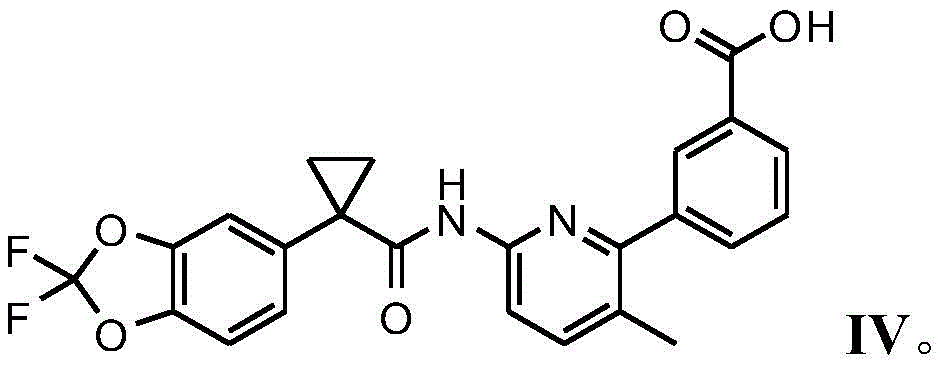
compound IV may be in the form of a pharmaceutically acceptable salt. Compound IV and methods of making and using compound IV are disclosed in WO 2007/056341, WO 2009/073757, and WO 2009/076142, which are incorporated herein by reference.
As used herein, "CFTR" refers to cystic fibrosis transmembrane conductance regulator.
As used herein, the terms "CFTR modulator" and "CFTR modulating compound" interchangeably refer to a compound that increases CFTR activity. Increased activity by modulators of CFTR includes, but is not limited to, compounds that correct, enhance, stabilize, and/or amplify CFTR.
As used herein, the term "CFTR corrector" refers to a compound that facilitates the processing and transport of CFTR to increase the amount of CFTR at the cell surface. Compounds I and II disclosed herein are CFTR correctors.
As used herein, the term "CFTR potentiator" refers to a compound that increases the channel activity of the CFTR protein at the surface of a cell, resulting in enhanced ion transport. Compounds III and III-d disclosed herein are CFTR potentiators. It will be understood that when a description of a combination of compound I with other specified CFTR modulators is provided herein, reference to "compound III or III-d" in connection with that combination means that compound III or compound III-d is included in that combination, and not both.
As used herein, the term "active pharmaceutical ingredient" or "therapeutic agent" ("API") refers to a biologically active compound.
As used herein, the term "pharmaceutically acceptable crystalline form" refers to a crystalline form of compound I of the present disclosure, wherein the crystalline form of compound I (e.g., crystalline free form, crystalline salt solvate, and crystalline salt hydrate) is non-toxic and suitable for use in a pharmaceutical composition.
The terms "patient" and "subject" are used interchangeably and refer to an animal including a human.
As used herein, the term "treating" or the like generally means ameliorating or reducing the severity of CF or one or more of its symptoms in a subject. As used herein, "treatment" includes, but is not limited to, the following: increased growth, increased weight gain, decreased lung mucus, improved pancreatic and/or liver function, reduced chest infections, and/or reduced coughing or shortness of breath in a subject. The amelioration of any of these symptoms, or lessening of their severity, can be readily assessed according to standard methods and techniques known in the art.
As used herein, the term "in combination with … …" when referring to two or more compounds, agents or additional pharmaceutically active ingredients means that the two or more compounds, agents or pharmaceutically active ingredients are administered to a patient before, simultaneously with, or after each other.
The terms "about" and "approximately" when used in conjunction with a dose, amount, or weight percentage of an ingredient of a composition or dosage form includes a value for the specified dose, amount, or weight percentage, or a range of such dose, amount, or weight percentage, that one of ordinary skill in the art would consider to provide a pharmacological effect equivalent to that obtained from the specified dose, amount, or weight percentage. The terms "about" and "approximately" can refer to an acceptable error for a particular value as determined by one of ordinary skill in the art, which will depend in part on how the value is measured or determined. In some embodiments, the terms "about" and "approximately" mean within 15%, 10%, 5%, 4%, 3%, 2%, 1%, or 0.5% of a given value or range.
As used herein, the term "amorphous" refers to a solid material that does not have long-range order in its molecular position. Amorphous solids are generally supercooled liquids in which the molecules are arranged in a random manner such that there is no well-defined arrangement (e.g., molecular packing) and no long-range order. Amorphous solids are generally isotropic, i.e. exhibit similar properties in all directions and do not have a defined melting point. For example, an amorphous material is a solid material that does not have sharp characteristic crystalline peaks in its X-ray powder diffraction (XRPD) pattern (i.e., is not crystalline as determined by XRPD). Instead, one or more broad peaks (e.g., halos) appear in its XRPD pattern. Broad peaks are characteristic of amorphous solids. See US2004/0006237 for a comparison of XRPD of amorphous and crystalline materials. In some embodiments, the solid material may comprise an amorphous compound, and the material may be characterized, for example, by the absence of sharp characteristic crystalline peaks in its XRPD spectrum (i.e., the material is not crystalline, but amorphous, as determined by XRPD). Alternatively, one or more broad peaks (e.g., halos) may appear in the material XRPD pattern. For a comparison of XRPD of amorphous and crystalline materials, see US 2004/0006237. A solid material comprising an amorphous compound may be characterized, for example, by a broader melting temperature range of the solid material compared to the melting range of a pure crystalline solid. Other techniques such as solid state NMR may also be used to characterize crystalline or amorphous forms.
As used herein, the terms "crystalline form," "crystalline form," and "form" interchangeably refer to a crystal structure (or polymorph) having a particular packing arrangement of molecules in a crystal lattice. The crystalline forms can be identified and distinguished from each other by one or more characterization techniques, including, for example, X-ray powder diffraction (XRPD), single crystal X-ray diffraction, and13c solid-state nuclear magnetic resonance (13C ssNMR). Thus, as used herein, the term "crystalline form of compound (I) [ X]"and" crystalline form of Compound (I) [ C]The potassium salt is TongluoBy one or more characterization techniques (including, for example, XRPD, single crystal X-ray diffraction and13c ssNMR) to identify and distinguish one distinct crystalline form from another. In some embodiments, the novel crystalline form is characterized by an X-ray powder diffraction pattern having one or more signals at one or more specified 2 Θ values (° 2 Θ).
As used herein, the term "free form" refers to the non-ionized form of a solid compound. Examples of free forms include the free base and the free acid.
As used herein, the term "solvate" refers to a crystalline form comprising: one or more molecules of the compounds of the present disclosure and one or more stoichiometric or non-stoichiometric amounts of one or more molecules of one or more solvents incorporated into the crystal lattice. When the solvent is water, the solvate is referred to as a "hydrate".
In some embodiments, the solid material may comprise a mixture of crystalline and amorphous solids. Solid materials comprising amorphous compounds may also, for example, contain up to 30% crystalline solids. In some embodiments, a solid material prepared to comprise an amorphous compound may also, for example, contain up to 25%, 20%, 15%, 10%, 5%, or 2% crystalline solids. In embodiments where the solid material contains a mixture of crystalline and amorphous solids, characterization data such as XRPD may contain indicators of both crystalline and amorphous solids. In some embodiments, the crystalline forms of the present disclosure may contain up to 30% amorphous compound. In some embodiments, a crystalline formulation of compound I may contain up to 25%, 20%, 15%, 10%, 5%, or 2% amorphous solids.
As used herein, the term "substantially amorphous" refers to a solid material having little or no long-range order in the position of its molecules. For example, a substantially amorphous material has a crystallinity of less than 15% (e.g., less than 10% crystallinity, less than 5% crystallinity, or less than 2% crystallinity). It should also be noted that the term "substantially amorphous" includes the descriptor "amorphous," which refers to a material that does not have (0%) crystallinity.
As used herein, the term "substantially crystalline" refers to a solid material having little or no amorphous molecules. For example, a substantially crystalline material has less than 15% amorphous molecules (e.g., less than 10% amorphous molecules, less than 5% amorphous molecules, or less than 2% amorphous molecules). It should also be noted that the term "substantially crystalline" includes the descriptor "crystalline," which refers to a material that is in 100% crystalline form.
As used herein, a crystalline form is "substantially pure" when it is equal to or greater than 90% by weight of the amount of the crystalline form that is the sum of all solid forms in the sample as determined by methods of the art (such as quantitative XRPD). In some embodiments, a solid form is "substantially pure" when it constitutes 95% or more by weight of the total amount of all solid forms in the sample. In some embodiments, a solid form is "substantially pure" when it constitutes equal to or greater than 99% by weight of the amount of the total of all solid forms in a sample.
As used herein, the term "XRPD" refers to the analytical characterization method of X-ray powder diffraction. XRPD patterns as disclosed herein were recorded using a diffractometer in either transmission or reflection geometry at ambient conditions.
As used herein, the term "ambient conditions" means room temperature, open air conditions, and uncontrolled humidity conditions. The terms "room temperature" and "ambient temperature" mean 15 ℃ to 30 ℃.
As used herein, the terms "X-ray powder diffraction pattern", "XRPD spectrum" interchangeably refer to an experimentally obtained pattern of plotted signal position (on the abscissa) versus signal intensity (on the ordinate). For amorphous materials, the X-ray powder diffraction pattern may include one or more broad signals; and for crystalline materials, the X-ray powder diffraction pattern can include one or more signals, each signal being identified by its angular value measured in degrees 2 ° (° 2 ·), plotted on the abscissa of the X-ray powder diffraction pattern, which can be expressed as "signal at … … ° 2 Θ", "signal at 2 Θ value of … …", and/or "signal at least … … 2 Θ values selected from … …".
As used herein, "signal" or "peak" refers to the point in an XRPD pattern where the intensity measured in counts is at a local maximum. One of ordinary skill in the art will recognize that one or more signals (or peaks) in an XRPD pattern may overlap and may be, for example, not apparent to the naked eye. Indeed, one of ordinary skill in the art will recognize that some industry recognized methods are capable of and suitable for determining whether a signal is present in a pattern, such as Rietveld refinement.
As used herein, "signal at … … ° 2 θ" refers to the X-ray reflection position (° 2 θ) as measured and observed in an X-ray powder diffraction experiment.
The repeatability of the measured angle values is within ± 0.2 ° 2 · range, i.e. the angle values can be at the enumerated angle values +0.2 ° 2 θ, angle values-0.2 ° 2 θ, or at any value between the two end points (angle value +0.2 ° 2 θ and angle value-0.2 ° 2 θ).
The terms "signal intensity" and "peak intensity" refer interchangeably to the relative signal intensity within a given X-ray powder diffraction pattern. Factors that may affect the relative signal or peak intensity include sample thickness and preferred orientation (e.g., the crystalline particles are not randomly distributed).
As used herein, an X-ray powder diffraction pattern is "substantially similar" to that in the [ particular ] diagram when at least 90% (such as at least 95%, at least 98%, or at least 99%) of the signals in the two diffraction patterns overlap. In determining "substantial similarity," one of ordinary skill in the art will appreciate that there may be variations in intensity and/or signal position in the XRPD diffraction pattern even for the same crystalline form. Thus, those of ordinary skill in the art will appreciate that the signal maximum (in ° 2 θ) in an XRPD diffractogram typically means that the value is identified as the reported value ± 0.2 ° 2 θ, which is an art-recognized variance.
As used herein, when at least 90% (such as at least 95%, at least 98%, or at least 99%) of the signals in the two spectra overlap,13c solid State Nuclear magnetic resonance (ssNMR) Spectroscopy "substantially corresponding to [ ]]Similar in the figure. In determining "substantial similarity", one of ordinary skill in the art would understandHowever, there may be variations in intensity and/or signal position in the ssNMR spectrum even for the same crystalline form. Thus, one of ordinary skill in the art will appreciate that chemical shifts in the ssNMR spectrum (in parts per million (ppm) as referred to herein) generally means that the value is identified as the reported value ± 0.2ppm, which is an art-recognized variance.
The term "X-ray powder diffraction pattern having a signal at a value of … … 2 θ" as used herein refers to an XRPD pattern containing X-ray reflection positions (° 2 θ) as measured and observed in an X-ray powder diffraction experiment.
As used herein, the term "DSC" refers to the analytical method of differential scanning calorimetry.
As used herein, the term "solvent" refers to any liquid that can at least partially dissolve the product (product solubility >1 g/l).
As used herein, the term "dispersion" refers to a dispersion system in which one substance (i.e., the dispersed phase) is distributed as discrete units throughout a second substance (the continuous phase or vehicle). The size of the dispersed phase can vary significantly (e.g., colloidal particles ranging in size from nanometers to several microns). Generally, the dispersed phase may be a solid, liquid or gas. In the case of solid dispersions, both the dispersed and continuous phases are solid. In pharmaceutical applications, the solid dispersion may comprise a crystalline drug (dispersed phase) in an amorphous polymer (continuous phase); or alternatively, amorphous drug (dispersed phase) in an amorphous polymer (continuous phase). In some embodiments, the solid dispersion comprises a polymer that constitutes the dispersed phase and a drug that constitutes the continuous phase. Alternatively, the solid dispersion comprises the drug constituting the dispersed phase and the polymer constituting the continuous phase.
It should be noted that the amount of compound I disclosed is based on its Ca salt. One of ordinary skill in the art will recognize that when an amount of compound I is disclosed, it also refers to an amount of compound I in crystalline form that is equivalent or bioequivalent to the concentration of the Ca salt of compound I. For example, "100 mg of compound I" should also be interpreted to refer not only to 100mg of compound I (free form), but also to an amount equivalent or bioequivalent to 100mg of compound I Ca salt of any of the pharmaceutically acceptable crystalline forms disclosed herein.
Crystalline form A of Compound I (free form)
In some embodiments, the present invention provides crystalline compound I (free form) form a. Figure 1 provides an X-ray powder diffraction pattern of crystalline compound I (free form) form a at room temperature.
In some embodiments, compound I (free form) is substantially pure crystalline form a. In some embodiments, compound I (free form) is substantially crystalline form a. In some embodiments, crystalline compound I (free form) form a is characterized by an X-ray powder diffraction pattern generated by X-ray powder diffraction analysis with an incident beam of Cu ka radiation.
In some embodiments, crystalline compound I (free form) form a is characterized by an X-ray powder diffraction pattern having a signal at 9.2 ± 0.2 ° 2 Θ. In some embodiments, crystalline compound I (free form) form a is characterized by an X-ray powder diffraction pattern having a signal at 11.3 ± 0.2 ° 2 Θ. In some embodiments, crystalline compound I (free form) form a is characterized by an X-ray powder diffraction pattern having a signal at 14.0 ± 0.2 ° 2 Θ. In some embodiments, crystalline compound I (free form) form a is characterized by an X-ray powder diffraction pattern having a signal at 22.9 ± 0.2 ° 2 Θ. In some embodiments, crystalline compound I (free form) form a is characterized by an X-ray powder diffraction pattern having at least one signal selected from the group consisting of: 9.2 + -0.2 deg. 2 theta, 11.3 + -0.2 deg. 2 theta, 14.0 + -0.2 deg. 2 theta and 22.9 + -0.2 deg. 2 theta. In some embodiments, crystalline compound I (free form) form a is characterized by an X-ray powder diffraction pattern having at least two signals selected from: 9.2 + -0.2 deg. 2 theta, 11.3 + -0.2 deg. 2 theta, 14.0 + -0.2 deg. 2 theta and 22.9 + -0.2 deg. 2 theta. In some embodiments, crystalline compound I (free form) form a is characterized by an X-ray powder diffraction pattern having at least three signals selected from: 9.2 + -0.2 deg. 2 theta, 11.3 + -0.2 deg. 2 theta, 14.0 + -0.2 deg. 2 theta and 22.9 + -0.2 deg. 2 theta. In some embodiments, crystalline compound I (free form) form a is characterized by an X-ray powder diffraction pattern having signals at: 9.2 + -0.2 deg. 2 theta, 11.3 + -0.2 deg. 2 theta, 14.0 + -0.2 deg. 2 theta and 22.9 + -0.2 deg. 2 theta.
In some embodiments, crystalline compound I (free form) form a is characterized by an X-ray powder diffraction pattern having: (a) signals at 9.2 ± 0.2 ° 2 θ, 11.3 ± 0.2 ° 2 θ, 14.0 ± 0.2 ° 2 θ, and/or 22.9 ± 0.2 ° 2 θ (i.e., one or more signals from this group); and (b) one, two, three or four signals selected from 20.0 + -0.2 deg. 2 theta, 23.1 + -0.2 deg. 2 theta, 16.6 + -0.2 deg. 2 theta and 23.3 + -0.2 deg. 2 theta.
In some embodiments, crystalline compound I (free form) form a is characterized by an X-ray powder diffraction pattern having: (a) signal at 9.2 ± 0.2 ° 2 θ; (b) a signal at 16.6 ± 0.2 ° 2 Θ; and (c) a signal at 20.0 ± 0.2 ° 2 θ. In some embodiments, crystalline compound I (free form) form a is characterized by an X-ray powder diffraction pattern having: (a) signals at 9.2 ± 0.2 ° 2 θ, 16.6 ± 0.2 ° 2 θ and 20.0 ± 0.2 ° 2 θ; and (b) signals at 11.3 ± 0.2 ° 2 θ, 14.0 ± 0.2 ° 2 θ, and/or 22.9 ± 0.2 ° 2 θ.
In some embodiments, crystalline compound I (free form) form a is characterized by an X-ray powder diffraction pattern having: (a) signals at 9.2 ± 0.2 ° 2 θ, 16.6 ± 0.2 ° 2 θ and 20.0 ± 0.2 ° 2 θ; and (b) one, two, three, four, five or more signals selected from 11.3 ± 0.2 ° 2 θ, 14.0 ± 0.2 ° 2 θ, 18.1 ± 0.2 ° 2 θ, 22.9 ± 0.2 ° 2 θ, 23.1 ± 0.2 ° 2 θ, and 23.3 ± 0.2 ° 2 θ. In some embodiments, crystalline compound I (free form) form a is characterized by an X-ray powder diffraction pattern having signals at: 9.2 + -0.2 deg. 2 theta, 16.6 + -0.2 deg. 2 theta, 20.0 + -0.2 deg. 2 theta, 11.3 + -0.2 deg. 2 theta, 14.0 + -0.2 deg. 2 theta, 18.1 + -0.2 deg. 2 theta, 22.9 + -0.2 deg. 2 theta, 23.1 + -0.2 deg. 2 theta and 23.3 + -0.2 deg. 2 theta.
In some embodiments, crystalline compound I (free form) form a is characterized by an X-ray powder diffraction pattern substantially similar to figure 1.
In some embodiments, crystalline compound I (free form) form a is characterized byHaving peaks containing one, two, three, four, five, six, seven or more peaks selected from13C solid-state nuclear magnetic resonance (13C ssNMR) spectrum: 163.2. + -. 0.2ppm, 130.2. + -. 0.2ppm, 104.6. + -. 0.2ppm, 103.9. + -. 0.2ppm, 58.3. + -. 0.2ppm, 49.7. + -. 0.2ppm, 43.3. + -. 0.2ppm and 37.0. + -. 0.2 ppm. In some embodiments, crystalline compound I (free form) form a is characterized as having peaks containing everywhere below13C ssNMR spectrum: 163.2. + -. 0.2ppm, 130.2. + -. 0.2ppm, 104.6. + -. 0.2ppm, 103.9. + -. 0.2ppm, 58.3. + -. 0.2ppm, 49.7. + -. 0.2ppm, 43.3. + -. 0.2ppm and 37.0. + -. 0.2 ppm.
In some embodiments, crystalline compound I (free form) form a is characterized by being substantially similar to figure 213C ssNMR spectrum.
In some embodiments, crystalline compound I (free form) form a is characterized by monoclinic system, P21Space group and in the device of Mo KαRadiation of radiation And (charge coupled device) the following unit cell dimensions measured on a Bruker diffractometer of a CCD detector at 298K:

Other aspects of the invention provide methods of preparing crystalline compound I (free form) form a comprising crystallizing amorphous compound I in toluene and vacuum drying to provide compound I (free form) crystalline form a.
Crystalline form B of Compound I (free form)
In some embodiments, the present invention provides crystalline compound I (free form) form B. Figure 3 provides an X-ray powder diffraction pattern of crystalline compound I (free form) form B at room temperature.
In some embodiments, compound I (free form) is substantially pure crystalline form B. In some embodiments, compound I (free form) is substantially crystalline form B. In some embodiments, crystalline compound I (free form) form B is characterized by an X-ray powder diffraction pattern generated by X-ray powder diffraction analysis with an incident beam of Cu ka radiation.
In some embodiments, crystalline compound I (free form) form B is characterized by an X-ray powder diffraction pattern having a signal at 16.3 ± 0.2 ° 2 Θ. In some embodiments, crystalline compound I (free form) form B is characterized by an X-ray powder diffraction pattern having a signal at 17.7 ± 0.2 ° 2 Θ. In some embodiments, crystalline compound I (free form) form B is characterized by an X-ray powder diffraction pattern having signals at 16.3 ± 0.2 ° 2 Θ and 17.7 ± 0.2 ° 2 Θ. In some embodiments, crystalline compound I (free form) form B is characterized by an X-ray powder diffraction pattern having signals at 5.5 ± 0.2 ° 2 Θ, 16.3 ± 0.2 ° 2 Θ, and 17.7 ± 0.2 ° 2 Θ.
In some embodiments, crystalline compound I (free form) form B is characterized by an X-ray powder diffraction pattern having: (a) signals at 5.5 ± 0.2 ° 2 θ, 16.3 ± 0.2 ° 2 θ and 17.7 ± 0.2 ° 2 θ; and (b) one or more peaks selected from 10.8 ± 0.2 ° 2 θ, 28.3 ± 0.2 ° 2 θ, and 25.9 ± 0.2 ° 2 θ. In some embodiments, crystalline compound I (free form) form B is characterized by an X-ray powder diffraction pattern having: (a) signals at 5.5 ± 0.2 ° 2 θ, signals at 16.3 ± 0.2 ° 2 θ, and signals at 17.7 ± 0.2 ° 2 θ; and (b) two or more peaks selected from 10.8 ± 0.2 ° 2 θ, 28.3 ± 0.2 ° 2 θ, and 25.9 ± 0.2 ° 2 θ. In some embodiments, crystalline compound I (free form) form B is characterized by an X-ray powder diffraction pattern having signals at: 5.5 + -0.2 deg. 2 theta, 16.3 + -0.2 deg. 2 theta, 17.7 + -0.2 deg. 2 theta, 10.8 + -0.2 deg. 2 theta, 28.3 + -0.2 deg. 2 theta and 25.9 + -0.2 deg. 2 theta.
In some embodiments, crystalline compound I (free form) form B is characterized by an X-ray powder diffraction pattern substantially similar to figure 3.
In some embodiments, crystalline compound I (free form) form B is characterized by having a peak having one or more peaks selected from 13C ssNMR spectrum: 142.8 +/-0.2 ppm, 97.8 +/-0.2 ppm, 18.1 +/-0.2 ppm and 2.3 +/-0.2 ppm. In some embodiments, crystalline compound I (free form) form B is characterized as having a crystalline structure comprising13C ssNMR spectrum: (a) two or more peaks selected from 142.8 ± 0.2ppm, 97.8 ± 0.2ppm, 18.1 ± 0.2ppm, and 2.3 ± 0.2 ppm; and (b) one, two, three, four, five or six peaks selected from 166.3 + -0.2 ppm, 137.2 + -0.2 ppm, 108.1 + -0.2 ppm, 37.6 + -0.2 ppm, 25.3 + -0.2 ppm and 20.1 + -0.2 ppm. In some embodiments, crystalline compound I (free form) form B is characterized as having peaks selected from13C ssNMR spectrum: 166.3 + -0.2 ppm, 142.8 + -0.2 ppm, 137.2 + -0.2 ppm, 108.1 + -0.2 ppm, 97.8 + -0.2 ppm, 37.6 + -0.2 ppm, 25.3 + -0.2 ppm, 20.1 + -0.2 ppm, 18.1 + -0.2 ppm and 2.3 + -0.2 ppm.
In some embodiments, crystalline compound I (free form) form B is characterized by being substantially similar to figure 413C ssNMR spectrum.
Another aspect of the invention provides a process for preparing crystalline compound I (free form) form B, which comprises stirring compound I calcium salt hydrate form D in fed state simulated intestinal fluid, centrifuging the resulting slurry, removing the fluid and air drying the solids to provide compound I (free form) crystalline form B.
Crystalline form C of Compound I (free form)
In some embodiments, the present invention provides crystalline compound I (free form) form C. Figure 5 provides an X-ray powder diffraction pattern of crystalline compound I (free form) form C at room temperature.
In some embodiments, compound I (free form) is substantially pure crystalline form C. In some embodiments, compound I (free form) is substantially crystalline form C. In some embodiments, crystalline compound I (free form) form C is characterized by an X-ray powder diffraction pattern generated by X-ray powder diffraction analysis with an incident beam of Cu ka radiation.
In some embodiments, crystalline compound I (free form) form C is characterized by an X-ray powder diffraction pattern having a signal at 6.3 ± 0.2 ° 2 Θ. In some embodiments, crystalline compound I (free form) form C is characterized by an X-ray powder diffraction pattern having signals at 6.3 ± 0.2 ° 2 Θ, 14.8 ± 0.2 ° 2 Θ, and 20.4 ± 0.2 ° 2 Θ.
In some embodiments, crystalline compound I (free form) form C is characterized by an X-ray powder diffraction pattern having: (a) signals at 6.3 ± 0.2 ° 2 θ, 14.8 ± 0.2 ° 2 θ and 20.4 ± 0.2 ° 2 θ; and (b) one or more signals selected from the group consisting of 15.5 + -0.2 deg. 2 theta, 18.5 + -0.2 deg. 2 theta, 19.2 + -0.2 deg. 2 theta, 20.1 + -0.2 deg. 2 theta, 23.8 + -0.2 deg. 2 theta, and 26.4 + -0.2 deg. 2 theta. In some embodiments, crystalline compound I (free form) form C is characterized by an X-ray powder diffraction pattern having: (a) signals at 6.3 ± 0.2 ° 2 θ, 14.8 ± 0.2 ° 2 θ and 20.4 ± 0.2 ° 2 θ; and (b) two, three, four, five or six signals selected from 15.5 + -0.2 deg. 2 theta, 18.5 + -0.2 deg. 2 theta, 19.2 + -0.2 deg. 2 theta, 20.1 + -0.2 deg. 2 theta, 23.8 + -0.2 deg. 2 theta and 26.4 + -0.2 deg. 2 theta. In some embodiments, crystalline compound I (free form) form C is characterized by an X-ray powder diffraction pattern having signals at: 6.3 + -0.2 deg. 2 theta, 14.8 + -0.2 deg. 2 theta, 15.5 + -0.2 deg. 2 theta, 18.5 + -0.2 deg. 2 theta, 19.2 + -0.2 deg. 2 theta, 20.1 + -0.2 deg. 2 theta, 20.4 + -0.2 deg. 2 theta, 23.8 + -0.2 deg. 2 theta and 26.4 + -0.2 deg. 2 theta.
In some embodiments, crystalline compound I (free form) form C is characterized by an X-ray powder diffraction pattern substantially similar to figure 5.
Another aspect of the present invention provides a process for preparing compound I (free form) crystalline form C comprising dissolving compound I (free form) form a in Isopropanol (IPA)/H at 25 ℃2Stirring in O to provide compound I (free form) in crystalline form C.
Crystalline form D of Compound I (free form)
In some embodiments, the present invention provides crystalline compound I (free form) form D. Figure 47 provides an X-ray powder diffraction pattern of crystalline compound I (free form) form D at room temperature.
In some embodiments, compound I (free form) is substantially pure crystalline form D. In some embodiments, compound I (free form) is substantially crystalline form D. In some embodiments, crystalline compound I (free form) form D is characterized by an X-ray powder diffraction pattern generated by X-ray powder diffraction analysis with an incident beam of Cu ka radiation.
In some embodiments, crystalline compound I (free form) form D is characterized by an X-ray powder diffraction pattern having a signal at 3.7 ± 0.2 ° 2 Θ. In some embodiments, crystalline compound I (free form) form D is characterized by an X-ray powder diffraction pattern having a signal at 7.4 ± 0.2 ° 2 Θ. In some embodiments, crystalline compound I (free form) form D is characterized by an X-ray powder diffraction pattern having a signal at 12.2 ± 0.2 ° 2 Θ. In some embodiments, crystalline compound I (free form) form D is characterized by an X-ray powder diffraction pattern having signals at 3.7 ± 0.2 ° 2 Θ, 7.4 ± 0.2 ° 2 Θ, and 12.2 ± 0.2 ° 2 Θ. In some embodiments, crystalline compound I (free form) form D is characterized by an X-ray powder diffraction pattern having signals at 3.7 ± 0.2 ° 2 Θ, 7.4 ± 0.2 ° 2 Θ, and 17.3 ± 0.2 ° 2 Θ. In some embodiments, crystalline compound I (free form) form D is characterized by an X-ray powder diffraction pattern having signals at 3.7 ± 0.2 ° 2 Θ, 7.4 ± 0.2 ° 2 Θ, 12.2 ± 0.2 ° 2 Θ, and 17.3 ± 0.2 ° 2 Θ.
In some embodiments, crystalline compound I (free form) form D is characterized by an X-ray powder diffraction pattern having: (a) signals at 3.7 ± 0.2 ° 2 θ, 7.4 ± 0.2 ° 2 θ, and/or 12.2 ± 0.2 ° 2 θ (i.e., from any one, any two, or all three of this group) and (b) signals at 7.3 ± 0.2 ° 2 θ, 17.3 ± 0.2 ° 2 θ, and/or 10.4 ± 0.2 ° 2 θ. In some embodiments, crystalline compound I (free form) form D is characterized by an X-ray powder diffraction pattern having: (a) signals at 3.7 ± 0.2 ° 2 θ, 7.4 ± 0.2 ° 2 θ, and/or 12.2 ± 0.2 ° 2 θ and (b) signals at 17.3 ± 0.2 ° 2 θ and/or 10.4 ± 0.2 ° 2 θ. In some embodiments, crystalline compound I (free form) form D is characterized by an X-ray powder diffraction pattern having signals at: 3.7 + -0.2 deg. 2 theta, 7.4 + -0.2 deg. 2 theta, 12.2 + -0.2 deg. 2 theta, 17.3 + -0.2 deg. 2 theta, and 10.4 + -0.2 deg. 2 theta.
In some embodiments, crystalline compound I (free form) form D is characterized by an X-ray powder diffraction pattern substantially similar to figure 47.
In some embodiments, crystalline compound I (free form) form D is characterized by having a peak having two or more peaks selected from 13C ssNMR spectrum: 164.6 + -0.2 ppm, 149.6 + -0.2 ppm, 135.7 + -0.2 ppm, 38.9 + -0.2 ppm, 27.6 + -0.2 ppm and 15.7 + -0.2 ppm. In some embodiments, crystalline compound I (free form) form D is characterized as having a peak having three or more peaks selected from13C ssNMR spectrum: 164.6 + -0.2 ppm, 149.6 + -0.2 ppm, 135.7 + -0.2 ppm, 113.6 + -0.2 ppm, 38.9 + -0.2 ppm, 27.6 + -0.2 ppm and 15.7 + -0.2 ppm. In some embodiments, crystalline compound I (free form) form D is characterized as having a peak having four or more peaks selected from13C ssNMR spectrum: 164.6 + -0.2 ppm, 149.6 + -0.2 ppm, 135.7 + -0.2 ppm, 113.6 + -0.2 ppm, 38.9 + -0.2 ppm, 27.6 + -0.2 ppm and 15.7 + -0.2 ppm. In some embodiments, crystalline compound I (free form) form D is characterized as having peaks containing five, six, seven, or eight peaks selected from13Csnmr spectrum: 164.6 + -0.2 ppm, 149.6 + -0.2 ppm, 135.7 + -0.2 ppm, 113.6 + -0.2 ppm, 38.9 + -0.2 ppm, 27.6 + -0.2 ppm and 15.7 + -0.2 ppm.
In some embodiments, crystalline compound I (free form) form D is characterized by being substantially similar to figure 4813C ssNMR spectrum.
Another aspect of the invention provides a process for preparing crystalline compound I (free form) form D comprising adding propanol to compound I (free form), concentrating the mixture under reduced pressure and repeating the procedure using toluene.
Compound I calcium salt hydrate form A
In some embodiments, the present invention provides crystalline compound I calcium salt hydrate form a. Figure 6 provides an X-ray powder diffraction pattern of compound I calcium salt hydrate form a at room temperature.
In some embodiments, compound I calcium salt hydrate form a is substantially pure crystalline. In some embodiments, compound I calcium salt hydrate is substantially crystalline form a. In some embodiments, compound I calcium salt hydrate form a is characterized by an X-ray powder diffraction pattern generated by X-ray powder diffraction analysis of an incident beam irradiated with Cu ka radiation.
In some embodiments, compound I calcium salt hydrate form a is characterized by an X-ray powder diffraction pattern having signals at: 4.2 + -0.2 deg. 2 theta, 18.0 + -0.2 deg. 2 theta and 19.7 + -0.2 deg. 2 theta. In some embodiments, compound I calcium salt hydrate form a is characterized by an X-ray powder diffraction pattern having: (a) signals at 4.2 ± 0.2 ° 2 θ, 18.0 ± 0.2 ° 2 θ and 19.7 ± 0.2 ° 2 θ; and (b) signals at 10.5 ± 0.2 ° 2 θ and/or 10.6 ± 0.2 ° 2 θ.
In some embodiments, compound I calcium salt hydrate form a is characterized by an X-ray powder diffraction pattern substantially similar to figure 6.
In some embodiments, compound I calcium salt hydrate form a is characterized as having a peak containing at 17.0 ± 0.2ppm or 7.8 ± 0.2ppm13C ssNMR spectrum. In some embodiments, compound I calcium salt hydrate form a is characterized as having peaks at 17.0 ± 0.2ppm and 7.8 ± 0.2ppm13C ssNMR spectrum. In some embodiments, compound I calcium salt hydrate form a is characterized as having a structure comprising13C ssNMR spectrum: (a) a peak at one or both of 17.0 ± 0.2ppm and 7.8 ± 0.2ppm, and (b) one or more peaks selected from 178.3 ± 0.2ppm, 136.8 ± 0.2ppm, 93.6 ± 0.2ppm, and 26.4 ± 0.2 ppm.
In some embodiments, compound I calcium salt hydrate form a is characterized as having a composition comprising13C ssNMR spectrum: (a) a peak at one or both of 17.0 ± 0.2ppm and 7.8 ± 0.2ppm, and (b) two or more peaks selected from 178.3 ± 0.2ppm, 136.8 ± 0.2ppm, 93.6 ± 0.2ppm, and 26.4 ± 0.2 ppm. In some embodiments, compound I calcium salt hydrate form a is characterized as having a composition comprising13C ssNMR spectrum: (a) a peak at one or both of 17.0 ± 0.2ppm and 7.8 ± 0.2ppm, and (b) three or more peaks selected from 178.3 ± 0.2ppm, 136.8 ± 0.2ppm, 93.6 ± 0.2ppm, and 26.4 ± 0.2 ppm. In some embodiments, compound I calcium salt hydrate form a is characterized as having peaks, including at 13C ssNMR spectrum: 178.3 + -0.2 ppm, 136.8 + -0.2 ppm, 93.6 + -0.2 ppm, 26.4 + -0.2 ppm, 17.0 + -0.2 ppm and 7.8 + -0.2 ppm.
In some embodiments, compound I calcium salt hydrate form a is characterized by being substantially similar to figure 713C ssNMR spectrum.
In some embodiments, compound I calcium salt hydrate form a is characterized by monoclinic system, C2 space group and is equipped with Cu KαRadiation of radiation And the following unit cell dimensions measured on a Bruker diffractometer on a CCD detector at 100K:


in some embodiments, compound I calcium salt hydrate form a is characterized by monoclinic system, C2 space group and is equipped with Cu KαRadiation of radiation And the following unit cell dimensions measured on a Bruker diffractometer on a CCD detector at 298K:

another aspect of the invention provides a process for preparing Compound I, calcium salt hydrate form A, which comprisesComprising adding to Compound I (free form) form A and Ca (OMe) at 70 ℃2Charging IPA/H2O to provide compound I calcium salt hydrate form a.
Compound I calcium salt hydrate form B
In some embodiments, the present invention provides crystalline compound I calcium salt hydrate form B. Figure 8 provides an X-ray powder diffraction pattern of compound I calcium salt hydrate form B at room temperature.
In some embodiments, compound I calcium salt hydrate form B is substantially pure crystalline. In some embodiments, compound I calcium salt hydrate is substantially crystalline form B. In some embodiments, compound I calcium salt hydrate form B is characterized by an X-ray powder diffraction pattern generated by X-ray powder diffraction analysis with an incident beam of Cu ka radiation.
In some embodiments, compound I calcium salt hydrate form B is characterized by an X-ray powder diffraction pattern having signals at: 13.1 + -0.2 deg. 2 theta, 14.6 + -0.2 deg. 2 theta and 17.7 + -0.2 deg. 2 theta. In some embodiments, compound I calcium salt hydrate form B is characterized by an X-ray powder diffraction pattern having signals at: 12.2 + -0.2 deg. 2 theta, 13.1 + -0.2 deg. 2 theta, 14.6 + -0.2 deg. 2 theta and 17.7 + -0.2 deg. 2 theta. In some embodiments, compound I calcium salt hydrate form B is characterized by an X-ray powder diffraction pattern having the following: (a) signals at 12.2 ± 0.2 ° 2 θ, 13.1 ± 0.2 ° 2 θ, 14.6 ± 0.2 ° 2 θ, and 17.7 ± 0.2 ° 2 θ; and (b) one or more signals selected from the group consisting of 16.2 ± 0.2 ° 2 θ, 20.4 ± 0.2 ° 2 θ, and 21.3 ± 0.2 ° 2 θ.
In some embodiments, compound I calcium salt hydrate form B is characterized by an X-ray powder diffraction pattern having: (a) signals at 12.2 ± 0.2 ° 2 θ, 13.1 ± 0.2 ° 2 θ, 14.6 ± 0.2 ° 2 θ, and 17.7 ± 0.2 ° 2 θ; and (b) one, two, three or four signals selected from 16.2 + -0.2 deg. 2 theta, 18.1 + -0.2 deg. 2 theta, 20.4 + -0.2 deg. 2 theta and 21.3 + -0.2 deg. 2 theta. In some embodiments, compound I calcium salt hydrate form B is characterized by an X-ray powder diffraction pattern having signals at: 12.2 + -0.2 deg. 2 theta, 14.6 + -0.2 deg. 2 theta, 16.2 + -0.2 deg. 2 theta, 17.7 + -0.2 deg. 2 theta, 18.1 + -0.2 deg. 2 theta, 20.4 + -0.2 deg. 2 theta and 21.3 + -0.2 deg. 2 theta.
In some embodiments, compound I calcium salt hydrate form B is characterized by an X-ray powder diffraction pattern substantially similar to figure 8.
In some embodiments, compound I calcium salt hydrate form B is characterized as having peaks at 119.6 ± 0.2ppm and/or 48.7 ± 0.2ppm13C solid-state nuclear magnetic resonance (C)13C ssNMR) spectrum. In some embodiments, compound I calcium salt hydrate form B is characterized as having a salt form B having a structure comprising13C solid-state nuclear magnetic resonance (13C ssNMR) spectrum: (a) a peak at 119.6 ± 0.2ppm and/or 48.7 ± 0.2 ppm; and (b) one or more peaks selected from 164.7 + -0.2 ppm, 148.9 + -0.2 ppm, 114.3 + -0.2 ppm, 97.7 + -0.2 ppm, and 25.9 + -0.2 ppm. In some embodiments, compound I calcium salt hydrate form B is characterized as having a composition comprising13C solid-state nuclear magnetic resonance (13C ssNMR) spectrum: (a) a peak at 119.6 ± 0.2ppm and/or 48.7 ± 0.2 ppm; and (b) two or more peaks selected from 164.7 + -0.2 ppm, 148.9 + -0.2 ppm, 114.3 + -0.2 ppm, 97.7 + -0.2 ppm, and 25.9 + -0.2 ppm. In some embodiments, compound I calcium salt hydrate form B is characterized as having a composition comprising13C solid-state nuclear magnetic resonance (13C ssNMR) spectrum: (a) a peak at 119.6 ± 0.2ppm and/or 48.7 ± 0.2 ppm; and (b) three or more peaks selected from 164.7 + -0.2 ppm, 148.9 + -0.2 ppm, 114.3 + -0.2 ppm, 97.7 + -0.2 ppm, and 25.9 + -0.2 ppm. In some embodiments, compound I calcium salt hydrate form B is characterized as having peaks, including at 13C solid-state nuclear magnetic resonance (13C ssNMR) spectrum: 119.6 + -0.2 ppm, 48.7 + -0.2 ppm, 164.7 + -0.2 ppm, 148.9 + -0.2 ppm, 114.3 + -0.2 ppm, 97.7 + -0.2 ppm and 25.9 + -0.2 ppm. In some embodiments, compound I calcium salt hydrate form B is characterized as having a composition comprising13C solid-state nuclear magnetic resonance (13C ssNMR) spectrum: (a) one or more peaks selected from the group consisting of 175.8 + -0.2 ppm, 119.6 + -0.2 ppm, 48.7 + -0.2 ppm, 24.4 + -0.2 ppm, and 22.5 + -0.2 ppm, and (b) at 164.7 + -0.2 ppm, 148.9 + -0.2 ppm, 114.3 + -0.2 ppm, 97.7 + -0.2 ppm, and 25.Peak at 9. + -. 0.2 ppm.
In some embodiments, compound I calcium salt hydrate form B is characterized by being substantially similar to figure 913C ssNMR spectrum.
In some embodiments, the isomorphic solvates, solvates/hydrates, and hydrates share the same XRPD pattern as compound I calcium salt hydrate form B. The solvent may be MeOH, EtOH, IPA, and/or water.
In some embodiments, compound I calcium salt hydrate/MeOH solvate form B is characterized as having peaks at 32.9 ± 0.2ppm and/or 23.3 ± 0.2ppm13C ssNMR spectrum. In some embodiments, compound I calcium salt hydrate/MeOH solvate form B is characterized as having a structure comprising 13C ssNMR spectrum: (a) peaks at 32.9 ± 0.2ppm and/or 23.3 ± 0.2 ppm; and (b) one or more peaks selected from 176.1 + -0.2 ppm, 164.7 + -0.2 ppm, 148.9 + -0.2 ppm, 49.3 + -0.2 ppm, and 25.9 + -0.2 ppm. In some embodiments, compound I calcium salt hydrate/MeOH solvate form B is characterized as having a structure comprising13C ssNMR spectrum: (a) peaks at 32.9 + -0.2 ppm and 23.3 + -0.2 ppm; and (b) one or more peaks selected from 176.1 + -0.2 ppm, 164.7 + -0.2 ppm, 148.9 + -0.2 ppm, 49.3 + -0.2 ppm, and 25.9 + -0.2 ppm. In some embodiments, compound I calcium salt hydrate/MeOH solvate form B is characterized as having peaks everywhere below13C ssNMR spectrum: 32.9 + -0.2 ppm, 23.3 + -0.2 ppm, 176.1 + -0.2 ppm, 164.7 + -0.2 ppm, 148.9 + -0.2 ppm, 49.3 + -0.2 ppm and 25.9 + -0.2 ppm.
In some embodiments, compound I calcium salt hydrate/MeOH solvate form B is characterized as substantially similar to figure 1013C ssNMR spectrum.
In some embodiments, compound I calcium salt hydrate/MeOH solvate form B is characterized by a monoclinic system, P21Space group and Cu K-equippedαRadiation of radiation And the following unit cell measured at 100K on a Bruker diffractometer of a CCD detector Size:

another aspect of the invention provides a process for preparing compound I calcium salt hydrate form B, comprising slurrying compound I calcium salt in EtOH/water. In some embodiments, the present invention provides a method of preparing compound I calcium salt hydrate/MeOH solvate form B comprising adding MeOH to compound I calcium salt hydrate form B.
Compound I calcium salt hydrate form C
In some embodiments, the present invention provides crystalline compound I calcium salt hydrate form C. Figure 11 provides an X-ray powder diffraction pattern of compound I calcium salt hydrate form C at room temperature.
In some embodiments, compound I calcium salt hydrate form C is substantially pure crystalline. In some embodiments, compound I calcium salt hydrate is substantially crystalline form C. In some embodiments, compound I calcium salt hydrate form C is characterized by an X-ray powder diffraction pattern generated by X-ray powder diffraction analysis of an incident beam irradiated with Cu ka radiation.
In some embodiments, compound I calcium salt hydrate form C is characterized by an X-ray powder diffraction pattern having signals at: 10.3 + -0.2 deg. 2 theta, 15.8 + -0.2 deg. 2 theta and 20.8 + -0.2 deg. 2 theta. In some embodiments, compound I calcium salt hydrate form C is characterized by an X-ray powder diffraction pattern having signals at: 4.0 + -0.2 deg. 2 theta, 10.3 + -0.2 deg. 2 theta, 15.8 + -0.2 deg. 2 theta and 20.8 + -0.2 deg. 2 theta. In some embodiments, compound I calcium salt hydrate form C is characterized by an X-ray powder diffraction pattern having: (a) signals at 4.0 ± 0.2 ° 2 θ, 10.3 ± 0.2 ° 2 θ, 15.8 ± 0.2 ° 2 θ and 20.8 ± 0.2 ° 2 θ; and (b) one or more signals selected from 13.3 ± 0.2 ° 2 θ, 14.3 ± 0.2 ° 2 θ, and 19.0 ± 0.2 ° 2 θ. In some embodiments, compound I calcium salt hydrate form C is characterized by an X-ray powder diffraction pattern having: (a) signals at 4.0 ± 0.2 ° 2 θ, 10.3 ± 0.2 ° 2 θ, 15.8 ± 0.2 ° 2 θ and 20.8 ± 0.2 ° 2 θ; and (b) two or more signals selected from 13.3 ± 0.2 ° 2 θ, 14.3 ± 0.2 ° 2 θ, and 19.0 ± 0.2 ° 2 θ. In some embodiments, compound I calcium salt hydrate form C is characterized by an X-ray powder diffraction pattern having signals at: 4.0 + -0.2 deg. 2 theta, 10.3 + -0.2 deg. 2 theta, 13.3 + -0.2 deg. 2 theta, 14.3 + -0.2 deg. 2 theta, 15.8 + -0.2 deg. 2 theta, 19.0 + -0.2 deg. 2 theta, and 20.8 + -0.2 deg. 2 theta.
In some embodiments, compound I calcium salt hydrate form C is characterized by an X-ray powder diffraction pattern substantially similar to figure 11.
In some embodiments, compound I calcium salt hydrate form C is characterized as having one or more peaks selected from13C ssNMR spectrum: 115.7 + -0.2 ppm, 65.9 + -0.2 ppm, 52.7 + -0.2 ppm and 21.4 + -0.2 ppm. In some embodiments, compound I calcium salt hydrate form C is characterized as having a peak having two or more peaks selected from13C ssNMR spectrum: 115.7 + -0.2 ppm, 65.9 + -0.2 ppm, 52.7 + -0.2 ppm and 21.4 + -0.2 ppm. In some embodiments, compound I calcium salt hydrate form C is characterized as having a peak having three or more peaks selected from13C ssNMR spectrum: 115.7 + -0.2 ppm, 65.9 + -0.2 ppm, 52.7 + -0.2 ppm and 21.4 + -0.2 ppm. In some embodiments, compound I calcium salt hydrate form C is characterized as having a peak having four or more peaks selected from13C ssNMR spectrum: 115.7 + -0.2 ppm, 65.9 + -0.2 ppm, 52.7 + -0.2 ppm and 21.4 + -0.2 ppm. In some embodiments, compound I calcium salt hydrate form C is characterized as having peaks, including at13C ssNMR spectrum: 115.7 + -0.2 ppm, 65.9 + -0.2 ppm, 52.7 + -0.2 ppm and 21.4 + -0.2 ppm.
In some embodiments, compound I calcium salt hydrate form C is characterized as having a composition comprising13C ssNMR spectrum: (a) one or more peaks selected from 115.7 + -0.2 ppm, 65.9 + -0.2 ppm, 52.7 + -0.2 ppm, and 21.4 + -0.2 ppm, and (b) one or more peaks selected from 178.3 + -0.2 ppm, 155.9 + -0.2 ppm, 137.7 + -0.2 ppm, 129.6 + -0.2 ppm, 112.0 + -0.2 ppm, 100.0 + -0.2 ppm, 37.8 + -0.2 ppm, 2Peaks at 6.4. + -. 0.2ppm and 19.9. + -. 0.2 ppm. In some embodiments, compound I calcium salt hydrate form C is characterized as having a composition comprising13C ssNMR spectrum: (a) one or more peaks selected from 115.7 + -0.2 ppm, 96.0 + -0.2 ppm, 65.9 + -0.2 ppm, 52.7 + -0.2 ppm, and 21.4 + -0.2 ppm, and (b) two, three, four, five, six, or more peaks selected from 178.3 + -0.2 ppm, 155.9 + -0.2 ppm, 137.7 + -0.2 ppm, 129.6 + -0.2 ppm, 112.0 + -0.2 ppm, 100.0 + -0.2 ppm, 37.8 + -0.2 ppm, 26.4 + -0.2 ppm, and 19.9 + -0.2 ppm.
In some embodiments, compound I calcium salt hydrate form C is characterized as being substantially similar to figure 1213C ssNMR spectrum.
In another aspect of the invention, there is provided a process for preparing compound I calcium salt hydrate form C, comprising contacting compound I (free form) form a with calcium methoxide (Ca ((OMe) 2) Stir together in DCM (containing 10% water) and separate and dry the solid.
Compound I calcium salt hydrate form D
In some embodiments, the present invention provides crystalline compound I calcium salt hydrate form D. Figure 13 provides an X-ray powder diffraction pattern of compound I calcium salt hydrate form D at room temperature.
In some embodiments, compound I calcium salt hydrate form D is substantially pure crystalline. In some embodiments, compound I calcium salt hydrate is substantially crystalline form D. In some embodiments, compound I calcium salt hydrate form D is characterized by an X-ray powder diffraction pattern generated by X-ray powder diffraction analysis of an incident beam irradiated with Cu ka radiation.
In some embodiments, compound I calcium salt hydrate form D is characterized by an X-ray powder diffraction pattern having signals at: 6.1 + -0.2 deg. 2 theta, 16.2 + -0.2 deg. 2 theta and 22.8 + -0.2 deg. 2 theta. In some embodiments, compound I calcium salt hydrate form D is characterized by an X-ray powder diffraction pattern having: (a) signals at 6.1 ± 0.2 ° 2 θ, 16.2 ± 0.2 ° 2 θ and 22.8 ± 0.2 ° 2 θ; and (b) one or more signals selected from the group consisting of 5.5 + -0.2 deg. 2 theta, 15.5 + -0.2 deg. 2 theta, 19.7 + -0.2 deg. 2 theta, 21.5 + -0.2 deg. 2 theta, 22.1 + -0.2 deg. 2 theta, 23.0 + -0.2 deg. 2 theta, and 27.6 + -0.2 deg. 2 theta.
In some embodiments, compound I calcium salt hydrate form D is characterized by an X-ray powder diffraction pattern having the following: (a) signals at 6.1 ± 0.2 ° 2 θ, 16.2 ± 0.2 ° 2 θ, and 22.8 ± 0.2 ° 2 θ; and (b) two or more signals selected from the group consisting of 5.5 ± 0.2 ° 2 θ, 15.5 ± 0.2 ° 2 θ, 19.7 ± 0.2 ° 2 θ, 21.5 ± 0.2 ° 2 θ, 22.1 ± 0.2 ° 2 θ, 23.0 ± 0.2 ° 2 θ, and 27.6 ± 0.2 ° 2 θ. In some embodiments, compound I calcium salt hydrate form D is characterized by an X-ray powder diffraction pattern having the following: (a) signals at 6.1 ± 0.2 ° 2 θ, 16.2 ± 0.2 ° 2 θ and 22.8 ± 0.2 ° 2 θ; and (b) three or more signals selected from the group consisting of 5.5 ± 0.2 ° 2 θ, 15.5 ± 0.2 ° 2 θ, 19.7 ± 0.2 ° 2 θ, 21.5 ± 0.2 ° 2 θ, 22.1 ± 0.2 ° 2 θ, 23.0 ± 0.2 ° 2 θ, and 27.6 ± 0.2 ° 2 θ. In some embodiments, compound I calcium salt hydrate form D is characterized by an X-ray powder diffraction pattern having: (a) signals at 6.1 ± 0.2 ° 2 θ, 16.2 ± 0.2 ° 2 θ and 22.8 ± 0.2 ° 2 θ; and (b) four or more signals selected from the group consisting of 5.5 ± 0.2 ° 2 θ, 15.5 ± 0.2 ° 2 θ, 19.7 ± 0.2 ° 2 θ, 21.5 ± 0.2 ° 2 θ, 22.1 ± 0.2 ° 2 θ, 23.0 ± 0.2 ° 2 θ, and 27.6 ± 0.2 ° 2 θ.
In some embodiments, compound I calcium salt hydrate form D is characterized by an X-ray powder diffraction pattern having signals at: 6.1 + -0.2 deg. 2 theta, 16.2 + -0.2 deg. 2 theta, 22.8 + -0.2 deg. 2 theta and 27.6 + -0.2 deg. 2 theta. In some embodiments, compound I calcium salt hydrate form D is characterized by an X-ray powder diffraction pattern having signals at: 6.1 + -0.2 deg. 2 theta, 15.5 + -0.2 deg. 2 theta, 16.2 + -0.2 deg. 2 theta, 19.7 + -0.2 deg. 2 theta, 22.8 + -0.2 deg. 2 theta and 27.6 + -0.2 deg. 2 theta.
In some embodiments, compound I calcium salt hydrate form D is characterized by an X-ray powder diffraction pattern substantially similar to figure 13.
In some embodiments, compound I calcium salt hydrate form D is characterized as having one or more peaks selected from13C ssNMR spectrum: 179.8 + -0.2 ppm, 130.2 + -0.2 ppm, 125.6 + -0.2 ppm, 120.9 + -0.2 ppm, 55.2 + -0.2 ppm44.3 + -0.2 ppm, 35.0 + -0.2 ppm and 1.6 + -0.2 ppm. In some embodiments, compound I calcium salt hydrate form D is characterized as having a peak having two or more peaks selected from13C ssNMR spectrum: 179.8 + -0.2 ppm, 130.2 + -0.2 ppm, 125.6 + -0.2 ppm, 120.9 + -0.2 ppm, 55.2 + -0.2 ppm, 44.3 + -0.2 ppm, 35.0 + -0.2 ppm and 1.6 + -0.2 ppm. In some embodiments, compound I calcium salt hydrate form D is characterized as having a peak having three or more peaks selected from 13C ssNMR spectrum: 179.8 + -0.2 ppm, 130.2 + -0.2 ppm, 125.6 + -0.2 ppm, 120.9 + -0.2 ppm, 55.2 + -0.2 ppm, 44.3 + -0.2 ppm, 35.0 + -0.2 ppm and 1.6 + -0.2 ppm. In some embodiments, compound I calcium salt hydrate form D is characterized as having a peak having four or more peaks selected from13C ssNMR spectrum: 179.8 + -0.2 ppm, 130.2 + -0.2 ppm, 125.6 + -0.2 ppm, 120.9 + -0.2 ppm, 55.2 + -0.2 ppm, 44.3 + -0.2 ppm, 35.0 + -0.2 ppm and 1.6 + -0.2 ppm. In some embodiments, compound I calcium salt hydrate form D is characterized as having a peak having five or more peaks selected from13C ssNMR spectrum: 179.8 + -0.2 ppm, 130.2 + -0.2 ppm, 125.6 + -0.2 ppm, 120.9 + -0.2 ppm, 55.2 + -0.2 ppm, 44.3 + -0.2 ppm, 35.0 + -0.2 ppm and 1.6 + -0.2 ppm. In some embodiments, compound I calcium salt hydrate form D is characterized as having six or more peaks selected from13Csnmr spectrum: 179.8 + -0.2 ppm, 130.2 + -0.2 ppm, 125.6 + -0.2 ppm, 120.9 + -0.2 ppm, 55.2 + -0.2 ppm, 44.3 + -0.2 ppm, 35.0 + -0.2 ppm and 1.6 + -0.2 ppm.
In some embodiments, compound I calcium salt hydrate form D is characterized as having one or more peaks selected from 13C ssNMR spectrum: 130.2. + -. 0.2ppm, 125.6. + -. 0.2ppm and 35.0. + -. 0.2 ppm. In some embodiments, compound I calcium salt hydrate form D is characterized as having a peak having two or more peaks selected from13C ssNMR spectrum: 130.2. + -. 0.2ppm, 125.6. + -. 0.2ppm and 35.0. + -. 0.2 ppm. In some embodiments, compound I calcium salt hydrate form D is characterized as having peaks, including at13C ssNMR spectrum: 130.2. + -. 0.2ppm, 125.6. + -. 0.2ppm and 35.0. + -. 0.2 ppm.
In some casesIn embodiments, compound I calcium salt hydrate form D is characterized as having a salt form D having13C solid-state nuclear magnetic resonance (13C ssNMR) spectrum: (a) peaks at 130.2 + -0.2 ppm, 125.6 + -0.2 ppm and/or 35.0 + -0.2 ppm; and (b) peaks at 176.9 + -0.2 ppm, 160.9 + -0.2 ppm, 142.0 + -0.2 ppm, and/or 98.6 + -0.2 ppm. In some embodiments, compound I calcium salt hydrate form D is characterized as having a composition comprising13C ssNMR spectrum: (a) peaks at 130.2 + -0.2 ppm, 125.6 + -0.2 ppm and/or 35.0 + -0.2 ppm; and (b) peaks at 176.9 + -0.2 ppm, 160.9 + -0.2 ppm, 142.0 + -0.2 ppm, and 98.6 + -0.2 ppm. In some embodiments, compound I calcium salt hydrate form D is characterized as having a composition comprising 13C ssNMR spectrum: (a) peaks at 130.2 + -0.2 ppm, 125.6 + -0.2 ppm and 35.0 + -0.2 ppm; and (b) peaks at 176.9 + -0.2 ppm, 160.9 + -0.2 ppm, 142.0 + -0.2 ppm, and/or 98.6 + -0.2 ppm. In some embodiments, compound I calcium salt hydrate form D is characterized as having peaks, including at13C ssNMR spectrum: 130.2 + -0.2 ppm, 125.6 + -0.2 ppm, 35.0 + -0.2 ppm, 176.9 + -0.2 ppm, 160.9 + -0.2 ppm, 142.0 + -0.2 ppm and 98.6 + -0.2 ppm.
In some embodiments, compound I calcium salt hydrate form D is characterized by being substantially similar to figure 1413C ssNMR spectrum.
In some embodiments, compound I calcium salt hydrate form D is characterized by a triclinic system, a P1 space group, and when provided with Cu KαRadiation of radiation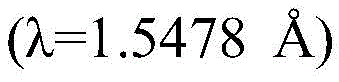 And the following unit cell dimensions measured at 100K on a Bruker diffractometer of a Complementary Metal Oxide Semiconductor (CMOS) detector:

another aspect of the invention provides a process for preparing compound I calcium salt hydrate form D, comprising charging compound I calcium salt hydrate form a with EtOH/water and heating to 65 ℃.
Compound I calcium salt hydrate form E
In some embodiments, the present invention provides crystalline compound I calcium salt hydrate form E. Figure 15 provides an X-ray powder diffraction pattern of compound I calcium salt hydrate form E at room temperature.
In some embodiments, compound I calcium salt hydrate form E is substantially pure crystalline. In some embodiments, compound I calcium salt hydrate is substantially crystalline form E. In some embodiments, compound I calcium salt hydrate form E is characterized by an X-ray powder diffraction pattern generated by X-ray powder diffraction analysis of an incident beam irradiated with Cu ka radiation.
In some embodiments, compound I calcium salt hydrate form E is characterized by an X-ray powder diffraction pattern having signals at: 8.0 + -0.2 deg. 2 theta, 12.0 + -0.2 deg. 2 theta and 24.2 + -0.2 deg. 2 theta. In some embodiments, compound I calcium salt hydrate form E is characterized by an X-ray powder diffraction pattern having signals at: 4.0 + -0.2 deg. 2 theta, 8.0 + -0.2 deg. 2 theta, 12.0 + -0.2 deg. 2 theta and 24.2 + -0.2 deg. 2 theta. In some embodiments, compound I calcium salt hydrate form E is characterized by an X-ray powder diffraction pattern having signals at: 4.0 + -0.2 deg. 2 theta, 8.0 + -0.2 deg. 2 theta, 12.0 + -0.2 deg. 2 theta, 24.2 + -0.2 deg. 2 theta, and 28.3 + -0.2 deg. 2 theta.
In some embodiments, compound I calcium salt hydrate form E is characterized by an X-ray powder diffraction pattern substantially similar to figure 15.
Another aspect of the invention provides a method of preparing compound I calcium salt hydrate form E comprising solid vapor diffusion of compound I calcium salt hydrate form a in EtOAc.
Compound I form F
Elemental analysis data for two batches of compound I form F showed the presence of both Ca and Na, indicating that compound I form F can be a Ca-Na mixed salt of compound I or a mixture of Ca and Na salts of compound I. In some embodiments, the present invention provides compound I crystalline form F. Figure 16 provides an X-ray powder diffraction pattern of compound I calcium salt hydrate form F at room temperature.
In some embodiments, compound I form F is substantially pure crystalline. In some embodiments, compound I is substantially crystalline form F. In some embodiments, compound I form F is characterized by an X-ray powder diffraction pattern generated by X-ray powder diffraction analysis with an incident beam of Cu ka radiation.
In some embodiments, compound I form F is characterized by an X-ray powder diffraction pattern having signals at: 5.3 + -0.2 deg. 2 theta, 7.5 + -0.2 deg. 2 theta and 9.1 + -0.2 deg. 2 theta. In some embodiments, compound I is characterized by an X-ray powder diffraction pattern having signals at: 5.3 + -0.2 deg. 2 theta, 9.1 + -0.2 deg. 2 theta and 11.9 + -0.2 deg. 2 theta. In some embodiments, compound I form F is characterized by an X-ray powder diffraction pattern having signals at: 7.5 + -0.2 deg. 2 theta, 9.1 + -0.2 deg. 2 theta and 11.9 + -0.2 deg. 2 theta. In some embodiments, compound I form F is characterized by an X-ray powder diffraction pattern having signals at: 5.3 + -0.2 deg. 2 theta, 7.5 + -0.2 deg. 2 theta, 9.1 + -0.2 deg. 2 theta and 11.9 + -0.2 deg. 2 theta.
In some embodiments, compound I form F is characterized by an X-ray powder diffraction pattern having signals at: 5.3 + -0.2 deg. 2 theta, 7.5 + -0.2 deg. 2 theta, 9.1 + -0.2 deg. 2 theta, 10.6 + -0.2 deg. 2 theta, and 11.9 + -0.2 deg. 2 theta.
In some embodiments, compound I form F is characterized by an X-ray powder diffraction pattern substantially similar to figure 16.
In some embodiments, compound I form F is characterized by the following:

compound I calcium salt hydrate form G
In some embodiments, the present invention provides crystalline compound I calcium salt hydrate form G. Figure 17 provides an X-ray powder diffraction pattern of compound I calcium salt hydrate form G at room temperature.
In some embodiments, compound I calcium salt hydrate form G is substantially pure crystalline. In some embodiments, compound I calcium salt hydrate is substantially crystalline form G. In some embodiments, compound I calcium salt hydrate form G is characterized by an X-ray powder diffraction pattern generated by X-ray powder diffraction analysis of an incident beam irradiated with Cu ka.
In some embodiments, compound I calcium salt hydrate form G is characterized by an X-ray powder diffraction pattern having signals at: 5.9 + -0.2 deg. 2 theta, 8.8 + -0.2 deg. 2 theta and 26.6 + -0.2 deg. 2 theta. In some embodiments, compound I calcium salt hydrate form G is characterized by an X-ray powder diffraction pattern having: (a) signals at 5.9 ± 0.2 ° 2 θ, 8.8 ± 0.2 ° 2 θ and 26.6 ± 0.2 ° 2 θ; and (b) one or more signals selected from 6.0 + -0.2 deg. 2 theta, 11.8 + -0.2 deg. 2 theta, 11.9 + -0.2 deg. 2 theta, 14.8 + -0.2 deg. 2 theta, and 14.7 + -0.2 deg. 2 theta. In some embodiments, compound I calcium salt hydrate form G is characterized by an X-ray powder diffraction pattern having signals at: 5.9 + -0.2 deg. 2 theta, 6.0 + -0.2 deg. 2 theta, 8.8 + -0.2 deg. 2 theta, 11.8 + -0.2 deg. 2 theta, 11.9 + -0.2 deg. 2 theta, 14.8 + -0.2 deg. 2 theta, 14.7 + -0.2 deg. 2 theta and 26.6 + -0.2 deg. 2 theta.
In some embodiments, compound I calcium salt hydrate form G is characterized by an X-ray powder diffraction pattern substantially similar to figure 17.
Another aspect of the present invention provides a process for preparing Compound I calcium salt hydrate form G, which comprises rapidly cooling Compound I calcium salt hydrate form A in EtOH: H2Solution in O (90: 10).
Compound I calcium salt form H
In some embodiments, the present invention provides crystalline compound I calcium salt form H. Figure 45 provides an X-ray powder diffraction pattern of compound I calcium salt form H at room temperature.
In some embodiments, compound I is substantially pure crystalline calcium salt form H. In some embodiments, compound I is substantially crystalline calcium salt form H. In some embodiments, compound I calcium salt form H is characterized by an X-ray powder diffraction pattern generated by X-ray powder diffraction analysis of an incident beam irradiated with Cu ka radiation.
In some embodiments, compound I calcium salt form H is characterized by an X-ray powder diffraction pattern having signals at: 5.8 + -0.2 deg. 2 theta, 13.0 + -0.2 deg. 2 theta and 14.5 + -0.2 deg. 2 theta. In some embodiments, compound I calcium salt form H is characterized by an X-ray powder diffraction pattern having: (a) signals at 5.8 ± 0.2 ° 2 θ, 13.0 ± 0.2 ° 2 θ and 14.5 ± 0.2 ° 2 θ; and (b) one or more signals selected from the group consisting of 8.3 ± 0.2 ° 2 θ, 12.0 ± 0.2 ° 2 θ, 19.5 ± 0.2 ° 2 θ, and 27.9 ± 0.2 ° 2 θ. In some embodiments, compound I calcium salt form H is characterized by an X-ray powder diffraction pattern having signals at: 5.8 + -0.2 deg. 2 theta, 12.0 + -0.2 deg. 2 theta, 13.0 + -0.2 deg. 2 theta, 14.5 + -0.2 deg. 2 theta and 27.9 + -0.2 deg. 2 theta.
In some embodiments, compound I calcium salt form H is characterized by an X-ray powder diffraction pattern substantially similar to figure 45.
In some embodiments, compound I calcium salt form H is characterized as having peaks containing everywhere below13C solid-state nuclear magnetic resonance (13C ssNMR) spectrum: 148.9 + -0.2 ppm, 27.2 + -0.2 ppm and 4.8 + -0.2 ppm. In some embodiments, compound I calcium salt form H is characterized as having a salt form H having13C solid-state nuclear magnetic resonance (13C ssNMR) spectrum: (a) peaks at 148.9 + -0.2 ppm, 27.2 + -0.2 ppm, and 4.8 + -0.2 ppm; and (b) one or more peaks selected from 164.7 + -0.2 ppm, 128.3 + -0.2 ppm, 117.0 + -0.2 ppm, and 19.4 + -0.2 ppm. In some embodiments, compound I calcium salt form H is characterized as having a salt form H having13C solid-state nuclear magnetic resonance (13C ssNMR) spectrum: (a) peaks at 148.9 + -0.2 ppm, 27.2 + -0.2 ppm, and 4.8 + -0.2 ppm; and (b) two, three or four peaks selected from 164.7 + -0.2 ppm, 128.3 + -0.2 ppm, 117.0 + -0.2 ppm and 19.4 + -0.2 ppm.
In some embodiments, compound I calcium salt form H is characterized as being substantially similar to figure 4613C ssNMR spectrum.
In some embodiments, compound I calcium salt form H is characterized by a triclinic system, a P1 space group, and irradiation on a Bruker diffractometer using a synchrotron 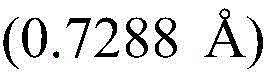 And the following unit cell dimensions measured by the CMOS detector at 100K:

another aspect of the present invention provides a method for preparing compound I calcium salt form H, comprising mixing compound I calcium salt hydrate form B in IPA/water.
Calcium salt of Compound I EtOH solvate form A
In some embodiments, the present invention provides crystalline compound I calcium salt EtOH solvate form a. Figure 18 provides an X-ray powder diffraction pattern of compound I calcium salt EtOH solvate form a at room temperature.
In some embodiments, compound I calcium salt EtOH solvate form a is substantially pure crystalline. In some embodiments, compound I calcium salt EtOH solvate form a is substantially crystalline. In some embodiments, compound I calcium salt EtOH solvate form a is characterized by an X-ray powder diffraction pattern generated by X-ray powder diffraction analysis with an incident beam of Cu ka radiation.
In some embodiments, compound I calcium salt EtOH solvate form a is characterized by an X-ray powder diffraction pattern having signals at: 4.1 + -0.2 deg. 2 theta, 8.2 + -0.2 deg. 2 theta and 17.1 + -0.2 deg. 2 theta. In some embodiments, compound I calcium salt EtOH solvate form a is characterized by an X-ray powder diffraction pattern having: (a) signals at 4.1 ± 0.2 ° 2 θ, 8.2 ± 0.2 ° 2 θ and 17.1 ± 0.2 ° 2 θ; and (b) signals at 8.5 ± 0.2 ° 2 θ and/or 16.5 ± 0.2 ° 2 θ.
In some embodiments, compound I calcium salt EtOH solvate form a is characterized by an X-ray powder diffraction pattern having at least two signals selected from: 8.2 + -0.2 deg. 2 theta, 8.5 + -0.2 deg. 2 theta, 16.5 + -0.2 deg. 2 theta and 17.1 + -0.2 deg. 2 theta. In some embodiments, compound I calcium salt EtOH solvate form a is characterized by an X-ray powder diffraction pattern having signals at: 8.2 + -0.2 deg. 2 theta, 8.5 + -0.2 deg. 2 theta, 16.5 + -0.2 deg. 2 theta and 17.1 + -0.2 deg. 2 theta.
In some embodiments, compound I calcium salt EtOH solvate form a is characterized by an X-ray powder diffraction pattern having: (a) signals at 8.2 ± 0.2 ° 2 θ, 8.5 ± 0.2 ° 2 θ, 16.5 ± 0.2 ° 2 θ, and/or 17.1 ± 0.2 ° 2 θ, and (b) at least one signal selected from 4.1 ± 0.2 ° 2 θ, 4.8 ± 0.2 ° 2 θ, 5.6 ± 0.2 ° 2 θ, and 20.3 ± 0.2 ° 2 θ.
In some embodiments, compound I calcium salt EtOH solvate form a is characterized by an X-ray powder diffraction pattern substantially similar to figure 18.
Another aspect of the invention provides a process for preparing EtOH solvate form A of Compound I calcium salt, which comprises rapidly cooling Compound I calcium salt to EtOH: H2Solution in O (85: 15).
Compound I calcium salt EtOH solvate form B
In some embodiments, the present invention provides crystalline compound I calcium salt EtOH solvate form B. Figure 19 provides an X-ray powder diffraction pattern of compound I calcium salt EtOH solvate form B at room temperature.
In some embodiments, compound I calcium salt EtOH solvate form B is substantially pure crystalline. In some embodiments, compound I calcium salt EtOH solvate form B is substantially crystalline. In some embodiments, compound I calcium salt EtOH solvate form B is characterized by an X-ray powder diffraction pattern generated by X-ray powder diffraction analysis with an incident beam of Cu ka radiation.
In some embodiments, compound I calcium salt EtOH solvate form B is characterized by an X-ray powder diffraction pattern having a signal at 15.4 ± 0.2 ° 2 Θ. In some embodiments, compound I calcium salt EtOH solvate form B is characterized by an X-ray powder diffraction pattern having: (a) signal at 15.4 ± 0.2 ° 2 Θ; and (b) signals at 4.5 ± 0.2 ° 2 θ and/or 5.0 ± 0.2 ° 2 θ. In some embodiments, compound I calcium salt EtOH solvate form B is characterized by an X-ray powder diffraction pattern having: (a) signal at 15.4 ± 0.2 ° 2 Θ; and (b) at least two signals selected from 4.5 + -0.2 deg. 2 theta, 5.0 + -0.2 deg. 2 theta, and 20.3 + -0.2 deg. 2 theta. In some embodiments, compound I calcium salt EtOH solvate form B is characterized by an X-ray powder diffraction pattern having signals at: 4.5 + -0.2 deg. 2 theta, 5.0 + -0.2 deg. 2 theta, 15.4 + -0.2 deg. 2 theta and 20.3 + -0.2 deg. 2 theta.
In some embodiments, compound I calcium salt EtOH solvate form B is characterized by an X-ray powder diffraction pattern substantially similar to figure 19.
Another aspect of the invention provides a process for preparing compound I calcium salt EtOH solvate form B comprising temperature cycling compound I calcium salt hydrate form a in EtOH: n-heptane (1:1) at a cooling rate of 0.2 ℃/min between 60 ℃ and 5 ℃.
EtOH solvate form C of the calcium salt of Compound I
In some embodiments, the present invention provides crystalline compound I calcium salt EtOH solvate form C. Figure 20 provides an X-ray powder diffraction pattern of compound I calcium salt EtOH solvate form C at room temperature.
In some embodiments, compound I calcium salt EtOH solvate form C is substantially pure crystalline. In some embodiments, compound I calcium salt EtOH solvate form C is substantially crystalline. In some embodiments, compound I calcium salt EtOH solvate form C is characterized by an X-ray powder diffraction pattern generated by X-ray powder diffraction analysis with an incident beam of Cu ka radiation.
In some embodiments, compound I calcium salt EtOH solvate form C is characterized by an X-ray powder diffraction pattern having signals at: 4.2 + -0.2 deg. 2 theta, 5.0 + -0.2 deg. 2 theta and 5.7 + -0.2 deg. 2 theta.
In some embodiments, compound I calcium salt EtOH solvate form C is characterized by an X-ray powder diffraction pattern substantially similar to figure 20.
In another aspect of the invention, there is provided a process for preparing EtOH solvate form C of Compound I calcium salt comprising preparing amorphous Compound I calcium salt with EtOH: H at room temperature2Slurry of O (9: 1).
Compound I sodium salt hydrate form A
In some embodiments, the present invention provides crystalline compound I sodium salt hydrate form a. Figure 34 provides an X-ray powder diffraction pattern of compound I sodium salt hydrate form a at room temperature.
In some embodiments, compound I sodium salt hydrate form a is substantially pure crystalline. In some embodiments, compound I sodium salt hydrate form a is substantially crystalline. In some embodiments, compound I sodium salt hydrate form a is characterized by an X-ray powder diffraction pattern generated by X-ray powder diffraction analysis with an incident beam of Cu ka radiation.
In some embodiments, compound I sodium salt hydrate form a is characterized by an X-ray powder diffraction pattern having signals at: 5.4 + -0.2 deg. 2 theta, 15.9 + -0.2 deg. 2 theta and 17.6 + -0.2 deg. 2 theta. In some embodiments, compound I sodium salt hydrate form a is characterized by an X-ray powder diffraction pattern having: (a) signals at 5.4 ± 0.2 ° 2 θ, 15.9 ± 0.2 ° 2 θ and 17.6 ± 0.2 ° 2 θ; and (b) at least one, at least two, at least three, at least four, or at least five signals selected from 15.3 ± 0.2 ° 2 θ, 18.6 ± 0.2 ° 2 θ, 21.3 ± 0.2 ° 2 θ, 23.9 ± 0.2 ° 2 θ, 20.0 ± 0.2 ° 2 θ, and 26.7 ± 0.2 ° 2 θ. In some embodiments, compound I sodium salt hydrate form a is characterized by an X-ray powder diffraction pattern having signals at: 5.4 + -0.2 deg. 2 theta, 15.9 + -0.2 deg. 2 theta, 17.6 + -0.2 deg. 2 theta, 15.3 + -0.2 deg. 2 theta, 18.6 + -0.2 deg. 2 theta, 21.3 + -0.2 deg. 2 theta, 23.9 + -0.2 deg. 2 theta, 20.0 + -0.2 deg. 2 theta and 26.7 + -0.2 deg. 2 theta.
In some embodiments, compound I sodium salt hydrate form a is characterized by an X-ray powder diffraction pattern substantially similar to figure 34.
In some embodiments, compound I sodium salt hydrate form a is characterized as having at least one peak selected from13C ssNMR spectrum: 177.0 + -0.2 ppm, 159.6 + -0.2 ppm, 138.5 + -0.2 ppm, 107.0 + -0.2 ppm, 96.4 + -0.2 ppm, 38.3 + -0.2 ppm and 28.9 + -0.2 ppm. In some embodiments, compound I sodium salt hydrate form a is characterized as having at least two peaks selected from13C ssNMR spectrum: 177.0 + -0.2 ppm, 159.6 + -0.2 ppm, 138.5 + -0.2 ppm, 107.0 + -0.2 ppm, 96.4 + -0.2 ppm, 38.3 + -0.2 ppm and 28.9 + -0.2 ppm. In some embodiments, compound I sodium salt hydrate form a is characterized as having at least three peaks selected from13C ssNMR spectrum: 177.0 + -0.2 ppm, 159.6 + -0.2 ppm, 138.5 + -0.2 ppm, 107.0 + -0.2 ppm, 96.4 + -0.2 ppm, 38.3 + -0.2 ppm and 28.9 + -0.2 ppm. In some embodiments, compound I sodium salt hydrate form a is characterized as having at least four peaks selected from13C ssNMR spectrum: 177.0 + -0.2 ppm, 159.6 + -0.2 ppm, 138.5 + -0.2 ppm, 107.0 + -0.2 ppm, 96.4 + -0.2 ppm, 38.3 + -0.2 ppm and 28.9 + -0.2 ppm. In some embodiments, compound I sodium salt hydrate form a is characterized as having at least five peaks selected from 13C ssNMR spectrum: 177.0 + -0.2 ppm, 159.6 + -0.2 ppm, 138.5 + -0.2 ppm, 107.0 + -0.2 ppm, 96.4 + -0.2 ppm, 38.3 + -0.2 ppm and 28.9 + -0.2 ppm. In some embodiments, compound I sodium salt hydrate form a is characterized as having peaks at 177.0 ± 0.2ppm, 159.6 ± 0.2ppm, 138.5 ± 0.2ppm, 107.0 ± 0.2ppm, 96.4 ± 0.2ppm, 38.3 ± 0.2ppm, and 28.9 ± 0.2ppm13C ssNMR spectrum.
In some embodiments, compound I sodium salt hydrate form a is characterized by being substantially similar to figure 3513C ssNMR spectrum.
In some embodiments, compound I sodium salt hydrate form a is characterized by orthorhombic, P2 12121Space group and synchrotron radiation on Bruker diffractometer At 100KThe following unit cell dimensions were measured:
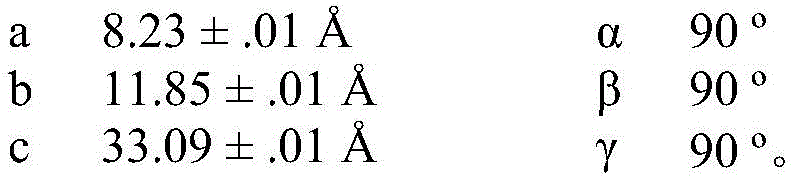
another aspect of the present invention provides a method of preparing compound I sodium salt hydrate form a comprising mixing amorphous compound I sodium salt with IPA/water at room temperature for two weeks.
Compound I sodium salt pure form B
In some embodiments, the present invention provides crystalline compound I sodium salt pure form B. Figure 36 provides an X-ray powder diffraction pattern of compound I sodium salt pure form B at room temperature.
In some embodiments, compound I sodium salt pure form B is substantially pure crystalline. In some embodiments, compound I sodium salt pure form B is substantially crystalline. In some embodiments, compound I sodium salt pure form B is characterized by an X-ray powder diffraction pattern generated by X-ray powder diffraction analysis with an incident beam of Cu ka radiation.
In some embodiments, compound I sodium salt pure form B is characterized by an X-ray powder diffraction pattern having signals at: 11.0 + -0.2 deg. 2 theta, 18.1 + -0.2 deg. 2 theta and 20.5 + -0.2 deg. 2 theta. In some embodiments, compound I sodium salt pure form B is characterized by an X-ray powder diffraction pattern having a signal at 12.8 ± 0.2 ° 2 Θ. In some embodiments, compound I sodium salt pure form B is characterized by an X-ray powder diffraction pattern having: (a) a signal at 12.8 ± 0.2 ° 2 Θ; and (b) signals at 11.0 ± 0.2 ° 2 θ, 18.1 ± 0.2 ° 2 θ, and/or 20.5 ± 0.2 ° 2 θ. In some embodiments, compound I sodium salt pure form B is characterized by an X-ray powder diffraction pattern having signals at: 11.0 + -0.2 deg. 2 theta, 12.8 + -0.2 deg. 2 theta, 18.1 + -0.2 deg. 2 theta and 20.5 + -0.2 deg. 2 theta.
In some embodiments, compound I sodium salt pure form B is characterized by an X-ray powder diffraction pattern substantially similar to figure 36.
Another aspect of the invention provides a process for preparing pure form B of the sodium salt of compound I, comprising desolvating/dehydrating compound I sodium salt hydrate form C.
Compound I sodium salt hydrate form C
In some embodiments, the present invention provides crystalline compound I sodium salt hydrate form C. Figure 37 provides an X-ray powder diffraction pattern of compound I sodium salt hydrate form C at room temperature.
In some embodiments, compound I sodium salt hydrate form C is substantially pure crystalline. In some embodiments, compound I sodium salt hydrate form C is substantially crystalline. In some embodiments, compound I sodium salt hydrate form C is characterized by an X-ray powder diffraction pattern generated by X-ray powder diffraction analysis with an incident beam of Cu ka radiation.
In some embodiments, compound I sodium salt hydrate form C is characterized by an X-ray powder diffraction pattern having signals at: 6.1 + -0.2 deg. 2 theta, 13.4 + -0.2 deg. 2 theta and 19.2 + -0.2 deg. 2 theta. In some embodiments, compound I sodium salt hydrate form C is characterized by an X-ray powder diffraction pattern having a signal at 4.5 ± 0.2 ° 2 Θ and/or 10.3 ± 0.2 ° 2 Θ. In some embodiments, compound I sodium salt hydrate form C is characterized by an X-ray powder diffraction pattern having: (a) signals at 4.5 ± 0.2 ° 2 Θ and/or 10.3 ± 0.2 ° 2 Θ; and (b) signals at 6.1 ± 0.2 ° 2 θ, 13.4 ± 0.2 ° 2 θ, and/or 19.2 ± 0.2 ° 2 θ. In some embodiments, compound I sodium salt hydrate form C is characterized by an X-ray powder diffraction pattern having signals at: 4.5 + -0.2 deg. 2 theta, 6.1 + -0.2 deg. 2 theta, 10.3 + -0.2 deg. 2 theta, 13.4 + -0.2 deg. 2 theta and 19.2 + -0.2 deg. 2 theta.
In some embodiments, compound I sodium salt hydrate form C is characterized by an X-ray powder diffraction pattern substantially similar to figure 37.
Another aspect of the present invention provides a process for preparing compound I sodium salt hydrate form C, comprising stirring an amorphous sodium salt of compound I with ACN at room temperature.
Compound I sodium salt hydrate form D
In some embodiments, the present invention provides crystalline compound I sodium salt hydrate form D. Figure 38 provides an X-ray powder diffraction pattern of compound I sodium salt hydrate form D at room temperature.
In some embodiments, compound I sodium salt hydrate form D is substantially pure crystalline. In some embodiments, compound I sodium salt hydrate form D is substantially crystalline. In some embodiments, compound I sodium salt hydrate form D is characterized by an X-ray powder diffraction pattern generated by X-ray powder diffraction analysis with an incident beam of Cu ka radiation.
In some embodiments, compound I sodium salt hydrate form D is characterized by an X-ray powder diffraction pattern having signals at: 7.8 + -0.2 deg. 2 theta, 18.5 + -0.2 deg. 2 theta and 19.9 + -0.2 deg. 2 theta. In some embodiments, compound I sodium salt hydrate form D is characterized by an X-ray powder diffraction pattern having signals at: 9.3 + -0.2 deg. 2 theta, 14.8 + -0.2 deg. 2 theta, 27.3 + -0.2 deg. 2 theta and/or 29.1 + -0.2 deg. 2 theta. In some embodiments, compound I sodium salt hydrate form D is characterized by an X-ray powder diffraction pattern having: (a) signals at 7.8 ± 0.2 ° 2 θ, 18.5 ± 0.2 ° 2 θ and 19.9 ± 0.2 ° 2 θ; and (b) signals at 9.3 ± 0.2 ° 2 θ, 14.8 ± 0.2 ° 2 θ, and/or 27.3 ± 0.2 ° 2 θ. In some embodiments, compound I sodium salt hydrate form D is characterized by an X-ray powder diffraction pattern having signals at: 7.8 + -0.2 deg. 2 theta, 9.3 + -0.2 deg. 2 theta, 14.8 + -0.2 deg. 2 theta, 18.5 + -0.2 deg. 2 theta, 19.9 + -0.2 deg. 2 theta, and 27.3 + -0.2 deg. 2 theta.
In some embodiments, compound I sodium salt hydrate form D is characterized by an X-ray powder diffraction pattern substantially similar to figure 38.
Another aspect of the present invention provides a process for preparing compound I sodium salt hydrate form D, comprising vacuum drying compound I sodium salt hydrate form C at 80 ℃.
Compound I sodium salt hydrate form E
In some embodiments, the present invention provides crystalline compound I sodium salt hydrate form E. Figure 49 provides an X-ray powder diffraction pattern of compound I sodium salt hydrate form E at room temperature.
In some embodiments, compound I sodium salt hydrate form E is substantially pure crystalline. In some embodiments, compound I sodium salt hydrate form E is substantially crystalline. In some embodiments, compound I sodium salt hydrate form E is characterized by an X-ray powder diffraction pattern generated by X-ray powder diffraction analysis with an incident beam of Cu ka radiation.
In some embodiments, compound I sodium salt hydrate form E is characterized by an X-ray powder diffraction pattern having signals at: 4.3 + -0.2 deg. 2 theta, 13.0 + -0.2 deg. 2 theta and 14.9 + -0.2 deg. 2 theta. In some embodiments, compound I sodium salt hydrate form E is characterized by an X-ray powder diffraction pattern having: (a) signals at 4.3 ± 0.2 ° 2 θ, 13.0 ± 0.2 ° 2 θ and 14.9 ± 0.2 ° 2 θ; and (b) at least one signal selected from the group consisting of signals at 10.6 + -0.2 DEG 2 theta, 11.7 + -0.2 DEG 2 theta, 13.4 + -0.2 DEG 2 theta, 14.1 + -0.2 DEG 2 theta, 14.2 + -0.2 DEG 2 theta, 17.3 + -0.2 DEG 2 theta, 18.1 + -0.2 DEG 2 theta, 18.8 + -0.2 DEG 2 theta, 19.2 + -0.2 DEG 2 theta, 20.0 + -0.2 DEG 2 theta, 21.4 + -0.2 DEG 2 theta, 21.5 + -0.2 DEG 2 theta, 22.3 + -0.2 DEG 2 theta and 23.1 + -0.2 DEG 2 theta. In some embodiments, compound I sodium salt hydrate form E is characterized by an X-ray powder diffraction pattern having: (a) signals at 4.3 ± 0.2 ° 2 θ, 13.0 ± 0.2 ° 2 θ and 14.9 ± 0.2 ° 2 θ; and (b) at least two, at least three, or at least four signals selected from the signals at 10.6 ± 0.2 ° 2 θ, 11.7 ± 0.2 ° 2 θ, 13.4 ± 0.2 ° 2 θ, 14.1 ± 0.2 ° 2 θ, 14.2 ± 0.2 ° 2 θ, 17.3 ± 0.2 ° 2 θ, 18.1 ± 0.2 ° 2 θ, 18.8 ± 0.2 ° 2 θ, 19.2 ± 0.2 ° 2 θ, 20.0 ± 0.2 ° 2 θ, 21.4 ± 0.2 ° 2 θ, 21.5 ± 0.2 ° 2 θ, 22.3 ± 0.2 ° 2 θ, and 23.1 ± 0.2 ° 2 θ.
In some embodiments, compound I sodium salt hydrate form E is characterized by an X-ray powder diffraction pattern having signals throughout: 4.3 + -0.2 deg. 2 theta, 13.0 + -0.2 deg. 2 theta and 23.1 + -0.2 deg. 2 theta.
In some embodiments, compound I sodium salt hydrate form E is characterized by an X-ray powder diffraction pattern substantially similar to figure 49.
In some embodiments, compound I sodium salt hydrate form E is characterized as having at least one peak selected from13C ssNMR spectrum: 165.2. + -. 0.2ppm, 155.4. + -. 0.2ppm, 142.7. + -. 0.2ppm, 128.4. + -. 0.2ppm, 121.3. + -. 0.2ppm, 101.0. + -. 0.2ppm, 93.1. + -. 0.2ppm, 69.5. + -. 0.2ppm, 62.6. + -. 0.2ppm, 55.2. + -. 0.2ppm, 50.6. + -. 0.2ppm, 50.0. + -. 0.2ppm, 21.1. + -. 0.2ppm, 17.2. + -. 0.2ppm, 7.2. + -. 0.2ppm and 2.1. + -. 0.2 ppm. In some embodiments, compound I sodium salt hydrate form E is characterized by having peaks with two, three, four, five, six, seven or more peaks selected from13C ssNMR spectrum: 165.2. + -. 0.2ppm, 155.4. + -. 0.2ppm, 142.7. + -. 0.2ppm, 128.4. + -. 0.2ppm, 121.3. + -. 0.2ppm, 101.0. + -. 0.2ppm, 93.1. + -. 0.2ppm, 69.5. + -. 0.2ppm, 62.6. + -. 0.2ppm, 55.2. + -. 0.2ppm, 50.6. + -. 0.2ppm, 50.0. + -. 0.2ppm, 21.1. + -. 0.2ppm, 17.2. + -. 0.2ppm, 7.2. + -. 0.2ppm and 2.1. + -. 0.2 ppm. In some embodiments, compound I sodium salt hydrate form E is characterized as having peaks at 13C ssNMR spectrum: 165.2 + -0.2 ppm, 155.4 + -0.2 ppm, 142.7 + -0.2 ppm, 128.4 + -0.2 ppm, 121.3 + -0.2 ppm, 101.0 + -0.2 ppm, 93.1 + -0.2 ppm, 69.5 + -0.2 ppm, 62.6 + -0.2 ppm, 55.2 + -0.2 ppm, 50.6 + -0.2 ppm, 50.0 + -0.2 ppm, 21.1 + -0.2 ppm, 17.2 + -0.2 ppm, 7.2 + -0.2 ppm and 2.1 + -0.2 ppm.
In some embodiments, compound I sodium salt hydrate form E is characterized as having peaks at13C ssNMR spectrum: 177.4 + -0.2 ppm, 165.2 + -0.2 ppm, 155.4 + -0.2 ppm, 142.7 + -0.2 ppm, 128.4 + -0.2 ppm, 121.3 + -0.2 ppm, 101.0 + -0.2 ppm, 69.5 + -0.2 ppm, 62.6 + -0.2 ppm, 55.2 + -0.2 ppm, 50.0 + -0.2 ppm, 30.9 + -0.2 ppm, 30.2 + -0.2 ppm, 27.8 + -0.2 ppm, 21.1 + -0.2 ppm, 17.2 + -0.2 ppm, 7.2 + -0.2 ppm and 2.1 + -0.2 ppm.
In some embodiments, compound I sodium salt hydrate form E is characterized by being substantially similar to figure 5013C ssNMR spectrum.
In some embodiments, compound I sodium salt hydrate form E is characterized byOrthorhombic, C2221Space group and Cu K-equippedαRadiation of radiation The following unit cell dimensions measured at 100K on a Bruker diffractometer:

another aspect of the invention provides a process for preparing compound I sodium salt hydrate form E comprising heating compound I sodium salt hydrate form a in IPA and water at 65 ℃, cooling the mixture to 45 ℃, seeding with compound I sodium salt hydrate form a crystals, cooling the mixture to 20 ℃, collecting the solids and then washing with IPA: water (1:3v: v), air drying, then adding IPA, NaOH and water to the solids, heating to 73 ℃, polishing the solution, cooling to 58 ℃, adding water, seeding with compound I sodium salt hydrate form E crystals at 40 ℃, cooling to 5 ℃, collecting the solids, washing the solids with a mixture of water and IPA and drying under vacuum at 40 ℃ to provide compound I sodium salt hydrate form E.
Another aspect of the invention provides a process for preparing compound I sodium salt hydrate form E comprising dissolving compound I sodium salt hydrate form a in IPA/water at 65 ℃, cooling the solution to 45 ℃, seeding with a mixture of compound I sodium salt hydrate form a and form E, adding water, cooling to 20 ℃, collecting the solid, washing the solid with a mixture of water and IPA and drying under vacuum to provide compound I sodium salt hydrate form E.
Compound I sodium salt IPA (wet) solvate form A
In some embodiments, the present invention provides compound I sodium salt IPA (wet) solvate form a. Figure 51 provides an X-ray powder diffraction pattern of compound I sodium salt IPA (wet) solvate form a at room temperature.
In some embodiments, compound I sodium salt IPA (wet) solvate form a is substantially pure crystalline. In some embodiments, compound I sodium salt IPA (wet) solvate form a is substantially crystalline. In some embodiments, compound I sodium salt IPA (wet) solvate form a is characterized by an X-ray powder diffraction pattern generated by X-ray powder diffraction analysis with an incident beam of Cu ka radiation.
In some embodiments, compound I sodium salt IPA (wet) solvate form a is characterized by an X-ray powder diffraction pattern having a signal at 3.5 ± 0.2 ° 2 Θ and/or a signal at 3.6 ± 0.2 ° 2 Θ. In some embodiments, compound I sodium salt IPA (wet) solvate form a is characterized by an X-ray powder diffraction pattern having: (a) a signal at 3.5 ± 0.2 ° 2 θ and/or a signal at 3.6 ± 0.2 ° 2 θ and (b) a signal at 9.5 ± 0.2 ° 2 θ.
In some embodiments, compound I sodium salt IPA (wet) solvate form a is characterized by an X-ray powder diffraction pattern having signals at: 3.6 + -0.2 deg. 2 theta, 3.5 + -0.2 deg. 2 theta and 9.5 + -0.2 deg. 2 theta.
In some embodiments, compound I sodium salt IPA (wet) solvate form a is characterized by an X-ray powder diffraction pattern substantially similar to figure 51.
Another aspect of the invention provides a process for preparing compound I sodium salt IPA (wet) solvate form a comprising slurrying amorphous compound I sodium salt hydrate form a in IPA.
Compound I sodium salt IPA (dry) solvate form B
In some embodiments, the present invention provides compound I sodium salt IPA (dry) solvate form B. Figure 52 provides an X-ray powder diffraction pattern of compound I sodium salt IPA (dry) solvate form B at room temperature.
In some embodiments, compound I sodium salt IPA (dry) solvate form B is substantially pure crystalline. In some embodiments, compound I sodium salt IPA (dry) solvate form B is substantially crystalline. In some embodiments, compound I sodium salt IPA (dry) solvate form B is characterized by an X-ray powder diffraction pattern generated by X-ray powder diffraction analysis with an incident beam of Cu ka radiation.
In some embodiments, compound I sodium salt IPA (dry) solvate form B is characterized by an X-ray powder diffraction pattern having signals at 4.0 ± 0.2 ° 2 Θ and 5.3 ± 0.2 ° 2 Θ. In some embodiments, compound I sodium salt IPA (dry) solvate form B is characterized by an X-ray powder diffraction pattern having: (a) signals at 4.0 ± 0.2 ° 2 θ and 5.3 ± 0.2 ° 2 θ; and (b) at least one signal selected from the group consisting of signals at 7.9 + -0.2 DEG 2 theta, 9.7 + -0.2 DEG 2 theta, 11.0 + -0.2 DEG 2 theta, 13.9 + -0.2 DEG 2 theta, 18.5 + -0.2 DEG 2 theta and 20.0 + -0.2 DEG 2 theta. In some embodiments, compound I sodium salt IPA (dry) solvate form B is characterized by an X-ray powder diffraction pattern having: (a) signals at 4.0 ± 0.2 ° 2 θ and 5.3 ± 0.2 ° 2 θ; and (b) signals at one, two, three or four of 7.9 ± 0.2 ° 2 θ, 9.7 ± 0.2 ° 2 θ, 11.0 ± 0.2 ° 2 θ, 13.9 ± 0.2 ° 2 θ, 18.5 ± 0.2 ° 2 θ and 20.0 ± 0.2 ° 2 θ.
In some embodiments, compound I sodium salt IPA (dry) solvate form B is characterized by an X-ray powder diffraction pattern having signals at: 4.0 + -0.2 deg. 2 theta, 7.9 + -0.2 deg. 2 theta and 9.7 + -0.2 deg. 2 theta.
In some embodiments, compound I sodium salt IPA (dry) solvate form B is characterized by an X-ray powder diffraction pattern substantially similar to figure 52.
In some embodiments, compound I sodium salt IPA (dry) solvate form B is characterized as having at least one peak selected from13C ssNMR spectrum: 180.3 +/-0.2 ppm, 178.7 +/-0.2 ppm, 164.7 +/-0.2 ppm, 135.9 +/-0.2 ppm, 127.0 +/-0.2 ppm, 117.0 +/-0.2 ppm, 105.4 +/-0.2 ppm, 95.5 +/-0.2 ppm, 94.4 +/-0.2 ppm, 68.9 +/-0.2 ppm, 67.6 +/-0.2 ppm, 64.1 +/-0.2 ppm, 59.5 +/-0.2 ppm, 54.5 +/-0.2 ppm, 53.6 +/-0.2 ppm, 32.7 +/-0.2 ppm, 24.6 +/-0.2 ppm, 20.2 +/-0.2 ppm, 5.1 +/-0.2 ppm and 3.6 +/-0.2 ppm. In some embodiments, compound I sodium salt IPA (dry) solvate form B is characterized as having peaks comprising two, three, four, five, six, seven or more selected from13C ssNMR spectrum: 180.3 plus or minus 0.2ppm, 178.7 plus or minus 0.2ppm, 164.7 plus or minus 0.2ppm, 135.9 plus or minus 0.2ppm and 127.0 plus or minus 0.2ppm, 117.0 +/-0.2 ppm, 105.4 +/-0.2 ppm, 95.5 +/-0.2 ppm, 94.4 +/-0.2 ppm, 68.9 +/-0.2 ppm, 67.6 +/-0.2 ppm, 64.1 +/-0.2 ppm, 59.5 +/-0.2 ppm, 54.5 +/-0.2 ppm, 53.6 +/-0.2 ppm, 32.7 +/-0.2 ppm, 24.6 +/-0.2 ppm, 20.2 +/-0.2 ppm, 5.1 +/-0.2 ppm and 3.6 +/-0.2 ppm. In some embodiments, compound I sodium salt IPA (dry) solvate form B is characterized as having peaks containing everywhere below 13C ssNMR spectrum: 180.3 +/-0.2 ppm, 178.7 +/-0.2 ppm, 164.7 +/-0.2 ppm, 135.9 +/-0.2 ppm, 127.0 +/-0.2 ppm, 117.0 +/-0.2 ppm, 105.4 +/-0.2 ppm, 95.5 +/-0.2 ppm, 94.4 +/-0.2 ppm, 68.9 +/-0.2 ppm, 67.6 +/-0.2 ppm, 64.1 +/-0.2 ppm, 59.5 +/-0.2 ppm, 54.5 +/-0.2 ppm, 53.6 +/-0.2 ppm, 32.7 +/-0.2 ppm, 24.6 +/-0.2 ppm, 20.2 +/-0.2 ppm, 5.1 +/-0.2 ppm and 3.6 +/-0.2 ppm.
In some embodiments, compound I sodium salt IPA (dry) solvate form B is characterized as having peaks everywhere below13C ssNMR spectrum: 180.3 + -0.2 ppm, 178.7 + -0.2 ppm, 164.7 + -0.2 ppm, 135.9 + -0.2 ppm, 127.0 + -0.2 ppm, 117.0 + -0.2 ppm, 105.4 + -0.2 ppm, 95.5 + -0.2 ppm, 94.4 + -0.2 ppm, 67.6 + -0.2 ppm, 59.5 + -0.2 ppm, 53.6 + -0.2 ppm, 32.7 + -0.2 ppm, 27.2 + -0.2 ppm, 24.6 + -0.2 ppm and 3.6 + -0.2 ppm.
In some embodiments, compound I sodium salt IPA (dry) solvate form B is characterized as substantially similar to figure 5313C ssNMR spectrum.
Another aspect of the invention provides a process for preparing compound I sodium salt IPA (dry) solvate form B comprising slurrying amorphous compound I sodium salt hydrate form a in IPA followed by vacuum drying at 40 ℃ to provide compound I sodium salt IPA (dry) solvate form B.
Compound I Potassium salt hydrate form A
In some embodiments, the present invention provides crystalline compound I potassium salt hydrate form a. Figure 39 provides an X-ray powder diffraction pattern of compound I potassium salt hydrate form a at room temperature.
In some embodiments, compound I potassium salt hydrate form a is substantially pure crystalline. In some embodiments, compound I potassium salt hydrate form a is substantially crystalline. In some embodiments, compound I potassium salt hydrate form a is characterized by an X-ray powder diffraction pattern generated by X-ray powder diffraction analysis with an incident beam of Cu ka radiation.
In some embodiments, compound I potassium salt hydrate form a is characterized by an X-ray powder diffraction pattern having a signal at 10.7 ± 0.2 ° 2 Θ. In some embodiments, compound I potassium salt hydrate form a is characterized by an X-ray powder diffraction pattern having a signal at 10.7 ± 0.2 ° 2 Θ and a signal at 15.3 ± 0.2 ° 2 Θ and/or 20.4 ± 0.2 ° 2 Θ. In some embodiments, compound I potassium salt hydrate form a is characterized by an X-ray powder diffraction pattern having signals at: 10.7 + -0.2 deg. 2 theta, 15.3 + -0.2 deg. 2 theta and 20.4 + -0.2 deg. 2 theta.
In some embodiments, compound I potassium salt hydrate form a is characterized by an X-ray powder diffraction pattern having: (a) signal at 10.7 ± 0.2 ° 2 Θ; and (b) one or more signals selected from the group consisting of 15.3 ± 0.2 ° 2 θ, 20.4 ± 0.2 ° 2 θ, and 29.1 ± 0.2 ° 2 θ. In some embodiments, compound I potassium salt hydrate form a is characterized by an X-ray powder diffraction pattern having signals at: 10.7 + -0.2 deg. 2 theta, 15.3 + -0.2 deg. 2 theta, 20.4 + -0.2 deg. 2 theta and 29.1 + -0.2 deg. 2 theta.
In some embodiments, compound I potassium salt hydrate form a is characterized by an X-ray powder diffraction pattern substantially similar to figure 39.
Another aspect of the invention provides a process for preparing compound I potassium salt hydrate form a, comprising reacting compound I (free form) form a with potassium hydride/water and subjecting it to two heating and cooling cycles from 60 ℃ to room temperature.
Compound I Potassium salt hydrate form B
In some embodiments, the present invention provides crystalline compound I potassium salt hydrate form B. Figure 40 provides an X-ray powder diffraction pattern of compound I potassium salt hydrate form B at room temperature.
In some embodiments, compound I potassium salt hydrate form B is substantially pure crystalline. In some embodiments, compound I potassium salt hydrate form B is substantially crystalline. In some embodiments, compound I potassium salt hydrate form B is characterized by an X-ray powder diffraction pattern generated by X-ray powder diffraction analysis of an incident beam irradiated with Cu ka.
In some embodiments, compound I potassium salt hydrate form B is characterized by an X-ray powder diffraction pattern having signals at: 4.7 + -0.2 deg. 2 theta, 6.8 + -0.2 deg. 2 theta and 21.5 + -0.2 deg. 2 theta. In some embodiments, compound I potassium salt hydrate form B is characterized by an X-ray powder diffraction pattern having signals at: 4.7 + -0.2 deg. 2 theta, 6.8 + -0.2 deg. 2 theta, 14.8 + -0.2 deg. 2 theta and 21.5 + -0.2 deg. 2 theta.
In some embodiments, compound I potassium salt hydrate form B is characterized by an X-ray powder diffraction pattern having: (a)4.7 + -0.2 deg. 2 theta, 6.8 + -0.2 deg. 2 theta and 21.5 + -0.2 deg. 2 theta; and (b) at least one signal selected from the group consisting of 14.8 + -0.2 deg. 2 theta, 15.2 + -0.2 deg. 2 theta, 16.1 + -0.2 deg. 2 theta, and 19.0 + -0.2 deg. 2 theta. In some embodiments, compound I potassium salt hydrate form B is characterized by an X-ray powder diffraction pattern having signals at: 4.7 + -0.2 deg. 2 theta, 6.8 + -0.2 deg. 2 theta, 14.8 + -0.2 deg. 2 theta, 15.2 + -0.2 deg. 2 theta, 16.1 + -0.2 deg. 2 theta, 19.0 + -0.2 deg. 2 theta and 21.5 + -0.2 deg. 2 theta.
In some embodiments, compound I potassium salt hydrate form B is characterized by an X-ray powder diffraction pattern substantially similar to figure 40.
Another aspect of the invention provides a process for preparing compound I potassium salt hydrate form B, comprising preparing a slurry of amorphous potassium salt of compound I with ACN at room temperature and then at 60 ℃.
Compound I Potassium salt hydrate form C
In some embodiments, the present invention provides crystalline compound I potassium salt hydrate form C. Figure 41 provides an X-ray powder diffraction pattern of compound I potassium salt hydrate form C at room temperature.
In some embodiments, compound I potassium salt hydrate form C is substantially pure crystalline. In some embodiments, compound I potassium salt hydrate form C is substantially crystalline. In some embodiments, compound I potassium salt hydrate form C is characterized by an X-ray powder diffraction pattern generated by X-ray powder diffraction analysis of an incident beam irradiated with Cu ka.
In some embodiments, compound I potassium salt hydrate form C is characterized by an X-ray powder diffraction pattern having signals at: 4.8 + -0.2 deg. 2 theta, 6.3 + -0.2 deg. 2 theta and 14.2 + -0.2 deg. 2 theta. In some embodiments, compound I potassium salt hydrate form C is characterized by an X-ray powder diffraction pattern having signals at: 4.8 + -0.2 deg. 2 theta, 6.3 + -0.2 deg. 2 theta, 14.2 + -0.2 deg. 2 theta, 13.5 + -0.2 deg. 2 theta and 27.1 + -0.2 deg. 2 theta. In some embodiments, compound I potassium salt hydrate form C is characterized by an X-ray powder diffraction pattern having: (a) signals at 6.3 ± 0.2 ° 2 θ, 4.8 ± 0.2 ° 2 θ, 14.2 ± 0.2 ° 2 θ, 13.5 ± 0.2 ° 2 θ and 27.1 ± 0.2 ° 2 θ; and (b) signals at 19.0 ± 0.2 ° 2 θ and/or 15.8 ± 0.2 ° 2 θ. In some embodiments, compound I potassium salt hydrate form C is characterized by an X-ray powder diffraction pattern having signals at: 6.3 + -0.2 deg. 2 theta, 4.8 + -0.2 deg. 2 theta, 14.2 + -0.2 deg. 2 theta, 13.5 + -0.2 deg. 2 theta, 27.1 + -0.2 deg. 2 theta, 19.0 + -0.2 deg. 2 theta and 15.8 + -0.2 deg. 2 theta.
In some embodiments, compound I potassium salt hydrate form C is characterized by an X-ray powder diffraction pattern substantially similar to figure 41.
Another aspect of the invention provides a method of preparing compound I potassium salt hydrate form C, comprising mixing amorphous compound I potassium salt with ACN at room temperature.
Compound I Potassium salt hydrate form D
In some embodiments, the present invention provides crystalline compound I potassium salt hydrate form D. Figure 42 provides an X-ray powder diffraction pattern of compound I potassium salt hydrate form D at room temperature.
In some embodiments, compound I potassium salt hydrate form D is substantially pure crystalline. In some embodiments, compound I potassium salt hydrate form D is substantially crystalline. In some embodiments, compound I potassium salt hydrate form D is characterized by an X-ray powder diffraction pattern generated by X-ray powder diffraction analysis of an incident beam irradiated with Cu ka.
In some embodiments, compound I potassium salt hydrate form D is characterized by an X-ray powder diffraction pattern having signals at: 4.4 + -0.2 deg. 2 theta, 15.3 + -0.2 deg. 2 theta and 13.1 + -0.2 deg. 2 theta.
In some embodiments, compound I potassium salt hydrate form D is characterized by an X-ray powder diffraction pattern having: (a) signals at 4.4 ± 0.2 ° 2 θ, 15.3 ± 0.2 ° 2 θ, and 13.1 ± 0.2 ° 2 θ and (b) signals at 8.8 ± 0.2 ° 2 θ. In some embodiments, compound I potassium salt hydrate form D is characterized by an X-ray powder diffraction pattern having signals at: 4.4 + -0.2 deg. 2 theta, 8.8 + -0.2 deg. 2 theta, 13.1 + -0.2 deg. 2 theta and 15.3 + -0.2 deg. 2 theta.
In some embodiments, compound I potassium salt hydrate form D is characterized by an X-ray powder diffraction pattern having: (a)4.4 ± 0.2 ° 2 θ, 8.8 ± 0.2 ° 2 θ, 13.1 ± 0.2 ° 2 θ, and 15.3 ± 0.2 ° 2 θ; and (b) at least one signal selected from 7.0 + -0.2 deg. 2 theta, 8.1 + -0.2 deg. 2 theta, and 21.9 + -0.2 deg. 2 theta. In some embodiments, compound I potassium salt hydrate form D is characterized by an X-ray powder diffraction pattern having signals at: 4.4 + -0.2 deg. 2 theta, 7.0 + -0.2 deg. 2 theta, 8.1 + -0.2 deg. 2 theta, 8.8 + -0.2 deg. 2 theta, 13.1 + -0.2 deg. 2 theta, 15.3 + -0.2 deg. 2 theta, and 21.9 + -0.2 deg. 2 theta.
In some embodiments, compound I potassium salt hydrate form D is characterized by an X-ray powder diffraction pattern substantially similar to figure 42.
Another aspect of the invention provides a process for preparing compound I potassium salt hydrate form D, comprising mixing amorphous compound I potassium salt with ACN at room temperature and drying in vacuo at 29 ℃.
Compound I ammonia salt hydrate form A
In some embodiments, the present invention provides crystalline compound I ammine salt hydrate form a. Figure 44 provides an X-ray powder diffraction pattern of compound I ammonia salt hydrate form a at room temperature.
In some embodiments, compound I ammine hydrate form a is substantially pure crystalline. In some embodiments, compound I, ammonium hydrate form a, is substantially crystalline. In some embodiments, compound I ammonium salt hydrate form a is characterized by an X-ray powder diffraction pattern generated by X-ray powder diffraction analysis with an incident beam of Cu ka radiation.
In some embodiments, compound I ammonia salt hydrate form a is characterized by an X-ray powder diffraction pattern having a signal at 5.5 ± 0.2 ° 2 Θ. In some embodiments, compound I ammonia salt hydrate form a is characterized by an X-ray powder diffraction pattern having a signal at 15.3 ± 0.2 ° 2 Θ. In some embodiments, compound I ammonia salt hydrate form a is characterized by an X-ray powder diffraction pattern having a signal at 17.7 ± 0.2 ° 2 Θ. In some embodiments, compound I ammonia salt hydrate form a is characterized by an X-ray powder diffraction pattern having signals at 5.5 ± 0.2 ° 2 Θ, 15.3 ± 0.2 ° 2 Θ, and/or 17.7 ± 0.2 ° 2 Θ. In some embodiments, compound I ammonia salt hydrate form a is characterized by an X-ray powder diffraction pattern having signals at 5.5 ± 0.2 ° 2 Θ, 15.3 ± 0.2 ° 2 Θ, and 17.7 ± 0.2 ° 2 Θ.
In some embodiments, compound I ammine salt hydrate form a is characterized by an X-ray powder diffraction pattern having: (a) signals at 5.5 ± 0.2 ° 2 Θ, 15.3 ± 0.2 ° 2 Θ, and/or 17.7 ± 0.2 ° 2 Θ; and (b) at least one signal selected from 19.6 ± 0.2 ° 2 θ, 20.9 ± 0.2 ° 2 θ, and 18.0 ± 0.2 ° 2 θ. In some embodiments, compound I ammonia salt hydrate form a is characterized by an X-ray powder diffraction pattern having: (a) signals at 5.5 ± 0.2 ° 2 Θ, 15.3 ± 0.2 ° 2 Θ, and/or 17.7 ± 0.2 ° 2 Θ; and (b) signals at 18.0 ± 0.2 ° 2 θ, 19.6 ± 0.2 ° 2 θ, and/or 20.9 ± 0.2 ° 2 θ. In some embodiments, compound I ammonia salt hydrate form a is characterized by an X-ray powder diffraction pattern having signals at: 5.5 + -0.2 deg. 2 theta, 15.3 + -0.2 deg. 2 theta, 17.7 + -0.2 deg. 2 theta, 18.0 + -0.2 deg. 2 theta, 19.6 + -0.2 deg. 2 theta and 20.9 + -0.2 deg. 2 theta.
In some embodiments, compound I ammonia salt hydrate form a is characterized by an X-ray powder diffraction pattern substantially similar to figure 44.
Another aspect of the invention provides a process for preparing compound I, ammonium salt hydrate form a, comprising mixing amorphous compound I (free form) form a with ammonium hydroxide in water.
Method of treatment
Compound I in the amorphous form or in any of the pharmaceutically acceptable crystalline forms disclosed herein acts as a CFTR modulator, i.e., it modulates CFTR activity in vivo. Individuals with mutations in the gene encoding CFTR may benefit from receiving a CFTR modulator. The CFTR mutation may affect the number of CFTR, i.e. the number of CFTR channels at the cell surface, or it may affect the CFTR function, i.e. the function of each channel to open and transport ions. Mutations that affect the number of CFTR include mutations that result in defects in synthesis (class I defects), defects in processing and transport (class II defects), mutations that result in reduced synthesis of CFTR (class V defects), and mutations that decrease the surface stability of CFTR (class VI defects). Mutations that affect CFTR function include mutations that result in gating defects (class III defects) and mutations that result in conduction defects (class IV defects). Some CFTR mutations exhibit multiple classes of characteristics. Certain mutations in the CFTR gene result in cystic fibrosis.
Accordingly, in some embodiments, the present invention provides a method of treating, reducing the severity of, or symptomatically treating cystic fibrosis in a patient, comprising administering to the patient an effective amount of compound I as an amorphous solid or in any of the pharmaceutically acceptable crystalline forms disclosed herein, alone or in combination with another active ingredient (such as another CFTR modulator). In some embodiments, the patient has an F508 del/Minimal Function (MF) genotype, an F508del/F508del genotype (homozygously for the F508del mutation), an F508 del/gating genotype, or an F508 del/Residual Function (RF) genotype. In some embodiments, the patient is heterotypic conjugated and has one F508del mutation. In some embodiments, the patient is homozygous for the N1303K mutation.
In some embodiments, the patient is heterotypically conjugated and has an F508del mutation on one allele and a mutation on the other allele selected from table 1:
table 1: CFTR mutation


In some embodiments, the present invention provides a method of treating, reducing the severity of, or symptomatically treating cystic fibrosis in a patient comprising administering to the patient an effective amount of compound I as crystalline free form compound I form a. In some embodiments, the method employs the compound I form B in crystalline free form. In some embodiments, the method employs compound I form C in crystalline free form.
In some embodiments, the present invention provides a method of treating, reducing the severity of, or symptomatically treating cystic fibrosis in a patient comprising administering to the patient an effective amount of crystalline compound I in the form of a calcium salt hydrate. In some embodiments, the crystalline form of compound I is calcium salt hydrate form a. In some embodiments, the crystalline form of compound I is calcium salt hydrate form B. In some embodiments, the crystalline form of compound I is calcium salt hydrate form C. In some embodiments, the crystalline form of compound I is calcium salt hydrate form D. In some embodiments, the crystalline form of compound I is calcium salt hydrate form E. In some embodiments, the crystalline form of compound I is form F. In some embodiments, the crystalline form of compound I is calcium salt hydrate form G. In some embodiments, the crystalline form of compound I is calcium salt form H.
In some embodiments, the present invention provides a method of treating, reducing the severity of, or symptomatically treating cystic fibrosis in a patient comprising administering to the patient an effective amount of a crystalline form of compound I, wherein the crystalline form is a calcium salt solvate. In some embodiments, crystalline compound I is calcium salt EtOH solvate form a. In some embodiments, crystalline compound I is calcium salt EtOH solvate form B. In some embodiments, crystalline compound I is calcium salt EtOH solvate form C.
In some embodiments, the present invention provides a method of treating, reducing the severity of, or symptomatically treating cystic fibrosis in a patient comprising administering to the patient an effective amount of a crystalline form of compound I, wherein the crystalline form is sodium salt hydrate form a. In some embodiments, the crystalline form of compound I is the sodium salt pure form B. In some embodiments, the crystalline form of compound I is sodium salt hydrate form C. In some embodiments, the crystalline form of compound I is sodium salt hydrate form D.
In some embodiments, the method of treating, reducing the severity of, or symptomatically treating cystic fibrosis in a patient comprises administering to the patient an effective amount of a crystalline form of compound I, wherein the crystalline form is potassium salt hydrate form a. In some embodiments, the crystalline form of compound I is potassium salt hydrate form a.
In some embodiments, the crystalline form of compound I for use in the methods of the invention for treating, reducing the severity of, or symptomatically treating cystic fibrosis is potassium salt hydrate form C. In some embodiments, the crystalline form of compound I for use in the methods of the invention for treating, reducing the severity of, or symptomatically treating cystic fibrosis is potassium salt hydrate form D.
In some embodiments, the crystalline form of compound I for use in the methods of the invention for treating, reducing the severity of, or symptomatically treating cystic fibrosis is the ammoniacal salt hydrate form a.
Combination therapy
One aspect disclosed herein provides methods of treating cystic fibrosis and other CFTR mediated diseases with compound I in combination with other pharmaceutically active agents, including CFTR modulators. In some embodiments, compound I is in amorphous form and may be administered in combination with at least one additional active pharmaceutical ingredient (such as a CFTR modulator). In some embodiments, the at least one additional active pharmaceutical ingredient is selected from the group consisting of (a) compound II and pharmaceutically acceptable salts thereof; and (b) compound III or compound III-d and pharmaceutically acceptable salts of compound III or compound III-d. Thus, in some embodiments, the combination therapies provided herein comprise amorphous compound I and at least one compound selected from compound II, (compound III or III-d), and pharmaceutically acceptable salts thereof. In some embodiments, the combination therapies provided herein comprise at least one compound selected from amorphous compound I and pharmaceutically acceptable salts thereof; and at least one compound selected from (compound III or III-d), compound IV and/or a pharmaceutically acceptable salt thereof.
In some embodiments, at least one compound selected from compound I in any one of the pharmaceutically acceptable crystalline forms disclosed herein is administered in combination with at least one compound selected from compound II and pharmaceutically acceptable salts thereof. In some embodiments, at least one compound selected from compound I in any one of the pharmaceutically acceptable crystalline forms disclosed herein is administered in combination with at least one compound selected from compound III and pharmaceutically acceptable salts thereof. In some embodiments, at least one compound selected from compound I in any one of the pharmaceutically acceptable crystalline forms disclosed herein is administered in combination with at least one compound selected from compound III-d and pharmaceutically acceptable salts thereof. In some embodiments, at least one compound selected from compound I in any one of the pharmaceutically acceptable crystalline forms disclosed herein is administered in combination with compound II or a pharmaceutically acceptable salt thereof and at least one compound selected from compound III and a pharmaceutically acceptable salt thereof. In some embodiments, at least one compound selected from compound I in any one of the pharmaceutically acceptable crystalline forms disclosed herein is administered in combination with at least one compound selected from compound II and pharmaceutically acceptable salts thereof and at least one compound selected from compound III-d and pharmaceutically acceptable salts thereof.
Each of compound I (in any of the pharmaceutically acceptable crystalline forms disclosed herein), II and III, or III-d, and pharmaceutically acceptable salts thereof, can be independently administered once daily, twice daily, or three times daily. In some embodiments, at least one compound selected from compound I in any one of the pharmaceutically acceptable crystalline forms disclosed herein is administered once daily. In some embodiments, at least one compound selected from compound I in any one of the pharmaceutically acceptable crystalline forms disclosed herein is administered twice daily. In some embodiments, at least one compound selected from compound I in any one of the pharmaceutically acceptable crystalline forms disclosed herein and at least one compound selected from compound II and pharmaceutically acceptable salts thereof is administered once daily. In some embodiments, at least one compound selected from compound I in any one of the pharmaceutically acceptable crystalline forms disclosed herein and at least one compound selected from compound II and pharmaceutically acceptable salts thereof are administered twice daily. In some embodiments, at least one compound selected from compound I in any one of the pharmaceutically acceptable crystalline forms disclosed herein and at least one compound selected from compound III or III-d and pharmaceutically acceptable salts thereof is administered once daily. In some embodiments, at least one compound selected from compound I in any of the pharmaceutically acceptable crystalline forms disclosed herein and at least one compound selected from compound III or III-d and pharmaceutically acceptable salts thereof is administered twice daily.
In some embodiments, at least one compound selected from compound I in any one of the pharmaceutically acceptable crystalline forms disclosed herein, at least one compound selected from compound II and pharmaceutically acceptable salts thereof, and at least one compound selected from compound III or III-d and pharmaceutically acceptable salts thereof is administered once daily. In some embodiments, at least one compound selected from compound I in any one of the pharmaceutically acceptable crystalline forms disclosed herein, at least one compound selected from compound III or III-d and pharmaceutically acceptable salts thereof, and at least one compound selected from compound IV and pharmaceutically acceptable salts thereof is administered once daily. In some embodiments, at least one compound selected from compound I in any one of the pharmaceutically acceptable crystalline forms disclosed herein, at least one compound selected from compound II and pharmaceutically acceptable salts thereof, and at least one compound selected from compound III or III-d and pharmaceutically acceptable salts thereof is administered twice daily. In some embodiments, at least one compound selected from compound I in any of the pharmaceutically acceptable crystalline forms disclosed herein, at least one compound selected from compound III or III-d and pharmaceutically acceptable salts thereof, and at least one compound selected from compound IV and pharmaceutically acceptable salts thereof, are administered twice daily.
In some embodiments, at least one compound selected from compound I in any one of the pharmaceutically acceptable crystalline forms disclosed herein and at least one compound selected from compound II and pharmaceutically acceptable salts thereof are administered once daily and at least one compound selected from compounds III-d and pharmaceutically acceptable salts thereof is administered twice daily. In some embodiments, at least one compound selected from compound I in any one of the pharmaceutically acceptable crystalline forms disclosed herein and at least one compound selected from compound IV and pharmaceutically acceptable salts thereof is administered once daily and at least one compound selected from compound III-d and pharmaceutically acceptable salts thereof is administered twice daily.
In some embodiments, at least one compound selected from compound I in any one of the pharmaceutically acceptable crystalline forms disclosed herein is administered in an amount from 5mg to 100 mg. In some embodiments, at least one compound selected from compound I in any one of the pharmaceutically acceptable crystalline forms disclosed herein is administered in an amount of 5mg, 10mg, 15mg, or 20mg per day. In some embodiments, at least one compound selected from compound I in any one of the pharmaceutically acceptable crystalline forms disclosed herein is administered in an amount of 5mg, 10mg, or 20mg once daily. In some embodiments, 5mg or 10mg of compound I in any one of the pharmaceutically acceptable crystalline forms disclosed herein is administered twice daily.
Compound I (in any of the pharmaceutically acceptable crystalline forms disclosed herein), II, (III or III-d), and pharmaceutically acceptable salts thereof, can be administered in a single pharmaceutical composition or in separate pharmaceutical compositions. Such pharmaceutical compositions may be administered once a day or multiple times a day, such as twice a day. As used herein, the phrase that a given amount of an API (e.g., compound I, II, (III, III-d), or a pharmaceutically acceptable salt thereof) is administered once or twice a day or daily means that the given amount is administered once or twice a day. For example, the phrase administering 50mg of compound II or a pharmaceutically acceptable salt thereof twice daily (daily/per day) means administering 50mg of compound II or an equivalent amount of a pharmaceutically acceptable salt thereof twice daily, each time (e.g., 50mg of compound II or an equivalent amount of a pharmaceutically acceptable salt thereof is administered in the morning and 50mg of compound II or an equivalent amount of a pharmaceutically acceptable salt thereof is administered in the evening).
In some embodiments, at least one compound selected from compound I in any one of the pharmaceutically acceptable crystalline forms disclosed herein is administered in a first pharmaceutical composition; administering at least one compound selected from compound II and pharmaceutically acceptable salts thereof in a second pharmaceutical composition; and administering at least one compound selected from compound III and pharmaceutically acceptable salts thereof in a third pharmaceutical composition.
In some embodiments, at least one compound selected from compound I in any one of the pharmaceutically acceptable crystalline forms disclosed herein is administered in a first pharmaceutical composition; administering at least one compound selected from compound II and pharmaceutically acceptable salts thereof in a second pharmaceutical composition; administering at least one compound selected from the group consisting of compounds III-d and pharmaceutically acceptable salts thereof in a third pharmaceutical composition.
In some embodiments, at least one compound selected from compound I in any one of the pharmaceutically acceptable crystalline forms disclosed herein is administered in a first pharmaceutical composition; administering at least one compound selected from compound III or III-d and pharmaceutically acceptable salts thereof in a second pharmaceutical composition; administering at least one compound selected from compound IV and pharmaceutically acceptable salts thereof in a third pharmaceutical composition.
In some embodiments, at least one compound selected from compound I in any one of the pharmaceutically acceptable crystalline forms disclosed herein is administered in a first pharmaceutical composition; and administering at least one compound selected from compound II and pharmaceutically acceptable salts thereof and at least one compound selected from compound III or III-d and pharmaceutically acceptable salts thereof in a second pharmaceutical composition. In some embodiments, the second pharmaceutical composition comprises half of the daily dose of the at least one compound selected from compound III, III-d, and pharmaceutically acceptable salts thereof, and the other half of the at least one compound selected from compound III, III-d, and pharmaceutically acceptable salts thereof is administered in the third pharmaceutical composition.
In some embodiments, at least one compound selected from compound I in any one of the pharmaceutically acceptable crystalline forms disclosed herein is administered as a first pharmaceutical composition; at least one compound selected from compound II and pharmaceutically acceptable salts thereof and at least one compound selected from compounds III, III-d and pharmaceutically acceptable salts thereof. In some embodiments, the first pharmaceutical composition is administered to the patient twice daily. In some embodiments, the first pharmaceutical composition is administered once daily. In some embodiments, the first pharmaceutical composition is administered once daily and the second composition comprising only compound III is administered once daily.
Any suitable pharmaceutical composition known in the art may be used for compound I (in any of the pharmaceutically acceptable crystalline forms disclosed herein), compound II, compound III-d, and pharmaceutically acceptable salts thereof. Some exemplary pharmaceutical compositions of compound I and pharmaceutically acceptable salts thereof are set forth in the examples. Some exemplary pharmaceutical compositions for compound II and pharmaceutically acceptable salts thereof can be found in WO 2011/119984 and WO 2014/014841, which are incorporated herein by reference. Some exemplary pharmaceutical compositions for compound III and pharmaceutically acceptable salts thereof can be found in WO 2007/134279, WO 2010/019239, WO 2011/019413, WO 2012/027731, and WO 2013/130669, and some exemplary pharmaceutical compositions for compound III-d and pharmaceutically acceptable salts thereof can be found in US 8,865,902, US 9,181,192, US 9,512,079, WO 2017/053455, and WO 2018/080591, all of which are incorporated herein by reference. Some exemplary pharmaceutical compositions for compound IV and pharmaceutically acceptable salts thereof can be found in WO 2010/037066, WO 2011/127421, and WO 2014/071122, which are incorporated herein by reference.
In some embodiments, the crystalline form of compound I used in the combination therapy of the present invention is free form compound I form a. In some embodiments, the combination therapy employs crystalline free form compound I form B. In some embodiments, the combination therapy employs compound I form C in crystalline free form.
In some embodiments, the crystalline form of compound I employed in the combination therapy of the present invention is a calcium salt hydrate. In some embodiments, the crystalline form of compound I is calcium salt hydrate form a. In some embodiments, the crystalline form of compound I is calcium salt hydrate form B. In some embodiments, the crystalline form of compound I is calcium salt hydrate form C. In some embodiments, the crystalline form of compound I is calcium salt hydrate form D. In some embodiments, the crystalline form of compound I is calcium salt hydrate form E. In some embodiments, the crystalline form of compound I is form F. In some embodiments, the crystalline form of compound I is calcium salt hydrate form G. In some embodiments, the crystalline form of compound I is calcium salt form H.
In some embodiments, the combination therapy of the present invention employs a crystalline form of compound I, wherein the crystalline form is a calcium salt solvate. In some embodiments, crystalline compound I is calcium salt EtOH solvate form a. In some embodiments, crystalline compound I is calcium salt EtOH solvate form B. In some embodiments, crystalline compound I is calcium salt EtOH solvate form C.
In some embodiments, the combination therapy of the present invention comprises a crystalline form of compound I, wherein the crystalline form is sodium salt hydrate form a. In some embodiments, the crystalline form of compound I is the sodium salt pure form B. In some embodiments, the crystalline form of compound I is sodium salt hydrate form C. In some embodiments, the crystalline form of compound I is sodium salt hydrate form D.
In some embodiments, the combination therapy of the present invention comprises a crystalline form of compound I, wherein the crystalline form is potassium salt hydrate form a. In some embodiments, the crystalline form of compound I is potassium salt hydrate form B.
In some embodiments, the crystalline form of compound I for use in the combination therapy of the present invention is potassium salt hydrate form C. In some embodiments, the crystalline form of compound I for use in the combination therapy of the present invention is potassium salt hydrate form D.
In some embodiments, the crystalline form of compound I for use in the combination therapy of the present invention is the ammoniacal salt hydrate form a.
Coordination structures of certain crystalline forms
Certain crystalline forms involve compound I coordinated with Ca ions. Local coordination has the chemical structure depicted below:

Wherein R1 and R2 are the remainder of compound I.
In each case, the calcium ion is coordinated by 6, 7 or 8 atoms, at least two of which are two oxygen atoms from compound I, and the other atoms in the coordination sphere may include other atoms from a molecule of compound I, atoms from different molecules of compound I, water or alcohol solvents.
Pharmaceutical composition
Another aspect of the present invention provides pharmaceutical compositions comprising compound I in an amorphous solid or in any one of the pharmaceutically acceptable crystalline forms disclosed herein. In some embodiments, the present invention provides pharmaceutical compositions comprising compound I in an amorphous solid or in any of the pharmaceutically acceptable crystalline forms disclosed herein and at least one additional active pharmaceutical ingredient. In some embodiments, the at least one additional active pharmaceutical ingredient is a CFTR modulator. In some embodiments, the at least one additional active pharmaceutical ingredient is a CFTR corrector. In some embodiments, the at least one additional active pharmaceutical ingredient is a CFTR potentiator. In some embodiments, the pharmaceutical composition comprises compound I in an amorphous solid or in any of the pharmaceutically acceptable crystalline forms disclosed herein and at least two additional active pharmaceutical ingredients, one of which is a CFTR corrector and one of which is a CFTR potentiator.
In some embodiments, the at least one additional active pharmaceutical ingredient is selected from the group consisting of mucolytic agents, bronchodilators, antibiotics, anti-infective agents, and anti-inflammatory agents.
In some embodiments, the present invention provides a pharmaceutical composition comprising at least one compound selected from compound I in an amorphous solid or in any one of the pharmaceutically acceptable crystalline forms disclosed herein and at least one pharmaceutically acceptable carrier.
In some embodiments, the present invention provides a pharmaceutical composition comprising (a)5mg to 20mg of compound I, wherein compound I is any one of the pharmaceutically acceptable crystalline forms disclosed herein, (b) at least one compound selected from compound II and pharmaceutically acceptable salts thereof, and (c) at least one pharmaceutically acceptable carrier.
In some embodiments, the present disclosure provides a pharmaceutical composition comprising (a)5mg to 20mg of compound I, wherein compound I is any one of the pharmaceutically acceptable crystalline forms disclosed herein, (b) at least one compound selected from compound III, III-d, and pharmaceutically acceptable salts thereof, and (c) at least one pharmaceutically acceptable carrier.
In some embodiments, the present disclosure provides a pharmaceutical composition comprising (a)5mg to 20mg of compound I, wherein compound I is any one of the pharmaceutically acceptable crystalline forms disclosed herein, (b) at least one compound selected from compound II and pharmaceutically acceptable salts thereof, (c) at least one compound selected from compound III and pharmaceutically acceptable salts thereof, and (d) at least one pharmaceutically acceptable carrier.
In some embodiments, the present disclosure provides a pharmaceutical composition comprising (a)5mg to 20mg of compound I, wherein compound I is any one of the pharmaceutically acceptable crystalline forms disclosed herein, (b) at least one compound selected from compound II and pharmaceutically acceptable salts thereof, (c) at least one compound selected from compound III-d and pharmaceutically acceptable salts thereof, and (d) at least one pharmaceutically acceptable carrier.
In some embodiments, the present disclosure provides a pharmaceutical composition comprising (a)5mg to 20mg of compound I, wherein compound I is any one of the pharmaceutically acceptable crystalline forms disclosed herein, (b) at least one compound selected from compound III or III-d and pharmaceutically acceptable salts thereof, (c) at least one compound selected from compound IV and pharmaceutically acceptable salts thereof, and (d) at least one pharmaceutically acceptable carrier.
In some embodiments, the present disclosure provides a pharmaceutical composition comprising 5mg to 20mg of compound I, wherein compound I is any one of the pharmaceutically acceptable crystalline forms disclosed herein, and optionally comprising one or more additional CFTR modulators. In some embodiments, the composition comprises about 5mg, about 10mg, or about 20mg of compound I and pharmaceutically acceptable salts thereof, and optionally comprises one or more additional CFTR modulators. In some embodiments, the composition comprises (a)5mg to 20mg of at least one compound selected from compound I, wherein compound I is any one of the pharmaceutically acceptable crystalline forms disclosed herein, (b)50mg to 100mg of compound II, and (c)150mg to 300mg of compound III or 50mg to 150mg of compound III-d. In some embodiments, the composition comprises (a)5mg to 20mg of compound I, wherein compound I is any one of the pharmaceutically acceptable crystalline forms disclosed herein, (b)100mg of compound II, and (c)150mg of compound III or 150mg of compound III-d.
In some embodiments, the present disclosure provides a pharmaceutical composition comprising 5mg of compound I, wherein compound I is any one of the pharmaceutically acceptable crystalline forms disclosed herein, and optionally comprising one or more additional CFTR modulators. In some embodiments, the pharmaceutical composition comprises 10mg of compound I, wherein compound I is any one of the pharmaceutically acceptable crystalline forms disclosed herein, and optionally comprises one or more additional CFTR modulators. In some embodiments, the present disclosure provides a pharmaceutical composition comprising 20mg of compound I, wherein compound I is any one of the pharmaceutically acceptable crystalline forms disclosed herein, and optionally comprising one or more additional CFTR modulators. In some embodiments, the composition comprises (a)5mg, 10mg, or 20mg of compound I, wherein compound I is any one of the pharmaceutically acceptable crystalline forms disclosed herein, (b)50mg or 100mg of compound II, and (c)150mg or 300mg of compound III or 50mg, 75mg, 100mg, 125mg, or 150mg of compound III-d.
Any of the pharmaceutical compositions disclosed herein can comprise at least one pharmaceutically acceptable carrier. In some embodiments, the at least one pharmaceutically acceptable carrier is selected from a pharmaceutically acceptable vehicle and a pharmaceutically acceptable adjuvant. In some embodiments, the at least one pharmaceutically acceptable is selected from pharmaceutically acceptable fillers, disintegrants, surfactants, binders, lubricants.
In some embodiments, the crystalline form of compound I in the pharmaceutical compositions of the invention is the free form of compound I form a. In some embodiments, the pharmaceutical composition comprises a crystalline free form of compound I form B. In some embodiments, the pharmaceutical composition comprises a crystalline free form of compound I form C.
In some embodiments, the crystalline form of compound I in the pharmaceutical compositions of the present invention is a calcium salt hydrate. In some embodiments, the crystalline form of compound I is calcium salt hydrate form a. In some embodiments, the crystalline form of compound I is calcium salt hydrate form B. In some embodiments, the crystalline form of compound I is calcium salt hydrate form C. In some embodiments, the crystalline form of compound I is calcium salt hydrate form D. In some embodiments, the crystalline form of compound I is calcium salt hydrate form E. In some embodiments, the crystalline form of compound I is form F. In some embodiments, the crystalline form of compound I is calcium salt hydrate form G. In some embodiments, the crystalline form of compound I is calcium salt form H.
In some embodiments, the pharmaceutical compositions of the present invention comprise a crystalline form of compound I, wherein the crystalline form is a calcium salt solvate. In some embodiments, crystalline compound I is calcium salt EtOH solvate form a. In some embodiments, crystalline compound I is calcium salt EtOH solvate form B. In some embodiments, crystalline compound I is calcium salt EtOH solvate form C.
In some embodiments, the pharmaceutical compositions of the present invention comprise a crystalline form of compound I, wherein the crystalline form is sodium salt hydrate form a. In some embodiments, the crystalline form of compound I is the sodium salt pure form B. In some embodiments, the crystalline form of compound I is sodium salt hydrate form C. In some embodiments, the crystalline form of compound I is sodium salt hydrate form D.
In some embodiments, the pharmaceutical compositions of the present invention comprise a crystalline form of compound I, wherein the crystalline form is potassium salt hydrate form a. In some embodiments, the crystalline form of compound I is potassium salt hydrate form B.
In some embodiments, the crystalline form of compound I in the pharmaceutical compositions of the present invention is potassium salt hydrate form C. In some embodiments, the crystalline form of compound I in the pharmaceutical compositions of the present invention is potassium salt hydrate form D.
In some embodiments, the crystalline form of compound I in the pharmaceutical compositions of the present invention is the ammoniacal salt hydrate form a.
The pharmaceutical compositions described herein are useful for treating cystic fibrosis and other CFTR mediated diseases.
As noted above, the pharmaceutical compositions disclosed herein may optionally further comprise at least one pharmaceutically acceptable carrier. The at least one pharmaceutically acceptable carrier may be selected from adjuvants and vehicles. As used herein, the at least one pharmaceutically acceptable carrier includes any and all solvents, diluents, other liquid vehicles, dispersion aids, suspension aids, surfactants, isotonicity agents, thickeners, emulsifiers, preservatives, solid binders, and lubricants suitable for the particular dosage form desired. The Science and Practice of Pharmacy, 21 st edition, 2005, D.B. Troy, eds, Lippincott Williams & Wilkins, Philadelphia and Encyclopedia of Pharmaceutical Technology, J.Swarbrick and J.C. Boylan, 1988. Buck 1999, Marcel Dekker, New York disclose various carriers for The formulation of Pharmaceutical compositions and known techniques for preparing The same. Unless any conventional carrier is incompatible with the compounds of the present disclosure, such as by producing any undesirable biological effect or otherwise interacting in a deleterious manner with any other component of the pharmaceutical composition, its use is contemplated within the scope of the present disclosure. Non-limiting examples of suitable pharmaceutically acceptable carriers include, but are not limited to, ion exchangers, alumina, aluminum stearate, lecithin, serum proteins (e.g., human serum albumin), buffer substances (e.g., phosphates, glycine, sorbic acid, and potassium sorbate), mixtures of partial glycerides of saturated vegetable fatty acids, water salts and electrolytes (such as protamine sulfate, disodium hydrogen phosphate, potassium hydrogen phosphate, sodium chloride, and zinc salts), colloidal silica, magnesium trisilicate, polyvinylpyrrolidone, polyacrylates, waxes, polyethylene-polyoxypropylene block polymers, lanolin, sugars (such as lactose, glucose, and sucrose), starches (such as corn starch and potato starch), celluloses and derivatives thereof (such as sodium carboxymethylcellulose, ethylcellulose, and cellulose acetate), powdered tragacanth, malt, gelatin, tragacanth, and mixtures thereof, Talc, excipients (such as cocoa butter and suppository waxes), oils (such as peanut oil, cottonseed oil, safflower oil, sesame oil, olive oil, corn oil and soybean oil), glycols (such as propylene glycol and polyethylene glycols), esters (such as ethyl oleate and ethyl laurate), agar, buffering agents (such as magnesium hydroxide and aluminum hydroxide), alginic acid, pyrogen-free water, isotonic saline, Ringer's solution, ethanol, phosphate buffered saline, non-toxic compatible lubricants (such as sodium lauryl sulfate and magnesium stearate), coloring agents, mold release agents, coating agents, sweetening agents, flavoring agents, fragrances, preservatives and antioxidants.
Exemplary embodiments
1. A compound I (free form)

Wherein compound I is in substantially crystalline form a (i.e., wherein less than 15% of compound I is in amorphous form, wherein less than 10% of compound I is in amorphous form, wherein less than 5% of compound I is in amorphous form).
2. Compound I according to embodiment 1, wherein compound I is 100% crystalline form a.
3. Compound I according to embodiment 1 or embodiment 2, wherein compound I (free form) form a is characterized by an X-ray powder diffraction pattern having signals at: 9.2 + -0.2 deg. 2 theta, 11.3 + -0.2 deg. 2 theta, 14.0 + -0.2 deg. 2 theta and/or 22.9 + -0.2 deg. 2 theta.
4. Compound I according to embodiment 1 or embodiment 2, wherein compound I (free form) form a is characterized by an X-ray powder diffraction pattern having signals at: 9.2 + -0.2 deg. 2 theta, 16.6 + -0.2 deg. 2 theta and 20.0 + -0.2 deg. 2 theta.
5. Compound I according to embodiment 1 or embodiment 2, wherein compound I (free form) form a is characterized by an X-ray powder diffraction pattern having: (a) signals at 9.2 ± 0.2 ° 2 θ, 16.6 ± 0.2 ° 2 θ and 20.0 ± 0.2 ° 2 θ; and (b) signals at 11.3 ± 0.2 ° 2 θ, 14.0 ± 0.2 ° 2 θ, 22.9 ± 0.2 ° 2 θ, 23.1 ± 0.2 ° 2 θ, and/or 23.3 ± 0.2 ° 2 θ.
6. Compound I according to embodiment 1 or embodiment 2, wherein compound I (free form) form a is characterized by an X-ray powder diffraction pattern substantially similar to figure 1.
7. Compound I (free form) form A according to any of embodiments 1 to 6, characterized by the monoclinic system, P21Space group and in-device Mo KαRadiation of radiation The following unit cell dimensions measured at 298K on a Bruker diffractometer:

8. compound I (free form) form a according to any one of embodiments 1 to 7, wherein compound I (free form) form a is characterized by having one, two, three, four, five, six, seven or more peaks selected from13C solid-state nuclear magnetic resonance (13C ssNMR) spectrum: 163.2. + -. 0.2ppm, 130.2. + -. 0.2ppm, 104.6. + -. 0.2ppm, 103.9. + -. 0.2ppm, 58.3. + -. 0.2ppm, 49.7. + -. 0.2ppm, 43.3. + -. 0.2ppm and 37.0. + -. 0.2 ppm.
9. Compound I (free form) form a as described in any one of embodiments 1 to 7, wherein compound I (free form) form a is characterized by having peaks at13C ssNMR spectrum: 163.2. + -. 0.2ppm, 130.2. + -. 0.2ppm, 104.6. + -. 0.2ppm, 103.9. + -. 0.2ppm, 58.3. + -. 0.2ppm, 49.7. + -. 0.2ppm, 43.3. + -. 0.2ppm and 37.0. + -. 0.2 ppm.
10. Compound I (free form) form A as claimed in any one of embodiments 1 to 7, wherein Compound I (free form)) Form A is characterized as being substantially similar to that of FIG. 213C ssNMR。
11. Compound I (free form) form a according to any one of embodiments 1 to 10, prepared by a process comprising crystallizing amorphous compound I in toluene and vacuum drying to provide compound I (free form) crystalline form a.
12. A pharmaceutical composition comprising compound I (free form) form a as described in any one of embodiments 1 to 11, and optionally further comprising one or more additional CFTR modulating compounds.
13. The pharmaceutical composition of embodiment 12, wherein the one or more additional CFTR-modulating compounds is
a. (a) compound III or compound III-d; or
b. (i) Compound II and (II) Compound III or Compound III-d.
14. Compound I (free form) form a as described in any one of embodiments 1 to 11 or a pharmaceutical composition as described in embodiment 12 or embodiment 13 for use in the treatment of cystic fibrosis.
15. Use of compound I (free form) form a as described in any one of embodiments 1 to 11 or a composition as described in embodiment 12 or embodiment 13 in the manufacture of a medicament for the treatment of cystic fibrosis.
16. A method of treating cystic fibrosis comprising administering to a subject in need thereof compound I (free form) form a according to any one of embodiments 1 to 11 or a pharmaceutical composition according to embodiment 12 or embodiment 13.
17. A compound for use according to embodiment 14, the use according to embodiment 15 or the method according to embodiment 19, wherein compound I (free form) form a according to any one of embodiments 1 to 11 is administered in combination with at least one additional CFTR modulating compound.
18. A compound, use or method as claimed in embodiment 17 wherein compound I (free form) form a as claimed in any one of embodiments 1 to 11 is administered in combination with:
a. (a) compound III or compound III-d;
b. (i) compound II and (II) compound III or compound III-d; or
c. (i) Compound IV and (ii) Compound III or Compound III-d.
19. The composition, method, use or compound of any one of embodiments 13 to 18, wherein compound II and/or compound III is in the form of a solid dispersion.
20. A process for preparing compound I (free form) form a according to any one of embodiments 1 to 10, comprising crystallizing amorphous compound I in toluene and vacuum drying to provide compound I (free form) crystalline form a.
21. A compound I (free form), wherein compound I is in substantially crystalline form B (i.e., wherein less than 15% of compound I is in amorphous form, wherein less than 10% of compound I is in amorphous form, wherein less than 5% of compound I is in amorphous form).
22. Compound I according to embodiment 21, wherein compound I is 100% crystalline form B.
23. Compound I as described in embodiment 21 or embodiment 22, wherein compound I (free form) form B is characterized by an X-ray powder diffraction pattern having a signal at 16.3 ± 0.2 ° 2 Θ and/or 17.7 ± 0.2 ° 2 Θ.
24. Compound I according to embodiment 21 or embodiment 22, wherein compound I (free form) form B is characterized by an X-ray powder diffraction pattern having: (a) signals at 16.3 ± 0.2 ° 2 θ and/or 17.7 ± 0.2 ° 2 θ; and (b) a signal at 5.5 ± 0.2 ° 2 θ.
25. Compound I as described in embodiment 21 or embodiment 22, wherein compound I (free form) form B is characterized by an X-ray powder diffraction pattern substantially similar to figure 3.
26. Compound I according to any one of embodiments 21 to 25, wherein compound I (free form) form B is characterized by having one, two, three or four peaks selected from 13C solid-state nuclear magnetic resonance (13C ssNMR) spectrum:142.8 +/-0.2 ppm, 97.8 +/-0.2 ppm, 18.1 +/-0.2 ppm and 2.3 +/-0.2 ppm.
27. Compound I according to any one of embodiments 21 to 25, wherein compound I (free form) form B is characterized by having13C ssNMR spectrum: (a) one, two, three or four peaks selected from 142.8 + -0.2 ppm, 97.8 + -0.2 ppm, 18.1 + -0.2 ppm and 2.3 + -0.2 ppm; and (b) one, two, three, four, five or six peaks selected from 166.3 + -0.2 ppm, 137.2 + -0.2 ppm, 108.1 + -0.2 ppm, 37.6 + -0.2 ppm, 25.3 + -0.2 ppm and 20.1 + -0.2 ppm.
28. Compound I according to any one of embodiments 21 to 25, wherein compound I (free form) form B is characterized by having peaks at13C ssNMR spectrum: 142.8 +/-0.2 ppm, 108.1 +/-0.2 ppm, 97.8 +/-0.2 ppm, 37.6 +/-0.2 ppm, 18.1 +/-0.2 ppm and 2.3 +/-0.2 ppm.
29. Compound I according to any one of embodiments 21 to 25, wherein compound I (free form) form B is characterized by having peaks at13C ssNMR spectrum: 142.8 +/-0.2 ppm, 166.3 +/-0.2 ppm, 137.2 +/-0.2 ppm, 25.3 +/-0.2 ppm and 20.1 +/-0.2 ppm.
30. Compound I according to any one of embodiments 21 to 25, wherein compound I (free form) form B is characterized by having peaks at 13C ssNMR spectrum: 37.6 + -0.2 ppm, 166.3 + -0.2 ppm, 137.2 + -0.2 ppm, 25.3 + -0.2 ppm and 20.1 + -0.2 ppm.
31. Compound I according to any one of embodiments 21 to 25, wherein compound I (free form) form B is characterized by being substantially similar to figure 413C ssNMR。
32. Compound I (free form) form B according to any one of embodiments 21 to 31, prepared by a process comprising stirring compound I calcium salt hydrate form D in fed state simulated intestinal fluid.
33. A process for preparing compound I (free form) form B according to any one of embodiments 21 to 31, comprising stirring compound I calcium salt hydrate form D in fed state simulated intestinal fluid.
34. A pharmaceutical composition comprising compound I (free form) form B as described in any one of embodiments 21 to 32, optionally further comprising one or more additional CFTR modulating compounds.
35. The pharmaceutical composition of embodiment 34, wherein the one or more additional CFTR-modulating compounds is
a. Compound III or compound III-d; or
b. (i) Compound II and (II) Compound III or Compound III-d.
36. Compound I (free form) form B as described in any one of embodiments 21 to 32 or a pharmaceutical composition as described in embodiment 34 or embodiment 35 for use in the treatment of cystic fibrosis.
37. Use of compound I (free form) form B according to any one of embodiments 21 to 32 or a pharmaceutical composition according to embodiment 34 or embodiment 35 in the manufacture of a medicament for the treatment of cystic fibrosis.
38. A method of treating cystic fibrosis comprising administering to a subject in need thereof compound I (free form) form B according to any one of embodiments 21 to 32 or a pharmaceutical composition according to embodiment 34 or embodiment 35.
39. A compound for use according to embodiment 36, a use according to embodiment 37 or a method according to embodiment 38, wherein compound I according to any one of embodiments 21 to 32 is administered in combination with:
a. compound III or compound III-d;
b. (i) compound II and (II) compound III or compound III-d; or
c. (i) Compound IV and (ii) Compound III or Compound III-d.
40. The composition, use, method or compound of any of embodiments 35 to 39, wherein compound II and/or compound III is in the form of a solid dispersion.
41. A compound I (free form), wherein compound I is in substantially crystalline form C (i.e., wherein less than 15% of compound I is in amorphous form, wherein less than 10% of compound I is in amorphous form, wherein less than 5% of compound I is in amorphous form).
42. Compound I according to embodiment 41, wherein compound I is 100% crystalline form C.
43. Compound I according to embodiment 41 or embodiment 42, wherein compound I (free form) form C is characterized by an X-ray powder diffraction pattern having a signal at 6.3 ± 0.2 ° 2 Θ.
44. Compound I as described in embodiment 41 or embodiment 42, wherein compound I (free form) form C is characterized by an X-ray powder diffraction pattern having signals at: 6.3 + -0.2 deg. 2 theta, 14.8 + -0.2 deg. 2 theta and 20.4 + -0.2 deg. 2 theta.
45. Compound I according to embodiment 41 or embodiment 42, wherein compound I (free form) form C is characterized by an X-ray powder diffraction pattern having: (a) signal at 6.3 ± 0.2 ° 2 Θ; and (b) one, two, three, four, five, six or more signals selected from 14.8 ± 0.2 ° 2 θ, 15.5 ± 0.2 ° 2 θ, 18.5 ± 0.2 ° 2 θ, 19.2 ± 0.2 ° 2 θ, 20.1 ± 0.2 ° 2 θ, 20.4 ± 0.2 ° 2 θ, 23.8 ± 0.2 ° 2 θ, and 26.4 ° 2 θ.
46. Compound I as claimed in any one of embodiment 41 or embodiment 42, wherein compound I (free form) form C is characterized by an X-ray powder diffraction pattern substantially similar to figure 5.
47. Compound I (free form) form C as described in any one of embodiments 41 to 46 by comprising contacting compound I (free form) form a with IPA/H at 25 ℃2Stirring in O.
48. A process for preparing compound I (free form) form C as described in any one of embodiments 41 to 46, comprising contacting compound I (free form) form a with IPA/H at 25 ℃2Stirring in O.
49. A pharmaceutical composition comprising compound I (free form) form C as described in any one of embodiments 41 to 47, optionally further comprising one or more additional CFTR modulating compounds.
50. The pharmaceutical composition of embodiment 49, wherein the one or more additional CFTR modulating compounds is
a. Compound III or compound III-d; or
b. (i) Compound II and (II) Compound III or Compound III-d.
51. Compound I according to any one of embodiments 41 to 47 or a pharmaceutical composition according to embodiment 49 or embodiment 50 for use in the treatment of cystic fibrosis.
52. Use of compound I (free form) form C according to any one of embodiments 41 to 47 or a pharmaceutical composition according to embodiment 49 or embodiment 50 in the manufacture of a medicament for the treatment of cystic fibrosis.
53. A method of treating cystic fibrosis comprising administering compound I (free form) form C as described in any one of embodiments 41 to 47 or a pharmaceutical composition as described in embodiment 49 or embodiment 50 to a subject in need thereof.
54. A compound for use as described in embodiment 51, a use as described in embodiment 52 or a method as described in embodiment 53 wherein compound I (free form) form C as described in any one of embodiments 41 to 47 is administered in combination with at least one additional CFTR modulating compound.
55. The compound, use or method according to embodiment 54, wherein compound I (free form) form C according to any one of embodiments 41 to 47 is administered in combination with:
a. compound III or compound III-d;
b. (i) compound II and (II) compound III or compound III-d; or
c. (i) Compound IV and (ii) Compound III or Compound III-d.
56. The composition, use, method or compound of any of embodiments 50 to 55, wherein compound II and/or compound III is in the form of a solid dispersion.
57. A compound I (free form), wherein compound I is in substantially crystalline form D (i.e., wherein less than 15% of compound I is in amorphous form, wherein less than 10% of compound I is in amorphous form, wherein less than 5% of compound I is in amorphous form).
58. Compound I according to embodiment 57, wherein compound I is 100% crystalline form D.
59. Compound I as described in embodiment 57 or embodiment 58, wherein compound I (free form) form D is characterized by an X-ray powder diffraction pattern having signals at: 3.7 + -0.2 deg. 2 theta, 7.4 + -0.2 deg. 2 theta and/or 12.2 + -0.2 deg. 2 theta.
60. Compound I as described in embodiment 57 or embodiment 58, wherein compound I (free form) form D is characterized by an X-ray powder diffraction pattern having signals at: 3.7 + -0.2 deg. 2 theta, 7.4 + -0.2 deg. 2 theta and 17.3 + -0.2 deg. 2 theta.
61. Compound I as claimed in any one of embodiment 57 or embodiment 58, wherein compound I (free form) form D is characterized by an X-ray powder diffraction pattern substantially similar to figure 47.
62. Compound I according to any one of embodiments 57 to 61, wherein compound I (free form) form D is characterized by having two, three, four, five, six, seven or eight peaks selected from13C solid-state nuclear magnetic resonance (13C ssNMR) spectrum: 164.6 + -0.2 ppm, 149.6 + -0.2 ppm, 135.7 + -0.2 ppm, 113.6 + -0.2 ppm, 63.0 + -0.2 ppm, 38.9 + -0.2 ppm, 27.6 + -0.2 ppm and 15.7 + -0.2 ppm.
63. Compound I according to any one of embodiments 57 to 61, wherein compound I (free form) form D is characterized by being substantially similar to figure 4813C ssNMR。
64. Compound I (free form) form D as described in any one of embodiments 57 to 63, prepared by a process comprising: propanol was added to compound I (free form) and the mixture was concentrated under reduced pressure and the procedure was repeated using toluene.
65. A process for preparing compound I (free form) form D as described in any one of embodiments 57 to 63, comprising adding propanol to compound I (free form) and concentrating the mixture under reduced pressure, and repeating the procedure with toluene.
66. A pharmaceutical composition comprising compound I (free form) form D according to any one of embodiments 57 to 64, optionally further comprising one or more additional CFTR modulating compounds.
67. The pharmaceutical composition of embodiment 64, wherein the one or more additional CFTR modulating compounds is
a. Compound III or compound III-d; or
b. (i) Compound II and (II) Compound III or Compound III-d.
68. Compound I (free form) form D according to any one of embodiments 57 to 64 or a pharmaceutical composition according to embodiment 66 or embodiment 67 for use in the treatment of cystic fibrosis.
69. Use of compound I (free form) form D as described in any one of embodiments 57 to 64 or a pharmaceutical composition as described in embodiment 66 or embodiment 67 in the manufacture of a medicament for the treatment of cystic fibrosis.
70. A method of treating cystic fibrosis comprising administering compound I (free form) form D as described in any one of embodiments 57-64 or a pharmaceutical composition as described in embodiment 66 or embodiment 67 to a subject in need thereof.
71. The compound for use according to embodiment 68, the use according to embodiment 69 or the method according to embodiment 70, wherein compound I (free form) form D according to any one of embodiments 57 to 64 is administered in combination with at least one additional CFTR modulating compound.
72. A compound, use or method as claimed in embodiment 71, wherein compound I (free form) form D as claimed in any one of embodiments 57 to 64 is administered in combination with:
a. compound III or compound III-d;
b. (i) compound II and (II) compound III or compound III-d; or
c. (i) Compound IV and (ii) Compound III or Compound III-d.
73. The composition, use, method or compound of any one of embodiments 67 to 72, wherein compound II and/or compound III is in the form of a solid dispersion.
74. A substantially crystalline calcium salt hydrate form a of compound I (i.e., wherein less than 15% of compound I is in amorphous form).
75. A substantially crystalline calcium salt hydrate form a of compound I of embodiment 74, wherein less than 10% is in amorphous form.
76. A substantially crystalline calcium salt hydrate form a of compound I of embodiment 74, wherein less than 5% is in amorphous form.
77. A crystalline compound I calcium salt hydrate form A.
78. Crystalline compound I calcium salt hydrate form a of any one of embodiments 74 to 77, characterized by an X-ray powder diffraction pattern having signals at: 4.2 + -0.2 deg. 2 theta, 18.0 + -0.2 deg. 2 theta and 19.7 + -0.2 deg. 2 theta.
79. Crystalline compound I calcium salt hydrate form a of any one of embodiments 74 to 77, characterized by the following X-ray powder diffraction pattern: (a) signals at 4.2 ± 0.2 ° 2 θ, 18.0 ± 0.2 ° 2 θ and 19.7 ± 0.2 ° 2 θ; and (b) signals at one or more of 10.5 ± 0.2 ° 2 θ, 10.6 ± 0.2 ° 2 θ, and 17.8 ± 0.2 ° 2 θ.
80. Crystalline compound I calcium salt hydrate form a of any one of embodiments 74 to 77, characterized by the following X-ray powder diffraction pattern: (a) signals at 4.2 ± 0.2 ° 2 θ, 18.0 ± 0.2 ° 2 θ and 19.7 ± 0.2 ° 2 θ; and (b) signals at two or more of 10.5 ± 0.2 ° 2 θ, 10.6 ± 0.2 ° 2 θ, and 17.8 ± 0.2 ° 2 θ.
81. Crystalline compound I calcium salt hydrate form a of any one of embodiments 74 to 77, characterized by the following X-ray powder diffraction pattern: (a) signals at 4.2 ± 0.2 ° 2 θ, 18.0 ± 0.2 ° 2 θ, and 19.7 ± 0.2 ° 2 θ; and (b) signals at 10.5 ± 0.2 ° 2 θ, 10.6 ± 0.2 ° 2 θ, and 17.8 ± 0.2 ° 2 θ.
82. Crystalline compound I calcium salt hydrate form a of any one of embodiments 74 to 77, characterized by the following X-ray powder diffraction pattern: (a) signals at 4.2 ± 0.2 ° 2 θ, 18.0 ± 0.2 ° 2 θ and 19.7 ± 0.2 ° 2 θ; and (b) one or more signals selected from the group consisting of 10.5 ± 0.2 ° 2 θ, 10.6 ± 0.2 ° 2 θ, 17.8 ± 0.2 ° 2 θ, 20.7 ± 0.2 ° 2 θ, and 25.1 ± 0.2 ° 2 θ.
83. Crystalline compound I calcium salt hydrate form a of any one of embodiments 74 to 77, characterized by the following X-ray powder diffraction pattern: (a) signals at 4.2 ± 0.2 ° 2 θ, 18.0 ± 0.2 ° 2 θ and 19.7 ± 0.2 ° 2 θ; and (b) two or more signals selected from the group consisting of 10.5 + -0.2 deg. 2 theta, 10.6 + -0.2 deg. 2 theta, 17.8 + -0.2 deg. 2 theta, 20.7 + -0.2 deg. 2 theta, and 25.1 + -0.2 deg. 2 theta.
84. Crystalline compound I calcium salt hydrate form a of any one of embodiments 74 to 77, characterized by the following X-ray powder diffraction pattern: (a) signals at 4.2 ± 0.2 ° 2 θ, 18.0 ± 0.2 ° 2 θ and 19.7 ± 0.2 ° 2 θ; and (b) three or more signals selected from the group consisting of 10.5 + -0.2 deg. 2 theta, 10.6 + -0.2 deg. 2 theta, 17.8 + -0.2 deg. 2 theta, 20.7 + -0.2 deg. 2 theta, and 25.1 + -0.2 deg. 2 theta.
85. Crystalline compound I calcium salt hydrate form a of any one of embodiments 74 to 77, characterized by the following X-ray powder diffraction pattern: (a) signals at 4.2 ± 0.2 ° 2 θ, 18.0 ± 0.2 ° 2 θ, and 19.7 ± 0.2 ° 2 θ; and (b) four or more signals selected from the group consisting of 10.5 + -0.2 deg. 2 theta, 10.6 + -0.2 deg. 2 theta, 17.8 + -0.2 deg. 2 theta, 20.7 + -0.2 deg. 2 theta, and 25.1 + -0.2 deg. 2 theta.
86. Crystalline compound I calcium salt hydrate form a of any one of embodiments 74 to 77, characterized by the following X-ray powder diffraction pattern: (a) signals at 4.2 ± 0.2 ° 2 θ, 18.0 ± 0.2 ° 2 θ and 19.7 ± 0.2 ° 2 θ; and (b) one or more signals selected from the group consisting of 10.6 + -0.2 deg. 2 theta, 14.8 + -0.2 deg. 2 theta, 17.8 + -0.2 deg. 2 theta, 19.6 + -0.2 deg. 2 theta, 20.7 + -0.2 deg. 2 theta, 24.4 + -0.2 deg. 2 theta, and 25.1 + -0.2 deg. 2 theta.
87. Crystalline compound I calcium salt hydrate form a of any one of embodiments 74 to 77, characterized by the following X-ray powder diffraction pattern: (a) signals at 4.2 ± 0.2 ° 2 θ, 18.0 ± 0.2 ° 2 θ and 19.7 ± 0.2 ° 2 θ; and (b) two or more signals selected from the group consisting of 10.6 + -0.2 deg. 2 theta, 14.8 + -0.2 deg. 2 theta, 17.8 + -0.2 deg. 2 theta, 19.6 + -0.2 deg. 2 theta, 20.7 + -0.2 deg. 2 theta, 24.4 + -0.2 deg. 2 theta, and 25.1 + -0.2 deg. 2 theta.
88. Crystalline compound I calcium salt hydrate form a of any one of embodiments 74 to 77, characterized by the following X-ray powder diffraction pattern: (a) signals at 4.2 ± 0.2 ° 2 θ, 18.0 ± 0.2 ° 2 θ and 19.7 ± 0.2 ° 2 θ; and (b) three or more signals selected from the group consisting of 10.6 + -0.2 deg. 2 theta, 14.8 + -0.2 deg. 2 theta, 17.8 + -0.2 deg. 2 theta, 19.6 + -0.2 deg. 2 theta, 20.7 + -0.2 deg. 2 theta, 24.4 + -0.2 deg. 2 theta, and 25.1 + -0.2 deg. 2 theta.
89. Crystalline compound I calcium salt hydrate form a of any one of embodiments 74 to 77, characterized by the following X-ray powder diffraction pattern: (a) signals at 4.2 ± 0.2 ° 2 θ, 18.0 ± 0.2 ° 2 θ and 19.7 ± 0.2 ° 2 θ; and (b) four or more signals selected from the group consisting of 10.6 + -0.2 deg. 2 theta, 14.8 + -0.2 deg. 2 theta, 17.8 + -0.2 deg. 2 theta, 19.6 + -0.2 deg. 2 theta, 20.7 + -0.2 deg. 2 theta, 24.4 + -0.2 deg. 2 theta, and 25.1 + -0.2 deg. 2 theta.
90. Crystalline compound I calcium salt hydrate form a of any one of embodiments 74 to 77, characterized by the following X-ray powder diffraction pattern: (a) signals at 4.2 ± 0.2 ° 2 θ, 18.0 ± 0.2 ° 2 θ and 19.7 ± 0.2 ° 2 θ; and (b) five or more signals selected from the group consisting of 10.6 + -0.2 deg. 2 theta, 14.8 + -0.2 deg. 2 theta, 17.8 + -0.2 deg. 2 theta, 19.6 + -0.2 deg. 2 theta, 20.7 + -0.2 deg. 2 theta, 24.4 + -0.2 deg. 2 theta, and 25.1 + -0.2 deg. 2 theta.
91. Crystalline compound I calcium salt hydrate form a of any one of embodiments 74 to 77, characterized by an X-ray powder diffraction pattern substantially similar to figure 6.
92. Crystalline compound I calcium salt hydrate form a of any one of embodiments 74 to 91, characterized by monoclinic system, C2 space group and when provided with Cu KαRadiation of radiation
 The following unit cell dimensions measured at 100K on a Bruker diffractometer:

93. the crystalline compound I calcium salt hydrate form a of any one of embodiments 74 to 92, characterized by monoclinic system, C2 space group and when provided with Cu KαRadiation of radiation
 And the following unit cell dimensions measured on a Bruker diffractometer on a CCD detector at 298K:

94. crystalline compound I calcium salt hydrate form a of any one of embodiments 74 to 93, characterized by having a peak at 17.0 ± 0.2ppm13C ssNMR spectrum.
95. Crystalline compound I calcium salt hydrate form a of any one of embodiments 74 to 93, characterized by having a peak at 7.8 ± 0.2ppm13C ssNMR spectrum.
96. The crystalline compound I calcium salt hydrate form a of any one of embodiments 74 to 93, characterized by having peaks at 17.0 ± 0.2ppm and 7.8 ± 0.2ppm 13C ssNMR spectrum.
97. Crystalline compound I calcium salt hydrate form a of any one of embodiments 74 to 93, characterized by having the following13C ssNMR spectrum: (a) a peak at 17.0 ± 0.2ppm and/or a peak at 7.8 ± 0.2 ppm; and (b) one or more peaks selected from 178.3 + -0.2 ppm, 136.8 + -0.2 ppm, 93.6 + -0.2 ppm, and 26.4 + -0.2 ppm.
98. Crystalline compound I calcium salt hydrate form a of any one of embodiments 74 to 93, characterized by having the following13C ssNMR spectrum: (a) at 17.0 + -0.2 ppm and/or at 7.8 ± 0.2 ppm; and (b) two or more peaks selected from 178.3 + -0.2 ppm, 136.8 + -0.2 ppm, 93.6 + -0.2 ppm, and 26.4 + -0.2 ppm.
99. Crystalline compound I calcium salt hydrate form a of any one of embodiments 74 to 93, characterized by having the following13C ssNMR spectrum: (a) a peak at 17.0 ± 0.2ppm and/or a peak at 7.8 ± 0.2 ppm; and (b) three or more peaks selected from 178.3 + -0.2 ppm, 136.8 + -0.2 ppm, 93.6 + -0.2 ppm, and 26.4 + -0.2 ppm.
100. Crystalline compound I calcium salt hydrate form a of any one of embodiments 74 to 93, characterized by having the following13C ssNMR spectrum: (a) a peak at 17.0 ± 0.2ppm and/or a peak at 7.8 ± 0.2 ppm; and (b) peaks at 178.3 + -0.2 ppm, 136.8 + -0.2 ppm, 93.6 + -0.2 ppm, and 26.4 + -0.2 ppm.
101. Crystalline compound I calcium salt hydrate form a of any one of embodiments 74 to 93, characterized by having peaks throughout13C ssNMR spectrum: 17.0 + -0.2 ppm, 7.8 + -0.2 ppm, 178.3 + -0.2 ppm, 136.8 + -0.2 ppm, 93.6 + -0.2 ppm and 26.4 + -0.2 ppm.
102. The crystalline compound I calcium salt hydrate form a of any one of embodiments 74 to 93, characterized by being substantially similar to figure 713C ssNMR。
103. The crystalline compound I calcium salt hydrate form a of any one of embodiments 74 to 102, by comprising converting compound I (free form) form a and ca (ome) at 70 ℃ to2Charging IPA/H2O, and the preparation method.
104. A process for preparing crystalline compound I calcium salt hydrate form a of any one of embodiments 74 to 102, comprising adding to compound I (free form) form a and ca (ome)2Charging IPA/H2O。
105. A pharmaceutical composition comprising crystalline compound I calcium salt hydrate form a of any one of embodiments 74 to 103.
106. The pharmaceutical composition of embodiment 105, further comprising one or more additional CFTR-modulating compounds.
107. The pharmaceutical composition of embodiment 105 or embodiment 106, further comprising compound III or compound III-d.
108. The pharmaceutical composition of embodiment 105 or embodiment 106, further comprising (a) compound II and (b) compound III or compound III-d.
109. The crystalline compound I calcium salt hydrate form a of any one of embodiments 74 to 103 or the pharmaceutical composition of any one of embodiments 105 to 108 for use in the treatment of cystic fibrosis.
110. Use of crystalline compound I calcium salt hydrate form a of any one of embodiments 74 to 103 or a composition of any one of embodiments 105 to 108 in the manufacture of a medicament for the treatment of cystic fibrosis.
111. A method of treating cystic fibrosis comprising administering to a subject in need thereof crystalline compound I calcium salt hydrate form a of any one of embodiments 74 to 103 or a pharmaceutical composition of any one of embodiments 105 to 108.
112. The method of embodiment 111, wherein crystalline compound I calcium salt hydrate form a of any one of embodiments 74 to 103 is administered in combination with at least one additional CFTR-modulating compound.
113. The method of embodiment 112, wherein crystalline compound I calcium salt hydrate form a as described in any one of embodiments 74 to 103 is administered in combination with compound III or compound III-d.
114. The method of embodiment 112, wherein crystalline compound I calcium salt hydrate form a of any one of embodiments 74 to 103 is administered in combination with (a) compound II and (b) compound III or compound III-d.
115. The method of embodiment 112, wherein crystalline compound I calcium salt hydrate form a as described in any one of embodiments 74 to 103 is administered in combination with (a) compound IV and (b) compound III or compounds III-d.
116. The method of any one of embodiments 107, 108 and 113 to 115 wherein compound II and/or compound III is in the form of a solid dispersion.
117. A substantially crystalline calcium salt hydrate form B of compound I (i.e., wherein less than 15% of compound I is in amorphous form, wherein less than 10% of compound I is in amorphous form, wherein less than 5% of compound I is in amorphous form).
118. Compound I according to embodiment 117, wherein compound I is 100% crystalline calcium salt hydrate form B.
119. Crystalline compound I calcium salt hydrate form B of embodiment 117 or embodiment 118, characterized by an X-ray powder diffraction pattern having signals at: 13.1 + -0.2 deg. 2 theta, 14.6 + -0.2 deg. 2 theta and 17.7 + -0.2 deg. 2 theta.
120. Crystalline compound I calcium salt hydrate form B of embodiment 117 or embodiment 118, characterized by the following X-ray powder diffraction pattern: (a) signals at 12.2 ± 0.2 ° 2 θ, 13.1 ± 0.2 ° 2 θ, 14.6 ± 0.2 ° 2 θ and 17.7 ± 0.2; and (b) signals at one, two, three, or four of 16.2 ± 0.2 ° 2 θ, 18.1 ± 0.2 ° 2 θ, 20.4 ± 0.2 ° 2 θ, and 21.3 ± 0.2 ° 2 θ.
121. Crystalline compound I calcium salt hydrate form B of embodiment 117 or embodiment 118, characterized by an X-ray powder diffraction pattern substantially similar to figure 8.
122. The crystalline compound I calcium salt hydrate form B of any one of embodiments 117 to 121, characterized by having a peak at one, two, three, four or five of 175.8 ± 0.2ppm, 119.6 ± 0.2ppm, 48.7 ± 0.2ppm, 24.4 ± 0.2ppm, 22.5 ± 0.2ppm13C ssNMR spectrum.
123. The crystalline compound I calcium salt hydrate form B of any one of embodiments 117 to 121, characterized by having the following13C ssNMR spectrum: (a) peaks at one, two, three, four or five of 175.8 + -0.2 ppm, 119.6 + -0.2 ppm, 48.7 + -0.2 ppm, 24.4 + -0.2 ppm and 22.5 + -0.2 ppm; and (b) one, two, three or four are selected from 164.7 + -0.2 ppm, 148.9 + -0.2 ppm, 97.7 + -0.2 ppm and 25 Peak at 9. + -. 0.2 ppm.
124. The crystalline compound I calcium salt hydrate form B of any one of embodiments 117 to 121, characterized by being substantially similar to figure 913C ssNMR。
125. A crystalline compound I calcium salt hydrate/MeOH solvate form B characterized by having a peak at 32.9 + -0.2 ppm and/or a peak at 23.3 + -0.2 ppm13C ssNMR spectrum.
126. The crystalline compound I calcium salt hydrate/MeOH solvate form B of embodiment 125, characterized as having13C ssNMR spectrum: (a) a peak at 32.9 ± 0.2ppm and/or a peak at 23.3 ± 0.2 ppm; and (b) one, two, three, four or five peaks selected from 176.1 + -0.2 ppm, 164.7 + -0.2 ppm, 148.9 + -0.2 ppm, 49.3 + -0.2 ppm and 25.9 + -0.2 ppm.
127. The crystalline compound I calcium salt hydrate/MeOH solvate form B of embodiment 125, characterized as substantially similar to figure 1013C ssNMR。
128. Crystalline compound I calcium salt hydrate/MeOH solvate form B as described in any of embodiments 125 to 127, characterized by monoclinic system, P21Space group and Cu K-equippedαRadiation of radiation And the following unit cell dimensions measured on a Bruker diffractometer on a CCD detector at 100K:

129. The crystalline compound I calcium salt hydrate form B of any one of embodiments 117 to 125 prepared by a process comprising slurrying compound I calcium salt in EtOH/water, or the crystalline compound I calcium salt hydrate/MeOH solvate form B of any one of embodiments 126 to 128 prepared by a process comprising adding MeOH to compound I calcium salt hydrate form B.
130. A method of preparing crystalline compound I calcium salt hydrate form B of any one of embodiments 117 to 125, comprising slurrying compound I calcium salt in EtOH/water, or a method of preparing crystalline compound I calcium salt hydrate/MeOH solvate form B of any one of embodiments 126 to 128, comprising adding MeOH to compound I calcium salt hydrate form B.
131. A pharmaceutical composition comprising crystalline compound I calcium salt hydrate form B or crystalline compound I calcium salt hydrate/MeOH solvate form B of any one of embodiments 117 to 129, optionally further comprising one or more additional CFTR-modulating compounds.
132. The pharmaceutical composition of embodiment 131, wherein said one or more additional CFTR-modulating compounds is
a. Compound III or compound III-d; or
(i) Compound II and (II) Compound III or Compound III-d.
133. Compound I calcium salt hydrate form B or crystalline compound I calcium salt hydrate/MeOH solvate form B or the pharmaceutical composition of embodiment 131 or embodiment 132 of any one of embodiments 117 to 129 for use in treating cystic fibrosis.
134. Use of compound I calcium salt hydrate form B or crystalline compound I calcium salt hydrate/MeOH solvate form B or a pharmaceutical composition as described in embodiment 131 or embodiment 132 in the manufacture of a medicament for treating cystic fibrosis.
135. A method of treating cystic fibrosis comprising administering compound I calcium salt hydrate form B or crystalline compound I calcium salt hydrate/MeOH solvate form B as described in any one of embodiments 117 to 129 or a pharmaceutical composition as described in embodiment 131 or embodiment 132 to a subject in need thereof.
136. The compound for use according to embodiment 133, the use according to embodiment 134, or the method according to embodiment 135, wherein compound I calcium salt hydrate form B according to any one of embodiments 117 to 129 is administered in combination with at least one additional CFTR modulating compound.
137. The compound, use or method of embodiment 136, wherein compound I calcium salt hydrate form B or crystalline compound I calcium salt hydrate/MeOH solvate form B of any one of embodiments 117 to 129 is administered in combination with:
a. compound III or compound III-d;
(II) compound III or compound III-d; or
c. (i) Compound IV and (ii) Compound III or Compound III-d.
138. The composition, use, method or compound of any one of embodiments 132 to 137, wherein compound II and/or compound III is in the form of a solid dispersion.
139. A substantially crystalline calcium salt hydrate form C of compound I (i.e., wherein less than 15% of compound I is in amorphous form, wherein less than 10% of compound I is in amorphous form, wherein less than 5% of compound I is in amorphous form).
140. Compound I according to embodiment 139, wherein compound I is 100% crystalline calcium salt hydrate form C.
141. Crystalline compound I calcium salt hydrate form C of embodiment 139 or embodiment 140, characterized by an X-ray powder diffraction pattern having signals at: 10.3 + -0.2 deg. 2 theta, 15.8 + -0.2 deg. 2 theta and 20.8 + -0.2 deg. 2 theta.
142. Crystalline compound I calcium salt hydrate form C of embodiment 139 or embodiment 140, characterized by the following X-ray powder diffraction pattern: (a) signals at 4.0 ± 0.2 ° 2 Θ, 10.3 ± 0.2 ° 2 Θ, 15.8 ± 0.2 ° 2 Θ, and 20.8 ± 0.2 ° 2 Θ; and (b) one or more signals at 19.0 ± 0.2 ° 2 θ, 14.3 ± 0.2 ° 2 θ, and 13.3 ± 0.2 ° 2 θ.
143. Crystalline compound I calcium salt hydrate form C of embodiment 139 or embodiment 140, characterized by an X-ray powder diffraction pattern substantially similar to figure 11.
144. As in embodiments 139 to 143Crystalline compound I calcium salt hydrate form C of any one of claims characterized by having peaks at13C ssNMR spectrum: 115.7 + -0.2 ppm, 65.9 + -0.2 ppm, 52.7 + -0.2 ppm and/or 21.4 + -0.2 ppm.
145. Crystalline compound I calcium salt hydrate form C according to any one of embodiments 139 to 143, characterized by having the following13C ssNMR spectrum: (a) peaks at 115.7 + -0.2 ppm, 65.9 + -0.2 ppm, 52.7 + -0.2 ppm and/or 21.4 + -0.2 ppm; and (b) peaks at 178.3 + -0.2 ppm, 155.9 + -0.2 ppm, 137.7 + -0.2 ppm, 129.6 + -0.2 ppm, 112.0 + -0.2 ppm, 100.0 + -0.2 ppm, 37.8 + -0.2 ppm, 26.4 + -0.2 ppm and/or 19.9 + -0.2 ppm.
146. Crystalline compound I calcium salt hydrate form C according to embodiment 139 or embodiment 140, characterized by being substantially similar to figure 1213C ssNMR。
147. Crystalline compound I calcium salt hydrate form C of any one of embodiments 139 to 146, prepared by a process comprising stirring compound I (free form) form a with calcium methoxide in dichloromethane (containing 10% water) and isolating and drying the solid.
148. A process for preparing crystalline compound I calcium salt hydrate form C of any one of embodiments 139 to 146 by a process comprising stirring compound I (free form) form a with calcium methoxide in dichloromethane (containing 10% water) and isolating and drying the solid.
149. A pharmaceutical composition comprising crystalline compound I calcium salt hydrate form C according to any one of embodiments 139 to 147, optionally further comprising one or more additional CFTR-modulating compounds.
150. The pharmaceutical composition of embodiment 149, wherein the one or more additional CFTR-modulating compounds is
a. Compound III or compound III-d; or
b. (i) Compound II and (II) Compound III or Compound III-d.
151. Compound I calcium salt hydrate form C according to any one of embodiments 139 to 147 or the pharmaceutical composition according to embodiment 149 or embodiment 150 for use in the treatment of cystic fibrosis.
152. Use of compound I calcium salt hydrate form C according to any one of embodiments 139 to 147 or a pharmaceutical composition according to embodiment 149 or 150 in the manufacture of a medicament for the treatment of cystic fibrosis.
153. A method of treating cystic fibrosis comprising administering compound I calcium salt hydrate form C of any one of embodiments 117 to 129 or the pharmaceutical composition of embodiment 149 or embodiment 150 to a subject in need thereof.
154. The compound for use according to embodiment 151, the use according to embodiment 152 or the method according to embodiment 153, wherein compound I calcium salt hydrate form C according to any one of embodiments 139 to 147 is administered in combination with at least one additional CFTR modulating compound.
155. The compound, use or method of embodiment 154, wherein compound I calcium salt hydrate form C, as described in any one of embodiments 139 to 147, is administered in combination with:
a. Compound III or compound III-d;
(II) compound III or compound III-d; or
c. (i) Compound IV and (ii) Compound III or Compound III-d.
156. The composition, use, method or compound of any one of embodiments 150 to 155, wherein compound II and/or compound III is in the form of a solid dispersion.
157. A substantially crystalline calcium salt hydrate form D of compound I (i.e., wherein less than 15% of compound I is in amorphous form).
158. A substantially crystalline calcium salt hydrate form D of compound I of embodiment 74, wherein less than 10% is in amorphous form.
159. A substantially crystalline calcium salt hydrate form D of compound I of embodiment 74, wherein less than 5% is in amorphous form.
160. A crystalline compound I calcium salt hydrate form D.
161. The crystalline compound I calcium salt hydrate form D of any one of embodiments 157 to 160, characterized by an X-ray powder diffraction pattern having signals at: 6.1 + -0.2 deg. 2 theta, 16.2 + -0.2 deg. 2 theta and 22.8 + -0.2 deg. 2 theta.
162. The crystalline compound I calcium salt hydrate form D of any one of embodiments 157 to 160, characterized by an X-ray powder diffraction pattern having: (a) signals at 6.1 ± 0.2 ° 2 θ, 16.2 ± 0.2 ° 2 θ and 22.8 ± 0.2 ° 2 θ; and (b) one or more signals selected from the group consisting of 5.5 + -0.2 deg. 2 theta, 15.5 + -0.2 deg. 2 theta, 19.7 + -0.2 deg. 2 theta, 21.5 + -0.2 deg. 2 theta, 22.1 + -0.2 deg. 2 theta, 23.0 + -0.2 deg. 2 theta, and 27.6 + -0.2 deg. 2 theta.
163. The crystalline compound I calcium salt hydrate form D of any one of embodiments 157 to 160, characterized by an X-ray powder diffraction pattern having: (a) signals at 6.1 ± 0.2 ° 2 θ, 16.2 ± 0.2 ° 2 θ and 22.8 ± 0.2 ° 2 θ; and (b) two or more signals selected from the group consisting of 5.5 + -0.2 deg. 2 theta, 15.5 + -0.2 deg. 2 theta, 19.7 + -0.2 deg. 2 theta, 21.5 + -0.2 deg. 2 theta, 22.1 + -0.2 deg. 2 theta, 23.0 + -0.2 deg. 2 theta, and 27.6 + -0.2 deg. 2 theta.
164. The crystalline compound I calcium salt hydrate form D of any one of embodiments 157 to 160, characterized by an X-ray powder diffraction pattern having: (a) signals at 6.1 ± 0.2 ° 2 θ, 16.2 ± 0.2 ° 2 θ and 22.8 ± 0.2 ° 2 θ; and (b) three or more signals selected from the group consisting of 5.5 + -0.2 DEG 2 theta, 15.5 + -0.2 DEG 2 theta, 19.7 + -0.2 DEG 2 theta, 21.5 + -0.2 DEG 2 theta, 22.1 + -0.2 DEG 2 theta, 23.0 + -0.2 DEG 2 theta and 27.6 + -0.2 DEG 2 theta.
165. The crystalline compound I calcium salt hydrate form D of any one of embodiments 157 to 160, characterized by an X-ray powder diffraction pattern having: (a) signals at 6.1 ± 0.2 ° 2 θ, 16.2 ± 0.2 ° 2 θ and 22.8 ± 0.2 ° 2 θ; and (b) four or more signals selected from the group consisting of 5.5 + -0.2 deg. 2 theta, 15.5 + -0.2 deg. 2 theta, 19.7 + -0.2 deg. 2 theta, 21.5 + -0.2 deg. 2 theta, 22.1 + -0.2 deg. 2 theta, 23.0 + -0.2 deg. 2 theta, and 27.6 + -0.2 deg. 2 theta.
166. The crystalline compound I calcium salt hydrate form D of any one of embodiments 157 to 160, characterized by the X-ray powder diffraction pattern of: (a) signals at 6.1 ± 0.2 ° 2 θ, 16.2 ± 0.2 ° 2 θ, and 22.8 ± 0.2 ° 2 θ; and (b) five or more signals selected from the group consisting of 5.5 + -0.2 deg. 2 theta, 15.5 + -0.2 deg. 2 theta, 19.7 + -0.2 deg. 2 theta, 21.5 + -0.2 deg. 2 theta, 22.1 + -0.2 deg. 2 theta, 23.0 + -0.2 deg. 2 theta, and 27.6 + -0.2 deg. 2 theta.
167. The crystalline compound I calcium salt hydrate form D of any one of embodiments 157 to 160, characterized by an X-ray powder diffraction pattern having signals throughout: 6.1 + -0.2 deg. 2 theta, 16.2 + -0.2 deg. 2 theta, 22.8 + -0.2 deg. 2 theta, and 27.6 + -0.2 deg. 2 theta.
168. The crystalline compound I calcium salt hydrate form D of any one of embodiments 157 to 160, characterized by an X-ray powder diffraction pattern having signals at: 6.1 + -0.2 deg. 2 theta, 15.5 + -0.2 deg. 2 theta, 16.2 + -0.2 deg. 2 theta, 19.7 + -0.2 deg. 2 theta, 22.8 + -0.2 deg. 2 theta and 27.6 + -0.2 deg. 2 theta.
169. The crystalline compound I calcium salt hydrate form D of any one of embodiments 157 to 160, characterized by an X-ray powder diffraction pattern substantially similar to figure 13.
170. Crystalline compound I calcium salt hydrate form D of any one of embodiments 157 to 169, characterized by a triclinic system, a P1 space group, and when provided with Cu KαRadiation of radiation The following unit cell dimensions measured at 100K on a Bruker diffractometer:

171. crystalline compound I calcium salt hydrate form D of any one of embodiments 157 to 170, characterized by having a peak at 130.2 ± 0.2ppm13C ssNMR spectrum.
172. Crystalline compound I calcium salt hydrate form D of any one of embodiments 157 to 170, characterized by having a peak at 125.6 ± 0.2ppm13C ssNMR spectrum.
173. Crystalline compound I calcium salt hydrate form D of any one of embodiments 157 to 170, characterized by having a peak at 35.0 ± 0.2ppm13C ssNMR spectrum.
174. Crystalline compound I calcium salt hydrate form D of any one of embodiments 157 to 170, characterized by having peaks at 130.2 ± 0.2ppm, 125.6 ± 0.2ppm, and/or 35.0 ± 0.2ppm13C ssNMR spectrum.
175. Crystalline compound I calcium salt hydrate form D of any one of embodiments 157 to 170, characterized by having the following13C ssNMR spectrum: (a) peaks at 130.2 + -0.2 ppm, 125.6 + -0.2 ppm and/or 35.0 + -0.2 ppm; and (b) peaks at 176.9 + -0.2 ppm, 160.9 + -0.2 ppm, 142.0 + -0.2 ppm, and/or 98.6 + -0.2 ppm.
176. Crystalline compound I calcium salt hydrate form D of any one of embodiments 157 to 170, characterized by having13C ssNMR spectrum: (a) peaks at 130.2 + -0.2 ppm, 125.6 + -0.2 ppm and 35.0 + -0.2 ppm; and (b) peaks at 176.9 + -0.2 ppm, 160.9 + -0.2 ppm, 142.0 + -0.2 ppm, and/or 98.6 + -0.2 ppm.
177. Crystalline compound I calcium salt hydrate form D of any one of embodiments 157 to 170, characterized by having the following13C ssNMR spectrum: (a) peaks at 130.2 + -0.2 ppm, 125.6 + -0.2 ppm and/or 35.0 + -0.2 ppm; and (b) peaks at 176.9 + -0.2 ppm, 160.9 + -0.2 ppm, 142.0 + -0.2 ppm, and 98.6 + -0.2 ppm.
178. Crystalline compound I calcium salt hydrate form D of any one of embodiments 157 to 170, characterized by having the following13C ssNMR spectrum: (a) a peak at 35.0 ± 0.2 ppm; and (b) peaks at 176.9 + -0.2 ppm, 160.9 + -0.2 ppm, 142.0 + -0.2 ppm, and 98.6 + -0.2 ppm.
179. Crystalline compound I calcium salt hydrate form D of any one of embodiments 157 to 170, characterized by being substantially similar to figure 1413C ssNMR。
180. Crystalline compound I calcium salt hydrate form D of any one of embodiments 157 to 179, prepared by a process comprising charging compound I calcium salt hydrate form a with EtOH/water and heating to 65 ℃.
181. A method of preparing crystalline compound I calcium salt hydrate form D according to any one of embodiments 157 to 179, comprising charging compound I calcium salt hydrate form a with EtOH/water and heating to 65 ℃.
182. A pharmaceutical composition comprising crystalline compound I calcium salt hydrate form D of any one of embodiments 157 to 180.
183. The pharmaceutical composition of embodiment 182, further comprising one or more additional CFTR modulating compounds.
184. The pharmaceutical composition of embodiment 182 or embodiment 183, further comprising compound III or compound III-d.
185. The pharmaceutical composition of embodiment 182 or embodiment 183, further comprising (a) compound II and (b) compound III or compounds III-d.
186. Crystalline compound I calcium salt hydrate form D of any one of embodiments 157 to 180 or the pharmaceutical composition of any one of embodiments 182 to 185 for use in the treatment of cystic fibrosis.
187. Use of crystalline compound I calcium salt hydrate form D of any one of embodiments 157 to 180 or a composition of any one of embodiments 182 to 185 in the manufacture of a medicament for the treatment of cystic fibrosis.
188. A method of treating cystic fibrosis comprising administering to a subject in need thereof crystalline compound I calcium salt hydrate form D of any one of embodiments 157 to 180 or a pharmaceutical composition of any one of embodiments 182 to 185.
189. The method of embodiment 188, wherein crystalline compound I calcium salt hydrate form D of any one of embodiments 157 to 180 is administered in combination with at least one additional CFTR modulating compound.
190. The method of embodiment 189, wherein crystalline compound I calcium salt hydrate form D of any one of embodiments 157 to 180 is administered in combination with compound III or compound III-D.
191. The method of embodiment 189, wherein crystalline compound I calcium salt hydrate form D of any one of embodiments 157 to 180 is administered in combination with (a) compound II and (b) compound III or compound III-D.
192. The method of embodiment 189, wherein crystalline compound I calcium salt hydrate form D of any one of embodiments 157 to 180 is administered in combination with (a) compound IV and (b) compound III or compound III-D.
193. The method of any one of embodiments 184, 185, and 190-192, wherein compound II and/or compound III is in the form of a solid dispersion.
194. A substantially crystalline calcium salt hydrate form E of compound I (i.e., wherein less than 15% of compound I is in amorphous form, wherein less than 10% of compound I is in amorphous form, wherein less than 5% of compound I is in amorphous form).
195. Compound I according to embodiment 194, wherein compound I is 100% crystalline calcium salt hydrate form E.
196. Crystalline compound I calcium salt hydrate form E of embodiment 194 or embodiment 195, characterized by an X-ray powder diffraction pattern having signals throughout: 8.0 + -0.2 deg. 2 theta, 12.0 + -0.2 deg. 2 theta and 24.2 + -0.2 deg. 2 theta.
197. Crystalline compound I calcium salt hydrate form E of embodiment 194 or embodiment 195, characterized by the following X-ray powder diffraction pattern: (a) signals at 8.0 ± 0.2 ° 2 θ, 12.0 ± 0.2 ° 2 θ, and 24.2 ± 0.2 ° 2 θ; and (b) signals at 4.0 ± 0.2 ° 2 θ and/or 28.3 ± 0.2 ° 2 θ.
198. Crystalline compound I calcium salt hydrate form E of embodiment 194 or embodiment 195, characterized by an X-ray powder diffraction pattern having signals at: 8.0 + -0.2 deg. 2 theta, 12.0 + -0.2 deg. 2 theta, 24.2 + -0.2 deg. 2 theta and 4.0 + -0.2 deg. 2 theta.
199. Crystalline compound I calcium salt hydrate form E of embodiment 194 or embodiment 195, characterized by an X-ray powder diffraction pattern substantially similar to figure 15.
200. The crystalline compound I calcium salt hydrate form E of any one of embodiments 195 to 199, prepared by a process comprising solid vapor diffusion of compound I calcium salt hydrate form a in EtOAc.
201. A method of preparing crystalline compound I calcium salt hydrate form E according to any one of embodiments 195 to 199 by a method comprising solid vapor diffusion of compound I calcium salt hydrate form a in EtOAc.
202. A pharmaceutical composition comprising crystalline compound I calcium salt hydrate form E according to any one of embodiments 195 to 200, optionally further comprising one or more additional CFTR-modulating compounds.
203. The pharmaceutical composition of embodiment 202, wherein the one or more additional CFTR-modulating compounds is
a. Compound III or compound III-d; or
b. (i) Compound II and (II) Compound III or Compound III-d.
204. Compound I calcium salt hydrate form E according to any one of embodiments 195 to 200 or the pharmaceutical composition according to embodiment 202 or embodiment 203 for use in the treatment of cystic fibrosis.
205. Use of compound I calcium salt hydrate form E according to any one of embodiments 195 to 200 or a pharmaceutical composition according to embodiment 202 or 203 in the manufacture of a medicament for the treatment of cystic fibrosis.
206. A method of treating cystic fibrosis comprising administering to a subject in need thereof compound I calcium salt hydrate form E according to any one of embodiments 195 to 200 or a pharmaceutical composition according to embodiment 202 or embodiment 203.
207. The compound for use according to embodiment 204, the use according to embodiment 205 or the method of embodiment 206, wherein compound I calcium salt hydrate form E according to any one of embodiments 195 to 200 is administered in combination with at least one additional CFTR modulating compound.
208. The compound, use or method of embodiment 207, wherein compound I calcium salt hydrate form E, as described in any one of embodiments 195 to 200, is administered in combination with:
a. compound III or compound III-d;
(II) compound III or compound III-d; or
c. (i) Compound IV and (ii) Compound III or Compound III-d.
209. The composition, use, method or compound of any one of embodiments 203 to 208, wherein compound II and/or compound III is in the form of a solid dispersion.
210. A substantially crystalline form F of compound I (i.e., wherein less than 15% of compound I is in amorphous form, wherein less than 10% of compound I is in amorphous form, wherein less than 5% of compound I is in amorphous form).
211. Compound I according to embodiment 210, wherein compound I is 100% crystalline form F.
212. Crystalline compound I form F according to embodiment 210 or embodiment 211, characterized by an X-ray powder diffraction pattern having signals at: 5.3 + -0.2 deg. 2 theta, 7.5 + -0.2 deg. 2 theta and 9.14 + -0.2 deg. 2 theta.
213. Crystalline compound I form F according to embodiment 210 or embodiment 211, characterized by an X-ray powder diffraction pattern having: (a) signals at 5.3 ± 0.2 ° 2 θ, 7.5 ± 0.2 ° 2 θ and 9.1 ± 0.2 ° 2 θ; and (b) signals at 10.6 ± 0.2 ° 2 θ and/or 11.9 ± 0.2 ° 2 θ.
214. Crystalline compound I form F according to embodiment 210 or embodiment 211, characterized by an X-ray powder diffraction pattern substantially similar to figure 16.
215. The crystalline compound I form F of any one of embodiments 210 to 214, prepared by a process comprising mixing compound I calcium salt hydrate form a with MEK at room temperature.
216. A method of preparing crystalline compound I form F according to any one of embodiments 210 to 214 by a process comprising mixing compound I calcium salt hydrate form a with MEK at room temperature.
217. A pharmaceutical composition comprising crystalline compound I form F according to any one of embodiments 210 to 215, optionally further comprising one or more additional CFTR-modulating compounds.
218. The pharmaceutical composition of embodiment 217, wherein the one or more additional CFTR modulating compounds is
a. Compound III or compound III-d; or
b. (i) Compound II and (II) Compound III or Compound III-d.
219. Compound I form F according to any one of embodiments 210 to 215 or a pharmaceutical composition according to embodiment 217 or embodiment 218 for use in the treatment of cystic fibrosis.
220. Use of compound I form F according to any one of embodiments 210 to 215 or a pharmaceutical composition according to embodiment 217 or embodiment 218 in the manufacture of a medicament for the treatment of cystic fibrosis.
221. A method of treating cystic fibrosis comprising administering compound I form F as described in any one of embodiments 210 to 215 or a pharmaceutical composition as described in embodiment 217 or embodiment 218 to a subject in need thereof.
222. The compound for use according to embodiment 219, the use according to embodiment 220 or the method of embodiment 221, wherein compound I form F according to any one of embodiments 210 to 215 is administered in combination with at least one additional CFTR modulating compound.
223. The compound, use or method of embodiment 222, wherein compound I form F, as described in any one of embodiments 210 to 215, is administered in combination with:
a. compound III or compound III-d;
(II) compound III or compound III-d; or
c. (i) Compound IV and (ii) Compound III or Compound III-d.
224. The composition, use, method or compound of any one of embodiments 218 to 223, wherein compound II and/or compound III is in the form of a solid dispersion.
225. A substantially crystalline calcium salt hydrate form G of compound I (i.e., wherein less than 15% of compound I is in amorphous form, wherein less than 10% of compound I is in amorphous form, wherein less than 5% of compound I is in amorphous form).
226. Compound I according to embodiment 225, wherein compound I is 100% crystalline calcium salt hydrate form G.
227. Crystalline compound I calcium salt hydrate form G of embodiment 225 or embodiment 226, characterized by an X-ray powder diffraction pattern having signals throughout: 5.9 + -0.2 deg. 2 theta, 8.8 + -0.2 deg. 2 theta and 26.6 + -0.2 deg. 2 theta.
228. Crystalline compound I calcium salt hydrate form G of embodiment 225 or embodiment 226, characterized by an X-ray powder diffraction pattern substantially similar to figure 17.
229. The crystalline compound I calcium salt hydrate form G of any one of embodiments 225 to 228 prepared by a process comprising solid vapor diffusion of compound I calcium salt hydrate form a in EtOAc.
230. A method of preparing crystalline compound I calcium salt hydrate form G of any one of embodiments 225 to 228 by a method comprising solid vapor diffusion of compound I calcium salt hydrate form a in EtOAc.
231. A pharmaceutical composition comprising crystalline compound I calcium salt hydrate form G of any one of embodiments 225 to 229, optionally further comprising one or more additional CFTR modulating compound.
232. The pharmaceutical composition of embodiment 231, wherein the one or more additional CFTR modulating compound is
a. Compound III or compound III-d; or
(i) Compound II and (II) Compound III or Compound III-d.
233. Compound I calcium salt hydrate form G according to any one of embodiments 225 to 229 or the pharmaceutical composition according to embodiment 231 or embodiment 232 for use in the treatment of cystic fibrosis.
234. Use of compound I calcium salt hydrate form G according to any one of embodiments 225 to 229 or the pharmaceutical composition according to embodiments 231 or 232 in the manufacture of a medicament for the treatment of cystic fibrosis.
235. A method of treating cystic fibrosis comprising administering compound I calcium salt hydrate form G of any one of embodiments 225 to 229 or the pharmaceutical composition of embodiment 231 or embodiment 232 to a subject in need thereof.
236. The compound for use according to embodiment 233, the use according to embodiment 234 or the method according to embodiment 235, wherein compound I calcium salt hydrate form G according to any one of embodiments 225 to 229 is administered in combination with at least one additional CFTR modulating compound.
237. The compound, use or method of embodiment 236, wherein compound I calcium salt hydrate form G, as described in any one of embodiments 225 to 229, is administered in combination with:
a. Compound III or compound III-d;
(II) compound III or compound III-d; or
(i) compound IV and (ii) compound III or compound III-d.
238. The composition, use, method or compound of any one of embodiments 232 to 237, wherein compound II and/or compound III is in the form of a solid dispersion.
239. A substantially crystalline calcium salt hydrate form H of compound I (i.e., wherein less than 15% of compound I is in amorphous form, wherein less than 10% of compound I is in amorphous form, wherein less than 5% of compound I is in amorphous form).
240. Compound I according to embodiment 239, wherein compound I is 100% crystalline calcium salt hydrate form H.
241. Crystalline compound I calcium salt hydrate form H of embodiment 239 or embodiment 240, characterized by an X-ray powder diffraction pattern having signals at: 5.8 + -0.2 deg. 2 theta, 13.0 + -0.2 deg. 2 theta and 14.5 + -0.2 deg. 2 theta.
242. Crystalline compound I calcium salt hydrate form H of embodiment 239 or embodiment 240, characterized by the following X-ray powder diffraction pattern: (a) signals at 5.8 ± 0.2 ° 2 θ, 13.0 ± 0.2 ° 2 θ and 14.5 ± 0.2 ° 2 θ; and (b) one or more signals selected from the group consisting of 8.3 ± 0.2 ° 2 θ, 12.0 ± 0.2 ° 2 θ, 19.5 ± 0.2 ° 2 θ, and 27.9 ± 0.2 ° 2 θ.
243. Crystalline compound I calcium salt hydrate form H of embodiment 239 or embodiment 240, characterized by an X-ray powder diffraction pattern substantially similar to figure 45.
244. Crystalline compound I calcium salt hydrate form H according to any one of embodiments 239 to 243, characterized by the triclinic system, the P1 space group and by synchrotron radiation on a Bruker diffractometer The following unit cell dimensions measured at 100K:

245. crystalline compound I calcium salt hydrate form H of any one of embodiments 239 to 244, characterized by having peaks everywhere below13C ssNMR spectrum: 148.9 + -0.2 ppm, 27.2 + -0.2 ppm and 4.8 + -0.2 ppm.
246. Crystalline compound I calcium salt hydrate form H of any one of embodiments 239 to 244, characterized by having the following13C ssNMR spectrum: (a) peaks at 148.9 + -0.2 ppm, 27.2 + -0.2 ppm, and 4.8 + -0.2 ppm; and (b) peaks at 164.7 + -0.2 ppm, 128.3 + -0.2 ppm, 117.0 + -0.2 ppm, and/or 19.4 + -0.2 ppm.
247. Crystalline compound I according to any one of embodiments 239 to 244Calcium salt hydrate form H characterized by being substantially similar to figure 4613C ssNMR。
248. The crystalline compound I calcium salt hydrate form H of any one of embodiments 239 to 244 by comprising contacting compound I calcium salt form a with IPA/H 2O, and the mixture is prepared by a method of mixing in O.
249. A method of preparing crystalline compound I calcium salt hydrate form H of any one of embodiments 239 to 244 comprising dissolving compound I calcium salt in IPA/H2And mixing in O.
250. A pharmaceutical composition comprising crystalline compound I calcium salt hydrate form H as described in any one of embodiments 239 to 245, optionally further comprising one or more additional CFTR-modulating compounds.
251. The pharmaceutical composition of embodiment 250, wherein the one or more additional CFTR-modulating compounds is
a. Compound III or compound III-d; or
b. (i) Compound II and (II) Compound III or Compound III-d.
252. Compound I calcium salt hydrate form H according to any one of embodiments 239 to 245 or the pharmaceutical composition according to embodiment 250 or embodiment 251 for use in the treatment of cystic fibrosis.
253. Use of compound I calcium salt hydrate form H according to any one of embodiments 239 to 245 or a pharmaceutical composition according to embodiment 250 or 251 in the manufacture of a medicament for the treatment of cystic fibrosis.
254. A method of treating cystic fibrosis comprising administering compound I calcium salt hydrate form H as described in any one of embodiments 239 to 245 or a pharmaceutical composition as described in embodiment 250 or embodiment 251 to a subject in need thereof.
255. The compound for use according to embodiment 252, the use according to embodiment 253, or the method according to embodiment 254, wherein compound I calcium salt hydrate form H according to any one of embodiments 239 to 245 is administered in combination with at least one additional CFTR modulating compound.
256. The compound, use or method of embodiment 255, wherein compound I calcium salt hydrate form H, as described in any one of embodiments 239 to 245, is administered in combination with:
a. compound III or compound III-d;
(II) compound III or compound III-d; or
c. (i) Compound IV and (ii) Compound III or Compound III-d.
257. The composition, use, method or compound of any one of embodiments 251 to 256, wherein compound II and/or compound III is in the form of a solid dispersion.
258. A substantially crystalline compound I calcium salt EtOH solvate form a (i.e., wherein less than 15% of compound I is in amorphous form, wherein less than 10% of compound I is in amorphous form, wherein less than 5% of compound I is in amorphous form).
259. Compound I according to embodiment 258, wherein compound I is 100% crystalline calcium salt EtOH solvate form a.
260. Crystalline compound I calcium salt EtOH solvate form a of embodiment 258 or embodiment 259, characterized by an X-ray powder diffraction pattern having signals at: 4.1 + -0.2 deg. 2 theta, 8.2 + -0.2 deg. 2 theta and 17.1 + -0.2 deg. 2 theta.
261. Crystalline compound I calcium salt EtOH solvate form a of embodiment 258 or embodiment 259 characterized by the following X-ray powder diffraction pattern: (a) signals at 4.1 ± 0.2 ° 2 θ, 8.2 ± 0.2 ° 2 θ, and 17.1 ± 0.2 ° 2 θ; and (b) signals at 8.5 ± 0.2 ° 2 θ and/or 16.5 ± 0.2 ° 2 θ.
262. Crystalline compound I calcium salt EtOH solvate form a according to embodiment 258 or embodiment 259, characterized by the following X-ray powder diffraction pattern: (a) signals at 4.1 ± 0.2 ° 2 θ, 8.2 ± 0.2 ° 2 θ and 17.1 ± 0.2 ° 2 θ; and (b) one or more signals at 4.1 ± 0.2 ° 2 θ, 4.8 ± 0.2 ° 2 θ, 5.6 ± 0.2 ° 2 θ, 8.5 ± 0.2 ° 2 θ, 16.5 ± 0.2 ° 2 θ, and 20.3 ± 0.2 ° 2 θ.
263. Crystalline compound I calcium salt EtOH solvate form a as described in embodiment 258 or embodiment 259, characterized by an X-ray powder diffraction pattern substantially similar to figure 18.
264. Crystalline compound I calcium salt EtOH solvate form a of any one of embodiments 258 to 263 by including rapid cooling of compound I calcium salt to EtOH 2O (85:15) solution.
265. A method of preparing the crystalline compound I calcium salt EtOH solvate form a of any one of embodiments 225 to 228 by comprising rapidly cooling compound I calcium salt to EtOH2O (85:15) solution.
266. A pharmaceutical composition comprising crystalline compound I calcium salt EtOH solvate form a according to any one of embodiments 258 to 264, optionally further comprising one or more additional CFTR modulating compounds.
267. The pharmaceutical composition of embodiment 266, wherein said one or more additional CFTR-modulating compounds is
a. Compound III or compound III-d; or
b. (i) Compound II and (II) Compound III or Compound III-d.
268. Compound I calcium salt EtOH solvate form a according to any one of embodiments 258 to 264 or a pharmaceutical composition according to embodiment 266 or embodiment 267 for use in the treatment of cystic fibrosis.
269. Use of compound I calcium salt EtOH solvate form a according to any one of embodiments 258 to 264 or a pharmaceutical composition according to embodiment 266 or 267 in the manufacture of a medicament for the treatment of cystic fibrosis.
270. A method of treating cystic fibrosis comprising administering compound I calcium salt EtOH solvate form a as described in any one of embodiments 258 to 264 or a pharmaceutical composition as described in embodiment 266 or embodiment 267 to a subject in need thereof.
271. The compound for use according to embodiment 268, the use according to embodiment 269 or the method according to embodiment 270, wherein compound I calcium salt EtOH solvate form a according to any one of embodiments 258 to 264 is administered in combination with at least one additional CFTR modulating compound.
272. The compound, use or method of embodiment 271, wherein compound I calcium salt EtOH solvate form a as described in any one of embodiments 258 to 264 is administered in combination with:
a. compound III or compound III-d;
b. (i) compound II and (II) compound III or compound III-d; or
c. (i) Compound IV and (ii) Compound III or Compound III-d.
273. The composition, use, method or compound of any one of embodiments 267 to 272, wherein compound II and/or compound III is in the form of a solid dispersion.
274. A substantially crystalline compound I calcium salt EtOH solvate form B (i.e., wherein less than 15% of compound I is in amorphous form, wherein less than 10% of compound I is in amorphous form, wherein less than 5% of compound I is in amorphous form).
275. Compound I according to embodiment 274, wherein compound I is 100% crystalline calcium salt EtOH solvate form B.
276. Crystalline compound I calcium salt EtOH solvate form B according to embodiment 274 or embodiment 275, characterized by an X-ray powder diffraction pattern having a signal at 15.4 ± 0.2 ° 2 Θ.
277. Crystalline compound I calcium salt EtOH solvate form B of embodiment 274 or embodiment 175 characterized by an X-ray powder diffraction pattern having signals at: 4.5 + -0.2 deg. 2 theta, 5.0 + -0.2 deg. 2 theta and 15.4 + -0.2 deg. 2 theta.
278. Crystalline compound I calcium salt EtOH solvate form B of embodiment 274 or embodiment 175 characterized by an X-ray powder diffraction pattern substantially similar to figure 19.
279. Crystalline compound I calcium salt EtOH solvate form B of any one of embodiments 274 to 278 prepared by a process comprising: compound I calcium salt hydrate form A was temperature cycled between 60 ℃ and 5 ℃ in EtOH: n-heptane (1:1) at a cooling rate of 0.2 ℃/min.
280. A method of preparing crystalline compound I calcium salt EtOH solvate form B of any one of embodiments 274 to 278, prepared by a method comprising: compound I calcium salt hydrate form A was temperature cycled between 60 ℃ and 5 ℃ in EtOH: n-heptane (1:1) at a cooling rate of 0.2 ℃/min.
281. A pharmaceutical composition comprising crystalline compound I calcium salt EtOH solvate form B according to any one of embodiments 274 to 279, optionally further comprising one or more additional CFTR modulating compounds.
282. The pharmaceutical composition of embodiment 281, wherein the one or more additional CFTR-modulating compounds is
a. Compound III or compound III-d; or
b. (i) Compound II and (II) Compound III or Compound III-d.
283. Compound I calcium salt EtOH solvate form B according to any one of embodiments 274 to 279 or a pharmaceutical composition according to embodiment 281 or embodiment 282 for use in the treatment of cystic fibrosis.
284. Use of compound I calcium salt EtOH solvate form B according to any one of embodiments 274 to 279 or a pharmaceutical composition according to embodiments 281 or 282 in the manufacture of a medicament for the treatment of cystic fibrosis.
285. A method of treating cystic fibrosis comprising administering compound I calcium salt EtOH solvate form B of any one of embodiments 274 to 279 or a pharmaceutical composition of embodiment 281 or embodiment 282 to a subject in need thereof.
286. The compound for use according to embodiment 283, the use according to embodiment 284 or the method according to embodiment 285, wherein compound I calcium salt EtOH solvate form B according to any one of embodiments 274 to 279 is administered in combination with at least one additional CFTR modulating compound.
287. The compound, use or method of embodiment 286, wherein compound I calcium salt EtOH solvate form B according to any one of embodiments 274 to 279 is administered in combination with:
a. compound III or compound III-d;
(II) compound III or compound III-d; or
c. (i) Compound IV and (ii) Compound III or Compound III-d.
288. The composition, use, method or compound of any one of embodiments 282 to 287, wherein compound II and/or compound III is in the form of a solid dispersion.
289. A substantially crystalline compound I calcium salt EtOH solvate form C (i.e., wherein less than 15% of compound I is in amorphous form, wherein less than 10% of compound I is in amorphous form, wherein less than 5% of compound I is in amorphous form).
290. Compound I according to embodiment 289, wherein compound I is 100% crystalline calcium salt EtOH solvate form C.
291. Crystalline compound I calcium salt EtOH solvate form C of embodiment 289 or embodiment 290, characterized by an X-ray powder diffraction pattern having signals at: 4.2 + -0.2 deg. 2 theta, 5.0 + -0.2 deg. 2 theta and 5.7 + -0.2 deg. 2 theta.
292. Crystalline compound I calcium salt EtOH solvate form C of embodiment 289 or embodiment 290, characterized by an X-ray powder diffraction pattern substantially similar to figure 20.
293. Crystalline compound I calcium salt EtOH solvate form C of any one of embodiments 289-292 by a process comprising preparing amorphous compound I calcium salt with EtOH at room temperature2O (9:1) slurry.
294. A method of preparing crystalline compound I calcium salt EtOH solvate form C of any one of embodiments 289-292 by a process comprising preparing amorphous compound I calcium salt with EtOH at room temperature2O(91) by the method of the slurry of (1).
295. A pharmaceutical composition comprising crystalline compound I calcium salt EtOH solvate form C as described in any one of embodiments 289 to 293, optionally further comprising one or more additional CFTR modulating compounds.
296. The pharmaceutical composition of embodiment 295, wherein the one or more additional CFTR-modulating compounds is
a. Compound III or compound III-d; or
b. (i) Compound II and (II) Compound III or Compound III-d.
297. Compound I calcium salt EtOH solvate form C according to any one of embodiments 289 to 293 or a pharmaceutical composition according to embodiment 295 or embodiment 296 for use in the treatment of cystic fibrosis.
298. Use of compound I calcium salt EtOH solvate form C according to any one of embodiments 289 to 293 or a pharmaceutical composition according to embodiments 295 or 296 in the manufacture of a medicament for the treatment of cystic fibrosis.
299. A method of treating cystic fibrosis comprising administering compound I calcium salt EtOH solvate form C as described in any one of embodiments 289-293 or a pharmaceutical composition as described in embodiment 295 or embodiment 296 to a subject in need thereof.
300. The compound for use according to embodiment 297, the use according to embodiment 298 or the method according to embodiment 299, wherein compound I calcium salt EtOH solvate form C according to any one of embodiments 289 to 293 is administered in combination with at least one further CFTR modulating compound.
301. The compound, use or method of embodiment 300 wherein compound I calcium salt EtOH solvate form C as described in any one of embodiments 289 to 293 is administered in combination with:
a. compound III or compound III-d;
b. (i) compound II and (II) compound III or compound III-d; or
c. (i) Compound IV and (ii) Compound III or Compound III-d.
302. The composition, use, method or compound of any one of embodiments 296 to 301, wherein compound II and/or compound III is in the form of a solid dispersion.
303. A substantially crystalline sodium salt hydrate form a of compound I (i.e., wherein less than 15% of compound I is in amorphous form, wherein less than 10% of compound I is in amorphous form, wherein less than 5% of compound I is in amorphous form).
304. Compound I according to embodiment 303, wherein compound I is 100% crystalline sodium salt hydrate form a.
305. The crystalline compound I sodium salt hydrate form a of embodiment 303 or embodiment 304, characterized by an X-ray powder diffraction pattern having signals at: 5.4 + -0.2 deg. 2 theta, 15.9 + -0.2 deg. 2 theta and 17.6 + -0.2 deg. 2 theta.
306. The crystalline compound I sodium salt hydrate form a of embodiment 303 or embodiment 304, characterized by an X-ray powder diffraction pattern having: (a) signals at 5.4 ± 0.2 ° 2 θ, 15.9 ± 0.2 ° 2 θ and 17.6 ± 0.2 ° 2 θ; and (b) signals at 15.3 ± 0.2 ° 2 θ, 18.6 ± 0.2 ° 2 θ, 20.0 ± 0.2 ° 2 θ, 21.3 ± 0.2 ° 2 θ, 23.9 ± 0.2 ° 2 θ, and/or 26.7 ± 0.2 ° 2 θ.
307. The crystalline compound I sodium salt hydrate form a of embodiment 303 or embodiment 304, characterized by an X-ray powder diffraction pattern substantially similar to figure 34.
308. The crystalline compound I sodium salt hydrate form a of any one of embodiments 303 to 307 characterized by having peaks everywhere below13C ssNMR spectrum: 177.0 + -0.2 ppm, 159.6 + -0.2 ppm, 138.5 + -0.2 ppm, 107.0 + -0.2 ppm, 96.4 + -0.2 ppm, 38.3 + -0.2 ppm and/or 28.9 + -0.2 ppm.
309. The crystalline compound I sodium salt hydrate form a of any one of embodiments 303 to 307 characterized by being substantially similar to that of figure 3513C ssNMR。
309(a) crystalline compound I sodium salt hydrate form a as described in any one of embodiments 303 to 309Characterized by orthorhombic system, P2 12121Space group and synchrotron radiation on Bruker diffractometer The following unit cell dimensions measured at 100K:
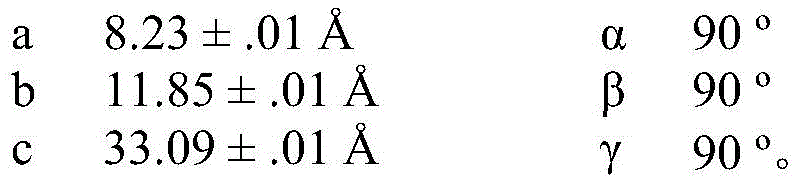
310. the crystalline compound I sodium salt hydrate form a of any one of embodiments 303 to 309 prepared by a process comprising mixing amorphous compound I sodium salt with IPA/water at room temperature for two weeks.
311. A method of preparing the crystalline compound I sodium salt hydrate form a of any one of embodiments 303 to 309 by a method comprising mixing amorphous compound I sodium salt with IPA/water at room temperature for two weeks.
312. A pharmaceutical composition comprising crystalline compound I sodium salt hydrate form a as described in any one of embodiments 303 to 310, optionally further comprising one or more additional CFTR-modulating compounds.
313. The pharmaceutical composition of embodiment 312, wherein the one or more additional CFTR-modulating compounds is
a. Compound III or compound III-d; or
b. (i) Compound II and (II) Compound III or Compound III-d.
314. Compound I sodium salt hydrate form a according to any one of embodiments 303 to 310 or a pharmaceutical composition according to embodiment 312 or embodiment 313 for use in the treatment of cystic fibrosis.
315. Use of compound I sodium salt hydrate form a according to any one of embodiments 303 to 310 or a pharmaceutical composition according to embodiment 312 or 313 in the manufacture of a medicament for the treatment of cystic fibrosis.
316. A method of treating cystic fibrosis comprising administering compound I sodium salt hydrate form a of any one of embodiments 303 to 310 or a pharmaceutical composition of embodiment 312 or embodiment 313 to a subject in need thereof.
317. The compound for use according to embodiment 314, the use according to embodiment 315, or the method according to embodiment 316, wherein compound I sodium salt hydrate form a according to any one of embodiments 303 to 310 is administered in combination with at least one additional CFTR modulating compound.
318. The compound, use or method of embodiment 317, wherein compound I sodium salt hydrate form a as described in any one of embodiments 303 to 310 is administered in combination with:
a. compound III or compound III-d;
(II) compound III or compound III-d; or
(i) compound IV and (ii) compound III or compound III-d.
319. The composition, use, method or compound of any one of embodiments 313 to 318, wherein compound II and/or compound III is in the form of a solid dispersion.
320. A substantially crystalline sodium salt of compound I in pure form B (i.e., wherein less than 15% of compound I is in amorphous form, wherein less than 10% of compound I is in amorphous form, wherein less than 5% of compound I is in amorphous form).
321. Compound I according to embodiment 320, wherein compound I is 100% crystalline sodium salt pure form B.
322. Crystalline compound I sodium salt pure form B as described in embodiment 320 or embodiment 321, characterized by an X-ray powder diffraction pattern of signals at: 11.0 + -0.2 deg. 2 theta, 18.1 + -0.2 deg. 2 theta and 20.5 + -0.2 deg. 2 theta.
323. The crystalline compound I sodium salt pure form B of embodiment 320 or embodiment 321, characterized by the X-ray powder diffraction pattern of: (a) a signal at 12.8 ± 0.2 ° 2 Θ; and (b) signals at 20.5 ± 0.2 ° 2 θ, 18.1 ± 0.2 ° 2 θ, and/or 11.0 ± 0.2 ° 2 θ.
324. The crystalline compound I sodium salt pure form B of embodiment 320 or embodiment 321 characterized by an X-ray powder diffraction pattern substantially similar to figure 36.
325. A crystalline compound I sodium salt pure form B as described in any one of embodiments 320 to 324 prepared by a process comprising desolvation/dehydration of compound I sodium salt hydrate form C.
326. A method of preparing the crystalline compound I sodium salt pure form B of any one of embodiments 320 to 324 by a method comprising desolvating/dehydrating compound I sodium salt hydrate form C.
327. A pharmaceutical composition comprising crystalline compound I sodium salt pure form B as described in any one of embodiments 320-325, optionally further comprising one or more additional CFTR-modulating compounds.
328. The pharmaceutical composition of embodiment 327, wherein the one or more additional CFTR-modulating compounds is
a. Compound III or compound III-d; or
b. (i) Compound II and (II) Compound III or Compound III-d.
329. Compound I sodium salt pure form B according to any one of embodiments 320 to 325 or the pharmaceutical composition according to embodiment 327 or embodiment 328 for use in the treatment of cystic fibrosis.
330. Use of compound I sodium salt pure form B according to any one of embodiments 320 to 325 or a pharmaceutical composition according to embodiments 327 or 328 in the manufacture of a medicament for the treatment of cystic fibrosis.
331. A method of treating cystic fibrosis comprising administering to a subject in need thereof compound I sodium salt pure form B according to any one of embodiments 320 to 325 or a pharmaceutical composition according to embodiment 327 or embodiment 328.
332. The compound for use according to embodiment 329, the use according to embodiment 330 or the method according to embodiment 331, wherein compound I sodium salt pure form B according to any one of embodiments 320 to 325 is administered in combination with at least one additional CFTR modulating compound.
333. The compound, use or method of embodiment 332, wherein compound I sodium salt pure form B as described in any one of embodiments 320 to 325 is administered in combination with:
a. compound III or compound III-d;
b. (i) compound II and (II) compound III or compound III-d; or
c. (i) Compound IV and (ii) Compound III or Compound III-d.
334. The composition, use, method or compound of any one of embodiments 328 to 333, wherein compound II and/or compound III is in the form of a solid dispersion.
335. A substantially crystalline sodium salt hydrate form C of compound I (i.e., wherein less than 15% of compound I is in amorphous form, wherein less than 10% of compound I is in amorphous form, wherein less than 5% of compound I is in amorphous form).
336. Compound I according to embodiment 335, wherein compound I is 100% crystalline sodium salt hydrate form C.
337. Crystalline compound I sodium salt hydrate form C as described in embodiment 335 or embodiment 336, characterized by an X-ray powder diffraction pattern having signals at: 6.1 + -0.2 deg. 2 theta, 13.4 + -0.2 deg. 2 theta and 19.2 + -0.2 deg. 2 theta.
338. Crystalline compound I sodium salt hydrate form C according to embodiment 335 or embodiment 336, characterized by an X-ray powder diffraction pattern having: (a) signals at 10.3 ± 0.2 ° 2 Θ and/or 4.5 ± 0.2 ° 2 Θ; and (b) signals at 19.2 ± 0.2 ° 2 θ, 13.4 ± 0.2 ° 2 θ, and/or 6.1 ± 0.2 ° 2 θ.
339. Crystalline compound I sodium salt hydrate form C as described in embodiment 335 or embodiment 336, characterized by an X-ray powder diffraction pattern substantially similar to figure 37.
340. The crystalline compound I sodium salt hydrate form C of any one of embodiments 335 to 339 prepared by a process comprising stirring an amorphous sodium salt of compound I with ACN at room temperature.
341. A process for preparing crystalline compound I sodium salt hydrate form C according to any one of embodiments 335 to 339 by a process comprising stirring an amorphous sodium salt of compound I with ACN at room temperature.
342. A pharmaceutical composition comprising crystalline compound I sodium salt hydrate form C as described in any one of embodiments 335 to 340, optionally further comprising one or more additional CFTR-modulating compounds.
343. The pharmaceutical composition of embodiment 342, wherein the one or more additional CFTR modulating compound is
a. Compound III or compound III-d; or
(i) Compound II and (II) Compound III or Compound III-d.
344. Compound I sodium salt hydrate form C according to any one of embodiments 335 to 340 or a pharmaceutical composition according to embodiment 342 or embodiment 343 for use in the treatment of cystic fibrosis.
345. Use of compound I sodium salt hydrate form C according to any one of embodiments 335 to 340 or a pharmaceutical composition according to embodiment 342 or 343 in the manufacture of a medicament for the treatment of cystic fibrosis.
346. A method of treating cystic fibrosis comprising administering compound I sodium salt hydrate form C of any one of embodiments 335 to 340 or a pharmaceutical composition of embodiment 342 or embodiment 343 to a subject in need thereof.
347. The compound for use according to embodiment 344, the use according to embodiment 345 or the method of embodiment 346, wherein compound I sodium salt hydrate form C according to any one of embodiments 335 to 340 is administered in combination with at least one additional CFTR modulating compound.
348. The compound, use or method of embodiment 347, wherein compound I sodium salt hydrate form C as described in any one of embodiments 335 to 340 is administered in combination with:
a. compound III or compound III-d;
(II) compound III or compound III-d; or
c. (i) Compound IV and (ii) Compound III or Compound III-d.
349. The composition, use, method or compound of any one of embodiments 343 to 348, wherein compound II and/or compound III is in the form of a solid dispersion.
350. A substantially crystalline sodium salt hydrate form D of compound I (i.e., wherein less than 15% of compound I is in amorphous form, wherein less than 10% of compound I is in amorphous form, wherein less than 5% of compound I is in amorphous form).
351. Compound I as in embodiment 350, wherein compound I is 100% crystalline sodium salt hydrate form D.
352. Crystalline compound I sodium salt hydrate form D of embodiment 350 or embodiment 351, characterized by an X-ray powder diffraction pattern having signals throughout: 7.8 + -0.2 deg. 2 theta, 18.5 + -0.2 deg. 2 theta and 19.9 + -0.2 deg. 2 theta.
353. Crystalline compound I sodium salt hydrate form D of embodiment 350 or embodiment 351, characterized by the X-ray powder diffraction pattern of: (a) signals at 7.8 ± 0.2 ° 2 θ, 18.5 ± 0.2 ° 2 θ and 19.9 ± 0.2 ° 2 θ; and (b) signals at 9.3 ± 0.2 ° 2 θ, 14.8 ± 0.2 ° 2 θ, and/or 27.3 ± 0.2 ° 2 θ.
354. Crystalline compound I sodium salt hydrate form D according to embodiment 350 or embodiment 351, characterized by an X-ray powder diffraction pattern substantially similar to figure 38.
355. The crystalline compound I sodium salt hydrate form D of any one of embodiments 350 to 354 prepared by a process comprising vacuum drying compound I sodium salt hydrate form C at 80 ℃.
356. A method of preparing crystalline compound I sodium salt hydrate form D of any one of embodiments 350 to 354 by a process comprising vacuum drying compound I sodium salt hydrate form C at 80 ℃.
357. A pharmaceutical composition comprising crystalline compound I sodium salt hydrate form D according to any one of embodiments 350 to 355, optionally further comprising one or more additional CFTR-modulating compounds.
358. The pharmaceutical composition of embodiment 357, wherein said one or more additional CFTR-modulating compounds is
a. Compound III or compound III-d; or
b. (i) Compound II and (II) Compound III or Compound III-d.
359. Compound I sodium salt hydrate form D according to any one of embodiments 350 to 355 or a pharmaceutical composition according to embodiment 357 or embodiment 358 for use in the treatment of cystic fibrosis.
360. Use of compound I sodium salt hydrate form D according to any one of embodiments 350 to 355 or a pharmaceutical composition according to embodiment 357 or 358 in the manufacture of a medicament for the treatment of cystic fibrosis.
361. A method of treating cystic fibrosis comprising administering compound I sodium salt hydrate form D of any one of embodiments 350 to 355 or a pharmaceutical composition of embodiment 357 or embodiment 358 to a subject in need thereof.
362. The compound for use according to embodiment 359, the use according to embodiment 360 or the method according to embodiment 361, wherein compound I sodium salt hydrate form D according to any one of embodiments 350 to 355 is administered in combination with at least one additional CFTR modulating compound.
363. The compound, use or method of embodiment 362 wherein compound I sodium salt hydrate form D, as described in any one of embodiments 350 to 355, is administered in combination with:
a. compound III or compound III-d;
(II) compound III or compound III-d; or
(i) compound IV and (ii) compound III or compound III-d.
364. The composition, use, method or compound of any one of embodiments 358 to 363, wherein compound II and/or compound III is in the form of a solid dispersion.
365. A substantially crystalline potassium salt hydrate form a of compound I (i.e., wherein less than 15% of compound I is in amorphous form, wherein less than 10% of compound I is in amorphous form, wherein less than 5% of compound I is in amorphous form).
366. Compound I according to embodiment 365, wherein compound I is 100% crystalline potassium salt hydrate form a.
367. Crystalline compound I potassium salt hydrate form a of embodiment 365 or embodiment 366, characterized by an X-ray powder diffraction pattern having a signal at 10.7 ± 0.2 ° 2 Θ.
368. Crystalline compound I potassium salt hydrate form a of embodiment 365 or embodiment 366, characterized by an X-ray powder diffraction pattern having: (a) a signal at 10.7 ± 0.2 ° 2 Θ; and (b) signals at 15.3 ± 0.2 ° 2 θ and/or 20.4 ± 0.2 ° 2 θ.
369. Crystalline compound I potassium salt hydrate form a of embodiment 365 or embodiment 366, characterized by an X-ray powder diffraction pattern substantially similar to figure 39.
370. Crystalline compound I potassium salt hydrate form a of any one of embodiments 365 to 369 prepared by a process comprising: reacting compound I (free form) form A with potassium hydride/H2O reacts and is subjected to two heating and cooling cycles from 60 ℃ to room temperature.
371. A process for preparing crystalline compound I potassium salt hydrate form a as described in any one of embodiments 365 to 369 by a process comprising: reacting compound I (free form) form A with potassium hydride/H2O reacts and is subjected to two heating and cooling cycles from 60 ℃ to room temperature.
372. A pharmaceutical composition comprising crystalline compound I potassium salt hydrate form a of any one of embodiments 365 to 370, optionally further comprising one or more additional CFTR-modulating compounds.
373. The pharmaceutical composition of embodiment 372, wherein the one or more additional CFTR-modulating compounds is
a. Compound III or compound III-d; or
(i) Compound II and (II) Compound III or Compound III-d.
374. Compound I potassium salt hydrate form a according to any one of embodiments 365 to 370 or a pharmaceutical composition according to embodiment 372 or embodiment 373 for use in the treatment of cystic fibrosis.
375. Use of compound I potassium salt hydrate form a according to any one of embodiments 365 to 370 or a pharmaceutical composition according to embodiment 372 or 373 in the manufacture of a medicament for the treatment of cystic fibrosis.
376. A method of treating cystic fibrosis comprising administering compound I potassium salt hydrate form a of any one of embodiments 365 to 370 or a pharmaceutical composition of embodiment 372 or embodiment 373 to a subject in need thereof.
377. The compound for use according to embodiment 374, the use according to embodiment 375, or the method according to embodiment 376, wherein compound I potassium salt hydrate form a according to any one of embodiments 365 to 370 is administered in combination with at least one additional CFTR modulating compound.
378. The compound, use or method of embodiment 377, wherein compound I potassium salt hydrate form a, as described in any one of embodiments 365 to 370, is administered in combination with:
a. Compound III or compound III-d;
b. (i) compound II and (II) compound III or compound III-d; or
c. (i) Compound IV and (ii) Compound III or Compound III-d.
379. The composition, use, method or compound of any one of embodiments 374 to 378, wherein compound II and/or compound III is in the form of a solid dispersion.
380. A substantially crystalline potassium salt hydrate form B of compound I (i.e., wherein less than 15% of compound I is in amorphous form, wherein less than 10% of compound I is in amorphous form, wherein less than 5% of compound I is in amorphous form).
381. Compound I according to embodiment 380, wherein compound I is 100% crystalline potassium salt hydrate form B.
382. Crystalline compound I potassium salt hydrate form B of embodiment 380 or embodiment 381 characterized by an X-ray powder diffraction pattern having a signal at 14.8 ± 0.2 ° 2 Θ.
383. Crystalline compound I potassium salt hydrate form B of embodiment 380 or embodiment 381 characterized by an X-ray powder diffraction pattern having signals at: 4.7 + -0.2 deg. 2 theta, 6.8 + -0.2 deg. 2 theta and 21.5 + -0.2 deg. 2 theta.
384. Crystalline compound I potassium salt hydrate form B of embodiment 380 or embodiment 381 characterized by the following X-ray powder diffraction pattern: (a) signals at 4.7 ± 0.2 ° 2 θ, 6.8 ± 0.2 ° 2 θ, 14.8 ± 0.2 ° 2 θ, 21.5 ± 0.2 ° 2 θ; and (b) signals at 15.2 ± 0.2 ° 2 θ, 16.1 ± 0.2 ° 2 θ, and/or 19.0 ± 0.2 ° 2 θ.
385. Crystalline compound I potassium salt hydrate form B of embodiment 380 or embodiment 381 characterized by an X-ray powder diffraction pattern substantially similar to figure 40.
386. Crystalline compound I potassium salt hydrate form B of any one of embodiments 380 to 385, prepared by a process comprising preparing a slurry of amorphous potassium salt of compound I and ACN at room temperature and then at 60 ℃.
387. A method of preparing crystalline compound I potassium salt hydrate form B according to any one of embodiments 380 to 385 by a process comprising preparing a slurry of amorphous potassium salt of compound I with ACN at room temperature and then at 60 ℃.
388. A pharmaceutical composition comprising crystalline compound I potassium salt hydrate form B of any one of embodiments 380 to 386, optionally further comprising one or more additional CFTR-modulating compounds.
389. The pharmaceutical composition of embodiment 388, wherein the one or more additional CFTR modulating compounds is
a. Compound III or compound III-d; or
b. (i) Compound II and (II) Compound III or Compound III-d.
390. Compound I potassium salt hydrate form B according to any one of embodiments 380 to 386 or a pharmaceutical composition according to embodiment 388 or embodiment 389 for use in the treatment of cystic fibrosis.
391. Use of compound I potassium salt hydrate form B according to any one of embodiments 380 to 386 or a pharmaceutical composition according to embodiments 388 or 389 in the manufacture of a medicament for the treatment of cystic fibrosis.
392. A method of treating cystic fibrosis comprising administering compound I potassium salt hydrate form B of any one of embodiments 380 to 386 or a pharmaceutical composition of embodiment 388 or embodiment 389 to a subject in need thereof.
393. The compound for use according to embodiment 390, the use according to embodiment 391 or the method according to embodiment 392, wherein compound I potassium salt hydrate form B according to any one of embodiments 380 to 386 is administered in combination with at least one further CFTR modulating compound.
394. A compound, use or method as described in embodiment 393, wherein compound I potassium salt hydrate form B as described in any one of embodiments 380 to 386 is administered in combination with:
a. compound III or compound III-d;
b. (i) compound II and (II) compound III or compound III-d; or
c. (i) Compound IV and (ii) Compound III or Compound III-d.
395. A composition, use, method, or compound of any one of embodiments 389 to 394, wherein compound II and/or compound III is in the form of a solid dispersion.
396. A substantially crystalline potassium salt hydrate form C of compound I (i.e., wherein less than 15% of compound I is in amorphous form, wherein less than 10% of compound I is in amorphous form, wherein less than 5% of compound I is in amorphous form).
397. Compound I according to embodiment 396, wherein compound I is 100% crystalline potassium salt hydrate form C.
398. Crystalline compound I potassium salt hydrate form C as described in embodiment 396 or embodiment 397, characterized by an X-ray powder diffraction pattern having signals at: 4.8 + -0.2 deg. 2 theta, 6.3 + -0.2 deg. 2 theta and 14.2 + -0.2 deg. 2 theta.
399. Crystalline compound I potassium salt hydrate form C as described in embodiment 396 or embodiment 397, characterized by an X-ray powder diffraction pattern having: (a) signals at 4.8 ± 0.2 ° 2 θ, 6.3 ± 0.2 ° 2 θ and 14.2 ± 0.2 ° 2 θ; and (b) one or more signals selected from 13.5 ± 0.2 ° 2 θ, 14.2 ± 0.2 ° 2 θ, 15.8 ± 0.2 ° 2 θ, 19.0 ± 0.2 ° 2 θ, and 27.1 ± 0.2 ° 2 θ.
400. Crystalline compound I potassium salt hydrate form C as described in embodiment 396 or embodiment 397, characterized by an X-ray powder diffraction pattern substantially similar to figure 41.
401. Crystalline compound I potassium salt hydrate form C of any one of embodiments 396-400, prepared by a process comprising stirring amorphous compound I potassium salt with ACN at room temperature.
402. A process for preparing crystalline compound I potassium salt hydrate form C according to any one of embodiments 396 to 400 by a process comprising stirring amorphous compound I potassium salt with ACN at room temperature.
403. A pharmaceutical composition comprising crystalline compound I potassium salt hydrate form C according to any one of embodiments 396-401, optionally further comprising one or more additional CFTR-modulating compounds.
404. The pharmaceutical composition of embodiment 403, wherein the one or more additional CFTR modulating compound is
a. Compound III or compound III-d; or
b. (i) Compound II and (II) Compound III or Compound III-d.
405. Compound I potassium salt hydrate form C according to any one of embodiments 396 to 401 or the pharmaceutical composition according to embodiment 403 or embodiment 404 for use in the treatment of cystic fibrosis.
406. Use of compound I potassium salt hydrate form C according to any one of embodiments 396 to 401 or a pharmaceutical composition according to embodiment 403 or 404 in the manufacture of a medicament for the treatment of cystic fibrosis.
407. A method of treating cystic fibrosis comprising administering to a subject in need thereof compound I potassium salt hydrate form C according to any one of embodiments 396 to 401 or a pharmaceutical composition according to embodiment 403 or embodiment 404.
408. The compound for use according to embodiment 405, the use according to embodiment 406 or the method according to embodiment 407, wherein compound I potassium salt hydrate form C according to any one of embodiments 396 to 401 is administered in combination with at least one additional CFTR modulating compound.
409. The compound, use or method of embodiment 408, wherein compound I potassium salt hydrate form C, as described in any one of embodiments 396 to 401, is administered in combination with:
a. compound III or compound III-d;
b. (i) compound II and (II) compound III or compound III-d; or
c. (i) Compound IV and (ii) Compound III or Compound III-d.
410. The composition, use, method or compound of any of embodiments 404 to 409, wherein compound II and/or compound III is in the form of a solid dispersion.
411. A substantially crystalline potassium salt hydrate form D of compound I (i.e., wherein less than 15% of compound I is in amorphous form, wherein less than 10% of compound I is in amorphous form, wherein less than 5% of compound I is in amorphous form).
412. Compound I according to embodiment 411, wherein compound I is 100% crystalline potassium salt hydrate form D.
413. Crystalline compound I potassium salt hydrate form D of embodiment 411 or embodiment 412, characterized by an X-ray powder diffraction pattern having signals at: 4.4 + -0.2 deg. 2 theta, 13.1 + -0.2 deg. 2 theta and 15.3 + -0.2 deg. 2 theta.
414. Crystalline compound I potassium salt hydrate form D of embodiment 411 or embodiment 412, characterized by the following X-ray powder diffraction pattern: (a) a signal at 8.8 ± 0.2 ° 2 Θ; and (b) signals at 4.4 ± 0.2 ° 2 θ, 13.1 ± 0.2 ° 2 θ, and 15.3 ± 0.2 ° 2 θ.
415. Crystalline compound I potassium salt hydrate form D of embodiment 411 or embodiment 412, characterized by the following X-ray powder diffraction pattern: (a) signals at 4.4 ± 0.2 ° 2 θ, 8.8 ± 0.2 ° 2 θ, 13.1 ± 0.2 ° 2 θ, and 15.3 ± 0.2 ° 2 θ; and (b) signals at 7.0 ± 0.2 ° 2 θ, 8.1 ± 0.2 ° 2 θ, and/or 21.9 ± 0.2 ° 2 θ.
416. Crystalline compound I potassium salt hydrate form D of embodiment 411 or embodiment 412, characterized by an X-ray powder diffraction pattern substantially similar to figure 42.
417. Crystalline compound I potassium salt hydrate form D of any one of embodiments 411 to 416, prepared by a process comprising stirring amorphous compound I potassium salt with ACN at room temperature and drying in vacuo at 29 ℃.
418. A process for preparing crystalline compound I potassium salt hydrate form D according to any one of embodiments 411 to 416 by a process comprising stirring amorphous compound I potassium salt with ACN at room temperature and drying in vacuo at 29 ℃.
419. A pharmaceutical composition comprising crystalline compound I potassium salt hydrate form D according to any one of embodiments 411 to 417, optionally further comprising one or more additional CFTR-modulating compounds.
420. The pharmaceutical composition of embodiment 419, wherein the one or more additional CFTR modulating compounds is
a. Compound III or compound III-d; or
b. (i) Compound II and (II) Compound III or Compound III-d.
421. Compound I potassium salt hydrate form D according to any one of embodiments 411 to 417 or a pharmaceutical composition according to embodiment 419 or embodiment 420 for use in the treatment of cystic fibrosis.
422. Use of compound I potassium salt hydrate form D according to any one of embodiments 411 to 417 or a pharmaceutical composition according to embodiments 419 or 420 in the manufacture of a medicament for the treatment of cystic fibrosis.
423. A method of treating cystic fibrosis comprising administering compound I potassium salt hydrate form D of any one of embodiments 411 to 417 or a pharmaceutical composition of embodiment 419 or embodiment 420 to a subject in need thereof.
424. A compound for use according to embodiment 421, a use according to embodiment 422, or a method according to embodiment 423, wherein compound I potassium salt hydrate form D according to any one of embodiments 411 to 417 is administered in combination with at least one additional CFTR modulating compound.
425. The compound, use or method of embodiment 408 wherein compound I potassium salt hydrate form D, as described in any one of embodiments 411 to 417, is administered in combination with:
a. compound III or compound III-d;
b. (i) compound II and (II) compound III or compound III-d; or
c. (i) Compound IV and (ii) Compound III or Compound III-d.
426. The composition, use, method or compound of any one of embodiments 420 to 425, wherein compound II and/or compound III is in the form of a solid dispersion.
427. A substantially crystalline form a of compound I ammine salt hydrate (i.e., wherein less than 15% of compound I is in amorphous form, wherein less than 10% of compound I is in amorphous form, wherein less than 5% of compound I is in amorphous form).
428. Compound I according to embodiment 427, wherein compound I is 100% crystalline ammonia salt hydrate form a.
429. Crystalline compound I ammine salt hydrate form a according to embodiment 427 or embodiment 428, characterized by an X-ray powder diffraction pattern having signals at: 5.5 + -0.2 deg. 2 theta, 15.3 + -0.2 deg. 2 theta and/or 17.7 + -0.2 deg. 2 theta.
430. Crystalline compound I ammine salt hydrate form a according to embodiment 427 or embodiment 428, characterized by the following X-ray powder diffraction pattern: (a) signals at 5.5 ± 0.2 ° 2 Θ, 15.3 ± 0.2 ° 2 Θ, and/or 17.7 ± 0.2 ° 2 Θ; and (b) signals at 18.0 ± 0.2 ° 2 θ, 19.6 ± 0.2 ° 2 θ, and/or 20.9 ± 0.2 ° 2 θ.
431. Crystalline compound I ammine salt hydrate form a according to embodiment 427 or embodiment 428, characterized by an X-ray powder diffraction pattern substantially similar to figure 44.
432. The crystalline compound I ammine hydrate form a of any one of embodiments 427 to 431, prepared by a process comprising mixing amorphous compound I (free form) form a with ammonium hydroxide in water.
433. A process for preparing the crystalline compound I ammonium salt hydrate form a of any one of embodiments 427 to 431 by a process comprising mixing amorphous compound I (free form) form a with ammonium hydroxide in water.
434. A pharmaceutical composition comprising crystalline compound I ammine salt hydrate form a according to any one of embodiments 427 to 432, optionally further comprising one or more additional CFTR-modulating compounds.
435. The pharmaceutical composition of embodiment 434, wherein the one or more additional CFTR-modulating compounds is
a. Compound III or compound III-d; or
b. (i) Compound II and (II) Compound III or Compound III-d.
436. Compound I ammine salt hydrate form a according to any one of embodiments 427 to 432 or a pharmaceutical composition according to embodiment 434 or embodiment 435 for use in the treatment of cystic fibrosis.
437. Use of compound I ammonia salt hydrate form a according to any one of embodiments 427 to 432 or a pharmaceutical composition according to embodiments 434 or 435 in the manufacture of a medicament for the treatment of cystic fibrosis.
438. A method of treating cystic fibrosis comprising administering compound I ammine salt hydrate form a of any one of embodiments 427 to 432 or a pharmaceutical composition of embodiment 434 or embodiment 435 to a subject in need thereof.
439. The compound for use according to embodiment 436, the use according to embodiment 437 or the method according to example 438, wherein compound I ammonia salt hydrate form a according to any one of embodiments 427 to 432 is administered in combination with at least one additional CFTR modulating compound.
440. The compound, use or method of embodiment 439, wherein compound I ammonia salt hydrate form a as described in any one of embodiments 427 to 432 is administered in combination with:
a. compound III or compound III-d;
b. (i) compound II and (II) compound III or compound III-d; or
c. (i) Compound IV and (ii) Compound III or Compound III-d.
441. The composition, use, method or compound of any one of embodiments 435 to 440, wherein compound II and/or compound III is in the form of a solid dispersion.
442. A substantially crystalline sodium salt hydrate form E of compound I.
443. Compound I sodium salt hydrate form E according to embodiment 442, characterized by an X-ray powder diffraction pattern having signals at: 4.3 + -0.2 deg. 2 theta, 13.0 + -0.2 deg. 2 theta and 14.9 + -0.2 deg. 2 theta.
444. Compound I sodium salt hydrate form E as described in embodiment 442 or embodiment 443 characterized by the following X-ray powder diffraction pattern:
(a) signals at 4.3 ± 0.2 ° 2 θ, 13.0 ± 0.2 ° 2 θ and 14.9 ± 0.2 ° 2 θ; and
(b) signals at one, two, three, or four of the following: 10.6 + -0.2 DEG 2 theta, 11.7 + -0.2 DEG 2 theta, 13.4 + -0.2 DEG 2 theta, 14.1 + -0.2 DEG 2 theta, 14.2 + -0.2 DEG 2 theta, 17.3 + -0.2 DEG 2 theta, 18.1 + -0.2 DEG 2 theta, 18.8 + -0.2 DEG 2 theta, 19.2 + -0.2 DEG 2 theta, 20.0 + -0.2 DEG 2 theta, 21.4 + -0.2 DEG 2 theta, 21.5 + -0.2 DEG 2 theta, 22.3 + -0.2 DEG 2 theta and 23.1 + -0.2 DEG 2 theta.
445. Compound I sodium salt hydrate form E according to embodiment 442, characterized by an X-ray powder diffraction pattern having signals throughout: 4.3 + -0.2 deg. 2 theta, 13.0 + -0.2 deg. 2 theta and 23.1 + -0.2 deg. 2 theta.
446. Compound I sodium salt hydrate form E as described in any one of embodiments 442 to 445, characterized by an X-ray powder diffraction pattern substantially similar to figure 49.
447. Compound I sodium salt hydrate form E according to any one of embodiments 442 to 446, wherein compound I sodium salt hydrate form E is characterized by having one, two, three, four, five, six, seven or more peaks selected from13C solid-state nuclear magnetic resonance (13Csnmr) spectrum: 165.2. + -. 0.2ppm, 155.4. + -. 0.2ppm, 142.7. + -. 0.2ppm, 128.4. + -. 0.2ppm, 121.3. + -. 0.2ppm, 101.0. + -. 0.2ppm, 93.1. + -. 0.2ppm, 69.5. + -. 0.2ppm, 62.6. + -. 0.2ppm, 55.2. + -. 0.2ppm, 50.6. + -. 0.2ppm, 50.0. + -. 0.2ppm, 21.1. + -. 0.2ppm, 17.2. + -. 0.2ppm, 7.2. + -. 0.2ppm and 2.1. + -. 0.2 ppm.
448. Compound I sodium salt hydrate form E as described in any one of embodiments 442 to 447, wherein compound I sodium salt hydrate form E is characterized by having peaks everywhere below 13C ssNMR spectrum: 165.2 + -0.2 ppm, 155.4 + -0.2 ppm, 142.7 + -0.2 ppm, 128.4 + -0.2 ppm, 121.3 + -0.2 ppm, 101.0 + -0.2 ppm, 93.1 + -0.2 ppm, 69.5 + -0.2 ppm, 62.6 + -0.2 ppm, 55.2 + -0.2 ppm, 50.6 + -0.2 ppm, 50.0 + -0.2 ppm, 21.1 + -0.2 ppm, 17.2 + -0.2 ppm, 7.2 + -0.2 ppm and 2.1 + -0.2 ppm.
449. Compound I sodium salt hydrate form E according to any one of embodiments 442 to 446, wherein compound I sodium salt hydrate form ECharacterised by having peaks at13C solid-state nuclear magnetic resonance (13C ssNMR) spectrum: 177.4 + -0.2 ppm, 165.2 + -0.2 ppm, 155.4 + -0.2 ppm, 142.7 + -0.2 ppm, 128.4 + -0.2 ppm, 121.3 + -0.2 ppm, 101.0 + -0.2 ppm, 69.5 + -0.2 ppm, 62.6 + -0.2 ppm, 55.2 + -0.2 ppm, 50.0 + -0.2 ppm, 30.9 + -0.2 ppm, 30.2 + -0.2 ppm, 27.8 + -0.2 ppm, 21.1 + -0.2 ppm, 17.2 + -0.2 ppm, 7.2 + -0.2 ppm and 2.1 + -0.2 ppm.
450. Compound I sodium salt hydrate form E according to any one of embodiments 442 to 449, characterized by being substantially similar to figure 5013C solid state NMR spectrum.
451. Compound I sodium salt hydrate form E according to any one of embodiments 442 to 450, characterized by orthorhombic crystallinity, C2221Space group and Cu K-equipped αRadiation of radiation The following unit cell dimensions measured at 100K on a Bruker diffractometer:
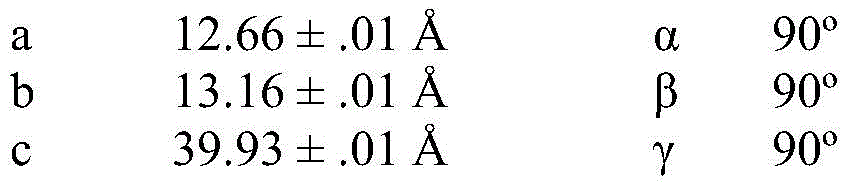
452. compound I sodium salt hydrate form E according to any one of embodiments 442 to 451, prepared by a process comprising:
i. heating compound I sodium salt hydrate form a in IPA and water at 65 ℃,
cooling the mixture to 45 ℃,
seeding with crystals of compound I sodium salt hydrate form a,
cooling the mixture to 20 ℃,
v. collecting the solid, wherein the solid is,
wash the solid with IPA: water (1:3v: v) and air dry,
adding IPA, NaOH and water to the solid,
heating to 73 ℃,
fine filtering the solution to obtain a solution,
x, cooling to 58 ℃,
adding water to the reaction kettle,
seeding at 40 ℃ with crystals of compound I sodium salt hydrate form E,
xiii. cooling to 5 deg.C,
collecting the solid, and (iv) collecting the solid,
xv. washing the solid with a mixture of water and IPA, and
drying in vacuum at 40 ℃,
to provide compound I sodium salt hydrate form E.
453. A process for preparing compound I sodium salt hydrate form E according to any one of embodiments 442 to 451, comprising:
i. heating compound I sodium salt hydrate form a in IPA and water at 65 ℃,
Cooling the mixture to 45 ℃,
seeding with crystals of compound I sodium salt hydrate form a,
cooling the mixture to 20 ℃,
v. collecting the solid, then
Wash the solid with IPA: water (1:3v: v) and air dry,
adding IPA, NaOH and water to the solid,
heating to 73 ℃,
fine filtering the solution to obtain a solution,
x, cooling to 58 ℃,
adding water to the reaction kettle,
seeding at 40 ℃ with crystals of compound I sodium salt hydrate form E,
xiii. cooling to 5 deg.C,
collecting the solid, and (iv) collecting the solid,
xv. washing the solid with a mixture of water and IPA, and
vacuum drying at 40 ℃.
454. Compound I sodium salt hydrate form E according to any one of embodiments 442 to 451, prepared by a process comprising:
i. compound I sodium salt hydrate form a was dissolved in IPA/water at 65 c,
cooling the solution to 45 ℃,
seeding with a mixture of compound I sodium salt hydrate form a and form E,
adding water to the reaction mixture,
v. cooling to 20 ℃,
collecting the solid, and (vi) collecting the solid,
washing the solid with a mixture of water and IPA, and
vacuum drying
To provide compound I sodium salt hydrate form E.
455. A process for preparing compound I sodium salt hydrate form E according to any one of embodiments 442 to 451, comprising:
i. compound I sodium salt hydrate form a was dissolved in IPA/water at 65 c,
cooling the solution to 45 ℃,
seeding with a mixture of compound I sodium salt hydrate form a and form E,
adding water to the reaction mixture,
v. cooling to 20 ℃,
collecting the solid, and (vi) collecting the solid,
washing the solid with a mixture of water and IPA, and
vacuum drying.
456. A substantially crystalline sodium salt of compound I IPA (wet) solvate form a.
457. Compound I sodium salt IPA solvate (wet) form a, as described in embodiment 456 characterized by an X-ray powder diffraction pattern having a signal at 3.5 ± 0.2 ° 2 Θ and/or 3.6 ± 0.2 ° 2 Θ.
458. Compound I sodium salt IPA solvate (wet) form a as described in embodiment 456 or embodiment 457 and characterized by the following X-ray powder diffraction pattern:
(a) signals at 3.5 ± 0.2 ° 2 Θ and/or 3.6 ± 0.2 ° 2 Θ; and
(b) signal at 9.5 ± 0.2 ° 2 θ.
459. Compound I sodium salt IPA solvate (wet) form a as described in any one of embodiments 456 to 458 characterized by an X-ray powder diffraction pattern having signals at: 3.6 + -0.2 deg. 2 theta, 3.5 + -0.2 deg. 2 theta and 9.5 + -0.2 deg. 2 theta.
460. Compound I sodium salt IPA solvate (wet) form a of any one of embodiments 456 to 459 characterized by an X-ray powder diffraction pattern substantially similar to figure 51.
461. Compound I sodium salt IPA solvate (wet) form a as described in any one of embodiments 456 to 460 prepared by a process comprising slurrying amorphous compound I sodium salt hydrate form a in IPA.
462. A method of preparing compound I sodium salt IPA solvate (wet) form a of any one of embodiments 456 to 460 comprising slurrying amorphous compound I sodium salt hydrate form a in IPA.
463. A substantially crystalline sodium salt of compound I IPA (dry) solvate form B.
464. Compound I sodium salt IPA solvate (dry) form B, as described in embodiment 463, characterized by an X-ray powder diffraction pattern having signals at 4.0 ± 0.2 ° 2 Θ and 5.3 ± 0.2 ° 2 Θ.
465. Compound I sodium salt IPA solvate (dry) form B as described in embodiment 463 or embodiment 464 characterized by an X-ray powder diffraction pattern having:
(a) signals at 4.0 ± 0.2 ° 2 θ and 5.3 ± 0.2 ° 2 θ; and
(b) signals at one, two, three, or four of the following: 7.9 + -0.2 deg. 2 theta, 9.7 + -0.2 deg. 2 theta, 11.0 + -0.2 deg. 2 theta, 13.9 + -0.2 deg. 2 theta, 18.5 + -0.2 deg. 2 theta, and 20.0 + -0.2 deg. 2 theta.
466. Compound I sodium salt IPA solvate (dry) form B as described in embodiment 463 characterized by an X-ray powder diffraction pattern having signals at: 4.0 + -0.2 deg. 2 theta, 7.9 + -0.2 deg. 2 theta and 9.7 + -0.2 deg. 2 theta.
467. Compound I sodium salt IPA solvate (dry) form B as described in any one of embodiments 463 through 466 characterized by an X-ray powder diffraction pattern substantially similar to figure 52.
468. Compound I sodium salt IPA solvate (dry) form B as described in any one of embodiments 463 through 467, wherein compound I sodium salt IPA solvate (dry) form B is characterized by having one, two, three, four, five, six, seven or more peaks selected from13C solid-state nuclear magnetic resonance (C)13C ssNMR) spectrum: 180.3 +/-0.2 ppm, 178.7 +/-0.2 ppm, 164.7 +/-0.2 ppm, 135.9 +/-0.2 ppm, 127.0 +/-0.2 ppm, 117.0 +/-0.2 ppm, 105.4 +/-0.2 ppm, 95.5 +/-0.2 ppm, 94.4 +/-0.2 ppm, 68.9 +/-0.2 ppm, 67.6 +/-0.2 ppm, 64.1 +/-0.2 ppm, 59.5 +/-0.2 ppm, 54.5 +/-0.2 ppm, 53.6 +/-0.2 ppm, 32.7 +/-0.2 ppm, 24.6 +/-0.2 ppm, 20.2 +/-0.2 ppm, 5.1 +/-0.2 ppm and 3.6 +/-0.2 ppm.
469. Compound I sodium salt IPA solvate (dry) form B as described in any one of embodiments 463 through 468 wherein compound I sodium salt IPA solvate (dry) form B is characterized by having peaks at 13C ssNMR spectrum: 180.3 +/-0.2 ppm, 178.7 +/-0.2 ppm, 164.7 +/-0.2 ppm, 135.9 +/-0.2 ppm, 127.0 +/-0.2 ppm, 117.0 +/-0.2 ppm, 105.4 +/-0.2 ppm, 95.5 +/-0.2 ppm, 94.4 +/-0.2 ppm, 68.9 +/-0.2 ppm, 67.6 +/-0.2 ppm, 64.1 +/-0.2 ppm, 59.5 +/-0.2 ppm, 54.5 +/-0.2 ppm, 53.6 +/-0.2 ppm, 32.7 +/-0.2 ppm, 24.6 +/-0.2 ppm, 20.2 +/-0.2 ppm, 5.1 +/-0.2 ppm and 3.6 +/-0.2 ppm.
470. Compound I sodium salt IPA solvate (dry) form B as described in any one of embodiments 463 through 467, wherein compound I sodium salt IPA solvate (dry) form B is characterized by having peaks everywhere below13C ssNMR spectrum: 180.3 + -0.2 ppm, 178.7 + -0.2 ppm, 164.7 + -0.2 ppm, 135.9 + -0.2 ppm, 127.0 + -0.2 ppm, 117.0 + -0.2 ppm, 105.4 + -0.2 ppm, 95.5 + -0.2 ppm, 94.4 + -0.2 ppm, 67.6 + -0.2 ppm, 59.5 + -0.2 ppm, 53.6 + -0.2 ppm, 32.7 + -0.2 ppm, 27.2 + -0.2 ppm, 24.6 + -0.2 ppm and 3.6 + -0.2 ppm.
471. Compound I sodium salt IPA solvate (dry) form B as described in any one of embodiments 463 through 470 and characterized as substantially similar to figure 5313C solid state NMR spectrum.
472. Compound I sodium salt IPA solvate (dry) form B as described in any one of embodiments 463 to 471 made by a method comprising: amorphous compound I sodium salt hydrate form a was slurried in IPA and then dried under vacuum at 40 ℃.
473. A method of preparing compound I sodium salt IPA solvate (dry) form B as described in any one of embodiments 463 to 471 comprising slurrying amorphous compound I sodium salt hydrate form a in IPA followed by vacuum drying at 40 ℃.
Methods for preparing compounds and forms
General Experimental procedures
The definitions of certain abbreviations of the following examples are summarized below:
| abbreviations | Chemical name |
| ACN | Acetonitrile |
| Boc2O | Di-tert-butyl dicarbonate; boc anhydride |
| BuOH | Butanol |
| CaCl2 | Calcium chloride |
| Ca(OCH3)2;Ca(OMe)2 | Methanol calcium |
| CuI | |
| DABCO | |
| 1, 4-diazabicyclo [2.2.2]Octane | |
| DCM | Methylene chloride (dichromethane/methylene chloride) |
| DMF | N, N-dimethylformamide |
| DMSO | Dimethyl sulfoxide |
| EtOH | Ethanol |
| H2O | Water (W) |
| IPA | Isopropanol (I-propanol) |
| IPAc | Acetic acid isopropyl ester |
| K2CO3 | Potassium carbonate |
| KOH | Potassium hydroxide |
| MeOH | Methanol |
| MgCl2 | Magnesium chloride |
| NaOH | Sodium hydroxide |
| Na(OCH3) | Sodium methoxide |
| NMP | N-methyl pyrrolidone |
| NPA | N-propanol |
| Raney Ni | Raney nickel |
Compounds II, III-d and IV can be prepared by any suitable method known in the art, for example, PCT publication Nos. WO 2011/133751, WO 2011/133951, WO 2015/160787 and U.S. Pat. No. 8,865,902.
Solid state NMR experiments (applicable to all crystalline forms): a Bruker-Biospin 400MHz wide bore spectrometer equipped with a Bruker-Biospin 4mm HFX probe was used. The samples were loaded into a 4mm rotor and rotated under Magic Angle Spinning (MAS) conditions at a typical rotational speed of 12.5 kHz. Proton relaxation time of 1H MAS T1Estimated by saturation recovery relaxation experiments and used to set13Appropriate cyclic delay for C Cross Polarization (CP) MAS experiments. The CP contact time of the CPMAS experiment was set to 2 ms. A CP proton pulse with a linear ramp (50% to 100%) was used. All spectra were externally referenced by adjusting the magnetic field to set the carbon resonance of adamantane to 29.5 ppm. Using a TPPM15 proton decoupling sequence, with a field strength ofAbout 100 kHz.
Although some of the crystalline forms of compound I set forth in the examples are non-pharmaceutical, they may be used to prepare other forms. Accordingly, some embodiments of the present invention provide crystalline compound I calcium salt IPA solvate form a (wet) or form B (dry). In some embodiments, crystalline compound I is the calcium salt NPA solvate form a (wet) or form B (dry). In some embodiments, crystalline compound I is the calcium salt 2-BuOH solvate form a (wet) or form B (dry). In some embodiments, crystalline compound I is calcium salt acetone solvate form a. In some embodiments, crystalline compound I is calcium salt DCM solvate form a. In some embodiments, crystalline compound I is calcium salt ethylene glycol solvate form a. In some embodiments, crystalline compound I is calcium salt ethylene glycol solvate form B. In some embodiments, crystalline compound I is calcium salt 1, 2-dimethoxyethane solvate form a. In some embodiments, crystalline compound I is calcium salt 1, 2-dimethoxyethane solvate form B. In some embodiments, crystalline compound I is calcium salt CPME solvate form a.
The embodiment is as follows:
example 1: (14S) -8- [3- (2- { dispiro [2.0.2.1]]Hept-7-yl } ethoxy) -1H-pyrazol-1-yl]-12, 12-dimethyl-2 λ 6-thia-3, 9,11,18, 23-pentaazatetracyclo [17.3.1.111,14.05,10]Synthesis of tetracosane-1 (22),5,7,9,19(23), 20-hexaen-2, 2, 4-trione (compound I)
Unless otherwise indicated, reagents and starting materials were obtained from commercial sources and used without purification.
At 400MHz and 100MHz respectively1H and13proton and carbon NMR spectra were obtained on either a Bruker Biospin DRX 400MHz FTNMR spectrometer or a 300MHz NMR spectrometer operating at C resonance frequency (as applied to example 1). One-dimensional proton and carbon spectra were acquired at 0.1834 and 0.9083Hz/Pt digital resolutions, respectively, using a broadband oven (BBFO) probe at 20Hz sample rotation. All protons and carbon were taken under temperature control of 30 ℃ using standards, previously published pulse sequences and conventional processing parametersSpectra.
Part A: synthesis of 2-chloro-6- [3- (2-dispiro [2.0.2.1] hept-7-ylethoxy) pyrazol-1-yl ] pyridine-3-carboxylic acid

Step 1: 7- (bromomethyl) dispiro [2.0.2.1] heptane
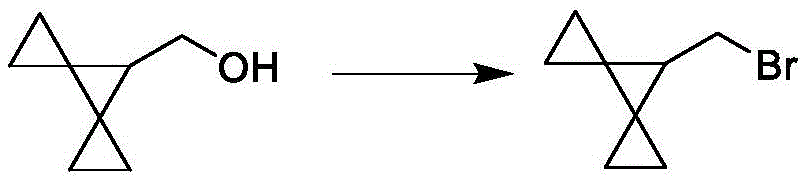
A1000 mL, 3-neck round bottom flask was equipped with a mechanical stirrer, cooling bath, addition funnel, J-Kem temperature probe, and nitrogen inlet/outlet. Under a nitrogen atmosphere, the vessel was charged with triphenylphosphine (102.7mL, 443.2mmol) and dichloromethane (1L) to give a clear colorless solution. Stirring was started and the cooling bath was charged with acetone. Dry ice was added to the cooling bath in portions until a pot temperature of-15 ℃ was obtained. The addition funnel was charged with a solution of bromine (22.82mL, 443.0mmol) in dichloromethane (220mL, 10mL/g) and then added dropwise over 1 hour. Dry ice was added to the cooling bath in portions during the addition to maintain the kettle temperature at-15 ℃. After the bromine addition was complete, the pale yellow suspension was stirred for a further 15min at-15 ℃ at which time the suspension was cooled to-30 ℃. The addition funnel was charged with dispiro [2.0.2.1] ]Hept-7-ylmethanol (50g,402.6mmol), pyridine (35.82mL,442.9mmol) and dichloromethane (250mL,5 mL/g). The clear pale yellow solution was then added dropwise over 1.5h, maintaining the kettle temperature at-30 ℃. The resulting clear pale yellow reaction mixture was gradually warmed to a kettle temperature of-5 ℃ and then continued to stir at-5 ℃ for 1 h. The reaction mixture was then poured into hexane (2000mL), resulting in the formation of a precipitate. The suspension was stirred at room temperature for 30 minutes and then filtered through a glass frit buchner funnel with a 20mm layer of celite. The clear filtrate was concentrated under reduced pressure (bath temperature 20 ℃) to give a yellow oil containing some precipitate. The oil was diluted with some hexane, left to stand at room temperature for 15 minutes, and then passed through a layer of celite having 20mmThe frit buchner funnel of (1) was filtered. The clear filtrate was concentrated under reduced pressure (bath temperature 20 ℃) to give 7- (bromomethyl) dispiro [2.0.2.1] as a clear yellow oil]Heptane (70g, 93%).1H NMR (400MHz, chloroform-d) δ 3.49(d, J ═ 7.5Hz,2H),1.90(t, J ═ 7.5Hz,1H),1.06-0.84(m,4H),0.71(ddd, J ═ 9.1,5.1,4.0Hz,2H),0.54(dddd, J ═ 8.6,4.8,3.8,1.0Hz, 2H).
Step 2: 2-dispiro [2.0.2.1] hept-7-ylacetonitrile

A1000 mL, 3-neck round bottom flask was equipped with a mechanical stirrer, a cooling bath for secondary protection, a J-Kem temperature probe, and a nitrogen inlet/outlet. Charging a container with 7- (bromomethyl) dispiro [2.0.2.1 ] in a nitrogen atmosphere]Heptane (35g, 187.1mmol) and dimethyl sulfoxide (245mL) gave a clear amber solution. Stirring was started and the pot temperature was recorded at 19 ℃. The vessel was then charged with solid sodium cyanide (11.46g,233.8mmol) added in one portion to give a dark solution and a gradual exotherm to 49 ℃ over 15 min. After a few minutes, the kettle temperature started to decrease and the mixture was continued to stir at room temperature overnight (about 15 h). The dark reaction mixture was quenched with ice-cold saturated sodium carbonate solution (500mL) and then transferred to a separatory funnel and partitioned with ether (500 mL). The organics were removed and the residual water was extracted with diethyl ether (2X250 mL). The combined organics were washed with water (500mL), dried over sodium sulfate (200g), and then filtered through a glass frit buchner funnel. The clear amber filtrate was concentrated under reduced pressure (bath temperature 20 ℃ C.) to give 2-dispiro [2.0.2.1 ] as a clear amber oil]Hept-7-ylacetonitrile (21g, 84%).1H NMR (400MHz, chloroform-d) δ 2.42(d, J ═ 6.6Hz,2H),1.69(t, J ═ 6.6Hz,1H),1.02-0.88(m,4H),0.79-0.70(m,2H),0.66-0.55(m, 2H).
And 3, step 3: 2-dispiro [2.0.2.1] hept-7-ylacetic acid

To 2-dispiro [2.0.2.1]]To a solution of hept-7-ylacetonitrile (2.1g, 14.19mmol) in EtOH (32mL) was added sodium hydroxide (5.12g, 128.0mmol) followed by water (13mL) and the resulting solution was stirred and heated to 70 ℃ overnight. The mixture was then cooled to room temperature, diluted with water and extracted with ether. The aqueous phase was adjusted to pH 1 by addition of 6N hydrochloric acid (resulting in a cloudy precipitate) and extracted with diethyl ether (3 ×). The organic phase was dried (magnesium sulfate), filtered and concentrated to give 2-dispiro [2.0.2.1] as an orange solid]Hept-7-ylacetic acid (2.19g, 99% yield, 98% purity), which was used in the next step without further purification.1H NMR (400MHz, chloroform-d) δ 2.44(d, J ═ 6.9Hz,2H),1.67(t, J ═ 6.9Hz,1H),0.91(ddd, J ═ 9.0,5.2,3.9Hz,2H),0.81(dddd, J ═ 8.9,5.2,3.9,0.5Hz,2H),0.69(ddd, J ═ 8.9,5.2,3.9Hz,2H),0.56-0.44(m, 2H).
And 4, step 4: 2-dispiro [2.0.2.1] hept-7-ylethanol
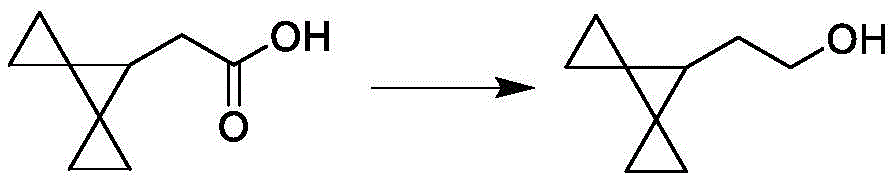
To lithium aluminum hydride (827.4mg, 902.3. mu.L, 21.80mmol) dissolved in tetrahydrofuran (33.71mL) cooled in an ice/water bath was added dropwise 2-dispiro [2.0.2.1] over 15 minutes]Hept-7-ylacetic acid (2.552g, 16.77mmol) in tetrahydrofuran (7.470mL) maintaining the reaction temperature <At 20 ℃. The mixture was allowed to stir for a total of 18 hours, gradually warming to ambient temperature. The mixture was cooled with an ice/water bath and quenched by the sequential slow addition of water (838.4mg, 838.4 μ L, 46.54mmol), followed by sodium hydroxide (1.006mL, 5M, 5.031mmol), then water (2.493g, 2.493mL, 138.4mmol) to give a white granular slurry filtered through celite filtration. The filtered solid was washed with diethyl ether. The filtrate was concentrated in vacuo at about 300mbar and 30 ℃ in a water bath. The residue was diluted with ether, dried (magnesium sulfate), filtered and concentrated in vacuo at about 300mbar and 30 ℃ water bath, followed by vacuum concentration for about 30 seconds to give 2-dispiro [2.0.2.1]]Hept-7-ylethanol (2.318g, 100%) was used directly in the subsequent steps without further purification.1H NMR (400MHz, chloroform-d) δ 3.64(s,2H),1.68(d, J ═ 6.7Hz, 2)H),1.39(s,1H),1.31(s,1H),0.82(d,J=14.0Hz,4H),0.65(s,2H),0.50(d,J=3.6Hz,2H)。
And 5: 3- (2-Dispiro [2.0.2.1] hept-7-ylethoxy) pyrazole-1-carboxylic acid tert-butyl ester

To 5-oxo-1H-pyrazole-2-carboxylic acid tert-butyl ester (2.942g, 15.97mmol) and 2-dispiro [2.0.2.1]To a solution of hept-7-ylethanol (2.318g, 16.77mmol) in tetrahydrofuran (36.78mL) was added triphenylphosphine (4.399g, 16.77 mmol). Diisopropyl azodicarboxylate (3.391g, 3.302mL, 16.77mmol) was added slowly dropwise to the mixture over 10 minutes (a slight exotherm was noted). The reaction mixture was stirred at room temperature for 30 minutes, then at 50 ℃ for 30 minutes. Tetrahydrofuran was added in vacuo. Toluene (23.54mL) was added to the crude residue, and the mixture was stirred overnight as the precipitate gradually crystallized. Slurried with celite, the precipitate was then filtered off and washed with toluene (8.705mL) and then toluene (8.705 mL). The filtrate was concentrated in vacuo. The crude product was purified by silica gel chromatography using a narrow gradient from 100% hexane to 100% ethyl acetate to give 3- (2-dispiro [2.0.2.1] ]Hept-7-ylethoxy) pyrazole-1-carboxylic acid tert-butyl ester (3.449g, 71%). ESI-MS M/z calculated 304.17868, experimental 305.1(M +1)+(ii) a Retention time: 0.82min (LC method A).
Step 6: 3- (2-dispiro [2.0.2.1] hept-7-ylethoxy) -1H-pyrazole

Mixing 3- (2-dispiro [2.0.2.1]]Hept-7-ylethoxy) pyrazole-1-carboxylic acid tert-butyl ester (5.304g, 17.43mmol) was dissolved in dichloromethane (53.04mL) containing trifluoroacetic acid (29.81g, 20.14mL, 261.4mmol), and the reaction was stirred at room temperature for 120 min. The reaction was evaporated and the resulting oil was partitioned between ethyl acetate and saturated sodium bicarbonate solution and the layers were separated. Mixing waterThe sexual portion was extracted twice with ethyl acetate, then the organics were combined, washed with brine, dried over sodium sulfate, filtered and evaporated to give 3- (2-dispiro [2.0.2.1] as an oil]Hept-7-ylethoxy) -1H-pyrazole (3.56g, 100%). ESI-MS M/z calculated 204.12627, Experimental 205.1(M +1)+(ii) a Retention time: 0.59min (LC method A).
And 7: 2-chloro-6- [3- (2-dispiro [2.0.2.1] hept-7-ylethoxy) pyrazol-1-yl ] pyridine-3-carboxylic acid tert-butyl ester

2, 6-dichloropyridine-3-carboxylic acid tert-butyl ester (4.322g, 17.42mmol), 3- (2-dispiro [2.0.2.1] ]Hept-7-ylethoxy) -1H-pyrazole (3.559g, 17.42mmol) and potassium carbonate (2.891g, 20.92mmol) were combined in anhydrous dimethyl sulfoxide (71.18 mL). Addition of 1, 4-diazabicyclo [2.2.2 ]]Octane (391.1mg, 3.487mmol) and the mixture was stirred at room temperature under nitrogen for 16 h. The reaction mixture was diluted with water (136.9mL) and stirred for 15 minutes. The resulting white solid was filtered and washed with water. The solid was dissolved in dichloromethane and dried over magnesium sulfate. The mixture was filtered and evaporated to give 2-chloro-6- [3- (2-dispiro [2.0.2.1] as a white solid]Hept-7-ylethoxy) pyrazol-1-yl]Pyridine-3-carboxylic acid tert-butyl ester (5.69g, 79%).1H NMR (400MHz, chloroform-d) δ 8.35(d, J ═ 2.9Hz,1H),8.18(d, J ═ 8.4Hz,1H),7.69(d, J ═ 8.4Hz,1H),5.94(d, J ═ 2.9Hz,1H),4.25(s,2H),1.90(d, J ═ 6.8Hz,2H),1.62(s,9H),1.49(t, J ═ 6.6Hz,1H),0.85(d, J ═ 1.5Hz,4H),0.65(d, J ═ 1.5Hz,2H),0.52(d, J ═ 1.1Hz, 2H). ESI-MS calculated M/z 415.16626, experimental 360.0(M-tBu) +; retention time: 2.09min (LC method B).
And 8: 2-chloro-6- [3- (2-dispiro [2.0.2.1] hept-7-ylethoxy) pyrazol-1-yl ] pyridine-3-carboxylic acid

2-chloro-6- [3- (2-dispiro [2.0.2.1]]Hept-7-ylethyl Oxy) pyrazol-1-yl]Tert-butyl pyridine-3-carboxylate (5.85g, 14.07mmol) was dissolved in dichloromethane (58.5mL) containing trifluoroacetic acid (16.26mL, 211.1mmol) and the reaction was stirred at room temperature for 16 h. The reaction was evaporated and ether was added to the resulting solid, and then the ether was removed under reduced pressure. The evaporation from ether was repeated two more times to give 2-chloro-6- [3- (2-dispiro [2.0.2.1 ] as a white solid]Hept-7-ylethoxy) pyrazol-1-yl]Pyridine-3-carboxylic acid (5.06g, 100%).1H NMR (400MHz, chloroform-d) δ 8.41(d, J ═ 8.5Hz,1H),8.37(d, J ═ 2.9Hz,1H),7.75(d, J ═ 8.5Hz,1H),5.97(d, J ═ 2.9Hz,1H),4.27(s,2H),1.91(d, J ═ 6.7Hz,2H),1.50(s,1H),0.85(d, J ═ 1.5Hz,4H),0.71-0.62(m,2H),0.52(d, J ═ 1.1Hz, 2H). ESI-MS M/z calculated 359.10367, Experimental 360.2(M +1)+(ii) a Retention time: 2.16 min (LC method B).
And part B: synthesis of tert-butyl (4S) -2, 2-dimethyl-4- [3- [ (6-sulfamoyl-2-pyridyl) amino ] propyl ] pyrrolidine-1-carboxylate
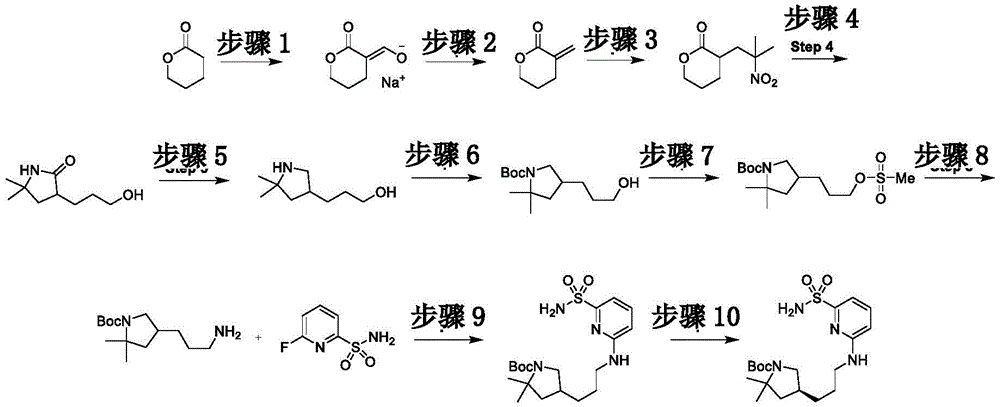
Step 1: (E) - (2-oxotetrahydropyran-3-ylidene) methanolate (sodium salt)

A 5L, 3-neck round bottom flask was equipped with a mechanical stirrer, heating mantle, addition funnel, J-Kem temperature probe/controller, and nitrogen inlet/outlet. Under a nitrogen atmosphere, the vessel was charged with sodium hydride (59.91g, 60% w/w, 1.498mol) followed by heptane (1.5L) to give a grey suspension. Stirring was started and the pot temperature was recorded at 19 ℃. The vessel was then charged with ethanol (3.451g,74.91mmol) added by syringe, which resulted in the evolution of gas. The addition funnel was charged with a clear pale yellow solution of tetrahydropyran-2-one (150g,1.498mol) and ethyl formate (111g,1.50 mol). The solution was added dropwise over 1h, which resulted in gas evolution and gradual exotherm to 45 ℃. The resulting thick white suspension was then heated to 65 ℃ for 2h and then allowed to cool to room temperature. The mixture was stirred at room temperature overnight (about 10 h). The reaction mixture was vacuum filtered through a glass frit buchner funnel (medium porosity) under a stream of nitrogen. The filter cake was displacement washed with heptane (2X250mL) and pumped for several minutes. The wet cake, slightly loaded with heptane, was transferred to a glass tray and dried in a vacuum oven at 45 ℃ for 15 hours to give a white solid (205g, 1.36mol, 91% yield) as the desired product (E) - (2-oxotetrahydropyran-3-ylidene) methoxide (sodium salt).
And 2, step: 3-methylenetetrahydropyran-2-one

A 5L, 3-neck round bottom flask was equipped with a mechanical stirrer, heating mantle, addition funnel, J-Kem temperature probe/controller, and nitrogen inlet/outlet. A vessel was charged with (E) - (2-oxotetrahydropyran-3-ylidene) methoxide (sodium salt) (205g, 1.366mol) (205g, 1.366mol) and tetrahydrofuran (1640mL) under a nitrogen atmosphere to give a white suspension. Stirring was started and the pot temperature was recorded at 19 ℃. The vessel was then charged with solid paraformaldehyde (136.6g,4.549mol) added in one portion. The resulting suspension was heated to 63 ℃ and the conditions were maintained for 15 h. Upon heating, the reaction mixture became a slightly gummy state. The white gelatinous mixture was concentrated under reduced pressure to remove most of the tetrahydrofuran. The remaining residue was partitioned with ethyl acetate (1000mL), saturated sodium chloride (500mL) and saturated sodium carbonate (500mL) in a separatory funnel. The organics were removed and the residual water was extracted with ethyl acetate (5X300 mL). The combined organics were dried over sodium sulfate (500g) and then vacuum filtered through a frit buchner funnel with a 20mm layer of celite. The filter cake was displacement washed with ethyl acetate (250 mL). The clear filtrate was concentrated under reduced pressure to give a clear pale yellow oil (135g) as the desired crude product. The material was purified by flash chromatography on silica gel (liquid loading) eluting with a gradient of 100% hexane to 60% ethyl acetate/hexane over 1 hour to collect 450mL fractions. Analysis by TLC on silica gel with 3:1 hexane/acetic acid The product was detected by ethyl ester elution and visualized under UV. The product fractions were combined and concentrated under reduced pressure to give 3-methylenetetrahydropyran-2-one as the desired product as a clear colorless oil (132g, 1.18mol, 72% yield, containing 16% by weight residual ethyl acetate as determined by NMR). 1H NMR (400MHz, dimethylsulfoxide-d)6)δ6.18(q,J=1.9Hz,1H),5.60(q,J=1.9Hz,1H),4.40-4.26(m,2H),2.61(ddt,J=7.0,6.3,2.0Hz,2H),1.90-1.75(m,2H)。
And step 3: 3- (2-methyl-2-nitro-propyl) tetrahydropyran-2-one

A5000 mL, 3-necked round bottom flask was equipped with a mechanical stirrer, a cooling bath for secondary protection, a J-Kem temperature probe, an addition funnel, and a nitrogen inlet/outlet. Under a nitrogen atmosphere, a vessel was charged with 2-nitropropane (104.9g,1.177 mol). Stirring was started and the pot temperature was recorded at 19 ℃. The vessel is then charged with an aliquot of pure 1, 8-diazabicyclo [5.4.0 ]]Undec-7-ene (22.41g,147.2mmol) gave a clear pale yellow solution. No exotherm was observed. The addition funnel was charged with a solution of 3-methylenetetrahydropyran-2-one (110g,981.0mmol) in acetonitrile (1100mL), which was added dropwise over 1h, yielding a clear pale yellow solution and gradual exotherm to 24 ℃. The reaction mixture was stirred further at room temperature for 3.5h and then concentrated under reduced pressure. The remaining residue was dissolved in dichloromethane (1000mL) and partitioned with 500mL of a 3:2 mixture of 1 molar citric acid solution/saturated sodium chloride solution. The resulting organic phase was a clear pale blue solution and the aqueous phase was a slightly cloudy very pale blue solution. The organics were removed and the residual aqueous solution was extracted with dichloromethane (300 mL). The combined organics were washed with saturated sodium chloride solution (300mL), dried over sodium sulfate (250g), and then filtered through a glass frit buchner funnel. The filtrate was concentrated under reduced pressure to a volume of about 200 mL. The clear light blue dichloromethane solution was diluted with methyl tert-butyl ether (1500mL) and the turbid solution was concentrated under reduced pressure to a volume of about 200mL, thus obtaining a suspension. Re-applying the mixture to the nail Tert-butyl ether (1500mL) was diluted and concentrated under reduced pressure to a volume of about 250 mL. The resulting suspension was allowed to stand overnight (about 12 hours) at room temperature. The solid was collected by vacuum filtration in a glass frit buchner funnel and the filter cake was displacement washed with cold methyl tert-butyl ether (2X150mL) and then pumped for 30 minutes. The material was further dried in a vacuum oven at 45 ℃ for 5 hours to give (160g, 0.795mol, 81% yield) 3- (2-methyl-2-nitro-propyl) tetrahydropyran-2-one as the desired product as a white solid.1H NMR (400MHz, dimethylsulfoxide-d)6)δ4.34(ddd,J=11.1,9.3,4.3Hz,1H),4.20(dt,J=11.1,5.1Hz,1H),2.75-2.62(m,1H),2.56(dd,J=14.9,5.2Hz,1H),2.01-1.89(m,2H),1.89-1.67(m,2H),1.55(d,J=6.0Hz,6H),1.44(dddd,J=12.8,11.5,8.1,6.6Hz,1H)。
And 4, step 4: 3- (3-hydroxypropyl) -5, 5-dimethyl-pyrrolidin-2-one

A1000 mL, 3-neck round bottom flask was equipped with a Teflon stir bar, heating mantle, J-Kem temperature probe/controller, and rubber septum. The vessel was charged with 3- (2-methyl-2-nitro-propyl) tetrahydropyran-2-one (25g, 124.2mmol) and ethanol (375mL) to give a white suspension. Stirring was started and the suspension was heated to 40 ℃ for 10 minutes, resulting in a clear colorless solution. The vessel was then equipped with a gas dispersion tube and the solution was degassed with nitrogen for 15 minutes. The container was then charged with Raney Nickel (8.019g, 50% w/w, 68.31mmol) and then fitted with a septum. The vessel was evacuated and placed under a hydrogen atmosphere. This process was repeated for three cycles. The vessel was then placed under 1 atmosphere of hydrogen and the reaction mixture was gradually heated to 60 ℃. The reaction was stirred for an additional 24h at 60 ℃. After cooling to room temperature, the vessel was equipped with a gas dispersion tube and the reaction mixture was degassed with nitrogen for 15 min. The mixture was vacuum filtered through a frit buchner funnel with a 20mm layer of celite. The filter cake was displacement washed with ethanol (2X100mL) and pumped until slightly ethanol wet, then water Wet and discard the used raney nickel catalyst under water. The clear light amber filtrate was concentrated under reduced pressure to a clear viscous light amber oil. The oil was diluted with methyl tert-butyl ether (1500mL) and the cloudy solution was concentrated under reduced pressure to a volume of about 150mL, thus giving a suspension. The mixture was again diluted with methyl tert-butyl ether (1500mL) and concentrated under reduced pressure to a volume of about 150 mL. The resulting suspension was allowed to stand overnight (about 12 hours) at room temperature. The solid was collected by vacuum filtration in a glass frit buchner funnel and the filter cake was displacement washed with cold methyl tert-butyl ether (2X50mL) and then pumped for 30 minutes. The material was further dried in a vacuum oven at 45 ℃ for 3 hours to give 3- (3-hydroxypropyl) -5, 5-dimethyl-pyrrolidin-2-one as the desired product as a white solid (19g, 0.111mol, 89% yield).1H NMR (400MHz, dimethylsulfoxide-d)6)δ7.63(s,1H),3.38(t,J=6.5Hz,2H),2.37(tdd,J=9.8,8.5,4.4Hz,1H),2.02(dd,J=12.3,8.6Hz,1H),1.72(tdd,J=9.6,7.5,4.4Hz,1H),1.52-1.32(m,3H),1.28-1.03(m,7H)。
And 5: 3- (5, 5-dimethylpyrrolidin-3-yl) propan-1-ol

A 5L, 3-neck round bottom flask was equipped with a mechanical stirrer, heating mantle, addition funnel, J-Kem temperature probe/controller, and nitrogen inlet/outlet. Under a nitrogen atmosphere, a container was charged with lithium aluminum hydride pellets (19.39g, 510.9 mmol). The vessel was then charged with tetrahydrofuran (500mL, 20 mL/g). Stirring was started and the pot temperature was recorded at 20 ℃. The mixture was stirred at room temperature for 0.5h to allow the pellet to dissolve. The pot temperature of the resulting grey suspension was recorded as 24 ℃. The addition funnel was charged with a solution of 3- (3-hydroxypropyl) -5, 5-dimethyl-pyrrolidin-2-one (25g,146.0mmol) in tetrahydrofuran (500mL) and the clear pale yellow solution was added dropwise over 90 min. Slight heating is required to achieve homogeneity. After the addition was complete, the pot temperature of the resulting light grey suspension was recorded as 24 ℃. The mixture was then heated to a pot temperature of 65 ℃ and the strands were heated The piece is maintained for 72 h. At this point, analysis of the reaction mixture showed that some residual starting material remained and product formation was unchanged. Subsequently, the reaction was stopped at this point. The heating jacket was removed and the vessel was fitted with a cooling bath. The suspension was cooled to 0 ℃ with a crushed ice/water cooling bath and then quenched by very slow dropwise addition of water (19.93mL), followed by addition of 15 wt% sodium hydroxide solution (19.93mL) and finally with water (59.79 mL). The pot temperature of the resulting white suspension was recorded as 5 ℃. The cooling bath was removed and the vessel was again fitted with a heating pack. The suspension was warmed to 60 ℃ and the conditions were maintained for 30 minutes. The hot suspension was vacuum filtered through a frit buchner funnel with a 20mm layer of celite. The filter cake was then displacement washed with 60 ℃ tetrahydrofuran (2X250mL) and then pumped for 30 min. The clear filtrate was concentrated under reduced pressure to give (23.5g,0.149mol, 99% yield) 3- (5, 5-dimethylpyrrolidin-3-yl) propan-1-ol as the desired product as a clear pale yellow viscous oil.1H NMR (400MHz, dimethylsulfoxide-d)6)δ3.37(dt,J=8.3,6.4Hz,3H),2.95(dd,J=10.6,7.6Hz,1H),2.40(dd,J=10.7,7.7Hz,1H),2.04(dt,J=16.1,8.1Hz,1H),1.69(dd,J=12.2,8.2Hz,1H),1.50-1.24(m,5H),1.11-0.94(m,7H)。
Step 6: 4- (3-hydroxypropyl) -2, 2-dimethyl-pyrrolidine-1-carboxylic acid tert-butyl ester

A1L, 3-neck round bottom flask was equipped with a mechanical stirrer, cooling bath, addition funnel, J-Kem temperature probe, and nitrogen inlet/outlet. Under a nitrogen atmosphere, a vessel was charged with 3- (5, 5-dimethylpyrrolidin-3-yl) propan-1-ol (15g, 95.39mmol) and dichloromethane (225mL, 15mL/g) to give a clear pale yellow solution. Stirring was started and the pot temperature was recorded at 19 ℃. The cooling bath was charged with crushed ice/water and the pot temperature was reduced to 0 ℃. The addition funnel was charged with triethylamine (12.55g,124.0mmol), which was then added neat dropwise over 5 min. No exotherm was observed. The addition funnel was then charged with dicarbonate dissolved in dichloromethane (225mL) Tert-butyl ester (22.89g, 104.9 mmol). The clear pale yellow solution was then added dropwise over 30 minutes, resulting in slow gas evolution. No exotherm was observed. The cooling bath was removed and the resulting clear pale yellow solution was allowed to warm to room temperature and stirring was continued at room temperature for 3 hours. The reaction mixture was transferred to a separatory funnel and partitioned with water (75 mL). The organics were removed and washed with saturated sodium chloride solution (75mL), dried over sodium sulfate (150g), and then filtered through a glass frit buchner funnel. The filtrate was concentrated under reduced pressure to give (30g) as a clear pale yellow oil of the desired crude product. The material was purified by flash chromatography on silica gel column (liquid loading with dichloromethane) eluting with a gradient of 100% dichloromethane to 10% methanol/dichloromethane over 60 minutes to collect 50mL fractions. Desired product fractions were combined and concentrated under reduced pressure to give tert-butyl 4- (3-hydroxypropyl) -2, 2-dimethyl-pyrrolidine-1-carboxylate (22g, 0.0855mol, 90% yield) as a clear, pale yellow viscous oil.1H NMR(400MHz,DMSO-d6)δ4.38(td,J=5.2,1.4Hz,1H),3.54(dt,J=10.3,6.7Hz,1H),3.38(td,J=6.6,3.5Hz,2H),2.76(q,J=10.3Hz,1H),2.07(td,J=11.6,5.7Hz,1H),1.87(ddd,J=16.7,12.1,6.0Hz,1H),1.37(dd,J=14.2,10.4Hz,17H),1.24(s,3H)。
And 7: 2, 2-dimethyl-4- (3-methylsulfonyloxypropyl) pyrrolidine-1-carboxylic acid tert-butyl ester

Tert-butyl 4- (3-hydroxypropyl) -2, 2-dimethyl-pyrrolidine-1-carboxylate (50.5g, 196.22mmol) and triethylamine (39.711g, 54.698mL, 392.44mmol) were dissolved in dichloromethane (500mL) and the resulting solution was cooled in an ice-water bath for 30 min. Methanesulfonyl chloride (24.725g, 16.706mL, 215.84mmol) was added dropwise over 30 minutes, then the ice bath was removed and the mixture was stirred at room temperature for one hour. The reaction was then quenched with saturated sodium bicarbonate solution (200 mL). The phases were separated and the organic phase was extracted with saturated sodium bicarbonate (200mL) and water (2X100 mL). The aqueous phase was discarded and the organic phase was dried over sodium sulfate, Filtration and concentration in vacuo afforded tert-butyl 2, 2-dimethyl-4- (3-methylsulfonyloxypropyl) pyrrolidine-1-carboxylate (64.2g, 93%) as a pale yellow oil. ESI-MS M/z calculated 335.1766, Experimental 336.4(M +1)+(ii) a Retention time: 5.54min (LC method Q).
And 8: 4- (3-aminopropyl) -2, 2-dimethyl-pyrrolidine-1-carboxylic acid tert-butyl ester

Tert-butyl 2, 2-dimethyl-4- (3-methylsulfonyloxypropyl) pyrrolidine-1-carboxylate (64.2g, 191.38mmol) was dissolved in dioxane (650mL) and ammonium hydroxide (650mL) was then added and the resulting mixture was heated to 45 ℃ for 18 hours. After 18 hours, the reaction was cooled to room temperature. The solution was diluted with 1M sodium hydroxide (200mL) and then extracted with diethyl ether (3X650 mL). The aqueous phase was discarded and the combined organic phases were extracted with water (2X200 mL). The aqueous phase was discarded and the organic phase was dried over sodium sulfate, filtered and concentrated in vacuo to give tert-butyl 4- (3-aminopropyl) -2, 2-dimethyl-pyrrolidine-1-carboxylate (48.9g, 95%) as a pale yellow oil. ESI-MS M/z calculated 256.2151, Experimental 257.3(M +1)+(ii) a Retention time: 3.70min (LC method Q).
And step 9: 2, 2-dimethyl-4- [3- [ (6-sulfamoyl-2-pyridyl) amino ] propyl ] pyrrolidine-1-carboxylic acid tert-butyl ester

To dimethyl sulfoxide (75mL) containing tert-butyl 4- (3-aminopropyl) -2, 2-dimethyl-pyrrolidine-1-carboxylate (8.91g, 34.8mmol) and 6-fluoropyridine-2-sulfonamide (6.13g, 34.8mmol) was added potassium carbonate (4.91g, 35.5mmol) and the mixture was stirred at 100 ℃ for 12 hours and then cooled to ambient temperature and stirred for a further 4 hours (16 hours total). The reaction mixture was slowly poured (some foaming) into water (200mL) containing hydrochloric acid (35mL, 1M, 35.00mmol),and diluted with ethyl acetate (250 mL). The organic phase was separated and washed with 100mL brine. The organic phase was dried over magnesium sulfate, filtered through celite and concentrated in vacuo to give a dark yellow oil. The crude product was purified by silica gel chromatography, eluting with 0% to 100% ethyl acetate/hexanes. Pure (9.0g) and impure (3g) fractions were collected. Purifying the impure fraction by silica gel chromatography, eluting with 0% to 100% ethyl acetate/hexane, to obtain a total of 2, 2-dimethyl-4- [3- [ (6-iminoformyl-2-pyridinyl) amino group]Propyl radical]Pyrrolidine-1-carboxylic acid tert-butyl ester (10.0g, 69%).1H NMR (400MHz, dimethylsulfoxide-d)6) δ 7.52(dd, J ═ 8.5,7.2Hz,1H),7.07(s,2H),6.95(dd, J ═ 7.2,0.7Hz,2H),6.61(d, J ═ 8.5Hz,1H),3.55(q, J ═ 9.1Hz,1H),3.32-3.24(m,2H),2.79(q, J ═ 10.0Hz,1H),2.13(d, J ═ 16.1Hz,1H),1.96-1.82(m,1H),1.51(dt, J ═ 18.0,9.3Hz,2H),1.37(dd, J ═ 12.9,10.6Hz,15H),1.24(s, 3H). ESI-MS M/z calculated 412.21442, Experimental 413.1(M +1) +(ii) a Retention time: 2.34min (LC method D).
Step 10: (4S) -2, 2-dimethyl-4- [3- [ (6-sulfamoyl-2-pyridyl) amino ] propyl ] pyrrolidine-1-carboxylic acid tert-butyl ester
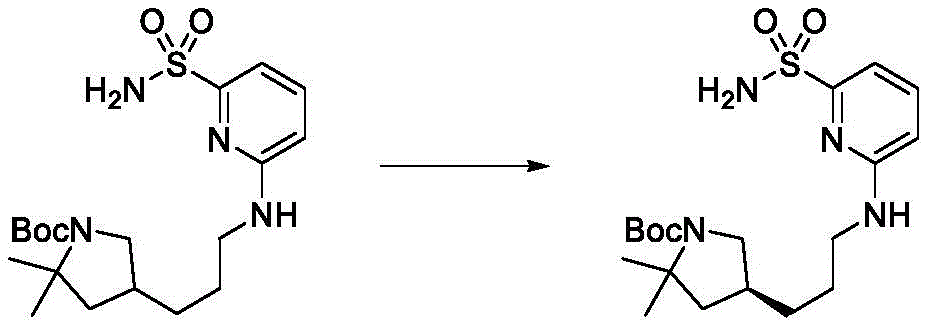
Racemic 2, 2-dimethyl-4- [3- [ (6-sulfamoyl-2-pyridyl) amino was chromatographed over 11.0 minutes at 70mL/min using ChiralPak IG (250x21.2mm column, 5 μm particle size) and 40% methanol/60% carbon dioxide mobile phase (injection volume 500 μ L of 32mg/mL solution in methanol) by SFC chromatography]Propyl radical]Chiral separation of pyrrolidine-1-carboxylic acid tert-butyl ester (7g, 16.97mmol) gave (4S) -2, 2-dimethyl-4- [3- [ (6-sulfamoyl-2-pyridyl) amino group as the first eluting peak]Propyl radical]Pyrrolidine-1-carboxylic acid tert-butyl ester (3.4481g, 99%). ESI-MS M/z calculated 412.21442, Experimental 413.2(M +1)+(ii) a Retention time: 0.63min (LC method A).
And part C: synthesis of (14S) -8- [3- (2- { dispiro [2.0.2.1] hept-7-yl } ethoxy) -1H-pyrazol-1-yl ] -12, 12-dimethyl-2 λ 6-thia-3, 9,11,18, 23-pentaazatetracyclo [17.3.1.111,14.05,10] tetracosan-1 (22),5,7,9,19(23), 20-hexaen-2, 2, 4-trione (Compound I)

Step 1: (4S) -4- [3- [ [6- [ [ 2-chloro-6- [3- (2-dispiro [2.0.2.1] hept-7-ylethoxy) pyrazol-1-yl ] pyridine-3-carbonyl ] sulfamoyl ] -2-pyridyl ] amino ] propyl ] -2, 2-dimethyl-pyrrolidine-1-carboxylic acid tert-butyl ester

To 2-chloro-6- [3- (2-dispiro [2.0.2.1 ]]Hept-7-ylethoxy) pyrazol-1-yl]To a solution of pyridine-3-carboxylic acid (5.2g,14.45mmol) in tetrahydrofuran (100mL) was added carbonyldiimidazole (2.8g,16.51mmol) and the mixture was stirred at ambient temperature for 1 h. To the mixture was added a solution containing (4S) -2, 2-dimethyl-4- [3- [ (6-sulfamoyl-2-pyridyl) amino group]Propyl radical]Pyrrolidine-1-carboxylic acid tert-butyl ester (6.0g,14.54mmol) in tetrahydrofuran (15mL) followed by addition of 1, 8-diazabicyclo [5.4.0]Undec-7-ene (6.5mL,43.47mmol) and the mixture was stirred at ambient temperature for 16 h. The reaction was diluted with water (150mL) and the mixture was acidified with aqueous hydrochloric acid (15mL,6M,90.00 mmol). The mixture was extracted with ethyl acetate (300mL) and the organic phase was separated. The organic phase was washed with brine, dried over magnesium sulfate, filtered through celite and concentrated in vacuo to give a white precipitate. The precipitate was slurried with acetonitrile and the solid was collected by filtration using a medium glass frit and washed with acetonitrile. The filtrate was concentrated in vacuo to give a yellow oil. The crude oil was diluted with acetonitrile and some N-methyl-2-pyrrolidone and at 415g of reverse phase C18Eluting with 50-100% acetonitrile/water to obtain (4S) -4- [3- [ [6- [ [ 2-chloro-6- [3- (2-dispiro [ 2.0.2.1) ] ]Hept-7-ylethoxy) pyrazol-1-yl]Pyridine-3-carbonyl]Sulfamoyl groups]-2-pyridyl]Amino group]Propyl radical]-2, 2-dimethyl-pyrrolidine-1-carboxylic acid tert-butyl ester (4.5g, 41%). ESI-MS calculated m/z 753.30756, Experimental value 754.4(M+1)+(ii) a Retention time: 3.79min (LC method D).
Step 2: 2-chloro-N- [ [6- [3- [ (3S) -5, 5-dimethylpyrrolidin-3-yl ] propylamino ] -2-pyridinyl ] sulfonyl ] -6- [3- (2-dispiro [2.0.2.1] hept-7-ylethoxy) pyrazol-1-yl ] pyridine-3-carboxamide (trifluoroacetate)

To (4S) -4- [3- [ [6- [ [ 2-chloro-6- [3- (2-dispiro [2.0.2.1]]Hept-7-ylethoxy) pyrazol-1-yl]Pyridine-3-carbonyl]Sulfamoyl radical]-2-pyridyl]Amino group]Propyl radical]To a solution of tert-butyl-2, 2-dimethyl-pyrrolidine-1-carboxylate (5.9g,7.821mmol) in dichloromethane (30mL) and toluene (15mL) was added trifluoroacetic acid (6.0mL,77.88mmol) and the mixture was stirred at ambient temperature for 18 h. The solvent was removed in vacuo and the bath temperature was set at 45 ℃ to give a thick yellow oil. The oil was diluted with toluene (125mL) and the solvent removed in vacuo, the bath temperature was set at 45 ℃. The oil was diluted with toluene and the solvent removed in vacuo to give 2-chloro-N- [ [6- [3- [ (3S) -5, 5-dimethylpyrrolidin-3-yl ] as a thick viscous yellow oil ]Propylamino group]-2-pyridinyl group]Sulfonyl radical]-6- [3- (2-dispiro [2.0.2.1]]Hept-7-ylethoxy) pyrazol-1-yl]Pyridine-3-carboxamide (trifluoroacetate) (6.0g, 100%) was used in the next step without further purification. ESI-MS M/z calculated 653.2551, Experimental 654.3(M +1)+(ii) a Retention time: 2.6 min (LC method B).
And step 3: (14S) -8- [3- (2- { dispiro [2.0.2.1] hept-7-yl } ethoxy) -1H-pyrazol-1-yl ] -12, 12-dimethyl-2 λ 6-thia-3, 9,11,18, 23-pentaazatetracyclo [17.3.1.111,14.05,10] tetracosan-1 (22),5,7,9,19(23), 20-hexaene-2, 2, 4-trione (Compound I)

To 2-chloro-N- [ [6- [3- [ (3S) -5, 5-dimethylpyrrolidin-3-yl ] group]Propylamino group]-2-pyridyl]Sulfonyl radical]-6- [3- (2-dispiro [2.0.2.1]]Hept-7-ylethoxy) pyrazole-1-radical]To a solution of pyridine-3-carboxamide (trifluoroacetate) (6.0g,7.810mmol) in NMP (140mL) was added potassium carbonate (5.3g,38.35 mmol). The mixture was purged with nitrogen for 5 minutes. The mixture was then heated at 150 ℃ for 22 hours. The reaction mixture was cooled to room temperature and added to water (300mL) to give an off-white solid precipitate. The mixture was carefully acidified with aqueous hydrochloric acid (12mL,6M,72.00mmol) to give a foamy slurry. The solid was collected by filtration using a medium frit. The wet cake was dissolved in ethyl acetate (500mL) and washed with 200mL brine. The aqueous phase was slightly cloudy and was therefore acidified with a small amount of 6N hydrochloric acid and returned to the organic phase. The aqueous phase was separated and the organic phase was dried over magnesium sulfate, filtered and concentrated in vacuo to give a pale yellow oil. The crude product was diluted with acetonitrile and at 415g C 18The chromatographic analysis was performed on a reverse phase column eluting with 50% to 100% acetonitrile/water. The product was isolated as an cream-colored foam. The foam was dried under vacuum at 45 ℃ for 48h to give (14S) -8- [3- (2- { dispiro [2.0.2.1 ]]Hept-7-yl } ethoxy) -1H-pyrazol-1-yl]-12, 12-dimethyl-2 λ 6-thia-3, 9,11,18, 23-pentaazatetracyclo [17.3.1.111,14.05,10]Tetracosan-1 (22),5,7,9,19(23), 20-hexaen-2, 2, 4-trione (compound I) (3.32g, 68%).1H NMR (400MHz, dimethylsulfoxide-d)6) δ 12.48(s,1H),8.20(d, J ═ 2.8Hz,1H),7.81(d, J ═ 8.2Hz,1H),7.57(dd, J ═ 8.5,7.2Hz,1H),7.05(d, J ═ 7.1Hz,1H),6.97(d, J ═ 8.5Hz,1H),6.91(d, J ═ 8.2Hz,1H),6.71(d, J ═ 8.5Hz,1H),6.08(d, J ═ 2.7Hz,1H),4.21(td, J ═ 6.7,1.3Hz,2H),3.92(d, J ═ 12.0Hz,1H),3.16(s,1H),2.95(d, J ═ 3.13, 1.7, 1.3Hz,2H),3.92(d, J ═ 12.0Hz,1H),3.16(s,1H),2.95(d, J ═ 6.13, 1.7, 1H), 1.13, 1.3H, 1.78H), 1.7 (s,1H), 1H), 6.7H, 1H, 6.7 (t, 1H), 6.7H, 1H, 1.7H, 1H), 6.7H, 1H, 1.9 (m-1H), 3, 1H, 1.7 (m-1H, 1.9, 1H, 1H, 6.7H, 1H, 1H, 1H, 1, 6, 1, 6, 1H, 1H, 1, 6, 1, 2H) 0.53-0.45(m, 2H). ESI-MS M/z calculated 617.27844, Experimental 618.4(M +1)+(ii) a Retention time: 10.29min (LC method F).
Ca of Compound I2+、Na+And K+Salts thereof by reacting Compound I with Ca (OCH)3)2、Na(OCH3) And KOH to make: mixing Compound I (1g) and Ca (OCH) 3)2(83mg) in methanol (65mL) at room temperature for 30min and then at 65 deg.CMixing for 30 min; MeOH (40mL) containing Compound I (0.6g (1mmol)) and a solution containing 25 wt% Na (OCH)3) MeOH (250mL (1 mol equivalent)) in (C) was mixed at 60 ℃ for 20 min; and acetone (11mL) containing Compound I (0.6g) was mixed with 1N KOH (1 mol equivalent) at 50 ℃ for 1 h. After filtration of the resulting hot solution, the filtrate was evaporated to dryness to yield the desired amorphous salt, respectively.
Example 2: compound I (free form) form A
The reactor was equipped with an overhead stirrer, reflux condenser, N2A bubbling line and outlet, and a temperature probe. Reacting (14S) -8-bromo-12, 12-dimethyl-2 lambda6-thia-3, 9,11,18, 23-pentaazatetracyclo [17.3.1.111,14.05,10]Tetracos-1 (23),5,7,9,19, 21-hexaen-2, 2, 4-trione (120g, 86% w/w, containing IPAc, [103.2g (14S) -8-bromo-12, 12-dimethyl-2. lambda6-thia-3, 9,11,18, 23-pentaazatetracyclo [17.3.1.111,14.05,10]Tetracos-1 (23),5,7,9,19, 21-hexaen-2, 2, 4-trione]0.21mol, 1 equivalent), 3- (2- (dispiro [ 2.0.2)4.13]Hept-7-yl) ethoxy) -1H-pyrazole (42.6g, 0.21mol, 1 eq), 325 mesh K2CO3A mixture of (63.4g, 0.46mol, 2.2 equiv.), CuI (3.3g, 17.2mmol, 0.083 equiv.), and BuOAc (740mL) was charged to the reactor. The mixture was stirred at ambient temperature. DMF (300mL,2.9vol) and N, N' -dimethylcyclohexane-1, 2-diamine (14.6g or 16.2mL, 0.1mol, 0.49 equiv) were then charged to the reactor and the mixture was taken up three times with N 2vacuum/N2And (5) circularly purging. The mixture was then heated to 120 ℃ for 4h and then allowed to cool to ambient temperature. A10% w/v aqueous solution of oxalic acid (860mL, 0.96mol, 4.6 equivalents) was added dropwise and the mixture was stirred for at least 1 h. The mixture was then filtered to remove suspended solids. The removed solids were washed with (2x120 mL). The layers from the filtrate were separated. The organic layer was washed with 8% w/v aqueous trisodium citrate solution (600 mL). Brine was added as needed to aid phase separation. The organic layer was washed with 1:1v/v water/brine (400 mL). The organic layer was filtered through a pad of celite. The filter pad was washed with IPAc (150 mL). Concentrating the filtrateAfter reduction, 800mL1-PrOH (7.8vol) was added and the mixture was concentrated. This step was repeated once more. Toluene (800mL) was added and the mixture was concentrated. This step was repeated once more to give a thick slurry. The crude mixture was concentrated to a volume of 300mL (2.9vol) of toluene. After stirring the slurry overnight, the solid was collected by filtration and washed with toluene (2 × 100mL,0.97 vol). The solid was dried under vacuum at 50 ℃ with a nitrogen purge until the loss on drying did not exceed 1.0% to give compound I as a white/off-white solid (107.0g, 83%, 94.5% (AUC) HPLC purity).
And (3) recrystallization: compound I form a [22.2g, 94.6% (AUC) compound I form a ] was suspended in toluene (440mL, 20vol, based on compound I form a) and the mixture was heated to reflux. After holding the NLT at reflux for 2h, the mixture was cooled to ambient temperature over 8 h. After stirring overnight at ambient temperature, the solid was collected by filtration and washed with toluene (40mL,1.8 vol). The solid was dried under vacuum at 50 ℃ with a nitrogen purge until the loss on drying did not exceed 1.0% to give compound I form a as a white/off-white solid (18.8g, 84%, 96.8% (AUC) HPLC purity).
And (3) secondary recrystallization: compound I form a [17.5g, 97.0% (AUC) compound I form a ] was suspended in toluene (350mL, 20vol, based on compound I form a) and the mixture was heated to reflux. After a hold of not less than 2h at reflux, the mixture was cooled to ambient temperature over 8 h. After stirring overnight at ambient temperature, the solid was collected by filtration and washed with toluene (40mL,1.8 vol). Drying the solid at 50 ℃ under vacuum with a nitrogen purge until the loss on drying does not exceed 1.0% gave compound I form a (free form) as a white/off-white solid (15.7g, 89%, 98.4% (AUC) HPLC purity).
Compound I free form A is the most stable polymorphic form at water activity ≦ 0.95 at ambient temperature.
A.X powder diffraction of radiation
XRPD patterns were acquired in reflection mode at room temperature using Bruker Advance equipped with a Vantec-1 detector. The samples were analyzed on a silicon sample holder from 3 ° 2 θ to 40 ° 2 θ in a continuous mode with a step size of 0.0144531 ° and a time per step of 0.25 s. The sample was spun at 15 rpm. The XRPD diffractogram of compound I (free form) form a is provided in fig. 1, and the XRPD data are summarized in table 2 below.
Table 2: XRPD signal of crystalline form A of Compound I (free form)


B. Single crystal description
A single crystal with the structure of compound I (free form) form a was grown from acetone/heptane. In the presence of Mo KαRadiation of radiation And X-ray diffraction data were acquired at 298K on a Bruker diffractometer with a CCD detector. The structure was resolved and refined using the SHELX program (sheldrag, g.m., Acta cryst., (2008) a64, 112-.
Table 3: single crystal illustration of Compound I (free form) form A

C. Solid state NMR
1. Solid state NMR experiments (applicable to all crystalline forms of compound I):
a Bruker-Biospin 400MHz wide bore spectrometer equipped with a Bruker-Biospin 4mm HFX probe was used. The sample was loaded to 4mm ZrO 2The rotor is rotated in Magic Angle Spinning (MAS) conditions at a rotational speed typically set at 12.5 kHz. Use of1H MAS T1Saturation recovery relaxation experiment measures proton relaxation time to set13Proper cyclic delay for C Cross Polarization (CP) MAS experiments. The CP contact time for the carbon CPMAS experiment was set to 2 ms. A CP proton pulse with a linear ramp (50% to 100%) was used. Carbon Hartmann-Hahn matching was optimized on an external reference sample (glycine). Carbon spectra were recorded using proton decoupling at a field strength of approximately 100kHz using a TPPM15 decoupling sequence.
2. Solid state NMR of Compound I (free form) form A
Solid state of compound I (free form) form a13The C NMR data is provided in fig. 2 and summarized in table 4 below.
Table 4: solid state NMR of Compound I (free form) form A


D. Differential scanning calorimetry analysis
DSC was performed using a TA Discovery differential scanning calorimeter (TA Instruments, New Castle, DE). The instrument was calibrated with indium. Approximately 1-10mg of the sample was weighed into a sealing disk and crimped using a lid with one well. The DSC sample was scanned from 25 ℃ to 300 ℃ at a heating rate of 10 ℃/min. Data were collected and analyzed by Trios analysis software (TA Instruments, New Castle, DE). The thermogram shows a single melting endotherm at about 227 ℃.
Example 3: compound I (free form) form B
100mg of compound I calcium salt hydrate form D were stirred in 5mL FESSIF V2 (fed state simulated intestinal fluid, available from Biorelevant) at ambient temperature for 24 h. The slurry was centrifuged and the liquid removed. The solid was washed twice with water and air dried. The resulting solid was compound I (free form) form B.
A.X ray powder diffraction:
XRPD patterns were acquired in reflection mode at room temperature using Bruker Advance equipped with a Vantec-1 detector. The samples were analyzed on a silicon sample holder from 3 ° 2 θ to 40 ° 2 θ in a continuous mode with a step size of 0.0144531 ° and a time per step of 0.25 s. The sample was spun at 15 rpm. The XRPD diffractogram of compound I (free form) form B is provided in fig. 3 and summarized in table 5.
Table 5: XRPD signal of crystalline form B of Compound I (free form)
| XRPD peak | Angle (° 2 θ ± 0.2) | |
| 1 | 16.3 | 100.0 |
| 2 | 5.5 | 84.6 |
| 3 | 17.7 | 67.6 |
| 4 | 15.2 | 46.1 |
| 5 | 21.7 | 44.0 |
| 6 | 27.2 | 41.6 |
| 7 | 5.7 | 35.9 |
| 8 | 10.8 | 20.5 |
| 9 | 23.6 | 18.8 |
| 10 | 28.3 | 13.6 |
| 11 | 25.5 | 12.1 |
| 12 | 25.9 | 11.2 |
| 13 | 24.4 | 10.3 |
B. Solid state NMR
Solid state of Compound I form B (free form)13The C NMR data is provided in fig. 4 and summarized in table 6.
Table 6: solid state NMR of Compound I (free form) form B
| Peak numbering | Chemical shift [ ppm [ ]]±0.2ppm | Strength [ relative ]] |
| 1 | 168.8 | 16.4 |
| 2 | 168.3 | 33.8 |
| 3 | 166.3 | 36.4 |
| 4 | 158.5 | 27.0 |
| 5 | 155.5 | 37.3 |
| 6 | 152.5 | 16.3 |
| 7 | 150.6 | 25.4 |
| 8 | 142.8 | 58.5 |
| 9 | 137.2 | 66.9 |
| 10 | 129.1 | 41.6 |
| 11 | 116.8 | 47.7 |
| 12 | 112.6 | 42.7 |
| 13 | 108.1 | 61.0 |
| 14 | 97.8 | 66.2 |
| 15 | 96.7 | 55.7 |
| 16 | 69.3 | 67.4 |
| 17 | 64.4 | 27.7 |
| 18 | 64 | 56.8 |
| 19 | 56.7 | 45.0 |
| 20 | 50.9 | 65.2 |
| 21 | 41.4 | 42.9 |
| 22 | 37.6 | 84 |
| 23 | 31.3 | 7.6 |
| 24 | 30.6 | 65.4 |
| 25 | 28.9 | 91.1 |
| 26 | 27.9 | 77.5 |
| 27 | 27.3 | 67.2 |
| 28 | 25.3 | 89.2 |
| 29 | 22.5 | 64.1 |
| 30 | 20.1 | 100.0 |
| 31 | 18.1 | 97.2 |
| 32 | 6.5 | 47.4 |
| 33 | 6.0 | 56.0 |
| 34 | 4.9 | 55.6 |
| 35 | 2.3 | 39.8 |
Example 4: compound I (free form) form C
By dissolving Compound I (free form) form A in IPA/H at 25 deg.C 2Stirring in O (v/v, 75/25) for 24h afforded Compound I (free form) form C.
A.X ray powder diffraction:
using Panalytical X' Pert on Si zero background scaffolds3Powder XRPD was performed. The 2 θ position was calibrated against the Panalytical Si reference standard disk. The XRPD diffractogram of compound I (free form) form C is shown in fig. 5 and summarized in table 7.
Table 7: XRPD signal of crystalline form C of Compound I (free form)
| XRPD peak | Angle (° 2 θ ± 0.2) | Strength% |
| l | 6.3 | 100.0 |
| 2 | 20.4 | 55.0 |
| 3 | 14.8 | 43.7 |
| 4 | 20.1 | 32.0 |
| 5 | 19.2 | 18.8 |
| 6 | 18.5 | 18.6 |
| 7 | 15.5 | 13.1 |
| 8 | 23.8 | 11.6 |
| 9 | 26.4 | 11.2 |
Example 5: compound I calcium salt hydrate form A
Compound I calcium salt hydrate form a is the most kinetically favored calcium salt hydrate form, providing higher dissolution, solubility, and exposure compared to other calcium salt hydrate forms.
Compound I calcium salt hydrate form A was prepared by adding 0.2mmol of Compound I (free form) form A and 0.1mmol of Ca (OMe)2The dry powder was prepared by charging about 45mg/mL IPA with about 10% water and heating to 70 ℃. Initially, all solids were dissolved. After 5min, a white solid precipitated out. The resulting slurry was stirred at room temperature for 4 d. The solid as compound I calcium salt hydrate form a was isolated by vacuum filtration and dried under vacuum at 40 ℃ overnight (about 78% isolated yield).
An alternative method for preparing compound I calcium salt hydrate form a uses 10g of compound I (free form a) charged with 63mL IPA and 7mL water. The slurry was heated to 55-65 ℃. The mixture was charged with 1.1 equivalents of NaOH. The mixture was stirred until the solution became homogeneous. The solution was then cooled to 25 ℃ and seeded with 0.1g of compound I sodium salt hydrate form a. The slurry was stirred for 18 h. The solution was then heated to 45 ℃. Slurry control with 0.1g of Compound I calcium salt hydrate form AAnd adding seed crystals into the solution. Adding 0.55 equivalent CaCl in a period of 5h29mL IPA and 1mL water. The resulting slurry was stirred for 2 h. The slurry was cooled to 20 ℃ over 5 h. The resulting solid was collected by vacuum filtration and the resulting wet cake was washed with 50mL of water. The washed wet cake was allowed to air dry for 1 h. The air dried wet cake was transferred to a vacuum oven at 45 ℃ and purged slightly with nitrogen for 20h to give crystalline compound I calcium salt hydrate form a (8.5g, 82% isolated yield).
A.X ray powder diffraction:
XRPD patterns were acquired in reflection mode at room temperature using Bruker Advance equipped with a Vantec-1 detector. The samples were analyzed on a silicon sample holder from 3 ° 2 θ to 40 ° 2 θ in a continuous mode with a step size of 0.0144531 ° and a time per step of 0.25 s. The sample was spun at 15 rpm. The XRPD diffractogram of compound I calcium salt hydrate form a is shown in fig. 6 and summarized in table 8.
Table 8: XRPD signal of crystalline Compound I calcium salt hydrate form A
| XRPD peaks | Angle (° 2 θ ± 0.2) | |
| 1 | 18.0 | 100.0 |
| 2 | 4.2 | 81.7 |
| 3 | 19.7 | 71.2 |
| 4 | 22.3 | 59.5 |
| 5 | 17.8 | 57.1 |
| 6 | 24.4 | 54.9 |
| 7 | 10.5 | 52.5 |
| 8 | 10.6 | 51.9 |
| 9 | 14.2 | 50.9 |
| 10 | 20.7 | 48.8 |
| 11 | 25.1 | 48.1 |
| 12 | 19.6 | 42.1 |
| 13 | 14.8 | 36.8 |
| 14 | 17.3 | 35.8 |
| 15 | 25.3 | 31.2 |
| 16 | 15.3 | 29.2 |
| 17 | 21.1 | 28.9 |
| 18 | 12.2 | 26.6 |
| 19 | 21.9 | 26.5 |
| 20 | 22.0 | 24.5 |
| 21 | 13.6 | 19.1 |
| 22 | 11.8 | 16.6 |
| 23 | 28.7 | 15.9 |
| 24 | 25.8 | 14.6 |
| 25 | 8.3 | 10.3 |
B. Single crystal description
Crystals having the structure of compound I calcium salt hydrate form a were grown by dissolving 1mg of compound I calcium salt hydrate form a in 350 μ L of a 90/10 mixture of dichloroethane/ethanol and then vapor-diffused with pentane over several days. In the presence of Cu KαRadiation of radiation And a Bruker diffractometer with a CCD detector at both 100K and 298K to acquire X-ray diffraction data. The structure was resolved and refined using the SHELX program (Sheldrick, G.M., Acta Crystal., (2008) A64,112- "122) and the results are summarized in Table 9 below.
Table 9: single crystal illustration of hydrate form A of calcium salt of Compound I

C. Solid state NMR
Solid state of compound I calcium salt hydrate form A13The C NMR spectra are provided in fig. 7 and summarized in table 10.
Table 10: solid state NMR of Compound I calcium salt hydrate form A
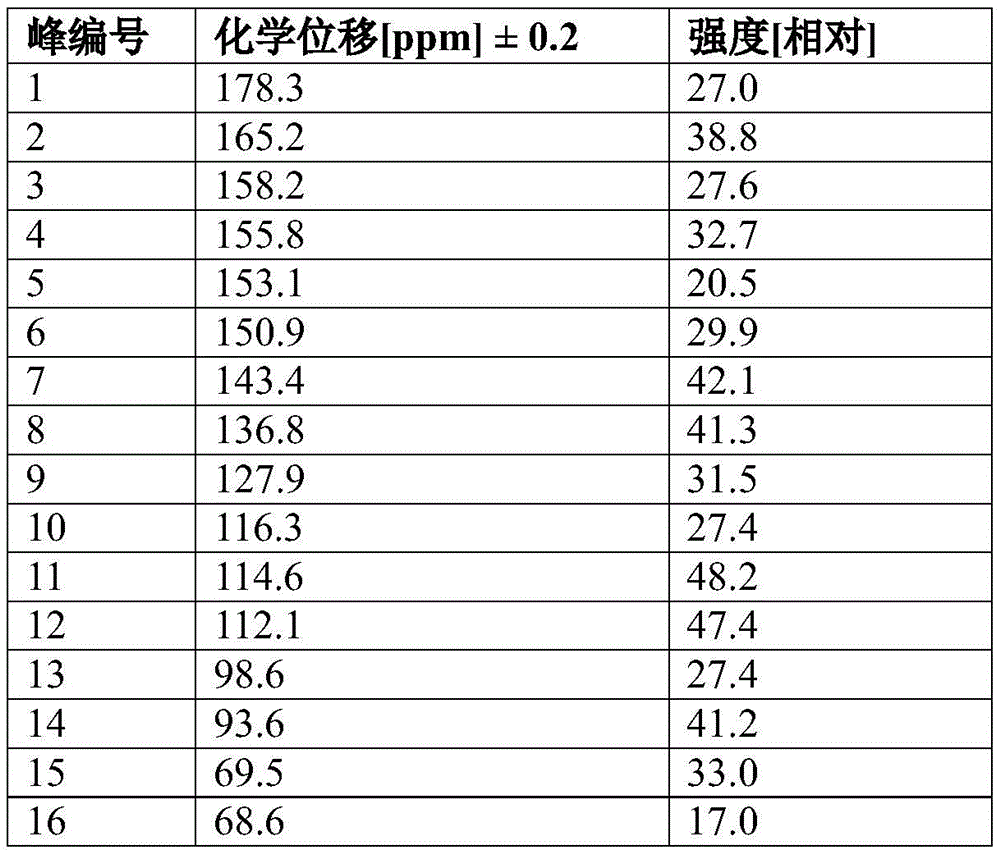

D. Differential scanning calorimetry analysis:
DSC thermograms were obtained using TA Instruments DSC Q2000. The sample was heated from 30 ℃ to 350 ℃ at 10 ℃/min. The thermogram shows an endothermic peak at about 223 ℃.
Example 6: compound I calcium salt hydrate form B
To 25g of Compound I (free form) form A was charged 50mL of ethanol and 100mL of water. The slurry was heated to 55-65 ℃. The mixture was charged with 1.1 equivalents of NaOH. The mixture was stirred until the solution became homogeneous. The solution was then cooled to 25 ℃ and seeded with 0.25g of compound I sodium salt hydrate form a. The slurry was stirred for 20 h. The solution was then heated to 45 ℃. The slurry was seeded with 0.1g of the calcium salt of compound I (the form is not critical). Adding 0.55 equivalent CaCl in a period of 5h 28mL of ethanol and 16mL of water. The resulting slurry was stirred for 2 h. The slurry was cooled to 20 ℃ over 5 h. The resulting solid was collected by vacuum filtration and allowed to air dry for 1 hour. The air dried wet cake was transferred to an unheated vacuum oven and slightly purged with nitrogen for 20h to yield 21g of crystalline compound I calcium salt hydrate form B (81% isolated yield).
Compound I calcium salt hydrate form B is the most stable polymorphic form in water at ambient temperature. Calcium salt form B of compound I isomorphous solvates, solvates/hydrates and hydrates share the same XRPD pattern as calcium salt hydrate form B of compound I. The solvent may be a small alcohol, such as MeOH, EtOH, IPA, and/or water.
A.X ray powder diffraction:
XRPD patterns were acquired in reflection mode at room temperature using Bruker Advance equipped with a Vantec-1 detector. The samples were analyzed on a silicon sample holder from 3 ° 2 θ to 40 ° 2 θ in a continuous mode with a step size of 0.0144531 ° and a time per step of 0.25 s. The sample was spun at 15 rpm. The XRPD diffractogram of compound I calcium salt hydrate form B is provided in fig. 8 and summarized in table 11.
Table 11: XRPD signal of crystalline Compound I calcium salt hydrate form B


B. Single crystal explication
Crystals having the structure of compound I calcium salt hydrate form B were grown by dissolving 1mg of compound I calcium salt hydrate form a in 350 μ L of a boiling 80/20 mixture of methanol/dichloromethane and then allowed to cool over several days. In the presence of Cu KαRadiation of radiation And X-ray diffraction data were acquired at 100K on a Bruker diffractometer with a CCD detector. The structure was resolved and refined using the SHELX program (sheldrag, g.m., Acta cryst., (2008) a64, 112-.
Table 12: single crystal illustration of hydrate/solvate form B of calcium salt of Compound I

C. Solid state NMR:
solid state of compound I calcium salt hydrate form B13The C NMR spectra are provided in fig. 9 and summarized in table 13.
Table 13: solid state NMR of Compound I calcium salt hydrate form B


D. Differential scanning calorimetry analysis of Compound I calcium salt hydrate form B
DSC was performed using a TA Discovery differential scanning calorimeter (TA Instruments, New Castle, DE). The instrument was calibrated with indium. Approximately 1-10mg of the sample was weighed into a sealing disk and crimped using a lid with one well. The DSC sample was scanned from 25 ℃ to 300 ℃ at a heating rate of 10 ℃/min. Data were collected and analyzed by Trios analysis software (TA Instruments, New Castle, DE). The thermogram shows multiple endothermic peaks at about 61 ℃ and about 110 ℃.
E. Compound I calcium salt hydrate/MeOH solvate form B
Compound I calcium salt hydrate/MeOH solvate form B was prepared by adding one drop of MeOH to air dried compound I calcium salt hydrate form B. Solid state of compound I calcium salt hydrate/MeOH solvate form B13The C NMR spectra are provided in fig. 10 and summarized in table 14.
Table 14: solid state NMR of Compound I calcium salt hydrate/MeOH solvate form B


F. Differential scanning calorimetry analysis of Compound I calcium salt hydrate/MeOH solvate form B
DSC was performed using a TA Discovery differential scanning calorimeter (TA Instruments, New Castle, DE). The instrument was calibrated with indium. Approximately 1-10mg of the sample was weighed into a sealing disk and crimped using a lid with one well. The DSC sample was scanned from 25 ℃ to 300 ℃ at a heating rate of 10 ℃/min. Data were collected and analyzed by Trios analysis software (TA Instruments, New Castle, DE). The thermogram shows multiple endothermic peaks at about 64 ℃ and about 113 ℃.
Example 7: compound I calcium salt hydrate form C
Direct crystallization-1 g of Compound I (in free form) form A is reacted with calcium methoxide (Ca (OMe)2) The solid was reacted at 2/1 molar ratio in DCM at 40 mg/mL. The mixture was stirred at room temperature overnight. About 10% water was incorporated the next day. The mixture was then stirred at room temperature for 1 week. The isolated solid was compound I calcium salt hydrate form C.
Conversion from amorphous calcium salt-1 g of compound I (free form) form a was charged into a round flask. Ca (OMe) was added in a molar ratio of 1:12. Methanol was then added to the flask to prepare about 15mg/mL of compound I. The mixture was stirred at room temperature for 30min to 1 h. Dissolving most of the solids. The solution was then heated to 60 ℃ for 30min to dissolve the remaining solids. The solution was filtered under vacuum while hot and rotary evaporated to give white to off-white amorphous compound I calcium salt. The material was further vacuum dried at 30 ℃ for 2-3 days. The resulting solid was an amorphous form of compound I Ca. 45mg of amorphous calcium salt of compound I at 30mg/mL in DCM are stirred at room temperature for at least 2.5 weeks. The solid isolated by filtration of the suspension was compound I calcium salt hydrate form C.
A.X powder diffraction of radiation
Irradiation with copper at room temperature using a PANALYtic's X-pert Pro diffractometer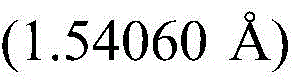 Powder x-ray diffraction measurements were performed. The incident beam optics include a variable divergence slit to ensure a constant illumination length on the sample and on the diffracted beam side. Use the speed rapidlyThe effective length of a linear solid state detector, measured in scan mode, is 2.12 ° 2 θ. Powder samples were loaded on the recessed areas of the zero background silicon holder and rotated for better statistics. The symmetric scan was measured from 4 ° 2 θ to 40 ° 2 θ, with a step size of 0.017 degrees and a scan step of 15.5 s. The XRPD diffractogram of compound I calcium salt hydrate form C is shown in fig. 11 and summarized in table 15.
Table 15: XRPD signal of crystalline Compound I calcium salt hydrate form C

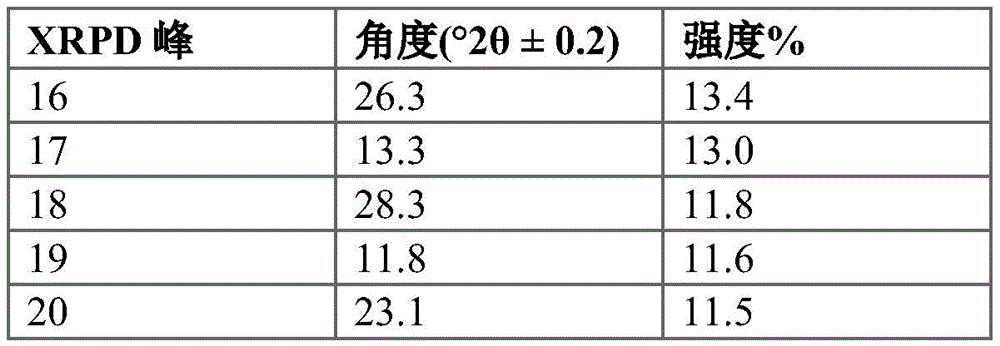
B. Solid state NMR:
solid state of compound I calcium salt hydrate form C13The C NMR spectra are provided in fig. 12 and summarized in table 16.
Table 16: solid state NMR of Compound I calcium salt hydrate form C


C. Differential scanning calorimetry analysis
DSC was performed using a TA Discovery differential scanning calorimeter (TA Instruments, New Castle, DE). The instrument was calibrated with indium. Approximately 1-10mg of the sample was weighed into a sealing disk and crimped using a lid with one well. The DSC sample was scanned from 25 ℃ to 300 ℃ at a heating rate of 10 ℃/min. Data were collected and analyzed by Trios analysis software (TA Instruments, New Castle, DE). The thermogram shows multiple endothermic peaks at about 137 ℃ and about 203 ℃.
Examples8: compound I calcium salt hydrate form D
Compound I calcium salt hydrate form D is the most stable calcium salt hydrate form under certain conditions, such as in a mixture of ethanol and water.
To approximately 25mg of Compound I calcium salt hydrate form A was charged 0.5mL EtOH: water 67:33 w/w. The slurry was heated to 65 ℃ for 8 days. The resulting solid collected by vacuum filtration was compound I calcium salt hydrate form D.
Alternatively, compound I calcium salt hydrate form D was prepared from 89g of compound I sodium hydrate form a, charged with 1080mL IPA and 120mL water. The slurry was heated to 55-65 ℃. The slurry was charged with 18g of compound I calcium salt hydrate form D seed crystals. Wet milling the slurry while adding 0.55 equivalents of CaCl over a period of 5h 2A solution of 81mL IPA and 9mL water. Wet milling was run until X-ray powder diffraction confirmed that the slurry was entirely of compound I calcium salt hydrate form D. The resulting solid was collected by vacuum filtration and the wet cake was washed with 350mL of water. The washed wet cake was allowed to air dry for 1 h. The air dried wet cake was transferred to a vacuum oven at 45 ℃ and purged slightly with nitrogen for 20h to give crystalline compound I calcium salt hydrate form D (83.15g, 90.6% isolated yield).
Compound calcium salt hydrate form D is the most stable polymorphic form in IPA/water at water activities of 0.1-0.95 from ambient temperature to 60 ℃.
A.X ray powder diffraction:
x-ray powder diffraction (XRPD) spectra were recorded in reflection mode at room temperature using a PANalytical Empyrean system (Malvern PANalytical Inc, Westborough, Massachusetts) equipped with a sealed tube source and a PIXcel 1D Medipix-2 detector. Using copper radiation The X-ray generator was operated at a voltage of 45kV and a current of 40 mA. The powder samples were placed in back-filled sample holders and loaded into the instrument. The sample was scanned over a range of about 3 ° 2 θ to about 40 ° 2 θ, with a step size of 0.0131303 ° and 49.725s per step. XRPD diffraction pattern of compound I calcium salt hydrate form D is shown in Fig. 13 and summarized in table 17.
Table 17: XRPD signal of crystalline Compound I calcium salt hydrate form D


B. Single crystal explication
A process for seeding ethanol/water with crystals of form D of the calcium salt hydrate of compound I. In the presence of Cu KaX-ray diffraction data were acquired at 100K on a Bruker diffractometer using radiation (l-1.5478, supplied by Rigaku MM007HF rotating anode) and CMOS detector. The structure was parsed and refined using the SHELX program (Sheldrick, G.M., Acta Crystal., (2008) A64,112- "122) and the results are summarized in Table 18.
Table 18: single crystal illustration of Compound I calcium salt hydrate form D

C. Solid state NMR:
solid state of compound I calcium salt hydrate form C13The C NMR spectra are provided in fig. 14 and summarized in table 19.
Table 19: solid state NMR of Compound I calcium salt hydrate form D



D. Differential scanning calorimetry analysis
DSC was performed using a TA Discovery differential scanning calorimeter (TA Instruments, New Castle, DE). The instrument was calibrated with indium. Approximately 1-10mg of the sample was weighed into a sealing disk and crimped using a lid with one well. The DSC sample was scanned from 25 ℃ to 300 ℃ at a heating rate of 10 ℃/min. Data were collected and analyzed by Trios analysis software (TA Instruments, New Castle, DE). The thermogram shows multiple endothermic peaks at about 182 ℃ and about 208 ℃.
Example 9: compound I calcium salt hydrate form E
Compound I calcium form E was obtained by solid vapor diffusion of compound I calcium salt hydrate form a in EtOAc.
A.X ray powder diffraction:
XRPD was performed on a Si zero background stent using Panalytical X' Pert3 powder XRPD. The 2 θ position was calibrated against the Panalytical Si reference standard disk. The XRPD diffractogram of compound I calcium salt hydrate form E is shown in fig. 15 and summarized in table 20.
Table 20: XRPD signal of crystalline Compound I calcium salt hydrate form E


Example 10: compound I form F
Compound I form F was obtained by slurrying compound I calcium salt hydrate form a in MEK at room temperature.
A.X powder diffraction of radiation
Using Panalytical X' Pert on Si zero background scaffolds3Powder XRPD was performed. The 2 θ position was calibrated against the Panalytical Si reference standard disk. Compound (I)The XRPD diffractogram of form I is shown in fig. 16 and summarized in table 21.
Table 21: XRPD signal of crystalline Compound I form F
| XRPD peak | Angle (° 2 θ ± 0.2) | |
| 1 | 9.14 | 100.0 |
| 2 | 9.06 | 89.3 |
| 3 | 5.3 | 48.5 |
| 4 | 7.5 | 48.2 |
| 5 | 10.6 | 23.7 |
| 6 | 11.9 | 18.5 |
Compound I form F is characterized by the following elemental analysis table:

example 11: compound I calcium salt hydrate form G
By reacting compound I calcium salt hydrate form A in EtOH: H 2Rapid cooling of the solution in O (v: v, 90: 10) gave Compound I calcium salt hydrate form G.
A.X powder diffraction by radiation:
using Panalytical X' Pert on Si zero background scaffolds3Powder XRPD was performed. The 2 θ position was calibrated against the Panalytical Si reference standard disk. The XRPD diffractogram of compound I calcium salt hydrate form G is shown in fig. 17 and summarized in table 22.
Table 22: XRPD signal of crystalline Compound I calcium salt hydrate form G
| XRPD peak | Angle (° 2 θ ± 0.2) | Strength% |
| l | 5.9 | 100.0 |
| 2 | 14.8 | 67.3 |
| 3 | 14.7 | 63.9 |
| 4 | 6.0 | 58.4 |
| 5 | 8.8 | 17.4 |
| 6 | 11.8 | 14.6 |
| 7 | 11.9 | 8.8 |
| 8 | 26.6 | 6.5 |
Example 12: compound I calcium salt EtOH solvate form A
By reacting compound I calcium salt hydrate form A in EtOH: H2The solution in O (85: 15, v: v) was immediately cooled rapidly from 50 ℃ to-20 ℃ to give compound I calcium salt EtOH solvate form A.
A.X ray powder diffraction:
using Panalytical X' Pert on Si zero background scaffolds3Powder XRPD was performed. The 2 θ position was calibrated against the Panalytical Si reference standard disk. The XRPD diffractogram of compound I calcium salt EtOH solvate form a is shown in figure 18 and summarized in table 23.
Table 23: XRPD signals of EtOH solvate form A, calcium salt of Compound I
| XRPD peak | Angle (° 2 θ ± θ.2) | Strength% |
| l | 4.1 | 100.0 |
| 2 | 17.1 | 26.9 |
| 3 | 4.8 | 23.9 |
| 4 | 8.2 | 19.7 |
| 5 | 8.5 | 19.2 |
| 6 | 5.6 | 16.6 |
| 7 | 16.5 | 14.2 |
| 8 | 20.3 | 11.1 |
| 9 | 11.1 | 10.8 |
| 10 | 14.2 | 10.7 |
| 11 | 9.5 | 10.4 |
| 12 | 7.0 | 10.4 |
| 13 | 16.1 | 10.2 |
Example 13: compound I calcium salt EtOH solvate form B
Compound I calcium salt EtOH solvate form B was obtained by temperature cycling Compound I calcium salt hydrate form A in EtOH: n-heptane (1: 1, v: v) at a cooling rate of 0.2 deg.C/min between 60 deg.C and 5 deg.C.
A.X powder diffraction of radiation
Using Panalytical X' Pert on Si zero background scaffolds3Powder XRPD of compound I calcium salt EtOH solvate form B. The 2 θ position was calibrated against the Panalytical Si reference standard disk. The XRPD diffractogram of compound I calcium salt EtOH solvate form a is shown in figure 19 and summarized in table 24.
Table 24: XRPD signals of EtOH solvate form B of calcium salt of Compound I
| XRPD peak | Angle (° 2 θ ± 0.2) | |
| 1 | 4.5 | 100.0 |
| 2 | 5.0 | 32.1 |
| 3 | 15.4 | 12.0 |
| 4 | 20.3 | 11.2 |
Example 14: compound I calcium salt EtOH solvate form C
By subjecting the amorphous form of the calcium salt of Compound I to EtOH/H at room temperature2Pulping in O (9: 1, v: v) affords compound I calcium salt EtOH solvate form C.
A.X powder diffraction of radiation
Using Panalytical X' Pert on Si zero background scaffolds3Powder XRPD of compound I calcium salt EtOH solvate form C. The 2 θ position was calibrated against the Panalytical Si reference standard disk. The XRPD diffractogram of compound I calcium salt EtOH solvate form C is shown in FIG. 20 Summarized in table 25.
Table 25: XRPD signals of EtOH solvate form C, calcium salt of Compound I
| XRPD peak | Angle (° 2 θ ± 0.2) | |
| 1 | 4.2 | 100.0 |
| 2 | 5.0 | 43.2 |
| 3 | 5.7 | 13.5 |
Example 15: compound I calcium salt IPA solvate
About 150mg of compound I calcium salt hydrate form a was weighed into a 4mL vial. 3mL IPA (about 50mg/mL Compound I Ca) was added. The mixture was stirred at room temperature for 4 days. Solid compound I calcium salt IPA solvate was isolated by centrifugation.
A.X powder diffraction of radiation
XRPD patterns were acquired in reflection mode at room temperature using Bruker Advance equipped with a Vantec-1 detector. The samples were analyzed on a silicon sample holder from 3 ° 2 θ to 40 ° 2 θ in a continuous mode with a step size of 0.0144531 ° and a time per step of 0.25 s. The sample was spun at 15 rpm.
This material is unstable. The X-ray powder diffraction pattern varies depending on the way the sample is dried. The XRPD diffractogram of moisture I calcium salt IPA solvate form a is shown in figure 21A and summarized in table 26. The XRPD diffractogram of air dried compound I calcium salt IPA solvate form B is shown in figure 21B and summarized in table 27.
Table 26: compound I calcium salt IPA solvate (Wet sample) form A
| XRPD peaks | Angle (° 2 θ ± 0.2) | |
| 1 | 19.7 | 100.0 |
| 2 | 19.9 | 78.9 |
| 3 | 18.5 | 71.5 |
| 4 | 21.0 | 68.4 |
| 5 | 21.4 | 64.2 |
| 6 | 12.8 | 63.0 |
| 7 | 18.1 | 60.6 |
| 8 | 19.1 | 58.5 |
| 9 | 5.3 | 57.9 |
| 10 | 19.4 | 55.2 |
| 11 | 15.9 | 52.9 |
| 12 | 15.6 | 51.7 |
| 13 | 20.2 | 51.7 |
| 14 | 6.7 | 49.5 |
| 15 | 23.3 | 47.6 |
| 16 | 10.4 | 42.9 |
| 17 | 17.9 | 41.6 |
| 18 | 24.3 | 40.5 |
| 19 | 16.7 | 39.1 |
| 20 | 22.5 | 35.2 |
| 21 | 22.8 | 31.6 |
| 22 | 17.6 | 30.3 |
| 23 | 17.4 | 29.0 |
| 24 | 9.9 | 25.1 |
| 25 | 25.8 | 23.3 |
| 26 | 26.0 | 23.3 |
| 27 | 15.2 | 19.3 |
| 28 | 14.0 | 15.3 |
| 29 | 9.5 | 14.2 |
| 30 | 8.9 | 10.9 |
| 31 | 6.1 | 10.0 |
Table 27: compound I calcium salt IPA solvate (air dried sample) form B
| XRPD peak | Angle (° 2 θ ± 0.2) | |
| 1 | 5.3 | 100.0 |
| 2 | 6.3 | 48.6 |
| 3 | 8.8 | 43.9 |
| 4 | 15.7 | 29.8 |
| 5 | 13.1 | 24.4 |
| 6 | 19.9 | 23.6 |
| 7 | 17.9 | 19.6 |
| 8 | 21.6 | 17.2 |
| 9 | 4.4 | 10.0 |
Example 16: solvation of Compound I calcium salt NPAArticle (A)
About 45mg of compound I calcium salt hydrate form a was stirred in about 0.5mL NPA at room temperature. About 5mg of each of compound I calcium salt hydrate forms B and D was added to the mixture. The mixture was stirred at room temperature for 13 days. The solid was separated by centrifugal filtration.
A.X powder diffraction of radiation
X-ray powder diffraction (XRPD) spectra were recorded in transmission mode at room temperature using a PANalytical Empyrean system (malverm PANalytical Inc, Westborough, Massachusetts) equipped with a sealed tube source and a PIXcel 1D Medipix-3 detector. Using copper radiation The X-ray generator was operated at a voltage of 45kV and a current of 40 mA. The powder samples were placed on 96-well sample holders with mylar film (mylar film) and loaded into the instrument. The sample was scanned over a range of about 3 ° 2 θ to about 40 ° 2 θ, with a step size of 0.0131303 ° and 49s per step.
This material is unstable. The X-ray powder diffraction pattern varies depending on the way the sample is dried. The XRPD diffractogram of the hydrate I calcium salt NPA solvate form a is shown in figure 22A and summarized in table 28. The XRPD diffractogram of air dried compound I calcium salt NPA solvate form B is shown in figure 22B and summarized in table 29.
Table 28: compound I calcium salt NPA solvate (Wet sample) form A
| XRPD peak | Angle (° 2 θ ± 0.2) | |
| 1 | 6.5 | 100.0 |
| 2 | 5.2 | 33.7 |
| 3 | 10.5 | 13.5 |
| 4 | 15.9 | 10.1 |
Table 29: compound I calcium salt NPA solvate (air dried sample) form B
| XRPD peak | Angle (° 2 θ ± 0.2) | |
| 1 | 6.9 | 100.0 |
| 2 | 5.5 | 65.5 |
| 3 | 6.4 | 47.4 |
| 4 | 7.1 | 31.5 |
Example 17: compound I calcium salt 2-BuOH solvate
50mg of Compound I calcium salt hydrate form A was stirred in 1mL of 2-butanol at room temperature for 4d to give Compound I calcium salt 2-BuOH solvate.
A.X powder diffraction of radiation
X-ray powder diffraction (XRPD) spectra were recorded in transmission mode at room temperature using a PANalytical Empyrean system (Malvern PANalytical Inc, Westborough, Massachusetts) equipped with a sealed tube source and a PIXcel 1D Medipix-3 detector. Using copper radiation The X-ray generator was operated at a voltage of 45kV and a current of 40 mA. The powder samples were placed on 96-well sample holders with mylar film (mylar film) and loaded into the instrument. The sample was scanned over a range of about 3 ° 2 θ to about 40 ° 2 θ, with a step size of 0.0131303 ° and 49s per step.
This material is unstable. The X-ray powder diffraction pattern varies depending on the way the sample is dried. The XRPD diffraction pattern of the wet compound I calcium salt 2-BuOH solvate form A is shown in FIG. 23A and is summarized in Table 30. The XRPD diffractogram of air dried compound I calcium salt 2-BuOH solvate form B is shown in figure 23B and summarized in table 31.
Table 30: compound I calcium salt 2-BuOH solvate (Wet sample) form A
| XRPD peak | Angle (° 2 θ ± 0.2) | |
| 1 | 5.8 | 100.0 |
| 2 | 5.3 | 56.0 |
| 3 | 7.7 | 39.0 |
| 4 | 8.8 | 24.1 |
| 5 | 8.6 | 18.2 |
| 6 | 20.9 | 12.1 |
| 7 | 11.3 | 11.5 |
Table 31: compound I calcium salt 2-BuOH solvate (air dried sample) form B
| XRPD peak | Angle (° 2 θ ± 0.2) | |
| 1 | 5.2 | 100.0 |
| 2 | 6.1 | 22.6 |
| 3 | 8.7 | 2.9 |
Example 18: calcium salt of Compound I acetone solvate form A
Compound I calcium salt acetone solvate form a was prepared by slurrying an amorphous form of compound I calcium salt in acetone at 4 ℃. This material is extremely unstable. Which quickly dried upon air drying to compound I calcium salt hydrate form C.
A.X powder diffraction of radiation
X-ray powder diffraction (XRPD) spectra were recorded in transmission mode at room temperature using a PANalytical Empyrean system (Malvern PANalytical Inc, Westborough, Massachusetts) equipped with a sealed tube source and a PIXcel 1D Medipix-3 detector. Using copper radiation The X-ray generator was operated at a voltage of 45kV and a current of 40 mA. The powder samples were placed on 96-well sample holders with mylar film (mylar film) and loaded into the instrument. The sample was scanned over a range of about 3 ° 2 θ to about 40 ° 2 θ, with a step size of 0.0131303 ° and 49s per step. Compound (I)The XRPD diffractogram of calcium salt acetone solvate form a is shown in fig. 24 and summarized in table 32.
Table 32: compound I calcium salt acetone solvate form A
| XRPD peaks | Angle (° 2 θ ± 0.2) | |
| 1 | 20.5 | 100.0 |
| 2 | 22.4 | 80.8 |
| 3 | 23.9 | 75.6 |
| 4 | 4.3 | 59.5 |
| 5 | 9.6 | 57.9 |
| 6 | 26.0 | 41.6 |
Example 19: compound I calcium salt DCM solvate form A
Compound I calcium salt DCM solvate form a was prepared by adding DCM to compound I calcium salt hydrate form C. This material is extremely unstable. Which upon filtration rapidly dried to compound I calcium salt hydrate form C.
A.X powder diffraction of radiation
XRPD patterns were acquired in reflection mode at room temperature using Bruker Advance equipped with a Vantec-1 detector. The samples were analyzed on a silicon sample holder from 3 ° 2 θ to 40 ° 2 θ in a continuous mode with a step size of 0.0144531 ° and a time per step of 0.25 s. The sample was spun at 15 rpm. The XRPD diffractogram of compound I calcium salt DCM solvate form a is shown in fig. 25 and summarized in table 33.
Table 33: compound I calcium salt DCM solvate (air dried sample) form A
| XRPD peak | Angle (° 20 ± 0.2) | |
| 1 | 9.9 | 100.0 |
| 2 | 4.3 | 86.5 |
| 3 | 23.9 | 33.1 |
| 4 | 20.6 | 29.4 |
B. Solid state NMR
Solid state of compound I calcium salt DCM solvate form A13The C NMR spectrum is provided in fig. 26 and summarized in table 34.
Table 34: solid state NMR of Compound I calcium salt DCM solvate form A


Example 20: calcium salt glycol solvate form A of Compound I
75mg of Compound I calcium salt hydrate form A in 1mL of ethylene glycol was stirred at room temperature for 4 d. The sample was isolated by centrifugal filtration and then dried at 60 ℃ over 3d to give compound I calcium salt ethylene glycol solvate form a.
A.X powder diffraction of radiation
X-ray powder diffraction (XRPD) spectra were recorded in transmission mode at room temperature using a PANalytical Empyrean system (Malvern PANalytical Inc, Westborough, Massachusetts) equipped with a sealed tube source and a PIXcel 1D Medipix-3 detector. Using copper radiation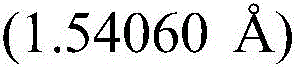 The X-ray generator was operated at a voltage of 45kV and a current of 40 mA. The powder samples were placed on 96-well sample holders with mylar film (mylar film) and loaded into the instrument. The sample was scanned over a range of about 3 ° 2 θ to about 40 ° 2 θ, with a step size of 0.0131303 ° and 49s per step. The XRPD diffractogram of compound I calcium salt ethanol solvate form A is shown in FIG. 27 andsummarized in table 35.
Table 35: calcium salt glycol solvate form A of Compound I


B. Solid state NMR
Solid state of compound I calcium salt glycol solvate form a13The C NMR spectra are provided in fig. 28 and summarized in table 36.
Table 36: solid state NMR for Compound I calcium salt glycol solvate form A
| Peak number | Chemical shift [ ppm ]]±0.2 | Strength [ relative ]] |
| 1 | 175.7 | 8.9 |
| 2 | 174.5 | 6.7 |
| 3 | 165.0 | 61.5 |
| 4 | 159.7 | 26.1 |
| 5 | 158.7 | 12.9 |
| 6 | 153.5 | 24.2 |
| 7 | 149.7 | 37.9 |
| 8 | 141.8 | 14.7 |
| 9 | 140.5 | 28.1 |
| 10 | 131.2 | 48.7 |
| 11 | 118.0 | 24.1 |
| 12 | 112.2 | 19 |
| 13 | 98.1 | 17.7 |
| 14 | 94.7 | 67.2 |
| 15 | 67.5 | 46.6 |
| 16 | 63.4 | 17.7 |
| 17 | 61.5 | 100 |
| 18 | 58.1 | 45.6 |
| 19 | 50.7 | 47.1 |
| 20 | 38.9 | 76.1 |
| 21 | 30.5 | 72.0 |
| 22 | 29.1 | 45.0 |
| 23 | 27.2 | 63.5 |
| 24 | 26.6 | 53.8 |
| 25 | 22.1 | 40.2 |
| 26 | 20.7 | 75.8 |
| 27 | 17.6 | 73.1 |
| 28 | 8.0 | 48.3 |
| 29 | 7.1 | 72.2 |
| 30 | 5.4 | 38.4 |
Example 21: calcium salt glycol solvate form B of Compound I
Compound I calcium salt glycol solvate form B was obtained by slurrying compound I calcium salt hydrate form a in ethylene glycol at 80 ℃.
A.X powder diffraction of radiation
Using Panalytical X' Pert on Si zero background scaffolds3Powder XRPD was performed. To is directed atPanalytical Si calibrates the 2 θ position with reference to a standard disk. The XRPD diffractogram of compound I calcium salt ethanol solvate form B is shown in fig. 29 and summarized in table 37.
Table 37: calcium salt glycol solvate form B of Compound I
| XRPD peak | Angle (° 2 θ ± 0.2) | |
| 1 | 3.9 | 100.0 |
| 2 | 22.0 | 38.7 |
| 3 | 23.4 | 27.6 |
| 4 | 21.1 | 27.0 |
| 5 | 20.7 | 25.8 |
| 6 | 5.0 | 24.6 |
| 7 | 21.5 | 21.3 |
| 8 | 18.1 | 20.2 |
| 9 | 11.6 | 17.6 |
| 10 | 12.5 | 15.3 |
| 11 | 14.2 | 14.7 |
| 12 | 24.4 | 14.3 |
| 13 | 16.7 | 14.1 |
Example 22: compound I calcium salt 1, 2-dimethoxyethane solvate form A
50mg of Compound I calcium salt hydrate form A was stirred in 1mL of 1, 2-dimethoxyethane at room temperature for 4d to give Compound I calcium salt 1, 2-dimethoxyethane solvate form A.
A.X powder diffraction of radiation
Using a PANalytic Empyrean system equipped with a sealed tube source and a PIXcel 1D Medipix-3 detector(Malvern PANALYTIC Inc, Westborough, Massachusetts) an X-ray powder diffraction (XRPD) spectrum was recorded in transmission mode at room temperature. Using copper radiation  The X-ray generator was operated at a voltage of 45kV and a current of 40 mA. The powder samples were placed on a 96-well sample holder with mylar film and loaded into the instrument. The sample was scanned over a range of about 3 ° 2 θ to about 40 ° 2 θ, with a step size of 0.0131303 ° and 49s per step. The XRPD diffractogram of compound I calcium salt 1, 2-dimethoxyethane solvate form a is shown in figure 30 and summarized in table 38.
Table 38: compound I calcium salt 1, 2-dimethoxyethane solvate form A
| XRPD peak | Angle (° 2 θ ± 0.2) | Strength% |
| l | 7.7 | 100.0 |
| 2 | 10.1 | 25.7 |
| 3 | 4.6 | 24.5 |
| 4 | 20.9 | 17.2 |
| 5 | 17.5 | 13.4 |
| 6 | 13.7 | 10.6 |
B. Solid state NMR
Solid state of compound I calcium salt 1, 2-dimethoxyethane solvate form A13The C NMR spectra are provided in fig. 31 and summarized in table 39.
Table 39: solid state NMR of Compound I calcium salt 1, 2-dimethoxyethane solvate form A


Example 23: compound I calcium salt 1, 2-dimethoxyethane solvate form B
Compound I calcium salt hydrate form a was slurried in 1, 2-dimethoxyethane at room temperature to obtain compound I calcium salt 1, 2-dimethoxyethane solvate form B.
A.X powder diffraction of radiation
Using Panalytical X' Pert on Si zero background scaffolds3Powder XRPD was performed. The 2 θ position was calibrated against the Panalytical Si reference standard disk. The XRPD diffractogram of compound I calcium salt 1, 2-dimethoxyethane alcohol solvate form B is shown in figure 32 and summarized in table 40.
Table 40: compound I calcium salt 1, 2-dimethoxyethane solvate form B


Example 24: calcium salt of Compound I CPME solvate form A
Compound I calcium salt cyclopentyl methyl ether (CPME) solvate form A was obtained by slurrying compound I calcium salt form A in IPA/CPME (1: 1, v/v) at room temperature.
A.X powder diffraction of radiation
Using Panalytical X' Pert on Si zero background scaffolds3Powder XRPD was performed. The 2 θ position was calibrated against the Panalytical Si reference standard disk. The XRPD diffractogram of compound I calcium salt CPME solvate form a is shown in fig. 33 and summarized in table 41.
Table 41: calcium salt of Compound I CPME solvate form A
| XRPD peak | Angle (° 2 θ ± 0.2) | |
| 1 | 5.5 | 100 |
| 2 | 16.6 | 4.38 |
| 3 | 11.0 | 3.86 |
Example 25: compound I sodium salt hydrate form A
To approximately 60mg of compound I sodium salt amorphous material was charged 40mg/mL IPA/mL/water (> 4% water by volume) or ACN/water (> 1% water by volume) mixture and stirred at room temperature for 2 weeks. The solid was isolated by vacuum filtration as compound I sodium salt hydrate form a and dried under vacuum at 40 ℃ over the weekend.
Alternatively, 100g of Compound I (free form) was charged with 400mL IPA and 400mL water. The slurry was heated to 55-65 ℃. The slurry was charged with 1.1 equivalents of NaOH. The mixture was allowed to stir until the solution became homogeneous. The solution was then cooled to 40 ℃ and seeded with 1g of compound I Na hydrate form a. Water (800mL) was charged over a period of 5 h. The resulting slurry was stirred for 2 h. The slurry was cooled to 20 ℃ over 5 h. The resulting solid was collected by vacuum filtration and the wet cake was washed with 500mL of water. The washed wet cake was allowed to air dry for 1 h. The air dried wet cake was transferred to a vacuum oven at 45 ℃ and purged slightly with nitrogen for 20h to yield 96.2g of crystalline compound I sodium hydrate form a (93% isolated yield).
A.X powder diffraction of radiation
XRPD patterns were acquired in reflection mode at room temperature using Bruker Advance equipped with a Vantec-1 detector. The samples were analyzed on a silicon sample holder from 3 ° 2 θ to 40 ° 2 θ in a continuous mode with a step size of 0.0144531 ° and a time per step of 0.25 s. The sample was spun at 15 rpm. The XRPD diffractogram of compound I sodium salt hydrate form a is shown in fig. 34 and summarized in table 42.
Table 42: compound I sodium salt hydrate form A
| XRPD peak | Angle (° 2 θ ± 0.2) | |
| 1 | 5.4 | 100.0 |
| 2 | 15.9 | 63.5 |
| 3 | 17.6 | 43.0 |
| 4 | 15.3 | 23.7 |
| 5 | 18.6 | 16.8 |
| 6 | 21.3 | 15.8 |
| 7 | 23.9 | 14.0 |
| 8 | 20.0 | 11.1 |
| 9 | 26.7 | 10.3 |
B. Single crystal description
Using synchrotron radiation on a Bruker diffractometer ( Supplied by beamline 12.2.1 of Advanced Light Source law Berkeley National Laboratory) and CMOS detectors acquire X-ray diffraction data at 100K. The structure was parsed and refined using the SHELX program (sheldrag, g.m., Acta cryst., (2008) a64, 112-.
Table 43: single crystal illustration of compound I sodium salt hydrate form a


C. Solid state NMR
Compound I sodium salt hydrate form A (275K; CZ;1H T1=5.4s;D17s) solid state13The CNMR spectra are provided in fig. 35 and summarized in table 44.
Table 44: solid state NMR of Compound I sodium salt hydrate form A
| Peak numbering | Chemical shift [ ppm [ ]] | Strength [ relative ]] |
| 1 | 177.0 | 18.0 |
| 2 | 166.3 | 27.2 |
| 3 | 159.6 | 51.8 |
| 4 | 153.1 | 13.8 |
| 5 | 148.6 | 17.7 |
| 6 | 140.6 | 32.6 |
| 7 | 138.5 | 40.8 |
| 8 | 129.2 | 30.2 |
| 9 | 118.3 | 22.4 |
| 10 | 114.7 | 35.3 |
| 11 | 107.0 | 42.3 |
| 12 | 97.1 | 37.7 |
| 13 | 96.4 | 50.4 |
| 14 | 70.6 | 51.9 |
| 15 | 63.4 | 46.9 |
| 16 | 56.6 | 36.9 |
| 17 | 51.9 | 58.4 |
| 18 | 40.0 | 32.1 |
| 19 | 38.3 | 50.3 |
| 20 | 31.5 | 29.5 |
| 21 | 28.9 | 100.0 |
| 22 | 28.5 | 56.3 |
| 23 | 28.1 | 51.5 |
| 24 | 26.2 | 72.6 |
| 25 | 21.9 | 46.7 |
| 26 | 19.7 | 77.5 |
| 27 | 18.4 | 76.5 |
| 28 | 6.5 | 80.3 |
| 29 | 1.2 | 22.5 |
D. Differential scanning calorimetry analysis
DSC thermograms were obtained using TA Instruments DSC Q2000. The sample was heated from 30 ℃ to 350 ℃ at 10 ℃/min. The thermogram shows two endothermic peaks at about 108 ℃ and about 290 ℃.
Example 26: compound I sodium salt pure form B
Approximately 10mg of compound I sodium salt hydrate form C was desolvated/dehydrated to 306 ℃ at 10 ℃/min in a TGA tray to obtain compound I sodium salt pure form B.
A.X ray powder diffraction:
irradiation with copper at room temperature using a PANALYtic's X-pert Pro diffractometer Powder x-ray diffraction measurements were performed. The incident beam optics include a variable divergence slit to ensure a constant illumination length on the sample and on the diffracted beam side. The effective length measured in scan mode using a fast linear solid state detector is 2.12 ° 2 θ. Powder samples were loaded on the recessed areas of the zero background silicon holder and rotated for better statistics. The symmetric scan was measured from 4 ° 2 θ to 40 ° 2 θ, with a step size of 0.017 degrees and a scan step of 15.5 s. The XRPD diffractogram of compound I sodium salt pure form B is shown in figure 36 and summarized in table 45.
Table 45: compound I sodium salt pure form B
| XRPD peaks | Angle (° 2 theta ± 0.2) | Strength% |
| 1 | 20.5 | 100.0 |
| 2 | 18.1 | 75.5 |
| 3 | 11.0 | 65.9 |
| 4 | 22.2 | 54.1 |
| 5 | 14.3 | 50.0 |
| 6 | 17.4 | 42.8 |
| 7 | 21.5 | 38.2 |
| 8 | 15.3 | 38.0 |
| 9 | 15.6 | 33.6 |
| 10 | 22.6 | 31.9 |
| 11 | 20.8 | 28.5 |
| 12 | 12.8 | 25.0 |
| 13 | 20.1 | 22.1 |
| 14 | 25.5 | 20.3 |
| 15 | 23.4 | 17.6 |
| 16 | 11.7 | 17.0 |
| 17 | 24.7 | 16.9 |
| 18 | 18.5 | 16.1 |
| 19 | 16.3 | 15.0 |
| 20 | 18.8 | 12.0 |
| 21 | 29.9 | 11.5 |
| 22 | 26.2 | 10.5 |
B. Differential scanning calorimetry analysis
DSC was performed using a TA Discovery differential scanning calorimeter (TA Instruments, New Castle, DE). The instrument was calibrated with indium. Approximately 1-10mg of the sample was weighed into a sealing disk and crimped using a lid with one well. The DSC sample was scanned from 25 ℃ to 350 ℃ at a heating rate of 10 ℃/min. Data were collected and analyzed by Trios analysis software (TA Instruments, New Castle, DE). The thermogram shows an endothermic peak at about 338 ℃.
Example 27: compound I sodium salt hydrate form C
To approximately 66mg of amorphous sodium salt of compound I was charged 45mg/mL ACN and stirred at room temperature for 2 d. The solid was isolated by vacuum filtration and air dried to give compound I sodium salt hydrate form C.
A.X ray powder diffraction:
irradiation with copper at room temperature using a PANALYtic's X-pert Pro diffractometer Powder x-ray diffraction measurements were performed. The incident beam optics include a variable divergence slit to ensure a constant illumination length on the sample and on the diffracted beam side. The effective length measured in scan mode using a fast linear solid state detector is 2.12 ° 2 θ. Powder samples were loaded on zero background silicon racks And rotated to achieve better statistics. The symmetric scan was measured from 4 ° 2 θ to 40 ° 2 θ, with a step size of 0.017 degrees and a scan step of 15.5 s. The XRPD diffractogram of compound I sodium salt hydrate form C is shown in fig. 37 and summarized in table 46.
Table 46: compound I sodium salt hydrate form C


B. Differential scanning calorimetry analysis
DSC was performed using a TA Discovery differential scanning calorimeter (TA Instruments, New Castle, DE). The instrument was calibrated with indium. Approximately 1-10mg of the sample was weighed into a sealing disk and crimped using a lid with one well. The DSC sample was scanned from 25 ℃ to 350 ℃ at a heating rate of 10 ℃/min. Data were collected and analyzed by Trios analysis software (TA Instruments, New Castle, DE). The thermogram shows an endothermic peak at about 51 deg.C, about 339 deg.C and an exothermic peak at 301 deg.C.
Example 28: compound I sodium salt hydrate form D
Compound I sodium salt hydrate form D was obtained by drying compound I sodium salt hydrate form C under vacuum at 80 ℃ overnight.
A.X ray powder diffraction:
irradiation with copper at room temperature using a PANALYtic's X-pert Pro diffractometer Powder x-ray diffraction measurements were performed. The incident beam optics include a variable divergence slit to ensure a constant illumination length on the sample and on the diffracted beam side. The effective length measured in scan mode using a fast linear solid state detector is 2.12 ° 2 θ. Filling powder samples in zero background silicon holders The recessed area is rotated to achieve better statistics. Symmetric scans were measured from 4 ° 2 θ to 40 ° 2 θ, with a step size of 0.017 degrees and a scan step of 15.5 s. The XRPD diffractogram of compound I sodium salt hydrate form D is shown in fig. 38 and summarized in table 47.
Table 47: compound I sodium salt hydrate form D
| XRPD peak | Angle (° 2 θ ± 0.2) | Strength% |
| 1 | 5.3 | 100.0 |
| 2 | 18.5 | 90.5 |
| 3 | 19.9 | 78.7 |
| 4 | 17.5 | 59.7 |
| 5 | 15.9 | 44.5 |
| 6 | 15.1 | 43.6 |
| 7 | 6.3 | 35.0 |
| 8 | 14.8 | 32.8 |
| 9 | 19.0 | 32.5 |
| 10 | 22.4 | 32.2 |
| 11 | 10.9 | 31.7 |
| 12 | 21.1 | 31.7 |
| 13 | 23.8 | 31.7 |
| 14 | 22.8 | 30.0 |
| 15 | 7.8 | 26.8 |
| 16 | 24.0 | 26.6 |
| 17 | 25.3 | 23.1 |
| 18 | 24.3 | 20.1 |
| 19 | 27.3 | 18.8 |
| 20 | 22.2 | 18.5 |
| 21 | 4.9 | 17.0 |
| 22 | 26.0 | 16.2 |
| 23 | 29.1 | 15.2 |
| 24 | 26.3 | 15.1 |
| 25 | 13.5 | 14.1 |
| 26 | 9.3 | 13.7 |
| 27 | 11.9 | 13.7 |
| 28 | 16.8 | 13.3 |
| 30 | 9.8 | 10.0 |
| 31 | 20.8 | 10.0 |
B. Differential scanning calorimetry analysis
DSC was performed using a TA Discovery differential scanning calorimeter (TA Instruments, New Castle, DE). The instrument was calibrated with indium. Approximately 1-10mg of the sample was weighed into a sealing disk and crimped using a lid with one well. The DSC sample was scanned from 25 ℃ to 300 ℃ at a heating rate of 10 ℃/min. Data were collected and analyzed by Trios analysis software (TA Instruments, New Castle, DE). The thermogram shows multiple endothermic peaks at about 137 ℃ and about 203 ℃.
Example 29: compound I Potassium salt hydrate form A
Compound I (free form) form a was obtained by reacting compound I (free form) form a with 0.1N potassium hydroxide in water at a 1:1 molar ratio. The reaction mixture was subjected to heating and cooling cycles from 60 ℃ to room temperature for 2 cycles with air cooling and stirred at room temperature for about one week.
A.X powder diffraction of radiation
Irradiation with copper at room temperature using a PANALYTICAL's X-pert Pro diffractometer Powder x-ray diffraction measurements were performed. The incident beam optics include a variable divergence slit to ensure a constant illumination length on the sample and on the diffracted beam side. The effective length measured in scan mode using a fast linear solid state detector is 2.12 ° 2 θ. Powder samples were loaded on the recessed areas of the zero background silicon holder and rotated for better statistics. The symmetric scan was measured from 4 ° 2 θ to 40 ° 2 θ, with a step size of 0.017 degrees and a scan step of 15.5 s. The XRPD diffractogram of compound I potassium salt hydrate form a is shown in fig. 39 and summarized in table 48.
Table 48: compound I Potassium salt hydrate form A


B. Differential scanning calorimetry analysis
DSC was performed using a TA Discovery differential scanning calorimeter (TA Instruments, New Castle, DE). The instrument was calibrated with indium. Approximately 1-10mg of the sample was weighed into a sealing disk and crimped using a lid with one well. The DSC sample was scanned from 25 ℃ to 300 ℃ at a heating rate of 10 ℃/min. Data were collected and analyzed by Trios analysis software (TA Instruments, New Castle, DE). The thermogram shows multiple endothermic peaks at about 75 ℃ and about 98 ℃.
Example 30: compound I Potassium salt hydrate form B
Compound I potassium salt hydrate form B was obtained by slurrying amorphous compound I potassium salt in ACN at room temperature for 3 or 4 weeks and continuing to slurry at 60 ℃ for 6 h.
A.X powder diffraction of radiation
Irradiation with copper at room temperature using a PANALYtic's X-pert Pro diffractometer Powder x-ray diffraction measurements were performed. The incident beam optics include a variable divergence slit to ensure a constant illumination length on the sample and on the diffracted beam side. The effective length measured in scan mode using a fast linear solid state detector is 2.12 ° 2 θ. Powder samples were loaded on the recessed areas of the zero background silicon holder and rotated for better statistics. The symmetric scan was measured from 4 ° 2 θ to 40 ° 2 θ, with a step size of 0.017 degrees and a scan step of 15.5 s. The XRPD diffractogram of compound I potassium salt hydrate form B is shown in figure 40 and summarized in table 49.
Table 49: compound I Potassium salt hydrate form B
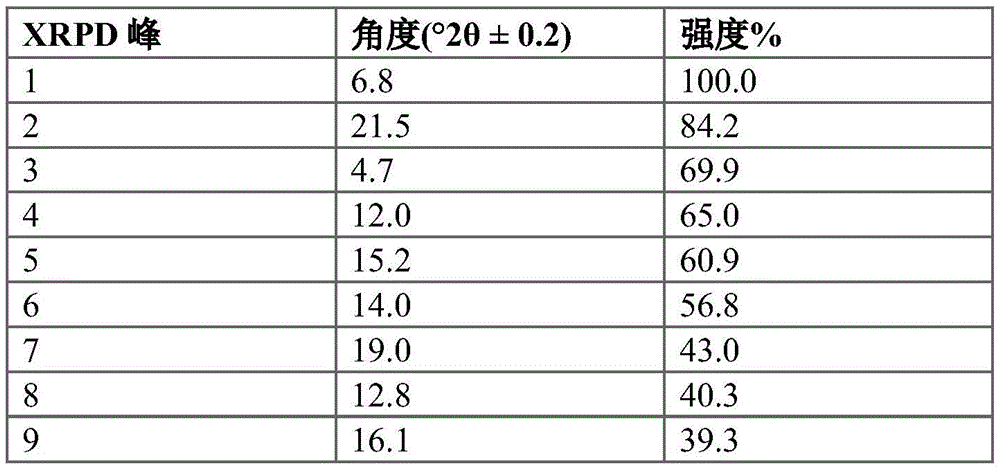

Example 31: compound I Potassium salt hydrate forms C and D
Approximately 1g of amorphous potassium compound I salt was stirred in approximately 8.5mL ACN at ambient temperature for 10 d. The mixture was filtered. The resulting solid was compound I potassium salt hydrate form C. Compound I potassium salt hydrate form C was dried under vacuum at about 29 ℃. The resulting solid was compound I potassium salt hydrate form D.
A.X ray powder diffraction:
XRPD patterns were acquired in reflection mode at room temperature using Bruker Advance equipped with a Vantec-1 detector. The samples were analyzed on a silicon sample holder from 3 ° 2 θ to 40 ° 2 θ in a continuous mode with a step size of 0.0144531 ° and a time per step of 0.25 s. The sample was spun at 15 rpm. XRPD diffractograms of compound I potassium salt hydrate form C and form D are shown in fig. 41 and 42 and summarized in tables 50 and 51.
Table 50: compound I Potassium salt hydrate form C


Table 51: compound I Potassium salt hydrate form D

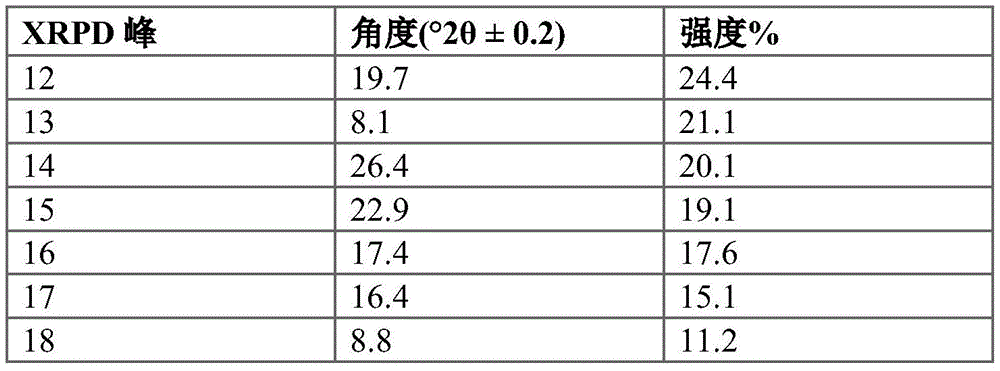
B. Solid state NMR
Solid state of compound I potassium salt hydrate form D13The C NMR spectrum is provided in fig. 43 and summarized in table 52.
Table 52: solid state NMR for Compound I Potassium salt hydrate form D


Example 32: compound I ammonia salt hydrate form A
A 0.1M stock suspension of compound I (free form) form a in acetone was prepared and reacted with ammonium hydroxide in water at a 1:1 molar ratio. The clear solution was allowed to stir at room temperature for 2 weeks. This gave a light brown solid.
A.X powder diffraction of radiation
Using P at room temperatureAnalytical's X-pert Pro diffractometer using copper radiation Powder x-ray diffraction measurements were performed. The incident beam optics include a variable divergence slit to ensure a constant illumination length on the sample and on the diffracted beam side. The effective length measured in scan mode using a fast linear solid state detector is 2.12 ° 2 θ. Powder samples were loaded on the recessed areas of the zero background silicon holder and rotated for better statistics. The symmetric scan was measured from 4 ° 2 θ to 40 ° 2 θ, with a step size of 0.017 degrees and a scan step of 15.5 s. The XRPD diffractogram of compound I, ammonium salt hydrate form a, is shown in fig. 44 and summarized in table 53.
Table 53: compound I ammonia salt hydrate form A


Example 33: compound I calcium salt form H
To 49.5g of Compound I sodium salt was charged 222.75mL ethanol and 24.75mL water. The slurry was heated to 45 ℃ and seeded with 0.495g of compound I calcium salt hydrate form a. A solution of 4.723g of calcium chloride, 4.26mL of ethanol, and 0.47mL of water was charged over a 4 hour period. The slurry was stirred at 45 ℃ for 3 days. The resulting solid was collected by vacuum filtration. The wet cake was transferred to a vacuum oven and slightly purged with nitrogen. To 5.12g of the dried product obtained above, 30mL of IPA and 20mL of water were charged. The slurry was heated to 25 ℃. The slurry was stirred for 12 hours. 50mL of IPA was charged over 5 hours. The slurry was allowed to stir for 6 days. 1mL of the slurry was taken into a separate vial and shaken at 25 ℃ for 18 days. 1mL of the slurry was then stored at room temperature and the solid contained Compound I calcium salt form H.
A.X ray powder diffraction:
XRPD patterns were acquired in reflection mode at room temperature using Bruker Advance equipped with a Vantec-1 detector. The samples were analyzed on a silicon sample holder from 3 ° 2 θ to 40 ° 2 θ in a continuous mode with a step size of 0.0144531 ° and a time per step of 0.25 s. The sample was spun at 15 rpm. The XRPD diffractogram of compound I calcium salt hydrate form a is shown in fig. 45 and summarized in table 54.
Table 54: XRPD signal of crystalline Compound I calcium salt form H


B. Single crystal explication
Using synchrotron radiation on a Bruker diffractometer: ( Supplied by beamline 12.2.1 of Advanced Light Source law Berkeley National Laboratory) and CMOS detectors acquire X-ray diffraction data at 100K. The structure was resolved and refined using the SHELX program (sheldrag, g.m., Acta cryst., (2008) a64, 112-.
Table 55: single crystal elucidation of calcium salt form H of Compound I
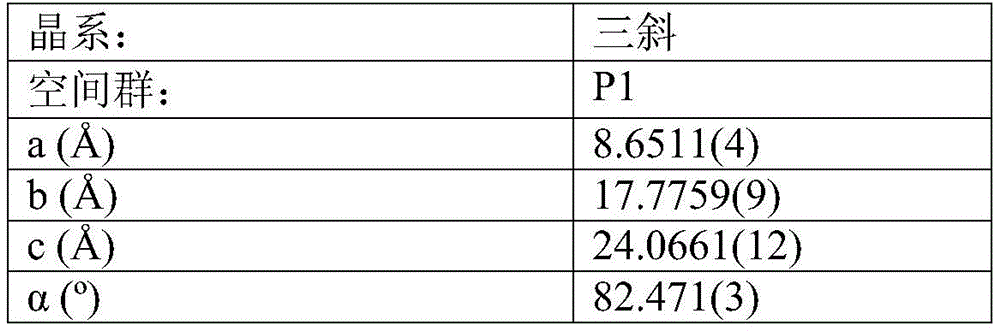

C. Solid state NMR
Solid state of compound I calcium salt form H13The C NMR spectrum is provided in fig. 46 and summarized in table 56.
Table 56: solid state NMR of Compound I calcium salt form H


D. Differential scanning calorimetry analysis:
DSC thermograms were obtained using TA Instruments DSC Q2000. The sample was heated from 30 ℃ to 400 ℃ at 10 ℃/min. The thermogram shows endothermic peaks at about 69 ℃ and about 113 ℃.
Example 34: compound I (free form) form D
Removal of suspended reaction solids by filtration to obtain carbonyl carbons13C labeled compound I (free form) form D. The removed solid was washed with isopropyl acetate (2X30 mL). The layers from the filtrate were separated to give a fine solid in suspension at the miscellaneous layer (rag layer). The aqueous layer was discarded. The organic layer was washed with 8% w/v aqueous trisodium citrate solution (120 mL). Brine (2X10mL) was added to help separate the phases. The aqueous layer was discarded. The organic layer was washed with 1:1v: v water, brine (80 mL). Suspended fine solids at the intermixed layer persist. The aqueous layer was discarded. The organic layer was finely filtered through a pad of celite filter. The filter pad was washed with isopropyl acetate (30 mL). The filtrate was concentrated under reduced pressure, and propanol (180mL) was added. The mixture was concentrated under reduced pressure. This step is repeated. Toluene (180mL) was added to the mixture, and the mixture was concentrated under reduced pressure. This procedure was repeated to give a thick slurry which was further concentrated to 60mL of toluene. After stirring the slurry overnight, the solid was collected by filtration and the filter cake was washed with toluene (2X20 mL). The solid was dried under vacuum at 50 ℃ with a nitrogen purge until the loss of drying did not exceed 1% to yield 13.2g (65% isolated yield) of the product as a white to off-white solid.
A.X powder diffraction of radiation
Using a PANalytic Empyrean System (Malvern PA) equipped with a sealed tube source and a PIXcel 1D Medipix-3 detectorNalytical Inc, Westborough, Massachusetts), XRPD spectra were recorded in transmission mode at room temperature. Using copper radiation The X-ray generator was operated at a voltage of 45kV and a current of 40 mA. The powder samples were placed on a 96-well sample holder with mylar film and loaded into the instrument. The sample was scanned over a range of about 3 ° 2 θ to about 40 ° 2 θ, with a step size of 0.0131303 ° and 49s per step. The XRPD diffractogram of compound I (free form) form D is provided in fig. 47, and the XRPD data are summarized in table 57 below.
Table 57: XRPD signal of crystalline form D of Compound I (free form)

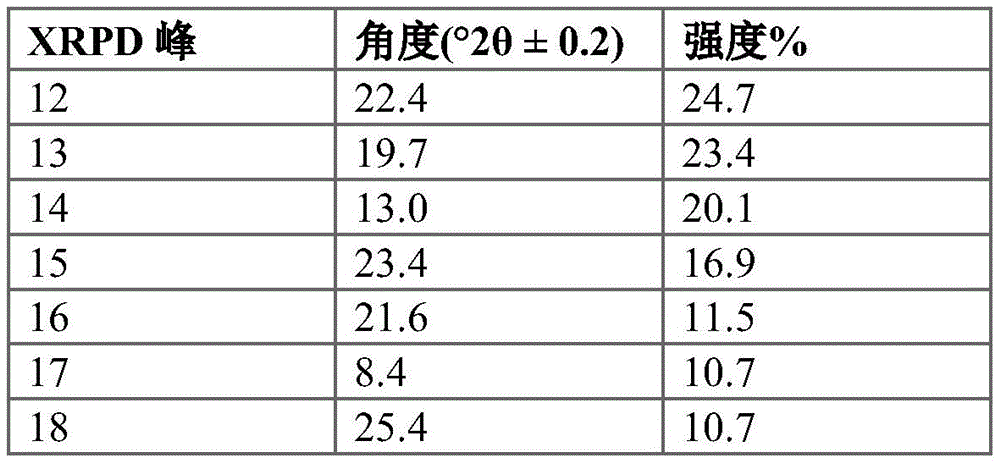
B. Solid state NMR
Solid state of compound I (free form) form D13The C NMR data is provided in fig. 48 and summarized in table 58 below.
Table 58: solid state NMR of Compound I (free form) form D
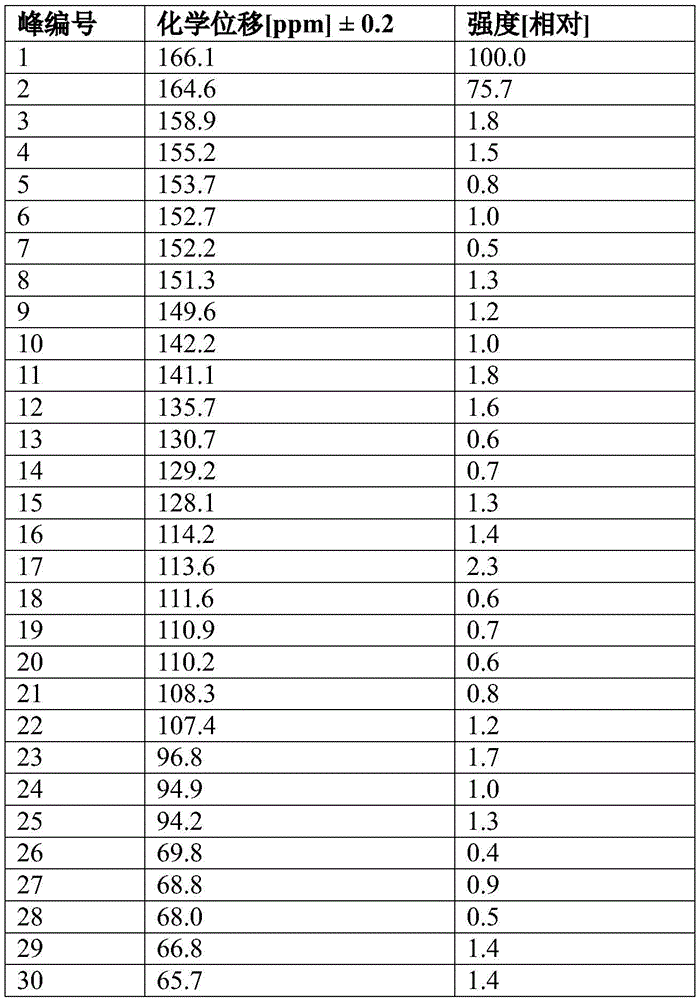

Example 35: compound I sodium salt hydrate form E
Compound I sodium salt hydrate form E provides a purity of compound I calcium salt that is higher than that obtained using the amorphous sodium salt of compound I, which can be confirmed using analytical techniques such as HPLC or ssNMR.
1g of Compound I sodium salt hydrate form A, 5mL IPA and 5mL water was charged to a 50mL Easymax vessel and heated to 65 ℃. The resulting solution was cooled to 45 ℃ within 20 min. 0.01g of Compound I sodium salt hydrate form A seed crystals were added to the solution. The mixture was kept at 45 ℃ for 1 hour. 10mL of water was then charged to the vessel over a period of 5 hours. The mixture was cooled to 20 ℃ over 4 hours. The precipitated solid was filtered off, washed on the filter with 10mL IPA, water 1:3v: v, and air dried. The final solid was a mixture of compound I sodium salt hydrate form a and form E.
Approximately 522.3g of compound I sodium salt hydrate (mixture of form a and form E), 2.64kg IPA, 43.5g 2.0M NaOH, and 3.54kg water were charged to a 10L jacketed laboratory reactor and heated to 73 ℃. The resulting solution was finely filtered and cooled to 58 ℃. 6.18kg of water was added to the solution. 4.9g of Compound I sodium salt hydrate form E seed crystals were then added to the solution at 40 ℃. The mixture was cooled to 5 ℃ over 12 hours and then kept at 5 ℃ overnight. The precipitated solid was filtered off and washed with a mixture of 1.745kg water +0.58kg IPA and then dried under vacuum at 40 ℃. The final solid was compound I sodium salt hydrate form E.
Alternative preparation
Compound I sodium salt hydrate form a (20g, 31.213mmol, 1 eq) was dissolved in IPA/water 1:1(200mL, 10 volumes) at 65 ℃. The solution was cooled to 45 ℃ and seeded with a mixture of compound I sodium salt hydrate form a and form E (200mg, 1% w/w, mixture of forms a and E). The seeded homogeneous solution was then charged with water (200mL) over a period of 5 hours. The solution was then cooled to 20 ℃ over 5 hours. The solid was isolated by filtration, washed with a minimum amount of IPA/water (1:3), and dried in a vacuum oven until a constant weight was reached. The yield of compound I sodium salt hydrate form E was 97.49%.
A.X powder diffraction by radiation:
x-ray powder diffraction (XRPD) spectra were recorded in transmission mode at room temperature using a PANALYTIC Empyrean system (Malvern PANALYTIC Inc, Westborough, Massachusetts) equipped with a sealed tube source and a PIXcel 1D Medipix-3 detector. Using copper radiation The X-ray generator was operated at a voltage of 45kV and a current of 40 mA. The powder samples were placed on a 96-well sample holder with mylar film and loaded into the instrument. The sample was scanned over a range of about 3 ° 2 θ to about 40 ° 2 θ, with a step size of 0.0131303 ° and 49s per step.
The XRPD diffractogram of compound I sodium salt hydrate form E is provided in fig. 49, and the XRPD data are summarized in table 59 below.
Table 59: XRPD signal of crystalline Compound I sodium salt hydrate form E
| Peak numbering | Angle (° 2 θ ± 0.2) | |
| 1 | 4.3 | 100.0 |
| 2 | 10.6 | 69.8 |
| 3 | 13.4 | 47.0 |
| 4 | 13.0 | 41.8 |
| 5 | 11.7 | 25.3 |
| 6 | 17.3 | 22.2 |
| 7 | 22.3 | 21.3 |
| 8 | 20.0 | 21.2 |
| 9 | 19.2 | 20.4 |
| 10 | 23.1 | 20.3 |
| 11 | 14.1 | 19.9 |
| 12 | 21.4 | 17.4 |
| 13 | 14.9 | 16.0 |
| 14 | 21.5 | 14.4 |
| 15 | 18.8 | 12.2 |
| 16 | 14.2 | 10.6 |
| 17 | 18.1 | 10.2 |
B. Single crystal description
In a device equipped with Cu Ka radiation And X-ray diffraction data were acquired at 100K on a Bruker diffractometer with CMOS detector. The structure was parsed and refined using the SHELX program (sheldrag, g.m., Acta cryst., (2008) a64, 112-.
Table 60: single crystal illustration of compound I sodium salt hydrate form E

C. Solid state NMR
Solid state of compound I sodium salt hydrate form E 13The C NMR spectra are provided in fig. 50 and summarized in table 61.
Table 61: solid state NMR for Compound I sodium salt hydrate form E
| Peak numbering | Chemical shift [ ppm [ ]]±0.2 | Strength [ relative ]] |
| 1 | 177.4 | 20.5 |
| 2 | 165.2 | 33.0 |
| 3 | 161.3 | 17.9 |
| 4 | 155.4 | 22.1 |
| 5 | 153.6 | 15.5 |
| 6 | 149.9 | 22.6 |
| 7 | 142.7 | 34.7 |
| 8 | 140.3 | 28.1 |
| 9 | 128.4 | 37.2 |
| 10 | 121.3 | 22.8 |
| 11 | 113.5 | 36.9 |
| 12 | 111.5 | 12.1 |
| 13 | 111.1 | 23.8 |
| 14 | 101.0 | 41.1 |
| 15 | 93.1 | 44.7 |
| 16 | 69.5 | 53.4 |
| 17 | 62.6 | 36.9 |
| 18 | 61.9 | 10.0 |
| 19 | 55.2 | 28.4 |
| 20 | 50.6 | 13.2 |
| 21 | 50.0 | 40.2 |
| 22 | 38.2 | 25.7 |
| 23 | 30.9 | 51.6 |
| 24 | 30.2 | 51.3 |
| 25 | 29.0 | 51.2 |
| 26 | 27.8 | 58.0 |
| 27 | 26.8 | 59.4 |
| 28 | 25.8 | 53.9 |
| 29 | 21.1 | 100.0 |
| 30 | 17.2 | 75.9 |
| 31 | 7.2 | 41.3 |
| 32 | 6.5 | 46.0 |
| 33 | 5.9 | 41.9 |
| 34 | 2.1 | 35.8 |
Example 36: compound I sodium salt IPA solvate
About 200mg of amorphous compound I sodium salt hydrate form a was charged with 2mL IPA. The slurry was stirred at ambient temperature for 5 days. The resulting solid was compound I sodium IPA solvate. The solvate was unstable and changed form after vacuum drying overnight at 40 ℃.
A.X powder diffraction of radiation
X-ray powder diffraction (XRPD) spectra were recorded in transmission mode at room temperature using a PANalytical Empyrean system (Malvern PANalytical Inc, Westborough, Massachusetts) equipped with a sealed tube source and a PIXcel 1D Medipix-3 detector. Using copper radiation The X-ray generator was operated at a voltage of 45kV and a current of 40 mA. The powder samples were placed on a 96-well sample holder with mylar film and loaded into the instrument. The sample was scanned over a range of about 3 ° 2 θ to about 40 ° 2 θ, with a step size of 0.0131303 ° and 49s per step.
XRPD diffraction patterns of compound I sodium salt IPA (wet) solvate form a and compound I sodium salt IPA (dry) solvate form B are provided in fig. 51 and 52, respectively, and the XRPD data are summarized in tables 62 and 63, respectively, below.
Table 62: XRPD signal of crystalline compound I sodium salt IPA (wet) solvate form A
| Peak numbering | Angle (° 2 θ ± 0.2) | |
| 1 | 3.6 | 100.0 |
| 2 | 3.5 | 94.3 |
| 3 | 9.5 | 12.4 |
Table 63: XRPD signal of crystalline compound I sodium salt IPA (dry) solvate form B
| Peak numbering | Angle (° 2 θ ± 0.2) | |
| 1 | 4.0 | 100.0 |
| 2 | 18.5 | 19.3 |
| 3 | 5.3 | 19.3 |
| 4 | 9.7 | 17.7 |
| 5 | 20.0 | 15.6 |
| 6 | 7.9 | 11.4 |
| 7 | 11.0 | 10.3 |
| 8 | 13.9 | 10.2 |
C. Solid state NMR
Solid state of compound I sodium salt IPA (dry) solvate form B13The C NMR spectra are provided in fig. 53 and summarized in table 64.
Table 64: solid state NMR of Compound I sodium salt IPA (dry) solvate form B
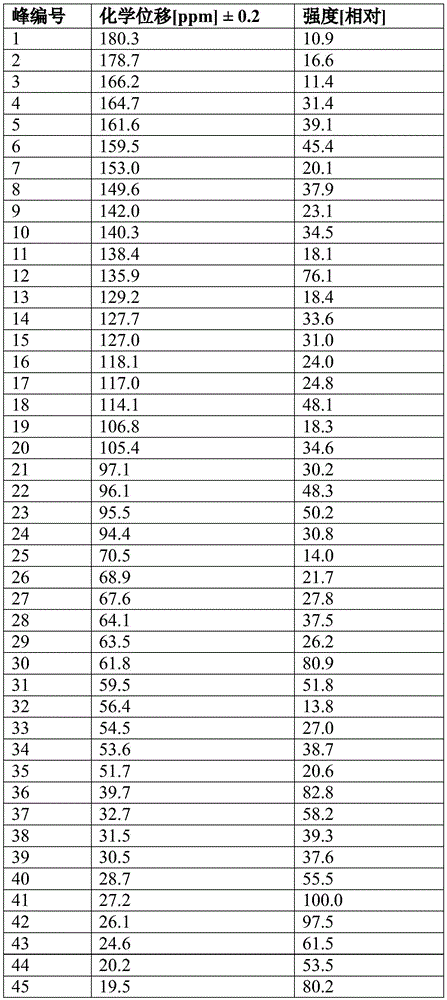

Example 37: preparation of a tablet containing 5mg of Compound I
Microcrystalline cellulose was passed through a stainless steel screen (30 mesh) and 210.1g was charged to a 10L Bohle silo. Compound I was passed through a stainless steel screen (30 mesh) and 210.0g was charged to a 10L Bohle silo. The silo was sealed and the components were blended for 2min at a speed of 32RPM to produce a microcrystalline cellulose/compound I blend. The microcrystalline cellulose/compound I blend was discharged into a stainless steel vessel. The following materials were sieved through a stainless steel 30 mesh screen and added in this order to a 10L Bohle silo: lactose (approximately half of 1022.2 g), microcrystalline cellulose (approximately half of 812 g), microcrystalline cellulose/compound I blend, polyvinylpyrrolidone/vinyl acetate (210.1g), croscarmellose sodium (133g), microcrystalline cellulose (the remaining half of the amount 812 g) and lactose (the remaining half of the amount 1022.2 g). The silo was sealed and the components were blended for 18.5min at a speed of 32 rpm. Reacting sodium stearyl fumarate  Passing through a 60 mesh stainless steel screen, an53.1g was charged to a Bohle silo. The silo was sealed and the components were blended for 4min at a speed of 32 rpm. And testing the homogeneity of the bin. The blend was added to a Piccola press and compressed into tablets weighing 67.0 mg.
Table 65: compound I tablet composition

Example 38: biological activity assay
Solutions of
Basal medium (ADF + + +) consisted of Advanced DMEM/Ham's F12, 2mM Glutamax, 10mM HEPES, 1. mu.l/ml penicillin/streptomycin.
Intestinal maintenance medium (IEMM) supplemented with ADF + + +, 1x B27, 1x N2Supplement, 1.25mM N-acetylcysteine, 10mM nicotinamide, 50ng/mL hEGF, 10nM gastrin, 1 μ g/mL hR-spondyloprotein-1, 100ng/mL hNoggin, TGF-b type 1 inhibitor A-83-01, 100 μ g/mL Primocin, 10 μ M P38 MAPK inhibitor SB 202190.
The chloride-free buffer consists of 1mM magnesium gluconate, 2mM calcium gluconate, 4.5mM potassium gluconate, 160mM sodium gluconate, 10mM HEPES, 10mM glucose.
The chlorine-free dye solution consisted of chlorine-free buffer, 0.04% Pluronic F127, 20. mu.M Methyl Oxonol, 30. mu.M CaCcinh-A01, 30. mu.M Chicago Sky Blue.
The chlorine-free dye-stimulated solution consists of a chlorine-free dye solution, 10. mu.M forskolin, 100. mu.M IBMX and 300nM compound III.
Cell culture
Human enteroepithelial enteroclike cells were obtained from The Hobod Developmental Biology and Stem Cell Research Institute of Udeleler Branch, The Netherlands (Hubrecht Institute for development Biology and Stem Cell Research, untrecht, The Netherlands) and expanded in T-flasks as previously described (Dekkers JF, Wiegerinck CL, de Jonge HR, Bronseld I, Jansens HM, de Winter-de Groot KM, Brandsma AM, de Jong WM, BijvelMJDs C, Scholte BJ, Niewenhuis EES, van den Bris, Clevers H, van der Ent CK, Middendorp S and M Beekman JM). Functional CFTR analysis using primary cystic fibrosis gut organoids is described in Nat med.2013, month 7; 19(7) 939-45.
Gut-like cell collection and inoculation
The cells were recovered in cell recovery solution, collected by centrifugation at 650rpm for 5min at 4 ℃, resuspended in TryPLE and incubated for 5min at 37 ℃. Cells were then harvested by centrifugation at 650rpm for 5min at 4 ℃ and resuspended in IEMM containing 10. mu.M ROCK Inhibitor (RI). The cell suspension was passed through a 40 μ M cell filter and resuspended at 1 × 10⁶ cells/mL in IEMM containing 10 μ M RI. Cells were seeded at 5000 cells/well in multi-well plates and assayed at 37 ℃, 95% humidity and 5% CO 2The incubation was continued overnight.
Membrane potential dye assay
At 37 deg.C, 95% humidity and 5% CO2Next, the gut-like cells are incubated with the test compound for 18-24h in IEMM. After compound incubation, the potency and efficacy of the test compound on CFTR mediated chloride transport after a sharp addition of 10 μ M forskolin and 300nM compound III was measured directly using FLIPR Tetra, using a membrane potential dye assay. Briefly, cells were washed 5 times in bath 1 buffer. Bath 1 dye solution was added and cells were incubated for 25 minutes at room temperature. After dye incubation, cells were washed 3 times in a chloride-free dye solution. Chloride ion transport was initiated by addition of a chloride-free dye to stimulate the solution and the fluorescence signal was read for 15 minutes. CFTR mediated chloride transport in each condition was determined from AUC of the fluorescence response stimulated against acutely forskolin and 300nM compound III. Chloride ion transport was then expressed as treatment with triple combination control of 3. M Compound I, 3. M Compound II, and 300nM acute Compound IIIPercentage chloride transport (% activity) after the last step.
The data in table 66 are shown below:
maximum activity: , + + + + is>60 percent; + is 30-60%; + is<30%。EC50: , + + + + is <1 mu M; + is 1-3 μ M; + is>3 mu M; and ND is "not determined".
Table 66: assay data for Compound I
| Molecule | Maximum activity | EC50 |
| Compound I | +++ | +++ |
Example 39: compound I increases chloride transport in F508del/F508del HBE and F508del/MF HBE alone and in combination with Compound II and/or Compound III
A Ussing Chamber (Ussing Chamber) study was performed to measure F508del CFTR-mediated chloride transport in HBE cells derived from 3F 508del homozygous donors and 5F 508del/MF donors (G542X, 3 donors; E585X, 1 donor; 3905InsT, 1 donor). As positive controls, the maximum effective concentration of N- (benzenesulfonyl) -6- [3- [2- [1- (trifluoromethyl) cyclopropyl ] ethoxy ] pyrazol-1-yl ] -2- [ (4S) -2,2, 4-trimethylpyrrolidin-l-yl ] pyridine-3-carboxamide (see WO 2018/064632) and the combination of N- [ (6-amino-2-pyridyl) sulfonyl ] -6- (3-fluoro-5-isobutoxy-phenyl) -2- [ (4S) -2,2, 4-trimethylpyrrolidin-1-yl ] pyridine-3-carboxamide (see WO 2016/057572) with Compound II/Compound III was included in each experiment.
In these CF cell lines, CFTR mediated chloride ion transport is low in the absence of CFTR modulator, consistent with little CFTR at the cell surface. Treatment with compound I alone for 16 to 24h resulted in a modest increase in chloride transport in F508del/F508del HBE and F508del/MF HBE cells. The combination of compound I with compound II further increases chloride ion transport when compared to compound I alone, and it is similar to compound II/compound III. The addition of compound III strongly enhances chloride transport in the presence of compound I or in combination with compound I/compound II. Synergistic analysis showed that the effect of compound I was highly synergistic with a fixed concentration of compound III or compound II/compound III and moderately synergistic with a fixed combination of compound II. At most compound I concentrations, compound I/compound II/compound III increased chloride ion transport to a greater extent than compound I/compound II or compound I/compound III. However, the efficacy of Compound I/Compound III and Compound I/Compound II/Compound III is in their respective EC 90The values are similar. Respective EC of Compound I/Compound III and Compound I/Compound II/Compound III under conditions that maximize CFTR activation90The values were 0.848. mu.M and 0.152. mu.M in F508del/F508del HBE, and 1.15. mu.M and 0.122. mu.M in F508del/MF HBE.
After a single oral administration of Compound I in Male animals, Compound I averages tMaximum ofValues were 9h in rats, 4h in dogs, and 3h in monkeys. The mean oral bioavailability (F) in rats (76.9%), dogs (49.7%) and monkeys (12.9%) was low to moderate.
Pharmacokinetic parameters of Compound I after Single oral administration of Compound I in Male rats, dogs and monkeys

Note that: data are presented as mean ± SD (n ═ 3).
With increasing dose, Compound I was administered to rats and dogsThe systemic exposure in (a) increases in a manner greater than the dose ratio. Dose normalized exposure was higher in female rats than in male rats. In dogs, systemic exposure to compound I was similar in both sexes. After repeated oral administration of compound I in rats and dogs for 28 days, accumulation of compound I exposure was observed. Systemic exposure of compound I was higher on day 28 than on day 1 (day 28/day 1 AUC) 024hThe ratio ranges from 1.63 to 2.70 in male rats, from 5.01 to 8.26 in female rats, from 1.73 to 2.64 in male dogs, and from 1.82 to 2.23 in female dogs).
Example 40: safety and efficacy Studies of Compound I
Safety analysis of an ongoing clinical study was performed on 37 subjects in groups a 1-a 5, 33 subjects in group B, and 17 subjects in group C exposed to at least 1 dose of study drug (compound I or placebo) as monotherapy and as part of a triple combination with compound II or compound III. Compound I is generally safe and well tolerated at doses up to 60mg qd in monotherapy and at doses up to 20mg qd in triple combination with compound II and compound III.
Claims (23)
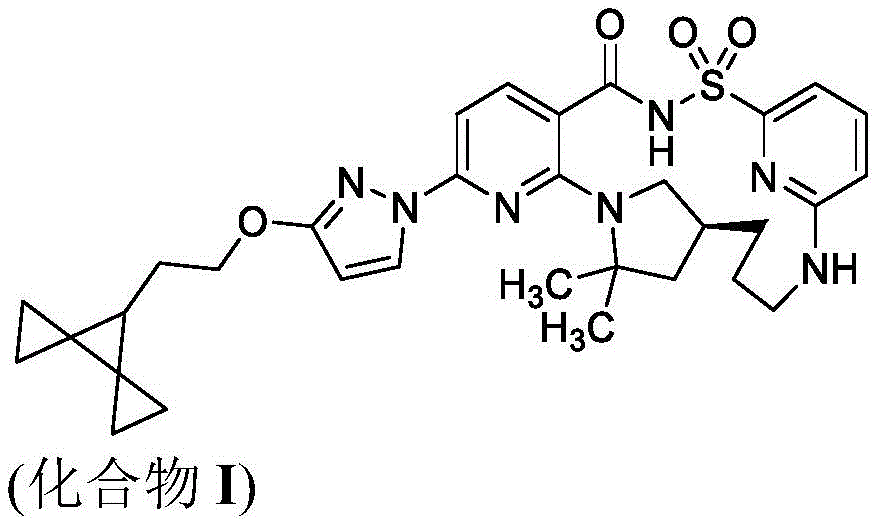
Applications Claiming Priority (5)
| Application Number | Priority Date | Filing Date | Title |
|---|---|---|---|
| US201962886565P | 2019-08-14 | 2019-08-14 | |
| US62/886565 | 2019-08-14 | ||
| US202063015903P | 2020-04-27 | 2020-04-27 | |
| US63/015903 | 2020-04-27 | ||
| PCT/US2020/046113 WO2021030552A1 (en) | 2019-08-14 | 2020-08-13 | Crystalline forms of cftr modulators |
Publications (2)
| Publication Number | Publication Date |
|---|---|
| CN114599657A true CN114599657A (en) | 2022-06-07 |
| CN114599657B CN114599657B (en) | 2024-10-11 |
Family
ID=72292620
Family Applications (1)
| Application Number | Title | Priority Date | Filing Date |
|---|---|---|---|
| CN202080071702.2A Active CN114599657B (en) | 2019-08-14 | 2020-08-13 | Crystalline forms of CFTR modulators |
Country Status (14)
| Country | Link |
|---|---|
| US (3) | US11873300B2 (en) |
| EP (1) | EP4013760A1 (en) |
| JP (1) | JP7752106B2 (en) |
| KR (1) | KR20220064366A (en) |
| CN (1) | CN114599657B (en) |
| AU (2) | AU2020328028B2 (en) |
| BR (1) | BR112022002605A2 (en) |
| CA (1) | CA3150162A1 (en) |
| CO (1) | CO2022002634A2 (en) |
| IL (2) | IL290366B1 (en) |
| MX (1) | MX2022001828A (en) |
| TW (1) | TWI877197B (en) |
| WO (1) | WO2021030552A1 (en) |
| ZA (1) | ZA202201794B (en) |
Families Citing this family (25)
| Publication number | Priority date | Publication date | Assignee | Title |
|---|---|---|---|---|
| KR102336926B1 (en) | 2014-10-06 | 2021-12-08 | 버텍스 파마슈티칼스 인코포레이티드 | Modulators of cystic fibrosis transmembrane conductance regulator |
| AU2017371200B2 (en) | 2016-12-09 | 2021-05-06 | Vertex Pharmaceuticals Incorporated | Modulator of cystic fibrosis transmembrane conductance regulator, pharmaceutical compositions, methods of treatment, and process for making the modulator |
| MA49631A (en) | 2017-07-17 | 2020-05-27 | Vertex Pharma | CYSTIC FIBROSIS TREATMENT METHODS |
| US11465985B2 (en) | 2017-12-08 | 2022-10-11 | Vertex Pharmaceuticals Incorporated | Processes for making modulators of cystic fibrosis transmembrane conductance regulator |
| RS64018B1 (en) | 2018-02-15 | 2023-03-31 | Vertex Pharma | MACROCYCLES AS MODULATORS OF THE TRANSMEMBRANE CONDUCTIVITY REGULATOR OF CYSTIC FIBROSIS, THEIR PHARMACEUTICAL COMPOSITIONS, THEIR USE IN THE TREATMENT OF CYSTIC FIBROSIS AND THE PROCESS OF THEIR PRODUCTION |
| TWI848092B (en) | 2019-04-03 | 2024-07-11 | 美商維泰克斯製藥公司 | Cystic fibrosis transmembrane conductance regulator modulating agents |
| JP7684279B2 (en) * | 2019-08-14 | 2025-05-27 | バーテックス ファーマシューティカルズ インコーポレイテッド | Cystic fibrosis transmembrane conductance regulator modulators |
| TWI867024B (en) | 2019-08-14 | 2024-12-21 | 美商維泰克斯製藥公司 | Modulators of cystic fibrosis transmembrane conductance regulator |
| TWI899097B (en) | 2019-08-14 | 2025-10-01 | 美商維泰克斯製藥公司 | Process of making cftr modulators |
| MX2022001828A (en) | 2019-08-14 | 2022-06-08 | Vertex Pharma | CRYSTALLINE FORMS OF CYSTIC FIBROSIS TRANSMEMBRANE CONDUCTANCE REGULATOR (CFTR) MODULATORS. |
| CR20230120A (en) | 2020-08-07 | 2023-09-01 | Vertex Pharma | Modulators of cystic fibrosis transmembrane conductance regulator |
| JP2023537944A (en) * | 2020-08-13 | 2023-09-06 | バーテックス ファーマシューティカルズ インコーポレイテッド | Crystal forms of CFTR modulators |
| US20230374038A1 (en) * | 2020-10-07 | 2023-11-23 | Vertex Pharmaceuticals Incorporated | Modulators of cystic fibrosis transmembrane conductance regulator |
| US20230382925A1 (en) * | 2020-10-07 | 2023-11-30 | Vertex Pharmaceuticals Incorporated | Modulators of cystic fibrosis transmembrane conductance regulator |
| EP4225763A1 (en) * | 2020-10-07 | 2023-08-16 | Vertex Pharmaceuticals Incorporated | Modulators of cystic fibrosis transmembrane conductance regulator |
| EP4225762A1 (en) * | 2020-10-07 | 2023-08-16 | Vertex Pharmaceuticals Incorporated | Modulators of cystic fibrosis transmembrane conductance regulator |
| US20230382924A1 (en) * | 2020-10-07 | 2023-11-30 | Vertex Pharmaceuticals Incorporated | Modulators of cystic fibrosis transmembrane conductance regulator |
| CR20230197A (en) * | 2020-10-07 | 2023-07-06 | Vertex Pharma | Modulators of cystic fibrosis transmembrane conductance regulator |
| US12324802B2 (en) | 2020-11-18 | 2025-06-10 | Vertex Pharmaceuticals Incorporated | Modulators of cystic fibrosis transmembrane conductance regulator |
| MX2023006770A (en) | 2020-12-10 | 2023-08-14 | Vertex Pharma | Methods of treatment for cystic fibrosis. |
| KR20250065916A (en) | 2022-09-15 | 2025-05-13 | 이도르시아 파마슈티컬스 리미티드 | Combination of macrocyclic CFTR modulators with CFTR correctors and/or CFTR potentiators |
| JP2025531206A (en) | 2022-09-15 | 2025-09-19 | イドルシア・ファーマシューティカルズ・リミテッド | Macrocyclic CFTR Modulators |
| WO2025166342A1 (en) | 2024-02-04 | 2025-08-07 | Vertex Pharmaceuticals Incorporated | Combination of vanzacaftor, tezacaftor, deutivacaftor for use in treating cystic fibrosis |
| WO2025171098A1 (en) | 2024-02-07 | 2025-08-14 | Vertex Pharmaceuticals Incorporated | Compositions for the treatment of cftr-mediated diseases |
| WO2025186214A1 (en) | 2024-03-05 | 2025-09-12 | Idorsia Pharmaceuticals Ltd | Macrocyclic cftr modulators |
Citations (2)
| Publication number | Priority date | Publication date | Assignee | Title |
|---|---|---|---|---|
| WO2018064632A1 (en) * | 2016-09-30 | 2018-04-05 | Vertex Pharmaceuticals Incorporated | Modulator of cystic fibrosis transmembrane conductance regulator, pharmaceutical compositions, methods of treatment, and process for making the modulator |
| WO2019161078A1 (en) * | 2018-02-15 | 2019-08-22 | Vertex Pharmaceuticals Incorporated | Macrocycles as modulators of cystic fibrosis transmembrane conductance regulator, pharmaceutical compositions thereof, their use in the treatment of cycstic fibrosis, and process for making them |
Family Cites Families (130)
| Publication number | Priority date | Publication date | Assignee | Title |
|---|---|---|---|---|
| US2677682A (en) | 1951-08-24 | 1954-05-04 | American Cyanamid Co | Sulfonamido pteridines |
| ID18983A (en) | 1996-12-04 | 1998-05-28 | Lilly Co Eli | PIRAZOLA AS AN NON-PANCREAS PHOSPHOLIPASE SECRETARY SECRESSION IN HUMAN |
| SE0001899D0 (en) | 2000-05-22 | 2000-05-22 | Pharmacia & Upjohn Ab | New compounds |
| HUP0501067A2 (en) | 2001-11-14 | 2006-02-28 | Teva Pharma | Amorphous and crystalline forms of losartan potassium and process for their preparation |
| RU2006120549A (en) | 2003-11-14 | 2007-12-27 | Вертекс Фармасьютикалз Инкорпорейтед (Us) | THIAZOLES AND OXAZOLES USED AS MODULATORS OF ART-BINDING CASSETTE TRANSPORTERS |
| CN1938279B (en) | 2004-01-30 | 2011-09-14 | 沃泰克斯药物股份有限公司 | Modulators of atp-binding cassette transporters |
| US8354427B2 (en) | 2004-06-24 | 2013-01-15 | Vertex Pharmaceutical Incorporated | Modulators of ATP-binding cassette transporters |
| US7495103B2 (en) | 2004-06-24 | 2009-02-24 | Vertex Pharmaceuticals Incorporated | Modulators of ATP-binding cassette transporters |
| CA2618057A1 (en) | 2005-08-11 | 2007-02-22 | Vertex Pharmaceuticals Incorporated | Modulators of cystic fibrosis transmembrane conductance regulator |
| WO2007053641A2 (en) | 2005-11-01 | 2007-05-10 | Mars, Incorporated | A-type procyanidins and inflammation |
| DK2395002T3 (en) | 2005-11-08 | 2014-09-08 | Vertex Pharma | Pharmaceutical composition containing a heterocyclic modulator of ATP-binding cassette transporters |
| EP1974212A1 (en) | 2005-12-27 | 2008-10-01 | Vertex Pharmaceuticals Incorporated | Compounds useful in cftr assays and methods therewith |
| US7671221B2 (en) | 2005-12-28 | 2010-03-02 | Vertex Pharmaceuticals Incorporated | Modulators of ATP-Binding Cassette transporters |
| CA2635581C (en) | 2005-12-28 | 2017-02-28 | Vertex Pharmaceuticals Incorporated | Solid forms of n-[2,4-bis(1,1-dimethylethyl)-5-hydroxyphenyl]-1,4-dihydro-4-oxoquinoline-3-carboxamide |
| NZ569327A (en) | 2005-12-28 | 2011-09-30 | Vertex Pharma | 1-(benzo [d] [1,3] dioxol-5-yl) -n- (phenyl) cyclopropane- carboxamide derivatives and related compounds as modulators of ATP-binding cassette transporters for the treatment of cystic fibrosis |
| SI2007756T1 (en) | 2006-04-07 | 2015-11-30 | Vertex Pharmaceuticals Incorporated | Modulators of atp-binding cassette transporters |
| AU2007249269A1 (en) | 2006-05-12 | 2007-11-22 | Vertex Pharmaceuticals Incorporated | Compositions of N-[2,4-bis(1,1-dimethylethyl)-5-hydroxyphenyl)-1,4-dihydro-4-oxoquinoline-3-carboxamide |
| ES2646175T3 (en) | 2006-11-03 | 2017-12-12 | Vertex Pharmaceuticals Incorporated | Azaindole derivatives as CFTR modulators |
| JP5451602B2 (en) | 2007-06-08 | 2014-03-26 | アッヴィ・インコーポレイテッド | 5-Heteroaryl-substituted indazoles as kinase inhibitors |
| RU2010114732A (en) | 2007-09-14 | 2011-10-20 | Вертекс Фармасьютикалз Инкорпорейтед (Us) | SOLID FORMS OF N- [2,4-BIS (1,1-DIMETHYLETHYL) -5-HYDROXYPHENYL] -1,4-DIHYDRO-4-OXOCHINOLIN-3-CARBOXAMIDE |
| MX2010006183A (en) | 2007-12-07 | 2010-10-15 | Vertex Pharma | Processes for producing cycloalkylcarboxiamido-pyridine benzoic acids. |
| SG186638A1 (en) | 2007-12-07 | 2013-01-30 | Vertex Pharma | Solid forms of 3-(6-(1-(2,2-difluorobenzo[d][1,3] dioxol-5-yl) cyclopropanecarboxamido)-3-methylpyridin-2-yl) benzoic acid |
| NZ703814A (en) | 2008-02-28 | 2016-06-24 | Vertex Pharma | Heteroaryl derivatives as cftr modulators |
| US20100074949A1 (en) | 2008-08-13 | 2010-03-25 | William Rowe | Pharmaceutical composition and administration thereof |
| HRP20180328T1 (en) | 2008-08-13 | 2018-04-20 | Vertex Pharmaceuticals Inc. | PHARMACEUTICAL PREPARATION N- [2,4-bis (1,1-dimethylethyl) -5-hydroxyphenyl] -1,4-dihydro-4-oxoquinoline-3-carboxamide and its administration |
| MX2011003249A (en) | 2008-09-29 | 2011-05-19 | Vertex Pharma | Dosage units of 3-(6-(1-(2,2-difluorobenzo [d] [1,3] dioxol-5-yl) cyclopropanecarboxamido)-3-methylpyridin-2-yl)benzoic acid. |
| TWI465449B (en) | 2008-10-23 | 2014-12-21 | Vertex Pharma | Modulators of cystic fibrosis transmembrane conductance regulator |
| HRP20150288T1 (en) | 2008-11-06 | 2015-04-24 | Vertex Pharmaceuticals Incorporated | Modulators of atp-binding cassette transporters |
| UA104876C2 (en) | 2008-11-06 | 2014-03-25 | Вертекс Фармасьютікалз Інкорпорейтед | Modulators of atp-binding cassette transporters |
| SMT201700593T1 (en) | 2009-03-20 | 2018-03-08 | Vertex Pharma | Process for making modulators of cystic fibrosis transmembrane conductance regulator |
| JP6180012B2 (en) | 2009-09-04 | 2017-08-16 | ラプター ファーマスーティカルズ,インコーポレイテッド | Use of aerosolized levofloxacin to treat cystic fibrosis |
| JP2013508414A (en) | 2009-10-22 | 2013-03-07 | バーテックス ファーマシューティカルズ インコーポレイテッド | Compositions for the treatment of cystic fibrosis and other chronic diseases |
| SI2547679T1 (en) * | 2010-03-19 | 2015-12-31 | Pfizer Inc. | 2,3 dihydro-1h-inden-1-yl-2,7-diazaspiro(3.6)nonane derivatives and their use as antagonists or inverse agonists of the ghrelin receptor |
| AU2011227021A1 (en) | 2010-03-19 | 2012-10-18 | Vertex Pharmaceuticals Incorporated | Solid forms of N-[2,4-bis(1,1-dimethylethyl)-5-hydroxyphenyl]-1,4-dihydro-4-oxoquinoline-3-carboxamide |
| CN106083832A (en) | 2010-03-25 | 2016-11-09 | 弗特克斯药品有限公司 | (R) 1 (2,2 difluoro benzos [D] [1,3] dioxole 5 base) solid form of N (1 (2,3 dihydroxypropyl) 6 fluorine 2 (1 hydroxyl 2 methyl-prop 2 base) 1H indole 5 base) cyclopropane carboxamide |
| CN106943403A (en) | 2010-04-07 | 2017-07-14 | 弗特克斯药品有限公司 | Pharmaceutical composition and its medication |
| NZ602795A (en) | 2010-04-07 | 2015-01-30 | Vertex Pharma | Solid forms of 3-(6-(1-(2,2-difluorobenzo[d][1,3]dioxol-5-yl) cyclopropanecarboxamido)-3-methylpyridin-2-yl)benzoic acid |
| AU2011237368B2 (en) | 2010-04-09 | 2015-07-23 | Ekso Bionics | Exoskeleton load handling system and method of use |
| WO2011133951A1 (en) | 2010-04-22 | 2011-10-27 | Vertex Pharmaceuticals Incorporated | Pharmaceutical compositions and administrations thereof |
| MX2012012204A (en) | 2010-04-22 | 2012-12-05 | Vertex Pharma | Process of producing cycloalkylcarboxamido-indole compounds. |
| US8563593B2 (en) | 2010-06-08 | 2013-10-22 | Vertex Pharmaceuticals Incorporated | Formulations of (R)-1-(2,2-difluorobenzo[D] [1,3] dioxol-5-yl)-N-(1-(2,3-dihydroxypropyl)-6-fluoro-2-(1-hydroxy-2-methylpropan-2-yl)-1H-indol-5-yl)cyclopropanecarboxamide |
| CN103153287A (en) | 2010-08-23 | 2013-06-12 | 弗特克斯药品有限公司 | Pharmaceutical composition of (r)-1-(2,2-difluorobenzo[d][1,3]dioxol-5-yl)-n-(1-(2,3-dihydroxy propyl)-6-fluoro-2-(1-hydroxy-2-methylpropan-2-yl)-1h-indol-5-yl) cyclopropanecarboxamide and administration therof |
| CA2809263A1 (en) | 2010-08-27 | 2012-03-01 | Eleni Dokou | Pharmaceutical composition and administrations thereof |
| CN109559148A (en) | 2011-01-04 | 2019-04-02 | Aq株式会社 | Advertising information provides system |
| HUE047354T2 (en) | 2011-05-18 | 2020-04-28 | Vertex Pharmaceuticals Europe Ltd | Deuterated derivatives of ivacaftor |
| EP2709986B1 (en) | 2011-05-18 | 2017-03-22 | Concert Pharmaceuticals Inc. | Deuterated derivatives of ivacaftor |
| CN103946221B (en) | 2011-09-16 | 2016-08-03 | 诺华股份有限公司 | Heterocyclic compounds for the treatment of cystic fibrosis |
| MX2014005304A (en) | 2011-10-31 | 2015-03-20 | Xenon Pharmaceuticals Inc | Biaryl ether sulfonamides and their use as therapeutic agents. |
| ME02650B (en) | 2011-11-08 | 2017-06-20 | Vertex Pharma | MODULATORS OF ATP-BINDING CASSETTE TRANSPORTERS |
| PL2806859T3 (en) | 2012-01-25 | 2019-11-29 | Vertex Pharma | Formulations of 3- (6- (1- (2,2-difluorobenzo [d] [1,3] dioxol-5-yl) cyclopropanecarboxamido) -3-methylpyridin-2-yl) benzoic acid |
| JP2015511583A (en) | 2012-02-27 | 2015-04-20 | バーテックス ファーマシューティカルズ インコーポレイテッドVertex Pharmaceuticals Incorporated | Pharmaceutical composition and its administration |
| WO2013158121A1 (en) | 2012-04-20 | 2013-10-24 | Vertex Pharmaceuticals Incorporated | Solid forms of n-[2,4-bis(1,1-dimethylethyl)-5-hydroxyphenyl]-1,4-dihydro-4-oxoquinoline-3-carboxamide |
| GB201207406D0 (en) | 2012-04-27 | 2012-06-13 | Glaxo Group Ltd | Novel compounds |
| AU2013266398A1 (en) | 2012-05-22 | 2015-01-22 | Genentech, Inc. | N-substituted benzamides and their use in the treatment of pain |
| WO2013185112A1 (en) | 2012-06-08 | 2013-12-12 | Vertex Pharmaceuticals Incorporated | Pharmaceuticl compositions for the treatment of cftr -mediated disorders |
| HK1209318A1 (en) | 2012-07-16 | 2016-04-01 | Vertex Pharmaceuticals Incorporated | Pharmaceutical compositions of (r)-1-(2,2-diflurorbenzo[d][1,3]dioxol-5-yl)-n-(1-(2,3-dihydroxypropyl)-6-fluoro-2-(1-hydroxy-2-methylpropan-2-yl)-1h-indol-5-yl) cyclopropanecarboxamide and administration thereof |
| SMT201800590T1 (en) | 2012-11-02 | 2019-01-11 | Vertex Pharma | Pharmaceutical compositions for the treatment of cftr mediated diseases |
| MY183582A (en) | 2012-11-19 | 2021-02-26 | Vertex Pharmaceuticals Europe Ltd | Deuterated cftr potentiators |
| US9663508B2 (en) | 2013-10-01 | 2017-05-30 | Amgen Inc. | Biaryl acyl-sulfonamide compounds as sodium channel inhibitors |
| PT3068392T (en) | 2013-11-12 | 2021-05-14 | Vertex Pharma | Process of preparing pharmaceutical compositions for the treatment of cftr mediated diseases |
| DK3925607T3 (en) | 2014-04-15 | 2023-08-21 | Vertex Pharma | PHARMACEUTICAL COMPOSITIONS FOR THE TREATMENT OF CYSTIC FIBROSIS TRANS MEMBRANE BRANCH CONDUCTANCE REGULATOR-MEDIATED DISEASES |
| KR102336926B1 (en) | 2014-10-06 | 2021-12-08 | 버텍스 파마슈티칼스 인코포레이티드 | Modulators of cystic fibrosis transmembrane conductance regulator |
| CA2963945C (en) | 2014-10-07 | 2023-01-10 | Vertex Pharmaceuticals Incorporated | Co-crystals of modulators of cystic fibrosis transmembrane conductance regulator |
| CN107110831B (en) | 2014-11-18 | 2020-02-21 | 弗特克斯药品有限公司 | Methods for conducting high-throughput experiments with high-performance liquid chromatography |
| WO2016121399A1 (en) | 2015-01-29 | 2016-08-04 | 京セラ株式会社 | Measurement device and sensor system |
| HK1249893A1 (en) | 2015-03-31 | 2018-11-16 | Vertex Pharmaceuticals (Europe) Limited | Deuterated vx-661 |
| US9840513B2 (en) | 2015-07-16 | 2017-12-12 | Abbvie S.Á.R.L. | Substituted tricyclics and method of use |
| MX388470B (en) | 2015-09-21 | 2025-03-20 | Vertex Pharmaceuticals Europe Ltd | Administration of deuterated cystic fibrosis transmembrane conductance regulator (CFTR) enhancers. |
| US10759721B2 (en) | 2015-09-25 | 2020-09-01 | Vertex Pharmaceuticals (Europe) Limited | Deuterated CFTR potentiators |
| EP3854782A1 (en) | 2016-03-30 | 2021-07-28 | Genentech, Inc. | Substituted benzamides and methods of use thereof |
| EP3436446B1 (en) | 2016-03-31 | 2023-06-07 | Vertex Pharmaceuticals Incorporated | Modulators of cystic fibrosis transmembrane conductance regulator |
| AR108203A1 (en) | 2016-04-07 | 2018-07-25 | Proteostasis Therapeutics Inc | COMPOUNDS, COMPOSITIONS AND METHODS TO MODULATE CFTR (REGULATOR OF TRANSMEMBRANE CONDUCTANCE OF CHYSICAL FIBROSIS) |
| MX2018013002A (en) | 2016-04-26 | 2019-01-31 | Abbvie Sarl | MODULATORS OF THE REGULATORY PROTEIN OF TRANSMEMBRANE CONDUCTANCE OF CHYSICAL FIBROSIS. |
| US10138227B2 (en) | 2016-06-03 | 2018-11-27 | Abbvie S.Á.R.L. | Heteroaryl substituted pyridines and methods of use |
| ES2954658T3 (en) | 2016-06-21 | 2023-11-23 | Proteostasis Therapeutics Inc | Compounds, compositions and methods for increasing CFTR activity |
| US20180012171A1 (en) | 2016-07-05 | 2018-01-11 | Elie Massabki | On-demand resource allocation |
| TW201811766A (en) | 2016-08-29 | 2018-04-01 | 瑞士商諾華公司 | N-(pyridin-2-yl)pyridine-sulfonamide derivatives and their use in the treatment of disease |
| US10399940B2 (en) | 2016-10-07 | 2019-09-03 | Abbvie S.Á.R.L. | Substituted pyrrolidines and methods of use |
| US9981910B2 (en) | 2016-10-07 | 2018-05-29 | Abbvie S.Á.R.L. | Substituted pyrrolidines and methods of use |
| EP3532469A1 (en) | 2016-10-26 | 2019-09-04 | Proteostasis Therapeutics, Inc. | Compounds, compositions, and methods for modulating cftr |
| WO2018081377A1 (en) | 2016-10-26 | 2018-05-03 | Proteostasis Therapeutics, Inc. | N-phenyl-2-(3-phenyl-6-oxo-1,6-dihydropyridazin-1-yl)acetamide derivatives for treating cystic fibrosis |
| AU2017348186A1 (en) | 2016-10-26 | 2019-05-16 | Proteostasis Therapeutics, Inc | Pyridazine derivatives, compositions and methods for modulating CFTR |
| AU2017352206B2 (en) | 2016-10-27 | 2022-03-03 | Vertex Pharmaceuticals (Europe) Limited | Methods of treatment with deuterated CFTR potentiators |
| CR20190292A (en) | 2016-11-18 | 2019-09-03 | Cystic Fibrosis Found Therapeutics Inc | PYRROLOPYRIMIDINES AS POTENTIALS OF CFTR |
| AU2017371200B2 (en) | 2016-12-09 | 2021-05-06 | Vertex Pharmaceuticals Incorporated | Modulator of cystic fibrosis transmembrane conductance regulator, pharmaceutical compositions, methods of treatment, and process for making the modulator |
| SG10201911221RA (en) | 2016-12-16 | 2020-02-27 | Cystic Fibrosis Found | Bicyclic heteroaryl derivatives as cftr potentiators |
| EP3558982A1 (en) | 2016-12-20 | 2019-10-30 | AbbVie S.À.R.L. | Deuterated cftr modulators and methods of use |
| WO2018127130A1 (en) | 2017-01-07 | 2018-07-12 | Shanghai Fochon Pharmaceutical Co., Ltd. | Compounds as bcl-2-selective apoptosis-inducing agents |
| TW201831471A (en) | 2017-02-24 | 2018-09-01 | 盧森堡商艾伯維公司 | Modulators of the cystic fibrosis transmembrane conductance regulator protein and methods of use |
| WO2018183367A1 (en) | 2017-03-28 | 2018-10-04 | Van Goor Fredrick F | Methods of treating cystic fibrosis in patients with residual function mutations |
| CA3054161A1 (en) | 2017-03-30 | 2018-10-04 | F. Hoffmann-La Roche Ag | Isoquinolines as inhibitors of hpk1 |
| US20200055844A1 (en) | 2017-04-28 | 2020-02-20 | Proteostasis Therapeutics, Inc. | 4-sulfonylaminocarbonylquinoline derivatives for increasing cftr activity |
| MA54105A (en) | 2017-06-08 | 2021-09-15 | Vertex Pharma | CYSTIC FIBROSIS TREATMENT METHODS |
| CA3068609A1 (en) | 2017-07-01 | 2019-01-10 | Vertex Pharmaceuticals Incorporated | Compositions and methods for treatment of cystic fibrosis |
| TW201920081A (en) | 2017-07-11 | 2019-06-01 | 美商維泰克斯製藥公司 | Carboxamide as a sodium channel regulator |
| MA49631A (en) | 2017-07-17 | 2020-05-27 | Vertex Pharma | CYSTIC FIBROSIS TREATMENT METHODS |
| WO2019018353A1 (en) | 2017-07-17 | 2019-01-24 | Vertex Pharmaceuticals Incorporated | Methods of treatment for cystic fibrosis |
| KR102606188B1 (en) | 2017-08-02 | 2023-11-23 | 버텍스 파마슈티칼스 인코포레이티드 | Process for producing pyrrolidine compounds |
| US10988454B2 (en) | 2017-09-14 | 2021-04-27 | Abbvie Overseas S.À.R.L. | Modulators of the cystic fibrosis transmembrane conductance regulator protein and methods of use |
| US20210369749A1 (en) | 2017-10-06 | 2021-12-02 | Proteostasis Therapeutics, Inc. | Compounds, compositions, and methods for increasing cftr activity |
| US10654829B2 (en) | 2017-10-19 | 2020-05-19 | Vertex Pharmaceuticals Incorporated | Crystalline forms and compositions of CFTR modulators |
| WO2019109021A1 (en) | 2017-12-01 | 2019-06-06 | Vertex Pharmaceuticals Incorporated | Processes for making modulators of cystic fibrosis transmembrane conductance regulator |
| WO2019113089A1 (en) | 2017-12-04 | 2019-06-13 | Vertex Pharmaceuticals Incorporated | Compositions for treating cystic fibrosis |
| US11465985B2 (en) | 2017-12-08 | 2022-10-11 | Vertex Pharmaceuticals Incorporated | Processes for making modulators of cystic fibrosis transmembrane conductance regulator |
| TWI810243B (en) | 2018-02-05 | 2023-08-01 | 美商維泰克斯製藥公司 | Pharmaceutical compositions for treating cystic fibrosis |
| WO2019191620A1 (en) | 2018-03-30 | 2019-10-03 | Vertex Pharmaceuticals Incorporated | Crystalline forms of modulators of cftr |
| WO2019195739A1 (en) | 2018-04-05 | 2019-10-10 | Alexander Russell Abela | Modulators of cystic fibrosis transmembrane conductance regulator |
| US11414439B2 (en) | 2018-04-13 | 2022-08-16 | Vertex Pharmaceuticals Incorporated | Modulators of cystic fibrosis transmembrane conductance regulator, pharmaceutical compositions, methods of treatment, and process for making the modulator |
| BR112021009145A2 (en) | 2018-11-14 | 2021-08-10 | Vertex Pharmaceuticals Incorporated | treatment methods for cystic fibrosis |
| EP3898621A1 (en) | 2018-12-21 | 2021-10-27 | Novartis AG | Macrocyclic compounds and their use in the treatment of disease |
| JP2022519301A (en) | 2019-02-06 | 2022-03-22 | ノバルティス アーゲー | N- (Pyridine-2-yl) Pyridine-Sulfonamide Derivatives and Their Use in the Treatment of Diseases |
| US20220160705A1 (en) | 2019-03-20 | 2022-05-26 | Cornell University | Methods for controlling prostaglandin-mediated biological processes |
| TWI848092B (en) | 2019-04-03 | 2024-07-11 | 美商維泰克斯製藥公司 | Cystic fibrosis transmembrane conductance regulator modulating agents |
| WO2020214921A1 (en) | 2019-04-17 | 2020-10-22 | Vertex Pharmaceuticals Incorporated | Solid forms of modulators of cftr |
| WO2020242935A1 (en) | 2019-05-29 | 2020-12-03 | Vertex Pharmaceuticals Incorporated | Methods of treatment for cystic fibrosis |
| MX2022001828A (en) | 2019-08-14 | 2022-06-08 | Vertex Pharma | CRYSTALLINE FORMS OF CYSTIC FIBROSIS TRANSMEMBRANE CONDUCTANCE REGULATOR (CFTR) MODULATORS. |
| TWI867024B (en) | 2019-08-14 | 2024-12-21 | 美商維泰克斯製藥公司 | Modulators of cystic fibrosis transmembrane conductance regulator |
| TWI899097B (en) | 2019-08-14 | 2025-10-01 | 美商維泰克斯製藥公司 | Process of making cftr modulators |
| JP7684279B2 (en) | 2019-08-14 | 2025-05-27 | バーテックス ファーマシューティカルズ インコーポレイテッド | Cystic fibrosis transmembrane conductance regulator modulators |
| AU2020382827A1 (en) | 2019-11-12 | 2022-05-26 | Genzyme Corporation | 6-membered heteroarylaminosulfonamides for treating diseases and conditions mediated by deficient CFTR activity |
| PH12022551139A1 (en) | 2019-11-12 | 2023-07-17 | Genzyme Corp | 5-membered heteroarylaminosulfonamides for treating conditions mediated by deficient cftr activity |
| CR20230120A (en) | 2020-08-07 | 2023-09-01 | Vertex Pharma | Modulators of cystic fibrosis transmembrane conductance regulator |
| JP2023537944A (en) | 2020-08-13 | 2023-09-06 | バーテックス ファーマシューティカルズ インコーポレイテッド | Crystal forms of CFTR modulators |
| IL301757A (en) | 2020-10-07 | 2023-05-01 | Vertex Pharma | Modulators of cystic fibrosis transmembrane conductance regulator |
| US20230382925A1 (en) | 2020-10-07 | 2023-11-30 | Vertex Pharmaceuticals Incorporated | Modulators of cystic fibrosis transmembrane conductance regulator |
| EP4225763A1 (en) | 2020-10-07 | 2023-08-16 | Vertex Pharmaceuticals Incorporated | Modulators of cystic fibrosis transmembrane conductance regulator |
| CR20230197A (en) | 2020-10-07 | 2023-07-06 | Vertex Pharma | Modulators of cystic fibrosis transmembrane conductance regulator |
| US20230374038A1 (en) | 2020-10-07 | 2023-11-23 | Vertex Pharmaceuticals Incorporated | Modulators of cystic fibrosis transmembrane conductance regulator |
| US20230382924A1 (en) | 2020-10-07 | 2023-11-30 | Vertex Pharmaceuticals Incorporated | Modulators of cystic fibrosis transmembrane conductance regulator |
| MX2023006770A (en) | 2020-12-10 | 2023-08-14 | Vertex Pharma | Methods of treatment for cystic fibrosis. |
-
2020
- 2020-08-13 MX MX2022001828A patent/MX2022001828A/en unknown
- 2020-08-13 BR BR112022002605A patent/BR112022002605A2/en unknown
- 2020-08-13 CA CA3150162A patent/CA3150162A1/en active Pending
- 2020-08-13 US US16/992,441 patent/US11873300B2/en active Active
- 2020-08-13 JP JP2022508831A patent/JP7752106B2/en active Active
- 2020-08-13 WO PCT/US2020/046113 patent/WO2021030552A1/en not_active Ceased
- 2020-08-13 AU AU2020328028A patent/AU2020328028B2/en active Active
- 2020-08-13 CN CN202080071702.2A patent/CN114599657B/en active Active
- 2020-08-13 EP EP20764823.9A patent/EP4013760A1/en active Pending
- 2020-08-13 KR KR1020227006127A patent/KR20220064366A/en active Pending
- 2020-08-14 TW TW109127756A patent/TWI877197B/en active
-
2022
- 2022-02-06 IL IL290366A patent/IL290366B1/en unknown
- 2022-02-10 ZA ZA2022/01794A patent/ZA202201794B/en unknown
- 2022-03-04 CO CONC2022/0002634A patent/CO2022002634A2/en unknown
-
2023
- 2023-10-24 US US18/493,667 patent/US12319693B2/en active Active
-
2025
- 2025-04-22 US US19/185,978 patent/US20260008779A1/en active Pending
- 2025-05-22 AU AU2025203781A patent/AU2025203781B2/en active Active
- 2025-11-16 IL IL324701A patent/IL324701A/en unknown
Patent Citations (2)
| Publication number | Priority date | Publication date | Assignee | Title |
|---|---|---|---|---|
| WO2018064632A1 (en) * | 2016-09-30 | 2018-04-05 | Vertex Pharmaceuticals Incorporated | Modulator of cystic fibrosis transmembrane conductance regulator, pharmaceutical compositions, methods of treatment, and process for making the modulator |
| WO2019161078A1 (en) * | 2018-02-15 | 2019-08-22 | Vertex Pharmaceuticals Incorporated | Macrocycles as modulators of cystic fibrosis transmembrane conductance regulator, pharmaceutical compositions thereof, their use in the treatment of cycstic fibrosis, and process for making them |
Also Published As
| Publication number | Publication date |
|---|---|
| IL324701A (en) | 2026-01-01 |
| BR112022002605A2 (en) | 2022-05-03 |
| ZA202201794B (en) | 2025-11-26 |
| TWI877197B (en) | 2025-03-21 |
| AU2020328028A1 (en) | 2022-03-17 |
| IL290366A (en) | 2022-04-01 |
| US11873300B2 (en) | 2024-01-16 |
| WO2021030552A1 (en) | 2021-02-18 |
| KR20220064366A (en) | 2022-05-18 |
| CA3150162A1 (en) | 2021-02-18 |
| AU2025203781B2 (en) | 2025-10-23 |
| CN114599657B (en) | 2024-10-11 |
| MX2022001828A (en) | 2022-06-08 |
| IL290366B1 (en) | 2025-12-01 |
| EP4013760A1 (en) | 2022-06-22 |
| US12319693B2 (en) | 2025-06-03 |
| AU2025203781A1 (en) | 2025-06-12 |
| JP2022544383A (en) | 2022-10-18 |
| AU2020328028B2 (en) | 2025-03-06 |
| JP7752106B2 (en) | 2025-10-09 |
| US20210047323A1 (en) | 2021-02-18 |
| CO2022002634A2 (en) | 2022-06-21 |
| TW202115093A (en) | 2021-04-16 |
| US20260008779A1 (en) | 2026-01-08 |
| US20250051326A1 (en) | 2025-02-13 |
Similar Documents
| Publication | Publication Date | Title |
|---|---|---|
| CN114599657B (en) | Crystalline forms of CFTR modulators | |
| CN116322676A (en) | Crystalline forms of CFTR modulators | |
| EP3176173B1 (en) | Crystalline free bases of c-met inhibitor or crystalline acid salts thereof, and preparation methods and uses thereof | |
| CN110577536B (en) | Salts of benzoylaminopyridine derivatives and their use in medicine | |
| JP2023552828A (en) | How to treat cystic fibrosis | |
| KR20190093651A (en) | Novel crystalline forms of ((5- (3-chlorophenyl) -3-hydroxypyridine-2-carbonyl) amino) acetic acid and preparation methods thereof | |
| AU2026200305A1 (en) | Crystalline forms of cftr modulators | |
| EA047596B1 (en) | CRYSTALLINE FORMS OF CFTR MODULATORS | |
| TW202515573A (en) | Solid forms of modulators of cystic fibrosis transmembrane conductance regulator | |
| WO2026021563A1 (en) | Polymorph of selective inhibitor and preparation method therefor | |
| WO2024157139A1 (en) | Polymorphic forms of savolitinib | |
| CN116829148A (en) | How to treat cystic fibrosis | |
| HK40121018A (en) | 5h-pyrrolo[2,3-d]pyrimidin-6(7h)-one and crystal of salt thereof | |
| CN119403807A (en) | Crystallization of 5H-pyrrolo[2,3-d]pyrimidin-6(7H)-one and its salts | |
| JP2023552305A (en) | 4-Amino-N-[4-(methoxymethyl)phenyl]-7-(1-methylcyclopropyl)-6-(3-morpholinoprop-1-yn-1-yl)-7H-pyrrolo[2,3 -d] Crystalline form of pyrimidine-5-carboxamide, its preparation method and its use | |
| WO2020222190A1 (en) | Crystalline form of 6-[4-[1 -(propan-2-yl)piperidin-4-yl]-1,4-diazepan-1 -yl]-n-(pyrdin-4-yl)pyridine-2-carboxamide | |
| WO2020222189A1 (en) | Crystalline form of 6-[4-[1-(propan-2-yl)piperidin-4-yl]-1,4-diazepan-1-yl]-n-(pyrdin-4-yl)pyridine-2-carboxamide |
Legal Events
| Date | Code | Title | Description |
|---|---|---|---|
| PB01 | Publication | ||
| PB01 | Publication | ||
| SE01 | Entry into force of request for substantive examination | ||
| SE01 | Entry into force of request for substantive examination | ||
| GR01 | Patent grant | ||
| GR01 | Patent grant |