CN114598983A - A test method for noise microphone array of civil aircraft lifting device - Google Patents
A test method for noise microphone array of civil aircraft lifting device Download PDFInfo
- Publication number
- CN114598983A CN114598983A CN202210226381.XA CN202210226381A CN114598983A CN 114598983 A CN114598983 A CN 114598983A CN 202210226381 A CN202210226381 A CN 202210226381A CN 114598983 A CN114598983 A CN 114598983A
- Authority
- CN
- China
- Prior art keywords
- time
- intensity
- sound source
- scanning
- noise
- Prior art date
- Legal status (The legal status is an assumption and is not a legal conclusion. Google has not performed a legal analysis and makes no representation as to the accuracy of the status listed.)
- Granted
Links
Images


Classifications
-
- H—ELECTRICITY
- H04—ELECTRIC COMMUNICATION TECHNIQUE
- H04R—LOUDSPEAKERS, MICROPHONES, GRAMOPHONE PICK-UPS OR LIKE ACOUSTIC ELECTROMECHANICAL TRANSDUCERS; DEAF-AID SETS; PUBLIC ADDRESS SYSTEMS
- H04R29/00—Monitoring arrangements; Testing arrangements
- H04R29/004—Monitoring arrangements; Testing arrangements for microphones
- H04R29/005—Microphone arrays
-
- G—PHYSICS
- G01—MEASURING; TESTING
- G01M—TESTING STATIC OR DYNAMIC BALANCE OF MACHINES OR STRUCTURES; TESTING OF STRUCTURES OR APPARATUS, NOT OTHERWISE PROVIDED FOR
- G01M9/00—Aerodynamic testing; Arrangements in or on wind tunnels
- G01M9/02—Wind tunnels
- G01M9/04—Details
-
- Y—GENERAL TAGGING OF NEW TECHNOLOGICAL DEVELOPMENTS; GENERAL TAGGING OF CROSS-SECTIONAL TECHNOLOGIES SPANNING OVER SEVERAL SECTIONS OF THE IPC; TECHNICAL SUBJECTS COVERED BY FORMER USPC CROSS-REFERENCE ART COLLECTIONS [XRACs] AND DIGESTS
- Y02—TECHNOLOGIES OR APPLICATIONS FOR MITIGATION OR ADAPTATION AGAINST CLIMATE CHANGE
- Y02T—CLIMATE CHANGE MITIGATION TECHNOLOGIES RELATED TO TRANSPORTATION
- Y02T90/00—Enabling technologies or technologies with a potential or indirect contribution to GHG emissions mitigation
Landscapes
- Physics & Mathematics (AREA)
- Health & Medical Sciences (AREA)
- General Health & Medical Sciences (AREA)
- Otolaryngology (AREA)
- Engineering & Computer Science (AREA)
- Acoustics & Sound (AREA)
- Signal Processing (AREA)
- Fluid Mechanics (AREA)
- General Physics & Mathematics (AREA)
- Measurement Of Mechanical Vibrations Or Ultrasonic Waves (AREA)
Abstract
本发明公开一种民机增升装置噪声麦克风阵列测试方法,首先需要在气动声学风洞中针对民机增升装置保证麦克风阵列处于合适的空间位置,其次是通过采集到的麦克风压力脉动的时间序列信号经过小波分析算法得到时域的频域结果,通过互相关获得互谱密度矩阵进行麦克风后处理算法获得声源强度空间分布随时间的分布变化,在这些基础上将处理结果分为对称的上下区域,进行展向脉动量和展向平均值以及展向脉动量比较展向平均值进行分析,从而获得可靠的统计结果。

The invention discloses a method for testing the noise microphone array of a civil aircraft elevating device. First of all, it is necessary to ensure that the microphone array is in a suitable spatial position for the civil aircraft elevating device in an aeroacoustic wind tunnel, and secondly, it is necessary to collect the time of the pressure pulsation of the microphone. The wavelet analysis algorithm of the sequence signal is used to obtain the frequency domain results in the time domain, and the cross-spectral density matrix is obtained by cross-correlation. The microphone post-processing algorithm is used to obtain the distribution change of the sound source intensity spatial distribution over time. On these basis, the processing results are divided into symmetrical In the upper and lower areas, the span-wise pulsation amount and the span-wise average value and the span-wise pulsation amount are compared with the span-wise average value for analysis, so as to obtain reliable statistical results.
Description
技术领域technical field
本申请涉及麦克风技术领域,是一种民机增升装置噪声麦克风阵列测试方法。The present application relates to the technical field of microphones, and relates to a method for testing a noise microphone array of a civil aircraft lift-enhancing device.
背景技术Background technique
麦克风阵列是现有涉及声学测试、研究和应用的高校实验室、科研单位和公司使用的声学测量设备,其基于多个麦克风采集的压力时间序列信号,可以进行空间上假想的声源面或者声源体的声源强度分布预测、估计和分析,通过多种不同的后处理算法和声源假设,可以通过比较大量的实验数据获得可以说明声源强度空间变化的分析结果。麦克风阵列已经广泛应用到气动声学风洞的多个尺寸的飞机整机和部件模型噪声测量,以及航空器飞跃测试外场噪声测量,火车噪声测量,汽车噪声测量,风扇、螺旋桨等旋转物体噪声的测量实验。Microphone array is an acoustic measurement device used by existing university laboratories, scientific research units and companies involved in acoustic testing, research and application. For the prediction, estimation and analysis of the sound source intensity distribution of the source body, through a variety of different post-processing algorithms and sound source assumptions, the analysis results that can explain the spatial variation of the sound source intensity can be obtained by comparing a large number of experimental data. Microphone arrays have been widely used in aero-acoustic wind tunnels for noise measurement of aircraft complete machines and component models of multiple sizes, as well as external field noise measurement for aircraft flyover tests, train noise measurement, automobile noise measurement, and noise measurement experiments of rotating objects such as fans and propellers. .
无论是气动声学风洞还是外场飞跃测试使用的麦克风阵列一般首先采用最为广泛的传统波束成形(CB,即Conventional Beamforming)算法进行实时分析和初步分析,在这一基础上针对不同模型存在不同的麦克风阵列后处理算法。一般对于飞跃测试实验,常采用FB(即Functional Beamforming)算法,也可在后续采用RAB(即Robust adaptivebeamforming)算法,对于通用的机体噪声及分别的部件噪声经常使用CLEAN-SC、DAMAS、NNLS(即Non-negative least-squares)、LPD(即Linear programming deconvolution)、SEM(即Spectral estimation method)算法,对于开口段尾缘噪声可以使用OB(即Orthogonal Beamforming)算法,对于具有强指向性的噪声源可以采用SODIX(即SourceDirectivity Modeling in the Cross-Spectral Matrix)算法,对于管道声学以及风洞噪声实验可以采用CsB(即Compressive sensing beamforming)和GIBF(即Generalizedinverse beamforming)算法,除此之外的通用算法还有IBIA(即Iterative Bayesianinverse approach)和GOM(即Global optimization methods)算法。Whether it is an aeroacoustic wind tunnel or an external field leap test, the microphone arrays generally first use the most extensive traditional beamforming (CB, Conventional Beamforming) algorithm for real-time analysis and preliminary analysis. On this basis, there are different microphones for different models. Array post-processing algorithm. Generally, for leap test experiments, the FB (ie Functional Beamforming) algorithm is often used, and the RAB (ie Robust adaptivebeamforming) algorithm can also be used in the follow-up. Non-negative least-squares), LPD (Linear programming deconvolution), SEM (Spectral estimation method) algorithms, OB (Orthogonal Beamforming) algorithm can be used for the trailing edge noise of the opening segment, and the noise source with strong directivity can be Using SODIX (ie SourceDirectivity Modeling in the Cross-Spectral Matrix) algorithm, CsB (ie Compressive sensing beamforming) and GIBF (ie Generalized inverse beamforming) algorithms can be used for pipeline acoustics and wind tunnel noise experiments. IBIA (ie Iterative Bayesianinverse approach) and GOM (ie Global optimization methods) algorithms.
民机增升装置是指飞机机翼上各种能活动的舵面以及附面层控制、吹吸气设备等,其与相应的支撑和驱动机构以及动力控制系统等结合共同组成了增升系统。现在的大型民用客机基本上采用具有前缘缝翼和后缘襟翼的多段翼型作为增升装置的基本构型,其缝道附近存在典型的带状声源分布,并且在总的噪声贡献比占据了比较靠前的位置。The civil aircraft lifting device refers to various movable rudder surfaces and boundary layer control, blowing and air suction equipment, etc. on the aircraft wing, which together with the corresponding supporting and driving mechanisms and power control systems form a lifting system. . Today's large civil airliners basically use multi-segment airfoils with leading edge slats and trailing edge flaps as the basic configuration of the elevating device. There is a typical ribbon sound source distribution near the slot, and the total noise contribution than occupy a relatively advanced position.
带状声源分布是指声源强度在某一个方向上强度分布较为平均,而沿另一个方向上存在一定规律的强度变化。在民机增升装置实验中,所采用的模型为二维剖面拉伸延长的有限翼展的三维模型,声源强度随弦向变化,而沿展向时间平均结果的强度基本稳定。Ribbon sound source distribution means that the sound source intensity is relatively uniform in one direction, while there is a certain regular intensity variation along the other direction. In the civil aircraft lift-enhancing device experiment, the model used is a three-dimensional model with a limited wingspan stretched in two-dimensional section. The sound source intensity varies with the chord direction, while the intensity of the time-averaged results along the span direction is basically stable.
气动声学风洞实验中,工程和科学研究中都比较关注流向上统计的声源强度分布随不同工况下的变化情况,一般选取展向上统计平均量作为衡量声源强度空间分布的结果,目前主要采用的方法是声源强度区域积分的方法,但是首先,处理的对象是时间平均结果,无法反映具有展向上具有一定动态变化的统计结果,尤其是当处理对象利用特定设置构成非对称情况进行同时测量比较的情况下,可能会忽略一些反应噪声现象物理本质的数据结果,其次,选取的统计区域往往较大,无法反映统计区域内的空间变化,另外,由于当下的增升装置降低噪声的设置手段中包含基于改变展向均匀性的锯齿、柔性、吹吸等手段,需要设计配套的测试方法和后处理手段满足同步确定不同区间内的噪声变化情况。In aero-acoustics wind tunnel experiments, engineering and scientific research pay more attention to the variation of the sound source intensity distribution in flow direction statistics with different working conditions. Generally, the average value of the air direction statistics is selected as the result of measuring the spatial distribution of sound source intensity. The main method used is the method of area integration of sound source intensity, but first, the processing object is the time-averaged result, which cannot reflect the statistical results with certain dynamic changes in the span, especially when the processing object uses a specific setting to form an asymmetric situation. In the case of simultaneous measurement and comparison, some data results reflecting the physical nature of the noise phenomenon may be ignored. Secondly, the selected statistical area is often large and cannot reflect the spatial changes in the statistical area. In addition, due to the current lifting device to reduce noise The setting methods include sawtooth, flexibility, blowing and suction based on changing the spanwise uniformity, and it is necessary to design supporting test methods and post-processing methods to simultaneously determine the noise changes in different intervals.
因此,需要针对具有带状声源分布的民机增升装置噪声麦克风阵列进行特定的测试方法研究。Therefore, it is necessary to conduct a specific test method research for the noise microphone array of the civil aircraft elevating device with the distribution of the ribbon sound source.
发明内容SUMMARY OF THE INVENTION
针对上述问题,本发明提出一种民机增升装置噪声麦克风阵列测试方法,主要解决的技术问题针对具有带状声源分布的民机增升装置噪声麦克风阵列的后处理问题,可以获得更为全面的比较结果,并能够进行非对称情况下的比较分析。In view of the above problems, the present invention proposes a method for testing the noise microphone array of a civil aircraft hoisting device. The main technical problem to be solved is the post-processing problem of the noise microphone array of the civil aircraft hoisting device with a strip-shaped sound source distribution. Comprehensive comparison results and the ability to perform comparative analysis in asymmetric situations.
本发明民机增升装置噪声麦克风阵列测试方法,具体步骤为:The method for testing the noise microphone array of the civil aircraft lifting device of the present invention includes the following specific steps:
步骤1:调整二维平面麦克风阵列的中心位置,即以阵列平面中心处为参考点,参考点需要在增升装置模型对称面位置,并以对称面分为上下两个对称的扫描面。Step 1: Adjust the center position of the two-dimensional planar microphone array, that is, take the center of the array plane as the reference point. The reference point needs to be at the position of the symmetry plane of the booster model, and the symmetry plane is divided into two symmetrical scanning planes.
步骤2:以相同方法对上下两组扫描面时均结果后处理,得到扫描面中各个扫描点的声源强度。Step 2: Post-processing the time-averaged results of the upper and lower two sets of scanning surfaces in the same way to obtain the sound source intensity of each scanning point in the scanning surface.
步骤3:引入小波分析获得时间上变化的噪声源强度空间分布,获得声源强度分布随时间的变化关系。Step 3: Introduce wavelet analysis to obtain the time-varying spatial distribution of the noise source intensity, and obtain the time-varying relationship of the sound source intensity distribution.
步骤4:根据增升装置模型的带状分布特性,选取带状分布上统计量沿垂直带状分布方向的结果。Step 4: According to the band distribution characteristics of the lift-enhancing device model, select the results of the statistics on the band distribution along the vertical band distribution direction.
本发明的优点在于:The advantages of the present invention are:
1、区别于现有的人为确定积分区域的时均统计量来衡量噪声强度的空间分布,本发明民机增升装置噪声麦克风阵列测试方法,采用的对称布局一方面只需考虑阵列性能下可以使用的最小空间分辨尺度,结果是随一定方向上离散化的可控统计量,能够衡量更高空间分辨率下结果的变化。1. Different from the existing artificially determined time-averaged statistics of the integral area to measure the spatial distribution of noise intensity, the method for testing the noise microphone array of the civil aircraft lifting device of the present invention adopts a symmetrical layout that only needs to consider the performance of the array. The minimum spatially resolved scale used, the result is a controllable statistic that is discretized with a certain direction, capable of measuring the variation of the result at higher spatial resolution.
2、本发明民机增升装置噪声麦克风阵列测试方法,对于在展向上下对称位置放置,而非对称设置,能够同步研究噪声强度变化,更大程度上发挥麦克风阵列测试技术在空间分布上区分声源来源的测试技术价值。2. The noise microphone array test method of the civil aircraft lifting device of the present invention is placed in a symmetrical position up and down in the span, rather than asymmetrically, it can synchronously study the change of noise intensity, and make use of the microphone array test technology to distinguish the spatial distribution to a greater extent The technical value of testing the sound source.
附图说明Description of drawings
图1是典型平面麦克风阵列和扫描平面的空间关系图。Figure 1 is a spatial relationship diagram of a typical planar microphone array and scan plane.
图2是典型三段翼增升装置模型在气动声学风洞中麦克风阵列布置俯视图。Figure 2 is a top view of the microphone array arrangement in the aeroacoustic wind tunnel of a typical three-section wing lift device model.
图3是针对典型三段翼增升装置30P30N模型划分上下对称区域的示意图。FIG. 3 is a schematic diagram of dividing upper and lower symmetrical regions for a typical three-section wing lift device 30P30N model.
具体实施方式Detailed ways
下面结合附图对本发明作进一步详细说明。The present invention will be further described in detail below in conjunction with the accompanying drawings.
本发明民机增升装置噪声麦克风阵列测试方法,是基于二维平面麦克风阵列以及麦克风阵列基本算法,针对具有较大展向尺度的民机增升装置模型,设计的一种针对展向一致性进行研究的声源强度分布时域统计方法。所述二维平面麦克风阵列指所有测量的麦克风位于同一平面上,平行于需要评估的民机增升装置模型扫描面,即等效声源强度分布平面,如图1所示,图中Z为麦克风阵列与扫描面距离,D是麦克风阵列直径,Lx和Ly是扫描面的流向x长度,是扫描面的展向y长度,Nx和Ny为在流向x和展向y上扫描面布置的等间距扫描点个数。r和rm分别是从阵列参考位置到扫描点和参考点的距离。所述展向一致性问题即研究者针对模型在特定水平流向位置处存在垂直展向上研究声源强度的空间脉动变化规律问题,是否存在特定空间位置间的同时或者相反的脉动压力变化规律。The method for testing the noise microphone array of the civil aircraft lifting device of the present invention is based on the two-dimensional plane microphone array and the basic algorithm of the microphone array, and is designed for the model of the civil aircraft lifting device with a larger spanwise scale. A time-domain statistical method for the study of sound source intensity distribution. The two-dimensional plane microphone array refers to that all the measured microphones are located on the same plane, parallel to the scanning plane of the civil aircraft elevating device model to be evaluated, that is, the equivalent sound source intensity distribution plane, as shown in Figure 1, and Z in the figure is The distance between the microphone array and the scanning surface, D is the diameter of the microphone array, L x and L y are the flow direction x length of the scanning surface, and are the spanwise y length of the scanning surface, Nx and Ny are the scanning surface arrangement in the flow direction x and spanwise y The number of equally spaced scanning points. r and rm are the distances from the array reference position to the scan point and the reference point, respectively. The spanwise consistency problem means that researchers study the spatial pulsation variation law of sound source intensity in the vertical spanwise direction at a specific horizontal flow position in the model, and whether there is a simultaneous or opposite pulsating pressure variation law between specific spatial positions.
本发明民机增升装置噪声麦克风阵列测试方法具体步骤为:The specific steps of the noise microphone array testing method of the civil aircraft lifting device of the present invention are as follows:
步骤1:麦克风阵列选取以及几何位置调整Step 1: Microphone array selection and geometric position adjustment
通过单一麦克风采集声学声压数据或者预先估计被测模型对象的噪声主频范围,保证所采用的麦克风的测量采样频率高于被测对象主频的至少5倍,并确定数据采集相关电子设备能够满足1分钟以上采样时间的数据采集和记录。Collect acoustic sound pressure data with a single microphone or pre-estimate the main frequency range of the noise of the model object under test, ensure that the measurement sampling frequency of the microphone used is at least 5 times higher than the main frequency of the object under test, and ensure that the data acquisition related electronic equipment can Data collection and recording with a sampling time of more than 1 minute.
麦克风阵列与声源均封闭在隔音空间中或无反射边界条件下。如图2所示,为在气动声学风洞中麦克风阵列布置方式,通过调整二维平面麦克风阵列的中心位置,即以阵列平面中心处(一般为阵列上所有麦克风空间位置的平均值结果,相当于多个麦克风构成的几何中心)为参考点,参考点垂直阵列平面为参考线,移动阵列使得参考线靠近被测模型的噪声源重点研究区域。对于典型三段翼增升装置模型,噪声源重点研究区域在水平流向方向位于前缘缝翼缝道中心或后缘襟翼缝道中心位置区域,在竖直展向方向在垂直模型对称面上,即垂直高度相同,如图2所示,俯视图上阵,列平面参考线位于翼型主翼段中心位置,水平流向上前后分别是前缘缝翼缝道和后缘襟翼缝道。此时可以根据研究对象为前缘缝翼缝道或者后缘襟翼缝道区域确定水平范围,然后在展向上平分为对称的两个区域,即上扫描面和下扫描面,对称条件包括所述麦克风与声源之间的相对位置满足扫描面设置,可以包含对称的两个足够大区域。如图3所示,分别是前缘缝翼缝道和后缘襟翼缝道区域的上下扫描面区域,具体来说,虚线框为两个下扫描面,实线框为两个上扫描面,这一区分上下扫描面的方法是灵活的,依赖于使用者选定的重点关心展向声源的位置。Both the microphone array and the sound source are enclosed in a soundproof space or under non-reflective boundary conditions. As shown in Figure 2, in order to arrange the microphone array in the aero-acoustic wind tunnel, by adjusting the center position of the two-dimensional plane microphone array, that is, the center of the array plane (generally the average result of the spatial positions of all microphones on the array, equivalent to The geometric center formed by multiple microphones) is the reference point, and the vertical array plane of the reference point is the reference line. Move the array so that the reference line is close to the key research area of the noise source of the model under test. For a typical three-section wing lift device model, the key research area of the noise source is located in the center of the leading edge slat slat or the center of the trailing edge flap slat in the horizontal flow direction, and in the vertical span direction on the vertical model symmetry plane , that is, the vertical height is the same, as shown in Figure 2, the top view is in the array, the column plane reference line is located at the center of the main wing section of the airfoil, and the front and rear of the horizontal flow are the leading edge slat slot and the trailing edge flap slot respectively. At this time, the horizontal range can be determined according to the research object for the leading edge slat slat or the trailing edge flap slot area, and then it is divided into two symmetrical areas in the spanwise direction, namely the upper scanning plane and the lower scanning plane. The symmetry conditions include all the The relative position between the microphone and the sound source satisfies the scanning plane setting, and can include two symmetrical enough large areas. As shown in Figure 3, they are the upper and lower scanning surface areas of the leading edge slat slot and the trailing edge flap slot area respectively. Specifically, the dotted frame is the two lower scanning surfaces, and the solid line frame is the two upper scanning surfaces. , this method of distinguishing the upper and lower scanning planes is flexible and depends on the position of the spanwise sound source selected by the user to focus on.
步骤2:以相同方法对上下两组扫描区域时均结果后处理,得到扫描区域中各个扫描点的声源强度。Step 2: Post-processing the time-averaged results of the upper and lower two groups of scanning areas in the same way to obtain the sound source intensity of each scanning point in the scanning area.
设定二维平面阵列中麦克风编号从1到M,对应不同空间位置点的麦克风。由此采集待测麦克风阵列中每个麦克风的声学时间序列信号(声压大小的时间序列信号),设为Pi(t),单位为Pa,采样率根据麦克风型号设定,采样时间保证足够长,数值上为根据扫描频率对应扫描时间间隔离散的压力信号,是包含多个周期信号、瞬时信号、白噪声等的可正可负的脉动量。Set the number of microphones in the two-dimensional plane array from 1 to M, corresponding to the microphones at different spatial locations. From this, the acoustic time series signal (time series signal of sound pressure) of each microphone in the microphone array to be tested is collected, set as P i (t), the unit is Pa, the sampling rate is set according to the microphone model, and the sampling time is guaranteed to be sufficient. The value is a discrete pressure signal corresponding to the scanning time interval according to the scanning frequency, and it is a positive or negative pulsation amount including multiple periodic signals, instantaneous signals, white noise, etc.
基于快速傅里叶变换对每个麦克风的时间序列信号Pi(t)进行处理,得到对应麦克风在各个频率f上的时均强度Pi(f),是一个复数,包含麦克风i在频率f上的强度和相位信息。定义各个频率f上的M×1维列向量P(f),由Pi(f)组成。The time series signal P i (t) of each microphone is processed based on the fast Fourier transform, and the time-averaged intensity P i (f) of the corresponding microphone at each frequency f is obtained, which is a complex number, including the frequency f of the microphone i. intensity and phase information on . Define an M×1-dimensional column vector P(f) at each frequency f, consisting of P i (f).
通过如下公式将上述的列向量P(f)计算出互谱密度矩阵R(f)The cross-spectral density matrix R(f) is calculated from the above column vector P(f) by the following formula
R(f)=P(f)P(f)H R(f)=P(f)P(f) H
式中,P(f)H表征取列向量P(f)的共轭转置。In the formula, P(f) H represents the conjugate transpose of the column vector P(f).
由此获得了时均意义上的互谱密度矩阵,用来在后续的麦克风阵列常用算法中表征一段时间内,麦克风阵列测量信号的时均结果。Thus, the cross-spectral density matrix in the time-average sense is obtained, which is used to characterize the time-averaged result of the microphone array measurement signal over a period of time in the subsequent commonly used algorithms of the microphone array.
设定二维扫描平面如图1所示,其中扫描点是扫描面上的格点,在x和y方向等间距分布,对扫描面的声源强度分布计算相当于计算声源强度在各个扫描点即格点位置处声源强度的计算,可以近似认为是从参考位置看出的声源强度在空间上的贡献分布。The two-dimensional scanning plane is set as shown in Figure 1, where the scanning points are grid points on the scanning surface, which are equally spaced in the x and y directions. The calculation of the sound source intensity distribution on the scanning surface is equivalent to calculating the sound source intensity in each scan. The calculation of the sound source intensity at the point or grid position can be approximated as the spatial contribution distribution of the sound source intensity seen from the reference position.
。由于该计算存在多种方法,各有优劣,本发明仅采用经典的频域Beamforming算法说明得到声源强度分布的步骤。. Since there are various methods for this calculation, each with its own advantages and disadvantages, the present invention only uses the classical frequency domain beamforming algorithm to describe the steps of obtaining the sound source intensity distribution.
频域Beamforming算法基于非相干点声源假设,分解声学信号为不同频率上的强度相位信息,采用指向向量计算扫描面上各个扫描点在不同频率上的强度大小。假设某一个扫描点的在频率f的声源强度大小为A(f),设定其到参考点(这里一般采用上述中二维麦克风平面阵列的中心点)的距离为r,到麦克风i的距离为ri,则频率f的指向向量e的定义如下。The frequency domain beamforming algorithm is based on the assumption of incoherent point sound sources, decomposes the acoustic signal into intensity phase information at different frequencies, and uses the pointing vector to calculate the intensity of each scanning point on the scanning surface at different frequencies. Assuming that the intensity of the sound source at the frequency f of a certain scanning point is A(f), the distance to the reference point (the center point of the above-mentioned two-dimensional microphone plane array is generally used here) is set as r, and the distance to the microphone i is r. If the distance is r i , the direction vector e of frequency f is defined as follows.


其中,j指代虚数,对应
由此基于频域Beamforming算法,根据上述的表征在该频率f下几何关系的指向向量e和麦克风阵列测的时均的互谱密度矩阵R(f),计算该扫描点处声源强度A(f)的公式如下:Therefore, based on the frequency domain beamforming algorithm, according to the above-mentioned pointing vector e that characterizes the geometric relationship at the frequency f and the time-averaged cross-spectral density matrix R(f) measured by the microphone array, the sound source intensity A at the scanning point is calculated ( The formula for f) is as follows:

其中,M为麦克风阵列的通道数也就是麦克风数目。Among them, M is the number of channels of the microphone array, that is, the number of microphones.
考虑到基于频域Beamforming结果的高级反卷积算法等可以从上述的互谱密度矩阵R(f)以及指向向量e进行更高分辨率和动态范围的声源强度空间分布计算,即DAMAS、CLEAN-SC以及Functional Beamforming等学术界公认的算法是可以通过上述叙述得到的时均物理量进行后续计算的,在此仅以频域Beamforming算法的叙述作为示例,表明步骤2中获得了声源空间强度分布的时均结果,这一点,在后续步骤3中也是仅以频域Beamforming算法为例,也可以采用更高精度的高级阵列算法。Considering that the advanced deconvolution algorithm based on the results of frequency domain beamforming can calculate the spatial distribution of sound source intensity with higher resolution and dynamic range from the above-mentioned cross-spectral density matrix R(f) and pointing vector e, namely DAMAS, CLEAN -SC and Functional Beamforming and other academically recognized algorithms can be used for subsequent calculation of the time-averaged physical quantities obtained by the above description. Here, only the description of the frequency-domain Beamforming algorithm is used as an example to show that the spatial intensity distribution of the sound source is obtained in
步骤3:扫描区域瞬时结果后处理,获得时间上变化的噪声源强度空间分布。Step 3: Post-processing the instantaneous results of the scanning area to obtain the spatial distribution of the noise source intensity varying in time.
引入小波分析获得时域上的互谱密度矩阵R(f,t),从而可以获得声源强度分布随时间的变化关系。所采用的小波基为Complex-Morlet小波基,公式如下:The wavelet analysis is introduced to obtain the cross-spectral density matrix R(f,t) in the time domain, so that the variation relationship of the sound source intensity distribution with time can be obtained. The wavelet base used is the Complex-Morlet wavelet base, and the formula is as follows:

其中,fb为时间衰减系数,fc为中心频率系数,需要根据实际情况(所选用的采样频率、采样时间长度和关心的主频大小)灵活选取。这里默认fb为12,fc为6。j为虚数,对应j2=-1。Among them, f b is the time attenuation coefficient, and f c is the center frequency coefficient, which needs to be flexibly selected according to the actual situation (the selected sampling frequency, the sampling time length and the main frequency of interest). Here by default f b is 12 and f c is 6. j is an imaginary number, corresponding to j 2 =-1.
计算中通过对麦克风i的声压时间序列信号Pi(t)进行基于上述小波基的运算,参考公认的离散小波变换得到麦克风i在各个频率上随时间变换的复数声压强度值Pi(f,t)(包含强度和相位信息)。这样得到的Pi(f,t)按照上述步骤2中的计算公式得到频率f上的M×1维列向量P(f,t),将时间设定为固定值时,可以得到互谱密度矩阵R(f),同样的当时间设为多个时间点后,就得到了瞬时的互谱密度矩阵R(f,t),从而可以进行后续麦克风算法(如步骤2中的频域Beamforming算法)计算得到空间上各个扫描点的声源强度随时间变化情况,即对于某个扫描点的声源强度A(f,t)。In the calculation, the sound pressure time series signal P i (t) of the microphone i is calculated based on the above-mentioned wavelet basis, and the complex sound pressure intensity value P i ( f,t) (contains intensity and phase information). P i (f, t) obtained in this way obtains the M×1-dimensional column vector P(f, t) at the frequency f according to the calculation formula in the
R(f,t)=P(f,t)P(f,t)H R(f,t)=P(f,t)P(f,t) H
步骤4:根据上述得到的各个扫描点的时均声源强度A(f)和瞬时声源强度A(f,t),通过上述的扫描点划分,区分出针对上下扫描面的时均和瞬时的声源强度分布,将时均和瞬时的声源强度分布沿展向进行统计得到空间上的平均和标准差作为统计量,这些统计量可以用来衡量从对称面上下区域对应的展向声源强度在空间上脉动变化的情况,反映了如增升装置模型这类具有带状分布特性的声源在带状分布上统计量沿垂直带状分布方向的结果。Step 4: According to the time-averaged sound source intensity A(f) and the instantaneous sound source intensity A(f, t) of each scanning point obtained above, the above-mentioned scanning point division is used to distinguish the time-averaged and instantaneous sound source intensity for the upper and lower scanning planes. The time-averaged and instantaneous sound source intensity distributions are counted along the span to obtain the spatial average and standard deviation as statistics. These statistics can be used to measure the spanwise sound corresponding to the upper and lower regions of the symmetry plane. The pulsating variation of the source intensity in space reflects the result of the statistic along the vertical band distribution direction of the sound source with band distribution characteristics such as the booster model.
通过步骤2和3得到的最终声源强度分布随时间的变化以及时均结果,建立对应的结构网格编号,比如对于扫描点(m,n),这里m和n表征流向x和展向y上扫描面内扫描点编号,流向和展向都是等间距分布的扫描点,按照中心对称分界面,流向数第m列,展向以原理中心对称面第n行就是对应的扫描点(m,n),f和t是频率和时间。由于步骤1中将扫描面分为上下两个平面,定义扫描点的编号(m,n)是对称上下扫描面对称编号的,即上扫描面编号(m,n)和下扫描面(m,n)在空间上应当是关于两个扫描面中心对称面对称的,用来方便后续直接采用相同序号比较对称的两个点间统计量的差异。The change of the final sound source intensity distribution with time and the time-averaged result obtained in
定义上下扫描面区域随时间变化的强度分布A1(m,n,f,t)和A2(m,n,f,t),此时引入6个统计量用来衡量具有带状声源分布(展向方向上强度时均相近而沿流向变化的声源分布)的噪声源,


其中,


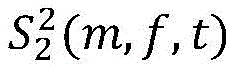
通过在实验中选定一定时间内分析6个统计量随时间变化,可以得到噪声源空间分布特性随时间变化。对于典型增升装置三段翼气动声学风洞实验中,可以通过


基于上述方法得到的多个统计量,相对于声源空间分布的时均强度,提供了定量化说明展向上声源强度脉动变化情况的统计量,也提供了无量纲化衡量上下区域差别的参数,方便实验人员设计实验中在一次同步的测量中选择上下区域不同布置条件下利用空间上的对称性进行不同布置条件下声源强度的对比和分析。Based on the multiple statistics obtained by the above method, relative to the time-averaged intensity of the spatial distribution of the sound source, it provides a statistic that quantitatively explains the fluctuation of the sound source intensity in the span, and also provides a dimensionless parameter to measure the difference between the upper and lower regions. , which is convenient for the experimenter to design the experiment in a synchronous measurement by selecting the upper and lower areas under different arrangement conditions to use the spatial symmetry to compare and analyze the sound source intensity under different arrangement conditions.
通过本发明测试方法,可以在具有展向较大尺度非均匀性的气动噪声实验中进行定量化分析展向上声源强度分布的统计变化量,尤其是对于三段翼增升装置模型,如前缘缝翼实验中,设计不同的锯齿尾缘进行降噪时,可以采用本发明测试方法,安装对应非对称的上下区域的锯齿,基于上述的统计量进行分析对比,从而进一步研究锯齿尾缘的相位干涉降噪机理。Through the testing method of the present invention, it is possible to quantitatively analyze the statistical variation of the sound source intensity distribution in the spanwise direction in the aerodynamic noise experiment with large spanwise non-uniformity, especially for the three-section wing lifter model, as described above In the edge slat experiment, when designing different sawtooth trailing edges for noise reduction, the test method of the present invention can be used to install the sawtooth corresponding to the asymmetric upper and lower regions, and analyze and compare based on the above statistics, so as to further study the noise of the sawtooth trailing edge. Phase interference noise reduction mechanism.
Claims (8)


Applications Claiming Priority (2)
| Application Number | Priority Date | Filing Date | Title |
|---|---|---|---|
| CN2022100799786 | 2022-01-24 | ||
| CN202210079978 | 2022-01-24 |
Publications (2)
| Publication Number | Publication Date |
|---|---|
| CN114598983A true CN114598983A (en) | 2022-06-07 |
| CN114598983B CN114598983B (en) | 2023-06-16 |
Family
ID=81807081
Family Applications (1)
| Application Number | Title | Priority Date | Filing Date |
|---|---|---|---|
| CN202210226381.XA Active CN114598983B (en) | 2022-01-24 | 2022-03-09 | Noise microphone array test method for civil aircraft lift-increasing device |
Country Status (1)
| Country | Link |
|---|---|
| CN (1) | CN114598983B (en) |
Cited By (2)
| Publication number | Priority date | Publication date | Assignee | Title |
|---|---|---|---|---|
| CN115306754A (en) * | 2022-10-12 | 2022-11-08 | 中国航发四川燃气涡轮研究院 | Axial flow fan aerodynamic instability identification method based on acoustic array |
| CN120028010A (en) * | 2025-04-21 | 2025-05-23 | 福州大学 | A pipeline flow-induced noise testing system and method |
Citations (10)
| Publication number | Priority date | Publication date | Assignee | Title |
|---|---|---|---|---|
| US5515444A (en) * | 1992-10-21 | 1996-05-07 | Virginia Polytechnic Institute And State University | Active control of aircraft engine inlet noise using compact sound sources and distributed error sensors |
| JP2002095084A (en) * | 2000-09-11 | 2002-03-29 | Oei Service:Kk | Directivity reception system |
| US20060256975A1 (en) * | 2005-05-10 | 2006-11-16 | United States Of America As Represented By The Administrator Of The Nasa | Deconvolution methods and systems for the mapping of acoustic sources from phased microphone arrays |
| US20090052689A1 (en) * | 2005-05-10 | 2009-02-26 | U.S.A. As Represented By The Administrator Of The National Aeronautics And Space Administration | Deconvolution Methods and Systems for the Mapping of Acoustic Sources from Phased Microphone Arrays |
| US20120109585A1 (en) * | 2010-10-29 | 2012-05-03 | The Boeing Company | Method and System to Account for Angle of Attack Effects in Engine Noise Shielding Tests |
| CN103010459A (en) * | 2012-12-11 | 2013-04-03 | 北京航空航天大学 | Method for reducing pneumatic noise of leading edge slat based on trailing edge micro-perforation |
| CN103308889A (en) * | 2013-05-13 | 2013-09-18 | 辽宁工业大学 | Passive sound source two-dimensional DOA (direction of arrival) estimation method under complex environment |
| CN106125047A (en) * | 2016-06-14 | 2016-11-16 | 北京科技大学 | A kind of sound localization method under air-flow environment |
| CN110794367A (en) * | 2019-10-12 | 2020-02-14 | 中国直升机设计研究所 | Method for positioning sound source interfered by propeller vortexes |
| CN112179656A (en) * | 2020-09-21 | 2021-01-05 | 西北工业大学 | A mobile linear microphone array sound source directivity measurement method and device |
-
2022
- 2022-03-09 CN CN202210226381.XA patent/CN114598983B/en active Active
Patent Citations (10)
| Publication number | Priority date | Publication date | Assignee | Title |
|---|---|---|---|---|
| US5515444A (en) * | 1992-10-21 | 1996-05-07 | Virginia Polytechnic Institute And State University | Active control of aircraft engine inlet noise using compact sound sources and distributed error sensors |
| JP2002095084A (en) * | 2000-09-11 | 2002-03-29 | Oei Service:Kk | Directivity reception system |
| US20060256975A1 (en) * | 2005-05-10 | 2006-11-16 | United States Of America As Represented By The Administrator Of The Nasa | Deconvolution methods and systems for the mapping of acoustic sources from phased microphone arrays |
| US20090052689A1 (en) * | 2005-05-10 | 2009-02-26 | U.S.A. As Represented By The Administrator Of The National Aeronautics And Space Administration | Deconvolution Methods and Systems for the Mapping of Acoustic Sources from Phased Microphone Arrays |
| US20120109585A1 (en) * | 2010-10-29 | 2012-05-03 | The Boeing Company | Method and System to Account for Angle of Attack Effects in Engine Noise Shielding Tests |
| CN103010459A (en) * | 2012-12-11 | 2013-04-03 | 北京航空航天大学 | Method for reducing pneumatic noise of leading edge slat based on trailing edge micro-perforation |
| CN103308889A (en) * | 2013-05-13 | 2013-09-18 | 辽宁工业大学 | Passive sound source two-dimensional DOA (direction of arrival) estimation method under complex environment |
| CN106125047A (en) * | 2016-06-14 | 2016-11-16 | 北京科技大学 | A kind of sound localization method under air-flow environment |
| CN110794367A (en) * | 2019-10-12 | 2020-02-14 | 中国直升机设计研究所 | Method for positioning sound source interfered by propeller vortexes |
| CN112179656A (en) * | 2020-09-21 | 2021-01-05 | 西北工业大学 | A mobile linear microphone array sound source directivity measurement method and device |
Non-Patent Citations (6)
| Title |
|---|
| KYLE A.PASCIONI: ""Areoaounstic Measurements of Leading-Edge Slat Noise"", 《22ND AIAA/CEAS AREOAOUNSTIC CONFERENCE 》 * |
| 刘沛清: "空腔噪声时域频域分析研究" * |
| 宋晓: ""前缘缝翼噪声特性及控制研究"", 《中国优秀硕士学位论文全文数据库工程科技II辑》 * |
| 李强等: "民用飞机增升装置气动噪声学风洞试验初步研究", 《民用飞机设计与研究》 * |
| 李征初: ""CLEAN-SC算法在风洞声源定位与识别中的应用研究"", 《实验流体力学》 * |
| 郝璇: "民用客机增升装置气动噪声研究进展" * |
Cited By (3)
| Publication number | Priority date | Publication date | Assignee | Title |
|---|---|---|---|---|
| CN115306754A (en) * | 2022-10-12 | 2022-11-08 | 中国航发四川燃气涡轮研究院 | Axial flow fan aerodynamic instability identification method based on acoustic array |
| CN115306754B (en) * | 2022-10-12 | 2023-02-17 | 中国航发四川燃气涡轮研究院 | Axial flow fan aerodynamic instability identification method based on acoustic array |
| CN120028010A (en) * | 2025-04-21 | 2025-05-23 | 福州大学 | A pipeline flow-induced noise testing system and method |
Also Published As
| Publication number | Publication date |
|---|---|
| CN114598983B (en) | 2023-06-16 |
Similar Documents
| Publication | Publication Date | Title |
|---|---|---|
| CN106125047B (en) | A kind of sound localization method under air-flow environment | |
| CN114598983A (en) | A test method for noise microphone array of civil aircraft lifting device | |
| Santana et al. | A rapid distortion theory modified turbulence spectra for semi-analytical airfoil noise prediction | |
| Yangzhou et al. | Aeroacoustic sources analysis of wake-ingesting propeller noise | |
| Sanjose et al. | Direct numerical simulation of acoustic reduction using serrated trailing-edge on an isolated airfoil | |
| CN106772227B (en) | A kind of unmanned plane direction determining method based on the identification of vocal print multiple-harmonic | |
| Laratro et al. | Self-noise and directivity of simple airfoils during stall: An experimental comparison | |
| CN110487393A (en) | The unstable state free field restoring method measured using single side acoustic pressure and particle velocity | |
| CN109683134A (en) | A kind of high-resolution localization method towards rotation sound source | |
| Christophe et al. | Trailing edge noise of a controlled-diffusion airfoil at moderate and high angle of attack | |
| Geyer et al. | Experimental assessment of the noise generated at the leading edge of porous airfoils using microphone array techniques | |
| CN107566969A (en) | A kind of enclosed environment internal low-frequency Reconstruction of Sound Field method | |
| Jiang et al. | Control of rotor trailing edge noise using porous additively manufactured blades | |
| Mamidala et al. | Leading-edge pressure gradient effect on boundary layer receptivity to free-stream turbulence | |
| Spehr et al. | Comparison of microphone array measurements in the closed test section of LSWT and ETW | |
| Moreau et al. | Validation of unstructured-mesh LES of the trailing-edge flow and noise of a controlled-diffusion airfoil | |
| Zhao et al. | Updating of wavenumber-frequency spectrum models by a phased array measurement | |
| Jiang et al. | Design and characterisation of an open-jet pressure gradient test rig for an aeroacoustic wind tunnel | |
| Boutilier | Experimental investigation of transition over a NACA 0018 airfoil at a low Reynolds number | |
| Geyer | Trailing edge noise generation of porous airfoils | |
| Syam Narayanan et al. | Effect of fluid-structure interaction on noise generation in MAV with fixed and flapping membrane wing | |
| Awasthi et al. | Sound radiated by a supercritical airfoil operating in the incompressible regime | |
| CN107908592B (en) | Background noise frequency division analysis method for hypersonic wind tunnel | |
| Gstrein et al. | Investigations on the application of various surface treatments for trailing edge noise reduction on a flat plate | |
| do Amaral et al. | On closed-section wind-tunnel aeroacoustic experiments with a two-dimensional lifting body |
Legal Events
| Date | Code | Title | Description |
|---|---|---|---|
| PB01 | Publication | ||
| PB01 | Publication | ||
| SE01 | Entry into force of request for substantive examination | ||
| SE01 | Entry into force of request for substantive examination | ||
| GR01 | Patent grant | ||
| GR01 | Patent grant |