CN1145872C - Method for automatically cutting and identiying hand written Chinese characters and system for using said method - Google Patents
Method for automatically cutting and identiying hand written Chinese characters and system for using said method Download PDFInfo
- Publication number
- CN1145872C CN1145872C CNB99100938XA CN99100938A CN1145872C CN 1145872 C CN1145872 C CN 1145872C CN B99100938X A CNB99100938X A CN B99100938XA CN 99100938 A CN99100938 A CN 99100938A CN 1145872 C CN1145872 C CN 1145872C
- Authority
- CN
- China
- Prior art keywords
- chinese character
- model
- handwritten chinese
- stroke
- recognition result
- Prior art date
- Legal status (The legal status is an assumption and is not a legal conclusion. Google has not performed a legal analysis and makes no representation as to the accuracy of the status listed.)
- Expired - Lifetime
Links
Classifications
-
- G—PHYSICS
- G06—COMPUTING OR CALCULATING; COUNTING
- G06V—IMAGE OR VIDEO RECOGNITION OR UNDERSTANDING
- G06V30/00—Character recognition; Recognising digital ink; Document-oriented image-based pattern recognition
- G06V30/10—Character recognition
- G06V30/28—Character recognition specially adapted to the type of the alphabet, e.g. Latin alphabet
- G06V30/293—Character recognition specially adapted to the type of the alphabet, e.g. Latin alphabet of characters other than Kanji, Hiragana or Katakana
-
- G—PHYSICS
- G06—COMPUTING OR CALCULATING; COUNTING
- G06V—IMAGE OR VIDEO RECOGNITION OR UNDERSTANDING
- G06V30/00—Character recognition; Recognising digital ink; Document-oriented image-based pattern recognition
- G06V30/10—Character recognition
- G06V30/32—Digital ink
-
- G—PHYSICS
- G06—COMPUTING OR CALCULATING; COUNTING
- G06V—IMAGE OR VIDEO RECOGNITION OR UNDERSTANDING
- G06V30/00—Character recognition; Recognising digital ink; Document-oriented image-based pattern recognition
- G06V30/10—Character recognition
- G06V30/14—Image acquisition
- G06V30/148—Segmentation of character regions
-
- G—PHYSICS
- G06—COMPUTING OR CALCULATING; COUNTING
- G06V—IMAGE OR VIDEO RECOGNITION OR UNDERSTANDING
- G06V30/00—Character recognition; Recognising digital ink; Document-oriented image-based pattern recognition
- G06V30/10—Character recognition
- G06V30/19—Recognition using electronic means
- G06V30/196—Recognition using electronic means using sequential comparisons of the image signals with a plurality of references
Landscapes
- Engineering & Computer Science (AREA)
- Computer Vision & Pattern Recognition (AREA)
- Physics & Mathematics (AREA)
- General Physics & Mathematics (AREA)
- Multimedia (AREA)
- Theoretical Computer Science (AREA)
- Character Discrimination (AREA)
- Character Input (AREA)
- Document Processing Apparatus (AREA)
Abstract
Description
本发明涉及手写汉字自动识别技术,具体地说,涉及对连续输入的手写汉字串进行自动分割和识别的方法以及使用该方法的系统。The present invention relates to the automatic recognition technology of handwritten Chinese characters, in particular to a method for automatically segmenting and recognizing continuously input handwritten Chinese character strings and a system using the method.
在目前可以接收用户手写汉字输入的信息处理系统中,通常包括一个基于笔的输入装置,该装置一般由书写笔和书写板组成。这样的基于笔的输入装置一般要求用户在书写完一个汉字之后,按下书写笔或书写板上的一个按钮,以对书写的汉字串进行手动分割。自动手写汉字识别机可以直接对这种经过手动分割的汉字串进行识别。但是手动分割过程影响了用户书写的连续性,因此这种书写方式不符合用户的书写习惯。Currently, an information processing system capable of receiving user's handwritten Chinese character input generally includes a pen-based input device, which generally consists of a writing pen and a writing tablet. Such pen-based input devices generally require the user to press a button on the writing pen or tablet after writing a Chinese character to manually segment the written Chinese character string. The automatic handwritten Chinese character recognition machine can directly recognize the manually segmented Chinese character strings. However, the manual segmentation process affects the continuity of the user's writing, so this writing method does not conform to the user's writing habits.
IBM公司的ThinkScribe是一种集成了手写数字化仪和传统的基于纸上记录系统的设备。该设备按笔画和相关时序记录用户的手写输入,并能够按原来的时序再现用户的手写输入。用户一般在ThinkScribe上以连续方式进行书写,书写的字与字之间的间隔很小或连在一起。这样在进行自动识别之前必须进行文字分割。IBM's ThinkScribe is a device that integrates a handwriting digitizer with traditional paper-based recording systems. The device records the user's handwriting input according to the strokes and related timing, and can reproduce the user's handwriting input according to the original timing. Users generally write in a continuous manner on ThinkScribe, and the intervals between the written words are small or connected together. In this way, text segmentation must be performed before automatic recognition.
目前还没有一种有效的文字分割方法,手写汉字识别技术只能对单个汉字或字间隔很大的手写汉字串进行识别。对手写汉字串进行自动分割困难在于:At present, there is no effective text segmentation method, and the handwritten Chinese character recognition technology can only recognize a single Chinese character or handwritten Chinese character strings with large word intervals. The difficulty of automatic segmentation of handwritten Chinese character strings lies in:
1)许多汉字是左右结构,当在水平线上从左到右快速书写时,左右成分之间的间隔和字与字之间的间隔非常相似。除了这种空间上的混淆之外,有些汉字的左、右成份本身就可以是一个独立的汉字或与某个独立的汉字非常象。同样,对于在垂直行上书写的手写汉字串也有类似的问题,因为有些汉字是上下结构的。1) Many Chinese characters have a left-right structure. When writing quickly from left to right on a horizontal line, the intervals between the left and right components are very similar to the intervals between characters. In addition to this spatial confusion, the left and right components of some Chinese characters can be an independent Chinese character or very similar to an independent Chinese character. Likewise, there is a similar problem with handwritten Chinese character strings written on vertical lines, since some Chinese characters are structured up and down.
2)当用户快速以草书方式书写时,对于相邻的汉字来说,前一个汉字的最后一个笔画和后一个汉字的开始笔画之间可能相连,彼此没有任何清楚的界限。2) When the user quickly writes in cursive script, for adjacent Chinese characters, the last stroke of the previous Chinese character and the beginning stroke of the next Chinese character may be connected without any clear boundaries.
于是,如何克服以上困难提供一种对连续输入的手写汉字串进行自动分割的方法,是实现对连续输入的手写汉字串进行自动识别的基础。Therefore, how to overcome the above difficulties and provide a method for automatically segmenting continuously input handwritten Chinese character strings is the basis for realizing automatic recognition of continuously input handwritten Chinese character strings.
根据本发明的手写汉字串自动分割和识别方法在不同层次上利用了来自于不同源的信息,例如人们的书写习惯、汉字串的几何特征、书写时的时序信息以及语言模型等实现了对连续输入的手写汉字串的自动分割和识别。According to the method for automatic segmentation and recognition of handwritten Chinese character strings of the present invention, information from different sources has been utilized at different levels, such as people's writing habits, geometric features of Chinese character strings, timing information when writing, and language models. Automatic segmentation and recognition of input handwritten Chinese character strings.
根据本发明的手写汉字串自动分割和识别方法包括以下步骤:Handwritten Chinese character string automatic segmentation and recognition method according to the present invention comprise the following steps:
建立描述手写汉字串中笔画序列几何特征的几何模型和描述汉语中字(词)依赖关系的语言模型;Establish a geometric model describing the geometric features of stroke sequences in handwritten Chinese character strings and a language model describing the dependency relationship between characters (words) in Chinese;
基于所述相关时序信息和几何模型找出连续输入的手写汉字串中所有的潜在分割方案;Find all potential segmentation schemes in the continuously input handwritten Chinese character string based on the relevant timing information and geometric model;
对于每一种分割方案,对任意两个分割点之间的笔画组进行识别,并计算出表征识别结果正确性的概率;For each segmentation scheme, identify the stroke group between any two segmentation points, and calculate the probability of characterizing the correctness of the recognition result;
用语言模型修正上述表征识别结果正确性的概率;和Using a language model to correct the probability of the correctness of the recognition result of the above representation; and
选择对应于概率值最大的识别结果和该识别结果所对应的分割方案作为对用户连续输入的手写汉字串的分割和识别结果。The recognition result corresponding to the highest probability value and the segmentation scheme corresponding to the recognition result are selected as the segmentation and recognition results of the handwritten Chinese character string continuously input by the user.
根据本发明的手写汉字串自动分割和识别系统包括:The automatic segmentation and recognition system of handwritten Chinese character string according to the present invention comprises:
输入装置,用于接收用户连续输入的手写汉字串,并按笔画和相关时序记录用户的手写输入;The input device is used to receive the handwritten Chinese character string continuously input by the user, and record the user's handwritten input according to strokes and related timing;
模型存储装置,用于存储描述手写汉字串中笔画序列几何特征的几何模型和描述汉语中字(词)依赖关系的语言模型;The model storage device is used to store a geometric model describing the geometric features of the stroke sequence in the handwritten Chinese character string and a language model describing the dependency relationship of characters (words) in Chinese;
分割装置,基于所述相关时序信息和几何模型找出连续输入的手写汉字串中所有的潜在分割方案;A segmentation device, based on the relevant timing information and geometric model, finds all potential segmentation schemes in the continuously input handwritten Chinese character string;
识别装置,对于每一种分割方案,对任意两个分割点之间的笔画组进行识别,并计算出表征识别结果正确性的概率;The identification device, for each segmentation scheme, identifies the stroke group between any two segmentation points, and calculates the probability representing the correctness of the identification result;
仲裁装置,用语言模型修正上述表征识别结果正确性的概率,选择对应于概率值最大的识别结果和该识别结果所对应的分割方案作为对用户连续输入的手写汉字串的分割和识别结果。The arbitration device uses a language model to modify the probability of the correctness of the above-mentioned characterizing recognition results, and selects the recognition result corresponding to the highest probability value and the segmentation scheme corresponding to the recognition result as the segmentation and recognition results for the handwritten Chinese character string continuously input by the user.
通过以下结合附图的说明可以使本发明的目的、特征和优点更加清楚。The purpose, features and advantages of the present invention can be made clearer through the following description in conjunction with the accompanying drawings.
图1为根据本发明的手写汉字串自动分割和识别方法的概念性流程图;Fig. 1 is according to the conceptual flowchart of handwritten Chinese character string automatic segmentation and recognition method of the present invention;
图2为根据本发明第一实施例的手写汉字串自动分割和识别方法的流程图;Fig. 2 is the flow chart of the handwritten Chinese character string automatic segmentation and recognition method according to the first embodiment of the present invention;
图3为根据本发明第二实施例的手写汉字串自动分割和识别方法的流程图;Fig. 3 is the flow chart of the handwritten Chinese character string automatic segmentation and recognition method according to the second embodiment of the present invention;
图4为根据本发明第三实施例的手写汉字串自动分割和识别方法的流程图;Fig. 4 is the flow chart of the handwritten Chinese character string automatic segmentation and recognition method according to the third embodiment of the present invention;
图5为根据本发明的手写汉字串自动分割和识别系统的框图。Fig. 5 is a block diagram of a system for automatic segmentation and recognition of handwritten Chinese character strings according to the present invention.
根据本发明的手写汉字串自动分割和识别方法可由下述公式来描述:According to the automatic segmentation and recognition method of handwritten Chinese character string of the present invention, can be described by following formula:
识别的目标是检索出尽可能与用户书写的实际汉字串
相近的汉字串
这可以通过使识别误差尽可能小来实现。于是,识别问题可以看作是找出对给定的手写输入序列


在等式(2)中,


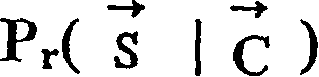
其中Φj=fbj-1+1…fbj代表了与汉字cj相关的书写单元组。Wherein Φ j = f bj-1+1 . . . f bj represents the writing unit group related to Chinese character c j .
然而,在书写状态为连续的情况下,边界点{bj}是任意的。在这种情况下, 可表示为:However, in the case where the writing states are continuous, the boundary point {b j } is arbitrary. in this case, Can be expressed as:
其中Φj的含义同等式(3)。等式(4)中的求和考虑了对于各种假设将书写序列分成M段的所有可能分割。Among them, the meaning of Φ j is the same as formula (3). The summation in equation (4) considers all possible partitions of the written sequence into M segments for various assumptions.
这样,so,
i)在分立的书写状态下,识别模型可表示为:i) In the discrete writing state, the recognition model can be expressed as:
ii)在连续的书写状态下,识别模型可表示为:ii) In the continuous writing state, the recognition model can be expressed as:
由以上分析可以看出手写汉字识别是分割和识别的组合。From the above analysis, it can be seen that handwritten Chinese character recognition is a combination of segmentation and recognition.
图1示出了根据以上分析得出本发明的手写汉字自动分割和识别方法的具体步骤。如图1所示:Fig. 1 shows the specific steps of the method for automatic segmentation and recognition of handwritten Chinese characters of the present invention based on the above analysis. As shown in Figure 1:
步骤S102:对于用户的手写输入序列

步骤S102:对于每一种分割方案进行识别并计算出
步骤S103:用语言模型修正上述计算结果,即计算
步骤S104:从以上计算结果中找出最大值,该值所对应的Φj和Step S104: Find the maximum value from the above calculation results, and the corresponding Φ j and
(j=1…M)即为用户手写汉字输入序列 的分割和识别结果。 (j=1...M) is the user's handwritten Chinese character input sequence segmentation and recognition results.
从以上可以看出,根据本发明的对手写汉字串进行自动分割和识别的方法,在完成分割的同时完成了识别。It can be seen from the above that, according to the method for automatic segmentation and recognition of handwritten Chinese character strings of the present invention, the recognition is completed while the segmentation is completed.
实际上,现有的手写汉字识别方法都是从大量样本中计算出Pr(Φj|cj),取Pr(Φj|cj)最大值所对应的cj作为对Φj的识别结果。于是,本发明的手写汉字串自动分割和识别方法可以利用现有的识别机,对于每一种潜在的分割方案利用现有的识别机计算出

通常在上述方法中,Φj被认为是笔画组,cj是单个汉字。但对于cj为一个汉字的组成部分,例如汉字的偏旁部首时该方法也适用。同时,cj也可以是一个词,这样对于那些包括重叠笔画无法自动分割的汉字串可以进行组合识别。但在这种情况下,无法利用现有的识别机。可以通过手写汉字串训练程序来计算Pr(Φj|cj)。当然该汉字串中包括单个汉字。Usually in the above methods, Φj is considered as a stroke group and cj is a single Chinese character. However, this method is also applicable when c and j are components of a Chinese character, such as the radicals of a Chinese character. At the same time, c j can also be a word, so that combination recognition can be carried out for those Chinese character strings that cannot be automatically divided including overlapping strokes. But in this case, the existing identification machine cannot be utilized. P r (Φ j |c j ) can be calculated by handwriting a Chinese character string training program. Of course, the Chinese character string includes a single Chinese character.
以下以IBM的ThinkScribe所记录的手写汉字串数据为例,详细地描述一下本发明的手写汉字串自动分割方法。Taking the handwritten Chinese character string data recorded by IBM's ThinkScribe as an example, the handwritten Chinese character string automatic segmentation method of the present invention will be described in detail below.
在进行手写汉字串自动分割时,我们做了以下的假设:When performing automatic segmentation of handwritten Chinese characters, we made the following assumptions:
(1)每个汉字由一些书写笔画组成;尽管一些书写笔画可能与打印出的汉字笔画不一定一一对应的,但一个汉字总是在某一书写笔画结束时结束。这也就是说,该边界检测方法不考虑前一汉字的最后一个书写笔画和下一个汉字的第一个笔画相连的情况。如果这种出现概论很小的事件发生了,用户可以启动一个手动程序断开相连的笔画来表明分割边界。(1) Each Chinese character is composed of some writing strokes; although some writing strokes may not necessarily correspond to the printed Chinese character strokes one-to-one, a Chinese character always ends when a certain writing stroke ends. That is to say, the boundary detection method does not consider the situation that the last written stroke of the previous Chinese character is connected with the first stroke of the next Chinese character. If this unlikely event occurs, the user can initiate a manual procedure to disconnect the connected strokes to indicate the segmentation boundary.
(2)按顺序书写汉字串。这也就是说,前一个汉字总是在书写下一个汉字之前完全书写完毕。(2) Write Chinese character strings in order. That is to say, the previous Chinese character is always completely written before the next Chinese character is written.
(3)汉字串在一行中从左到右的方向书写。如果按从上到下的方向书写汉字串可以相应地修改分割方案。(3) Chinese character strings are written from left to right in a row. If the Chinese character string is written from top to bottom, the segmentation scheme can be modified accordingly.
(4)以IBM的ThinkScribe所记录的数据为例。每个书写笔画由一系列离散的笔画点的x、y坐标以及时序信息值来表示。于是第i个书写笔画可以表示成:(4) Take the data recorded by IBM's ThinkScribe as an example. Each written stroke is represented by a series of discrete stroke points' x, y coordinates and timing information values. Then the i-th writing stroke can be expressed as:
s(i)=((x(i,1),y(i,1),t(i,1)),…,(x(i,j),y(i,j),t(i,j)),…(x(i,e(i)),y(i,e(i),t(i,e(i)))s(i) = ((x(i, 1), y(i, 1), t(i, 1)), ..., (x(i, j), y(i, j), t(i, j)), ... (x(i, e(i)), y(i, e(i), t(i, e(i)))
其中e(i)是笔画i中笔画点的个数。于是所要分割的笔画序列可表示为:Where e(i) is the number of stroke points in stroke i. Then the sequence of strokes to be segmented can be expressed as:
s(1),s(2)…s(i)s(1), s(2)...s(i)
其中s(1)是属于未分割汉字串中的第一个笔画。Among them, s(1) is the first stroke belonging to the unsegmented Chinese character string.
我们注意到用于汉字分割的一个很明显的标准是两相邻汉字之间的物理间隔。当用户按从左到右方向书写时,这样的间隔可以用两相邻笔画之间垂直方向上的间隙G表示。于是,我们可以在每个笔画s(K)的起始点处使用下述条件来测试这样的间隙:We note that an obvious criterion for Chinese character segmentation is the physical spacing between two adjacent Chinese characters. When the user writes in a left-to-right direction, such an interval can be represented by a gap G in the vertical direction between two adjacent strokes. We can then test for such a gap at the starting point of each stroke s(K) using the following condition:
Max (x(i,j)) ≤ Min (x(i,j))-G (7)Max (x(i,j)) ≤ Min (x(i,j))-G (7)
对于满足t(i,j)< 对于满足t(i,j)For satisfying t(i, j)< For satisfying t(i, j)
t(K,1)的所有点 ≥t(K,1)的所有点All points of t(K, 1) ≥ all points of t(K, 1)
请注意,在等式(7)的右边我们考虑了所有的点。实际上,当人们开始在距离上一个已确定为潜在边界的笔画足够远处开始书写时就可以结束这种测试。于是,条件“包含满足x(i,j)<x(i,1)+D的某个点的所有笔画”可以用作测试结束条件。这里D是可由经验来确定的G的上界(例如它可以是行宽,或至今所确定的文字边界之间最大距离的1.5倍)。我们现在在定义f(G)是G的一个单调上升函数,因为G愈大,笔画s(K)成为边界笔画的可能性愈大,f(G)对于给定的汉字串来说是笔画s(K)为一汉字的起始笔画的累积概率函数。注意,此函数可以通过对典型用户的书写数据进行分析而得到,也可以对某一特定用户进行训练。理论上,它与书写的具体情况有关。然而,实际上由于人们的书写习惯不总是固定不变的,所以最好取一个近似函数,特别是与用户无关。Note that on the right-hand side of Equation (7) we consider all points. In fact, the test can end when people start writing far enough away from the last stroke that has been identified as a potential boundary. Then, the condition "contains all strokes of a certain point satisfying x(i, j)<x(i, 1)+D" can be used as the test end condition. Here D is an upper bound on G that can be determined empirically (eg it can be the line width, or 1.5 times the maximum distance between text boundaries determined so far). We are now defining f(G) as a monotonically increasing function of G, because the larger G is, the greater the possibility of stroke s(K) becoming a boundary stroke, and f(G) is stroke s for a given Chinese character string (K) is the cumulative probability function of the initial strokes of a Chinese character. Note that this function can be obtained by analyzing the writing data of typical users, or it can be trained for a specific user. In theory, it has to do with the specific circumstances of writing. However, in practice, since people's writing habits are not always fixed, it is better to take an approximate function, especially irrelevant to users.
等式(7)用于描述在水平方向上彼此相隔开的笔画的垂直间隙。通常,即使笔画之间不相连,并且在水平方向上与先前笔画相隔开,也不一定存在垂直间隙。我们可以使用不同的标准确定这样的水平间隔:Equation (7) is used to describe the vertical gap of strokes that are spaced apart from each other in the horizontal direction. In general, even though strokes are not connected to each other and are spaced horizontally from previous strokes, there is not necessarily a vertical gap. We can determine such horizontal intervals using different criteria:
Max (x(i,j)) ≤ Min (x(i,j))-G (8)Max (x(i,j)) ≤ Min (x(i,j))-G (8)
满足t(i,j)<t(K,1)且 满足t(i,j)≥t(K,1)Satisfy t(i, j)<t(K, 1) and satisfy t(i, j)≥t(K, 1)
y(i,j)=每个Y值的 且y(i,j)=每个值y(i, j) = for each Y value and y(i, j) = for each value
所有点 的所有点all points all points
由于笔画是用离散的点来定义的,所以可以将等式(8)进一步修改成为等式(9),其中T选做笔画点的统计函数,这样,如果一笔画跨跃一水平带,则某一笔画点将出现在该水平带上。Since strokes are defined by discrete points, equation (8) can be further modified into equation (9), where T is selected as the statistical function of stroke points, so that if a stroke spans a horizontal band, then A certain stroke point will appear on this horizontal band.
Max (x(i,j)) ≤ Min (x(i,j))-G (9)Max (x(i,j)) ≤ Min (x(i,j))-G (9)
满足t(i,j)<t(K,1) 满足t(i,j)≥t(K,1)Satisfy t(i, j)<t(K, 1) Satisfy t(i, j)≥t(K, 1)
且nT≤y(i,j)≤ 且nT≤y(i,j)≤and nT≤y(i, j)≤ and nT≤y(i, j)≤
(n+1)T的所有点 (n+1)T的所有点All points of (n+1)T All points of (n+1)T
这里nT从汉字串的y坐标值的最小值变化到最大值。对于给定汉字串

用检测到的笔画间的垂直间隙或水平间隔,可以识别出一组潜在的分割点。于是我们重写等式(2):Using the detected vertical gaps or horizontal intervals between strokes, a set of potential segmentation points can be identified. So we rewrite equation (2):
其中对于所有的
(0≤i≤m)寻找最大值,即,对于所有潜在分割点的组合序列寻找最大值。项

等式(10)中的第一因子 是从所观测的笔画几何特征中俘获概率参数的最有效因素。The first factor in equation (10) is the most effective factor in capturing the probability parameter from the observed stroke geometry.
由于在没
中不同有继承概率差,所以

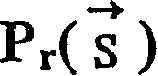
是可以从两个信息源中通过观测笔画几何特征得出的几何模型。一个是间距模型G,它与


在理论上,Pr (g)和Pr (d)都可以看作是上下文有关的,即是 的函数。然而,Pr (g)对 的依赖性非常小,且Pr (g)可以上下文无关的间隔模型G中计算出来:In theory, both P r (g) and P r (d) can be regarded as context-sensitive, that is, The function. However, P r (g) for The dependence of is very small, and P r (g) can be calculated in the context-free interval model G:
其中i的范围是
中的潜在分割点,而j的范围为不在

对于分布模型,Pr (d)可用不同方式计算出来,这依赖于所采用的策略,与各种性能参数之间的权衡,如复杂度、可靠性和准确的增益有关。一般来说,我们假设可以从每一个汉字的书写样本中建立X方向上笔画密度分布。相对于平均大小的汉字来说可以是归一化的。当对于给定


其中mi表示由分布模型D给出的候选汉字ci的似然概率。实际上mi在X方上的分布变得很大时,如≥0,mi将为零。Among them, m i represents the likelihood probability of the candidate Chinese character ci given by the distribution model D. In fact, when the distribution of mi on the X side becomes very large, such as ≥ 0, mi will be zero.
因子
是从汉字串中得出的语言模型。由于汉语是基于词的,所以应该使用词一级的语言模型。这意味着,对于每个汉字串,我们将进行词分割,使用词频率和可能更高层的n元文法来计算

我们注意到在等式(10)中基于笔画的几何特征的几何模型


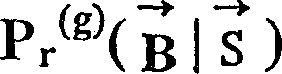
在等(14)中使用的间距模型和分布模型是基于手写样本的统计模型。The spacing model and distribution model used in et al. (14) are statistical models based on handwriting samples.
由以上分析可以看出,本发明的自动分割和识别方法,在寻找潜在的分割点时考虑了笔画的几何特征,具体地说使用了间距模型G和分布模型D。G模型使用两相邻笔画之间的间隔来描述所述两相邻笔画中后一笔画为一个潜在分割点的可能性,所述两相邻笔画按相关时序信息分为前一笔画和后一笔画。进一步说,所述G模型为一单调上升函数,其中自变量为两相邻笔画之间的间隔,因变量描述后一笔画为一个潜在分割点的可能性。It can be seen from the above analysis that the automatic segmentation and recognition method of the present invention considers the geometric characteristics of strokes when looking for potential segmentation points, specifically using the distance model G and distribution model D. The G model uses the interval between two adjacent strokes to describe the possibility that the latter stroke in the two adjacent strokes is a potential segmentation point. The two adjacent strokes are divided into the previous stroke and the next stroke according to the relevant timing information. strokes. Furthermore, the G model is a monotonically increasing function, wherein the independent variable is the interval between two adjacent strokes, and the dependent variable describes the possibility that the latter stroke is a potential segmentation point.
此外,所述几何模型还包括分布模型D,使用当前笔画与前一个已确定为潜在分割点的笔画之间的距离来描述当前笔画和潜在的分割点之间的笔画为一个字的可能性。In addition, the geometric model also includes a distribution model D, using the distance between the current stroke and the previous stroke determined as a potential segmentation point to describe the possibility that the stroke between the current stroke and the potential segmentation point is a character.
进一步说,所述D模型可以是一个类正态分布函数,其中自变量为当前笔画与前一个已确定为潜在分割点的笔画之间的距离,因变量描述当前笔画和潜在分割点之间的笔画为一个字的可能性,当自变量在于某一连续的值域内时该类正态分布函数值较大,而当自变量落在所述值域外时该类正态分布函数值较小。Further, the D model can be a normal distribution function, wherein the independent variable is the distance between the current stroke and the previous stroke that has been determined as a potential segmentation point, and the dependent variable describes the distance between the current stroke and the potential segmentation point. The possibility that the stroke is a character, when the independent variable is within a certain continuous value range, the value of this type of normal distribution function is large, and when the independent variable falls outside the value range, the value of this type of normal distribution function is small.
图2示出了根据本发明第一实施例的手写汉字串自动分割和识别方法的具体步骤。Fig. 2 shows the specific steps of the method for automatic segmentation and recognition of handwritten Chinese character strings according to the first embodiment of the present invention.
首先使用户的手写汉字串S经过间隔模型G的分析,确定所有的潜在分割点,对于每一种潜在的分割方案产生一条路径,将所以路径按队列存放。然后对于队列中的每条路径进行识别。再用分布模型D和语言模型PLM对Pgap·PR进行校正,即计算PLM·PD·PR·Pgap。经排列后求出得分最高的路径,其所对应的分割方案和识别结果即为手写汉字串 的分割和识别结果。First, the user's handwritten Chinese character string S is analyzed by the interval model G to determine all potential segmentation points, and a path is generated for each potential segmentation scheme, and all paths are stored in queues. Then identify each path in the queue. Then use the distribution model D and the language model P LM to correct P gap · PR , that is, calculate P LM · P D · PR · P gap . After arranging, find the path with the highest score, and its corresponding segmentation scheme and recognition result are handwritten Chinese character strings segmentation and recognition results.
图3示出了根据本发明另一个实施例的手写汉字串自动分割和识别方法的具体步骤。手写汉字串

图4示出了根据本发明第三实施例的手写汉字串自动分割和识别方法的具体步骤。对于识别结果用分布模型D′进行校正,以提高分割和识别的准确度。在书写方向为水平方向时,当识别结果为左右结构的汉字时,使用字宽度模型D′来修正表征识别结果正确性的概率值,字宽度模型D’使用即可以为左右结构汉字中的一个组成部分又可以为单个汉字的成分的宽度来描述在该宽度下该成分为左右结构汉字中一个组成部分的可能性或为单个汉字的可能性。而在书写方向为垂直方向时,当识别结果为一上下结构的汉字时使用字高度模型D’来修正表征识别结果正确性的概率值,字高度模型D’使用即可以为上下结构汉字中的一个组成部分又可以为单个汉字的成分的高度来描述在该高度下该成分为上下结构汉字中一个组成部分的可能性或为单个汉字的可能性。Fig. 4 shows the specific steps of the method for automatic segmentation and recognition of handwritten Chinese character strings according to the third embodiment of the present invention. The recognition results are corrected with the distribution model D' to improve the accuracy of segmentation and recognition. When the writing direction is horizontal, when the recognition result is a Chinese character with a left-right structure, use the character width model D' to modify the probability value representing the correctness of the recognition result, and the character width model D' can be used as one of the Chinese characters with a left-right structure The component part can be the width of a component of a single Chinese character to describe the possibility of the component being a component of the left and right structure Chinese characters or the possibility of being a single Chinese character under this width. When the writing direction is the vertical direction, when the recognition result is a Chinese character with a top-bottom structure, the character height model D' is used to modify the probability value representing the correctness of the recognition result. A component can be the height of a component of a single Chinese character to describe the possibility of the component being a component of the upper and lower structure Chinese characters or the possibility of being a single Chinese character at this height.
此外,正如前边已讨论过的那样,识别结果可以是偏旁部首、单字词或多字词。In addition, as discussed above, the recognition results can be radicals, single-character words or multi-character words.
在具体实施例本发明的手写汉字串自动分割和识别方法时,可以使用树状结构。这样可以有效地表示代表潜在分割方案的每条路径。When implementing the method for automatic segmentation and recognition of handwritten Chinese character strings of the present invention, a tree structure can be used. This effectively represents each path representing a potential segmentation scheme.
使用树状结构进行手写汉字串自动分割和识别的具体步骤为:The specific steps for automatic segmentation and recognition of handwritten Chinese character strings using a tree structure are:
步骤(1):分析手写数据样本,构造f(G)和f(D)。Step (1): Analyze handwritten data samples and construct f(G) and f(D).
步骤(2):对每一笔画计算G。如果G大于0,则该笔画可能是一潜在的分割点。Step (2): Calculate G for each stroke. If G is greater than 0, the stroke may be a potential segmentation point.
步骤(3):以最初确定的分割点为根,产生一代表潜在分割方案的二叉树。左分枝表示不接受前一个潜在分割点,右分枝表示接受前一个潜在的分割点。每当产生新的潜在分割点时,树就向下产生分枝。从根到叶子节点的每条路径都代表了一个潜在的分割方案。于是可用等式(10)求出每条路径的得分。然而实际上,当我们向下生长树时,对于每个新产生的分枝都用f(G)和识别结果来估计分枝存在的可能性,以对树进行裁剪。Step (3): Taking the initially determined segmentation point as the root, a binary tree representing potential segmentation schemes is generated. The left branch means not to accept the previous potential split point, and the right branch means to accept the previous potential split point. The tree branches down each time a new potential split point is created. Each path from the root to a leaf node represents a potential splitting scheme. Equation (10) can then be used to find the score for each path. However, in fact, when we grow the tree downward, we use f(G) and the recognition result to estimate the possibility of the existence of the branch for each newly generated branch, so as to cut the tree.
步骤(4):如果对于某一个潜在的分割点f(G)=1,则可以将左分枝裁剪掉。这种情况发生在两相邻笔画之间存在很大物理间隔时。Step (4): If f(G)=1 for a certain potential segmentation point, the left branch can be cut off. This happens when there is a large physical separation between two adjacent strokes.
步骤(5):如果某个特定的似然概率mi等于零,则可以将上一个左分枝裁剪掉。Step (5): If a specific likelihood probability mi is equal to zero, the previous left branch can be cut off.
步骤(6):如果由于包含前一个潜在分割点,而使识别结果的概率值落入预定阈值L之下,则左分枝裁剪掉,L值可由经验来定。Step (6): If the probability value of the recognition result falls below a predetermined threshold L due to the inclusion of the previous potential segmentation point, then the left branch is cut off, and the value of L can be determined empirically.
步骤(7):对于剩下的每一分枝计算公式(10)的值。Step (7): Calculate the value of formula (10) for each remaining branch.
以上结合附图详细地描述了根据本发明的手写汉字自动分割和识别方法。下面结构图5描述一下使用该方法的系统。The method for automatic segmentation and recognition of handwritten Chinese characters according to the present invention has been described in detail above in conjunction with the accompanying drawings. The structure of Figure 5 below describes a system using this method.
如图5所示,根据本发明的手写汉字自动分割和识别系统包括:As shown in Figure 5, the automatic segmentation and recognition system of handwritten Chinese characters according to the present invention comprises:
输入装置,用于接收用户连续输入的手写汉字串,并按笔画和相关时序记录用户的手写输入;The input device is used to receive the handwritten Chinese character string continuously input by the user, and record the user's handwritten input according to strokes and related timing;
模型存储装置,用于存储描述手写汉字串中笔画序列几何特征的几何模型和描述汉语中字(词)依赖关系的语言模型;The model storage device is used to store a geometric model describing the geometric features of the stroke sequence in the handwritten Chinese character string and a language model describing the dependency relationship of characters (words) in Chinese;
分割装置,基于所述相关时序信息和几何模型找出连续输入的手写汉字串中所有的潜在分割方案;A segmentation device, based on the relevant timing information and geometric model, finds all potential segmentation schemes in the continuously input handwritten Chinese character string;
识别装置,对于每一种分割方案,对任意两个分割点之间的笔画组进行识别,并计算出表征识别结果正确性的概率;The identification device, for each segmentation scheme, identifies the stroke group between any two segmentation points, and calculates the probability representing the correctness of the identification result;
仲裁装置,用语言模型修正上述表征识别结果正确性的概率,选择对应于概率值最大的识别结果和该识别结果所对应的分割方案作为对用户连续输入的手写汉字串的分割和识别结果。The arbitration device uses a language model to modify the probability of the correctness of the above-mentioned characterizing recognition results, and selects the recognition result corresponding to the highest probability value and the segmentation scheme corresponding to the recognition result as the segmentation and recognition results for the handwritten Chinese character string continuously input by the user.
输入装置例如可以是IBM公司的ThinkScribe。ThinkScribe是一种集成了手写数字化仪和传统的基于纸上记录系统的设备。该设备按笔画和相关时序记录用户的手写输入,并能够按原来的时序再现用户的手写输入。ThinkScribe可以将数据流S(1),S(2),S(3)…存储在自己的非易失存储器中,并且在需要时可以通过输入/输出端口送到例如一台PC机中,PC机可以运行ThinkScribe的手写输入再现程序,按原来的时序再现用户的手写输入。当PC机安装有识别程序时,也可以作为一台识别机,对用户的手写输入进行识别。The input device can be ThinkScribe of IBM Corporation, for example. ThinkScribe is a device that integrates a handwriting digitizer with traditional paper-based recording systems. The device records the user's handwriting input according to the strokes and related timing, and can reproduce the user's handwriting input according to the original timing. ThinkScribe can store the data streams S(1), S(2), S(3)...in its own non-volatile memory, and send them to a PC, for example, through the input/output port when needed The computer can run ThinkScribe's handwriting input reproduction program, and reproduce the user's handwriting input according to the original timing. When the PC is equipped with a recognition program, it can also be used as a recognition machine to recognize the user's handwriting input.
以上结合附图描述了根据本发明的在手写汉字信息处理系统中自动分割和识别用户连续输入的手写汉字串的方法和使用该方法的系统。正如本领域技术人员所理解的那样,本发明不限于以上的实施例。在不违背本发明的精神和范畴的条件下,可以对本发明作出各种修改和变型,本发明旨在包括所有这些修改和变型。本发明的保护范围由所附权利要求书来限定。The method for automatically segmenting and recognizing handwritten Chinese character strings continuously input by users in the handwritten Chinese character information processing system according to the present invention and the system using the method have been described above with reference to the accompanying drawings. As understood by those skilled in the art, the present invention is not limited to the above embodiments. Various modifications and variations can be made in the present invention without departing from the spirit and scope of the present invention, and the present invention is intended to include all such modifications and variations. The protection scope of the present invention is defined by the appended claims.
Claims (12)
Priority Applications (6)
| Application Number | Priority Date | Filing Date | Title |
|---|---|---|---|
| CNB99100938XA CN1145872C (en) | 1999-01-13 | 1999-01-13 | Method for automatically cutting and identiying hand written Chinese characters and system for using said method |
| TW088104737A TW558687B (en) | 1999-01-13 | 1999-03-25 | Method for automatically segmenting and recognizing Chinese handwriting character strings and system for using the same method |
| JP2000002392A JP3426180B2 (en) | 1999-01-13 | 2000-01-11 | Method and system for automatically segmenting and recognizing handwritten kanji |
| US09/481,157 US6519363B1 (en) | 1999-01-13 | 2000-01-12 | Method and system for automatically segmenting and recognizing handwritten Chinese characters |
| KR1020000001284A KR100328907B1 (en) | 1999-01-13 | 2000-01-12 | Method and system for automatically segmenting and recognizing handwritten chinese characters |
| US10/350,244 US6665436B2 (en) | 1999-01-13 | 2003-01-23 | Method and system for automatically segmenting and recognizing handwritten chinese characters |
Applications Claiming Priority (1)
| Application Number | Priority Date | Filing Date | Title |
|---|---|---|---|
| CNB99100938XA CN1145872C (en) | 1999-01-13 | 1999-01-13 | Method for automatically cutting and identiying hand written Chinese characters and system for using said method |
Publications (2)
| Publication Number | Publication Date |
|---|---|
| CN1260524A CN1260524A (en) | 2000-07-19 |
| CN1145872C true CN1145872C (en) | 2004-04-14 |
Family
ID=5270242
Family Applications (1)
| Application Number | Title | Priority Date | Filing Date |
|---|---|---|---|
| CNB99100938XA Expired - Lifetime CN1145872C (en) | 1999-01-13 | 1999-01-13 | Method for automatically cutting and identiying hand written Chinese characters and system for using said method |
Country Status (5)
| Country | Link |
|---|---|
| US (2) | US6519363B1 (en) |
| JP (1) | JP3426180B2 (en) |
| KR (1) | KR100328907B1 (en) |
| CN (1) | CN1145872C (en) |
| TW (1) | TW558687B (en) |
Families Citing this family (69)
| Publication number | Priority date | Publication date | Assignee | Title |
|---|---|---|---|---|
| WO2000036530A1 (en) * | 1998-12-15 | 2000-06-22 | Matsushita Electric Industrial Co., Ltd. | Searching method, searching device, and recorded medium |
| CN1145872C (en) * | 1999-01-13 | 2004-04-14 | 国际商业机器公司 | Method for automatically cutting and identiying hand written Chinese characters and system for using said method |
| US6950555B2 (en) * | 2001-02-16 | 2005-09-27 | Parascript Llc | Holistic-analytical recognition of handwritten text |
| AUPR824501A0 (en) * | 2001-10-15 | 2001-11-08 | Silverbrook Research Pty. Ltd. | Methods and systems (npw003) |
| AUPR824601A0 (en) | 2001-10-15 | 2001-11-08 | Silverbrook Research Pty. Ltd. | Methods and system (npw004) |
| KR100449805B1 (en) * | 2001-12-26 | 2004-09-22 | 한국전자통신연구원 | Method for segmenting and recognizing handwritten touching numeral strings |
| US7676675B2 (en) * | 2003-06-06 | 2010-03-09 | Microsoft Corporation | Architecture for connecting a remote client to a local client desktop |
| US7218783B2 (en) * | 2003-06-13 | 2007-05-15 | Microsoft Corporation | Digital ink annotation process and system for recognizing, anchoring and reflowing digital ink annotations |
| CN1317664C (en) * | 2004-01-17 | 2007-05-23 | 中国科学院计算技术研究所 | Method for building random stroke database and online handwritten Chinese character recognition evaluation system |
| US8428358B2 (en) * | 2005-05-31 | 2013-04-23 | Microsoft Corporation | Radical-base classification of East Asian handwriting |
| JP2007079943A (en) * | 2005-09-14 | 2007-03-29 | Toshiba Corp | Character reading program, character reading method, and character reading device |
| KR100718139B1 (en) * | 2005-11-04 | 2007-05-14 | 삼성전자주식회사 | Character recognition device and method included in the image |
| US20070271087A1 (en) * | 2006-05-18 | 2007-11-22 | Microsoft Corporation | Language-independent language model using character classes |
| US8539349B1 (en) * | 2006-10-31 | 2013-09-17 | Hewlett-Packard Development Company, L.P. | Methods and systems for splitting a chinese character sequence into word segments |
| US7805004B2 (en) | 2007-02-28 | 2010-09-28 | Microsoft Corporation | Radical set determination for HMM based east asian character recognition |
| US8064696B2 (en) * | 2007-04-10 | 2011-11-22 | Microsoft Corporation | Geometric parsing of mathematical expressions |
| US20090024366A1 (en) * | 2007-07-18 | 2009-01-22 | Microsoft Corporation | Computerized progressive parsing of mathematical expressions |
| CN101354749B (en) * | 2007-07-24 | 2013-01-09 | 夏普株式会社 | Method for making dictionary, hand-written input method and apparatus |
| JP5666307B2 (en) * | 2007-11-26 | 2015-02-12 | ウォーレン・ダニエル・チャイルドWarren Daniel CHILD | System and method for classification and reading of Kanji characters and character components |
| US8933876B2 (en) | 2010-12-13 | 2015-01-13 | Apple Inc. | Three dimensional user interface session control |
| US9035876B2 (en) | 2008-01-14 | 2015-05-19 | Apple Inc. | Three-dimensional user interface session control |
| JP5365065B2 (en) * | 2008-05-13 | 2013-12-11 | 富士通株式会社 | Dictionary creation device |
| US20100235786A1 (en) * | 2009-03-13 | 2010-09-16 | Primesense Ltd. | Enhanced 3d interfacing for remote devices |
| CN101930545A (en) * | 2009-06-24 | 2010-12-29 | 夏普株式会社 | Handwriting recognition method and device |
| US20110164032A1 (en) * | 2010-01-07 | 2011-07-07 | Prime Sense Ltd. | Three-Dimensional User Interface |
| US20110254765A1 (en) * | 2010-04-18 | 2011-10-20 | Primesense Ltd. | Remote text input using handwriting |
| CN101901355A (en) * | 2010-06-29 | 2010-12-01 | 北京捷通华声语音技术有限公司 | Character recognition method and device based on maximum entropy |
| JP5791131B2 (en) | 2010-07-20 | 2015-10-07 | アップル インコーポレイテッド | Interactive reality extension for natural interactions |
| US9201501B2 (en) | 2010-07-20 | 2015-12-01 | Apple Inc. | Adaptive projector |
| US8959013B2 (en) | 2010-09-27 | 2015-02-17 | Apple Inc. | Virtual keyboard for a non-tactile three dimensional user interface |
| US8872762B2 (en) | 2010-12-08 | 2014-10-28 | Primesense Ltd. | Three dimensional user interface cursor control |
| CN102063620A (en) * | 2010-12-31 | 2011-05-18 | 北京捷通华声语音技术有限公司 | Handwriting identification method, system and terminal |
| EP3527121B1 (en) | 2011-02-09 | 2023-08-23 | Apple Inc. | Gesture detection in a 3d mapping environment |
| US8881051B2 (en) | 2011-07-05 | 2014-11-04 | Primesense Ltd | Zoom-based gesture user interface |
| US9459758B2 (en) | 2011-07-05 | 2016-10-04 | Apple Inc. | Gesture-based interface with enhanced features |
| US9377865B2 (en) | 2011-07-05 | 2016-06-28 | Apple Inc. | Zoom-based gesture user interface |
| US9030498B2 (en) | 2011-08-15 | 2015-05-12 | Apple Inc. | Combining explicit select gestures and timeclick in a non-tactile three dimensional user interface |
| US9122311B2 (en) | 2011-08-24 | 2015-09-01 | Apple Inc. | Visual feedback for tactile and non-tactile user interfaces |
| US9218063B2 (en) | 2011-08-24 | 2015-12-22 | Apple Inc. | Sessionless pointing user interface |
| US9229534B2 (en) | 2012-02-28 | 2016-01-05 | Apple Inc. | Asymmetric mapping for tactile and non-tactile user interfaces |
| US9155606B2 (en) | 2012-03-20 | 2015-10-13 | C. R. Bard, Inc. | Method and apparatus for rehydration of lyophilized biologic materials |
| US9377863B2 (en) | 2012-03-26 | 2016-06-28 | Apple Inc. | Gaze-enhanced virtual touchscreen |
| JP6003705B2 (en) * | 2013-02-14 | 2016-10-05 | 富士ゼロックス株式会社 | Information processing apparatus and information processing program |
| US9286527B2 (en) * | 2014-02-20 | 2016-03-15 | Google Inc. | Segmentation of an input by cut point classification |
| US9183636B1 (en) * | 2014-04-16 | 2015-11-10 | I.R.I.S. | Line segmentation method |
| JP6575116B2 (en) * | 2015-04-03 | 2019-09-18 | 富士ゼロックス株式会社 | Character recognition device, character recognition processing system, and program |
| CN105160342A (en) * | 2015-08-11 | 2015-12-16 | 成都数联铭品科技有限公司 | HMM-GMM-based automatic word picture splitting method and system |
| US9977976B2 (en) * | 2016-06-29 | 2018-05-22 | Konica Minolta Laboratory U.S.A., Inc. | Path score calculating method for intelligent character recognition |
| US10360470B2 (en) | 2016-10-10 | 2019-07-23 | Gyrfalcon Technology Inc. | Implementation of MobileNet in a CNN based digital integrated circuit |
| US10102453B1 (en) * | 2017-08-03 | 2018-10-16 | Gyrfalcon Technology Inc. | Natural language processing via a two-dimensional symbol having multiple ideograms contained therein |
| US10083171B1 (en) * | 2017-08-03 | 2018-09-25 | Gyrfalcon Technology Inc. | Natural language processing using a CNN based integrated circuit |
| US10339445B2 (en) | 2016-10-10 | 2019-07-02 | Gyrfalcon Technology Inc. | Implementation of ResNet in a CNN based digital integrated circuit |
| US10366328B2 (en) | 2017-09-19 | 2019-07-30 | Gyrfalcon Technology Inc. | Approximating fully-connected layers with multiple arrays of 3x3 convolutional filter kernels in a CNN based integrated circuit |
| US10366302B2 (en) | 2016-10-10 | 2019-07-30 | Gyrfalcon Technology Inc. | Hierarchical category classification scheme using multiple sets of fully-connected networks with a CNN based integrated circuit as feature extractor |
| US10275646B2 (en) | 2017-08-03 | 2019-04-30 | Gyrfalcon Technology Inc. | Motion recognition via a two-dimensional symbol having multiple ideograms contained therein |
| US10192148B1 (en) * | 2017-08-22 | 2019-01-29 | Gyrfalcon Technology Inc. | Machine learning of written Latin-alphabet based languages via super-character |
| JP7247472B2 (en) * | 2018-04-19 | 2023-03-29 | 富士フイルムビジネスイノベーション株式会社 | Information processing device and program |
| US10417342B1 (en) | 2018-07-03 | 2019-09-17 | Gyrfalcon Technology Inc. | Deep learning device for local processing classical chinese poetry and verse |
| US10311149B1 (en) * | 2018-08-08 | 2019-06-04 | Gyrfalcon Technology Inc. | Natural language translation device |
| CN109032383B (en) * | 2018-09-13 | 2022-09-16 | 广东工业大学 | Input method based on handwriting recognition |
| US10387772B1 (en) | 2018-10-22 | 2019-08-20 | Gyrfalcon Technology Inc. | Ensemble learning based image classification systems |
| US11281911B2 (en) | 2019-04-27 | 2022-03-22 | Gyrfalcon Technology Inc. | 2-D graphical symbols for representing semantic meaning of a video clip |
| US10713830B1 (en) | 2019-05-13 | 2020-07-14 | Gyrfalcon Technology Inc. | Artificial intelligence based image caption creation systems and methods thereof |
| US11526723B2 (en) | 2019-07-09 | 2022-12-13 | Gyrfalcon Technology Inc. | Apparatus and methods of obtaining multi-scale feature vector using CNN based integrated circuits |
| KR102815110B1 (en) * | 2019-11-19 | 2025-06-04 | 삼성전자주식회사 | Electronic device and operating method for converting from handwriting input to text |
| CN112699780A (en) * | 2020-12-29 | 2021-04-23 | 上海臣星软件技术有限公司 | Object identification method, device, equipment and storage medium |
| CN113064497A (en) * | 2021-03-23 | 2021-07-02 | 上海臣星软件技术有限公司 | Statement identification method, device, equipment and computer storage medium |
| CN115019315B (en) * | 2022-05-23 | 2025-06-06 | 北京计算机技术及应用研究所 | An online handwritten Chinese character recognition method and system integrating stroke and structure information |
| CN115082934B (en) * | 2022-07-04 | 2023-12-29 | 蒋锋 | A method for segmentation and recognition of handwritten Chinese characters in financial bills |
Family Cites Families (9)
| Publication number | Priority date | Publication date | Assignee | Title |
|---|---|---|---|---|
| JPS63182793A (en) * | 1987-01-26 | 1988-07-28 | Sharp Corp | Character extraction method |
| US5727081A (en) * | 1991-12-31 | 1998-03-10 | Lucent Technologies Inc. | System and method for automated interpretation of input expressions using novel a posteriori probability measures and optimally trained information processing networks |
| JP2940747B2 (en) | 1992-10-13 | 1999-08-25 | 三洋電機株式会社 | Character segmentation device |
| US5392363A (en) | 1992-11-13 | 1995-02-21 | International Business Machines Corporation | On-line connected handwritten word recognition by a probabilistic method |
| JP2842263B2 (en) | 1994-12-21 | 1998-12-24 | 日本電気株式会社 | Address reading device |
| JPH0954814A (en) | 1995-08-04 | 1997-02-25 | At & T Corp | Analysis of input signal expression and scoring system of possible interpretation of input signal expression |
| US5933525A (en) * | 1996-04-10 | 1999-08-03 | Bbn Corporation | Language-independent and segmentation-free optical character recognition system and method |
| JPH10240867A (en) | 1997-02-27 | 1998-09-11 | Oki Electric Ind Co Ltd | Method and device for character segmentation |
| CN1145872C (en) * | 1999-01-13 | 2004-04-14 | 国际商业机器公司 | Method for automatically cutting and identiying hand written Chinese characters and system for using said method |
-
1999
- 1999-01-13 CN CNB99100938XA patent/CN1145872C/en not_active Expired - Lifetime
- 1999-03-25 TW TW088104737A patent/TW558687B/en not_active IP Right Cessation
-
2000
- 2000-01-11 JP JP2000002392A patent/JP3426180B2/en not_active Expired - Fee Related
- 2000-01-12 KR KR1020000001284A patent/KR100328907B1/en not_active Expired - Fee Related
- 2000-01-12 US US09/481,157 patent/US6519363B1/en not_active Expired - Lifetime
-
2003
- 2003-01-23 US US10/350,244 patent/US6665436B2/en not_active Expired - Lifetime
Also Published As
| Publication number | Publication date |
|---|---|
| US20030108239A1 (en) | 2003-06-12 |
| JP3426180B2 (en) | 2003-07-14 |
| KR20000057744A (en) | 2000-09-25 |
| US6519363B1 (en) | 2003-02-11 |
| KR100328907B1 (en) | 2002-03-15 |
| TW558687B (en) | 2003-10-21 |
| CN1260524A (en) | 2000-07-19 |
| JP2000207492A (en) | 2000-07-28 |
| US6665436B2 (en) | 2003-12-16 |
Similar Documents
| Publication | Publication Date | Title |
|---|---|---|
| CN1145872C (en) | Method for automatically cutting and identiying hand written Chinese characters and system for using said method | |
| CN1139884C (en) | Information processing method and device | |
| CN1269069C (en) | Symbol identifying device and method | |
| CN1207664C (en) | Error correcting method for voice identification result and voice identification system | |
| CN1301482C (en) | Systems and methods that facilitate pattern recognition | |
| US8923608B2 (en) | Pre-screening training data for classifiers | |
| CN1143239C (en) | Method and apparatus for analyzing table images | |
| CN1625741A (en) | An electronic filing system searchable by a handwritten search query | |
| CN1701323A (en) | Digital ink database searching using handwriting feature synthesis | |
| CN1609846A (en) | Digital ink annotation process and system for recognizing, anchoring and reflowing digital ink annotations | |
| CN1977261A (en) | Method and system for word sequence processing | |
| CN1573926A (en) | Discriminative training of language models for text and speech classification | |
| CN1492377A (en) | Form processing system and method | |
| CN1737822A (en) | Low-resolution optical character recognition for camera-acquired documents | |
| CN1232226A (en) | Sentence processing apparatus and method thereof | |
| CN1834992A (en) | Detecting an orientation of characters in a document image | |
| CN1457041A (en) | System for automatically annotating training data for a natural language understanding system | |
| CN1324068A (en) | Explanatory and search for handwriting sloppy Chinese characters based on shape of radicals | |
| CN1141666C (en) | Online Character Recognition System Using Standard Strokes to Recognize Input Characters | |
| CN1091905C (en) | How to Build the Database of Character Recognition System | |
| CN1770174A (en) | Parsing hierarchical lists and outlines | |
| CN1367460A (en) | Character string identification device, character string identification method and storage medium thereof | |
| CN1198238C (en) | Image processor and method for producing binary image by multi-stage image | |
| CN1722154A (en) | Character recognition method, data correction history processing method and character recognition system | |
| CN1256650C (en) | Chinese whole sentence input method |
Legal Events
| Date | Code | Title | Description |
|---|---|---|---|
| C10 | Entry into substantive examination | ||
| SE01 | Entry into force of request for substantive examination | ||
| C06 | Publication | ||
| PB01 | Publication | ||
| C14 | Grant of patent or utility model | ||
| GR01 | Patent grant | ||
| ASS | Succession or assignment of patent right |
Owner name: GOOGLE INC. Free format text: FORMER OWNER: INTERNATIONAL BUSINESS MACHINES CORP. Effective date: 20110414 |
|
| C41 | Transfer of patent application or patent right or utility model | ||
| COR | Change of bibliographic data |
Free format text: CORRECT: ADDRESS; FROM: NEW YORK, THE USA TO: CALIFORNIA, THE USA |
|
| TR01 | Transfer of patent right |
Effective date of registration: 20110414 Address after: American California Patentee after: Google Inc. Address before: American New York Patentee before: International Business Machines Corp. |
|
| CP01 | Change in the name or title of a patent holder | ||
| CP01 | Change in the name or title of a patent holder |
Address after: American California Patentee after: Google limited liability company Address before: American California Patentee before: Google Inc. |
|
| CX01 | Expiry of patent term |
Granted publication date: 20040414 |
|
| CX01 | Expiry of patent term |