CN114569708B - Application of NKG2D CAR-immunocyte in anti-aging - Google Patents
Application of NKG2D CAR-immunocyte in anti-aging Download PDFInfo
- Publication number
- CN114569708B CN114569708B CN202011482080.0A CN202011482080A CN114569708B CN 114569708 B CN114569708 B CN 114569708B CN 202011482080 A CN202011482080 A CN 202011482080A CN 114569708 B CN114569708 B CN 114569708B
- Authority
- CN
- China
- Prior art keywords
- cells
- car
- nkg2d
- senescent
- cell
- Prior art date
- Legal status (The legal status is an assumption and is not a legal conclusion. Google has not performed a legal analysis and makes no representation as to the accuracy of the status listed.)
- Active
Links
Images


Classifications
-
- A—HUMAN NECESSITIES
- A61—MEDICAL OR VETERINARY SCIENCE; HYGIENE
- A61K—PREPARATIONS FOR MEDICAL, DENTAL OR TOILETRY PURPOSES
- A61K35/00—Medicinal preparations containing materials or reaction products thereof with undetermined constitution
- A61K35/12—Materials from mammals; Compositions comprising non-specified tissues or cells; Compositions comprising non-embryonic stem cells; Genetically modified cells
- A61K35/14—Blood; Artificial blood
- A61K35/17—Lymphocytes; B-cells; T-cells; Natural killer cells; Interferon-activated or cytokine-activated lymphocytes
-
- A—HUMAN NECESSITIES
- A61—MEDICAL OR VETERINARY SCIENCE; HYGIENE
- A61K—PREPARATIONS FOR MEDICAL, DENTAL OR TOILETRY PURPOSES
- A61K40/00—Cellular immunotherapy
- A61K40/10—Cellular immunotherapy characterised by the cell type used
- A61K40/11—T-cells, e.g. tumour infiltrating lymphocytes [TIL] or regulatory T [Treg] cells; Lymphokine-activated killer [LAK] cells
-
- A—HUMAN NECESSITIES
- A61—MEDICAL OR VETERINARY SCIENCE; HYGIENE
- A61K—PREPARATIONS FOR MEDICAL, DENTAL OR TOILETRY PURPOSES
- A61K40/00—Cellular immunotherapy
- A61K40/10—Cellular immunotherapy characterised by the cell type used
- A61K40/15—Natural-killer [NK] cells; Natural-killer T [NKT] cells
-
- A—HUMAN NECESSITIES
- A61—MEDICAL OR VETERINARY SCIENCE; HYGIENE
- A61K—PREPARATIONS FOR MEDICAL, DENTAL OR TOILETRY PURPOSES
- A61K40/00—Cellular immunotherapy
- A61K40/30—Cellular immunotherapy characterised by the recombinant expression of specific molecules in the cells of the immune system
- A61K40/31—Chimeric antigen receptors [CAR]
-
- A—HUMAN NECESSITIES
- A61—MEDICAL OR VETERINARY SCIENCE; HYGIENE
- A61K—PREPARATIONS FOR MEDICAL, DENTAL OR TOILETRY PURPOSES
- A61K40/00—Cellular immunotherapy
- A61K40/40—Cellular immunotherapy characterised by antigens that are targeted or presented by cells of the immune system
- A61K40/41—Vertebrate antigens
-
- A—HUMAN NECESSITIES
- A61—MEDICAL OR VETERINARY SCIENCE; HYGIENE
- A61K—PREPARATIONS FOR MEDICAL, DENTAL OR TOILETRY PURPOSES
- A61K40/00—Cellular immunotherapy
- A61K40/40—Cellular immunotherapy characterised by antigens that are targeted or presented by cells of the immune system
- A61K40/41—Vertebrate antigens
- A61K40/42—Cancer antigens
- A61K40/4202—Receptors, cell surface antigens or cell surface determinants
- A61K40/4214—Receptors for cytokines
- A61K40/4215—Receptors for tumor necrosis factors [TNF], e.g. lymphotoxin receptor [LTR], CD30
-
- A—HUMAN NECESSITIES
- A61—MEDICAL OR VETERINARY SCIENCE; HYGIENE
- A61K—PREPARATIONS FOR MEDICAL, DENTAL OR TOILETRY PURPOSES
- A61K40/00—Cellular immunotherapy
- A61K40/40—Cellular immunotherapy characterised by antigens that are targeted or presented by cells of the immune system
- A61K40/41—Vertebrate antigens
- A61K40/42—Cancer antigens
- A61K40/4202—Receptors, cell surface antigens or cell surface determinants
- A61K40/4224—Molecules with a "CD" designation not provided for elsewhere
-
- A—HUMAN NECESSITIES
- A61—MEDICAL OR VETERINARY SCIENCE; HYGIENE
- A61K—PREPARATIONS FOR MEDICAL, DENTAL OR TOILETRY PURPOSES
- A61K45/00—Medicinal preparations containing active ingredients not provided for in groups A61K31/00 - A61K41/00
- A61K45/06—Mixtures of active ingredients without chemical characterisation, e.g. antiphlogistics and cardiaca
-
- A—HUMAN NECESSITIES
- A61—MEDICAL OR VETERINARY SCIENCE; HYGIENE
- A61K—PREPARATIONS FOR MEDICAL, DENTAL OR TOILETRY PURPOSES
- A61K9/00—Medicinal preparations characterised by special physical form
- A61K9/0012—Galenical forms characterised by the site of application
- A61K9/0019—Injectable compositions; Intramuscular, intravenous, arterial, subcutaneous administration; Compositions to be administered through the skin in an invasive manner
-
- A—HUMAN NECESSITIES
- A61—MEDICAL OR VETERINARY SCIENCE; HYGIENE
- A61P—SPECIFIC THERAPEUTIC ACTIVITY OF CHEMICAL COMPOUNDS OR MEDICINAL PREPARATIONS
- A61P1/00—Drugs for disorders of the alimentary tract or the digestive system
- A61P1/16—Drugs for disorders of the alimentary tract or the digestive system for liver or gallbladder disorders, e.g. hepatoprotective agents, cholagogues, litholytics
-
- A—HUMAN NECESSITIES
- A61—MEDICAL OR VETERINARY SCIENCE; HYGIENE
- A61P—SPECIFIC THERAPEUTIC ACTIVITY OF CHEMICAL COMPOUNDS OR MEDICINAL PREPARATIONS
- A61P19/00—Drugs for skeletal disorders
- A61P19/02—Drugs for skeletal disorders for joint disorders, e.g. arthritis, arthrosis
-
- A—HUMAN NECESSITIES
- A61—MEDICAL OR VETERINARY SCIENCE; HYGIENE
- A61P—SPECIFIC THERAPEUTIC ACTIVITY OF CHEMICAL COMPOUNDS OR MEDICINAL PREPARATIONS
- A61P19/00—Drugs for skeletal disorders
- A61P19/08—Drugs for skeletal disorders for bone diseases, e.g. rachitism, Paget's disease
- A61P19/10—Drugs for skeletal disorders for bone diseases, e.g. rachitism, Paget's disease for osteoporosis
-
- A—HUMAN NECESSITIES
- A61—MEDICAL OR VETERINARY SCIENCE; HYGIENE
- A61P—SPECIFIC THERAPEUTIC ACTIVITY OF CHEMICAL COMPOUNDS OR MEDICINAL PREPARATIONS
- A61P25/00—Drugs for disorders of the nervous system
- A61P25/14—Drugs for disorders of the nervous system for treating abnormal movements, e.g. chorea, dyskinesia
- A61P25/16—Anti-Parkinson drugs
-
- A—HUMAN NECESSITIES
- A61—MEDICAL OR VETERINARY SCIENCE; HYGIENE
- A61P—SPECIFIC THERAPEUTIC ACTIVITY OF CHEMICAL COMPOUNDS OR MEDICINAL PREPARATIONS
- A61P25/00—Drugs for disorders of the nervous system
- A61P25/28—Drugs for disorders of the nervous system for treating neurodegenerative disorders of the central nervous system, e.g. nootropic agents, cognition enhancers, drugs for treating Alzheimer's disease or other forms of dementia
-
- A—HUMAN NECESSITIES
- A61—MEDICAL OR VETERINARY SCIENCE; HYGIENE
- A61P—SPECIFIC THERAPEUTIC ACTIVITY OF CHEMICAL COMPOUNDS OR MEDICINAL PREPARATIONS
- A61P3/00—Drugs for disorders of the metabolism
- A61P3/08—Drugs for disorders of the metabolism for glucose homeostasis
- A61P3/10—Drugs for disorders of the metabolism for glucose homeostasis for hyperglycaemia, e.g. antidiabetics
-
- A—HUMAN NECESSITIES
- A61—MEDICAL OR VETERINARY SCIENCE; HYGIENE
- A61P—SPECIFIC THERAPEUTIC ACTIVITY OF CHEMICAL COMPOUNDS OR MEDICINAL PREPARATIONS
- A61P35/00—Antineoplastic agents
-
- A—HUMAN NECESSITIES
- A61—MEDICAL OR VETERINARY SCIENCE; HYGIENE
- A61P—SPECIFIC THERAPEUTIC ACTIVITY OF CHEMICAL COMPOUNDS OR MEDICINAL PREPARATIONS
- A61P39/00—General protective or antinoxious agents
- A61P39/06—Free radical scavengers or antioxidants
-
- A—HUMAN NECESSITIES
- A61—MEDICAL OR VETERINARY SCIENCE; HYGIENE
- A61P—SPECIFIC THERAPEUTIC ACTIVITY OF CHEMICAL COMPOUNDS OR MEDICINAL PREPARATIONS
- A61P43/00—Drugs for specific purposes, not provided for in groups A61P1/00-A61P41/00
-
- A—HUMAN NECESSITIES
- A61—MEDICAL OR VETERINARY SCIENCE; HYGIENE
- A61P—SPECIFIC THERAPEUTIC ACTIVITY OF CHEMICAL COMPOUNDS OR MEDICINAL PREPARATIONS
- A61P9/00—Drugs for disorders of the cardiovascular system
-
- A—HUMAN NECESSITIES
- A61—MEDICAL OR VETERINARY SCIENCE; HYGIENE
- A61P—SPECIFIC THERAPEUTIC ACTIVITY OF CHEMICAL COMPOUNDS OR MEDICINAL PREPARATIONS
- A61P9/00—Drugs for disorders of the cardiovascular system
- A61P9/04—Inotropic agents, i.e. stimulants of cardiac contraction; Drugs for heart failure
-
- A—HUMAN NECESSITIES
- A61—MEDICAL OR VETERINARY SCIENCE; HYGIENE
- A61P—SPECIFIC THERAPEUTIC ACTIVITY OF CHEMICAL COMPOUNDS OR MEDICINAL PREPARATIONS
- A61P9/00—Drugs for disorders of the cardiovascular system
- A61P9/10—Drugs for disorders of the cardiovascular system for treating ischaemic or atherosclerotic diseases, e.g. antianginal drugs, coronary vasodilators, drugs for myocardial infarction, retinopathy, cerebrovascula insufficiency, renal arteriosclerosis
-
- C—CHEMISTRY; METALLURGY
- C07—ORGANIC CHEMISTRY
- C07K—PEPTIDES
- C07K14/00—Peptides having more than 20 amino acids; Gastrins; Somatostatins; Melanotropins; Derivatives thereof
- C07K14/435—Peptides having more than 20 amino acids; Gastrins; Somatostatins; Melanotropins; Derivatives thereof from animals; from humans
- C07K14/705—Receptors; Cell surface antigens; Cell surface determinants
- C07K14/70503—Immunoglobulin superfamily
- C07K14/7051—T-cell receptor (TcR)-CD3 complex
-
- C—CHEMISTRY; METALLURGY
- C07—ORGANIC CHEMISTRY
- C07K—PEPTIDES
- C07K14/00—Peptides having more than 20 amino acids; Gastrins; Somatostatins; Melanotropins; Derivatives thereof
- C07K14/435—Peptides having more than 20 amino acids; Gastrins; Somatostatins; Melanotropins; Derivatives thereof from animals; from humans
- C07K14/705—Receptors; Cell surface antigens; Cell surface determinants
- C07K14/70503—Immunoglobulin superfamily
- C07K14/70517—CD8
-
- C—CHEMISTRY; METALLURGY
- C07—ORGANIC CHEMISTRY
- C07K—PEPTIDES
- C07K14/00—Peptides having more than 20 amino acids; Gastrins; Somatostatins; Melanotropins; Derivatives thereof
- C07K14/435—Peptides having more than 20 amino acids; Gastrins; Somatostatins; Melanotropins; Derivatives thereof from animals; from humans
- C07K14/705—Receptors; Cell surface antigens; Cell surface determinants
- C07K14/70503—Immunoglobulin superfamily
- C07K14/70539—MHC-molecules, e.g. HLA-molecules
-
- C—CHEMISTRY; METALLURGY
- C07—ORGANIC CHEMISTRY
- C07K—PEPTIDES
- C07K16/00—Immunoglobulins [IGs], e.g. monoclonal or polyclonal antibodies
- C07K16/18—Immunoglobulins [IGs], e.g. monoclonal or polyclonal antibodies against material from animals or humans
- C07K16/28—Immunoglobulins [IGs], e.g. monoclonal or polyclonal antibodies against material from animals or humans against receptors, cell surface antigens or cell surface determinants
- C07K16/2851—Immunoglobulins [IGs], e.g. monoclonal or polyclonal antibodies against material from animals or humans against receptors, cell surface antigens or cell surface determinants against the lectin superfamily, e.g. CD23, CD72
-
- C—CHEMISTRY; METALLURGY
- C07—ORGANIC CHEMISTRY
- C07K—PEPTIDES
- C07K16/00—Immunoglobulins [IGs], e.g. monoclonal or polyclonal antibodies
- C07K16/18—Immunoglobulins [IGs], e.g. monoclonal or polyclonal antibodies against material from animals or humans
- C07K16/28—Immunoglobulins [IGs], e.g. monoclonal or polyclonal antibodies against material from animals or humans against receptors, cell surface antigens or cell surface determinants
- C07K16/2878—Immunoglobulins [IGs], e.g. monoclonal or polyclonal antibodies against material from animals or humans against receptors, cell surface antigens or cell surface determinants against the NGF-receptor/TNF-receptor superfamily, e.g. CD27, CD30, CD40, CD95
-
- C—CHEMISTRY; METALLURGY
- C07—ORGANIC CHEMISTRY
- C07K—PEPTIDES
- C07K19/00—Hybrid peptides, i.e. peptides covalently bound to nucleic acids, or non-covalently bound protein-protein complexes
-
- C—CHEMISTRY; METALLURGY
- C12—BIOCHEMISTRY; BEER; SPIRITS; WINE; VINEGAR; MICROBIOLOGY; ENZYMOLOGY; MUTATION OR GENETIC ENGINEERING
- C12N—MICROORGANISMS OR ENZYMES; COMPOSITIONS THEREOF; PROPAGATING, PRESERVING, OR MAINTAINING MICROORGANISMS; MUTATION OR GENETIC ENGINEERING; CULTURE MEDIA
- C12N15/00—Mutation or genetic engineering; DNA or RNA concerning genetic engineering, vectors, e.g. plasmids, or their isolation, preparation or purification; Use of hosts therefor
- C12N15/09—Recombinant DNA-technology
- C12N15/11—DNA or RNA fragments; Modified forms thereof; Non-coding nucleic acids having a biological activity
- C12N15/62—DNA sequences coding for fusion proteins
-
- C—CHEMISTRY; METALLURGY
- C12—BIOCHEMISTRY; BEER; SPIRITS; WINE; VINEGAR; MICROBIOLOGY; ENZYMOLOGY; MUTATION OR GENETIC ENGINEERING
- C12N—MICROORGANISMS OR ENZYMES; COMPOSITIONS THEREOF; PROPAGATING, PRESERVING, OR MAINTAINING MICROORGANISMS; MUTATION OR GENETIC ENGINEERING; CULTURE MEDIA
- C12N15/00—Mutation or genetic engineering; DNA or RNA concerning genetic engineering, vectors, e.g. plasmids, or their isolation, preparation or purification; Use of hosts therefor
- C12N15/09—Recombinant DNA-technology
- C12N15/63—Introduction of foreign genetic material using vectors; Vectors; Use of hosts therefor; Regulation of expression
- C12N15/79—Vectors or expression systems specially adapted for eukaryotic hosts
- C12N15/85—Vectors or expression systems specially adapted for eukaryotic hosts for animal cells
- C12N15/86—Viral vectors
-
- C—CHEMISTRY; METALLURGY
- C12—BIOCHEMISTRY; BEER; SPIRITS; WINE; VINEGAR; MICROBIOLOGY; ENZYMOLOGY; MUTATION OR GENETIC ENGINEERING
- C12N—MICROORGANISMS OR ENZYMES; COMPOSITIONS THEREOF; PROPAGATING, PRESERVING, OR MAINTAINING MICROORGANISMS; MUTATION OR GENETIC ENGINEERING; CULTURE MEDIA
- C12N5/00—Undifferentiated human, animal or plant cells, e.g. cell lines; Tissues; Cultivation or maintenance thereof; Culture media therefor
- C12N5/06—Animal cells or tissues; Human cells or tissues
- C12N5/0602—Vertebrate cells
- C12N5/0634—Cells from the blood or the immune system
- C12N5/0636—T lymphocytes
-
- C—CHEMISTRY; METALLURGY
- C12—BIOCHEMISTRY; BEER; SPIRITS; WINE; VINEGAR; MICROBIOLOGY; ENZYMOLOGY; MUTATION OR GENETIC ENGINEERING
- C12N—MICROORGANISMS OR ENZYMES; COMPOSITIONS THEREOF; PROPAGATING, PRESERVING, OR MAINTAINING MICROORGANISMS; MUTATION OR GENETIC ENGINEERING; CULTURE MEDIA
- C12N5/00—Undifferentiated human, animal or plant cells, e.g. cell lines; Tissues; Cultivation or maintenance thereof; Culture media therefor
- C12N5/06—Animal cells or tissues; Human cells or tissues
- C12N5/0602—Vertebrate cells
- C12N5/0634—Cells from the blood or the immune system
- C12N5/0645—Macrophages, e.g. Kuepfer cells in the liver; Monocytes
-
- C—CHEMISTRY; METALLURGY
- C12—BIOCHEMISTRY; BEER; SPIRITS; WINE; VINEGAR; MICROBIOLOGY; ENZYMOLOGY; MUTATION OR GENETIC ENGINEERING
- C12N—MICROORGANISMS OR ENZYMES; COMPOSITIONS THEREOF; PROPAGATING, PRESERVING, OR MAINTAINING MICROORGANISMS; MUTATION OR GENETIC ENGINEERING; CULTURE MEDIA
- C12N5/00—Undifferentiated human, animal or plant cells, e.g. cell lines; Tissues; Cultivation or maintenance thereof; Culture media therefor
- C12N5/06—Animal cells or tissues; Human cells or tissues
- C12N5/0602—Vertebrate cells
- C12N5/0634—Cells from the blood or the immune system
- C12N5/0646—Natural killers cells [NK], NKT cells
-
- C—CHEMISTRY; METALLURGY
- C12—BIOCHEMISTRY; BEER; SPIRITS; WINE; VINEGAR; MICROBIOLOGY; ENZYMOLOGY; MUTATION OR GENETIC ENGINEERING
- C12N—MICROORGANISMS OR ENZYMES; COMPOSITIONS THEREOF; PROPAGATING, PRESERVING, OR MAINTAINING MICROORGANISMS; MUTATION OR GENETIC ENGINEERING; CULTURE MEDIA
- C12N5/00—Undifferentiated human, animal or plant cells, e.g. cell lines; Tissues; Cultivation or maintenance thereof; Culture media therefor
- C12N5/10—Cells modified by introduction of foreign genetic material
-
- A—HUMAN NECESSITIES
- A61—MEDICAL OR VETERINARY SCIENCE; HYGIENE
- A61K—PREPARATIONS FOR MEDICAL, DENTAL OR TOILETRY PURPOSES
- A61K39/00—Medicinal preparations containing antigens or antibodies
- A61K2039/505—Medicinal preparations containing antigens or antibodies comprising antibodies
-
- A—HUMAN NECESSITIES
- A61—MEDICAL OR VETERINARY SCIENCE; HYGIENE
- A61K—PREPARATIONS FOR MEDICAL, DENTAL OR TOILETRY PURPOSES
- A61K2239/00—Indexing codes associated with cellular immunotherapy of group A61K40/00
- A61K2239/10—Indexing codes associated with cellular immunotherapy of group A61K40/00 characterized by the structure of the chimeric antigen receptor [CAR]
- A61K2239/11—Antigen recognition domain
- A61K2239/15—Non-antibody based
-
- A—HUMAN NECESSITIES
- A61—MEDICAL OR VETERINARY SCIENCE; HYGIENE
- A61K—PREPARATIONS FOR MEDICAL, DENTAL OR TOILETRY PURPOSES
- A61K2239/00—Indexing codes associated with cellular immunotherapy of group A61K40/00
- A61K2239/10—Indexing codes associated with cellular immunotherapy of group A61K40/00 characterized by the structure of the chimeric antigen receptor [CAR]
- A61K2239/17—Hinge-spacer domain
-
- A—HUMAN NECESSITIES
- A61—MEDICAL OR VETERINARY SCIENCE; HYGIENE
- A61K—PREPARATIONS FOR MEDICAL, DENTAL OR TOILETRY PURPOSES
- A61K2239/00—Indexing codes associated with cellular immunotherapy of group A61K40/00
- A61K2239/10—Indexing codes associated with cellular immunotherapy of group A61K40/00 characterized by the structure of the chimeric antigen receptor [CAR]
- A61K2239/21—Transmembrane domain
-
- A—HUMAN NECESSITIES
- A61—MEDICAL OR VETERINARY SCIENCE; HYGIENE
- A61K—PREPARATIONS FOR MEDICAL, DENTAL OR TOILETRY PURPOSES
- A61K2239/00—Indexing codes associated with cellular immunotherapy of group A61K40/00
- A61K2239/31—Indexing codes associated with cellular immunotherapy of group A61K40/00 characterized by the route of administration
-
- A—HUMAN NECESSITIES
- A61—MEDICAL OR VETERINARY SCIENCE; HYGIENE
- A61K—PREPARATIONS FOR MEDICAL, DENTAL OR TOILETRY PURPOSES
- A61K2239/00—Indexing codes associated with cellular immunotherapy of group A61K40/00
- A61K2239/38—Indexing codes associated with cellular immunotherapy of group A61K40/00 characterised by the dose, timing or administration schedule
-
- C—CHEMISTRY; METALLURGY
- C07—ORGANIC CHEMISTRY
- C07K—PEPTIDES
- C07K2317/00—Immunoglobulins specific features
- C07K2317/60—Immunoglobulins specific features characterized by non-natural combinations of immunoglobulin fragments
- C07K2317/62—Immunoglobulins specific features characterized by non-natural combinations of immunoglobulin fragments comprising only variable region components
- C07K2317/622—Single chain antibody (scFv)
-
- C—CHEMISTRY; METALLURGY
- C07—ORGANIC CHEMISTRY
- C07K—PEPTIDES
- C07K2317/00—Immunoglobulins specific features
- C07K2317/70—Immunoglobulins specific features characterized by effect upon binding to a cell or to an antigen
- C07K2317/73—Inducing cell death, e.g. apoptosis, necrosis or inhibition of cell proliferation
-
- C—CHEMISTRY; METALLURGY
- C07—ORGANIC CHEMISTRY
- C07K—PEPTIDES
- C07K2319/00—Fusion polypeptide
- C07K2319/01—Fusion polypeptide containing a localisation/targetting motif
- C07K2319/02—Fusion polypeptide containing a localisation/targetting motif containing a signal sequence
-
- C—CHEMISTRY; METALLURGY
- C07—ORGANIC CHEMISTRY
- C07K—PEPTIDES
- C07K2319/00—Fusion polypeptide
- C07K2319/01—Fusion polypeptide containing a localisation/targetting motif
- C07K2319/03—Fusion polypeptide containing a localisation/targetting motif containing a transmembrane segment
-
- C—CHEMISTRY; METALLURGY
- C07—ORGANIC CHEMISTRY
- C07K—PEPTIDES
- C07K2319/00—Fusion polypeptide
- C07K2319/33—Fusion polypeptide fusions for targeting to specific cell types, e.g. tissue specific targeting, targeting of a bacterial subspecies
-
- C—CHEMISTRY; METALLURGY
- C12—BIOCHEMISTRY; BEER; SPIRITS; WINE; VINEGAR; MICROBIOLOGY; ENZYMOLOGY; MUTATION OR GENETIC ENGINEERING
- C12N—MICROORGANISMS OR ENZYMES; COMPOSITIONS THEREOF; PROPAGATING, PRESERVING, OR MAINTAINING MICROORGANISMS; MUTATION OR GENETIC ENGINEERING; CULTURE MEDIA
- C12N2510/00—Genetically modified cells
Landscapes
- Health & Medical Sciences (AREA)
- Life Sciences & Earth Sciences (AREA)
- Chemical & Material Sciences (AREA)
- Engineering & Computer Science (AREA)
- Organic Chemistry (AREA)
- General Health & Medical Sciences (AREA)
- Bioinformatics & Cheminformatics (AREA)
- Veterinary Medicine (AREA)
- Public Health (AREA)
- Biomedical Technology (AREA)
- Animal Behavior & Ethology (AREA)
- Medicinal Chemistry (AREA)
- Immunology (AREA)
- Genetics & Genomics (AREA)
- Pharmacology & Pharmacy (AREA)
- Zoology (AREA)
- Biotechnology (AREA)
- Biochemistry (AREA)
- Nuclear Medicine, Radiotherapy & Molecular Imaging (AREA)
- General Chemical & Material Sciences (AREA)
- Chemical Kinetics & Catalysis (AREA)
- Wood Science & Technology (AREA)
- Cell Biology (AREA)
- Epidemiology (AREA)
- General Engineering & Computer Science (AREA)
- Hematology (AREA)
- Molecular Biology (AREA)
- Microbiology (AREA)
- Physical Education & Sports Medicine (AREA)
- Biophysics (AREA)
- Gastroenterology & Hepatology (AREA)
- Proteomics, Peptides & Aminoacids (AREA)
- Orthopedic Medicine & Surgery (AREA)
- Rheumatology (AREA)
- Neurosurgery (AREA)
- Cardiology (AREA)
- Neurology (AREA)
- Toxicology (AREA)
- Diabetes (AREA)
- Heart & Thoracic Surgery (AREA)
Abstract
Description
技术领域technical field
本发明属于免疫细胞治疗或生物医药领域,具体涉及一种NKG2D CAR-免疫细胞在抗衰老中的应用。The invention belongs to the field of immune cell therapy or biomedicine, and specifically relates to an application of NKG2D CAR-immune cells in anti-aging.
背景技术Background technique
目前世界各国均面临着严重的人口老龄化,数据显示到2050年约三分之一的中国人口年龄将超过60岁。人口老龄化会带来各种各样的老年相关疾病,现有的医疗水平、医治能力尚不足以面对如此大规模的医疗需求,因此如何让老年人健康生活成了一项巨大挑战。大多数老年疾病如老年痴呆、骨质疏松、糖尿病、动脉粥样硬化、肾功能障碍等与机体的衰老有关,而从病理学上看,促进年龄相关慢性疾病发生的一个重要过程就是细胞衰老。At present, all countries in the world are facing serious population aging. Statistics show that by 2050, about one-third of the Chinese population will be over 60 years old. Population aging will bring various age-related diseases. The existing medical level and treatment capacity are not enough to meet such large-scale medical needs. Therefore, how to make the elderly live a healthy life has become a huge challenge. Most senile diseases, such as Alzheimer's disease, osteoporosis, diabetes, atherosclerosis, renal dysfunction, etc., are related to the aging of the body. From a pathological point of view, an important process that promotes the occurrence of age-related chronic diseases is cell senescence.
实验数据表明,清除衰老小鼠体内p16Ink4a阳性细胞可使衰老相关表型发生延迟,小鼠的寿命中位数提高24%,并且能够减轻年龄相关的多种器官功能退化,改善与年龄相关的脂肪营养不良、肝脏脂肪变性、心功能和骨质流失以及tau介导的神经退行性变。因此,清除衰老细胞是治疗和预防各种年龄相关疾病的一种重要手段。Experimental data show that clearing p16 Ink4a- positive cells in aging mice can delay the occurrence of aging-related phenotypes, increase the median lifespan of mice by 24%, reduce age-related degeneration of various organ functions, and improve age-related Lipodystrophy, hepatic steatosis, cardiac function and bone loss, and tau-mediated neurodegeneration. Therefore, clearing senescent cells is an important means to treat and prevent various age-related diseases.
目前,清除衰老细胞的方法主要集中在寻找能够选择性清除衰老细胞的小分子化合物方面,例如达沙替尼、槲皮素、ABT263等,但这些化合物或清除衰老细胞效果欠佳,或存在明显的毒副作用,不利于成药。例如ABT-263可引起短暂性血小板减少症和中性粒细胞减少症;用UBX0101处理患有骨关节炎的小鼠,不能够挽回小鼠骨关节炎的病理特征,只是一些分子表达水平的改变从而将创造有利于修复损伤的外环境。At present, the methods for clearing senescent cells mainly focus on finding small molecular compounds that can selectively clear senescent cells, such as dasatinib, quercetin, ABT263, etc., but these compounds may not be effective in clearing senescent cells, or have obvious Toxic and side effects are unfavorable for finished medicine. For example, ABT-263 can cause transient thrombocytopenia and neutropenia; treating mice with osteoarthritis with UBX0101 cannot restore the pathological characteristics of mouse osteoarthritis, but changes in the expression levels of some molecules This will create an external environment conducive to repairing damage.
经过嵌合抗原受体(Chimeric Antigen Receptor,CAR)修饰的免疫细胞,可特异性地识别细胞相关抗原,从而靶向杀伤目标细胞,具有广阔的临床应用前景。例如靶向CD19的CAR-T细胞对B细胞恶性肿瘤具有极佳的治疗效果,已被FDA批准上市。此外,大量经过CAR改造NK细胞目前正处于临床II期实验(NCT02742727,NCT02892695,NCT02944162,NCT03056339)。目前,也有研究表明表达HER2 CAR的巨噬细胞具有特异性吞噬肿瘤细胞的作用。鉴于CAR免疫细胞杀伤靶细胞的特异性、高效性和持续性,理应对衰老细胞的清除也有极佳的效果,然而,在针对抗衰老的研究领域,还没有效果较佳的CAR-免疫细胞疗法。Immune cells modified with Chimeric Antigen Receptor (CAR) can specifically recognize cell-associated antigens, thereby targeting and killing target cells, and have broad clinical application prospects. For example, CAR-T cells targeting CD19 have excellent therapeutic effects on B cell malignancies and have been approved by the FDA for marketing. In addition, a large number of CAR-modified NK cells are currently in phase II clinical trials (NCT02742727, NCT02892695, NCT02944162, NCT03056339). At present, studies have also shown that macrophages expressing HER2 CAR can specifically phagocytose tumor cells. In view of the specificity, high efficiency and persistence of killing target cells by CAR immune cells, it should also have an excellent effect on the removal of senescent cells. However, in the field of anti-aging research, there is no CAR-immune cell therapy with better effect .
因此,本领域迫切需要开发一种利用CAR-免疫细胞技术来特异性地、高效地清除衰老细胞的方法。Therefore, there is an urgent need in the field to develop a method for specifically and efficiently removing senescent cells using CAR-immune cell technology.
发明内容Contents of the invention
本发明的目的是提供一种利用CAR-免疫细胞技术特异性地、高效地清除衰老细胞的方法。The purpose of the present invention is to provide a method for specifically and efficiently removing senescent cells using CAR-immune cell technology.
在本发明的第一方面,提供了一种靶向NKG2D配体的CAR-免疫细胞的用途,用于制备一药物,所述药物用于:In the first aspect of the present invention, a use of CAR-immune cells targeting NKG2D ligands is provided for the preparation of a drug, and the drug is used for:
(i)清除衰老细胞,其中,所述衰老细胞中的NKG2D配体较正常细胞上调2-20倍,较佳地4-15倍,更佳地10-20倍;(i) Eliminate senescent cells, wherein the NKG2D ligand in the senescent cells is up-regulated 2-20 times compared with normal cells, preferably 4-15 times, more preferably 10-20 times;
(ii)延缓个体衰老;和/或(ii) delay aging in the individual; and/or
(iii)预防和/或治疗老年性疾病;(iii) prevention and/or treatment of geriatric diseases;
并且,所述靶向NKG2D配体的CAR-免疫细胞中表达靶向NKG2D配体的嵌合抗原受体,所述的嵌合抗原受体中的抗原结合结构域包括氨基酸序列如SEQ ID NO:1所示的多肽,或与SEQ ID NO:1所示序列具有80%以上相似度并且可结合NKG2D配体的多肽。And, the chimeric antigen receptor targeting NKG2D ligand is expressed in the CAR-immune cells targeting NKG2D ligand, and the antigen binding domain in the chimeric antigen receptor includes an amino acid sequence such as SEQ ID NO: The polypeptide shown in 1, or the polypeptide that has more than 80% similarity with the sequence shown in SEQ ID NO: 1 and can bind to NKG2D ligands.
在另一优选例中,所述的CAR-免疫细胞选自下组:CAR-T细胞、CAR-NK细胞、CAR-巨噬细胞。In another preferred example, the CAR-immune cells are selected from the group consisting of CAR-T cells, CAR-NK cells, and CAR-macrophages.
在另一优选例中,所述的CAR-免疫细胞是CAR-T细胞。In another preferred example, the CAR-immune cells are CAR-T cells.
在另一优选例中,所述的嵌合抗原受体具有如式I所示的结构,In another preferred example, the chimeric antigen receptor has the structure shown in formula I,
L-NKG2D-H-TM-C-CD3ζ (式I)L-NKG2D-H-TM-C-CD3ζ (Formula I)
式中,In the formula,
L为无或信号肽序列;L is nothing or a signal peptide sequence;
NKG2D为如权利要求1所述的NKG2D配体结合结构域序列;NKG2D is the NKG2D ligand binding domain sequence as claimed in
H为无或CD8α铰链区;H is none or CD8α hinge region;
TM为人CD8α跨膜结构域;TM is human CD8α transmembrane domain;
C为4-1BB或CD28共刺激信号分子;C is 4-1BB or CD28 co-stimulatory signal molecule;
CD3ζ为源于CD3ζ的胞浆信号传导序列;CD3ζ is a cytoplasmic signaling sequence derived from CD3ζ;
各“-”独立地表示连接上述各元件的连接肽或肽键。Each "-" independently represents a connecting peptide or a peptide bond linking each of the above elements.
在另一优选例中,所述信号肽序列的氨基酸序列如SEQ ID NO:2所示。In another preferred example, the amino acid sequence of the signal peptide sequence is shown in SEQ ID NO:2.
在另一优选例中,所述CD8α铰链区的氨基酸序列如SEQ ID NO:3所示。In another preferred example, the amino acid sequence of the CD8α hinge region is shown in SEQ ID NO:3.
在另一优选例中,所述CD8α跨膜结构域的氨基酸序列如SEQ ID NO:4所示。In another preferred example, the amino acid sequence of the CD8α transmembrane domain is shown in SEQ ID NO:4.
在另一优选例中,所述4-1BB共刺激信号分子的氨基酸序列如SEQ ID NO:5所示。In another preferred example, the amino acid sequence of the 4-1BB co-stimulatory signal molecule is shown in SEQ ID NO:5.
在另一优选例中,所述源于CD3ζ的胞浆信号传导序列的氨基酸序列如SEQ ID NO:6所示。In another preferred example, the amino acid sequence of the CD3ζ-derived cytoplasmic signaling sequence is shown in SEQ ID NO:6.
在另一优选例中,所述的嵌合抗原受体由强启动子EF1α驱动表达。In another preferred example, the expression of said chimeric antigen receptor is driven by a strong promoter EF1α.
在另一优选例中,所述的衰老细胞的选自下组:肺细胞、脂肪细胞、肾细胞、肌肉细胞,或其组合。In another preferred embodiment, the senescent cells are selected from the group consisting of lung cells, fat cells, kidney cells, muscle cells, or combinations thereof.
在另一优选例中,所述的衰老细胞为人胚肺细胞IMR90。In another preferred example, the senescent cells are human embryonic lung cells IMR90.
在另一优选例中,所述的衰老细胞是自然的或人工诱导衰老的。In another preferred embodiment, the senescent cells are naturally or artificially induced senescence.
在另一优选例中,所述的人工诱导衰老方法包括:DNA损伤诱导衰老、过表达P16诱导衰老、致癌信号诱导衰老、端粒缩短诱导衰老,或其组合。In another preferred example, the method for artificially inducing senescence includes: senescence induced by DNA damage, senescence induced by overexpression of P16, senescence induced by oncogenic signal, senescence induced by telomere shortening, or a combination thereof.
在另一优选例中,所述的人工诱导衰老的方法为用诱导剂DOX诱导衰老。In another preferred example, the method for artificially inducing senescence is to induce senescence with an inducer DOX.
在另一优选例中,患有所述老年性疾病的个体中,含有衰老细胞,所述衰老细胞中的NKG2D配体较正常细胞上调2-20倍,较佳地4-15倍,更佳地10-20倍In another preferred example, the individual suffering from the senile disease contains senescent cells, and the NKG2D ligand in the senescent cells is up-regulated by 2-20 times compared with normal cells, preferably 4-15 times, more preferably 10-20 times
在另一优选例中,所述的老年性疾病选自下组:心衰、动脉粥样硬化、糖尿病、心肌肥厚、骨质疏松、组织/器官纤维化、阿尔茨海默病、帕金森综合征、关节炎等细胞衰老导致的器官退行性疾病,或其组合。In another preferred example, the senile diseases are selected from the group consisting of heart failure, atherosclerosis, diabetes, cardiac hypertrophy, osteoporosis, tissue/organ fibrosis, Alzheimer's disease, Parkinson's syndrome Organ degenerative diseases caused by cellular aging such as arthritis, arthritis, or a combination thereof.
在本发明的第二方面,提供了一种药物组合物,所述药物组合物包括:In a second aspect of the present invention, a pharmaceutical composition is provided, the pharmaceutical composition comprising:
(a)靶向NKG2D配体的CAR-免疫细胞,其中,所述靶向NKG2D配体的CAR-免疫细胞中表达靶向NKG2D配体的嵌合抗原受体,所述的嵌合抗原受体中的抗原结合结构域包括氨基酸序列如SEQ ID NO:1所示的多肽,或与SEQ ID NO:1所示的序列具有80%以上相似度并且可结合NKG2D配体的多肽;(a) CAR-immune cells targeting NKG2D ligands, wherein the CAR-immune cells targeting NKG2D ligands express chimeric antigen receptors targeting NKG2D ligands, and the chimeric antigen receptors The antigen-binding domain in includes a polypeptide having an amino acid sequence as shown in SEQ ID NO: 1, or a polypeptide having more than 80% similarity to the sequence shown in SEQ ID NO: 1 and which can bind to NKG2D ligands;
(b)除(a)之外的其他抗衰老药物;和(b) other anti-aging drugs other than (a); and
(c)药学上可接受的载体、稀释剂或赋形剂。(c) A pharmaceutically acceptable carrier, diluent or excipient.
在另一优选例中,在组分(b)中,所述的其他抗衰老药物包括其他能够特异性地清除衰老细胞的药物。In another preferred example, in component (b), the other anti-aging drugs include other drugs that can specifically eliminate senescent cells.
在另一优选例中,组分(b)包括能够特异性清除衰老细胞的小分子化合物,优选地选自下组:达沙替尼、槲皮素、ABT263、ABT737、荜茇酰胺,或其组合。In another preferred embodiment, component (b) includes a small molecular compound capable of specifically clearing senescent cells, preferably selected from the group consisting of dasatinib, quercetin, ABT263, ABT737, perylene amide, or combination.
在另一优选例中,所述药物组合物是液态的药物组合物。In another preferred example, the pharmaceutical composition is a liquid pharmaceutical composition.
在另一优选例中,所述药物组合物是注射剂。In another preferred example, the pharmaceutical composition is an injection.
在另一优选例中,所述药物组合物中,所述靶向NKG2D的CAR-免疫细胞的剂量为1×10⁵-5×10⁷个细胞/kg,较佳地为5×106-1×107个细胞/kg。In another preferred example, in the pharmaceutical composition, the dose of the CAR-immune cells targeting NKG2D is 1×10 5 -5×10 7 cells/kg, preferably 5×10 6 - 1×10 7 cells/kg.
在本发明的第三方面,提供了一种延缓个体衰老,或预防和/或治疗老年性疾病的方法,包括步骤:向有所需要的对象施用靶向NKG2D配体的CAR-免疫细胞,其中,所述靶向NKG2D的CAR-免疫细胞中表达靶向NKG2D配体的嵌合抗原受体,所述的嵌合抗原受体中的抗原结合结构域包括氨基酸序列如SEQ ID NO:1所示的多肽,或与SEQ ID NO:1所示的序列具有80%以上相似度并且可结合NKG2D配体的多肽。In the third aspect of the present invention, there is provided a method for delaying individual aging, or preventing and/or treating senile diseases, comprising the step of: administering CAR-immune cells targeting NKG2D ligands to a subject in need, wherein , the NKG2D-targeting CAR-immune cells express a chimeric antigen receptor targeting NKG2D ligand, and the antigen-binding domain in the chimeric antigen receptor includes an amino acid sequence as shown in SEQ ID NO:1 polypeptide, or a polypeptide that has more than 80% similarity with the sequence shown in SEQ ID NO: 1 and can bind to NKG2D ligands.
在另一优选例中,所述的施用方式为静脉注射。In another preferred example, the administration method is intravenous injection.
在本发明的第四方面,提供了一种CAR-免疫细胞,所述CAR-免疫细胞中表达一嵌合抗原受体,所述的嵌合抗原受体具有如式I所示的结构,In the fourth aspect of the present invention, a CAR-immune cell is provided, and a chimeric antigen receptor is expressed in the CAR-immune cell, and the chimeric antigen receptor has the structure shown in formula I,
L-NKG2D-H-TM-C-CD3ζ (式I)L-NKG2D-H-TM-C-CD3ζ (Formula I)
式中,In the formula,
L为无或信号肽序列;L is nothing or a signal peptide sequence;
NKG2D为如权利要求1所述的抗原结合结构域序列;NKG2D is the antigen binding domain sequence as claimed in
H为无或CD8α铰链区;H is none or CD8α hinge region;
TM为人CD8α跨膜结构域;TM is human CD8α transmembrane domain;
C为4-1BB共刺激信号分子;C is 4-1BB co-stimulatory signal molecule;
CD3ζ为源于CD3ζ的胞浆信号传导序列;CD3ζ is a cytoplasmic signaling sequence derived from CD3ζ;
各“-”独立地表示连接上述各元件的连接肽或肽键。Each "-" independently represents a connecting peptide or a peptide bond linking each of the above elements.
在另一优选例中,所述的嵌合抗原受体具有如SEQ ID NO:12所示的氨基酸序列。In another preferred example, the chimeric antigen receptor has the amino acid sequence shown in SEQ ID NO:12.
应理解,在本发明范围内中,本发明的上述各技术特征和在下文(如实施例)中具体描述的各技术特征之间都可以互相组合,从而构成新的或优选的技术方案。限于篇幅,在此不再一一累述。It should be understood that within the scope of the present invention, the above-mentioned technical features of the present invention and the technical features specifically described in the following (such as embodiments) can be combined with each other to form new or preferred technical solutions. Due to space limitations, we will not repeat them here.
附图说明Description of drawings
图1显示了衰老细胞模型的构建结果。Figure 1 shows the results of the construction of the senescent cell model.
(A)IMR90细胞不同衰老模型SA-βgal染色表型观察:IMR90-Et为DNA损伤诱导衰老细胞模型,DNA损伤药物Etoposide(Et)处理IMR90细胞24h,更换新鲜培养基持续培养8天后染色;IMR90-p16为通过四环素诱导系统过表达p16蛋白的衰老细胞模型,1μg/ml dox处理8天后染色;IMR90-Kras为过表达癌基因KrasG12D衰老细胞模型,过表达KrasG12D 10天后染色;IMR90-Rep为复制型衰老细胞模型,体外连续传代37次后染色观察;SC指衰老细胞,CON为年轻对照组细胞;(B)A图所示衰老IMR90细胞SA-βgal染色阳性率统计;(C)A图所示衰老IMR90细胞p16相对表达量(n=3)。统计计算三次测量的平均值和标准差,双尾T检验*P<0.05,**P<0.01,***P<0.001。(A) Observation of SA-βgal staining phenotype in different senescence models of IMR90 cells: IMR90-Et is a DNA damage-induced senescence cell model, IMR90 cells were treated with the DNA damage drug Etoposide (Et) for 24 hours, replaced with fresh medium and continued to culture for 8 days before staining; IMR90 -p16 is a senescent cell model overexpressing p16 protein through tetracycline induction system, stained after 1 μg/ml dox treatment for 8 days; IMR90-Kras is a senescent cell model overexpressing oncogene Kras G12D , stained after 10 days of overexpressing Kras G12D ; IMR90-Rep It is a replicative senescent cell model, stained and observed after 37 consecutive passages in vitro; SC refers to senescent cells, CON refers to young control cells; (B) Statistics of the positive rate of SA-βgal staining of aging IMR90 cells shown in Figure A; (C) A The figure shows the relative expression of p16 in aging IMR90 cells (n=3). Statistically calculate the mean and standard deviation of three measurements, two-tailed T-test *P<0.05, **P<0.01, ***P<0.001.
图2显示了衰老细胞模型NKG2DL表达检测结果。Figure 2 shows the detection results of NKG2DL expression in the senescent cell model.
(A)实时荧光定量PCR检测不同衰老模型中NKG2D配体RNA表达,IMR90-Et为DNA损伤诱导衰老细胞模型,IMR90-p16为四环素诱导系统过表达p16蛋白衰老细胞模型,IMR90-Kras为过表达癌基因KrasG12D衰老细胞模型,IMR90-Rep为复制型衰老细胞模型,计算三次测量的平均值和标准差,双尾T检验*P<0.05,**P<0.01,***P<0.001。(B)流式细胞术检测衰老细胞表面NKG2D配体表达,图中所示百分比为细胞阳性率。(A) Real-time fluorescent quantitative PCR detection of NKG2D ligand RNA expression in different aging models, IMR90-Et is a DNA damage-induced aging cell model, IMR90-p16 is a tetracycline-induced overexpression of p16 protein aging cell model, IMR90-Kras is an overexpression Oncogene Kras G12D senescent cell model, IMR90-Rep is a replicative senescent cell model, the mean and standard deviation of three measurements were calculated, two-tailed T-test *P<0.05, **P<0.01, ***P<0.001. (B) The expression of NKG2D ligand on the surface of senescent cells was detected by flow cytometry, and the percentage shown in the figure is the positive rate of cells.
图3显示了NKG2D CAR-T细胞对衰老细胞杀伤检测结果。Figure 3 shows the detection results of NKG2D CAR-T cells killing senescent cells.
(A)MOCK和NKG2D CAR载体结构示意图;(B)MOCK和NKG2D CAR慢病毒感染T细胞72h后,流式检测CAR表达,MOI=50,图中所示百分比为阳性率,NTD为未感染病毒T细胞;(C)(D)(E)MOCK和NKG2D CAR-T细胞分别与IMR90-P16、IMR90-Et和IMR90-Rep衰老细胞共培养10h后细胞表型观察和杀伤率分析。效靶比为2:1,实验重复3次,双尾T检验*P<0.05,**P<0.01,***P<0.001。(F)MOCK和NKG2D CAR-T细胞分别与IMR90-Et衰老细胞共培养后10h后,ELISA检测上清中穿孔素和颗粒酶含量,计算三次测量的平均值和标准差,双尾T检验*P<0.05,**P<0.01,***P<0.001。(A) Schematic diagram of MOCK and NKG2D CAR vector structure; (B) MOCK and NKG2D CAR lentivirus infection of T cells for 72 hours, flow cytometry detection of CAR expression, MOI=50, the percentage shown in the figure is the positive rate, NTD is the uninfected virus T cells; (C) (D) (E) MOCK and NKG2D CAR-T cells were co-cultured with IMR90-P16, IMR90-Et and IMR90-Rep senescent cells for 10 hours, and the cell phenotype observation and killing rate analysis. The effect-to-target ratio was 2:1, the experiment was repeated 3 times, two-tailed T-test *P<0.05, **P<0.01, ***P<0.001. (F) After MOCK and NKG2D CAR-T cells were co-cultured with IMR90-Et senescent cells for 10 h, the contents of perforin and granzyme in the supernatant were detected by ELISA, and the mean and standard deviation of three measurements were calculated, and the two-tailed T test* P<0.05, **P<0.01, ***P<0.001.
图4显示了NKG2D-BBz CAR-T的安全性评估结果。Figure 4 shows the safety assessment results of NKG2D-BBz CAR-T.
(A)用MICA抗体将HOrgN09PT02微阵列中的90个正常人组织染色。MICA表达明显升高的样品以红色标记。A1-A4:甲状腺;A5-A7:舌头;A8-A11:食管上皮;A12-B5:胃黏膜;B6-B7:十二指肠粘膜;B8-C1:空肠黏膜;C2-C4:回肠粘膜;C5-C9:附录;C10-D1:结肠黏膜;D2-D3:直肠粘膜;D4–D5:肝脏;D6-D7:胰腺;D8-D10:气管;D11-E3:肺;E4-E6:心肌;E7-E9:动脉;E10-F4:骨骼肌;F5-F7:皮肤;F8:精囊;F9-F11:前列腺;F12-G6:睾丸;G7-G10:膀胱;G11:延髓;G12-H1:端脑;H2-H3:脑中脑;H4:脑干;H5-H6:脾脏,比例尺:500μm。(B)未转导的T细胞和NKG2D-BBz CAR-T细胞的核型分析。(A) 90 normal human tissues in the HOrgN09PT02 microarray were stained with MICA antibody. Samples with significantly elevated MICA expression are marked in red. A1-A4: thyroid gland; A5-A7: tongue; A8-A11: esophageal epithelium; A12-B5: gastric mucosa; B6-B7: duodenal mucosa; B8-C1: jejunal mucosa; C2-C4: ileal mucosa; C5-C9: appendix; C10-D1: colonic mucosa; D2-D3: rectal mucosa; D4–D5: liver; D6-D7: pancreas; D8-D10: trachea; D11-E3: lung; E4-E6: myocardium; E7-E9: artery; E10-F4: skeletal muscle; F5-F7: skin; F8: seminal vesicle; F9-F11: prostate; F12-G6: testis; G7-G10: bladder; G11: medulla oblongata; G12-H1: terminal Brain; H2-H3: brain midbrain; H4: brainstem; H5-H6: spleen, scale bar: 500 μm. (B) Karyotype analysis of untransduced T cells and NKG2D-BBz CAR-T cells.
图5显示了猴NKG2D CAR-T的制备结果。Figure 5 shows the preparation results of monkey NKG2D CAR-T.
(A)猴T细胞培养,球状物为被激活的T细胞;(B)NKG2D CAR-T病毒感染猴子T细胞后,流式细胞仪检测CAR表达效率。(C)NKG2D CAR-T病毒感染猴子T细胞后,流式细胞仪CD4和CD8表达。(A) Monkey T cells were cultured, and the spheroids were activated T cells; (B) After NKG2D CAR-T virus infected monkey T cells, the expression efficiency of CAR was detected by flow cytometry. (C) CD4 and CD8 expression by flow cytometry after NKG2D CAR-T virus infected monkey T cells.
图6显示了NKG2D CAR-T回输后猴基础体征监测结果。Figure 6 shows the monitoring results of basic signs in monkeys after reinfusion of NKG2D CAR-T.
(A)NKG2D CAR-T回输后realtime PCR检测血液中CAR-T的拷贝数;(B)(C)NKG2DCAR-T回输后猴体温和体重监测。(D)NKG2D CAR-T回输后,Elisa检测血清中细胞因子浓度。(A) Realtime PCR detection of CAR-T copy number in blood after NKG2D CAR-T reinfusion; (B) (C) Monkey body temperature and body weight monitoring after NKG2DCAR-T reinfusion. (D) After reinfusion of NKG2D CAR-T, the concentration of cytokines in serum was detected by Elisa.
图7显示了NKG2D CAR-T回输后猴生化指标检测结果。Figure 7 shows the test results of biochemical indicators in monkeys after reinfusion of NKG2D CAR-T.
(A)回输细胞前后猕猴/食蟹猴血常规各项指标(WBC:白细胞;Lymphocyte:淋巴细胞;Monocyte:单核细胞;Granulocyte:粒细胞;RBC:红细胞;PLT:血小板)变化情况。(B、C、D)回输细胞前后猕猴/食蟹猴血清中与肝脏(B)、肾脏(C)和心脏(D)有关的分子标志的变化情况。(A) Changes of blood routine indicators (WBC: white blood cells; Lymphocyte: lymphocytes; Monocyte: monocytes; Granulocyte: granulocytes; RBC: red blood cells; PLT: platelets) changes in macaques/cynomolgus monkeys before and after cell reinfusion. (B, C, D) Changes of molecular markers related to liver (B), kidney (C) and heart (D) in serum of macaques/cynomolgus monkeys before and after reinfusion of cells.
图8显示了NKG2D CAR-T体内清除衰老细胞的结果。Figure 8 shows the results of NKG2D CAR-T clearing senescent cells in vivo.
NKG2D CAR-T回输90天后,实时荧光定量PCR检测猴脂肪、肌肉、肝脏和肾脏组织中衰老细胞标志物P16、P14、P21、LGFBP2、IL6和MMP3表达变化,18SRNA作为内参。90 days after reinfusion of NKG2D CAR-T, real-time fluorescent quantitative PCR was used to detect the expression changes of senescent cell markers P16, P14, P21, LGFBP2, IL6 and MMP3 in monkey fat, muscle, liver and kidney tissues, and 18SRNA was used as an internal reference.
具体实施方式Detailed ways
本发明人经过广泛而深入的研究,经过大量的筛选,首次开发了一种利用CAR-T细胞技术高特异性和高效地清除受试者中衰老细胞的方法。After extensive and in-depth research and extensive screening, the inventors first developed a method for removing senescent cells in subjects with high specificity and high efficiency using CAR-T cell technology.
具体地,本发明构建了一系列不同细胞系的衰老细胞模型,并在利用衰老模型确认了NKG2D配体(NKG2DL)的高表达,然后以NKG2D胞外序列为靶点识别域,4-1BB和CD3ζ为共刺激信号构建了第二代CAR-T细胞。实验结果表明,NKG2D CAR-T细胞在体外可以高效地杀死衰老细胞,释放高浓度的细胞因子、穿孔素和颗粒酶。此外,慢病毒介导的CAR表达对T细胞的增殖、凋亡和基因组稳定性无显著作用。Specifically, the present invention constructed a series of senescent cell models of different cell lines, and confirmed the high expression of NKG2D ligand (NKG2DL) in the senescent model, and then used the extracellular sequence of NKG2D as the target recognition domain, 4-1BB and CD3ζ constructs the second-generation CAR-T cells as a co-stimulatory signal. The experimental results showed that NKG2D CAR-T cells could efficiently kill senescent cells in vitro, releasing high concentrations of cytokines, perforin and granzymes. In addition, lentivirus-mediated CAR expression had no significant effect on T cell proliferation, apoptosis, and genome stability.
此外,为了进一步验证NKG2D CAR-T细胞的安全性,本发明分离并制备了猴NKG2DCAR-T细胞,然后以1x10⁶/kg剂量自体回输到猴体内。在回输细胞前后对猴体温、体重和细胞因子进行测量;结果表明猴均未出现发热现象,无腹泻症状产生、体重无异常变化、血清中细胞因子在回输NKG2D CAR-T细胞前后无显著异常变化。在回输细胞前后对猴的血常规和生化检测结果表明,血常规以及生化指标均在正常范围之内。这说明NKG2D CAR-T细胞未对猴的器官包括心脏、肾脏和肝脏产生毒副作用。In addition, in order to further verify the safety of NKG2D CAR-T cells, the present invention isolated and prepared monkey NKG2DCAR-T cells, and then autologously reinfused them into monkeys at a dose of 1x10 6 /kg. The body temperature, body weight and cytokines of the monkeys were measured before and after the reinfusion of cells; the results showed that none of the monkeys had fever, diarrhea symptoms, no abnormal changes in body weight, and no significant changes in serum cytokines before and after reinfusion of NKG2D CAR-T cells. abnormal change. The blood routine and biochemical test results of the monkeys before and after the reinfusion of cells showed that the blood routine and biochemical indicators were within the normal range. This shows that NKG2D CAR-T cells did not produce toxic side effects on monkey organs, including heart, kidney and liver.
以上结果均说明NKG2D CAR-T细胞清除衰老细胞具有可行性,为开发抗衰老疗法提供了新的思路。在此基础上完成了本发明。The above results indicate that NKG2D CAR-T cells are feasible to eliminate senescent cells, which provides a new idea for the development of anti-aging therapy. The present invention has been accomplished on this basis.
术语the term
为了可以更容易地理解本公开,首先定义某些术语。如本申请中所使用的,除非本文另有明确规定,否则以下术语中的每一个应具有下面给出的含义。In order that the present disclosure may be more readily understood, certain terms are first defined. As used in this application, unless expressly stated otherwise herein, each of the following terms shall have the meaning given below.
如本文所用,术语“约”可以是指在本领域普通技术人员确定的特定值或组成的可接受误差范围内的值或组成,其将部分地取决于如何测量或测定值或组成。As used herein, the term "about" can refer to a value or composition within an acceptable error range for a particular value or composition as determined by one of ordinary skill in the art, which will depend in part on how the value or composition is measured or determined.
如本文所用,术语“给予”、“施用”可互换使用,是指使用本领域技术人员已知的各种方法和递送系统中的任一种将本发明的产品物理引入受试者,包括静脉内,肌内,皮下,腹膜内,脊髓或其它肠胃外给药途径,例如通过注射或输注。As used herein, the terms "administration" and "administration" are used interchangeably and refer to the physical introduction of the product of the present invention into a subject using any of a variety of methods and delivery systems known to those skilled in the art, including Intravenous, intramuscular, subcutaneous, intraperitoneal, spinal or other parenteral routes of administration, for example by injection or infusion.
嵌合抗原受体(CAR)Chimeric Antigen Receptor (CAR)
嵌合免疫抗原受体(Chimeric Antigen Receptors,CARs)由胞外抗原识别结构域,通常是scFv(single-chain variable Fragment)、跨膜区以及胞内共刺激信号结构域组成。CARs的设计经历了以下过程:第一代CAR只有一个胞内信号组份CD3ζ或者FcγRI分子,由于胞内只有一个活化结构域,因此它只能引起短暂的T细胞增殖和较少的细胞因子分泌,而并不能提供长时间的T细胞增殖信号和持续的体内抗肿瘤效应,所以并没有取得很好地临床疗效。第二代CARs在原有结构基础上引入一个共刺激分子,如CD28、4-1BB、OX40、ICOS,与一代CARs相比功能有很大提高,进一步加强CAR-T细胞的持续性和对肿瘤细胞的杀伤能力。在二代CARs基础上串联一些新的免疫共刺激分子如CD27、CD134,发展成为三代和四代CARs。Chimeric immune antigen receptors (Chimeric Antigen Receptors, CARs) are composed of extracellular antigen recognition domain, usually scFv (single-chain variable Fragment), transmembrane region and intracellular co-stimulatory signal domain. The design of CARs has gone through the following process: the first-generation CAR has only one intracellular signaling component CD3ζ or FcγRI molecule, and because there is only one activation domain in the cell, it can only cause transient T cell proliferation and less cytokine secretion , but can not provide long-term T cell proliferation signal and sustained anti-tumor effect in vivo, so it has not achieved good clinical efficacy. The second-generation CARs introduce a co-stimulatory molecule based on the original structure, such as CD28, 4-1BB, OX40, and ICOS. Compared with the first-generation CARs, the function is greatly improved, and the persistence of CAR-T cells and the ability to treat tumor cells are further enhanced. lethality. On the basis of the second-generation CARs, some new immune co-stimulatory molecules such as CD27 and CD134 are connected in series to develop into the third-generation and fourth-generation CARs.
CARs的胞外段可识别一个或多个特异性的抗原决定簇(epitopes),随后通过胞内结构域转导该信号,引起细胞的活化增殖、细胞溶解毒性和分泌细胞因子,进而清除靶细胞。首先分离病人自体或异体(健康供者)的PBMC,激活并进行基因改造产生CAR的免疫细胞,随后注入病人体内,以非MHC限制的方式通过直接识别肿瘤细胞表面抗原对其进行特异性杀伤。The extracellular segment of CARs can recognize one or more specific antigenic determinants (epitopes), and then transduce the signal through the intracellular domain, causing cell activation and proliferation, cytolytic toxicity, and secretion of cytokines, thereby clearing target cells . First, isolate the patient's autologous or allogeneic (healthy donor) PBMC, activate and genetically modify immune cells that produce CAR, and then inject them into the patient to specifically kill them by directly recognizing tumor cell surface antigens in a non-MHC-restricted manner.
具体地,本发明的嵌合抗原受体(CAR)包括细胞外结构域、跨膜结构域、和细胞内结构域。胞外结构域包括靶-特异性结合元件(也称为抗原结合结构域)。细胞内结构域包括共刺激信号传导区和/或ζ链部分。共刺激信号传导区指包括共刺激分子的细胞内结构域的一部分。共刺激分子为淋巴细胞对抗原的有效应答所需要的细胞表面分子,而不是抗原受体或它们的配体。Specifically, the chimeric antigen receptor (CAR) of the present invention includes an extracellular domain, a transmembrane domain, and an intracellular domain. The extracellular domain includes target-specific binding elements (also known as antigen binding domains). Intracellular domains include co-stimulatory signaling regions and/or zeta chain portions. A co-stimulatory signaling region refers to a portion of an intracellular domain that includes co-stimulatory molecules. Costimulatory molecules are cell surface molecules other than antigen receptors or their ligands that are required for an efficient response of lymphocytes to antigens.
在CAR的胞外结构域和跨膜结构域之间,或在CAR的胞浆结构域和跨膜结构域之间,可并入接头。A linker can be incorporated between the extracellular domain and the transmembrane domain of the CAR, or between the cytoplasmic domain and the transmembrane domain of the CAR.
如本文所用,术语“接头”、“铰链区”可互换使用,通常指起到将跨膜结构域连接至多肽链的胞外结构域或胞浆结构域作用的任何寡肽或多肽。接头可包括0-300个氨基酸,优选地2至100个氨基酸和最优选地3至50个氨基酸。As used herein, the terms "linker", "hinge region" are used interchangeably and generally refer to any oligopeptide or polypeptide that functions to link a transmembrane domain to the extracellular or cytoplasmic domain of a polypeptide chain. Linkers may comprise 0-300 amino acids, preferably 2 to 100 amino acids and most preferably 3 to 50 amino acids.
本发明的CAR当在免疫细胞中表达时,能够基于抗原结合特异性进行抗原识别。当其结合肿瘤细胞上关联抗原时,导致肿瘤细胞死亡,患者的肿瘤负荷缩小或消除。抗原结合结构域优选与来自共刺激分子和/或ζ链中的一个或多个的细胞内结构域融合。优选地,抗原结合结构域与CD28共刺激信号分子、4-1BB共刺激信号分子和CD3ζ信号结构域组合的细胞内结构域融合。The CAR of the present invention, when expressed in immune cells, is capable of antigen recognition based on antigen binding specificity. When it binds to an associated antigen on a tumor cell, it results in the death of the tumor cell and the reduction or elimination of the patient's tumor burden. The antigen binding domain is preferably fused to an intracellular domain from one or more of the co-stimulatory molecule and/or the zeta chain. Preferably, the antigen binding domain is fused to the intracellular domain of a combination of CD28 costimulatory signaling molecule, 4-1BB costimulatory signaling molecule and CD3ζ signaling domain.
如本文所用,本发明嵌合抗原受体的基础结构包括:NKG2D抗原结合结构域、胞外铰链区、跨膜区和胞内信号区。As used herein, the basic structure of the chimeric antigen receptor of the present invention includes: NKG2D antigen binding domain, extracellular hinge region, transmembrane region and intracellular signal region.
NK细胞是机体清除衰老细胞的主要免疫细胞,NKG2D-NKG2D配体轴是其识别靶细胞的主要活化通路。因此与其他CAR-免疫细胞相比,以NKG2D胞外域为识别位点构建的CAR-免疫细胞理应具有更可靠的安全性。此外,NKG2D可识别MICA、MICB、ULBP1、ULBP2和ULBP3等多种配体,基于其构建的CAR-T细胞清除衰老细胞更具有广谱性。NK cells are the main immune cells for eliminating senescent cells in the body, and the NKG2D-NKG2D ligand axis is the main activation pathway for identifying target cells. Therefore, compared with other CAR-immune cells, CAR-immune cells constructed with NKG2D ectodomain as the recognition site should have more reliable safety. In addition, NKG2D can recognize a variety of ligands such as MICA, MICB, ULBP1, ULBP2, and ULBP3, and CAR-T cells constructed based on it can clear senescent cells with a broader spectrum.
如本文所用,术语“CAR-免疫细胞”是指表达本发明的嵌合抗原受体的免疫细胞。特别值得说明的是,本发明的CAR-免疫细胞可以是在生物体内行使效应功能的不同的免疫细胞,例如T细胞、NK细胞、巨噬细胞等。CAR-T细胞是目前研究最为彻底和广泛的免疫疗法,多款产品已经被批准用于肿瘤治疗。相较于CAR-T细胞,CAR-NK细胞具有较低的细胞因子释放,并且还可以通过NK细胞受体本身来消除肿瘤细胞。CAR-巨噬细胞可通过表达促炎细胞因子和趋化因子,将附近M2巨噬细胞转化为M1,上调抗原呈递机制并激活自身免疫系统,具有更高的安全性。As used herein, the term "CAR-immune cell" refers to an immune cell expressing a chimeric antigen receptor of the present invention. It is particularly worth noting that the CAR-immune cells of the present invention can be different immune cells that perform effector functions in vivo, such as T cells, NK cells, macrophages, etc. CAR-T cells are currently the most thoroughly researched and extensive immunotherapy, and many products have been approved for tumor treatment. Compared with CAR-T cells, CAR-NK cells have lower cytokine release and can also eliminate tumor cells through the NK cell receptor itself. CAR-macrophages can convert nearby M2 macrophages into M1 by expressing pro-inflammatory cytokines and chemokines, upregulate the antigen presentation mechanism and activate the autoimmune system, which has higher safety.
在本发明的一个优选例中,选择NKG2D的胞外区作为本发明CAR中靶向NKG2D的抗原结合结构域。In a preferred example of the present invention, the extracellular region of NKG2D is selected as the antigen-binding domain targeting NKG2D in the CAR of the present invention.
在一个优选的实施方式中,所述抗原结合结构域的氨基酸序列如SEQ ID NO:1所示,可以高效的与NKG2D配体分子结合。In a preferred embodiment, the amino acid sequence of the antigen-binding domain is shown in SEQ ID NO: 1, which can efficiently bind to NKG2D ligand molecules.
IWSAVFLNSLFNQEVQIPLTESYCGPCPKNWICYKNNCYQFFDESKNWYESQASCMSQNASLLKVYSKEDQDLLKLVKSYHWMGLVHIPTNGSWQWEDGSILSPNLLTIIEMQKGDCALYASSFKGYIENCSTPNTYICMQRTV(SEQ ID NO:1)IWSAVFLNSLFNQEVQIPLTESYCGPCPKNWICYKNNCYQFFDESKNWYESQASCMSQNASLLKVYSKEDQDLLKLVKSYHWMGLVHIPTNGSWQWEDGSILSPNLLTIIEMQKGDCALYASSFKGYIENCSTPNTYICMQRTV (SEQ ID NO: 1)
在本发明中,靶向NKG2D配体的抗原结合结构域还包括所述序列的保守性变异体,指与本发明抗原结合结构域的氨基酸序列相比,有至多10个,较佳地至多8个,更佳地至多5个,最佳地至多3个氨基酸被性质相似或相近的氨基酸所替换而形成多肽。在本发明中,所述添加、缺失、修饰和/或取代的氨基酸数量,优选为不超过初始氨基酸序列总氨基酸数量的40%,更优选为不超过35%,更优选为1-33%,更优选为5-30%,更优选为10-25%,更优选为15-20%。在本发明中,所述添加、缺失、修饰和/或取代的氨基酸数量通常是1、2、3、4或5个,较佳地为1-3个,更佳地为1-2个,最佳地为1个。In the present invention, the antigen-binding domain targeting NKG2D ligand also includes conservative variants of the sequence, which means that compared with the amino acid sequence of the antigen-binding domain of the present invention, there are at most 10, preferably at most 8 One, more preferably at most 5, and most preferably at most 3 amino acids are replaced by amino acids with similar or similar properties to form a polypeptide. In the present invention, the number of amino acids added, deleted, modified and/or substituted is preferably no more than 40% of the total amino acid number of the original amino acid sequence, more preferably no more than 35%, more preferably 1-33%, More preferably 5-30%, more preferably 10-25%, more preferably 15-20%. In the present invention, the number of added, deleted, modified and/or substituted amino acids is usually 1, 2, 3, 4 or 5, preferably 1-3, more preferably 1-2, Optimally 1.
对于绞链区和跨膜区(跨膜结构域),CAR可被设计以包括融合至CAR的胞外结构域的跨膜结构域。在一个实施方式中,使用天然与CAR中的结构域之一相关联的跨膜结构域。在一些例子中,可选择跨膜结构域,或通过氨基酸置换进行修饰,以避免将这样的结构域结合至相同或不同的表面膜蛋白的跨膜结构域,从而最小化与受体复合物的其他成员的相互作用。For the hinge region and the transmembrane region (transmembrane domain), the CAR can be designed to include the transmembrane domain fused to the extracellular domain of the CAR. In one embodiment, a transmembrane domain naturally associated with one of the domains in the CAR is used. In some instances, transmembrane domains may be selected, or modified by amino acid substitutions, to avoid binding such domains to transmembrane domains of the same or different surface membrane proteins, thereby minimizing interaction with the receptor complex. interactions with other members.
优选地,本发明的CAR构建物具有以下结构:信号肽-靶向NKG2D配体的抗原结合结构域-CD8α铰链区-CD8αTM-41BB-4-1BB共刺激信号分子-CD3ζ胞浆信号传导序列。Preferably, the CAR construct of the present invention has the following structure: signal peptide-antigen-binding domain targeting NKG2D ligand-CD8α hinge region-CD8αTM-41BB-4-1BB co-stimulatory signal molecule-CD3ζ cytoplasmic signaling sequence.
在一个实施方式中,所述信号肽的氨基酸序列如SEQ ID NO:2所示。MALPVTALLLPLALLLHAARP(SEQ ID NO:2)In one embodiment, the amino acid sequence of the signal peptide is shown in SEQ ID NO:2. MALPVTALLLPLALLLLHAARP (SEQ ID NO:2)
在一个实施方式中,所述CD8α铰链区的氨基酸序列如SEQ ID NO:3所示。TTTPAPRPPTPAPTIASQPLSLRPEACRPAAGGAVHTRGLDFACD(SEQ ID NO:3)In one embodiment, the amino acid sequence of the CD8α hinge region is shown in SEQ ID NO:3. TTTPAPRPPTPAPTIASQPLSLRPEACRPAAGGAVHTRGLDFACD (SEQ ID NO: 3)
在一个实施方式中,所述CD8α跨膜结构域的氨基酸序列如SEQ ID NO:4所示。In one embodiment, the amino acid sequence of the CD8α transmembrane domain is shown in SEQ ID NO:4.
IYIWAPLAGTCGVLLLSLVITLYC(SEQ ID NO:4)IYIWAPLAGTCGVLLLSLVITLYC (SEQ ID NO: 4)
在一个实施方式中,所述4-1BB共刺激信号分子的氨基酸序列如SEQ ID NO:5所示。In one embodiment, the amino acid sequence of the 4-1BB co-stimulatory signal molecule is shown in SEQ ID NO:5.
KRGRKKLLYIFKQPFMRPVQTTQEEDGCSCRFPEEEEGGCEL(SEQ ID NO:5)KRGRKKLLYIFKQPFMRPVQTTQEEDGCSCRFPEEEEGGCEL (SEQ ID NO: 5)
在在一个实施方式中,所述源于CD3ζ的胞浆信号传导序列的氨基酸序列如SEQ IDNO:6所示。In one embodiment, the amino acid sequence of the CD3ζ-derived cytoplasmic signaling sequence is shown in SEQ ID NO:6.
RVKFSRSADAPAYQQGQNQLYNELNLGRREEYDVLDKRRGRDPEMGGKPRRKNPQEGLYNELQKDKMAEAYSEIGMKGERRRGKGHDGLYQGLSTATKDTYDALHMQALPPR(SEQ ID NO:6)RVKFSRSADAPAYQQGQNQLYNELNLGRREEYDVLDKRRGRDPEMGGKPRRKNPQEGLYNELQKDKMAEAYSEIGMKGERRRGKGHDGLYQGLSTATKDTYDALHMQALPPR (SEQ ID NO: 6)
在一个优选的实施方式中,本发明CAR的氨基酸序列如SEQ ID NO:12所示。MALPVTALLLPLALLLHAARPIWSAVFLNSLFNQEVQIPLTESYCGPCPKNWICYKNNCYQFFDESKNWYESQASCMSQNASLLKVYSKEDQDLLKLVKSYHWMGLVHIPTNGSWQWEDGSILSPNLLTIIEMQKGDCALYASSFKGYIENCSTPNTYICMQRTVTTTPAPRPPTPAPTIASQPLSLRPEACRPAAGGAVHTRGLDFACDIYIWAPLAGTCGVLLLSLVITLYCKRGRKKLLYIFKQPFMRPVQTTQEEDGCSCRFPEEEEGGCELRVKFSRSADAPAYQQGQNQLYNELNLGRREEYDVLDKRRGRDPEMGGKPRRKNPQEGLYNELQKDKMAEAYSEIGMKGERRRGKGHDGLYQGLSTATKDTYDALHMQALPPR(SEQ ID NO:12)In a preferred embodiment, the amino acid sequence of the CAR of the present invention is shown in SEQ ID NO:12. MALPVTALLLPLALLLHAARPIWSAVFLNSLFNQEVQIPLTESYCGPCPKNWICYKNNCYQFFDESKNWYESQASCMSQNASLLKVYSKEDQDLLKLVKSYHWMGLVHIPTNGSWQWEDGSILSPNLLTIIEMQKGDCALYASSFKGYIENCSTPNTYICMQRTVTTTPAPRPTPAPTIASQPLSLRP EACRPAAGGAVHTRGLDFACDIYIWAPLAGTCGVLLLSLVITLYCKRGRKKLLYIFKQPFMRPVQTTQEEDGCSCRFPEEEEGGCELRVKFSRSADAPAYQQGQNQLYNELNLGRREEYDVLDKRRGRDPEMGGKPRRKNPQEGLYNELQKDKMAEAYSEIGMKGERRRGKGHDGLY QGLSTATKDTYDALHMQALPPR (SEQ ID NO: 12)
药物组合物pharmaceutical composition
本发明提供了一种含有本发明第一方面所述的靶向NKG2D的CAR-免疫细胞、其他抗衰老药物,以及药学上可接受的载体、稀释剂或赋形剂。在一个实施方式中,所述药物组合物为液态制剂。优选地,所述制剂为注射剂。优选地,所述制剂中所述CAR-免疫细胞的剂量为1×10⁵-5×10⁷个细胞/kg,更优地5×105-1×107个细胞/kg。The present invention provides a CAR-immune cell targeting NKG2D described in the first aspect of the present invention, other antiaging drugs, and a pharmaceutically acceptable carrier, diluent or excipient. In one embodiment, the pharmaceutical composition is a liquid formulation. Preferably, the preparation is an injection. Preferably, the dose of the CAR-immune cells in the preparation is 1×10 5 -5×10 7 cells/kg, more preferably 5×10 5 -1×10 7 cells/kg.
在一个实施方式中,所述制剂可包括缓冲液诸如中性缓冲盐水、硫酸盐缓冲盐水等等;碳水化合物诸如葡萄糖、甘露糖、蔗糖或葡聚糖、甘露醇;蛋白质;多肽或氨基酸诸如甘氨酸;抗氧化剂;螯合剂诸如EDTA或谷胱甘肽;佐剂(例如,氢氧化铝);和防腐剂。In one embodiment, the formulation may include buffers such as neutral buffered saline, sulfate buffered saline, etc.; carbohydrates such as glucose, mannose, sucrose or dextran, mannitol; proteins; polypeptides or amino acids such as glycine ; antioxidants; chelating agents such as EDTA or glutathione; adjuvants (eg, aluminum hydroxide); and preservatives.
本发明的制剂优选配制用于静脉内施用。The formulations of the invention are preferably formulated for intravenous administration.
治疗性应用therapeutic application
本发明提供了本发明的靶向NKG2D的CAR-免疫细胞和本发明的药物组合物的用途,用于预防和/或治疗老年性疾病。The present invention provides the use of the NKG2D-targeting CAR-immune cells of the present invention and the pharmaceutical composition of the present invention for preventing and/or treating senile diseases.
并且,本发明还提供了本发明的靶向NKG2D的CAR-免疫细胞和本发明的药物组合物的用途,用于制备一药物,所述药物用于(i)清除衰老细胞,其中,NKG2D配体较正常细胞上调2-20倍,较佳地4-15倍,更佳地10-20倍;(ii)延缓个体衰老;和/或(iii)预防和/或治疗老年性疾病。Moreover, the present invention also provides the use of the NKG2D-targeting CAR-immune cells of the present invention and the pharmaceutical composition of the present invention for preparing a drug for (i) clearing senescent cells, wherein NKG2D coordinates The body is up-regulated 2-20 times compared with normal cells, preferably 4-15 times, more preferably 10-20 times; (ii) delaying the aging of individuals; and/or (iii) preventing and/or treating senile diseases.
其中,老年性疾病包括:心衰、动脉粥样硬化、糖尿病、心肌肥厚、骨质疏松、组织/器官纤维化、阿尔茨海默病、帕金森综合征、关节炎等细胞衰老导致的器官退行性疾病,或其组合。Among them, senile diseases include: heart failure, atherosclerosis, diabetes, cardiac hypertrophy, osteoporosis, tissue/organ fibrosis, Alzheimer's disease, Parkinson's syndrome, arthritis and other organ degeneration caused by cellular aging disease, or a combination thereof.
本发明的通用型CAR-免疫细胞也可用作对哺乳动物离体免疫和/或体内疗法的疫苗类型。优选地,哺乳动物为人。The universal CAR-immune cells of the present invention can also be used as a type of vaccine for ex vivo immunization and/or in vivo therapy of mammals. Preferably, the mammal is a human.
对于离体免疫细胞制备,以下中的至少一项在将细胞施用进入哺乳动物前在体外发生:i)扩增细胞,ii)将编码CAR的核酸引入细胞,和/或iii)冷冻保存细胞。For ex vivo immune cell preparation, at least one of the following occurs in vitro prior to administration of the cells into the mammal: i) expanding the cells, ii) introducing a CAR-encoding nucleic acid into the cells, and/or iii) cryopreserving the cells.
离体细胞处理程序在本领域中是公知的,并在以下更完全地进行讨论。简单地说,细胞从哺乳动物(优选人)中分离并用表达本文公开的CAR的载体对上述细胞进行基因修饰(即体外转导或转染)。CAR-修饰的细胞可被施用于哺乳动物接受者,以提供治疗益处。哺乳动物接受者可为人,CAR-修饰的细胞相对于接受者可为自体,也可为同种异基因的、同基因的(syngeneic)。Ex vivo cell handling procedures are well known in the art and are discussed more fully below. Briefly, cells are isolated from a mammal (preferably a human) and genetically modified (ie transduced or transfected in vitro) with a vector expressing the CAR disclosed herein. CAR-modified cells can be administered to mammalian recipients to provide therapeutic benefit. The mammalian recipient can be a human, and the CAR-modified cells can be autologous, allogeneic, or syngeneic relative to the recipient.
除了就离体免疫细胞而言使用基于细胞的疫苗之外,本发明也提供了用于体内以增强针对患者中靶向抗原的免疫应答的组合物和方法。In addition to the use of cell-based vaccines with ex vivo immune cells, the present invention also provides compositions and methods for use in vivo to enhance immune responses against targeted antigens in patients.
本发明提供了治疗老年性疾病的方法,其包括施用给需要的对象以有效量的本发明的CAR-免疫细胞。The present invention provides a method for treating senile diseases, which comprises administering an effective amount of the CAR-immune cells of the present invention to a subject in need.
本发明的CAR-免疫细胞可被单独施用或作为药物组合物与稀释剂和/或与其他组分诸如其他细胞因子或细胞群结合施用。简单地说,本发明的药物组合物可包括如本文所述的靶细胞,与一种或多种药学或临床上可接受载体、稀释剂或赋形剂结合。这样的组合物可包括缓冲液诸如中性缓冲盐水、硫酸盐缓冲盐水等等;碳水化合物诸如葡萄糖、甘露糖、蔗糖或葡聚糖、甘露醇;蛋白质;多肽或氨基酸诸如甘氨酸;抗氧化剂;螯合剂诸如EDTA或谷胱甘肽;佐剂(例如,氢氧化铝);和防腐剂。本发明的组合物优选配制用于静脉内施用。The CAR-immune cells of the present invention can be administered alone or as a pharmaceutical composition in combination with diluents and/or with other components such as other cytokines or cell populations. Briefly, the pharmaceutical compositions of the present invention may comprise target cells as described herein, in combination with one or more pharmaceutically or clinically acceptable carriers, diluents or excipients. Such compositions may include buffers such as neutral buffered saline, sulfate buffered saline, and the like; carbohydrates such as glucose, mannose, sucrose or dextran, mannitol; proteins; polypeptides or amino acids such as glycine; antioxidants; Agents such as EDTA or glutathione; adjuvants (eg, aluminum hydroxide); and preservatives. The compositions of the invention are preferably formulated for intravenous administration.
本发明的药物组合物可以适于待治疗(或预防)的疾病的方式施用。施用的数量和频率将由这样的因素确定,如患者的病症的特征、疾病的类型和严重度——尽管适当的剂量可由临床试验确定。The pharmaceutical composition of the present invention can be administered in a manner suitable for the disease to be treated (or prevented). The amount and frequency of administration will be determined by such factors as the characteristics of the patient's condition, the type and severity of the disease - although appropriate dosages may be determined by clinical trials.
当指出“免疫学上有效量”、“抗衰老有效量”、“衰老性疾病-抑制有效量”或“治疗量”时,待施用的本发明组合物的精确量可由医师确定,其考虑患者(对象)的年龄、重量、衰老组织大小、衰老程度和病症的个体差异。可通常指出:包括本文描述的T细胞的药物组合物可以以104至109个细胞/kg体重的剂量,优选105至107个细胞/kg体重的剂量(包括那些范围内的所有整数值)施用。T细胞组合物也可以这些剂量多次施用。细胞可通过使用免疫疗法中公知的注入技术(见例如Rosenberg等,New Eng.J.of Med.319:1676,1988)施用。对于具体患者的最佳剂量和治疗方案可通过监测患者的疾病迹象,治疗方案由医学领域技术人员确定。When referring to "immunologically effective amount", "antiaging effective amount", "aging disease-suppressing effective amount" or "therapeutic amount", the precise amount of the composition of the present invention to be administered can be determined by a physician, taking into account the patient's Individual differences in (subjects') age, weight, size of senescent tissue, degree of aging, and disease. It may generally be stated that a pharmaceutical composition comprising T cells as described herein may be dosed at a dose of 10 4 to 10 9 cells/kg body weight, preferably at a dose of 10 5 to 10 7 cells/kg body weight (including all integers within those ranges value) applied. T cell compositions can also be administered in multiples of these doses. Cells can be administered using infusion techniques well known in immunotherapy (see, eg, Rosenberg et al., New Eng. J. of Med. 319:1676, 1988). The optimal dosage and treatment regimen for a particular patient can be determined by those skilled in the medical arts by monitoring the patient for signs of disease.
对象组合物的施用可以任何方便的方式进行,包括通过喷雾法、注射、吞咽、输液、植入或移植。本文描述的组合物可被皮下、皮内、瘤内、结内、脊髓内、肌肉内、通过静脉内(i.v.)注射或腹膜内、胸膜内施用给患者。在另一个实施方式中,本发明的T细胞组合物优选通过i.v.静脉内注射施用。T细胞的组合物可被直接注入衰老组织或由衰老引起的病理组织或感染位置。Administration of the compositions to a subject can be by any convenient means, including by spraying, injection, swallowing, infusion, implantation or implantation. The compositions described herein can be administered to a patient subcutaneously, intradermally, intratumorally, intranodally, intraspinally, intramuscularly, by intravenous (i.v.) injection or intraperitoneally, intrapleurally. In another embodiment, the T cell composition of the invention is preferably administered by i.v. intravenous injection. Compositions of T cells can be injected directly into senescent tissue or into pathological tissue or sites of infection caused by senescence.
在本发明的某些实施方式中,利用本文描述的方法或本领域已知的其他将T细胞扩增至治疗性水平的方法活化和扩增细胞,与任何数量的有关治疗形式结合(例如,之前、同时或之后)施用给患者,所述治疗形式包括但不限于用以下试剂进行治疗:达沙替尼、槲皮素、ABT263、ABT737、荜茇酰胺。In certain embodiments of the invention, cells are activated and expanded using the methods described herein or other methods known in the art to expand T cells to therapeutic levels, in combination with any number of relevant treatment modalities (e.g., Before, at the same time or after) administration to the patient, the treatment modality includes but is not limited to treatment with the following agents: dasatinib, quercetin, ABT263, ABT737, perylene amide.
在一些实施方式中,在移植后,对象接受本发明的扩增的免疫细胞的注入。在一个额外的实施方式中,扩增的细胞在外科手术前或外科手术后施用。In some embodiments, following transplantation, the subject receives an infusion of expanded immune cells of the invention. In an additional embodiment, the expanded cells are administered before or after surgery.
施用给患者的以上治疗的剂量将随着治疗病症的精确属性和治疗的接受者而变化。人施用的剂量比例可根据本领域接受的实践实施。通常,每次治疗或每个疗程,可将1×10⁶个至1×10¹⁰个本发明的CAR-免疫细胞,通过例如静脉回输的方式,施用于患者。Dosages administered to a patient for the above treatments will vary with the precise nature of the condition being treated and the recipient of the treatment. Dosage ratios for human administration can be implemented according to practice accepted in the art. Usually, 1×10 6 to 1×10 10 CAR-immune cells of the present invention can be administered to the patient for each treatment or each course of treatment, for example, through intravenous infusion.
本发明的主要优点包括:The main advantages of the present invention include:
1)本发明首次开发了一种能够特异性地清除NKG2D配体高表达的衰老细胞的CAR-免疫细胞。1) For the first time, the present invention has developed a CAR-immune cell that can specifically eliminate senescent cells with high expression of NKG2D ligands.
2)慢病毒介导的本发明的CAR表达对T细胞的增殖、凋亡和基因组稳定性无显著作用。2) The expression of the CAR of the present invention mediated by lentivirus has no significant effect on the proliferation, apoptosis and genome stability of T cells.
3)本发明的CAR-免疫细胞具有较高的安全性。在猴的体内试验结果证实了其对猴的器官包括心脏、肾脏和肝脏均未产生毒副作用。3) The CAR-immune cells of the present invention have higher safety. The in vivo test results in monkeys have confirmed that it has no toxic side effects on monkey organs including heart, kidney and liver.
下面结合具体实施例,进一步阐述本发明。应理解,这些实施例仅用于说明本发明而不用于限制本发明的范围。下列实施例中未注明具体条件的实验方法,通常按照常规条件,例如Sambrook等人,分子克隆:实验室手册(New York:Cold Spring HarborLaboratory Press,1989)中所述的条件,或按照制造厂商所建议的条件。除非另外说明,否则百分比和份数是重量百分比和重量份数。Below in conjunction with specific embodiment, further illustrate the present invention. It should be understood that these examples are only used to illustrate the present invention and are not intended to limit the scope of the present invention. The experimental method that does not indicate specific condition in the following examples, usually according to conventional conditions, such as Sambrook et al., molecular cloning: the conditions described in the laboratory manual (New York: Cold Spring Harbor Laboratory Press, 1989), or according to the manufacturer suggested conditions. Percentages and parts are by weight unless otherwise indicated.
实验方法experimental method
1.衰老细胞模型构建1. Construction of senescent cell model
(1)Tet-on系统过表达p16蛋白的细胞衰老模型构建(1) Construction of cell senescence model with overexpression of p16 protein in Tet-on system
(i)将3×10⁵个细胞分别铺于10cm皿,第二天贴壁后细胞密度在20%左右;(i)
(ii)待细胞贴壁后,将Tet-on系统过表达p16蛋白的慢病毒以50-100的感染复数(multiplicity of infection,MOI)分别感染细胞,并按照1:1000的比例加入原液浓度为8mg/mL的polybrene以提高感染效率;(ii) After the cells adhere to the wall, infect the cells with the lentivirus overexpressing the p16 protein in the Tet-on system at a multiplicity of infection (MOI) of 50-100, and add the stock solution at a ratio of 1:1000. 8mg/mL polybrene to improve infection efficiency;
(iii)24h后以相同的病毒量进行二次感染;(iii) carry out secondary infection with the same amount of virus after 24h;
(iv)感染病毒4天后,加入终浓度为3μg/mL的嘌呤霉素筛选;(iv) After 4 days of virus infection, add puromycin with a final concentration of 3 μg/mL for selection;
(v)将构建好的过表达p16蛋白的细胞传于孔板或培养皿中,24h贴壁后加入1μg/mL的dox诱导p16蛋白的表达;(v) Pass the constructed cells overexpressing the p16 protein in a well plate or a culture dish, and add 1 μg/mL dox to induce the expression of the p16 protein after 24 hours of attachment;
(vi)诱导8天后,用SA-βgal染色试剂盒(CS0030,Sigma)对细胞进行衰老染色,结果显示90%以上细胞呈阳性,表明此时细胞已衰老。(vi) After 8 days of induction, the cells were stained for senescence with SA-βgal staining kit (CS0030, Sigma). The results showed that more than 90% of the cells were positive, indicating that the cells were senescent at this time.
(2)癌基因KRASG12D诱导衰老细胞模型的构建(2) Construction of senescence cell model induced by oncogene KRAS G12D
(i)将细胞铺于10cm皿,使贴壁后的密度在20%-30%左右;(i) Spread the cells on a 10cm dish so that the density after attachment is around 20%-30%;
(ii)第二天细胞贴壁后进行病毒感染,每10cm皿以MOI 50-100加入pTomo-KrasG12D-EGFP病毒(Kras病毒),并加入polybrene(终浓度8μg/mL)以提高感染效率;(ii) virus infection was carried out after the cells adhered to the wall on the second day, and pTomo-Kras G12D -EGFP virus (Kras virus) was added to each 10 cm dish at an MOI of 50-100, and polybrene (
(iii)细胞感染病毒的大约5天后基本停止生长,继续培养5天后,用SA-βgal染色试剂盒(CS0030,Sigma)对细胞进行衰老染色,结果显示90%以上细胞呈阳性,表明此时细胞已衰老。(iii) After about 5 days after the cells were infected with the virus, they basically stopped growing. After continuing to culture for 5 days, the cells were stained with SA-βgal staining kit (CS0030, Sigma). The results showed that more than 90% of the cells were positive, indicating that the cells were at this time has aged.
(3)DNA损伤药物诱导细胞衰老模型的构建(3) Construction of cell senescence model induced by DNA damage drugs
(i)铺细胞于10cm皿中,使贴壁后的密度在50%左右(i) Spread the cells in a 10cm dish so that the density after attachment is about 50%
(ii)24小时后加入Etoposide(sigma,E1383),使其终浓度为50μM;(ii) Add Etoposide (sigma, E1383) after 24 hours to make the
(iii)36h后更换为新鲜培养基;(iii) Replace with fresh medium after 36h;
(iv)继续培养细胞,其间每三天更换一次培养基,8天后细胞出现衰老表型。用SA-βgal染色试剂盒(CS0030,Sigma)对细胞进行衰老鉴定。(iv) The cells were continued to be cultured, during which the medium was replaced every three days, and the senescence phenotype appeared in the cells after 8 days. Cells were identified for senescence using SA-βgal staining kit (CS0030, Sigma).
(4)自然复制衰老模型的构建(4) Construction of natural replication aging model
(i)复苏非永生化人胚肺成纤维细胞HEL1,WI38或IMR90培养于10cm的细胞培养皿中;(i) Resuscitated non-immortalized human embryonic lung fibroblasts HEL1, WI38 or IMR90 were cultured in a 10 cm cell culture dish;
(ii)当培养皿中细胞密度达到95%时进行传代,细胞会随着传代次数的增加,增殖速度减慢,形态变大;(ii) subculture when the cell density in the culture dish reaches 95%, the cells will slow down as the number of passages increases, and the shape will become larger;
(iii)HEL1细胞代数达到P44,IMR90细胞达到P37 PDL52,WI38细胞达到P38 PDL52时,细胞几乎完全停止增殖,SA-βgal衰老染色呈阳性。(iii) When the generation number of HEL1 cells reached P44, IMR90 cells reached P37 PDL52, and WI38 cells reached P38 PDL52, the cells almost completely stopped proliferating, and SA-βgal senescence staining was positive.
2.NKG2D配体表达检测2. NKG2D ligand expression detection
(1)NKG2D配体转录水平表达检测(1) NKG2D ligand transcription level expression detection
(i)按上述方法准备衰老细胞后,在10cm皿中依据细胞密度加入1~2mL Trizol,冰上放置5min,枪头吹打混匀;(i) After preparing senescent cells according to the above method, add 1-2mL Trizol to a 10cm dish according to the cell density, place it on ice for 5min, and blow and mix with the tip of the pipette;
(ii)吸取1mL各孔裂解液加入1.5mL EP管中,加入氯仿200μL,用力振摇15s;室温放置5min离心(4℃,12000g,15min);(ii)
(iii)在新的EP管中加入450μL的异丙醇;(iii) Add 450 μL of isopropanol to a new EP tube;
(iv)小心吸取离心后的上层无色液体,加入含异丙醇的EP管中,混匀,室温孵育10min,离心(4℃,12000g,10min);(iv) Carefully absorb the colorless liquid in the upper layer after centrifugation, add it to the EP tube containing isopropanol, mix well, incubate at room temperature for 10 minutes, and centrifuge (4°C, 12000g, 10 minutes);
(v)弃上清,加入1mL RNase free水配置的75%乙醇洗RNA,离心(4℃,7500g,5min);(v) Discard the supernatant, add 1 mL of RNase free water to wash the RNA with 75% ethanol, and centrifuge (4°C, 7500g, 5min);
(vi)小心去上清,倒扣5min晾干,用枪头吸去管壁的液体;(vi) Carefully remove the supernatant, turn it upside down for 5 minutes to dry, and suck off the liquid on the tube wall with the tip of a pipette;
(vii)加入30μL RNase Free水溶解,溶解后立即放在冰上,测定浓度(vii) Add 30 μL RNase Free water to dissolve, put it on ice immediately after dissolving, and measure the concentration
(viii)以提取的RNA为模板,使用Thermo Scientific RevertAidTM FirstStrand cDNA Synthesis Kit试剂盒将2μg RNA反转录为cDNA。反应体系如下所示:(viii) Using the extracted RNA as a template, 2 μg of RNA was reverse-transcribed into cDNA using the Thermo Scientific RevertAidTM FirstStrand cDNA Synthesis Kit. The reaction system is as follows:
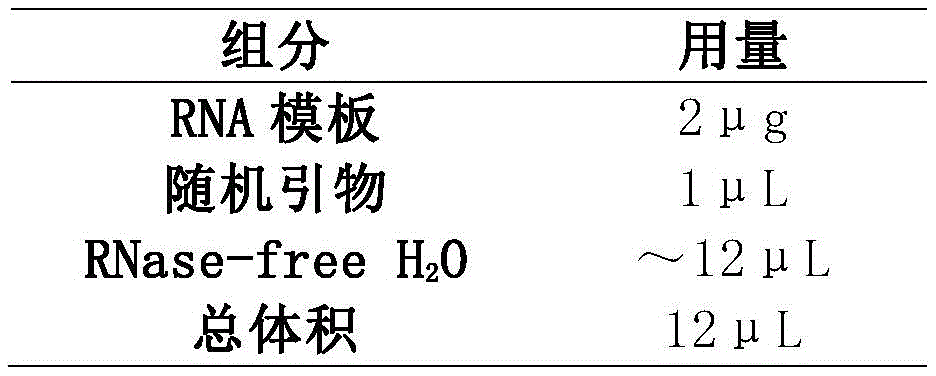
(ix)按以上体系将反应物加入PCR管中,PCR仪内65℃,5min,立即放于冰上,再向管中加入以下成份:(ix) Add the reactant to the PCR tube according to the above system, put it in the PCR instrument at 65°C for 5 minutes, put it on ice immediately, and then add the following ingredients into the tube:

轻轻混匀并瞬时离心,置于PCR仪中进行如下反应:25℃,5min;42℃,1h;70℃,5min;Gently mix and centrifuge briefly, place in a PCR instrument for the following reactions: 25°C, 5min; 42°C, 1h; 70°C, 5min;
(x)荧光实时定量PCR检测NKG2D配体表达,具体操作根据Thermo powerupTM SYBRGreen Master Mix(A25742)试剂盒说明书进行,程序:50℃,2min;95℃,2min;95℃,15s(40个循环);60℃,1min(40个循环);12℃,forever;(x) Fluorescent real-time quantitative PCR was used to detect the expression of NKG2D ligands. The specific operation was carried out according to the instructions of the Thermo powerup TM SYBRGreen Master Mix (A25742) kit, the program: 50°C, 2min; 95°C, 2min; 95°C, 15s (40 cycles ); 60°C, 1min (40 cycles); 12°C, forever;
(xi)导出Excel格式的数据,计算目的基因的相对表达量。(xi) Export the data in Excel format to calculate the relative expression level of the target gene.
(2)NKG2D配体膜表面表达检测(2) NKG2D ligand membrane surface expression detection
(i)胰酶消化并收集10cm皿的衰老组和正常组细胞,PBS洗细胞一次;(i) trypsinize and collect the aging group and the normal group cells in a 10cm dish, and wash the cells once with PBS;
(ii)700μL含1%FBS的PBS重悬细胞(轻轻吹打混匀,以防产生过多气泡);(ii) 700 μL of PBS containing 1% FBS to resuspend the cells (gently pipette and mix to prevent excessive air bubbles);
(iii)将细胞平均分配到7个1.5mL EP中,每管含100μL PBS;(iii) Divide the cells equally into seven 1.5mL EPs, each containing 100μL PBS;
(iv)按1:50的比例稀释抗体;(iv) Dilute the antibody at a ratio of 1:50;
(v)每管细胞中分别加入100μL抗体;(v) Add 100 μL of antibody to each tube of cells;
(vi)冰上避光孵育至少30min,每隔十分钟轻轻涡旋振荡一次;(vi) Incubate on ice in the dark for at least 30 minutes, and vortex gently every ten minutes;
(vii)加入1mL含1%FBS的PBS洗细胞2次,800g 5min;(vii) Add 1 mL of PBS containing 1% FBS to wash the cells twice, 800 g for 5 min;
(viii)加入200μL含1%FBS的PBS重悬细胞,流式检测NKG2D配体表达。(viii) 200 μL of PBS containing 1% FBS was added to resuspend the cells, and the expression of NKG2D ligand was detected by flow cytometry.
3.慢病毒表达载体构建3. Construction of lentiviral expression vector
本发明采用了第二代CAR结构。以人NKG2D胞外域链为识别片段,由强启动子CMV驱动其表达,信号肽(SP)和NKG2D序列后依次连入人CD8α铰链区(CD8Hinge)、人CD8α跨膜区(CD8 TM),4-1BB共刺激结构域以及CD3ζ激活结构域。本发明以不含NKG2D胞外域序列的Mock载体为阴性对照。NKG2D CAR载体结构如图3A所示。CD8SP-NKG2D EC-CD8 Hinge andTM-41BB-CD3ζ由北京擎科生物科技有限公司合成后,通过XbaI和SalI酶切位点克隆到pTomo慢病毒载体中。The present invention adopts the second-generation CAR structure. The human NKG2D ectodomain chain is used as a recognition fragment, and its expression is driven by a strong promoter CMV. The signal peptide (SP) and NKG2D sequence are sequentially linked into the human CD8α hinge region (CD8Hinge), human CD8α transmembrane region (CD8 TM), 4 -1BB co-stimulatory domain and CD3ζ activation domain. In the present invention, a Mock vector without NKG2D extracellular domain sequence is used as a negative control. The structure of the NKG2D CAR vector is shown in Figure 3A. After CD8SP-NKG2D EC-CD8 Hinge and TM-41BB-CD3ζ were synthesized by Beijing Qingke Biotechnology Co., Ltd., they were cloned into pTomo lentiviral vector through XbaI and SalI restriction sites.
SP(SEQ ID NO:7):SP (SEQ ID NO: 7):
atggccctgcccgtcaccgctctgctgctgccccttgctctgcttcttcatgcagcaaggccgatggccctgcccgtcaccgctctgctgctgccccttgctctgcttcttcatgcagcaaggccg
NKG2D EC(SEQ ID NO:8):NKG2D EC (SEQ ID NO: 8):
atatggagtgctgtattcctaaactcattattcaaccaagaagttcaaattcccttgaccgaaagttactgtggcccatgtcctaaaaactggatatgttacaaaaataactgctaccaattttttgatgagagtaaaaactggtatgagagccaggcttcttgtatgtctcaaaatgccagccttctgaaagtatacagcaaagaggaccaggatttacttaaactggtgaagtcatatcattggatgggactagtacacattccaacaaatggatcttggcagtgggaagatggctccattctctcacccaacctactaacaataattgaaatgcagaagggagactgtgcactctatgcctcgagctttaaaggctatatagaaaactgttcaactccaaatacgtacatctgcatgcaaaggactgtgatatggagtgctgtattcctaaactcattattcaaccaagaagttcaaattcccttgaccgaaagttactgtggcccatgtcctaaaaactggatatgttacaaaaataactgctaccaattttttgatgagagtaaaaactggtatgagagccaggcttcttgtatgtctcaaaatgccagccttctgaaagtatacagca aagaggaccaggatttacttaaactggtgaagtcatatcattggatgggactagtacacattccaaaatggatcttggcagtgggaagatggctccattctctcacccaacctactaacaataattgaaatgcagaagggagactgtgcactctatgcctcgagctttaaaggctatatagaaaactgttcaactccaaatacgtacatctgcatgcaaag gactgtg
CD8铰链区和跨膜区(SEQ ID NO:9):CD8 hinge region and transmembrane region (SEQ ID NO:9):
accacgacgccagcgccgcgaccaccaacaccggcgcccaccatcgcgtcgcagcccctgtccctgcgcccagaggcgtgccggccagcggcggggggcgcagtgcacacgagggggctggacttcgcctgtgatatctacatctgggcgcccttggccgggacttgtggggtccttctcctgtcactggttatcaccctttactgcaccacgacgccagcgccgcgaccaccaacaccggcgcccaccatcgcgtcgcagcccctgtccctgcgcccagaggcgtgccggccagcggcggggggcgcagtgcacacgagggggctggacttcgcctgtgatatctacatctggcgcccttggccgggacttgtggggtccttctcctgtcact ggttatcaccctttactgc
4-1BB共刺激信号分子(SEQ ID NO:10):4-1BB co-stimulatory signal molecule (SEQ ID NO: 10):
aaacggggcagaaagaaactcctgtatatattcaaacaaccatttatgagaccagtacaaactactcaagaggaagatggctgtagctgccgatttccagaagaagaagaaggaggatgtgaactgaaacggggcagaaagaaactcctgtatatattcaaacaaccatttatgagaccagtacaaactactcaagaggaagatggctgtagctgccgatttccagaagaagaagaaggaggatgtgaactg
CD3ζ胞内信号传导结构域(SEQ ID NO:11):CD3ζ intracellular signaling domain (SEQ ID NO: 11):
agagtgaagttcagcaggagcgcagacgcccccgcgtacaagcagggccagaaccagctctataacgagctcaatctaggacgaagagaggagtacgatgttttggacaagagacgtggccgggaccctgagatggggggaaagccgagaaggaagaaccctcaggaaggcctgtacaatgaactgcagaaagataagatggcggaggcctacagtgagattgggatgaaaggcgagcgccggaggggcaaggggcacgatggcctttaccagggtctcagtacagccaccaaggacacctacgacgcccttcacatgcaggccctgccccctcgctaaagagtgaagttcagcaggagcgcagacgcccccgcgtacaagcagggccagaaccagctctataacgagctcaatctaggacgaagagaggagtacgatgttttggacaagagacgtggccgggaccctgagatggggggaaagccgagaaggaagaaccctcaggaaggcctgtacaatgaactgcagaaagataagatggcgg aggcctacagtgagattgggatgaaaggcgagcgccggaggggcaaggggcacgatggcctttaccagggtctcagtacagccaccaaggacacctacgacgcccttcacatgcaggccctgccccctcgctaa
4.病毒包装4. Viral packaging
(i)质粒准备:慢病毒包装的核心质粒pCMV△8.9和pMD2.G均用QIAGEN EndoFreePlasmid Maxi Kit进行大抽,慢病毒表达核心质粒pTomo-NKG2D-CAR-T2A-mKATE,pTomo-Mock CAR用QIAGEN Plasmid Midi Kit进行中抽。(i) Plasmid preparation: the core plasmids pCMV△8.9 and pMD2.G for lentiviral packaging were extracted with QIAGEN EndoFreePlasmid Maxi Kit, and the lentiviral expression core plasmids pTomo-NKG2D-CAR-T2A-mKATE and pTomo-Mock CAR were used for QIAGEN The Plasmid Midi Kit is in the draw.
(ii)293T细胞准备:病毒包装前24h,丰度90%以上的293T细胞,按1:2.5的比例进行细胞传代,每15cm培养皿中加入25mL含有10%血清,不含双抗的DMEM培养基培养。包装前4~6h,对皿中的细胞进行“半换液”处理,即吸掉15mL培养基上清,并向其中补加15mL仅含10%血清,无双抗的DMEM培养基,以将细胞状态调整至最佳。当皿中细胞密度达到80%~90%时,即可进行病毒包装。(ii) 293T cell preparation: 24 hours before virus packaging, 293T cells with an abundance of more than 90% were subcultured at a ratio of 1:2.5, and 25 mL of DMEM containing 10% serum and no double antibody was added to each 15 cm culture dish. base culture. 4 to 6 hours before packaging, the cells in the dish were treated with "half exchange", that is, 15 mL of the medium supernatant was sucked off, and 15 mL of DMEM medium containing only 10% serum and no double antibody was added to it, so that the cells The state is adjusted to the best. When the cell density in the dish reaches 80%-90%, the virus packaging can be carried out.
(iii)质粒转染过程:准备两个15mL的离心管,向其中分别加入2mL无血清无双抗的DMEM基础培养基。其中一管加入20μg核心质粒、10μg pCMV△8.9、4μg pMD2.G(核心质粒:pCMV8.9:pMD2.G=5:2.5:1)混匀,记为A液;另一管加入68μL的Lipo6000转染试剂,与培养基混匀,并静置5min,计为B液;A液、B液混匀,室温静置20min。(iii) Plasmid transfection process: two 15 mL centrifuge tubes were prepared, and 2 mL of serum-free and double-antibody-free DMEM basal medium were added to each of them. Add 20 μg core plasmid, 10 μg pCMV△8.9, 4 μg pMD2.G (core plasmid: pCMV8.9: pMD2.G = 5:2.5:1) to one tube, mix well, and record it as solution A; add 68 μL Lipo6000 to the other tube Mix the transfection reagent with the medium, and let it stand for 5 minutes, and count it as solution B; mix the solutions A and B, and let it stand at room temperature for 20 minutes.
(a)移液枪吸去14mL 293T培养皿中的上清(余11mL培养基),将上述4mL混合液,轻轻滴加入293T细胞中,于37℃细胞培养箱中培养。(a) Remove the supernatant (remaining 11mL medium) in the 14mL 293T culture dish with a pipette gun, and gently drop the above 4mL mixture into the 293T cells, and culture them in a cell culture incubator at 37°C.
(b)8h后将皿中293T的培养基更换为16mL含5%血清,1%双抗的DMEM培养基。(b) After 8 hours, replace the medium of 293T in the dish with 16 mL of DMEM medium containing 5% serum and 1% double antibody.
(iv)收病毒:包装48h后收集15mL含病毒的培养基上清,再补加15m含5%血清,1%双抗的DMEM培养基,包装72h后再次收集病毒上清;(iv) Receive virus: collect 15mL virus-containing culture medium supernatant after packaging for 48 hours, add 15mL of DMEM medium containing 5% serum and 1% double antibody, and collect virus supernatant again after packaging for 72 hours;
(v)浓缩病毒:将两次收集到的培养基上清在4℃条件下以3000rmp转速离心15min;0.45μm滤膜过滤,取30mL过滤后的病毒液于超速离心管中,并移液枪将5mL 20%蔗糖溶液匀速、缓慢地加入离心管底部;25000rmp 4℃条件下低温超速离心2.5h;(v) Concentrate the virus: centrifuge the culture supernatant collected twice at 4°C at 3000rmp for 15min; filter with a 0.45μm filter membrane, take 30mL of the filtered virus solution in an ultracentrifuge tube, and pipette Add 5mL of 20% sucrose solution to the bottom of the centrifuge tube at a constant speed and slowly; ultracentrifuge at 25000rmp and 4°C for 2.5h at low temperature;
(vi)溶解病毒:倒掉上清,将离心管倒扣在喷有酒精的纸巾上,室温干燥5min,吸掉离心管管壁剩余的液滴(或用喷有酒精的纸巾擦干液滴);每管中加入适当体积的0.1%BSA的PBS于4℃过夜溶解病毒。(vi) Dissolving virus: Pour off the supernatant, put the centrifuge tube upside down on a paper towel sprayed with alcohol, dry at room temperature for 5 minutes, absorb the remaining droplets on the wall of the centrifuge tube (or dry the droplets with a paper towel sprayed with alcohol) ); Add an appropriate volume of 0.1% BSA in PBS to each tube to dissolve the virus overnight at 4°C.
(vii)分装及保存病毒:过夜溶解后的病毒悬液于冰上分装成10μL每份,置于1.5mL EP管中,-80℃条件下储存。(vii) Aliquoting and preserving virus: the virus suspension dissolved overnight was divided into 10 μL portions on ice, placed in 1.5 mL EP tubes, and stored at -80°C.
(viii)QPCR法测定病毒滴度(viii) Determination of virus titer by QPCR method
取3μL病毒原液,梯度稀释为10倍,100倍,1000倍,10000倍,作为qPCR模板,每一梯度设置3个重复;参照
反应体系:reaction system:
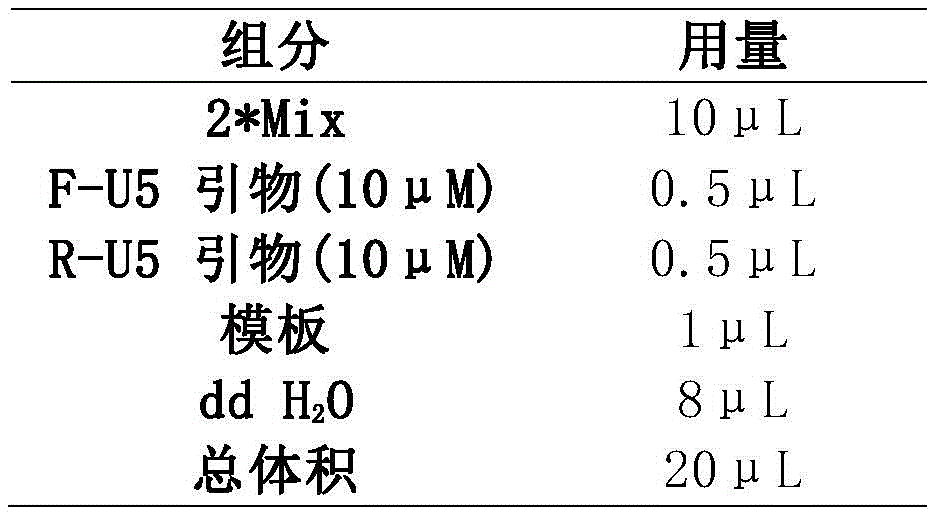
反应程序:Reaction procedure:
50℃,2min;50℃, 2min;
95℃,2min;95℃, 2min;
95℃,15sec;95℃, 15sec;
60℃,1min;60℃, 1min;
第3和第4步共40个循环。
5.人体外周血T淋巴细胞分离5. Isolation of human peripheral blood T lymphocytes
(i)将人体外周血转移至50mL离心管中,添加RosetteSepTMCocktail至血液中(50μL/mL血液);(i) Human peripheral blood was transferred to a 50mL centrifuge tube, and RosetteSep TM Cocktail was added to the blood (50μL/mL blood);
(ii)充分混匀后,室温孵育20min;(ii) After fully mixing, incubate at room temperature for 20 minutes;
(iii)配制稀释液:将1640培养基与1*PBS按体积比1:2混合;(iii) Preparation of dilution: mix 1640 medium with 1*PBS at a volume ratio of 1:2;
(iv)准备梯度离心管,加入15mL梯度分离液Ficol Lymphoprep;(iv) Prepare a gradient centrifuge tube and add 15 mL of gradient separation solution Ficol Lymphoprep;
(v)将稀释液与孵育血样按1:1混合;(v) Mix the diluent and the incubated blood sample 1:1;
(vi)将稀释血样轻柔转移至分离液上,1200g离心20min;(vi) Gently transfer the diluted blood sample to the separation medium, and centrifuge at 1200g for 20min;
(vii)将离心后的全部上清液快速转移至新的离心管;(vii) quickly transfer all the supernatant after centrifugation to a new centrifuge tube;
(viii)用25mL的稀释液与上清混合均匀,300g离心10min;(viii) Mix evenly with 25mL of diluent and supernatant, and centrifuge at 300g for 10min;
(ix)重复操作步骤(viii);(ix) repeat operation step (viii);
(x)加入2mL T细胞完全培养基重悬T细胞,计数、分装、冻存。(x) Add 2 mL of T cell complete medium to resuspend T cells, count, aliquot and freeze.
6.猕猴/食蟹猴T细胞分离6. Macaque/cynomolgus T cell isolation
(i)配制稀释液:含2%FBS的1xPBS;(i) Prepare diluent: 1xPBS containing 2% FBS;
(ii)向15ml离心管中加入采集的5ml猴子全血,加入等量的稀释液并缓慢混匀;(ii) Add 5ml of monkey whole blood collected into a 15ml centrifuge tube, add an equal amount of diluent and mix slowly;
(iii)准备梯度离心管,加入15ml Ficol Lymphoprep离心液;(iii) Prepare a gradient centrifuge tube and add 15ml of Ficol Lymphoprep centrifugal solution;
(iv)将移液器调至0档,而后把稀释的血液样本轻柔转移至分离液上,离心10min,离心速度为1200g;(iv) Adjust the pipette to
(v)将上层含有淋巴细胞层的液体迅速转移到干净的50ml离心管中并加入等量稀释的液体轻轻混匀,离心10min,离心速度为500g;(v) Quickly transfer the liquid containing the lymphocyte layer in the upper layer to a clean 50ml centrifuge tube, add an equal amount of diluted liquid and mix gently, and centrifuge for 10min at a speed of 500g;
(vi)重复操作步骤(v),取一定量的T细胞培养基重悬细胞,计数;(vi) Repeat operation step (v), take a certain amount of T cell culture medium to resuspend cells, and count;
(vii)将细胞直接用非人灵长类T细胞培养基培养,25ul磁珠(非人灵长类)/1x106细胞;(vii) Culture the cells directly with non-human primate T cell medium, 25ul magnetic beads (non-human primate)/1x10 6 cells;
(viii)非人灵长类用T细胞培养基配制:(viii) Preparation of T cell culture medium for non-human primates:
向1640基础培养基中加入10%胎牛血清,1%P/S,1%谷氨酸盐添加剂,1%巯基乙醇以及0.02%IL2,混匀。Add 10% fetal bovine serum, 1% P/S, 1% glutamate supplement, 1% mercaptoethanol and 0.02% IL2 to the 1640 basal medium, and mix well.
(ix)非人灵长类T细胞培养磁珠激活:(ix) Non-human primate T cell culture magnetic beads activation:
a.准备1xPBS:将1ml 1xBPS分装到1.5ml EP管中并存放于4℃冰箱预冷;a. Prepare 1xPBS: Dispense 1ml 1xBPS into 1.5ml EP tubes and store in 4°C refrigerator to pre-cool;
b.将CD2、CD3、CD28和磁珠以1:1:1:1混匀;b. Mix CD2, CD3, CD28 and magnetic beads at a ratio of 1:1:1:1;
c.将预冷的1×PBS和步骤b中混匀的液体1:1混匀,放于4℃静音混悬仪上孵育2h后即可使用。c. Mix the pre-cooled 1×PBS and the liquid mixed in step b at a ratio of 1:1, and incubate on a 4°C silent suspension apparatus for 2 hours before use.
7.T细胞纯度分析7. T cell purity analysis
(i)用200ul 1xPBS(含2%FBS)重悬分离的T细胞;(i) resuspend isolated T cells with 200ul 1xPBS (containing 2% FBS);
(ii)向重悬的细胞中加入2ul CD3抗体,混匀,放置于冰上孵育30min,期间每隔10min涡旋一次细胞,以500g的速度离心5min,弃上清;(ii) Add 2ul CD3 antibody to the resuspended cells, mix well, place on ice and incubate for 30min, vortex the cells every 10min during this period, centrifuge at 500g for 5min, and discard the supernatant;
(iii)加入1ml 1xPBS(含2%FBS)重悬细胞,500g离心5min;(iii) add 1ml 1xPBS (containing 2% FBS) to resuspend the cells, and centrifuge at 500g for 5min;
(iv)重复步骤(iii);(iv) repeat step (iii);
(v)加入200ul 1xPBS(含2%FBS)重悬细胞;(v) add 200ul 1xPBS (containing 2% FBS) to resuspend the cells;
(vi)流式仪检测CD3阳性的T细胞。(vi) Detection of CD3 positive T cells by flow cytometry.
8.T细胞杀伤实验8. T cell killing experiment
(1)NKG2D CAR-T细胞构建(1) Construction of NKG2D CAR-T cells
(i)复苏T细胞,加入CD3/CD28磁珠以及含IL-2的T细胞培养基培养T细胞3天以激活T细胞;(i) recovering T cells, adding CD3/CD28 magnetic beads and T cell medium containing IL-2 to culture T cells for 3 days to activate T cells;
(ii)取10^6个T细胞,于96孔板中,以MOI=100加入相应体积的NKG2D CAR病毒,同时加入polybrene(终浓度8μg/mL);(ii) Take 10 ^6 T cells and add corresponding volume of NKG2D CAR virus at MOI=100 to a 96-well plate, and add polybrene (
(iii)收集感染病毒后的T细胞于1.5mL离心管中,500g离心3min,弃上清;(iii) Collect virus-infected T cells in a 1.5mL centrifuge tube, centrifuge at 500g for 3min, and discard the supernatant;
(iv)500μL培养基将T细胞重悬,并转移至24孔板中培养,孔中培养基的总体积为1.5mL;(iv) T cells were resuspended in 500 μL medium, and transferred to a 24-well plate for culture, and the total volume of the medium in the well was 1.5 mL;
(v)培养4天后,流式检测荧光表达情况。(v) After 4 days of culture, the fluorescence expression was detected by flow cytometry.
(2)CAR-T细胞和衰老细胞共培养(2) Co-culture of CAR-T cells and senescent cells
(i)提前8~9天准备衰老细胞于96孔板中,共培养时衰老细胞密度约为5000个/孔,正常组细胞于24h前以5000/孔铺板于96孔板中;(i) Prepare senescent cells in a 96-well plate 8-9 days in advance, the density of senescent cells is about 5000/well during co-cultivation, and the cells of the normal group are plated in a 96-well plate at 5000/well 24 hours before;
(ii)300g离心5min收集CAR-T细胞,用1mL的T细胞完全培养基重悬CAR-T细胞,抽取10μL细胞悬液,用0.4%的台盼蓝染色后计数活细胞;(ii) Collect CAR-T cells by centrifugation at 300g for 5 minutes, resuspend the CAR-T cells with 1 mL of T cell complete medium, extract 10 μL of cell suspension, and count live cells after staining with 0.4% trypan blue;
(iii)接种CAR-T细胞:计数后调整CAR-T细胞密度,按效靶比1:2,1:1和2:1的比例,将CAR-T细胞轻轻加入靶细胞所在的96孔板中,每孔含150μL T细胞培养基。(iii) Inoculation of CAR-T cells: After counting, adjust the density of CAR-T cells, and gently add CAR-T cells into the 96 wells where the target cells are located according to the ratio of effect to target ratio of 1:2, 1:1 and 2:1 In the plate, each well contained 150 μL of T cell medium.
(iv)CAR-T细胞与靶细胞在5%CO2,37℃条件下共培养6~12h,直至出现衰老组细胞杀伤表型。(iv) The CAR-T cells and the target cells are co-cultured for 6-12 hours under the condition of 5% CO 2 and 37° C., until the cell killing phenotype of the aging group appears.
(3)CAR-T细胞杀伤效率定量(3) Quantification of CAR-T cell killing efficiency
(i)共培养6~12h出现杀伤表型后,此时移除靶细胞中的培养基,并用PBS洗细胞一次;(i) After the killing phenotype appears after 6-12 hours of co-culture, the medium in the target cells is removed at this time, and the cells are washed once with PBS;
(ii)用8道移液器吸取100μL 95%乙醇加入靶细胞中进行固定;(ii) Use an 8-channel pipette to absorb 100 μL of 95% ethanol and add it to the target cells for fixation;
(iii)3min后移去95%酒精,按照1:1000比例稀释DAPI原液(浓度:1mg/mL),避光染色2min;(iii) After 3 minutes, remove 95% alcohol, dilute the DAPI stock solution (concentration: 1 mg/mL) according to the ratio of 1:1000, and stain in the dark for 2 minutes;
(iv)移除DAPI,每孔加入200μL PBS;(iv) DAPI was removed, and 200 μL of PBS was added to each well;
(v)将96孔板放入高内涵仪器中,进行拍照计数统计,每孔选取中间9个视野,同一视野中使用IL-10,DAPI通道各拍摄一张照片;(v) Put the 96-well plate into a high-content instrument, take pictures and count statistics, select the middle 9 fields of view for each well, use IL-10 in the same field of view, and take a photo for each DAPI channel;
(vi)使用高内涵仪器分析软件中的overlay模块将IL-10,DAPI通道照片叠加并导出;(vi) Use the overlay module in the high-content instrument analysis software to superimpose and export IL-10 and DAPI channel photos;
(vii)用ImageJ软件对导出的照片进行计数,统计存活的靶细胞的个数;(vii) count the exported photos with ImageJ software, and count the number of surviving target cells;
(viii)杀伤效率=(Blank组靶细胞数量-共培养组靶细胞数量)/Blank组靶细胞数量*100%(viii) killing efficiency=(number of target cells in Blank group-number of target cells in co-culture group)/number of target cells in Blank group*100%
9.穿孔素、颗粒酶含量测定9. Determination of perforin and granzyme content
本发明中使用ELISA法测定穿孔素与颗粒酶含量,实验所用样品为T细胞与DNA损伤诱导衰老IMR90细胞共培养12h(穿孔素)或24h(颗粒酶)的细胞上清。收集上清后,以2000g的转速离心10min,暂存于-80℃。按照Abcam公司的Perforin(PRF1)Human ELISA试剂盒(ab46068)以及Human Granzyme B SimpleStep ELISA试剂盒(ab235635)的使用说明分别配制标准品,绘制标准曲线,并对样品中穿孔素与颗粒酶的含量分别进行测定。后续使用GraphPad Prism软件进行数据分析。In the present invention, the ELISA method is used to measure the content of perforin and granzyme, and the sample used in the experiment is the cell supernatant of T cells co-cultured with DNA damage-induced aging IMR90 cells for 12h (perforin) or 24h (granzyme). After collecting the supernatant, centrifuge at a speed of 2000g for 10min and temporarily store at -80°C. According to the instructions of Abcam's Perforin (PRF1) Human ELISA kit (ab46068) and Human Granzyme B SimpleStep ELISA kit (ab235635), standard products were prepared respectively, a standard curve was drawn, and the contents of perforin and granzyme in the samples were respectively analyzed. To measure. Follow-up data analysis was performed using GraphPad Prism software.
10.感染病毒前后CD4/CD8阳性T细胞检测10. Detection of CD4/CD8 positive T cells before and after virus infection
(i)病毒感染猕猴/食蟹猴T细胞3天以后,将细胞吹散并收集液体到离心管中,将收集的细胞悬液离心,收集沉淀下来的CAR-T细胞(500g/5min);(i) 3 days after the virus infected macaque/cynomolgus monkey T cells, the cells were blown away and the liquid was collected into a centrifuge tube, the collected cell suspension was centrifuged, and the precipitated CAR-T cells were collected (500g/5min);
(ii)用4℃左右的1×PBS(含2%FBS)将细胞洗涤2次;(ii) Wash the cells twice with 1×PBS (containing 2% FBS) at about 4°C;
(iii)用400ul 1×PBS(含2%FBS)重悬细胞,每组细胞分成等量的两份,按1:200分别向CAR-T细胞悬液中加入CD4和CD8的抗体,在冰上避光孵育1h;(iii) Resuspend the cells with
(iv)再次用1×PBS(含2%FBS)清洗孵育过抗体的T细胞2次;(iv) wash the T cells incubated with the antibody twice again with 1×PBS (containing 2% FBS);
(v)而后用适量的1×PBS(含2%FBS)重悬CAR-T细胞,并将其转移至流式管中,流式检测CD4/CD8阳性细胞率;(v) Then resuspend the CAR-T cells with an appropriate amount of 1×PBS (containing 2% FBS), transfer them to a flow tube, and detect the CD4/CD8 positive cell rate by flow cytometry;
11.NKG2D CAR-T细胞回输到猕猴/食蟹猴体内11. NKG2D CAR-T cells reinfused into macaques/cynomolgus monkeys
(i)收集感染病毒72h后的猴子T细胞(即CAR-T细胞),去掉细胞培养基中的磁珠(将细胞悬液转移到无菌流式管中,而后将流式管放到磁体中放置1min,将流式管中的液体迅速加入到15ml大小体积的离心管中),在500g转速的离心机中离心5min并收集离心下来的细胞沉淀;(i) Collect monkey T cells (i.e. CAR-T cells) after 72 hours of virus infection, remove the magnetic beads in the cell culture medium (transfer the cell suspension to a sterile flow tube, and then put the flow tube into the magnet Place in the tube for 1 min, quickly add the liquid in the flow tube to a 15ml centrifuge tube), centrifuge in a centrifuge at a speed of 500g for 5 min and collect the centrifuged cell pellet;
(ii)用4℃左右的1xPBS清洗细胞,500g离心5min;(ii) Wash the cells with 1xPBS at about 4°C, and centrifuge at 500g for 5min;
(iii)重复步骤2);(iii) repeat step 2);
(iv)将离心下来的细胞用1ml的1640基础培养基重悬;(iv) resuspend the centrifuged cells with 1ml of 1640 basal medium;
(v)将重悬的细胞用1ml注射器回输入猴子大腿内测静脉中。(v) The resuspended cells were reinfused into the internal femoral vein of the monkey with a 1 ml syringe.
12.猕猴/食蟹猴血常规和生化指标检测12. Rhesus monkey/cynomolgus monkey blood routine and biochemical index detection
(i)血常规检测(i) routine blood test
a)取200ul新鲜血液到抗凝管中,轻晃摇匀;a) Take 200ul of fresh blood into the anticoagulant tube, shake gently;
b)上机(HEMAVET 950动物五分类血球仪)检测。b) On-machine (HEMAVET 950 animal five-category hematology analyzer) detection.
(ii)生化指标检测(ii) Detection of biochemical indicators
a)采集1ml血液到无抗凝剂的采血管中,常温静置2h后离心,取上层血清400ul上机(罗氏I400全自动生化仪)检测。a) Collect 1ml of blood into a blood collection tube without anticoagulant, let it stand at room temperature for 2 hours, then centrifuge, and take 400ul of the upper serum for detection on a machine (Roche I400 automatic biochemical analyzer).
13.猕猴/食蟹猴血清细胞因子检测13. Cytokine detection in macaque/cynomolgus monkey serum
收集猕猴/食蟹猴在回输细胞前后不同时间段的血清,送优宁维公司(上海)进行多细胞因子检测。The serum of macaques/cynomolgus monkeys was collected at different time periods before and after the reinfusion of cells, and sent to Unionwell (Shanghai) for multi-cytokines detection.
实施例1:衰老细胞模型的建立Example 1: Establishment of Senescent Cell Model
不同因素诱导的细胞衰老,代表了细胞衰老的不同类型,涉及的分子标记以及信号通路等均有所不同。为展开抗衰老的相关研究,并使研究结果更具有广谱性,本发明利用不同诱导因素构建了一系列的衰老细胞模型,为后续研究奠定基础:1.通过DNA损伤药物Etoposide(Et)处理人胚肺细胞IMR90诱导衰老;2.使用DOX诱导IMR90细胞过表达p16蛋白诱导衰老;3.在IMR90细胞中过表达癌基因Kras G12D诱导衰老;4.体外连续培养IMR90细胞,建立自然衰老细胞模型。利用SA-βgal染色对以上模型进行验证,可见阳性率均为90%以上(图1A,B)。p16表达升高是衰老细胞的典型特征之一。Cell senescence induced by different factors represents different types of cell senescence, involving different molecular markers and signaling pathways. In order to carry out anti-aging related research and make the research results more broad-spectrum, the present invention uses different inducing factors to construct a series of senescent cell models, laying the foundation for follow-up research: 1. Treatment by DNA damage drug Etoposide (Et) Human embryonic lung cell IMR90 induces senescence; 2. Use DOX to induce IMR90 cells to overexpress p16 protein to induce senescence; 3. Overexpress the oncogene Kras G12D in IMR90 cells to induce senescence; 4. Continuously culture IMR90 cells in vitro to establish a natural senescent cell model . The above models were verified by SA-βgal staining, and the positive rates were above 90% (Fig. 1A, B). Increased expression of p16 is one of the typical characteristics of senescent cells.
荧光实时定量PCR检测衰老细胞模型的p16的表达,实验结果显示DOX诱导p16表达诱导衰老组细胞p16上调25~30倍,其他三种模型中p16表达上调2~3倍(图1C)。Fluorescent real-time quantitative PCR was used to detect the expression of p16 in the senescent cell model. The experimental results showed that p16 expression was induced by DOX to increase the expression of p16 in the aging group by 25-30 times, and the expression of p16 in the other three models was up-regulated by 2-3 times (Figure 1C).
实施例2:衰老细胞模型NKG2D配体表达上调Example 2: Up-regulation of NKG2D ligand expression in senescent cell model
已有文献研究表明,衰老细胞表面NKG2D配体表达显著上调,是NK细胞是机体清除衰老细胞的主要靶点。Existing literature studies have shown that the expression of NKG2D ligands on the surface of senescent cells is significantly up-regulated, which means that NK cells are the main target for the body to eliminate senescent cells.
在本实施例中,检测了以上四种细胞衰老模型中NKG2D主要配体MICA、MICB、ULBP2、ULBP2以及ULBP3的表达,结果显示RNA和蛋白水平NKG2D配体的表达均存在上调,其中MICA、ULBP1、ULBP2上调最为显著(图2A、B)。In this example, the expression of NKG2D main ligands MICA, MICB, ULBP2, ULBP2, and ULBP3 in the above four cell aging models were detected, and the results showed that the expression of NKG2D ligands at the RNA and protein levels were all up-regulated, among which MICA, ULBP1 , ULBP2 was most significantly up-regulated (Fig. 2A, B).
实施例3:NKG2D CAR-T细胞对衰老细胞杀伤检测Example 3: Detection of NKG2D CAR-T cells killing senescent cells
NKG2D配体在衰老细胞中表达上调,预示NKG2D CAR-T细胞理应具有清除衰老细胞的作用。为了验证以上猜想,我们构建了CMV启动子驱动表达,以NKG2D胞外域为识别序列,4-1BB和CD3ζ为共刺激结构信号的二代CAR-T细胞(图3A,B)。为了检测所构建的NKG2D CAR-T细胞对衰老细胞是否具有杀伤作用,本实施例中,把对照T细胞和CAR-T细胞分别与IMR90-p16衰老细胞按2:1效靶比体外共培养。NKG2D ligands are up-regulated in senescent cells, indicating that NKG2D CAR-T cells should have the effect of clearing senescent cells. In order to verify the above conjecture, we constructed the second-generation CAR-T cells with CMV promoter-driven expression, NKG2D extracellular domain as the recognition sequence, and 4-1BB and CD3ζ as co-stimulatory structural signals (Fig. 3A, B). In order to test whether the constructed NKG2D CAR-T cells have a killing effect on senescent cells, in this example, control T cells and CAR-T cells were co-cultured with IMR90-p16 senescent cells in vitro at a 2:1 effect-to-target ratio.
10小时后观察可见,与Mock对照共培养体系相比,衰老组IMR90-p16细胞数量明显减少,说明NKG2D对衰老IMR90-p16细胞具有显著杀伤作用(图3C)。After 10 hours, it was observed that compared with the Mock control co-culture system, the number of IMR90-p16 cells in the aging group was significantly reduced, indicating that NKG2D had a significant killing effect on aging IMR90-p16 cells (Figure 3C).
为了进一步验证NKG2D CAR-T细胞是否能够杀伤多种类型的衰老细胞,在IMR90-Rep和IMR90-Et衰老细胞模型中重复以上实验,均得到类似的实验结果(图3C,D),说明NKG2D CAR-T细胞对衰老细胞的清除作用具有广谱性。取对照T细胞和NKG2D CAR-T细胞分别与IMR90-Et衰老细胞共培养体系中的上清分析,可见后者穿孔素和颗粒酶释放显著上调(图3E)。In order to further verify whether NKG2D CAR-T cells can kill various types of senescent cells, the above experiments were repeated in the IMR90-Rep and IMR90-Et senescent cell models, and similar experimental results were obtained (Fig. 3C, D), indicating that NKG2D CAR - T cells have a broad-spectrum clearance of senescent cells. Analysis of the supernatants of control T cells and NKG2D CAR-T cells co-cultured with IMR90-Et senescent cells showed that the release of perforin and granzyme was significantly up-regulated in the latter (Fig. 3E).
以上结果均说明:NKG2D CAR-T细胞对衰老细胞具有显著杀伤作用。The above results all indicate that NKG2D CAR-T cells have a significant killing effect on senescent cells.
实施例4:NKG2D CAR-T安全性Example 4: NKG2D CAR-T Safety
肿瘤相关抗原在正常细胞上的表达通常会导致严重的脱靶现象,从而阻止了CAR-T治疗的临床应用。在大多数人体正常组织中,包括甲状腺、舌头、食道上皮、胃粘膜、空肠粘膜、回肠粘膜、阑尾、直肠粘膜、肝、胰腺、气管、肺、心肌、心肌、动脉、骨骼肌、精囊、前列腺、膀胱、睾丸、延髓、端脑、前脑、脑干和脾脏,均未检测到NKG2D主要配体MICA的表达,仅皮肤呈弱阳性(图4A)。The expression of tumor-associated antigens on normal cells often leads to serious off-target phenomena, which prevents the clinical application of CAR-T therapy. In most human normal tissues, including thyroid, tongue, esophageal epithelium, gastric mucosa, jejunal mucosa, ileal mucosa, appendix, rectal mucosa, liver, pancreas, trachea, lung, myocardium, cardiac muscle, artery, skeletal muscle, seminal vesicle, prostate , bladder, testis, medulla oblongata, telencephalon, forebrain, brainstem and spleen, the expression of MICA, the main ligand of NKG2D, was not detected, and only the skin was weakly positive (Fig. 4A).
考虑到慢病毒介导的基因转移可能引起基因组不稳定和细胞恶性转化,因此还通过染色体核型分析以评估慢病毒感染CAR表达的安全性。与未转导的T细胞相比,NKG2D-BBzCAR-T细胞在感染病毒后14后未观测到异常核型(图4B)。Considering that lentivirus-mediated gene transfer may cause genome instability and malignant transformation of cells, karyotype analysis was also performed to evaluate the safety of CAR expression in lentivirus infection. Compared with untransduced T cells, no abnormal karyotype was observed in NKG2D-BBzCAR-T cells after 14 post-virus infection (Fig. 4B).
实施例5:NKG2D CAR-T体内效果检测Example 5: In vivo effect detection of NKG2D CAR-T
为了检测NKG2D CAR-T的体内效果,在本实施例中,将从猕猴/食蟹猴外周血采集得到的新鲜血液分别用梯度离心的方法分离非人灵长类的T细胞,并接种至24孔板中(每孔1x106个细胞),每孔加入非人灵长类专用的T细胞磁珠25ul(含CD2/CD3/CD28抗体),分离的细胞培养1天后开始成球,表明该T细胞成功从猴子外周血中分离且能够被激活(图5A)。In order to detect the in vivo effect of NKG2D CAR-T, in this example, fresh blood collected from the peripheral blood of macaques/cynomolgus monkeys was used to separate non-human primate T cells by gradient centrifugation, and inoculated to 24 In a well plate (1x10⁶ cells per well), add 25ul of non-human primate-specific T cell magnetic beads (containing CD2/CD3/CD28 antibodies) to each well, and the isolated cells begin to form spheres after 1 day of culture, indicating that the T cells It was successfully isolated from monkey peripheral blood and was able to be activated (Fig. 5A).
接着,将NKG2D CAR病毒以MOI=100感染猴子的T细胞。由于猕猴和食蟹猴T细胞上具有抑制HIV病毒感染的限制性因子TRIM5α,而亲环素A(cyclophil in A;CypA)蛋白的存在能够调节TRIM5α对HIV病毒的感染效率。因此在病毒感染的同时,加入亲环素A的抑制剂CsA(5ug/mL)来促进病毒感染。猴子T细胞感染病毒3天后,用NKG2D抗体对T细胞进行孵育并运用流式技术检测病毒感染效率。病毒感染猴子T细胞的效率约为24.5%(图5B)。这表明该病毒成功整合到了猴子T细胞中让该细胞带上了NKG2D的CAR。Next, the NKG2D CAR virus was used to infect monkey T cells at MOI=100. Since the T cells of rhesus monkeys and cynomolgus monkeys have the restriction factor TRIM5α that inhibits HIV virus infection, the existence of cyclophilin A (cyclophilin A; CypA) protein can regulate the infection efficiency of TRIM5α to HIV virus. Therefore, at the same time of virus infection, CsA (5ug/mL), an inhibitor of cyclophilin A, was added to promote virus infection. Three days after the monkey T cells were infected with the virus, the T cells were incubated with NKG2D antibody and the virus infection efficiency was detected by flow cytometry. The efficiency of the virus infecting monkey T cells was about 24.5% (Fig. 5B). This indicates that the virus was successfully integrated into monkey T cells, allowing the cells to carry the NKG2D CAR.
当T细胞被抗原激活后,其会分化成CD4和CD8阳性的细胞。在CAR-T细胞增殖和进入人体内部后CD8阳性的T细胞群增殖率将会升高,且CD8阳性的细胞在靶向和清除肿瘤细胞的过程中也起着最主要作用。但流式结果表明感染病毒3天后的T细胞中CD4阳性的T细胞和CD8阳性T细胞均无变化(图5C)。When T cells are activated by an antigen, they differentiate into CD4 and CD8 positive cells. After CAR-T cells proliferate and enter the human body, the proliferation rate of CD8-positive T cell population will increase, and CD8-positive cells also play the most important role in the process of targeting and eliminating tumor cells. However, the results of flow cytometry showed that there were no changes in CD4-positive T cells and CD8-positive T cells in
为了检测NKG2D CAR-T细胞对猴子衰老细胞的作用,向每只猴子大腿内侧静脉回输1x10⁶/kg自体NKG2D CAR-T细胞。CAR-T细胞在猴体内缓慢扩增,到18天左右达到峰值,然后开始下降(图6A)。In order to test the effect of NKG2D CAR-T cells on aging cells in monkeys, 1x10 6 /kg autologous NKG2D CAR-T cells were reinfused into the inner thigh vein of each monkey. CAR-T cells expanded slowly in monkeys, peaked around
由于CAR-T细胞回输到病人体内后,大量T细胞的增殖可能会导致细胞因子分泌上调,在临床上表现为体温升高、厌食、腹泻及呕吐等症状,因此在NKG2D CAR-T细胞回输到五只猴体内前后对猴子进行了体温的测量,并在回输细胞后对猴子的基础体征进行了严密的观察。After the CAR-T cells are reinfused into the patient, the proliferation of a large number of T cells may lead to the upregulation of cytokine secretion, which is clinically manifested as symptoms such as elevated body temperature, anorexia, diarrhea, and vomiting. The body temperature of the monkeys was measured before and after transfusion into the five monkeys, and the basic signs of the monkeys were closely observed after the cells were reinfused.
结果发现,五只猴子体温在回输细胞后21天内体温虽然有稍微的上下波动,但处于正常范围内,无发热症状出现(图6B)。同时,猴子进食正常,无腹泻和呕吐等异常情况出现。It was found that the body temperature of the five monkeys fluctuated slightly within 21 days after the cells were reinfused, but it was within the normal range, and no fever symptoms appeared (Figure 6B). At the same time, the monkeys ate normally, without abnormalities such as diarrhea and vomiting.
除此之外,还监测了五只猴子两个月内的体重变化。其中编号为00085的猕猴体重在回输细胞一个月之后相比于回输细胞之前有所下降,但在第二个月的时候体重回升至回输细胞前;编号为00065的猕猴体重在实验前后两个月无太大差别;编号为00102、01102和98106三只食蟹猴在回输细胞后的两个月内体重有轻微下降(图6C)。In addition to this, the body weight changes of five monkeys were monitored over a period of two months. Among them, the body weight of the macaque numbered 00085 decreased compared with that before the cell reinfusion one month after the reinfusion, but the body weight returned to that before the reinfusion of the cells in the second month; There was no big difference in two months; the three cynomolgus monkeys numbered 00102, 01102 and 98106 had a slight weight loss within two months after the reinfusion of cells (Fig. 6C).
在回输NKG2D CAR-T细胞后,还检测了血清中与细胞因子释放综合征相关的主要的细胞因子IL-2、TNF-α、IFN-γ和IL-6的表达水平。所有检测样本中,均未发现IL-2和TNF-α的表达。编号为00102和00085的两只猴子在回输细胞后的14天里IFN-γ的分泌有所增加,而后编号为00102猴子的IFN-γ的量下降;编号为01102猴子的IFN-γ水平在回输后的第1天下降,但第7-14天有所增加;编号为00065猴子IFN-γ水平则在第7-14天有所增加;98106猴子的IFN-γ表达从回输后第0-7天先增加而后降低(图6D)。编号为00065和98106的两只猴子血清中IL-6的分泌在回输细胞前后几乎无变化;而编号为00085的猴子在第14天开始有所增加;编号为01102和00102两只猴子的IL-6在回输细胞后的第1天开始增加,而后在第7天开始下降(图6D)。After reinfusion of NKG2D CAR-T cells, the expression levels of major cytokines IL-2, TNF-α, IFN-γ and IL-6 related to cytokine release syndrome in serum were also detected. In all the tested samples, no expression of IL-2 and TNF-α was found. In the two monkeys numbered 00102 and 00085, the secretion of IFN-γ increased in the 14 days after the reinfusion of cells, and then the amount of IFN-γ in the monkey numbered 00102 decreased; the level of IFN-γ in the monkey numbered 01102 was The 1st day after reinfusion decreased, but increased on the 7th to 14th day; the IFN-γ level of monkey numbered 00065 increased on the 7th to 14th day; Days 0-7 first increased and then decreased (Fig. 6D). The secretion of IL-6 in the serum of the two monkeys numbered 00065 and 98106 had almost no change before and after the reinfusion of cells; while the monkey numbered 00085 began to increase on the 14th day; the IL-6 secretion of the two monkeys numbered 01102 and 00102 -6 began to increase on the 1st day after reinfusion of cells, and then began to decrease on the 7th day (Fig. 6D).
检测NKG2D CAR-T治疗后猴血液中各类细胞(白细胞:WBC;淋巴细胞:Lymphocyte;单核细胞:Monocyte;粒细胞Granulocyte;红细胞:RBC;和血小板:PLT)的变化情况,发现编号为00085的猕猴在CAR-T细胞回输后的第7天单核细胞数量超过正常范围(0.22~2.22x10⁹/L),但第14天时已回到正常范围。编号为98106的食蟹猴血小板在第0天时超过正常范围(211.84~669.06x109/L),第7天及以后均在正常范围内(图7A)。其余猴子血常规的各项指标均在正常范围内。Detect the changes of various types of cells (white blood cells: WBC; lymphocytes: Lymphocyte; monocytes: Monocyte; granulocyte Granulocyte; red blood cells: RBC; and platelets: PLT) in blood of monkeys after NKG2D CAR-T treatment. The number of monocytes in macaques exceeded the normal range (0.22-2.22x10⁹/L) on the 7th day after CAR-T cell reinfusion, but returned to the normal range on the 14th day. The platelets of the cynomolgus monkey numbered 98106 exceeded the normal range (211.84-669.06x10⁹/L) on the 0th day, and were within the normal range on the 7th day and later (Fig. 7A). The blood routine indexes of the other monkeys were all within the normal range.
以上的结果表明:NKG2D CAR-T细胞输入猴子体内后对其血常规无影响。在回输细胞后第7天和第14天分析血液中肝脏标志物谷草转氨酶(AST)、谷丙转氨酶(ALT)、碱性磷酸酶(ALP)、谷氨酰转肽酶(GGT),肾脏标志物肌酐(CRE2)、尿素氮(BUN),心脏标志物肌酸激酶(CK)表达,均未发现显著异常。这说明NKG2D CAR-T对猴子的肝脏、肾脏和心脏均无明显毒性(图7B,C)。The above results show that: NKG2D CAR-T cells infused into monkeys have no effect on their blood routine. Liver markers aspartate aminotransferase (AST), alanine aminotransferase (ALT), alkaline phosphatase (ALP), glutamyl transpeptidase (GGT) in the blood were analyzed on the 7th and 14th days after the reinfusion of cells. Markers creatinine (CRE2), blood urea nitrogen (BUN), cardiac marker creatine kinase (CK) expression, no significant abnormalities were found. This shows that NKG2D CAR-T has no obvious toxicity to the liver, kidney and heart of monkeys (Fig. 7B, C).
NKG2D CAR-T治疗后,提取猴皮下脂肪、肌肉、肝脏和肾脏组织RNA,检测衰老细胞标志物P16、P14、P21、LGFBP2、IL6和MMP3表达变化。实验结果显示CAR-T处理后,所有检测组织中,衰老标志物均下调,说明NKG2D CAR-T可有效地清除体内衰老细胞(图8)。After NKG2D CAR-T treatment, RNA was extracted from monkey subcutaneous fat, muscle, liver and kidney tissues, and the expression changes of senescent cell markers P16, P14, P21, LGFBP2, IL6 and MMP3 were detected. The experimental results showed that after CAR-T treatment, senescence markers were down-regulated in all tested tissues, indicating that NKG2D CAR-T can effectively remove senescent cells in vivo (Figure 8).
在本发明提及的所有文献都在本申请中引用作为参考,就如同每一篇文献被单独引用作为参考那样。此外应理解,在阅读了本发明的上述讲授内容之后,本领域技术人员可以对本发明作各种改动或修改,这些等价形式同样落于本申请所附权利要求书所限定的范围。All documents mentioned in this application are incorporated by reference in this application as if each were individually incorporated by reference. In addition, it should be understood that after reading the above teaching content of the present invention, those skilled in the art can make various changes or modifications to the present invention, and these equivalent forms also fall within the scope defined by the appended claims of the present application.
序列表sequence listing
<110> 四川大学华西医院<110> West China Hospital of Sichuan University
<120> NKG2D CAR-免疫细胞在抗衰老中应用<120> Application of NKG2D CAR-immune cells in anti-aging
<130> P2020-2716<130> P2020-2716
<150> CN202011399860.9<150> CN202011399860.9
<151> 2020-12-02<151> 2020-12-02
<160> 12<160> 12
<170> SIPOSequenceListing 1.0<170> SIPOSequenceListing 1.0
<210> 1<210> 1
<211> 144<211> 144
<212> PRT<212> PRT
<213> 人工序列(artificial sequence)<213> Artificial sequence (artificial sequence)
<400> 1<400> 1
Ile Trp Ser Ala Val Phe Leu Asn Ser Leu Phe Asn Gln Glu Val GlnIle Trp Ser Ala Val Phe Leu Asn Ser Leu Phe Asn Gln Glu Val Gln
1 5 10 151 5 10 15
Ile Pro Leu Thr Glu Ser Tyr Cys Gly Pro Cys Pro Lys Asn Trp IleIle Pro Leu Thr Glu Ser Tyr Cys Gly Pro Cys Pro Lys Asn Trp Ile
20 25 30 20 25 30
Cys Tyr Lys Asn Asn Cys Tyr Gln Phe Phe Asp Glu Ser Lys Asn TrpCys Tyr Lys Asn Asn Cys Tyr Gln Phe Phe Asp Glu Ser Lys Asn Trp
35 40 45 35 40 45
Tyr Glu Ser Gln Ala Ser Cys Met Ser Gln Asn Ala Ser Leu Leu LysTyr Glu Ser Gln Ala Ser Cys Met Ser Gln Asn Ala Ser Leu Leu Lys
50 55 60 50 55 60
Val Tyr Ser Lys Glu Asp Gln Asp Leu Leu Lys Leu Val Lys Ser TyrVal Tyr Ser Lys Glu Asp Gln Asp Leu Leu Lys Leu Val Lys Ser Tyr
65 70 75 8065 70 75 80
His Trp Met Gly Leu Val His Ile Pro Thr Asn Gly Ser Trp Gln TrpHis Trp Met Gly Leu Val His Ile Pro Thr Asn Gly Ser Trp Gln Trp
85 90 95 85 90 95
Glu Asp Gly Ser Ile Leu Ser Pro Asn Leu Leu Thr Ile Ile Glu MetGlu Asp Gly Ser Ile Leu Ser Pro Asn Leu Leu Thr Ile Ile Glu Met
100 105 110 100 105 110
Gln Lys Gly Asp Cys Ala Leu Tyr Ala Ser Ser Phe Lys Gly Tyr IleGln Lys Gly Asp Cys Ala Leu Tyr Ala Ser Ser Phe Lys Gly Tyr Ile
115 120 125 115 120 125
Glu Asn Cys Ser Thr Pro Asn Thr Tyr Ile Cys Met Gln Arg Thr ValGlu Asn Cys Ser Thr Pro Asn Thr Tyr Ile Cys Met Gln Arg Thr Val
130 135 140 130 135 140
<210> 2<210> 2
<211> 21<211> 21
<212> PRT<212> PRT
<213> 人工序列(artificial sequence)<213> Artificial sequence (artificial sequence)
<400> 2<400> 2
Met Ala Leu Pro Val Thr Ala Leu Leu Leu Pro Leu Ala Leu Leu LeuMet Ala Leu Pro Val Thr Ala Leu Leu Leu Pro Leu Ala Leu Leu Leu
1 5 10 151 5 10 15
His Ala Ala Arg ProHis Ala Ala Arg Pro
20 20
<210> 3<210> 3
<211> 45<211> 45
<212> PRT<212> PRT
<213> 人工序列(artificial sequence)<213> Artificial sequence (artificial sequence)
<400> 3<400> 3
Thr Thr Thr Pro Ala Pro Arg Pro Pro Thr Pro Ala Pro Thr Ile AlaThr Thr Thr Pro Ala Pro Arg Pro Pro Thr Pro Ala Pro Thr Ile Ala
1 5 10 151 5 10 15
Ser Gln Pro Leu Ser Leu Arg Pro Glu Ala Cys Arg Pro Ala Ala GlySer Gln Pro Leu Ser Leu Arg Pro Glu Ala Cys Arg Pro Ala Ala Gly
20 25 30 20 25 30
Gly Ala Val His Thr Arg Gly Leu Asp Phe Ala Cys AspGly Ala Val His Thr Arg Gly Leu Asp Phe Ala Cys Asp
35 40 45 35 40 45
<210> 4<210> 4
<211> 24<211> 24
<212> PRT<212> PRT
<213> 人工序列(artificial sequence)<213> Artificial sequence (artificial sequence)
<400> 4<400> 4
Ile Tyr Ile Trp Ala Pro Leu Ala Gly Thr Cys Gly Val Leu Leu LeuIle Tyr Ile Trp Ala Pro Leu Ala Gly Thr Cys Gly Val Leu Leu Leu
1 5 10 151 5 10 15
Ser Leu Val Ile Thr Leu Tyr CysSer Leu Val Ile Thr Leu Tyr Cys
20 20
<210> 5<210> 5
<211> 42<211> 42
<212> PRT<212> PRT
<213> 人工序列(artificial sequence)<213> Artificial sequence (artificial sequence)
<400> 5<400> 5
Lys Arg Gly Arg Lys Lys Leu Leu Tyr Ile Phe Lys Gln Pro Phe MetLys Arg Gly Arg Lys Lys Leu Leu Tyr Ile Phe Lys Gln Pro Phe Met
1 5 10 151 5 10 15
Arg Pro Val Gln Thr Thr Gln Glu Glu Asp Gly Cys Ser Cys Arg PheArg Pro Val Gln Thr Thr Gln Glu Glu Asp Gly Cys Ser Cys Arg Phe
20 25 30 20 25 30
Pro Glu Glu Glu Glu Gly Gly Cys Glu LeuPro Glu Glu Glu Glu Gly Gly Cys Glu Leu
35 40 35 40
<210> 6<210> 6
<211> 112<211> 112
<212> PRT<212> PRT
<213> 人工序列(artificial sequence)<213> Artificial sequence (artificial sequence)
<400> 6<400> 6
Arg Val Lys Phe Ser Arg Ser Ala Asp Ala Pro Ala Tyr Gln Gln GlyArg Val Lys Phe Ser Arg Ser Ala Asp Ala Pro Ala Tyr Gln Gln Gly
1 5 10 151 5 10 15
Gln Asn Gln Leu Tyr Asn Glu Leu Asn Leu Gly Arg Arg Glu Glu TyrGln Asn Gln Leu Tyr Asn Glu Leu Asn Leu Gly Arg Arg Glu Glu Tyr
20 25 30 20 25 30
Asp Val Leu Asp Lys Arg Arg Gly Arg Asp Pro Glu Met Gly Gly LysAsp Val Leu Asp Lys Arg Arg Gly Arg Asp Pro Glu Met Gly Gly Lys
35 40 45 35 40 45
Pro Arg Arg Lys Asn Pro Gln Glu Gly Leu Tyr Asn Glu Leu Gln LysPro Arg Arg Lys Asn Pro Gln Glu Gly Leu Tyr Asn Glu Leu Gln Lys
50 55 60 50 55 60
Asp Lys Met Ala Glu Ala Tyr Ser Glu Ile Gly Met Lys Gly Glu ArgAsp Lys Met Ala Glu Ala Tyr Ser Glu Ile Gly Met Lys Gly Glu Arg
65 70 75 8065 70 75 80
Arg Arg Gly Lys Gly His Asp Gly Leu Tyr Gln Gly Leu Ser Thr AlaArg Arg Gly Lys Gly His Asp Gly Leu Tyr Gln Gly Leu Ser Thr Ala
85 90 95 85 90 95
Thr Lys Asp Thr Tyr Asp Ala Leu His Met Gln Ala Leu Pro Pro ArgThr Lys Asp Thr Tyr Asp Ala Leu His Met Gln Ala Leu Pro Pro Arg
100 105 110 100 105 110
<210> 7<210> 7
<211> 63<211> 63
<212> DNA<212>DNA
<213> 人工序列(artificial sequence)<213> Artificial sequence (artificial sequence)
<400> 7<400> 7
atggccctgc ccgtcaccgc tctgctgctg ccccttgctc tgcttcttca tgcagcaagg 60atggccctgc ccgtcaccgc tctgctgctg ccccttgctc tgcttcttca tgcagcaagg 60
ccg 63ccg 63
<210> 8<210> 8
<211> 432<211> 432
<212> DNA<212>DNA
<213> 人工序列(artificial sequence)<213> Artificial sequence (artificial sequence)
<400> 8<400> 8
atatggagtg ctgtattcct aaactcatta ttcaaccaag aagttcaaat tcccttgacc 60atatggagtg ctgtattcct aaactcatta ttcaaccaag aagttcaaat tcccttgacc 60
gaaagttact gtggcccatg tcctaaaaac tggatatgtt acaaaaataa ctgctaccaa 120gaaagttact gtggcccatg tcctaaaaac tggatatgtt acaaaaataa ctgctaccaa 120
ttttttgatg agagtaaaaa ctggtatgag agccaggctt cttgtatgtc tcaaaatgcc 180ttttttgatg agagtaaaaa ctggtatgag agccaggctt cttgtatgtc tcaaaatgcc 180
agccttctga aagtatacag caaagaggac caggatttac ttaaactggt gaagtcatat 240agccttctga aagtatacag caaagaggac caggatttac ttaaactggt gaagtcatat 240
cattggatgg gactagtaca cattccaaca aatggatctt ggcagtggga agatggctcc 300cattggatgg gactagtaca cattccaaca aatggatctt ggcagtggga agatggctcc 300
attctctcac ccaacctact aacaataatt gaaatgcaga agggagactg tgcactctat 360attctctcac ccaacctact aacaataatt gaaatgcaga agggagactg tgcactctat 360
gcctcgagct ttaaaggcta tatagaaaac tgttcaactc caaatacgta catctgcatg 420gcctcgagct ttaaaggcta tatagaaaac tgttcaactc caaatacgta catctgcatg 420
caaaggactg tg 432caaaggactg tg 432
<210> 9<210> 9
<211> 207<211> 207
<212> DNA<212>DNA
<213> 人工序列(artificial sequence)<213> Artificial sequence (artificial sequence)
<400> 9<400> 9
accacgacgc cagcgccgcg accaccaaca ccggcgccca ccatcgcgtc gcagcccctg 60accacgacgc cagcgccgcg accaccaaca ccggcgccca ccatcgcgtc gcagcccctg 60
tccctgcgcc cagaggcgtg ccggccagcg gcggggggcg cagtgcacac gagggggctg 120tccctgcgcc cagaggcgtg ccggccagcg gcggggggcg cagtgcacac gagggggctg 120
gacttcgcct gtgatatcta catctgggcg cccttggccg ggacttgtgg ggtccttctc 180gacttcgcct gtgatatcta catctgggcg cccttggccg ggacttgtgg ggtccttctc 180
ctgtcactgg ttatcaccct ttactgc 207ctgtcactgg ttatcaccct ttactgc 207
<210> 10<210> 10
<211> 126<211> 126
<212> DNA<212>DNA
<213> 人工序列(artificial sequence)<213> Artificial sequence (artificial sequence)
<400> 10<400> 10
aaacggggca gaaagaaact cctgtatata ttcaaacaac catttatgag accagtacaa 60aaacggggca gaaagaaact cctgtatata ttcaaacaac catttatgag accagtacaa 60
actactcaag aggaagatgg ctgtagctgc cgatttccag aagaagaaga aggaggatgt 120actactcaag aggaagatgg ctgtagctgc cgatttccag aagaagaaga aggaggatgt 120
gaactg 126gaactg 126
<210> 11<210> 11
<211> 339<211> 339
<212> DNA<212>DNA
<213> 人工序列(artificial sequence)<213> Artificial sequence (artificial sequence)
<400> 11<400> 11
agagtgaagt tcagcaggag cgcagacgcc cccgcgtaca agcagggcca gaaccagctc 60agagtgaagt tcagcaggag cgcagacgcc cccgcgtaca agcagggcca gaaccagctc 60
tataacgagc tcaatctagg acgaagagag gagtacgatg ttttggacaa gagacgtggc 120tataacgagc tcaatctagg acgaagagag gagtacgatg ttttggacaa gagacgtggc 120
cgggaccctg agatgggggg aaagccgaga aggaagaacc ctcaggaagg cctgtacaat 180cgggaccctg agatgggggg aaagccgaga aggaagaacc ctcaggaagg cctgtacaat 180
gaactgcaga aagataagat ggcggaggcc tacagtgaga ttgggatgaa aggcgagcgc 240gaactgcaga aagataagat ggcggaggcc tacagtgaga ttgggatgaa aggcgagcgc 240
cggaggggca aggggcacga tggcctttac cagggtctca gtacagccac caaggacacc 300cggaggggca aggggcacga tggcctttac cagggtctca gtacagccac caaggacacc 300
tacgacgccc ttcacatgca ggccctgccc cctcgctaa 339tacgacgccc ttcacatgca ggccctgccc cctcgctaa 339
<210> 12<210> 12
<211> 388<211> 388
<212> PRT<212> PRT
<213> 人工序列(artificial sequence)<213> Artificial sequence (artificial sequence)
<400> 12<400> 12
Met Ala Leu Pro Val Thr Ala Leu Leu Leu Pro Leu Ala Leu Leu LeuMet Ala Leu Pro Val Thr Ala Leu Leu Leu Pro Leu Ala Leu Leu Leu
1 5 10 151 5 10 15
His Ala Ala Arg Pro Ile Trp Ser Ala Val Phe Leu Asn Ser Leu PheHis Ala Ala Arg Pro Ile Trp Ser Ala Val Phe Leu Asn Ser Leu Phe
20 25 30 20 25 30
Asn Gln Glu Val Gln Ile Pro Leu Thr Glu Ser Tyr Cys Gly Pro CysAsn Gln Glu Val Gln Ile Pro Leu Thr Glu Ser Tyr Cys Gly Pro Cys
35 40 45 35 40 45
Pro Lys Asn Trp Ile Cys Tyr Lys Asn Asn Cys Tyr Gln Phe Phe AspPro Lys Asn Trp Ile Cys Tyr Lys Asn Asn Cys Tyr Gln Phe Phe Asp
50 55 60 50 55 60
Glu Ser Lys Asn Trp Tyr Glu Ser Gln Ala Ser Cys Met Ser Gln AsnGlu Ser Lys Asn Trp Tyr Glu Ser Gln Ala Ser Cys Met Ser Gln Asn
65 70 75 8065 70 75 80
Ala Ser Leu Leu Lys Val Tyr Ser Lys Glu Asp Gln Asp Leu Leu LysAla Ser Leu Leu Lys Val Tyr Ser Lys Glu Asp Gln Asp Leu Leu Lys
85 90 95 85 90 95
Leu Val Lys Ser Tyr His Trp Met Gly Leu Val His Ile Pro Thr AsnLeu Val Lys Ser Tyr His Trp Met Gly Leu Val His Ile Pro Thr Asn
100 105 110 100 105 110
Gly Ser Trp Gln Trp Glu Asp Gly Ser Ile Leu Ser Pro Asn Leu LeuGly Ser Trp Gln Trp Glu Asp Gly Ser Ile Leu Ser Pro Asn Leu Leu
115 120 125 115 120 125
Thr Ile Ile Glu Met Gln Lys Gly Asp Cys Ala Leu Tyr Ala Ser SerThr Ile Ile Glu Met Gln Lys Gly Asp Cys Ala Leu Tyr Ala Ser Ser
130 135 140 130 135 140
Phe Lys Gly Tyr Ile Glu Asn Cys Ser Thr Pro Asn Thr Tyr Ile CysPhe Lys Gly Tyr Ile Glu Asn Cys Ser Thr Pro Asn Thr Tyr Ile Cys
145 150 155 160145 150 155 160
Met Gln Arg Thr Val Thr Thr Thr Pro Ala Pro Arg Pro Pro Thr ProMet Gln Arg Thr Val Thr Thr Thr Pro Ala Pro Arg Pro Pro Thr Pro
165 170 175 165 170 175
Ala Pro Thr Ile Ala Ser Gln Pro Leu Ser Leu Arg Pro Glu Ala CysAla Pro Thr Ile Ala Ser Gln Pro Leu Ser Leu Arg Pro Glu Ala Cys
180 185 190 180 185 190
Arg Pro Ala Ala Gly Gly Ala Val His Thr Arg Gly Leu Asp Phe AlaArg Pro Ala Ala Gly Gly Ala Val His Thr Arg Gly Leu Asp Phe Ala
195 200 205 195 200 205
Cys Asp Ile Tyr Ile Trp Ala Pro Leu Ala Gly Thr Cys Gly Val LeuCys Asp Ile Tyr Ile Trp Ala Pro Leu Ala Gly Thr Cys Gly Val Leu
210 215 220 210 215 220
Leu Leu Ser Leu Val Ile Thr Leu Tyr Cys Lys Arg Gly Arg Lys LysLeu Leu Ser Leu Val Ile Thr Leu Tyr Cys Lys Arg Gly Arg Lys Lys
225 230 235 240225 230 235 240
Leu Leu Tyr Ile Phe Lys Gln Pro Phe Met Arg Pro Val Gln Thr ThrLeu Leu Tyr Ile Phe Lys Gln Pro Phe Met Arg Pro Val Gln Thr Thr
245 250 255 245 250 255
Gln Glu Glu Asp Gly Cys Ser Cys Arg Phe Pro Glu Glu Glu Glu GlyGln Glu Glu Asp Gly Cys Ser Cys Arg Phe Pro Glu Glu Glu Glu Glu Gly
260 265 270 260 265 270
Gly Cys Glu Leu Arg Val Lys Phe Ser Arg Ser Ala Asp Ala Pro AlaGly Cys Glu Leu Arg Val Lys Phe Ser Arg Ser Ala Asp Ala Pro Ala
275 280 285 275 280 285
Tyr Gln Gln Gly Gln Asn Gln Leu Tyr Asn Glu Leu Asn Leu Gly ArgTyr Gln Gln Gly Gln Asn Gln Leu Tyr Asn Glu Leu Asn Leu Gly Arg
290 295 300 290 295 300
Arg Glu Glu Tyr Asp Val Leu Asp Lys Arg Arg Gly Arg Asp Pro GluArg Glu Glu Tyr Asp Val Leu Asp Lys Arg Arg Gly Arg Asp Pro Glu
305 310 315 320305 310 315 320
Met Gly Gly Lys Pro Arg Arg Lys Asn Pro Gln Glu Gly Leu Tyr AsnMet Gly Gly Lys Pro Arg Arg Lys Asn Pro Gln Glu Gly Leu Tyr Asn
325 330 335 325 330 335
Glu Leu Gln Lys Asp Lys Met Ala Glu Ala Tyr Ser Glu Ile Gly MetGlu Leu Gln Lys Asp Lys Met Ala Glu Ala Tyr Ser Glu Ile Gly Met
340 345 350 340 345 350
Lys Gly Glu Arg Arg Arg Gly Lys Gly His Asp Gly Leu Tyr Gln GlyLys Gly Glu Arg Arg Arg Gly Lys Gly His Asp Gly Leu Tyr Gln Gly
355 360 365 355 360 365
Leu Ser Thr Ala Thr Lys Asp Thr Tyr Asp Ala Leu His Met Gln AlaLeu Ser Thr Ala Thr Lys Asp Thr Tyr Asp Ala Leu His Met Gln Ala
370 375 380 370 375 380
Leu Pro Pro ArgLeu Pro Pro Arg
385385
Claims (8)
Priority Applications (2)
| Application Number | Priority Date | Filing Date | Title |
|---|---|---|---|
| PCT/CN2021/135151 WO2022117049A1 (en) | 2020-12-02 | 2021-12-02 | Application of nkg2d car-immunocyte in treatment of anti-aging and age-related diseases |
| US18/255,808 US20240016843A1 (en) | 2020-12-02 | 2021-12-02 | Application of nkg2d car-immunocyte in treatment of anti-aging and age-related diseases |
Applications Claiming Priority (2)
| Application Number | Priority Date | Filing Date | Title |
|---|---|---|---|
| CN202011399860 | 2020-12-02 | ||
| CN2020113998609 | 2020-12-02 |
Publications (2)
| Publication Number | Publication Date |
|---|---|
| CN114569708A CN114569708A (en) | 2022-06-03 |
| CN114569708B true CN114569708B (en) | 2023-07-04 |
Family
ID=81769631
Family Applications (1)
| Application Number | Title | Priority Date | Filing Date |
|---|---|---|---|
| CN202011482080.0A Active CN114569708B (en) | 2020-12-02 | 2020-12-15 | Application of NKG2D CAR-immunocyte in anti-aging |
Country Status (3)
| Country | Link |
|---|---|
| US (1) | US20240016843A1 (en) |
| CN (1) | CN114569708B (en) |
| WO (1) | WO2022117049A1 (en) |
Families Citing this family (5)
| Publication number | Priority date | Publication date | Assignee | Title |
|---|---|---|---|---|
| CN116199787A (en) * | 2022-08-02 | 2023-06-02 | 四川大学华西医院 | Preparation and application of chimeric antigen receptor immune cells constructed based on GFD structural domain of uPA |
| CN116059348A (en) * | 2022-09-16 | 2023-05-05 | 四川大学华西医院 | Application of NKG2D-based cell adapter molecules in clearing senescent cells |
| CN116003627B (en) * | 2022-09-16 | 2025-05-13 | 四川大学华西医院 | NKG2D-NKp46 cell engager molecules and their uses |
| WO2025054580A1 (en) * | 2023-09-08 | 2025-03-13 | University Of Pittsburgh-Of The Commonwealth System Of Higher Education | Compositions and methods for increasing myocardial capillary formation, reducing left ventricular hypertrophy and/or reducing ventricular dysfunction |
| WO2025196207A1 (en) * | 2024-03-20 | 2025-09-25 | King's College London | Compositions and methods for use in depleting senescent cells and treating aging |
Citations (2)
| Publication number | Priority date | Publication date | Assignee | Title |
|---|---|---|---|---|
| CN110330567A (en) * | 2019-07-02 | 2019-10-15 | 南京凯地生物科技有限公司 | Bispecific chimeric antigen receptor T cell, preparation method and application |
| CN111484559A (en) * | 2020-03-03 | 2020-08-04 | 浙江启新生物技术有限公司 | Construction and application of third-generation NKG2D chimeric antigen receptor T or NK cell |
Family Cites Families (12)
| Publication number | Priority date | Publication date | Assignee | Title |
|---|---|---|---|---|
| US20100310504A1 (en) * | 2007-09-26 | 2010-12-09 | Lowe Scott W | Methods for treating fibrosis by modulating cellular senescence |
| AU2015271985A1 (en) * | 2010-07-13 | 2016-01-21 | Anthrogenesis Corporation | Methods of generating natural killer cells |
| KR102466666B1 (en) * | 2013-03-15 | 2022-11-15 | 메모리얼 슬로안 케터링 캔서 센터 | Compositions and methods for immunotherapy |
| CN108261426B (en) * | 2017-01-04 | 2019-04-05 | 杭州康万达医药科技有限公司 | Pharmaceutical composition and its application in the drug for the treatment of tumour and/or cancer |
| WO2018165913A1 (en) * | 2017-03-15 | 2018-09-20 | 南京凯地生物科技有限公司 | Specific chimeric antigen receptor targeting nkg2dl and car-t cell thereof and use thereof |
| GB201708456D0 (en) * | 2017-05-26 | 2017-07-12 | Medical Res Council | Senolytic compounds |
| WO2020047462A2 (en) * | 2018-08-30 | 2020-03-05 | HCW Biologics, Inc. | Methods of treating aging-related disorders |
| CN109777784B (en) * | 2019-02-22 | 2021-12-31 | 上海尚泰生物技术有限公司 | Construction method and application of chimeric antigen receptor vector for enhancing migration to tumor part |
| US20200308248A1 (en) * | 2019-03-26 | 2020-10-01 | ST Phi Therapeutics | Chimeric Natural Killer Cell Receptors and Method of Using Thereof |
| CN111363046A (en) * | 2020-03-11 | 2020-07-03 | 深圳宾德生物技术有限公司 | Chimeric antigen receptor targeting NKG2D, chimeric antigen receptor T cell, and preparation method and application thereof |
| CN111454372A (en) * | 2020-05-08 | 2020-07-28 | 温州启星生物技术有限公司 | Construction and application of NKG2D-ACE2CAR-NK cell secreting super I L15 |
| CN111632135A (en) * | 2020-05-09 | 2020-09-08 | 深圳宾德生物技术有限公司 | Application of chimeric antigen receptor T cell targeting NKG2D in treatment of prostate cancer and medicine for treating prostate cancer |
-
2020
- 2020-12-15 CN CN202011482080.0A patent/CN114569708B/en active Active
-
2021
- 2021-12-02 US US18/255,808 patent/US20240016843A1/en active Pending
- 2021-12-02 WO PCT/CN2021/135151 patent/WO2022117049A1/en not_active Ceased
Patent Citations (2)
| Publication number | Priority date | Publication date | Assignee | Title |
|---|---|---|---|---|
| CN110330567A (en) * | 2019-07-02 | 2019-10-15 | 南京凯地生物科技有限公司 | Bispecific chimeric antigen receptor T cell, preparation method and application |
| CN111484559A (en) * | 2020-03-03 | 2020-08-04 | 浙江启新生物技术有限公司 | Construction and application of third-generation NKG2D chimeric antigen receptor T or NK cell |
Also Published As
| Publication number | Publication date |
|---|---|
| WO2022117049A1 (en) | 2022-06-09 |
| CN114569708A (en) | 2022-06-03 |
| US20240016843A1 (en) | 2024-01-18 |
Similar Documents
| Publication | Publication Date | Title |
|---|---|---|
| CN114569708B (en) | Application of NKG2D CAR-immunocyte in anti-aging | |
| CN112426526B (en) | A kind of preparation method of NK cell and its application in the treatment of cancer | |
| CN110204619B (en) | Chimeric antigen receptor comprising Fc gamma RI and uses thereof | |
| WO2021155670A1 (en) | Bispecific chimeric antigen receptor for treating hematological tumor complicated with hiv infection | |
| WO2022222846A1 (en) | Chimeric antigen receptor targeting cd19, preparation method therefor and use thereof | |
| CN113621077B (en) | A TIM-3/CD28 fusion protein and CAR-T cells modified by the fusion protein | |
| WO2025056004A1 (en) | Immune cell expressing fusion protein, and expression vector thereof, use thereof and preparation method therefor | |
| CN107298715B (en) | Slit2D2-Chimeric Antigen Receptor and Its Application | |
| WO2024250865A1 (en) | Chimeric antigen receptor and use thereof | |
| EP3129398B1 (en) | New medical agents and uses thereof | |
| CN111139222B (en) | A kind of recombinant mesenchymal stem cell and its preparation method and use | |
| CN113481167B (en) | Immune cell exosome and application thereof | |
| CN111777677A (en) | EGFR T790M new antigen epitope peptide and application thereof in treating tumors | |
| EP4141118A1 (en) | Technique for preparing universal humanised car19-dnt cells and application therefor | |
| EP4588937A1 (en) | Use of nkg2d-based cell adapter molecule in removal of aging cells | |
| CN119855899A (en) | Modified immune cells targeting hepatitis B surface antigen and medical application thereof | |
| CN112755051B (en) | Preparation of NK (natural killer) cells and application of NK cells in treatment of cancers | |
| JP2025519475A (en) | HBV surface antigen-specific T cell receptor and uses thereof | |
| CN114350616A (en) | A kind of immune cell and its preparation method and application | |
| CN109535231B (en) | CTL (cytotoxic T lymphocyte) specific recognition epitope of human T cell virus antigen protein Tax and application thereof | |
| CN111286512A (en) | Chimeric antigen receptor targeting humanized tyrosine kinase orphan receptor 1 and uses thereof | |
| CN118620059B (en) | T cell antigen receptor, and preparation method and application thereof | |
| CN118638237B (en) | A single-chain antibody targeting human PDGFRβ and its application in CAR-T immunotherapy | |
| CN118878702B (en) | Chimeric Antigen Receptor (CAR) targeting BCMA and anticancer application thereof | |
| CN113577265B (en) | TIL cells, methods of making same and uses thereof in cancer therapy |
Legal Events
| Date | Code | Title | Description |
|---|---|---|---|
| PB01 | Publication | ||
| PB01 | Publication | ||
| SE01 | Entry into force of request for substantive examination | ||
| SE01 | Entry into force of request for substantive examination | ||
| GR01 | Patent grant | ||
| GR01 | Patent grant |