CN114509728A - Radar detection method and digital modulation radar for stabilizing IQ imbalance - Google Patents
Radar detection method and digital modulation radar for stabilizing IQ imbalance Download PDFInfo
- Publication number
- CN114509728A CN114509728A CN202110829638.6A CN202110829638A CN114509728A CN 114509728 A CN114509728 A CN 114509728A CN 202110829638 A CN202110829638 A CN 202110829638A CN 114509728 A CN114509728 A CN 114509728A
- Authority
- CN
- China
- Prior art keywords
- radar
- code sequence
- integer
- signal
- light source
- Prior art date
- Legal status (The legal status is an assumption and is not a legal conclusion. Google has not performed a legal analysis and makes no representation as to the accuracy of the status listed.)
- Pending
Links
Images




Classifications
-
- G—PHYSICS
- G01—MEASURING; TESTING
- G01S—RADIO DIRECTION-FINDING; RADIO NAVIGATION; DETERMINING DISTANCE OR VELOCITY BY USE OF RADIO WAVES; LOCATING OR PRESENCE-DETECTING BY USE OF THE REFLECTION OR RERADIATION OF RADIO WAVES; ANALOGOUS ARRANGEMENTS USING OTHER WAVES
- G01S7/00—Details of systems according to groups G01S13/00, G01S15/00, G01S17/00
- G01S7/02—Details of systems according to groups G01S13/00, G01S15/00, G01S17/00 of systems according to group G01S13/00
- G01S7/35—Details of non-pulse systems
- G01S7/352—Receivers
- G01S7/354—Extracting wanted echo-signals
-
- G—PHYSICS
- G01—MEASURING; TESTING
- G01S—RADIO DIRECTION-FINDING; RADIO NAVIGATION; DETERMINING DISTANCE OR VELOCITY BY USE OF RADIO WAVES; LOCATING OR PRESENCE-DETECTING BY USE OF THE REFLECTION OR RERADIATION OF RADIO WAVES; ANALOGOUS ARRANGEMENTS USING OTHER WAVES
- G01S7/00—Details of systems according to groups G01S13/00, G01S15/00, G01S17/00
- G01S7/02—Details of systems according to groups G01S13/00, G01S15/00, G01S17/00 of systems according to group G01S13/00
- G01S7/03—Details of HF subsystems specially adapted therefor, e.g. common to transmitter and receiver
- G01S7/032—Constructional details for solid-state radar subsystems
-
- G—PHYSICS
- G01—MEASURING; TESTING
- G01S—RADIO DIRECTION-FINDING; RADIO NAVIGATION; DETERMINING DISTANCE OR VELOCITY BY USE OF RADIO WAVES; LOCATING OR PRESENCE-DETECTING BY USE OF THE REFLECTION OR RERADIATION OF RADIO WAVES; ANALOGOUS ARRANGEMENTS USING OTHER WAVES
- G01S7/00—Details of systems according to groups G01S13/00, G01S15/00, G01S17/00
- G01S7/02—Details of systems according to groups G01S13/00, G01S15/00, G01S17/00 of systems according to group G01S13/00
-
- G—PHYSICS
- G01—MEASURING; TESTING
- G01S—RADIO DIRECTION-FINDING; RADIO NAVIGATION; DETERMINING DISTANCE OR VELOCITY BY USE OF RADIO WAVES; LOCATING OR PRESENCE-DETECTING BY USE OF THE REFLECTION OR RERADIATION OF RADIO WAVES; ANALOGOUS ARRANGEMENTS USING OTHER WAVES
- G01S13/00—Systems using the reflection or reradiation of radio waves, e.g. radar systems; Analogous systems using reflection or reradiation of waves whose nature or wavelength is irrelevant or unspecified
- G01S13/02—Systems using reflection of radio waves, e.g. primary radar systems; Analogous systems
- G01S13/06—Systems determining position data of a target
- G01S13/08—Systems for measuring distance only
- G01S13/10—Systems for measuring distance only using transmission of interrupted, pulse modulated waves
- G01S13/26—Systems for measuring distance only using transmission of interrupted, pulse modulated waves wherein the transmitted pulses use a frequency- or phase-modulated carrier wave
- G01S13/28—Systems for measuring distance only using transmission of interrupted, pulse modulated waves wherein the transmitted pulses use a frequency- or phase-modulated carrier wave with time compression of received pulses
- G01S13/284—Systems for measuring distance only using transmission of interrupted, pulse modulated waves wherein the transmitted pulses use a frequency- or phase-modulated carrier wave with time compression of received pulses using coded pulses
- G01S13/288—Systems for measuring distance only using transmission of interrupted, pulse modulated waves wherein the transmitted pulses use a frequency- or phase-modulated carrier wave with time compression of received pulses using coded pulses phase modulated
-
- G—PHYSICS
- G01—MEASURING; TESTING
- G01S—RADIO DIRECTION-FINDING; RADIO NAVIGATION; DETERMINING DISTANCE OR VELOCITY BY USE OF RADIO WAVES; LOCATING OR PRESENCE-DETECTING BY USE OF THE REFLECTION OR RERADIATION OF RADIO WAVES; ANALOGOUS ARRANGEMENTS USING OTHER WAVES
- G01S13/00—Systems using the reflection or reradiation of radio waves, e.g. radar systems; Analogous systems using reflection or reradiation of waves whose nature or wavelength is irrelevant or unspecified
- G01S13/02—Systems using reflection of radio waves, e.g. primary radar systems; Analogous systems
- G01S13/06—Systems determining position data of a target
- G01S13/08—Systems for measuring distance only
- G01S13/32—Systems for measuring distance only using transmission of continuous waves, whether amplitude-, frequency-, or phase-modulated, or unmodulated
- G01S13/325—Systems for measuring distance only using transmission of continuous waves, whether amplitude-, frequency-, or phase-modulated, or unmodulated using transmission of coded signals, e.g. P.S.K. signals
-
- G—PHYSICS
- G01—MEASURING; TESTING
- G01S—RADIO DIRECTION-FINDING; RADIO NAVIGATION; DETERMINING DISTANCE OR VELOCITY BY USE OF RADIO WAVES; LOCATING OR PRESENCE-DETECTING BY USE OF THE REFLECTION OR RERADIATION OF RADIO WAVES; ANALOGOUS ARRANGEMENTS USING OTHER WAVES
- G01S13/00—Systems using the reflection or reradiation of radio waves, e.g. radar systems; Analogous systems using reflection or reradiation of waves whose nature or wavelength is irrelevant or unspecified
- G01S13/02—Systems using reflection of radio waves, e.g. primary radar systems; Analogous systems
- G01S13/50—Systems of measurement based on relative movement of target
- G01S13/58—Velocity or trajectory determination systems; Sense-of-movement determination systems
-
- G—PHYSICS
- G01—MEASURING; TESTING
- G01S—RADIO DIRECTION-FINDING; RADIO NAVIGATION; DETERMINING DISTANCE OR VELOCITY BY USE OF RADIO WAVES; LOCATING OR PRESENCE-DETECTING BY USE OF THE REFLECTION OR RERADIATION OF RADIO WAVES; ANALOGOUS ARRANGEMENTS USING OTHER WAVES
- G01S13/00—Systems using the reflection or reradiation of radio waves, e.g. radar systems; Analogous systems using reflection or reradiation of waves whose nature or wavelength is irrelevant or unspecified
- G01S13/02—Systems using reflection of radio waves, e.g. primary radar systems; Analogous systems
- G01S13/50—Systems of measurement based on relative movement of target
- G01S13/58—Velocity or trajectory determination systems; Sense-of-movement determination systems
- G01S13/581—Velocity or trajectory determination systems; Sense-of-movement determination systems using transmission of interrupted pulse modulated waves and based upon the Doppler effect resulting from movement of targets
- G01S13/582—Velocity or trajectory determination systems; Sense-of-movement determination systems using transmission of interrupted pulse modulated waves and based upon the Doppler effect resulting from movement of targets adapted for simultaneous range and velocity measurements
-
- G—PHYSICS
- G01—MEASURING; TESTING
- G01S—RADIO DIRECTION-FINDING; RADIO NAVIGATION; DETERMINING DISTANCE OR VELOCITY BY USE OF RADIO WAVES; LOCATING OR PRESENCE-DETECTING BY USE OF THE REFLECTION OR RERADIATION OF RADIO WAVES; ANALOGOUS ARRANGEMENTS USING OTHER WAVES
- G01S13/00—Systems using the reflection or reradiation of radio waves, e.g. radar systems; Analogous systems using reflection or reradiation of waves whose nature or wavelength is irrelevant or unspecified
- G01S13/02—Systems using reflection of radio waves, e.g. primary radar systems; Analogous systems
- G01S13/50—Systems of measurement based on relative movement of target
- G01S13/58—Velocity or trajectory determination systems; Sense-of-movement determination systems
- G01S13/583—Velocity or trajectory determination systems; Sense-of-movement determination systems using transmission of continuous unmodulated waves, amplitude-, frequency-, or phase-modulated waves and based upon the Doppler effect resulting from movement of targets
- G01S13/584—Velocity or trajectory determination systems; Sense-of-movement determination systems using transmission of continuous unmodulated waves, amplitude-, frequency-, or phase-modulated waves and based upon the Doppler effect resulting from movement of targets adapted for simultaneous range and velocity measurements
-
- G—PHYSICS
- G01—MEASURING; TESTING
- G01S—RADIO DIRECTION-FINDING; RADIO NAVIGATION; DETERMINING DISTANCE OR VELOCITY BY USE OF RADIO WAVES; LOCATING OR PRESENCE-DETECTING BY USE OF THE REFLECTION OR RERADIATION OF RADIO WAVES; ANALOGOUS ARRANGEMENTS USING OTHER WAVES
- G01S7/00—Details of systems according to groups G01S13/00, G01S15/00, G01S17/00
- G01S7/02—Details of systems according to groups G01S13/00, G01S15/00, G01S17/00 of systems according to group G01S13/00
- G01S7/023—Interference mitigation, e.g. reducing or avoiding non-intentional interference with other HF-transmitters, base station transmitters for mobile communication or other radar systems, e.g. using electro-magnetic interference [EMI] reduction techniques
-
- G—PHYSICS
- G01—MEASURING; TESTING
- G01S—RADIO DIRECTION-FINDING; RADIO NAVIGATION; DETERMINING DISTANCE OR VELOCITY BY USE OF RADIO WAVES; LOCATING OR PRESENCE-DETECTING BY USE OF THE REFLECTION OR RERADIATION OF RADIO WAVES; ANALOGOUS ARRANGEMENTS USING OTHER WAVES
- G01S7/00—Details of systems according to groups G01S13/00, G01S15/00, G01S17/00
- G01S7/02—Details of systems according to groups G01S13/00, G01S15/00, G01S17/00 of systems according to group G01S13/00
- G01S7/28—Details of pulse systems
- G01S7/285—Receivers
- G01S7/288—Coherent receivers
- G01S7/2886—Coherent receivers using I/Q processing
-
- G—PHYSICS
- G01—MEASURING; TESTING
- G01S—RADIO DIRECTION-FINDING; RADIO NAVIGATION; DETERMINING DISTANCE OR VELOCITY BY USE OF RADIO WAVES; LOCATING OR PRESENCE-DETECTING BY USE OF THE REFLECTION OR RERADIATION OF RADIO WAVES; ANALOGOUS ARRANGEMENTS USING OTHER WAVES
- G01S7/00—Details of systems according to groups G01S13/00, G01S15/00, G01S17/00
- G01S7/02—Details of systems according to groups G01S13/00, G01S15/00, G01S17/00 of systems according to group G01S13/00
- G01S7/35—Details of non-pulse systems
- G01S7/352—Receivers
- G01S7/358—Receivers using I/Q processing
Landscapes
- Engineering & Computer Science (AREA)
- Radar, Positioning & Navigation (AREA)
- Remote Sensing (AREA)
- Computer Networks & Wireless Communication (AREA)
- Physics & Mathematics (AREA)
- General Physics & Mathematics (AREA)
- Radar Systems Or Details Thereof (AREA)
Abstract
提供了一种用于促进对IQ不平衡稳定的雷达检测的方法。该方法包括在数字域中生成雷达信号的步骤,该雷达信号包括与渐进相位旋转


A method is provided for facilitating stable radar detection of IQ imbalance. The method includes the step of generating a radar signal in the digital domain, the radar signal including a progressive phase rotation with
Description
Technical Field
The present invention relates to radar signal generation and reception, particularly in digitally modulated radar, to facilitate stable radar operation against non-idealities associated with radar transceivers.
Background
Digital modulated radar is now becoming more prominent due to its inherent ability to be programmed for different applications and the ability to perform subsequent processing through digital signal processing techniques. In this regard, data generally refers to complex data values having real and imaginary components commonly referred to as in-phase (I) and quadrature (Q) components, respectively. Signal path characteristics such as gain and phase of the points where the I and Q signal components become digital data require a very high degree of balance to maintain signal integrity.
On the other hand, any mismatch between the I and Q signal components will allow artifacts to be generated, such as radar range distributions and/or time or range side lobes in radar-range-doppler plots, or ghosts in radar range-doppler plots, and thus degrade radar performance. Furthermore, additional front-end non-linearities, especially power amplitude non-linearities from the transmitter power amplifier, may be introduced along the signal path, which may also create such undesirable artifacts and further degrade overall performance.
For example, document EP 3627787 a1 proposes a radar detection technique that is stable against IQ imbalance. In particular, EP 3627787 a1 discloses generating OFDM radar signals based on hadamard transforms that are stable to IQ imbalance. Although the OFDM radar signal of EP 3627787 a1 outperforms any OFDM radar in terms of transmitter power amplifier non-linear stability, the proposed technique is limited to OFDM radar only and implemented for Phase Modulated Continuous Wave (PMCW) radar, for example.
Disclosure of Invention
It is therefore an object of the present invention to provide a method and digitally modulated radar for facilitating radar detection that is stable against conventional front-end non-idealities, which can generally be implemented for all digitally modulated radars.
This object is achieved by the features of the first independent claim directed to the method and the features of the second independent claim directed to the digitally modulated radar. The dependent claims contain further developments.
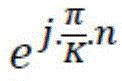
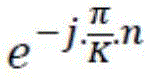
According to a first aspect of the invention, a method is provided for facilitating radar detection that is stable to IQ imbalances. The method comprises the steps ofA step of generating in the word domain a radar signal comprising a progressive phase rotation M periodic repetitions of a multiplied code sequence having a length Lc, where Lc and M are integers, K is an integer or a non-integer, and n is a discrete integer variable, i.e. a discrete time index corresponding to the code rate. The method further comprises the steps of: by rotating a reflected signal corresponding to the radar signal with a progressive phase in the digital domain
 Multiplying to generate a processed input signal from the reflected signal. In this context, K is defined such that the ratio
 Is a non-integer, and M is defined such that the ratio
 Is an integer.
The present invention therefore proposes a simplified technique for generating radar signals that are stable to front-end non-idealities. The invention further proposes a simplified processing of radar detection from the radar signal, wherein the signal generation and the signal processing are not limited to the type of code sequence, i.e. to the type of modulation scheme used in digitally modulated radar. The constraints that must be maintained are limited only to factors such as the code sequence length Lc and to variables such as K and M, which are defined or selected, regardless of the type of code sequence and/or modulation scheme.
Preferably, the method further comprises the steps of: the processed input signal is correlated with the code sequence to generate a series of distance distributions. In addition, the method further comprises the step of accumulating the M consecutive distance distributions.
The radar signal preferably comprises a periodic repetition of the code sequence, and the reflected signal typically comprises a linear combination of delayed versions of the code sequence. The delay is proportional to the target range position. To estimate the delay, the reflected signal is correlated with the transmitted code sequence (or the complex conjugate of the transmitted code sequence), which results in a distance distribution. The distance profile contains a peak at the location of each target that is proportional to the power reflected back from the target. In addition, accumulating multiple consecutive distance distributions (e.g., M distance distributions) advantageously improves, for example, signal-to-noise ratio.
Preferably, the method further comprises the step of defining Lc for a given radar bandwidth relative to a maximum unambiguous range of the radar, wherein the maximum unambiguous range of the radar is given by the radar's ability to receive a reflected pulse or chip completely before the next transmitted pulse or chip. In addition, the radar bandwidth is preferably defined based on a preferred range resolution (i.e., a measure of the minimum separation distance of its targets).
Preferably, the method further comprises the step of generating a radar signal comprising N periodic repetitions of M periodic repetitions of the code sequence, where N is an integer. Additionally, the method further comprises the step of processing the N range profiles to produce a range-doppler plot. In other words, the number of repetitions N defines the number of samples used for doppler processing to estimate the target velocity.
Preferably, the code sequence corresponds to a binary code sequence or a real code sequence or a complex code sequence. To this end, if the code sequence corresponds to a binary code sequence, for example the modulation corresponds to Binary Phase Shift Keying (BPSK), the method further comprises the step of defining K as an integer or non-integer given by:
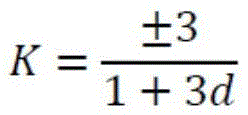
wherein d is an integer.
The present invention therefore further proposes a modulation-specific (BPSK) implementation of the inventive method to address additional non-idealities of the front-end in addition to IQ imbalance. In particular, the invention additionally addresses power amplitude non-linearities and further proposes a radar signal generation and processing scheme that is stable to said non-linearities. The power amplitude non-linearity is especially due to non-linear distortions introduced in the transmitter power amplifier and further introduces unwanted artifacts, such as range distributions and/or range side lobes in range-doppler plots or ghosts in range-doppler plots.
According to a second aspect of the present invention, there is provided a digitally modulated radar for facilitating radar detection that is stable to IQ imbalances. The digitally modulated radar comprises a code generation unit configured to generate a radar signal in the digital domain, the radar signal comprising a progressive phase rotation M periodic repetitions of a multiplied code sequence having a length Lc, where Lc and M are integers, K is an integer or a non-integer, and n is a discrete integer variable, i.e. a discrete time index corresponding to the code rate.
The digitally modulated radar further comprises a processing unit configured to rotate in the digital domain by rotating a reflection signal corresponding to the radar signal with a progressive phase Multiplying to generate a processed input signal from the reflected signal. In this context, the code generation unit is further configured to define K such that the ratio
 Is a non-integer. Furthermore, the code generation unit is further configured to define M such that the ratio
 Is an integer.
The present invention therefore proposes a simplified technique for generating radar signals and processing radar detections that is stable to front-end non-idealities and is not limited to the type of code sequences and/or modulation schemes used in digitally modulated radars.
Preferably, the digitally modulated radar further comprises a transmit path configured to transmit radar signals, the transmit path comprising at least one digital-to-analog converter, at least one low pass filter, at least one mixer, and at least one power amplifier. Preferably, the digitally modulated radar further comprises a receive path configured to receive the reflected signal, the receive path comprising at least one low noise amplifier, at least one mixer, at least one low pass filter, and at least one analog to digital converter. Further preferably, the transmit path is configured to convey the I and Q signal components by their respective domain conversions and successive filtering. Similarly, the receive path is configured to convey the I and Q signal components through their respective filtering and continuous domain conversion.
Preferably, the processing unit is further configured to correlate the processing input signal with the code sequence to generate a series of distance distributions. To this end, the processing unit is further configured to accumulate M consecutive distance distributions. Advantageously, the accumulation of a plurality of consecutive distance distributions (e.g., M distance distributions) improves, for example, the signal-to-noise ratio.
Preferably, the code sequence corresponds to a binary code sequence or a real code sequence or a complex code sequence. To this end, in case the code sequence corresponds to a binary code sequence, the code generation unit is further configured to define K as an integer or a non-integer given by:

wherein d is an integer. Advantageously, the present invention further proposes a modulation-specific (BPSK) implementation to address additional non-idealities of the front-end in addition to IQ imbalance.
Drawings
Exemplary embodiments of the invention will now be further explained with reference to the accompanying drawings, which are given by way of illustration only and not by way of limitation. In the drawings:
fig. 1 shows an exemplary embodiment of a method according to a first aspect of the present invention;
fig. 2 shows an exemplary transmission frame for acquiring a radar data cube.
FIG. 3A shows an ideal M-sequence distance distribution with two targets;
FIG. 3B shows an ideal APS distance distribution with two targets;
fig. 4 shows an exemplary embodiment of a digitally modulated radar according to a second aspect of the present invention;
FIG. 5A shows the code generation unit of FIG. 4 in detail;
FIG. 5B shows the processing unit of FIG. 4 in detail;
FIG. 6 shows, by way of example, the magnitude of z as a function of K;
fig. 7A shows the accumulated APS distance distribution for sequence length 544 with BPSK modulation;
fig. 7B shows the accumulated APS distance distribution for sequence length 544 with MSK modulation;
FIG. 7C shows the accumulated APS distance distribution for sequence length 544 with pi/2-BPSK modulation;
fig. 7D shows an accumulated APS distance distribution for a sequence length 544 with pi/3-BPSK modulation according to the proposed solution;
fig. 8A shows the accumulated M-sequence distance distribution for sequence length 511 with BPSK modulation;
fig. 8B shows the accumulated M-sequence distance distribution for sequence length 511 with MSK modulation;
fig. 8C shows the accumulated M-sequence distance distribution for sequence length 511 with pi/2-BPSK modulation; and
fig. 8D shows the accumulated M-sequence distance distribution for a sequence length 511 with pi/3-BPSK modulation according to the proposed solution;
Detailed Description
Reference will now be made in detail to the various embodiments of the present invention, examples of which are illustrated in the accompanying drawings. However, the following embodiments of the present invention may be variously modified and the scope of the present invention is not limited by the following embodiments.
In fig. 1, an exemplary embodiment of a method according to the first aspect of the present invention is shown.In a first step 101, a code sequence having a code sequence length Lc is selected. In a second step 102, the value of the parameter K is selected such that the ratio Lc/K is a non-integer. In a third step 103, the value of the parameter M is selected such that the ratio Lc · M/K is a non-integer. In a fourth step 104, the code sequence is rotated in the digital domain by periodically repeating M times with a progressive phase The multiplication generates a radar signal. In a
 fifth step 105, the radar signal is rotated in the digital domain by rotating a reflection signal corresponding to the radar signal with a progressive phase Multiplying to generate a processed input signal from the reflected signal. Finally, in a
 sixth step 106, distance processing is performed on the processed input signal.
The range processing includes the generation of range profiles, doppler profiles, and further includes the combination of the range and doppler profiles referred to as range-doppler plots. To this end, the method comprises the following successive steps: the processed input signal is correlated with the code sequence to generate a series of distance distributions and the M consecutive distance distributions are further accumulated to improve the SNR.
In fig. 2, an exemplary transmission frame 200 for acquiring a radar data cube is shown. Transmission frame 200 is shown as a conventional transmission frame for a single-input single-output phase modulated continuous wave (SISO-PMCW) radar. The code sequence length Lc defines the number of samples or chips 201 in the code sequence 202 (denoted as "s" herein). In other words, the code sequence length Lc defines the number of distance sections used for distance processing operations. Thus, the so-called pulse repetition frequency of a digitally modulated radar can be defined as a sequence of lengths Lc that repeat itself, e.g. at a chip rate fc.
The parameter M defines the number of repetitions 203 of the accumulated identical code sequence "s", similar to a conventional pseudo random code sequence, such as a Maximum Length Sequence (MLS). In other words, the number of repetitions M defines the number of distance distributions to be coherently accumulated. The parameter N defines the number of repetitions 204 of the M sequences 203, i.e. the number of samples for doppler processing to estimate the target velocity. Thus, the code sequence "s" is repeated M · N times in the transmission frame 200 for the acquisition of one radar data cube.
During the detection phase, the transmitted signal is reflected from all objects or obstacles in front of the radar. This results in a linear combination of delayed versions of the code sequence "s". The delay is proportional to the target range position. To estimate the delay, the received signal is correlated with the transmitted code sequence "s" (e.g., for a binary code sequence) or with the complex conjugate of the transmitted code sequence "s" (e.g., for a complex code sequence). This produces a distance distribution containing a peak at the location of each target, which is proportional to the power reflected back from the target.
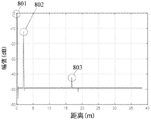
In fig. 3A and 3B, exemplary distance profiles for an ideal radar transceiver are shown. Specifically, fig. 3A shows an ideal distance distribution with two targets for an M-sequence (MLS). The horizontal axis represents the distance in meters of the target and the vertical axis represents the reflected power amplitude in decibels. Here, two targets are indicated with circles 301 and 302 at the respective peaks. While figure 3B shows an ideal distance distribution with two targets for a near perfect sequence (APS). The horizontal axis represents the distance in meters of the target and the vertical axis represents the reflected power amplitude in decibels. Here, two targets are indicated at the respective peaks with circles 303 and 304.
Ideally, the output of the correlator contains zeros in the range bin, which zeros do not correspond to any target. In practice, some non-null values may appear to come from code sequence characteristics. These values are called range side lobes. For example, the M-sequence always produces a range sidelobe that is-20 log10(Lc) dB below the correlation peak, where Lc is the code sequence length, as shown in fig. 3A. On the other hand, APS does not generate any side lobe, as shown in fig. 3B. The ideal code sequence should have the following characteristics:

this is for BPSK code sequences, or

This is for complex code sequences, where bc(n) is a code sequence in the digital domain, Δ is a cyclic shift in the code sequence corresponding to the target distance, and ()*Is a complex conjugate operation.
As already mentioned above, M consecutive distance distributions are accumulated to improve the SNR, while the doppler processing is achieved by Discrete Fourier Transform (DFT) along the slow speed, i.e. N repetitions of the M code sequences. If multiple antennas are used, then angular processing with conventional beamforming or Multiple Input Multiple Output (MIMO) may also be applied. With an ideal transceiver, the response to a point target creates a spike in the range, range-doppler, or range-doppler-angle domain, which may be limited by theoretical side lobes of the waveform sequence. However, with non-ideal transceivers, the ideal response is degraded, which is usually manifested as the appearance of ghost objects or increased sidelobes. Typical sources of non-idealities are power amplifier non-linearity or IQ mismatch.
The choice of sequence "s" depends on the type of digitally modulated radar, such as Phase Modulated Continuous Wave (PMCW) based radar or Orthogonal Frequency Division Modulation (OFDM) based radar.
In the case of PMCW radars, range processing is performed by means of correlation. Thus, the code sequence selection depends on the periodic auto-correlation properties of the code sequence, as defined in equations (1) and (2). Here, a code sequence satisfying the above auto-correlation characteristic is selected. For this reason, APS and M sequences are exemplified in the present specification, which perfectly satisfies the auto-correlation property described above. In particular, APS produces two non-zero values in the distance distribution, instead of only one, and when Δ ≠ 0, the M-sequence gives a value of 1, instead of 0,
in the case of OFDM radar, the distance processing is performed by a process similar to channel equalization in wireless communication. This operation extracts the distance distribution and removes the code sequence itself. Thus, each sequence of Lc complex samples may be used and thus there is no constraint on the value of the complex samples. The proposed solution effectively addresses and facilitates radar detection that is stable to the non-idealities described above, wherein the proposed solution can be implemented regardless of code sequence selection and the type of digitally modulated radar.
In fig. 4, an exemplary embodiment of a digitally modulated radar 400 according to a second aspect of the present invention is shown. The digitally modulated radar 400 comprises a code generation unit 401 which generates a radar signal 402 in the digital domain. A digital-to-analog converter (DAC)403 downstream of code generation unit 401 converts digital radar signal 402 in the analog domain, thereby generating an analog radar signal 404. A Low Pass Filter (LPF)405 downstream of the DAC 403 performs baseband filtering of the analog radar signal 404, i.e., filters out higher frequency components, thereby generating a filtered radar signal 406.
A mixer 407 downstream from LPF 405 modulates filtered radar signal 406 with a carrier sine wave, preferably generated by a local oscillator (not shown), thereby generating RF radar signal 408. An amplifier, in particular a Power Amplifier (PA)409, amplifies RF radar signal 408, thereby generating a radar transmit signal 410 that is transmitted via a transmitter antenna 411. Thus, the transmit path for transmitting radar signal 402 is comprised of DAC 403, LPF 405, mixer 407, PA 409, and optional transmitter antenna 411.
Radar transmit signal 410 is typically reflected from all targets and the resulting echo or reflected signal or radar receive signal 430 is received by the receiver antenna. Generally, only a portion of the transmitted signal 410 is reflected back to the receiver antenna 431. An amplifier, and in particular a Low Noise Amplifier (LNA)429, amplifies radar signal 430, thereby generating an amplified radar receive signal 428. Mixer 427 downstream of LNA 429 demodulates amplified radar receive signal 428 with the carrier signal generated by the local oscillator, i.e., a direct conversion of amplified radar receive signal 428, thereby generating baseband signal 426.
A Low Pass Filter (LPF)425 downstream of the mixer 427 filters the baseband signal 426, thereby generating a filtered baseband signal 424. An analog-to-digital converter (ADC)423 downstream of the LPF 425 converts the filtered baseband signal 424 into the digital domain, thereby generating a reflected signal 422 in the digital domain corresponding to the radar signal 402 generated by the code generation unit 401 in the digital domain. The digitally modulated radar 400 further comprises a processing unit 421 which generates a processed input signal from the reflected signal 422 in the digital domain to perform range and doppler processing. Thus, the receive path for receiving the reflected signal 422 is comprised of LNA 429, mixer 427, LPF 425, ADC 423 and optional receiver antenna 431.
It will be appreciated that the transmitter antenna 411 and the receiver antenna 431 may be implemented as dedicated antennas in an antenna array for respective transmit and receive paths of the digitally modulated radar 400. It is also contemplated that transmitter antenna 411 and receiver antenna 431 may be implemented in a single antenna array and that the antenna array may be operated in a switched manner, such as an antenna switch or circulator, for the transmit path and the receive path of digitally modulated radar 400.
The code generation unit 401 is further configured to communicate with the processing unit 421 to provide information on the selected code sequence for correlation. The communication signal is shown as dashed line 412. It is contemplated that code generation unit 401 and processing unit 421 may be implemented as a single entity, e.g., as a baseband processing unit. Furthermore, additional means for generating and/or processing radar signals, such as memories for storing code sequences, control commands, etc., or storage and interfaces such as user interfaces, etc., are not explicitly shown, but are apparent in the above-described implementations.
Due to the non-idealities of the mixers 407 and 427, the I and Q components are not identical and therefore cause a mismatch between said I and Q components, which is called IQ imbalance. In general, the non-idealities of the mixer 407 introduce IQ imbalance, which leads to range sidelobes or ghosts in, for example, radar range-doppler plots. In addition, the non-idealities of the mixer 427 also introduce IQ imbalance in the baseband signal. Due to the above-described effects, the resulting radar range profile may include significant range side lobes. In addition, the nonlinearity of the PA 409 further degrades radar performance by producing range sidelobes or ghosts, for example, in the radar range-doppler plot.
In fig. 5A and 5B, generation of radar signal 402 in code generation unit 401 and generation of processing input signal 524 in processor 421 are shown in detail. The code generation unit 401 of fig. 5A comprises a signal generator 501 for generating a chip signal or chip according to a predefined code sequence. This code sequence may correspond to a transmission frame comprising a sequence "s" of Lc chips, as shown in fig. 2, which is repeated M times and finally M repetitions of "s" are repeated N further times. In other words, the sequence "s" is repeated M · N times in a single transmission frame.
Here, the code sequence is shown as bc(n), wherein n defines a discrete-time index corresponding to the code rate. In conventional digitally modulated radars, the code sequence bc(n) are repeatedly transmitted as radar signals, i.e. code sequence b is repeatedc(n) is used directly for the successive conversion, filtering and amplification stages. However, in order to generate a radar signal that is stable against non-idealities according to the inventive solution presented herein, the code generation unit 401 further comprises a second step of converting b to a third step of a second code generation stepcPeriodic repetition of (n) (shown here as b (n)) with progressive phase rotation
A multiplying multiplier 503. Thus, radar signal 402 may be expressed as a digital code sequence:

wherein b (n) is bc(n) is repeated periodically.
On the other hand, the processing unit 421 receives the reflected signal 422 (shown here as u (n)) after baseband conversion as described in fig. 4. The processing unit 421 includes the steps of rotating the reflected signal u (n) with the progressive phase A multiplying
 multiplier 523. This produces a processed input signal 524 (shown here asv (n)), the signal is used for subsequent processing. Thus, the processing input signal v (n) can be expressed as:

it can be seen that the progressive phase rotation on the received signal has a rotation angle opposite to the progressive phase rotation on the transmitted signal. Thus, multiplier 523 effectively removes the complex exponent.
The processing unit 421 further comprises a processing block 525 which will process the input signal 524 with the code sequence b, for example with the help of code sequence information 412 fed from the code generation unit 401, in particular the signal generator 501c(n) correlation, thereby performing range processing to generate a radar range distribution. Processing block 525 further accumulates the M consecutive range distributions to remove range side lobes from IQ imbalance, as will be described in detail in subsequent sections. The accumulation of M consecutive distributions further improves e.g. the SNR. The processing unit 421 further comprises a Discrete Fourier Transform (DFT) block 527, which DFT block 527 performs a DFT on the N samples to produce a doppler distribution.
In the following, the criteria on the parameters Lc, K and M and their influence on range side lobe reduction (especially because of IQ imbalance) are described in detail.
The reflected signal 422 may be described in the time domain as:
u(t)=αy(t)+βy*(t) (5)
thus, for the ideal case, i.e. when there is no mismatch or imbalance between the I and Q branches, α is 1 and β is 0.
Therefore, IQ mismatch on the transmit path and/or receive path will produce range side lobes such as:

where Δ is the propagation delay.
In the formula (6), the first term Is a delayed version of the code sequence multiplied by a phase rotation that depends on the propagation delay delta. Thus, the auto-correlation properties of the code sequence are not affected.
However, the second term Also a delayed version of the code sequence multiplied by the phase rotation. In addition, the term includes progressive phase rotation
 This progressive phase rotation destroys the correlation properties of the code sequence. This will result in range sidelobes. However, under the selection criterion of K, the progressive phase rotation will be mitigated during the radar digital processing chain.
For example, the first three distance distributions may be expressed as:



wherein D is a code sequence bcCyclic shift in (n).
Each distance distribution rk(D) Affected by range sidelobes. This can be described as:

wherein r issl,k(D) Containing a compound derived from rk(D) The range sidelobe of (1).
Equation (8) can be rewritten as:

since b (n) is b containing Lc samplesc(n) is repeated periodically.
It can be seen that all range distributions will have the same range side lobes as follows:

the range side lobe is rotated with a phase depending on a range distribution index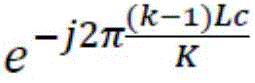 Multiplication. Therefore, equation (9) can be rewritten in a simplified form as:

from equation (11), it can be concluded that if Lc is not a multiple of K, the range sidelobes in the continuous range distribution are not in phase and will therefore decay during accumulation.
Further, as can be concluded from equation (11), if Lc · M/K is an integer, the phases of the range side lobes at the exponent D in all M range distributions are equally distributed on the complex circle. Thus, the accumulation of M consecutive range distributions eliminates range side lobes as shown in the following equation:

this can also be extended to complex code sequences as well as OFDM radars, as they transmit complex digital modulated signals. Especially for complex code sequences, it can be seen that ghosts are composed of This is shown to be similar to equation (6), but with a complex operator (), i.e. the complex conjugate of the code sequence. However, they are affected by the same phase rotation in the function of K. Thus, the solution proposed herein can also be used to efficiently compensate for range side lobes generated by IQ-imbalance (on the transmitter and receiver side) with a complex code sequence.
In the following, the criteria on the parameter K and its effect on range side lobe reduction (especially due to power amplifier non-linearity) are described in detail. The following technique is performed on a binary code sequence, for example implemented in a binary phase modulation radar such as a PMCW radar.
An efficient way to implement a low complexity PMCW radar is to use BPSK modulation. In this way, the modulated signal is only { -1; +1} code sequence. This results in a binary phase modulated radar. In addition to this low complexity, BPSK modulation also exhibits a low peak-to-average power ratio (PAPR). Ideally, the PAPR should be 0dB (invariant). However, because the transmitter bandwidth is limited, the transition from a +1 to a-1 is not instantaneous and the waveform exhibits a non-constant amplitude, which makes the waveform sensitive to nonlinear distortion introduced in the power amplifier. This PAPR degradation may also come from the pulse shaping operation needed to adapt to a particular spectral mask. This phenomenon produces undesirable artifacts in the range profile called range sidelobes or ghosts.
The code sequence b (n) is considered to be a binary code sequence multiplied by a progressive phase rotation in the digital domain by a complex exponential, as described above. This produces a radar signal s (n), as shown in equation (3). The radar signal is then converted and modulated in the analog domain with a carrier sine wave.
Generally, the transmission is bandwidth limited, which can be modeled by the LPF 405 with an impulse response h (n). The signal is then amplified by a PA 409. To reduce the power consumption of radar signaling, PA 409 is preferably operated near its saturation point. However, this produces non-linear distortion in the transmitted signal, which degrades radar performance.
The proposed solution implements a different technique, i.e. not to create waveforms with low PAPR. The proposed technique creates a waveform that can eliminate the most important source of range side lobes. For this reason, the following two assumptions are proposed:
1) the power amplifier nonlinear model can be approximated by a cubic model:
y(n)=a0x(n)+a3x(n)|x(n)|2 (13)
wherein a is0Is the linear gain (positive real value) of the power amplifier and a3Is third order non-linearity (negative real value).
This assumption is actually satisfied in the following cases: even non-idealities do not exist in the baseband power amplifier model and third order non-linearities are dominant in practice.
2) Only three taps in the LPF discrete impulse response are significant:

this assumption is realistic since h (n) is a low pass filter. However, if there are more than three taps in the filter discrete impulse response, the non-linear distortion (combined with power amplifier non-linearity) originating from the additional taps will be partially compensated. In other words, the assumption is proposed to remove side lobes and ghosts originating from the three most significant taps and thus remove the most significant parts of range side lobes and ghosts.
The processed input signal v (n) contains several terms which are linear combinations of the binary code sequences b (n), which depend on the target position and contain useful information. The other terms depend on the non-linear combination of b (n). The non-linear combination will produce range sidelobes or ghosts in the range profile. However, for each case, the nonlinear combinations are all multiplied by:

for values of K for which z (K) is 0, no range side lobes and ghosts will be generated. At least, the three most significant taps of the impulse response h (n) and the sidelobes and ghosts generated by third-order non-linearities are eliminated due to waveform characteristics.
In fig. 6, the magnitude 600 of z as a function of K is shown. The horizontal axis defines the value of K and the vertical axis defines the magnitude of | z |. It can be seen that, for example, at points 601 and 602, the magnitude 600 of z as a function of K reaches zero. For this example, the K values that make | z | zero are 1.5 and 3 at points 601 and 602, respectively. Thus, a K value such as 3 or 1.5 does not give range side lobes or ghosts, while a K value of 2 gives larger range side lobes and ghosts. From this illustration, the parameter K can be expressed in a simplified form, such as:

wherein d is an integer. Thus, possible K values may be approximated as 3, + -1.5, and so on.
Some exemplary combinations of the parameters Lc, K and M are shown in the following table:
| Lc | M | K |
| 844 | 3 | 3 |
| 511 | 2 | 2 |
| 844 | 3 | 3 |
| 1023 | 2 | 2 |
| 1024 | 3 | 3 |
for example, for a code sequence length Lc of 844, three consecutive distance distributions (i.e., M) need to be accumulated and the value of K needs to be defined as 3. This particular combination allows the generation of radar signals that are stable to IQ imbalance regardless of the modulation technique of the digitally modulated radar. Furthermore, since the value of K is 3, which satisfies the criterion of the binary code sequence as shown in equation (16), the combination further allows the generation of a radar signal that is non-linearly stable for the power amplifier, especially for binary phase modulated radars.
In fig. 7A, 7B, 7C and 7D, distance distributions for APS code sequences with code sequence length 544 for different modulation techniques are shown.
Fig. 7A shows an accumulated distance distribution with two targets 701, 702, in particular for an APS code sequence with a code sequence length 544 for Binary Phase Shift Keying (BPSK) modulation. The horizontal axis represents the distance in meters of the targets 701, 702, and the vertical axis represents the reflected power magnitude in decibels. Here, two targets are indicated with circles 701 and 702 at the respective peaks. The range sidelobe magnitude may be approximately-60 dB.
Fig. 7B shows the accumulated distance distribution with two targets 701, 702, in particular for APS code sequences with a code sequence length 544 for minimum shift Monitoring (MSK) modulation. The horizontal axis represents the distance in meters of the targets 701, 702, and the vertical axis represents the reflected power magnitude in decibels. Here, two targets are indicated with circles 701 and 702 at the respective peaks. The range sidelobe magnitude may be approximated as about-40 dB, i.e., the sidelobe magnitude is incremented by about 20dB relative to the technique of fig. 7A.
Fig. 7C shows the accumulated distance distribution with two targets 701, 702, in particular for APS code sequences with a code sequence length 544 for pi/2 binary phase shift keying (pi/2-BPSK) modulation. The horizontal axis represents the distance in meters of the targets 701, 702, and the vertical axis represents the reflected power magnitude in decibels. Here, two targets are indicated with circles 701 and 702 at the respective peaks. The range side lobe magnitude may be approximated as about-50 dB, i.e., the side lobe magnitude is incremented by about 10dB relative to the technique of fig. 7A and the side lobe magnitude is decremented by about 20dB relative to the technique of fig. 7B.
Fig. 7D shows an accumulated distance distribution with two objects 701, 702 according to the proposed solution, in particular for an APS code sequence with a code sequence length 544. Here, the value of K is selected to be 3, the value of M is selected to be 3, and is implemented with binary phase shift keying (pi/3-BPSK) modulation. The horizontal axis represents the distance in meters of the targets 701, 702, and the vertical axis represents the reflected power magnitude in decibels. Here, two targets are indicated with circles 701 and 702 at the respective peaks. The range sidelobe magnitude can be approximated to be about-100 dB, which shows better sidelobe suppression compared to the techniques shown in fig. 7A, 7B and 7C, i.e. sidelobe suppression is improved by about 40dB, 60dB and 50dB, respectively.
Note that the-100 dB range sidelobes originate from the additional taps of more than three taps of the low pass filter, as described above. If the low pass filter has only three taps, no range side lobes will be observed in the range profile shown in FIG. 7D. However, the proposed solution shows performance superior to the technique shown in fig. 7A, 7B and 7C, since the sidelobes produced by the three most significant taps of the filter are suppressed.
In fig. 8A, 8B, 8C and 8D, distance distributions for M-sequence code sequences with code sequence length 511 for different modulation techniques are shown. Especially for M-sequences, range sidelobes come from a limitation on the code sequence itself, since M-sequences are known in the art to produce ghost objects in the presence of amplifier nonlinearities.
Fig. 8A shows an accumulated distance distribution with two targets 801, 802, in particular for an M-sequence code sequence with a code sequence length 511 for Binary Phase Shift Keying (BPSK) modulation. The horizontal axis represents the distance in meters of the targets 801, 802, and the vertical axis represents the reflected power magnitude in decibels. Here, two targets are indicated by circles 801 and 802 at the respective peaks. The range side lobe amplitude may be approximately-50 dB. It can also be seen that this technique produces ghost objects, as indicated at peak 803.
Fig. 8B shows the accumulated distance distribution with two targets 801, 802, in particular for M-sequence code sequences with a code sequence length 511 for Minimum Shift Keying (MSK) modulation. The horizontal axis represents the distance in meters of the targets 801, 802, and the vertical axis represents the reflected power magnitude in decibels. Here, two targets are indicated by circles 801 and 802 at the respective peaks. The range sidelobe magnitude may be approximately-55 dB.
Fig. 8C shows the accumulated distance distribution with two targets 801, 802, in particular for M-sequence code sequences with a code sequence length 511 for pi/2 binary phase shift keying (pi/2-BPSK) modulation. The horizontal axis represents the distance in meters of the targets 801, 802, and the vertical axis represents the reflected power magnitude in decibels. Here, two targets are indicated by circles 801 and 802 at the respective peaks. The range sidelobes may be approximately-55 dB in magnitude, however subject to amplifier nonlinearity and produce ghost objects, as indicated at peak 804.
Fig. 8D shows an accumulated distance distribution with two targets 801, 802 according to the proposed solution, in particular for an M-sequence code sequence with a code sequence length 511. Here, the value of K is selected to be 3, the value of M is selected to be 3, and is implemented with binary phase shift keying (pi/3-BPSK) modulation. The horizontal axis represents the distance in meters of the targets 801, 802 and the vertical axis represents the reflected power magnitude in decibels. Here, two targets are indicated by circles 801 and 802 at the respective peaks. The range sidelobe amplitude can be approximated to be about-50 dB and no ghost targets are present, indicating stability to amplifier non-linearity.
Thus, it can be seen that for example for odd length code sequences (e.g., 511), pi/2-BPSK is stable to IQ mismatch, but is affected by power amplifier non-linearity. On the other hand, MSK pulse shaping can be viewed as a special π/2-BPSK case with invariants. Therefore, MSK technology is also a viable alternative to the odd code sequence. However, pi/2-BPSK and MSK pulse shaping techniques are stable to IQ imbalance only if M satisfies the proposed criterion that Lc M/K is an integer. For other values of M, stability to IQ imbalance cannot be achieved by the technique. However, for even-length code sequences (e.g., 544), pi/2-BPSK and MSK pulse shaping are very sensitive to IQ mismatch. The proposed solution (e.g., as exemplified herein as pi/3-BPSK modulation technique) is better in side-lobe suppression than the above-described technique for even-length code sequences.
Thus, the proposed solution solves the sidelobe degradation and ghosting problems in digitally modulated radars, such as PMCW and OFDM radars. In these radars, a near-ideal blur function can be achieved by carefully selecting the waveform sequence and the algorithm used to construct the radar data cube. However, transceiver non-idealities (non-linearity, saturation/clipping, phase noise, IQ imbalance, ADC jitter, etc.) can cause degradation of the blur function, which appears to induce range side lobes and/or the appearance of ghost targets. Range sidelobe degradation leads to reduced sensitivity, ghost objects lead to false alarms; both of these must be avoided as much as possible.
The goal of the proposed solution is to minimize the impact of power amplifier non-linearity and IQ-imbalance. For this purpose, progressive phase rotations are added to the transmitted signal in order to modify the effect of IQ mismatch differently due to the distance distribution. Therefore, in the case where a combination of the imaginary length Lc, the accumulation number M, and the phase rotation pi/K is defined, the range side lobe from the IQ mismatch can be eliminated. In addition, for a BPSK PMCW radar, the particular phase rotation pi/K greatly improves the stability to power amplifier nonlinearities.
Embodiments of the present invention may be implemented by hardware, software, or a combination thereof. Embodiments of the invention may be implemented by one or more Application Specific Integrated Circuits (ASICs), Digital Signal Processors (DSPs), Digital Signal Processing Devices (DSPDs), Programmable Logic Devices (PLDs), Field Programmable Gate Arrays (FPGAs), processors, controllers, micro-controllers, microprocessors, and the like.
Although the invention has been illustrated and described with respect to one or more implementations, equivalent alterations and modifications will occur to others skilled in the art upon the reading and understanding of this specification and the annexed drawings. In addition, while a particular feature of the invention may have been disclosed with respect to only one of several implementations, such feature may be combined with one or more other features of the other implementations as may be desired and advantageous for any given or particular application.
Claims (15)
1. A method for facilitating radar detection that is stable to IQ imbalance, comprising the steps of:
generating a radar signal in the digital domain, the radar signal comprising a progressive phase rotation M periodic repetitions of a multiplied code sequence having a length Lc, where Lc and M are integers, K is an integer or a non-integer, and n is a discrete integer variable; and
by rotating a reflected signal corresponding to the radar signal with a progressive phase in the digital domain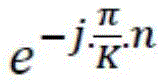 Multiplying to generate a processed input signal from the reflected signal,
where K is defined such that the ratio Lc/K is a non-integer, and M is defined such that the ratio (Lc M)/K is an integer.
2. The method of claim 1, wherein the first and second light sources are selected from the group consisting of a red light source, a green light source, and a blue light source,
wherein the method further comprises the steps of: correlating the processed input signal with the code sequence to generate a series of distance distributions.
3. The method of claim 1, wherein the first and second light sources are selected from the group consisting of a red light source, a green light source, and a blue light source,
the method further comprises the step of accumulating M consecutive distance distributions.
4. The method of claim 1, wherein the first and second light sources are selected from the group consisting of a red light source, a green light source, and a blue light source,
wherein the method further comprises the step of defining Lc for a given radar bandwidth with respect to the maximum unambiguous distance of the radar.
5. The method of claim 1, wherein the first and second light sources are selected from the group consisting of a red light source, a green light source, and a blue light source,
wherein the method further comprises the step of generating the radar signal comprising N periodic repetitions of M periodic repetitions of the code sequence, where N is an integer.
6. The method of claim 5, wherein the first and second light sources are selected from the group consisting of a red light source, a green light source, and a blue light source,
wherein the method further comprises the step of processing the N range profiles to produce a range-doppler plot.
7. The method of claim 1, wherein the first and second light sources are selected from the group consisting of a red light source, a green light source, and a blue light source,
wherein the code sequence corresponds to a binary code sequence, or a real code sequence or a complex code sequence.
8. The method of claim 7, wherein the first and second light sources are selected from the group consisting of,
wherein, in case the code sequence corresponds to a binary code sequence, the method further comprises the step of defining K as an integer or non-integer given by:
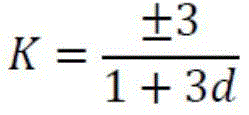
wherein d is an integer.
9. A digitally modulated radar for facilitating radar detection that is stable to IQ imbalances, comprising:
a code generation unit configured to generate a radar signal in the digital domain, the radar signal comprising a progressive phase rotation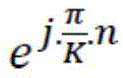 M periodic repetitions of a multiplied code sequence having a length Lc, where Lc and M are integers, K is an integer or a non-integer, and n is a discrete integer variable; and
a processing unit configured to rotate a reflection signal corresponding to the radar signal with a progressive phase in a digital domain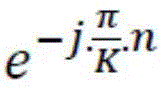 Multiplying to generate a processed input signal from the reflected signal,
wherein the code generation unit is further configured to define K such that the ratio Lc/K is a non-integer, and
wherein the code generation unit is further configured to define M such that the ratio (Lc M)/K is an integer.
10. The digitally modulated radar of claim 9,
wherein the digitally modulated radar further comprises a transmit path configured to transmit the radar signal, the transmit path comprising at least one digital-to-analog converter, at least one low pass filter, at least one mixer, and at least one power amplifier.
11. The digitally modulated radar of claim 9,
wherein the digitally modulated radar further comprises a receive path configured to receive the reflected signal, the receive path comprising at least one low noise amplifier, at least one mixer, at least one low pass filter, and at least one analog to digital converter.
12. The digitally modulated radar of claim 9,
wherein the processing unit is further configured to correlate the processing input signal with the code sequence to generate a series of distance distributions.
13. The digitally modulated radar of claim 9,
wherein the processing unit is further configured to accumulate M consecutive distance distributions.
14. The digitally modulated radar of claim 9,
wherein the code sequence corresponds to a binary code sequence, or a real code sequence, or a complex code sequence.
15. The digitally modulated radar of claim 14,
wherein, in case the code sequence corresponds to a binary code sequence, the code generation unit is further configured to define K as an integer or a non-integer given by:

wherein d is an integer.
Applications Claiming Priority (2)
| Application Number | Priority Date | Filing Date | Title |
|---|---|---|---|
| EP20208013.1 | 2020-11-17 | ||
| EP20208013.1A EP4001954B1 (en) | 2020-11-17 | 2020-11-17 | RADAR DETECTION METHOD AND DIGITALLY MODULATED RADAR WITH ROBUSTNESS AGAINST IQ IMBALITATION |
Publications (1)
| Publication Number | Publication Date |
|---|---|
| CN114509728A true CN114509728A (en) | 2022-05-17 |
Family
ID=73455580
Family Applications (2)
| Application Number | Title | Priority Date | Filing Date |
|---|---|---|---|
| CN202110829638.6A Pending CN114509728A (en) | 2020-11-17 | 2021-07-22 | Radar detection method and digital modulation radar for stabilizing IQ imbalance |
| CN202111349696.5A Pending CN114509724A (en) | 2020-11-17 | 2021-11-15 | Method for robust radar detection and digitally modulated radar |
Family Applications After (1)
| Application Number | Title | Priority Date | Filing Date |
|---|---|---|---|
| CN202111349696.5A Pending CN114509724A (en) | 2020-11-17 | 2021-11-15 | Method for robust radar detection and digitally modulated radar |
Country Status (3)
| Country | Link |
|---|---|
| US (2) | US12111416B2 (en) |
| EP (2) | EP4001954B1 (en) |
| CN (2) | CN114509728A (en) |
Families Citing this family (1)
| Publication number | Priority date | Publication date | Assignee | Title |
|---|---|---|---|---|
| TWI849601B (en) | 2022-12-01 | 2024-07-21 | 立積電子股份有限公司 | Signal generation circuit, radar apparatus, and signal control method |
Family Cites Families (9)
| Publication number | Priority date | Publication date | Assignee | Title |
|---|---|---|---|---|
| CN101706583B (en) * | 2009-10-16 | 2012-07-04 | 西安交通大学 | Localized phase space method of multi-offset VSP imaging |
| CN105874351B (en) * | 2013-12-06 | 2018-01-19 | 美国休斯研究所 | Coded aperture radar (CAR) signal processing method and device |
| JP6340689B2 (en) * | 2014-05-23 | 2018-06-13 | パナソニックIpマネジメント株式会社 | Pulse radar device and control method of pulse radar device |
| JP6566396B2 (en) * | 2015-08-06 | 2019-08-28 | パナソニック株式会社 | Radar equipment |
| JP6818541B2 (en) * | 2016-03-14 | 2021-01-20 | パナソニック株式会社 | Radar device and positioning method |
| LU100243B1 (en) * | 2017-05-10 | 2018-11-26 | Iee Sa | Orthogonal Phase Modulation for Detection and Communication in Radar |
| EP3627787B1 (en) | 2018-09-22 | 2023-01-25 | IMEC vzw | Ofdm based radar detection |
| US11099267B2 (en) * | 2018-12-18 | 2021-08-24 | Nxp Usa, Inc. | Extended doppler PMCW code division MIMO radar |
| CN111880171B (en) * | 2020-07-07 | 2023-09-05 | 西安电子科技大学 | A Pulse Segment Encoding Method for Eliminating Blind Velocity of Radar Targets |
-
2020
- 2020-11-17 EP EP20208013.1A patent/EP4001954B1/en active Active
-
2021
- 2021-07-22 CN CN202110829638.6A patent/CN114509728A/en active Pending
- 2021-11-15 CN CN202111349696.5A patent/CN114509724A/en active Pending
- 2021-11-15 EP EP21208119.4A patent/EP4001955A1/en active Pending
- 2021-11-15 US US17/526,627 patent/US12111416B2/en active Active
- 2021-11-16 US US17/527,796 patent/US12025729B2/en active Active
Also Published As
| Publication number | Publication date |
|---|---|
| CN114509724A (en) | 2022-05-17 |
| EP4001954A1 (en) | 2022-05-25 |
| US12025729B2 (en) | 2024-07-02 |
| EP4001954B1 (en) | 2025-12-31 |
| US20220155412A1 (en) | 2022-05-19 |
| US12111416B2 (en) | 2024-10-08 |
| US20220155433A1 (en) | 2022-05-19 |
| EP4001955A1 (en) | 2022-05-25 |
Similar Documents
| Publication | Publication Date | Title |
|---|---|---|
| US7068715B2 (en) | Ultra-wideband communications system and method using a delay hopped, continuous noise transmitted reference | |
| US11428778B2 (en) | System and method for performing spillover cancellation | |
| JP6340689B2 (en) | Pulse radar device and control method of pulse radar device | |
| US20070133495A1 (en) | Transmitter and transmitting method of code division multiplexing wireless communication system using on-off keying modulation scheme | |
| CN108535701B (en) | A method for reducing out-of-band spectrum spread in radar communication integrated waveform design | |
| Bauduin et al. | Code diversity for range sidelobe attenuation in PMCW and OFDM radars | |
| CN114509728A (en) | Radar detection method and digital modulation radar for stabilizing IQ imbalance | |
| US7561100B2 (en) | Correlation processor for receiver | |
| Bauduin et al. | Reducing range sidelobes and ghost targets in PMCW radars with π/k-zadoff code sequences | |
| US7542505B2 (en) | Systems and methods for signal conversion | |
| US11815620B2 (en) | Digitally modulated radar transmitter modules, systems and methods | |
| Feng et al. | Analysis of non-linear power amplifier effect and digital predistortion on ofdm radar | |
| Bauduin et al. | Pi/K phase modulation for MIMO digitally modulated radars | |
| Michev et al. | IQ-transmitter digital predistortion for an OFDM radar | |
| WO2014184760A1 (en) | Coherent radar | |
| Bhatt et al. | Design of high-resolution radar waveforms for multi-radar and dense target environments | |
| Rosenmuller et al. | The impact of transceiver nonlinearity in PMCW radar using polyphase coded sequences | |
| Peters et al. | Improved Performance in PMCW Radar Systems Through Equalization Using Predistortion and Postprocessing | |
| US20040208264A1 (en) | System and method of low power demodulation of continuous phase modulated waveforms | |
| Rajeswari et al. | Sidelobe reduction techniques for range-resolution radar | |
| US11575550B2 (en) | System and method for high-entropy gaussian minimum shift keying (HE-GMSK) modulation | |
| US10432445B1 (en) | Application of transmit sub-sample dithering apparatus for cyclostationary feature elimination | |
| CN121432369A (en) | Keystone transformation-based microwave photonic radar ultra-wideband signal processing method | |
| Doerry | Mathematics of Signal Manipulation and Processing for Radar. | |
| Hu et al. | Modelling and correction for an ultra wide-band radar pulse-compression signal generator |
Legal Events
| Date | Code | Title | Description |
|---|---|---|---|
| PB01 | Publication | ||
| PB01 | Publication | ||
| SE01 | Entry into force of request for substantive examination | ||
| SE01 | Entry into force of request for substantive examination |