CN114463997A - A method and system for cooperative vehicle control at an intersection without signal lights - Google Patents
A method and system for cooperative vehicle control at an intersection without signal lights Download PDFInfo
- Publication number
- CN114463997A CN114463997A CN202210132425.2A CN202210132425A CN114463997A CN 114463997 A CN114463997 A CN 114463997A CN 202210132425 A CN202210132425 A CN 202210132425A CN 114463997 A CN114463997 A CN 114463997A
- Authority
- CN
- China
- Prior art keywords
- action
- vehicle
- value
- information
- neural network
- Prior art date
- Legal status (The legal status is an assumption and is not a legal conclusion. Google has not performed a legal analysis and makes no representation as to the accuracy of the status listed.)
- Granted
Links
Images


Classifications
-
- G—PHYSICS
- G08—SIGNALLING
- G08G—TRAFFIC CONTROL SYSTEMS
- G08G1/00—Traffic control systems for road vehicles
- G08G1/07—Controlling traffic signals
-
- G—PHYSICS
- G06—COMPUTING OR CALCULATING; COUNTING
- G06N—COMPUTING ARRANGEMENTS BASED ON SPECIFIC COMPUTATIONAL MODELS
- G06N3/00—Computing arrangements based on biological models
- G06N3/02—Neural networks
- G06N3/04—Architecture, e.g. interconnection topology
- G06N3/045—Combinations of networks
-
- G—PHYSICS
- G06—COMPUTING OR CALCULATING; COUNTING
- G06N—COMPUTING ARRANGEMENTS BASED ON SPECIFIC COMPUTATIONAL MODELS
- G06N3/00—Computing arrangements based on biological models
- G06N3/02—Neural networks
- G06N3/08—Learning methods
-
- G—PHYSICS
- G08—SIGNALLING
- G08G—TRAFFIC CONTROL SYSTEMS
- G08G1/00—Traffic control systems for road vehicles
- G08G1/01—Detecting movement of traffic to be counted or controlled
- G08G1/0104—Measuring and analyzing of parameters relative to traffic conditions
- G08G1/0125—Traffic data processing
-
- G—PHYSICS
- G08—SIGNALLING
- G08G—TRAFFIC CONTROL SYSTEMS
- G08G1/00—Traffic control systems for road vehicles
- G08G1/07—Controlling traffic signals
- G08G1/08—Controlling traffic signals according to detected number or speed of vehicles
-
- Y—GENERAL TAGGING OF NEW TECHNOLOGICAL DEVELOPMENTS; GENERAL TAGGING OF CROSS-SECTIONAL TECHNOLOGIES SPANNING OVER SEVERAL SECTIONS OF THE IPC; TECHNICAL SUBJECTS COVERED BY FORMER USPC CROSS-REFERENCE ART COLLECTIONS [XRACs] AND DIGESTS
- Y02—TECHNOLOGIES OR APPLICATIONS FOR MITIGATION OR ADAPTATION AGAINST CLIMATE CHANGE
- Y02T—CLIMATE CHANGE MITIGATION TECHNOLOGIES RELATED TO TRANSPORTATION
- Y02T10/00—Road transport of goods or passengers
- Y02T10/10—Internal combustion engine [ICE] based vehicles
- Y02T10/40—Engine management systems
Landscapes
- Physics & Mathematics (AREA)
- Engineering & Computer Science (AREA)
- General Physics & Mathematics (AREA)
- Theoretical Computer Science (AREA)
- General Health & Medical Sciences (AREA)
- General Engineering & Computer Science (AREA)
- Biophysics (AREA)
- Computational Linguistics (AREA)
- Data Mining & Analysis (AREA)
- Evolutionary Computation (AREA)
- Artificial Intelligence (AREA)
- Molecular Biology (AREA)
- Computing Systems (AREA)
- Biomedical Technology (AREA)
- Life Sciences & Earth Sciences (AREA)
- Mathematical Physics (AREA)
- Software Systems (AREA)
- Health & Medical Sciences (AREA)
- Chemical & Material Sciences (AREA)
- Analytical Chemistry (AREA)
- Traffic Control Systems (AREA)
- Feedback Control In General (AREA)
Abstract
Description
技术领域technical field
本发明涉及人工智能领域,特别是涉及一种无信号灯交叉路口车辆协同控制方法及系统。The present invention relates to the field of artificial intelligence, in particular to a method and system for coordinated vehicle control at an intersection without a signal light.
背景技术Background technique
能否有效地进行城市交叉路口管控对造成交通系统是否拥堵现象和是否出现安全事故起着至关重要的作用。城市化的深入大幅增加了城市中的人口数量,城市中的车辆数量,不可避免地引起交通拥堵问题,进而造成社会生产效率的降低,带来环境污染,增加交通事故发生的概率,影响市容市貌。在交叉路口设置交通信号灯是普遍情况下有效缓解上述问题的方法之一,为了使交通流有效和安全,学术界在优化交通信号灯的时间与相位上做了大量探索(包括基于优化理论的算法和人工智能算法)。在1992年,MichaelG.H.Bell在其论文中论述仅靠交通信号灯本身是无法解决交通拥堵问题,而是需要集成一些其他信息,例如车辆能够获取当前道路的一些拥堵情况信息。Effective control of urban intersections plays a vital role in causing traffic congestion and safety accidents. The deepening of urbanization has greatly increased the number of people in the city and the number of vehicles in the city, which inevitably causes traffic congestion, which in turn reduces social production efficiency, brings environmental pollution, increases the probability of traffic accidents, and affects the appearance of the city. appearance. Setting traffic lights at intersections is one of the effective ways to alleviate the above problems in general. In order to make the traffic flow effective and safe, academia has done a lot of research on optimizing the time and phase of traffic lights (including algorithms based on optimization theory and artificial intelligence algorithms). In 1992, Michael G.H. Bell discussed in his paper that the traffic signal alone cannot solve the problem of traffic congestion, but needs to integrate some other information, such as the vehicle can obtain some information about the current road congestion.
在有交通信号灯的交叉路口中,车辆的等待时间无法被消除。因此,这也激发了科学家们对车辆在无信号灯交叉路口的有效协同控制的探索。如今智能网联车技术的不断发展,如V2V(Vehicles to Vehicles),V2I(Vehicles to Infrastructure)等技术促进了该场景下的车辆协同技术的发展。从场景角度来看,仅仅是单一城市交叉路口中车辆之间的冲突关系就已经比较复杂,建立起路网层面对各网联车进行协调就更为困难。At intersections with traffic lights, the waiting time of vehicles cannot be eliminated. Therefore, it also motivates scientists to explore the effective cooperative control of vehicles at intersections without signal lights. Nowadays, the continuous development of intelligent networked vehicle technology, such as V2V (Vehicles to Vehicles), V2I (Vehicles to Infrastructure) and other technologies, promote the development of vehicle collaboration technology in this scenario. From the perspective of the scene, the conflict relationship between vehicles in a single urban intersection is already relatively complex, and it is even more difficult to establish a road network level to coordinate various connected vehicles.
现如今无信号灯交叉路口大多尝试用集中式协同方法(例如,基于经典控制方法MPC)组织各车辆的决策。但传统方法的局限性在于计算复杂度高,实时性与鲁棒性较差。机器学习技术的发展与应用(尤其是基于深度学习的机器学习算法)解决了过往较为困难的问题,例如目标识别、图像生成,自然语言处理、癌症检测、机器人控制等领域。目前学术界也有用多智能体深度强化学习解决交叉路口协同控制问题的方法,即集中式多智能体深度强化学习算法,但随着车辆的数量增加,算法的复杂度会指数级上升,遇到维数灾难的问题。集中式多智能体深度强化学习算法在解决合作任务时候会遇到智能体之间的信用分配问题,通过公平并且有效地分配信用,智能体之间能够更有效地合作。分布式多智能体强化学习是另一种方法思路,但该类方法会严重受环境的非平稳性所影响(即每个智能体把其他智能体当作环境的一部分,其他智能体的策略发生变化的同时环境一直在发生变化)。目前在多智能体强化学习领域中的一类流行的算法范式是集中式训练,分布式执行,该方法假设每个智能体只能观测到部分环境信息,而在算法的训练阶段可以获取环境完整的状态信息。此类方法能够避免环境非平稳性带来的问题,一般通过参数共享的方式在一定程度上缓解维数灾难问题。Most of today's non-signaled intersections attempt to organize the decisions of each vehicle with a centralized collaborative method (eg, based on the classical control method MPC). But the limitations of traditional methods are high computational complexity and poor real-time performance and robustness. The development and application of machine learning technology (especially machine learning algorithms based on deep learning) have solved difficult problems in the past, such as object recognition, image generation, natural language processing, cancer detection, robot control and other fields. At present, academia also uses multi-agent deep reinforcement learning to solve the problem of cooperative control of intersections, namely centralized multi-agent deep reinforcement learning algorithm, but as the number of vehicles increases, the complexity of the algorithm will increase exponentially. The problem of the curse of dimensionality. The centralized multi-agent deep reinforcement learning algorithm will encounter the problem of credit distribution between agents when solving cooperative tasks. By distributing credit fairly and effectively, agents can cooperate more effectively. Distributed multi-agent reinforcement learning is another method idea, but this type of method is seriously affected by the non-stationarity of the environment (that is, each agent regards other agents as part of the environment, and the strategies of other agents occur. The environment is changing all the time). At present, a popular algorithm paradigm in the field of multi-agent reinforcement learning is centralized training and distributed execution. This method assumes that each agent can only observe part of the environmental information, and can obtain the complete environment during the training phase of the algorithm. status information. Such methods can avoid the problems caused by environmental non-stationarity, and generally alleviate the problem of dimensionality disaster to a certain extent through parameter sharing.
本发明尝试采用基于值分解方法的多智能体深度强化学习方法,集中式训练分布式执行的架构解决无交通信号灯下单交叉路口多车辆协同控制问题。旨在解决非智能算法中的高计算复杂度问题,多智能体强化学习集中式算法中的维数灾难、信用分配问题。The present invention attempts to use a multi-agent deep reinforcement learning method based on a value decomposition method, and a centralized training and distributed execution architecture to solve the problem of multi-vehicle cooperative control at a single intersection without traffic lights. It aims to solve the problem of high computational complexity in non-intelligent algorithms, the disaster of dimensionality and credit allocation in centralized algorithms of multi-agent reinforcement learning.
发明内容SUMMARY OF THE INVENTION
本发明的目的是提供一种无信号灯交叉路口车辆协同控制方法及系统,旨在解决非智能算法中的高计算复杂度问题,多智能体强化学习集中式算法中的维数灾难、信用分配问题。The purpose of the present invention is to provide a method and system for cooperative control of vehicles at intersections without signal lights, which aims to solve the problem of high computational complexity in non-intelligent algorithms, dimensional disaster and credit allocation problems in multi-agent reinforcement learning centralized algorithms .
为实现上述目的,本发明提供了如下方案:For achieving the above object, the present invention provides the following scheme:
一种无信号灯交叉路口车辆协同控制方法,所述控制方法包括:A vehicle cooperative control method at an intersection without a signal light, the control method comprising:
将无交通信号灯的交叉路口协同控制问题建模成分布式部分可观察马尔可夫决策过程;所述部分可观察马尔可夫决策过程由元组G=(S,U,P,r,Z,O,n,γ)组成;其中S表示环境的全局状态信息,U表示联合离散的动作空间,P表示状态转移的概率,r表示智能体分享同一个奖赏值函数,Z表示观测信息,O表示观测函数,n表示智能体的索引,γ表示折扣因子;The problem of cooperative control of an intersection without traffic lights is modeled as a distributed partially observable Markov decision process; the partially observable Markov decision process consists of the tuple G=(S,U,P,r,Z, O, n, γ); where S represents the global state information of the environment, U represents the joint discrete action space, P represents the probability of state transition, r represents the agent sharing the same reward value function, Z represents the observation information, and O represents the Observation function, n represents the index of the agent, γ represents the discount factor;
搭建十字交叉路口场景模型;Build an intersection scene model;
获取车辆的状态信息、动作信息以及ID信息;Obtain vehicle status information, action information and ID information;
构建神经网络模型;所述神经网络模型包括:动作值神经网络和混合神经网络;constructing a neural network model; the neural network model includes: an action value neural network and a hybrid neural network;
将所述车辆的状态信息、动作信息以及ID信息输入至所述动作值神经网络得到当前状态下各车辆动作值的评估值;Inputting the state information, action information and ID information of the vehicle into the action value neural network to obtain the evaluation value of the action value of each vehicle in the current state;
基于所述当前状态下各车辆动作值的评估值采用动作选择机制确定各车辆的动作信息;Using an action selection mechanism to determine the action information of each vehicle based on the evaluation value of the action value of each vehicle in the current state;
将所述环境的全局状态信息和所述各车辆的动作信息输入至所述混合神经网络,得到近似共享奖赏值。The global state information of the environment and the motion information of each vehicle are input into the hybrid neural network to obtain an approximate shared reward value.
可选的,所述十字交叉路口场景模型的具体参数包括:受管控的车道,长度为100m;左转车道;直行车道;车辆,数量为8辆,长度为5米,最大速度为15m/s,最小速度为0m/s,最大加速度为3.5m/s2,最大减速度为-5m/s2。Optionally, the specific parameters of the intersection scene model include: a controlled lane, with a length of 100m; a left-turn lane; a straight lane; vehicles, with a number of 8, a length of 5 meters, and a maximum speed of 15m/s , the minimum speed is 0m/s, the maximum acceleration is 3.5m/s 2 , and the maximum deceleration is -5m/s 2 .
可选的,所述共享奖赏值函数为:Optionally, the shared reward function is:

其中,α1,α2,α3,α4,α5均为可调节参数,


可选的,基于所述当前状态下各车辆动作的评估值采用以下公式作为动作选择机制以确定各车辆具体的动作信息:Optionally, the following formula is used as the action selection mechanism to determine the specific action information of each vehicle based on the evaluation value of the actions of each vehicle in the current state:

其中,



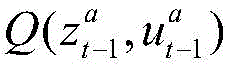
可选的,所述动作值网络包括三层神经网络,第一层为全连接前馈神经网络,输入维度取决于输入向量,输出维度为32;第二层为门控循环神经网络,输出维度为64,隐藏层维度为64;第三层为全连接前馈神经网络,输入维度为64,输出维度取决于动作序列维度。Optionally, the action value network includes a three-layer neural network, the first layer is a fully connected feedforward neural network, the input dimension depends on the input vector, and the output dimension is 32; the second layer is a gated recurrent neural network, and the output dimension is is 64, the hidden layer dimension is 64; the third layer is a fully connected feedforward neural network, the input dimension is 64, and the output dimension depends on the action sequence dimension.
基于本发明中的上述方法,本发明另外提供一种无信号灯交叉路口车辆协同控制系统,其特征在于,所述控制系统包括:Based on the above method in the present invention, the present invention further provides a vehicle cooperative control system at an intersection without a signal light, characterized in that the control system includes:
建模模块,用于将无交通信号灯的交叉路口协同控制问题建模成分布式部分可观察马尔可夫决策过程;所述部分可观察马尔可夫决策过程由元组G=(S,U,P,r,Z,O,n,γ)组成;其中S表示环境的全局状态信息,U表示联合离散的动作空间,P表示状态转移的概率,r表示智能体分享同一个奖赏值函数,Z表示观测信息,O表示观测函数,n表示智能体的索引,γ表示折扣因子;A modeling module for modeling the problem of cooperative control of intersections without traffic lights into a distributed partially observable Markov decision process; the partially observable Markov decision process consists of a tuple G = (S, U, P, r, Z, O, n, γ); where S represents the global state information of the environment, U represents the joint discrete action space, P represents the probability of state transition, r represents the agent sharing the same reward function, Z represents the observation information, O represents the observation function, n represents the index of the agent, and γ represents the discount factor;
场景模型搭建模块,用于搭建十字交叉路口场景模型;The scene model building module is used to build the scene model of the intersection;
车辆信息获取模块,用于获取车辆的状态信息、动作信息以及ID信息;The vehicle information acquisition module is used to acquire the status information, action information and ID information of the vehicle;
神经网络构建模块,用于构建神经网络模型;所述神经网络模型包括:动作值神经网络和混合神经网络;A neural network building module for building a neural network model; the neural network model includes: an action value neural network and a hybrid neural network;
车辆动作值的评估值确定模块,用于将所述车辆的状态信息、动作信息以及ID信息输入至所述动作值神经网络得到当前状态下各车辆动作值的评估值;an evaluation value determination module for vehicle action values, configured to input the state information, action information and ID information of the vehicle into the action value neural network to obtain an evaluation value of each vehicle action value in the current state;
动作信息确定模块,用于基于所述当前状态下各车辆动作值的评估值采用动作选择机制确定各车辆的动作信息;an action information determination module, configured to use an action selection mechanism to determine the action information of each vehicle based on the evaluation value of the action value of each vehicle in the current state;
近似共享奖赏值确定模块,用于将所述环境的全局状态信息和所述各车辆的动作信息输入至所述混合神经网络,得到近似共享奖赏值。The approximate shared reward value determination module is configured to input the global state information of the environment and the action information of each vehicle into the hybrid neural network to obtain an approximate shared reward value.
可选的,所述十字交叉路口场景模型的具体参数包括:受管控的车道,长度为100m;左转车道;直行车道;车辆,数量为8辆,长度为5米,最大速度为15m/s,最小速度为0m/s,最大加速度为3.5m/s2,最大减速度为-5m/s2。Optionally, the specific parameters of the intersection scene model include: a controlled lane, with a length of 100m; a left-turn lane; a straight lane; vehicles, with a number of 8, a length of 5 meters, and a maximum speed of 15m/s , the minimum speed is 0m/s, the maximum acceleration is 3.5m/s 2 , and the maximum deceleration is -5m/s 2 .
可选的,所述共享奖赏值函数为:Optionally, the shared reward function is:

其中,α1,α2,α3,α4,α5均为可调节参数,



可选的,所述动作信息确定模块具体采用以下公式:Optionally, the action information determination module specifically adopts the following formula:

其中,


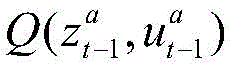
可选的,所述动作值网络包括三层神经网络,第一层为全连接前馈神经网络,输入维度取决于输入向量,输出维度为32;第二层为门控循环神经网络,输出维度为64,隐藏层维度为64;第三层为全连接前馈神经网络,输入维度为64,输出维度取决于动作序列维度。Optionally, the action value network includes a three-layer neural network, the first layer is a fully connected feedforward neural network, the input dimension depends on the input vector, and the output dimension is 32; the second layer is a gated recurrent neural network, and the output dimension is is 64, the hidden layer dimension is 64; the third layer is a fully connected feedforward neural network, the input dimension is 64, and the output dimension depends on the action sequence dimension.
根据本发明提供的具体实施例,本发明公开了以下技术效果:According to the specific embodiments provided by the present invention, the present invention discloses the following technical effects:
本发明中的上述方法及系统在无信号灯交叉路口下的多车协同问题中,基于经典控制论的解法一般对智能体的动作空间的假设为连续动作空间,若直接使用一般的多智能体强化学习算法对其求解会造成解空间维数灾难及算法搜索效率低下的问题,而本发明在建模过程中将该实际问题的动作空间进行离散化,在不损失求解精度的同时提高了求解效率;In the multi-vehicle cooperation problem at the intersection without signal lights, the above method and system in the present invention generally assumes the action space of the agent to be a continuous action space in the solution based on classical cybernetics. The solution of the learning algorithm will cause the problem of solution space dimensional disaster and low algorithm search efficiency, and the present invention discretizes the action space of the actual problem in the modeling process, which improves the solution efficiency without losing the solution accuracy. ;
在无信号灯交叉路口下的多车协同问题中,基于经典控制论的解法缺乏让智能体自主探索并自主适应环境的能力,因此本发明采用强化学习框架解决该问题可以让智能体在训练中有自主探索、自主适应环境的能力;In the problem of multi-vehicle cooperation at intersections without signal lights, the solution based on classical cybernetics lacks the ability to allow the agent to explore and adapt to the environment autonomously. Therefore, the present invention adopts the reinforcement learning framework to solve this problem, so that the agent can be trained in the training process. Ability to explore and adapt to the environment independently;
基于集中式的经典控制论的方法的计算复杂度较高,可扩展性差。而本发明的算法采用了参数共享这一技术,其可以有效提升算法的可扩展性,即扩展到涉及更多车辆的无交通信号灯的交叉路口场景;而算法训练后得到的模型其本质上只进行有限的矩阵乘法运算,从而大幅度降低了经典控制论算法中的高计算复杂度问题;The methods based on centralized classical cybernetics have high computational complexity and poor scalability. The algorithm of the present invention adopts the technology of parameter sharing, which can effectively improve the scalability of the algorithm, that is, it can be extended to the intersection scene without traffic lights involving more vehicles; and the model obtained after algorithm training is essentially only Perform limited matrix multiplication operations, thereby greatly reducing the high computational complexity of classical cybernetics algorithms;
集中式的多智能体强化学习算法存在信用分配差的问题,本发明采用的基于值分解的多智能体强化学习算法可以有效对智能体的贡献度进行估算。The centralized multi-agent reinforcement learning algorithm has the problem of poor credit allocation, and the multi-agent reinforcement learning algorithm based on value decomposition adopted in the present invention can effectively estimate the contribution degree of the agents.
分布式的多智能体强化学习算法(未应用到该实际场景)存在受环境非平稳性影响严重的问题,本发明采用的是集中式训练,分布式执行的算法框架,在训练过程中,智能体能够获取全局信息,因此环境非平稳性可以得到有效缓解。The distributed multi-agent reinforcement learning algorithm (not applied to the actual scene) has the problem of being seriously affected by the non-stationarity of the environment. The present invention adopts a centralized training and distributed execution algorithm framework. During the training process, the intelligent The body can obtain global information, so the environmental non-stationarity can be effectively alleviated.
附图说明Description of drawings
为了更清楚地说明本发明实施例或现有技术中的技术方案,下面将对实施例中所需要使用的附图作简单地介绍,显而易见地,下面描述中的附图仅仅是本发明的一些实施例,对于本领域普通技术人员来讲,在不付出创造性劳动性的前提下,还可以根据这些附图获得其他的附图。In order to more clearly illustrate the embodiments of the present invention or the technical solutions in the prior art, the accompanying drawings required in the embodiments will be briefly introduced below. Obviously, the drawings in the following description are only some of the present invention. In the embodiments, for those of ordinary skill in the art, other drawings can also be obtained according to these drawings without creative labor.
图1为本发明实施例一种无信号灯交叉路口车辆协同控制方法流程图;FIG. 1 is a flowchart of a method for cooperative vehicle control at an intersection without a signal light according to an embodiment of the present invention;
图2为本发明实施例于值分解的多智能体深度强化学习算法进行交互式训练流程图;2 is a flowchart of interactive training of a multi-agent deep reinforcement learning algorithm for value decomposition according to an embodiment of the present invention;
图3为本发明实施例∈-greedy策略算法流程图;Fig. 3 is the flow chart of the embodiment of the present invention ε-greedy strategy algorithm;
图4为本发明实施例一种无信号灯交叉路口车辆协同控制系统结构示意图。FIG. 4 is a schematic structural diagram of a vehicle cooperative control system at an intersection without a signal light according to an embodiment of the present invention.
具体实施方式Detailed ways
下面将结合本发明实施例中的附图,对本发明实施例中的技术方案进行清楚、完整地描述,显然,所描述的实施例仅仅是本发明一部分实施例,而不是全部的实施例。基于本发明中的实施例,本领域普通技术人员在没有做出创造性劳动前提下所获得的所有其他实施例,都属于本发明保护的范围。The technical solutions in the embodiments of the present invention will be clearly and completely described below with reference to the accompanying drawings in the embodiments of the present invention. Obviously, the described embodiments are only a part of the embodiments of the present invention, but not all of the embodiments. Based on the embodiments of the present invention, all other embodiments obtained by those of ordinary skill in the art without creative efforts shall fall within the protection scope of the present invention.
本发明的目的是提供一种无信号灯交叉路口车辆协同控制方法及系统,旨在解决非智能算法中的高计算复杂度问题,多智能体强化学习集中式算法中的维数灾难、信用分配问题。The purpose of the present invention is to provide a method and system for cooperative control of vehicles at intersections without signal lights, which aims to solve the problem of high computational complexity in non-intelligent algorithms, dimensional disaster and credit allocation problems in multi-agent reinforcement learning centralized algorithms .
为使本发明的上述目的、特征和优点能够更加明显易懂,下面结合附图和具体实施方式对本发明作进一步详细的说明。In order to make the above objects, features and advantages of the present invention more clearly understood, the present invention will be described in further detail below with reference to the accompanying drawings and specific embodiments.
图1为本发明实施例一种无信号灯交叉路口车辆协同控制方法流程图,如图1所示,所述方法包括:FIG. 1 is a flowchart of a method for cooperative vehicle control at an intersection without signal lights according to an embodiment of the present invention. As shown in FIG. 1 , the method includes:
步骤101:将无交通信号灯的交叉路口协同控制问题建模成分布式部分可观察马尔可夫决策过程;Step 101: Model the collaborative control problem of an intersection without traffic lights into a distributed partially observable Markov decision process;
具体而言,将无交通信号灯的交叉路口协同控制问题建模成分布式部分可观马尔可夫决策过程(Decentralized Partially Observable Markov Decision Process,Dec-POMDP),由元组G=(S,U,P,r,Z,O,n,γ)组成,其中s∈S代表与算法交互的仿真环境中的所有智能体的状态信息,其中包含所有智能体的位置、速度等信息。每一步中每个智能体a∈A≡{1,2,...,N}选择动作ua∈U,其联合动作为u∈U≡Un,做出动作选择之后会使环境以概率P(s'|s,u):S×U×S→[0,1]进入下一个状态,所有智能体分享同一个奖赏值函数


步骤102:搭建十字交叉路口场景模型。Step 102: Build an intersection scene model.
具体的,是在SimulationofUrbanMobility(SUMO)仿真器中搭建一个8车道的十字交叉路口场景,场景具体参数如下:Specifically, an 8-lane intersection scene is built in the SimulationofUrbanMobility(SUMO) simulator. The specific parameters of the scene are as follows:
1、受管控的车道长度为100m。1. The length of the controlled lane is 100m.
2、每一路包含左转车道和直行车道。2. Each road includes a left-turn lane and a straight-through lane.
3、车辆为乘用车;受算法管控的车辆数为8;车身长度为5m3. The vehicle is a passenger car; the number of vehicles controlled by the algorithm is 8; the body length is 5m
4、车辆的最大速度为15m/s,最小速度为0m/s,最大加速度为3.5m/s2,最大减速度为-5m/s2 4. The maximum speed of the vehicle is 15m/s, the minimum speed is 0m/s, the maximum acceleration is 3.5m/s 2 , and the maximum deceleration is -5m/s 2
5、每一步交互的时间为0.1s;每个回合的最大长度为200。5. The interaction time of each step is 0.1s; the maximum length of each round is 200.
6、成功完成交叉路口管理任务的条件:车辆进入交叉路口并无碰撞地安全驶出路口。6. Conditions for successful completion of intersection management tasks: Vehicles enter the intersection and exit the intersection safely without collision.
定义各智能体(即各车辆)的状态空间为:s=[z1,z2,...,z8];Define the state space of each agent (that is, each vehicle) as: s=[z 1 , z 2 ,...,z 8 ];
每个智能体的初始ID为:a∈{0,1,2,...,7};The initial ID of each agent is: a∈{0,1,2,...,7};
每个智能体a的动作空间为:ua=[accel,keep,decel],分别代表以恒定的加速度加速、保持上一步的速度、以恒定加速度减速;The action space of each agent a is: u a =[accel,keep,decel], respectively representing acceleration with constant acceleration, maintaining the speed of the previous step, and decelerating with constant acceleration;
每个智能体只能观测到它局部信息z∈Z,具体包含的信息如下:za=[x,y,vel,safe_dist,waiting_time,enter_flag,out_flag],其中[x,y,vel]代表该智能体的绝对坐标与速度信息(智能体的最大速度为15m/s,加速度为可调参数,最多不能超过5m/s2),safe_dist表示与距该智能体最近的智能体的相对距离,waiting_time表示该智能体在经过交叉路口过程中累计等待的时间,[enter_flag,out_flag]表示智能体是否进入或驶出交叉路口;Each agent can only observe its local information z∈Z, which contains the following information: za = [x,y,vel,safe_dist,waiting_time,enter_flag,out_flag], where [x,y,vel] represents the The absolute coordinates and speed information of the agent (the maximum speed of the agent is 15m/s, the acceleration is an adjustable parameter, and the maximum cannot exceed 5m/s 2 ), safe_dist represents the relative distance to the agent closest to the agent, waiting_time Indicates the accumulated waiting time of the agent in the process of passing through the intersection, [enter_flag,out_flag] indicates whether the agent enters or exits the intersection;
每个智能体的历史轨迹为:τa=(za×ua)The historical trajectory of each agent is: τ a = (z a ×u a )
每个智能体的策略记作πa(ua|τa),本方案中的算法对每个智能体的策略计算一个Q值函数,其物理意义代表对当前时刻当前状态下智能体动作的评估

所有智能体在每一步算法与仿真环境交互中获得的共享奖赏值函数定义如下:The shared reward function obtained by all agents in each step of the interaction between the algorithm and the simulated environment is defined as follows:

式中α1,α2,α3,α4,α5均为可调节参数,

微观上,该奖赏函数机制能够让每一个车辆安全无碰撞地通过交叉路口(奖赏函数第三项),并鼓励车辆快速通过路口,即尽可能以最短的通行时间经过路口。宏观上意义上该奖赏函数可以提高整体交通效率和交通安全。Microscopically, the reward function mechanism can allow each vehicle to pass through the intersection safely and without collision (the third item of the reward function), and encourage vehicles to pass through the intersection quickly, that is, to pass through the intersection with the shortest transit time as possible. In the macroscopic sense, the reward function can improve the overall traffic efficiency and traffic safety.
步骤103:获取车辆的状态信息、动作信息以及ID信息。Step 103: Acquire state information, action information and ID information of the vehicle.
步骤104:构建神经网络模型;所述神经网络模型包括:动作值神经网络和混合神经网络。Step 104: Construct a neural network model; the neural network model includes: an action value neural network and a hybrid neural network.
步骤105:将所述车辆的状态信息、动作信息以及ID信息输入至所述动作值神经网络得到当前状态下各车辆动作值的评估值;Step 105: Input the state information, action information and ID information of the vehicle into the action value neural network to obtain the evaluation value of the action value of each vehicle in the current state;
步骤106:基于所述当前状态下各车辆动作值的评估值采用动作选择机制确定各车辆的动作信息;Step 106 : determining the action information of each vehicle by adopting an action selection mechanism based on the evaluation value of the action value of each vehicle in the current state;
步骤107:将所述环境的全局状态信息和所述各车辆的动作信息输入至所述混合神经网络,得到近似共享奖赏值。Step 107: Input the global state information of the environment and the action information of each vehicle into the hybrid neural network to obtain an approximate shared reward value.
基于上述构建的数学模型和搭建的仿真场景,利用基于值分解的多智能体深度强化学习算法进行交互式训练,流程图如图2所示。Based on the mathematical model constructed above and the built simulation scene, interactive training is performed using the value decomposition-based multi-agent deep reinforcement learning algorithm. The flowchart is shown in Figure 2.
步骤102中搭建的仿真场景在交互的每一步中为该算法提供车辆的状态信息,即步骤101中的zt,st(其中包含的具体信息见步骤101建模过程);算法的输出为各车辆下一时刻的动作信息,用于控制仿真器中车辆的行为。具体来说,算法的输入为


∈为概率,它表示由程序从[0,1]区间内按均匀分布采样得到的数值。∈ is the probability, which represents the value sampled by the program from a uniform distribution in the interval [0,1].
算法框架的具体过程图3所示:The specific process of the algorithm framework is shown in Figure 3:
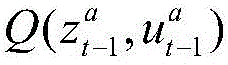
该算法主要由两个网络构成,一个是动作值网络,一个是混合网络。动作值网络由三层神经网络构成,第一层为全连接前馈神经网络,输入维度取决于输入向量(见下文),输出维度为32;第二层为门控循环神经网络(Gated RecurrentNetwork,GRU),其网络输出维度为64,隐藏层维度也为64;第三层为全连接前馈神经网络,输入维度为64,输出维度取决于动作序列维度。最后使用上述探索策略,即∈-greedy策略输出所有智能体已选动作的具体Q值。The algorithm is mainly composed of two networks, one is an action value network and the other is a hybrid network. The action value network consists of three layers of neural networks, the first layer is a fully connected feedforward neural network, the input dimension depends on the input vector (see below), and the output dimension is 32; the second layer is a gated recurrent neural network (Gated Recurrent Network, GRU), the network output dimension is 64, and the hidden layer dimension is also 64; the third layer is a fully connected feedforward neural network, the input dimension is 64, and the output dimension depends on the action sequence dimension. Finally, the above exploration strategy is used, that is, the ∈-greedy strategy outputs the specific Q-values of the selected actions of all agents.
动作值网络的输入向量如下:The input vector of the action value network is as follows:

其中


随机梯度下降算法的公式如下:The formula for the stochastic gradient descent algorithm is as follows:

θ表示混合网络模型的所有参数,
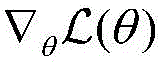

其中θQ表示动作值网络的所有参数,f(·)表示利用深度学习框架pytorch中自动求解梯度机制后,将混合网络的损失值映射到动作值网络的函数where θ Q represents all parameters of the action value network, and f( ) represents the function of mapping the loss value of the hybrid network to the action value network after using the gradient mechanism in the deep learning framework pytorch to automatically solve

b代表每次用于算法训练的一批数据的总维数,r代表仿真环境中所有智能体得到的共享奖赏值,γ表示折扣因子,Qtot(·)代表整个混合网络模型(该模型本质上是一个复杂的非线性函数),其中τ′表示下一时刻的历史信息轨迹,s'代表下一时刻环境的状态信息,u′表示智能体在下一时刻的动作序列,θ、θ′分别代表混合网络及目标混合网络的参数,每一次算法与仿真环境交互之后两者之间的关系如下,其中β为可调节参数,其物理意义代表目标网络参数更新的快慢:b represents the total dimension of a batch of data used for algorithm training each time, r represents the shared reward value obtained by all agents in the simulation environment, γ represents the discount factor, and Q tot ( ) represents the entire hybrid network model (the model essentially is a complex nonlinear function), where τ' represents the historical information trajectory at the next moment, s' represents the state information of the environment at the next moment, u' represents the action sequence of the agent at the next moment, θ, θ' respectively Represents the parameters of the hybrid network and the target hybrid network. The relationship between the two after each interaction between the algorithm and the simulation environment is as follows, where β is an adjustable parameter, and its physical meaning represents the update speed of the target network parameters:
θ′=β*θ+(1-β)*θ′θ′=β*θ+(1-β)*θ′
argmaxu′Qtot(τ',u',s';θ)表示从参数为θ的混合网络模型的输出向量中,根据所有智能体在下一时刻不同环境状态s'下的不同动作输出中挑选一个能使该模型输出值最大的动作序列。argmax u' Q tot (τ', u', s'; θ) means to select from the output vector of the hybrid network model with parameter θ, according to the different action outputs of all agents in different environmental states s' at the next moment An action sequence that maximizes the output value of the model.
图4为本发明实施例一种无信号灯交叉路口车辆协同控制系统结构示意图,如图4所示所述系统包括:FIG. 4 is a schematic structural diagram of a vehicle cooperative control system at an intersection without a signal light according to an embodiment of the present invention. As shown in FIG. 4 , the system includes:
建模模块201,用于将无交通信号灯的交叉路口协同控制问题建模成分布式部分可观察马尔可夫决策过程;所述部分可观察马尔可夫决策过程由元组G=(S,U,P,r,Z,O,n,γ)组成;其中S表示环境的全局状态信息,U表示联合离散的动作空间,P表示状态转移的概率,r表示智能体分享同一个奖赏值函数,Z表示观测信息,O表示观测函数,n表示智能体的索引,γ表示折扣因子;The
场景模型搭建模块202,用于搭建十字交叉路口场景模型;The scene
车辆信息获取模块203,用于获取车辆的状态信息、动作信息以及ID信息;The vehicle
神经网络构建模块204,用于构建神经网络模型;所述神经网络模型包括:动作值神经网络和混合神经网络;The neural
车辆动作值的评估值确定模块205,用于将所述车辆的状态信息、动作信息以及ID信息输入至所述动作值神经网络得到当前状态下各车辆动作值的评估值;The evaluation
动作信息确定模块206,用于基于所述当前状态下各车辆动作值的评估值采用动作选择机制确定各车辆的动作信息;an action
近似共享奖赏值确定模块207,用于将所述环境的全局状态信息和所述各车辆的动作信息输入至所述混合神经网络,得到近似共享奖赏值。The approximate shared reward
本说明书中各个实施例采用递进的方式描述,每个实施例重点说明的都是与其他实施例的不同之处,各个实施例之间相同相似部分互相参见即可。对于实施例公开的系统而言,由于其与实施例公开的方法相对应,所以描述的比较简单,相关之处参见方法部分说明即可。The various embodiments in this specification are described in a progressive manner, and each embodiment focuses on the differences from other embodiments, and the same and similar parts between the various embodiments can be referred to each other. For the system disclosed in the embodiment, since it corresponds to the method disclosed in the embodiment, the description is relatively simple, and the relevant part can be referred to the description of the method.
本文中应用了具体个例对本发明的原理及实施方式进行了阐述,以上实施例的说明只是用于帮助理解本发明的方法及其核心思想;同时,对于本领域的一般技术人员,依据本发明的思想,在具体实施方式及应用范围上均会有改变之处。综上所述,本说明书内容不应理解为对本发明的限制。In this paper, specific examples are used to illustrate the principles and implementations of the present invention. The descriptions of the above embodiments are only used to help understand the methods and core ideas of the present invention; meanwhile, for those skilled in the art, according to the present invention There will be changes in the specific implementation and application scope. In conclusion, the contents of this specification should not be construed as limiting the present invention.
Claims (10)







Priority Applications (1)
| Application Number | Priority Date | Filing Date | Title |
|---|---|---|---|
| CN202210132425.2A CN114463997B (en) | 2022-02-14 | 2022-02-14 | Vehicle cooperative control method and system for intersection without signal lamp |
Applications Claiming Priority (1)
| Application Number | Priority Date | Filing Date | Title |
|---|---|---|---|
| CN202210132425.2A CN114463997B (en) | 2022-02-14 | 2022-02-14 | Vehicle cooperative control method and system for intersection without signal lamp |
Publications (2)
| Publication Number | Publication Date |
|---|---|
| CN114463997A true CN114463997A (en) | 2022-05-10 |
| CN114463997B CN114463997B (en) | 2023-06-16 |
Family
ID=81412961
Family Applications (1)
| Application Number | Title | Priority Date | Filing Date |
|---|---|---|---|
| CN202210132425.2A Active CN114463997B (en) | 2022-02-14 | 2022-02-14 | Vehicle cooperative control method and system for intersection without signal lamp |
Country Status (1)
| Country | Link |
|---|---|
| CN (1) | CN114463997B (en) |
Cited By (6)
| Publication number | Priority date | Publication date | Assignee | Title |
|---|---|---|---|---|
| CN114919581A (en) * | 2022-05-11 | 2022-08-19 | 中南大学 | Behavioral decision-making method and computer device for intelligent vehicle disordered intersection |
| CN115077549A (en) * | 2022-06-16 | 2022-09-20 | 南昌智能新能源汽车研究院 | Vehicle state tracking method, system, computer and readable storage medium |
| CN115116240A (en) * | 2022-06-27 | 2022-09-27 | 中国科学院电工研究所 | Lantern-free intersection vehicle cooperative control method and system |
| CN115145281A (en) * | 2022-07-19 | 2022-10-04 | 江苏大学 | Vehicle-road cooperative control system and method based on multi-agent federated reinforcement learning at complex intersections |
| US11862016B1 (en) | 2022-07-19 | 2024-01-02 | Jiangsu University | Multi-intelligence federal reinforcement learning-based vehicle-road cooperative control system and method at complex intersection |
| CN117523847A (en) * | 2023-12-29 | 2024-02-06 | 苏州观瑞汽车技术有限公司 | A multi-vehicle collaborative control method and system at an information-controlled intersection in a mixed traffic environment |
Citations (7)
| Publication number | Priority date | Publication date | Assignee | Title |
|---|---|---|---|---|
| CN110431037A (en) * | 2017-02-10 | 2019-11-08 | 日产北美公司 | Autonomous Vehicle Operations Management Including Examples Using Partially Observable Markov Decision Process Models |
| CN111445692A (en) * | 2019-12-24 | 2020-07-24 | 清华大学 | A speed collaborative optimization method for intelligent networked vehicles at intersections without signal lights |
| CN111695690A (en) * | 2020-07-30 | 2020-09-22 | 航天欧华信息技术有限公司 | Multi-agent confrontation decision-making method based on cooperative reinforcement learning and transfer learning |
| CN112015174A (en) * | 2020-07-10 | 2020-12-01 | 歌尔股份有限公司 | Multi-AGV motion planning method, device and system |
| CN113264064A (en) * | 2021-03-31 | 2021-08-17 | 志行千里(北京)科技有限公司 | Automatic driving method for intersection scene and related equipment |
| CN113313267A (en) * | 2021-06-28 | 2021-08-27 | 浙江大学 | Multi-agent reinforcement learning method based on value decomposition and attention mechanism |
| CN113487857A (en) * | 2021-06-18 | 2021-10-08 | 杭州远眺科技有限公司 | Regional multi-intersection variable lane cooperative control decision method |
-
2022
- 2022-02-14 CN CN202210132425.2A patent/CN114463997B/en active Active
Patent Citations (7)
| Publication number | Priority date | Publication date | Assignee | Title |
|---|---|---|---|---|
| CN110431037A (en) * | 2017-02-10 | 2019-11-08 | 日产北美公司 | Autonomous Vehicle Operations Management Including Examples Using Partially Observable Markov Decision Process Models |
| CN111445692A (en) * | 2019-12-24 | 2020-07-24 | 清华大学 | A speed collaborative optimization method for intelligent networked vehicles at intersections without signal lights |
| CN112015174A (en) * | 2020-07-10 | 2020-12-01 | 歌尔股份有限公司 | Multi-AGV motion planning method, device and system |
| CN111695690A (en) * | 2020-07-30 | 2020-09-22 | 航天欧华信息技术有限公司 | Multi-agent confrontation decision-making method based on cooperative reinforcement learning and transfer learning |
| CN113264064A (en) * | 2021-03-31 | 2021-08-17 | 志行千里(北京)科技有限公司 | Automatic driving method for intersection scene and related equipment |
| CN113487857A (en) * | 2021-06-18 | 2021-10-08 | 杭州远眺科技有限公司 | Regional multi-intersection variable lane cooperative control decision method |
| CN113313267A (en) * | 2021-06-28 | 2021-08-27 | 浙江大学 | Multi-agent reinforcement learning method based on value decomposition and attention mechanism |
Non-Patent Citations (1)
| Title |
|---|
| TABISH RASHID等: "QMIX: Monotonic Value Function Factorisation for Deep Multi-Agent Reinforcement Learning" * |
Cited By (11)
| Publication number | Priority date | Publication date | Assignee | Title |
|---|---|---|---|---|
| CN114919581A (en) * | 2022-05-11 | 2022-08-19 | 中南大学 | Behavioral decision-making method and computer device for intelligent vehicle disordered intersection |
| CN114919581B (en) * | 2022-05-11 | 2024-04-26 | 中南大学 | Behavior decision method and computer device for intelligent vehicle at disordered intersection |
| CN115077549A (en) * | 2022-06-16 | 2022-09-20 | 南昌智能新能源汽车研究院 | Vehicle state tracking method, system, computer and readable storage medium |
| CN115077549B (en) * | 2022-06-16 | 2024-04-26 | 南昌智能新能源汽车研究院 | Vehicle status tracking method, system, computer and readable storage medium |
| CN115116240A (en) * | 2022-06-27 | 2022-09-27 | 中国科学院电工研究所 | Lantern-free intersection vehicle cooperative control method and system |
| WO2024001301A1 (en) * | 2022-06-27 | 2024-01-04 | 中国科学院电工研究所 | Method and system for cooperative control of vehicles at intersection without traffic light |
| CN115145281A (en) * | 2022-07-19 | 2022-10-04 | 江苏大学 | Vehicle-road cooperative control system and method based on multi-agent federated reinforcement learning at complex intersections |
| US11862016B1 (en) | 2022-07-19 | 2024-01-02 | Jiangsu University | Multi-intelligence federal reinforcement learning-based vehicle-road cooperative control system and method at complex intersection |
| WO2024016386A1 (en) * | 2022-07-19 | 2024-01-25 | 江苏大学 | Multi-agent federated reinforcement learning-based vehicle-road collaborative control system and method under complex intersection |
| CN117523847A (en) * | 2023-12-29 | 2024-02-06 | 苏州观瑞汽车技术有限公司 | A multi-vehicle collaborative control method and system at an information-controlled intersection in a mixed traffic environment |
| CN117523847B (en) * | 2023-12-29 | 2024-11-05 | 苏州观瑞汽车技术有限公司 | Multi-vehicle cooperative control method and system for signal control intersection under mixed traffic environment |
Also Published As
| Publication number | Publication date |
|---|---|
| CN114463997B (en) | 2023-06-16 |
Similar Documents
| Publication | Publication Date | Title |
|---|---|---|
| CN114463997A (en) | A method and system for cooperative vehicle control at an intersection without signal lights | |
| Lin et al. | Traffic signal optimization based on fuzzy control and differential evolution algorithm | |
| CN110750877B (en) | Vehicle following behavior prediction method under Apollo platform | |
| CN110032782B (en) | A city-level intelligent traffic signal control system and method | |
| CN110992695B (en) | A multi-objective optimization method for vehicle traffic decision-making at urban intersections based on conflict resolution | |
| CN115116240A (en) | Lantern-free intersection vehicle cooperative control method and system | |
| WO2022052406A1 (en) | Automatic driving training method, apparatus and device, and medium | |
| CN111696370A (en) | Traffic light control method based on heuristic deep Q network | |
| CN110796856A (en) | Vehicle Lane Change Intention Prediction Method and Lane Change Intention Prediction Network Training Method | |
| CN118212808B (en) | Method, system and equipment for planning traffic decision of signalless intersection | |
| CN113255998B (en) | Expressway unmanned vehicle formation method based on multi-agent reinforcement learning | |
| CN116476863B (en) | Automatic driving transverse and longitudinal integrated decision-making method based on deep reinforcement learning | |
| Chen et al. | Traffic signal optimization control method based on adaptive weighted averaged double deep Q network | |
| CN117636661A (en) | A completely autonomous traffic flow control method at unsignalized intersections | |
| Gong et al. | Collision-free cooperative motion planning and decision-making for connected and automated vehicles at unsignalized intersections | |
| CN113743767A (en) | Vehicle dispatching method, system, computer and medium based on time and safety | |
| Gao et al. | DRL based platooning control with traffic signal synchronization for delay and fuel optimization | |
| Wang et al. | Iterative learning-based cooperative motion planning and decision-making for connected and autonomous vehicles coordination at on-ramps | |
| CN116935669A (en) | Multi-vehicle combined longitudinal control method based on improved MADDPG | |
| CN118865722A (en) | Multi-vehicle system ramp collaborative decision control method and device based on iterative learning | |
| Zhang et al. | PlanLight: learning to optimize traffic signal control with planning and iterative policy improvement | |
| CN113189998A (en) | Multi-passenger dynamic vehicle path optimization method based on deep reinforcement learning | |
| Xu et al. | Deep reinforcement learning with fuzzy feature fusion for cooperative control in traffic light and connected autonomous vehicles | |
| CN117370894A (en) | Intelligent vehicle reinforcement learning collaborative driving method for urban traffic scenarios | |
| CN120612836A (en) | An automatic driving system based on intelligent transportation |
Legal Events
| Date | Code | Title | Description |
|---|---|---|---|
| PB01 | Publication | ||
| PB01 | Publication | ||
| SE01 | Entry into force of request for substantive examination | ||
| SE01 | Entry into force of request for substantive examination | ||
| GR01 | Patent grant | ||
| GR01 | Patent grant |