CN114438036A - Method for promoting directional differentiation and maturation of stem cells into erythroid cells and application - Google Patents
Method for promoting directional differentiation and maturation of stem cells into erythroid cells and application Download PDFInfo
- Publication number
- CN114438036A CN114438036A CN202210074204.4A CN202210074204A CN114438036A CN 114438036 A CN114438036 A CN 114438036A CN 202210074204 A CN202210074204 A CN 202210074204A CN 114438036 A CN114438036 A CN 114438036A
- Authority
- CN
- China
- Prior art keywords
- cells
- gene
- dsup
- nucleic acid
- stem cells
- Prior art date
- Legal status (The legal status is an assumption and is not a legal conclusion. Google has not performed a legal analysis and makes no representation as to the accuracy of the status listed.)
- Granted
Links
Images


Classifications
-
- C—CHEMISTRY; METALLURGY
- C12—BIOCHEMISTRY; BEER; SPIRITS; WINE; VINEGAR; MICROBIOLOGY; ENZYMOLOGY; MUTATION OR GENETIC ENGINEERING
- C12N—MICROORGANISMS OR ENZYMES; COMPOSITIONS THEREOF; PROPAGATING, PRESERVING, OR MAINTAINING MICROORGANISMS; MUTATION OR GENETIC ENGINEERING; CULTURE MEDIA
- C12N15/00—Mutation or genetic engineering; DNA or RNA concerning genetic engineering, vectors, e.g. plasmids, or their isolation, preparation or purification; Use of hosts therefor
- C12N15/09—Recombinant DNA-technology
- C12N15/63—Introduction of foreign genetic material using vectors; Vectors; Use of hosts therefor; Regulation of expression
- C12N15/79—Vectors or expression systems specially adapted for eukaryotic hosts
- C12N15/85—Vectors or expression systems specially adapted for eukaryotic hosts for animal cells
-
- A—HUMAN NECESSITIES
- A61—MEDICAL OR VETERINARY SCIENCE; HYGIENE
- A61K—PREPARATIONS FOR MEDICAL, DENTAL OR TOILETRY PURPOSES
- A61K48/00—Medicinal preparations containing genetic material which is inserted into cells of the living body to treat genetic diseases; Gene therapy
- A61K48/005—Medicinal preparations containing genetic material which is inserted into cells of the living body to treat genetic diseases; Gene therapy characterised by an aspect of the 'active' part of the composition delivered, i.e. the nucleic acid delivered
-
- A—HUMAN NECESSITIES
- A61—MEDICAL OR VETERINARY SCIENCE; HYGIENE
- A61P—SPECIFIC THERAPEUTIC ACTIVITY OF CHEMICAL COMPOUNDS OR MEDICINAL PREPARATIONS
- A61P13/00—Drugs for disorders of the urinary system
-
- A—HUMAN NECESSITIES
- A61—MEDICAL OR VETERINARY SCIENCE; HYGIENE
- A61P—SPECIFIC THERAPEUTIC ACTIVITY OF CHEMICAL COMPOUNDS OR MEDICINAL PREPARATIONS
- A61P35/00—Antineoplastic agents
-
- A—HUMAN NECESSITIES
- A61—MEDICAL OR VETERINARY SCIENCE; HYGIENE
- A61P—SPECIFIC THERAPEUTIC ACTIVITY OF CHEMICAL COMPOUNDS OR MEDICINAL PREPARATIONS
- A61P35/00—Antineoplastic agents
- A61P35/02—Antineoplastic agents specific for leukemia
-
- A—HUMAN NECESSITIES
- A61—MEDICAL OR VETERINARY SCIENCE; HYGIENE
- A61P—SPECIFIC THERAPEUTIC ACTIVITY OF CHEMICAL COMPOUNDS OR MEDICINAL PREPARATIONS
- A61P37/00—Drugs for immunological or allergic disorders
- A61P37/02—Immunomodulators
-
- A—HUMAN NECESSITIES
- A61—MEDICAL OR VETERINARY SCIENCE; HYGIENE
- A61P—SPECIFIC THERAPEUTIC ACTIVITY OF CHEMICAL COMPOUNDS OR MEDICINAL PREPARATIONS
- A61P7/00—Drugs for disorders of the blood or the extracellular fluid
-
- A—HUMAN NECESSITIES
- A61—MEDICAL OR VETERINARY SCIENCE; HYGIENE
- A61P—SPECIFIC THERAPEUTIC ACTIVITY OF CHEMICAL COMPOUNDS OR MEDICINAL PREPARATIONS
- A61P7/00—Drugs for disorders of the blood or the extracellular fluid
- A61P7/06—Antianaemics
-
- C—CHEMISTRY; METALLURGY
- C07—ORGANIC CHEMISTRY
- C07K—PEPTIDES
- C07K14/00—Peptides having more than 20 amino acids; Gastrins; Somatostatins; Melanotropins; Derivatives thereof
- C07K14/435—Peptides having more than 20 amino acids; Gastrins; Somatostatins; Melanotropins; Derivatives thereof from animals; from humans
- C07K14/43504—Peptides having more than 20 amino acids; Gastrins; Somatostatins; Melanotropins; Derivatives thereof from animals; from humans from invertebrates
-
- C—CHEMISTRY; METALLURGY
- C12—BIOCHEMISTRY; BEER; SPIRITS; WINE; VINEGAR; MICROBIOLOGY; ENZYMOLOGY; MUTATION OR GENETIC ENGINEERING
- C12N—MICROORGANISMS OR ENZYMES; COMPOSITIONS THEREOF; PROPAGATING, PRESERVING, OR MAINTAINING MICROORGANISMS; MUTATION OR GENETIC ENGINEERING; CULTURE MEDIA
- C12N5/00—Undifferentiated human, animal or plant cells, e.g. cell lines; Tissues; Cultivation or maintenance thereof; Culture media therefor
- C12N5/06—Animal cells or tissues; Human cells or tissues
- C12N5/0602—Vertebrate cells
- C12N5/0603—Embryonic cells ; Embryoid bodies
- C12N5/0606—Pluripotent embryonic cells, e.g. embryonic stem cells [ES]
-
- C—CHEMISTRY; METALLURGY
- C12—BIOCHEMISTRY; BEER; SPIRITS; WINE; VINEGAR; MICROBIOLOGY; ENZYMOLOGY; MUTATION OR GENETIC ENGINEERING
- C12N—MICROORGANISMS OR ENZYMES; COMPOSITIONS THEREOF; PROPAGATING, PRESERVING, OR MAINTAINING MICROORGANISMS; MUTATION OR GENETIC ENGINEERING; CULTURE MEDIA
- C12N5/00—Undifferentiated human, animal or plant cells, e.g. cell lines; Tissues; Cultivation or maintenance thereof; Culture media therefor
- C12N5/06—Animal cells or tissues; Human cells or tissues
- C12N5/0602—Vertebrate cells
- C12N5/0634—Cells from the blood or the immune system
- C12N5/0641—Erythrocytes
-
- C—CHEMISTRY; METALLURGY
- C12—BIOCHEMISTRY; BEER; SPIRITS; WINE; VINEGAR; MICROBIOLOGY; ENZYMOLOGY; MUTATION OR GENETIC ENGINEERING
- C12N—MICROORGANISMS OR ENZYMES; COMPOSITIONS THEREOF; PROPAGATING, PRESERVING, OR MAINTAINING MICROORGANISMS; MUTATION OR GENETIC ENGINEERING; CULTURE MEDIA
- C12N2501/00—Active agents used in cell culture processes, e.g. differentation
- C12N2501/10—Growth factors
- C12N2501/115—Basic fibroblast growth factor (bFGF, FGF-2)
-
- C—CHEMISTRY; METALLURGY
- C12—BIOCHEMISTRY; BEER; SPIRITS; WINE; VINEGAR; MICROBIOLOGY; ENZYMOLOGY; MUTATION OR GENETIC ENGINEERING
- C12N—MICROORGANISMS OR ENZYMES; COMPOSITIONS THEREOF; PROPAGATING, PRESERVING, OR MAINTAINING MICROORGANISMS; MUTATION OR GENETIC ENGINEERING; CULTURE MEDIA
- C12N2501/00—Active agents used in cell culture processes, e.g. differentation
- C12N2501/10—Growth factors
- C12N2501/125—Stem cell factor [SCF], c-kit ligand [KL]
-
- C—CHEMISTRY; METALLURGY
- C12—BIOCHEMISTRY; BEER; SPIRITS; WINE; VINEGAR; MICROBIOLOGY; ENZYMOLOGY; MUTATION OR GENETIC ENGINEERING
- C12N—MICROORGANISMS OR ENZYMES; COMPOSITIONS THEREOF; PROPAGATING, PRESERVING, OR MAINTAINING MICROORGANISMS; MUTATION OR GENETIC ENGINEERING; CULTURE MEDIA
- C12N2501/00—Active agents used in cell culture processes, e.g. differentation
- C12N2501/10—Growth factors
- C12N2501/14—Erythropoietin [EPO]
-
- C—CHEMISTRY; METALLURGY
- C12—BIOCHEMISTRY; BEER; SPIRITS; WINE; VINEGAR; MICROBIOLOGY; ENZYMOLOGY; MUTATION OR GENETIC ENGINEERING
- C12N—MICROORGANISMS OR ENZYMES; COMPOSITIONS THEREOF; PROPAGATING, PRESERVING, OR MAINTAINING MICROORGANISMS; MUTATION OR GENETIC ENGINEERING; CULTURE MEDIA
- C12N2501/00—Active agents used in cell culture processes, e.g. differentation
- C12N2501/10—Growth factors
- C12N2501/145—Thrombopoietin [TPO]
-
- C—CHEMISTRY; METALLURGY
- C12—BIOCHEMISTRY; BEER; SPIRITS; WINE; VINEGAR; MICROBIOLOGY; ENZYMOLOGY; MUTATION OR GENETIC ENGINEERING
- C12N—MICROORGANISMS OR ENZYMES; COMPOSITIONS THEREOF; PROPAGATING, PRESERVING, OR MAINTAINING MICROORGANISMS; MUTATION OR GENETIC ENGINEERING; CULTURE MEDIA
- C12N2501/00—Active agents used in cell culture processes, e.g. differentation
- C12N2501/10—Growth factors
- C12N2501/155—Bone morphogenic proteins [BMP]; Osteogenins; Osteogenic factor; Bone inducing factor
-
- C—CHEMISTRY; METALLURGY
- C12—BIOCHEMISTRY; BEER; SPIRITS; WINE; VINEGAR; MICROBIOLOGY; ENZYMOLOGY; MUTATION OR GENETIC ENGINEERING
- C12N—MICROORGANISMS OR ENZYMES; COMPOSITIONS THEREOF; PROPAGATING, PRESERVING, OR MAINTAINING MICROORGANISMS; MUTATION OR GENETIC ENGINEERING; CULTURE MEDIA
- C12N2501/00—Active agents used in cell culture processes, e.g. differentation
- C12N2501/10—Growth factors
- C12N2501/16—Activin; Inhibin; Mullerian inhibiting substance
-
- C—CHEMISTRY; METALLURGY
- C12—BIOCHEMISTRY; BEER; SPIRITS; WINE; VINEGAR; MICROBIOLOGY; ENZYMOLOGY; MUTATION OR GENETIC ENGINEERING
- C12N—MICROORGANISMS OR ENZYMES; COMPOSITIONS THEREOF; PROPAGATING, PRESERVING, OR MAINTAINING MICROORGANISMS; MUTATION OR GENETIC ENGINEERING; CULTURE MEDIA
- C12N2501/00—Active agents used in cell culture processes, e.g. differentation
- C12N2501/10—Growth factors
- C12N2501/165—Vascular endothelial growth factor [VEGF]
-
- C—CHEMISTRY; METALLURGY
- C12—BIOCHEMISTRY; BEER; SPIRITS; WINE; VINEGAR; MICROBIOLOGY; ENZYMOLOGY; MUTATION OR GENETIC ENGINEERING
- C12N—MICROORGANISMS OR ENZYMES; COMPOSITIONS THEREOF; PROPAGATING, PRESERVING, OR MAINTAINING MICROORGANISMS; MUTATION OR GENETIC ENGINEERING; CULTURE MEDIA
- C12N2501/00—Active agents used in cell culture processes, e.g. differentation
- C12N2501/20—Cytokines; Chemokines
- C12N2501/23—Interleukins [IL]
- C12N2501/2303—Interleukin-3 (IL-3)
-
- C—CHEMISTRY; METALLURGY
- C12—BIOCHEMISTRY; BEER; SPIRITS; WINE; VINEGAR; MICROBIOLOGY; ENZYMOLOGY; MUTATION OR GENETIC ENGINEERING
- C12N—MICROORGANISMS OR ENZYMES; COMPOSITIONS THEREOF; PROPAGATING, PRESERVING, OR MAINTAINING MICROORGANISMS; MUTATION OR GENETIC ENGINEERING; CULTURE MEDIA
- C12N2501/00—Active agents used in cell culture processes, e.g. differentation
- C12N2501/20—Cytokines; Chemokines
- C12N2501/26—Flt-3 ligand (CD135L, flk-2 ligand)
-
- C—CHEMISTRY; METALLURGY
- C12—BIOCHEMISTRY; BEER; SPIRITS; WINE; VINEGAR; MICROBIOLOGY; ENZYMOLOGY; MUTATION OR GENETIC ENGINEERING
- C12N—MICROORGANISMS OR ENZYMES; COMPOSITIONS THEREOF; PROPAGATING, PRESERVING, OR MAINTAINING MICROORGANISMS; MUTATION OR GENETIC ENGINEERING; CULTURE MEDIA
- C12N2501/00—Active agents used in cell culture processes, e.g. differentation
- C12N2501/70—Enzymes
- C12N2501/72—Transferases [EC 2.]
- C12N2501/727—Kinases (EC 2.7.)
-
- C—CHEMISTRY; METALLURGY
- C12—BIOCHEMISTRY; BEER; SPIRITS; WINE; VINEGAR; MICROBIOLOGY; ENZYMOLOGY; MUTATION OR GENETIC ENGINEERING
- C12N—MICROORGANISMS OR ENZYMES; COMPOSITIONS THEREOF; PROPAGATING, PRESERVING, OR MAINTAINING MICROORGANISMS; MUTATION OR GENETIC ENGINEERING; CULTURE MEDIA
- C12N2506/00—Differentiation of animal cells from one lineage to another; Differentiation of pluripotent cells
- C12N2506/02—Differentiation of animal cells from one lineage to another; Differentiation of pluripotent cells from embryonic cells
-
- C—CHEMISTRY; METALLURGY
- C12—BIOCHEMISTRY; BEER; SPIRITS; WINE; VINEGAR; MICROBIOLOGY; ENZYMOLOGY; MUTATION OR GENETIC ENGINEERING
- C12N—MICROORGANISMS OR ENZYMES; COMPOSITIONS THEREOF; PROPAGATING, PRESERVING, OR MAINTAINING MICROORGANISMS; MUTATION OR GENETIC ENGINEERING; CULTURE MEDIA
- C12N2510/00—Genetically modified cells
-
- C—CHEMISTRY; METALLURGY
- C12—BIOCHEMISTRY; BEER; SPIRITS; WINE; VINEGAR; MICROBIOLOGY; ENZYMOLOGY; MUTATION OR GENETIC ENGINEERING
- C12N—MICROORGANISMS OR ENZYMES; COMPOSITIONS THEREOF; PROPAGATING, PRESERVING, OR MAINTAINING MICROORGANISMS; MUTATION OR GENETIC ENGINEERING; CULTURE MEDIA
- C12N2800/00—Nucleic acids vectors
- C12N2800/10—Plasmid DNA
- C12N2800/106—Plasmid DNA for vertebrates
- C12N2800/107—Plasmid DNA for vertebrates for mammalian
-
- Y—GENERAL TAGGING OF NEW TECHNOLOGICAL DEVELOPMENTS; GENERAL TAGGING OF CROSS-SECTIONAL TECHNOLOGIES SPANNING OVER SEVERAL SECTIONS OF THE IPC; TECHNICAL SUBJECTS COVERED BY FORMER USPC CROSS-REFERENCE ART COLLECTIONS [XRACs] AND DIGESTS
- Y02—TECHNOLOGIES OR APPLICATIONS FOR MITIGATION OR ADAPTATION AGAINST CLIMATE CHANGE
- Y02A—TECHNOLOGIES FOR ADAPTATION TO CLIMATE CHANGE
- Y02A50/00—TECHNOLOGIES FOR ADAPTATION TO CLIMATE CHANGE in human health protection, e.g. against extreme weather
- Y02A50/30—Against vector-borne diseases, e.g. mosquito-borne, fly-borne, tick-borne or waterborne diseases whose impact is exacerbated by climate change
Landscapes
- Health & Medical Sciences (AREA)
- Life Sciences & Earth Sciences (AREA)
- Engineering & Computer Science (AREA)
- Chemical & Material Sciences (AREA)
- Organic Chemistry (AREA)
- General Health & Medical Sciences (AREA)
- Bioinformatics & Cheminformatics (AREA)
- Genetics & Genomics (AREA)
- Biomedical Technology (AREA)
- Medicinal Chemistry (AREA)
- Biotechnology (AREA)
- Pharmacology & Pharmacy (AREA)
- Animal Behavior & Ethology (AREA)
- Zoology (AREA)
- Public Health (AREA)
- Veterinary Medicine (AREA)
- Wood Science & Technology (AREA)
- Nuclear Medicine, Radiotherapy & Molecular Imaging (AREA)
- Chemical Kinetics & Catalysis (AREA)
- General Chemical & Material Sciences (AREA)
- Hematology (AREA)
- General Engineering & Computer Science (AREA)
- Biochemistry (AREA)
- Immunology (AREA)
- Molecular Biology (AREA)
- Microbiology (AREA)
- Reproductive Health (AREA)
- Developmental Biology & Embryology (AREA)
- Gynecology & Obstetrics (AREA)
- Diabetes (AREA)
- Biophysics (AREA)
- Cell Biology (AREA)
- Urology & Nephrology (AREA)
- Plant Pathology (AREA)
- Epidemiology (AREA)
- Physics & Mathematics (AREA)
- Tropical Medicine & Parasitology (AREA)
- Toxicology (AREA)
- Gastroenterology & Hepatology (AREA)
- Proteomics, Peptides & Aminoacids (AREA)
Abstract
本发明提出了一种促进干细胞向红系细胞定向分化与成熟的方法与应用,该方法中构建了包含DSUP基因的重组干细胞,所述DSUP基因的核酸序列选自SEQ ID NO:1所示的核酸序列,或者与SEQ ID NO:1所示的核酸序列具有至少70%、至少75%、至少80%、至少85%、至少90%、至少95%、至少99%同源性的核酸序列。所述包含DSUP基因的重组干细胞的红系集落形成数量是未经基因修饰的干细胞的10倍,向红系细胞分化的产出量提高了近6倍,所述重组干细胞定向分化为红系细胞的能力显著高于未经过DSUP基因修饰改造的干细胞。The present invention provides a method and application for promoting the directional differentiation and maturation of stem cells to erythroid cells. In the method, a recombinant stem cell comprising a DSUP gene is constructed, and the nucleic acid sequence of the DSUP gene is selected from SEQ ID NO: 1. A nucleic acid sequence, or a nucleic acid sequence having at least 70%, at least 75%, at least 80%, at least 85%, at least 90%, at least 95%, at least 99% homology to the nucleic acid sequence shown in SEQ ID NO:1. The number of erythroid colonies formed by the recombinant stem cells comprising the DSUP gene is 10 times that of the unmodified stem cells, the output of erythroid cell differentiation is increased by nearly 6 times, and the recombinant stem cells are directed to differentiate into erythroid cells The ability of stem cells was significantly higher than that of stem cells without DSUP gene modification.
Description
技术领域technical field
本发明涉及基因工程领域,具体地,本发明涉及一种促进干细胞向红系细胞定向分化与成熟的方法与应用,更具体地,涉及重组干细胞、包含DSUP基因的试剂在干细胞向红系细胞分化中的用途、制备所述重组干细胞的方法、促进干细胞向红系细胞分化的方法、包含DSUP基因的试剂在治疗疾病中的用途。The present invention relates to the field of genetic engineering, in particular, the present invention relates to a method and application for promoting the directional differentiation and maturation of stem cells to erythroid cells, and more particularly, to recombinant stem cells and reagents comprising DSUP gene in the differentiation of stem cells to erythroid cells Use in , the method for preparing the recombinant stem cells, the method for promoting the differentiation of stem cells to erythroid cells, and the use of the agent comprising the DSUP gene in the treatment of diseases.
背景技术Background technique
水熊虫是地球上生命力最强的生物,它可以生存于极其恶劣的自然环境中,并且可在没有防护的条件下在外太空生存。它能够抵抗极端的环境变化包括失水、低温、饥饿、缺氧等。为了弄清楚水熊虫如何耐受这种极端恶劣环境,东京大学分子生物学家TakekazuKunieda等选择了一个耐受力最强的水熊虫物种(Ramazzottius varieornatus),该物种处于无水生物状态的成年期时对90℃和-196℃的温度具有耐受性,并且可以暴露于99.8%的乙腈或用4000Gy He离子辐照。研究者对它们进行了基因组测序,并研究了不同阶段的基因表达情况。通过分析,发现了水熊虫对抗辐射极端环境的蛋白质-Dsup(Damagesuppressor),该蛋白质由445个氨基酸组成,研究人员将Dsup基因插入到人类细胞的基因组中,从而让人源细胞(293T)表达Dsup蛋白,结果发现与没有表达该蛋白的细胞相比,表达的Dsup蛋白在细胞中能够与染色体相结合,在接受x射线辐射时发挥了对染色体的保护作用,使其DNA损伤比对照组减轻了40%,从而使细胞在受到辐射损伤后仍然保持了一定的活性和增殖能力。Water bears are the most vigorous creatures on earth. They can survive in extremely harsh natural environments, and can survive in outer space without protection. It is resistant to extreme environmental changes including dehydration, hypothermia, starvation, hypoxia and more. To figure out how tardigrades can tolerate this extremely harsh environment, University of Tokyo molecular biologist Takekazu Kunieda et al selected one of the most tolerant tardigrade species (Ramazzottius varieornatus), which is an adult in an anhydrous state. It is tolerant to temperatures of 90°C and -196°C during the period and can be exposed to 99.8% acetonitrile or irradiated with 4000Gy He ions. The researchers sequenced their genomes and studied gene expression at different stages. Through analysis, the protein Dsup (Damagesuppressor), which is a tardigrade's anti-radiation extreme environment, was found. The protein consists of 445 amino acids. The researchers inserted the Dsup gene into the genome of human cells, so that human cells (293T) expressed Dsup protein, it was found that compared with cells that did not express the protein, the expressed Dsup protein could bind to chromosomes in cells, and exerted a protective effect on chromosomes when receiving X-ray radiation, making its DNA damage less than the control group. 40%, so that cells still maintain a certain activity and proliferation ability after being damaged by radiation.
目前,临床输血是广泛使用的疾病治疗手段之一,但随着医疗卫生技术的快速发展及血液中病原体的污染使血液及其制品供应十分紧张。干细胞是一类具有高度自我更新能力、高度增殖和多向分化潜能的细胞,在不同的诱导环境下可以分化成机体不同类型的组织器官,包括胚胎干细胞(human embryonic stem cells,hESC)、诱导多能干细胞(induced pluripotent stem cells,iPSC)、脐血、外周血来源的造血干细胞(Hematopoietic stem cell,HSC)或者祖细胞(progenitor cell)等在内的干细胞都可以作为种子细胞,通过干细胞研究的相关技术在体外大规模诱导干细胞分化为血液细胞,可作为解决血液及其制品来源匮乏问题的方法。目前在体外大规模诱导造血干/祖细胞分化为红系细胞并最终应用于临床治疗还有很多关键性的技术瓶颈需要解决,其中如何能高效率诱导造血干/祖细胞向红系细胞的分化从而获得高数量和高纯度的红系细胞是研究的重点内容,提高造血干/祖细胞向红系细胞的诱导分化效率将为干细胞体外扩增及诱导分化为成熟血细胞奠定重要基础。At present, clinical blood transfusion is one of the widely used treatment methods for diseases, but with the rapid development of medical and health technology and the contamination of pathogens in blood, the supply of blood and its products is very tight. Stem cells are a class of cells with high self-renewal ability, high proliferation and multi-directional differentiation potential. They can differentiate into different types of tissues and organs in the body under different induction environments, including human embryonic stem cells (hESC), induced Stem cells, including induced pluripotent stem cells (iPSCs), cord blood, peripheral blood-derived hematopoietic stem cells (HSCs) or progenitor cells (progenitor cells), can be used as seed cells. The technology can induce stem cells to differentiate into blood cells on a large scale in vitro, which can be used as a method to solve the problem of lack of blood and its products. At present, there are still many key technical bottlenecks that need to be solved in the large-scale induction of hematopoietic stem/progenitor cells to differentiate into erythroid cells in vitro and their final application in clinical treatment. Among them, how to efficiently induce hematopoietic stem/progenitor cells to differentiate into erythroid cells Therefore, obtaining a high number and high purity of erythroid cells is the focus of research. Improving the induction and differentiation efficiency of hematopoietic stem/progenitor cells to erythroid cells will lay an important foundation for the in vitro expansion of stem cells and induction of differentiation into mature blood cells.
发明内容SUMMARY OF THE INVENTION
本申请是基于发明人对以下事实和问题的发现和认识作出的:This application is made based on the inventor's findings and knowledge of the following facts and problems:
Dsup基因在细胞DNA抵抗射线和脱水破坏的过程中能够起到保护作用,而DNA损伤修复是细胞具有的基本功能,该功能发生紊乱也是诸如癌症、衰老等许多疾病的诱因,通过对相关抗性基因的研究为人类细胞提高耐受应激能力提供了一种策略,因此,将Dsup基因应用于细胞或者机体损伤防护、衰老及干细胞分化等方面具有重要意义。Dsup gene can play a protective role in the process of cell DNA resistance to radiation and dehydration damage, and DNA damage repair is the basic function of cells, and the disorder of this function is also the inducement of many diseases such as cancer and aging. Gene research provides a strategy for human cells to improve their ability to tolerate stress. Therefore, it is of great significance to apply Dsup gene to cell or body damage protection, aging and stem cell differentiation.
为此,在本发明的第一方面,本发明提出了一种重组干细胞。根据本发明的实施例,包含DSUP基因,所述DSUP基因的核酸序列选自SEQ ID NO:1所示的核酸序列,或者与SEQID NO:1所示的核酸序列具有至少70%、至少75%、至少80%、至少85%、至少90%、至少95%、至少99%同源性的核酸序列。根据本发明实施例所述的重组干细胞为经过基因修饰优化改造后的重组干细胞,所述重组干细胞的红系集落形成数量是未经基因修饰的干细胞的10倍,向红系细胞分化的产出量提高了近6倍,所述重组干细胞定向分化为红系细胞的能力显著高于未经过DSUP基因修饰改造的干细胞。To this end, in the first aspect of the present invention, the present invention provides a recombinant stem cell. According to an embodiment of the present invention, a DSUP gene is included, and the nucleic acid sequence of the DSUP gene is selected from the nucleic acid sequence shown in SEQ ID NO: 1, or has at least 70%, at least 75% of the nucleic acid sequence shown in SEQ ID NO: 1 , at least 80%, at least 85%, at least 90%, at least 95%, at least 99% homologous nucleic acid sequences. The recombinant stem cells according to the embodiments of the present invention are genetically modified and optimized recombinant stem cells, and the number of erythroid colonies formed by the recombinant stem cells is 10 times that of unmodified stem cells, and the output of differentiation into erythroid cells The amount of the recombinant stem cells was increased by nearly 6 times, and the ability of the recombinant stem cells to differentiate into erythroid cells was significantly higher than that of the stem cells without DSUP gene modification.
根据本发明的实施例,上述用途还可以进一步包括如下附加技术特征至少之一:According to an embodiment of the present invention, the above-mentioned use may further include at least one of the following additional technical features:
根据本发明的实施例,所述重组干细胞为人多能干细胞。According to an embodiment of the present invention, the recombinant stem cells are human pluripotent stem cells.
根据本发明的实施例,所述重组干细胞为人胚胎干细胞。According to an embodiment of the present invention, the recombinant stem cells are human embryonic stem cells.
根据本发明的实施例,所述重组干细胞为人胚胎干细胞系-H9。According to an embodiment of the present invention, the recombinant stem cells are human embryonic stem cell line-H9.
根据本发明的实施例,所述DSUP基因来源于水熊虫,优选为水熊虫的Ramazzottius varieornatus物种。According to an embodiment of the present invention, the DSUP gene is derived from tardigrades, preferably Ramazzottius varieornatus species of tardigrades.
根据本发明的实施例,所述SEQ ID NO:1所示的核酸序列位于人类第19号染色体上。According to an embodiment of the present invention, the nucleic acid sequence shown in SEQ ID NO: 1 is located on
根据本发明的实施例,所述SEQ ID NO:1所示的核酸序列位于人类第19号染色体的AAVS1位点上。According to an embodiment of the present invention, the nucleic acid sequence shown in SEQ ID NO: 1 is located at the AAVS1 site of
在本发明的第二方面,本发明提出了包含DSUP基因的试剂在干细胞向红系细胞分化中的用途。根据本发明的实施例,所述试剂为基于包括选自核酸、基因药物、细胞治疗制剂、DNA疫苗的至少之一的试剂。施用本发明的实施例所述的包含DSUP基因的试剂于干细胞后,所述重组干细胞的红系集落形成数量是未经基因修饰的干细胞的10倍,向红系细胞分化的产出量提高了近6倍,所述重组干细胞定向分化为红系细胞的能力显著高于未经过DSUP基因修饰改造的干细胞。In a second aspect of the present invention, the present invention proposes the use of an agent comprising a DSUP gene in the differentiation of stem cells into erythroid cells. According to an embodiment of the present invention, the reagent is based on a reagent comprising at least one selected from the group consisting of nucleic acid, gene medicine, cell therapy preparation, and DNA vaccine. After applying the agent comprising the DSUP gene according to the embodiment of the present invention to stem cells, the number of erythroid colonies formed by the recombinant stem cells is 10 times that of the unmodified stem cells, and the output of differentiation to erythroid cells is increased. Nearly 6 times, the ability of the recombinant stem cells to differentiate into erythroid cells is significantly higher than that of stem cells without DSUP gene modification.
根据本发明的实施例,上述用途还可以进一步包括如下附加技术特征至少之一:According to an embodiment of the present invention, the above-mentioned use may further include at least one of the following additional technical features:
根据本发明的实施例,所述基因的核酸序列选自SEQ ID NO:1所示的核酸序列,或者与SEQ ID NO:1所示的核酸序列具有至少70%、至少75%、至少80%、至少85%、至少90%、至少95%、至少99%同源性的核酸序列。According to an embodiment of the present invention, the nucleic acid sequence of the gene is selected from the nucleic acid sequence shown in SEQ ID NO: 1, or has at least 70%, at least 75%, at least 80% of the nucleic acid sequence shown in SEQ ID NO: 1 , at least 85%, at least 90%, at least 95%, at least 99% homologous nucleic acid sequences.
atggcatccacacaccaatcatccacagaaccctcttccacaggtaaatctgaggaaacgaagaaagatgcttcgcaagggagcgggcaagactccaagaacgtaaccgttaccaaaggtaccggttcctccgccacctcagctgccattgtcaagacaggaggatcccaaggcaaagattcctctactacagcgggctcttctagtactcagggacagaagttcagtactacacctaccgacccgaaaactttcagctctgaccaaaaggagaaatccaaaagcccagccaaagaagtcccgtctggtggcgatagtaagtcccaaggtgacaccaagtctcaaagcgacgccaaatcttctggacaaagtcagggccagtctaaagacagcggcaaatcatcttccgacagtagcaagagtcactctgtcatcggagctgtcaaagacgtcgttgcaggcgccaaagatgtcgcaggaaaagccgtcgaggatgctcctagcatcatgcatactgcagtcgatgctgtgaagaacgcagccacgactgtgaaggatgtggcatcgtcggctgcatcgactgtggcggagaaggtagtcgatgcttaccacagtgtggtgggagacaagacggacgacaagaaagagggcgagcacagcggcgacaagaaggacgactccaaagctggaagtggctctggacaaggtggtgacaacaagaagtctgaaggagagacttctggccaagcagaatccagctctggcaacgaaggagctgctccagccaaaggccgtggtcgtggacggcctccagcagctgctaaaggagttgctaagggtgctgcaaagggcgctgccgcctccaaaggagccaagagcggtgctgaatcctccaagggaggagaacagtcgtcaggagatatcgagatggcagatgcttcctccaagggaggctcggaccagagggattccgcggcgaccgttggcgaaggtggtgcatcaggcagtgagggtggagctaagaaaggcagagggcggggcgctggtaagaaagcggatgcgggtgatacgtccgctgagccgcctcggcggtcgtcccgcctgacgtcttcaggtacaggggcgggttccgctccagctgcagcgaaaggcggagcgaagcgtgctgcttcttcctccagtacaccttccaacgctaagaagcaagcgactggaggtgctggcaaagctgctgccaccaaagcaactgctgccaaatcggcagcctctaaagctccccagaatggcgcaggtgccaagaagaagggaggaaaggctggaggacggaagaggaagtaa(SEQ ID NO:1)。atggcatccacacaccaatcatccacagaaccctcttccacaggtaaatctgaggaaacgaagaaagatgcttcgcaagggagcgggcaagactccaagaacgtaaccgttaccaaaggtaccggttcctccgccacctcagctgccattgtcaagacaggaggatcccaaggcaaagattcctctactacagcgggctcttctagtactcagggacagaagttcagtactacacctaccgacccgaaaactttcagctctgaccaaaaggagaaatccaaaagcccagccaaagaagtcccgtctggtggcgatagtaagtcccaaggtgacaccaagtctcaaagcgacgccaaatcttctggacaaagtcagggccagtctaaagacagcggcaaatcatcttccgacagtagcaagagtcactctgtcatcggagctgtcaaagacgtcgttgcaggcgccaaagatgtcgcaggaaaagccgtcgaggatgctcctagcatcatgcatactgcagtcgatgctgtgaagaacgcagccacgactgtgaaggatgtggcatcgtcggctgcatcgactgtggcggagaaggtagtcgatgcttaccacagtgtggtgggagacaagacggacgacaagaaagagggcgagcacagcggcgacaagaaggacgactccaaagctggaagtggctctggacaaggtggtgacaacaagaagtctgaaggagagacttctggccaagcagaatccagctctggcaacgaaggagctgctccagccaaaggccgtggtcgtggacggcctccagcagctgctaaaggagttgctaagggtgctgcaaagggcgctgccgcctccaaaggagccaagagcggtgctgaatcctccaagggaggagaacagtcgtcaggagatatcgagatggcagatgcttcctccaagggaggctcggaccagagggattccgcggcgaccgttggcgaaggtggtgcat caggcagtgagggtggagctaagaaaggcagagggcggggcgctggtaagaaagcggatgcgggtgatacgtccgctgagccgcctcggcggtcgtcccgcctgacgtcttcaggtacaggggcgggttccgctccagctgcagcgaaaggcggagcgaagcgtgctgcttcttcctccagtacaccttccaacgctaagaagcaagcgactggaggtgctggcaaagctgctgccaccaaagcaactgctgccaaatcggcagcctctaaagctccccagaatggcgcaggtgccaagaagaagggaggaaaggctggaggacggaagaggaagtaa(SEQ ID NO:1)。
根据本发明的实施例,所述DSUP基因来源于水熊虫。According to an embodiment of the present invention, the DSUP gene is derived from water bears.
根据本发明的实施例,所述水熊虫为水熊虫的Ramazzottius varieornatus物种。According to an embodiment of the present invention, the water bear is the Ramazzottius varieornatus species of the water bear.
根据本发明的实施例,所述干细胞为人多能干细胞。According to an embodiment of the present invention, the stem cells are human pluripotent stem cells.
根据本发明的实施例,所述人多能干细胞为人胚胎干细胞。According to an embodiment of the present invention, the human pluripotent stem cells are human embryonic stem cells.
根据本发明的实施例,所述人胚胎干细胞为人胚胎干细胞系-H9。According to an embodiment of the present invention, the human embryonic stem cells are human embryonic stem cell line-H9.
根据本发明的实施例,所述红系细胞包含髓系细胞、红系祖细胞、原始红细胞、早幼红细胞、中幼红细胞、晚幼红细胞、网织红细胞、成熟红细胞中的至少之一。According to an embodiment of the present invention, the erythroid cells comprise at least one of myeloid cells, erythroid progenitor cells, primitive erythrocytes, promyelocytic erythrocytes, erythroblasts, metamyelocytes, reticulocytes, and mature erythrocytes.
在本发明的第三方面,本发明提出了一种制备第一方面所述的重组干细胞的方法,其特征在于,包括:1)构建包含DSUP基因的载体;2)制备靶向干细胞基因组预定基因位置并实现剪切的基因靶向核酸序列;3)将所述载体、所述靶向核酸序列以及所述干细胞基因组同时转染,以便获得所述重组干细胞。根据本发明实施例的方法制备的重组干细胞向红系细胞分化的速度是未经过基因修饰的天然干细胞(实施例中的对照组干细胞)向红系细胞分化速度的5~7倍,所述重组干细胞定向分化为红系细胞的速度显著高于未经过基因修饰改造的天然干细胞。In the third aspect of the present invention, the present invention provides a method for preparing the recombinant stem cells described in the first aspect, which is characterized by comprising: 1) constructing a vector comprising the DSUP gene; 2) preparing a predetermined gene targeting the stem cell genome 3) Simultaneous transfection of the vector, the targeting nucleic acid sequence and the stem cell genome to obtain the recombinant stem cells. The rate of differentiation of recombinant stem cells prepared according to the methods of the embodiments of the present invention to erythroid cells is 5 to 7 times that of the rate of differentiation of natural stem cells without genetic modification (stem cells of the control group in the examples) to erythroid cells. Stem cells can differentiate into erythroid cells at a significantly higher rate than natural stem cells that have not been genetically modified.
根据本发明的实施例,所述靶向所述干细胞基因组预定基因位置并实现剪切通过Crisper-Cas9基因编辑系统实现。According to an embodiment of the present invention, the targeting of the predetermined gene position in the stem cell genome and the realization of shearing are realized by the Crisper-Cas9 gene editing system.
根据本发明的实施例,所述干细胞基因组预定位置中的位点为AAVS1位点。According to an embodiment of the present invention, the site in the predetermined position of the stem cell genome is the AAVS1 site.
在本发明的第四方面,本发明提出了一种促进干细胞向红系细胞分化的方法。根据本发明的实施例,包括:利用第三方面所述的方法构建重组干细胞;2)使所述重组干细胞形成EB囊状拟胚体;3)对所述EB囊状拟胚体进行第一、二、三诱导分化处理,以获得所述红系细胞。In the fourth aspect of the present invention, the present invention provides a method for promoting the differentiation of stem cells into erythroid cells. According to an embodiment of the present invention, it includes: constructing recombinant stem cells by using the method described in the third aspect; 2) forming EB sac-like embryoid bodies from the recombinant stem cells; 3) performing a first step on the EB sac-like embryoid bodies , 2 and 3 inducing differentiation to obtain the erythroid cells.
根据本发明的实施例,所述第一诱导分化处理包含利用BMP4、FGF-2、Activin A和CHIR99021处理EB囊状拟胚体1d~1.5d的步骤。According to an embodiment of the present invention, the first inducing differentiation treatment comprises the step of treating EB sac-like embryoid bodies 1d to 1.5d with BMP4, FGF-2, Activin A and CHIR99021.
根据本发明的实施例,所述第二诱导分化处理包含利用VEGF、FGF-2和SB431542处理所述第一诱导分化处理产物3d~5d的步骤。According to an embodiment of the present invention, the second induction and differentiation treatment comprises the step of treating the first induction and differentiation treatment products 3d to 5d with VEGF, FGF-2 and SB431542.
根据本发明的实施例,所述第三诱导分化处理包含利用SCF、TPO、IL-3、Flt3L、VEGF和EPO处理所述第二诱导分化处理产物13d~15d的步骤。According to an embodiment of the present invention, the third induction and differentiation treatment comprises the step of treating the second induction and differentiation treatment products 13d to 15d with SCF, TPO, IL-3, Flt3L, VEGF and EPO.
在本发明的第五方面,本发明提出了一种包含DSUP基因的试剂在治疗或缓解疾病中的用途。根据本发明的实施例,所述试剂为基于包括选自核酸、蛋白、重组细胞、基因药物、细胞治疗制剂、DNA疫苗的至少之一的试剂。根据本发明实施例的包含DSUP基因的试剂可以有效的治疗或缓解造血障碍及免疫系统疾病。In the fifth aspect of the present invention, the present invention provides the use of an agent comprising the DSUP gene in the treatment or alleviation of diseases. According to an embodiment of the present invention, the reagent is based on a reagent comprising at least one selected from nucleic acids, proteins, recombinant cells, genetic medicines, cell therapy preparations, and DNA vaccines. The agent comprising the DSUP gene according to the embodiments of the present invention can effectively treat or alleviate hematopoietic disorders and immune system diseases.
根据本发明的实施例,上述用途还可以进一步包括如下附加技术特征至少之一:According to an embodiment of the present invention, the above-mentioned use may further include at least one of the following additional technical features:
根据本发明的实施例,所述疾病为白血病、淋巴瘤、骨髓异常增生综合征、多发性骨髓瘤、地中海贫血、联合免疫缺陷病、结缔组织病、再生障碍性贫血、血红蛋白尿、下肢缺血、红系细胞减少症中的至少之一。根据本发明的具体实施例,当所述红系细胞减少症为药物或治疗手段引起时,例如,放疗或化疗等方式引起的红系细胞减少症,所述包含DSUP基因的试剂治疗或缓解药物或治疗手段引起的红系细胞减少症的作用更加显著。According to an embodiment of the present invention, the disease is leukemia, lymphoma, myelodysplastic syndrome, multiple myeloma, thalassemia, combined immunodeficiency disease, connective tissue disease, aplastic anemia, hemoglobinuria, lower extremity ischemia , at least one of erythrocytopenia. According to a specific embodiment of the present invention, when the erythrocytopenia is caused by a drug or a treatment method, for example, erythrocytopenia caused by radiotherapy or chemotherapy, the agent comprising the DSUP gene treats or relieves the drug The effect of erythrocytopenia caused by or treatment is more significant.
根据本发明的实施例,所述DSUP基因的核酸序列选自SEQ ID NO:1所示的核酸序列,或者与SEQ ID NO:1所示的核酸序列具有至少70%、至少75%、至少80%、至少85%、至少90%、至少95%、至少99%同源性的核酸序列。According to an embodiment of the present invention, the nucleic acid sequence of the DSUP gene is selected from the nucleic acid sequence shown in SEQ ID NO: 1, or has at least 70%, at least 75%, at least 80% with the nucleic acid sequence shown in SEQ ID NO: 1 %, at least 85%, at least 90%, at least 95%, at least 99% homologous nucleic acid sequences.
本发明的附加方面和优点将在下面的描述中部分给出,部分将从下面的描述中变得明显,或通过本发明的实践了解到。Additional aspects and advantages of the present invention will be set forth, in part, from the following description, and in part will be apparent from the following description, or may be learned by practice of the invention.
附图说明Description of drawings
本发明的上述和/或附加的方面和优点从结合下面附图对实施例的描述中将变得明显和容易理解,其中:The above and/or additional aspects and advantages of the present invention will become apparent and readily understood from the following description of embodiments taken in conjunction with the accompanying drawings, wherein:
图1是根据本发明实施例的pDSUP载体的结构图;1 is a structural diagram of a pDSUP vector according to an embodiment of the present invention;
图2是根据本发明实施例的Dsup基因修饰的人多能干细胞构建过程中DNA转染的操作流程图;Fig. 2 is the operational flow chart of DNA transfection in the construction process of Dsup gene-modified human pluripotent stem cells according to an embodiment of the present invention;
图3是根据本发明实施例的hES-H9的插入Dsup基因的PCR检测(3-A)及测序鉴定(3-B)结果图,其中,3-A中chromosome表示染色体;3 is a graph showing the results of PCR detection (3-A) and sequencing identification (3-B) of the inserted Dsup gene of hES-H9 according to an embodiment of the present invention, wherein the chromosome in 3-A represents a chromosome;
图4-A是根据本发明实施例的hES-H9-CON/Dsup干性表面标志物SSEA4及Tra-1-60表达情况检测图;Figure 4-A is a graph showing the detection of the expression of hES-H9-CON/Dsup stem surface markers SSEA4 and Tra-1-60 according to an embodiment of the present invention;
图4-B是根据本发明实施例的hES-H9-CON/Dsup中DSUP基因mRNA表达水平统计分析结果图;Figure 4-B is a graph showing the results of statistical analysis of DSUP gene mRNA expression levels in hES-H9-CON/Dsup according to an embodiment of the present invention;
图4-C是根据本发明实施例的hES-H9-CON/Dsup碱性磷酸酶(AP)染色结果图;Figure 4-C is a graph of the results of staining with hES-H9-CON/Dsup alkaline phosphatase (AP) according to an embodiment of the present invention;
图4-D是根据本发明实施例的hES-H9-CON/Dsup干性标志物OCT、SOX2、NANOG表达情况免疫荧光检测结果图;Figure 4-D is a graph showing the results of immunofluorescence detection of the expression of hES-H9-CON/Dsup stemness markers OCT, SOX2, and NANOG according to an embodiment of the present invention;
图5是根据本发明实施例的hES-H9-CON核型检测结果图;Fig. 5 is the hES-H9-CON karyotype detection result graph according to the embodiment of the present invention;
图6是根据本发明实施例的hES-H9-Dsup核型检测结果图;6 is a graph of the results of hES-H9-Dsup karyotype detection according to an embodiment of the present invention;
图7是根据本发明实施例的hES-H9-CON/Dsup向血细胞诱导分化的过程图,其中,stageⅠ、stageⅡ、stageⅢ分别表示第1、2、3阶段;Fig. 7 is a process diagram of the induced differentiation of hES-H9-CON/Dsup into blood cells according to an embodiment of the present invention, wherein stage I, stage II, and stage III represent
图8是根据本发明实施例的hES-H9-CON/Dsup向血细胞诱导分化的过程中第12、15、18、21天的表型变化结果图;8 is a graph showing the results of phenotypic changes on the 12th, 15th, 18th, and 21st days in the process of inducing differentiation of hES-H9-CON/Dsup into blood cells according to an embodiment of the present invention;
图9是根据本发明实施例的hES-H9-CON/Dsup来源的造血干/祖细胞红系集落形成能力结果截图,包括hES-H9-CON/Dsup来源的造血干/祖细胞红系集落形成能力的表观图及数量统计分析图;以及9 is a screenshot of the results of the erythroid colony formation of hES-H9-CON/Dsup-derived hematopoietic stem/progenitor cells according to an embodiment of the present invention, including the formation of hES-H9-CON/Dsup-derived hematopoietic stem/progenitor cell erythroid colonies Appearance and quantitative analysis of abilities; and
图10是根据本发明实施例的hES-H9-CON/Dsup诱导分化为红系细胞,其中:Figure 10 shows the induction of differentiation into erythroid cells by hES-H9-CON/Dsup according to an embodiment of the present invention, wherein:
10-A为DSUP基因对EKLF基因的mRNA水平影响的结果图,10-A is the result of the effect of DSUP gene on the mRNA level of EKLF gene,
10-B为DSUP基因对干细胞诱导分化过程中的CD71和CD235阳性红系细胞含量的影响。10-B is the effect of DSUP gene on the content of CD71 and CD235 positive erythroid cells during the induction and differentiation of stem cells.
具体实施方式Detailed ways
下面详细描述本发明的实施例,所述实施例的示例在附图中示出。下面通过参考附图描述的实施例是示例性的,旨在用于解释本发明,而不能理解为对本发明的限制。The following describes in detail the embodiments of the present invention, examples of which are illustrated in the accompanying drawings. The embodiments described below with reference to the accompanying drawings are exemplary, and are intended to explain the present invention and should not be construed as limiting the present invention.
同一性,本发明,为了比较两个或更多个核苷酸序列,可以通过将[第一序列中与相应位置的核苷酸相同的核苷酸的数目相除]来计算第一序列和第二序列之间的“序列同一性”的百分比。第二个序列中的核苷酸]减去[第一个序列中核苷酸的总数],然后乘以[100%],其中第二个核苷酸序列中每个核苷酸的缺失,插入,取代或添加-相对于第一核苷酸序列-被认为是单个核苷酸(位置)上的差异。Identity, the present invention, in order to compare two or more nucleotide sequences, can be calculated by dividing [the number of nucleotides in the first sequence that are identical to the nucleotide in the corresponding position] The percent "sequence identity" between the second sequences. nucleotides in the second sequence] subtract [total number of nucleotides in the first sequence], then multiply by [100%], where each nucleotide in the second nucleotide sequence is deleted, inserted , substitutions or additions - relative to the first nucleotide sequence - are considered to be differences in single nucleotides (positions).
或者,可以使用标准设置,使用用于序列比对的已知计算机算法,例如NCBI Blastv2.0,计算两个或多个核苷酸序列之间的序列同一性程度。Alternatively, the degree of sequence identity between two or more nucleotide sequences can be calculated using standard settings using known computer algorithms for sequence alignment, eg, NCBI Blast v2.0.
用于确定序列同一性程度的一些其他技术,计算机算法和设置例如在WO 04/037999,EP 0 967 284,EP 1 085 089,WO 00/55318,WO 00/78972,WO 98/49185和GB2357768-A。Some other techniques, computer algorithms and settings for determining the degree of sequence identity are eg in WO 04/037999,
发明人以人类细胞AAVS1位点为基因编辑位点,AAVS1位点(又名PPP1R2C位点)位于人类第19号染色体上,是一个开放的染色体结构,并且是一个经过验证的安全位点,在该位点插入基因能够在保证该基因转录的同时不会对细胞产生已知的副作用及影响细胞的功能。发明人通过CRISPR-Cas9体系使人19号染色体上的AAVS1位点产生DNA双链断裂,进而触发DNA的修复机制,使供体DNA与该位点进行同源重组,从而使DSUP基因精准整合入该位点。The inventors used the human cell AAVS1 site as the gene editing site. The AAVS1 site (also known as the PPP1R2C site) is located on
发明人以经过DSUP基因修饰过的人多能干细胞为种子细胞,经过体外扩增和红系定向诱导分化,发现了在体外定向诱导分化成红系细胞的过程中,DSUP基因的表达能够明显促进干/祖细胞向红系细胞的分化,hESC-H9-DSUP来源的造血干/祖细胞红系集落的体积明显大于对照组细胞,CFU-E及BFU-E等红系集落数量是部分具体实施例中对照组(未导入DSUP基因的人胚胎干细胞)的10倍,提示DSUP基因明显促进了红系集落的形成,并且和具体实施方案中的对照组相比经过DSUP基因修饰的干/祖细胞定向诱导分化为红系细胞的数量提高近6倍。因此,基于发明人的以上发现,提供了一种促进干/祖细胞分化为红系细胞的方法,通过Dsup蛋白可以显著促进红系细胞的诱导分化,有利于提高红系细胞的产量。The inventors used DSUP gene-modified human pluripotent stem cells as seed cells, and through in vitro expansion and erythroid directional induction and differentiation, they found that in the process of directional induction and differentiation into erythroid cells in vitro, the expression of DSUP gene can significantly promote the In the differentiation of stem/progenitor cells to erythroid cells, the volume of erythroid colonies of hematopoietic stem/progenitor cells derived from hESC-H9-DSUP is significantly larger than that of control cells, and the number of erythroid colonies such as CFU-E and BFU-E is part of the specific implementation. In the example, the control group (human embryonic stem cells without DSUP gene introduction) is 10 times, suggesting that the DSUP gene significantly promotes the formation of erythroid colonies, and compared with the control group in the specific embodiment, the stem/progenitor cells modified by the DSUP gene are The number of directional induced differentiation into erythroid cells increased nearly 6 times. Therefore, based on the above findings of the inventors, a method for promoting the differentiation of stem/progenitor cells into erythroid cells is provided. Dsup protein can significantly promote the induced differentiation of erythroid cells, which is beneficial to improve the yield of erythroid cells.
下面将对实施例作具体介绍。下述实施例中所使用的实验方法如无特殊说明,均为常规方法。下述实施例中所用的材料、试剂等,如无特殊说明,均可从商业途径得到。The embodiments will be described in detail below. The experimental methods used in the following examples are conventional methods unless otherwise specified. The materials, reagents, etc. used in the following examples can be obtained from commercial sources unless otherwise specified.
实施例1载体的构建The construction of
根据NCBI数据库水熊虫Dsup基因序列(LC050827)设计引物,引物序列如表1所示,以pAcGFP-N1-DSUP载体(购自addgene)为模板,通过PCR技术克隆水熊虫Dsup基因,反应体系如下:The primers were designed according to the tardigrade Dsup gene sequence (LC050827) in the NCBI database. The primer sequences are shown in Table 1. The pAcGFP-N1-DSUP vector (purchased from addgene) was used as the template to clone the tardigrade Dsup gene by PCR technology. The reaction system as follows:
DSUP基因的PCR扩增体系(25μl)如表2所示,反应条件为:98℃2min,(98℃15s,58℃20s,72℃60s)×30cycles,72℃5min,10℃hold。The PCR amplification system (25 μl) of DSUP gene is shown in Table 2. The reaction conditions are: 98°C for 2 min, (98°C for 15s, 58°C for 20s, 72°C for 60s)×30cycles, 72°C for 5min, 10°C hold.
表1:Table 1:
表2:Table 2:
配置1%的琼脂糖凝胶并对上述酶切产物进行电泳,使用凝胶回收试剂盒回收约1300bp左右的DSUP片段,并按照试剂盒说明书操作将PCR获得的DSUP基因克隆入pClone007载体(购自擎科生物),利用限制性内切酶SgfI和mLuI酶切插入DSUP基因序列的pClone007-DSUP载体和供体载体pSH(购自GeneCopaeia),以获得带有SgfI和mLuI酶切突出端的片段,酶切反应体系如下:Configure 1% agarose gel and carry out electrophoresis on the above-mentioned digestion products, use the gel recovery kit to recover the DSUP fragment of about 1300bp, and clone the DSUP gene obtained by PCR into the pClone007 vector (purchased from Qingke Biotechnology), the pClone007-DSUP vector inserted into the DSUP gene sequence and the donor vector pSH (purchased from GeneCopaeia) were cut with restriction endonucleases SgfI and mLuI to obtain fragments with SgfI and mLuI digestion overhangs. The reaction system is as follows:
限制性内切酶酶切体系(20μl)如表3所示,反应条件为37℃酶切5小时。The restriction endonuclease digestion system (20 μl) was shown in Table 3, and the reaction conditions were 37° C. for 5 hours.
表3:table 3:
配置1%的琼脂糖凝胶并对上述酶切产物进行电泳,使用凝胶回收试剂盒回收约1300bp左右的DSUP片段和8700bp的pSH载体片段,然后使用连接试剂盒将回收的DSUP片段连接入pSH载体,具体实验操作按照试剂盒说明书进行,从而获得基因修饰供体载体pDSUP,如图1所示,经过测序pDSUP载体构建成功。Configure a 1% agarose gel and perform electrophoresis on the above digestion products. Use a gel recovery kit to recover about 1300bp of DSUP fragment and 8700bp of pSH vector fragment, and then use a ligation kit to ligate the recovered DSUP fragment into pSH Vector, the specific experimental operation was carried out according to the kit instructions, so as to obtain the gene modification donor vector pDSUP, as shown in Figure 1, the pDSUP vector was successfully constructed after sequencing.
DSUP基因序列为:The DSUP gene sequence is:
atggcatccacacaccaatcatccacagaaccctcttccacaggtaaatctgaggaaacgaagaaagatgcttcgcaagggagcgggcaagactccaagaacgtaaccgttaccaaaggtaccggttcctccgccacctcagctgccattgtcaagacaggaggatcccaaggcaaagattcctctactacagcgggctcttctagtactcagggacagaagttcagtactacacctaccgacccgaaaactttcagctctgaccaaaaggagaaatccaaaagcccagccaaagaagtcccgtctggtggcgatagtaagtcccaaggtgacaccaagtctcaaagcgacgccaaatcttctggacaaagtcagggccagtctaaagacagcggcaaatcatcttccgacagtagcaagagtcactctgtcatcggagctgtcaaagacgtcgttgcaggcgccaaagatgtcgcaggaaaagccgtcgaggatgctcctagcatcatgcatactgcagtcgatgctgtgaagaacgcagccacgactgtgaaggatgtggcatcgtcggctgcatcgactgtggcggagaaggtagtcgatgcttaccacagtgtggtgggagacaagacggacgacaagaaagagggcgagcacagcggcgacaagaaggacgactccaaagctggaagtggctctggacaaggtggtgacaacaagaagtctgaaggagagacttctggccaagcagaatccagctctggcaacgaaggagctgctccagccaaaggccgtggtcgtggacggcctccagcagctgctaaaggagttgctaagggtgctgcaaagggcgctgccgcctccaaaggagccaagagcggtgctgaatcctccaagggaggagaacagtcgtcaggagatatcgagatggcagatgcttcctccaagggaggctcggaccagagggattccgcggcgaccgttggcgaaggtggtgcatcaggcagtgagggtggagctaagaaaggcagagggcggggcgctggtaagaaagcggatgcgggtgatacgtccgctgagccgcctcggcggtcgtcccgcctgacgtcttcaggtacaggggcgggttccgctccagctgcagcgaaaggcggagcgaagcgtgctgcttcttcctccagtacaccttccaacgctaagaagcaagcgactggaggtgctggcaaagctgctgccaccaaagcaactgctgccaaatcggcagcctctaaagctccccagaatggcgcaggtgccaagaagaagggaggaaaggctggaggacggaagaggaagtaa(SEQ ID NO:1)。atggcatccacacaccaatcatccacagaaccctcttccacaggtaaatctgaggaaacgaagaaagatgcttcgcaagggagcgggcaagactccaagaacgtaaccgttaccaaaggtaccggttcctccgccacctcagctgccattgtcaagacaggaggatcccaaggcaaagattcctctactacagcgggctcttctagtactcagggacagaagttcagtactacacctaccgacccgaaaactttcagctctgaccaaaaggagaaatccaaaagcccagccaaagaagtcccgtctggtggcgatagtaagtcccaaggtgacaccaagtctcaaagcgacgccaaatcttctggacaaagtcagggccagtctaaagacagcggcaaatcatcttccgacagtagcaagagtcactctgtcatcggagctgtcaaagacgtcgttgcaggcgccaaagatgtcgcaggaaaagccgtcgaggatgctcctagcatcatgcatactgcagtcgatgctgtgaagaacgcagccacgactgtgaaggatgtggcatcgtcggctgcatcgactgtggcggagaaggtagtcgatgcttaccacagtgtggtgggagacaagacggacgacaagaaagagggcgagcacagcggcgacaagaaggacgactccaaagctggaagtggctctggacaaggtggtgacaacaagaagtctgaaggagagacttctggccaagcagaatccagctctggcaacgaaggagctgctccagccaaaggccgtggtcgtggacggcctccagcagctgctaaaggagttgctaagggtgctgcaaagggcgctgccgcctccaaaggagccaagagcggtgctgaatcctccaagggaggagaacagtcgtcaggagatatcgagatggcagatgcttcctccaagggaggctcggaccagagggattccgcggcgaccgttggcgaaggtggtgcat caggcagtgagggtggagctaagaaaggcagagggcggggcgctggtaagaaagcggatgcgggtgatacgtccgctgagccgcctcggcggtcgtcccgcctgacgtcttcaggtacaggggcgggttccgctccagctgcagcgaaaggcggagcgaagcgtgctgcttcttcctccagtacaccttccaacgctaagaagcaagcgactggaggtgctggcaaagctgctgccaccaaagcaactgctgccaaatcggcagcctctaaagctccccagaatggcgcaggtgccaagaagaagggaggaaaggctggaggacggaagaggaagtaa(SEQ ID NO:1)。
实施例2 Dsup基因修饰的人多能干细胞的构建及基因组鉴定Example 2 Construction and genomic identification of Dsup gene-modified human pluripotent stem cells
分别以未插入DSUP基因序列的供体载体pSH为对照组和构建的插入Dsup基因序列的供体载体pSH为实验组,与CRISPR/CAS9载体(购自GeneCopaeia)共同对人多能干细胞系(hESC-H9)进行转染,利用载体上的左右同源臂(图1:AAVS1 HA-Left为AAVS1位点左同源臂,AAVS1 HA-Right为AAVS1位点右同源臂)使Dsup基因插入到细胞的AAVS1位点,然后利用嘌呤霉素(Puro)进行药物筛选,再利用标签蛋白GFP蛋白进行流式分选纯化,进一步将纯化的Dsup及其对照组人多能干细胞进行基因鉴定和测序(WT为野生型细胞,CON为对照组,DSUP为实验组),从而获得基因组中稳定插入Dsup的细胞系及其对照组细胞系。The donor vector pSH without DSUP gene sequence was used as the control group and the constructed donor vector pSH inserted with the Dsup gene sequence was used as the experimental group. -H9) for transfection, using the left and right homology arms on the vector (Figure 1: AAVS1 HA-Left is the left homology arm of the AAVS1 site, AAVS1 HA-Right is the right homology arm of the AAVS1 site) to insert the Dsup gene into the The AAVS1 locus of the cells was then screened with puromycin (Puro), and then the tag protein GFP protein was used for flow sorting and purification, and the purified Dsup and its control group human pluripotent stem cells were further identified and sequenced ( WT is a wild-type cell, CON is a control group, and DSUP is an experimental group), so as to obtain a cell line with Dsup stably inserted in the genome and its control cell line.
1、细胞准备1. Cell Preparation
转染前人多能干细胞系hESC-H9用Relesa进行消化,吹打至细胞团块(5~10个细胞为宜),传代至24孔板中,每孔细胞汇合度30%~50%,放入培养箱中培养,48h后细胞的汇合度达到75%~85%再进行转染。Before transfection, the human pluripotent stem cell line hESC-H9 was digested with Relesa, pipetted to cell clumps (5-10 cells were suitable), and passaged into a 24-well plate. The cells were cultured in an incubator until the confluence of the cells reached 75% to 85% after 48 h before transfection.
2、DNA转染2. DNA transfection
DNA转染的详细操作流程见图1。The detailed operation flow of DNA transfection is shown in Figure 1.
准备两个500μL的EP管为一组(EP管1和EP管2),各加入25μL室温Opti-MEM I培养基;其中EP管1中加入1μL的Lipofectamine Stem转染试剂,轻弹混匀;EP管2按1:1的比例加入总量500ng的CRISPR/CAS9载体及Dsup供体载体,轻弹混匀后,将此管中的混合物轻轻滴入上1个EP管中,轻弹混匀,室温静置10min;将混和物缓慢滴入24孔板中,轻微晃动摇匀后,放置37℃,5%CO2培养箱中过夜培养;第二天及时补加0.5mL新鲜的mTesR1培养基至24h,换入1mL新鲜的mTesR1培养基,继续培养至48h,细胞的汇合度约至75%~85%,转染流程如图2所示,人多能干细胞转导体系详见表4。Prepare two 500 μL EP tubes as a group (
表4:Table 4:


3、嘌呤霉素(Puro)筛选、单克隆培养及其插入基因鉴定3. Puromycin (Puro) screening, monoclonal culture and identification of inserted genes
将本实施例步骤2中获得的培养至48h,汇合度约至75%~85%的细胞换入含有0.3μg/mL的Puro的mTesR1培养基,每孔含培养基1mL;连续每天换入含有0.3μg/mL的Puro的mTesR1培养基进行筛选,筛选6-8天后,细胞呈少数团块生长;挑取单个克隆,至24孔板中,继续以含有0.3μg/mL的Puro的mTesR1培养基培养6-8天;用Relesa消化24孔板中的细胞至12孔板中培养4-6天获得足够量的细胞;进一步将获得的单克隆细胞提取基因组后进行插入序列的PCR及测序鉴定,鉴定引物如表5所示。The cells obtained in
表5:table 5:
利用引物AAVS1引物进行整合位点鉴定时,PCR产物序列应跨同源臂,包括染色体序列(Chromosome)、左同源臂(LHA)序列、载体序列(V),且三者序列应连续,预期PCR产物大小为1100bp;利用DSUP引物进行DSUP基因鉴定时,预期PCR产物大小为1400bp。鉴定结果如图3所示,对筛选的阳性克隆进行AAVS1位点基因组鉴定(引物LF、LR),PCR结果显示对照组2、5、6、8号克隆,DSUP组3、8、16、20号克隆,片段大小与预期相符(图3A),经过PCR产物测序并进行比对后显示结果正确;进一步对这些阳性克隆进行DSUP基因的PCR扩增(引物CF、CR),结果显示DSUP组3、8、16、20号克隆扩增出1400bp左右的片段,大小与预期相符,经过PCR产物测序并进行比对后显示结果正确(图3B)。因此我们初步确定已获得DSUP基因在AAVS1位点插入的DSUP细胞及其对照组细胞。When using the primer AAVS1 to identify the integration site, the sequence of the PCR product should span the homology arms, including the chromosomal sequence (Chromosome), the left homology arm (LHA) sequence, and the vector sequence (V), and the sequences of the three should be consecutive. The PCR product size is 1100bp; when using DSUP primers for DSUP gene identification, the expected PCR product size is 1400bp. The identification results are shown in Figure 3. The screened positive clones were identified by AAVS1 locus genome (primers LF, LR). The PCR results showed
4、流式分选纯化富集4. Flow sorting, purification and enrichment
用Accutase消化液消化12孔板中经过PURO筛选纯化后的细胞,再利用SSEA-4和TRA-1-60荧光抗体标记人多能干细胞并进行流式分选,操作步骤如下:The PURO-screened and purified cells in the 12-well plate were digested with Accutase digestion solution, and the human pluripotent stem cells were labeled with SSEA-4 and TRA-1-60 fluorescent antibodies for flow sorting. The operation steps are as follows:
1)6孔板常规培养hESC-H1至细胞长至合适密度,用DPBS洗涤细胞2次,加入500μLAccutase,37℃孵育3~5min;1) Routinely culture hESC-H1 in a 6-well plate until the cells grow to an appropriate density, wash the cells twice with DPBS, add 500 μL Accutase, and incubate at 37°C for 3-5 min;
2)加入1mL DPBS终止消化,用手轻拍孔板四周,使细胞从板底脱落,将细胞悬液转移至15mL离心管中;向离心管中补加DPBS,使终止消化的DPBS体积是Accutase体积的6~8倍;2) Add 1 mL of DPBS to stop the digestion, tap around the well plate by hand to make the cells fall off the bottom of the plate, and transfer the cell suspension to a 15 mL centrifuge tube; add DPBS to the centrifuge tube so that the volume of DPBS that stops digestion is the volume of
3)室温,2000rpm,离心5min;3) Room temperature, 2000rpm, centrifugation for 5min;
4)弃上清,用1mL缓冲液(0.5%BSA-2mMEDTA-PBS)重悬。4) Discard the supernatant and resuspend with 1 mL buffer (0.5% BSA-2 mM EDTA-PBS).
5)室温2000rpm离心5min;5) Centrifuge at 2000rpm for 5min at room temperature;
6)弃上清,100μL缓冲液重悬细胞,加入0.2μL FVS510,2μL PE-TRA-1-60,8μLAPC-SSEA4,混匀,4℃避光孵育30min;6) Discard the supernatant, resuspend the cells in 100 μL buffer, add 0.2 μL FVS510, 2 μL PE-TRA-1-60, 8 μL APC-SSEA4, mix well, and incubate at 4°C for 30 min in the dark;
7)孵育完毕后,用1mL缓冲液洗涤两次;7) After incubation, wash twice with 1mL buffer;
8)弃上清,500μL缓冲液重悬细胞,40μm筛网过滤细胞。8) Discard the supernatant, resuspend the cells in 500 μL buffer, and filter the cells with a 40 μm mesh.
9)在无菌条件下利用流式分选技术将SSEA-4和TRA-1-60和GFP三阳性细胞富集分离,并接种在基质胶铺被的12孔板中,加入10μM的Y27促进贴壁,然后团块法传代扩增纯化的hESC-H9-CON/Dsup。9) Under sterile conditions, SSEA-4, TRA-1-60 and GFP triple-positive cells were enriched and separated by flow sorting technology, and seeded in Matrigel-coated 12-well plates, and 10 μM of Y27 was added to promote Adhered, and then pelleted to amplify purified hESC-H9-CON/Dsup.
5、基因组鉴定5. Genome identification
用Accutase消化液消化12孔板中的细胞至6孔板中继续培养3~4天,收取一定量的细胞利用基因组鉴定引物对插入位点其进行全长测序鉴定,以确定整合框完整整合入hESC-H9细胞系中,经过基因组鉴定和基因组测序正确的细胞继续传代培养用于后续实验。Digest the cells in the 12-well plate with Accutase digestion solution to the 6-well plate and continue to culture for 3 to 4 days, collect a certain amount of cells and use genome identification primers to identify the insertion site by full-length sequencing to confirm the complete integration of the integration frame. In the hESC-H9 cell line, cells with correct genome identification and genome sequencing were continued to be subcultured for subsequent experiments.
提取基因组后进行PCR检测,PCR扩增体系(25μL)构成及反应条件如表6所示。After the genome was extracted, PCR detection was performed. The composition and reaction conditions of the PCR amplification system (25 μL) were shown in Table 6.
表6:Table 6:
反应条件为:98℃2min,(98℃15s,56℃20s,72℃20s)×30cycles,72℃5min,10℃hold。The reaction conditions were: 98°C for 2 min, (98°C for 15s, 56°C for 20s, 72°C for 20s) × 30 cycles, 72°C for 5 min, and 10°C hold.
基因组鉴定引物序列如表7所示。The genome identification primer sequences are shown in Table 7.
表7:Table 7:
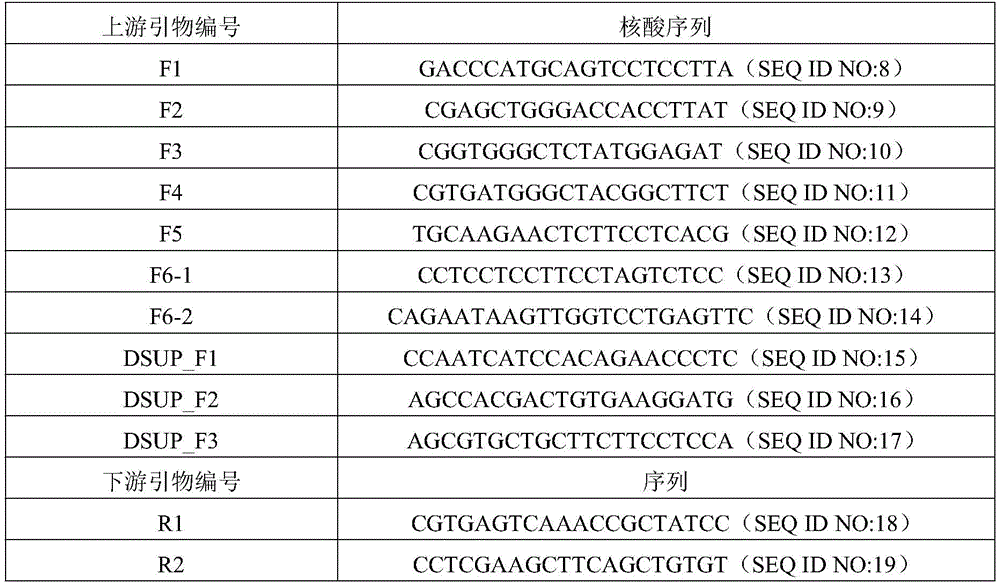

利用基因组鉴定引物对经过纯化后的基因修饰的人多能干细胞进行全整合框测序鉴定。通过测序,确定构建的人多能干细胞系中Dsup基因整合入AAVS1位点,并且未出现有重要影响的突变情况。The purified gene-modified human pluripotent stem cells were identified by whole-frame sequencing using genome identification primers. Through sequencing, it was confirmed that the Dsup gene was integrated into the AAVS1 site in the constructed human pluripotent stem cell line, and there was no significant mutation.
实施例3 DSUP基因修饰的人多能干细胞的鉴定Example 3 Identification of DSUP gene-modified human pluripotent stem cells
1、表面标志物SSEA4及Tra-1-60表达情况检测1. Detection of the expression of surface markers SSEA4 and Tra-1-60
将培养的细胞弃掉培养基并用1mL PBS清洗一遍,加入0.5mL的Accutase消化酶并在37℃培养箱中消化2-3min。再用0.5mL的培养基中和消化液,然后转移到15mL离心管中1200rpm离心5min,弃掉上清液后,用1mL PBS重悬后用70μm筛网过滤一次得到单细胞悬液,再次离心后准备染色。按照抗体说明书以PBS稀释流式抗体SSEA-4及TRA-1-60成50μL的抗体工作液,后将抗体染色液加入细胞沉淀中,重悬混匀于室温避光孵育30分钟。反应结束后各补加1mL PBS终止反应,1200rpm离心5min,弃上清,重复清洗两次后用400μL PBS重悬细胞,进一步进行流式细胞仪检测。具体结果如图4-A所示,其中ISO为同型对照,结果显示DSUP基因修饰的人多能干细胞表面标志物能够正常表达。The cultured cells were discarded and washed with 1 mL of PBS. 0.5 mL of Accutase was added and digested in a 37°C incubator for 2-3 min. Then use 0.5mL of medium to neutralize the digested solution, then transfer it to a 15mL centrifuge tube and centrifuge at 1200rpm for 5min. After discarding the supernatant, resuspend it with 1mL PBS and filter it once with a 70μm mesh to obtain a single cell suspension, and centrifuge again. ready for staining. Dilute flow-through antibodies SSEA-4 and TRA-1-60 with PBS according to the antibody instructions into 50 μL of antibody working solution, then add the antibody staining solution to the cell pellet, resuspend and incubate at room temperature for 30 minutes in the dark. After the reaction, 1 mL of PBS was added to terminate the reaction, centrifuged at 1200 rpm for 5 min, the supernatant was discarded, and the cells were resuspended with 400 μL of PBS after repeated washing twice, and further flow cytometry was performed. The specific results are shown in Figure 4-A, where ISO is the isotype control, and the results show that the surface markers of human pluripotent stem cells modified by the DSUP gene can be expressed normally.
2、DSUP基因mRNA表达情况检测2. Detection of DSUP gene mRNA expression
(1)Trizol法提取基因修饰后人多能干细胞的总RNA(1) Extraction of total RNA from genetically modified human pluripotent stem cells by Trizol method
吸弃培养细胞的培养液,加入PBS洗涤一次;每孔细胞加入500μL TRIzol,反复吹打使细胞破碎溶解;将液体转移到1.5mL的EP管中,室温静置5~10min;加入0.2mL氯仿/mLTRIzol,剧烈振荡混匀15s,室温静置10min;12000rpm,4℃,离心15min;离心后液体分为三层,从下至上依次为酚/氯仿层、中间蛋白层、上层无色水相。RNA存于上层水相中;吸取上层水相至新的EP管中,注意避免将中间蛋白吸出;加入预冷的异丙醇0.5mL/mL TRIzol,颠倒混匀,室温静置10min;12000rpm,4℃,离心10min;弃上清,RNA沉淀用75%乙醇(750μL无水乙醇,250μL DEPC水现配)洗涤,12000rpm,4℃,离心5min;弃上清,超净台中鼓风干燥3分钟左右,RNA呈半透明状;加入DEPC水溶解RNA沉淀,紫外分光光度计测定浓度及OD值,直接进行逆转录反应。Aspirate and discard the culture medium of the cultured cells, add PBS for washing once; add 500 μL TRIzol to each well of cells, and repeatedly pipet and beat to dissolve the cells; transfer the liquid to a 1.5 mL EP tube, and let stand at room temperature for 5-10 min; add 0.2 mL of chloroform/ mLTRIzol, vigorously shake and mix for 15s, stand at room temperature for 10min; 12000rpm, 4℃, centrifuge for 15min; after centrifugation, the liquid is divided into three layers, from bottom to top, the phenol/chloroform layer, the intermediate protein layer, and the upper colorless aqueous phase. RNA is stored in the upper aqueous phase; pipette the upper aqueous phase into a new EP tube, taking care to avoid aspirating the intermediate protein; add pre-cooled isopropanol 0.5mL/mL TRIzol, invert and mix, and let stand at room temperature for 10min; 12000rpm, 4°C, centrifuge for 10 min; discard the supernatant, wash the RNA precipitate with 75% ethanol (750 μL absolute ethanol, 250 μL DEPC water), centrifuge at 12,000 rpm, 4°C for 5 min; discard the supernatant and blow dry in an ultra-clean bench for 3 minutes The RNA is translucent; add DEPC water to dissolve the RNA precipitate, measure the concentration and OD value with an ultraviolet spectrophotometer, and conduct reverse transcription reaction directly.
(2)RNA反转录为cDNA(2) RNA reverse transcription to cDNA
将提取基因修饰后人多能干细胞的总RNA置于65℃变性5min,使用ReverTra AceqPCR RT Master Mix进行反转录,反应体系(20μL)构成及反应条件如表8所示:The total RNA extracted from the genetically modified human pluripotent stem cells was denatured at 65°C for 5 min, and reverse transcribed using ReverTra AceqPCR RT Master Mix. The composition and reaction conditions of the reaction system (20 μL) are shown in Table 8:
表8:Table 8:


混匀后置于PCR仪中,反应条件:37℃反应15min,50℃反应5min,98℃反应5min,保存于10℃。Mix well and place in a PCR machine. The reaction conditions are: 37°C for 15 minutes, 50°C for 5 minutes, 98°C for 5 minutes, and stored at 10°C.
(3)实时荧光定量PCR(3) Real-time fluorescence quantitative PCR
将反转录的cDNA样品20倍稀释后,使用SYBR Green PCR MIX配置如表9所示的PCR反应体系。After 20-fold dilution of the reverse transcribed cDNA samples, the PCR reaction system shown in Table 9 was configured using SYBR Green PCR MIX.
表9:Table 9:
反应条件:95℃2min;95℃15s,58℃20s,72℃30s,40个循环;65℃~95℃读取溶解曲线。每个样品设置3个技术重复。数据分析:以GAPDH基因为内参进行标准化目的基因的表达量,计算方法为2-△△Ct相对定量法。Reaction conditions: 95°C for 2 min; 95°C for 15s, 58°C for 20s, 72°C for 30s, 40 cycles; read the dissolution curve at 65°C to 95°C. Three technical replicates were set up for each sample. Data analysis: The expression level of the target gene was normalized with GAPDH gene as the internal reference, and the calculation method was 2- △△Ct relative quantification method.
结果如图4-B所示,与野生型(WT)和对照组(CON)相比,DSUP组细胞能够表达DSUP基因。The results are shown in Fig. 4-B, compared with the wild type (WT) and the control group (CON), cells in the DSUP group were able to express the DSUP gene.
3、干性标志物OCT4、SOX2和NANOG的免疫荧光检测3. Immunofluorescence detection of stemness markers OCT4, SOX2 and NANOG
在无菌状态下将圆形盖玻片加入24孔板中,并加入300μL的1%基质胶培养基37℃包被,1小时后掉包被液并加入500μL培养基。将适量细胞团块接种于该孔板中贴壁过夜。培养3天后弃上清并用PBS清洗3次,加入新鲜配制的4%多聚甲醛固定15分钟后PBS清洗3次。用0.1%Triton-X-100-PBS破膜30min后PBS清洗3次,10%血清室温封闭30min。根据抗体说明书稀释抗体后每孔加入200μL抗体工作液,保湿4℃孵育过夜。PBS清洗3次后加入1:50稀释的荧光二抗,室温避光孵育45min,PBS清洗后DAPI染细胞核3min,然后用PBS清洗3次,留100μL PBS于孔板中避光保存。送样检测时将玻璃片取出倒扣在含有一小滴50%甘油溶液或抗淬灭剂载玻片上,在激光共聚焦显微镜下观察并记录。具体结果如图4-D所示,免疫荧光结果显示干性标志物OCT4、SOX2和NANOG的表达情况正常。The round coverslips were added to a 24-well plate under sterile conditions, and 300 μL of 1% Matrigel medium was added to coat at 37° C. After 1 hour, the coating solution was removed and 500 μL of medium was added. An appropriate amount of cell clumps were seeded in this well plate overnight. After culturing for 3 days, the supernatant was discarded and washed 3 times with PBS, and was fixed with freshly prepared 4% paraformaldehyde for 15 minutes, and then washed 3 times with PBS. The membrane was ruptured with 0.1% Triton-X-100-PBS for 30 min, washed three times with PBS, and blocked with 10% serum at room temperature for 30 min. After diluting the antibody according to the antibody instructions, add 200 μL of antibody working solution to each well, and incubate overnight at 4°C. After washing 3 times with PBS, 1:50 diluted fluorescent secondary antibody was added, and incubated at room temperature for 45 min in the dark. After washing with PBS, the nuclei were stained with DAPI for 3 min, and then washed with PBS for 3 times. When the sample was sent for testing, the glass slide was taken out and buckled upside down on a glass slide containing a small drop of 50% glycerol solution or anti-quenching agent, observed and recorded under a laser confocal microscope. The specific results are shown in Figure 4-D. The immunofluorescence results showed that the expression of stemness markers OCT4, SOX2 and NANOG were normal.
4、碱性磷酸酶检测4. Alkaline phosphatase detection
将细胞置于预先包被好Matrigel的细胞培养板上进行贴壁培养。长至80%汇合度时,吸弃培养上清,PBS洗涤细胞2次,加入500μL的ReLeSR,在一分钟内吸掉。37℃孵育3分钟后加入1mL的mTeSR plus,终止消化。将脱落的细胞团块转移到15mL离心管,室温900rpm离心5min。弃上清后用培养基重悬细胞,按照合适的密度(1:15~1:20)将细胞接种至预先包被好Matrigel的6孔板上,5%CO2,37℃孵育箱中进行培养。培养至细胞团块大小合适,PBS洗涤3次,加1mL 4%PFA,室温固定30分钟,PBS洗涤3~5次。按照比例(碱性磷酸酯酶显色缓冲液3mL,BCIP溶液(300X)10μL,NBT溶液(150X)Cells were placed on pre-coated Matrigel cell culture plates for adherent culture. When reaching 80% confluence, the culture supernatant was discarded, the cells were washed twice with PBS, 500 μL of ReLeSR was added, and the cells were aspirated within one minute. After incubation at 37°C for 3 minutes, 1 mL of mTeSR plus was added to stop the digestion. The detached cell pellet was transferred to a 15 mL centrifuge tube, and centrifuged at 900 rpm for 5 min at room temperature. After discarding the supernatant, resuspend the cells in medium, and inoculate the cells at a suitable density (1:15~1:20) on a 6-well plate pre-coated with Matrigel, 5% CO2, and culture in a 37°C incubator. . The cells were cultured until the size of the cell mass was appropriate, washed 3 times with PBS, added 1 mL of 4% PFA, fixed at room temperature for 30 minutes, and washed 3 to 5 times with PBS. According to the ratio (alkaline phosphatase development buffer 3mL, BCIP solution (300X) 10μL, NBT solution (150X)
20μL,BCIP/NBT染色工作液3.03mL)依次加入各试剂,混匀后即配制成BCIP/NBT染色工作液。PBS洗涤后,加入适量BCIP/NBT染色工作液,确保能充分覆盖样品。室温避光孵育5~30分钟或更长时间,每隔10分钟显微镜下观察,直至显色至预期深浅。去除BCIP/NBT染色工作液,用PBS洗涤1~2次,终止显色反应。具体结果如图4-C所示,代表人多能干细胞性能的碱性磷酸酯酶染色实验呈阳性。20 μL, BCIP/NBT staining working solution 3.03 mL), add each reagent in turn, and mix well to prepare BCIP/NBT staining working solution. After washing with PBS, add an appropriate amount of BCIP/NBT working solution to ensure adequate coverage of the sample. Incubate in the dark at room temperature for 5 to 30 minutes or longer, and observe under the microscope every 10 minutes until the color develops to the desired depth. Remove the BCIP/NBT staining working solution and wash with PBS for 1 to 2 times to stop the color reaction. The specific results are shown in Figure 4-C, and the alkaline phosphatase staining assay, which represents the performance of human pluripotent stem cells, was positive.
5、核型检测5. Karyotype detection
在T-25的培养瓶中培养细胞,当细胞密度为60%~80%时进行检测。具体结果如图5和图6所示,各组细胞均为正常核型。Cells were cultured in T-25 culture flasks and detected when the cell density was 60% to 80%. The specific results are shown in Figures 5 and 6, and the cells in each group were of normal karyotype.
通过对DSUP基因修饰的人多能干细胞的鉴定,证明我们构建的基因修饰的人多能干细胞能正常表达DSUP基因,稳定传代并保留了原多能干细胞的干性,符合后续进行程序性诱导分化的实验要求。Through the identification of DSUP gene-modified human pluripotent stem cells, it is proved that the gene-modified human pluripotent stem cells constructed by us can normally express DSUP gene, stably passage and retain the stemness of the original pluripotent stem cells, which is in line with the subsequent programmed induction and differentiation experimental requirements.
实施例4 DSUP基因修饰的人多能干细胞向造血干/祖细胞的诱导分化Example 4 Induction and differentiation of DSUP gene-modified human pluripotent stem cells into hematopoietic stem/progenitor cells
1)利用脱离饲养层细胞悬浮培养法培养hESC-H9-CON/DSUP细胞,接种2*105个细胞于低吸附6孔板中培养24小时,使其自发形成EB球拟胚体。1) The hESC-H9-CON/DSUP cells were cultured by detaching the feeder cell suspension culture method, and 2*10 5 cells were inoculated and cultured in a low-adsorption 6-well plate for 24 hours to spontaneously form EB ball embryoid bodies.
2)更换第一阶段培养基(表10)培养两天,每天换液,使细胞向中胚层分化。2) The first stage medium (Table 10) was replaced for two days, and the medium was changed every day to differentiate the cells into the mesoderm.
3)更换第二阶段培养基(表11),培养四天,每天换液,使细胞向生血内皮分化。3) The second stage medium (Table 11) was replaced, cultured for four days, and the medium was changed every day to differentiate cells into hematopoietic endothelium.
4)更换第三阶段培养基(表12),培养两周,隔天换液,诱导细胞向造血干/祖细胞分化,并进一步向下游定向诱导分化成熟。4) The third stage medium (Table 12) was replaced, cultured for two weeks, and the medium was changed every other day to induce cells to differentiate into hematopoietic stem/progenitor cells, and further induce differentiation and maturation downstream.
诱导分化成熟的过程如图7所示。The process of inducing differentiation and maturation is shown in Figure 7.
第一阶段培养基配方如表10所示:The first stage medium formula is shown in Table 10:
表10:Table 10:
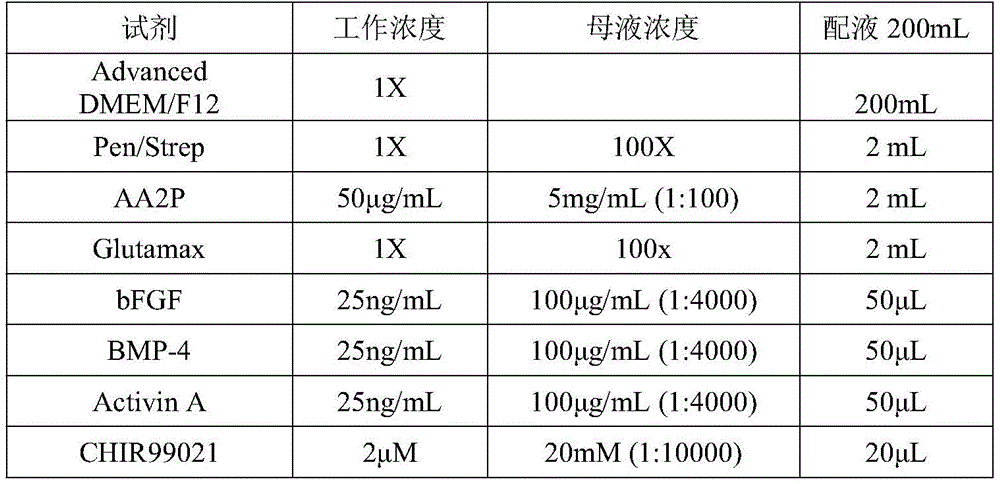
第二阶段培养基配方如表11所示:The formulation of the second stage medium is shown in Table 11:
表11:Table 11:
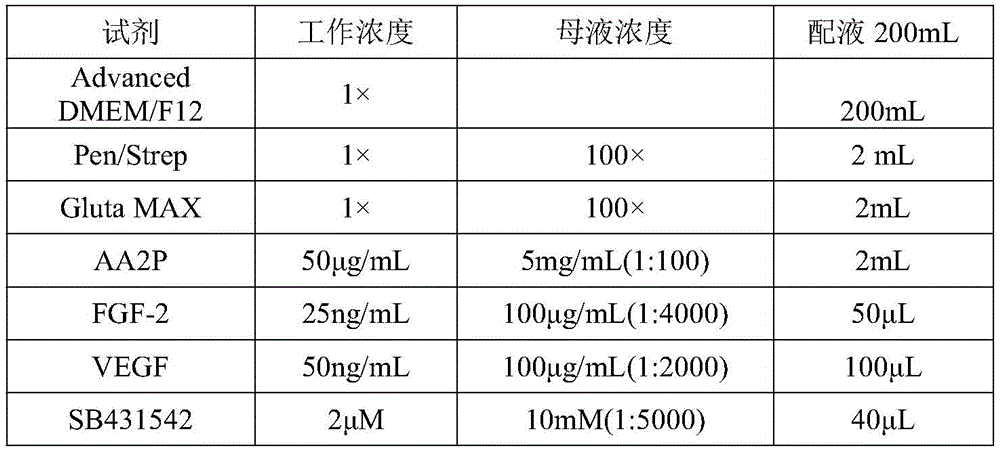
第三阶段培养基配方如表12所示:The formula of the third stage medium is shown in Table 12:
表12:Table 12:
实施例5 Dsup基因促进人多能干细胞诱导来源的造血干/祖细胞向红系分化Example 5 Dsup gene promotes erythroid differentiation of hematopoietic stem/progenitor cells derived from human pluripotent stem cells
1、hESC-H9-CON/Dsup向红系诱导分化过程中的表型变化1. Phenotypic changes of hESC-H9-CON/Dsup during erythroid differentiation
hESC-H9-CON/DSUP在向红系诱导分化过程中,DSUP组在第15天即开始产生大量悬浮血细胞,产生血细胞的速度明显快于对照组细胞(第18天),血红蛋白在第12天即开始产生,其时间明显早于对照组细胞第15天的结果,而且DSUP组产生血细胞的数量也明细高于对照组(图8)。实验结果说明了DSUP基因的表达明显促进了细胞向血细胞分化和血红蛋白的表达。During the induction and differentiation of hESC-H9-CON/DSUP to erythroid, the DSUP group began to produce a large number of suspended blood cells on the 15th day, and the rate of blood cell production was significantly faster than that of the control cells (the 18th day). That is, the generation of blood cells was significantly earlier than that of the control group cells on
2、hESC-H9-CON/DSUP细胞诱导来源的造血干/祖细胞红系集落形成能力2. Erythroid colony-forming ability of hematopoietic stem/progenitor cells derived from hESC-H9-CON/DSUP cells
对在诱导过程中第12天的细胞进行造血集落形成实验,此时正好处于诱导过程中造血干/祖细胞阶段,取5×103细胞/孔的细胞密度接种到含有1毫升半固体集落形成培养基的低吸附24孔板中,放于细胞培养箱进行集落形成实验,14天后检测集落形成实验的结果,统计并进行集落种类的分类和计数。实验结果如图9所示,hESC-H9-DSUP来源的造血干/祖细胞红系集落的体积明显大于对照组细胞,CFU-E及BFU-E等红系集落数量是对照组的10倍,这说明DSUP明显促进了红系集落的形成。Hematopoietic colony formation experiments were performed on the cells on the 12th day of the induction process, which happened to be in the hematopoietic stem/progenitor cell stage of the induction process, and a cell density of 5 x 10 3 cells/well was used to inoculate the cells containing 1 ml of semi-solid colony formation. The culture medium was placed in a low-adsorption 24-well plate and placed in a cell incubator for colony formation experiments. After 14 days, the results of the colony formation experiments were detected, and the colony types were classified and counted by statistics. The experimental results are shown in Figure 9. The volume of hematopoietic stem/progenitor cell erythroid colonies derived from hESC-H9-DSUP is significantly larger than that of the control group, and the number of erythroid colonies such as CFU-E and BFU-E is 10 times that of the control group. This indicated that DSUP significantly promoted the formation of erythroid colonies.
3、hESC-H9-CON/DSUP细胞诱导分化为红系细胞3. Induction of hESC-H9-CON/DSUP cells into erythroid cells
在hESC-H9-DSUP与hESC-H9-CON细胞诱导来源的造血干/祖细胞继续向成熟红系细胞诱导过程中,通过对红系谱系相关关键基因EKLF的表达情况进行mRNA水平检测,图10-A显示在DSUP基因的影响下该基因的表达水平明显升高,最高时达到12倍(诱导分化第15天时EKLF基因mRNA表达水平与对照组相比上升约12倍);进一步对红系细胞的表面标志物CD71及CD235进行检测,结果如图10-B所示,hESC-H9-DSUP诱导分化过程中的CD71和CD235双阳性红系细胞比例能够维持在较高水平,比对照组相应细胞比例高30%~40%;经过测算,在相同诱导细胞数量的情况下,与对照组细胞相比DSUP基因能够促进红系细胞的产出量升高近6倍(即一个hES细胞最终产生CD71+/CD235+的数量)。During the induction of hematopoietic stem/progenitor cells from hESC-H9-DSUP and hESC-H9-CON cells to mature erythroid cells, the mRNA level of EKLF, a key gene related to erythroid lineage, was detected by mRNA level detection, Figure 10 -A shows that the expression level of this gene is significantly increased under the influence of DSUP gene, and the highest is 12 times (the mRNA expression level of EKLF gene on the 15th day of induction of differentiation is about 12 times higher than that of the control group); further on erythroid cells The surface markers CD71 and CD235 were detected, and the results were shown in Figure 10-B. The proportion of CD71 and CD235 double-positive erythroid cells during the differentiation process of hESC-H9-DSUP could be maintained at a higher level, which was higher than that of the corresponding cells in the control group. The ratio is 30% to 40% higher; after calculation, in the case of the same number of induced cells, the DSUP gene can promote the output of erythroid cells to increase nearly 6 times compared with the control cells (that is, a hES cell eventually produces CD71 + / the number of CD235 + ).
在本说明书的描述中,参考术语“一个实施例”、“一些实施例”、“示例”、“具体示例”、或“一些示例”等的描述意指结合该实施例或示例描述的具体特征、结构、材料或者特点包含于本发明的至少一个实施例或示例中。在本说明书中,对上述术语的示意性表述不必须针对的是相同的实施例或示例。而且,描述的具体特征、结构、材料或者特点可以在任一个或多个实施例或示例中以合适的方式结合。此外,在不相互矛盾的情况下,本领域的技术人员可以将本说明书中描述的不同实施例或示例以及不同实施例或示例的特征进行结合和组合。In the description of this specification, description with reference to the terms "one embodiment," "some embodiments," "example," "specific example," or "some examples", etc., mean specific features described in connection with the embodiment or example , structure, material or feature is included in at least one embodiment or example of the present invention. In this specification, schematic representations of the above terms are not necessarily directed to the same embodiment or example. Furthermore, the particular features, structures, materials or characteristics described may be combined in any suitable manner in any one or more embodiments or examples. Furthermore, those skilled in the art may combine and combine the different embodiments or examples described in this specification, as well as the features of the different embodiments or examples, without conflicting each other.
尽管上面已经示出和描述了本发明的实施例,可以理解的是,上述实施例是示例性的,不能理解为对本发明的限制,本领域的普通技术人员在本发明的范围内可以对上述实施例进行变化、修改、替换和变型。Although the embodiments of the present invention have been shown and described above, it should be understood that the above embodiments are exemplary and should not be construed as limiting the present invention. Embodiments are subject to variations, modifications, substitutions and variations.
Claims (13)
Applications Claiming Priority (2)
| Application Number | Priority Date | Filing Date | Title |
|---|---|---|---|
| CN202111467728 | 2021-12-03 | ||
| CN2021114677281 | 2021-12-03 |
Publications (2)
| Publication Number | Publication Date |
|---|---|
| CN114438036A true CN114438036A (en) | 2022-05-06 |
| CN114438036B CN114438036B (en) | 2023-08-18 |
Family
ID=81370180
Family Applications (1)
| Application Number | Title | Priority Date | Filing Date |
|---|---|---|---|
| CN202210074204.4A Active CN114438036B (en) | 2021-12-03 | 2022-01-21 | Method for promoting directional differentiation and maturation of stem cells into erythroid cells and application |
Country Status (1)
| Country | Link |
|---|---|
| CN (1) | CN114438036B (en) |
Cited By (1)
| Publication number | Priority date | Publication date | Assignee | Title |
|---|---|---|---|---|
| CN115747155A (en) * | 2022-11-11 | 2023-03-07 | 中国人民解放军军事科学院军事医学研究院 | Use of leukotrienes in promoting maturation of erythroid cells |
Citations (9)
| Publication number | Priority date | Publication date | Assignee | Title |
|---|---|---|---|---|
| CN104694471A (en) * | 2015-03-25 | 2015-06-10 | 奥思达干细胞有限公司 | Method for inducing embryonic stem cells to be differentiated into erythroid cells in vitro |
| JP2016153383A (en) * | 2015-02-20 | 2016-08-25 | 國枝 武和 | Dna damage inhibitor |
| WO2017180587A2 (en) * | 2016-04-11 | 2017-10-19 | Obsidian Therapeutics, Inc. | Regulated biocircuit systems |
| CN108085299A (en) * | 2017-12-28 | 2018-05-29 | 安徽中盛溯源生物科技有限公司 | A kind of efficient induced multi-potent stem cell reprogramming method of blood cell |
| WO2021224506A1 (en) * | 2020-05-08 | 2021-11-11 | Universitat Pompeu Fabra | Crispr-cas homology directed repair enhancer |
| CN114023449A (en) * | 2021-11-05 | 2022-02-08 | 中山大学 | Diabetes risk early warning method and system based on depth self-encoder |
| US20220177921A1 (en) * | 2018-08-27 | 2022-06-09 | BioViva USA, Inc. | Gene therapy using genetically modified viral vectors |
| CN115710578A (en) * | 2022-11-11 | 2023-02-24 | 中国人民解放军军事科学院军事医学研究院 | Application of leukotriene in inducing stem cell to differentiate into hematopoietic stem/progenitor cell and application thereof |
| CN115786259A (en) * | 2022-12-02 | 2023-03-14 | 华南理工大学 | Kit for inducing stem cells to differentiate into megakaryocytes and/or platelets and application of kit |
-
2022
- 2022-01-21 CN CN202210074204.4A patent/CN114438036B/en active Active
Patent Citations (9)
| Publication number | Priority date | Publication date | Assignee | Title |
|---|---|---|---|---|
| JP2016153383A (en) * | 2015-02-20 | 2016-08-25 | 國枝 武和 | Dna damage inhibitor |
| CN104694471A (en) * | 2015-03-25 | 2015-06-10 | 奥思达干细胞有限公司 | Method for inducing embryonic stem cells to be differentiated into erythroid cells in vitro |
| WO2017180587A2 (en) * | 2016-04-11 | 2017-10-19 | Obsidian Therapeutics, Inc. | Regulated biocircuit systems |
| CN108085299A (en) * | 2017-12-28 | 2018-05-29 | 安徽中盛溯源生物科技有限公司 | A kind of efficient induced multi-potent stem cell reprogramming method of blood cell |
| US20220177921A1 (en) * | 2018-08-27 | 2022-06-09 | BioViva USA, Inc. | Gene therapy using genetically modified viral vectors |
| WO2021224506A1 (en) * | 2020-05-08 | 2021-11-11 | Universitat Pompeu Fabra | Crispr-cas homology directed repair enhancer |
| CN114023449A (en) * | 2021-11-05 | 2022-02-08 | 中山大学 | Diabetes risk early warning method and system based on depth self-encoder |
| CN115710578A (en) * | 2022-11-11 | 2023-02-24 | 中国人民解放军军事科学院军事医学研究院 | Application of leukotriene in inducing stem cell to differentiate into hematopoietic stem/progenitor cell and application thereof |
| CN115786259A (en) * | 2022-12-02 | 2023-03-14 | 华南理工大学 | Kit for inducing stem cells to differentiate into megakaryocytes and/or platelets and application of kit |
Non-Patent Citations (7)
| Title |
|---|
| ANGELO LOMBARDO 等: "S ite-specific integration and tailoring of cassette design for sustainable gene transfer", 《NATURE METHODS》 * |
| CRAIG WESTOVER 等: "Engineering Radioprotective Human Cells Using the 1 Tardigrade Damage 2 Suppressor Protein, DSUP", 《BIORXIV》 * |
| NCBI: "Ramazzottius varieornatus Dsup mRNA for damage suppressor, complete cds", 《GENBANK DATABASE》 * |
| TAKUMA HASHIMOTO 等: "Extremotolerant tardigrade genome and improved radiotolerance of human cultured cells by tardigrade-unique protein", 《NATURE COMMUNICATIONS》 * |
| 刘森泉 等: "多能性干细胞向红细胞定向诱导分化的研究进展", 《中国实验血液学杂志》 * |
| 杨舟 等: "人胚胎干细胞定向诱导分化为红细胞及其生物学 特性的研究", 《军事医学》 * |
| 陈俊;李磊;郭燕;毕瑞;沈磐;王立志;杨冬;张令强;: "杜氏高生熊虫实验室培养体系的建立", 军事医学, no. 02 * |
Cited By (1)
| Publication number | Priority date | Publication date | Assignee | Title |
|---|---|---|---|---|
| CN115747155A (en) * | 2022-11-11 | 2023-03-07 | 中国人民解放军军事科学院军事医学研究院 | Use of leukotrienes in promoting maturation of erythroid cells |
Also Published As
| Publication number | Publication date |
|---|---|
| CN114438036B (en) | 2023-08-18 |
Similar Documents
| Publication | Publication Date | Title |
|---|---|---|
| CN106636210B (en) | Transcription factor combines the method that induced fibroblast transdifferentiation is class interstitial glands | |
| CN105051188A (en) | Novel method | |
| JP2024042096A (en) | Neural stem cell compositions and methods for treating neurodegenerative disorders | |
| CN103028119B (en) | Application of miR-132 in preparation of medicine for treating Parkinson's disease | |
| CN108865969A (en) | MAPK/PKC signal path activator promotes the differentiation of mankind's bile duct cell and maturation | |
| CN114438036B (en) | Method for promoting directional differentiation and maturation of stem cells into erythroid cells and application | |
| CN102181399B (en) | Mouse liver tumor cell line for highly expressing CD133 and preparation method thereof | |
| CN113416768B (en) | Application of PRKRA gene as target in inhibiting replication of peste des petits ruminants virus | |
| CN102747104A (en) | Non-exogenous induced factor integrated porcine induced pluripotent stem cell and its construction method | |
| CN111575306B (en) | A method for activating gamma globin gene expression in red blood cells | |
| CN109294994A (en) | Method and application of effective repair of Westmead mutation in thalassemia | |
| CN113528576A (en) | Recurrent mole patient-specific induced pluripotent stem cell line containing pure and mutated NLRP7 and its construction method | |
| CN111254110A (en) | A method for transdifferentiation of mesenchymal stem cells into sperm | |
| CN117683727A (en) | A GHR gene knockout pancreatic islet β cell line and its construction method and application | |
| US20250263655A1 (en) | Methods and compositions for producing microglia | |
| CN114457080B (en) | A method for constructing an iPSC cell line with ARHGAP11B gene deletion and its application | |
| CN110079526B (en) | sgRNA sequence and method for preparing RH negative erythrocyte by using CRISPR-Cas9 technology | |
| US9976118B2 (en) | Method for inducing tailored pluripotent stem cells using extract of plant stem cells or plant dedifferentiated stem cells, and pluripotent stem cells produced by means of the method | |
| CN116356431A (en) | A method for knockout library, knockout cell bank and screening target gene based on bovine genome-wide CRISPR-Cas9 knockout library | |
| CN114457036A (en) | A red fluorescent labeled cell with human retinal differentiation potential and its construction method | |
| CN107541484A (en) | Diploid red crucian caudal fin cell system 2nFC and its construction method and application | |
| CN105441481A (en) | Preparation method of SIRTUIN6 gene deleted human mesenchymal stem cells | |
| CN103695469B (en) | Method for preparing CD44 gene defect mouse induced pluripotent stem cells | |
| Xiao et al. | Differential expression and co-localization of transcription factors during the indirect de novo shoot organogenesis in the fern Ceratopteris richardii | |
| CN102311941A (en) | Method for separating and culturing pig spermatogonial stem cells by mechanical process |
Legal Events
| Date | Code | Title | Description |
|---|---|---|---|
| PB01 | Publication | ||
| PB01 | Publication | ||
| SE01 | Entry into force of request for substantive examination | ||
| SE01 | Entry into force of request for substantive examination | ||
| GR01 | Patent grant | ||
| GR01 | Patent grant |