CN114438034A - Preparation method of genetically modified cell - Google Patents
Preparation method of genetically modified cell Download PDFInfo
- Publication number
- CN114438034A CN114438034A CN202011233449.4A CN202011233449A CN114438034A CN 114438034 A CN114438034 A CN 114438034A CN 202011233449 A CN202011233449 A CN 202011233449A CN 114438034 A CN114438034 A CN 114438034A
- Authority
- CN
- China
- Prior art keywords
- cells
- immune
- cell
- cell population
- incubation
- Prior art date
- Legal status (The legal status is an assumption and is not a legal conclusion. Google has not performed a legal analysis and makes no representation as to the accuracy of the status listed.)
- Pending
Links
- 238000002360 preparation method Methods 0.000 title abstract description 18
- 210000004027 cell Anatomy 0.000 claims abstract description 142
- 210000002865 immune cell Anatomy 0.000 claims abstract description 104
- 238000000034 method Methods 0.000 claims abstract description 44
- 230000005291 magnetic effect Effects 0.000 claims description 60
- 239000011324 bead Substances 0.000 claims description 56
- 238000011534 incubation Methods 0.000 claims description 30
- 238000005406 washing Methods 0.000 claims description 25
- 238000001890 transfection Methods 0.000 claims description 23
- 239000000203 mixture Substances 0.000 claims description 17
- 241000700605 Viruses Species 0.000 claims description 15
- 238000012258 culturing Methods 0.000 claims description 12
- 230000010412 perfusion Effects 0.000 claims description 12
- 238000002156 mixing Methods 0.000 claims description 10
- 238000002617 apheresis Methods 0.000 claims description 7
- 230000003213 activating effect Effects 0.000 claims description 6
- 239000007788 liquid Substances 0.000 claims description 6
- 210000004369 blood Anatomy 0.000 claims description 5
- 239000008280 blood Substances 0.000 claims description 5
- 238000005119 centrifugation Methods 0.000 claims description 3
- 238000003306 harvesting Methods 0.000 claims description 3
- 210000003819 peripheral blood mononuclear cell Anatomy 0.000 claims description 3
- 239000013603 viral vector Substances 0.000 claims description 3
- 238000011533 pre-incubation Methods 0.000 claims 2
- 239000000243 solution Substances 0.000 description 17
- 238000011084 recovery Methods 0.000 description 13
- 108090000623 proteins and genes Proteins 0.000 description 8
- 210000001744 T-lymphocyte Anatomy 0.000 description 7
- 239000000872 buffer Substances 0.000 description 7
- 230000035899 viability Effects 0.000 description 7
- 238000007885 magnetic separation Methods 0.000 description 6
- 230000004913 activation Effects 0.000 description 5
- 230000020411 cell activation Effects 0.000 description 5
- 238000004113 cell culture Methods 0.000 description 5
- 230000000694 effects Effects 0.000 description 5
- 230000008569 process Effects 0.000 description 5
- 239000002458 cell surface marker Substances 0.000 description 4
- 238000002474 experimental method Methods 0.000 description 4
- 239000007789 gas Substances 0.000 description 4
- 239000006228 supernatant Substances 0.000 description 4
- 239000007853 buffer solution Substances 0.000 description 3
- 238000004108 freeze drying Methods 0.000 description 3
- 238000009169 immunotherapy Methods 0.000 description 3
- 210000004698 lymphocyte Anatomy 0.000 description 3
- 238000004519 manufacturing process Methods 0.000 description 3
- 239000002609 medium Substances 0.000 description 3
- 239000002244 precipitate Substances 0.000 description 3
- 239000000047 product Substances 0.000 description 3
- 238000000926 separation method Methods 0.000 description 3
- 101000914514 Homo sapiens T-cell-specific surface glycoprotein CD28 Proteins 0.000 description 2
- 241000713666 Lentivirus Species 0.000 description 2
- 206010028980 Neoplasm Diseases 0.000 description 2
- 102100027213 T-cell-specific surface glycoprotein CD28 Human genes 0.000 description 2
- 239000006143 cell culture medium Substances 0.000 description 2
- 238000002659 cell therapy Methods 0.000 description 2
- 230000001413 cellular effect Effects 0.000 description 2
- 210000004748 cultured cell Anatomy 0.000 description 2
- 238000005516 engineering process Methods 0.000 description 2
- 238000009776 industrial production Methods 0.000 description 2
- QCAWEPFNJXQPAN-UHFFFAOYSA-N methoxyfenozide Chemical compound COC1=CC=CC(C(=O)NN(C(=O)C=2C=C(C)C=C(C)C=2)C(C)(C)C)=C1C QCAWEPFNJXQPAN-UHFFFAOYSA-N 0.000 description 2
- 210000001616 monocyte Anatomy 0.000 description 2
- 210000000822 natural killer cell Anatomy 0.000 description 2
- 238000012545 processing Methods 0.000 description 2
- 230000005909 tumor killing Effects 0.000 description 2
- 108700019146 Transgenes Proteins 0.000 description 1
- 230000002411 adverse Effects 0.000 description 1
- 230000006907 apoptotic process Effects 0.000 description 1
- QVGXLLKOCUKJST-UHFFFAOYSA-N atomic oxygen Chemical compound [O] QVGXLLKOCUKJST-UHFFFAOYSA-N 0.000 description 1
- 230000009286 beneficial effect Effects 0.000 description 1
- 210000001185 bone marrow Anatomy 0.000 description 1
- 230000024245 cell differentiation Effects 0.000 description 1
- 230000010261 cell growth Effects 0.000 description 1
- 230000006727 cell loss Effects 0.000 description 1
- 230000007969 cellular immunity Effects 0.000 description 1
- 239000003153 chemical reaction reagent Substances 0.000 description 1
- 230000007012 clinical effect Effects 0.000 description 1
- 239000012141 concentrate Substances 0.000 description 1
- 230000004069 differentiation Effects 0.000 description 1
- 238000010790 dilution Methods 0.000 description 1
- 239000012895 dilution Substances 0.000 description 1
- 239000003814 drug Substances 0.000 description 1
- 229940079593 drug Drugs 0.000 description 1
- 210000004700 fetal blood Anatomy 0.000 description 1
- 239000012530 fluid Substances 0.000 description 1
- 230000012010 growth Effects 0.000 description 1
- 230000005764 inhibitory process Effects 0.000 description 1
- 238000002955 isolation Methods 0.000 description 1
- 230000002147 killing effect Effects 0.000 description 1
- 210000003071 memory t lymphocyte Anatomy 0.000 description 1
- 230000002503 metabolic effect Effects 0.000 description 1
- 238000012986 modification Methods 0.000 description 1
- 230000004048 modification Effects 0.000 description 1
- 239000001301 oxygen Substances 0.000 description 1
- 229910052760 oxygen Inorganic materials 0.000 description 1
- 238000012858 packaging process Methods 0.000 description 1
- 238000012856 packing Methods 0.000 description 1
- 239000008188 pellet Substances 0.000 description 1
- 210000005259 peripheral blood Anatomy 0.000 description 1
- 239000011886 peripheral blood Substances 0.000 description 1
- 230000002688 persistence Effects 0.000 description 1
- 238000001556 precipitation Methods 0.000 description 1
- 238000011160 research Methods 0.000 description 1
- 230000009758 senescence Effects 0.000 description 1
- 238000001179 sorption measurement Methods 0.000 description 1
- 230000008685 targeting Effects 0.000 description 1
Classifications
-
- A—HUMAN NECESSITIES
- A61—MEDICAL OR VETERINARY SCIENCE; HYGIENE
- A61P—SPECIFIC THERAPEUTIC ACTIVITY OF CHEMICAL COMPOUNDS OR MEDICINAL PREPARATIONS
- A61P1/00—Drugs for disorders of the alimentary tract or the digestive system
-
- A—HUMAN NECESSITIES
- A61—MEDICAL OR VETERINARY SCIENCE; HYGIENE
- A61K—PREPARATIONS FOR MEDICAL, DENTAL OR TOILETRY PURPOSES
- A61K40/00—Cellular immunotherapy
- A61K40/10—Cellular immunotherapy characterised by the cell type used
- A61K40/11—T-cells, e.g. tumour infiltrating lymphocytes [TIL] or regulatory T [Treg] cells; Lymphokine-activated killer [LAK] cells
-
- A—HUMAN NECESSITIES
- A61—MEDICAL OR VETERINARY SCIENCE; HYGIENE
- A61K—PREPARATIONS FOR MEDICAL, DENTAL OR TOILETRY PURPOSES
- A61K40/00—Cellular immunotherapy
- A61K40/40—Cellular immunotherapy characterised by antigens that are targeted or presented by cells of the immune system
- A61K40/46—Viral antigens
-
- C—CHEMISTRY; METALLURGY
- C07—ORGANIC CHEMISTRY
- C07K—PEPTIDES
- C07K14/00—Peptides having more than 20 amino acids; Gastrins; Somatostatins; Melanotropins; Derivatives thereof
- C07K14/435—Peptides having more than 20 amino acids; Gastrins; Somatostatins; Melanotropins; Derivatives thereof from animals; from humans
- C07K14/705—Receptors; Cell surface antigens; Cell surface determinants
- C07K14/70503—Immunoglobulin superfamily
- C07K14/7051—T-cell receptor (TcR)-CD3 complex
-
- C—CHEMISTRY; METALLURGY
- C07—ORGANIC CHEMISTRY
- C07K—PEPTIDES
- C07K14/00—Peptides having more than 20 amino acids; Gastrins; Somatostatins; Melanotropins; Derivatives thereof
- C07K14/435—Peptides having more than 20 amino acids; Gastrins; Somatostatins; Melanotropins; Derivatives thereof from animals; from humans
- C07K14/705—Receptors; Cell surface antigens; Cell surface determinants
- C07K14/70503—Immunoglobulin superfamily
- C07K14/70514—CD4
-
- C—CHEMISTRY; METALLURGY
- C07—ORGANIC CHEMISTRY
- C07K—PEPTIDES
- C07K14/00—Peptides having more than 20 amino acids; Gastrins; Somatostatins; Melanotropins; Derivatives thereof
- C07K14/435—Peptides having more than 20 amino acids; Gastrins; Somatostatins; Melanotropins; Derivatives thereof from animals; from humans
- C07K14/705—Receptors; Cell surface antigens; Cell surface determinants
- C07K14/70503—Immunoglobulin superfamily
- C07K14/70517—CD8
-
- C—CHEMISTRY; METALLURGY
- C12—BIOCHEMISTRY; BEER; SPIRITS; WINE; VINEGAR; MICROBIOLOGY; ENZYMOLOGY; MUTATION OR GENETIC ENGINEERING
- C12N—MICROORGANISMS OR ENZYMES; COMPOSITIONS THEREOF; PROPAGATING, PRESERVING, OR MAINTAINING MICROORGANISMS; MUTATION OR GENETIC ENGINEERING; CULTURE MEDIA
- C12N15/00—Mutation or genetic engineering; DNA or RNA concerning genetic engineering, vectors, e.g. plasmids, or their isolation, preparation or purification; Use of hosts therefor
- C12N15/09—Recombinant DNA-technology
- C12N15/63—Introduction of foreign genetic material using vectors; Vectors; Use of hosts therefor; Regulation of expression
- C12N15/79—Vectors or expression systems specially adapted for eukaryotic hosts
- C12N15/85—Vectors or expression systems specially adapted for eukaryotic hosts for animal cells
- C12N15/86—Viral vectors
-
- C—CHEMISTRY; METALLURGY
- C12—BIOCHEMISTRY; BEER; SPIRITS; WINE; VINEGAR; MICROBIOLOGY; ENZYMOLOGY; MUTATION OR GENETIC ENGINEERING
- C12N—MICROORGANISMS OR ENZYMES; COMPOSITIONS THEREOF; PROPAGATING, PRESERVING, OR MAINTAINING MICROORGANISMS; MUTATION OR GENETIC ENGINEERING; CULTURE MEDIA
- C12N5/00—Undifferentiated human, animal or plant cells, e.g. cell lines; Tissues; Cultivation or maintenance thereof; Culture media therefor
- C12N5/06—Animal cells or tissues; Human cells or tissues
- C12N5/0602—Vertebrate cells
- C12N5/0634—Cells from the blood or the immune system
- C12N5/0636—T lymphocytes
-
- C—CHEMISTRY; METALLURGY
- C12—BIOCHEMISTRY; BEER; SPIRITS; WINE; VINEGAR; MICROBIOLOGY; ENZYMOLOGY; MUTATION OR GENETIC ENGINEERING
- C12N—MICROORGANISMS OR ENZYMES; COMPOSITIONS THEREOF; PROPAGATING, PRESERVING, OR MAINTAINING MICROORGANISMS; MUTATION OR GENETIC ENGINEERING; CULTURE MEDIA
- C12N5/00—Undifferentiated human, animal or plant cells, e.g. cell lines; Tissues; Cultivation or maintenance thereof; Culture media therefor
- C12N5/06—Animal cells or tissues; Human cells or tissues
- C12N5/0602—Vertebrate cells
- C12N5/0634—Cells from the blood or the immune system
- C12N5/0646—Natural killers cells [NK], NKT cells
-
- C—CHEMISTRY; METALLURGY
- C12—BIOCHEMISTRY; BEER; SPIRITS; WINE; VINEGAR; MICROBIOLOGY; ENZYMOLOGY; MUTATION OR GENETIC ENGINEERING
- C12N—MICROORGANISMS OR ENZYMES; COMPOSITIONS THEREOF; PROPAGATING, PRESERVING, OR MAINTAINING MICROORGANISMS; MUTATION OR GENETIC ENGINEERING; CULTURE MEDIA
- C12N2501/00—Active agents used in cell culture processes, e.g. differentation
- C12N2501/50—Cell markers; Cell surface determinants
- C12N2501/505—CD4; CD8
-
- C—CHEMISTRY; METALLURGY
- C12—BIOCHEMISTRY; BEER; SPIRITS; WINE; VINEGAR; MICROBIOLOGY; ENZYMOLOGY; MUTATION OR GENETIC ENGINEERING
- C12N—MICROORGANISMS OR ENZYMES; COMPOSITIONS THEREOF; PROPAGATING, PRESERVING, OR MAINTAINING MICROORGANISMS; MUTATION OR GENETIC ENGINEERING; CULTURE MEDIA
- C12N2501/00—Active agents used in cell culture processes, e.g. differentation
- C12N2501/50—Cell markers; Cell surface determinants
- C12N2501/51—B7 molecules, e.g. CD80, CD86, CD28 (ligand), CD152 (ligand)
-
- C—CHEMISTRY; METALLURGY
- C12—BIOCHEMISTRY; BEER; SPIRITS; WINE; VINEGAR; MICROBIOLOGY; ENZYMOLOGY; MUTATION OR GENETIC ENGINEERING
- C12N—MICROORGANISMS OR ENZYMES; COMPOSITIONS THEREOF; PROPAGATING, PRESERVING, OR MAINTAINING MICROORGANISMS; MUTATION OR GENETIC ENGINEERING; CULTURE MEDIA
- C12N2501/00—Active agents used in cell culture processes, e.g. differentation
- C12N2501/50—Cell markers; Cell surface determinants
- C12N2501/515—CD3, T-cell receptor complex
-
- C—CHEMISTRY; METALLURGY
- C12—BIOCHEMISTRY; BEER; SPIRITS; WINE; VINEGAR; MICROBIOLOGY; ENZYMOLOGY; MUTATION OR GENETIC ENGINEERING
- C12N—MICROORGANISMS OR ENZYMES; COMPOSITIONS THEREOF; PROPAGATING, PRESERVING, OR MAINTAINING MICROORGANISMS; MUTATION OR GENETIC ENGINEERING; CULTURE MEDIA
- C12N2509/00—Methods for the dissociation of cells, e.g. specific use of enzymes
-
- C—CHEMISTRY; METALLURGY
- C12—BIOCHEMISTRY; BEER; SPIRITS; WINE; VINEGAR; MICROBIOLOGY; ENZYMOLOGY; MUTATION OR GENETIC ENGINEERING
- C12N—MICROORGANISMS OR ENZYMES; COMPOSITIONS THEREOF; PROPAGATING, PRESERVING, OR MAINTAINING MICROORGANISMS; MUTATION OR GENETIC ENGINEERING; CULTURE MEDIA
- C12N2510/00—Genetically modified cells
-
- C—CHEMISTRY; METALLURGY
- C12—BIOCHEMISTRY; BEER; SPIRITS; WINE; VINEGAR; MICROBIOLOGY; ENZYMOLOGY; MUTATION OR GENETIC ENGINEERING
- C12N—MICROORGANISMS OR ENZYMES; COMPOSITIONS THEREOF; PROPAGATING, PRESERVING, OR MAINTAINING MICROORGANISMS; MUTATION OR GENETIC ENGINEERING; CULTURE MEDIA
- C12N2740/00—Reverse transcribing RNA viruses
- C12N2740/00011—Details
- C12N2740/10011—Retroviridae
- C12N2740/15011—Lentivirus, not HIV, e.g. FIV, SIV
- C12N2740/15041—Use of virus, viral particle or viral elements as a vector
- C12N2740/15043—Use of virus, viral particle or viral elements as a vector viral genome or elements thereof as genetic vector
-
- C—CHEMISTRY; METALLURGY
- C12—BIOCHEMISTRY; BEER; SPIRITS; WINE; VINEGAR; MICROBIOLOGY; ENZYMOLOGY; MUTATION OR GENETIC ENGINEERING
- C12N—MICROORGANISMS OR ENZYMES; COMPOSITIONS THEREOF; PROPAGATING, PRESERVING, OR MAINTAINING MICROORGANISMS; MUTATION OR GENETIC ENGINEERING; CULTURE MEDIA
- C12N2740/00—Reverse transcribing RNA viruses
- C12N2740/00011—Details
- C12N2740/10011—Retroviridae
- C12N2740/16011—Human Immunodeficiency Virus, HIV
- C12N2740/16041—Use of virus, viral particle or viral elements as a vector
- C12N2740/16043—Use of virus, viral particle or viral elements as a vector viral genome or elements thereof as genetic vector
Landscapes
- Health & Medical Sciences (AREA)
- Life Sciences & Earth Sciences (AREA)
- Engineering & Computer Science (AREA)
- Chemical & Material Sciences (AREA)
- Organic Chemistry (AREA)
- Genetics & Genomics (AREA)
- Biomedical Technology (AREA)
- Zoology (AREA)
- General Health & Medical Sciences (AREA)
- Bioinformatics & Cheminformatics (AREA)
- Immunology (AREA)
- Wood Science & Technology (AREA)
- Biotechnology (AREA)
- Biochemistry (AREA)
- General Engineering & Computer Science (AREA)
- Cell Biology (AREA)
- Microbiology (AREA)
- Veterinary Medicine (AREA)
- Public Health (AREA)
- Animal Behavior & Ethology (AREA)
- Hematology (AREA)
- Epidemiology (AREA)
- Molecular Biology (AREA)
- Biophysics (AREA)
- Medicinal Chemistry (AREA)
- Toxicology (AREA)
- Gastroenterology & Hepatology (AREA)
- Proteomics, Peptides & Aminoacids (AREA)
- Plant Pathology (AREA)
- Physics & Mathematics (AREA)
- Virology (AREA)
- Chemical Kinetics & Catalysis (AREA)
- General Chemical & Material Sciences (AREA)
- Nuclear Medicine, Radiotherapy & Molecular Imaging (AREA)
- Pharmacology & Pharmacy (AREA)
- Medicines Containing Material From Animals Or Micro-Organisms (AREA)
- Micro-Organisms Or Cultivation Processes Thereof (AREA)
Abstract
本发明涉及一种基因修饰的细胞制备方法。具体地,本发明提供一种基因修饰的免疫细胞的制备方法,本发明的细胞制备方法能够快速制备免疫细胞且制备的免疫细胞具有高质量,从而能够保证临床疗效。The present invention relates to a method for preparing genetically modified cells. Specifically, the present invention provides a preparation method of genetically modified immune cells. The cell preparation method of the present invention can rapidly prepare immune cells and the prepared immune cells are of high quality, thereby ensuring clinical efficacy.
Description
技术领域technical field
本发明涉及生物技术领域,具体地,涉及一种基因修饰的细胞制备方法。The present invention relates to the field of biotechnology, in particular, to a method for preparing genetically modified cells.
背景技术Background technique
细胞免疫疗法是一种收集患者免疫细胞,进行基因修饰或选择性扩增培养后增强免疫细胞靶向性、杀伤性以及持久性的新型医疗技术。在近年来的肿瘤免疫治疗临床上有着很好的表现,给临床治愈肿瘤带来了希望。但是免疫细胞的制备过程相对复杂,工艺流程、设备设施和试剂选择等中间环节的不足都会对制备的细胞质量产生不利影响,进而影响临床效果。Cellular immunotherapy is a new medical technology that collects patient's immune cells, genetically modifies or selectively expands and cultivates them, and enhances the targeting, killing and persistence of immune cells. In recent years, tumor immunotherapy has performed well in clinical practice, bringing hope for clinical cure of tumors. However, the preparation process of immune cells is relatively complicated, and the lack of intermediate links such as technological process, equipment and facilities, and reagent selection will adversely affect the quality of the prepared cells, thereby affecting the clinical effect.
传统的免疫细胞制备具有周期长、操作复杂和容易造成培养过程中细胞过度分化衰老等劣势,从而增大制备成本,降低细胞免疫的疗效,难以满足免疫细胞治疗的临床需求。Traditional immune cell preparation has the disadvantages of long cycle, complicated operation, and easy to cause excessive differentiation and senescence of cells during the culture process, which increases the preparation cost, reduces the efficacy of cellular immunity, and is difficult to meet the clinical needs of immune cell therapy.
因此,本领域需要开发一种提高免疫细胞制备效率且提高免疫细胞质量胞制备方法。Therefore, there is a need in the art to develop a method for improving the production efficiency of immune cells and improving the quality of immune cells.
发明内容SUMMARY OF THE INVENTION
本发明的目的在于提供一种提高免疫细胞制备效率且提高免疫细胞质量胞制备方法。The purpose of the present invention is to provide a method for improving the preparation efficiency of immune cells and improving the quality of immune cells.
本发明第一方面,提供一种基因修饰的免疫细胞的制备方法,所述的方法包括步骤:A first aspect of the present invention provides a method for preparing a genetically modified immune cell, the method comprising the steps of:
(a)提供含待进行基因修饰的免疫细胞的样本;(a) providing a sample containing immune cells to be genetically modified;
(b)对所述样本进行分选,从而获得富含免疫细胞的第一免疫细胞群;(b) sorting the sample to obtain a first immune cell population rich in immune cells;
(c)对所述的第一免疫细胞群进行激活处理,从而获得经激活的第二免疫细胞群;(c) activating the first immune cell population to obtain an activated second immune cell population;
(d)对所述的经激活的第二免疫细胞群进行转染前培养(pre-transfectionculturing,也称为预培育),从而获得预培养的第三免疫细胞群;(d) performing pre-transfection culturing (also referred to as pre-cultivation) on the activated second immune cell population to obtain a pre-cultured third immune cell population;
(e)采用病毒载体,通过转染,对所述的经激活的第三免疫细胞群进行基因修饰,从而获得经基因修饰的第四免疫细胞群;(e) genetically modifying the activated third immune cell population by transfection using a viral vector, thereby obtaining a genetically modified fourth immune cell population;
(f)对所述的经基因修饰的第四免疫细胞群进行转染后培养 (post-transfection culturing),从而获得经培养的第四免疫细胞群,即所述的基因修饰的免疫细胞;(f) performing post-transfection culturing on the fourth genetically modified immune cell population, thereby obtaining the fourth cultured immune cell population, that is, the genetically modified immune cells;
其中,所述方法具有选自下组的一个或多个特征:wherein the method has one or more features selected from the group consisting of:
(i)在步骤(c)中,采用激活磁珠进行激活,并且所述激活磁珠与所述的细胞的个数比为0.5-5:1;(i) in step (c), using activated magnetic beads for activation, and the ratio of the activated magnetic beads to the number of cells is 0.5-5:1;
(ii)在步骤(e)中,将所述病毒和所述的经激活的第四免疫细胞群进行混合,并孵育一段时间te,并且在孵育后不进行离心操作;(ii) in step ( e ), mixing the virus and the activated fourth immune cell population, and incubating for a period of time te without centrifugation after incubation;
(iii)在步骤(f)中,在培养时,基于培养体系中的免疫细胞的密度采用不同的灌流方式:当免疫细胞的密度<2×10⁶细胞/ml时,不进行灌流;当免疫细胞的密度≥2×106细胞/ml且<4×106细胞/ml时,按0.5V/天-1V/天的速率进行灌流,其中V为培养体系的体积;当免疫细胞的密度≥4×106细胞/ml时,按1V/ 天-2V/天的速率进行灌流,其中V为培养体系的体积。(iii) In step (f), during culture, different perfusion methods are used based on the density of immune cells in the culture system: when the density of immune cells is less than 2×10 6 cells/ml, no perfusion is performed; When the cell density is greater than or equal to 2×10 6 cells/ml and less than 4×10 6 cells/ml, perfuse at a rate of 0.5V/day-1V/day, where V is the volume of the culture system; when the density of immune cells is greater than or equal to 4×10 6 cells/ml were perfused at a rate of 1V/day-2V/day, where V was the volume of the culture system.
在另一优选例中,在步骤(c)中,所述的第一免疫细胞群的密度为0.5-10×106cells/ml。In another preferred example, in step (c), the density of the first immune cell population is 0.5-10×10 6 cells/ml.
在另一优选例中,所述方法还具有选自下组的一个或多个特征:In another preferred embodiment, the method also has one or more features selected from the group consisting of:
(t1)步骤(b)至(f)的总时间t(b-f)为4-5天;(t1) The total time t (bf) of steps (b) to (f) is 4-5 days;
(t2)步骤(f)的培养时间tf为1.0-3.5天。(t2) The culture time t f of step (f) is 1.0-3.5 days.
在另一优选例中,所述激活磁珠与所述的细胞的个数比为1-5:1。In another preferred embodiment, the number ratio of the activated magnetic beads to the cells is 1-5:1.
在另一优选例中,步骤(b)包括:将所述样本与分选磁珠进行混合,对混合物孵育一段时间tb,然后分选出富含免疫细胞的第一免疫细胞群;In another preferred example, step (b) includes: mixing the sample with sorting magnetic beads, incubating the mixture for a period of time t b , and then sorting out a first immune cell population rich in immune cells;
优选地,所述的tb为10-30分钟,较佳地10-25分钟。Preferably, the t b is 10-30 minutes, preferably 10-25 minutes.
在另一优选例中,步骤(c)包括:将所述的第一免疫细胞群和激活磁珠进行混合,对混合物孵育一段时间tc,从而获得经激活的第二免疫细胞群。In another preferred example, step (c) includes: mixing the first immune cell population with the activated magnetic beads, and incubating the mixture for a period of time t c , so as to obtain an activated second immune cell population.
在另一优选例中,步骤(c)的所述的tc为12-24小时。In another preferred example, the t c in step (c) is 12-24 hours.
在另一优选例中,所述的方法具有选自下组的一种或多种特征:In another preferred embodiment, the method has one or more features selected from the following group:
步骤(d)中,预培养时间td为1.5-3天,较佳地为1.5-2.5天;In step (d), the pre-culture time t d is 1.5-3 days, preferably 1.5-2.5 days;
步骤(e)中,转染培养时间te为0.5-2.5天,较佳地1-2天;和/或In step (e), the transfection culture time t e is 0.5-2.5 days, preferably 1-2 days; and/or
步骤(f)中,转染后培养的时间tf为1-3.5天,较佳地1.5-3天。In step (f), the post-transfection culture time t f is 1-3.5 days, preferably 1.5-3 days.
在另一优选例中,所述方法还包括:In another preferred embodiment, the method further includes:
(f)当所述经培养的第四免疫细胞群的细胞数量或细胞密度达到预定值时,收获所述经培养的第四免疫细胞群。(f) when the cell number or cell density of the cultured fourth immune cell population reaches a predetermined value, harvesting the cultured fourth immune cell population.
在另一优选例中,所述的预定值为2×10⁶细胞/ml~20×106细胞/ml。In another preferred example, the predetermined value is 2×10 6 cells/ml to 20×10 6 cells/ml.
在另一优选例中,在步骤(e)中,将所述病毒和所述的经激活的第四免疫细胞群进行混合,并孵育一段时间te,获得孵育液;对所述孵育液用培养基进行按体积计0.5-2倍(较佳地0.75-1.5倍)的稀释,从而获得经稀释的孵育液。In another preferred example, in step ( e ), the virus and the activated fourth immune cell population are mixed, and incubated for a period of time te to obtain an incubation solution; The medium is diluted 0.5-2 times (preferably 0.75-1.5 times) by volume to obtain a diluted incubation solution.
在另一优选例中,在步骤(f)中,对经稀释的孵育液孵育0.5-1.5天,然后接种至生物反应器如Xuri Wave,进行继续培养1-7天。In another preferred embodiment, in step (f), the diluted incubation solution is incubated for 0.5-1.5 days, and then inoculated into a bioreactor such as Xuri Wave, and cultured for 1-7 days.
在另一优选例中,所述的样本选自下组:血液、细胞、新鲜单采物、冻存单采物、PBMC采集物,或其组合。In another preferred embodiment, the sample is selected from the group consisting of blood, cells, fresh apheresis, frozen apheresis, PBMC collection, or a combination thereof.
在另一优选例中,所述的免疫细胞选自下组:T细胞、NK细胞,或其组合。In another preferred embodiment, the immune cells are selected from the group consisting of T cells, NK cells, or a combination thereof.
在另一优选例中,在对所述样本进行分选前,对样品进行洗涤。In another preferred embodiment, the sample is washed before sorting the sample.
在另一优选例中,所述的洗涤包括步骤:向细胞样本中加入洗涤液后混合,离心,去除上清液,得到沉淀。In another preferred embodiment, the washing includes the steps of: adding a washing solution to the cell sample, mixing, centrifuging, and removing the supernatant to obtain a precipitate.
在另一优选例中,所述的洗涤在Sepax 2、Sepax C-pro、Sefia、Lovo、CS 5+、CSElite或Prodigy设备上进行。In another preferred embodiment, the washing is performed on Sepax 2, Sepax C-pro, Sefia, Lovo, CS 5+, CSElite or Prodigy equipment.
在另一优选例中,所述的洗涤在Sepax C-pro设备上进行。In another preferred embodiment, the washing is carried out on Sepax C-pro equipment.
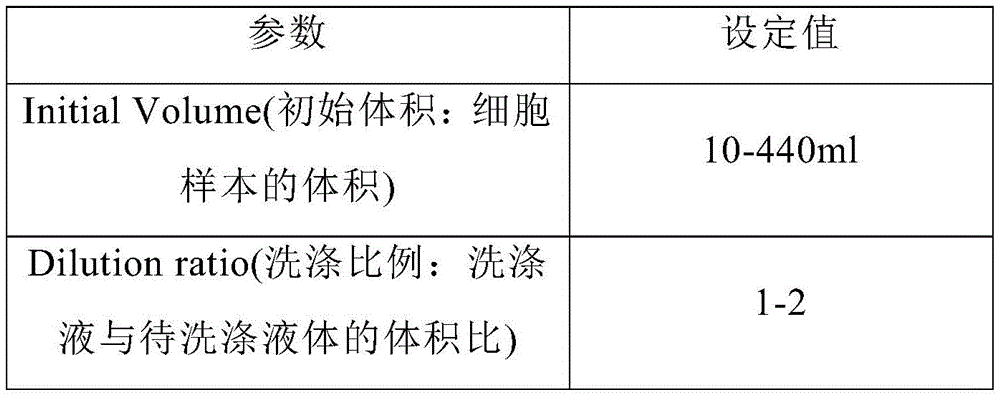
在另一优选例中,用Sepax C-pro的“Beadwash”程序进行的样本洗涤和磁珠孵育,Beadwash参数包括选自如下表A中的一种或多种参数:In another preferred example, for the sample washing and magnetic bead incubation performed by the "Beadwash" program of Sepax C-pro, the Beadwash parameters include one or more parameters selected from the following Table A:
表ATable A

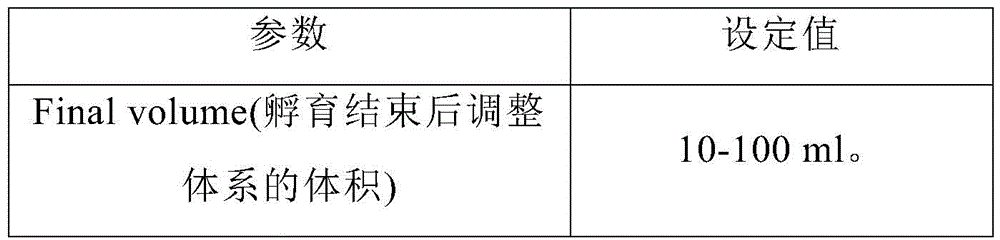
在另一优选例中,在步骤(b)中,所述的分选包括正分选或负分选。In another preferred embodiment, in step (b), the sorting includes positive sorting or negative sorting.
在另一优选例中,在步骤(b)中,所述的分选包括通过加入分选磁珠进行分选,所述的分选磁珠含有与免疫细胞表面标记物(如CD4和/或CD8)结合的捕获体,所述的分选磁珠通过捕获体与免疫细胞表面标记物结合,形成分选磁珠-细胞复合物,从而获得富含免疫细胞的第一免疫细胞群。In another preferred example, in step (b), the sorting includes sorting by adding sorting magnetic beads, the sorting magnetic beads containing markers that are related to immune cell surface markers (such as CD4 and/or CD8)-bound capture body, the sorting magnetic beads are combined with immune cell surface markers through the capture body to form a separation magnetic bead-cell complex, thereby obtaining a first immune cell population rich in immune cells.
在另一优选例中,所述的捕获体为抗体。In another preferred embodiment, the capture body is an antibody.
在另一优选例中,所述的抗体为特异性抗体。In another preferred embodiment, the antibody is a specific antibody.
在另一优选例中,所述的抗体选自下组:CD4+抗体、CD8+抗体,或其组合。In another preferred embodiment, the antibody is selected from the group consisting of CD4 + antibody, CD8 + antibody, or a combination thereof.
在另一优选例中,所述的细胞表面标记物选自下组:CD4+、CD8+,或其组合。In another preferred embodiment, the cell surface marker is selected from the group consisting of CD4 + , CD8 + , or a combination thereof.
在另一优选例中,所述的捕获体与所述的细胞表面标记物特异性结合。In another preferred embodiment, the capture body specifically binds to the cell surface marker.
在另一优选例中,所述的分选磁珠为含CD4+抗体和CD8+抗体的分选磁珠。In another preferred embodiment, the magnetic separation beads are magnetic separation beads containing CD4 + antibody and CD8 + antibody.
在另一优选例中,所述的洗涤液为缓冲液。In another preferred embodiment, the washing solution is a buffer solution.
在另一优选例中,所述的分选液为含有分选磁珠的缓冲液。In another preferred embodiment, the sorting solution is a buffer solution containing sorting magnetic beads.
在另一优选例中,所述的缓冲液为pH6.8-7.4PBS缓冲液。In another preferred embodiment, the buffer is pH 6.8-7.4 PBS buffer.
在另一优选例中,所述步骤(c)中,所述的激活磁珠为CD3+、CD28+或其组合型激活磁珠。In another preferred embodiment, in the step (c), the activated magnetic beads are CD3 + , CD28 + or their combination activated magnetic beads.
在另一优选例中,所述的激活磁珠为Dynabeads。In another preferred embodiment, the activated magnetic beads are Dynabeads.
在另一优选例中,所述步骤(c)中,所述第二免疫细胞群中的细胞密度为 0.5-10×106cells/ml。In another preferred example, in the step (c), the cell density in the second immune cell population is 0.5-10×10 6 cells/ml.
在另一优选例中,步骤(e)中,所述病毒为慢病毒。In another preferred embodiment, in step (e), the virus is a lentivirus.
在另一优选例中,所述的基因为肿瘤杀死基因。In another preferred embodiment, the gene is a tumor killing gene.
在另一优选例中,步骤(e)中,所述的转染步骤中,所述的病毒与细胞的个数比为1-10:1。In another preferred example, in step (e), in the transfection step, the number ratio of the virus to the cell is 1-10:1.
在另一优选例中,步骤(f)中,所述的培养是在Wave设备中进行培养。In another preferred embodiment, in step (f), the culturing is performed in a Wave device.
在另一优选例中,所述的培养在wave培养袋中进行。In another preferred embodiment, the culture is carried out in a wave culture bag.
在另一优选例中,所述的wave培养袋的规格为2L-10L。In another preferred example, the specification of the wave culture bag is 2L-10L.
在另一优选例中,Wave参数:温度35-39℃,Gas Flow 0.08-0.15L/min, CO2 4-6%,Rocking Speed 10-18rpm,Rocking angle 6-10°。In another preferred example, Wave parameters: temperature 35-39°C, Gas Flow 0.08-0.15L/min, CO 2 4-6%, Rocking Speed 10-18rpm, Rocking angle 6-10°.
在另一优选例中,所述的步骤(f)中,所述的培养后,用Dynamag CTS 对激活磁珠进行去除。In another preferred embodiment, in the step (f), after the incubation, Dynamag CTS is used to remove the activated magnetic beads.
在另一优选例中,所述的步骤(f)还包括对培养的第四免疫细胞群进行浓缩,所述的浓缩是在Sepax C-pro设备上进行;In another preferred embodiment, the step (f) further comprises concentrating the cultured fourth immune cell population, and the concentration is carried out on a Sepax C-pro device;
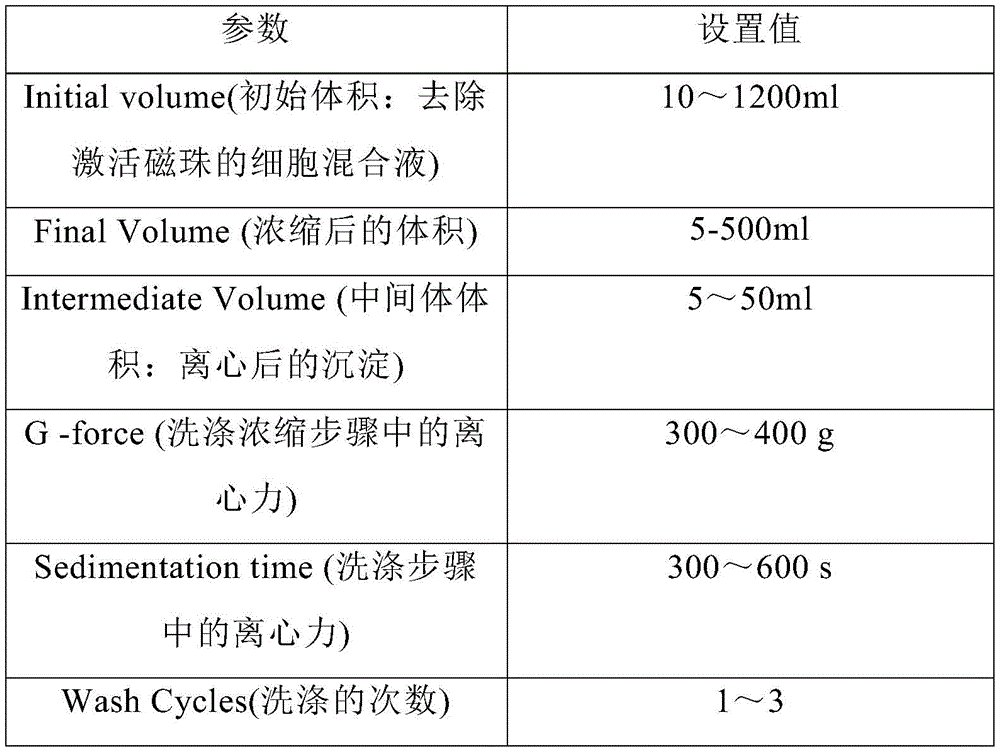
在另一优选例中,用Sepax C-pro的“culturewash”程序进行浓缩,所述的culturewash参数包括选自下组的一种或多种如下:In another preferred embodiment, the "culturewash" program of Sepax C-pro is used for concentration, and the culturewash parameters include one or more selected from the following group as follows:
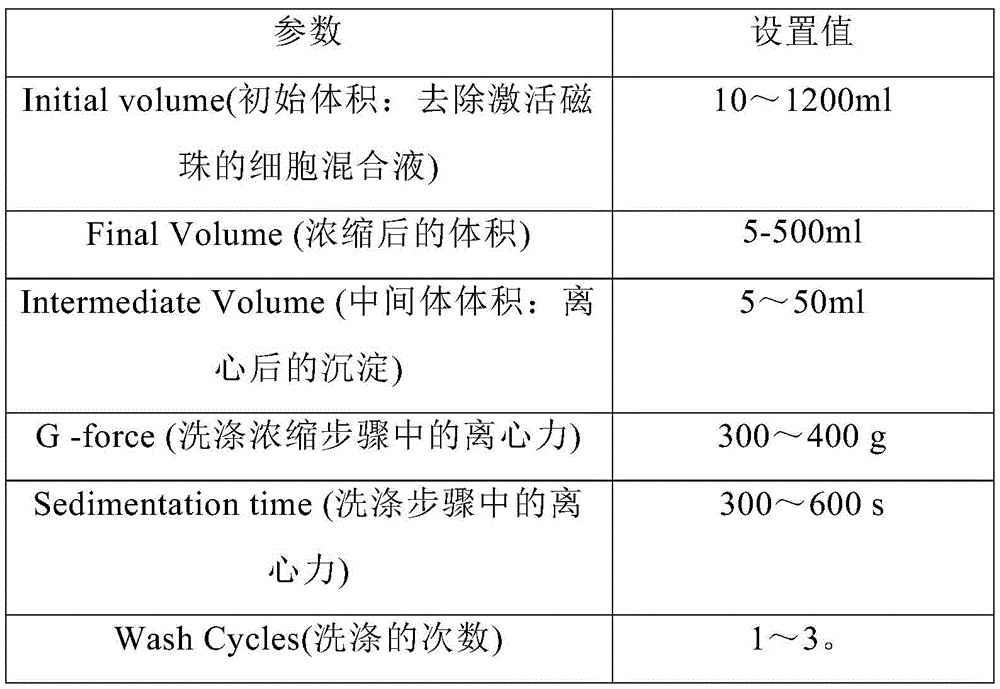
应理解,在本发明范围内中,本发明的上述各技术特征和在下文(如实施例) 中具体描述的各技术特征之间都可以互相组合,从而构成新的或优选的技术方案。限于篇幅,在此不再一一累述。It should be understood that, within the scope of the present invention, the above-mentioned technical features of the present invention and the technical features specifically described in the following (eg, embodiments) can be combined with each other to form new or preferred technical solutions. Due to space limitations, it is not repeated here.
具体实施方式Detailed ways
本发明人通过广泛而又深入的研究,首次意外开发一种基因修饰的免疫细胞的制备方法,本发明的细胞制备方法能够快速制备免疫细胞且制备的免疫细胞具有高质量,从而能够保证临床疗效。Through extensive and in-depth research, the present inventor unexpectedly developed a preparation method of genetically modified immune cells for the first time. The cell preparation method of the present invention can quickly prepare immune cells and the prepared immune cells are of high quality, thereby ensuring clinical efficacy. .
术语the term
除非另有定义,否则本文中所用的所有技术和科学术语的含义与本发明所属领域普通技术人员普遍理解的含义相同。Unless otherwise defined, all technical and scientific terms used herein have the same meaning as commonly understood by one of ordinary skill in the art to which this invention belongs.
如本文所用,术语“包括”、“包含”与“含有”可互换使用,不仅包括开放式定义,还包括半封闭式、和封闭式定义。换言之,所述术语包括了“由……构成”、“基本上由……构成”。As used herein, the terms "comprising," "including," and "containing" are used interchangeably to include not only open definitions, but also semi-closed, and closed definitions. In other words, the terms include "consisting of", "consisting essentially of".
制备方法Preparation
本发明提供一种基因修饰的免疫细胞的制备方法,所述的方法包括步骤:The present invention provides a method for preparing a genetically modified immune cell, the method comprising the steps of:
(a)提供含待进行基因修饰的免疫细胞的样本;(a) providing a sample containing immune cells to be genetically modified;
(b)对所述样本进行分选,从而获得富含免疫细胞的第一免疫细胞群;(b) sorting the sample to obtain a first immune cell population rich in immune cells;
(c)对所述的第一免疫细胞群进行激活处理,从而获得经激活的第二免疫细胞群;(c) activating the first immune cell population to obtain an activated second immune cell population;
(d)对所述的经激活的第二免疫细胞群进行转染前培养(pre-transfectionculturing,也称为预培育),从而获得预培养的第三免疫细胞群;(d) performing pre-transfection culturing (also referred to as pre-cultivation) on the activated second immune cell population to obtain a pre-cultured third immune cell population;
(e)采用病毒载体,通过转染,对所述的经激活的第三免疫细胞群进行基因修饰,从而获得经基因修饰的第四免疫细胞群;(e) genetically modifying the activated third immune cell population by transfection using a viral vector, thereby obtaining a genetically modified fourth immune cell population;
(f)对所述的经基因修饰的第四免疫细胞群进行转染后培养 (post-transfection culturing),从而获得经培养的第四免疫细胞群,即所述的基因修饰的免疫细胞;(f) performing post-transfection culturing on the fourth genetically modified immune cell population, thereby obtaining the fourth cultured immune cell population, that is, the genetically modified immune cells;
其中,所述方法具有选自下组的一个或多个特征:wherein the method has one or more features selected from the group consisting of:
(i)在步骤(c)中,采用激活磁珠进行激活,并且所述激活磁珠与所述的细胞的个数比为0.5-5:1;(i) in step (c), using activated magnetic beads for activation, and the ratio of the activated magnetic beads to the number of cells is 0.5-5:1;
(ii)在步骤(e)中,将所述病毒和所述的经激活的第四免疫细胞群进行混合,并孵育一段时间te,并且在孵育后不进行离心操作;(ii) in step ( e ), mixing the virus and the activated fourth immune cell population, and incubating for a period of time te without centrifugation after incubation;
(iii)在步骤(f)中,在培养时,基于培养体系中的免疫细胞的密度采用不同的灌流方式:当免疫细胞的密度<2×10⁶细胞/ml时,不进行灌流;当免疫细胞的密度≥2×106细胞/ml且<4×106细胞/ml时,按0.5V/天-1V/天的速率进行灌流,其中V为培养体系的体积;当免疫细胞的密度≥4×106细胞/ml时,按1V/ 天-2V/天的速率进行灌流,其中V为培养体系的体积。(iii) In step (f), during culture, different perfusion methods are adopted based on the density of immune cells in the culture system: when the density of immune cells is less than 2×10 6 cells/ml, no perfusion is performed; When the cell density is greater than or equal to 2×10 6 cells/ml and less than 4×10 6 cells/ml, perfuse at a rate of 0.5V/day-1V/day, where V is the volume of the culture system; when the density of immune cells is greater than or equal to 4×10 6 cells/ml were perfused at a rate of 1V/day-2V/day, where V was the volume of the culture system.
在另一优选例中,在步骤(c)中,所述的第一免疫细胞群的密度为0.5-10×106cells/ml。In another preferred example, in step (c), the density of the first immune cell population is 0.5-10×10 6 cells/ml.
本发明所述的方法能够快速的制备细胞,制备时间短,从而有利于工业化生产。The method of the present invention can quickly prepare cells, and the preparation time is short, which is beneficial to industrial production.
优选地,所述方法还具有选自下组的一个或多个特征:Preferably, the method further has one or more features selected from the group consisting of:
(t1)步骤(b)至(f)的总时间t(b-f)为4-5天;(t1) The total time t (bf) of steps (b) to (f) is 4-5 days;
(t2)步骤(f)的培养时间tf为1.0-3.5天。(t2) The culture time t f of step (f) is 1.0-3.5 days.
在本发明的另一优选例中,所述激活磁珠与所述的细胞的个数比为1-5:1;In another preferred embodiment of the present invention, the number ratio of the activated magnetic beads to the cells is 1-5:1;
在本发明的另一优选例中,步骤(b)包括:将所述样本与分选磁珠进行混合,对混合物孵育一段时间tb,然后分选出富含免疫细胞的第一免疫细胞群;In another preferred embodiment of the present invention, step (b) includes: mixing the sample with sorting magnetic beads, incubating the mixture for a period of time t b , and then sorting out a first immune cell population rich in immune cells ;
优选地,所述的tb为10-30分钟,较佳地10-25分钟。Preferably, the t b is 10-30 minutes, preferably 10-25 minutes.
在另一优选例中,步骤(c)包括:将所述的第一免疫细胞群和激活磁珠进行混合,对混合物孵育一段时间tc,从而获得经激活的第二免疫细胞群;In another preferred example, step (c) includes: mixing the first immune cell population with the activated magnetic beads, and incubating the mixture for a period of time t c , thereby obtaining an activated second immune cell population;
在另一优选例中,步骤(c)的所述的tc为12-24小时。In another preferred example, the t c in step (c) is 12-24 hours.
在本发明的另一优选例中,所述的方法具有选自下组的一种或多种特征:In another preferred embodiment of the present invention, the method has one or more features selected from the following group:
步骤(d)中,预培养时间td为1.5-3天,较佳地为1.5-2.5天;In step (d), the pre-culture time t d is 1.5-3 days, preferably 1.5-2.5 days;
步骤(e)中,转染培养时间te为0.5-2.5天,较佳地1-2天;和/或In step (e), the transfection culture time t e is 0.5-2.5 days, preferably 1-2 days; and/or
步骤(f)中,转染后培养的时间tf为1-3.5天,较佳地1.5-3天。In step (f), the post-transfection culture time t f is 1-3.5 days, preferably 1.5-3 days.
在本发明的另一优选例中,所述方法还包括:In another preferred embodiment of the present invention, the method further includes:
(f)当所述经培养的第四免疫细胞群的细胞数量或细胞密度达到预定值时,收获所述经培养的第四免疫细胞群。(f) when the cell number or cell density of the cultured fourth immune cell population reaches a predetermined value, harvesting the cultured fourth immune cell population.
在另一优选例中,所述的预定值为2×10⁶细胞/ml~20×106细胞/ml。In another preferred example, the predetermined value is 2×10 6 cells/ml to 20×10 6 cells/ml.
在另一优选例中,在步骤(e)中,将所述病毒和所述的经激活的第四免疫细胞群进行混合,并孵育一段时间te,获得孵育液;对所述孵育液用培养基进行按体积计0.5-2倍(较佳地0.75-1.5倍)的稀释,从而获得经稀释的孵育液。In another preferred example, in step ( e ), the virus and the activated fourth immune cell population are mixed, and incubated for a period of time te to obtain an incubation solution; The medium is diluted 0.5-2 times (preferably 0.75-1.5 times) by volume to obtain a diluted incubation solution.
在另一优选例中,在步骤(f)中,对经稀释的孵育液孵育0.5-1.5天,然后接种至生物反应器如Xuri Wave,进行继续培养1-7天。In another preferred embodiment, in step (f), the diluted incubation solution is incubated for 0.5-1.5 days, and then inoculated into a bioreactor such as Xuri Wave, and cultured for 1-7 days.
在本发明所述的方法中,所述的样本并没有特别的限定,优选地,所述的样本包括(但不限于):血液、细胞、新鲜单采物、冻存单采物、PBMC采集物,或其组合。In the method of the present invention, the sample is not particularly limited, preferably, the sample includes (but is not limited to): blood, cells, fresh apheresis, frozen apheresis, PBMC collection , or a combination thereof.
在另一优选例中,所述的免疫细胞包括(但不限于):T细胞、NK细胞,或其组合。In another preferred example, the immune cells include (but are not limited to): T cells, NK cells, or a combination thereof.
在本发明的另一优选例中,在对所述样本进行分选前,对样品进行洗涤。In another preferred embodiment of the present invention, before sorting the sample, the sample is washed.
在另一优选例中,所述的洗涤包括步骤:向细胞样本中加入洗涤液后混合,离心,去除上清液,得到沉淀。本发明所述的洗涤可以在Sepax 2、Sepax C-pro、 Sefia、Lovo、CS5+、CS Elite或Prodigy设备上进行。In another preferred embodiment, the washing includes the steps of: adding a washing solution to the cell sample, mixing, centrifuging, and removing the supernatant to obtain a precipitate. Washing according to the present invention can be carried out on Sepax 2, Sepax C-pro, Sefia, Lovo, CS5+, CS Elite or Prodigy equipment.
在另一优选例中,所述的洗涤在Sepax C-pro设备上进行。In another preferred embodiment, the washing is carried out on Sepax C-pro equipment.
Sepax C-Pro是一种全自动封闭式细胞处理系统,是生产细胞治疗产品时用于处理细胞的一种自动化、功能性封闭技术产品,与软件方案和套件联用,可实现多种处理步骤的多功能组合,包括但不限于各种来源细胞的富集、分离、洗涤、浓缩、稀释和分袋(脐带血、骨髓、外周血、脂肪、培养细胞等)。Sepax C-Pro is a fully automatic closed cell processing system, an automated, functional closed technology product used to process cells in the production of cell therapy products, combined with software solutions and kits to achieve a variety of processing steps A multifunctional combination of cells, including but not limited to enrichment, isolation, washing, concentration, dilution and bagging of cells from various sources (cord blood, bone marrow, peripheral blood, adipose, cultured cells, etc.).
代表性地,用Sepax C-pro的“Beadwash”程序进行的样本洗涤和磁珠孵育,Beadwash参数包括选自如上表A中的一种或多种参数。Typically, sample washing and magnetic bead incubation are performed with the "Beadwash" procedure of Sepax C-pro, Beadwash parameters including one or more parameters selected from Table A above.
在另一优选例中,在步骤(b)中,所述的分选包括正分选或负分选。In another preferred embodiment, in step (b), the sorting includes positive sorting or negative sorting.
在另一优选例中,在步骤(b)中,所述的分选包括通过加入分选磁珠进行分选,所述的分选磁珠含有与免疫细胞表面标记物(如CD4和/或CD8)结合的捕获体,所述的分选磁珠通过捕获体与免疫细胞表面标记物结合,形成分选磁珠-细胞复合物,从而获得富含免疫细胞的第一免疫细胞群。In another preferred example, in step (b), the sorting includes sorting by adding sorting magnetic beads, the sorting magnetic beads containing markers that are related to immune cell surface markers (such as CD4 and/or CD8)-bound capture body, the sorting magnetic beads are combined with immune cell surface markers through the capture body to form a separation magnetic bead-cell complex, thereby obtaining a first immune cell population rich in immune cells.
在一个优选例中,所述的捕获体为抗体。所述的抗体可以为为特异性抗体。代表性地,所述的抗体选自下组:CD4+抗体、CD8+抗体,或其组合。In a preferred embodiment, the capture body is an antibody. The antibody can be a specific antibody. Typically, the antibody is selected from the group consisting of a CD4 + antibody, a CD8 + antibody, or a combination thereof.
在另一优选例中,所述的细胞表面标记物选自下组:CD4+、CD8+,或其组合。本发明所述的捕获体可以与所述的细胞表面标记物特异性结合。In another preferred embodiment, the cell surface marker is selected from the group consisting of CD4 + , CD8 + , or a combination thereof. The capture body of the present invention can specifically bind to the cell surface marker.
在本发明的另一优选例中,所述的分选磁珠为含CD4+抗体和CD8+抗体的分选磁珠。In another preferred embodiment of the present invention, the magnetic separation beads are magnetic separation beads containing CD4 + antibody and CD8 + antibody.
在本发明的另一优选例中,所述步骤(c)中,所述的激活磁珠为CD3+、 CD28+或其组合型激活磁珠。In another preferred embodiment of the present invention, in the step (c), the activated magnetic beads are CD3 + , CD28 + or their combined activated magnetic beads.
代表性地,所述的激活磁珠为Dynabeads。Typically, the activated magnetic beads are Dynabeads.
在另一优选例中,所述步骤(c)中,所述第二免疫细胞群中的细胞密度为 0.5-10×106cells/ml。In another preferred example, in the step (c), the cell density in the second immune cell population is 0.5-10×10 6 cells/ml.
在本发明的另一优选例中,步骤(e)中,所述病毒为慢病毒。In another preferred embodiment of the present invention, in step (e), the virus is a lentivirus.
在另一优选例中,所述的基因为肿瘤杀死基因。In another preferred embodiment, the gene is a tumor killing gene.
在另一优选例中,步骤(e)中,所述的转染步骤中,所述的病毒与细胞的个数比为1-10:1。In another preferred example, in step (e), in the transfection step, the number ratio of the virus to the cell is 1-10:1.
在本发明的另一优选例中,步骤(f)中,所述的培养是在Wave设备中进行培养。In another preferred embodiment of the present invention, in step (f), the culturing is performed in a Wave device.
在另一优选例中,所述的培养在wave培养袋中进行。In another preferred embodiment, the culture is carried out in a wave culture bag.
在另一优选例中,所述的wave培养袋的规格为2L-10L。In another preferred example, the specification of the wave culture bag is 2L-10L.
在另一优选例中,Wave参数:温度35-39℃,Gas Flow 0.08-0.15L/min, CO2 4-6%,Rocking Speed 10-18rpm,Rocking angle 6-10°。In another preferred example, Wave parameters: temperature 35-39°C, Gas Flow 0.08-0.15L/min, CO 2 4-6%, Rocking Speed 10-18rpm, Rocking angle 6-10°.
在另一优选例中,所述的步骤(f)中,所述的培养后,用Dynamag CTS 对激活磁珠进行去除。In another preferred embodiment, in the step (f), after the incubation, Dynamag CTS is used to remove the activated magnetic beads.
在另一优选例中,所述的步骤(f)还包括对培养的第四免疫细胞群进行浓缩,所述的浓缩是在Sepax C-pro设备上进行;In another preferred embodiment, the step (f) further comprises concentrating the cultured fourth immune cell population, and the concentration is carried out on a Sepax C-pro device;
优选地,用Sepax C-pro的“culturewash”程序进行浓缩,所述的culturewash 参数包括选自下组的一种或多种如下:Preferably, the concentration is carried out using the "culturewash" procedure of Sepax C-pro, the culturewash parameters comprising one or more selected from the group consisting of the following:
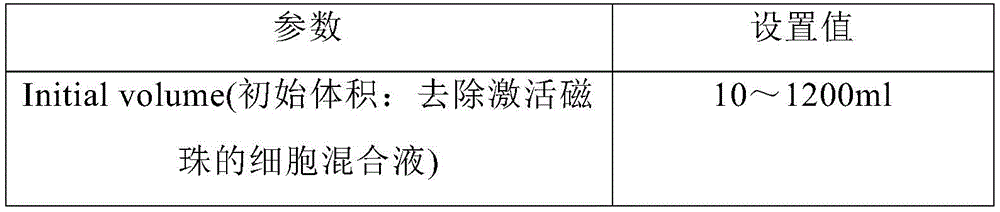
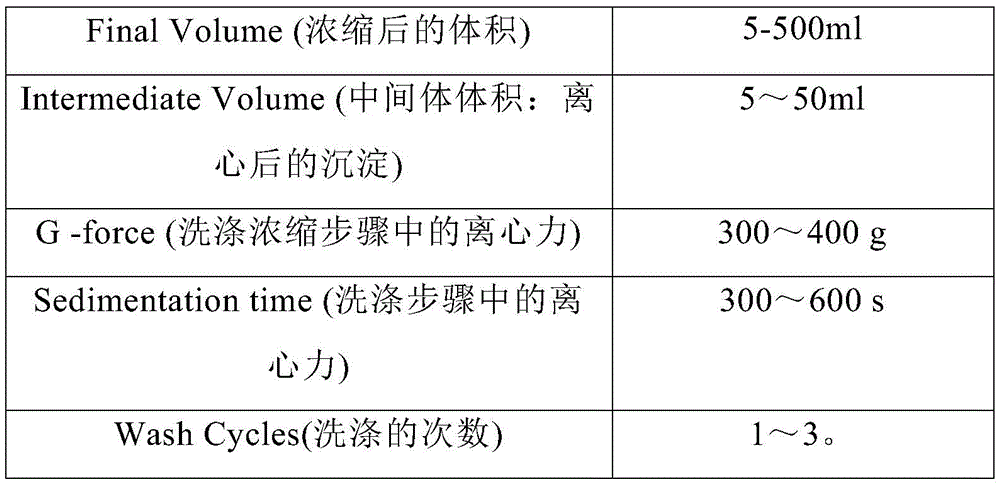
本发明的主要优点主要包括:The main advantages of the present invention mainly include:
本发明的细胞制备方法能够快速制备免疫细胞,降低了企业的成本,提高了生产产能,适合工业化生产,同时本发明的细胞制备方法制备的免疫细胞具有高质量,能够保证临床疗效。The cell preparation method of the present invention can rapidly prepare immune cells, reduces the cost of the enterprise, increases the production capacity, and is suitable for industrial production. Meanwhile, the immune cells prepared by the cell preparation method of the present invention have high quality and can ensure clinical curative effect.
下面结合具体实施例,进一步阐述本发明。应理解,这些实施例仅用于说明本发明而不用于限制本发明的范围。下列实施例中未注明具体条件的实验方法,通常按照常规条件,或按照制造厂商所建议的条件。除非另外说明,否则百分比和份数按重量计算。The present invention will be further described below in conjunction with specific embodiments. It should be understood that these examples are only used to illustrate the present invention and not to limit the scope of the present invention. In the following examples, the experimental methods without specific conditions are usually in accordance with conventional conditions, or in accordance with the conditions suggested by the manufacturer. Percentages and parts are by weight unless otherwise indicated.
实施例1用于细胞免疫疗法的细胞制备方法Example 1 Cell preparation method for cellular immunotherapy
1.细胞培养:1. Cell culture:
所有的细胞培养均在正常细胞培养条件下进行。All cell cultures were performed under normal cell culture conditions.
2.制备方法2. Preparation method
(1)提供细胞样本:(1) Provide cell samples:
复苏10~440ml冻存表达CD4+和CD8+的细胞(血液样本),作为细胞样本。Recover 10-440ml of cryopreserved cells (blood samples) expressing CD4 + and CD8 + as cell samples.
(2)洗涤和分选步骤:(2) washing and sorting steps:
使用Sepax C-Pro“beadWash”程序进行细胞洗涤和用含CD4+抗体和CD8+抗体的分选磁珠孵育,设置参数如下表1所示:Cell washing and incubation with sorting magnetic beads containing CD4 + antibody and CD8 + antibody were performed using the Sepax C-Pro "beadWash" program, with parameters set as shown in Table 1 below:
表1 Sepax Pro Beadwash参数设置Table 1 Sepax Pro Beadwash parameter settings
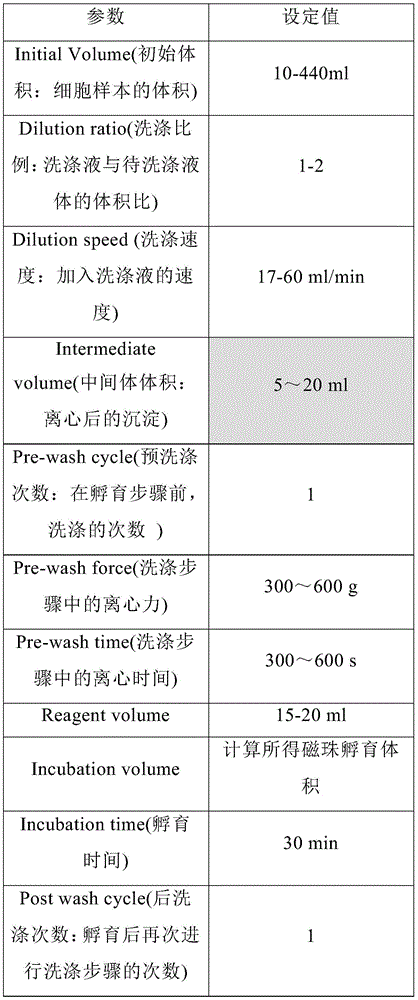

Sepax Pro“beadWash”程序的工作如下:The Sepax Pro "beadWash" program works as follows:
向细胞样本中加入洗涤液pH7.2 PBS缓冲液后混合,离心,去除上清液,得到沉淀。The washing solution pH7.2 PBS buffer was added to the cell sample, mixed, centrifuged, and the supernatant was removed to obtain a pellet.
向所述沉淀中加入分选液进行孵育10-30min,得到孵育混合液,其中,所述的分选液为含有分选磁珠的液pH7.2 PBS缓冲液,分选磁珠的体积用量= CD4/CD8淋巴细胞量/[(200~800)×106/ml],所述的分选磁珠含有CD4+抗体和 CD8+抗体作为捕获体,所述的分选磁珠通过CD4+抗体和CD8+抗体与细胞表面的CD4+和CD8+特异性结合,形成分选磁珠-细胞复合物。Add a sorting solution to the precipitation and incubate for 10-30 min to obtain an incubation mixture, wherein the sorting solution is a pH 7.2 PBS buffer solution containing magnetic separation beads, and the volumetric dosage of magnetic separation beads = CD4/CD8 lymphocyte amount/[(200~800)×10 6 /ml], the sorting magnetic beads contain CD4 + antibody and CD8 + antibody as capture bodies, and the sorting magnetic beads pass through CD4 + Antibodies and CD8 + antibodies specifically bind to CD4 + and CD8 + on the cell surface to form sorting magnetic bead-cell complexes.
在该步骤(2)中,发现当孵育时间过低会影响目的细胞的结合,细胞与磁珠孵育时间过短会或导致部分目的细胞不能与分选磁珠相结合,影响分选效率,然后当孵育时间过长时,细胞的生长状态不佳。当分选磁珠的体积用量过低时导致部分目的细胞不能被标记,影响分选效率,当磁珠用量过高会增加磁珠孵育清洗后的残留量,占据分选柱结合位点,影响分选效果。In this step (2), it is found that if the incubation time is too low, it will affect the binding of target cells, and if the incubation time of cells and magnetic beads is too short, some target cells may not be combined with the sorting magnetic beads, which will affect the sorting efficiency. When the incubation time is too long, the cells do not grow well. When the volume of magnetic beads used for sorting is too low, some of the target cells cannot be labeled, which affects the sorting efficiency. Select effect.
使用CliniMacs设备所述的孵育混合液中分离得到分选磁珠-细胞复合物 pH7.2PBS缓冲液。Separation magnetic bead-cell complexes were obtained from the incubation mixture described in the CliniMacs equipment pH 7.2 PBS buffer.
CliniMacs设备工作如下:CliniMacs devices work as follows:
首先利用磁场对分选磁珠-细胞复合物进行吸附,去除孵育混合液中液体,然后,去除磁场,用pH7.2 PBS缓冲液冲洗分选磁珠-细胞复合物,得到分选磁珠-细胞复合物pH7.2 PBS缓冲液。First, the magnetic field was used to adsorb the sorting magnetic beads-cell complexes, and the liquid in the incubation mixture was removed. Then, the magnetic field was removed, and the sorting magnetic beads-cell complexes were washed with pH7.2 PBS buffer to obtain the sorting magnetic beads- Cell complex pH7.2 PBS buffer.
(3)细胞激活步骤:(3) Cell activation steps:
将分选磁珠-细胞复合物pH7.2 PBS缓冲液离心,去除上清液,得到含有分选磁珠-细胞复合物的沉淀,使用培养基重悬后加入含有用于激活细胞的激活磁珠(Dynabeads)的细胞培养液,得到细胞混合液,孵育12-24后进行后续操作,其中,在所述的细胞混合液中,所述的激活磁珠与所述的细胞的个数比为0.5 -5:1,激活的细胞的密度为0.5-10×106cells/ml。The sorting magnetic bead-cell complex was centrifuged with pH7.2 PBS buffer, the supernatant was removed, and the precipitate containing the sorting magnetic bead-cell complex was obtained. Bead (Dynabeads) cell culture solution, obtain a cell mixture, incubate for 12-24 hours and carry out follow-up operations, wherein, in the cell mixture, the number ratio of the activated magnetic beads to the cells is 0.5-5:1, the density of activated cells is 0.5-10×10 6 cells/ml.
在该步骤(4)中,发现激活磁珠使用量比例过高,可能会造成淋巴T细胞的过度活化和磁珠去除时残留量的增加;细胞过度活化会造成细胞的凋亡和分化,磁珠量过多易造成磁铁吸附能力过载,造成细胞终产品中磁珠残留过多,风险度高。当激活密度过高或过低会影响细胞与激活磁珠的接触几率,从而影响磁珠对细胞的激活效果,进而影响细胞的扩增。In this step (4), it is found that the proportion of activated magnetic beads used is too high, which may cause the over-activation of lymphoid T cells and the increase of the residual amount when the magnetic beads are removed; over-activation of cells will cause cell apoptosis and differentiation, magnetic Excessive amount of beads can easily overload the magnetic adsorption capacity, resulting in excessive residual magnetic beads in the final cell product, and the risk is high. When the activation density is too high or too low, it will affect the contact probability of the cells and the activated magnetic beads, thereby affecting the activation effect of the magnetic beads on the cells, thereby affecting the expansion of the cells.
(4)转染步骤:(4) Transfection steps:
对细胞混合液进行培养2天后,用携带目的基因的病毒转染细胞,携带目的基因的病毒与细胞的个数比(MOI)为1-10:1,孵育2天后,得到孵育液,向孵育液中加入同体积的细胞培养液对病毒进行稀释1倍,继续培养1天,然后将细胞接种至Xuri Wave中继续培养,在Wave中培养1-2天后结束培养,得到携带目的基因的细胞混合液,其中细胞培养Wave参数:温度37℃,Gas Flow 0.1L/min,CO2 5%,Rocking Speed 10-18rpm,Rocking angle 6-10°。After culturing the cell mixture for 2 days, the cells were transfected with the virus carrying the target gene, and the number ratio (MOI) of the virus carrying the target gene to the cells was 1-10:1. Add the same volume of cell culture medium to the solution to dilute the virus by 1 times, continue to culture for 1 day, and then inoculate the cells into Xuri Wave to continue the culture. After culturing in the Wave for 1-2 days, the culture is terminated, and a mixture of cells carrying the target gene is obtained. liquid, wherein the cell culture Wave parameters: temperature 37°C, Gas Flow 0.1L/min, CO 2 5%, Rocking Speed 10-18rpm, Rocking angle 6-10°.
在该步骤(5)中,发现Wave培养温度过低或过高会影响细胞的代谢生长速率;CO2比例,气体流速,摇摆角度和速率的过低过高,会影响溶氧率等培养条件抑制细胞的生长,使用Wave培养可对上述参数进行严格控制。In this step (5), it was found that if the Wave culture temperature is too low or too high, the metabolic growth rate of the cells will be affected; if the CO2 ratio, gas flow rate, rocking angle and speed are too low or too high, it will affect the inhibition of culture conditions such as the dissolved oxygen rate. For cell growth, the above parameters can be tightly controlled using Wave culture.
(5)去除激活磁珠步骤:(5) Steps to remove activated magnetic beads:
使用Dynamag CTS设备对携带目的基因的细胞混合液中的激活磁珠进行去除,得到去除激活磁珠的细胞混合液;Use Dynamag CTS equipment to remove the activated magnetic beads in the cell mixture carrying the target gene to obtain the cell mixture with the activated magnetic beads removed;
(6)细胞灌流(6) Cell perfusion
对去除激活磁珠的细胞混合液进行培养,培养过程中进行灌流(流动补充培养基,保持细胞培养液为500ml),得到培养的细胞液,灌流如下表2所示:The cell mixture from which the activated magnetic beads have been removed is cultured, and perfusion is performed during the culture process (flowing supplementary medium, keeping the cell culture medium at 500ml) to obtain the cultured cell fluid, and the perfusion is shown in Table 2 below:
表2细胞灌流培养Table 2 Cell perfusion culture
(7)细胞浓缩和分装冻干:(7) Cell concentration and lyophilization:
对步骤(7)得到的细胞液进行洗涤浓缩后,加入冻干保护液后,分装,冷冻干燥得到基因修饰的细胞。After washing and concentrating the cell liquid obtained in step (7), adding a freeze-drying protection solution, sub-packing, and freeze-drying to obtain genetically modified cells.
其中,用Sepax C-pro的“culturewash”程序进行细胞洗涤浓缩步骤,所述的culturewash参数如下表3所示:Wherein, use the "culturewash" program of Sepax C-pro to carry out the cell washing and concentration step, and the culturewash parameters are shown in Table 3 below:
表-3 Culturewash参数设置Table-3 Culturewash parameter settings
3、实验结果3. Experimental results
按照上述的方法多次进行平行实验,考察不同的工艺参数,结果如下:Carry out parallel experiments many times according to the above-mentioned method, investigate different technological parameters, and the results are as follows:
3.1在步骤(2)洗涤孵育中,使用Sepax Pro“beadWash”程序进行洗涤孵育步骤后,其中,单核细胞和淋巴细胞的回收率如表4所示。3.1 In the washing and incubation step (2), the Sepax Pro "beadWash" program is used to perform the washing and incubation step, wherein the recovery rates of monocytes and lymphocytes are shown in Table 4.
表4单核细胞和淋巴细胞的回收率Table 4 Recovery of monocytes and lymphocytes

从表4中可以看出,使用Sepax Pro“beadWash”对细胞样本进行洗涤孵育后,细胞回收率高达90%以上,表明使用Sepax Pro“beadWash”对细胞样本进行洗涤孵育基本上不会导致细胞损失。From Table 4, it can be seen that the cell recovery rate is as high as more than 90% after washing and incubating cell samples with Sepax Pro "beadWash", indicating that the washing and incubation of cell samples with Sepax Pro "beadWash" does not substantially lead to cell loss .
3.2在步骤(3)分选步骤中,使用CliniMacs进行细胞分选,细胞的回收率如表5所示:3.2 In the sorting step of step (3), use CliniMacs for cell sorting, and the recovery rate of cells is shown in Table 5:
表5细胞的回收率Table 5 Recovery of cells
从表5中可以看出,使用CliniMacs对细胞样本进行细胞分选后,细胞回收率高达80%以上,表明CliniMacs对细胞样本进行细胞分选后,能够收集大部分目的细胞。It can be seen from Table 5 that the cell recovery rate was as high as over 80% after the cell samples were sorted by CliniMacs, which indicated that after cell sorting of the cell samples by CliniMacs, most of the cells of interest could be collected.
3.3在步骤(5)的转染步骤中,在细胞混合液中培养到第1天后检测细胞激活比例,病毒转染后继续孵育细胞2天。第1天的细胞激活比例,第3、4天的细胞量和细胞阳性率如表6所示:3.3 In the transfection step of step (5), the cell activation ratio was detected after culturing in the cell mixture for the first day, and the cells were incubated for 2 days after virus transfection. The ratio of cell activation on day 1, the amount of cells and the positive rate of cells on day 3 and 4 are shown in Table 6:
表6步骤(4)的细胞激活步骤中的激活效果Activation effect in the cell activation step of table 6 step (4)

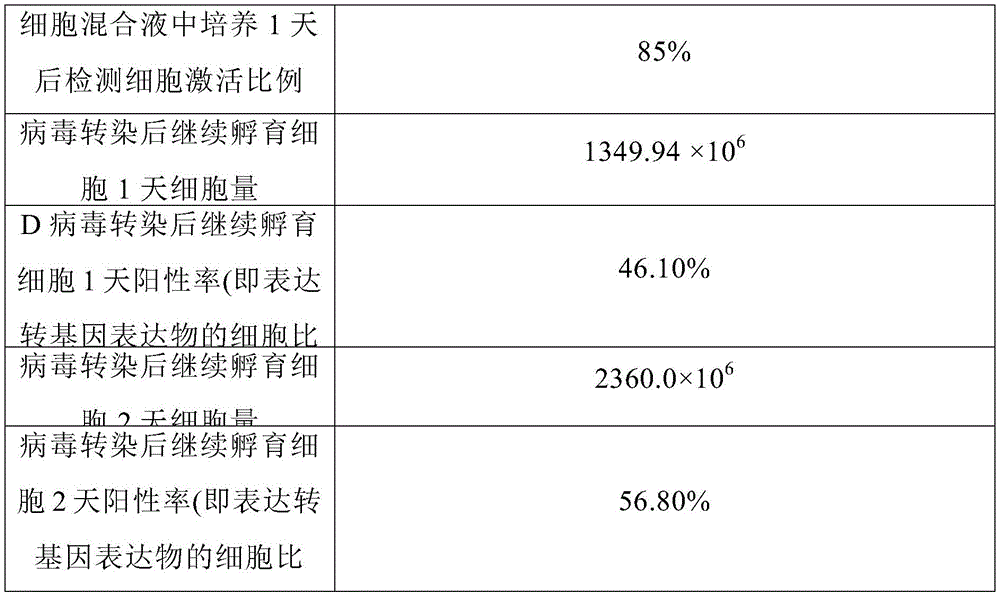
从表6中可以看出,步骤(4)的细胞混合液经过1天的培养,高达85%的细胞都处于活化状态,表明细胞激活效果良好,继续培养细胞能够持续扩增且高效表达转基因表达物。As can be seen from Table 6, after 1 day of culture of the cell mixture in step (4), up to 85% of the cells are in an activated state, indicating that the cell activation effect is good, and the cells can continue to expand and express transgene expression with high efficiency. thing.
3.4在本实施例细胞的制备方法中,分别在步骤(1)的细胞样本(开始的血药样本)、在步骤(3)的分选后和步骤(5)的转染步骤中病毒转染后继续孵育细胞2 天时的细胞亚群信息,结果如表7所示:3.4 In the cell preparation method of this example, virus transfection was performed in the cell sample (starting blood drug sample) in step (1), after sorting in step (3), and in the transfection step in step (5). The cell subset information when the cells were incubated for 2 days, the results are shown in Table 7:
表7细胞亚群信息Table 7 Cell Subpopulation Information
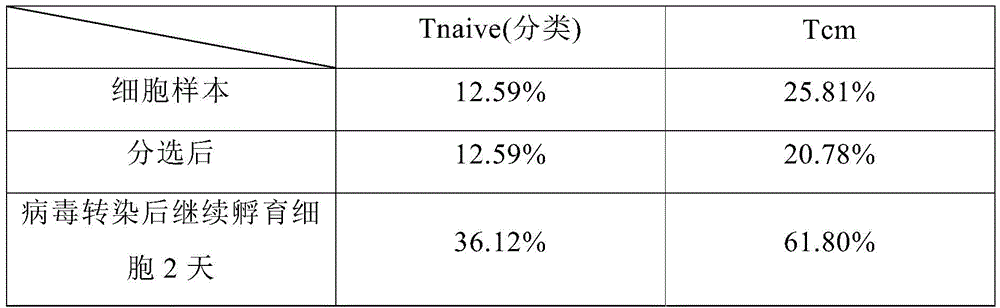
备注:Tnaive:naive T cell;Tcm:Central Memory T cell。Note: Tnaive: naive T cell; Tcm: Central Memory T cell.
从表7中可以看出,在细胞的制备过程中,Tnaive和Tcm细胞比例不断增加,表明在制备过程中,细胞的活力不断增强。As can be seen from Table 7, during the preparation of cells, the proportion of Tnaive and Tcm cells increased continuously, indicating that the viability of cells was continuously enhanced during the preparation.
3.5使用Dynamag CTS去除dynabeads前后的细胞回收率和活率如表8所示:3.5 The cell recovery and viability before and after the removal of dynabeads with Dynamag CTS are shown in Table 8:
表8Dynamag CTS去除dynabeads前后的细胞回收率和活率Table 8 Cell recovery and viability before and after removal of dynabeads by Dynamag CTS

从表8中可以看出,Dynamag CTS去除dynabeads能够保证细胞具有较高的回收率和活率。It can be seen from Table 8 that the removal of dynabeads by Dynamag CTS can ensure that the cells have high recovery and viability.
3.6细胞洗涤浓缩工艺实验3.6 Cell washing and concentration process experiment
使用Sepax Pro对细胞样本进行洗涤浓缩前后的细胞回收率和存活率如表 9所示:The cell recovery and viability of the cell samples before and after washing and concentration using Sepax Pro are shown in Table 9:
表9细胞洗涤浓缩前后的细胞回收率和存活率Table 9 Cell recovery and viability before and after cell washing and concentration

从表9中可以看出,使用Sepax Pro对细胞样本进行洗涤浓缩前后具有优异的细胞回收率和存活率。As can be seen in Table 9, the use of Sepax Pro to wash and concentrate cell samples has excellent cell recovery and viability.
3.7细胞分装工艺实验3.7 Cell sub-packaging process experiment
使用Cell Connect分装管路或Sefia对细胞样本进行分装,可保证分装时输出体积的准确及细胞密度的一致性,结果如表10所示:Using Cell Connect dispensing pipeline or Sefia to dispense cell samples can ensure accurate output volume and consistency of cell density during dispensing. The results are shown in Table 10:
表10Table 10
在本发明提及的所有文献都在本申请中引用作为参考,就如同每一篇文献被单独引用作为参考那样。此外应理解,在阅读了本发明的上述讲授内容之后,本领域技术人员可以对本发明作各种改动或修改,这些等价形式同样落于本申请所附权利要求书所限定的范围。All documents mentioned herein are incorporated by reference in this application as if each document were individually incorporated by reference. In addition, it should be understood that after reading the above teaching content of the present invention, those skilled in the art can make various changes or modifications to the present invention, and these equivalent forms also fall within the scope defined by the appended claims of the present application.
Claims (10)

Priority Applications (5)
| Application Number | Priority Date | Filing Date | Title |
|---|---|---|---|
| CN202011233449.4A CN114438034A (en) | 2020-11-06 | 2020-11-06 | Preparation method of genetically modified cell |
| PCT/US2021/072242 WO2022099287A1 (en) | 2020-11-06 | 2021-11-04 | Methods for preparing genetically modified cells |
| JP2023526655A JP2023548850A (en) | 2020-11-06 | 2021-11-04 | Method for preparing genetically modified cells |
| US18/251,469 US20230407335A1 (en) | 2020-11-06 | 2021-11-04 | Methods for Preparing Genetically Modified Cells |
| EP21890333.4A EP4240382A4 (en) | 2020-11-06 | 2021-11-04 | METHOD FOR PRODUCING GENETICALLY MODIFIED CELLS |
Applications Claiming Priority (1)
| Application Number | Priority Date | Filing Date | Title |
|---|---|---|---|
| CN202011233449.4A CN114438034A (en) | 2020-11-06 | 2020-11-06 | Preparation method of genetically modified cell |
Publications (1)
| Publication Number | Publication Date |
|---|---|
| CN114438034A true CN114438034A (en) | 2022-05-06 |
Family
ID=81361374
Family Applications (1)
| Application Number | Title | Priority Date | Filing Date |
|---|---|---|---|
| CN202011233449.4A Pending CN114438034A (en) | 2020-11-06 | 2020-11-06 | Preparation method of genetically modified cell |
Country Status (5)
| Country | Link |
|---|---|
| US (1) | US20230407335A1 (en) |
| EP (1) | EP4240382A4 (en) |
| JP (1) | JP2023548850A (en) |
| CN (1) | CN114438034A (en) |
| WO (1) | WO2022099287A1 (en) |
Families Citing this family (1)
| Publication number | Priority date | Publication date | Assignee | Title |
|---|---|---|---|---|
| CN119506185A (en) * | 2023-08-22 | 2025-02-25 | 深圳赛桥生物创新技术有限公司 | Cell sample processing method, device, system and medium |
Citations (3)
| Publication number | Priority date | Publication date | Assignee | Title |
|---|---|---|---|---|
| US20180142034A1 (en) * | 2015-02-19 | 2018-05-24 | University Of Florida Research Foundation, Inc. | Chimeric antigen receptors and uses thereof |
| CN110234756A (en) * | 2017-01-18 | 2019-09-13 | F1肿瘤医学公司 | The method and application thereof of transduction and amplification immunocyte |
| CN110499291A (en) * | 2018-05-16 | 2019-11-26 | 西比曼生物科技(香港)有限公司 | Method for preparing chimeric antigen receptor T cells by serum-free culture |
Family Cites Families (5)
| Publication number | Priority date | Publication date | Assignee | Title |
|---|---|---|---|---|
| TWI654206B (en) * | 2013-03-16 | 2019-03-21 | 諾華公司 | Treatment of cancer with a humanized anti-CD19 chimeric antigen receptor |
| GB201416362D0 (en) * | 2014-07-25 | 2014-10-29 | Ge Healthcare Bio Sciences Ab | Method and system for suspension culture |
| KR102387122B1 (en) * | 2014-08-19 | 2022-04-14 | 밀테니 비오텍 비.브이. & 씨오. 케이지 | Chimeric antigen receptor specific for ssea4 antigen |
| US10934336B2 (en) * | 2017-04-13 | 2021-03-02 | The Trustees Of The University Of Pennsylvania | Use of gene editing to generate universal TCR re-directed T cells for adoptive immunotherapy |
| EA202091422A1 (en) * | 2017-12-11 | 2020-08-28 | Эмджен Инк. | METHOD FOR CONTINUOUS PRODUCTION OF PRODUCTS BASED ON BISPECIFIC ANTIBODIES |
-
2020
- 2020-11-06 CN CN202011233449.4A patent/CN114438034A/en active Pending
-
2021
- 2021-11-04 US US18/251,469 patent/US20230407335A1/en active Pending
- 2021-11-04 WO PCT/US2021/072242 patent/WO2022099287A1/en not_active Ceased
- 2021-11-04 JP JP2023526655A patent/JP2023548850A/en active Pending
- 2021-11-04 EP EP21890333.4A patent/EP4240382A4/en active Pending
Patent Citations (3)
| Publication number | Priority date | Publication date | Assignee | Title |
|---|---|---|---|---|
| US20180142034A1 (en) * | 2015-02-19 | 2018-05-24 | University Of Florida Research Foundation, Inc. | Chimeric antigen receptors and uses thereof |
| CN110234756A (en) * | 2017-01-18 | 2019-09-13 | F1肿瘤医学公司 | The method and application thereof of transduction and amplification immunocyte |
| CN110499291A (en) * | 2018-05-16 | 2019-11-26 | 西比曼生物科技(香港)有限公司 | Method for preparing chimeric antigen receptor T cells by serum-free culture |
Also Published As
| Publication number | Publication date |
|---|---|
| EP4240382A4 (en) | 2024-12-11 |
| WO2022099287A1 (en) | 2022-05-12 |
| JP2023548850A (en) | 2023-11-21 |
| EP4240382A1 (en) | 2023-09-13 |
| US20230407335A1 (en) | 2023-12-21 |
Similar Documents
| Publication | Publication Date | Title |
|---|---|---|
| US10131876B2 (en) | Method for automated generation of genetically modified T cells | |
| CN105087788A (en) | Immunomagnetic bead for sorting human cells and preparation and cutting-off method of immunomagnetic bead | |
| CN104894068A (en) | Method for preparing CAR-T cell by CRISPR/Cas9 | |
| TW202132560A (en) | Methods of manufacturing car-t cells | |
| CN116254233B (en) | A method for recovering and culturing ROBO1 CAR NK cells | |
| CN105949316A (en) | Anti-EGFRvIII chimeric antigen receptor, encoding gene, recombinant expression vector, construction method of recombinant expression vector, and application | |
| CN110499291B (en) | Method for preparing chimeric antigen receptor T cells by serum-free culture | |
| TW202132333A (en) | Manufacturing process for making t cells expressing chimeric antigen receptors | |
| CN103710306A (en) | Method used separating and purifying microglia cells | |
| CN112608896A (en) | NK cell culture method and application thereof | |
| CN114438034A (en) | Preparation method of genetically modified cell | |
| CN104762261A (en) | Tumor infiltrating lymphocytes separation method | |
| CN109971726B (en) | Hybridoma cell strain, antibody produced by hybridoma cell strain and preparation method of antibody | |
| CN107090423B (en) | Application of thermophilic thiobacillus | |
| CN105316286A (en) | Method for preparing recombination mesenchymal stem cell and recombination mesenchymal stem cell prepared through method | |
| CN119876036A (en) | Immortalized alpaca kidney cell line and construction method and application thereof | |
| CN105925544A (en) | Preparation method and application of 4-1BB-containing lentivirus | |
| CN116148461A (en) | Quality control product for flow detection of leukocyte differentiation antigen CD34 and preparation method thereof | |
| CN116622712A (en) | Reagents and methods for knocking out TRAC and B2M in T cells | |
| WO2023125696A2 (en) | Activated lymphocyte expansion method having stable and controllable quality, and anti-tumor use thereof | |
| Pello et al. | Optimal large‐scale CD34+ enrichment from a leukapheresis collection using the clinimacs prodigy platform | |
| CN116179582A (en) | Preparation method and application of a universal gene recombinant protein A affinity purification filler | |
| CN113801844A (en) | A kind of fully enclosed integrated immune cell preparation method | |
| CN115181726A (en) | A kind of construction method of lymphocyte immortalization | |
| CN121427822A (en) | In vitro expansion methods and applications of NK cells |
Legal Events
| Date | Code | Title | Description |
|---|---|---|---|
| PB01 | Publication | ||
| PB01 | Publication | ||
| SE01 | Entry into force of request for substantive examination | ||
| SE01 | Entry into force of request for substantive examination |