CN114394091B - A vehicle speed control method in the scene of traffic vehicles merging in an adaptive cruise system - Google Patents
A vehicle speed control method in the scene of traffic vehicles merging in an adaptive cruise system Download PDFInfo
- Publication number
- CN114394091B CN114394091B CN202210167005.8A CN202210167005A CN114394091B CN 114394091 B CN114394091 B CN 114394091B CN 202210167005 A CN202210167005 A CN 202210167005A CN 114394091 B CN114394091 B CN 114394091B
- Authority
- CN
- China
- Prior art keywords
- vehicle
- collision
- merging
- ttc
- corner
- Prior art date
- Legal status (The legal status is an assumption and is not a legal conclusion. Google has not performed a legal analysis and makes no representation as to the accuracy of the status listed.)
- Active
Links
- 238000000034 method Methods 0.000 title claims abstract description 23
- 230000003044 adaptive effect Effects 0.000 title claims description 19
- 230000001133 acceleration Effects 0.000 claims abstract description 24
- 238000004364 calculation method Methods 0.000 claims description 21
- 238000001514 detection method Methods 0.000 claims description 10
- 230000007774 longterm Effects 0.000 claims description 7
- 238000005070 sampling Methods 0.000 claims description 7
- 238000006243 chemical reaction Methods 0.000 claims description 6
- 238000010586 diagram Methods 0.000 description 6
- 101001121408 Homo sapiens L-amino-acid oxidase Proteins 0.000 description 1
- 102100026388 L-amino-acid oxidase Human genes 0.000 description 1
- 101100233916 Saccharomyces cerevisiae (strain ATCC 204508 / S288c) KAR5 gene Proteins 0.000 description 1
- 238000013528 artificial neural network Methods 0.000 description 1
- 230000009286 beneficial effect Effects 0.000 description 1
- 239000012634 fragment Substances 0.000 description 1
Images


Classifications
-
- B—PERFORMING OPERATIONS; TRANSPORTING
- B60—VEHICLES IN GENERAL
- B60W—CONJOINT CONTROL OF VEHICLE SUB-UNITS OF DIFFERENT TYPE OR DIFFERENT FUNCTION; CONTROL SYSTEMS SPECIALLY ADAPTED FOR HYBRID VEHICLES; ROAD VEHICLE DRIVE CONTROL SYSTEMS FOR PURPOSES NOT RELATED TO THE CONTROL OF A PARTICULAR SUB-UNIT
- B60W30/00—Purposes of road vehicle drive control systems not related to the control of a particular sub-unit, e.g. of systems using conjoint control of vehicle sub-units
- B60W30/08—Active safety systems predicting or avoiding probable or impending collision or attempting to minimise its consequences
- B60W30/095—Predicting travel path or likelihood of collision
- B60W30/0953—Predicting travel path or likelihood of collision the prediction being responsive to vehicle dynamic parameters
-
- B—PERFORMING OPERATIONS; TRANSPORTING
- B60—VEHICLES IN GENERAL
- B60W—CONJOINT CONTROL OF VEHICLE SUB-UNITS OF DIFFERENT TYPE OR DIFFERENT FUNCTION; CONTROL SYSTEMS SPECIALLY ADAPTED FOR HYBRID VEHICLES; ROAD VEHICLE DRIVE CONTROL SYSTEMS FOR PURPOSES NOT RELATED TO THE CONTROL OF A PARTICULAR SUB-UNIT
- B60W30/00—Purposes of road vehicle drive control systems not related to the control of a particular sub-unit, e.g. of systems using conjoint control of vehicle sub-units
- B60W30/08—Active safety systems predicting or avoiding probable or impending collision or attempting to minimise its consequences
- B60W30/09—Taking automatic action to avoid collision, e.g. braking and steering
-
- B—PERFORMING OPERATIONS; TRANSPORTING
- B60—VEHICLES IN GENERAL
- B60W—CONJOINT CONTROL OF VEHICLE SUB-UNITS OF DIFFERENT TYPE OR DIFFERENT FUNCTION; CONTROL SYSTEMS SPECIALLY ADAPTED FOR HYBRID VEHICLES; ROAD VEHICLE DRIVE CONTROL SYSTEMS FOR PURPOSES NOT RELATED TO THE CONTROL OF A PARTICULAR SUB-UNIT
- B60W30/00—Purposes of road vehicle drive control systems not related to the control of a particular sub-unit, e.g. of systems using conjoint control of vehicle sub-units
- B60W30/08—Active safety systems predicting or avoiding probable or impending collision or attempting to minimise its consequences
- B60W30/095—Predicting travel path or likelihood of collision
- B60W30/0956—Predicting travel path or likelihood of collision the prediction being responsive to traffic or environmental parameters
-
- B—PERFORMING OPERATIONS; TRANSPORTING
- B60—VEHICLES IN GENERAL
- B60W—CONJOINT CONTROL OF VEHICLE SUB-UNITS OF DIFFERENT TYPE OR DIFFERENT FUNCTION; CONTROL SYSTEMS SPECIALLY ADAPTED FOR HYBRID VEHICLES; ROAD VEHICLE DRIVE CONTROL SYSTEMS FOR PURPOSES NOT RELATED TO THE CONTROL OF A PARTICULAR SUB-UNIT
- B60W30/00—Purposes of road vehicle drive control systems not related to the control of a particular sub-unit, e.g. of systems using conjoint control of vehicle sub-units
- B60W30/14—Adaptive cruise control
- B60W30/143—Speed control
-
- B—PERFORMING OPERATIONS; TRANSPORTING
- B60—VEHICLES IN GENERAL
- B60W—CONJOINT CONTROL OF VEHICLE SUB-UNITS OF DIFFERENT TYPE OR DIFFERENT FUNCTION; CONTROL SYSTEMS SPECIALLY ADAPTED FOR HYBRID VEHICLES; ROAD VEHICLE DRIVE CONTROL SYSTEMS FOR PURPOSES NOT RELATED TO THE CONTROL OF A PARTICULAR SUB-UNIT
- B60W30/00—Purposes of road vehicle drive control systems not related to the control of a particular sub-unit, e.g. of systems using conjoint control of vehicle sub-units
- B60W30/14—Adaptive cruise control
- B60W30/16—Control of distance between vehicles, e.g. keeping a distance to preceding vehicle
-
- B—PERFORMING OPERATIONS; TRANSPORTING
- B60—VEHICLES IN GENERAL
- B60W—CONJOINT CONTROL OF VEHICLE SUB-UNITS OF DIFFERENT TYPE OR DIFFERENT FUNCTION; CONTROL SYSTEMS SPECIALLY ADAPTED FOR HYBRID VEHICLES; ROAD VEHICLE DRIVE CONTROL SYSTEMS FOR PURPOSES NOT RELATED TO THE CONTROL OF A PARTICULAR SUB-UNIT
- B60W30/00—Purposes of road vehicle drive control systems not related to the control of a particular sub-unit, e.g. of systems using conjoint control of vehicle sub-units
- B60W30/18—Propelling the vehicle
- B60W30/18009—Propelling the vehicle related to particular drive situations
- B60W30/18163—Lane change; Overtaking manoeuvres
-
- B—PERFORMING OPERATIONS; TRANSPORTING
- B60—VEHICLES IN GENERAL
- B60W—CONJOINT CONTROL OF VEHICLE SUB-UNITS OF DIFFERENT TYPE OR DIFFERENT FUNCTION; CONTROL SYSTEMS SPECIALLY ADAPTED FOR HYBRID VEHICLES; ROAD VEHICLE DRIVE CONTROL SYSTEMS FOR PURPOSES NOT RELATED TO THE CONTROL OF A PARTICULAR SUB-UNIT
- B60W2520/00—Input parameters relating to overall vehicle dynamics
- B60W2520/10—Longitudinal speed
-
- B—PERFORMING OPERATIONS; TRANSPORTING
- B60—VEHICLES IN GENERAL
- B60W—CONJOINT CONTROL OF VEHICLE SUB-UNITS OF DIFFERENT TYPE OR DIFFERENT FUNCTION; CONTROL SYSTEMS SPECIALLY ADAPTED FOR HYBRID VEHICLES; ROAD VEHICLE DRIVE CONTROL SYSTEMS FOR PURPOSES NOT RELATED TO THE CONTROL OF A PARTICULAR SUB-UNIT
- B60W2520/00—Input parameters relating to overall vehicle dynamics
- B60W2520/10—Longitudinal speed
- B60W2520/105—Longitudinal acceleration
-
- B—PERFORMING OPERATIONS; TRANSPORTING
- B60—VEHICLES IN GENERAL
- B60W—CONJOINT CONTROL OF VEHICLE SUB-UNITS OF DIFFERENT TYPE OR DIFFERENT FUNCTION; CONTROL SYSTEMS SPECIALLY ADAPTED FOR HYBRID VEHICLES; ROAD VEHICLE DRIVE CONTROL SYSTEMS FOR PURPOSES NOT RELATED TO THE CONTROL OF A PARTICULAR SUB-UNIT
- B60W2520/00—Input parameters relating to overall vehicle dynamics
- B60W2520/14—Yaw
-
- B—PERFORMING OPERATIONS; TRANSPORTING
- B60—VEHICLES IN GENERAL
- B60W—CONJOINT CONTROL OF VEHICLE SUB-UNITS OF DIFFERENT TYPE OR DIFFERENT FUNCTION; CONTROL SYSTEMS SPECIALLY ADAPTED FOR HYBRID VEHICLES; ROAD VEHICLE DRIVE CONTROL SYSTEMS FOR PURPOSES NOT RELATED TO THE CONTROL OF A PARTICULAR SUB-UNIT
- B60W2554/00—Input parameters relating to objects
- B60W2554/40—Dynamic objects, e.g. animals, windblown objects
- B60W2554/404—Characteristics
- B60W2554/4042—Longitudinal speed
-
- B—PERFORMING OPERATIONS; TRANSPORTING
- B60—VEHICLES IN GENERAL
- B60W—CONJOINT CONTROL OF VEHICLE SUB-UNITS OF DIFFERENT TYPE OR DIFFERENT FUNCTION; CONTROL SYSTEMS SPECIALLY ADAPTED FOR HYBRID VEHICLES; ROAD VEHICLE DRIVE CONTROL SYSTEMS FOR PURPOSES NOT RELATED TO THE CONTROL OF A PARTICULAR SUB-UNIT
- B60W2554/00—Input parameters relating to objects
- B60W2554/40—Dynamic objects, e.g. animals, windblown objects
- B60W2554/404—Characteristics
- B60W2554/4043—Lateral speed
-
- B—PERFORMING OPERATIONS; TRANSPORTING
- B60—VEHICLES IN GENERAL
- B60W—CONJOINT CONTROL OF VEHICLE SUB-UNITS OF DIFFERENT TYPE OR DIFFERENT FUNCTION; CONTROL SYSTEMS SPECIALLY ADAPTED FOR HYBRID VEHICLES; ROAD VEHICLE DRIVE CONTROL SYSTEMS FOR PURPOSES NOT RELATED TO THE CONTROL OF A PARTICULAR SUB-UNIT
- B60W2554/00—Input parameters relating to objects
- B60W2554/40—Dynamic objects, e.g. animals, windblown objects
- B60W2554/404—Characteristics
- B60W2554/4044—Direction of movement, e.g. backwards
-
- B—PERFORMING OPERATIONS; TRANSPORTING
- B60—VEHICLES IN GENERAL
- B60W—CONJOINT CONTROL OF VEHICLE SUB-UNITS OF DIFFERENT TYPE OR DIFFERENT FUNCTION; CONTROL SYSTEMS SPECIALLY ADAPTED FOR HYBRID VEHICLES; ROAD VEHICLE DRIVE CONTROL SYSTEMS FOR PURPOSES NOT RELATED TO THE CONTROL OF A PARTICULAR SUB-UNIT
- B60W2554/00—Input parameters relating to objects
- B60W2554/40—Dynamic objects, e.g. animals, windblown objects
- B60W2554/404—Characteristics
- B60W2554/4045—Intention, e.g. lane change or imminent movement
-
- B—PERFORMING OPERATIONS; TRANSPORTING
- B60—VEHICLES IN GENERAL
- B60W—CONJOINT CONTROL OF VEHICLE SUB-UNITS OF DIFFERENT TYPE OR DIFFERENT FUNCTION; CONTROL SYSTEMS SPECIALLY ADAPTED FOR HYBRID VEHICLES; ROAD VEHICLE DRIVE CONTROL SYSTEMS FOR PURPOSES NOT RELATED TO THE CONTROL OF A PARTICULAR SUB-UNIT
- B60W2554/00—Input parameters relating to objects
- B60W2554/80—Spatial relation or speed relative to objects
- B60W2554/801—Lateral distance
-
- B—PERFORMING OPERATIONS; TRANSPORTING
- B60—VEHICLES IN GENERAL
- B60W—CONJOINT CONTROL OF VEHICLE SUB-UNITS OF DIFFERENT TYPE OR DIFFERENT FUNCTION; CONTROL SYSTEMS SPECIALLY ADAPTED FOR HYBRID VEHICLES; ROAD VEHICLE DRIVE CONTROL SYSTEMS FOR PURPOSES NOT RELATED TO THE CONTROL OF A PARTICULAR SUB-UNIT
- B60W2554/00—Input parameters relating to objects
- B60W2554/80—Spatial relation or speed relative to objects
- B60W2554/802—Longitudinal distance
-
- Y—GENERAL TAGGING OF NEW TECHNOLOGICAL DEVELOPMENTS; GENERAL TAGGING OF CROSS-SECTIONAL TECHNOLOGIES SPANNING OVER SEVERAL SECTIONS OF THE IPC; TECHNICAL SUBJECTS COVERED BY FORMER USPC CROSS-REFERENCE ART COLLECTIONS [XRACs] AND DIGESTS
- Y02—TECHNOLOGIES OR APPLICATIONS FOR MITIGATION OR ADAPTATION AGAINST CLIMATE CHANGE
- Y02T—CLIMATE CHANGE MITIGATION TECHNOLOGIES RELATED TO TRANSPORTATION
- Y02T10/00—Road transport of goods or passengers
- Y02T10/10—Internal combustion engine [ICE] based vehicles
- Y02T10/40—Engine management systems
Landscapes
- Engineering & Computer Science (AREA)
- Automation & Control Theory (AREA)
- Transportation (AREA)
- Mechanical Engineering (AREA)
- Control Of Driving Devices And Active Controlling Of Vehicle (AREA)
- Traffic Control Systems (AREA)
Abstract
Description
技术领域Technical Field
本发明涉及一种车速控制方法,特别涉及一种基于自适应巡航系统的交通车并道场景下的车速控制方法。The invention relates to a vehicle speed control method, and in particular to a vehicle speed control method in a traffic merging scenario based on an adaptive cruise system.
背景技术Background Art
汽车自适应巡航系统(ACC)利用汽车上安装的传感器探测主车与前方车辆的距离,根据二者之间的相对距离及设定车速,ACC系统向制动系统和发动机控制系统发送指令,控制自车加速或减速,与前方车辆保持安全距离。目前的汽车自适应巡航系统主要关注自车与本车道前方车辆,即与跟车目标之间的距离控制,而对相邻车道的车辆缺少关注,相邻车道车辆向本车道并道时,当交通车的一半驶入本车道时,才将该车设为跟车目标,这就会导致自车反应滞后,为了将跟车距离及时增大到安全距离,就会发生突然制动的情况,甚至可能发生事故。而现有的一些提前考虑交通车并道情况的控制方法,在判断车辆干涉情况时没有考虑具体的侧向碰撞、追尾等碰撞形式,对相邻车道上向本车道并道的交通车缺乏预先反应,对碰撞时间的预测精度有待改进;在进行车速控制时,大多一味采取保守的减速措施,对通行效率造成影响。The Adaptive Cruise Control (ACC) system uses sensors installed on the car to detect the distance between the main vehicle and the vehicle in front. According to the relative distance between the two and the set speed, the ACC system sends instructions to the braking system and the engine control system to control the acceleration or deceleration of the vehicle to maintain a safe distance from the vehicle in front. The current adaptive cruise control system of the car mainly focuses on the distance control between the vehicle and the vehicle in front of the lane, that is, the following target, but pays little attention to the vehicles in the adjacent lanes. When the vehicle in the adjacent lane merges into the lane, the vehicle is set as the following target only when half of the traffic vehicle enters the lane. This will cause the vehicle to react lag. In order to increase the following distance to a safe distance in time, sudden braking will occur, and even accidents may occur. However, some existing control methods that consider the merging of traffic vehicles in advance do not consider specific collision forms such as side collisions and rear-end collisions when judging vehicle interference. There is a lack of pre-response to the traffic vehicles in the adjacent lane merging into the lane, and the prediction accuracy of the collision time needs to be improved; when controlling the speed of the vehicle, most of them blindly take conservative deceleration measures, which affects the traffic efficiency.
现有的一些关注旁车道车辆并线的自适应巡航控制方法仍存在以下问题:没有考虑并线车辆的具体轨迹,也不考虑可能的碰撞形式,精度上有待改进;或者判断两车是否发生干涉时车辆的几何模型被假设为一个点,没有考虑到实际体积,在碰撞判别中对车辆自身体积和形状考虑不足,无法充分考虑车辆之间可能的干涉形式。Some existing adaptive cruise control methods that focus on merging vehicles in adjacent lanes still have the following problems: they do not consider the specific trajectory of merging vehicles, nor the possible form of collision, and their accuracy needs to be improved; or when judging whether two vehicles interfere with each other, the geometric model of the vehicle is assumed to be a point, and the actual volume is not taken into account. In the collision judgment, the volume and shape of the vehicle itself are not sufficiently considered, and the possible form of interference between vehicles cannot be fully considered.
发明内容Summary of the invention
本发明为了解决现有的自适应巡航系统中存在的上述技术问题,提供一种基于自适应巡航系统的交通车并道场景下的车速控制方法,包括以下步骤:In order to solve the above technical problems existing in the existing adaptive cruise control system, the present invention provides a vehicle speed control method in a traffic merging scenario based on an adaptive cruise control system, comprising the following steps:
第一步、采集自车及相邻交通车的运动学信息:包括自车的速度、加速度、横摆角速度,相邻交通车相对自车的横向距离、纵向距离、航向角、横摆角速度、纵向速度、横向速度等;The first step is to collect the kinematic information of the vehicle and adjacent vehicles: including the speed, acceleration, yaw rate of the vehicle, the lateral distance, longitudinal distance, heading angle, yaw rate, longitudinal speed, lateral speed of adjacent vehicles relative to the vehicle, etc.
第二步、识别相邻车道交通车的并道意图:进行相邻车道交通车的左换道、右换道或车道保持意图辨识,将具有向本车道并道意图的交通车标记为并道交通车;Step 2: Identify the merging intention of vehicles in adjacent lanes: Identify the left lane change, right lane change or lane keeping intention of vehicles in adjacent lanes, and mark vehicles with the intention of merging into the lane as merging vehicles;
第三步、预测并道交通车和自车的离散轨迹:Step 3: Predict the discrete trajectories of the merging vehicles and the vehicle:
预测并道交通车未来ΔT时间内的并道离散轨迹:采样频率为f,得到长度为ΔT×f的并道离散轨迹序列,包含未来ΔT时间内并道交通车的位置、速度和朝向角信息,并转换至当前时刻的自车坐标系下;Predict the merging discrete trajectory of the merging vehicle within the next ΔT time: The sampling frequency is f, and a merging discrete trajectory sequence of length ΔT×f is obtained, which contains the position, speed and heading angle information of the merging vehicle within the next ΔT time, and is converted to the ego-vehicle coordinate system at the current moment;
预测自车未来ΔT时间内的离散轨迹:采样频率为f,即得到长度为ΔT×f的轨迹序列,包含未来ΔT时间内自车相对当前时刻的纵向位置、横向位置、车速、朝向角信息;Predict the discrete trajectory of the ego vehicle in the future ΔT time: The sampling frequency is f, that is, the trajectory sequence of length ΔT×f is obtained, which contains the longitudinal position, lateral position, speed, and heading angle information of the ego vehicle in the future ΔT time relative to the current moment;
第四步、碰撞时间计算:Step 4: Calculation of collision time:
短时碰撞时间计算:遍历法对预测的离散轨迹序列进行自车与并道交通车的矩形框重合检测,记录首次发生重合的轨迹点对应的时刻为碰撞时间ttc;Calculation of short-term collision time: The traversal method detects the overlap of the rectangular frames of the self-vehicle and the merging traffic vehicle in the predicted discrete trajectory sequence, and records the time corresponding to the first overlapped trajectory point as the collision time ttc;
若矩形框重合检测中,预测轨迹范围内没有发生重合,则建立匀速模型,进行进一步的长时碰撞时间计算和碰撞情形判别;If there is no overlap within the predicted trajectory during the rectangular frame overlap detection, a uniform velocity model is established to perform further long-term collision time calculation and collision situation identification;
第五步、根据第四步计算得到的碰撞时间ttc和碰撞情形,计算自车的期望加速度;Step 5: Calculate the expected acceleration of the vehicle based on the collision time ttc and collision situation calculated in step 4;
第六步、汽车自适应巡航系统与制动系统及驱动系统通信,使其产生合适的制动压力或发动机输出功率,控制车辆以期望加速度行驶至自适应巡航系统跟驰目标切换为并道交通车或与当前车道前车的纵向距离小于等于跟车距离thvh。Step 6: The vehicle adaptive cruise system communicates with the braking system and the driving system to generate appropriate braking pressure or engine output power, and controls the vehicle to travel at the desired acceleration until the adaptive cruise system's following target switches to a merging vehicle or the longitudinal distance to the vehicle in front of the current lane is less than or equal to the following distance th v h .
进一步的,第四步所述的矩形框重合检测,包括以下步骤:Furthermore, the rectangular frame overlap detection described in the fourth step includes the following steps:
步骤1、通过坐标系转换,分别计算自车矩形框的四个角点相对同一时刻并道交通车轨迹点的坐标(xcorner,ycorner)fl,fr,rl,rr;Step 1: Calculate the coordinates (x corner ,y corner ) fl, fr, rl, rr of the four corners of the rectangular frame of the vehicle relative to the trajectory of the merging vehicle at the same time through coordinate system conversion;
步骤2、将自车的角点坐标(xcorner,ycorner)fl,fr,rl,rr与并道交通车矩形框的长lt、宽wt相比较,判断自车矩形框是否有角点与并道交通车发生干涉,若某一角点满足

步骤3、通过坐标系转换,分别计算并道交通车矩形框的四个角点相对同一时刻自车轨迹点的坐标(x'corner,y'corner)fl,fr,rl,rr;Step 3: Calculate the coordinates (x' corner ,y' corner ) fl, fr, rl, rr of the four corner points of the rectangular box of the merging vehicle relative to the trajectory point of the vehicle at the same time through coordinate system conversion;
步骤4、将并道交通车的角点坐标(x'corner,y'corner)fl,fr,rl,rr与自车矩形框的长lh、宽wh相比较,判断并道交通车矩形框是否有角点与自车发生干涉,若某一角点满足

步骤5、参照步骤1~步骤4,用遍历法对预测轨迹序列的矩形框重合情况进行检测,最先检测到矩形框重合的预测轨迹序列索引为kcollision,碰撞时间记为ttc=kcollision/f,ttc≤ΔT。
进一步的,第四步所述的长时碰撞时间计算和碰撞情形判别,包括以下步骤:Furthermore, the long-term collision time calculation and collision situation determination described in the fourth step include the following steps:
步骤1、提取轨迹预测最末时刻k=ΔT×f时,自车与并道交通车的位置、速度和朝向角信息;Step 1: extract the position, speed and heading angle information of the vehicle and the merging vehicle at the last moment of trajectory prediction k = ΔT × f;
步骤2、假设二者自此保持匀速直线行驶,

碰撞情形〇:Collision Scenario 0:

若
步骤3、


上式中,xk、yk、vxk、vyk分别为k=ΔT×f时刻并道交通车与自车的纵向相对距离、横向相对距离、纵向相对速度、横向相对速度,

步骤4、同组纵侧向碰撞时间相比较,确定碰撞情形,方法如下:Step 4: Compare the longitudinal and lateral collision times of the same group to determine the collision situation, as follows:
若ttcx,1≥ttcy,1,则为碰撞情形Ⅰ,表示自车头部与并道交通车尾部车角发生边对角碰撞;If ttc x,1 ≥ttc y,1 , it is collision situation I, which means that the front of the vehicle collides with the rear corner of the merging vehicle;
若ttcx,2≥ttcy,2&ttcx,1<ttcy,1,则为碰撞情形Ⅱ,表示自车头部车角与并道交通车侧边发生角对边碰撞;If ttc x,2 ≥ttc y,2 &ttc x,1 <ttc y,1 , it is collision situation II, which means that the front corner of the vehicle collides with the side of the merging vehicle at an angle.
若ttcx,3≥ttcy,3&ttcx,2<ttcy,2,则为碰撞情形Ⅲ,表示并道交通车头部车角与自车侧边发生角对边碰撞;If ttc x,3 ≥ttc y,3 &ttc x,2 <ttc y,2 , it is collision situation III, which means that the front corner of the merging vehicle collides with the side of the vehicle at an angle.
若ttcx,4≥ttcy,4&ttcx,3<ttcy,3,则为碰撞情形Ⅳ,表示并道交通车头部与自车尾部车角发生边对角碰撞;If ttc x,4 ≥ttc y,4 &ttc x,3 <ttc y,3 , it is collision situation IV, which means that the head of the merging vehicle collides with the corner of the rear of the own vehicle side by side;
步骤5、根据确定的碰撞情形,计算相应的碰撞时间ttc,计算公式如下:Step 5: Calculate the corresponding collision time ttc according to the determined collision situation. The calculation formula is as follows:
碰撞情形Ⅰ:Collision Scenario I:

碰撞情形Ⅱ:Collision Scenario II:

碰撞情形Ⅲ:Collision Scenario III:

碰撞情形Ⅳ:Collision Scenario IV:

进一步的,第五步中计算自车的期望加速度方法如下:Furthermore, the method for calculating the expected acceleration of the vehicle in the fifth step is as follows:
步骤1、若ttc≤ΔT或所判断的碰撞情形为〇、Ⅰ或Ⅱ,则自车期望制动减速度为:Step 1: If ttc≤ΔT or the determined collision situation is 0, I or II, the expected braking deceleration of the vehicle is:

步骤2、若所判断的碰撞情形为Ⅲ或Ⅳ,当前车道无前车,或与当前车道前车的纵向距离xfollow≥1.2thvh,则自车期望加速度为:Step 2: If the collision situation is III or IV, there is no vehicle ahead in the current lane, or the longitudinal distance to the vehicle ahead in the current lane is x follow ≥ 1.2 th v h , then the expected acceleration of the ego vehicle is:

步骤3、若所判断的碰撞情形为Ⅲ或Ⅳ,当前车道有前车,且与当前车道前车的纵向距离xfollow<1.2thvh,则自车期望制动减速度同步骤1;Step 3: If the determined collision situation is III or IV, there is a leading vehicle in the current lane, and the longitudinal distance x follow to the leading vehicle in the current lane is <1.2 th v h , then the expected braking deceleration of the ego vehicle is the same as
其中,步骤1~3中的abmax、aamax分别为自车能达到的最大制动加速度和最大加速度,vh为当前时刻自车车速,th为汽车自适应巡航系统设定的跟车时距。Wherein, a bmax and a amax in
本发明的有益效果:Beneficial effects of the present invention:
相比现有技术,本发明充分考虑了交通车并道意图和自车及并道交通车未来可能的具体行驶轨迹,通过矩形框重合检测,考虑车辆实际大小,大幅提高了对短时间内碰撞的预测精度;进一步地,通过考虑车辆实际大小进行长时碰撞时间计算和碰撞情形判别,增强对长时间内交通态势的预测能力;现有技术大多面临交通车并道工况都会执行不同程度的制动动作,而本发明根据碰撞时间和碰撞情形计算期望的自车加速度,控制车辆进行制动以提前拉开跟驰车距,规避碰撞风险,或加速以规避碰撞风险并提高通行效率。Compared with the prior art, the present invention fully considers the merging intention of traffic vehicles and the possible specific driving trajectories of the own vehicle and the merging traffic vehicles in the future, and greatly improves the prediction accuracy of collisions in a short time by considering the actual size of the vehicles through rectangular frame overlap detection; further, by considering the actual size of the vehicles for long-term collision time calculation and collision situation judgment, the prediction ability of traffic conditions in a long time is enhanced; most of the prior arts will perform different degrees of braking actions when facing the merging conditions of traffic vehicles, while the present invention calculates the expected acceleration of the own vehicle according to the collision time and collision situation, controls the vehicle to brake to increase the distance between the following vehicles in advance and avoid collision risks, or accelerates to avoid collision risks and improve traffic efficiency.
附图说明BRIEF DESCRIPTION OF THE DRAWINGS
图1为本发明的整体流程图。FIG1 is an overall flow chart of the present invention.
图2为本发明针对工况的示意图。FIG. 2 is a schematic diagram of the present invention for working conditions.
图3为本发明所述短时碰撞时间和矩形框重合检测计算示意图。FIG3 is a schematic diagram of the calculation of the short-time collision time and rectangular frame overlap detection according to the present invention.
图4为本发明所述短时碰撞时间和矩形框重合检测计算流程示意图。FIG. 4 is a schematic diagram of the calculation flow of the short-time collision time and rectangular frame overlap detection according to the present invention.
图5为本发明所述长时碰撞时间计算和碰撞情形判别中4种碰撞情形示意图。FIG. 5 is a schematic diagram of four collision situations in the long-term collision time calculation and collision situation identification of the present invention.
图6为本发明所述长时碰撞时间计算和碰撞情形判别流程示意图。FIG6 is a schematic diagram of the long-term collision time calculation and collision situation determination process of the present invention.
图7为本发明所述自车期望加速度计算流程示意图。FIG. 7 is a schematic diagram of a flow chart of the calculation of the desired acceleration of the vehicle according to the present invention.
图中的标注如下:The annotations in the figure are as follows:
1、自车,2、并道交通车,3、当前车道前车,4、自车矩形框的四个角点,5、并道交通车矩形框的四个角点。1. The vehicle itself, 2. The merging vehicle, 3. The vehicle in front of the current lane, 4. The four corner points of the rectangular box of the vehicle itself, 5. The four corner points of the rectangular box of the merging vehicle.
具体实施方式DETAILED DESCRIPTION
请参阅图1-7所示:Please refer to Figure 1-7:
本发明提供一种基于自适应巡航系统的交通车并道场景下的车速控制方法,包括以下步骤:The present invention provides a vehicle speed control method in a traffic merging scenario based on an adaptive cruise system, comprising the following steps:
S10、采集自车1及相邻交通车的运动学信息:包括自车1的速度、加速度、横摆角速度,相邻交通车相对自车的横向距离、纵向距离、航向角、横摆角速度、纵向速度、横向速度等。S10, collecting kinematic information of the
S20、识别相邻车道交通车的并道意图:方法为:利用公开的自然驾驶数据集中的车辆左换道、右换道和车道保持数据,训练隐马尔科夫模型,进行相邻车道交通车的左换道、右换道或车道保持意图辨识;将具有向本车道并道意图的交通车标记为并道交通车2。S20. Identify the merging intention of vehicles in adjacent lanes: The method is: use the vehicle left lane change, right lane change and lane keeping data in the public natural driving data set to train a hidden Markov model to identify the left lane change, right lane change or lane keeping intention of vehicles in adjacent lanes; mark the vehicle with the intention to merge into the current lane as merging
S30、预测并道交通车2未来ΔT时间内的并道离散轨迹:轨迹点为对应时刻车辆几何中心所在位置,采样频率为f,得到长度为ΔT×f的轨迹序列,包含未来ΔT时间内并道交通车2的位置、速度和朝向角信息,并转换至当前时刻的自车坐标系下。轨迹预测方法为:利用公开的自然驾驶数据集中的车辆换道数据,提取车辆左换道、右换道时的轨迹片段,采用神经网络分别训练左换道、右换道的车辆换道轨迹预测模型,预测时长为ΔT,得到交通车2的并道离散轨迹序列。S30, predicting the discrete trajectory of the merging
S40、预测自车1未来ΔT时间内的离散轨迹:轨迹点为对应时刻车辆几何中心所在位置,采样频率为f,即得到长度为ΔT×f的轨迹序列,包含未来ΔT时间内自车1相对当前时刻的纵向位置、横向位置、车速、朝向角信息。方法为:根据当前时刻自车1的纵向速度和横摆角速度,采用恒定转率和速度模型进行自车1的未来轨迹预测,状态转移方程为:S40, predicting the discrete trajectory of

式中状态量xk表示k时刻自车相对当前时刻的纵向位置,yk表示k时刻自车相对当前时刻的横向位置,vk表示k时刻自车的速度,

S50、短时碰撞时间计算:遍历法对预测的离散轨迹序列进行自车1与并道交通车2的矩形框重合检测,记录首次发生重合的轨迹点对应的时刻为碰撞时间ttc。所述的矩形框重合检测,参阅图1、图3和图4所示,包括以下步骤:S50, short-term collision time calculation: The traversal method performs a rectangular frame overlap detection on the predicted discrete trajectory sequence between the
S51、通过坐标系转换,分别计算自车1矩形框的四个角点相对同一时刻并道交通车2轨迹点的坐标(xcorner,ycorner)fl,fr,rl,rr;S51, by coordinate system conversion, respectively calculate the coordinates (x corner ,y corner ) fl, fr, rl, rr of the four corner points of the rectangular frame of
S52、将自车的角点坐标(xcorner,ycorner)fl,fr,rl,rr与并道交通车矩形框的长lt、宽wt相比较,判断自车1矩形框是否有角点与并道交通车2发生干涉,若某一角点满足

S53、通过坐标系转换,分别计算并道交通车2矩形框的四个角点相对同一时刻自车1轨迹点的坐标(x'corner,y'corner)fl,fr,rl,rr;S53, by coordinate system conversion, respectively calculating the coordinates (x' corner ,y' corner ) fl, fr, rl, rr of the four corner points of the rectangular frame of the merging
S54、将并道交通车2的角点坐标(x'corner,y'corner)fl,fr,rl,rr与自车1矩形框的长lh、宽wh相比较,判断并道交通车2矩形框是否有角点与自车1发生干涉,若某一角点满足

S55、参照S51~S54,用遍历法对预测轨迹序列的矩形框重合情况进行检测,最先检测到矩形框重合的预测轨迹序列索引为kcollision,碰撞时间记为ttc=kcollision/f,ttc≤ΔT。S55 , referring to S51 to S54 , using the traversal method to detect the overlap of the rectangular boxes of the predicted trajectory sequence, the predicted trajectory sequence that first detects the overlap of the rectangular boxes is indexed as k collision , and the collision time is recorded as ttc=k collision /f, ttc≤ΔT.
S60、长时碰撞时间计算和碰撞情形判别:若S50矩形框重合检测中,预测轨迹范围内没有发生重合,则建立匀速模型,进行进一步的碰撞时间预测,参阅图1、图5和图6所示,包括以下步骤:S60, long-term collision time calculation and collision situation determination: If there is no overlap within the predicted trajectory range in the rectangular frame overlap detection in S50, a uniform speed model is established to perform further collision time prediction, as shown in FIG. 1 , FIG. 5 and FIG. 6 , including the following steps:
S61、提取轨迹预测最末时刻k=ΔT×f时,自车1与并道交通车2的位置、速度和朝向角信息;S61, extracting the position, speed and heading angle information of the
S62、假设二者自此保持匀速直线行驶,

碰撞情形〇:Collision Scenario 0:

若
S63、


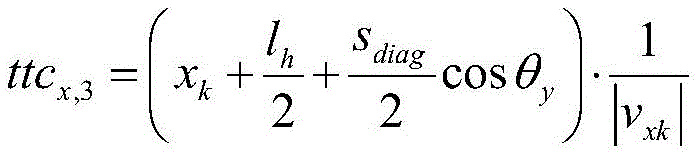


上式中,xk、yk、vxk、vyk分别为k=ΔT×f时刻并道交通车2与自车1的纵向相对距离、横向相对距离、纵向相对速度、横向相对速度,

S64、同组纵侧向碰撞时间相比较,确定碰撞情形,方法如下:S64. Compare the longitudinal and lateral collision times of the same group to determine the collision situation in the following manner:
若ttcx,1≥ttcy,1,则为碰撞情形Ⅰ,表示自车1头部与并道交通车2尾部车角发生边对角碰撞;If ttc x,1 ≥ttc y,1 , it is collision situation I, which means that the head of
若ttcx,2≥ttcy,2&ttcx,1<ttcy,1,则为碰撞情形Ⅱ,表示自车1头部车角与并道交通车2侧边发生角对边碰撞;If ttc x,2 ≥ttc y,2 &ttc x,1 <ttc y,1 , it is collision situation II, which means that the front corner of
若ttcx,3≥ttcy,3&ttcx,2<ttcy,2,则为碰撞情形Ⅲ,表示并道交通车2头部车角与自车1侧边发生角对边碰撞;If ttc x,3 ≥ttc y,3 &ttc x,2 <ttc y,2 , it is collision situation III, which means that the front corner of the merging
若ttcx,4≥ttcy,4&ttcx,3<ttcy,3,则为碰撞情形Ⅳ,表示并道交通车2头部与自车1尾部车角发生边对角碰撞;If ttc x,4 ≥ttc y,4 &ttc x,3 <ttc y,3 , it is collision situation IV, which means that the head of the merging
S65、根据S64确定的碰撞情形,计算相应的碰撞时间ttc,计算公式如下:S65. Calculate the corresponding collision time ttc according to the collision situation determined in S64. The calculation formula is as follows:
碰撞情形Ⅰ:Collision Scenario I:

碰撞情形Ⅱ:Collision Scenario II:

碰撞情形Ⅲ:Collision Scenario III:

碰撞情形Ⅳ:Collision Scenario IV:

S70、根据S50和S60计算得到的碰撞时间ttc,计算自车1的期望加速度,方法如下:S70, calculating the expected acceleration of
S71、若ttc≤ΔT或S60所判断的碰撞情形为〇、Ⅰ或Ⅱ,自车1期望制动减速度为:S71. If ttc≤ΔT or the collision situation determined in S60 is 0, I or II, the expected braking deceleration of

S72、若S60所判断的碰撞情形为Ⅲ或Ⅳ,当前车道无前车,或与当前车道前车3的纵向距离xfollow≥1.2thvh,自车期望加速度为:S72. If the collision situation determined in S60 is III or IV, there is no preceding vehicle in the current lane, or the longitudinal distance x follow from the preceding

S73、若S60所判断的碰撞情形为Ⅲ或Ⅳ,当前车道有前车,且与当前车道前车3的纵向距离xfollow<1.2thvh,自车期望制动减速度同S71;S73, if the collision situation determined in S60 is III or IV, there is a preceding vehicle in the current lane, and the longitudinal distance x follow from the preceding
其中,S71~S73中的abmax、aamax分别为自车1能达到的最大制动加速度和最大加速度,vh为当前时刻自车1车速,th为汽车自适应巡航系统设定的跟车时距。Wherein, a bmax and a amax in S71-S73 are respectively the maximum braking acceleration and maximum acceleration that the
S80、汽车自适应巡航系统与制动系统及驱动系统通信,使其产生合适的制动压力或发动机输出功率,控制车辆以期望加速度行驶至自适应巡航系统跟驰目标切换为并道交通车2,或与当前车道前车3的纵向距离小于等于跟车距离thvh。S80: The vehicle adaptive cruise control system communicates with the braking system and the driving system to generate appropriate braking pressure or engine output power, and controls the vehicle to travel at a desired acceleration until the adaptive cruise control system's following target switches to the merging
Claims (2)


Priority Applications (1)
| Application Number | Priority Date | Filing Date | Title |
|---|---|---|---|
| CN202210167005.8A CN114394091B (en) | 2022-02-23 | 2022-02-23 | A vehicle speed control method in the scene of traffic vehicles merging in an adaptive cruise system |
Applications Claiming Priority (1)
| Application Number | Priority Date | Filing Date | Title |
|---|---|---|---|
| CN202210167005.8A CN114394091B (en) | 2022-02-23 | 2022-02-23 | A vehicle speed control method in the scene of traffic vehicles merging in an adaptive cruise system |
Publications (2)
| Publication Number | Publication Date |
|---|---|
| CN114394091A CN114394091A (en) | 2022-04-26 |
| CN114394091B true CN114394091B (en) | 2023-06-06 |
Family
ID=81234895
Family Applications (1)
| Application Number | Title | Priority Date | Filing Date |
|---|---|---|---|
| CN202210167005.8A Active CN114394091B (en) | 2022-02-23 | 2022-02-23 | A vehicle speed control method in the scene of traffic vehicles merging in an adaptive cruise system |
Country Status (1)
| Country | Link |
|---|---|
| CN (1) | CN114394091B (en) |
Families Citing this family (4)
| Publication number | Priority date | Publication date | Assignee | Title |
|---|---|---|---|---|
| CN115042788A (en) * | 2022-06-01 | 2022-09-13 | 智道网联科技(北京)有限公司 | Traffic intersection passing method, device, electronic device, and storage medium |
| CN114954533B (en) * | 2022-07-05 | 2025-08-05 | 北京航空航天大学 | A method, device and storage medium for autonomous vehicle motion planning based on trajectory re-prediction |
| CN115432010B (en) * | 2022-10-10 | 2024-06-14 | 南京林业大学 | A trajectory planning method considering the risk of neighboring vehicles cutting in |
| CN118770207A (en) * | 2024-06-28 | 2024-10-15 | 上海安亭地平线智能交通技术有限公司 | Vehicle collision time prediction method, device, medium and electronic device |
Citations (2)
| Publication number | Priority date | Publication date | Assignee | Title |
|---|---|---|---|---|
| WO2015188904A1 (en) * | 2014-06-13 | 2015-12-17 | Daimler Ag | Method and device for at least reducing the consequences of a collision of a vehicle |
| DE102016011282A1 (en) * | 2016-09-20 | 2018-03-22 | Wabco Gmbh | Method for performing an evasive maneuver with a commercial vehicle team, and emergency evasion system |
Family Cites Families (2)
| Publication number | Priority date | Publication date | Assignee | Title |
|---|---|---|---|---|
| EP2848487B1 (en) * | 2013-09-12 | 2020-03-18 | Volvo Car Corporation | Manoeuvre generation for automated drive |
| KR102138979B1 (en) * | 2018-11-29 | 2020-07-29 | 한국과학기술원 | Lane-based Probabilistic Surrounding Vehicle Motion Prediction and its Application for Longitudinal Control |
-
2022
- 2022-02-23 CN CN202210167005.8A patent/CN114394091B/en active Active
Patent Citations (2)
| Publication number | Priority date | Publication date | Assignee | Title |
|---|---|---|---|---|
| WO2015188904A1 (en) * | 2014-06-13 | 2015-12-17 | Daimler Ag | Method and device for at least reducing the consequences of a collision of a vehicle |
| DE102016011282A1 (en) * | 2016-09-20 | 2018-03-22 | Wabco Gmbh | Method for performing an evasive maneuver with a commercial vehicle team, and emergency evasion system |
Non-Patent Citations (1)
| Title |
|---|
| 基于RGB-D SLAM 的智能车自主避障与路径规划试验研究;李兆凯等;汽车技术(第2021年第9期期);第55-62页 * |
Also Published As
| Publication number | Publication date |
|---|---|
| CN114394091A (en) | 2022-04-26 |
Similar Documents
| Publication | Publication Date | Title |
|---|---|---|
| CN114394091B (en) | A vehicle speed control method in the scene of traffic vehicles merging in an adaptive cruise system | |
| CN110155046B (en) | Automatic emergency braking grading control method and system | |
| CN113276848B (en) | Intelligent driving lane changing and obstacle avoiding track planning and tracking control method and system | |
| CN116811916A (en) | Automatic driving system based on 5G vehicle road cooperation | |
| CN105966396B (en) | A kind of vehicle intelligent collision control method based on driver's collision avoidance behavior | |
| CN113327458B (en) | Vehicle collision prediction method, vehicle collision prediction system, and electronic device | |
| CN109035862B (en) | A multi-vehicle cooperative lane changing control method based on vehicle-vehicle communication | |
| CN106218638B (en) | A Coordinated Lane Changing Control Method for Intelligent Networked Vehicles | |
| CN109318893B (en) | Safe driving assistance method and system based on license plate pixel height change | |
| US11370420B2 (en) | Vehicle control device, vehicle control method, and storage medium | |
| CN109910879B (en) | Vehicle safety anti-collision control method combining safe distance and collision time | |
| CN108594812A (en) | A kind of intelligent vehicle smooth track planing method of structured road | |
| CN111645677B (en) | A vehicle braking and steering coordination control emergency anti-collision system and control method | |
| CN116513245B (en) | Quick automatic driving track planning method based on driving environment | |
| CN110705388A (en) | Target vehicle lane change identification method for auxiliary driving based on prediction feedback | |
| CN110329257A (en) | A kind of more longitudinally controlled methods of car team team based on Che-Che Tongxin | |
| CN113844445A (en) | Automatic emergency braking system and method for vehicle based on prediction reference line coordinate system | |
| CN107452201A (en) | Rear car determines method and with speeding on as modeling method with acceleration of speeding when a kind of consideration front truck lane-change is sailed out of | |
| CN111409639A (en) | Main vehicle network connection cruise control method and system | |
| CN115158308A (en) | A kind of intelligent vehicle active obstacle avoidance control method and device, storage medium and terminal | |
| CN115140093B (en) | Real-time track planning method | |
| CN118494469B (en) | Trailer cross collision detection and collision avoidance planning method based on collision compound circle | |
| CN114862158A (en) | Automatic driving automobile scene risk assessment method based on passable area | |
| CN114782921A (en) | Pedestrian and vehicle collision early warning system and method in internet connection environment based on pedestrian intention identification | |
| CN119078817A (en) | An active lane-changing obstacle avoidance control method based on road friction coefficient prediction |
Legal Events
| Date | Code | Title | Description |
|---|---|---|---|
| PB01 | Publication | ||
| PB01 | Publication | ||
| SE01 | Entry into force of request for substantive examination | ||
| SE01 | Entry into force of request for substantive examination | ||
| GR01 | Patent grant | ||
| GR01 | Patent grant |