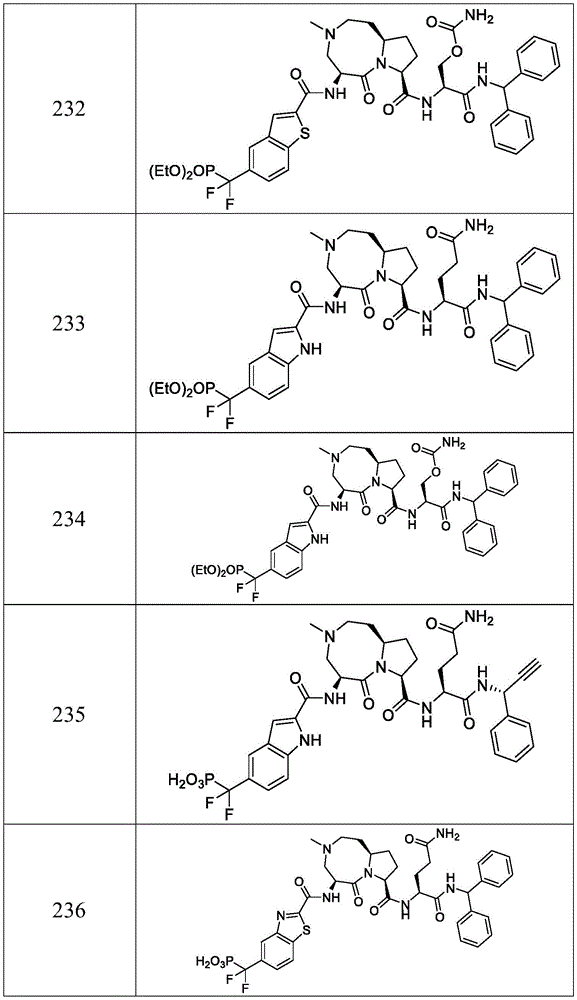
Detailed Description
I. Compounds of the present disclosure
The compounds of the present disclosure are STAT3 protein inhibitors, STAT3 protein degradants, synthetic intermediates convertible to STAT3 inhibitors, or synthetic intermediates convertible to STAT3 degradants. The compounds of the present disclosure may also degrade one or more additional STAT proteins, such as STAT 1. Thus, in some embodiments, the compounds of the present disclosure are dual STAT3/STAT1 degradants.
In one embodiment, the compounds of the present disclosure are of formula I:
wherein:
R1aand R1bIndependently selectFree hydrogen, C1-C4Alkyl, aralkyl and-CH2OC(=O)R1eA group of (a);
R1eselected from the group consisting of C1-C6Alkyl radical, C3-C6Cycloalkyl and C1-C6Alkoxy groups; m is selected from the group consisting of-O-and-C (R)2a)(R2b) -a group of compositions;
each R2aAnd R2bIndependently selected from the group consisting of hydrogen and fluorine; or R2aAnd R2bTogether with the carbon atom to which they are attached form a-C (═ O) -group;
a is selected from the group consisting of:
wherein the bond indicated by "+" is linked to-C (═ O) -E-QA;
G1Selected from the group consisting of-O-, -S-and-NR17-a group of compositions;
G2selected from the group consisting of-N ═ and-CR18a(ii) as a group;
G3selected from the group consisting of-N ═ and-CR18b(ii) as a group;
G4selected from the group consisting of-N ═ and-CR18c(ii) as a group;
G5selected from the group consisting of-N ═ and-CR18d(ii) as a group;
G6selected from the group consisting of-N ═ and-CR18e(ii) as a group;
g is selected from the group consisting of-N ═ and-CR18f(ii) as a group;
R3selected from hydrogen, halo, C1-C4Alkyl radical, C3-C6Cycloalkyl, -C (═ O) R3aAnd aralkyl groups;
R3ais C1-C4An alkyl group;
R3band R3cIndependently selected from hydrogen and C1-C4Alkyl groups;
R3dselected from hydrogen, C1-C6Alkyl and-C (═ O) R3fA group of (a);
R3eselected from hydrogen and C1-C4Alkyl groups;
R3fselected from the group consisting of C1-C12Alkyl radical, C1-C6Alkoxy and aralkoxy;
R17Selected from hydrogen, C1-C4Alkyl radical, C3-C6Cycloalkyl, aralkyl and-C (═ O) R17aA group of (a);
R17ais C1-C4An alkyl group;
R18a、R18b、R18c、R18d、R18eand R18fEach independently selected from hydrogen, halo and C1-C4A group consisting of alkyl groups,
e is as follows:
wherein the bond denoted by "+" is linked to QA;
R3gSelected from hydrogen and C1-C4Alkyl groups;
XAis selected from the group consisting of-N (R)8)CH2-、-CH2N(R8) -and-CH2CH2-a group of compositions;
R8selected from hydrogen, C1-C6Alkyl radical, C1-C6Haloalkyl, (hetero) alkyl, -C (═ O) R9Alkylsulfonyl and-L-B;
R9selected from the group consisting of C1-C6Alkyl, amino, C1-C6Alkoxy, aralkoxy, optionally substituted C3-C10Cycloalkyl, optionally substituted 4-to 8-membered heterocycle, optionally substituted aryl, optionally substituted 5-to 10-membered heteroarylAryl, aralkyl and (heteroaryl) alkyl;
QA is selected from the group consisting of:
X1is selected from the group consisting of-CH2-, -O-and-N (R)11a) -a group of compositions; or
X1Is absent;
R10selected from hydrogen, C1-C6Alkyl, optionally substituted aralkyl, optionally substituted C3-C6Cycloalkyl, optionally substituted 4-to 8-membered heterocycle, and optionally substituted aryl;
R11aselected from hydrogen and C1-C3Alkyl groups;
s is 1, 2, 3 or 4;
X2is selected from the group consisting of-CH2-, -O-and-N (R)11b) -a group of compositions; or
X2Is absent;
t is 0, 1, 2, 3 or 4;
R11bselected from hydrogen and C 1-C3Alkyl groups;
R12aselected from hydrogen, C1-C6Alkyl, optionally substituted C2-C6Alkynyl, aralkyl, (heteroaryl) alkyl, optionally substituted C3-C6Cycloalkyl, optionally substituted 4-to 8-membered heterocycle, optionally substituted aryl, (amido) (aryl) alkyl, (amino) (heteroaryl) alkyl, and (cycloalkyl) alkyl;
R12bselected from hydrogen, C1-C4Alkyl, optionally substituted aryl and aralkyl; or
R12aAnd R12bTogether with the nitrogen atom to which they are attached form a 4-to 8-membered optionally substituted heterocyclic ring;
R12cselected from hydrogen, C1-C4Alkyl and aralkyl groups;
A1is selected from the group consisting of-C (R)14a) -and-N-;
R14aselected from hydrogen and C1-C3Alkyl groups;
e is 1, 2 or 3;
f is 1, 2 or 3;
X4is selected from the group consisting of-CH2-, -O-and-N (R)11d) -a group of compositions; or
X4Is absent;
v is 0, 1, 2, 3 or 4;
R11dselected from hydrogen and C1-C3Alkyl groups;
R12dselected from hydrogen, C1-C4Alkyl and aralkyl groups;
R13aselected from hydrogen, C1-C6Alkyl, optionally substituted C3-C12Cycloalkyl, optionally substituted aryl, aralkyl, (heteroaryl) alkyl, (cycloalkyl) alkyl, and optionally substituted 5-to 9-membered heteroaryl;
R13bselected from hydrogen and C1-C4Alkyl groups;
R13cSelected from hydrogen and C1-C4Alkyl groups; or
R13aAnd R13bTogether form C3-C8Optionally substituted cycloalkyl or C4-C9Optionally substituted heterocycle; or
R13bAnd R13cTogether form a 4-to 9-membered optionally substituted heterocycle;
A2*is selected from the group consisting of-C (R)14b) -and-N-;
R14bselected from hydrogen and C1-C3Alkyl groups;
g is 1, 2 or 3;
h is 1, 2 or 3;
X5is selected fromfrom-CH2-, -O-and-N (R)11e) -a group of compositions; or
X5Is absent;
y is 0, 1, 2, 3 or 4;
R11eselected from hydrogen and C1-C3Alkyl groups;
R15selected from hydrogen, C1-C6Alkyl radical, C3-C8Cycloalkyl, optionally substituted aryl, and optionally substituted 5-to 9-membered heteroaryl;
l is-J1-Y1-J2-Y2-J3-Z-;
J1Selected from the group consisting of alkylene (alkenylene), heteroalkylene (heterocyclylene), cycloalkylene (cycloalkylene), heterocyclylene (heterocyclylene), phenylene (phenylene), and heteroarylene (heteroarylene); or
J1Is absent;
Y1is selected from the group consisting of- (CH)2)m-、-C≡C-、-CH=CH-、-N(R16a)-、-C(=O)-、-S(=O)2-、-C(=O)O-、-OC(=O)-、-C(=O)N(R16b) -and-N (R)16b) C (═ O) -;
m is 0, 1, 2 or 3;
R16aselected from hydrogen, C1-C4Alkyl and aralkyl groups;
R16bselected from hydrogen and C1-C4Alkyl groups;
J2selected from the group consisting of alkylene, heteroalkylene, cycloalkylene, heterocyclylene, phenylene, and heteroarylene; or
J2Is absent;
Y2is selected from the group consisting of- (CH) 2)n-、-C≡C-、-CH=CH-、-N(R16a)-、-C(=O)-、-S(=O)2-、
-C(=O)O-、-OC(=O)-、-C(=O)N(R16b) And- (R)16b) C (═ O) N-;
n is 0, 1, 2, 3, 4, 5 or 6;
R16aselected from hydrogen, C1-C4Alkyl and aralkyl groups;
R16bselected from hydrogen and C1-C4Alkyl groups;
J3selected from the group consisting of alkylene, heteroalkylene, cycloalkylene, heterocyclylene, phenylene, and heteroarylene; or
J3Is absent;
z is selected from the group consisting of- (CH)2)d-、-C≡C-、-CH=CH-、-C(=O)-、-O-、-S-、-N(R16c)-、-C(=O)N(R16d)-、-N(R16d)C(=O)-、-N(R16e)C(=O)CH2O-and-N (R)16f)C(=O)CH2N(R16g) -a group of compositions;
d is 0, 1, 2 or 3;
R16c、R16d、R16e、R16fand R16gEach independently selected from hydrogen, C1-C4Alkyl and aralkyl groups;
wherein Z is attached to B;
b is selected from the group consisting of:
A5is selected from the group consisting of-C (R)19a) and-N ═ the group consisting of;
A2is selected from the group consisting of-C (R)19b) and-N ═ the group consisting of;
A3is selected from the group consisting of-C (R)19c) and-N ═ the group consisting of;
A4is selected from the group consisting of-C (R)19d) and-N ═ the group consisting of;
Z1is selected from the group consisting of-CH2and-C (═ O) -;
R5aselected from the group consisting of hydrogen, methyl and fluorine;
R5bselected from the group consisting of hydrogen and methyl;
R19a、R19b、R19cand R19dEach independently selected from hydrogen, halo and C1-4Alkyl groups;
R20is C1-C6An alkyl group;
R21selected from hydrogen and C1-C4Alkyl groups;
R22aselected from the group consisting of C1-C6Alkyl and optionally substituted C3-C6Cycloalkyl groups;
R22bselected from the group consisting of C1-C6Alkyl, optionally substituted C3-C6Cycloalkyl, optionally substituted aryl and optionally substituted heteroaryl; and is
R23Selected from the group consisting of C1-C6Alkyl and optionally substituted C3-C6Cycloalkyl groups; and is
R24Selected from the group consisting of C1-C6Alkyl, optionally substituted C3-C6Cycloalkyl, optionally substituted aryl and optionally substituted heteroaryl, or a pharmaceutically acceptable salt or solvate thereof.
In one embodiment, the compounds of the present disclosure are of formula I, with the proviso that:
(1) when X is presentAis-CH2CH2When is, then QASelected from the group consisting of Q-3, Q-4, Q-5, Q-6 and Q-7;
(2) when X is presentAis-N (R)8)CH2-or-CH2N(R8) -, and R8Selected from hydrogen, C1-C6Alkyl radical, C1-C6Haloalkyl, (heterocycle) alkyl, alkylsulfonyl and-C (═ O) R9When they are in the group, then QASelected from the group consisting of Q-3, Q-4, Q-5, Q-6 and Q-7;
(3) when X is presentAis-N (R)8)CH2-or-CH2N(R8) -, and R8When is-L-B, then QASelected from the group consisting of Q-1 and Q-2The group of (a) or (b),
or a pharmaceutically acceptable salt or solvate thereof.
In another embodiment, the compounds of the present disclosure are of formula I, wherein R is1eIs C1-C6An alkyl group, or a pharmaceutically acceptable salt or solvate thereof.
In another embodiment, the compounds of the present disclosure are of formula I, wherein R is8Selected from hydrogen, C1-C6Alkyl, -C (═ O) R9and-L-B, or a pharmaceutically acceptable salt or solvate thereof.
In another embodiment, the compounds of the present disclosure are of formula I, wherein R is8Selected from hydrogen, C1-C6Alkyl, -C (═ O) R9Alkylsulfonyl and-L-B, or a pharmaceutically acceptable salt or solvate thereof.
In another embodiment, the compounds of the present disclosure are of formula I, wherein R is13aSelected from hydrogen, C1-C6Alkyl, optionally substituted C3-C12Cycloalkyl, optionally substituted aryl, aralkyl, and optionally substituted 5-to 9-membered heteroaryl, or a pharmaceutically acceptable salt or solvate thereof. In another embodiment, the compounds of the present disclosure are of formula I, wherein R is13aIs an aralkyl group.
In another embodiment, the compounds of the present disclosure are compounds of formula I, wherein M is-O-, or a pharmaceutically acceptable salt or solvate thereof.
In another embodiment, the compounds of the present disclosure are compounds of formula I wherein M is-C (R)2a)(R2b) Or a pharmaceutically acceptable salt or solvate thereof.
In another embodiment, the compounds of the present disclosure are of formula II:
wherein R is1a、R1bA, E and QAAs defined in combination with formula I, or a pharmaceutically acceptable salt or solvate thereof.
In another embodiment, the compounds of the present disclosure are of formula III:
Wherein R is1a、R1bA, E and QAAs defined in combination with formula I, or a pharmaceutically acceptable salt or solvate thereof.
In another embodiment, the compounds of the present disclosure are of any one of formulas I-XVIII, VI-B, VII-B, VII-D, XXII-XXIV, or XXVI (see below), wherein A is A-1, or a pharmaceutically acceptable salt or solvate thereof.
In another embodiment, the compounds of the present disclosure are of any one of formulas I-XVIII, VI-B, VII-B, VII-D, XXII-XXIV, or XXVI (see below), wherein A is A-2, or a pharmaceutically acceptable salt or solvate thereof.
In another embodiment, the compounds of the present disclosure are of any one of formulas I-XVIII, VI-B, VII-B, VII-D, XXII-XXIV, or XXVI (see below), wherein A is A-3, or a pharmaceutically acceptable salt or solvate thereof.
In another embodiment, the compounds of the present disclosure are of any one of formulas I-XVIII, VI-B, VII-B, VII-D, XXII-XXIV, or XXVI (see below), wherein A is A-4, or a pharmaceutically acceptable salt or solvate thereof.
In another embodiment, the compounds of the present disclosure are of any one of formulas I-XVIII, VI-B, VII-B, VII-D, XXII-XXIV, or XXVI (see below), wherein A is A-5, or a pharmaceutically acceptable salt or solvate thereof.
In another embodiment, the compounds of the present disclosure are of any one of formulas I-XVIII, VI-B, VII-B, VII-D, XXII-XXIV, or XXVI (see below), wherein A is A-6, or a pharmaceutically acceptable salt or solvate thereof.
In another embodiment, the compounds of the present disclosure are of any one of formulas I-XVIII, VI-B, VII-B, VII-D, XXII-XXIV, or XXVI (see below), wherein A is A-7, or a pharmaceutically acceptable salt or solvate thereof.
In another embodiment, the compounds of the present disclosure are of any one of formulas I-XVIII, VI-B, VII-B, VII-D, XXII-XXIV, or XXVI (see below), wherein A is A-8, or a pharmaceutically acceptable salt or solvate thereof.
In another embodiment, the compounds of the present disclosure are of any one of formulas I-XVIII, VI-B, VII-B, VII-D, XXII-XXIV, or XXVI (see below), wherein A is A-9, or a pharmaceutically acceptable salt or solvate thereof.
In another embodiment, the compounds of the present disclosure are of any one of formulas I-XVIII, VI-B, VII-B, VII-D, XXII-XXIV, or XXVI (see below), wherein A is A-10, or a pharmaceutically acceptable salt or solvate thereof.
In another embodiment, the compounds of the present disclosure are of any one of formulas I-XVIII, VI-B, VII-B, VII-D, XXII-XXIV, or XXVI (see below), wherein A is A-11, or a pharmaceutically acceptable salt or solvate thereof.
In another embodiment, the compounds of the present disclosure are of any one of formulas I-XVIII, VI-B, VII-B, VII-D, XXII-XXIV, or XXVI (see below), wherein A is A-12, or a pharmaceutically acceptable salt or solvate thereof.
In another embodiment, the compounds of the present disclosure are of any one of formulas I-XVIII, VI-B, VII-B, VII-D, XXII-XXIV, or XXVI (see below), wherein A is A-13, or a pharmaceutically acceptable salt or solvate thereof.
In another embodiment, the compounds of the present disclosure are of any one of formulas I-XVIII, VI-B, VII-B, VII-D, XXII-XXIV, or XXVI (see below), wherein A is A-14, or a pharmaceutically acceptable salt or solvate thereof.
In another embodiment, the compounds of the present disclosure are of any one of formulas I-XVIII, VI-B, VII-B, VII-D, XXII-XXIV, or XXVI (see below), wherein A is A-15, or a pharmaceutically acceptable salt or solvate thereof.
In another embodiment, the compounds of the present disclosure are of any one of formulas I-XVIII, VI-B, VII-B, VII-D, XXII-XXIV, or XXVI (see below), wherein A is A-16, or a pharmaceutically acceptable salt or solvate thereof.
In another embodiment, the compounds of the present disclosure are of any one of formulas I-XVIII, VI-B, VII-B, VII-D, XXII-XXIV, or XXVI (see below), wherein A is A-17, or a pharmaceutically acceptable salt or solvate thereof.
In another embodiment, the compounds of the present disclosure are of any one of formulas I-XVIII, VI-B, VII-B, VII-D, XXII-XXIV, or XXVI (see below), wherein A is A-18, or a pharmaceutically acceptable salt or solvate thereof.
In another embodiment, the compounds of the present disclosure are of any one of formulas I-XVIII, VI-B, VII-B, VII-D, XXII-XXIV, or XXVI (see below), wherein A is A-19, or a pharmaceutically acceptable salt or solvate thereof.
In another embodiment, the compounds of the present disclosure are of any one of formulas I-XVIII, VI-B, VII-B, VII-D, XXII-XXIV, or XXVI (see below), wherein A is A-20, or a pharmaceutically acceptable salt or solvate thereof.
In another embodiment, the compounds of the present disclosure are of any one of formulas I-XVIII, VI-B, VII-B, VII-D, XXII-XXIV, or XXVI (see below), wherein A is A-21, or a pharmaceutically acceptable salt or solvate thereof.
In another embodiment, the compounds of the present disclosure are of any one of formulas I-XVIII, VI-B, VII-B, VII-D, XXII-XXIV, or XXVI (see below), wherein A is A-22, or a pharmaceutically acceptable salt or solvate thereof.
In another embodiment, the compounds of the present disclosure are of any one of formulas I-XVIII, VI-B, VII-B, VII-D, XXII-XXIV, or XXVI (see below), wherein a is selected from the group consisting of:
or a pharmaceutically acceptable salt or solvate thereof.
In another embodiment, the compounds of the present disclosure are of any one of formulas I-XVIII, VI-B, VII-B, VII-D, XXII-XXIV, or XXVI (see below), wherein a is selected from the group consisting of:
or a pharmaceutically acceptable salt or solvate thereof.
In another embodiment, the compounds of the present disclosure are of any one of formulas I-XVIII, VI-B, VII-B, VII-D, XXII-XXIV, or XXVI (see below), wherein a is selected from the group consisting of:
Or a pharmaceutically acceptable salt or solvate thereof.
In another embodiment, the compounds of the present disclosure are of any one of formulas I-XVIII, VI-B, VII-B, VII-D, XXII-XXIV, or XXVI (see below), wherein A is:
or a pharmaceutically acceptable salt or solvate thereof.
In another embodiment, the compounds of the present disclosure are of any one of formulas I-XVIII, VI-B, VII-B, VII-D, XXII-XXIV, or XXVI (see below), wherein A is:
or a pharmaceutically acceptable salt or solvate thereof.
In another embodiment, the compounds of the present disclosure are of any one of formulas I-XVIII, VI-B, VII-B, VII-D, XXII-XXIV, or XXVI (see below), wherein A is:
or a pharmaceutically acceptable salt or solvate thereof.
In another embodiment, the compounds of the present disclosure are of any one of formulas I-III, VIII-X, or XVI-XVIII (see below), wherein R3gIs C1-C4An alkyl group, or a pharmaceutically acceptable salt or solvate thereof.
In another embodiment, the compounds of the present disclosure are of any one of formulas I-III, VIII-X, or XVI-XVIII (see below), wherein R3gIs hydrogen, or a pharmaceutically acceptable salt or solvate thereof.
In another embodiment, the compounds of the present disclosure are of any one of formulas I-III, VIII-X, or XVI-XVIII (see below), wherein E is:
or a pharmaceutically acceptable salt or solvate thereof. In another embodiment, E-1 is selected from the group consisting of:
in another embodiment, E-1 is E-1-1. In another embodiment, E-1 is E-1-2. In another embodiment, E-1 is E-1-3. In another embodiment, E-1 is E-1-4. In another embodiment, E-1 is E-1-5. In another embodiment, E-1 is E-1-6. In another embodiment, E-1 is E-1-7. In another embodiment, E-1 is E-1-8.
In another embodiment, the compounds of the present disclosure are of any one of formulas I-III, VIII-X, or XVI-XVIII (see below), wherein E is:
or a pharmaceutically acceptable salt or solvate thereof. In another embodiment, E-2 is selected from the group consisting of:
in another embodiment, E-2 is E-2-1. In another embodiment, E-2 is E-2-2. In another embodiment, E-2 is E-2-3. In another embodiment, E-2 is E-2-4. In another embodiment, E-2 is E-2-5. In another embodiment, E-2 is E-2-6. In another embodiment, E-2 is E-2-7. In another embodiment, E-2 is E-2-8.
In another embodiment, the compounds of the present disclosure are of any one of formulas I-III, VIII-X, or XVI-XVIII (see below), wherein E is:
or a pharmaceutically acceptable salt or solvate thereof. In another embodiment, E-3 is selected from the group consisting of:
in another embodiment, E-3 is E-3-1. In another embodiment, E-3 is E-3-2. In another embodiment, E-3 is E-3-3. In another embodiment, E-3 is E-3-4. In another embodiment, E-3 is E-3-5. In another embodiment, E-3 is E-3-6. In another embodiment, E-3 is E-3-7. In another embodiment, E-3 is E-3-8.
In another embodiment, a compound of the disclosure is a compound of any one of formulas I-III, wherein E is E-1, E-1-2, E-1-3, E-1-4, E-1-5, E-1-6, E-1-7, E-1-8, E-2-1, E-2-2, E-2-3, E-2-4, E-2-5, E-2-6, E-2-7, or E-2-8, R8is-L-B, QAIs Q-1, and R10Is hydrogen, or a pharmaceutically acceptable salt or solvate thereof. In another embodiment, E is E-1-1. In another embodiment, E is E-2-1. In another embodiment, X1Is selected from the group consisting of-CH2-and-n (h) -in a pharmaceutically acceptable carrier. In another embodiment, X 1is-CH2-. In another embodiment, s is 0 or 1. In another embodiment, s is 0.
In another embodiment, a compound of the disclosure is a compound of any one of formulas I-III, wherein E is E-1, E-1-2, E-1-3, E-1-4, E-1-5, E-1-6, E-1-7, E-1-8, E-2-1, E-2-2, E-2-3, E-2-4, E-2-5, E-2-6, E-2-7, or E-2-8, R8is-L-B, QAIs Q-2, or a pharmaceutically acceptable salt or solvate thereof. In another embodiment, E is E-1-1. In another embodiment, E is E-2-1. In another embodiment, Q-2 is:
in another embodiment, X2Is selected from the group consisting of-CH2-, -O-and-N (H) -. In another embodiment, X2is-CH2-. In another embodiment, t is 0 or 1. In another embodiment, t is 0. In another embodiment, R12bIs hydrogen, or a pharmaceutically acceptable salt or solvate thereof. In another embodiment, R12aIs aralkyl, or a pharmaceutically acceptable salt or solvate thereof.
In another embodiment, a compound of the disclosure is a compound of any one of formulas I-III, wherein E is E-1, E-1-2, E-1-3, E-1-4, E-1-5, E-1-6, E-1-7, E-1-8, E-2-1, E-2-2, E-2-3, E-2-4, E-2-5, E-2-6, E-2-7, or E-2-8, R 8Selected from hydrogen, C1-C6Alkyl radical, C1-C6Haloalkyl, (heterocycle) alkyl, alkylsulfonyl and-C (═ O) R9Group of and QAIs Q-3, or a pharmaceutically acceptable salt or solvate thereof. In another embodiment, E is E-1-1. In another embodiment, E is E-2-1. In another embodiment, R8Is C1-C4An alkyl group.
In another embodiment, the compounds of the present disclosure are compounds of any one of formulas I-III, wherein E is E-3, E-3-1, E-3-2, E-3-3, E-3-4, E-3-5, E-3-6, E-3-7, or E-3-8; and QAIs Q-3, or a pharmaceutically acceptable salt or solvate thereof. In another embodiment, E is E-3-1.
In another embodiment, the compounds of the present disclosure are of any one of formulas I-III, wherein Q-3 is Q-3-1:
in another embodiment, X2is-CH2-. In another embodiment, t is 0 or 1. In another embodiment, t is 0. In another embodiment, R12cIs hydrogen.
In another embodiment, the compounds of the present disclosure are of any one of formulas I-III, wherein E is E-1, E-1-2, E-1-3, E-1-4, E-1-5, E-1-6, E-1-7,e-1-8, E-2-1, E-2-2, E-2-3, E-2-4, E-2-5, E-2-6, E-2-7 or E-2-8, R 8Selected from hydrogen, C1-C6Alkyl radical, C1-C6Haloalkyl, (heterocycle) alkyl, alkylsulfonyl and-C (═ O) R9Group of and QAIs Q-4, or a pharmaceutically acceptable salt or solvate thereof. In another embodiment, E is E-1-1. In another embodiment, E is E-2-1. In another embodiment, R8Is C1-C4An alkyl group.
In another embodiment, the compounds of the present disclosure are compounds of any one of formulas I-III, wherein E is E-3, E-3-1, E-3-2, E-3-3, E-3-4, E-3-5, E-3-6, E-3-7, or E-3-8; and QAIs Q-4, or a pharmaceutically acceptable salt or solvate thereof. In another embodiment, E is E-3-1.
In another embodiment, the compounds of the present disclosure are of any one of formulas I-III, wherein Q-4 is Q-4-1:
or a pharmaceutically acceptable salt or solvate thereof. In another embodiment, X2is-CH2-. In another embodiment, t is 0 or 1. In another embodiment, t is 0. In another embodiment, f and e are each 1 or 2. In another embodiment, f and e are each 2. In another embodiment, A1is-C (H) -.
In another embodiment, a compound of the disclosure is a compound of any one of formulas I-III, wherein E is E-1, E-1-2, E-1-3, E-1-4, E-1-5, E-1-6, E-1-7, E-1-8, E-2-1, E-2-2, E-2-3, E-2-4, E-2-5, E-2-6, E-2-7, or E-2-8, R 8Selected from hydrogen, C1-C6Alkyl radical, C1-C6Haloalkyl, (heterocycle) alkyl, alkylsulfonyl and-C (═ O) R9Group of and QAIs Q-5, or a pharmaceutically acceptable salt or solvate thereof. In another embodimentIn the scheme, E is E-1-1. In another embodiment, E is E-2-1. In another embodiment, R8Is C1-C4An alkyl group.
In another embodiment, the compounds of the present disclosure are compounds of any one of formulas I-III, wherein E is E-3, E-3-1, E-3-2, E-3-3, E-3-4, E-3-5, E-3-6, E-3-7, or E-3-8; and QAIs Q-5, or a pharmaceutically acceptable salt or solvate thereof. In another embodiment, E is E-3-1.
In another embodiment, the compounds of the present disclosure are of any one of formulas I-III, wherein Q-5 is Q-5-1:
or a pharmaceutically acceptable salt or solvate thereof. In another embodiment, X4is-CH2-. In another embodiment, v is 0 or 1. In another embodiment, v is 0. In another embodiment, R12dIs hydrogen. In another embodiment, R13aSelected from the group consisting of optionally substituted C3-C12Cycloalkyl, aralkyl and optionally substituted phenyl. In another embodiment, R13aIs optionally substituted C 3-C6A cycloalkyl group. In another embodiment, R13aIs optionally substituted phenyl. In another embodiment, R13aIs an aralkyl group.
In another embodiment, the compounds of the present disclosure are of any one of formulas I-III, wherein Q-5 is Q-5-2:
or a pharmaceutically acceptable salt or solvate thereof. In another embodiment, X4is-CH2-. In another embodiment, v is 0 or 1. In another embodiment, v is 0. In another embodiment, R12dIs hydrogen.In another embodiment, R13aSelected from the group consisting of optionally substituted C3-C12Cycloalkyl, aralkyl and optionally substituted phenyl. In another embodiment, R13aIs optionally substituted C3-C6A cycloalkyl group. In another embodiment, R13aIs optionally substituted phenyl. In another embodiment, R13aIs an aralkyl group.
In another embodiment, a compound of the disclosure is a compound of any one of formulas I-III, wherein E is E-1, E-1-2, E-1-3, E-1-4, E-1-5, E-1-6, E-1-7, E-1-8, E-2-1, E-2-2, E-2-3, E-2-4, E-2-5, E-2-6, E-2-7, or E-2-8, R8Selected from hydrogen, C1-C6Alkyl radical, C1-C6Haloalkyl, (heterocycle) alkyl, alkylsulfonyl and-C (═ O) R 9Group of and QAIs Q-6, or a pharmaceutically acceptable salt or solvate thereof. In another embodiment, E is E-1-1. In another embodiment, E is E-2-1. In another embodiment, R8Is C1-C4An alkyl group.
In another embodiment, the compounds of the present disclosure are compounds of any one of formulas I-III, wherein E is E-3, E-3-1, E-3-2, E-3-3, E-3-4, E-3-5, E-3-6, E-3-7, or E-3-8; and QAIs Q-6, or a pharmaceutically acceptable salt or solvate thereof. In another embodiment, E is E-3-1.
In another embodiment, the compounds of the present disclosure are of any one of formulas I-III, wherein Q-6 is Q-6-1:
or a pharmaceutically acceptable salt or solvate thereof. In another embodiment, X4is-CH2-. In another embodiment, v is 0 or 1. In another embodiment, v is 0. In another embodiment, R13aSelected from the group consisting of optionally substituted C3-C12Cycloalkyl, aralkylAnd optionally substituted phenyl. In another embodiment, R13aIs optionally substituted C3-C6A cycloalkyl group. In another embodiment, R13aIs optionally substituted phenyl. In another embodiment, R13aIs an aralkyl group. In another embodiment, g and h are each 1 or 2. In another embodiment, g and h are 2. In another embodiment, A 2*is-C (H) -. In another embodiment, A2*is-N-. In another embodiment, Q-6-1 is Q-6-1-A or Q-6-1-B:
in another embodiment, the compounds of the present disclosure are of any one of formulas I-III, wherein Q-6 is Q-6-2:
or a pharmaceutically acceptable salt or solvate thereof. In another embodiment, X4is-CH2-. In another embodiment, v is 0 or 1. In another embodiment, v is 0. In another embodiment, R13aSelected from the group consisting of optionally substituted C3-C12Cycloalkyl, aralkyl and optionally substituted phenyl. In another embodiment, R13aIs optionally substituted C3-C6A cycloalkyl group. In another embodiment, R13aIs optionally substituted phenyl. In another embodiment, R13aIs an aralkyl group. In another embodiment, g and h are each 1 or 2. In another embodiment, g and h are 2. In another embodiment, A2*is-C (H) -.
In another embodiment, the compounds of the present disclosure are compounds of any one of formulas I-III, wherein E is E-1, E-1-2, E-1-3, E-1-4, E-1-5, E-1-6, E-1-7, E-1-8, E-2-1, E-2-2, E-2-3, E-2-4, E-2-5, E-2-6, E-2-7, or E-2-8,R8Selected from hydrogen, C 1-C6Alkyl radical, C1-C6Haloalkyl, (heterocycle) alkyl, alkylsulfonyl and-C (═ O) R9Group of and QAIs Q-7, or a pharmaceutically acceptable salt or solvate thereof. In another embodiment, E is E-1-1. In another embodiment, E is E-2-1. In another embodiment, R8Is C1-C4An alkyl group.
In another embodiment, the compounds of the present disclosure are compounds of any one of formulas I-III, wherein E is E-3, E-3-1, E-3-2, E-3-3, E-3-4, E-3-5, E-3-6, E-3-7, or E-3-8; and QAIs Q-7, or a pharmaceutically acceptable salt or solvate thereof. In another embodiment, E is E-3-1.
In another embodiment, the compounds of the present disclosure are of any one of formulas I-III, wherein Q-7 is Q-7-1;
or a pharmaceutically acceptable salt or solvate thereof. In another embodiment, X5is-CH2-. In another embodiment, y is 0 or 1. In another embodiment, y is 0. In another embodiment, R15Is optionally substituted phenyl.
In another embodiment, the compounds of the present disclosure are compounds of any one of formulas I-III, wherein Q-7 is Q-7-2;
or a pharmaceutically acceptable salt or solvate thereof. In another embodiment, X 5is-CH2-. In another embodiment, y is 0 or 1. In another embodiment, y is 0. In another embodiment, R15Is optionally substituted phenyl.
In another embodiment, the disclosureThe compounds are of any one of formulas I-III or XVI-XVIII (see below), wherein L is-Y1-J2-Y2-J3-Z-, or a pharmaceutically acceptable salt or solvate thereof. In another embodiment, L is-Y1-Y2-J3-Z-. In another embodiment, L is-Y1-J2-Y2-Z-. In another embodiment, L is-Y1-Y2-Z-. In another embodiment, Y1Is selected from the group consisting of- (CH)2)m-and-C (═ O) -; m is 1, 2 or 3; y is2Is- (CH)2)n-; n is 1, 2, 3, 4, 5 or 6; and Z is selected from the group consisting of- (CH)2) -, -C.ident.C-and-N (H) -.
In another embodiment, the compounds of the present disclosure are of any one of formulas I-III, XVI-XVIII, or XXIV (see below), wherein:
R8is-L-B;
l is selected from the group consisting of:
wherein the bond indicated by "+" is linked to B;
w is 1, 2, 3, 4, 5, 6, 7, 8, 9, 10, 11 or 12; and is
x is 1, 2, 3, 4, 5 or 6, or a pharmaceutically acceptable salt or solvate thereof.
In another embodiment, the compounds of the present disclosure are of any one of formulas I-III, XXII, or XXIII, wherein:
R8Selected from hydrogen, C1-C6Alkyl radical, C1-C6Haloalkyl, (heterocycle) alkyl, alkylsulfonyl and-C (═ O) R9A group of (a);
l is selected from the group consisting of:
wherein the bond indicated by "+" is linked to B;
w is 1, 2, 3, 4, 5, 6, 7, 8, 9, 10, 11 or 12; and is
x is 1, 2, 3, 4, 5 or 6, or a pharmaceutically acceptable salt or solvate thereof.
In another embodiment, the compounds of the present disclosure are of any one of formulas I-III, XVI-XVIII or XXII-XXIV (see below), wherein B is B-1, or a pharmaceutically acceptable salt or solvate thereof. In another embodiment, R5bIs hydrogen. In another embodiment, A2、A3And A4is-CH ═ CH. In another embodiment, Z1is-C (═ O) -. In another embodiment, Z1is-CH2-. In another embodiment, B-1 is:
in another embodiment, B-1 is:
in another embodiment, R5aIs fluorine. In another embodiment, R5aIs deuterium. In another embodiment, R5aIs hydrogen.
In another embodiment, the compounds of the present disclosure are of any one of formulas I-III, XVI-XVIII or XXII-XXIV (see below), wherein B is B-2, or a pharmaceutically acceptable salt or solvate thereof.
In another embodiment, the compounds of the present disclosure are of any one of formulas I-III, XVI-XVIII or XXII-XXIV (see below), wherein B is B-3, or a pharmaceutically acceptable salt or solvate thereof.
In another embodiment, the compounds of the present disclosure are of any one of formulas I-III, XVI-XVIII or XXII-XXIV (see below), wherein B is B-4, or a pharmaceutically acceptable salt or solvate thereof.
In another embodiment, the compounds of the present disclosure are of any one of formulas I-III, XVI-XVIII or XXII-XXIV (see below), wherein B is B-5, or a pharmaceutically acceptable salt or solvate thereof.
In another embodiment, the compounds of the present disclosure are of any one of formulas I-III, XVI-XVIII or XXII-XXIV (see below), wherein B is B-6, or a pharmaceutically acceptable salt or solvate thereof.
In another embodiment, the compounds of the present disclosure are of any one of formulas I-III, XVI-XVIII or XXII-XXIV (see below), wherein B is B-7, or a pharmaceutically acceptable salt or solvate thereof.
In another embodiment, the compounds of the present disclosure are of any one of formulas I-III, XVI-XVIII or XXII-XXIV (see below), wherein B is B-8, or a pharmaceutically acceptable salt or solvate thereof.
In another embodiment, the compounds of the present disclosure are of any one of formulas I-III, XVI-XVIII or XXII-XXIV (see below), wherein B is B-9, or a pharmaceutically acceptable salt or solvate thereof.
In another embodiment, the compounds of the present disclosure are of any one of formulas I-III, XVI-XVIII or XXII-XXIV (see below), wherein B is B-10, or a pharmaceutically acceptable salt or solvate thereof.
In another embodiment, the compounds of the present disclosure are of formula IV:
wherein R is1a、R1b、R2a、R2b、R12a、A、J2、J3、Y2And Z is as defined in conjunction with formula I, or a pharmaceutically acceptable salt or solvate thereof.
In another embodiment, the compounds of the present disclosure are of formula V:
wherein R is1a、R1b、R2a、R2b、R12a、A、J2、J3、Y2And Z is as defined in conjunction with formula I, or a pharmaceutically acceptable salt or solvate thereof.
In another embodiment, the compounds of the present disclosure are of formula IV-a:
wherein R is1a、R1b、R2a、R2b、R12a、G1、J2、J3、Y2And Z is as defined in conjunction with formula I, or a pharmaceutically acceptable salt or solvate thereof.
In another embodiment, the compounds of the present disclosure are of formula V-a:
wherein R is1a、R1b、R2a、R2b、R12a、G1、J2、J3、Y2And Z is as defined in conjunction with formula I, or a pharmaceutically acceptable salt or solvate thereof.
In another embodiment, the compounds of the present disclosure are of any one of formulas IV, IV-A, V or V-A, wherein R is 12aIs aralkyl, or a pharmaceutically acceptable salt or solvate thereof. In another embodiment, R12aComprises the following steps:
wherein R is25a、R25b、R25cAnd R25dEach independently selected from hydrogen, halo, C1-C4Alkyl and C1-C4Alkoxy groups.
In another embodiment, the compounds of the present disclosure are of formula IV-A or formula V-A, wherein G1is-S-, or a pharmaceutically acceptable salt or solvate thereof.
In another embodiment, the compounds of the present disclosure are of formula IV-A or formula V-A, wherein G1is-NH-, or a pharmaceutically acceptable salt or solvate thereof.
In another embodiment, the compounds of the present disclosure are of any one of formulas IV, IV-A, V or V-A, wherein R is2aAnd R2bIs fluorine, or a pharmaceutically acceptable salt or solvate thereof.
In another embodiment, the compounds of the present disclosure are of any one of formulas IV, IV-A, V or V-A, wherein R is2aAnd R2bTogether with the carbon to which they are attached form a-C (═ O) -group, or a pharmaceutically acceptable salt or solvate thereof.
In another embodiment, the compounds of the present disclosure are of any one of formulas IV, IV-A, V or V-A, wherein J2Is absent, Y2Is- (CH)2)nN is 3, 4 or 5, and J 3Absent, or a pharmaceutically acceptable salt or solvate thereof.
In another embodiment, the compound of the present disclosure is a compound of any one of formulas IV, IV-A, V or V-A, wherein Z is-C ≡ C-, or a pharmaceutically acceptable salt or solvate thereof.
In another embodiment, the compound of the present disclosure is a compound of formula VI:
wherein R is1a、R1b、R2a、R2b、R8、R13a、A、A2*、J2、J3、Y2And Z is as defined in conjunction with formula I, or a pharmaceutically acceptable salt or solvate thereof.
In another embodiment, the compound of the present disclosure is a compound of formula VII:
wherein R is1a、R1b、R2a、R2b、R8、R13a、A、A2*、J2、J3、Y2And Z is as defined in conjunction with formula I, or a pharmaceutically acceptable salt or solvate thereof.
In another embodiment, the compounds of the present disclosure are of formula VI-A:
wherein R is1a、R1b、R2a、R2b、R8、R13a、A2*、G1、J2、J3、Y2And Z is as defined in conjunction with formula I, or a pharmaceutically acceptable salt or solvate thereof.
In another embodiment, the compounds of the present disclosure are of formula VII-a:
wherein R is1a、R1b、R2a、R2b、R8、R13a、A2*、G1、J2、J3、Y2And Z is as defined in conjunction with formula I, or a pharmaceutically acceptable salt or solvate thereof.
In another embodiment, the compounds of the present disclosure are of formula VI-B:
wherein R is1a、R1b、R2a、R2b、R8、R13a、A、A2*、J2、J3、Y2And Z is as defined in conjunction with formula I, or a pharmaceutically acceptable salt or solvate thereof.
In another embodiment, the compounds of the present disclosure are of formula VII-B:
Wherein R is1a、R1b、R2a、R2b、R8、R13a、A、A2*、J2、J3、Y2And Z is as defined in conjunction with formula I, or a pharmaceutically acceptable salt or solvate thereof.
In another embodiment, the compounds of the present disclosure are of formula VI-C:
wherein R is1a、R1b、R2a、R2b、R8、R13a、A2*、G1、J2、J3、Y2And Z is as combinedAs defined by formula I, or a pharmaceutically acceptable salt or solvate thereof.
In another embodiment, the compounds of the present disclosure are of formula VII-C:
wherein R is1a、R1b、R2a、R2b、R8、R13a、A2*、G1、J2、J3、Y2And Z is as defined in conjunction with formula I, or a pharmaceutically acceptable salt or solvate thereof.
In another embodiment, the compounds of the present disclosure are of any one of formulas VI, VI-A, VI-B, IV-C, VII-A, VII-B, or VII-C, wherein R is13aSelected from the group consisting of optionally substituted cyclohexyl, aralkyl, (heteroaryl) alkyl and optionally substituted phenyl, or a pharmaceutically acceptable salt or solvate thereof. In another embodiment, R13aSelected from the group consisting of optionally substituted cyclohexyl, aralkyl and optionally substituted phenyl. In another embodiment, R13aIs optionally substituted phenyl. In another embodiment, R13aIs an aralkyl group. In another embodiment, R13aIs (heteroaryl) alkyl. In another embodiment, the compounds of the present disclosure are of any one of formulas VI, VI-A, VI-B, IV-C, VII-A, VII-B, or VII-C, wherein R is 8Selected from the group consisting of C1-C4Alkyl radical, C1-C4Haloalkyl, (heterocycle) alkyl, alkylsulfonyl and-C (═ O) R9A group of (a); and R is9Selected from the group consisting of C1-C4Alkyl, alkylamino, dialkylamino and C1-C4Alkoxy, or a pharmaceutically acceptable salt or solvate thereof. In another embodiment, R8Selected from the group consisting of C1-C4Alkyl radical, C1-C4Haloalkyl, alkylsulfonyl and-C (═ O) R9A group of (a); and R is9Selected from the group consisting of C1-C4Alkyl, alkylamino, dialkylamino and C1-C4Alkoxy groups. In another embodiment, R8Is C1-C4An alkyl group. In another embodiment, R8Is methyl. In another embodiment, R8Is methyl, ethyl, isopropyl, -CH2CHF2、-CH2CF3、-C(=O)OCH3、-C(=O)CH3、-C(=O)NHCH3、-C(=O)N(CH3)2、-S(=O)2Me、-S(=O)2Et or-SO2And (4) iPr. In another embodiment, R8Is methyl, ethyl, -CH2CHF2or-C (═ O) OCH3。
In another embodiment, the compounds of the present disclosure are of any one of formulas VI, VI-A, VI-B, IV-C, VII-A, VII-B, or VII-C, wherein A is2*is-CH-, or a pharmaceutically acceptable salt or solvate thereof.
In another embodiment, the compounds of the present disclosure are of any one of formulas VI, VI-A, VI-B, IV-C, VII-A, VII-B, or VII-C, wherein A is2*is-N-, or a pharmaceutically acceptable salt or solvate thereof.
In another embodiment, the compounds of the present disclosure are of any one of formulas VI-A, VI-C, VII-A or VII-C, wherein G1is-S-, or a pharmaceutically acceptable salt or solvate thereof.
In another embodiment, the compounds of the present disclosure are of any one of formulas VI-A, VI-C, VII-A or VII-C, wherein G1is-NH-, or a pharmaceutically acceptable salt or solvate thereof.
In another embodiment, the compounds of the present disclosure are of any one of formulas VI, VI-A, VI-B, IV-C, VII-A, VII-B, or VII-C, wherein R is2aAnd R2bIs fluorine, or a pharmaceutically acceptable salt or solvate thereof.
In another embodiment, the compounds of the present disclosure are of formulas VI, VI-A, VI-B, IV-C, VII-A, VII-B, or VII-CA compound of any one of (1), wherein R2aAnd R2bTogether with the carbon to which they are attached form a-C (═ O) -group, or a pharmaceutically acceptable salt or solvate thereof.
In another embodiment, the compounds of the present disclosure are of any one of formulas VI, VI-A, VI-B, IV-C, VII-A, VII-B, or VII-C, wherein J is2Is absent, Y2Is- (CH)2)nN is 2, 3 or 4, and J3Absent, or a pharmaceutically acceptable salt or solvate thereof.
In another embodiment, the compounds of the present disclosure are of any one of formulas VI, VI-A, VI-B, IV-C, VII-A, VII-B, or VII-C, wherein Z is-C ≡ C-, or a pharmaceutically acceptable salt or solvate thereof.
In another embodiment, the compounds of the present disclosure are of formulae VII-D:
wherein R is1a、R1b、R13a、A、XAAnd X4As defined in combination with formula I, or a pharmaceutically acceptable salt or solvate thereof.
In another embodiment, the compounds of the present disclosure are of formula VII-D, wherein X isAis-N (R)8)CH2-; and R is8Selected from hydrogen, C1-C6Alkyl radical, C1-C6Haloalkyl, (heterocycle) alkyl, alkylsulfonyl and-C (═ O) R9Or a pharmaceutically acceptable salt or solvate thereof. In another embodiment, R8Selected from the group consisting of C1-C4Alkyl radical, C1-C4Haloalkyl and-C (═ O) R9A group of (a); and R is9Selected from the group consisting of C1-C4Alkyl, alkylamino, dialkylamino and C1-C4Alkoxy groups. In another embodiment, R9Selected from the group consisting of C1-C3Alkyl, alkylaminoDialkylamino and C1-C3Alkoxy groups. In another embodiment, R8Is methyl, ethyl, isopropyl, -CH2CHF2、-CH2CF3、-C(=O)OCH3、-C(=O)CH3、-C(=O)NHCH3、-C(=O)N(CH3)2、-S(=O)2Me、-S(=O)2Et or-SO2And (4) iPr. In another embodiment, R8Is methyl, ethyl, -CH 2CHF2or-C (═ O) OCH3。
In another embodiment, the compounds of the present disclosure are of formula VII-D, wherein X isAis-CH2N(R8) -; and R is8Selected from hydrogen, C1-C6Alkyl radical, C1-C6Haloalkyl, (heterocycle) alkyl, alkylsulfonyl and-C (═ O) R9Or a pharmaceutically acceptable salt or solvate thereof. In another embodiment, R8Selected from the group consisting of C1-C4Alkyl radical, C1-C4Haloalkyl and-C (═ O) R9A group of (a); and R is9Selected from the group consisting of C1-C4Alkyl, alkylamino, dialkylamino and C1-C4Alkoxy groups. In another embodiment, R9Selected from the group consisting of C1-C3Alkyl, alkylamino, dialkylamino and C1-C3Alkoxy groups. In another embodiment, R8Is methyl, ethyl, isopropyl, -CH2CHF2、-CH2CF3、-C(=O)OCH3、-C(=O)CH3、-C(=O)NHCH3、-C(=O)N(CH3)2、-S(=O)2Me、-S(=O)2Et or-SO2And (4) iPr. In another embodiment, R8Is methyl, ethyl, -CH2CHF2or-C (═ O) OCH3。
In another embodiment, the compounds of the present disclosure are of formula VII-D, wherein X isAis-CH2CH2Or a pharmaceutically acceptable salt or solvate thereof.
In another embodiment, the compounds of the present disclosure are of formula VII-D, wherein X is4is-CH2Or a pharmaceutically acceptable salt or solvate thereof.
In another embodiment, the compounds of the present disclosure are of formula VII-D, wherein X is 4is-O-, or a pharmaceutically acceptable salt or solvate thereof.
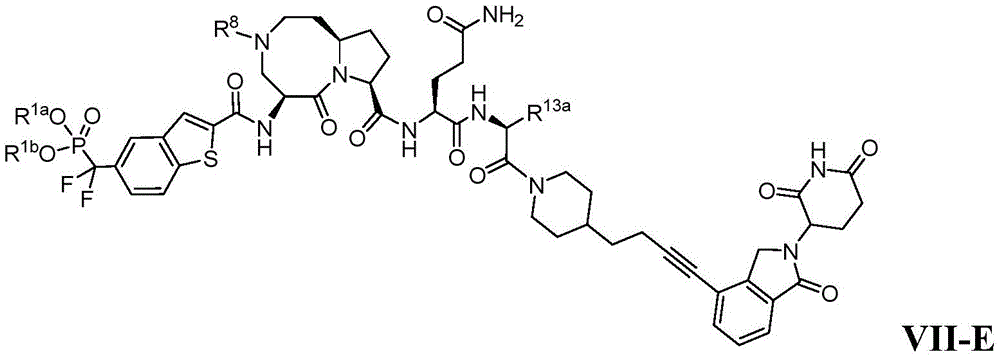
In another embodiment, the compounds of the present disclosure are of formulae VII-E:
wherein R is1a、R1b、R8And R13aAs defined in combination with formula I, or a pharmaceutically acceptable salt or solvate thereof.
In another embodiment, the compounds of the present disclosure are of the formula VII-E, wherein R is8Selected from hydrogen, C1-C6Alkyl radical, C1-C6Haloalkyl, (heterocycle) alkyl, alkylsulfonyl and-C (═ O) R9Or a pharmaceutically acceptable salt or solvate thereof. In another embodiment, R8Selected from the group consisting of C1-C4Alkyl radical, C1-C4Haloalkyl, alkylsulfonyl and-C (═ O) R9A group of (a); and R is9Selected from the group consisting of C1-C4Alkyl, alkylamino, dialkylamino and C1-C4Alkoxy groups. In another embodiment, R9Selected from the group consisting of C1-C3Alkyl, alkylamino, dialkylamino and C1-C3Alkoxy groups. In another embodiment, R8Is methyl, ethyl, isopropyl, -CH2CHF2、-CH2CF3、-C(=O)OCH3、-C(=O)CH3、-C(=O)NHCH3、-C(=O)N(CH3)2、-S(=O)2Me、-S(=O)2Et or-SO2And (4) iPr. In another embodiment, R8Is methyl, ethyl, -CH2CHF2or-C (═ O) OCH3。
In another embodiment, the compounds of the present disclosure are of formula VII-D or formula VII-E, wherein R is13aSelected from the group consisting of optionally substituted C3-C12Cycloalkyl, optionally substituted aryl, aralkyl, (heteroaryl) alkyl, (cycloalkyl) alkyl, and optionally substituted 5-to 9-membered heteroaryl, or a pharmaceutically acceptable salt or solvate thereof. In another embodiment, R 13aSelected from the group consisting of:
wherein R is25eAnd R25fIndependently selected from hydrogen, halo, C1-C4Alkyl radical, C1-C4Haloalkyl and C1-C4Alkoxy groups.
In another embodiment, the compounds of the present disclosure are of any one of formulas I-IV, IV-A, V, V-A, VI-A, VI-B, IV-C, VII-A, VII-B, VII-C, VII-D, or VII-E, wherein R is1aAnd R1bIs C1-C4An alkyl group, or a pharmaceutically acceptable salt or solvate thereof.
In another embodiment, the compounds of the present disclosure are of any one of formulas I-IV, IV-A, V, V-A, VI-A, VI-B, IV-C, VII-A, VII-B, VII-C, VII-D, or VII-E, wherein R is1aAnd R1bIs hydrogen, or a pharmaceutically acceptable salt or solvate thereof.
In another embodiment, the compounds of the present disclosure are of any one of formulas I-IV, IV-A, V, V-A, VI-A, VI-B, IV-C, VII-A, VII-B, VII-C, VII-D, or VII-E, wherein R is1aAnd R1bis-CH2OC(=O)R1e(ii) a And each R1eIndependently selected from C1-C6Alkyl and C1-C6Alkoxy groups. In a further embodiment of the process according to the invention,each R1eIs C1-C6An alkyl group. In another embodiment, each R is1eIs C1-C6An alkoxy group.
In another embodiment, the compounds of the present disclosure are of any one of formulas I-IV, IV-A, V, V-A, VI-A, VI-B, IV-C, VII-A, VII-B, VII-C, VII-D, or VII-E, wherein R is 1aAnd R1bSelected from the group consisting of:
in another embodiment, the compounds of the present disclosure are of any one of formulas I, VI-A, VI-B, IV-C, VII-A, VII-B, VII-C, VII-D, or VII-E, wherein:
R13aselected from the group consisting of:
R25eAnd R25fIndependently selected from hydrogen, halo, C1-C6Alkyl, optionally substituted C3-C6Cycloalkyl, optionally substituted aryl, C1-C4Haloalkyl, C1-C4Alkoxy, carboxamido, sulfonamido, alkylsulfonyl, arylsulfonyl, -C (═ O) R57、-S(=O)2R58and-N (R)56c)S(=O)2R56dGroup (d) of (a).
In another embodiment, the compounds of the present disclosure are of any one of formulas I, VI-A, VI-B, IV-C, VII-A, VII-B, VII-C, VII-D, or VII-E, wherein:
R13acomprises the following steps:
R25eselected from hydrogen, halo, C1-C6Alkyl, -C (═ O) NR50cR50d、C1-C6Alkylsulfonyl, arylsulfonyl, -N (R)56c)S(=O)2R56dand-S (═ O)2R58A group of components selected from the group consisting of,
R25fselected from the group consisting of hydrogen and halo;
R50cselected from the group consisting of C1-C6Alkyl, optionally substituted C3-C6Cycloalkyl, optionally substituted 5-or 6-membered heterocycle, optionally substituted phenyl, optionally substituted 5-to 9-membered heteroaryl, aralkyl, (heteroaryl) C1-C4Alkyl and (hetero) C1-C4Alkyl groups;
R5odselected from hydrogen and C 1-C3Alkyl groups; or
R50cAnd R50dTogether with the nitrogen to which they are attached form a 3-to 8-membered optionally substituted heterocyclyl;
R58is optionally substituted C3-C6A cycloalkyl group;
R56cselected from hydrogen and C1-C3Alkyl groups; and is
R56dSelected from the group consisting of optionally substituted C3-C6Cycloalkyl, optionally substituted phenyl and optionally substituted 5-to 9-membered heteroaryl.
In another embodiment, the compounds of the present disclosure are of formula XXII:
wherein:
R1aand R1bIndependently selected from hydrogen, C1-C6Alkyl and aralkyl groups;
R8selected from hydrogen, C1-C6Alkyl radical, C1-C6Haloalkyl group (a), (b), (c) and (d)Heterocycle) alkyl, alkylsulfonyl and-C (═ O) R9A group of (a); and is
R2a、R2b、R9、R12c、A、X2T, L and B are as defined in combination with formula I, or a pharmaceutically acceptable salt or solvate thereof.
In another embodiment, the compounds of the present disclosure are of formula XXIII:
wherein:
R1aand R1bIndependently selected from hydrogen, C1-C6Alkyl and aralkyl groups;
R8selected from hydrogen, C1-C6Alkyl radical, C1-C6Haloalkyl, (heterocycle) alkyl, alkylsulfonyl and-C (═ O) R9A group of (a); and is
R2a、R2b、R9、A、A1、X2T, e, f, L and B are as defined in connection with formula I, or a pharmaceutically acceptable salt or solvate thereof.
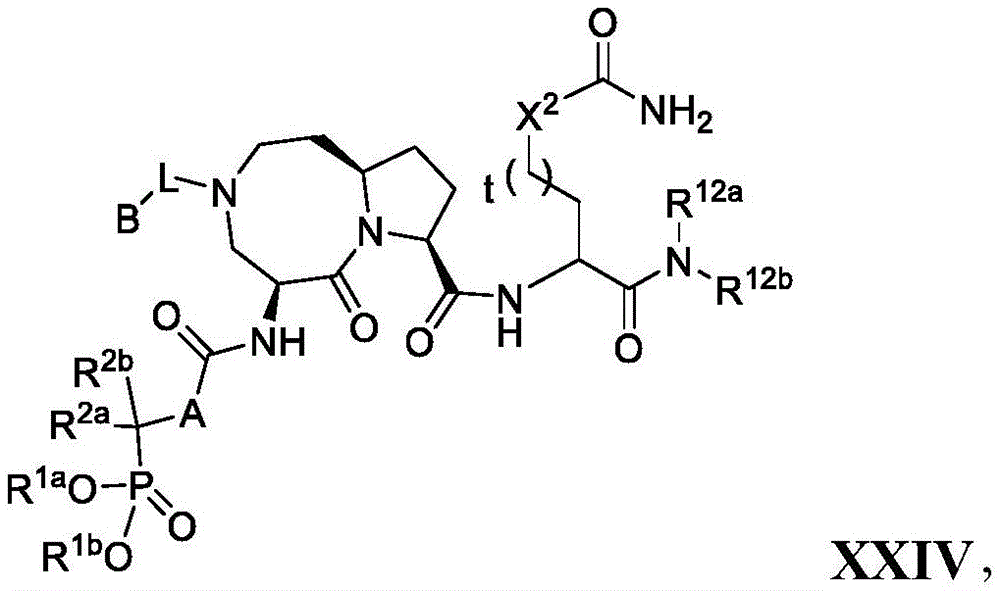
In another embodiment, the compounds of the present disclosure are of formula XXIV:
Wherein R is1aAnd R1bIndependently selected from hydrogen, C1-C6Alkyl and aralkyl groups; and R is2a、R2b、A、X2、R12a、R12bT, L and B are as defined in combination with formula I, or a pharmaceutically acceptable salt or solvate thereof.
In another embodiment, the compounds of the present disclosure are of formula XXVI:
wherein R is1aAnd R1bIndependently selected from hydrogen, C1-C6Alkyl and aralkyl groups; and R is2a、R2b、A、XA、X2、t、R3g、R12aAnd R12bAs defined in connection with formula I.
In another embodiment, the compounds of the present disclosure are compounds of formula I provided in table 1, table 1A, and table IB, or a pharmaceutically acceptable salt or solvate thereof. In another embodiment, the compounds of the present disclosure are compounds of formula I provided in table 1 and table 1A, or a pharmaceutically acceptable salt or solvate thereof. In another embodiment, the compounds of the present disclosure are compounds of formula I provided in table 1, or a pharmaceutically acceptable salt or solvate thereof. In another embodiment, the compounds of the present disclosure are compounds of formula I provided in table 1A, or a pharmaceutically acceptable salt or solvate thereof. In another embodiment, the compounds of the present disclosure are compounds of formula I provided in table 1B, or a pharmaceutically acceptable salt or solvate thereof. The chemical names in Table 1, Table 1A and Table IB are represented by Chemdraw
Professional version 17.0.0.206 (121). The compounds of the present disclosure are defined by their chemical structure provided that there is any ambiguity between their chemical structure and chemical name.
In another embodiment, the compound of the present disclosure is a compound of formula I selected from the group consisting of:
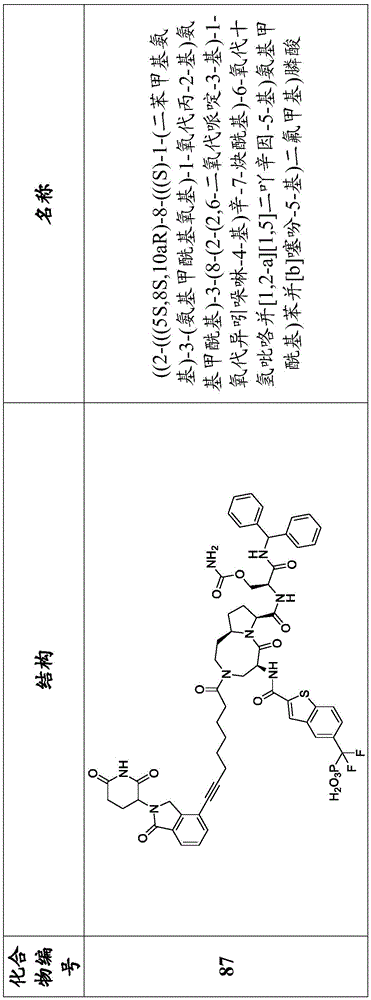
((2- (((5S,8S,10aR) -8- (((S) -5-amino-1- (benzhydrylamino) -1, 5-dioxopent-2-yl) carbamoyl) -3- (8- (2- (2, 6-dioxopiperidin-3-yl) -1-oxoisoindolin-4-yl) oct-7-ynoyl) -6-oxodecahydropyrrolo [1,2-a ] [1,5] diazacin-5-yl) carbamoyl) -1H-indol-5-yl) difluoromethyl) phosphonic acid;
(2- (((5S,8S,10aR) -8- (((S) -5-amino-1- (benzhydrylamino) -1, 5-dioxopent-2-yl) carbamoyl) -3- (8- (2- (2, 6-dioxopiperidin-3-yl) -1-oxoisoindolin-4-yl) oct-7-ynoyl) -6-oxodecahydropyrrolo [1,2-a ] [1,5] diazacyclon-5-yl) carbamoyl) -1H-indole-5-carbonyl) phosphonic acid;
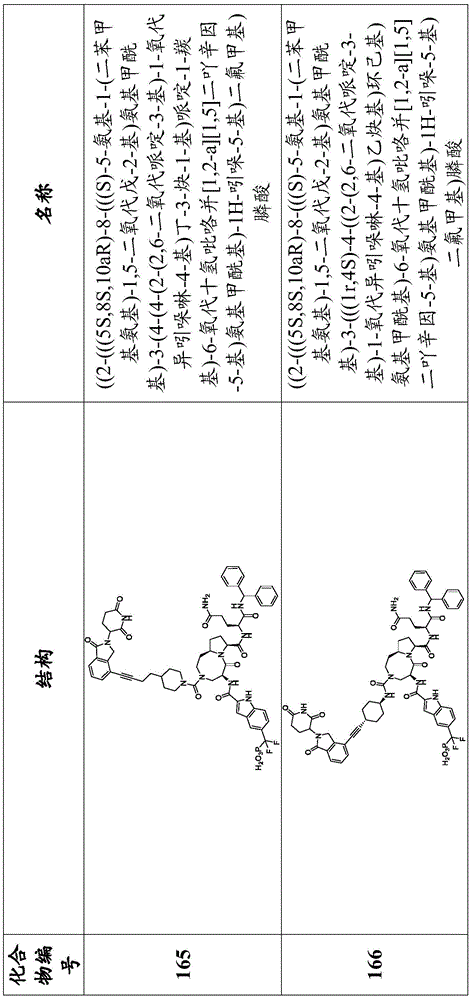
(2- (((5S,8S,10aR) -8- (((2S) -5-amino-1- (((1S) -2- (4- (4- (2- (2, 6-dioxopiperidin-3-yl) -1-oxoisoindolin-4-yl) but-3-yn-1-yl) piperidin-1-yl) -2-oxo-1-phenylethyl) amino) -1, 5-dioxopent-2-yl) carbamoyl) -3-methyl-6-oxodecahydropyrrolo [1,2-a ] [1,5] diazacyclin-5-yl) carbamoyl) -1H-indole-5-carbonyl) phosphonic acid;
(2- (((5S,8S,10aR) -8- (((2S) -5-amino-1- (((1S) -1-cyclohexyl-2- (4- (4- (2- (2, 6-dioxopiperidin-3-yl) -1-oxoisoindolin-4-yl) but-3-yn-1-yl) piperidin-1-yl) -2-oxoethyl) amino) -1, 5-dioxopent-2-yl) carbamoyl) -3-methyl-6-oxodecahydropyrrolo [1,2-a ] [1,5] diazacin-5-yl) carbamoyl) -1H-indole-5-carbonyl) phosphonic acid;
((2- (((5S,8S,10aR) -8- (((S) -5-amino-1- (benzhydrylamino) -1, 5-dioxopent-2-yl) carbamoyl) -3- (8- (2- (2, 6-dioxopiperidin-3-yl) -1-oxoisoindolin-4-yl) oct-7-ynoyl) -6-oxodecahydropyrrolo [1,2-a ] [1,5] diazacin-5-yl) carbamoyl) benzo [ b ] thiophen-5-yl) difluoromethyl) phosphonic acid;
((2- (((5S,8S,10aR) -8- (((2S) -5-amino-1- (((1S) -1-cyclohexyl-2- (4- (4- (2- (2, 6-dioxopiperidin-3-yl) -1-oxoisoindolin-4-yl) but-3-yn-1-yl) piperidin-1-yl) -2-oxoethyl) amino) -1, 5-dioxopent-2-yl) carbamoyl) -3-methyl-6-oxodecahydropyrrolo [1,2-a ] [1,5] diazacin-5-yl) carbamoyl) benzo [ b ] thiophen-5-yl) difluoromethyl) phosphonic acid;
((2- (((5S,8S,10aR) -8- (((2S) -5-amino-1- (((1S) -2- (4- (4- (2- (2, 6-dioxopiperidin-3-yl) -1-oxoisoindolin-4-yl) but-3-yn-1-yl) piperidin-1-yl) -2-oxo-1-phenylethyl) amino) -1, 5-dioxopent-2-yl) carbamoyl) -3-methyl-6-oxodecahydropyrrolo [1,2-a ] [1,5] diazacypin-5-yl) carbamoyl) benzo [ b ] thiophen-5-yl) difluoromethyl) phosphonic acid.
(2- (((5S,8S,10aR) -8- (((S) -5-amino-1- (benzhydrylamino) -1, 5-dioxopent-2-yl) carbamoyl) -3- (8- (2- (2, 6-dioxopiperidin-3-yl) -1-oxoisoindolin-4-yl) oct-7-ynoyl) -6-oxodecahydropyrrolo [1,2-a ] [1,5] diazacyclon-5-yl) carbamoyl) benzo [ b ] thiophene-5-carbonyl) phosphonic acid;
(2- (((5S,8S,10aR) -8- (((2S) -5-amino-1- (((1S) -1-cyclohexyl-2- (4- (4- (2- (2, 6-dioxopiperidin-3-yl) -1-oxoisoindolin-4-yl) but-3-yn-1-yl) piperidin-1-yl) -2-oxoethyl) amino) -1, 5-dioxopent-2-yl) carbamoyl) -3-methyl-6-oxodecahydropyrrolo [1,2-a ] [1,5] diazacin-5-yl) carbamoyl) benzo [ b ] thiophene-5-carbonyl) phosphonic acid; and
(2- (((5S,8S,10aR) -8- (((2S) -5-amino-1- (((1S) -2- (4- (4- (2- (2, 6-dioxopiperidin-3-yl) -1-oxoisoindolin-4-yl) but-3-yn-1-yl) piperidin-1-yl) -2-oxo-1-phenylethyl) amino) -1, 5-dioxopent-2-yl) carbamoyl) -3-methyl-6-oxodecahydropyrrolo [1,2-a ] [1,5] diazacypin-5-yl) carbamoyl) benzo [ b ] thiophene-5-carbonyl) phosphonic acid,
or a pharmaceutically acceptable salt or solvate thereof.
In another embodiment, the compound of the present disclosure is a compound of formula I selected from the group consisting of:
((2- (((5S,8S,10aR) -8- (((2S) -5-amino-1- (((2S) -3- (3, 4-difluorophenyl) -1- (4- (2- (2, 6-dioxopiperidin-3-yl) -1-oxoisoindolin-4-yl) but-3-yn-1-yl) piperidin-1-yl) -1-oxoprop-2-yl) amino) -1, 5-dioxopent-2-yl) carbamoyl) -3- (methoxycarbonyl) -6-oxodecahydropyrrolo [1,2-a ] [1,5] diazacypin-5-yl) carbamoyl) benzo [ b ] thiophen-5-yl -yl) difluoromethyl) phosphonic acid; and
((2- (((5S,8S,10aR) -8- (((2S) -5-amino-1- (((1S) -1-cyclohexyl-2- (4- (2- (2, 6-dioxopiperidin-3-yl) -1-oxoisoindolin-4-yl) but-3-yn-1-yl) piperidin-1-yl) -2-oxoethyl) amino) -1, 5-dioxopent-2-yl) carbamoyl) -3- (methoxycarbonyl) -6-oxodecahydropyrrolo [1,2-a ] [1,5] diazacin-5-yl) carbamoyl) benzo [ b ] thiophen-5-yl) difluoromethyl) phosphonic acid,
or a pharmaceutically acceptable salt or solvate thereof.
In another embodiment, the compound of the present disclosure is ((2- (((5S,8S,10aR) -8- (((2S) -5-amino-1- (((2S) -3- (3, 4-difluorophenyl) -1- (4- (4- (2- (2, 6-dioxopiperidin-3-yl) -1-oxoisoindolin-4-yl) but-3-yn-1-yl) piperidin-1-yl) -1-oxoprop-2-yl) amino) -1, 5-dioxopent-2-yl) carbamoyl) -3- (methoxycarbonyl) -6-oxodecahydropyrrolo [1,2-a ] [1,5] diazacin-5-yl) carbamoyl) benzo [ b ] thiophen-5-yl) difluoromethyl) phosphonic acid, or a pharmaceutically acceptable salt thereof.
In another embodiment, the present disclosure provides a compound having the structure:
(chemical name: ((2- (((5S,8S,10aR) -8- (((S) -5-amino-1, 5-dioxo-1- (((S) -2-oxo-2- ((8- (5- ((3aS,4S,6aR) -2-oxohexahydro-1H-thieno [3,4-d ] imidazol-4-yl) pentanamide) octyl) amino) -1-phenylethyl) amino) pent-2-yl) carbamoyl) -3- (8- (2- (2, 6-dioxopiperidin-3-yl) -1-oxoisoindolin-4-yl) oct-7-ynoyl) -6-oxodecahydropyrrolo [1,2-a ] [1,5] diazacin-5-yl) carbamoyl) -1H-indol-5-yl) difluoromethyl) phosphonic acid).
In another embodiment, the present disclosure provides a compound having the structure:
(chemical name: ((2- (((5S,8S,10aR) -8- (((S) -5-amino-1, 5-dioxo-1- (((S) -2-oxo-2- ((8- (5- ((3aS,4S,6aR) -2-oxohexahydro-1H-thieno [3,4-d ] imidazol-4-yl) pentanamide) octyl) amino) -1-phenylethyl) amino) pent-2-yl) carbamoyl) -3-methyl-6-oxodecahydropyrrolo [1,2-a ] [1,5] diazacyclon-n-5-yl) carbamoyl) -1H-indol-5-yl) difluoromethyl) phosphonic acid).
In another embodiment, the present disclosure provides a compound having the structure:
(chemical name: ((2- (((5S,8S,10aR) -8- (((S) -5-amino-1- (((S) -2- ((8- (3',6' -dihydroxy-3-oxo-3H-spiro [ isobenzofuran-1, 9' -xanthene ] -5-carboxamido) octyl) amino) -2-oxo-1-phenylethyl) amino) -1, 5-dioxopent-2-yl) carbamoyl) -3-methyl-6-oxodecahydropyrrolo [1,2-a ] [1,5] diazacin-5-yl) carbamoyl) -1H-indol-5-yl) difluoromethyl) phosphonic acid).
In another embodiment, the compound of the present disclosure is a compound of formula VIII:
wherein:
R1aand R1bIndependently selected from hydrogen, C1-C6Alkyl and aralkyl groups;
R2a、R2bm, A and E are as defined in connection with formula I, except that the bond denoted by "+" in A is linked to-C (═ O) -E-QBAnd is linked to Q in E by a bond denoted by "+"B;
R8Selected from hydrogen, C1-C6Alkyl radical, C1-C6Haloalkyl, (heterocycle) alkyl, alkylsulfonyl and-C (═ O) R9A group of (a);
R9as defined in conjunction with formula I;
QBselected from the group consisting of Q-1 and Q-2, wherein Q-1 and Q-2 are as defined in connection with formula I, or a pharmaceutically acceptable salt or solvate thereof.
In another embodiment, the compound of the present disclosure is a compound of formula VIII, with the proviso that:
(1) when X is presentAis-CH2CH2-then:
(i) a is selected from the group consisting of A-2, A-5, A-6, A-7, A-8, A-9, A-10, A-11, A-12, A-13, A-14, A-15, A-16, A-17, A-18, A-19, and A-20;
(ii) a is A-4 and G1is-S-; or
(iii)R2aAnd R2bTogether with the carbon atom to which they are attached form a-C (═ O) -group;
(2) when X is presentAis-N (R)8)CH2-then:
(i) a is selected from the group consisting of A-1, A-2, A-4, A-5, A-6, A-7, A-8, A-9, A-10, A-11, A-12, A-13, A-14, A-15, A-16, A-17, A-18, A-19, and A-20; or
(ii)R2aAnd R2bTogether with the carbon atom to which they are attached form a-C (═ O) -group; or
(3) When X is presentAis-CH2N(R8) -then:
(i) a is selected from the group consisting of A-1, A-2, A-4, A-5, A-6, A-7, A-8, A-9, A-10, A-11, A-12, A-13, A-14, A-15, A-16, A-17, A-18, A-19, and A-20; or
(ii)R2aAnd R2bTogether with the carbon atom to which they are attached form a-C (═ O) -group, or a pharmaceutically acceptable salt or solvate thereof.
In another embodiment, the compound of the present disclosure is a compound of formula VIII, wherein M is-O-, or a pharmaceutically acceptable salt or solvate thereof.
In another embodiment, the compounds of the present disclosure are of formula VIII, wherein M is-C (R)2a)(R2b) Or a pharmaceutically acceptable salt or solvate thereof.
In another embodiment, the compounds of the present disclosure are of formula IX:
wherein R is1a、R1bA, E and QBAs defined in conjunction with formula VIII, or a pharmaceutically acceptable salt or solvate thereof.
In another embodiment, the compounds of the present disclosure are of formula X:
wherein R is1a、R1bA, E and QBAs defined in conjunction with formula VIII, or a pharmaceutically acceptable salt or solvate thereof.
In another embodiment, the compounds of the present disclosure are of any one of formulas VIII-X, wherein Q is BIs Q-1, or a pharmaceutically acceptable salt or solvate thereof. In another embodiment, E is E-1-1. In another embodiment, E is E-2-1. In another embodiment, E is E-3-1. In another embodiment, X1Is selected from the group consisting of-CH2-and-n (h) -in a pharmaceutically acceptable carrier. In another embodiment, X1is-CH2-. In another embodiment, s is 0 or 1. In another embodiment, s is 0.
In another embodiment, the compounds of the present disclosure are of any one of formulas VIII-X, wherein Q isBIs Q-2, or a pharmaceutically acceptable salt or solvate thereof. In another embodiment, E is E-1-1. In another embodiment, E is E-2-1. In another embodiment, E is E-3-1. In another embodiment, Q-2 is Q-2-1 (wherein Q-2-1 is as defined in connection with formula I). In another embodiment, X2Is selected from the group consisting of-CH2-, -O-and-N (H) -. In another implementationIn scheme (II), X2is-CH2-. In another embodiment, t is 0 or 1. In another embodiment, t is 0. In another embodiment, R12bIs hydrogen, or a pharmaceutically acceptable salt or solvate thereof. In another embodiment, R12aIs aralkyl, or a pharmaceutically acceptable salt or solvate thereof.
In another embodiment, the compounds of the present disclosure are of formula XI:
wherein R is1a、R1b、R2a、R2b、R8、R12aAnd A is as defined in conjunction with formula VIII, or a pharmaceutically acceptable salt or solvate thereof.
In another embodiment, the compounds of the present disclosure are of formula XII:
wherein R is1a、R1b、R2a、R2b、R8、R12aAnd A is as defined in conjunction with formula VIII, or a pharmaceutically acceptable salt or solvate thereof.
In another embodiment, the compounds of the present disclosure are of formula XI or formula XII, wherein R is2aAnd R2bIs fluorine, or a pharmaceutically acceptable salt or solvate thereof.
In another embodiment, the compounds of the present disclosure are of formula XI or formula XII, wherein R is2aAnd R2bTogether with the carbon to which they are attached form a-C (═ O) -group, or a pharmaceutically acceptable salt or solvate thereof.
In another embodiment, the compound of the present disclosure is a compound of formula XI or formula XII, wherein a is a-4, or a pharmaceutically acceptable salt or solvate thereof. In another embodiment, G1is-S-.
In another embodiment, the compound of the present disclosure is a compound of formula XI or formula XII, wherein a is a-8, or a pharmaceutically acceptable salt or solvate thereof. In another embodiment, G, G4And G6Is-c (h) ═ c; and R is 3Is hydrogen.
In another embodiment, the compounds of the present disclosure are of formula XI or formula XII, wherein R is8Is hydrogen, or a pharmaceutically acceptable salt or solvate thereof.
In another embodiment, the compounds of the present disclosure are of formula XI or formula XII, wherein R is8Is C1-C4An alkyl group, or a pharmaceutically acceptable salt or solvate thereof.
In another embodiment, the compounds of the present disclosure are of formula XI or formula XII, wherein R is12aIs aralkyl, or a pharmaceutically acceptable salt or solvate thereof. In another embodiment, R12aComprises the following steps:
R25a、R25b、R25cAnd R25dEach independently selected from hydrogen, halo, C1-C4Alkyl and C1-C4Alkoxy, or a pharmaceutically acceptable salt or solvate thereof.
In another embodiment, the compounds of the present disclosure are of formula XI or formula XII, wherein R is1aAnd R1bIs C1-C4An alkyl group, or a pharmaceutically acceptable salt or solvate thereof.
In another embodiment, the compounds of the present disclosure are of formula XI or formula XII, wherein R is1aAnd R1bIs hydrogen, or a pharmaceutically acceptable salt or solvate thereof.
In another embodiment, the compound of the present disclosure is a compound of formula VIII provided in table 2, or a pharmaceutically acceptable salt or solvate thereof.
TABLE 2
In another embodiment, the present disclosure provides a pharmaceutical composition comprising a compound of the present disclosure and a pharmaceutically acceptable carrier.
In another embodiment, the compounds of the present disclosure and intermediates of the present disclosure are enantiomerically enriched, e.g., the enantiomeric excess or "ee" of the compound is about 5% or more as measured by chiral HPLC. In another embodiment, the ee is about 10%. In another embodiment, the ee is about 20%. In another embodiment, the ee is about 30%. In another embodiment, the ee is about 40%. In another embodiment, the ee is about 50%. In another embodiment, the ee is about 60%. In another embodiment, the ee is about 70%. In another embodiment, the ee is about 80%. In another embodiment, the ee is about 85%. In another embodiment, the ee is about 90%. In another embodiment, the ee is about 91%. In another embodiment, the ee is about 92%. In another embodiment, the ee is about 93%. In another embodiment, the ee is about 94%. In another embodiment, the ee is about 95%. In another embodiment, the ee is about 96%. In another embodiment, the ee is about 97%. In another embodiment, the ee is about 98%. In another embodiment, the ee is about 99%.
Certain of the compounds of the present disclosure are heterobifunctional molecules. In one embodiment, the E portion of the molecule, i.e.,
for enantiomeric enrichment, for example, the enantiomeric excess or "ee" of this portion of the heterobifunctional compound is about 5% or more as measured by chiral HPLC. In another embodiment, the ee is about 10%. In another embodiment, the ee is about 20%. In another embodiment, the ee is about 30%. In another embodiment, the ee is about 40%. In another embodiment, the ee is about 50%. In another embodiment, the ee is about 60%. In another embodiment, the ee is about 70%. In another embodiment, the ee is about 80%. In another embodiment, the ee is about 85%. In another embodiment, the ee is about 90%. In another embodiment, the ee is about 91%. In another embodiment, the ee is about 92%. In another embodiment, the ee is about 93%. In another embodiment, the ee is about 94%. In another embodiment, the ee is about 95%. In another embodiment, the ee is about 96%. In another embodiment, the ee is about 97%. In another embodiment, the ee is about 98%. In another embodiment, the ee is about 99%.
In another embodiment, the glucocerebroside (cereblon) binding portion of the molecule, i.e., -B, is enantiomerically enriched. In another embodiment, the glucocerebroside binding portion of the molecule is racemic. The present disclosure encompasses all possible stereoisomeric (e.g., diastereomeric) forms of the compounds of the present disclosure. For example, all possible stereoisomers of the compounds of the present disclosure are contemplated when the E portion of the molecule is enantiomerically enriched and the glucocerebroside binding portion of the molecule is racemic.
The present disclosure encompasses the preparation and use of salts of the compounds of the present disclosure. As used herein, a drug "pharmaceutically acceptable salt" refers to a salt or zwitterionic form of a compound of the present disclosure. Salts of the compounds of the present disclosure can be prepared during the final isolation and purification of the compounds or separately by reacting the compounds with a suitable acid. A pharmaceutically acceptable salt of a compound of the present disclosure can be an acid addition salt formed using a pharmaceutically acceptable acid. Examples of acids useful for forming pharmaceutically acceptable salts include inorganic acids such as nitric acid, boric acid, hydrochloric acid, hydrobromic acid, sulfuric acid, and phosphoric acid; and organic acids such as oxalic acid, maleic acid, succinic acid, and citric acid. Non-limiting examples of salts of the compounds of the present disclosure include, but are not limited to, hydrochloride, hydrobromide, hydroiodide, sulfate, bisulfate, 2-hydroxyethanesulfonate, phosphate, biphosphate, acetate, adipate, alginate, aspartate, benzoate, bisulfate, butyrate, camphorate, camphorsulfonate, digluconate, glycerophosphate, hemisulfate, heptanoate, hexanoate, formate, succinate, fumarate, maleate, ascorbate, isethionate, salicylate, methanesulfonate, mesitylenesulfonate, naphthylene sulfonate, nicotinate, 2-naphthalenesulfonate, oxalate, pamoate, pectate, persulfate, 3-phenylpropionate, picrate, pivalate, propionate, trichloroacetate, Trifluoroacetate, phosphate, glutamate, bicarbonate, p-toluenesulfonate, undecanoate, lactate, citrate, tartrate, gluconate, methanesulfonate, ethanedisulfonate, benzenesulfonate and p-toluenesulfonate. In addition, methyl, ethyl, propyl and butyl chlorides, bromides and iodides may be used; dimethyl, diethyl, dibutyl and diamyl sulfates; chlorides, bromides and iodides of decyl, lauryl, myristyl and sterol groups; and benzyl and phenethyl bromides quaternize available amino groups present in the compounds of the present disclosure. In light of the foregoing, any reference to a compound of the present disclosure as appearing herein is intended to encompass the compounds of the present disclosure as well as pharmaceutically acceptable salts, hydrates, or solvates thereof.
The present disclosure encompasses the preparation and use of solvates of the compounds of the present disclosure. Solvates typically do not significantly alter the physiological activity or toxicity of the compound and thus may serve as pharmacological equivalents. The term "solvate" as used herein is a combination, physical association, and/or solvation of a compound of the present disclosure with a solvent molecule, such as a bis-solvate, mono-solvate, or semi-solvate, wherein the ratio of solvent molecules to compounds of the present disclosure is about 2:1, about 1:1, or about 1:2, respectively. This physical association involves varying degrees of ionic and covalent bonding, including hydrogen bonding. In certain instances, solvates may be isolated, such as when one or more solvent molecules are incorporated into the crystal lattice of a crystalline solid. Thus, "solvate" encompasses both solution phase and separable solvate. The compounds of the present disclosure may be present in solvated forms with pharmaceutically acceptable solvents (such as water, methanol, and ethanol), and the present disclosure is intended to include both solvated and unsolvated forms of the compounds of the present disclosure. One type of solvate is a hydrate. "hydrates" refers to a specific subset of solvates in which the solvent molecule is water. Solvates typically serve as pharmacological equivalents. The preparation of solvates is known in the art. See, e.g., m.caira et al, j.pharmaceut.sci.,93(3): 601-. E.c. van binder et al, AAPS pharm. sci. tech.,5(1): Article 12(2004) and a.l. bingham et al, chem. commu.603-604 (2001) describe similar preparations of solvates, hemisolvates, hydrates, etc. A typical, non-limiting method of preparing the solvate will involve dissolving a compound of the present disclosure in the desired solvent (organic solvent, water, or mixtures thereof) at a temperature above 20 ℃ to about 25 ℃, then cooling the solution at a rate sufficient to form crystals, and isolating the crystals by known methods, such as filtration. The presence of solvates in the crystals of the solvate may be confirmed using analytical techniques such as infrared spectroscopy.
Intermediates of the present disclosure
The present disclosure also provides synthetic intermediates useful in the preparation of the compounds of the present disclosure, collectively referred to as "intermediates of the present disclosure".
In one embodiment, the intermediate of the present disclosure is a compound of formula XIII:
wherein:
r is selected from hydrogen and C1-C6Alkyl, aralkyl and optionally substituted phenyl;
R1aand R1bIndependently selected from hydrogen, C1-C6Alkyl and aralkyl groups;
R2aand R2bAs defined in conjunction with formula I; and is
A is as defined in connection with formula I, wherein the bond denoted by "×" is linked to-C (═ O) -OR.
In another embodiment, the intermediate of the present disclosure is a compound of formula XIII, with the proviso that the compound is not:
or a salt or solvate thereof.
In another embodiment, the intermediate of the present disclosure is a compound of formula XIV:
r, R therein1a、R1bAnd A is as defined in connection with formula XIII, or a salt or solvate thereof.
In another embodiment, the intermediate of the present disclosure is a compound of formula XV:
r, R therein1a、R1bAnd A is as defined in connection with formula XIII, or a salt or solvate thereof.
In another embodiment, the intermediate of the present disclosure is a compound of formula XIII selected from the group consisting of:
or a salt or solvate thereof.
In another embodiment, the intermediate of the present disclosure is a compound of any one of formula XIII, XIII-A, XIII-B, XIII-C, XIII-D, XIII-E, XIV, or XV, wherein R is hydrogen, or a salt or solvate thereof.
In another embodiment, the intermediate of the present disclosure is a compound of any one of formula XIII, XIII-A, XIII-B, XIII-C, XIII-D, XIII-E, XIV, or XV, wherein R is benzyl, or a salt or solvate thereof.
In another embodiment, the intermediate of the present disclosure is a compound of any one of formula XIII, XIII-A, XIII-B, XIII-C, XIII-D, XIII-E, XIV, or XV, wherein R is selected from the group consisting of pentachlorobenzene and pentafluorobenzene, or a salt or solvate thereof.
In another embodiment, the disclosed intermediates are compounds of any one of formula XIII, XIII-A, XIII-B, XIII-C, XIII-D, XIII-E, XIV, or XV, wherein R is1aAnd R1bIs ethyl, or a salt thereofOr a solvate.
In another embodiment, the intermediates of the present disclosure are compounds of any one of formula XIII, XIII-A, XIII-B, XIII-C, XIII-D, XIII-E, XIV, or XV, wherein R is hydrogen; and R is1aAnd R1bIs ethyl, or a salt or solvate thereof.
In one embodiment, the intermediate of the present disclosure is a compound of formula XVI:
wherein:
R1a、R1b、R2a、R2ba and E, wherein the bond marked with "+" is connected to Q as defined in connection with formula IC;
QCComprises the following steps:
X2and t is as defined in connection with formula I; and is
R26Selected from hydrogen, C 1-C6Alkyl and aralkyl groups.
In another embodiment, the intermediate of the present disclosure is a compound of formula XVI, with the proviso that:
(1) when X is presentAis-CH2CH2-then:
(i) a is selected from the group consisting of A-2, A-5, A-6, A-7, A-8, A-9, A-10, A-11, A-12, A-13, A-14, A-15, A-16, A-17, A-18, A-19, and A-20;
(ii) a is A-4 and G1is-S-; or
(iii)R2aAnd R2bTogether with the carbon atom to which they are attached form a-C (═ O) -group;
(2) when X is presentAis-N (R)8)CH2-and R8Selected from hydrogen, C1-C6Alkyl radical, C1-C6Haloalkyl, (heterocycle) alkyl, alkylsulfonyl and-C (═ O) R9When in group, then:
(i) a is selected from the group consisting of A-1, A-2, A-4, A-5, A-6, A-7, A-8, A-9, A-10, A-11, A-12, A-13, A-14, A-15, A-16, A-17, A-18, A-19, and A-20; or
(ii)R2aAnd R2bTogether with the carbon atom to which they are attached form a-C (═ O) -group; or
(3) When X is presentAis-CH2N(R8) -and R8Selected from hydrogen, C1-C6Alkyl radical, C1-C6Haloalkyl, (heterocycle) alkyl, alkylsulfonyl and-C (═ O) R9When in group, then:
(i) a is selected from the group consisting of A-1, A-2, A-4, A-5, A-6, A-7, A-8, A-9, A-10, A-11, A-12, A-13, A-14, A-15, A-16, A-17, A-18, A-19, and A-20; or
(ii)R2aAnd R2bTogether with the carbon atom to which they are attached form a-C (═ O) -group, or a pharmaceutically acceptable salt or solvate thereof.
In another embodiment, the intermediate of the present disclosure is a compound of formula XVII:
wherein R is1a、R1bA, E and QCAs defined in connection with formula XVI, or a salt or solvate thereof.
In another embodiment, the intermediate of the present disclosure is a compound of formula XVIII:
wherein R is1a、R1bA, E and QCAs defined in connection with formula XVI, or a salt or solvate thereof.
In another embodiment, the intermediate of the present disclosure is a compound of formula XVI-a:
wherein R is1aAnd R1bIndependently selected from hydrogen and C1-C4Alkyl groups; g1Selected from the group consisting of-S-and-N (H) -; r8Selected from hydrogen, C1-C6Alkyl radical, C1-C6Haloalkyl, (heterocycle) alkyl, alkylsulfonyl and-C (═ O) R9A group of (a); r9Selected from the group consisting of C1-C6Alkyl, alkylamino, dialkylamino and C1-C6Alkoxy groups; and R is26Selected from hydrogen, C1-C6Alkyl and aralkyl groups. In another embodiment, R1aAnd R1bIs C1-C3An alkyl group. In another embodiment, R1aIs C1-C3An alkyl group; and R is1bIs hydrogen. In another embodiment, R1aAnd R1bIs ethyl. In another embodiment, R1aIs ethyl; and R is1bIs hydrogen.
In another embodiment, the intermediate of the present disclosure is a compound of any one of formulas XVI, XVI-A, XVII or XVIII, wherein R is8Selected from the group consisting of C1-C6Alkyl radical, C1-C6Haloalkyl, (heterocyclic) alkyl and-C (═ O) R9Or a salt or solvate thereof. In another embodiment, R is8Selected from the group consisting of C1-C4Alkyl radical, C1-C4Haloalkyl, alkylsulfonyl and-C (═ O) R9A group of (a); and R is9Selected from the group consisting of C1-C4Alkyl, alkylamino, dialkylamino and C1-C4Alkoxy groups. In another embodiment, R9Selected from the group consisting of C1-C3Alkyl, alkylamino, dialkylamino and C1-C3Alkoxy groups. In another embodimentIn the embodiment, R8Is methyl, ethyl, isopropyl, -CH2CHF2、-CH2CF3、-C(=O)OCH3、-C(=O)CH3、-C(=O)NHCH3、-C(=O)N(CH3)2、-S(=O)2Me、-S(=O)2Et or-SO2And (4) iPr. In another embodiment, R8Is methyl, ethyl, -CH2CHF2or-C (═ O) OCH3。
In another embodiment, the intermediate of the present disclosure is a compound of any one of formulas XVI-XVIII, wherein R8is-L-B, or a salt or solvate thereof.
In another embodiment, the intermediate of the present disclosure is a compound of any one of formulas XVI, XVI-A, XVII or XVIII, wherein R is26Is C1-C6Alkyl, or a salt or solvate thereof.
In another embodiment, the intermediate of the present disclosure is a compound of any one of formulas XVI, XVI-A, XVII or XVIII, R 26Is hydrogen, or a salt or solvate thereof.
In another embodiment, the intermediate of the present disclosure is a compound of any one of formulas XVI, XVI-A, XVII or XVIII, R26Is benzyl, or a salt or solvate thereof.
In another embodiment, an intermediate of the present disclosure is a compound of table 2A, or a salt or solvate thereof.
TABLE 2A
In another embodiment, an intermediate of the present disclosure is a compound of formula XXXIV:
wherein R is8And R13aAs defined in combination with formula I, or a pharmaceutically acceptable salt or solvate thereof.
In another embodiment, an intermediate of the present disclosure is a compound of formula XXXIV, wherein R is8Selected from hydrogen, C1-C6Alkyl radical, C1-C6Haloalkyl, (heterocycle) alkyl, alkylsulfonyl and-C (═ O) R9Or a pharmaceutically acceptable salt or solvate thereof. In another embodiment, R8Selected from the group consisting of C1-C4Alkyl radical, C1-C4Haloalkyl, alkylsulfonyl and-C (═ O) R9A group of (a); and R is9Selected from the group consisting of C1-C4Alkyl, alkylamino, dialkylamino and C1-C4Alkoxy groups. In another embodiment, R9Selected from the group consisting of C1-C3Alkyl, alkylamino, dialkylamino and C1-C3Alkoxy groups. In another embodiment, R8Is methyl, ethyl, isopropyl, -CH 2CHF2、-CH2CF3、-C(=O)OCH3、-C(=O)CH3、-C(=O)NHCH3、-C(=O)N(CH3)2、-S(=O)2Me、-S(=O)2Et or-SO2And (4) iPr. In another embodiment, R8Is methyl, ethyl, -CH2CHF2or-C (═ O) OCH3。
In another embodiment, an intermediate of the present disclosure is a compound of formula XXXIV, wherein R is13aSelected from the group consisting of optionally substituted C3-C12Cycloalkyl, optionally substituted aryl, aralkyl, (heteroaryl) alkyl, (cycloalkyl) alkyl, and optionally substituted 5-to 9-membered heteroaryl, or a pharmaceutically acceptable salt or solvate thereof. In another embodimentIn the embodiment, R13aIs an aralkyl group. In another embodiment, R13aSelected from the group consisting of:
wherein R is25eAnd R25fIndependently selected from hydrogen, halo, C1-C4Alkyl radical, C1-C4Haloalkyl and C1-C4Alkoxy groups.
In another embodiment, an intermediate of the present disclosure is a compound of formula XXXIV, wherein:
R13aselected from the group consisting of:
R25eAnd R25fIndependently selected from hydrogen, halo, C1-C6Alkyl, optionally substituted C3-C6Cycloalkyl, optionally substituted aryl, C1-C4Haloalkyl, C1-C4Alkoxy, carboxamido, sulfonamido, alkylsulfonyl, arylsulfonyl, -C (═ O) R57、-S(=O)2R58and-N (R)56c)S(=O)2R56dGroup (d) of (a).
In another embodiment, an intermediate of the present disclosure is a compound of formula XXXIV, wherein:
R13acomprises the following steps:
R25eselected from hydrogen, halo, C 1-C6Alkyl, -C (═ O) NR50cR50d、C1-C6Alkylsulfonyl, arylsulfonyl, -N (R)56c)S(=O)2R56dand-S (═ O)2R58A group of components selected from the group consisting of,
R25fselected from the group consisting of hydrogen and halo;
R50cselected from the group consisting of C1-C6Alkyl, optionally substituted C3-C6Cycloalkyl, optionally substituted 5-or 6-membered heterocycle, optionally substituted phenyl, optionally substituted 5-to 9-membered heteroaryl, aralkyl, (heteroaryl) C1-C4Alkyl and (hetero) C1-C4Alkyl groups;
R5odselected from hydrogen and C1-C3Alkyl groups; or
R50cAnd R50dTogether with the nitrogen to which they are attached form a 3-to 8-membered optionally substituted heterocyclyl;
R58is optionally substituted C3-C6A cycloalkyl group;
R56cselected from hydrogen and C1-C3Alkyl groups; and is
R56dSelected from the group consisting of optionally substituted C3-C6Cycloalkyl, optionally substituted phenyl and optionally substituted 5-to 9-membered heteroaryl.
In another embodiment, an intermediate of the present disclosure is a compound of formula XXXV:
wherein R is12a、J2、J3、Y2And Z is as defined in conjunction with formula I, or a pharmaceutically acceptable salt or solvate thereof.
In another embodiment, the intermediate of the present disclosure is a compound of formula XXXVI:
wherein R is12a、J2、J3、Y2And Z is as defined in conjunction with formula I, or a pharmaceutically acceptable salt or solvate thereof.
In another embodiment, an intermediate of the present disclosure is a compound of formula XXXV or XXXVI, wherein R 12aIs aralkyl, or a pharmaceutically acceptable salt or solvate thereof. In another embodiment, R12aComprises the following steps:
wherein R is25a、R25b、R25cAnd R25dEach independently selected from hydrogen, halo, C1-C4Alkyl and C1-C4Alkoxy groups.
In another embodiment, an intermediate of the present disclosure is a compound of formula XXXVII:
wherein X4Is selected from the group consisting of-CH2-and-O-; and R is13a、A2*、J2、J3、Y2And Z is as defined in conjunction with formula I, or a pharmaceutically acceptable salt or solvate thereof.
In another embodiment, the intermediate of the present disclosure is a compound of formula XXXVIII:
wherein X4Is selected from the group consisting of-CH2-and-O-; and R is13a、A2*、J2、J3、Y2And Z is as defined in conjunction with formula I, or a pharmaceutically acceptable salt or solvate thereof.
In another embodiment, the disclosed intermediates are compounds of formula XXXVII or XXXVIII, wherein R13aSelected from the group consisting ofOr a pharmaceutically acceptable salt or solvate thereof, or a pharmaceutically acceptable salt or solvate thereof. In another embodiment, R13aSelected from the group consisting of optionally substituted cyclohexyl, aralkyl and optionally substituted phenyl. In another embodiment, R13aIs optionally substituted phenyl. In another embodiment, R 13aIs an aralkyl group. In another embodiment, R13aIs (heteroaryl) alkyl.
In another embodiment, the disclosed intermediates are compounds of formula XXXVII or XXXVIII, wherein R8Selected from the group consisting of C1-C4Alkyl radical, C1-C4Haloalkyl, (heterocycle) alkyl, alkylsulfonyl and-C (═ O) R9A group of (a); and R is9Selected from the group consisting of C1-C4Alkyl, alkylamino, dialkylamino and C1-C4Alkoxy, or a pharmaceutically acceptable salt or solvate thereof. In another embodiment, R8Is C1-C4An alkyl group. In another embodiment, R8Is methyl.
In another embodiment, an intermediate of the disclosure is a compound of any one of formulas XXXV-XXXVIII, wherein J2Is absent, Y2Is- (CH)2)nN is 3, 4 or 5, and J3Absent, or a pharmaceutically acceptable salt or solvate thereof.
In another embodiment, an intermediate of the present disclosure is a compound of any one of formulas XXXV-XXXVIII, wherein Z is-C ≡ C-, or a pharmaceutically acceptable salt or solvate thereof.
In another embodiment, an intermediate of the disclosure is a compound of any one of formulas XXXV-XXXVIII, wherein A2*is-CH-, or a pharmaceutically acceptable salt or solvate thereof.
In another embodiment, an intermediate of the present disclosure is a compound of formula XXXIX:
Wherein R is13a、XAAnd X4As defined in combination with formula I, or a pharmaceutically acceptable salt or solvate thereof.
In another embodiment, an intermediate of the present disclosure is a compound of formula XXXIX, wherein X isAis-N (R)8)CH2-; and R is8Selected from hydrogen, C1-C6Alkyl radical, C1-C6Haloalkyl, (heterocyclic) alkyl and-C (═ O) R9Or a pharmaceutically acceptable salt or solvate thereof. In another embodiment, R9Selected from the group consisting of C1-C3Alkyl and C1-C3Alkoxy groups.
In another embodiment, an intermediate of the present disclosure is a compound of formula XXXIX, wherein X isAis-CH2N(R8) -; and R is8Selected from hydrogen, C1-C6Alkyl radical, C1-C6Haloalkyl, (heterocycle) alkyl, alkylsulfonyl and-C (═ O) R9Or a pharmaceutically acceptable salt or solvate thereof. In another embodiment, R9Selected from the group consisting of C1-C3Alkyl, alkylamino, dialkylamino and C1-C3Alkoxy groups.
In another embodiment, an intermediate of the present disclosure is a compound of formula XXXIX, wherein X isAis-CH2CH2Or a pharmaceutically acceptable salt or solvate thereof.
In another embodiment, an intermediate of the present disclosure is a compound of formula XXXIX, wherein X is4is-CH2Or a pharmaceutically acceptable salt or solvate thereof.
In another embodiment, an intermediate of the present disclosure is a compound of formula XXXIX, wherein X is4is-O-, or a pharmaceutically acceptable salt or solvate thereof.
In another embodiment, the intermediate of the present disclosure is the intermediate compound of formula 2:
wherein R is13As defined in combination with formula I, or a salt or solvate thereof.
In another embodiment, an intermediate of the disclosure is a compound of any one of formulas XXXVII, XXXVIII, XXXIX, or intermediate formula 2, wherein R is13aIs an aralkyl group.
In another embodiment, an intermediate of the disclosure is a compound of any one of formulas XXXVII, XXXVIII, XXXIX, or intermediate formula 2, wherein R is13aIs optionally substituted phenyl.
In another embodiment, an intermediate of the present disclosure is a compound of any one of formulae XXXVII, XXXVIII, XXXIX, or intermediate formula 2, wherein:
R13aselected from the group consisting of:
R25eAnd R25fIndependently selected from hydrogen, halo, C1-C6Alkyl, optionally substituted C3-C6Cycloalkyl, optionally substituted aryl, C1-C4Haloalkyl, C1-C4Alkoxy, carboxamido, sulfonamido, alkylsulfonyl, arylsulfonyl, -C (═ O) R57、-S(=O)2R58and-N (R)56c)S(=O)2R56dGroup (d) of (a).
In another embodiment, an intermediate of the present disclosure is a compound of any one of formulae XXXVII, XXXVIII, XXXIX, or intermediate formula 2, wherein:
R13aComprises the following steps:
R25eselected from hydrogen, halo, C1-C6Alkyl, -C (═ O) NR50cR50d、C1-C6Alkylsulfonyl, arylsulfonyl, -N (R)56c)S(=O)2R56dand-S (═ O)2R58A group of components selected from the group consisting of,
R25fselected from the group consisting of hydrogen and halo;
R50cselected from the group consisting of C1-C6Alkyl, optionally substituted C3-C6Cycloalkyl, optionally substituted 5-or 6-membered heterocycle, optionally substituted phenyl, optionally substituted 5-to 9-membered heteroaryl, aralkyl, (heteroaryl) C1-C4Alkyl and (hetero) C1-C4Alkyl groups;
R5odselected from hydrogen and C1-C3Alkyl groups; or
R50cAnd R50dTogether with the nitrogen to which they are attached form a 3-to 8-membered optionally substituted heterocyclyl;
R58is optionally substituted C3-C6A cycloalkyl group;
R56cselected from hydrogen and C1-C3Alkyl groups; and is
R56dSelected from the group consisting of optionally substituted C3-C6Cycloalkyl, optionally substituted phenyl and optionally substituted 5-to 9-membered heteroaryl.
In another embodiment, an intermediate of the present disclosure is a compound of table 2B, or a salt or solvate thereof.
TABLE 2B
Methods of making compounds and intermediates of the present disclosure
The present disclosure also provides methods of making the compounds of the present disclosure and/or intermediates of the present disclosure.
In one embodiment, the present disclosure provides a method of preparing a compound of formula I, or a pharmaceutically acceptable salt or solvate thereof.
In another embodiment, the present disclosure provides a method of preparing a compound of formula XXII:
wherein:
R1aand R1bIndependently selected from C1-C6Alkyl and aralkyl groups;
R8selected from the group consisting of C1-C6Alkyl radical, C1-C6Haloalkyl, (heterocycle) alkyl, alkylsulfonyl and-C (═ O) R9A group of (a); and is
R2a、R2b、R9、R12c、A、X2T, L and B are as defined in connection with formula I,
the method comprises reacting a compound of formula XXX:
wherein:
R1aand R1bIndependently selected from C1-C6Alkyl and aralkyl groups;
R8selected from the group consisting of C1-C6Alkyl radical, C1-C6Haloalkyl, (heterocycle) alkyl, alkylsulfonyl and-C (═ O) R9A group of (a); and is
R2a、R2b、R9、A、X2And t is as defined in connection with formula I,
with a compound of formula XVII:
H-N(R12c)-L-B XVII,
wherein R is12cL and B are as defined in connection with formula I,
in the presence of a coupling agent in a solvent.
In another embodiment, the present disclosure provides a method of preparing a compound of formula XXIII:
wherein:
R1aand R1bIndependently selected from C1-C6Alkyl and aralkyl groups;
R8selected from the group consisting of C1-C6Alkyl radical, C1-C6Haloalkyl, (heterocycle) alkyl, alkylsulfonyl and-C (═ O) R9A group of (a); and is
R2a、R2b、R9、A、A1、X2T, e, f, L and B are as defined in connection with formula I,
the method comprises reacting a compound of formula XXX:
wherein:
R1aand R1bIndependently selected from C 1-C6Alkyl and aralkyl groups;
R8selected from the group consisting of C1-C6Alkyl radical, C1-C6Haloalkyl, (heterocycle) alkyl, alkylsulfonyl and-C (═ O) R9A group of (a); and is
R2a、R2b、R9、A、X2And t is as defined in connection with formula I,
with a compound of formula XVIII:
wherein A is1E, f, L and B are as defined in connection with formula I,
in the presence of a coupling agent in a solvent.
In another embodiment, the present disclosure provides a method of preparing a compound of formula XXIV:
wherein:
R1aand R1bIndependently selected from C1-C6Alkyl and aralkyl groups; and is
R2a、R2b、A、X2、R12a、R12bT, L and B are as defined in connection with formula I,
the method comprises reacting a compound of formula XXXI:
wherein:
R1aand R1bIndependently selected from C1-C6Alkyl and aralkyl groups; and is
R2a、R2b、A、X2T, L and B are as defined in connection with formula I,
with a compound of formula XIX:
H-N(R12a)(R12b)XIX,
wherein R is12aAnd R12bAs defined in connection with formula I,
in the presence of a coupling agent in a solvent.
In another embodiment, the present disclosure provides a compound of formula XXV:
wherein:
R1aand R1bIndependently selected from C1-C6Alkyl and aralkyl groups;
R26selected from the group consisting of C1-C6Alkyl and aralkyl groups; and is
R2a、R2b、A、XA、X2T and R3gAs defined in connection with formula I.
In another embodiment, the present disclosure provides a method of preparing a compound of formula XXV:
Wherein:
R1aand R1bIndependently selected from C1-C6Alkyl and aralkyl groups;
R26selected from the group consisting of C1-C6Alkyl and aralkyl groups; and is
R2a、R2b、A、XA、X2T and R3gAs defined in connection with formula I,
the method comprises reacting a compound of formula XXXII:
wherein XA、X2T and R26As defined in connection with formula XVI,
with a compound of formula XIII (wherein R is1aAnd R1bSelected from the group consisting of C1-C6Alkyl and aralkyl groups; and R is hydrogen) in the presence of a coupling agent in a solvent.
In another embodiment, the present disclosure provides a process for preparing a compound of formula XXVI:
wherein:
R1aand R1bIndependently selected from C1-C6Alkyl and aralkyl groups; and is
R2a、R2b、A、XA、X2、t、R3g、R12aAnd R12bAs defined in connection with formula I,
the method comprises reacting a compound of formula XXXIII:
wherein XA、X2、t、R3g、R12aAnd R12bAs defined in connection with formula I,
with a compound of formula XIII (wherein R is1aAnd R1bSelected from the group consisting of C1-C6Alkyl and aralkyl groups; and R is hydrogen) in the presence of a coupling agent in a solvent.
In another embodiment, the present disclosure provides a method of making a compound of formulae VII-E:
wherein:
R1aand R1bIndependently selected from hydrogen and C1-C4Alkyl groups;
R8selected from the group consisting of C1-C6Alkyl radical, C1-C6Haloalkyl, (heterocycle) alkyl, alkylsulfonyl and-C (═ O) R 9A group of (a);
R9selected from the group consisting of C1-C3Alkyl, alkylamino, dialkylamino and C1-C3Alkoxy groups; and is
R13aSelected from the group consisting of C1-C6Alkyl, optionally substituted C3-C12Cycloalkyl, optionally substituted aryl, aralkyl, (heteroaryl) alkyl, (cycloalkyl) alkyl, and optionally substituted 5-to 9-membered heteroaryl,
the method comprises reacting a compound of formula XVI-A:
wherein:
R1aand R1bIndependently selected from hydrogen and C1-C4Alkyl groups;
R8selected from the group consisting of C1-C6Alkyl radical, C1-C6Haloalkyl, (heterocycle) alkyl, alkylsulfonyl and-C (═ O) R9A group of (a); and is
R9Selected from the group consisting of C1-C3Alkyl, alkylamino, dialkylamino and C1-C3Alkoxy groups; and is
R26Is a hydrogen atom, and is,
with the intermediate compound of formula 2:
wherein:
R13aselected from the group consisting of C1-C6Alkyl, optionally substituted C3-C12Cycloalkyl, optionally substituted aryl, aralkyl, (heteroaryl) alkyl, (cycloalkyl) alkyl, and optionally substituted 5-to 9-membered heteroaryl,
in the presence of a coupling agent in a solvent.
In another embodiment, the present disclosure provides a process for preparing a compound of formula VII-E, wherein R is13aIs an aralkyl radicalAnd (4) a base.
In another embodiment, the present disclosure provides a process for preparing a compound of formula VII-E, wherein R is 13aIs optionally substituted phenyl.
In another embodiment, the present disclosure provides a process for preparing a compound of formula VII-E, wherein:
R13aselected from the group consisting of:
R25eAnd R25fIndependently selected from hydrogen, halo, C1-C6Alkyl, optionally substituted C3-C6Cycloalkyl, optionally substituted aryl, C1-C4Haloalkyl, C1-C4Alkoxy, carboxamido, sulfonamido, alkylsulfonyl, arylsulfonyl, -C (═ O) R57、-S(=O)2R58and-N (R)56c)S(=O)2R56dGroup (d) of (a).
In another embodiment, the present disclosure provides a process for preparing a compound of formula VII-E, wherein:
R13acomprises the following steps:
R25eselected from hydrogen, halo, C1-C6Alkyl, -C (═ O) NR50cR50d、C1-C6Alkylsulfonyl, arylsulfonyl, -N (R)56c)S(=O)2R56dand-S (═ O)2R58A group of components selected from the group consisting of,
R25fselected from the group consisting of hydrogen and halo;
R50cselected from the group consisting of C1-C6Alkyl, optionally substituted C3-C6Cycloalkyl, optionally substituted 5-or 6-membered heterocycle, optionally substitutedPhenyl, optionally substituted 5-to 9-membered heteroaryl, aralkyl, (heteroaryl) C1-C4Alkyl and (hetero) C1-C4Alkyl groups;
R5odselected from hydrogen and C1-C3Alkyl groups; or
R50cAnd R50dTogether with the nitrogen to which they are attached form a 3-to 8-membered optionally substituted heterocyclyl;
R58is optionally substituted C3-C6A cycloalkyl group;
R56cselected from hydrogen and C 1-C3Alkyl groups; and is
R56dSelected from the group consisting of optionally substituted C3-C6Cycloalkyl, optionally substituted phenyl and optionally substituted 5-to 9-membered heteroaryl.
In another embodiment, the present disclosure provides a process for preparing a compound of formula VII-E, wherein the compound of formula XVI-a is one or more selected from the compounds of table 2A, or a salt or solvate thereof.
In another embodiment, the present disclosure provides a process for preparing a compound of formula VII-E, wherein the intermediate compound of formula 2 is selected from one or more of the compounds of table 2b, or a salt or solvate thereof.
Methods of treating diseases with compounds of the present disclosure
The compounds of the present disclosure inhibit or degrade STAT3 and are therefore useful for treating or preventing a variety of diseases and conditions. In particular, the compounds of the present disclosure are useful in methods of treating or preventing diseases or conditions in which inhibition or degradation of STAT3 provides a benefit or in which degradation of STAT3 and STAT1 proteins provides a benefit. The most prominent of these diseases and conditions are cancer and proliferative diseases. In one embodiment, such cancer is "STAT 3-mediated cancer. STAT 3-mediated cancers are known in the art. The treatment methods of the present disclosure comprise administering to a subject (e.g., a human) in need thereof a therapeutically effective amount of a compound of the present disclosure. The methods of the invention also encompass optionally administering to the subject a second therapeutic agent other than a compound of the disclosure. The second therapeutic agent is selected from drugs known to be useful in treating a disease or condition afflicting a subject in need thereof, such as chemotherapeutic agents and/or radiation known to be useful in treating a particular cancer.
In one embodiment, the disclosure relates to a method of treating a subject suffering from a disease or condition in which degradation of STAT3 provides a benefit, comprising administering to a subject in need thereof a therapeutically effective amount of a compound of the disclosure, e.g., a compound of any one of formulas I-IV, IV-A, V, V-a, VI-a, VII-A, VII-B, VII-C, VII-D, or VII-E.
In one embodiment, the disclosure relates to a method of treating an individual suffering from a disease or condition in which degradation of STAT3 and STAT1 provides a benefit, comprising administering to an individual in need thereof a therapeutically effective amount of a compound of the disclosure, e.g., a compound of any one of formulas I-IV, IV-A, V, V-a, VI-a, VII-A, VII-B, VII-C, VII-D, or VII-E.
In another embodiment, the present disclosure relates to a method of treating a subject suffering from a disease or condition in which inhibition of STAT3 provides a benefit, comprising administering to a subject in need thereof a therapeutically effective amount of a compound of the present disclosure, e.g., a compound of any one of formulas VIII-XII.
Since the compounds of the present disclosure are inhibitors or degradants of STAT3 protein, or degradants of both STAT3 and STAT1, a number of diseases and conditions mediated by STAT3 can be treated by employing these compounds. Accordingly, the present disclosure is generally directed to a method for treating a condition or disorder responsive to STAT3 inhibition or degradation in an animal (e.g., a human subject) suffering from or at risk of suffering from the condition or disorder, the method comprising administering to the animal an effective amount of one or more compounds of the present disclosure.
In another embodiment, the present disclosure is directed to a method of degrading STAT3 in a subject in need thereof, the method comprising administering to the subject an effective amount of at least one compound of the present disclosure of formula I-IV, IV-A, V, V-a, VI-a, VII-A, VII-B, VII-C, VII-D, or VII-E.
In another embodiment, the present disclosure is directed to a method of degrading STAT3 and STAT1 in a subject in need thereof, the method comprising administering to the subject an effective amount of at least one compound of the present disclosure of formula I-IV, IV-A, V, V-a, VI-a, VII-A, VII-B, VII-C, VII-D, or VII-E.
In another embodiment, the present disclosure is directed to a method of inhibiting STAT3 in a subject in need thereof, comprising administering to the subject an effective amount of at least one compound of the present disclosure having formula VIII-XII.
The methods of the present disclosure can be accomplished by administering the compounds of the present disclosure in pure compound form or in pharmaceutical composition form. Administration of a pharmaceutical composition or pure compound of a compound of the present disclosure may be performed during or after the onset of a disease or disorder of interest. Typically, the pharmaceutical compositions are sterile and free of toxic, carcinogenic, or mutagenic compounds that would cause an adverse reaction when administered. Also provided are kits comprising a compound of the disclosure, and an optional second therapeutic agent, packaged separately or together, and an insert with instructions for using these active agents.
In one embodiment, the compounds of the present disclosure are administered in combination with a second therapeutic agent useful in the treatment of diseases or conditions in which degradation of STAT3 provides a benefit. The second therapeutic agent is different from the compound of the present disclosure. In one embodiment, the compounds of the present disclosure are administered in combination with a second therapeutic agent useful in the treatment of diseases or conditions in which inhibition of STAT3 provides a benefit. The second therapeutic agent is different from the compound of the present disclosure. The compound of the present disclosure and the second therapeutic agent may be administered simultaneously or sequentially to achieve the desired effect. In addition, the compound of the present disclosure and the second therapeutic agent can be administered from a single composition or two separate compositions.
The second therapeutic agent is administered in an amount effective to provide the desired therapeutic effect. Effective dosage ranges for each second therapeutic agent are known in the art, and the second therapeutic agent is administered to an individual in need thereof within such established ranges.
The compound of the present disclosure and the second therapeutic agent may be administered together as a single unit dose or separately as multiple unit doses, wherein the compound of the present disclosure is administered prior to the second therapeutic agent or vice versa. One or more doses of a compound of the present disclosure and/or one or more doses of a second therapeutic agent may be administered. The compounds of the present disclosure may therefore be used in combination with one or more second therapeutic agents (such as, but not limited to, anti-cancer agents).
Diseases and conditions that can be treated by the methods of the present disclosure include, but are not limited to, cancer and other proliferative disorders, inflammatory diseases, septicemia, autoimmune diseases, and viral infections. In one embodiment, a human subject is treated with a compound of the present disclosure or a pharmaceutical composition comprising a compound of the present disclosure, wherein the compound is administered in an amount sufficient to inhibit or degrade STAT3 protein in the patient or to degrade STAT3 and STAT1 protein in the patient.
In another aspect, the present disclosure provides a method of treating cancer in a subject, the method comprising administering a therapeutically effective amount of a compound of the present disclosure. While not limited to a particular mechanism, in some embodiments, the compounds of the present disclosure treat cancer by degrading STAT3, and in other embodiments, the compounds of the present disclosure treat cancer by inhibiting STAT3, and in other embodiments, the compounds of the present disclosure treat cancer by degrading STAT3 and STAT 1. Examples of cancers that may be treated include, but are not limited to, any one or more of the cancers of table 3.
TABLE 3
In another embodiment, the cancer is a solid tumor. In another embodiment, the cancer is a hematologic cancer. Exemplary hematologic cancers include, but are not limited to, those listed in table 4. In another embodiment, the hematologic cancer is acute lymphocytic leukemia, chronic lymphocytic leukemia (including B-cell chronic lymphocytic leukemia), or acute myelogenous leukemia.
TABLE 4
In another embodiment, the cancer is a leukemia, such as a leukemia selected from: acute monocytic leukemia, acute myelogenous leukemia, chronic lymphocytic leukemia, and Mixed Lineage Leukemia (MLL). In another embodiment, the cancer is NUT midline carcinoma. In another embodiment, the cancer is multiple myeloma. In another embodiment, the cancer is lung cancer, such as Small Cell Lung Cancer (SCLC). In another embodiment, the cancer is neuroblastoma. In another embodiment, the cancer is burkitt's lymphoma. In another embodiment, the cancer is cervical cancer. In another embodiment, the cancer is esophageal cancer. In another embodiment, the cancer is ovarian cancer. In another embodiment, the cancer is colorectal cancer. In another embodiment, the cancer is prostate cancer. In another embodiment, the cancer is breast cancer.
In another embodiment, the cancer is selected from the group consisting of: acute monocytic leukemia, acute myelogenous leukemia, chronic lymphocytic leukemia mixed lineage leukemia, NUT midline carcinoma, multiple myeloma, small cell lung cancer, non-small cell lung cancer, neuroblastoma, burkitt lymphoma, cervical cancer, esophageal cancer, ovarian cancer, colorectal cancer, prostate cancer, breast cancer, bladder cancer, ovarian cancer, glioma, sarcoma, esophageal squamous cell carcinoma, and papillary thyroid carcinoma.
In another embodiment, the present disclosure provides a method of treating benign proliferative disorders such as, but not limited to, the following: benign soft tissue tumors, bone tumors, brain and spinal cord tumors, eyelid and orbital tumors, granulomas, lipomas, meningiomas, multiple endocrine tumors, nasal polyps, pituitary tumors, prolactinoma, pseudocerebroma, seborrheic keratosis, gastric polyps, thyroid nodules, cystic neoplasms of pancreas, hemangiomas, vocal cord nodules, polyps and cysts, Castleman's disease, chronic pilatory disease, cutaneous fibroma, hair cysts, pyogenic granulomas, and juvenile polyp syndrome.
The compounds of the present disclosure may also be used to treat infectious and non-infectious inflammatory events as well as autoimmune and other inflammatory diseases by administering an effective amount of a compound of the present invention to a mammal, particularly a human, in need of such treatment. Examples of autoimmune and inflammatory diseases, disorders, and syndromes treated using the compounds and methods described herein include inflammatory pelvic disease, urethritis, sunburn of the skin, sinusitis, pneumonia, encephalitis, meningitis, myocarditis, nephritis, osteomyelitis, myositis, hepatitis, gastritis, enteritis, dermatitis, gingivitis, appendicitis, pancreatitis, cholecystitis, gammaglobulinemia-free, psoriasis, anaphylaxis, Crohn's disease, irritable bowel syndrome, ulcerative colitis, Sjogren's disease, tissue transplant rejection, hyperacute transplant organ rejection, asthma, allergic rhinitis, Chronic Obstructive Pulmonary Disease (COPD), autoimmune polyacrine disease (also known as autoimmune polyanality syndrome), autoimmune alopecia, pernicious anemia, glomerulonephritis, dermatomyositis, multiple sclerosis, allergic rhinitis, Chronic Obstructive Pulmonary Disease (COPD), autoimmune polyglandular disease (also known as autoimmune polyglandular syndrome), autoimmune alopecia, pernicious anemia, glomerulonephritis, dermatomyositis, and multiple sclerosis, Scleroderma, vasculitis, autoimmune hemolytic and thrombocytopenic states, Goodpasture's syndrome, atherosclerosis, Addison's disease, Parkinson's disease, Alzheimer's disease, type I diabetes, septic shock, Systemic Lupus Erythematosus (SLE), rheumatoid arthritis, psoriatic arthritis, juvenile arthritis, osteoarthritis, chronic idiopathic thrombocytopenic purpura, Fahrenheit macroglobulinemia, myasthenia gravis, Hashimoto's thyroiditis, atopic dermatitis, degenerative joint disease, vitiligo, autoimmune hypopituitarism, Guilin-Barre syndrome, Behcet's disease, scleroderma, mycosis, acute respiratory distress syndrome (such as ischemia/acute respiratory distress syndrome), acute respiratory distress syndrome, and acute respiratory distress syndrome Disease (Graves' disease).
In another embodiment, the present disclosure provides a method of treating systemic inflammatory response syndrome (such as LPS-induced endotoxic shock and/or bacterially-induced sepsis) by administering to a mammal, particularly a human, in need of such treatment an effective amount of a compound of the present disclosure.
In another embodiment, the present disclosure provides a method for treating viral infections and diseases. Examples of viral infections and diseases treated using the compounds and methods described herein include episome-based DNA viruses, including but not limited to human papilloma virus, herpes virus, Epstein-Barr virus (Epstein-Barr virus), human immunodeficiency virus, hepatitis B virus, and hepatitis C virus.
In another embodiment, the present disclosure provides a method of treatment for modulating protein methylation, gene expression, cell proliferation, cell differentiation and/or apoptosis in vivo in a disease mentioned above, in particular cancer, inflammatory diseases and/or viral diseases, by administering to a subject in need of such therapy a therapeutically effective amount of a compound of the present disclosure.
In another embodiment, the disclosure provides a method of modulating endogenous or heterologous promoter activity by contacting a cell with a compound of the disclosure.
In the methods of the present disclosure, a therapeutically effective amount of a compound of the present disclosure, typically formulated in accordance with medical practice, is administered to a human in need thereof. Whether such treatment is indicated depends on the individual condition and is indicated by the signs, symptoms and/or disorders that will be present; risk of developing particular signs, symptoms and/or disorders; and medical evaluation (diagnosis) taking into account other factors.
The compounds of the present disclosure may be administered by any suitable route, for example, by oral, buccal, inhalation, sublingual, rectal, vaginal, intracisternal, or intrathecal administration by lumbar puncture, urethral, nasal, dermal (i.e., intradermal), or parenteral (including intravenous, intramuscular, subcutaneous, intracoronary, intradermal, intramammary, intraperitoneal, intraarticular, intrathecal, retrobulbar, intrapulmonary injection, and/or surgical implantation at a particular site). Parenteral administration can be accomplished using needles and syringes or using high pressure techniques.
Pharmaceutical compositions include those wherein a compound of the present disclosure is administered in an effective amount to achieve its intended purpose. The exact formulation, route of administration and dosage are determined by the individual physician in view of the condition or disease being diagnosed. The dosage and time interval can be adjusted individually to provide levels of the compounds of the present disclosure sufficient to maintain the therapeutic effect.
Toxicity and therapeutic efficacy of the compounds of the present disclosure can be determined by standard pharmaceutical procedures in cell cultures or experimental animals (e.g., for determining the Maximum Tolerated Dose (MTD) of a compound, which is defined as the highest dose that does not cause toxicity in the animal). The dose ratio between the maximum tolerated dose and the therapeutic effect (e.g., inhibition of tumor growth) is the therapeutic index. The dosage may vary within this range depending upon the dosage form employed and the route of administration employed. Determination of a therapeutically effective amount is well within the ability of those skilled in the art, especially in light of the detailed disclosure provided herein.
The therapeutically effective amount of a compound of the present disclosure required for use in therapy varies with the nature of the condition being treated, the length of time over which activity is required, and the age and condition of the patient, and is ultimately at the discretion of the attendant physician. The dosage and time interval can be individually adjusted to provide plasma levels of STAT3 inhibitor or degradant sufficient to maintain the desired therapeutic effect. The desired dose may be administered as a single dose, or as multiple doses administered at appropriate intervals (e.g., as one, two, three, four, or more sub-doses per day). Multiple doses are often desired or required. For example, a compound of the present disclosure may be administered at the following frequency: four doses (q4dx4) were delivered one dose per day four days apart; four doses (q3dx4) were delivered one dose per day three days apart; delivering one dose per day at five days intervals (qdx 5); one dose per week for three weeks (qwk 3); a daily dose of five days, a rest of two days, and a daily dose of five more days (5/2/5); or any dosage regimen determined to be appropriate.
The compounds of the present disclosure used in the methods of the present disclosure may be administered in an amount of about 0.005 to about 500 mg/dose, about 0.05 to about 250 mg/dose, or about 0.5 to about 100 mg/dose. For example, a compound of the present disclosure may be administered in an amount of about 0.005, about 0.05, about 0.5, about 5, about 10, about 20, about 30, about 40, about 50, about 100, about 150, about 200, about 250, about 300, about 350, about 400, about 450, or about 500 milligrams per dose (including all doses between 0.005 and 500 milligrams).
A dose of a composition containing a compound of the present disclosure or a composition containing a compound of the present disclosure may be from about 1ng/kg to about 200mg/kg, from about 1 μ g/kg to about 100mg/kg, or from about 1mg/kg to about 50 mg/kg. The dosage of the composition may be any dosage including, but not limited to, about 1 μ g/kg. The dosage of the composition may be any dosage including, but not limited to, the following: about 1. mu.g/kg, about 10. mu.g/kg, about 25. mu.g/kg, about 50. mu.g/kg, about 75. mu.g/kg, about 100. mu.g/kg, about 125. mu.g/kg, about 150. mu.g/kg, about 175. mu.g/kg, about 200. mu.g/kg, about 225. mu.g/kg, about 250. mu.g/kg, about 275. mu.g/kg, about 300. mu.g/kg, about 325. mu.g/kg, about 350. mu.g/kg, about 375. mu.g/kg, about 400. mu.g/kg, about 425. mu.g/kg, about 450. mu.g/kg, about 475. mu.g/kg, about 500. mu.g/kg, about 525. mu.g/kg, about 550. mu.g/kg, about 575. mu.g/kg, about 600. mu.g/kg, about 625. mu.g/kg, about 650. mu.g/kg, about 675. mu.g/kg, About 700. mu.g/kg, about 725. mu.g/kg, about 750. mu.g/kg, about 775. mu.g/kg, about 800. mu.g/kg, about 825. mu.g/kg, about 850. mu.g/kg, about 875. mu.g/kg, about 900. mu.g/kg, about 925. mu.g/kg, about 950. mu.g/kg, about 975. mu.g/kg, about 1mg/kg, about 5mg/kg, about 10mg/kg, about 15mg/kg, about 20mg/kg, about 25mg/kg, about 30mg/kg, about 35mg/kg, about 40mg/kg, about 45mg/kg, about 50mg/kg, about 60mg/kg, about 70mg/kg, about 80mg/kg, about 90mg/kg, about 100mg/kg, about 125mg/kg, about 150mg/kg, about 175mg/kg, about, About 200mg/kg or more. The above dosages exemplify average cases, but there may be individual cases where higher or lower dosages are advantageous, and such cases are within the scope of the present disclosure. In practice, the physician determines the actual dosage regimen that is most suitable for an individual patient, which may vary with the age, weight and response of the particular patient.
As described above, the compounds of the present disclosure can be administered in combination with a second therapeutically active agent. In some embodiments, the second therapeutic agent is an epigenetic drug. As used herein, the term "epigenetic drug" refers to a therapeutic agent that targets an epigenetic regulator. Examples of epigenetic regulators include histone lysine methyltransferase, histone arginine methyltransferase, histone demethylase, histone deacetylase, histone acetylase, and DNA methyltransferase. Histone deacetylase inhibitors include, but are not limited to, vorinostat (vorinostat).
In another embodiment, chemotherapeutic or other antiproliferative agents may be combined with the compounds of the present disclosure to treat proliferative diseases and cancer. Examples of therapies and anti-cancer agents that may be used in combination with the compounds of the present disclosure include surgery, radiation therapy (e.g., gamma radiation, neutron beam radiation therapy, electron beam radiation therapy, proton therapy, brachytherapy, and systemic radioisotopes), endocrine therapy, biological response modifiers (e.g., interferons, interleukins, Tumor Necrosis Factor (TNF), hyperthermia and cryotherapy, agents for alleviating any deleterious effects (e.g., anti-emetic agents), and any other approved chemotherapeutic drugs.
Examples of antiproliferative compounds include, but are not limited to, aromatase inhibitors; an antiestrogen; an antiandrogen; gonadorelin (Gonadorelin) agonists; a topoisomerase I inhibitor; a topoisomerase II inhibitor; a microtubule active agent; an alkylating agent; a retinoid, carotenoid, or tocopherol; a cyclooxygenase inhibitor; an MMP inhibitor; an mTOR inhibitor; an antimetabolite; a platinum compound; a methionine aminopeptidase inhibitor; a bisphosphonate; an anti-proliferative antibody; heparanase inhibitors; ras oncogenic isoform inhibitor; a telomerase inhibitor; a proteasome inhibitor; compounds for use in the treatment of hematological malignancies; flt-3 inhibitors; an Hsp90 inhibitor; inhibitors of spindle kinesin; a MEK inhibitor; an anti-tumor antibiotic; nitrosoureas; a compound that targets/reduces the activity of a protein or lipid kinase, a compound that targets/reduces the activity of a protein or lipid phosphatase, or any other anti-angiogenic compound.
Non-limiting exemplary aromatase inhibitors include, but are not limited to, steroids such as atamestane (atamestane), exemestane (exemestane), and formestane (formestane); and non-steroids such as aminoglutethimide (aminoglutethimide), lotemide (rogethimide), pirglutethimide (pyridoglucetimide), trilostane (trilostane), testolactone, ketoconazole (ketoconazole), vorozole (vorozole), fadrozole (fadrozole), anastrozole (anastrozole), and letrozole (letrozole).
Non-limiting antiestrogens include, but are not limited to, tamoxifen (tamoxifen), fulvestrant (fulvestrant), raloxifene (raloxifene), and raloxifene hydrochloride. Antiandrogens include, but are not limited to, bicalutamide (bicalutamide). Gonadorelin agonists include, but are not limited to abarelix (abarelix), goserelin (goserelin), and goserelin acetate.
Exemplary topoisomerase I inhibitors include, but are not limited to, topotecan (topotecan), gimatecan (gimatecan), irinotecan (irinotecan), camptothecin and its analogs, 9-nitrocamptothecin, and the macromolecular camptothecin conjugate PNU-166148. Topoisomerase II inhibitors include, but are not limited to, anthracyclines such as doxorubicin (doxorubicin), daunorubicin (daunorubicin), epirubicin (epirubicin), idarubicin (idarubicin), and nemorubicin (nemorubicin); anthraquinones such as mitoxantrone (mitoxantrone) and losoxantrone (losoxantrone); and podophyllotoxins such as etoposide (etoposide) and teniposide (teniposide).
Microtubule active agents include microtubule stabilizing compounds, microtubule destabilizing compounds, and tubulin polymerization inhibitors, including but not limited to taxanes such as paclitaxel and docetaxel; vinca alkaloids such as vinblastine, vinblastine sulfate, vincristine and vincristine sulfate, and vinorelbine (vinorelbine); discodermolide; colchicine (cochine) and epothilone (epothilone) and their derivatives.
Exemplary non-limiting alkylating agents include cyclophosphamide, ifosfamide, melphalan (melphalan), and nitrosoureas such as carmustine (carmustine) and lomustine (lomustine).
Exemplary non-limiting cyclooxygenase inhibitors include Cox-2 inhibitors, 5 alkyl substituted 2-arylaminophenylacetic acids and derivatives such as celecoxib (celecoxib), rofecoxib (rofecoxib), etoricoxib (etoricoxib), valdecoxib (valdecoxib), or 5-alkyl-2-arylaminophenylacetic acids such as lumiracoxib (lumiracoxib).
Exemplary non-limiting matrix metalloproteinase inhibitors ("MMP inhibitors") include collagen peptidomimetics and non-peptidomimetics inhibitors, tetracycline derivatives, batimastat (batimastat), marimastat (marimastat), promamastat (prinomastat), mastat (metastat), BMS-279251, BAY12-9566, TAA211, MMI270B, and AAJ 996.
Exemplary non-limiting mTOR inhibitors include compounds that inhibit the mammalian target of rapamycin (mTOR) and have antiproliferative activity, such as sirolimus (sirolimus), everolimus (everolimus), CCI-779, and ABT 578.
Exemplary non-limiting antimetabolites include 5-fluorouracil (5-FU), capecitabine (capecitabine), gemcitabine (gemcitabine), DNA demethylating compounds such as 5-azacytidine and decitabine (decitabine), methotrexate (methotrexate) and edatrexate (edatrexate), and folate antagonists such as pemetrexed (pemetrexed).
Exemplary non-limiting platinum compounds include carboplatin, cis-platinum, cisplatin, and oxaliplatin (oxaliplatin).
Exemplary non-limiting methionine aminopeptidase inhibitors include bangamide (bengamide) or a derivative thereof and PPI-2458.
Exemplary non-limiting bisphosphonates include itraconazole (ethidic acid), clodronic acid (clodronic acid), tiludronic acid (tildronic acid), pamidronic acid (pamidronic acid), alendronic acid (alendronic acid), ibandronic acid (ibandronic acid), risedronic acid (risedronic acid), and zoledronic acid (zoledronic acid).
Exemplary non-limiting anti-proliferative antibodies include trastuzumab (trastuzumab), trastuzumab-DMl, cetuximab (cetuximab), bevacizumab (bevacizumab), rituximab (rituximab), PR064553, and 2C 4. The term "antibody" is intended to include intact monoclonal antibodies, polyclonal antibodies, multispecific antibodies formed from at least two intact antibodies, and antibody fragments so long as they exhibit the desired biological activity.
Exemplary non-limiting heparanase inhibitors include compounds that target, reduce or inhibit heparin sulfate degradation, such as PI-88 and OGT 2115.
As used herein, the term "Ras oncogenic isoform inhibitor" (such as H-Ras, K-Ras, or N-Ras) refers to compounds that target, decrease, or inhibit the oncogenic activity of Ras, for example, farnesyl transferase inhibitors (farnesyl transferase inhibitors), such as L-744832, DK8G557, tipifarnib (tipifarnib), and lonafarnib (lonafarnib).
Exemplary non-limiting telomerase inhibitors include compounds that target, decrease, or inhibit telomerase activity, such as compounds that inhibit telomerase receptors, such as telomestatin.
Exemplary non-limiting proteasome inhibitors include compounds that target, decrease or inhibit proteasome activity, including but not limited to bortezomib (bortezomid).
The phrase "compound for use in the treatment of a hematological malignancy" as used herein includes FMS-like tyrosine kinase inhibitors, which are compounds that target, decrease or inhibit the activity of FMS-like tyrosine kinase receptor (Flt-3R); interferon, I- β -D-arabinofuranosyl cytosine (cytarabine) and sulphoxide (bisulfan); and an ALK inhibitor, which is a compound that targets, reduces, or inhibits anaplastic lymphoma kinase.
Exemplary non-limiting Flt-3 inhibitors include PKC412, midostaurin (a staurosporine derivative), SU11248 and MLN 518.
Exemplary non-limiting HSP90 inhibitors include those that target, decrease or inhibit the intrinsic atpase activity of HSP 90; or compounds that degrade, target, reduce or inhibit HSP90 client proteins (client proteins) via the ubiquitin proteosome pathway. Compounds that target, decrease or inhibit the intrinsic atpase activity of HSP90 are, inter alia, compounds, proteins or antibodies that inhibit the atpase activity of HSP90, such as 17-allylamino, 17-demethoxygeldanamycin (17AAG) (geldanamycin derivative); other geldanamycin related compounds; radicicol and HDAC inhibitors.
The phrase "targets/reduces protein or lipid kinase activity as used herein; or a protein or lipid phosphatase activity; or any other anti-angiogenic compound "includes protein tyrosine kinase and/or serine and/or threonine kinase inhibitors or lipid kinase inhibitors, such as a) compounds that target, decrease or inhibit the activity of platelet-derived growth factor receptor (PDGFR), such as compounds that target, decrease or inhibit the activity of PDGFR, such as N-phenyl-2-pyrimidine-amine derivatives, such as imatinib (imatinib), SUlOl, SU6668 and GFB-111; b) a compound that targets, reduces or inhibits the activity of a Fibroblast Growth Factor Receptor (FGFR); c) compounds that target, decrease or inhibit the activity of insulin-like growth factor receptor I (IGF-IR), such as compounds that target, decrease or inhibit the activity of IGF-IR; d) a compound that targets, reduces or inhibits the activity of the Trk receptor tyrosine kinase family, or an ephrin B4 inhibitor; e) a compound that targets, reduces or inhibits the activity of the Axl receptor tyrosine kinase family; f) a compound that targets, decreases or inhibits the activity of Ret receptor tyrosine kinase; g) compounds that target, decrease or inhibit the activity of Kit/SCFR receptor tyrosine kinases, such as imatinib; h) compounds that target, decrease or inhibit the activity of the c-Kit receptor tyrosine kinase, such as imatinib; i) compounds that target, decrease or inhibit the activity of c-Abl family members, their gene fusion products (e.g., Bcr-Abl kinase) and mutants such as N-phenyl-2-pyrimidine-amine derivatives, such as imatinib or nilotinib (nilotinib); PD 180970; AG 957; NSC 680410; PD 173955; or dasatinib (dasatinib); j) compounds that target, decrease or inhibit the activity of protein kinases of the serine/threonine kinases, protein kinases c (pkc) and members of the Raf family, members of the MEK, SRC, JAK, FAK, PDK1, PKB/Akt and Ras/MAPK family members, and/or members of the cyclin dependent kinase family (CDK), such as staurosporine derivatives disclosed in U.S. Pat. No. 5,093,330, such as midostaurin; examples of other compounds include UCN-01, safrog (safingol), BAY 43-9006, statstatins 1(bryostatin 1), pirifocine (perifosine); ilofovir (ilmofosine); RO318220 and RO 320432; GO 6976; isis 3521; LY333531/LY 379196; isoquinoline (isochinoline) compounds; farnesyl transferase inhibitors; PD184352 or QAN697 or AT 7519; k) compounds that target, decrease or inhibit the activity of protein-tyrosine kinases, such as imatinib mesylate or tenectetin (tyrphostin), such as tenectetin a 23/RG-50810; AG 99; tivepin AG 213; tivepin AG 1748; tivepin AG 490; tevoxetine B44; the (+) enantiomer of tevotine B44; tivepin AG 555; AG 494; tivetidine AG 556, AG957 and adafostin (adaphostin) (4- { [ (2, 5-dihydroxyphenyl) methyl ] amino } -benzoic acid adamantyl ester; NSC680410, adafostin); l) compounds that target, reduce or inhibit the activity of receptor tyrosine kinases of the epidermal growth factor family (EGFR, ErbB2, ErbB3, ErbB4 as homo-or heterodimers) and their mutants, such as CP 358774, ZD 1839, ZM 105180; trastuzumab, cetuximab, gefitinib, erlotinib, OSI-774, Cl-1033, EKB-569, GW-2016, antibodies E1.1, E2.4, E2.5, E6.2, E6.4, E2.11, E6.3, and E7.6.3, and 7H-pyrrolo- [2,3-d ] pyrimidine derivatives; and m) compounds that target, decrease or inhibit the activity of the c-Met receptor.
Exemplary compounds that target, decrease or inhibit the activity of a protein or lipid phosphatase include inhibitors of phosphatase 1, phosphatase 2A or CDC25, such as okadaic acid (okadaic acid) or derivatives thereof.
Other anti-angiogenic compounds include compounds that have another mechanism for their activity unrelated to protein or lipid kinase inhibition, such as thalidomide (thalidomide) and TNP-470.
Additional non-limiting exemplary chemotherapeutic compounds (one or more of which may be used in combination with the compounds of the present disclosure) include: daunorubicin, doxorubicin (adriamycin), cytarabine, VP-16, teniposide, mitoxantrone, idarubicin, carboplatin, PKC412, 6-mercaptopurine (6-MP), fludarabine phosphate, octreotide (octreotide), SOM230, FTY720, 6-thioguanine, cladribine (cladribine), 6-mercaptopurine, pentostatin (pentostatin), hydroxyurea, 2-hydroxy-1H-isoindole-1, 3-dione derivative, l- (4-chloroaniline) -4- (4-pyridylmethyl) phthalazine or a pharmaceutically acceptable salt thereof, 1- (4-chloroaniline) -4- (4-pyridylmethyl) phthalazine succinate, angiostatin, endostatin, anthranilamide, ZD4190, ZD6474, SU5416, SU6668, and/or a pharmaceutically acceptable salt thereof, and a pharmaceutically acceptable carrier thereof, Bevacizumab, rhuMAb, rhuFab, macugen (macugon); FLT-4 inhibitors, FLT-3 inhibitors, VEGFR-2IgGI antibodies, RPI 4610, bevacizumab, porfimer sodium (porfimer sodium), anecortave (anecortave), triamcinolone (triamcinolone), hydrocortisone (hydrocortisone), 11-a-epihydrocortisone, deoxycorticosterol (corticole), 17 a-hydroxyprogesterone, corticosterone, deoxycorticosterone, testosterone, estrone, dexamethasone (dexamethosone), fluocinolone (fluocinolone), plant alkaloids, hormonal compounds and/or antagonists, biological response modifiers (such as lymphokines or interferons), antisense oligonucleotides or oligonucleotide derivatives, shRNA and siRNA.
Other examples of second therapeutic agents (one or more of which may also be combined with a compound of the present disclosure) include, but are not limited to: treatments for alzheimer's disease, such as donepezil (donepezil) and rivastigmine (rivastigmine); treatment for Parkinson's disease, such as L-DOPA/carbidopa (carbidopa), EntacarbaPun (entacapone), ropinirole (roprole), pramipexole (pramipexole), bromocriptine (bromocriptine), pergolide (pergolide), trihexyphenidyl (trihexyphenyl) and amantadine (amantadine); agents for the treatment of Multiple Sclerosis (MS), such as interferon-beta (e.g. interferon-beta)
And
) Glatiramer acetate (glatiramer acetate) and mitoxantrone; treatments for asthma, such as albuterol (albuterol) and montelukast (montelukast); agents for treating schizophrenia, such as replan (zyprexa), risperidone (risperdal), selazen (seroquel), and haloperidol (haloperidol); anti-inflammatory agents such as corticosteroids, TNF blockers, IL-1RA, azathiopurines, cyclophosphamide, and sulfasalazine; immunomodulators, including immunosuppressants such as cyclosporine, tacrolimus (tacrolimus), rapamycin, mycophenolate mofetil, interferons, corticosteroids, cyclophosphamide, azathioprine, and sulfasalazine; neurotrophic factors such as acetylcholinesterase inhibitors, MAO inhibitors, interferons, anticonvulsants, ion channel blockers, riluzole (riluzole), or antiparkinson agents; agents for the treatment of cardiovascular diseases, such as beta-blockers, ACE inhibitors, diuretics, nitrates, calcium channel blockers or statins; agents for treating liver diseases, such as corticosteroids, cholestyramine (cholestyramine), interferons, and antiviral agents; agents for treating blood disorders, such as corticosteroids, anti-leukemic agents, or growth factors; or agents for treating immunodeficiency disorders, such as gamma globulin.
In another embodiment, the second therapeutically active agent is an immune checkpoint inhibitor. Examples of immune checkpoint inhibitors include PD-1 inhibitors, PD-L1 inhibitors, CTLA-4 inhibitors, LAG3 inhibitors, TIM3 inhibitors, cd47 inhibitors, and B7-H1 inhibitors. Thus, in one embodiment, a compound of the present disclosure is administered in combination with an immune checkpoint inhibitor selected from the group consisting of: PD-1 inhibitors, PD-L1 inhibitors, CTLA-4 inhibitors, LAG3 inhibitors, TIM3 inhibitors, and cd47 inhibitors.
In another embodiment, the immune checkpoint inhibitor is a programmed cell death (PD-1) inhibitor. PD-1 is a T cell co-inhibitory receptor that plays a key role in the ability of tumor cells to evade the host immune system. Blocking the interaction between PD-1 and the ligand PD-L1 of PD-1 enhances immune function and mediates antitumor activity. Examples of PD-1 inhibitors include antibodies that specifically bind to PD-1. Specific anti-PD-1 antibodies include, but are not limited to, nivolumab (nivolumab), pembrolizumab (pembrolizumab), STI-A1014, and pidilzumab (pidilzumab). See U.S. patent nos. 2013/0309250, U.S. patent nos. 6,808,710, U.S. patent No. 7,595,048, U.S. patent No. 8,008,449, U.S. patent No. 8,728,474, U.S. patent No. 8,779,105, U.S. patent No. 8,952,136, U.S. patent No. 8,900,587, U.S. patent No. 9,073,994, U.S. patent No. 9,084,776, and Naido et al, British Journal of Cancer 111:2214-19(2014), for a general discussion of the availability, preparation, mechanism of action, and clinical studies.
In another embodiment, the immune checkpoint inhibitor is a PD-L1 (also referred to as B7-H1 or CD274) inhibitor. Examples of PD-L1 inhibitors include antibodies that specifically bind to PD-L1. Specific anti-PD-L1 antibodies include, but are not limited to, avizumab (avelumab), atelizumab (atezolizumab), Devolumab (durvalumab), and BMS-936559. For a general discussion of availability, methods of preparation, mechanisms of action, and clinical studies, see U.S.8,217,149, U.S.2014/0341917, U.S.2013/0071403, WO 2015036499, and Naido et al, British Journal of Cancer 111:2214-19 (2014).
In another embodiment, the immune checkpoint inhibitor is a CTLA-4 inhibitor. CTLA-4, also known as cytotoxic T-lymphocyte antigen 4, is a protein receptor that down-regulates the immune system. CTLA-4 is characterized as a "gate" that binds co-stimulatory molecules on antigen presenting cells, it prevents interaction with CD28 on T cells and also produces a significant inhibitory signal that inhibits T cell activation. Examples of CTLA-4 inhibitors include antibodies that specifically bind to CTLA-4. Specific anti-CTLA-4 antibodies include, but are not limited to, ipilimumab (ipilimumab) and tremelimumab (tremelimumab). For a general discussion of availability, methods of preparation, mechanisms of action, and clinical studies, see U.S. Pat. No. 6,984,720, U.S. Pat. No. 6,207,156, and Naido et al, British Journal of Cancer 111:2214-19 (2014).
In another embodiment, the immune checkpoint inhibitor is a LAG3 inhibitor. Lymphocyte activation gene 3LAG3 is a negative co-stimulatory receptor that regulates T-cell homeostasis, proliferation, and activation. Furthermore, LAG3 has been reported to be involved in regulating T cell (Treg) suppression function. LAG3 molecules are largely retained in cells near the center of microtubule tissue and are induced only after antigen-specific T cell activation. U.S. 2014/0286935. Examples of LAG3 inhibitors include antibodies that specifically bind to LAG 3. Specific anti-LAG 3 antibodies include, but are not limited to, GSK 2831781. See U.S.2011/0150892, U.S.2014/0093511, U.S.20150259420, and Huang et al, Immunity 21:503-13(2004) for a general discussion of availability, methods of preparation, mechanism of action, and studies.
In another embodiment, the immune checkpoint inhibitor is a TIM3 inhibitor. T cell immunoglobulin and mucin Domain 3TIM3 is a peptide for T restriction H1 and T C1 duration and magnitude of T cell response. TIM3 pathway due to its dysfunction in CD8+Dysregulated CD8, expressed on T cells and tregs, considered as targets for anticancer immunotherapy+T cells and tregs are two reported populations of immune cells that constitute immunosuppression in tumor tissue. Anderson, Cancer Immunology Research 2:393-98 (2014). Examples of TIM3 inhibitors include antibodies that specifically bind to TIM 3. See U.S. Pat. No. 3,20150225457, U.S. Pat. No. 20130022623, U.S. Pat. No. 8,522,156, Ngiow et al, Cancer Res 71:6567-71(2011), Ngiow et al, Cancer Res 71:3540-51(2011) and Anderson, Cancer Immunology Res 2:393-98(2014), for a general discussion of the availability, preparation, mechanism of action and research of TIM3 inhibitors.
In another embodiment, the immune checkpoint inhibitor is a cd47 inhibitor. See Unanuue, E.R., PNAS 110:10886-87 (2013).
The term "antibody" is intended to include intact monoclonal antibodies, polyclonal antibodies, multispecific antibodies formed from at least two intact antibodies, and antibody fragments so long as they exhibit the desired biological activity. In another embodiment, "antibody" is intended to include soluble receptors that do not have an Fc portion of an antibody. In one embodiment, the antibodies are humanized monoclonal antibodies and fragments thereof prepared by means of recombinant genetic engineering.
Another class of immune checkpoint inhibitors includes polypeptides that bind to the PD-1 receptor on T cells and block it without triggering inhibitor signaling. Such peptides include the B7-DC polypeptide, the B7-H1 polypeptide, the B7-1 polypeptide and the B7-2 polypeptide and soluble fragments thereof, as disclosed in U.S. Pat. No. 8,114,845.
Another class of immune checkpoint inhibitors includes compounds having a peptide moiety that inhibits PD-1 signaling. Examples of such compounds are disclosed in us patent 8,907,053.
Another class of immune checkpoint inhibitors includes inhibitors of certain metabolic enzymes, such as
indoleamine 2,3 dioxygenase (IDO), which is expressed by infiltrating bone marrow cells and tumor cells. IDO enzymes suppress immune responses by consuming amino acids essential for anabolic functions in T cells or by synthesizing specific natural ligands for cytoplasmic receptors that are able to alter lymphocyte function. Pardol, Nature reviews 12:252-64 (2012);
Cancer Immunol Immunother 58:153-57 (2009). Specific IDO blockers include, but are not limited to, L-1-methyl tryptophan (L-1MT) and 1-methyl-tryptophan (1 MT). Qian et al, Cancer Res 69:5498-504 (2009); and
etc., Cancer Immunol Immunother 58:153-7 (2009).
In one embodiment, the immune checkpoint inhibitor is nivolumab, pembrolizumab, pidilizumab, STI-a1110, avizumab, atlizumab, tefluzumab, STI-a1014, ipilimumab, tremelimumab, GSK2831781, BMS-936559, or MED 14736.
The above-described second therapeutically active agent (one or more of which may be used in combination with a compound of the present disclosure) is prepared and administered as described in the art.
The compounds of the present disclosure are typically administered in admixture with a pharmaceutical carrier to yield a pharmaceutical composition selected with respect to the intended route of administration and standard pharmaceutical practice. Pharmaceutical compositions for use according to the present disclosure are formulated in a conventional manner using one or more physiologically acceptable carriers comprising excipients and/or adjuvants that facilitate processing of the compounds of the present disclosure.
Such pharmaceutical compositions may be manufactured, for example, by means of conventional mixing, dissolving, granulating, dragee-making, emulsifying, encapsulating, entrapping or lyophilizing processes. The appropriate formulation depends on the chosen route of administration. When a therapeutically effective amount of a compound of the present disclosure is administered orally, the composition is typically in the form of a tablet, capsule, powder, solution, or elixir. When administered in tablet form, the compositions may additionally contain a solid carrier, such as gelatin or an adjuvant. Tablets, capsules, and powders contain from about 0.01% to about 95%, and preferably from about 1% to about 50%, of a compound of the present disclosure. When applied in liquid form, a liquid carrier may be added, such as water, petroleum or oils of animal or vegetable origin. The liquid form of the composition may also contain physiological saline solution, dextrose or other sugar solution, or glycols. When applied in liquid form, the compositions contain from about 0.1% to about 90%, and preferably from about 1% to about 50%, by weight of a compound of the present disclosure.
When a therapeutically effective amount of a compound of the present disclosure is administered by intravenous, transdermal or subcutaneous injection, the composition is in the form of a pyrogen-free parenterally acceptable aqueous solution. It is within the skill of the art to prepare such parenterally acceptable solutions taking into account pH, isotonicity, stability, and the like. Preferred compositions for intravenous, transdermal or subcutaneous injection typically contain an isotonic vehicle.
The compounds of the present disclosure can be readily combined with pharmaceutically acceptable carriers well known in the art. Standard drug carriers are described in Remington's Pharmaceutical Sciences, Mack Publishing Co., Easton, Pa, 19 th edition 1995. Such carriers enable the active agents to be formulated as tablets, pills, dragees, capsules, liquids, gels, syrups, slurries, suspensions and the like, for oral ingestion by a patient to be treated. Pharmaceutical formulations for oral use can be obtained by adding a compound of the present disclosure to a solid excipient, optionally grinding the resulting mixture, and processing the mixture of granules, after adding suitable auxiliaries (if desired), to obtain tablets or dragee cores. Suitable excipients include, for example, fillers and cellulose preparations. If desired, a disintegrant may be added.
The compounds of the present disclosure may be formulated for parenteral administration by injection (e.g., by bolus injection or continuous infusion). Formulations for injection may be presented in unit dosage form, e.g., in ampoules or in multi-dose containers, with an added preservative. The compositions may be in the form of, for example, suspensions, solutions or emulsions in oily or aqueous vehicles, and may contain formulatory agents such as suspending, stabilizing and/or dispersing agents.
Pharmaceutical compositions for parenteral administration include aqueous solutions of the active agent in water-soluble form. Additionally, suspensions of the compounds of the present disclosure may be prepared as appropriate oily injection suspensions. Suitable lipophilic solvents or vehicles include fatty oils or synthetic fatty acid esters. Aqueous injection suspensions may contain substances that increase the viscosity of the suspension. Optionally, the suspension may also contain suitable stabilizers or agents that increase the solubility of the compound and allow for the preparation of highly concentrated solutions. Alternatively, the compositions of the present invention may be in powder form for constitution with a suitable vehicle, e.g., sterile, pyrogen-free water, before use.
The compounds of the present disclosure may also be formulated in rectal compositions such as suppositories or retention enemas (e.g., containing conventional suppository bases). In addition to the formulations described previously, the compounds of the present disclosure may be formulated as depot formulations. Such long acting formulations may be administered by implantation (e.g., subcutaneously or intramuscularly) or by intramuscular injection. Thus, for example, the compounds of the present disclosure may be formulated using suitable polymeric or hydrophobic materials (e.g., as an emulsion in an acceptable oil) or ion exchange resins.
In particular, the compounds of the present disclosure may be administered orally, buccally or sublingually in the form of tablets containing excipients (such as starch or lactose) or in the form of capsules or beads, alone or in admixture with excipients, or in the form of elixirs or suspensions containing flavoring or coloring agents. Such liquid formulations may be prepared using pharmaceutically acceptable additives, such as suspending agents. The compounds of the present disclosure may also be injected parenterally (e.g., intravenously, intramuscularly, subcutaneously, or intracoronary). For parenteral administration, the compounds of the present disclosure are typically used in the form of sterile aqueous solutions which may contain other substances, for example, salts or monosaccharides such as mannitol or glucose to make the solution isotonic with blood.
The present disclosure provides the following specific embodiments in conjunction with treating a disease in a subject:
embodiment i. a method of treating a subject comprising administering to the subject a therapeutically effective amount of a compound of the present disclosure, wherein the subject has cancer, a chronic autoimmune disorder, an inflammatory disorder, a proliferative disorder, sepsis, or a viral infection.
The method of embodiment I, wherein the subject has cancer.
The method of embodiment II, wherein the cancer is any one or more of the cancers of table 3.
The method of embodiment II, wherein the cancer is selected from the group consisting of: acute monocytic leukemia, acute myelogenous leukemia, chronic lymphocytic leukemia mixed lineage leukemia, NUT midline carcinoma, multiple myeloma, small cell lung cancer, non-small cell lung cancer, neuroblastoma, burkitt lymphoma, cervical cancer, esophageal cancer, ovarian cancer, colorectal cancer, prostate cancer, breast cancer, bladder cancer, ovarian cancer, glioma, sarcoma, esophageal squamous cell carcinoma, and papillary thyroid carcinoma.
The method of embodiment II, wherein the cancer is any one or more of the cancers of table 4.
The method of any one of embodiments I-V, further comprising administering a therapeutically effective amount of a second therapeutic agent useful in treating the disease or condition, e.g., an immune checkpoint inhibitor or another anti-cancer agent.
The method of any one of embodiments I-VI, wherein the compound of the present disclosure is a compound of any one of formulas-IV, IV-A, V, V-a, VI-a, VII-A, VII-B, VII-C, VII-D, or VII-E, or a pharmaceutically acceptable salt or solvate thereof.
The method of any one of embodiments I-VI, wherein the compound of the present disclosure is a compound of any one of formulas VIII-XII, or a pharmaceutically acceptable salt or solvate thereof.
Embodiment IX. a pharmaceutical composition comprising a compound of the present disclosure and a pharmaceutically acceptable excipient for use in treating cancer, a chronic autoimmune disorder, an inflammatory disorder, a proliferative disorder, sepsis or a viral infection.
Embodiment x. the pharmaceutical composition of embodiment IX for use in the treatment of cancer.
Embodiment xi the pharmaceutical composition of embodiment X, wherein said cancer is any one or more of the cancers of table 3.
The pharmaceutical composition of embodiment X, wherein the cancer is selected from the group consisting of: acute monocytic leukemia, acute myelogenous leukemia, chronic lymphocytic leukemia mixed lineage leukemia, NUT midline carcinoma, multiple myeloma, small cell lung cancer, non-small cell lung cancer, neuroblastoma, burkitt lymphoma, cervical cancer, esophageal cancer, ovarian cancer, colorectal cancer, prostate cancer, breast cancer, bladder cancer, ovarian cancer, glioma, sarcoma, esophageal squamous cell carcinoma, and papillary thyroid carcinoma.
The pharmaceutical composition of embodiment X, wherein the cancer is any one or more of the cancers of table 4.
The pharmaceutical composition of any one of embodiments IX-XIII, wherein the compound of the present disclosure is a compound of any one of formulas-IV, IV-A, V, V-a, VI-a, VII-A, VII-B, VII-C, VII-D, or VII-E, or a pharmaceutically acceptable salt or solvate thereof.
Embodiment XV. the pharmaceutical composition of any one of embodiments IX-XIII, wherein the compound of the present disclosure is a compound of any one of VIII-XII, or a pharmaceutically acceptable salt or solvate thereof.
Embodiment xvi. a compound of the present disclosure for use in treating cancer, a chronic autoimmune disorder, an inflammatory disorder, a proliferative disorder, sepsis or a viral infection.
A compound as described in embodiment XVI for use in the treatment of cancer.
The compound of embodiment XVII, wherein the cancer is any one or more of the cancers of table 3.
The compound of embodiment XVII, wherein the cancer is selected from the group consisting of: acute monocytic leukemia, acute myelogenous leukemia, chronic lymphocytic leukemia mixed lineage leukemia, NUT midline carcinoma, multiple myeloma, small cell lung cancer, non-small cell lung cancer, neuroblastoma, burkitt lymphoma, cervical cancer, esophageal cancer, ovarian cancer, colorectal cancer, prostate cancer, breast cancer, bladder cancer, ovarian cancer, glioma, sarcoma, esophageal squamous cell carcinoma, and papillary thyroid carcinoma.
The compound of embodiment XX. according to embodiment XVII, wherein the cancer is any one or more of the cancers of table 4.
The compound of any one of embodiments XVI-XX, wherein the compound of the present disclosure is a compound of any one of formulae I-IV, IV-A, V, V-a, VI-a, VII-A, VII-B, VII-C, VII-D, or VII-E, or a pharmaceutically acceptable salt or solvate thereof.
A compound as described in any one of embodiments XVI-XX, wherein the compound of the present disclosure is a compound of any one of formulae VIII-XII, or a pharmaceutically acceptable salt or solvate thereof.
Embodiment xxiii use of a compound of the present disclosure for the manufacture of a medicament for treating cancer, a chronic autoimmune disorder, an inflammatory disorder, a proliferative disorder, sepsis, or a viral infection.
The use as described in embodiment XXIII for the treatment of cancer.
The use of embodiment xxv as described in embodiment XXIV, wherein the cancer is any one or more of the cancers of table 3.
The use of embodiment xxvi, wherein the cancer is selected from the group consisting of: acute monocytic leukemia, acute myelogenous leukemia, chronic lymphocytic leukemia mixed lineage leukemia, NUT midline carcinoma, multiple myeloma, small cell lung cancer, non-small cell lung cancer, neuroblastoma, burkitt lymphoma, cervical cancer, esophageal cancer, ovarian cancer, colorectal cancer, prostate cancer, breast cancer, bladder cancer, ovarian cancer, glioma, sarcoma, esophageal squamous cell carcinoma, and papillary thyroid carcinoma.
The use of embodiment xxvii, wherein the cancer is any one or more of the cancers of table 4.
The use as described in any of embodiments XXIII-XXVII, wherein the compound of the present disclosure is a compound of any one of formulas-IV, IV-A, V, V-a, VI-a, VII-A, VII-B, VII-C, VII-D, or VII-E, or a pharmaceutically acceptable salt or solvate thereof.
The use as described in any of embodiments XXIII-XXVII, wherein the compound of the present disclosure is a compound of any one of formulas VIII-XII, or a pharmaceutically acceptable salt or solvate thereof.
Embodiment xxx. a method of reducing intracellular STAT3 protein in a patient in need thereof, the method comprising administering to the patient a compound having any one of formulas I-IV, IV-A, V, V-a, VI-a, VII-A, VII-B, VII-C, VII-D, or VII-E, or a pharmaceutically acceptable salt or solvate thereof. In one embodiment, STAT3 protein is reduced by about 50% or less, e.g., 1%, about 2%, about 3%, about 4%, about 5%, about 10%, about 15%, about 20%, about 25%, about 30%, about 35%, about 40%, or about 45%. In one embodiment, STAT3 protein is reduced by about 51% or more, for example, about 55%, about 60%, about 65%, about 70%, about 75%, about 80%, about 85%, about 90%, or about 95%.
Embodiment xxxi a method of reducing intracellular STAT3 protein and STAT1 protein in a patient in need thereof, the method comprising administering to the patient a compound having any one of formulas I-IV, IV-A, V, V-a, VI-a, VII-A, VII-B, VII-C, VII-D, or VII-E, or a pharmaceutically acceptable salt or solvate thereof. In one embodiment, STAT3 protein is reduced by about 50% or less, e.g., 1%, about 2%, about 3%, about 4%, about 5%, about 10%, about 15%, about 20%, about 25%, about 30%, about 35%, about 40%, or about 45%. In one embodiment, STAT3 protein is reduced by about 51% or more, for example, about 55%, about 60%, about 65%, about 70%, about 75%, about 80%, about 85%, about 90%, or about 95%. In one embodiment, STAT1 protein is reduced by about 50% or less, e.g., 1%, about 2%, about 3%, about 4%, about 5%, about 10%, about 15%, about 20%, about 25%, about 30%, about 35%, about 40%, or about 45%. In one embodiment, STAT1 protein is reduced by about 51% or more, for example, about 55%, about 60%, about 65%, about 70%, about 75%, about 80%, about 85%, about 90%, or about 95%.
Embodiment xxxiii a method of inhibiting intracellular STAT3 protein in a patient in need thereof, the method comprising administering to the patient a compound having any one of formulas VII-XII, or a pharmaceutically acceptable salt or solvate thereof.
V. the kit of the present disclosure
In another embodiment, the present disclosure provides a kit comprising a compound of the present disclosure (or a composition comprising a compound of the present disclosure) packaged in a manner conducive for practicing the methods of the present disclosure. In one embodiment, a kit comprises a compound of the present disclosure (or a composition comprising a compound of the present disclosure) packaged in a container (such as a sealed bottle or container), and a label affixed to the container or included in the kit that describes the use of the compound or composition for practicing a method of the present disclosure, e.g., a method of any of embodiments I-VI. In one embodiment, the compound or composition is packaged in a unit dosage form. The kit may further comprise a device suitable for administering the composition according to the intended route of administration.
Definition of VI
The term "a disease or disorder in which inhibition or degradation of STAT3 provides a benefit" or the like is associated with a disease or disorder in which STAT3 is important or essential, e.g., for the onset, progression, manifestation of the disease or disorder, or known to be treated by STAT3 inhibitors or degradants. Examples of such conditions include, but are not limited to, cancer, chronic autoimmune diseases, inflammatory diseases, proliferative diseases, sepsis and viral infections. One skilled in the art can readily determine whether a compound can treat a disease or condition mediated by a STAT3 inhibitor or degrader against any particular cell type, e.g., by assays that can be suitably used to assess the activity of a particular compound. See, e.g., Yue and Turkson, Expert Opinion Invest Drugs 18:45-56 (2009).
The term "STAT 3" refers to a protein encoded by the STAT3 gene. STAT3 is a member of the STAT protein family. In response to cytokines and growth factors, STAT3 is phosphorylated by receptor-associated janus kinases (JAKs), forms homodimers or heterodimers, and translocates to the nucleus where they act as transcriptional activators.
The term "STAT 1" refers to a protein encoded by the STAT1 gene. STAT1 is a member of the STAT protein family. STAT1 plays a role in the expression of many genes that elicit cell survival, viability, or pathogen response.
The term "STAT 3 inhibitor" or the like refers to a compound of the present disclosure that inhibits STAT3 protein. For inhibition of STAT3, STAT3 inhibitors typically have a half maximal Inhibitory Concentration (IC) of less than about 100 μ M, e.g., less than about 50 μ M, less than about 25 μ M, and less than 5 μ M, less than about 1 μ M, less than about 0.5 μ M, less than about 0.1 μ M, less than about 0.05 μ M, or less than about 0.01 μ M50). STAT3 inhibitors can be used as synthetic intermediates to prepare compounds of the present disclosure that degrade STAT 3. Representative compounds of the present disclosure that inhibit STAT3 are disclosed in table 2.
The term "STAT 3 degradant" or the like refers to a compound of the present disclosure that degrades STAT3 protein. STAT3 degradants are heterobifunctional small molecules containing a first ligand that binds to STAT3 protein, a second ligand for the E3 ligase system, and a chemical linker tethering the first and second ligands. Representative compounds of the present disclosure that degrade STAT3 are disclosed in table 1, table 1A, and table IB. Likewise, "STAT 1" degradant or the like refers to a compound of the present disclosure that degrades STAT1 protein. Compounds of the present disclosure may preferentially degrade STAT3, or STAT1, or both STAT3 and STAT 1.
The term "second therapeutic agent" refers to a therapeutic agent that is different from the compounds of the present disclosure and is known to treat the disease or condition of interest. For example, when cancer is a disease or disorder of interest, the second therapeutic agent can be a known chemotherapeutic drug, such as paclitaxel, or radiation, for example.
The term "disease" or "condition" means a disorder and/or abnormality that is generally considered a pathological condition or function and may manifest itself in the form of specific signs, symptoms, and/or disorders. The compounds of the present disclosure are inhibitors or degradants of STAT3 and are useful in the treatment or prevention of diseases and conditions in which inhibition or degradation of STAT3 provides a benefit. Compounds of the present disclosure may also degrade STAT3 and STAT1 and thus may be useful in treating or preventing diseases and disorders in which degradation of STAT3 and STAT1 provides a benefit.
As used herein, the term "treating" or the like refers to eliminating, alleviating or ameliorating a disease or condition and/or symptoms associated therewith. Although not excluded, treating a disease or condition does not require that the disease, condition, or symptoms associated therewith be completely eliminated. The terms "treatment" and synonyms encompass the administration of a therapeutically effective amount of a compound of the present disclosure to a subject in need of such treatment. The treatment may be symptomatic, e.g. for suppression of symptoms. It may be achieved over a short period of time, targeted beyond a medium period of time, or may be a long-term treatment, for example, in the context of maintenance therapy.
As used herein, the term "preventing" refers to a method of preventing the onset of a disease or condition and/or its attendant symptoms or arresting the acquisition of a disease in a subject. As used herein, "preventing" also includes delaying the onset of disease and/or its attendant symptoms and reducing the risk of acquiring disease in a subject. The term "preventing" can include "prophylactic treatment," which refers to reducing the likelihood of recurrence of a recurring disease or disorder or a previously controlled disease or disorder in a subject who does not have, but is at risk for, or predisposed to, recurrence of the recurring disease or disorder or disease or disorder.
The term "therapeutically effective amount" or "effective dose" as used herein refers to an amount of one or more active ingredients that, when administered by the methods of the present disclosure, is sufficient to effectively deliver the one or more active ingredients to a subject in need thereof to treat the condition or disease of interest. In the case of cancer or other proliferative disorders, a therapeutically effective amount of the agent can reduce (i.e., block or prevent to some extent) unwanted cellular proliferation; reducing the number of cancer cells; reducing the size of the tumor; inhibit (i.e., block or prevent to some extent) cancer cell infiltration into peripheral organs; inhibit (i.e., block or prevent to some extent) tumor metastasis; inhibit tumor growth to some extent; and/or relieve to some extent one or more of the symptoms associated with the cancer. Where the administered compound or composition prevents growth and/or kills existing cancer cells, it can be cytostatic and/or cytotoxic.
The term "container" means any receptacle and enclosure therefore suitable for storing, shipping, dispensing and/or disposing of pharmaceutical products.
The term "insert" means information accompanying a pharmaceutical product that provides a description of how the product is to be administered, as well as safety and efficacy data needed to allow physicians, pharmacists and patients to make sound decisions regarding the use of the product. Package inserts are commonly known as "labels" for pharmaceutical products.
By "concurrently administering," "combined administering," "simultaneously administering," and similar phrases, is meant administering two or more agents concurrently to the subject being treated. By "concurrently" is meant that each agent is administered simultaneously or sequentially in any order at different time points. However, if not simultaneously, it means that they are administered to the subject in a sequence and close enough in time to provide the desired therapeutic effect and can work together. For example, a compound of the present disclosure may be administered sequentially, in any order, with a second therapeutic agent, either simultaneously or at different time points. The compound of the present disclosure and the second therapeutic agent may be administered separately in any suitable form and by any suitable route. When the compound of the present disclosure and the second therapeutic agent are not administered concurrently, it will be appreciated that they may be administered to a subject in need thereof in any order. For example, a compound of the disclosure can be administered prior to (e.g., 5 minutes, 15 minutes, 30 minutes, 45 minutes, 1 hour, 2 hours, 4 hours, 6 hours, 12 hours, 24 hours, 48 hours, 72 hours, 96 hours, 1 week, 2 weeks, 3 weeks, 4 weeks, 5 weeks, 6 weeks, 8 weeks, or 12 weeks before), concurrently with, or after (e.g., 5 minutes, 15 minutes, 30 minutes, 45 minutes, 1 hour, 2 hours, 4 hours, 6 hours, 12 hours, 24 hours, 48 hours, 72 hours, 96 hours, 1 week, 2 weeks, 3 weeks, 4 weeks, 5 weeks, 6 weeks, 8 weeks, or 12 weeks after) administration of a second therapeutic treatment modality (e.g., radiation therapy) to a subject in need thereof. In various embodiments, a compound of the disclosure and a second therapeutic agent are administered 1 minute apart, 10 minutes apart, 30 minutes apart, less than 1 hour apart, 1 hour to 2 hours apart, 2 hours to 3 hours apart, 3 hours to 4 hours apart, 4 hours to 5 hours apart, 5 hours to 6 hours apart, 6 hours to 7 hours apart, 7 hours to 8 hours apart, 8 hours to 9 hours apart, 9 hours to 10 hours apart, 10 hours to 11 hours apart, 11 hours to 12 hours apart, no more than 24 hours apart, or no more than 48 hours apart. In one embodiment, the components of the combination therapy are administered about 1 minute to about 24 hours apart.
The use of the terms "a" and "an" and "the" and similar referents in the context of describing the disclosure (especially in the context of the following claims) are to be construed to cover both the singular and the plural, unless otherwise indicated. Recitation of ranges of values herein are merely intended to serve as a shorthand method of referring individually to each separate value falling within the range, unless otherwise indicated herein, and each separate value is incorporated into the specification as if it were individually recited herein. The use of any and all examples, or exemplary language (e.g., "such as") provided herein, is intended merely to better illuminate the disclosure and does not pose a limitation on the scope of the disclosure unless otherwise claimed. No language in the specification should be construed as indicating any non-claimed element as essential to the practice of the disclosure.
The term "halo", as used herein alone or as part of another group, refers to-Cl, -F, -Br, or-I.
The term "nitro" as used herein alone or as part of another group refers to-NO2。
The term "cyano," as used herein alone or as part of another group, refers to — CN.
The term "hydroxy" as used herein alone or as part of another group refers to-OH.
The term "alkyl" as used herein alone or as part of another group refers to a group containing one to twelve carbon atoms (i.e., C)1-C12Alkyl) or is specifiedA number of carbon atoms (e.g. C)1Alkyl groups such as methyl; c2Alkyl groups such as ethyl; etc.) of a linear or branched aliphatic hydrocarbon. In one embodiment, alkyl is C1-C10An alkyl group. In another embodiment, alkyl is C1-C6An alkyl group. In another embodiment, alkyl is C1-C4An alkyl group. In another embodiment, alkyl is C1-C3Alkyl, i.e. methyl, ethyl, propyl or isopropyl. Non-limiting exemplary C1-C12Alkyl groups include methyl, ethyl, propyl, isopropyl, butyl, sec-butyl, tert-butyl, isobutyl, 3-pentyl, hexyl, heptyl, octyl, nonyl, and decyl.
The term "optionally substituted alkyl" as used herein alone or as part of another group refers to alkyl unsubstituted or substituted with one, two or three substituents, wherein each substituent is independently nitro, haloalkoxy, aryloxy, aralkoxy, alkylthio, sulfonamido, alkylcarbonyl, arylcarbonyl, alkylsulfonyl, arylsulfonyl, ureido, guanidino, carbamate, carboxyl, alkoxycarbonyl, carboxyalkyl, -N (R) 56a)C(=O)R56b、-N(R56c)S(=O)2R56d、-C(=O)R57、-S(=O)R56eor-S (═ O)2R58(ii) a Wherein:
R56ais hydrogen or alkyl;
R56bis alkyl, haloalkyl, optionally substituted cycloalkyl, alkoxy, (alkoxy) alkyl, (aryl) alkyl, (heteroaryl) alkyl, (amino) alkyl, (hydroxy) alkyl, (cyano) alkyl, optionally substituted alkenyl, optionally substituted alkynyl, optionally substituted cycloalkyl, optionally substituted heterocycle, optionally substituted C6-C10Aryl or optionally substituted heteroaryl;
R56cis hydrogen or alkyl;
R56dis alkyl, haloalkyl, optionally substituted cycloalkyl, alkoxy, (alkoxy) alkyl, (aryl) alkyl, (heteroaryl) alkyl, (amino) alkyl, (halo, alkoxy), alkoxyHydroxy) alkyl, (cyano) alkyl, optionally substituted alkenyl, optionally substituted alkynyl, optionally substituted cycloalkyl, optionally substituted heterocycle, optionally substituted C6-C10Aryl or optionally substituted heteroaryl;
R56eis alkyl, haloalkyl, optionally substituted cycloalkyl, alkoxy, (alkoxy) alkyl, (aryl) alkyl, (heteroaryl) alkyl, (amino) alkyl, (hydroxy) alkyl, (cyano) alkyl, optionally substituted alkenyl, optionally substituted alkynyl, optionally substituted cycloalkyl, optionally substituted heterocycle, optionally substituted C6-C10Aryl or optionally substituted heteroaryl;
R57Is haloalkyl, optionally substituted cycloalkyl, alkoxy, (alkoxy) alkyl, (aryl) alkyl, (heteroaryl) alkyl, (amino) alkyl, (hydroxy) alkyl, (cyano) alkyl, optionally substituted alkenyl, optionally substituted alkynyl, optionally substituted cycloalkyl, optionally substituted heterocycle, or optionally substituted heteroaryl; and is
R58Is haloalkyl, optionally substituted cycloalkyl, alkoxy, (alkoxy) alkyl, (aryl) alkyl, (heteroaryl) alkyl, (amino) alkyl, (hydroxy) alkyl, (cyano) alkyl, optionally substituted alkenyl, optionally substituted alkynyl, optionally substituted cycloalkyl, optionally substituted heterocycle, or optionally substituted heteroaryl. Non-limiting exemplary optionally substituted alkyl groups include-CH (CO)2Me)CH2CO2Me and-CH (CH)3)CH2N(H)C(=O)O(CH3)3。
The term "alkenyl" as used herein alone or as part of another group refers to an alkyl group containing one, two, or three carbon-carbon double bonds. In one embodiment, alkenyl is C2-C6An alkenyl group. In another embodiment, alkenyl is C2-C4An alkenyl group. In another embodiment, the alkenyl group has one carbon-carbon double bond. Non-limiting exemplary alkenyl groups include ethenyl, propenyl, isopropenyl, butenyl, sec-butenyl, pentenyl, and hexenyl.
The term "optionally substituted alkenyl" as used herein alone or as part of another refers to alkenyl unsubstituted or substituted with one, two, or three substituents, wherein each substituent is independently halo, nitro, cyano, hydroxy, amino (e.g., alkylamino, dialkylamino), haloalkyl, hydroxyalkyl, alkoxy, haloalkoxy, aryloxy, aralkoxy, alkylthio, carboxamide, sulfonamide, alkylcarbonyl, arylcarbonyl, alkylsulfonyl, arylsulfonyl, ureido, guanidino, carboxy, carboxyalkyl, optionally substituted cycloalkyl, alkenyl, alkynyl, optionally substituted aryl, optionally substituted heteroaryl, or optionally substituted heterocycle. Non-limiting exemplary optionally substituted alkenyl groups include-CH ═ CHPh.
The term "alkynyl" as used herein alone or as part of another group refers to an alkyl group containing one, two or three carbon-carbon triple bonds. In one embodiment, alkynyl is C2-C6Alkynyl. In another embodiment, alkynyl is C2-C4Alkynyl. In another embodiment, alkynyl has one carbon-carbon triple bond. Non-limiting exemplary alkynyl groups include ethynyl, propynyl, butynyl, 2-butynyl, pentynyl, and hexynyl.
The term "optionally substituted alkynyl" as used herein alone or as part of another group refers to alkynyl groups unsubstituted or substituted with one, two or three substituents, wherein each substituent is independently halo, nitro, cyano, hydroxy, amino (e.g., alkylamino, dialkylamino), haloalkyl, hydroxyalkyl, alkoxy, haloalkoxy, aryloxy, aralkoxy, alkylthio, carboxamide, sulfonamide, alkylcarbonyl, arylcarbonyl, alkylsulfonyl, arylsulfonyl, ureido, guanidino, carboxy, carboxyalkyl, optionally substituted cycloalkyl, alkenyl, alkynyl, optionally substituted aryl, optionally substituted heteroaryl, or optionally substituted heterocycle. Non-limiting exemplary optionally substituted alkynyl groups include-C ≡ CPh and-CH (ph) C ≡ CH.
The term "haloalkyl" as used herein alone or as part of another group refers to a group substituted with one or more fluorine, chlorine, bromine, and/or iodine atomsAn alkyl group. In one embodiment, the alkyl group is substituted with one, two or three fluorine and/or chlorine atoms. In another embodiment, the alkyl group is substituted with one, two or three fluorine atoms. In another embodiment, alkyl is C 1-C6An alkyl group. In another embodiment, alkyl is C1-C4An alkyl group. In another embodiment, alkyl is C1Or C2An alkyl group. Non-limiting exemplary haloalkyl groups include fluoromethyl, difluoromethyl, trifluoromethyl, pentafluoroethyl, 1-difluoroethyl, 2,2, 2-trifluoroethyl, 3,3, 3-trifluoropropyl, 4,4, 4-trifluorobutyl, and trichloromethyl.
The term "hydroxyalkyl" or "(hydroxy) alkyl" as used herein alone or as part of another group refers to an alkyl group substituted with one, two or three hydroxy groups. In one embodiment, alkyl is C1-C6An alkyl group. In another embodiment, alkyl is C1-C4An alkyl group. In another embodiment, alkyl is C1Or C2An alkyl group. In another embodiment, the hydroxyalkyl group is a monohydroxyalkyl group, i.e., substituted with one hydroxyl group. In another embodiment, the hydroxyalkyl group is a dihydroxyalkyl group, i.e., substituted with two hydroxyl groups. Non-limiting exemplary (hydroxy) alkyl groups include hydroxymethyl, hydroxyethyl, hydroxypropyl, and hydroxybutyl, such as 1-hydroxyethyl, 2-hydroxyethyl, 1, 2-dihydroxyethyl, 2-hydroxypropyl, 3-hydroxybutyl, 4-hydroxybutyl, 2-hydroxy-1-methylpropyl, and 1, 3-dihydroxypropan-2-yl.
The term "alkoxy" as used herein alone or as part of another group refers to an alkyl group attached to a terminal oxygen atom. In one embodiment, alkyl is C1-C6Alkyl and thus the resulting alkoxy group is referred to as "C1-C6Alkoxy ". In another embodiment, alkyl is C1-C4An alkyl group. Non-limiting exemplary alkoxy groups include methoxy, ethoxy, and t-butoxy.
The term "haloalkoxy" as used herein alone or as part of another group is intended to mean two or more ofHaloalkyl attached to a terminal oxygen atom. In one embodiment, haloalkyl is C1-C6A haloalkyl group. In another embodiment, haloalkyl is C1-C4A haloalkyl group. Non-limiting exemplary haloalkoxy groups include fluoromethoxy, difluoromethoxy, trifluoromethoxy and 2,2, 2-trifluoroethoxy.
The term "alkylthio" as used herein alone or as part of another group refers to an alkyl group attached to a terminal sulfur atom. In one embodiment, alkyl is C1-C4An alkyl group. Non-limiting exemplary alkylthio groups include-SCH3and-SCH2CH3。
The term "alkoxyalkyl" or "(alkoxy) alkyl" as used herein alone or as part of another group refers to an alkyl group substituted with one alkoxy group. In one embodiment, alkoxy is C 1-C6An alkoxy group. In another embodiment, alkoxy is C1-C4An alkoxy group. In another embodiment, alkyl is C1-C6An alkyl group. In another embodiment, alkyl is C1-C4An alkyl group. Non-limiting exemplary alkoxyalkyl groups include methoxymethyl, methoxyethyl, methoxypropyl, methoxybutyl, ethoxymethyl, ethoxyethyl, ethoxypropyl, ethoxybutyl, propoxymethyl, isopropoxymethyl, propoxyethyl, propoxypropyl, butoxymethyl, tert-butoxymethyl, isobutoxymethyl, sec-butoxymethyl, and pentyloxymethyl.
The term "heteroalkyl," as used alone or as part of another group, refers to an unsubstituted straight or branched chain aliphatic hydrocarbon containing from three to twenty chain atoms (i.e., a 3-to 20-membered heteroalkyl group) or the indicated number of chain atoms, wherein at least one-CH2-replacing with at least one of: -O-, -N (H) -, -N (C)1-C4Alkyl) -or-S-. -O-, -N (H) -, -N (C)1-C4Alkyl) -or-S-can be independently located at any internal position of the aliphatic hydrocarbon chain, so long as each-O-, -N (H) -, -N (C)1-C4Alkyl) -and-S-groups consisting of at leasttwo-CH2The groups are separated. In one embodiment, one-CH 2The group is replaced by an-O-group. In another embodiment, two-CHs2The-group is replaced by two-O-groups. In another embodiment, three-CH2The-group is replaced by three-O-groups. In another embodiment, four-CHs2The-group is replaced by four-O-groups. Non-limiting exemplary heteroalkyl groups include-CH2OCH3、-CH2OCH2CH2CH3、-CH2CH2CH2OCH3、-CH2CH2OCH2CH2OCH2CH3、-CH2CH2OCH2CH2OCH2CH2OCH2CH3。
The term "cycloalkyl" as used herein alone or as part of another group refers to a compound containing from three to twelve carbon atoms (i.e., C)3-12Cycloalkyl) or a specified number of carbons (e.g. C)3Cycloalkyl groups such as cyclopropyl; c4Cycloalkyl groups such as cyclobutyl; etc.) saturated and partially unsaturated (e.g., containing one or two double bonds). In one embodiment, the cycloalkyl group is bicyclic, i.e., it has two rings. In another embodiment, the cycloalkyl group is monocyclic, i.e., it has one ring. In another embodiment, cycloalkyl is C3-8A cycloalkyl group. In another embodiment, cycloalkyl is C3-6Cycloalkyl, i.e. cyclopropyl, cyclobutyl, cyclopentyl or cyclohexyl. In another embodiment, cycloalkyl is C5Cycloalkyl, i.e. cyclopentyl. In another embodiment, cycloalkyl is C 6Cycloalkyl, i.e. cyclohexyl. Non-limiting exemplary C3-12Cycloalkyl groups include cyclopropyl, cyclobutyl, cyclopentyl, cyclohexyl, cycloheptyl, cyclooctyl, norbornyl, decalin, adamantyl, cyclohexenyl and spiro [3.3]Heptane.
The term "optionally substituted cycloalkyl" as used herein alone or as part of another group refers to unsubstituted or substituted with one, two or three substituentsWherein each substituent is independently halo, nitro, cyano, hydroxy, amino (e.g., -NH)2Alkylamino, dialkylamino, aralkylamino, hydroxyalkylamino or (hetero) alkylamino), heteroalkyl, haloalkyl, hydroxyalkyl, alkoxy, haloalkoxy, aryloxy, aralkyl, aralkoxy, alkylthio, carboxamide, sulfonamide, alkylcarbonyl, arylcarbonyl, alkylsulfonyl, arylsulfonyl, ureido, guanidino, carboxyl, carboxyalkyl, optionally substituted alkyl, optionally substituted cycloalkyl, alkenyl, alkynyl, optionally substituted aryl, optionally substituted heteroaryl, optionally substituted heterocycle, alkoxyalkyl, (amino) alkyl, (cyano) alkyl, (carboxamide) alkyl, mercaptoalkyl, (hetero) alkyl, (heteroaryl) alkyl, -N (R) alkyl 56a)C(=O)R56b、-N(R56c)S(=O)2R56d、-C(=O)R57、-S(=O)R56e、-S(=O)2R58OR-OR59Wherein R is56a、R56b、R56c、R56d、R56e、R57And R58As defined in connection with the term "optionally substituted alkyl" and R59Is (hydroxy) alkyl or (amino) alkyl. The term optionally substituted cycloalkyl also includes cycloalkyl groups having a fused optionally substituted aryl or optionally substituted heteroaryl group, such as
Non-limiting exemplary optionally substituted cycloalkyl groups include:
the term "heterocycle" as used herein alone or as part of another group refers to saturated and partially unsaturated (e.g., containing one or more heteroatoms) groups containing three to fourteen ring members (i.e., 3-to 14-membered heterocyclyl groups) containing one, two, three, or four heteroatomsTwo double bonds) are used. Each heteroatom is independently oxygen, sulfur or nitrogen. Each sulfur atom is independently oxidized to give a sulfoxide, i.e., S (═ O); or sulfones, i.e. S (═ O)2。
The term heterocycle includes those in which one or more-CH groups2Groups in which a group is replaced by one or more-C (═ O) -groups, including cyclic urea groups such as-2-ketones; cyclic amide groups such as pyrrolidin-2-one or piperidin-2-one; and cyclic carbamate groups such as oxazolidinyl-2-ones.
The term heterocyclyl also includes groups having fused optionally substituted aryl or optionally substituted heteroaryl groups, such as indoline, indolin-2-one, 2, 3-dihydro-1H-pyrrolo [2,3-c ] s ]Pyridine, 2,3,4, 5-tetrahydro-1H-benzo [ d]Aza derivatives
Or 1,3,4, 5-tetrahydro-2H-benzo [ d]Aza derivatives
-2-ketones.
In one embodiment, heterocyclyl is a 4-to 8-membered cyclic group containing one ring and one or two oxygen atoms, such as tetrahydrofuran or tetrahydropyran, or one or two nitrogen atoms, such as pyrrolidine, piperidine or piperazine, or one oxygen and one nitrogen atom, such as morpholine, and optionally one-CH2The-group is replaced by a-C (═ O) -group, for example pyrrolidin-2-one or piperazin-2-one. In another embodiment, heterocyclyl is a 5-to 8-membered cyclic group containing one ring and one or two nitrogen atoms, and optionally, one-CH2The-group is replaced with a-C (═ O) -group. In another embodiment, heterocyclyl is a 5-or 6-membered cyclic group, said 5-or 6-membered cyclic group containing one ring and one or two nitrogen atoms, and optionally, one-CH2The-group is replaced with a-C (═ O) -group. In another embodiment, heterocyclyl is an 8-to 12-membered cyclic group containing two rings and one or two nitrogen atoms. Heterocyclic rings May be bonded to the rest of the molecule through any available carbon or nitrogen atom. Non-limiting exemplary heterocyclyl groups include:
the term "optionally substituted heterocycle" as used herein alone or as part of another group refers to a heterocycle group unsubstituted or substituted with one to four substituents, wherein each substituent is independently halo, nitro, cyano, hydroxy, amino (e.g., -NH)2Alkylamino, dialkylamino, aralkylamino, hydroxyalkylamino or (hetero) alkylamino), heteroalkyl, haloalkyl, hydroxyalkyl, alkoxy, haloalkoxy, aryloxy, aralkyl, aralkoxy, alkylthio, carboxamide, sulfonamide, alkylcarbonyl, arylcarbonyl, alkylsulfonyl, arylsulfonyl, ureido, guanidino, carboxyl, carboxyalkyl, optionally substituted alkyl, optionally substituted cycloalkyl, alkenyl, alkynyl, optionally substituted aryl, optionally substituted heteroaryl, optionally substituted heterocycle, alkoxyalkyl, (amino) alkyl, (cyano) alkyl, (carboxamide) alkyl, mercaptoalkyl, (hetero) alkyl, (heteroaryl) alkyl, -N (R) alkyl56a)C(=O)R56b、-N(R56c)S(=O)2R56d、-C(=O)R57、-S(=O)R56e、-S(=O)2R58OR-OR59Wherein R is56a、R56b、R56c、R56d、R56e、R57、R58And R59As defined in connection with the term "optionally substituted cycloalkyl". The substitution may occur on any available carbon or nitrogen atom of the heterocyclic group. Non-limiting exemplary optionally substituted heterocyclyl groups include:
The term "aryl" as used herein alone or as part of another groupBy "radical" is meant an aromatic ring system having six to ten four carbon atoms, i.e. C6-C14And (4) an aryl group. Non-limiting exemplary aryl groups include phenyl (abbreviated "Ph"), naphthyl, phenanthryl, anthracyl, indenyl, azulenyl, biphenyl, biphenylene, and fluorenyl. In one embodiment, aryl is phenyl or naphthyl. In another embodiment, aryl is phenyl.
The term "optionally substituted aryl" as used herein alone or as part of another group refers to aryl groups unsubstituted or substituted with one to five substituents, wherein each substituent is independently halo, nitro, cyano, hydroxy, amino (e.g., -NH)2Alkylamino, dialkylamino, aralkylamino, hydroxyalkylamino or (hetero) alkylamino), heteroalkyl, haloalkyl, hydroxyalkyl, alkoxy, haloalkoxy, aryloxy, aralkyl, aralkoxy, alkylthio, carboxamide, sulfonamide, alkylcarbonyl, arylcarbonyl, alkylsulfonyl, arylsulfonyl, ureido, guanidino, carboxyl, carboxyalkyl, optionally substituted alkyl, optionally substituted cycloalkyl, alkenyl, alkynyl, optionally substituted aryl, optionally substituted heteroaryl, optionally substituted heterocycle, alkoxyalkyl, (amino) alkyl, (cyano) alkyl, (carboxamide) alkyl, mercaptoalkyl, (hetero) alkyl, (heteroaryl) alkyl, -N (R) alkyl 56a)C(=O)R56b、-N(R56c)S(=O)2R56d、-C(=O)R57、-S(=O)R56e、-S(=O)2R58OR-OR59Wherein R is56a、R56b、R56c、R56d、R56e、R57、R58And R59As defined in connection with the term "optionally substituted cycloalkyl".
In one embodiment, the optionally substituted aryl is optionally substituted phenyl. In another embodiment, the optionally substituted phenyl has four substituents. In another embodiment, the optionally substituted phenyl group has three substituents. In another embodiment, the optionally substituted phenyl group has two substituents. In another embodiment, the optionally substituted phenyl group has one substitutionAnd (4) a base. Non-limiting exemplary optionally substituted aryl groups include 2-methylphenyl, 2-methoxyphenyl, 2-fluorophenyl, 2-chlorophenyl, 2-bromophenyl, 3-methylphenyl, 3-methoxyphenyl, 3-fluorophenyl, 3-chlorophenyl, 4-methylphenyl, 4-ethylphenyl, 4-methoxyphenyl, 4-fluorophenyl, 4-chlorophenyl, 2, 6-di-fluorophenyl, 2, 6-di-chlorophenyl, 2-methyl, 3-methoxyphenyl, 2-ethyl, 3-methoxyphenyl, 3, 4-di-methoxyphenyl, 3, 5-di-fluorophenyl, 3, 5-di-methylphenyl, 3, 5-dimethoxy, 4-methylphenyl, 2-chlorophenyl, 3-methoxyphenyl, 4-methylphenyl, 2-chlorophenyl, 4-methylphenyl, 4-methyl-phenyl, 4-fluoro-phenyl, 4-fluorophenyl, 2-bromophenyl, 2-fluorophenyl, 2-di-chlorophenyl, 2,6, 2, 6-chloro, 2, 6-chloro, 2,3, 6-fluoro, 3, 5-fluoro, 3, 4-fluoro, 3, 5-fluoro, or a, 2-fluoro-3-chlorophenyl, 3-chloro-4-fluorophenyl, and 2-phenylpropan-2-amine. The term optionally substituted aryl includes aryl groups having fused optionally substituted cycloalkyl groups and fused optionally substituted heterocyclyl groups. Non-limiting examples include: 2, 3-dihydro-1H-inden-1-yl, 1,2,3, 4-tetrahydronaphthalen-1-yl, 1,3,4, 5-tetrahydro-2H-benzo [ c ]Aza derivatives

-2-yl, 1,2,3, 4-tetrahydroisoquinolin-1-yl, and 2-oxo-2, 3,4, 5-tetrahydro-1H-benzo [ d ]]Aza derivatives
-1-yl.
The term "heteroaryl" as used herein alone or as part of another group refers to monocyclic and bicyclic aromatic ring systems having five to 14 fourteen ring members containing one, two, three or four heteroatoms, i.e., 5-to 14-membered heteroaryl. Each heteroatom is independently oxygen, sulfur or nitrogen. In one embodiment, the heteroaryl group has three heteroatoms. In another embodiment, the heteroaryl group has two heteroatoms. In another embodiment, the heteroaryl group has one heteroatom. In another embodiment, heteroaryl is 5-to 10-membered heteroaryl. In another embodiment, the heteroaryl group has 5 ring atoms, such as a 5-membered heteroarylthienyl group having four carbon atoms and one sulfur atom. In another embodiment, the heteroaryl group has 6 ring atoms, such as a 6-membered heteroarylpyridyl group having five carbon atoms and one nitrogen atom. Non-limiting exemplary heteroaryl groups include thienyl, benzo [ b ] thienyl, naphtho [2,3-b ] thienyl, thianthrenyl, furyl, benzofuryl, pyranyl, isobenzofuryl, benzoxazolonyl, chromenyl, xanthenyl, 2H-pyrrolyl, imidazolyl, pyrazolyl, pyridyl, pyrazinyl, pyrimidinyl, pyridazinyl, isoindolyl, 3H-indolyl, indazolyl, purinyl, isoquinolyl, quinolyl, phthalazinyl, naphthyridinyl, cinnolinyl, quinazolinyl, pteridinyl, 4 aH-carbazolyl, beta-carbolinyl, phenanthridinyl, acridinyl, pyrimidinyl, phenanthrolinyl, phenazinyl, thiazolyl, isothiazolyl, phenothiazinyl (phenothiazolyl), isoxazolyl, furazanyl, and phenoxazinyl. In one embodiment, the heteroaryl group is selected from thienyl (e.g., thiophen-2-yl and thiophen-3-yl), furyl (e.g., 2-furyl and 3-furyl), pyrrolyl (e.g., 1H-pyrrol-2-yl and 1H-pyrrol-3-yl), imidazolyl (e.g., 2H-imidazol-2-yl and 2H-imidazol-4-yl), pyrazolyl (e.g., 1H-pyrazol-3-yl, 1H-pyrazol-4-yl and 1H-pyrazol-5-yl), pyridyl (e.g., pyridin-2-yl, pyridin-3-yl and pyridin-4-yl), pyrimidinyl (e.g., pyrimidin-2-yl, pyrimidin-4-yl and pyrimidin-5-yl), Thiazolyl (e.g., thiazol-2-yl, thiazol-4-yl, and thiazol-5-yl), isothiazolyl (e.g., isothiazol-3-yl, isothiazol-4-yl, and isothiazol-5-yl), oxazolyl (e.g., oxazol-2-yl, oxazol-4-yl, and oxazol-5-yl), and isoxazolyl (e.g., isoxazol-3-yl, isoxazol-4-yl, and isoxazol-5-yl). The term heteroaryl also includes N-oxides. A non-limiting exemplary N-oxide is pyridyl N-oxide.
The term "optionally substituted heteroaryl" as used herein alone or as part of another group refers to heteroaryl unsubstituted or substituted with one to four substituents, wherein the substituents are independently halo, nitro, cyano, hydroxy, amino (e.g., -NH)2Alkylamino, dialkylamino, aralkylamino, hydroxyalkylamino or (hetero) alkylamino), heteroalkyl, haloalkyl, hydroxyalkyl, alkoxy, haloalkoxy, aryloxy, aralkyl, aralkoxy, alkylthio, carboxamide, sulfonamide, alkylcarbonyl, arylcarbonyl, alkylsulfonyl, arylsulfonyl, ureido, guanidino, carboxyl, carboxyalkyl, optionally substituted alkylSubstituted cycloalkyl, alkenyl, alkynyl, optionally substituted aryl, optionally substituted heteroaryl, optionally substituted heterocycle, alkoxyalkyl, (amino) alkyl, (cyano) alkyl, (carboxamido) alkyl, mercaptoalkyl, (heterocycle) alkyl, (heteroaryl) alkyl, -N (R)56a)C(=O)R56b、-N(R56c)S(=O)2R56d、-C(=O)R57、-S(=O)R56e、-S(=O)2R58OR-OR59Wherein R is56a、R56b、R56c、R56d、R56e、R57、R58And R59As defined in connection with the term "optionally substituted cycloalkyl".
In one embodiment, the optionally substituted heteroaryl has two substituents. In another embodiment, the optionally substituted heteroaryl has one substituent. Any available carbon or nitrogen atom may be substituted.
The term "aryloxy" as used herein alone or as part of another group refers to an optionally substituted aryl group attached to a terminal oxygen atom. A non-limiting exemplary aryloxy group is PhO-.
The term "heteroaryloxy" as used herein alone or as part of another group refers to an optionally substituted heteroaryl group attached to a terminal oxygen atom. A non-limiting exemplary aryloxy group is pyridyl-O-.
The term "aralkoxy" as used herein alone or as part of another group refers to an aralkyl group attached to a terminal oxygen atom. A non-limiting exemplary aralkyloxy is PhCH2O-。
The term "(cyano) alkyl" as used herein alone or as part of another group refers to an alkyl group substituted with one, two, or three cyano groups. In one embodiment, the alkyl group is substituted with one cyano group. In another embodiment, alkyl is C1-C6An alkyl group. In another embodiment, alkyl is C1-C4An alkyl group. Non-limiting exemplary (cyano) alkyl groups include-CH2CH2CN and-CH2CH2CH2CN。
The term "(cycloalkyl) alkyl" as used herein alone or as part of another group refers to an alkyl group substituted with one or two optionally substituted cycloalkyl groups. In one embodiment, one or more cycloalkyl groups is optionally substituted C 3-C6A cycloalkyl group. In another embodiment, alkyl is C1-C6An alkyl group. In another embodiment, alkyl is C1-C4An alkyl group. In another embodiment, alkyl is C1Or C2An alkyl group. In another embodiment, the alkyl is substituted with one optionally substituted cycloalkyl. In another embodiment, the alkyl is substituted with two optionally substituted cycloalkyl groups. Non-limiting exemplary (cycloalkyl) alkyl groups include:
the term "sulfonamide" as used herein, alone or as part of another group, refers to a compound of the formula-SO2NR50aR50bWherein R is50aAnd R50bEach independently is hydrogen, alkyl, optionally substituted cycloalkyl, optionally substituted heterocycle, optionally substituted aryl, or optionally substituted heteroaryl; or R50aAnd R50bTogether with the nitrogen to which they are attached form a 3-to 8-membered optionally substituted heterocyclyl. Non-limiting exemplary sulfonamide groups include-SO2NH2、-SO2N(H)CH3and-SO2N(H)Ph。
The term "alkylcarbonyl," as used herein alone or as part of another group, refers to a carbonyl substituted with an alkyl (i.e., -C (═ O) -). In one embodiment, alkyl is C1-C4An alkyl group. A non-limiting exemplary alkylcarbonyl group is-COCH3。
The term "arylcarbonyl" as used herein alone or as part of another group refers to a carbonyl (i.e., -C (═ O) -) substituted with an optionally substituted aryl. A non-limiting exemplary arylcarbonyl is-COPh.
The term "alkylsulfonyl" as used herein alone or as part of another group refers to a sulfonyl group substituted with an alkyl group (i.e., -SO2-). A non-limiting exemplary alkylsulfonyl group is-SO2CH3。
The term "arylsulfonyl" as used herein alone or as part of another group refers to a sulfonyl group substituted with an optionally substituted aryl group (i.e., -SO2-). A non-limiting exemplary arylsulfonyl group is-SO2Ph。
The term "mercaptoalkyl" as used herein alone or as part of another group refers to an alkyl group substituted with a-SH group.
The term "carboxy" as used alone or as part of another group refers to a group of formula-C (═ O) OH.
The term "carboxamide" as used herein alone or as part of another group refers to a compound of formula-C (═ O) NR50cR50dWherein R is50cAnd R50dEach independently is hydrogen, alkyl, optionally substituted cycloalkyl, optionally substituted heterocycle, optionally substituted aryl, optionally substituted heteroaryl, aralkyl, (heteroaryl) alkyl or (heterocycle) alkyl; or R50cAnd R50dTogether with the nitrogen to which they are attached form a 3-to 8-membered optionally substituted heterocyclyl. Non-limiting exemplary carboxamide groups include-C (═ O) NH2、-C(=O)N(H)CH3and-C (═ O) n (h) Ph.
The term "ureido" as used herein alone or as part of another group refers to the formula-NR51a-C(=O)-NR51bR51cWherein R is51aIs hydrogen or alkyl; and R is51bAnd R51cEach independently is hydrogen, alkyl, optionally substituted cycloalkyl, optionally substituted heterocycle, optionally substituted aryl or optionally substituted heteroaryl, or R51bAnd R51cTogether with the nitrogen to which they are attached form a 4-to 8-membered optionally substituted heterocyclyl. Non-limiting exemplary ureido groups include-NH-C (C ═ O) -NH2and-NH-C (C ═ O) -NHCH3。
As used herein, alone or asThe term "guanidino" as used as part of another group refers to a compound of the formula-NR52a-C(=NR53)-NR52bR52cWherein R is52aIs hydrogen or alkyl; r52bAnd R53cEach independently is hydrogen, alkyl, optionally substituted cycloalkyl, optionally substituted heterocycle, optionally substituted aryl, or optionally substituted heteroaryl; or R52bAnd R52cTogether with the nitrogen to which they are attached form a 4-to 8-membered optionally substituted heterocyclyl; and R is53Is hydrogen, alkyl, cyano, alkylsulfonyl, alkylcarbonyl, carboxamido or sulfonamido. Non-limiting exemplary guanidino groups include-NH-C (C ═ NH) -NH2、-NH-C(C=NCN)-NH2and-NH-C (C ═ NH) -NHCH3。
The term "(heterocyclyl) alkyl" as used herein alone or as part of another group refers to an alkyl group substituted with one, two or three optionally substituted heterocyclyl groups. In one embodiment, the alkyl is substituted with one optionally substituted 5-to 8-membered heterocyclyl. In another embodiment, alkyl is C 1-C6An alkyl group. In another embodiment, alkyl is C1-C4An alkyl group. The heterocyclic group may be bonded to the alkyl group through a carbon or nitrogen atom. Non-limiting exemplary (heterocyclic) alkyl groups include:
the term "carbamate" as used herein alone or as part of another group refers to the formula-NR54a-C(=O)-OR54bWherein R is54aIs hydrogen or alkyl and R54bIs hydrogen, alkyl, optionally substituted cycloalkyl, optionally substituted heterocycle, optionally substituted aryl or optionally substituted heteroaryl. A non-limiting exemplary carbamate group is-NH- (C ═ O) -OtBu.
The term "(heteroaryl) alkyl" as used herein alone or as part of another group refers to an alkyl group substituted with one or two optionally substituted heteroaryl groups. In one embodiment, an alkaneSubstituted with an optionally substituted 5-to 14-membered heteroaryl. In another embodiment, the alkyl is substituted with two optionally substituted 5-to 14-membered heteroaryl groups. In another embodiment, the alkyl is substituted with one optionally substituted 5-to 9-membered heteroaryl. In another embodiment, the alkyl is substituted with two optionally substituted 5-to 9-membered heteroaryl groups. In another embodiment, the alkyl is substituted with one optionally substituted 5-or 6-membered heteroaryl. In another embodiment, the alkyl is substituted with two optionally substituted 5-or 6-membered heteroaryl groups. In one embodiment, alkyl is C 1-C6An alkyl group. In another embodiment, alkyl is C1-C4An alkyl group. In another embodiment, alkyl is C1Or C2An alkyl group. Non-limiting exemplary (heteroaryl) alkyl groups include:
the term "(amino) (heteroaryl) alkyl" as used herein alone or as part of another group refers to an alkyl group substituted with one optionally substituted heteroaryl and one amino group. In one embodiment, heteroaryl is optionally substituted 5-to 9-membered heteroaryl. In another embodiment, heteroaryl is optionally substituted 5-or 6-membered heteroaryl. In one embodiment, alkyl is C1-C6An alkyl group. In another embodiment, alkyl is C1-C4An alkyl group. In another embodiment, alkyl is C1Or C2An alkyl group. Non-limiting exemplary (amino) (heteroaryl) alkyl groups are:
the term "aralkyl" or "(aryl) alkyl" as used herein alone or as part of another group refers to an alkyl group substituted with one, two or three optionally substituted aryl groups. In one embodiment, the alkyl group is substituted with one optionally substituted aryl group. At another placeIn embodiments, the alkyl group is substituted with two optionally substituted aryl groups. In one embodiment, aryl is optionally substituted phenyl or optionally substituted naphthyl. In another embodiment, aryl is optionally substituted phenyl. In one embodiment, alkyl is C 1-C6An alkyl group. In another embodiment, alkyl is C1-C4An alkyl group. In another embodiment, alkyl is C1Or C2An alkyl group. Non-limiting exemplary (aryl) alkyl groups include benzyl, phenethyl, -CHPh2and-CH (4-F-Ph)2。
The term "amido", as used herein alone or as part of another group, refers to a compound of formula-C (═ O) NR60aR60bWherein R is60aAnd R60bEach independently is hydrogen, optionally substituted alkyl, optionally substituted alkenyl, optionally substituted alkynyl, haloalkyl, (alkoxy) alkyl, (hydroxy) alkyl, (cyano) alkyl, optionally substituted cycloalkyl, optionally substituted heterocycle, optionally substituted aryl, optionally substituted heteroaryl, (aryl) alkyl, (cycloalkyl) alkyl, (heterocycle) alkyl, or (heteroaryl) alkyl; or R60aAnd R60bTogether with the nitrogen to which they are attached form a 4-to 8-membered optionally substituted heterocyclyl. In one embodiment, R60aAnd R60bEach independently is hydrogen or C1-C6An alkyl group.
The term "(amido) (aryl) alkyl" as used herein alone or as part of another group refers to an alkyl group substituted with one amido and one optionally substituted aryl. In one embodiment, aryl is optionally substituted phenyl. In one embodiment, alkyl is C 1-C6An alkyl group. In another embodiment, alkyl is C1-C4An alkyl group. Non-limiting exemplary (amido) (aryl) alkyl groups include:
as used herein alone or as part of another groupThe term "(amino) (aryl) alkyl" as used herein refers to an alkyl substituted with one amino group and one optionally substituted aryl group. In one embodiment, amino is-NH2An alkylamino or dialkylamino group. In one embodiment, aryl is optionally substituted phenyl. In one embodiment, alkyl is C1-C6An alkyl group. In another embodiment, alkyl is C1-C4An alkyl group. Non-limiting exemplary (amino) (aryl) alkyl groups include:
the term "amino", as used alone or as part of another group, refers to the formula-NR55aR55bWherein R is55aAnd R55bIndependently hydrogen, optionally substituted alkyl, haloalkyl, (hydroxy) alkyl, (alkoxy) alkyl, (amino) alkyl, heteroalkyl, optionally substituted cycloalkyl, optionally substituted heterocycle, optionally substituted aryl, optionally substituted heteroaryl, (aryl) alkyl, (cycloalkyl) alkyl, (heterocycle) alkyl, or (heteroaryl) alkyl.
In one embodiment, amino is-NH2。
In another embodiment, amino is "alkylamino", i.e., wherein R is 55aIs C1-6Alkyl and R55bIs an amino group of hydrogen. In one embodiment, R55aIs C1-C4An alkyl group. Non-limiting exemplary alkylamino groups include-N (H) CH3and-N (H) CH2CH3。
In another embodiment, amino is "dialkylamino", i.e., wherein R is55aAnd R55bEach independently is C1-6Amino group of alkyl group. In one embodiment, R55aAnd R55bEach independently is C1-C4An alkyl group. Non-limiting exemplary dialkylamino groups include-N (CH)3)2and-N (CH)3)CH2CH(CH3)2。
In another embodiment, amino is "hydroxyalkylamino", i.e., wherein R is55aIs (hydroxy) alkyl and R55bIs hydrogen or C1-C4Amino group of alkyl group.
In another embodiment, amino is "cycloalkylamino", i.e., wherein R is55aIs optionally substituted cycloalkyl and R55bIs hydrogen or C1-C4Amino group of alkyl group.
In another embodiment, amino is "aralkylamino", i.e., wherein R is55aIs aralkyl and R55bIs hydrogen or C1-C4Amino group of alkyl group. Non-limiting exemplary aralkylamino groups include-N (H) CH2Ph、-N(H)CHPh2and-N (CH)3)CH2Ph。
In another embodiment, amino is "(cycloalkyl) alkylamino", i.e., wherein R is55aIs (cycloalkyl) alkyl and R55bIs hydrogen or C1-C4Amino group of alkyl group. Non-limiting exemplary (cycloalkyl) alkylamino groups include:
in another embodiment, amino is "(heterocyclic) alkylamino", i.e., wherein R is 55aIs (hetero) alkyl and R55bIs hydrogen or C1-C4Amino group of alkyl group. Non-limiting exemplary (heterocyclic) alkylamino groups include:
the term "(amino) alkyl" as used herein alone or as part of another group refers to an alkyl group substituted with one amino group. In one embodiment, amino is-NH2. In one embodiment, the amino group is an alkylamino group. In another embodiment, the amino group is a dialkylamino group. In another embodiment, alkyl is C1-C6An alkyl group. In another embodiment, alkyl is C1-C4An alkyl group. Non-limiting exemplary (amino) alkyl groups include-CH2NH2、CH2CH2N(H)CH3、-CH2CH2N(CH3)2、CH2N (H) cyclopropyl, -CH2N (H) cyclobutyl and-CH2N (H) cyclohexyl and-CH2CH2CH2N(H)CH2Ph and-CH2CH2CH2N(H)CH2(4-CF3-Ph)。
The term "heteroarylene" as used herein alone or as part of another group refers to a divalent form of an optionally substituted 5-to 9-membered heteroaryl. In one embodiment, the heteroarylene is a bicyclic 9-membered heteroarylene. Exemplary non-limiting exemplary bicyclic 9-membered heteroarylenes include:
in the present disclosure, the term "alkylene" as used herein alone or as part of another group refers to a divalent form of an alkyl group, wherein the alkyl group is unsubstituted or substituted with one or two groups independently selected from the group consisting of optionally substituted phenyl and optionally substituted 5-or 6-membered heteroaryl. In one embodiment, alkylene is C 1-12Divalent forms of alkyl. In one embodiment, alkylene is C1-10Divalent forms of alkyl. In one embodiment, alkylene is C1-8Divalent forms of alkyl. In one embodiment, alkylene is unsubstituted C1-6Divalent forms of alkyl. In another embodiment, alkylene is unsubstituted C1-4Divalent forms of alkyl. In another embodiment, alkylene is C substituted with one or two optionally substituted phenyl groups1-4Divalent forms of alkyl. Non-limiting exemplary alkylene groups include-CH2-、-CH2CH2-、-CH(Ph)-、-CH(Ph)CH2-、-CH2CH2CH2-、-CH(Ph)CH2CH2-、-CH2(CH2)2CH2-、-CH(CH2)3CH2-and-CH2(CH2)4CH2-。
The term "heteroalkylene" as used herein alone or as part of another group refers to divalent forms of a heteroalkyl group. In one embodiment, the heteroalkylene is a divalent form of a 3-to 20-membered heteroalkyl. In another embodiment, the heteroalkylene is a divalent form of a 3-to 10-membered heteroalkyl. In another embodiment, the heteroalkylene is a divalent form of a 3-to 8-membered heteroalkyl. In another embodiment, the heteroalkylene is a divalent form of a 3-to 6-membered heteroalkyl. In another embodiment, the heteroalkylene is a divalent form of a 3-to 4-membered heteroalkyl. In another embodiment, the heteroalkylene is of the formula- (CH) 2CH2O)u1A group of (a) wherein u1Is 1, 2, 3, 4, 5 or 6. Non-limiting exemplary heteroalkylene groups include-CH2OCH2-、-CH2CH2OCH2CH2O-、-CH2OCH2CH2CH2-and-CH2CH2OCH2CH2OCH2CH2O-。
The term "heterocyclylene" as used herein alone or as part of another group refers to a divalent form of an optionally substituted 4-to 8-membered heterocyclyl. In one embodiment, the heterocyclylene group is a divalent form of an optionally substituted azetidine. In one embodiment, heterocyclylene is a divalent form of an optionally substituted piperidinyl group. Non-limiting exemplary heterocyclylene groups include:
the term "cycloalkylene" as used herein alone or as part of another group refers to optionally substituted C4-C6Divalent forms of cycloalkyl. In one embodiment, the cycloalkylene group is a 4-membered cycloalkylene group. In another embodimentIn embodiments, the cycloalkylene is a 5-membered cycloalkylene. In another embodiment, the cycloalkylene is a 6-membered cycloalkylene. Non-limiting exemplary groups include:
the term "phenylene" as used herein alone or as part of another group refers to a divalent form of an optionally substituted phenyl. Non-limiting examples include:
the term "bicyclic 9-or 10-membered heteroarylene" as used herein alone or as part of another group refers to a divalent form of an optionally substituted bicyclic 9-or 10-membered heteroaryl. In one embodiment, the bicyclic 9-membered or 10-membered heteroarylene is a bicyclic 9-membered heteroarylene. In another embodiment, the bicyclic 9-membered or 10-membered heteroarylene is a bicyclic 10-membered heteroarylene. Exemplary bicyclic 9-membered heteroarylenes include, but are not limited to:
Exemplary bicyclic 10-membered heteroarylenes include, but are not limited to:
the term "naphthylene" as used herein, alone or as part of another group, refers to the divalent form of an optionally substituted naphthyl group. Exemplary naphthylenes include, but are not limited to:
the disclosure coversAny of the compounds of the present disclosure that are isotopically labeled (i.e., radiolabeled) with one or more atoms replaced with atoms having a different atomic mass or mass number. Examples of isotopes that can be incorporated into the disclosed compounds include isotopes of hydrogen, carbon, nitrogen, oxygen, phosphorus, fluorine, and chlorine, such as2H (or deuterium (D)), (ii) and (iii) a salt of hydrogen,3H、11C、13C、14C、15N、18O、17O、31P、32P、35S、18F and36cl, e.g. of3H、11C and14C. in one embodiment, a composition is provided wherein substantially all of the atoms of a position within a compound of the present disclosure are replaced with atoms having a different atomic mass or mass number. In another embodiment, a composition is provided wherein a portion of the atoms in a position within a compound of the disclosure are replaced, i.e., a compound of the disclosure is enriched in atoms having a different atomic mass or mass number in one position. Isotopically labeled compounds of the present disclosure can be prepared by methods known in the art.
The compounds of the present disclosure contain one or more asymmetric centers and can therefore give rise to enantiomers, diastereomers, and other stereoisomeric forms. The present disclosure encompasses the use of all such possible forms, as well as their racemic and resolved forms and mixtures thereof. The individual enantiomers may be separated according to the present disclosure according to methods known in the art. When the compounds described herein contain olefinic double bonds or other centers of geometric asymmetry, and unless otherwise specified, they are intended to include both E and Z geometric isomers. The present disclosure also encompasses all tautomers.
As used herein, the term "stereoisomer" is a collective term for all isomers of an individual molecule that differ only in the orientation of the atoms in space. It includes enantiomers and isomers of compounds having more than one chiral center that are not mirror images of each other (diastereomers).
The term "chiral center" or "asymmetric carbon atom" refers to a carbon atom to which four different groups are attached.
The terms "enantiomer" and "enantiomer" refer to a molecule that cannot be superimposed on a mirror image, and is therefore optically active, wherein the enantiomer rotates the plane of polarized light in one direction, while the mirror image compound rotates the plane of polarized light in the opposite direction.
The term "racemic" refers to a mixture of equal parts of enantiomers and which is optically inactive. In one embodiment, the compounds of the present disclosure are racemic.
The term "absolute configuration" refers to the spatial arrangement of atoms of a chiral molecular entity (or group) as well as its stereochemical description, e.g., R or S.
Unless otherwise indicated, the stereochemical terms and conventions used in this specification are intended to be consistent with those described in Pure & appl. chem 68:2193 (1996).
The term "enantiomeric excess" or "ee" refers to a measure of how much of one enantiomer is present compared to the other. For a mixture of R and S enantiomers, the enantiomeric excess percentage is defined as | R-S | 100, where R and S are the respective molar or weight fractions of the enantiomers in the mixture such that R + S ═ 1. With knowledge of the optical activity of chiral species, the percent enantiomeric excess is defined as ([ alpha ])]Observed value/[α]Maximum of) 100 of [ α ], wherein]Observed valueIs optically active of a mixture of enantiomers and [ alpha ]]Maximum ofOptical activity as a pure enantiomer. Determination of enantiomeric excess can be carried out using a variety of analytical techniques, including NMR spectroscopy, chiral column chromatography, or optical polarization measurements.
The term "coupling agent" as used herein refers to a reagent, such as an activator, for forming an amide bond between formic acid and an amine; or a combination of agents, such as an activator and a base or an activator, a base, and one or more additives. Coupling agents are well known in the art. In one embodiment, the coupling agent comprises an activator, such as carbodiimides (dicyclohexylcarbodiimide, diisopropylcarbodiimide, (N- (3-dimethylamino) carbodiimidePropyl) -N' -ethylcarbodiimide HCl) or (N- [ (7-aza-1H-benzotriazol-1-yl) (dimethylamino) -methylene]-N-methylmethyleneiminium hexafluorophosphate N-oxide (HATU). In another embodiment, the coupling agent comprises an activator, such as carbodiimide or HATU; and bases such as diisopropylethylamine or 2,4, 6-coriine base. In another embodiment, the coupling agent comprises an activator, such as carbodiimide; bases, such as 2,4, 6-coririne; and at least one additive, e.g. 1-hydroxybenzotriazole or
The solvents used in the coupling reaction are also well known in the art. Exemplary solvents include, but are not limited to, methylene chloride, N-dimethylformamide, tetrahydrofuran, 2-methyltetrahydrofuran, and N-methyl-2-pyrrolidone.
As used herein, the term "about" includes the recited value ± 10%. Thus, "about 10" means 9 to 11.
Specific embodiments
The present disclosure also provides the following specific embodiments. The structures of the formulae recited in these particular embodiments are as described above. For example, compounds of formula I "a-1", "B-1", etc. in embodiment 1 are described in "I. compounds of the present disclosure," compounds of formula XIII are described in "ii. intermediates of the present disclosure," etc.
Embodiment 1A Compound of formula I, wherein R1aAnd R1bIndependently selected from hydrogen, C1-C4Alkyl, aralkyl and-CH2OC(=O)R1eA group of (a);
R1eselected from the group consisting of C1-C6Alkyl radical, C3-C6Cycloalkyl and C1-C6Alkoxy groups;
m is selected from the group consisting of-O-and-C (R)2a)(R2b) -a group of compositions;
R2aand R2bIndependently selected from the group consisting of hydrogen and fluorine; or R2aAnd R2bTogether with the carbon atom to which they are attachedForming a-C (═ O) -group;
a is selected from the group consisting of A-1, A-2, A-3, A-4, A-5, A-6, A-7, A-8, A-9, A-10, A-11, A-12, A-13, A-14, A-15, A-16, A-17, A-18, A-19, A-20, A-21, and A-22; wherein the bond indicated by "+" is linked to-C (═ O) -E-QA;
G1Selected from the group consisting of-O-, -S-and-NR17-a group of compositions; g 2Selected from the group consisting of-N ═ and-CR18a(ii) as a group; g3Selected from the group consisting of-N ═ and-CR18b(ii) as a group; g4Selected from the group consisting of-N ═ and-CR18c(ii) as a group; g5Selected from the group consisting of-N ═ and-CR18d(ii) as a group; g6Selected from the group consisting of-N ═ and-CR18e(ii) as a group; g is selected from the group consisting of-N ═ and-CR18f(ii) as a group;
R3selected from hydrogen, halo, C1-C4Alkyl radical, C3-C6Cycloalkyl, -C (═ O) R3aAnd aralkyl groups;
R3ais C1-C4An alkyl group;
R3band R3cIndependently selected from hydrogen and C1-C4Alkyl groups;
R3dselected from hydrogen, C1-C6Alkyl and-C (═ O) R3fA group of (a);
R3eselected from hydrogen and C1-C4Alkyl groups;
R3fselected from the group consisting of C1-C12Alkyl radical, C1-C6Alkoxy and aralkoxy;
R17selected from hydrogen, C1-C4Alkyl radical, C3-C6Cycloalkyl, aralkyl and-C (═ O) R17aA group of (a);
R17ais C1-C4An alkyl group;
R18a、R18b、R18c、R18d、R18eand R18fAre independently selected fromFree of hydrogen, halo and C1-C4A group consisting of alkyl groups,
Wherein the bond denoted by "+" is linked to QA;
R3gSelected from hydrogen and C1-C4Alkyl groups;
XAis selected from the group consisting of-N (R)8)CH2-、-CH2N(R8) -and-CH2CH2-a group of compositions;
R8selected from hydrogen, C1-C6Alkyl radical, C1-C6Haloalkyl, (hetero) alkyl, -C (═ O) R9and-L-B;
R9selected from the group consisting of C1-C6Alkyl, amino, C1-C6Alkoxy, aralkoxy, optionally substituted C3-C10Cycloalkyl, optionally substituted 4-to 8-membered heterocycle, optionally substituted aryl, optionally substituted 5-to 10-membered heteroaryl, aralkyl and (heteroaryl) alkyl;
QASelected from the group consisting of Q-1, Q-2, Q-3, Q-4, Q-5, Q-6 and Q-7;
X1is selected from the group consisting of-CH2-, -O-and-N (R)11a) -a group of compositions; or X1Is absent;
R10selected from hydrogen, C1-C6Alkyl, optionally substituted aralkyl, optionally substituted C3-C6Cycloalkyl, optionally substituted 4-to 8-membered heterocycle, and optionally substituted aryl;
R11aselected from hydrogen and C1-C3Alkyl groups;
s is 1, 2, 3 or 4;
X2is selected from the group consisting of-CH2-, -O-and-N (R)11b) -a group of compositions; or X2Is absent;
t is 0, 1, 2, 3 or 4;
R11bselected from hydrogen and C1-C3Alkyl groups;
R12aselected from hydrogen, C1-C6Alkyl, optionally substituted C2-C6Alkynyl, aralkyl, (heteroaryl) alkyl, optionally substituted C3-C6Cycloalkyl, optionally substituted 4-to 8-membered heterocycle, optionally substituted aryl, (amido) (aryl) alkyl, (amino) (heteroaryl) alkyl, and (cycloalkyl) alkyl;
R12bselected from hydrogen, C1-C4Alkyl, optionally substituted aryl and aralkyl; or R12aAnd R12bTogether with the nitrogen atom to which they are attached form a 4-to 8-membered optionally substituted heterocyclic ring,
R12cselected from hydrogen, C1-C4Alkyl and aralkyl groups;
A1is selected from the group consisting of-C (R)14a) -and-N-;
R14aselected from hydrogen and C1-C3Alkyl groups;
e is 1, 2 or 3;
f is 1, 2 or 3;
X4is selected from the group consisting of-CH2-, -O-and-N (R)11d) -a group of compositions; or X4Is absent;
v is 0, 1, 2, 3 or 4;
R11dselected from hydrogen and C1-C3Alkyl groups;
R12dselected from hydrogen, C1-C4Alkyl and aralkyl groups;
R13aselected from hydrogen, C1-C6Alkyl, optionally substituted C3-C12Cycloalkyl, optionally substituted aryl, aralkyl, (heteroaryl) alkyl, (cycloalkyl) alkyl, and optionally substituted 5-to 9-membered heteroaryl;
R13bselected from hydrogen and C1-C4Alkyl groups;
R13cselected from hydrogen and C1-C4Alkyl groups; or R13aAnd R13bTogether form C3-C8Optionally substituted cycloalkyl or C4-C9Optionally substituted heterocycle; or R13bAnd R13cTogether form a 4-to 9-membered optionally substituted heterocycle;
A2*is selected from the group consisting of-C (R)14b) -and-N-;
R14bselected from hydrogen and C1-C3Alkyl groups;
g is 1, 2 or 3;
h is 1, 2 or 3;
X5is selected from the group consisting of-CH2-, -O-and-N (R)11e) -a group of compositions; or X5Is absent;
y is 0, 1, 2, 3 or 4;
R11eselected from hydrogen and C1-C3Alkyl groups;
R15selected from hydrogen, C1-C6Alkyl radical, C3-C8Cycloalkyl, optionally substituted aryl, and optionally substituted 5-to 9-membered heteroaryl;
l is-J1-Y1-J2-Y2-J3-Z-;
J1Selected from the group consisting of alkylene, heteroalkylene, cycloalkylene, heterocyclylene, phenylene, and heteroarylene; or J 1Is absent;
Y1is selected from the group consisting of- (CH)2)m-、-C≡C-、-CH=CH-、-N(R16a)-、-C(=O)-、-S(=O)2-、-C(=O)O-、-OC(=O)-、-C(=O)N(R16b) -and-N (R)16b) C (═ O) -;
m is 0, 1, 2 or 3;
R16aselected from hydrogen, C1-C4Alkyl and aralkyl groups;
R16bselected from hydrogenAnd C1-C4Alkyl groups;
J2selected from the group consisting of alkylene, heteroalkylene, cycloalkylene, heterocyclylene, phenylene, and heteroarylene; or J2Is absent;
Y2is selected from the group consisting of- (CH)2)n-、-C≡C-、-CH=CH-、-N(R16a')-、-C(=O)-、-S(=O)2-、-C(=O)O-、-OC(=O)-、-C(=O)N(R16b') and- (R)16b') C (═ O) N-;
n is 0, 1, 2, 3, 4, 5 or 6;
R16a' is selected from hydrogen, C1-C4Alkyl and aralkyl groups;
R16b' is selected from the group consisting of hydrogen and C1-C4Alkyl groups;
J3selected from the group consisting of alkylene, heteroalkylene, cycloalkylene, heterocyclylene, phenylene, and heteroarylene; or
J3Is absent;
z is selected from the group consisting of- (CH)2)d-、-C≡C-、-CH=CH-、-C(=O)-、-O-、-S-、-N(R16c)-、-C(=O)N(R16d)-、-N(R16d)C(=O)-、-N(R16e)C(=O)CH2O-and-N (R)16f)C(=O)CH2N(R16g) -a group of compositions;
d is 0, 1, 2 or 3;
R16c、R16d、R16e、R16fand R16gEach independently selected from hydrogen, C1-C4Alkyl and aralkyl groups;
wherein Z is attached to B;
b is selected from the group consisting of B-1, B-2, B-3, B-4, B-5, B-6, B-7, B-8, B-9 and B-10;
A5is selected from the group consisting of-C (R)19a) and-N ═ the group consisting of; a. the2Is selected from the group consisting of-C (R)19b) and-N ═ the group consisting of; a. the3Is selected from the group consisting of-C (R)19c) and-N ═ the group consisting of; a. the4Is selected from the group consisting of-C (R)19d) and-N ═ the group consisting of;
Z1is selected from the group consisting of-CH2and-C (═ O) -;
R5aSelected from the group consisting of hydrogen, methyl and fluorine;
R5bselected from the group consisting of hydrogen and methyl;
R19a、R19b、R19cand R19dEach independently selected from hydrogen, halo and C1-4Alkyl groups;
R20is C1-C6An alkyl group;
R21selected from hydrogen and C1-C4Alkyl groups;
R22aselected from the group consisting of C1-C6Alkyl and optionally substituted C3-C6Cycloalkyl groups;
R22bselected from the group consisting of C1-C6Alkyl, optionally substituted C3-C6Cycloalkyl, optionally substituted aryl and optionally substituted heteroaryl;
R23selected from the group consisting of C1-C6Alkyl and optionally substituted C3-C6Cycloalkyl groups; and is
R24Selected from the group consisting of C1-C6Alkyl, optionally substituted C3-C6Cycloalkyl, optionally substituted aryl and optionally substituted heteroaryl,
the precondition is as follows:
(1) when X is presentAis-CH2CH2When is, then QASelected from the group consisting of Q-3, Q-4, Q-5, Q-6 and Q-7;
(2) when X is presentAis-N (R)8)CH2-or-CH2N(R8) -, and R8Selected from hydrogen, C1-C6Alkyl radical, C1-C6Haloalkyl, (heterocyclic) alkyl and-C (═ O) R9When they are in the group, then QASelected from the group consisting of Q-3, Q-4, Q-5, Q-6 and Q-7;
(3) when X is presentAis-N (R)8)CH2-or-CH2N(R8) -, and R8When is-L-B, then QASelected from the group consisting of Q-1 and Q-2;
or a pharmaceutically acceptable salt or solvate thereof.
Embodiment 2. the compound of embodiment 1, having formula II, or a pharmaceutically acceptable salt or solvate thereof.
Embodiment 3. the compound of embodiment 1, having formula III, or a pharmaceutically acceptable salt or solvate thereof.
Embodiment 4. the compound of any one of embodiments 1 to 3, wherein a is selected from the group consisting of:
or a pharmaceutically acceptable salt or solvate thereof.
Embodiment 5. the compound of
embodiment 4, wherein a is selected from the group consisting of:
or a pharmaceutically acceptable salt or solvate thereof.
Embodiment 6. the compound of
embodiment 5, wherein a is selected from the group consisting of:
or a pharmaceutically acceptable salt or solvate thereof.
Embodiment 7. the compound of
embodiment 6, wherein A is
Or a pharmaceutically acceptable salt or solvent thereofA compound (I) is provided.
Embodiment 8 the compound of
embodiment 6, wherein a is
Or a pharmaceutically acceptable salt or solvate thereof.
Embodiment 9 the compound of
embodiment 6, wherein a is
Or a pharmaceutically acceptable salt or solvate thereof.
Embodiment 10. the compound of any one of embodiments 1-9, wherein E is E-1, or a pharmaceutically acceptable salt or solvate thereof.
Embodiment 11 the compound of embodiment 10, wherein E-1 is E-1-1, or a pharmaceutically acceptable salt or solvate thereof.
Embodiment 12. the compound of any one of embodiments 1-9, wherein E is E-2, or a pharmaceutically acceptable salt or solvate thereof.
Embodiment 13. the compound of embodiment 12, wherein E-2 is E-2-1, or a pharmaceutically acceptable salt or solvate thereof.
Embodiment 14. the compound of any one of embodiments 1-9, wherein E is E-3, or a pharmaceutically acceptable salt or solvate thereof.
Embodiment 15 the compound of embodiment 14, wherein E-3 is E-3-1, or a pharmaceutically acceptable salt or solvate thereof.
Embodiment 16. the compound of any of embodiments 1 to 13, wherein R8is-L-B, QAIs Q-1, and R10Is hydrogen, or a pharmaceutically acceptable salt or solvate thereof.
Embodiment 17. the compound of embodiment 16, wherein X1Is selected from the group consisting of-CH2-and-n (h) -or a pharmaceutically acceptable salt or solvate thereof.
Embodiment 18 the compound of embodiment 16 or 17, wherein s is 0 or 1, or a pharmaceutically acceptable salt or solvate thereof.
Embodiment 19. the compound of any of embodiments 1-13, wherein R8is-L-B, Q AIs Q-2, or a pharmaceutically acceptable salt or solvate thereof.
Embodiment 20 the compound of embodiment 19, wherein Q-2 is Q-2-1, or a pharmaceutically acceptable salt or solvate thereof.
Embodiment 21. the compound of embodiment 19 or 20, wherein X2Is selected from the group consisting of-CH2-, -O-and-N (H) -or a pharmaceutically acceptable salt or solvate thereof.
Embodiment 22. the compound of embodiment 21, wherein X2is-CH2Or a pharmaceutically acceptable salt or solvate thereof.
Embodiment 23. the compound of any one of embodiments 19-22, wherein t is 0 or 1, or a pharmaceutically acceptable salt or solvate thereof.
Embodiment 24. the compound of any of embodiments 19-23, wherein R12bIs hydrogen, or a pharmaceutically acceptable salt or solvate thereof.
Embodiment 25. the compound of any of embodiments 19-24, wherein R12aIs aralkyl, or a pharmaceutically acceptable salt or solvate thereof.
Embodiment 26. the compound of any of embodiments 1-13, wherein R8Selected from hydrogen, C1-C6Alkyl radical, C1-C6Haloalkyl, (heterocyclic) alkyl and-C (═ O) R9Group of and Q AIs Q-3, or a pharmaceutically acceptable salt or solvate thereof.
Embodiment 27. the compound of embodiment 14 or 15, wherein QAIs Q-3, or a pharmaceutically acceptable salt or solvate thereof.
Embodiment 28 the compound of embodiment 26 or 27, wherein Q-3 is Q-3-1, or a pharmaceutically acceptable salt or solvate thereof.
Embodiment 29. the compound of any of embodiments 26 to 28, wherein X2is-CH2Or a pharmaceutically acceptable salt or solvate thereof.
Embodiment 30 the compound of any one of embodiments 26-29, wherein t is 0, or a pharmaceutically acceptable salt or solvate thereof.
Embodiment 31. the compound of any of embodiments 26-30, wherein R12cIs hydrogen, or a pharmaceutically acceptable salt or solvate thereof.
Embodiment 32. the compound of any of embodiments 26 or 28-31, wherein R8Is C1-C4An alkyl group, or a pharmaceutically acceptable salt or solvate thereof.
Embodiment 33. the compound of any of embodiments 1-13, wherein R8Selected from hydrogen, C1-C6Alkyl radical, C1-C6Haloalkyl, (heterocyclic) alkyl and-C (═ O) R9Group of and QAIs Q-4, or a pharmaceutically acceptable salt or solvate thereof.
Embodiment 34 the compound of embodiment 14 or 15, wherein QAIs Q-4, or a pharmaceutically acceptable salt or solvate thereof.
Embodiment 35 the compound of embodiment 33 or 34, wherein Q-4 is Q-4-1, or a pharmaceutically acceptable salt or solvate thereof.
Embodiment 36. the compound of any of embodiments 33 to 35, wherein X2is-CH2Or a pharmaceutically acceptable salt or solvate thereof.
Embodiment 37 the compound of any one of embodiments 33-36, wherein t is 0, or a pharmaceutically acceptable salt or solvate thereof.
Embodiment 38 the compound of any one of embodiments 33-37, wherein f and e are 2, or a pharmaceutically acceptable salt or solvate thereof.
Embodiment 39. the method of any one of embodiments 33 to 38A compound of formula (I) wherein A1is-C (H) -, or a pharmaceutically acceptable salt or solvate thereof.
Embodiment 40. the compound of any of embodiments 33 or 35-39, wherein R8Is C1-C4An alkyl group, or a pharmaceutically acceptable salt or solvate thereof.
Embodiment 41. the compound of any of embodiments 1-13, wherein R8Selected from hydrogen, C 1-C6Alkyl radical, C1-C6Haloalkyl, (heterocyclic) alkyl and-C (═ O) R9Group of and QAIs Q-5, or a pharmaceutically acceptable salt or solvate thereof.
Embodiment 42. the compound of embodiment 14 or 15, wherein QAIs Q-5, or a pharmaceutically acceptable salt or solvate thereof.
Embodiment 43. the compound of embodiment 41 or 42, wherein Q-5 is Q-5-1 or Q-5-2, or a pharmaceutically acceptable salt or solvate thereof.
Embodiment 44. the compound of any of embodiments 41-43, wherein X4is-CH2Or a pharmaceutically acceptable salt or solvate thereof.
Embodiment 45 the compound of any one of embodiments 41-44, wherein v is 0, or a pharmaceutically acceptable salt or solvate thereof.
Embodiment 46. the compound of any of embodiments 41-45, wherein R12dIs hydrogen, or a pharmaceutically acceptable salt or solvate thereof.
Embodiment 47. the compound of any one of embodiments 41 to 46, wherein R13aSelected from the group consisting of optionally substituted C3-C12Cycloalkyl, aralkyl and optionally substituted phenyl, or a pharmaceutically acceptable salt or solvate thereof.
Embodiment 48. the compound of any of embodiments 41 or 43-47, wherein R 8Is C1-C4An alkyl group, or a pharmaceutically acceptable salt or solvate thereof.
Embodiment 49. the compound of any of embodiments 1-13, wherein R8Selected from hydrogen, C1-C6Alkyl radical, C1-C6Haloalkyl, (heterocyclic) alkyl and-C (═ O) R9Group of and QAIs Q-6, or a pharmaceutically acceptable salt or solvate thereof.
Embodiment 50 the compound of embodiment 14 or 15, wherein QAIs Q-6, or a pharmaceutically acceptable salt or solvate thereof.
Embodiment 51. the compound of embodiment 49 or 50, wherein Q-6 is Q-6-1 or Q-6-2, or a pharmaceutically acceptable salt or solvate thereof.
Embodiment 52. the compound of any of embodiments 49-51, wherein X4is-CH2Or a pharmaceutically acceptable salt or solvate thereof.
Embodiment 53 the compound of any one of embodiments 49-52, wherein v is 0, or a pharmaceutically acceptable salt or solvate thereof.
Embodiment 54 the compound of any one of embodiments 49-53, wherein g and h are 2, or a pharmaceutically acceptable salt or solvate thereof.
Embodiment 55. the compound of any of embodiments 49 to 54, wherein a2*is-C (H) -, or a pharmaceutically acceptable salt or solvate thereof.
Embodiment 56. the compound of any one of embodiments 49-55, wherein R13aSelected from the group consisting of optionally substituted C3-C12Cycloalkyl, aralkyl and optionally substituted phenyl, or a pharmaceutically acceptable salt or solvate thereof.
Embodiment 57 the compound of any one of embodiments 49 or 51 to 56, wherein R8Is C1-C4An alkyl group, or a pharmaceutically acceptable salt or solvate thereof.
Embodiment 58. the compound of any of embodiments 1-13, wherein R8Selected from hydrogen, C1-C6Alkyl radical, C1-C6Haloalkyl, (heterocyclic) alkyl and-C (═ O) R9Group of and QAIs Q-7, or a pharmaceutically acceptable salt or solvate thereof.
Embodiment 59. the compound of embodiment 14 or 15, wherein QAIs Q-7, or a pharmaceutically acceptable salt or solvate thereof.
Embodiment 60 the compound of embodiment 58 or 59, wherein Q-7 is Q-7-1 or Q-7-2, or a pharmaceutically acceptable salt or solvate thereof.
Embodiment 61. the compound of any one of embodiments 58 to 60, wherein X5is-CH2Or a pharmaceutically acceptable salt or solvate thereof.
Embodiment 62 the compound of any one of embodiments 58-61, wherein y is 0, or a pharmaceutically acceptable salt or solvate thereof.
Embodiment 63. the compound of any of embodiments 58 to 62, wherein R15Is optionally substituted phenyl, or a pharmaceutically acceptable salt or solvate thereof.
Embodiment 64. the compound of any of embodiments 58 or 60-63, wherein R8Is C1-C4An alkyl group, or a pharmaceutically acceptable salt or solvate thereof.
Embodiment 65. the compound of any of embodiments 1-64, wherein L is-Y1-J2-Y2-J3-Z-, or a pharmaceutically acceptable salt or solvate thereof.
Embodiment 66. the compound of any of embodiments 1-65, wherein L is-Y1-Y2-J3-Z-, or a pharmaceutically acceptable salt or solvate thereof.
Embodiment 67. the compound of any of embodiments 1-65, wherein L is-Y1-J2-Y2-Z-, or a pharmaceutically acceptable salt or solvate thereof.
Embodiment 68. the compound of any of embodiments 1-65, wherein L is-Y1-Y2-Z-, or a pharmaceutically acceptable salt or solvate thereof.
Embodiment 69 the compound of embodiment 68, wherein Y1Is selected from the group consisting of- (CH)2)m-and-C (═ O) -; m is 1, 2 or 3; y is2Is- (CH)2)n-; n is 1, 2, 3, 4, 5 or 6; and Z is selected from the group consisting of- (CH)2) -, -C.ident.C-and-N (H) -, or a pharmaceutically acceptable salt or solvate thereof.
Embodiment 70. the compound of any one of embodiments 10-13 or 16-25, wherein:
R8is-L-B;
l is selected from the group consisting of:
wherein the bond indicated by "+" is linked to B;
w is 1, 2, 3, 4, 5, 6, 7 or 8; and is
x is 1, 2, 3, 4, 5 or 6,
or a pharmaceutically acceptable salt or solvate thereof.
Embodiment 71. the compound of any one of embodiments 14, 15, or 26-64, wherein:
l is selected from the group consisting of:
wherein the bond indicated by "+" is linked to B;
w is 1, 2, 3, 4, 5, 6, 7 or 8; and is
x is 1, 2, 3, 4, 5 or 6,
or a pharmaceutically acceptable salt or solvate thereof.
Embodiment 72 the compound of any one of embodiments 1-71, wherein B is B-1, or a pharmaceutically acceptable salt or solvate thereof.
Embodiment 73. the compound of
embodiment 72, wherein B-1 is
Or a pharmaceutically acceptable salt or solvate thereof.
Embodiment 74 the compound of embodiment 1, having the formula IV-a, or a pharmaceutically acceptable salt or solvate thereof.
Embodiment 75. the compound of embodiment 1, having the formula V-a, or a pharmaceutically acceptable salt or solvate thereof.
Embodiment 76. the compound of embodiment 74 or 75, wherein R12aIs aralkyl, or a pharmaceutically acceptable salt or solvate thereof.
Embodiment 77 a compound of embodiment 76, wherein R
12aComprises the following steps:
and is
R25a、R25b、R25cAnd R25dEach independently selected from hydrogen, halo, C1-C4Alkyl and C1-C4Alkoxy, or a pharmaceutically acceptable salt or solvate thereof.
Embodiment 78 the compound of any one of embodiments 74-77, wherein G1is-S-, or a pharmaceutically acceptable salt or solvate thereof.
Embodiment 79 the compound of any of embodiments 74-77, wherein G1is-NH-, or a pharmaceutically acceptable salt or solvate thereof.
Embodiment 80. the compound of any of embodiments 74-79, wherein R2aAnd R2bIs fluorine, or a pharmaceutically acceptable salt or solvate thereof.
Embodiment 81. the compound of any of embodiments 74-79, wherein R2aAnd R2bTo carbon-to which they are attachedTo form a-C (═ O) -group, or a pharmaceutically acceptable salt or solvate thereof.
Embodiment 82. the compound of any one of embodiments 74-81, wherein J2Is absent, Y2Is- (CH) 2)nN is 3, 4 or 5, and J3Absent, or a pharmaceutically acceptable salt or solvate thereof.
Embodiment 83. the compound of any one of embodiments 74-82, wherein Z is-C ≡ C-, or a pharmaceutically acceptable salt or solvate thereof.
Embodiment 84. the compound of embodiment 1, having the formula VI-a, or a pharmaceutically acceptable salt or solvate thereof.
Embodiment 85 the compound of embodiment 1, having formula VII-a, or a pharmaceutically acceptable salt or solvate thereof.
Embodiment 86. the compound of embodiment 84 or 85, wherein R13aSelected from the group consisting of optionally substituted cyclohexyl, aralkyl and optionally substituted phenyl, or a pharmaceutically acceptable salt or solvate thereof.
Embodiment 87. the compound of embodiment 86, wherein R13aIs optionally substituted phenyl, or a pharmaceutically acceptable salt or solvate thereof.
Embodiment 88. the compound of any of embodiments 84-86, wherein R8Is C1-C4An alkyl group, or a pharmaceutically acceptable salt or solvate thereof.
Embodiment 89 the compound of embodiment 88, wherein R 8Is methyl, or a pharmaceutically acceptable salt or solvate thereof.
Embodiment 90 the compound of any one of embodiments 84-89, wherein G1is-S-, or a pharmaceutically acceptable salt or solvate thereof.
Embodiment 91 the compound of any one of embodiments 84-89, wherein G1is-NH-, or a pharmaceutically acceptable salt or solvate thereof.
Embodiment 92. the compound of any of embodiments 84-91, wherein R2aAnd R2bIs fluorine, or a pharmaceutically acceptable salt or solvate thereof.
Embodiment 93. the compound of any of embodiments 84-91, wherein R2aAnd R2bTogether with the carbon to which they are attached form a-C (═ O) -group, or a pharmaceutically acceptable salt or solvate thereof.
Embodiment 94 the compound of any one of embodiments 84-93, wherein J2Is absent, Y2Is- (CH)2)nN is 2, 3 or 4, and J3Absent, or a pharmaceutically acceptable salt or solvate thereof.
Embodiment 95 the compound of any one of embodiments 84-94, wherein Z is-C ≡ C-, or a pharmaceutically acceptable salt or solvate thereof.
Embodiment 96 the compound of embodiment 1, having the formula VII-D, or a pharmaceutically acceptable salt or solvate thereof.
Embodiment 97 the compound of
embodiment 96, wherein a is selected from the group consisting of:
or a pharmaceutically acceptable salt or solvate thereof.
Embodiment 98 the compound of embodiment 96 or 97, wherein XAis-N (R)8)CH2-; and R is8Selected from hydrogen, C1-C6Alkyl radical, C1-C6Haloalkyl, (heterocyclic) alkyl and-C (═ O) R9Or a pharmaceutically acceptable salt or solvate thereof.
Embodiment 99 a compound of embodiment 96 or 97, wherein XAis-CH2N(R8) -; and R is8Selected from hydrogen, C1-C6Alkyl radical, C1-C6Haloalkyl, (heterocyclic) alkyl and-C (═ O) R9Group of, or pharmaceutically acceptable thereofA salt or solvate of (a).
Embodiment 100 the compound of embodiment 96 or 97, wherein XAis-CH2CH2Or a pharmaceutically acceptable salt or solvate thereof.
Embodiment 101. the compound of any one of embodiments 96 to 100, wherein X4is-CH2Or a pharmaceutically acceptable salt or solvate thereof.
Embodiment 102 the compound of any one of embodiments 96-100, wherein X4is-O-, or a pharmaceutically acceptable salt or solvate thereof.
Embodiment 103. the compound of any one of embodiments 96 to 102, wherein R 13aSelected from the group consisting of optionally substituted C3-C12Cycloalkyl, optionally substituted aryl, aralkyl, (heteroaryl) alkyl, (cycloalkyl) alkyl, and optionally substituted 5-to 9-membered heteroaryl, or a pharmaceutically acceptable salt or solvate thereof.
Embodiment 104. the compound of any of embodiments 1-103, wherein R1aAnd R1bIs C1-C4An alkyl group, or a pharmaceutically acceptable salt or solvate thereof.
Embodiment 105. the compound of any one of embodiments 1 to 103, wherein R1aAnd R1bIs hydrogen, or a pharmaceutically acceptable salt or solvate thereof.
Embodiment 106. the compound of any of embodiments 1-103, wherein R1aAnd R1bis-CH2OC(=O)R1e(ii) a And each R1eIndependently selected from C1-C6Alkyl and C1-C6Alkoxy groups.
Embodiment 107. the compound of any of embodiments 1-103, wherein R
1aAnd R
1bIs selected from the group consisting of
Group (d) of (a).
Embodiment 108. the compound of embodiment 1, selected from one or more of the compounds of table 1 and table 1A, or a pharmaceutically acceptable salt or solvate thereof.
Embodiment 109. the compound of embodiment 108 is selected from the group consisting of:
((2- (((5S,8S,10aR) -8- (((S) -5-amino-1- (benzhydrylamino) -1, 5-dioxopent-2-yl) carbamoyl) -3- (8- (2- (2, 6-dioxopiperidin-3-yl) -1-oxoisoindolin-4-yl) oct-7-ynoyl) -6-oxodecahydropyrrolo [1,2-a ] [1,5] diazacin-5-yl) carbamoyl) -1H-indol-5-yl) difluoromethyl) phosphonic acid;
(2- (((5S,8S,10aR) -8- (((S) -5-amino-1- (benzhydrylamino) -1, 5-dioxopent-2-yl) carbamoyl) -3- (8- (2- (2, 6-dioxopiperidin-3-yl) -1-oxoisoindolin-4-yl) oct-7-ynoyl) -6-oxodecahydropyrrolo [1,2-a ] [1,5] diazacyclon-5-yl) carbamoyl) -1H-indole-5-carbonyl) phosphonic acid;
(2- (((5S,8S,10aR) -8- (((2S) -5-amino-1- (((1S) -2- (4- (4- (2- (2, 6-dioxopiperidin-3-yl) -1-oxoisoindolin-4-yl) but-3-yn-1-yl) piperidin-1-yl) -2-oxo-1-phenylethyl) amino) -1, 5-dioxopent-2-yl) carbamoyl) -3-methyl-6-oxodecahydropyrrolo [1,2-a ] [1,5] diazacyclin-5-yl) carbamoyl) -1H-indole-5-carbonyl) phosphonic acid;
(2- (((5S,8S,10aR) -8- (((2S) -5-amino-1- (((1S) -1-cyclohexyl-2- (4- (4- (2- (2, 6-dioxopiperidin-3-yl) -1-oxoisoindolin-4-yl) but-3-yn-1-yl) piperidin-1-yl) -2-oxoethyl) amino) -1, 5-dioxopent-2-yl) carbamoyl) -3-methyl-6-oxodecahydropyrrolo [1,2-a ] [1,5] diazacin-5-yl) carbamoyl) -1H-indole-5-carbonyl) phosphonic acid;
((2- (((5S,8S,10aR) -8- (((S) -5-amino-1- (benzhydrylamino) -1, 5-dioxopent-2-yl) carbamoyl) -3- (8- (2- (2, 6-dioxopiperidin-3-yl) -1-oxoisoindolin-4-yl) oct-7-ynoyl) -6-oxodecahydropyrrolo [1,2-a ] [1,5] diazacin-5-yl) carbamoyl) benzo [ b ] thiophen-5-yl) difluoromethyl) phosphonic acid;
((2- (((5S,8S,10aR) -8- (((2S) -5-amino-1- (((1S) -1-cyclohexyl-2- (4- (4- (2- (2, 6-dioxopiperidin-3-yl) -1-oxoisoindolin-4-yl) but-3-yn-1-yl) piperidin-1-yl) -2-oxoethyl) amino) -1, 5-dioxopent-2-yl) carbamoyl) -3-methyl-6-oxodecahydropyrrolo [1,2-a ] [1,5] diazacin-5-yl) carbamoyl) benzo [ b ] thiophen-5-yl) difluoromethyl) phosphonic acid;
((2- (((5S,8S,10aR) -8- (((2S) -5-amino-1- (((1S) -2- (4- (4- (2- (2, 6-dioxopiperidin-3-yl) -1-oxoisoindolin-4-yl) but-3-yn-1-yl) piperidin-1-yl) -2-oxo-1-phenylethyl) amino) -1, 5-dioxopent-2-yl) carbamoyl) -3-methyl-6-oxodecahydropyrrolo [1,2-a ] [1,5] diazacypin-5-yl) carbamoyl) benzo [ b ] thiophen-5-yl) difluoromethyl) phosphonic acid.
(2- (((5S,8S,10aR) -8- (((S) -5-amino-1- (benzhydrylamino) -1, 5-dioxopent-2-yl) carbamoyl) -3- (8- (2- (2, 6-dioxopiperidin-3-yl) -1-oxoisoindolin-4-yl) oct-7-ynoyl) -6-oxodecahydropyrrolo [1,2-a ] [1,5] diazacyclon-5-yl) carbamoyl) benzo [ b ] thiophene-5-carbonyl) phosphonic acid;
(2- (((5S,8S,10aR) -8- (((2S) -5-amino-1- (((1S) -1-cyclohexyl-2- (4- (4- (2- (2, 6-dioxopiperidin-3-yl) -1-oxoisoindolin-4-yl) but-3-yn-1-yl) piperidin-1-yl) -2-oxoethyl) amino) -1, 5-dioxopent-2-yl) carbamoyl) -3-methyl-6-oxodecahydropyrrolo [1,2-a ] [1,5] diazacin-5-yl) carbamoyl) benzo [ b ] thiophene-5-carbonyl) phosphonic acid; and
(2- (((5S,8S,10aR) -8- (((2S) -5-amino-1- (((1S) -2- (4- (4- (2- (2, 6-dioxopiperidin-3-yl) -1-oxoisoindolin-4-yl) but-3-yn-1-yl) piperidin-1-yl) -2-oxo-1-phenylethyl) amino) -1, 5-dioxopent-2-yl) carbamoyl) -3-methyl-6-oxodecahydropyrrolo [1,2-a ] [1,5] diazacypin-5-yl) carbamoyl) benzo [ b ] thiophene-5-carbonyl) phosphonic acid,
or a pharmaceutically acceptable salt or solvate thereof.
Embodiment 110 the compound of embodiment 109, which is ((2- (((5S,8S,10aR) -8- (((S) -5-amino-1- (benzhydrylamino) -1, 5-dioxopent-2-yl) carbamoyl) -3- (8- (2- (2, 6-dioxopiperidin-3-yl) -1-oxoisoindolin-4-yl) oct-7-ynoyl) -6-oxodecahydropyrrolo [1,2-a ] [1,5] diazacin-5-yl) carbamoyl) -1H-indol-5-yl) difluoromethyl) phosphonic acid, or a pharmaceutically acceptable salt or solvate thereof.
Embodiment 111A Compound of formula VIII wherein R1aAnd R1bIndependently selected from hydrogen, C1-C6Alkyl and aralkyl groups;
m is selected from the group consisting of-O-and-C (R)2a)(R2b) -a group of compositions;
R2aand R2bIndependently selected from the group consisting of hydrogen and fluorine; or
R2aAnd R2bTogether with the carbon atom to which they are attached form a-C (═ O) -group;
A is selected from the group consisting of A-1, A-2, A-3, A-4, A-5, A-6, A-7, A-8, A-9, A-10, A-11, A-12, A-13, A-14, A-15, A-16, A-17, A-18, A-19, and A-20;
wherein the bond indicated by "+" is linked to-C (═ O) -E-QB;
G1Selected from the group consisting of-O-, -S-and-NR17-a group of compositions; g2Selected from the group consisting of-N ═ and-CR18a(ii) as a group; g3Selected from the group consisting of-N ═ and-CR18b(ii) as a group; g4Selected from the group consisting of-N ═ and-CR18c(ii) as a group; g5Selected from the group consisting of-N ═ and-CR18d(ii) as a group; g6Selected from the group consisting of-N ═ and-CR18e(ii) as a group; g is selected from the group consisting of-N ═ and-CR18f(ii) as a group;
R3selected from hydrogen, halo, C1-C4Alkyl radical, C3-C6Cycloalkyl, -C (═ O) R3aAnd aralkyl groups;
R3ais C1-C4An alkyl group;
R3band R3cIndependently selected from hydrogen and C1-C4Alkyl groups;
R3dselected from hydrogen, C1-C6Alkyl and-C (═ O) R3fA group of (a);
R3eselected from hydrogen and C1-C4Alkyl groups;
R3fselected from the group consisting of C1-C12Alkyl radical, C1-C6Alkoxy and aralkoxy;
R17selected from hydrogen, C1-C4Alkyl radical, C3-C6Cycloalkyl, aralkyl and-C (═ O) R17aA group of (a);
R17ais C1-C4An alkyl group;
R18a、R18b、R18c、R18d、R18eand R18fEach independently selected from hydrogen, halo and C1-C4Alkyl groups;
e is
Wherein the bond denoted by "+" is linked to Q
B;
R3gSelected from hydrogen and C1-C4Alkyl groups;
XAIs selected from the group consisting of-N (R)8)CH2-、-CH2N(R8) -and-CH2CH2-a group of compositions;
R8selected from hydrogen, C1-C6Alkyl radical, C1-C6Haloalkyl, (heterocyclic) alkyl and-C (═ O) R9A group of (a);
R9selected from the group consisting of C1-C6Alkyl, amino, C1-C6Alkoxy, aralkoxy, optionally substituted C3-C10Cycloalkyl, optionally substituted 4-to 8-membered heterocycle, optionally substituted aryl, optionally substituted 5-to 10-membered heteroaryl, aralkyl and (heteroaryl) alkyl;
QBselected from the group consisting of Q-1 and Q-2;
X1is selected from the group consisting of-CH2-, -O-and-N (R)11a) -composition ofA group of (1); or
X1Is absent;
R10selected from hydrogen, C1-C6Alkyl, optionally substituted aralkyl, optionally substituted C3-C6Cycloalkyl, optionally substituted 4-to 8-membered heterocycle, and optionally substituted aryl;
R11aselected from hydrogen and C1-C3Alkyl groups;
s is 1, 2, 3 or 4;
X2is selected from the group consisting of-CH2-, -O-and-N (R)11b) -a group of compositions; or
X2Is absent;
t is 0, 1, 2, 3 or 4;
R11bselected from hydrogen and C1-C3Alkyl groups;
R12aselected from hydrogen, C1-C6Alkyl, optionally substituted C2-C6Alkynyl, aralkyl, (heteroaryl) alkyl, optionally substituted C3-C6Cycloalkyl, optionally substituted 4-to 8-membered heterocycle, optionally substituted aryl, (amido) (aryl) alkyl, (amino) (heteroaryl) alkyl, and (cycloalkyl) alkyl;
R12bSelected from hydrogen, C1-C4Alkyl, optionally substituted aryl and aralkyl; or
R12aAnd R12bTogether with the nitrogen atom to which they are attached form a 4-to 8-membered optionally substituted heterocyclic ring,
the precondition is as follows:
(1) when X is presentAis-CH2CH2-then:
(i) a is selected from the group consisting of A-2, A-5, A-6, A-7, A-8, A-9, A-10, A-11, A-12, A-13, A-14, A-15, A-16, A-17, A-18, A-19, and A-20;
(ii) a is A-4 and G1is-S-; or
(iii)R2aAnd R2bWith themThe carbon atoms to which they are attached together form a-C (═ O) -group;
(2) when X is presentAis-N (R)8)CH2-then:
(i) a is selected from the group consisting of A-1, A-2, A-4, A-5, A-6, A-7, A-8, A-9, A-10, A-11, A-12, A-13, A-14, A-15, A-16, A-17, A-18, A-19, and A-20; or
(ii)R2aAnd R2bTogether with the carbon atom to which they are attached form a-C (═ O) -group; or
(3) When X is presentAis-CH2N(R8) -then:
(i) a is selected from the group consisting of A-1, A-2, A-4, A-5, A-6, A-7, A-8, A-9, A-10, A-11, A-12, A-13, A-14, A-15, A-16, A-17, A-18, A-19, and A-20; or
(ii)R2aAnd R2bTogether with the carbon atom to which they are attached form a-C (═ O) -group;
or a pharmaceutically acceptable salt or solvate thereof.
Embodiment 112 the compound of embodiment 111, having formula IX, or a pharmaceutically acceptable salt or solvate thereof.
Embodiment 113 the compound of embodiment 111, having formula X, or a pharmaceutically acceptable salt or solvate thereof.
Embodiment 114. the compound according to any one of embodiments 111-113, wherein a is selected from the group recited in embodiment 4, or a pharmaceutically acceptable salt or solvate thereof.
Embodiment 115 the compound of embodiment 114, wherein a is selected from the group recited in embodiment 5, or a pharmaceutically acceptable salt or solvate thereof.
Embodiment 116 the compound of embodiment 115, wherein a is selected from the group recited in embodiment 6, or a pharmaceutically acceptable salt or solvate thereof.
Embodiment 117 the compound of embodiment 116, wherein a is
Or a pharmaceutically acceptable salt or solvate thereof.
Embodiment 118 the compound of embodiment 116, wherein a is
Or a pharmaceutically acceptable salt or solvate thereof.
Embodiment 119. the compound of embodiment 116, wherein a is
Or a pharmaceutically acceptable salt or solvate thereof.
Embodiment 120 the compound as described in any one of embodiments 111-119, wherein E is
Or a pharmaceutically acceptable salt or solvate thereof.
Embodiment 121. the compound of embodiment 120, wherein E-1 is E-1-1, or a pharmaceutically acceptable salt or solvate thereof.
Embodiment 122 the compound of any one of embodiments 111-119, wherein E is E-2, or a pharmaceutically acceptable salt or solvate thereof.
Embodiment 123. the compound of embodiment 122, wherein E-2 is E-2-1, or a pharmaceutically acceptable salt or solvate thereof.
Embodiment 124. the compound of any one of embodiments 111-119, wherein E is E-3, or a pharmaceutically acceptable salt or solvate thereof.
Embodiment 125 the compound of embodiment 124, wherein E-3 is E-3-1, or a pharmaceutically acceptable salt or solvate thereof.
Embodiment 126. the compound according to any one of embodiments 111-125, wherein QBIs Q-1, or a pharmaceutically acceptable salt or solvate thereof.
Embodiment 127. examplesThe compound of scheme 126 wherein X1Is selected from the group consisting of-CH2-and-n (h) -or a pharmaceutically acceptable salt or solvate thereof.
Embodiment 128 the compound of embodiment 126 or 127, wherein s is 0 or 1, or a pharmaceutically acceptable salt or solvate thereof.
Embodiment 129 the compound of any one of embodiments 111-125, wherein QBIs Q-2, or a pharmaceutically acceptable salt or solvate thereof.
Embodiment 130 the compound of embodiment 129, wherein Q-2 is Q-2-1, or a pharmaceutically acceptable salt or solvate thereof.
Embodiment 131 the compound of embodiment 129 or 130, wherein X2Is selected from the group consisting of-CH2-, -O-and-N (H) -or a pharmaceutically acceptable salt or solvate thereof.
Embodiment 132 the compound of embodiment 131, wherein X2is-CH2Or a pharmaceutically acceptable salt or solvate thereof.
Embodiment 133 the compound of any one of embodiments 129-132, wherein t is 0 or 1, or a pharmaceutically acceptable salt or solvate thereof.
Embodiment 134 the compound of any one of embodiments 129-133, wherein R12bIs hydrogen, or a pharmaceutically acceptable salt or solvate thereof.
Embodiment 135. the compound according to any one of embodiments 129-134, wherein R12aIs aralkyl, or a pharmaceutically acceptable salt or solvate thereof.
Embodiment 136 the compound of embodiment 111, having formula XI, or a pharmaceutically acceptable salt or solvate thereof.
Embodiment 137 the compound of embodiment 111, having formula XII, or a pharmaceutically acceptable salt or solvate thereof.
Embodiment 138 a compound of embodiment 136 or 137, wherein R2aAnd R2bIs fluorine, or a pharmaceutically acceptable salt or solvate thereof.
Embodiment 139. the compound of embodiment 136 or 137, wherein R2aAnd R2bTogether with the carbon to which they are attached form a-C (═ O) -group, or a pharmaceutically acceptable salt or solvate thereof.
Embodiment 140. the compound of any one of embodiments 136-139, wherein a is a-4, or a pharmaceutically acceptable salt or solvate thereof.
Embodiment 141. a compound of embodiment 140, wherein G1is-S-, or a pharmaceutically acceptable salt or solvate thereof.
Embodiment 142 the compound of embodiment 141, wherein a is a-8, or a pharmaceutically acceptable salt or solvate thereof.
Embodiment 143. the compound of any one of embodiments 136-142, wherein R8Is hydrogen, or a pharmaceutically acceptable salt or solvate thereof.
Embodiment 144 the compound of any one of embodiments 136-142, wherein R 8Is C1-C4An alkyl group, or a pharmaceutically acceptable salt or solvate thereof.
Embodiment 145 the compound of any one of embodiments 136-144, wherein R12aIs aralkyl, or a pharmaceutically acceptable salt or solvate thereof.
Embodiment 146 a compound of embodiment 145, wherein R
12aIs composed of
And R is
25a、R
25b、R
25cAnd R
25dEach independently selected from hydrogen, halo, C
1-C
4Alkyl and C
1-C
4Alkoxy, or a pharmaceutically acceptable salt or solvate thereof.
Embodiment 147. the compound of any one of embodiments 111-146, wherein R1aAnd R1bIs C1-C4An alkyl group, or a pharmaceutically acceptable salt or solvate thereof.
Embodiment 148 the compound of any one of embodiments 111-146, wherein R1aAnd R1bIs hydrogen, or a pharmaceutically acceptable salt or solvate thereof.
Embodiment 149 the compound of embodiment 111, selected from one or more of the compounds of table 2, or a pharmaceutically acceptable salt or solvate thereof.
Embodiment 150. a pharmaceutical composition comprising a compound of any one of embodiments 1-149, or a pharmaceutically acceptable salt or solvate thereof, and a pharmaceutically acceptable carrier.
Embodiment 151 a method of treating cancer in a subject in need thereof, the method comprising administering to the subject a therapeutically effective amount of a compound of any one of embodiments 1-149, or a pharmaceutically acceptable salt or solvate thereof.
The embodiment 152 the method of embodiment 151, wherein the cancer is any one or more of the cancers of table 3.
Embodiment 153 the method of embodiment 151 or 152, further comprising administering a therapeutically effective amount of a second therapeutic agent useful for treating cancer.
Embodiment 154 the pharmaceutical composition of embodiment 150 for use in treating cancer.
Embodiment 155 the pharmaceutical composition of embodiment 154, wherein the cancer is any one or more of the cancers of table 3.
Embodiment 156 the compound of any one of embodiments 1-149, or a pharmaceutically acceptable salt or solvate thereof, for use in the treatment of cancer.
Embodiment 157 the compound for use of embodiment 156, wherein the cancer is any one or more of the cancers of table 3.
Embodiment 158 use of a compound of any one of embodiments 1 to 149, or a pharmaceutically acceptable salt or solvate thereof, for the manufacture of a medicament for the treatment of cancer.
Embodiment 159 the use of embodiment 158, wherein said cancer is any one or more of the cancers of table 3.
Embodiment 160 a method of reducing intracellular STAT3 protein in a patient in need thereof, the method comprising administering to the subject a compound of any one of embodiments 1-110, or a pharmaceutically acceptable salt or solvate thereof.
Embodiment 161 a method of inhibiting STAT3 protein in a cell of a subject in need thereof, the method comprising administering to the patient a compound of any one of embodiments 111-149 or a pharmaceutically acceptable salt or solvate thereof.
Embodiment 162 a kit comprising a compound of any one of embodiments 1-149, or a pharmaceutically acceptable salt or solvate thereof, and instructions for administering the compound, or a pharmaceutically acceptable salt or solvate thereof, to a subject having cancer.
Embodiment 163 the kit of embodiment 162, wherein the cancer is any one or more of the cancers of table 3.
Embodiment 164. the kit of embodiment 162 or 163, further comprising one or more additional therapeutic agents.
Embodiment 165. A compound of formula XIII, wherein R is selected from the group consisting of hydrogen, C1-C6Alkyl, aralkyl and optionally substituted phenyl;
R1aand R1bIndependently selected from hydrogen, C1-C6Alkyl and aralkyl groups;
R2aand R2bEach is fluorine; or R2aAnd R2bTogether with the carbon atom to which they are attached form a-C (═ O) -group;
a is selected from the group consisting of A-1, A-2, A-3, A-4, A-5, A-6, A-7, A-8, A-9, A-10, A-11, A-12, A-13, A-14, A-15, A-16, A-17, A-18, A-19, and A-20;
wherein the bond indicated by "-" is linked to-C (═ O) -OR;
G1selected from the group consisting of-O-, -S-and-NR17-a group of compositions; g2Selected from the group consisting of-N ═ and-CR18a(ii) as a group; g3Selected from the group consisting of-N ═ and-CR18b(ii) as a group; g4Selected from the group consisting of-N ═ and-CR18c(ii) as a group; g5Selected from the group consisting of-N ═ and-CR18d(ii) as a group; g6Selected from the group consisting of-N ═ and-CR18e(ii) as a group; g is selected from the group consisting of-N ═ and-CR18f(ii) as a group;
R3selected from hydrogen, halo, C1-C4Alkyl radical, C3-C6Cycloalkyl, -C (═ O) R3aAnd aralkyl groups;
R3ais C1-C4An alkyl group;
R3band R3cEach independently selected from hydrogen and C 1-C4Alkyl groups;
R3dselected from hydrogen, C1-C6Alkyl and-C (═ O) R3fA group of (a);
R3eselected from hydrogen and C1-C4Alkyl groups;
R3fselected from the group consisting of C1-C12Alkyl radical, C1-C6Alkoxy and aralkoxy;
R17selected from hydrogen, C1-C4Alkyl radical, C3-C6Cycloalkyl, aralkyl and-C (═ O) R17aA group of (a);
R17ais C1-C4An alkyl group; and is
R18a、R18b、R18c、R18d、R18eAnd R18fEach independently selected from hydrogen, halo and C1-C4Alkyl groups;
with the proviso that the compound is not:
or a pharmaceutically acceptable salt or solvate thereof.
Embodiment 166. the compound of embodiment 165, having formula XIV, or a pharmaceutically acceptable salt or solvate thereof.
Embodiment 167. the compound of embodiment 165, having formula XV, or a pharmaceutically acceptable salt or solvate thereof.
Embodiment 168. the compound according to any one of embodiments 165-167, wherein a is selected from the group recited in embodiment 4, or a pharmaceutically acceptable salt or solvate thereof.
Embodiment 169 the compound of embodiment 168, wherein a is selected from the group recited in embodiment 5, or a pharmaceutically acceptable salt or solvate thereof.
Embodiment 170 the compound of embodiment 169, wherein a is selected from the group recited in embodiment 4, or a pharmaceutically acceptable salt or solvate thereof.
Embodiment 171 the compound of embodiment 170, wherein a is
Or a pharmaceutically acceptable salt or solvate thereof.
Embodiment 172. the compound of embodiment 170, wherein a is
Or a pharmaceutically acceptable salt or solvate thereof.
Embodiment 173 the compound of embodiment 170, wherein a is
Or a pharmaceutically acceptable salt or solvate thereof.
Embodiment 174 the compound of embodiment 165, selected from the group consisting of:
or a pharmaceutically acceptable salt or solvate thereof.
Embodiment 175 the compound of any one of embodiments 165-174, wherein R is hydrogen, or a pharmaceutically acceptable salt or solvate thereof.
Embodiment 176. the compound of any one of embodiments 165-174, wherein R is benzyl, or a pharmaceutically acceptable salt or solvate thereof.
Embodiment 177. the compound of any one of embodiments 165-174, wherein R is selected from the group consisting of pentachlorobenzene and pentafluorobenzene, or a pharmaceutically acceptable salt or solvate thereof.
Embodiment 178. the compound of any one of embodiments 165-177, wherein R1aAnd R 1bIs ethyl, or a pharmaceutically acceptable salt or solvate thereof.
Embodiment 179A Compound of formula XVI wherein R1aAnd R1bIndependently selected from hydrogen, C1-C4Alkyl, aralkyl and-CH2OC(=O)R1eA group of (a);
R1eis C1-C6An alkyl group;
R2aand R2bIndependently selected from the group consisting of hydrogen and fluorine; or
R2aAnd R2bTogether with the carbon atom to which they are attached form a-C (═ O) -group;
a is selected from the group consisting of A-1, A-2, A-3, A-4, A-5, A-6, A-7, A-8, A-9, A-10, A-11, A-12, A-13, A-14, A-15, A-16, A-17, A-18, A-19, and A-20;
wherein the bond indicated by "+" is linked to-C (═ O) -E-QC;
G1Is selected fromfrom-O-, -S-and-NR17-a group of compositions; g2Selected from the group consisting of-N ═ and-CR18a(ii) as a group; g3Selected from the group consisting of-N ═ and-CR18b(ii) as a group; g4Selected from the group consisting of-N ═ and-CR18c(ii) as a group; g5Selected from the group consisting of-N ═ and-CR18d(ii) as a group; g6Selected from the group consisting of-N ═ and-CR18e(ii) as a group; g is selected from the group consisting of-N ═ and-CR18f(ii) as a group;
R3selected from hydrogen, halo, C1-C4Alkyl radical, C3-C6Cycloalkyl, -C (═ O) R3aAnd aralkyl groups;
R3ais C1-C4An alkyl group;
R3band R3cIndependently selected from hydrogen and C1-C4Alkyl groups;
R3dselected from hydrogen, C1-C6Alkyl and-C (═ O) R3fA group of (a);
R3eselected from hydrogen and C 1-C4Alkyl groups;
R3fselected from the group consisting of C1-C12Alkyl radical, C1-C6Alkoxy and aralkoxy;
R17selected from hydrogen, C1-C4Alkyl radical, C3-C6Cycloalkyl, aralkyl and-C (═ O) R17aA group of (a);
R17ais C1-C4An alkyl group;
R18a、R18b、R18c、R18d、R18eand R18fEach independently selected from hydrogen, halo and C1-C4Alkyl groups;
e is
Wherein the bond denoted by "+" is linked to Q
C;
R3gSelected from hydrogen and C1-C4Alkyl groups;
XAis selected from the group consisting of-N (R)8)CH2-、-CH2N(R8) -and-CH2CH2-a group of compositions;
R8selected from hydrogen, C1-C6Alkyl radical, C1-C6Haloalkyl, (hetero) alkyl, -C (═ O) R9and-L-B;
R9selected from the group consisting of C1-C6Alkyl, amino, C1-C6Alkoxy, optionally substituted C3-C10Cycloalkyl, optionally substituted 4-to 8-membered heterocycle, optionally substituted aryl, optionally substituted 5-to 10-membered heteroaryl, aralkyl and (heteroaryl) alkyl;
QCis Q-8;
X2is selected from the group consisting of-CH2-, -O-and-N (R)11b) -a group of compositions; or X2Is absent;
t is 0, 1, 2, 3 or 4;
R11bselected from hydrogen and C1-C3Alkyl groups; and is
R26Selected from hydrogen, C1-C6Alkyl and aralkyl groups;
l is-J1-Y1-J2-Y2-J3-Z-;
J1Selected from the group consisting of alkylene, heteroalkylene, cycloalkylene, heterocyclylene, phenylene, and heteroarylene; or J1Is absent;
Y1is selected from the group consisting of- (CH)2)m-、-C≡C-、-CH=CH-、-N(R16a)-、-C(=O)-、-S(=O)2-、
-C(=O)O-、-OC(=O)-、-C(=O)N(R16b) -and-N (R)16b) C (═ O) -;
m is 0, 1, 2 or 3;
R16aselected from hydrogen, C1-C4Alkyl and aralkyl radicalsA group consisting of;
R16bselected from hydrogen and C1-C4Alkyl groups;
J2selected from the group consisting of alkylene, heteroalkylene, cycloalkylene, heterocyclylene, phenylene, and heteroarylene; or J2Is absent;
Y2is selected from the group consisting of- (CH)2)n-、-C≡C-、-CH=CH-、-N(R16a)-、-C(=O)-、-S(=O)2-、-C(=O)O-、-OC(=O)-、-C(=O)N(R16b) And- (R)16b) C (═ O) N-;
n is 0, 1, 2, 3, 4, 5 or 6;
R16aselected from hydrogen, C1-C4Alkyl and aralkyl groups;
R16bselected from hydrogen and C1-C4Alkyl groups;
J3selected from the group consisting of alkylene, heteroalkylene, cycloalkylene, heterocyclylene, phenylene, and heteroarylene; or J3Is absent;
z is selected from the group consisting of- (CH)2)d-、-C≡C-、-CH=CH-、-C(=O)-、-O-、-S-、-N(R16c)-、-C(=O)N(R16d)-、-N(R16d)C(=O)-、-N(R16e)C(=O)CH2O-and-N (R)16f)C(=O)CH2N(R16g) -a group of compositions;
d is 0, 1, 2 or 3;
R16c、R16d、R16e、R16fand R16gEach independently selected from hydrogen, C1-C4Alkyl and aralkyl groups;
wherein Z is attached to B;
b is selected from the group consisting of-1, B-2, B-3, B-4, B-5, B-6, B-7, B-8, B-9 and B-10;
A5is selected from the group consisting of-C (R)19a) and-N ═ the group consisting of; a. the2Is selected from the group consisting of-C (R)19b) and-N ═ the group consisting of; a. the3Is selected from the group consisting of-C (R)19c) and-N ═ the group consisting of; a. the4Is selected from the group consisting of-C (R)19d) and-N ═ the group consisting of;
Z1is selected from the group consisting of-CH2and-C (═ O) -;
R5aselected from the group consisting of hydrogen, methyl and fluorine;
R5bselected from the group consisting of hydrogen and methyl;
R19a、R19b、R19cAnd R19dEach independently selected from hydrogen, halo and C1-4Alkyl groups;
R20is C1-C6An alkyl group;
R21selected from hydrogen and C1-C4Alkyl groups;
R22aselected from the group consisting of C1-C6Alkyl and optionally substituted C3-C6Cycloalkyl groups;
R22bselected from the group consisting of C1-C6Alkyl, optionally substituted C3-C6Cycloalkyl, optionally substituted aryl and optionally substituted heteroaryl; and is
R23Selected from the group consisting of C1-C6Alkyl and optionally substituted C3-C6Cycloalkyl groups; and is
R24Selected from the group consisting of C1-C6Alkyl, optionally substituted C3-C6Cycloalkyl, optionally substituted aryl and optionally substituted heteroaryl,
the precondition is as follows:
(1) when X is presentAis-CH2CH2-then:
(i) a is selected from the group consisting of A-2, A-5, A-6, A-7, A-8, A-9, A-10, A-11, A-12, A-13, A-14, A-15, A-16, A-17, A-18, A-19, and A-20;
(ii) a is A-4 and G1is-S-; or
(iii)R2aAnd R2bTogether with the carbon atom to which they are attached form-C (═ O) -A group;
(2) when X is presentAis-N (R)8)CH2-and R8Selected from hydrogen, C1-C6Alkyl radical, C1-C6Haloalkyl, (heterocyclic) alkyl and-C (═ O) R9When in group, then:
(i) a is selected from the group consisting of A-1, A-2, A-4, A-5, A-6, A-7, A-8, A-9, A-10, A-11, A-12, A-13, A-14, A-15, A-16, A-17, A-18, A-19, and A-20; or
(ii)R2aAnd R2bTogether with the carbon atom to which they are attached form a-C (═ O) -group; or
(3) When X is presentAis-CH2N(R8) -and R8Selected from hydrogen, C1-C6Alkyl radical, C1-C6Haloalkyl, (heterocyclic) alkyl and-C (═ O) R9When in group, then:
(i) a is selected from the group consisting of A-1, A-2, A-4, A-5, A-6, A-7, A-8, A-9, A-10, A-11, A-12, A-13, A-14, A-15, A-16, A-17, A-18, A-19, and A-20; or
(ii)R2aAnd R2bTogether with the carbon atom to which they are attached form a-C (═ O) -group, or a salt or solvate thereof.
Embodiment 180. the compound of embodiment 179, having formula XVII, or a salt or solvate thereof.
Embodiment 181 a compound according to embodiment 179, having formula XVIII, or a salt or solvate thereof.
Embodiment 182. the compound according to any one of embodiments 179-181, wherein R8Selected from hydrogen, C1-C6Alkyl radical, C1-C6Haloalkyl, (heterocyclic) alkyl and-C (═ O) R9Or a solvate thereof.
Embodiment 183. the compound according to any one of embodiments 179-181, wherein R8is-L-B, or a salt or solvate thereof.
Embodiment 184. As described in any of embodiments 179-183Wherein R is 26Is C1-C6Alkyl, or a salt or solvate thereof.
Embodiment 185. the compound according to any one of embodiments 179-183, wherein R26Is hydrogen, or a salt or solvate thereof.
Embodiment 186A compound of formula XXXIV, wherein R8Selected from hydrogen, C1-C6Alkyl radical, C1-C6Haloalkyl, (heterocyclic) alkyl and-C (═ O) R9A group of (a); and is
R13aSelected from the group consisting of optionally substituted C3-C12Cycloalkyl, optionally substituted aryl, aralkyl, (heteroaryl) alkyl, (cycloalkyl) alkyl, and optionally substituted 5-to 9-membered heteroaryl, or a pharmaceutically acceptable salt or solvate thereof.
Embodiment 187 a process for preparing a compound of formula XXII, wherein:
R1aand R1bIndependently selected from hydrogen, C1-C6Alkyl and aralkyl groups;
R8selected from the group consisting of C1-C6Alkyl radical, C1-C6Haloalkyl, (heterocyclic) alkyl and-C (═ O) R9A group of (a);
R2aand R2bIndependently selected from the group consisting of hydrogen and fluorine; or
R2aAnd R2bTogether with the carbon atom to which they are attached form a-C (═ O) -group;
R9selected from the group consisting of C1-C6Alkyl, amino, C1-C6Alkoxy, aralkoxy, optionally substituted C3-C10Cycloalkyl, optionally substituted 4-to 8-membered heterocycle, optionally substituted aryl, optionally substituted 5-to 10-membered heteroaryl, aralkyl and (heteroaryl) alkyl;
R12cSelected from hydrogen, C1-C4Alkyl and aralkyl groups;
X2is selected from the group consisting of-CH2-, -O-and-N (R)11b) -a group of compositions; or X2Is absent;
t is 0, 1, 2, 3 or 4;
l is-J1-Y1-J2-Y2-J3-Z-;
J1Selected from the group consisting of alkylene, heteroalkylene, cycloalkylene, heterocyclylene, phenylene, and heteroarylene; or J1Is absent;
Y1is selected from the group consisting of- (CH)2)m-、-C≡C-、-CH=CH-、-N(R16a)-、-C(=O)-、-S(=O)2-、-C(=O)O-、-OC(=O)-、-C(=O)N(R16b) -and-N (R)16b) C (═ O) -;
m is 0, 1, 2 or 3;
R16aselected from hydrogen, C1-C4Alkyl and aralkyl groups;
R16bselected from hydrogen and C1-C4Alkyl groups;
J2selected from the group consisting of alkylene, heteroalkylene, cycloalkylene, heterocyclylene, phenylene, and heteroarylene; or J2Is absent;
Y2is selected from the group consisting of- (CH)2)n-、-C≡C-、-CH=CH-、-N(R16a')-、-C(=O)-、-S(=O)2-、-C(=O)O-、-OC(=O)-、-C(=O)N(R16b') and- (R)16b') C (═ O) N-;
n is 0, 1, 2, 3, 4, 5 or 6;
R16a' is selected from hydrogen, C1-C4Alkyl and aralkyl groups;
R16b' is selected from the group consisting of hydrogen and C1-C4Alkyl groups;
J3selected from the group consisting of alkylene, heteroalkylene, cycloalkylene, heterocyclylene, phenylene, and heteroarylene; or J3Is absent;
z is selected from the group consisting of- (CH)2)d-、-C≡C-、-CH=CH-、-C(=O)-、-O-、-S-、-N(R16c)-、-C(=O)N(R16d)-、-N(R16d)C(=O)-、-N(R16e)C(=O)CH2O-and-N (R)16f)C(=O)CH2N(R16g) -a group of compositions;
d is 0, 1, 2 or 3;
R16c、R16d、R16e、R16fand R16gEach independently selected from hydrogen, C1-C4Alkyl and aralkyl groups;
wherein Z is attached to B;
b is selected from the group consisting of B-1, B-2, B-3, B-4, B-5, B-6, B-7, B-8, B-9 and B-10;
A5Is selected from the group consisting of-C (R)19a) and-N ═ the group consisting of; a. the2Is selected from the group consisting of-C (R)19b) and-N ═ the group consisting of; a. the3Is selected from the group consisting of-C (R)19c) and-N ═ the group consisting of; a. the4Is selected from the group consisting of-C (R)19d) and-N ═ the group consisting of;
Z1is selected from the group consisting of-CH2and-C (═ O) -;
R5aselected from the group consisting of hydrogen, methyl and fluorine;
R5bselected from the group consisting of hydrogen and methyl;
R19a、R19b、R19cand R19dEach independently selected from hydrogen, halo and C1-4Alkyl groups;
R20is C1-C6An alkyl group;
R21selected from hydrogen and C1-C4Alkyl groups;
R22aselected from the group consisting of C1-C6Alkyl and optionally substituted C3-C6Cycloalkyl groups;
R22bselected from the group consisting of C1-C6Alkyl, optionally substituted C3-C6Cycloalkyl, optionally substituted aryl and optionally substituted heteroaryl;
R23selected from the group consisting of C1-C6Alkyl and optionally substituted C3-C6Cycloalkyl groups; and is
R24Selected from the group consisting of C1-C6Alkyl, optionally substituted C3-C6Cycloalkyl, optionally substituted aryl and optionally substituted heteroaryl,
the process comprises reacting a compound of formula XXX with a compound of formula XVII in the presence of a coupling agent in a solvent.
Embodiment 188 a process for preparing a compound of formula XXIII, wherein:
R1aand R1bIndependently selected from hydrogen, C1-C6Alkyl and aralkyl groups;
R8selected from the group consisting of C1-C6Alkyl radical, C 1-C6Haloalkyl, (heterocyclic) alkyl and-C (═ O) R9A group of (a);
R2aand R2bIndependently selected from the group consisting of hydrogen and fluorine; or
R2aAnd R2bTogether with the carbon atom to which they are attached form a-C (═ O) -group;
R9selected from the group consisting of C1-C6Alkyl, amino, C1-C6Alkoxy, aralkoxy, optionally substituted C3-C10Cycloalkyl, optionally substituted 4-to 8-membered heterocycle, optionally substituted aryl, optionally substituted 5-to 10-membered heteroaryl, aralkyl and (heteroaryl) alkyl;
A1is selected from the group consisting of-C (R)14a) -and-N-;
R14aselected from hydrogen and C1-C3Alkyl groups;
e is 1, 2 or 3;
f is 1, 2 or 3;
X2is selected from the group consisting of-CH2-, -O-and-N (R)11b) -a group of compositions; or X2Is absent;
t is 0, 1, 2, 3 or 4;
l is-J1-Y1-J2-Y2-J3-Z-;
J1Selected from the group consisting of alkylene, heteroalkylene, cycloalkylene, heterocyclylene, phenylene, and heteroarylene; or J1Is absent;
Y1is selected from the group consisting of- (CH)2)m-、-C≡C-、-CH=CH-、-N(R16a)-、-C(=O)-、-S(=O)2-、-C(=O)O-、-OC(=O)-、-C(=O)N(R16b) -and-N (R)16b) C (═ O) -;
m is 0, 1, 2 or 3;
R16aselected from hydrogen, C1-C4Alkyl and aralkyl groups;
R16bselected from hydrogen and C1-C4Alkyl groups;
J2selected from the group consisting of alkylene, heteroalkylene, cycloalkylene, heterocyclylene, phenylene, and heteroarylene; or J2Is absent;
Y2is selected from the group consisting of- (CH) 2)n-、-C≡C-、-CH=CH-、-N(R16a')-、-C(=O)-、-S(=O)2-、-C(=O)O-、-OC(=O)-、-C(=O)N(R16b') and- (R)16b') C (═ O) N-;
n is 0, 1, 2, 3, 4, 5 or 6;
R16a' is selected from hydrogen, C1-C4Alkyl and aralkyl groups;
R16b' is selected from the group consisting of hydrogen and C1-C4Alkyl groups;
J3selected from the group consisting of alkylene, heteroalkylene, cycloalkylene, heterocyclylene, phenylene, and heteroarylene; or J3Is absent;
z is selected from the group consisting of- (CH)2)d-、-C≡C-、-CH=CH-、-C(=O)-、-O-、-S-、-N(R16c)-、-C(=O)N(R16d)-、-N(R16d)C(=O)-、-N(R16e)C(=O)CH2O-and-N (R)16f)C(=O)CH2N(R16g) -a group of compositions;
d is 0, 1, 2 or 3;
R16c、R16d、R16e、R16fand R16gEach independently selected from hydrogen, C1-C4Alkyl and aralkyl groups;
wherein Z is attached to B;
b is selected from the group consisting of B-1, B-2, B-3, B-4, B-5, B-6, B-7, B-8, B-9 and B-10;
A5is selected from the group consisting of-C (R)19a) and-N ═ the group consisting of; a. the2Is selected from the group consisting of-C (R)19b) and-N ═ the group consisting of; a. the3Is selected from the group consisting of-C (R)19c) and-N ═ the group consisting of; a. the4Is selected from the group consisting of-C (R)19d) and-N ═ the group consisting of;
Z1is selected from the group consisting of-CH2and-C (═ O) -;
R5aselected from the group consisting of hydrogen, methyl and fluorine;
R5bselected from the group consisting of hydrogen and methyl;
R19a、R19b、R19cand R19dEach independently selected from hydrogen, halo and C1-4Alkyl groups;
R20is C1-C6An alkyl group;
R21selected from hydrogen and C1-C4Alkyl groups;
R22aselected from the group consisting of C1-C6Alkyl and optionally substituted C3-C6Cycloalkyl groups;
R22bselected from the group consisting of C1-C6Alkyl, optionally substituted C 3-C6Cycloalkyl, optionally substituted aryl and optionally substituted heteroaryl;
R23selected from the group consisting of C1-C6Alkyl and optionally substituted C3-C6Cycloalkyl groups; and is
R24Selected from the group consisting of C1-C6Alkyl, optionally substituted C3-C6Cycloalkyl, optionally substituted aryl and optionally substituted heteroaryl,
the process comprises reacting a compound of formula XXX with a compound of formula XVII in the presence of a coupling agent in a solvent.
Embodiment 189A process for the preparation of a compound of formula XXIV, wherein R is1aAnd R1bIndependently selected from hydrogen, C1-C6Alkyl and aralkyl groups;
R2aand R2bIndependently selected from the group consisting of hydrogen and fluorine; or
R2aAnd R2bTogether with the carbon atom to which they are attached form a-C (═ O) -group;
X2is selected from the group consisting of-CH2-, -O-and-N (R)11b) -a group of compositions; or X2Is absent;
t is 0, 1, 2, 3 or 4;
R12aselected from hydrogen, C1-C6Alkyl, optionally substituted C2-C6Alkynyl, aralkyl, (heteroaryl) alkyl, optionally substituted C3-C6Cycloalkyl, optionally substituted 4-to 8-membered heterocycle, optionally substituted aryl, (amido) (aryl) alkyl, (amino) (heteroaryl) alkyl, and (cycloalkyl) alkyl;
R12bselected from hydrogen, C1-C4Alkyl, optionally substituted aryl and aralkyl; or R 12aAnd R12bTogether with the nitrogen atom to which they are attached form a 4-to 8-membered optionally substituted heterocyclic ring
L is-J1-Y1-J2-Y2-J3-Z-;
J1Selected from the group consisting of alkylene, heteroalkylene, cycloalkylene, heterocyclylene, phenylene, and heteroarylene; or J1Is absent;
Y1is selected from the group consisting of- (CH)2)m-、-C≡C-、-CH=CH-、-N(R16a)-、-C(=O)-、-S(=O)2-、-C(=O)O-、-OC(=O)-、-C(=O)N(R16b) -and-N (R)16b) C (═ O) -;
m is 0, 1, 2 or 3;
R16aselected from hydrogen, C1-C4Alkyl and aralkyl groups;
R16bselected from hydrogen and C1-C4Alkyl groups;
J2selected from the group consisting of alkylene, heteroalkylene, cycloalkylene, heterocyclylene, phenylene, and heteroarylene; or J2Is absent;
Y2is selected from the group consisting of- (CH)2)n-、-C≡C-、-CH=CH-、-N(R16a')-、-C(=O)-、-S(=O)2-、-C(=O)O-、-OC(=O)-、-C(=O)N(R16b') and- (R)16b') C (═ O) N-;
n is 0, 1, 2, 3, 4, 5 or 6;
R16a' is selected from hydrogen, C1-C4Alkyl and aralkyl groups;
R16b' is selected from the group consisting of hydrogen and C1-C4Alkyl groups;
J3selected from the group consisting of alkylene, heteroalkylene, cycloalkylene, heterocyclylene, phenylene, and heteroarylene; or
J3Is absent;
z is selected from the group consisting of- (CH)2)d-、-C≡C-、-CH=CH-、-C(=O)-、-O-、-S-、-N(R16c)-、-C(=O)N(R16d)-、-N(R16d)C(=O)-、-N(R16e)C(=O)CH2O-and-N (R)16f)C(=O)CH2N(R16g) -a group of compositions;
d is 0, 1, 2 or 3;
R16c、R16d、R16e、R16fand R16gEach independently selected from hydrogen, C1-C4Alkyl and aralkyl groups;
wherein Z is attached to B;
b is selected from the group consisting of B-1, B-2, B-3, B-4, B-5, B-6, B-7, B-8, B-9 and B-10;
A5Is selected from the group consisting of-C (R)19a) and-N ═ the group consisting of; a. the2Is selected from the group consisting of-C (R)19b) and-N ═ the group consisting of; a. the3Is selected from the group consisting of-C (R)19c) and-N ═ the group consisting of; a. the4Is selected from the group consisting of-C (R)19d) and-N ═ the group consisting of;
Z1is selected from the group consisting of-CH2and-C (═ O) -;
R5aselected from the group consisting of hydrogen, methyl and fluorine;
R5bselected from the group consisting of hydrogen and methyl;
R19a、R19b、R19cand R19dEach independently selected from hydrogen, halo and C1-4Alkyl groups;
R20is C1-C6An alkyl group;
R21selected from hydrogen and C1-C4Alkyl groups;
R22aselected from the group consisting of C1-C6Alkyl and optionally substituted C3-C6Cycloalkyl groups;
R22bselected from the group consisting of C1-C6Alkyl, optionally substituted C3-C6Cycloalkyl, optionally substituted aryl and optionally substituted heteroaryl;
R23selected from the group consisting of C1-C6Alkyl and optionally substituted C3-C6Cycloalkyl groups; and is
R24Selected from the group consisting of C1-C6Alkyl, optionally substituted C3-C6Cycloalkyl, optionally substituted aryl and optionally substituted heteroaryl,
the process comprises reacting a compound of formula XXXI with a compound of formula XIX in the presence of a coupling agent in a solvent.
Examples
Example 1
Synthesis of (2- ((perchlorophenoxy) carbonyl) -1H-indole-5-carbonyl) phosphonic acid
A solution of 1(265mg, 0.76mmol, 1 equiv.), pentachlorophenol (223mg, 0.84mmol, 1.1 equiv.), DCC (204mg, 0.99mmol, 1.3 equiv.), and DMAP (9.3mg, 0.64mmol, 0.1 equiv.) in 3mL of DMF was stirred at room temperature for 24 h. The mixture was purified by HPLC to give Compound 2(354mg, yield: 78%). UPLC-MS (ESI-MS) m/z 597.85.
To a round bottom flask was added 2(354mg, 0.59mmol, 1.0 eq.) and CH2Cl2(10 mL). The solution was cooled to 0 ℃ and then CF was added3CON(TMS)2(611mg, 2.37mmol, 4.0 equiv.) and a 1M solution of TMS-I in DCM (1.19mL, 1.19mmol, 2.0 equiv.). The reaction mixture was stirred at 0 ℃ until the starting material disappeared. The solvent was removed in vacuo at 0 ℃. Dissolving the residue in CH3CN in a mixture with water and purified by HPLC to give 3(254mg, yield: 79%). UPLC-MS (ESI-MS) m/z 541.77.
TFA (8mL) was added to Compound 3(450mg) in CH3CN (30mL) and water (45 mL). The mixture was heated to 52 ℃ for 2 days. The resulting precipitate was collected by filtration to give compound 4(350 mg).1H NMR(400MHz,DMSO)δ12.90(d,J=1.4Hz,1H),9.05-8.89(m,1H),8.10(dd,J=8.9,1.5Hz,1H),7.86(dd,J=2.0,0.8Hz,1H),7.63(d,J=8.9Hz,1H)。13C NMR(101MHz,DMSO)δ203.33(d,JP-C=174.73),157.31,143.92,141.42,131.89,131.63,130.42,129.83,128.45,128.00,126.41,126.09,126.06,125.97,114.49,113.75。
Example 2
Synthesis of 5- ((diethoxyphosphoryl) carbonyl) benzo [ b ] thiophene-2-carboxylic acid
To a 50mL round bottom flask equipped with a magnetic stir bar was added A (1.2g, 4.66mmol, 1.0 equiv.) and DMF (12 mL). CDI (1.0g, 6.07mmol, 1.3 equiv.) was added. The solution was stirred at 35 ℃ for 0.5 h until LC-MS indicated that the reaction was complete. t-BuOH (1.6ml, 16.3mmol, 3.5 equiv.) and DBU (0.85ml, 5.60mmol, 1.2 equiv.) were added sequentially. The solution was stirred at 35 ℃ for an additional 5 hours until LC-MS indicated that the reaction was complete. By H 2The reaction was quenched with EtOAc, extracted (50mLx3), washed three times with brine, dried over anhydrous sodium sulfate, filtered, and concentrated. The residual crude product B was used in the next step without further purification.
To a 350mL sealed tube (pressure resistant) was added B (about 4.5mmol, 1 eq.), Pd (OAc)2(0.2g, 0.9mmol, 0.2 equiv.), PPh3(0.7g, 2.7mmol, 0.6 equiv.), oxalic acid (1.4g, 15.7mmol, 3.5 equiv.), DIPEA (3.2mL, 18mmol, 4.0 equiv.), Ac2O (1.8mL, 18mmol, 4.0 equiv.) and DMF (30 mL). The mixture was sealed and allowed to react at 100 ℃ for 8 hours. After completion of the reaction, the system was cooled to room temperature and quenched with 0.5M aqueous HCl to pH 3-5. The reaction mixture was extracted three times with EtOAc. The organic phase was washed three times with brine, dried over anhydrous sodium sulfate, filtered and concentrated. The residual crude product was purified by flash column chromatography (DCM: MeOH ═ 20:1) to afford the desired benzothiophenoic acid C as a white solid (1.03g, 80% yield over two steps).
To a 50mL round bottom flask equipped with a magnetic stir bar was added C (0.3g, 1.08mmol, 1.0 equiv.) and anhydrous CHCl3(6.0 mL). Adding PCl portionwise5(0.25g, 1.2mmol, 1.1 equiv.). The solution was stirred at room temperature for 5min until the solution became clear. Slow addition of P (OEt) 3(0.37mL, 2.16mmol, 2.0 equiv.). The solution was stirred at room temperature for an additional 0.5 hours until LC-MS showed the reaction was complete (about 80% conversion). By H2The reaction was quenched, extracted with DCM (50mLx3), washed with brine, dried over anhydrous sodium sulfate, filtered and concentrated to give crude product D. The residual crude product D was dissolved in 5ml DCM, andTFA (5ml) was added to remove Boc. After removal of all solvents in vacuo, the crude residue was purified by HPLC (MeCN/H)2O30% -100%, 70min, 60mL/min, product out at 42% MeCN) to provide the desired product E as a white solid (185mg, 50% yield).1H NMR(400MHz,CD3CN:D2O=1:1)δ8.74(s,1H),8.15(s,1H),8.06-7.98(m,2H),4.28-4.20(m,4H),1.28(t,J=7.2Hz,6H).UPLC-MS C14H15O6Calculated PS [ M + H]+343.03, Experimental value 343.26.
Example 3
Synthesis of 5- (difluoro (phosphono) methyl) benzo [ b ] thiophene-2-carboxylic acid
Step 1: 5-Bromobenzo [ b ] thiophene-2-carboxylic acid benzyl ester
To a 100mL round bottom flask equipped with a magnetic stir bar was added 5-bromobenzo [ b ] thiophene-2-carboxylic acid 1(1.0g, 3.9mmol, 1.0 equiv.) and anhydrous DCM (50 mL). The suspension was cooled with an ice/water bath, then oxalyl chloride (1.5g, 11.7mmol, 3.0 equiv.) and DMF (0.3mL) were added. The solution was stirred at this temperature for 30 minutes and returned to room temperature. After 1.5h the suspension became a clear solution. All solvents and excess oxalyl chloride were removed in vacuo. The residual crude product 2 was used directly in the next step without further purification.
To a 100mL round bottom flask equipped with a magnetic stir bar was added the previous crude acid chloride 2 and anhydrous DCM (50 mL). The solution was cooled with an ice/water bath and then benzyl alcohol (0.8g, 0.8mL, 7.8mmol, 2.0 equiv.) and triethylamine (1.2g, 1.6mL, 11.7mmol, 3.0 equiv.) were added. The solution was allowed to come back to room temperature and stirred for 1h, then quenched with aqueous ammonium chloride. The reaction was extracted with DCM (50mLx3), dried over anhydrous sodium sulfate, filtered and concentrated in vacuo. The residual crude product was purified by flash column chromatography (PE: EA ═ 10:1) to afford the desired benzyl ester 3 as a white solid (1.1g, 85% yield).
Step 2: 5-iodobenzo [ b ] thiophene-2-carboxylic acid phenylmethyl ester
A 50mL sealed bottle equipped with a magnetic stir bar was filled with argon, then 5-bromobenzo [ b ] thiophene-2-carboxylic acid benzyl ester 3(1.0g, 2.9mmol, 1.0 equiv.), copper (I) iodide (110mg, 0.58mmol, 0.2 equiv.), potassium iodide (1.0g, 5.8mmol, 2.0 equiv.), N' -dimethylethane-1, 2-diamine (51mg, 62 μ L, 0.58mmol, 0.2 equiv.), and anhydrous 1, 4-dioxane (20mL) were added. The reaction system was changed to an argon atmosphere three times, and then reacted at 110 ℃ for 24 hours. The reaction was cooled to room temperature and quenched with aqueous ammonium chloride. The reaction mixture was extracted with EtOAc (50mLx3), washed with brine, dried over anhydrous sodium sulfate, filtered and concentrated in vacuo. The residual crude product was purified by flash column chromatography (PE: EA ═ 10:1) to afford a mixture of desired iodide 4 and starting material 3 as a white solid (0.85g, 4:3 ═ 3:1, monitored by LC-MS). This mixture was used directly in the next step without further purification.
And step 3: 5- ((diethoxyphosphoryl) difluoromethyl) benzo [ b ] thiophene-2-carboxylic acid benzyl ester
A 50mL round bottom flask equipped with a magnetic stir bar was filled with argon and then added with the mixture of 4 and 3 previously (0.85g, 4:3 ═ 3:1, 2.1mmol, 1.0 equiv), copper (I) iodide (0.8g, 4.2mmol, 2.0 equiv) and cadmium reagent DMF solution a (13mL, 0.33M, 4.2mmol, 2.0 equiv). The reaction system was then changed to argon atmosphere three times and then stirred at room temperature for 24 h. The reaction mixture was quenched with aqueous ammonium chloride solution, extracted with EtOAc (50mLx3), washed three times with brine, dried over anhydrous sodium sulfate, filtered, and concentrated in vacuo. The residual crude product was purified by flash column chromatography (PE: EA ═ 1:1) to afford the desired phosphate 5 as a colorless oil (0.5g, 70% yield).
And 4, step 4: 5- ((diethoxyphosphoryl) difluoromethyl) benzo [ b ] thiophene-2-carboxylic acid
A50 mL round-bottomed flask equipped with a magnetic stir bar was filled with argon, and then 5- ((diethoxyphosphoryl) difluoromethyl) benzo [ b ] was added]Thiophene-2-carboxylic acid benzyl ester 5(130mg, 0.28mmol, 1.0 equiv.), methanol (5mL) and 10% Pd/C (150 mg). The reaction system was changed to a hydrogen atmosphere three times and then stirred at room temperature for 5min (longer) The reaction time of (a) may decrease the yield of the reaction). The reaction mixture was filtered to remove Pd/C and the solvent was removed in vacuo. The residual crude product was purified by HPLC (MeCN/H)2O35% -100%, 65min, 60mL/min, product out when MeCN was 46%) to provide the desired formic acid 6 as a white solid (43mg, 42% yield).1H NMR (400MHz, methanol-d)4)δ8.20(s,1H),8.17(s,1H),8.09(d,J=8.4Hz,1H),7.67(d,J=8.4Hz,1H),4.29-4.17(m,4H),1.31(td,J=7.1,0.7Hz,6H).UPLC-MS C14H16F2O5Calculated PS [ M + H]+365.03, Experimental value 365.24.
Example 4
Synthesis of 5- (difluoro (phosphono) methyl) benzo [ b ] thiophene-2-carboxylic acid
Step 1: 7-bromo-2-naphthoic acid phenylmethyl ester
To a 100mL round bottom flask equipped with a magnetic stir bar was added 7-bromo-2-naphthoic acid 1(1.0g, 3.9mmol, 1.0 equiv.) and anhydrous DCM (50 mL). The suspension was cooled with an ice/water bath, then oxalyl chloride (1.5g, 11.7mmol, 3.0 equiv.) and DMF (0.3mL) were added. The solution was stirred at this temperature for 30 minutes and returned to room temperature. After 1.5h the suspension became a clear solution. All solvents and excess oxalyl chloride were removed in vacuo. The residual crude product 2 was used directly in the next step without further purification.
To a 100mL round bottom flask equipped with a magnetic stir bar was added the previous crude acid chloride 2 and anhydrous DCM (50 mL). The solution was cooled with an ice/water bath and then benzyl alcohol (0.8g, 0.8mL, 7.8mmol, 2.0 equiv.) and triethylamine (1.2g, 1.6mL, 11.7mmol, 3.0 equiv.) were added. The solution was allowed to come back to room temperature and stirred for 1h, then quenched with aqueous ammonium chloride. The reaction mixture was extracted with DCM (50mLx3), dried over anhydrous sodium sulfate, filtered, and concentrated in vacuo. The residual crude product was purified by flash column chromatography (PE: EA ═ 10:1) to afford the desired benzyl ester 3 as a white solid (1.1g, 85% yield).
Step 2: 7-iodo-2-naphthoic acid phenylmethyl ester
A 50mL sealed bottle equipped with a magnetic stir bar was filled with argon, then 7-bromo-2-naphthoic acid benzyl ester 3(1.0g, 2.9mmol, 1.0 equiv.), copper (I) iodide (110mg, 0.58mmol, 0.2 equiv.), potassium iodide (1.0g, 5.8mmol, 2.0 equiv.), N' -dimethylethane-1, 2-diamine (51mg, 62 μ L, 0.58mmol, 0.2 equiv.), and anhydrous 1, 4-dioxane (20mL) were added. The reaction system was changed to an argon atmosphere three times, and then reacted at 110 ℃ for 24 hours. The reaction mixture was cooled to room temperature and quenched with aqueous ammonium chloride. Extracted with EtOAc (50mLx3), washed with brine, dried over anhydrous sodium sulfate, filtered and concentrated in vacuo. The residual crude product was purified by flash column chromatography (PE: EA ═ 10:1) to afford a mixture of desired iodide 4 and starting material 3 as a white solid (0.85g, 4:3 ═ 3:1, monitored by LC-MS). This mixture was used directly in the next step without further purification.
And step 3: 7- ((diethoxyphosphoryl) difluoromethyl) -2-naphthoic acid phenylmethyl ester
A 50mL round bottom flask equipped with a magnetic stir bar was filled with argon and then added with the mixture of 4 and 3 previously (0.85g, 4:3 ═ 3:1, 2.1mmol, 1.0 equiv), copper (I) iodide (0.8g, 4.2mmol, 2.0 equiv) and cadmium reagent DMF solution a (13mL, 0.33M, 4.2mmol, 2.0 equiv). The reaction system was then changed to argon atmosphere three times and then stirred at room temperature for 24 h. The reaction mixture was quenched with aqueous ammonium chloride solution, extracted with EtOAc (50mLx3), washed three times with brine, dried over anhydrous sodium sulfate, filtered, and concentrated in vacuo. The residual crude product was purified by flash column chromatography (PE: EA ═ 1:1) to afford the desired phosphate 5(0.5g, 70% yield) as a white solid.
And 4, step 4: 7- ((diethoxyphosphoryl) difluoromethyl) -2-naphthoic acid
A50 mL round-bottomed flask equipped with a magnetic stir bar was filled with argon, then added with benzyl 7- ((diethoxyphosphoryl) difluoromethyl) -2-naphthoate 5(130mg, 0.28mmol, 1.0 equiv.), methanol (5mL), and 10% Pd/C (30 mg). The reaction system was changed to a hydrogen atmosphere three times, and then stirred at room temperature for 30 min. Mixing the reactionThe material was filtered to remove Pd/C and the solvent was removed in vacuo. The residual crude product was purified by HPLC (MeCN/H)2O35% -100%, 65min, 60mL/min, product out when MeCN was 46.5%) to provide the desired formic acid 6 as a white solid (86mg, 85% yield).1H NMR (400MHz, methanol-d)4)δ8.73(s,1H),8.28(s,1H),8.21-8.13(m,1H),8.07(dd,J=20.0,8.4Hz,2H),7.82-7.73(m,1H),4.31-4.16(m,4H),1.31(t,J=7.2Hz,6H).UPLC-MS C16H18F2O5P calculated value [ M + H]+359.09, Experimental value 359.38.
Example 5
Synthesis of intermediates of the disclosure
The intermediates of the present disclosure of formula XIII are prepared and used to prepare the compounds of the present disclosure according to the following scheme.
Scheme 1
Scheme 2
Scheme 3
Scheme 4
Scheme 5
Scheme 6
Scheme 7
Scheme 8
Scheme 9
Scheme 10
Scheme 11
Scheme 12
Scheme 13
Scheme 14
Reagents and conditions: NaH 2.0 eq, Boc2O1.4 equivalent, THF, 0 ℃ to room temperature, 24 h; NBS 1.0 equivalent, Bz2O20.04 equivalent, CCl4Reflux for 12h, 77% yield over the two steps; c.P (OEt) 31.2 equiv, 100 ℃, 12h, 84% yield; ti (O-i-Pr)40.25 equivalent, 20.0 equivalents of BnOH, 100 ℃, 83% yield; 3.0 equiv NaH, 1.5 equiv Cbz-Cl, THF,0 ℃ to room temperature, 12h, 88% yield; 3.0 equiv for NFBS, 3.0 equiv for NaHMDS, THF, -78 deg.C to room temperature, 12h, 95% yield; g.H2Pd-C, THF, 12h, 94% yield.
Step 1: 2-Ethyl-5- (bromomethyl) -1H-indole-1, 2-dicarboxylic acid 1-tert-butyl ester (Compound 14)
To a round bottom flask equipped with a magnetic stir bar were added NaH (2.2g, 53mmol, 2.0 equiv., 60% in mineral oil) and THF (300 mL). The suspension was cooled in an ice/water bath and then 5-methyl-1H-indole-2-carboxylic acid ethyl ester (compound 12) (5.0g, 26mmol, 1.0 eq) was added over 15 min. The solution was stirred at this temperature for 30min (the color of the solution turned red). Reacting Boc2O (8.1g, 37mmol, 1.4 equiv.) was added to the solution in one portion. The reaction mixture was stirred at room temperature for a further 24h and then quenched with ice water. The aqueous layer was extracted with ethyl acetate (200mL × 2) and the combined organic layers were washed with brine (50mL × 2), dried over anhydrous sodium sulfate, and concentrated on a rotary evaporator. The residual crude compound 13 was used in the next step without further purification.
To a round bottom flask equipped with a magnetic stir bar was added the crude product compound 13, (PhCO)2O2(242mg, 1.0mmol, 0.04 equiv.), NBS (4,62g, 26.0mmol, 1.0 equiv.), and anhydrous CCl4(150 mL). The reaction mixture was heated at reflux for 12 h. The precipitate was filtered off and the solvent was removed on a rotary evaporator. The residual crude product was purified by flash column chromatography to afford the desired benzyl bromide compound 14 as a colorless oil (7.6g, 77% yield). Monobrominated product (14) dibrominated product starting material (13) ═ 2:0.15: 0.22. Data for the major isomer compound 14 are shown below.1H NMR(300MHz,CDCl3):8.05(d,J=8.66Hz,1H),7.61 9d,J=1.39Hz,1H),7.44(dd,J=8.66,1.81Hz,1H),7.06(d,J=0.65Hz,1H),5.29(s,2H),4.38(q,J=7.14Hz,2H),1.62(s,9H),1.40(t,J=7.14Hz,3H).13C NMR(75MHz,CDCl3):161.8,149.2,146.9,137.6,133.0,131.8,128.0,127.9,122.7,115.5,114.5,85.3,85.0,61.7,34.1,28.0,14.4.ESI-MS C17H21 79BrNO4[M+H]+Calculated value is 382.07, experimental value is 382.42; c17H21 81BrNO4[M+H]+384.06, Experimental value 384.08.
Step 2: 2-Ethyl-5- ((diethoxyphosphoryl) methyl) -1H-indole-1, 2-dicarboxylic acid 1-tert-butyl ester (Compound 15)
To a round bottom flask equipped with a magnetic stir bar were added compound 14(3g, 7.9mmol, 1.0 equiv.) and (EtO)3P (1.72mL, 10.0mmol, 1.2 equiv.). The reaction mixture was heated at 100 ℃ for 12 h. The reaction mixture was directly loaded onto a silica gel column and purified by flash column chromatography to provide the desired phosphate compound 15(2.9g, 84%) as a colorless oil.1H NMR(300MHz,CDCl3):8.02(d,J=8.62Hz,1H),7.53(s,1H),7.35(d,J=8.63Hz,1H),7.05(s,1H),4.38(q,J=7.13Hz,2H),4.07-3.92(m,4H),3.23(d,JP-H=21.24Hz,2H),1.63(s,9H),1.39(t,J=7.13Hz,3H),1.23(t,J=7.06Hz,6H).13C NMR(75MHz,CDCl3):161.7,149.1,136.7(d,JP-C=2.88Hz),131.1,128.5(d,JP-C=5.88Hz),127.7(d,JP-C=2.81),126.5(d,JP-C=9.12Hz),122.9(d,JP-C=7.15Hz),114.8(d,JP-C=2.50Hz),114.3,84.5,62.0(d,JP-C=6.79Hz),61.3,33.3(d,JP-C=128.4),27.7,16.3(d,JP-C=5.96Hz),14.1.31P NMR(121M Hz,CDCl3):26.3(s).ESI-MS C21H31NO7P[M+H]+The calculated value is 440.18, and the experimental value is 440.67.
And step 3: 5- ((diethoxyphosphoryl) methyl) -1H-indole-2-carboxylic acid phenylmethyl ester (Compound 16)
To a round bottom flask equipped with a magnetic stir bar was added compound 15(2.9g, 6.6mmol, 1.0 equiv.), BnOH (14 mL)132mmol, 20 equivalents) and Ti (Oi-Pr)4(0.32mL, 1.6mmol, 0.25 equiv.). The reaction mixture was heated at 100 ℃ for 12 h. The reaction mixture was cooled to 35 ℃ and quenched with 1N HCl (20 mL). The aqueous layer was extracted with ethyl acetate (200mL × 2) and the combined organic extracts were washed with brine (50mL × 2), dried over anhydrous sodium sulfate, filtered and concentrated in vacuo. The residual crude product was purified by flash column chromatography to afford the desired benzyl formate compound 16 as a colorless oil (2.25g, 83% yield). 80% purity (by)31P NMR measurement): 10% ethyl formate, 10% unknown.1H NMR(300MHz,MeOD-d4):7.65(s,1H),7.60-7.38(m,6H),7.31(dt,J=8.57,1.72Hz,1H),7.24(s,1H),5.43(s,2H),4.15-4.00(m,4H),3.35(d,JP-H=21.03Hz,2H),1.30(t,J=7.06Hz,6H).13C NMR(75MHz,MeOD-d4):163.0,138.2(d,JP-C=2.19Hz),137.6,129.6,129.3,129.2,129.1,128.8(d,JP-C=2.76Hz),128.2(d,JP-C=5.33Hz),124.3(d,JP-C=7.95Hz),124.1(d,JP-C=9.42Hz),113.4(d,JP-C=2.37Hz),109.3,67.4,63.6(d,JP-C=6.96Hz),33.6(d,J P-C=138.3Hz),16.7(d,JP-C=5.92Hz).31P NMR(121M Hz,MeOD-d4):28.3(s),26.4(s).ESI-MS C21H25NO5P[M+H]+The calculated value is 402.15, and the experimental value is 402.50.
And 4, step 4: 5- ((diethoxyphosphoryl) methyl) -1H-indole-1, 2-dicarboxylic acid diphenylmethyl ester (Compound 17)
To a round bottom flask equipped with a magnetic stir bar were added NaH (0.6g, 15mmol, 3.0 equiv., 60% in mineral oil) and THF (100 mL). The suspension was cooled with an ice/water bath and 16(2.25g in THF, 5.5mmol, 1.0 equiv.) was added over 5 min. The solution was stirred at this temperature for 10min, then Cbz-Cl (1.12mL, 8mmol, 1.5 equiv.) was added via syringe. The reaction mixture was stirred at room temperature for another 12h and then quenched with ice water. The aqueous layer was extracted with ethyl acetate (200mL × 2) and the combined organic extracts were washed with brine (50mL × 2), dried over anhydrous sodium sulfate, and concentrated in vacuo. Purifying the residual crude product by flash column chromatography to provide Desired compound 17(2.6g, 88% yield) as a colorless oil.1H NMR(300MHz,CDCl3):8.00(d,J=8.63Hz,1H),7.52(s,1H),7.46-7.26(m,11H),7.11(s,1H),5.33(s,2H),5.20(s,2H),4.10-3.90(m,4H),3.22(d,JP-H=21.30Hz,2H),1.21(t,J=7.05Hz,6H).13C NMR(75MHz,CDCl3):161.3,150.5,136.6(d,JP-C=2.97Hz),135.3,134.4,130.6,129.0(d,J P-C=5.88Hz)128.7,128.6,128.6,128.5,128.3,128.2,127.8(d,JP-C=2.82Hz),127.0(d,JP-C=9.10Hz),123.1(d,JP-C=7.08Hz),115.6,115.0(d,JP-C=2.25Hz),69.5,67.1,62.1(d,JP-C=6.78Hz),33.4(d,JP-C=138.49Hz),16.3(d,JP-C=5.87Hz).31P NMR(121M Hz,CDCl3):26.3(s).ESI-MS C29H30NO7P[M+Na]+Calculated value is 558.17, experimental value is 558.08
And 5: 5- ((diethoxyphosphoryl) difluoromethyl) -1H-indole-1, 2-dicarboxylic acid diphenylmethyl ester (Compound 18)
To a round bottom flask equipped with a magnetic stir bar was added compound 17(9.17g, 17mmol, 1.0 eq), (PhSO)2)2NF (called NFSB, 16g, 51mmol, 3.0 equiv.) and THF (300 mL). The reaction mixture was cooled to-78 ℃ with the aid of an ethanol/dry ice bath. To this solution was added NaHMDS (51mL, 1.0M in THF, 3.0 equiv.) over 10 min. The reaction mixture was stirred at this temperature for 2h, then warmed to room temperature for over 3 to 4 h. With saturated NH4The reaction was quenched with aqueous Cl (100 mL). The aqueous layer was extracted with ethyl acetate (200mL × 2) and the combined organic extracts were washed with brine (50mL × 2), dried over anhydrous sodium sulfate, and concentrated in vacuo. The residual crude product was purified by flash column chromatography to afford the desired product compound 18 as a colorless oil (9.6g, 95% yield).1H NMR(300MHz,CDCl3):8.13(d,J=8.70Hz,1H),7.88(s,1H),7.65(d,J=8.90Hz,1H),7.50-7.28(m,10H),7.17(s,1H),5.33(s,2H),5.20(s,2H),4.30-4.00(m,4H),1.27(t,J=6.85Hz,6H).13C NMR(75MHz,CDCl3):161.2,150.3,138.6,135.2,134.2,131.5,129.0,128.8,128.7,128.6,128.5,128.4,128.4-127.6(m),127.4,125.2-124.4(m),121.0-120.6(m),120.5-119.5(m),115.5,115.2,70.0,67.3,64.9(d,JP-C=6.76Hz),16.3(d,JP-C=5.49Hz).31P NMR(121M Hz,CDCl3):6.3(t,JP-F=117Hz).ESI-MS C29H29F2NO7P[M+H]+The calculated value is 572.17, and the experimental value is 572.25.
Step 6: 5- ((diethoxyphosphoryl) difluoromethyl) -1H-indole-2-carboxylic acid (Compound 19)
To a round bottom flask equipped with a magnetic stir bar was added compound 18(1g, 1.7mmol, 1.0 equiv.) and THF (300 mL). Oxygen was removed by means of a vacuum tube and nitrogen balloon. 10% Pd/C (0.1g, 0.1mmol, 0.05 equiv.) was added to the reaction mixture. The reaction was left at room temperature in H 2Atmosphere (1atm H2Balloon) for 12 h. The Pd/C was removed by filtration and the solvent was removed in vacuo. The residual crude product was purified by flash column chromatography to afford the desired compound 19 as a pale green solid (0.56g, 94% yield). By starting from CHCl3Recrystallization can achieve higher purity.1H NMR(300MHz,MeOD-d4):11.6(s,1H),7.94(s,1H),7.58(d,J=8.75Hz,1H),7.48(d,J=8.75Hz,1H),7.27(s,1H),4.30-4.05(m,4H),1.30(td,J=7.04Hz,JP-H=0.49Hz,6H).13C NMR(75MHz,MeOD-d4):164.5,139.7,131.2,128.1,126.0-124.0(m),123.4-123.0(m),122.4-122.0(m),119.0-118.1(m),113.5,109.6,66.3(d,JP-C=7.09Hz),16.6(d,JP-C=5.34Hz).31P NMR(121M Hz,MeOD-d4):6.6(t,JP-F=123Hz).ESI-MS C14H17F2NO5P[M+H]+The calculated value is 348.08, and the experimental value is 348.42.
Example 6
Synthesis of ((2- (((5S,8S,10aR) -3-acetyl-8- (((S) -5-amino-1- (benzhydrylamino) -1, 5-dioxopent-2-yl) carbamoyl) -6-oxodecahydropyrrolo [1,2-a ] [1,5] diazacyclo-n-5-yl) carbamoyl) -1H-indol-5-yl) difluoromethyl) phosphonic acid (Compound No. 200)
ST-C1: to a solution of Boc-Gln-OH (5.0g, 20.3mmol, 1 eq), aminodiphenylmethane hydrochloride (4.5g, 20.3mmol, 1 eq) and DIEA (10.6mL, 60.9mmol, 3 eq) in DMF (60mL) was added HATU (8.5g, 22.3mmol, 1.1 eq) and the resulting mixture was stirred at room temperature for 1 h. The solution was diluted with EtOAc and washed with H2The reaction mixture was washed with saturated aqueous sodium bicarbonate solution and brine, and dried over sodium sulfate. After removal of the solvent in vacuo, the residue was purified by flash chromatography on silica gel to afford ST-C-1(7.3g 87%). 1H NMR(400MHz,CDCl3)δ7.95(d,J=6.5Hz,1H),7.35-7.23(m,10H),6.36(s,1H),6.21(d,J=8.2Hz,1H),5.89(d,J=5.8Hz,1H),5.74(s,1H),4.24(s,1H),2.33-2.26(m,1H),2.21-2.11(m,1H),2.09-2.00(m,1H),1.92-1.87(m,1H),1.43(s,9H).13C NMR(101MHz,CDCl3)δ175.42,171.02,156.26,141.50,141.32,128.63,127.44,80.10,56.92,53.75,31.91,29.10,28.31。
ST-C: TFA (5mL) was added slowly to a solution of ST-C-1(3g) in DCM (50mL) and the resulting reaction solution was stirred at room temperature for 6 h, then evaporated. The residue was used in the next step without purification.
ST-1-Cbz-1: Cbz-Cl (1.36mL, 9.5mmol, 1.3 equiv.) is added to 1(2.5g, 7.3mmol, 1 equiv.) and NaHCO3(1.85g, 21.9mmol, 3 equiv.) in a mixture of dioxane (100mL) and the resulting reaction mixture was stirred for 5 h. The reaction mixture was filtered through celite and the filtrate was evaporated under reduced pressure. The residue was diluted with EA and washed with water and brine, and over Na2SO4And (5) drying. The solvent is then evaporated and the residue is purified by chromatography on silica gel to give the compound St-1-Cbz (9-239 acid).1H NMR(400MHz,MeOD)δ7.47-7.26(m,5H),5.22-5.10(m,2H),4.78-4.60(m,1H),4.55-4.38(m,1H),4.34-4.19(m,1H),3.83-3.56(m,3H),3.55-3.43(m,1H),2.48-2.32(m,1H),2.24-1.95(m,3H),1.88-1.67(m,2H),1.46-1.45(m,9H, two peaks).
ST-1-Cbz: will contain LiOH-H2O (352mg, 8.4mmoL, 2 equivalents) of water (20mL) was added to a solution of compound 2(2g, 4.2mmoL, 1 equivalent) in dioxane (40mL) and the resulting mixture was stirred at room temperature for 1 h. Most of the organic solvent was removed by evaporation and the residue was adjusted to pH 7 and extracted several times with EA. Subjecting the combined organic fractions to Na 2SO4The solvent was dried and removed in vacuo and the residue was used without purification.
9-267-1: HATU (1.59g, 4.2mmol, 1.1 equiv.) was added to a solution of ST-1-CBz (1.75g, 3.8mmol, 1 equiv.), ST-C (1.61g, 3.8mmol, 1 equiv.) and DIEA (1.98mL, 11.4mmol, 3 equiv.) in DMF (15mL) and the resulting mixture was stirred at room temperature for 1 h. The solution was diluted with EtOAc and H2The reaction mixture was washed with saturated aqueous sodium bicarbonate solution and brine, and dried over sodium sulfate. After removal of the solvent in vacuo, the residue was purified by flash chromatography on silica gel to afford 9-267-1(2.4g 84%).1H NMR(400MHz,MeOD)δ7.46-7.39(m,2H),7.38-7.19(m,13H),6.16-6.15(m,1H),5.20-5.18(m,2H),4.74-4.57(m,1H),4.56-4.37(m,2H),4.25-4.23(m,1H),3.87-3.35(m,4H),2.55-2.28(m,2H),2.27-1.58(m,8H),1.46(s,9H).UPLC-MS(ESI-MS)m/z:C41H51N6O8P+Calculated value 755.38, [ M + H]+Experimental value 755.52.
Compound No. 240: TFA (3mL) was added slowly to a solution of 9-277-1(2g, 2.65mmol) in DCM (30mL) at room temperature and the resulting reaction solution was stirred at the same temperature for 6 h, then evaporated. The crude product was used directly in the next step without purification. To a solution of the crude product of the previous step (2.65mmoL, 1 eq), ST-D (0.92g, 2.65mmoL, 1 eq) and DIEA (1.39mL, 7.95mmoL, 3 eq) in DMF (15mL) was added HATU (1.1g, 2.91mmoL, 1.1 eq). Subjecting the obtained product toThe mixture was stirred at room temperature for 1H and diluted with EtOAc and with H 2The reaction mixture was washed with saturated aqueous sodium bicarbonate solution and brine, and dried over sodium sulfate. After removal of the solvent in vacuo, the residue was purified by flash chromatography on silica gel to provide compound No. 240. UPLC-MS (ESI-MS) m/z: C50H57F2N7O10P+Calculated value 984.39, Experimental value [ M + H]+984.25。
241 compound to a solution of 240 compound (1.0g, 1.02mmol) in MeOH (40mL) was added 10% Pd-C (200 mg). Dissolving the solution in 1atm of H2Stirred at room temperature for 3 hours, then filtered through celite and concentrated. The resulting amine was purified by HPLC to provide compound No. 241 (0.86g, 90%).1H NMR(400MHz,MeOD)δ7.92(s,1H),7.57(d,J=8.7Hz,1H),7.46(d,J=8.8Hz,1H),7.38-7.31(m,5H),7.30-7.24(m,6H),6.19(s,1H),5.61(dd,J=12.1,5.6Hz,1H),4.78(t,J=8.9Hz,1H),4.70-4.66(m,1H),4.59(dd,J=9.5,5.0Hz,1H),4.29-4.05(m,4H),3.72-3.61(m,2H),3.54(t,J=12.6Hz,1H),3.42(t,J=12.4Hz,1H),2.45-2.27(m,3H),2.24-2.01(m,3H),2.00-1.70(m,4H),1.29(td,J=7.1,3.2Hz,6H).13C NMR(101MHz,MeOD)δ176.23,174.38,171.02,168.30,161.93,141.49,141.38,138.02,131.42,128.30,128.23,127.29,127.25,127.22,127.16,127.14,126.88,112.17,104.87,65.05,65.03,64.98,64.96,(dd)60.59,58.41,57.06,53.01,48.95,46.92,45.47,31.53,30.84,30.68,27.78,26.50,15.33,15.28(d).UPLC-MS(ESI-MS)m/z:C42H51F2N7O8P+Calculated value 850.35, Experimental value [ M + H]+850.37。
Compound No. 200: acetic anhydride (24mg, 0.24mmoL, 2 equiv.) and DIEA (61 uL, 0.35mmoL, 3 equiv.) were added to No. 241A solution of compound (100mg, 0.12mmol, 1 eq) in DCM (5 mL). The resulting reaction mixture was stirred for half an hour, then evaporated, and the residue was purified by flash chromatography on silica gel to provide compound No. 242. Compound No. 200 was prepared from compound No. 242 by a procedure similar to that used to prepare compound No. 36 from compound No. 37. The overall yield of these two steps was 69%.1H NMR(400MHz,CD3CN:D2O=1:1)δ7.90(s,1H),7.56-7.52(m,1H),7.48-7.46(m,1H),7.35-7.21(m,11H),6.07-6.06(m,1H),5.11-5.02(m,1H),4.42-4.23(m,3H),3.95-3.80(m,1H),3.77-3.53(m,2H),3.49-3.37(m,1H),2.32-2.26(m,2H),2.19-2.14(m,4H),2.11-2.01(m,2H),1.96-1.58(m,5H).UPLC-MS(ESI-MS)m/z:C40H45F2N7O9P+Calculated value 836.30, Experimental value [ M + H]+836.4。
Example 7
Synthesis of intermediates of the disclosure
The following compound of formula VIII was prepared using the technique described in example 6.
Compound No. 216:1H NMR(400MHz,CD3CN:D2O=1:1)δ7.91(s,1H),7.53-7.47(m,2H),7.27(s,1H),5.47(s,1H),4.72-4.60(m,2H),4.28-4.26(m,1H),3.94-3.82(m,1H),3.67-3.52(m,2H),3.39-3.33(m,1H),3.04(s,3H),2.68(s,3H),2.50-2.43(m,1H),2.21-1.76(m,9H).UPLC-MS(ESI-MS)m/z:C27H37F2N7O8P+calculated value 656.24, Experimental value [ M + H]+656.15。
Compound No. 201:1H NMR(400MHz,CD3CN)δ7.91(s,1H),7.553-7.48(m,2H),7.27(s,1H),5.58-5.42(m,1H),4.65-4.59(m,2H),3.93-3.82(m,1H),3.71-3.63(m,1H),3.59-3.49(m,1H),3.37(t,J=12.0Hz,1H),3.30-3.13(m,2H),3.05(s,3H),2.47-2.40(m,1H),2.24-2.15(m,4H),1.96-1.64(m,5H).UPLC-MS(ESI-MS)m/z:C25H34F2N6O7P+calculated value 599.17, Experimental value [ M + H]+599.22。
Compound No. 205:1H NMR(400MHz,CD3CN:D2O=1:1)δ7.91(s,1H),7.62-7.43(m,2H),7.42-7.14(m,11H),6.10(s,1H),5.48-5.46(m,1H),4.76-4.57(m,2H),4.42-4.39(m,1H),3.92-3.84(m,1H),3.67-3.65(m,1H),3.49-3.46(m,1H),3.36-3.30(m,1H),2.96(s,3H),2.51-2.23(m,3H),2.17-2.04(m,3H),1.92-1.87(m,2H),1.80-1.72(m,2H).UPLC-MS(ESI-MS)m/z:C39H45F2N7O8P+calculated value 808.30, Experimental value [ M + H]+808.5。
Compound No. 206: SI-107 UPLC-MS (ESI-MS) m/z 825.4.
Compound No. 207: UPLC-MS (ESI-MS) m/z 809.4.
Example 8
Synthesis of ((2- (((5S,8S,10aR) -8- (((S) -5-amino-1- (benzhydrylamino) -1, 5-dioxopent-2-yl) carbamoyl) -3- (8- (2- (2, 6-dioxopiperidin-3-yl) -1-oxoisoindolin-4-yl) oct-7-ynoyl) -6-oxodecahydropyrrolo [1,2-a ] [1,5] diazacyclon-5-yl) carbamoyl) -1H-indol-5-yl) difluoromethyl) phosphonic acid (Compound No. 36)
9-145: trimethylamine (10mL) was added to compounds ST-B-1(1.3g, 4.0mmol, 1 eq.), oct-7-ynoic acid (0.56g, 4.0mmol, 1 eq.), CuI (154mg, 0.8mmol, 0.2 eq.), and Pd (PPh)3)2Cl2(282mg, 0.4mmol, 0.1 equiv.) in a mixture of DMF (10 mL). The resulting mixture was purged with argon and refilled three times and stirred under argon at 70-80 ℃ for 3 h. The reaction mixture was then cooled to room temperature and evaporated to remove most of the solvent. The residue was purified by HPLC to give 9-145(1.18g, 76%). 1H NMR(400MHz,DMSO)δ11.99(s,1H),10.99(s,1H),7.77-7.68(m,1H),7.68-7.59(m,1H),7.52(t,J=7.6Hz,1H),5.15(dd,J=13.3,5.0Hz,1H),4.46(d,J=17.7Hz,1H),4.33(d,J=17.7Hz,1H),2.97-2.88(m,1H),2.63-2.59(m,1H),2.53-2.47(m,3H),2.24(t,J=7.2Hz,2H),2.13-1.94(m,1H),1.78-1.27(m,6H).13C NMR(101MHz,DMSO)δ174.90,173.32,171.45,168.14,144.23,134.52,132.46,129.05,123.05,119.32,96.73,76.91,52.14,47.47,34.07,31.68,28.32,28.25,24.50,22.83,19.14.UPLC-MS(ESI-MS)m/z:C21H23N2O5 +Calculated value 383.16, Experimental value [ M + H]+383.28。
Compound No. 102: HATU (295mg, 0.77mmol, 1.1 equiv.) is added to a solution of compound No. 241 (see example 6) (600mg, 0.71mmol, 1 equiv.), ST-B (270g, 0.71mmol, 1 equiv.) and DIEA (0.37mL, 2.12mmol, 3 equiv.) in DMF (10mL) and the resulting mixture is stirred at room temperature for 1 h. The solution was diluted with EtOAc and H2The reaction mixture was washed with saturated aqueous sodium bicarbonate solution and brine, and dried over sodium sulfate. After removal of the solvent in vacuo, the residue was purified by flash chromatography on silica gel to provide compound No. 102 (702mg 82%).1H NMR(400MHz,MeOD:CDCl3=1:1)δ7.90(s,1H),7.76-7.66(m,1H),7.57-7.51(m,2H),7.47-7.35(m,2H),7.33-7.19(m,11H),6.27-6.06(m,1H),5.33-4.87(m,2H),4.55-4.37(m,4H),4.26-3.75(m,7H),3.71-3.26(m,2H),2.90-2.71(m,2H),2.67-1.85(m,14H),1.83-1.47(m,8H),1.29(t,J=7.1Hz,6H)。
Compound No. 36: to a round bottom flask was added compound No. 102 (500mg, 0.41mmol, 1.0 equiv.) and CH2Cl2(40 mL). The solution was cooled to 0 ℃ and then CF was added3CON(TMS)2(635mg, 2.5mmol, 6.0 equiv.) and a 1M solution of TMS-I in DCM (1.65mL, 1.65mmol, 4.0 equiv.). The reaction mixture was stirred at 0 ℃ for 10min and the solvent was removed in vacuo at 0 ℃. Dissolving the residue in CH3CN (5mL), water (5mL), and TFA (0.3mL) in a mixed solvent and purified by HPLC to give compound No. 36 (420mg, 88%).1H NMR(400MHz,CD3CN:D2O=1:1)δδ7.90-7.85(m,1H),7.73-7.59(m,1H),7.56-7.36(m,4H),7.35-7.05(m,11H),6.06-6.03(m,1H),5.12-4.87(m,2H),4.48-4.19(m,5H),3.98-3.49(m,3H),3.36-3.24(m,1H),2.88-2.64(m,2H),2.61-2.23(m,7H),2.21-1.99(m,4H),1.94-1.35(m,11H)。1H NMR(400MHz,DMSO)δ11.96-11.76(d,J=77.6Hz,1H),10.99(s,1H),8.96-8.61(m,2H),8.33(d,J=6.5Hz,1H),8.24-8.17(m,1H),7.84(s,1H),7.72-7.69(m,1H),7.65-7.62(m,1H),7.54-7.47(m,2H),7.44-7.10(m,13H),6.79-6.71(m,1H),6.13-6.09(m,1H),5.17-5.11(m,1H),4.97-4.88(m,1H),4.60-4.10(m,5H),4.06-3.14(m,4H),2.99-2.82(m,1H),2.78-2.51(m,5H),2.47-2.33(m,1H),2.26-1.12(m,17H)。1H NMR (400MHz, DMSO, one drop of D was added2O, 3 days old) delta 7.84(s,1H),7.72-7.69(m,1H),7.65-7.61(m,1H),7.54-7.47(m,2H),7.40-7.38(m,1H),7.36-7.19(m,11H),6.10-6.08(m,1H),5.15-5.09(m,1H),4.97-4.86(m,1H),4.54-4.15(m,5H),3.98-3.90(m,2H),3.63-3.29(m,2H),2.99-2.80(m,1H),2.74-2.54(m,2H),2.49-2.33(m,4H),2.24-1.43(m, 17H). 1H NMR (400MHz, DMSO, one drop of D was added2O, aged for 3 days, 353K) δ 7.87(s,1H),7.68(d, J ═ 7.5Hz,1H),7.60(d, J ═ 7.3Hz,1H),7.57-7.42(m,3H),7.38-7.14(m,11H),6.11(s,1H),5.10-5.06(m,1H),4.96(d, J ═ 7.8Hz,1H),4.54-4.12(m,5H),3.97(d, J ═ 12.7Hz,1H),3.80-3.76(m,1H),3.42-3.22(m,2H),2.98-2.80(m,1H),2.75-2.52(m,3H),2.59-2.33(m,3H), 2.23-17H (m, 17H). UPLC-MS (ESI-MS) m/z: C59H63F2N9O12P+Calculated value 1158.43, Experimental value [ M + H]+1158.60。
Example 9
Synthesis of Compounds of the disclosure
The following compounds of the present disclosure were prepared according to the following general scheme using compound No. 241 as a synthetic intermediate.
Compound No. 35: UPLC-MS (ESI-MS) m/z 1278.8.
Compound No. 38:1H NMR(400MHz,CD3CN:D2O=1:1)δ7.89-7.88(m,1H),7.72-7.67(m,1H),7.60-7.39(m,4H),7.37-7.13(m,11H),6.06-6.03(m,1H),5.17-4.86(m,2H),4.47-4.19(m,5H),3.95-3.53(m,3H),3.38-3.27(m,1H),2.90-2.67(m,2H),2.57-2.01(m,11H),1.93-1.20(m,17H).UPLC-MS(ESI-MS)m/z:C62H70F2N9O12P2+calculated value 600.74, Experimental value [ M +2H]2+600.88。
Compound No. 47: UPLC-MS (ESI-MS) m/z 1158.9.
Compound No. 50:1H NMR(400MHz,CD3CN:D2O=1:1)δ7.90-7.88(m,1H),7.69-7.41(m,4H),7.41-7.07(m,12H),6.07-6.03(m,1H),5.13-4.90(m,2H),4.51-4.18(m,5H),3.99-3.55(m,3H),3.36-3.27(m,1H),3.01-2.02(m,13H),1.91-1.09(m,15H).UPLC-MS(ESI-MS)m/z:C59H67F2N9O12P+calculated value 1162.46, Experimental value [ M + H]+1162.44。
Compound No. 51:1H NMR(400MHz,CD3CN:D2O=1:1)δ7.99-7.81(m,1H),7.76-7.43(m,4H),7.43-7.00(m,12H),6.06-6.03(m,1H),5.19-4.88(m,2H),4.45-4.18(m,5H),3.95-3.65(m,3H),3.37-3.28(m,1H),3.02-1.99(m,14H),1.93-1.51(m,8H).UPLC-MS(ESI-MS)m/z:C58H61F2N9O12P+calculated value 1144.41, Experimental value [ M + H]+1144.45。
Compound No. 52:1H NMR(400MHz,CD3CN:D2O=1:1)δ7.99-7.79(m,1H),7.78-7.43(m,4H),7.42-6.93(m,12H),6.09-5.98(m,1H),5.11-4.89(m,2H),4.50-4.24(m,5H),3.91-3.15(m,4H),2.86-2.47(m,6H),2.42-1.99(m,8H),1.93-1.45(m,6H).UPLC-MS(ESI-MS)m/z:C57H60F2N9O12P2+calculated value 565.71, Experimental value [ M + H]2+565.96。
Compound No. 56:1H NMR(400MHz,CD3CN:D2O=1:1)7.89-7.87(m,1H),7.61-7.41(m,4H),7.38-7.08(m,12H),6.06-6.03(m,1H),5.13-4.90(m,2H),4.50-4.18(m,5H),3.97-3.50(m,3H),3.41-3.33(m,1H),3.26-3.30(m,2H),2.90-2.65(m,2H),2.56-2.00(m,9H),1.92-1.84(m,2H),1.73-1.55(m,7H),1.42-1.21(m,4H).UPLC-MS(ESI-MS)m/z:C57H60F2N9O12P2+calculated value 565.71, Experimental value [ M + H]2+582.65。
Compound No. 67: UPLC-MS (ESI-MS) m/z 1184.7.
Compound No. 68:1H NMR(400MHz,CD3CN:D2O=1:1)δ7.99-7.87(m,1H),7.73-7.41(m,5H),7.40-6.99(m,11H),6.07-6.04(m,1H),5.12-4.91(m,2H),4.46-4.21(m,5H),3.98-3.53(m,3H),3.34-3.26(m,1H),2.88-2.68(m,2H),2.57-2.06(m,10H),1.90-1.21(m,14H).UPLC-MS(ESI-MS)m/z:C60H66F2N9O12P2+calculated value 586.73, Experimental value [ M +2H]2+586.95。
Example 10
Synthesis of ((2- (((5S,8S,10aR) -8- (((S) -5-amino-1- (benzhydrylamino) -1, 5-dioxopent-2-yl) carbamoyl) -3- (((6- (2- (2, 6-dioxopiperidin-3-yl) -1-oxoisoindolin-4-yl) hex-5-yn-1-yl) oxy) carbonyl) -6-oxodecahydropyrrolo [1,2-a ] [1,5] diazacyclon-5-yl) carbamoyl) -1H-indol-5-yl) difluoromethyl) phosphonic acid (Compound No. 69)
Compound No. 69: compound No. 69E was prepared using the same method as 9-145. See example 8. A solution of SD-68-intermediate-1 (1.1mmol) in dichloromethane (5mL) was cooled to 0 deg.C and a solution of triphosgene (0.5mmol) in dichloromethane (3mL) was added dropwise. The resulting solution was stirred for 10min, then pyridine (0.09ml, 1.1mmol) was added dropwise. The resulting solution was stirred at 0 ℃ for 10min, then the reaction was poured into water (10 mL). The product was extracted with dichloromethane (3 × 10mL) and the combined organic phases were washed with brine (20mL), over Na2SO4Dried and concentrated under reduced pressure to afford SD-68-intermediate-2 which was used in the next step without further purification. One equivalent of triethylamine (1mmol) and compound No. 241 (1mmol) was added dropwise to SD-68-intermediate-2 (1mmol) in 5mL of CH cooled with an ice bath2Cl2In the solution of (1). The reaction mixture was allowed to warm to room temperature and stirred for 2 h. The solution was washed with brine and the organic layer was washed with Na2SO4Drying, and then concentrating the mixture,to provide SD-68-intermediate-3. SD-68-intermediate-3 was converted into compound No. 69 by using the same method as compound No. 36.1H NMR(400MHz,CD3CN:D2O=1:1)δ7.90(s,1H),7.72(d,J=7.5Hz,1H),7.65-7.39(m,4H),7.38-6.99(m,11H),6.05-6.03(m,1H),5.12-4.90(m,2H),4.46-4.16(m,6H),4.07-3.97(m,1H),3.68-3.31(m,4H),2.86-2.69(m,2H),2.56-1.98(m,10H),1.90-1.43(m,8H).UPLC-MS(ESI-MS)m/z:C58H63F2N9O13P2+Calculated value 580.71, Experimental value [ M + H]2+581.11。
Example 11
Synthesis of ((2- (((5S,8S,10aR) -8- (((S) -5-amino-1- (benzhydrylamino) -1, 5-dioxopent-2-yl) carbamoyl) -3- ((6- (2- (2, 6-dioxopiperidin-3-yl) -1-oxoisoindolin-4-yl) hex-5-yn-1-yl) carbamoyl) -6-oxodecahydropyrrolo [1,2-a ] [1,5] diazacin-5-yl) carbamoyl) -1H-indol-5-yl) difluoromethyl) phosphonic acid (Compound No. 70)
SD-69 amine: trimethylamine (5mL) was added to the compounds ST-B-1(0.5g, 1.54mmol, 1 eq.), N-Boc-hex-5-yn-1-amine (0.31g, 1.54mmol, 1 eq.), CuI (59mg, 0.31mmol, 0.2 eq.), and Pd (PPh)3)3Cl2(109mg, 0.15mmol, 0.1 equiv.) in a mixture of DMF (5 mL). The resulting mixture was purged with argon and refilled three times and stirred under argon at 70-80 ℃ for 3 h. The reaction mixture was then cooled to room temperature and evaporated to remove most of the solvent. The residue was purified by HPLC and the product in yield was dissolved in DCM (10mL) and TFA (2mL) was added. The reaction was stirred at room temperature for 3h and the contents evaporated under reduced pressure to give SD-69 amine (373mg, 71% over two steps).1H NMR(400MHz,MeOD)δ7.77(dd,J=7.6,0.9Hz,1H),7.63(dd,J=7.7,1.0Hz,1H),7.52(t,J=7.6Hz,1H),5.19(dd,J=13.3,5.2Hz,1H),4.62-4.33(m,2H),3.09-2.99(m,2H),2.93(ddd,J=17.8,13.5,5.4Hz,1H),2.84-2.77(ddd,J=17.6,4.6,2.4Hz,1H),2.59(t,J=6.8Hz,2H),2.57-2.45(m,1H),2.24-2.18(m,1H),1.94-1.82(m,2H),1.80-1.65(m,2H).13C NMR(101MHz,MeOD)δ173.21,170.82,169.58,143.91,134.47,131.58,128.24,122.47,119.32,94.75,76.44,52.34,47.51,38.96,30.96,26.47,25.14,22.68,18.26。
9-232-1: triphosgene (131mg, 0.44mmol, 1/2 equiv.) was added to a mixture of SD-69 amine (400g, 0.88mmol, 1 equiv.) and potassium bicarbonate solution (260mg, 2.6mmmol, 3 equiv.) in dichloromethane (5mL) and water (5mL) at 0 ℃. The mixture was stirred at 0 ℃ for 2 hours and diluted with dichloromethane. The organic portion was separated and the aqueous layer was washed with additional dichloromethane. Subjecting the combined organic fractions to Na2SO4The solvent was dried and removed in vacuo and the residue was used without purification.
Compound No. 70E: to a solution of crude product 9-232-1(140mg, 0.38mmol, 1 eq) and compound No. 241 (326mg, 0.38mmol, 1 eq) in DCM (10mL) was added DIEA (0.2mL, 1.15mmol, 3 eq). The reaction was stirred at room temperature overnight and concentrated. The residue was purified by HPLC to give compound SD-69 ester (218mg, 47%).1H NMR(400MHz,MeOD:CDCl3=1:1)δ7.88(s,1H),7.66(t,J=8.0Hz,1H),7.57-7.48(m,2H),7.45(d,J=8.8Hz,1H),7.36-7.20(m,11H),7.11(d,J=4.8Hz,1H),6.18(s,1H),5.16-5.07(m,1H),4.77-4.73(m,1H),4.59-4.37(m,4H),4.25-3.93(m,7H),3.53-3.34(m,2H),3.27-3.10(m,2H),2.87-2.69(m,2H),2.56(t,J=6.7Hz,2H),2.48-2.31(m,3H),2.30-1.92(m,7H),1.90-1.57(m,6H),1.29(td,J=7.1,0.8Hz,6H).UPLC-MS(ESI-MS)m/z:C62H71F2N10O12P2+Calculated value 608.25, Experimental value [ M + H]2+607.82。
Compound No. 70: compound No. 70 was prepared in 81% yield from compound No. 70E by a procedure similar to the preparation of compound No. 36 from compound No. 102.1H NMR(400MHz,CD3CN:D2O=1:1)δ7.84(d,J=4.8Hz,1H),7.63-7.55(m,1H),7.53-7.42(m,3H),7.41-7.01(m,12H),6.07(s,1H),5.04-4.92(m,1H),4.78(d,J=8.1Hz,1H),4.45-4.32(m,4H),4.09-4.04(m,1H),3.87(d,J=13.5Hz,2H),3.43-3.22(m,2H),3.15-3.09(m,2H),2.88-2.63(m,2H),2.51(t,J=6.4Hz,2H),2.39-2.16(m,4H),2.12-2.02(m,4H),1.96-1.90(m,1H),1.83-1.43(m,7H)。UPLC-MS(ESI-MS)m/z:C58H62F2N10O12P+Calculated value 1159.42, Experimental value [ M + H]+1159.44。
Example 12
Synthesis of Compounds of the disclosure
The following compounds of the present disclosure were prepared according to the following general scheme using compound No. 241 as a synthetic intermediate.
Compound No. 88:1H NMR(400MHz,CD3CN:D2O=1:1)δ7.89-7.85(m,1H),7.76-7.65(m,3H),7.57-7.41(m,2H),7.38-7.08(m,11H),6.06-6.03(m,1H),5.13-4.84(m,2H),4.35-4.21(m,3H),3.3.95-3.65(m,3H),3.38-3.26(m,1H),2.87-2.68(m,2H),2.65-2.36(m,5H),2.33-2.00(m,6H),1.96-1.36(m,11H).UPLC-MS(ESI-MS)m/z:C59H61F2N9O13P+calculated value 1172.41, Experimental value [ M + H]+1172.29/
Compound No. 140:1H NMR(400MHz,CD3CN:D2O=1:1)δ7.86(s,1H),7.67-7.64(m,1H),7.48-7.37(m,4H),7.29-7.14(m,11H),6.01(s,1H),5.45(br,1H),5.02-4.96(m,1H),4.68-4.53(m,2H),4.32-4.21(m,3H),3.73-3.70(m,1H),3.54-3.49(m,2H),3.29(t,J=1.2Hz,1H),3.14-3.08(m,2H),2.82-2.64(m,2H),2.38-2.15(m,6H),2.14-1.95(m,3H),1.93-1.23(m,13H).UPLC-MS C59H64F2N8O11calculated PS [ M + H]+1144.45, Experimental value 1144.50. UPLC-retention time 3.89 min.
Compound No. 156:1H NMR(400MHz,CD3CN:D2O=1:1)δ7.89-7.78(m,2H),7.71-7.60(m,2H),7.50-7.34(m,4H),7.27-7.13(m,11H),6.01-5.96(m,1H),5.05-4.88(m,2H),4.37-4.21(m,7H),3.75-3.29(m,4H),2.82-2.70(m,2H),2.65-1.94(m,11H),1.93-1.65(m,5H).UPLC-MS C60H61F2N11O12p calculated value [ M + H]+1196.42, Experimental value 1196.44. UPLC-retention time 3.71 min.
Compound No. 157:1H NMR(400MHz,CD3CN:D2O=1:1)δ7.93-7.83(m,1H),7.65-7.54(m,1H),7.47-7.10(m,15H),6.03-5.99(m,1H),5.00-4.90(m,2H),4.30-4.18(m,6H),3.91-3.63(m,3H),3.29-3.26(m,1H),2.76-2.57(m,3H),2.45-1.94(m,10H),1.93-1.44(m,10H).UPLC-MS C59H63F2N9O12p calculated value [ M + H]+1158.43, Experimental value 1158.48. UPLC-retention time 4.00 min.
Compound No. 158:1H NMR(400MHz,CD3CN:D2O=1:1)δ7.95-7.82(m,1H),7.68-7.61(m,1H),7.53-7.09(m,15H),6.03-5.99(m,1H),4.99-4.90(m,2H),4.31-4.15(m,6H),3.93-3.64(m,3H),3.29-3.28(m,1H),2.78-2.69(m,2H),2.57-2.13(m,7H),2.03-1.94(m,4H),1.92-1.47(m,10H).UPLC-MS C59H63F2N9O12p calculated value [ M + H]+1158.43, Experimental value 1158.45. UPLC-retention time 3.99 min.
Compound No. 160:1H NMR(400MHz,CD3CN:D2O=1:1)δ8.14-8.03(m,1H),7.86-7.60(m,3H),7.51-7.10(m,15H),6.00-5.99(m,1H),5.15-4.95(m,2H),4.27-4.18(m,7H),3.82-3.48(m,3H),2.74-2.66(m,2H),2.38-1.95(m,11H),1.92-1.54(m,5H).UPLC-MS C60H61F2N11O12p calculated value [ M + H]+1196.42, Experimental value 1196.28. UPLC-retention time 3.50 min.
Compound No. 165:1H NMR(400MHz,CD3CN:D2O=1:1)δ7.84(s,1H),7.70-7.68(m,1H),7.55-7.41(m,4H),7.29-7.13(m,11H),6.02(s,1H),5.14-5.02(m,2H),4.44-4.13(m,6H),3.64-3.52(m,4H),3.27-3.15(m,2H),2.83-2.61(m,4H),2.45-2.02(m,9H),1.92-1.49(m,9H),1.20-1.05(m,2H).UPLC-MS C61H66F2N10O12p calculated value [ M + H]+1199.46, Experimental value 1199.48. UPLC-retention time 4.35 min.
Example 13
((2- (((5S,8S,10aR) -8- (((S) -5-amino-1- (benzhydrylamino) -1, 5-dioxopent-2-yl) carbamoyl) -3- (8- (2- (1-methyl-2, 6-dioxopiperidin-3-yl) -1-oxoisoindolin-4-yl) oct-7-ynoyl) -6-oxodecahydropyrrolo [1,2-a ] [1,5] diazacyclon-5-yl) carbamoyl) -1H-indole-5-one
Synthesis of Yl) difluoromethyl) phosphonic acid (Compound No. 37)
9-145Me:UPLC-MS(ESI-MS)m/z:C22H25N2O5 +Calculated value 397.18, Experimental value [ M + H]+397.31
Compound No. 37:1H NMR(400MHz,CD3CN:D2O=1:1)δ7.88(d,J=16.1Hz,1H),7.72-7.59(m,1H),7.56-7.36(m,4H),7.35-7.06(m,11H),6.06-6.03(m,1H),5.12-4.87(m,2H),4.45-4.20(m,5H),3.98-3.50(m,3H),3.37-3.22(m,1H),3.08-2.94(m,3H),2.88-2.73(m,2H),2.61-2.37(m,4H),2.34-1.99(m,7H),1.95-1.81(m,2H),1.79-1.40(m,9H).UPLC-MS(ESI-MS)m/z:C60H65F2N9O12P+calculated value 1172.45, Experimental value [ M + H]+1172.45。
Example 14
Synthesis of Compounds of the disclosure
The compound of formula XVI (wherein R is R) is used according to the following general scheme26For hydrogen) Compounds of the present disclosure, for example, 9-247(((5S,8S,10aR) -5- (5- ((diethoxyphosphoryl) difluoromethyl) -1H-indole-2-carboxamido) -3- (8- (2- (2, 6-dioxopiperidin-3-yl) -1-oxoisoindolin-4-yl) oct-7-ynoyl) -6-oxodecahydropyrrolo [1,2-a ] S][1,5]Diazacin-8-carbonyl) -L-glutamine) as a synthetic intermediate.
9-243:1H NMR(400MHz,MeOD)δ7.44-7.33(m,5H),5.33-5.14(m,2H),4.53(t,J=8.6Hz,1H),4.45-4.29(m,2H),4.18-4.11(m,2H),3.83-3.63(m,1H),3.55-3.36(m,2H),2.38(tt,J=7.3,6.0Hz,3H),2.28-2.03(m,3H),2.01-1.72(m,4H),1.50-1.44m,9H).UPLC-MS(ESI-MS)m/z:C27H40N5O7 +Calculated value 546.29, Experimental value [ M + H ]+546.47。
9-244:1H NMR(400MHz,MeOD)δ7.90(s,1H),7.61-7.18(m,8H),5.29-5.06(m,3H),4.49(t,J=8.5Hz,1H),4.39-4.30(m,2H),4.26-4.08(m,4H),4.01-3.44(m,4H),2.52-1.62(m,10H),1.50-1.43(m,9H),1.29(t,J=7.1Hz,6H).UPLC-MS(ESI-MS)m/z:C41H54F2N6O11P+Calculated value 875.36, experimental value [ M + H-]+819.59。
9-245:1H NMR(400MHz,MeOD)δ7.91(s,1H),7.56(d,J=8.7Hz,1H),7.46(d,J=8.8Hz,1H),7.33(d,J=0.6Hz,1H),5.64(dd,J=12.1,5.6Hz,1H),4.84-4.67(m,2H),4.39(dd,J=9.2,5.3Hz,1H),4.29-4.04(m,4H),3.79-3.50(m,3H),3.43(t,J=12.4Hz,1H),2.53-2.41(m,1H),2.37(t,J=7.4Hz,2H),2.28-1.80(m,7H),1.48(s,9H),1.36-1.23(m,6H)。UPLC-MS(ESI-MS)m/z:C33H48F2N6O9P+Calculated value 741.32, Experimental value [ M + H]+741.44。
9-247:1H NMR(400MHz,MeOD)δ7.91(s,1H),7.76-7.67(m,1H),7.64-7.53(m,2H),7.51-7.40(m,2H),7.33-7.24(m,1H),5.27-5.07(m,2H),4.59-4.40(m,4H),4.35-4.25(m,1H),4.25-4.09(m,4H),4.02-3.99(m,1H),3.82-3.54(m,3H),2.95-2.47(m,7H),2.45-1.85(m,10H),1.83-1.49(m,7H),1.30(t,J=7.1Hz,6H).UPLC-MS(ESI-MS)m/z:C50H60F2N8O13P+Calculated value 1049.40, Experimental value [ M + H]+1049.53。
Compound No. 64:1H NMR(400MHz,CD3CN:D2O=1:1)δ7.98-7.87(m,1H),7.79-7.45(m,4H),7.44-7.35(m,1H),7.35-6.92(m,6H),5.12-4.93(m,2H),4.46-4.21(m,6H),3.94-3.28(m,5H),2.81-2.73(m,2H),2.63-1.99(m,12H),1.92-1.38(m,10H).UPLC-MS(ESI-MS)m/z:[M+H]+1082.4。
compound No. 65:1H NMR(400MHz,CD3CN:D2O=1:1)δ7.97-7.82(m,1H),7.81-6.96(m,6H),5.16-4.93(m,2H),4.49-4.18(m,5H),3.95-3.18(m,4H),3.00-1.99(m,14H),1.95-1.08(m,13H).UPLC-MS(ESI-MS)m/z:[M+H]+1006.5。
compound No. 66: UPLC-MS (ESI-MS) M/z [ M +2H ]]2+475.4。
Compound No. 54:1H NMR(400MHz,CD3CN)δ7.90-7.86(m,1H),7.73-7.60(m,1H),7.55-7.35(m,4H),7.31-6.92(m,9H),6.06-6.04(m,1H),5.13-4.93(m,2H),4.48-4.19(m,5H),3.98-3.56(m,3H),3.39-3.31(m,1H),2.89-2.66(m,2H),2.62-2.01(m,11H),1.95-1.35(m,11H).UPLC-MS(ESI-MS)m/z:[M+2H]2+598.1。
compound No. 60:1H NMR(400MHz,CD3CN)δ7.90-7.85(m,1H),7.77-7.17(m,8H),7.13-6.94(m,6H),6.09-6.06(m,1H),5.22-4.83(m,2H),4.47-4.19(m,5H),3.94-3.57(m,3H),3.35-3.27(m,1H),2.85-2.68(m,2H),2.63-2.02(m,11H),1.92-1.44(m,11H)。UPLC-MS(ESI-MS)m/z:[M+2H]2+598.1。
compound No. 71: UPLC-MS (ESI-MS) M/z [ M +2H ]]2+555.4。
Compound No. 72: UPLC-MS (ESI-MS) m/z 1122.5.
Compound No. 73: UPLC-MS (ESI-MS) m/z 1152.4.
Compound No. 74: UPLC-MS (ESI-MS) M/z [ M +2H ]]2+583.3。
Compound No. 75: UPLC-MS (ESI-MS) M/z [ M +2H ]]2+555.0。
Compound No. 76: UPLC-MS (ESI-MS) M/z [ M +2H ]]2+554.9。
Compound No. 77: UPLC-MS (ESI-MS) M/z [ M +2H ]]2+570.5。
Compound No. 78: UPLC-MS (ESI-MS) M/z [ M +2H ]]2+561.7。
Compound No. 79: UPLC-MS (ESI-MS) M/z [ M +2H ]]2+562.0。
Compound No. 80: UPLC-MS (ESI-MS) m/z 1124.4.
Compound No. 81: UPLC-MS (ESI-MS) m/z 1124.6.
Compound No. 82: UPLC-MS (ESI-MS) m/z 1108.7.
Compound No. 83: UPLC-MS (ESI-MS) m/z 1096.5.
Compound No. 84: UPLC-MS (ESI-MS) m/z 1097.3.
Compound No. 91: UPLC-MS (ESI-MS) m/z 1106.8.
Example 15
Synthesis of Compounds of the disclosure
The compound of formula XVI (wherein R is R) is used according to the following general scheme26Hydrogen) the following compounds of the disclosure are prepared, for example, as SD-2-intermediate (((5S,8S,10aR) -5- (5- ((diethoxyphosphoryl) difluoromethyl) -1H-indole-2-carboxamido) -3-methyl-6-oxodecahydropyrrolo [1, 2-a) ][1,5]Diazacin-8-carbonyl) -L-glutamine) as a synthetic intermediate.
SD-2 intermediate: the compound 9-245 amine (1mmol) and formaldehyde are added to H2A 37 wt.% solution in O (4mmol) was mixed in 1, 2-dichloroethane (25mL) and then treated with sodium triacetoxyborohydride (2 mmol). The mixture was stirred at room temperature for 3 h. The reaction mixture was then quenched by addition of 1N NaOH, and concentrated. The resulting crude product was dissolved in DCM (20mL) and treated with TFA (5mL) and the resulting solution was stirred for 5h until the starting material disappeared. The reaction was concentrated to give the product SD-2 intermediate. UPLC-MS (ESI-MS) m/z 699.1.
Compound No. 2: UPLC-MS (ESI-MS) m/z 1101.9.
Compound No. 9: UPLC-MS (ESI-MS) m/z 950.7.
Compound No. 10: UPLC-MS (ESI-MS) m/z 954.5.
Compound No. 11: UPLC-MS (ESI-MS) m/z 1034.4.
Compound No. 12: UPLC-MS (ESI-MS) m/z: 1038.5.
Compound No. 13: UPLC-MS (ESI-MS) m/z 1060.5.
Compound No. 14: UPLC-MS (ESI-MS) m/z 1094.8.
Compound No. 15: UPLC-MS (ESI-MS) m/z 1052.9.
Compound No. 16: UPLC-MS (ESI-MS) m/z 1011.4.
Compound No. 17: UPLC-MS (ESI-MS) m/z 1059.7.
Compound No. 18: UPLC-MS (ESI-MS) m/z 1142.6.
Compound No. 19: UPLC-MS (ESI-MS) m/z 1067.5.
Compound No. 20: UPLC-MS (ESI-MS) m/z 1150.6.
Compound No. 24: UPLC-MS (ESI-MS) m/z 1101.6.
Compound No. 25: UPLC-MS (ESI-MS) m/z 1124.6.
Compound No. 26: UPLC-MS (ESI-MS) m/z 1006.0.
Compound No. 27: UPLC-MS (ESI-MS) m/z 1103.7.
Compound No. 32: UPLC-MS (ESI-MS) M/z: [ M + H ]]2+617.9。
Compound No. 33: UPLC-MS (ESI-MS) m/z 1153.7.
Compound No. 34: UPLC-MS (ESI-MS) m/z 1153.7.
Compound No. 39: UPLC-MS (ESI-MS) m/z 1111.9.
Compound No. 40: UPLC-MS (ESI-MS) m/z 1111.9.
Compound No. 41: UPLC-MS (ESI-MS) m/z 1139.7.
Compound No. 42: UPLC-MS (ESI-MS) m/z 1167.5.
Compound No. 43: UPLC-MS (ESI-MS) M/z: [ M + H ]]2+601.6。
Compound No. 44: UPLC-MS (ESI-MS) M/z: [ M + H ]]2+601.5。
Example 16
((2- (((5S,8S,10aR) -8- (((2S) -5-amino-1- (((1S) -2- ((11- (2- (2, 6-dioxopiperidin-3-yl) -1-oxoisoindolin-4-yl) undec-10-yn-1-yl) oxy) -1-phenylethyl) amino) -1, 5-dioxopent-2-yl) carbamoyl) -3-methyl-6-oxodecahydropyrrolo [1,2-a ] [1,5] diazacin-5-yl) carbamoyl) -1H-indol-5-yl) difluoromethyl) phosphonic acid (Compound No. 21) and related compounds.
Compound No. 21: UPLC-MS (ESI-MS) m/z 1154.5.
Compound No. 23: UPLC-MS (ESI-MS) m/z 1154.7.
Compound No. 28: UPLC-MS (ESI-MS) m/z 1168.9.
Compound No. 29: UPLC-MS (ESI-MS) m/z 1070.7.
Compound No. 30: UPLC-MS (ESI-MS) m/z 1098.5.
Compound No. 31: UPLC-MS (ESI-MS) m/z 1126.8.
Example 17
Synthesis of ((2- (((3S,6S,10aS) -3- (((16S) -19-amino-1- ((2- (2, 6-dioxopiperidin-3-yl) -1, 3-dioxoisoindolin-4-yl) amino) -15, 19-dioxo-4, 7, 10-trioxa-14-azanonadin-16-yl) carbamoyl) -5-oxodecahydropyrrolo [1,2-a ] azocin-6-yl) carbamoyl) -1H-indol-5-yl) difluoromethyl) phosphonic acid (Compound No. 1) and related Compounds
Compound No. 1: UPLC-MS (ESI-MS) m/z 1186.7.
Compound No. 3: UPLC-MS (ESI-MS) m/z 1044.9.
Compound No. 4: UPLC-MS (ESI-MS) m/z 1045.5.
Compound No. 5: UPLC-MS (ESI-MS) m/z 1016.8.
Compound No. 6: UPLC-MS (ESI-MS) m/z 1017.4.
Compound No. 7: UPLC-MS (ESI-MS) m/z 1044.8.
Compound No. 8: UPLC-MS (ESI-MS) m/z 1045.9.
Compound No. 58: UPLC-MS (ESI-MS) m/z 1159.8.
Example 18
Synthesis of ((2- (((5S,8S,10aR) -8- (((S) -1- (benzhydrylamino) -3- (carbamoyloxy) -1-oxopropan-2-yl) carbamoyl) -3- (8- (2- (2, 6-dioxopiperidin-3-yl) -1-oxoisoindolin-4-yl) oct-7-ynoyl) -6-oxodecahydropyrrolo [1,2-a ] [1,5] diazacin-5-yl) carbamoyl) -1H-indol-5-yl) difluoromethyl) phosphonic acid (Compound No. 62) and related Compounds
N- (tert-butoxycarbonyl) -O-carbamoyl-L-serine (9-197 acid): Boc-Ser-OBzl (1g, 3.39mmol, 1 equiv.) was dissolved in DCM (10mL) and the solution was cooled to 0 deg.C, then trichloroacetyl isocyanate (0.76g, 4.06mmol, 1.2 equiv.) was added slowly. The reaction was then warmed to room temperature and stirred for 5h, then the solvent was removed under reduced pressure. The residue was dissolved in MeOH and K was added2CO3(47mg, 0.34mmol, 0.1 equiv.). The resulting mixture was stirred at room temperature for 4h, then the solvent was removed under reduced pressure. The residue was dissolved in DCM and saturated NH4In aqueous Cl, the organic layer was collected and the aqueous layer was extracted with additional DCM. The combined organic extracts were washed with saturated aqueous NaCl and MgSO4Dried and evaporated under reduced pressure to afford the crude product. This crude product was redissolved in MeOH, to which was added 10% Pd-C (200 mg). Dissolving the solution in 1atm of H2Stirred at room temperature for 3 hours, then filtered through celite and concentrated. The resulting acid was purified by HPLC to provide the compound N- (tert-butoxycarbonyl) -O-carbamoyl-L-serine (9-197 acid).1H NMR(400MHz,MeOD)δ7.46-7.12(m,10H),6.23(s,1H),4.56-4.37(m,2H),4.28(dd,J=5.3,3.9Hz,1H).13C NMR(101MHz,MeOD)δ165.06,156.86,140.99,140.93,128.29,128.29,127.45,127.30,127.17,127.05,62.57,57.38,52.64。
Compound No. 62: all other steps used procedures analogous to the synthesis of compound No. 36. 1H NMR(400MHz,CD3CN:D2O=1:1)δ7.87(d,J=14.6Hz,1H),7.70-7.58(m,1H),7.56-7.41(m,3H),7.40-7.01(m,12H),6.08-6.04(m,1H),5.11-4.88(m,2H),4.64-4.52(m,1H),4.47-4.19(m,6H),3.89-3.27(m,4H),2.79-2.70(m,2H),2.58-1.98(m,8H),1.94-1.36(m,10H)。UPLC-MS(ESI-MS)m/z:1160.4。
Compound No. 89: UPLC-MS (ESI-MS) m/z 1161.8.
Compound No. 106: UPLC-MS (ESI-MS) M/z [ M +2H ]]2+693.9。
Example 19
Synthesis of (2- (((5S,8S,10aR) -8- (((S) -5-amino-1- (benzhydrylamino) -1, 5-dioxopent-2-yl) carbamoyl) -3- (8- (2- (2, 6-dioxopiperidin-3-yl) -1-oxoisoindolin-4-yl) oct-7-ynoyl) -6-oxodecahydropyrrolo [1,2-a ] [1,5] diazacyclon-5-yl) carbamoyl) -1H-indole-5-carbonyl) phosphonic acid (Compound No. 92)
To a solution of compound 9-267-1(500mg, 0.66mmol) in THF (30mL) was added 10% Pd-C (150 mg). Dissolving the solution in 1atm of H2Stirred at room temperature for 3 hours, then filtered through celite and concentrated. The resulting amine was used in the next step without further purification.
HATU (276mg, 0.73mmol, 1.1 equiv.) was added to a solution of this amine, ST-B (253g, 0.66mmol, 1 equiv.) and DIEA (0.34mL, 1.98mmol, 3 equiv.) in DMF (10mL) and the resulting mixture was stirred at room temperature for 1 h. The solution was diluted with EtOAc and H2The reaction mixture was washed with saturated aqueous sodium bicarbonate solution and brine, and dried over sodium sulfate. After removal of the solvent in vacuo, the residue was dissolved in DCM (10mL) and TFA (2mL) was added to this solution. The resulting mixture was stirred for 1h, then concentrated. The residue was purified by HPLC to afford 9-208.
DIEA (12 μ L, 0.068mmol, 3 equivalents) was added to a mixture of compound 4(14mg, 0.027mmol, 1.2 equivalents), compound 5(20mg, 0.023mmol, 1 equivalent), and HOBt (6mg, 0.045mmol, 2 equivalents) in DMF (2 mL). The resulting mixture was stirred at room temperature for 0.5 hour. Purification by HPLCTo give compound No. 92 (20mg, 80%).1H NMR(400MHz,CD3CN:D2O=1:1)δ8.79-8.66(m,1H),8.06-7.93(m,1H),7.80-7.43(m,4H),7.42-7.05(m,11H),6.06-6.02(m,1H),5.14-4.89(m,2H),4.49-4.24(m,4H),3.96-3.24(m,5H),2.88-2.68(m,2H),2.64-2.25(m,7H),2.22-2.00(m,4H),1.94-1.38(m,11H).UPLC-MS(ESI-MS)m/z:[M+H]+1136.5。
Example 20
Synthesis of (2- (((5S,8S,10aR) -8- (((S) -5-amino-1- (benzhydrylamino) -1, 5-dioxopent-2-yl) carbamoyl) -3- (8- (2- (2, 6-dioxopiperidin-3-yl) -1-oxoisoindolin-4-yl) oct-7-ynoyl) -6-oxodecahydropyrrolo [1,2-a ] [1,5] diazacyclon-5-yl) carbamoyl) benzo [ b ] thiophene-5-carbonyl) phosphonic acid (Compound No. 191) and related Compounds
Compound No. 191E: DIEA (0.07mL, 0.36mmol, 3 equivalents) was added to a solution of E (42mg, 0.12mmol, 1.0 equivalents), F (120mg, 0.132mmol, 1.1 equivalents) and HATU (51mg, 0.132mmol, 1.1 equivalents) in DMF (1.0mL) and the resulting mixture was stirred at room temperature for 10min until LC-MS showed the reaction to be complete. The reaction was quenched with TFA (0.2mL) (this step is important because compound No. 191E is not stable under basic conditions). The residual crude product was purified by HPLC (MeCN/H) 2O50% -100%, 50min, 40mL/min, product out when MeCN is 58.5%) to give compound No. 191E as a white solid (102mg, 70% yield).
Compound No. 191: to a round bottom flask was added compound No. 191E (102mg, 0.085mmol, 1.0 equiv.) and CH2Cl2(5.0 mL). The solution was cooled to 0 ℃ and then CF was added3CON(TMS)2(0.13mL, 0.42mmol, 5.0 equiv.) and a 1M solution of TMS-I in DCM (0.34mL, 0.34mmol, 4.0 equiv.). The reaction mixture was stirred at 0 ℃ for 10min and the solvent was removed in vacuo at 0 ℃. Dissolving the residue in CH3CN, Water and TFA, and purification by HPLC (MeCN/H)2O35% -100%, 65min, 60mL/min, product out when MeCN was 43.2%) to give compound No. 191 (70mg, 70% yield).1H NMR(400MHz,CD3CN:D2O=1:1)δ8.76-8.67(m,1H),8.06-7.78(m,1H),7.65-7.15(m,13H),6.02-5.98(m,1H),5.03-4.81(m,2H),4.36-4.19(m,4H),4.18-4.10(m,1H),3.91-3.57(m,3H),3.26-3.16(m,1H),2.77-2.62(m,2H),2.65-2.22(m,7H),2.16-1.96(m,4H),1.92-1.38(m,11H).UPLC-MS C59H62N8O13Calculated PS [ M + H]+1153.39, Experimental value 1153.44. UPLC-retention time 4.01 min.
Compound No. 48: UPLC-MS (ESI-MS) m/z 1175.4.
Compound No. 49: UPLC-MS (ESI-MS) m/z 1160.4.
Compound No. 55: UPLC-MS (ESI-MS) M/z [ M +2H ]]2+607.0。
Compound No. 57: UPLC-MS (ESI-MS) m/z 1180.9.
Compound No. 59: UPLC-MS (ESI-MS) M/z: [ M + H ]]2+589.07。
Compound No. 61: UPLC-MS (ESI-MS) M/z [ M +2H ]]2+606.38。
Compound No. 63:1H NMR(400MHz,CD3CN)δ8.16-7.83(m,3H),7.71-7.43(m,3H),7.41-7.14(m,11H),6.09-6.04(m,1H),5.13-4.82(m,2H),4.65-4.53(m,1H),4.46-4.18(m,6H),4.03-3.12(m,4H),2.90-2.63(m,2H),2.61-1.99(m,8H),1.95-1.33(m,10H).UPLC-MS(ESI-MS)m/z:1177.39。
compound No. 85: UPLC-MS (ESI-MS) M/z [ M +2H ] ]2+589.1。
Compound No. 87: UPLC-MS (ESI-MS) M/z: [ M + H ]]+1178.4。
Compound No. 93: UPLC-MS (ESI-MS) m/z 1172.6.
Compound No. 94: UPLC-MS (ESI-MS) m/z 1174.6.
Compound No. 95: UPLC-MS (ESI-MS) M/z: [ M + H ]]2+570.4。
Compound No. 96: UPLC-MS (ESI-MS) M/z [ M +2H ]]2+607.4。
Compound No. 97: UPLC-MS (ESI-MS) M/z [ M +2H ]]2+601.9。
Compound No. 98: UPLC-MS (ESI-MS) m/z 1042.7.
Compound No. 99: UPLC-MS (ESI-MS) m/z 1072.5.
Compound No. 136:1H NMR(400MHz,CD3CN:D2O=1:1)δ8.10-7.83(m,3H),7.68-7.57(m,2H),7.49-7.17(m,12H),6.04-5.99(m,1H),5.05-4.83(m,2H),4.40-4.25(m,5H),4.20-3.66(m,3H),3.26-3.18(m,1H),2.79-2.64(m,2H),2.55-1.96(m,11H),1.93-1.42(m,11H).UPLC-MS C59H62F2N8O12calculated PS [ M + H]+1175.39, Experimental value 1175.55. UPLC-retention time 4.28 min.
Compound No. 142:1H NMR(400MHz,CD3CN:D2O=1:1)δ8.40-8.30(m,1H),8.17-8.09(m,1H),7.95-7.63(m,4H),7.57-7.36(m,2H),7.32-7.15(m,11H),6.01-5.98(m,1H),5.07-4.88(m,2H),4.35-4.24(m,5H),4.22-3.57(m,3H),3.26-3.19(m,1H),2.76-2.61(m,2H),2.54-2.16(m,7H),2.14-1.96(m,4H),1.92-1.40(m,11H).UPLC-MS C61H64F2N8O12p calculated value [ M + H]+1169.43, Experimental value 1169.73. UPLC-retention time 4.31 min.
Compound No. 181:1H NMR(400MHz,CD3CN:D2O=1:1)δ8.38-8.28(m,1H),8.16-8.09(m,1H),7.95-7.69(m,4H),7.64-7.12(m,13H),6.03-5.99(m,1H),5.02-4.88(m,2H),4.55-4.50(m,1H),4.37-4.27(m,3H),4.23-4.13(m,3H),3.90-3.59(m,3H),3.22-3.20(m,1H),2.76-2.36(m,6H),2.30-1.94(m,4H),1.87-1.40(m,10H).UPLC-MS C60H62F2N8O13p calculated value [ M + H]+1171.41, Experimental value 1171.54. UPLC-retention time 4.40 min.
Example 21
Synthesis of Compounds of the disclosure
I. Synthesis of intermediate 1
The following procedure is for intermediate 1 when X is O.
Compound C: to a 100mL round bottom flask equipped with a magnetic stir bar were added A (1.1g, 3.2mmol, 1.0 equiv.), HCHO (37%, 2.2mL, 25.6mmol, 8.0 equiv.), and DCE (50 mL). Add NaBH (OAc) portion by portion3(5.6g, 25.6mmol, 8.0 equiv.). The solution was stirred at room temperature for 2 hours until LC-MS showed the reaction was complete. Water (40ml) was added to quench the reaction. The reaction mixture was extracted with DCM (50mLx3), dried over anhydrous sodium sulfate, filtered, and concentrated in vacuo. The residual crude product B was dissolved in dioxane (60ml) and water (30ml), and LiOH-H was added 2O (270mg, 6.4mmol, 2 equiv.) and the resulting mixture was stirred at room temperature for 1h until LC-MS showed the reaction was complete. Most of the organic solvent was removed by evaporation, and the residue was purified by HPLC (MeCN/H)2O10% -100%, 90min, 60mL/min, product out when MeCN was 18%) to provide the desired acid C as a white solid (0.9g, 82% yield).
Compound E: HATU (0.5g, 1.3mmol, 1.1 equiv.) is added to a solution of D (0.29g, 1.2mmol, 1 equiv.), C (0.4g, 1.2mmol, 1 equiv.) and DIEA (1.25mL, 7.2mmol, 6 equiv.) in DMF (10mL) and the resulting mixture is stirred at room temperature for 30 min. With NaHCO3The reaction was quenched with aqueous solution, extracted with EtOAc (75mLx3), washed three times with brine, dried over anhydrous sodium sulfate, filtered, and concentrated in vacuo. The residual crude product was purified by flash column chromatography (DCM: MeOH ═ 20:1) to afford the desired Boc-protected E as a white solid (0.6g, 88% yield). Boc group was removed before the next step.
Compound G: HATU (0.42g, 1.1mmol, 1.1 equiv.) was added to a solution of E (0.46g, 1.0mmol, 1 equiv.), F (0.36g, 1.0mmol, 1 equiv.) and DIEA (1.0mL, 6mmol, 6 equiv.) in DMF (10mL) and the resulting mixture was stirred at room temperature for 30min with NaHCO 3The aqueous solution was quenched, extracted with EtOAc (75mLx3), washed three times with brine, dried over anhydrous sodium sulfate, filtered, and concentrated in vacuo. The residual crude product was purified by flash column chromatography (DCM: MeOH ═ 20:1) to afford G (0.6G, 80% yield).
Intermediate 1: matching deviceA50 mL round-bottomed flask equipped with a magnetic stir bar was filled with argon, and then G (0.45G), methanol (30mL), and 10% Pd/C (500mg) were added. The reaction system was changed to a hydrogen atmosphere three times, and then stirred at room temperature for 30 min. The reaction mixture was filtered to remove Pd/C and the solvent was removed in vacuo. The residual crude product was purified by HPLC (MeCN/H)2O25% -100%, 75min, 60mL/min, product out when MeCN was 31.6%) to provide the desired intermediate 1(280mg, 71% yield) as a pale yellow solid.
Synthesis of intermediate 2
The following procedure is used when n is 1 and R13aIntermediate 2 in the case of cyclohexyl.
Compound J: to a 25mL round bottom flask equipped with a magnetic stir bar were added H (0.25g, 0.85mmol, 1.0 equiv.), DMSO (5.0mL), and I (90%, 0.13g, 1.3mmol, 1.5 equiv.). The suspension was stirred at room temperature for 4 hours and monitored by TLC (PE: EA ═ 4: 1). Water (10ml) was added to quench the reaction. Extracted with EtOAc (20mLx3), washed three times with brine and dried over anhydrous sodium sulfate. Filter and remove the solvent in vacuo. The residue was purified by flash column chromatography (PE: EA ═ 10:1 to PE: EA ═ 5:1) to afford J as a colorless oil (0.15g, 75% yield).
Compound M: trimethylamine (4mL) was added to Compound J (0.15g, 0.63mmol, 1 eq.), K (0.2g, 0.63mmol, 1 eq.), CuI (24mg, 0.126mmol, 0.2 eq.), and Pd (PPh)3)2Cl2(44mg, 0.063mmol, 0.1 equiv.) in a mixture of DMF (4 mL). The resulting mixture was purged with argon and refilled three times and stirred under argon at 80 ℃ for 3 h. The reaction mixture was then cooled to room temperature and treated with NH4And (4) quenching by using a Cl aqueous solution. Extracted with EtOAc (50mLx3), washed three times with brine and dried over anhydrous sodium sulfate. Filter and remove the solvent in vacuo. The residue was purified by flash column chromatography (PE: EA ═ 1:2) to afford Boc protected M as a light yellow solid (0.2g, 66% yield). In thatThe Boc was removed using TFA prior to the next step.
Intermediate 2(n ═ 1, R)13aCyclohexyl): HATU (13mg, 0.033mmol, 1.1 eq) was added to a solution of amino acids L (8.5mg, 0.033mmol, 1.1 eq), M (15mg, 0.03mmol, 1 eq) and DIEA (0.03mL, 0.18mmol, 6 eq) in DMF (1.0mL) and the resulting mixture was stirred at room temperature for 30 min. The residual crude product was purified by HPLC (MeCN/H)2O50% -100%, 50min, 60mL/min, product out when MeCN was 61.3%), then TFA was used to remove Boc to provide intermediate 2(14mg, 90% yield).
Compound N (X ═ O, N ═ 1, and R13aCyclohexyl): HATU (12mg, 0.03mmol, 1.1 equiv.) is added to a solution of intermediate 2(14mg, 0.027mmol, 1 equiv.), intermediate 1(21mg, 0.03mmol, 1.1 equiv.) and DIEA (0.03mL, 0.18mmol, 6 equiv.) in DMF (1.0mL) and the resulting mixture is stirred at room temperature for 30 min. The residual crude product was purified by HPLC (MeCN/H)2O40% -100%, 60min, 60mL/min, product out when MeCN was 45.3%), providing N (23.8mg, 72% yield).
Compound No. 180 (X ═ O, n ═ 1, and R13aCyclohexyl): to a round bottom flask were added N (23.8mg, 0.02mmol, 1.0 equiv.) and CH2Cl2(1.5 mL). The solution was cooled to 0 ℃ and then CF was added3CON(TMS)2(0.036mL, 0.12mmol, 6.0 equiv.) and a 1M solution of TMS-I in DCM (0.1mL, 0.1mmol, 5.0 equiv.). The reaction mixture was stirred at 0 ℃ for 10min and the solvent was removed in vacuo at 0 ℃. Dissolving the residue in CH3CN (1.5mL), water (1.5mL) and TFA (0.1mL) in a mixture of solvents and purified by HPLC (MeCN/H)2O30% -100%, 70min, 60mL/min, product out when MeCN was 38.3%) to give compound No. 180 (14mg, 63%).
Compound number 182: also purified by HPLC (MeCN/H) 2 O 30%-100%,70min,60mL/min, product out when MeCN was 38.5%).1H NMR(400MHz,DMSO-d6:D2O=4:1)δ8.17-8.07(m,2H),7.70-7.68(m,1H),7.60-7.58(m,1H),7.52-7.48(m,1H),5.34(br,1H),5.05-5.01(m,1H),4.66-4.58(m,3H),4.46-4.41(m,1H),4.32-4.16(m,3H),3.98-3.36(m,5H),2.96-2.93(m,4H),2.87-2.78(m,1H),2.65-2.51(m,2H),2.18-1.44(m,21H),1.06-0.92(m,7H).UPLC-MS C56H69F2N9O12Calculated PS [ M + H]+1160.45, Experimental value 1160.48. UPLC-retention time 3.74 min.
Compound number 183:1H NMR(400MHz,DMSO-d6:D2O=4:1)δ8.16(s,1H),8.09-8.06(m,2H),7.70-7.67(m,1H),7.60-7.47(m,3H),7.36-7.27(m,5H),5.79-5.74(m,1H),5.33(br,1H),5.05-5.01(m,1H),4.63-4.55(m,2H),4.44-4.24(m,4H),4.06-3.33(m,5H),2.96-2.79(m,5H),2.66-2.55(m,2H),2.49-0.98(m,21H).UPLC-MS C56H63F2N9O12calculated PS [ M + H]+1154.40, Experimental value 1154.58. UPLC-retention time 3.40 min.
Compound No. 199:1H NMR(400MHz,CD3CN:D2O=1:1)δ8.79(s,1H),8.03-7.91(m,3H),7.70-7.67(m,1H),7.53-7.43(m,2H),7.30-7.27(m,5H),5.81-5.76(m,1H),5.38(br,1H),5.08-5.02(m,1H),4.66-4.55(m,2H),4.40-4.21(m,5H),3.81-3.63(m,3H),3.43-3.32(m,2H),2.99-2.63(m,7H),2.56-1.97(m,10H),1.87-1.27(m,10H).UPLC-MS C56H63N9O13calculated PS [ M + H]+1132.40, Experimental value 1132.97. UPLC-retention time 3.29 min.
Compound No. 192:1H NMR(400MHz,CD3CN:D2O=1:1)δ8.10-8.04(m,2H),7.97-7.94(m,1H),7.70-7.67(m,1H),7.61-7.59(m,1H),7.54-7.49(m,1H),7.46-7.42(m,1H),7.31-7.24(m,5H),5.78-5.72(m,1H),5.07-4.95(m,2H),4.39-4.25(m,6H),3.84-3.76(m,2H),3.68-3.35(m,3H),2.98-2.55(m,4H),2.43-1.99(m,12H),2.99-2.63(m,7H),1.92-1.06(m,12H).UPLC-MS C57H63F2N9O13calculated PS [ M + H]+1182.40, Experimental value 1182.56. UPLC-retention time 3.89 min.
Compound number 194:1H NMR(400MHz,CD3CN:D2O=1:1)δ8.09-8.02(m,2H),7.96-7.94(m,1H),7.69-7.67(m,1H),7.61-7.59(m,1H),7.54-7.42(m,2H),7.31-7.26(m,5H),5.78-5.72(m,1H),5.07-4.90(m,2H),4.38-4.21(m,6H),3.84-3.36(m,8H),2.98-2.54(m,4H),2.43-2.02(m,9H),1.78-1.05(m,12H).UPLC-MS C57H63F2N9O14calculated PS [ M + H]+1198.39, Experimental value 1198.45. UPLC-retention time 3.85 min.
Compound No. 196:1H NMR(400MHz,CD3CN:D2O=1:1)δ8.09-8.04(m,2H),7.95-7.93(m,1H),7.70-7.67(m,1H),7.62-7.60(m,1H),7.54-7.43(m,2H),7.33-7.25(m,5H),5.81-5.76(m,1H),5.45-5.41(m,1H),5.08-5.02(m,1H),4.68-4.56(m,2H),4.40-4.26(m,6H),3.76-3.72(m,1H),3.52-3.18(m,4H),3.21-3.15(m,1H),2.98-2.55(m,4H),2.44-2.24(m,6H),2.12-1.94(m,3H),1.87-1.05(m,16H).UPLC-MS C58H67F2N9O12calculated PS [ M + H]+1182.43, Experimental value 1182.55. UPLC-retention time 3.57 min.
Example 22
Synthesis of Compounds of the disclosure
Compound No. 53: UPLC-MS (ESI-MS) m/z 1156.7.4.
Example 23
(2- (((5S,8S,10aR) -8- (((2S) -5-amino-1- (((1S) -2- (4- (2- (2, 6-dioxopiperidin-3-yl) -1-oxoisoindolin-4-yl) but-3-yn-1-yl) piperidin-1-yl) -2-oxo-1-phenylethyl) amino) -1, 5-dioxopent-2-yl) carbamoyl) -3-methyl-6-oxodecahydropyrrolo [1,2-a ] [1,5] diazacyclin-5-yl) carbamoyl) -1H-indole-5-carbonyl) phosphonic acid (Compound No. 100) and related compounds Synthesis of (2)
Compound No. 100: compounds 10-66 were prepared using a method analogous to that described above. To a solution of compound 10-65(210mg, 0.38mmol) in THF (20mL) was added 10% Pd-C (100 mg). Dissolving the solution in 1atm of H2Stirred at room temperature for 3 hours and then filtered through celite. The filtrate was concentrated to give 10-69(160mg, 91%). UPLC-MS (ESI-MS) m/z: 470.3.
HATU (53mg, 0.14mmol, 1.1 equiv.) and 10-69(60mg, 0.13mmol, 1 equiv.) were added to a solution of 10-66(65mg, 0.13mmol, 1 equiv.) and DIEA (67 μ L, 0.38mmol, 3 equiv.) in DMF (2mL) and the resulting mixture was stirred at room temperature for 1 h. Purification by HPLC afforded 10-70(95mg, 77%). UPLC-MS (ESI-MS) m/z 1964.5.
TFA (0.5mL) was slowly added to a solution of 10-70(60mg, 0.06mmol) in DCM (5mL) at room temperature, and the resulting reaction solution was stirred at the same temperature for 1 hour, then evaporated. The crude product 10-70TFA was used in the next step without purification. DIEA (11 μ L, 0.061mmol, 3 equivalents) was added to a mixture of (2- ((perchlorophenoxy) carbonyl) -1H-indole-5-carbonyl) phosphonic acid (13mg, 0.025mmol, 1.2 equivalents), compound 10-70TFA (20mg, 0.02mmol, 1 equivalent), and HOBt (6mg, 0.045mmol, 2 equivalents) in DMF (2 mL). The resulting mixture was stirred at room temperature for 10 min. The reaction mixture was purified by HPLC to give compound No. 100 (18mg, 81%). 1H NMR(400MHz,CD3CN:D2O=1:1)δ8.73(s,1H),7.96(d,J=8.8Hz,1H),7.75-7.72(m,1H),7.57-7.48(m,3H),7.36-7.33(m,6H),5.86-5.81(m,1H),5.50-5.39(m,1H),5.13-5.08(m,1H),4.70-4.59(m,2H),4.49-4.28(m,4H),3.85-3.29(m,5H),3.11-2.56(m,7H),2.50-2.01(m,10H),1.94-1.48(m,7H),1.45-1.14(m,4H).UPLC-MS(ESI-MS)m/z:1115.5。
Compound No. 101:1H NMR(400MHz,CD3CN:D2O=1:1)δ8.75(s,1H),7.97(d,J=8.8Hz,1H),7.74(d,J=7.6Hz,1H),7.60(d,J=7.4Hz,1H),7.53-7.49(m,2H),7.35(s,1H),5.46(s,1H),5.24-5.03(m,1H),4.85-4.56(m,3H),4.48-4.31(m,4H),4.06-3.90(m,2H),3.73-3.47(m,2H),3.38(t,J=11.9Hz,1H),3.13-2.42(m,13H),2.33-2.15(m,5H),1.86-1.49(m,13H),1.27-0.97(m,8H).UPLC-MS(ESI-MS)m/z:1121.7。
compound No. 243: UPLC-MS (ESI-MS) M/z: [ M + H ]]+1117.50。
Compound No. 244: UPLC-MS (ESI-MS) m/z 1130.6.
Compound No. 245: UPLC-MS (ESI-MS) m/z 1135.8.
Compound No. 246: UPLC-MS (ESI-MS) m/z 1169.5.
Compound No. 247: UPLC-MS (ESI-MS) m/z 1174.6.
Compound No. 248: UPLC-MS (ESI-MS) m/z 1174.8.
Compound No. 249: UPLC-MS (ESI-MS) m/z 1174.6.
Example 24
Synthesis of (5S,8S,10aR) -5- ((tert-butoxycarbonyl) amino) -3-ethyl-6-oxodecahydropyrrolo [1,2-a ] [1,5] diazacin-8-carboxylic acid (Compound B) and related Compounds
Compound B: to a 100mL round bottom flask equipped with a magnetic stir bar was added Compound A (1.1g, 3.2mmol, 1.0 equiv.), CH3CHO (1.4mL, 25.6mmol, 8.0 equiv.) and DCE (50 mL). Add NaBH (OAc) portion by portion3(5.6g, 25.6mmol, 8.0 equiv.). The resulting solution was stirred at room temperature for 2h until LC-MS indicated completion of the reaction. Water (40ml) was added to quench the reaction. The reaction mixture was extracted with DCM (50mLx3), dried over anhydrous sodium sulfate, filtered, and concentrated in vacuo. The residual crude product was dissolved in dioxane (60ml) and water (30ml) and LiOH-H was added2O (270mg, 6.4mmol, 2 equiv.). The resulting mixture was stirred at room temperature for 1h until LC-MS indicated completion of the reaction. Most of the organic solvent was removed by evaporation and the residue was purified by HPLC (MeCN/H) 2 O 10%-100%,90min,60mL/min). The desired product eluted from the column when the MeCN concentration reached 19%. Compound B was obtained as a white solid (0.9g, 82% yield).
Compound C: to a 100mL round bottom flask equipped with a magnetic stir bar was added compound A (1.1g, 3.2mmol, 1.0 equiv.) and DCM (50 mL). Adding Et3N (0.7mL, 4.8mmol, 1.5 equiv.) was added to the mixture followed by AcCl (0.3mL, 3.8mmol, 1.2 equiv.). The solution was stirred at room temperature for 1h until LC-MS indicated completion of the reaction. The reaction solvent was removed in vacuo. The residual product was dissolved in dioxane (60ml) and water (30ml) and LiOH-H was added2O (270mg, 6.4mmol, 2 equiv.). The resulting mixture was stirred at room temperature for 1h until LC-MS indicated completion of the reaction. Most of the organic solvent was removed by evaporation and the residue was purified by HPLC to afford compound C as a white solid (1.0g, 90% yield).
Compound F: to a 100mL round bottom flask equipped with a magnetic stir bar was added Compound A (1.1g, 3.2mmol, 1.0 equiv.) and MeCN (50 mL). Will K2CO3(0.7g, 4.8mmol, 1.5 equiv.) was added to the mixture followed by iPrI (0.5mL, 4.8mmol, 1.5 equiv.). The solution was heated at 60 ℃ for 8h until LC-MS indicated that the reaction was complete. The reaction solvent was removed in vacuo. The residual product was dissolved in dioxane (60ml) and water (30ml) and LiOH-H was added 2O (270mg, 6.4mmol, 2 equiv.). The resulting mixture was stirred at room temperature for 1h until LC-MS indicated completion of the reaction. Most of the organic solvent was removed by evaporation and the residue was purified by HPLC to afford compound F as a white solid (0.7g, 61% yield).
Compounds D and E were prepared using a similar synthetic method.
Example 25
Synthesis of intermediate formula 1 and intermediate formula 2
Intermediate formula 1
Synthesis of formula N (wherein R8As defined in connection with formula XXX): HATU (0.5G, 1.3mmol, 1.1 equiv.) is added to a solution of compound G (0.29G, 1.2mmol, 1 equiv.), formula M (1.2mmol, 1 equiv.) and DIEA (1.25mL, 7.2mmol, 6 equiv.) in DMF (10mL) and the resulting mixture is stirred at room temperature for 30 min. With NaHCO3The reaction was quenched with aqueous solution, extracted with EtOAc (75mLx3), washed three times with brine, dried over anhydrous sodium sulfate, filtered, and concentrated in vacuo. The residual crude product was purified by flash column chromatography (DCM: MeOH ═ 20:1) to afford the desired Boc-protected product as a white solid (85-90% yield). The Boc group was removed before the next step to give the compound of formula N.
Synthesis of formula O: HATU (0.42g, 1.1mmol, 1.1 equiv.) is added to a solution of formula N (0.46g, 1.0mmol, 1 equiv.), compound I (0.36g, 1.0mmol, 1 equiv.) and DIEA (1.0mL, 6mmol, 6 equiv.) in DMF (10mL) and the resulting mixture is stirred at room temperature for 30 min. With NaHCO 3The reaction was quenched with aqueous solution, extracted with EtOAc (75mLx3), washed three times with brine, dried over anhydrous sodium sulfate, filtered, and concentrated in vacuo. The residual crude product was purified by flash column chromatography (DCM: MeOH ═ 20:1) to afford formula O (about 80% yield).
Synthesis of intermediate 1: a50 mL round bottom flask equipped with a magnetic stir bar was filled with argon, then formula O (0.45g), methanol (30mL), and 10% Pd/C (500mg) were added. The reaction system was changed to a hydrogen atmosphere three times and stirred at room temperature for 30 min. The reaction mixture was filtered to remove Pd/C and the solvent was removed in vacuo. The residual crude product was purified by HPLC to provide intermediate formula 1 as a light yellow solid (about 50-70% yield).
Synthesis of intermediate formula 2.
Synthesis of Compound M: to a 25mL round bottom flask equipped with a magnetic stir bar were added compound K (0.25g, 0.85mmol, 1.0 equiv.), DMSO (5.0mL) and compound L (90%, 0.13g, 1.3mmol, 1.5 equiv.). The suspension was stirred at room temperature for 4h and monitored by TLC (PE: EA ═ 4: 1). Water (10ml) was added to quench the reaction. The reaction was extracted with EtOAc (20mLx3), washed three times with brine, dried over anhydrous sodium sulfate, filtered, and concentrated. The residue was purified by flash column chromatography (PE: EA ═ 10:1 to PE: EA ═ 5:1) to afford compound M as a colorless oil (0.15g, 75% yield).
Synthesis of Compound O: trimethylamine (4mL) was added to Compound M (0.15g, 0.63mmol, 1 eq.), Compound N (0.2g, 0.63mmol, 1 eq.), CuI (24mg, 0.126mmol, 0.2 eq.), and Pd (PPh)3)2Cl2(44mg, 0.063mmol, 0.1 equiv.) in a mixture of DMF (4 mL). The resulting mixture was purged with argon, refilled three times, and stirred at 80 ℃ for 3h under argon. The reaction mixture was then cooled to room temperature and treated with NH4And (4) quenching by using a Cl aqueous solution. The reaction mixture was extracted with EtOAc (50mLx3), washed three times with brine, dried over anhydrous sodium sulfate, filtered, and concentrated. The residual crude product was purified by flash column chromatography (PE: EA ═ 1:2) to afford Boc protected compound as a light yellow solid (0.2g, 66% yield). Compound O was obtained by removing the Boc group using TFA.
Synthesis of intermediate formula 2 (wherein R13aAs defined in connection with formula I): HATU (13mg, 0.033mmol, 1.1 eq.) was added to cyclohexylamino acid ((as example R)13aCyclohexyl: 8.5mg, 0.033mmol, 1.1 equiv.), Compound O (15mg, 0.03mmol, 1 equiv.), and DIEA (0.03mL, 0.18mmol, 6 equiv.) in DMF (1.0 mL). The resulting mixture was stirred at room temperature for 30 min. The residual crude product was purified by HPLC (MeCN/H) 2O50% -100%, 50min, 60 mL/min). The desired product eluted from the column when the MeCN concentration reached 61.3%). Intermediate formula 2(14mg, 90% yield) was obtained by removing the Boc group with TFA.
Example 26
General Synthesis of STAT3 degradants of formulas VII-E
((2- (((5S,8S,10aR) -8- (((2S) -5-amino-1- (((1S) -1-cyclohexyl-2- (4- (4- (2- (2, 6-dioxopiperidin-3-yl) -1-oxoisoindolin-4-yl) but-3-yn-1-yl) piperidin-1-yl) -2-oxoethyl) amino) -1, 5-dioxopent-2-yl) carbamoyl) -3- (methoxycarbonyl) -6-oxodecahydropyrrolo [1,2-a ] [1,5] diazacin-5-yl) carbamoyl) benzo [ b ] thiophen-5-yl) difluoromethyl) phosphonic acid (Compound No. 195) Substance) Synthesis
Step 1: HATU (12mg, 0.03mmol, 1.1 equiv.) was added to intermediate formula 2 (wherein R is13Cyclohexyl, 11mg, 0.013mmol, 1 equivalent), intermediate formula 1 (wherein R is8Is ═ methoxycarbonyl, and R1aAnd R1bEthyl, 9mg, 0.013mmol, 1 eq) and DIEA (0.014mL, 0.078mmol, 6 eq) in DMF (1.0mL) and the resulting mixture was stirred at room temperature for 10 min. The residual crude product was purified by HPLC (MeCN/H)2O50% -100%, 50min, 40 mL/min). The desired product eluted from the column when the MeCN concentration reached 58.5% to provide the desired product (14.6mg, 89% yield).
Step 2: to a round bottom flask was added the product of step 1 (14.6mg, 0.011mmol, 1.0 equiv.) and CH2Cl2(1.0 mL). The solution was cooled to 0 ℃ and then CF was added3CON(TMS)2(0.021mL, 0.066mmol, 6.0 equiv.) and 1M TMS-I in DCM (0.055mL, 0.055mmol, 5.0 equiv.). The reaction mixture was stirred at 0 ℃ for 10min and the solvent was removed in vacuo at 0 ℃. Dissolving the residue in CH3CN (1.5mL), water (1.5mL) and TFA (0.1mL) and purified by HPLC (MeCN/H)2O40% -100%, 60min, 40 mL/min). The product eluted from the column when the MeCN concentration reached 45.3% to give compound No. 195 (10.5mg, 80%).1H NMR(400MHz,CD3CN:D2O=1:1)δ8.09(s,1H),8.03(d,J=6.8Hz,1H),7.95(d,J=8.8Hz,1H),7.69(d,J=7.6Hz,1H),7.60(d,J=8.8Hz,1H),7.54(d,J=8.0Hz,1H),7.45(t,J=7.6Hz,1H),5.09-4.92(m,2H),4.64-4.62(m,1H),4.42-4.23(m,7H),3.99-3.73(m,2H),3.66-3.43(m,6H),3.01(t,J=13.2Hz,1H),2.87-2.71(m,2H),2.62-2.53(m,1H),2.45-2.34(m,3H),2.27-2.01(m,5H),1.88-1.46(m,16H),1.10-0.93(m,7H).UPLC-MS C57H69F2N9O14Calculated PS [ M + H]1204.44, experimental value 603.04. UPLC-retention time 4.1 min.
The following compounds were prepared using methods analogous to those used to prepare compound number 195 and other compounds described in the examples above. All compounds were purified by HPLC.
Compound No. 193: UPLC-MS calculated [ M + H ] +:1188.45, Experimental 1188.68. UPLC-retention time 3.7 min.
278 compound: UPLC-MS calculated [ M + H ] +:1186.41, experimental 1186.48 UPLC-retention time 3.6 min.
Compound No. 305: UPLC-MS calculated [ M + H ] +:1169.42, Experimental 1169.64. UPLC-retention time 2.5 min.
Compound No. 306: UPLC-MS calculated [ M + H ] +:1174.47, Experimental 1174.58. UPLC-retention time 4.0 min.
Compound No. 307: UPLC-MS calculated [ M + H ] +:1204.40, Experimental 602.75. UPLC-retention time 3.6 min.
Compound No. 308: UPLC-MS calculated [ M + H ] +:1182.44, experimental 1182.49 UPLC-retention time 3.8 min.
Compound No. 309: UPLC-MS calculated [ M + H ] +:1202.38, Experimental 601.69. UPLC-retention time 3.9 min.
Compound No. 310: UPLC-MS calculated [ M + H ] +:1170.40, Experimental 1170.59. UPLC-retention time 3.6 min.
Compound No. 311: UPLC-MS calculated [ M + H ] +:1271.56, Experimental 636.83. UPLC-residence time 3.3 min.
Compound No. 312: UPLC-MS calculated [ M + H ] +:1313.49, Experimental 657.83. UPLC-retention time 3.4 min.
Compound No. 313: UPLC-MS calculated [ M + H ] +:1204.36, Experimental 602.77. UPLC-retention time 3.9 min.
Compound No. 314: UPLC-MS calculated [ M + H ] +:1206.38, Experimental 603.95. UPLC-retention time 3.8 min.
Compound No. 315: UPLC-MS calculated [ M + H ] +:1162.34, Experimental 1163.50. UPLC-retention time 3.4 min.
Compound No. 316: UPLC-MS calculated [ M + H ] +:1182.44, Experimental 1182.58. UPLC-retention time 3.7 min.
Compound No. 317: UPLC-MS calculated [ M + H ] +:1224.48, Experimental 613.21. UPLC-retention time 4.5 min.
Compound No. 318: UPLC-MS calculated [ M + H ] +:1236.41, Experimental 618.92. UPLC-retention time 4.1 min.
Compound number 319: UPLC-MS calculated [ M + H ] +:1226.46, Experimental 614.04. UPLC-retention time 4.5 min.
Compound No. 320: UPLC-MS calculated [ M + H ] +:1238.39, Experimental 619.98. UPLC-retention time 4.1 min.
Compound No. 321: UPLC-MS calculated [ M + H ] +:1244.45, Experimental 622.83. UPLC-retention time 4.2 min.
Compound number 322: UPLC-MS calculated [ M + H ] +:1226.37, Experimental 613.91. UPLC-retention time 4.0 min.
Compound No. 323: UPLC-MS calculated [ M + H ] +:1238.32, Experimental 621.19. UPLC-retention time 4.1 min.
Compound number 324:1H NMR(400MHz,CD3CN:D2o1: 1) δ 8.10(s,1H),8.04(s,1H),7.94(d, J8.0 Hz,1H),7.70(d, J8.0 Hz,1H),7.62(d, J8.0 Hz,1H),7.55(d, J8.0 Hz,1H),7.46(t, J8.0 Hz,1H),5.48-5.45(m,1H),5.10-5.04(m,1H),4.72-4.60(m,3H),4.43-4.25(m,7H),4.01-3.97(m,1H),3.76-3.72(m,1H),3.61-3.54(m,2H),3.40-3.25(m, 3.03H), 3.03 (m, 3.0, 3.00 (m,1H), 1.48-3.48 (m,1H), 3.48-3.54 (m,2H), 3.3.3.3.3.3.3, 3.3.3.00 (m,3H), 3.3.3.48-3.48 (m,1H), 3.3.64 (m, 3.3.3.48-3.48-3.3.93 (m, 3.3.9-3.0H), 7H) UPLC-MS calculated [ M + H ]1174.47, experimental value 1174.72. UPLC-retention time 3.8 min.
Compound No. 325: UPLC-MS calculated [ M + H ] +:1238.39, Experimental 619.76. UPLC-retention time 4.1 min.
Compound No. 326:1H NMR(400MHz,CD3CN:D2O=1:1)δ8.09(s,1H),8.02(s,1H),7.92(d,J=8.4Hz,1H),7.69(d,J=7.6Hz,1H),7.61(d,J=8.8Hz,1H),7.53(d,J=7.6Hz,1H),7.45(t,J=7.6Hz,1H),7.16-7.05(m,2H),6.986.95(M,1H),5.46(s,1H),5.10-4.94(M,2H),4.70-4.58(M,2H),4.41-4.25(M,5H),3.80-3.71(M,2H),3.58-3.53(M,2H),3.39-3.26(M,3H),2.94-2.66(M,5H),2.55-2.34(M,5H),2.24-1.97(M,7H),1.87-1.27(M,12H) UPLC-MS calculated [ M + H ]]1218.42, experimental value 610.28. UPLC-retention time 4.5 min.
Compound number 327: UPLC-MS calculated [ M + H ] +:1232.43, Experimental 617.05. UPLC-retention time 4.5 min.
Compound No. 328:1H NMR(400MHz,CD3CN:D2o1: 1) δ 8.09(s,1H),8.03(s,1H),7.95(d, J8.4 Hz,1H),7.68(d, J7.6 Hz,1H),7.60(d, J8.4 Hz,1H),7.53(d, J7.6 Hz,1H),7.44(t, J7.6 Hz,1H),7.13-7.04(M,2H),6.97-6.94(M,1H),5.08-4.93(M,3H),4.40-4.25(M,7H),3.86-3.75(M,2H),3.70-3.41(M,3H),2.93-2.67(M,5H),2.50-2.00(M, 92H), 1.90 (M, 13.11H), 11M + lc + 11H), calculated values (M,1H, 11H), and calculated values of [ + lc]1232.40, experimental value 616.82. UPLC-retention time 3.8 min.
Compound No. 330: UPLC-MS calculated [ M + H ] +:1220.40, Experimental 610.60. UPLC-retention time 4.7 min.
Compound No. 332: UPLC-MS calculated [ M + H ] +:1254.40, experimental 628.42. UPLC-retention time 4.2 min.
Compound No. 333:1H NMR(400MHz,CD3CN:D2o1: 1) δ 8.09(s,1H),8.03(s,1H),7.98-7.93(M,1H),7.71-7.68(M,1H),7.62-7.59(M,1H),7.55-7.42(M,4H),7.38-7.31(M,1H),5.10-4.98(M,3H),4.37-4.25(M,7H),3.88-3.43(M,8H),2.99-2.91(M,5H),2.49-2.06(M,10H),1.87-0.99(M,11H), UPLC-MS calculated value [ M + H ], (M + H) }]1280.40, experimental value 640.89. UPLC-retention time 4.5 min.
Compound No. 334:1H NMR(400MHz,CD3CN:D2o1: 1) δ 8.44(s,1H),8.20(s,1H),7.97(d, J8.4 Hz,1H),7.88(d, J8.4 Hz,1H),7.74-7.69(M,2H),7.55(d, J7.6 Hz,1H),7.46(t, J7.6 Hz,1H),5.09-4.99(M,2H),4.64-4.62(M,1H),4.43-4.22(M,7H),3.99-3.76(M,2H),3.67-3.30(M,6H),3.05-2.99(M,1H),2.86-2.71(M,2H),2.62-2.53(M,1H),2.46-2.34(M, 3.88H), 1H + 11H, 11-11H, 1H, 5, 1H, 5, 1H, 5, 1H, 7, 1H, 7, 1H, 1, and the calculated values of which are included in total]1198.48, experimental value 1198.55. UPLC-retention time 4.2 min.
Compound No. 335: UPLC-MS calculated [ M + H ] +:1240.42, Experimental 620.88. UPLC-retention time 4.5 min.
Compound number 336:1H NMR(400MHz,CD3CN:D2o1: 1) δ 8.08(s,1H),8.01(s,1H),7.94(d, J8.4 Hz,1H),7.69(d, J7.6 Hz,1H),7.59(d, J8.4 Hz,1H),7.54(d, J7.6 Hz,1H),7.45(t, J7.6 Hz,1H),7.13-7.07(M,2H),6.97-6.95(M,1H),5.10-4.91(M,2H),4.76-4.75(M,1H),4.44-4.24(M,9H),3.96-3.88(M,1H),3.76-3.59(M,5H),3.49-3.41(M,1H), 3.17-4.24 (M,9H),3.96-3.88(M,1H),3.76-3.59(M,5H),3.49-3.41(M,1H), 3.17.88 (M,1H), 13-2H), 5.35 (M, 13-2H), 5H, 13-5H, 13(M, 13-6H). ]1248.39, experimental value 625.04. UPLC-retention time 3.9 min.
Compound No. 284: UPLC-MS (ESI-MS) m/z: C60H64F2N8O12PS+Calculated value 1189.41, Experimental value [ M + H]+1189.50 UPLC-residence time 4.4 min.
Compound No. 285: MS (ESI-MS) m/z 1188.9.
Compound No. 286: MS (ESI-MS) m/z 1200.3.
Compound No. 287: UPLC-MS (ESI-MS) m/z: C56H62F3N9O13PS+Calculated value 1188.39, Experimental value [ M + H]+1188.51. UPLC-retention time 3.7 min.
Compound No. 288: UPLC-MS (ESI-MS) m/z: C57H64F3N8O12PS2+Calculated value 586.20, Experimental value [ M + H]2+586.76. UPLC-retention time 4.3 min.
Compound No. 289: MS (ESI-MS) m/z 1227.1.
Compound No. 290:1H NMR(400MHz,CD3CN:D2O=1:1)δ8.10(s,1H),8.04(s,1H),7.94(d,J=8.6Hz,1H),7.70(d,J=7.6Hz,1H),7.62(d,J=8.6Hz,1H),7.55(d,J=7.6Hz,1H),7.48-7.44(m,1H),7.24-7.10(m,2H),7.04-6.86(m,2H),5.47-5.41(m,1H),5.15-4.90(m,2H),4.70-4.52(m,2H),4.44-4.22(m,4H),3.76-3.66(m,2H),3.63-3.45(m,2H),3.38-3.22(m,3H),2.99-2.62(m,5H),2.54-1.96(m,11H),1.90-0.92(m,14H)。MS(ESI-MS)m/z:1200.5。
compound No. 291:1H NMR(400MHz,CD3CN:D2O=1:1)δ8.12(s,1H),8.08(s,1H),7.97(d,J=8.6Hz,1H),7.72(dd,J=7.6,1.3Hz,1H),7.63(d,J=8.6Hz,1H),7.57(d,J=7.7Hz,1H),7.48(td,J=7.6,2.0Hz,1H),7.25-7.10(m,2H),7.06-6.90(m,2H),5.51-5.44(m,1H),5.14-4.88(m,2H),4.79-4.22(m,6H),3.74(d,J=13.0Hz,2H),3.61-3.54(m,2H),3.38-3.23(m,3H),3.00-2.55(m,5H),2.52-1.96(m,8H),1.87-0.63(m,15H)。MS(ESI-MS)m/z:1202.7。
compound No. 279: MS (ESI-MS) m/z 1145.8.
Compound No. 293:1H NMR(400MHz,CD3CN:D2O=1:1)δ1H NMR(400MHz,CD3CN)δ8.12(s,1H),8.08(s,1H),7.97(d,J=8.6Hz,1H),7.71(d,J=7.6Hz,1H),7.64(d,J=8.6Hz,1H),7.57(d,J=7.5Hz,1H),7.50-7.46(m,1H),7.31-7.06(m,4H),5.50-5.45(m,1H),5.15-4.90(m,2H),4.75-4.54(m,2H),4.47-4.22(m,4H),3.79-3.73(m,2H),3.62-3.54(m,2H),3.43-3.17(m,3H),2.98-2.64(m,5H),2.61-1.96(m,11H),1.89-0.89(m,14H)。MS(ESI-MS)m/z:1216.6。
compound No. 294: MS (ESI-MS) m/z 1218.7.
Compound number 295:1H NMR(400MHz,CD3CN:D2O=1:1)δ8.14(s,1H),8.10(s,1H),7.99(d,J=8.6Hz,1H),7.74(d,J=7.5Hz,1H),7.66(d,J=8.6Hz,1H),7.59(d,J=7.6Hz,1H),7.50(t,J=7.7Hz,1H),7.30-7.11(m,2H),7.04-6.95(m,2H),6.37(t,J=53.8Hz,1H),5.51-5.38(m,1H),5.14-5.07(m,1H),5.03-4.96(m,1H),4.74-4.64(m,1H),4.61-4.54(m,1H),4.46-4.29(m,3H),3.86-3.63(m,5H),3.46-3.40(m,1H),3.01-2.67(m,4H),2.64-2.34(m,4H),2.32-1.99(m,4H),1.91-1.03(m,10H)。UPLC-MS(ESI-MS)m/z:C58H65F5N9O12PS2+calculated value 618.71, Experimental value [ M + H]2+618.97. UPLC-retention time 4.6 min.
Compound No. 296:1H NMR(400MHz,CD3CN:D2O=1:1)δ8.10(s,1H),8.04(d,J=6.6Hz,1H),7.96(d,J=8.6Hz,1H),7.70(d,J=7.6Hz,1H),7.61(d,J=8.6Hz,1H),7.55(d,J=7.6Hz,1H),7.46(t,J=7.6Hz,1H),7.19-7.12(m,2H),6.99-6.91(m,2H),5.10-5.03(m,1H),4.97-4.93(m,2H),4.53-4.21(m,6H),3.93-3.31(m,8H),2.98-2.56(m,5H),2.54-1.98(m,10H),1.88-0.88(m,12H)。UPLC-MS(ESI-MS)m/z:C58H65F3N9O14PS2+calculated value 615.70, Experimental value [ M + H]2+615.93. UPLC-retention time 4.5 min.
Compound No. 297:1H NMR(400MHz,CD3CN:D2O=1:1)δ8.15(s,1H),8.11(d,J=2.8Hz,1H),8.00(d,J=8.7Hz,1H),7.74(d,J=7.4Hz,1H),7.66(d,J=8.6Hz,1H),7.61(d,J=7.7Hz,1H),7.51(t,J=7.5Hz,1H),6.33(t,J=53.8Hz,1H),5.40(s,1H),5.20-5.02(m,1H),4.75-4.41(m,5H),3.81-3.34(m,5H),3.19-1.99(m,16H),1.90-0.75(m,18H)。UPLC-MS(ESI-MS)m/z:C57H70F4N9O12PS2+calculated value 605.73, Experimental value [ M + H]2+606.27. UPLC-retention time 4.9 min.
298 compound No.:1H NMR(400MHz,CD3CN:D2O=1:1)δ8.12(s,1H),8.07(s,1H),7.97(d,J=8.6Hz,1H),7.75-7.67(m,1H),7.63(d,J=8.7Hz,1H),7.56-7.44(m,2H),7.41-7.07(m,5H),6.43-6.16(m,1H),5.80-5.75(m,1H),5.45(dd,J=11.5,5.1Hz,1H),5.09-5.03(m,1H),4.69-4.65(m,1H),4.59-4.54(m,1H),4.44-4.25(m,4H),3.92-3.62(m,6H),3.42-3.36(m,1H),3.01-2.56(m,4H),2.51-1.96(m,10H),1.89-0.88(m,11H)。MS(ESI-MS)m/z:1204.7。
299 compound:1H NMR(400MHz,CD3CN:D2O=1:1)δ8.11(s,1H),8.06(s,1H),7.96(d,J=8.6Hz,1H),7.71(d,J=7.5Hz,1H),7.63(d,J=8.6Hz,1H),7.56-7.45(m,2H),7.39-7.19(m,5H),5.82-5.77m,1H),5.47-5.39(m,1H),5.09-5.03(m,1H),4.70-4.56(m,2H),4.40-4.27(m,4H),3.80-3.69(m,2H),3.61-3.43(m,2H),3.30(t,J=12.0Hz,1H),3.20-3.15(m,2H),3.02-2.54(m,4H),2.49-1.95(m,10H),1.90-0.98(m,14H)。MS(ESI-MS)m/z:1168.5。
compound No. 300:1H NMR(400MHz,CD3CN:D2O=1:1)δ8.08(d,J=14.4Hz,2H),7.96(d,J=8.6Hz,1H),7.71(d,J=7.6Hz,1H),7.63(d,J=8.6Hz,1H),7.56(dd,J=7.6,0.9Hz,1H),7.47(td,J=7.6,2.2Hz,1H),7.20-7.12(m,2H),7.01-6.91(m,2H),6.47-6.19(m,1H),5.45-5.41(m,1H),5.13-4.93(m,2H),4.72-4.68(m,1H),4.55-4.50(m,2H),4.44-4.24(m,3H),3.83-3.64(m,5H),3.44-3.37(m,1H),2.98-2.69(m,4H),2.65-1.95(m,9H),1.91-0.80(m,10H)。MS(ESI-MS)m/z:1238.9。
compound No. 301: UPLC-MS (ESI-MS) m/z: C58H65F3N9O13PS2+Calculated value 607.71, Experimental value [ M + H ]2+607.73. UPLC-retention time 4.2 min.
Example 27
((((2- (((5S,8S,10aR) -8- (((2S) -5-amino-1- (((2S) -3- (3, 4-difluorophenyl) -1- (4- (2- (2, 6-dioxopiperidin-3-yl) -1-oxoisoindolin-4-yl) but-3-yn-1-yl) piperidin-1-yl) -1-oxoprop-2-yl) amino) -1, 5-dioxopent-2-yl) carbamoyl) -3-ethyl-6-oxodecahydropyrrolo [1,2-a ] [1,5] diazacyclin-5-yl) carbamoyl) benzo [ b ] thiophen-5-yl ) Synthesis of difluoromethyl) phosphoryl) bis (oxy)) bis (methylene) bis (2, 2-dimethylpropionate) (compound No. 340) and related compounds
Step 1: synthesis of Compound 4
A solution of compound 1(364mg, 1mmol, 1 equiv.), pentachlorophenol (193mg, 1.1mmol, 1.1 equiv.), DCC (268mg, 1.3mmol, 1.3 equiv.), and DMAP (12.2mg, 0.1mmol, 0.1 equiv.) in 10mL of DMF was stirred at room temperature for 24 h. The reaction mixture was filtered through celite and the filtrate was diluted with EtOAc, H2O and brine, and dried over sodium sulfate. After removal of the solvent in vacuo, the residue was purified by flash chromatography on silica gel to provide compound 2(410mg, 67%). UPLC-MS (ESI-MS) m/z 612.8.
To a round-bottomed flask was added Compound 2(330mg, 0.54mmol, 1.0 equiv.) and CH 2Cl2(10 mL). The solution was cooled to 0 ℃ and then CF was added3CON(TMS)2(555mg, 2.16mmol, 4.0 equiv.) and a 1M solution of TMS-I in DCM (1.08mL, 1.08 mmol)2.0 equivalents). The reaction mixture was stirred at 0 ℃ until the starting material disappeared. The solvent was removed in vacuo at 0 ℃. The crude product, compound 3, was used without further purification.
1N NaOH solution (1.1mL) was added to crude compound 3 in 10mL of H2O to adjust the pH to 9 to 10. After 5 minutes, AgNO was added3(275mg, 1.6mmol, 3 equiv.) of water and the reaction mixture was stirred at room temperature for 2 h. The precipitate (silver salt) was collected by filtration, washed with ether (20mL × 4) and dried on a lyophilizer (lypherlizer).
The silver salt was placed in a round bottom flask equipped with a magnetic stir bar and anhydrous toluene was added. Thereafter, iodomethyl pivalate (392mg, 1.6mmol, 3.0 equiv.) was added via syringe and the reaction mixture was stirred in the dark for 24 hours. The reaction mixture was filtered and the solution was collected. The solvent was removed in vacuo and the residual crude product was purified by flash column chromatography to afford compound 4 as a white solid (207mg, 49% yield over three steps). MS (ESI-MS) m/z 785.1.
Step 2: synthesis of Compound No. 340
DIEA (12 μ L, 0.068mmol, 3 equivalents) was added to a mixture of compound 4(25mg, 0.032mmol, 1.2 equivalents), compound 6(25mg, 0.027mmol, 1 equivalent) and HOBt (7.2mg, 0.054mmol, 2 equivalents) in DMF (2 mL). The resulting mixture was stirred at room temperature for 0.5 hour. HPLC purification gave compound No. 340 (30mg, 78%). MS (ESI-MS) m/z 1446.8. UPLC-retention time 5.5 min.
Compound 5 was prepared using a method analogous to compound 4. MS (ESI-MS) m/z 788.7.
The following compounds were prepared by procedures analogous to those used to prepare compound No. 340, e.g., using compound 4 or 5 as starting materials.
Compound No. 341: UPLC-MS (ESI-MS) m/z: C68H82F4N9O18PS2+Calculated value 726.24, Experimental value [ M + H]2+726.06. UPLC-residence time 5.1 min.
Compound No. 342: MS (ESI-MS) m/z 1402.9. UPLC-retention time 5.3 min.
Compound number 343: UPLC-MS (ESI-MS) m/z C67H88F2N9O18PS2+Calculated value 703.78, Experimental value [ M + H]2+704.21. UPLC-residence time 5.1 min.
Compound No. 344: MS (ESI-MS) m/z 1476.6. UPLC-retention time 6.4 min.
Compound No. 345: UPLC-MS (ESI-MS) m/z: C68H80F4N9O20PS2+Calculated value 740.75, Experimental value [ M + H]2+741.38. UPLC-retention time 5.9 min.
Compound No. 346: MS (ESI-MS) m/z 1432.5. UPLC-retention time 6.5 min.
Compound number 347: MS (ESI-MS) m/z 1436.9. UPLC-retention time 6.4 min.
Compound No. 348:1H NMR(400MHz,CD3CN:D2o1: 1) δ 7.86(s,1H),7.69(d, J7.6 Hz,1H),7.54(d, J7.6 Hz,1H),7.48-7.42(m,1H),7.34-7.25(m,1H),7.20(s,1H),5.26(s,1H),5.08-5.03(m,2H),4.70-4.54(m,2H),4.41-4.22(m,4H),3.31-3.30(m,2H),3.18-2.68(m,8H),2.40-2.01(m,11H),1.82-1.70(m,3H),1.54-1.47(m,2H),1.38-1.00(m, 12H). UPLC-MS calculated value [ M + H%]1167.49, experimental value 1167.81. UPLC-retention time 4.1 min.
Example 28
((2- (((5S,8S,10aR) -8- (((2S) -5-amino-1- (((2S) -3- (3, 4-difluorophenyl) -1- (4- (2- (2, 6-dioxopiperidin-3-yl) -1-oxoisoindolin-4-yl) but-3-yn-1-yl) piperidin-1-yl) -1-oxoprop-2-yl) amino) -1, 5-dioxopent-2-yl) carbamoyl) -3- (methoxycarbonyl) -6-oxodecahydropyrrolo [1,2-a ] [1,5] diazacypin-5-yl) carbamoyl) benzo [ b ] thiophen-5-yl Synthesis of (v) -yl) difluoromethyl) phosphonic acid (Compound No. 329)
Compound B: to a 100mL round bottom flask equipped with a magnetic stir bar was added compound A (1.1g, 3.2mmol, 1.0 equiv.) and DCM (50 mL). Adding Et 3N (0.7mL, 4.8mmol, 1.5 equiv.) was added to the mixture followed by dimethyl dicarbonate (0.5g, 3.8mmol, 1.2 equiv.). The solution was stirred at room temperature for 1h until LC-MS showed the reaction was complete. The reaction solvent was removed in vacuo. The residual crude compound B was dissolved in dioxane (60ml) and water (30ml) and LiOH-H was added2O (670mg, 16mmol, 5 equiv.). The resulting mixture was stirred at room temperature for 30min until LC-MS indicated completion of the reaction. Most of the organic solvent was removed by evaporation, and the residue was then purified by HPLC to provide compound B as a white solid (0.95g, 77% yield over two steps).
Compound D: HATU (0.42g, 1.1mmol, 1.1 equiv.) is added to a solution of compound C (0.26g, 1.1mmol, 1.1 equiv.), compound B (0.38g, 1.0mmol, 1 equiv.) and DIEA (1.0mL, 6.0mmol, 6 equiv.) in DMF (8mL) and the resulting mixture is stirred at room temperature for 15min until LC-MS shows completion of the reaction. The residue was purified by HPLC (MeCN/H)2O30% -100%, 70min, 60 mL/min. Compound D eluted from the column when MeCN reached 41.0% to give a white solid (0.54g, 90% yield). Removal of the Boc group in TFA/DCM-1/1 solution gave compound E.
Compound No. 371: HATU (0.14g, 0.36mmol, 1.1 equiv) was added to a solution of compound E (0.16g, 0.33mmol, 1 equiv), compound F (0.12g, 0.33mmol, 1 equiv) and DIEA (0.34mL, 2mmol, 6 equiv) in DMF (3mL) and the resulting mixture was stirred at room temperature for 30min until LC-MS showed reaction completion (LC-MS:5.0min [ M + H/Na ] M + H/Na)]+:850/872). With NaHCO3The reaction was quenched with aqueous solution, extracted with EtOAc (75mLx3), washed three times with brine, dried over anhydrous sodium sulfate, filtered, and concentrated in vacuo. The residual crude product was purified by flash column chromatography (DCM: MeOH ═ 20:1) to afford compound No. 371 (0.23g, 85% yield).
Compound No. 372: a50 mL round bottom flask equipped with a magnetic stir bar was filled with argon and compound No. 371 (0.23g, 0.28mmol), methanol (30mL), and 10% Pd/C (300mg) were added. The reaction system was changed to a hydrogen atmosphere three times, and stirred at room temperature for 30 min. The reaction mixture was filtered to remove Pd/C and the solvent was removed in vacuo. The residual crude product was purified by HPLC (MeCN/H)2O35% -100%, 65min, 60mL/min, product out when MeCN was 40.4%) to provide compound No. 372 as a light yellow solid (0.15g, 70% yield).
Compound J: to a 25mL round bottom flask equipped with a magnetic stir bar were added compound H (0.25g, 0.85mmol, 1.0 equiv.), DMSO (5.0mL) and compound I (90%, 0.13g, 1.3mmol, 1.5 equiv.). The suspension was stirred at room temperature for 4 hours and monitored by TLC (PE: EA ═ 4: 1). Water (10ml) was added to quench the reaction. The reaction mixture was extracted with EtOAc (20mLx3), washed three times with brine, dried over anhydrous sodium sulfate, filtered and concentrated in vacuo. The residual product was purified by flash column chromatography (PE: EA ═ 10:1 to PE: EA ═ 5:1) to afford compound J as a colorless oil (0.15g, 75% yield).
A compound L: trimethylamine (4mL) was added to Compound J (0.15g, 0.63mmol, 1 eq.), Compound K (0.2g, 0.63mmol, 1 eq.), CuI (24mg, 0.126mmol, 0.2 eq.), and Pd (PPh)3)2Cl2(44mg, 0.063mmol, 0.1 equiv.) in a mixture of DMF (4 mL). The resulting mixture was purged with argon and refilled three times and stirred at 80 ℃ for 5h under argon. The reaction mixture was then cooled to room temperature and treated with NH4Aqueous Cl solution quenchingExtracted with EtOAc (50mLx3), washed three times with brine, and dried over anhydrous sodium sulfate, filtered, and concentrated in vacuo. The residual product was purified by flash column chromatography (PE: EA ═ 1:2) to afford compound L as a light yellow solid (0.2g, 66% yield). Prior to the next step, the Boc group was removed in TFA/DCM ═ 1/1 solution to give compound M.
383 compound: HATU (69mg, 0.18mmol, 1.1 equiv.) is added to a solution of amino acid compound N (49mg, 0.16mmol, 1.0 equiv.), compound M (61mg, 0.16mmol, 1.0 equiv.), and DIEA (0.17mL, 1.0mmol, 6 equiv.) in DMF (1.0mL) and the resulting mixture is stirred at room temperature for 30 min. The residual crude product was purified by HPLC (MeCN/H)2O55% -100%, 45min, 60mL/min, product out when MeCN was 62.1%), then the Boc group was removed using TFA/DCM-1/1 solution to afford compound No. 383 (77mg, 86% yield).
Compound No. 329E: HATU (12mg, 0.033mmol, 1.1 eq) was added to a solution of compound No. 383 (17mg, 0.03mmol, 1.0 eq), compound No. 372 (23mg, 0.03mmol, 1.0 eq) and DIEA (0.03mL, 0.18mmol, 6 eq) in DMF (1.0mL) and the resulting mixture was stirred at room temperature for 10 min. The residual crude product was purified by HPLC (MeCN/H)2O45% -100%, 55min, 60mL/min, product out when MeCN was 53.5%) was compound No. 329E (27.1mg, 70% yield).
Compound No. 329: to a round bottom flask was added 329E compound (27.1mg, 0.02mmol, 1.0 equiv.) and CH2Cl2(1.0 mL). The solution was cooled to 0 ℃ and then CF was added 3CON(TMS)2(31mg, 0.12mmol, 6.0 equiv.) and a 1M solution of TMS-I in DCM (0.1mL, 0.1mmol, 5.0 equiv.). The reaction mixture was stirred at 0 ℃ for 10min and the solvent was removed in vacuo at 0 ℃. Dissolving the residue in CH3CN (1.5mL), water (1.5mL) and TFA (0.1mL) in a mixture of solvents and purified by HPLC (MeCN/H)2O35% -100%, 65min, 60mL/min, product out when MeCN was 43.5%) to give compound No. 329 (21mg, 87%).1H NMR(400MHz,CD3CN:D2O=1:1)δ8.10(s,1H),8.05(d,J=6.0Hz,1H),7.96(d,J=8.4Hz,1H),7.70(d,J=7.2Hz,1H),7.61(d,J=8.4Hz,1H),7.56(d,J=7.6Hz,1H),7.47(t,J=7.6Hz,1H),7.12-7.06(m,2H),6.99-6.95(m,1H),5.10-4.93(m,3H),4.43-4.25(m,7H),3.87-3.30(m,9H),2.94-2.68(m,5H),2.51-2.31(m,4H),2.22-2.00(m,5H),1.87-1.35(m,11H)。UPLC-MS C58H63F4N9O14Calculated PS [ M + H]1248.39, experimental value 625.28. UPLC-retention time 4.0 min.
Example 29
((2- (((5S,8S,10aR) -8- (((2S) -5-amino-1- (((2S) -3- (4- (tert-butyl) phenyl) -1- (4- (2- (2, 6-dioxopiperidin-3-yl) -1-oxoisoindolin-4-yl) but-3-yn-1-yl) piperidin-1-yl) -1-oxoprop-2-yl) amino) -1, 5-dioxopent-2-yl) carbamoyl) -3-ethyl-6-oxodecahydropyrrolo [1,2-a ] [1,5] diazacin-5-yl) carbamoyl) benzo [ b ] thiophen-5-yl) Synthesis of difluoromethyl) phosphonic acid (Compound No. 331)
Compound B: to a 25mL round bottom flask equipped with a magnetic stir bar was added Compound A (0.5g, 1.46mmol, 1.0 equiv.), K2CO3(0.8g, 5.84mmol, 4.0 equiv.) and DMF (6 mL). EtI (0.36mL, 4.4mmol, 3.0 equiv.) was added. The solution was stirred at 50 ℃ for 20min until the LC-MS detection reaction was complete. The reaction was cooled to room temperature and water and MeCN were added. The crude product was purified directly by HPLC (MeCN/H) 2O15% -100%, 85min, 60mL/min, product out when MeCN is 22.3%) to provide compound B. Boc was removed by TFA/DCM-1/1 before the next step.
Compound E: HATU (0.58g, 1.54mmol, 1.1 equiv.) was added to compound B (0.7g, 1.4mmol, 1 equiv.), compound D (0.5g, 1.4mmol, 1 equiv.) and DIEA (1.5mL, 8.4mmol, 6 equiv.) in DMF (10mL)And the resulting mixture was stirred at room temperature for 15 min. With NaHCO3The reaction was quenched with aqueous solution, extracted with EtOAc (75mLx3), washed three times with brine, dried over anhydrous sodium sulfate, filtered, and concentrated in vacuo. The crude product was used in the next step without further purification.
Compound F: the residual crude compound E was dissolved in THF (10ml) and water (5ml) and LiOH-H was added2O (300mg, 7mmoL, 5 equiv.) the resulting mixture was stirred at room temperature for 1h until the LC-MS detection reaction was complete. Most of the organic solvent was removed by evaporation and the residual product was then purified by HPLC (MeCN/H)2O10% -100%, 90min, 60mL/min, product out when MeCN was 22.0%) to provide the desired acid compound F as a white solid (0.6g, 80% yield).
Compound No. 382: HATU (0.11G, 0.29mmol, 1.1 equiv.) is added to a solution of compound F (0.15G, 0.26mmol, 1 equiv.), compound G (0.069G, 0.29mmol, 1.1 equiv.) and DIEA (0.26mL, 1.5mmol, 6 equiv.) in DMF (2mL) and the resulting mixture is stirred at room temperature for 20 min. The residual product was purified by HPLC (MeCN/H) 2O20% -100%, 80min, 60mL/min, product out when MeCN is 28.0%), to provide the desired tBu ester number 381 compound. The tBu group was removed by TFA/DCM-1/1 and then lyophilized to give compound No. 382.
Compound No. 384: HATU (13mg, 0.033mmol, 1.1 eq) was added to a solution of amino acid L (10.5mg, 0.033mmol, 1.1 eq), compound M (see example 28) (12mg, 0.03mmol, 1 eq) and DIEA (0.03mL, 0.18mmol, 6 eq) in DMF (1.0mL) and the resulting mixture was stirred at room temperature for 30 min. The residual crude product was purified by HPLC (MeCN/H)2O50% -100%, 50min, 60mL/min, product out when MeCN is 59.5%). The Boc group was removed using TFA to provide compound No. 384 (14mg, 90% yield).
Compound No. 331E:HATU (12mg, 0.03mmol, 1.1 equiv.) is added to a solution of compound M (16mg, 0.028mmol, 1 equiv.), compound No. 382 (21mg, 0.03mmol, 1.1 equiv.), and DIEA (0.03mL, 0.18mmol, 6 equiv.) in DMF (1.0mL) and the resulting mixture is stirred at room temperature for 30 min. The residual crude product was purified by HPLC (MeCN/H)2O35% -100%, 65min, 60mL/min, product out when MeCN was 44.1%) to provide compound No. 331E.
Compound No. 331: to a round bottom flask was added 331E compound (25.3mg, 0.02mmol, 1.0 equiv.) and CH2Cl2(1.5 mL). The solution was cooled to 0 ℃ and then CF was added3CON(TMS)2(0.03mL, 0.10mmol, 5.0 equiv.) and a 1M solution of TMS-I in DCM (0.08mL, 0.08mmol, 4.0 equiv.). The reaction mixture was stirred at 0 ℃ for 10min and the solvent was removed in vacuo at 0 ℃. Dissolving the residue in CH3CN (1.5mL), water (1.5mL) and TFA (0.1mL) and purified by HPLC (MeCN/H)2O40% -100%, 60min, 60mL/min, product out when MeCN is 44.7%), giving compound No. 331. UPLC-MS calculated value [ M + H%]1238.50, experimental value 619.97. UPLC-retention time 5.4 min.
Example 30
((2- (((5S,8S,10aR) -8- (((2S) -5-amino-1- (((2S) -3- (4- (cyclopropylsulfonyl) phenyl) -1- (4- (2- (2, 6-dioxopiperidin-3-yl) -1-oxoisoindolin-4-yl) but-3-yn-1-yl) piperidin-1-yl) -1-oxoprop-2-yl) amino) -1, 5-dioxopent-2-yl) carbamoyl) -3-ethyl-6-oxodecahydropyrrolo [1,2-a ] [1,5] diazacyclin-5-yl) carbamoyl) benzo [ b ] thiophene-5- Synthesis of Yl) Difluoromethyl) phosphonic acid (compound No. 352)
Compound C: a mixture of aryl halide compound A (1mmol), sodium benzenesulfonate compound B (1.2mmol), copper iodide (0.1mmol), L-proline sodium salt (0.2mmol) and 2mL of DMSO was heated under argon at 90 ℃ in a sealed tube. After 24h, the cooled mixture was purified by HPLC Conversion (MeCN/H)2O40% -100%, 60min, 60mL/min, product out when MeCN is 54.1%) to give compound C.
Compound D: compound C (0.5mmol) was dissolved in THF (3ml) and water (1.5ml), and LiOH-H was added2O (200mg, 5mmoL, 10 equiv.). The resulting mixture was stirred at room temperature for 1h until the LC-MS detection reaction was complete. The residue was purified by HPLC (MeCN/H)2O35% -100%, 65min, 60mL/min, product out when MeCN is 45.7%), to provide the desired acid compound D.
Compound No. 352 was prepared as described in example 29 using compound D instead of compound L. Compound No. 352 was purified by HPLC (MeCN/H)2O30% -100%, 70min, 60mL/min, product out when MeCN is 37.6%). (ESI-MS) [ M + H ]]+:1322.8。
Example 31
((2- (((5S,8S,10aR) -8- (((2S) -5-amino-1- (((2S) -3- (4- (cyclopropylsulfonyl) phenyl) -1- (4- (2- (2, 6-dioxopiperidin-3-yl) -1-oxoisoindolin-4-yl) but-3-yn-1-yl) piperidin-1-yl) -1-oxoprop-2-yl) amino) -1, 5-dioxopent-2-yl) carbamoyl) -3-ethyl-6-oxodecahydropyrrolo [1,2-a ] [1,5] diazacyclin-5-yl) carbamoyl) benzo [ b ] thiophene-5- Synthesis of Yl) difluoromethyl) phosphonic acid (Compound No. 353)
Compound C: aryl halide compound A (202mg, 0.5mmol, 1 equiv.), sodium sulfonate compound B (77mg, 0.6mmol, 1.2 equiv.), Cu (OTf) benzene (50mg, 0.1mmol, 0.2 equiv.), N1,N2A mixture of-dimethylethane-1, 2-diamine (17.6mg, 0.2mmol, 0.4 equiv.) and 2.5mL of DMSO was heated under argon at 120 ℃ in a sealed tube. After 24H, the cooled mixture was purified by HPLC (MeCN/H)2O30% -100%, 70min, 60mL/min, product out when MeCN is 46.0%) to give compound C.
Compound D: compound C (0.25mmol) was dissolved in THF (2ml) and water (1ml)And adding LiOH-H2O (100mg, 2.5mmoL, 10 equiv.). The resulting mixture was stirred at room temperature for 1h until the LC-MS detection reaction was complete. The residue was purified by HPLC (MeCN/H)2O25% -100%, 75min, 60mL/min, product coming out when MeCN is 38.4%), to provide the desired acid compound D.
Compound No. 353 was prepared as described in example 29 using compound D instead of compound L. Compound No. 353 was purified by HPLC (MeCN/H)2O25% -100%, 75min, 60mL/min, product out when MeCN is 34.7%). (ESI-MS) [ M + H ]]+:1286.8。
Example 32
((2- (((5S,8S,10aR) -8- (((2S) -5-amino-1- (((2S) -1- (4- (4- (2- (2, 6-dioxopiperidin-3-yl) -1-oxoisoindolin-4-yl) but-3-yn-1-yl) piperidin-1-yl) -3- (4- ((4-methylphenyl) sulfonylamino) phenyl) -1-oxoprop-2-yl) amino) -1, 5-dioxopent-2-yl) carbamoyl) -3-ethyl-6-oxodecahydropyrrolo [1,2-a ] [1, synthesis of 5] diazacin-5-yl) carbamoyl) benzo [ b ] thiophen-5-yl) difluoromethyl) phosphonic acid (Compound No. 354)
Compound C: to a 10mL round-bottomed flask equipped with a magnetic stir bar was added Compound A (100mg, 0.25mmol, 1.0 equiv.), Et3N (101mg, 0.14mL, 1mmol, 4 equiv.) and DCM (3 mL). TsCl (51mg, 0.28mmol, 1.1 equiv.) was added. The solution was stirred at room temperature for 1h until the LC-MS detection reaction was complete. The crude product was purified directly by HPLC (MeCN/H)2O45% -100%, 55min, 60mL/min, product out when MeCN is 58.3%) to provide compound C (about 15% yield)
Compound No. 354 was prepared as described in example 29 using compound C instead of compound L. Compound No. 354 was purified by HPLC (MeCN/H)2O30% -100%, 70min, 60mL/min, product out when MeCN is 38.5%). (ESI-MS) [ M + H ]]+:1351.6。
Use similar to compound No. 354Route 357 was prepared. Compound No. 357 was purified by HPLC (MeCN/H)2O45% -100%, 55min, 60mL/min, product out when MeCN is 50.6%). (ESI-MS) [ M + H ]]+:1419.7。
Example 33
((2- (((5S,8S,10aR) -8- (((2S) -5-amino-1- (((2S) -1- (4- (4- (2- (2, 6-dioxopiperidin-3-yl) -1-oxoisoindolin-4-yl) but-3-yn-1-yl) piperidin-1-yl) -1-oxo-3- (4- ((tetrahydro-2H-pyran-4-yl) carbamoyl) phenyl) propan-2-yl) amino) -1, 5-dioxopent-2-yl) carbamoyl) -3-ethyl-6-oxodecahydropyrrolo [1, synthesis of 2-a ] [1,5] diazacin-5-yl) carbamoyl) benzo [ b ] thiophen-5-yl) difluoromethyl) phosphonic acid (Compound No. 359)
General Synthesis of Compound No. I.358
Compound No. 358 was purified by HPLC (MeCN/H)2O40% -100%, 60min, 40mL/min, product out when MeCN is 45.3%). (ESI-MS) [ M + H ]]+:1226.5。
General Synthesis of Compound No. II.359
Compound No. 359 purified by HPLC (MeCN/H)2O25% -100%, 75min, 60mL/min, product out when MeCN is 32.6%). (ESI-MS) [ M + H ]]+:1309.6。
Example 34
The following compounds were prepared using the methods described in the above examples.
Compound No. 360 was purified by HPLC (MeCN/H)2O20% -100%, 80min, 60mL/min, product out when MeCN is 25.9%). (ESI-MS) [ M + H ]]+:1336.7。
Compound No. 365 was purified by HPLC (MeCN/H)2 O 30%-100%,70min, 60mL/min, product out when MeCN was 37.3%). (ESI-MS) [ M + H ]]+:1329.6。
Compound No. 366 was purified by HPLC (MeCN/H)2O25% -100%, 75min, 60mL/min, product out when MeCN is 32.3%). (ESI-MS) [ M + H ]]+:1295.5。
Compound No. 367 was purified by HPLC (MeCN/H)2O30% -100%, 70min, 60mL/min, product out when MeCN is 38.0%). (ESI-MS) [ M + H ]]+:1307.8。
Compound No. 361 was purified by HPLC (MeCN/H)2O45% -100%, 55min, 60mL/min, product out when MeCN is 50.9%). (ESI-MS) [ M + H ]]+:1268.7。
Compound No. 362 was purified by HPLC (MeCN/H) 2O45% -100%, 55min, 60mL/min, product out when MeCN was 49.0%). (ESI-MS) [ M + H ]]+:1274.8。
Compound No. 363 is purified by HPLC (MeCN/H)2O40% -100%, 60min, 60mL/min, product out when MeCN is 46.6%). (ESI-MS) [ M + H ]]+:1252.6。
Compound No. 364 was purified by HPLC (MeCN/H)2O40% -100%, 60min, 60mL/min, product out when MeCN is 44.6%). (ESI-MS) [ M + H ]]+:1252.7。
Compound 349 was purified by HPLC (MeCN/H)2O35% -100%, 65min, 60mL/min, product out when MeCN is 44.5%). (ESI-MS) [ M + H ]]+:1203.7。
Compound No. 350 was purified by HPLC (MeCN/H)2O35% -100%, 65min, 60mL/min, product out when MeCN is 44.8%). (ESI-MS) [ M + H ]]+:1250.7。
Compound No. 351 was purified by HPLC (MeCN/H)2O40% -100%, 60min, 60mL/min, product out when MeCN is 44.6%). (ESI-MS) [ M + H ]]+:1226.8。
Example 35
((((2- (((5S,8S,10aR) -8- (((2S) -5-amino-1- (((2S) -3- (3, 4-difluorophenyl) -1- (4- (2- (2, 6-dioxopiperidin-3-yl) -1-oxoisoindolin-4-yl) but-3-yn-1-yl) piperidin-1-yl) -1-oxoprop-2-yl) amino) -1, 5-dioxopent-2-yl) carbamoyl) -3-ethyl-6-oxodecahydropyrrolo [1,2-a ] [1,5] diazacyclin-5-yl) carbamoyl) benzo [ b ] thiophen-5-yl ) Synthesis of difluoromethyl) (hydroxy) phosphoryl) oxy) methyl pivalate (Compound No. 368)
Compound No. 368: 0.04mL of TFA was slowly added to Compound No. 340 (10mg) in CH3CN (4mL), and the resulting solution was stirred for 5 min. After removal of the solvent, the residue was purified by HPLC to provide compound No. 368 (4 mg). MS (ESI-MS) m/z 1332.7.
Compound No. 369 was synthesized by a procedure similar to that used for SD-255. MS (ESI-MS) m/z 1288.9.
Compound No. 370 was synthesized by a procedure similar to that used for SD-255. MS (ESI-MS) m/z 1362.8.
Example 36
STAT3 analysis
Fluorescence Polarization (FP) assay
FP analysis was performed to determine STAT3 SH2 domain binding agent ((2- (((5S,8S,10aR) -8- (((S) -5-amino-1- (((S) -2- ((8- (3',6' -dihydroxy-3-oxo-3H-spiro [ isobenzofuran-1, 9' -xanthene)]-5-carboxamido) octyl) amino) -2-oxo-1-phenylethyl) amino) -1, 5-dioxopent-2-yl) carbamoyl) -3-methyl-6-oxodecahydropyrrolo [1,2-a][1,5]Dissociation constant (K) for the interaction between diazacin-5-yl) carbamoyl) -1H-indol-5-yl) difluoromethyl) phosphonic acid (SD-FL) and STATd) Wherein 5nM of 5-FAM labeled Compound No. 200 SD-FL is incubated with serial dilutions of recombinant STAT protein in FP buffer (50mM NaCl, 10mM Hepes pH 7.5, 1mM EDTA pH 8.0, 0.01% Triton X-100, 2mM DTT). FP was measured on a Tecan Infinite microplate reader after 1h incubation. K was determined from binding isotherms derived from mP vs protein concentration curves dThe value is obtained. In competition assays, the STAT3 recombinant protein was first combined withSD-FL combination, then added to the serially diluted compounds. FP was measured after 1h incubation at room temperature. IC of SD-FL displacement was calculated by non-linear regression analysis using GraphPad Prism software50The value is obtained. K for calculating competitive inhibitors as described by Cer, R.Z. et al, IC50-to-Ki: a Web-based tool for converting IC50 to Ki values for inhibitors of enzyme activity and ligand binding, nucleic Acids Res,2009.37 (published by Web Server): page W441-5)iThe value is obtained.
Biolayer interferometry (BLI) analysis
The purified recombinant STAT protein was biotinylated using EZ-Link biotinylation reagent (Thermo Fisher Scientific). Briefly, the protein and biotinylation reagent were mixed in PBS at a 1:1 molar ratio at 4 ℃. Low biotinylation reagent concentrations were applied to avoid over biotinylation of the protein. These reaction mixtures were incubated at 4 ℃ for 2 hours to complete the reaction. The reaction mixture was then dialyzed using a 10K MWCO dialysis cartridge (Thermo Fisher Scientific) to remove unreacted biotinylated reagent.
BLI experiments were performed using the OctetRED96 instrument from ForteBio. All analyses were performed at 30 ℃ with continuous 1000RPM shaking. PBS containing 0.1% BSA, 0.01% Tween-20 (Tween-20) and 1% DMSO was used as an assay buffer. Biotinylated STAT proteins were tethered to a superstavidin (SSA) biosensor (ForteBio) by immersing the sensor in 10 μ g/mL protein solution. All STAT proteins achieved an average saturation response level of 10-15nm within 15 minutes. The tethered protein sensor was washed in assay buffer for 10 minutes to eliminate bound, relaxed non-specific protein molecules and establish a stable baseline before beginning association-dissociation cycles with the compounds tested. DMSO reference only was included in all assays. The collected raw kinetic data were processed using dual reference subtraction in data analysis software provided by the manufacturer, where only the DMSO reference and the inactive reference were subtracted. The data obtained were analyzed based on a 1:1 binding model to obtain Kon and Koff values, and Kd values were then calculated.
Immunoblot analysis
The cells cultured in vitro or the xenografted tumors were lysed in 1 × Cell lysis buffer (Cell Signaling Technology, #9803), resolved by SDS-PAGE NuPAGE gel (Thermo Fisher Scientific), and transferred to PVDF membrane (Bio Rad). In the chemiluminescent immunoblot analysis, membranes were blocked with 5% blot-grade blocking agent (#1706404, Bio Rad) in 1 × Tris-buffered saline (TBST, Pierce) with Tween 20 for 1 h. The antibodies used were: rabbit mAbs for STAT3(Cell Signaling Technology, #4368, #12640) and p-STAT3(Y705) (Cell Signaling Technology, #9245, # 52075). HRP-conjugated goat anti-rabbit IgG (H + L) (# a27036) secondary antibody was from Thermo Fisher Scientific. GAPDH (Santa Cruz Technology, sc-47724HRP) and actin (Santa Cruz Technology, sc-8432HRP, sc-47778HRP) were loading controls. In the fluorescent immunoblot analysis, membranes were blocked using Odyssey TBS blocker buffer (LI-COR). A secondary antibody (LI-COR) labeled with IRDye 680RD and 800CW dye was used. The washed membrane was scanned using an Odyssey CLx imager (LI-COR). The intensity of western blot signaling was quantified using Odyssey software.
Pharmacodynamic study in xenograft model in mice
All animal experiments were performed according to the guidelines of the University of Michigan animal Use and Care Committee (University of Michigan Committee for Use and Care of Animals) and using approved animal protocols. By subcutaneous injection of 5X 10-containing solution in the dorsal side of Severe Combined Immunodeficiency (SCID) mice 650% matrigel of individual cells to establish xenograft tumors, one tumor per mouse. When the tumor reaches about 100mm3At time, mice were randomly assigned to treatment and vehicle control groups. Tumor size growth in mice was measured in two dimensions using calipers. Tumor volume (mm)3)=(AxB2) And/2, wherein A and B are tumor length and width (mm), respectively. Tumor volume and body weight were measured twice or three times a week during the treatment period. Tumor volume and body weight were measured at least once a week after treatment was stopped. Tumors were grown to 100-200mm by volume before treatment was initiated3. Make the tumor inMice within the size range were received randomized into treatment groups of 7 mice per group. Representative compounds of the present disclosure were administered intravenously to determine antitumor activity.
Representative DCs of compounds of the present disclosure against STAT3 and STAT1 in MOLM-16 cells are provided in table 5 50And (6) estimating the value.
TABLE 5
Reference documents:
Yu,H.;Jove,R.The STATs of cancer--new molecular targets come of age.Nat Rev Cancer 2004,4,97-105.
Wang,X.;Crowe,P.J.;Goldstein,D.;Yang,J.L.STAT3 inhibition,a novel approach to enhancing targeted therapy in human cancers(review).Int J Oncol2012,41,1181-91.
Johnson,D.E.;O′Keefe,R.A.;Grandis,J.R.Targeting the IL-6/JAK/STAT3signalling axis in cancer.Nat Rev Clin Oncol 2018,15,234-248.
Banerjee,K.;Resat,H.Constitutive activation of STAT3 in breast cancer cells:A review.Int J Cancer 2016,138,2570-8.
Kortylewski,M.;Jove,R.;Yu,H.Targeting STAT3 affects melanoma on multiple fronts.Cancer Metastasis Rev 2005,24,315-27.
Haura,E.B.;Turkson,J.;Jove,R.Mechanisms of disease:Insights into the emerging role of signal transducers and activators of transcription in cancer.Nat Clin Pract Oncol 2005,2,315-24.
Sakamoto,K.M.;Kim,K.B.;Kumagai,A.;Mercurio,F.;Crews,C.M.;Deshaies,R.J.Protacs:Chimeric molecules that target proteins to the Skp1-Cullin-Fbox complex for ubiquitination and degradation.Proceedings of the National Academy ofSciences 2001,98,8554-8559.
Raina,K.;Crews,C.M.Chemical Inducers of Targeted Protein Degradation.Journal of Biological Chemistry 2010,285,11057-11060.
Bondeson,D.P.;Mares,A.;Smith,I.E.D.;Ko,E.;Campos,S.;Miah,A.H.;Mulholland,K.E.;Routly,N.;Buckley,D.L.;Gustafson,J.L.;Zinn,N.;Grandi,P.;Shimamura,S.;Bergamini,G.;Faelth-Savitski,M.;Bantscheff,M.;Cox,C.;Gordon,D.A.;Willard,R.R.;Flanagan,J.J.;Casillas,L.N.;Votta,B.J.;den Besten,W.;Famm,K.;Kruidenier,L.;Carter,P.S.;Harling,J.D.;Churcher,I.;Crews,C.M.Catalytic in vivo protein knockdown by small-molecule PROTACs.Nat Chem Biol 2015,11,611-617.
Toure,M.;Crews,C.M.Small-Molecule PROTACS:New Approaches to Protein Degradation.Angewandte Chemie International Edition 2016,55,1966-1973.
Raina,K.;Lu,J.;Qian,Y.;Alticri,M.;Gordon,D.;Rossi,A.M.K.;Wang,J.;Chen,X.;Dong,H.;Siu,K.;Winkler,J.D.;Crew,A.P.;Crews,C.M.;Coleman,K.G.PROTAC-induced BET protein degradation as a therapy for castration-resistant prostate cancer.Proceedings of the National Academy of Sciences 2016,113,7124-7129.
Chen,J.;Bai,L.;Bernard,D.;Nikolovska-Coleska,Z.;Gomez,C.;Zhang,J.;Yi,H.;Wang,S.Structure-Based Design of Conformationally Constrained,Cell-Permeable STAT3 Inhibitors.ACS Med Chem Lett2010,1,85-89.
Chen,J.Y.;Bai,L.C.;Bernard,D.;Nikolovska-Coleska,Z.;Gomez,C.;Zhang,J.A.;Yi,H.;Wang,S.M.Structure-Based Design of Conformationally Constrained,Cell-Permeable STAT3 Inhibitors.ACS Med.Chem.Lett.2010,1,85-89.
Mandal,P.K.;Liao,W.S.L.;McMurray,J.S.Synthesis of Phosphatase-Stable,Cell-Permeable Peptidomimetic Prodrugs That Target the SH2 Domain of Stat3.Org.Lett.2009,11,3394-3397.
Mandal,P.K.;Gao,F.Q.;Lu,Z.;Rcn,Z.Y.;Ramesh,R.;Birtwistle,J.S.;Kaluarachchi,K.K.;Chen,X.M.;Bast,R.C.;Liao,W.S.;McMurray,J.S.Potent and Selective Phosphopeptide Mimetic Prodrugs Targeted to the Src Homology 2(SH2)Domain of Signal Transducer and Activator of Transcription3.J.Med.Chem.2011,54,3549-3563.
Morlacchi,P.;Mandal,P.K.;McMurray,J.S.Synthesis and in Vitro Evaluation of a Peptidomimetic Inhibitor Targeting the Src Homology2(SH2)Domain of STAT6.ACS Med.Chem.Lett.2014,5,69-72.
Mandal,P.K.;Morlacchi,P.;Knight,J.M.;Link,T.M.;Lee,G.R.;Nurieva,R.;Singh,D.;Dhanik,A.;Kavraki,L.;Corry,D.B.;Ladbury,J.E.;McMurray,J.S.Targeting the Src Homology 2(SH2)Domain of Signal Transducer and Activator of Transcription 6(STAT6)with Cell-Permeable,Phosphatase-Stable Phosphopeptide Mimics Potently Inhibits Tyr641 Phosphorylation and Transcriptional Activity.J.Med.Chem.2015,58,8970-8984.
Tourc,M.;Crews,C.M.Small-Molecule PROTACS:New Approaches to Protein Degradation.Angew.Chem.Int.Edit.2016,55,1966-1973.
Bai,L.C.;Zhou,B.;Yang,C.Y.;Ji,J.;McEachern,D.;Przybranowski,S.;Jiang,H.;Hu,J.T.;Xu,F.M.;Zhao,Y.J.;Liu,L.;Fernandez-Salas,E.;Xu,J.;Dou, Y.L.;Wen,B.;Sun,D.X.;Meagher,J.;Stuckey,J.;Hayes,D.F.;Li,S.Q.;Ellis,M.J.;Wang,S.M.Targeted Degradation of BET Proteins in Triple-Negative Breast Cancer.Cancer Res.2017,77,2476-2487.
Zhou,B.;Hu,J.T.;Xu,F.M.;Chen,Z.;Bai,L.C.;Fernandez-Salas,E.;Lin,M.;Liu,L.;Yang,C.Y.;Zhao,Y.J.;McEachcrn,D.;Przybranowski,S.;Wen,B.;Sun,D.X.;Wang,S.M.Discovery of a Small-Molecule Degrader of Bromodomain and Extra-Terminal(BET)Proteins with Picomolar Cellular Potencies and Capable of Achieving Tumor Regression.J.Med.Chem.2018,61,462-481.
Qin,C.;Hu,Y.;Zhou,B.;Fernandez-Salas,E.;Yang,C.Y.;Liu,L.;McEachern,D.;Przybranowski,S.;Wang,M.;Stuckey,J.;Meagher,J.;Bai,L.C.;Chen,Z.;Lin,M.;Yang,J.L.;Ziazadeh,D.N.;Xu,F.M.;Hu,J.T.;Xiang,W.G.;Huang,L.Y.;Li,S.W.;Wen,B.;Sun,D.X.;Wang,S.M.Discovery of QCA570as an Exceptionally Potent and Efficacious Proteolysis Targeting Chimera(PROTAC)Degrader of the Bromodomain and Extra-Terminal(BET)Proteins Capable of Inducing Complete and Durable Tumor Regression.J.Med.Chem.2018,61,6685-6704.
Li,Y.;Yang,J.;Aguilar,A.;McEachern,D.;Przybranowski,S.;Liu,L.;Yang,C.Y.;Wang,M.;Han,X.;Wang,S.Discovery of MD-224 as a First-in-Class,Highly Potent,and Efficacious Proteolysis Targeting Chimera Murine Double Minute2Degrader Capable of Achieving Complete and Durable Tumor Regression.J Med Chem 2018.
Qin,C.;Hu,Y.;Zhou,B.;Fernandez-Salas,E.;Yang,C.Y.;Liu,L.;McEachern,D.;Przybranowski,S.;Wang,M.;Stuckey,J.;Meagher,J.;Bai,L.;Chen,Z.;Lin,M.;Yang,J.;Ziazadeh,D.N.;Xu,F.;Hu,J.;Xiang,W.;Huang,L.;Li,S.;Wen,B.;Sun,D.;Wang,S.Discovery of QCA570as an Exceptionally Potent and Efficacious Proteolysis Targeting Chimera(PROTAC)Degrader of the Bromodomain and Extra-Terminal(BET)Proteins Capable of Inducing Complete and Durable Tumor Regression.J Med Chem 2018,61,6685-6704.
Zhou,B.;Hu,J.;Xu,F.;Chen,Z.;Bai,L.;Fernandez-Salas,E.;Lin,M.;Liu,L.;Yang,C.Y.;Zhao,Y.;McEachern,D.;Przybranowski,S.;Wen,B.;Sun,D.;Wang,S.Discovery of a Small-Molecule Degrader of Bromodomain and Extra-Terminal(BET)Proteins with Picomolar Cellular Potencies and Capable of Achieving Tumor Regression.J Med Chem2018,61,462-481.
Li,Y.;Yang,J.;Aguilar,A.;McEachern,D.;Przybranowski,S.;Liu,L.;Yang,C.-Y.;Wang,M.;Han,X.;Wang,S.Discovery of MD-224as a First-in-Class,Highly Potent,and Efficacious Proteolysis Targeting Chimera Murine Double Minute 2Degrader Capable of Achieving Complete and Durable Tumor Regression.Journal of Medicinal Chemistry 2019,62,448-466.
Fischer,E.S.;Bohm,K.;Lydeard,J.R.;Yang,H.D.;Stadler,M.B.;Cavadini,S.;Nagel,J.;Serluca,F.;Acker,V.;Lingaraju,G.M.;Tichkule,R.B.;Schebesta,M.;Forrester,W.C.;Schirle,M.;Hassiepen,U.;Ottl,J.;Hild,M.;Beckwith,R.E.J.;Harper,J.W.;Jenkins,J.L.;Thoma,N.H.Structure of the DDBI-CRBN E3 ubiquitin ligase in complex with thalidomide.Nature 2014,512,49.
having now fully described the methods, compounds, and compositions herein, it will be appreciated by those of skill in the art that the methods can be performed within a wide and equivalent range of conditions, formulations, and other parameters without affecting the scope of the methods, compounds, and compositions provided herein or any embodiment thereof.
All patents, patent applications, and publications cited herein are incorporated by reference in their entirety.