CN114269748A - Imidazo [1,2-c ] pyrimidine derivatives as PRC2 inhibitors for the treatment of cancer - Google Patents
Imidazo [1,2-c ] pyrimidine derivatives as PRC2 inhibitors for the treatment of cancer Download PDFInfo
- Publication number
- CN114269748A CN114269748A CN202080055867.0A CN202080055867A CN114269748A CN 114269748 A CN114269748 A CN 114269748A CN 202080055867 A CN202080055867 A CN 202080055867A CN 114269748 A CN114269748 A CN 114269748A
- Authority
- CN
- China
- Prior art keywords
- compound
- methyl
- heterocyclyl
- equiv
- mixture
- Prior art date
- Legal status (The legal status is an assumption and is not a legal conclusion. Google has not performed a legal analysis and makes no representation as to the accuracy of the status listed.)
- Pending
Links
Classifications
-
- C—CHEMISTRY; METALLURGY
- C07—ORGANIC CHEMISTRY
- C07D—HETEROCYCLIC COMPOUNDS
- C07D487/00—Heterocyclic compounds containing nitrogen atoms as the only ring hetero atoms in the condensed system, not provided for by groups C07D451/00 - C07D477/00
- C07D487/02—Heterocyclic compounds containing nitrogen atoms as the only ring hetero atoms in the condensed system, not provided for by groups C07D451/00 - C07D477/00 in which the condensed system contains two hetero rings
- C07D487/04—Ortho-condensed systems
-
- A—HUMAN NECESSITIES
- A61—MEDICAL OR VETERINARY SCIENCE; HYGIENE
- A61K—PREPARATIONS FOR MEDICAL, DENTAL OR TOILETRY PURPOSES
- A61K31/00—Medicinal preparations containing organic active ingredients
- A61K31/33—Heterocyclic compounds
- A61K31/395—Heterocyclic compounds having nitrogen as a ring hetero atom, e.g. guanethidine or rifamycins
- A61K31/495—Heterocyclic compounds having nitrogen as a ring hetero atom, e.g. guanethidine or rifamycins having six-membered rings with two or more nitrogen atoms as the only ring heteroatoms, e.g. piperazine or tetrazines
- A61K31/505—Pyrimidines; Hydrogenated pyrimidines, e.g. trimethoprim
- A61K31/519—Pyrimidines; Hydrogenated pyrimidines, e.g. trimethoprim ortho- or peri-condensed with heterocyclic rings
-
- A—HUMAN NECESSITIES
- A61—MEDICAL OR VETERINARY SCIENCE; HYGIENE
- A61P—SPECIFIC THERAPEUTIC ACTIVITY OF CHEMICAL COMPOUNDS OR MEDICINAL PREPARATIONS
- A61P35/00—Antineoplastic agents
Landscapes
- Chemical & Material Sciences (AREA)
- Organic Chemistry (AREA)
- Health & Medical Sciences (AREA)
- Life Sciences & Earth Sciences (AREA)
- Medicinal Chemistry (AREA)
- Pharmacology & Pharmacy (AREA)
- Animal Behavior & Ethology (AREA)
- General Health & Medical Sciences (AREA)
- Public Health (AREA)
- Veterinary Medicine (AREA)
- Nuclear Medicine, Radiotherapy & Molecular Imaging (AREA)
- General Chemical & Material Sciences (AREA)
- Chemical Kinetics & Catalysis (AREA)
- Epidemiology (AREA)
- Pharmaceuticals Containing Other Organic And Inorganic Compounds (AREA)
- Nitrogen Condensed Heterocyclic Rings (AREA)
Abstract
公开了抑制多梳抑制复合物2(PRC2)活性的化合物。具体地,公开了式(I)化合物及其药物组合物,以及在例如治疗癌症的方法中使用该化合物和药物组合物的方法。 Compounds that inhibit the activity of Polycomb repressive complex 2 (PRC2) are disclosed. Specifically, compounds of formula (I) and pharmaceutical compositions thereof are disclosed, as well as methods of using the compounds and pharmaceutical compositions, eg, in methods of treating cancer. 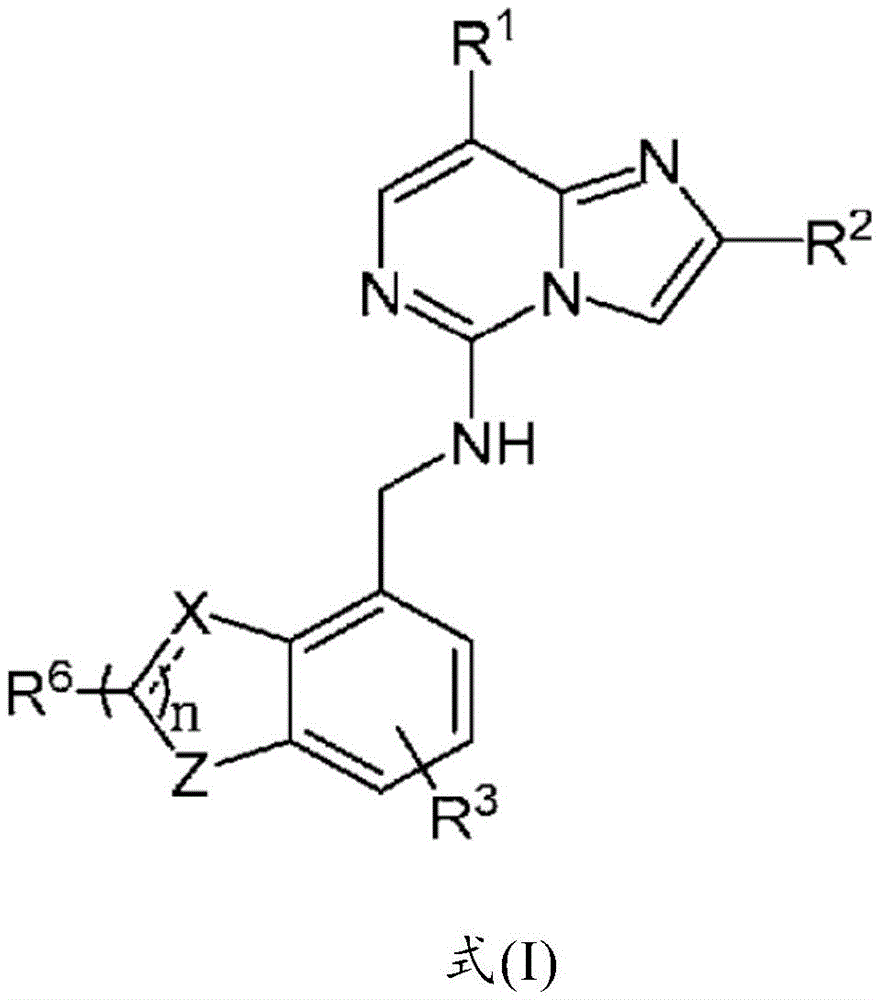
Description
Cross Reference to Related Applications
This application claims priority to U.S. application No. 62/857,515 filed on 5.6.2019, the disclosure of which is incorporated herein by reference in its entirety.
Technical Field
The present invention relates to compounds that inhibit polycomb inhibitory complex 2(PRC 2). In particular, the invention relates to compounds, pharmaceutical compositions comprising the compounds and methods of use thereof.
Background
Polycomb inhibitory complex 2(PRC2) is a multiprotein complex that contributes to epigenetic silencing of target genes to regulate development and homeostasis. The PRC2 complex comprises three core subunits: enhancer of zeste homolog 2(enhancer of zeste homolog 2, EZH2), embryonic ectodermal developmental protein (EED), and zeste 12 inhibitor (supress of zeste 12, SUZ 12). The function of the two additional nonessential subunits, AEBP2 and RbAp48, is to promote the enzymatic activity of the PRC2 complex (see, e.g., Cao et al, (2002) Science 298: 1039-1043).
EZH2 (the catalytic subunit of the PRC2 complex) is a histone methyltransferase that functions to silence target genes by trimethylating the lysine at position 27 of histone H3 (H3K27me 3). The EED is responsible in part for recognizing trimethylated histone H3 lysine 27 and serves as a scaffold protein for assembly of the PRC2 complex. The interaction between the EZH2 subunit and the EED subunit is essential for histone methyltransferase activity and function of the PRC2 complex (see, e.g., Denisenko et al, (1998) mol. cell biol.18: 5631-.
Aberrant PRC2 expression has been reported in several cancers. EZH2 is overexpressed in aggressive solid tumors including prostate, breast, skin, bladder, liver, pancreatic, and head and neck cancers. For example, EZH2 transcripts and proteins persist in invasive breast cancers and are closely associated with the aggressiveness of breast cancer, compared to normal breast epithelium. Overexpression of EZH2 in immortalized human mammary epithelial cell lines promotes anchorage-independent growth and cell invasion. Cell invasion mediated by EZH2 requires an intact SET domain and histone deacetylase activity (Kleer et al, (2003) Proc. Natl Acad. Sci USA100(20): 11606-11611). The risk of recurrence following prostatectomy is also greater in tumors expressing high levels of EZH2 (Varambally et al, (2008) Science322: 1695-1699).
In addition to overexpression, somatic activation and inactivation mutations of EZH2 subunit were also reported. Somatic activation mutations of EZH2 have been found in follicular lymphomas and diffuse large B-cell lymphomas that result in elevated levels of H3K27me3 (for a review see Helin and Dhanak (2013) Nature 502: 480-83488; Pasqualucci et al, (2011) Nature Genet.43(9): 830-837). These mutations, along with overexpression of EZH2 in various solid tumors, suggest that misregulation of EZH2 can result in silencing of genes important for tumor growth and survival by the PRC2 complex. Interestingly, however, inhibitors of the PRC2 complex targeting the non-catalytic subunit (e.g., EED) maintained potent activity on cell lines carrying EZH2 activation mutations (e.g., He et al, (2017) Nat Chem biol.:13(8):922.doi:10.1038/nchembio0817-922 b).
Disclosure of Invention
PRC2 activity promoted undesired cell proliferation and tumor cell invasiveness in part through trimethylation of H3K 27. Since increased levels of H3K27me3 can lead to cancer aggressiveness in many tumor types, inhibition of PRC2 activity will provide therapeutic benefits for a variety of cancers. The compounds of the invention provide therapeutic benefits as inhibitors of binding to the EED subunit and are useful for down-regulating the activity of PRC2 in cells and for treating various forms of cancer.
There is a need to develop new PRC2 inhibitors that retain potency against EZH2 activating mutations and exhibit improved cellular potency, efficacy, stability and safety compared to inhibitors targeting the SET domain of EZH 2. Regardless of EZH2 mutation status or expression level, the compounds and compositions of the present invention advantageously overcome one or more of these disadvantages by providing potent, selective orally active compounds that bind to EED and inhibit PRC2 activity.
In one aspect of the present invention, there is provided a compound represented by formula (I):

or a pharmaceutically acceptable salt thereof:
wherein:

z is O or S;
x is O, CR11、CR11OH or C (R)11)2Wherein:
when the group X is a group of atoms selected from the group consisting of O, is a single bond;
when X is C (R)11)2When the temperature of the water is higher than the set temperature, is a single bond;
when X is CR11When the reaction solution is in the OH group, is a single bond; or
When X is CR11When the temperature of the water is higher than the set temperature, is a double bond;
R1is aryl, heteroaryl, -L-cycloalkyl or-L-heterocyclyl, wherein the cyclic moiety of aryl, heteroaryl and-L-cycloalkyl and-L-heterocyclyl is optionally substituted by one or more R4Substitution;
R2is-C (R5)aR5b)R7Or a heteroaryl group;
each R3Independently is C1-C3 alkyl or halogen;
each R4Independently cyano, halogen, alkoxy, hydroxyalkyl, heteroalkyl, alkyl halideradical-Y2-a haloalkyl group; -Y1-C1-C6 alkyl, -Y2-C1-C6 alkyl, -L-cycloalkyl, -L-heteroaryl, -L-heterocyclyl, -Y1-heterocyclyl, -L-N (R)11)2、-Y1-N(R11)2or-Y2-N(R11)2wherein-L-cycloalkyl, -L-heteroaryl, -L-heterocyclyl and-Y1-the ring of the heterocyclyl is optionally substituted by one or more R9Substitution;
l is a bond or C1-C4 alkylene;
Y1is a bond, -C (O) -or-NHC (O) -;
Y2is a bond, -S-, -SO-, -SO2-or-NR5SO2-;
R5aAnd R5bEach independently is hydrogen, C1-C3 alkyl, haloalkyl, cycloalkyl or aryl, wherein R is5aOr R5bAt least one of which is hydrogen;
R6is hydrogen, C1-C3 alkyl, halogen, haloalkyl, hydroxyalkyl or heteroalkyl;
R7is-NR8a8bWherein R is8aAnd R8bTogether with the nitrogen atom to which each is attached form a 4-8 membered saturated or partially saturated heterocyclic group, which 4-8 membered saturated or partially saturated heterocyclic group optionally contains 1,2 or 3 heteroatoms selected from-O-, -N-or-S-and is optionally substituted by one or more R10Substitution; or
R7is-OR8aor-NHR8aWherein R is8aIs hydrogen, C1-C3 alkyl, cycloalkyl, aralkyl, or halosulfonylalkyl;
each R9Independently oxo, cyano, hydroxy, alkoxy, halogen, haloalkyl, hydroxyalkyl, heteroalkyl, cycloalkyl, -L-N (R)11)2C1-C6 alkyl or-Y1-heterocyclyl, wherein-Y1-heterocyclyl is optionally substituted by one or more R10Substitution;
each R10Independently oxo, cyano, hydroxy, alkoxy, halogen, haloalkyl, hydroxyalkyl or heteroalkyl;
each R11Independently hydrogen or C1-C3 alkyl; and is
n is 1 or 2.
In another aspect of the invention, there is provided a pharmaceutical composition comprising a therapeutically effective amount of a compound of the invention, or a pharmaceutically acceptable salt thereof, and a pharmaceutically acceptable excipient.
In yet another aspect of the invention, there is provided a method for inhibiting PRC2 activity in a cell, comprising contacting the cell with a compound of formula I. In one embodiment, the contacting is performed in vitro. In one embodiment, the contacting is performed in vivo.
Also provided herein is a method of inhibiting cell proliferation in vitro or in vivo, comprising contacting a cell with an effective amount of a compound of formula I as defined herein, or a pharmaceutically acceptable salt thereof, or a pharmaceutical composition thereof.
Also provided are methods for treating cancer in a patient comprising administering to a patient in need thereof a therapeutically effective amount of a compound or pharmaceutical composition of the invention, or a pharmaceutically acceptable salt thereof.
Also provided herein are methods of treating cancer in a patient in need thereof, the methods comprising (a) determining that the cancer is associated with a PRC2 mutation (e.g., a PRC 2-associated cancer); and (b) administering to the patient a therapeutically effective amount of a compound of formula I or a pharmaceutically acceptable salt thereof or a pharmaceutical composition thereof.
Also provided herein is the use of a compound of formula I as defined herein, or a pharmaceutically acceptable salt or solvate thereof, in the manufacture of a medicament for inhibiting PRC2 activity.
Also provided herein is the use of a compound of formula I, or a pharmaceutically acceptable salt or solvate thereof, as defined herein, in the manufacture of a medicament for the treatment of a PRC 2-associated disease or disorder.
Detailed Description
The present invention relates to PRC2 inhibitors. In particular, the present invention relates to compounds that bind to EEDs to inhibit PRC2 activity, pharmaceutical compositions comprising a therapeutically effective amount of the compounds, and methods of use thereof.
Definition of
Unless otherwise defined, all terms and ranges used herein have the same meaning as commonly understood by one of ordinary skill in the art to which this invention belongs, unless explicitly defined otherwise. All patents, patent applications, and publications cited herein are incorporated by reference to the extent they are consistent with this disclosure.
For simplicity, chemical moieties are defined and referred to throughout primarily as monovalent chemical moieties (e.g., alkyl, aryl, etc.). However, such terms may also be used to express corresponding multivalent moieties in the context of appropriate structures as will be clear to those skilled in the art. For example, while an "alkyl" moiety generally refers to a monovalent radical (e.g., CH)3-CH2-) but in some cases the divalent linking moiety may be an "alkyl" group, in which case one of skill in the art would understand that alkyl is a divalent radical (e.g., -CH2-CH2-, which corresponds to the term "alkylene". (similarly, where a divalent moiety is required and is referred to as an "aryl," those skilled in the art will understand that the term "aryl" refers to the corresponding divalent moiety, arylene). All atoms are understood to have their normal valences for forming a bond (i.e., carbon is 4, N is 3, O is 2, S is 2,4, or 6, depending on the oxidation state of S).
As used herein, "polycomb inhibition complex 2" or "PRC 2 complex" refers to a polypeptide comprising three core subunits: the zeste homolog enhancer 2(EZH2), embryonic ectodermal developmental protein (EED), and zeste 12 repressor (SUZ12), as well as two additional non-essential subunits AEBP2 and RbAp 48.
As used herein, "EED" refers to the embryonic ectodermal developmental protein subunit of the PRC2 complex.
As used herein, "EZH 2" or "EZH 2 enzyme" refers to a mammalian histone methyltransferase, which is the catalytic subunit of polycomb inhibition complex 2(PRC2), and functions to silence a target gene by trimethylating the lysine at position 27 of histone H3 (H3K27me 3).
As used herein, "PRC 2 inhibitor" refers to a compound of the invention represented by formula (I) as described herein. These compounds are capable of negatively modulating or inhibiting all or part of the enzymatic activity of the PRC2 complex. While not wishing to be bound by any theory, we speculate that the inhibitors of the present invention may inhibit PRC2 enzymatic activity by binding to EED to prevent assembly of the PRC2 complex to the histone H3 tail, thereby inhibiting its activity.
As used herein, "PRC 2-associated disease or disorder" refers to a disease or disorder that has, is associated with, or is mediated by aberrant expression of activating EZH2 mutations and/or PRC 2. A non-limiting example of a PRC 2-associated disease or disorder is a PRC 2-associated cancer.
The term "amino" refers to the group-NH2。
The term "acetyl" refers to "-C (O) CH3”。
As used herein, the term "acyl" refers to an alkylcarbonyl or arylcarbonyl substituent, wherein the alkyl and aryl moieties are as defined herein.
As used herein, the term "alkyl" refers to straight and branched chain aliphatic groups having 1 to 12 carbon atoms. Thus, "alkyl" includes C1、C2、C3、C4、C5、C6、C7、C8、C9、C10、C11And C12A group. Examples of alkyl groups include, but are not limited to, methyl, ethyl, propyl, isopropyl, butyl, isobutyl, sec-butyl, tert-butyl, pentyl, and hexyl.
As used herein, the term "alkenyl" refers to an unsaturated straight or branched aliphatic group having one or more carbon-carbon double bonds, having from 2 to 12 carbon atoms. Thus, "alkenyl" includes C2、C3、C4、C5、C6、C7、C8、C9、C10、C11And C12A group. Examples of alkenyl groups include, but are not limited to, ethenyl, propenyl, butenyl, pentenyl, and hexenyl.
The term "alkynyl" as used herein refers to an unsaturated straight chain having one or more carbon-carbon triple bondsOr a branched aliphatic group having 2 to 12 carbon atoms. Thus, "alkynyl" includes C2、C3、C4、C5、C6、C7、C8、C9、C10、C11And C12A group. Examples of alkynyl groups include, but are not limited to, ethynyl, propynyl, butynyl, pentynyl, and hexynyl.
An "alkylene," "alkenylene," or "alkynylene" group is an alkyl, alkenyl, or alkynyl group, as defined above, that is located between and serves to link two other chemical groups. Examples of alkylene groups include, but are not limited to, methylene, ethylene, propylene, and butylene. Exemplary alkenylene groups include, but are not limited to, ethenylene, propenylene, and butenylene. Exemplary alkynylene groups include, but are not limited to, ethynylene, propynyl, and butynyl.
The term "alkoxy" refers to-OC 1-C6 alkyl.
As used herein, the term "cycloalkyl" is a saturated and partially unsaturated cyclic hydrocarbon group having from 3 to 12 carbons. Thus, "cycloalkyl" includes C3、C4、C5、C6、C7、C8、C9、C10、C11And C12A cyclic hydrocarbon group. Examples of cycloalkyl groups include, but are not limited to, cyclopropyl, cyclobutyl, cyclopentyl, cyclopentenyl, cyclohexyl, cyclohexenyl, cycloheptyl, and cyclooctyl.
The term "heteroalkyl" refers to an alkyl group as defined above wherein one or more carbon atoms in the chain are independently replaced with O, S or NRxIs substituted in which RxIs hydrogen or C1-C3 alkyl. Examples of heteroalkyl groups include methoxymethyl, methoxyethyl, and methoxypropyl.
An "aryl" group is C comprising 1 to 3 aromatic rings6-C14An aromatic moiety. Thus, "aryl" includes C6、C10、C13And C14A cyclic hydrocarbon group. An exemplary aryl group is C6-C10An aryl group.Specific aryl groups include, but are not limited to, phenyl, naphthyl, anthracenyl, and fluorenyl.
An "aralkyl" or "arylalkyl" group includes an aryl group covalently linked to an alkylene group wherein the moiety is linked to another group through an alkyl moiety. Exemplary aralkyl groups are- (C1-C6) alkyl (C6-C10) aryl groups, including but not limited to benzyl, phenethyl, and naphthylmethyl.
A "heterocyclyl" or "heterocyclic" group is a monocyclic or bicyclic (fused or spiro) ring structure having 3 to 12 atoms (3, 4,5, 6, 7, 8, 9, 10, 11, or 12 atoms), for example 4 to 8 atoms, in which one or more ring atoms are independently-C (O) -, N, NR5O or S, the remaining ring atoms being quaternary or carbonyl carbons. Examples of heterocyclyl groups include, but are not limited to, epoxy, oxirane, oxetanyl, azetidinyl, aziridinyl, tetrahydrofuryl, tetrahydropyranyl, tetrahydrothienyl, pyrrolidinyl, piperidinyl, piperazinyl, imidazolidinyl, thiazolidinyl, thietanyl (thiatanyl), dithianyl, trithianyl, azathianyl, oxathianyl, dioxolanyl, oxazolidinyl, oxazolidinonyl, decahydroquinolinyl, piperidinonyl, 4-piperidinonyl, thiomorpholinyl, dimethyl-morpholinyl, and morpholinyl. Specifically excluded from the scope of this term are compounds having adjacent ring O and/or S atoms.
As used herein, "-L-heterocyclyl" refers to a heterocyclyl group covalently attached to another group through an alkylene linker L, where L is C1-C4 alkylene.
As used herein, the term "heteroaryl" refers to a group having 5 to 14 ring atoms, preferably 5,6, 10, 13, or 14 ring atoms; sharing 6, 10 or 14 pi electrons in the ring array; and, in addition to carbon atoms, from 1 to 3 heteroatoms each independently N, O or S. "heteroaryl" also includes fused polycyclic (e.g., bicyclic) ring systems wherein one or more fused rings are non-aromatic, provided that at least one ring is aromatic and at least one ring contains N, O or the S ring atom.
Examples of heteroaryl groups include acridinyl, azocinyl (azocinyl), benzimidazolyl, benzofuranyl, benzo [ d ] oxazol-2 (3H) -one, 2H-benzo [ b ] [1,4] oxazin-3 (4H) -one, benzothiofuranyl, benzothiophenyl, benzoxazolyl, benzothiazolyl, benzotriazolyl, benzotetrazolyl, benzisoxazolyl, benzisothiazolyl, benzimidazolinyl, carbazolyl, 4 aH-carbazolyl, carbolinyl, chromanyl, chromenyl, cinnolinyl, furanyl, furoyl, imidazolinyl, imidazolyl, 1H-indazolyl, indolinyl (indolinyl), indolinyl, indolizinyl, indolyl, 3H-indolyl, isobenzofuranyl, isochromanyl, isoindolyl, isoindolinyl, isoquinolyl, isothiazolyl, isoxazolyl, naphthyridinyl, octahydroisoquinolyl, oxadiazolyl, 1,2, 3-oxadiazolyl, 1,2, 4-oxadiazolyl, 1,2, 5-oxadiazolyl, 1,3, 4-oxadiazolyl, oxazolidinyl, oxazolyl, oxazolidinyl, pyrimidinyl, phenanthridinyl, phenanthrolinyl, phenazinyl, phenothiazinyl, phenoxathiyl, phenoxazinyl, phthalazinyl, piperonyl, pteridinyl, purinyl, pyranyl, pyrazinyl, pyrazolidinyl, pyrazolinyl, pyrazolyl, pyridazinyl, pyridooxazole, pyridoimidazole, pyridothiazole, pyridyl (pyridinyl), pyridyl (pyridinol), pyrimidinyl, pyrrolinyl, 2H-pyrrolyl, quinazolinyl, quinolyl, 4H-quinolizinyl, quinoxalyl, quinuclidinyl, tetrahydroisoquinolyl, 1,2, 3-oxadiazolyl, phenazinyl, phenothiazinyl, phenoxazinyl, and the like, Tetrahydroquinolyl, tetrazolyl, 6H-1,2, 5-thiadiazinyl, 1,2, 3-thiadiazolyl, 1,2, 4-thiadiazolyl, 1,2, 5-thiadiazolyl, 1,3, 4-thiadiazolyl, thianthrenyl, thiazolyl, thienyl, thienothiazolyl, thienooxazolyl, thienoimidazolyl, thiophenyl, triazinyl, 1,2, 3-triazolyl, 1,2, 4-triazolyl, 1,2, 5-triazolyl, 1,3, 4-triazolyl, and xanthenyl.
The "-L-heteroaryl", "heteroaralkyl", or "heteroarylalkyl" group comprises a heteroaryl group covalently linked to another group through an alkylene linker. Examples of heteroarylalkyl groups include C1–C6Alkyl groups and heteroaryl groups having 5,6, 9 or 10 ring atoms. Examples of heteroaralkyl groups include pyridylmethyl, pyridylethyl, pyrrolylmethylPyrrolylethyl, imidazolylmethyl, imidazolylethyl, thiazolylmethyl, thiazolylethyl, benzimidazolylmethyl, benzimidazolylethyl, quinazolinylmethyl, quinolinylmethyl, quinolinylethyl, benzofuranylmethyl, indolinylethyl, isoquinolinylmethyl, isoindolylmethyl, cinnolinylmethyl, and benzothiophenylethyl. Specifically excluded from the scope of this term are compounds having adjacent ring O and/or S atoms.
An "arylene", "heteroarylene" or "heterocyclylene" group is a divalent aryl, heteroaryl or heterocyclyl group, respectively, as defined above, located between and used to link two other chemical groups.
As used herein, when a moiety (e.g., cycloalkyl, aryl, heteroaryl, heterocyclyl, urea, etc.) is described as "optionally substituted" without explicit specification of substituents, it is meant that the group optionally has 1 to 4, preferably 1 to 3, more preferably 1 or 2 non-hydrogen substituents.
As used herein, the term "halogen" or "halo" refers to chlorine, bromine, fluorine, or iodine.
The term "haloalkyl" refers to an alkyl chain wherein one or more hydrogens are replaced with a halogen. Exemplary haloalkyl groups are trifluoromethyl, difluoromethyl, fluorochloromethyl, chloromethyl and fluoromethyl.
As defined herein, the term "hydroxyalkyl" refers to an alkyl chain wherein at least one hydrogen is replaced by a hydroxyl group.
As used herein, an "effective amount" of a compound is an amount sufficient to down-regulate or inhibit the activity of PRC2 complex.
As used herein, a "therapeutically effective amount" of a compound is an amount sufficient to ameliorate or in some way reduce symptoms or halt or reverse the progression of a condition, or negatively modulate or inhibit the activity of PRC2 complex. Such amounts may be administered as a single dose or may be administered according to an effective regimen.
As used herein, "treatment" refers to any manner of ameliorating or otherwise beneficially altering the symptoms or pathology of a condition, disorder, or disease in a patient.
As used herein, "ameliorating the symptoms of a particular disorder by administering a particular compound or pharmaceutical composition" refers to any alleviation, whether permanent or temporary, permanent or transient, attributable to or associated with the administration of the composition.
Compound (I)
In one aspect of the present invention, there is provided a compound represented by formula (I):

or a pharmaceutically acceptable salt thereof:
wherein:

z is O or S;
x is O, CR11、CR11OH or C (R)11)2Wherein:
when the group X is a group of atoms selected from the group consisting of O, is a single bond;
when X is C (R)11)2When the temperature of the water is higher than the set temperature, is a single bond;
when X is CR11When the reaction solution is in the OH group,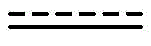 is a single bond; or
When X is CR11When the temperature of the water is higher than the set temperature, is a double bond;
R1is aryl, heteroaryl, -L-cycloalkylor-L-heterocyclyl, wherein the cyclic moiety of aryl, heteroaryl and-L-cycloalkyl and-L-heterocyclyl is optionally substituted by one or more R4Substitution;
R2is-C (R5)aR5b)R7Or a heteroaryl group;
each R3Independently is C1-C3 alkyl or halogen;
each R4Independently cyano, halogen, alkoxy, hydroxyalkyl, heteroalkyl, haloalkyl, -Y2-a haloalkyl group; -Y1-C1-C6 alkyl, -Y2-C1-C6 alkyl, -L-cycloalkyl, -L-heteroaryl, -L-heterocyclyl, -Y1-heterocyclyl, -L-N (R)11)2、-Y1-N(R11)2or-Y2-N(R11)2wherein-L-cycloalkyl, -L-heteroaryl, -L-heterocyclyl or-Y1-the ring of the heterocyclyl is optionally substituted by one or more R9Substitution;
l is a bond or C1-C4 alkylene;
Y1is a bond, -C (O) -or-NHC (O) -;
Y2is a bond, -S-, -SO-, -SO2-or-NR5SO2-;
R5aAnd R5bEach independently is hydrogen, C1-C3 alkyl, haloalkyl, cycloalkyl or aryl, wherein R is5aOr R5bAt least one of which is hydrogen;
R6is hydrogen, C1-C3 alkyl, halogen, haloalkyl, hydroxyalkyl or heteroalkyl;
R7is-NR8a8bWherein R is8aAnd R8bTogether with the nitrogen atom to which each is attached form a 4-8 membered saturated or partially saturated heterocyclyl, said 4-8 membered saturated or partially saturated heterocyclyl optionally containing 1,2 or 3 heteroatoms selected from-O-, -N-or-S-and optionally substituted with one or more R10Substitution; or
R7is-OR8aor-NHR8aWherein R is8aIs hydrogen, C1-C3 alkyl, cycloalkyl, aralkyl, or halosulfonylalkyl;
each R9Independently oxo, cyano, hydroxy, alkoxy, halogen, haloalkyl, hydroxyalkyl, heteroalkyl, cycloalkyl, -L-N (R)11)2C1-C6 alkyl or-Y1-heterocyclyl, wherein-Y1-heterocyclyl is optionally substituted by one or more R10Substitution;
each R10Independently oxo, cyano, hydroxy, alkoxy, halogen, haloalkyl, hydroxyalkyl or heteroalkyl;
each R11Independently hydrogen or C1-C3 alkyl; and is
n is 1 or 2.
In one embodiment, Z is O or S. In one embodiment, X is O, CR11、CR11OH or C (R)11)2Wherein when X is O, the compound is, is a single bond; when X is C (R)11)2When the temperature of the water is higher than the set temperature,
 is a single bond; when X is CR11When the reaction solution is in the OH group,
 is a single bond; or when X is CR11When the temperature of the water is higher than the set temperature,
 is a double bond. In one embodiment, n is 1. In one embodiment, n is 2.
In one embodiment, Z is O, X is O, n is 1 and is a single bond. In another embodiment, Z is O and X is CR11And is
 Is a double bond. In one embodiment, Z is O and X is C (R)11)2N is 1 and
 is a single bond. In one embodiment, Z is O and X is CR11OH, n is 1 and
 is a single bond. In another embodiment, Z is O and X is C (R)11)2N is 2 and
 is a single bond. In yet another embodiment, Z is S and X is C (R)11)2N is 1 and
 is a single bond.
In one embodiment of the compounds of formula (I), R1Is aryl, optionally substituted by one or more R4And (4) substitution. In certain embodiments, the aryl group is phenyl, optionally substituted with one or more R4And (4) substitution.
In one embodiment of the compounds of formula (I), the aryl group is substituted with a single R4And (4) substituting the group. In one embodiment, the aryl group is substituted with two R4And (4) substituting the group. In one embodiment, the aryl group is substituted with three R4And (4) substituting the group. Exemplary aryl radicals R4Groups include halogen, hydroxy, haloalkyl, -Y1-C1-C6 alkyl, -Y2-C1-C6 alkyl, -L-N (R)11)2、-Y1-N(R11)2、-Y2-N(R11)2、-Y2-haloalkyl, -L-heterocyclyl or-Y1-heterocyclyl, wherein-L-heterocyclyl or-Y1-the heterocyclyl part of the heterocyclyl is optionally substituted by one or more R9And (4) substitution.
In one embodiment of the compounds of formula (I), R1Is a quilt-Y2-C1-C6 alkyl substituted phenyl. In one embodiment, Y2Is a bond and C1-C6 alkyl is methylAlkyl, ethyl or isopropyl. In one embodiment, R1Is a quilt-Y2-C1-C6 alkyl-substituted phenyl, wherein Y2is-SO2-and the C1-C6 alkyl is methyl. In one embodiment, R1Is phenyl, which is substituted by methyl and-Y2-C1-C6 alkyl disubstituted wherein Y2is-SO2-and the C1-C6 alkyl is methyl.
In one embodiment of the compounds of formula (I), R1Is represented by an R4Substituted phenyl, wherein R4Is a cyano group.
In one embodiment of the compounds of formula (I), R1Is represented by an R4Substituted phenyl, wherein R4is-L-heteroaryl. In certain embodiments, -L-heteroaryl is tetrazolyl. In one embodiment, R1Is represented by an R4Substituted phenyl, wherein R4is-PO3(C1-C3 alkyl)2. In one embodiment, R1Is represented by an R4Substituted phenyl, wherein R4is-COOR11. In one embodiment, R1Is represented by an R4Substituted phenyl, wherein R4is-O-L-N (R)11)2. In one embodiment, R1Is represented by an R4Substituted phenyl, wherein R4Is an aralkyl group.
In one embodiment of the compounds of formula (I), R1Is substituted by at least one R4Substituted phenyl, wherein R4is-L-N (R)11)2. In one embodiment, L is a bond. In one embodiment, L is methylene. In one embodiment, each R is11Independently hydrogen. In one embodiment, each R is11Independently is a C1-C3 alkyl group. In one embodiment, each C1-C3 alkyl group is methyl. In one embodiment, one R is11Is a C1-C3 alkyl group and the other is hydrogen. In one embodiment, one C1-C3 alkyl group is methyl. In one embodiment, R1Is represented by-L-N (R)11)2Substituted and further substituted by one or more halogensAnd/or phenyl substituted by C1-C6 alkyl.
In one embodiment of the compounds of formula (I), R1Is represented by an R4Substituted phenyl, wherein R4is-Y1-N(R11)2. In certain embodiments, Y1is-C (O) -and each R11Is a C1-C3 alkyl group. In one embodiment, each C1-C3 alkyl group is methyl. In one embodiment, Y1is-C (O) -and each R11Is hydrogen. In one embodiment, Y1is-C (O) -and one R11Is a C1-C3 alkyl group and the other is hydrogen. In one embodiment, one C1-C3 alkyl group is methyl. In one embodiment, R1Is a quilt-Y1-N(R11)2Phenyl substituted and further substituted with one or more halogens and/or C1-C6 alkyl.
In one embodiment of the compounds of formula (I), R1Is a quilt-Y2-haloalkyl-substituted phenyl, wherein Y2is-S-or-SO2-and haloalkyl is trifluoromethyl.
In one embodiment of the compounds of formula (I), R1Is substituted by at least one-L-heterocyclyl or-Y1-phenyl substituted by heterocyclyl, each heterocyclyl being optionally substituted by one or more R9And (4) substitution. In one embodiment, R1Is represented by an R4Substituted phenyl, wherein R4Is optionally substituted by one or more R9substituted-Y1-a heterocyclic group. In one embodiment, Y1is-C (o) -and heterocyclyl is piperazinyl optionally substituted by C1-C3 alkyl.
In certain embodiments of the compounds of formula (I), R4The radicals being optionally substituted by one or more R9substituted-L-heterocyclyl. In one embodiment, L is methylene and heterocyclyl is pyrrolidinyl, piperidinyl, piperazinyl, or 4-methyl-piperazinyl. In one embodiment, L is methylene and heterocyclyl is azetidinyl, pyrrolidinyl, piperidinyl, piperazinyl, piperazinone, tetrahydropyranyl, morpholinyl, thiomorpholinyl, or dimorpholinylAzepanyl, each of which is optionally substituted with one or more R9And (4) substitution. Exemplary R9Groups include oxo, halo, hydroxyalkyl, and C1-C3 alkyl.
In one embodiment of the compounds of formula (I), R1Is a quilt-Y1-heterocyclyl-substituted phenyl, the radical-Y1-heterocyclyl is optionally substituted by one or more R9And (4) substitution. In certain embodiments, Y1Is-c (o) -and heterocyclyl is azetidinyl, pyrrolidinyl, piperidinyl, piperazinyl or 4-methyl-piperazinyl, each of which is optionally further substituted with one or more halogens.
In one embodiment of the compounds of formula (I), R1Is phenyl substituted by-L-heteroaryl, optionally substituted by one or more R9And (4) substitution. In certain embodiments, -L-heteroaryl is tetrazolyl.
In one embodiment of the compounds of formula (I), R1Is a quilt-PO3(C1-C3 alkyl)2A substituted phenyl group. In another embodiment, R1Is by-COOR11A substituted phenyl group. In one embodiment, R1Is hydroxyalkyl, -O-L-N (R)11)2Or aralkyl substituted phenyl.
In one embodiment of the compounds of formula (I), R1Is heteroaryl, optionally substituted with one or more R4And (4) substitution. In certain embodiments, heteroaryl is pyrazolyl, imidazolyl, oxazolyl, isoxazolyl, thiazolyl, triazinyl, pyridyl-2-one, pyrazinyl, pyridazinyl, pyrimidinyl, or 5, 6-dihydro-4H-pyrrolo [1,2-b ]]Pyrazolyl, each of which is optionally substituted by one or more R4And (4) substitution.
In one embodiment of the compounds of formula (I), the heteroaryl group is substituted with a single R4And (4) substituting the group. In one embodiment, the heteroaryl is substituted with two R4And (4) substituting the group. In one embodiment, the heteroaryl is substituted with three R4And (4) substituting the group. Exemplary heteroaryl groups R4Groups include amino, cyano, halogen, alkoxy, hydroxyalkyl, heteroalkyl, haloalkyl, -Y2-haloalkyl, -Y1-C1-C6 alkyl, -Y2-C1-C6 alkyl, -L-cycloalkyl, -L-heteroaryl, -L-heterocyclyl, -Y1-heterocyclyl, -L-N (R)11)2or-Y1-N(R11)2wherein-L-cycloalkyl, -L-heteroaryl, -L-heterocyclyl and-Y1-the ring of the heterocyclyl is optionally substituted by one or more R9And (4) substitution.
In one embodiment of the compounds of formula (I), R9Is amino, hydroxy, cyano, alkoxy or halogen. In one embodiment, R7Is a C1-C3 alkyl group. In one embodiment, R9Is halogen, wherein halogen is fluorine or chlorine. In one embodiment, R9Is alkoxy, wherein alkoxy is methoxy or ethoxy. In one embodiment, R9Is cycloalkyl, wherein cycloalkyl is cyclopropyl.
In another embodiment of the compounds of formula (I), R1Is heteroaryl and each R4Independently is hydroxyalkyl, heteroalkyl, or haloalkyl. In certain embodiments, the hydroxyalkyl group is hydroxymethyl, hydroxyethyl, or 2-methyl, 2-hydroxypropyl. In certain embodiments, the heteroalkyl is methoxymethyl or methoxyethyl. In certain embodiments, haloalkyl is fluoromethyl, difluoromethyl, trifluoromethyl, fluoroethyl, difluoroethyl or trifluoroethyl.
In certain embodiments of the compounds of formula (I), R1Is heteroaryl and R4is-Y1-C1-C6 alkyl, wherein Y1Is a bond and the C1-C6 alkyl group is methyl, ethyl or isopropyl. In one embodiment, R4is-Y1-C1-C6 alkyl, wherein Y1is-C (O) -and C1-C6 alkyl is methyl, ethyl or isopropyl. In other embodiments, Y1is-NHC (O) -and the C1-C6 alkyl moiety is methyl.
In one embodiment of the compounds of formula (I), R1Is heteroaryl and R4is-Y2-C1-C6 alkyl, wherein Y2is-SO2-and C1-C6 alkyl is methyl. In another embodiment, R4is-Y2-C1-C6 alkyl, wherein Y2is-S-and C1-C6 alkyl is methyl.
In one embodiment of the compounds of formula (I), R1Is heteroaryl, and R4is-Y1-heterocyclyl, optionally substituted by one or more R9And (4) substitution. In one embodiment, Y1Is a bond. In another embodiment, Y1is-C (O) -. In one embodiment, Y1Is a bond and the heterocyclyl is azetidinyl, oxetanyl, tetrahydrofuranyl, tetrahydropyranyl, pyrrolidinyl, piperidinyl, piperazinyl or 4-methyl-piperazinyl. In one embodiment, R9Is a C1-C3 alkyl group. In one embodiment, R9Is a halogen.
In one embodiment of the compounds of formula (I), the heteroaryl is substituted with at least one R4Substituted, R4is-L-heterocyclyl, optionally substituted by one or more R9And (4) substitution. In one embodiment, L is ethylene and heterocyclyl is pyrrolidinyl, piperidinyl, piperazinyl, or 4-methyl-piperazinyl. In one embodiment, L is methylene and heterocyclyl is azetidinyl, pyrrolidinyl, piperidinyl, piperazinyl, piperazinone, tetrahydropyranyl, morpholinyl, thiomorpholinyl, or diazepanyl, each of which is optionally substituted with one or more R9And (4) substitution.
In one embodiment, R9Independently is-L-N (R)11)2Hydroxy, cyano, alkoxy or halogen. In one embodiment, R9Is a C1-C3 alkyl group. In one embodiment, R7Is halogen, wherein halogen is fluorine or chlorine. In one embodiment, R9Is alkoxy, wherein alkoxy is methoxy or ethoxy. In one embodiment, R9Is cycloalkyl, wherein cycloalkyl is cyclopropyl. In one embodiment, R9is-L-N (R)11)2. In one embodiment, L is a bond. In one embodiment, L is methylene. In one embodiment, each R is11Independently hydrogen. In one embodiment, eachR11Independently is a C1-C3 alkyl group. In one embodiment, each C1-C3 alkyl group is methyl. In one embodiment, one R is11Is a C1-C3 alkyl group and the other is hydrogen. In one embodiment, one C1-C3 alkyl group is methyl.
In one embodiment of the compounds of formula (I), R1Is heteroaryl and R4is-L-N (R)11)2. In one embodiment, L is a bond. In one embodiment, L is methylene, ethylene or propylene. In one embodiment, each R is11Independently is a C1-C3 alkyl group. In one embodiment, each C1-C3 alkyl group is methyl. In one embodiment, one R is11Is a C1-C3 alkyl group and the other is hydrogen. In one embodiment, one C1-C3 alkyl group is methyl. In one embodiment, each R is11Independently hydrogen.
In one embodiment of the compounds of formula (I), R1Is heteroaryl, and R4is-L-heteroaryl, optionally substituted by one or more R9And (4) substitution. In one embodiment, L is a bond. In one embodiment, L is a bond C1-C3 alkylene. In one embodiment, the C1-C3 alkylene group is methylene. In certain embodiments, the heteroaryl of the-L-heteroaryl is pyrazolyl, pyridinyl, pyrimidinyl, pyrazinyl, triazinyl, thiazolyl, or pyridazinyl. In one embodiment, the heteroaryl group of the-L-heteroaryl group is a pyridyl group.
In one embodiment of the compounds of formula (I), R1Is represented by two R4A heteroaryl group substituted with the two R4The radicals are independently selected from two-Y1-C1-C6 alkyl; -Y1-C1-C6 alkyl and alkoxy; -Y1-C1-C6 alkyl and cycloalkyl; -Y1-C1-C6 alkyl and haloalkyl; -Y1-C1-C6 alkyl and amino; two alkoxy groups; alkoxy and halogen; alkoxy and cyano; and amino and haloalkyl groups. In certain embodiments, R4is-Y1-C1-C6 alkyl, wherein each Y is1Is a bond and each C1-C6 alkyl group is methyl, ethyl orAnd (3) isopropyl. In one embodiment, the cycloalkyl group is cyclopropyl. In one embodiment, alkoxy is methoxy. In one embodiment, halogen is fluorine or chlorine. In one embodiment, the haloalkyl is trifluoromethyl or trifluoroethyl.
In one embodiment of the compounds of formula (I), R1Is optionally substituted by one or more R4substituted-L-heterocyclyl. In one embodiment, L is a bond and heterocyclyl is tetrahydrofuranyl, piperidinyl, piperazinyl, or morpholinyl. In one embodiment, L is methylene and the heterocyclyl is azetidinyl, pyrrolidinyl or -azabicyclo [3.1.0]And hexyl. In certain embodiments, heterocyclyl is selected from oxo, halo, alkoxy, hydroxy, and-Y1-one or more R of C1-C6 alkyl groups4Wherein Y is a bond or-C (O) -.
In one embodiment of the compounds of formula (I), R2is-C (R5)aR5b)R7. In certain embodiments, R5aIs hydrogen and R5bIs C1-C3 alkyl, haloalkyl, cycloalkyl or aryl. In other embodiments, R5aIs C1-C3 alkyl, haloalkyl, cycloalkyl or aryl and R5bAnd (3) hydrogen.
In one embodiment of the compounds of formula (I), R7is-OR8a. In one embodiment, R8aIs hydrogen or C1-C3 alkyl.
In one embodiment of the compounds of formula (I), R7is-NR8aR8b. In one embodiment, R8aAnd R8bAre all hydrogen. In another embodiment, R8aIs hydrogen and R8bIs C1-C3 alkyl, halosulfonylalkyl, cycloalkyl or aralkyl.
In one embodiment of the compounds of formula (I), R7is-NR8aR8bWherein R is8aAnd R8bTogether with the nitrogen atom to which they are each attached form a 4-to 8-membered saturatedAnd or a partially saturated heterocyclyl, said 4-to 8-membered saturated or partially saturated heterocyclyl optionally containing 1,2 or 3 heteroatoms selected from-O-, -N-or-S-and optionally substituted with one or more R10And (4) substitution. In certain embodiments, the 4-8 membered saturated or partially saturated heterocyclyl is azetidinyl or 3-hydroxy-azetidinyl.
In one embodiment of the compounds of formula (I), R2Is a heteroaryl group. In certain embodiments, heteroaryl is tetrazolyl, oxazolyl, or oxadiazolyl.
In one embodiment, n is 0. In one embodiment, n is 0 and R3Is a halogen. In certain embodiments, the halogen is fluorine or chlorine. In one embodiment, the halogen is fluorine.
In one embodiment, R6Is hydrogen, C1-C3 alkyl, halogen, haloalkyl, hydroxyalkyl or heteroalkyl. In certain embodiments, R6Is hydrogen. In other embodiments, R6Is methyl, ethyl or propyl.
In one embodiment, R4The cyclic radical part of the group being substituted by one R9And (4) substituting the group. In certain embodiments, R9Is oxo, hydroxy, alkoxy, halogen, haloalkyl, hydroxyalkyl, heteroalkyl, cycloalkyl, -L-N (R)11)2Or C1-C3 alkyl. In certain embodiments, R9Is C1-C3 alkyl, wherein C1-C3 alkyl is methyl, ethyl or isopropyl. In certain embodiments, R9Is halogen, wherein halogen is fluorine or chlorine. In certain embodiments, R9Is oxo.
In one embodiment, R4The cyclic radical part of the group being substituted by two R9And (4) substituting the group. In certain embodiments, two R are9The groups are all halogens, wherein each halogen is fluorine.
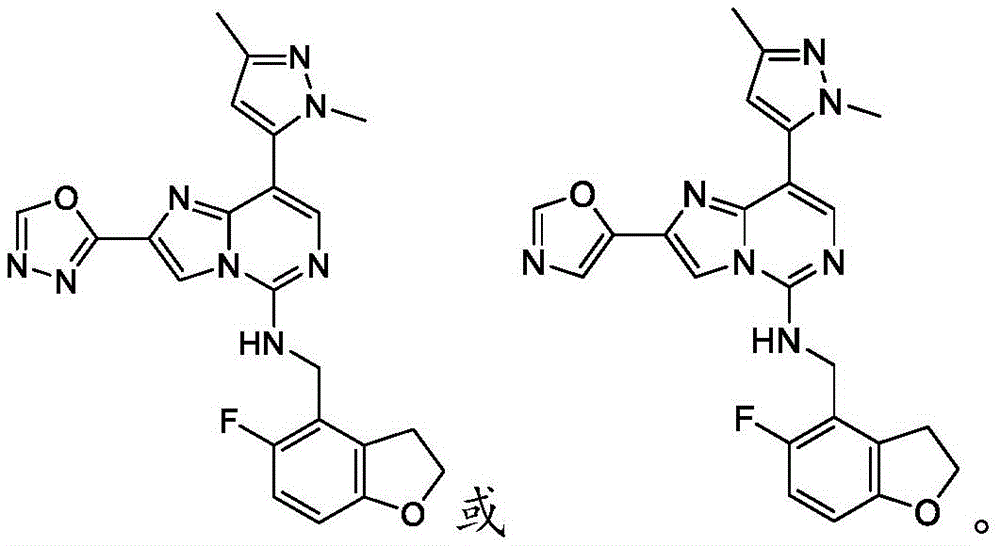
In one embodiment, the compound is:


pharmaceutical composition
In another aspect, the present invention provides a pharmaceutical composition comprising an inhibitor of PRC2 according to the present invention and a pharmaceutically acceptable carrier, excipient or diluent. The compounds of the present invention may be formulated by any method known in the art and may be prepared for administration by any route, including but not limited to parenteral, oral, sublingual, transdermal, topical, intranasal, intratracheal, or intrarectal. In certain embodiments, the compounds of the invention are administered intravenously in a hospital setting. In certain other embodiments, administration by the oral route may be preferred.
The nature of the carrier will depend on the route of administration. As used herein, the term "pharmaceutically acceptable" refers to a non-toxic material that is compatible with biological systems such as cells, cell cultures, tissues, or organisms, and does not interfere with the effectiveness of the biological activity of the active ingredient. Thus, in addition to inhibitors, the compositions according to the present invention may also comprise diluents, fillers, salts, buffers, stabilizers, solubilizers and other materials well known in the art. The preparation of pharmaceutically acceptable formulations is described, for example, in Remington's pharmaceutical Sciences, 18 th edition, a.gennaro, Mack Publishing co., Easton, Pa., 1990.
As used herein, the term "pharmaceutically acceptable salt" refers to a salt that retains the desired biological activity of the above-mentioned compounds and exhibits minimal or no undesirable toxicological effects. Examples of such salts include, but are not limited to, acid addition salts formed with inorganic acids (e.g., hydrochloric acid, hydrobromic acid, sulfuric acid, phosphoric acid, nitric acid, and the like) and salts formed with organic acids such as acetic acid, oxalic acid, tartaric acid, succinic acid, malic acid, ascorbic acid, benzoic acid, tannic acid, pamoic acid, alginic acid, polyglutamic acid, naphthalenesulfonic acid, naphthalenedisulfonic acid, and polygalacturonic acid. The compounds may also be administered as pharmaceutically acceptable quaternary salts known to those skilled in the art, including in particular quaternary ammonium salts of the formula-NR + Z-, wherein R is hydrogen, alkyl or benzyl and Z is a counterion, including chloride, bromide, iodide, -O-alkyl, tosylate, methylsulphonate, sulphonate, phosphate or carboxylate (such as benzoate, succinate, acetate, glycolate, maleate, malate, citrate, tartrate, ascorbate, benzoate, cinnamate (cinmamoate), mandelate (manodelate), benzylate and diphenylacetate).
The active compound is contained in a pharmaceutically acceptable carrier or diluent in an amount sufficient to deliver a therapeutically effective amount to the patient without causing serious toxic effects in the patient being treated. The dose of active compound for all of the above conditions is from about 0.01 to 300mg/kg per day, preferably from 0.1 to 100mg/kg, more usually from 0.5 to about 25mg/kg per day, depending on the weight of the recipient. Typical topical dosages are 0.01-3% wt/wt in a suitable carrier. The effective dosage range of the pharmaceutically acceptable derivative can be calculated based on the weight of the parent compound to be delivered. If the derivative itself exhibits activity, the effective dose may be estimated as above using the weight of the derivative or by other means known to those skilled in the art.
Pharmaceutical compositions comprising the compounds of the invention may be used in the methods described herein.
Application method
In yet another aspect, the invention provides a method for inhibiting PRC2 activity in a cell, comprising contacting a cell in need of inhibition of PRC2 activity with a therapeutically effective amount of a compound of formula (I), a pharmaceutically acceptable salt thereof, or a pharmaceutical composition comprising the compound or a pharmaceutically acceptable salt thereof.
The compositions and methods provided herein are particularly believed to be useful for inhibiting PRC2 activity in a cell. In one embodiment, a cell in need of inhibition of PRC2 activity is contacted with a therapeutically effective amount of a compound of formula (I) to down-regulate the activity of PRC 2. In other embodiments, a therapeutically effective amount of a pharmaceutically acceptable salt or pharmaceutical composition containing a compound of formula (I) may be used.
By negatively regulating the activity of PRC2, particularly in the case of cells overexpressing EZH2 enzyme or somatic mutations that activate EZH2 enzyme, the method aims to restore normal cellular transcriptional expression patterns, for example, by altering the methylation pattern of H3K27 to inhibit undesired cell proliferation due to increased PRC2 activity within the cell. Cells may be contacted in single or multiple doses to affect the desired down-regulation of PRC2 according to a particular treatment regimen. The degree of monomethylation and dimethylation of histone H3K27 can be monitored in cells using well known methods, including those described in example a below, to assess the effectiveness of the treatment, and the dosage can be adjusted accordingly by the attending physician.
In another aspect, there is provided a method of treating cancer comprising administering to a patient having cancer a therapeutically effective amount of a compound of formula (I), a pharmaceutically acceptable salt thereof, or a pharmaceutical composition comprising the compound or a pharmaceutically acceptable salt thereof.
The compositions and methods provided herein can be used to treat a variety of cancers, including tumors, such as prostate cancer, breast cancer, brain cancer, skin cancer, cervical cancer, testicular cancer, and the like. More specifically, cancers that can be treated by the compositions and methods of the invention include, but are not limited to, tumor types such as astrocytic, breast, cervical, colorectal, endometrial, esophageal, gastric, head and neck, hepatocellular, laryngeal, lung, oral, ovarian, prostate, and thyroid cancers and sarcomas. More specifically, these compounds are useful in the treatment of: heart: sarcomas (angiosarcoma, fibrosarcoma, rhabdomyosarcoma, liposarcoma), myxoma, rhabdomyoma, fibroma, lipoma, and teratoma; lung: bronchial carcinoma (squamous cell carcinoma, undifferentiated small cell carcinoma, undifferentiated large cell carcinoma, adenocarcinoma), alveolar (bronchiolar) carcinoma, bronchial adenoma, sarcoma, lymphoma, chondromatous hamartoma, mesothelioma; gastrointestinal tract: esophagus (squamous cell carcinoma, adenocarcinoma, leiomyosarcoma, lymphoma), stomach (carcinoma, lymphoma, leiomyosarcoma), pancreas (ductal adenocarcinoma, insulinoma, glucagonoma, gastrinoma, carcinoid tumor, vipoma), small intestine (adenocarcinoma, lymphoma, carcinoid tumor, kaposi's sarcoma, leiomyoma, hemangioma, lipoma, neurofibroma, fibroma), large intestine (adenocarcinoma, tubular adenoma, villous adenoma, hamartoma, leiomyoma); urogenital tract: kidney (adenocarcinoma, wilm's tumor (nephroblastoma), lymphoma, leukemia), bladder and urethra (squamous cell carcinoma, transitional cell carcinoma, adenocarcinoma), prostate (adenocarcinoma, sarcoma), testis (seminoma, teratoma, embryonal carcinoma, teratocarcinoma, choriocarcinoma, sarcoma, interstitial cell carcinoma, fibroma, fibroadenoma, adenomatoid tumors, lipoma); liver: liver cancer (hepatocellular carcinoma), cholangiocarcinoma, hepatoblastoma, angiosarcoma, hepatocellular adenoma, hemangioma; biliary tract: gallbladder cancer, ampulla cancer, biliary duct cancer; bone: osteogenic sarcoma (osteogenic sarcoma), fibrosarcoma, malignant fibrosarcoma, chondrosarcoma, ewing's sarcoma, malignant lymphoma (reticulosarcoma), multiple myeloma, malignant giant cell tumor chordoma, osteochondroma (osteochondral exogenic bone wart), benign chondroma, chondroblastoma, osteomyxoid fibroma, osteoid osteoma, and giant cell tumor; the nervous system: cranium (osteoma, hemangioma, granuloma, xanthoma, osteitis deformans), meninges (meningioma, meningosarcoma, glioma), brain (astrocytoma, medulloblastoma, glioma, ependymoma, germ cell tumor (pinealoma), glioblastoma multiforme, oligodendroglioma, schwannoma, retinoblastoma, congenital tumor), spinal neurofibroma, meningioma, glioma, sarcoma); gynecological: uterus (endometrial carcinoma), cervix (cervical carcinoma, pre-tumor cervical dysplasia), ovaries (ovarian carcinoma (serous cystadenocarcinoma, mucinous cystadenocarcinoma, undifferentiated carcinoma), granulo-thecal cell tumor, Sertoli-Leydig cell tumor, dysgerminoma, malignant teratoma), vulva (squamous cell carcinoma, intraepithelial carcinoma, adenocarcinoma, fibrosarcoma, melanoma), vagina (clear cell carcinoma, squamous cell carcinoma, botryoid sarcoma (embryonal rhabdomyosarcoma), fallopian tubes (carcinoma), hematology, blood (myeloid leukemia (acute and chronic), acute lymphoblastic leukemia, chronic lymphocytic leukemia, myeloproliferative diseases, multiple myeloma, myelodysplastic syndrome, Hodgkin's disease, non-Hodgkin's lymphoma (malignant lymphoma), skin malignant melanoma, basal cell carcinoma, malignant lymphoma, malignant melanoma, malignant lymphoma, cancer of the cell carcinoma of the skin, and non-induced by-induced tumor, or non-induced tumor, and non-induced by-induced tumor-induced, Squamous cell carcinoma, kaposi's sarcoma, dysplastic nevi, lipoma, hemangioma, dermatofibroma, keloid, psoriasis; and adrenal gland: neuroblastoma. In certain embodiments, the cancer is diffuse large B-cell lymphoma (DLBCL).
The concentration and route of administration to the patient will vary depending on the cancer to be treated. The compounds, pharmaceutically acceptable salts thereof, and pharmaceutical compositions comprising such compounds and salts may also be co-administered with other anti-neoplastic compounds (e.g., chemotherapy), or used in combination with other treatments, such as radiation or surgical intervention, as pre-or post-operative adjunctive therapy. The degree of monomethylation and dimethylation of histone H3K27 in a patient can be monitored using well known methods, including those described in example a below, to assess the effectiveness of the treatment and other prognostic or biological factors, and the dosage can be adjusted accordingly by the attending physician.
General reaction schemes, intermediates and examples
General reaction scheme
The compounds of the invention may be prepared using commercially available reagents and intermediates in the synthetic methods and reaction schemes described herein, or may be prepared using other reagents and conventional methods well known to those skilled in the art.
For example, the compound intermediates of the present invention and the compounds of formula (I) may be prepared according to general reaction schemes I-IV:
general reaction scheme I
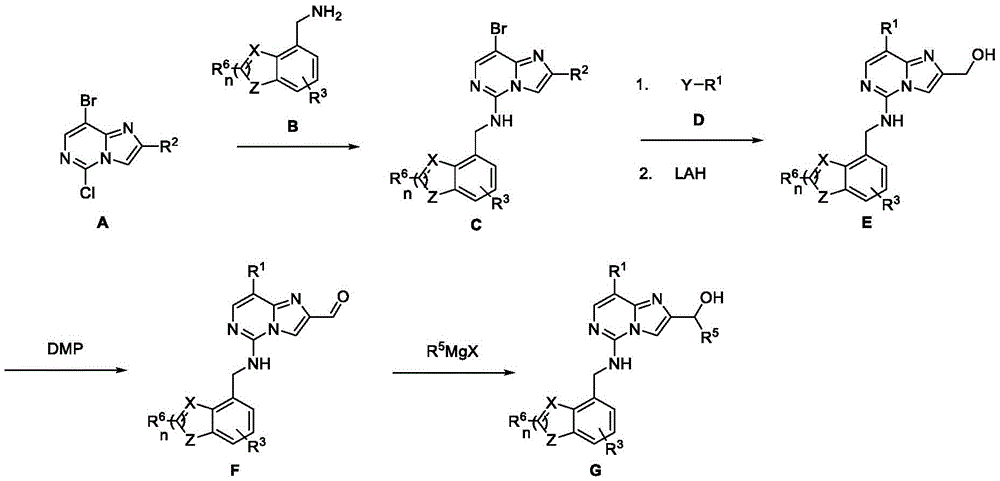
In general reaction scheme I, R is substituted by a nucleophilic substitution2Ester-substituted imidazo [1,2-c]Pyrimidines A and R3Optionally substituted intermediate amine B is coupled to produce intermediate C. Boronic acid derivatives (Y) -R by Suzuki reaction in the presence of a suitable base (e.g. sodium carbonate)1D is coupled with a halogen-substituted intermediate C, and R is reacted by a reducing agent such as lithium aluminum hydride2The ester is converted to an alcohol to produce intermediate alcohol E. Alcohol E is converted to the corresponding aldehyde F by oxidation using a suitable oxidizing agent (e.g., Dess-Martin periodinane) and then converted to a secondary alcohol by treatment with an organometallic reagent such as a grignard reagent to form the title compound alcohol G.
General reaction scheme II

In general reaction scheme II, R is substituted by a nucleophilic substitution2Cyano-substituted imidazo [1,2-c]Pyrimidines H and R3Optionally substituted intermediate amine B is coupled to produce intermediate I. Boronic acid derivatives (Y) -R by Suzuki reaction in the presence of a suitable base (e.g. sodium carbonate)1D is coupled with a halogen-substituted intermediate I, and R is hydrogenated by a metal-mediated hydrogenation reaction using hydrogen and a suitable metal, such as raney nickel2The cyano group is converted to an amine to form the title compound amine J.
General reaction scheme III

In general reaction scheme III, intermediates F and R can be reacted using a suitable reducing agent, such as sodium triacetoxyborohydride8a8bThe optionally substituted intermediate amine K undergoes a reductive amination reaction to form the title compound L.
General reaction scheme IV

In general reaction scheme IV, an organometallic reagent (such as an alkylmagnesium halide) is reacted with R2-cyanoimidazo [1,2-c]Nucleophilic addition of pyrimidine I to give R11Substituted amine intermediate M. The resulting amine M is protected with a suitable protecting group (e.g., t-butyloxycarbonyl) to give intermediate N. The intermediate N can then be reacted with the boronic acid derivative (Y) -R by a Suzuki reaction in the presence of a suitable base (e.g., sodium carbonate)1D is coupled and the protecting group is removed from the resulting product by treatment with a strong acid (e.g., TFA) to afford the desired title compound O.
The following intermediates are intended to illustrate the various intermediates useful in the preparation of the compounds of the present invention and are not intended to limit the scope of the invention.
Intermediate A-1

Exemplary intermediate A, intermediate A-1, is useful in the synthesis of compounds of formula (I). A mixture of 6-amino-5-bromo-1H-pyrimidin-2-one (2.00g, 10.5mmol, 1.00 equiv.) and ethyl 3-bromo-2-oxo-propionate (3.12g, 16.0mmol, 2.00mL, 1.52 equiv.) in DMF (20.0mL) was stirred at 80 ℃ for 3 hours. The mixture was concentrated in vacuo to give a residue. To the residue was added water (50.0mL), the mixture was extracted with ethyl acetate (80.0mL × 3) and the organic layer was concentrated in vacuo. The crude material was heated in methanol (5.00mL) and filtered to remove solids. The filtrate was concentrated under reduced pressure to give ethyl 8-bromo-5-oxo-6H-imidazo [1,2-c ] pyrimidine-2-carboxylate as a yellow solid (1.00g, 3.50mmol, 33.2% yield).
1H NMR(400MHz,DMSO-d6)δ=12.09(br s,1H),8.32(s,1H),7.73(s,1H),4.30(q,J=7.2Hz,2H),1.31(t,J=7.2Hz,3H)。
Will 8-bromo-5-oxo-6H-imidazo [1,2-c ]]Pyrimidine-2-carboxylic acid ethyl ester (500mg, 1.75mmol, 1 equiv.) and DIEA (564mg, 4.37mmol, 760uL, 2.50 equiv.) in POCl3The mixture in (8.00mL) was stirred at 120 ℃ for 15 hours. The mixture was concentrated in vacuo to obtain a crude residue. The crude material was purified by column chromatography (petroleum ether/ethyl acetate, 10/1 to 1/1) to provide 8-bromo-5-chloro-imidazo [1,2-c ] as a yellow solid]Pyrimidine-2-carboxylic acid ethyl ester (380mg, 1.25mmol, 71.4% yield).
1H NMR(400MHz,CD3OD)δ=8.61(s,1H),8.20(s,1H),4.46(q,J=7.2Hz,2H),1.43(t,J=7.2Hz,3H)。
Intermediate A-2
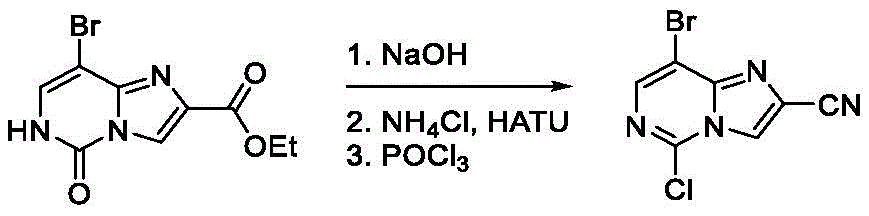
A second exemplary intermediate A, intermediate A-2, is also useful in the synthesis of compounds of formula (I). To a solution of 8-bromo-5-oxo-6H-imidazo [1,2-c ] pyrimidine-2-carboxylic acid ethyl ester (3.00g, 10.2mmol, 1.00 eq) in MeOH (60.0mL) was added NaOH (1M, 30.5mL, 3.00 eq). The resulting mixture was stirred at 60 ℃ for 1 hour. Subsequently, the reaction mixture was concentrated and the pH was adjusted to 4 with 1M aqueous HCl, at which time a precipitate formed. The solid was filtered and dried in vacuo to afford 8-bromo-5-oxo-6H-imidazo [1,2-c ] pyrimidine-2-carboxylic acid as a brown solid (2.60g, 10.1mmol, 99.1% yield).
To 8-bromo-5-oxo-6H-imidazo [1,2-c]To a solution of pyrimidine-2-carboxylic acid (2.60g, 10.1mmol, 1.00 equiv.) in DMF (60.0mL) was added NH4Cl (1.62g, 30.2mmol, 3.00 equiv.), DIPEA (11.7g, 90.7mmol, 15.8mL, 9.00 equiv.), and HATU (5.75g, 15.1mmol, 1.50 equiv.). The mixture was stirred at 15 ℃ for 12 hours and then concentrated in vacuo. The resulting residue was triturated with MeOH (30 mL). The precipitate was washed with 50mL of water, filtered and the filtrate was concentrated in vacuo to give 8-bromo-5-oxo-6H-imidazo [1,2-c as a pale yellow solid]Pyrimidine-2-carboxamide (1.78g, 6.92mmol, 68.7% yield). LC-MS [ M +1]]:257.0。
To 8-bromo-5-oxo-6H-imidazo [1,2-c ] at 0 deg.C]Pyrimidine-2-carboxamide (1.70g, 6.61mmol,1.00 equiv) of POCl3(20.0mL) to the solution was added DIPEA (4.27g, 33.1mmol, 5.76mL, 5.00 equiv) dropwise. The mixture was stirred at 120 ℃ for 12 hours. The reaction mixture was filtered and concentrated under reduced pressure to afford crude material. By column chromatography (SiO)2Petroleum ether/ethyl acetate 10/1 to 4/1) to obtain 8-bromo-5-chloro-imidazo [1, 2-c) as a pale yellow solid]Pyrimidine-2-carbonitrile (950mg, 3.69mmol, 55.8% yield). LC-MS [ M +1]]:258.9。
Alternatively, intermediate a-2 may be prepared on a large scale as follows:
NBS (480g, 2.70mol, 1.00 equiv.) is added to a solution of cytosine (300g, 2.70mol, 1.00 equiv.) in DMF (1.5L). The mixture was stirred at 25 ℃ for 10 hours, at which time it was crude1H NMR spectrum indicated completion of reaction. The reaction mixture was filtered and the filter cake was washed with water (1L. times.4). The solid was collected and dried under reduced pressure to obtain 5-bromocytosine as a white solid (480g, 2.53mol, 93.6% yield).
1H NMR(400MHz,DMSO-d6)δ10.80(br s,1H),11.36-10.16(m,1H),7.74(s,1H),6.83(br s,2H)。
A mixture of compound 5-bromocytosine (150g, 789mmol, 1.00 equiv.) and ethyl 3-bromo-2-oxo-propionate (385g, 1.97mol, 247mL, 2.50 equiv.) in AcOH (1.5L) was stirred at 120 ℃ for 2 hours. Coarse1H NMR spectrum indicated completion of reaction. Three batches were concentrated to provide a residue, which was triturated with MTBE (3L) and filtered. The filter cake was washed with water (1L x4) and dried to obtain 8-bromo-5-oxo-5, 6-dihydroimidazo [1,2-c ] as a brown solid]Pyrimidine-2-carboxylic acid ethyl ester (300g, 1.05mol, 44.3% yield).
1H NMR(400MHz,DMSO-d6)δ12.47-11.64(m,1H),8.33(s,1H),8.06(s,2H),7.73(s,1H),4.31(q,J=7.1Hz,2H),1.32(t,J=7.1Hz,3H)。
To a solution of ethyl 8-bromo-5-oxo-5, 6-dihydroimidazo [1,2-c ] pyrimidine-2-carboxylate (150g, 524mmol, 1.00 eq) in MeOH (1.5L) was added NaOH (2M, 786mL, 3.00 eq). The mixture was stirred at 65 ℃ for 2 hours, at which time LCMS indicated the reaction was complete. The reaction mixture was concentrated to give a residue, which was acidified with HCl (2M) to pH 2-3. The solid was filtered and the filter cake was washed with water (800mL x 4). The solid was collected and dried in vacuo to give 8-bromo-5-oxo-5, 6-dihydroimidazo [1,2-c ] pyrimidine-2-carboxylic acid as a brown solid (140g, 543mmol, 51.7% yield). LCMS (M +1): 257.9.
1H NMR(400MHz,DMSO-d6)δ12.86-11.28(m,1H),8.27(s,1H),7.73(s,1H)。
To 8-bromo-5-oxo-5, 6-dihydroimidazo [1,2-c ]]Pyrimidine-2-carboxylic acid (120g, 465mmol, 1.00 equiv.) in SOCl2(787g, 6.62mol, 480mL, 14.2 equiv.) to the suspension DMF (340mg, 4.65mmol, 358. mu.L, 0.01 equiv.) was added and the mixture was stirred at 80 ℃ for 2 h. The solution was concentrated to give a residue, which was dissolved in DCM (200 mL). To the resulting mixture was added dropwise concentrated ammonium hydroxide (1.09kg, 9.35mol, 1.20L, 20.1 eq.) at 0 ℃, and the mixture was stirred at 25 ℃ for 1 hour. LCMS indicated reaction completion. The mixture was filtered, the filter cake was washed with MeOH (200mL) and the solid was dried in vacuo to give 8-bromo-5-oxo-5, 6-dihydroimidazo [1,2-c as a brown solid]Pyrimidine-2-carboxamide (120g, crude). LCMS (M +1): 257.0/259.0.
1H NMR(400MHz,DMSO-d6)δ8.05(s,1H),7.66(s,1H),7.56(br s,1H),7.41(br s,1H)。
To 8-bromo-5-oxo-5, 6-dihydroimidazo [1,2-c ] at 0 deg.C]POCl of pyrimidine-2-carboxamide (20.0g, 77.8mmol, 1.00 equiv.)3(388g, 2.53mol, 235mL, 32.5 equiv.) to the solution DIEA (50.3g, 389mmol, 67.8mL, 5.00 equiv.) was added dropwise. The mixture was stirred at 120 ℃ for 12 hours. The reaction mixture (4 same batch combinations) was cooled to room temperature and concentrated to obtain a residue. The residue was purified by column chromatography (petroleum ether: ethyl acetate ═ 20:1 to 5:1) to give 8-bromo-5-chloroimidazo [1, 2-c) as an off-white solid]Pyrimidine-2-carbonitrile (19.9g, 76.1mmol, 24.5% yield, 98.6% purity). LCMS (M +1): 388.0/390.0.
1H NMR(400MHz,DMSO-d6)δ9.19(s,1H),8.36(s,1H)。
Intermediate B-1

Exemplary intermediate B, intermediate B-1, is useful in the synthesis of compounds of formula I, wherein Z is O, n is 1, and X is C (R)11)2And is and is a single bond. To a mixture of 3-bromophenol (10.0g, 57.8mmol, 1.00 equiv.) and 2-bromo-1, 1-diethoxy-ethane (13.7g, 69.4mmol, 10.4mL, 1.20 equiv.) in DMF (100mL) was added potassium carbonate (24.0g, 173mmol, 3.00 equiv.). The resulting mixture was stirred at 110 ℃ for 12 hours under nitrogen atmosphere. The reaction mixture was diluted with petroleum ether (100mL) and washed with brine (50.0mL × 4), dried over anhydrous sodium sulfate, filtered and concentrated under reduced pressure to give a residue. The crude material was purified by column chromatography (petroleum ether) to obtain 1-bromo-3- (2, 2-diethoxyethoxy) benzene (17.0g, 48.2mmol, 83.4% yield, 82.0% purity) as a pale yellow oil.
1H NMR(400MHz,CDCl3)δ=7.17-7.07(m,3H),6.88-6.84(m,1H),4.82(t,J=5.2Hz,1H),3.99(d,J=5.2Hz,2H),3.80-3.74(m,1H),3.80-3.73(m,2H),3.68-3.61(m,2H),1.25(t,J=7.2Hz,6H)。
To a solution of polyphosphoric acid (21.5g, 63.6mmol, 1.50 equivalents) in toluene (80.0mL) at 90 deg.C was added 1-bromo-3- (2, 2-diethoxyethoxy) benzene (15.0g, 42.5mmol, 1.00 equivalents). The mixture was stirred at 90 ℃ for 2 hours, and then concentrated under reduced pressure to give a residue. The crude material was purified by column chromatography (petroleum ether) to give 4-bromobenzofuran as a yellow oil (5.20g, 13.2mmol, 31.0% yield, 50.0% purity).
1H NMR(400MHz,CDCl3)δ=7.70(s,1H),7.67(d,J=2.0Hz,1H),7.61(d,J=2.4Hz,1H),7.47(d,J=8.4Hz,2H),7.41(d,J=8.0Hz,1H),7.37(dd,J=1.6,8.4Hz,1H),7.21-7.15(m,1H),6.85-6.80(m,1H),6.78-6.73(m,1H)。
To a solution of 4-bromobenzofuran (5.20g, 13.2mmol, 1.00 equiv.) in DMAC (50.0mL) was added zinc cyanide (6.85g, 58).3mmol, 4.42 equiv.) and Pd (PPh)3)4(1.52g, 1.32mmol, 0.100 equiv.). The mixture was stirred at 140 ℃ for 12 hours under nitrogen atmosphere. The reaction mixture was diluted with ethyl acetate (80.0mL), washed with brine (50.0mL × 3), dried over anhydrous sodium sulfate, filtered and concentrated under reduced pressure to give a residue. The crude material was purified by column chromatography (petroleum ether/ethyl acetate ═ 50/1 to 0/1) to obtain benzofuran-4-carbonitrile as a pale yellow oil (1.60g, 10.1mmol, 76.2% yield, 90.0% purity).
1H NMR(400MHz,CDCl3)δ=7.80(d,J=2.0Hz,1H),7.75(d,J=8.4Hz,1H),7.60(d,J=8.0Hz,1H),7.38(t,J=8.4Hz,1H),7.03-7.00(m,1H)。
To a solution of benzofuran-4-carbonitrile (750mg, 4.72mmol, 1.00 eq) in methanol (10.0mL) was added Boc2O (3.09g, 14.2mmol, 3.00 equivalents) and Pd/C (4.72mmol, 10.0 w.%, 1.00 equivalents). The mixture was stirred under hydrogen (50.0psi) at 30 ℃ for 24 hours. The reaction mixture was filtered and concentrated under reduced pressure to give a crude material, which was purified by column chromatography (petroleum ether/ethyl acetate-1/0 to 50/1) to obtain tert-butyl N- (2, 3-dihydrobenzofuran-4-ylmethyl) carbamate (140mg, 562 μmol, 11.9% yield) as a colorless oil.
1H NMR(400MHz,CDCl3)δ=7.10(t,J=8.0Hz,1H),6.74(dd,J=8.0,14.0Hz,2H),4.75(br s,1H),4.59(t,J=8.8Hz,2H),4.28(br d,J=5.6Hz,2H),3.20(t,J=8.8Hz,2H),1.47(s,9H)。
To a solution of tert-butyl N- (2, 3-dihydrobenzofuran-4-ylmethyl) carbamate (140mg, 562. mu. mol, 1.00 eq) in DCM (2.00mL) was added TFA (640mg, 5.62mmol, 416. mu.L, 10.0 eq). The mixture was stirred at 25 ℃ for 1 hour. The reaction mixture was diluted with DCM (10.0mL) and added to saturated aqueous potassium carbonate (10.0 mL). The two-phase mixture was stirred at 25 ℃ for 0.5 hour. The organic phase was separated, dried over sodium sulfate and concentrated in vacuo to afford 2, 3-dihydrobenzofuran-4-ylmethylamine (80.0mg, 483 μmol, 85.9% yield, 90.0% purity) as a yellow solid.
1H NMR(400MHz,CDCl3)δ=7.13(t,J=8.0Hz,1H),6.84(d,J=7.6Hz,1H),6.72(d,J=8.0Hz,1H),4.60(t,J=8.8Hz,2H),3.82(s,2H),3.20(t,J=8.8Hz,2H)。
Intermediate B-2

A second exemplary intermediate, intermediate B-2, is useful in the synthesis of compounds of formula I, wherein Z is O, n is 1, and X is CR11, Is a double bond and one R3Is fluorine. To a mixture of 5-fluorobenzofuran-4-carbonitrile (250mg, 1.47mmol, 1.00 equiv.) and raney nickel (126mg, 1.47mmol, 1.00 equiv.) in methanol (6.60mL) was added ammonium hydroxide (1.60 mL). The mixture was purged with nitrogen and stirred at 25 ℃ for 12 hours under a hydrogen atmosphere. The reaction mixture was filtered and concentrated under reduced pressure to give (5-fluorobenzofuran-4-yl) methylamine (220mg, 1.20mmol, 81.3% yield, 90.0% purity) as a brown oil.
1H NMR(400MHz,CDCl3)δ=7.67(s,1H),7.33(br d,J=5.6Hz,1H),7.04(br t,J=9.6Hz,1H),6.90(s,1H),4.54-3.78(m,2H)。
Intermediate B-3

A third exemplary intermediate, intermediate B-3, is useful in the synthesis of compounds of formula I, wherein Z is O, n is 1, and X is C (R)11)2, Is a single bond and one R3Is chlorine. To a solution of benzofuran-4-carboxylic acid (900mg, 5.55mmol, 1 eq) in MeOH (9.00mL) under nitrogen was added activated carbon-supported palladium (20.0mg, 555. mu. mol, 10.0 wt%, 0.10 eq). The vessel was evacuated and purged several times with hydrogen. The mixture was stirred under hydrogen (50.0psi) at 25 ℃ for 12 hours. The reaction mixture was filtered and concentrated in vacuoThe filtrate was filtered to obtain 2, 3-dihydrobenzofuran-4-carboxylic acid (750mg, 3.66mmol, 65.9% yield, 80.0% purity) as a white solid.
1H NMR(400MHz,DMSO-d6)δ=7.38(d,J=8.0Hz,1H),7.20(t,J=8.0Hz,1H),6.97(d,J=8.0Hz,1H),4.54(t,J=8.8Hz,2H),3.45(br t,J=8.8Hz,2H)。
To a solution of 2, 3-dihydrobenzofuran-4-carboxylic acid (750mg, 3.66mmol, 1.00 eq) in DMF (1.00mL) was added Pd (OAc)2(82.1mg, 366. mu. mol, 0.10 equiv.) and NCS (586mg, 4.39mmol, 1.20 equiv.). The reaction was stirred at 110 ℃ for 12 hours under nitrogen atmosphere. The reaction mixture was filtered and concentrated in vacuo and the resulting residue was purified by silica gel chromatography (petroleum ether/ethyl acetate-5/1 to dichloromethane/methanol-10/1) to afford 5-chloro-2, 3-dihydrobenzofuran-4-carboxylic acid as a yellow oil (600mg, crude). LC-MS: [ M +1]]198.9。
To a solution of 5-chloro-2, 3-dihydrobenzofuran-4-carboxylic acid (600mg, 3.02mmol, 1.00 eq) in DMF (5.00mL) was added ammonium chloride (242mg, 4.53mmol, 1.50 eq), HATU (2.30g, 6.04mmol, 2.00 eq), DIEA (1.17g, 9.06mmol, 1.58mL, 3.00 eq). The reaction mixture was stirred at 25 ℃ for 12 h and concentrated in vacuo to give the crude which was purified by silica gel chromatography (petroleum ether/ethyl acetate-10/1 to 1/1) to afford 5-chloro-2, 3-dihydrobenzofuran-4-carboxamide (700mg, 2.83mmol, 93.8% yield, 80.0% purity) as a white solid.
1H NMR(400MHz,DMSO-d6)δ=7.87(br s,1H),7.63(br s,1H),7.17(d,J=8.4Hz,1H),6.79(d,J=8.4Hz,1H),4.58(t,J=8.8Hz,2H),3.18(t,J=8.8Hz,2H)。
To a solution of 5-chloro-2, 3-dihydrobenzofuran-4-carboxamide (300mg, 1.21mmol, 1.00 eq) in THF (5.00mL) was added BH dropwise3DMS (10.0M, 607. mu.L, 5.00 equiv.). The reaction was stirred at 70 ℃ for 2.5 h, quenched with MeOH (5.00mL) and concentrated in vacuo to afford a residue. To the residue was added water (20.0mL) and the mixture was extracted with DCM (20.0 mL. times.3). The combined organic phases were washed with brine (20.0 mL. times.2), dried over anhydrous sodium sulfate, filtered and concentrated to give (5-chloro-2) as a brown oil3-Dihydrobenzofuran-4-yl) methylamine (240mg, crude). LC-MS: [ M-16 ]]167.1。
Intermediate B-4

A fourth exemplary intermediate, intermediate B-4, is useful in the synthesis of compounds of formula I, wherein Z is O, n is 1, and X is C (R)11)2, Is a single bond and one R3Is fluorine. To a solution of 3-bromo-4-fluorophenol (100g, 524mmol, 1.00 equiv.) and 2-bromo-1, 1-diethoxy-ethane (124g, 628mmol, 94.5mL, 1.20 equiv.) in DMF (600mL) was added potassium carbonate (217g, 1.57mol, 3.00 equiv.). The mixture was stirred at 110 ℃ for 12 hours under nitrogen atmosphere. The reaction mixture was diluted with ethyl acetate (500mL), washed with brine (500mL × 5) and concentrated under reduced pressure to afford a residue. The residue was purified by column chromatography (petroleum ether/ethyl acetate ═ 1/0 to 20/1) to obtain 2-bromo-4- (2, 2-diethoxyethoxy) -1-fluoro-benzene (171g, 501mmol, 95.7% yield, 90.0% purity) as a pale yellow oil.
1H NMR(400MHz,CDCl3)δ=7.12(dd,J=2.8,5.6Hz,1H),7.06-6.98(m,1H),6.84(td,J=3.2,9.2Hz,1H),4.81(t,J=5.2Hz,1H),3.96(d,J=5.2Hz,2H),3.81-3.72(m,2H),3.68-3.59(m,2H),1.25(t,J=7.2Hz,6H)。
To a solution of PPA (254g, 752mmol, 1.50 equiv.) in toluene (1.30L) was added 2-bromo-4- (2, 2-diethoxyethoxy) -1-fluoro-benzene (171g, 501mmol, 1.00 equiv.) at 90 ℃. The mixture was stirred at 95 ℃ for 2 hours and concentrated under reduced pressure to give a residue. The residue was purified by column chromatography (petroleum ether) to give 4-bromo-5-fluoro-benzofuran as a yellow oil (87.3g, 203mmol, 40.5% yield, 50.0% purity). To a mixture of 4-bromo-5-fluoro-benzofuran (85.5g, 398mmol, 1.00 equiv.) and 6-bromo-5-fluoro-benzofuran (85.5g, 398mmol, 1.00 equiv.) in DMAC (1.50L) was added zinc cyanide (31.1g, 264mmol, 0.67 equiv.) and Pd (P)Ph3)4(23.0g, 19.9mmol, 0.05 equiv.). The mixture was stirred at 90 ℃ for 12 hours under nitrogen atmosphere. The reaction mixture was diluted with ethyl acetate (1.00L) and filtered. The filtrate was washed with brine (1.00L × 3) and the organic layer was concentrated under reduced pressure to provide a residue. The residue was purified by column chromatography (petroleum ether/ethyl acetate-1/0 to 50/1) to obtain 4-bromo-5-fluoro-benzofuran as a white solid (78g, crude).
To a solution of 4-bromo-5-fluoro-benzofuran (87.3g, 203mmol, 1.00 equiv.) in DMAC (600mL) was added zinc cyanide (94.6g, 805mmol, 3.97 equiv.) and Pd (PPh)3)4(23.5g, 20.3mmol, 0.10 equiv.). The mixture was stirred at 110 ℃ for 12 hours under nitrogen atmosphere. The reaction mixture was diluted with ethyl acetate (500mL), washed with brine (400mL × 5), dried over anhydrous sodium sulfate, filtered and concentrated under reduced pressure to afford a residue. The residue was purified by column chromatography (petroleum ether/ethyl acetate ═ 1/0 to 50/1) to obtain 5-fluorobenzofuran-4-carbonitrile (20.0g, 118mmol, 58.1% yield, 95.0% purity) as a white solid.
1H NMR(400MHz,CDCl3)δ=7.84(d,J=2.0Hz,1H),7.73-7.67(m,1H),7.14(t,J=9.2Hz,1H),7.02-6.96(m,1H)。
To a solution of 5-fluorobenzofuran-4-carbonitrile (19.6g, 116mmol, 1.00 eq) in methanol (1.00L) was added di-tert-butyl dicarbonate (75.7g, 347mmol, 3.00 eq) and Pd/C10 w.% (1.16 g). The mixture was stirred at 35 ℃ for 24 hours under a hydrogen atmosphere (50.0 psi). The reaction mixture was filtered and concentrated under reduced pressure to provide a residue. The residue was purified by column chromatography (petroleum ether/ethyl acetate-1/0 to 3/1) to obtain tert-butyl N- [ (5-fluoro-2, 3-dihydrobenzofuran-4-yl) methyl ] carbamate (22.0g, 78.2mmol, 67.7% yield, 95.0% purity) as a white solid.
1H NMR(400MHz,CDCl3)δ=6.82-6.76(m,1H),6.62(dd,J=4.0,8.8Hz,1H),4.88(br s,1H),4.60(t,J=8.8Hz,2H),4.30(br d,J=6.0Hz,2H),3.30(br t,J=8.8Hz,2H),1.44(s,9H)。
To a solution of tert-butyl N- [ (5-fluoro-2, 3-dihydrobenzofuran-4-yl) methyl ] carbamate (22.0g, 78.2mmol, 1.00 eq) in DCM (200mL) was added TFA (89.2g, 782mmol, 57.9mL, 10.0 eq). The mixture was stirred at 25 ℃ for 0.5 hour, followed by quenching with saturated aqueous potassium carbonate (200 mL). The mixture was stirred at 25 ℃ for 0.5 hour. The organic phase was separated and dried over sodium sulfate and concentrated in vacuo to give (5-fluoro-2, 3-dihydrobenzofuran-4-yl) methylamine (13.0g, 73.9mmol, 94.5% yield, 95.0% purity) as a pale yellow oil.
1H NMR(400MHz,CDCl3)δ=6.85-6.76(m,1H),6.60(dd,J=4.0,8.8Hz,1H),4.61(t,J=8.8Hz,2H),3.82(s,2H),3.24(t,J=8.8Hz,2H)。
Alternatively, intermediate B-4 may be prepared on a large scale as follows:
to 3-bromo-4-fluorophenol (1.00kg, 5.24mol, 1.00 eq.) and Cs2CO3To a solution of (3.41kg, 10.5mol, 2.00 eq) in DMF (5.00L) was added the compound 2-bromo-1, 1-diethoxyethane (1.24kg, 6.28mol, 1.20 eq) in one portion. The suspension was stirred at 110 ℃ for 12 hours. TLC (petroleum ether/ethyl acetate 10/1, R)f0.50) indicates that the reaction is complete. The reaction mixture was filtered, diluted with water (15.0L) and extracted with MTBE (5.00L x 2). The combined organic layers were washed with brine (3.00L) and Na2SO4Dried, filtered and concentrated under reduced pressure to give the compound 2-bromo-4- (2, 2-diethoxyethoxy) -1-fluorobenzene (1.61kg, crude) as a yellow oil.
Both reactions were carried out in parallel on the same scale and combined during work-up (workup). To a mixture of polyphosphoric acid (1.30kg) in toluene (2.40L) was added 2-bromo-4- (2, 2-diethoxyethoxy) -1-fluorobenzene (800g, 2.60mol, 1.00 eq) in one portion at 90 ℃. The mixture was stirred at 90 ℃ for 3 hours. TLC (petroleum ether/EtOAc: 10/1, R)f0.6) indicates that the reaction is complete. The two reactions were combined prior to work-up. The mixture was poured into water (6.00L) and extracted with MTBE (6.00L x 2). The combined organic layers were washed with brine (5.00L x2) and anhydrous Na2SO4Dried, filtered and concentrated in vacuo. The residue was purified by silica gel chromatography (petroleum ether/EtOAc ═ 1/0 to 100/1) to give 4-bromo-5-fluorobenzofuran and 6-bromo-5-fluorobenzofuran (800g, 3) as brown oils72mol, 71.4% yield) of an about 1:1 mixture.
Both reactions were carried out in parallel on the same scale and combined during work-up. At 25 ℃ in N2To a mixture of 4-bromo-5-fluorobenzofuran (150g, 698mmol, 1.00 eq) and 6-bromo-5-fluorobenzofuran (150g, 698mmol, 1.00 eq) in DMA (2.40L) was added Zn (CN) in one portion2(49.2g, 419mmol, 0.60 equiv.) and Pd (PPh)3)4(40.3g, 34.9mmol, 0.05 equiv.). The mixture was stirred at 90 ℃ for 12 hours. TLC (petroleum ether/EtOAc ═ 10/1) indicated that the undesired isomer (6-bromo-5-fluorobenzofuran) was consumed. The two reactions were combined prior to work-up. The mixture was diluted with EtOAc (5.00L) and filtered. The filtrate was poured into water (8.00L) and the mixture was extracted with EtOAc (3.00L x 2). The combined organic phases were washed with brine (4.00L x2) and anhydrous Na2SO4Dried, filtered and concentrated under reduced pressure. The residue was purified by silica gel chromatography (petroleum ether/EtOAc ═ 1/0 to 5/1) to give compound 4-bromo-5-fluorobenzofuran (340g) as a yellow oil.
Both reactions were carried out in parallel on the same scale and combined during work-up. At 25 ℃ in N2Next, to a mixture of compound 4-bromo-5-fluorobenzofuran (170g, 791mmol, 1.00 equiv.) in DMA (1.30L) was added Zn (CN) in one portion2(92.8g, 791mmol, 1.00 equiv.) and Pd (PPh)3)4(91.4g, 79.1mmol, 0.10 equiv.). The resulting mixture was stirred at 120 ℃ for 12 hours. TLC (petroleum ether/EtOAc ═ 10/1) indicated the reaction was complete. The two reactions were combined before work-up and the mixture was poured into water (3.00L) and EtOAc (4.00L), filtered and the filtrate was extracted with EtOAc (2.00L x 2). The combined organic layers were washed with brine (3.00L x2) and anhydrous Na2SO4Dried, filtered and concentrated in vacuo. The residue was purified by silica gel chromatography (petroleum ether/EtOAc ═ 1/0 to 50/1) to obtain the compound 5-fluorobenzofuran-4-carbonitrile (120g, 745mmol, 47.1% yield) as a yellow oil.
1H NMR(400MHz,CD3OD)δ8.06(d,J=2.0Hz,1H),7.82-7.86(m,1H),7.23-7.28(m,1H),7.02(d,J=2.0Hz,1H)。
Both reactions were carried out in parallel on the same scale and combined during work-up. In N2To a solution of the compound 5-fluorobenzofuran-4-carbonitrile (60.0g, 372mmol, 1.00 eq) in MeOH (1.50L) was added Boc2O (122g, 559mmol, 1.50 equiv.) and Pd/C (12.0g, 10 wt%). The suspension is evacuated and washed with H2Purging several times and mixing the mixture in H2(50psi) at 50 ℃ for 12 hours. TLC (petroleum ether/EtOAc ═ 10/1) indicated the reaction was complete. Both reactions were combined and filtered before work-up. The filtrate was concentrated to give a residue, which was triturated with petroleum ether (500mL), filtered, and dried under vacuum at 45 ℃ to give tert-butyl ((5-fluoro-2, 3-dihydrobenzofuran-4-yl) methyl) carbamate (100g, 374mmol, 50.2% yield) as a white solid.
1H NMR(400MHz,CDCl3)δ6.76-6.81(m,1H),6.60-6.63(m,1H),4.60(t,J=8.8Hz,2H),4.29-4.31(m,2H),3.30(t,J=8.8Hz,2H),1.44(s,9H)。
Both reactions were carried out in parallel on the same scale and combined during work-up. At 25 ℃ in N2Next tert-butyl ((5-fluoro-2, 3-dihydrobenzofuran-4-yl) methyl) carbamate (50.0g, 187mmol, 1.00 eq.) in a mixture of EtOAc (400mL) was added HCl/EtOAc (300mL, 4M) in one portion. The resulting mixture was stirred for 4 hours, at which time TLC (petroleum ether/EtOAc ═ 5/1) indicated completion of the reaction. The two reactions were combined, filtered, and the filter cake was washed with MTBE (100mL x2) before work-up. The filter cake was dissolved in water (200mL) and washed with K at 0 deg.C2CO3The pH was adjusted to 9 with saturated aqueous solution and then extracted with DCM (200mL x 4). The combined organic phases were washed with brine (200 mL. times.2) and anhydrous Na2SO4Dried, filtered and concentrated in vacuo to give (5-fluoro-2, 3-dihydrobenzofuran-4-yl) methylamine (50.0g, 299mmol, 79.9% yield) as a brown oil.
1H NMR(400MHz,DMSO-d6)δ8.57(br.s.,3H),6.97(m,1H),6.77-6.80(m,1H),4.55-4.59(m,2H),3.94(s,2H),3.37-3.42(m,2H)。
Intermediate B-5

A fifth exemplary intermediate B, intermediate B-5, is useful in the synthesis of compounds of formula I, wherein Z is S, n is 1, and X is C (R)11)2, Is a single bond and one R3Is fluorine. A mixture of 3-bromo-4-fluoro-benzenethiol (4.50g, 21.7mmol, 1.00 equiv.), 2-bromo-1, 1-diethoxy-ethane (4.71g, 23.9mmol, 3.60mL, 1.10 equiv.), and potassium carbonate (3.60g, 26.1mmol, 1.20 equiv.) in DMF (50.0mL) was purged with nitrogen. The mixture was stirred at 80 ℃ for 0.5 h under nitrogen atmosphere. The mixture was concentrated in vacuo to afford a residue, which was purified by column chromatography (petroleum ether/ethyl acetate, 20/1 to 5/1) to afford 2-bromo-4- (2, 2-diethoxyethylmercapto) -1-fluoro-benzene (6.2g, 19.2mmol, 88.3% yield) as a colorless liquid.
1H NMR(400MHz,CDCl3)δ=7.63(dd,J=2.4,6.4Hz,1H),7.32(ddd,J=2.4,4.4,8.8Hz,1H),7.03(t,J=8.4Hz,1H),4.63(t,J=5.6Hz,1H),3.72-3.65(m,2H),3.57-3.51(m,2H),3.08(d,J=5.6Hz,2H),1.20(t,J=7.2Hz,6H)。
To a solution of polyphosphoric acid (39g, 710. mu.L, 1.00 eq) in chlorobenzene (70.0mL) was added 2-bromo-4- (2, 2-diethoxyethylmercapto) -1-fluoro-benzene (5.9g, 18.3mmol, 1.00 eq), and the resulting mixture was stirred at 130 ℃ for 12 hours. The mixture was concentrated in vacuo to provide a residue. The residue was purified by column chromatography (petroleum ether) to obtain 4-bromo-5-fluoro-benzothiophene (2.50g, 10.8mmol, 29.8% yield, 50% purity) as a colorless liquid.
1H NMR(400MHz,CDCl3)δ=7.75(dd,J=4.4,8.8Hz,1H),7.61(d,J=5.6Hz,1H),7.49(d,J=5.6Hz,1H),7.17(t,J=8.8Hz,1H)。
To a solution of 4-bromo-5-fluoro-benzothiophene (1.25g, 5.41mmol, 1.00 equiv.) in DMAC (12.0mL) was added zinc cyanide (953mg, 8.11mmol, 515. mu.L, 1.50 equiv.) and Pd (PPh)3)4(938mg, 811. mu. mol, 0.150 mmAmount). The mixture was stirred at 100 ℃ for 12 hours under nitrogen atmosphere. Water (50.0mL) was added and the mixture was extracted with ethyl acetate (80.0 mL. times.3). The combined organic layers were concentrated in vacuo to provide a residue. The residue was purified by column chromatography (petroleum ether) to obtain 5-fluorobenzothiophene-4-carbonitrile (530mg, 2.99mmol, 27.7% yield) as a white solid.
1H NMR(400MHz,CDCl3)δ=8.05(dd,J=4.4,8.8Hz,1H),7.80(d,J=5.6Hz,1H),7.57(d,J=5.6Hz,1H),7.23(t,J=8.8Hz,1H)。
To a mixture of 5-fluorobenzothiophene-4-carbonitrile (300mg, 1.69mmol, 1.00 equiv.) in THF (2.00mL) at 0 deg.C was added BH3-Me2S (10M, 677. mu.L, 4.00 equiv.) and the mixture was stirred at 75 ℃ for 6 hours. The mixture was cooled to room temperature and quenched with ethanol (10.0mL) and the pH was adjusted to 3 with aqueous HCl (2M). The mixture was concentrated in vacuo to afford a residue to which water (20.0mL) was added. The aqueous mixture was extracted with ethyl acetate (40.0mL × 4) and the combined organic layers were concentrated to obtain (5-fluorophenothiophen-4-yl) methylamine (150mg, 828 μmol, 48.9% yield) as a yellow solid.
Intermediate B-6
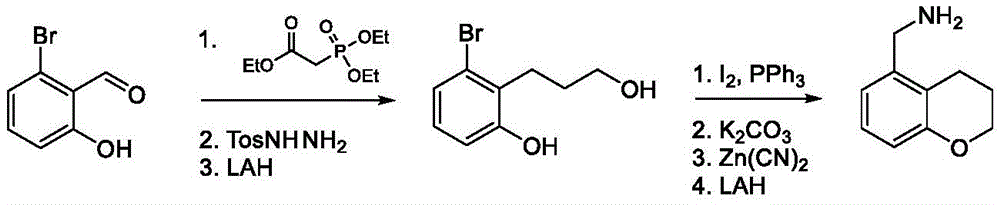
A sixth exemplary intermediate B, intermediate B-6, is useful in the synthesis of compounds of formula I, wherein Z is O, n is 2, and X is C (R)11)2, Is a single bond and one R3Is fluorine.
To a solution of 2-bromo-6-hydroxy-benzaldehyde (0.30g, 1.49mmol, 1.00 equiv.) and ethyl 2-diethoxyphosphorylacetate (669mg, 2.98mmol, 592 μ L, 2.00 equiv.) in DMF (3.00mL) at room temperature under a nitrogen atmosphere was added NaH (119mg, 2.98mmol, 60% purity, 2.00 equiv.). The resulting mixture was stirred at 40 ℃ for 12 hours. The reaction mixture was diluted with ethyl acetate (50.0mL) and quenched with water (10.0mL). The combined organic phases were washed with brine (30.0mL × 3), dried over sodium sulfate, filtered and concentrated in vacuo. By column chromatography (SiO)2Petroleum ether/ethyl acetate 10/1 to 4/1) to obtain (E) -ethyl 3- (2-bromo-6-hydroxy-phenyl) prop-2-enoate as a white solid (380mg, 1.37mmol, 92.0% yield, 98.0% purity).
1H NMR(400MHz,CD3OD)δ=8.02(d,J=16.0Hz,1H),7.15(dd,J=1.2,8.0Hz,1H),7.06(t,J=8.0Hz,1H),6.97(d,J=16.0Hz,1H),6.86(d,J=8.0Hz,1H),4.56(s,1H),4.25(q,J=7.2Hz,2H),1.33(t,J=7.2Hz,3H)。
To a solution of ethyl (E) -3- (2-bromo-6-hydroxy-phenyl) prop-2-enoate (380mg, 1.37mmol, 1.00 eq) in THF (5.00mL) and water (5.00mL) were added NaOAc (225mg, 2.75mmol, 2.00 eq) and 4-methylbenzenesulfonylhydrazide (512mg, 2.75mmol, 2.00 eq). The mixture was stirred at 70 ℃ for 12 hours. The mixture was cooled to room temperature and extracted with ethyl acetate (20.0 mL. times.2). The combined organic phases were washed with brine (30.0mL × 3), dried over sodium sulfate, filtered and concentrated in vacuo. By column chromatography (SiO)2Petroleum ether/ethyl acetate 20/1 to 10/1) to obtain ethyl 3- (2-bromo-6-hydroxy-phenyl) propionate as a pale yellow oil (380mg, 1.32mmol, 96.2% yield, 95.0% purity).
1H NMR(400MHz,CDCl3)δ=8.27(s,1H),7.14(dd,J=1.2,8.0Hz,1H),6.99(t,J=8.0Hz,1H),6.93-6.88(m,1H),4.17(q,J=7.2Hz,2H),3.50(s,1H),3.10-3.03(m,2H),2.87-2.79(m,2H),1.28-1.24(m,3H)。
To a solution of ethyl 3- (2-bromo-6-hydroxy-phenyl) propionate in THF (2.00mL) at 0 ℃ was added LAH (39.6mg, 1.04mmol, 3.00 equiv). The mixture was stirred at room temperature for 2 hours. The reaction mixture was quenched with water (0.50mL) and diluted with DCM (30.0 mL). The mixture was dried over magnesium sulfate, filtered and concentrated in vacuo. By preparative TLC (SiO)2PE: EA ═ 2:1) the crude residue was purified to obtain 3-bromo-2- (3-hydroxypropyl) phenol as a yellow oil (70.0mg, 297 μmol, 85.4% yield, 98.0% purity).
1H NMR(400MHz,CDCl3)δ=7.66(br s,1H),7.14(dd,J=1.2,8.0Hz,1H),6.97(t,J=8.0Hz,1H),6.84(dd,J=1.2,8.0Hz,1H),3.64(t,J=5.6Hz,2H),3.03-2.94(m,2H),2.01-1.90(m,2H)。
Iodine (3.30g, 13.0mmol, 2.62mL, 1.65 equiv.) was added to imidazole (2.42g, 35.5mmol, 4.50 equiv.) and PPh at 0 deg.C3(3.72g, 14.2mmol, 1.80 equiv.) in DCM (40.0 mL). The reaction mixture was stirred for 15 minutes, then a solution of 3-bromo-2- (3-hydroxypropyl) phenol in DCM (10.0mL) was added dropwise. The reaction mixture was protected from light and stirred at room temperature for 12 hours. The mixture was diluted with DCM (50.0mL) and washed with brine (40.0mL × 2). The combined organic phases were dried over sodium sulfate, filtered and concentrated in vacuo. By column chromatography (SiO)2Petroleum ether/ethyl acetate 1/0 to 20/1) to obtain 3-bromo-2- (3-iodopropyl) phenol as a white solid (2.10g, 6.16mmol, 78.1% yield).
To a solution of 3-bromo-2- (3-iodopropyl) phenol (2.10g, 6.16mmol, 1.00 eq) in acetone (50.0mL) was added K2CO3(1.70g, 12.3mmol, 2.00 equiv.). The mixture was stirred at 50 ℃ for 12 hours. The reaction mixture was filtered and concentrated in vacuo. By column chromatography (SiO)2Petroleum ether) to obtain 5-bromochroman (1.20g, 5.63mmol, 91.5% yield, 100% purity) as a pale yellow oil.
Purge 5-bromochroman (0.10g, 469. mu. mol, 1.00 eq.), Zn (CN) with nitrogen2(110mg, 939. mu. mol, 2.00 equiv.), Pd (PPh)3)4(81.4mg, 70.4. mu. mol, 0.15 equiv.) in DMAC (1.00 mL). The mixture was stirred at 100 ℃ for 8 hours. The reaction mixture was diluted with ethyl acetate (20.0mL) and washed with brine (15.0 mL. times.3). The combined organic phases were dried over sodium sulfate, filtered and concentrated in vacuo. By preparative TLC (SiO)2PE: EA ═ 10:1) the crude material was purified to obtain chroman-5-carbonitrile as a pale yellow oil (60.0mg, 377 μmol, 80.3% yield).
1H NMR(400MHz,CDCl3)δ=7.22-7.18(m,1H),7.18-7.13(m,1H),7.02(dd,J=1.2,8.0Hz,1H),4.28-4.19(m,2H),2.97(t,J=6.4Hz,2H),2.16-2.02(m,2H)。
To a solution of chroman-5-carbonitrile (60.0mg, 377. mu. mol, 1.00 eq.) in THF (3.00mL) at 0 deg.C was added LAH (57.2mg, 1.51mmol, 4.00 eq.). The mixture was stirred at room temperature for 2 hours. The reaction mixture was quenched with water (1.00mL) and diluted with DCM (30 mL). The mixture was dried over magnesium sulfate and filtered. The filtrate was concentrated in vacuo to give chroman-5-ylmethylamine (70.0mg, crude) as a yellow oil.
Intermediate B-7

A seventh exemplary intermediate B, intermediate B-7, is useful in the synthesis of compounds of formula I, wherein Z is O, n is 1, and X is C (R)11)2, Is a single bond, one R3Is fluorine and the two methylene hydrogens are replaced by deuterium.
To a solution of 5-fluorobenzofuran-4-carbonitrile (2.00g, 12.4mmol, 1.00 equiv.) in dimethyl sulfoxide (20.0mL) was added hydrogen peroxide (7.04g, 62.1mmol, 5.96mL, 30% pure, 5.00 equiv.) and potassium carbonate (1.72g, 12.4mmol, 1.00 equiv.) at 0 deg.C. The mixture was stirred at 25 ℃ for 1 hour. The residue was poured into ice water (5.00mL) and stirred for 10 min. The mixture was filtered and concentrated in vacuo to give 5-fluorobenzofuran-4-carboxamide (1.80g, 10.1mmol, 81.0% yield) as a white solid.
1H NMR(400MHz,DMSO-d6)δ=8.11(d,J=2.0Hz,1H),7.81(br s,1H),7.73(dd,J=4.0,8.8Hz,2H),7.23(dd,J=9.2,10.4Hz,1H),7.10(d,J=1.2Hz,1H)。
To a solution of 5-fluorobenzofuran-4-carboxamide (1.80g, 10.1mmol, 1.00 equiv) in methanol (4.00mL) was added hydrogen (50psi) and Pd/C (500mg, 50% purity). The mixture was stirred at 35 ℃ for 12 hours. The mixture was filtered and concentrated in vacuo to give 5-fluoro-2, 3-dihydrobenzofuran-4-carboxamide (1.60g, 8.83mmol, 87.9% yield) as a white solid. LCMS [ M +1] 182.2.
1H NMR(400MHz,DMSO-d6)δ=7.82-7.55(m,2H),6.96(t,J=8.8Hz,1H),6.79(dd,J=4.0,8.8Hz,1H),4.54(t,J=8.8Hz,2H),3.25(t,J=8.8Hz,2H)。
Lithium aluminum deuteride (670mg, 17.7mmol, 911. mu.L, 2.00 equiv.) was added to a solution of 5-fluoro-2, 3-dihydrobenzofuran-4-carboxamide (1.60g, 8.83mmol, 1.00 equiv.) in tetrahydrofuran (20.0mL) at 0 ℃. The mixture was stirred at 60 ℃ for 12 hours. The mixture was quenched with water (1.60mL) (stirred for 15 min) and then with sodium hydroxide (1.50mL, 15% aq) (15 min) and water (4.80mL) (30 min). The suspension was filtered and concentrated in vacuo to give a residue. The residue was purified by preparative HPLC (basic conditions) to give (5-fluoro-2, 3-dihydrobenzofuran-4-yl) methyl-d 2-amine (0.80g, 4.56mmol, 51.6% yield, 96.4% purity) as a red oil.
1H NMR (400MHz, chloroform-d) δ 6.82-6.76(m,1H),6.59(dd, J4.0, 8.8Hz,1H),4.59(t, J8.8 Hz,2H),3.23(t, J8.8 Hz, 2H).
Intermediate B-8
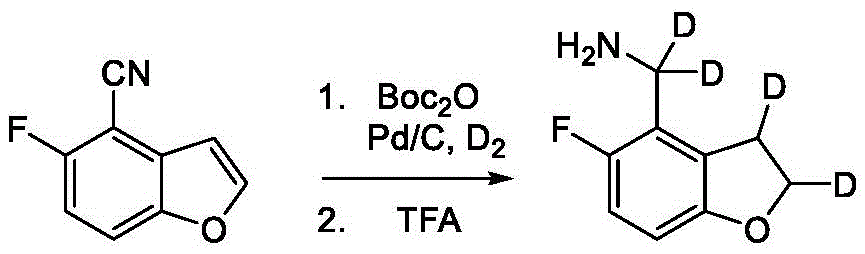
An eighth exemplary intermediate, intermediate B-8, is useful in the synthesis of compounds of formula I, wherein Z is O, n is 1, and X is C (R)11)2, Is a single bond, one R3Is fluorine, the two methylene hydrogens and the two hydrogens on the benzofuran ring are replaced by deuterium.
To 5-fluorobenzofuran-4-carbonitrile (100mg, 620. mu. mol, 1.00 eq) in methanol-d4To a solution (1.00mL) were added di-tert-butyl dicarbonate (135mg, 620. mu. mol, 143. mu.L, 1.00 eq.) and palladium on carbon (100mg, 10.0 w%, 0.09 eq.). The mixture was stirred at 35 ℃ for 12 hours under a deuterium atmosphere (15 psi). The reaction was filtered and concentrated under reduced pressure to give tert-butyl ((5-fluoro-2, 3-dihydrobenzofuran-4-yl-2, 3-d2) methyl-d 2) carbamate (45.0mg, 166. mu. mol, 26.7% yield) as a white solid.
1H NMR(400MHz,CDCl3)δ=6.82-6.76(m,1H),6.62(dd,J=3.6,8.4Hz,1H),4.86(br s,1H),4.57(br d,J=10.0Hz,1H),3.27(br d,J=6.8Hz,1H),1.46-1.41(s,9H)。
To a solution of tert-butyl ((5-fluoro-2, 3-dihydrobenzofuran-4-yl-2, 3-d2) methyl-d 2) carbamate (40.0mg, 147. mu. mol, 1.00 eq) in dichloromethane (2.00mL) was added trifluoroacetic acid (109. mu.L, 1.47mmol, 10.0 eq). The mixture was stirred at 25 ℃ for 1 hour, followed by concentration under reduced pressure to give a residue. The residue was added to saturated sodium bicarbonate (2.00mL) and stirred for 5 minutes. The aqueous phase was extracted with ethyl acetate (2.00 mL. times.3). The combined organic phases were washed with brine (2.00mL × 3), dried over anhydrous sodium sulfate, filtered and concentrated under reduced pressure to give dideutero- (2, 3-dideutero-5-fluoro-2, 3-dihydrobenzofuran-4-yl) methylamine (25.0mg, crude) as a white solid, which was used without further purification.
Intermediate B-9

A ninth exemplary intermediate B, intermediate B-9, is useful in the synthesis of compounds of formula I, wherein Z is O, n is 1, X is O, is a single bond, and one R3Is fluorine.
To a solution of 5-fluoro-1, 3-benzodioxole (500mg, 3.57mmol, 1.00 equiv.) in THF (5.00mL) at-78 deg.C was added n-butyllithium (2.50M, 1.57mL, 1.10 equiv.) dropwise. The mixture was stirred at-78 ℃ for 15 minutes, then DMF (235mg, 3.21mmol, 247. mu.L, 0.90 equiv.) was added dropwise and stirring continued at-78 ℃ for 0.5 hours. The mixture was poured into saturated aqueous ammonium chloride (5.00mL) and stirred for 15 minutes. The aqueous phase was extracted with ethyl acetate (6.00 mL. times.2). The combined organic phases were washed with brine (6.00mL × 3), dried over anhydrous sodium sulfate, filtered and concentrated under reduced pressure to give 5-fluoro-1, 3-benzodioxole-4-carbaldehyde (370mg, 2.20mmol, 61.7% yield) as a white solid.
1H NMR(400MHz,DMSO-d6)δ=10.07(s,1H),7.12(dd,J=4.4,8.4Hz,1H),6.72(dd,J=8.8,11.6Hz,1H),6.17(s,2H)。
To a solution of 5-fluoro-1, 3-benzodioxole-4-carbaldehyde (200mg, 1.19mmol, 1.00 equiv.) in ethanol (6.00mL) was added hydroxylamine hydrochloride (248mg, 3.57mmol, 3.00 equiv.) and triethylamine (827. mu.L, 5.95mmol, 5.00 equiv.). The mixture was stirred at 15 ℃ for 0.5 hour and the mixture was concentrated under reduced pressure to give a residue. The residue was triturated with water (3.00 mL. times.2) and filtered, the filter cake was collected and dried under reduced pressure to give 5-fluoro-1, 3-benzodioxole-4-carbaldehyde oxime as a white solid (200mg, 1.09mmol, 91.8% yield).
1H NMR(400MHz,DMSO-d6)δ=11.68(s,1H),8.08(s,1H),6.91(br dd,J=4.0,8.4Hz,1H),6.77-6.65(m,1H),6.12(s,2H)。
To a solution of 5-fluoro-1, 3-benzodioxole-4-carbaldehyde oxime (280mg, 2.07mmol, 1.00 equiv.) in methanol (3.00mL) was added Pd/C (2.07mmol, 10% purity, 1.00 equiv.) and di-tert-butyl dicarbonate (906mg, 4.15mmol, 953. mu.L, 2.00 equiv.). The mixture was stirred at 25 ℃ for 12 hours under a hydrogen atmosphere (15 psi). The mixture was filtered and concentrated under reduced pressure to give a residue. By column chromatography (SiO)2Petroleum ether/ethyl acetate 1/0 to 2/1) to obtain N- [ (5-fluoro-1, 3-benzodioxol-4-yl) methyl group as a white solid]Tert-butyl carbamate (350mg, 1.71mmol, 82.3% yield). LCMS [ M-55 ]]:214.1。
To a solution of tert-butyl ((5-fluorobenzo [ d ] [1,3] dioxol-4-yl) methyl) carbamate (85.0mg, 316. mu. mol, 1.00 eq) in DCM (1.00mL) was added TFA (0.30 mL). The mixture was stirred at 25 ℃ for 0.5 hour. The reaction mixture was neutralized with saturated aqueous potassium carbonate solution (5.00mL) and stirred for 30 min. The aqueous phase was extracted with DCM (5.00 mL. times.2). The combined organic phases were washed with brine (5.00 mL. times.2), dried over anhydrous sodium sulfate, filtered and concentrated under reduced pressure to give (5-fluorobenzo [ d ] [1,3] dioxol-4-yl) methylamine as a yellow oil (45.0mg, 266. mu. mol, 84.3% yield).
1H NMR(400MHz,CDCl3)δ=6.63(dd,J=4.4,8.4Hz,1H),6.52(dd,J=8.4,10.4Hz,1H),6.00(s,2H),3.89(s,2H)。
Intermediate C-1

Exemplary intermediate C, intermediate C-1, is useful in the synthesis of compounds of formula I, wherein Z is O, n is 1, and X is C (R)11)2, Is a single bond and one R3Is fluorine. Purging 8-bromo-5-chloro-imidazo [1,2-c ] with nitrogen]A mixture of pyrimidine-2-carboxylic acid ethyl ester (380mg, 1.25mmol, 1.00 equiv.), 5-fluoro-2, 3-dihydrobenzofuran-4-yl) methylamine (250.34mg, 1.50mmol, 1.20 equiv.), DIEA (322mg, 2.50mmol, 434uL, 2.00 equiv.) in DMF (3.00mL) was stirred at 85 ℃ for 0.5 h. To the mixture was added water (10.0mL) and ethyl acetate (8.00 mL). The biphasic mixture was filtered to remove solid impurities and the organic layer was concentrated in vacuo to provide 8-bromo-5- (((5-fluoro-2, 3-dihydrobenzofuran-4-yl) methyl) amino) imidazo [1,2-c as a white solid]Pyrimidine-2-carboxylic acid ethyl ester (443mg, 1.02mmol, 81.5% yield).
1H NMR(400MHz,DMSO-d6)δ=8.87(s,1H),8.50(t,J=4.8Hz,1H),7.90(s,1H),6.93(t,J=9.6Hz,1H),6.69(dd,J=4.0,8.8Hz,1H),4.65(d,J=4.8Hz,2H),4.52(t,J=8.8Hz,2H),4.32(q,J=7.2Hz,2H),3.25(t,J=8.8Hz,2H),1.32(t,J=7.2Hz,3H)。
Intermediate C-2

A second exemplary intermediate C, intermediate C-2, is useful in the synthesis of compounds of formula I, wherein Z is O, n is 1, and X is CR11, Is a double bond and one R3Is fluorine. Reacting 8-bromo-5-chloro-imidazo [1,2-c ] under nitrogen atmosphere]A mixture of pyrimidine-2-carboxylate (160mg, 525. mu. mol, 1.00 equivalents), (5-fluorobenzofuran-4-yl) methylamine (116mg, 630. mu. mol, 1.20 equivalents) and DIEA (136mg, 1.05mmol, 183uL, 2.00 equivalents) in DMF (2.00mL) was stirred at 85 ℃ for 0.5 h. The reaction mixture was concentrated under reduced pressure to give a residue. The crude material was purified by column chromatography (petroleum ether/ethyl acetate, 0/1 to 2/1) to obtain 8-bromo-5- (((5-fluorobenzofuran-4-yl) methyl) amino) imidazo [1, 2-c) as a brown solid]Pyrimidine-2-carboxylic acid ethyl ester (180mg, 78.2% yield). LCMS (liquid Crystal Module) (M +1)]:433.1。
1H NMR(400MHz,CD3OD)δ=8.63(s,1H),7.92(s,1H),7.80(d,J=2.0Hz,1H),7.45(dd,J=3.6,8.8Hz,1H),7.13-7.07(m,1H),7.06(d,J=1.2Hz,1H),5.04(s,2H),4.38(q,J=6.8Hz,2H),1.38(t,J=7.2Hz,3H)。
Intermediate C-3

A third exemplary intermediate C, intermediate C-3, is useful in the synthesis of compounds of formula I, wherein Z is O, n is 1, X is O, and is a single bond. To 8-bromo-5-chloro-imidazo [1,2-c]DIEA (42.4mg, 328. mu. mol, 57.2uL, 1.00 equiv.) was added to a solution of pyrimidine-2-carboxylic acid ethyl ester (103mg, 328. mu. mol, 1.00 equiv.) and 1, 3-benzodioxol-4-ylmethylamine (54.6mg, 361. mu. mol, 1.10 equiv.) in DMF (2.00 mL). The resulting mixture was stirred at 85 ℃ for 1 hour, followed by concentration to obtain a crude material. The residue was washed with water (3.00 mL. times.2) to provide 5- ((benzo [ d ] as a brown solid][1,3]Dioxol-4-ylmethyl) amino) -8-bromoimidazo [1,2-c]Pyrimidine-2-carboxylic acid ethyl ester (120mg, 286.24. mu. mol, 87.2% yield). LCMS (liquid Crystal Module) [ M +1]]421.2。
1H NMR(400MHz,DMSO-d6)δ=8.87(s,1H),8.65(br s,1H),7.88(s,1H),6.90-6.77(m,3H),6.03(s,2H),4.66(d,J=4.8Hz,2H),4.36-4.31(m,2H),1.33(t,J=7.2Hz,3H)。
Intermediate C-4

A fourth exemplary intermediate C, intermediate C-4, is useful in the synthesis of compounds of formula I, wherein Z is O, n is 1, and X is C (R)11)2, Is a single bond and one R3Is chlorine. To 8-bromo-5-chloro-imidazo [1,2-c]To a solution of pyrimidine-2-carboxylic acid ethyl ester (230mg, 755. mu. mol, 1.00 equiv), (5-chloro-2, 3-dihydrobenzofuran-4-yl) methylamine (118mg, 642. mu. mol, 0.850 equiv) in DMF (2.00mL) was added DIEA (195mg, 1.51mmol, 263. mu.L, 2.00 equiv) and the reaction mixture was stirred at 85 ℃ for 1 hour. The solution was concentrated in vacuo to give the crude material, which was purified by preparative TLC (petroleum ether/ethyl acetate ═ 1/1) to obtain 8-bromo-5- (((5-chloro-2, 3-dihydrobenzofuran-4-yl) methyl) amino) imidazo [1, 2-c) as a brown solid]Pyrimidine-2-carboxylic acid ethyl ester (320 mg). LCMS: [ M +3]453.1。
Intermediate C-4A

Another intermediate C, intermediate C-4A, is useful in the synthesis of compounds of formula I wherein Z is O, n is 2, and X is C (R)11)2And is and is a single bond. To 8-bromo-5-chloro-imidazo [1,2-c]To a solution of pyrimidine-2-carboxylic acid ethyl ester (250mg, 802. mu. mol, 1.00 eq) in DMF (3.00mL) was added DIPEA (207mg, 1.60mmol, 279. mu.L, 2.00 eq) and chroman-5-ylmethylamine (170mg, 1.04mmol, 1.30 eq). The mixture was stirred at 85 ℃ for 30 minutes. The reaction mixture was diluted with water (40mL) and filtered. VacuumDrying the solid to obtain 8-bromo-5- ((chroman-5-ylmethyl) amino) imidazo [1, 2-c) as a yellow solid]Pyrimidine-2-carboxylic acid ethyl ester (320mg, 742. mu. mol, 92.5% yield). LC-MS: [ M +1]]433.3。
Intermediate C-4B

Yet another exemplary intermediate C, intermediate C-4B, is useful in the synthesis of compounds of formula I, wherein Z is S, n is 1, and X is C (R)11)2, Is a single bond and one R3Is fluorine. To (5-fluorobenzothiophen-4-yl) methylamine (39.4mg, 218. mu. mol, 1.40 equiv.) and 8-bromo-5-chloro-imidazo [1,2-c ]]DIEA (60.2mg, 466. mu. mol, 81.2. mu.L, 3.00 equivalents) was added to a solution of pyrimidine-2-carbonitrile (40.0mg, 155. mu. mol, 1.00 equivalents) in DMF (2.00 mL). The reaction mixture was stirred at 85 ℃ for 1 hour. The mixture was diluted with ethyl acetate (10.0mL), washed with brine (10.0mL × 2), dried over anhydrous sodium sulfate, filtered and concentrated in vacuo to give a crude residue. The crude material was purified by preparative TLC (petroleum ether/ethyl acetate ═ 1/1 to give 8-bromo-5- ((5-fluorobenzo [ b ] as a brown solid]Thien-4-yl) amino) imidazo [1,2-c]Pyrimidine-2-carbonitrile (35.0mg, 87.0. mu. mol, 56.0% yield). LCMS (liquid Crystal Module) (M +1)]:404.0。
Intermediate C-5

A fifth exemplary intermediate C, intermediate C-5, is useful in the synthesis of compounds of formula I, wherein Z is O, n is 1, and X is C (R)11)2, Is a single bond and one R3Is fluorine. Under nitrogen atmosphere, 8-bromo-5- (((5-fluoro-2, 3-dihydrobenzofuran-4-yl) methyl) amino) imidazo [1,2-c]A mixture of pyrimidine-2-carboxylic acid ethyl ester (160mg, 367. mu. mol, 1 eq.) and sodium hydroxide (1M, 1.10mL, 3 eq.) in methanol (3.30mL) was stirred at 55 ℃ for 0.5 h. The mixture was concentrated in vacuo and the residue was diluted with water (1.00 mL). The pH was adjusted to pH 2 with HCl (1M) and the solid was collected by filtration. Drying the resulting solid under reduced pressure to obtain 8-bromo-5- (((5-fluoro-2, 3-dihydrobenzofuran-4-yl) methyl) amino) imidazo [1, 2-c) as a white solid]Pyrimidine-2-carboxylic acid (124mg, 304 μmol, 82.8% yield). LC-MS: [ M +1]]408.8。
A mixture of 8-bromo-5- (((5-fluoro-2, 3-dihydrobenzofuran-4-yl) methyl) amino) imidazo [1,2-c ] pyrimidine-2-carboxylic acid (124mg, 304. mu. mol, 1.00 equiv.), ammonium chloride (48.8mg, 913. mu. mol, 3.00 equiv.), HATU (173mg, 1.50 equiv.), DIEA (314mg, 2.44mmol, 424uL, 8 equiv.) in DMF (1.00mL) was stirred at 30 ℃ for 1 hour under a nitrogen atmosphere. Subsequently, the mixture was concentrated in vacuo. To the crude material was added water (1.00mL) and the resulting solid was collected by filtration. The solid was dried under reduced pressure to provide 8-bromo-5- (((5-fluoro-2, 3-dihydrobenzofuran-4-yl) methyl) amino) imidazo [1,2-c ] pyrimidine-2-carboxamide as a white solid (100mg), which was used without further purification.
To a mixture of 8-bromo-5- (((5-fluoro-2, 3-dihydrobenzofuran-4-yl) methyl) amino) imidazo [1,2-c ] pyrimidine-2-carboxamide (100mg, 246. mu. mol, 1.00 eq), TEA (484mg, 4.79mmol, 666uL, 19.4 eq) in THF (2.00mL) was added TFAA (302mg, 1.44mmol, 200uL, 5.84 eq) at 0 ℃. Subsequently, the mixture was stirred at 0-30 ℃ for 40 minutes under nitrogen atmosphere. The mixture was concentrated to give a crude residue, which was purified by column chromatography (petroleum ether/ethyl acetate, 5/1 to 0/1) to obtain 8-bromo-5- (((5-fluoro-2, 3-dihydrobenzofuran-4-yl) methyl) amino) imidazo [1,2-c ] pyrimidine-2-carbonitrile (100mg, 245 μmol, 99.7% yield) as a yellow solid. LC-MS: [ M +1] 387.8.
Alternatively, intermediate C-5 may be prepared as follows:

to a solution of 8-bromo-5-chloro-imidazo [1,2-c ] pyrimidine-2-carbonitrile (3.00g, 11.7mmol, 1.00 equiv.) and (5-fluoro-2, 3-dihydrobenzofuran-4-yl) methylamine (2.14g, 12.8mmol, 1.10 equiv.) in DMF (30.0mL) was added DIEA (3.01g, 23.3mmol, 4.06mL, 2.00 equiv.). The resulting mixture was stirred at 85 ℃ for 1 hour, cooled to room temperature, and poured into water (100 mL). The mixture was extracted with ethyl acetate (50.0 mL. times.3). The combined organic phases were washed with brine (50.0mL × 2), dried over anhydrous sodium sulfate, filtered and concentrated to give a residue. The residue was purified by silica gel chromatography (petroleum ether/ethyl acetate ═ 10/1 to 1/1) to obtain 8-bromo-5- (((5-fluoro-2, 3-dihydrobenzofuran-4-yl) methyl) amino) imidazo [1,2-c ] pyrimidine-2-carbonitrile (4.00g, 10.3mmol, 88.4% yield) as a yellow solid. LCMS [ M +1] 390.1.
Intermediate C-6

A sixth exemplary intermediate C, intermediate C-6, is useful in the synthesis of compounds of formula I, wherein Z is O, n is 1, and X is C (R)11)2, Is a single bond and one R3Is fluorine.
A mixture of ethyl 8-bromo-5- (((5-fluoro-2, 3-dihydrobenzofuran-4-yl) methyl) amino) imidazo [1,2-c ] pyrimidine-2-carboxylate (204mg, 460. mu. mol, 1.00 equiv.), di-tert-butyl dicarbonate (201mg, 919. mu. mol, 2.00 equiv.), 4- (dimethylamino) pyridine (561ug, 4.60. mu. mol, 0.01 equiv.) in tetrahydrofuran (2.00mL) was purged with nitrogen and then stirred at 25 ℃ for 2 hours under a nitrogen atmosphere. The mixture was diluted with water (3.00mL) and extracted with ethyl acetate (2.00 mL. times.3). The combined organic layers were washed with brine (2.00mL × 3), dried over anhydrous sodium sulfate, filtered and concentrated under reduced pressure to afford a residue. The crude material was purified by preparative TLC (SiO2, petroleum ether/ethyl acetate, 3/1) to obtain ethyl 8-bromo-5- ((tert-butoxycarbonyl) ((5-fluoro-2, 3-dihydrobenzofuran-4-yl) methyl) amino) imidazo [1,2-c ] pyrimidine-2-carboxylate (160mg, 198 μmol, 43.0% yield, 66.2% purity) as a white solid. LC-MS [ M +1] 537.2.
1H NMR(400MHz,CDCl3)δ=8.11(s,1H),7.93(s,1H),6.67-6.61(m,1H),6.59-6.54(m,1H),5.08(s,2H),4.58(t,J=8.8Hz,2H),4.47(q,J=7.2Hz,2H),3.32(br t,J=8.8Hz,2H),1.43(t,J=7.2Hz,3H),1.36(s,9H)。
Intermediate C-7

A seventh exemplary intermediate C, intermediate C-7, is useful in the synthesis of compounds of formula I, wherein Z is O, n is 1, and X is C (R)11)2, Is a single bond, one R3Is fluorine and the two methylene hydrogens are replaced by deuterium.
To a solution of (5-fluoro-2, 3-dihydrobenzofuran-4-yl) methyl-d 2-amine (50.0mg, 284 μmol, 1.00 equivalents), 8-bromo-5-chloroimidazo [1,2-c ] pyrimidine-2-carbonitrile (73.1mg, 284 μmol, 1.00 equivalents) in DMF (1.00mL) was added DIEA (110mg, 851 μmol, 148 μ L, 3.00 equivalents). The mixture was stirred at 85 ℃ for 1 hour. The reaction mixture was diluted with water (1.00mL) and extracted with ethyl acetate (1.00 mL. times.3). The combined organic layers were washed with brine (3.00mL × 2), dried over sodium sulfate, filtered and concentrated under reduced pressure to give 8-bromo-5- (((5-fluoro-2, 3-dihydrobenzofuran-4-yl) methyl-d 2) amino) imidazo [1,2-c ] pyrimidine-2-carbonitrile as a white solid (20.0mg, crude). LCMS [ M +1] 390.0.
Intermediate C-8

An eighth exemplary intermediate C, intermediate C-8, is useful in the synthesis of compounds of formula I, wherein Z is O, n is 1, and X is C (R)11)2, Is a single bond, one R3Is fluorine, the two methylene hydrogens and the two hydrogens on the benzofuran ring are replaced by deuterium.
To dideutero- (2, 3-dideutero-5-fluoro-2, 3-dihydrobenzofuran-4-yl) methylamine (31.9mg, 186. mu. mol, 1.20 equivalents) and 8-bromo-5-chloroimidazo [1,2-c ]]To a solution of pyrimidine-2-carbonitrile (40.0mg, 155. mu. mol, 1.00 eq) in DMF (1.00mL) was added DIEA (108uL, 621. mu. mol, 4.00 eq.) and the mixture was stirred at 85 ℃ for 0.5 h. The mixture was concentrated under reduced pressure to give a residue, which was poured into water (3.00mL) and stirred for 5 minutes. The aqueous phase was extracted with ethyl acetate (3.00 mL. times.3). The combined organic phases were washed with brine (3.00 mL. times.2), dried over anhydrous sodium sulfate, filtered and concentrated under reduced pressure to give 8-bromo-5- (((5-fluoro-2, 3-dihydrobenzofuran-4-yl-2, 3-d) as a white solid2) Methyl-d2) Amino) imidazo [1,2-c]Pyrimidine-2-carbonitrile (25.0mg, 63.7. mu. mol, 41.0% yield).
1H NMR(400MHz,CDCl3)δ=8.30(s,1H),7.94(s,1H),7.93(s,1H),6.83-6.76(m,1H),6.64(dd,J=4.0,8.8Hz,1H),4.59(br d,J=10.0Hz,1H),3.33(br d,J=8.4Hz,1H)。
Intermediate C-9

A ninth exemplary intermediate C, intermediate C-9, is useful in the synthesis of compounds of formula I, wherein Z is O, n is 1, X is O, is a single bond, and one R3Is fluorine.
To a solution of 8-bromo-5-chloroimidazo [1,2-c ] pyrimidine-2-carbonitrile (40.0mg, 155. mu. mol, 1.00 eq.) and (5-fluorobenzo [ d ] [1,3] dioxol-4-yl) methylamine (31.5mg, 186. mu. mol, 1.20 eq.) in DMF (0.50mL) was added DIEA (54.1. mu.L, 310. mu. mol, 2.00 eq.). The mixture was stirred at 85 ℃ for 0.5 h under nitrogen atmosphere. The mixture was poured into water (3.00mL) and stirred for 5 minutes. The aqueous phase was extracted with ethyl acetate (3.00 mL. times.2). The combined organic phases were washed with brine (3.00mL × 2), dried over anhydrous sodium sulfate, filtered and concentrated under reduced pressure to give 8-bromo-5- (((5-fluorobenzo [ d ] [1,3] dioxol-4-yl) methyl) amino) imidazo [1,2-c ] pyrimidine-2-carbonitrile as a yellow solid (50.0mg, 128 μmol, 82.5% yield).
1H NMR(400MHz,DMSO-d6)δ=8.92(s,1H),8.567(br s,1H),7.95(s,1H),6.88(dd,J=4.4,8.4Hz,1H),6.69(dd,J=8.8,10.4Hz,1H),6.04(s,2H),4.67(br d,J=2.0Hz,2H)。
Intermediate D-1

Exemplary intermediate D, intermediate D-1, is useful in the synthesis of compounds of formula I, wherein R1Is disubstituted heteroaryl.
A mixture of 3-methyl-4- (4,4,5, 5-tetramethyl-1, 3, 2-dioxaborolan-2-yl) -1H-pyrazole (370mg, 1.78mmol, 1.00 eq), 2-iodopropane (907mg, 5.33mmol, 533uL, 3.00 eq) and cesium carbonate (2.32g, 7.11mmol, 4.00 eq) in acetonitrile (7.00mL) was purged with nitrogen and subsequently stirred at 90 ℃ for 4 hours. The reaction mixture was filtered and concentrated under reduced pressure to provide a residue. The crude material was purified by column chromatography (petroleum ether/ethyl acetate, 1/0 to 3/1) to obtain a mixture of 1-isopropyl-3-methyl-4- (4,4,5, 5-tetramethyl-1, 3, 2-dioxaborolan-2-yl) pyrazole (170mg, 34.4% yield, 90.0% purity) and 1-isopropyl-5-methyl-4- (4,4,5, 5-tetramethyl-1, 3, 2-dioxaborolan-2-yl) pyrazole (170mg, 34.4% yield, 90.0% purity) as a pale yellow oil. LCMS [ M +1] 251.4.
1H NMR(400MHz,CDCl3)δ=7.73(s,0.6H),7.65(s,1H),4.50-4.36(m,2H),2.45(s,2H),2.40(s,3H),1.50-1.44(m,12H),1.31(s,22H)。
Intermediate D-2

A second exemplary intermediate D, intermediate D-2, is useful in the synthesis of compounds of formula I, wherein R1Is represented by two R4A substituent-substituted heteroaryl. Purge 5-bromo-2-methoxy-4-methyl-pyridine (350mg, 1.73mmol, 1.00 equiv.), bis (pinacolato) diboron (2.20g, 8.66mmol, 5.00 equiv.), potassium acetate (527mg, 5.37mmol, 3.10 equiv.), Pd (dppf) Cl with nitrogen2A mixture of (127mg, 173 μmol, 0.10 eq) in dioxane (5.00mL) was stirred at 90 ℃ for 3 hours. The residue was diluted with ethyl acetate (3.00mL) and extracted with ethyl acetate (2.00 mL. times.3). The combined organic layers were washed with brine (2.00mL × 3), dried over anhydrous sodium sulfate, filtered and concentrated under reduced pressure to give a residue. The crude material was purified by column chromatography (petroleum ether/ethyl acetate, 100/1 to 20/1) to obtain 2-methoxy-4-methyl-5- (4,4,5, 5-tetramethyl-1, 3, 2-dioxaborolan-2-yl) pyridine (150mg, 546 μmol, 31.5% yield, 90.6% purity) as a white solid.
1H NMR(400MHz,CDCl3)δ=8.47(s,1H),6.51(s,1H),3.93(s,3H),2.45(s,3H),1.33(s,12H)。
Intermediate D-3
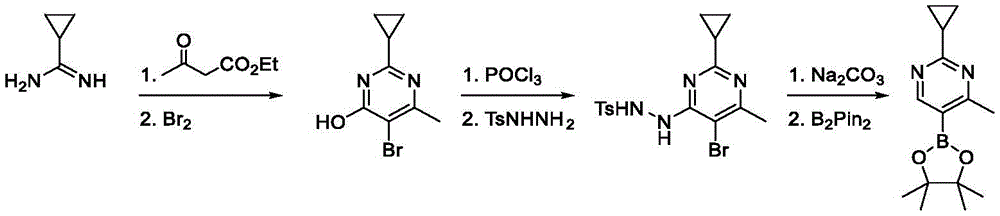
A third exemplary intermediate D, intermediate D-3, is useful in the synthesis of compounds of formula I or formula II, wherein R1Is represented by two R4A substituent-substituted heteroaryl. A mixture of cyclopropanecarboxamidine hydrochloride (5.00g, 59.4mmol, 1.00 equiv.), ethyl 3-oxobutyrate (7.74g, 59.4mmol, 7.51mL, 1.00 equiv.), sodium ethoxide (8.09g, 119mmol, 2.00 equiv.) in ethanol (500mL) was purged with nitrogen and subsequently stirred at 25 ℃ for 12 hours. The residue was dissolved in water (25.0mL) and the pH was adjusted to about 4 with HCl (1M). After cooling to 5 ℃, the solid was collected and dried under reduced pressure to give 2-cyclopropyl-6-methyl-pyrimidin-4-ol as a white solid (4.00g, 26.6mmol, 44.8% yield, 100% purity). LC-MS [ M +1]]:151.3。
1H NMR(400MHz,DMSO-d6)δ=12.45(s,1H),5.93(s,1H),2.07(s,3H),1.90-1.85(m,1H),1.00-0.97(m,4H)。
A mixture of 2-cyclopropyl-6-methyl-pyrimidin-4-ol (4.00g, 26.6mmol, 1.00 equiv.), bromine (4.34g, 27.2mmol, 1.40mL, 1.00 equiv.), potassium hydroxide (1.49g, 26.6mmol, 1.00 equiv.) in water (32.6mL) was stirred at 25 ℃ for 2 hours under a nitrogen atmosphere. The solid was filtered to give 5-bromo-2-cyclopropyl-6-methyl-pyrimidin-4-ol (2.76g, 9.31mmol, 35.0% yield, 77.3% purity) as a white solid. LC-MS [ M +3] 231.0.
To a mixture of 5-bromo-2-cyclopropyl-6-methyl-pyrimidin-4-ol (2.50g, 8.44mmol, 1.00 equiv.) and dimethylformamide (1.54g, 21.1mmol, 1.62mL, 2.50 equiv.) in toluene (36.9mL) at 0 deg.C was added dropwise a solution of phosphorus oxychloride (1.57g, 10.2mmol, 951uL, 1.21 equiv.) in toluene (9.20 mL). The mixture was then stirred at 25 ℃ for 3 hours under nitrogen atmosphere. The mixture was poured into sodium carbonate (1.00M, 55.2mL) and extracted with ethyl acetate (10.0 mL. times.3). The combined organic phases were concentrated to obtain 5-bromo-4-chloro-2-cyclopropyl-6-methyl-pyrimidine as a yellow oil (2.31g, 4.51mmol, 53.5% yield, 48.4% purity). LC-MS [ M +3] 249.1.
A mixture of 5-bromo-4-chloro-2-cyclopropyl-6-methyl-pyrimidine (2.31g, 9.33mmol, 1.00 equiv.), 4-methylbenzenesulfonylhydrazide (5.91g, 31.7mmol, 3.40 equiv.) in chloroform (4.30mL) was stirred at 90 ℃ for 16 hours under a nitrogen atmosphere. The solid was filtered and washed with dichloromethane (20.0mL) to obtain N' - (5-bromo-2-cyclopropyl-6-methyl-pyrimidin-4-yl) -4-methyl-benzenesulfonylhydrazide as a white solid (1.60g, 4.02mmol, 43.1% yield, 99.8% purity). LC-MS [ M +3] 399.2.
1H NMR(400MHz,DMSO-d6)δ=10.08(br s,1H),7.64(d,J=8.4Hz,2H),7.34(d,J=8.0Hz,2H),2.44(br s,3H),2.37(s,3H),2.05-1.83(m,1H),1.05-0.90(m,2H),0.87-0.75(m,2H)。
A mixture of N' - (5-bromo-2-cyclopropyl-6-methyl-pyrimidin-4-yl) -4-methyl-benzenesulfonylhydrazide (1.60g, 4.02mmol, 1.00 eq) and aqueous sodium carbonate (0.57M, 90.6mL, 12.8 eq) was stirred at 90 deg.C for 1 hour under a nitrogen atmosphere. The mixture was diluted with ethyl acetate (50.0mL), the organic phase was separated and concentrated to give 5-bromo-2-cyclopropyl-4-methyl-pyrimidine as a brown oil (620mg, 2.59mmol, 64.6% yield, 89.2% purity). LC-MS [ M +1] 213.2.
1H NMR(400MHz,CDCl3)δ=8.49(s,1H),2.56(s,3H),2.25-2.08(m,1H),1.19-0.99(m,4H)。
Purge 5-bromo-2-cyclopropyl-4-methyl-pyrimidine (580mg, 2.43mmol, 1.00 equiv.), 4,5, 5-tetramethyl-2- (4,4,5, 5-tetramethyl-1, 3, 2-dioxaborolan-2-yl) -1,3, 2-dioxaborolan (863mg, 3.40mmol, 1.40 equiv.), potassium acetate (715mg, 7.28mmol, 3.00 equiv.), and Pd (dppf) Cl with nitrogen2A mixture of (88.8mg, 121 μmol, 0.05 eq) in dioxane (5.00mL) was then stirred at 90 ℃ for 4 hours under nitrogen atmosphere. The residue was diluted with water (3.00mL) and extracted with ethyl acetate (2.00 mL. times.3). The combined organic layers were washed with brine (2.00mL × 3), dried over anhydrous sodium sulfate, filtered and concentrated under reduced pressure to give a residue. The crude material was purified by column chromatography (petroleum ether/ethyl acetate, 100/1 to 10/1) to obtain 2-cyclopropyl-4-methyl-5- (4,4,5, 5-tetramethyl-1, 3, 2-dioxaborolan-2-yl) pyrimidine as a yellow oil (1.00g, 1.92mmol, 79.2% yield, 50.0% purity).
1H NMR(400MHz,CDCl3)δ=8.73(s,1H),2.62(s,3H),2.27-2.14(m,1H),1.34(s,12H),1.18-1.13(m,2H),1.07-1.01(m,2H)。
Intermediate D-4

A fourth exemplary intermediate D, intermediate D-4, is useful in the synthesis of compounds of formula I, wherein R1Is represented by two R4A substituent-substituted heteroaryl. A mixture of sodium (111mg, 4.82mmol, 1.00 equiv.) in methanol (772mg, 24.1mmol, 975. mu.L, 5.00 equiv.) was stirred at 25 ℃ for 0.5 h. To this solution was added 5-bromo-2-chloro-4-methyl-pyrimidine (1.00g, 4.82mmol, 1.00 equiv.) and the mixture was stirred at 25 ℃ for 2 hours.Water (5mL) was added to quench the reaction. The aqueous phase was extracted with ethyl acetate (10.0 mL. times.3) and the combined organic phases were washed with brine (10.0 mL. times.3), anhydrous Na2SO4Dried, filtered and concentrated in vacuo to afford 5-bromo-2-methoxy-4-methyl-pyrimidine as a red oil (500mg, 2.46mmol, 51.1% yield). LCMS (liquid Crystal Module) [ M +1]]203.1。
To a solution of 5-bromo-2-methoxy-4-methyl-pyrimidine (500mg, 2.46mmol, 1.00 equiv.), 4,5, 5-tetramethyl-2- (4,4,5, 5-tetramethyl-1, 3, 2-dioxaborolan-2-yl) -1,3, 2-dioxaborolan (813mg, 3.20mmol, 1.30 equiv.), and potassium acetate (483mg, 4.93mmol, 2.00 equiv.) in dioxane (5.00mL) was added pd (dppf) Cl under nitrogen2(180mg, 246. mu. mol, 0.10 equiv.). The resulting mixture was stirred at 105 ℃ for 2 hours. The mixture was concentrated in vacuo to give the crude material, which was purified by column chromatography (petroleum ether/ethyl acetate, 1/0 to 1:1) to obtain 2-methoxy-4-methyl-5- (4,4,5, 5-tetramethyl-1, 3, 2-dioxaborolan-2-yl) pyrimidine as a red oil (150mg, 539 μmol, 21.9% yield, 90.0% purity).
1H NMR(400MHz,MeOD)δ=8.69(s,1H),4.03(s,3H),2.65(s,3H),1.38(s,12H)。
Intermediate D-5

A fifth exemplary intermediate D, intermediate D-5, is useful in the synthesis of compounds of formula I, wherein R1Is represented by two R4A substituent-substituted heteroaryl. To a solution of isopropanol (869mg, 14.5mmol, 1.11mL, 3.00 equiv) in THF (10.0mL) at 0 ℃ NaH (578mg, 14.5mmol, 60.0% purity, 3.00 equiv) was added portionwise. The mixture was stirred at 0 ℃ for 0.5 hour. After addition of 5-bromo-2-chloro-4-methyl-pyrimidine (1.00g, 4.82mmol, 1.00 eq.), the mixture was stirred at 25 ℃ for 3 hours. The mixture was poured into water (20.00mL) and the aqueous phase was extracted with ethyl acetate (20.0 mL. times.3). The combined organic phases were washed with brine (20.0 mL. times.3) and anhydrous Na2SO4Dried, filtered and concentrated to give 5 as a yellow oilBromo-2-isopropoxy-4-methyl-pyrimidine (600mg, 2.60mmol, 53.9% yield).
To a solution of 5-bromo-2-isopropoxy-4-methyl-pyrimidine (300mg, 1.30mmol, 1.00 equiv.), 4,5, 5-tetramethyl-2- (4,4,5, 5-tetramethyl-1, 3, 2-dioxaborolan-2-yl) -1,3, 2-dioxaborolan (429mg, 1.69mmol, 1.30 equiv.), and potassium acetate (255mg, 2.60mmol, 2.00 equiv.) in dioxane (5.00mL) was added pd (dppf) Cl2(95.0mg, 130. mu. mol, 0.10 equiv.). The mixture was stirred at 105 ℃ for 2 hours under nitrogen atmosphere. The mixture was concentrated in vacuo to afford the crude which was purified by column chromatography (petroleum ether/ethyl acetate, 1/1 to dichloromethane: methanol, 10/1) to obtain 2-isopropoxy-4-methyl-5- (4,4,5, 5-tetramethyl-1, 3, 2-dioxaborolan-2-yl) pyrimidine as a white oil (60.0mg, 216 μmol, 16.6% yield). LCMS (liquid Crystal Module) [ M +1]]279.3。
Intermediate D-6

A sixth exemplary intermediate D, intermediate D-6, is useful in the synthesis of compounds of formula I, wherein R1Is represented by two R4Aryl substituted with a substituent. To a solution of 1-bromo-4-fluoro-2-methyl-benzene (1.00g, 5.29mmol, 1.00 equiv.) in DMF (10.0mL) was added NaSMe (869mg, 5.29mmol, 1.00 equiv.). The mixture was stirred at 50 ℃ for 12 hours. The reaction mixture was diluted with ethyl acetate (50.0mL) and the organic layer was washed with brine (40.0mL × 3), dried over anhydrous sodium sulfate, filtered and concentrated under reduced pressure to obtain 1-bromo-2-methyl-4-methylsulfanyl-benzene as a pale yellow oil (900mg, crude).
1H NMR(400MHz,MeOD)δ=7.42(d,J=8.4Hz,1H),7.17(d,J=2.0Hz,1H),6.97(dd,J=2.0,8.4Hz,1H),2.45(s,3H),2.35(s,3H)。
To a solution of 1-bromo-2-methyl-4-methylthio-benzene (900mg, 4.15mmol, 1.00 eq) in DCM (9.00mL) was added m-CPBA (1.43g, 8.29mmol, 2.00 eq) at 0 deg.C. The reaction mixture was stirred at 25 ℃ for 2 hours. The reaction mixture was diluted with DCM (20.0mL), washed with saturated aqueous potassium carbonate (20.0mL x 3), brine (20.0mL x2), and the organic phase was concentrated under reduced pressure to give a residue. The crude material was purified by column chromatography (petroleum ether/ethyl acetate, 1/0 to 3/1) to obtain 1-bromo-2-methyl-4-methanesulfonyl-benzene (370mg, 1.41mmol, 34.0% yield, 95.0% purity) as a white solid.
1H NMR(400MHz,MeOD)δ=7.87(d,J=1.6Hz,1H),7.82(d,J=8.4Hz,1H),7.66(dd,J=2.0,8.4Hz,1H),3.12(s,3H),2.50(s,3H)。
Purge 1-bromo-2-methyl-4-methanesulfonyl-benzene (170mg, 648. mu. mol, 1.00 eq), potassium acetate (127mg, 1.30mmol, 2.00 eq), Pd (dppf) Cl with nitrogen2(47.4mg, 64.8 μmol, 0.100 equivalents) and 4,4,5, 5-tetramethyl-2- (4,4,5, 5-tetramethyl-1, 3, 2-dioxaborolan-2-yl) -1,3, 2-dioxaborolan (247mg, 972 μmol, 1.50 equivalents) in dioxane (3.00 mL). The resulting reaction mixture was stirred at 105 ℃ for 1 hour. The mixture was filtered and concentrated under reduced pressure to give a residue. The crude material was purified by preparative TLC (petroleum ether/ethyl acetate, 5/1) to give 4,4,5, 5-tetramethyl-2- (2-methyl-4-methanesulfonyl-phenyl) -1,3, 2-dioxaborolan (110mg, 338 μmol, 52.1% yield, 90.9% purity) as a colorless oil. LCMS (liquid Crystal Module) (M +1)]:296.9。
Intermediate D-7
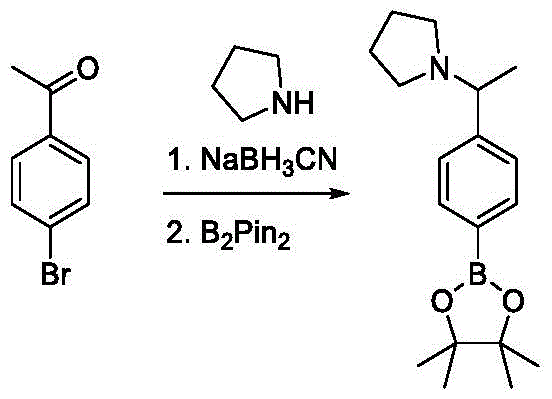
A seventh exemplary intermediate D, intermediate D-7, is useful in the synthesis of compounds of formula I, wherein R1Is by R4Aryl substituted with a substituent. To a solution of 1- (4-bromophenyl) ethanone (1.00g, 5.02mmol, 1.00 equiv.) and pyrrolidine (1.79g, 25.1mmol, 2.10mL, 5.00 equiv.) in methanol (16.0mL) was added NaBH3CN (347mg, 5.53mmol, 1.10 equiv.). The mixture was stirred at 20 ℃ for 24 hours. To the mixture was added water (4.00mL) and the aqueous phase was extracted with ethyl acetate (5.00 mL). The combined organic phases were washed with brine (2.00mL) and anhydrous Na2SO4Drying, filtering and concentrating to obtain 1- [1- (4-bromophenyl) ethyl ] as yellow oil]Pyrrolidine as a therapeutic agent(1.00g, 3.93mmol, 78.3% yield).
To 1- [1- (4-bromophenyl) ethyl]Pyrrolidine (400mg, 1.57mmol, 1.00 equiv.), 4,5, 5-tetramethyl-2- (4,4,5, 5-tetramethyl-1, 3, 2-dioxaborolan-2-yl) -1,3, 2-dioxaborolan (799mg, 3.15mmol, 2.00 equiv.), and potassium acetate (308mg, 3.15mmol, 2.00 equiv.) in dioxane (2.00mL) to which Pd (dppf) Cl is added2(115mg, 157. mu. mol, 0.100 equiv.). The reaction mixture was stirred at 105 ℃ for 2 hours under nitrogen atmosphere. The mixture was concentrated in vacuo to give a residue. The crude material was purified by column chromatography (petroleum ether/ethyl acetate, 1/0 to 1/1) to obtain 1- [1- [4- (4,4,5, 5-tetramethyl-1, 3, 2-dioxaborolan-2-yl) phenyl ] as a red oil]Ethyl radical]Pyrrolidine (110 mg).
Intermediate D-8

An eighth exemplary intermediate D, intermediate D-8, is useful in the synthesis of compounds of formula I, wherein R1Is represented by two R4A substituent-substituted heteroaryl. To a solution of n-butyllithium (2.50M, 1.80mL, 1.00 equiv) was added dropwise a solution of i-PrMgCl (2.00M, 1.12mL, 0.500 equiv) in THF (12mL) at 0 ℃ over 1 minute under a nitrogen atmosphere. The mixture was stirred at 0 ℃ for 5 minutes, then 5-bromo-4-chloro-2-methoxy-pyridine (1.00g, 4.50mmol, 1.00 eq) was added, after which the mixture was stirred at 0 ℃ for 45 minutes. To this solution was added 2-isopropoxy-4, 4,5, 5-tetramethyl-1, 3, 2-dioxaborolan (836mg, 4.50mmol, 917uL, 1.00 equiv.) and the mixture was stirred for a further 15 minutes, then at 20 ℃ for 3 hours. The reaction mixture was quenched by addition of saturated aqueous ammonium chloride (20.0mL) at 20 ℃ and extracted with ethyl acetate (20.0 mL. times.3). The combined organic layers were washed with brine (10.0mL), dried over anhydrous sodium sulfate, filtered and concentrated under reduced pressure to give 4-chloro-2-methoxy-5- (4,4,5, 5-tetramethyl-1, 3, 2-dioxaborolan-2-yl) pyridine (1.00g, 3.71mmol, 82.5% yield) as a grey solid, which was used in the next step without further purification.
1H NMR(400MHz,CDCl3)δ=8.47(s,1H),6.77(s,1H),3.97(s,3H),1.38(s,12H)。
Intermediate D-9

A ninth exemplary intermediate D, intermediate D-9, is useful in the synthesis of compounds of formula I, wherein R1Is represented by three R4A substituent-substituted heteroaryl. A mixture of 3, 5-dimethyl-4- (4,4,5, 5-tetramethyl-1, 3, 2-dioxaborolan-2-yl) -1H-pyrazole (100mg, 450. mu. mol, 1.00 eq), isopropyl iodide (306mg, 1.80mmol, 180uL, 4.00 eq) and cesium carbonate (587mg, 1.80mmol, 4.00 eq) in acetonitrile (3.00mL) was purged with nitrogen and subsequently stirred at 65 ℃ for 4 hours. The mixture was filtered and the solvent removed in vacuo to give 1-isopropyl-3, 5-dimethyl-4- (4,4,5, 5-tetramethyl-1, 3, 2-dioxaborolan-2-yl) pyrazole as a green oil (100mg, 368 μmol, 81.8% yield, 97.3% purity). LC-MS [ M +1]]:265。
Intermediate D-10

A tenth exemplary intermediate D, intermediate D-10, is useful in the synthesis of compounds of formula I, wherein R1Is represented by two R4A substituent-substituted heteroaryl. A mixture of 3-bromo-6-fluoro-2-methyl-pyridine (1.00g, 5.26mmol, 1.00 equiv.) and N-methylpiperazine (685mg, 6.84mmol, 759 μ L, 1.30 equiv.) was stirred at 110 ℃ for 12 hours. The mixture was diluted with ethyl acetate (50.0mL), washed with brine (20.0 mL. times.3), and dried over anhydrous Na2SO4Dried, filtered and concentrated to provide 1- (5-bromo-6-methyl-2-pyridinyl) -4-methyl-piperazine as a yellow solid (1.10g, 4.07mmol, 77.4% yield). LCMS (liquid Crystal Module) (M +1)]:272.1。
To a solution of 1- (5-bromo-6-methyl-2-pyridyl) -4-methyl-piperazine (400mg, 1.48mmol, 1.00 equiv.), 4,5, 5-tetramethyl-2- (4,4,5, 5-tetramethyl-1, 3, 2-dioxaboroleTo a solution of pentan-2-yl) -1,3, 2-dioxaborolan (752mg, 2.96mmol, 2.00 equiv.) and potassium acetate (291mg, 2.96mmol, 2.00 equiv.) in dioxane (2.00mL) was added Pd (dppf) Cl2(108mg, 148. mu. mol, 0.100 equiv.). The reaction was stirred at 105 ℃ for 2 hours under nitrogen atmosphere. The mixture was concentrated in vacuo to give a residue. The crude material was purified by preparative TLC (DCM/MeOH ═ 10/1) to give compound 1-methyl-4- (6-methyl-5- (4,4,5, 5-tetramethyl-1, 3, 2-dioxaborolan-2-yl) pyridin-2-yl) piperazine as a brown oil (210mg, 662 μmol, 44.7% yield). LCMS (liquid Crystal Module) (M +1)]:318.3。
Intermediate D-11

The eleventh exemplary intermediate D, intermediate D-11, is useful in the synthesis of compounds of formula I, wherein R1Is represented by three R4A substituent-substituted heteroaryl. To a solution of 3, 5-dimethyl-4- (4,4,5, 5-tetramethyl-1, 3, 2-dioxaborolan-2-yl) -1H-pyrazole (100mg, 450 μmol, 1.00 eq), (2S) -2-methyloxirane (392mg, 6.75mmol, 473 μ L, 15.0 eq) was added cesium carbonate (29.3mg, 90.1 μmol, 0.20 eq). The reaction mixture was stirred at 50 ℃ for 16 hours, followed by concentration in vacuo to give a residue. By preparative TLC (SiO)2Ethyl acetate ═ 1:1) to obtain (2S) -1- [3, 5-dimethyl-4- (4,4,5, 5-tetramethyl-1, 3, 2-dioxaborolan-2-yl) pyrazol-1-yl as a yellow oil]Propan-2-ol (56.0mg, 44.4% yield). LCMS (liquid Crystal Module) (M +1)]:281.3。
Intermediate D-12

A twelfth exemplary intermediate D, intermediate D-12, is useful in the synthesis of compounds of formula I, wherein R1Is represented by two R4Aryl substituted with a substituent. To 4-bromo-3-chloro-benzoic acid (300mg, 1.27mmol, 1.00 equiv.), DIEA (490mg, 3.79mmol, 660. mu.L, 300 eq) and N, N-dimethylamine (2.00M in THF, 1.27mL, 2.00 eq) in DMF (3.00mL) was added HATU (727mg, 1.91mmol, 1.50 eq). The mixture was stirred at room temperature for 2 hours, then the reaction mixture was quenched by the addition of water (15.0 mL). The mixture was extracted with dichloromethane (20.0 mL. times.3). The combined organic layers were washed with water (30.0mL) and concentrated to provide a crude mixture. By column chromatography (SiO)2Petroleum ether/ethyl acetate 5/1 to 2/1) to obtain 4-bromo-3-chloro-N, N-dimethyl-benzamide (430mg, 983 μmol, 77.0% yield, 60.0% purity) as a white solid. LCMS (liquid Crystal Module) (M +1)]:264.0。
1H NMR(400MHz,CDCl3)δ=7.67(d,J=8.2Hz,1H),7.53(d,J=1.6Hz,1H),7.18(dd,J=2.0,8.4Hz,1H),3.11(s,3H),2.99(s,3H)。
To a solution of 4-bromo-3-chloro-N, N-dimethyl-benzamide (150mg, 343 μmol, 1.00 equiv.), 4,5, 5-tetramethyl-2- (4,4,5, 5-tetramethyl-1, 3, 2-dioxaborolan-2-yl) 1,3, 2-dioxaborolan (870mg, 3.43mmol, 10.0 equiv.), and potassium acetate (67.0mg, 683 μmol, 2.00 equiv.) in dioxane (10.0mL) was added Pd (PPh)3)2Cl2(24.0mg, 34.2. mu. mol, 0.10 equiv.). The vessel was purged with nitrogen and the mixture was stirred at 100 ℃ for 1 hour. The reaction mixture was cooled to room temperature and filtered through a pad of celite. By preparative TLC (SiO)2Petroleum ether/ethyl acetate 2/1) to yield [ 2-chloro-4- (dimethylcarbamoyl) phenyl ] as a yellow solid]Boric acid (200 mg). LCMS (liquid Crystal Module) (M +1)]:228.0。
Intermediate D-13

A thirteenth exemplary intermediate D, intermediate D-13, is useful in the synthesis of compounds of formula I, wherein R1Is represented by two R4Aryl substituted with a substituent. A mixture of 4-bromo-3-methyl-benzaldehyde (500mg, 2.51mmol, 1.00 equiv.) and N, N-dimethylamine (2M in THF, 6.3mL, 12.6mmol, 5.00 equiv.) in methanol (10.0mL) was stirred at 40 ℃ for 30 min. Followed byAfter that, sodium triacetoxyborohydride (1.60g, 7.54mmol, 3.00 equiv.) was added and the mixture was stirred for another 3 hours. The mixture was concentrated under reduced pressure to give a residue. The crude residue was purified by column chromatography (petroleum ether/ethyl acetate-1/0 to 0/1, then dichloromethane/methanol-20/1 to 10/1) to give 1- (4-bromo-3-methyl-phenyl) -N, N-dimethyl-methylamine (570mg) as a brown oil.
1H NMR(400MHz,CD3OD)δ=7.61(d,J=8.0Hz,1H),7.38(d,J=1.6Hz,1H),7.16(dd,J=1.6,8.0Hz,1H),3.96(s,2H),2.63(s,6H),2.42(s,3H)。
Purge 1- (4-bromo-3-methyl-phenyl) -N, N-dimethyl-methylamine (470mg, 2.06mmol, 1.00 equiv.), 4,4,4',4',5,5,5',5' -octamethyl-2, 2' -bis (1,3, 2-dioxaborolan) (785mg, 3.09mmol, 1.50 equiv.), potassium acetate (404mg, 4.12mmol, 2.00 equiv.), and pd (dppf) Cl with nitrogen2(151mg, 206 μmol, 0.100 equiv.) in dioxane (8.00mL) and stirred at 105 ℃ for 2 hours. The mixture was concentrated under reduced pressure to give a residue. The residue was purified by column chromatography (dichloromethane/methanol ═ 50/1 to 10/1) to obtain N, N-dimethyl-1- [ 3-methyl-4- (4,4,5, 5-tetramethyl-1, 3, 2-dioxaborolan-2-yl) phenyl as a brown oil]Methylamine (70.0mg, 185. mu. mol, 8.99% yield, 72.8% purity). LCMS (liquid Crystal Module) (M +1)]:275.6。
Intermediate D-14

A fourteenth exemplary intermediate D, intermediate D-14, is useful in the synthesis of compounds of formula I, wherein R1Is represented by an R4Aryl substituted with a substituent. To a solution of 4-bromobenzenesulfonyl chloride (200mg, 783. mu. mol, 1.00 eq.) in THF (2.00mL) was added ammonia (7N in MeOH, 224. mu.L, 1.57mmol, 2.00 eq.). The reaction mixture was stirred at 25 ℃ for 30 minutes. The mixture was concentrated in vacuo to afford a residue, which was poured into water (10.0 mL). The aqueous phase was extracted with ethyl acetate (10.0 mL. times.3) and the combined organic phases were washed with brine (3.00 mL. times.3), dried over anhydrous sodium sulfate, filtered and concentrated to give a solid4-bromobenzenesulfonamide as a white solid (180mg, 762. mu. mol, 97.4% yield).
1H NMR(400MHz,DMSO-d6)δ=7.82-7.72(m,4H),7.46(s,2H)。
To a solution of 4-bromobenzenesulfonamide (100mg, 424. mu. mol, 1.00 equivalents) and 4,4,5, 5-tetramethyl-2- (4,4,5, 5-tetramethyl-1, 3, 2-dioxaborolan-2-yl) -1,3, 2-dioxaborolan-2 (129mg, 508. mu. mol, 1.20 equivalents) in DMSO (2.00mL) under nitrogen was added potassium acetate (83.1mg, 847. mu. mol, 2.00 equivalents) and Pd (dppf) Cl2(31.0mg, 42.4. mu. mol, 0.10 equiv.). The mixture was stirred at 80 ℃ for 3 hours, followed by concentration in vacuo to give a residue. The residue was poured into water (10.0mL) and the aqueous phase was extracted with ethyl acetate (10.0 mL. times.3). The combined organic phases were washed with brine (5.00mL × 3), dried over anhydrous sodium sulfate, filtered and concentrated to give 4- (4,4,5, 5-tetramethyl-1, 3, 2-dioxaborolan-2-yl) benzenesulfonamide (95.0mg, 336 μmol, 79.2% yield) as a red solid.
1H NMR(400MHz,CDCl3)δ=7.96-7.88(m,4H),7.26(s,2H),1.35(s,12H)。
Intermediate D-15

A fifteenth exemplary intermediate D, intermediate D-15, is useful in the synthesis of compounds of formula I, wherein R1Is a monosubstituted heteroaryl. To a solution of 2-methoxyethanol (236mg, 3.10mmol, 245. mu.L, 1.50 equiv.) in tetrahydrofuran (2.00mL) was added sodium hydride (99.3mg, 60.0%, 2.48mmol, 1.20 equiv) portionwise at 0 ℃. The mixture was stirred at this temperature for 45 minutes, then 5-bromo-2-chloro-pyrimidine (400mg, 2.07mmol, 1.00 equiv.) was added dropwise at room temperature. The resulting mixture was stirred for an additional 4 hours. The mixture was filtered and concentrated in vacuo to give a residue. The residue was purified by preparative TLC (petroleum ether/ethyl acetate ═ 10/1) to obtain 5-bromo-2- (2-methoxyethoxy) pyrimidine as a white solid (150mg, 644 μmol, 31.1% yield).
1H NMR(400MHz,CD3OD)δ=8.54(s,2H),4.42-4.37(m,2H),3.68-3.62(m,2H),3.30(s,3H)。
Purge 5-bromo-2- (2-methoxyethoxy) pyrimidine (150mg, 644. mu. mol, 1.00 equiv.), 4,5, 5-tetramethyl-2- (4,4,5, 5-tetramethyl-1, 3, 2-dioxaborolan-2-yl) -1,3, 2-dioxaborolan-2 (327mg, 1.29mmol, 2.00 equiv.), potassium acetate (126mg, 1.29mmol, 2.00 equiv.), Pd (dppf) Cl with nitrogen2(47.1mg, 64.4. mu. mol, 0.10 eq.) in dioxane (1.00mL) and stirred at 100 ℃ for 2 hours. The reaction was filtered and concentrated in vacuo to give a residue. The residue was purified by preparative TLC (petroleum ether/ethyl acetate ═ 1/1) to obtain 2- (2-methoxyethoxy) -5- (4,4,5, 5-tetramethyl-1, 3, 2-dioxaborolan-2-yl) pyrimidine as a yellow oil (130mg, 464 μmol, 72.1% yield).
1H NMR(400MHz,CDCl3)δ=8.83-8.79(m,2H),4.61-4.54(m,2H),3.82-3.76(m,2H),3.44(s,3H),1.36(s,12H)。
Intermediate D-16

A sixteenth exemplary intermediate D, intermediate D-16, is useful in the synthesis of compounds of formula I, wherein R1Is disubstituted heteroaryl. To a solution of ethylene glycol (310mg, 5.00mmol, 280 μ L, 2.00 equiv.) and 5-bromo-4-methyl-pyridine-2-carbaldehyde (500mg, 2.50mmol, 1.00 equiv.) in toluene (20.0mL) was added p-toluenesulfonic acid (47.6mg, 250 μmol, 0.10 equiv.). The mixture was stirred at 110 ℃ for 12 hours, then concentrated in vacuo to give a residue. By column chromatography (SiO)2Petroleum ether/ethyl acetate 1/0 to 5/1) to obtain 5-bromo-2- (1, 3-dioxolan-2-yl) -4-methylpyridine as a colorless oil (320mg, 1.24mmol, 49.6% yield).
1H NMR(400MHz,CDCl3)δ=8.64(s,1H),7.42(s,1H),5.80(s,1H),4.19-4.14(m,2H),4.10-4.05(m,2H),2.42(s,3H)。
To a solution of 5-bromo-2- (1, 3-dioxolan-2-yl) -4-methylpyridine (300mg, 1.23mmol, 1.00 eq) in diethyl ether (20.0mL) at-78 deg.C under a nitrogen atmosphere was added n-butyllithium (2.5M, 737. mu.L, 1.50 eq). The mixture was stirred at-78 ℃ for 0.5 h, then 2-isopropoxy-4, 4,5, 5-tetramethyl-1, 3, 2-dioxaborolan (457mg, 2.46mmol, 501. mu.L, 2.00 equiv.) was added. The mixture was heated to 0 ℃ and stirred for a further 1.5 hours. The mixture was quenched with water (15.0mL) and the resulting mixture was extracted with ethyl acetate (20.0 mL. times.2). The combined organic phases were dried over sodium sulfate, filtered and concentrated under reduced pressure to give 2- (1, 3-dioxolan-2-yl) -4-methyl-5- (4,4,5, 5-tetramethyl-1, 3, 2-dioxaborolan-2-yl) pyridine as a yellow oil (150mg, crude). LCMS [ M +1] 292.15.
Intermediate D-17

A seventeenth exemplary intermediate D, intermediate D-17, is useful in the synthesis of compounds of formula I, wherein R1Is a monosubstituted bicyclic heteroaryl. A mixture of paraformaldehyde (350mg, 3.63mmol, 2.20 equivalents) in methanol (1.00mL) was stirred at 60 ℃ for 1 hour, then cooled to 40 ℃. To the mixture was added AcOH (1 drop) and 6-bromo-1, 2,3, 4-tetrahydroisoquinoline (350mg, 1.65mmol, 1.00 equiv.), followed by addition of NaCNBH3(114mg, 1.82mmol, 1.1 equiv.). The mixture was stirred at 40 ℃ for 1 hour, then filtered and concentrated in vacuo to give a residue. The residue was purified by preparative TLC (petroleum ether/ethyl acetate ═ 2/1) to obtain 6-bromo-2-methyl-3, 4-dihydro-1H-isoquinoline (360mg, 1.59mmol, 96.5% yield) as a yellow oil.
1H NMR(400MHz,CD3OD)δ=7.32(s,1H),7.28(dd,J=2.0,8.4Hz,1H),7.00(d,J=8.0Hz,1H),3.57(s,2H),2.94(t,J=6.0Hz,2H),2.75-2.72(m,2H),2.46(s,3H)。
Purge 6-bromo-2-methyl-3, 4-dihydro-1H-isoquinoline (220mg, 973. mu. mol, 1.00 equiv.), 4,5, 5-tetramethyl-2- (4,4,5, 5-tetramethyl-1, 3, 2-dioxaborolan-2-yl) -1,3, 2-dioxaborolan (494mg, 1.95mmol, 2.00 equiv.), EtOH with NitrogenPotassium (191mg, 1.95mmol, 2.00 equiv.), Pd (dppf) Cl2A mixture of (71.2mg, 97.3 μmol, 0.10 eq) in dioxane (3.00mL) was then stirred at 100 ℃ for 2 hours. The mixture was filtered and concentrated in vacuo to give a residue. The residue was purified by preparative TLC (petroleum ether/ethyl acetate ═ 2/1) to obtain 2-methyl-6- (4,4,5, 5-tetramethyl-1, 3, 2-dioxaborolan-2-yl) -3, 4-dihydro-1H-isoquinoline (150mg, crude) as a white solid.
Intermediate D-18

The eighteenth exemplary intermediate D, intermediate D-18, is useful in the synthesis of compounds of formula I, wherein R1Is an N-protected bicyclic heteroaryl. To a solution of 6-bromo-1, 2,3, 4-tetrahydroisoquinoline (400mg, 1.89mmol, 1.00 eq) in tetrahydrofuran (2.00mL) was added Boc2O (617mg, 2.83mmol, 1.50 equiv.) and dimethylaminopyridine (46.1mg, 377. mu. mol, 0.20 equiv.). The mixture was stirred at 25 ℃ for 3 hours, then filtered and concentrated in vacuo to give a residue. By column chromatography (SiO)2Petroleum ether/ethyl acetate 20/1 to 3/1) to obtain tert-butyl 6-bromo-3, 4-dihydro-1H-isoquinoline-2-carboxylate as a white solid (150mg, 480 μmol, 25.5% yield).
1H NMR(400MHz,CD3OD)δ=7.38-7.32(m,2H),7.07(d,J=8.0Hz,1H),4.52(br s,2H),3.64(br t,J=6.0Hz,2H),2.84(t,J=6.0Hz,2H),1.51(s,9H)。
Purge 6-bromo-3, 4-dihydro-1H-isoquinoline-2-carboxylic acid tert-butyl ester (140mg, 448. mu. mol, 1.00 equiv.), 4,5, 5-tetramethyl-2- (4,4,5, 5-tetramethyl-1, 3, 2-dioxaborolan-2-yl) -1,3, 2-dioxaborolan (228mg, 897. mu. mol, 2.00 equiv.), Pd (dppf) Cl with nitrogen2A mixture of (32.8mg, 44.8 μmol, 0.10 eq), potassium acetate (88.0mg, 897 μmol, 2.00 eq) in dioxane (1.00mL) was then stirred at 100 ℃ for 2 hours. The mixture was filtered and concentrated in vacuo to give a residue. The residue was purified by preparative TLC (petroleum ether/ethyl acetate ═ 2/1) to give a crude extractTert-butyl 6- (4,4,5, 5-tetramethyl-1, 3, 2-dioxaborolan-2-yl) -3, 4-dihydro-1H-isoquinoline-2-carboxylate (100mg, 278. mu. mol, 62.1% yield) is obtained as a yellow oil.
1H NMR(400MHz,CD3OD)δ=7.58-7.54(m,2H),7.13(d,J=8.0Hz,1H),4.58(br s,2H),3.65(br t,J=6.0Hz,2H),2.84(t,J=6.0Hz,2H),1.35(s,12H),1.19(br s,1H),1.22(s,9H)。
Intermediate D-19

The nineteenth exemplary intermediate D, intermediate D-19, is useful in the synthesis of compounds of formula I, wherein R1Is a monosubstituted aryl group. A mixture of paraformaldehyde (133mg, 4.42mmol, 122. mu.L, 10.0 equivalents) and methanol (1.00mL) was stirred at 60 ℃ for 1 hour and then cooled to 0 ℃. To the mixture was added acetic acid (52.5mg, 874. mu. mol, 0.05mL, 1.98 equiv.) and 2- (4-bromophenyl) pyrrolidine (100mg, 442. mu. mol, 1.00 equiv.). The mixture was stirred at room temperature for 1 hour, then sodium cyanoborohydride (83.4mg, 1.33mmol, 3.00 equiv.) was added and stirred for another 1 hour. The mixture was filtered and concentrated under reduced pressure to give a residue. By preparative TLC (SiO)2Petroleum ether/ethyl acetate 3/1) to obtain 2- (4-bromophenyl) -1-methyl-pyrrolidine as a white solid (100mg, 413 μmol, 93.3% yield, 99.1% purity). LC-MS [ M +1]]:240.1。
1H NMR(400MHz,CDCl3)δ=7.48-7.41(m,2H),7.26-7.21(m,2H),3.33-3.14(m,1H),3.02(t,J=8.4Hz,1H),2.29(q,J=9.2Hz,1H),2.16(s,3H),2.06-1.89(m,1H),1.86-1.77(m,1H),1.76-1.69(m,2H)。
Purge 2- (4-bromophenyl) -1-methyl-pyrrolidine (48.0mg, 200. mu. mol, 1.00 equiv.), bis (pinacolato) diboron (76.1mg, 300. mu. mol, 1.50 equiv.), potassium acetate (58.9mg, 600. mu. mol, 3.00 equiv.), Pd (dppf) Cl with nitrogen2A mixture of (14.6mg, 20.0 μmol, 0.10 eq) in dioxane (1.00mL) was then stirred at 90 ℃ for 2 hours. The mixture was filtered and concentrated under reduced pressure to afford a residueAnd (4) remaining. By preparative TLC (SiO)2Petroleum ether/ethyl acetate ═ 3/1) to obtain 1-methyl-2- [4- (4,4,5, 5-tetramethyl-1, 3, 2-dioxaborolan-2-yl) phenyl as a white solid]Pyrrolidine (23.0mg, 73.3 μmol, 36.7% yield, 91.5% purity). LC-MS [ M +1]]:288.0。
Intermediate D-20

A twentieth exemplary intermediate D, intermediate D-20, is useful in the synthesis of compounds of formula I, wherein R1Is a monosubstituted aryl group. A mixture of 2- (4-bromophenyl) pyrrolidine (50.0mg, 221. mu. mol, 1.00 equiv.), di-tert-butyl dicarbonate (57.9mg, 265. mu. mol, 1.20 equiv.) and dimethylaminopyridine (2.70mg, 22.1. mu. mol, 0.10 equiv.) in tetrahydrofuran (1.00mL) was purged with nitrogen and then stirred at 25 ℃ for 2 hours. The mixture was filtered and concentrated under reduced pressure. By preparative TLC (SiO)2Petroleum ether/ethyl acetate 10/1) to obtain tert-butyl 2- (4-bromophenyl) pyrrolidine-1-carboxylate as a yellow oil (55.0mg, 163 μmol, 73.6% yield, 96.5% purity). LC-MS [ M-55 ]]:272.1。
2- (4-bromophenyl) pyrrolidine-1-carboxylic acid tert-butyl ester (46.6mg, 138. mu. mol, 1.00 equiv.), bis (pinacolato) diboron (52.5mg, 207. mu. mol, 1.50 equiv.), potassium acetate (40.6mg, 414. mu. mol, 3.00 equiv.), and Pd (dppf) Cl were purged with nitrogen2A mixture of (10.1mg, 13.8 μmol, 0.10 eq) in dioxane (1.00mL) was then stirred at 90 ℃ for 2 hours. The mixture was filtered and concentrated under reduced pressure. By preparative TLC (SiO)2Petroleum ether/ethyl acetate ═ 5/1) to obtain 2- [4- (4,4,5, 5-tetramethyl-1, 3, 2-dioxaborolan-2-yl) phenyl as a yellow solid]Pyrrolidine-1-carboxylic acid tert-butyl ester (45.0mg, 102 μmol, 74.3% yield, 85.0% purity). LC-MS [ M-55 ]]:318.2。
1H NMR(400MHz,CDCl3)δ=7.75(br d,J=7.6Hz,2H),7.17(br d,J=7.6Hz,2H),4.80(br s,1H),3.63(br s,2H),2.32(br s,1H),1.98-1.75(m,3H),1.58(s,9H),1.35(br s,12H)。
Intermediate D-21
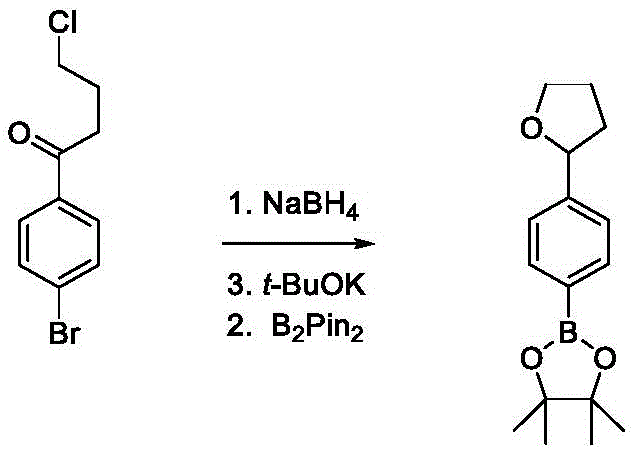
A twenty-first exemplary intermediate D, intermediate D-21, is useful in the synthesis of compounds of formula I, wherein R1Is a monosubstituted heteroaryl. To a solution of 1- (4-bromophenyl) -4-chloro-butan-1-one (1.00g, 3.82mmol, 1.00 equiv.) in methanol (13.0mL) at room temperature was added NaBH in portions4(300mg, 7.93mmol, 2.07 equiv.). The mixture was stirred at room temperature for 2 hours, then quenched by the addition of water (10.0 mL). The mixture was diluted with dichloromethane (20mL) and the organic layer was washed with water and brine, dried over anhydrous sodium sulfate, filtered and concentrated under reduced pressure to give the crude product 1- (4-bromophenyl) -4-chloro-butan-1-ol as a pale yellow oil (1.00g, 3.79mmol, 99.2% yield).
1H NMR(400MHz,CDCl3)δ=7.49(d,J=8.4Hz,2H),7.24(d,J=8.4Hz,2H),4.71(br t,J=6.0Hz,1H),3.54(s,2H),2.01-1.72(m,4H)。
A solution of 1- (4-bromophenyl) -4-chloro-butan-1-ol (500mg, 1.90mmol, 1.00 eq.) and t-BuOK (1.0M in THF, 1.90mL, 1.00 eq.) was stirred at room temperature for 2 h. The reaction was quenched with water and extracted with diethyl ether (2X 20.0 ml). The combined organic phases were dried over anhydrous sodium sulfate, filtered and concentrated under reduced pressure to give 2- (4-bromophenyl) tetrahydrofuran (420mg, 1.85mmol, 97.5% yield) as a white solid.
1H NMR(400MHz,CDCl3)δ=7.49-7.42(m,2H),7.24-7.18(m,2H),4.85(t,J=7.2Hz,1H),4.13-4.05(m,1H),3.97-3.90(m,1H),2.38-2.27(m,1H),2.06-1.95(m,2H),1.80-1.70(m,1H)。
To a mixture of 2- (4-bromophenyl) tetrahydrofuran (150mg, 661 μmol, 1.00 equiv.) and 4,4,5, 5-tetramethyl-2- (4,4,5, 5-tetramethyl-1, 3, 2-dioxaborolan-2-yl) -1,3, 2-dioxaborolan (252mg, 992 μmol, 1.50 equiv.), potassium acetate (195mg, 1.99mmol, 3.01 equiv.) in dioxane (5.00mL) was added Pd (dppf) Cl2(48.3mg,66.0μmol,0.10 equivalent). The mixture was stirred at 105 ℃ for 1 hour, cooled to room temperature and filtered through a pad of celite. The filtrate was concentrated to give a residue, which was purified by preparative TLC (SiO)2Petroleum ether/ethyl acetate 2/1) to obtain 4,4,5, 5-tetramethyl-2- (4-tetrahydro-furan-2-ylphenyl) -1,3, 2-dioxaborolan as a colorless oil (240mg, 639 μmol, 96.8% yield, 73% purity). LCMS (liquid Crystal Module) (M +1)]:275.1。
1H NMR(400MHz,CDCl3)δ=7.78(d,J=8.4Hz,2H),7.34(d,J=7.6Hz,2H),4.92(t,J=7.2Hz,1H),4.17-4.06(m,1H),4.00-3.90(m,1H),2.41-2.27(m,1H),2.09-1.91(m,2H),1.85-1.73(m,1H),1.35(s,12H)。
Intermediate D-22

A twenty-second exemplary intermediate D, intermediate D-22, is useful in the synthesis of compounds of formula I, wherein R1Is a monosubstituted aryl group. To a cooled solution of formalin (300mg, 9.99mmol, 275 μ L, 10.0 equiv.) 2- (4-bromophenyl) ethylamine (200mg, 1.0mmol, 155 μ L, 1.00 equiv.) was added HCOOH (5.00mL) and the solution was stirred at 110 ℃ under nitrogen for 16 h. The reaction mixture was concentrated to give a residue. To the residue was added HCl (3N, 1.00mL) and the mixture was washed with ethyl acetate (310 mL). The aqueous phase was basified to pH 14 with NaOH (10N, 1.00mL) and extracted with ethyl acetate (3 × 15.0 mL). The combined organic phases were washed with brine (2 × 15.0mL), dried over anhydrous sodium sulfate, and concentrated in vacuo to give 2- (4-bromophenyl) -N, N-dimethyl-ethylamine (200mg, 877 μmol, 87.7% yield) as a colorless oil.
1H NMR(400MHz,CDCl3)δ=7.40(d,J=8.4Hz,2H),7.09(d,J=8.4Hz,2H),2.73(d,J=8.4Hz,2H),2.56-2.48(m,2H),2.29(s,6H)。
2- (4-bromophenyl) -N, N-dimethyl-ethylamine (160mg, 701. mu. mol, 1.00 equiv.), 4,5, 5-tetramethyl-2- (4,4,5, 5-tetramethyl-1, 3, 2-dioxaborolan-2-yl) (268mg, 1.06mmol, 1.50 equiv.), P with nitrogen purged(dppf)Cl2A mixture of (51.2mg, 70.0 μmol, 0.10 eq), potassium acetate (206mg, 2.10mmol, 3.00 eq) in dioxane (8.00mL) and stirred at 100 ℃ for 1 hour. The mixture was concentrated to give a residue, which was purified by preparative TLC (SiO)2Dichloromethane/methanol ═ 10/1) to obtain N, N-dimethyl-2- [4- (4,4,5, 5-tetramethyl-1, 3, 2-dioxaborolan-2-yl) phenyl as a black oil]Ethylamine (350mg, crude). LCMS (liquid Crystal Module) (M +1)]:276.2。
Intermediate D-23

A twenty-third exemplary intermediate D, intermediate D-23, is useful in the synthesis of compounds of formula I, wherein R1Is a monosubstituted aryl group. To a solution of 1-bromo-4-iodo-benzene (200mg, 707. mu. mol, 1.00 eq), diethyl phosphite (97.6mg, 707. mu. mol, 91.2. mu.L, 1.00 eq) in tetrahydrofuran (2.00mL) was added Pd (OAc)2(4.76mg, 21.2. mu. mol, 0.03 equiv.), potassium acetate (9.02mg, 91.9. mu. mol, 0.13 equiv.), DPPF (23.5mg, 42.4. mu. mol, 0.06 equiv.), and triethylamine 107mg, 1.06mmol, 147. mu.L, 1.50 equiv.). The vessel was purged with nitrogen and stirred at 68 ℃ for 1 hour. The mixture was concentrated in vacuo to give a residue. By preparative TLC (SiO)2Petroleum ether/ethyl acetate-1/1) to obtain 1-bromo-4-diethoxyphosphoryl-benzene (110mg, 341 μmol, 48.2% yield, 90.8% purity) as a red solid. LCMS (liquid Crystal Module) (M + 3)]:294.9。
1H NMR(400MHz,CDCl3)δ=7.73-7.57(m,4H),4.22-3.99(m,4H),1.32(t,J=7.2Hz,6H)。
To a solution of 1-bromo-4-diethoxyphosphoryl-benzene (100mg, 341 μmol, 1.00 equivalents), 4,5, 5-tetramethyl-2- (4,4,5, 5-tetramethyl-1, 3, 2-dioxaborolan-2-yl) -1,3, 2-dioxaborolan (104mg, 409 μmol, 1.20 equivalents) in dioxane (2.00mL) under nitrogen atmosphere was added pd (dppf) Cl2(24.9mg, 34.1. mu. mol, 0.10 eq.) and potassium acetate (67.0mg, 682umol, 2.00 eq.). The mixture was stirred at 100 ℃ for 2 hours and then concentrated in vacuoTo obtain a residue. By preparative TLC (SiO)2Petroleum ether/ethyl acetate 1/1) to obtain 2- (4-diethoxyphosphorylphenyl) -4,4,5, 5-tetramethyl-1, 3, 2-dioxaborolan cyclopentane as a red oil (55.0mg, 162 μmol, 47.4% yield).
1H NMR(400MHz,CDCl3)δ=7.93-7.87(m,2H),7.85-7.76(m,2H),4.21-4.01(m,4H),1.36(s,12H),1.32(t,J=7.2Hz,6H)。
Intermediate D-24

A twenty-fourth exemplary intermediate D, intermediate D-24, is useful in the synthesis of compounds of formula I, wherein R1Is a disubstituted aryl group. To a solution of 2- (4-bromo-3-methyl-phenyl) pyrrolidine (500mg, 2.08mmol, 1.00 eq) in dichloromethane (5.00mL) was added Boc2O (1.05g, 4.79mmol, 1.10mL, 2.30 equiv.) and dimethylaminopyridine (25.4mg, 208. mu. mol, 0.10 equiv.). The mixture was stirred at 25 ℃ for 1 hour, then filtered and concentrated under reduced pressure to give a residue. By column chromatography (SiO)2Petroleum ether/ethyl acetate 30/1 to 20/1) to obtain tert-butyl 2- (4-bromo-3-methyl-phenyl) pyrrolidine-1-carboxylate as a yellow oil (600mg, 84.7% yield).
1H NMR(400MHz,CD3OD)δ=7.46(br d,J=8.4Hz,1H),7.10(d,J=1.6Hz,1H),6.92(dd,J=1.6,8.0Hz,1H),4.73(br s,1H),3.65-3.51(m,2H),2.37(s,3H),2.34-2.27(m,1H),1.93-1.82(m,2H),1.82-1.73(m,1H),1.45(br s,3H),1.24-1.13(m,6H)。
Purging with nitrogen 4,4,5, 5-tetramethyl-2- (4,4,5, 5-tetramethyl-1, 3, 2-dioxaborolan-2-yl) -1,3, 2-dioxaborolan-2-yl (268mg, 1.06mmol, 1.20 equivalents), tert-butyl 2- (4-bromo-3-methyl-phenyl) pyrrolidine-1-carboxylate (300mg, 882. mu. mol, 1.00 equivalents), Pd (dppf) Cl2A mixture of (64.1mg, 88.2 μmol, 0.10 eq) and potassium acetate (173mg, 1.76mmol, 2.00 eq) in dioxane (3.00mL) and the mixture was then stirred at 100 ℃ for 1.5 h. FiltrationThe reaction mixture was concentrated under reduced pressure to give a residue. By column chromatography (SiO)2Petroleum ether/ethyl acetate 20/1 to 10/1) to obtain 2- [ 3-methyl-4- (4,4,5, 5-tetramethyl-1, 3, 2-dioxaborolan-2-yl) phenyl as a white solid]Pyrrolidine-1-carboxylic acid tert-butyl ester (260mg, 76.1% yield).
1H NMR(400MHz,CDCl3)δ=7.68(br d,J=7.6Hz,1H),7.0-6.94(m,2H),4.98-4.66(m,1H),3.61(br s,2H),2.52(s,3H),2.36(br s,1H),1.93-1.76(m,3H),1.35(br s,12H),1.29-1.25(m 3H),1.21(br s,6H)。
Intermediate D-25

A twenty-fifth exemplary intermediate D, intermediate D-25, is useful in the synthesis of compounds of formula I, wherein R1Is a disubstituted aryl group. To a solution of 4-bromo-3-methyl-benzaldehyde (2.00g, 10.1mmol, 1.00 equiv.) in toluene (100mL) was added TsOH-H2O (191mg, 1.00mmol, 0.10 equiv.) and ethylene glycol (1.25g, 20.1mmol, 1.12mL, 2.00 equiv.). The mixture was stirred at 130 ℃ for 12 hours and then cooled to room temperature. The pH was adjusted to 9 with DMAP and then concentrated in vacuo. By column chromatography (neutral Al)2O3Petroleum ether/ethyl acetate 1/0 to 100/1) to obtain 2- (4-bromo-3-methyl-phenyl) -1, 3-dioxolane as a yellow oil (2.30g, 9.46mmol, 94.2% yield).
1H NMR(400MHz,CDCl3)δ=7.54(d,J=8.4Hz,1H),7.36(d,J=1.6Hz,1H),7.17(dd,J=2.4,8.0Hz,1H),5.76(s,1H),4.15-4.08(m,2H),4.08-4.00(m,2H),2.42(s,3H)。
With N2Purge 2- (4-bromo-3-methyl-phenyl) -1, 3-dioxolane (2.50g, 10.3mmol, 1.00 equiv.), Pin2B2(3.39g, 13.4mmol, 1.30 equiv.), KOAc (2.02g, 20.6mmol, 2.00 equiv.), and Pd (dppf) Cl2A mixture of (376mg, 514umol, 0.05 eq) in dioxane (30.0mL) was then stirred at 100 ℃ for 6 hours. The mixture was filtered and concentrated in vacuoAnd (4) shrinking. By column chromatography (neutral Al)2O3Petroleum ether/ethyl acetate 1/0 to 50/1) to obtain 2- [4- (1, 3-dioxolan-2-yl) -2-methyl-phenyl as green oil]4,4,5, 5-tetramethyl-1, 3, 2-dioxaborole (2.60g, 8.96mmol, 87.1% yield).
1H NMR(400MHz,CDCl3)δ=7.78(d,J=7.6Hz,1H),7.29-7.25(m,2H),5.81(s,1H),4.15-4.08(m,2H),4.07-4.01(m,2H),2.56(s,3H),1.35(s,12H)。
Intermediate D-26

A twenty-sixth exemplary intermediate D, intermediate D-26, is useful in the synthesis of compounds of formula I, wherein R1Is a monosubstituted heteroaryl. With N2Purging N- [ (5-bromopyrimidin-2-yl) methyl]Tert-butyl carbamate (100mg, 347. mu. mol, 1.00 eq.), Pin2B2(176mg, 694. mu. mol, 2.00 equivalents), KOAc (68.1mg, 694. mu. mol, 2.00 equivalents) and Pd (dppf) Cl2(25.4mg, 34.7 μmol, 0.10 eq.) in dioxane (2.00mL) and then stirred at 100 ℃ for 2 hours. The reaction mixture was filtered and concentrated in vacuo to give [2- [ (tert-butoxycarbonylamino) methyl group as red oil]Pyrimidin-5-yl]Boric acid (100mg, crude). LCMS [ M-55 ]]:198.1。
Intermediate D-27
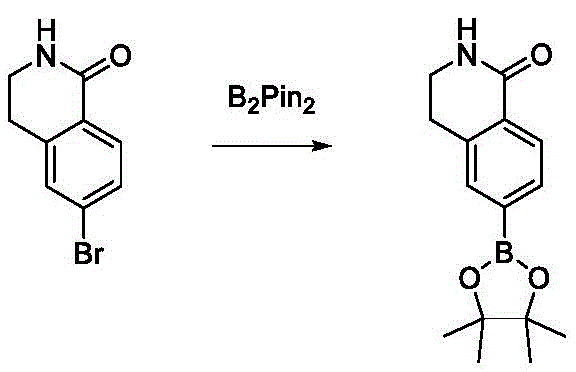
A twenty-seventh exemplary intermediate D, intermediate D-27, is useful in the synthesis of compounds of formula I, wherein R1Is a monosubstituted bicyclic heteroaryl. Purge 6-bromo-3, 4-dihydro-2H-isoquinolin-1-one (150mg, 664. mu. mol, 1.00 equiv.), 4,5, 5-tetramethyl-2- (4,4,5, 5-tetramethyl-1, 3, 2-dioxaborolan-2-yl) -1,3, 2-dioxaborolan (253mg, 996. mu. mol, 1.50 equiv.), Pd (dppf) Cl with nitrogen2(48.55mg, 66.35. mu. mol, 0.10 equiv.), potassium acetate (195mg, 1.99mmol, 3.00 equivalents) in dioxane (5.00mL) and then stirred at 95 ℃ for 2 hours. The reaction mixture was cooled and filtered through a pad of celite, and the filtrate was concentrated to give a residue. By column chromatography (SiO)2Petroleum ether/ethyl acetate 3/1 to 1/1) to obtain 6- (4,4,5, 5-tetramethyl-1, 3, 2-dioxaborolan-2-yl) -3, 4-dihydro-2H-isoquinolin-1-one (180mg, 659 μmol, 99.32% yield) as an off-white solid. LCMS (liquid Crystal Module) (M +1)]:274.1。
1H NMR(400MHz,CDCl3)δ=8.07(d,J=8.0Hz,1H),7.80(d,J=7.6Hz,1H),7.67(s,1H),6.04(s,1H),3.57(dt,J=2.8,6.4Hz,2H),3.02(t,J=6.4Hz,2H),1.37(s,12H)。
Intermediate D-28

A twenty-eighth exemplary intermediate D, intermediate D-28, is useful in the synthesis of compounds of formula I, wherein R1Is a disubstituted bicyclic heteroaryl. To a suspension of NaH (79.1mg, 60%, 1.98mmol, 2.00 equiv.) in DMF (3.00mL) at 0 deg.C was added dropwise a solution of 6- (4,4,5, 5-tetramethyl-1, 3, 2-dioxaborolan-2-yl) -3, 4-dihydro-2H-isoquinolin-1-one (270mg, 989. mu. mol, 1.00 equiv.) in DMF. The mixture was stirred at this temperature for a further 30 minutes, then CH was added dropwise at 0 deg.C3I (1.40g, 9.89mmol, 615. mu.L, 10.0 equiv.). The mixture was warmed to room temperature and stirred for 3 hours. The reaction was quenched by the addition of 20.0mL of water and extracted with ether (3X 30.0 mL). The combined organic layers were washed with water (50.0mL), dried over sodium sulfate, filtered and concentrated under reduced pressure to give 2-methyl-6- (4,4,5, 5-tetramethyl-1, 3, 2-dioxaborolan-2-yl) -3, 4-dihydroisoquinolin-1-one (300mg, crude) as a black oil. LCMS (liquid Crystal Module) (M +1)]:288.1。
1H NMR(400MHz,CHCl3-d)δ=8.07(d,J=7.6Hz,1H),7.77(d,J=7.6Hz,1H),7.63(s,1H),3.56(t,J=6.8Hz,2H),3.16(s,3H),3.01(t,J=6.8Hz,2H),1.36(s,12H)。
Intermediate D-29

A twenty-ninth exemplary intermediate D, intermediate D-29, is useful in the synthesis of compounds of formula I, wherein R1Is a disubstituted aryl group. A mixture of 5-bromo-2- (bromomethyl) benzonitrile (100mg, 364. mu. mol, 1.00 equiv.), diisopropylethylamine (141mg, 1.09mmol, 190. mu.L, 3.00 equiv.), and dimethylamine (2.00M, 1.82mL, 10.0 equiv.) in dimethylformamide (2.00mL) was stirred at room temperature for 3 hours. The reaction mixture was diluted with 5.00mL of water and extracted with ethyl acetate (5.00 mL. times.3). The combined organic layers were washed with brine (3.00mL × 3), dried over sodium sulfate, filtered and concentrated under reduced pressure to give a residue. The residue was purified by preparative TLC (petroleum ether/ethyl acetate ═ 3/1) to obtain 5-bromo-2- [ (dimethylamino) methyl group as yellow oil]Benzonitrile (50.0mg, 209. mu. mol, 57.5% yield). LC-MS [ M +1]]:239.2。
1H NMR(400MHz,CDCl3)δ=7.77(d,J=2.0Hz,1H),7.69(dd,J=2.0,8.4Hz,1H),7.46(d,J=8.4Hz,1H),3.59(s,2H),1.59(br s,6H)。
Purging 5-bromo-2- [ (dimethylamino) methyl group with nitrogen]Benzonitrile (30.0mg, 125. mu. mol, 1.00 eq), bis (pinacolato) diboron (63.7mg, 251. mu. mol, 2.00 eq), potassium acetate (36.9mg, 376. mu. mol, 3.00 eq) and Pd (dppf) Cl2.CH2Cl2A mixture of (3.07mg, 3.76 μmol, 0.03 eq) in dioxane (1.00mL) was then stirred at 90 ℃ for 4 hours. The mixture was filtered and concentrated under reduced pressure to give the crude product 2- [ (dimethylamino) methyl group as a black oil]-5- (4,4,5, 5-tetramethyl-1, 3, 2-dioxaborolan-2-yl) benzonitrile (40.0mg), which was used in the next step without further purification.
Intermediate D-30
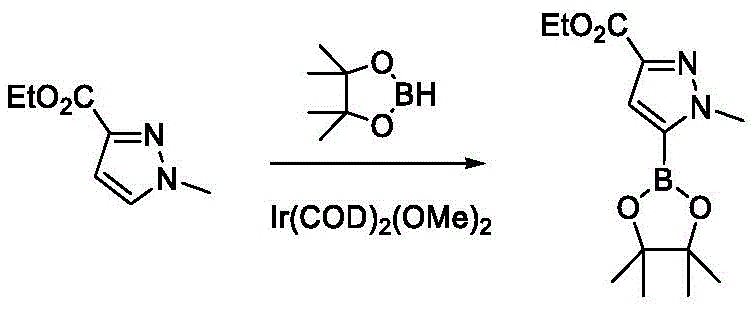
A thirty-second exemplary intermediate D, intermediate D-30, is useful in the synthesis of compounds of formula I, whereinR1Is disubstituted heteroaryl. To Ir (COD)2(OMe)2To a solution of (5.00mg, 7.54. mu. mol, 0.02 eq) and 4,4,5, 5-tetramethyl-1, 3, 2-dioxaborolan (68.5mg, 535. mu. mol, 77.7. mu.L, 1.50 eq) in n-pentane (0.50mL) was added 4-tert-butyl-2- (4-tert-butyl-2-pyridyl) pyridine (5.00mg, 18.6. mu. mol, 0.05 eq) and the mixture was stirred at 25 ℃ for 20 minutes. To the mixture was added a solution of methyl 1-methylpyrazole-3-carboxylate (50.0mg, 357. mu. mol, 1.00 equiv.) in n-pentane (0.50mL) and THF (0.50mL) and the mixture was stirred at 25 ℃ for 24 h. The mixture was partitioned between ethyl acetate (10.0mL) and water (10.0 mL). The organic phase was dried over anhydrous sodium sulfate and concentrated to obtain the crude product methyl 1-methyl-5- (4,4,5, 5-tetramethyl-1, 3, 2-dioxaborolan-2-yl) pyrazole-3-carboxylate (50.0mg, 113 μmol, 31.6% yield, 60.0% purity) as a black oil.
1H NMR(400MHz,CDCl3)δ=7.28(s,1H),4.15(s,3H),3.93(s,3H),1.35(s,12H)。
Intermediate D-31

Thirty-first exemplary intermediate D, intermediate D-31, is useful in the synthesis of compounds of formula I, wherein R1Is a disubstituted aryl group in which two hydrogens of one substituent are replaced with deuterium. To a solution of 4-bromo-N, 3-trimethyl-benzamide (500mg, 2.07mmol, 1.00 equiv.) in THF (5.00mL) was added lithium aluminum tetradeuteriolate (235mg, 6.20mmol, 3.00 equiv.). The mixture was stirred at 0 ℃ for 1.5 hours, then warmed to room temperature and stirred for an additional 1 hour. The reaction mixture was cooled to 0 ℃ and diluted with THF (10.0 mL). The reaction was quenched by dropwise addition of deuterium oxide (0.24mL), a 15% NaOD solution of deuterium oxide (0.24mL) at 0 deg.C, and finally deuterium oxide (0.72 mL). The mixture was stirred at room temperature for 10 minutes, dried over sodium sulfate, filtered and concentrated under reduced pressure to give a residue. By column chromatography (SiO)2Dichloromethane/methanol-50/1 to 20/1) to obtain 1- (4-bromo-3-methyl-phenyl) -1, 1-dideutero-N, N-didecyl as a brown oilMethyl-methylamine (220mg, crude). LCMS (liquid Crystal Module) (M +1)]:232.1。
Intermediate D-32
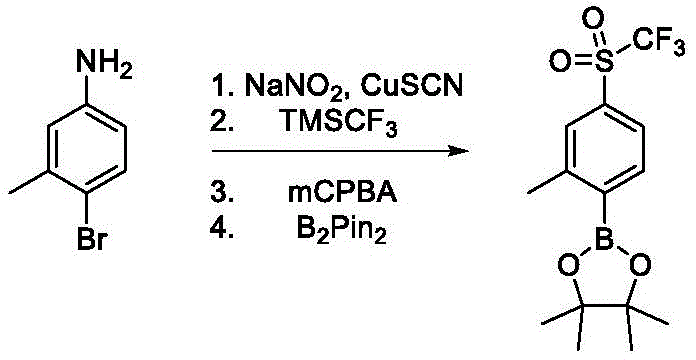
A thirty-second exemplary intermediate D, intermediate D-32, is useful in the synthesis of compounds of formula I, wherein R1Is a disubstituted aryl group. To a solution of 4-bromo-3-methyl-aniline (4.00g, 21.5mmol, 1.00 equiv.) in concentrated sulfuric acid (40.0mL) and water (40.0mL) was added sodium nitrite (1.62g, 23.4mmol, 1.09 equiv.) at 0 ℃ and the mixture was stirred for 90 minutes. Subsequently, a solution of potassium thiocyanate (2.82g, 29.0mmol, 2.82mL, 1.35 equiv.) in water (16.0mL) and cuprous thiocyanate (6.80g, 55.9mmol, 2.60 equiv.) were added to the suspension at 5 ℃. After stirring at 5 ℃ for 2 hours, the mixture was stirred at room temperature for 10 hours. The mixture was filtered and concentrated under reduced pressure to give a residue. By column chromatography (SiO)2Petroleum ether) to obtain (4-bromo-3-methyl-phenyl) thiocyanate as a yellow oil (2.00g, 8.77mmol, 40.8% yield).
1H NMR(400MHz,CDCl3)δ=7.52(d,J=8.4Hz,1H),7.33(d,J=2.4Hz,1H),7.14(dd,J=2.4,8.4Hz,1H),2.36(s,3H)。
A mixture of (4-bromo-3-methyl-phenyl) thiocyanate (500mg, 2.19mmol, 1.00 equiv.), trimethyl (trifluoromethyl) silane (1.00g, 7.04mmol, 3.21 equiv.), and tetrabutylammonium fluoride (1.00M, 701. mu.L, 0.32 equiv.) in tetrahydrofuran (1.00mL) was stirred at room temperature for 4 hours. The mixture was filtered and concentrated under reduced pressure. By column chromatography (SiO)2Petroleum ether) to obtain 1-bromo-2-methyl-4- (trifluoromethylmercapto) benzene (450mg, 1.66mmol, 75.7% yield) as a colorless oil.
1H NMR(400MHz,CDCl3)δ=7.59(d,J=8.0Hz,1H),7.52(d,J=2.0Hz,1H),7.34(dd,J=2.4,8.0Hz,1H),2.44(s,3H)。
1-bromo-2-methyl-4- (trifluoromethylmercapto) benzene (450mg, 1.66mmol, 1.00 equiv.) and m-chloroperoxybenzoic acid (2.02g, 85.0%, 9%96mmol, 6.00 equiv.) in chloroform (10.0mL) was stirred at room temperature for 2 hours. The mixture was heated to 60 ℃ and stirred for a further 10 hours. The mixture was diluted with saturated sodium bicarbonate (15.0mL) and extracted with dichloromethane (5.00 mL. times.3). The combined organic phases were washed with sodium sulfite (5.00mL), brine (5.00mL), dried over sodium sulfate, filtered and concentrated under pressure to give a residue. By column chromatography (SiO)2Petroleum ether) to obtain 1-bromo-2-methyl-4- (trifluoromethanesulfonyl) benzene as a white solid (400mg, 1.32mmol, 79.5% yield).
1H NMR(400MHz,CDCl3)δ=7.88(d,J=2.0Hz,1H),7.86(d,J=8.4Hz 1H),7.71(dd,J=2.4,8.4Hz,1H),2.55(s,3H)。
Purge 1-bromo-2-methyl-4- (trifluoromethanesulfonyl) benzene (100mg, 330. mu. mol, 1.00 eq), bis (pinacolato) diboron (168mg, 660. mu. mol, 2.00 eq), potassium acetate (97.1mg, 990. mu. mol, 3.00 eq), and Pd (dppf) Cl with nitrogen2A mixture of (24.1mg, 33.0 μmol, 0.10 eq) in dioxane (2.00mL) was then stirred at 90 ℃ for 2 hours. The mixture was filtered and concentrated under reduced pressure to obtain 4,4,5, 5-tetramethyl-2- [ 2-methyl-4- (trifluoromethanesulfonyl) phenyl ] as a black oil]1,3, 2-Dioxyborocyclopentane (200mg, crude), which was used in the next step without further purification.
Intermediate D-33

A thirty-third exemplary intermediate D, intermediate D-33, is useful in the synthesis of compounds of formula I, wherein R1Is a monosubstituted heteroaryl. To a solution of diisopropylamine (243mg, 2.40mmol, 339. mu.L, 1.30 equiv.) in THF (4.00mL) at-78 deg.C was added n-BuLi (2.50M, 961uL, 1.30 equiv.) dropwise, and the reaction was stirred at-78 deg.C for 30 min. 1-Cyclopropylpyrazole (200mg, 1.85mmol, 1.00 equiv.) was added and the reaction stirred at-78 ℃ for 1 hour. Tributyl (chloro) stannane (602mg, 1.85mmol, 498uL, 1.00 equiv.) was added dropwise and the reaction was stirred at-78 ℃ for an additional 30 minutes. Reacting the reaction mixture in acetic acidThe layers were separated between ethyl ester (5.00mL) and saturated ammonium chloride (5.00 mL). The organic phase was separated, washed with brine (5.00mL), dried over sodium sulfate, filtered and concentrated under reduced pressure to give tributyl- (2-cyclopropylpyrazol-3-yl) stannane (1.00g, crude) as a colorless oil, which was used in the next step without further purification.
1H NMR(400MHz,CDCl3)δ=7.51(d,J=1.6Hz,1H),6.32(d,J=1.6Hz,1H),3.54-3.49(m,1H),1.61-1.50(m,6H),1.37-1.31(m,6H),1.21-1.13(m,6H),0.97-0.89(m,13H)。
Intermediate D-34

A thirty-fourth exemplary intermediate D, intermediate D-34, is useful in the synthesis of compounds of formula I, wherein R1Is disubstituted heteroaryl. To a solution of 4-chloropyridazin-3-ol (300mg, 2.30mmol, 1.00 equiv.) and methyl iodide (3.26g, 23.0mmol, 1.43mL, 10.0 equiv.) in dioxane (6.00mL) was added silver oxide (533mg, 2.30mmol, 1.00 equiv.). The mixture was stirred at 60 ℃ for 5 hours. The mixture was filtered and concentrated in vacuo to afford a residue. By preparative TLC (SiO)2Petroleum ether/ethyl acetate ═ 1/1) to obtain 4-chloro-2-methyl-pyridazin-3-one (110mg, 761 μmol, 33.1% yield) as a yellow solid.
1H NMR(400MHz,DMSO-d6)δ=7.87(d,J=4.4Hz,1H),7.78(d,J=4.4Hz,1H),3.72(s,3H)。
To a solution of 4-chloro-2-methyl-pyridazin-3-one (110mg, 761 μmol, 1.00 eq) and hexamethylditin (998mg, 3.04mmol, 631 μ L, 4.00 eq) in dioxane (2.00mL) was added Pd (PPh) under nitrogen3)4(87.93mg, 76.09. mu. mol, 0.10 equiv.). The mixture was stirred at 110 ℃ for 2 hours, then filtered and concentrated in vacuo. By preparative TLC (SiO)2Petroleum ether/ethyl acetate ═ 1/1) to obtain 2-methyl-4-trimethylstannanyl-pyridazin-3-one (130mg, 476 μmol, 62.6% yield) as a white solid.
1H NMR(400MHz,CD3OD)δ=7.79(d,J=3.6Hz,1H),7.51(d,J=3.6Hz,1H),3.73(s,3H),0.32(s,9H)。
Intermediate D-35

Thirty-fifth exemplary intermediate D, intermediate D-35, is useful in the synthesis of compounds of formula I, wherein R1Is a trisubstituted heteroaryl. To a solution of 2, 5-dibromo-3-fluoro-pyridine (0.50g, 1.96mmol, 1.00 eq) in THF (10.0mL) at-65 ℃ was added n-BuLi (2.50M, 1.18mL, 1.50 eq) dropwise. The mixture was stirred at-65 ℃ for 0.5 h, then N-isopropylpropan-2-amine (397mg, 3.92mmol, 554. mu.L, 2.00 equiv.) was added in one portion and stirred at this temperature for a further 30 min. To the mixture was added methyl iodide (334mg, 2.35mmol, 147. mu.L, 1.20 equiv.) and the mixture was stirred at-65 ℃ for 1 hour. By addition of saturated NH4The reaction mixture was quenched with aqueous Cl (10.0mL) and the resulting mixture was extracted with ethyl acetate (20.0 mL. times.3). The combined organic phases were washed with brine (30.0mL × 2), dried over anhydrous sodium sulfate, filtered and concentrated under reduced pressure to give a crude residue. The residue was purified by preparative HPLC (acidic conditions) to give 2, 5-dibromo-3-fluoro-4-methyl-pyridine (300mg, 1.12mmol, 56.9% yield) as a yellow solid. LCMS (liquid Crystal Module) (M +1)]:269.7。
To a solution of 2, 5-dibromo-3-fluoro-4-methyl-pyridine (0.80g, 2.97mmol, 1.00 equiv.) in THF (10.0mL) at-65 ℃ was added n-BuLi (2.5M, 1.19mL, 1.00 equiv.) and the resulting mixture was stirred for 0.5 h, then DMF (326mg, 4.46mmol, 343 μ L, 1.50 equiv.) was added dropwise. After stirring at-65 ℃ for a further 30 minutes, saturated NH is added4The reaction mixture was quenched with aqueous Cl (5.00mL) and the resulting mixture was extracted with ethyl acetate (30.0 mL. times.2). The combined organic phases were washed with brine (30.0mL × 2), dried over anhydrous sodium sulfate, filtered and concentrated under reduced pressure to give a crude residue. By column chromatography (SiO)2Petroleum ether/ethyl acetate 1/0 to 100/1) to obtain 5-bromo-3-fluoro-4-methyl-pyridine-2-carbaldehyde (300mg, 1.38 mm) as a yellow solidol, 46.3% yield).
1H NMR(400MHz,CDCl3)δ=10.20(d,J=0.8Hz,1H),8.69(s,1H),2.48(d,J=2.4Hz,3H)。
To a solution of 5-bromo-3-fluoro-4-methyl-pyridine-2-carbaldehyde (300mg, 1.38mmol, 1.00 eq) in toluene (10.0mL) was added TsOH-H2O (26.2mg, 138. mu. mol, 0.10 equiv.) and ethylene glycol (171mg, 2.75mmol, 14. mu.L, 2.00 equiv.). The mixture was stirred at 120 ℃ for 2 hours. The reaction mixture was concentrated under reduced pressure to provide a crude residue. By column chromatography (SiO)2Petroleum ether/ethyl acetate 1/0 to 100/1) to obtain 5-bromo-2- (1, 3-dioxolan-2-yl) -3-fluoro-4-methyl-pyridine (250mg, 954 μmol, 69.3% yield) as a colorless oil.
1H NMR(400MHz,CDCl3)δ=8.49(s,1H),6.13(s,1H),4.32-4.20(m,2H),4.14-4.04(m,2H),2.39(d,J=2.4Hz,3H)。
To 5-bromo-2- (1, 3-dioxolan-2-yl) -3-fluoro-4-methyl-pyridine (450mg, 1.72mmol, 1.00 equiv.) in Et at-70 deg.C2To a solution of O (10.0mL) was added n-BuLi (2.5M, 756. mu.L, 1.10 equiv.) dropwise. The mixture was stirred at-70 ℃ for 0.5 h, followed by the addition of 2-isopropoxy-4, 4,5, 5-tetramethyl-1, 3, 2-dioxaborolan (639mg, 3.43mmol, 701 μ L, 2.00 equiv.). The mixture was stirred at-70 ℃ for 1 hour and saturated NH4Aqueous Cl (10mL) was quenched. The mixture was extracted with DCM (30mL × 3) and the combined organic phases were washed with brine (50.0mL × 2), dried over sodium sulfate, filtered and concentrated under reduced pressure to give a crude solid. By preparative TLC (SiO)2Petroleum ether/ethyl acetate 1/1) to obtain [6- (1, 3-dioxolan-2-yl) -5-fluoro-4-methyl-3-pyridinyl as a pale yellow oil]Boronic acid (220mg, 940 μmol, 54.8% yield, 97.0% purity). LCMS (liquid Crystal Module) (M +1)]:228.0。
Intermediate D-36

Thirty-sixth exemplary intermediate D, intermediate D-36, is useful in the synthesis ofA compound of formula I wherein R1Is a monosubstituted aryl group. To a solution of 3-phenylmorpholine (500mg, 3.06mmol, 1.00 equiv.) in tetrahydrofuran (5.00mL) was added triethylamine (512. mu.L, 3.68mmol, 1.20 equiv.) and di-tert-butyl dicarbonate (669mg, 3.06mmol, 704. mu.L, 1.00 equiv.). The mixture was stirred at 20 ℃ for 1 hour. The mixture was concentrated under reduced pressure to give a residue (1.30g, crude) which was used directly in the next step.
To a solution of tert-butyl 3-phenylmorpholine-4-carboxylate (580mg, 2.20mmol, 1.00 equiv.) in dichloromethane (6.00mL) was added phenyl-. lambda.3Iododiylbis (2,2, 2-trifluoroacetate) (1.04g, 2.42mmol, 1.10 equiv.) and iodine (559mg, 2.20mmol, 444uL, 1.00 equiv.). The reaction mixture was stirred at 20 ℃ for 2 hours. The mixture was diluted with sodium bicarbonate solution (20.0mL) and washed with dichloromethane (10.0 mL. times.3). The combined organic layers were washed with saturated sodium thiosulfate solution (20.0mL), brine (20mL), dried over anhydrous sodium sulfate, filtered, and concentrated under reduced pressure to give a residue. By column chromatography (SiO)2Petroleum ether/ethyl acetate 1/0 to 10/1) to obtain tert-butyl 3- (4-iodophenyl) morpholine-4-carboxylate as a white oil (260mg, 668 μmol, 30.3% yield).
1H NMR(400MHz,DMSO-d6)δ=7.73(br d,J=8.4Hz,2H),7.16(br d,J=8.0Hz,2H),4.92(br s,1H),4.20(br d,J=12.0Hz,1H),3.84-3.78(m,1H),3.76-3.65(m,2H),3.50-3.40(m,1H),3.04-2.93(m,1H),1.39(s,9H)。
Purging with nitrogen 3- (4-iodophenyl) morpholine-4-carboxylic acid tert-butyl ester (260mg, 668. mu. mol, 1.00 equiv.), 4,5, 5-tetramethyl-2- (4,4,5, 5-tetramethyl-1, 3, 2-dioxaborolan-2-yl) -1,3, 2-dioxaborolan (254mg, 1.00mmol, 1.50 equiv.), potassium acetate (131mg, 1.34mmol, 2.00 equiv.), and Pd (dppf) Cl2A mixture (48.9mg, 66.8 μmol, 0.10 eq) in dioxane (2.00mL) was then stirred under nitrogen at 100 ℃ for 2 hours. The mixture was filtered and concentrated under reduced pressure to give a residue. By column chromatography (SiO)2Petroleum ether/ethyl acetate 1/0 to 10/1) to obtain 3- [4- (4,4,5, 5-tetramethyl-1, 3, 2-dioxaborolan-2-yl) phenyl) as a white oil]Morpholine-4Tert-butyl formate (100mg, 257umol, 38.5% yield).
1H NMR(400MHz,DMSO-d6)δ=7.67(d,J=8.0Hz,2H),7.37(d,J=7.6Hz,2H),4.98(br s,1H),4.29-4.23(m,1H),3.86-3.66(m,3H),3.51-3.42(m,1H),3.07-2.96(m,1H),1.41-1.38(m,9H),1.30(s,12H)。
Intermediate D-37-D-44
Characterization of intermediates D37-D44
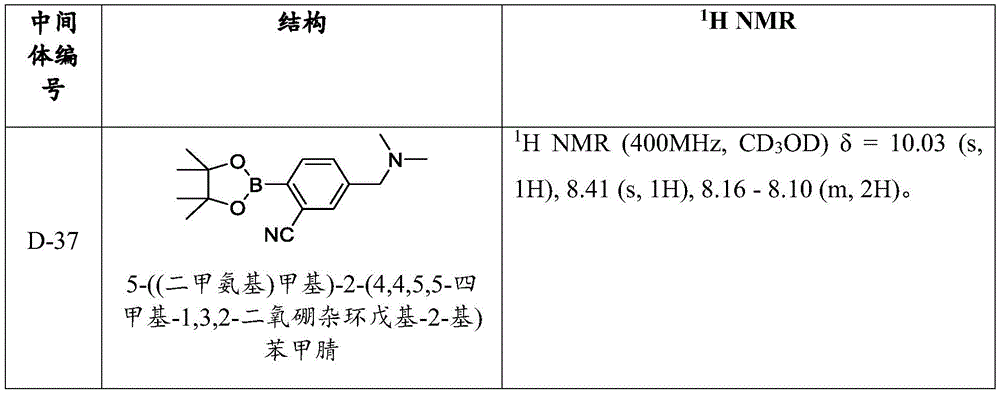


The following examples are intended to further illustrate certain embodiments of the invention and are not intended to limit the scope of the invention.
Example 1

(8- (1, 3-dimethyl-1H-pyrazol-5-yl) -5- (((5-fluoro-2, 3-dihydrobenzofuran-4-yl) methyl) amino) imidazo [1,2-c ] pyrimidin-2-yl) methanol

Reacting 8-bromo-5- (((5-fluoro-2, 3-dihydrobenzofuran-4-yl) methyl) amino) imidazo [1,2-c]Pyrimidine-2-carboxylic acid ethyl ester (0.100g, 230. mu. mol, 1.00 equiv.), 1, 3-dimethyl-5- (4,4,5, 5-tetramethyl-1, 3, 2-dioxaborolan-2-yl) pyrazole (81.6mg, 368. mu. mol, 1.60 equiv.), sodium bicarbonate (77.2mg, 919. mu. mol, 4.00 equiv.), Pd (dppf) Cl2(16.8mg,23.0μmol, 0.100 eq) in dioxane (2.10mL) and water (0.700mL) was purged three times with nitrogen. Subsequently, the mixture was stirred at 105 ℃ for 1 hour under nitrogen atmosphere. The reaction mixture was filtered and concentrated in vacuo. By preparative TLC (SiO)2PE: EA ═ 2:3) purification of the crude material to obtain 8- (1, 3-dimethyl-1H-pyrazol-5-yl) -5- (((5-fluoro-2, 3-dihydrobenzofuran-4-yl) methyl) amino) imidazo [1, 2-c) as an orange solid]Pyrimidine-2-carboxylic acid ethyl ester (60.0mg, 47.9% yield, 82.6% purity). LCMS (liquid Crystal Module) (M +1)]:450.9。
To 8- (1, 3-dimethyl-1H-pyrazol-5-yl) -5- (((5-fluoro-2, 3-dihydrobenzofuran-4-yl) methyl) amino) imidazo [1,2-c at 0 deg.C]Lithium aluminum hydride (8.09mg, 213. mu. mol, 2.00 equiv.) was added to a solution of pyrimidine-2-carboxylic acid ethyl ester (50.0mg, 107. mu. mol, 1.00 equiv.) in THF (2.00 mL). The mixture was stirred at 25 ℃ for 1 hour. The reaction mixture was diluted with DCM (5.00mL) and cooled to 0 ℃, then quenched by dropwise addition of water (0.30mL) and 10% aqueous sodium hydroxide (0.30mL), followed by water (0.90 mL). With anhydrous Mg2SO4The suspension was dried, filtered, and the filtrate was concentrated under reduced pressure to give a residue. By preparative HPLC (column: Waters Xbridge 150. about.5010. mu.; mobile phase: [ phase A: water (0.05% ammonium hydroxide v/v), phase B: ACN]The residue was purified and lyophilized to give (8- (1, 3-dimethyl-1H-pyrazol-5-yl) -5- (((5-fluoro-2, 3-dihydrobenzofuran-4-yl) methyl) amino) imidazo [1, 2-c) as a white solid]Pyrimidin-2-yl) methanol (9.37mg, 21.2% yield, 98.3% purity). LCMS (liquid Crystal Module) (M +1)]:409.4。
1H NMR(400MHz,DMSO-d6)δ=8.32(t,J=4.8Hz,1H),8.02(s,1H),7.66(s,1H),6.86(t,J=8.8,1H),6.69(dd,J=8.4,4.4Hz,1H),6.19(s,1H),5.31(t,J=5.6Hz,1H),4.72(d,J=4.8Hz,2H),4.58-4.51(m,4H),3.68(s,3H),3.32-3.27(m,2H),2.17(s,3H)。
Example 2
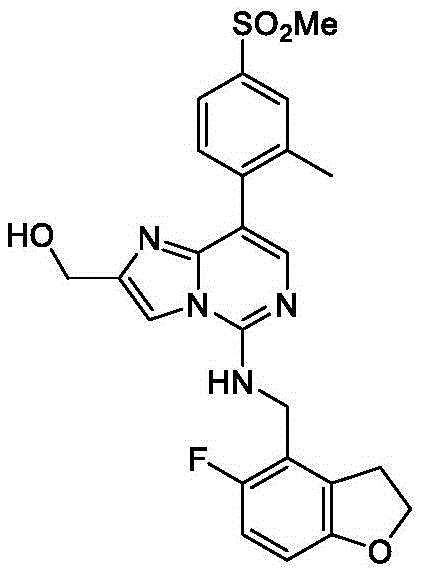
(5- (((5-fluoro-2, 3-dihydrobenzofuran-4-yl) methyl) amino) -8- (2-methyl-4- (methylsulfonyl) phenyl) imidazo [1,2-c ] pyrimidin-2-yl) methanol

Reacting 8-bromo-5- [ (5-fluoro-2, 3-dihydrobenzofuran-4-yl) methylamino]Imidazo [1,2-c ]]Pyrimidine-2-carboxylic acid ethyl ester (120mg, 275. mu. mol, 1.00 equiv.), 4,5, 5-tetramethyl-2- (2-methyl-4- (methylsulfonyl) phenyl) -1,3, 2-dioxaborolan (100mg, 332. mu. mol, 1.21 equiv.), Pd (dppf) Cl2A mixture of (20.2mg, 27.6 μmol, 0.10 eq) and sodium bicarbonate (69.5mg, 827 μmol, 32.2 μ L, 3.00 eq) in dioxane (2.00mL), water (0.20mL) was degassed and purged 3 times with nitrogen, then the mixture was stirred at 95 ℃ for 1 hour under nitrogen. The reaction mixture was filtered and concentrated under reduced pressure to give a residue. The residue was triturated with methanol (3.00mL), the suspension filtered, the filter cake collected and dried in vacuo to give 5- (((5-fluoro-2, 3-dihydrobenzofuran-4-yl) methyl) amino) -8- (2-methyl-4- (methylsulfonyl) phenyl) imidazo [1, 2-c) as a white solid]Pyrimidine-2-carboxylic acid ethyl ester (100mg, 68.4% yield, 99.0% purity). LCMS (liquid Crystal Module) (M +1)]:525.0。
To a solution of ethyl 5- (((5-fluoro-2, 3-dihydrobenzofuran-4-yl) methyl) amino) -8- (2-methyl-4- (methylsulfonyl) phenyl) imidazo [1,2-c ] pyrimidine-2-carboxylate (50.0mg, 94.4 μmol, 1.00 eq) in THF (2.00mL) at 0 ℃ was added lithium aluminum hydride (7.16mg, 188 μmol, 2.00 eq). The mixture was stirred at 25 ℃ for 1 hour. The reaction mixture was quenched by the addition of water and 10% sodium hydroxide solution (0.01mL) at 0 ℃ followed by the addition of water (0.03mL), the mixture was stirred for 10 minutes at 25 ℃, then filtered and concentrated under reduced pressure to give a residue. The residue was triturated with methanol (2.00mL), the suspension was filtered, the filter cake was collected and dried in vacuo to give (5- (((5-fluoro-2, 3-dihydrobenzofuran-4-yl) methyl) amino) -8- (2-methyl-4- (methylsulfonyl) phenyl) imidazo [1,2-c ] pyrimidin-2-yl) methanol (14.1mg, 29.3% yield, 94.5% purity) as a white solid. LCMS [ M +1] 483.4.
1H NMR(400MHz,DMSO-d6)δ=8.25(br s,1H),8.01(br s,1H),7.86(s,1H),7.78(br d,J=8.0Hz,1H),7.61-7.55(m,2H),6.94(br t,J=9.2Hz,1H),6.70(dd,J=3.6,8.4Hz,1H),5.28(br s,1H),4.73(s,2H),4.58-4.50(m,4H),3.30-3.29(m,2H),3.26(s,3H),2.29(s,3H)。
Examples 3-6 were prepared according to the general reaction scheme, examples 1 and 2, and the teaching of the intermediates disclosed herein, as shown in table 1.
TABLE 1 characterization of examples 3-6


1- (8- (1, 3-dimethyl-1H-pyrazol-5-yl) -5- (((5-fluoro-2, 3-dihydrobenzofuran-4-yl) methyl) amino) imidazo [1,2-c ] pyrimidin-2-yl) ethan-1-ol

Dess-Martin periodinane (175mg, 413. mu. mol, 127. mu.L, 1.50 equivalents) was added to a solution of (8- (1, 3-dimethyl-1H-pyrazol-5-yl) -5- (((5-fluoro-2, 3-dihydrobenzofuran-4-yl) methyl) amino) imidazo [1,2-c ] pyrimidin-2-yl) methanol (120mg, 276. mu. mol, 1.00 equivalents) in DCM (3.00mL) at 0 ℃. The mixture was stirred at 25 ℃ for 12 hours. The reaction mixture was filtered and concentrated under reduced pressure to give a residue. The residue was triturated with methanol (3.00mL), the suspension was filtered, the filter cake was collected and dried in vacuo to give 8- (1, 3-dimethyl-1H-pyrazol-5-yl) -5- (((5-fluoro-2, 3-dihydrobenzofuran-4-yl) methyl) amino) imidazo [1,2-c ] pyrimidine-2-carbaldehyde as a white solid (100mg, 83.7% yield, 93.7% purity). LCMS [ M +1] 407.0.
To a solution of 8- (1, 3-dimethyl-1H-pyrazol-5-yl) -5- (((5-fluoro-2, 3-dihydrobenzofuran-4-yl) methyl) amino) imidazo [1,2-c ] pyrimidine-2-carbaldehyde (30.0mg, 69.2 μmol, 1.00 eq) in THF (0.50mL) at 0 ℃ was added methylmagnesium bromide (3.00M, 73.8 μ L, 3.20 eq). The mixture was stirred at 25 ℃ for 12 hours. The reaction mixture was quenched by addition of saturated aqueous ammonium chloride (5.00mL) and extracted with ethyl acetate (5.00 mL. times.3). The combined organic layers were washed with brine (10.0mL × 2), dried over sodium sulfate, filtered and concentrated under reduced pressure to give a residue. The residue was purified by preparative HPLC (column: Phenomenex Synergi C18150 x 25 x 10 μm; mobile phase: [ phase A: water (0.1% TFA), phase B: ACN ]) and lyophilized to give 1- (8- (1, 3-dimethyl-1H-pyrazol-5-yl) -5- (((5-fluoro-2, 3-dihydrobenzofuran-4-yl) methyl) amino) imidazo [1,2-C ] pyrimidin-2-yl) ethan-1-ol as a yellow oil (8.76mg, 29.1% yield, 97.2% purity). LCMS [ M +1] 423.4.
1H NMR(400MHz,DMSO-d6)δ=8.61(br s,1H),8.13(br s,1H),7.87(br s,1H),6.94(t,J=9.2Hz,1H),6.71(dd,J=8.4,3.6Hz,1H),6.22(s,1H),4.84(d,J=6.4Hz,1H),4.73(d,J=4.4Hz,2H),4.56(t,J=8.8Hz,2H),3.67(s,3H),3.32(t,J=8.8Hz,2H),2.20(s,3H),1.43(d,J=6.4Hz,3H)。
Example 8
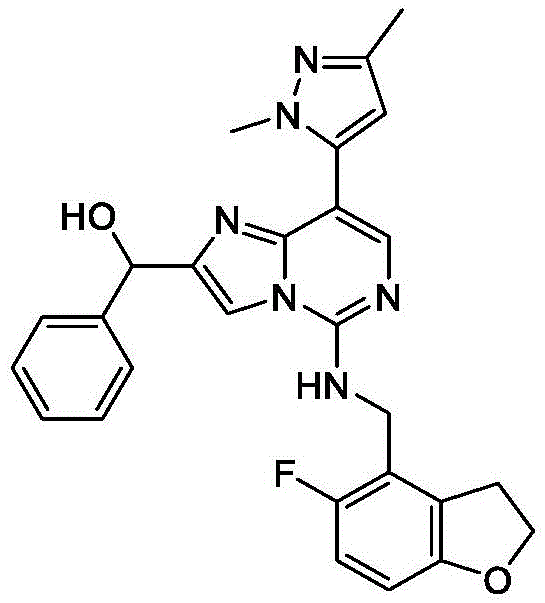
(8- (1, 3-dimethyl-1H-pyrazol-5-yl) -5- (((5-fluoro-2, 3-dihydrobenzofuran-4-yl) methyl) amino) imidazo [1,2-c ] pyrimidin-2-yl) (phenyl) methanol
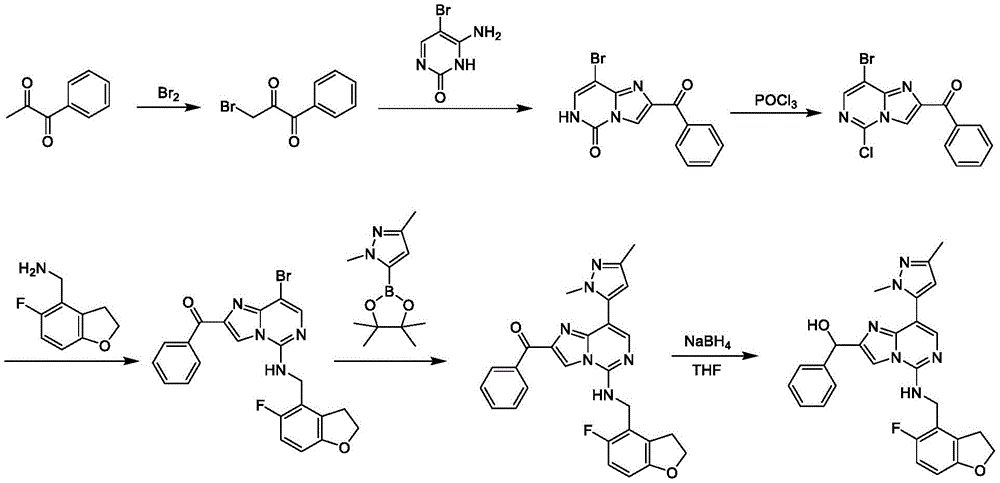
Step A: to 1-phenylpropan-1, 2-dione (1.00g, 6.75mmol, 909. mu.L, 1.00 equiv.) in CHCl at 75 deg.C3(10.0mL) solution to add Br dropwise2(1.19g, 7.42mmol, 383. mu.L, 1.10 equiv.) the mixture was stirred at 75 ℃ for 4 h. The reaction mixture was diluted with 50mL of DCM and washed with brine (30mL × 2), the separated organic phase was dried over sodium sulfate,filtered and concentrated in vacuo. By column chromatography (SiO)2Petroleum ether/ethyl acetate 1/0 to 100/1) to obtain 3-bromo-1-phenylpropan-1, 2-dione as a yellow oil (1.40g, 4.62mmol, 68.5% yield, 75.0% purity).
1H NMR(400MHz,CDCl3)δ=8.06-8.01(m,2H),7.72-7.65(m,1H),7.56-7.52(m,2H),4.41(s,2H),2.54(s,1H)。
And B: to a solution of 6-amino-5-bromopyrimidin-2 (1H) -one (0.64g, 3.30mmol, 1.00 eq) in AcOH (6.00mL) was added 3-bromo-1-phenylpropan-1, 2-dione (1.40g, 4.62mmol, 1.40 eq) and the mixture was stirred at 120 ℃ for 1H. The reaction mixture was concentrated in vacuo to remove AcOH, the residue triturated with 50mL MTBE followed by water (60 mL. times.3 mL), the precipitate filtered and evaporated to afford 2-benzoyl-8-bromoimidazo [1,2-c ] pyrimidin-5 (6H) -one (180mg, 388. mu. mol, 11.7% yield, 68.5% purity) as a brown solid. LCMS [ M +1] 318.2.
And C: to 2-benzoyl-8-bromoimidazo [1,2-c ] at 0 deg.C]POCl of pyrimidin-5 (6H) -one (0.18g, 388. mu. mol, 1.00 equiv.)3To a solution (5.00mL) was added DIPEA (150mg, 1.16mmol, 203. mu.L, 3.00 equiv.) dropwise, and the mixture was stirred at 120 ℃ for 12 hours. The reaction mixture was concentrated in vacuo and purified by preparative TLC (SiO)2PE: EA ═ 3:1) the residue was purified to give the compound (8-bromo-5-chloroimidazo [1, 2-c) as a red solid]Pyrimidin-2-yl) (phenyl) methanone (45.0mg, 133 μmol, 34.2% yield, 99.2% purity). LCMS (liquid Crystal Module) (M +1)]:338.0。
Step D: to a solution of (8-bromo-5-chloroimidazo [1,2-c ] pyrimidin-2-yl) (phenyl) methanone (45.0mg, 133 μmol, 1.00 eq) in DMF (3.00mL) was added DIPEA (34.3mg, 265 μmol, 46.2 μ L, 2.00 eq) and (5-fluoro-2, 3-dihydrobenzofuran-4-yl) methylamine (28.01mg, 159.16 μmol, 1.2 eq). The mixture was stirred at 85 ℃ for 30 minutes, then diluted with 20mL of water and filtered. The precipitate was dried in vacuo to give the compound (8-bromo-5- (((5-fluoro-2, 3-dihydrobenzofuran-4-yl) methyl) amino) imidazo [1,2-c ] pyrimidin-2-yl) (phenyl) methanone (55.0mg, 118 μmol, 88.7% yield) as a yellow solid. LCMS [ M +1] 467.1.
Step E: will be provided with(8-bromo-5- (((5-fluoro-2, 3-dihydrobenzofuran-4-yl) methyl) amino) imidazo [1, 2-c)]Pyrimidin-2-yl) (phenyl) methanone (60.0mg, 128. mu. mol, 1.00 equiv.), 1, 3-dimethyl-5- (4,4,5, 5-tetramethyl-1, 3, 2-dioxaborolan-2-yl) -1H-pyrazole (42.8mg, 193. mu. mol, 1.50 equiv.), NaHCO3(32.4mg, 385. mu. mol, 15.0. mu.L, 3.00 equiv.), Pd (dppf) Cl2(14.1mg, 19.3. mu. mol, 0.15 equiv.) in dioxane (1.50mL) and H2The mixture in O (0.50mL) was degassed and treated with N2Purge three times, then at N2The mixture was stirred at 100 ℃ for 1 hour under an atmosphere. The reaction mixture was filtered and concentrated in vacuo. By preparative TLC (SiO)2DCM: MeOH ═ 20:1) the residue was purified to give the compound (8- (1, 3-dimethyl-1H-pyrazol-5-yl) -5- (((5-fluoro-2, 3-dihydrobenzofuran-4-yl) methyl) amino) imidazo [1, 2-c) as a yellow solid]Pyrimidin-2-yl) (phenyl) methanone (33.3mg, 65.9 μmol, 51.3% yield, 95.3% purity). LCMS (liquid Crystal Module) (M +1)]:483.2。
1H NMR(400MHz,DMSO-d6)δ=8.91(s,1H),8.65(br s,1H),8.19(d,J=7.2Hz,2H),7.81(s,1H),7.71-7.65(m,1H),7.61-7.55(m,2H),6.95(t,J=9.6Hz,1H),6.71(dd,J=4.0,8.8Hz,1H),6.25(s,1H),4.73(br d,J=2.8Hz,2H),4.55(t,J=8.8Hz,2H),3.76(s,3H),2.18(s,3H)。
Step F: to (8- (1, 3-dimethyl-1H-pyrazol-5-yl) -5- (((5-fluoro-2, 3-dihydrobenzofuran-4-yl) methyl) amino) imidazo [1, 2-c) at 0 deg.C]To a solution of pyrimidin-2-yl) (phenyl) methanone (19.0mg, 37.5. mu. mol, 1.00 eq) in THF (2.00mL) was added NaBH4(1.70mg, 45.0. mu. mol, 1.20 equivalents), the mixture was stirred at 10 ℃ for 1 hour. The reaction mixture was quenched with water (0.1mL) and concentrated in vacuo. By preparative HPLC (column: Phenomenex Synergi C18150 × 25 × 10 μm; mobile phase: [ phase A: water (0.1% TFA), phase B: ACN]) The residue was purified to give the compound (8- (1, 3-dimethyl-1H-pyrazol-5-yl) -5- (((5-fluoro-2, 3-dihydrobenzofuran-4-yl) methyl) amino) imidazo [1, 2-c) as a white solid]Pyrimidin-2-yl) (phenyl) methanol (7.00mg, 14.3 μmol, 38.2% yield, 99.1% purity). LCMS (liquid Crystal Module) (M +1)]:485.3。
1H NMR(400MHz,DMSO-d6)δ=8.52(br s,1H),8.07(s,1H),7.78(br s,1H),7.43(d,J=7.2Hz,2H),7.33(t,J=7.2Hz,2H),7.29-7.22(m,1H),6.98-6.90(m,1H),6.70(dd,J=4.0,8.8Hz,1H),6.18(s,1H),5.79(s,1H),4.70(br d,J=4.8Hz,2H),4.55(t,J=8.8Hz,2H),3.60(s,3H),3.31(br t,J=8.8Hz,2H),2.18(s,3H)。
Example 9

8- (1, 3-dimethyl-1H-pyrazol-5-yl) -N- ((5-fluoro-2, 3-dihydrobenzofuran-4-yl) methyl) -2- (methoxymethyl) imidazo [1,2-c ] pyrimidin-5-amine
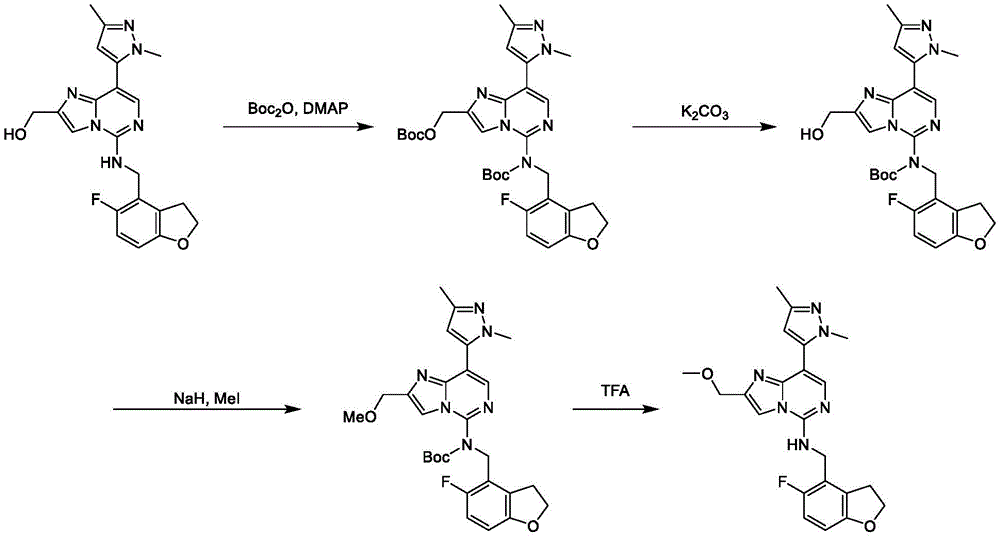
Step A: to a solution of (8- (1, 3-dimethyl-1H-pyrazol-5-yl) -5- (((5-fluoro-2, 3-dihydrobenzofuran-4-yl) methyl) amino) imidazo [1,2-c ] pyrimidin-2-yl) methanol (1.50g, 3.67mmol, 1.00 equiv) in THF (15.0mL) were added di-tert-butyl dicarbonate (2.00g, 9.18mmol, 2.11mL, 2.50 equiv) and DMAP (44.9mg, 367. mu. mol, 0.10 equiv), and the reaction mixture was stirred at 80 ℃ for 1 hour. The reaction was concentrated in vacuo to give a residue which was purified by silica gel chromatography (petroleum ether/ethyl acetate-5/1 to dichloromethane/methanol-20/1) to give tert-butyl (2- (((tert-butoxycarbonyl) oxy) methyl) -8- (1, 3-dimethyl-1H-pyrazol-5-yl) imidazo [1,2-c ] pyrimidin-5-yl) ((5-fluoro-2, 3-dihydrobenzofuran-4-yl) methyl) carbamate (2.10g, 3.45mmol, 93.9% yield) LCMS [ M +1]:609.1 as a brown oil.
And B: to a solution of (2- (((tert-butoxycarbonyl) oxy) methyl) -8- (1, 3-dimethyl-1H-pyrazol-5-yl) imidazo [1,2-c ] pyrimidin-5-yl) ((5-fluoro-2, 3-dihydrobenzofuran-4-yl) methyl) carbamate (400mg, 657 μmol, 1.00 eq) in methanol (6.00mL) was added potassium carbonate (182mg, 1.31mmol, 2.00 eq) and the reaction mixture was stirred at 25 ℃ for 12 hours. The reaction mixture was then filtered and the filtrate was concentrated in vacuo to give a residue. The residue was purified by preparative TLC (dichloromethane/methanol: 10/1) to give tert-butyl (8- (1, 3-dimethyl-1H-pyrazol-5-yl) -2- (hydroxymethyl) imidazo [1,2-c ] pyrimidin-5-yl) ((5-fluoro-2, 3-dihydrobenzofuran-4-yl) methyl) carbamate (200mg, 393. mu. mol, 59.8% yield) as a white solid. LCMS [ M +1] 509.3.
And C: to a solution of tert-butyl (8- (1, 3-dimethyl-1H-pyrazol-5-yl) -2- (hydroxymethyl) imidazo [1,2-c ] pyrimidin-5-yl) ((5-fluoro-2, 3-dihydrobenzofuran-4-yl) methyl) carbamate (80.0mg, 157 μmol, 1.00 equivalents) in THF (4.00mL) at 0 ℃ was added sodium hydride (12.6mg, 315 μmol, 60.0% pure, 2.00 equivalents), the reaction mixture was stirred at 0 ℃ for 30 minutes, then methyl iodide (44.7mg, 315 μmol, 19.6 μ L, 2.00 equivalents) was added dropwise. The reaction mixture was then heated to 25 ℃ and stirred for 30 minutes. The reaction was quenched with water (10.0mL) and the aqueous phase was extracted with ethyl acetate (10.0 mL. times.3). The combined organic phases were washed with brine (10.0mL × 2), dried over anhydrous sodium sulfate, filtered and concentrated in vacuo to give a residue which was purified by preparative TLC (dichloromethane/methanol ═ 10/1) to give tert-butyl (8- (1, 3-dimethyl-1H-pyrazol-5-yl) -2- (methoxymethyl) imidazo [1,2-c ] pyrimidin-5-yl) ((5-fluoro-2, 3-dihydrobenzofuran-4-yl) methyl) carbamate (71.0mg, 128 μmol, 81.5% yield, 94.4% purity) as a brown oil. LCMS [ M +1] 523.3.
Step D: to a solution of tert-butyl (8- (1, 3-dimethyl-1H-pyrazol-5-yl) -2- (methoxymethyl) imidazo [1,2-c ] pyrimidin-5-yl) ((5-fluoro-2, 3-dihydrobenzofuran-4-yl) methyl) carbamate (71.0mg, 128 μmol, 1.00 eq) in TFA (0.30mL) and DCM (1.00mL) was stirred at 25 ℃ for 12 hours. The reaction mixture was quenched with saturated aqueous sodium bicarbonate (10.0mL) and extracted with DCM (5.00 mL. times.3). The combined organic phases were washed with brine (5.00mL × 2), dried over anhydrous sodium sulfate, filtered and concentrated in vacuo to give a residue. The residue was triturated with petroleum ether/ethyl acetate (1/1) (5.00mL), filtered, the filter cake collected and dried in vacuo to give 8- (1, 3-dimethyl-1H-pyrazol-5-yl) -N- ((5-fluoro-2, 3-dihydrobenzofuran-4-yl) methyl) -2- (methoxymethyl) imidazo [1,2-c ] pyrimidin-5-amine (15.9mg, 35.1 μmol, 27.4% yield, 93.4% purity) as an off-white solid. LCMS [ M +1] 423.3.
1H NMR(400MHz,CD3OD)δ=7.91(s,1H),7.71(s,1H),6.84(t,J=9.2Hz,1H),6.62(dd,J=3.6,8.4Hz,1H),6.22(s,1H),4.81(s,2H),4.59-4.54(m,2H),4.54(s,2H),3.70(s,3H),3.42(s,3H),3.35(t,J=8.8Hz,2H),2.27(s,3H)。
Example 10
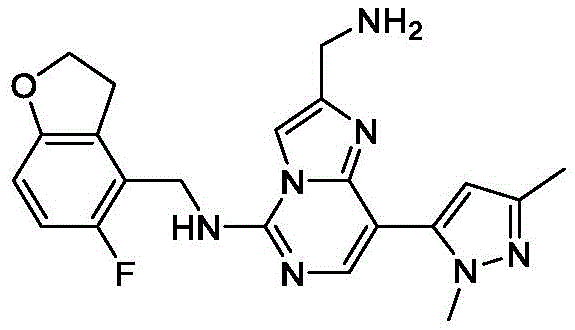
2- (aminomethyl) -8- (1, 3-dimethyl-1H-pyrazol-5-yl) -N- ((5-fluoro-2, 3-dihydrobenzofuran-4-yl) methyl) imidazo [1,2-c ] pyrimidin-5-amine

Step A: in N2Under the atmosphere, 8-bromo-5- (((5-fluoro-2, 3-dihydrobenzofuran-4-yl) methyl) amino) imidazo [1,2-c]A mixture of pyrimidine-2-carboxylic acid ethyl ester (160mg, 367. mu. mol, 1 equiv), sodium hydroxide (1M, 1.10mL, 3 equiv.) in methanol (3.30mL) was stirred at 55 ℃ for 30 minutes. The mixture was concentrated in vacuo to give a residue, water (1.00mL) was added and HCl (1M) was added until pH 2, the solid was collected by filtration and dried in vacuo to give compound 8-bromo-5- (((5-fluoro-2, 3-dihydrobenzofuran-4-yl) methyl) amino) imidazo [1,2-c as a white solid]Pyrimidine-2-carboxylic acid (124mg, 304 μmol, 82.8% yield). LCMS (liquid Crystal Module) [ M +1]]408.8。
And B: reacting 8-bromo-5- (((5-fluoro-2, 3-dihydrobenzofuran-4-yl) methyl) amino) imidazo [1,2-c]A mixture of pyrimidine-2-carboxylic acid (124mg, 304. mu. mol, 1.00 equiv.), ammonium chloride (48.8mg, 913. mu. mol, 31.9. mu.L, 3.00 equiv.), HATU (173mg, 456. mu. mol, 1.50 equiv.), DIEA (314mg, 2.44mmol, 424. mu.L, 8 equiv.) in DMF (1.00mL) was degassed and N was used2Purge 3 times, then at N2The mixture was stirred at 30 ℃ for 1 hour under an atmosphere. The mixture was concentrated in vacuo to give a residue. To the residue was added water (1.00mL) and the solid was collected by filtration and then dried in vacuo to give compound 8 as a white solid-bromo-5- (((5-fluoro-2, 3-dihydrobenzofuran-4-yl) methyl) amino) imidazo [1,2-c]Pyrimidine-2-carboxamide (100mg, crude), which was used in the next step without further purification.
And C: to 8-bromo-5- (((5-fluoro-2, 3-dihydrobenzofuran-4-yl) methyl) amino) imidazo [1, 2-c) at 0 deg.C]To a mixture of pyrimidine-2-carboxamide (100mg, 246. mu. mol, 1.00 equiv), TEA (484mg, 4.79mmol, 666. mu.L, 19.4 equiv) in THF (2.00mL) was added TFAA (302mg, 1.44mmol, 200. mu.L, 5.84 equiv) followed by N2The mixture was stirred at 0-30 ℃ for 40 minutes under an atmosphere. The mixture was concentrated in vacuo to give a residue. The residue was purified by column chromatography (petroleum ether/ethyl acetate 5/1 to 0/1) to give the compound 8-bromo-5- (((5-fluoro-2, 3-dihydrobenzofuran-4-yl) methyl) amino) imidazo [1, 2-c) as a yellow solid]Pyrimidine-2-carbonitrile (100mg, 245. mu. mol, 99.7% yield, 95.3% purity). LCMS (liquid Crystal Module) [ M +1]]387.8。
Step D: reacting 8-bromo-5- (((5-fluoro-2, 3-dihydrobenzofuran-4-yl) methyl) amino) imidazo [1,2-c]Pyrimidine-2-carbonitrile (90.0mg, 231. mu. mol, 1.00 equiv.), 1, 3-dimethyl-5- (4,4,5, 5-tetramethyl-1, 3, 2-dioxaborolan-2-yl) -1H-pyrazole (103mg, 463. mu. mol, 2.00 equiv.), Pd (dppf) Cl2A mixture of (16.9mg, 23.1 μmol, 0.100 equivalents), sodium bicarbonate (58.4mg, 695 μmol, 27.0 μ L, 3 equivalents) in dioxane (6.00mL) and water (3.00mL) was degassed and treated with N2Purge 3 times, then at N2The mixture was stirred at 100 ℃ for 2 hours under an atmosphere. Water (8.00mL) was added and the mixture was extracted with ethyl acetate (8.00 mL. times.3). The organic layer was concentrated in vacuo to give a residue. Preparative HPLC (column: Phenomenex Synergi C18150. about.25. mu.m; mobile phase: [ water (0.1% TFA) -ACN; preparative HPLC on reversed phase](ii) a B%: 33% -63%, 13 min) to obtain the compound 8- (1, 3-dimethyl-1H-pyrazol-5-yl) -5- (((5-fluoro-2, 3-dihydrobenzofuran-4-yl) methyl) amino) imidazo [1, 2-c) as a white solid]Pyrimidine-2-carbonitrile (51.0mg, 120. mu. mol, 52.0% yield, 95.4% purity). LCMS (liquid Crystal Module) [ M +1]]404。
1H NMR(400MHz,DMSO-d6)δ=8.92(s,1H),8.64(br t,J=4.8Hz,1H),7.86(s,1H),6.99-6.91(m,1H),6.71(dd,J=4.0,8.8Hz,1H),6.23(s,1H),4.72(br d,J=4.4Hz,2H),4.55(t,J=8.8Hz,2H),3.67(s,3H),3.31(t,J=8.8Hz,2H),2.18(s,3H)。
Step E: to 8- (1, 3-dimethyl-1H-pyrazol-5-yl) -5- (((5-fluoro-2, 3-dihydrobenzofuran-4-yl) methyl) amino) imidazo [1,2-c under nitrogen]Pyrimidine-2-carbonitrile (80.0mg, 193. mu. mol, 1.00 equiv.) in THF (2.00mL) and NH3·H2To a solution in O (14.0M, 0.80mL, 58.0 equiv) was added Raney nickel (16.53mg, 192.95. mu. mol, 1.00 equiv). The suspension is degassed under vacuum and purged several times with nitrogen and washed with hydrogen2The mixture was stirred under an atmosphere (15psi) at 25 ℃ for 3 hours. The reaction mixture was filtered and concentrated under reduced pressure to give a residue. The residue was triturated with methanol (3.00mL × 2), the suspension was filtered and the filter cake was collected and dried in vacuo to give 2- (aminomethyl) -8- (1, 3-dimethyl-1H-pyrazol-5-yl) -N- ((5-fluoro-2, 3-dihydrobenzofuran-4-yl) methyl) imidazo [1, 2-c) as a yellow solid]Pyrimidin-5-amine (34.8mg, 41.5% yield, 94.0% purity). LCMS (liquid Crystal Module) [ M +1]]408.1。
1H NMR(400MHz,DMSO-d6)δ=8.62(br.s,1H),8.21(s,1H),7.97(br.s,2H),7.74(s,1H),6.94(t,J=8.4Hz,1H),6.74-6.66(m,1H),6.21(s,1H),4.72(s,2H),4.55(t,J=8.0Hz,2H),4.12(s,2H),3.69(s,3H),3.31-3.27(m,2H),2.18(s,3H)。
Examples 11 and 12

2- (1-aminoethyl) -8- (1, 3-dimethyl-1H-pyrazol-5-yl) -N- ((5-fluoro-2, 3-dihydrobenzofuran-4-yl) methyl) imidazo [1,2-c ] pyrimidin-5-amine

Step A: to 8-bromo-5- (((5-fluoro-2, 3-dihydrobenzofuran-4-yl) methyl) amino) imidazo [1, 2-c) at 0 deg.C]Pyrimidine-2-carbonitrile (3.50g, 9.02mmol, 1.00 equiv.) in THF (10.0mL) was added methylmagnesium bromide (3.00M, 18.0mL, 6.00 equiv.) dropwise. Will be provided withThe mixture was stirred at 0 ℃ for 2h, then methanol (5.00mL) was added to the reaction, and after 15 min sodium borohydride (1.36g, 36.1mmol, 4.00 equiv.) was added to the mixture and stirred at 0-25 ℃ for 7 h. The reaction was poured into ice water (15.0mL) and stirred for 15 min, and the aqueous phase was extracted with ethyl acetate (30.0 mL. times.3). The combined organic phases were washed with brine (30.0mL × 3), dried over anhydrous sodium sulfate, filtered and concentrated in vacuo to give a residue. By column chromatography (SiO)2Petroleum ether/ethyl acetate 100/1 to 1/1) to give 2- (1-aminoethyl) -8-bromo-N- ((5-fluoro-2, 3-dihydrobenzofuran-4-yl) methyl) imidazo [1, 2-c) as a yellow solid]Pyrimidin-5-amine (3.00g, crude).
1H NMR(400MHz,DMSO-d6)δ=8.28(t,J=5.2Hz,1H),8.07(s,1H),7.83(s,1H),6.95-6.88(m,1H),6.68(dd,J=4.0,8.8Hz,1H),5.62(br s,1H),5.43-5.33(m,1H),4.65(d,J=4.8Hz,2H),4.53(t,J=8.8Hz,2H),3.88-3.75(m,1H),3.25(t,J=8.8Hz,2H),1.50(d,J=6.8Hz,3H)。
And B: to 2- (1-aminoethyl) -8-bromo-N- ((5-fluoro-2, 3-dihydrobenzofuran-4-yl) methyl) imidazo [1,2-c]To a solution of pyrimidin-5-amine (3.00g, 7.38mmol, 1.00 equiv.) and di-tert-butyl dicarbonate (3.22g, 14.8mmol, 3.39mL, 2.00 equiv.) in THF (15.0mL) was added TEA (2.24g, 22.15mmol, 3.08mL, 3.00 equiv.) and DMAP (90.2mg, 738. mu. mol, 0.10 equiv.). The mixture was stirred at 40 ℃ for 1 hour. The mixture was concentrated in vacuo to give a residue. By column chromatography (SiO)2Petroleum ether/ethyl acetate 100/1 to 2/1) to give (1- (8-bromo-5- (((5-fluoro-2, 3-dihydrobenzofuran-4-yl) methyl) amino) imidazo [1, 2-c) as a yellow solid]Pyrimidin-2-yl) ethyl) carbamic acid tert-butyl ester (1.30g, 2.57mmol, 34.8% yield).
1H NMR(400MHz,DMSO-d6)δ=8.28(br t,J=4.8Hz,1H),7.98(s,1H),7.80(s,1H),7.25(br d,J=8.0Hz,1H),6.96-6.86(m,1H),6.68(dd,J=4.0,8.8Hz,1H),4.78-4.69(m,1H),4.65(t,J=4.0Hz,2H),4.53(t,J=8.8Hz,2H),3.25(t,J=8.4Hz,2H),1.43-4.35(m,12H)。
And C: to (1- (8-bromo-5- (((5-fluoro-2, 3-dihydrobenzofuran-4-yl)) under a nitrogen atmosphereMethyl) amino) imidazo [1,2-c]Pyrimidin-2-yl) ethyl) carbamic acid tert-butyl ester (600mg, 1.18mmol, 1.00 equiv.) and 1, 3-dimethyl-5- (4,4,5, 5-tetramethyl-1, 3, 2-dioxaborolan-2-yl) -1H-pyrazole (395mg, 1.78mmol, 1.50 equiv.) to a solution in dioxane (1.00mL) and water (0.20mL) was added sodium bicarbonate (199mg, 2.37mmol, 92.2 μ L, 2.00 equiv.) and pd (dppf) Cl2(86.7mg, 118. mu. mol, 0.10 equiv.). The mixture was stirred at 100 ℃ for 12 hours under nitrogen atmosphere. The mixture was concentrated in vacuo to give a residue. By column chromatography (SiO)2Petroleum ether/ethyl acetate 100/1 to 1/1) to obtain (1- (8- (1, 3-dimethyl-1H-pyrazol-5-yl) -5- (((5-fluoro-2, 3-dihydrobenzofuran-4-yl) methyl) amino) imidazo [1, 2-c) as a red solid]Pyrimidin-2-yl) ethyl) carbamic acid tert-butyl ester (500mg, 767. mu. mol, 64.7% yield, 80.0% purity). LCMS [ M-99 ]]:422.3。
Step D: to (1- (8- (1, 3-dimethyl-1H-pyrazol-5-yl) -5- (((5-fluoro-2, 3-dihydrobenzofuran-4-yl) methyl) amino) imidazo [1, 2-c)]Pyrimidin-2-yl) ethyl) carbamic acid tert-butyl ester (500mg, 767. mu. mol, 1.00 eq) in dichloromethane (6.00mL) was added TFA (2.00 mL). The mixture was stirred at 25 ℃ for 30 minutes. The mixture was adjusted to pH 8 with ammonium hydroxide and concentrated in vacuo to give a residue. By preparative HPLC (column: waters xbridge C18150X 50mM X10 μm; mobile phase: [ water (10mM NH)4HCO3)-ACN](ii) a B%: 22% -52%, 11.5 min) to obtain 2- (1-aminoethyl) -8- (1, 3-dimethyl-1H-pyrazol-5-yl) -N- ((5-fluoro-2, 3-dihydrobenzofuran-4-yl) methyl) imidazo [1, 2-c) as a white solid]Pyrimidin-5-amine (280mg, 661 μmol, 86.2% yield, 99.5% purity). LCMS (liquid Crystal Module) (M +1)]:422.3。
1H NMR(400MHz,DMSO-d6)δ=8.23(br t,J=4.8Hz,1H),7.94(s,1H),7.63(s,1H),6.96-6.88(m,1H),6.68(dd,J=3.6,8.4Hz,1H),6.17(s,1H),4.69(br d,J=4.0Hz,2H),4.53(t,J=8.8Hz,2H),4.04-3.99(m,1H),3.68(s,3H),3.29-3.26(m,2H),2.16(s,3H),1.99(br s,2H),1.32(d,J=6.4Hz,3H)。
The enantiomers of 2- (1-aminoethyl) -8- (1, 3-dimethyl-1H-pyrazol-5-yl) -N- ((5-fluoro-2, 3-dihydrobenzofuran-4-yl) methyl) imidazo [1,2-c ] pyrimidin-5-amine are separated by chiral SFC to provide enantiomerically pure compounds-example 11 and example 12.
Example 11: column: chiralcel OD-350 × 4.6mm i.d., 3 um; mobile phase: phase A is CO2And phase B is IPA (0.05% DEA); gradient elution: CO 22IPA (0.05% DEA) in (c) from 5% to 40%. Flow rate: 3 mL/min; wavelength: 220 nm. Column temperature: 35 ℃; back pressure: 100 Bar. t is tr1.742 minutes. LCMS (liquid Crystal Module) (M +1)]:422.1。
1H NMR(400MHz,CD3OD)δ=8.23(s,1H),8.07(s,1H),6.90-6.79(m,1H),6.72(s,1H),6.64(dd,J=3.9,8.7Hz,1H),4.88-4.86(m,2H),4.69(q,J=6.8Hz,1H),4.59(t,J=8.7Hz,2H),3.98(s,3H),3.41(t,J=8.6Hz,2H),2.47(s,3H),1.73(d,J=6.8Hz,3H)。
Example 12: column: chiralcel OD-350 × 4.6mm i.d., 3 um; mobile phase: phase A is CO2And phase B is IPA (0.05% DEA); gradient elution: CO 22IPA (0.05% DEA), from 5% to 40%. Flow rate: 3 mL/min; wavelength: 220 nm. Column temperature: 35 ℃; back pressure: 100 Bar. t is tr1.796 minutes. LCMS (liquid Crystal Module) (M +1)]:422.3。
1H NMR(400MHz,CD3OD)δ=8.27-8.16(m,1H),8.10-7.99(m,1H),6.94-6.81(m,1H),6.74-6.60(m,2H),4.94-4.89(m,2H),4.69(br t,J=6.8Hz,1H),4.60(t,J=8.8Hz,2H),3.96(m,3H),3.42(t,J=8.8Hz,2H),2.46(br d,J=10.0Hz,3H),1.80-1.71(m,3H)。
Example 13

2- (aminomethyl) -N- ((5-fluoro-2, 3-dihydrobenzofuran-4-yl) methyl) -8- (2-methyl-4- (methylsulfonyl) phenyl) imidazo [1,2-c ] pyrimidin-5-amine

Step A: to 8-bromo-5- (((5-fluoro-2, 3-dihydrobenzofuran-4-yl) methyl) amino) imidazo [1,2-c]Pyrimidine-2-carbonitrile (121mg, 302. mu. mol, 1.00 equiv.) and 4,4,5, 5-tetramethyl-2- (2-methyl-4- (methylsulfonyl) phenyl) -1,3, 2-dioxaborolan (150mg, 456. mu. mol, 1.50 equiv.), sodium bicarbonate (76.0mg, 905. mu. mol, 35.2. mu.L, 3.00 equiv.) to a solution in a mixed solvent of dioxane (1.70mL) and water (0.30mL) was added Pd (dppf) Cl2.CH2Cl2(25.0mg, 30.6. mu. mol, 0.10 equiv.). The mixture was stirred at 95 ℃ for 12 hours under nitrogen atmosphere. The reaction mixture was evaporated to give a residue, which was purified by preparative TLC (SiO)2Dichloromethane methanol ═ 20:1) the residue was purified to give 5- (((5-fluoro-2, 3-dihydrobenzofuran-4-yl) methyl) amino) -8- (2-methyl-4- (methylsulfonyl) phenyl) imidazo [1, 2-c) as a pale yellow solid]Pyrimidine-2-carbonitrile (80.0mg, 49.4% yield, 89.0% purity). LCMS (liquid Crystal Module) (M +1)]:478.1。
1H NMR(400MHz,DMSO-d6)δ=8.93(s,1H),8.58(t,J=5.2Hz,1H),7.89(d,J=1.2Hz,1H),7.83-7.78(m,2H),7.58(d,J=8.4Hz,1H),7.04-6.89(m,1H),6.72(dd,J=3.6,8.4Hz,1H),4.73(d,J=4.8Hz,2H),4.56(t,J=8.8Hz,2H),3.37-3.29(m,2H),3.26(s,3H),2.28(s,3H)。
And B: reacting 5- (((5-fluoro-2, 3-dihydrobenzofuran-4-yl) methyl) amino) -8- (2-methyl-4- (methylsulfonyl) phenyl) imidazo [1, 2-c)]A mixture of pyrimidine-2-carbonitrile (80.0mg, 149. mu. mol, 1.00 eq.) and Raney nickel (15.0mg) in methanol (1.50mL) and ammonium hydroxide (0.50mL) was degassed and treated with H2Purging 3 times, then mixing the mixture in H2(15psi) at 25 ℃ for 12 hours. The reaction mixture was filtered and the filtrate was evaporated to give a residue, which was purified by preparative HPLC (column: Phenomenex Synergi C18150 × 25 × 10 μm; mobile phase: [ water (0.05% HCl) -ACN](ii) a B%: 20% -40%, 10 min) purification of the residue to obtain 2- (aminomethyl) -N- ((5-fluoro-2, 3-dihydrobenzofuran-4-yl) methyl) -8- (2-methyl-4- (methylsulfonyl) phenyl) imidazo [1, 2-c) as a white solid]Pyrimidin-5-amine (29.1mg, 37.5% yield, 99.4% purity, HCl salt). LCMS (liquid Crystal Module) (M +1)]:482.2。
1H NMR(400MHz,DMSO-d6)δ=8.82(s,1H),8.43(s,3H),8.35(s,1H),7.90(s,1H),7.80(d,J=7.6Hz,1H),7.75(s,1H),7.59(d,J=8.0Hz,1H),6.94(t,J=9.2Hz,1H),6.70(dd,J=3.6,8.4Hz,1H),4.74(br d,J=4.8Hz,2H),4.55(t,J=8.8Hz,2H),4.10(br d,J=5.6Hz,2H),3.34(t,J=8.8Hz,2H),3.27(s,3H),2.30(s,3H)。
Examples 14-24 were prepared according to the general reaction scheme, examples 10-13, and the teaching of the intermediates disclosed herein, as shown in table 2.
TABLE 2 characterization of examples 14-24


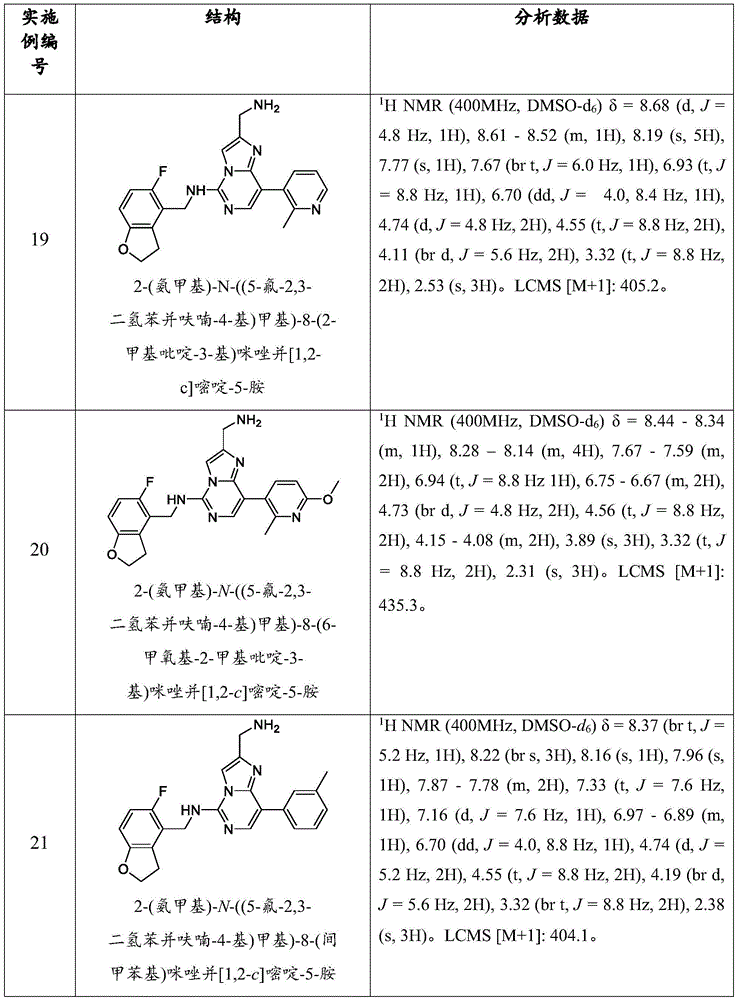

Example 25

8- (1, 3-dimethyl-1H-pyrazol-5-yl) -N- ((5-fluoro-2, 3-dihydrobenzofuran-4-yl) methyl) -2- ((methylamino) methyl) imidazo [1,2-c ] pyrimidin-5-amine

To a solution of 8- (1, 3-dimethyl-1H-pyrazol-5-yl) -5- (((5-fluoro-2, 3-dihydrobenzofuran-4-yl) methyl) amino) imidazo [1,2-c ] pyrimidine-2-carbaldehyde (30.0mg, 69.2 μmol, 1.00 equiv), methylamine (2.00M in THF, 69.1 μ L, 2.00 equiv) in methanol (2.00mL) was added acetic acid (2.08mg, 34.7 μmol, 1.98 μ L, 0.50 equiv). The reaction mixture was stirred at 40 ℃ for 2 hours, then sodium triacetoxyborohydride (44.0mg, 207. mu. mol, 3.00 equiv.) was added to the mixture in one portion and stirred at 40 ℃ for 2 hours. The reaction mixture was filtered and concentrated under reduced pressure to give a residue. The residue was triturated with methanol (3.00mL), the suspension filtered, the filter cake washed with water (2.00mL), collected and dried in vacuo to give 8- (1, 3-dimethyl-1H-pyrazol-5-yl) -N- ((5-fluoro-2, 3-dihydrobenzofuran-4-yl) methyl) -2- ((methylamino) methyl) imidazo [1,2-c ] pyrimidin-5-amine (8.07mg, 27.1% yield, 97.7% purity) as a white solid. LCMS [ M +1] 422.4.
1H NMR(400MHz,DMSO-d6)δ=8.40(br s,1H),8.10(s,1H),7.71(s,1H),6.94(br t,J=9.6Hz,1H),6.77-6.63(m,1H),6.20(s,1H),4.72(br d,J=4.4Hz,2H),4.55(br t,J=8.8Hz,2H),3.98(s,2H),3.69(s,3H),3.30-3.28(m,2H),2.46(br s,3H),2.18(s,3H)。
Example 26

8- (1, 3-dimethyl-1H-pyrazol-5-yl) -2- ((dimethylamino) methyl) -N- ((5-fluoro-2, 3-dihydrobenzofuran-4-yl) methyl) imidazo [1,2-c ] pyrimidin-5-amine
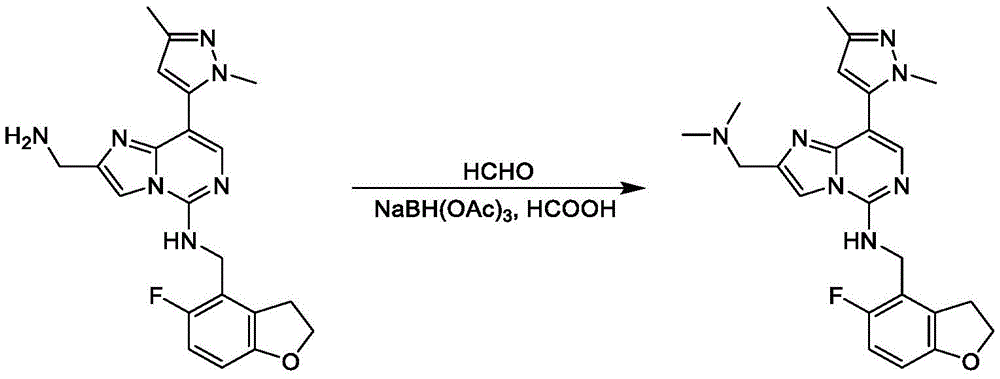
To a solution of 2- (aminomethyl) -8- (1, 3-dimethyl-1H-pyrazol-5-yl) -N- ((5-fluoro-2, 3-dihydrobenzofuran-4-yl) methyl) imidazo [1,2-c ] pyrimidin-5-amine (19.9mg, 45.8 μmol, 1.00 equivalents) in methanol (1.00mL) and DCE (1.00mL) were added formaldehyde (7.44mg, 91.6 μmol, 6.82 μ L, 37.0% purity, 2.00 equivalents), formic acid (220 μ g, 4.58 μmol, 0.10 equivalents), and sodium triacetoxyborohydride (19.4mg, 91.6 μmol, 2.00 equivalents), and the reaction mixture was stirred at 25 ℃ for 12 hours. The reaction was filtered and concentrated in vacuo to give a residue which was purified by preparative HPLC (column: Phenomenex Synergi C18150X 25X 10 μm; mobile phase: [ water (0.1% TFA) -ACN ]; B%: 20% -50%, 9 min) and lyophilized to give 2- [ (dimethylamino) methyl ] -8- (2, 5-dimethylpyrazol-3-yl) -N- [ (5-fluoro-2, 3-dihydrobenzofuran-4-yl) methyl ] imidazo [1,2-C ] pyrimidin-5-amine (7.82mg, 14.1. mu. mol, 30.7% yield, 98.9% purity, trifluoroacetate) as a white solid. LCMS [ M +1] 436.2.
1H NMR(400MHz,CD3OD)δ=8.16(s,1H),7.84(s,1H),6.89-6.83(m,1H),6.65(dd,J=4.0,8.8Hz,1H),6.30(s,1H),4.84(s,3H),4.59(t,J=8.8Hz,2H),4.46(s,2H),3.77(s,3H),3.41(t,J=8.4Hz,2H),2.92(s,6H),2.30(s,3H)。
Example 27

2- (((8- (1, 3-dimethyl-1H-pyrazol-5-yl) -5- (((5-fluoro-2, 3-dihydrobenzofuran-4-yl) methyl) amino) imidazo [1,2-c ] pyrimidin-2-yl) methyl) amino) ethane-1-sulfonyl fluoride
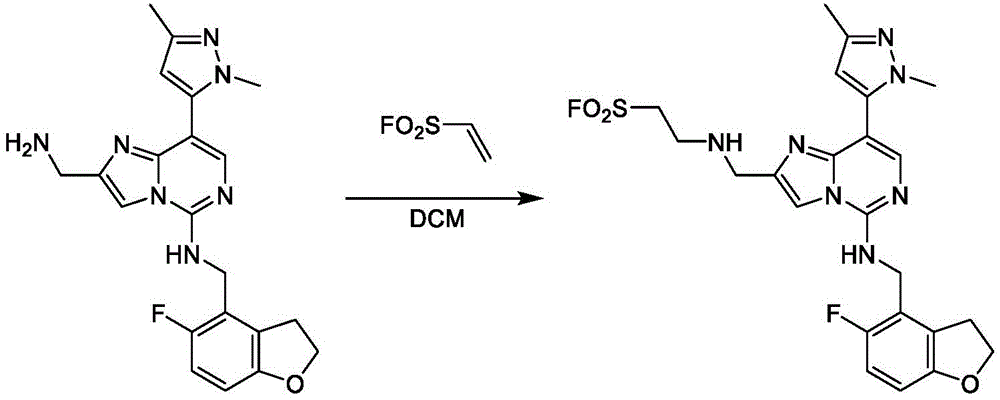
To a solution of 2- (aminomethyl) -8- (2, 5-dimethylpyrazol-3-yl) -N- [ (5-fluoro-2, 3-dihydrobenzofuran-4-yl) methyl ] imidazo [1,2-c ] pyrimidin-5-amine (20.0mg, 49.1 μmol, 1.00 eq) in dichloromethane (0.50mL) was added vinyl sulfonyl fluoride (2.70mg, 24.5 μmol, 0.50 eq). The mixture was stirred at 25 ℃ for 1 hour. The mixture was concentrated in vacuo to give a residue. The residue was purified by preparative HPLC (column: Luna C18150X 255 u; mobile phase: [ water (0.075% TFA) -ACN ]; B%: 18% -48%, 9 min.) to give 22- (((8- (1, 3-dimethyl-1H-pyrazol-5-yl) -5- (((5-fluoro-2, 3-dihydrobenzofuran-4-yl) methyl) amino) imidazo [1,2-C ] pyrimidin-2-yl) methyl) amino) ethane-1-sulfonyl fluoride (8.00mg, 11.2. mu. mol, 22.9% yield, 88.6% purity) as a yellow solid. LCMS [ M +1] 518.2.
1H NMR(400MHz,DMSO-d6)δ=9.53-8.86(m,1H),8.57(br t,J=5.2Hz,1H),8.23(s,1H),7.76(s,1H),6.97-6.89(m,1H),6.70(dd,J=4.0,8.8Hz,1H),6.21(s,1H),4.72(br d,J=4.8Hz,2H),4.54(t,J=8.8Hz,2H),4.38(s,2H),4.36-4.29(m,2H),3.68(s,3H),3.61-3.57(m,2H),3.31(br t,J=8.8Hz,2H),2.17(s,3H)。
Example 28

2,2' - ((8- (1, 3-dimethyl-1H-pyrazol-5-yl) -5- (((5-fluoro-2, 3-dihydrobenzofuran-4-yl) methyl) amino) imidazo [1,2-c ] pyrimidin-2-yl) methyl) azelidinyl) bis (ethane-1-sulfonyl fluoride)

To a solution of 2- (aminomethyl) -8- (1, 3-dimethyl-1H-pyrazol-5-yl) -N- ((5-fluoro-2, 3-dihydrobenzofuran-4-yl) methyl) imidazo [1,2-c ] pyrimidin-5-amine (30.0mg, 73.6 μmol, 1 eq) in dichloromethane (0.50mL) was added vinyl sulfonyl fluoride (7.30mg, 66.3 μmol, 0.90 eq). The mixture was stirred at 25 ℃ for 1 hour. The mixture was concentrated in vacuo to give a residue. The residue was purified by preparative HPLC (column: Luna C18150X 255. mu.; mobile phase: [ water (0.075% TFA) -ACN ]; B%: 30% -60%, 9 min.) to give 2,2' - ((((8- (1, 3-dimethyl-1H-pyrazol-5-yl) -5- (((5-fluoro-2, 3-dihydrobenzofuran-4-yl) methyl) amino) imidazo [1,2-C ] pyrimidin-2-yl) methyl) azelidinyl) bis (ethane-1-sulfonyl fluoride) (30.0mg, 40.2. mu. mol, 54.6% yield, 99.3% purity, trifluoroacetate salt) as a white oil. LCMS [ M +1] 628.4.
1H NMR(400MHz,DMSO-d6)δ=8.64(br s,1H),8.13(s,1H),7.86(br s,1H),6.99-6.91(m,1H),6.70(dd,J=4.0,8.8Hz,1H),6.23(s,1H),4.74(d,J=4.8Hz,2H),4.54(t,J=8.8Hz,2H),4.19-4.12(m,4H),3.91(s,2H),3.68(s,3H),3.31(t,J=8.8Hz,2H),3.13(t,J=6.8Hz,4H),2.19(s,3H)。
Example 29
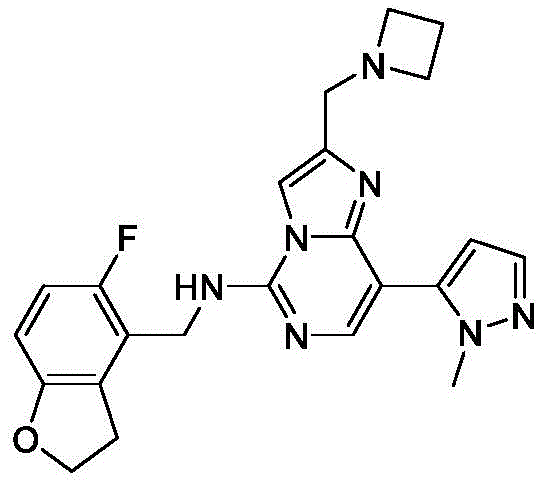
2- (azetidin-1-ylmethyl) -N- ((5-fluoro-2, 3-dihydrobenzofuran-4-yl) methyl) -8- (1-methyl-1H-pyrazol-5-yl) imidazo [1,2-c ] pyrimidin-5-amine

To 8- (1, 3-dimethyl-1H-pyrazol-5-yl) -5- (((5-fluoro-2, 3-dihydrobenzofuran-4-yl) methyl) amino) imidazo [1,2-c]Pyrimidine-2-carbaldehyde (70.0mg, 141. mu. mol, 1.00 equiv.), azetidine hydrochloride (40.3mg, 430. mu. mol, 3.05 equiv.), Ti (Oi-Pr)4To a solution of (119mg, 419. mu. mol, 124. mu.L, 2.96 equivalents) and acetic acid (1.05mg, 17.5. mu. mol, 1.00. mu.L, 0.12 equivalents) in DCE (2.50mL) was added sodium cyanoborohydride (17.5mg, 278. mu. mol, 1.97 equivalents), and the reaction was stirred at 25 ℃ for 1.5 hours. The reaction mixture was diluted with ammonium chloride solution (20.0mL) and the suspension was filtered, and the filtrate was extracted with ethyl acetate (30.0 mL. times.2). The combined organic layers were washed with brine (50.0mL), dried over anhydrous sodium sulfate and concentrated under reduced pressure to give a residue. By preparative HPLC (column: Phenomenex Synergi C18150. multidot.25. multidot.10 μm; mobile phase: [ water (0.05% HCl) -ACN](ii) a B%: 20% -40%) to obtain 2- (azetidin-1-ylmethyl) -N- ((5-fluoro-2, 3-dihydrobenzofuran-4-yl) methyl) -8- (1-methyl-1H-pyrazol-5-yl) imidazo [1, 2-c) as a white solid]Pyrimidin-5-amine (25.6mg, 48.4 μmol, 34.3% yield, 91.5% purity, hydrochloride salt). LCMS (liquid Crystal Module) (M +1)]:448.2。
1H NMR(400MHz,CD3OD)δ=8.43(s,1H),8.21(s,1H),6.91-6.83(m,1H),6.81(s,1H),6.67(dd,J=4.0,8.8Hz,1H),4.91(br s,2H),4.66(s,2H),4.61(t,J=8.8Hz,2H),4.40-4.17(m,4H),4.02(s,3H),3.44(t,J=8.8Hz,2H),2.68-2.41(m,5H)。
Example 30

2- ((cyclobutylamino) methyl) -8- (1, 3-dimethyl-1H-pyrazol-5-yl) -N- ((5-fluoro-2, 3-dihydrobenzofuran-4-yl) methyl) imidazo [1,2-c ] pyrimidin-5-amine

To a solution of 8- (1, 3-dimethyl-1H-pyrazol-5-yl) -5- (((5-fluoro-2, 3-dihydrobenzofuran-4-yl) methyl) amino) imidazo [1,2-c ] pyrimidine-2-carbaldehyde (30.0mg, 73.8 μmol, 1.00 equiv) and cyclobutylamine (15.8mg, 221 μmol, 19.0 μ L, 3.00 equiv) in methanol (2.00mL) was added acetic acid (39.4mg, 656 μmol, 37.5 μ L, 8.88 equiv). The mixture was stirred at 50 ℃ for 2 hours, then sodium cyanoborohydride (9.28mg, 148. mu. mol, 2.00 equiv.) was added to the reaction mixture at 20 ℃. The reaction mixture was stirred at 20 ℃ for 30 minutes. The reaction mixture was filtered and concentrated under reduced pressure to give a residue. The residue was purified by preparative HPLC (column: Phenomenex Synergi C18150: 25. mu.m; mobile phase: [ water (0.05% HCl) -ACN ]; B%: 20% -40%) to give 2- [ (cyclobutylamino) methyl ] -8- (2, 5-dimethylpyrazol-3-yl) -N- [ (5-fluoro-2, 3-dihydrobenzofuran-4-yl) methyl ] imidazo [1,2-C ] pyrimidin-5-amine (17.1mg, 36.0. mu. mol, 48.8% yield, 96.9% purity) as a white solid. LCMS [ M +1] 462.5.
1H NMR(400MHz,DMSO-d6)δ=10.00(br s,1H),9.48(br s,1H),8.65(s,1H),7.97(s,1H),6.96-6.87(m,1H),6.68(dd,J=4.0,8.8Hz,1H),6.41(s,1H),4.73(br s,2H),4.53(t,J=8.4Hz,2H),4.15(br s,2H),4.09-3.97(m,1H),3.77(s,3H),3.73-3.60(m,1H),3.35(br t,J=8.8Hz,2H),2.30-2.18(m,5H),2.17-2.08(m,2H),1.81-1.66(m,2H)。
Examples 31-33 were prepared according to the general reaction scheme, examples 29-30 and the teaching of the intermediates disclosed herein, as shown in table 3.
TABLE 3 characterization of examples 31-33


Example 34

2- (1-aminoethyl) -N- ((5-fluoro-2, 3-dihydrobenzofuran-4-yl) methyl) -8- (2-methyl-4- (methylsulfonyl) phenyl) imidazo [1,2-c ] pyrimidin-5-amine

Step A: reacting (1- (8-bromo-5- (((5-fluoro-2, 3-dihydrobenzofuran-4-yl) methyl) amino) imidazo [1, 2-c)]Pyrimidin-2-yl) ethyl) carbamic acid tert-butyl ester (70.0mg, 138. mu. mol, 1.00 equiv.), 4,5, 5-tetramethyl-2- (2-methyl-4- (methylsulfonyl) phenyl) -1,3, 2-dioxaborolan (81.9mg, 276. mu. mol, 2.00 equiv.), Pd (dppf) Cl2A mixture of (10.1mg, 13.8 μmol, 0.10 equivalents) and sodium bicarbonate (34.8mg, 415 μmol, 16.1 μ L, 3.00 equivalents) in a mixed solvent of water (0.40mL) and dioxane (2.00mL) was degassed and purged with nitrogen 3 times, and then the mixture was stirred at 100 ℃ for 30 minutes under a nitrogen atmosphere. After completion of the reaction, the reaction mixture was evaporated to obtain a residue. By preparative TLC (SiO)2Petroleum ether/ethyl acetate 1/1) to give (1- (5- (((5-fluoro-2, 3-dihydrobenzofuran-4-yl) methyl) amino) -8- (2-methyl-4- (methylsulfonyl) phenyl) imidazo [1, 2-c) as a yellow oil]Pyrimidin-2-yl) ethyl) carbamic acid tert-butyl ester (80.0mg, crude). LCMS (liquid Crystal Module) (M +1)]:596.1。
And B: (1- (5- (((5-fluoro-2, 3-dihydrobenzofuran-4-yl) methyl) amino) -8- (2-methyl-4- (methylsulfonyl) phenyl) imidazo [1, 2-c)]Pyrimidin-2-yl) ethyl) carbamic acid tert-butyl ester (80.0mg, 134. mu. mol, 1.00 equiv.) as a solution in a mixed solvent of dichloromethane (3.00mL) and trifluoroacetic acid (1.00mL) was mixedThe mixture was stirred at 25 ℃ for 30 minutes. After completion of the reaction, the reaction mixture was evaporated to obtain a residue. By preparative HPLC (column: Waters Xbridge 150X 25mM X5 um; mobile phase: [ water (10mM NH)4HCO3)-ACN](ii) a B%: 22% -52%, 10 min) purification of the residue to obtain 2- (1-aminoethyl) -N- ((5-fluoro-2, 3-dihydrobenzofuran-4-yl) methyl) -8- (2-methyl-4- (methylsulfonyl) phenyl) imidazo [1, 2-c) as a white solid]Pyrimidin-5-amine (25.9mg, 50.0 μmol, 37.2% yield, 95.6% purity). LCMS (liquid Crystal Module) (M +1)]:496.3。
1H NMR(400M Hz,CD3OD)δ=7.91(s,1H),7.85(dd,J=1.6,8.0Hz,1H),7.80(s,1H),7.62(s,1H),7.57(d,J=8.0Hz,1H),6.92-6.78(m,1H),6.64(dd,J=4.0,8.8Hz,1H),4.82(s,2H),4.57(t,J=8.8Hz,2H),4.35-4.18(m,1H),3.41-3.34(m,2H),3.16(s,3H),2.31(s,3H),1.46(d,J=6.8Hz,3H)。
Examples 35-39 were prepared according to the general reaction scheme, example 34, and the teaching of the intermediates disclosed herein, as shown in table 4.
TABLE 4 characterization of examples 35-39


Example 40
5- (2- (1-aminoethyl) -5- (((5-fluoro-2, 3-dihydrobenzofuran-4-yl) methyl) amino) imidazo [1,2-c ] pyrimidin-8-yl) -1-methyl-1H-pyrazole-3-carbonitrile

Step A: methyl 1-methyl-5- (4,4,5, 5-tetramethyl-1, 3, 2-dioxaborolan-2-yl) -1H-pyrazole-3-carboxylate (263mg, 988. mu. mol, 2.00 equiv.), (1- (8-bromo-5- (((5-fluoro-2, 3-dihydrobenzofuran-4-yl) methyl) amino) imidazo [1,2-c]Pyrimidines-2-yl) ethyl) carbamic acid tert-butyl ester (250mg, 494 μmol, 1.00 equiv), bis (tri-tert-butylphosphine) palladium (0) (50.5mg, 98.7 μmol, 0.20 equiv) and potassium carbonate (341mg, 2.47mmol, 5.00 equiv) in a mixed solvent of dioxane (5.00mL) and water (1.00mL) were degassed and purged 3 times with nitrogen, and then the mixture was stirred at 80 ℃ for 1 hour under a nitrogen atmosphere. The reaction mixture was evaporated to give a residue. By column chromatography (SiO)2Dichloromethane/methanol-1/0 to 10/1) to obtain 5- (2- (1- ((tert-butoxycarbonyl) amino) ethyl) -5- (((5-fluoro-2, 3-dihydrobenzofuran-4-yl) methyl) amino) imidazo [1, 2-c) as an off-white solid]Pyrimidin-8-yl) -1-methyl-1H-pyrazole-3-carboxylic acid methyl ester (270mg, 434 μmol, 88.0% yield, 91.0% purity). LCMS (liquid Crystal Module) (M +1)]:566.6。
1H NMR(400MHz,CD3OD)δ=7.81(s,1H),7.78(s,1H),6.95(s,1H),6.85(t,J=9.6Hz,1H),6.64(dd,J=4.0,8.8Hz,1H),4.83(s,2H),4.58(t,J=8.8Hz,2H),4.15-4.10(m,1H),3.92(s,3H),3.88(s,3H),3.41-3.35(m,2H),1.44(s,12H),1.41(s,3H)。
And B: a mixture of methyl 5- (2- (1- ((tert-butoxycarbonyl) amino) ethyl) -5- (((5-fluoro-2, 3-dihydrobenzofuran-4-yl) methyl) amino) imidazo [1,2-c ] pyrimidin-8-yl) -1-methyl-1H-pyrazole-3-carboxylate (250mg, 402 μmol, 1.00 eq) and sodium hydroxide (1.00M in water, 1.21mL, 3.00 eq) in methanol (10.0mL) was degassed and purged 3 times with nitrogen before the mixture was stirred at 50 ℃ for 1 hour under a nitrogen atmosphere. After completion of the reaction, the mixture was acidified to pH 7 with aqueous hydrochloric acid (1.00M). During this time, a white precipitate formed, the suspension was filtered, the filter cake was collected and dried in vacuo to give 5- (2- (1- ((tert-butoxycarbonyl) amino) ethyl) -5- (((5-fluoro-2, 3-dihydrobenzofuran-4-yl) methyl) amino) imidazo [1,2-c ] pyrimidin-8-yl) -1-methyl-1H-pyrazole-3-carboxylic acid (250mg, crude) as a white solid, which was used directly.
1H NMR(400MHz,DMSO-d6)δ=8.41(s,1H),7.96(s,1H),7.68(s,1H),7.22(br d,J=7.6Hz,1H),6.96-6.87(m,1H),6.69(dd,J=4.0,8.8Hz,1H),6.50(s,1H),4.77-4.66(m,3H),4.54(t,J=8.8Hz,2H),3.77(s,3H),3.31-3.28(m,2H),1.40(s,3H),1.38(s,9H)。
And C: to a solution of 5- (2- (1- ((tert-butoxycarbonyl) amino) ethyl) -5- (((5-fluoro-2, 3-dihydrobenzofuran-4-yl) methyl) amino) imidazo [1,2-c ] pyrimidin-8-yl) -1-methyl-1H-pyrazole-3-carboxylic acid (230mg, 417 μmol, 1.00 eq) and ammonium chloride (66.9mg, 1.25mmol, 3.00 eq) in DMF (3.00mL) was added diisopropylethylamine (162mg, 1.25mmol, 218 μ L, 3.00 eq) and HATU (238mg, 625 μmol, 1.50 eq). The mixture was stirred at 25 ℃ for 30 minutes. After completion of the reaction, the reaction mixture was triturated with water (20.0mL), the suspension was filtered and the filter cake was collected and dried under reduced pressure to give crude tert-butyl (1- (8- (3-carbamoyl-1-methyl-1H-pyrazol-5-yl) -5- (((5-fluoro-2, 3-dihydrobenzofuran-4-yl) methyl) amino) imidazo [1,2-c ] pyrimidin-2-yl) ethyl) carbamate as a white solid (140mg, 254 μmol, 61.0% yield), which was used directly in the next step.
1H NMR(400MHz,DMSO-d6)δ=8.42(t,J=4.4,1H),7.96(s,1H),7.76(s,1H),7.48(s,1H),7.26-7.19(m,1H),6.99-6.91(m,1H),6.79(s,1H),6.70(dd,J=4.0,8.8Hz,1H),4.82-4.65(m,3H),4.55(t,J=8.8Hz,2H),3.85(s,3H),3.30-3.29(m,2H),1.41(s,3H),1.39(s,9H)。
Step D: to a mixture of tert-butyl (1- (8- (3-carbamoyl-1-methyl-1H-pyrazol-5-yl) -5- (((5-fluoro-2, 3-dihydrobenzofuran-4-yl) methyl) amino) imidazo [1,2-c ] pyrimidin-2-yl) ethyl) carbamate (120mg, 218 μmol, 1.00 eq) and triethylamine (441mg, 4.36mmol, 607 μ L, 20.0 eq) in anhydrous tetrahydrofuran (2.00mL) was added trifluoroacetic anhydride (458mg, 2.18mmol, 303 μ L, 10.0 eq) at 0 ℃. The resulting mixture was heated to 25 ℃ and stirred for 30 minutes. The reaction mixture was diluted with aqueous ammonium chloride (20.0mL) and the suspension was filtered, and the filtrate was extracted with ethyl acetate (30.0 mL. times.2). The combined organic layers were washed with brine (50.0mL), dried over anhydrous sodium sulfate and concentrated under reduced pressure to give tert-butyl (1- (8- (3-cyano-1-methyl-1H-pyrazol-5-yl) -5- (((5-fluoro-2, 3-dihydrobenzofuran-4-yl) methyl) amino) imidazo [1,2-c ] pyrimidin-2-yl) ethyl) carbamate as a yellow oil (120mg, crude), which was used directly. LCMS [ M +1] 533.3.
Step E: reacting (1- (8- (3-cyano-1-methyl-1H-pyrazol-5-yl) -5- (((5-fluoro-2, 3-dihydrobenzofuran-4-yl) methyl) amino) imidazo [1,2-c]Pyrimidin-2-yl) ethyl) carbamic acid tert-butyl ester (120mg, 225. mu. mol, 1.00 equiv.) in a mixed solvent of dichloromethane (1.50mL) and trifluoroacetic acid (0.50mL) was stirred at 25 ℃ for 30 minutes. The reaction mixture was evaporated to give a residue. By preparative HPLC (column: Waters Xbridge 150X 25mM X5 μm; mobile phase: [ water (10mM NH)4HCO3)-ACN](ii) a B%: 22% -52%, 10 min) purification of the residue to obtain 5- (2- (1-aminoethyl) -5- (((5-fluoro-2, 3-dihydrobenzofuran-4-yl) methyl) amino) imidazo [1, 2-c) as a white solid]Pyrimidin-8-yl) -1-methyl-1H-pyrazole-3-carbonitrile (4.70mg, 10.6 μmol, 4.72% yield, 97.8% purity). LCMS (liquid Crystal Module) (M +1)]:433.3。
1H NMR(400MHz,CD3OD)δ=7.82(s,1H),7.79(s,1H),6.95(s,1H),6.87-6.80(m,1H),6.63(dd,J=4.0,8.8Hz,1H),4.82(s,2H),4.56(t,J=8.8Hz,2H),4.18-4.13(m,1H),3.87(s,3H),3.37(t,J=8.4Hz,2H),1.49(d,J=6.4Hz,3H)。
EXAMPLE 41

2- (amino (cyclopropyl) methyl) -8- (1, 3-dimethyl-1H-pyrazol-5-yl) -N- ((5-fluoro-2, 3-dihydrobenzofuran-4-yl) methyl) imidazo [1,2-c ] pyrimidin-5-amine
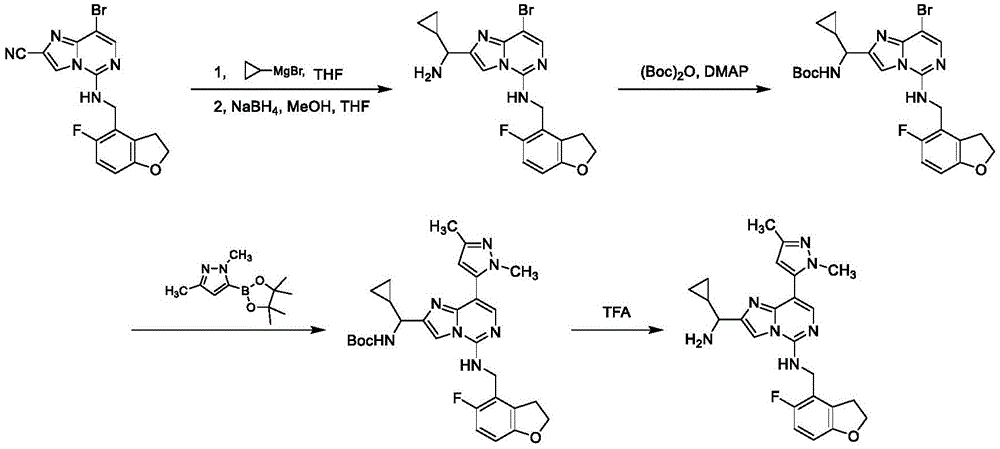
Step A: to a solution of 8-bromo-5- (((5-fluoro-2, 3-dihydrobenzofuran-4-yl) methyl) amino) imidazo [1,2-c ] pyrimidine-2-carbonitrile (50.0mg, 129 μmol, 1.00 eq) in THF (1.00mL) at 15 ℃ was added dropwise cyclopropylmagnesium bromide (0.50M, 1.55mL, 6.00 eq), the mixture was stirred at 25 ℃ for 5 h, then the reaction mixture was cooled to-10 ℃. Methanol (0.50mL) was added to the reaction mixture, and after 15 minutes sodium borohydride (19.5mg, 515. mu. mol, 4.00 equiv.) was added to the reaction mixture and stirred at 0 ℃ for 2 hours. To the reaction mixture was added aqueous sodium bicarbonate (10.0mL) followed by extraction with ethyl acetate (10.0mL × 3), combined and dried over sodium sulfate, and concentrated to give 2- (amino (cyclopropyl) methyl) -8-bromo-N- ((5-fluoro-2, 3-dihydrobenzofuran-4-yl) methyl) imidazo [1,2-c ] pyrimidin-5-amine (50.0mg, 95.0 μmol, 74.0% yield, 82.0% purity) as a yellow oil, which was used in the next step without further purification.
And B: to a mixture of 2- (amino (cyclopropyl) methyl) -8-bromo-N- ((5-fluoro-2, 3-dihydrobenzofuran-4-yl) methyl) imidazo [1,2-c ] pyrimidin-5-amine (61.0mg, 116 μmol, 1.00 eq) and TEA (35.1mg, 347 μmol, 48.3 μ L, 3.00 eq) in THF (2.00mL) under a nitrogen atmosphere at 20 ℃ was added di-tert-butyl dicarbonate (50.5mg, 231 μmol, 53.1 μ L, 2.00 eq) and DMAP (1.41mg, 11.6 μmol, 0.10 eq) in one portion. The reaction mixture was stirred at 20 ℃ for 3 hours. To the reaction mixture was added water (3.00mL) followed by extraction with ethyl acetate (3.00 mL. times.2). The combined organic phases were washed with brine (8.00mL), dried over anhydrous sodium sulfate, filtered and concentrated in vacuo. The residue was purified by preparative TLC (petroleum ether/ethyl acetate ═ 1/1) to obtain the final product tert-butyl ((8-bromo-5- (((5-fluoro-2, 3-dihydrobenzofuran-4-yl) methyl) amino) imidazo [1,2-c ] pyrimidin-2-yl) (cyclopropyl) methyl) carbamate (40.0mg, 75.1 μmol, 65.0% yield) as a yellow oil, which was used in the next step without further purification. LCMS [ M +1] 532.0.
And C: ((8-bromo-5- (((5-fluoro-2, 3-dihydrobenzofuran-4-yl) methyl) amino) imidazo [1, 2-c) in dioxane (1.00mL) and water (0.20mL)]Pyrimidin-2-yl) (cyclopropyl) methyl) carbamic acid tert-butyl ester (40.0mg, 75.1. mu. mol, 1.00 equivalents), 1, 3-dimethyl-5- (4,4,5, 5-tetramethyl-1, 3, 2-dioxaborolan-2-yl) -1H-pyrazole (20.0mg, 90.2. mu. mol, 1.20 equivalents), Pd (dppf) Cl2(5.50mg, 7.51. mu. mol, 0.10 equiv.) and sodium bicarbonate (18.9mg, 225. mu. mol, 8.77. mu.L, 3.00 equiv.) were degassed and then heated to 100 ℃ under nitrogen for 2 hours. The mixture was cooled to 20 ℃ and concentrated under reduced pressure. To the reaction mixture was added water (10.0mL) followed by extraction with ethyl acetate (10.0 mL. times.3). Using brine (20.0 m)L) the combined organic phases were washed, dried over anhydrous sodium sulfate, filtered and concentrated in vacuo. The residue was purified by preparative TLC (petroleum ether/ethyl acetate ═ 1/1) to obtain (cyclopropyl (8- (1, 3-dimethyl-1H-pyrazol-5-yl) -5- (((5-fluoro-2, 3-dihydrobenzofuran-4-yl) methyl) amino) imidazo [1, 2-c) as a yellow oil]Pyrimidin-2-yl) methyl) carbamic acid tert-butyl ester (20.0mg, 36.5 μmol, 48.6% yield), which was used in the next step without further purification. LCMS (liquid Crystal Module) (M +1)]:548.4。
Step D: to a mixture of tert-butyl (cyclopropyl (8- (1, 3-dimethyl-1H-pyrazol-5-yl) -5- (((5-fluoro-2, 3-dihydrobenzofuran-4-yl) methyl) amino) imidazo [1,2-c ] pyrimidin-2-yl) methyl) carbamate (20.0mg, 36.5 μmol, 1.00 eq) in DCM (0.50mL) was added TFA (770mg, 6.75mmol, 0.50mL, 185 eq) in one portion at 20 ℃ under nitrogen. The mixture was stirred at 20 ℃ for 2 hours. The solvent was removed under reduced pressure to give a residue which was purified by preparative HPLC (column: Waters Xbridge 150X 25mm X5 μm; mobile phase: [ water (0.05% ammonium hydroxide v/v) -ACN ]; B%: 32% -62%, 10 min.) to give 2- (amino (cyclopropyl) methyl) -8- (1, 3-dimethyl-1H-pyrazol-5-yl) -N- ((5-fluoro-2, 3-dihydrobenzofuran-4-yl) methyl) imidazo [1,2-c ] pyrimidin-5-amine (10.0mg, 22.3. mu. mol, 61.1% yield, 99.9% purity) as a white solid. LCMS [ M +1] 448.4.
1H NMR(400MHz,CD3OD)δ=7.95(s,1H),7.73(s,1H),6.91-6.82(m,1H),6.66(dd,J=4.0,8.8Hz,1H),6.25(s,1H),4.83(s,2H),4.59(t,J=8.8Hz,2H),3.74(s,3H),3.38(t,J=8.8Hz,2H),3.29(br d,J=8.8Hz,1H),2.30(s,3H),1.28-1.17(m,1H),0.67-0.62(m,2H),0.50-0.32(m,2H)。
Example 42

2- (1-amino-2, 2, 2-trifluoroethyl) -8- (1, 3-dimethyl-1H-pyrazol-5-yl) -N- ((5-fluoro-2, 3-dihydrobenzofuran-4-yl) methyl) imidazo [1,2-c ] pyrimidin-5-amine

Step A: to 8- (1, 3-dimethyl-1H-pyrazol-5-yl) -5- (((5-fluoro-2, 3-dihydrobenzofuran-4-yl) methyl) amino) imidazo [1,2-c]DMAP (2.40mg, 19.7. mu. mol, 0.10 equiv.) was added to a solution of pyrimidine-2-carbaldehyde (80.0mg, 197. mu. mol, 1.00 equiv.) and di-tert-butyl dicarbonate (47.3mg, 217. mu. mol, 49.7. mu.L, 1.10 equiv.) in THF (1.00 mL). The reaction mixture was stirred at 35 ℃ for 1 hour. The mixture was concentrated in vacuo to give a residue. By preparative TLC (SiO)2Petroleum ether/ethyl acetate 2/1) to give (8- (1, 3-dimethyl-1H-pyrazol-5-yl) -2-formylimidazo [1, 2-c) as a grey solid]Pyrimidin-5-yl) ((5-fluoro-2, 3-dihydrobenzofuran-4-yl) methyl) carbamic acid tert-butyl ester (85.0mg, 168. mu. mol, 85.3% yield).
1H NMR(400MHz,DMSO-d6)δ=10.08(s,1H),8.40(s,1H),8.20(s,1H),6.82-6.76(m,1H),6.61(dd,J=4.0,8.8Hz,1H),6.51(s,1H),5.07(s,2H),4.52(t,J=8.8Hz,2H),3.76(s,3H),3.28-3.29(m,2H),2.22(s,3H),1.32(s,9H)。
And B: to a solution of tert-butyl (8- (1, 3-dimethyl-1H-pyrazol-5-yl) -2-formylimidazo [1,2-c ] pyrimidin-5-yl) ((5-fluoro-2, 3-dihydrobenzofuran-4-yl) methyl) carbamate (85.0mg, 168 μmol, 1.00 eq) and potassium carbonate (46.4mg, 336 μmol, 2.00 eq) in DMF (1.00mL) at 0 ℃ was added trimethyl (trifluoromethyl) silane (191mg, 1.34mmol, 8.00 eq) dropwise. The reaction mixture was stirred at 25 ℃ for 12 hours. The reaction was poured into water (3.00mL) and stirred for 15 minutes. The aqueous phase was extracted with ethyl acetate (3.00 mL. times.2). The combined organic phases were washed with brine (3.00mL × 2), dried over anhydrous sodium sulfate, filtered and concentrated in vacuo to give tert-butyl (8- (1, 3-dimethyl-1H-pyrazol-5-yl) -2- (2,2, 2-trifluoro-1-hydroxyethyl) imidazo [1,2-c ] pyrimidin-5-yl) ((5-fluoro-2, 3-dihydrobenzofuran-4-yl) methyl) carbamate (85.0mg, 147 μmol, 87.9% yield) as a grey solid.
1H NMR(400MHz,DMSO-d6)δ=8.11(s,1H),7.60(s,1H),7.01(d,J=6.8Hz,1H),6.80-6.74(m,1H),6.61(dd,J=4.0,8.8Hz,1H),6.46(s,1H),5.34(t,J=6.8Hz,1H),5.07(s,2H),4.52(t,J=8.8Hz,2H),3.72(s,3H),3.29-3.26(m,2H),2.21(s,3H),1.29(s,9H)。
And C: to a solution of tert-butyl (8- (1, 3-dimethyl-1H-pyrazol-5-yl) -2- (2,2, 2-trifluoro-1-hydroxyethyl) imidazo [1,2-c ] pyrimidin-5-yl) ((5-fluoro-2, 3-dihydrobenzofuran-4-yl) methyl) carbamate (22.0mg, 38.2 μmol, 1.00 equivalents) in DCE (1.00mL) was added manganese dioxide (6.60mg, 76.3 μmol, 2.00 equivalents). The mixture was stirred at 40 ℃ for 1 hour. The mixture was filtered and concentrated in vacuo to give tert-butyl (8- (1, 3-dimethyl-1H-pyrazol-5-yl) -2- (2,2, 2-trifluoroacetyl) imidazo [1,2-c ] pyrimidin-5-yl) ((5-fluoro-2, 3-dihydrobenzofuran-4-yl) methyl) carbamate (16.0mg, crude) as a white solid, which was used in the next step without further purification.
Step D: to a solution of tert-butyl (8- (1, 3-dimethyl-1H-pyrazol-5-yl) -2- (2,2, 2-trifluoroacetyl) imidazo [1,2-c ] pyrimidin-5-yl) ((5-fluoro-2, 3-dihydrobenzofuran-4-yl) methyl) carbamate (12.0mg, 20.9 μmol, 1.00 equivalents) in THF (0.50mL) was added ammonia (711 μ g, 41.8 μmol, 2.00 equivalents) and titanium isopropoxide (11.9mg, 41.8 μmol, 12.3 μ L, 2.00 equivalents), the mixture was adjusted to pH 4 with acetic acid (0.10mL) and stirred at 40 ℃ for 30 minutes. Sodium cyanoborohydride (2.63mg, 41.8. mu. mol, 2.00 equiv.) was then added to the mixture and stirred at 40 ℃ for a further 2 hours. The mixture was poured into saturated ammonium chloride (3.00mL) and stirred for 15 minutes. The aqueous phase was extracted with dichloromethane (3.00 mL. times.5). The combined organic phases were washed with brine (3.00mL × 2), dried over anhydrous sodium sulfate, filtered and concentrated in vacuo to give tert-butyl (2- (1-amino-2, 2, 2-trifluoroethyl) -8- (1, 3-dimethyl-1H-pyrazol-5-yl) imidazo [1,2-c ] pyrimidin-5-yl) ((5-fluoro-2, 3-dihydrobenzofuran-4-yl) methyl) carbamate (12.0mg, crude) as a white solid. LCMS [ M +1] 576.5.
Step E: to (2- (1-amino-2, 2, 2-trifluoroethyl) -8- (1, 3-dimethyl-1H-pyrazol-5-yl) imidazo [1, 2-c)]To a solution of tert-butyl pyrimidin-5-yl) ((5-fluoro-2, 3-dihydrobenzofuran-4-yl) methyl) carbamate (10.0mg, 17.4. mu. mol, 1.00 eq) in dichloromethane (1.00mL) was added trifluoroacetic acid (0.30 mL). Mixing the mixture withStirred for 30 minutes at 25 ℃. The mixture was concentrated in vacuo to give a residue. By preparative HPLC (column: Waters Xbridge 150X 25mM X5 μm; mobile phase: [ water (10mM NH)4HCO3)-ACN](ii) a B%: 27% -57%, 10 min) purification of the residue to obtain 2- (1-amino-2, 2, 2-trifluoroethyl) -8- (1, 3-dimethyl-1H-pyrazol-5-yl) -N- ((5-fluoro-2, 3-dihydrobenzofuran-4-yl) methyl) imidazo [1, 2-c) as a white solid]Pyrimidin-5-amine (6.00mg, 12.2 μmol, 70.0% yield, 96.4% purity). LCMS (liquid Crystal Module) (M +1)]:476.4。
1H NMR(400MHz,DMSO-d6)δ=8.42(br s,1H),8.20(s,1H),7.71(s,1H),6.98-6.89(m,1H),6.70(dd,J=4.0,8.8Hz,1H),6.20(s,1H),4.71(br s,2H),4.68-4.60(m,1H),4.55(t,J=8.8Hz,2H),3.68(s,3H),3.31-3.27(m,2H),2.43(br d,J=7.2Hz,2H),2.18(s,3H)。
Example 43

8- (1, 3-dimethyl-1H-pyrazol-5-yl) -N- ((5-fluoro-2, 3-dihydrobenzofuran-4-yl) methyl) -2- (2H-tetrazol-5-yl) imidazo [1,2-c ] pyrimidin-5-amine

Step A: reacting 8-bromo-5- (((5-fluoro-2, 3-dihydrobenzofuran-4-yl) methyl) amino) imidazo [1,2-c]Pyrimidine-2-carbonitrile (250mg, 644. mu. mol, 1.00 equiv.), 1, 3-dimethyl-5- (4,4,5, 5-tetramethyl-1, 3, 2-dioxaborolan-2-yl) -1H-pyrazole (215mg, 966. mu. mol, 1.50 equiv.), Pd (dppf) Cl2A mixture of (47.1mg, 64.4 μmol, 0.10 eq) and sodium bicarbonate (162mg, 1.93mmol, 75.1 μ L, 3.00 eq) in dioxane (1.70mL) and water (0.30mL) was degassed and purged 3 times with nitrogen, then the mixture was stirred at 95 ℃ for 1 hour under a nitrogen atmosphere. After completion of the reaction, the reaction mixture was cooled and filtered, and the filtrate was concentrated in vacuo to give a residue. By column chromatography (SiO)2Petroleum ether/ethyl acetate 3/1 to 1/1) purificationThe residue was taken up as a yellow solid to give 8- (1, 3-dimethyl-1H-pyrazol-5-yl) -5- (((5-fluoro-2, 3-dihydrobenzofuran-4-yl) methyl) amino) imidazo [1,2-c]Pyrimidine-2-carbonitrile (170mg, 379. mu. mol, 58.9% yield, 90% purity).
1H NMR(400MHz,DMSO-d6)δ=8.92(s,1H),8.63(t,J=4.8Hz,1H),7.86(s,1H),7.02-6.90(m,1H),6.71(dd,J=4.0,8.8Hz,1H),6.23(s,1H),4.72(d,J=4.8Hz,2H),4.55(t,J=8.8Hz,2H),3.67(s,3H),3.32-3.30(m,2H),2.18(s,3H)。
And B: to a mixture of 8- (1, 3-dimethyl-1H-pyrazol-5-yl) -5- (((5-fluoro-2, 3-dihydrobenzofuran-4-yl) methyl) amino) imidazo [1,2-c ] pyrimidine-2-carbonitrile (20.0mg, 44.6 μmol, 1.00 equiv.) and ammonium chloride (2.50mg, 46.7 μmol, 1.05 equiv.) in DMF (1.00mL) was added sodium azide (3.00mg, 46.1 μmol, 1.03 equiv.). The reaction mixture was heated at 100 ℃ for 3 hours. After completion of the reaction, the reaction mixture was cooled and diluted with water (3.00mL) and extracted with ethyl acetate (5.00 mL. times.3). The combined organic layers were washed with brine and dried over anhydrous sodium sulfate, and concentrated under reduced pressure to give a residue. The residue was purified by preparative HPLC (column: Phenomenex synergy C18150 × 25 × 10 μm; mobile phase: [ water (0.05% HCl) -ACN ]; B%: 20% -40%) to obtain 8- (1, 3-dimethyl-1H-pyrazol-5-yl) -N- ((5-fluoro-2, 3-dihydrobenzofuran-4-yl) methyl) -2- (2H-tetrazol-5-yl) imidazo [1,2-C ] pyrimidin-5-amine (19.7mg, 43.1 μmol, 96.6% yield, 97.7% purity) as a white solid. LCMS [ M +1] 447.1.
1H NMR(400MHz,DMSO-d6)δ=8.99(s,1H),8.64(s,1H),7.80(s,1H),7.04-6.87(m,1H),6.71(dd,J=4.0,8.8Hz,1H),6.26(s,1H),4.75(d,J=4.8Hz,2H),4.55(t,J=8.8Hz,2H),3.71(s,3H),3.37-3.31(m,2H),2.20(s,3H)。
Example 44
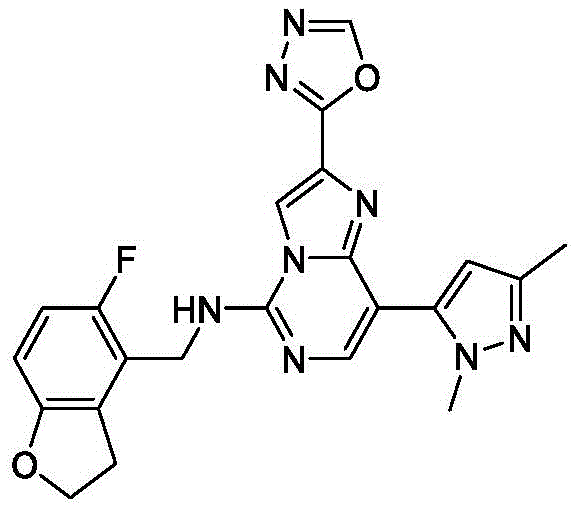
8- (1, 3-dimethyl-1H-pyrazol-5-yl) -N- ((5-fluoro-2, 3-dihydrobenzofuran-4-yl) methyl) -2- (1,3, 4-oxadiazol-2-yl) imidazo [1,2-c ] pyrimidin-5-amine


Step A: reacting 8-bromo-5- (((5-fluoro-2, 3-dihydrobenzofuran-4-yl) methyl) amino) imidazo [1,2-c]Pyrimidine-2-carboxylic acid ethyl ester (800mg, 1.84mmol, 1.00 equiv.), 1, 3-dimethyl-5- (4,4,5, 5-tetramethyl-1, 3, 2-dioxaborolan-2-yl) -1H-pyrazole (612mg, 2.76mmol, 1.50 equiv.), NaHCO3(463mg, 5.51mmol, 214. mu.L, 3.00 equiv.) and Pd (dppf) Cl2A mixture of (134mg, 184 μmol, 0.10 eq) in water (1.60mL) and dioxane (8.00mL) was degassed and purged 3 times with nitrogen, then the mixture was stirred at 105 ℃ for 2 hours under nitrogen atmosphere. The mixture was filtered and concentrated in vacuo to give a residue. By column chromatography (SiO)2Petroleum ether/ethyl acetate 1/0 to 0/1) to obtain 8- (1, 3-dimethyl-1H-pyrazol-5-yl) -5- (((5-fluoro-2, 3-dihydrobenzofuran-4-yl) methyl) amino) imidazo [1, 2-c) as a yellow solid]Pyrimidine-2-carboxylic acid ethyl ester (750mg, 1.66mmol, 90.6% yield). LCMS (liquid Crystal Module) (M +1)]:451.0。
And B: to a solution of ethyl 8- (1, 3-dimethyl-1H-pyrazol-5-yl) -5- (((5-fluoro-2, 3-dihydrobenzofuran-4-yl) methyl) amino) imidazo [1,2-c ] pyrimidine-2-carboxylate (400mg, 888 μmol, 1.00 eq) in ethanol (4.00mL) at 25 ℃ was added hydrazine hydrate (178mg, 3.55mmol, 173 μ L, 4.00 eq). The mixture was stirred at 80 ℃ for 2 hours. The reaction mixture was concentrated under reduced pressure to give a residue. The residue was triturated with methanol (3.00mL), filtered, the filter cake collected and dried to give 8- (1, 3-dimethyl-1H-pyrazol-5-yl) -5- (((5-fluoro-2, 3-dihydrobenzofuran-4-yl) methyl) amino) imidazo [1,2-c ] pyrimidine-2-carbohydrazide as a white solid (190mg, 435 μmol, 49.0% yield).
1H NMR(400MHz,DMSO-d6)δ=9.48(br s,1H),8.65(s,1H),8.48(br s,1H),7.75(s,1H),6.93(br t,J=8.8Hz,1H),6.74-6.65(m,1H),6.27(s,1H),4.71(br d,J=3.6Hz,2H),4.54(br t,J=8.8Hz,2H),4.48(br s,2H),3.72(s,3H),3.30-3.28(m,2H),2.18(s,3H)。
And C: to 8- (1, 3-dimethyl-1H-pyrazol-5-yl) -5- (((5-fluoro-2, 3-dihydrobenzofuran-4-yl) methyl) amino) imidazo [1,2-c]To a solution of pyrimidine-2-carbohydrazide (50.0mg, 97.4. mu. mol, 1.00 equiv.) in triethoxymethane (2.00mL) and DMSO (2.00mL) was added ammonium chloride (20.8mg, 390. mu. mol, 4.00 equiv.), and the reaction mixture was stirred at 130 ℃ for 1 hour. The reaction was concentrated in vacuo to give a residue, which was purified by preparative HPLC (column: Waters Xbridge 150. mu.M 255. mu.M; mobile phase: [ phase A: water (10mM NH)4HCO3) Phase B: ACN]) The residue was purified and lyophilized to give 8- (1, 3-dimethyl-1H-pyrazol-5-yl) -N- ((5-fluoro-2, 3-dihydrobenzofuran-4-yl) methyl) -2- (1,3, 4-oxadiazol-2-yl) imidazo [1, 2-c) as a white solid]Pyrimidin-5-amine (10.3mg, 21.1 μmol, 21.7% yield, 91.4% purity). LCMS (liquid Crystal Module) (M +1)]:447.3。
1H NMR(400MHz,DMSO-d6)δ=9.34(s,1H),8.91(br s,1H),8.62(br s,1H),7.79(s,1H),6.95(br t,J=9.2Hz,1H),6.70(br dd,J=3.6,8.4Hz,1H),6.24(s,1H),4.73(s,2H),4.55(br t,J=8.4Hz,2H),3.72(s,3H),3.37-3.34(m,2H),2.20(s,3H)。
Example 45

8- (1, 3-dimethyl-1H-pyrazol-5-yl) -N- ((5-fluoro-2, 3-dihydrobenzofuran-4-yl) methyl) -2- (oxazol-5-yl) imidazo [1,2-c ] pyrimidin-5-amine

To a solution of 8- (1, 3-dimethyl-1H-pyrazol-5-yl) -5- (((5-fluoro-2, 3-dihydrobenzofuran-4-yl) methyl) amino) imidazo [1,2-c ] pyrimidine-2-carbaldehyde (80.0mg, 196 μmol, 1.00 equiv) in methanol (2.00mL) was added p-toluenesulfonylmethyl isocyanide (64.0mg, 328 μmol, 1.67 equiv) and potassium carbonate (81.6mg, 590 μmol, 3.00 equiv). The reaction was stirred at 65 ℃ for 2 hours. The suspension was filtered, the filter cake was collected and triturated with methanol (5.00mL), then dried in vacuo to give 8- (1, 3-dimethyl-1H-pyrazol-5-yl) -N- ((5-fluoro-2, 3-dihydrobenzofuran-4-yl) methyl) -2- (oxazol-5-yl) imidazo [1,2-c ] pyrimidin-5-amine (37.4mg, 80.2 μmol, 40.7% yield, 95.5% purity) as a white solid. LCMS [ M +1] 446.2.
1H NMR(400MHz,CD3OD)δ=8.31(s,1H),8.26(s,1H),7.77(s,1H),7.58(s,1H),6.85(t,J=9.2Hz,1H),6.64(dd,J=3.6,8.8Hz,1H),6.26(s,1H),4.83-4.80(m,2H),4.57(t,J=8.8Hz,2H),3.74(s,3H),3.38(t,J=8.8Hz,2H),2.29(s,3H)。
The compounds of the invention may have one or more chiral centers and, if so, are synthesized as stereoisomeric mixtures, i.e., isomers of identical composition but differing in the arrangement of the atoms in space. The compounds may be used as mixtures or the individual components/isomers may be separated using commercially available reagents and conventional methods for separating stereoisomers and enantiomers well known to those skilled in the art, e.g. using the manufacturer's instructions (Sigma-Aldrich) or
 (Diacel Corp) chiral chromatographic HPLC column, and the methods described herein, e.g., in examples 11 and 12. Alternatively, the compounds of the present invention may be synthesized using optically pure chiral reagents and intermediates to prepare individual isomers or enantiomers. Unless otherwise indicated, all chiral (enantiomeric and diastereomeric) and racemic forms are within the scope of the invention.
Also contemplated within the scope of the invention are variants of the compounds of the invention wherein one or more hydrogen atoms have been replaced by deuterium. As exemplified herein, intermediates B-7, B-8, C-7, C-8 and D-31 have one or more hydrogen atoms substituted with deuterium. By substituting deuterium for one or more hydrogens in intermediates a-D exemplified herein, deuterated forms of the compounds of the invention can be readily produced using methods well known in the art.
Example A
This example illustrates that exemplary compounds of the present invention inhibit PRC2 enzyme activity.
A ten point dose response curve for the compounds of the invention was determined using the Hot Spot HMT Assay (Reaction Biology Corp; see Horiuchi et al, Assay Drug Dev Technol. (2013)4: 227-. The assay used a purified His-tagged human PRC2 complex including an N-terminal His-tagged EZH2 enzyme, an N-terminal Flag-tagged embryonic ectodermal developmental protein (EED), an N-terminal His-tagged zeste 12 inhibitor (SUZ12), an N-terminal His-tagged AEBP2, and an N-terminal His-tagged RbAp 48. In this assay, following filtration, the transfer of tritiated methyl groups from radiolabeled S-adenosylmethionine (SAM) to purified core histone protein by EZH2 was quantified to determine the activity of the core PRC2 complex in the presence and absence of the compound.
Briefly, compounds of the invention were dissolved in DMSO and each compound was serially diluted in 15% DMSO in a series of 10, three-fold serial dilutions. The initial concentration of each compound was 1.0 μ M in serial dilutions. In addition, control samples without compound, EZH2 enzyme, or various reaction components were prepared and processed in parallel with the compound test samples. SAH (S- (5-adenosine) -L-homocysteine) was used as a positive control for assay validation.
Aliquots of each serial dilution of test compound were added to deep 384-well plates using an acoustics Technology instrument (Echo 550, LabCyte) containing reaction buffer (50mM Tris-HCl (pH 8), 0.01% Brij35, 1mM EDTA, 1mM DTT, 1mM PMSF, and 1% DMSO), 10nM purified PRC2 complex, and 0.05mg/ml core histone H3 in a volume of 5 μ l. The reaction was gently mixed and then pre-incubated at 30 ℃ for 20 minutes. By adding 1uM S-adenosine-L- [ methyl-3H]Methionine to start the enzymatic reaction and incubated at 30 ℃ for 1 hour. After 1 hour, the reaction product was detected using a filter binding methodAnd the amount of tritiated H3 core histone was quantified using a scintillation counter. IC for each compound was determined from each 10-point dose response curve using GraphPad Prism software50Values, results for exemplary compounds of formula (I) are shown in table 5. Description of the symbols: a ≦ 250 nM; b ═>250 nM-500 nM; and C ═>500nM-≤2μM。
TABLE 5 inhibition of PRC2 mediated enzymatic activity by exemplary compounds of formula (I)

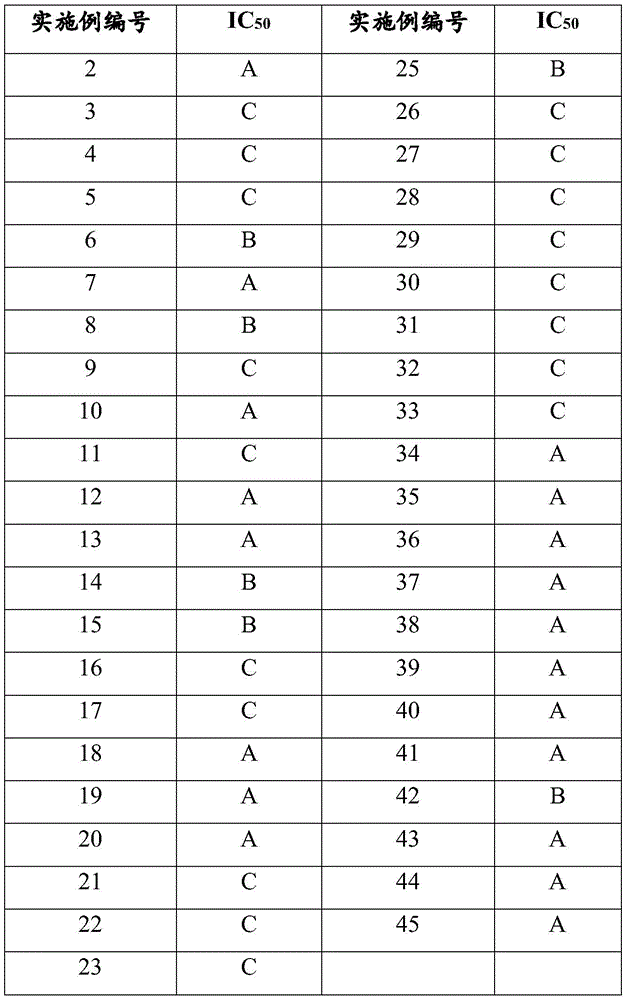
Example B
This example illustrates that exemplary compounds of the present invention inhibit the growth of tumor cells bearing PRC2 complex containing EZH2 activating mutations.
The Pfeiffer cell line was established from pleural infusions of patients with metastatic diffuse large B-cell lymphoma (DLBCL). This cell line expresses a mutant form of EZH2 enzyme (a677G), which results in enhanced EZH2 activity, leading to increased methylation of histone H3 Lys 27. The increased trimethylation of histone H3 Lys27 is thought to be associated with tumorigenesis and poor clinical prognosis of lymphomas (McCabe et al, (2012) Nature 492: 108-112).
Inhibition of PRC2 mediated histone H3 methylation by the compound of formula (I) was measured by ELISA using trimethyl histone H3(Lys 27) sandwich ELISA kit (Cell Signaling Tech #7866C) according to the manufacturer's instructions. Briefly, Pfeiffer cells were cultured in RPMI medium supplemented with 10% fetal bovine serum, 1% penicillin, and 1% streptomycin in 96-well culture plates at 37 ℃ to a density of 8000 cells/90 μ Ι/well, and the cells were harvested. A series of 3-fold serial dilutions of each test compound of formula (I) was prepared in RPMI medium and added to the cells at final concentrations ranging from 1 μ M to 0.15 nM. The plates were incubated at 37 ℃ for 96 hours.
After incubation, cells were pelleted by centrifugation at 1,100rpm for 10 minutes in a pre-cooled 4 ℃ rotor and the supernatant removed by aspiration. The cell pellet was resuspended in 55. mu.l lysis buffer (0.4M HCl) and incubated on ice for 30 minutes with periodic shaking. The lysed cells were centrifuged at 4,200rpm for 10 minutes at 4 ℃, the supernatant containing the acid soluble protein was collected and the residue was discarded. The acid soluble protein was adjusted to neutral pH by adding 20. mu.l of neutralization buffer (1M disodium hydrogen phosphate (pH12.5), 2.5mM DTT and 1mM PMSF) and the neutralized lysate was analyzed by ELISA.
A65. mu.l aliquot of each cell lysate was added to the wells of the microwell plate, the microwells sealed with tape and incubated at 37 ℃ for 2 hours or at 4 ℃ overnight. After incubation, the tape at the microwells was removed and washed four times with 200. mu.l of 1 Xwash buffer. To each washed microwell, a 100. mu.l aliquot of anti-trimethylhistone H3 Lys27 detection antibody solution was added, and the microwells were incubated at 37 ℃ for 1 hour. The detection antibody solution was removed by aspiration and each well was washed four times using 200 μ l of 1 × wash buffer.
To each well a100 μ l aliquot of HRP-linked secondary antibody was added, the wells sealed with tape and incubated at 37 ℃ for 30 minutes. HRP-linked secondary antibody solution was removed by aspiration and the wells were washed four times with 200 μ Ι 1X wash buffer. To each well a100 μ l aliquot of TMB substrate was added, the wells sealed with tape and incubated at 37 ℃ for 10 minutes or at 25 ℃ for 30 minutes. The reaction was stopped by adding a 100. mu.l aliquot of stop solution and the plate was shaken slightly. The extent of histone H3 trimethylation was determined using spectrophotometer readings by measuring the absorbance at 450nm and then calculating the amount of trimethylated histone H3. The results are shown in Table 6. Description of the symbols: a ≦ 250 nM; b >250nM ≦ 500 nM; and C >500nM ≦ 5 μ M.
Table 6 inhibition of EZH 2-mediated trimethylation of histone H3 by exemplary compounds of formula (I)
| Example numbering | IC50 | Example numbering | IC50 |
| 6 | A | 27 | C |
| 7 | A | 28 | C |
| 9 | C | 29 | C |
| 10 | A | 30 | B |
| 11 | A | 31 | C |
| 12 | A | 32 | B |
| 13 | A | 33 | B |
| 15 | A | 34 | A |
| 16 | C | 35 | A |
| 17 | C | 36 | A |
| 18 | A | 37 | A |
| 19 | B | 38 | A |
| 20 | B | 39 | A |
| 21 | C | 40 | A |
| 22 | C | 41 | A |
| 23 | C | 44 | A |
| 24 | B | 45 | B |
Example C
This example illustrates that exemplary compounds of the invention exhibit greater potency on DLBCL cell lines expressing an activated mutant form of EZH2 enzyme as compared to DLBCL cell lines expressing wild-type EZH 2.
The Karpas 422 cell line is a human B-cell non-hodgkin lymphoma cell line established from female patients with DLBCL. The EZH2 hybrid cell line expressed a mutant form of EZH2 enzyme (Y641N) that increased histone H3 methylation and that was associated with tumorigenesis of lymphomas such as DLBCL.
Karpas 422 cells (PHE catalog No. 06101702) were cultured in RPMI medium supplemented with 20% fetal bovine serum and 1% penicillin/1% streptomycin and seeded at 1000 cells/90 μ Ι/well in 96-well white assay plates. Dose response curves for compounds of the invention were determined by adding 10 μ l aliquots of stock solutions of different concentrations (concentration range 10 μ M three-fold diluted to a final concentration of 1.5nM) of the compounds to the same medium in each well. The plates were incubated at 37 ℃ for a predetermined period of time (4 days, 7 days or 11 days) and the viability of the cells was measured on day 4 and 7 using the CTG assay kit (Cell Titre Glo; Promega catalog number G7573) according to the manufacturer's instructions.
For the viability assay of the plates on day 11, plates were centrifuged at 1100rpm for 5 minutes on day 7 and the supernatant removed by aspiration. The cells were resuspended in a 90. mu.l aliquot of the appropriate growth medium without the compound, and then 10. mu.l of a10 Xstock solution of the same compound at the same concentration was added. The viability of the cells on day 11 was measured using the CTG assay kit described above according to the manufacturer's instructions. IC was calculated for each compound at each predetermined time point using Graph pad PRISM software50The results are shown in Table 7. Description of the symbols: a ≦ 250 nM; b ═>250nM-≤500nM;C=>500nM ≦ 5 μ M and n.d. not determined.
Table 7 enhanced efficacy of exemplary compounds in inhibiting proliferation of cells expressing EZH 2-activating mutant forms


While the invention has been described in connection with specific embodiments, it will be understood that it is capable of further modifications and this application is intended to cover any variations, uses, or adaptations of the invention following, in general, the principles of the invention and including such departures from the present disclosure as come within known or customary practice within the art to which the invention pertains and as may be applied to the essential features hereinbefore set forth and as follows in the scope of the appended claims.
Claims (65)








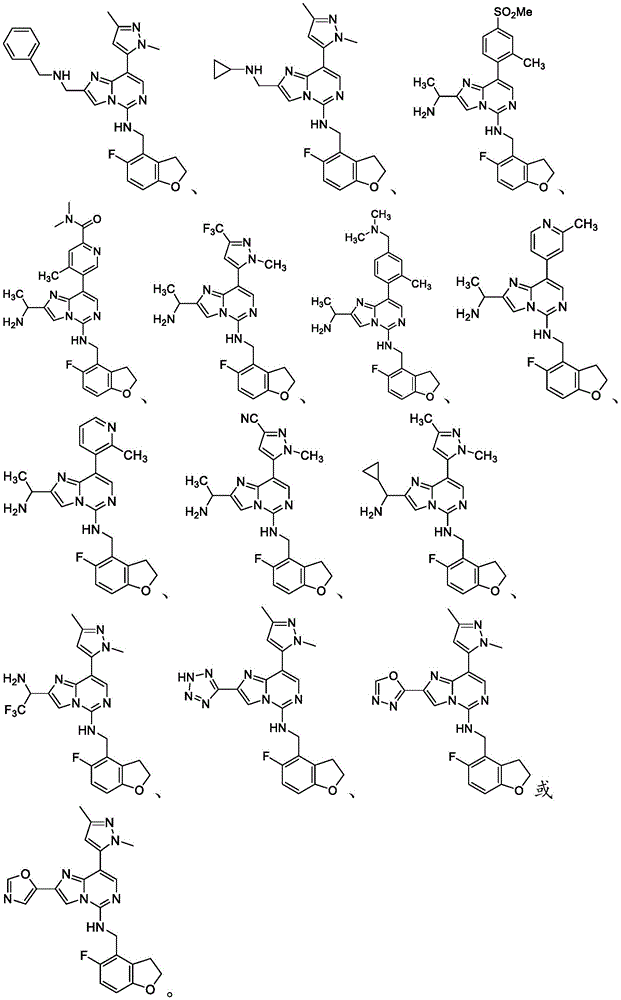
Applications Claiming Priority (3)
| Application Number | Priority Date | Filing Date | Title |
|---|---|---|---|
| US201962857515P | 2019-06-05 | 2019-06-05 | |
| US62/857,515 | 2019-06-05 | ||
| PCT/US2020/035891 WO2020247475A1 (en) | 2019-06-05 | 2020-06-03 | Imidazo[1,2-c]pyrimidine derivatives as prc2 inhibitors for treating cancer |
Publications (1)
| Publication Number | Publication Date |
|---|---|
| CN114269748A true CN114269748A (en) | 2022-04-01 |
Family
ID=71842807
Family Applications (1)
| Application Number | Title | Priority Date | Filing Date |
|---|---|---|---|
| CN202080055867.0A Pending CN114269748A (en) | 2019-06-05 | 2020-06-03 | Imidazo [1,2-c ] pyrimidine derivatives as PRC2 inhibitors for the treatment of cancer |
Country Status (9)
| Country | Link |
|---|---|
| US (2) | US12252493B2 (en) |
| EP (1) | EP3980422A1 (en) |
| JP (1) | JP7541538B2 (en) |
| KR (1) | KR20220027933A (en) |
| CN (1) | CN114269748A (en) |
| AU (1) | AU2020288563A1 (en) |
| CA (1) | CA3142711A1 (en) |
| IL (1) | IL288529A (en) |
| WO (1) | WO2020247475A1 (en) |
Cited By (1)
| Publication number | Priority date | Publication date | Assignee | Title |
|---|---|---|---|---|
| WO2022171166A1 (en) * | 2021-02-10 | 2022-08-18 | 上海青煜医药科技有限公司 | Azaheteroaryl compound, preparation method therefor, and application thereof |
Families Citing this family (9)
| Publication number | Priority date | Publication date | Assignee | Title |
|---|---|---|---|---|
| HUE059536T2 (en) | 2018-01-31 | 2022-11-28 | Mirati Therapeutics Inc | Prc2 inhibitors |
| US12421228B2 (en) | 2019-04-22 | 2025-09-23 | Mirati Therapeutics, Inc. | Naphthyridine derivatives as PRC2 inhibitors |
| CN114269748A (en) | 2019-06-05 | 2022-04-01 | 米拉蒂医疗股份有限公司 | Imidazo [1,2-c ] pyrimidine derivatives as PRC2 inhibitors for the treatment of cancer |
| TW202312995A (en) * | 2021-08-11 | 2023-04-01 | 大陸商上海青煜醫藥科技有限公司 | Azaaryl compound, and preparation method therefor and use thereof |
| EP4404932A4 (en) * | 2021-09-24 | 2025-07-23 | Oric Pharmaceuticals Inc | PRC2 INHIBITORS FOR USE IN THE TREATMENT OF BLOOD DISORDERS |
| WO2023049723A1 (en) * | 2021-09-24 | 2023-03-30 | Oric Pharmaceuticals, Inc. | Prc2 inhibitors for use in treating blood disorders |
| WO2024123669A1 (en) * | 2022-12-05 | 2024-06-13 | Oric Pharmaceuticals, Inc. | Treatment of prostate cancer having androgen receptor variants |
| WO2024215699A1 (en) * | 2023-04-11 | 2024-10-17 | Oric Pharmaceuticals, Inc. | Treatment of t-cell lymphoma |
| WO2025034543A1 (en) * | 2023-08-04 | 2025-02-13 | Oric Pharmaceuticals, Inc. | Treatment of prostate cancer |
Family Cites Families (74)
| Publication number | Priority date | Publication date | Assignee | Title |
|---|---|---|---|---|
| US6921762B2 (en) | 2001-11-16 | 2005-07-26 | Amgen Inc. | Substituted indolizine-like compounds and methods of use |
| WO2010021381A1 (en) | 2008-08-22 | 2010-02-25 | 武田薬品工業株式会社 | Fused heterocyclic derivative and use thereof |
| EP2566327B1 (en) | 2010-05-07 | 2017-03-29 | Glaxosmithkline LLC | Indoles |
| EP2566328B1 (en) | 2010-05-07 | 2015-03-04 | GlaxoSmithKline LLC | Indazoles |
| US9175331B2 (en) | 2010-09-10 | 2015-11-03 | Epizyme, Inc. | Inhibitors of human EZH2, and methods of use thereof |
| US20130310379A1 (en) | 2010-11-19 | 2013-11-21 | Constellation Pharmaceuticals | Modulators of methyl modifying enzymes, compositions and uses thereof |
| AU2011341441A1 (en) | 2010-12-03 | 2013-06-20 | Epizyme, Inc. | Modulators of histone methyltransferase, and methods of use thereof |
| EP2681216B1 (en) | 2011-02-28 | 2017-09-27 | Epizyme, Inc. | Substituted 6,5-fused bicyclic heteroaryl compounds |
| TWI598336B (en) | 2011-04-13 | 2017-09-11 | 雅酶股份有限公司 | Substituted benzene compounds |
| JO3438B1 (en) | 2011-04-13 | 2019-10-20 | Epizyme Inc | Aryl- or heteroaryl-substituted benzene compounds |
| KR20140033377A (en) | 2011-05-10 | 2014-03-18 | 길리애드 사이언시즈, 인코포레이티드 | Fused heterocyclic compounds as sodium channel modulators |
| CA2850570A1 (en) | 2011-09-30 | 2013-04-04 | Glaxosmithkline Llc | Methods of treating cancer |
| CA2853501A1 (en) | 2011-10-27 | 2013-05-02 | Memorial Sloan-Kettering Cancer Center | Methyltransferase inhibitors for treating cancer |
| WO2013075084A1 (en) | 2011-11-18 | 2013-05-23 | Constellation Pharmaceuticals | Modulators of methyl modifying enzymes, compositions and uses thereof |
| WO2013075083A1 (en) | 2011-11-18 | 2013-05-23 | Constellation Pharmaceuticals | Modulators of methyl modifying enzymes, compositions and uses thereof |
| CA2862289C (en) | 2012-02-10 | 2019-11-26 | Constellation Pharmaceuticals, Inc. | Modulators of methyl modifying enzymes, compositions and uses thereof |
| MX367793B (en) | 2012-04-13 | 2019-09-06 | Epizyme Inc | Combination therapy for treating cancer. |
| US9562041B2 (en) | 2012-05-16 | 2017-02-07 | Glaxosmithkline Llc | Enhancer of zeste homolog 2 inhibitors |
| US9105490B2 (en) | 2012-09-27 | 2015-08-11 | Taiwan Semiconductor Manufacturing Company, Ltd. | Contact structure of semiconductor device |
| JP6254169B2 (en) | 2012-09-28 | 2017-12-27 | ファイザー・インク | Benzamide and heterobenzamide compounds |
| US9688665B2 (en) | 2012-10-15 | 2017-06-27 | Epizyme, Inc. | Methods of treating cancer |
| JP6461803B2 (en) | 2012-10-15 | 2019-01-30 | エピザイム,インコーポレイティド | Substituted benzene compounds |
| JP2016503009A (en) | 2012-12-13 | 2016-02-01 | グラクソスミスクライン・リミテッド・ライアビリティ・カンパニーGlaxoSmithKline LLC | ZESTE homolog 2 enhancer inhibitor |
| EP2935214B1 (en) | 2012-12-21 | 2019-02-20 | Epizyme, Inc. | 1,4-pyridone compounds |
| US9701666B2 (en) | 2012-12-21 | 2017-07-11 | Epizyme, Inc. | 1,4-pyridone bicyclic heteroaryl compounds |
| UA111305C2 (en) | 2012-12-21 | 2016-04-11 | Пфайзер Інк. | Condensed with lactams of aryl and heteroaryl |
| PL2953941T3 (en) | 2013-02-11 | 2017-11-30 | Constellation Pharmaceuticals, Inc. | Modulators of methyl modifying enzymes, compositions and uses thereof |
| WO2014151142A1 (en) | 2013-03-15 | 2014-09-25 | Constellation Pharmaceuticals, Inc. | Modulators of methyl modifying enzymes, compositions and uses thereof |
| US9243001B2 (en) | 2013-03-15 | 2016-01-26 | Epizyme, Inc. | Substituted benzene compounds |
| EP2970281A4 (en) | 2013-03-15 | 2016-08-03 | Epizyme Inc | SUBSTITUTED BENZENE COMPOUNDS |
| EP2970306A4 (en) | 2013-03-15 | 2016-08-03 | Epizyme Inc | SUBSTITUTED BICYCLIC HETEROARYL COMPOUNDS CONDENSED IN 6.5 |
| US9045477B2 (en) | 2013-03-15 | 2015-06-02 | Epizyme, Inc. | Substituted 6,5-fused bicyclic heteroaryl compounds |
| NZ630205A (en) | 2013-04-30 | 2017-03-31 | Glaxosmithkline Intellectual Property (No 2) Ltd | Enhancer of zeste homolog 2 inhibitors |
| EP3004096A1 (en) | 2013-06-06 | 2016-04-13 | Glaxosmithkline Intellectual Property (No. 2) Limited | Enhancer of zeste homolog 2 inhibitors |
| ES2640386T3 (en) | 2013-07-10 | 2017-11-02 | Glaxosmithkline Intellectual Property (No. 2) Limited | Zeste 2 counterpart inhibitor enhancer |
| WO2015010049A1 (en) | 2013-07-19 | 2015-01-22 | Epizyme, Inc. | Substituted benzene compounds |
| WO2015010078A2 (en) | 2013-07-19 | 2015-01-22 | Epizyme, Inc. | Substituted 6,5-fused bicyclic heteroaryl compounds |
| WO2015023915A1 (en) | 2013-08-15 | 2015-02-19 | Constellation Pharmaceuticals, Inc. | Indole derivatives as modulators of methyl modifying enzymes, compositions and uses thereof |
| US9738630B2 (en) | 2013-11-19 | 2017-08-22 | Bristol-Myers Squibb Company | Inhibitors of lysine methyl transferase |
| US9822103B2 (en) | 2013-11-22 | 2017-11-21 | Bristol-Myers Squibb Company | Inhibitors of lysine methyl transferase |
| US20160361309A1 (en) | 2014-02-26 | 2016-12-15 | Glaxosmithkline Intellectual Property (No.2) Limited | Methods of treating cancer patients responding to ezh2 inhibitor gsk126 |
| JP2017508007A (en) | 2014-03-07 | 2017-03-23 | グラクソスミスクライン、インテレクチュアル、プロパティー、(ナンバー2)、リミテッドGlaxosmithkline Intellectual Property (No.2) Limited | ZESTE homolog 2 enhancer inhibitor |
| RS60022B1 (en) | 2014-03-17 | 2020-04-30 | Daiichi Sankyo Co Ltd | 1,3-benzodioxole derivatives as ezh1 and/or ezh2 inhibitors |
| WO2015193768A1 (en) | 2014-06-17 | 2015-12-23 | Pfizer Inc. | Aryl fused lactams as ezh2 modulators |
| BR112016029612B1 (en) | 2014-06-17 | 2021-01-19 | Pfizer Inc. | substituted dihydroisoquinolinone compounds |
| CN107148419A (en) | 2014-10-28 | 2017-09-08 | 葛兰素史密斯克莱知识产权(第2 号)有限公司 | The inhibitor of ZESTE enhancers homologue 2 |
| WO2016073956A1 (en) | 2014-11-06 | 2016-05-12 | Dana-Farber Cancer Institute, Inc. | Ezh2 inhibitors and uses thereof |
| BR112017009440A2 (en) | 2014-11-06 | 2017-12-19 | Dana Farber Cancer Inst Inc | use of compositions that modulate the chromatin structure for graft versus host disease (gvhd) |
| AR102767A1 (en) | 2014-12-05 | 2017-03-22 | Lilly Co Eli | EZH2 INHIBITORS |
| WO2016102493A1 (en) | 2014-12-22 | 2016-06-30 | Bayer Pharma Aktiengesellschaft | Imidazopyridine ezh2 inhibitors |
| IL236420A (en) | 2014-12-23 | 2016-06-30 | Ron Schneider | Methods and systems for producing a magnified 3d image |
| PL3237418T3 (en) * | 2014-12-23 | 2019-07-31 | Novartis Ag | Triazolopyrimidine compounds and uses thereof |
| WO2016123387A1 (en) | 2015-01-30 | 2016-08-04 | Genentech, Inc. | Therapeutic compounds and uses thereof |
| WO2016130396A1 (en) | 2015-02-13 | 2016-08-18 | Constellation Pharmaceuticals, Inc. | Modulators of methyl modifying enzymes, compositions and uses thereof |
| TW201718598A (en) | 2015-08-27 | 2017-06-01 | 美國禮來大藥廠 | Inhibitors of EZH2 |
| JP6828229B2 (en) | 2015-11-19 | 2021-02-10 | ジエンス ヘンルイ メデイシンカンパニー リミテッドJiangsu Hengrui Medicine Co.,Ltd. | Benzofuran derivatives, their production methods and their use in pharmaceuticals |
| CA3007492A1 (en) | 2015-12-07 | 2017-06-15 | Epizyme, Inc. | Inhibitors of ezh2 and methods of use thereof |
| WO2017174023A1 (en) | 2016-04-08 | 2017-10-12 | 南京明德新药研发股份有限公司 | Biphenyl compound serving as ezh2 inhibitor |
| WO2017184999A1 (en) | 2016-04-22 | 2017-10-26 | Dana-Farber Cancer Institute, Inc. | Ezh2 inhibitors and uses thereof |
| EP3452483B1 (en) | 2016-05-05 | 2020-04-01 | GlaxoSmithKline Intellectual Property (No. 2) Limited | Enhancer of zeste homolog 2 inhibitors |
| US9957274B2 (en) | 2016-05-06 | 2018-05-01 | Abbvie Inc. | Indane inhibitors of EED and methods of their use |
| WO2017210395A1 (en) | 2016-06-01 | 2017-12-07 | Epizyme, Inc. | Use of ezh2 inhibitors for treating cancer |
| MA45406A (en) | 2016-06-17 | 2019-04-24 | Epizyme Inc | EZH2 INHIBITORS TO TREAT CANCER |
| EP3472161B1 (en) * | 2016-06-20 | 2020-03-25 | Novartis AG | Triazolopyridine compounds and uses thereof |
| US10676479B2 (en) * | 2016-06-20 | 2020-06-09 | Novartis Ag | Imidazolepyridine compounds and uses thereof |
| MX388824B (en) | 2016-06-20 | 2025-03-20 | Novartis Ag | CRYSTALLINE FORMS OF TRIAZOLOPYRIMIDINE COMPOUND. |
| US10266542B2 (en) | 2017-03-15 | 2019-04-23 | Mirati Therapeutics, Inc. | EZH2 inhibitors |
| WO2019062435A1 (en) | 2017-09-28 | 2019-04-04 | 中国科学院上海药物研究所 | Use of triazolopyrimidine, triazolopyridine compounds and composition thereof for treating prc2-mediated diseases |
| CN109942556A (en) | 2017-12-21 | 2019-06-28 | 上海青煜医药科技有限公司 | Pyrimidinone compound and its application |
| HUE059536T2 (en) | 2018-01-31 | 2022-11-28 | Mirati Therapeutics Inc | Prc2 inhibitors |
| CN110156787B (en) | 2018-02-13 | 2021-11-02 | 中国科学院上海药物研究所 | A kind of triazolopyrimidine derivative compound, pharmaceutical composition comprising same and use thereof |
| CN110563722A (en) | 2018-06-06 | 2019-12-13 | 上海青煜医药科技有限公司 | pyridine or pyridazine ring compound and application thereof |
| US12421228B2 (en) | 2019-04-22 | 2025-09-23 | Mirati Therapeutics, Inc. | Naphthyridine derivatives as PRC2 inhibitors |
| CN114269748A (en) | 2019-06-05 | 2022-04-01 | 米拉蒂医疗股份有限公司 | Imidazo [1,2-c ] pyrimidine derivatives as PRC2 inhibitors for the treatment of cancer |
-
2020
- 2020-06-03 CN CN202080055867.0A patent/CN114269748A/en active Pending
- 2020-06-03 AU AU2020288563A patent/AU2020288563A1/en not_active Abandoned
- 2020-06-03 WO PCT/US2020/035891 patent/WO2020247475A1/en not_active Ceased
- 2020-06-03 EP EP20747226.7A patent/EP3980422A1/en active Pending
- 2020-06-03 US US17/615,778 patent/US12252493B2/en active Active
- 2020-06-03 CA CA3142711A patent/CA3142711A1/en not_active Abandoned
- 2020-06-03 KR KR1020227000118A patent/KR20220027933A/en not_active Withdrawn
- 2020-06-03 JP JP2021572409A patent/JP7541538B2/en active Active
-
2021
- 2021-11-29 IL IL288529A patent/IL288529A/en unknown
-
2025
- 2025-02-05 US US19/045,764 patent/US20250179082A1/en active Pending
Cited By (1)
| Publication number | Priority date | Publication date | Assignee | Title |
|---|---|---|---|---|
| WO2022171166A1 (en) * | 2021-02-10 | 2022-08-18 | 上海青煜医药科技有限公司 | Azaheteroaryl compound, preparation method therefor, and application thereof |
Also Published As
| Publication number | Publication date |
|---|---|
| JP7541538B2 (en) | 2024-08-28 |
| US12252493B2 (en) | 2025-03-18 |
| JP2022535577A (en) | 2022-08-09 |
| EP3980422A1 (en) | 2022-04-13 |
| US20220274990A1 (en) | 2022-09-01 |
| KR20220027933A (en) | 2022-03-08 |
| CA3142711A1 (en) | 2020-12-10 |
| WO2020247475A1 (en) | 2020-12-10 |
| US20250179082A1 (en) | 2025-06-05 |
| AU2020288563A1 (en) | 2022-01-06 |
| IL288529A (en) | 2022-01-01 |
Similar Documents
| Publication | Publication Date | Title |
|---|---|---|
| CN114269748A (en) | Imidazo [1,2-c ] pyrimidine derivatives as PRC2 inhibitors for the treatment of cancer | |
| JP7495555B2 (en) | PRC2 inhibitors | |
| US12421228B2 (en) | Naphthyridine derivatives as PRC2 inhibitors | |
| HK40077182B (en) | Prc2 inhibitors | |
| HK40077182A (en) | Prc2 inhibitors | |
| HK40039589A (en) | Prc2 inhibitors | |
| HK40039589B (en) | Prc2 inhibitors |
Legal Events
| Date | Code | Title | Description |
|---|---|---|---|
| PB01 | Publication | ||
| PB01 | Publication | ||
| WD01 | Invention patent application deemed withdrawn after publication | ||
| WD01 | Invention patent application deemed withdrawn after publication |
Application publication date: 20220401 |