CN114254508A - A Fully Associated Voting Method Based on Blockchain Equity Authorization Proof Consensus Mechanism - Google Patents
A Fully Associated Voting Method Based on Blockchain Equity Authorization Proof Consensus Mechanism Download PDFInfo
- Publication number
- CN114254508A CN114254508A CN202111571605.2A CN202111571605A CN114254508A CN 114254508 A CN114254508 A CN 114254508A CN 202111571605 A CN202111571605 A CN 202111571605A CN 114254508 A CN114254508 A CN 114254508A
- Authority
- CN
- China
- Prior art keywords
- node
- nodes
- block chain
- language term
- probability
- Prior art date
- Legal status (The legal status is an assumption and is not a legal conclusion. Google has not performed a legal analysis and makes no representation as to the accuracy of the status listed.)
- Pending
Links
Images


Classifications
-
- G—PHYSICS
- G06—COMPUTING OR CALCULATING; COUNTING
- G06F—ELECTRIC DIGITAL DATA PROCESSING
- G06F30/00—Computer-aided design [CAD]
- G06F30/20—Design optimisation, verification or simulation
-
- G—PHYSICS
- G06—COMPUTING OR CALCULATING; COUNTING
- G06F—ELECTRIC DIGITAL DATA PROCESSING
- G06F17/00—Digital computing or data processing equipment or methods, specially adapted for specific functions
- G06F17/10—Complex mathematical operations
- G06F17/16—Matrix or vector computation, e.g. matrix-matrix or matrix-vector multiplication, matrix factorization
-
- G—PHYSICS
- G06—COMPUTING OR CALCULATING; COUNTING
- G06Q—INFORMATION AND COMMUNICATION TECHNOLOGY [ICT] SPECIALLY ADAPTED FOR ADMINISTRATIVE, COMMERCIAL, FINANCIAL, MANAGERIAL OR SUPERVISORY PURPOSES; SYSTEMS OR METHODS SPECIALLY ADAPTED FOR ADMINISTRATIVE, COMMERCIAL, FINANCIAL, MANAGERIAL OR SUPERVISORY PURPOSES, NOT OTHERWISE PROVIDED FOR
- G06Q40/00—Finance; Insurance; Tax strategies; Processing of corporate or income taxes
- G06Q40/04—Trading; Exchange, e.g. stocks, commodities, derivatives or currency exchange
-
- H—ELECTRICITY
- H04—ELECTRIC COMMUNICATION TECHNIQUE
- H04L—TRANSMISSION OF DIGITAL INFORMATION, e.g. TELEGRAPHIC COMMUNICATION
- H04L41/00—Arrangements for maintenance, administration or management of data switching networks, e.g. of packet switching networks
- H04L41/30—Decision processes by autonomous network management units using voting and bidding
-
- H—ELECTRICITY
- H04—ELECTRIC COMMUNICATION TECHNIQUE
- H04L—TRANSMISSION OF DIGITAL INFORMATION, e.g. TELEGRAPHIC COMMUNICATION
- H04L67/00—Network arrangements or protocols for supporting network services or applications
- H04L67/01—Protocols
- H04L67/10—Protocols in which an application is distributed across nodes in the network
Landscapes
- Engineering & Computer Science (AREA)
- Physics & Mathematics (AREA)
- General Physics & Mathematics (AREA)
- Theoretical Computer Science (AREA)
- Mathematical Physics (AREA)
- Business, Economics & Management (AREA)
- Accounting & Taxation (AREA)
- Mathematical Optimization (AREA)
- Signal Processing (AREA)
- Pure & Applied Mathematics (AREA)
- Computer Networks & Wireless Communication (AREA)
- Data Mining & Analysis (AREA)
- Mathematical Analysis (AREA)
- Finance (AREA)
- General Engineering & Computer Science (AREA)
- Computational Mathematics (AREA)
- Databases & Information Systems (AREA)
- General Business, Economics & Management (AREA)
- Development Economics (AREA)
- Economics (AREA)
- Marketing (AREA)
- Strategic Management (AREA)
- Technology Law (AREA)
- Software Systems (AREA)
- Algebra (AREA)
- Computing Systems (AREA)
- Computer Hardware Design (AREA)
- Evolutionary Computation (AREA)
- Geometry (AREA)
- Information Retrieval, Db Structures And Fs Structures Therefor (AREA)
Abstract
Description
技术领域technical field
本发明涉及区块链共识技术领域,具体涉及了一种基于区块链股权授权证明共识机制的全关联投票方法。The invention relates to the technical field of blockchain consensus, in particular to a fully associated voting method based on a blockchain equity authorization proof consensus mechanism.
背景技术Background technique
区块链可以为不同的应用场景提供可信任的、安全的和高效的环境。它在交通系统、工业物联网系统、医疗信息共享平台和智慧城市等领域都取得了成功的应用。Blockchain can provide a trusted, secure and efficient environment for different application scenarios. It has been successfully applied in transportation systems, industrial IoT systems, medical information sharing platforms, and smart cities.
区块链分别由分布式账本、非对称加密、智能契约和共识机制四种核心技术组成。分布式账本采用分散化的设计理念,构建区块链平台作为分布式网络。用户可以自由加入分布式区块链网络,共同参与交易的记录活动。与此同时,当涉及的人员不断增加时,人们通常无法达成共识。共识机制可以解决如何在分布式环境下的区块链中实现共识的问题。The blockchain consists of four core technologies: distributed ledgers, asymmetric encryption, smart contracts and consensus mechanisms. The distributed ledger adopts a decentralized design concept to build a blockchain platform as a distributed network. Users can freely join the distributed blockchain network and jointly participate in the recording activities of transactions. At the same time, consensus is often not reached when the number of people involved is increasing. The consensus mechanism can solve the problem of how to achieve consensus in the blockchain in a distributed environment.
股权授权证明共识机制是解决共识问题的一种有效和民主的替代方案,要求区块链节点进行投票,选择代表来管理区块链网络,然后由这些代表提出核心变更。在传统的股权授权证明共识方案中,每个区块链节点为每一轮选择中的节点进行投票。当需要n个代表时,选择收到投票次数最多的前n个区块链节点作为代表。The Proof-of-Stake consensus mechanism is an efficient and democratic alternative to the consensus problem, requiring blockchain nodes to vote, selecting representatives to govern the blockchain network, and those representatives then propose core changes. In the traditional proof-of-stake consensus scheme, each blockchain node votes for the nodes in each round of selection. When n representatives are required, the top n blockchain nodes that have received the most votes are selected as representatives.
目前为止,只有重庆邮电大学徐光侠团队的研究专注于如何表示被投票的区块链节点的群体投票信息,但仍面临着重大挑战,即没有考虑到“支持”和“反对”意见的强度,在这种情况下,可能导致信息丢失问题,从而降低知识表达的准确性。因此,需要发明一种解决信息丢失问题和确保投票公平性的股权授权证明机制改进方法。So far, only the research of Xu Guangxia's team at Chongqing University of Posts and Telecommunications has focused on how to represent the group voting information of the voted blockchain nodes, but still faces a major challenge, that is, without considering the strength of "support" and "opposition" opinions, in In this case, it may lead to the problem of information loss, thereby reducing the accuracy of knowledge expression. Therefore, it is necessary to invent an improved method for the proof-of-stake authorization mechanism to solve the problem of information loss and ensure voting fairness.
发明内容SUMMARY OF THE INVENTION
针对现有技术的不足,本发明提供一种为投票节点提供细粒度的投票选项,通过累积可能度和抽签算法优化节点投票过程,以有效地选择最佳代理节点的基于区块链股权授权证明共识机制的全关联投票方法。In view of the deficiencies of the prior art, the present invention provides a fine-grained voting option for voting nodes, and optimizes the node voting process by accumulating probability and a lottery algorithm, so as to effectively select the best proxy node based on blockchain equity authorization certificate A fully associated voting method for the consensus mechanism.
本发明的一种基于区块链股权授权证明共识机制的全关联投票方法,采用以下技术方案:其包括步骤如下:A fully associated voting method based on the blockchain equity authorization proof consensus mechanism of the present invention adopts the following technical solutions: it includes the following steps:
S1:在区块链网络的股权授权证明共识机制中引入对称语言术语集,区块链网络中的每个节点逐个对区块链网络中的所有节点从对称语言术语集中选择一个语言术语进行投票;S1: A symmetric language term set is introduced into the consensus mechanism of the proof-of-stake authorization of the blockchain network, and each node in the blockchain network votes one by one for all nodes in the blockchain network to select a language term from the symmetric language term set ;
S2:收集区块链网络中的每个节点收到所有节点的投票,分别形成每个节点的群体投票信息;S2: Collect the votes of all nodes received by each node in the blockchain network, and form the group voting information of each node;
S3:计算每个节点的群体投票信息中语言术语的概率分布信息,利用比例犹豫模糊语言术语集对每个节点的群体投票信息进行建模,各自生成比例犹豫模糊语言术语集;S3: Calculate the probability distribution information of language terms in the group voting information of each node, use the proportional hesitant fuzzy language term set to model the group voting information of each node, and generate a proportional hesitant fuzzy language term set;
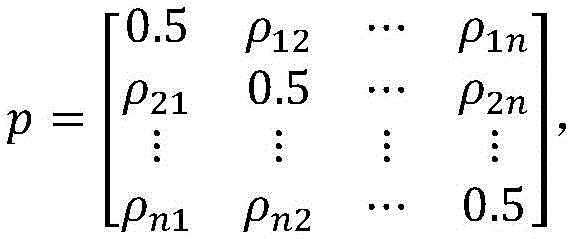
S4:对区块链网络中所有节点的比例犹豫模糊语言术语集进行两两比较,得到二级可能度矩阵,并计算每个节点的累积可能度;S4: Make a pairwise comparison of the proportional hesitant fuzzy language term sets of all nodes in the blockchain network to obtain a secondary probability matrix, and calculate the cumulative probability of each node;
S5:将节点的累积可能度按降序排序,选择排位在前的若干个节点作为代表。S5: Sort the cumulative probability of the nodes in descending order, and select several nodes ranked first as representatives.
进一步,所述步骤S1中,对称语言术语集S={s-θ,...,s-2,s-1,s0,s1,s2,...,sθ},其中θ≥1,如果区块链节点弃权,则使用语言术语s0表示其投票。Further, in the step S1, the symmetric language term set S={s -θ ,..., s -2 , s -1 , s 0 , s 1 , s 2 ,..., s θ }, where θ ≥ 1, if the blockchain node abstains, the linguistic term s 0 is used to denote its vote.
进一步,所述步骤S3中,将每个节点接收到的群体投票信息用比例犹豫模糊语言术语集


进一步,所述步骤S4中,令


其中,


其中,


则节点的累积可能度ρi计算为Then the cumulative probability ρ i of the node is calculated as

进一步,所述的步骤S5中,节点的累积可能度按降序排序为Further, in the described step S5, the cumulative probability of the nodes is sorted in descending order as

其中,{ρ(1),ρ(2),...,ρ(n)}是{ρ1,ρ2,...,ρn}按照ρ(i)≥ρ(j)顺序的降序排列。若ρ(m)≠ρ(m+1),则选择累积可能度排在前m个的区块链节点作为代表。where { ρ (1) , ρ (2) ,...,ρ (n) } is the descending order of {ρ1,ρ2,..., ρn } in the order of ρ (i) ≥ρ (j) arrangement. If ρ (m) ≠ ρ (m+1) , select the top m blockchain nodes with cumulative likelihood as the representative.
进一步,若

则先选择累积可能度排在前m-(m1+1)个的区块链节点作为代表,使用彩票算法从
与现有技术相比,本发明的有益效果如下:Compared with the prior art, the beneficial effects of the present invention are as follows:
1、采用对称语言术语集用于为投票节点提供细粒度的投票选项;1. A symmetric language term set is used to provide fine-grained voting options for voting nodes;
2、采用比例犹豫模糊语言术语集的概念来表示被投票节点接收到的群体投票信息,信息表示更准确,更全面,无信息丢失情况;2. The concept of proportional hesitant fuzzy language term set is used to represent the group voting information received by the voting nodes, the information representation is more accurate and comprehensive, and there is no information loss;
3、采用累积可能度和彩票算法,提出了一种新的区块链节点排序和代理节点选择算法;3. Using the cumulative probability and lottery algorithm, a new blockchain node sorting and proxy node selection algorithm is proposed;
综上所述,使用本发明可以有效解决信息丢失问题,确保区块链股权授权证明共识机制的投票公平性。To sum up, the use of the present invention can effectively solve the problem of information loss and ensure the fairness of voting in the consensus mechanism of blockchain equity authorization proof.
附图说明Description of drawings
此处所说明的附图用来提供对本申请的进一步理解,在附图中:The accompanying drawings described herein are used to provide a further understanding of the present application, in which:
图1为本发明的某个节点收到所有节点的投票示意图;Fig. 1 is a schematic diagram of a node of the present invention receiving votes from all nodes;
图2为本发明的方法流程示意图。FIG. 2 is a schematic flow chart of the method of the present invention.
具体实施方式Detailed ways
参见图1和图2所示,实施例一种基于区块链股权授权证明共识机制的全关联投票方法,其包括步骤如下:Referring to FIG. 1 and FIG. 2, an embodiment of a fully associated voting method based on a blockchain equity authorization proof consensus mechanism includes the following steps:
S1:在区块链网络的股权授权证明共识机制中引入对称语言术语集,区块链网络中的每个节点逐个对区块链网络中的所有节点从对称语言术语集中选择一个语言术语进行投票;S1: A symmetric language term set is introduced into the consensus mechanism of the proof-of-stake authorization of the blockchain network, and each node in the blockchain network votes one by one for all nodes in the blockchain network to select a language term from the symmetric language term set ;
S2:收集区块链网络中的每个节点收到所有节点的投票,分别形成每个节点的群体投票信息;S2: Collect the votes of all nodes received by each node in the blockchain network, and form the group voting information of each node;
S3:计算每个节点的群体投票信息中语言术语的概率分布信息,利用比例犹豫模糊语言术语集方法对每个节点的群体投票信息进行建模,各自生成比例犹豫模糊语言术语集;S3: Calculate the probability distribution information of language terms in the group voting information of each node, use the proportional hesitant fuzzy language term set method to model the group voting information of each node, and generate proportional hesitant fuzzy language term sets respectively;
S4:对区块链网络中所有节点的比例犹豫模糊语言术语集进行两两比较,得到二级可能度矩阵,并计算每个节点的累积可能度;S4: Make a pairwise comparison of the proportional hesitant fuzzy language term sets of all nodes in the blockchain network to obtain a secondary probability matrix, and calculate the cumulative probability of each node;
S5:将节点的累积可能度按降序排序,选择排位在前的若干个节点作为代表。S5: Sort the cumulative probability of the nodes in descending order, and select several nodes ranked first as representatives.
在步骤S1中,本实例中假设有21个投票节点,每个节点可以对所有节点进行投票,从对称语言术语集S={s-2=“Very opposed”,s-1=“Opposed”,s0=“Neutral”,s1=“Supported”, s2=“Very supported”}中选择语言术语表达自己的偏好信息。In step S1, it is assumed that there are 21 voting nodes in this example, and each node can vote on all nodes. From the symmetric language term set S = {s -2 = "Very opposed", s -1 = "Opposed", s 0 = "Neutral", s 1 = "Supported", s 2 = "Very supported"}, choose language terms to express your preference information.
在步骤S2中,本实例中该矩阵表示21个节点收到的投票信息表如下:In step S2, in this example, the matrix represents the voting information table received by 21 nodes as follows:


表1投票信息表在步骤S3中,21个节点的群体投票信息可以建模为比例犹豫模糊语言术语集形式:Table 1 Voting information table In step S3, the group voting information of 21 nodes can be modeled as a proportional hesitant fuzzy language term set form:


在步骤S4中,对所有区块链节点进行两两比较,得到二级可能度矩阵表如下:In step S4, all blockchain nodes are compared in pairs, and the second-level possibility matrix table is obtained as follows:

表2二级可能度矩阵表Table 2
在步骤S4中,计算每个区块链节点i的累积可能度,每个区块链节点i的累积可能度ρi计算为:In step S4, the cumulative probability of each blockchain node i is calculated, and the cumulative probability ρi of each blockchain node i is calculated as:


在步骤S5中,区块链节点的累积可能度按降序排序为:In step S5, the cumulative likelihood of blockchain nodes is sorted in descending order as:
N15>N1>N16>N9>N3>N13>N10>N4>N2>N8>N5>N18>N12>N17>N7>N6>N11>N14>N21>N19>N20。 N15 >N1> N16 > N9 > N3 > N13 > N10 > N4 > N2 > N8 > N5 > N18 > N12 > N17 > N7 > N6 > N11 >N 14 >N 21 >N 19 >N 20 .
选择累积可能度排在前5个的区块链节点作为代表,即节点15、1、16、9、3被挑选为代理节点。The blockchain nodes with the top 5 cumulative likelihoods are selected as representatives, that is,
尽管已经示出和描述了本发明的实施例,对于本领域的普通技术人员而言,可以理解在不脱离本发明的原理和精神的情况下可以对这些实施例进行多种变化、修改、替换和变型,本发明的范围由所附权利要求及其等同物限定。Although embodiments of the present invention have been shown and described, it will be understood by those skilled in the art that various changes, modifications, and substitutions can be made in these embodiments without departing from the principle and spirit of the invention and modifications, the scope of the present invention is defined by the appended claims and their equivalents.
Claims (6)




Priority Applications (1)
| Application Number | Priority Date | Filing Date | Title |
|---|---|---|---|
| CN202111571605.2A CN114254508A (en) | 2021-12-21 | 2021-12-21 | A Fully Associated Voting Method Based on Blockchain Equity Authorization Proof Consensus Mechanism |
Applications Claiming Priority (1)
| Application Number | Priority Date | Filing Date | Title |
|---|---|---|---|
| CN202111571605.2A CN114254508A (en) | 2021-12-21 | 2021-12-21 | A Fully Associated Voting Method Based on Blockchain Equity Authorization Proof Consensus Mechanism |
Publications (1)
| Publication Number | Publication Date |
|---|---|
| CN114254508A true CN114254508A (en) | 2022-03-29 |
Family
ID=80796267
Family Applications (1)
| Application Number | Title | Priority Date | Filing Date |
|---|---|---|---|
| CN202111571605.2A Pending CN114254508A (en) | 2021-12-21 | 2021-12-21 | A Fully Associated Voting Method Based on Blockchain Equity Authorization Proof Consensus Mechanism |
Country Status (1)
| Country | Link |
|---|---|
| CN (1) | CN114254508A (en) |
Citations (4)
| Publication number | Priority date | Publication date | Assignee | Title |
|---|---|---|---|---|
| US10200196B1 (en) * | 2018-04-25 | 2019-02-05 | Blockchain Asics Llc | Cryptographic ASIC with autonomous onboard permanent storage |
| CN109783879A (en) * | 2018-12-21 | 2019-05-21 | 西安电子科技大学 | A kind of radar emitter signal discrimination efficiency appraisal procedure and system |
| CN109872152A (en) * | 2019-01-11 | 2019-06-11 | 平安科技(深圳)有限公司 | Block chain common recognition method and relevant device based on share authorisation verification mechanism |
| CN113709222A (en) * | 2021-08-16 | 2021-11-26 | 重庆邮电大学 | Method for selecting proxy nodes in block chain based on improved weighted score function |
-
2021
- 2021-12-21 CN CN202111571605.2A patent/CN114254508A/en active Pending
Patent Citations (4)
| Publication number | Priority date | Publication date | Assignee | Title |
|---|---|---|---|---|
| US10200196B1 (en) * | 2018-04-25 | 2019-02-05 | Blockchain Asics Llc | Cryptographic ASIC with autonomous onboard permanent storage |
| CN109783879A (en) * | 2018-12-21 | 2019-05-21 | 西安电子科技大学 | A kind of radar emitter signal discrimination efficiency appraisal procedure and system |
| CN109872152A (en) * | 2019-01-11 | 2019-06-11 | 平安科技(深圳)有限公司 | Block chain common recognition method and relevant device based on share authorisation verification mechanism |
| CN113709222A (en) * | 2021-08-16 | 2021-11-26 | 重庆邮电大学 | Method for selecting proxy nodes in block chain based on improved weighted score function |
Non-Patent Citations (1)
| Title |
|---|
| 韩二东: "犹豫模糊语言多准则决策方法及项目群管理应用研究", 30 April 2021 * |
Similar Documents
| Publication | Publication Date | Title |
|---|---|---|
| Bornmann et al. | BRICS countries and scientific excellence: A bibliometric analysis of most frequently cited papers | |
| Kalyanam et al. | Leveraging social context for modeling topic evolution | |
| CN111475724B (en) | A random walk social network event recommendation method based on user similarity | |
| Wong et al. | On the efficiency of social recommender networks | |
| Zhang et al. | Mechanism design for finding experts using locally constructed social referral web | |
| Liu et al. | Spatial association and explanation of China’s digital financial inclusion development based on the network analysis method | |
| Molchan et al. | The'digitalisation trap'of Russian regions | |
| Jiang et al. | Message clustering based matrix factorization model for retweeting behavior prediction | |
| CN115022326A (en) | Blockchain Byzantine Fault Tolerant Consensus Method Based on Collaborative Filtering Recommendation | |
| Zuo et al. | Trust computing for social networking | |
| CN114254508A (en) | A Fully Associated Voting Method Based on Blockchain Equity Authorization Proof Consensus Mechanism | |
| Jia et al. | Multilayer social network overlapping community detection algorithm based on trust relationship | |
| CN106611339B (en) | Seed user screening method, product user influence evaluation method and device | |
| Lin et al. | Reducing Uncertainty of Probabilistic Top-$ k $ Ranking via Pairwise Crowdsourcing | |
| Xu et al. | How does persuasion happen? a novel bounded confidence opinion dynamics model based on social judgment theory | |
| CN107358533A (en) | A kind of user of Web Community recommends method and system | |
| CN116155683A (en) | Construction method of HotStuff consensus mechanism based on three-layer tree communication structure | |
| Alirezaee et al. | New analytical hierarchical process/data envelopment analysis methodology for ranking decision‐making units | |
| CN109410078A (en) | A kind of information propagation prediction method for the mobile social networking shared suitable for object oriented file | |
| Chiu et al. | Endogenous preferential treatment in centralized admissions | |
| Candellone et al. | Negative ties highlight hidden extremes in social media polarization | |
| Buccafurri et al. | Interest assortativity in Twitter | |
| CN113590826A (en) | Big data-based engineering project bid inviting management system and method | |
| Yao et al. | Multi-objective optimization model and evolutional solution of network node matching problem | |
| Perez-Rivera et al. | Engaging for Puerto Rico:# RickyRenuncia (and# RickySeQueda) during El Verano del 19 and digital identities |
Legal Events
| Date | Code | Title | Description |
|---|---|---|---|
| PB01 | Publication | ||
| PB01 | Publication | ||
| SE01 | Entry into force of request for substantive examination | ||
| SE01 | Entry into force of request for substantive examination | ||
| RJ01 | Rejection of invention patent application after publication |
Application publication date: 20220329 |
|
| RJ01 | Rejection of invention patent application after publication |