Detailed Description
So that the manner in which the features and elements of the disclosed embodiments can be understood in detail, a more particular description of the disclosed embodiments, briefly summarized above, may be had by reference to the embodiments, some of which are illustrated in the appended drawings. In the following description of the technology, for purposes of explanation, numerous details are set forth in order to provide a thorough understanding of the disclosed embodiments. However, one or more embodiments may be practiced without these details. In other instances, well-known structures and devices may be shown in simplified form in order to simplify the drawing.
The terms "first," "second," and the like in the description and in the claims, and the above-described drawings of embodiments of the present disclosure, are used for distinguishing between similar elements and not necessarily for describing a particular sequential or chronological order. It should be understood that the data so used may be interchanged under appropriate circumstances such that embodiments of the present disclosure described herein may be made. Furthermore, the terms "comprising" and "having," as well as any variations thereof, are intended to cover non-exclusive inclusions.
The term "plurality" means two or more unless otherwise specified.
The term "correspond" may refer to an association or binding relationship, and a corresponds to B refers to an association or binding relationship between a and B.
In the embodiment of the disclosure, the intelligent household appliance is a household appliance formed by introducing a microprocessor, a sensor technology and a network communication technology into the household appliance, and has the characteristics of intelligent control, intelligent sensing and intelligent application, the operation process of the intelligent household appliance usually depends on the application and processing of modern technologies such as internet of things, internet and an electronic chip, for example, the intelligent household appliance can realize the remote control and management of a user on the intelligent household appliance by connecting the intelligent household appliance with the electronic device.
In the disclosed embodiment, the terminal device is an electronic device with a wireless connection function, and the terminal device can be in communication connection with the above intelligent household appliance by connecting to the internet, or can be in communication connection with the above intelligent household appliance directly in a bluetooth mode, a wifi mode, or the like. In some embodiments, the terminal device is, for example, a mobile device, a computer, or a vehicle-mounted device built in a floating car, or any combination thereof. The mobile device may include, for example, a cell phone, a smart home device, a wearable device, a smart mobile device, a virtual reality device, or the like, or any combination thereof, wherein the wearable device includes, for example: smart watches, smart bracelets, pedometers, and the like.
In some embodiments, as shown in connection with fig. 1, a power supply system includes: commercial power, generator, air conditioner and reposition of redundant personnel electrical apparatus. The commercial power and the generator are both electrically connected with the air conditioner and the shunt electric appliance, and the air conditioner and the shunt electric appliance can be powered by the commercial power or the generator.
The power supply system provided by the embodiment of the disclosure can selectively supply power to the air-conditioning and shunt electric appliances through the commercial power or the generator, and the generator starts the power supply to the air-conditioning and shunt electric appliances under the condition that the level of the commercial power is lower or even zero, so that the stability of the power supply system is kept.
Optionally, the power supply system further comprises: and a detection module. The detection modules are distributed on a power supply circuit of the mains supply, the generator, the air conditioner and the shunt electric appliance, communication connection is established between the detection modules and the processor, and the power supply state of the mains supply, the generating voltage and the output current of the generator, the input voltage and the input current of the air conditioner and the input voltage and the input current of the shunt electric appliance can be detected in real time. Therefore, the power supply state, the voltage and the current of each module in the power supply system can be detected by the detection module, the detection result is sent to the processor, and the processor acquires the detection result, so that the power supply system is regulated, the stability of the power supply system is kept, and the stability of the power supply of the air conditioner is improved.
Optionally, the bus of the utility power and the bus of the generator are both provided with a detection module. Therefore, the voltage on the bus of the commercial power and the voltage on the bus of the generator can be detected through the detection module, and whether the commercial power and the generator execute power supply or not is judged.
In a specific embodiment, the utility power is set as c, the generator is set as b, the air conditioner is set as e, the shunt electric appliance is set as d, and the detected output voltage of the utility power is recorded as UcAnd the output current is marked as Ic(ii) a The detected generator output voltage is recorded as UbAnd the output current is marked as Ib(ii) a The detected input voltage of the air conditioner is recorded as UeThe input current is marked as Ie(ii) a The detected input voltage of the shunt electric appliance is recorded as UdThe input current is marked as Id。
Referring to fig. 2, in some embodiments, a method for air conditioner power conditioning includes:
s01, the processor obtains the power supply states of the air conditioner and the shunt electric appliance;
s02, under the condition that the air conditioner and the shunt electric appliance supply power to the generator, the processor acquires the running frequency of a compressor of the air conditioner;
s03, the processor controls the air conditioner to be in the on-state operation or the off-state operation according to the magnitude relation between the operation frequency of the compressor and the preset minimum operation frequency;
the shunt electric appliances refer to all electric appliances except an air conditioner in the power supply area of the generator.
By adopting the method for adjusting the power supply of the air conditioner, the power supply states of the air conditioner and the shunt electric appliance in the power supply area where the air conditioner is located can be obtained, under the condition that the electric appliance in the power supply area is powered by the generator, the air conditioner and the shunt electric appliance consume the energy output by the generator, the air conditioner is controlled to be in the on-state continuous operation or off-state continuous operation according to the magnitude relation between the operation frequency of the compressor and the preset minimum operation frequency by obtaining the operation frequency of the compressor of the air conditioner, the power utilization compatibility between the air conditioner and the shunt electric appliance can be balanced, the stability of the operation of the air conditioner and the shunt electric appliance in the power supply area is maintained, and the energy consumption is reduced.
It is understood that the power supply area refers to an area where the generator bus is connected, for example, in a residential area of a user, the bus of the generator is connected with all the electric appliances in the residential area, and power supply can be performed on all the electric appliances in the residential area through the generator.
Optionally, the processor obtains the power supply states of the air conditioner and the shunt electrical appliance, and includes: the processor obtains the power-on state of a bus of the generator. Therefore, the processor determines whether the air conditioner and the shunt electric appliance are in the power supply state of the generator or not by acquiring the power-on state of the generator bus, and the accuracy of determining the power supply state of the air conditioner and the shunt electric appliance is improved.
Optionally, when the air conditioner and the shunt electrical appliance supply power to the generator, the following are indicated: in the case where the bus of the generator is in an energized state. Thus, when the bus of the generator is in the electrified state, the generator can be used for supplying power to the air conditioner and the shunt electric appliance.
Optionally, in a case where the air conditioner and the electrical shunt apparatus supply the commercial power, the air conditioner and the electrical shunt apparatus are supplied with the commercial power, and the steps S02 and S03 stop executing.
In a specific embodiment, the preset minimum operating frequency may be a zero-bound operating frequency at which the compressor is stopped, or may be experimental data obtained according to power utilization compatibility between the air conditioner and the electrical shunt apparatus, and when the operating frequency of the compressor is less than the minimum operating frequency, the energy consumption of the air conditioner increases and affects normal use of the electrical shunt apparatus, so that shutdown of the air conditioner needs to be controlled.
In some specific embodiments, as shown in fig. 3, a method for air conditioner power supply regulation includes:
s01, the processor obtains the power supply states of the air conditioner and the shunt electric appliance;
s02, under the condition that the air conditioner and the shunt electric appliance supply power to the generator, the processor acquires the running frequency of a compressor of the air conditioner;
s031, under the situation that the running frequency of the compressor is greater than or equal to the minimum running frequency, the processor controls the air conditioner to run in the on state;
and S032, controlling the air conditioner to shut down by the processor under the condition that the running frequency of the compressor is less than the minimum running frequency.
By adopting the method for adjusting the power supply of the air conditioner, when the air conditioner and the shunt electric appliance are supplied with power through the generator, the running frequency of the compressor is obtained, under the condition that the running frequency of the compressor is greater than or equal to the minimum running frequency, the electric energy of the generator consumed by the running of the shunt electric appliance has smaller influence on the running of the compressor, and the generator can supply the electric energy required by the running of the air conditioner, so that the processor controls the air conditioner to be in a starting state to continue running, under the condition that the running frequency of the compressor is less than the minimum running frequency, the electric energy of the generator consumed by the running of the shunt electric appliance has larger influence on the running of the compressor, the electric energy supplied by the generator to the running of the air conditioner cannot meet the normal running of the compressor, if the air conditioner is in forced running, the running state of the shunt electric appliance is unstable, the energy consumption is increased, and the processor controls the air conditioner to be shut down, the air conditioner has the advantages that the influence on the shunt current transformer caused by the operation of the air conditioner is avoided, the power supply stability is improved, and the energy consumption is reduced.
Optionally, when the operating frequency of the compressor is greater than or equal to the minimum operating frequency, after the processor controls the air conditioner to operate in the on state, the method further includes: the processor acquires the output power of the generator; the processor acquires the input power of the air conditioner and the input power of the shunt electric appliance; the processor determines a difference between the output power of the generator and the input power of the shunt electrical appliance; the processor controls the operating frequency of the compressor according to the magnitude relationship between the difference value and the input power of the air conditioner. Therefore, after the air conditioner is in the starting state and continuously operates, the power is supplied to the air conditioner and the shunt electric appliance through the generator, the output power of the generator, the input power of the shunt electric appliance and the input power of the air conditioner are obtained, the difference value between the output power of the generator and the input power of the shunt electric appliance is determined, the operating frequency of a compressor of the air conditioner is adjusted according to the size relation between the difference value and the input power of the air conditioner, the operating state of the air conditioner can be adjusted and controlled more reasonably according to the power consumption of all electric appliances in the power supply area, the operating stability of the air conditioner is improved, and the energy consumption is reduced.
Optionally, the processor obtains an output power of the generator, and comprises: the processor obtains the generating voltage U of the generatorbAnd an output current Ib(ii) a Processor determines the generated voltage U of the generatorbAnd an output current IbProduct of (U)b*IbAs the output power of the generator. Thus, the processor obtains the generating voltage U of the generatorbAnd an output current IbThrough the generated voltage UbAnd an output current IbThe output power of the generator is determined by the product of the two, the accuracy of the obtained output power of the generator is improved, and the process of obtaining the output power of the generator is simplified.
Optionally, the processor obtains input power of the air conditioner and input power of the shunt electrical appliance, and includes: the processor obtains the input voltage U of the air conditionereInput current IeAnd the input voltage U of the shunt electric appliancedInput current Id(ii) a Processor determines input voltage U of air conditionereAnd an input current IeProduct of (U)e*IeAs input power for the air conditioner; processor determining input voltage U of shunt electrical appliancedAnd an input current IdProduct of (U)d*IdAs the input power to the shunt device. Thus, the processor obtains the input voltage U of the air conditionereInput current IeAnd the input voltage U of the shunt electric appliancedInput current IdBy determining Ue*IeTo obtain the input power of the air conditioner by determining Ud*IdThe input power of the shunt electric appliance is obtained, so that the obtaining precision of the input power of the air conditioner and the shunt electric appliance is improved, and the obtaining process is simplified.
Optionally, the processor determines a difference between the output power of the generator and the input power of the shunt device, including: processor determining Ub*Ib-Ud*IdAnd is equal to Ub*Ib-Ud*IdAs the difference between the output power of the generator and the input power of the shunt device. Thus, by determining U, the generator supplies power to the air conditioner and the shunt deviceb*Ib-Ud*IdThe value of the power difference value is used as the difference value between the output power of the generator and the input power of the shunt electric appliance, the residual power obtained by subtracting the input power of the shunt electric appliance from the output power of the generator can be better reflected, the size relation between the residual power and the current input power of the air conditioner is judged, and the operation of the air conditioner is better adjusted.
It can be understood that the generator supplies power to all the electrical appliances in the power supply area, and the shunt electrical appliance is all the electrical appliances except the air conditioner in the power supply area of the generator, and the processor acquires the input voltage U of the shunt electrical appliance whether the generator and all the electrical appliances in the power supply area are in a parallel circuit or a series circuitdNamely the total input voltage of all the electrical appliances except the air conditioner in the power supply area, and the input current I of the shunt electrical appliance acquired by the processordI.e. the total input current of all electrical appliances except the air conditioner in the power supply area.
Optionally, the processor controls the operating frequency of the compressor according to a magnitude relationship between the difference value and the input power of the air conditioner, including: under the condition that the difference value is greater than or equal to the input power of the air conditioner, the processor controls the compressor to operate at a set frequency; and under the condition that the difference value is smaller than the input power of the air conditioner, the processor controls the running frequency of the compressor to be gradually reduced until the running frequency of the compressor is reduced to the minimum frequency. Therefore, under the condition that the difference value is greater than or equal to the input power of the air conditioner, the output power of the generator can meet the consumption of the current input power of the air conditioner while the input power of the shunted electric appliance is consumed, so that the processor controls the compressor of the air conditioner to operate at a set frequency, and the air conditioner is maintained to operate in a stable state; under the condition that the difference value is smaller than the input power of the air conditioner, the output power of the generator is not enough to maintain the current input power consumption of the air conditioner while the input power of the shunted electric appliance is consumed, so that the running frequency of the compressor needs to be controlled to be reduced to keep the normal running of the shunted electric appliance and the air conditioner, the power consumption of the air conditioner is reduced, the influence of the power consumption of the air conditioner on the shunted electric appliance is reduced, and the power supply stability is improved.
In a specific embodiment, in the case that the difference is greater than or equal to the input power of the air conditioner, it means: at Ub*Ib-Ud*Id≥Ue*IeIn the case of (1). The processor determines the output power U of the generatorb*IbSubtracting input power U of shuntd*IdIs greater than or equal to the input power U of the air conditionere*IeWhether the output power of the generator can meet the current power consumption of the air conditioner after being distributed by the shunt electric appliance can be determined more accurately, and the operation of the air conditioner is controlled better.
Optionally, in the case that the difference is smaller than the input power of the air conditioner, the processor controls the operating frequency of the compressor to gradually decrease, including: the processor controls the compressor operating frequency to gradually decrease as follows:
f=f*[(Ub*Ib-Ud*Id)/(Ue*Ie)]
wherein f is the real-time operating frequency of the compressor, UbFor the generated voltage of the generator, IbIs the output current of the generator, UdFor shunting the input voltage of the electrical appliance, IdFor shunting the input current of the appliance, UeIs the input voltage of the air conditioner, IeIs the input current of the air conditioner. Thus, the difference between the output power of the generator and the input power of the shunt electric appliance is smaller than that of the air conditionerUnder the condition of the input power of the compressor, the output power of the generator is not enough to maintain the consumption of the current input power of the air conditioner while the input power of the shunted electric appliance is consumed, therefore, in order to keep the normal operation of the shunted electric appliance and the air conditioner, the operation frequency of the compressor needs to be controlled to be reduced, the compressor is gradually subjected to frequency reduction treatment by multiplying the real-time operation frequency of the compressor by the ratio of the difference value to the input power of the air conditioner, the frequency reduction of the compressor is related to the difference value and the input power of the air conditioner, the frequency reduction stability of the compressor is improved, the energy consumption is reduced, and the stability of the heat exchange performance of the air conditioner is kept.
In a specific embodiment, in the case that the difference is smaller than the input power of the air conditioner, it means: at Ub*Ib-Ud*Id<Ue*IeIn the case of (1). The processor determines the output power U of the generatorb*IbSubtracting input power U of shuntd*IdIs less than the input power U of the air conditionere*IeWhether the output power of the generator can meet the current power consumption of the air conditioner after being distributed by the shunt electric appliance can be determined more accurately, and the operation of the air conditioner is controlled better.
Optionally, in the case that the difference is smaller than the input power of the air conditioner, after the processor controls the operating frequency of the compressor to gradually decrease, the method further includes: the processor controls the rotation speed of the outdoor fan to gradually increase until the rotation speed of the outdoor fan increases to the maximum rotation speed, and controls the rotation speed of the indoor fan to gradually decrease until the rotation speed of the indoor fan decreases to the minimum rotation speed. Therefore, under the condition that the difference value is smaller than the input power of the air conditioner, the running frequency of the compressor needs to be controlled to be reduced, the power consumption of the air conditioner is reduced, the running frequency of the compressor is reduced, the heat exchange capacity of the indoor heat exchanger is reduced, and at the moment, if the indoor fan runs at the original rotating speed, the air supply temperature changes rapidly, the air supply comfort is affected, so that the rotating speed of the indoor fan is controlled to be reduced gradually, the heat exchange time of the air outlet flow and the indoor heat exchanger is prolonged, the air outlet quantity is reduced, and the air supply comfort is improved when the compressor reduces the frequency; and when the running frequency of the compressor is gradually reduced, because the hardness of the power consumption generated by the frequency reduction of the compressor is greater than the influence of the speed increase of the outdoor fan, the rotating speed of the outdoor fan is increased to compensate the heat exchange effect caused by the frequency reduction of the compressor, and the rotating speed of the outdoor fan is controlled to be gradually increased at the moment, so that the accelerated heat exchange between the outdoor heat exchanger and the outdoor environment is facilitated, the heat exchange capability of the indoor heat exchanger is improved, and the air supply comfort is further improved.
Optionally, in the case that the difference is smaller than the input power of the air conditioner, the processor controls the rotation speed of the outdoor fan to gradually increase, including: the processor controls the rotating speed of the outdoor fan to gradually increase according to the following formula:
Rout=Rout*[(Ue*Ie)/(Ub*Ib-Ud*Id)]
wherein R isoutThe real-time rotating speed of the outdoor fan. Therefore, under the condition that the difference between the output power of the generator and the input power of the shunt electric appliance is smaller than the input power of the air conditioner, the operation frequency of the compressor needs to be controlled to be reduced, along with the gradual reduction of the operation frequency of the compressor, the effect that the power consumption hardness is larger than the speed increase of the outdoor fan is generated, so that the effect of heat exchange caused by the frequency reduction of the compressor is reduced by increasing the rotating speed of the outdoor fan, the rotating speed of the outdoor fan is gradually increased according to the proportion of the difference between the input power of the air conditioner and the output power of the generator and the input power of the shunt electric appliance, the rotating speed increase of the outdoor fan is related to the difference between the input power of the air conditioner, the output power of the generator and the input power of the shunt electric appliance, the rotating speed of the outdoor fan is increased more stably, and the heat exchange effect caused by the reduction of the compressor is compensated better.
Optionally, in a case that the difference is smaller than the input power of the air conditioner, the processor controls the rotation speed of the outdoor fan of the air conditioner to gradually increase, and further includes: the processor controls the target discharge temperature of the compressor to correct. Therefore, under the condition that the difference value between the output power of the generator and the input power of the shunt electric appliance is smaller than the input power of the air conditioner, the operation frequency of the compressor needs to be subjected to frequency reduction control, and after the frequency of the compressor is reduced, the exhaust temperature of the compressor is changed, so that the target exhaust temperature of the compressor needs to be corrected, the target exhaust temperature of the compressor can be better adapted to the current operation frequency of the compressor, and the cooling and heating effects of the air conditioner are guaranteed.
Optionally, the processor controls the target discharge temperature of the compressor to be corrected, including: the processor controls the target discharge temperature of the compressor at Td=a1*f+b1+c1And correcting the target exhaust gas temperature according to the following formula:
Td=a1*a2*f+b1+c1
wherein, TdIs a target exhaust gas temperature, a1For the compressor operating frequency coefficient, b1Is a constant number c1Correction of constant for outdoor ambient temperature, a2=[(Ue*Ie)/(Ub*Ib-Ud*Id)]. Thus, since the target discharge temperature of the compressor is related to the operating frequency of the compressor and the external ambient temperature, the target discharge temperature is controlled to be T after the operating frequency of the compressor is decreasedd=a1*f+b1+c1On the basis, the target exhaust temperature is corrected through the formula, so that the target exhaust temperature is better adapted to the frequency work of the current compressor, the refrigerating and heating effects of the air conditioner are guaranteed, and the target exhaust temperature is protected from exceeding a critical point.
Optionally, in a case where the difference is smaller than the input power of the air conditioner, the processor controls the rotation speed of the indoor fan to be gradually reduced, including: the processor controls the rotating speed of the indoor fan to gradually decrease according to the following formula:
Rin=Rin*[(Ub*Ib-Ud*Id)/(Ue*Ie)]
wherein R isinThe real-time rotating speed of the indoor fan. In this way, in the case that the difference between the output power of the generator and the input power of the shunt apparatus is smaller than the input power of the air conditioner, it is necessary to control the operation frequency of the compressor to be lowered to reduce the power consumption of the air conditioner, but at the same time as the operation frequency of the compressor is lowered,the heat exchange capacity of the indoor heat exchanger can be reduced, if the indoor fan keeps the original rotating speed operation at the moment, the air supply temperature can be rapidly changed, the air supply comfort is influenced, therefore, the rotating speed of the indoor fan is gradually reduced by adjusting the ratio between the difference value between the output power of the generator and the input power of the shunt electric appliance and the input power of the air conditioner, the speed reduction of the indoor fan is associated with the difference value between the output power of the generator and the input power of the shunt electric appliance and the input power of the air conditioner, the speed reduction control is better performed on the indoor fan, the rapid reduction of the air supply quantity of the rotating speed of the indoor fan is avoided, or the rotating speed of the indoor fan is slowly reduced, the air supply airflow with large temperature change is greatly blown out, and the air supply comfort is improved.
Optionally, when the operating frequency of the compressor is less than the minimum operating frequency, after the processor controls the air conditioner to shut down, the method further includes: the processor acquires the output power of the generator and the input power of the shunt electric appliance; the processor acquires the minimum input power of the air conditioner at the minimum operating frequency; the processor determines the magnitude relation between the difference value between the output power of the generator and the input power of the shunt electric appliance and the minimum input power of the air conditioner; and under the condition that the difference value is greater than or equal to the minimum input power of the air conditioner, the processor controls the air conditioner to be started. Therefore, after the processor controls the air conditioner to be shut down, the minimum input power of the air conditioner under the minimum operation frequency is obtained, namely the minimum input power required by the air conditioner at the critical point of the air conditioner to be shut down, and as the operation frequency of the compressor is related to the input power of the air conditioner, the operation frequency of the compressor is larger as the input power is larger, so that when the processor determines that the difference value between the output power of the generator and the input power of the shunting electrical appliance is larger than or equal to the minimum input power of the air conditioner, the power supplied by the generator to the air conditioner is enough to support the compressor to maintain the operation at the minimum operation frequency and above, and the influence on the operation of the shunting electrical appliance is small, the air conditioner is controlled to be started to operate for cooling or heating, the environment temperature is adjusted, and the user experience is improved.
Optionally, in a case that the difference is greater than or equal to the minimum input power of the air conditioner, after the processor controls the air conditioner to be powered on, the processor controls the operating frequency of the compressor according to a magnitude relationship between the difference and the input power of the air conditioner.
In some optional embodiments, as shown in fig. 4, a method for air conditioner power supply regulation includes:
s01, the processor obtains the power supply states of the air conditioner and the shunt electric appliance;
s02, under the condition that the air conditioner and the shunt electric appliance supply power to the generator, the processor acquires the running frequency of a compressor of the air conditioner;
s03, the processor controls the air conditioner to be in the on-state operation or the off-state operation according to the magnitude relation between the operation frequency of the compressor and the preset minimum operation frequency;
the shunt electric appliances refer to all electric appliances except an air conditioner in the power supply area of the generator;
s04, the processor acquires the power supply state of the commercial power;
and S05, under the condition that the commercial power is in the current power-on state, the processor controls the generator to be turned off, and the commercial power is started to supply power to the air conditioner and the shunt electric appliance.
By adopting the method for adjusting the power supply of the air conditioner, the processor acquires the power supply state of the commercial power in the process of supplying power through the generator, controls the generator to be turned off under the condition that the commercial power is in the current power-on state, starts the commercial power to supply power to the air conditioner and the shunt electric appliance, reduces the energy consumption generated by the operation of the generator, and further improves the power supply stability.
As can be understood, the processor obtains the power supply state of the commercial power, including: the processor acquires the power-on state of the bus of the commercial power, and determines that the commercial power is in the power-on state currently under the condition that the bus of the commercial power is in the power-on state.
Optionally, the method for supplying power to the air conditioner and the shunt electric appliance by using commercial power comprises the following steps: and controlling the air conditioner and the shunt electric appliance to operate under the set working condition. Like this, when supplying power through the commercial power, the voltage is more stable, consequently control air conditioner and reposition of redundant personnel electrical apparatus and move under the settlement operating mode, have improved user's experience.
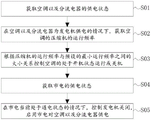
In some optional embodiments, as shown in fig. 5, a method for air conditioner power supply regulation includes:
s01, the processor obtains the power supply states of the air conditioner and the shunt electric appliance;
s02, under the condition that the air conditioner and the shunt electric appliance supply power to the generator, the processor acquires the running frequency of a compressor of the air conditioner;
s03, the processor controls the air conditioner to be in the on-state operation or the off-state operation according to the magnitude relation between the operation frequency of the compressor and the preset minimum operation frequency;
the shunt electric appliances refer to all electric appliances except an air conditioner in the power supply area of the generator;
s04, the processor acquires the power supply state of the commercial power;
s05, under the condition that the commercial power is in the current power-on state, the processor controls the generator to be turned off, and the commercial power is started to supply power to the air conditioner and the shunt electric appliance;
and S06, the processor acquires the running state of the air conditioner and controls the air conditioner to be started under the condition that the air conditioner is shut down.
By adopting the method for adjusting the power supply of the air conditioner, the generator is turned off and the commercial power is started to supply power to the air conditioner and the shunt electric appliance under the condition that the commercial power is powered on currently, the processor acquires the running state of the air conditioner, and the air conditioner is controlled to be started to refrigerate and heat under the condition that the air conditioner is powered off, so that the user experience is improved.
As shown in fig. 6, an embodiment of the present disclosure provides an apparatus for air conditioner power supply regulation, which includes a processor (processor)100 and a memory (memory) 101. Optionally, the apparatus may also include a Communication Interface (Communication Interface)102 and a bus 103. The processor 100, the communication interface 102, and the memory 101 may communicate with each other via a bus 103. The communication interface 102 may be used for information transfer. The processor 100 may call logic instructions in the memory 101 to perform the method for air conditioner power supply regulation of the above-described embodiment.
In addition, the logic instructions in the memory 101 may be implemented in the form of software functional units and stored in a computer readable storage medium when the logic instructions are sold or used as independent products.
The memory 101, which is a computer-readable storage medium, may be used for storing software programs, computer-executable programs, such as program instructions/modules corresponding to the methods in the embodiments of the present disclosure. The processor 100 executes functional applications and data processing by executing program instructions/modules stored in the memory 101, that is, implements the method for air conditioner power supply regulation in the above-described embodiments.
The memory 101 may include a storage program area and a storage data area, wherein the storage program area may store an operating system, an application program required for at least one function; the storage data area may store data created according to the use of the terminal device, and the like. In addition, the memory 101 may include a high-speed random access memory, and may also include a nonvolatile memory.
In some embodiments, an air conditioner includes the above-mentioned device for air conditioner power supply regulation.
The disclosed embodiments provide a storage medium storing computer-executable instructions configured to perform the above-described method for air conditioner power supply regulation.
The storage medium described above may be a transitory computer-readable storage medium or a non-transitory computer-readable storage medium.
The technical solution of the embodiments of the present disclosure may be embodied in the form of a software product, where the computer software product is stored in a storage medium and includes one or more instructions to enable a computer device (which may be a personal computer, a server, or a network device) to execute all or part of the steps of the method of the embodiments of the present disclosure. And the aforementioned storage medium may be a non-transitory storage medium comprising: a U-disk, a removable hard disk, a Read-Only Memory (ROM), a Random Access Memory (RAM), a magnetic disk or an optical disk, and other various media capable of storing program codes, and may also be a transient storage medium.
The above description and drawings sufficiently illustrate embodiments of the disclosure to enable those skilled in the art to practice them. Other embodiments may incorporate structural, logical, electrical, process, and other changes. The examples merely typify possible variations. Individual components and functions are optional unless explicitly required, and the sequence of operations may vary. Portions and features of some embodiments may be included in or substituted for those of others. Furthermore, the words used in the specification are words of description only and are not intended to limit the claims. As used in the description of the embodiments and the claims, the singular forms "a", "an" and "the" are intended to include the plural forms as well, unless the context clearly indicates otherwise. Similarly, the term "and/or" as used in this application is meant to encompass any and all possible combinations of one or more of the associated listed. Furthermore, the terms "comprises" and/or "comprising," when used in this application, specify the presence of stated features, integers, steps, operations, elements, and/or components, but do not preclude the presence or addition of one or more other features, integers, steps, operations, elements, components, and/or groups thereof. Without further limitation, an element defined by the phrase "comprising an …" does not exclude the presence of other like elements in a process, method or apparatus that comprises the element. In this document, each embodiment may be described with emphasis on differences from other embodiments, and the same and similar parts between the respective embodiments may be referred to each other. For methods, products, etc. of the embodiment disclosures, reference may be made to the description of the method section for relevance if it corresponds to the method section of the embodiment disclosure.
Those of skill in the art would appreciate that the various illustrative elements and algorithm steps described in connection with the embodiments disclosed herein may be implemented as electronic hardware or combinations of computer software and electronic hardware. Whether such functionality is implemented as hardware or software may depend upon the particular application and design constraints imposed on the solution. Skilled artisans may implement the described functionality in varying ways for each particular application, but such implementation decisions should not be interpreted as causing a departure from the scope of the disclosed embodiments. It can be clearly understood by the skilled person that, for convenience and brevity of description, the specific working processes of the system, the apparatus and the unit described above may refer to the corresponding processes in the foregoing method embodiments, and are not described herein again.
In the embodiments disclosed herein, the disclosed methods, products (including but not limited to devices, apparatuses, etc.) may be implemented in other ways. For example, the above-described apparatus embodiments are merely illustrative, and for example, the division of the units may be merely a logical division, and in actual implementation, there may be another division, for example, multiple units or components may be combined or integrated into another system, or some features may be omitted, or not executed. In addition, the shown or discussed mutual coupling or direct coupling or communication connection may be an indirect coupling or communication connection through some interfaces, devices or units, and may be in an electrical, mechanical or other form. The units described as separate parts may or may not be physically separate, and parts displayed as units may or may not be physical units, may be located in one place, or may be distributed on a plurality of network units. Some or all of the units can be selected according to actual needs to implement the present embodiment. In addition, functional units in the embodiments of the present disclosure may be integrated into one processing unit, or each unit may exist alone physically, or two or more units are integrated into one unit.
The flowchart and block diagrams in the figures illustrate the architecture, functionality, and operation of possible implementations of systems, methods and computer program products according to embodiments of the present disclosure. In this regard, each block in the flowchart or block diagrams may represent a module, segment, or portion of code, which comprises one or more executable instructions for implementing the specified logical function(s). In some alternative implementations, the functions noted in the block may occur out of the order noted in the figures. For example, two blocks shown in succession may, in fact, be executed substantially concurrently, or the blocks may sometimes be executed in the reverse order, depending upon the functionality involved. In the description corresponding to the flowcharts and block diagrams in the figures, operations or steps corresponding to different blocks may also occur in different orders than disclosed in the description, and sometimes there is no specific order between the different operations or steps. For example, two sequential operations or steps may in fact be executed substantially concurrently, or they may sometimes be executed in the reverse order, depending upon the functionality involved. Each block of the block diagrams and/or flowchart illustrations, and combinations of blocks in the block diagrams and/or flowchart illustrations, can be implemented by special purpose hardware-based systems that perform the specified functions or acts, or combinations of special purpose hardware and computer instructions.