CN114134075A - Bacillus belgii capable of producing complex enzyme at high yield and efficiently degrading mycotoxin and application of bacillus belgii - Google Patents
Bacillus belgii capable of producing complex enzyme at high yield and efficiently degrading mycotoxin and application of bacillus belgii Download PDFInfo
- Publication number
- CN114134075A CN114134075A CN202111385265.4A CN202111385265A CN114134075A CN 114134075 A CN114134075 A CN 114134075A CN 202111385265 A CN202111385265 A CN 202111385265A CN 114134075 A CN114134075 A CN 114134075A
- Authority
- CN
- China
- Prior art keywords
- feed
- bacillus
- afb
- animal
- raw material
- Prior art date
- Legal status (The legal status is an assumption and is not a legal conclusion. Google has not performed a legal analysis and makes no representation as to the accuracy of the status listed.)
- Granted
Links
- 241000193830 Bacillus <bacterium> Species 0.000 title claims abstract description 39
- 102000004190 Enzymes Human genes 0.000 title claims abstract description 38
- 108090000790 Enzymes Proteins 0.000 title claims abstract description 38
- 230000000593 degrading effect Effects 0.000 title claims abstract description 11
- 231100000678 Mycotoxin Toxicity 0.000 title abstract description 12
- 239000002636 mycotoxin Substances 0.000 title abstract description 12
- 229940088598 enzyme Drugs 0.000 claims abstract description 37
- 241000193744 Bacillus amyloliquefaciens Species 0.000 claims abstract description 35
- 239000002994 raw material Substances 0.000 claims abstract description 33
- 238000000855 fermentation Methods 0.000 claims abstract description 31
- 230000004151 fermentation Effects 0.000 claims abstract description 31
- 230000012010 growth Effects 0.000 claims abstract description 21
- 230000000968 intestinal effect Effects 0.000 claims abstract description 21
- 230000001965 increasing effect Effects 0.000 claims abstract description 18
- 235000020232 peanut Nutrition 0.000 claims abstract description 15
- 239000004382 Amylase Substances 0.000 claims abstract description 13
- 102000013142 Amylases Human genes 0.000 claims abstract description 13
- 108010065511 Amylases Proteins 0.000 claims abstract description 13
- 235000017060 Arachis glabrata Nutrition 0.000 claims abstract description 13
- 235000010777 Arachis hypogaea Nutrition 0.000 claims abstract description 13
- 235000018262 Arachis monticola Nutrition 0.000 claims abstract description 13
- 108010059892 Cellulase Proteins 0.000 claims abstract description 13
- 235000019418 amylase Nutrition 0.000 claims abstract description 13
- 229940106157 cellulase Drugs 0.000 claims abstract description 13
- 235000012054 meals Nutrition 0.000 claims abstract description 13
- 108090000623 proteins and genes Proteins 0.000 claims abstract description 12
- 108091005804 Peptidases Proteins 0.000 claims abstract description 11
- 239000004365 Protease Substances 0.000 claims abstract description 11
- 102100037486 Reverse transcriptase/ribonuclease H Human genes 0.000 claims abstract description 11
- 230000006872 improvement Effects 0.000 claims abstract description 11
- 102000004169 proteins and genes Human genes 0.000 claims abstract description 9
- 239000002253 acid Substances 0.000 claims abstract description 8
- 108090000765 processed proteins & peptides Proteins 0.000 claims abstract description 7
- 230000002401 inhibitory effect Effects 0.000 claims abstract description 6
- 238000001784 detoxification Methods 0.000 claims abstract description 5
- 241001465754 Metazoa Species 0.000 claims description 34
- 238000000034 method Methods 0.000 claims description 31
- 238000006731 degradation reaction Methods 0.000 claims description 27
- 230000015556 catabolic process Effects 0.000 claims description 25
- 230000001580 bacterial effect Effects 0.000 claims description 15
- 239000002068 microbial inoculum Substances 0.000 claims description 14
- 244000105624 Arachis hypogaea Species 0.000 claims description 13
- 239000000725 suspension Substances 0.000 claims description 10
- 241000894006 Bacteria Species 0.000 claims description 7
- 210000001035 gastrointestinal tract Anatomy 0.000 claims description 7
- 238000004321 preservation Methods 0.000 claims description 7
- 230000009286 beneficial effect Effects 0.000 claims description 5
- 239000003795 chemical substances by application Substances 0.000 claims description 5
- OQIQSTLJSLGHID-WNWIJWBNSA-N aflatoxin B1 Chemical compound C=1([C@@H]2C=CO[C@@H]2OC=1C=C(C1=2)OC)C=2OC(=O)C2=C1CCC2=O OQIQSTLJSLGHID-WNWIJWBNSA-N 0.000 claims description 4
- 239000002054 inoculum Substances 0.000 claims description 4
- 239000000463 material Substances 0.000 claims description 4
- 230000002829 reductive effect Effects 0.000 claims description 4
- 239000004480 active ingredient Substances 0.000 claims description 2
- 238000011109 contamination Methods 0.000 claims description 2
- 230000002708 enhancing effect Effects 0.000 claims description 2
- 229920002521 macromolecule Polymers 0.000 claims description 2
- 102000004196 processed proteins & peptides Human genes 0.000 claims description 2
- 244000063299 Bacillus subtilis Species 0.000 claims 3
- 235000014469 Bacillus subtilis Nutrition 0.000 claims 3
- 230000008030 elimination Effects 0.000 claims 1
- 238000003379 elimination reaction Methods 0.000 claims 1
- 230000005764 inhibitory process Effects 0.000 claims 1
- 241000287828 Gallus gallus Species 0.000 abstract description 25
- 230000000694 effects Effects 0.000 abstract description 21
- 238000012360 testing method Methods 0.000 abstract description 21
- 239000000835 fiber Substances 0.000 abstract description 3
- 238000001727 in vivo Methods 0.000 abstract description 3
- 239000006041 probiotic Substances 0.000 abstract description 2
- 230000000529 probiotic effect Effects 0.000 abstract description 2
- 235000018291 probiotics Nutrition 0.000 abstract description 2
- 241001553178 Arachis glabrata Species 0.000 abstract 2
- XLYOFNOQVPJJNP-UHFFFAOYSA-N water Chemical compound O XLYOFNOQVPJJNP-UHFFFAOYSA-N 0.000 description 32
- 239000000243 solution Substances 0.000 description 31
- 239000007787 solid Substances 0.000 description 22
- 239000001963 growth medium Substances 0.000 description 20
- 239000002609 medium Substances 0.000 description 18
- 239000007788 liquid Substances 0.000 description 17
- FAPWRFPIFSIZLT-UHFFFAOYSA-M Sodium chloride Chemical compound [Na+].[Cl-] FAPWRFPIFSIZLT-UHFFFAOYSA-M 0.000 description 16
- 238000002835 absorbance Methods 0.000 description 16
- 238000012258 culturing Methods 0.000 description 15
- 238000002156 mixing Methods 0.000 description 14
- 239000012153 distilled water Substances 0.000 description 13
- 239000000843 powder Substances 0.000 description 11
- 229920001817 Agar Polymers 0.000 description 10
- 229920002472 Starch Polymers 0.000 description 10
- 239000008272 agar Substances 0.000 description 10
- 238000006243 chemical reaction Methods 0.000 description 10
- 239000008107 starch Substances 0.000 description 10
- 235000019698 starch Nutrition 0.000 description 10
- WQZGKKKJIJFFOK-GASJEMHNSA-N Glucose Natural products OC[C@H]1OC(O)[C@H](O)[C@@H](O)[C@@H]1O WQZGKKKJIJFFOK-GASJEMHNSA-N 0.000 description 9
- 239000008103 glucose Substances 0.000 description 9
- 239000011780 sodium chloride Substances 0.000 description 8
- OUYCCCASQSFEME-QMMMGPOBSA-N L-tyrosine Chemical compound OC(=O)[C@@H](N)CC1=CC=C(O)C=C1 OUYCCCASQSFEME-QMMMGPOBSA-N 0.000 description 7
- 239000012880 LB liquid culture medium Substances 0.000 description 7
- 239000005018 casein Substances 0.000 description 7
- BECPQYXYKAMYBN-UHFFFAOYSA-N casein, tech. Chemical compound NCCCCC(C(O)=O)N=C(O)C(CC(O)=O)N=C(O)C(CCC(O)=N)N=C(O)C(CC(C)C)N=C(O)C(CCC(O)=O)N=C(O)C(CC(O)=O)N=C(O)C(CCC(O)=O)N=C(O)C(C(C)O)N=C(O)C(CCC(O)=N)N=C(O)C(CCC(O)=N)N=C(O)C(CCC(O)=N)N=C(O)C(CCC(O)=O)N=C(O)C(CCC(O)=O)N=C(O)C(COP(O)(O)=O)N=C(O)C(CCC(O)=N)N=C(O)C(N)CC1=CC=CC=C1 BECPQYXYKAMYBN-UHFFFAOYSA-N 0.000 description 7
- 235000021240 caseins Nutrition 0.000 description 7
- 235000018102 proteins Nutrition 0.000 description 7
- 238000012216 screening Methods 0.000 description 7
- OKKJLVBELUTLKV-UHFFFAOYSA-N Methanol Chemical compound OC OKKJLVBELUTLKV-UHFFFAOYSA-N 0.000 description 6
- 238000009835 boiling Methods 0.000 description 6
- 239000003153 chemical reaction reagent Substances 0.000 description 6
- 239000000047 product Substances 0.000 description 6
- 239000012086 standard solution Substances 0.000 description 6
- OWEGMIWEEQEYGQ-UHFFFAOYSA-N 100676-05-9 Natural products OC1C(O)C(O)C(CO)OC1OCC1C(O)C(O)C(O)C(OC2C(OC(O)C(O)C2O)CO)O1 OWEGMIWEEQEYGQ-UHFFFAOYSA-N 0.000 description 5
- GUBGYTABKSRVRQ-PICCSMPSSA-N Maltose Natural products O[C@@H]1[C@@H](O)[C@H](O)[C@@H](CO)O[C@@H]1O[C@@H]1[C@@H](CO)OC(O)[C@H](O)[C@H]1O GUBGYTABKSRVRQ-PICCSMPSSA-N 0.000 description 5
- DPXJVFZANSGRMM-UHFFFAOYSA-N acetic acid;2,3,4,5,6-pentahydroxyhexanal;sodium Chemical compound [Na].CC(O)=O.OCC(O)C(O)C(O)C(O)C=O DPXJVFZANSGRMM-UHFFFAOYSA-N 0.000 description 5
- 239000001768 carboxy methyl cellulose Substances 0.000 description 5
- 238000009629 microbiological culture Methods 0.000 description 5
- LWIHDJKSTIGBAC-UHFFFAOYSA-K potassium phosphate Substances [K+].[K+].[K+].[O-]P([O-])([O-])=O LWIHDJKSTIGBAC-UHFFFAOYSA-K 0.000 description 5
- 235000019812 sodium carboxymethyl cellulose Nutrition 0.000 description 5
- 229920001027 sodium carboxymethylcellulose Polymers 0.000 description 5
- 239000000758 substrate Substances 0.000 description 5
- 239000012137 tryptone Substances 0.000 description 5
- 229960004441 tyrosine Drugs 0.000 description 5
- CSNNHWWHGAXBCP-UHFFFAOYSA-L Magnesium sulfate Chemical compound [Mg+2].[O-][S+2]([O-])([O-])[O-] CSNNHWWHGAXBCP-UHFFFAOYSA-L 0.000 description 4
- 235000015278 beef Nutrition 0.000 description 4
- 238000004364 calculation method Methods 0.000 description 4
- 229940041514 candida albicans extract Drugs 0.000 description 4
- 229910052799 carbon Inorganic materials 0.000 description 4
- 235000013330 chicken meat Nutrition 0.000 description 4
- ZYGHJZDHTFUPRJ-UHFFFAOYSA-N coumarin Chemical compound C1=CC=C2OC(=O)C=CC2=C1 ZYGHJZDHTFUPRJ-UHFFFAOYSA-N 0.000 description 4
- 239000000284 extract Substances 0.000 description 4
- 239000000203 mixture Substances 0.000 description 4
- 229910000402 monopotassium phosphate Inorganic materials 0.000 description 4
- 235000019796 monopotassium phosphate Nutrition 0.000 description 4
- 239000012071 phase Substances 0.000 description 4
- 239000002904 solvent Substances 0.000 description 4
- 239000012138 yeast extract Substances 0.000 description 4
- 108020004465 16S ribosomal RNA Proteins 0.000 description 3
- OKTJSMMVPCPJKN-UHFFFAOYSA-N Carbon Chemical compound [C] OKTJSMMVPCPJKN-UHFFFAOYSA-N 0.000 description 3
- YMWUJEATGCHHMB-UHFFFAOYSA-N Dichloromethane Chemical compound ClCCl YMWUJEATGCHHMB-UHFFFAOYSA-N 0.000 description 3
- PEDCQBHIVMGVHV-UHFFFAOYSA-N Glycerine Chemical compound OCC(O)CO PEDCQBHIVMGVHV-UHFFFAOYSA-N 0.000 description 3
- 239000008186 active pharmaceutical agent Substances 0.000 description 3
- 238000004458 analytical method Methods 0.000 description 3
- 239000003242 anti bacterial agent Substances 0.000 description 3
- 229920002678 cellulose Polymers 0.000 description 3
- 239000001913 cellulose Substances 0.000 description 3
- 210000004913 chyme Anatomy 0.000 description 3
- 238000001514 detection method Methods 0.000 description 3
- 238000010790 dilution Methods 0.000 description 3
- 239000012895 dilution Substances 0.000 description 3
- 239000012530 fluid Substances 0.000 description 3
- 238000005259 measurement Methods 0.000 description 3
- 230000000813 microbial effect Effects 0.000 description 3
- 239000002504 physiological saline solution Substances 0.000 description 3
- GNSKLFRGEWLPPA-UHFFFAOYSA-M potassium dihydrogen phosphate Chemical compound [K+].OP(O)([O-])=O GNSKLFRGEWLPPA-UHFFFAOYSA-M 0.000 description 3
- 238000002360 preparation method Methods 0.000 description 3
- 239000006228 supernatant Substances 0.000 description 3
- OUYCCCASQSFEME-UHFFFAOYSA-N tyrosine Natural products OC(=O)C(N)CC1=CC=C(O)C=C1 OUYCCCASQSFEME-UHFFFAOYSA-N 0.000 description 3
- 238000005406 washing Methods 0.000 description 3
- 101150116940 AGPS gene Proteins 0.000 description 2
- 229930195730 Aflatoxin Natural products 0.000 description 2
- 241000228212 Aspergillus Species 0.000 description 2
- 241000228197 Aspergillus flavus Species 0.000 description 2
- 241001112693 Lachnospiraceae Species 0.000 description 2
- 241000186660 Lactobacillus Species 0.000 description 2
- 240000007594 Oryza sativa Species 0.000 description 2
- 235000007164 Oryza sativa Nutrition 0.000 description 2
- 239000001888 Peptone Substances 0.000 description 2
- 108010080698 Peptones Proteins 0.000 description 2
- 241001052560 Thallis Species 0.000 description 2
- 240000008042 Zea mays Species 0.000 description 2
- 235000005824 Zea mays ssp. parviglumis Nutrition 0.000 description 2
- 235000002017 Zea mays subsp mays Nutrition 0.000 description 2
- 239000005409 aflatoxin Substances 0.000 description 2
- 230000003698 anagen phase Effects 0.000 description 2
- 229940088710 antibiotic agent Drugs 0.000 description 2
- 210000004534 cecum Anatomy 0.000 description 2
- 235000005822 corn Nutrition 0.000 description 2
- 235000012343 cottonseed oil Nutrition 0.000 description 2
- 229960000956 coumarin Drugs 0.000 description 2
- 235000001671 coumarin Nutrition 0.000 description 2
- 238000007865 diluting Methods 0.000 description 2
- ZPWVASYFFYYZEW-UHFFFAOYSA-L dipotassium hydrogen phosphate Chemical compound [K+].[K+].OP([O-])([O-])=O ZPWVASYFFYYZEW-UHFFFAOYSA-L 0.000 description 2
- 229910000396 dipotassium phosphate Inorganic materials 0.000 description 2
- 235000019797 dipotassium phosphate Nutrition 0.000 description 2
- 201000010099 disease Diseases 0.000 description 2
- 208000037265 diseases, disorders, signs and symptoms Diseases 0.000 description 2
- 239000000706 filtrate Substances 0.000 description 2
- 238000001914 filtration Methods 0.000 description 2
- 239000012634 fragment Substances 0.000 description 2
- 238000004128 high performance liquid chromatography Methods 0.000 description 2
- 230000036039 immunity Effects 0.000 description 2
- 238000011081 inoculation Methods 0.000 description 2
- 230000001788 irregular Effects 0.000 description 2
- 238000009630 liquid culture Methods 0.000 description 2
- 229910052943 magnesium sulfate Inorganic materials 0.000 description 2
- 235000019341 magnesium sulphate Nutrition 0.000 description 2
- 229940099596 manganese sulfate Drugs 0.000 description 2
- 239000011702 manganese sulphate Substances 0.000 description 2
- 235000007079 manganese sulphate Nutrition 0.000 description 2
- SQQMAOCOWKFBNP-UHFFFAOYSA-L manganese(II) sulfate Chemical compound [Mn+2].[O-]S([O-])(=O)=O SQQMAOCOWKFBNP-UHFFFAOYSA-L 0.000 description 2
- 238000004519 manufacturing process Methods 0.000 description 2
- 230000000877 morphologic effect Effects 0.000 description 2
- 235000015816 nutrient absorption Nutrition 0.000 description 2
- 230000008520 organization Effects 0.000 description 2
- 235000019319 peptone Nutrition 0.000 description 2
- 239000008055 phosphate buffer solution Substances 0.000 description 2
- FGIUAXJPYTZDNR-UHFFFAOYSA-N potassium nitrate Chemical compound [K+].[O-][N+]([O-])=O FGIUAXJPYTZDNR-UHFFFAOYSA-N 0.000 description 2
- 230000008569 process Effects 0.000 description 2
- 235000009566 rice Nutrition 0.000 description 2
- 238000005070 sampling Methods 0.000 description 2
- 238000012163 sequencing technique Methods 0.000 description 2
- 230000001954 sterilising effect Effects 0.000 description 2
- UHPMCKVQTMMPCG-UHFFFAOYSA-N 5,8-dihydroxy-2-methoxy-6-methyl-7-(2-oxopropyl)naphthalene-1,4-dione Chemical compound CC1=C(CC(C)=O)C(O)=C2C(=O)C(OC)=CC(=O)C2=C1O UHPMCKVQTMMPCG-UHFFFAOYSA-N 0.000 description 1
- ZCYVEMRRCGMTRW-UHFFFAOYSA-N 7553-56-2 Chemical compound [I] ZCYVEMRRCGMTRW-UHFFFAOYSA-N 0.000 description 1
- 108091093088 Amplicon Proteins 0.000 description 1
- 241000193833 Bacillales Species 0.000 description 1
- UXVMQQNJUSDDNG-UHFFFAOYSA-L Calcium chloride Chemical compound [Cl-].[Cl-].[Ca+2] UXVMQQNJUSDDNG-UHFFFAOYSA-L 0.000 description 1
- 208000003643 Callosities Diseases 0.000 description 1
- 108020004414 DNA Proteins 0.000 description 1
- 238000007400 DNA extraction Methods 0.000 description 1
- 108700039887 Essential Genes Proteins 0.000 description 1
- 241000192125 Firmicutes Species 0.000 description 1
- 241000233866 Fungi Species 0.000 description 1
- 241000223218 Fusarium Species 0.000 description 1
- 108010001336 Horseradish Peroxidase Proteins 0.000 description 1
- 206010020649 Hyperkeratosis Diseases 0.000 description 1
- 206010021143 Hypoxia Diseases 0.000 description 1
- 229910021578 Iron(III) chloride Inorganic materials 0.000 description 1
- 108010029541 Laccase Proteins 0.000 description 1
- 108010059896 Manganese peroxidase Proteins 0.000 description 1
- 241000283973 Oryctolagus cuniculus Species 0.000 description 1
- 241000228143 Penicillium Species 0.000 description 1
- 241000122971 Stenotrophomonas Species 0.000 description 1
- 230000006978 adaptation Effects 0.000 description 1
- 230000002411 adverse Effects 0.000 description 1
- 239000002115 aflatoxin B1 Substances 0.000 description 1
- 229940024606 amino acid Drugs 0.000 description 1
- 150000001413 amino acids Chemical class 0.000 description 1
- BFNBIHQBYMNNAN-UHFFFAOYSA-N ammonium sulfate Chemical compound N.N.OS(O)(=O)=O BFNBIHQBYMNNAN-UHFFFAOYSA-N 0.000 description 1
- 229910052921 ammonium sulfate Inorganic materials 0.000 description 1
- 235000011130 ammonium sulphate Nutrition 0.000 description 1
- 239000003674 animal food additive Substances 0.000 description 1
- 108091007433 antigens Proteins 0.000 description 1
- 102000036639 antigens Human genes 0.000 description 1
- 238000013459 approach Methods 0.000 description 1
- 235000014590 basal diet Nutrition 0.000 description 1
- 238000003287 bathing Methods 0.000 description 1
- 230000003115 biocidal effect Effects 0.000 description 1
- 230000000443 biocontrol Effects 0.000 description 1
- 238000003766 bioinformatics method Methods 0.000 description 1
- 230000037396 body weight Effects 0.000 description 1
- 239000007853 buffer solution Substances 0.000 description 1
- 239000001110 calcium chloride Substances 0.000 description 1
- 229910001628 calcium chloride Inorganic materials 0.000 description 1
- 230000000711 cancerogenic effect Effects 0.000 description 1
- 230000035425 carbon utilization Effects 0.000 description 1
- 231100000315 carcinogenic Toxicity 0.000 description 1
- 235000010980 cellulose Nutrition 0.000 description 1
- 238000005119 centrifugation Methods 0.000 description 1
- CYDMQBQPVICBEU-UHFFFAOYSA-N chlorotetracycline Natural products C1=CC(Cl)=C2C(O)(C)C3CC4C(N(C)C)C(O)=C(C(N)=O)C(=O)C4(O)C(O)=C3C(=O)C2=C1O CYDMQBQPVICBEU-UHFFFAOYSA-N 0.000 description 1
- 229960004475 chlortetracycline Drugs 0.000 description 1
- CYDMQBQPVICBEU-XRNKAMNCSA-N chlortetracycline Chemical compound C1=CC(Cl)=C2[C@](O)(C)[C@H]3C[C@H]4[C@H](N(C)C)C(O)=C(C(N)=O)C(=O)[C@@]4(O)C(O)=C3C(=O)C2=C1O CYDMQBQPVICBEU-XRNKAMNCSA-N 0.000 description 1
- 235000019365 chlortetracycline Nutrition 0.000 description 1
- 239000002131 composite material Substances 0.000 description 1
- IQFVPQOLBLOTPF-HKXUKFGYSA-L congo red Chemical compound [Na+].[Na+].C1=CC=CC2=C(N)C(/N=N/C3=CC=C(C=C3)C3=CC=C(C=C3)/N=N/C3=C(C4=CC=CC=C4C(=C3)S([O-])(=O)=O)N)=CC(S([O-])(=O)=O)=C21 IQFVPQOLBLOTPF-HKXUKFGYSA-L 0.000 description 1
- 239000000356 contaminant Substances 0.000 description 1
- 239000006027 corn-soybean meal Substances 0.000 description 1
- 235000013365 dairy product Nutrition 0.000 description 1
- 238000005202 decontamination Methods 0.000 description 1
- 230000003588 decontaminative effect Effects 0.000 description 1
- 230000003247 decreasing effect Effects 0.000 description 1
- 238000013461 design Methods 0.000 description 1
- 238000001035 drying Methods 0.000 description 1
- 238000004043 dyeing Methods 0.000 description 1
- 238000002474 experimental method Methods 0.000 description 1
- 235000021050 feed intake Nutrition 0.000 description 1
- 235000013305 food Nutrition 0.000 description 1
- 244000053095 fungal pathogen Species 0.000 description 1
- 230000002068 genetic effect Effects 0.000 description 1
- 231100000024 genotoxic Toxicity 0.000 description 1
- 230000001738 genotoxic effect Effects 0.000 description 1
- 101150013736 gyrB gene Proteins 0.000 description 1
- 230000036541 health Effects 0.000 description 1
- 210000003405 ileum Anatomy 0.000 description 1
- 238000000338 in vitro Methods 0.000 description 1
- 230000002779 inactivation Effects 0.000 description 1
- 208000015181 infectious disease Diseases 0.000 description 1
- 229910052740 iodine Inorganic materials 0.000 description 1
- 239000011630 iodine Substances 0.000 description 1
- RBTARNINKXHZNM-UHFFFAOYSA-K iron trichloride Chemical compound Cl[Fe](Cl)Cl RBTARNINKXHZNM-UHFFFAOYSA-K 0.000 description 1
- 229950007634 kitasamycin Drugs 0.000 description 1
- 229940039696 lactobacillus Drugs 0.000 description 1
- XYJOGTQLTFNMQG-KJHBSLKPSA-N leucomycin V Chemical compound CO[C@H]1[C@H](O)CC(=O)O[C@H](C)C\C=C\C=C\[C@H](O)[C@H](C)C[C@H](CC=O)[C@@H]1O[C@H]1[C@H](O)[C@@H](N(C)C)[C@H](O[C@@H]2O[C@@H](C)[C@H](O)[C@](C)(O)C2)[C@@H](C)O1 XYJOGTQLTFNMQG-KJHBSLKPSA-N 0.000 description 1
- 238000011068 loading method Methods 0.000 description 1
- WRUGWIBCXHJTDG-UHFFFAOYSA-L magnesium sulfate heptahydrate Chemical compound O.O.O.O.O.O.O.[Mg+2].[O-]S([O-])(=O)=O WRUGWIBCXHJTDG-UHFFFAOYSA-L 0.000 description 1
- 229940061634 magnesium sulfate heptahydrate Drugs 0.000 description 1
- 239000012528 membrane Substances 0.000 description 1
- 238000012986 modification Methods 0.000 description 1
- 230000004048 modification Effects 0.000 description 1
- 230000004660 morphological change Effects 0.000 description 1
- 231100000219 mutagenic Toxicity 0.000 description 1
- 230000003505 mutagenic effect Effects 0.000 description 1
- 239000002773 nucleotide Substances 0.000 description 1
- 125000003729 nucleotide group Chemical group 0.000 description 1
- 235000015097 nutrients Nutrition 0.000 description 1
- 235000019198 oils Nutrition 0.000 description 1
- 230000003287 optical effect Effects 0.000 description 1
- 239000012074 organic phase Substances 0.000 description 1
- 101150012629 parE gene Proteins 0.000 description 1
- 230000003071 parasitic effect Effects 0.000 description 1
- PJNZPQUBCPKICU-UHFFFAOYSA-N phosphoric acid;potassium Chemical compound [K].OP(O)(O)=O PJNZPQUBCPKICU-UHFFFAOYSA-N 0.000 description 1
- 244000000003 plant pathogen Species 0.000 description 1
- 231100000614 poison Toxicity 0.000 description 1
- 235000010333 potassium nitrate Nutrition 0.000 description 1
- 239000004323 potassium nitrate Substances 0.000 description 1
- 238000012545 processing Methods 0.000 description 1
- 238000000746 purification Methods 0.000 description 1
- 230000009467 reduction Effects 0.000 description 1
- 238000011160 research Methods 0.000 description 1
- 210000004767 rumen Anatomy 0.000 description 1
- 229930000044 secondary metabolite Natural products 0.000 description 1
- 239000011734 sodium Substances 0.000 description 1
- CDBYLPFSWZWCQE-UHFFFAOYSA-L sodium carbonate Substances [Na+].[Na+].[O-]C([O-])=O CDBYLPFSWZWCQE-UHFFFAOYSA-L 0.000 description 1
- 229910000029 sodium carbonate Inorganic materials 0.000 description 1
- 238000010186 staining Methods 0.000 description 1
- 230000003068 static effect Effects 0.000 description 1
- 238000004659 sterilization and disinfection Methods 0.000 description 1
- 239000000126 substance Substances 0.000 description 1
- 231100000378 teratogenic Toxicity 0.000 description 1
- 230000003390 teratogenic effect Effects 0.000 description 1
- 239000003440 toxic substance Substances 0.000 description 1
- YNJBWRMUSHSURL-UHFFFAOYSA-N trichloroacetic acid Chemical compound OC(=O)C(Cl)(Cl)Cl YNJBWRMUSHSURL-UHFFFAOYSA-N 0.000 description 1
- 238000000870 ultraviolet spectroscopy Methods 0.000 description 1
- 230000004584 weight gain Effects 0.000 description 1
- 235000019786 weight gain Nutrition 0.000 description 1
Images


Classifications
-
- A—HUMAN NECESSITIES
- A23—FOODS OR FOODSTUFFS; TREATMENT THEREOF, NOT COVERED BY OTHER CLASSES
- A23K—FODDER
- A23K10/00—Animal feeding-stuffs
- A23K10/10—Animal feeding-stuffs obtained by microbiological or biochemical processes
- A23K10/16—Addition of microorganisms or extracts thereof, e.g. single-cell proteins, to feeding-stuff compositions
- A23K10/18—Addition of microorganisms or extracts thereof, e.g. single-cell proteins, to feeding-stuff compositions of live microorganisms
-
- A—HUMAN NECESSITIES
- A23—FOODS OR FOODSTUFFS; TREATMENT THEREOF, NOT COVERED BY OTHER CLASSES
- A23K—FODDER
- A23K10/00—Animal feeding-stuffs
- A23K10/30—Animal feeding-stuffs from material of plant origin, e.g. roots, seeds or hay; from material of fungal origin, e.g. mushrooms
- A23K10/37—Animal feeding-stuffs from material of plant origin, e.g. roots, seeds or hay; from material of fungal origin, e.g. mushrooms from waste material
-
- A—HUMAN NECESSITIES
- A23—FOODS OR FOODSTUFFS; TREATMENT THEREOF, NOT COVERED BY OTHER CLASSES
- A23K—FODDER
- A23K50/00—Feeding-stuffs specially adapted for particular animals
- A23K50/70—Feeding-stuffs specially adapted for particular animals for birds
- A23K50/75—Feeding-stuffs specially adapted for particular animals for birds for poultry
-
- A—HUMAN NECESSITIES
- A23—FOODS OR FOODSTUFFS; TREATMENT THEREOF, NOT COVERED BY OTHER CLASSES
- A23L—FOODS, FOODSTUFFS OR NON-ALCOHOLIC BEVERAGES, NOT OTHERWISE PROVIDED FOR; PREPARATION OR TREATMENT THEREOF
- A23L33/00—Modifying nutritive qualities of foods; Dietetic products; Preparation or treatment thereof
- A23L33/10—Modifying nutritive qualities of foods; Dietetic products; Preparation or treatment thereof using additives
- A23L33/135—Bacteria or derivatives thereof, e.g. probiotics
-
- A—HUMAN NECESSITIES
- A23—FOODS OR FOODSTUFFS; TREATMENT THEREOF, NOT COVERED BY OTHER CLASSES
- A23L—FOODS, FOODSTUFFS OR NON-ALCOHOLIC BEVERAGES, NOT OTHERWISE PROVIDED FOR; PREPARATION OR TREATMENT THEREOF
- A23L5/00—Preparation or treatment of foods or foodstuffs, in general; Food or foodstuffs obtained thereby; Materials therefor
- A23L5/20—Removal of unwanted matter, e.g. deodorisation or detoxification
- A23L5/28—Removal of unwanted matter, e.g. deodorisation or detoxification using microorganisms
-
- A—HUMAN NECESSITIES
- A23—FOODS OR FOODSTUFFS; TREATMENT THEREOF, NOT COVERED BY OTHER CLASSES
- A23V—INDEXING SCHEME RELATING TO FOODS, FOODSTUFFS OR NON-ALCOHOLIC BEVERAGES AND LACTIC OR PROPIONIC ACID BACTERIA USED IN FOODSTUFFS OR FOOD PREPARATION
- A23V2002/00—Food compositions, function of food ingredients or processes for food or foodstuffs
-
- Y—GENERAL TAGGING OF NEW TECHNOLOGICAL DEVELOPMENTS; GENERAL TAGGING OF CROSS-SECTIONAL TECHNOLOGIES SPANNING OVER SEVERAL SECTIONS OF THE IPC; TECHNICAL SUBJECTS COVERED BY FORMER USPC CROSS-REFERENCE ART COLLECTIONS [XRACs] AND DIGESTS
- Y02—TECHNOLOGIES OR APPLICATIONS FOR MITIGATION OR ADAPTATION AGAINST CLIMATE CHANGE
- Y02P—CLIMATE CHANGE MITIGATION TECHNOLOGIES IN THE PRODUCTION OR PROCESSING OF GOODS
- Y02P60/00—Technologies relating to agriculture, livestock or agroalimentary industries
- Y02P60/80—Food processing, e.g. use of renewable energies or variable speed drives in handling, conveying or stacking
- Y02P60/87—Re-use of by-products of food processing for fodder production
Landscapes
- Life Sciences & Earth Sciences (AREA)
- Chemical & Material Sciences (AREA)
- Polymers & Plastics (AREA)
- Engineering & Computer Science (AREA)
- Food Science & Technology (AREA)
- Microbiology (AREA)
- Health & Medical Sciences (AREA)
- Zoology (AREA)
- Animal Husbandry (AREA)
- Molecular Biology (AREA)
- Mycology (AREA)
- Physiology (AREA)
- Biotechnology (AREA)
- Nutrition Science (AREA)
- Birds (AREA)
- Botany (AREA)
- Biochemistry (AREA)
- Biomedical Technology (AREA)
- Micro-Organisms Or Cultivation Processes Thereof (AREA)
- Enzymes And Modification Thereof (AREA)
Abstract
The invention discloses bacillus beilesensis capable of efficiently degrading mycotoxin at the same time of highly producing complex enzyme and application thereof. The Bacillus belgii is Bacillus belgii (Bacillus velezensis) LB-Y-1, and the strainNot only can effectively degrade AFB1And the capability of high yield of protease, cellulase and amylase is also provided. In vivo tests of broilers show that the strain has the potential probiotic characteristics of high safety, strong stress resistance, easy intestinal colonization, improvement of intestinal flora structure, improvement of growth performance and the like. In addition, the strain can degrade AFB in mildewed peanut meal through fermentation treatment1The content of acid soluble protein is increased, and biological detoxification and quality improvement of the peanut meal are realized. Has comprehensive effects on eliminating and inhibiting mycotoxin pollution in feed and raw materials, reducing the content of crude fiber of the raw materials, improving the content of small peptide and the like.
Description
Technical Field
The invention relates to the technical field of agricultural biology, in particular to a Bacillus velezensis strain and application thereof, and particularly relates to a Bacillus velezensis (LB-Y-1) strain capable of producing complex enzyme at a high yield and efficiently degrading mycotoxin and application thereof.
Background
Mycotoxins are secondary metabolites produced by fungi and are ubiquitous and unavoidable contaminants in food and feed, and mycotoxins consumed by humans and animals can cause disease and death. Aspergillus, Penicillium and Fusarium all produce a variety of mycotoxins. For example, Aspergillus flavus parasitic, Aspergillus flavus norvegicus, and Aspergillus pseudoflavus are the leading culprits in the production of a range of highly toxic substances, aflatoxins. Aflatoxins B since 19601(Aflatoxin B1,AFB1) It has been verified to be highly carcinogenic, mutagenic, teratogenic and genotoxic since the discovery, and is widely found in agricultural products such as peanuts, corn, rice and cotton seeds. In view of AFB1The adverse effects on human and animal health, it is essential to find safe, practical, inexpensive and effective decontamination strategies.
Existing AFB reduction1The method of influence mainly comprises removal, inactivation, conversion or degradation, and the modes can be divided into three modes of physics, chemistry and biology. Due to unavoidable limitations, most of these methods are inefficient or cost prohibitiveThe product is AFB in agricultural products and animal feed due to its excellent safety, economy and stability1Provides an attractive option for removal and degradation. Some strains, such as Stenotrophomonas sp, mycobacteria sp, etc. have been shown to have good AFB1The degradation effect is good, and in addition, laccase, horseradish peroxidase and manganese peroxidase also have certain degradation capability. In summary, the biological approach removes AFB1Seems to be the best means to address the limitations. Most of the currently reported cases are single strain or composite strain pair AFB1The single degradation of (2) such as Bacillus belezii ANSB01E related to patent CN110804570A only discloses that the single degradation has the capability of degrading mycotoxin, and a certain strain is only found to degrade AFB1Meanwhile, the feed has other functions, and the quality improvement of feed raw materials is usually multifaceted, such as reduction of crude fiber level, degradation of macromolecular protein or antigen protein and the like.
Bacillus velezensis (Bacillus velezensis) was first isolated in 1999 and formally named in 2005, and has been verified to control various plant pathogen infections, lower disease indices, and inhibit various pathogenic fungi and bacteria, and is an excellent biocontrol strain. However, there are few reports on the research of the strain in degrading mycotoxin.
Disclosure of Invention
One purpose of the invention is to provide a Bacillus velezensis LB-Y-1 strain.
The preservation number of the Bacillus velezensis LB-Y-1 provided by the invention is CGMCC No. 21344. The strain has been preserved in China general microbiological culture Collection center (CGMCC for short; address: No. 3, institute of microbiology, national academy of sciences, Navy, Beijing, Inward, and Yangxi, China general microbiological culture Collection center; zip code: 100101) 10 days 12 and 10 days 2020. The Bacillus velezensis LB-Y-1 is obtained by separating the Bacillus velezensis from the chyme in the digestive tract of a healthy animal through complicated processes of domestication, comparison, screening and the like, and has the function of simultaneously degrading AFB1And high yield of amylase, protease and cellulaseThe in vivo and in vitro tests prove that the strain has high safety, and can improve the intestinal flora structure and growth performance of the broiler chicken.
Another object of the present invention is to provide a microbial inoculum.
The active ingredient of the microbial inoculum provided by the invention is the Bacillus velezensis LB-Y-1 or the bacterial suspension thereof or the culture solution thereof or the fermentation broth thereof.
In the above microbial agent, the concentration of the suspension or the culture may be 1.0X 10⁷-1.0×10⁹CFU/mL, preferably 1.0X 10⁸CFU/mL。
Still another object of the present invention is to provide a novel use of the above Bacillus velezensis LB-Y-1 or microbial agent.
The invention provides an application of the Bacillus velezensis LB-Y-1 or the bacterial agent in any one of the following 1) -9):
1) degradation or removal of AFB1;
2) Producing complex enzyme;
3) degrading macromolecular substances or increasing the content of small peptides;
4) improving the structure of animal intestinal flora;
5) the growth performance of animals is improved;
6) eliminating or inhibiting AFB in raw materials or feed1Pollution;
7) increasing the content of acid soluble protein and/or small peptide in the raw material or the feed;
8) raw material or feed detoxification;
9) improve the quality of raw materials or feed.
It is a final object of the invention to provide a process as described in any of the following c1) -c 6):
c1) degradation or removal of AFB1The method comprises the following steps: the Bacillus velezensis LB-Y-1 or the microbial inoculum is used for fermenting and processing raw materials or feeds to realize AFB1Degradation or removal;
c2) eliminating or inhibiting AFB in raw material or feed1A method of contamination comprising the steps of:the Bacillus velezensis LB-Y-1 or the microbial inoculum is used for fermenting and treating raw materials or feeds to eliminate or inhibit AFB in the raw materials or the feeds1Pollution;
c3) a method for detoxifying a feed or feed comprising the steps of: the Bacillus velezensis (Bacillus velezensis) LB-Y-1 or microbial inoculum is used for fermenting and treating raw materials or feed to realize detoxification of the raw materials or feed;
c4) a method of improving the quality of a feed or feed comprising the steps of: the Bacillus velezensis (Bacillus velezensis) LB-Y-1 or microbial inoculum is used for fermenting and treating raw materials or feed, so that the quality of the raw materials or the feed is improved;
c5) a method for improving the intestinal flora structure of an animal comprising the steps of: the Bacillus velezensis (Bacillus velezensis) LB-Y-1 or the microbial inoculum is used for feeding animals, so that the intestinal flora structure of the animals is improved;
c6) a method for enhancing growth performance of an animal comprising the steps of: the Bacillus velezensis LB-Y-1 or the microbial inoculum is used for feeding animals, so that the growth performance of the animals is improved.
In the above application or method, the complex enzyme is protease, cellulase and amylase.
In the above application or method, the improvement of animal growth performance is embodied in any one of the following a1) -a 2):
a1) increasing animal body weight (e.g., end weight, average daily gain);
a2) the material weight ratio is reduced.
In the above application or method, the structure for improving animal intestinal flora is any one of b1) -b 3):
b1) increasing the abundance of flora in the intestinal tract of the animal;
b2) increasing the proportion of beneficial bacteria (such as Lactobacillus, Alisipes, Lachnospiraceae flora) in the intestinal tract of the animal;
b3) reducing the proportion of harmful bacteria (such as Escherichia-Shigella flora which are unfavorable for nutrient absorption and reduce immunity) in animal intestinal tract.
In the above application or methodThe preparation method of the bacterial suspension comprises the following steps: inoculating separated and purified LB-Y-1 strain in LB solid culture medium, solid culturing for 24 hr, picking single colony to LB liquid culture medium, culturing at 37 deg.C and 160r/min for 18-24 hr to make thallus concentration in culture system reach 1.0 × 10⁷~1.0×10⁹CFU/mL, centrifuging (centrifugation condition can be 4000rpm for 10min), collecting thallus, washing the thallus with sterile physiological saline (washing times can be three times) and re-suspending to obtain the bacterial suspension (thallus concentration in bacterial suspension is 1.0 × 10)7~1.0×10⁹CFU/mL)。
The preparation method of the culture comprises the following steps: inoculating the separated and purified LB-Y-1 strain into an LB solid culture medium, selecting a single colony in a logarithmic growth phase into an LB liquid culture medium, culturing at 37 ℃ and 160rpm/min (the culture time can be 24h) to obtain a seed solution, inoculating the seed solution (the inoculum size can be 1%) into the LB liquid culture medium, and culturing at 37 ℃ and 160rpm/min (the culture time can be 14h) to obtain a fermentation liquid, namely the culture (the concentration of thalli in the culture is 1.0 multiplied by 10), wherein the fermentation liquid is obtained7~1.0×10⁹CFU/mL)。
In the above application or method, the animal is a chicken, specifically a broiler chicken (e.g., AA broiler chicken).
In the above application or method, the raw material or feed may be subjected or not to AFB1Contaminated agricultural products such as peanuts, corns, rice and cottonseeds. In a specific embodiment of the invention, the feedstock is AFB-fed1Contaminated peanut meal.
The Bacillus velezensis LB-Y-1 provided by the invention can be applied to the following aspects: (1) due to its strong AFB1Degradability, can be used for treating AFB1Contaminated materials (e.g., peanut meal); (2) because the starch can degrade macromolecular protein, cellulose and starch, the starch can be used for preparing fermentation raw materials (such as peanut meal), so that the quality of the raw materials is improved; (3) the strain can produce complex enzyme, has high safety and improved intestinal flora structure, and can be directly fed to animals (such as broiler chicken) to improve growth performance.
The invention provides a Bacillus velezensis (Bacillus velezensis) LB-Y-1 strain, which can effectively degrade AFB1The cellulase also has the capability of producing protease, cellulase and amylase with high yield, and the enzyme activities are 345.47U/mL, 429.72U/mL and 34.75U/mL respectively. In vivo tests of broilers show that the strain has the potential probiotic characteristics of high safety, strong stress resistance, easy intestinal colonization, improvement of intestinal flora structure, improvement of growth performance and the like. In addition, the strain can degrade AFB in mildewed peanut meal through fermentation treatment1The content of acid soluble protein (small peptide and amino acid) is increased, and biological detoxification and quality improvement of the peanut meal are realized. Has comprehensive effects on eliminating and inhibiting mycotoxin pollution in feed and raw materials, reducing the content of crude fiber of the raw materials, improving the content of small peptide and the like.
Drawings
FIG. 1 shows the effect of bacterial strain LB-Y-1 of the present invention in primary screening for casein, sodium carboxymethylcellulose and soluble starch. A is protease producing ability; b is the cellulase production capacity; c is the amylase producing ability.
FIG. 2 shows the colony characteristics and cell morphology (gram stain X100) of the strain LB-Y-1 of the present invention. A is the colony characteristic; b is the form of the cells.
FIG. 3 shows the result of analysis of the strain LB-Y-1 of the present invention using API 20 NE.
FIG. 4 shows a phylogenetic tree constructed by the strain LB-Y-1 of the present invention.
FIG. 5 is a growth curve of the strain LB-Y-1 of the present invention.
FIG. 6 shows the influence of the strain LB-Y-1 of the present invention on the intestinal flora structure of broiler chicken.
FIG. 7 shows the fermentation time versus AFB in naturally mildewed peanut meal degraded by strain LB-Y-11Influence of the content.
FIG. 8 is a graph showing the effect of fermentation time on the increase of acid-soluble protein content in naturally moldy peanut meal by strain LB-Y-1.
Deposit description
The name of Chinese: bacillus belgii
Latin name: bacillus velezensis
The strain number is as follows: LB-Y-1
The preservation organization: china general microbiological culture Collection center
The preservation organization is abbreviated as: CGMCC (China general microbiological culture Collection center)
Address: xilu No. 1 Hospital No. 3 of Beijing market facing Yang district
The preservation date is as follows: 12 month and 10 days of 2020
Registration number of the preservation center: CGMCC No.21344
Detailed Description
The present invention is described in further detail below with reference to specific embodiments, which are given for the purpose of illustration only and are not intended to limit the scope of the invention. The examples provided below serve as a guide for further modifications by a person skilled in the art and do not constitute a limitation of the invention in any way.
The experimental procedures in the following examples, unless otherwise indicated, are conventional and are carried out according to the techniques or conditions described in the literature in the field or according to the instructions of the products. Materials, reagents and the like used in the following examples are commercially available unless otherwise specified.
The culture medium (solvents are distilled water and are sterilized for 20min at 121 ℃ before use) related by the invention is as follows:
nutrient Broth (NB) medium (g/L): 10 parts of peptone, 3 parts of beef extract and 5 parts of sodium chloride, adjusting the pH value to 7.2-7.4, and adding 2% agar powder into a solid culture medium.
Horrmisch medium (g/L): 0.25 part of dipotassium phosphate, 0.25 part of magnesium sulfate heptahydrate, 0.5 part of potassium nitrate, 0.5 part of ammonium sulfate, 0.005 part of calcium chloride and 0.003 part of ferric chloride, wherein the pH value is adjusted to 7.0, 1-3 g of coumarin is added according to needs after sterilization, and 2% agar powder is added into a solid culture medium.
Casein medium (g/L): casein 10, beef extract powder 3, agar powder 15, sodium chloride 5 and monopotassium phosphate 2, adjusting the pH to 7.0, and adding 2% agar powder into a solid culture medium.
Cellulase selection medium (g/L): 5 parts of yeast extract, 5 parts of sodium chloride, 10 parts of tryptone, 10 parts of sodium carboxymethylcellulose and 1 part of monopotassium phosphate, wherein the pH value is adjusted to 7.2-7.4, and 2% agar powder is added into a solid culture medium.
Amylase selection medium (g/L): 10 parts of soluble starch, 5 parts of glucose, 10 parts of tryptone, 5 parts of beef extract and 5 parts of sodium chloride, adjusting the pH value to 7.2-7.4, and adding 2% agar powder into a solid culture medium.
LB medium (g/L): tryptone 10, yeast extract 5 and sodium chloride 10, adjusting the pH value to 7.2-7.4, and adding 2% agar powder into a solid culture medium.
Fermentation medium a (g/L): 10 parts of peptone, 3 parts of beef extract, 5 parts of sodium chloride, 1 part of dipotassium phosphate and 1 part of glucose, adjusting the pH value to 6.5, and adding 2% agar powder into a solid culture medium.
Fermentation medium B (g/L): glucose 5, tryptone 10, yeast extract 5, potassium dihydrogen phosphate 1, sodium chloride 5, magnesium sulfate 0.5, manganese sulfate 0.005, sodium carboxymethyl cellulose 5, pH adjusted to 5.5, and 2% agar powder added to the solid medium.
Fermentation medium C (g/L): soluble starch 5, glucose 5, tryptone 10, yeast extract 5, monopotassium phosphate 1, sodium chloride 5, magnesium sulfate 0.5, manganese sulfate 0.005, pH adjusted to 5.5, and 2% agar powder added into a solid culture medium.
The detection method comprises the following steps: AFB1The concentration is detected by an HPLC method; the protease activity is detected by Folin-phenol method; the cellulase activity is detected by a DNS method; detecting the activity of amylase by using a DNS method; acid soluble protein content reference (GB/T22492-2008).
The invention will be further illustrated by the following examples:
example 1 screening and identification of Bacillus belgii LB-Y-1
Screening of strain LB-Y-1
1. Preliminary screening of bacterial strains
35 healthy and well-growing dairy cow rumen, chicken cecum, pig ileum and rabbit cecum chyme samples are collected and used for screening target strains. The specific method comprises the following steps: dissolving 10g of the above samples in 90mL of sterile PBS solution, shaking at 160rpm for 20min, sucking 500. mu.L of the solution, and transferring the solution into 5.5mL of NB liquid for cultureCulturing at 37 ℃ for 24 hours at 160rpm, then sucking 100 mu L of bacterial liquid, inoculating the bacterial liquid into 5.5mL of Horrmisch liquid culture medium, gradually increasing the content of coumarin from 1-3 mg/mL, culturing at 37 ℃ and 160rpm for 48 hours, and enriching the strain. After 5 enrichments, the broth was diluted and spread on NB solid media (dilution factor from 10)-1~10-6) And carrying out static culture at 37 ℃ for 24h, selecting a single colony in an NB solid culture medium by judging the aspects of the morphology, the color, the edge smoothness, the humidity and the like of the colony as identification standards, carrying out third-generation purification, and preserving the purified strain in 50% glycerol at-80 ℃.
2. Rescreening of bacterial strains
Inoculating the primary screened strain to fermentation medium A, culturing at 37 deg.C for 48 hr, and preparing with AFB1Standard, 990. mu.L fermentation broth, and 10. mu.L AFB1And (3) culturing a standard substance (with the concentration of 10 mu g/mL) at 37 ℃ for 48h, adding 1mL of dichloromethane after the reaction is finished, repeating for 3 times, combining organic phases, adding 1mL of methanol for redissolution, filtering the mixture through a 0.22 mu m filter membrane, and loading an HPLC machine, wherein the detection conditions are as follows: c18 column: SB-C18, 4.6mm × 250mm, 5 μm; mobile phase: v (methanol) is prepared by mixing V (water) with water at a ratio of 60:40, at a flow rate of 0.8mL/min, at a column temperature of 32 deg.C and at a running time of 11 min; detection wavelength 365nm, photodiode array (PDA). The degradation rate calculation formula is as follows: AFB1Is (a-B)/ax100%, wherein A, B represents the addition of AFB, respectively1The control peak area and the post-treatment peak area of (c).
Selecting AFB1Further screening the first 20 strains with better degradation effect; inoculating 1 μ L of fermented seed liquid into casein solid culture medium, culturing for 24 hr, measuring and calculating casein degradation loop area (S)1) And colony area(s)1) Selecting a plurality of strains with the best degradation efficiency to carry out the next cellulose degradation capability judgment; inoculating the selected fermentation seed liquid into cellulase selection solid culture medium, culturing for 24h, and measuring and calculating cellulose degradation ring area (S) by Congo red dyeing2) And colony area(s)2) Selecting a plurality of strains with the best degradation efficiency, and judging the starch degradation capability in the next step; taking the above strainInoculating the fermented seed liquid into amylase selective solid culture medium, culturing for 24h, and measuring and calculating the area of starch degradation ring by iodine solution staining3) And colony area(s)3) The optimal degrading strain is judged according to the ratio, and the degradation result is shown in figure 1.
The test result shows that: strain LB-Y-1 has degradation AFB1The degradation efficiency is 81.56%, and simultaneously the capacity of producing protease, cellulase and amylase is realized, and the area ratio (S/S) of the degradation ring to the colony size is respectively as follows: 3.67, 4.06, 2.68.
II, identification of the strain LB-Y-1
1. Morphological Observation of Strain LB-Y-1
The strain LB-Y-1 was streaked into LB solid medium, and the colony growth morphology was observed (FIG. 2A), which was characterized in that: milky white colonies are opaque, the morphological change is gradually changed from initial round (full) to irregular (folded), the edges are irregular and are scattered in a cloud form to the periphery, the middle of the colonies is raised to form a crater shape, and viscous liquid is contained after the colonies are picked up; the log-phase growth thallus is smeared, fixed and stained with gram stain, and photographed under an oil lens to observe the shape (figure 2B), wherein the thallus is in a short rod shape and can form spores and is gram-positive.
2. Biochemical identification of strain LB-Y-1
The strain LB-Y-1 was first analyzed using API 20NE reagent strips, the specific results are shown in FIG. 3, and further BIOLOG was used to analyze the carbon source utilization of the strain LB-Y-1, and the positive reaction carbon source is shown in Table 1.
TABLE 1 BIOLOG GEN III analysis of carbon utilization by Bacillus belgii LB-Y-1

3. Molecular biological identification of strain LB-Y-1
Bacterial genome DNA extraction kit is adopted to extract bacterial strain LB-Y-1DNA, and 16S rDNA and housekeeping gene gyrB are amplified and sequenced. The sequencing result shows that: the 16S rDNA PCR product of the strain LB-Y-1 obtains a gene fragment with the size of 1476bp together, and the nucleotide sequence of the gene fragment is shown as a sequence 1. The strain was identified as Bacillus (Bacillus) and was Bacillus velezensis (Bacillus belief).
The 16S rDNA gene sequence of the strain LB-Y-1 was subjected to homology comparison at NCBI, and genetic relationship was analyzed to construct a phylogenetic tree (FIG. 4).
4. Growth curve of Strain LB-Y-1
Inoculating strain LB-Y-1 in LB solid culture medium, selecting single colony in logarithmic growth phase to 10mL LB liquid culture medium, culturing at 37 deg.C and 160rpm/min for 24h as seed liquid, accurately sucking 1% inoculum size of the seed liquid, inoculating in 100mLLB liquid culture medium, culturing at 37 deg.C and 160rpm/min for 24h, sampling once every 1h, measuring Optical Density (OD) at 600nm of ultraviolet-visible spectrophotometer, and drawing OD600Graph with time (fig. 5).
And determining the classification unit of the strain LB-Y-1 by means of integrating the morphological characteristics of colonies and thalli, the utilization condition of a BIOLOG carbon source, the analysis result of API 20NE, molecular biology identification and the like: (ii) Bacteria; firmicutes; bacillus; bacillales; bacillus bacteria; bacillus, belonging to Bacillus velezensis.
Third, preservation of Strain LB-Y-1
Bacillus velezensis LB-Y-1 has been deposited in China general microbiological culture Collection center (CGMCC; address: No. 3, institute of microbiology, national academy of sciences; zip code: 100101) in the morning area of Beijing, and the preservation number is CGMCC No.21344, 12 months and 10 days in 2020.
Example 2 ability of Bacillus belgii LB-Y-1 to produce protease, cellulase and amylase
Ability of Bacillus belgii LB-Y-1 to produce protease
1. Drawing an L-tyrosine standard curve: 0.1mol/L HCL solution is prepared in advance as a solvent, and is prepared into a tyrosine standard solution with the concentration of 0-70 mu g/mL by taking 10 mu g/mL as a gradient difference. 1mL of the above standard solution and 5mL of 0.4mol/L Na were each collected2CO3Mixing the solution with 1mL Folon-Phenol reagent, water bathing at 40 deg.C for 20min, measuring absorbance at 680nm wavelength of ultraviolet spectrophotometer, and drawing L-tyrosine OD680Concentration dependence.
2. A seed solution was prepared in the same manner as in example 1, inoculated into fermentation medium A, and cultured at 37 ℃ and 160rpm/min for 36 hours.
3. After the step 2 is finished, centrifuging for 15min at the temperature of 4 ℃ and the rpm of 8000 for separating supernatant fluid, namely crude enzyme liquid.
4. And (3) enzyme activity determination: 1mL of the crude enzyme solution obtained in the step 3 is put in a water bath at 40 ℃ for 20min, 1mL of a substrate (1g of casein is dissolved in a buffer solution with the pH value of 7.5 and the volume is determined to be 100mL) and 2mL of 0.4mol/L trichloroacetic acid are sequentially added, the mixture is uniformly mixed, the mixture is stood for 10min, filtrate is collected by slow filtration, 1mL of the filtrate is transferred to a new test tube and is mixed with 5mL of 0.4mol/L Na2CO3The solution is mixed with 1mL of Folon-Phenol reagent, the mixture is incubated in water bath at 40 ℃ for 20min, then the absorbance is measured under the wavelength of 680nm of an ultraviolet spectrophotometer, three replicates are set for each measurement, and distilled water is used as a blank control.
Calculating the formula: absorbance-absorbance (test group) -absorbance (control group).
And (3) obtaining the yield of the tyrosine by contrasting a standard curve, calculating the enzyme activity of the crude enzyme solution, and taking the enzyme amount of 1 enzyme activity required by catalyzing casein to generate 1 mu g of tyrosine per mL of enzyme solution as a metering unit (U/mL).
The calculation result shows that: the activity of the protease crude enzyme liquid produced by the Bacillus belgii LB-Y-1 is 345.47U/mL.
Second, the ability of Bacillus belgii LB-Y-1 to produce cellulase
1. Drawing a glucose standard curve
Distilled water is used as a solvent, and 0.1mg/mL is used as a gradient difference to prepare a glucose standard solution with the concentration of 0.1-0.7 mg/mL. And (3) adding 3mL of the standard solution and 1mL of DNS reagent into a test tube, fully mixing, immediately transferring into an ice bath to stop the reaction after 5min of boiling water bath, adding 16mL of distilled water, fully mixing, measuring absorbance at a wavelength of 540nm of an ultraviolet spectrophotometer, and drawing a relation curve between the absorbance and the glucose concentration.
2. A seed solution was prepared in the same manner as in example 1, inoculated into fermentation medium B, and cultured at 37 ℃ and 160rpm/min for 36 hours.
3. After the step 2 is completed, centrifuging for 15min at the temperature of 4 ℃ and the rpm of 8000 for separating supernatant fluid, namely the crude enzyme solution.
4. And (3) enzyme activity determination: and (4) diluting the crude enzyme solution obtained in the step (3) with distilled water to obtain a solution to be detected. Adding 2mL of substrate (0.5g of sodium carboxymethylcellulose dissolved in phosphate buffer solution with pH of 7.5 and constant volume to 100mL), 1mL of DNS and 1mL of solution to be detected into a test tube in sequence for a control group, uniformly mixing, carrying out boiling water bath for 5min, then stopping reaction in ice bath, adding 16mL of distilled water, fully mixing, and measuring absorbance at the wavelength of 540nm of an ultraviolet spectrophotometer; adding 2mL of substrate and 1mL of solution to be detected in turn into a test group, uniformly mixing, placing in a water bath at 50 ℃ for 1h, then adding 1mL of DNS, uniformly mixing, stopping the reaction in an ice bath after boiling the water bath for 5min, adding 16mL of distilled water, measuring the absorbance at the wavelength of 540nm of an ultraviolet spectrophotometer, and setting three parallels for each measurement of a control group and the test group.
Calculating the formula: absorbance-absorbance (test group) -absorbance (control group).
And (3) calculating the enzyme activity of the crude enzyme solution according to the generation amount and dilution times of the glucose by contrasting a standard curve, and taking the enzyme amount required by catalyzing sodium carboxymethylcellulose to generate 1 mu g of glucose per milliliter of enzyme solution as a metering unit (U/mL).
The calculation result shows that: the enzyme activity of the crude enzyme liquid for producing the cellulase by the Bacillus belgii LB-Y-1 is 429.72U/mL.
Ability of Bacillus belgii LB-Y-1 to produce amylase
1. Drawing a maltose standard curve
Distilled water is used as a solvent, and 0.1mg/mL is used as a gradient difference to prepare a maltose standard solution with the concentration of 0.1-0.7 mg/mL. And (3) adding 2mL of the standard solution and 2mL of DNS reagent into a test tube, fully mixing, immediately transferring into an ice bath after boiling water bath for 5min to terminate the reaction, adding 16mL of distilled water, fully mixing, measuring absorbance at a wavelength of 540nm of an ultraviolet spectrophotometer, and drawing a relation curve between the absorbance and the maltose concentration.
2. A seed solution was prepared in the same manner as in example 1, inoculated into fermentation medium C, and cultured at 37 ℃ and 160rpm/min for 36 hours.
3. After the step 2 is finished, centrifuging for 15min at the temperature of 4 ℃ and the rpm of 8000 for separating supernatant fluid, namely crude enzyme liquid.
4. And (3) enzyme activity determination: and (4) diluting the crude enzyme solution obtained in the step (3) with distilled water to obtain a solution to be detected. Adding 1mL of substrate (0.5g of soluble starch is dissolved in phosphate buffer solution with pH of 6.5 and the volume is determined to be 100mL), 2mL of DNS and 1mL of solution to be detected into a test tube in sequence for a control group, uniformly mixing, stopping reaction in an ice bath after boiling water bath for 5min, adding 16mL of distilled water, fully mixing, and measuring the absorbance under the wavelength of 540nm of an ultraviolet spectrophotometer; adding 1mL of substrate and 1mL of solution to be detected in turn into a test group, uniformly mixing, placing in a water bath at 50 ℃ for 1h, then adding 2mL of DNS, uniformly mixing, stopping the reaction in an ice bath after boiling the water bath for 5min, adding 16mL of distilled water, measuring the absorbance at the wavelength of 540nm of an ultraviolet spectrophotometer, and setting three parallels for each measurement of a control group and the test group.
Calculating the formula: absorbance-absorbance (test group) -absorbance (control group).
And (3) calculating the enzyme activity of the crude enzyme solution according to the generated amount and dilution times of the maltose by contrasting a standard curve, and taking the enzyme amount required by catalyzing starch to generate 1mg of maltose by each 30min per mL of enzyme solution as a metering unit (U/mL).
The calculation result shows that: the enzyme activity of the crude enzyme liquid for producing the amylase by the Bacillus belgii LB-Y-1 is 34.75U/mL.
Example 3 influence of Bacillus belgii LB-Y-1 on broiler growth Performance and intestinal microbial diversity
First, different gradient Bacillus belgii LB-Y-1 broiler chicken feeding test
300 healthy moxa Yijia broilers (AA broilers) with the age of 1 day are selected and randomly divided into 5 treatment groups, each treatment group has 6 repetitions, each treatment group has 10 chickens, and each group is respectively a control group CON, a Bacillus belgii group BV1, a BV2, a BV3 and an antibiotic AGPs group. Feeding basic ration by CON group; BV1, 2 and 3 groups in basal dietSpraying Bacillus beleisi suspension to make the concentration of bacteria in basic daily ration 1.0 × 10⁷CFU/kg、1.0×108CFU/kg、1.0×109CFU/kg; AGPs group to basal diet add combined antibiotics (aureomycin 100mg/kg, kitasamycin 20 mg/kg). The basic ration is corn-soybean meal type ration, the formula design refers to chicken feeding standard (NY/T33-2004), the test period is 42d, and the influence on the growth performance and the intestinal flora structure of the broiler chicken is analyzed.
The method for preparing the bacillus belgii suspension comprises the following steps: inoculating the separated and purified Bacillus belgii LB-Y-1 into LB solid culture medium, after solid culture for 24h, selecting single colony to inoculate into 10mL LB liquid culture medium, and shake culturing at 37 deg.C and 160r/min for 18-24h to make the thallus concentration in the culture system reach 1.0 × 10⁹Centrifuging at 4000rpm for 10min at CFU/mL, collecting thallus, washing with sterile physiological saline for 3 times, and re-suspending with sterile physiological saline to obtain bacterial suspension (thallus concentration of 1.0 × 10)9CFU/mL)。
Secondly, the influence of Bacillus beleisi LB-Y-1 on the growth performance of broiler chickens
The following indexes of the broilers in each group are counted respectively in the early period (1-21 days) and the later period (22-42 days) of the test: end weight, average daily gain, average daily feed intake and feed weight ratio.
The results show that: adding 1.0 × 10 of the feed additive in the whole period of raising the broiler chickens8CFU/kg of Bacillus belgii can significantly improve broiler growth performance (Table 2). Specifically, the final weight and the average daily gain weight of the BV2 group are obviously higher than those of a control group (P is less than 0.05) in the early stage of the test (1 to 21 days); in the later period of the test (22-42 days), the end weight and the feed conversion rate (material-to-weight ratio) of the BV2 group are both obviously superior to those of a control group (P is less than 0.05), and the method has no obvious difference with the application of antibiotics (P is more than 0.05).
Table 2 influence of feed addition of Bacillus beleisi LB-Y-1 on broiler growth performance
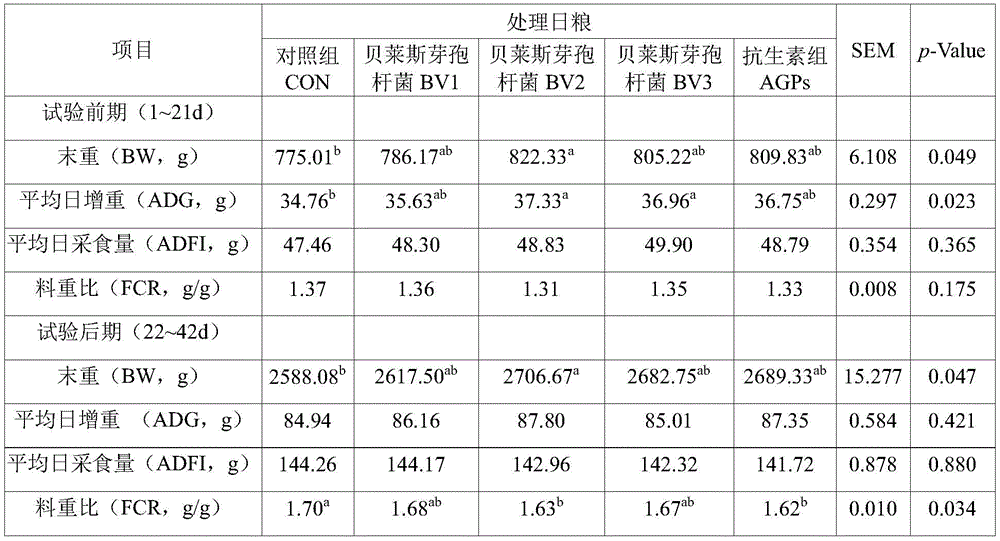
Note: the data in the same row are marked with different lower case letters to show that the difference is significant (P < 0.05), and the same or no letters to show that the difference is not significant (P > 0.05).
Influence of Bacillus belgii LB-Y-1 on intestinal flora structure
And when the broiler chickens are 42 days old, taking back the intestinal chyme, and analyzing the intestinal flora structure by a 16S amplicon sequencing and bioinformatics method.
The results show that: adding 1.0X 10⁸The abundance of intestinal flora of the broiler chickens of the CFU/kg Bacillus belgii group is remarkably increased, wherein the proportion of beneficial flora Lactobacilli, Alisipes and Lachnospiraceae is increased, the proportion of flora Escherichia-Shigella which is not beneficial to nutrient absorption and can reduce the immunity of the broiler chickens is remarkably reduced, and meanwhile, the decrease of the abundance of bacterial flora is also beneficial to the weight gain of the broiler chickens (figure 6).
Example 4 application of Bacillus beilesiensis LB-Y-1 fermented peanut meal to AFB1And the influence of the acid soluble protein content
Preparation of fermentation medium and fermentation liquid
1. Fermentation medium: 50g of peanut meal, 50mL of sterilized distilled water, and sterilizing at 105 ℃ for 15min (AFB)1The content was 103.47. mu.g/kg).
2. Inoculating strain LB-Y-1 into LB solid culture medium, selecting single colony in logarithmic phase into 10mL LB liquid culture medium, culturing at 37 deg.C and 160rpm/min for 24 hr to obtain seed solution, inoculating 1% seed solution into LB liquid culture medium, culturing at 37 deg.C and 160rpm/min for 14 hr, and collecting logarithmic phase fermentation broth (with thallus concentration of 1.0 × 10)9CFU/mL) was prepared for inoculation fermentation.
Bacillus belgii LB-Y-1 fermented peanut meal
Inoculating the fermentation broth prepared in the step one (2) into the fermentation medium prepared in the step one (1) according to the inoculation amount of 10%, fermenting at constant temperature of 37 ℃ for 60h, sampling at 0h, 12h, 24h, 36h, 48h and 60h after fermentation, drying and crushing at 50 ℃, and determining AFB (active oxygen deficiency) in the fermentation broth1And acid soluble protein content.
The results show that: with the increasing fermentation time, AFB1The content gradually decreased (FIG. 7), and the content of acid-soluble protein gradually increased(FIG. 8), the preferred level is reached at 48h of fermentation, wherein AFB1The degradation rate of the protein is 60.73%, and the content of acid soluble protein is increased from 2.89% to 21.75%.
The present invention has been described in detail above. It will be apparent to those skilled in the art that the invention can be practiced in a wide range of equivalent parameters, concentrations, and conditions without departing from the spirit and scope of the invention and without undue experimentation. While the invention has been described with reference to specific embodiments, it will be appreciated that the invention can be further modified. In general, this application is intended to cover any variations, uses, or adaptations of the invention following, in general, the principles of the invention and including such departures from the present disclosure as come within known or customary practice within the art to which the invention pertains. The use of some of the essential features is possible within the scope of the claims attached below.
Sequence listing
<110> Tianjin Bo Fei Germany Co., Ltd
<120> Bacillus belgii capable of highly producing complex enzyme and efficiently degrading mycotoxin and application thereof
<160> 1
<170> PatentIn version 3.5
<210> 1
<211> 1476
<212> DNA
<213> Artificial Sequence
<400> 1
caggacgaac gctggcggcg tgcctaatac atgcaagtcg agcggacaga tgggagcttg 60
ctccctgatg ttagcggcgg acgggtgagt aacacgtggg taacctgcct gtaagactgg 120
gataactccg ggaaaccggg gctaataccg gatggttgtt tgaaccgcat ggttcagaca 180
taaaaggtgg cttcggctac cacttacaga tggacccgcg gcgcattagc tagttggtga 240
ggtaacggct caccaaggcg acgatgcgta gccgacctga gagggtgatc ggccacactg 300
ggactgagac acggcccaga ctcctacggg aggcagcagt agggaatctt ccgcaatgga 360
cgaaagtctg acggagcaac gccgcgtgag tgatgaaggt tttcggatcg taaagctctg 420
ttgttaggga agaacaagtg ccgttcaaat agggcggcac cttgacggta cctaaccaga 480
aagccacggc taactacgtg ccagcagccg cggtaatacg taggtggcaa gcgttgtccg 540
gaattattgg gcgtaaaggg ctcgcaggcg gtttcttaag tctgatgtga aagcccccgg 600
ctcaaccggg gagggtcatt ggaaactggg gaacttgagt gcagaagagg agagtggaat 660
tccacgtgta gcggtgaaat gcgtagagat gtggaggaac accagtggcg aaggcgactc 720
tctggtctgt aactgacgct gaggagcgaa agcgtgggga gcgaacagga ttagataccc 780
tggtagtcca cgccgtaaac gatgagtgct aagtgttagg gggtttccgc cccttagtgc 840
tgcagctaac gcattaagca ctccgcctgg ggagtacggt cgcaagactg aaactcaaag 900
gaattgacgg gggcccgcac aagcggtgga gcatgtggtt taattcgaag caacgcgaag 960
aaccttacca ggtcttgaca tcctctgaca atcctagaga taggacgtcc ccttcggggg 1020
cagagtgaca ggtggtgcat ggttgtcgtc agctcgtgtc gtgagatgtt gggttaagtc 1080
ccgcaacgag cgcaaccctt gatcttagtt gccagcattc agttgggcac tctaaggtga 1140
ctgccggtga caaaccggag gaaggtgggg atgacgtcaa atcatcatgc cccttatgac 1200
ctgggctaca cacgtgctac aatgggcaga acaaagggca gcgaaaccgc gaggttaagc 1260
caatcccaca aatctgttct cagttcggat cgcagtctgc aactcgactg cgtgaagctg 1320
gaatcgctag taatcgcgga tcagcatgcc gcggtgaata cgttcccggg ccttgtacac 1380
accgcccgtc acaccacgag agtttgtaac acccgaagtc ggtgaggtaa ccttttagga 1440
gccagccgcc gaaggtggga cagatgattg gggtga 1476
Claims (10)
1. Bacillus velezensis (Bacillus velezensis) LB-Y-1, the preservation number is CGMCC No. 21344.
2. An agent, wherein the active ingredient is Bacillus bleekensis (Bacillus velezensis) LB-Y-1 or its suspension, its culture solution or its fermentation solution as defined in claim 1.
3. The microbial inoculum of claim 2, wherein: the concentration of the bacterial suspension is 1.0 x 10⁷~1.0×10⁹CFU/mL。
4. The microbial inoculum of claim 2, wherein: the concentration of the culture was 1.0X 10⁷~1.0×10⁹CFU/mL。
5. Use of the Bacillus velezensis (LB-Y-1) according to claim 1 or of the agent according to any one of claims 2 to 4) in any one of the following 1) to 9):
1) degradation or removal of AFB1;
2) Producing complex enzyme;
3) degrading macromolecular substances or increasing the content of small peptides;
4) improving the structure of animal intestinal flora;
5) the growth performance of animals is improved;
6) eliminating or inhibiting AFB in raw materials or feed1Pollution;
7) increasing the content of acid soluble protein and/or small peptide in the raw material or the feed;
8) raw material or feed detoxification;
9) improve the quality of raw materials or feed.
6. Use according to claim 5, characterized in that: the complex enzyme is protease, cellulase and amylase.
7. Use according to claim 5, characterized in that: the animal growth performance improvement is embodied in any one of the following a1) -a 2):
a1) increasing the weight of the animal;
a2) the material weight ratio is reduced.
8. Use according to claim 5, characterized in that: the structure for improving the animal intestinal flora is any one of b1) -b 3):
b1) increasing the abundance of flora in the intestinal tract of the animal;
b2) increasing the proportion of beneficial bacteria in the intestinal tract of the animal;
b3) the proportion of harmful bacteria in the intestinal tract of animals is reduced.
9. The method as described in any one of c1) -c6) below:
c1) degradation or removal of AFB1The method comprises the following steps: AFB is achieved by fermenting a raw material or feed with the Bacillus velezensis (LB-Y-1) of claim 1 or the microbial inoculum of any one of claims 2 to 41Degradation or removal;
c2) eliminating or inhibiting AFB in raw material or feed1A method of contamination comprising the steps of: the elimination or inhibition of AFB in a raw material or feed by fermentation treatment of the raw material or feed with the Bacillus velezensis (LB-Y-1) of claim 1 or the microbial inoculum of any one of claims 2 to 41Pollution;
c3) a method for detoxifying a feed or feed comprising the steps of: performing fermentation treatment on a raw material or feed by using the Bacillus subtilis LB-Y-1 of claim 1 or the microbial inoculum of any one of claims 2 to 4 to detoxify the raw material or the feed;
c4) a method of improving the quality of a feed or feed comprising the steps of: fermenting a raw material or feed with the Bacillus velezensis (LB-Y-1) of claim 1 or the microbial inoculum of claim 2 to improve the quality of the raw material or feed;
c5) a method for improving the intestinal flora structure of an animal comprising the steps of: feeding an animal with the inoculant of Bacillus subtilis LB-Y-1 of claim 1 or any one of claims 2 to 4 to achieve an improvement in the intestinal flora structure of the animal;
c6) a method for enhancing growth performance of an animal comprising the steps of: the improvement of the growth performance of animals is achieved by feeding the animals with the inoculant of Bacillus subtilis LB-Y-1 of claim 1 or any one of claims 2 to 4.
10. Use according to any one of claims 5 to 8 or a method according to claim 9, wherein: the raw material or feed is peanut meal.
Priority Applications (2)
| Application Number | Priority Date | Filing Date | Title |
|---|---|---|---|
| CN202111385265.4A CN114134075B (en) | 2021-11-22 | 2021-11-22 | Bacillus bailii capable of producing complex enzyme with high yield and simultaneously degrading mycotoxin with high efficiency and application thereof |
| PCT/CN2021/142776 WO2023087499A1 (en) | 2021-11-22 | 2021-12-30 | Bacillus velezensis capable of producing complex enzyme at high yield and efficiently degrading mycotoxin and application thereof |
Applications Claiming Priority (1)
| Application Number | Priority Date | Filing Date | Title |
|---|---|---|---|
| CN202111385265.4A CN114134075B (en) | 2021-11-22 | 2021-11-22 | Bacillus bailii capable of producing complex enzyme with high yield and simultaneously degrading mycotoxin with high efficiency and application thereof |
Publications (2)
| Publication Number | Publication Date |
|---|---|
| CN114134075A true CN114134075A (en) | 2022-03-04 |
| CN114134075B CN114134075B (en) | 2023-11-21 |
Family
ID=80390631
Family Applications (1)
| Application Number | Title | Priority Date | Filing Date |
|---|---|---|---|
| CN202111385265.4A Active CN114134075B (en) | 2021-11-22 | 2021-11-22 | Bacillus bailii capable of producing complex enzyme with high yield and simultaneously degrading mycotoxin with high efficiency and application thereof |
Country Status (2)
| Country | Link |
|---|---|
| CN (1) | CN114134075B (en) |
| WO (1) | WO2023087499A1 (en) |
Cited By (8)
| Publication number | Priority date | Publication date | Assignee | Title |
|---|---|---|---|---|
| CN114631601A (en) * | 2022-04-15 | 2022-06-17 | 北京挑战农业科技有限公司 | Production method and application of peanut meal by virtue of stepwise fermentation of bacillus beleisis and pediococcus acidilactici |
| CN115093998A (en) * | 2022-06-24 | 2022-09-23 | 华南农业大学 | Bacillus belgii for fermenting soybean meal |
| CN116179440A (en) * | 2022-08-09 | 2023-05-30 | 中国农业大学 | A strain of Bacillus Veles from chicken and its application |
| CN116287009A (en) * | 2022-12-16 | 2023-06-23 | 北京挑战农业科技有限公司 | Production method and application of co-fermentation of Shuanghuanglian herb residue by Bacillus Velez and Pediococcus lactis |
| CN117343876A (en) * | 2023-11-07 | 2024-01-05 | 湖北蓝谷中微生物技术有限公司 | Antibacterial and anti-inflammatory bacillus belicus and application thereof |
| CN117511820A (en) * | 2023-12-11 | 2024-02-06 | 大连工业大学 | A strain of Bacillus veleis and its application in preparing fermented feed |
| CN119842512A (en) * | 2024-05-14 | 2025-04-18 | 中国农业科学院油料作物研究所 | Bacillus belicus strain for reducing aflatoxin in peanut meal and application thereof |
| CN120464517A (en) * | 2025-04-23 | 2025-08-12 | 深圳良合生物科技有限公司 | A strain of Bacillus velez LPF421 and its application |
Families Citing this family (5)
| Publication number | Priority date | Publication date | Assignee | Title |
|---|---|---|---|---|
| US12350299B2 (en) | 2023-07-10 | 2025-07-08 | Bio-Cat Microbials, Llc | Bacillus velezensis compositions and methods of use thereof |
| CN117327618B (en) * | 2023-09-27 | 2024-05-14 | 中国农业科学院烟草研究所(中国烟草总公司青州烟草研究所) | Bacillus thuringiensis and its application, composite biological bacterial agent and its preparation method and application |
| CN117925453B (en) * | 2023-12-28 | 2025-08-01 | 南京中医药大学 | Bacillus belicus strain for preventing and treating early bolting of angelica sinensis, microbial agent and application thereof |
| CN118773066B (en) * | 2024-06-18 | 2025-03-14 | 南京农业大学 | Greenhouse gas emission reduction inhibitor and application thereof in livestock and poultry breeding padding |
| CN120796142A (en) * | 2025-08-05 | 2025-10-17 | 福建省农业科学院植物保护研究所 | Bacillus bailii ZZ04 and application thereof |
Citations (7)
| Publication number | Priority date | Publication date | Assignee | Title |
|---|---|---|---|---|
| CN110804570A (en) * | 2019-11-20 | 2020-02-18 | 中国农业大学 | A kind of Bacillus velesi for simultaneously degrading zearalenone and aflatoxin and its application |
| CN111235065A (en) * | 2020-03-12 | 2020-06-05 | 中国科学院南海海洋研究所 | A strain of Bacillus veles D1 with the function of efficiently degrading feed starch in aquaculture water and its application |
| CN111876351A (en) * | 2020-07-23 | 2020-11-03 | 山东农业大学 | Bacillus belgii and application thereof in relieving apple continuous cropping obstacle |
| CN111893056A (en) * | 2020-06-16 | 2020-11-06 | 金华康扬环境科技有限公司 | Bacillus belgii KY01 and application thereof in degrading kitchen garbage |
| CN112043002A (en) * | 2020-09-07 | 2020-12-08 | 湖北中烟工业有限责任公司 | Application of Bacillus velesi in degrading cellulose in tobacco incense raw materials |
| CN112358995A (en) * | 2020-11-17 | 2021-02-12 | 山东省花生研究所 | Biocontrol bacillus beleisi ZHX-12 and application thereof |
| CN112574922A (en) * | 2020-12-29 | 2021-03-30 | 新希望六和股份有限公司 | Bacillus belgii with probiotic effect and application thereof |
Family Cites Families (4)
| Publication number | Priority date | Publication date | Assignee | Title |
|---|---|---|---|---|
| US20180020676A1 (en) * | 2014-12-29 | 2018-01-25 | Fmc Corporation | Bacillus velezensis rti301 compositions and methods of use for benefiting plant growth and treating plant disease |
| CN111826295B (en) * | 2019-04-16 | 2021-07-20 | 重庆市畜牧科学院 | Bacillus velesi strains for soybean meal fermentation |
| CN112126601B (en) * | 2020-09-22 | 2022-08-12 | 天津大学 | A kind of Bacillus velesi and fermentation method and application |
| CN112980751A (en) * | 2021-05-10 | 2021-06-18 | 毕节市家乡美农业综合开发有限公司 | Bacillus belgii and application thereof |
-
2021
- 2021-11-22 CN CN202111385265.4A patent/CN114134075B/en active Active
- 2021-12-30 WO PCT/CN2021/142776 patent/WO2023087499A1/en not_active Ceased
Patent Citations (7)
| Publication number | Priority date | Publication date | Assignee | Title |
|---|---|---|---|---|
| CN110804570A (en) * | 2019-11-20 | 2020-02-18 | 中国农业大学 | A kind of Bacillus velesi for simultaneously degrading zearalenone and aflatoxin and its application |
| CN111235065A (en) * | 2020-03-12 | 2020-06-05 | 中国科学院南海海洋研究所 | A strain of Bacillus veles D1 with the function of efficiently degrading feed starch in aquaculture water and its application |
| CN111893056A (en) * | 2020-06-16 | 2020-11-06 | 金华康扬环境科技有限公司 | Bacillus belgii KY01 and application thereof in degrading kitchen garbage |
| CN111876351A (en) * | 2020-07-23 | 2020-11-03 | 山东农业大学 | Bacillus belgii and application thereof in relieving apple continuous cropping obstacle |
| CN112043002A (en) * | 2020-09-07 | 2020-12-08 | 湖北中烟工业有限责任公司 | Application of Bacillus velesi in degrading cellulose in tobacco incense raw materials |
| CN112358995A (en) * | 2020-11-17 | 2021-02-12 | 山东省花生研究所 | Biocontrol bacillus beleisi ZHX-12 and application thereof |
| CN112574922A (en) * | 2020-12-29 | 2021-03-30 | 新希望六和股份有限公司 | Bacillus belgii with probiotic effect and application thereof |
Non-Patent Citations (1)
| Title |
|---|
| 陈龙;吴兴利;闫晓刚;魏炳栋;张芳毓;: "贝莱斯芽孢杆菌的分类、次级代谢产物及应用", 家畜生态学报, vol. 41, no. 01, pages 1 - 8 * |
Cited By (12)
| Publication number | Priority date | Publication date | Assignee | Title |
|---|---|---|---|---|
| CN114631601A (en) * | 2022-04-15 | 2022-06-17 | 北京挑战农业科技有限公司 | Production method and application of peanut meal by virtue of stepwise fermentation of bacillus beleisis and pediococcus acidilactici |
| WO2023197536A1 (en) * | 2022-04-15 | 2023-10-19 | 天津博菲德科技有限公司 | Peanut meal production method using bacillus velezensis and pediococcus acidilactici for stepwise fermentation, and application thereof |
| CN115093998A (en) * | 2022-06-24 | 2022-09-23 | 华南农业大学 | Bacillus belgii for fermenting soybean meal |
| CN115093998B (en) * | 2022-06-24 | 2023-10-17 | 华南农业大学 | Bacillus belicus for fermenting soybean meal |
| CN116179440A (en) * | 2022-08-09 | 2023-05-30 | 中国农业大学 | A strain of Bacillus Veles from chicken and its application |
| CN116179440B (en) * | 2022-08-09 | 2023-12-05 | 中国农业大学 | Bacillus gallinarum and application thereof |
| CN116287009A (en) * | 2022-12-16 | 2023-06-23 | 北京挑战农业科技有限公司 | Production method and application of co-fermentation of Shuanghuanglian herb residue by Bacillus Velez and Pediococcus lactis |
| WO2024124832A1 (en) * | 2022-12-16 | 2024-06-20 | 天津博菲德科技有限公司 | Production method for co-fermentation of shuanghuanglian decoction dreg by bacillus velezensis and pediococcus acidilactici and use thereof |
| CN117343876A (en) * | 2023-11-07 | 2024-01-05 | 湖北蓝谷中微生物技术有限公司 | Antibacterial and anti-inflammatory bacillus belicus and application thereof |
| CN117511820A (en) * | 2023-12-11 | 2024-02-06 | 大连工业大学 | A strain of Bacillus veleis and its application in preparing fermented feed |
| CN119842512A (en) * | 2024-05-14 | 2025-04-18 | 中国农业科学院油料作物研究所 | Bacillus belicus strain for reducing aflatoxin in peanut meal and application thereof |
| CN120464517A (en) * | 2025-04-23 | 2025-08-12 | 深圳良合生物科技有限公司 | A strain of Bacillus velez LPF421 and its application |
Also Published As
| Publication number | Publication date |
|---|---|
| WO2023087499A1 (en) | 2023-05-25 |
| CN114134075B (en) | 2023-11-21 |
Similar Documents
| Publication | Publication Date | Title |
|---|---|---|
| CN114134075B (en) | Bacillus bailii capable of producing complex enzyme with high yield and simultaneously degrading mycotoxin with high efficiency and application thereof | |
| US20240093142A1 (en) | Strain for degrading deoxynivalenol and use thereof | |
| CN106957810B (en) | Pediococcus acidilactici and application thereof | |
| TWI545193B (en) | Bacillus amyloliquefaciens and uses of zearalenone detoxification | |
| CN113999797A (en) | Pediococcus acidilactici for improving production performance and immunity level of broiler chickens and screening method and application thereof | |
| CN102925377B (en) | Bacillus licheniformi, screening method and uses thereof | |
| CN112410269B (en) | Bacillus subtilis and application thereof in degradation of zearalenone | |
| CN110540949A (en) | Velez Bacillus Mutant Strain and Its Application | |
| CN109321500B (en) | A strain of Bacillus amyloliquefaciens and its application in the control of Camellia oleifera anthracnose | |
| CN110607251A (en) | A kind of halotolerant marine bacteria degrading vomitoxin and its application | |
| CN116218717A (en) | A strain capable of decomposing various insoluble phosphorus sources and its application | |
| CN111808765A (en) | Bacillus subtilis capable of efficiently degrading vomitoxin and application thereof | |
| CN110684695B (en) | A strain of Paenibacillus polymyxa QZY-1 and its application | |
| JP4991999B2 (en) | A novel microorganism that degrades deoxynivalenol | |
| CN112080435A (en) | A strain of lavender and its application in degrading chicken feathers | |
| CN116891818A (en) | A strain of Bacillus mobilis and its application | |
| CN107502566A (en) | One plant of lysine bacillus and its application in degrading zearalenone | |
| CN113755410B (en) | A strain of Bacillus licheniformis that degrades DON and its application | |
| KR102612095B1 (en) | Anti-microbial composition comprising bioconversion product of Nostoc commune extract or extract thereof | |
| CN112746044B (en) | A mutant strain of Lactobacillus plantarum and its application in alfalfa silage | |
| CN118028160B (en) | A strain of Arthrobacter soilh01 and its application in degradation of aflatoxins and ochratoxins | |
| CN117106649B (en) | Strain for antagonizing aspergillus flavus and application of strain in biological control of aspergillus flavus | |
| CN109810918B (en) | Bacillus atrophaeus with effect of preventing wolfberry leaf blight, biological agent and application of biological agent | |
| CN118389370A (en) | Nocardia YB-2 and application thereof in degrading vomitoxin | |
| CN112322539B (en) | Enterococcus faecium R-NTR-1 from ocean and screening method and application thereof |
Legal Events
| Date | Code | Title | Description |
|---|---|---|---|
| PB01 | Publication | ||
| PB01 | Publication | ||
| SE01 | Entry into force of request for substantive examination | ||
| SE01 | Entry into force of request for substantive examination | ||
| GR01 | Patent grant | ||
| GR01 | Patent grant |