CN114124367B - Data transmission method, device and storage medium - Google Patents
Data transmission method, device and storage medium Download PDFInfo
- Publication number
- CN114124367B CN114124367B CN202010899982.8A CN202010899982A CN114124367B CN 114124367 B CN114124367 B CN 114124367B CN 202010899982 A CN202010899982 A CN 202010899982A CN 114124367 B CN114124367 B CN 114124367B
- Authority
- CN
- China
- Prior art keywords
- message
- client
- key
- server
- encryption
- Prior art date
- Legal status (The legal status is an assumption and is not a legal conclusion. Google has not performed a legal analysis and makes no representation as to the accuracy of the status listed.)
- Active
Links
Images


Classifications
-
- H—ELECTRICITY
- H04—ELECTRIC COMMUNICATION TECHNIQUE
- H04W—WIRELESS COMMUNICATION NETWORKS
- H04W12/00—Security arrangements; Authentication; Protecting privacy or anonymity
- H04W12/04—Key management, e.g. using generic bootstrapping architecture [GBA]
- H04W12/047—Key management, e.g. using generic bootstrapping architecture [GBA] without using a trusted network node as an anchor
- H04W12/0471—Key exchange
-
- H—ELECTRICITY
- H04—ELECTRIC COMMUNICATION TECHNIQUE
- H04L—TRANSMISSION OF DIGITAL INFORMATION, e.g. TELEGRAPHIC COMMUNICATION
- H04L9/00—Cryptographic mechanisms or cryptographic arrangements for secret or secure communications; Network security protocols
- H04L9/08—Key distribution or management, e.g. generation, sharing or updating, of cryptographic keys or passwords
- H04L9/0816—Key establishment, i.e. cryptographic processes or cryptographic protocols whereby a shared secret becomes available to two or more parties, for subsequent use
- H04L9/0838—Key agreement, i.e. key establishment technique in which a shared key is derived by parties as a function of information contributed by, or associated with, each of these
-
- H—ELECTRICITY
- H04—ELECTRIC COMMUNICATION TECHNIQUE
- H04L—TRANSMISSION OF DIGITAL INFORMATION, e.g. TELEGRAPHIC COMMUNICATION
- H04L9/00—Cryptographic mechanisms or cryptographic arrangements for secret or secure communications; Network security protocols
- H04L9/08—Key distribution or management, e.g. generation, sharing or updating, of cryptographic keys or passwords
- H04L9/0816—Key establishment, i.e. cryptographic processes or cryptographic protocols whereby a shared secret becomes available to two or more parties, for subsequent use
- H04L9/085—Secret sharing or secret splitting, e.g. threshold schemes
-
- H—ELECTRICITY
- H04—ELECTRIC COMMUNICATION TECHNIQUE
- H04L—TRANSMISSION OF DIGITAL INFORMATION, e.g. TELEGRAPHIC COMMUNICATION
- H04L63/00—Network architectures or network communication protocols for network security
- H04L63/04—Network architectures or network communication protocols for network security for providing a confidential data exchange among entities communicating through data packet networks
- H04L63/0428—Network architectures or network communication protocols for network security for providing a confidential data exchange among entities communicating through data packet networks wherein the data content is protected, e.g. by encrypting or encapsulating the payload
-
- H—ELECTRICITY
- H04—ELECTRIC COMMUNICATION TECHNIQUE
- H04L—TRANSMISSION OF DIGITAL INFORMATION, e.g. TELEGRAPHIC COMMUNICATION
- H04L63/00—Network architectures or network communication protocols for network security
- H04L63/16—Implementing security features at a particular protocol layer
- H04L63/166—Implementing security features at a particular protocol layer at the transport layer
-
- H—ELECTRICITY
- H04—ELECTRIC COMMUNICATION TECHNIQUE
- H04L—TRANSMISSION OF DIGITAL INFORMATION, e.g. TELEGRAPHIC COMMUNICATION
- H04L9/00—Cryptographic mechanisms or cryptographic arrangements for secret or secure communications; Network security protocols
- H04L9/08—Key distribution or management, e.g. generation, sharing or updating, of cryptographic keys or passwords
- H04L9/0816—Key establishment, i.e. cryptographic processes or cryptographic protocols whereby a shared secret becomes available to two or more parties, for subsequent use
- H04L9/0838—Key agreement, i.e. key establishment technique in which a shared key is derived by parties as a function of information contributed by, or associated with, each of these
- H04L9/0841—Key agreement, i.e. key establishment technique in which a shared key is derived by parties as a function of information contributed by, or associated with, each of these involving Diffie-Hellman or related key agreement protocols
-
- H—ELECTRICITY
- H04—ELECTRIC COMMUNICATION TECHNIQUE
- H04L—TRANSMISSION OF DIGITAL INFORMATION, e.g. TELEGRAPHIC COMMUNICATION
- H04L9/00—Cryptographic mechanisms or cryptographic arrangements for secret or secure communications; Network security protocols
- H04L9/08—Key distribution or management, e.g. generation, sharing or updating, of cryptographic keys or passwords
- H04L9/0891—Revocation or update of secret information, e.g. encryption key update or rekeying
-
- H—ELECTRICITY
- H04—ELECTRIC COMMUNICATION TECHNIQUE
- H04L—TRANSMISSION OF DIGITAL INFORMATION, e.g. TELEGRAPHIC COMMUNICATION
- H04L9/00—Cryptographic mechanisms or cryptographic arrangements for secret or secure communications; Network security protocols
- H04L9/12—Transmitting and receiving encryption devices synchronised or initially set up in a particular manner
-
- H—ELECTRICITY
- H04—ELECTRIC COMMUNICATION TECHNIQUE
- H04L—TRANSMISSION OF DIGITAL INFORMATION, e.g. TELEGRAPHIC COMMUNICATION
- H04L9/00—Cryptographic mechanisms or cryptographic arrangements for secret or secure communications; Network security protocols
- H04L9/30—Public key, i.e. encryption algorithm being computationally infeasible to invert or user's encryption keys not requiring secrecy
- H04L9/3066—Public key, i.e. encryption algorithm being computationally infeasible to invert or user's encryption keys not requiring secrecy involving algebraic varieties, e.g. elliptic or hyper-elliptic curves
-
- H—ELECTRICITY
- H04—ELECTRIC COMMUNICATION TECHNIQUE
- H04L—TRANSMISSION OF DIGITAL INFORMATION, e.g. TELEGRAPHIC COMMUNICATION
- H04L9/00—Cryptographic mechanisms or cryptographic arrangements for secret or secure communications; Network security protocols
- H04L9/32—Cryptographic mechanisms or cryptographic arrangements for secret or secure communications; Network security protocols including means for verifying the identity or authority of a user of the system or for message authentication, e.g. authorization, entity authentication, data integrity or data verification, non-repudiation, key authentication or verification of credentials
- H04L9/3236—Cryptographic mechanisms or cryptographic arrangements for secret or secure communications; Network security protocols including means for verifying the identity or authority of a user of the system or for message authentication, e.g. authorization, entity authentication, data integrity or data verification, non-repudiation, key authentication or verification of credentials using cryptographic hash functions
-
- H—ELECTRICITY
- H04—ELECTRIC COMMUNICATION TECHNIQUE
- H04W—WIRELESS COMMUNICATION NETWORKS
- H04W12/00—Security arrangements; Authentication; Protecting privacy or anonymity
- H04W12/03—Protecting confidentiality, e.g. by encryption
- H04W12/033—Protecting confidentiality, e.g. by encryption of the user plane, e.g. user's traffic
Landscapes
- Engineering & Computer Science (AREA)
- Computer Security & Cryptography (AREA)
- Computer Networks & Wireless Communication (AREA)
- Signal Processing (AREA)
- Computing Systems (AREA)
- Theoretical Computer Science (AREA)
- General Engineering & Computer Science (AREA)
- Computer Hardware Design (AREA)
- Physics & Mathematics (AREA)
- Mathematical Physics (AREA)
- Pure & Applied Mathematics (AREA)
- Mathematical Optimization (AREA)
- Mathematical Analysis (AREA)
- General Physics & Mathematics (AREA)
- Algebra (AREA)
- Mobile Radio Communication Systems (AREA)
- Information Transfer Between Computers (AREA)
- Computer And Data Communications (AREA)
Abstract
本申请公开一种数据传输方法,应用于客户端,包括:第一端通过握手消息与第二端协商共享密钥;所述第一端通过内容消息与所述第二端传输应用数据,所述内容消息通过使用所述共享密钥进行加密和解密;其中,所述握手消息和所述内容消息具有相同的消息格式,所述消息格式包括:消息序号和消息载荷;所述消息序号包括密钥代数(Epoch)标识和消息计数(Seq)标识,其中,所述密钥代数标识通过小于第一位数的比特信息进行表征,所述消息计数标识通过小于第二位数的比特信息进行表征。本申请还公开了一种数据传输装置及存储介质;通过本申请实施例提供的数据传输方法、装置及存储介质,可以实现共享密钥的协商。

The present application discloses a data transmission method applied to a client, including: the first end negotiates a shared key with the second end through a handshake message; the first end transmits application data with the second end through a content message, and the The content message is encrypted and decrypted by using the shared key; wherein, the handshake message and the content message have the same message format, and the message format includes: a message sequence number and a message load; the message sequence number includes a secret Key algebra (Epoch) identification and message count (Seq) identification, wherein, the key algebra identification is characterized by bit information less than the first digit, and the message count identification is characterized by bit information less than the second digit . The present application also discloses a data transmission device and a storage medium; through the data transmission method, device and storage medium provided by the embodiments of the present application, the negotiation of a shared key can be realized.
Description
技术领域Technical Field
本申请涉及通信安全技术领域,尤其涉及一种数据传输方法、装置及存储介质。The present application relates to the field of communication security technology, and in particular to a data transmission method, device and storage medium.
背景技术Background Art
物联网设备在进行数据传输之前,考虑到数据传输的安全因素,客户端与服务端需要先通过交互的方式协商共享密钥,进而通过共享密钥进行数据传输。因此,如何协商共享密钥,是需要解决的技术问题。Before IoT devices transmit data, considering the security of data transmission, the client and the server need to negotiate a shared key through interaction, and then transmit data through the shared key. Therefore, how to negotiate the shared key is a technical problem that needs to be solved.
发明内容Summary of the invention
本申请实施例提供一种数据传输方法、装置及存储介质,可以灵活地确定密钥协商模式,进而协商共享密钥,进行数据传输。The embodiments of the present application provide a data transmission method, device, and storage medium, which can flexibly determine a key negotiation mode, and then negotiate a shared key to perform data transmission.
本申请实施例的技术方案是这样实现的:The technical solution of the embodiment of the present application is implemented as follows:
第一方面,本申请实施例提供一种数据传输方法,包括:In a first aspect, an embodiment of the present application provides a data transmission method, including:
第一端通过握手消息与第二端协商共享密钥;The first end negotiates a shared key with the second end through a handshake message;
所述第一端通过内容消息与所述第二端传输应用数据,所述内容消息通过使用所述共享密钥进行加密和解密;The first end transmits application data with the second end via a content message, wherein the content message is encrypted and decrypted by using the shared key;
其中,所述握手消息和所述内容消息具有相同的消息格式,所述消息格式包括:消息序号和消息载荷;The handshake message and the content message have the same message format, and the message format includes: a message sequence number and a message payload;
所述消息序号包括密钥代数(Epoch)标识和消息计数(Seq)标识,其中,所述密钥代数标识通过小于第一位数的比特信息进行表征,所述消息计数标识通过小于第二位数的比特信息进行表征。The message sequence number includes a key epoch identifier and a message count (Seq) identifier, wherein the key epoch identifier is represented by bit information smaller than a first digit, and the message count identifier is represented by bit information smaller than a second digit.
第二方面,本申请实施例提供一种数据传输装置,包括:In a second aspect, an embodiment of the present application provides a data transmission device, including:
协商单元,用于通过握手消息与第二端协商密钥;A negotiation unit, configured to negotiate a key with the second end through a handshake message;
应用数据单元,用于通过内容消息与所述第二端传输应用数据,所述内容消息通过使用所述共享密钥进行加密和解密;an application data unit, configured to transmit application data to the second end via a content message, wherein the content message is encrypted and decrypted by using the shared key;
其中,所述握手消息和所述内容消息具有相同的消息格式,所述消息格式包括:消息序号和消息载荷;The handshake message and the content message have the same message format, and the message format includes: a message sequence number and a message payload;
所述消息序号包括密钥代数标识和消息计数标识,其中,所述密钥代数标识通过小于第一位数的比特信息进行表征,所述消息计数标识通过小于第二位数的比特信息进行表征。The message sequence number includes a key algebraic identifier and a message count identifier, wherein the key algebraic identifier is represented by bit information smaller than a first digit, and the message count identifier is represented by bit information smaller than a second digit.
上述方案中,所述消息载荷包括实际数据和消息类型,所述消息类型包括填充类型、应用数据类型、警告类型和握手类型。In the above solution, the message payload includes actual data and message type, and the message type includes padding type, application data type, warning type and handshake type.
上述方案中,所述装置还包括:加密单元;In the above scheme, the device further comprises: an encryption unit;
所述加密单元,用于通过所述共享密钥对所述内容消息中的消息载荷进行加密。The encryption unit is used to encrypt the message payload in the content message by using the shared key.
上述方案中,所述装置还包括:校验单元;In the above solution, the device further comprises: a verification unit;
所述校验单元,用于在协商共享密钥过程中,对所述握手消息进行校验得到校验值。The verification unit is used to verify the handshake message to obtain a verification value during the negotiation of the shared key.
上述方案中,所述握手消息包括握手完成消息,用于指示完成所述共享密钥的协商流程,其中,所述握手完成消息携带所述校验值。In the above solution, the handshake message includes a handshake completion message, which is used to indicate the completion of the negotiation process of the shared key, wherein the handshake completion message carries the verification value.
上述方案中,所述握手消息包括以下至少一项:握手问候消息、握手应答消息、重发请求消息、认证数据消息、握手完成消息。In the above scheme, the handshake message includes at least one of the following: a handshake greeting message, a handshake response message, a resend request message, an authentication data message, and a handshake completion message.
上述方案中,所述握手问候消息、握手应答消息、重发请求消息的消息载荷中至少包括以下字段中的一种或多种:协议版本字段、加密套件字段、共享密钥字段、加密曲线字段。In the above scheme, the message payload of the handshake hello message, handshake response message, and retransmission request message includes at least one or more of the following fields: protocol version field, encryption suite field, shared key field, and encryption curve field.
上述方案中,所述第一端通过所述握手问候消息、所述握手应答消息或所述重发请求消息与所述第二端协商共享密钥时,所述密钥代数标识为a;In the above solution, when the first end negotiates a shared key with the second end through the handshake hello message, the handshake response message or the retransmission request message, the key algebra identifier is a;
所述第一端通过所述认证数据消息或所述握手完成消息与所述第二端协商共享密钥时,所述密钥代数标识为a+1;When the first end negotiates a shared key with the second end through the authentication data message or the handshake completion message, the key algebra identifier is a+1;
所述第一端通过所述内容消息与所述第二端传输应用数据时,所述密钥代数标识为a+2至a+N;其中,a为整数,N为大于或等于2的整数。When the first end transmits application data with the second end through the content message, the key generation number identifier is a+2 to a+N; wherein a is an integer, and N is an integer greater than or equal to 2.
上述方案中,所述握手问候消息或所述握手应答消息的消息载荷中包括公钥列表字段,所述公钥列表字段的值为空(NULL),所述空值用于确定所述第二端是否支持目标加密套件。In the above scheme, the message payload of the handshake hello message or the handshake response message includes a public key list field, the value of the public key list field is empty (NULL), and the empty value is used to determine whether the second end supports the target encryption suite.
上述方案中,所述第二端基于所述握手问候消息返回所述重发请求消息,其中,所述重发请求消息中的加密套件字段配置为所述目标加密套件。In the above solution, the second end returns the retransmission request message based on the handshake hello message, wherein the encryption suite field in the retransmission request message is configured as the target encryption suite.
上述方案中,所述第一端为客户端(Client),所述第二端为服务端(Server);或者,所述第一端为服务端,所述第二端为客户端。In the above solution, the first end is a client (Client), and the second end is a server (Server); or, the first end is a server, and the second end is a client.
本申请实施例提供的数据传输方法、装置及存储介质,第一端通过握手消息与第二端协商共享密钥;所述第一端通过内容消息与所述第二端传输应用数据,所述内容消息通过使用所述共享密钥进行加密和解密;其中,所述握手消息和所述内容消息具有相同的消息格式,所述消息格式包括:消息序号和消息载荷;所述消息序号包括密钥代数标识和消息计数标识,其中,所述密钥代数标识通过小于第一位数的比特信息进行表征,所述消息计数标识通过小于第二位数的比特信息进行表征。。如此,可以灵活地确定密钥协商模式,进行共享密钥协商,进而通过协商的共享密钥传输目标数据。The data transmission method, device and storage medium provided by the embodiment of the present application, the first end negotiates a shared key with the second end through a handshake message; the first end transmits application data with the second end through a content message, and the content message is encrypted and decrypted by using the shared key; wherein the handshake message and the content message have the same message format, and the message format includes: a message sequence number and a message payload; the message sequence number includes a key algebraic identifier and a message count identifier, wherein the key algebraic identifier is represented by bit information less than the first digit, and the message count identifier is represented by bit information less than the second digit. . In this way, the key negotiation mode can be flexibly determined, the shared key negotiation can be performed, and then the target data can be transmitted through the negotiated shared key.
附图说明BRIEF DESCRIPTION OF THE DRAWINGS
图1为相关技术中基于ECDH的配网协议的流程示意图;FIG1 is a flow chart of a network distribution protocol based on ECDH in the related art;
图2为相关技术中基于ECJPAKE的配网协议的流程示意图;FIG2 is a flow chart of a network distribution protocol based on ECJPAKE in the related art;
图3为本申请实施例提供的数据传输方法的客户端侧的一种可选流程示意图;FIG3 is a schematic diagram of an optional flow chart of a client side of a data transmission method provided in an embodiment of the present application;
图4为本申请实施例提供的使用ECDH的配网协议协商共享密钥的可选流程示意图;FIG4 is a schematic diagram of an optional process for negotiating a shared key using an ECDH network configuration protocol according to an embodiment of the present application;
图5为本申请实施例提供的使用ECDH的配网协议协商共享密钥的详细处理流程示意图;FIG5 is a schematic diagram of a detailed processing flow of negotiating a shared key using the ECDH network configuration protocol provided in an embodiment of the present application;
图6为本申请实施例提供的使用ECJPAKE的配网协议协商共享密钥的可选流程示意图;FIG6 is a schematic diagram of an optional process of negotiating a shared key using the network configuration protocol of ECJPAKE provided in an embodiment of the present application;
图7为本申请实施例提供的使用ECJPAKE的配网协议协商共享密钥的详细处理流程示意图;FIG7 is a schematic diagram of a detailed processing flow of negotiating a shared key using the network configuration protocol of ECJPAKE provided in an embodiment of the present application;
图8为本申请实施例提供的数据传输方法的服务端侧的一种可选流程示意图;FIG8 is a schematic diagram of an optional flow chart of the service end side of the data transmission method provided in an embodiment of the present application;
图9为本申请实施例提供的数据传输方法的一种可选流程示意图;FIG9 is a schematic diagram of an optional flow chart of a data transmission method provided in an embodiment of the present application;
图10为本申请实施例提供的数据传输方法的一种详细处理流程示意图;FIG10 is a schematic diagram of a detailed processing flow of a data transmission method provided in an embodiment of the present application;
图11为本申请实施例提供的数据传输方法的又一种可选流程示意图;FIG11 is a schematic diagram of another optional flow chart of the data transmission method provided in an embodiment of the present application;
图12为本申请实施例提供的数据传输方法的又一种详细处理流程示意图;FIG12 is a schematic diagram of another detailed processing flow of the data transmission method provided in an embodiment of the present application;
图13为本申请实施例提供的数据传输方法的再一种可选流程示意图;FIG13 is a schematic diagram of another optional flow chart of the data transmission method provided in an embodiment of the present application;
图14为本申请实施例提供的数据传输方法的再一种详细处理流程示意图;FIG14 is a schematic diagram of another detailed processing flow of the data transmission method provided in an embodiment of the present application;
图15为本申请实施例提供的数据传输方法的还一种可选流程示意图;FIG15 is a schematic diagram of another optional flow chart of the data transmission method provided in an embodiment of the present application;
图16为本申请实施例提供的数据传输方法的另一种可选流程示意图;FIG16 is a schematic diagram of another optional flow chart of the data transmission method provided in an embodiment of the present application;
图17为本申请实施例提供的客户端与服务端传输的消息的内容的可选结构示意图;FIG17 is a schematic diagram of an optional structure of the content of a message transmitted between a client and a server according to an embodiment of the present application;
图18为本申请实施例提供的客户端的一种可选结构示意图;FIG18 is a schematic diagram of an optional structure of a client provided in an embodiment of the present application;
图19为本申请实施例提供的服务端的一种可选结构示意图;FIG19 is a schematic diagram of an optional structure of a server provided in an embodiment of the present application;
图20为本申请实施例提供的数据传输装置的一种可选结构示意图;FIG20 is a schematic diagram of an optional structure of a data transmission device provided in an embodiment of the present application;
图21为本申请实施例的电子设备的硬件组成结构示意图。FIG. 21 is a schematic diagram of the hardware composition structure of the electronic device according to an embodiment of the present application.
具体实施方式DETAILED DESCRIPTION
以下结合附图及实施例,对本申请进行进一步详细说明。应当理解,此处所描述的具体实施例仅仅用以解释本申请,并不用于限定本申请。The present application is further described in detail below in conjunction with the accompanying drawings and embodiments. It should be understood that the specific embodiments described herein are only used to explain the present application and are not used to limit the present application.
物联网设备在进行功能层面的操作前,出于安全的考虑,往往需要先经过配置,所谓配置,就是通过交互的方式以验证双方身份,并在此过程产生用于数据加密的密钥,由于大部分物联网(Internet of Things,IoT)设备具备通过无线技术,如WiFi、蓝牙低能耗(Bluetooth Low Energy,BLE)等,进行连接的能力,设备配置后才可以在当前无线网络进行通讯,故将此过程称为配网。Before performing functional operations, IoT devices often need to be configured for security reasons. Configuration is to verify the identities of both parties through interaction and generate keys for data encryption in this process. Since most IoT (Internet of Things) devices have the ability to connect through wireless technologies such as WiFi and Bluetooth Low Energy (BLE), devices can communicate on the current wireless network only after configuration, so this process is called network configuration.
目前有两种主流配网协议,基于ECDH与ECJPAKE的配网协议,大致流程如图1和图2所示。There are currently two mainstream network distribution protocols, the network distribution protocols based on ECDH and ECJPAKE, and the general process is shown in Figures 1 and 2.
图1示出了相关技术中基于ECDH的配网协议的流程示意图。FIG. 1 shows a schematic diagram of a flow chart of a network configuration protocol based on ECDH in the related art.
如图1所示,在第一客户端与服务端建立连接后,分别生成相应的密钥对,然后基于交互的公钥产生共享密钥,在产生共享密钥后即可认为配网完成,进行应用层数据的传输(用共享密钥进行对称加密)。As shown in Figure 1, after the first client establishes a connection with the server, they generate corresponding key pairs respectively, and then generate a shared key based on the interacted public key. After the shared key is generated, the network configuration is considered complete and the application layer data is transmitted (symmetric encryption is performed using the shared key).
图2示出了相关技术中基于ECJPAKE的配网协议的流程示意图。FIG. 2 shows a flow chart of a network distribution protocol based on ECJPAKE in the related art.
如图2所示,在第一客户端与服务端建立连接,进入握手阶段交换公钥,产生共享密钥,在产生共享密钥后即可认为配网完成,进行应用层数据的传输(用共享密钥进行对称加密)。As shown in Figure 2, a connection is established between the first client and the server, and the public keys are exchanged in the handshake phase to generate a shared key. After the shared key is generated, the network configuration is considered complete and the application layer data is transmitted (symmetric encryption is performed using the shared key).
但是,在相关技术中基于ECDH的配网协议或者基于ECJPAKE的配网协议,设备的支持不够灵活、全面,同时,目前的标准流程交互过程中数据量高,对BLE设备而言负担大。However, in the related technologies, the network configuration protocol based on ECDH or the network configuration protocol based on ECJPAKE is not flexible and comprehensive enough in terms of device support. At the same time, the current standard process interaction process has a high amount of data, which is a heavy burden for BLE devices.
随着人们对安全、隐私的意识越来越高,安全技术在物联网产品中显得愈发重要,通常在BLE设备端的做法是,根据BLE设备的安全等级执行不同的协商流程,具体包括:As people become more and more aware of security and privacy, security technology becomes increasingly important in IoT products. Usually, different negotiation processes are performed on the BLE device side according to the security level of the BLE device, including:
(1)低安全等级:随机数提供不可预测性,对称密钥,对称加、解密(AES-128);(1) Low security level: random numbers provide unpredictability, symmetric keys, symmetric encryption and decryption (AES-128);
(2)高安全等级:随机数提供不可预测性,非对称密钥交换(ECDH密钥交换),对消息进行对称加、解密(AES-128),在消息头加消息序列号用于防重放,证书认证身份。(2) High security level: Random numbers provide unpredictability, asymmetric key exchange (ECDH key exchange), symmetric encryption and decryption of messages (AES-128), adding a message sequence number to the message header to prevent replay, and certificate authentication.
此外,申请人还发现对于有个人识别密码(Personal Identification Number,PIN)码的设备,PIN码本身的保护程度不够,容易发生泄露,另外密钥一旦产生将会在整个生命周期使用,没有更新机制。In addition, the applicant also found that for devices with personal identification numbers (PINs), the PINs themselves are not sufficiently protected and are prone to leakage. In addition, once the key is generated, it will be used throughout its life cycle without an update mechanism.
基于安全通信方法中存在的问题,本申请提出一种数据传输方法,能够解决现有技术方案中无法解决的技术难题和缺点。Based on the problems existing in the secure communication method, the present application proposes a data transmission method that can solve the technical difficulties and shortcomings that cannot be solved in the existing technical solutions.
图3示出了本申请实施例提供的数据传输方法的客户端侧的一种可选流程示意图,将根据各个步骤进行说明。FIG3 shows an optional flow chart of the client side of the data transmission method provided in an embodiment of the present application, which will be described according to each step.
步骤S101,发送第一客户端问候消息。Step S101: Send a first client hello message.
在一些实施例中,所述客户端向服务端发送第一客户端问候消息,所述第一客户端问候消息包括第一信息,所述第一信息用于指示所述客户端能够支持的第一密钥协商模式。In some embodiments, the client sends a first client hello message to the server, where the first client hello message includes first information, where the first information is used to indicate a first key negotiation mode that the client can support.
在一些实施例中,所述第一密钥协商模式包括使用ECDH的配网协议协商密钥和/或使用ECJPAKE的配网协议协商密钥。In some embodiments, the first key agreement mode includes negotiating a key using a network configuration protocol of ECDH and/or negotiating a key using a network configuration protocol of ECJPAKE.
在一些实施例中,所述第一信息包括第一加密套件集合;所述第一加密套件集合包括所述客户端能够支持的至少一个加密套件的集合。In some embodiments, the first information includes a first encryption suite set; the first encryption suite set includes a set of at least one encryption suite that the client can support.
在另一些实施例中,所述第一客户端问候消息还可以包括:第一加密套件字段;所述加密套件字段用于指示所述客户端支持的部分或全部加密套件参数。In some other embodiments, the first client hello message may further include: a first encryption suite field; the encryption suite field is used to indicate some or all encryption suite parameters supported by the client.
在一些实施例中,所述第一信息还可以包括第一加密曲线集合;所述第一加密曲线集合包括所述客户端能够支持的至少一个加密曲线的集合。In some embodiments, the first information may further include a first encryption curve set; the first encryption curve set includes a set of at least one encryption curve that the client can support.
在另一些实施例中,所述第一客户端问候消息还可以包括:第一加密曲线字段;所述加密曲线字段用于指示所述客户端支持的部分或全部加密曲线参数。In some other embodiments, the first client hello message may further include: a first encryption curve field; the encryption curve field is used to indicate some or all encryption curve parameters supported by the client.
在一些实施例中,所述第一客户端问候消息还包括:第一公钥,所述第一公钥包括:在所述客户端能够支持ECDH的配网协议的情况下,所述第一加密套件集合中任一个加密套件和/或所述第一加密曲线集合中任一个加密曲线确定的公钥。不同加密套件和/或加密曲线确定的公钥不同。In some embodiments, the first client hello message further includes: a first public key, the first public key including: a public key determined by any encryption suite in the first encryption suite set and/or any encryption curve in the first encryption curve set when the client is capable of supporting the ECDH network configuration protocol. The public keys determined by different encryption suites and/or encryption curves are different.
在一些实施例中,所述第一客户端问候消息还包括:第一协议标识集合,所述第一协议标识集合包括至少一个协议版本对应的协议标识,所述协议版本与所述协议标识一一对应,所述第一协议标识集合指示所述客户端支持的协议版本的集合。In some embodiments, the first client hello message also includes: a first protocol identifier set, the first protocol identifier set includes a protocol identifier corresponding to at least one protocol version, the protocol version corresponds one-to-one to the protocol identifier, and the first protocol identifier set indicates a set of protocol versions supported by the client.
在另一些实施例中,所述第一客户端问候消息还可以包括:协议版本字段;所述协议版本字段用于指示所述客户端支持的部分或全部协议版本参数。In some other embodiments, the first client hello message may further include: a protocol version field; the protocol version field is used to indicate some or all protocol version parameters supported by the client.
在一些实施例中,所述第一客户端问候消息还包括:第一公钥列表,所述第一客户端问候消息的第一公钥列表为NULL。In some embodiments, the first client hello message further includes: a first public key list, and the first public key list of the first client hello message is NULL.
步骤S102,获取服务端基于所述第一客户端问候消息发送的第一反馈信息。Step S102: obtaining first feedback information sent by the server based on the first client hello message.
在一些实施例中,所述客户端可以是主动连接端,所述客户端可以是蓝牙低功耗设备,也可以是如手持终端、可穿戴终端、个人笔记本、平板电脑等电子设备;所述服务端可以是被动连接端,所述服务端可以是蓝牙低功耗设备,如应用于监控护理领域的血压测量装置、温度测量装置、血糖监测装置;或应用于运动和健身领域的健身器材传感器、心律测量装置、定位装置、测速装置、测重装置;或应用于智能家居领域的开关装置、照明装置、智能门锁、电动窗帘、扫地机器人等。In some embodiments, the client can be an active connection end, the client can be a Bluetooth low-power device, or an electronic device such as a handheld terminal, a wearable terminal, a personal notebook, a tablet computer, etc.; the server can be a passive connection end, the server can be a Bluetooth low-power device, such as a blood pressure measuring device, a temperature measuring device, a blood sugar monitoring device used in the field of monitoring and care; or a fitness equipment sensor, a heart rate measuring device, a positioning device, a speed measuring device, a weight measuring device used in the field of sports and fitness; or a switch device, a lighting device, a smart door lock, an electric curtain, a sweeping robot, etc. used in the field of smart home.
在一些实施例中,所述客户端获取服务端基于所述第一客户端问候消息发送的第一服务端反馈消息;所述第一服务端反馈消息包括第一反馈信息,所述第一反馈信息用于指示所述服务端确定的第二密钥协商模式。In some embodiments, the client obtains a first server feedback message sent by the server based on the first client hello message; the first server feedback message includes first feedback information, and the first feedback information is used to indicate a second key negotiation mode determined by the server.
在一些实施例中,在满足所述第一客户端问候消息中包括的第一加密套件集合中包括所述服务端支持的至少一个加密套件、所述第一客户端问候消息中包括的第一加密曲线集合包括所述服务端支持的至少一个加密曲线或所述第一客户端问候消息包括的第一协议标识集合中包括所述服务端支持的至少一个协议版本对应的协议标识,且所述服务端确定第二密钥协商模式为使用ECDH的配网协议协商密钥的情况下,所述第一反馈信息包括以下至少一种:第一加密套件、第一加密曲线、第一协议标识和第二公钥;所述第一加密套件集合包括所述第一加密套件,所述第一加密套件包括所述服务端支持的至少一个加密套件中任一个加密套件;所述第一加密曲线集合包括所述第一加密曲线,所述第一加密曲线包括所述服务端支持的至少一个加密曲线中任一个加密曲线;所述第一协议标识集合包括所述第一协议标识,所述第一协议标识包括所述服务端支持的至少一个协议版本中任一个协议版本对应的协议标识。所述第二公钥基于所述第一加密套件、第一加密曲线和第一协议标识中至少一种确定。所述第一公钥与所述第二公钥相同或不同。In some embodiments, when the first encryption suite set included in the first client hello message includes at least one encryption suite supported by the server, the first encryption curve set included in the first client hello message includes at least one encryption curve supported by the server, or the first protocol identifier set included in the first client hello message includes a protocol identifier corresponding to at least one protocol version supported by the server, and the server determines that the second key agreement mode is to use ECDH to negotiate the network configuration protocol key, the first feedback information includes at least one of the following: a first encryption suite, a first encryption curve, a first protocol identifier, and a second public key; the first encryption suite set includes the first encryption suite, the first encryption suite includes any one of the at least one encryption suite supported by the server; the first encryption curve set includes the first encryption curve, the first encryption curve includes any one of the at least one encryption curve supported by the server; the first protocol identifier set includes the first protocol identifier, the first protocol identifier includes a protocol identifier corresponding to any one of the at least one protocol version supported by the server. The second public key is determined based on at least one of the first encryption suite, the first encryption curve, and the first protocol identifier. The first public key is the same as or different from the second public key.
在另一些实施例中,在满足所述第一客户端问候消息中包括的第一加密套件集合中包括所述服务端支持的至少一个加密套件、所述第一客户端问候消息中包括的第一加密曲线集合包括所述服务端支持的至少一个加密曲线或所述第一客户端问候消息包括的第一协议标识集合中包括所述服务端支持的至少一个协议版本对应的协议标识,且所述服务端确定第二密钥协商模式为使用ECJPAKE的配网协议协商密钥的情况下,所述第一反馈信息包括:第一加密套件、第一加密曲线、第一协议标识和第一公钥列表;所述第一加密套件集合包括所述第一加密套件,所述第一加密套件包括所述服务端支持的至少一个加密套件中任一个加密套件;所述第一加密曲线集合包括所述第一加密曲线,所述第一加密曲线包括所述服务端支持的至少一个加密曲线中任一个加密曲线;所述第一协议标识集合包括所述第一协议标识,所述第一协议标识包括所述服务端支持的至少一个协议版本中任一个协议版本对应的协议标识。所述第二公钥基于所述第一加密套件、第一加密曲线和第一协议标识中至少一种确定。所述第一公钥列表包括服务端向客户端发送的,用于确定第一客户端共享密钥的公钥对。In some other embodiments, when the first encryption suite set included in the first client hello message includes at least one encryption suite supported by the server, the first encryption curve set included in the first client hello message includes at least one encryption curve supported by the server, or the first protocol identifier set included in the first client hello message includes a protocol identifier corresponding to at least one protocol version supported by the server, and the server determines that the second key negotiation mode is to use the network configuration protocol negotiation key of ECJPAKE, the first feedback information includes: a first encryption suite, a first encryption curve, a first protocol identifier, and a first public key list; the first encryption suite set includes the first encryption suite, the first encryption suite includes any one encryption suite in at least one encryption suite supported by the server; the first encryption curve set includes the first encryption curve, the first encryption curve includes any one encryption curve in at least one encryption curve supported by the server; the first protocol identifier set includes the first protocol identifier, the first protocol identifier includes a protocol identifier corresponding to any one protocol version in at least one protocol version supported by the server. The second public key is determined based on at least one of the first encryption suite, the first encryption curve, and the first protocol identifier. The first public key list includes a public key pair sent by the server to the client for determining the first client shared key.
在再一些实施例中,在满足以下至少一种情况:所述第一客户端问候消息中包括的第一加密套件集合中不包括所述服务端支持的至少一个加密套件、所述第一客户端问候消息中包括的第一加密曲线集合不包括所述服务端支持的至少一个加密曲线或所述第一客户端问候消息包括的第一协议标识集合中不包括所述服务端支持的至少一个协议版本对应的协议标识的情况下,所述第一反馈信息包括:第二加密套件、第二加密曲线和第二协议标识。所述第一加密套件集合不包括所述第二加密套件,所述第二加密套件包括所述服务端支持的至少一个加密套件中任一个加密套件;所述第一加密曲线集合不包括所述第二加密曲线,所述第二加密曲线包括所述服务端支持的至少一个加密曲线中任一个加密曲线;所述第一协议标识集合部包括所述第二协议标识,所述第二协议标识包括所述服务端支持的至少一个协议版本中任一个协议版本对应的协议标识。In some further embodiments, when at least one of the following conditions is met: the first encryption suite set included in the first client hello message does not include at least one encryption suite supported by the server, the first encryption curve set included in the first client hello message does not include at least one encryption curve supported by the server, or the first protocol identifier set included in the first client hello message does not include a protocol identifier corresponding to at least one protocol version supported by the server, the first feedback information includes: a second encryption suite, a second encryption curve, and a second protocol identifier. The first encryption suite set does not include the second encryption suite, and the second encryption suite includes any one of the at least one encryption suite supported by the server; the first encryption curve set does not include the second encryption curve, and the second encryption curve includes any one of the at least one encryption curve supported by the server; the first protocol identifier set includes the second protocol identifier, and the second protocol identifier includes a protocol identifier corresponding to any one of the at least one protocol version supported by the server.
例如,在所述第一加密套件集合中不包括所述服务端支持的加密套件、所述第一加密曲线集合中不包括所述服务端支持的曲线,且所述第一协议标识集合中不包括所述服务端支持的协议版本对应的协议标识的情况下,所述第一反馈信息包括所述服务端根据所述服务端自身性能确定的第二加密套件、第二加密曲线和第二协议标识。For example, when the first encryption suite set does not include the encryption suite supported by the server, the first encryption curve set does not include the curve supported by the server, and the first protocol identifier set does not include the protocol identifier corresponding to the protocol version supported by the server, the first feedback information includes the second encryption suite, the second encryption curve, and the second protocol identifier determined by the server according to the server's own performance.
或者,在所述第一加密套件集合中包括所述服务端支持的加密套件、所述第一加密曲线集合不包括所述服务端支持的加密曲线,且所述第一协议标识集合中不包括所述服务端支持的协议版本对应的协议标识的情况下,所述第一反馈信息包括所述服务端根据所述服务端自身性能确定的第二加密曲线和第二协议标识,以及所述服务端基于所述第一客户端问候消息确定的第一加密套件。Alternatively, when the first encryption suite set includes encryption suites supported by the server, the first encryption curve set does not include encryption curves supported by the server, and the first protocol identifier set does not include a protocol identifier corresponding to a protocol version supported by the server, the first feedback information includes a second encryption curve and a second protocol identifier determined by the server according to the server's own performance, and a first encryption suite determined by the server based on the first client hello message.
步骤S103,若所述第一密钥协商模式包括所述第二密钥协商模式,基于所述第二密钥协商模式确定第一客户端共享密钥,根据所述第一客户端共享密钥进行目标数据传输。Step S103: If the first key negotiation mode includes the second key negotiation mode, determine a first client shared key based on the second key negotiation mode, and perform target data transmission according to the first client shared key.
在一些实施例中,在所述第一密钥协商模式包括所述第二密钥协商模式的情况下,基于所述第二密钥协商模式确定第一客户端共享密钥,根据所述第一客户端共享密钥进行目标数据传输。In some embodiments, when the first key negotiation mode includes the second key negotiation mode, a first client shared key is determined based on the second key negotiation mode, and target data transmission is performed according to the first client shared key.
在一些实施例中,所述第一密钥协商模式包括所述第二密钥协商模式包括:所述第一加密套件集合中包括所述第一加密套件、所述第一加密曲线集合包括所述第一加密曲线、所述第一协议标识集合中包括所述第一协议标识的情况下,所述第一密钥协商模式包括所述第一服务端反馈消息中携带的第一加密套件、第一加密曲线和第一协议标识对应的第二密钥协商模式。In some embodiments, the first key negotiation mode includes that the second key negotiation mode includes: when the first encryption suite set includes the first encryption suite, the first encryption curve set includes the first encryption curve, and the first protocol identifier set includes the first protocol identifier, the first key negotiation mode includes the second key negotiation mode corresponding to the first encryption suite, the first encryption curve, and the first protocol identifier carried in the first server feedback message.
在另一些实施例中,所述第一密钥协商模式包括所述第二密钥协商模式,还可以包括:所述第一客户端问候消息的所述协议版本字段的协议版本参数包括所述第一服务端反馈消息的所述协议版本字段的协议版本参数;所述第一客户端问候消息的所述加密套件字段的加密套件参数包括所述第一服务端反馈消息的所述加密套件字段的加密套件参数;所述第一客户端问候消息的所述加密曲线字段的加密曲线参数包括所述第一服务端反馈消息的所述加密套件字段的加密套件参数。In some other embodiments, the first key negotiation mode includes the second key negotiation mode, and may further include: the protocol version parameters of the protocol version field of the first client hello message include the protocol version parameters of the protocol version field of the first server feedback message; the encryption suite parameters of the encryption suite field of the first client hello message include the encryption suite parameters of the encryption suite field of the first server feedback message; the encryption curve parameters of the encryption curve field of the first client hello message include the encryption suite parameters of the encryption suite field of the first server feedback message.
在一些实施例中,基于所述第二密钥协商模式确定第一客户端共享密钥包括情景1和情景2,将在后续实施例中进行详细说明。In some embodiments, determining the first client shared key based on the second key negotiation mode includes
在一些实施例中,所述情景1包括:所述第二密钥协商模式为使用ECDH的配网协议协商密钥;进一步,所述基于所述第二密钥协商模式确定第一客户端共享密钥包括:使用ECDH的配网协议协商密钥。In some embodiments,
在一些实施例中,所述情景2包括所述第二密钥协商模式为ECJPAKE的配网协议。进一步,所述基于所述第二密钥协商模式确定第一客户端共享密钥包括:使用ECJPAKE的配网协议协商密钥。In some embodiments, the
步骤S104,若所述第一密钥协商模式不包括所述第二密钥协商模式,则发送第二客户端问候消息。Step S104: If the first key negotiation mode does not include the second key negotiation mode, sending a second client hello message.
在一些实施例中,所述第一密钥协商模式不包括所述第二密钥协商模式,包括:所述第一客户端问候消息包括的第一加密套件集合中不包括所述第一服务端反馈消息中携带的第二加密套件;或者,所述第一客户端问候消息包括的第一加密曲线集合不包括所述第一反馈信息中携带的第二加密曲线;或者,所述第一客户端问候消息包括的第一协议标识集合中不包括所述第一反馈信息中携带的第二协议标识。即所述第一密钥协商模式不包括所述第一服务端反馈消息中携带的加密套件、加密曲线和协议标识对应的第二密钥协商模式。In some embodiments, the first key agreement mode does not include the second key agreement mode, including: the first encryption suite set included in the first client hello message does not include the second encryption suite carried in the first server feedback message; or, the first encryption curve set included in the first client hello message does not include the second encryption curve carried in the first feedback information; or, the first protocol identifier set included in the first client hello message does not include the second protocol identifier carried in the first feedback information. That is, the first key agreement mode does not include the second key agreement mode corresponding to the encryption suite, encryption curve and protocol identifier carried in the first server feedback message.
在一些实施例中,所述客户端发送第二客户端问候消息包括:所述客户端向服务端发送第二客户端问候消息,所述第二客户端问候消息包括第二信息,所述第二信息用于指示所述客户端能够支持的第三密钥协商模式。In some embodiments, the client sending the second client hello message includes: the client sending the second client hello message to the server, the second client hello message including second information, and the second information is used to indicate a third key negotiation mode that the client can support.
在一些实施例中,所述第二信息包括所述客户端能够支持的第二加密套件集合和/或所述客户端能够支持的第二加密曲线集合。所述第一加密套件集合中包括的至少一个加密套件与所述第二加密套件集合中包括的至少一个加密套件完全不相同;所述第一加密曲线集合中包括的至少一个加密曲线与所述第二加密曲线集合中包括的至少一个加密曲线完全不相同。In some embodiments, the second information includes a second encryption suite set supported by the client and/or a second encryption curve set supported by the client. At least one encryption suite included in the first encryption suite set is completely different from at least one encryption suite included in the second encryption suite set; at least one encryption curve included in the first encryption curve set is completely different from at least one encryption curve included in the second encryption curve set.
在一些实施例中,所述第二客户端问候消息还包括:第四公钥,所述第四公钥包括:在所述客户端能够支持ECDH的配网协议的情况下,所述第二加密套件集合中任一个加密套件和/或所述第二加密曲线集合中任一个加密曲线确定的公钥。In some embodiments, the second client hello message also includes: a fourth public key, the fourth public key including: a public key determined by any encryption suite in the second encryption suite set and/or any encryption curve in the second encryption curve set when the client is capable of supporting the ECDH network configuration protocol.
在一些实施例中,所述第二客户端问候消息还包括:第二协议标识集合,所述第二协议标识集合包括至少一个协议版本对应的协议标识,所述协议版本与所述协议标识一一对应,所述第二协议标识集合指示所述客户端支持的协议版本的集合。In some embodiments, the second client hello message also includes: a second protocol identifier set, the second protocol identifier set includes a protocol identifier corresponding to at least one protocol version, the protocol version corresponds one-to-one to the protocol identifier, and the second protocol identifier set indicates a set of protocol versions supported by the client.
在一些实施例中,所述第二客户端问候消息还包括:第二公钥列表,所述第二客户端问候消息的第二公钥列表为NULL。In some embodiments, the second client hello message further includes: a second public key list, and the second public key list of the second client hello message is NULL.
在一些实施例中,在所述服务端能够支持所述第三密钥协商模式的情况下,执行步骤S105;在所述服务端不能支持所述第三密钥协商模式的情况下,执行步骤S107。In some embodiments, when the server can support the third key negotiation mode, step S105 is executed; when the server cannot support the third key negotiation mode, step S107 is executed.
步骤S105,获取所述服务端基于所述第二客户问候消息发送的第二服务端反馈消息。Step S105: obtaining a second server feedback message sent by the server based on the second client hello message.
在一些实施例中,所述客户端获取所述服务端基于所述第二客户问候消息发送的第二服务端反馈消息,所述第二服务端反馈消息包括第二反馈信息,所述第二反馈信息用于指示所述服务端确定的第四密钥协商模式的具体步骤流程与步骤S102相似,此处不再重复赘述。In some embodiments, the client obtains a second server feedback message sent by the server based on the second client hello message, and the second server feedback message includes second feedback information. The second feedback information is used to indicate that the specific step process of the fourth key negotiation mode determined by the server is similar to step S102 and will not be repeated here.
步骤S106,基于所述第四密钥协商模式确定第二客户端共享密钥,根据所述第二客户端共享密钥进行目标数据传输。Step S106: determining a second client shared key based on the fourth key negotiation mode, and performing target data transmission according to the second client shared key.
在一些实施例中,基于所述第四密钥协商模式确定第二客户端共享密钥,根据所述第二客户端共享密钥进行目标数据传输的具体步骤流程与步骤S103相似,此处不再重复赘述。In some embodiments, the specific steps of determining the second client shared key based on the fourth key negotiation mode and transmitting the target data according to the second client shared key are similar to step S103 and will not be repeated here.
步骤S107,获取所述服务端基于所述第二客户端问候消息发送的第一警告消息,基于所述第一警告消息断开连接。Step S107: Obtain a first warning message sent by the server based on the second client hello message, and disconnect based on the first warning message.
在一些实施例中,所述客户端获取所述服务端基于所述第二客户端问候消息发送的第一警告消息,基于所述第一警告消息断开连接。In some embodiments, the client obtains a first warning message sent by the server based on the second client hello message, and disconnects based on the first warning message.
在一些实施例中,所述服务端接收所述第二客户端问候消息,并确定所述服务端不支持所述第二加密套件集合中包括的至少一个加密套件;或者所述服务端不支持所述第二加密曲线集合中包括的至少一个加密曲线;或者所述服务端不支持所述第二协议标识集合中包括的至少一个协议标识对应的协议版本的情况下,所述服务端向所述客户端发送第一警告消息,所述第一警告消息用于指示断开所述客户端与所述服务端之间的连接。In some embodiments, when the server receives the second client hello message and determines that the server does not support at least one encryption suite included in the second encryption suite set; or the server does not support at least one encryption curve included in the second encryption curve set; or the server does not support the protocol version corresponding to at least one protocol identifier included in the second protocol identifier set, the server sends a first warning message to the client, where the first warning message is used to instruct to disconnect the connection between the client and the server.
在一些实施例中,所述方法还包括:步骤S108,发送第二警告消息。In some embodiments, the method further includes: step S108, sending a second warning message.
在一些实施例中,在所述客户端接收到的第一服务端反馈消息中,所述第一服务端反馈消息中包括2个以上加密曲线或者2个以上加密套件或者2个以上版本标识的情况下,所述客户端向服务端发送第二警告消息,并断开与服务端之间的连接;所述第二警告消息用于指示断开所述客户端和服务端之间的连接。在所述第一服务端反馈消息中包括2个以上加密曲线或者2个以上加密套件或者2个以上版本标识的情况下,说明所述客户端受到第三方的恶意攻击,或者服务端出现错误,所述客户端发送第二警告消息并断开与服务端之间的连接。In some embodiments, in the first server feedback message received by the client, if the first server feedback message includes more than 2 encryption curves or more than 2 encryption suites or more than 2 version identifiers, the client sends a second warning message to the server and disconnects from the server; the second warning message is used to indicate the disconnection between the client and the server. In the case where the first server feedback message includes more than 2 encryption curves or more than 2 encryption suites or more than 2 version identifiers, it means that the client is maliciously attacked by a third party, or an error occurs on the server, and the client sends a second warning message and disconnects from the server.
在另一些实施例中,在所述客户端接收到的第二服务端反馈消息中,所述第二服务端反馈消息中包括2个以上加密曲线或者2个以上加密套件或者2个以上版本标识的情况下,所述客户端向服务端发送第二警告消息,并断开与服务端之间的连接;所述第二警告消息用于指示断开所述客户端和服务端之间的连接。In some other embodiments, when the second server feedback message received by the client includes more than two encryption curves or more than two encryption suites or more than two version identifiers, the client sends a second warning message to the server and disconnects the connection with the server; the second warning message is used to instruct the disconnection between the client and the server.
如此,本申请实施例提供一种灵活的数据传输方式,对于性能较差且对安全要求不高的客户端,使用ECDH的配网协议进行数据传输;对于性能较好且对安全要求高的客户端,使用ECJPAKE的配网协议进行数据传输。无需由开发者或提前选择数据传输流程,客户端或服务端可以根据实际需求自行确定传输流程。并且,本申请实施例中,对于安全级别要求高的客户端,将客户端的PIN码与传输流程结合,提升了PIN码破解的难度,提升了数据传输的安全性。此外,本申请实施例中,所述客户端和/或服务端传输的每一帧消息均参与校验数据的哈希值运算,保证了握手协商数据不被篡改,提升握手协商过程的安全可靠性。In this way, the embodiment of the present application provides a flexible data transmission method. For clients with poor performance and low security requirements, the ECDH network configuration protocol is used for data transmission; for clients with good performance and high security requirements, the ECJPAKE network configuration protocol is used for data transmission. There is no need for the developer to select the data transmission process in advance. The client or server can determine the transmission process by itself according to actual needs. Moreover, in the embodiment of the present application, for clients with high security level requirements, the client's PIN code is combined with the transmission process, which increases the difficulty of cracking the PIN code and improves the security of data transmission. In addition, in the embodiment of the present application, each frame of the message transmitted by the client and/or the server participates in the hash value calculation of the verification data, ensuring that the handshake negotiation data is not tampered with, and improving the security and reliability of the handshake negotiation process.
图4示出了本申请实施例提供的使用ECDH的配网协议协商共享密钥的可选流程示意图;图5示出了本申请实施例提供的使用ECDH的配网协议协商共享密钥的详细处理流程示意图,将结合图4、图5进行说明。Figure 4 shows an optional flow chart of negotiating a shared key using the network configuration protocol using ECDH provided in an embodiment of the present application; Figure 5 shows a detailed processing flow chart of negotiating a shared key using the network configuration protocol using ECDH provided in an embodiment of the present application, which will be explained in conjunction with Figures 4 and 5.
本实施例对应步骤S103中的情景1。This embodiment corresponds to
在一些实施例中,所述客户端基于步骤S102,从所述服务端获取所述第一服务端反馈消息,并基于所述第一反馈信息确定第二密钥传输模式为使用ECDH的配网协议协商共享密钥的情况下,若所述客户端在确定所述第二公钥的第一加密曲线与确定所述第一公钥的加密曲线不相同,执行步骤S200;若所述客户端在确定所述第二公钥的第一加密曲线与确定所述第一公钥的加密曲线相同,执行步骤S201。In some embodiments, the client obtains the first server feedback message from the server based on step S102, and determines based on the first feedback information that the second key transmission mode is to use the ECDH network configuration protocol to negotiate a shared key. If the first encryption curve for determining the second public key is different from the encryption curve for determining the first public key, the client executes step S200; if the first encryption curve for determining the second public key is the same as the encryption curve for determining the first public key, the client executes step S201.
步骤S200,客户端向服务端发送第三客户端问候消息。Step S200: The client sends a third client hello message to the server.
在一些实施例中,所述第三客户端问候消息包括一下至少一种:第一加密套件、第一加密曲线和第一协议标识。In some embodiments, the third client hello message includes at least one of: a first encryption suite, a first encryption curve, and a first protocol identifier.
在一些实施例中,所述第三客户端问候消息还可以包括:第三公钥;所述第三公钥基于所述第一加密套件和/或第一加密曲线确定。In some embodiments, the third client hello message may further include: a third public key; the third public key is determined based on the first encryption suite and/or the first encryption curve.
在另一些实施例中,所述第三客户端问候消息还可以包括:第三公钥与第一随机序列组合形成的第一数字序列。所述第一随机序列由所述客户端随机生成。In some other embodiments, the third client hello message may further include: a first digital sequence formed by combining a third public key with a first random sequence. The first random sequence is randomly generated by the client.
例如,所述第三公钥可以包括:####,所述第一随机序列可以包括******(所述第一随机序列可以是数字、大小写字母、符号组成的随机序列),所述数字序列可以包括**####****。所述第一随机序列可以只有所述客户端知晓,用于增加第一公钥传输的复杂度,防止所述第一数字序列被第三方截取后,基于所述第一数字序列获得所述第一公钥;所述第一随机序列不参与所述第一密钥的确定;所述服务端接收所述第一数字序列后,去除所述第一数字序列中的第一随机序列,获取所述第三公钥,进而确定所述第一密钥。For example, the third public key may include: ####, the first random sequence may include ****** (the first random sequence may be a random sequence of numbers, uppercase and lowercase letters, and symbols), and the digital sequence may include **####****. The first random sequence may be known only to the client, and is used to increase the complexity of the first public key transmission to prevent the first digital sequence from being intercepted by a third party and the first public key from being obtained based on the first digital sequence; the first random sequence does not participate in the determination of the first secret key; after receiving the first digital sequence, the server removes the first random sequence from the first digital sequence, obtains the third public key, and then determines the first secret key.
在一些实施例中,如图5所示,所述第三客户端问候消息通过ClientHello信息发送至所述服务端。In some embodiments, as shown in FIG5 , the third client hello message is sent to the server via ClientHello information.
步骤S201,所述客户端基于第二公钥确定第一密钥。Step S201: The client determines a first key based on a second public key.
在一些实施例中,所述客户端基于第二公钥确定第一密钥包括:所述客户端基于所述第一服务端反馈消息中的第二公钥确定第一密钥。所述第二客户端去除所述第一服务端反馈消息中,所述服务端产生的第二随机序列,获取所述第二公钥,并基于所述第二公钥确定所述第一密钥。In some embodiments, the client determines the first key based on the second public key, including: the client determines the first key based on the second public key in the first server feedback message. The second client removes the second random sequence generated by the server in the first server feedback message, obtains the second public key, and determines the first key based on the second public key.
在一些实施例中,所述基于第二公钥确定第一密钥的方法与相关技术中,基于公钥确定密钥的方法相同,此处不再重复赘述。In some embodiments, the method for determining the first key based on the second public key is the same as the method for determining the key based on the public key in the related art, and will not be repeated here.
在一些实施例中,如图5所示,所述第一服务端反馈消息通过ServerHello消息发送至所述服务端。In some embodiments, as shown in FIG5 , the first server feedback message is sent to the server via a ServerHello message.
步骤S202,服务端基于第一公钥或第三公钥确定第一密钥。Step S202: The server determines the first secret key based on the first public key or the third public key.
在一些实施例中,在确定所述第二公钥的第一加密曲线与确定所述第一公钥的加密曲线相同的情况下,所述服务端基于第一客户端问候消息中的第一公钥确定第一密钥。所述服务端去除所述第一客户端问候消息中的随机序列,获取所述第一公钥,并基于所述第一公钥确定所述第一密钥。In some embodiments, when the first encryption curve for determining the second public key is the same as the encryption curve for determining the first public key, the server determines the first secret key based on the first public key in the first client hello message. The server removes the random sequence in the first client hello message, obtains the first public key, and determines the first secret key based on the first public key.
在另一些实施例中,在确定所述第二公钥的第一加密曲线与确定所述第一公钥的加密曲线不相同的情况下,所述服务端基于第一数字序列中的第三公钥确定第一密钥。所述服务端去除所述第一数字序列中的第一随机序列,获取所述第三公钥,并基于所述第三公钥确定所述第一密钥。In some other embodiments, when the first encryption curve for determining the second public key is different from the encryption curve for determining the first public key, the server determines the first key based on the third public key in the first digital sequence. The server removes the first random sequence in the first digital sequence, obtains the third public key, and determines the first key based on the third public key.
步骤S203,服务端向客户端发送第一验证信息。Step S203: the server sends first verification information to the client.
在一些实施例中,所述服务端向所述客户端发送第一验证信息,所述第一验证信息包括所述服务端的证书;所述第一验证信息用于所述客户端验证所述服务端的身份。In some embodiments, the server sends first verification information to the client, where the first verification information includes a certificate of the server; the first verification information is used by the client to verify the identity of the server.
在一些实施例中,如图5所示,所述第一验证信息通过Authenticate信息发送至所述客户端。In some embodiments, as shown in FIG. 5 , the first verification information is sent to the client via an Authenticate message.
在一些实施例中,所述第一验证信息可以是X509证书或者是服务端自定义的整数。In some embodiments, the first verification information may be an X509 certificate or an integer customized by the server.
步骤S204,服务端向客户端发送第一校验数据。Step S204: the server sends first verification data to the client.
在一些实施例中,所述服务端向客户端发送第一校验数据,所述第一校验数据包括所述客户端发送和/或接收的每一帧消息的哈希值的集合。例如第一校验数据=hash(M1||M2||...||Mn),其中M1,M2……,Mn为所述客户端发送和/或接收的每一帧消息。例如,在本实施例中,客户端向服务端发送第一客户端问候消息、服务端向客户端发送第一服务端反馈消息以及服务端向客户端发送第一验证信息的情况下,所述第一校验数据包括:所述第一客户端问候消息的哈希值、所述第一服务端反馈消息的哈希值以及所述第一验证信息的哈希值。In some embodiments, the server sends first verification data to the client, and the first verification data includes a set of hash values of each frame message sent and/or received by the client. For example, the first verification data = hash(M1||M2||...||Mn), where M1, M2..., Mn are each frame message sent and/or received by the client. For example, in this embodiment, when the client sends a first client hello message to the server, the server sends a first server feedback message to the client, and the server sends a first verification message to the client, the first verification data includes: the hash value of the first client hello message, the hash value of the first server feedback message, and the hash value of the first verification message.
在一些实施例中,如图5所示,所述第一校验数据通过Finished信息发送至所述客户端。In some embodiments, as shown in FIG5 , the first verification data is sent to the client via a Finished message.
在另一些实施例中,所述第一校验数据还可以通过:hash(hash(M1||M2||...||Mn))确定。In some other embodiments, the first verification data may also be determined by: hash(hash(M1||M2||...||Mn)).
在一些实施例中,所述第一校验数据可以在所述客户端和服务端交换公钥后发送,包括所述第一客户端发送和/或接收的每一帧消息的哈希值的集合;也可以携带在所述服务端向所述客户端发送的每一条消息中。In some embodiments, the first verification data may be sent after the client and the server exchange public keys, including a set of hash values of each frame message sent and/or received by the first client; it may also be carried in each message sent by the server to the client.
在一些实施例中,所述第一校验数据携带在所述服务端向所述客户端发送的每一条消息中包括:所述服务端基于最近接收的消息中携带的第一哈希值,与所述服务端即将向客户端发送消息的第二哈希值,确定第一校验数据。所述第一校验数据可以是所述第一哈希值与所述第二哈希值之和。例如,基于第一客户端问候消息获取所述第一客户端问候消息中的第一哈希值;所述服务端基于第一服务端反馈消息确定的所述第一服务端反馈消息的第二哈希值,所述第一反馈信息中,所述第一客户端问候消息和所述第一服务端反馈消息的哈希值集合包括所述第一哈希值与所述第二哈希值的和;所述第一哈希值与所述第二哈希值长度相同。In some embodiments, the first verification data carried in each message sent by the server to the client includes: the server determines the first verification data based on the first hash value carried in the most recently received message and the second hash value of the message that the server is about to send to the client. The first verification data may be the sum of the first hash value and the second hash value. For example, the first hash value in the first client hello message is obtained based on the first client hello message; the server determines the second hash value of the first server feedback message based on the first server feedback message, and in the first feedback information, the hash value set of the first client hello message and the first server feedback message includes the sum of the first hash value and the second hash value; the first hash value and the second hash value have the same length.
步骤S205,客户端向服务端发送第二验证信息。Step S205: the client sends second verification information to the server.
在一些实施例中,所述客户端向所述服务端发送第二验证信息,所述第二验证信息包括所述客户端的证书;所述第二验证信息用于所述服务端验证所述客户端的身份。In some embodiments, the client sends second verification information to the server, where the second verification information includes a certificate of the client; the second verification information is used by the server to verify the identity of the client.
在一些实施例中,如图5所示,所述第二验证信息通过Authenticate信息发送至所述服务端。In some embodiments, as shown in FIG. 5 , the second verification information is sent to the server via Authenticate information.
步骤S206,客户端向服务端发送第二校验数据。Step S206: the client sends second verification data to the server.
在一些实施例中,所述客户端向服务端发送第二校验数据,所述第二校验数据包括所述服务端发送和/或接收的每一帧消息的哈希值的集合。例如第二校验数据=hash(M1||M2||...||Mn),其中M1,M2……,Mn为所述服务端发送和/或接收的每一帧消息。例如,在本实施例中,客户端向服务端发送第一客户端问候消息、服务端向客户端发送第一服务端反馈消息、服务端向客户端发送第一验证信息、服务端向客户端发送第一校验信息以及客户端向服务端发送第二验证信息的情况下,所述第一校验数据包括:所述第一客户端问候消息的哈希值、所述第一服务端反馈消息的哈希值、所述第一验证信息的哈希值、第二验证信息的哈希值以及第一校验数据的哈希值。In some embodiments, the client sends second verification data to the server, and the second verification data includes a set of hash values of each frame message sent and/or received by the server. For example, the second verification data = hash (M1||M2||...||Mn), where M1, M2..., Mn are each frame message sent and/or received by the server. For example, in this embodiment, when the client sends a first client hello message to the server, the server sends a first server feedback message to the client, the server sends a first verification message to the client, the server sends a first verification message to the client, and the client sends a second verification message to the server, the first verification data includes: the hash value of the first client hello message, the hash value of the first server feedback message, the hash value of the first verification message, the hash value of the second verification message, and the hash value of the first verification data.
在一些实施例中,如图5所示,所述第二校验数据通过Finished信息发送至所述服务端。In some embodiments, as shown in FIG5 , the second verification data is sent to the server via a Finished message.
在另一些实施例中,所述第二校验数据还可以通过:hash(hash(M1||M2||...||Mn))获得。In some other embodiments, the second verification data may also be obtained by: hash(hash(M1||M2||...||Mn)).
在一些实施例中,所述第二校验数据可以在所述客户端和服务端交换公钥后发送,包括所述第一客户端发送和/或接收的每一帧消息的哈希值的集合;也可以携带在所述客户端向所述服务端发送的每一条消息中。In some embodiments, the second verification data can be sent after the client and the server exchange public keys, including a set of hash values of each frame message sent and/or received by the first client; it can also be carried in each message sent by the client to the server.
在一些实施例中,所述第二校验数据携带在所述服务端向所述客户端发送的每一条消息中包括:所述客户端基于最近接收的消息中携带的第三哈希值,与所述客户端即将向服务端发送的消息的第四哈希值,确定第二校验数据。所述第二校验数据可以是所述第三哈希值与所述第四哈希值之和。例如,基于第一服务端反馈消息获取所述第一客户端问候消息中的第三哈希值;所述客户器基于第三客户端问候消息确定的所述第三客户端问候消息的第四哈希值,所述第三客户端问候消息中,所述第二校验数据包括所述第三哈希值与所述第四哈希值的和;所述第一哈希值与所述第二哈希值长度相同。In some embodiments, the second verification data carried in each message sent by the server to the client includes: the client determines the second verification data based on the third hash value carried in the most recently received message and the fourth hash value of the message that the client is about to send to the server. The second verification data may be the sum of the third hash value and the fourth hash value. For example, the third hash value in the first client hello message is obtained based on the first server feedback message; the client determines the fourth hash value of the third client hello message based on the third client hello message, and in the third client hello message, the second verification data includes the sum of the third hash value and the fourth hash value; the first hash value and the second hash value have the same length.
如此,本申请实施例提供的数据传输方式,性能较差或对安全性能要求不高的客户端和/或服务端可以使用ECDH的配网协议进行数据传输。无需由开发者或提前选择数据传输流程,客户端或服务端可以根据实际需求自行确定传输流程。并且,本申请实施例中,所述客户端和/或服务端传输的每一帧消息均参与校验数据的哈希值运算,保证了握手协商数据不被篡改,提升握手协商过程的安全可靠性。In this way, the data transmission method provided in the embodiment of the present application, the client and/or server with poor performance or low security performance requirements can use the ECDH network configuration protocol for data transmission. There is no need for the developer to select the data transmission process in advance, and the client or server can determine the transmission process by itself according to actual needs. In addition, in the embodiment of the present application, each frame message transmitted by the client and/or server participates in the hash value calculation of the verification data, ensuring that the handshake negotiation data is not tampered with, and improving the security and reliability of the handshake negotiation process.
图6示出了本申请实施例提供的使用ECJPAKE的配网协议协商共享密钥的可选流程示意图;图7示出了本申请实施例提供的使用ECJPAKE的配网协议协商共享密钥的详细处理流程示意图,将结合图6、图7进行说明。Figure 6 shows an optional flow chart of negotiating a shared key using the network configuration protocol of ECJPAKE provided in an embodiment of the present application; Figure 7 shows a detailed processing flow chart of negotiating a shared key using the network configuration protocol of ECJPAKE provided in an embodiment of the present application, which will be explained in conjunction with Figures 6 and 7.
本实施例对应步骤S103中的情景2,所述第二密钥协商模式为使用ECJPAKE的配网协议协商共享密钥。This embodiment corresponds to
步骤S301,客户端向服务端发送第三客户端问候消息。Step S301: The client sends a third client hello message to the server.
在一些实施例中,所述客户端基于步骤S102,从所述服务端获取所述第一反馈信息,并基于所述第一反馈信息确定第二密钥传输模式为使用ECJPAKE的配网协议协商共享密钥的情况下,所述客户端向所述服务端发送第三客户端问候消息。In some embodiments, the client obtains the first feedback information from the server based on step S102, and determines based on the first feedback information that the second key transmission mode is to use the ECJPAKE network configuration protocol to negotiate a shared key, and the client sends a third client hello message to the server.
在一些实施例中,所述第三客户端问候消息包括一下至少一种:第一加密套件、第一加密曲线和第一协议标识。In some embodiments, the third client hello message includes at least one of: a first encryption suite, a first encryption curve, and a first protocol identifier.
在一些实施例中,所述第三客户端问候消息还可以包括:第二公钥列表,所述第二公钥列表包括用于确定第一服务端共享密钥的公钥对。所述第二公钥列表还可以包括所述客户端的PIN码。In some embodiments, the third client hello message may further include: a second public key list, the second public key list including a public key pair used to determine the first server shared key. The second public key list may also include a PIN code of the client.
在一些实施例中,所述第三客户端问候消息还可以包括:第四公钥。所述第四公钥基于所述第一加密套件和/或第一加密曲线确定。所述第四公钥还可以包括所述客户端的PIN码。In some embodiments, the third client hello message may further include: a fourth public key. The fourth public key is determined based on the first encryption suite and/or the first encryption curve. The fourth public key may also include a PIN code of the client.
在另一些实施例中,所述第三客户端问候消息还可以包括:第四公钥与第二随机序列组合形成的第二数字序列。所述第二随机序列由所述客户端随机生成。In some other embodiments, the third client hello message may further include: a second digital sequence formed by combining a fourth public key with a second random sequence. The second random sequence is randomly generated by the client.
例如,所述第四公钥可以包括:####,所述第二随机序列可以包括******(所述第二随机序列可以是数字、大小写字母、符号组成的随机序列),所述第二数字序列可以包括**####****。所述第二随机序列可以只有所述服务端知晓,用于增加第四公钥传输的复杂度,防止所述第二数字序列被第三方截取后,基于所述第二数字序列获得所述第四公钥;所述第二随机序列不参与所述第一密钥的确定;所述服务端接收所述第二数字序列后,去除所述第二数字序列中的第二随机序列,获取所述第四公钥,进而确定所述第一密钥。For example, the fourth public key may include: ####, the second random sequence may include ****** (the second random sequence may be a random sequence of numbers, uppercase and lowercase letters, and symbols), and the second digital sequence may include **####****. The second random sequence may be known only to the server, and is used to increase the complexity of the fourth public key transmission to prevent the second digital sequence from being intercepted by a third party and the fourth public key from being obtained based on the second digital sequence; the second random sequence does not participate in the determination of the first key; after receiving the second digital sequence, the server removes the second random sequence in the second digital sequence, obtains the fourth public key, and then determines the first key.
在一些实施例中,如图7所示,所述第三客户端问候消息通过ClientHello信息发送至所述服务端。In some embodiments, as shown in FIG. 7 , the third client hello message is sent to the server via ClientHello information.
相应地,所述服务端接收所述第二公钥列表和第四公钥,基于所述第二公钥列表中包括的公钥对与所述第四公钥确定第一密钥。Correspondingly, the server receives the second public key list and the fourth public key, and determines the first key based on the public key pairs included in the second public key list and the fourth public key.
步骤S302,服务端向客户端第一服务端问候消息。Step S302: The server sends a first server hello message to the client.
在一些实施例中,所述第一服务端问候消息包括一下至少一种:第一加密套件、第一加密曲线和第一协议标识。In some embodiments, the first server hello message includes at least one of: a first encryption suite, a first encryption curve, and a first protocol identifier.
在一些实施例中,所述第一服务端问候消息还可以包括:第五公钥。所述第五公钥基于所述第一加密套件和/或第一加密曲线确定。所述第五公钥还可以包括所述服务端的PIN码。In some embodiments, the first server hello message may further include: a fifth public key. The fifth public key is determined based on the first encryption suite and/or the first encryption curve. The fifth public key may also include a PIN code of the server.
在另一些实施例中,所述第一服务端问候消息还可以包括:第五公钥与第三随机序列组合形成的第三数字序列。所述第三随机序列由所述服务端随机生成。In some other embodiments, the first server hello message may further include: a third digital sequence formed by combining the fifth public key and a third random sequence. The third random sequence is randomly generated by the server.
在一些实施例中,如图7所示,所述第一服务端问候消息通过ServerHello信息发送至所述客户端。In some embodiments, as shown in FIG. 7 , the first server hello message is sent to the client via a ServerHello message.
相应地,所述客户端基于第一服务端反馈消息中第一公钥列表包括的公钥对与所述第五公钥确定第一密钥。Correspondingly, the client determines the first key based on the public key pair included in the first public key list in the first server feedback message and the fifth public key.
步骤S303,服务端向客户端发送第一校验数据。Step S303: the server sends first verification data to the client.
在一些实施例中,所述服务端向所述客户端发送第一校验数据,所述第一校验数据包括所述第一客户端发送和/或接收的每一帧消息的哈希值的集合。例如第一校验数据=hash(M1||M2||...||Mn),其中M1,M2……,Mn为所述第一客户端发送和/或接收的每一帧消息。例如,在本实施例中,客户端向服务端发送第一客户端问候消息和第三客户端问候消息、服务端向客户端发送第一服务端反馈消息和第一服务端问候消息的情况下,所述第一校验数据包括:所述第一客户端问候消息的哈希值、所述第三客户端问候消息的哈希值、所述第一服务端反馈消息的哈希值以及所述第一服务端问候消息的哈希值。如图7所示,所述第一校验数据通过Finished信息发送至所述第一客户端。In some embodiments, the server sends first verification data to the client, and the first verification data includes a set of hash values of each frame message sent and/or received by the first client. For example, the first verification data = hash (M1||M2||...||Mn), where M1, M2..., Mn are each frame message sent and/or received by the first client. For example, in this embodiment, when the client sends a first client hello message and a third client hello message to the server, and the server sends a first server feedback message and a first server hello message to the client, the first verification data includes: the hash value of the first client hello message, the hash value of the third client hello message, the hash value of the first server feedback message, and the hash value of the first server hello message. As shown in Figure 7, the first verification data is sent to the first client through the Finished message.
在另一些实施例中,所述第一校验数据还可以通过:hash(hash(M1||M2||...||Mn))获得。In some other embodiments, the first verification data may also be obtained by: hash(hash(M1||M2||...||Mn)).
在一些实施例中,所述第一校验数据可以在所述客户端和服务端交换公钥后发送,包括所述第一客户端发送和/或接收的每一帧消息的哈希值的集合;也可以携带在所述服务端向所述客户端发送的每一条消息中。In some embodiments, the first verification data may be sent after the client and the server exchange public keys, including a set of hash values of each frame message sent and/or received by the first client; it may also be carried in each message sent by the server to the client.
在一些实施例中,所述第一校验数据携带在所述服务端向所述客户端发送的每一条消息中包括:所述服务端基于最近接收的消息中携带的第一哈希值,与所述服务端即将向客户端发送消息的第二哈希值,确定第一校验数据。所述第一校验数据可以是所述第一哈希值与所述第二哈希值之和。例如,基于第一客户端问候消息获取所述第一客户端问候消息中的第一哈希值;所述服务端基于第一服务端反馈消息确定的所述第一服务端反馈消息的第二哈希值,所述第一反馈信息中,所述第一校验数据包括所述第一哈希值与所述第二哈希值的和;所述第一哈希值与所述第二哈希值长度相同。In some embodiments, the first verification data carried in each message sent by the server to the client includes: the server determines the first verification data based on the first hash value carried in the most recently received message and the second hash value of the message that the server is about to send to the client. The first verification data may be the sum of the first hash value and the second hash value. For example, the first hash value in the first client hello message is obtained based on the first client hello message; the server determines the second hash value of the first server feedback message based on the first server feedback message, and in the first feedback information, the first verification data includes the sum of the first hash value and the second hash value; the first hash value and the second hash value have the same length.
步骤S304,客户端向服务端发送第二校验数据。Step S304: the client sends second verification data to the server.
在一些实施例中,所述客户端向服务端发送第二校验数据,所述第二校验数据包括所述服务端发送和/或接收的每一帧消息的哈希值的集合。例如第二校验数据=hash(M1||M2||...||Mn),其中M1,M2……,Mn为所述服务端发送和/或接收的每一帧消息。例如,在本实施例中,客户端向服务端发送第一客户端问候消息、服务端向客户端发送第一服务端反馈消息、服务端向客户端发送第一验证信息、服务端向客户端发送第一校验信息以及客户端向服务端发送第二验证信息的情况下,所述第一校验数据包括:所述第一客户端问候消息的哈希值、所述第一服务端反馈消息的哈希值、所述第一验证信息的哈希值、第二验证信息的哈希值以及第一校验数据的哈希值。In some embodiments, the client sends second verification data to the server, and the second verification data includes a set of hash values of each frame message sent and/or received by the server. For example, the second verification data = hash (M1||M2||...||Mn), where M1, M2..., Mn are each frame message sent and/or received by the server. For example, in this embodiment, when the client sends a first client hello message to the server, the server sends a first server feedback message to the client, the server sends a first verification message to the client, the server sends a first verification message to the client, and the client sends a second verification message to the server, the first verification data includes: the hash value of the first client hello message, the hash value of the first server feedback message, the hash value of the first verification message, the hash value of the second verification message, and the hash value of the first verification data.
在一些实施例中,如图7所示,所述第二校验数据通过Finished信息发送至所述服务端。In some embodiments, as shown in FIG. 7 , the second verification data is sent to the server via a Finished message.
在另一些实施例中,所述第二校验数据还可以通过:hash(hash(M1||M2||...||Mn))获得。In some other embodiments, the second verification data may also be obtained by: hash(hash(M1||M2||...||Mn)).
在一些实施例中,所述第二校验数据可以在所述客户端和服务端交换公钥后发送,包括所述第一客户端发送和/或接收的每一帧消息的哈希值的集合;也可以携带在所述客户端向所述服务端发送的每一条消息中。In some embodiments, the second verification data can be sent after the client and the server exchange public keys, including a set of hash values of each frame message sent and/or received by the first client; it can also be carried in each message sent by the client to the server.
在一些实施例中,所述第二校验数据携带在所述服务端向所述客户端发送的每一条消息中包括:所述客户端基于最近接收的消息中携带的第三哈希值,与所述客户端即将向服务端发送的消息的第四哈希值,确定第二校验数据。所述第二校验数据可以是所述第三哈希值与所述第四哈希值之和。例如,基于第一服务端反馈消息获取所述第一客户端问候消息中的第三哈希值;所述客户器基于第三客户端问候消息确定的所述第三客户端问候消息的第四哈希值,所述第三客户端问候消息中,所述第二校验数据包括所述第三哈希值与所述第四哈希值的和;所述第一哈希值与所述第二哈希值长度相同。In some embodiments, the second verification data carried in each message sent by the server to the client includes: the client determines the second verification data based on the third hash value carried in the most recently received message and the fourth hash value of the message that the client is about to send to the server. The second verification data may be the sum of the third hash value and the fourth hash value. For example, the third hash value in the first client hello message is obtained based on the first server feedback message; the client determines the fourth hash value of the third client hello message based on the third client hello message, and in the third client hello message, the second verification data includes the sum of the third hash value and the fourth hash value; the first hash value and the second hash value have the same length.
如此,本申请实施例提供一种灵活的数据传输方式,对于性能较好且对安全要求高的终端设备,使用ECJPAKE的配网协议进行数据传输。无需由开发者或提前选择数据传输流程,终端设备或服务端可以根据实际需求自行确定传输流程。并且,本申请实施例中,对于安全级别要求高的终端设备,将终端设备的PIN码与传输流程结合,提升了PIN码破解的难度,提升了数据传输的安全性。此外,本申请实施例中,所述终端设备和/或服务端传输的每一帧消息均参与校验数据的哈希值运算,保证了握手协商数据不被篡改,提升握手协商过程的安全可靠性。In this way, the embodiment of the present application provides a flexible data transmission method. For terminal devices with good performance and high security requirements, ECJPAKE's network configuration protocol is used for data transmission. There is no need for the developer to select the data transmission process in advance. The terminal device or the server can determine the transmission process by itself according to actual needs. Moreover, in the embodiment of the present application, for terminal devices with high security level requirements, the PIN code of the terminal device is combined with the transmission process, which increases the difficulty of cracking the PIN code and improves the security of data transmission. In addition, in the embodiment of the present application, each frame message transmitted by the terminal device and/or the server participates in the hash value calculation of the verification data, ensuring that the handshake negotiation data is not tampered with, and improving the security and reliability of the handshake negotiation process.
图8示出了本申请实施例提供的数据传输方法的服务端侧的一种可选流程示意图,将根据各个步骤进行说明。FIG8 shows an optional flow chart of the service side of the data transmission method provided in an embodiment of the present application, which will be described according to each step.
步骤S401,接收客户端发送的第一客户端问候消息。Step S401: receiving a first client hello message sent by a client.
在一些实施例中,所述服务端接收客户端发送的第一客户端问候消息。所述第一客户端问候消息包括第一信息,所述第一信息用于指示所述客户端能够支持的第一密钥协商模式。In some embodiments, the server receives a first client hello message sent by the client, wherein the first client hello message includes first information, and the first information is used to indicate a first key negotiation mode that the client can support.
在一些实施例中,所述第一密钥协商模式包括使用ECDH的配网协议协商密钥和/或使用ECJPAKE的配网协议协商密钥。In some embodiments, the first key agreement mode includes negotiating a key using a network configuration protocol of ECDH and/or negotiating a key using a network configuration protocol of ECJPAKE.
在一些实施例中,所述第一信息包括第一加密套件集合;所述第一加密套件集合包括所述客户端能够支持的至少一个加密套件的集合。In some embodiments, the first information includes a first encryption suite set; the first encryption suite set includes a set of at least one encryption suite that the client can support.
在另一些实施例中,所述第一客户端问候消息还可以包括:第一加密套件字段;所述加密套件字段用于指示所述客户端支持的部分或全部加密套件参数。In some other embodiments, the first client hello message may further include: a first encryption suite field; the encryption suite field is used to indicate some or all encryption suite parameters supported by the client.
在一些实施例中,所述第一信息还可以包括第一加密曲线集合;所述第一加密曲线集合包括所述客户端能够支持的至少一个加密曲线的集合。In some embodiments, the first information may further include a first encryption curve set; the first encryption curve set includes a set of at least one encryption curve that the client can support.
在另一些实施例中,所述第一客户端问候消息还可以包括:第一加密曲线字段;所述加密曲线字段用于指示所述客户端支持的部分或全部加密曲线参数。In some other embodiments, the first client hello message may further include: a first encryption curve field; the encryption curve field is used to indicate some or all encryption curve parameters supported by the client.
在一些实施例中,所述第一客户端问候消息还包括:第一公钥,所述第一公钥包括:在所述客户端能够支持ECDH的配网协议的情况下,所述第一加密套件集合中任一个加密套件和/或所述第一加密曲线集合中任一个加密曲线确定的公钥。不同加密套件和/或加密曲线确定的公钥不同。In some embodiments, the first client hello message further includes: a first public key, the first public key including: a public key determined by any encryption suite in the first encryption suite set and/or any encryption curve in the first encryption curve set when the client is capable of supporting the ECDH network configuration protocol. The public keys determined by different encryption suites and/or encryption curves are different.
在一些实施例中,所述第一客户端问候消息还包括:第一协议标识集合,所述第一协议标识集合包括至少一个协议版本对应的协议标识,所述协议版本与所述协议标识一一对应,所述第一协议标识集合指示所述客户端支持的协议版本的集合。In some embodiments, the first client hello message also includes: a first protocol identifier set, the first protocol identifier set includes a protocol identifier corresponding to at least one protocol version, the protocol version corresponds one-to-one to the protocol identifier, and the first protocol identifier set indicates a set of protocol versions supported by the client.
在另一些实施例中,所述第一客户端问候消息还可以包括:协议版本字段;所述协议版本字段用于指示所述客户端支持的部分或全部协议版本参数。In some other embodiments, the first client hello message may further include: a protocol version field; the protocol version field is used to indicate some or all protocol version parameters supported by the client.
在一些实施例中,所述第一客户端问候消息还包括:第一公钥列表,所述第一客户端问候消息的第一公钥列表为NULL。In some embodiments, the first client hello message further includes: a first public key list, and the first public key list of the first client hello message is NULL.
步骤S402,根据所述第一密钥协商模式确定所述服务端选择的第二密钥协商模式,并通过所述第一服务端反馈消息发送给所述客户端。Step S402: Determine the second key negotiation mode selected by the server according to the first key negotiation mode, and send the second key negotiation mode to the client through a feedback message of the first server.
在一些实施例中,服务端根据所述第一密钥协商模式确定所述服务端选择的第二密钥协商模式包括:所述服务端基于所述第一客户端问候消息中携带的第一加密套件集合包括的至少一个加密套件、第一加密曲线集合中包括的至少一个加密曲线和第一协议标识集合中包括的至少一个协议版本对应的协议标识,确定所述服务端支持的第二密钥模式。In some embodiments, the server determines the second key agreement mode selected by the server according to the first key agreement mode, including: the server determines the second key mode supported by the server based on at least one encryption suite included in the first encryption suite set carried in the first client hello message, at least one encryption curve included in the first encryption curve set, and a protocol identifier corresponding to at least one protocol version included in the first protocol identifier set.
在一些实施例中,在所述第一客户端问候消息中包括的第一加密套件集合中包括所述服务端支持的至少一个加密套件、所述第一客户端问候消息中包括的第一加密曲线集合包括所述服务端支持的至少一个加密曲线,且所述第一客户端问候消息包括的第一协议标识集合中包括所述服务端支持的至少一个协议版本对应的协议标识的情况下,所述服务端确定所述第二密钥协商模式对应的第一加密套件、第一加密曲线和第一协议标识,并通过第一服务端反馈消息发送给所述客户端。在所述服务端确定第二密钥协商模式为使用ECDH的配网协议协商密钥的情况下,所述第一服务端反馈消息还包括:第二公钥,所述第二公钥基于所述第一加密套件、第一加密曲线和第一协议标识中至少一种确定;或者,在所述服务端确定第二密钥协商模式为使用ECJPAKE的配网协议协商密钥的情况下,所述第一服务端反馈消息还包括:第一公钥列表,所述第一公钥列表包括服务端向客户端发送的,用于确定第一客户端共享密钥的公钥对。所述第一公钥列表还可以包括所述服务端的PIN码。In some embodiments, when the first encryption suite set included in the first client hello message includes at least one encryption suite supported by the server, the first encryption curve set included in the first client hello message includes at least one encryption curve supported by the server, and the first protocol identifier set included in the first client hello message includes a protocol identifier corresponding to at least one protocol version supported by the server, the server determines the first encryption suite, the first encryption curve and the first protocol identifier corresponding to the second key agreement mode, and sends them to the client through the first server feedback message. When the server determines that the second key agreement mode is a network configuration protocol negotiation key using ECDH, the first server feedback message also includes: a second public key, the second public key is determined based on at least one of the first encryption suite, the first encryption curve and the first protocol identifier; or, when the server determines that the second key agreement mode is a network configuration protocol negotiation key using ECJPAKE, the first server feedback message also includes: a first public key list, the first public key list includes a public key pair sent by the server to the client for determining the first client shared key. The first public key list may also include a PIN code of the server.
在另一些实施例中,在所述第一客户端问候消息中不包括的第一加密套件集合中包括所述服务端支持的至少一个加密套件,或者所述第一客户端问候消息中包括的第一加密曲线集合不包括所述服务端支持的至少一个加密曲线,或者所述第一客户端问候消息包括的第一协议标识集合中不包括所述服务端支持的至少一个协议版本对应的协议标识的情况下,所述服务端基于自身能力,向所述客户端发送第一服务端反馈消息;所述第一服务端反馈消息包括:第二加密套件、第二加密曲线和第二协议标识。所述第一加密套件集合不包括所述第二加密套件,所述第二加密套件包括所述服务端支持的至少一个加密套件中任一个加密套件;所述第一加密曲线集合不包括所述第二加密曲线,所述第二加密曲线包括所述服务端支持的至少一个加密曲线中任一个加密曲线;所述第一协议标识集合部包括所述第二协议标识,所述第二协议标识包括所述服务端支持的至少一个协议版本中任一个协议版本对应的协议标识。In some other embodiments, when the first encryption suite set not included in the first client hello message includes at least one encryption suite supported by the server, or the first encryption curve set included in the first client hello message does not include at least one encryption curve supported by the server, or the first protocol identifier set included in the first client hello message does not include a protocol identifier corresponding to at least one protocol version supported by the server, the server sends a first server feedback message to the client based on its own capabilities; the first server feedback message includes: a second encryption suite, a second encryption curve, and a second protocol identifier. The first encryption suite set does not include the second encryption suite, and the second encryption suite includes any one of the at least one encryption suite supported by the server; the first encryption curve set does not include the second encryption curve, and the second encryption curve includes any one of the at least one encryption curve supported by the server; the first protocol identifier set includes the second protocol identifier, and the second protocol identifier includes a protocol identifier corresponding to any one of the at least one protocol version supported by the server.
步骤S403,若所述第一密钥协商模式包括所述第二密钥协商模式,基于所述第二密钥协商模式确定第一服务端共享密钥,根据所述第一服务端共享密钥进行目标数据传输。Step S403: If the first key negotiation mode includes the second key negotiation mode, a first server shared key is determined based on the second key negotiation mode, and target data is transmitted according to the first server shared key.
在一些实施例中,在所述第一密钥协商模式包括所述第二密钥协商模式的情况下,基于所述第二密钥协商模式确定第一客户端共享密钥,根据所述第一客户端共享密钥进行目标数据传输。In some embodiments, when the first key negotiation mode includes the second key negotiation mode, a first client shared key is determined based on the second key negotiation mode, and target data transmission is performed according to the first client shared key.
在一些实施例中,所述第一密钥协商模式包括所述第二密钥协商模式包括:所述第一加密套件集合中包括所述第一加密套件、所述第一加密曲线集合包括所述第一加密曲线且所述第一协议标识集合中包括所述第一协议标识的情况下,所述第一密钥协商模式包括所述第一服务端反馈消息中携带的第一加密套件、第一加密曲线和第一协议标识对应的第二密钥协商模式。In some embodiments, the first key negotiation mode includes that the second key negotiation mode includes: when the first encryption suite set includes the first encryption suite, the first encryption curve set includes the first encryption curve, and the first protocol identifier set includes the first protocol identifier, the first key negotiation mode includes the second key negotiation mode corresponding to the first encryption suite, the first encryption curve, and the first protocol identifier carried in the first server feedback message.
在另一些实施例中,所述第一密钥协商模式包括所述第二密钥协商模式,还可以包括:所述第一客户端问候消息的所述协议版本字段的协议版本参数包括所述第一服务端反馈消息的所述协议版本字段的协议版本参数;所述第一客户端问候消息的所述加密套件字段的加密套件参数包括所述第一服务端反馈消息的所述加密套件字段的加密套件参数;所述第一客户端问候消息的所述加密曲线字段的加密曲线参数包括所述第一服务端反馈消息的所述加密套件字段的加密套件参数。In some other embodiments, the first key negotiation mode includes the second key negotiation mode, and may further include: the protocol version parameters of the protocol version field of the first client hello message include the protocol version parameters of the protocol version field of the first server feedback message; the encryption suite parameters of the encryption suite field of the first client hello message include the encryption suite parameters of the encryption suite field of the first server feedback message; the encryption curve parameters of the encryption curve field of the first client hello message include the encryption suite parameters of the encryption suite field of the first server feedback message.
在一些实施例中,基于所述第二密钥协商模式确定第一客户端共享密钥包括情景1(步骤S201至步骤S206)和情景2(步骤S301至步骤S304),此处不再重复赘述。In some embodiments, determining the first client shared key based on the second key agreement mode includes scenario 1 (steps S201 to S206) and scenario 2 (steps S301 to S304), which will not be repeated here.
在一些实施例中,所述情景1包括:所述第二密钥协商模式为使用ECDH的配网协议协商密钥;基于所述第二密钥协商模式确定第一客户端共享密钥包括:使用ECDH的配网协议协商密钥。In some embodiments,
在一些实施例中,所述情景2包括所述第二密钥协商模式为ECJPAKE的配网协议。In some embodiments, the
步骤S404,若所述第一密钥协商模式不包括所述第二密钥协商模式,接收所述客户端发送第二客户端问候消息。Step S404: If the first key negotiation mode does not include the second key negotiation mode, receiving a second client hello message sent by the client.
在一些实施例中,所述第一密钥协商模式不包括所述第二密钥协商模式,包括:所述第一客户端问候消息包括的第一加密套件集合中不包括所述第一服务端反馈消息中携带的第二加密套件;或者,所述第一客户端问候消息包括的第一加密曲线集合不包括所述第一反馈信息中携带的第二加密曲线;或者,所述第一客户端问候消息包括的第一协议标识集合中不包括所述第一反馈信息中携带的第二协议标识。即所述第一密钥协商模式不包括所述第一服务端反馈消息中携带的加密套件、加密曲线和协议标识对应的第二密钥协商模式。In some embodiments, the first key agreement mode does not include the second key agreement mode, including: the first encryption suite set included in the first client hello message does not include the second encryption suite carried in the first server feedback message; or, the first encryption curve set included in the first client hello message does not include the second encryption curve carried in the first feedback information; or, the first protocol identifier set included in the first client hello message does not include the second protocol identifier carried in the first feedback information. That is, the first key agreement mode does not include the second key agreement mode corresponding to the encryption suite, encryption curve and protocol identifier carried in the first server feedback message.
在一些实施例中,所述服务端接收所述客户端发送的第二客户端问候消息,所述客户端发送第二客户端问候消息包括:所述客户端向服务端发送第二客户端问候消息,所述第二客户端问候消息包括第二信息,所述第二信息用于指示所述客户端能够支持的第三密钥协商模式。In some embodiments, the server receives a second client hello message sent by the client, and the client sending the second client hello message includes: the client sends a second client hello message to the server, and the second client hello message includes second information, and the second information is used to indicate a third key negotiation mode that the client can support.
在一些实施例中,所述第二信息包括所述客户端能够支持的第二加密套件集合和/或所述客户端能够支持的第二加密曲线集合。所述第一加密套件集合中包括的至少一个加密套件与所述第二加密套件集合中包括的至少一个加密套件完全不相同;所述第一加密曲线集合中包括的至少一个加密曲线与所述第二加密曲线集合中包括的至少一个加密曲线完全不相同。In some embodiments, the second information includes a second encryption suite set supported by the client and/or a second encryption curve set supported by the client. At least one encryption suite included in the first encryption suite set is completely different from at least one encryption suite included in the second encryption suite set; at least one encryption curve included in the first encryption curve set is completely different from at least one encryption curve included in the second encryption curve set.
在一些实施例中,在一些实施例中,所述第二客户端问候消息还包括:第四公钥,所述第四公钥包括:在所述客户端能够支持ECDH的配网协议的情况下,所述第二加密套件集合中任一个加密套件和/或所述第二加密曲线集合中任一个加密曲线确定的公钥。In some embodiments, in some embodiments, the second client hello message also includes: a fourth public key, the fourth public key including: a public key determined by any encryption suite in the second encryption suite set and/or any encryption curve in the second encryption curve set when the client is capable of supporting the ECDH network configuration protocol.
在一些实施例中,所述第二客户端问候消息还包括:第二协议标识集合,所述第二协议标识集合包括至少一个协议版本对应的协议标识,所述协议版本与所述协议标识一一对应,所述第二协议标识集合指示所述客户端支持的协议版本的集合。In some embodiments, the second client hello message also includes: a second protocol identifier set, the second protocol identifier set includes a protocol identifier corresponding to at least one protocol version, the protocol version corresponds one-to-one to the protocol identifier, and the second protocol identifier set indicates a set of protocol versions supported by the client.
在一些实施例中,所述第二客户端问候消息还包括:第二公钥列表,所述第二客户端问候消息的第二公钥列表为NULL。In some embodiments, the second client hello message further includes: a second public key list, and the second public key list of the second client hello message is NULL.
在一些实施例中,在所述服务端能够支持所述第三密钥协商模式的情况下,执行步骤S405;在所述服务端不能支持所述第三密钥协商模式的情况下,执行步骤S407。In some embodiments, when the server can support the third key negotiation mode, step S405 is executed; when the server cannot support the third key negotiation mode, step S407 is executed.
步骤S405,基于所述第二客户端问候消息发送第二服务端反馈消息,所述第二服务端反馈消息用于指示所述服务端确定的第四密钥协商模式。Step S405: Send a second server feedback message based on the second client hello message, where the second server feedback message is used to indicate a fourth key negotiation mode determined by the server.
在一些实施例中,所述第二服务端反馈消息用于指示所述服务端确定的第四密钥协商模式。In some embodiments, the second server feedback message is used to indicate a fourth key agreement mode determined by the server.
在一些实施例中,所述服务端基于所述第二客户端问候消息发送第二服务端反馈消息的具体步骤流程与步骤S402相似,此处不再重复赘述。In some embodiments, the specific steps of the server sending the second server feedback message based on the second client hello message are similar to step S402 and will not be repeated here.
步骤S406,基于所述第四密钥协商模式确定第二服务端共享密钥,根据所述第二客户端共享密钥进行目标数据传输。Step S406: determine a second server shared key based on the fourth key negotiation mode, and transmit target data according to the second client shared key.
在一些实施例中,基于所述服务端第四密钥协商模式确定第二客户端共享密钥,根据所述第二客户端共享密钥进行目标数据传输的具体步骤流程与步骤S203相似,此处不再重复赘述。In some embodiments, the specific steps of determining the second client shared key based on the fourth key negotiation mode of the server and transmitting the target data according to the second client shared key are similar to step S203 and will not be repeated here.
步骤S407,发送第一警告消息。Step S407: Send a first warning message.
在一些实施例中,所述服务端不能支持所述第三密钥协商模式包括:所述第二客户端问候消息包括的第二加密套件集合中不包括所述服务端支持的加密套件;或者,所述第二客户端问候消息包括的第一加密曲线集合不包括所述服务端支持的加密曲线;或者,所述第二客户端问候消息包括的第一协议标识集合中不包括所述服务端支持的协议标识。In some embodiments, the server cannot support the third key agreement mode including: the second encryption suite set included in the second client hello message does not include the encryption suite supported by the server; or, the first encryption curve set included in the second client hello message does not include the encryption curve supported by the server; or, the first protocol identifier set included in the second client hello message does not include the protocol identifier supported by the server.
在一些实施例中,所述服务端向所述客户端发送第一告警信息,所述第一警告消息用于指示断开所述客户端和所述服务端之间的连接。In some embodiments, the server sends a first warning message to the client, where the first warning message is used to indicate disconnection between the client and the server.
如此,本申请实施例提供一种灵活的数据传输方式,对于性能较好且对安全要求高的客户端,使用ECJPAKE的配网协议进行数据传输。无需由开发者或提前选择数据传输流程,客户端或服务端可以根据实际需求自行确定传输流程。并且,本申请实施例中,对于安全级别要求高的客户端,将客户端的PIN码与传输流程结合,提升了PIN码破解的难度,提升了数据传输的安全性。此外,本申请实施例中,所述客户端和/或服务端传输的每一帧消息均参与校验数据的哈希值运算,保证了握手协商数据不被篡改,提升握手协商过程的安全可靠性。In this way, the embodiment of the present application provides a flexible data transmission method. For clients with good performance and high security requirements, ECJPAKE's network configuration protocol is used for data transmission. There is no need for the developer to select the data transmission process in advance. The client or server can determine the transmission process by itself according to actual needs. Moreover, in the embodiment of the present application, for clients with high security level requirements, the client's PIN code is combined with the transmission process, which increases the difficulty of cracking the PIN code and improves the security of data transmission. In addition, in the embodiment of the present application, each frame of the message transmitted by the client and/or the server participates in the hash value calculation of the verification data, ensuring that the handshake negotiation data is not tampered with, and improving the security and reliability of the handshake negotiation process.
图9示出了本申请实施例提供的数据传输方法的一种可选流程示意图,图10示出了本申请实施例提供的数据传输方法的一种详细处理流程示意图,将结合图9、图10进行说明。Figure 9 shows an optional flow chart of the data transmission method provided in an embodiment of the present application, and Figure 10 shows a detailed processing flow chart of the data transmission method provided in an embodiment of the present application, which will be explained in combination with Figures 9 and 10.
步骤S501,客户端向服务端发送第一客户端问候消息。Step S501: The client sends a first client hello message to the server.
在一些实施例中,所述客户端向服务端发送第一客户端问候消息,所述第一客户端问候消息包括第一信息,所述第一信息用于指示所述客户端能够支持的第一密钥协商模式。In some embodiments, the client sends a first client hello message to the server, where the first client hello message includes first information, where the first information is used to indicate a first key negotiation mode that the client can support.
在一些实施例中,所述第一密钥协商模式包括使用ECDH的配网协议协商密钥和/或使用ECJPAKE的配网协议协商密钥。In some embodiments, the first key agreement mode includes negotiating a key using a network configuration protocol of ECDH and/or negotiating a key using a network configuration protocol of ECJPAKE.
在一些实施例中,所述第一信息包括第一加密套件集合、第一加密曲线集合和第一协议标识集合中至少一种。所述第一加密套件集合包括所述客户端能够支持的至少一个加密套件的集合;所述第一加密曲线集合包括所述客户端能够支持的至少一个加密曲线的集合;所述第一协议标识集合包括至少一个协议版本对应的协议标识,所述协议版本与所述协议标识一一对应,所述第一协议标识集合指示所述客户端支持的协议版本的集合。In some embodiments, the first information includes at least one of a first encryption suite set, a first encryption curve set, and a first protocol identifier set. The first encryption suite set includes a set of at least one encryption suite that the client can support; the first encryption curve set includes a set of at least one encryption curve that the client can support; the first protocol identifier set includes a protocol identifier corresponding to at least one protocol version, the protocol version corresponds to the protocol identifier one-to-one, and the first protocol identifier set indicates a set of protocol versions supported by the client.
在一些实施例中,所述第一客户端问候消息通过图10中示出的ClientHello消息传输。所述ClientHello消息中包括的“supported_version”字段用于指示所述第一协议标识集合;所述ClientHello消息中包括的“cipher_suites”字段用于指示所述第一加密套件集合;所述ClientHello消息中包括的“supported_group”字段用于指示所述第一加密曲线集合;所述ClientHello消息中包括的“key_share”字段用于指示所述第一公钥。In some embodiments, the first client hello message is transmitted via the ClientHello message shown in Figure 10. The "supported_version" field included in the ClientHello message is used to indicate the first protocol identifier set; the "cipher_suites" field included in the ClientHello message is used to indicate the first encryption suite set; the "supported_group" field included in the ClientHello message is used to indicate the first encryption curve set; the "key_share" field included in the ClientHello message is used to indicate the first public key.
在一些实施例中,所述ClientHello消息中还包括“ecjpake_key_kp_pair_list”用于指示ECJPAKE的配网协议使用的公钥对,在本实施例中,所述“ecjpake_key_kp_pair_list”为NULL。In some embodiments, the ClientHello message also includes "ecjpake_key_kp_pair_list" for indicating the public key pair used by the ECJPAKE network configuration protocol. In this embodiment, the "ecjpake_key_kp_pair_list" is NULL.
在一些实施例中,所述“key_share”字段还用于指示第四随机序列,所述第四随机序列包括所述客户端随机生成的序列;进一步,所述“key_share”字段用于指示第一公钥与第四随机序列组合形成的第四数字序列。In some embodiments, the "key_share" field is also used to indicate a fourth random sequence, and the fourth random sequence includes a sequence randomly generated by the client; further, the "key_share" field is used to indicate a fourth digital sequence formed by combining the first public key and the fourth random sequence.
步骤S502,服务端向客户端发送第一服务端反馈消息。Step S502: The server sends a first server feedback message to the client.
在一些实施例中,服务端接收客户端发送的第一客户端问候消息;根据所述第一密钥协商模式确定所述服务端选择的第二密钥协商模式包括:所述服务端基于所述第一客户端问候消息中携带的第一加密套件集合包括的至少一个加密套件、第一加密曲线集合中包括的至少一个加密曲线和第一协议标识集合中包括的至少一个协议版本对应的协议标识,确定所述服务端支持的第二密钥模式。In some embodiments, a server receives a first client hello message sent by a client; determining a second key agreement mode selected by the server according to the first key agreement mode includes: the server determines the second key mode supported by the server based on at least one encryption suite included in a first encryption suite set carried in the first client hello message, at least one encryption curve included in a first encryption curve set, and a protocol identifier corresponding to at least one protocol version included in a first protocol identifier set.
在一些实施例中,在所述第一客户端问候消息中包括的第一加密套件集合中包括所述服务端支持的至少一个加密套件、所述第一客户端问候消息中包括的第一加密曲线集合包括所述服务端支持的至少一个加密曲线,且所述第一客户端问候消息包括的第一协议标识集合中包括所述服务端支持的至少一个协议版本对应的协议标识的情况下,所述服务端确定所述第二密钥协商模式对应的第一加密套件、第一加密曲线和第一协议标识,并通过第一服务端反馈消息发送给所述客户端。In some embodiments, when the first encryption suite set included in the first client hello message includes at least one encryption suite supported by the server, the first encryption curve set included in the first client hello message includes at least one encryption curve supported by the server, and the first protocol identifier set included in the first client hello message includes a protocol identifier corresponding to at least one protocol version supported by the server, the server determines the first encryption suite, the first encryption curve, and the first protocol identifier corresponding to the second key agreement mode, and sends them to the client through a first server feedback message.
在一些实施例中,在所述服务端确定第二密钥协商模式为使用ECDH的配网协议协商密钥的情况下,所述第一服务端反馈消息还包括:第二公钥,所述第二公钥基于所述第一加密套件、第一加密曲线和第一协议标识中至少一种确定。In some embodiments, when the server determines that the second key agreement mode is to use ECDH to negotiate the network configuration protocol key, the first server feedback message also includes: a second public key, which is determined based on at least one of the first encryption suite, the first encryption curve and the first protocol identifier.
在一些实施例中,所述第一服务端反馈消息通过图10中示出的ServerHello消息传输。所述ServerHello消息中包括的“supported_version”字段用于指示所述第一协议标识;所述ServerHello消息中包括的“cipher_suites”字段用于指示所述第一加密套件;所述ServerHello消息中包括的“supported_group”字段用于指示所述第一加密曲线;所述ServerHello消息中包括的“key_share”字段用于指示所述第二公钥。In some embodiments, the first server feedback message is transmitted via the ServerHello message shown in Figure 10. The "supported_version" field included in the ServerHello message is used to indicate the first protocol identifier; the "cipher_suites" field included in the ServerHello message is used to indicate the first encryption suite; the "supported_group" field included in the ServerHello message is used to indicate the first encryption curve; the "key_share" field included in the ServerHello message is used to indicate the second public key.
由于本实施例描述的是使用ECDH的配网协议协商密钥的流程,因此,所述ServerHello消息中不包括“ecjpake_key_kp_pair_list”。Since this embodiment describes the process of negotiating a key using the ECDH network configuration protocol, the ServerHello message does not include "ecjpake_key_kp_pair_list".
在一些实施例中,所述“key_share”字段还用于指示第二随机序列,所述第二随机序列包括所述服务端随机生成的序列;进一步,所述“key_share”字段用于指示第二公钥与第二随机序列组合形成的第四数字序列。In some embodiments, the "key_share" field is also used to indicate a second random sequence, which includes a sequence randomly generated by the server; further, the "key_share" field is used to indicate a fourth digital sequence formed by combining the second public key and the second random sequence.
步骤S503,客户端接收所述第一服务端反馈消息。Step S503: the client receives the first server feedback message.
在一些实施例中,所述客户端接收所述第一服务端反馈消息,判断所述第一反馈消息中包括的第一加密曲线与确定所述第一客户端问候信息中包括的第一公钥的加密曲线是否相同,在所述第一加密曲线与确定所述第一公钥的加密曲线不相同的情况下,执行步骤S504;或者,在所述第一加密曲线与确定所述第一公钥的加密曲线相同的情况下,执行步骤S505。In some embodiments, the client receives the first server feedback message, determines whether the first encryption curve included in the first feedback message is the same as the encryption curve for determining the first public key included in the first client hello message, and executes step S504 if the first encryption curve is not the same as the encryption curve for determining the first public key; or executes step S505 if the first encryption curve is the same as the encryption curve for determining the first public key.
步骤S504,客户端向服务端发送第二客户端问候消息。Step S504: the client sends a second client hello message to the server.
在一些实施例中,所述第二客户端问候消息包括一下至少一种:第一加密套件、第一加密曲线和第一协议标识。In some embodiments, the second client hello message includes at least one of: a first encryption suite, a first encryption curve, and a first protocol identifier.
在一些实施例中,所述第二客户端问候消息还可以包括:第三公钥;所述第三公钥基于所述第一加密套件和/或第一加密曲线确定。In some embodiments, the second client hello message may further include: a third public key; the third public key is determined based on the first encryption suite and/or the first encryption curve.
在另一些实施例中,所述第二客户端问候消息还可以包括:第三公钥与第一随机序列组合形成的第一数字序列。所述第一随机序列由所述客户端随机生成。In some other embodiments, the second client hello message may further include: a first digital sequence formed by combining a third public key with a first random sequence. The first random sequence is randomly generated by the client.
在一些实施例中,所述第二客户端问候消息通过图10中示出的ClientHello消息传输。所述ClientHello消息中包括的“supported_version”字段用于指示所述第一协议标识;所述ClientHello消息中包括的“cipher_suites”字段用于指示所述第一加密套件;所述ClientHello消息中包括的“supported_group”字段用于指示所述第一加密曲线;所述ClientHello消息中包括的“key_share”字段用于指示所述第三公钥。In some embodiments, the second client hello message is transmitted via the ClientHello message shown in Figure 10. The "supported_version" field included in the ClientHello message is used to indicate the first protocol identifier; the "cipher_suites" field included in the ClientHello message is used to indicate the first encryption suite; the "supported_group" field included in the ClientHello message is used to indicate the first encryption curve; the "key_share" field included in the ClientHello message is used to indicate the third public key.
在一些实施例中,所述ClientHello消息中还包括“ecjpake_key_kp_pair_list”用于指示ECJPAKE的配网协议使用的公钥对,在本实施例中,所述“ecjpake_key_kp_pair_list”为NULL。In some embodiments, the ClientHello message also includes "ecjpake_key_kp_pair_list" for indicating the public key pair used by the ECJPAKE network configuration protocol. In this embodiment, the "ecjpake_key_kp_pair_list" is NULL.
步骤S505,服务端基于第一公钥或第三公钥确定第一密钥。Step S505: The server determines the first secret key based on the first public key or the third public key.
在一些实施例中,所述服务端基于第一公钥确定第一密钥包括:所述第一反馈消息中包括的第一加密曲线与确定所述第一客户端问候信息中包括的第一公钥的加密曲线相同的情况下,所述服务端基于所述第一客户端问候消息确定第一密钥。In some embodiments, determining, by the server, the first secret key based on the first public key comprises: determining, by the server, the first secret key based on the first client hello message when a first encryption curve included in the first feedback message is the same as an encryption curve for determining the first public key included in the first client hello message.
在一些实施例中,所述服务端基于第一客户端问候消息中包括的“key_share”字段指示的第一公钥确定第一密钥;或者,所述服务端去除所述“key_share”字段指示的第四数字序列中的第四随机序列,基于所述第四数字序列中包括的第一公钥确定第一密钥。In some embodiments, the server determines the first key based on the first public key indicated by the "key_share" field included in the first client hello message; or, the server removes the fourth random sequence in the fourth digital sequence indicated by the "key_share" field, and determines the first key based on the first public key included in the fourth digital sequence.
在另一些实施例中,所述服务端基于第一公钥确定第一密钥包括:所述第一反馈消息中包括的第一加密曲线与确定所述第一客户端问候信息中包括的第一公钥的加密曲线不相同的情况下,所述服务端基于第二客户端问候消息确定第一密钥。In some other embodiments, the server determines the first secret key based on the first public key, including: when the first encryption curve included in the first feedback message is different from the encryption curve for determining the first public key included in the first client hello message, the server determines the first secret key based on the second client hello message.
在一些实施例中,所述服务端基于第二客户端问候消息中包括的“key_share”字段指示的第三公钥确定第一密钥;或者,所述服务端去除所述“key_share”字段指示的第一数字序列中的第一随机序列,基于所述第一数字序列中包括的第三公钥确定第一密钥。In some embodiments, the server determines the first key based on the third public key indicated by the "key_share" field included in the second client hello message; or, the server removes the first random sequence in the first digital sequence indicated by the "key_share" field, and determines the first key based on the third public key included in the first digital sequence.
在一些实施例中,步骤S501至步骤S505可以是Epoch0阶段执行的流程,所述客户端与所述服务端之间传输的消息不加密。In some embodiments, steps S501 to S505 may be a process executed in the
步骤S506,服务端向客户端发送第一验证信息。Step S506: the server sends first verification information to the client.
所述步骤S506的具体步骤与步骤S203相同,此处不再重复赘述。The specific steps of step S506 are the same as those of step S203 and will not be repeated here.
步骤S507,服务端向客户端发送第一校验数据。Step S507: the server sends first verification data to the client.
所述步骤S507的具体步骤与步骤S204相同,此处不再重复赘述。The specific steps of step S507 are the same as those of step S204 and will not be repeated here.
步骤S508,客户端向服务端发送第二验证信息。Step S508: the client sends second verification information to the server.
所述步骤S508的具体步骤与步骤S205相同,此处不再重复赘述。The specific steps of step S508 are the same as those of step S205 and will not be repeated here.
步骤S509,客户端向服务端发送第二校验数据。Step S509: the client sends second verification data to the server.
所述步骤S509的具体步骤与步骤S206相同,此处不再重复赘述。The specific steps of step S509 are the same as those of step S206 and will not be repeated here.
客户端向服务端发送第二验证信息。The client sends the second verification information to the server.
在一些实施例中,步骤S506至步骤S509可以是Epoch1阶段执行的流程,所述客户端与所述服务端之间传输的消息通过第一密钥加密和/或解密。In some embodiments, steps S506 to S509 may be a process executed in the
步骤S510,客户端确定第一客户端共享密钥,并根据第一客户端共享密钥进行目标数据传输。Step S510: The client determines a first client shared key, and performs target data transmission according to the first client shared key.
在一些实施例中,所述客户端确定第一客户端共享密钥包括:所述客户端基于第一公钥、第二公钥、第三公钥和第一密钥中至少一种,确定第一客户端共享密钥。In some embodiments, the client determining the first client shared key includes: the client determining the first client shared key based on at least one of the first public key, the second public key, the third public key and the first key.
在一些实施例中,所述第一校验数据验证通过,说明所述客户端发送和/或接收的消息未被篡改,所述客户端可以基于第一客户端共享密钥传输目标数据。In some embodiments, if the first verification data is verified successfully, it indicates that the message sent and/or received by the client has not been tampered with, and the client can transmit the target data based on the first client shared key.
步骤S511,服务端确定第一服务端共享密钥,并根据第一服务端共享密钥进行目标数据传输。In step S511, the server determines a first server shared key and transmits target data according to the first server shared key.
在一些实施例中,所述服务端确定第一服务端共享密钥包括:所述服务端基于第一公钥、第二公钥、第三公钥和第一密钥中至少一种,确定第一服务端共享密钥。In some embodiments, the server determines the first server shared key, including: the server determines the first server shared key based on at least one of the first public key, the second public key, the third public key and the first key.
在一些实施例中,所述第二校验数据验证通过,说明所述服务端发送和/或接收的消息未被篡改,所述服务端可以基于第一服务端共享密钥传输目标数据。In some embodiments, if the second verification data is verified successfully, it indicates that the message sent and/or received by the server has not been tampered with, and the server can transmit the target data based on the first server shared key.
在一些实施例中,所述第一客户端共享密钥与所述第一服务端共享密钥相同或不同。In some embodiments, the first client shared key is the same as or different from the first server shared key.
在一些实施例中,所述第一客户端共享密钥基于所述第一密钥确定,例如所述第一客户端共享密钥可以包括所述第一密钥加密后确定的数据。In some embodiments, the first client shared key is determined based on the first key. For example, the first client shared key may include data determined after being encrypted with the first key.
在一些实施例中,在一些实施例中,步骤S510至步骤S511可以是Epoch2阶段执行的流程,所述客户端传输的消息通过第一客户端共享密钥加密和/或解密;所述服务端传输的消息通过第一服务端共享密钥加密和/或解密。In some embodiments, in some embodiments, steps S510 to S511 may be a process executed in the Epoch2 phase, and the message transmitted by the client is encrypted and/or decrypted by the first client shared key; the message transmitted by the server is encrypted and/or decrypted by the first server shared key.
在一些实施例中,所述方法还包括:所述客户端发送和/或接收的经所述第一客户端共享密钥加密的目标数据的次数大于第一阈值的情况下,所述客户端与服务端重新确定客户端共享密钥。In some embodiments, the method further includes: when the number of times the client sends and/or receives target data encrypted by the first client shared key is greater than a first threshold, the client and the server redetermine the client shared key.
在一些实施例中,所述客户端发送和/或接收的经所述第一客户端共享密钥加密的目标数据的次数大于第一阈值,包括:第一客户端共享密钥加密次数过多,多次传输会提升所述第一客户端共享密钥被破译的风险,在所述第一客户端共享密钥加密的目标数据的次数大于第一阈值的情况下,所述客户端和所述服务端更新第一密钥和/或第一客户端共享密钥。In some embodiments, the number of times the client sends and/or receives target data encrypted by the first client shared key is greater than a first threshold, including: the first client shared key is encrypted too many times, and multiple transmissions will increase the risk of the first client shared key being deciphered. When the number of times the first client shared key is encrypted is greater than the first threshold, the client and the server update the first key and/or the first client shared key.
如此,本申请实施例提供一种灵活的数据传输方式,无需由开发者或提前选择数据传输流程,客户端或服务端可以根据实际需求自行确定传输流程。此外,本申请实施例中,所述客户端和/或服务端传输的每一帧消息均参与校验数据的哈希值运算,保证了握手协商数据不被篡改,提升握手协商过程的安全可靠性。In this way, the embodiment of the present application provides a flexible data transmission method, without the need for the developer to select the data transmission process in advance, and the client or server can determine the transmission process according to actual needs. In addition, in the embodiment of the present application, each frame message transmitted by the client and/or server participates in the hash value calculation of the verification data, ensuring that the handshake negotiation data is not tampered with, and improving the security and reliability of the handshake negotiation process.
图11示出了本申请实施例提供的数据传输方法的又一种可选流程示意图,图12示出了本申请实施例提供的数据传输方法的又一种详细处理流程示意图,将结合图11、图12进行说明。Figure 11 shows another optional flow chart of the data transmission method provided in an embodiment of the present application, and Figure 12 shows another detailed processing flow chart of the data transmission method provided in an embodiment of the present application, which will be explained in combination with Figures 11 and 12.
步骤S601,客户端向服务端发送第一客户端问候消息。Step S601: The client sends a first client hello message to the server.
所述步骤S601的具体流程与步骤S501相同,此处不再重复赘述。The specific process of step S601 is the same as step S501 and will not be repeated here.
步骤S602,服务端接收客户端发送的第一客户端问候消息。Step S602: the server receives a first client hello message sent by the client.
在一些实施例中,服务端接收客户端发送的第一客户端问候消息;根据所述第一密钥协商模式确定所述服务端选择的第二密钥协商模式,并通过所述第一服务端反馈消息发送给所述客户端。In some embodiments, the server receives a first client hello message sent by the client; determines a second key negotiation mode selected by the server according to the first key negotiation mode, and sends the second key negotiation mode to the client via the first server feedback message.
在一些实施例中,服务端根据所述第一密钥协商模式确定所述服务端选择的第二密钥协商模式包括:所述服务端基于所述第一客户端问候消息中携带的第一加密套件集合包括的至少一个加密套件、第一加密曲线集合中包括的至少一个加密曲线和第一协议标识集合中包括的至少一个协议版本对应的协议标识,确定所述服务端支持的第二密钥模式。In some embodiments, the server determines the second key negotiation mode selected by the server according to the first key negotiation mode, including: the server determines the second key mode supported by the server based on at least one encryption suite included in the first encryption suite set carried in the first client hello message, at least one encryption curve included in the first encryption curve set, and a protocol identifier corresponding to at least one protocol version included in the first protocol identifier set.
在一些实施例中,在所述第一客户端问候消息中包括的第一加密套件集合中包括所述服务端支持的至少一个加密套件、所述第一客户端问候消息中包括的第一加密曲线集合包括所述服务端支持的至少一个加密曲线,且所述第一客户端问候消息包括的第一协议标识集合中包括所述服务端支持的至少一个协议版本对应的协议标识的情况下,所述服务端确定所述第二密钥协商模式对应的第一加密套件、第一加密曲线和第一协议标识,并通过第一服务端反馈消息发送给所述客户端。In some embodiments, when the first encryption suite set included in the first client hello message includes at least one encryption suite supported by the server, the first encryption curve set included in the first client hello message includes at least one encryption curve supported by the server, and the first protocol identifier set included in the first client hello message includes a protocol identifier corresponding to at least one protocol version supported by the server, the server determines the first encryption suite, the first encryption curve, and the first protocol identifier corresponding to the second key agreement mode, and sends them to the client through a first server feedback message.
在一些实施例中,在所述服务端确定第二密钥协商模式为使用ECJPAKE的配网协议协商密钥的情况下,所述第一服务端反馈消息还包括:第一公钥列表,所述第一公钥基于所述第一加密套件、第一加密曲线和第一协议标识中至少一种确定。所述第一公钥列表还可以包括所述服务端的PIN码。In some embodiments, when the server determines that the second key negotiation mode is to use the network configuration protocol negotiation key of ECJPAKE, the first server feedback message also includes: a first public key list, the first public key is determined based on at least one of the first encryption suite, the first encryption curve and the first protocol identifier. The first public key list may also include the PIN code of the server.
在一些实施例中,所述第一服务端反馈消息通过图12中示出的HelloRetryRequest消息传输。所述HelloRetryRequest消息中包括的“supported_version”字段用于指示所述第一协议标识;所述HelloRetryRequest消息中包括的“cipher_suites”字段用于指示所述第一加密套件;所述HelloRetryRequest消息中包括的“supported_group”字段用于指示所述第一加密曲线。In some embodiments, the first server feedback message is transmitted via the HelloRetryRequest message shown in Figure 12. The "supported_version" field included in the HelloRetryRequest message is used to indicate the first protocol identifier; the "cipher_suites" field included in the HelloRetryRequest message is used to indicate the first encryption suite; the "supported_group" field included in the HelloRetryRequest message is used to indicate the first encryption curve.
在一些实施例中,所述HelloRetryRequest消息中包括的“ecjpake_key_kp_params”字段用于指示所述第二公钥;或者,所述HelloRetryRequest消息中包括的“key_share”字段用于指示所述第二公钥。In some embodiments, the "ecjpake_key_kp_params" field included in the HelloRetryRequest message is used to indicate the second public key; or, the "key_share" field included in the HelloRetryRequest message is used to indicate the second public key.
由于本实施例描述的是使用ECJPAKE的配网协议协商密钥的流程,因此,所述HelloRetryRequest消息中包括“ecjpake_key_kp_pair_list”,所述“ecjpake_key_kp_pair_list”用于指示第一公钥列表。Since this embodiment describes the process of negotiating keys using the network configuration protocol of ECJPAKE, the HelloRetryRequest message includes "ecjpake_key_kp_pair_list", and the "ecjpake_key_kp_pair_list" is used to indicate the first public key list.
步骤S603,客户端向服务端发送第三客户端问候消息。Step S603: the client sends a third client hello message to the server.
在一些实施例中,所述第三客户端问候消息包括一下至少一种:第一加密套件、第一加密曲线和第一协议标识。In some embodiments, the third client hello message includes at least one of: a first encryption suite, a first encryption curve, and a first protocol identifier.
在一些实施例中,所述第三客户端问候消息还可以包括:第二公钥列表和第六公钥;所述第六公钥基于所述第一加密套件和/或第一加密曲线确定。所述第二公钥列表还可以包括所述客户端的PIN码。In some embodiments, the third client hello message may further include: a second public key list and a sixth public key; the sixth public key is determined based on the first encryption suite and/or the first encryption curve. The second public key list may also include a PIN code of the client.
在另一些实施例中,所述第三客户端问候消息还可以包括:第六公钥与第一随机序列组合形成的第一数字序列。所述第一随机序列由所述客户端随机生成。所述第六公钥还可以包括所述客户端的PIN码。In some other embodiments, the third client hello message may further include: a first digital sequence formed by combining a sixth public key with a first random sequence. The first random sequence is randomly generated by the client. The sixth public key may further include a PIN code of the client.
在一些实施例中,所述第三客户端问候消息通过图12中示出的ClientHello消息传输。所述ClientHello消息中包括的“supported_version”字段用于指示所述第一协议标识;所述ClientHello消息中包括的“cipher_suites”字段用于指示所述第一加密套件;所述ClientHello消息中包括的“supported_group”字段用于指示所述第一加密曲线。In some embodiments, the third client hello message is transmitted via the ClientHello message shown in Figure 12. The "supported_version" field included in the ClientHello message is used to indicate the first protocol identifier; the "cipher_suites" field included in the ClientHello message is used to indicate the first encryption suite; and the "supported_group" field included in the ClientHello message is used to indicate the first encryption curve.
在一些实施例中,在一些实施例中,所述ClientHello消息中包括的“ecjpake_key_kp_params”字段用于指示所述第六公钥;或者,所述ClientHello消息中包括的“key_share”字段用于指示所述第六公钥。In some embodiments, in some embodiments, the "ecjpake_key_kp_params" field included in the ClientHello message is used to indicate the sixth public key; or, the "key_share" field included in the ClientHello message is used to indicate the sixth public key.
在一些实施例中,所述ClientHello消息中还包括“ecjpake_key_kp_pair_list”用于指示ECJPAKE的配网协议使用的第二公钥列表。In some embodiments, the ClientHello message also includes "ecjpake_key_kp_pair_list" for indicating a second public key list used by the ECJPAKE network configuration protocol.
步骤S604,服务端向客户端第一服务端问候消息。Step S604: the server sends a first server hello message to the client.
在一些实施例中,所述第一服务端问候消息包括一下至少一种:第一加密套件、第一加密曲线和第一协议标识。In some embodiments, the first server hello message includes at least one of: a first encryption suite, a first encryption curve, and a first protocol identifier.
在一些实施例中,所述第一服务端问候消息还可以包括:第五公钥。所述第五公钥基于所述第一加密套件和/或第一加密曲线确定。所述第五公钥还可以包括所述服务端的PIN码。In some embodiments, the first server hello message may further include: a fifth public key. The fifth public key is determined based on the first encryption suite and/or the first encryption curve. The fifth public key may also include a PIN code of the server.
在另一些实施例中,所述第一服务端问候消息还可以包括:第五公钥与第三随机序列组合形成的第三数字序列。所述第三随机序列由所述服务端随机生成。In some other embodiments, the first server hello message may further include: a third digital sequence formed by combining the fifth public key and a third random sequence. The third random sequence is randomly generated by the server.
在一些实施例中,所述第一服务端问候消息通过图12中示出的ServerHello消息传输。所述ServerHello消息中包括的“supported_version”字段用于指示所述第一协议标识;所述ServerHello消息中包括的“cipher_suites”字段用于指示所述第一加密套件;所述ServerHello消息中包括的“supported_group”字段用于指示所述第一加密曲线。In some embodiments, the first server hello message is transmitted via the ServerHello message shown in Figure 12. The "supported_version" field included in the ServerHello message is used to indicate the first protocol identifier; the "cipher_suites" field included in the ServerHello message is used to indicate the first encryption suite; and the "supported_group" field included in the ServerHello message is used to indicate the first encryption curve.
在一些实施例中,在一些实施例中,所述ServerHello消息中包括的“ecjpake_key_kp_params”字段用于指示所述第五公钥;或者,所述ServerHello消息中包括的“key_share”字段用于指示所述第五公钥。In some embodiments, in some embodiments, the "ecjpake_key_kp_params" field included in the ServerHello message is used to indicate the fifth public key; or, the "key_share" field included in the ServerHello message is used to indicate the fifth public key.
在一些实施例中,步骤S601至步骤S604可以是Epoch0阶段执行的流程,所述客户端与所述服务端之间传输的消息不加密。In some embodiments, steps S601 to S604 may be a process executed in the
步骤S605,服务端向客户端发送第一校验数据。Step S605: the server sends first verification data to the client.
所述步骤S605的具体流程与步骤S303相同,此处不再重复赘述。The specific process of step S605 is the same as step S303 and will not be repeated here.
步骤S606,客户端向服务端发送第二校验数据。Step S606: the client sends second verification data to the server.
所述步骤S606的具体流程与步骤S303相同,此处不再重复赘述。The specific process of step S606 is the same as step S303 and will not be repeated here.
在一些实施例中,步骤S605至步骤S606可以是Epoch1阶段执行的流程,所述客户端与所述服务端之间传输的消息通过第一密钥加密和/或解密。In some embodiments, steps S605 to S606 may be a process executed in the
步骤S607,客户端确定第一客户端共享密钥,并根据第一客户端共享密钥进行目标数据传输。Step S607: the client determines the first client shared key, and performs target data transmission according to the first client shared key.
在一些实施例中,所述客户端确定第一客户端共享密钥包括:所述客户端基于第五公钥、第六公钥、第一公钥列表、第二公钥列表和第一密钥中至少一种,确定第一客户端共享密钥。In some embodiments, the client determining the first client shared key includes: the client determining the first client shared key based on at least one of the fifth public key, the sixth public key, the first public key list, the second public key list and the first key.
在一些实施例中,所述第一校验数据验证通过,说明所述客户端发送和/或接收的消息未被篡改,所述客户端可以基于第一客户端共享密钥传输目标数据。In some embodiments, if the first verification data is verified successfully, it indicates that the message sent and/or received by the client has not been tampered with, and the client can transmit the target data based on the first client shared key.
步骤S608,服务端确定第一服务端共享密钥,并根据第一服务端共享密钥进行目标数据传输。Step S608: The server determines a first server shared key and transmits target data according to the first server shared key.
在一些实施例中,所述服务端确定第一服务端共享密钥包括:所述服务端基于第五公钥、第六公钥、第一公钥列表、第二公钥列表和第一密钥中至少一种,确定第一服务端共享密钥。In some embodiments, the server determines the first server shared key, including: the server determines the first server shared key based on at least one of the fifth public key, the sixth public key, the first public key list, the second public key list and the first key.
在一些实施例中,所述第二校验数据验证通过,说明所述服务端发送和/或接收的消息未被篡改,所述服务端可以基于第一服务端共享密钥传输目标数据。In some embodiments, if the second verification data is verified successfully, it indicates that the message sent and/or received by the server has not been tampered with, and the server can transmit the target data based on the first server shared key.
在一些实施例中,所述第一客户端共享密钥与所述第一服务端共享密钥相同或不同。In some embodiments, the first client shared key is the same as or different from the first server shared key.
在一些实施例中,所述第一客户端共享密钥基于所述第一密钥确定,例如所述第一客户端共享密钥可以包括所述第一密钥加密后确定的数据。In some embodiments, the first client shared key is determined based on the first key. For example, the first client shared key may include data determined after being encrypted with the first key.
在一些实施例中,在一些实施例中,步骤S510至步骤S511可以是Epoch2阶段执行的流程,所述客户端传输的消息和/或数据通过第一客户端共享密钥加密解密;所述服务端传输的消息和/或数据通过第一服务端共享密钥加密解密In some embodiments, in some embodiments, steps S510 to S511 may be a process executed in the Epoch2 phase, wherein the message and/or data transmitted by the client is encrypted and decrypted by the first client shared key; the message and/or data transmitted by the server is encrypted and decrypted by the first server shared key.
在一些实施例中,所述方法还包括:所述客户端发送和/或接收的经所述第一客户端共享密钥加密的目标数据的次数大于第一阈值的情况下,所述客户端与服务端重新确定客户端共享密钥。In some embodiments, the method further includes: when the number of times the client sends and/or receives target data encrypted by the first client shared key is greater than a first threshold, the client and the server redetermine the client shared key.
在一些实施例中,所述客户端发送和/或接收的经所述第一客户端共享密钥加密的目标数据的次数大于第一阈值,包括:第一客户端共享密钥加密次数过多,多次传输会提升所述第一客户端共享密钥被破译的风险,在所述第一客户端共享密钥加密的目标数据的次数大于第一阈值的情况下,所述客户端和所述服务端更新第一密钥和/或第一客户端共享密钥。In some embodiments, the number of times the client sends and/or receives target data encrypted by the first client shared key is greater than a first threshold, including: the first client shared key is encrypted too many times, and multiple transmissions will increase the risk of the first client shared key being deciphered. When the number of times the first client shared key is encrypted is greater than the first threshold, the client and the server update the first key and/or the first client shared key.
如此,本申请实施例提供一种灵活的数据传输方式,对于性能较好且对安全要求高的客户端,使用ECJPAKE的配网协议进行数据传输。无需由开发者或提前选择数据传输流程,客户端或服务端可以根据实际需求自行确定传输流程。并且,本申请实施例中,对于安全级别要求高的客户端,将客户端的PIN码与传输流程结合,提升了PIN码破解的难度,提升了数据传输的安全性。此外,本申请实施例中,所述客户端和/或服务端传输的每一帧消息均参与校验数据的哈希值运算,保证了握手协商数据不被篡改,提升握手协商过程的安全可靠性。In this way, the embodiment of the present application provides a flexible data transmission method. For clients with good performance and high security requirements, ECJPAKE's network configuration protocol is used for data transmission. There is no need for the developer to select the data transmission process in advance. The client or server can determine the transmission process by itself according to actual needs. Moreover, in the embodiment of the present application, for clients with high security level requirements, the client's PIN code is combined with the transmission process, which increases the difficulty of cracking the PIN code and improves the security of data transmission. In addition, in the embodiment of the present application, each frame of the message transmitted by the client and/or the server participates in the hash value calculation of the verification data, ensuring that the handshake negotiation data is not tampered with, and improving the security and reliability of the handshake negotiation process.
图13示出了本申请实施例提供的数据传输方法的再一种可选流程示意图,图14示出了本申请实施例提供的数据传输方法的再一种详细处理流程示意图,将结合图13、图14进行说明。Figure 13 shows another optional flow chart of the data transmission method provided in an embodiment of the present application, and Figure 14 shows another detailed processing flow chart of the data transmission method provided in an embodiment of the present application, which will be explained in combination with Figures 13 and 14.
步骤S801,客户端向服务端发送第一客户端问候消息。Step S801: The client sends a first client hello message to the server.
所述步骤S801的具体流程与步骤S501相同,此处不再重复赘述。The specific process of step S801 is the same as step S501 and will not be repeated here.
步骤S802,服务端向客户端发送第一服务端反馈消息。Step S802: The server sends a first server feedback message to the client.
在一些实施例中,在所述第一客户端问候消息中不包括的第一加密套件集合中包括所述服务端支持的至少一个加密套件,或者所述第一客户端问候消息中包括的第一加密曲线集合不包括所述服务端支持的至少一个加密曲线,或者所述第一客户端问候消息包括的第一协议标识集合中不包括所述服务端支持的至少一个协议版本对应的协议标识的情况下,所述服务端基于自身能力,向所述客户端发送第一服务端反馈消息;所述第一服务端反馈消息包括:第二加密套件、第二加密曲线和第二协议标识。所述第一加密套件集合不包括所述第二加密套件,所述第二加密套件包括所述服务端支持的至少一个加密套件中任一个加密套件;所述第一加密曲线集合不包括所述第二加密曲线,所述第二加密曲线包括所述服务端支持的至少一个加密曲线中任一个加密曲线;所述第一协议标识集合部包括所述第二协议标识,所述第二协议标识包括所述服务端支持的至少一个协议版本中任一个协议版本对应的协议标识。In some embodiments, when the first encryption suite set not included in the first client hello message includes at least one encryption suite supported by the server, or the first encryption curve set included in the first client hello message does not include at least one encryption curve supported by the server, or the first protocol identifier set included in the first client hello message does not include a protocol identifier corresponding to at least one protocol version supported by the server, the server sends a first server feedback message to the client based on its own capabilities; the first server feedback message includes: a second encryption suite, a second encryption curve, and a second protocol identifier. The first encryption suite set does not include the second encryption suite, and the second encryption suite includes any one of the at least one encryption suite supported by the server; the first encryption curve set does not include the second encryption curve, and the second encryption curve includes any one of the at least one encryption curve supported by the server; the first protocol identifier set includes the second protocol identifier, and the second protocol identifier includes a protocol identifier corresponding to any one of the at least one protocol version supported by the server.
在一些实施例中,所述第一服务端反馈消息通过图14中示出的HelloRetryRequest消息传输。所述HelloRetryRequest消息中包括的“supported_version”字段用于指示所述第二协议标识;所述HelloRetryRequest消息中包括的“cipher_suites”字段用于指示所述第二加密套件;所述HelloRetryRequest消息中包括的“supported_group”字段用于指示所述第二加密曲线。In some embodiments, the first server feedback message is transmitted via the HelloRetryRequest message shown in Figure 14. The "supported_version" field included in the HelloRetryRequest message is used to indicate the second protocol identifier; the "cipher_suites" field included in the HelloRetryRequest message is used to indicate the second encryption suite; the "supported_group" field included in the HelloRetryRequest message is used to indicate the second encryption curve.
在一些实施例中,所述HelloRetryRequest消息中包括的“ecjpake_key_kp_params”字段用于指示所述第二公钥;或者,所述HelloRetryRequest消息中包括的“key_share”字段用于指示所述第二公钥。In some embodiments, the "ecjpake_key_kp_params" field included in the HelloRetryRequest message is used to indicate the second public key; or, the "key_share" field included in the HelloRetryRequest message is used to indicate the second public key.
在一些实施例中,在所述第一密钥协商模式包括所述第二加密套件、所述第二加密曲线和所述第二协议标识对应的第二密钥协商模式的情况下,执行步骤S503至步骤S511的流程,或者,执行步骤S603至步骤S608的流程。在所述第一密钥协商模式不包括所述第二加密套件、所述第二加密曲线和所述第二协议标识对应的第二密钥协商模式的情况下,执行步骤S803。In some embodiments, when the first key agreement mode includes the second encryption suite, the second encryption curve, and the second protocol identifier corresponding to the second key agreement mode, the process from step S503 to step S511 is performed, or the process from step S603 to step S608 is performed. When the first key agreement mode does not include the second encryption suite, the second encryption curve, and the second protocol identifier corresponding to the second key agreement mode, step S803 is performed.
步骤S803,客户端向服务端发送第二客户端问候信息。Step S803: the client sends a second client hello message to the server.
在一些实施例中,所述客户端发送第二客户端问候消息包括:所述客户端向服务端发送第二客户端问候消息,所述第二客户端问候消息包括第二信息,所述第二信息用于指示所述客户端能够支持的第三密钥协商模式。In some embodiments, the client sending the second client hello message includes: the client sending the second client hello message to the server, the second client hello message including second information, and the second information is used to indicate a third key negotiation mode that the client can support.
在一些实施例中,所述第二信息包括所述客户端能够支持的第二加密套件集合和/或所述客户端能够支持的第二加密曲线集合。所述第一加密套件集合中包括的至少一个加密套件与所述第二加密套件集合中包括的至少一个加密套件完全不相同;所述第一加密曲线集合中包括的至少一个加密曲线与所述第二加密曲线集合中包括的至少一个加密曲线完全不相同。In some embodiments, the second information includes a second encryption suite set supported by the client and/or a second encryption curve set supported by the client. At least one encryption suite included in the first encryption suite set is completely different from at least one encryption suite included in the second encryption suite set; at least one encryption curve included in the first encryption curve set is completely different from at least one encryption curve included in the second encryption curve set.
在一些实施例中,在一些实施例中,所述第二客户端问候消息还包括:第四公钥,所述第四公钥包括:在所述客户端能够支持ECDH的配网协议的情况下,所述第二加密套件集合中任一个加密套件和/或所述第二加密曲线集合中任一个加密曲线确定的公钥。In some embodiments, in some embodiments, the second client hello message also includes: a fourth public key, the fourth public key including: a public key determined by any encryption suite in the second encryption suite set and/or any encryption curve in the second encryption curve set when the client is capable of supporting the ECDH network configuration protocol.
在一些实施例中,所述第二客户端问候消息还包括:第二协议标识集合,所述第二协议标识集合包括至少一个协议版本对应的协议标识,所述协议版本与所述协议标识一一对应,所述第二协议标识集合指示所述客户端支持的协议版本的集合。In some embodiments, the second client hello message also includes: a second protocol identifier set, the second protocol identifier set includes a protocol identifier corresponding to at least one protocol version, the protocol version corresponds one-to-one to the protocol identifier, and the second protocol identifier set indicates a set of protocol versions supported by the client.
在一些实施例中,所述第二客户端问候消息还包括:第二公钥列表,所述第二客户端问候消息的第二公钥列表为空(NULL)。In some embodiments, the second client hello message further includes: a second public key list, and the second public key list of the second client hello message is empty (NULL).
在一些实施例中,所述第二客户端问候消息通过图14中示出的ClientHello消息传输。所述ClientHello消息中包括的“supported_version”字段用于指示所述第二协议标识集合;所述ClientHello消息中包括的“cipher_suites”字段用于指示所述第二加密套件集合;所述ClientHello消息中包括的“supported_group”字段用于指示所述第二加密曲线集合。In some embodiments, the second client hello message is transmitted via the ClientHello message shown in Figure 14. The "supported_version" field included in the ClientHello message is used to indicate the second protocol identifier set; the "cipher_suites" field included in the ClientHello message is used to indicate the second encryption suite set; and the "supported_group" field included in the ClientHello message is used to indicate the second encryption curve set.
在一些实施例中,所述ClientHello消息中包括的“ecjpake_key_kp_params”字段用于指示所述第四公钥;或者,所述ClientHello消息中包括的“key_share”字段用于指示所述第四公钥。In some embodiments, the "ecjpake_key_kp_params" field included in the ClientHello message is used to indicate the fourth public key; or, the "key_share" field included in the ClientHello message is used to indicate the fourth public key.
在一些实施例中,所述ClientHello消息中还包括“ecjpake_key_kp_pair_list”用于指示ECJPAKE的配网协议使用的公钥对,在本实施例中,所述“ecjpake_key_kp_pair_list”为NULL。In some embodiments, the ClientHello message also includes "ecjpake_key_kp_pair_list" for indicating the public key pair used by the ECJPAKE network configuration protocol. In this embodiment, the "ecjpake_key_kp_pair_list" is NULL.
在一些实施例中,在所述第三密钥协商模式包括所述服务端能够支持的加密套件、加密曲线和协议标识对应的第四密钥协商模式的情况下,执行步骤S804。在所述第三密钥协商模式不包括所述服务端能够支持的加密套件、加密曲线和协议标识对应的第四密钥协商模式的情况下,执行步骤S805。In some embodiments, when the third key agreement mode includes the fourth key agreement mode corresponding to the cipher suite, cipher curve, and protocol identifier supported by the server, step S804 is performed. When the third key agreement mode does not include the fourth key agreement mode corresponding to the cipher suite, cipher curve, and protocol identifier supported by the server, step S805 is performed.
步骤S804,服务端发送第二服务端反馈信息。Step S804: the server sends second server feedback information.
在一些实施例中,在所述第二客户端问候消息中包括的第二加密套件集合中包括所述服务端支持的至少一个加密套件、所述第二客户端问候消息中包括的第二加密曲线集合包括所述服务端支持的至少一个加密曲线,且所述第二客户端问候消息包括的第二协议标识集合中包括所述服务端支持的至少一个协议版本对应的协议标识的情况下,所述服务端确定所述第四密钥协商模式对应的第二加密套件、第二加密曲线和第二协议标识,并通过第二服务端反馈消息发送给所述客户端。在所述服务端确定第四密钥协商模式为使用ECDH的配网协议协商密钥的情况下,所述第二服务端反馈消息还包括:第五公钥,所述第五公钥基于所述第二加密套件、第二加密曲线和第二协议标识中至少一种确定;或者,在所述服务端确定第二密钥协商模式为使用ECJPAKE的配网协议协商密钥的情况下,所述第二服务端反馈消息还包括:第三公钥列表,所述第三公钥列表包括服务端向客户端发送的,用于确定第一客户端共享密钥的公钥对。In some embodiments, when the second encryption suite set included in the second client hello message includes at least one encryption suite supported by the server, the second encryption curve set included in the second client hello message includes at least one encryption curve supported by the server, and the second protocol identifier set included in the second client hello message includes a protocol identifier corresponding to at least one protocol version supported by the server, the server determines the second encryption suite, the second encryption curve, and the second protocol identifier corresponding to the fourth key agreement mode, and sends them to the client through a second server feedback message. When the server determines that the fourth key agreement mode is a network configuration protocol negotiation key using ECDH, the second server feedback message also includes: a fifth public key, the fifth public key is determined based on at least one of the second encryption suite, the second encryption curve, and the second protocol identifier; or, when the server determines that the second key agreement mode is a network configuration protocol negotiation key using ECJPAKE, the second server feedback message also includes: a third public key list, the third public key list includes a public key pair sent by the server to the client for determining the first client shared key.
在一些实施例中,所述第一服务端反馈消息通过图14中示出的ServerHello消息传输。所述ServerHello消息中包括的“supported_version”字段用于指示所述第二协议标识;所述ServerHello消息中包括的“cipher_suites”字段用于指示所述第二加密套件;所述ServerHello消息中包括的“supported_group”字段用于指示所述第二加密曲线。In some embodiments, the first server feedback message is transmitted via the ServerHello message shown in Figure 14. The "supported_version" field included in the ServerHello message is used to indicate the second protocol identifier; the "cipher_suites" field included in the ServerHello message is used to indicate the second encryption suite; and the "supported_group" field included in the ServerHello message is used to indicate the second encryption curve.
在一些实施例中,所述ClientHello消息中包括的“ecjpake_key_kp_params”字段用于指示所述第五公钥;或者,所述ClientHello消息中包括的“key_share”字段用于指示所述第五公钥。In some embodiments, the "ecjpake_key_kp_params" field included in the ClientHello message is used to indicate the fifth public key; or, the "key_share" field included in the ClientHello message is used to indicate the fifth public key.
在一些实施例中,若所述客户端与服务端使用ECDH的配网协议协商密钥的流程,所述ServerHello消息中不包括“ecjpake_key_kp_pair_list”;若所述客户端与服务端使用ECJPAKE的配网协议协商密钥的流程,所述ServerHello消息中还包括“ecjpake_key_kp_pair_list”,所述“ecjpake_key_kp_pair_list”用于指示第一公钥列表。In some embodiments, if the client and the server use the ECDH network configuration protocol to negotiate the key process, the ServerHello message does not include "ecjpake_key_kp_pair_list"; if the client and the server use the ECJPAKE network configuration protocol to negotiate the key process, the ServerHello message also includes "ecjpake_key_kp_pair_list", and the "ecjpake_key_kp_pair_list" is used to indicate the first public key list.
在一些实施例中,所述方法还包括:执行步骤S503至步骤S511的流程,或者,执行步骤S603至步骤S608的流程。In some embodiments, the method further includes: executing the process from step S503 to step S511, or executing the process from step S603 to step S608.
步骤S805,服务端发送第一警告消息。Step S805: the server sends a first warning message.
在一些实施例中,所述服务端不能支持所述第三密钥协商模式包括:所述第二客户端问候消息包括的第二加密套件集合中不包括所述服务端支持的加密套件;或者,所述第二客户端问候消息包括的第一加密曲线集合不包括所述服务端支持的加密曲线;或者,所述第二客户端问候消息包括的第一协议标识集合中不包括所述服务端支持的协议标识。In some embodiments, the server cannot support the third key agreement mode including: the second encryption suite set included in the second client hello message does not include the encryption suite supported by the server; or, the first encryption curve set included in the second client hello message does not include the encryption curve supported by the server; or, the first protocol identifier set included in the second client hello message does not include the protocol identifier supported by the server.
在一些实施例中,所述服务端向所述客户端发送第一告警信息,所述第一警告消息用于指示断开所述客户端和所述服务端之间的连接。In some embodiments, the server sends a first warning message to the client, where the first warning message is used to indicate disconnection between the client and the server.
在一些实施例中,所述方法还包括:In some embodiments, the method further comprises:
步骤S806,客户端发送第二警告消息。Step S806: The client sends a second warning message.
在一些实施例中,在所述客户端接收到的服务端发送的消息中包括2个以上加密曲线或者2个以上加密套件或者2个以上版本标识的情况下,所述客户端向服务端发送第二警告消息,并断开与服务端之间的连接;所述第二警告消息用于指示断开所述客户端和服务端之间的连接。In some embodiments, when the message sent by the server and received by the client includes more than two encryption curves or more than two encryption suites or more than two version identifiers, the client sends a second warning message to the server and disconnects from the server; the second warning message is used to indicate the disconnection between the client and the server.
在一些实施例中,所述服务端发送的消息包括:第一服务端反馈消息和/或第一服务端问候消息。In some embodiments, the message sent by the server includes: a first server feedback message and/or a first server greeting message.
如此,本申请实施例提供一种灵活的数据传输方式,对于性能较差且对安全要求不高的客户端,使用ECDH的配网协议进行数据传输;对于性能较好且对安全要求高的客户端,使用ECJPAKE的配网协议进行数据传输。无需由开发者或提前选择数据传输流程,客户端或服务端可以根据实际需求自行确定传输流程。并且,本申请实施例中,对于安全级别要求高的客户端,将客户端的PIN码与传输流程结合,提升了PIN码破解的难度,提升了数据传输的安全性。此外,本申请实施例中,所述客户端和/或服务端传输的每一帧消息均参与校验数据的哈希值运算,保证了握手协商数据不被篡改,提升握手协商过程的安全可靠性。In this way, the embodiment of the present application provides a flexible data transmission method. For clients with poor performance and low security requirements, the ECDH network configuration protocol is used for data transmission; for clients with good performance and high security requirements, the ECJPAKE network configuration protocol is used for data transmission. There is no need for the developer to select the data transmission process in advance. The client or server can determine the transmission process by itself according to actual needs. Moreover, in the embodiment of the present application, for clients with high security level requirements, the client's PIN code is combined with the transmission process, which increases the difficulty of cracking the PIN code and improves the security of data transmission. In addition, in the embodiment of the present application, each frame of the message transmitted by the client and/or the server participates in the hash value calculation of the verification data, ensuring that the handshake negotiation data is not tampered with, and improving the security and reliability of the handshake negotiation process.
图15示出了本申请实施例提供的数据传输方法的还一种可选流程示意图。FIG. 15 shows another optional flow chart of the data transmission method provided in an embodiment of the present application.
步骤S901,客户端向服务端发送客户端问候消息。Step S901: The client sends a client hello message to the server.
在一些实施例中,在一轮协商中第一次发送所述客户端问候消息时,所述客户端问候消息包括以下至少一项:协议版本字段:用于指示所述客户端支持的部分或全部协议版本参数;所述加密套件字段用于指示所述客户端支持的部分或全部加密套件参数;所述加密曲线字段用于指示所述客户端支持的部分或全部加密曲线参数;所述第一公钥字段用于指示所述客户端的第一公钥;所述第二公钥字段为空或不包括所述第二公钥字段。In some embodiments, when the client hello message is sent for the first time in a round of negotiation, the client hello message includes at least one of the following: a protocol version field: used to indicate some or all protocol version parameters supported by the client; the encryption suite field is used to indicate some or all encryption suite parameters supported by the client; the encryption curve field is used to indicate some or all encryption curve parameters supported by the client; the first public key field is used to indicate the first public key of the client; the second public key field is empty or does not include the second public key field.
步骤S902,接收服务端基于所述客户端问候消息发送的请求重发问候消息或服务端问候消息或警告消息。Step S902: receiving a request from the server to resend a hello message or a server hello message or a warning message based on the hello message sent by the client.
在一些实施例中,当所述请求重发问候消息为所述服务端在一轮协商中第一次发送的请求重发问候消息,则再次发送所述客户端问候消息;和/或,当所述请求重发问候消息为所述服务端在一轮协商中第二次发送的请求重发问候消息,则发送警告消息并断开连接;和/或,接收到所述服务端发送的服务端问候消息缺少任一必选字段时发送警告消息并断开连接;和/或,接收到所述服务端发送的服务端问候消息的协议版本号字段中包括多个协议版本时发送警告消息并断开连接;和/或,接收到所述服务端发送的服务端问候消息的加密套件字段中包括多个加密套件参数或不支持加密套件参数时发送警告消息并断开连接;和/或,接收到所述服务端发送的服务端问候消息的加密曲线字段中包括多个加密曲线参数或不支持加密曲线参数时发送警告消息并断开连接;和/或,接收到所述服务端发送的服务端问候消息的第一公钥字段中包括多个第一公钥时发送警告消息并断开连接。In some embodiments, when the request to resend the hello message is the first request to resend the hello message sent by the server in a round of negotiation, the client hello message is sent again; and/or, when the request to resend the hello message is the second request to resend the hello message sent by the server in a round of negotiation, a warning message is sent and the connection is disconnected; and/or, when the server hello message sent by the server lacks any required field, a warning message is sent and the connection is disconnected; and/or, when the protocol version number field of the server hello message sent by the server includes multiple protocol versions, a warning message is sent and the connection is disconnected; and/or, when the encryption suite field of the server hello message sent by the server includes multiple encryption suite parameters or the encryption suite parameters are not supported, a warning message is sent and the connection is disconnected; and/or, when the encryption curve field of the server hello message sent by the server includes multiple encryption curve parameters or the encryption curve parameters are not supported, a warning message is sent and the connection is disconnected; and/or, when the first public key field of the server hello message sent by the server includes multiple first public keys, a warning message is sent and the connection is disconnected.
步骤S903,基于服务端发送的公钥生成客户端共享密钥。Step S903: Generate a client shared key based on the public key sent by the server.
在一些实施例中,当所述客户端能够支持所述服务端发送的所述请求重发反馈消息或所述服务端问候消息指示的密钥协商模式时,基于所述请求重发反馈消息或所述服务端问候消息携带的所述服务端公钥生成客户端共享密钥。In some embodiments, when the client is able to support the key negotiation mode indicated by the request to resend feedback message or the server hello message sent by the server, a client shared key is generated based on the server public key carried by the request to resend feedback message or the server hello message.
如此,本申请实施例提供一种灵活的数据传输方式,无需由开发者或提前选择数据传输流程,客户端或服务端可以根据实际需求自行确定传输流程。并且,本申请实施例中,所述客户端和/或服务端传输的每一帧消息均参与校验数据的哈希值运算,保证了握手协商数据不被篡改,提升握手协商过程的安全可靠性。In this way, the embodiment of the present application provides a flexible data transmission method, without the need for the developer to select the data transmission process in advance, and the client or server can determine the transmission process according to actual needs. In addition, in the embodiment of the present application, each frame message transmitted by the client and/or server participates in the hash value calculation of the verification data, ensuring that the handshake negotiation data is not tampered with, and improving the security and reliability of the handshake negotiation process.
图16示出了本申请实施例提供的数据传输方法的另一种可选流程示意图,将根据各个步骤进行说明。FIG16 shows another optional flow chart of the data transmission method provided in an embodiment of the present application, which will be explained according to each step.
步骤S1001,第一端通过握手消息与第二端协商共享密钥。Step S1001: The first end negotiates a shared key with the second end through a handshake message.
在一些实施例中,所述第一端为客户端的情况下,所述第二端为服务端;或者,所述第一端为服务端的情况下,所述第二端为客户端。In some embodiments, when the first end is a client, the second end is a server; or, when the first end is a server, the second end is a client.
所述客户端通过握手消息与服务端协商共享密钥包括步骤S101至步骤S108,或者包括步骤S200至步骤S206,或者包括步骤S301至步骤S304,或者包括步骤S401至步骤S407,或者包括步骤S501至步骤S511,或者包括步骤S601至步骤S608,或者包括步骤S801至步骤S806,或者包括步骤S901至步骤S903以及图5、图7、图10、图12和图14中示出的具体流程,此处不再重复赘述。相应地,所述握手消息包括第一客户端问候消息、第一服务端反馈消息、第二客户端问候消息、第一服务端问候消息、第三客户端问候消息、第一警告消息和第二警告消息至少一种。The client negotiates a shared key with the server through a handshake message, including steps S101 to S108, or steps S200 to S206, or steps S301 to S304, or steps S401 to S407, or steps S501 to S511, or steps S601 to S608, or steps S801 to S806, or steps S901 to S903 and the specific processes shown in Figures 5, 7, 10, 12 and 14, which will not be repeated here. Accordingly, the handshake message includes at least one of a first client hello message, a first server feedback message, a second client hello message, a first server hello message, a third client hello message, a first warning message and a second warning message.
在一些实施例中,所述握手消息包括握手问候消息和握手应答消息;所述握手问候消息包括:第一客户端问候消息、第二客户端问候消息和第三客户端问候消息中至少一种;所述握手应答消息包括:第一服务端问候消息;所述重发请求消息包括第一服务端反馈消息。In some embodiments, the handshake message includes a handshake greeting message and a handshake response message; the handshake greeting message includes: at least one of a first client greeting message, a second client greeting message and a third client greeting message; the handshake response message includes: a first server greeting message; the retransmission request message includes a first server feedback message.
所述握手问候消息或所述握手应答消息的消息载荷中包括公钥列表字段,所述公钥列表字段的值为空NULL,所述空值用于确定所述第二端是否支持目标加密套件。所述公钥列表字段通过“ecjpake_key_kp_pair_list”字段指示。The message payload of the handshake hello message or the handshake response message includes a public key list field, the value of the public key list field is NULL, and the NULL value is used to determine whether the second end supports the target encryption suite. The public key list field is indicated by the "ecjpake_key_kp_pair_list" field.
在一些实施例中,所述方法还包括:在协商密钥过程中,所述第一端对所述握手消息进行校验得到校验值。所述握手消息包括握手完成消息,用于指示完成所述密钥的协商流程,其中,所述握手完成消息携带所述校验值。In some embodiments, the method further includes: during the key negotiation process, the first end verifies the handshake message to obtain a verification value. The handshake message includes a handshake completion message, which is used to indicate the completion of the key negotiation process, wherein the handshake completion message carries the verification value.
在一些实施例中,所述握手完成消息可以包括步骤S204、步骤S303、步骤S507、步骤S605中的第一校验数据,和/或步骤S205、步骤S304、步骤S509、步骤S606中的第二校验数据;相应地所述校验值可以是所述第一校验数据和/或所述第二校验数据中携带的哈希值。In some embodiments, the handshake completion message may include the first verification data in step S204, step S303, step S507, and step S605, and/or the second verification data in step S205, step S304, step S509, and step S606; accordingly, the verification value may be the hash value carried in the first verification data and/or the second verification data.
步骤S1002,所述第一端通过内容消息与所述第二端传输应用数据,所述内容消息通过使用所述共享密钥进行加密和解密。Step S1002: the first end transmits application data to the second end via a content message, wherein the content message is encrypted and decrypted by using the shared key.
在一些实施例中,所述内容消息包括所述第一端和所述第二段传输的目标数据。所述第一端和所述第二段通过使用所述共享密钥对所述第一端和第二端传输的内容消息进行加密和解密。In some embodiments, the content message includes target data transmitted by the first end and the second end. The first end and the second end encrypt and decrypt the content message transmitted by the first end and the second end by using the shared key.
在一些实施例中,所述方法还包括:使用所述共享密钥对所述内容消息中的消息载荷进行加密。所述消息载荷包括:协议版本字段、加密套件字段、共享密钥字段、加密曲线字段。所述协议版本字段包括图3至图16的流程中的“supported_version”字段;所述加密套件字段包括图3至图16的流程中的“cipher_suites”字段;所述共享密钥字段包括图3至图16的流程中的“key_share”字段、“ecjpake_key_kp_pair_list”字段和“ecjpake_key_kp_params”字段中至少一种;所述加密曲线字段包括图3至图16的流程中的“supported_group”字段。In some embodiments, the method further includes: encrypting the message payload in the content message using the shared key. The message payload includes: a protocol version field, an encryption suite field, a shared key field, and an encryption curve field. The protocol version field includes the "supported_version" field in the process of Figures 3 to 16; the encryption suite field includes the "cipher_suites" field in the process of Figures 3 to 16; the shared key field includes at least one of the "key_share" field, the "ecjpake_key_kp_pair_list" field, and the "ecjpake_key_kp_params" field in the process of Figures 3 to 16; the encryption curve field includes the "supported_group" field in the process of Figures 3 to 16.
在一些实施例中,所述握手问候消息包括图3至图16的流程中包括的第一客户端问候消息、第二客户端问候消息、第三客户端问候消息;所述握手应答消息包括图3至图16的流程中包括的第一服务端问候消息;所述重发请求消息包括图3至图16的流程中包括的第一服务端反馈消息和/或第二服务端反馈消息;所述认证数据消息包括图3至图16的流程中包括的第一验证信息和/或第二验证信息;所述握手完成消息包括图3至图16的流程中包括的第一校验数据和/或第二校验数据。In some embodiments, the handshake greeting message includes the first client greeting message, the second client greeting message, and the third client greeting message included in the process of Figures 3 to 16; the handshake response message includes the first server greeting message included in the process of Figures 3 to 16; the retransmission request message includes the first server feedback message and/or the second server feedback message included in the process of Figures 3 to 16; the authentication data message includes the first verification information and/or the second verification information included in the process of Figures 3 to 16; the handshake completion message includes the first verification data and/or the second verification data included in the process of Figures 3 to 16.
在一些实施例中,如图3至图16的流程中包括的第一客户端问候消息、第一服务端反馈消息、第二客户端问候消息、第一服务端问候消息、第三服务端问候消息具有相同的消息格式,所述消息格式包括:消息计数和消息载荷;所述消息计数包括密钥代数(Epoch)标识和消息计数(Seq),其中,所述密钥代数通过小于第一位数的比特信息进行表征,所述消息计数通过小于第二位数的比特信息进行表征。In some embodiments, the first client hello message, the first server feedback message, the second client hello message, the first server hello message, and the third server hello message included in the processes of Figures 3 to 16 have the same message format, and the message format includes: a message count and a message payload; the message count includes a key epoch (Epoch) identifier and a message count (Seq), wherein the key epoch is represented by bit information less than a first digit, and the message count is represented by bit information less than a second digit.
在一些实施例中,所述第一位数可以是2;所述第二位数可以是8。In some embodiments, the first number of bits may be 2; the second number of bits may be 8.
在一些实施例中,所述第一客户端问候消息、第一服务端反馈消息、第二客户端问候消息、第一服务端问候消息、第三服务端问候消息的消息载荷中至少包括以下字段中的一种或多种:协议版本字段、加密套件字段、共享密钥字段、加密曲线字段。In some embodiments, the message payloads of the first client hello message, the first server feedback message, the second client hello message, the first server hello message, and the third server hello message include at least one or more of the following fields: protocol version field, encryption suite field, shared key field, encryption curve field.
其中,所述密钥代数使用E表示,所述E表征Epoch的最低位;所述Epoch用于指示当前使用的对称密钥的形式,如表1所示,Epoch 0的情况下,不使用密钥;Epoch 1的情况下,使用第一密钥;Epoch 2的情况下,使用第二密钥等。The key algebra is represented by E, where E represents the lowest bit of Epoch; Epoch is used to indicate the form of the symmetric key currently used, as shown in Table 1. In the case of
在一些实施例中,所述第一端通过所述握手问候消息、所述握手应答消息或所述重发请求消息与所述第二端协商密钥时,所述密钥代数标识为a;所述第一端通过所述认证数据消息或所述握手完成消息与所述第二端协商密钥时,所述密钥代数标识为a+1;所述第一端通过所述内容消息与所述第二端传输应用数据时,所述密钥代数标识为a+2至a+N;其中,a为整数,N为大于或等于2的整数。传输在先的应用数据的密钥代数小于传输在后的应用数据的密钥代数。In some embodiments, when the first end negotiates a key with the second end through the handshake hello message, the handshake response message, or the retransmission request message, the key generation number is identified as a; when the first end negotiates a key with the second end through the authentication data message or the handshake completion message, the key generation number is identified as a+1; when the first end transmits application data with the second end through the content message, the key generation number is identified as a+2 to a+N; wherein a is an integer, and N is an integer greater than or equal to 2. The key generation number of the application data transmitted first is less than the key generation number of the application data transmitted later.
例如,在a=0的情况下,步骤S501至步骤S505可以是Epoch0阶段执行的流程,所述客户端与所述服务端之间传输的消息不加密;步骤S506至步骤S509可以是Epoch1阶段执行的流程,所述客户端与所述服务端之间传输的消息通过第一密钥加密和/或解密;传输所述应用数据可以是Epoch2至EpochN,所述客户端与所述服务端之间传输的消息通过共享密钥加密和/或解密。For example, when a=0, steps S501 to S505 may be a process executed in the Epoch0 phase, and the messages transmitted between the client and the server are not encrypted; steps S506 to S509 may be a process executed in the Epoch1 phase, and the messages transmitted between the client and the server are encrypted and/or decrypted using a first key; the transmission of the application data may be Epoch2 to EpochN, and the messages transmitted between the client and the server are encrypted and/or decrypted using a shared key.
在一些实施例中,所述消息计数包括8个字节,每个字节占8位(8比特信息),其中,所述消息计数的前2个字节表征Epoch(占16位),本申请实施例中,E通过小于第一位数的比特信息表征;所述E可以是对应Epoch的最低1位(占用1比特),或者,所述E可以是对应Epoch的最低0位(不占用比特信息)。In some embodiments, the message count includes 8 bytes, each byte occupies 8 bits (8 bits of information), wherein the first 2 bytes of the message count represent the Epoch (occupying 16 bits). In the embodiment of the present application, E is represented by bit information that is less than the first digit; the E can be the lowest 1 bit of the corresponding Epoch (occupying 1 bit), or the E can be the lowest 0 bit of the corresponding Epoch (not occupying bit information).
在一些实施例中,所述握手问候消息或所述握手应答消息的消息载荷中包括ecjpake_key_kp_pair_list字段,所述公钥列表字段的值为空NULL,所述空值用于确定所述第二端是否支持目标加密套件。In some embodiments, the message payload of the handshake hello message or the handshake response message includes an ecjpake_key_kp_pair_list field, the value of the public key list field is empty NULL, and the empty value is used to determine whether the second end supports the target encryption suite.
在一些实施例中,所述第二端基于所述握手问候消息返回所述重发请求消息,其中,所述重发请求消息中的加密套件字段配置为所述目标加密套件。In some embodiments, the second end returns the retransmission request message based on the handshake hello message, wherein the encryption suite field in the retransmission request message is configured as the target encryption suite.
表1Table 1


在不同的阶段,所述客户端和服务端端发送和/或接收的数据,使用不同的密钥进行加密、解密。当握手完成后,进入Epoch 2,后续如果需要更新密钥,可以由客户端和服务端端同步更新,即进入Epoch N。At different stages, the data sent and/or received by the client and server are encrypted and decrypted using different keys. When the handshake is completed,
图17示出了本申请实施例提供的客户端与服务端传输的消息的内容的可选结构示意图。FIG. 17 shows an optional structural diagram of the content of a message transmitted between a client and a server according to an embodiment of the present application.
图17中,Seq为消息计数,用于所述Seq对应的消息是所述客户端和/或服务端传输的信息的序号(即所述Seq对应的消息是所述客户端和/或服务端传输的第几条消息)。In FIG. 17 , Seq is a message count, and the message corresponding to Seq is the sequence number of information transmitted by the client and/or server (ie, the message corresponding to Seq is the nth message transmitted by the client and/or server).
在一些实施例中,所述消息计数包括8个字节,每个字节占8位(8比特信息),其中,所述消息计数的后6个字节表征Seq(占48位),本申请实施例中,所述消息计数标识通过所述消息计数的最低第三位数的比特信息表征;消息计数标识的值等于在前传输的相邻的消息计数标识的值与1的和。所述第三位数小于所述第二位数。在所述第二位数为8的情况下,所述第三位数可以是7,相应地,所述消息计数标识为所述消息计数的最低7位;或者,在所述第二位数为8的情况下,所述第三位数可以是6,相应地,所述消息计数标识为所述消息计数的最低6位。也就是说,本申请实施例中,使用小于或等于8位比特信息表征所述消息序号,相比目前标准ECJPAKE的配网协议的字节长度,消息序号减少了1-2字节,更加精简,可以减少传输数据量。In some embodiments, the message count includes 8 bytes, each byte occupies 8 bits (8 bits of information), wherein the last 6 bytes of the message count represent Seq (occupying 48 bits). In the embodiment of the present application, the message count identifier is represented by the bit information of the third lowest digit of the message count; the value of the message count identifier is equal to the sum of the value of the adjacent message count identifier transmitted previously and 1. The third digit is less than the second digit. In the case where the second digit is 8, the third digit can be 7, and accordingly, the message count identifier is the lowest 7 bits of the message count; or, in the case where the second digit is 8, the third digit can be 6, and accordingly, the message count identifier is the lowest 6 bits of the message count. That is to say, in the embodiment of the present application, the message sequence number is represented by bit information less than or equal to 8 bits. Compared with the byte length of the current standard ECJPAKE network distribution protocol, the message sequence number is reduced by 1-2 bytes, which is more concise and can reduce the amount of transmitted data.
在一些实施例中,所述消息载荷包括实际数据和消息类型,所述消息类型包括填充类型、应用数据类型、警告类型和握手类型。In some embodiments, the message payload includes actual data and a message type, and the message type includes a padding type, an application data type, a warning type, and a handshake type.
图17中,Payload为实际数据,包括:经所述第一密钥加密的所述校验数据中携带的传输数据;或者,经共享密钥加密的所述应用数据携带中的传输数据;或者,所述握手信息携带的传输数据。其中,所述经所述第一密钥加密的所述校验数据中携带的传输数据可以是所述校验数据包括的哈希值的集合;所述经所述第一密钥加密的所述应用数据携带中的传输数据可以是待传输的应用数据(如开灯、关灯、开始扫地、打开窗帘等);所述握手信息携带的传输数据可以是公钥、随机序列、加密曲线、加密套件、协议标识、公钥列表中至少一种。In Figure 17, Payload is actual data, including: the transmission data carried in the verification data encrypted by the first key; or, the transmission data carried in the application data encrypted by the shared key; or, the transmission data carried in the handshake information. Among them, the transmission data carried in the verification data encrypted by the first key can be a set of hash values included in the verification data; the transmission data carried in the application data encrypted by the first key can be application data to be transmitted (such as turning on the lights, turning off the lights, starting to sweep the floor, opening the curtains, etc.); the transmission data carried in the handshake information can be at least one of a public key, a random sequence, an encryption curve, an encryption suite, a protocol identifier, and a public key list.
图17中,“+”表示消息所附带的的extension;“{}”表示Epoch 1,即消息使用[sender]HandshakeTraffic派生的密钥功能进行加密;“[]”表示Epoch 2,即消息使用[sender]ApplicationTraffic派生的密钥进行加密。In Figure 17, “+” indicates the extension attached to the message; “{}” indicates
图17中,所述消息格式包括:E、Seq和Payload;所述Payload包括Content和Type。In FIG. 17 , the message format includes: E, Seq and Payload; the Payload includes Content and Type.
其中,所述Payload包括消息载荷,除第0代密钥(Epoch 0)外,Payload数据被加密。The Payload includes a message payload, and except for the 0th generation key (Epoch 0), the Payload data is encrypted.
所述消息载荷包括实际数据和消息类型,所述消息类型包括填充类型、应用数据类型、警告类型和握手类型。所述消息类型(Type)的定义如表2所示:The message payload includes actual data and message type, and the message type includes padding type, application data type, warning type and handshake type. The definition of the message type (Type) is shown in Table 2:
表2Table 2
其中,所述填充类型包括表2中的Padding,用于填充Payload至合适的长度。Padding对应的Content部分仍然是Payload格式,即最后一个字节需要根据消息类型重新判断。解析时,可以直接掉过Payload结尾的Padding。The padding type includes the Padding in Table 2, which is used to fill the Payload to an appropriate length. The Content part corresponding to the Padding is still in the Payload format, that is, the last byte needs to be re-determined according to the message type. When parsing, the Padding at the end of the Payload can be directly skipped.
如表2所示,所述应用数据类型包括表2中的Application Data,包括传输所述第一客户端和/或服务端之间的应用数据,可以是开灯、关灯、环境信息采集、生物特征采集等数据。As shown in Table 2, the application data type includes the Application Data in Table 2, including application data transmitted between the first client and/or server, which may be data such as turning on and off lights, collecting environmental information, and collecting biometric features.
所述警告类型包括表2中的通知消息,具体包括握手成功、握手失败等告知ECDH的配网协议或ECJPAKE的配网协议的消息,如第一警告消息、第二警告消息等。The warning type includes the notification messages in Table 2, specifically including messages such as handshake success, handshake failure, etc. that inform the ECDH network configuration protocol or ECJPAKE network configuration protocol, such as the first warning message, the second warning message, etc.
所述握手类型包括表2中的握手协商消息,具体包括第一信息、第二序列、第一校验数据、第一验证信息、第二校验数据、第二验证信息、第三序列、第一重传请求、第一问候信息中至少一种。The handshake type includes the handshake negotiation message in Table 2, specifically including at least one of the first information, the second sequence, the first check data, the first verification information, the second check data, the second verification information, the third sequence, the first retransmission request, and the first hello information.
如表2所示,Alert用于发送告警消息,代码包括:As shown in Table 2, Alert is used to send an alert message. The code includes:
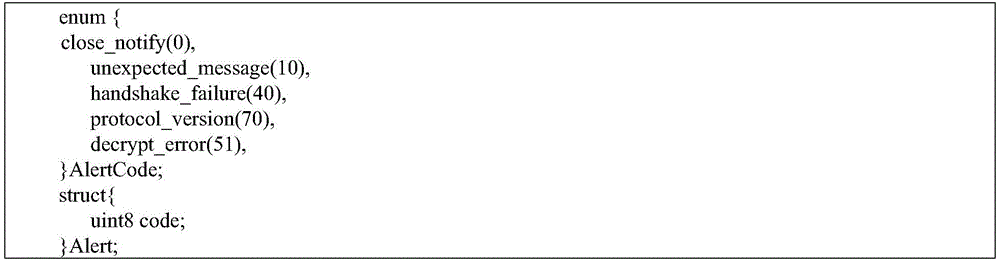
其中,所述客户端和或服务端在接收到告警消息的情况下,必须断开连接。Wherein, the client and/or server must disconnect when receiving the warning message.
在一些实施例中,Payload内容为Handshake的情况下,Handshake消息的代码包括:In some embodiments, when the Payload content is Handshake, the code of the Handshake message includes:


在一些实施例中,所述Handshake用于发送握手消息,所述握手消息包括:第一信息、第二序列、第一校验数据、第一验证信息、第二校验数据、第二验证信息、第三序列、第一重传请求、第一问候信息中至少一种。In some embodiments, the Handshake is used to send a handshake message, and the handshake message includes at least one of: first information, second sequence, first check data, first verification information, second check data, second verification information, third sequence, first retransmission request, and first greeting information.
在一些实施例中,至少一个Handshake消息的Epoch相同,则发送所述至少一个Handshake消息的一端可以将所述至少一个Handshake消息合并,如此只需要加密一次。In some embodiments, if the Epoch of at least one Handshake message is the same, the end sending the at least one Handshake message may merge the at least one Handshake message, so that encryption only needs to be performed once.
相应地,在接收所述消息的一端解密数据时,通过Handshake.len确定每个Handshake消息的边界,通过整条消息长度确定一条消息中包含的所有Handshake。Accordingly, when the end receiving the message decrypts the data, the boundary of each Handshake message is determined by Handshake.len, and all Handshakes contained in a message are determined by the length of the entire message.
图14中,客户端发送的ClientHello的代码包括:In Figure 14, the ClientHello code sent by the client includes:

其中,random包括8字节的随机数据,用于防止重放攻击。extension为扩展,用于描述所述客户端的自身能力和相关参数。Extension中所有扩展必须按照扩展类型从小到大的顺序排列。Among them, random includes 8 bytes of random data, which is used to prevent replay attacks. Extension is an extension, which is used to describe the client's own capabilities and related parameters. All extensions in Extension must be arranged in order from small to large according to the extension type.
ClientHello是协议协商的第一条消息,由Client向Server发送。用于向Server告知所述Client的认证能力以及自定义参数。ClientHello is the first message in the protocol negotiation, sent by the Client to the Server. It is used to inform the Server of the Client's authentication capabilities and custom parameters.
图14中,服务端发送的ServerHello的代码包括:In Figure 14, the ServerHello code sent by the server includes:

其中,random包括32字节的随机数据,用于防止重放攻击。extension为扩展,用于描述所述服务端的自身能力和相关参数。Extension中所有扩展必须按照扩展类型从小到大的顺序排列。只有当ClientHello中给出了某个扩展时(代表Client支持所述某个扩展),在ServerHello的应答中才允许应答对应的扩展。Among them, random includes 32 bytes of random data, which is used to prevent replay attacks. Extension is an extension, which is used to describe the server's own capabilities and related parameters. All extensions in Extension must be arranged in order from small to large according to the extension type. Only when an extension is given in ClientHello (indicating that the Client supports the extension), the corresponding extension is allowed to be responded to in the response of ServerHello.
ServerHello由Server向Client发送,用于确定会话的连接参数。ServerHello is sent by the server to the client to determine the connection parameters of the session.
ClientHello是协议协商的第一条消息,由Client向Server发送。用于向Server告知所述Client的认证能力以及自定义参数。ClientHello is the first message in the protocol negotiation, sent by the Client to the Server. It is used to inform the Server of the Client's authentication capabilities and custom parameters.
在Client处理ServerHello时,若发现其中存在任何不支持的扩展,必须向Server发送unexpected_message警告并断开连接。Server发现必选扩展不存在是,必须向Client发送unexpected_message警告并断开连接。When the Client processes the ServerHello, if it finds any unsupported extensions, it must send an unexpected_message warning to the Server and disconnect. If the Server finds that the required extension does not exist, it must send an unexpected_message warning to the Client and disconnect.
图14中,HelloRetryRequest消息的代码包括:In Figure 14, the code of the HelloRetryRequest message includes:

其中,extensions表征扩展,用于描述所述服务端的自身能力和相关参数。在所述Client第一次向Server发送ClientHello以后,Server可能发送HelloRetryRequest要求Client重新发起协商。比较常见的情况是Client提供的key_share曲线Server不支持,比如Client提供secp256r1曲线,但Server只支持C25519曲线,此时,Server需要从ClientHello中找到supported_group扩展,从supported_group中找到能够进行协商的曲线,然后使用HelloRetryRequest消息通知Client重新协商。Among them, extensions represents extensions, which are used to describe the server's own capabilities and related parameters. After the client sends ClientHello to the server for the first time, the server may send a HelloRetryRequest to request the client to re-initiate negotiation. A more common situation is that the key_share curve provided by the client is not supported by the server. For example, the client provides the secp256r1 curve, but the server only supports the C25519 curve. At this time, the server needs to find the supported_group extension from ClientHello, find the curve that can be negotiated from the supported_group, and then use the HelloRetryRequest message to notify the client to renegotiate.
在客户端和服务端协商共享密钥的过程中,Retryrequest只允许发起一次。对于Server,若第二次Clienthello发送的参数仍然无法接受时,Server必须发送handshake_failure警告并关闭连接。对于Client,若收到第二个HelloRetryrequest,Client必须发送unexpected_message并断开连接。During the negotiation of the shared key between the client and the server, Retryrequest is only allowed to be initiated once. For the server, if the parameters sent by the second Clienthello are still unacceptable, the server must send a handshake_failure warning and close the connection. For the client, if the second HelloRetryrequest is received, the client must send an unexpected_message and disconnect.
HelloRetryRequest消息在ECDH的配网协议中用于对错误ClientHello消息的应答;或者,在ECJPAKE的配网协议中用于传输ECJPAKE Round 1数据。The HelloRetryRequest message is used in the ECDH network configuration protocol to respond to an erroneous ClientHello message; or, in the ECJPAKE network configuration protocol, to transmit
在一些实施例中,所述在ECDH的配网协议中对错误ClientHello消息的应答包括步骤S301至步骤S302,此处不再重复赘述;所述在ECJPAKE的配网协议中传输ECJPAKERound 1数据包括步骤S401至步骤S402,此处不再重复赘述。In some embodiments, the response to the erroneous ClientHello message in the ECDH network configuration protocol includes steps S301 to S302, which are not repeated here; the transmission of
图14中,Authenticate消息的代码包括:In Figure 14, the code of the Authenticate message includes:

其中,所述Authenticate消息用于传输认证数据。消息格式会根据cipher_suites定义的Authentication列的取值变化。特殊的,当Authentication取值为None时,该消息必须被省略。不同的认证方式下,Authenticate构造方式不同。The Authenticate message is used to transmit authentication data. The message format will change according to the value of the Authentication column defined by cipher_suites. In particular, when the Authentication value is None, the message must be omitted. The Authenticate construction method is different under different authentication methods.
在认证方式使用ECDH的配网协议的情况下,Authenticate消息的代码包括:When the ECDH network configuration protocol is used as the authentication method, the code of the Authenticate message includes:

其中,所述Authenticate消息用于对ECDH的证书认证,支持两种证书:X509证书与自定义证书。The Authenticate message is used for certificate authentication of ECDH, and supports two types of certificates: X509 certificate and custom certificate.
图14中,Finished消息的代码包括:In Figure 14, the code of the Finished message includes:

其中,verify data为使用当前Transcripthash值计算HMAC。计算方法包括:Among them, verify data is to calculate HMAC using the current Transcripthash value. The calculation method includes:
其中,TranscriptHash:Server:TranscriptHash(ClientHello1……ServerAuthenticate)。Among them, TranscriptHash: Server: TranscriptHash(ClientHello1...ServerAuthenticate).
Client:TranscriptHash(ClientHello1…Server Authenticate,ServerFinished,Client Authenticate)。Client: TranscriptHash(ClientHello1...Server Authenticate, ServerFinished, Client Authenticate).
Finished Key:Server:Expand(PRK=ServerHandshakeTraffic,|abe|=”htbtsfinished”,len=Hash Length)。Finished Key: Server: Expand (PRK=ServerHandshakeTraffic,|abe|=”htbtsfinished”,len=Hash Length).
Client:Expand(PRK=ClientHandshakeTraffic,|abe|=”htbts finished”,len=Hash Length)Client:Expand(PRK=ClientHandshakeTraffic,|abe|=”htbts finished”,len=Hash Length)
图14中,Application Data消息的Content部分为完整的用户数据。In Figure 14, the Content part of the Application Data message is complete user data.
所述消息代码中,extension是对消息的补充说明,代码包括:In the message code, extension is a supplementary description of the message, and the code includes:

其中,extension_data表征各扩展类型内,定义的扩展数据;data_size表征数据长度。编码方式可以参考变长整数。data_size不大于16383字节,即data_size编码后只可能为1字节或2字节。当编码为2字节时,第一字节最高位为1,第二字节最高位不为1。解码时,若发现data_size不符合要求,则应发送unexpected_message告并关闭连接;extension_type表征Extension的消息类型如表3所示:Among them, extension_data represents the extended data defined in each extension type; data_size represents the data length. The encoding method can refer to variable-length integers. data_size is not greater than 16383 bytes, that is, data_size can only be 1 byte or 2 bytes after encoding. When encoded as 2 bytes, the highest bit of the first byte is 1, and the highest bit of the second byte is not 1. During decoding, if it is found that data_size does not meet the requirements, an unexpected_message report should be sent and the connection should be closed; extension_type represents the message type of Extension as shown in Table 3:
表3Table 3


其中,所述“适用于”用于标识允许使用相应扩展的我受消息。消息名称通过缩写表示:CR(ClientHello),SR(ServerHello),HRR(HelloRetryRequest),AU(Authenticate)。The "applicable to" is used to identify the accepted messages that allow the use of the corresponding extension. The message names are represented by abbreviations: CR (ClientHello), SR (ServerHello), HRR (HelloRetryRequest), AU (Authenticate).
其中,“必选”表示响应的消息中必须存在。在对端发送的消息中,缺少某个必选扩展,必须发送unexpected_message并断开连接。"Required" means that it must be present in the response message. If a required extension is missing in the message sent by the peer, an unexpected_message must be sent and the connection must be terminated.
表3中,Type 0表征版本号;Type1表征加密套件,可以是ECDH、(Diffle-Hellman,DH)等;Type2表征使用的曲线类型,如椭圆曲线;Type4表征交互公钥;Type5和Type6分别表征不同阶段的公钥。In Table 3,
图14中,supported_version的代码包括:In Figure 14, the code of supported_version includes:

其中,supported_version指示所述客户端或服务端支持的协议版本。目前协议版本为1。Among them, supported_version indicates the protocol version supported by the client or server. The current protocol version is 1.
supported_version必须被添加到ClientHello、ServerHello、HelloRetryRequest中。并填写一个Version。Server填写的Version将作为本次连接的协议版本。supported_version must be added to ClientHello, ServerHello, and HelloRetryRequest. A Version must be filled in. The Version filled in by the server will be used as the protocol version for this connection.
在一些实施例中,当Client在收到的ServerHello中,发现supported_version扩展中存在多个Version或发现Version自己不支持时,clent应该发送protocol_version警告并关闭连接。In some embodiments, when the Client finds that there are multiple Versions in the supported_version extension in the received ServerHello or finds that the Version itself is not supported, the client should send a protocol_version warning and close the connection.
图14中,cipher_suites的代码包括:In Figure 14, the code of cipher_suites includes:

其中,所述cipher_suites指示所述客户端或服务端支持的加密套件。所述cipher_suites包括CipherSuite、Sym、KeyExchange、Authentication、Cipher、MAC Tag、和Hash。The cipher_suites indicates the encryption suites supported by the client or server, and the cipher_suites include CipherSuite, Sym, KeyExchange, Authentication, Cipher, MAC Tag, and Hash.
CipherSuite用于指示加密套件的uint8的取值;Sym用于指示加密套件名称,用于统一个实现的命名。KeyExchange用于指示密钥交换方式,影响key_share扩展。Authentication用于指示认证方式,影响Authenticate消息;Cipher用于指示数据加密方式,在加密时需要使用;MAC Tag用于指示加密套件的MAC Tag长度。Hash用于指示在协议运行过程中使用的HKDF、HMAC等函数所使用的散列函数。CipherSuite is used to indicate the uint8 value of the encryption suite; Sym is used to indicate the name of the encryption suite, which is used to unify the naming of the implementation. KeyExchange is used to indicate the key exchange method, which affects the key_share extension. Authentication is used to indicate the authentication method, which affects the Authenticate message; Cipher is used to indicate the data encryption method, which is required for encryption; MAC Tag is used to indicate the MAC Tag length of the encryption suite. Hash is used to indicate the hash function used by functions such as HKDF and HMAC used during the protocol operation.
在一些实施例中,Client在ClientHello中填写一个或多个CipherSuite。由Server在ServerHello和HelloRetryRequest中选中并填写一个CipherSuite。Server填写的CipherSuite将作为本次连接使用的加密套件。In some embodiments, the client fills in one or more CipherSuites in ClientHello. The server selects and fills in a CipherSuite in ServerHello and HelloRetryRequest. The CipherSuite filled in by the server will be used as the encryption suite for this connection.
在一些实施例中,非调试目的不允许使用0x00(None)加密套件。In some embodiments, the 0x00 (None) encryption suite is not allowed for non-debugging purposes.
在一些实施例中,当Client在收到的ServerHello中,发现cipher_suites扩展中存在多个cipher_suites或发现cipher_suites自己不支持时,Client应该发送unexpected_message警告并关闭连接。In some embodiments, when the Client finds that there are multiple cipher_suites in the cipher_suites extension or finds that the cipher_suites itself is not supported in the received ServerHello, the Client should send an unexpected_message warning and close the connection.
图14中,supported_group的代码包括:In Figure 14, the code of supported_group includes:

在一些实施例中,支持的EC曲线参数。定义如表4:In some embodiments, the supported EC curve parameters are defined as shown in Table 4:
表4Table 4
其中,Client在ClientHello中填写一个或多个自己支持的NamedGroup,但Server在ServerHello和HelloRetryRequest中,选中并填写一个NamedGroup。Server填写的NamedGroup将作为本次连接使用的EC曲线。The client fills in one or more NamedGroups it supports in ClientHello, but the server selects and fills in a NamedGroup in ServerHello and HelloRetryRequest. The NamedGroup filled in by the server will be used as the EC curve for this connection.
在一些实施例中,当Client在收到的ServerHello中,发现supported_group扩展中存在多个NamedGroup或发现NamedGroup自己不支持时,Client应该发送unexpected_message警告并关闭连接。In some embodiments, when the Client finds that there are multiple NamedGroups in the supported_group extension or finds that NamedGroup itself is not supported in the received ServerHello, the Client should send an unexpected_message warning and close the connection.
图14中,key_share的代码包括:In Figure 14, the code of key_share includes:


其中,key_share用于向对方共享密钥。用于密钥协商。key_share在ClientHello、ServerHello、HelloRetryRequest消息中可能使用。Among them, key_share is used to share the key with the other party. It is used for key negotiation. key_share may be used in ClientHello, ServerHello, and HelloRetryRequest messages.
在一些实施例中,ClientHello中,key_shares允许出现多个,用于供Server挑选。ServerHell中,key_shares仅能出现一个,用于选择密钥协商。HelloRetryRequest中,key_shares仅能出现一个,并且len为0。仅用于告知Client重新发起ClientHello。In some embodiments, multiple key_shares can appear in ClientHello for the server to select. Only one key_shares can appear in ServerHello for selecting key negotiation. Only one key_shares can appear in HelloRetryRequest, and len is 0. It is only used to inform the client to re-initiate ClientHello.
在一些实施例中,当Client在收到的ServerHello中,发现扩展中存在多个key_shareEntry或发现NamedGroup自己不支持时,Client应该发送unexpected_message警告并关闭连接。In some embodiments, when the Client finds that there are multiple key_shareEntry in the extension in the received ServerHello or finds that NamedGroup itself is not supported, the Client should send an unexpected_message warning and close the connection.
图14中,ecjpake_key_kp_pair_list的代码包括:In Figure 14, the code of ecjpake_key_kp_pair_list includes:

在一些实施例中,如果不确定Server端是否支持ECJPAKE认证,Client端在第一个ClientHello1中应该携带空的ecjpake_key_pair_list。若Server端选择ECJPAKE进行认证,则Server端需要选择ECJPAKE类cipher_suites,填写自己的ECJPAKE Round1数据并发送HelloRetryRequest要求Client重新认证。In some embodiments, if it is uncertain whether the server supports ECJPAKE authentication, the client should carry an empty ecjpake_key_pair_list in the first ClientHello1. If the server chooses ECJPAKE for authentication, the server needs to select the ECJPAKE class cipher_suites, fill in its own ECJPAKE Round1 data and send a HelloRetryRequest to request the client to re-authenticate.
在一些实施例中,所述握手问候消息或所述握手应答消息的消息载荷中包括ecjpake_key_kp_pair_list字段,所述ecjpake_key_kp_pair_list字段的值为空NULL,所述空值用于确定所述第二端是否支持目标加密套件。In some embodiments, the message payload of the handshake hello message or the handshake response message includes an ecjpake_key_kp_pair_list field, the value of the ecjpake_key_kp_pair_list field is NULL, and the NULL value is used to determine whether the second end supports the target encryption suite.
在一些实施例中,格式定义与Elliptic Curve J-PAKE Cipher for TransportLayer(TLS)Section 7.2.217中定义相同。对应ClientHello/ServerHello中的“ECJPAKEKeyKPPairList”扩展。identtity字段被删除,使用mbedTLS实现中预定义的“Client”/“Server”。In some embodiments, the format definition is the same as that defined in Elliptic Curve J-PAKE Cipher for Transport Layer (TLS) Section 7.2.2 17. It corresponds to the "ECJPAKEKeyKPPairList" extension in ClientHello/ServerHello. The identtity field is deleted and the predefined "Client"/"Server" in the mbedTLS implementation is used.
图14中,ecjpake_key_kp_params的代码包括:In Figure 14, the code of ecjpake_key_kp_params includes:

其中,格式定义与Elliptic Curve J-PAKE Cipher for Transport Layer(TLS)Section 7.318中定义相同。对应ServerKeyExchange/ClientKeyExchange中的“ServerECJPAKEParams”或“ClientECJPAKEParams”。The format definition is the same as that in Elliptic Curve J-PAKE Cipher for Transport Layer (TLS) Section 7.3 18. It corresponds to "ServerECJPAKEParams" or "ClientECJPAKEParams" in ServerKeyExchange/ClientKeyExchange.
在一些实施例中,所述“ecjpake_key_kp_params”用于指示ECJPAKE的协议中的公钥,如第五公钥、第六公钥等。In some embodiments, the "ecjpake_key_kp_params" is used to indicate the public keys in the ECJPAKE protocol, such as the fifth public key, the sixth public key, and the like.
图14中,TrainscriptHash是握手过程中需要保持的Hash上下文,用于保障握手过程数据的完整性。Client、Server每发送、接收一条消息,都需要将消息内容写入Hash上下文。Client在收到ServerHello或HelloRetryRequest时初始化TranscriptHash。Server在收到第一包ClientHello时初始化TranscriptHash。In Figure 14, TrainscriptHash is the hash context that needs to be maintained during the handshake process to ensure the integrity of the data during the handshake process. Each time the client and server send or receive a message, they need to write the message content into the hash context. The client initializes TranscriptHash when it receives ServerHello or HelloRetryRequest. The server initializes TranscriptHash when it receives the first packet of ClientHello.
在一些实施例中,TranscriptHash构造方法包括:In some embodiments, the TranscriptHash construction method includes:
其中,HelloRetryRequest一般情况下是不需要使用的,这样整个交互过程就会省略HelloRetryRequest和第二个ClientHello。Among them, HelloRetryRequest is generally not needed, so the entire interaction process will omit HelloRetryRequest and the second ClientHello.
此时TranscriptHash组成包括:At this point, the TranscriptHash consists of:
在一些实施例中,消息序号的代码包括:In some embodiments, the code for the message sequence number includes:

其中,消息序号分为epoch、seq两部分,共64位。Client与Server分开处理。epoch为密钥代数。连接刚刚建立成功时,epoch为0。包括epoch 0在内,每发送和接收一条消息,seq递增1。The message sequence number consists of two parts: epoch and seq, totaling 64 bits. The client and server process them separately. Epoch is the key generation number. When the connection is just established successfully, epoch is 0. Including
图18示出了本申请实施例提供的客户端的一种可选结构示意图,将根据各个部分进行说明。FIG18 shows a schematic diagram of an optional structure of a client provided in an embodiment of the present application, which will be described according to each part.
在一些实施例中,所述客户端1100包括:第一发送单元1101,第一获取单元1102和第一确定单元1103。In some embodiments, the client 1100 includes: a first sending unit 1101 , a first obtaining unit 1102 , and a first determining unit 1103 .
第一发送单元1101,用于发送第一客户端问候消息,所述第一客户端问候消息包括第一信息,所述第一信息用于指示所述客户端能够支持的第一密钥协商模式;A first sending unit 1101 is configured to send a first client hello message, where the first client hello message includes first information, where the first information is used to indicate a first key negotiation mode that the client can support;
第一获取单元1102,用于获取服务端基于所述第一客户端问候消息发送的第一服务端反馈消息,所述第一反馈信息用于指示所述服务端确定的第二密钥协商模式,所述第一服务端反馈消息包括请求重发问候消息或服务端问候消息;A first acquiring unit 1102 is configured to acquire a first server feedback message sent by the server based on the first client hello message, where the first feedback information is used to indicate a second key agreement mode determined by the server, and the first server feedback message includes a request to resend a hello message or a server hello message;
第一确定单元1103,若所述第一密钥协商模式包括所述第二密钥协商模式,用于基于所述第二密钥协商模式确定第一客户端共享密钥,根据所述第一客户端共享密钥进行目标数据传输。The first determining unit 1103 is configured to determine a first client shared key based on the second key negotiation mode if the first key negotiation mode includes the second key negotiation mode, and to perform target data transmission according to the first client shared key.
在一些实施例中,若所述第一密钥协商模式不包括所述第二密钥协商模式,则所述第一发送单元1101,用于发送第二客户端问候消息,所述第二信息用于指示所述客户端能够支持的第三密钥协商模式;In some embodiments, if the first key negotiation mode does not include the second key negotiation mode, the first sending unit 1101 is used to send a second client hello message, and the second information is used to indicate a third key negotiation mode that the client can support;
所述第一获取单元1102,用于获取所述服务端基于所述第二客户问候消息发送的第二服务端反馈消息,所述第二反馈信息用于指示所述服务端确定的第四密钥协商模式;The first acquiring unit 1102 is configured to acquire a second server feedback message sent by the server based on the second client hello message, wherein the second feedback message is used to indicate a fourth key negotiation mode determined by the server;
所述第一确定单元1103,用于基于所述第四密钥协商模式确定第二客户端共享密钥,根据所述第二客户端共享密钥进行目标数据传输;The first determining unit 1103 is configured to determine a second client shared key based on the fourth key negotiation mode, and perform target data transmission according to the second client shared key;
所述第一获取单元1102,用于获取所述服务端基于所述第二客户端问候消息发送的第一警告消息,基于所述第一警告消息断开连接;或者,获取所述服务端基于所述第二客户端问候消息发送的第三服务端反馈消息,基于所述第三服务端反馈消息发送第二警告消息并断开连接。The first acquisition unit 1102 is used to acquire a first warning message sent by the server based on the second client hello message, and disconnect based on the first warning message; or to acquire a third server feedback message sent by the server based on the second client hello message, and send a second warning message based on the third server feedback message and disconnect.
在一些实施例中,所述第一客户端问候消息、第二客户端问候消息、第一服务端反馈消息、第二服务端反馈消息均包括预定义字段,所述预定义字段包括:协议版本字段、加密套件字段、加密曲线字段、第一公钥字段和第二公钥字段中的至少一种字段;所述协议版本字段用于指示所述客户端或所述服务端支持的部分或全部协议版本参数;所述加密套件字段用于指示所述客户端或所述服务端支持的部分或全部加密套件参数;所述加密曲线字段用于指示所述客户端或所述服务端支持的部分或全部加密曲线参数;所述第一公钥字段用于指示所述客户端或所述服务端的第一公钥;所述第二公钥字段用于指示所述客户端或所述服务端的第二公钥。In some embodiments, the first client hello message, the second client hello message, the first server feedback message, and the second server feedback message all include predefined fields, and the predefined fields include: at least one of a protocol version field, an encryption suite field, an encryption curve field, a first public key field, and a second public key field; the protocol version field is used to indicate some or all of the protocol version parameters supported by the client or the server; the encryption suite field is used to indicate some or all of the encryption suite parameters supported by the client or the server; the encryption curve field is used to indicate some or all of the encryption curve parameters supported by the client or the server; the first public key field is used to indicate a first public key of the client or the server; and the second public key field is used to indicate a second public key of the client or the server.
在一些实施例中,所述第一客户端问候消息包括所述协议版本字段、所述加密套件字段、所述第一公钥字段、所述加密曲线字段和所述第二公钥字段,其中,所述第一公钥字段包括所述客户端的第一公钥;所述第二公钥字段为空;和/或,当所述客户端和所述服务端适用第一密钥协商算法时,所述第二客户端问候消息包括所述协议版本字段、所述加密套件字段、所述第一公钥字段,所述第一公钥字段包括所述客户端的第二公钥;和/或,当所述客户端和所述服务端适用第二密钥协商算法,且所述客户端支持所述第二密钥协商模式时,所述第二客户端问候消息包括所述协议版本字段、所述加密套件字段、所述第二公钥字段,所述第二公钥字段包括所述客户端的第三公钥;和/或,当所述客户端和所述服务端适用第二密钥协商算法,且所述客户端不支持所述第二密钥协商模式时,所述第二客户端问候消息包括所述协议版本字段、所述加密套件字段、所述加密曲线字段。In some embodiments, the first client hello message includes the protocol version field, the encryption suite field, the first public key field, the encryption curve field and the second public key field, wherein the first public key field includes the first public key of the client; the second public key field is empty; and/or, when the client and the server apply a first key agreement algorithm, the second client hello message includes the protocol version field, the encryption suite field, the first public key field, and the first public key field includes the second public key of the client; and/or, when the client and the server apply a second key agreement algorithm and the client supports the second key agreement mode, the second client hello message includes the protocol version field, the encryption suite field, the second public key field, and the second public key field includes the third public key of the client; and/or, when the client and the server apply a second key agreement algorithm and the client does not support the second key agreement mode, the second client hello message includes the protocol version field, the encryption suite field, and the encryption curve field.
在一些实施例中,所述第一密钥协商算法为ECDH算法,所述第二密钥协商算法为ECJPAKE算法。In some embodiments, the first key agreement algorithm is an ECDH algorithm, and the second key agreement algorithm is an ECJPAKE algorithm.
在一些实施例中,所述若所述第一密钥协商模式包括所述第二密钥协商模式,包括:所述第一客户端问候消息的所述协议版本字段的协议版本参数包括所述第一服务端反馈消息的所述协议版本字段的协议版本参数;所述第一客户端问候消息的所述加密套件字段的加密套件参数包括所述第一服务端反馈消息的所述加密套件字段的加密套件参数;所述第一客户端问候消息的所述加密曲线字段的加密曲线参数包括所述第一服务端反馈消息的所述加密套件字段的加密套件参数;和/或,所述若所述第一密钥协商模式不包括所述第二密钥协商模式,包括:所述第一客户端问候消息的所述协议版本字段的协议版本参数不包括所述第一服务端反馈消息的所述协议版本字段的协议版本参数;或者,所述第一客户端问候消息的所述加密套件字段的加密套件参数不包括所述第一服务端反馈消息的所述加密套件字段的加密套件参数;或者,所述第一客户端问候消息的所述加密曲线字段的加密曲线参数不包括所述第一服务端反馈消息的所述加密套件字段的加密套件参数。In some embodiments, if the first key agreement mode includes the second key agreement mode, it includes: the protocol version parameter of the protocol version field of the first client hello message includes the protocol version parameter of the protocol version field of the first server feedback message; the encryption suite parameter of the encryption suite field of the first client hello message includes the encryption suite parameter of the encryption suite field of the first server feedback message; the encryption curve parameter of the encryption curve field of the first client hello message includes the encryption suite parameter of the encryption suite field of the first server feedback message; and/or, if the first key agreement mode does not include the second key agreement mode, it includes: the protocol version parameter of the protocol version field of the first client hello message does not include the protocol version parameter of the protocol version field of the first server feedback message; or, the encryption suite parameter of the encryption suite field of the first client hello message does not include the encryption suite parameter of the encryption suite field of the first server feedback message; or, the encryption curve parameter of the encryption curve field of the first client hello message does not include the encryption suite parameter of the encryption suite field of the first server feedback message.
在一些实施例中,若所述第一客户端共享密钥或所述第二客户端共享密钥使用预设次数或预设时间后,重新执行所述发送第一客户端问候消息的步骤。In some embodiments, if the first client shared key or the second client shared key is used a preset number of times or a preset time, the step of sending the first client hello message is performed again.
图19示出了本申请实施例提供的数据传输装置的另一种可选结构示意图,将根据各个部分进行说明。FIG19 shows another optional structural diagram of the data transmission device provided in an embodiment of the present application, which will be described according to each part.
在一些实施例中,服务端1200包括:第二接收单元1201和第二确定单元1202。In some embodiments, the server 1200 includes: a second receiving unit 1201 and a second determining unit 1202 .
第二接收单元1201,用于接收客户端发送的第一客户端问候消息,所述第一客户端问候消息用于指示所述客户端能够支持的第一密钥协商模式;The second receiving unit 1201 is configured to receive a first client hello message sent by a client, where the first client hello message is used to indicate a first key negotiation mode that the client can support;
第二确定单元1202,用于根据所述第一密钥协商模式确定所述服务端选择的第二密钥协商模式,并通过所述第一服务端反馈消息发送给所述客户端;或者,若所述第一密钥协商模式包括所述第二密钥协商模式,用于基于所述第二密钥协商模式确定第一服务端共享密钥,根据所述第一服务端共享密钥进行目标数据传输。The second determination unit 1202 is used to determine the second key negotiation mode selected by the server according to the first key negotiation mode, and send it to the client through the first server feedback message; or, if the first key negotiation mode includes the second key negotiation mode, it is used to determine the first server shared key based on the second key negotiation mode, and transmit the target data according to the first server shared key.
在一些实施例中,若所述第一密钥协商模式不包括所述第二密钥协商模式,所述第二接收单元1201,用于接收所述客户端发送第二客户端问候消息,所述第二客户端问候消息用于指示所述客户端能够支持的第三密钥协商模式;In some embodiments, if the first key agreement mode does not include the second key agreement mode, the second receiving unit 1201 is used to receive a second client hello message sent by the client, where the second client hello message is used to indicate a third key agreement mode that the client can support;
第二接收单元1201,用于基于所述第二客户端问候消息发送第二服务端反馈消息,所述第二服务端反馈消息用于指示所述服务端确定的第四密钥协商模式;The second receiving unit 1201 is used to send a second server feedback message based on the second client hello message, where the second server feedback message is used to indicate a fourth key agreement mode determined by the server;
所述第二确定单元1202,用于基于所述第四密钥协商模式确定第二服务端共享密钥,根据所述第二客户端共享密钥进行目标数据传输;或者,基于所述第二客户端问候消息发送的第三服务端反馈消息并断开连接。The second determination unit 1202 is used to determine the second server shared key based on the fourth key negotiation mode, and transmit the target data according to the second client shared key; or, send a third server feedback message based on the second client hello message and disconnect.
在一些实施例中,所述第一客户端问候消息、第二客户端问候消息、第一服务端反馈消息、第二服务端反馈消息均包括预定义字段,所述预定义字段包括:协议版本字段、加密套件字段、加密曲线字段、第一公钥字段和第二公钥字段中的至少一种字段;所述协议版本字段用于指示所述客户端或所述服务端支持的部分或全部协议版本参数;所述加密套件字段用于指示所述客户端或所述服务端支持的部分或全部加密套件参数;所述加密曲线字段用于指示所述客户端或所述服务端支持的部分或全部加密曲线参数;所述第一公钥字段用于指示所述客户端或所述服务端的第一公钥;所述第二公钥字段用于指示所述客户端或所述服务端的第二公钥。In some embodiments, the first client hello message, the second client hello message, the first server feedback message, and the second server feedback message all include predefined fields, and the predefined fields include: at least one of a protocol version field, an encryption suite field, an encryption curve field, a first public key field, and a second public key field; the protocol version field is used to indicate some or all of the protocol version parameters supported by the client or the server; the encryption suite field is used to indicate some or all of the encryption suite parameters supported by the client or the server; the encryption curve field is used to indicate some or all of the encryption curve parameters supported by the client or the server; the first public key field is used to indicate a first public key of the client or the server; and the second public key field is used to indicate a second public key of the client or the server.
在一些实施例中,所述客户端和所述服务端能够适用第一密钥协商算法和/或第二密钥协商算法;所述第一服务端反馈消息包括请求重发问候消息或服务端问候消息。In some embodiments, the client and the server can apply a first key agreement algorithm and/or a second key agreement algorithm; the first server feedback message includes a request to resend a hello message or a server hello message.
在一些实施例中,所述请求重发问候消息为第一请求重发问候消息、第二请求重发问候消息、第三请求重发问候消息、第四请求重发消息中的任一种,所述服务端问候消息为第一服务端问候消息、第二服务端问候消息中的任一种,其中,所述第一请求重发问候消息用于在所述服务端适用所述第一密钥协商算法且不支持所述第一密钥协商模式的情况下发送的;和/或,所述第二请求重发问候消息用于在所述服务端适用所述第二密钥协商算法且支持所述第一密钥协商模式的情况下发送的;和/或,所述第三请求重发问候消息用于在所述服务端适用所述第二密钥协商算法且不支持所述第一密钥协商模式的情况下发送的;和/或,所述第四请求重发问候消息用于在所述服务适用所述第一密钥协商算法且支持第一密钥协商模式,但不支持所述第一公钥的情况下发送的;所述第一服务端问候消息用于在所述服务端适用所述第二密钥协商算法且支持所述第一密钥协商模式的情况下发送;和/或,所述第二服务端问候消息用于在所述服务端适用所述第一密钥协商算法且支持所述第一密钥协商模式的情况下发送的。In some embodiments, the request to resend the hello message is any one of a first request to resend the hello message, a second request to resend the hello message, a third request to resend the hello message, and a fourth request to resend the message, and the server hello message is any one of a first server hello message and a second server hello message, wherein the first request to resend the hello message is used to be sent when the server applies the first key agreement algorithm and does not support the first key agreement mode; and/or, the second request to resend the hello message is used to be sent when the server applies the second key agreement algorithm and supports the first key agreement mode; and/or, the third request to resend the hello message is used to be sent when the server applies the second key agreement algorithm and does not support the first key agreement mode; and/or, the fourth request to resend the hello message is used to be sent when the service applies the first key agreement algorithm and supports the first key agreement mode but does not support the first public key; the first server hello message is used to be sent when the server applies the second key agreement algorithm and supports the first key agreement mode; and/or, the second server hello message is used to be sent when the server applies the first key agreement algorithm and supports the first key agreement mode.
在一些实施例中,所述第一密钥协商算法为ECDH算法,所述第二密钥协商算法为ECJPAKE算法。In some embodiments, the first key agreement algorithm is an ECDH algorithm, and the second key agreement algorithm is an ECJPAKE algorithm.
图20示出了本申请实施例提供的数据传输装置的一种可选结构示意图,将根据各个部分进行说明。FIG20 shows an optional structural diagram of a data transmission device provided in an embodiment of the present application, which will be described according to each part.
在一些实施例中,数据传输装置1400,包括:协商单元1401和应用数据单元1402。In some embodiments, the data transmission device 1400 includes: a negotiation unit 1401 and an application data unit 1402 .
协商单元1401,用于通过握手消息与第二端协商密钥;A negotiation unit 1401, configured to negotiate a key with the second end through a handshake message;
应用数据单元1402,用于通过内容消息与所述第二端传输应用数据,所述内容消息通过使用所述共享密钥进行加密和解密;An application data unit 1402, configured to transmit application data to the second end via a content message, wherein the content message is encrypted and decrypted by using the shared key;
其中,所述握手消息和所述内容消息具有相同的消息格式,所述消息格式包括:消息序号和消息载荷;所述消息序号包括密钥代数标识和消息计数标识,其中,所述密钥代数标识通过小于第一位数的比特信息进行表征,所述消息计数标识通过小于第二位数的比特信息进行表征。Among them, the handshake message and the content message have the same message format, and the message format includes: a message sequence number and a message payload; the message sequence number includes a key algebraic identifier and a message count identifier, wherein the key algebraic identifier is represented by bit information less than the first digit, and the message count identifier is represented by bit information less than the second digit.
在一些实施例中,所述消息载荷包括实际数据和消息类型,所述消息类型包括填充类型、应用数据类型、警告类型和握手类型。In some embodiments, the message payload includes actual data and a message type, and the message type includes a padding type, an application data type, a warning type, and a handshake type.
在一些实施例中,所述数据传输装置1400还包括:加密单元1403;In some embodiments, the data transmission device 1400 further includes: an encryption unit 1403;
所述加密单元1403,用于通过所述共享密钥对所述内容消息中的消息载荷进行加密。The encryption unit 1403 is configured to encrypt the message payload in the content message using the shared key.
在一些实施例中,所述数据传输装置1400还包括:校验单元1404;In some embodiments, the data transmission device 1400 further includes: a verification unit 1404;
所述校验单元1404,用于在协商共享密钥过程中,对所述握手消息进行校验得到校验值。The verification unit 1404 is used to verify the handshake message to obtain a verification value during the negotiation of the shared key.
在一些实施例中,所述握手消息包括握手完成消息,用于指示完成所述共享密钥的协商流程,其中,所述握手完成消息携带所述校验值。In some embodiments, the handshake message includes a handshake completion message, which is used to indicate the completion of the negotiation process of the shared key, wherein the handshake completion message carries the verification value.
在一些实施例中,所述握手消息包括以下至少一项:握手问候消息、握手应答消息、重发请求消息、认证数据消息、握手完成消息。In some embodiments, the handshake message includes at least one of the following: a handshake hello message, a handshake response message, a resend request message, an authentication data message, and a handshake completion message.
在一些实施例中,所述握手问候消息、握手应答消息、重发请求消息的消息载荷中至少包括以下字段中的一种或多种:协议版本字段、加密套件字段、共享密钥字段、加密曲线字段。In some embodiments, the message payload of the handshake hello message, handshake response message, and retransmission request message includes at least one or more of the following fields: protocol version field, encryption suite field, shared key field, and encryption curve field.
在一些实施例中,所述第一端通过所述握手问候消息、所述握手应答消息或所述重发请求消息与所述第二端协商共享密钥时,所述密钥代数标识为a;所述第一端通过所述认证数据消息或所述握手完成消息与所述第二端协商共享密钥时,所述密钥代数标识为a+1;所述第一端通过所述内容消息与所述第二端传输应用数据时,所述密钥代数标识为a+2至a+N;其中,a为整数,N为大于或等于2的整数。In some embodiments, when the first end negotiates a shared key with the second end through the handshake greeting message, the handshake response message or the retransmission request message, the key generation number is identified as a; when the first end negotiates a shared key with the second end through the authentication data message or the handshake completion message, the key generation number is identified as a+1; when the first end transmits application data with the second end through the content message, the key generation number is identified as a+2 to a+N; wherein a is an integer and N is an integer greater than or equal to 2.
在一些实施例中,所述握手问候消息或所述握手应答消息的消息载荷中包括公钥列表字段,所述公钥列表字段的值为空(NULL),所述空值用于确定所述第二端是否支持目标加密套件。In some embodiments, the message payload of the handshake hello message or the handshake response message includes a public key list field, the value of the public key list field is empty (NULL), and the empty value is used to determine whether the second end supports the target encryption suite.
在一些实施例中,所述第二端基于所述握手问候消息返回所述重发请求消息,其中,所述重发请求消息中的加密套件字段配置为所述目标加密套件。In some embodiments, the second end returns the retransmission request message based on the handshake hello message, wherein the encryption suite field in the retransmission request message is configured as the target encryption suite.
在一些实施例中,所述第一端为客户端,所述第二端为服务端;或者,所述第一端为服务端,所述第二端为客户端。In some embodiments, the first end is a client and the second end is a server; or, the first end is a server and the second end is a client.
图21是本申请实施例的电子设备的硬件组成结构示意图,电子设备1300包括:至少一个处理器1301、存储器1302和至少一个网络接口1304。客户端或服务端1300中的各个组件通过总线系统1305耦合在一起。可理解,总线系统1305用于实现这些组件之间的连接通信。总线系统1305除包括数据总线之外,还包括电源总线、控制总线和状态信号总线。但是为了清楚说明起见,在图15中将各种总线都标为总线系统1305。FIG21 is a schematic diagram of the hardware composition structure of an electronic device according to an embodiment of the present application, wherein the
在一些实施例中,所述电子设备可以是客户端或服务器对应的硬件结构。In some embodiments, the electronic device may be a hardware structure corresponding to a client or a server.
可以理解,存储器1302可以是易失性存储器或非易失性存储器,也可包括易失性和非易失性存储器两者。其中,非易失性存储器可以是ROM、可编程只读存储器(PROM,Programmable Read-Only Memory)、可擦除可编程只读存储器(EPROM,ErasableProgrammable Read-Only Memory)、电可擦除可编程只读存储器(EEPROM,ElectricallyErasable Programmable Read-Only Memory)、磁性随机存取存储器(FRAM,ferromagneticrandom access memory)、快闪存储器(Flash Memory)、磁表面存储器、光盘、或只读光盘(CD-ROM,Compact Disc Read-Only Memory);磁表面存储器可以是磁盘存储器或磁带存储器。易失性存储器可以是随机存取存储器(RAM,Random Access Memory),其用作外部高速缓存。通过示例性但不是限制性说明,许多形式的RAM可用,例如静态随机存取存储器(SRAM,Static Random Access Memory)、同步静态随机存取存储器(SSRAM,SynchronousStatic Random Access Memory)、动态随机存取存储器(DRAM,Dynamic Random AccessMemory)、同步动态随机存取存储器(SDRAM,Synchronous Dynamic Random AccessMemory)、双倍数据速率同步动态随机存取存储器(DDRSDRAM,Double Data RateSynchronous Dynamic Random Access Memory)、增强型同步动态随机存取存储器(ESDRAM,Enhanced Synchronous Dynamic Random Access Memory)、同步连接动态随机存取存储器(SLDRAM,SyncLink Dynamic Random Access Memory)、直接内存总线随机存取存储器(DRRAM,Direct Rambus Random Access Memory)。本申请实施例描述的存储器1302旨在包括但不限于这些和任意其它适合类型的存储器。It can be understood that the
本申请实施例中的存储器1302用于存储各种类型的数据以支持客户端或服务端1300的操作。这些数据的示例包括:用于在客户端或服务端1300上操作的任何计算机程序,如应用程序1322。实现本申请实施例方法的程序可以包含在应用程序1322中。The
所述本申请实施例揭示的方法可以应用于处理器1301中,或者由处理器1301实现。处理器1301可能是一种集成电路芯片,具有信号的处理能力。在实现过程中,所述方法的各步骤可以通过处理器1301中的硬件的集成逻辑电路或者软件形式的指令完成。所述的处理器1301可以是通用处理器、数字信号处理器(DSP,Digital Signal Processor),或者其他可编程逻辑器件、分立门或者晶体管逻辑器件、分立硬件组件等。处理器1301可以实现或者执行本申请实施例中的公开的各方法、步骤及逻辑框图。通用处理器可以是微处理器或者任何常规的处理器等。结合本申请实施例所公开的方法的步骤,可以直接体现为硬件译码处理器执行完成,或者用译码处理器中的硬件及软件模块组合执行完成。软件模块可以位于存储介质中,该存储介质位于存储器1302,处理器1301读取存储器1302中的信息,结合其硬件完成前述方法的步骤。The method disclosed in the embodiment of the present application can be applied to the
在示例性实施例中,客户端或服务端1300可以被一个或多个应用专用集成电路(ASIC,Application Specific Integrated Circuit)、DSP、可编程逻辑器件(PLD,Programmable Logic Device)、复杂可编程逻辑器件(CPLD,Complex Programmable LogicDevice)、FPGA、通用处理器、控制器、MCU、MPU、或其他电子元件实现,用于执行前述方法。In an exemplary embodiment, the client or
本申请实施例还提供了一种存储介质,用于存储计算机程序。An embodiment of the present application also provides a storage medium for storing a computer program.
可选的,该存储介质可应用于本申请实施例中的第一客户端,并且该计算机程序使得计算机执行本申请实施例的各个方法中的相应流程,为了简洁,在此不再赘述。Optionally, the storage medium can be applied to the first client in the embodiment of the present application, and the computer program enables the computer to execute the corresponding processes in the various methods in the embodiment of the present application, which will not be described in detail here for the sake of brevity.
本申请是参照根据本申请实施例的方法、设备(系统)、和计算机程序产品的流程图和/或方框图来描述的。应理解可由计算机程序指令实现流程图和/或方框图中的每一流程和/或方框、以及流程图和/或方框图中的流程和/或方框的结合。可提供这些计算机程序指令到通用计算机、专用计算机、嵌入式处理机或其他可编程数据处理设备的处理器以产生一个机器,使得通过计算机或其他可编程数据处理设备的处理器执行的指令产生用于实现在流程图一个流程或多个流程和/或方框图一个方框或多个方框中指定的功能的装置。The present application is described with reference to the flowchart and/or block diagram of the method, device (system) and computer program product according to the embodiment of the present application. It should be understood that each process and/or box in the flowchart and/or block diagram, and the combination of the process and/or box in the flowchart and/or block diagram can be realized by computer program instructions. These computer program instructions can be provided to a processor of a general-purpose computer, a special-purpose computer, an embedded processor or other programmable data processing device to produce a machine, so that the instructions executed by the processor of the computer or other programmable data processing device produce a device for realizing the function specified in one process or multiple processes in the flowchart and/or one box or multiple boxes in the block diagram.
这些计算机程序指令也可存储在能引导计算机或其他可编程数据处理设备以特定方式工作的计算机可读存储器中,使得存储在该计算机可读存储器中的指令产生包括指令装置的制造品,该指令装置实现在流程图一个流程或多个流程和/或方框图一个方框或多个方框中指定的功能。These computer program instructions may also be stored in a computer-readable memory that can direct a computer or other programmable data processing device to work in a specific manner, so that the instructions stored in the computer-readable memory produce a manufactured product including an instruction device that implements the functions specified in one or more processes in the flowchart and/or one or more boxes in the block diagram.
这些计算机程序指令也可装载到计算机或其他可编程数据处理设备上,使得在计算机或其他可编程设备上执行一系列操作步骤以产生计算机实现的处理,从而在计算机或其他可编程设备上执行的指令提供用于实现在流程图一个流程或多个流程和/或方框图一个方框或多个方框中指定的功能的步骤。These computer program instructions may also be loaded onto a computer or other programmable data processing device so that a series of operational steps are executed on the computer or other programmable device to produce a computer-implemented process, whereby the instructions executed on the computer or other programmable device provide steps for implementing the functions specified in one or more processes in the flowchart and/or one or more boxes in the block diagram.
以上所述,仅为本申请的较佳实施例而已,并非用于限定本申请的保护范围,凡在本申请的精神和原则之内所作的任何修改、等同替换和改进等,均应包含在本申请的保护范围之内。The above description is only a preferred embodiment of the present application and is not intended to limit the scope of protection of the present application. Any modifications, equivalent substitutions and improvements made within the spirit and principles of the present application should be included in the scope of protection of the present application.
Claims (14)
Priority Applications (4)
| Application Number | Priority Date | Filing Date | Title |
|---|---|---|---|
| CN202010899982.8A CN114124367B (en) | 2020-08-31 | 2020-08-31 | Data transmission method, device and storage medium |
| PCT/CN2021/107277 WO2022042137A1 (en) | 2020-08-31 | 2021-07-20 | Data transmission method and apparatus, device, and storage medium |
| EP21859977.7A EP4170961A4 (en) | 2020-08-31 | 2021-07-20 | DATA TRANSMISSION METHOD AND DEVICE, APPARATUS AND STORAGE MEDIUM |
| US18/090,753 US11949781B2 (en) | 2020-08-31 | 2022-12-29 | Data transmission method, device, apparatus and storage medium |
Applications Claiming Priority (1)
| Application Number | Priority Date | Filing Date | Title |
|---|---|---|---|
| CN202010899982.8A CN114124367B (en) | 2020-08-31 | 2020-08-31 | Data transmission method, device and storage medium |
Publications (2)
| Publication Number | Publication Date |
|---|---|
| CN114124367A CN114124367A (en) | 2022-03-01 |
| CN114124367B true CN114124367B (en) | 2023-03-24 |
Family
ID=80352618
Family Applications (1)
| Application Number | Title | Priority Date | Filing Date |
|---|---|---|---|
| CN202010899982.8A Active CN114124367B (en) | 2020-08-31 | 2020-08-31 | Data transmission method, device and storage medium |
Country Status (4)
| Country | Link |
|---|---|
| US (1) | US11949781B2 (en) |
| EP (1) | EP4170961A4 (en) |
| CN (1) | CN114124367B (en) |
| WO (1) | WO2022042137A1 (en) |
Families Citing this family (2)
| Publication number | Priority date | Publication date | Assignee | Title |
|---|---|---|---|---|
| CN114124367B (en) * | 2020-08-31 | 2023-03-24 | Oppo广东移动通信有限公司 | Data transmission method, device and storage medium |
| WO2023141864A1 (en) * | 2022-01-27 | 2023-08-03 | 京东方科技集团股份有限公司 | Conference data transmission method, apparatus and system, electronic device and readable medium |
Family Cites Families (27)
| Publication number | Priority date | Publication date | Assignee | Title |
|---|---|---|---|---|
| GB2357227B (en) * | 1999-12-08 | 2003-12-17 | Hewlett Packard Co | Security protocol |
| US7512714B2 (en) * | 2004-08-31 | 2009-03-31 | Honeywell International Inc. | System and method for transmitting ACARS messages over a TCP/IP data communication link |
| US7676676B2 (en) * | 2005-11-14 | 2010-03-09 | Motorola, Inc. | Method and apparatus for performing mutual authentication within a network |
| US7778219B2 (en) * | 2005-11-17 | 2010-08-17 | San Diego Research Center, Inc. | Directional transmission and reception in a mobile wireless ad hoc network |
| CN101409706B (en) * | 2007-10-09 | 2011-11-23 | 华为技术有限公司 | Method, system and relevant equipment for distributing data of edge network |
| CN101459506B (en) * | 2007-12-14 | 2011-09-14 | 华为技术有限公司 | Cipher key negotiation method, system, customer terminal and server for cipher key negotiation |
| CN101431519B (en) * | 2008-12-09 | 2011-06-01 | 西安西电捷通无线网络通信股份有限公司 | Three-way handshake protocol method |
| US8301895B2 (en) * | 2009-12-02 | 2012-10-30 | Microsoft Corporation | Identity based network policy enablement |
| US8978467B2 (en) * | 2010-04-09 | 2015-03-17 | Bae Systems Information And Electronic Systems Integration Inc. | Method and apparatus for providing two way control and data communications to and from transportation refrigeration units (TRUs) |
| US10447767B2 (en) * | 2010-04-26 | 2019-10-15 | Pure Storage, Inc. | Resolving a performance issue within a dispersed storage network |
| MY157055A (en) * | 2010-12-15 | 2016-04-29 | Mimos Berhad | A system and method for quantum mobile access verification |
| US8516595B2 (en) * | 2010-12-28 | 2013-08-20 | Caixa d'Estalvis I Pensions de Barcelona “La Caixa” | Method and system for estimating the reliability of blacklists of botnet-infected computers |
| CN103581167B (en) * | 2013-07-29 | 2016-12-28 | 华为技术有限公司 | Safety certifying method based on safe transmission layer protocol, equipment and system |
| US9729413B2 (en) * | 2014-10-07 | 2017-08-08 | Coudmark, Inc. | Apparatus and method for identifying domain name system tunneling, exfiltration and infiltration |
| CN104394164A (en) * | 2014-12-06 | 2015-03-04 | 金琥 | Method of identifying HTTPS port data based on sessions and protocols |
| US9794229B2 (en) * | 2015-04-03 | 2017-10-17 | Infoblox Inc. | Behavior analysis based DNS tunneling detection and classification framework for network security |
| CN107787568B (en) * | 2015-04-24 | 2021-09-07 | 7隧道公司 | random password codebook cryptography |
| CN106453233A (en) * | 2016-08-10 | 2017-02-22 | 深圳市中兴物联科技股份有限公司 | Data transmission method and apparatus based on UDP |
| US10915629B2 (en) * | 2017-11-02 | 2021-02-09 | Paypal, Inc. | Systems and methods for detecting data exfiltration |
| US11017665B1 (en) * | 2018-02-25 | 2021-05-25 | Matthew Roy | Vehicle-to-vehicle payment system for traffic prioritization in self-driving vehicles |
| CN108650227B (en) * | 2018-03-30 | 2021-03-30 | 苏州科达科技股份有限公司 | Handshaking method and system based on datagram secure transmission protocol |
| CN109309570B (en) * | 2018-10-15 | 2021-09-14 | 北京天融信网络安全技术有限公司 | Method for using quantum key in SSL VPN and corresponding equipment and storage medium |
| EP3651426A1 (en) * | 2018-11-06 | 2020-05-13 | Efficient IP SAS | Method and system for detecting and blocking data transfer using dns protocol |
| CN110266485B (en) | 2019-06-28 | 2022-06-24 | 宁波奥克斯电气股份有限公司 | Internet of things safety communication control method based on NB-IoT |
| CN110519050B (en) * | 2019-08-19 | 2021-12-17 | 中国电子科技集团公司第三十研究所 | Secret key negotiation method based on quantum true random number exchange and black box mapping |
| CN114124367B (en) * | 2020-08-31 | 2023-03-24 | Oppo广东移动通信有限公司 | Data transmission method, device and storage medium |
| CN116318677A (en) * | 2020-08-31 | 2023-06-23 | Oppo广东移动通信有限公司 | Data transmission method, client, server and storage medium |
-
2020
- 2020-08-31 CN CN202010899982.8A patent/CN114124367B/en active Active
-
2021
- 2021-07-20 WO PCT/CN2021/107277 patent/WO2022042137A1/en not_active Ceased
- 2021-07-20 EP EP21859977.7A patent/EP4170961A4/en not_active Withdrawn
-
2022
- 2022-12-29 US US18/090,753 patent/US11949781B2/en active Active
Also Published As
| Publication number | Publication date |
|---|---|
| WO2022042137A1 (en) | 2022-03-03 |
| CN114124367A (en) | 2022-03-01 |
| US20230163959A1 (en) | 2023-05-25 |
| EP4170961A4 (en) | 2023-12-06 |
| EP4170961A1 (en) | 2023-04-26 |
| US11949781B2 (en) | 2024-04-02 |
Similar Documents
| Publication | Publication Date | Title |
|---|---|---|
| US12328392B2 (en) | Rekeying a security association (SA) | |
| CN114363890B (en) | Extended universal boot architecture authentication method, device and storage medium | |
| EP3044983B1 (en) | Communicating with a machine to machine device | |
| US11943209B2 (en) | Rekeying a security association SA | |
| CN104468560B (en) | Method and system for collecting plaintext of network confidential data | |
| CN111835691B (en) | Authentication information processing method, terminal and network device | |
| WO2018177905A1 (en) | Hybrid key exchange | |
| CN102082796A (en) | Method for encrypting channels and simplified method and system for encrypting channels based on HTTP (hyper text transport protocol) | |
| CN114124368B (en) | A data transmission method, client, server and storage medium | |
| CN104320329B (en) | Security instant communication method and system under open, insincere internet environment | |
| CN111614670A (en) | Method and device for sending encrypted file, and storage medium | |
| CN114124367B (en) | Data transmission method, device and storage medium | |
| CN118764315A (en) | SSH login authentication method, communication system and storage medium based on national secret algorithm | |
| CN119483917A (en) | Key negotiation method and communication system based on SM2 encryption certificate | |
| US20220329582A1 (en) | Communication method and related product | |
| CN108040071A (en) | A kind of VoIP audio-video encryptions key dynamic switching method | |
| CN120034321A (en) | A key negotiation method and device |
Legal Events
| Date | Code | Title | Description |
|---|---|---|---|
| PB01 | Publication | ||
| PB01 | Publication | ||
| SE01 | Entry into force of request for substantive examination | ||
| SE01 | Entry into force of request for substantive examination | ||
| GR01 | Patent grant | ||
| GR01 | Patent grant |