CN114072315A - Resin member for vehicle body, window member with resin member for vehicle body, and vehicle - Google Patents
Resin member for vehicle body, window member with resin member for vehicle body, and vehicle Download PDFInfo
- Publication number
- CN114072315A CN114072315A CN202080049282.8A CN202080049282A CN114072315A CN 114072315 A CN114072315 A CN 114072315A CN 202080049282 A CN202080049282 A CN 202080049282A CN 114072315 A CN114072315 A CN 114072315A
- Authority
- CN
- China
- Prior art keywords
- vehicle
- resin member
- vehicle body
- resin
- window
- Prior art date
- Legal status (The legal status is an assumption and is not a legal conclusion. Google has not performed a legal analysis and makes no representation as to the accuracy of the status listed.)
- Pending
Links
Images


Classifications
-
- B—PERFORMING OPERATIONS; TRANSPORTING
- B60—VEHICLES IN GENERAL
- B60J—WINDOWS, WINDSCREENS, NON-FIXED ROOFS, DOORS, OR SIMILAR DEVICES FOR VEHICLES; REMOVABLE EXTERNAL PROTECTIVE COVERINGS SPECIALLY ADAPTED FOR VEHICLES
- B60J1/00—Windows; Windscreens; Accessories therefor
- B60J1/20—Accessories, e.g. wind deflectors, blinds
-
- B—PERFORMING OPERATIONS; TRANSPORTING
- B60—VEHICLES IN GENERAL
- B60J—WINDOWS, WINDSCREENS, NON-FIXED ROOFS, DOORS, OR SIMILAR DEVICES FOR VEHICLES; REMOVABLE EXTERNAL PROTECTIVE COVERINGS SPECIALLY ADAPTED FOR VEHICLES
- B60J1/00—Windows; Windscreens; Accessories therefor
- B60J1/02—Windows; Windscreens; Accessories therefor arranged at the vehicle front, e.g. structure of the glazing, mounting of the glazing
-
- B—PERFORMING OPERATIONS; TRANSPORTING
- B60—VEHICLES IN GENERAL
- B60J—WINDOWS, WINDSCREENS, NON-FIXED ROOFS, DOORS, OR SIMILAR DEVICES FOR VEHICLES; REMOVABLE EXTERNAL PROTECTIVE COVERINGS SPECIALLY ADAPTED FOR VEHICLES
- B60J1/00—Windows; Windscreens; Accessories therefor
- B60J1/002—Windows; Windscreens; Accessories therefor with means for clear vision, e.g. anti-frost or defog panes, rain shields
-
- B—PERFORMING OPERATIONS; TRANSPORTING
- B60—VEHICLES IN GENERAL
- B60J—WINDOWS, WINDSCREENS, NON-FIXED ROOFS, DOORS, OR SIMILAR DEVICES FOR VEHICLES; REMOVABLE EXTERNAL PROTECTIVE COVERINGS SPECIALLY ADAPTED FOR VEHICLES
- B60J5/00—Doors
- B60J5/04—Doors arranged at the vehicle sides
- B60J5/0493—Appurtenances
-
- B—PERFORMING OPERATIONS; TRANSPORTING
- B60—VEHICLES IN GENERAL
- B60R—VEHICLES, VEHICLE FITTINGS, OR VEHICLE PARTS, NOT OTHERWISE PROVIDED FOR
- B60R1/00—Optical viewing arrangements; Real-time viewing arrangements for drivers or passengers using optical image capturing systems, e.g. cameras or video systems specially adapted for use in or on vehicles
- B60R1/001—Optical viewing arrangements; Real-time viewing arrangements for drivers or passengers using optical image capturing systems, e.g. cameras or video systems specially adapted for use in or on vehicles integrated in the windows, e.g. Fresnel lenses
-
- B—PERFORMING OPERATIONS; TRANSPORTING
- B60—VEHICLES IN GENERAL
- B60R—VEHICLES, VEHICLE FITTINGS, OR VEHICLE PARTS, NOT OTHERWISE PROVIDED FOR
- B60R1/00—Optical viewing arrangements; Real-time viewing arrangements for drivers or passengers using optical image capturing systems, e.g. cameras or video systems specially adapted for use in or on vehicles
- B60R1/006—Side-view mirrors, e.g. V-shaped mirrors located at the front or rear part of the vehicle
-
- B—PERFORMING OPERATIONS; TRANSPORTING
- B60—VEHICLES IN GENERAL
- B60R—VEHICLES, VEHICLE FITTINGS, OR VEHICLE PARTS, NOT OTHERWISE PROVIDED FOR
- B60R11/00—Arrangements for holding or mounting articles, not otherwise provided for
-
- B—PERFORMING OPERATIONS; TRANSPORTING
- B60—VEHICLES IN GENERAL
- B60R—VEHICLES, VEHICLE FITTINGS, OR VEHICLE PARTS, NOT OTHERWISE PROVIDED FOR
- B60R11/00—Arrangements for holding or mounting articles, not otherwise provided for
- B60R11/02—Arrangements for holding or mounting articles, not otherwise provided for for radio sets, television sets, telephones, or the like; Arrangement of controls thereof
- B60R11/0258—Arrangements for holding or mounting articles, not otherwise provided for for radio sets, television sets, telephones, or the like; Arrangement of controls thereof for navigation systems
-
- B—PERFORMING OPERATIONS; TRANSPORTING
- B60—VEHICLES IN GENERAL
- B60R—VEHICLES, VEHICLE FITTINGS, OR VEHICLE PARTS, NOT OTHERWISE PROVIDED FOR
- B60R11/00—Arrangements for holding or mounting articles, not otherwise provided for
- B60R11/02—Arrangements for holding or mounting articles, not otherwise provided for for radio sets, television sets, telephones, or the like; Arrangement of controls thereof
- B60R11/0264—Arrangements for holding or mounting articles, not otherwise provided for for radio sets, television sets, telephones, or the like; Arrangement of controls thereof for control means
-
- B—PERFORMING OPERATIONS; TRANSPORTING
- B60—VEHICLES IN GENERAL
- B60R—VEHICLES, VEHICLE FITTINGS, OR VEHICLE PARTS, NOT OTHERWISE PROVIDED FOR
- B60R11/00—Arrangements for holding or mounting articles, not otherwise provided for
- B60R11/04—Mounting of cameras operative during drive; Arrangement of controls thereof relative to the vehicle
-
- G—PHYSICS
- G01—MEASURING; TESTING
- G01S—RADIO DIRECTION-FINDING; RADIO NAVIGATION; DETERMINING DISTANCE OR VELOCITY BY USE OF RADIO WAVES; LOCATING OR PRESENCE-DETECTING BY USE OF THE REFLECTION OR RERADIATION OF RADIO WAVES; ANALOGOUS ARRANGEMENTS USING OTHER WAVES
- G01S13/00—Systems using the reflection or reradiation of radio waves, e.g. radar systems; Analogous systems using reflection or reradiation of waves whose nature or wavelength is irrelevant or unspecified
- G01S13/88—Radar or analogous systems specially adapted for specific applications
- G01S13/93—Radar or analogous systems specially adapted for specific applications for anti-collision purposes
- G01S13/931—Radar or analogous systems specially adapted for specific applications for anti-collision purposes of land vehicles
-
- G—PHYSICS
- G01—MEASURING; TESTING
- G01S—RADIO DIRECTION-FINDING; RADIO NAVIGATION; DETERMINING DISTANCE OR VELOCITY BY USE OF RADIO WAVES; LOCATING OR PRESENCE-DETECTING BY USE OF THE REFLECTION OR RERADIATION OF RADIO WAVES; ANALOGOUS ARRANGEMENTS USING OTHER WAVES
- G01S17/00—Systems using the reflection or reradiation of electromagnetic waves other than radio waves, e.g. lidar systems
- G01S17/88—Lidar systems specially adapted for specific applications
- G01S17/93—Lidar systems specially adapted for specific applications for anti-collision purposes
- G01S17/931—Lidar systems specially adapted for specific applications for anti-collision purposes of land vehicles
-
- G—PHYSICS
- G01—MEASURING; TESTING
- G01S—RADIO DIRECTION-FINDING; RADIO NAVIGATION; DETERMINING DISTANCE OR VELOCITY BY USE OF RADIO WAVES; LOCATING OR PRESENCE-DETECTING BY USE OF THE REFLECTION OR RERADIATION OF RADIO WAVES; ANALOGOUS ARRANGEMENTS USING OTHER WAVES
- G01S7/00—Details of systems according to groups G01S13/00, G01S15/00, G01S17/00
- G01S7/48—Details of systems according to groups G01S13/00, G01S15/00, G01S17/00 of systems according to group G01S17/00
- G01S7/481—Constructional features, e.g. arrangements of optical elements
- G01S7/4811—Constructional features, e.g. arrangements of optical elements common to transmitter and receiver
- G01S7/4813—Housing arrangements
-
- B—PERFORMING OPERATIONS; TRANSPORTING
- B60—VEHICLES IN GENERAL
- B60R—VEHICLES, VEHICLE FITTINGS, OR VEHICLE PARTS, NOT OTHERWISE PROVIDED FOR
- B60R11/00—Arrangements for holding or mounting articles, not otherwise provided for
- B60R2011/0001—Arrangements for holding or mounting articles, not otherwise provided for characterised by position
- B60R2011/0003—Arrangements for holding or mounting articles, not otherwise provided for characterised by position inside the vehicle
- B60R2011/0026—Windows, e.g. windscreen
-
- B—PERFORMING OPERATIONS; TRANSPORTING
- B60—VEHICLES IN GENERAL
- B60R—VEHICLES, VEHICLE FITTINGS, OR VEHICLE PARTS, NOT OTHERWISE PROVIDED FOR
- B60R11/00—Arrangements for holding or mounting articles, not otherwise provided for
- B60R2011/0042—Arrangements for holding or mounting articles, not otherwise provided for characterised by mounting means
-
- G—PHYSICS
- G01—MEASURING; TESTING
- G01S—RADIO DIRECTION-FINDING; RADIO NAVIGATION; DETERMINING DISTANCE OR VELOCITY BY USE OF RADIO WAVES; LOCATING OR PRESENCE-DETECTING BY USE OF THE REFLECTION OR RERADIATION OF RADIO WAVES; ANALOGOUS ARRANGEMENTS USING OTHER WAVES
- G01S13/00—Systems using the reflection or reradiation of radio waves, e.g. radar systems; Analogous systems using reflection or reradiation of waves whose nature or wavelength is irrelevant or unspecified
- G01S13/88—Radar or analogous systems specially adapted for specific applications
- G01S13/93—Radar or analogous systems specially adapted for specific applications for anti-collision purposes
- G01S13/931—Radar or analogous systems specially adapted for specific applications for anti-collision purposes of land vehicles
- G01S2013/9323—Alternative operation using light waves
-
- G—PHYSICS
- G01—MEASURING; TESTING
- G01S—RADIO DIRECTION-FINDING; RADIO NAVIGATION; DETERMINING DISTANCE OR VELOCITY BY USE OF RADIO WAVES; LOCATING OR PRESENCE-DETECTING BY USE OF THE REFLECTION OR RERADIATION OF RADIO WAVES; ANALOGOUS ARRANGEMENTS USING OTHER WAVES
- G01S13/00—Systems using the reflection or reradiation of radio waves, e.g. radar systems; Analogous systems using reflection or reradiation of waves whose nature or wavelength is irrelevant or unspecified
- G01S13/88—Radar or analogous systems specially adapted for specific applications
- G01S13/93—Radar or analogous systems specially adapted for specific applications for anti-collision purposes
- G01S13/931—Radar or analogous systems specially adapted for specific applications for anti-collision purposes of land vehicles
- G01S2013/9327—Sensor installation details
- G01S2013/93276—Sensor installation details in the windshield area
Landscapes
- Engineering & Computer Science (AREA)
- Mechanical Engineering (AREA)
- Radar, Positioning & Navigation (AREA)
- Remote Sensing (AREA)
- Physics & Mathematics (AREA)
- Computer Networks & Wireless Communication (AREA)
- General Physics & Mathematics (AREA)
- Multimedia (AREA)
- Electromagnetism (AREA)
- Compositions Of Macromolecular Compounds (AREA)
- Fittings On The Vehicle Exterior For Carrying Loads, And Devices For Holding Or Mounting Articles (AREA)
- Laminated Bodies (AREA)
Abstract
本发明的实施方式涉及一种车身用树脂构件,其为配置在车辆的窗构件上部的车身用树脂构件,其中,其安装有至少一个车载构件。
An embodiment of the present invention relates to a resin member for a vehicle body, which is a resin member for a vehicle body disposed on an upper portion of a window member of a vehicle, in which at least one vehicle-mounted member is attached.
Description
Technical Field
The invention relates to a resin member for a vehicle body, a window member with the resin member for a vehicle body, and a vehicle.
Background
Various sensors, antennas, mirrors, and other various members (hereinafter, also referred to as "vehicle-mounted members") are mounted on a vehicle. Due to the advancement of driving assistance technology and the like, the variety of vehicle-mounted components is increasingly diversified.
The vehicle-mounted member is desirably disposed inside the window glass, that is, in the vehicle compartment, for various reasons depending on the type thereof. However, some of these vehicle-mounted components are difficult to arrange in the vehicle compartment.
For example, since glass is hard to transmit infrared rays, an infrared camera is hard to be disposed in a vehicle cabin. Further, glass is also insufficient in transmission of radio waves in a frequency band of several GHz to several tens of GHz (hereinafter also referred to as a "high frequency band") used in a recent 4 th generation mobile communication system (hereinafter also referred to as "4G") or a recent 5 th generation mobile communication system (hereinafter also referred to as "5G"). Therefore, it is difficult to dispose the antenna in the vehicle cabin.
In view of the above, various efforts have been made to arrange various vehicle-mounted components in the vehicle interior.
For example, patent document 1 discloses that a part of the glass inside a laminated glass used as a window glass is replaced with a radio wave transmitting material or the like so that a part of the window member becomes a region having high radio wave transmittance.
Further, patent document 2 discloses that the transparency of electromagnetic waves is improved by providing a window member made of a laminated glass with a region where no inner glass is present in part.
Further, patent document 3 discloses that a window glass is partially hollowed out, and a material having a high infrared transmittance is inserted so as to partially provide a region having a high infrared transmittance in a window member.
Documents of the prior art
Patent document
Patent document 1: international publication No. 2017/188415
Patent document 2: japanese patent laid-open publication No. 2011-502090
Patent document 3: british patent application publication No. 2271139 specification
Disclosure of Invention
Technical problem to be solved by the invention
However, these documents do not sufficiently study the difficulty of processing window members and the difficulty of mounting vehicle-mounted members.
Any of the window members described in patent documents 1 to 3 requires a shape obtained by cutting or hollowing out a part of glass. However, since the glass has low formability and workability, such working requires enormous costs and man-hours, the periphery of the worked portion may be deformed, and problems may occur in appearance and performance of the mounted vehicle-mounted member.
As a method of attaching the vehicle-mounted member to the window member, a method of providing a recess or a hole in the window member and attaching the vehicle-mounted member thereto may be mentioned. However, since glass has low formability and workability, such working requires enormous costs and man-hours. Further, the machining accuracy may be insufficient compared to the positioning accuracy required for mounting the vehicle-mounted member.
Another method of attaching the vehicle-mounted member to the window member includes attaching a bracket to the window member and attaching the vehicle-mounted member to the bracket. However, since the window member is curved and the attachment surface of the bracket is substantially planar, it is difficult to secure the adhesion area and, in turn, the adhesion strength. Therefore, this method is difficult to apply in the case where the vehicle-mounted member is heavy. Further, although it is also conceivable to use an adhesive such as urethane having a thickness and flexibility and capable of alleviating the difference in the shape of the adhering surface, this method not only leads to an increase in cost and man-hours, but also the adhered vehicle-mounted member is liable to vibrate, possibly adversely affecting the function of the vehicle-mounted member.
As another method for attaching the vehicle-mounted member to the window member, for example, a method for bonding the vehicle-mounted member to the window member may be mentioned, but the same problem as the above-mentioned bracket bonding may occur in this method.
In the window member described in patent document 1 or 2, although a region having a higher electromagnetic wave transmittance than other regions is provided in the window member, the region may have a glass, and thus the electromagnetic wave transmittance may be insufficient.
The present invention has been made in view of the above problems, and an object thereof is to provide a resin member for a vehicle body suitable for mounting a vehicle-mounted member. It is also an object of the present invention to provide a window member with a resin member for a vehicle body, which includes the resin member for a vehicle body, and a vehicle.
Technical scheme for solving technical problem
A resin member for a vehicle body according to an embodiment of the present invention for solving the above-described problems is a resin member for a vehicle body disposed on an upper portion of a window member of a vehicle, and at least one vehicle-mounted member is attached to the resin member for a vehicle body.
In one aspect of the resin member for a vehicle body according to the present invention, at least one of the vehicle-mounted members may be a sensor, and the resin member for a vehicle body may include a through hole.
In one aspect of the resin member for a vehicle body according to the present invention, at least one of the vehicle-mounted members may be an antenna, and the resin member for a vehicle body may include a recess for mounting the antenna.
In one aspect of the resin member for a vehicle body according to the present invention, at least one of the vehicle-mounted members may be a mirror, and the resin member for a vehicle body may include a flat surface portion to which a mirror base of the mirror is attached.
In one aspect of the resin member for a vehicle body according to the present invention, at least one of the vehicle-mounted members is a mirror, and a mirror base of the mirror may be integrally molded with the resin member for a vehicle body.
In one embodiment of the resin member for a vehicle body of the present invention, the visible light transmittance may be 50% or less.
In one embodiment of the resin member for a vehicle body of the present invention, the load deflection temperature may be 50 ℃ or higher.
In one aspect of the resin member for a vehicle body of the present invention, the linear expansion coefficient may be 80 × 10-6℃-1The following.
A window member with a resin member for a vehicle body according to an embodiment of the present invention includes a window member and the resin member for a vehicle body according to the present invention disposed on an upper portion of the window member.
In one aspect of the window member with a resin member for a vehicle body according to the present invention, the window member may further include at least one vehicle-mounted member attached to the resin member for a vehicle body.
A vehicle according to an embodiment of the present invention includes a window member and the resin member for a vehicle body of the present invention disposed on an upper portion of the window member.
In one aspect of the vehicle according to the present invention, the vehicle may further include at least one vehicle-mounted member attached to the resin member for a vehicle body.
Effects of the invention
The resin member for a vehicle body according to one embodiment of the present invention is suitable for mounting a vehicle-mounted member. Further, the window member with the resin member for a vehicle body and the vehicle are provided with the resin member for a vehicle body suitable for mounting the vehicle-mounted member.
Drawings
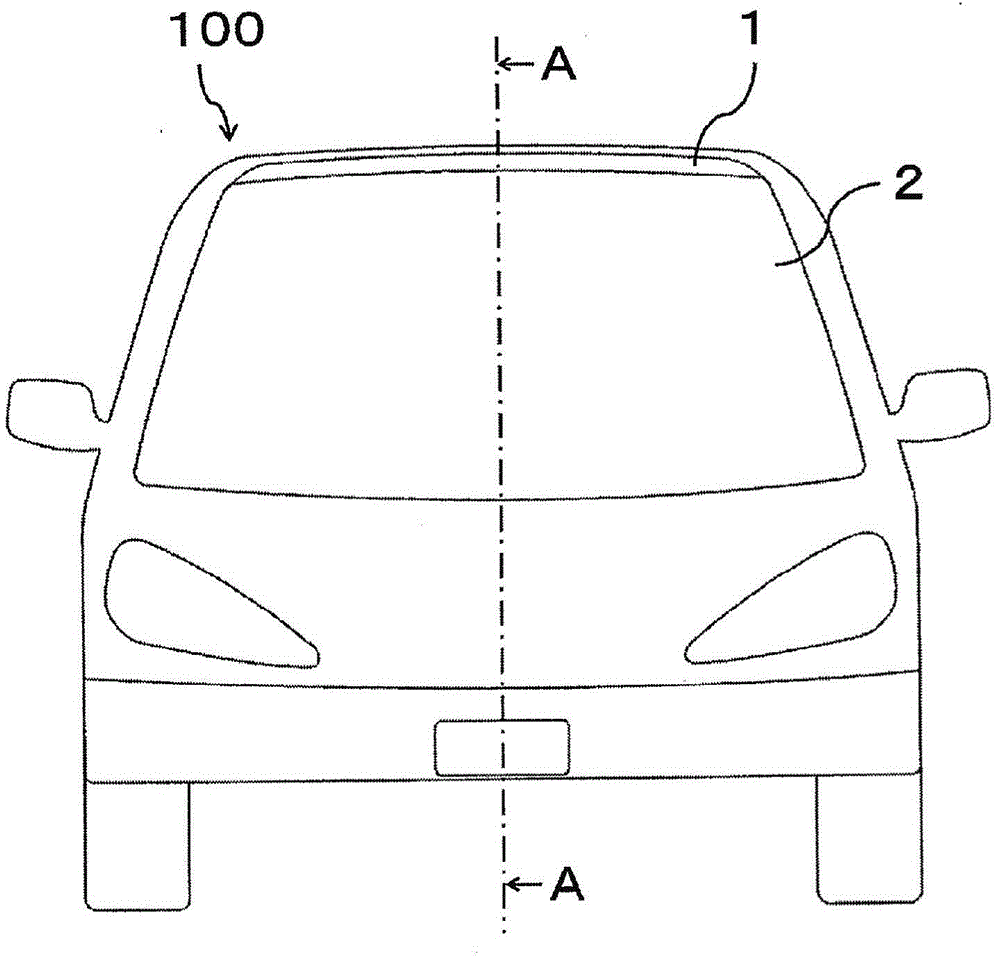
Fig. 1 is a schematic front view of a vehicle including a resin member for a vehicle body according to an embodiment of the present invention.
Fig. 2 is a cross-sectional view taken along line a-a of fig. 1, showing an example of an enlarged view of the periphery of a portion of the resin member for a vehicle body where the vehicle-mounted member is mounted.
Fig. 3 is a cross-sectional view taken along line a-a of fig. 1, showing another example of an enlarged view of the periphery of a portion of the resin member for a vehicle body where the vehicle-mounted member is mounted.
Fig. 4 is a cross-sectional view taken along line a-a of fig. 1, showing another example of an enlarged view of the periphery of a portion of the resin member for a vehicle body where the vehicle-mounted member is mounted.
Fig. 5 is a cross-sectional view taken along line a-a of fig. 1, showing another example of an enlarged view of the periphery of a portion of the resin member for a vehicle body where the vehicle-mounted member is mounted.
Fig. 6 is a cross-sectional view taken along line a-a of fig. 1, showing another example of an enlarged view of the periphery of a portion of the resin member for a vehicle body where the vehicle-mounted member is mounted.
Fig. 7 is a cross-sectional view taken along line a-a of fig. 1, showing another example of an enlarged view of the periphery of a portion of the resin member for a vehicle body where the vehicle-mounted member is mounted.
Fig. 8 is a cross-sectional view taken along line a-a of fig. 1, showing another example of an enlarged view of the periphery of a portion of the resin member for a vehicle body where the vehicle-mounted member is mounted.
Fig. 9 is a schematic front view of a vehicle provided with a resin member for a vehicle body according to another embodiment of the present invention.
Fig. 10A is a cross-sectional view taken along line a-a of fig. 1, and is an example of an enlarged view of the periphery of the joint portion of the resin member for a vehicle body and the window member.
Fig. 10B is a cross-sectional view taken along line a-a of fig. 1, showing another example of an enlarged view around a joint portion of the resin member for a vehicle body and the window member.
Fig. 10C is a cross-sectional view taken along line a-a of fig. 1, showing another example of an enlarged view around a joint portion of the resin member for a vehicle body and the window member.
Fig. 10D is a cross-sectional view taken along line a-a of fig. 1, showing another example of an enlarged view around a joint portion of the resin member for a vehicle body and the window member.
Detailed Description
Hereinafter, embodiments of the present invention will be described. The present invention is not limited to the embodiments described below. Furthermore, the embodiments shown in the figures are schematic and do not necessarily represent exact dimensions or scales for clearly illustrating the invention.
Fig. 1 is a schematic front view of a vehicle 100 including a resin member 1 for a vehicle body according to the present embodiment. The resin member 1 for a vehicle body of the present embodiment is disposed above a window member 2 of a vehicle 100, and at least one vehicle-mounted member is attached thereto. The resin member 1 for a vehicle body of the present embodiment will be described in detail below.
The resin member for a vehicle body of the present embodiment is a resin member constituting a vehicle body (resin member for a vehicle body).
In the present specification, the vehicle body is a concept used separately from the window member. The window member is usually made of laminated glass or tempered glass through which passengers see the outside scenery. Examples of the window member for a vehicle include a windshield, a rear window, and a side window. Whereas the vehicle body generally transmits little visible light, passengers cannot see the outside scenery through the vehicle body.
Hereinafter, the resin member for a vehicle body may be simply referred to as a "resin member".
The resin member of the present embodiment is a member to which an in-vehicle member is attached. The resin member of the present embodiment is made of resin and has high moldability and workability, and therefore can be easily formed into a shape suitable for mounting an in-vehicle component. The shape suitable for mounting the vehicle-mounted member is, for example, a shape having a recess, a hole, a protrusion, a flat surface portion, and the like for mounting the vehicle-mounted member. The method of forming the resin member of the present embodiment into such a shape is not particularly limited, but it is preferable to form the resin member into such a shape at the time of molding from the viewpoints of cost, man-hour, and processing accuracy. That is, the resin member of the present embodiment is preferably a resin member formed by integral molding.
Further, since the resin member of the present embodiment is easily mounted with the in-vehicle member and is made of resin, it is not likely to hinder the function of the mounted in-vehicle member. As will be described in detail later.
Due to these features, the resin member of the present embodiment is a member suitable for mounting an in-vehicle member. Further, since the resin member of the present embodiment is mounted on the upper side of the window member of the vehicle, it is particularly suitable for mounting those vehicle-mounted members which are desired to be mounted at a high position. Hereinafter, the mounted vehicle-mounted member will be exemplified, and a configuration example of the vehicle-mounted member of the present embodiment will be specifically described.
< sensor >
First, a case where the vehicle-mounted component is a sensor will be described. Here, as the sensor mounted on the vehicle, a camera such as a visible light camera or an infrared camera, a radar such as a millimeter wave radar, a LIDAR (laser imaging detection and ranging), and the like can be mentioned.
The sensor is desirably mounted at a relatively high position in the vehicle in order to ensure a wide sensing range. However, since glass has low transmittance for infrared rays or millimeter waves, an infrared camera, a LIDAR, or a millimeter wave radar cannot be mounted in the vehicle compartment (inside the window member). Therefore, the sensor is usually mounted inside the front grill.
On the other hand, since visible light can pass through the glass, the visible light camera can be mounted in the vehicle compartment, usually in the upper part of the inside of the window member. However, in the case where the visible light camera is mounted in this manner, the visible light transmitted through the window member is detected by the visible light camera, and therefore, there is a problem that the obtained image is unclear and becomes a distorted image.
In order to solve the above problem, a method may be considered in which a through hole is provided in a part of the window member, and a sensor capable of detecting an electromagnetic wave passing through the through hole is mounted. However, since the window member is formed of glass having low workability and formability, it takes a great deal of cost and man-hours to provide such a through hole.
Further, since the window member is generally made of glass having a curved surface and low workability, the sensor is difficult to be mounted on the window member, and thus, there is a problem that a large cost and man-hours are required. Further, since the sensor is difficult to be mounted, the sensor mounted is poor in stability, and vibrations are likely to occur during the running of the vehicle, which may adversely affect the function of the sensor.
In order to solve the above-described conventional problems when mounting a sensor, a resin member having a through hole is given as an example of the resin member of the present embodiment. The sensor is mounted on the resin member so as to be able to detect electromagnetic waves (visible light, infrared light, millimeter waves, and the like) passing through the through-hole.
Since the resin member of the present embodiment is made of resin and has excellent moldability and processability, the through-hole can be easily formed. The sensor can also be mounted easily and stably. Therefore, if the resin member of the present embodiment is used, the sensor can be easily mounted at a high position without hindering the function thereof.
The size and shape of the through-hole can be adjusted as appropriate depending on the size and shape of the sensor member to be mounted, but is usually circular with a diameter of about 1 to 3 cm.
Examples of the method of fixing the sensor to the resin member include a method of inserting the sensor into the through hole, a method of bonding the sensor to the resin member, a method of pressing the sensor against the resin member, and a method of fixing the sensor using a holder or a sensor case. The following description will be made by taking an example of a method of mounting a sensor on a resin member as shown in FIGS. 2 to 4. In addition, the method of fixing the sensor to the resin member is not limited thereto. FIGS. 2 to 4 are sectional views taken along line A-A of FIG. 1, and are enlarged views of the resin member 1 around the portion where the vehicle-mounted member is mounted. The same applies to FIGS. 5 to 8.
In the example shown in fig. 2, the sensor 3 is fixed by being bonded to the resin member 1. In addition, as in the example shown in fig. 2, in the case where the lens portion of the sensor 3 is exposed to the outside of the vehicle, the lens portion is preferably protected by a cover glass or the like.
The cover glass preferably has a high transmittance for the electromagnetic waves detected by the sensor 3. For example, when a visible light camera is mounted, the cover glass is preferably made of glass having high visible light transmittance. When the infrared camera is mounted, the cover glass is preferably made of glass having high infrared transmittance. The glass having a high infrared transmittance may, for example, be a chalcogenide glass.
Such a structure cannot remove rainwater with the wiper blade when rainwater enters the through-hole 4. Therefore, such a structure is preferably provided with a mechanism for blowing air to the through-hole, for example, so that rainwater in the through-hole 4 can be removed. It is also preferable that the through-hole 4 is sealed with an arbitrary member so that rainwater does not flow into the vehicle interior from between the through-hole and the sensor 3.
The sensor may be fixed not by an adhesive but by pressing, for example, a spring member onto the resin member. In this case, it is preferable to dispose a rubber member between the resin member and the sensor from the viewpoint of sealing property.
Next, another example shown in fig. 3 will be explained. In the example shown in fig. 3, the sensor 3 is fixed to the resin member 1 by a bracket 6. In this example, as shown in fig. 3, it is preferable to provide a cover glass 5 at the vehicle exterior side end of the through-hole 4. In order to improve the stability of mounting the sensor 3, it is preferable to provide a flat surface portion on the resin member 1 and mount the bracket 6 thereto. Further, the holder 6 is preferably integrally formed with the resin member 1.
Next, another example shown in fig. 4 will be explained. In the example shown in fig. 4, the sensor 3 is housed in the sensor case 7, pressed against the resin member by the spring member 9, and inserted into the through hole 4 to be fixed.
A method of mounting the resin member 1 into the sensor cartridge 7 is not particularly limited. For example, the sensor case 7 may be bonded to the resin member 1. The resin member 1 may be provided with a projection for engagement and inserted into an engaging recess provided in the sensor case 7. The shapes of the engaging projections and the recesses are not particularly limited, and may be appropriately adjusted to a shape that facilitates mounting. The sensor case 7 may be formed by being integrally molded with the resin member 1.
In this example, the sensor 3 is inserted into the through hole 4 and fixed. The method for fixing the sensor 3 to the through hole 4 is not particularly limited. Examples thereof include a method of fixing with an adhesive, a method of screwing the inner surface of the through-hole 4 and the outer surface of the sensor 3 by providing a screw, and a method of engaging the sensor 3 by providing an engaging member such as a jig.
The sensor 3 may be fixed by pressing the spring member 9 against the resin member 1 from inside the sensor case 7, for example. In this case, it is preferable to dispose the rubber member 8 for filling the gap between the sensor 3 and the resin member 1.
In addition, in the case of mounting a plurality of sensors, the plurality of sensors may be housed in 1 sensor cartridge and then mounted. Further, a cover or the like covering the upper portion of the sensor may be attached to the sensor so as not to allow outside light to enter.
The method of mounting the sensor to the resin member is not limited to the specific example described above. For example, instead of the sensor cartridge, the sensor may be mounted on a plate-shaped member constituted only by the bottom plate of the sensor cartridge and the sensor may be mounted by attaching the plate-shaped member to a resin member.
< antenna >
Next, a case where the vehicle-mounted component is an antenna for transmitting and receiving radio waves will be described.
The antenna is desirably mounted at a relatively high position of the vehicle, for example, at an upper portion of the inside of the window member, in order to easily transmit and receive radio waves. However, in recent years, high-frequency band waves used in 4G or 5G are difficult to transmit through glass, and therefore, it is difficult to dispose the antenna in the vehicle interior as in the conventional case.
On the other hand, since the resin member of the present embodiment is made of resin, it is easier to improve the electromagnetic wave transmittance by adjusting the material and thickness than the glass window member, and high-frequency waves can also be transmitted therethrough. Therefore, when the resin member of the present embodiment is used, the antenna can be installed in the vehicle cabin.
The antenna may be mounted on the resin member 1 by an adhesive or the like, for example. In the case of mounting an antenna, the resin member 1 may have a recess 11 for mounting an antenna 10 as shown in fig. 5.
Further, the antenna 10 may be mounted after being inserted into a small pocket 12 provided in the resin member 1, as shown in fig. 6, for example. In order to suppress vibration of the antenna 10 in the small pocket 12, the antenna 10 is preferably fixed by being pressed into the small pocket 12 by, for example, a spring member 13 or the like. In addition, the antenna 10 may also be adhered, for example, within the pouch 12.
Further, a bracket is generally used for mounting the vehicle-mounted member, but since the bracket is made of metal, it has a bad influence on transmission and reception of radio waves. The resin member of the present embodiment is made of resin, has high moldability and workability, and can be easily formed into a shape suitable for mounting various vehicle-mounted members. Therefore, the number of brackets for mounting the vehicle-mounted component can be reduced. Therefore, from the above viewpoint, the resin member of the present embodiment is suitable for mounting an antenna.
< indoor mirror >
Next, a case where the vehicle-mounted component is an interior mirror will be described.
An in-vehicle mirror is generally mounted to a window member by a mirror base adhered to the window member. However, since the window member is curved and the mount surface of the mirror base is generally flat, it is difficult to secure the adhesive strength as described above. However, in recent years, there has been a demand for a multi-functional indoor mirror, and the weight of the indoor mirror has increased, and therefore, a mounting structure capable of more firmly mounting the indoor mirror has been required.
In order to solve the above-described conventional problems when the indoor mirror 14 is mounted, as a 1 st example of the resin member of the present embodiment, there is a resin member 1 having a flat surface portion 16 for mounting the mirror base 15 as shown in fig. 7. At this time, the surface may be roughened in order to improve adhesion. In addition, as a 2 nd example, there is a resin member 1 provided with an integrally molded mirror base 17 as shown in fig. 8.
In the resin member 1 of example 1 described above, the mirror base 15 is attached to the flat surface portion 16, and the indoor mirror 14 is attached to the mirror base 15, whereby the indoor mirror 14 can be firmly attached. In contrast, in the resin member 1 of example 2, the indoor mirror 14 can be firmly attached by attaching the indoor mirror 14 to the integrally formed mirror base 17. In example 1, the method of attaching the mirror holder 15 to the flat surface portion 16 is not particularly limited, and the mirror holder can be attached by, for example, adhesion.
Representative vehicle-mounted members are listed above, and examples of resin members for mounting thereof are explained, but the vehicle-mounted members mounted on the resin members of the present embodiment are not limited to those exemplified above. Further, the in-vehicle component of the present embodiment may mount a plurality of in-vehicle components.
The shape of the resin member of the present embodiment is not particularly limited, and may be, for example, a plate shape having a thickness of 2 to 30 mm. The thickness of the resin member may be uneven, or may be appropriately adjusted according to the required strength, the performance of the mounted sensor, and the mounting structure. The resin member 1 of the present embodiment may be provided across the entire width direction of the window member 2 as shown in fig. 1, or may be provided in a part of the width direction of the window member 2 as shown in fig. 9, for example.
When the resin member of the present embodiment is installed in a vehicle, it may or may not be coated. When the resin member of the present embodiment is provided in a wide range of shapes as shown in fig. 1, it is preferable to coat the resin member with the same color as the vehicle body portion other than the resin member of the present embodiment for the reason of appearance.
On the other hand, when not coated, the resin member of the present embodiment is preferably high in weather resistance because it directly contacts sunlight, outside air, rainwater, and the like. The weather resistance can be improved by coloring the resin member of the present embodiment black or by adding a UV absorber, an antioxidant, or the like to the resin member of the present embodiment.
Further, the mounting structure of the vehicle-mounted member is not good in appearance if it is seen from the outside of the vehicle. Therefore, when the resin member of the present embodiment is not coated, the visible light transmittance is preferably low. Specifically, the visible light transmittance is preferably 50% or less, and more preferably 20% or less. The visible light transmittance is a visible light transmittance determined in accordance with Japanese Industrial standards (JIS R3212-2015).
In addition, since the region where the resin member of the present embodiment is attached is a region where temperature rise due to sunlight or the like is relatively easy, the resin member of the present embodiment is preferably excellent in heat resistance. Specifically, the load deflection temperature of the resin member of the present embodiment is preferably 50 ℃ or higher, more preferably 70 ℃ or higher, and still more preferably 90 ℃ or higher. The deflection temperature under load is a value measured in accordance with the Japanese Industrial Standard (JIS K7191-2-2007, 0.45 MPa).
To explain the joint portion between the resin member and the window member, fig. 10A to D are sectional views taken along line a-a of fig. 1, and are enlarged views around the joint portion between the resin member 1 and the window member 2.
The resin member 1 and the window member 2 are joined by, for example, an adhesive. The structure of the joint portion may be such that the end surfaces of the resin member 1 and the window member 2 abut against each other as shown in fig. 10A. As shown in fig. 10B, the vicinity of the two long sides of the end face of the resin member 1 may protrude in a direction perpendicular to the end face, and the end of the window member 2 may be fitted between the protruding portions. As shown in fig. 10C or 10D, the vicinity of one long side of the end face of the resin member 1 may protrude in a direction perpendicular to the end face. The structures of fig. 10B to 10D are preferable from the viewpoint of strength, and particularly the structures of fig. 10B and 10C are preferable from the viewpoint of strength against an impact from the outside of the vehicle.
If the difference in thermal expansion coefficient between the resin member and the window member is large, the joint between the resin member and the window member may be broken, and the window member or the resin member may be broken. This possibility is even greater particularly in the case where a resin member like that shown in fig. 1 is provided over the entire width direction of the window member.
Therefore, the linear expansion coefficient of the resin member of the present embodiment is preferably close to the linear expansion coefficient of the window member (about 9 × 10)-6℃-1). Specifically, 80 × 10 is preferable-6℃-1Hereinafter, more preferably 60 × 10-6℃-1Hereinafter, more preferably 50X 10-6℃-1The following. The linear expansion coefficient is a value measured based on japanese industrial standards (JISK 7140-1-2008).
The material of the resin member of the present embodiment is not particularly limited. The resin that is the material of the resin member of the present embodiment may be mixed with a filler for various purposes such as improvement of stability and heat resistance, improvement of thermal function such as flame retardancy, improvement of mechanical properties such as strength and abrasion resistance, and improvement of electrical properties, magnetic properties, and sound insulation. The shape of the filler is not limited, and examples thereof include a spherical shape, a hollow shape, a granular shape, a plate shape, a rod shape, and a fiber shape. The material of the filler is not limited, and examples thereof include glass, inorganic salts such as calcium carbonate, carbon, and aramid.
As a material of the resin member of the present embodiment, for example, a fiber reinforced plastic is cited. Examples of the fiber-reinforced plastic include carbon fiber-reinforced plastic (CFRP), CNF (cellulose nanofiber) -reinforced plastic (CNF), glass fiber-reinforced plastic (GFRP), and aramid fiber-reinforced plastic (AFRP).
As a material of the resin member of the present embodiment, a plastic that is not fiber-reinforced may be used. For example, polyvinyl chloride (PVC), ABS resin, acrylic (PMMA), polyamide resin (PA including nylon), Polyacetal (POM), polybutylene terephthalate (PBT), polyethylene terephthalate (PET), Polycarbonate (PC), polyphenylene sulfide (PPS), polyether ketone (PEEK), polyether sulfone (PES), polypropylene (PP), Polyethylene (PE), and the like can be used.
It may also be mixed with more than 2 for the purpose of performance enhancement to form a polymer alloy.
In addition, additives, for example, a UV absorber, an antioxidant, and the like may be added to the resin member of the present embodiment within a range not to impair the effects of the present invention. The resin member of the present embodiment may be processed by coating or the like within a range not impairing the effects of the present invention.
The method for producing the resin member of the present embodiment is not particularly limited, and injection molding may be mentioned.
Next, a window member with a resin member for a vehicle body according to the present embodiment will be described. The window member with resin for a vehicle body according to the present embodiment includes a window member for a vehicle and the resin member attached to an upper portion of the window member for a vehicle.
In the window member with a resin member for a vehicle body according to the present embodiment, the structure of the window member is not particularly limited. The window member may be a window member made of laminated glass, for example, or may be a window member made of resin. Examples of the resin constituting the resin window member include polycarbonate, and a composite resin of cellulose nanofibers and polycarbonate.
Next, the vehicle according to the present embodiment will be explained. The vehicle according to the present embodiment includes a window member and the resin member positioned above the window member. The vehicle of the present embodiment includes a resin member at a relatively high position, and an in-vehicle member may be mounted on the resin member.
The various embodiments have been described above with reference to the drawings, but the present invention is not limited to these examples. It is apparent to those skilled in the art that various modifications and variations can be made in the present invention within the scope of the claims and those skilled in the art should understand that they also fall within the technical scope of the present invention. In addition, various components in the above embodiments may be arbitrarily combined without departing from the scope of the invention.
In addition, the present application is based on japanese patent application No. 2019-126898 filed on 7/8 of 2019, the contents of which are incorporated by reference in the present application.
Description of the symbols
1 resin Member for vehicle body
2 Window component
3 sensor
4 through hole
5 cover glass
6 support
7 sensor box
8 rubber component
9 spring component
10 aerial
11 pit
12 small bag
13 spring component
14 vehicle inner mirror
15 mirror base
16 plane part
17 mirror base
100 vehicle
Claims (12)
1. A resin member for a vehicle body is disposed on an upper portion of a window member of a vehicle, and at least one vehicle-mounted member is mounted thereon.
2. The resin member for a vehicle body according to claim 1, wherein at least one of the in-vehicle members is a sensor, and the resin member for a vehicle body includes a through hole.
3. The resin member for a vehicle body according to claim 1 or 2, wherein at least one of the vehicle-mounted members is an antenna, and the resin member for a vehicle body is provided with a recess for mounting the antenna.
4. The resin member for a vehicle body according to any one of claims 1 to 3, wherein at least one of the vehicle-mounted members is a mirror, and the resin member for a vehicle body includes a flat surface portion on which a mirror base of the mirror is attached.
5. The resin member for a vehicle body according to any one of claims 1 to 3, wherein at least one of the vehicle-mounted members is a mirror, and a mirror base of the mirror is integrally formed with the resin member for a vehicle body.
6. The resin member for a vehicle body according to any one of claims 1 to 5, wherein a visible light transmittance is 50% or less.
7. A resin member for a vehicle body according to any one of claims 1 to 6, wherein a deflection temperature under load is 50 ℃ or higher.
8. The resin member for vehicle bodies according to any one of claims 1 to 7, wherein a linear expansion coefficient is 80 x 10-6℃-1The following.
9. A window member with a resin member for a vehicle body, comprising a window member and the resin member for a vehicle body according to any one of claims 1 to 8 disposed on an upper portion of the window member.
10. The window member with a resin member for a vehicle body according to claim 9, further comprising at least one vehicle-mounted member attached to the resin member for a vehicle body.
11. A vehicle comprising a window member and the resin member for a vehicle body according to any one of claims 1 to 8 disposed on an upper portion of the window member.
12. The vehicle according to claim 11, further comprising at least one vehicle-mounted member attached to the resin member for a vehicle body.
Applications Claiming Priority (3)
| Application Number | Priority Date | Filing Date | Title |
|---|---|---|---|
| JP2019-126898 | 2019-07-08 | ||
| JP2019126898 | 2019-07-08 | ||
| PCT/JP2020/024069 WO2021006004A1 (en) | 2019-07-08 | 2020-06-19 | Vehicle body resin member, window member with vehicle body resin member, and vehicle |
Publications (1)
| Publication Number | Publication Date |
|---|---|
| CN114072315A true CN114072315A (en) | 2022-02-18 |
Family
ID=74114849
Family Applications (1)
| Application Number | Title | Priority Date | Filing Date |
|---|---|---|---|
| CN202080049282.8A Pending CN114072315A (en) | 2019-07-08 | 2020-06-19 | Resin member for vehicle body, window member with resin member for vehicle body, and vehicle |
Country Status (5)
| Country | Link |
|---|---|
| US (1) | US12065025B2 (en) |
| EP (1) | EP3998177A4 (en) |
| JP (1) | JP7424378B2 (en) |
| CN (1) | CN114072315A (en) |
| WO (1) | WO2021006004A1 (en) |
Families Citing this family (7)
| Publication number | Priority date | Publication date | Assignee | Title |
|---|---|---|---|---|
| DE102019128013A1 (en) * | 2019-10-17 | 2021-04-22 | Bayerische Motoren Werke Aktiengesellschaft | Vehicle component for integrating an environment detection sensor into a vehicle |
| WO2021112032A1 (en) * | 2019-12-03 | 2021-06-10 | 株式会社クラレ | Multilayer body, antenna system and method of producing same |
| JP2021116352A (en) * | 2020-01-27 | 2021-08-10 | ポリプラスチックス株式会社 | Automotive optical module parts |
| FR3127633B1 (en) * | 2021-09-24 | 2025-05-30 | Lynred | Infrared imaging device |
| WO2023119316A1 (en) * | 2021-12-21 | 2023-06-29 | Saint-Gobain Glass France | An automotive glazing with integrated radar unit |
| CN114734929A (en) * | 2022-04-27 | 2022-07-12 | 福耀玻璃工业集团股份有限公司 | Vehicle window glass assembly and control method thereof |
| FR3160650A1 (en) * | 2024-03-29 | 2025-10-03 | Saint-Gobain Glass France | Assembly comprising vehicle glazing with a through hole for using an infrared camera |
Citations (5)
| Publication number | Priority date | Publication date | Assignee | Title |
|---|---|---|---|---|
| JPH07215131A (en) * | 1994-01-31 | 1995-08-15 | Asahi Glass Co Ltd | Mirror base mounting structure and mounting method on glass plate surface |
| CN1460079A (en) * | 2001-05-15 | 2003-12-03 | 株式会社村上开明堂 | Rear-view mirror with built-in antenna |
| CN101037099A (en) * | 2006-03-14 | 2007-09-19 | 福特全球技术公司 | Device and method for outwardly looking ir camera mounted inside vehicles. |
| CN107074160A (en) * | 2014-11-04 | 2017-08-18 | 日本板硝子株式会社 | Windshield |
| CN109641793A (en) * | 2016-07-29 | 2019-04-16 | 日本板硝子株式会社 | Windshield and method for manufacturing windshield |
Family Cites Families (25)
| Publication number | Priority date | Publication date | Assignee | Title |
|---|---|---|---|---|
| JPH0633433Y2 (en) * | 1988-04-15 | 1994-08-31 | 日産自動車株式会社 | Vehicle monitoring device |
| JPH06180775A (en) * | 1992-12-14 | 1994-06-28 | Nippondenso Co Ltd | Electronic mark for vehicle |
| EP0609453B1 (en) | 1992-06-25 | 2002-10-23 | Denso Corporation | Mobile object identification device |
| GB2271139A (en) | 1992-10-03 | 1994-04-06 | Pilkington Plc | Vehicle window with insert of high infra-red transmittance |
| US6326613B1 (en) * | 1998-01-07 | 2001-12-04 | Donnelly Corporation | Vehicle interior mirror assembly adapted for containing a rain sensor |
| JP2003146134A (en) * | 2001-11-14 | 2003-05-21 | Ichikoh Ind Ltd | Inner mirror device |
| JP2007269205A (en) * | 2006-03-31 | 2007-10-18 | Yupiteru Ind Co Ltd | On-vehicle device fixing device |
| DE102007042028A1 (en) | 2007-09-05 | 2009-03-12 | Saint-Gobain Sekurit Deutschland Gmbh & Co. Kg | Disk with a detector for electromagnetic radiation |
| JP2009234432A (en) | 2008-03-27 | 2009-10-15 | Nissan Motor Co Ltd | Window material for automobile |
| JP2010234867A (en) | 2009-03-30 | 2010-10-21 | Daikyonishikawa Corp | Vehicle wind panel |
| JP2012206721A (en) | 2012-07-17 | 2012-10-25 | Mitsubishi Engineering Plastics Corp | Panel structure having window |
| EP2941451A4 (en) | 2013-01-02 | 2016-07-13 | Sabic Global Technologies Bv | POLYMERS, ARTICLES COMPRISING POLYMERS AND METHODS OF MAKING AND USING THE SAME |
| JP2015107764A (en) | 2013-12-05 | 2015-06-11 | 株式会社豊田自動織機 | Camera mounting structure |
| CN106103158B (en) * | 2014-03-14 | 2018-11-06 | 日本板硝子株式会社 | Windshield |
| WO2016143582A1 (en) | 2015-03-12 | 2016-09-15 | 日本板硝子株式会社 | Windshield |
| JP2016175447A (en) * | 2015-03-18 | 2016-10-06 | トヨタ自動車株式会社 | vehicle |
| WO2017188414A1 (en) * | 2016-04-27 | 2017-11-02 | 旭硝子株式会社 | Resin body, and glass plate article |
| CN109070704B (en) | 2016-04-27 | 2021-10-08 | Agc株式会社 | Window member and window glass for vehicle |
| WO2017188412A1 (en) | 2016-04-27 | 2017-11-02 | 旭硝子株式会社 | Bracket-equipped laminated plate |
| US9963018B2 (en) * | 2016-06-27 | 2018-05-08 | Toyota Motor Engineering & Manufacturing North America, Inc. | Vehicles and vehicle roof structures for concealing one or more sensors |
| DE112018001377T5 (en) * | 2017-03-15 | 2019-11-28 | AGC Inc. | Laminated glass for a vehicle with an interior mirror |
| JP6896533B2 (en) * | 2017-07-04 | 2021-06-30 | 富士フイルム株式会社 | Head-up display |
| CN111066313B (en) | 2017-09-06 | 2022-03-25 | 富士胶片株式会社 | camera |
| JP6950547B2 (en) | 2018-01-26 | 2021-10-13 | 工機ホールディングス株式会社 | Strike work machine |
| JP2019166964A (en) | 2018-03-23 | 2019-10-03 | ソニーセミコンダクタソリューションズ株式会社 | Imaging system and vehicle window for use therein |
-
2020
- 2020-06-19 CN CN202080049282.8A patent/CN114072315A/en active Pending
- 2020-06-19 JP JP2021530566A patent/JP7424378B2/en active Active
- 2020-06-19 WO PCT/JP2020/024069 patent/WO2021006004A1/en not_active Ceased
- 2020-06-19 EP EP20836624.5A patent/EP3998177A4/en active Pending
-
2022
- 2022-01-03 US US17/646,726 patent/US12065025B2/en active Active
Patent Citations (5)
| Publication number | Priority date | Publication date | Assignee | Title |
|---|---|---|---|---|
| JPH07215131A (en) * | 1994-01-31 | 1995-08-15 | Asahi Glass Co Ltd | Mirror base mounting structure and mounting method on glass plate surface |
| CN1460079A (en) * | 2001-05-15 | 2003-12-03 | 株式会社村上开明堂 | Rear-view mirror with built-in antenna |
| CN101037099A (en) * | 2006-03-14 | 2007-09-19 | 福特全球技术公司 | Device and method for outwardly looking ir camera mounted inside vehicles. |
| CN107074160A (en) * | 2014-11-04 | 2017-08-18 | 日本板硝子株式会社 | Windshield |
| CN109641793A (en) * | 2016-07-29 | 2019-04-16 | 日本板硝子株式会社 | Windshield and method for manufacturing windshield |
Also Published As
| Publication number | Publication date |
|---|---|
| JP7424378B2 (en) | 2024-01-30 |
| WO2021006004A1 (en) | 2021-01-14 |
| EP3998177A4 (en) | 2023-08-02 |
| US12065025B2 (en) | 2024-08-20 |
| EP3998177A1 (en) | 2022-05-18 |
| US20220118832A1 (en) | 2022-04-21 |
| JPWO2021006004A1 (en) | 2021-01-14 |
Similar Documents
| Publication | Publication Date | Title |
|---|---|---|
| CN114072315A (en) | Resin member for vehicle body, window member with resin member for vehicle body, and vehicle | |
| CN108627838B (en) | Radar apparatus | |
| ES3019363T3 (en) | Electronic device including housing containing metallic materials | |
| JP2020006827A (en) | Mounting base and glass for vehicles with mounting base | |
| EA035643B1 (en) | Antenna panel | |
| US20140036632A1 (en) | Mounting structure for sonar sensor | |
| EP3629054A1 (en) | Sealing member and vehicle sensor unit | |
| CN110418725A (en) | Laminated glass for use in vehicles with rearview mirror | |
| JP2015107764A (en) | Camera mounting structure | |
| CN113650561A (en) | Sensor mounting structure for vehicle | |
| JP2016172460A (en) | Vehicle and vehicle antenna device | |
| US20150338602A1 (en) | Lens module for imaging apparatus | |
| CN106536285A (en) | Arrangement for mounting functional component such as camera on motor vehicle bodywork element | |
| JP6365874B2 (en) | VEHICLE SENSOR MOUNTING DEVICE AND VEHICLE DISTANCE DETECTOR HAVING THE SAME | |
| JP7519781B2 (en) | Sensor fixing member for vehicle and method for manufacturing the same | |
| WO2021200590A1 (en) | Defogging heater | |
| CN103895575A (en) | Outside mirror assembly for vehicle | |
| CN121285756A (en) | Vehicle-mounted device | |
| JP2006287499A (en) | Radio wave transmissive cover member | |
| AU2006302955A1 (en) | On a radome mounted GPS antenna assembly | |
| WO2023037871A1 (en) | Radio wave transmissive member, emblem, and target detection structure | |
| US20220317306A1 (en) | Vehicle Component for Integrating an Environment Detection Sensor Into a Vehicle | |
| JP7692033B2 (en) | Vehicle information acquisition device cover | |
| JP2022147334A (en) | Vehicle window glass with on-vehicle camera | |
| KR20180065504A (en) | Camera |
Legal Events
| Date | Code | Title | Description |
|---|---|---|---|
| PB01 | Publication | ||
| PB01 | Publication | ||
| SE01 | Entry into force of request for substantive examination | ||
| SE01 | Entry into force of request for substantive examination | ||
| RJ01 | Rejection of invention patent application after publication |
Application publication date: 20220218 |
|
| RJ01 | Rejection of invention patent application after publication |