CN114040918A - Saponin conjugates and vaccines or pharmaceutical compositions containing the same - Google Patents
Saponin conjugates and vaccines or pharmaceutical compositions containing the same Download PDFInfo
- Publication number
- CN114040918A CN114040918A CN202080041297.XA CN202080041297A CN114040918A CN 114040918 A CN114040918 A CN 114040918A CN 202080041297 A CN202080041297 A CN 202080041297A CN 114040918 A CN114040918 A CN 114040918A
- Authority
- CN
- China
- Prior art keywords
- group
- aliphatic
- virus
- ethers
- saponin
- Prior art date
- Legal status (The legal status is an assumption and is not a legal conclusion. Google has not performed a legal analysis and makes no representation as to the accuracy of the status listed.)
- Granted
Links
Images


Classifications
-
- A—HUMAN NECESSITIES
- A61—MEDICAL OR VETERINARY SCIENCE; HYGIENE
- A61K—PREPARATIONS FOR MEDICAL, DENTAL OR TOILETRY PURPOSES
- A61K39/00—Medicinal preparations containing antigens or antibodies
- A61K39/39—Medicinal preparations containing antigens or antibodies characterised by the immunostimulating additives, e.g. chemical adjuvants
-
- A—HUMAN NECESSITIES
- A61—MEDICAL OR VETERINARY SCIENCE; HYGIENE
- A61P—SPECIFIC THERAPEUTIC ACTIVITY OF CHEMICAL COMPOUNDS OR MEDICINAL PREPARATIONS
- A61P31/00—Antiinfectives, i.e. antibiotics, antiseptics, chemotherapeutics
- A61P31/04—Antibacterial agents
-
- A—HUMAN NECESSITIES
- A61—MEDICAL OR VETERINARY SCIENCE; HYGIENE
- A61P—SPECIFIC THERAPEUTIC ACTIVITY OF CHEMICAL COMPOUNDS OR MEDICINAL PREPARATIONS
- A61P31/00—Antiinfectives, i.e. antibiotics, antiseptics, chemotherapeutics
- A61P31/12—Antivirals
-
- A—HUMAN NECESSITIES
- A61—MEDICAL OR VETERINARY SCIENCE; HYGIENE
- A61P—SPECIFIC THERAPEUTIC ACTIVITY OF CHEMICAL COMPOUNDS OR MEDICINAL PREPARATIONS
- A61P31/00—Antiinfectives, i.e. antibiotics, antiseptics, chemotherapeutics
- A61P31/12—Antivirals
- A61P31/14—Antivirals for RNA viruses
-
- A—HUMAN NECESSITIES
- A61—MEDICAL OR VETERINARY SCIENCE; HYGIENE
- A61P—SPECIFIC THERAPEUTIC ACTIVITY OF CHEMICAL COMPOUNDS OR MEDICINAL PREPARATIONS
- A61P31/00—Antiinfectives, i.e. antibiotics, antiseptics, chemotherapeutics
- A61P31/12—Antivirals
- A61P31/14—Antivirals for RNA viruses
- A61P31/16—Antivirals for RNA viruses for influenza or rhinoviruses
-
- A—HUMAN NECESSITIES
- A61—MEDICAL OR VETERINARY SCIENCE; HYGIENE
- A61P—SPECIFIC THERAPEUTIC ACTIVITY OF CHEMICAL COMPOUNDS OR MEDICINAL PREPARATIONS
- A61P35/00—Antineoplastic agents
-
- A—HUMAN NECESSITIES
- A61—MEDICAL OR VETERINARY SCIENCE; HYGIENE
- A61P—SPECIFIC THERAPEUTIC ACTIVITY OF CHEMICAL COMPOUNDS OR MEDICINAL PREPARATIONS
- A61P37/00—Drugs for immunological or allergic disorders
- A61P37/02—Immunomodulators
-
- C—CHEMISTRY; METALLURGY
- C07—ORGANIC CHEMISTRY
- C07H—SUGARS; DERIVATIVES THEREOF; NUCLEOSIDES; NUCLEOTIDES; NUCLEIC ACIDS
- C07H1/00—Processes for the preparation of sugar derivatives
-
- C—CHEMISTRY; METALLURGY
- C07—ORGANIC CHEMISTRY
- C07H—SUGARS; DERIVATIVES THEREOF; NUCLEOSIDES; NUCLEOTIDES; NUCLEIC ACIDS
- C07H15/00—Compounds containing hydrocarbon or substituted hydrocarbon radicals directly attached to hetero atoms of saccharide radicals
- C07H15/20—Carbocyclic rings
- C07H15/24—Condensed ring systems having three or more rings
- C07H15/256—Polyterpene radicals
-
- C—CHEMISTRY; METALLURGY
- C07—ORGANIC CHEMISTRY
- C07J—STEROIDS
- C07J53/00—Steroids in which the cyclopenta(a)hydrophenanthrene skeleton has been modified by condensation with a carbocyclic rings or by formation of an additional ring by means of a direct link between two ring carbon atoms, including carboxyclic rings fused to the cyclopenta(a)hydrophenanthrene skeleton are included in this class
- C07J53/002—Carbocyclic rings fused
-
- C—CHEMISTRY; METALLURGY
- C07—ORGANIC CHEMISTRY
- C07J—STEROIDS
- C07J63/00—Steroids in which the cyclopenta(a)hydrophenanthrene skeleton has been modified by expansion of only one ring by one or two atoms
- C07J63/008—Expansion of ring D by one atom, e.g. D homo steroids
-
- A—HUMAN NECESSITIES
- A61—MEDICAL OR VETERINARY SCIENCE; HYGIENE
- A61K—PREPARATIONS FOR MEDICAL, DENTAL OR TOILETRY PURPOSES
- A61K39/00—Medicinal preparations containing antigens or antibodies
- A61K2039/555—Medicinal preparations containing antigens or antibodies characterised by a specific combination antigen/adjuvant
- A61K2039/55511—Organic adjuvants
- A61K2039/55577—Saponins; Quil A; QS21; ISCOMS
-
- A—HUMAN NECESSITIES
- A61—MEDICAL OR VETERINARY SCIENCE; HYGIENE
- A61K—PREPARATIONS FOR MEDICAL, DENTAL OR TOILETRY PURPOSES
- A61K39/00—Medicinal preparations containing antigens or antibodies
- A61K2039/57—Medicinal preparations containing antigens or antibodies characterised by the type of response, e.g. Th1, Th2
- A61K2039/572—Medicinal preparations containing antigens or antibodies characterised by the type of response, e.g. Th1, Th2 cytotoxic response
-
- Y—GENERAL TAGGING OF NEW TECHNOLOGICAL DEVELOPMENTS; GENERAL TAGGING OF CROSS-SECTIONAL TECHNOLOGIES SPANNING OVER SEVERAL SECTIONS OF THE IPC; TECHNICAL SUBJECTS COVERED BY FORMER USPC CROSS-REFERENCE ART COLLECTIONS [XRACs] AND DIGESTS
- Y02—TECHNOLOGIES OR APPLICATIONS FOR MITIGATION OR ADAPTATION AGAINST CLIMATE CHANGE
- Y02A—TECHNOLOGIES FOR ADAPTATION TO CLIMATE CHANGE
- Y02A50/00—TECHNOLOGIES FOR ADAPTATION TO CLIMATE CHANGE in human health protection, e.g. against extreme weather
- Y02A50/30—Against vector-borne diseases, e.g. mosquito-borne, fly-borne, tick-borne or waterborne diseases whose impact is exacerbated by climate change
Landscapes
- Health & Medical Sciences (AREA)
- Chemical & Material Sciences (AREA)
- Life Sciences & Earth Sciences (AREA)
- Organic Chemistry (AREA)
- General Health & Medical Sciences (AREA)
- Veterinary Medicine (AREA)
- Public Health (AREA)
- Animal Behavior & Ethology (AREA)
- Chemical Kinetics & Catalysis (AREA)
- General Chemical & Material Sciences (AREA)
- Medicinal Chemistry (AREA)
- Pharmacology & Pharmacy (AREA)
- Virology (AREA)
- Nuclear Medicine, Radiotherapy & Molecular Imaging (AREA)
- Molecular Biology (AREA)
- Oncology (AREA)
- Communicable Diseases (AREA)
- Engineering & Computer Science (AREA)
- Immunology (AREA)
- Biochemistry (AREA)
- Genetics & Genomics (AREA)
- Biotechnology (AREA)
- Microbiology (AREA)
- Mycology (AREA)
- Epidemiology (AREA)
- Pulmonology (AREA)
- Bioinformatics & Cheminformatics (AREA)
- Pharmaceuticals Containing Other Organic And Inorganic Compounds (AREA)
- Medicines Containing Antibodies Or Antigens For Use As Internal Diagnostic Agents (AREA)
- Steroid Compounds (AREA)
- Saccharide Compounds (AREA)
Abstract
The present invention relates to a novel compound whose lipophilic group (such as a lipid, fatty acid, polyethylene glycol or terpene) is covalently linked to the carboxyl group of 3-O-glucuronic acid on a non-acylated or deacylated triterpene saponin. The combination of the lipophilic group with 3-O-glucuronic acid of saponin (such as quillaja deacylated saponin, loofah glycoside P or saponin from nephelinum, saponaria and phellopterin) enhances the adjuvant effect of saponin on humoral immunity and cellular immunity mediated immunity. Furthermore, the saponin analogues obtained by attaching a lipophilic group to the 3-O-glucuronic acid residue of a non-acylated or deacylated saponin are easier to purify, less toxic, chemically more stable and have equal or better adjuvant properties than existing saponins.
Description
Technical Field
The present invention relates to saponin conjugates, their synthesis and intermediates thereof. The invention also provides pharmaceutical compositions comprising the saponin conjugates of the invention, and methods of using the saponin conjugates or compositions to treat infectious diseases, cancer, and immune disorders.
Background
In present day vaccine formulations, the efficacy of adjuvants has been demonstrated. The current challenge is that for therapeutic vaccines, the combination of antigen and adjuvant must effectively stimulate both humoral and cellular immunity in order to treat complex diseases, such as: aids, malaria, tuberculosis and cancer. The development of a vaccine adjuvant is a major research focus in the vaccine formulation industry of today, however, no approved adjuvant exists today yet, the adjuvant can effectively induce cellular immunity and has high safety in clinical use.
Quillaja saponins (Quillaja saponins, q. saponins) are triterpene glycosides extracted from the bark of Quillaja saponaria Molina (Quillaja saponaria Molina). Quillaja saponin is a strong irritant for airway mucus production and causes inflammation of the digestive tract. Four major triterpene glycosides identified as QS-7, QS-17, QS-18 and QS-21 (quillaja saponin fractions 7, 17, 18 and 21) are known to be isolated from quillaja extracts, and these saponin structures possess the same triterpene backbone quillajac acid (quillaja acid) and are each linked to the trisaccharide β -D-Gal- (1 → 2) - [ β -D-Xyl- (1 → 3) ] - β -D-GlcA at the 3-O position. QS-21 contains the linear tetrasaccharide β -D-Apif/Xyl- (1 → 3) - β -D-Xyl- (1 → 4) - α -L-Rha- (1 → 2) - β -D-Fuc at the 28-O position and has a stereochemically rich fatty acid chain 1 (fuse-linked 4-O-acyl stereochemistry rich fatty acid chain 1) bonded through the fucose 4-O-position. The structures of QS-21 and its purified analogs are shown in the following table:
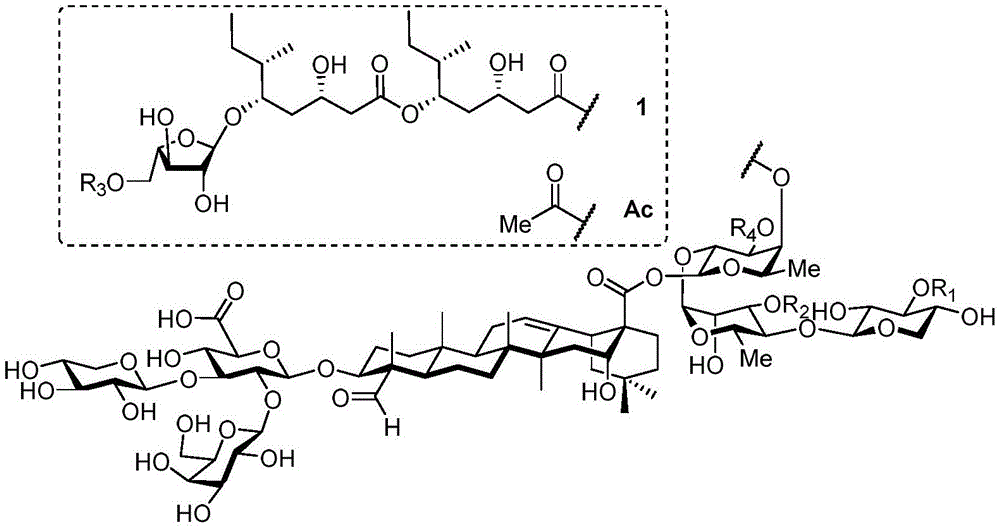
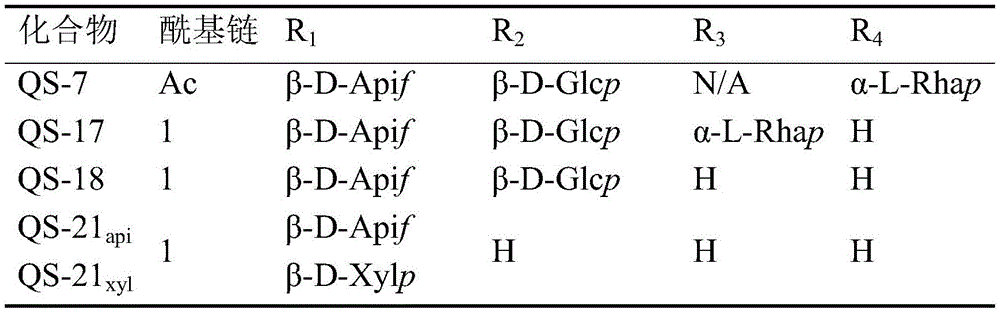
apif: furanapiose (apiofuranose); and (2) Xylp: xylose pyrans (xylopyranose);
glcp: glucopyranose (glucopyranose); rhap: rhamnopyranose (rhamnopyranose).
QS-21 molecule has been applied to hundreds of recent and ongoing clinical trials of vaccines (malaria, herpes, alzheimer's disease, human immunodeficiency virus type 1 (HIV-1), melanoma, breast cancer, small cell lung cancer, prostate cancer, etc.), and has also been established as a prospective adjuvant to enhance immune response, save dose (dose-sparing). However, there are still four major problems associated with the clinical use of QS-21: QS-21 has dose limiting toxicity (dose limiting toxicity), poor stability, inadequate understanding of the molecular mechanism of action, and limited supply of high quality products.
GPI-0100 is a mixture of semisynthetic saponins derived from the extract of Quillaja Saponaria Molina. The crude bark extract was treated under mild alkaline hydrolysis conditions and then linked to a straight chain C12 fatty carbon chain (an aliphatic dodeacyl chain) via an amide linkage with hydrolytic stability to give GPI-0100. This modification makes the molecular structure of quillaja saponins more stable at high temperatures (more complete toxin at high temperature) and also greatly reduces the intrinsic toxicity of quillaja extracts, however, their adjuvant activity is reduced as a result. Therefore, the development of saponin adjuvants that induce potent cellular immunity and have low toxicity is still the focus of vaccine development. The present invention develops a new generation of saponin-based adjuvants with improved efficacy in enhancing cellular immunity, which are more suitable for combination with therapeutic vaccines than existing adjuvants.
Disclosure of Invention
The present invention relates to novel compounds, herein referred to as saponin conjugates, wherein
In one aspect, the invention provides saponin conjugates of formula (I) or a pharmaceutically acceptable salt thereof:
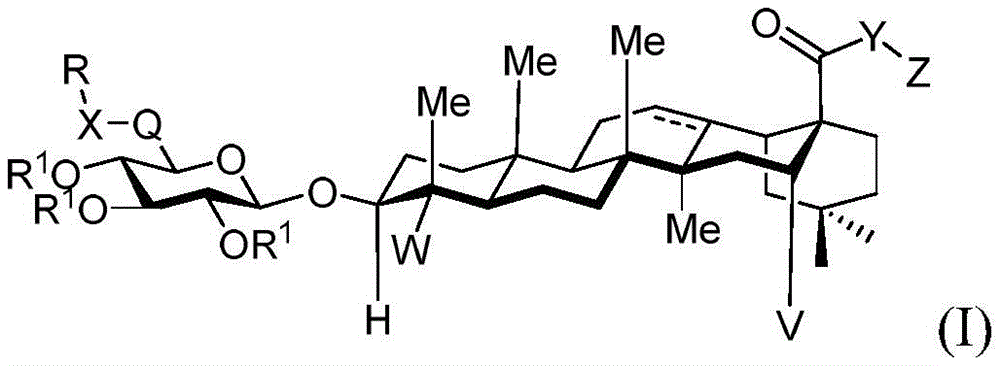
wherein:
· is a single bond or a double bond;
w is methyl (Me), -CHO,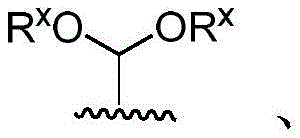 —CH2OR1、—C(O)RxOr CH2ORx;
V is hydrogen OR-OR1;
Y is CH2- (O) - (S) - (NR) - (NH) - (Y-O) - (Y-S) - (Y-NR) - (Y-NH) -;
q is CH2C-O, C ═ N-OH or C ═ N-OMe;
x is CH2- (O) - (NR) - (NH-C-O) - (S-or O-) - (C-O) - (O-) - (NR) - (NH-C-O) - (C-O) -;
r is an optionally substituted cyclic or acyclic moiety selected from the group consisting of acyl, aliphatic, heteroaliphatic, aryl-aliphatic, cycloaliphatic, heterocyclic-aliphatic, heteroaryl-aliphatic, alkoxy-aliphatic and aryloxy-aliphatic; or selected from the group consisting of: c1-C18Aliphatic, 5-10 membered aryl-aliphatic, 5-10 membered heteroaryl-aliphatic having 1-4 heteroatoms independently selected from the group consisting of nitrogen, oxygen, and sulfur, 4-7 membered heterocyclic-aliphatic having 1-2 heteroatoms independently selected from the group consisting of nitrogen, oxygen, and sulfur;
·R1independently hydrogen or selected from the group consisting of alkyl ethers, benzyl ethers, silyl ethers, acetals, ketals, esters, carbamates and carbonatesAn oxygen protecting group of the group; or carbohydrates having monosaccharide structures, such as: glucose, mannose, galactose, N-acetylglucosamine, N-acetylgalactosamine, altrose, allose, fucose, rhamnose, etc.;
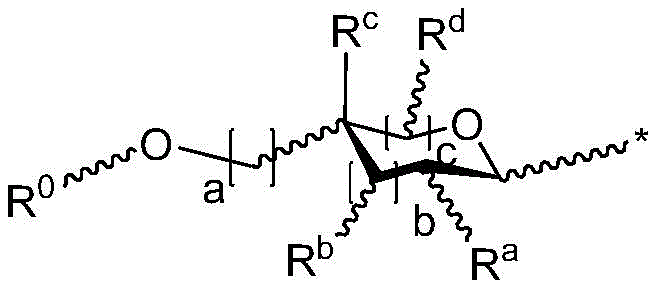
wherein:
■ a, b, and c are independently at each occurrence 0 or 1;
■R0independently hydrogen or an oxygen protecting group selected from the group consisting of alkyl ethers, benzyl ethers, silyl ethers, acetals, ketals, esters, carbamates, and carbonates;
■Ra、Rb、Rcand RdEach occurrence is independently hydrogen, halogen, OH, ORx;RxEach occurrence is independently hydrogen or an oxygen protecting group selected from the group consisting of alkyl ethers, benzyl ethers, silyl ethers, acetals, ketals, esters, carbamates, and carbonates;
z is hydrogen; or an optionally substituted cyclic or acyclic moiety selected from the group consisting of acyl, aliphatic, heteroaliphatic, aryl, aralkyl, heterocyclyl, and heteroaryl; or a carbohydrate having the structure:
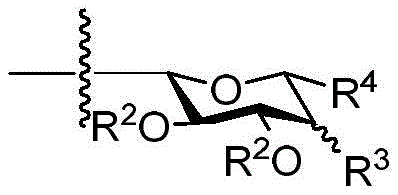
where:
◆R2each occurrence is hydrogen or a carbohydrate domain having the structure:
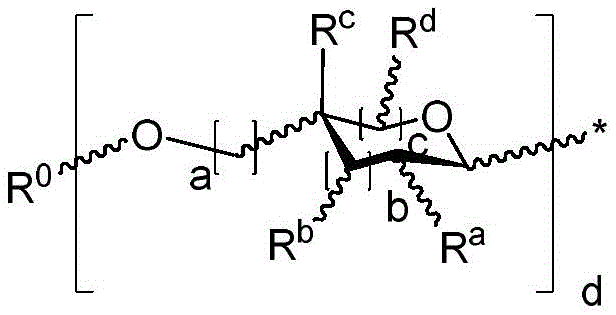
wherein:
■ a, b, and c are independently at each occurrence 0,1, or 2;
■ d is an integer from 1 to 5, wherein the structure in each bracket d may be the same or different; provided that the structure in bracket d represents a furanose or pyranose moiety and the sum of b and c is 1 or 2;
■R0is hydrogen or an oxygen protecting group selected from the group consisting of alkyl ethers, benzyl ethers, silyl ethers, acetals, ketals, esters, carbamates, and carbonates;
■Ra、Rb、Rcand RdEach occurrence is independently hydrogen, halogen, OH, ORx、NR2NHCOR or an optionally substituted group selected from: acyl radical, C1-C10Aliphatic, C1-C6Heteroaliphatic, 6-10 membered aryl, aryl-aliphatic; or a 5-10 membered heteroaryl having 1-4 heteroatoms selected from the group consisting of nitrogen, oxygen, or sulfur; or a 4-7 membered heterocyclic group having 1-2 heteroatoms independently selected from the group consisting of nitrogen, oxygen, and sulfur;
◆R3is hydrogen, halogen, OH, ORx,
◆R4Is hydrogen, halogen, CH2ORxOr selected from acyl, C1-C10Optionally substituted groups of the group consisting of aliphatic;
◆Rxeach occurrence is independently hydrogen or an oxygen protecting group selected from the group consisting of alkyl ethers, benzyl ethers, silyl ethers, acetals, ketals, esters, carbamates, and carbonates;
the present invention encompasses the following recognitions: because of the complex structure, GPI-0100 has limited clinical use as an adjuvant mixture and is difficult to isolate in pure form. The present invention provides compounds analogous to GPI-0100.
On the other hand, the compounds of the invention have proven useful as adjuvants. Thus, in certain embodiments, there is provided a vaccine comprising one or more bacterial, viral, protozoan or tumor-associated antigens and one or more compounds of the invention. In certain embodiments, the one or more antigens are non-covalently associated with a pharmaceutically acceptable excipient. In some embodiments, the one or more antigens are covalently bound to a pharmaceutically acceptable excipient.
In another aspect, the invention provides a method of enhancing an immune response to an antigen comprising administering to an individual the vaccine provided in an amount effective to enhance the immune response to the antigen in the individual.
In another embodiment, the present invention provides a saponin compound which induces an immune response to both humoral and cellular immunity.
In another embodiment, the invention provides a method of stimulating or enhancing cytokine production in a subject, the method comprising administering to the subject, inter alia, any of the compounds of the invention, such that immune cells secrete cytokines.
In another aspect, the invention provides a method of vaccinating an individual comprising administering to the individual the provided vaccine. In some embodiments, the subject is a human. In some embodiments, the vaccine is administered orally. In other embodiments, the vaccine is administered intramuscularly. In other embodiments, the vaccine is administered subcutaneously. In certain embodiments, the adjuvant compound is administered in an amount of 10-1000 μ g. In certain embodiments, the adjuvant compound is administered in an amount of 500-1000 μ g. In certain embodiments, the adjuvant compound is administered in an amount of 100-500 μ g. In certain embodiments, the adjuvant compound is administered in an amount of 50-250 μ g. In certain embodiments, the adjuvant compound is administered in an amount of 50-500 μ g. In certain embodiments, the adjuvant compound is administered in an amount of 250-500 μ g. The antigen to vaccinate the individual may be a cancer antigen, a bacterial antigen, a viral antigen, a protozoan antigen or an autoantigen.
In another aspect, the present invention provides a pharmaceutical composition comprising a compound of the present invention and a pharmaceutically acceptable excipient. In certain embodiments, the pharmaceutical composition is a vaccine comprising an antigen and an adjuvant of the invention.
In another aspect, the invention provides a kit comprising a pharmaceutical composition of a compound of the invention. In some embodiments, the kit contains prescription information. In some embodiments, the kit comprises an adjuvant compound of the invention in combination with another immunotherapeutic agent (e.g., vaccine, antibody). These formulations may be packaged separately or together. The kit optionally includes instructions for prescribing the medicament. In certain embodiments, the kit comprises multiple doses of each reagent. The kit may include sufficient amounts of the components to treat the subject for one week, two weeks, three weeks, four weeks, or several months. In certain embodiments, the kit comprises one immunotherapy cycle. In certain embodiments, the kit includes a sufficient amount of the pharmaceutical composition to chronically immunize the subject against the antigen.
In one embodiment, the present invention provides a method of preparing a compound having the structure of formula (II):
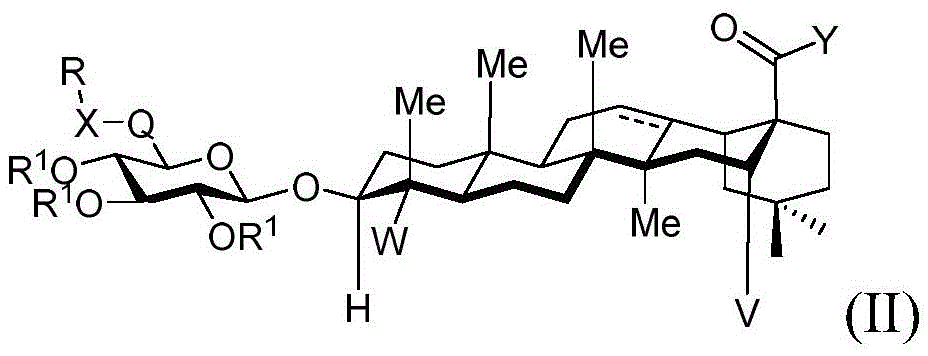
wherein:
· is a single bond or a double bond;
w is Me, -CHO,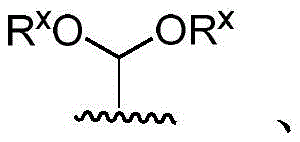 —CH2OR1- (O) R or CH2ORx;
V is hydrogen OR-OR1;
Y is CH2-O-, -S-, -NR-, -NH-or an oxygen protecting group selected from the group consisting of alkyl ethers, benzyl ethers, silyl ethers, acetals, ketals, esters, carbamates and carbonates;
q is CH2C-O, C ═ N-OH or C ═ N-OMe;
x is CH2- (O) - (NR) - (NH-C-O) - (S-or O-) - (C-O) - (O-) - (NR) - (NH-C-O) - (C-O) -;
·R1independently hydrogen, an oxygen protecting group selected from the group consisting of alkyl ethers, benzyl ethers, silyl ethers, acetals, ketals, esters, carbamates, and carbonates; or a carbohydrate having the structure:
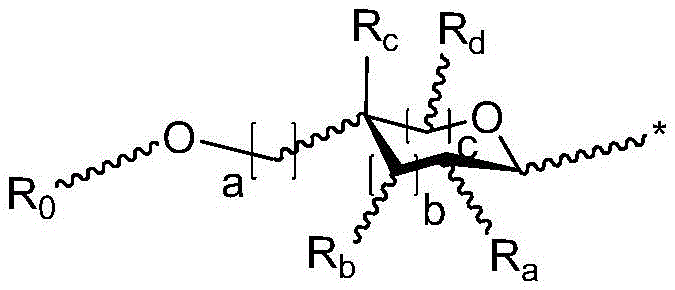
wherein:
■ a, b, and c are independently at each occurrence 0 or 1;
■R0independently hydrogen or an oxygen protecting group selected from the group consisting of alkyl ethers, benzyl ethers, silyl ethers, acetals, ketals, esters, carbamates, and carbonates;
■Ra、Rb、Rcand RdEach occurrence is independently hydrogen, halogen, OH, ORx;RxEach occurrence is independently hydrogen or an oxygen protecting group selected from the group consisting of alkyl ethers, benzyl ethers, silyl ethers, acetals, ketals, esters, carbamates, and carbonates; and is
R is a cyclic or acyclic moiety selected from the group consisting of acyl, aliphatic, heteroaliphatic, aryl-aliphatic, cycloaliphatic, heterocyclic-aliphatic, heteroaryl-aliphatic, alkoxy-aliphatic and aryloxy-aliphatic; or an optionally substituted group selected from: c1-C18Aliphatic, 5-10 membered arylaliphatic, 5-10 membered heteroaryl-aliphatic having 1-4 heteroatoms independently selected from the group consisting of nitrogen, oxygen, or sulfur, 4-7 membered heterocyclic-aliphatic having 1-2 heteroatoms independently selected from the group consisting of nitrogen, oxygen, and sulfur.
In one embodiment of the invention, the compound of formula (II) is obtainable by a process comprising the steps of:
reacting the compound shown in the structure of the formula (III) with the compound shown in the structure of the formula (IV) or pharmaceutically acceptable salts thereof.
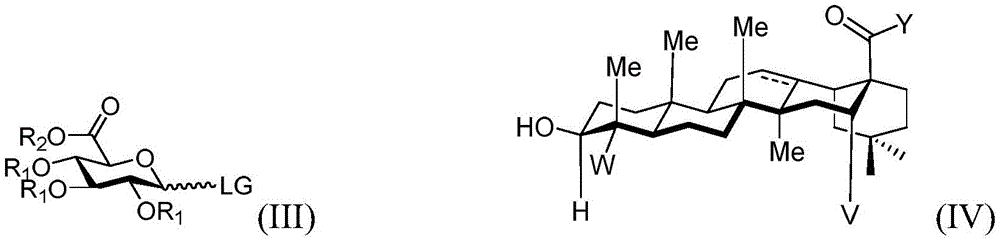
In the formula (III):
·R1independently hydrogen, selected from the group consisting of alkyl ethers, benzyl ethers, silyl ethers, acetals, ketals, esters, carbamates and carbonsAn oxygen protecting group of the group consisting of acid esters; or a carbohydrate having the structure
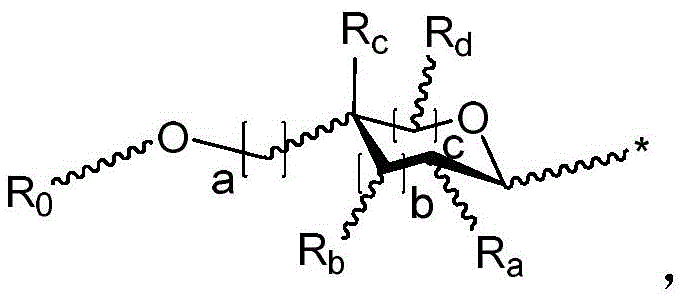
Wherein:
■ a, b, and c are independently at each occurrence 0 or 1;
■R0independently hydrogen or an oxygen protecting group selected from the group consisting of alkyl ethers, benzyl ethers, silyl ethers, acetals, ketals, esters, carbamates, and carbonates;
■Ra、Rb、Rcand RdEach occurrence is independently hydrogen, halogen, OH, ORx;RxEach occurrence is independently hydrogen or an oxygen protecting group selected from the group consisting of alkyl ethers, benzyl ethers, silyl ethers, acetals, ketals, esters, carbamates, and carbonates;
■ LG is a leaving group, in particular
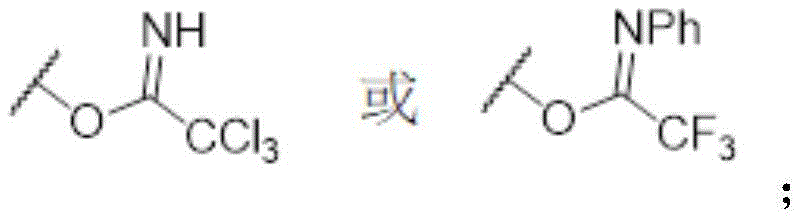
In the formula (IV):
· is a single bond or a double bond;
w is Me, -CHO,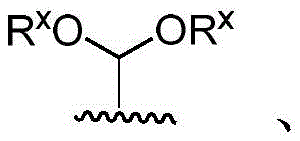 —CH2OR OR-C (O) R;
v is hydrogen OR-OR 1;
y is CH2-O-, -NR-, -NH-or an oxygen protecting group selected from the group consisting of alkyl ethers, benzyl ethers, silyl ethers, acetals, ketals, esters, carbamates and carbonates; and is
·R、RxOr R1Independently hydrogen or selected from alkyl ether, benzyl etherAn oxygen protecting group of the group consisting of silyl ethers, acetals, ketals, esters, carbamates and carbonates.
In one embodiment of the present invention, a compound of formula (I) is obtainable by a process comprising the steps of:
reacting formula (II) with formula (V) or a pharmaceutically acceptable salt thereof:
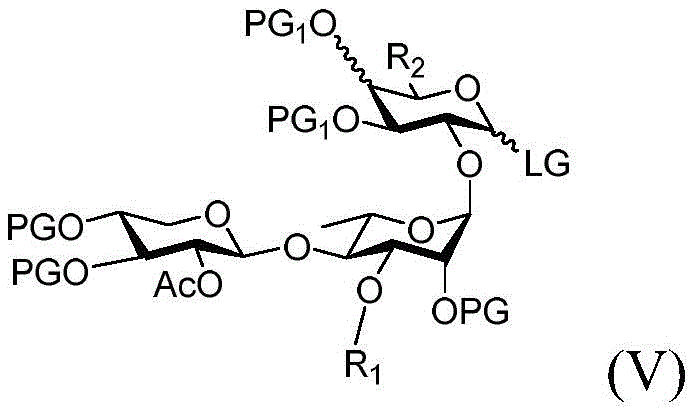
wherein:
PG and PG1Is an oxygen protecting group selected from the group consisting of alkyl ethers, benzyl ethers, silyl ethers, acetals, ketals, esters, carbamates, and carbonates;
·R1independently hydrogen, an oxygen protecting group selected from the group consisting of alkyl ethers, benzyl ethers, silyl ethers, acetals, ketals, esters, carbamates, and carbonates; or a carbohydrate having the structure:
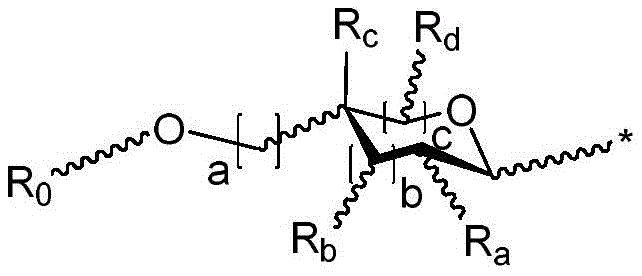
wherein:
■ a, b, and c are independently at each occurrence 0 or 1;
■R0independently hydrogen or an oxygen protecting group selected from the group consisting of alkyl ethers, benzyl ethers, silyl ethers, acetals, ketals, esters, carbamates, and carbonates;
■Ra、Rb、Rcand RdEach occurrence is independently hydrogen, halogen, OH, ORx;RxEach occurrence is independently hydrogen or an oxygen protecting group selected from the group consisting of alkyl ethers, benzyl ethers, silyl ethers, acetals, ketals, esters, carbamates, and carbonates;
·R2independently of each other is hydrogen, halogen, CH2OH or an optionally substituted group selected from lower alkyl; and is
LG is a leaving group, which can be in particular
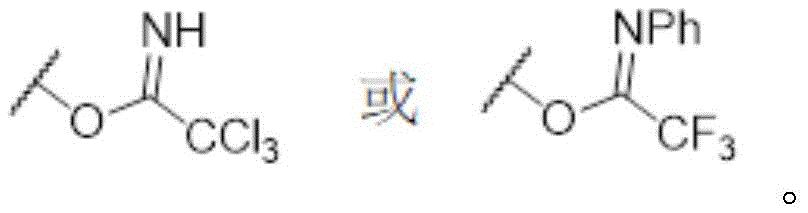
Definition of
As used herein, the following definitions will apply unless otherwise indicated.
"stereoisomers" refers to compounds having different chirality at one or more stereocenters. Stereoisomers include mirror image isomers and non-mirror image isomers.
"subject" refers to mammals, including humans and non-human mammals.
The term "aliphatic" or "aliphatic group" or "aliphatic moiety" as used herein refers to a straight (i.e., unbranched) or branched, substituted or unsubstituted hydrocarbon chain that is fully saturated or contains one or more units of unsaturation, or to an aromatic group (also referred to herein as a "carbocyclic ring," "alicyclic ring," or "cycloalkyl") that is fully saturated or contains one or more units of unsaturation, but does not have a single point of attachment to the rest of the molecule. Unless otherwise specified, aliphatic groups contain aliphatic carbon atoms. In some embodiments, aliphatic groups contain 1-12 aliphatic carbon atoms. In some embodiments, aliphatic groups contain 1-11 aliphatic carbon atoms. In other embodiments, aliphatic groups contain 1-10 aliphatic carbon atoms. In other embodiments, aliphatic groups contain 1-9 aliphatic carbon atoms, while in other embodiments aliphatic groups contain 1-8 aliphatic carbon atoms. In other embodiments, aliphatic groups contain 1-7 aliphatic carbon atoms. In other embodiments, aliphatic groups contain 1-6 aliphatic carbon atoms. In other embodiments, aliphatic groups contain 1-5 aliphatic carbon atoms. In other embodiments, aliphatic groups contain 1-4 aliphatic carbon atoms. In other embodiments, aliphatic groups contain 1-3 aliphatic carbon atoms, while in other embodiments aliphatic groups contain 1-2 aliphatic carbon atoms.
In some embodiments, alicyclic (or "carbocycle" or "cycloalkyl") refers to a monocyclic C-C hydrocarbon that is fully saturated or contains one or more units of unsaturation, but is not aromatic with a single point of attachment to the rest of the molecule. Suitable aliphatic groups include, but are not limited to, linear or branched, substituted or unsubstituted alkyl, alkenyl, alkynyl groups and mixtures thereof such as (cycloalkyl) alkyl, (cycloalkenyl) alkyl or (cycloalkyl) alkenyl.
The term (heteroatom) refers to one or more of oxygen, sulfur, nitrogen, phosphorus or silicon (including any oxidized form of nitrogen, sulfur, phosphorus or silicon; any basic nitrogen in quaternized form or heterocyclic ring may be substituted for nitrogen, e.g., N (as in 3, 4-dihydro-2H-pyrrolyl), NH (as in pyrrolidyl) or NR "(as in N-substituted pyrrolidyl)).
As used herein, the term "unsaturated" refers to a moiety (moiey) having one or more double bonds.
The term "halogen" refers to fluorine, chlorine, bromine or iodine.
The term "acyl" used alone or as part of a larger moiety refers to a group formed by removal of a hydroxyl group from a carboxylic acid.
The terms "aralkyl" and "arylaliphatic" are used interchangeably and mean an aliphatic group in which a hydrogen atom is replaced with an aryl group. The aryl group includes, but is not limited to, phenyl, biphenyl, naphthyl, cinnamyl, and dihydrocinnamyl.
The term "aryl" is used alone or as part of a larger moiety (motif), for example in "aryl-aliphatic", "heteroaryl-aliphatic".
The term "aryloxy-aliphatic" (or "aralkoxy" or "aryloxyalkyl") refers to a monocyclic or bicyclic ring system having a total of 5-14 ring members, wherein at least one ring in the system is aromatic and each ring in the system contains 3-7 ring members. The term "aryl" is used interchangeably with the term "aromatic ring".
In certain embodiments of the present invention, "aryl" refers to an aromatic ring system including, but not limited to, benzyl, phenyl, biphenyl, naphthyl, anthracenyl, and the like, which may bear one or more substituents. As used herein, groups in which an aromatic ring is fused to zero or one or more non-aromatic rings are also included within the scope of the term "aryl", e.g., indanyl, phthalimidyl, naphthalimide, phenanthridinyl, tetrahydronaphthyl, and the like.
The term "heteroaryl" used alone or as part of a larger moiety (moiey), such as "heteroaryloxy" or "heteroaryl-aliphatic" or "heteroarylalkyl", refers to a group having the following structural features: having 5 to 10 ring atoms, preferably 5, 6 or 9 ring atoms; a ring array with 6, 10 or 14 electrons shared; and 1-5 heteroatoms other than carbon atoms. The term "heteroatom" refers to nitrogen, oxygen or sulfur, and includes any oxidized form of nitrogen or sulfur, as well as any quaternized form of a basic nitrogen. Heteroaryl groups include, but are not limited to, thienyl, furyl, pyrrolyl, imidazolyl, pyrazolyl, triazolyl, tetrazolyl, oxazolyl, isoxazolyl, oxadiazolyl, thiazolyl, isothiazolyl, thiadiazolyl, pyridyl, pyridazinyl, pyrimidinyl, pyrazinyl, indolizinyl, purinyl, naphthyridinyl, and pteridinyl.
As used herein, the terms "heteroaryl" and "heteroar-" also include groups in which a heteroaryl ring is fused to one or more aryl, alicyclic, or heterocyclic rings, the point of attachment being on the heteroaryl ring. Non-limiting examples include indolyl, isoindolyl, benzothienyl, benzofuranyl, dibenzofuranyl, indazolyl, benzimidazolyl, benzothiazolyl, quinolinyl, isoquinolinyl, cinnolinyl, phthalazinyl, quinazolinyl, quinoxalinyl, 4H-quinolizinyl, carbazolyl, acridinyl, phenazinyl, phenothiazinyl, phenoxazinyl, tetrahydroquinolyl, tetrahydroisoquinolyl, and 2H-pyrido [2,3-b ] -1, 4-oxazin-3 (4H) -one. Heteroaryl groups may be monocyclic or bicyclic. The term "heteroaryl" is used interchangeably with the terms "heteroaryl ring", "heteroaryl group" or "heteroaromatic", and any of the above terms includes an optionally substituted ring. The terms "heteroaryl-aliphatic" and "heteroaryl-alkyl" refer to aliphatic substituted with a heteroaryl moiety, wherein the aliphatic and heteroaryl moieties are independently optionally substituted.
As used herein, the term "heteroaliphatic" refers to an aliphatic group in which one or two carbon atoms are independently substituted with one or more of oxygen, sulfur, nitrogen, or phosphorus. The heteroaliphatic group can be substituted or unsubstituted, branched or unbranched, cyclic or acyclic, and includes a "heterocyclic" group, a "heterocyclyl" group, a "heterocycloaliphatic" group, or a "heterocyclic" group.
As used herein, the terms "heterocycle", "heterocyclyl" and "heterocyclic" are used interchangeably to refer to a stable 5-7 membered monocyclic or 7-10 membered bicyclic heterocyclic moiety, which is saturated or partially unsaturated, and which has one or more (preferably 1-4) heteroatoms as defined above in addition to carbon atoms. When referring to a ring atom of a heterocyclic ring, the term "nitrogen" includes substituted nitrogens, e.g. in a saturated or partially unsaturated ring having 0-3 heteroatoms selected from oxygen, sulphur or nitrogen, the nitrogen may be N (e.g. in 3, 4-dihydro-2H-pyrrolyl), NH (e.g. in pyrrolidinyl) or+NR (for example in N-substituted pyrrolidinyl).
The heterocyclyl ring may be attached to its pendant group at any heteroatom or carbon atom that results in a stable structure, and any ring atom may be optionally substituted. Examples of such saturated or partially unsaturated heterocyclic residues include, but are not limited to, tetrahydrofuranyl, tetrahydrothienyl, pyrrolidinyl, piperidinyl, pyrrolinyl, tetrahydroquinolinyl, tetrahydroisoquinolinyl, decahydroquinolinyl, oxazolinyl, piperazinyl, dioxanyl, dioxolanyl, diazepanyl, oxazepanyl, thiazepanyl, morpholinyl, and quinuclidinyl.
The terms "heterocycle", "heterocyclyl ring", "heterocyclic group" and "heterocyclic moiety" are used interchangeably herein and also include groups in which the heterocyclyl ring is fused to one or more aryl, heteroaryl or alicyclic rings, such as indolinyl, 3H-indolyl, chromanyl, phenanthridinyl or tetrahydroquinolinyl. The heterocyclic group may be monocyclic or bicyclic.
The term "heterocycloaliphatic" refers to an alkyl group substituted with a heterocyclyl, wherein the aliphatic and heterocyclic moieties are independently optionally substituted.
As used herein, the term "partially unsaturated" means that the ring portion includes at least one double or triple bond. The term "partially unsaturated" is intended to encompass rings having multiple sites of unsaturation, but not including aryl or heteroaryl moieties as defined herein.
In another aspect, the present invention provides "pharmaceutically acceptable" compositions comprising a therapeutically effective amount of one or more compounds described herein, formulated with one or more pharmaceutically acceptable carriers (additives) and/or diluents. As detailed, the pharmaceutical compositions of the present invention may be specifically formulated for administration in solid or liquid form, including forms suitable for: oral administration, such as drenches (aqueous or non-aqueous solutions or suspensions), tablets (e.g., tablets targeted for buccal, sublingual and systemic absorption), boluses, powders, granules, ointments administered to the tongue; parenteral administration, for example, by intramuscular, subcutaneous, intravenous or epidural injection in the form of sterile solutions or suspensions or sustained release formulations; topical administration, for example to the lung, skin or oral cavity in the form of a cream, ointment or controlled release spray or patch; intravaginal or intrarectal, such as pessaries, creams or foams; under the tongue; eye passing; percutaneous; or nasal, pulmonary and other mucosal surfaces.
The phrase "pharmaceutically acceptable" is employed herein to refer to compounds, compositions, materials, and/or dosage forms which are, within the scope of sound medical judgment, suitable for use in contact with the tissues of human beings and animals without excessive toxicity, irritation, allergic response, or other problem or complication, commensurate with a reasonable benefit/risk ratio.
The phrase "pharmaceutically acceptable carrier" as used herein refers to a pharmaceutically acceptable material, composition, or vehicle. Such as liquid or solid fillers, excipients, diluents, or solvent encapsulating materials, involve transporting or carrying the subject compound from one part of the body to another part of the body. Each carrier must be "acceptable" in the sense of being compatible with the other ingredients of the formulation and not injurious to the patient. Some examples of materials that can be used as pharmaceutically acceptable carriers include: sugars, such as glucose, lactose, sucrose; starches, such as corn starch and potato starch; cellulose and its derivatives, such as carboxymethyl cellulose, ethyl cellulose and cellulose acetate; tragacanth powder; malt; gelatin; talc; excipients, such as cocoa butter and suppository waxes; oils such as peanut oil, cottonseed oil, safflower oil, sesame oil, olive oil, corn oil and soybean oil; glycols, such as propylene glycol; a polyol. Such as glycerol, sorbitol, mannitol and polyethylene glycol; esters such as ethyl oleate and ethyl laurate; agar; buffering agents such as magnesium hydroxide and aluminum hydroxide; alginic acid; pyrogen-free water; isotonic saline; ringer's solution; ethanol; a pH buffer solution; polyesters, polycarbonates and/or polyanhydrides; and other non-toxic compatible materials used in pharmaceutical formulations.
As used herein, the term "pharmaceutically acceptable salts" refers to salts which are, within the scope of sound medical judgment, suitable for use in contact with the tissues of humans and lower animals without excessive toxicity, irritation, allergic response, and the like, commensurate with a reasonable benefit/risk ratio. Pharmaceutically acceptable salts are well known in the art. For example, s.m. berge et al, which are incorporated herein by reference, detail pharmaceutically acceptable salts in the journal of pharmaceutical Sciences (j.pharmaceutical Sciences,1977,66, 1-19). Pharmaceutically acceptable salts of the compounds of the present invention include salts derived from suitable inorganic and organic acids and bases. Examples of pharmaceutically acceptable non-toxic acid addition salts are salts of an amine group with inorganic acids such as hydrochloric acid, hydrobromic acid, phosphoric acid, sulfuric acid and perchloric acid, or with organic acids such as acetic acid, oxalic acid, maleic acid, tartaric acid, citric acid, succinic acid or malonic acid, or with amino groups formed using other methods in the art, such as ion exchange. Other pharmaceutically acceptable salts include adipate, alginate, ascorbate, aspartate, benzenesulfonate, benzoate, bisulfate, borate, butyrate, camphorate, camphorsulfonate, citrate, cyclopentanepropionate, digluconate, dodecylsulfate, ethanesulfonate, formate, fumarate, glucoheptonate, glycerophosphate, gluconate, hemisulfate, heptanoate, hexanoate, hydroiodide, 2-hydroxyethanesulfonate, lactobionate, lactate, laurate, dodecylsulfate, malate, maleate, malonate, methanesulfonate, 2-naphthalenesulfonate, nicotinate, nitrate, oleate, oxalate, palmitate, pamoate (pamoate), pectate, persulfate, 3-phenylpropionate, Phosphates, pivalates, propionates, stearates, succinates, sulfates, tartrates, thiocyanates, p-toluenesulfonates, undecanoates, valerates, and the like.
In other cases, the compounds of the present invention may contain one or more acidic functional groups and are therefore capable of forming pharmaceutically acceptable salts with pharmaceutically acceptable bases. In these cases, the term "pharmaceutically acceptable salts" refers to the relatively non-toxic inorganic and organic base addition salts of the compounds of the present invention. These salts can likewise be prepared in situ during the manufacture of the administration vehicle or dosage form, or by reacting the purified compound in its free acid form with a suitable base (e.g., a hydroxide, carbonate or bicarbonate of a pharmaceutically acceptable metal cation), with ammonia or with a pharmaceutically acceptable organic primary, secondary, tertiary or quaternary amine, respectively. Salts derived from suitable bases include alkali metal salts, alkaline earth metal salts, ammonium salts and N (C)1-4Alkyl) salts. Representative alkali or alkaline earth metal salts include sodium, lithium, potassium, calcium, magnesium, and the like. Other pharmaceutically acceptable salts include, where appropriate, non-toxic ammonium, quaternary ammonium, and amine cations formed using counterions such as halide, hydroxide, carboxylate, sulfate, phosphate, nitrate, lower alkyl sulfonate, and aryl sulfonate. Representative organic amines useful for forming base addition salts include ethylamine, diethylamine, ethylenediamine, ethanolamine, diethanolamine, piperazine and the like.
Unless otherwise indicated, structures described herein are also intended to include all isomeric (e.g., mirror image, non-mirror image, and geometric) forms of the structures; for example, the R and S configuration, Z and E double bond isomers, and Z and E configuration isomers of each stereocenter. Thus, single stereochemical isomers as well as enantiomers, diastereomers and geometric (or configurational) mixtures of the compounds of the present invention are within the scope of the present invention. Unless otherwise indicated, all tautomers of the compounds of the invention are within the scope of the invention.
The provided compounds can comprise one or more sugar moieties. Unless otherwise stated, both the D-and L-configurations and mixtures thereof are within the scope of the invention. Unless otherwise indicated, the present invention contemplates examples of C-and S-linkages and mixtures thereof.
Further, unless otherwise indicated, structures described herein are also intended to include compounds that differ only in the presence of one or more isotopically enriched atoms. For example, having a structure comprising replacement of hydrogen by deuterium or tritium or by13C-or14Compounds of the structure of the present invention having C-enriched carbon substituted carbon are within the scope of the present invention. Such compounds may for example be used as analytical tools, probes in bioassays or as therapeutic agents according to the invention.
According to embodiments of the present invention, the phrase "protecting group" as used herein refers to a potentially reactive functional group that is temporarily modified to protect it from undesired chemical transformations. Examples of such protecting groups include esters of carboxylic acids, silyl ethers of alcohols, and acetals and ketals of aldehydes and ketones, respectively. Of course, other suitable protecting groups may be used. Furthermore, Greene and Wuts describe various protecting groups (as above).
In one embodiment of the invention, the protecting group may be, inter alia, a hydroxyl protecting group. In one embodiment of the invention, the hydroxyl protecting group may be, inter alia, an alkyl, aryl, aralkyl, silane or acyl group. In another embodiment, the protecting group may be, inter alia, a trimethylsilyl group, a triethylsilyl group, a tert-butyldimethylsilyl group (TBS), a triisopropylsilyl group (TIPS), or a tert-butyldiphenylsilyl group. Of course, any other suitable protecting group may be used.
In one embodiment, the aralkyl group may be substituted or unsubstituted. In another embodiment, the aralkyl group may be, inter alia, an arylmethyl group. In another embodiment, the protecting group may be, inter alia, benzyl. In another embodiment, the protecting group may be, inter alia, a methoxybenzyl group. In another embodiment, the methoxybenzyl group may be, inter alia, a p-methoxybenzyl group.
In one embodiment of the invention, the protecting group may be, inter alia, an amino protecting group. In one embodiment of the invention, the amino protecting group may be, inter alia, a carbamate, an amide or an N-sulfonylamine. In another embodiment, the amino protecting group may be, inter alia, benzyloxycarbonyl (Cbz), 9-fluorenylmethyloxycarbonyl (9-fluoromethyloxycarbonyl, Fmoc), t-butyloxycarbonyl (t-butyloxycarbonyl, tBoc), biphenylisopropyloxycarbonyl (biphenylisopropyloxycarbonyl), t-pentyloxycarbonylisonyloxycarbonyl (t-amyloxycarbonyloxybarbonyloxy), α -dimethyl-3,5-dimethoxybenzyloxycarbonyl (alpha-dimethyl-3, 5-dimethyloxybutyloxycarbonyl) or 2-nitrilo-t-butyloxycarbonyl (2-cyanoo-t-butyloxycarbonyl).
Furthermore, in one embodiment, the present invention provides a method for stimulating, suppressing, inhibiting or modulating an immune response in an individual, the method comprising inter alia administering to the individual any one of the compounds of the present invention or any combination thereof.
Furthermore, in one embodiment, the present invention provides a method for stimulating, suppressing, inhibiting or modulating an immune response in an individual, the method comprising, inter alia, administering to the individual a pharmaceutical composition comprising, inter alia, any one of the compounds of the present invention or any combination thereof and one or more pharmaceutically acceptable excipients.
Furthermore, in one embodiment, a "pharmaceutical composition" may refer to a therapeutically effective amount of one or more compounds of the present invention and suitable excipients and/or carriers suitable for stimulating, suppressing, inhibiting or modulating an immune response in a subject.
In one embodiment, a "therapeutically effective amount" is an amount that provides a therapeutic effect for a particular condition and dosing regimen. In one embodiment, such compositions may be administered by any method known in the art.
As described herein, the compounds of the present invention may comprise an "optionally substituted" moiety. Generally, the term "substituted", whether or not preceded by the term "optionally", means that one or more hydrogens of the designated moiety are replaced with a suitable substituent. Unless otherwise specified, an "optionally substituted" group may have a suitable substituent at each substitutable position of the group, and when more than one position in any particular structure may be substituted with more than one substituent selected from a particular group, the substituents at each position may be the same or different. The combinations of substituents contemplated by the present invention are preferably substituents that result in the formation of stable or chemically feasible compounds.
As used herein, the phrase "parenteral administration" refers to modes of administration other than enteral and topical administration, typically injection, and includes, but is not limited to, intravenous, intramuscular, intraarterial, intrathecal, intracapsular, intraorbital, intracardiac, intradermal, intraperitoneal, transtracheal, subcutaneous, subcuticular, intraarticular, subcapsular, subarachnoid, intraspinal and intrasternal injection and infusion.
As used herein, the phrases "systemic administration" and "peripheral administration" refer to administration of a compound, drug or other substance other than directly into the central nervous system, into the system of a patient to undergo metabolism and other similar processes, such as subcutaneous administration.
The term "pure" refers to a compound that is substantially free of associated non-target structures or chemical precursors (when chemically synthesized). This property can be measured or expressed as "purity". In some embodiments, the target compound has less than about 30%, 20%, 10%, 5%, 2%, 1%, 0.5%, and 0.1% non-target structures or chemical precursors.
The term "carbohydrate" refers to a sugar or a polymer of a sugar. The terms "sugar", "polysaccharide", "carbohydrate" and "oligosaccharide" are used interchangeably. Most carbohydrates are aldehydes or ketones having a number of hydroxyl groups, usually one hydroxyl group on each carbon atom of the molecule. Carbohydrates generally have the formula CnH2nOn. The carbohydrate may be a monosaccharide, disaccharide, trisaccharide, oligosaccharide or polysaccharide. Most basic carbonThe carbohydrate is a monosaccharide such as glucose, galactose, sucrose, ribose, mannose, arabinose, xylose, and fructose. Disaccharides are two linked monosaccharides. Exemplary disaccharides include sucrose, lactose, cellobiose, and maltose. Typically, oligosaccharides comprise three to six monosaccharide units (e.g., raffinose, stachyose), while polysaccharides comprise six or more monosaccharide units. Exemplary polysaccharides include starch, glycogen, and cellulose. The carbohydrate may comprise modified sugar units such as 2 '-deoxyribose (where the hydroxyl groups are removed), 2' -fluororibose (where the hydroxyl groups are substituted with fluorine) or N-acetylglucosamine (a nitrogen-containing form of glucose). (e.g., 2' -fluororibose, deoxyribose, and hexose). Carbohydrates can exist in many different forms, such as configurational isomers, cyclic forms, acyclic forms, stereoisomers, tautomers, anomers, and isomers.
Drawings
FIG. 1 shows a graphical representation of the number of IFN γ (left 2 group) and IL-2 (right 2 group) secreting cells obtained with or without saponin and PEK antigen, detected by ELISpot one week after the third dose.
FIG. 2 shows T cell activation after one week of third saponin administration, CD3 in whole spleen+In T cells, IFN γ+(y-axis) to CD4+Or CD8+(x-axis) percentage of cells.
FIG. 3 shows T cell activation after one week of third saponin administration, CD3 in whole spleen+In T cells, IL-2+(y-axis) to CD4+Or CD8+(x-axis) percentage of cells.
FIG. 4 shows T cell activation after one week of third saponin administration, CD3 in whole spleen+In T cells, TNF alpha+(y-axis) to CD4+Or CD8+(x-axis) percentage of cells.
FIG. 5 shows flow cytometric analysis of T cell populations, spleen CD62L in total T cell population one week after third administration of a saponin of the present invention+(x-axis) CD44+Representative scatter plot (y-axis). Cell populations low in CD62L and high in CD44 were classified as memory T cells and shown to be viable CD8+Frequency of IFN-. gamma.TNF-. alpha.or IL-2 expression by splenocytes. And when the frequency of the positive events exceeds the mean value of the control group +/-the standard error of the mean value, determining that the cytokine is positive.
FIG. 6 shows activation of T cells after a third administration of saponin 46-49, 53-56, 56 alpha, 57-62, 64, 66, 77 alpha, 77 beta, 78, 79, 83, 92, 95 for one week, with incorporation of PEK-specific IFN γ forming spots in quadruplicate reaction wells of splenocytes+Or IL-2 or TNF alpha cells. And when the frequency of the positive events exceeds the mean value of the control group +/-the standard error of the mean value, determining that the cytokine is positive.
Figure 7 shows an E7 specific IgG antibody. Sera were collected after each immunization with PEK/saponin to confer C57BL/6 mice immunization and measured for E7 protein specific IgG antibodies in the sera by ELISA. The OD of each serum group after being diluted by 10000 times is recorded450The value is obtained. Values are expressed as mean ± standard error of mean (n ═ 3).
FIG. 8(A) is the percentage change in median body weight of mice over 5 days. Values are expressed as mean ± standard error of mean (n ═ 5). (B) The values are expressed as mean ± standard error of the mean (n-5) for the liver somatic index and (C) for the spleen somatic index. The median percent change in body weight of mice receiving increased doses of saponin adjuvant 56 was less than 5%. There was no change in both spleen and liver somatic cell indices for all experimental groups compared to the control group. These data indicate that saponin 56 is an effective and safe drug candidate as a vaccine adjuvant.
Figure 9 shows the effect of signal dose of OVA vaccine with saponin conjugate 56 on e.g. 7-OVA tumors in female C57BL/6 mice.
Figure 10 survival of mice threatened by mouse influenza (PR8) following subcutaneous and intranasal administration of influenza vaccines incorporating compound 56.
FIG. 11 antibody titers of subcutaneous administration of SARS-CoV-2(2ug or 10ug) and adjuvant (alum and compound 56) to mice.
Detailed Description
Saponin conjugates
The present invention relates to saponin conjugates of formula (I) as defined above, their synthesis and intermediates thereof.
The saponin conjugates of formula (I) can be synthesized by the following synthetic procedure.
Step 1-1: synthesis of trisaccharide donors
The synthesis of the trisaccharides starts from the glycosylation of xylosylimide ester (xylosyl imide) 1 and rhamnose acceptor 2, by BF3·OEt2Lewis acid catalysis gave disaccharide 3 in 58% yield (scheme 1). Thereafter, thiodisaccharide (thio-disaccharide)3 was coupled with fucose 4 α to provide the desired trisaccharide 5 in 58% yield. Alternatively, the two glycosylation steps can also be performed by a one-pot method, first conjugating disaccharide 3, and then adding fucose 4 α and NIS sequentially to the reaction mixture to give trisaccharide 5. Trisaccharide 5 was selectively deprotected using morpholine at room temperature and then acetylated by acetic anhydride. The resulting pentaacetylated trisaccharide 6 is performed under hydrogenolysis and formation of imide esters to provide the trisaccharide donor 10. Method for optimizing the trisaccharide xylose 1 and rhamnose 7 were first coupled to give disaccharide 8, which was then hydrolyzed and acetylated to give disaccharide 9. The trisaccharide 6 was obtained by glycosylation of disaccharide 9 and fucose 4 α with an excellent yield of 96%. Imide ester derivatives of trisaccharides 12 and 13 were also synthesized by glycosylation of disaccharide 9 and arabinose 11 α and subsequent hydrogenolysis and imidization reactions.
Scheme 1-describes the synthesis of trisaccharides and their analogs.
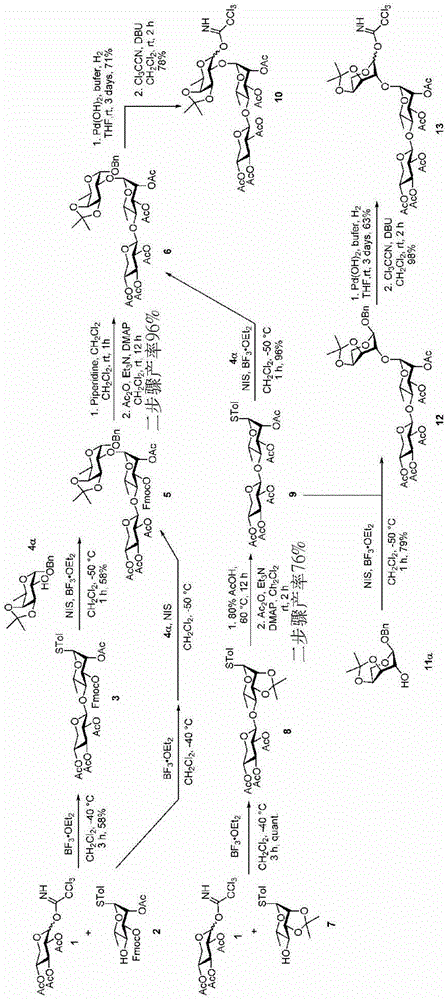
(procedure 1)
Step 1-2: synthesis of tetrasaccharide donors
Tetrasaccharide synthesis was performed by treating glucosylimide ester (glucosyl imide) 15 and rhamnoside 14 with TMSOTf to give disaccharide 16 with the correct β - (1 → 3) linkage in 51% yield (scheme 2). The disaccharide imide ester donor 17 is obtained after performing thio hydrolysis and imide ester formation and then reacted with fucose 4 α to give trisaccharide 18, which is then treated with DDQ to remove the PMB protecting group. The resulting trisaccharide acceptor 19 is further conjugated with xylosyl donor 1 to obtain tetrasaccharide 20. After structure confirmation by NMR mass spectrometry, tetrasaccharide 20 was subjected to hydrogenolysis and imide ester formation to provide tetrasaccharide imide esters 21 and 22.
Scheme 2-describes the synthesis of tetrasaccharide and its analogs.
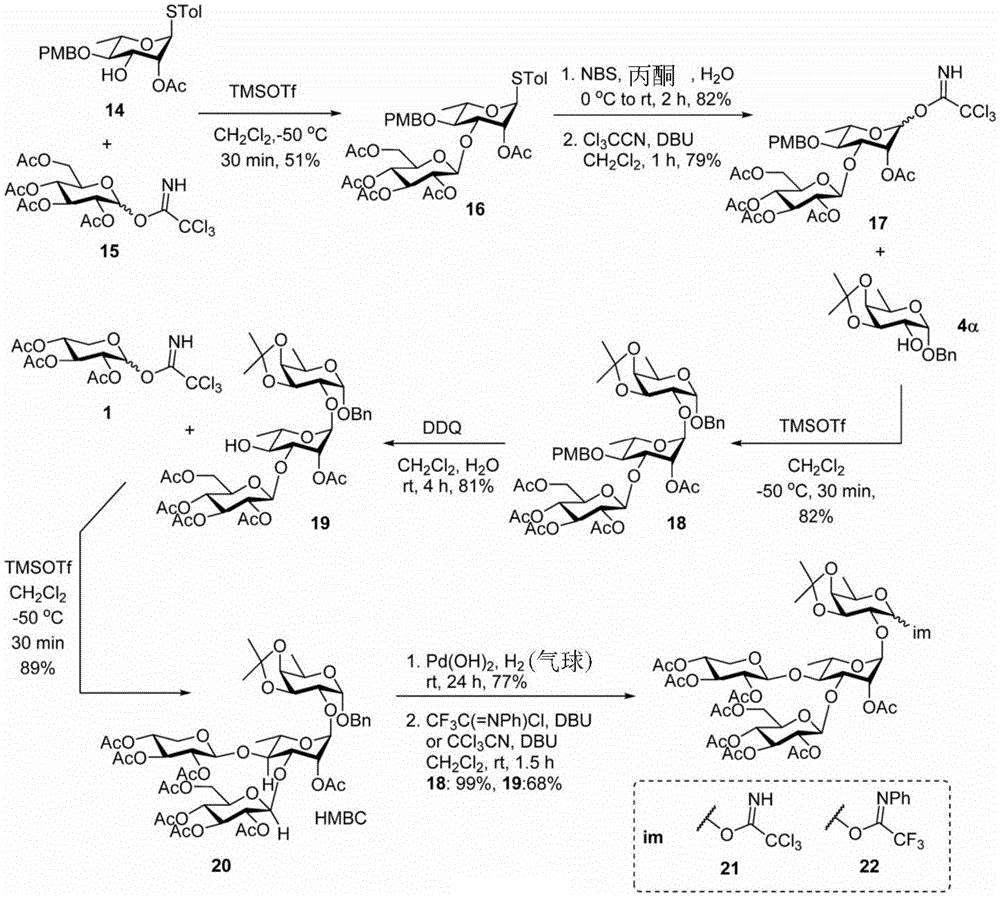
(procedure 2)
Step 2: synthesis of triterpene building blocks
The allyl group is first introduced into the C-28 carboxylic acid to give the soap-ester (quillaic ester)20 and echinocystic ester (echinocystic ester)21 (scheme 3). To increase the selectivity of 3-O glycosylation, the 16-OH group on the diol 20 was further protected with a Triethylsilyl (TES) group by a three-step synthesis: selective 3-O acetylation, TES on 16-OH followed by deacetylation, yielded 60% soap-skin ester 25 by these 3 steps.
Scheme 3-describes the synthesis of triterpene building blocks and analogs thereof.
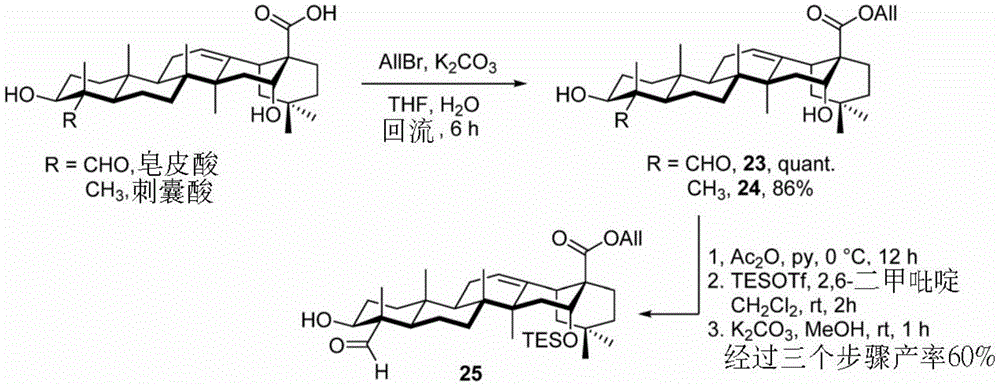
(procedure 3)
And step 3: synthesis of protected disaccharide chain saponins
For the glucuronic acid building block, glucuronides with benzoyl (Bz), isobutyryl (iPrCO) and pivaloyl (pivaloyl) groups were synthesized. (scheme 4). Bromide glucuronide 26 reacts with thiotoluene (thiotoluene) to produce thio-glucuronide 27. Thereafter, compound 27 is deacetylated and acylated with benzoyl chloride, isobutyryl chloride and pivaloyl chloride to give 28-30. Followed by oxidative removal of the thio group and subsequent formation of trichloroacetimidate, glucuronide esters (glucuronides) 31-33 can be readily coupled with the soap acid. Coupling of the benzoylation donor 31 with the soap sculate 23 results in the formation of primarily the orthoester. The formation of orthoesters can be attributed to the lack of steric hindrance by the 2-O-benzoyl in planar configuration. Thus, isobutyrylated glucuronate 32 was introduced to establish a barrier near the carbonyl position. The product was successfully obtained in 21% yield but the orthoester product still accounted for 47%, even so this result encouraged us to use the more sterically hindered pivaloyl group. Finally, conjugation product 34 was successfully obtained in 48% yield using trimethyl acetylated donor 33 and 29% of the soap-picolate 23 was recovered. In addition, the reaction of echinocystic ester 24 with benzoylated glucuronate 31 successfully yielded product 36 in 72% yield.
Then to deprotect the C-28 carboxylic acid, the benzoyl, pivaloyl and methoxy groups are first hydrolyzed under basic conditions with heating. The resulting intermediate is then carboxylic acid benzylated and hydroxy triethylsiliconated (triethylsilylation) to yield the fully protected soap-skin ester 37 and the echinocyanate ester 38. Furthermore, based on1Coupling constant analysis by H NMR, we noted that of glucuronate4C1Configuration overturning device1C4. The original coupling constant between H-1 '-H-2' of glucuronide 34 is from JH-1’-H-2’J to TES-protective compound 37 at 7.8HzH-1’-H-2’A decrease in the coupling constant of the other hydrogens on the glucuronide was also observed at 4.2 Hz. To further obtain the glucuronide receptor, the product is purified by Pd (OAc) under mild acidic conditions2Catalytic hydrolysis of O-allyl esters affords compounds 39 and 40. At-75 ℃ with BF3·OEt2The combination of oligosaccharide 13 and glucuronide 39 proceeds with promotion, thereby obtaining 41 β in an excellent yield of 94%. The coupling of the arabinose-containing trisaccharide 13 with soapic acid 39 yields 42 β and 42 α in 75% and 16% yields, respectively. Also, by glycosylating the imide ester 10 with echinocystic acid (echinocystic acid)40, the echinocystic acid ester 43 (. beta.) was obtained also in an excellent yield of 96%. Coupling of the tetrasaccharide donor 21 with soapic acid 39 yields a lower end group isomerization ratio (anomeric ratio) of β/α to 1/1 in TLC analysisProduct 44. Followed by N-phenyltrifluoroacetimido ester 22; as a result, the main product saponin 44 β was successfully obtained in a yield of 46%.
Scheme 4-preparation of demonstration Compounds 41-44.
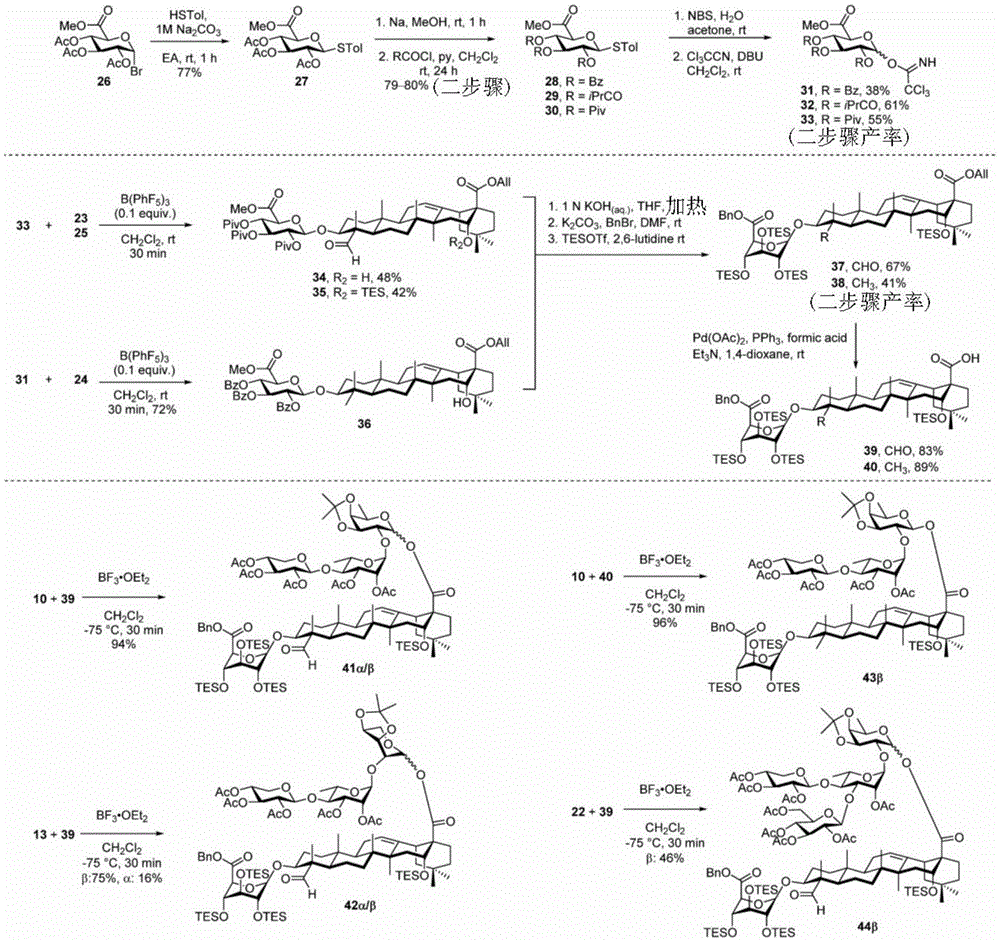
(procedure 4)
And 4, step 4: synthesis of amide-bound and fully deprotected saponins
After hydrogenolysis at 41 β, amide bond formation was continued using the HBTU/DIPEA coupling system to give a series of conjugated amides. Thereafter, the product was subjected to acid hydrolysis and methanolysis to provide our target saponin. Representative saponins in scheme 5 contain aliphatic carbon chains of varying lengths from methyl to octadecyl, various arylaliphatic, heteroarylaliphatic, heterocycloaliphatic compounds.
Scheme 5-demonstrates the preparation of formula (I) according to an embodiment of the invention.
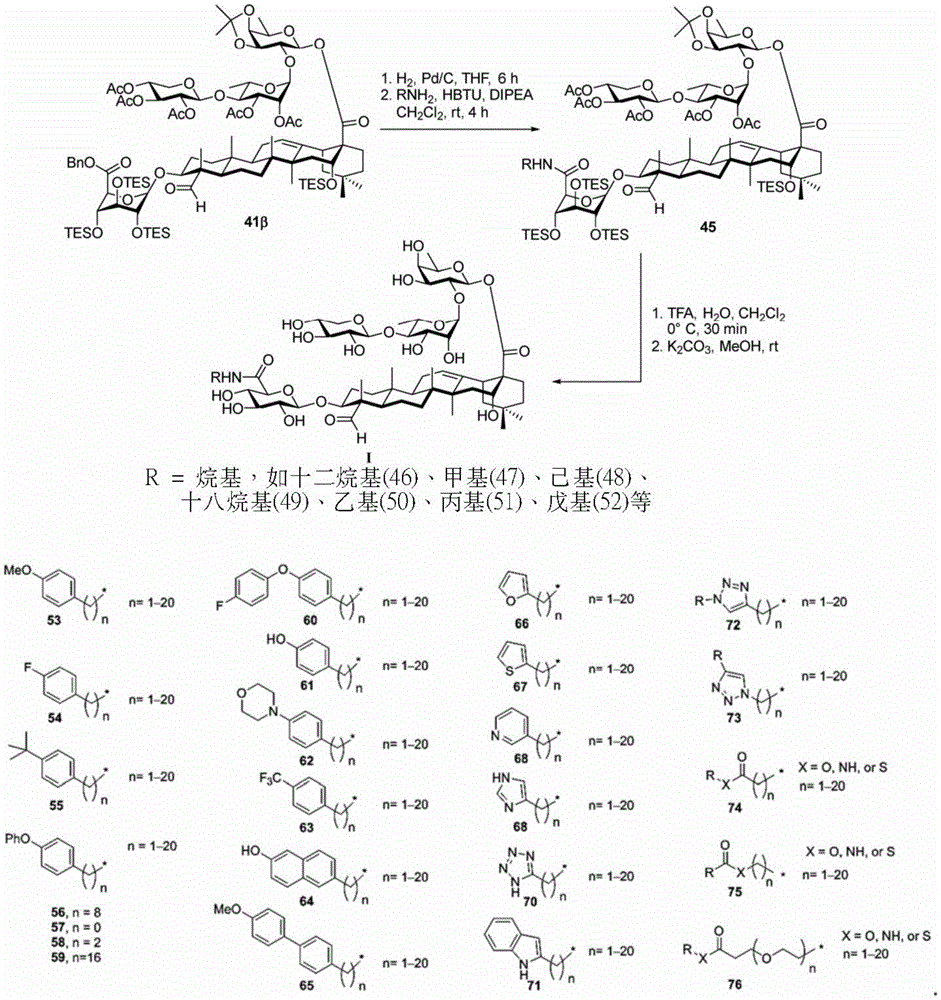
(procedure 5)
And 5: synthesis of saponin analogues
The synthesis of saponins contains an α -oriented trisaccharide moiety (compound 56 α, scheme 6). D-fucose is substituted by L-arabinose to obtain saponin 77 alpha/beta anomer. The echinocystic ester 78 was synthesized and the β -linked tetrasaccharide ester 79 was derived.
Scheme 6-demonstrates the preparation of saponin analogs according to embodiments of the invention.
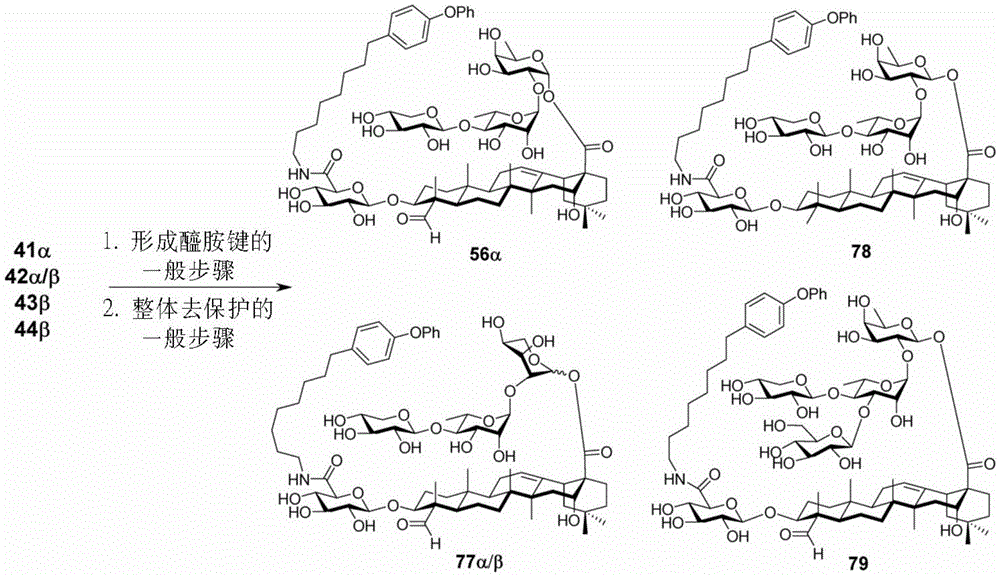
(procedure 6)
Vaccine composition
In another aspect, the present application relates to a vaccine composition comprising an antigen and a saponin analogue of the present application as an adjuvant. In some embodiments, the vaccine composition further comprises an additional adjuvant.
The vaccine compositions of the present application may be used as vaccines that induce active immunity against antigens in individuals. Any animal that may experience the beneficial effects of the compositions of the present invention is within the scope of the individual that can be treated. In some embodiments, the subject is a mammal. In some embodiments, the subject is a human.
Administration of a vaccine (or antisera elicited therefrom) may be for "prophylactic" or "therapeutic" purposes. Prophylactic administration of the vaccine is used to prevent or alleviate any subsequent manifestation of the disease. The vaccine is provided prophylactically, prior to any disease symptoms. The vaccine is provided therapeutically, either at the time of or after the detection of a possible pathogen infection or a symptom of a cancer in the animal. Therapeutic administration of the vaccine may slow down any actual disease manifestation. Thus, the vaccine may be provided before the onset of spread of the disease or after the actual onset of spread.
Thus, in one aspect, the invention provides a vaccine comprising one or more bacterial, viral, protozoan or tumor-associated antigens together with one or more compounds of the invention. In some embodiments, the vaccine comprises a single bacterial, protozoal, viral, or tumor-associated antigen in combination with one of the compounds of the invention. In some embodiments, the vaccine comprises two or more bacterial, viral, protozoan or tumor-associated antigens in combination with one compound of the invention. In some embodiments, the vaccine comprises a single bacterial, viral, protozoan or tumor-associated antigen in combination with two or more compounds of the invention.
In some embodiments, one or more antigens in a provided vaccine are bacterial antigens. In certain embodiments, the bacterial antigen is an antigen associated with a bacterium selected from the group consisting of Bordetella pertussis (Bordetella pertussis), Bordetella parapertussis (Bordetella parapertussis), Bordetella bronchiseptica (Bordetella bronchetica), Bordetella burgdorferi (Bordetella burgdorferi), Bordetella (Bordetella spp.), Chlamydia trachomatis (Chlamydia trachoromatis), Helicobacter pylori (Helicobacter pylori), Chlamydia pneumoniae (Chlamydia pneumoniae), Mycoplasma urealyticus (Ureapaprasum), Mycoplasma pneumoniae (Mycoplasma pneumoniae), Staphylococcus (Staphylococcus spp.), Staphylococcus aureus (Staphylococcus aureus), Neisseria meningitidis (Streptococcus pneumoniae), Streptococcus pneumoniae (Streptococcus meningitidis), Streptococcus meningitis, Streptococcus pneumoniae (Streptococcus meningitis, Streptococcus pneumoniae (Streptococcus meningitis), Streptococcus meningitis (Streptococcus meningitidis), Bacillus meningitidis (Streptococcus meningitidis), Bacillus meningitidis, Streptococcus meningitidis (Streptococcus meningitidis), Bacillus spp Salmonella (Salmonella spp.), Salmonella typhi (Salmonella typhi), Vibrio cholerae (Vibrio cholera), Pasteurella pestis (Pasteurella pestis), Campylobacter (Campylobacter spp.), Campylobacter jejuni (Campylobacter jejuni), Clostridium (Clostridium spp.), Clostridium difficile (Clostridium difficile), Corynebacterium diphtheriae (Corynebacterium diphtheriae), Mycobacterium (Mycobacterium spp.), Mycobacterium tuberculosis (Mycobacterium tuberculosis spp.), Pseudomonas aeruginosa (Pseudomonas aeruginosa), Treponema (Treponema spp.), leptospira (leptospira spp.), Mycobacterium (Mycobacterium tuberculosis spp.), Mycobacterium tuberculosis (Mycobacterium tuberculosis spp.), Pseudomonas aeruginosa (Haemophilus aerugensis), Haemophilus aeruginosa (Haemophilus aeruginosa), Haemophilus aeruginosa (Escherichia coli), Escherichia coli (Escherichia coli), and combinations thereof.
In certain embodiments, one or more antigens in a provided vaccine are virus-associated antigens. In certain embodiments, the virus-associated antigen is an antigen associated with a virus selected from the group consisting of influenza virus, parainfluenza virus, mumps virus, adenovirus, respiratory syncytial virus, Epstein-Barr virus (EBV), rhinovirus, myelitis virus, coxsackie virus (coxsackievirus), echovirus (echovirus), measles virus, rubella virus, varicella zoster virus, herpes simplex virus, parvovirus, cytomegalovirus, hepatitis virus, human papilloma virus, alphavirus, flavivirus, bunyavirus (bunyavirus), rabies virus, arenavirus, filovirus, HIV-1, HIV-2, HTLV-1, HTLV-II, feline leukemia virus (feline ukemia virus, FeLV), bovine leukemia virus (bovine leukemia virus, bovine LV), feline immunodeficiency virus (FeIV), canine distemper virus, canine infectious hepatitis virus (canine infectious hepatitis virus), feline calicivirus, feline rhinotracheitis virus, porcine transmissible gastroenteritis virus (TGEV), foot and mouth disease virus, coronavirus, dengue virus, and combinations thereof.
In certain embodiments, one or more antigens in a provided vaccine are tumor associated antigens. In some embodiments, the tumor-associated antigen is an antigen selected from the group consisting of: killed tumor cells and lysates thereof;
MAGE-1, MAGE-3 and peptide fragments thereof; human chorionic gonadotropin and peptide fragments thereof; cancer embryonic antigens and peptide fragments thereof; alpha-fetoprotein and peptide fragments thereof; pancreatic embryonic antigen (POA) and peptide fragments thereof; prostate specific antigen and peptide fragments thereof; MUC-1 and peptide fragments thereof; CA125, CA 15-3, CA19-9, CA549, CA 195 and peptide fragments thereof; prostate specific membrane antigen and peptide fragments thereof; squamous cell carcinoma-associated antigens and peptide fragments thereof; ovarian cancer antigens and peptide fragments thereof; pancreatic cancer-associated antigens and peptide fragments thereof; her1/neu and peptide fragments thereof; gp-100 and peptide fragments thereof; mutant K-Ras proteins and peptide fragments thereof; mutant p53 and peptide fragments thereof; truncated epidermal growth factor receptor (truncated epidermal growth factor receptor), chimeric protein p210BCR-ABL、STn、Tn、Lewisx、LewisyTF, GM1, GM2, GD2, GD3, Gb3, KH-1, and Globo-H, SSEA-4; and mixtures thereof.
As described above, the provided compounds can be used in combination with tumor associated antigens as adjuvants in cancer vaccines. In certain embodiments, the vaccine can be used to treat or prevent a tumor. In certain embodiments, the tumor is a benign tumor. In other embodiments, the tumor is a malignant tumor. Any cancer can be treated using the compounds and antigens of the invention.
In another aspect, the present application relates to methods of immunizing an individual using the vaccine compositions of the present application.
Preparation
The saponin analogs of the present application can be combined with pharmaceutically acceptable excipients to form pharmaceutical compositions. In certain embodiments, the pharmaceutical composition comprises a pharmaceutically acceptable amount of a compound of the invention. The amount of active ingredient that may be combined with the carrier materials to produce a single dosage form will vary depending upon the host treated and the particular mode of administration. The amount of active ingredient that can be combined with a carrier material to produce a single dosage form is generally that amount of the compound which produces a therapeutic effect. Typically, the amount is from about 1% to about 99% of the active ingredient, preferably from about 5% to about 70%, most preferably from about 10% to about 30%.
Wetting agents, emulsifiers and lubricants, such as sodium lauryl sulfate and magnesium stearate, as well as coloring agents, controlled release agents, coating agents, sweetening, flavoring and perfuming agents, preservatives and antioxidants can also be included in the compositions.
The formulations of the present invention include those suitable for oral, nasal, topical, rectal, vaginal and/or parenteral administration. The formulations may conveniently be presented in unit dosage form and may be prepared by any of the methods well known in the art of pharmacy. In certain embodiments, the formulations of the invention comprise an excipient selected from the group consisting of cyclodextrins, liposomes, micelle formers (e.g., cholic acid) and polymeric carriers (e.g., polyesters and polyanhydrides) and a compound of the invention. In certain embodiments, the foregoing formulations render the compounds of the present invention orally biocompatible.
Formulations of the invention suitable for oral administration may be in the form of capsules, cachets, pills, tablets (tablets), buccal tablets (using a flavored base, typically sucrose and acacia or tragacanth), powders, granules, or as a solution or suspension in an aqueous or non-aqueous liquid, or an aqueous liquid emulsion in oil or water in oil, or an elixir or syrup, or lozenges (pastilles) (using an inert base such as gelatin and glycerin, or sucrose and acacia), and/or mouthwashes and the like, each containing a predetermined amount of a compound of the invention as an active ingredient. The compounds of the invention may also be administered in the form of a bolus, electuary or paste.
The formulations of the present application may be administered orally, parenterally, topically or rectally. It is, of course, administered in a form suitable for each route of administration. For example, administration in the form of tablets or capsules; by injection, inhalation, eye drop, ointment, suppository, etc.; administration by injection, infusion or inhalation; topical administration via lotions or ointments; and suppositories for rectal administration.
Regardless of the route of administration chosen, the saponin analogs of the present application can be used in a suitable hydrated form, and/or the pharmaceutical compositions of the present invention can be formulated into pharmaceutically acceptable dosage forms by methods known to those skilled in the art. The actual dosage concentration of the active ingredient in the pharmaceutical compositions of the present invention can be varied to obtain an amount of the active ingredient that is effective to achieve the desired therapeutic response for a particular patient, composition, and mode of administration, without being toxic to the patient.
The choice of dosage concentration will depend on a number of factors including: activity of the particular compound of the invention or ester, salt or amide thereof used; the route of administration; the time of administration; the rate of excretion or metabolism of the particular compound used; the duration of treatment; other drugs, compounds and/or substances used in combination with the particular compound used; the age, sex, weight, condition, general health, and prior medical history of the patient being treated; and factors well known in the medical arts.
A physician or veterinarian of ordinary skill in the art can readily determine and prescribe the effective amount of the pharmaceutical composition required. For example, a physician or veterinarian can refer to a concentration below that required to achieve the desired therapeutic effect as the initial dose of a compound of the invention employed in a pharmaceutical composition, and then gradually increase the dose until the desired effect is achieved.
Examples
The following examples are provided to illustrate certain aspects of the present invention and to assist those skilled in the art in practicing the invention. These examples do not limit the scope of the present invention.
All reagents and solvents were reagent grade and used without further purification unless otherwise indicated. The molecular sieve was activated at 200 ℃ before use. Using p-anisaldehyde, ninhydrin and ammonium cerium molybdate (cerium ammonium molybdate) as developer in 0.25mm silica gel 60F254Thin layer chromatography analysis was performed on (Merck Millipore) to monitor the reaction progress. Flash column chromatography was performed using 230-400 mesh silica gel.
Instrument for measuring the position of a moving object
NMR spectra were obtained using Bruker-AV-400(400MHz) and Bruker-AV-600(600 MHz). Chemical shifts (. delta.) are in ppm relative to CDCl3Is/are as follows1H:7.26ppm,13C: 77.0 ppm; relative to CD3Of OD1H:3.31ppm,13C: 49.0 ppm. The split form is represented by a singlet as s, a doublet as d, a triplet as t, a quartet as q, and a multiplet as m. The coupling constant (J) is in Hertz (Hertz, Hz). Reverse phase HPLC purification and analysis Using either a HITACHI D-2000Elite HPLC system equipped with an autosampler L-2200, UV detector L-2420 and pump L-2130, or a SHIMADZU HPLC system equipped with system controller CBM-20A, photodiode array detector SPD-M20A, pump LC-20AT and autosampler SIL-20 AHT. Accurate mass measurements were performed with a VG platform electrospray ionization mass spectrometer or BioTOF II.
Synthesis example I
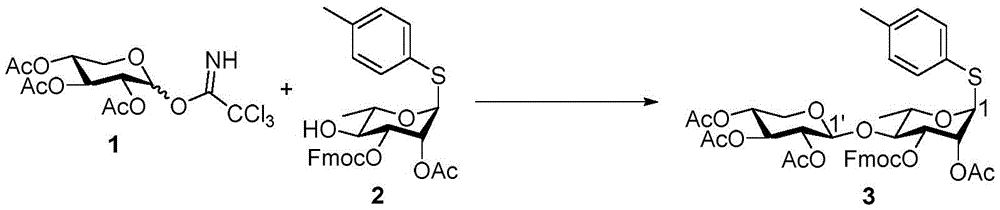
P-methylphenyl 2,3, 4-tri-O-acetyl-beta-D-xylopyranosyl- (1 → 4) -2-O-acetyl-3-O-fluorenylmethoxycarbonyl-1-thio-alpha-L-rhamnopyranoside (3)
At-40 ℃ and N2BF is carried out in gas environment3·OEt2(about 48%, 11. mu.L, 0.08mmol) were added to 1(137mg,0.33mmol), 2(87mg,0.16mmol) and activation Molecular sieve powder in anhydrous CH2Cl2(1.6mL) in stirred suspension. After 3 hours the reaction was complete, saturated NaHCO was added3The mixture was quenched and then warmed to room temperature. The resulting mixture was further purified over MgSO4Dried and concentrated under reduced pressure. The residue was purified by column chromatography (silica gel; EtOAc/hexanes 1/4 to 1/2) to afford 3 as an anhydrous syrup (75mg, 58%): rf0.36 (EtOAc/hexanes-1/2);1H NMR(600MHz,CDCl3)δ7.78(d,J=7.5Hz,2H),7.64(dd,J=19.0,7.4Hz,2H),7.45–7.41(m,2H),7.39–7.34(m,4H),7.12(d,J=8.0Hz,2H),5.54(dd,J=3.4,1.4Hz,1H,H-2),5.33(d,J=1.4Hz,1H,H-1),5.21(t,J=9.4Hz,1H,H-3’),5.08(dd,J=9.6,3.4Hz,1H,H-3),4.99(td,J=9.4,5.4Hz,1H,H-4'),4.95(dd,J=9.4,7.6Hz,1H,H-2’),4.79(d,J=7.6Hz,1H,H-1’),4.57(dd,J=13.4,10.1Hz,1H,Fmoc C 2H),4.35–4.31(m,2H,Fmoc C 2H and CH),4.28–4.25(m,1H,H-5),4.14(dd,J=11.8,5.4Hz,1H,H-5a’),3.84(t,J=9.5Hz,1H,H-4’),3.40(dd,J=11.8,9.5Hz,1H,H-5b’),2.33(s,3H),2.16(s,3H),2.05(s,3H),2.03(s,3H),1.91(s,3H),1.35(d,J=6.2Hz,3H,H-6);13C NMR(151MHz,CDCl3)δ
167.0,169.9,169.8,169.5,154.0,143.4,143.1,141.3,141.2,138.2,132.6,129.9,129.3,128.0,127.3,125.2,125.0,120.1,120.0,100.8(C-1’),85.8(C-1),76.1(C-3),75.9(C-4),72.2(C-3’),71.3(C-2’),71.2(C-2),70.6(Fmoc CH2),69.3(C-4’),68.1(C-5),62.5(C-5’),46.6(Fmoc CH),21.1,20.9,20.7,20.7,20.5,17.5(C-6)ppm;C41H44O14SNa[M+Na]+HRMS (ESI-TOF) of (g) calculated 815.2349, found 815.2352.

At-50 ℃ and N2NIS (1.12g,4.99mmol) and BF were reacted under a gas atmosphere3·OEt2(0.38mL,1.42mmol) was added to 4 α (1.05g,3.57mmol), 3(3.40g,4.28mmol) and activated Molecular sieve powder in anhydrous CH2Cl2(2mL) in stirred suspension. After 1 hour the reaction was complete, saturated NaHCO was added3And 10% Na2S2O3The reaction was quenched with aqueous solution. The reaction mixture was warmed to room temperature, stirred for 1 hour, and then filtered. The filtrate is treated with CH2Cl2Diluting with 10% Na2S2O3(aq.), saturated NaHCO3Washed with brine, over MgSO4Dried and then concentrated under reduced pressure. By column chromatography (silica; EtOAc/CH)2Cl2Hexane 1/1/6 to 1/1/4) to give 5 as a white foam (2.00g, 58%): rf0.44(EtOAc/CH2Cl21/1/2/hexane);1H NMR(600MHz,CDCl3)δ7.78(d,J=7.5Hz,2H),7.67(d,J=7.4Hz,1H),7.63(d,J=7.5Hz,1H),7.42(t,J=7.4Hz,2H),7.42(t,J=7.4Hz,2H),7.39–7.27(m,5H),5.50–5.46(m,1H,H-2’),5.19(t,J=9.2Hz,1H,H-3”),5.12–5.10(m,2H,H-1’,H-3’),4.99(td,J=9.2,5.5Hz,1H,H-4”),4.94(dd,J=9.2,7.6Hz,1H,H-2”),4.82(d,J=3.5Hz,1H,H-1),4.77(d,J=7.5Hz,1H,H-1”),4.71(d,J=12.3Hz,1H,Bn C 2H),4.60–4.51(m,2H,Bn C 2H,Fmoc C 2H),4.37–4.31(m,2H,H-3,Fmoc CH),4.28(dd,J=10.0,8.1Hz,1H,Fmoc C 2H),4.17–4.09(m,2H,H-5,H-5a”),4.02(dd,J=5.3,2.4Hz,1H,H-4),3.76(dd,J=8.1,3.5Hz,1H,H-2),3.72(t,J=9.6Hz,1H,H-4’),3.65–3.60(m,1H,H-5’),3.40(dd,J=11.6,9.7Hz,1H,H-5b”),2.18(s,3H),2.05(s,3H),2.01(s,3H),1.86(s,3H),1.50(s,3H),1.34(d,J=6.7Hz,3H,H-6),1.32(s,3H),1.18(d,J=6.2Hz,3H,H-6’);C50H58O19Na[M+Na]+HRMS (ESI-TOF) calculation of (g/t)985.3463, found 985.3476.
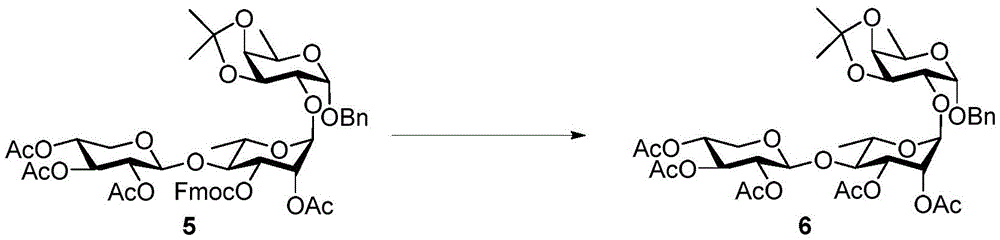
Morpholine (0.5mL) was added to stirred 5(100mg,0.10mmol) in CH at room temperature2Cl2(5 mL). After 1.5 hours the reaction was complete, the reaction mixture was taken up with CH2Cl2Diluting with saturated NH4Cl, saturated NaHCO3Washed with brine and MgSO4Dried and then concentrated under reduced pressure. The residue was purified by column chromatography (silica gel; EtOAc/hexane ═ 1/1 to 3/2) to give fluorenylmethyloxycarbonyl (Fmoc) -deprotected product (72mg, 95%). At room temperature and N2Addition of Ac under gas atmosphere2O(91μL,0.96mmol)、Et3N (201. mu.L, 1.4mmol) and DMAP (6mg,0.048mmol) to Fmoc-deprotected product (462mg,0.48mmol) in dry CH2Cl2(10mL) in stirred solution. After 2 hours the reaction was complete, the reaction was quenched with CH2Cl2Diluting with H2O, brine, and MgSO4Dried and then concentrated under reduced pressure. The residue was purified by column chromatography (silica gel; EtOAc/hexanes: 2/3) to afford 6 as a white foam (391mg, 96%): rf0.48 (EtOAc/hexanes 1/1);1H NMR(600MHz,CDCl3)δ7.38–7.27(m,5H),5.32(dd,J=3.5,1.6Hz,1H,H-2’),5.26(dd,J=9.3,3.5Hz,1H,H-3’),5.13(t,J=9.3Hz,1H,H-3”),5.05(d,J=1.5Hz,1H,H-1’),4.96(td,J=9.3,5.4Hz,1H,H-4”),4.91–4.87(dd,J=9.3,7.6Hz,1H,H-2”),4.80(d,J=3.6Hz,1H,H-1),4.71(d,J=12.3Hz,1H,Bn C 2H),4.63(d,J=7.6Hz,1H,H-1”),4.54(d,J=12.3Hz,1H,Bn C 2H),4.34(dd,J=8.1,5.4Hz,1H,H-3),4.14(qd,J=6.7,2.5Hz,1H,H-5),4.10(dd,J=11.7,5.4Hz,1H,H-5a”),4.02(dd,J=5.4,2.5Hz,1H,H-4),3.74(dd,J=8.1,3.6Hz,1H,H-2),3.62–3.54(m,2H,H-4’,H-5’),3.33(dd,J=11.7,9.5Hz,1H,H-5b”),2.13(s,3H),2.08(s,3H),2.03(s,3H),2.01(s,6H),1.49(s,3H),1.34(d,J=6.7Hz,3H,H-6),1.32(s,3H),1.14(d,J=5.6Hz,3H,H-6’)ppm;C37H50O18Na[M+Na]+HRMS (ESI-TOF) of (g) calculated 805.2889, found 805.2898.
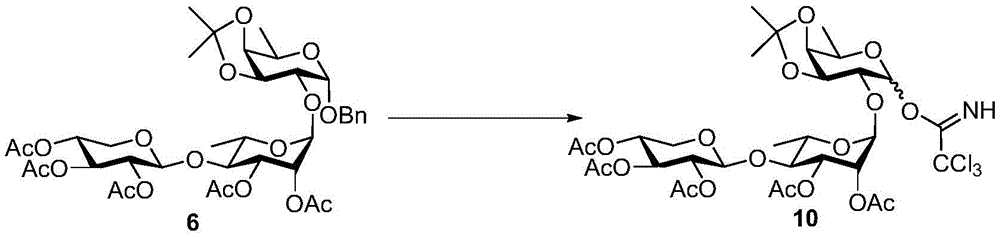
At room temperature H2Stirring 6(1.26g,1.6mmol) and 10% Pd/C (0.2g) in phosphate buffer (100mM Na) under a balloon atmosphere2HPO4/NaH2PO4(aq.), pH 7.0)/THF/MeOH 1/1/4(30 mL). After stirring for 3 days, the mixture was filtered through celite and concentrated under reduced pressure. The residue is taken up in CH2Cl2Diluting with H2O, brine, and MgSO4Dried, concentrated and then purified by column chromatography (silica gel; EtOAc/hexanes: 1/1 to 3/2) to give the hemiacetal (0.79g, 71%) as a colorless slurry. At room temperature and N2Addition of Cl in a gaseous atmosphere3CCN (16. mu.L, 0.16mmol) and DBU (3. mu.L, 0.021mmol) to hemiacetal (36mg,0.48mmol) in anhydrous CH2Cl2(1mL) in a stirred solution. After stirring for 1.5 hours, completion of the reaction was confirmed by TLC analysis, and the mixture was concentrated under reduced pressure. Flash column chromatography (silica; EtOAc/hexanes 1/1 to 3/2, containing 0.5% Et)3N) the residue was purified to give 10 as a yellow slurry (34mg, 78%). 10 alpha: Rf0.46 (EtOAc/hexanes-1/1);1H NMR(600MHz,CDCl3)δ8.67(s,1H),6.30(d,J=3.5Hz,1H,H-1),5.24(dd,J=3.3,1.8Hz,1H,H-2’),5.14–5.08(m,2H,H-3’,H-3”),5.03(d,J=1.8Hz,1H,H-1’),4.93(td,J=9.4,5.4Hz,1H,H-4”),4.86(dd,J=9.4,7.7Hz,1H,H-2”),4.58(d,J=7.7Hz,1H,H-1”),4.40(dd,J=7.8,5.4Hz,1H,H-3),4.32(qd,J=6.7,2.5Hz,1H,H-5),4.12–4.07(m,2H,H-5a”,H-4),3.91(dd,J=7.8,3.5Hz,1H,H-2),3.81(dq,J=9.6,6.2Hz,1H,H-5’),3.60(t,J=9.6Hz,1H,H-4’),3.31(dd,J=11.7,9.7Hz,1H,H-5b”),2.13(s,3H),2.03(s,3H),2.02(s,3H),2.00(s,3H),1.95(s,3H),1.52(s,3H),1.38(d,J=6.7Hz,3H,H-6),1.34(s,3H),1.28(d,J=6.2Hz,3H,H-6’)。
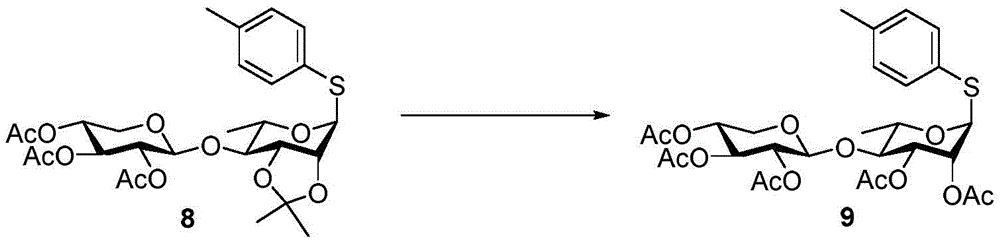
p-methylphenyl 2,3, 4-tri-O-acetyl-beta-D-xylopyranosyl- (1 → 4) -2, 3-di-O-acetyl-1-thio-alpha-L-rhamnopyranoside (9)
A stirred solution of 8(4.6g,8.1mmol) in 80% AcOH (100mL) was heated to 60 ℃ for 12 h. The resulting mixture was evaporated and then azeotropically distilled with toluene (50mL) twice under reduced pressure. After drying under high vacuum, at room temperature and N2Using Ac in a gaseous environment2O(2.2mL,23mmol)、Et3N (5.2mL,38mmol) and DMAP (9mg,0.074mmol) in CH2Cl2The solution in (1) treats the crude slurry. After 2 hours the reaction was complete, the mixture was washed with CH2Cl2Diluting with H2O, brine, over MgSO4Dried and then concentrated under reduced pressure. The residue was purified by column chromatography (silica gel; EtOAc/hexanes: 2/3) to afford 9(3.8g, 76%) as a white solid: rf0.19 (EtOAc/hexanes 1/2);1H NMR(400MHz,CDCl3)δ7.34(d,J=7.9Hz,2H),7.11(d,J=7.8Hz,2H),5.39(brs,1H,H-2),5.26(brs,1H,H-1),5.22(dd,J=9.6,3.1Hz,1H,H-3),5.14(t,J=9.2Hz,1H,H-3’),5.00–4.93(m,1H,H-4’),4.90(dd,J=9.2,7.6Hz,1H,H-2’),4.66(d,J=7.6Hz,1H,H-1’),4.24(dq,J=9.6,6.1Hz,1H,H-5),4.12(dd,J=11.6,5.3Hz,1H,H-5a’),3.72(t,J=9.6Hz,1H,H-4),3.39–3.30(m,1H,H-5b’),2.31(s,3H),2.11(s,3H),2.09(s,3H),2.03(s,3H),2.02(s,6H,Ac×2),1.31(d,J=6.1Hz,3H)ppm;C28H36O13SNa[M+Na]+HRMS (ESI-TOF) of (g) calculation 635.1769, foundValue 635.1774.
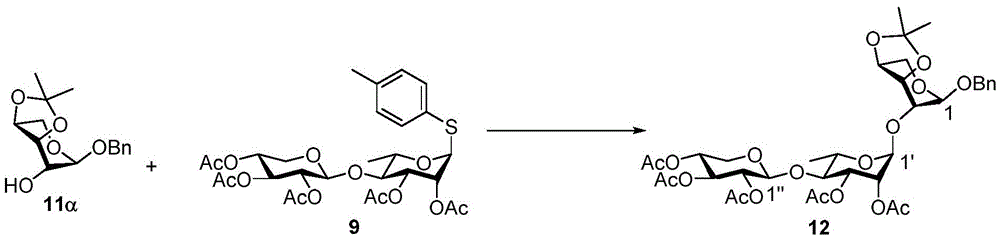
At-50 ℃ and N2NIS (0.23g,1.0mmol) and TMSOTf (12. mu.L, 0.066mmol) to 9(500mg,0.82mmol), 11 α (190mg,0.68mmol) and activation were added under a gas atmosphere Molecular sieve powder in anhydrous CH2Cl2(7mL) in stirred suspension. After completion of the reaction after 0.5 hours Et was added3N, saturated NaHCO3And 10% Na2S2O3The reaction was quenched with aqueous solution. After heating and stirring at room temperature for 1 hour, the reaction mixture was filtered and washed with CH2Cl2Diluting with 10% Na2S2O3Aqueous solution, saturated NaHCO3Washed with brine, over MgSO4Dried and concentrated under reduced pressure. The residue was purified by column chromatography (silica gel; EtOAc/hexanes 2/3 to 1/1) to give 12 as a white foam (412mg, 79%): rf0.25 (EtOAc/hexanes-2/3);1H NMR(600MHz,CDCl3)δ7.38–7.28(m,5H),5.32(dd,J=3.4,1.4Hz,1H,H-2’),5.26(dd,J=9.2,3.4Hz,1H,H-3’),5.13(t,J=9.2Hz,1H,H-3”),5.05(s,1H,H-1’),4.96(td,J=9.2,5.5Hz,1H,H-4”),4.90(dd,J=9.2,7.7Hz,1H,H-2”),4.82(d,J=3.4Hz,1H,H-1),4.73(d,J=12.3Hz,1H,Bn C 2H),4.63(d,J=7.7Hz,1H,H-1”),4.53(d,J=12.3Hz,1H,Bn C 2H),4.36(dd,J=7.9,5.6Hz,1H,H-3),4.20(d,J=5.6Hz,1H,H-4),4.10(dd,J=11.7,5.5Hz,1H,H-5a”),3.98(brs,2H,H-5),3.75(dd,J=7.9,3.4Hz,1H,H-2),3.61–3.54(m,2H,H-4’,H-5’),3.33(dd,J=11.7,9.6Hz,1H),2.14(s,3H),2.08(s,3H),2.03(s,3H),2.02–2.01(m,6H,Ac C 3H×2),1.50(s,3H),1.32(s,3H),1.14(d,J=5.7Hz,3H)ppm;C36H48O18Na[M+Na]+HRMS (ESI-TOF) of (g) calculated 791.2733, found 791.2735.
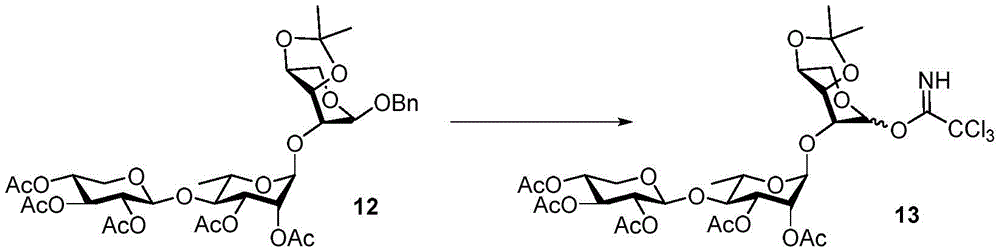
At room temperature and H212(300mg,0.39mmol) and 10% Pd/C (150mg) in buffer (100mM Na) were stirred under a balloon atmosphere2HPO4/NaH2PO4(aq.), pH 7.0)/THF/MeOH 1/1/4(30 mL). After stirring for 3.5 days, the mixture was filtered through celite and concentrated under reduced pressure. The residue was purified by column chromatography (silica gel; EtOAc/hexanes 1/1 to 3/2) to give the hemiacetal (166mg, 63%) as a white foam. At room temperature and N2Addition of Cl in a gaseous atmosphere3CCN (22. mu.L, 0.22mmol) and DBU (4.3. mu.L, 0.029mmol) to hemiacetal (50mg,0.074mmol) in anhydrous CH2Cl2(1.5mL) in a stirred solution. After stirring for 16 hours, the mixture was concentrated under reduced pressure. Flash column chromatography (silica; EtOAc/hexanes: 1/1, containing 0.5% Et3N) the resulting residue was purified to give 13 as an anhydrous syrup (60mg, 98%). 100 alpha: Rf0.43 (EtOAc/hexanes-1/1);1H NMR(600MHz,CDCl3)δ8.69(s,1H,NH),6.30(d,J=3.4Hz,1H,H-1),5.24(dd,J=3.2,1.3Hz,1H,H-2’),5.14–5.08(m,2H,H-3’,H-3”),5.02(d,J=1.3Hz,1H,H-1’),4.93(td,J=9.4,5.4Hz,1H,H-4”),4.85(dd,J=9.5,7.7Hz,1H,H-2”),4.58(d,J=7.7Hz,1H,H-1”),4.42(dd,J=7.6,5.7Hz,1H,H-3),4.31–4.26(m,1H,H-4),4.12(d,J=1.8Hz,2H,H-5),4.09(dd,J=11.7,5.4Hz,1H,H-5a”),3.91(dd,J=7.6,3.4Hz,1H,H-2),3.80(dq,J=9.5,6.2Hz,1H,H-5’),3.60(t,J=9.5Hz,1H,H-4’),3.31(dd,J=11.7,9.4Hz,1H,H-5b”),2.13(s,3H),2.03(s,3H),2.02(s,3H),2.00(s,3H),1.95(s,3H),1.52(s,3H),1.35(s,3H),1.28(d,J=6.2Hz,3H,H-6’)ppm。
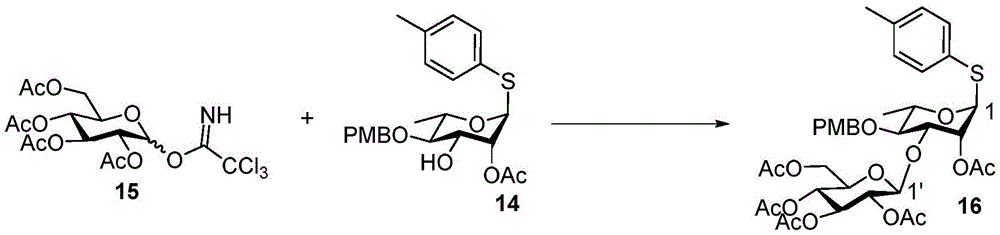
p-methylphenyl 2,3,4, 6-tetra-O-acetyl-beta-D-glucopyranosyl- (1 → 3) -2-O-acetyl-4-O- (p-methoxybenzyl) -1-thio-alpha-L-rhamnopyranoside (16)
At-50 ℃ and N2TMSOTf (10. mu.L, 0.052mmol) to 15(130mg,0.26mmol), 14(114mg,0.26mmol) and activation were added under a gas atmosphere Molecular sieve powder in anhydrous CH2Cl2(2.5mL) in stirred suspension. After completion of the reaction after 0.5 hours Et was added3N to quench the reaction, warmed to room temperature, filtered, and then concentrated under reduced pressure. The residue was purified by column chromatography (silica gel; EtOAc/hexanes: 1/2) to afford 16(102mg, 51%) as a white foam: rf0.24 (EtOAc/hexanes 1/2);1H NMR(600MHz,CDCl3)δ7.29–7.27(m,4H),7.08(d,J=8.0Hz,2H),6.89(d,J=8.7Hz,2H),5.39(dd,J=3.4,1.4Hz,1H,H-2),5.30(d,J=1.4Hz,1H,H-1),5.18(t,J=9.7Hz,1H,H-3’),5.06(dd,J=9.7,8.0Hz,1H,H-2’),5.03(t,J=9.7Hz,1H,H-4’),4.79(d,J=8.0Hz,1H,H-1’),4.71(d,J=10.5Hz,1H),4.46(d,J=10.5Hz,1H),4.19–4.13(m,2H),4.09(dd,J=12.2,2.2Hz,1H’),4.06(dd,J=9.5,3.4Hz,1H),3.79(s,3H,3.70(ddd,J=9.7,5.7,2.2Hz,1H,H-5’),3.48(t,J=9.5Hz,1H,H-4),2.29(s,3H),2.10(s,3H),2.09(s,3H),2.01(s,3H),1.98(s,3H),1.83(s,3H),1.25(d,J=6.2Hz,3H,H-6)ppm;C37H46O15SNa[M+Na]+HRMS (ESI-TOF) of (g) calculated 785.2450, found 785.2457.
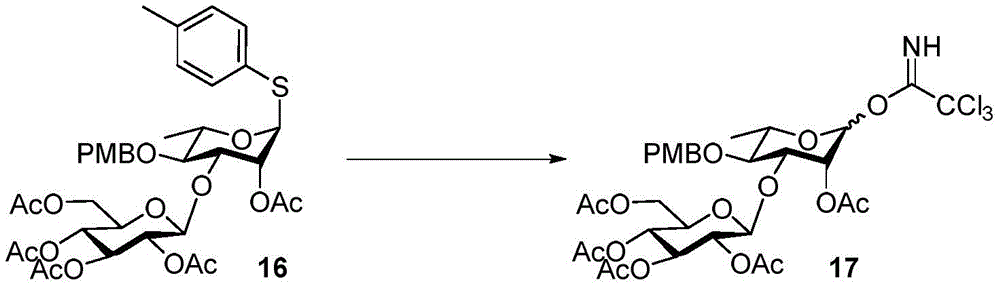
NBS (35mg,0.19mmol) in 16(37mg,0.049mmol) in acetone/H was added at room temperature2O (1mL) in a stirred solution. After stirring for 2 hours, saturated NaHCO was added3And 10% Na2S2O3(aq.)To quench the mixture. The resulting mixture was stirred at room temperature for 1 hour, and then the solvent was removed under reduced pressure. The residue is taken up in CH2Cl2Diluting with 10% Na2S2O3(aq.)Saturated NaHCO3Washed with brine and MgSO4Dried and then concentrated under reduced pressure. The residue was purified by column chromatography (silica gel; EtOAc/hexanes ═ 3/2) to give the hemiacetal (26mg, 82%) as a colorless slurry. At room temperature and N2Addition of Cl in a gaseous atmosphere3CCN (12. mu.L, 0.12mmol) and DBU (2.4. mu.L, 0.016mmol) to hemiacetal (26mg,0.040mmol) in anhydrous CH2Cl2(1mL) in a stirred solution. After stirring for 1 hour, the mixture was concentrated under reduced pressure. Flash column chromatography (silica; EtOAc/hexanes: 1/2, containing 0.5% Et3N) the residue was purified to give 17 as a white foam (25mg, 79%). 17: rf0.44 (EtOAc/hexanes 1/1);1H NMR(400MHz,CDCl3)δ8.68(s,1H),7.29(d,J=8.4Hz,2H),6.91(d,J=8.4Hz,2H),6.15(s,1H,H-1),5.34(s,1H,H-2),5.20(t,J=9.4Hz,1H,H-3’),5.12–5.06(m,2H,H-2’,H-4’),4.84(d,J=7.9Hz,1H,H-1’),4.72(d,J=10.3Hz,1H,PMB C 2H),4.49(d,J=10.3Hz,1H,PMB C 2H),4.21–4.13(m,2H,H-3,H-6a’),4.09(t,J=11.0Hz,1H,H6b’),3.89(dq,J=9.6,6.1Hz,1H,H-5),3.81(s,3H,PMB OC 3H),3.66(d,J=9.7Hz,1H,H-5’),3.52(t,J=9.6Hz,1H,H-4),2.15(s,3H),2.07(s,3H),2.01(s,3H),2.00(s,3H),1.88(s,3H),1.29(d,J=6.1Hz,3H,H-6)ppm。
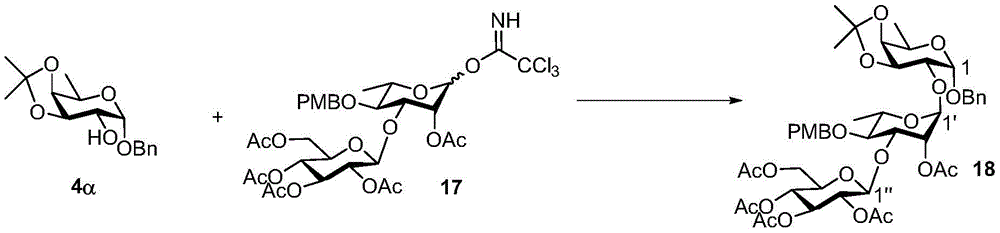
At-50 ℃ and N2TMSOTf (1. mu.L, 0.0062mmol) was added under gas atmosphere to 17(25mg,0.31mmol), 4 α (9mg,0.31mmol) and activated Molecular sieve powder in anhydrous CH2Cl2(1.5mL) in stirred suspension. After 1 hour the reaction was complete Et was added3N to quench the reaction, warmed to room temperature, filtered, and then concentrated under reduced pressure. The residue was purified by column chromatography (silica gel; EtOAc/hexanes: 2/3) to afford 18 as a white foam (24mg, 82%): rf0.43 (EtOAc/hexanes-1/1);1H NMR(600MHz,CDCl3)δ7.34(d,J=7.2Hz,2H),7.29(t,J=7.5Hz,2H),7.26–7.24(m,3H),6.89(d,J=8.7Hz,2H),5.30(dd,J=3.6,1.7Hz,1H,H-2’),5.16(t,J=9.5Hz,1H,H-3”),5.09–5.04(m,H-2”,H-4”),5.03(d,J=1.7Hz,1H,H-1’),4.85(d,J=3.6Hz,1H,H-1),4.77(d,J=7.9Hz,1H,H-1”),4.70(d,J=10.8Hz,1H,PMB C 2H),4.69(d,J=12.2Hz,1H,Bn C 2H),4.51(d,J=12.2Hz,1H,Bn C 2H),4.45(d,J=10.8Hz,1H,PMB C 2H),4.29(dd,J=8.1,5.4Hz,1H,H-3),4.21(dd,J=12.2,4.9Hz,1H,H-6a”),4.14–4.09(m,1H,H-5),4.08(dd,J=9.5,3.6Hz,1H,H-3’),4.04–3.99(m,2H,H-4,H-6b”),3.81(s,3H,PMB OC 3H),3.74(dd,J=8.1,3.6Hz,1H,H-2),3.70–3.61(m,2H,H-5”,H-5’),3.40(t,J=9.5Hz,1H,H-4’),2.10(s,3H),2.07(s,3H),2.01(s,3H),1.98(s,3H),1.77(s,3H),1.48(s,3H),1.33(d,J=6.7Hz,3H,H-6),1.31(s,3H),1.14(d,J=6.2Hz,3H,H-6’);C46H60O20Na[M+Na]+HRMS (ESI-TOF) of (g) calculated 955.3570, found 955.3579.
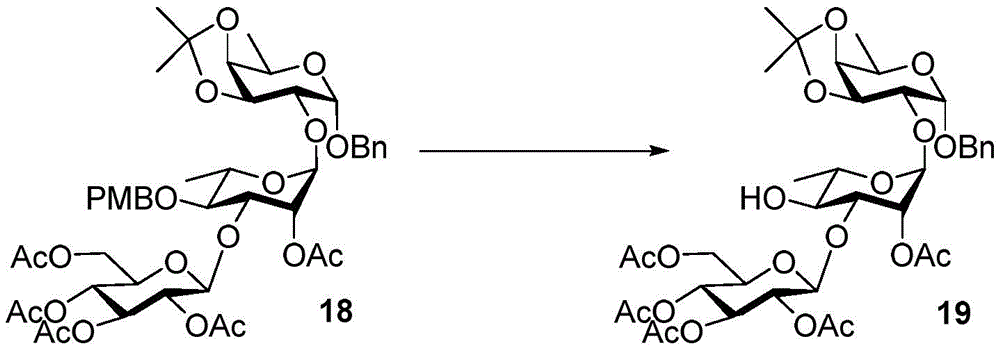
DDQ (9mg,0.039mmol) in 18(24mg,0.026mmol) in CH was added at room temperature2Cl2/H2O-18/1 (1mL) in a stirred solution. The reaction mixture was stirred for 3 hours and then saturated NaHCO3And (4) quenching. The obtained mixture is substituted by CH2Cl2Diluting with saturated NaHCO3Washed with brine and over MgSO4Dried and then concentrated under reduced pressure. The residue was purified by column chromatography (silica gel, EtOAc/hexanes-1/1) to afford 19 as an anhydrous syrup (17mg, 81%): rf0.30 (EtOAc/hexanes-1/1);1H NMR(600MHz,CDCl3)δ7.37–7.29(m,5H),5.24(dd,J=3.6,1.7Hz,1H,H-2’),5.20(t,J=9.6Hz,1H,H-3”),5.04–4.99(m,3H,H-2”,H-1’,H-4”),4.87(d,J=3.6Hz,1H,H-1),4.72(d,J=12.1Hz,1H,Bn C 2H),4.70(d,J=7.8Hz,1H,H-1”),4.53(d,J=12.1Hz,1H,Bn C 2H),4.30(dd,J=8.2,5.3Hz,1H,H-3),4.22(dd,J=12.3,5.0Hz,1H,H-6a”),4.12(qd,J=6.7,2.6Hz,1H,H-5),4.05–4.03(m,2H,H-4,H-6b”),3.85(dd,J=9.0,3.6Hz,1H,H-3’),3.74(dd,J=8.2,3.6Hz,1H,H-2),3.71(ddd,J=10.1,5.0,2.2Hz,1H,H-5”),3.63–3.56(m,2H,H-4’,H-5’),2.46(d,J=2.2Hz,1H,OH),2.08(s,3H),2.07(s,3H),2.05(s,3H),2.02(s,3H),2.00(s,3H),1.48(s,3H),1.33(d,J=6.7Hz,3H,H-6),1.32(s,3H),1.19(d,J=5.7Hz,3H,H-6’)ppm;C38H52O19Na[M+Na]+HRMS (ESI-TOF) of (g) calculated 835.2995, found 835.3000.
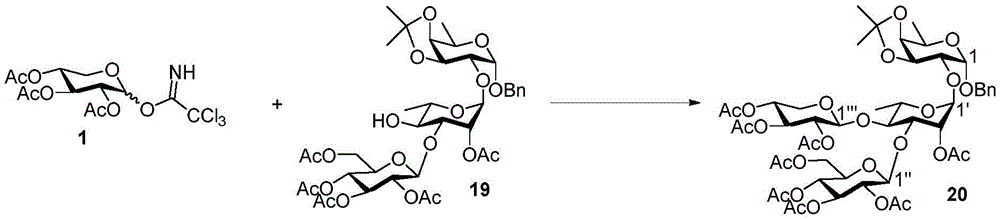
At-50 ℃ and N2Adding TMSOTf (0.4 μ L,0.0021mmol) to 1(13mg,0.031mmol), 19(17mg,0.021mmol) and activating under gas atmosphere Molecular sieve powder in anhydrous CH2Cl2(1mL) in stirred suspension. After completion of the reaction after 0.5 hours Et was added3N to quench the reaction, warmed to room temperature, filtered, and then concentrated under reduced pressure. The residue was purified by column chromatography (silica gel; EtOAc/hexane-1/1) to afford 20 as an anhydrous syrup (20mg, 89%): rf0.27 (EtOAc/hexanes-1/1);1H NMR(600MHz,CDCl3)δ7.39–7.30(m,5H),5.30(dd,J=3.6,1.8Hz,1H,H-2’),5.16(t,J=9.5Hz,1H,H-4”),5.11(t,J=8.2Hz,1H,H-3”’),5.04–4.98(m,2H,H-2”,H-3”),4.96(d,J=1.8Hz,1H,H-1’),4.91(td,J=8.3,4.9Hz,1H,H-4”’),4.86(dd,J=8.2,6.3Hz,1H,H-2”’),4.82(d,J=3.6Hz,1H,H-1),4.80(d,J=6.3Hz,1H,H-1”’),4.73(d,J=7.7Hz,1H,H-1”),4.69(d,J=12.1Hz,1H,Bn C 2H),4.50(d,J=12.1Hz,1H,Bn C 2H),4.25(dd,J=8.2,5.3Hz,1H,H-3),4.16–4.09(m,2H,H-6a”,H-5),4.09–4.03(m,2H,H-5a”’,H-3’),4.03–3.99(m,2H,H-4,H-6b”),3.75(t,J=9.5Hz,1H,H-4’),3.71–3.66(m,2H,H-2,H-5”),3.54(dq,J=9.5,6.2Hz,1H,H-5’),3.37(dd,J=11.9,8.3Hz,1H,H-5b”’),2.19(s,3H),2.08(s,3H),2.08(s,3H),2.08(s,3H),2.04(s,3H),2.01(s,3H),1.99(s,3H),1.97(s,3H),1.46(s,3H),1.33(d,J=6.7Hz,3H,H-6),1.29(s,3H),1.10(d,J=6.2Hz,3H,H-6’)ppm;C49H66O26Na[M+Na]+HRMS (ESI-TOF) of (g) calculated 1093.3735, found 1093.3734.
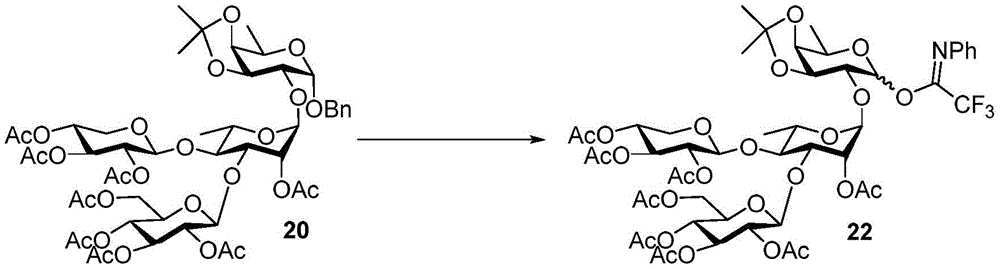
N-phenyl-2,2,2-trifluoroacetimidoyl 2,3,4, 6-tetra-O-acetyl- β -D-glucopyranosyl- (1 → 3) - (2,3, 4-tri-O-acetyl- β -D-xylopyranosyl- (1 → 4)) -2-O-acetyl- α -L-rhamnopyranosyl- (1 → 2) -3, 4-O-isopropylidene- α/β -D-fucopyranoside (22)
At room temperature and H2Stirring under a balloon atmosphere 20(255mg,0.24mmol) and 20% Pd (OH)2Suspension of/C (25mg) in THF (5 mL). After stirring for 24 hours, the mixture was filtered through celite and concentrated under reduced pressure. The residue was purified by column chromatography (silica gel; EtOAc/hexanes 3/2 to 2/1) to give the hemiacetal (180mg, 77%) as a white foam. At room temperature and N2N-phenyl-2,2,2-trifluoroacetimidoyl chloride (N-phenyl-2,2,2-trifluoroacetimidoyl chloride, 19. mu.L, 0.12mmol) and DBU (3.7. mu.L, 0.024mmol) in hemiacetal (20mg,0.020mmol) in anhydrous CH were added under a gas atmosphere2Cl2(1mL) in a stirred solution. After stirring for 1.5 hours, the mixture was concentrated under reduced pressure. The residue was purified by flash column chromatography (silica gel; EtOAc/hexanes 1/1 to 3/2, containing 0.5% Et3N) to yield 22(16mg, 68%) as a colorless paste. 22 α: rf0.61 (EtOAc/hexanes 3/2);1H NMR(600MHz,CDCl3)δ7.33(t,J=7.8Hz,2H),7.12(t,J=7.4Hz,1H),6.85(d,J=7.6Hz,2H),5.58(brs,1H,H-1),5.20(s,1H,H-1’),5.19–5.15(m,2H),5.10(t,J=9.7Hz,1H),5.06(t,J=7.0Hz,1H),4.99(dd,J=9.3,7.9Hz,1H),4.92(d,J=5.1Hz,1H,H-1”’),4.86(td,J=6.9,4.2Hz,1H),4.80(dd,J=6.7,5.3Hz,1H),4.72(d,J=7.9Hz,1H,H-1”),4.23–4.08(m,5H),4.00–3.98(m,2H),3.89(brs,1H),3.84–3.77(m,2H),3.66–3.63(m,1H),3.45(dd,J=12.1,7.0Hz,1H),2.16(s,3H),2.11(s,3H),2.09(s,3H),2.06(s,3H),2.04(s,4H),2.02(s,3H),1.99(s,3H),1.99(s,3H),1.53(s,3H),1.39(d,J=6.3Hz,3H),1.32(s,3H),1.27(d,J=5.6Hz,3H)ppm。

28-O-allyl-3-O- (methyl 2,3, 4-tri-O-trimethylacetyl-beta-D-glucopyranosyl uronate) soapbark acid ester (34)
At room temperature and N2Addition of B (PhF) in a gaseous atmosphere5)3(42mg,0.083mmol) to 33(500mg,0.83mmol), 23(435mg,0.83mmol) and activation Molecular sieve powder in anhydrous CH2Cl2(8mL) in stirred suspension. After completion of the reaction after 0.5 hours Et was added3N to quench the reaction, filtered, and then concentrated under reduced pressure. The residue was purified by column chromatography (silica gel; EtOAc/CH)2Cl2Hexanes 1/1/6) to give 34 as a white solid (385mg, 48%): rf0.57 (EtOAc/hexanes ═ 1: 2);1H NMR(600MHz,CDCl3) Δ 9.40(s,1H, H-23), 5.88-5.81 (m,1H, allylic internal alkenyl C)H) 5.37(t, J ═ 3.3Hz,1H, H-12), 5.31-5.27 (m,2H, H-3', allyl-terminal alkenyl C aH) 5.20-5.16 (m,2H, H-4', allyl-terminated alkenyl C) bH) 4.98(t, J ═ 8.0Hz, H-2 '), 4.52-4.44 (m,4H, H-1', H-16, allyl C) 2H),3.99(d,J=10.0Hz,1H,H-5’),3.84(dd,J=11.8,4.7Hz,1H,H-3),3.72(s,3H,OC 3H,3.05(dd,J=14.3,4.1Hz,1H,H-18),2.15(t,J=13.6Hz,1H,H-19a),1.92–1.85(m,4H),1.80–1.70(m,4H),1.68–1.63(m,3H),,1.50–1.41(m,2H),1.35–1.28(m,4H),1.25–1.17(m,3H),1.14(s,9H),1.12–1.10(m,10H),1.09–1.08(m,12H),1.05–0.97(m,2H),0.96(s,3H),0.94(s,3H),0.89(s,3H),0.70(s,3H)ppm;C55H84O14Na[M+Na]+HRMS (ESI-TOF) of (g) calculated 991.5753, found 991.5758.

28-O-allyl-3-O- (benzyl 2,3, 4-tri-O-triethylsilyl-beta-D-glucopyranosyl uronate) -16-O-triethylsilyl soap-ic-anate (37)
A stirred solution of 1.0N KOH (3mL) in 34(358mg,0.37mmol) in THF (15mL) was added and heated to 66 ℃ under reflux. The reaction mixture was stirred for 24 hours and then cooled to room temperature. The reaction mixture was washed with Amberlyst IR-120H+Neutralizing, filtering, concentrating and reducingDrying under reduced pressure. Then with bromobenzyl (88. mu.L, 0.73mmol) in DMF (7mL) and K at room temperature2CO3(102mg,0.73mmol) of the residue. After stirring for 2 hours, the reaction mixture was washed with CH2Cl2Diluting with H2O, brine, over MgSO4Dried and then concentrated under reduced pressure. The residue was purified by column chromatography (silica gel, MeOH/CH)2 Cl 21/15) to yield benzyl ester as a yellow solid. At room temperature and N2TESOTF (0.6mL,2.7mmol) and 2, 6-lutidine (0.4mL,3.4mmol) in benzyl ester (266mg,0.34mmol) in anhydrous CH were added under a gaseous atmosphere2Cl2(5mL) in stirred solution. The reaction mixture was stirred for 2 hours, then saturated NaHCO was added3To quench it. Subjecting the mixture to CH2Cl2Diluting with saturated NaHCO3Washed with brine and over MgSO4Dried and then concentrated under reduced pressure. The residue was purified by column chromatography (silica gel, EtOAc/hexanes 1/40) to afford 37 as an anhydrous syrup (310mg, 67% three step yield): rf0.71 (EtOAc/hexanes ═ 1/10);1H NMR(400MHz,CDCl3) Δ 9.34(s,1H, H-23), 7.39-7.30 (m,5H), 5.90-5.80 (m,1H, allylic internal alkenyl C)H) 5.35(s,1H, H-12),5.29(d, J ═ 17.2Hz,1H, allyl terminal alkenyl C aH) 5.20(d, J ═ 10.7Hz,1H, terminal alkenyl C bH),5.17–5.15(m,2H,Bn C 2H) 4.58-4.57 (m,2H, H-1', H-16), 4.53-4.40 (m,2H, allyl C) 2H),4.27(dd,J=6.2,4.9Hz,1H,H-4’),4.22(d,J=6.2Hz,1H,H-5’),3.81(dd,J=11.4,3.8Hz,1H,H-3),3.61(d,J=4.9Hz,1H,H-3’),3.57(d,J=3.4Hz,1H,H-2’),3.02(d,J=11.6Hz,1H,H-18),2.23(t,J=13.5Hz,1H,H-19),1.99(d,J=10.8Hz,1H),1.91–1.79(m,4H),1.75–1.53(m,5H),1.48–1.31(m,5H),1.30–1.22(m,1H),1.20–1.23(m,3H),1.11–1.06(m,4H),1.03–0.85(m,47H),0.72–0.52(m,27H)ppm;C70H120O11Si4Na[M+Na]+HRMS (ESI-TOF) of (g) calculated 1271.7800, found 1271.7829.

3-O- (benzyl 2,3, 4-tri-O-triethylsilyl-beta-D-glucopyranosyl uronate) -16-O-triethylsilyl soapbark acid (39)
Pre-mixed formic acid (0.38mL,10mmol)/Et in 1, 4-dioxane (2.5mL) at room temperature3N (1.3mL,9.6mmol) and Pd (OAc) in 1, 4-dioxane (2.5mL)2(54mg,0.24mmol) 37(0.60g,0.48mmol) and PPh were added3(0.31g,1.2mmol) in a stirred solution of 1, 4-dioxane (5 mL). The reaction mixture was stirred for 12 hours and then concentrated under reduced pressure. The residue was purified by column chromatography (silica gel, EtOAc/hexanes-1/6) to give 39 as a white foam (0.48g, 83%): rf0.25 (EtOAc/hexanes-1/6);1H NMR(600MHz,CDCl3)δ9.36(s,1H,H-23),7.37–7.30(m,5H),5.34(t,J=3.4Hz,1H,H-12),5.16(s,2H,Bn C 2H),4.59(d,J=4.4Hz,1H,H-1’),4.53(s,1H,H-16),4.28(dd,J=6.2,5.3Hz,1H,H-4’),4.22(d,J=6.2Hz,1H,H-5’),3.82(dd,J=11.8,4.6Hz,1H,H-3),3.61(d,J=5.3Hz,1H,H-3’),3.58(d,J=4.4,1H,H-2’),2.95(dd,J=14.3,4.0Hz,1H,H-18),2.21(t,J=13.6Hz,1H,H-19a),2.03–1.95(m,1H),1.90–1.80(m,4H),1.78–1.61(m,4H),1.57(d,J=13.4Hz,1H),1.47–1.37(m,2H),1.35(s,3H),1.27(d,J=13.6Hz,1H),1.21–1.12(m,3H),1.10–1.03(m,4H),1.02–0.87(m,46H),0.70–0.53(m,27H)ppm;C67H116O11Si4Na[M+Na]+HRMS (ESI-TOF) of (g) calculated 1231.7487, found 1231.7507.

28-O-allyl-3-O- (methyl 2,3, 4-tri-O-benzoyl-beta-D-glucopyranosyl uronate) echinocyanate (36)
At room temperature and N2Addition of B (PhF) in a gaseous atmosphere5)3(1.5mg,0.0030mmol) to 31(20mg,0.030mmol), 24(7.7mg,0.015mmol) and activation Molecular sieve powder in anhydrous CH2Cl2(0.6mL) in stirred suspension. After completion of the reaction after 0.5 hours Et was added3N to quench the reaction, filtered, and then concentrated under reduced pressure. The residue was purified by column chromatography (silica gel; EtOAc/CH)2Cl2Hexanes 1/1/6) to give 36 as a white solid (11mg, 72%): rf0.42 (EtOAc/hexanes ═ 1: 2);1H NMR(600MHz,CDCl3) δ 7.95-7.91 (m,4H),7.85(dd, J ═ 8.4,1.3Hz,2H), 7.53-7.49 (m,2H), 7.45-7.42 (m,1H), 7.40-7.35 (m,4H), 7.31-7.28 (m,2H),5.91(t, J ═ 9.7Hz,1H, H-3 '), 5.89-5, 82(m,1H, allylic internal alkenyl C, H-3'), 5.89-5H) 5.64(t, J ═ 9.7Hz,1H, H-4 '), 5.59(dd, J ═ 9.7,7.8Hz,1H, H-2'), 5.39(t, J ═ 3.6Hz,1H, H-12),5.29(dt, J ═ 17.2,1.5Hz,1H, allyl terminal alkenyl C aH) 5.20(dt, J ═ 10.5,1.3Hz,1H, allyl-terminal alkenyl C bH) 4.89(d, J ═ 7.8Hz,1H, H-1'), 4.53-4.45 (m,3H, H-16, allyl C) 2H),4.30(d,J=9.7Hz,1H,H-5’),3.69(s,3H,OC 3H),3.16(dd,J=11.7,4.6Hz,1H,H-3),3.06(dd,J=14.4,4.3Hz,1H,H-18),2.14(dd,J=13.7Hz,1H,H-19a),1.90–1.85(m,4H,H-2a,H-11ab,H-22a),1.82–1.71(m,4H,H-2b,H-15a,H-21a,H-22b),1.65–1.61(m,1H,H-1a),1.55–1.52(m,2H,H-9,16-OH),1.44–1.34(m,2H,H-6a,H-7a),1.34–1.30(m,4H,H-15b,H-27),1.26–1.19(m,3H,H-6b,H-7b,H-21b),1.14–1.10(m,1H,H-19b),0.97(s,3H,H-30),0.94–0.92(m,1H,H-1b),0.90(s,3H,H-29),0.88(s,3H,H-25),0.71(s,3H,H-23),0.70–0.65(m,4H,H-5,H-26),0.62(s,3H,H-24)ppm;C61H74O13Na[M+Na]+HRMS (ESI-TOF) of (g) calculated 1037.5022, found 1037.5026.

28-O-allyl-3-O- (benzyl 2,3, 4-tri-O-triethylsilyl-beta-D-glucopyranosyl uronate) -16-O-triethylsilyl echinocyanate (38)
A stirred solution of 1.0N KOH (5mL) in 36(0.45g,0.41mmol) in THF (25mL) was added and heated at 45 ℃. The reaction mixture was stirred for 12 hours and then cooled to room temperature. The reaction mixture was washed with Amberlyst IR-120H+Neutralized, filtered, concentrated, and then dried under reduced pressure. Followed by benzyl bromide (98. mu.L, 0.82mmol) and K in DMF (8mL) at room temperature2CO3(113mg,0.82mmol) of the residue. After stirring for 12 hours, the reaction mixture was washed with CH2Cl2Diluting with H2O, brine, over MgSO4Dried and then concentrated under reduced pressure. The residue was purified by column chromatography (silica gel, MeOH/CH)2 Cl 21/20) to give the benzyl ester. At room temperature and N2TESOTF (0.74mL,3.3mmol) and 2, 6-lutidine (0.48mL,4.1mmol) were added to the benzyl ester in dry CH under a gaseous atmosphere2Cl2(8mL) in stirred solution. The reaction mixture was stirred for 2 hours, then saturated NaHCO was added3To quench it. Subjecting the mixture to CH2Cl2Diluting with saturated NaHCO3Washed with brine and over MgSO4Dried and then concentrated under reduced pressure. The residue was purified by column chromatography (silica gel, EtOAc/hexanes-1/40) to afford 38 as an unpigmented solid (0.21g, 41%): rf0.41 (EtOAc/hexanes-1/20);1H NMR(400MHz,CDCl3) Δ 7.39-7.28 (m,5H), 5.92-5.82 (m,1H, allylic internal alkenyl C)H) 5.35(s,1H, H-12), 5.33-5.27 (m,1H, allyl-terminated alkenyl C)H) 5.20(d, J ═ 10.3Hz,1H, allyl terminal alkenyl CH),5.16(s,2H,Bn C 2H) 4.77(d, J ═ 4.2Hz,1H, H-1'), 4.59(s,1H, H-16), 4.53-4.43 (m,2H, allyl C) 2H),4.34(dd,J=6.1,5.1Hz,1H,H-4’),4.27(d,J=6.1Hz,1H,H-5’),3.73(d,J=4.2Hz,1H,H-2’),3.65(d,J=5.1Hz,1H,H-3’),3.06–2.98(m,2H,H-3,H-18),2.23(t,J=13.5Hz,1H,H-19a),1.96(d,J=10.8Hz,1H),1.89–1.80(m,4H),1.77–1.62(m,3H),1.58–1.40(m,4H),1.34(s,3H),1.31–1.23(m,3H),1.16–1.04(m,2H),1.04–0.90(m,42H),0.89–0.84(s,7H),0.78(s,3H),0.72–0.55(m,28H)ppm;C70H122O10Si4Na[M+Na]+HRMS (ESI-TOF) of (g) calculated 1257.8007, found 1257.8019.

3-O- (benzyl 2,3, 4-tri-O-triethylsilyl-beta-D-glucopyranosyl uronate) -16-O-triethylsilyl echinocystic acid (40)
Pre-mixed formic acid (150. mu.L, 3.3mmol)/Et in 1, 4-dioxane (2mL) at room temperature3N (430. mu.L, 3.1mmol) and Pd (OAc) in 1, 4-dioxane (2mL)2(17mg,0.078mmol) 38(194mg,0.16mmol) and PPh were added3(1.03mg,0.39mmol) in a stirred solution of 1, 4-dioxane (4 mL). The reaction mixture was stirred for 12 hours and then concentrated under reduced pressure. The residue was purified by column chromatography (silica gel, EtOAc/hexanes-1/6) to afford 40 as a white foam (168mg, 89%): rf0.58 (EtOAc/hexanes-1/6);1H NMR(400MHz,CDCl3)δ7.40–7.28(m,5H),5.34(s,1H,H-12),5.16(s,2H,Bn C 2H),4.78(d,J=4.3Hz,1H,H-1’),4.55(s,1H,H-16),4.34(t,J=5.5Hz,1H,H-4’),4.27(d,J=5.8Hz,1H,H-5’),3.73(d,J=3.9Hz,1H,H-2’),3.66(d,J=5.0Hz,1H,H-3’),3.02(dd,J=11.5,3.7Hz,1H,H-3),2.95(d,J=11.3Hz,1H,H-18),2.21(t,J=13.5Hz,1H,H-19a),1.96(d,J=11.1Hz,1H),1.92–1.62(m,7H),1.62–1.40(m,4H),1.34(s,3H),1.31–1.23(m,3H),1.17–1.04(m,2H),1.02–0.91(m,42H),0.90–0.84(s,7H),0.79(s,3H),0.73–0.55(m,28H)ppm;C67H118O10Si4Na[M+Na]+HRMS (ESI-TOF) of (g) calculated 1217.7694, found 1217.7703.
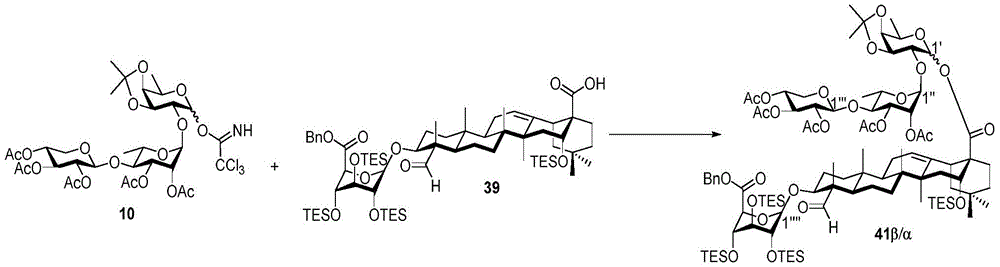
3-O- (benzyl 2,3, 4-tri-O-triethylsilyl-beta-D-glucopyranosyl uronate) -28-O- (2,3, 4-tri-O-acetyl-beta-D-xylopyranosyl- (1 → 4) -2, 3-di-O-acetyl-alpha-L-rhamnopyranosyl- (1 → 2) -3, 4-O-isopropylidene-beta/alpha-D-fucopyranosyl) -16-O-triethylsilylsoap-anate (41 beta/alpha)
At-75 ℃ and N2Addition of BF in a gaseous atmosphere3·OEt2(about 48%, 12. mu.L, 0.044mmol) in 10(276mg,0.33mmol), 39(266mg,0.22mmol) and activation Molecular sieve powder in anhydrous CH2Cl2(11mL) in stirred suspension. After completion of the reaction after 0.5 hours Et was added3N to quench the reaction, warmed to room temperature, filtered, and then concentrated under reduced pressure. The residue was purified by column chromatography (silica gel; EtOAc/CH)2Cl2Hexane 2/1/5) to yield 41 β (391mg, 94%) as an unpigmented solid. 41 beta: rf0.64 (EtOAc/hexanes ═ 1: 1);1H NMR(600MHz,CDCl3)δ9.35(s,1H,H-23),7.40–7.28(m,5H),5.41(d,J=7.5Hz,1H,H-1’),5.34(t,J=3.5Hz,1H,H-12),5.25(dd,J=3.5,1.6Hz,1H,H-2”),5.21(dd,J=9.8,3.5Hz,1H,H-3”),5.16(s,2H,Bn C 2H),5.13(t,J=9.2Hz,1H,H-3”’),4.98(d,J=1.6Hz,1H,H-1”),4.96(td,J=9.2,5.5Hz,1H,H-4”’),4.85(dd,J=9.2,7.7Hz,1H,H-2”’),4.63(d,J=7.7Hz,1H,H-1”’),4.58(d,J=4.3Hz,1H,H-1””),4.49(s,1H,H-16),4.27(t,J=6.3Hz,1H,H-4””),4.22(d,J=6.3Hz,1H,H-5””),4.18(t,J=6.0Hz,1H,H-3’),4.13(dd,J=11.7,5.4Hz,1H,H-5a”’),4.01(dd,J=6.0,2.0Hz,1H,H-4’),3.87(qd,J=6.5,2.0Hz,1H,H-5’),3.84–3.79(m,2H,H-3,H-5”),3.66(dd,J=7.5,6.3Hz,1H,H-2’),3.64–3.60(m,2H,H-3””,H-4”),3.57(dd,J=4.3,0.9Hz,1H,H-2””),3.34(dd,J=11.7,9.3Hz,1H,H-5b”’),2.94(dd,J=14.2,4.0Hz,1H,H-18),2.23(t,J=13.6Hz,1H,H-19a),2.13(s,3H),2.06(s,3H),2.03(s,3H),2.00(s,3H,),1.99–1.97(m,4H,H-2,Ac C 3H),1.88–1.75(m,5H,H-11ab,H-21a,H-22ab),1.73–1.65(m,2H,H-2a,H-15a),1.63–1.60(m,1H,H-9),1.57–1.55(m,1H,H-1a) 1.53(s,3H, isopropylidene C) 3H),1.47–1.40(m,2H,H-6a,H-7a) 1.35(s,3H, H-27),1.34(s,3H, isopropylidene C) 3H),1.29(d,J=6.5Hz,4H,H-6’),1.27–1.24(m,H-6”,H-15b),1.19–1.16(m,2H,H-5,H-6b),1.12(d,J=7.8Hz,1H,H-21b),1.09(s,3H,H-24),1.05(dd,J=12.1,4.0Hz,1H,H-19b),1.01–0.89(m,44H,TES C 3H,H-1b,H-7b,H-25,H-30),0.89(s,3H,H-29),0.73(s,3H,H-26),0.69–0.55(m,24H,TES C 2H)ppm;C97H158O28Si4Na[M+Na]+HRMS (ESI-TOF) of (g) calculated 1906.9937, found 1906.9959.
41α:Rf0.69 (EtOAc/hexanes ═ 1: 1);1H NMR(600MHz,CDCl3)δ9.34(s,1H,H-23),7.37–7.30(m,5H),6.02(d,J=3.7Hz,1H,H-1”),5.39(t,J=3.6Hz,1H,H-12),5.21(dd,J=3.5,1.7Hz,1H,H-2”’),5.16(s,2H,Bn C- 2H),5.11(t,J=9.0Hz,1H,H-3””),5.08–5.06(m,2H,H-1”’,H-3”’),4.93(td,J=9.0,5.3Hz,1H,H-4””),4.80(dd,J=9.0,7.4Hz,1H,H-2””),4.66(d,J=7.4Hz,1H,H-1””),4.58(d,J=4.4Hz,1H,H-1’),4.56(s,1H,H-16),4.27(t,J=6.3Hz,1H,H-4’),4.21(d,J=6.3Hz,1H,H-5’),4.19(dd,J=8.0,5.1Hz,1H,H-3”),4.13–4.09(dd,J=11.8,5.2Hz,1H,H-5a””),4.06–4.01(m,2H,H-4”,H-5”),3.87(dd,J=8.0,3.7Hz,1H,H-2”),3.81(dd,J=11.8,4.7Hz,1H,H-3),3.70–3.64(m,1H,H-5”’),3.63–3.58(m,2H,H-4”’,H-3’),3.57(dd,J=4.4,1.1Hz,1H,H-2’),3.35(dd,J=11.8,9.0Hz,1H,H-5b””),3.00(dd,J=14.3,4.1Hz,1H,H-18),2.19(t,J=13.2Hz,1H,H-19a),2.13(s,3H),2.03(s,3H),2.02(s,3H),2.02(s,3H),2.00–1.97(m,1H,H-2a),1.96(s,3H),1.95–1.83(m,3H,H-22a,H-11ab),1.81–1.65(m,3H,H-21a,H-22b,H-2b),1.62–1.52(m,3H,H-9,H-1a,H-15a) 1.51(s,3H, isopropylidene C) 3H),1.48–1.40(m,2H,H-6a,H-7a) 1.35(s,3H, H-27),1.34(s,3H, isopropylidene C) 3H),1.32(d,J=6.5Hz,3H,H-6”),1.29–1.27(m,4H,H-15b,H-6”’),1.23–1.11(m,3H,H-21b,H-5,H-6b),1.09–1.05(m,4H,H-24,H-19b),1.01(m,TES C 3H×3),0.96–0.90(m,35H,H-1b,H-7b,H-25,H-30,TES C 3H×9),0.88(s,3H,H-29),0.73(s,3H,H-26),0.67(m,6H,TES C 2H×3),0.62–0.54(m,18H,TES C 2H×9)ppm;C97H158O28Si4Na[M+Na]+HRMS (ESI-TOF) of (g) calculated 1906.9937, found 1906.9967.
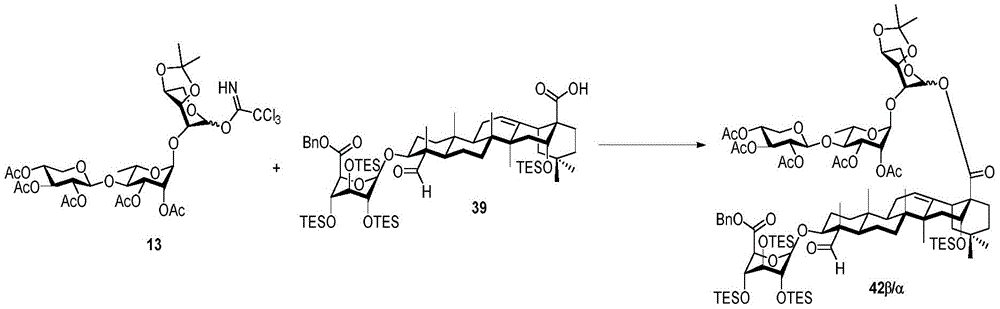
3-O- (benzyl 2,3, 4-tri-O-triethylsilyl-beta-D-glucopyranosyl uronate) -28-O- (2,3, 4-tri-O-acetyl-beta-D-xylopyranosyl- (1 → 4) -2, 3-di-O-acetyl-alpha-L-rhamnopyranosyl- (1 → 2) -3, 4-O-isopropylidene-beta/alpha-L-arabinopyranosyl) -16-O-triethylsilyl soap canoate (42 beta/alpha)
At-75 ℃ and N2Addition of BF in a gaseous atmosphere3·OEt2(about 48%, 1.5. mu.L, 0.0058mmol) to 13(67mg,0.081mmol), 39(65mg,0.054mmol) and activation Molecular sieve powder in anhydrous CH2Cl2(6mL) in stirred suspension. After completion of the reaction after 0.5 hours, Et was used3The reaction was quenched with N and warmed to room temperature. The obtained mixture is substituted by CH2Cl2Diluting with saturated NaHCO3Washed with brine and over MgSO4Dried and then concentrated under reduced pressure. The residue was purified by column chromatography (silica gel; EtOAc/CH)2Cl2Hexane 2/1/5) to yield 101(101 β:76mg, 75%, 101 α:15mg, 16%) as an unslaked paste. 42 beta: rf 0.24(EtOAc/CH2Cl22/1/5/hexane);1H NMR(600MHz,CDCl3)δ9.36(s,1H,H-23),7.39–7.29(m,5H),5.76(d,J=3.8Hz,1H,H-1’),5.35(s,1H,H-12),5.21(s,1H,H-2”),5.19–5.15(m,3H,H-3”,Bn C 2H),5.13(t,J=9.2Hz,1H,H-3”’),4.97–4.92(m,2H,H-1”,H-4”’),4.86(dd,J=9.2,7.6Hz,1H,H-2”’),4.63(d,J=7.6Hz,1H,H-1”’),4.58(d,J=4.2Hz,1H,H-1””),4.55(s,1H,H-16),4.35(q,J=6.2Hz,1H,H-4’),4.27(t,J=5.8Hz,1H,H-4””),4.21(d,J=6.3Hz,1H,H-5””),4.17(t,J=5.4Hz,1H,H-3’),4.12(dd,J=11.5,5.1Hz,1H,H-5a”’),3.85–3.76(m,4H,H-3,H-2’,H-5a’,H-5”),3.71(dd,J=11.7,8.2Hz,1H,H-5b’),3.64–3.60(m,2H,H-4”,H-3””),3.57(d,J=4.2Hz,1H,H-2””),3.33(t,J=10.6Hz,1H,H-5b”’),2.98(d,J=11.8Hz,1H,H-18),2.24(t,J=13.5Hz,1H,H-19a),2.13(s,3H),2.07(s,3H),2.03(s,3H),2.01(s,3H),2.00–1.97(m,4H,Ac C 3H,H-2a),1.89–1.65(m,7H,H-2b,H-11ab,H-15a,H-21a,H-22ab),1.63–1.60(m,1H,H-9),1.56(d,J=13.5Hz,1H,H-1a),1.51(s,3H,C 3H)1.48–1.40(m,2H,H-6a,H-7a),1.35(s,6H,H-27,C 3H),1.27–1.24(m,4H,H-15b,H-6”),1.20–1.12(m,3H,H-5,H-6b,H-21b),1.09(s,3H,H-24),1.06(d,J=13.2Hz,1H,H-19b),1.01–0.90(m,44H,H-1b,H-7b,H-25,H-30,TES C 3H),0.89(s,3H,H-29),0.72(s,3H,H-26),0.69–0.53(m,24H)ppm;C96H156O28Si4Na[M+Na]+HRMS (ESI-TOF) of (g) calculated 1892.9793, found 1892.9791.
42α:Rf 0.29(EtOAc/CH2Cl22/1/5/hexane);1H NMR(600MHz,CDCl3)δ9.35(s,1H,H-23),7.39–7.30(m,5H),6.07(d,J=3.3Hz,1H,H-1”),5.39(t,J=3.5Hz,1H,H-12),5.22(dd,J=3.5,1.3Hz,1H,H-2”’),5.16(s,2H,Bn C 2H),5.11(t,J=8.9Hz,1H,H-3””),5.07(dd,J=9.7,3.5Hz,1H,H-3”’),5.05(d,J=1.3Hz,1H,H-1”’),4.94(td,J=8.9,5.3Hz,1H,H-4””),4.81(dd,J=8.9,7.4Hz,1H,H-2””),4.67(d,J=7.4Hz,1H,H-1””),4.58(d,J=4.4Hz,1H,H-1’),4.57(s,1H,H-16),4.27(t,J=5.8Hz,1H,H-4’),4.25–4.20(m,3H,H-3”,H-4”,H-5’),4.11(dd,J=11.8,5.3Hz,1H,H-5a””),4.05–4.01(d,J=13.4Hz,1H,H-5a”),3.91–3.84(m,2H,H-2”,H-5b”),3.81(dd,J=11.8,4.6Hz,1H,H-3),3.69(dq,J=9.5,6.1Hz,1H,H-5”’),3.64–3.59(m,2H,H-4”’,H-3’),3.57(d,J=4.4Hz,1H,H-2’),3.36(dd,J=11.8,9.1Hz,1H,H-5b””),2.99(dd,J=14.4,4.0Hz,1H,H-18),2.20(t,J=13.6Hz,1H,H-19a),2.14(s,3H),2.04(s,3H),2.03(s,3H),2.02(s,3H),2.00–1.99(m,1H,H-2a),1.97(s,3H),1.95–1.83(m,3H,H-22a,H-11ab),1.81–1.65(m,3H,H-21a,H-22b,H2b),1.65–1.62(m,1H,H-9),1.58–1.53(m,2H,H-1a,H-15a) 1.51(s,3H, isopropylidene C) 3H),1.45–1.40(m,2H,H-6a,H-7a) 1.36-1.35 (m,6H, H-27, isopropylidene C) 3H),1.32(dd,J=14.5,1.6Hz,1H,H-15b),1.29(d,J=6.1Hz,3H,H-6”’),1.23–1.15(m,3H,H-5,H-6b,H-21b),1.10–1.05(m,4H,H-19b,H-24),1.04–0.89(m,44H,H-1b,H-7b,H-25,H-30,TES C 3H×12),0.88(s,3H,H-29),0.73(s,3H,H-26),0.71–0.54(m,24H,TES C 2H×12)ppm;C96H156O28Si4Na[M+Na]+HRMS (ESI-TOF) of (g) calculated 1892.9793, found 1892.9780.
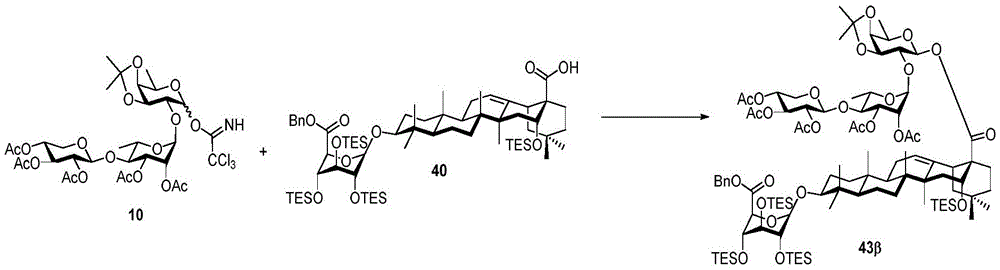
3-O- (benzyl 2,3, 4-tri-O-triethylsilyl-beta-D-glucopyranosyl uronate) -28-O- (2,3, 4-tri-O-acetyl-beta-D-xylopyranosyl- (1 → 4) -2, 3-di-O-acetyl-alpha-L-rhamnopyranosyl- (1 → 2) -3, 4-O-isopropylidene-beta-D-fucopyranosyl) -16-O-triethylsilyl ester of spinosyn (43 beta)
At-75 ℃ and N2Addition of BF in a gaseous atmosphere3·OEt2(about 48%, 7.0. mu.L, 0.026mmol) to 10(166mg,0.20mmol), 40(158mg,0.13mmol) and activation Molecular sieve powder in anhydrous CH2Cl2(6.5mL) in stirred suspension. After completion of the reaction after 0.5 hours, Et was used3The reaction was quenched with N and warmed to room temperature. The obtained mixture is substituted by CH2Cl2Diluting with saturated NaHCO3Washed with brine and over MgSO4Dried and then concentrated under reduced pressure. The residue was purified by column chromatography (silica gel; EtOAc/CH)2Cl2Hexane 2/1/5) to yield 43 β (237mg, 96%) as an unpigmented solid. 102 β: rf 0.23(EtOAc/CH2Cl22/1/5/hexane);1H NMR(600MHz,CDCl3)δ7.37–7.29(m,5H),5.42(d,J=7.5Hz,1H,H-1’),5.34(s,1H,H-12),5.26(dd,J=3.4,1.5Hz,1H,H-2”),5.21(dd,J=9.8,3.4Hz,1H,H-3”),5.16(d,J=3.2Hz,2H,Bn C 2H),5.13(t,J=9.3Hz,1H,H-3”’),4.99(d,J=1.5Hz,1H,H-1”),4.95(td,J=9.3,5.4Hz,1H,H-4”’),4.85(dd,J=9.3,7.6Hz,1H,H-2”’),4.77(d,J=4.4Hz,1H,H-1””),4.64(d,J=7.6Hz,1H,H-1”’),4.50(s,1H,H-16),4.33(dd,J=6.1,5.8Hz,1H,H-4””),4.26(d,J=6.1Hz,1H,H-5””),4.18(t,J=6.0Hz,1H,H-3’),4.12(dd,J=11.7,5.4Hz,1H,H-5a”’),4.01(dd,J=6.0,1.8Hz,1H,H-4’),3.89–3.81(m,2H,H-5’,H-5”),3.72(d,J=4.4Hz,1H,H-2””),3.68–3.61(m,3H,H-2’,H-3””,H-4”),3.34(dd,J=11.9,9.3Hz,1H,H-5b”’),3.01(dd,J=11.7,4.3Hz,1H,H-3),2.93(dd,J=14.2,3.7Hz,1H,H-18),2.23(t,J=13.5Hz,1H,H-19a),2.13(s,3H),2.07(s,3H),2.03(s,3H),2.00(s,3H),1.98(s,3H),1.97–1.93(m,1H,H-2a),1.86–1.76(m,6H,H-11ab,H-22a,H-21a,H-22b),1.76–1.71(m,1H,H-15a),1.67–1.65(m,1H,H-2b) 1.54(s,3H, isopropylidene C) 3H),1.53–1.42(m,4H,H-9,H-1a,H-6a,H-7a) 1.34-1.33 (m,6H, H-27, isopropylidene C) 3H),1.31–1.24(m,9H,H-6’,H-6”,H-6b,H-7b,H-15b),1.11–1.10(m,1H,H-21b),1.07–1.02(m,2H,H-19b),1.01–0.91(m,42H,H-23,H-30,TES C 3H),0.89(s,3H,H-25),0.88(s,5H,H-29),0.79(s,3H,H-24),0.73(s,3H,H-26),0.70–0.55(m,25H,H-5,TES C 2H)ppm;C97H160O27Si4Na[M+Na]+HRMS (ESI-TOF) of (g) calculated 1893.0144, found 1893.0150.
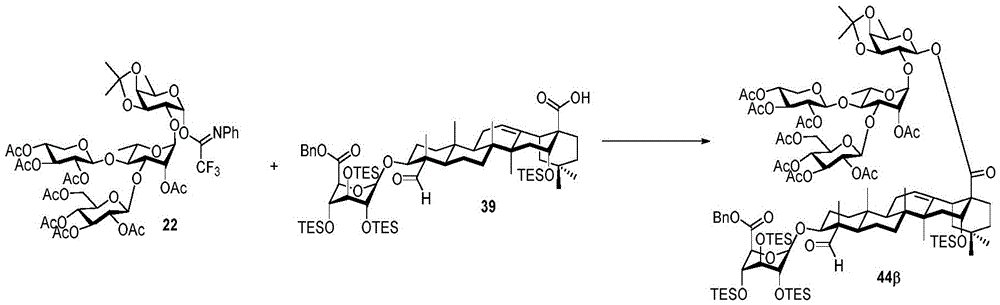
3-O- (benzyl 2,3, 4-tri-O-triethylsilyl- β -D-glucopyranosyl uronate) -28-O- (2,3,4, 6-tetra-O-acetyl- β -D-glucopyranosyl- (1 → 3) - (2,3, 4-tri-O-acetyl- β -D-xylopyranosyl- (1 → 4)) -2-O-acetyl- α -L-rhamnopyranosyl- (1 → 2) -3, 4-O-isopropylidene- β -D-fucopyranosyl) -16-O-triethylsilyl soap-picolinate (44 β).
At-75 ℃ and N2Addition of BF in a gaseous atmosphere3·OEt2(about 48%, 2.0. mu.L, 0.0076mmol) to 22(22mg,0.019mmol), 39(23mg,0.019mmol) and activation Molecular sieve powder in anhydrous CH2Cl2(1mL) in stirred suspension. After 0.5 h the reaction was complete, saturated NaHCO was added3The reaction was quenched and warmed to room temperature. The obtained mixture is substituted by CH2Cl2Diluting with saturated NaHCO3Washed with brine and over MgSO4Dried and then concentrated under reduced pressure. The residue was purified by column chromatography (silica gel; EtOAc/CH)2Cl2Hexane 4/1/7) to afford 103(44 β:19mg, 46%; 44 α:2mg, 5%). 44 beta: rf0.60 (EtOAc/hexanes-1/1);1H NMR(600MHz,CDCl3)δ9.36(s,1H,H-23),7.38–7.30(m,5H),5.39(d,J=7.3Hz,1H,H-1’),5.32(t,J=3.6Hz,1H,H-12),5.17(dd,J=3.5,1.8Hz,1H,H-2”),5.16(d,J=1.8Hz,2H,Bn C 2H),5.15–5.09(m,3H,H-3”’,H-4”’,H-3””),5.02(m,J=7.8Hz,1H,H-2”’),4.95(d,J=1.8Hz,1H,H-1”),4.91(td,J=8.0,4.9Hz,1H,H-4””),4.85–4.81(m,2H,H-2””,H-1””),4.68(d,J=7.8Hz,1H,H-1”’),4.58(d,J=4.4Hz,1H,H-1””’),4.47(s,1H,H-16),4.28–4.25(m,2H,H-4””’,H-6a”’),4.21(d,J=6.3Hz,1H,H-5””’),4.16(t,J=6.0Hz,1H,H-3’),4.14–4.09(m,2H,H-6b”’,H-5a””),4.03(dd,J=6.0,1.9Hz,1H,H-4’),3.99(dd,J=9.4,3.5Hz,1H,H-3”),3.86(qd,J=6.5,1.9Hz,1H,H-5’),3.81(dd,J=11.8,4.6Hz,1H,H-3),3.76(t,J=9.4Hz,1H,H-4”),3.71–3.62(m,3H,H-5”,H-2’,H-5”’),3.61(dd,J=5.4,1.2Hz,1H,H-3””’),3.57(dd,J=4.4,1.2Hz,1H,H-2””’),3.40(dd,J=11.9,8.1Hz,1H,H-5b””),2.91(dd,J=14.4,4.2Hz,1H,H-18),2.22(t,J=13.5Hz,1H,H-19a),2.18(s,3H),2.11(s,3H),2.09(s,6H),2.04(s,3H),2.03(s,3H),2.01(s,3H),2.00(s,3H),1.99–1.97(m,1H,H-2a),1.87–1.84(m,2H,H-11ab),1.80(s,3H,H-21a,H-22ab),1.70–1.68(m,2H,H-2b,H-15a),1.59–1.56(m,2H,H-9,H-1a)1.54(s,3H, isopropylidene C) 3H),1.45–1.41(m,2H,H-6b,H-7a) 1.34(s,6H, H-27, isopropylidene C) 3H),1.28(d,J=6.5Hz,3H,H-6’),1.26–1.24(m,1H,H-15b),1.22(d,J=6.1Hz,3H,H-6”),1.18–1.16(m,2H,H-5,H-6b),1.13–1.11(m,1H,H-21b),1.08(s,3H,H-24),1.06–1.02(m,1H,H-19b),1.00–0.92(m,44H,H-1b,H-7b,H-25,H-30,TES C 3H),0.88(s,3H,H-29),0.74(s,3H,H-26),0.68–0.55(m,24H,TES C 2H)ppm;C109H174O36Si4Na[M+Na]+HRMS (ESI-TOF) of (g) calculated 2195.0788, found 2195.0785.
General procedure for formation of amide bond:
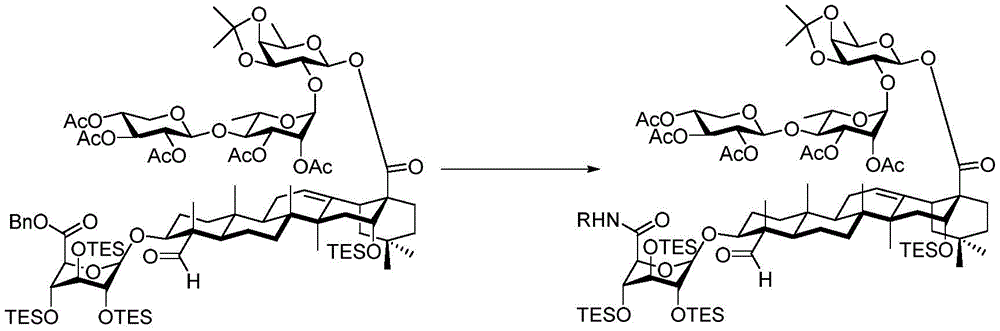
at room temperature and H2A suspension of benzyl ester starting material (1 eq) and 10% Pd/C (10% w/v) in THF (50mM) was stirred under a gas atmosphere (balloon). The reaction mixture was stirred for 12 to 24 hours. The resulting mixture was filtered through celite, concentrated, and then dried under reduced pressure to provide a crude acid intermediate. At room temperature and N2Alkylamine (3 eq) was added to the crude acid intermediate, HBTU (3 eq) and DIPEA (3 eq) in anhydrous CH under a gas atmosphere2Cl2(50mM) in a stirred solution. The reaction mixture was stirred for 4 hours. The resulting mixture was concentrated and then purified by column chromatography (silica gel, EtOAc/CH)2Cl2Hexane 2/1/5 to 1/1/2) to give the amide product in two step yields of 61-95%.
In some embodiments, the silane groups are randomly deprotected under hydrogenolysis conditions such that a subsequent amide coupling step produces an inseparable mixture. Thus, through a short column (silica, EtOAc/CH)2Cl2Hexane 1/1/2) was filtered and the mixture was directly subjected to a bulk deprotection step without structural characterization.
General procedure for global deprotection:
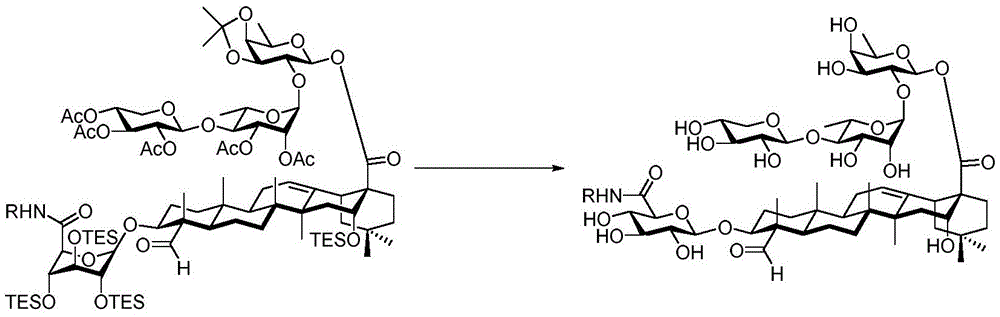
CH to starting material at 0 deg.C2Cl2(10mM) solution Pre-cooled TFA/H2Solution (relative to CH) of 4/12 Cl 250% v/v) and stirred for 30 minutes. At 0 ℃ and reduced pressure (<1 torr) and then dried at room temperature under high vacuum for 1 hour. Addition of K2CO3(20 equiv.) to a solution of the residue in MeOH (10mM) and stirred at room temperature for 12 h. The suspension was centrifuged and the liquid was purified by HPLC (HPLC column: SUPELCO Ascentis C1825 cm X10 mm, 5 μm; mobile phase: 20% ACN/H in 20 min2O is increased to 90% ACN/H2Gradient of O, then 90% ACN/H2Degree of O isocratic(isocratic)15 minutes; flow rate: 5mL/min) to give the product in 30-75% two-step yield.
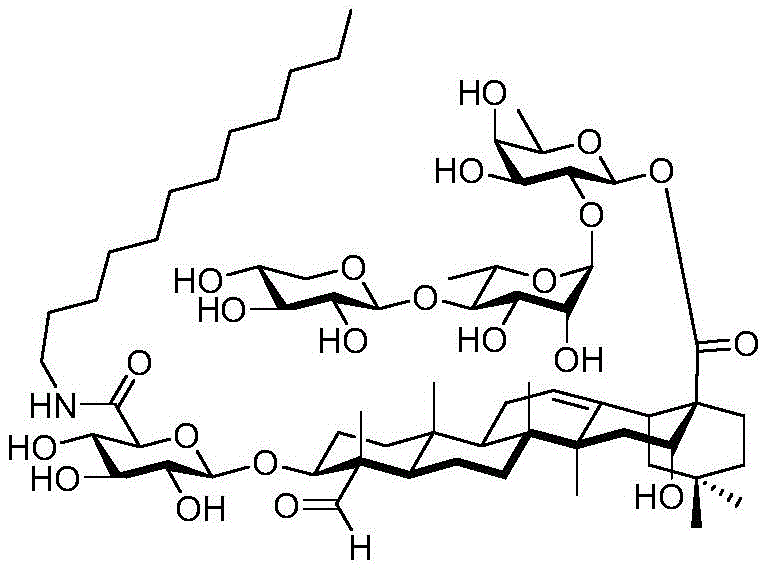
3-O- (N- ((dodecyl) - β -D-glucopyranosyl uronamide) -28-O- (β -D-xylopyranosyl- (1 → 4) - α -L-rhamnopyranosyl- (1 → 2) - β -D-fucopyranosyl) soapbark acid ester (46)
Following the general procedure for global deprotection, 46 was obtained as a white solid in 68% yield: [ alpha ] to]D 20-68.0(c0.15,MeOH);1H NMR (600MHz, MeOD). delta.9.43 (s,1H, H-23),8.55(s,1H, amide NH),5.41(d,J=1.7Hz,1H,H-1”),5.31(t,J=3.5Hz,1H,H-12),5.28(d,J=8.2Hz,1H,H-1’),4.49–4.48(m,2H,H-1”’,H-16),4.26(d,J=7.8Hz,1H,H-1””),3.92–3.79(m,6H,H-2”,H-3,H-5”’,H-3”,H-2’,H-5”),3.69–3.64(m,3H,H-5’,H-3’,H-5””),3.57–3.53(m,2H,H-4’,H-4”),3.49–3.42(m,2H,H-4”’,H-4””),3.33–3-30(m,2H,H-3”’,H-3””),3.28–3.26(m,1H,–NHC aH–),3.24–3.17(m,3H,–NHC bH–,H-2”’,H-5”’),3.14(dd,J=9.2,7.8Hz,1H,H-2””),2.94(dd,J=14.1,4.3Hz,1H,H-18),2.30(t,J=13.6Hz,1H,H-19a),1.97–1.89(m,5H,H-2a,H-11ab,H-21a,H-22a),1.84–1.64(m,5H,H-2b,H-22b,H-9,H-1a,H-15a),1.58–1.48(m,4H,H-6a,H-7aCarbon chain C 2H),1.45(dd,J=14.8,2.7Hz,1H,H-15b),1.40(s,3H,H-27),1.37–1.27(m,23H,H-5,H-6bH-6', carbon chain C 2H×9),1.22(d,J=6.4Hz,3H,H-6’),1.19–1.16(m,1H,H-21b),1.14(s,3H,H-24),1.12–1.09(m,1H,H-1b),1.07–1.04(m,1H,H-19b) 1.02(s,3H, H-25), 0.98-0.94 (m,4H, H-7b, H-30),0.91(t, J ═ 7.0Hz,3H, carbon chain C 3H),0.88(s,3H,H-29),0.77(s,3H,H-26);13C NMR(151MHz,MeOD)δ209.2(C-23),177.2(C-28),171.5,144.9(C-13),123.1(C-12),107.0(C-1 '), 105.1(C-1 '), 101.1(C-1 '), 95.2(C-1 '), 84.0(C-4 '), 83.5(C-3),78.2(C-3 '), 77.6(C-3 '), 76.7(C-3 '), 76.6(C-5 '), 76.1(C-2 '), 74.7(C-2 '), 74.6(C-16),74.0(C-2 '), 73.6(C-4 '), 73.2(C-4 '), 72.7(C-5 '), 72.2(C-3 '), 71.9(C-2 '), 71.1(C-4 '), 68.8(C-5 '), 67.3(C-5 '), 56.1(C-4),50.0(C-17),49.6(C-5),48.1(C-9 '), 48.0(C-19),42.8(C-14),42.4(C-18),41.1(C-8),40.1 (carbon chain)CH2) 39.5(C-1),37.1(C-10),36.5(C-21),36.5(C-15),33.6(C-6),33.4(C-29),33.1 (carbon chain)CH2) 32.0(C-22),31.3(C-20),30.9 (carbon chain)CH2) 30.9 (carbon chain)CH2) 30.8 (carbon chain)CH2) 30.8 (carbon chain)CH2) 30.6 (carbon chain)CH2) 30.5 (carbon chain)CH2) 30.3 (carbon chain)CH2) 28.0 (carbon chain)CH2) 27.2(C-27),26.0(C-2),24.8(C-30),24.5(C-11),23.8 (carbon chain)CH2) 21.6(C-7),18.3(C-6 "), 17.7(C-26),16.5 (C-6'), 16.4(C-25),14.5 (carbon chain)CH3),10.6(C-24)ppm;C65H107NO22Na[M+Na]+HRMS (ESI-TOF) of (g) calculated 1276.7177, found 1276.7209.
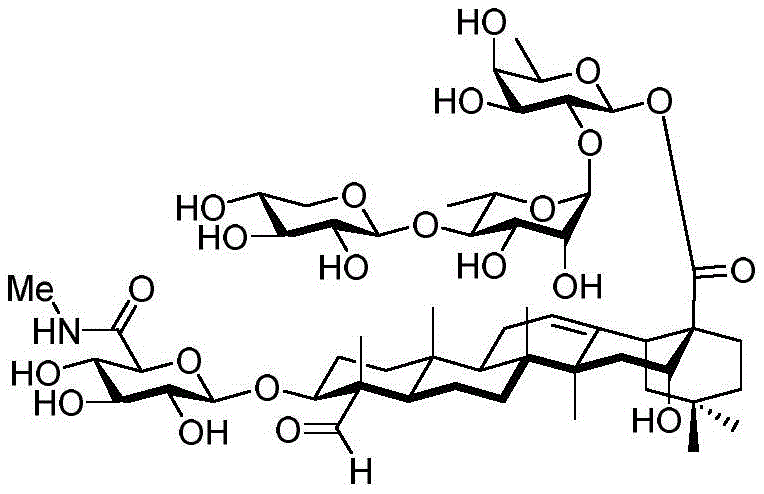
3-O- (N- (methyl) -beta-D-glucopyranosyl uronamide) -28-O- (beta-D-xylopyranosyl- (1 → 4) -alpha-L-rhamnopyranosyl- (1 → 2) -beta-D-fucopyranosyl) soapbark acid ester (47)
Following the general procedure for global deprotection, 47 was obtained as a white solid in 36% yield: [ alpha ] to]D 20-26.8(c0.22,MeOH);1H NMR (600MHz, MeOD). delta.9.42 (s,1H, H-23),8.52(s,1H, amide NH),5.40(d,J=1.7Hz,1H,H-1”),5.31(t,1H,J=3.5Hz,H-12),5.28(d,J=8.2Hz,1H,H-1’),4.49–4.47(m,2H,H-1”’,H-16),4.24(d,J=7.9Hz,1H,H-1””),3.90(dd,J=3.3,1.7Hz,1H,H-2”),3.89–3.79(m,5H,H-3,H-5a”’,H-3”,H-2’,H-5”),3.69–3.64(m,3H,H-5’,H-3’,H-5””),3.56–3.53(m,2H,H-4’,H-4”),3.46(ddd,J=10.4,8.8,5.4Hz,1H,H-4”’),3.41(t,J=9.1Hz.1H,H-4””),3.33–3.30(m,2H,H-3”’,H-3””)3.23–3.17(m,2H,H-2”’,H-5b”’),3.13(dd,J=9.2,7.9Hz,1H,H-2””),2.94(dd,J=14.6,4.1Hz,1H,H-18),2.80(s,3H,–NHC 3H),2.30(t,J=13.7Hz,1H,H-19a),1.94–1.91(m,5H,H-2a,H-11ab,H-21a,H-22a),1.81–1.66(m,5H,H-2b,H-22b,H-9,H-1a,H-15a),1.55–1.43(m,3H,H-6a,H-7a,H-15b),1.40(s,3H,H-27),1.35–1.31(m,5H,H-5,H-6b,H-6”),1.22(d,J=6.4Hz,3H,H-6’),1.18(d,J=10.3,2.5Hz,1H,H-21b),1.13(s,3H,H-24),1.10(dd,J=13.2,4.02Hz,1H,H-1b),1.05(dd,J=13.4,3.5Hz,1H,H-19b),1.02(s,3H,H-25),0.97–0.95(m,4H,H-7b,H-30),0.88(s,3H,H-29),0.77(s,3H,H-26);13C NMR(151MHz,MeOD)δ209.3(C-23),177.2(C-28),172.3,144.8(C-13),123.2(C-12),107.0(C-1”’),104.8(C-1””),101.1(C-1”),95.2(C-1’),84.1(C-4”),83.3(C-3),78.2(C-3”’),77.5(C-3””),76.7(C-3’),76.5(C-5””),76.1(C-2”’),74.7(C-2””),74.6(C-16),74.0(C-2’),73.6(C-4’),73.4(C-4””),72.7(C-5’),72.2(C-3”),71.9(C-2”),71.1(C-4”’),68.8(C-5”),67.3(C-5”’),56.1(C-4),50.0(C-17),49.6(C-5),48.0(C-9),48.0(C-19),42.8(C-14),42.4(C-18),41.1(C-8),39.3(C-1),37.1(C-10),36.5(C-21),36.5(C-15),33.6(C-6),33.4(C-29),32.0(C-22),31.3(C-20),27.2(C-27),26.2(–NHCH3),25.8(C-2),24.8(C-30),24.5(C-11),21.5(C-7),18.3(C-6”),17.7(C-26),16.5(C-6’),16.3(C-25),10.5(C-24)ppm;C54H86NO22[M+H]+HRMS (ESI-TOF) of (g) calculated 1100.5636, found 1100.5667.
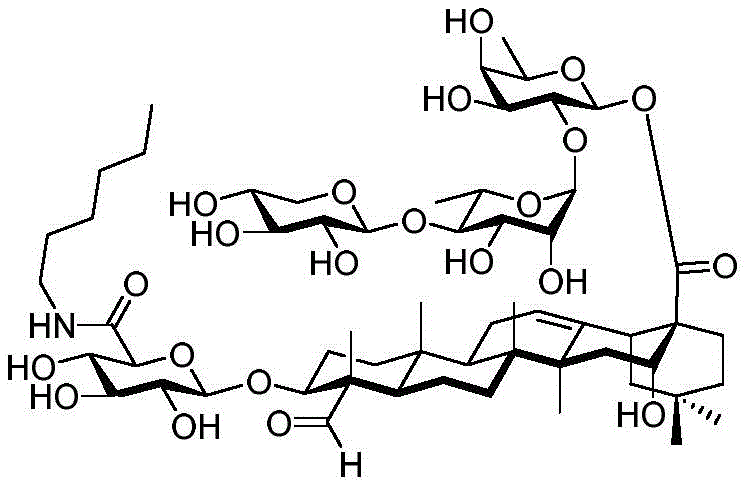
3-O- (N- (hexyl) - β -D-glucopyranosyl uronamide) -28-O- (β -D-xylopyranosyl- (1 → 4) - α -L-rhamnopyranosyl- (1 → 2) - β -D-fucopyranosyl) soapbark acid ester (48)
Following the general procedure for global deprotection, 48 was obtained as a white solid in 45% yield: [ alpha ] to]D 20-17.35(c0.34,MeOH);1H NMR (600MHz, MeOD). delta.9.42 (s,1H, H-23),8.55(s,1H, amide NH),5.40(d,J=1.6Hz,1H,H-1”),5.31(t,J=3.4Hz,1H,H-12),5.28(d,J=8.2Hz,1H,H-1’),4.49–4.48(m,2H,H-16,H-1”’),4.26(d,J=7.9Hz,1H,H-1””),3.92–3.77(m,6H,H-2”,H-3,H-5a”’,H-3”,H-2’,H-5”),3.70–3.62(m,3H,H-5’,H-3’,H-5””),3.56–3.53(m,2H,H-4’,H-4”),3.49–3.41(m,2H,H-4”’,H-4””),3.33–3.30(m,2H,H-3”’,H-3””),3.29–3.17(m,4H,–NHC 2H–,H-2”’,H-5b”’),3.14(dd,J=9.2,7.9Hz,1H,H-2””),2.94(dd,J=14.1,4.0Hz,1H,H-18),2.30(t,J=13.8Hz,1H,H-19a),1.96–1.90(m,5H,H-2a,H-11ab,H-21a,H-22a),1.84–1.64(m,5H,H-2b,H-22b,H-9,H-1a,H-15a),1.55–1.49(m,4H,H-6a,H-7aCarbon chain C 2H),1.45(dd,J=14.8,2.7Hz,1H,H-15b),1.40(s,3H,H-27),1.36–1.29(m,13H,H-5,H-6bH-6', carbon chain C 2H×4),1.22(d,J=6.4Hz,3H,H-6’),1.18–1.17(m,1H,H-21b),1.13(s,3H,H-24),1.12–1.09(m,1H,H-1b),1.05(dd,J=12.6,3.0Hz,1H,H-19b),1.01(s,3H,H-25),0.95(s,4H,H-7bH-30),0.92(t, J ═ 7.0Hz,3H, carbon chain C 3H),0.88(s,3H,H-29),0.77(s,3H,H-26);13C NMR (151MHz, MeOD) delta 209.3(C-23),177.2(C-28),171.5,144.8(C-13),123.2(C-12),106.9(C-1 '), 104.9(C-1 '), 101.1(C-1 '), 95.2(C-1 '), 84.0(C-4 '), 83.3(C-3),78.2(C-3 '), 77.6(C-3 '), 76.7(C-3 '), 76.6(C-5 '), 76.1(C-2 '), 74.7(C-2 '), 74.6(C-16),74.1(C-2 '), 73.6(C-4 '), 73.2(C-4 '), 72.7(C-5 '), 72.2(C-3 '), 71.9(C-2 '), 71.1(C-4 '), 68.8(C-5 '), 68, C-5 ', C-3 '), 67.3 (C-5'), 56.1(C-4),50.0(C-17),49.6(C-5),48.0(C-9, C-19),42.8(C-14),42.4(C-18),41.1(C-8),40.1 (carbon chain)CH2) 39.4(C-1),37.1(C-10),36.5(C-21),36.5(C-15),33.6(C-6),33.4(C-29),32.8 (carbon chain)CH2) 32.0(C-22),31.3(C-20),30.3 (carbon chain)CH2) 27.6 (carbon chain)CH2) 27.2(C-27),25.9(C-2),24.8(C-30),24.5(C-11),23.8 (carbon chain)CH2) 21.5(C-7),18.3(C-6 "), 17.7(C-26),16.5 (C-6'), 16.3(C-25),14.5 (carbon chain)CH3),10.6(C-24)ppm;C59H96NO22[M+H]+HRMS (ESI-TOF) of (g) calculated 1170.6418, found 1170.6448.
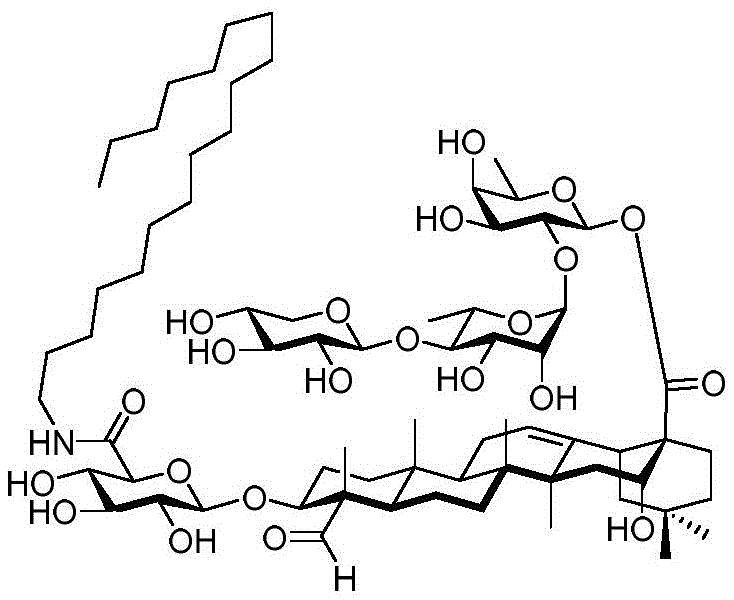
3-O- (N- (octadecyl) -beta-D-glucopyranosyl uronamide) -28-O- (beta-D-xylopyranosyl- (1 → 4) -alpha-L-rhamnopyranosyl- (1 → 2) -beta-D-fucopyranosyl) soapbark acid ester (49)
Following the general procedure for the global deprotection (HPLC column: Altima C8150 mm X4.6 mm, 5 μm, flow rate: 1mL/min), 49 was obtained as a white solid in 30% yield: [ alpha ] to]D 20-27.4(c 0.27,MeOH);1H NMR (600MHz, MeOD). delta.9.43 (s,1H, H-23),8.55(s,1H, amide NH),5.41(d,J=1.6Hz,1H,H-1”),5.31(t,J=3.4Hz,1H,H-12),5.28(d,J=8.2Hz,1H,H-1’),4.49(d,J=7.6Hz,2H,H-16,H-1”’),4.26(d,J=7.9Hz,1H,H-1””),3.92–3.77(m,6H,H-2”,H-3,H-5a”’,H-3”,H-2’,H-5”),3.69–3.63(m,3H,H-5’,H-3’,H-5””),3.57–3.53(m,2H,H-4’,H-4”),3.49–3.41(m,2H,H-4”’,H-4””),3.33–3.27(m,3H,H-3”’,H-3””,–NHC aH–),3.24–3.17(m,3H,H-2”’,H-5b”’,–NHC bH–),3.14(dd,J=9.2,7.9Hz,1H,H-2””),2.94(dd,J=14.3,4.1Hz,1H,H-18),2.30(t,J=13.6Hz,1H,H-19a),1.98–1.89(m,5H,H-2a,H-11ab,H21a,H-22a),1.84–1.64(m,5H,H-2b,H-9,H-22b,H-1a,H-15a),1.55–1.49(m,4H,H-6a,H-7aCarbon chain C 2H),1.45(dd,J=14.8,2.5Hz,1H,H-15b),1.40(s,3H,H-27),1.37–1.25(m,35H,H-5,H-6bH-6', carbon chain C 2H×15),1.22(d,J=6.4Hz,3H,H-6’),1.20–1.15(m,1H,H-21b),1.14(s,3H,H-24),1.13–1.08(m,1H,H-1b),1.06(dd,J=12.6,3.0Hz,1H,H-19b),1.02(s,3H,H-25),0.97–0.95(m,4H,H-7bH-30),0.90(t, J ═ 7.0Hz,3H, carbon chain C 3H),0.88(s,3H,H-29),0.77(s,3H,H-26);13C NMR (151MHz, MeOD) delta 209.2(C-23),177.2(C-28),171.5,144.9(C-13),123.1(C-12),107.0(C-1 '), 105.1 (C-1'), 101.1(C-1 '), 95.7 (C-1'), 84.0(C-4 '), 83.5(C-3),78.2 (C-3'), 77.6(C-3 '), 76.7 (C-3'), 76.6(C-5 '), 76.1 (C-2'), 74.7(C-2 '), 74.6(C-16),74.0 (C-2'), 73.6(C-4 '), 73.2 (C-4'), 72.7(C-5 '), 72.2 (C-3'), 71.9(C-2 '), 71.1 (C-4'), 68.7(C-5 ', 68.7, C-5', 67.3 (C-5'), 56.1(C-4),50.0(C-17),49.6(C-5),48.1(C-9),48.0(C-19),42.8(C-14),42.3(C-18),41.1(C-8),40.0 (carbon chain C-8) 2H) 39.5(C-1),37.1(C-10),36.5(C-21),36.5(C-15),33.6(C-6),33.4(C-29),33.1 (carbon chain C-1) 2H) 32.0(C-22),31.4(C-20),30.9 (carbon chain C) 2H) 30.9 (carbon chain C) 2H) 30.8 (carbon chain C) 2H) 30.8 (carbon chain C) 2H) 30.6 (carbon chain C) 2H) 30.5 (carbon chain C) 2H) 30.3 (carbon chain C) 2H) 28.0 (carbon chain C) 2H) 27.2(C-27),26.0(C-2),24.9(C-30),24.5(C-11),23.8 (carbon chain C) 2H) 21.6(C-7),18.3(C-6 "), 17.7(C-26),16.5 (C-6'), 16.4(C-25),14.5 (carbon chain C) 3H),10.6(C-24)ppm;C71H120NO22[M+H]+HRMS (ESI-TOF) of (g) calculated 1338.8297, found 1338.3327.
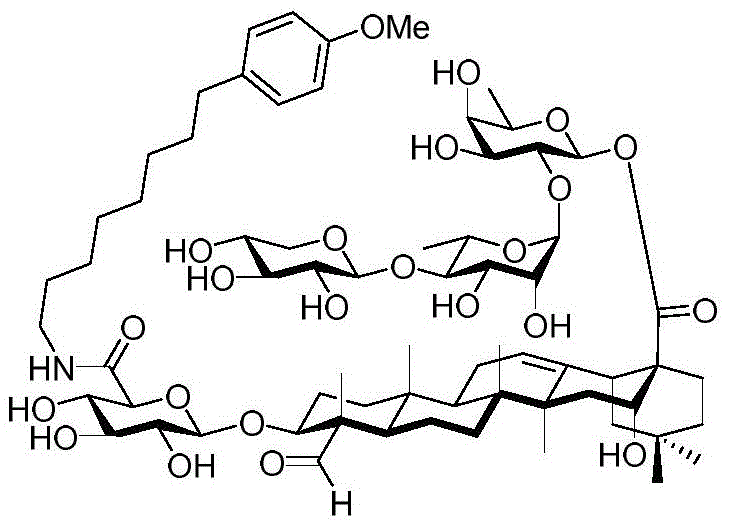
3-O- (N- (8- (4-methoxyphenyl) octyl) -beta-D-glucopyranosyl uronamide) -28-O- (beta-D-xylopyranosyl- (1 → 4) -alpha-L-rhamnopyranosyl- (1 → 2) -beta-D-fucopyranosyl) soapbark acid ester (53)
Following the general procedure for global deprotection, 53 was obtained as a white solid in 54% yield: [ alpha ] to]D 20-123.3(c0.06,MeOH);1H NMR (600MHz, MeOD). delta.9.42 (s,1H, H-23),8.55(s,1H, amide NH),7.07(d,J=8.7Hz,2H),6.82(d,J=8.7Hz,2H),5.41(d,J=1.8Hz,1H,H-1”),5.30–5.27(m,2H,H-12,H-1’),4.49–4.48(m,2H,H-16,H-1”’),4.26(d,J=7.8Hz,1H,H-1””),3.91(dd,J=3.3,1.8Hz,1H,H-2”),3.90–3.79(m,5H,H-3,H-5a”’,H-3”,H-2’,H-5”),3.76(s,3H,OC 3H),3.69–3.66(m,2H,H-5’,H-3’),3.64(d,J=9.7Hz,1H,H-5””),3.58–3.53(m,2H,H-4’,H-4”),3.49–3.42(m,2H,H-4”’,H-4””),3.33–3-30(m,2H,H-3”’,H-3””),3.28–3.25(m,1H,–NHC aH–),3.24–3.17(m,3H,H-2”’,H-5b”’,–NHC bH-), 3.14(dd, J ═ 9.2,7.8Hz,1H, H-2 ""), 2.94(dd, J ═ 14.3,4.1Hz,1H, H-18),2.54(t, J ═ 7.4Hz 2H, carbon chain C 2HPh),2.30(t,J=13.6Hz,1H,H-19a),1.97–1.88(m,5H,H-2a,H-11ab,H-21a,H-22a),1.84–1.72(m,3H,H-2b,H-9,H-22b),1.71–1.66m,2H,H-1a,H-15a) 1.62-1.47 (m,6H, carbon chain C) 2H×2,H-6a,H-7a),1.47–1.43(m,1H,H-15b),1.40(s,3H,H-27),1.37–1.30(m,13H,H-5,H-6bH-6', carbon chain C 2H×4),1.22(d,J=6.4Hz,3H,H-6’),1.18–1.16(m,1H,H-21b),1.13(s,3H,H-24),1.10–1.08(m,1H,H-1b),1.05(dd,J=12.1,3.6Hz,1H,H-19b),1.00(s,3H,H-25),0.97–0.94(m,4H,H-7b,H-30),0.87(s,3H,H-29),0.77(s,3H,H-26);13C NMR(151MHz,MeOD)δ209.2(C-23),177.2(C-28),171.5,159.2,144.8(C-13),135.9,130.3,123.1(C-12),114.8,107.0(C-1”’),105.0(C-1””),101.1(C-1”),95.2(C-1’),84.0(C-4”),83.5(C-3),78.2(C-3”’),77.6(C-3””),76.7(C-3’),76.6(C-5””),76.1(C-2”’),74.7(C-2””),74.6(C-16),74.0(C-2’),73.6(C-4’),73.2(C-4””),72.7(C-5’),72.2(C-3”),71.9(C-2”),71.1(C-4”’),68.8(C-5”),67.3(C-5”’),56.1(C-4),55.7(OCH3) 50.0(C-17),49.6(C-5),48.1(C-19),48.0(C-9),42.8(C-14),42.3(C-18),41.1(C-8),40.0 (carbon chain)CH2) 39.4(C-1),37.1(C-10),36.5(C-21),36.5(C-15),36.7 (carbon chain)CH2) 33.6(C-6),33.4(C-29),33.0 (carbon chain)CH2) 32.0(C-22),31.3(C-20),30.7 (carbon chain)CH2) 30.5 (carbon chain)CH2) 30.3 (carbon chain)CH2) 30.2 (carbon chain)CH2) 27.9 (carbon chain)CH2),27.2(C-27),26.0(C-2),24.8(C-30),24.5(C-11),21.6(C-7),18.3(C-6”),17.7(C-26),16.5(C-6’),16.4(C-25),10.6(C-24)ppm;C68H106NO23[M+H]+HRMS (ESI-TOF) of (g) calculated 1326.6970, found 1326.6978.
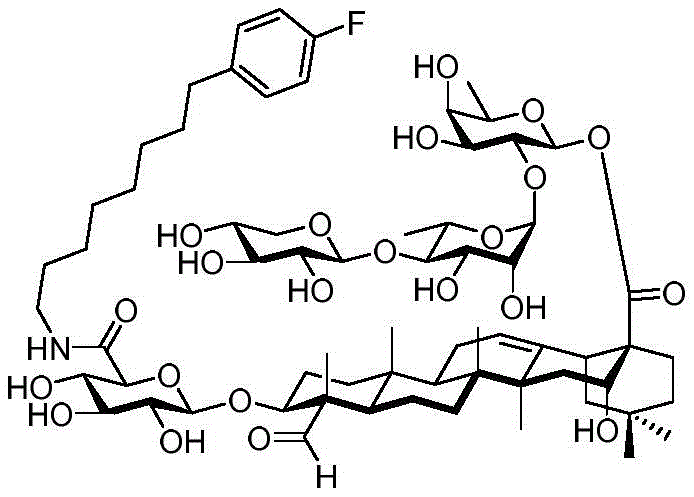
3-O- (N- (8- (4-fluorophenyl) octyl) -beta-D-glucopyranosyl uronamide) -28-O- (beta-D-xylopyranosyl- (1 → 4) -alpha-L-rhamnopyranosyl- (1 → 2) -beta-D-fucopyranosyl) soapbark acid ester (54)
Following the general procedure for global deprotection, 54 was obtained as a white solid in 56% yield: [ alpha ] to]D 20-28.3(c0.18,MeOH);1H NMR (600MHz, MeOD). delta.9.42 (s,1H, H-23),8.55(s,1H, amide NH),7.17(dd,J=8.8,5.4Hz,2H),6.98(t,J=8.8Hz,2H),5.41(d,J=1.7Hz,1H,H-1”),5.29–5.27(m,2H,H-12,H-1’),4.49–4.48(m,2H,H-16,H-1”’),4.26(d,J=7.9Hz,1H,H-1””),3.92–3.78(m,6H,H-2”,H-3,H-5a”’,H-3”,H-2’,H-5”),3.70–3.63(m,3H,H-5’,H-3’,H-5””),3.57–3.52(m,2H,H-4’,H-4”),3.48–3.41(m,2H,H-4”’,H-4””),3.33–3.30(m,2H,H-3”’,H-3””),3.28–3.25(m,1H,–NHC aH–),3.24–3.16(m,3H,H-2”’,H-5b”’,–NHC bH-), 3.13(dd, J ═ 9.2,7.9Hz,1H, H-2 ""), 2.94(dd, J ═ 14.3,4.5Hz,1H, H-18),2.59(t, J ═ 7.6Hz,2H, carbon chain C, 2.6 Hz, C, etc.) 2HPh),2.29(t,J=13.6Hz,1H,H-19a),1.96–1.89(m,5H,H-2a,H-11ab,H-21a,H-22a),1.83–1.72(m,3H,H-2b,H-9,H-22b),1.72–1.64(m,2H,H-1a,H-15a) 1.63-1.58 (m,2H, carbon chain C) 2H),1.56–1.48(m,4H,H-6a,H-7a),1.45(dd,J=14.9,2.6Hz,1H,H-15b),1.40(s,3H,H-27),1.36–1.31(m,13H,H-5,H-6bH-6', carbon chain C 2H×4),1.22(d,J=6.4Hz,3H,H-6’),1.18–1.16(m,1H,H-21b),1.13(s,3H,H-24),1.11–1.08(m,1H,H-1b),1.05–1.03(m,1H,H-19b),1.00(s,3H,H-25),0.96–0.94(m,4H,H-7b,H-30),0.86(s,3H,H-29),0.77(s,3H,H-26);13C NMR (151MHz, MeOD) δ 209.2(C-23),177.2(C-28),171.5,162.6(J ═ 241Hz),144.9(C-13),139.8,130.9(J ═ 8Hz),123.1(C-12),115.8(J ═ 21Hz),107.0(C-1 "'), 105.0 (C-1" "), 101.1 (C-1"), 95.2(C-1 '), 84.0(C-4 "), 83.4(C-3),78.2 (C-3" '), 77.6(C-3 ""), 76.7(C-3 '), 76.6(C-5 ""), 76.1(C-2 "'), 74.7 (C-2" "), 74.6(C-16),74.0(C-2 '), 73.6(C-4 '), 73.2 (C-4" "), 72.7 (C-5" "), 72.2 (C-3" "), 71.9 (C-2" ", 71, 7, etc."). 71.1(C-4 '), 68.8(C-5 '), 67.3(C-5 '), 56.1(C-4),50.0(C-17),49.6(C-5),48.1(C-9),48.0(C-19),42.8(C-14),42.4(C-18),41.1(C-8),40.0 (carbon chain)CH2) 39.4(C-1),37.1(C-10),36.5(C-21),36.5(C-15),36.1 (carbon chain)CH2) 33.6(C-6),33.4(C-29),32.9(C-),32.0(C-22),31.3(C-20),30.7 (carbon chain)CH2) 30.5 (carbon chain)CH2) 30.3 (carbon chain)CH2) 30.3 (carbon chain)CH2) 30.2 (carbon chain)CH2) 27.9 (carbon chain)CH2),27.2(C-27),26.0(C-2),24.8(C-30),24.5(C-11),21.5(C-7),18.3(C-6”),17.7(C-26),16.5(C-)6’,16.4(C-25),10.6(C-24)ppm;C67H102FNO22Na[M+Na]+HRMS (ESI-TOF) of (g) calculated 1314.6770, found 1314.6794.
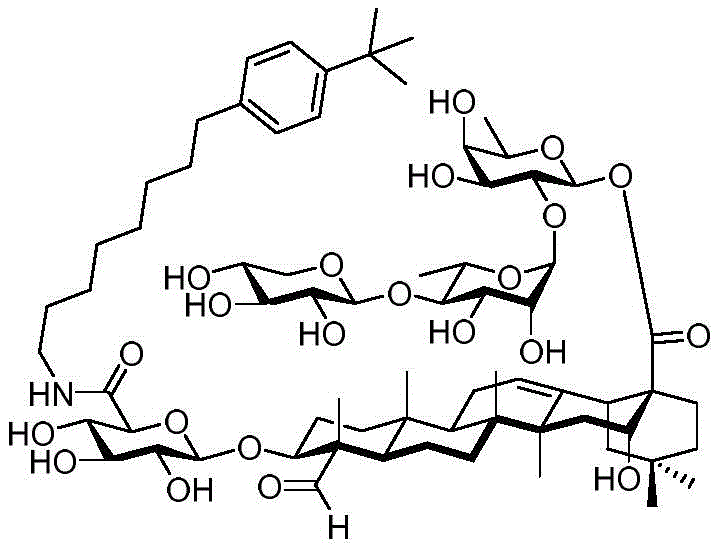
3-O- (N- (8- (4-fluorophenyl) octyl) -beta-D-glucopyranosyl uronamide) -28-O- (beta-D-xylopyranosyl- (1 → 4) -alpha-L-rhamnopyranosyl- (1 → 2) -beta-D-fucopyranosyl) soapbark acid ester (55)
Following the general procedure for global deprotection, 55 was obtained as a white solid in 75% yield: [ alpha ] to]D 20-32.5(c0.24,MeOH);1H NMR (600MHz, MeOD). delta.9.42 (s,1H, H-23),8.55(s,1H, amide NH),7.29(d,J=8.3Hz,2H),7.08(d,J=8.3Hz,2H),5.41(d,J=1.7Hz,1H,H-1”),5.31(t,J=3.6Hz,1H,H-12),5.29(d,J=8.2Hz,1H,H-1’),4.49–4.48(m,2H,H-1”’,H-16),4.26(d,J=7.8Hz,1H,H-1””),3.91–3.78(m,6H,H-2”,H-3,H-5a”’,H-3”,H-2’,H-5”),3.69–3.63(m,3H,H-5’,H-3’,H-5””),3.57–3.53(m,2H,H-4’,H-4”),3.48–3.42(m,2H,H-4”’,H-4””),3.33–3.30(m,2H,H-3”’,H-3””),3.29–3.25(m,1H,–NHC aH–),3.23–3.17(m,3H,H-2”’,H-5b”’,–NHC aH-), 3.14(dd, J ═ 9.2,7.8Hz,1H, H-2 ""), 2.94(dd, J ═ 14.5,4.3Hz,1H, H-18),2.57(m, J ═ 7.6Hz,2H, carbon chain C, 2.7 2HPh),2.30(t,J=13.6Hz,1H,H-19a),1.97–1.89(m,5H,H-2a,H-11ab,H-21a,H-22a),1.83–1.72(m,3H,H-2b,H-9,H-22b),1.72–1.64(m,2H,H-1a,H-15a) 1.63-1.57 (m,2H, carbon chain C) 2H),1.56–1.47(m,4H,H-6a,H-7aCarbon chain C 2H),1.47–1.43(m,1H,H-15b),1.40(s,3H,H-27),1.36–1.28(m,22H,H-5,H-6bH-6', carbon chain C 2H×4,tBu C 3H×3),1.22(d,J=6.4Hz,3H,H-6’),1.19–1.15(m,1H,H-21b),1.13(s,3H,H-24),1.11–1.08(m,1H,H-1b),1.08–1.03(m,1H,H-19b),1.00(s,3H,H-25),0.96–0.94(m,4H,H-7b,H-30),0.86(s,3H,H-29),0.77(s,3H,H-26);13C NMR(151MHz,MeOD)δ209.2(C-23),177.2(C-28),171.5,149.5,144.8(C-13),140.8,129.1,126.1,123.1(C-12),107.0(C-1”’),105.0(C-1””),101.1(C-1”),95.2(C-1’),84.1(C-4”),83.5(C-3),78.2(C-3”’),77.6(C-3””),767(C-3 '), 76.6(C-5 '), 76.1(C-2 '), 74.7(C-2 '), 74.6(C-16),74.0(C-2 '), 73.6(C-4 '), 73.2(C-4 '), 72.7(C-5 '), 72.2(C-3 '), 71.9(C-2 '), 71.1(C-4 '), 68.8(C-5 '), 67.1(C-5 '), 56.1(C-4),50.0(C-17),49.6(C-5),48.1(C-9),48.0(C-19),42.8(C-14),42.4(C-18),41.1(C-8),40.0 (carbon chain)CH2) 39.4(C-1),37.1(C-10),36.4(C-15, C-21, carbon chain)CH2) 35.2(tBu 4 ℃ C.), 33.6(C-6),33.4(C-29),32.8 (carbon chain)CH2),31.9(C-22,tBu CH3X 3),31.3(C-20),30.7 (carbon chain)CH2) 30.5 (carbon chain)CH2) 30.4 (carbon chain)CH2) 30.2 (carbon chain)CH2) 27.9 (carbon chain)CH2),27.2(C-27),26.0(C-2),24.8(C-30),24.5(C-11),21.6(C-7),18.3(C-6”),17.7(C-26),16.5(C-6’),16.4(C-25),10.6(C-24)ppm;C71H111NO22Na[M+Na]+HRMS (ESI-TOF) of (g) calculated 1352.7490, found 1352.7515.
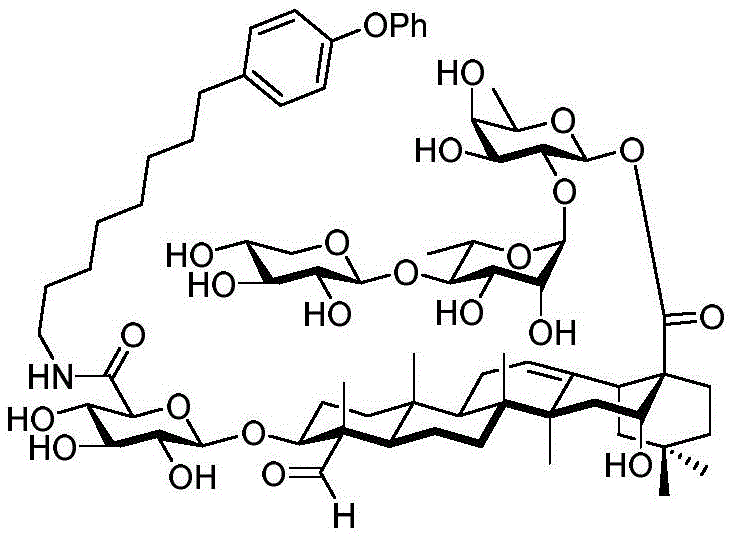
3-O- (N- (8- (4-phenoxyphenyl) octyl) - β -D-glucopyranosyl uronamide) -28-O- (β -D-xylopyranosyl- (1 → 4) - α -L-rhamnopyranosyl- (1 → 2) - β -D-fucopyranosyl) soapbark acid ester (56)
Following the general procedure for global deprotection, 56 was obtained as a white solid in 46% yield: [ alpha ] to]D 20-71.4(c 0.07,MeOH);1H NMR (600MHz, MeOD). delta.9.42 (s,1H, H-23),8.55(s,1H, amide NH),7.32(dd,J=8.6,7.5Hz,2H),7.17(dd,J=8.6,1.0Hz,2H),7.07(tt,J=7.5,1.0Hz,1H),6.95(d,J=8.6Hz,2H),6.91(d,J=8.6Hz,2H),5.41(d,J=1.7Hz,1H,H-1”),5.30(s,1H,H-12),5.27(d,J=8.2Hz,1H,H-1’),4.49–4.47(m,2H,H-16,H-1”’),4.26(d,J=7.8Hz,1H,H-1””),3.91–3.79(m,6H,H-2”,H-3,H-5a”’,H-3”,H-2’,H-5”),3.67–3.63(m,3H,H-5’,H-3’,H-5””),3.56–3.53(m,2H,H-4’,H-4”),3.49–3.42(m,2H,H-4”’,H-4””),3.33–3.25(m,3H,H-3”’,H-3””,–NHC aH–),3.23–3.17(m,3H,H-2”’,H-5b”’,–NHC bH-), 3.14(dd, J ═ 9.2,7.8Hz,1H, H-2 ""), 2.94(dd, J ═ 14.2,4.4Hz,1H, H-18),2.60(t, J ═ 7.5Hz,2H, carbon chain C, 2.60 2HPh),2.29(t,J=13.1Hz,1H,H-19a),1.98–1.87(m,5H,H-2a,H-11ab,H-21a,H-22a),1.82–1.76(m,3H,H-2b,H-9,H-22b),1.71–1.65(m,2H,H-1a,H-15a) 1.64-1.60 (m,2H, carbon chain C) 2H),1.56–1.48(m,4H,H-6a,H-7a),1.45(dd,J=14.9,2.6Hz,1H,H-15b),1.40(s,3H,H-27),1.37–1.31(m,13H,H-5,H-6bH-6', carbon chain C 2H),1.21(d,J=6.4Hz,3H,H-6’),1.18–1.15(m,1H,H-21b),1.13(s,3H,H-24),1.11–1.08(m,1H,H-1b),1.06–1.03(m,1H,H-19b),1.00(s,3H,H-25),0.97–0.93(m,4H,H-7b,H-30),0.85(s,3H,H-29),0.77(s,3H,H-26);13C NMR (151MHz, MeOD) delta 209.2(C-23),177.1(C-28),171.5,159.2,156.5,144.9(C-13),139.2,130.8,130.7,124.0,123.1(C-12),120.0,119.4,107.0(C-1 '), 105.0(C-1 '), 101.1(C-1 '), 95.2(C-1 '), 84.1(C-4 '), 83.5(C-3),78.2(C-3 '), 77.6(C-3 '), 76.7(C-3 '), 76.6(C-5 '), 76.1(C-2 '), 74.7(C-2 '), 74.6(C-16),74.0(C-2 '), 73.6(C-4 '), 73.2(C-4 '), 72.7(C-5 '), 72.2(C-3 '), 71.9(C-2 '), 71.1(C-4 '), 68.7(C-5 ' ),67.3 (C-5'), 56.1(C-4),50.0(C-17),49.6(C-5),48.1(C-9),48.0(C-19),42.8(C-14),42.4(C-18),41.1(C-8),40.0 (carbon chain)CH2) 39.4(C-1),37.1(C-10),36.5(C-21),36.5(C-15),36.2 (carbon chain)CH2) 33.6(C-6),33.4(C-29),32.9 (carbon chain)CH2) 32.0(C-22),31.3(C-20),30.7 (carbon chain)CH2) 30.5 (carbon chain)CH2) 30.4 (carbon chain)CH2) 30.3 (carbon chain)CH2) 27.9 (carbon chain)CH2),27.2(C-27),26.0(C-2),24.8(C-30),24.5(C-11),21.6(C-7),18.3(C-6”),17.7(C-26),16.5(C-6’),16.4(C-25),10.6(C-24)ppm;C73H107NO23Na[M+Na]+HRMS (ESI-TOF) of (g) calculated 1388.7126, found 1388.7172.
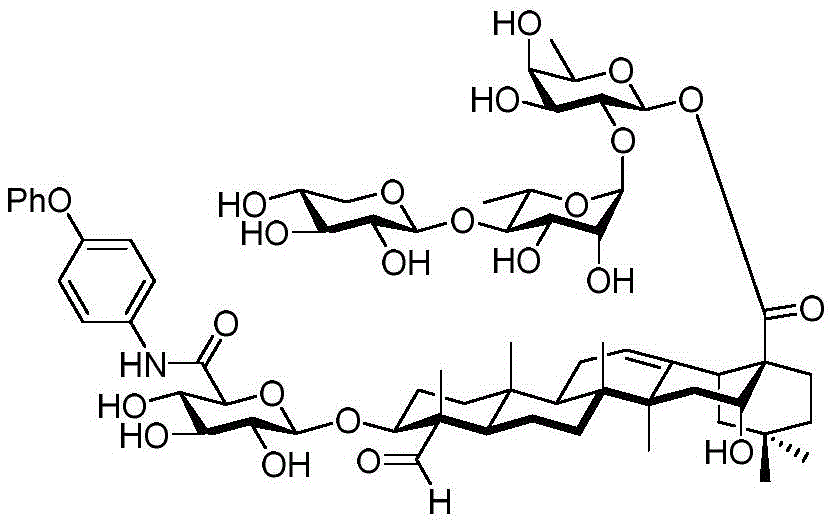
3-O- (N- (4-phenoxyphen-1-yl) - β -D-glucopyranosyl uronamide) -28-O- (β -D-xylopyranosyl- (1 → 4) - α -L-rhamnopyranosyl- (1 → 2) - β -D-fucopyranosyl) soapbark acid ester (57)
Following the general procedure for global deprotection, 57 was obtained as a white solid in 23% yield:1H NMR(600MHz,CD3OD)δ9.45(s,1H),8.55(s,1H),7.61(d,J=8.9Hz,2H),7.34(t,J=7.7Hz,2H),7.09(t,J=7.1Hz,1H),7.00–6.95(m,4H),5.41(d,J=1.6Hz,1H),5.30(t,J=3.6Hz,1H),5.28(d,J=8.2Hz,1H),4.50–4.47(m,2H),4.32(d,J=7.8Hz,1H),3.93(dd,J=11.8,4.6Hz,1H),3.90(dd,J=3.2,1.8Hz,1H),3.87–3.77(m,5H),3.67–3.65(m,2H),3.60–3.53(m,3H),3.46(ddd,J=10.4,9.0,5.4Hz,1H),3.36(t,J=9.0Hz,1H),3.33–3.30(m,1H)3.24–3.17(m,3H),2.93(dd,J=14.4,4.3Hz,1H),2.29(t,J=13.6Hz,1H),2.00–1.90(m,5H),1.86–1.64(m,5H),1.61–1.48(m,2H),1.45(dd,J=14.8,2.6Hz,1H),1.39(s,3H),1.37–1.33(m,2H),1.31(d,J=6.2Hz,3H),1.21(d,J=6.4Hz,3H),1.20–1.16(m,1H),1.15(s,3H),1.13–1.08(m,1H),1.06–1.02(m,1H),1.01(s,3H),0.97–0.94(m,4H),0.87(s,3H),0.77(s,3H);13C NMR(151MHz,CD3OD)δ209.4,177.2,170.3,169.4,159.0,155.2,144.7,134.8,130.9,124.3,123.2,120.3,119.5,106.9,105.2,101.1,95.2,84.0,83.4,78.2,77.6,77.6,77.6,76.7,76.1,74.7,74.6,74.0,73.6,73.0,72.7,72.2,71.9,71.1,68.7,67.3,56.2,50.0,49.6,48.0,48.0,42.8,42.3,41.1,39.3,37.1,36.5,36.5,36.5,33.4,32.0,31.3,27.2,24.8,21.6,18.3,17.7,16.5,16.3,10.6ppm;C65H92NO23[M+H]+HRMS (ESI-TOF) of (g) calculated 1254.6055, found 1254.6060.
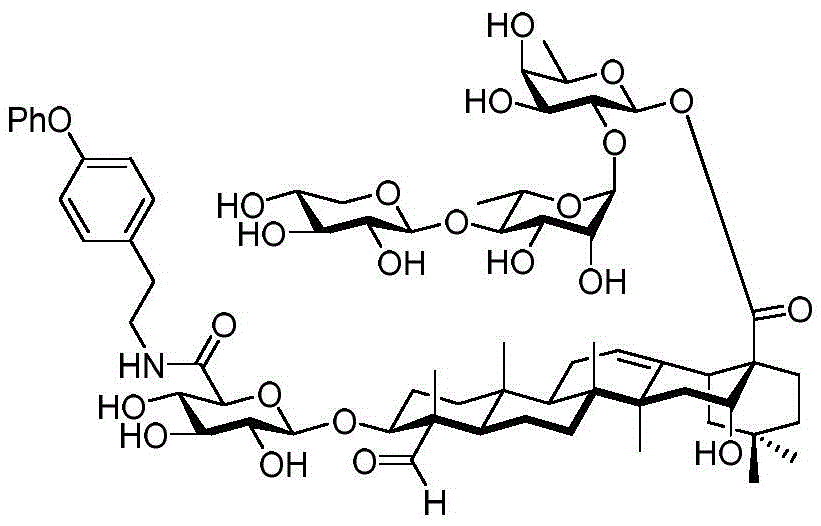
3-O- (N- (2- (4-phenoxyphen-1-yl) ethyl) - β -D-glucopyranosyl uronamide) -28-O- (β -D-xylopyranosyl- (1 → 4) - α -L-rhamnopyranosyl- (1 → 2) - β -D-fucopyranosyl) soapbark acid ester (58)
Following the general procedure for global deprotection, 58 was obtained as a white solid in 58% yield:1H NMR(600MHz,CD3OD)δ9.40(s,1H),8.55(s,1H),7.33(dd,J=8.5,7.5Hz,2H),7.23(d,J=8.5Hz,2H),7.09(t,J=7.5Hz,1H),6.95(d,J=8.5Hz,2H),6.93(d,J=8.6Hz,2H),5.41(d,J=1.7Hz,1H),5.30–5.27(m,2H),4.50–4.47(m,2H),4.23(d,J=7.9Hz,1H),3.91(dd,J=3.2,1.7Hz,1H),3.87–3.77(m,5H),3.70–3.65(m,2H),3.63(d,J=9.7Hz,1H),3.57–3.50(m,3H),3.50–3.43(m,2H),3.40(t,J=9.3Hz,1H),3.33–3.29(m,2H),3.23–3.17(m,2H),3.11(dd,J=9.2,7.9Hz,1H),2.94(dd,J=14.3,4.1Hz,1H),2.83(t,J=6.8Hz,2H),2.30(t,J=13.6Hz,1H),1.98–p1.79(m,8H),1.77(dd,J=13.8,4.3Hz,1H),1.74–1.64(m,4H),1.58–1.41(m,3H),1.39(s,3H),1.35(d,J=11.7Hz,1H),1.34–1.28(m,5H),1.22(d,J=6.4Hz,3H),1.18(d,J=12.8Hz,1H),1.11(s,3H),1.08–1.02(m,2H),0.97(s,3H),0.96–0.92(m,4H),0.89(s,3H),0.76(s,3H);BBD 13C NMR(151MHz,MeOD)δ209.3,177.2,171.7,159.0,157.0,144.7,135.6,131.3,130.9,124.2,123.2,120.2,119.5,106.9,104.9,101.1,95.2,84.0,83.5,78.2,77.5,76.7,76.4,76.1,74.7,74.6,74.0,73.6,73.4,72.7,72.2,71.9,71.1,68.7,67.3,56.1,50.0,49.6,48.0,48.0,42.8,42.3,41.5,41.1,39.4,37.0,36.5,36.5,35.4,33.6,33.4,32.0,31.3,27.2,25.9,24.8,24.6,21.5,18.3,17.7,16.5,16.3,10.6ppm;C67H96NO23[M+H]+HRMS (ESI-TOF) of (g) calculated 1282.6368, found 1282.6370.
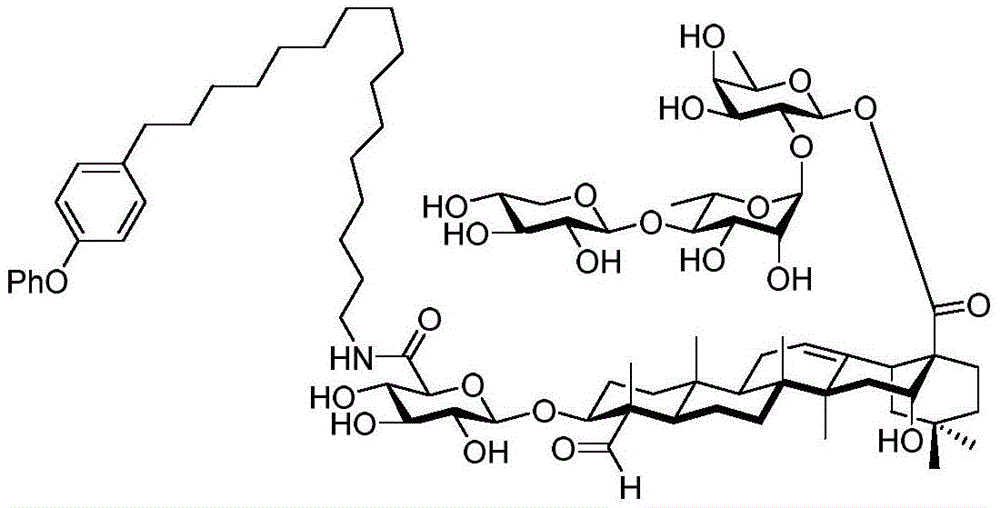
3-O- (N- (16- (4-phenoxyphen-1-yl) hexadecyl) -beta-D-glucopyranosyl uronamide) -28-O- (beta-D-xylopyranosyl- (1 → 4) -alpha-L-rhamnopyranosyl- (1 → 2) -beta-D-fucopyranosyl) soapbark acid ester (59)
Following the general procedure for bulk deprotection (HPLC column: Altima C8150 mm X4.6)mm, 5 μm, flow rate: 1mL/min) to obtain 59 as a white solid in 34% yield:1H NMR(600MHz,CD3OD)δ9.42(s,1H),8.55(s,1H),7.32(dd,J=8.5,7.5Hz,2H),7.16(d,J=8.5Hz,2H),7.07(t,J=7.5Hz,1H),6.94(d,J=8.5Hz,2H),6.89(d,J=8.5Hz,2H),5.41(d,J=1.6Hz,1H),5.31(brs,1H),5.28(d,J=8.2Hz,1H),4.50–4.47(m,2H),4.26(d,J=7.8Hz,1H),3.92–3.78(m,6H),3.68–3.63(m,3H),3.57–3.53(m,2H),3.48–3.42(m,2H),3.35–3.27(m,3H),3.24–3.16(m,3H),3.14(dd,J=9.2,7.8Hz,1H),2.97–2.92(m,1H),2.60(t,J=7.7Hz,2H),2.30(t,J=13.6Hz,1H),1.97–1.90(m,5H),1.83–1.65(m,5H),1.63–1.59(m,2H),1.56–1.43(m,5H),1.40(s,3H),1.38–1.27(m,29H),1.21(d,J=6.4Hz,3H),1.17(d,J=12.6Hz,1H),1.13(s,3H),1.09(d,J=13.4Hz,1H),1.07–1.03(m,1H),1.01(s,3H),0.97–0.92(m,4H),0.87(s,3H),0.77(s,3H);BBD 13C NMR(151MHz,CD3OD)δ209.2,177.1,171.5,159.2,156.4,144.9,139.3,130.8,130.7,124.0,123.1,112.0,119.4,106.9,105.1,101.1,95.2,84.0,83.5,78.2,77.8,76.7,76.7,76.6,76.1,74.7,74.6,73.9,73.6,73.2,72.7,72.2,71.9,71.2,68.7,67.3,56.1,50.0,49.6,48.1,48.0,42.8,42.3,41.1,40.0,37.1,36.5,36.5,36.2,33.6,33.4,32.8,31.4,30.9,30.9,30.9,30.8,30.8,30.7,30.7,30.6,30.6,30.5,30.3,28.0,27.2,26.0,24.9,24.5,21.6,18.3,17.7,16.5,16.4,10.6ppm;C81H124NO23[M+H]+HRMS (ESI-TOF) of (g) calculated 1478.8559, found 1478.8560.
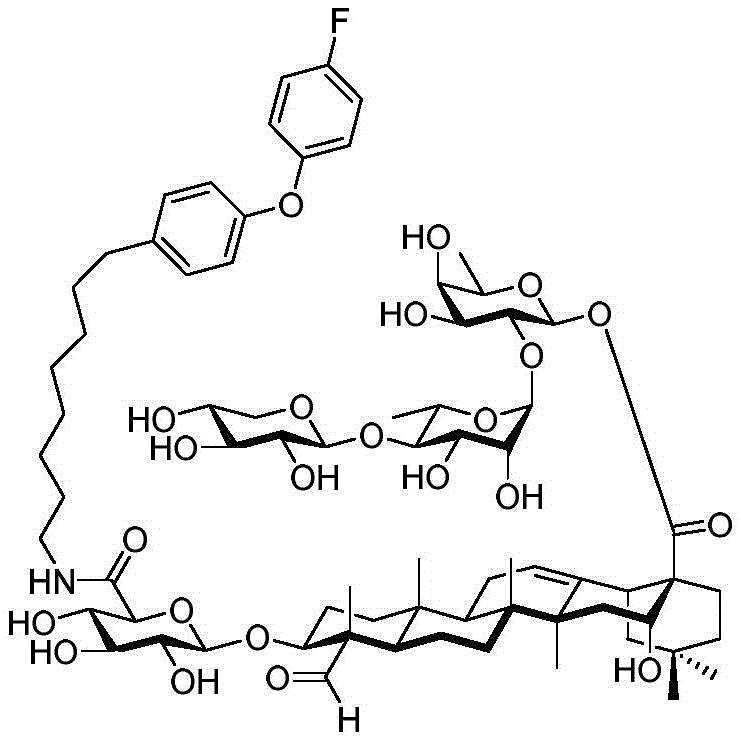
3-O- (N- (8- (4- (4-fluorophenoxy) phen-1-yl) octyl) - β -D-glucopyranosyl uronamide) -28-O- (β -D-xylopyranosyl- (1 → 4) - α -L-rhamnopyranosyl- (1 → 2) - β -D-fucopyranosyl) soapbark acid ester (60)
Following the general procedure for amide bond formation and overall deprotection, 60 was obtained as a white solid in 40% yield:1H NMR(600MHz,CD3OD)δ9.42(s,1H),7.16(d,J=8.5Hz,2H),7.09–7.04(m,2H),6.99–6.95(m,2H),6.88(d,J=8.5Hz,2H),5.41(d,J=1.6Hz,1H),5.29–5.27(m,2H),4.50–4.48(m,2H),4.26(d,J=7.8Hz,1H),3.92–3.77(m,6H),3.67–3.63(m,3H),3.57–3.52(m,2H),3.48–3.43(m,2H),3.33–3.30(m,2H),3.29–3.26(m,1H),3.23–3.17(m,3H),3.14(dd,J=9.2,7.8Hz,1H),2.93(dd,J=14.3,4.1Hz,1H),2.60(t,J=7.6Hz,2H),2.29(t,J=13.6Hz,1H),1.97–1.88(m,5H),1.83–1.64(m,5H),1.63–1.59(m,2H),1.57–1.48(m,4H),1.45(dd,J=14.7,2.4Hz,1H),1.39(s,3H),1.38–1.30(m,13H),1.21(d,J=6.4Hz,3H),1.19–1.15(m,1H),1.13(s,3H),1.11–1.07(m,1H),1.04(dd,J=13.6,3.7Hz,1H),0.99(s,3H),0.96(d,J=11.6Hz,1H),0.92(s,3H),0.85(s,3H),0.76(s,3H);13C NMR(151MHz,CD3OD)δ209.2,177.1,171.5,160.8,159.2,156.9,155.1,144.9,139.1,130.8,123.1,121.2,121.2,119.5,117.3,117.1,106.9,105.1,101.0,95.2,84.0,83.5,78.2,77.6,76.7,76.6,76.1,74.7,74.6,73.9,73.6,73.2,72.7,72.2,71.9,71.1,68.7,67.3,56.1,50.0,49.6,48.1,48.0,42.8,42.3,41.1,40.0,39.4,37.1,36.5,36.5,36.2,33.6,33.4,32.9,32.0,31.3,30.7,30.5,30.4,30.2,27.9,27.2,26.0,24.8,24.5,21.5,18.3,17.7,16.5,16.4,10.6ppm;C73H107FNO23[M+H]+HRMS (ESI-TOF) of (g) calculated 1384.7212, found 1384.7224.
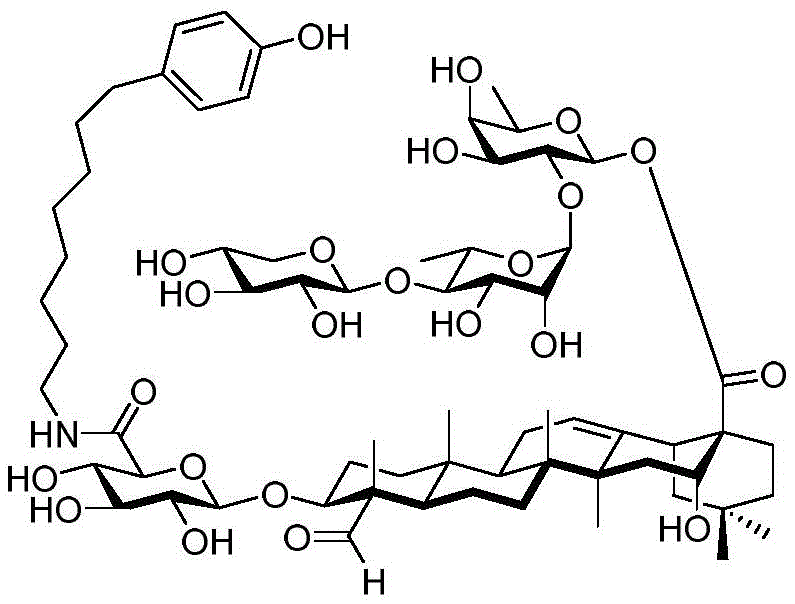
3-O- (N- (8- (4-hydroxyphenyl-1-yl) octyl) - β -D-glucopyranosyl uronamide) -28-O- (β -D-xylopyranosyl- (1 → 4) - α -L-rhamnopyranosyl- (1 → 2) - β -D-fucopyranosyl) soap sculate (61)
Following the general procedure for global deprotection, 61 was obtained as a white solid in 23% yield:1H NMR(600MHz,CD3OD)δ9.42(s,1H),8.55(s,1H),6.97(d,J=8.5Hz,2H),6.69(d,J=8.5Hz,2H),5.41(d,J=1.7Hz,1H),5.30(t,J=3.1Hz,1H),5.29(d,J=8.2Hz,1H),4.49(d,J=7.7Hz,2H),4.26(d,J=7.8Hz,1H),3.93–3.77(m,6H),3.69–3.63(m,3H),3.58–3.52(m,2H),3.49–3.41(m,2H),3.33–3.25(m,3H),3.24–3.16(m,3H),3.14(dd,J=9.2,7.8Hz,1H),2.94(dd,J=14.2,4.2Hz,1H),2.50(t,J=7.5Hz,2H),2.30(t,J=13.6Hz,1H),1.98–1.88(m,5H),1.83–1.64(m,5H),1.60–1.48(m,6H),1.47–1.43(m,1H),1.40(s,3H),1.37–1.27(m,13H),1.22(d,J=6.4Hz,3H),1.18–1.16(m,1H),1.13(s,3H),1.11–1.03(m,2H),1.00(s,3H),0.96–0.95(m,4H),0.87(s,3H),0.77(s,3H);BBD 13C NMR(151MHz,CD3OD)δ209.2,177.2,171.5,156.3,144.8,134.8,130.3,123.2,116.1,106.9,105.0,101.1,95.2,84.0,83.4,78.2,77.6,76.7,76.6,76.1,74.7,74.6,74.0,73.6,73.2,72.7,72.2,71.9,71.1,68.7,67.3,56.1,50.0,49.6,48.0,42.8,42.3,41.1,40.0,39.4,37.1,36.5,36.5,36.1,33.6,33.4,33.1,32.0,31.3,30.7,30.5,30.3,30.3,27.9,27.2,26.0,24.8,24.5,21.5,18.3,17.7,16.5,16.4,10.6ppm;C67H104NO23[M+H]+HRMS (ESI-TOF) of (g) calculated 1290.6994, found 19690.7008.
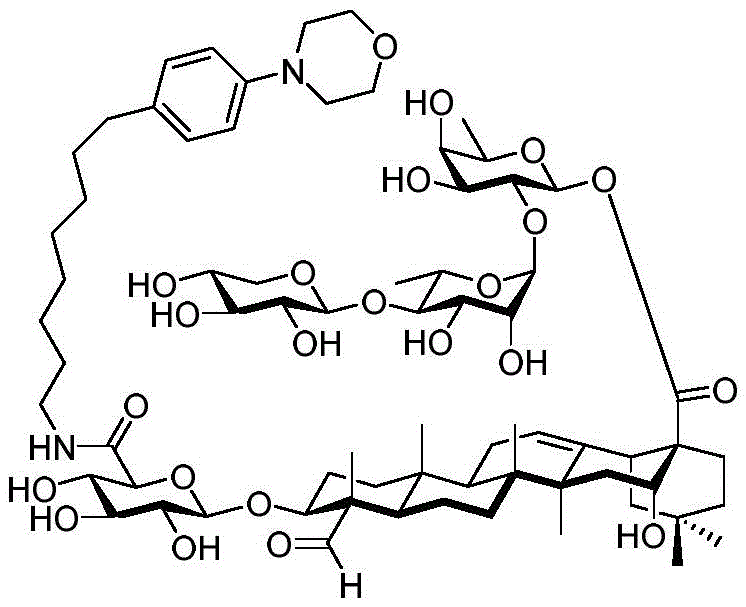
3-O- (N- (8- (4-morpholinylben-1-yl) octyl) - β -D-glucopyranosyl uronamide) -28-O- (β -D-xylopyranosyl- (1 → 4) - α -L-rhamnopyranosyl- (1 → 2) - β -D-fucopyranosyl) soapbark acid ester (62)
Following the general procedure for global deprotection, 62 was obtained as a white solid in 43% yield:1H NMR(600MHz,MeOD)δ9.42(s,1H),8.55(s,1H),7.07(d,J=8.5Hz,2H),6.90(d,J=8.5Hz,2H),5.41(d,J=1.1Hz,1H),5.31–5.27(m,2H),4.49(d,J=7.6Hz,1H),4.48(brs,1H)4.26(d,J=7.8Hz,1H),3.92–3.90(m,1H),3.89–3.77(m,9H),3.69–3.63(m,3H),3.57–3.52(m,2H),3.49–3.42(m,2H),3.33–3.26(m,3H),3.24–3.16(m,3H),3.13(dd,J=9.2,7.8Hz,1H),3.11–3.08(m,4H),2.94(dd,J=14.3,4.0Hz,1H),2.53(t,J=7.6Hz,2H),2.29(t,J=13.6Hz,1H),1.98–1.86(m,5H),1.82–1.63(m,5H),1.62–61.47(m,6H),1.47–1.43(m,1H),1.40(s,3H),1.37–1.29(m,13H),1.22(d,J=6.4Hz,3H),1.17(d,J=13.4Hz,1H),1.13(s,3H),1.11–1.02(m,2H),0.99(s,3H),0.96–0.94(m,4H),0.87(s,3H),0.76(s,3H);BBD 13C NMR(151MHz,CD3OD)δ209.2,177.1,171.5,150.9,144.8,135.9,130.0,123.1,117.4,106.9,105.1,101.1,95.1,84.0,83.6,78.2,77.6,76.7,76.6,76.1,74.7,74.6,74.0,73.6,73.2,72.7,72.2,71.9,71.1,68.7,68.0,67.3,56.1,51.4,50.0,49.6,48.1,48.0,42.8,42.3,41.1,40.0,39.4,37.1,36.5,36.5,36.1,33.6,33.4,33.0,32.0,31.3,30.8,30.5,30.3,30.2,27.9,27.2,26.0,24.9,24.1,21.5,18.3,17.8,16.5,16.4,10.6ppm;C71H111N2O23[M+H]+HRMS (ESI-TOF) of (g) calculated 1359.7572, found 1359.7580.
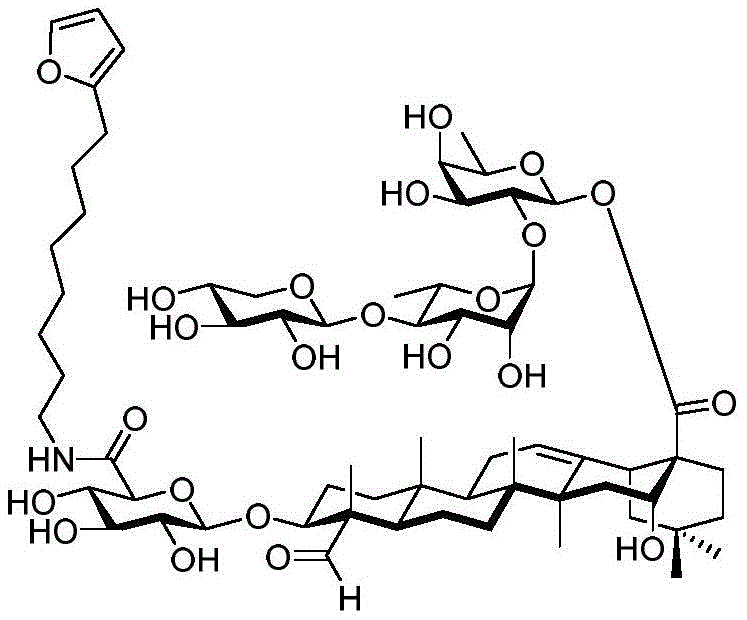
3-O- (N- (8- (furan-2-yl) octyl) -beta-D-glucopyranosyl uronamide) -28-O- (beta-D-xylopyranosyl- (1 → 4) -alpha-L-rhamnopyranosyl- (1 → 2) -beta-D-fucopyranosyl) soapbark acid ester (66)
Following the general procedure for global deprotection, 66 was obtained as a white solid in 23% yield:1H NMR(600MHz,CD3OD)δ9.42(s,1H),8.55(s,1H),7.33(d,J=1.1Hz,1H),6.30–6.26(m,1H),5.99(d,J=3.1Hz,1H),5.41(d,J=1.4Hz,1H),5.30–5.27(m,2H),4.50–4.47(m,2H),4.26(d,J=7.8Hz,1H),3.93–3.76(m,6H),3.71–3.62(m,3H),3.58–3.50(m,2H),3.48–3.42(m,2H),3.33–3.25(m,3H),3.23–3.16(m,3H),3.13(dd,J=9.0,7.8Hz,1H),2.94(dd,J=14.3,4.2Hz,1H),2.62(d,J=7.5Hz,2H),2.31(d,J=13.4Hz,1H),1.99–1.87(m,5H),1.84–1.59(m,7H),1.59–1.48(m,4H),1.45(dd,J=14.8,2.5Hz,1H),1.40(s,3H),1.37–1.30(m,13H),1.22(d,J=6.4Hz,3H),1.18(d,J=11.0Hz,1H),1.13(s,3H),1.12–1.08(m,1H),1.07–1.03(m,1H),1.01(s,3H),0.97–1.94(m,4H),0.87(s,3H),0.77(s,3H);BBD 13C NMR(151MHz,CD3OD)δ209.2,177.2,171.5,157.5,144.8,141.9,123.2,111.0,106.9,105.7,105.0,101.1,95.2,84.0,83.4,78.2,77.6,76.7,76.6,76.1,74.7,74.6,74.0,73.6,73.2,72.7,72.2,71.9,71.1,68.7,67.3,56.1,50.0,49.8,48.0,42.8,42.3,41.1,40.0,39.4,37.1,36.5,36.5,33.6,33.4,32.0,31.3,30.6,30.5,30.2,29.3,28.9,27.9,27.2,26.0,24.8,24.5,21.5,18.3,17.7,16.5,16.3,10.6ppm;C65H102NO23[M+H]+HRMS (ESI-TOF) of (g) calculated 1264.6837, found 1264.6846.
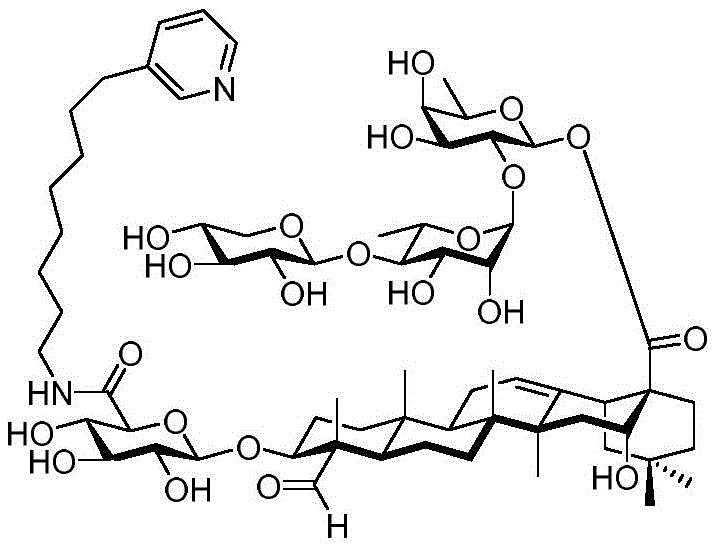
3-O- (N- (8- (pyridin-3-yl) octyl) - β -D-glucopyranosyl uronamide) -28-O- (β -D-xylopyranosyl- (1 → 4) - α -L-rhamnopyranosyl- (1 → 2) - β -D-fucopyranosyl) soapbark acid ester (68)
Following the general procedure for amide bond formation and overall deprotection, 68 was obtained as a white solid in 42% yield:1H NMR(600MHz,CD3OD)δ9.42(s,1H),8.55(s,1H),8.38(d,J=1.8Hz,1H),8.36(dd,J=4.8,1.8Hz,1H),7.70(dt,J=7.8,1.8Hz,1H),7.37(dd,J=7.7,4.8Hz,1H),5.41(d,J=1.6Hz,1H),5.29–5.27(m,2H),4.50–4.47(m,2H),4.26(d,J=7.8Hz,1H),3.92–3.77(m,6H),3.69–3.63(m,3H),3.56–3.53(m,2H),3.49–3.42(m,2H),3.33–3.25(m,3H),3.23–3.17(m,3H),3.14(dd,J=9.2,7.8Hz,1H),2.93(dd,J=14.3,4.2Hz,1H),2.67(t,J=7.6Hz,2H),2.29(t,J=13.6Hz,1H),1.98–1.87(m,5H),1.83–1.62(m,7H),1.56–1.48(m,4H),1.45(dd,J=14.7,2.4Hz,1H),1.39(s,3H),1.38–1.28(m,13H),1.22(d,J=6.4Hz,3H),1.19–1.15(m,1H),1.13(s,3H),1.10(d,J=13.5Hz,1H),1.06–1.01(m,1H),1.00(s,3H),0.96–0.94(m,4H),0.86(s,3H),0.76(s,3H);13C NMR(151MHz,CD3OD)δ209.2,177.2,171.5,170.3,150.0,147.5,144.8,140.3,138.3,130.9,125.2,123.1,106.9,105.0,101.1,95.2,84.08,83.4,78.2,77.6,76.7,76.6,76.1,74.7,74.6,74.0,73.6,73.2,72.7,72.2,71.9,71.2,68.7,67.3,56.1,50.0,49.6,48.1,48.0,42.8,42.3,41.1,40.0,39.4,37.1,36.5,36.4,33.8,33.6,33.4,32.4,32.0,31.3,30.8,30.8,30.6,30.4,30.3,30.2,27.9,27.2,26.0,24.8,24.5,21.5,18.3,17.7,16.5,16.4,10.6ppm;C66H103N2O22[M+H]+HRMS (ESI-TOF) of (g) calculated 1275.6997, found 1275.7031.
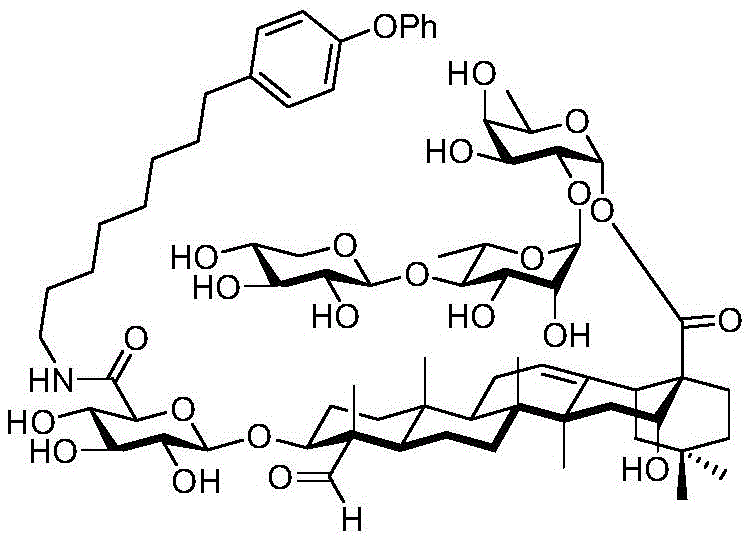
3-O- (N- (8- (4-phenoxyphenyl) octyl) -beta-D-glucopyranosyl uronamide) -28-O- (beta-D-xylopyranosyl- (1 → 4) -alpha-L-rhamnopyranosyl- (1 → 2) -alpha-D-fucopyranosyl) soapbark acid ester (56 alpha)
Following the general procedure for global deprotection, 56 α was obtained as a white solid in 47% yield:1h NMR (600MHz, MeOD) δ 9.41(s,1H, H-23),8.55(s,1H, amide NH),7.32(dd, J ═ 8.6,7.5Hz,2H),7.16(d, J ═ 8.6Hz,2H),7.07(t, J ═ 7.4Hz,1H),6.95(d, J ═ 8.5Hz,2H),6.90(d, J ═ 8.5Hz,2H),6.06(d, J ═ 3.7Hz,1H, H-1'), 5.33(t, J ═ 3.4Hz,1H, H-12),4.87(d, J ═ 1.7Hz,1H, H-1 ") 4.49(s,1H, H-16),4.42(d, 7.7H, H-1 ″,4H ″,3H ″, 3.8H ″, 3H-2H ″, 3H-7H ″, 3H-2H-7H ″, 3H-7H ″, 3H-8H-7H ″, 3H-7H-2H-7H, 7H-7H, 3H-7H-8H-7H, 3H, 7H-7H, 3H-7H, 3H-8H, 7H, 3H-7H, 7H-7H, 3H-7H, 2H, 7H-7H, 2H-7H, 2H, 7H, 2H, 7H, 2H, 7H, 3H, 7H, 3H, 2H, 7H, 3H, 2H, 7H, 3H, 7H, 3H, 7H, h-5 '), 3.85-3.80 (m,2H, H-3', H-5)a”’),3.77(dd,J=9.4,3.2Hz,1H,H-3”),3.72(d,J=3.0Hz,1H,H-4’),3.65(d,J=9.7Hz,1H,H-5””),3.53(dq,J=9.4,6.0Hz,1H,H-5”),3.49(t,J=9.4Hz,1H,H-4”),3.45–3.41(m,2H,H-4”’,H-4””),3.33–3.25(m,3H,H-3”’,H-3””,–NHC aH–),3.23–3.16(m,3H,H-2”’,H-5b”’,–NHC bH-), 3.14(dd, J ═ 9.2,7.8Hz,1H, H-2 ""), 2.98(dd, J ═ 14.3,4.1Hz,1H, H-18),2.60(t, J ═ 7.7Hz,2H, carbon chain C, 2.60 2HPh),2.26(t,J=13.7Hz,1H),2.01–1.88(m,5H,H-2a,H-11ab,H-21a,H-22a),1.83–1.74(m,3H,H-2b,H-22b,H-9),1.70(d,J=13.4Hz,1H,H-1a),1.65–1.59(m,3H,H-15aCarbon chain C 2H),1.58–1.47(m,4H,H-6a,H-7aCarbon chain C 2H),1.41–1.38(m,4H,H-15bH-27), 1.37-1.31 (m,9H, H-5, carbon chain C) 2H×4),1.24(d,J=6.0Hz,3H,H-6”),1.23–1.19(m,2H,H-6b,H-21b),1.17(d,J=6.5Hz,3H,H-6’),1.12(s,3H,H-24),1.11–1.08(m,H-1b),1.05(dd,J=11.7,4.3Hz,1H,H-19b),1.01(s,3H,H-25),0.95–0.91(m,4H,H-7b,H-30),0.87(s,3H,H-29),0.79(s,3H,H-26);13C NMR(151MHz,MeOD)δ209.1(C-23),176.8(C-28),171.5,159.2,156.5,144.7(C-13),139.1,130.8,130.7,124.0,123.4(C-12),120.0,119.4,107.1(C-1”’),105.0(C-1””),104.5(C-1”),93.0(C-1’),84.5(C-4”),83.3(C-3),78.4(C-3”’),77.6(C-3””),76.9(C-2’),76.6(C-5””),76.1(C-2”’),75.0(C-16),74.7(C-2””),73.5(C-4’),73.2(C-4””),72.5(C-3”),71.6(C-2”),71.0(C-4”’),71.0(C-3’),70.5(C-5’),68.8(C-5”),67.2(C-5”’),56.1(C-4),50.6(C-17),49.6(C-5),48.0(C-9),48.0(C-19),42.8(C-14),42.1(C-18),41.0(C-8),40.0,39.4(C-1),37.1(C-10),36.3(C-21,C-15),36.2,33.6(C-6),33.4(C-29),32.9,32.4(C-22),31.4(C-20),30.7,30.4,30.3,30.2,27.9,27.2(C-27),26.0(C-2),25.3(C-30),24.5(C-11),21.4(C-7),18.0(C-26),17.9(C-6”),16.8(C-6’),16.3(C-25),10.5(C-29)ppm;C73H108NO23[M+H]+HRMS (ESI-TOF) of (g) calculated 1366.7307, found 1366.7318.
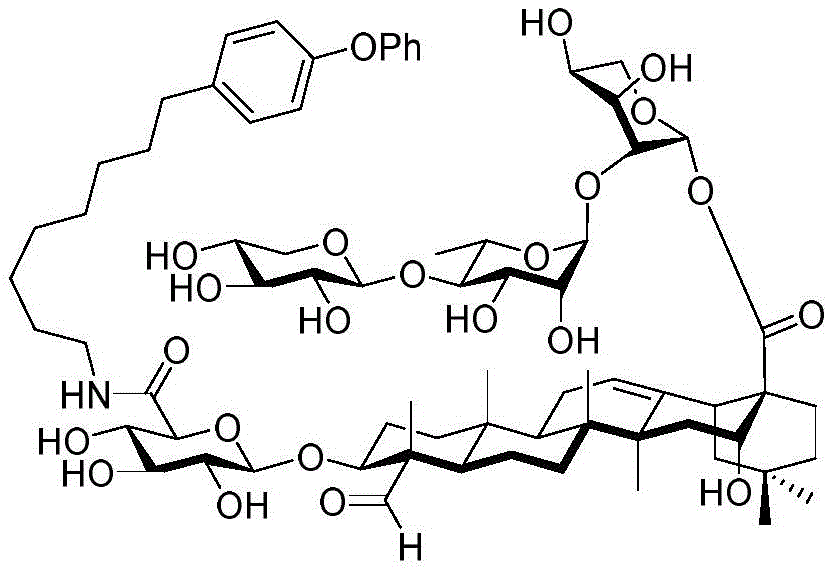
3-O- (N- (8- (4-phenoxyphenyl) octyl) -beta-D-glucopyranosyl uronamide) -28-O- (beta-D-xylopyranosyl- (1 → 4) -alpha-L-rhamnopyranosyl- (1 → 2) -beta-L-arabinopyranosyl) soapbark acid ester (77 beta)
Following the general procedure for global deprotection, 77 β was obtained as a white solid in 67% yield:1h NMR (600MHz, MeOD). delta.9.42 (s,1H, H-23),8.55(s,1H, amide NH),7.32(dd,J=8.5,7.4Hz,2H),7.16(dd,J=8.5,1.0Hz,2H),7.07(tt,J=7.6,1.0Hz,1H),6.95(d,J=8.5Hz,2H),6.90(d,J=8.5Hz,2H),5.61(d,J=3.7Hz,1H,H-1’),5.35(t,J=3.5Hz,1H,H-12),5.02(s,1H,H-1”),4.51(d,J=7.7Hz,1H,H-1”’),4.49(s,1H,H-16),4.26(d,J=7.8Hz,1H,H-1””),3.92–3.79(m,7H,H-5a’,H-3,H-3’,H-2”,H-3”,H-5a”’,H-4’),3.77(dd,J=5.2,3.7Hz,1H,H-2’),3.73–3.67(m,1H,H-5”),3.65(d,J=9.7Hz,1H,H-5””),3.57(t,J=9.1Hz,1H,H-4”),3.50–3.41(m,3H,H-5b’,H-4”’,H-4””),3.33–3.26(m,3H,H-3”’,H-3””,–NHC aH–),3.23–3.16(m,3H,H-2”’,H-5b”’,–NHC bH-), 3.14(dd, J ═ 9.2,7.8Hz,1H, H-2 ""), 3.05(dd, J ═ 14.3,4.2Hz,1H, H-18),2.60(t, J ═ 7.6Hz,2H, carbon chain C, 2.60 ″, C ″ 2HPh),2.28(t,J=13.6Hz,1H,H-19a),1.97–1.87(m,5H,H-2a,H-11ab,H-21a,H-22a),1.84–1.66(m,5H,H-2a,H-22b,H-9,H-15a,H-1a) 1.66-1.59 (m,2H, carbon chain C) 2H) 1.59-1.50 (m,3H, H-6a, carbon chain C) 2H),1.42–1.37(m,4H,H-15bH-27), 1.36-1.32 (m,9H, H-5, carbon chain C) 2H×4),1.31–1.27(m,5H,H-6b,H-7a,H-6”),1.17–1.12(m,4H,H-21b,H-24),1.12–1.07(m,1H,H-1b),1.04(dd,J=12.7,3.1Hz,1H,H-19b),1.00(s,3H,H-25),0.97–0.92(m,4H,H-30,H-7b),0.86(s,3H,H-29),0.77(s,3H,H-26);13C NMR (151MHz, MeOD) delta 209.1(C-23),176.9(C-28),171.5,159.2,156.5,144.9(C-13),139.1,130.8,130.7,124.0,123.4(C-12),120.0,119.4,106.6(C-1 '), 105.0(C-1 '), 101.3(C-1 '), 94.0(C-1 '), 83.4(C-3),83.3(C-4 '), 78.1(C-3 '), 77.6(C-3 '), 76.6(C-5 '), 76.0(C-2 '), 75.5(C-2 '), 74.7(C-2 '), 74.6(C-16),73.2(C-4 '), 72.3(C-3 '), 72.1(C-2 '), 71.1(C-3 ', C-4 '), 69.0(C-5 '), 67.2(C-5 '), 67.0(C-4 '), 67., 63.7 (C-5'), 56.1(C-4),50.2(C-17),49.6(C-5),48.1(C-9),47.7(C-19),42.8(C-14),42.1(C-18),41.1(C-8),40.0 (carbon chain)CH2) 39.4(C-1),37.1(C-10),36.4(C-21),36.3(C-15),36.2 (carbon chain)CH2) 33.5(C-6),33.4(C-29),32.9 (carbon chain)CH2) 32.0(C-22),31.4(C-20),30.7 (carbon chain)CH2) 30.5 (carbon chain)CH2) 30.3 (carbon chain)CH2) 30.3 (carbon chain)CH2) 27.9 (carbon chain)CH2),27.3(C-27),26.0(C-2),25.1(C-30),24.5(C-11),21.5(C-7),18.1(C-6”),17.9(C-26),16.4(C-25),10.6(C-24)ppm;C72H105NO23[M+H]+HRMS (ESI-TOF) of (g) calculated 1352.7150, found 1352.7167.
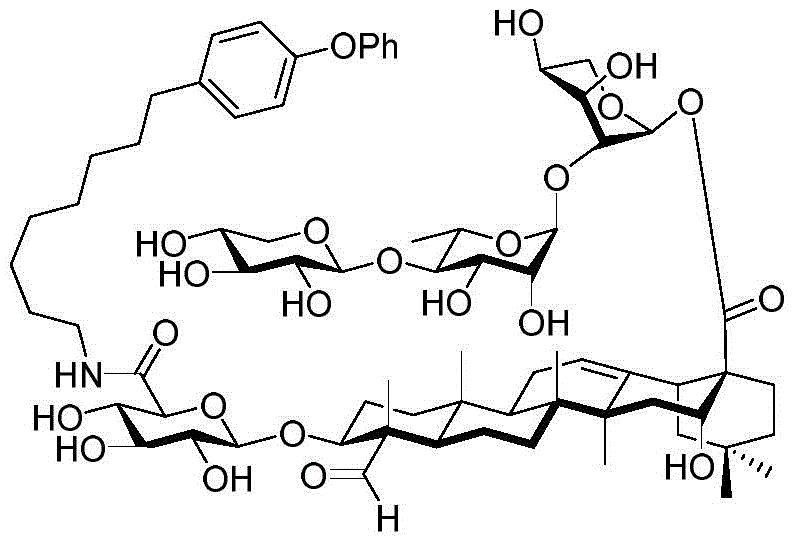
3-O- (N- (8- (4-phenoxyphenyl) octyl) -beta-D-glucopyranosyl uronamide) -28-O- (beta-D-xylopyranosyl- (1 → 4) -alpha-L-rhamnopyranosyl- (1 → 2) -alpha-L-arabinopyranosyl) soapbark acid ester (77 alpha)
Following the general procedure for global deprotection, 77 α was obtained as a white solid in 35% yield:1h NMR (600MHz, MeOD). delta.9.41 (s,1H, H-23),8.55(s,1H, amide NH),7.32(dd,J=8.6,7.4Hz,2H),7.16(d,J=8.6Hz,2H),7.07(t,J=7.4Hz,1H),6.95(d,J=8.6Hz,2H),6.90(d,J=8.6Hz,2H),6.09(d,J=3.6Hz,1H,H-1’),5.34(t,J=3.5Hz,1H,H-12),4.89(d,J=1.7Hz,H-1”)4.49(s,1H,H-16),4.43(d,J=7.7Hz,1H,H-1”’),4.26(d,J=7.8Hz,1H,H-1””),3.96(dd,J=3.1,1.7Hz,1H,H-2”),3.94(dd,J=10.1,3.6Hz,1H,H-2’),3.92–3.90(m,H-4’),3.89(dd,J=11.8,4.7Hz,1H,H-3),3.85(dd,J=10.1,3.3Hz,1H,H-3’),3.83(dd,J=11.4,5.4Hz,1H,H-5a”’),3.80–3.76(m,2H,H-5a’,H-3”),3.67(dd,J=12.4,1.8Hz,1H,H-5b’),3.65(d,J=9.7Hz,1H,H-5””),3.58–3.53(m,1H,H-5”),3.49(t,J=9.4Hz,1H,H-4”),3.46–3.41(m,2H,H-4”’,H-4””),3.33–3.26(m,3H,H-3”’,H-3””,–NHC aH–),3.23–3.12(m,4H,H-2”’,H-5b”’,H-2””,–NHC bH-), 2.98(dd, J ═ 14.4,4.2Hz,1H, H-18),2.60(t, J ═ 7.6Hz,2H, carbon chain C 2HPh),2.26(t,J=13.6Hz,1H,H-19a),2.00–1.87(m,5H,H-2a,H-11ab,H-21a,H-22a),1.83–1.78(m,2H,H-2b,H-22b),1.75(dd,J=10.9,6.7Hz,1H,H-9),1.73–1.65(m,2H,H-1a,H-15a) 1.65-1.60 (m,2H, carbon chain C) 2H),1.60–1.46(m,4H,H-6a,H-7aCarbon chain C 2H),1.43–1.38(m,4H,H-15bH-27), 1.37-1.32 (m,9H, H-5, carbon chain C) 2H×4),1.26–1.24(m,4H,H-6b,H-6”),1.21(d,J=12.5Hz,1H,H-21b),1.12(s,3H,H-24),1.10(dd,J=13.7,3.6Hz,1H,H-1b),1.05(dd,J=12.4,3.7Hz,1H,H-19b),1.01(s,3H,H-25),0.95–0.91(m,4H,H-7b,H-30),0.87(s,3H,H-29),0.77(s,3H,H-26);13C NMR (151MHz, MeOD) delta 209.0(C-23),176.8(C-28),171.5,170.3,159.2,156.5,144.5(C-13),139.2,130.8,130.7,124.0,123.5(C-12),120.0,119.4,107.1(C-1 '), 105.0(C-1 '), 104.3(C-1 '), 93.5(C-1 '), 84.4(C-4 '), 83.3(C-3),78.4(C-3 '), 77.6(C-3 '), 77.0(C-2 '), 76.6 (C-5), ' 76.1(C-2 '), 74.9(C-16),74.7(C-2 '), 73.2(C-4 '), 72.5(C-3 '), 71.6(C-2 '), 71.0(C-4 '), 70.7(C-4 '), 70.1(C-3 '), 68.8(C-5 '), 67.2(C-5 '), 67.5, C-5 ') '), 66.5 (C-5'), 56.1(C-4),50.7(C-17),49.6(C-5),48.0(C-9),47.9(C-19),42.8(C-14),42.2(C-18),41.1(C-8),40.0 (carbon chain C-8) 2H) 39.4(C-1),37.1(C-10),36.4(C-21),36.3(C-15),36.2 (carbon chain C) 2H) 33.7(C-6),33.3(C-29),32.9 (carbon chain CH) 2 ) 32.3(C-22),31.4(C-20),30.7 (carbon chain C) 2H) 30.4 (carbon chain C) 2H) 30.3 (carbon chain C) 2H) 30.2 (carbon chain C) 2H) 27.9 (carbon chain C) 2H),27.2(C-27),26.0(C-2),25.3(C-30),24.5(C-11),21.4(C-7),17.9(C-6”),17.9(C-26),16.3(C-25),10.5(C-24)ppm;C72H106NO23[M+H]+HRMS (ESI-TOF) of (g) calculated 1352.7150, found 1352.7159.
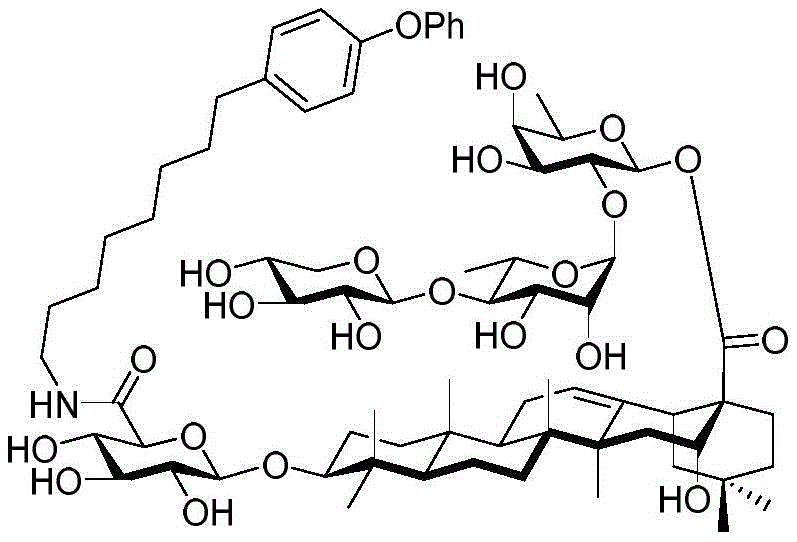
3-O- (N- (8- (4-phenoxyphenyl) octyl) -beta-D-glucopyranosyl uronamide) -28-O- (beta-D-xylopyranosyl- (1 → 4) -alpha-L-rhamnopyranosyl- (1 → 2) -beta-D-fucopyranosyl) echinocyanate ester (78)
Following the general procedure for global deprotection, 78 was obtained as a white solid in 69% yield:1h NMR (600MHz, MeOD). delta.8.55 (s,1H, amide NH),7.32(dd,J=8.6,7.4Hz,2H),7.16(dd,J=8.6,1.0Hz,2H),7.06(tt,J=7.4,1.0Hz,1H),6.95(d,J=8.6Hz,2H),6.90(d,J=8.6Hz,2H),5.41(d,J=1.7Hz,1H,H-1”),5.30–5.27(m,2H,H-12,H-1’),4.51–4.48(m,2H,H-1”’,H-16),4.40(d,J=7.8Hz,1H,H-1””),3.92(dd,J=3.3,1.7Hz,1H,H-2”),3.88–3.79(m,4H,H-5a”’,H-3”,H-2’,H-5”),3.69–3.62(m,3H,H-5””,H-3’,H-5’),3.58–3.53(m,2H,H-4”,H-4’),3.50–3.45(m,2H,H-4”’,H-4””),3.38(t,J=9.1Hz,1H,H-3””),3.35–3.28(m,2H,H-3”’,–NHC aH–),3.27–3.24(m,2H,H-2”’,H-2””),3.23–3.17(m,3H,H-3,H-5b”’,–NHC bH-), 2.93(dd, J ═ 14.3,4.2Hz,1H, H-18),2.60(m, J ═ 7.5Hz,2H, carbon chain C 2HPh),2.29(t,J=13.6Hz,1H,H-19a),1.96–1.82(m,5H,H-2a,H-11ab,H-21a,H-22a),1.80–1.66(m,3H,H-22b,H-2b,H-15a),1.66–1.55(m,5H,H-1a,H-7aH-9, carbon chain C 2H),1.55–1.49(m,3H,H-6aCarbon chain C 2H),1.48–1.41(m,2H,H-15b,H-6b) 1.40-1.36 (m,4H, H-7b, H-27), 1.36-1.32 (m,11H, H-6', carbon chain C) 2H×4),1.21(d,J=6.4Hz,3H,H-6’),1.16(dd,J=10.8,3.8Hz,1H,H-21b),1.06(s,3H,H-23),1.03(dd,J=12.1,8.9Hz,1H,H-19b),0.98(dd,J=13.4,3.5Hz,1H,H-1b),0.95(s,3H,H-25),0.92(s,3H,H-30),0.86(s,3H,H-24),0.85(s,3H,H-29),0.78(d,J=12.0Hz,1H,H-5),0.76(s,3H,H-26);13C NMR(151MHz,MeOD)δ177.1(C-28),171.7,159.2,156.5,144.8(C-13),139.1,130.8,130.7,124.0,123.4(C-12),120.1,119.4,107.0(C-1”’),106.8(C-1””),101.1(C-1”),95.2(C-1’),91.0(C-3),84.1(C-4”),78.1(C-3”’),77.8(C-3””),76.7(C-3’),76.5(C-5””),76.1(C-2”’),75.2(C-2””),74.7(C-16),74.0(C-2’),73.6(C-4’),73.4(C-4””),72.7(C-5’),72.2(C-3”),71.9(C-2”),71.1(C-4”’),68.7(C-5”),67.3(C-5”’),57.2(C-5),50.0(C-17),48.1(C-9),48.1(C-19),42.7(C-14),42.3(C-18),40.8(C-8),40.2(C-4),40.0(C-1),39.9,37.9(C-10),36.5(C-21),36.5(C-15),36.4,34.3(C-6),33.4(C-29),32.9,32.0(C-22),31.3(C-20),30.7,30.6,30.4,30.3,28.5(C-23),27.9,27.3(C-2),27.2(C-27),24.8(C-30),24.6(C-11),19.4(C-7),18.3(C-6”),17.8(C-26),17.0(C-24),16.5(C-6’),16.3(C-25)ppm;C73H110NO22[M+H]+HRMS (ESI-TOF) of (g) calculated 1352.7514, found 1352.7532.
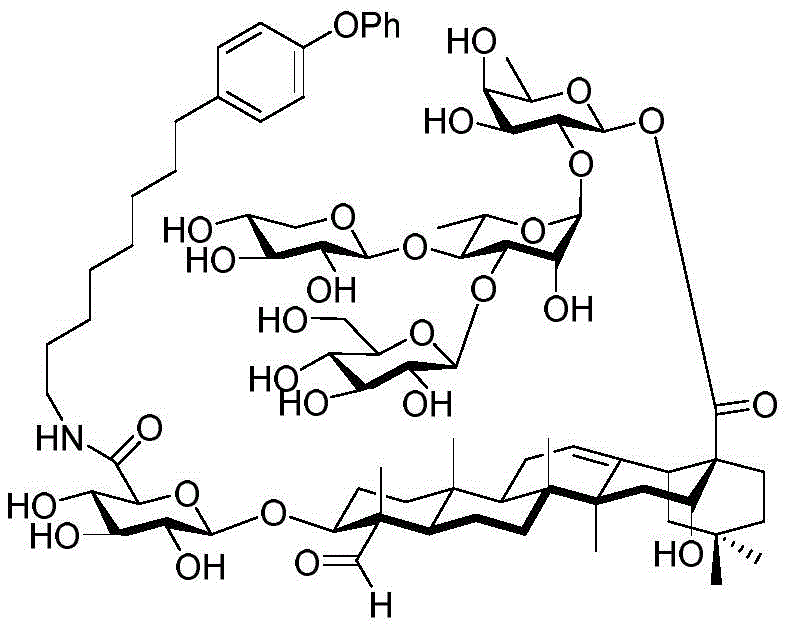
3-O- (N- (8- (4-phenoxyphenyl) octyl) -beta-D-glucopyranosyl uronamide) -28-O- (beta-D-glucopyranosyl- (1 → 3) - (beta-D-xylopyranosyl- (1 → 4)) -alpha-L-rhamnopyranosyl- (1 → 2) -beta-D-fucopyranosyl) soapbark acid ester (79)
Following the general procedure for global deprotection, 79 was obtained as a white solid in 33% yield: 1H NMR (600MHz, MeOD). delta.9.42 (s,1H, H-23),8.55(s,1H, amide NH),7.32(dd,J=8.5,7.5Hz,2H),7.17(d,J=8.5Hz,2H),7.07(t,J=7.5Hz,1H),6.95(d,J=8.5Hz,2H),6.90(d,J=8.5Hz,2H),5.29(s,1H,H-12),5.26(d,J=8.1Hz,1H,H-1’),5.23(s,1H,H-1”),4.70(d,J=7.9Hz,1H,H-1””),4.53(d,J=7.3Hz,1H,H-1”’),4.46(s,1H,H-16),4.27–4.25(m,2H,H-2”,H-1””’),3.95(dd,J=9.5,3.0Hz,1H,H-3”),3.90–3.81(m,4H,H-5”,H-3,H-6a”’,H-5a””),3.74(dd,J=10.2,8.1Hz,1H,H-2’),3.71–3.60(m,5H,H-4”,H-6b”’,H-5””’,H-5’,H-3’),3.55(d,J=2.6Hz,1H,H-4’),3.49–3.41(m,2H,H-4””,H-4””’),3.33–3.25(m,7H,H-2”’,H-3”’,H-4”’,H-5”’,H-3””,H-3””’,–NHC aH–),3.23–3.08(m,4H,H-2””,H-5b", H-2" "'), 2.95-2.88 (m,1H, H-18),2.60(t, J ═ 7.6Hz,2H, carbon chain C 2HPh),2.28(t,J=13.6Hz,1H,H-19a),1.98–1.86(m,5H,H-2a,H-21a,H-22a,H-11ab),1.86–1.77(m,2H,H-22b,H-2b),1.76–1.67(m,3H,H-9,H-15a,H-1a) 1.65-1.59 (m,2H, carbon chain C) 2H),1.58–1.48(m,4H,H-6a,H-7aCarbon chain C 2H),1.41–1.38(m,4H,H-15bH-27), 1.37-1.31 (m,9H, H-5, carbon chain C) 2H×4),1.30–1.26(m,4H,H-6b,H-6”),1.21(d,J=6.3Hz,3H,H-6’),1.16(d,J=11.2Hz,1H,H-21b),1.14(s,3H,H-24),1.10(d,J=16.7Hz,2H,H-1b),1.04(d,J=10.1Hz,1H,H-19b),1.00(s,3H,H-25),0.96–0.94(m,1H,H-7b),0.93(s,3H,H-30),0.85(s,3H,H-29),0.79(s,3H,H-26);13C NMR(151MHz,MeOD)δ209.4(C-23),177.2(C-28),171.5,159.2,156.5,144.8(C-13),139.2,130.8,130.7,124.0,123.1(C-12),120.0,119.4,105.4(C-1”’),105.1(C-1””’),105.0(C-1””),101.5(C-1”),95.4(C-1’),83.5(C-3),83.0(C-3”),78.7(C-4”),78.6(C-3”’),78.3(C-3””),77.8(C-2”’),77.6(C-3””’),76.6(C-5””’),75.9(C-3’),75.7(C-2””),75.3(C-4”’),74.9(C-2’),74.8(C-16),74.7(C-2””’),73.5(C-4’),73.2(C-4””’),72.7(C-5’),71.5(C-4””),71.3(C-2”),71.1(C-5”’),69.1(C-5”),67.0(C-5””),62.4(C-6”’),56.1(C-4),49.9(C-17),49.5(C-5),48.1(C-19),48.0(C-9),42.8(C-14),42.4(C-18),41.1(C-8),40.0,39.4(C-1),37.1(C-10),36.5(C-15,C-21),36.2,33.8(C-6),33.4(C-29),32.9,31.8(C-22),31.3(C-20),30.7,30.5,30.4,30.3,27.9,27.3(C-27),26.0(C-2),24.9(C-30),24.5(C-11),21.4(C-7),18.6(C-6”),17.8(C-26),16.5(C-6’),16.4(C-25),10.6(C-24);C79H118NO28[M+H]+HRMS (ESI-TOF) of (g) calculated 1528.7835, found 1528.7847.
Synthesis example II
The protopanagenin is coupled with a trisaccharide.
Given the lengthy process of conjugation of glucuronate to quillajate, we further applied a semi-synthetic approach to obtain saponin cores. Hydrolysis of C-28 linked oligosaccharides by the starter Quillaja Ultra Dry100-Q (Desert kit, batch: QDU-100-. After triethylsiliconization and selective benzylation, the pro-sapogenin core is provided in three steps (scheme 7).
Scheme 7-isolation and selective protection of the branched trisaccharide-triterpenoid saponins.
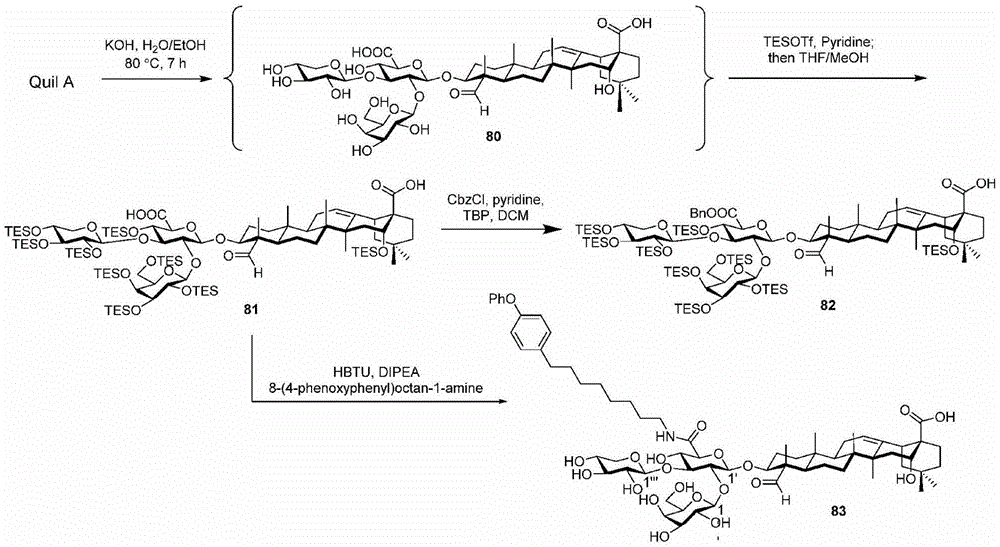
(procedure 7)
Diversified linkers are formed on the amide bond of the protosapogenin.
The coupling of trisaccharides with the pro-sapogenins can be easily achieved to provide a saponin core. The target saponin with a diversified carbon chain is provided through deprotection and amido bond formation.
Scheme 8-demonstrates the preparation of saponin analogs according to embodiments of the invention.
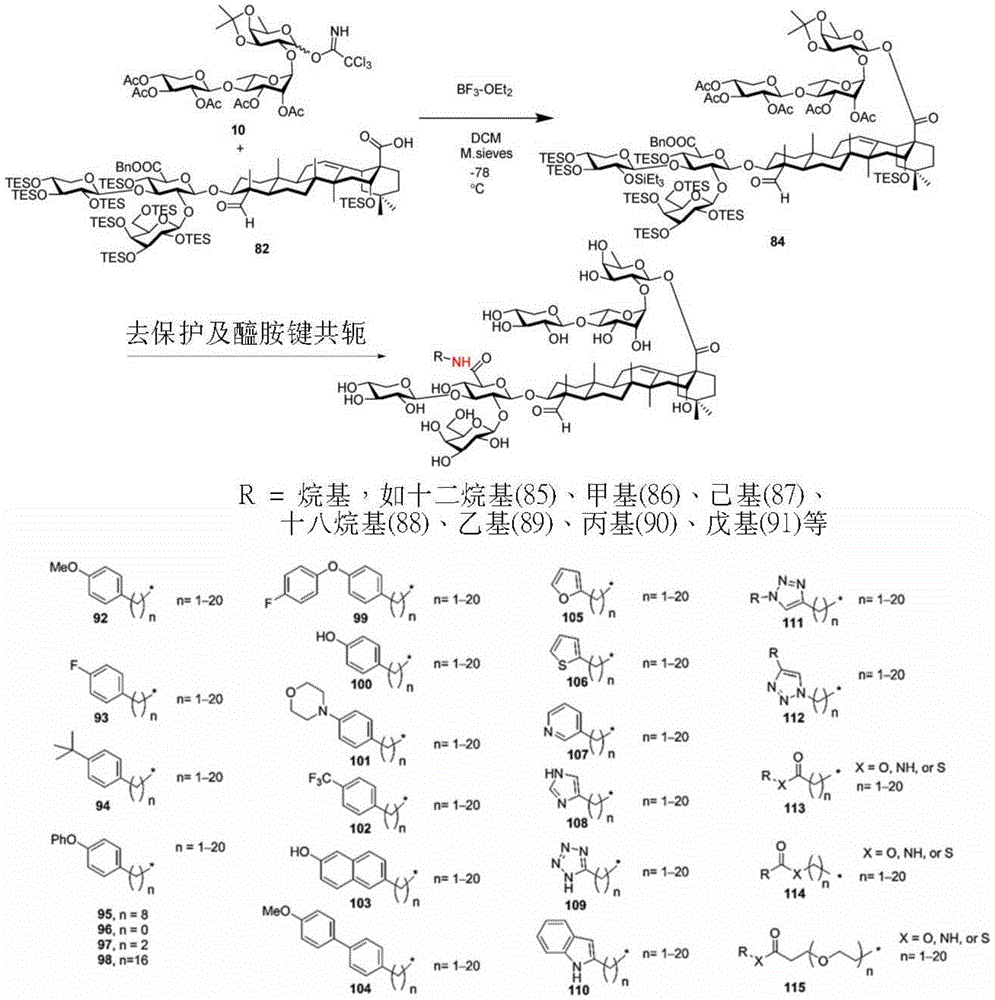
(procedure 8)
Details of the experiment
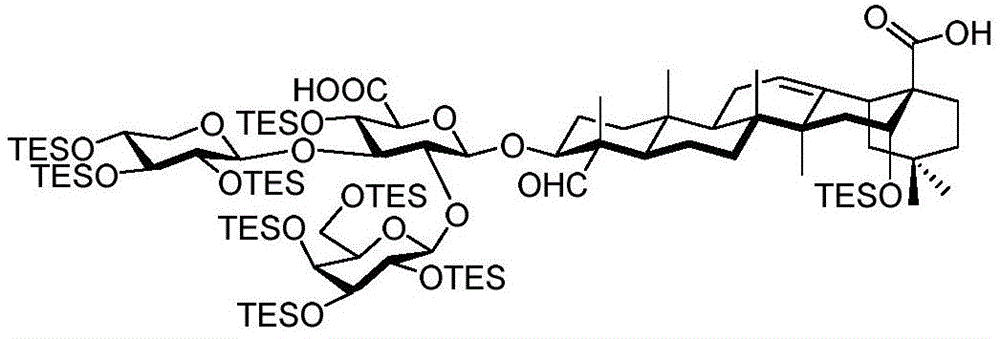
3-O- (2,3,4, 6-tetra-O-triethylsilyl- β -D-galactopyranosyl- (1 → 2) - (2,3, 4-tri-O-triethylsilyl- β -D-xylopyranosyl- (1 → 3)) -3-O-triethylsilyl- β -D-glucuronic acid)) -16-O-triethylsilyl soapic acid (81)
At room temperature and N2TESOTf (5.0mL,22.1mmol) was added to a stirred suspension of the prosapogenin (1.72g) in anhydrous pyridine (25mL) under a gaseous atmosphere. The reaction mixture was stirred for 2 days, then TESOTF (1.3mL,5.8mmol) was added, then 1 more time after 24 hours (1.0mL,4.4 mmol). The reaction mixture was stirred for a total of 5 days. The resulting mixture was concentrated and passed through a silica gel column eluting with hexane/EtOAc (2: 1). The eluate was concentrated and dried under reduced pressure to give a yellow oil. The resulting yellow oil was dissolved in MeOH/THF (1:1) (80mL) and the solution was stirred at room temperature for 3 days. The reaction mixture was concentrated under reduced pressure and then purified by column chromatography (silica gel, EtOAc/hexanes 1/6 to 1/4) to give 81(0.66g,. about.19%) as a white solid foam. Rf0.47 (EtOAc/benzene ═ 1/4);1H NMR(600MHz,CDCl3)δ9.68(s,1H),5.35(br.s,1H,H-12),4.56(br.s,1H,H-16),4.54(d,J=7.4Hz,1H,H-1”'),4.42(d,J=7.4Hz,1H,H-1”),4.41(d,J=6.4Hz,1H,H-1'),3.96-3.88(m,4H,H-4”,H-3',H-5',H-3”),3.84-3.82(m,2H,H-5a”',H-2'),3.77(t,J=9.2Hz,1H,H-6a”),3.65-3.61(m,3H,H-3,H-2”,H-6b”),3.52-3.49(m,1H,H-4”'),3.53-3.51(m,1H,H-4'),3.42-3.35(m,2H,H-3”',H-5”),3.27(t,J=7.8Hz,1H,H-2”'),3.12(t,J=10.7Hz,1H,H-5”'),2.96(dd,J=13.3Hz,J=3.1Hz,1H,H-18),2.22(t,J=13.8Hz,1H,H-19),1.92-1.86(m,4H),1.84-1.71(m,4H),1.68(t,J=8.9Hz,1H,H-19a),1.63-1.31(m,1H,H-1),1.57-1.50(m,1H),1.49-1.41(m,2H,H-6),1.39-1.36(m,5H,H-5,H-27),1.29-1.25(m,5H,H-15,H-24),1.12-1.15(m,2H,H-21),1.11-1.07(m,1H,H-9),1.04-0.94(m,94H),0.91(s,3H,H-29),0.75-0.62(m,54H)ppm;C101H199O20Si9[M+H]+HRMS (ESI-TOF) of (g) calculated 1986.2504, found 1986.3361.
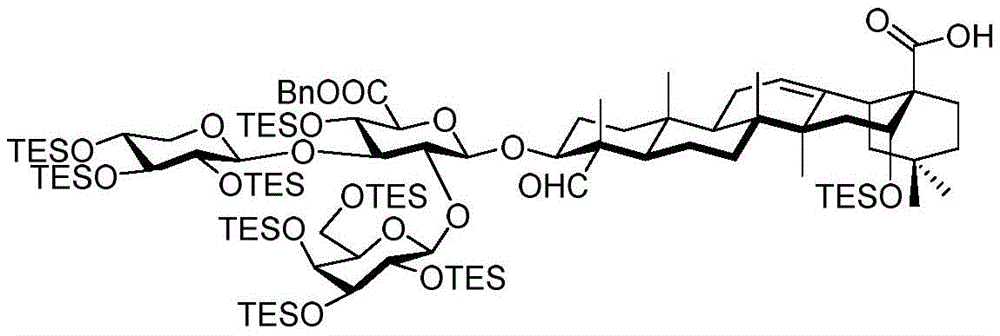
3-O- (benzyl 2,3,4, 6-tetra-O-triethylsilyl- β -D-galactopyranosyl- (1 → 2) - (2,3, 4-tri-O-triethylsilyl- β -D-xylopyranosyl- (1 → 3)) -3-O-triethylsilyl- β -D-glucopyranosyl uronate)) -16-O-triethylsilyl soap-acid (82)
In N2CBzCl (47. mu.L, 0.33mmol) to 81(253mg, 127. mu. mol), TBP (319mg,1.29mmol) and anhydrous pyridine (94. mu.L, 1.2mmol) were added in CH under a gas atmosphere2Cl2(2.2mL) in stirred suspension. After 14 hours the reaction was complete, the reaction mixture was concentrated under reduced pressure. The residue was purified by column chromatography (silica gel; EtOAc/hexanes 1/20 to 1/10) to give 82(207mg, 65%) as a white solid foam. Rf0.74 (EtOAc/benzene ═ 1/9);1H NMR(400MHz,CDCl3)δ9.68(s,1H),7.33-7.29(m,5H),5.31(br.s,1H,H-12),5.23(d,J=12.4Hz,1H Bn CH 2),5.07(d,J=12.0Hz,1H Bn CH 2),4.53(d,J=7.6Hz,1H,H-1”'),4.51(br.s,1H,H-16),4.40(d,J=7.2Hz,1H,H-1”),4.12(d,J=7.2Hz,1H,H-1'),3.93-3.79(m,4H,H-4”,H-3',H-5',H-3”),3.878-3.74(m,2H,H-5a”',H-2'),3.72(t,J=9.1Hz,1H,H-6a”),3.61-3.52(m,3H,H-3,H-2”,H-6b”),3.49-3.42(m,1H,H-4”'),3.40-3.35(m,1H,H-4'),3.39-3.29(m,2H,H-3”',H-5”),3.23(t,J=7.7Hz,1H,H-2”'),3.11(t,J=11.0Hz,1H,H-5b”'),2.91(dd,J=13.8Hz,J=3.6Hz,1H,H-18),2.19(t,J=13.6Hz,1H,H-19),1.89-1.79(m,4H),1.55-1.45(m,4H),1.42-1.30(m,5H,H-5,H-27),1.30-1.23(m,5H,H-15,H-24),1.16-1.09(m,2H,H-21),1.08-1.01(m,1H,H-9),1.00-0.90(m,94H),0.88(s,3H,H-29),0.73-0.57(m,54H)ppm;C108H204O20Si9Na[M+Na]+HRMS (ESI-TOF) of (g) calculated 2099.2803, found 2099.3005.
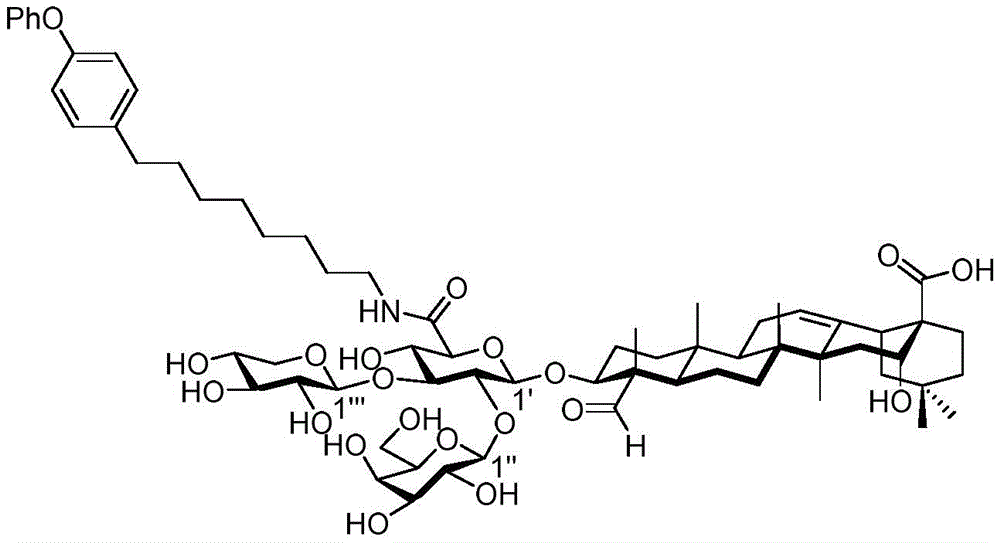
3-O- (N- (8- (4-phenoxyphenyl) octyl) -beta-D-galactopyranosyl- (1 → 2) - (beta-D-xylopyranosyl- (1 → 3)) -beta-D-glucopyranosyl uronamide) -soapic acid (83)
In N2DIPEA (5. mu.L, 25. mu. mol), 8- (4-phenoxyphenyl) octan-1-amine (4mg, 14. mu. mol) were added sequentially to a stirred suspension of sapondic acid (26mg, 13. mu. mol) and HBTU (7mg, 25. mu. mol) in anhydrous THF (1mL) under a gas atmosphere. After 1 hour the reaction was complete, the reaction mixture was concentrated under reduced pressure and taken up with CH2Cl2Diluting with H2O twice, brine and MgSO 44Dried and then concentrated under pressure. The residue was then purified by flash column (silica gel, EtOAc/hexanes 1/20 to 1/10). The crude product was then dissolved in 1mL THF and stirred at pH 1 under acidic conditions for 6 hours. With NaHCO3After neutralization, the mixture was filtered through a 0.22 μm filter plate, the filtrate was concentrated and then purified by HPLC (HPLC column: SUPELCO Ascentis C1825 cm X10 mm, 5 μm; mobile phase: 20% ACN/H in 20 min2O is increased to 90% ACN/H2Gradient of O, then 90% ACN/H2O, isocratic for 15 minutes; flow rate: 4mL/min) in 80% yieldFor product 83(2mg) as a white solid:1H NMR(600MHz,CD3OD)δ9.44(s,1H,H-23),7.32(t,J=7.7Hz,2H),7.16(d,J=8.3Hz,2H),7.07(t,J=7.2Hz,1H),6.95(d,J=8.2Hz,2H),6.90(d,J=8.2Hz,1H),5.28(br.s,1H,H-12),4.79(d,J=7.1Hz,1H,H-1”),4.45(s,1H,H-16),4.57(d,J=7.7Hz,1H,H-1”'),4.43(d,J=7.4Hz,1H,H-1'),3.89(dd,J=11.5&5.5Hz,1H,H-3),3.85(dd,J=11.8&4.4Hz,1H,H-5a”'),3.81(d,J=2.5Hz,1H,H-4”)3.75(d,J=6.2Hz,2H,H-6”),3.70-3,63(m,4H,H-2”',H-2',H-5',H-3'),3.56-3.41(m,5H,H-2”,H-3',H-4',H-5”,H-4”'),3.26-3.19(m,4H,H-3”',H-5b”',-NHC 2H-),3.00(dd,J=14.1Hz&4.1Hz,1H, H-18),2.60(t, J ═ 7.6Hz,2H, carbon chain C 2HPh),2.29(t,J=13.4Hz,1H,H-19a),1.99-1.87(m,5H),1.80-1.72(m,3H),1.71-1.66(m,1H),1.65-1.60(m,2H),1.55-1.49(m,3H),1.38(s,1H,H-27),1.36-1.29(m,14H),1.15(s,3H,H-23),1.02(m=3H),0.98(s,3H,H-25),0.95(s,3H,H-30),0.86(s,3H,H-24),0.78(s,3H,H-26)ppm;C67H97NO20Na[M+Na]+HRMS (high resolution Mass Spectrometry)+(ESI-TOF) calculated 1258.6496, found 1258.6510.
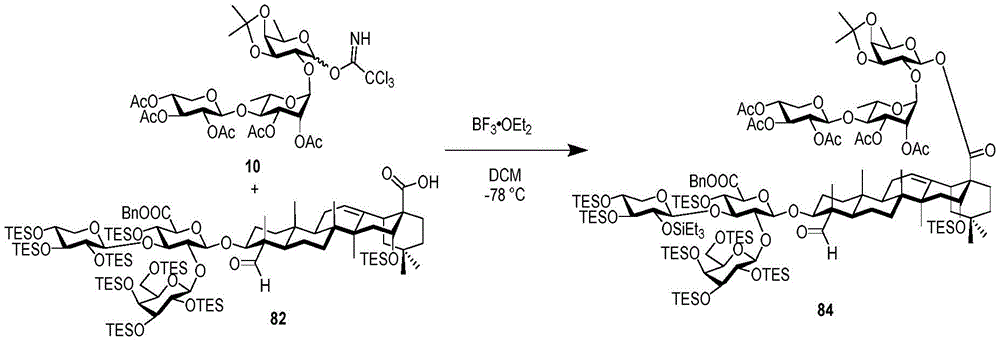
3-O- (benzyl 2,3,4, 6-tetra-O-triethylsilyl- β -D-galactopyranosyl- (1 → 2) - (2,3, 4-tri-O-triethylsilyl- β -D-xylopyranosyl- (1 → 3)) - (3-O-triethylsilyl- β -D-glucopyranosyl uronate)) -28-O- (2,3, 4-tri-O-acetyl- β -D-xylopyranosyl- (1 → 4) -2, 3-di-O-acetyl- α -L-glucopyranosyl rhamnosyl- (1 → 2) -3, 4-O-isopropylidene-beta-D-fucopyranosyl) -16-O-triethylsilyl soap-skin acid ester (84)
At-75 ℃ and N2Addition of BF in a gaseous atmosphere3·OEt2(about 48%, 4. mu.L, 24. mu. mol) to 10(68.8mg, 83.6. mu. mol), 82(130mg, 62.3. mu. mol) and activation Molecular sieve powder inAnhydrous CH2Cl2(3.0mL) in stirred suspension. After completion of the reaction after 0.5 hours, Et was used3The reaction was quenched with N and warmed to room temperature. Subjecting the obtained mixture to CH2Cl2Diluted and filtered through 5 μm filter paper. The resulting filtrate was concentrated under reduced pressure. By column chromatography (silica; EtOAc/CH)2Cl2Hexanes-1/1/6-1/1/4) the residue was purified to give 84(160mg, 93%) as a white solid foam. Rf0.63 (EtOAc/hexanes-1/1);1H NMR(600MHz,CDCl3)δ9.67(s,1H),7.32-7.29(m,5H),5.38(d,J=7.4Hz,1H,H-1””),5.30(t,J=3.7 1H,H-12),5.26(d,J=12.0Hz,1H Bn CH 2),5.23-5.21(m,1H,H-2””'),5.19(dd,J=9.8Hz,J=3.5Hz,1H,H-3””'),5.07(d,J=12.4Hz,1H Bn CH 2),4.97(d,J=0.8Hz,1H,H-1””'),4.93(dt,J=9.2Hz,J=5.5Hz,1H,H-4”””),4.83(dd,J=9.2Hz,J=5.5Hz,1H,H-2”””),4.61(d,J=7.8Hz,1H,H-1”””),4.53(d,J=7.8Hz,1H,H-1”'),4.46(s,1H,H-16),4.39(d,J=7.2Hz,1H,H-1”),4.17-4.14(m,2H,H-1',H-3””),4.12-4.07(m,2H,H-3',H-5a”””),3.99(dd,J=5.8Hz,J=1.9Hz,1H,H-4””),3.91-3.88(m,2H,H-4',H-5'),3.86-3.81(m,3H,H-4”,H-5””,H-3”),3.81-3.75(m,3H,H-5”',H-5a”',H-2'),3.72(t,J=9.2Hz,1H,H-6a”),3.66-3.60(m,2H,H-2””,H-5””'),3.59-3.53(m,3H,H-2”,H-6b”,H-3),3.47-3.42(m,1H,H-4”'),3.36(dd,J=9.4Hz,J=2.2Hz,1H,H-4””),3.34-3.29(m,3H,H-3”',H-5”,H-5b”””),3.22(t,J=7.4Hz,1H,H-2”'),3.10,(t,J=11.0Hz,1H,H-5b"'), 2.90(dd, J ═ 14.1Hz, J ═ 3.7Hz,1H, H-18),2.21(t, J ═ 13.7Hz,1H, H-19),2.11(s,3H),2.04(s,3H),2.01(s,3H),1.99(s,3H),1.95(s,3H),1.83-1.77(m,4H, H-11, H-22),1.76-1.62(m,4H),1.62-1.55(m,3H),1.52(s,3H, H-27),1.50-1.47(m,1H),1.33(s,1H, H-5),1.31(s,6H, isopropylidene C, isopropylideneH 3),1.27(s,3H,H-24),1.26-1.25(m,3H,H-6””),1.25-1.24(d,3H,H-6””'),1.24-1.22(m,4H),0.98-0.91(m,94H),0.91-0.89(m,10H,H-1,H-7,H-15,H-20),0.69-0.56(m,54H)ppm;C138H246O37Si9Na[M+Na]+HRMS (high resolution Mass Spectrometry)(ESI-TOF) calculated 2772.5224, found 2772.5586.
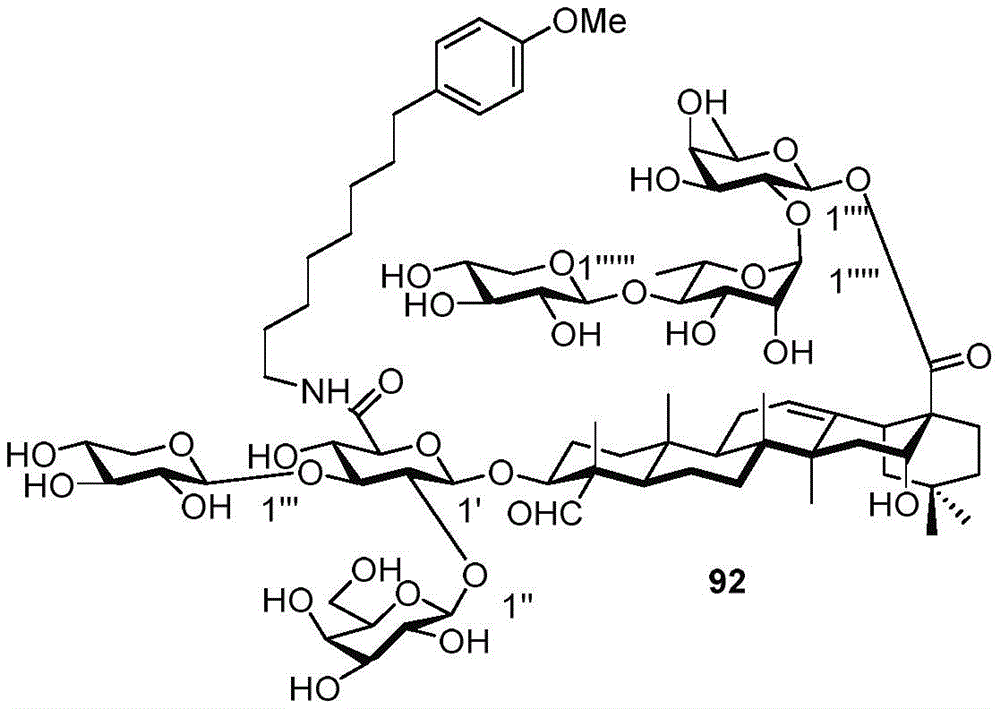
3-O- { β -D-galactopyranosyl- (1 → 2) - [ β -D-xylopyranosyl- (1 → 3) ] - [ N- (8- (4-methoxyphenyl) octyl) - β -D-glucopyranosyl uronamide ] } -28-O- [ β -D-xylopyranosyl- (1 → 4) - α -L-rhamnopyranosyl- (1 → 2) - β -D-fucopyranosyl ] soapbark acid ester (92)
In N2DIPEA (10. mu.L, 58. mu. mol) was added to a stirred suspension of 50(8mg, 6. mu. mol), 8- (4-methoxyphenyl) octan-1-amine (13mg, 58. mu. mol) and HBTU (22mg, 58. mu. mol) in anhydrous DMA (0.5mL) under a gaseous atmosphere. After 24 hours the reaction was complete, the reaction mixture was concentrated under reduced pressure, diluted with MeOH and then filtered through 5 μm filter paper. The filtrate was concentrated and then purified by HPLC (HPLC column: SUPELCO Ascentis C1825 cm X10 mm, 5 μm; mobile phase: 30% ACN/H in 20 min2O is increased to 80% ACN/H2Gradient of O, then 90% ACN/H2O, isocratic for 15 minutes; flow rate: 5mL/min) to provide product 51b (2mg) as a white solid in 30% yield; c79H123NO32Na[M+Na]+HRMS (ESI-TOF) of (g) calculated 1620.7920, found 1620.7920.
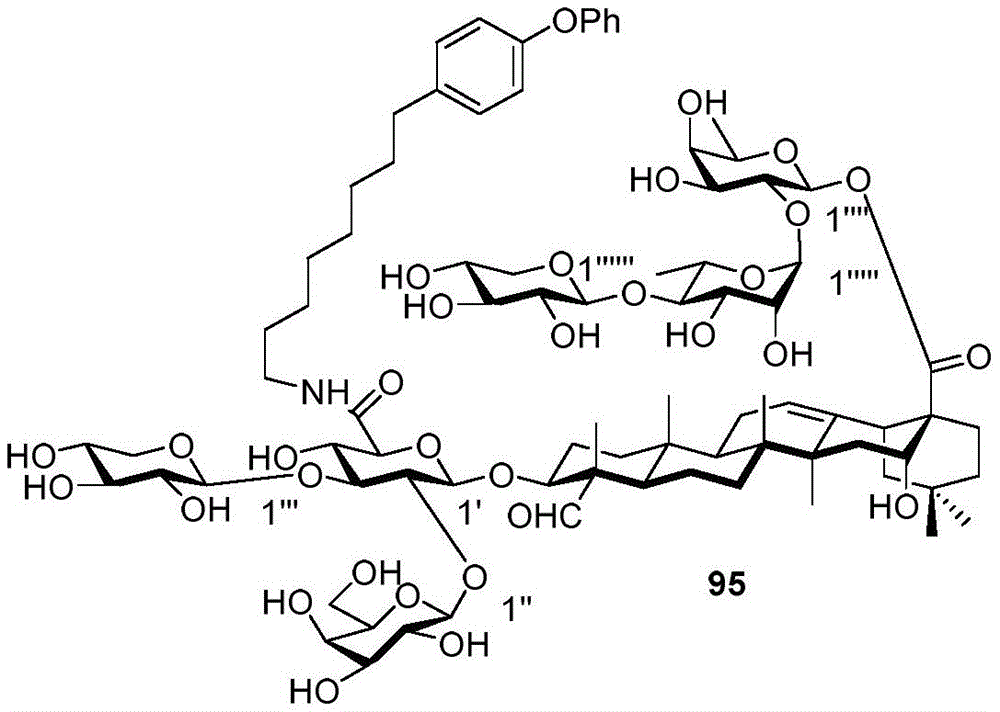
3-O- { β -D-galactopyranosyl- (1 → 2) - [ β -D-xylopyranosyl- (1 → 3) ] - [ N- (8- (4-phenoxyphenyl) octyl) - β -D-glucopyranosyl uronamide ] } -28-O- [ β -D-xylopyranosyl- (1 → 4) - α -L-rhamnopyranosyl- (1 → 2) - β -D-fucopyranosyl ] soapbark acid ester (95)
In N2DIPEA (6. mu.L, 40. mu. mol) to 50(5mg, 4. mu. mol), 8- (4-phenoxyphenyl) octan-1-amine (10mg, 40. mu. mol) and HBTU (12mg, 40. mu. mol) were added under a gas atmosphere to a stirred suspension of anhydrous DMA (0.5 mL). After the reaction was complete after 24 hours, the reaction mixture was reducedConcentrate under pressure, dilute with MeOH, then filter through 5 μm filter paper. The filtrate was concentrated and then purified by HPLC (HPLC column: SUPELCO Ascentis C1825 cm X10 mm, 5 μm; mobile phase: 20% ACN/H in 20 min2O is increased to 90% ACN/H2Gradient of O, then 90% ACN/H2O, isocratic for 15 minutes; flow rate: 2.4mL/min) to provide product 51a (2mg) as a white solid in 80% yield:1H NMR(600MHz,CD3OD) delta 9.45(s,1H, H-23),8.54(s,1H, amide NH),7.33(dd,J=8.5Hz&7.6Hz,2H),7.18(d,J=8.5Hz,2H),7.08(t,J=7.4Hz,1H),6.95(d,J=7.8Hz,2H),6.91(d,J=8.5Hz,1H),5.37(d,J=1.5Hz,1H,H-1””'),5.28(t,J=3.4Hz,1H,H-12),5.27(d,J=8.2Hz,1H,H-1””),4.79(d,J=7.1Hz,1H,H-1”),4.62(s,1H,H-16),4.57(d,J=7.7Hz,1H,H-1”'),4.47(d,J=7.7Hz,1H,H-1”””),4.43(d,J=7.4Hz,1H,H-1'),3.93(m,1H,H-2””'),3.89(m,1H,H-5a”'),3.82(m,6H,H-4”,H-2””,H-3””,H-3””',H-5””',H-5a”””),3.75(m,2H,H-6”),3.69(m,1H,H-2”'),3.65(m,5H,H-2',H-5',H-3”,H-4””,H-5””),3.49(m,9H,H-3,H-3',H-4',H-5”,H-4”',H-3””',H-4””',H-2”””,H-4”””),3.22(m,6H,H-2”,H-3”',H-5b”',H-3”””,H-5b”””,-NHC aH-),2.95(m,2H,H-18,-NHC bH-, 2.60(t, J ═ 7.6Hz,2H, carbon chain C 2HPh),2.29(t,J=13.4Hz,1H,H-19a),1.95(m,2H),1.90(m,4H),1.76(m,3H),1.69(m,2H),1.63(m,4H),1.53(m,3H),1.46(m,3H),1.38(s,1H,H-27),1.34(m,13H),1.30(m,11H),1.20(d,J=6.4Hz,3H,H-6””'),1.16(s,3H,H-23),1.15(m,1H),1.08(m,3H),0.98(s,3H,H-25),0.92(s,3H,H-30),0.90(m,2H),0.86(s,3H,H-24),0.74(s,3H,H-26);C84H125NO32Na[M+Na]+HRMS (ESI-TOF) of (g) calculated 1682.8077, found 1682.8079.
6-N-glycosyl soapbark ester
Conjugation of the soap-corticoid to azido-glucose successfully yielded product 117 in 70% yield. Interestingly, the results indicate the selectivity of 3-O glycosylation at the 16-O position.
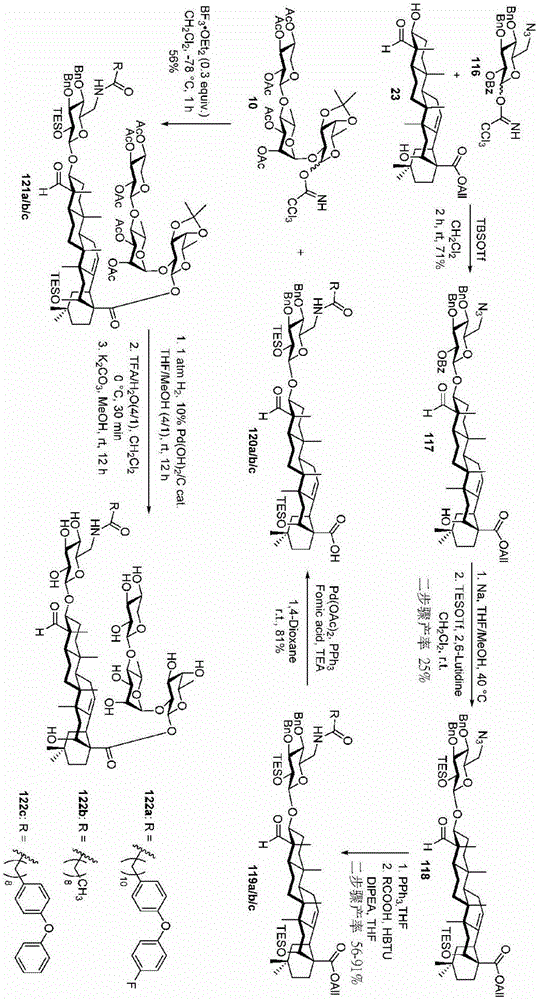
With glycoside 117, a further modification was made to unmask the C-28 carboxylic acid. First, benzoyl is hydrolyzed under basic conditions and at elevated temperatures. Surprisingly, under the harsh environment of such strong bases, 28-O-allyl esters are not affected. After triethylsiliconization of the resulting azido glycoside, the azido group is reduced to an amine, which is then formed into an amide by coupling with a lipophilic long chain acid to give the fully protected soap-ic ester 119 a/b/c. In a low acid environment with Pd (OAc)2Catalytic hydrolysis of O-allyl esters 119a/b/c to give glycoside receptors 120 a/b. Conjugation of monobasic acid 120a/b/c with trisaccharide 10 at-78 ℃ with Lewis acid catalysis gave 121a/b/c in 56% yield. At H2Reacting completely protected saponin 121a/b/c with Pd (OH) under gas atmosphere2Suspended in THF/MeOH to hydrolyze the benzyl groups on the 3-O and 4-O of glucose. After completion of the acidic hydrolysis and basic methanolysis, HPLC purification was performed to obtain 122a/b/c in 13%, 16%, 30% yield.
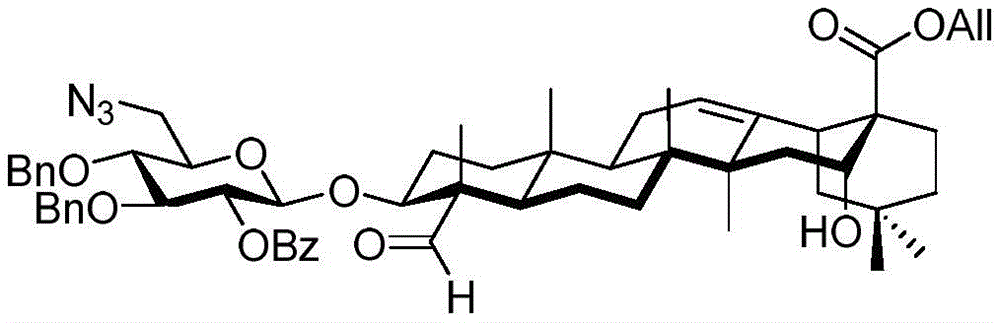
3-O- (6-azido-2-O-benzoyl-3, 4-di-O-benzyl-6-deoxy- β -D-glucopyranosyl) -28-O-allyl-soapbark acid ester (117):
1H NMR(600MHz,CDCl3) Δ 9.17(s,1H, H-23),8.04-8.01(m,2H, Bz),7.61-7.56(m,1H, Bz),7.48-7.44(m,2H, Bz),7.36-7.24(m,5H, Bn),7.14-7.09(m,5H, Bn), 5.88-5.80 (m,1H, allylic internal alkenyl C)H) 5.33(t, J ═ 3.5Hz,1H, H-12),5.28(d, J ═ 17.6Hz,1H, allyl-terminated alkenyl C aH) 5.21-15(m,2H, H-2', allyl-terminal alkenyl C) bH),4.85(d,J=11.2Hz,1H,Bn C aH),4.68(d,J=11.1Hz,1H,Bn C bH),4.62(d,J=11.1Hz,1H,Bn C aH),4.57(d,J=11.2Hz,1H,Bn C bH) 4.52-4.45 (m,3H, H-16, allyl C) 2H),4.43(d,J=7.9Hz 1H,H-1’),3.80-3.73(m,2H,H-3,H-3’),3.53-3.50(m,2H,H-4’,H-5’),3.41-3.38(m,1H,H-6a’),3.32-3.28(m,1H,H-6b’),3.05(dd,J=14.4,4.4Hz,1H,H-18),2.13(t,J=13.4Hz,1H,H-19),1.93–1.82(m,4H),1.80–1.69(m,4H),1.66-1.60(m,3H),1.59(br.s,3H),1.43–1.33(m,2H),1.31(s,3H),1.30–1.26(m,1H),1.21–1.14(m,3H),1.10(dd,J=12.8,3.6Hz,1H),1.03-0.99(m,1H),0.97–0.94(m,6H),0.90–0.88(m,6H)ppm;C60H75N3O10Na[M+Na]+HRMS (ESI-TOF) of (g) calculated 1020.5345, found 1020.5350.
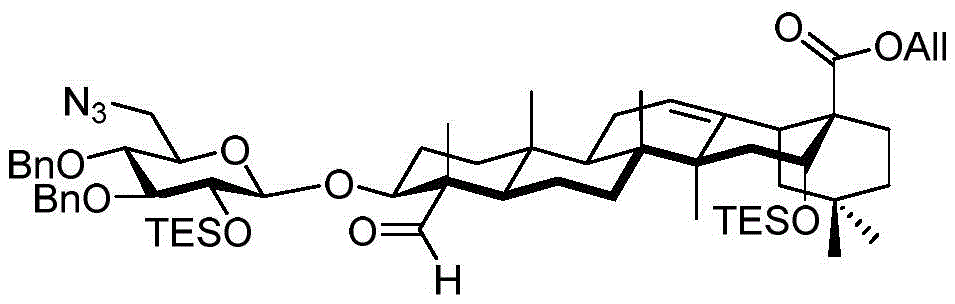
3-O- (6-azido-3, 4-di-O-benzyl-6-deoxy-2-O-triethylsilyl- β -D-glucopyranosyl) -16-O-triethylsilyl-28-O-allyl-soap-ic-anate (118):
1H NMR(400MHz,CDCl3) Δ 9.45(s,1H, H-23),7.61-7.56(m,1H, Bz),7.48-7.44(m,2H, Bz),7.36-7.26(m,8H, Bn),7.18-7.12(m,2H, Bn), 5.92-5.80 (m,1H, allylic internal alkenyl C)H) 5.40-5.26(m,2H, H-12, allyl-terminated alkenyl C) aH) 5.21(d, J ═ 10.4Hz,1H, allyl terminal alkenyl C bH),4.85(br.s,2H,Bn C 2H),4.73(d,J=11.0Hz,1H,Bn C bH),4.59(br.s,1H,Bn C aH) 4.55-4.41 (m,3H, H-16, allyl C) 2H),4.14(d,J=6.2Hz 1H,H-1’),3.99(dd,J=11.1,4.6Hz,1H,H-3),3.50-3.34(m,5H,H-2’,H-3’,H-4’,H-5’,H-6a’),3.32-3.23(m,1H,H-6b’),3.07-2.99(m,1H,H-18),2.23(t,J=13.3Hz,1H,H-19),1.93–1.80(m,5H),1.78–1.59(m,6H),1.54-1.40(m,2H),1.37(br.s,3H),1.32–1.18(m,4H),1.15(br.s,5H),1.06–0.88(m,30H),0.73–0.59(m,15H)ppm;C65H100N3O9Si2[M+H]+HRMS (ESI-TOF) of (g) calculated 1233.6993, found 1122.7010.
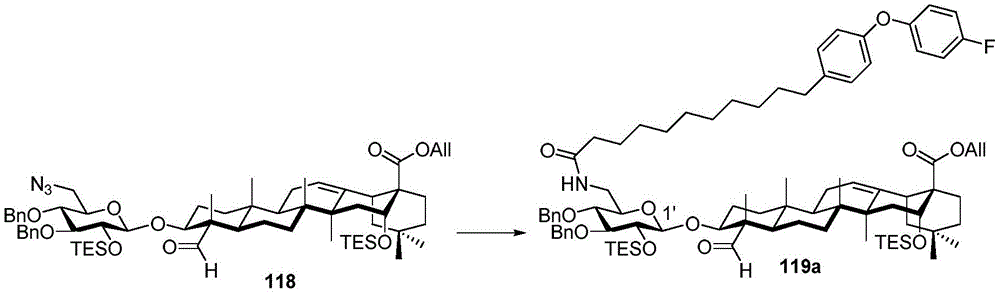
3-O- (3, 4-di-O-benzyl-6-deoxy-6- (11- (4- (4-fluorophenoxy) phenyl) undecanoamido) -2-O-triethylsilyl-beta-D-glucopyranosyl) -16-O-triethylsilyl-28-O-allyl-soapbark acid ester (119a)
Addition of PPh3(200mg,0.76mmol) to 118(282mg,0.25mmol) in THF (15mL) in a stirred solution. After the mixture was stirred for 12 hours, 0.5mL of H was added2O, then THF was removed at 35 ℃ under reduced pressure. The residue obtained is taken up in CH2Cl2Diluting and then using H2O, brine, and MgSO4Dried and then concentrated under pressure. A stirred solution of the resulting mixture in THF (7mL) was treated with a pre-mixed suspension of 11- (4- (4-fluorophenoxy) phenyl) undecanoic acid (187mg,0.50mmol), HBTU (286mg,0.75mmol), DIPEA (132. mu.L, 0.75mmol) and THF (7 mL). After completion of the reaction after stirring at 30 ℃ for 2 hours, the residue was concentrated under reduced pressure to remove THF. The residue is taken up in CH2Cl2Diluting with H2O, brine, over MgSO4Dried and then concentrated under pressure. The residue was purified by column chromatography (silica gel, EtOAc/hexanes ═ 1/8) to give 119a (349mg, 96%) as a white foamy solid: rf0.29 (EtOAc/hexanes-1/5);1H NMR(600MHz,CDCl3) δ 9.45(s,1H, H-23),7.33-7.26(m,4H),7.22-7.17(m,2H),7.10(d, J ═ 8.5Hz,2H),7.01-6.96(m,2H),6.95-6.91(m,2H),6.86(d, J ═ 8.5Hz,2H), 5.87-5.81 (m,1H, internal alkenyl C, m,2H), C, y, C, yH),5.32(t,J=3.7Hz,1H,H-12),5.28(dq,J=17.0Hz&1.2Hz,1H, terminal alkenyl C aH),5.18(dt,J=10.6Hz&1.2Hz,1H, terminal alkenyl C bH),4.83(q,J=10.5Hz,2H,Bn C 2H),4.67(d,J=10.5Hz,1H,Bn C aH),4.56(br.s,1H,H-16),4.51(d,J=10.6Hz,1H,Bn C bH),4.45(dt,J=19.9Hz&1.4Hz,2H, allyl C 2H),4.02(d,J=6.8Hz,1H,H-1’),3.93(dd,J=11.2Hz&5,2Hz,1H,H-3),3.59(dt,J=13.9Hz&5.9Hz,1H,H-6a’),3.47(dt,J=13.9Hz&5.9Hz,1H,H-6b’),3.43-3.37(m,2H,H-2’,H-4’),3.36-3.22(m,2H,H-3’,H-5’),3.00(dd,J=14.3Hz&4.0Hz,1H,H-18),2.54(t,J=6.7Hz,2H,C 2HPhOPhF),2.32(t,J=7.6Hz,1H,NHC aH),2.20(m,1H,H-19a),2.15(td,J=13.6Hz&3.1Hz,1H,H-19b),1.90–1.85(m,2H),1.84–1.76(m,3H),1.72-1.65(m,3H),1.64-1.53(m,9H),1.48-1.40(m,2H),1.34(s,2H),1.31-1.23(m,22H),1.16(s,2H),1.13-1.08(m,2H),1.06-1.02(m,2H),1.00-0.95(m,10H),0.95-0.92(m,4H),0.92-0.91(m,2H),0.91-0.90(m,3H),0.89-0.88(m,2H),0.87-0.85(m,4H),0.69-0.63(m,8H),0.63-0.57(m,6H)ppm;C88H129FNO11Si2[M+Na]+HRMS (high resolution Mass Spectrometry)+(ESI-TOF) calculated 1451.9113, found 1451.9095.
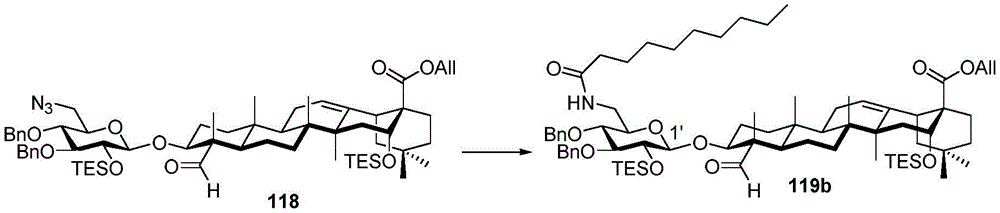
3-O- (3, 4-di-O-benzyl-6-decanamido-6-deoxy-2-O-triethylsilyl-beta-D-glucopyranosyl) -16-O-triethylsilyl-28-O-allyl-soapbark acid ester (119b)
Following the azide reduction and amide formation steps as described above, 119b was obtained as a white solid in 56% yield:1H NMR(600MHz,CDCl3) Δ 9.40(s,1H, H-23),7.33-7.24(m,5H),7.24-7.15(m,5H), 5.87-5.80 (m,1H, internal alkenyl C)H) 5.31(t, J ═ 3.4Hz,1H, H-12),5.30-5.25(m,2H, terminal alkenyl C) aH,NHCH2),5.18(dd,J=10.5Hz&1.1Hz,1H, terminal alkenyl C bH),4.87-4.80(m,2H,Bn C 2H),4.65(d,J=10.4Hz,1H,Bn C aH),4.58-4.52(m,2H,H-16,Bn C bH),4.46(qd,J=13.6Hz&1.1Hz,2H, allyl C 2H),4.07(d,J=6.8Hz,1H,H-1’),3.98-3.91(m,1H,H-3),3.65-3.54(m,1H,H-4’),3.50-3.30(m,4H,H-2’,H-5’,H-6’),3.29-3.22(m,1H,H-3’),3.00(dd,J=14.2Hz&3.8Hz,1H,H-18),2.31(t,J=7.4Hz,1H,NHC aH),2.20(t,J=12.8Hz,1H,H-19a),1.90–1.75(m,7H),1.72–1.63(m,4H),1.63-1.58(m,3H),1.45-1.40(m,2H),1.39(s,3H),1.31-1.21(m,16H),1.78-1.15(m,1H),1.12(s,3H),1.06-1.02(m,2H),0.98(t,J=3.7Hz,3H),0.97(s,3H),0.96(br.s,2H),0.95-0.92(m,6H),0.91(br.s,2H),0.90(s,3H),0.89(s,3H),0.87-0.84(m,6H),0.67-0.62(m,9H),0.62-0.56(m,6H)ppm;C75H120NO10Si2[M+H]+HRMS (high resolution Mass Spectrometry)+(ESI-TOF) calculated 1251.8475, found 1251.8426.
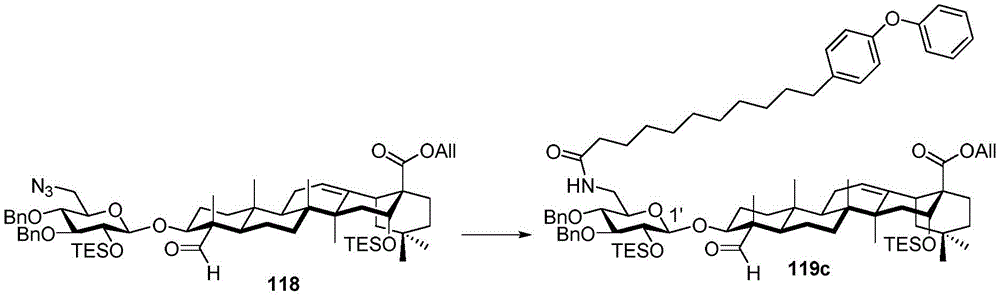
3-O- { 2-O-triethylsilyl-3, 4-di-O-benzyl-6- [9- (4-phenoxy-phenyl) nonanamido ] -6-deoxy- β -D-glucopyranosyl } -16-O-triethylsilyl-28-O-allyl-soap-ic acid ester (119c)
Following the azide reduction and amide formation steps as described above, 119b was obtained as a white solid in 56% yield:1H NMR(400MHz,CDCl3)δ9.45(s,1H,H-23),7.31-7.21(m,2H),7.10(d,J=8.4Hz,2H),7.04(t,J=7.4Hz,2H),6.96(dd,J=8.7Hz&1.0Hz,2H),6.90(d, J ═ 8.5Hz,2H), 5.89-5.80 (m,2H, amide N)HInternal alkenyl radical CH) 5.32(t, J ═ 3.7Hz,1H, H-12),5.28(d, J ═ 18.2Hz,1H, terminal alkenyl C aH),5.17(dd,J=10.4Hz&1.3Hz,1H, terminal alkenyl C bH),4.83(q,J=11.7Hz,2H,Bn C 2H),4.67(d,J=10.4Hz,1H,Bn C aH),4.57(br.s,1H,H-16),4.51(d,J=10.4Hz,1H,Bn C bH),4.45(ddt,J=11.4Hz&5.6Hz&1.1Hz,2H, allyl C 2H),4.02(d,J=6.8Hz,1H,H-1’),3.94(dd,J=10.2Hz&5.8Hz,1H,H-3),3.63-3.56(m,1H),3.51-3.39(m,3H),3.32-3.21(m,2H),3.00(dd,J=14.2Hz&3.9Hz,1H,H-18),2.55(t,J=7.5Hz,2H,C 2HPhOPh),2.33-2.13(m,3H,H-19a,NHCOC 2H),1.91-1.83(m,3H),1.83–1.76(m,3H),1.75-1.52(m,11H),1.49-1.40(m,2H),1.34(s,3H),1.29(br.s,11H),1.23(s,3H),1.15(s,3H),1.14-1.00(m,4H),0.98-0.86(m,31H),0.69-0.57(m,16H);BBD13C NMR(100MHz,CDCl3)δ207.5(C-23),176.4(C-28),173.1(NHCO),157.7,154.8,143.5(C-13),138.5,137.8,137.5,132.2,129.6129.4,128.4,128.2,128.1,127.9,127.2,126.8,122.7,121.7 (C-12),118.9,118.4,117.8 (allyl terminal alkenyl)CH2),101.0(C-1’),85.5(C-3),79.3,79.0,75.2(Bn CH2),75.0,75.0(Bn CH2),74.9(C-16),73.1,65.0(C-6’),54.5,48.9,48.8,46.6,46.3,41.3,40.4,40.0,39.5,38.1,36.7,36.0,35.2,35.1,34.5,33.8,32.7,32.3,31.5×2,30.5,29.6,29.3×2,29.2,29.1,29.0,26.3,25.7,24.7,24.6,24.2,23.2,20.1,16.9,15.5,10.4,7.1,6.9,5.0,4.9ppm;C86H125NO11Si2[M+H]+HRMS (high resolution Mass Spectrometry)+(ESI-TOF) calculated 140.8894, found 1405.8984.
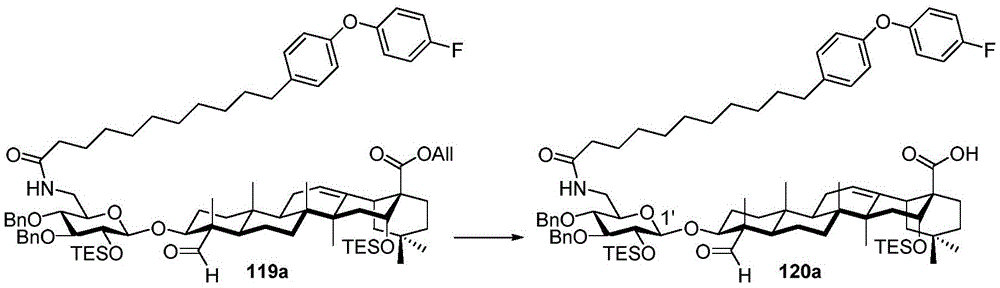
3-O- (3, 4-di-O-benzyl-6-deoxy-6- (11- (4- (4-fluorophenoxy) phenyl) undecanoamido) -2-O-triethylsilyl-beta-D-glucopyranosyl) -16-O-triethylsilyl-soapic acid (120a)
Pre-mixed formic acid (129 μ L,3.4mmol)/Et in 1, 4-dioxane (2mL) at room temperature3N (456. mu.L, 3.2mmol) and Pd (OAc) in 1, 4-dioxane (2mL)2(18mg,0.08mmol) was added to 119a (237mg,0.16mmol) and PPh3(107mg,0.41mmol) in a stirred solution of 1, 4-dioxane (4 mL). The reaction mixture was stirred for 12 hours and then concentrated under reduced pressure. The residue was purified by column chromatography (silica gel, EtOAc/hexanes 1/4 to 1/2) to afford 120a as a white solid (186mg, 81%): rf0.36 (EtOAc/hexanes-1/2);1H NMR(600MHz,CDCl3) δ 9.41(s,1H, H-23),7.27-7.26(m,1H),7.25(br.s,1H),7.34-7.25(m,6H),7.06(d, J ═ 8.4Hz,1H),6.98-6.64(m,6H),6.82(d, J ═ 8.4Hz,1H),5.82(t, J ═ 5.2Hz, amide N, NH),5.30(br.s,1H,H-12),4.83-4.76(m,2H,Bn C 2H),4.63(d,J=10.3Hz,1H,Bn C aH),4.50-4.53(m,2H,H-16,Bn C bH),3.98(d,J=6.6Hz,1H,H-1’),3.90(dd,J=11.2Hz&4.9Hz,1H,H-3),3.60-3.53(m,1H,H-6a’),3.48-3.41(m,1H,H-6b’),3.41-3.34(m,2H,H-2’,H-4’),3.27-3.19(m,2H,H-3’,H-5’),2.90(dd,J=14.1Hz&3.6Hz,1H,H-18),2.50(t,J=7.6Hz,2H,C 2HPhOPhF),2.31(t,J=7.4Hz,1H,NHC aH),2.19-2.09(m,3H),1.87–1.68(m,7H),1.68-1.59(m,3H),1.59-1.49(m,4H),1.44-1.36(m,2H),1.30(s,3H,H-27),1.28-1.16(m,17H),1.11(s,3H,H-29),1.09-1.08(m,1H),1.03-0.97(m,2H),0.94(s,2H),0.93(s,3H),0.92(s,3H),0.89-0.87(m,5H),0.87(s,3H),0.85(s,2H),0.82(s,3H),0.66-0.53(m,17H)ppm;C85H125FNO11Si2[M+H]+HRMS (high resolution Mass Spectrometry)+(ESI-TOF) calculated 1411.8800, found 1411.8742.
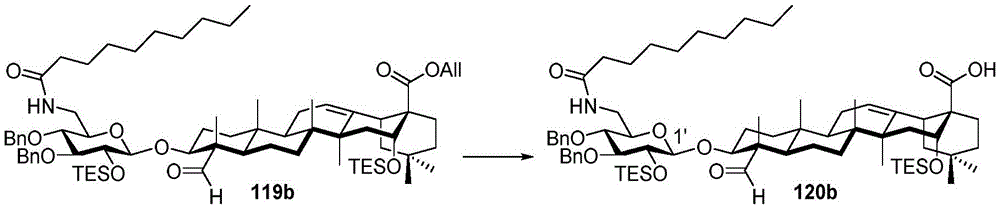
3-O- (2-O-triethylsilyl-3, 4-di-O-benzyl-6-decanamido-6-deoxy-beta-D-glucopyranosyl) -16-O-triethylsilyl-28-O-allyl-soapbark acid (120b)
Pre-mixed formic acid (129 μ L,3.4mmol)/Et in 1, 4-dioxane (2mL) at room temperature3N (456. mu.L, 3.2mmol) and Pd (OAc) in 1, 4-dioxane (2mL)2(18mg,0.08mmol) was added to 119b (200mg,0.16mmol) and PPh3(107mg,0.41mmol) in a stirred solution of 1, 4-dioxane (4 mL). The reaction mixture was stirred for 12 hours and then concentrated under reduced pressure. The residue was purified by column chromatography (silica gel, EtOAc/hexanes 1/4 to 1/2) to afford 120b as a white solid (154mg, 80%): rf0.36 (EtOAc/hexanes-1/2);1H NMR(600MHz,CDCl3) δ 9.45(s,1H, H-23),7.32-7.24(m,6H),7.24-7.19(m,4H),5.85(t, J ═ 5.0Hz, amide NH),5.30(t,J=3.7Hz 1H,H-12),4.86-4.80(m,2H,Bn C 2H),4.66(d,J=10.4Hz,1H,Bn C aH),4.54-4.49(m,2H,H-16,Bn C bH),4.03(d,J=6.8Hz,1H,H-1’),3.94(dd,J=11.2Hz&4.9Hz,1H,H-3),3.59-3.55(m,1H),3.52-3.46(m,1H),3.44-3.38(m,2H),3.31-3.24(m,2H),2.94(dd,J=14.2Hz&4.0Hz,1H,H-18),2.31(t,J=7.5Hz,1H,NHC aH),2.19-2.09(m,3H),1.87–1.68(m,7H),1.68-1.59(m,3H),1.59-1.49(m,4H),1.44-1.36(m,2H),1.30(s,3H,H-27),1.28-1.16(m,17H),1.11(s,3H),1.09-1.08(m,1H),1.03-0.97(m,2H),0.94(s,2H),0.93(s,3H),0.92(s,3H),0.89-0.87(m,5H),0.87(s,3H),0.85(s,2H),0.82(s,3H),0.66-0.53(m,17H);BBD13C NMR(150MHz,CDCl3)δ207.4(C-23),182.7(C-28),173.3(NHCO),143.3(C-13),138.6,137.6,128.4,128.2,126.9,121.8(C-12),101.1(C-1’),85.5,79.5,79.2(C-3),75.2(Bn CH2),75.0(Bn CH2),74.9,74.8(C-16),73.2,54.5,49.0,48.6,46.6,46.3,41.3,40.1(C-6’),39.5(C-8),38.2,36.8(-NHCOCH2-),36.1,35.1,34.6,34.0,32.6,32.,31.8,31.6,30.5,29.5,29.4,29.3,29.2,29.0,26.4,25.8,24.7,24.2,23.2,22.7,20.1,16.9,15.5,14.1,10.4,7.1,7.0,5.1,5.0ppm ppm;C72H116NO10Si2[M+H]+HRMS (high resolution Mass Spectrometry)+(ESI-TOF) calculated 1210.8132, found 1210.8108.
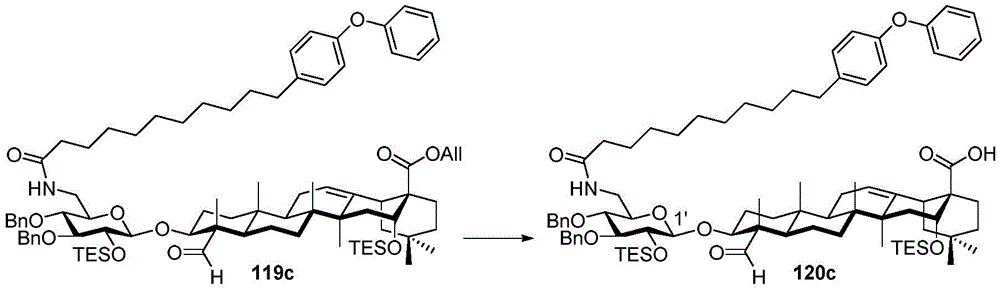
3-O- { 2-O-triethylsilyl-3, 4-di-O-benzyl-6- [9- (4-phenoxy-phenyl) nonanamido ] -6-deoxy-beta-D-glucopyranosyl } -16-O-triethylsilyl-28-soapbark acid (120c)
Pre-mixed formic acid (129 μ L,3.4mmol)/Et in 1, 4-dioxane (2mL) at room temperature3N (456. mu.L, 3.2mmol) and Pd (OAc) in 1, 4-dioxane (2mL)2(18mg,0.08mmol) was added to 119c (224mg,0.16mmol) and PPh3(107mg,0.41mmol) in a stirred solution of 1, 4-dioxane (4 mL). The reaction mixture was stirred for 12 hours and then concentrated under reduced pressure. The residue was purified by column chromatography (silica gel, EtOAc/hexanes 1/4 to 1/2) to afford 120c (154mg, 80%) as a white solid: rf0.36 (EtOAc/hexanes-1/2);1H NMR(400MHz,CDCl3)δ9.45(s,1H,H-23),7.31-7.21(m,2H),7.10(d,J=8.4Hz,2H),7.04(t,J=7.4Hz,2H),6.96(dd,J=8.7Hz&1.0Hz,2H),6.90(d,J=8.5Hz,2H), 5.89-5.80 (m,2H, amide N)HInternal alkenyl radical CH),5.32(t,J=3.7Hz,1H,H-12),4.83(q,J=11.7Hz,2H,Bn C 2H),4.67(d,J=10.4Hz,1H,Bn C aH),4.57(br.s,1H,H-16),4.51(d,J=10.4Hz,1H,Bn C bH),4.02(d,J=6.8Hz,1H,H-1’),3.94(dd,J=10.2Hz&5.8Hz,1H,H-3),3.63-3.56(m,1H),3.51-3.39(m,3H),3.32-3.21(m,2H),3.00(dd,J=14.2Hz&3.9Hz,1H,H-18),2.55(t,J=7.5Hz,2H,C 2HPhOPh),2.33-2.13(m,3H,H-19a,NHCOC 2H),1.91-1.83(m,3H),1.83–1.76(m,3H),1.75-1.52(m,11H),1.49-1.40(m,2H),1.34(s,3H),1.29(br.s,11H),1.23(s,3H),1.15(s,3H),1.14-1.00(m,4H),0.98-0.86(m,31H),0.69-0.57(m,16H);BBD 13C NMR(100MHz,CDCl3)δ207.5(C-23),182.0(C-28),173.2(NHCO),157.7,154.8,143.5(C-13),138.5,137.5,132.2,129.6 129.4,128.4,128.2,128.1,127.9,127.2,126.8,122.7,121.7(C-12),118.9,118.4,101.0(C-1’),85.5(C-3),79.3,79.0,75.2(Bn CH2),75.0,75.0(Bn CH2),74.9(C-16),73.1,65.0(C-6’),54.5,48.9,48.8,46.6,46.3,41.3,40.4,40.0,39.5,38.1,36.7,36.0,35.2,35.1,34.5,33.8,32.7,32.3,31.5×2,30.5,29.6,29.3×2,29.2,29.1,29.0,26.3,25.7,24.7,24.6,24.2,23.2,20.1,16.9,15.5,10.4,7.1,6.9,5.0,4.9ppm;C83H122NO11Si2[M+H]+HRMS (high resolution Mass Spectrometry)+(ESI-TOF) calculated 1364.8551, found 1364.8567.
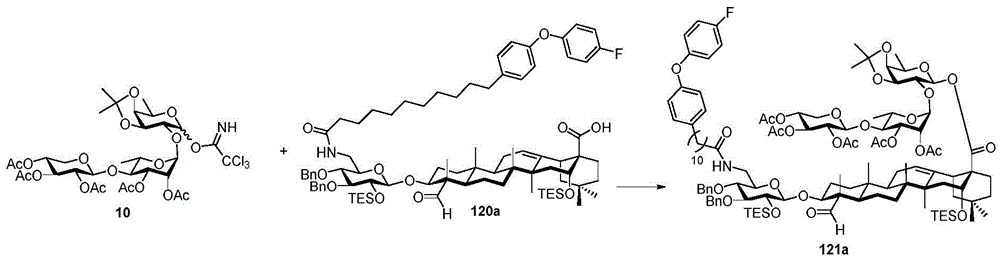
3-O- (3, 4-di-O-benzyl-6-deoxy-6- (11- (4- (4-fluorophenoxy) phenyl) undecanoamido) -2-O-triethylsilyl- β -D-glucopyranosyl) -28-O- (2,3, 4-tri-O-acetyl- β -D-xylopyranosyl- (1 → 4) -2, 3-di-O-acetyl- α -L-rhamnopyranosyl- (1 → 2) -3, 4-O-isopropylidene- β -D-fucopyranosyl) -16-O-triethylsilyl soap-rate-ester (121 a).
At-75 ℃ and N2Addition of BF in a gaseous atmosphere3·OEt2(about 48%, 4. mu.L, 24)μ mol) to 10(40mg,48 μmol), 120a (50mg,35 μmol) and activation Molecular sieve powder in anhydrous CH2Cl2(0.5mL) in stirred suspension. After completion of the reaction after 0.5 hours, Et was used3The reaction was quenched with N and warmed to room temperature. Subjecting the obtained mixture to CH2Cl2Diluted and filtered through 5 μm filter paper. The resulting filtrate was concentrated under reduced pressure. The residue was purified by column chromatography (silica gel; EtOAc/
hexanes 1/5 to 1/2) to give 121a (37mg, 50%) as a white solid foam. Rf0.56 (EtOAc/hexanes 1/1);1H NMR(600MHz,CDCl3) δ 9.49(s,1H, H-23),7.33-7.26(m,6H),7.26-7.21(m,4H),7.12(d, J ═ 8.4Hz,1H),7.02-7.00(m,2H),6.96-6.93(m,2H),6.88(d, J ═ 8.6Hz,1H),6.82(d, J ═ 8.4Hz,1H),5.86(t, J ═ 5.1Hz, amide NH),5.41(d,J=7.6Hz,1H,H-1”),5.33(t,J=3.4Hz,1H,H-12),5.25(dd,J=3.4Hz&1.3Hz,1H,H-2”’),5.20(dd,J=9.8Hz&3.5Hz,1H,H-3”’),5.13(t,J=9.4Hz,1H,H-3””),4.98(d,J=1.3Hz,1H,H-1”’),4.97-4.94(m,1H,H-4””),4.88-4.82(m,3H,H-2””,Bn C 2H),5.68(d,J=10.4Hz,1H,Bn C aH),4.63(d,J=7.7Hz,1H,H-1””),4.53(d,J=10.4Hz,1H,Bn C bH),4.50(br.s,1H,H-16),4.17(t,J=6.0Hz,1H,H-3”),4.12-4.10(m,1H,H-5a””),4.04-4.00(m,2H,H-1’,H-4”),3.98-3.94(m,1H,H-3),3.89-3.84(m,1H,H-5”),3.84-3.79(m,1H,H-5”’),3.68-3,64(m,1H,H-2”),3.64-3.59(m,2H,H-6a’,H-4’),3.49(dt,J=13.9Hz,&3.8Hz,1H H-6b’),3.45-3.39(m,2H,H-2’,H-4’),3.36-3.24(m,3H,H-3’,H-5’,H-5b””),2.93(dd,J=14.2Hz&3.8Hz,1H,H-18),2.56(t,J=7.6Hz,2H,C 2HPhOPhF),2.22(m,1H,H-19a),2.17(td,J=7.5Hz&3.4Hz,2H,-NHCOC 2H-),2.13(s,3H),2.06(s,3H),2.03(s,3H),2.01(s,3H),1.98(s,3H),1.90-1.86(m,2H),1.86-1.82(m,1H),1.83-1.76(m,3H),1.74-1.67(m,4H),1.67-1.56(m,5H),1.52(s,3H, isopropylidene C (s,3H) 3H) 1.52-1.49(m,1H),1.34(s,3H, H-27),1.33(s,3H, Hierochloes Adorata)Propyl radical C 3H),1.30-1.25(m,24H),1.23-1.32(m,1H),1.19(s,3H,H-24),1.13-1.10(m,1H),1.05-1.03(m,1H),1.03-1.01(m,1H),1.01-0.96(m,15H,H-25,TES CH3×4),0.92(s,H,H-30),0.91(s,3H,TES CH3),0.90(s,3H,TES CH3),0.88(s,3H,H-29),0.74(s,3H,H-26),0.68-0.58(m,12H,TES CH2×6)ppm;C115H167FNO28Si2[M+H]+HRMS (high resolution Mass Spectrometry)+(ESI-TOF) calculated 2086.1223, found 2086.1222.
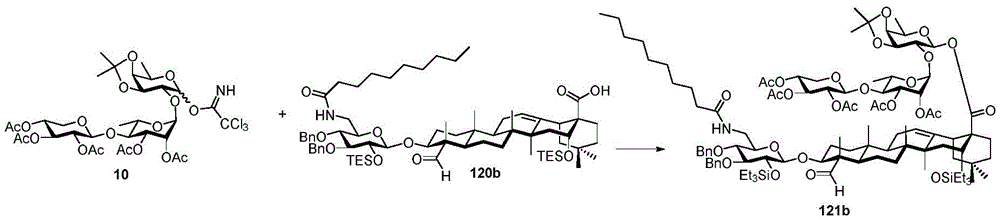
3-O- (3, 4-di-O-benzyl-6-decanamido-6-deoxy- β -D-glucopyranosyl } -28-O- (2,3, 4-tri-O-acetyl- β -D-xylopyranosyl- (1 → 4) -2, 3-di-O-acetyl- α -L-rhamnopyranosyl- (1 → 2) -3, 4-O-isopropylidene- β -D-fucopyranosyl) -16-O-triethylsilylsaponificate (121b)
At-75 ℃ and N2Addition of BF in a gaseous atmosphere3·OEt2(about 48%, 4. mu.L, 24. mu. mol) to 10(40mg, 48. mu. mol), 120b (42mg, 35. mu. mol) and activation Molecular sieve powder in anhydrous CH2Cl2(0.5mL) in stirred suspension. After completion of the reaction after 0.5 hours, Et was used3The reaction was quenched with N and warmed to room temperature. Subjecting the obtained mixture to CH2Cl2Diluted and filtered through 5 μm filter paper. The resulting filtrate was concentrated under reduced pressure. The residue was purified by column chromatography (silica gel; EtOAc/
hexanes 1/5 to 1/2) to give 121b (37mg, 50%) as a white solid foam. Rf0.56 (EtOAc/hexanes 1/1); a 121b α/β mixture was obtained as a white solid foam.
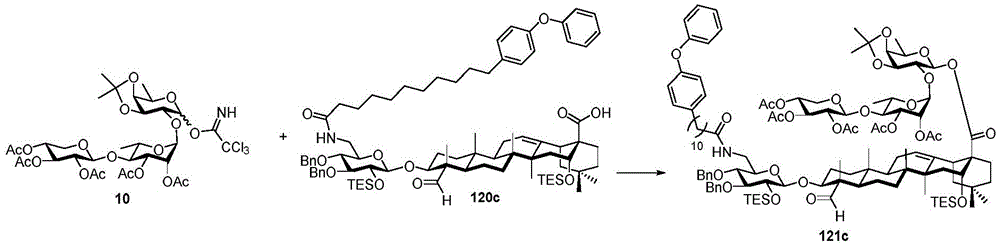
3-O- (2-O-triethylsilyl-3, 4-di-O-benzyl-6- [9- (4-phenoxy-phenyl) nonanamido } -28-O- (2,3, 4-tri-O-acetyl-beta-D-xylopyranosyl- (1 → 4) -2, 3-di-O-acetyl-alpha-L-rhamnopyranosyl- (1 → 2) -3, 4-O-isopropylidene-beta-D-fucopyranosyl) -16-O-triethylsilylsoapbark acid ester (121c)
At-75 ℃ and N2Addition of BF in a gaseous atmosphere3·OEt2(about 48%, 4. mu.L, 24. mu. mol) to 10(40mg, 48. mu. mol), 120c (42mg, 35. mu. mol) and activation Molecular sieve powder in anhydrous CH2Cl2(0.5mL) in stirred suspension. After completion of the reaction after 0.5 hours, Et was used3The reaction was quenched with N and warmed to room temperature. Subjecting the obtained mixture to CH2Cl2Diluted and filtered through 5 μm filter paper. The resulting filtrate was concentrated under reduced pressure. The residue was purified by column chromatography (silica gel; EtOAc/
hexanes 1/5 to 1/2) to give 121c (37mg, 50%) as a white solid foam. Rf0.56 (EtOAc/hexanes 1/1); a 121c α/β mixture was obtained as a white solid foam.
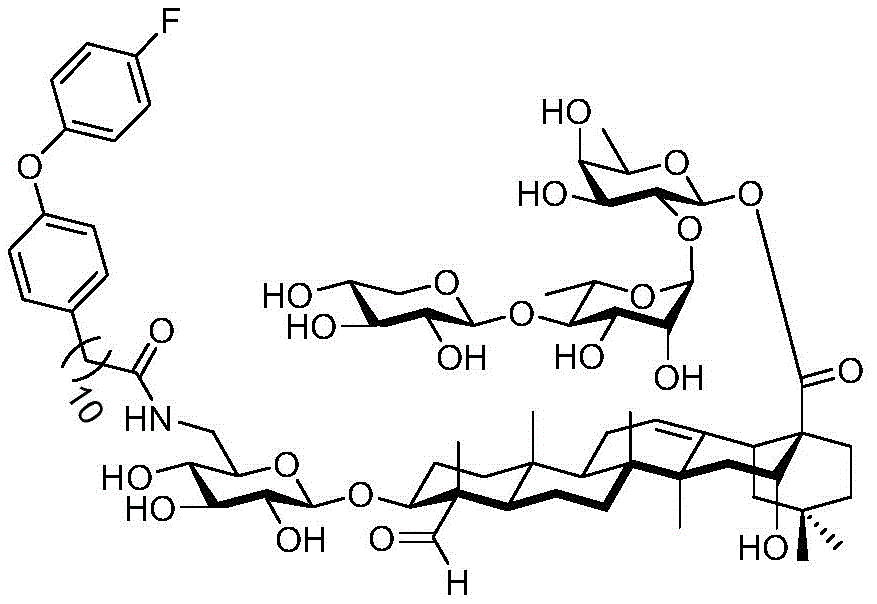
3-O- (6-deoxy-6- (11- (4- (4-fluorophenoxy) phenyl) undecanoamido) - β -D-glucopyranosyl) -28-O- (β -D-xylopyranosyl- (1 → 4) - α -L-rhamnopyranosyl- (1 → 2) - β -D-fucopyranosyl) soapbark acid ester (122a)
At room temperature and 1atm H2121a (32mg, 15. mu. mol) and 10% Pd (OH) were stirred under a gaseous atmosphere2Suspension of/C (5mg,4 μmol) in THF/MeOH 4/1(1.5 mL). The reaction mixture was stirred for 12 hours. Precooling TFA/H at 0 ℃2O-4/1 (0.5mL) was added to the crude tetrasaccharide saponin in CH2Cl2(0.5mL) and stirred for 30 minutes. At 0 ℃ and reduced pressure (<1 torr) and then dried at room temperature under high vacuum for 1 hour. Addition of K2CO3(40mg, 300. mu. mol) to residue MeOH (1mL) in a stirred solutionIn the solution, and stirred for 12 hours. The suspension was filtered, concentrated and then purified by HPLC (HPLC column: SUPELCO Ascentis C1825 cm X10 mm, 5 μm; mobile phase: 20% ACN/H in 25 min2O is increased to 90% ACN/H2Gradient of O, then 90% ACN/H2O, isocratic for 15 minutes; flow rate: 5mL/min) to provide product 122a (3.6mg) as a white solid in 16% yield:1H NMR(600MHz,CD3OD)δ9.41(s,1H,H-23),7.16(d,J=8.4Hz,2H),7.07(t,J=8.8Hz,2H),6.98-6.95(m,4H),6.87(d,J=8.6Hz,2H),5.40(d,J=1.4Hz,1H,H-1”’),5.31(br.s,1H,H-12),5.29(d,J=8.2Hz,1H,H-1”),4.50-4.47(m,2H,H-16,H-1””),4.14(d,J=7.7Hz,1H,H-1’),3.91-3.89(m,1H,H-2”’),3.86-3.78(m,5H,H-3,H-2”,H-3”’,H-5”’,H-5a””),3.68-3.64(m,2H,H-3”,H-5”),3.60-3.56(m,1H,H-6a’),3.56-3.53(m,2H,H-4”,H-4”’),3.49-3.42(m,2H,H-5’,H-4””),3.29-3.25(m,3H,H-3’,H-6b’,H-3””),3.23-3.16(m,2H,H-2””,H-5b””),3.09-3.05(m,2H,H-2’,H-4’),2.45(dd,J=13.4Hz&3.2Hz,H-18),2.60(t,J=7.6Hz,2H,C 2HPhOPhF),2.30(m,1H,H-19a),2.21(t,J=7.6Hz,2H,-NHCOC 2H-),1.99-1.95(m,1H),1.95-1.91(m,1H),1.80-1.71(m,4H),1.70-1.65(m,1H),1.64-1.59(m,4H),1.55-1.50(m,2H)1.49-1.44(m,1H),1.40(s,3H, H-27),1.36-1.29(m,19H, H-6', carbon chain C 2H×8),1.20(d,J=6.5Hz,3H,H-6”),1.12(s,3H,H-24),1.10-1.06(m,1H),1.01(s,3H,25),0.99-0.96(m,1H),0.93(s,3H,H-30),0.92-0.89(m,1H),0.87(s,3H,H-29),0.77(s,3H,H-26);BBD 13C NMR(150MHz,CD3OD) delta 209.3(C-23),177.1(C-28),176.7 (amide NH)CO),160(d,J=240Hz),156.8,155.1,144.9(C-13),139.2,130.8,123.1(C-12),121.2(d,J=8Hz),119.5,117.2(d,J=23Hz),107.0,(C-1””),105.0(C-1’),101.1(C-1”’),95.2(C-1”),84.0(C-4”’),83.4(C-3),78.2(C-3””),77.6(C-3’),76.7(C-3”),76.1(C-2””),75.6(C-2’),75.2(C-5’),74.6(C-16),74.0(C-2”),73.6(C-4”),73.3(C-4’),72.7(C-5”),72.2(C-3”’),71.9(C-2”’),71.1(C-4””),68.7(C-5”’),67.3(C-5””),56.1(C-5),50.0(C-17),48.1(C-19,C-9),42.8(C-14),42.4(C-18),41.9(C-6’),41.1(C-8),39.6(C-1),37.3(C-1),36.8(-NHCOCH2-),37.1(C-10),,36.5(C-21),36.2(-CH2PhOPhF),33.6(C-16),3.4(C-29),32.9(C-6),32.0(C-22),31.4(C-20),30.8,30.7,30.6,30.4,27.3(C-2),20.2(C-27),26.0,25.9(C-2),24.9(C-30),24.6(C-11),21.6,(C-7),18.3(C-6”’),17.7(C-26),16.5(C-6”),16.4(C-25),10.6(C-24)ppm;C76H112FNO23Si2Na[M+H]+HRMS (high resolution Mass Spectrometry)+(ESI-TOF) calculated 1448.7501, found 1448.7558.
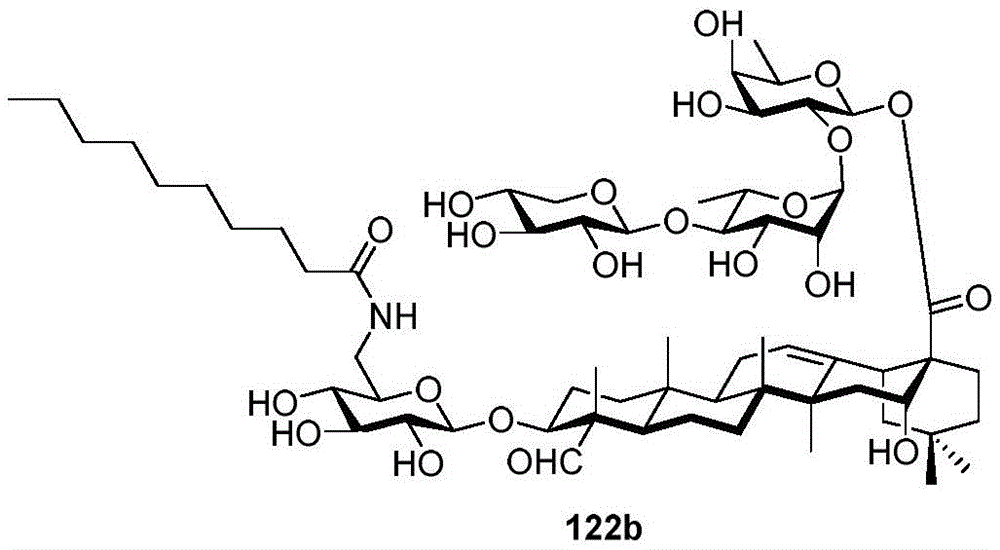
3-O- { 6-decanamido-6-deoxy-beta-D-glucopyranosyl } -28-O- [ beta-D-xylopyranosyl- (1 → 4) -alpha-L-rhamnopyranosyl- (1 → 2) -beta-D-fucopyranosyl ] soapbark acid ester (122b)
At room temperature and 1atm H2121b (28mg, 15. mu. mol) and 10% Pd (OH) were stirred under a gaseous atmosphere2Suspension of/C (5mg,4 μmol) in THF/MeOH 4/1(1.5 mL). The reaction mixture was stirred for 12 hours. Addition of precooled TFA/H at 0 deg.C2O-4/1 (0.5mL) to crude tetrasaccharide saponin in CH2Cl2(0.5mL) and stirred for 30 minutes. At 0 ℃ and reduced pressure (<1 torr) and then dried at room temperature under high vacuum for 1 hour. Addition of K2CO3(40mg, 300. mu. mol) to a stirred solution of the residue in MeOH (1mL) and stirred for 12 h. The suspension was filtered, concentrated and then purified by HPLC (HPLC column: SUPELCO Ascentis C1825 cm X10 mm, 5 μm; mobile phase: 20% ACN/H in 25 min2O is increased to 90% ACN/H2Gradient of O, then 90% ACN/H2O, isocratic for 15 minutes; flow rate: 5mL/min) to provide product 122b (2.3mg) as a white solid in 13% yield: 1H NMR (600MHz, CD)3OD)δ9.42(s,1H,H-23),5.40(s,1H,H-1”’),5.31(br.s,1H,H-12),5.29(d,J=8.2Hz,1H,H-1”),4.51-4.46(m,2H,H-16,H-1””),4.15(d,J=7.7Hz,1H,H-1’),3.93-3.90(m,1H),3.87-3.78(m,5H),3.71-3.66(m,2H,),3.60-3.53(m,3H),3.49-3.41(m,2H),3.29-3.25(m,3H),3.24-3.17(m,2H),3.09-3.04(m,2H),2.95(d,J=14.1Hz,1H,H-18),2.30(m,1H,H-19a),2.21(t,J=7.6Hz,2H,-NHCOCH2-),2.04-1.88(m,3H),1.69-1.60(m,3H),1.55-1.44(m,4H),1.40(s,3H,H-27),1.35-1.29(m,18H),1.20(d,J=6.5Hz,3H,H-6”),1.12(s,3H),1.10-1.06(m,1H),1.01(s,3H),0.99-0.96(m,1H),0.95(s,3H),0.93-0.89(m,3H),0.88(s,3H),0.77(s,3H);BBD 13C NMR(150MHz,CD3OD) delta 209.4(C-23),177.2(C-28),176.7 (amide NHCO),144.9(C-13),123.1(C-12),106.9, (C-1 '), 105.0(C-1 '), 101.1(C-1 '), 95.2(C-1 '), 84.0(C-4 '), 83.3(C-3),78.1(C-3 '), 77.6,76.6,76.1,75.6,75, 74.6(C-16),74.0,73.6,73.3,72.7,72.2,71.9,71.0,68.7,67.3,56.1,50.0,48.1,42.8,42.3(C-18),41.8(C-6 '), 41.1,39.6,37.3,37.1, NHCO 36.8 (-OCH 36)2-) 36.5,36.4,33.6,33.4,33.1,32.0,31.3,30.8,30.7,30.6,30.5,27.3,27.2,26.0,24.8,24.5,23.8,21.6,18.3(C-6 '), 17.7,16.5(C-6 '), 16.3,14.6 (carbon chain end-CH-C-6 ')3),10.6ppm;C63H104NO22[M+H]+HRMS (high resolution Mass Spectrometry)+(ESI-TOF) calculated 1226.7059, found 1226.7059.
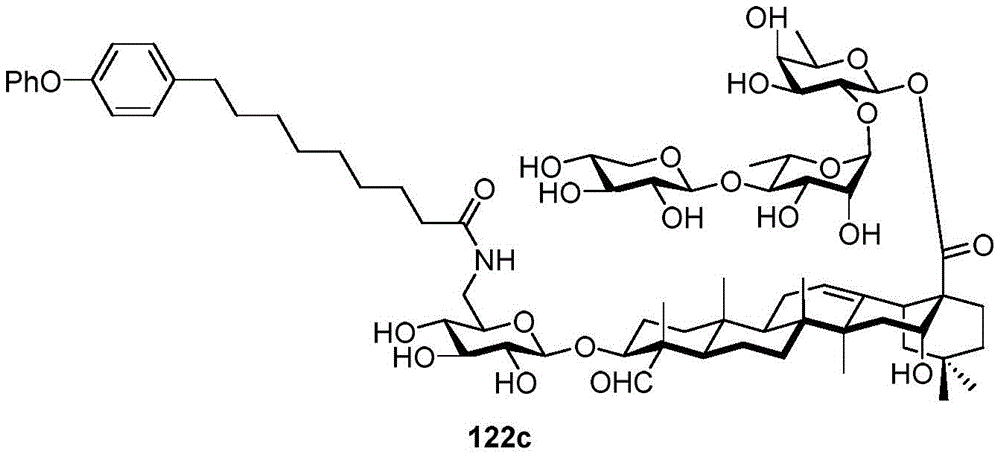
3-O- { [9- (4-phenoxy-phenyl) nonanamido ] -6-deoxy- β -D-glucopyranosyl } -28-O- [ β -D-xylopyranosyl- (1 → 4) - α -L-rhamnopyranosyl- (1 → 2) - β -D-fucopyranosyl ] soapbark acid ester (122c)
At room temperature and 1atm H2121c (20mg, 15. mu. mol) and 10% Pd (OH) were stirred under a gaseous atmosphere2Suspension of/C (5mg,4 μmol) in THF/MeOH 4/1(1.5 mL). The reaction mixture was stirred for 12 hours. Precooling TFA/H at 0 ℃2O-4/1 (0.5mL) was added to crude tetrasaccharide saponin in CH2Cl2(0.5mL) and stirred for 30 minutes. At 0 ℃ and reduced pressure (<1 torr) and then dried at room temperature under high vacuum for 1 hour. Will K2CO3(40mg, 300. mu. mol) was added to a stirred solution of the residue in MeOH (1mL) and stirredFor 12 hours. The suspension was filtered, concentrated and then purified by HPLC (HPLC column: SUPELCO Ascentis C1825 cm X10 mm, 5 μm; mobile phase: 20% ACN/H in 25 min2O is increased to 90% ACN/H2Gradient of O, then 90% ACN/H2O, isocratic for 15 minutes; flow rate: 5mL/min) to provide product 122c (6.2mg) as a white solid in 30% yield:1H NMR(600MHz,CD3OD)δ9.41(s,1H,H-23),7.32(t,J=8.2Hz,2H),7.17(d,J=8.4Hz,2H),7.06(t,J=7.5Hz,1H),6.94(d,J=8.2Hz,2H),6.90(d,J=8.2Hz,2H),5.40(br.s,1H,H-1”’),5.31(br.s,1H,H-12),5.28(d,J=8.2Hz,1H,H-1”),4.50-4.46(m,2H,H-16,H-1””),4.15(d,J=7.8Hz,1H,H-1’),3.92-3.90(m,1H,H-2”’),3.87-3.79(m,5H),3.67-3.64(m,2H),3.60-3.56(m,1H,H-6a’),3.56-3.53(m,2H),3.49-3.42(m,1H,H-4””),3.36-3.33(m,1H),3.30-3.16(m,5H),3.09-3.05(m,2H),2.97-2.92(m,1H,H-18),2.61(t,J=7.8Hz,2H,C 2HPhOPh),2.30(m,1H,H-19a),2.21(t,J=7.7Hz,2H,-NHCOC 2H-),1.98-1.88(m,5H),1.80-1.69(m,4H),1.67-1.59(m,4H),1.55-1.43(m,3H),1.40(s,3H,H-27),1.39-1.33(m,10H),1.31(d,J=6.2Hz,3H,H-6”’,),1.29(s,1H),1.20(d,J=6.4Hz,3H,H-6”),1.13(s,3H),1.10-1.03(m,2H),1.00(s,3H),0.98-0.94(m,1H),0.92(s,3H),0.85(s,3H),0.77(s,3H);BBD 13C NMR(150MHz,CD3OD) delta 209.4(C-23),177.2(C-28),176.7 (amide NH)CO),159.3,156.5,155.1,144.9(C-13),139.2,130.8,124.0,123.1(C-12),120.0,119.4,107.0,(C-1””),104.9(C-1’),101.1(C-1”’),95.2(C-1”),84.2,83.3(C-3),78.2,77.7(C-3’),76.6,76.2,75.6,75.3,74.6(C-16),74.0,73.6,73.3,72.7,72.3,71.9,71.1,68.8,67.2,56.1,50.1,48.1,42.8,42.4(C-18),41.9(C-6’),41.2,39.6,37.1,37.3,36.5(-NHCOCH2-),36.5,36.2(-CH2PhOPh),33.6,33.4,32.8,31.9,31.3,30.7,30.5,30.3,27.3,27.2,26.0,25.0,24.6,21.6,,18.3(C-6”’),17.8,16.5(C-6”),16.4,10.6ppm;C74H110NO23[M+H]+HRMS (high resolution Mass Spectrometry)+(ESI-TOF) calculated 1380.7463, found 1380.7476.
Experimental example I-immunological evaluation of saponins
Materials and methods
Adjuvant stock solution
The sample powder was dissolved in DMSO to 20 mg/mL. Prior to administration, stock with 0.5% (w/w) Tween 20 was diluted to 0.5mg/mL and filtered through PTFE (0.1 μm). Redissolved PEK lyophilized cake (1mg/mL PEK and 0.5mg/mL adjuvant) or OVA (100mg) in PBS as placebo.
Animals and vaccination
The C57BL/6 mice were obtained from the Taiwan laboratory animal center, Taiwan laboratory research institute, Taiwan, China. Mice 4 to 8 weeks old were vaccinated with 100 μ L of vaccine by subcutaneous route, one dose per week for three weeks. Mice were sacrificed one week after the third vaccination and sera and splenocytes collected.
Spleen cell sample preparation and flow cytometry analysis
Spleen tissue was isolated from mice and processed into single cell suspensions using PP microcentrifuge sample pestles. At 2x 10⁷Per 2mL splenocytes were seeded on 6-well plates with or without HPV16E7-peptide stimulation and in CO2The culture was carried out in an incubator for 2 hours. After 2 hours, the cells were treated with the protein transport inhibitors Monensin (Monensin, Invitrogen, Cat. No. 00-4505-51) and Brefeldin (Brefeldin, Invitrogen, Cat. No. 00-4506-51) at 37 ℃ for 4 hours. Thereafter, the cells were collected, washed twice with PBS, and then stained at 4 ℃ for 30 minutes for surface CD3(BioLegend, Cat. No. 100290), CD4(Invitrogen, Cat. No. 56-0041-82), CD8(Invitrogen, Cat. No. 12-0081-82). After washing, the cells were fixed for 30 minutes at room temperature using IC fixing buffer (Invitrogen, Cat. No. 00-8222-49), then washed in permeabilization buffer (Invitrogen, Cat. No. 00-8333-56) and stained with IFN γ antibody (Invitrogen, Cat. No. 53-7311-82). 2000 ten thousand cellular events were obtained on a flow cytometer (Backman Coulter Gallios). The flow data was analyzed using Kaluza software version 1.2. First, the population is selected in CD3+On T cells, and then on live monocytes using forward and side scatter aperture. Subsequently, the secondary round is selected at CD4+/IFNγ+Double positive cells or CD8+/IFNγ+On double positive cells.
Enzyme-Linked ImmunoSpot method (Enzyme-Linked ImmunoSpot, ELISpot)
MabTech mouse IFN gamma ELISpot PLUS kit (3321-4HPW-2) and IL2 ELISpot PLUS kit (3441-4HPW-2) were used to assess IFN gamma and IL2 production. Cells were plated overnight in advance using the capture antibody according to the manufacturer's instructions. Splenocytes were isolated from the vaccinated animals and lysed for erythrocytes. Then at 2x 10⁶The cells were resuspended in/mL and 100. mu.L of cells were combined with 100. mu.L of stimulus cocktail reagent (stimulation master mix). The mixed reagent comprises 10 mu g/mL of HPV16E7-pET32a and 2 mu g/mL of HPV16E 7-peptide. Cells were cultured in enzyme-linked immuno-spot micro-well plates (ELISPOT plates) at 37 ℃ for 24 hours and ELISpot analysis was performed according to the manufacturer's instructions. The microplate was analyzed using AID vSpot spectra. The values were calculated as the average of the triplicates.
Enzyme-linked immunosorbent assay (ELISA)
PEK plates were incubated overnight in 96-well plates (1. mu.g/well, Nunc Maxisorb) with 100mM carbonate buffer at 4 ℃. The well plates were blocked with blocking buffer (5% milk in PBS) for at least 1 hour at 37 ℃ and then washed with PBS + 0.05% Tween 20. Serum samples at 2-fold serial dilutions were added to the well plate. After 1 hour, the well plates were washed with PBS + 0.05% Tween 20 and secondary antibodies were added. Added to 1% milk-PBS in 1: the addition time was 1 hour for 4000 dilutions of peroxide-labeled goat anti-mouse IgG1(southern Biotech, Cat No. 1070-05) and goat anti-mouse IgG2b (southern Biotech, Cat No. 1090-05). The well plates were washed with PBS + 0.05% Tween 20 and developed with TMB chromogen solution (Invitrogen, Cat. No. 00-2023) for 15 minutes, followed by stop solution (0.2N H)2SO4) And (6) processing. The absorbance at 405nm was recorded.
Spleen cell sample preparation and flow cytometry analysis (memory T cells)
Spleen tissue was isolated from mice and processed into single cell suspensions using PP microcentrifuge sample pestles. At 2x 10⁷Per 2mL splenocytes were seeded on 6-well plates inCO2The culture was carried out in an incubator for 2 hours. After 2 hours, stimulation was carried out at 37 ℃ for 2 hours with or without E7 peptide, and then the cells were treated with the protein transport inhibitors monensin (Invitrogen, Cat. No. 00-4505-51) and brefeldin (Invitrogen, Cat. No. 00-4506-51) at 37 ℃ for 4 hours. Thereafter, the cells were collected, washed twice with PBS, and then stained at 4 ℃ for 30 minutes for surface CD3(BioLegend, Cat. No. 100222), CD4(BioLegend, Cat. No. 100540), CD8(Invitrogen, Cat. No. 11-0081-86), CD44(BioLegend, Cat. No. 103008), and CD62L (BioLegend, Cat. No. 104412). After washing, the cells were fixed with IC fixing buffer (Invitrogen, catalog No. 00-8222-49) for 30 minutes at room temperature, and then washed in permeabilization buffer (Invitrogen, catalog No. 00-8333-56) and stained with IFN γ antibody (Invitrogen, catalog No. 48-7311-82), IL-2 antibody (Invitrogen, catalog No. 25-7021-82) and TNF α antibody (Invitrogen, catalog No. 48-7321-82). 150 ten thousand cell events were obtained on a flow cytometer (Backman Coulter Gallios). The flow data was analyzed using Kaluza software version 1.2. The population was first selected on live monocytes using forward and side scattered light and then selected on CD3+/CD4+Or CD3+/CD8+On T cells. Next, secondary picking CD62L-/CD44+Memory T cells. Subsequently, at CD4+/IFNγ+、CD8+/IFNγ+CD4+/IL-2+、CD8+/IL-2+、CD4+/TNFα+And CD8+/TNFα+And (5) secondary selection of double positive cells.
Results
Mouse vaccination model Using the antigens PE-E7-K3(PEK), the exotoxin from Pseudomonas, the human mastovirus protein E7(HPV 16E 7) and KDEL3Peptide sequences for evaluating the efficacy of an adjuvant. Five mice per group were immunized three times every three weeks with 50 μ g saponin and PEK (100 μ g). The ability of the saponins of the invention and GPI-0100 (as a positive control) to modulate the immune response was then analyzed by flow cytometry, ELISpot and ELISA.
Specific T cell activation
One week after the third administration, splenocytes from mice were harvested and the effect of these saponin adjuvants with PEK antigen on cytokine production (IFN γ and IL-2) was measured by ELISpot (fig. 1). Saponin adjuvants 56, 63, 79 greatly enhanced secretion of cytokine IFN γ, three to four times that of GPI-0100, and were also moderate in inducing IL-2 (fig. 1).
T cell activation
Antigen-specific T cell activation was analyzed by flow cytometry. One week after the third administration, splenocytes from the mice were collected and 2000 ten thousand cell events were obtained on a flow cytometer (Backman Coulter Gallios). First, the population is selected in CD3+On T cells, and then on live monocytes using forward and side scatter aperture. Subsequently, at CD4+/IFNγ+(or TNF alpha) double positive cells or CD8+/IFNγ+(or TNF alpha) double positive cells were selected in secondary rounds.
From the flow cytometry analysis results (FIGS. 2 to 4), PEK-specific CD4 was caused by aliphatic chain modified saponins as compared to GPI-0100+And CD8+T cells are less activated. PEK-specific IFN-gamma secretion of CD8 induced by terminal aryl-substituted saponins 56, 62, 79 as compared to GPI-0100+And TNF-alpha secretion of CD8+T cell proliferation was 4 to 8 fold higher. However, the saponin pair CD4+Induction of T cells was not significant. These results indicate that these saponins of the invention mediate mainly CD8+T cell immunization.
Memory T cell stimulation
It is known that initially and activated T cells express different adhesion molecules, which are believed to exhibit different patterns of migration due to the expression of apparently other adhesion molecules. Two adhesion molecules associated with naive and activated/memory T cell differentiation are CD62L (L-selectin) and CD44 (H-CAM). It has been demonstrated that naive T cells express the high CD62L and low CD44 phenotypes, whereas memory T cells express the low CD62L and high CD44 phenotypes. With live CD8+Or CD4+Frequency of IFN-. gamma.expression of splenocytes, TNF-. alpha.expression of IL-2T cells (individual mice) were subjected to flow cytometry. And (5) determining the positive rate of the cell factors. Flow cytometryAnalysis confirmed that saponins 56, 62, 79 exhibited higher CD8 than GPI-0100 vaccinated mice+T cell frequency, these cells were positive for IFN-. gamma.or TNF-. alpha. (FIGS. 5 and 6). Apparently, no cytokine-positive CD4 was detected+T cells. These results indicate that 56, 62, 79 can provide durable cellular immune protection against the E7 antigen.
Antibody production assay
After each administration, serum PEK (coated with E7) specific IgG antibody titers were determined using ELISA. As shown in FIG. 7, PEK/GPI-0100 induced the highest level of antibody production in C57BL/6 mice. Among these, compounds 53-56 were able to induce moderate production of E7-specific antibodies. Since cellular and humoral immunity are mutually suppressed, it is reasonable that the compound induces higher cytotoxic T cell immunity to reduce antibody production.
Vaccination after immunoassay with the compounds of the invention showed that compounds 46-62, 64, 66, 77-79, 83, 92, 95 are potent saponin-based adjuvants that enhance the cellular immunity of the host. Adjuvants with these properties can be used in combination with therapeutic vaccines for cancer, bacteria (tuberculosis), viruses (HIV, herpes), protozoa (malaria), etc.
Toxicity
Acute toxicity was tested with increasing doses of 100 μ g to 1000 μ g of saponin 56. Results are presented as the number of survivors within 7 days for 5 mice per group (female BALB/c mice, 9 weeks). After testing, all mice survived with no obvious abnormalities in both activity and dietary behavior. (FIG. 8)
TABLE 1 acute toxicity of Saponin 56.
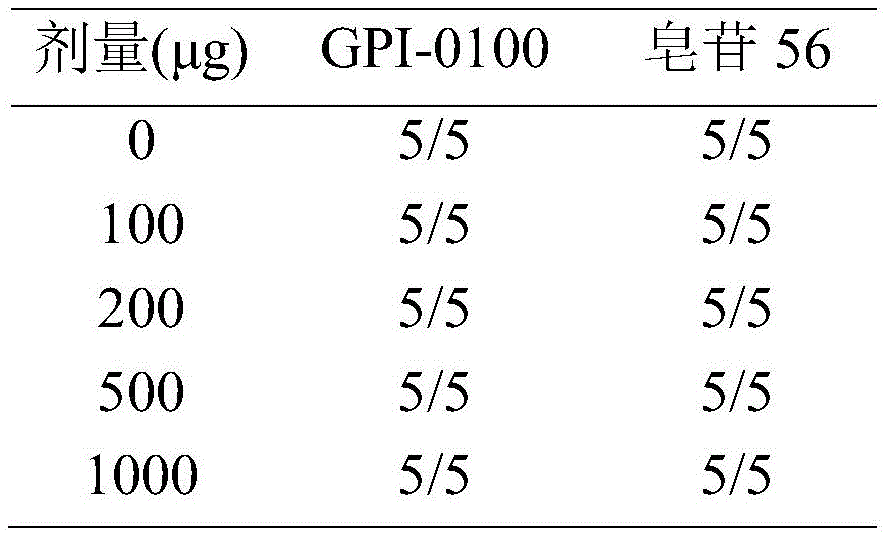
Results
The results are shown in FIG. 8. The median percent change in body weight of mice receiving increased doses of saponin adjuvant 56 was less than 5%. There was no change in both spleen and liver somatic cell indices for all experimental groups compared to the control group. These data indicate that saponin 56 is an effective and safe drug candidate as a vaccine adjuvant.
Experimental example II-challenge of OVA peptide vaccine to tumors
Materials and methods
Adjuvant stock solution
The sample powder was dissolved in DMSO to 20 mg/mL.
Animals and vaccination
Female C57BL/6 mice, 6-8 weeks old, were obtained from the Taiwan laboratory animal center, Taiwan laboratory research institute, Taiwan, China. 200 μ L of the extract containing 1.5X 10⁶G7-OVA (OVA expressing EL4 lymphoma) cells were injected subcutaneously into mice in PBS solution. Tumor volumes were measured at regular intervals using a vernier caliper and calculated by the following formula: tumor volume (mm)3) Long diameter x (short diameter)2x 0.52. When the mean tumor volume reached about 100mm3(day 7) 100mL of PBS solution containing 100. mu.g OVA (with or without 50. mu.g Compound 56), alum, QS-21 and GPI-0100 were injected subcutaneously around the tumor. PBS (200. mu.L) was used as a control.
Results
A mouse vaccination model was used in combination with antigen OVA to assess anti-tumor efficacy. Five mice per group were immunized twice every three weeks with 50 μ g saponin and 100 μ g OVA. The antitumor efficacy of compound 56 and the positive control group (alum, QS-21 and GPI-0100) was analyzed using a vernier caliper.
Antitumor effect
Mice bearing e.g. g7-OVA tumors were inoculated intradermally with different formulations twice on day 7, day 14. Mice treated with OVA and OVA + alum initially showed a slight inhibition of tumor growth compared to control (PBS), but the treatment was not good, and the tumor rapidly resumed growth thereafter. In contrast, mice treated with OVA + compound 56, OVA + QS-21 and OVA + GPI-0100 showed significant tumor growth inhibition. In addition, OVA + compound 56 reached the highest survival (figure 9).
Experimental example III-challenge of OVA peptide vaccines to influenza
Materials and methods
Adjuvant stock solution
The sample powder was dissolved in DMSO to 20 mg/mL.
Animals and vaccination
Female C57BL/6 mice 6-8 weeks old were immunized by subcutaneous injection of 100. mu.L of vaccine or by administration of 30. mu.L of vaccine by the intranasal route. All vaccine fluids were freshly prepared and diluted with 0.5% Tween 20 PBS. Vaccines for subcutaneous injection contain immunogenic NP alone or in combination with compound 56 (50. mu.g)366–374/NP311–325A peptide. Vaccines for the intranasal route contain the immunogen alone or in combination with compound 56(30 μ g). After two vaccinations, mice were infected intranasally with 110 Plaque Forming Units (PFU) of live PR8 virus.
Results
A mouse vaccination model was used in combination with antigen OVA to evaluate the efficacy against influenza. Five mice per group were treated with compound 56 and NPI/IIThe immunization was performed twice. After two vaccinations, mice were infected intranasally with 110 Plaque Forming Units (PFU) of live PR8 virus. Compared with NP aloneIAnd NPII(NPI/II) Mice immunized with peptide, using NPI/IIMice immunized with compound 56 had higher survival rates following PR8 infection (fig. 10).
EXAMPLE IV-immunological evaluation of the combination of SARS-CoV-2 antigen with Compound 56 immunological adjuvant
Materials and methods
Adjuvant stock solution
The sample powder was dissolved in DMSO to 20 mg/mL. Prior to administration, the stock solution was diluted to 0.5mg/mL with 0.5% (w/w) Tween 20 and filtered through PTFE (0.1 μm).
Animals and vaccination
Female C57BL/6 mice 6 to 8 weeks old were inoculated with SARS-CoV-2 spike protein via the subcutaneous route and without alum or compound 56 and injected three times at six week intervals. To determine IgG levels, blood from mice was collected via the tail artery 10 days after each immunization.
ELISA
A Maxisorp microtiter dish coated with SARS-CoV-2 neurite RBD His protein (0.5 μ g/well) (Nunc International,roskilde, Denmark) in borate buffer (BBS; 100mM NaCl, 50mM boric acid, 1.2mM Na2B4O7pH 8.2) overnight at 4 ℃ to determine the level of serum IgG specific for SARS-CoV-2 spike protein per group. The microtiter plates were blocked with blocking buffer (5% milk in PBS) for at least 1 hour at 37 ℃ and then washed with PBS + 0.05% Tween 20. Serum samples at 5-fold serial dilutions were added to microtiter plates. After 1 hour, the microtiter plates were washed with PBS + 0.05% Tween 20. To 1% BSA-PBS was added a 1: 3000 dilution of peroxide-labeled goat anti-mouse IgG (Invitrogen, Cat. No. 81-6520) was added over 1 hour. The microtiter plates were washed with PBS + 0.05% Tween 20 and developed with TMB chromogen solution (Invitrogen, Cat. No. 00-2023) for 15 minutes, followed by stop solution (0.2N H)2SO4) And (6) processing. The absorbance at 450nm was recorded.
Results
A mouse vaccination model was used in combination with the antigen SARS-CoV-2 fiber knob RBD His protein to evaluate the utility against COVID-19. Mice were divided into three groups: compound 56 (50. mu.g), SARS-CoV-2 (2. mu.g) + Compound 56 (50. mu.g), SARS-CoV-2 (10. mu.g) + Alum (10. mu.g).
Antibody production assay
Serum SARS-CoV-2 specific IgG antibody titers were determined after each administration using ELISA. As shown in FIG. 11, the SARS-CoV-2+ compound 56 group induced the highest level of antibody production in C57BL/6 mice. Among them, SARS-CoV-2/Compound 56 group showed an increase in antibody titer of 1000-fold only with 20% of the antigen.
Claims (19)
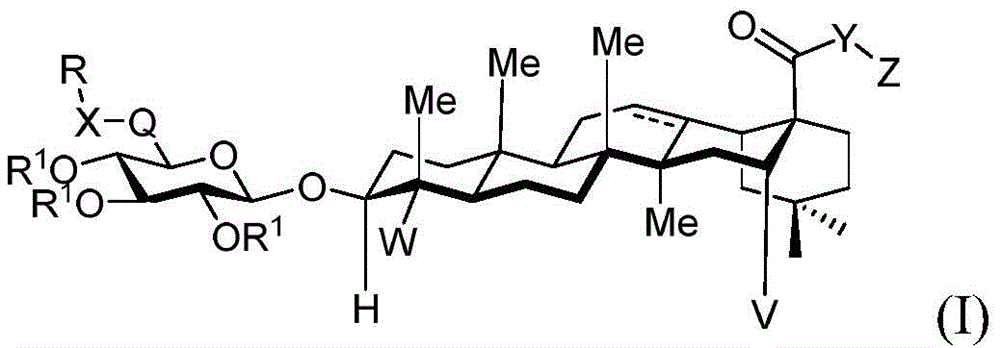

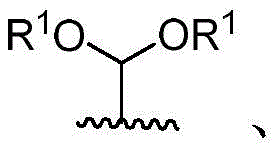
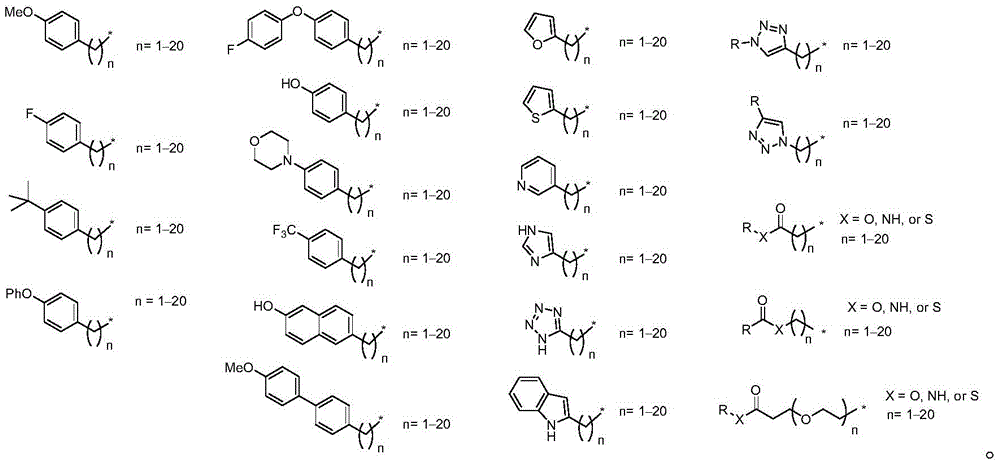
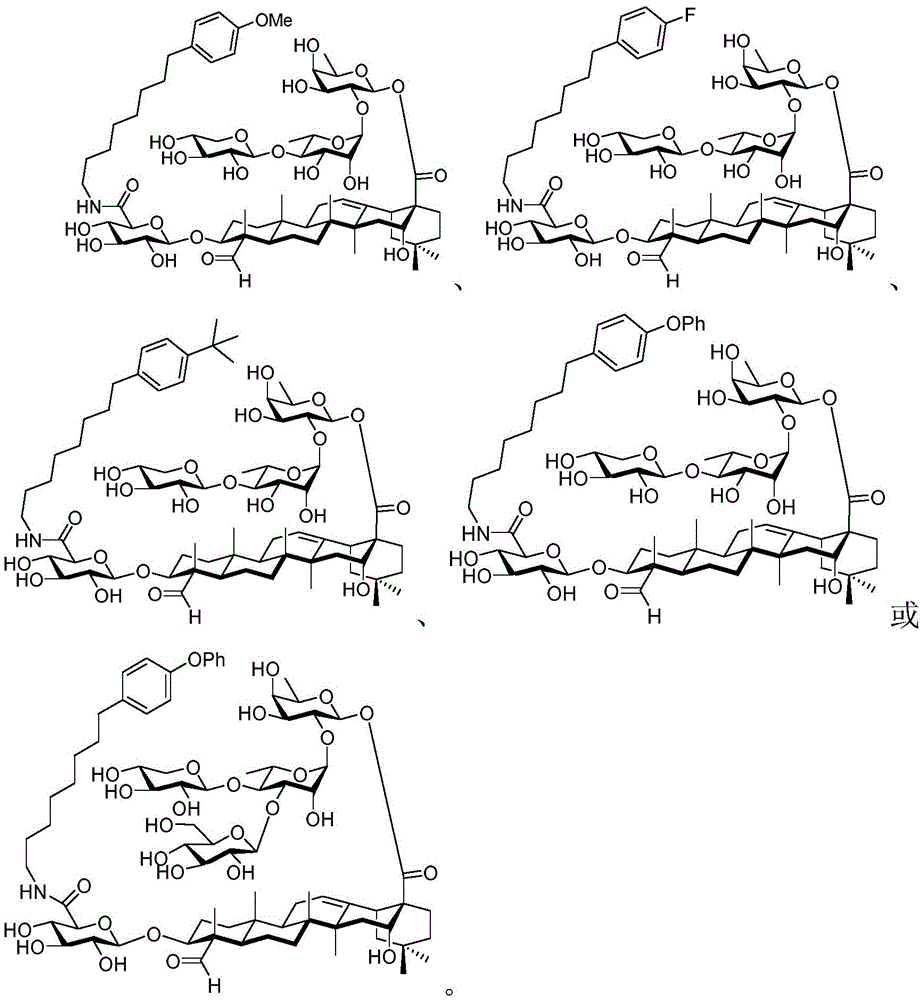
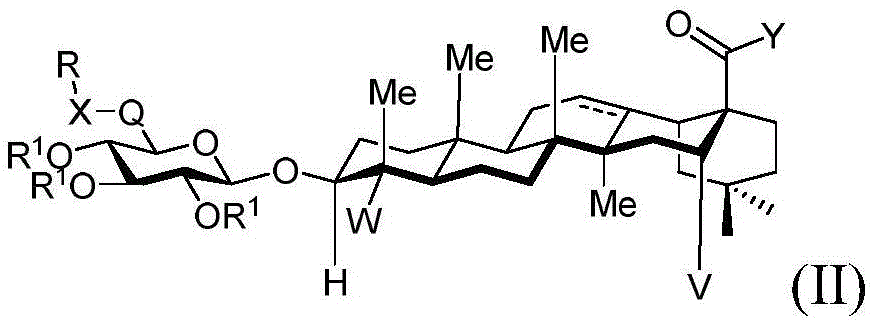

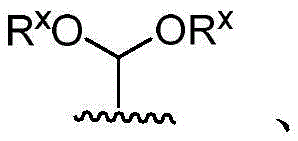
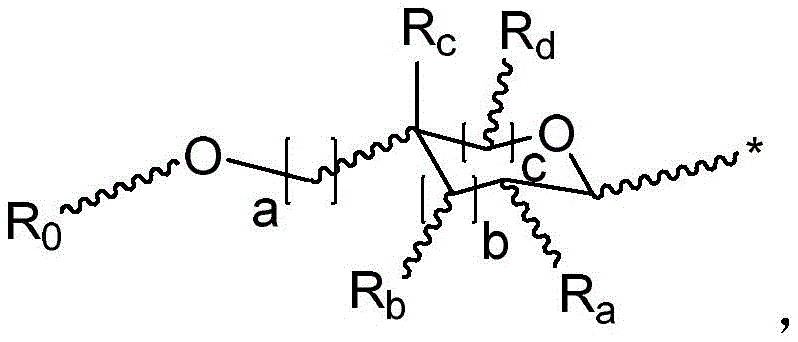
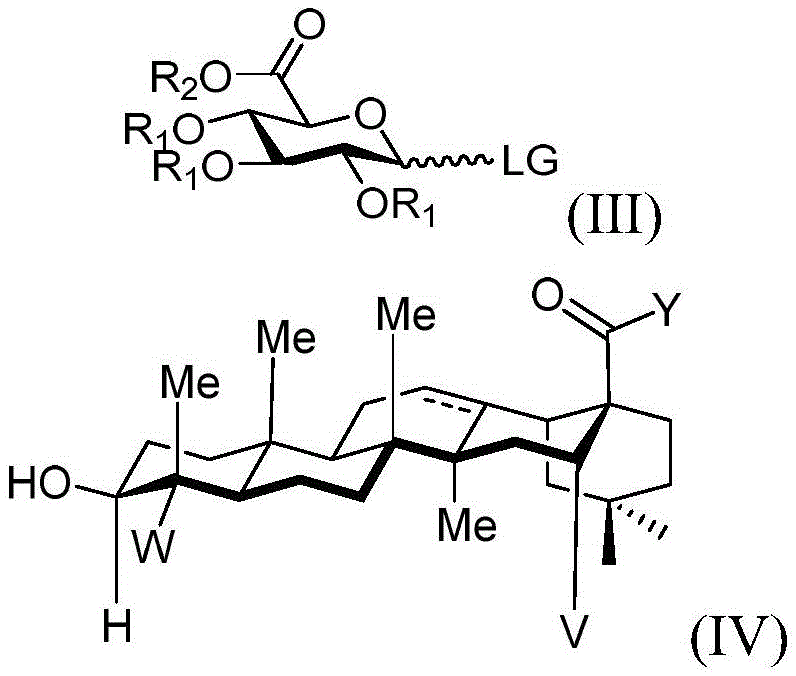
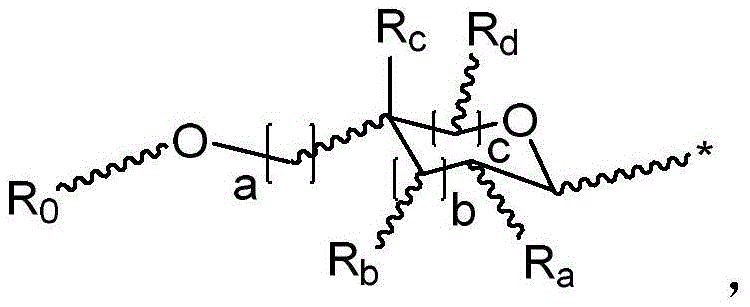
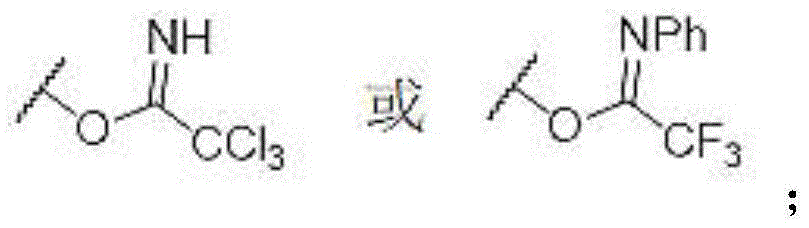

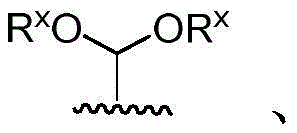
Applications Claiming Priority (3)
| Application Number | Priority Date | Filing Date | Title |
|---|---|---|---|
| US201962856729P | 2019-06-03 | 2019-06-03 | |
| US62/856,729 | 2019-06-03 | ||
| PCT/CN2020/093784 WO2020244483A1 (en) | 2019-06-03 | 2020-06-01 | Saponin conjugate and vaccine or pharmaceutical composition comprising the same |
Publications (2)
| Publication Number | Publication Date |
|---|---|
| CN114040918A true CN114040918A (en) | 2022-02-11 |
| CN114040918B CN114040918B (en) | 2024-11-22 |
Family
ID=73652077
Family Applications (1)
| Application Number | Title | Priority Date | Filing Date |
|---|---|---|---|
| CN202080041297.XA Active CN114040918B (en) | 2019-06-03 | 2020-06-01 | Saponin conjugate and vaccine or pharmaceutical composition containing the same |
Country Status (12)
| Country | Link |
|---|---|
| US (1) | US12419952B2 (en) |
| EP (1) | EP3976627A4 (en) |
| JP (1) | JP7680966B2 (en) |
| KR (1) | KR102783472B1 (en) |
| CN (1) | CN114040918B (en) |
| AU (1) | AU2020288770B2 (en) |
| BR (1) | BR112021024277A2 (en) |
| CA (1) | CA3140411C (en) |
| IL (1) | IL288645B2 (en) |
| MX (1) | MX2021014965A (en) |
| TW (1) | TWI768365B (en) |
| WO (1) | WO2020244483A1 (en) |
Cited By (1)
| Publication number | Priority date | Publication date | Assignee | Title |
|---|---|---|---|---|
| CN115368428A (en) * | 2022-08-02 | 2022-11-22 | 华南农业大学 | Potato trisaccharide betulinic acid saponin ester derivative and preparation method and application thereof |
Families Citing this family (4)
| Publication number | Priority date | Publication date | Assignee | Title |
|---|---|---|---|---|
| CN114644678B (en) * | 2020-12-18 | 2023-12-12 | 百极优棠(广东)医药科技有限公司 | Glucuronide compound, preparation method and application thereof |
| CN114644679B (en) * | 2020-12-18 | 2024-01-09 | 百极优棠(广东)医药科技有限公司 | Glucuronide glycoside compounds, preparation methods and applications thereof |
| JP2025518565A (en) * | 2022-05-18 | 2025-06-17 | ザ ユーエービー リサーチ ファウンデーション | Saponin-based immunostimulant, pharmaceutical composition containing said immunostimulant, and therapeutic use thereof |
| WO2024005485A1 (en) * | 2022-06-26 | 2024-01-04 | 기초과학연구원 | Saponin derivative compound, and pharmaceutical composition for preventing or treating coronavirus infection comprising same |
Citations (1)
| Publication number | Priority date | Publication date | Assignee | Title |
|---|---|---|---|---|
| WO2013142142A1 (en) * | 2012-03-23 | 2013-09-26 | The Uab Research Foundation | Natural saponin-based synthetic immunoadjuvants |
Family Cites Families (7)
| Publication number | Priority date | Publication date | Assignee | Title |
|---|---|---|---|---|
| IL132886A0 (en) | 1997-05-20 | 2001-03-19 | Galenica Pharmaceuticals Inc | A triterpene saponin-lipophile conjugate a pharmaceutical composition containing the same and a vaccine containing the same |
| US6080725A (en) | 1997-05-20 | 2000-06-27 | Galenica Pharmaceuticals, Inc. | Immunostimulating and vaccine compositions employing saponin analog adjuvants and uses thereof |
| WO2004092329A2 (en) | 2003-04-08 | 2004-10-28 | Galenica Pharmaceuticals, Inc. | Semi-synthetic saponin analogs with carrier and immune stimulatory activities for dna and rna vaccines |
| CN105111272B (en) | 2015-08-04 | 2017-03-22 | 中国医学科学院药用植物研究所 | 3-monouronic acid o-glycoside oleanane type and ursane type triterpenoid saponin derivative, as well as preparation method and application thereof |
| WO2017106836A1 (en) | 2015-12-17 | 2017-06-22 | Memorial Sloan-Kettering Cancer Center | Triterpene saponin variants, methods of synthesis and use thereof |
| US12497429B2 (en) | 2018-03-20 | 2025-12-16 | The Uab Research Foundation | Saponin-based vaccine adjuvants |
| US12419950B2 (en) | 2019-03-19 | 2025-09-23 | The Uab Research Foundation | Saponin-based vaccine adjuvants |
-
2020
- 2020-06-01 CN CN202080041297.XA patent/CN114040918B/en active Active
- 2020-06-01 BR BR112021024277A patent/BR112021024277A2/en unknown
- 2020-06-01 CA CA3140411A patent/CA3140411C/en active Active
- 2020-06-01 MX MX2021014965A patent/MX2021014965A/en unknown
- 2020-06-01 KR KR1020217041156A patent/KR102783472B1/en active Active
- 2020-06-01 JP JP2021572368A patent/JP7680966B2/en active Active
- 2020-06-01 WO PCT/CN2020/093784 patent/WO2020244483A1/en not_active Ceased
- 2020-06-01 US US17/616,213 patent/US12419952B2/en active Active
- 2020-06-01 TW TW109118307A patent/TWI768365B/en active
- 2020-06-01 EP EP20818336.8A patent/EP3976627A4/en active Pending
- 2020-06-01 IL IL288645A patent/IL288645B2/en unknown
- 2020-06-01 AU AU2020288770A patent/AU2020288770B2/en active Active
Patent Citations (1)
| Publication number | Priority date | Publication date | Assignee | Title |
|---|---|---|---|---|
| WO2013142142A1 (en) * | 2012-03-23 | 2013-09-26 | The Uab Research Foundation | Natural saponin-based synthetic immunoadjuvants |
Non-Patent Citations (3)
| Title |
|---|
| GUI LIU等: "QS-21 structure/function studies: effect of acylation on adjuvant activity", VACCINE, vol. 20, pages 2802 - 2815 * |
| PENGFEI WANG等: "Synthesis and Evaluation of QS-21-Based Immunoadjuvants with a Terminal-Functionalized Side Chain Incorporated in the West Wing Trisaccharide", THE JOURNAL OF ORGANIC CHEMISTRY, vol. 81, pages 9560 - 9566, XP055765276, DOI: 10.1021/acs.joc.6b00922 * |
| PENGFEI WANG等: "Synthesis of QS-21-Based Immunoadjuvants", THE JOURNAL OF ORGANIC CHEMISTRY, vol. 78, pages 11525 - 11534, XP055979724, DOI: 10.1021/jo402118j * |
Cited By (1)
| Publication number | Priority date | Publication date | Assignee | Title |
|---|---|---|---|---|
| CN115368428A (en) * | 2022-08-02 | 2022-11-22 | 华南农业大学 | Potato trisaccharide betulinic acid saponin ester derivative and preparation method and application thereof |
Also Published As
| Publication number | Publication date |
|---|---|
| JP2022536296A (en) | 2022-08-15 |
| TW202110459A (en) | 2021-03-16 |
| KR20220009441A (en) | 2022-01-24 |
| AU2020288770B2 (en) | 2023-09-28 |
| IL288645B2 (en) | 2025-05-01 |
| EP3976627A1 (en) | 2022-04-06 |
| CN114040918B (en) | 2024-11-22 |
| KR102783472B1 (en) | 2025-03-19 |
| MX2021014965A (en) | 2022-04-11 |
| CA3140411C (en) | 2024-01-02 |
| CA3140411A1 (en) | 2020-12-10 |
| EP3976627A4 (en) | 2023-07-19 |
| TWI768365B (en) | 2022-06-21 |
| US12419952B2 (en) | 2025-09-23 |
| IL288645A (en) | 2022-02-01 |
| AU2020288770A1 (en) | 2022-01-06 |
| IL288645B1 (en) | 2025-01-01 |
| BR112021024277A2 (en) | 2022-04-26 |
| US20220323578A1 (en) | 2022-10-13 |
| WO2020244483A1 (en) | 2020-12-10 |
| JP7680966B2 (en) | 2025-05-21 |
Similar Documents
| Publication | Publication Date | Title |
|---|---|---|
| CN114040918B (en) | Saponin conjugate and vaccine or pharmaceutical composition containing the same | |
| CN102112484B (en) | Triterpene saponins, their synthesis method and use | |
| EP3197907B1 (en) | Vaccines against streptococcus pneumoniae serotype 8 | |
| JP2016530212A (en) | Protein- and peptide-free synthetic vaccine against Streptococcus pneumoniae type 3 | |
| JP6416249B2 (en) | Synthetic vaccine against Streptococcus pneumoniae type 1 | |
| CN107709343B (en) | Vaccine against Streptococcus pneumoniae serotype 5 | |
| EP3274358B1 (en) | Vaccine against carbapenem-resistantklebsiella pneumoniae | |
| EP3230297B1 (en) | Vaccines against streptococcus pneumoniae serotype 4 | |
| CN116601163A (en) | Protected disaccharides, methods for their preparation, their use in the synthesis of zwitterionic oligosaccharides and conjugates thereof | |
| HK40064797A (en) | Saponin conjugate and vaccine or pharmaceutical composition comprising the same | |
| HK40064797B (en) | Saponin conjugate and vaccine or pharmaceutical composition comprising the same | |
| EP4682154A1 (en) | Protected tetrasaccharides, their process of preparation and their use in the synthesis of oligosaccharides representing segments of o-antigens from diverse shigella flexneri serotypes | |
| Hall | Synthesis of oligosaccharides for functionalization of RHDV VLP | |
| EP3000820A1 (en) | Synthetic vaccines against Streptococcus pneumoniae serotype 8 | |
| HK1242329B (en) | Vaccines against streptococcus pneumoniae serotype 8 | |
| HK1242329A1 (en) | Vaccines against streptococcus pneumoniae serotype 8 |
Legal Events
| Date | Code | Title | Description |
|---|---|---|---|
| PB01 | Publication | ||
| PB01 | Publication | ||
| SE01 | Entry into force of request for substantive examination | ||
| SE01 | Entry into force of request for substantive examination | ||
| REG | Reference to a national code |
Ref country code: HK Ref legal event code: DE Ref document number: 40064797 Country of ref document: HK |
|
| GR01 | Patent grant | ||
| GR01 | Patent grant |