CN113993852A - Process for preparing ClC-1 chloride channel inhibitors - Google Patents
Process for preparing ClC-1 chloride channel inhibitors Download PDFInfo
- Publication number
- CN113993852A CN113993852A CN202080043796.2A CN202080043796A CN113993852A CN 113993852 A CN113993852 A CN 113993852A CN 202080043796 A CN202080043796 A CN 202080043796A CN 113993852 A CN113993852 A CN 113993852A
- Authority
- CN
- China
- Prior art keywords
- phenoxy
- dihydroisoxazol
- bromo
- butoxy
- propanoate
- Prior art date
- Legal status (The legal status is an assumption and is not a legal conclusion. Google has not performed a legal analysis and makes no representation as to the accuracy of the status listed.)
- Granted
Links
Images


Classifications
-
- C—CHEMISTRY; METALLURGY
- C07—ORGANIC CHEMISTRY
- C07D—HETEROCYCLIC COMPOUNDS
- C07D261/00—Heterocyclic compounds containing 1,2-oxazole or hydrogenated 1,2-oxazole rings
- C07D261/02—Heterocyclic compounds containing 1,2-oxazole or hydrogenated 1,2-oxazole rings not condensed with other rings
- C07D261/06—Heterocyclic compounds containing 1,2-oxazole or hydrogenated 1,2-oxazole rings not condensed with other rings having two or more double bonds between ring members or between ring members and non-ring members
- C07D261/08—Heterocyclic compounds containing 1,2-oxazole or hydrogenated 1,2-oxazole rings not condensed with other rings having two or more double bonds between ring members or between ring members and non-ring members with only hydrogen atoms, hydrocarbon or substituted hydrocarbon radicals, directly attached to ring carbon atoms
-
- A—HUMAN NECESSITIES
- A61—MEDICAL OR VETERINARY SCIENCE; HYGIENE
- A61K—PREPARATIONS FOR MEDICAL, DENTAL OR TOILETRY PURPOSES
- A61K31/00—Medicinal preparations containing organic active ingredients
- A61K31/33—Heterocyclic compounds
- A61K31/395—Heterocyclic compounds having nitrogen as a ring hetero atom, e.g. guanethidine or rifamycins
- A61K31/41—Heterocyclic compounds having nitrogen as a ring hetero atom, e.g. guanethidine or rifamycins having five-membered rings with two or more ring hetero atoms, at least one of which being nitrogen, e.g. tetrazole
- A61K31/42—Oxazoles
Landscapes
- Chemical & Material Sciences (AREA)
- Organic Chemistry (AREA)
- Health & Medical Sciences (AREA)
- Animal Behavior & Ethology (AREA)
- Epidemiology (AREA)
- Life Sciences & Earth Sciences (AREA)
- Pharmacology & Pharmacy (AREA)
- General Health & Medical Sciences (AREA)
- Public Health (AREA)
- Veterinary Medicine (AREA)
- Medicinal Chemistry (AREA)
- Heterocyclic Carbon Compounds Containing A Hetero Ring Having Nitrogen And Oxygen As The Only Ring Hetero Atoms (AREA)
- Pharmaceuticals Containing Other Organic And Inorganic Compounds (AREA)
- Organic Low-Molecular-Weight Compounds And Preparation Thereof (AREA)
Abstract
本公开涉及使用式II化合物作为起始物质制备作为ClC‑1氯离子通道抑制剂的式I化合物的改进的化学方法。(式I、式II) The present disclosure relates to improved chemical processes for the preparation of compounds of formula I as inhibitors of ClC-1 chloride channels using compounds of formula II as starting materials. (Formula I, Formula II) 
Description
Technical Field
The present disclosure relates to novel chemical processes for the synthesis of ClC-1 chloride channel inhibitors.
Background
The present disclosure relates to chemical processes for preparing compounds that are inhibitors of the ClC-1 chloride channel. As described in WO 2016/202341, ClC-1 chloride channel inhibitors are useful for treating neuromuscular disorders such as myasthenia gravis (myasthenia gravis) and ALS, or for reversing and/or ameliorating neuromuscular blockade.
Disclosure of Invention
To develop a therapeutic method for neuromuscular diseases, a ClC-1 chloride channel inhibitor is needed. The present disclosure provides a novel industrially applicable process for the preparation of compounds of formula I. As demonstrated by the data generated by studying the compound set in the biological models described herein, the compounds of formula I inhibit the ClC-1 ion channel and are able to restore neuromuscular transmission. Thus, these compounds are useful for treating or ameliorating muscle weakness and muscle fatigue in neuromuscular junction disorders caused by disease or neuromuscular blocking agents.
In one aspect, the present disclosure provides a process for preparing a compound of formula I

Comprising a step a) in which
i) Reacting a compound of formula II with an acid or base

And
ii) isolating the compound of formula I from the reaction mixture,
wherein R is1To R9And n is as defined herein.
The present disclosure also relates to novel compounds of formula II as defined herein.
Drawings
FIG. 1: panel A illustrates a voltage protocol for inducing current in whole cell patches of CHO cells expressing the human ClC-1 channel. Panel B shows representative whole cell current traces from patched CHO cells expressing the human ClC-1 channel. The current is induced by applying the voltage scheme shown in panel a.
FIG. 2: panel A shows representative I/V plots of constant current density in ClC-1 expressing CHO cells before (circles) and after (squares) application of 100 μ M of the ClC-1 inhibitor 9-anthracenecarboxylic acid (9-AC, Sigma A89405). Panel B shows the I/V plot of the instantaneous tail current density obtained from the same ClC-1 expressing CHO cells as shown in Panel A before (circles) and after (squares) the application of 100. mu.M 9-AC.
FIG. 3: FIG. 3 shows representative plots of normalized instantaneous tail currents obtained from ClC-1 expressing CHO cell patches before (circles) and after (squares) application of 100 μ M9-AC. The instantaneous tail current at each voltage step (voltage step) is normalized with respect to the maximum tail current obtained after a (+)120mV voltage step and fitted with a Boltzmann function to determine the semi-activation potential V1/2。
Definition of
The term "C1-3Alkyl "and" C1-5Alkyl "refers to branched or unbranched alkyl groups having one to three or one to five carbon atoms, respectively, including but not limited to methyl, ethyl, prop-1-yl, prop-2-yl, 2-methyl-prop-1-yl, 2-methyl-prop-2-yl, 2-dimethyl-prop-1-yl, but-2-yl, 3-methyl-but-1-yl, 3-methyl-but-2-yl, pent-1-yl, pent-2-yl and pent-3-yl.
The term "C2-5Alkenyl "refers to a branched or unbranched alkenyl group having two to five carbon atoms, two of which are connected by a double bond, including, but not limited to, ethenyl, propenyl, isopropenyl, butenyl, isobutenyl, pentenyl, and isopentenyl.
The term "C2-5Alkynyl "refers to a branched or unbranched alkynyl group having two to five carbon atoms, two of which are joined by a triple bond, including, but not limited to, ethynyl, prop-1-ynyl, prop-2-ynyl, but-1-ynyl, but-2-ynyl, but-3-ynyl, but-1, 3-diynyl, pent-1-ynyl, pent-2-ynyl, pent-3-ynyl, pent-4-ynyl, pent-2, 4-diynyl and pent-1, 3-diynyl.
The term "C3-5Cycloalkyl radicals "and" C3-6Cycloalkyl "refers to groups having three to five or three to six carbon atoms, respectively, including monocyclic or bicyclic carbocycles, including, but not limited to, cyclopropyl, cyclobutyl, cyclopentyl, and cyclohexyl.
Detailed Description
The present disclosure provides novel industrially applicable processes for preparing compounds of formula I that are inhibitors of the ClC-1 chloride channel. The process of the invention allows for better control of impurities, reduces or eliminates the need for chromatographic steps and has higher yields, thereby providing better commercial costs.
Thus, in one aspect, the present disclosure provides a process for the preparation of a compound of formula I,
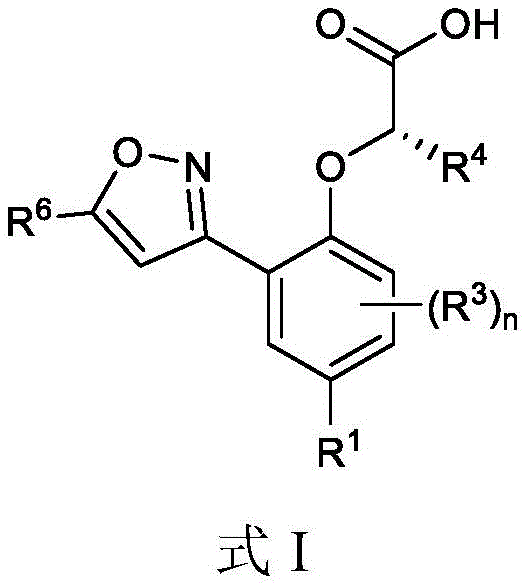
which comprises a step a) in which
i) Reacting a compound of formula II with an acid or base,

and
ii) separating the compound of formula I from the reaction mixture,
wherein
-R1Selected from H, F, Cl, Br and I;
-R2is selected from C1-5Alkyl and C3-5A cycloalkyl group;
-R3selected from deuterium, F, Cl, Br and I;
-R4selected from H, deuterium, C1-5Alkyl radical, C2-5Alkenyl radical, C2-5Alkynyl, C3-5Cycloalkyl and C5Cycloalkenyl in which each may optionally be substituted by one or more identical or different substituents R7Substitution;
-R5selected from the group consisting of R optionally substituted by one or more identical or different substituents8Substituted C1-5Alkyl radical, C2-5Alkenyl radical, C2-5Alkynyl, optionally substituted by one or more identical or different substituents R8Substituted C3-6Cycloalkyl, optionally substituted by one or more identical or different substituents R9Substituted phenyl and optionally substituted by one or more identical or different substituents R9A substituted benzyl group;
-R6selected from H, deuterium, C1-5Alkyl and C3-5A cycloalkyl group;
-R7independently selected from deuterium, tritium, F, Cl, Br, I, CN, isocyano (isocyanide), optionally substituted by one or more identical or different substituents R8Substituted C3-5Cycloalkyl, optionally substituted by one or more identical or different substituents R8Substituted O-C1-3Alkyl, optionally substituted by one or more identical or different substituents R8Substituted S-C1-3Alkyl, optionally substituted by one or more identical or different substituents R8Substituted CH2-O-C1-3Alkyl and optionally substituted by one or more identical or different substituents R8Substituted CH2-S-C1-3An alkyl group;
-R8independently selected from deuterium and F;
-R9independently selected from deuterium, methoxy, nitro, cyano, Cl, Br, I and F; and is
-n is an integer 0, 1,2 or 3.
In one embodiment, R1Is Cl or Br. In one embodiment, R1Is Cl. In one embodiment, R1Is Br.
In one embodiment, R2Is C1-5An alkyl group. In one embodiment, R2Selected from the group consisting of methyl, ethyl, prop-1-yl, prop-2-yl, 2-methyl-prop-1-yl, 2-methyl-prop-2-yl, 2-dimethyl-prop-1-yl, but-2-yl, 3-methyl-but-1-yl, 3-methyl-but-2-yl, pent-1-yl, pent-2-yl and pent-3-yl. In one embodiment, R2Is ethyl. In one embodiment, R2Is propan-1-yl. In one embodiment, R2Is propan-2-yl. In one embodiment, R2Is butan-1-yl. In one embodiment, R2Is 2-methyl-propan-2-yl.
In one embodiment, R3Is deuterium. In one embodiment, R3Is F.
In one embodiment, R4Is H. In one embodiment, R4Is optionally substituted by one or more identical or different substituents R7Substituted C1-5An alkyl group. In one embodiment, R4Is a quilt C3-5Cycloalkyl-substituted C1-5Alkyl radical, C3-5Cycloalkyl is optionally substituted by one or more identical or different substituents R8And (4) substitution. In one embodiment, R4Is Me. In one embodiment, R4Is Et. In one embodiment, R4is-CH2F. In one embodiment, R5Is cyclopropyl.
In one embodiment, R5Is optionally substituted by one or more identical or different substituents R8Substituted C1-5An alkyl group. In one embodiment, R5Is Me. In one embodiment, R5Is Et. In one embodiment, R5Is 2-methyl-propan-2-yl.
In one embodiment, R6Is H. In one embodiment, R6Is deuterium. In one embodiment, R6Is C1-5An alkyl group. In one embodiment, R6Selected from the group consisting of methyl, ethyl, prop-1-yl, prop-2-yl, 2-methyl-prop-1-yl, 2-methyl-prop-2-yl, 2-dimethyl-prop-1-yl, but-2-yl, 3-methyl-but-1-yl, 3-methyl-but-2-yl, pent-1-yl, pent-2-yl and pent-3-yl.
In one embodiment, R7Is deuterium. In one embodiment, R7Is F. In one embodiment, R7Is optionally substituted by one or more identical or different substituents R8Substituted C3-5A cycloalkyl group. In one embodiment, R4Is by R7Substituted C1-5Alkyl radical, wherein R7Is optionally substituted by one or more identical or different substituents R8Substituted C3-5A cycloalkyl group.
In one embodiment, n is 0. In one embodiment, n is 1. In one embodiment, n is 2. In one embodiment, n is 3.
In one embodiment, the compound of formula II is reacted with an acid. In one embodiment, the compound of formula II is reacted with a concentrated acid. In one embodiment, the compound of formula II is reacted with an acid selected from formic acid, acetic acid, propionic acid, butyric acid, benzoic acid, hydrochloric acid and sulfuric acid or mixtures thereof (e.g., a mixture of formic acid and acetic acid). In one embodiment, the acid is acetic acid. In one embodiment, the acid is formic acid. In one embodiment, the acid is concentrated acetic acid. In one embodiment, the acid is concentrated formic acid. In one embodiment, the acid is concentrated acetic acid. In one embodiment, the acid is a mixture of concentrated formic acid and concentrated acetic acid.
In one embodiment, step a) i) is carried out at a temperature of from 70 ℃ to 140 ℃, such as from 80 ℃ to 130 ℃, such as from 90 ℃ to 120 ℃.
In one embodiment, the reaction time of step a) i) is from 12 hours to 96 hours, such as from 24 hours to 72 hours, such as from 36 hours to 60 hours.
In one embodiment, the amount of acid used in step a) i) is from 3mL per gram of starting material to 15mL per gram of starting material.
In one embodiment, the compound of formula I is isolated from the reaction mixture by adding water and extracting the product into an organic solvent. In one embodiment, the organic solvent used for extraction is selected from toluene, ethyl acetate, isopropyl acetate and methyl tert-butyl ether. In one embodiment, the organic solvent used for extraction is methyl tert-butyl ether.
In one embodiment, the compound of formula I is purified by crystallization from an organic solvent selected from the group consisting of toluene, ethyl acetate, isopropyl acetate and methyl tert-butyl ether. In one embodiment, the compound of formula I is purified by crystallization from toluene.
In one embodiment, the method further comprises step b), wherein
i) Reacting a compound of formula III
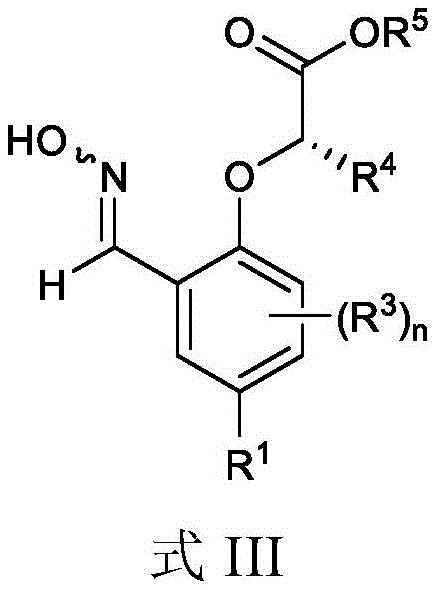
Reacting with N-chlorosuccinimide in an organic solvent;
ii) reacting a compound of formula IV

Adding a base to the reaction mixture; and
iii) isolating the compound of formula II from the reaction mixture,
wherein R is1To R9And n is as defined herein.
In one embodiment, the solvent in step b) i) is Dimethylformamide (DMF). In one embodiment, the compound of formula IV is selected from the group consisting of ethyl vinyl ether, n-butyl vinyl ether, and t-butyl vinyl ether. In one embodiment, the compound of formula IV is n-butyl vinyl ether. In one embodiment, the base in step b) ii) is a trialkylamine. In one embodiment, the base in step b) ii) is selected from trimethylamine, triethylamine, triisopropylamine and N, N-diisopropylethylamine. In one embodiment, the base in step b) ii) is triethylamine.
In one embodiment, the method further comprises step c), wherein
i) Reacting a compound of formula V

Reacting with hydroxylamine in an organic solvent;
ii) adding a base to the reaction mixture; and
III) isolating the compound of formula III from the reaction mixture,
wherein R is1To R9And n is as defined herein.
In one embodiment, the method further comprises step d), wherein
i) Reacting a compound of formula VI
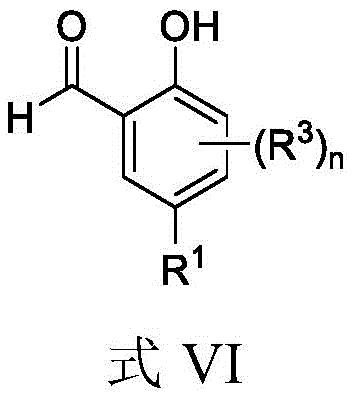
To a compound of formula VII in an organic solvent;

ii) adding a base to the reaction mixture; and
iii) isolating the compound of formula V from the reaction mixture,
wherein R is1To R9And n is as defined herein and LG is a leaving group.
In one embodiment, the leaving group is selected from tosylate, mesylate, triflate, m-nitrobenzenesulfonate (nosylate), brosylate, bromide, iodide and chloride.
In one embodiment, the method comprises step a) as outlined in scheme 1. In one embodiment, the method comprises steps a) and b) as outlined in scheme 1. In one embodiment, the method comprises steps a), b) and c) as outlined in scheme 1. In one embodiment, the method comprises steps a), b), c) and d) as outlined in scheme 1.
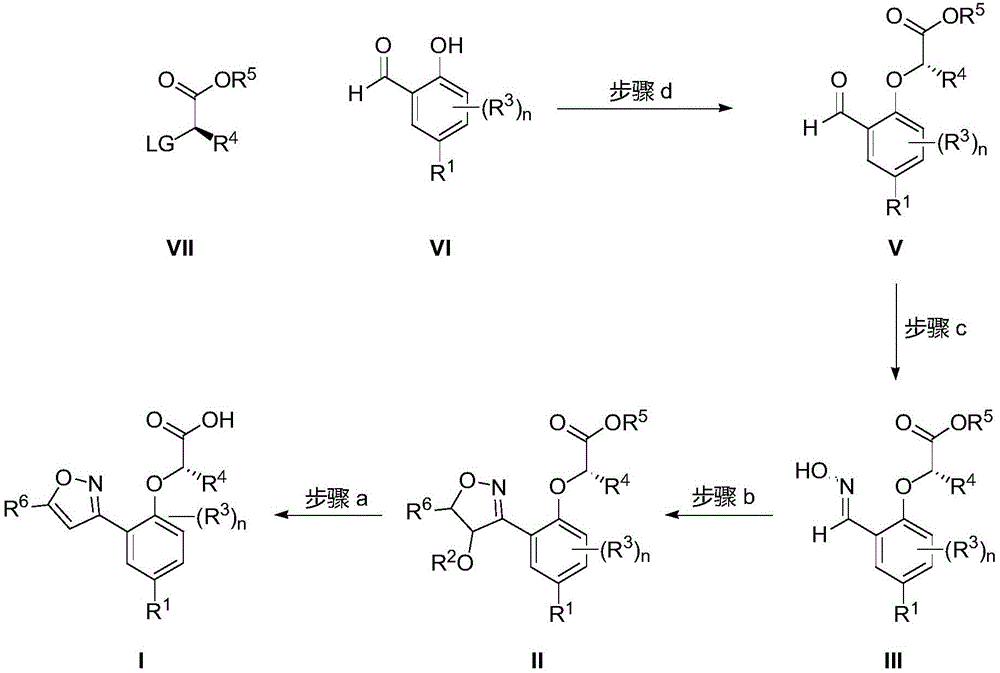
Scheme 1: synthesis of Compounds of formula I
In one embodiment, the compounds of formula I are inhibitors of ClC-1 chloride channels.
In one embodiment, the compound of formula I is at least 80% pure, such as at least 90% pure, such as at least 95% pure, such as at least 96% pure, such as at least 97% pure, such as at least 98% pure.
In certain embodiments, a compound according to the present disclosure or a compound used according to the present disclosure may have an enantiomeric excess of > 90%. In certain embodiments, a compound according to the present disclosure or a compound used according to the present disclosure may have > 95% e.e.
In one embodiment, the compound of formula I is selected from:
(2S) -2- [ 4-bromo-5-fluoro-2- (1, 2-oxazol-3-yl) phenoxy ] -2-cyclopropylacetic acid;
(2S) -2- [ 4-bromo-2- (1, 2-oxazol-3-yl) phenoxy ] -3-cyclobutylpropionic acid;
2- [ 4-bromo-5-fluoro-2- (1, 2-oxazol-3-yl) phenoxy ] acetic acid;
2- [ 4-bromo-2- (1, 2-oxazol-3-yl) phenoxy ] acetic acid;
(2S) -2- [4, 5-dichloro-2- (1, 2-oxazol-3-yl) phenoxy ] propanoic acid;
(2S) -2- [ 4-bromo-5-fluoro-2- (1, 2-oxazol-3-yl) phenoxy ] propionic acid;
(2S) -2- [ 4-chloro-5-fluoro-2- (1, 2-oxazol-3-yl) phenoxy ] propionic acid;
(2S) -2- [ 4-chloro-2- (1, 2-oxazol-3-yl) phenoxy ] -3-cyclopropylpropionic acid;
(2S) -2- [ 4-fluoro-2- (1, 2-oxazol-3-yl) phenoxy ] propionic acid;
(2S) -2- [ 4-chloro-2- (5-cyclopropyl-1, 2-oxazol-3-yl) phenoxy ] propionic acid;
(2S) -2- [ 4-chloro-2- (1, 2-oxazol-3-yl) phenoxy ] -3-methylbutanoic acid;
(2S) -2- [ 4-chloro-2- (1, 2-oxazol-3-yl) phenoxy ] butanoic acid;
(2S) -2- [ 4-chloro-2- (1, 2-oxazol-3-yl) phenoxy ] propionic acid;
(2S) -2- [ 4-bromo-2- (1, 2-oxazol-3-yl) phenoxy ] -3-cyclopropylpropionic acid;
(2S) -2- [ 4-bromo-2- (1, 2-oxazol-3-yl) phenoxy ] butanoic acid;
(2S) -2- [ 4-bromo-2- (1, 2-oxazol-3-yl) phenoxy ] -3-methylbutanoic acid;
(2S) -2- [ 4-bromo-2- (5-methyl-1, 2-oxazol-3-yl) phenoxy ] propionic acid;
(2S) -2- [ 4-bromo-2- (5-cyclopropyl-1, 2-oxazol-3-yl) phenoxy ] propionic acid; and
(2S) -2- [ 4-bromo-2- (1, 2-oxazol-3-yl) phenoxy ] propionic acid.
In one aspect, the present disclosure relates to a process for preparing a pharmaceutical composition comprising the steps of:
i) preparing a compound according to the invention, said compound being selected from the following:
(2S) -2- [ 4-bromo-5-fluoro-2- (1, 2-oxazol-3-yl) phenoxy ] -2-cyclopropylacetic acid;
(2S) -2- [ 4-bromo-2- (1, 2-oxazol-3-yl) phenoxy ] -3-cyclobutylpropionic acid;
2- [ 4-bromo-5-fluoro-2- (1, 2-oxazol-3-yl) phenoxy ] acetic acid;
2- [ 4-bromo-2- (1, 2-oxazol-3-yl) phenoxy ] acetic acid;
(2S) -2- [4, 5-dichloro-2- (1, 2-oxazol-3-yl) phenoxy ] propanoic acid;
(2S) -2- [ 4-bromo-5-fluoro-2- (1, 2-oxazol-3-yl) phenoxy ] propionic acid;
(2S) -2- [ 4-chloro-5-fluoro-2- (1, 2-oxazol-3-yl) phenoxy ] propionic acid;
(2S) -2- [ 4-chloro-2- (1, 2-oxazol-3-yl) phenoxy ] -3-cyclopropylpropionic acid;
(2S) -2- [ 4-fluoro-2- (1, 2-oxazol-3-yl) phenoxy ] propionic acid;
(2S) -2- [ 4-chloro-2- (5-cyclopropyl-1, 2-oxazol-3-yl) phenoxy ] propionic acid;
(2S) -2- [ 4-chloro-2- (1, 2-oxazol-3-yl) phenoxy ] -3-methylbutanoic acid;
(2S) -2- [ 4-chloro-2- (1, 2-oxazol-3-yl) phenoxy ] butanoic acid;
(2S) -2- [ 4-chloro-2- (1, 2-oxazol-3-yl) phenoxy ] propionic acid;
(2S) -2- [ 4-bromo-2- (1, 2-oxazol-3-yl) phenoxy ] -3-cyclopropylpropionic acid;
(2S) -2- [ 4-bromo-2- (1, 2-oxazol-3-yl) phenoxy ] butanoic acid;
(2S) -2- [ 4-bromo-2- (1, 2-oxazol-3-yl) phenoxy ] -3-methylbutanoic acid;
(2S) -2- [ 4-bromo-2- (5-methyl-1, 2-oxazol-3-yl) phenoxy ] propionic acid;
(2S) -2- [ 4-bromo-2- (5-cyclopropyl-1, 2-oxazol-3-yl) phenoxy ] propionic acid; and
(2S) -2- [ 4-bromo-2- (1, 2-oxazol-3-yl) phenoxy ] propionic acid, and
ii) formulating said compound into a pharmaceutical composition.
In one aspect, the disclosure relates to a compound of formula II as defined herein.
In one embodiment, the compound of formula II is selected from:
(2S) -methyl 2- [ 4-bromo-2- (4-butoxy-4, 5-dihydroisoxazol-3-yl) phenoxy ] propionate;
(2S) -ethyl 2- [ 4-bromo-2- (4-butoxy-4, 5-dihydroisoxazol-3-yl) phenoxy ] propionate;
(2S) -tert-butyl 2- [ 4-bromo-2- (4-butoxy-4, 5-dihydroisoxazol-3-yl) phenoxy ] propionate;
(2S) -methyl 2- [ 4-bromo-2- (4-ethoxy-4, 5-dihydroisoxazol-3-yl) phenoxy ] propanoate;
(2S) -ethyl 2- [ 4-bromo-2- (4-ethoxy-4, 5-dihydroisoxazol-3-yl) phenoxy ] propionate;
(2S) -tert-butyl 2- [ 4-bromo-2- (4-ethoxy-4, 5-dihydroisoxazol-3-yl) phenoxy ] propionate;
(2S) -methyl 2- [ 4-chloro-2- (5-cyclopropyl-4-butoxy-4, 5-dihydroisoxazol-3-yl) phenoxy ] propionate;
(2S) -methyl 2- [ 4-bromo-2- (5-methyl-4-butoxy-4, 5-dihydroisoxazol-3-yl) phenoxy ] propionate;
(2S) -methyl 2- [ 4-bromo-2- (5-cyclopropyl-4-butoxy-4, 5-dihydroisoxazol-3-yl) phenoxy ] propionate;
(2S) -ethyl 2- [ 4-chloro-2- (5-cyclopropyl-4-butoxy-4, 5-dihydroisoxazol-3-yl) phenoxy ] propionate;
(2S) -ethyl 2- [ 4-bromo-2- (5-methyl-4-butoxy-4, 5-dihydroisoxazol-3-yl) phenoxy ] propionate;
(2S) -ethyl 2- [ 4-bromo-2- (5-cyclopropyl-4-butoxy-4, 5-dihydroisoxazol-3-yl) phenoxy ] propionate;
(2S) -tert-butyl 2- [ 4-chloro-2- (5-cyclopropyl-4-butoxy-4, 5-dihydroisoxazol-3-yl) phenoxy ] propionate;
(2S) -tert-butyl 2- [ 4-bromo-2- (5-methyl-4-butoxy-4, 5-dihydroisoxazol-3-yl) phenoxy ] propionate;
(2S) -tert-butyl 2- [ 4-bromo-2- (5-cyclopropyl-4-butoxy-4, 5-dihydroisoxazol-3-yl) phenoxy ] propionate;
(2S) -methyl 2- [ 4-chloro-2- (5-cyclopropyl-4-butoxy-4, 5-dihydroisoxazol-3-yl) phenoxy ] propionate;
(2S) -methyl 2- [ 4-bromo-2- (5-methyl-4-butoxy-4, 5-dihydroisoxazol-3-yl) phenoxy ] propionate;
(2S) -methyl 2- [ 4-bromo-2- (5-cyclopropyl-4-butoxy-4, 5-dihydroisoxazol-3-yl) phenoxy ] propionate;
(2S) -ethyl 2- [ 4-chloro-2- (5-cyclopropyl-4-butoxy-4, 5-dihydroisoxazol-3-yl) phenoxy ] propionate;
(2S) -ethyl 2- [ 4-bromo-2- (5-methyl-4-butoxy-4, 5-dihydroisoxazol-3-yl) phenoxy ] propionate;
(2S) -ethyl 2- [ 4-bromo-2- (5-cyclopropyl-4-butoxy-4, 5-dihydroisoxazol-3-yl) phenoxy ] propionate;
(2S) -tert-butyl 2- [ 4-chloro-2- (5-cyclopropyl-4-butoxy-4, 5-dihydroisoxazol-3-yl) phenoxy ] propionate;
(2S) -tert-butyl 2- [ 4-bromo-2- (5-methyl-4-butoxy-4, 5-dihydroisoxazol-3-yl) phenoxy ] propionate;
(2S) -tert-butyl 2- [ 4-bromo-2- (5-cyclopropyl-4-butoxy-4, 5-dihydroisoxazol-3-yl) phenoxy ] propionate;
(2S) -2- [ 4-bromo-5-fluoro-2- (4-butoxy-4, 5-dihydroisoxazol-3-yl) phenoxy ] -2-cyclopropylacetic acid methyl ester;
(2S) -methyl 2- [ 4-bromo-2- (4-butoxy-4, 5-dihydroisoxazol-3-yl) phenoxy ] -3-cyclobutylpropanoate;
methyl 2- [ 4-bromo-5-fluoro-2- (4-butoxy-4, 5-dihydroisoxazol-3-yl) phenoxy ] acetate;
methyl 2- [ 4-bromo-2- (4-butoxy-4, 5-dihydroisoxazol-3-yl) phenoxy ] acetate;
(2S) -methyl 2- [4, 5-dichloro-2- (4-butoxy-4, 5-dihydroisoxazol-3-yl) phenoxy ] propanoate;
(2S) -methyl 2- [ 4-bromo-5-fluoro-2- (4-butoxy-4, 5-dihydroisoxazol-3-yl) phenoxy ] propionate;
(2S) -methyl 2- [ 4-chloro-5-fluoro-2- (4-butoxy-4, 5-dihydroisoxazol-3-yl) phenoxy ] propionate;
(2S) -methyl 2- [ 4-chloro-2- (4-butoxy-4, 5-dihydroisoxazol-3-yl) phenoxy ] -3-cyclopropylpropionate;
(2S) -methyl 2- [ 4-fluoro-2- (4-butoxy-4, 5-dihydroisoxazol-3-yl) phenoxy ] propionate;
(2S) -methyl 2- [ 4-chloro-2- (4-butoxy-4, 5-dihydroisoxazol-3-yl) phenoxy ] -3-methylbutyrate;
(2S) -methyl 2- [ 4-chloro-2- (4-butoxy-4, 5-dihydroisoxazol-3-yl) phenoxy ] butanoate;
(2S) -methyl 2- [ 4-chloro-2- (4-butoxy-4, 5-dihydroisoxazol-3-yl) phenoxy ] propionate;
(2S) -methyl 2- [ 4-bromo-2- (4-butoxy-4, 5-dihydroisoxazol-3-yl) phenoxy ] -3-cyclopropylpropionate;
(2S) -methyl 2- [ 4-bromo-2- (4-butoxy-4, 5-dihydroisoxazol-3-yl) phenoxy ] butanoate;
(2S) -methyl 2- [ 4-bromo-2- (4-butoxy-4, 5-dihydroisoxazol-3-yl) phenoxy ] -3-methylbutyrate;
(2S) -methyl 2- [ 4-bromo-2- (4-butoxy-4, 5-dihydroisoxazol-3-yl) phenoxy ] propionate;
(2S) -ethyl 2- [ 4-bromo-5-fluoro-2- (4-butoxy-4, 5-dihydroisoxazol-3-yl) phenoxy ] -2-cyclopropylacetate;
(2S) -ethyl 2- [ 4-bromo-2- (4-butoxy-4, 5-dihydroisoxazol-3-yl) phenoxy ] -3-cyclobutylpropanoate;
ethyl 2- [ 4-bromo-5-fluoro-2- (4-butoxy-4, 5-dihydroisoxazol-3-yl) phenoxy ] acetate;
ethyl 2- [ 4-bromo-2- (4-butoxy-4, 5-dihydroisoxazol-3-yl) phenoxy ] acetate;
ethyl (2S) -2- [4, 5-dichloro-2- (4-butoxy-4, 5-dihydroisoxazol-3-yl) phenoxy ] propionate;
(2S) -ethyl 2- [ 4-bromo-5-fluoro-2- (4-butoxy-4, 5-dihydroisoxazol-3-yl) phenoxy ] propionate;
(2S) -ethyl 2- [ 4-chloro-5-fluoro-2- (4-butoxy-4, 5-dihydroisoxazol-3-yl) phenoxy ] propionate;
(2S) -ethyl 2- [ 4-chloro-2- (4-butoxy-4, 5-dihydroisoxazol-3-yl) phenoxy ] -3-cyclopropylpropionate;
(2S) -ethyl 2- [ 4-fluoro-2- (4-butoxy-4, 5-dihydroisoxazol-3-yl) phenoxy ] propionate;
(2S) -ethyl 2- [ 4-chloro-2- (4-butoxy-4, 5-dihydroisoxazol-3-yl) phenoxy ] -3-methylbutyrate;
(2S) -ethyl 2- [ 4-chloro-2- (4-butoxy-4, 5-dihydroisoxazol-3-yl) phenoxy ] butanoate;
ethyl (2S) -2- [ 4-chloro-2- (4-butoxy-4, 5-dihydroisoxazol-3-yl) phenoxy ] propionate;
(2S) -ethyl 2- [ 4-bromo-2- (4-butoxy-4, 5-dihydroisoxazol-3-yl) phenoxy ] -3-cyclopropylpropionate;
(2S) -ethyl 2- [ 4-bromo-2- (4-butoxy-4, 5-dihydroisoxazol-3-yl) phenoxy ] butanoate;
(2S) -ethyl 2- [ 4-bromo-2- (4-butoxy-4, 5-dihydroisoxazol-3-yl) phenoxy ] -3-methylbutyrate;
(2S) -ethyl 2- [ 4-bromo-2- (4-butoxy-4, 5-dihydroisoxazol-3-yl) phenoxy ] propionate;
(2S) -2- [ 4-bromo-5-fluoro-2- (4-butoxy-4, 5-dihydroisoxazol-3-yl) phenoxy ] -2-cyclopropylacetic acid tert-butyl ester;
(2S) -tert-butyl 2- [ 4-bromo-2- (4-butoxy-4, 5-dihydroisoxazol-3-yl) phenoxy ] -3-cyclobutylpropanoate;
tert-butyl 2- [ 4-bromo-5-fluoro-2- (4-butoxy-4, 5-dihydroisoxazol-3-yl) phenoxy ] acetate;
tert-butyl 2- [ 4-bromo-2- (4-butoxy-4, 5-dihydroisoxazol-3-yl) phenoxy ] acetate;
(2S) -tert-butyl 2- [4, 5-dichloro-2- (4-butoxy-4, 5-dihydroisoxazol-3-yl) phenoxy ] propionate;
(2S) -tert-butyl 2- [ 4-bromo-5-fluoro-2- (4-butoxy-4, 5-dihydroisoxazol-3-yl) phenoxy ] propionate;
(2S) -tert-butyl 2- [ 4-chloro-5-fluoro-2- (4-butoxy-4, 5-dihydroisoxazol-3-yl) phenoxy ] propionate;
(2S) -tert-butyl 2- [ 4-chloro-2- (4-butoxy-4, 5-dihydroisoxazol-3-yl) phenoxy ] -3-cyclopropylpropionate;
(2S) -tert-butyl 2- [ 4-fluoro-2- (4-butoxy-4, 5-dihydroisoxazol-3-yl) phenoxy ] propionate;
(2S) -tert-butyl 2- [ 4-chloro-2- (4-butoxy-4, 5-dihydroisoxazol-3-yl) phenoxy ] -3-methylbutyrate;
(2S) -tert-butyl 2- [ 4-chloro-2- (4-butoxy-4, 5-dihydroisoxazol-3-yl) phenoxy ] butyrate;
(2S) -tert-butyl 2- [ 4-chloro-2- (4-butoxy-4, 5-dihydroisoxazol-3-yl) phenoxy ] propionate;
(2S) -tert-butyl 2- [ 4-bromo-2- (4-butoxy-4, 5-dihydroisoxazol-3-yl) phenoxy ] -3-cyclopropylpropionate;
(2S) -tert-butyl 2- [ 4-bromo-2- (4-butoxy-4, 5-dihydroisoxazol-3-yl) phenoxy ] butyrate;
(2S) -tert-butyl 2- [ 4-bromo-2- (4-butoxy-4, 5-dihydroisoxazol-3-yl) phenoxy ] -3-methylbutyrate;
(2S) -tert-butyl 2- [ 4-bromo-2- (4-butoxy-4, 5-dihydroisoxazol-3-yl) phenoxy ] propionate;
(2S) -2- [ 4-bromo-5-fluoro-2- (4-ethoxy-4, 5-dihydroisoxazol-3-yl) phenoxy ] -2-cyclopropylacetic acid methyl ester;
(2S) -methyl 2- [ 4-bromo-2- (4-ethoxy-4, 5-dihydroisoxazol-3-yl) phenoxy ] -3-cyclobutylpropanoate;
2- [ 4-bromo-5-fluoro-2- (4-ethoxy-4, 5-dihydroisoxazol-3-yl) phenoxy ] acetic acid methyl ester;
2- [ 4-bromo-2- (4-ethoxy-4, 5-dihydroisoxazol-3-yl) phenoxy ] acetic acid methyl ester;
(2S) -methyl 2- [4, 5-dichloro-2- (4-ethoxy-4, 5-dihydroisoxazol-3-yl) phenoxy ] propanoate;
(2S) -methyl 2- [ 4-bromo-5-fluoro-2- (4-ethoxy-4, 5-dihydroisoxazol-3-yl) phenoxy ] propanoate;
(2S) -methyl 2- [ 4-chloro-5-fluoro-2- (4-ethoxy-4, 5-dihydroisoxazol-3-yl) phenoxy ] propanoate;
(2S) -2- [ 4-chloro-2- (4-ethoxy-4, 5-dihydroisoxazol-3-yl) phenoxy ] -3-cyclopropylpropionic acid methyl ester;
(2S) -methyl 2- [ 4-fluoro-2- (4-ethoxy-4, 5-dihydroisoxazol-3-yl) phenoxy ] propanoate;
(2S) -methyl 2- [ 4-chloro-2- (4-ethoxy-4, 5-dihydroisoxazol-3-yl) phenoxy ] -3-methylbutanoate;
(2S) -methyl 2- [ 4-chloro-2- (4-ethoxy-4, 5-dihydroisoxazol-3-yl) phenoxy ] butanoate;
(2S) -methyl 2- [ 4-chloro-2- (4-ethoxy-4, 5-dihydroisoxazol-3-yl) phenoxy ] propanoate;
(2S) -2- [ 4-bromo-2- (4-ethoxy-4, 5-dihydroisoxazol-3-yl) phenoxy ] -3-cyclopropylpropionic acid methyl ester;
(2S) -methyl 2- [ 4-bromo-2- (4-ethoxy-4, 5-dihydroisoxazol-3-yl) phenoxy ] butanoate;
(2S) -methyl 2- [ 4-bromo-2- (4-ethoxy-4, 5-dihydroisoxazol-3-yl) phenoxy ] -3-methylbutanoate;
(2S) -methyl 2- [ 4-bromo-2- (4-ethoxy-4, 5-dihydroisoxazol-3-yl) phenoxy ] propanoate;
(2S) -ethyl 2- [ 4-bromo-5-fluoro-2- (4-ethoxy-4, 5-dihydroisoxazol-3-yl) phenoxy ] -2-cyclopropylacetate;
(2S) -ethyl 2- [ 4-bromo-2- (4-ethoxy-4, 5-dihydroisoxazol-3-yl) phenoxy ] -3-cyclobutylpropanoate;
ethyl 2- [ 4-bromo-5-fluoro-2- (4-ethoxy-4, 5-dihydroisoxazol-3-yl) phenoxy ] acetate;
ethyl 2- [ 4-bromo-2- (4-ethoxy-4, 5-dihydroisoxazol-3-yl) phenoxy ] acetate;
(2S) -ethyl 2- [4, 5-dichloro-2- (4-ethoxy-4, 5-dihydroisoxazol-3-yl) phenoxy ] propionate;
(2S) -ethyl 2- [ 4-bromo-5-fluoro-2- (4-ethoxy-4, 5-dihydroisoxazol-3-yl) phenoxy ] propionate;
(2S) -ethyl 2- [ 4-chloro-5-fluoro-2- (4-ethoxy-4, 5-dihydroisoxazol-3-yl) phenoxy ] propionate;
(2S) -ethyl 2- [ 4-chloro-2- (4-ethoxy-4, 5-dihydroisoxazol-3-yl) phenoxy ] -3-cyclopropylpropionate;
(2S) -ethyl 2- [ 4-fluoro-2- (4-ethoxy-4, 5-dihydroisoxazol-3-yl) phenoxy ] propionate;
(2S) -ethyl 2- [ 4-chloro-2- (4-ethoxy-4, 5-dihydroisoxazol-3-yl) phenoxy ] -3-methylbutanoate;
(2S) -ethyl 2- [ 4-chloro-2- (4-ethoxy-4, 5-dihydroisoxazol-3-yl) phenoxy ] butanoate;
(2S) -ethyl 2- [ 4-chloro-2- (4-ethoxy-4, 5-dihydroisoxazol-3-yl) phenoxy ] propionate;
(2S) -ethyl 2- [ 4-bromo-2- (4-ethoxy-4, 5-dihydroisoxazol-3-yl) phenoxy ] -3-cyclopropylpropionate;
(2S) -ethyl 2- [ 4-bromo-2- (4-ethoxy-4, 5-dihydroisoxazol-3-yl) phenoxy ] butanoate;
(2S) -ethyl 2- [ 4-bromo-2- (4-ethoxy-4, 5-dihydroisoxazol-3-yl) phenoxy ] -3-methylbutyrate;
(2S) -ethyl 2- [ 4-bromo-2- (4-ethoxy-4, 5-dihydroisoxazol-3-yl) phenoxy ] propionate;
(2S) -2- [ 4-bromo-5-fluoro-2- (4-ethoxy-4, 5-dihydroisoxazol-3-yl) phenoxy ] -2-cyclopropylacetic acid tert-butyl ester;
(2S) -2- [ 4-bromo-2- (4-ethoxy-4, 5-dihydroisoxazol-3-yl) phenoxy ] -3-cyclobutylpropionic acid tert-butyl ester;
2- [ 4-bromo-5-fluoro-2- (4-ethoxy-4, 5-dihydroisoxazol-3-yl) phenoxy ] acetic acid tert-butyl ester;
2- [ 4-bromo-2- (4-ethoxy-4, 5-dihydroisoxazol-3-yl) phenoxy ] acetic acid tert-butyl ester;
(2S) -tert-butyl 2- [4, 5-dichloro-2- (4-ethoxy-4, 5-dihydroisoxazol-3-yl) phenoxy ] propionate;
(2S) -tert-butyl 2- [ 4-bromo-5-fluoro-2- (4-ethoxy-4, 5-dihydroisoxazol-3-yl) phenoxy ] propionate;
(2S) -tert-butyl 2- [ 4-chloro-5-fluoro-2- (4-ethoxy-4, 5-dihydroisoxazol-3-yl) phenoxy ] propionate;
(2S) -2- [ 4-chloro-2- (4-ethoxy-4, 5-dihydroisoxazol-3-yl) phenoxy ] -3-cyclopropylpropionic acid tert-butyl ester;
(2S) -tert-butyl 2- [ 4-fluoro-2- (4-ethoxy-4, 5-dihydroisoxazol-3-yl) phenoxy ] propionate;
(2S) -2- [ 4-chloro-2- (4-ethoxy-4, 5-dihydroisoxazol-3-yl) phenoxy ] -3-methylbutyrate;
(2S) -tert-butyl 2- [ 4-chloro-2- (4-ethoxy-4, 5-dihydroisoxazol-3-yl) phenoxy ] butyrate;
(2S) -tert-butyl 2- [ 4-chloro-2- (4-ethoxy-4, 5-dihydroisoxazol-3-yl) phenoxy ] propionate;
(2S) -2- [ 4-bromo-2- (4-ethoxy-4, 5-dihydroisoxazol-3-yl) phenoxy ] -3-cyclopropylpropionic acid tert-butyl ester;
(2S) -tert-butyl 2- [ 4-bromo-2- (4-ethoxy-4, 5-dihydroisoxazol-3-yl) phenoxy ] butyrate;
(2S) -2- [ 4-bromo-2- (4-ethoxy-4, 5-dihydroisoxazol-3-yl) phenoxy ] -3-methylbutyrate; and
tert-butyl (2S) -2- [ 4-bromo-2- (4-ethoxy-4, 5-dihydroisoxazol-3-yl) phenoxy ] propionate.
The present disclosure also relates, in part, to pharmaceutical compositions comprising compounds of formula I prepared by the disclosed methods. In one embodiment, the compounds of formula I prepared by the above-described methods may be included in a pharmaceutical composition. These compositions may also comprise one or more conventional pharmaceutically acceptable carriers. The composition may contain additional active ingredients/agents or other components to increase the efficacy of the composition.
Thus, another aspect of the present disclosure is a process for the preparation of a pharmaceutical composition comprising a compound of formula I, characterized in that a compound of formula I is prepared by a process according to the present invention.
Pharmaceutical compositions comprising a compound of formula I of the present disclosure and a pharmaceutically acceptable carrier constitute another aspect of the invention.
Item
1. A process for the preparation of a compound of formula I

Which comprises a step a) in which
i) Reacting a compound of formula II with an acid or base

And
ii) isolating the compound of formula I from the reaction mixture,
wherein
-R1Selected from H, F, Cl, Br and I;
-R2is selected from C1-5Alkyl and C3-5A cycloalkyl group;
-R3selected from deuterium, F, Cl, Br and I;
-R4selected from H, deuterium, C1-5Alkyl radical, C2-5Alkenyl radical, C2-5Alkynyl, C3-5Cycloalkyl and C5Cycloalkenyl each of which may optionally be substituted by one or more identical or different substituents R7Substitution;
-R5selected from the group consisting of R optionally substituted by one or more identical or different substituents8Substituted C1-5Alkyl radical, C2-5Alkenyl radical, C2-5Alkynyl, optionally substituted by one or more identical or different substituents R8Substituted C3-6Cycloalkyl, optionally substituted by one or more identical or different substituents R9Substituted phenyl and optionally substituted by one or more identical or different substituents R9A substituted benzyl group;
-R6selected from H, deuterium, C1-5Alkyl and C3-5A cycloalkyl group;
-R7independently selected from deuterium, tritium, F, Cl, Br, I, CN, isocyano, R7Is optionally substituted by one or more identical or different substituents R8Substituted C3-5Cycloalkyl, optionally substituted by one or more identical or different substituents R8Substituted O-C1-3Alkyl, optionally substituted by one or more identical or different substituents R8Substituted S-C1-3Alkyl, optionally substituted by one or more identical or different substituents R8Substituted CH2-O-C1-3Alkyl and optionally substituted by one or more identical or different substituents R8Substituted CH2-S-C1-3An alkyl group;
-R8independently selected from deuterium and F;
-R9independently selected from deuterium, methoxy, nitro, cyano, Cl, Br, I and F; and is
-n is an integer 0, 1,2 or 3.
2. The method of any one of the preceding items, wherein R1Is Cl or Br.
3. The method of any one of the preceding items, wherein R1Is Cl.
4. The method of any one of the preceding items, wherein R1Is Br.
5. The method of any one of the preceding items, wherein R2Is C1-5An alkyl group.
6. The method of any one of the preceding items, wherein R2Selected from the group consisting of methyl, ethyl, prop-1-yl, prop-2-yl, 2-methyl-prop-1-yl, 2-methyl-prop-2-yl, 2-dimethyl-prop-1-yl, but-2-yl, 3-methyl-but-1-yl, 3-methyl-but-2-yl, pent-1-yl, pent-2-yl and pent-3-yl.
7. The method of any one of the preceding items, wherein R2Is ethyl.
8. The method of any one of the preceding items, wherein R2Is propan-1-yl.
9. The method of any one of the preceding items, wherein R2Is propan-2-yl.
10. The method of any one of the preceding items, wherein R2Is butan-1-yl.
11. The method of any one of the preceding items, wherein R2Is 2-methyl-propan-2-yl.
12. The method of any one of the preceding items, wherein R3Is F.
13. The method of any one of the preceding items, wherein R3Is deuterium.
14. The method of any one of the preceding items, wherein R4Is H.
15. Of any one of the preceding itemsProcess wherein R4Is optionally substituted by one or more identical or different substituents R7Substituted C1-5An alkyl group.
16. The method of any one of the preceding items, wherein R4Is Me.
17. The method of any one of the preceding items, wherein R4Is Et.
18. The method of any one of the preceding items, wherein R4is-CH2F。
19. The method of any one of the preceding items, wherein R4Is cyclopropyl.
20. The method of any one of the preceding items, wherein R5Is optionally substituted by one or more identical or different substituents R8Substituted C1-5An alkyl group.
21. The method of any one of the preceding items, wherein R5Is Me.
22. The method of any one of the preceding items, wherein R5Is Et.
23. The method of any one of the preceding items, wherein R5Is 2-methyl-propan-2-yl.
24. The method of any one of the preceding items, wherein R6Is H.
25. The method of any one of the preceding items, wherein R6Is D.
26. The method of any one of the preceding items, wherein R6Is C1-5An alkyl group.
27. The method of any one of the preceding items, wherein R6Selected from the group consisting of methyl, ethyl, prop-1-yl, prop-2-yl, 2-methyl-prop-1-yl, 2-methyl-prop-2-yl, 2-dimethyl-prop-1-yl, but-2-yl, 3-methyl-but-1-yl, 3-methyl-but-2-yl, pent-1-yl, pent-2-yl and pent-3-yl.
28. The method of any one of the preceding items, wherein R7Is deuterium.
29. The method of any one of the preceding items, wherein R7Is F.
30. The method of any one of the preceding items, wherein R7Are optionally one or more of the sameOr different substituents R8Substituted C3-5A cycloalkyl group.
31. The method of any one of the preceding items, wherein R4Is by R7Substituted C1-5Alkyl radical, wherein R7Is optionally substituted by one or more identical or different substituents R8Substituted C3-5A cycloalkyl group.
32. The method of any one of the preceding items, wherein n ═ 0.
33. The method of any one of the preceding items, wherein n ═ 1.
34. The method of any one of the preceding items, wherein n ═ 2.
35. The method of any one of the preceding items, wherein n-3.
36. The method of any one of the preceding items, wherein the compound of formula II is reacted with a base.
37. The method of any one of the preceding items, wherein the compound of formula II is reacted with an acid.
38. The process of any one of the preceding items, wherein the compound of formula II is reacted with a concentrated acid.
39. A process according to any one of the preceding items, wherein the compound of formula II is reacted with an acid selected from formic acid, acetic acid, propionic acid, butyric acid, benzoic acid, hydrochloric acid and sulfuric acid or a mixture thereof.
40. The method of any one of the preceding items, wherein the compound of formula II is reacted with concentrated formic acid.
41. The process of any one of the preceding items, wherein the compound of formula II is reacted with concentrated acetic acid.
42. The process of any one of the preceding items, wherein the compound of formula II is reacted with a mixture of concentrated formic acid and concentrated acetic acid.
43. The method of any one of the preceding items, wherein step a) is performed at a temperature of 70 ℃ to 140 ℃, such as 80 ℃ to 130 ℃, such as 90 ℃ to 120 ℃.
44. The method of any one of the preceding items, wherein the reaction time of step a) is from 12 hours to 96 hours, such as from 24 hours to 72 hours, such as from 36 hours to 60 hours.
45. The method of any one of the preceding items, wherein the amount of acid used in step a) i) is from 3mL per gram of starting material to 15mL per gram of starting material.
46. The process of any one of the preceding items, wherein the compound of formula I is isolated from the reaction mixture in step b) by adding water and extracting the product into an organic solvent.
47. The process of any one of the preceding items, wherein the compound of formula I is isolated from the reaction mixture in step b) by adding water and extracting the product into a solvent selected from the group consisting of toluene, ethyl acetate, isopropyl acetate and methyl tert-butyl ether.
48. The process of any one of the preceding items, wherein the compound of formula I is purified by crystallization from an organic solvent.
49. The process of any one of the preceding items, wherein the compound of formula I is purified by crystallization from an organic solvent selected from the group consisting of toluene, ethyl acetate, isopropyl acetate and methyl tert-butyl ether.
50. The method of any one of the preceding items, wherein the method further comprises step b),
i) reacting a compound of formula III

Reacting with N-chlorosuccinimide in an organic solvent;
ii) reacting a compound of formula IV

And a base is added to the reaction mixture; and
iii) isolating the compound of formula II from the reaction mixture,
wherein R is1To R9And n is as defined in item 1.
51. The process of any one of the preceding items, wherein the solvent in step b) i) is Dimethylformamide (DMF).
52. The process of any of the preceding items, wherein the mixture of formula IV is selected from the group consisting of ethyl vinyl ether, n-butyl vinyl ether, and t-butyl vinyl ether.
53. The process of any one of the preceding items, wherein the base in step b) ii) is selected from trimethylamine, triethylamine, triisopropylamine and N, N-diisopropylethylamine.
54. The method of any one of the preceding items, wherein the method further comprises step c), wherein
i) Reacting a compound of formula V

Reacting with hydroxylamine in an organic solvent;
ii) adding a base to the reaction mixture; and
III) isolating the compound of formula III from the reaction mixture,
wherein R is1To R9And n is as defined in claim 1.
55. The process of any one of the preceding items, wherein the organic solvent in step c) i) is an alcohol.
56. The process of any of the preceding items, wherein the organic solvent in step c) i) is an alcohol selected from the group consisting of methanol, ethanol, propanol, n-butanol and tert-butanol.
57. The process of any one of the preceding items, wherein the base in step c) ii) is selected from pyridine, trimethylamine, triethylamine, triisopropylamine and N, N-diisopropylethylamine.
58. The method of any one of the preceding items, wherein the method further comprises step d), wherein
i) Reacting a compound of formula VI

To a compound of formula VII in an organic solvent;

ii) adding a base to the reaction mixture; and
iii) isolating the compound of formula V from the reaction mixture,
wherein R is1To R9And n is as defined herein and LG is a leaving group.
59. The method of any one of the preceding items, wherein the Leaving Group (LG) of formula VI is selected from the group consisting of tosylate, mesylate, triflate, m-nitrobenzenesulfonate, p-bromobenzenesulfonate, bromide, iodide, and chloride.
60. The method of any one of the preceding items, wherein the Leaving Group (LG) of formula VI is tosylate.
61. The process of any one of the preceding items, wherein the organic solvent is selected from the group consisting of pentane, hexane, heptane, toluene, xylene, dichloromethane, tetrahydrofuran, and acetonitrile.
62. The process of any one of the preceding items, wherein the base in step d) ii) is an inorganic base.
63. The process of any of the preceding items, wherein the base in step d) ii) is an inorganic base selected from the group consisting of lithium carbonate, sodium carbonate, potassium carbonate, cesium carbonate, lithium bicarbonate, sodium bicarbonate, potassium bicarbonate, lithium hydroxide, sodium hydroxide, and potassium hydroxide.
64. The method of any one of the preceding items, wherein the compound of formula I is selected from:
(2S) -2- [ 4-bromo-5-fluoro-2- (1, 2-oxazol-3-yl) phenoxy ] -2-cyclopropylacetic acid;
(2S) -2- [ 4-bromo-2- (1, 2-oxazol-3-yl) phenoxy ] -3-cyclobutylpropionic acid;
2- [ 4-bromo-5-fluoro-2- (1, 2-oxazol-3-yl) phenoxy ] acetic acid;
2- [ 4-bromo-2- (1, 2-oxazol-3-yl) phenoxy ] acetic acid;
(2S) -2- [4, 5-dichloro-2- (1, 2-oxazol-3-yl) phenoxy ] propanoic acid;
(2S) -2- [ 4-bromo-5-fluoro-2- (1, 2-oxazol-3-yl) phenoxy ] propionic acid;
(2S) -2- [ 4-chloro-5-fluoro-2- (1, 2-oxazol-3-yl) phenoxy ] propionic acid;
(2S) -2- [ 4-chloro-2- (1, 2-oxazol-3-yl) phenoxy ] -3-cyclopropylpropionic acid;
(2S) -2- [ 4-fluoro-2- (1, 2-oxazol-3-yl) phenoxy ] propionic acid;
(2S) -2- [ 4-chloro-2- (5-cyclopropyl-1, 2-oxazol-3-yl) phenoxy ] propionic acid;
(2S) -2- [ 4-chloro-2- (1, 2-oxazol-3-yl) phenoxy ] -3-methylbutanoic acid;
(2S) -2- [ 4-chloro-2- (1, 2-oxazol-3-yl) phenoxy ] butanoic acid;
(2S) -2- [ 4-chloro-2- (1, 2-oxazol-3-yl) phenoxy ] propionic acid;
(2S) -2- [ 4-bromo-2- (1, 2-oxazol-3-yl) phenoxy ] -3-cyclopropylpropionic acid;
(2S) -2- [ 4-bromo-2- (1, 2-oxazol-3-yl) phenoxy ] butanoic acid;
(2S) -2- [ 4-bromo-2- (1, 2-oxazol-3-yl) phenoxy ] -3-methylbutanoic acid;
(2S) -2- [ 4-bromo-2- (5-methyl-1, 2-oxazol-3-yl) phenoxy ] propionic acid;
(2S) -2- [ 4-bromo-2- (5-cyclopropyl-1, 2-oxazol-3-yl) phenoxy ] propionic acid; and
(2S) -2- [ 4-bromo-2- (1, 2-oxazol-3-yl) phenoxy ] propionic acid.
65. The method of any one of the preceding items, wherein the compound of formula I is an inhibitor of the ClC-1 chloride channel.
66. The method of any one of the preceding items, wherein the compound of formula I is at least 80% pure, such as at least 90% pure, such as at least 95% pure, such as at least 96% pure, such as at least 97% pure, such as at least 98% pure.
67. A process for preparing a pharmaceutical composition comprising the steps of
i) Preparing a compound selected from the group consisting of:
(2S) -2- [ 4-bromo-5-fluoro-2- (1, 2-oxazol-3-yl) phenoxy ] -2-cyclopropylacetic acid;
(2S) -2- [ 4-bromo-2- (1, 2-oxazol-3-yl) phenoxy ] -3-cyclobutylpropionic acid;
2- [ 4-bromo-5-fluoro-2- (1, 2-oxazol-3-yl) phenoxy ] acetic acid;
2- [ 4-bromo-2- (1, 2-oxazol-3-yl) phenoxy ] acetic acid;
(2S) -2- [4, 5-dichloro-2- (1, 2-oxazol-3-yl) phenoxy ] propanoic acid;
(2S) -2- [ 4-bromo-5-fluoro-2- (1, 2-oxazol-3-yl) phenoxy ] propionic acid;
(2S) -2- [ 4-chloro-5-fluoro-2- (1, 2-oxazol-3-yl) phenoxy ] propionic acid;
(2S) -2- [ 4-chloro-2- (1, 2-oxazol-3-yl) phenoxy ] -3-cyclopropylpropionic acid;
(2S) -2- [ 4-fluoro-2- (1, 2-oxazol-3-yl) phenoxy ] propionic acid;
(2S) -2- [ 4-chloro-2- (5-cyclopropyl-1, 2-oxazol-3-yl) phenoxy ] propionic acid;
(2S) -2- [ 4-chloro-2- (1, 2-oxazol-3-yl) phenoxy ] -3-methylbutanoic acid;
(2S) -2- [ 4-chloro-2- (1, 2-oxazol-3-yl) phenoxy ] butanoic acid;
(2S) -2- [ 4-chloro-2- (1, 2-oxazol-3-yl) phenoxy ] propionic acid;
(2S) -2- [ 4-bromo-2- (1, 2-oxazol-3-yl) phenoxy ] -3-cyclopropylpropionic acid;
(2S) -2- [ 4-bromo-2- (1, 2-oxazol-3-yl) phenoxy ] butanoic acid;
(2S) -2- [ 4-bromo-2- (1, 2-oxazol-3-yl) phenoxy ] -3-methylbutanoic acid;
(2S) -2- [ 4-bromo-2- (5-methyl-1, 2-oxazol-3-yl) phenoxy ] propionic acid;
(2S) -2- [ 4-bromo-2- (5-cyclopropyl-1, 2-oxazol-3-yl) phenoxy ] propionic acid; and
(2S) -2- [ 4-bromo-2- (1, 2-oxazol-3-yl) phenoxy ] propionic acid; and
ii) formulating said compound into a pharmaceutical composition.
Examples
Materials and methods
NMR spectra
Recording on a Jeol LA400(400MHz) spectrometer1H-NMR spectroscopy and use of residual non-deuterated solvents as internal reference (for CHCl)37.24ppm) was calibrated.
LCMS method
The instrument comprises the following steps: agilent 1260Infinity series LC (high pressure degasser, binary pump, autosampler, and column oven) equipped with an Agilent 1100DAD detector scanned over a range from 210nm to 315 nm. Mass detection was provided with an API 2000 mass spectrometer (electrospray).
Column: agilent Poroshell 120EC-C18(2.7 μm, 3.0X 50 mm).
Conditions are as follows: 0.1% v/v aqueous formic acid [ eluent A ]; MeCN [ eluent B ]; the flow rate was 0.8mL/min and the equilibration time between samples was 1.5 minutes.
Gradient:
| time (min) | Eluent A (%) | Eluent B (%) |
| 0.01 | 95 | 5 |
| 0.20 | 95 | 5 |
| 2.00 | 5 | 95 |
| 3.00 | 5 | 95 |
| 3.25 | 95 | 5 |
| 3.50 | 95 | 5 |
Chiral SCF process
Compounds were analyzed using a Waters ACQUITY ultra performance phase chromatography (UPC2) system equipped with a binary solvent delivery pump, autosampler, column oven (CM-30S), back pressure regulator, and diode array detector.
Column: lux A1(4.6mm x 250mm, 5 μm).
Conditions are as follows: 40 ℃, 4mL/min, isocratic 15:85EtOH: CO2(0.1%v/v TFA),125BarG。
Example 1: synthesis of (2S) -2- (4-bromo-2- (isoxazol-3-yl) phenoxy) propionic acid
The scheme shown below was used to prepare (S) -2- (4-bromo-2- (isoxazol-3-yl) phenoxy) propanoic acid b.6.

Synthesis of methyl (S) -2- (4-bromo-2-formylphenoxy) propionate B.3
5-bromo-2-hydroxybenzaldehyde B.1(9.26g, 46.10mmol) was added to a stirred solution of methyl (R) -2- (toluenesulfonyloxy) propionate B.2(11.90g, 46.10mmol) in hexane (180mL) and the resulting mixture was heated to 80 ℃ until dissolved. Potassium carbonate (12.74g, 92.20mmol) was added to the reaction mixture and stirred at 80 ℃ for 36h and at room temperature for 60 h.
The solvent was removed under vacuum and the residue was partitioned between water (400mL) and ethyl acetate (400 mL). The aqueous layer was extracted with more ethyl acetate. The organic layers were combined and washed with water (2 × 300mL) and brine, dried over sodium sulfate, filtered and concentrated under reduced pressure to afford a pale yellow oil. The crude material was purified by flash column chromatography on silica gel using heptane ethyl acetate 10-20% as solvent system to provide the desired product: methyl (S) -2- (4-bromo-2-formylphenoxy) propionate b.3 as a colorless oil, which solidified overnight (8.08g, 62% yield).
1H NMR(400MHz,CDCl3)δ10.54(s,1H),7.94(d,J=2.7Hz,1H),7.56(dd,J=8.9,2.7Hz,1H),6.71(d,J=8.9Hz,1H),4.84(q,J=6.8Hz,1H),3.74(s,3H),1.68(d,J=6.8Hz,3H)。LC/MS(Agilent)m/z 286.8(M+H)+At 2.54 min.
Synthesis of methyl (S, E) -2- (4-bromo-2- ((hydroxyimino) -methyl) phenoxy) propanoate B.4
Hydroxylamine hydrochloride (1.87g, 26.90mmol) was added under nitrogen to a stirred solution of methyl (S) -2- (4-bromo-2-formylphenoxy) propionate B.3(7.25g, 26.90mmol) in methanol (150mL) which had been previously cooled to-40 ℃. Then, pyridine (2.6mL, 29.60mmol) was added dropwise to the mixture and stirred at that temperature for 1 h. The reaction mixture was stored at 4 ℃ overnight.
The reaction mixture was warmed to room temperature and poured into water (400 mL). The solution was extracted with ethyl acetate (2 × 400 mL). The organic layers were combined together and washed with water (2 × 300mL) and brine, dried over sodium sulfate, filtered and concentrated under reduced pressure to afford the desired product methyl (S, E) -2- (4-bromo-2- ((hydroxyimino) -methyl) phenoxy) propanoate b.4 as a white solid (8.20g, quantitative yield).
1H NMR(400MHz,CDCl3)δ8.49(s,1H),7.87(d,J=2.6Hz,1H),7.35(dd,J=8.8,2.6Hz,1H),6.61(d,J=8.8Hz,1H),4.74(q,J=6.8Hz,1H),3.72(s,3H),1.63(d,J=6.8Hz,3H)。LC/MS(Agilent)m/z 301.9(M+H)+At 2.42 min.
Synthesis of methyl (2S) -2- (4-bromo-2- (4-butoxy-4, 5-dihydroisoxazol-3-yl) phenoxy) propanoate B.5
N-chlorosuccinimide (3.90g, 28.95mmol) was added to a solution of methyl (S, E) -2- (4-bromo-2- ((hydroxyimino) -methyl) phenoxy) propanoate b.4(7.95g, 26.40mmol) in dimethylformamide (200mL) at room temperature, followed by the addition of a 1M hydrochloric acid solution (1mL aqueous solution). The resulting reaction mixture was stirred at room temperature for 75 min. Thereafter, the mixture was cooled to 0 ℃ and triethylamine (4.42mL, 31.70mmol) was added thereto, followed by butyl vinyl ether (4.1mL, 31.70 mmol). The reaction mixture was stirred at room temperature for 3.5 h.
The reaction mixture was poured into water (350mL), acidified to pH 5 with 1M hydrochloric acid solution and extracted with methyl tert-butyl ether (2 × 350 mL). The organic layers were combined together, washed with water and brine, dried over sodium sulfate, filtered and concentrated under reduced pressure to give the desired product methyl (2S) -2- (4-bromo-2- (4-butoxy-4, 5-dihydroisoxazol-3-yl) phenoxy) propanoate b.5 (about 1:1 mixture of diastereomers) as a yellow oil (10.30g, 98% yield).
1H NMR(400MHz,CDCl3) δ 7.99 and 7.97 (two d, J ═ 2.5Hz,1H),7.37(dd, J ═ 8.9,2.5Hz,1H),6.63 and 6.61 (two d, J ═ 8.9Hz,1H),5.62(m,1H),4.78(m,1H),3.81(m,1H),3.73 and 3.71 (two s,3H),3.59(m,1H),3.48(m,1H),3.35 and 3.31 (two dd, J ═ 13.4,1.5Hz,1H),1.61(d, J ═ 6.8Hz,3H),1.56(m,2H),1.35(m,2H),0.90 and 0.89 (two t, J ═ 7.4, 3H). LC/MS (Agilent) M/z 399.9(M + H)+At 2.91 min.
Synthesis of (2S) -2- (4-bromo-2- (isoxazol-3-yl) phenoxy) propanoic acid B.6
A solution of ethyl (2S) -2- (4-bromo-2- (4-butoxy-4, 5-dihydroisoxazol-3-yl) phenoxy) propanoate, B.5(9.15g, 22.90mmol) in aqueous formic acid (90%) (100mL, 2.39mol) was heated at 100 ℃ for 6 h.
The reaction mixture was cooled to room temperature and the solvent was removed under vacuum. The crude material was azeotroped with acetonitrile and dried under vacuum at 40 ℃ for 1 h. The separated oil was partitioned between methyl tert-butyl ether and water. The organic layer was dried over sodium sulfate, filtered and concentrated under reduced pressure to give a yellow oil. The oil was triturated in dichloromethane (20mL) and hexane (400mL) and the isolated solid dried in a vacuum oven overnight to afford the desired product (2S) -2- (4-bromo-2- (isoxazol-3-yl) phenoxy) propionic acid b.6 as an off-white solid (5.52g, 78% yield).
1H NMR(400MHz,CDCl3)δ8.49(d,J=1.8Hz,1H),7.77(d,J=2.4Hz,1H),7.53(dd,J=8.8,2.4Hz,1H),6.90(d,J=8.8Hz,1H),6.78(d,J=1.8Hz,1H),4.91(q,J=6.9Hz,1H),1.73(d,J=6.9Hz,3H)。LC/MS(Agilent)m/z 312.0(M+H)+At 2.40 min.
The overall yield from 5-bromo-2-hydroxybenzaldehyde b.1 was 48% and the product purity was > 98% as judged by LC/MS and 1H NMR.
Chiral SCF process: (S) -enantiomer, 2.12 min; (R) -enantiomer, 2.79 min.
Example 2: synthesis of (2S) -2- (4-bromo-2- (isoxazol-3-yl) phenoxy) propionic acid
Synthesis of methyl (2S) -2- (4-bromo-2- (4-butoxy-4, 5-dihydroisoxazol-3-yl) phenoxy) propanoate B.5
DMF (595mL) was added to (S, E) -methyl 2- (4-bromo-2- ((hydroxyimino) methyl) phenoxy) propanoate b.4(119g) and the temperature was adjusted to 20 ℃. N-chlorosuccinimide (16.0g, 0.3eq) was added and the reaction was stirred for 20 min at 15-30 ℃. N-chlorosuccinimide (4X 10.5g, 4X 0.2eq) was added in 4 equal portions every 5 minutes, the temperature was kept between 20-30 ℃ and the reaction was stirred for 20 minutes at 15-30 ℃. The reaction was cooled to 0-5 ℃ and butyl vinyl ether (56.6mL, 1.1eq) was added followed by triethylamine (54.9mL, 1.0eq) dropwise over 1 hour at 0-5 ℃. The reaction was stirred at 0-5 ℃ for 12 hours, then water (1.19L) was added over 5 minutes. The product was extracted with methyl tert-butyl ether (2x 600mL) and the organic phase was washed with 10% w/w brine (2x 350mL), dried over magnesium sulphate, filtered and concentrated to give methyl (2S) -2- (4-bromo-2- (4-butoxy-4, 5-dihydroisoxazol-3-yl) phenoxy) propionate b.5 as an approximately 1:1 mixture of diastereomers (157.1g, quantitative) as an amber oil.
Synthesis of (2S) -2- (4-bromo-2- (isoxazol-3-yl) phenoxy) propanoic acid B.6
(2S) -2- (4-bromo-2- (4-butoxy-4, 5-dihydroisoxazol-3-yl) phenoxy) propanoate B.5(151g) was dissolved in acetic acid (755mL) and water (226mL) was added at 15-25 ℃. The reaction was heated to reflux (about 107 ℃) for 48 hours or until in-process control indicated that the reaction was complete. The reaction was cooled to 15-25 ℃ and water (1.5L) was added. The product was extracted with methyl tert-butyl ether (755mL then 450mL) and the combined organic phases were washed with 10% w/w brine (3 × 450 mL). The organic phase was distilled leaving about 4 volumes, then toluene (1.5L) was added. The organic phase was distilled, leaving about 5 volumes, and toluene (750mL) was added. The organic phase was distilled leaving about 4 volumes, then cooled to 80-90 ℃ and filtered. The organic phase is cooled to 50-55 ℃ and seed crystals are added. The solution was stirred at 50-55 ℃ for 30 minutes, cooled to 0-5 ℃ over 12 hours, stirred at 0-5 ℃ for 5 hours, then filtered and washed with toluene (150mL) and n-heptane (2 × 300 mL). The solid was dried at 40 ℃ until no further mass change occurred to give (2S) -2- (4-bromo-2- (isoxazol-3-yl) phenoxy) propionic acid b.6 as an off-white solid (83.9g, 71%) with a purity of > 98% by LC/MS and 1H NMR and an enantiomeric excess of > 98% by chiral HPLC.
Example 3: screening of compounds on human ClC-1 isoforms expressed in CHO cells Using automated Patch clamping
The objective of these experiments was to evaluate how compounds affect the probability of opening and current amplitude of the human ClC-1 channel expressed in CHO cells. Experiments were performed using an automated patch clamp system that allowed high throughput testing of whole cell patches and intracellular and extracellular addition of compounds.
Automatic voltage clamp measurement
Automated whole cell patch clamp experiments were performed at room temperature using the Qpatch 16 system (Sophion Bioscience, Ballerup, Denmark). Data acquisition and analysis were performed in the Qassay software (version 5.6, Odense).
Voltage protocol and analysis of Whole cell ClC-1 Current
To induce a ClC-1 current in a whole cell membrane, the membrane potential was initially stepped from a holding potential of-30 mV to +60mV for 100ms, and then stepped to various test voltages (sweeps) ranging from +120mV to-140 mV in steps of 20mV for 300 ms. To obtain the tail current, the membrane potential was stepped to-100 mV for 300ms after each test voltage, and then relaxed to-30 mV for 2sec between scans (FIG. 1).
The I/V relationship of the whole-cell transient and steady-state current amplitudes was obtained by plotting the average current density at the beginning and end of the 300ms step against the membrane potential (fig. 2).
To determine a relative total open probability (P)0) The instantaneous tail current is normalized with respect to the maximum tail current obtained after the most positive voltage step and plotted against the test voltage. The normalized tail current map from each whole-cell patch was then fitted to the boltzmann function, allowing the semi-activation voltage (V) to be determined1/2Fig. 3).
Solutions of
For the automated patch clamp experiments, the extracellular solution contained: 2mM CaCl2、1mM MgCl210mM HEPES, 4mM KCl, 145mM NaCl, 10mM glucose, pH adjusted to 7.4 with NaOH (2M). Osmolality (Osmolality) was adjusted to-320 using sucrose.
The intracellular solution comprises: 80mM CsF, 60mM CsCl, 5/1mM KOH/EGTA, 10mM HEPES, 10mM NaCl, pH adjusted to 7.2 with NaOH (2M). The osmolality was adjusted to-320 mOsm using sucrose.
Cell line information:
the cells used in the patch clamp experiments were Chinese hamster ovary Cells (CHO) constitutively expressing the human ClC-1 channel. The cDNA used to generate this cell line encodes an amino acid sequence identical to the translated sequence of GenBank accession No. NM _ 000083.2. Cells were produced by Charles River (catalog CT6175, Cleveland OH, USA) in cryopreserved form. Experiments were performed on cells directly after thawing (3x 10 was used in each experiment)6Individual cells).
Test protocol
To evaluate the effect of compounds on ClC-1, the semi-activation voltage V was determined from a whole-cell patch in which the compound was added to the intracellular solution when applied directly to the intracellular side of the cell membrane1/2Then it is mixed with a control cell patch from which only the vehicle is added to the intracellular solutionV determined in (1)1/2A comparison is made. In addition, V is determined before and after exchanging the extracellular solution to contain the compound1/2And steady state current amplitude to evaluate the effect of the extracellularly added compound.
Difference DeltaV of semi-activation voltage of ClC-1 channel1/2Was determined as the difference between the cell patch treated intracellularly with the compound and the control cell patch and is reported in table 1 below. Δ V1/2The positive shift in (b) reflects the inhibition of the ClC-1 channel by the test compound. P-value<0.05 was considered significant.
1/2Table 1: offset of the semi-activation voltage V
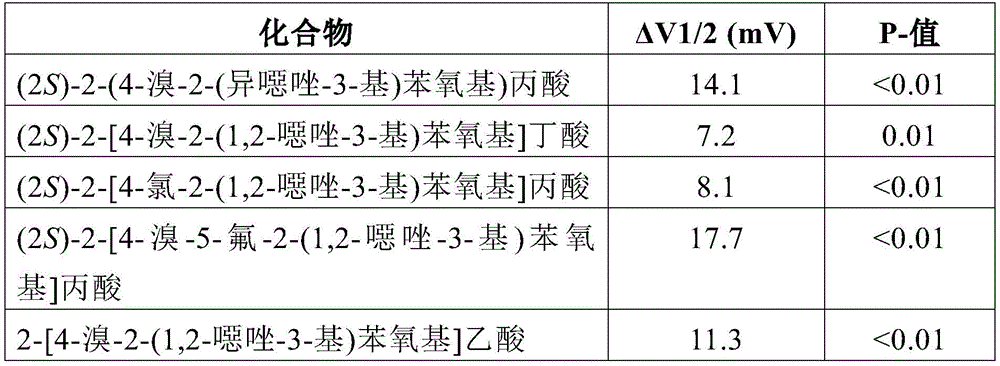
Example 4: measurement of in situ muscle contraction characteristics
Isometric (isometric) hind limb forces were measured in 12-week-old female Lewis rats in the presence and absence of compound.
Rats were placed under isoflurane (2-4%) anesthesia, intubated and then connected to a microshoker (Microvent 1, Hallowell EMC, US). Two stimulation electrodes were inserted through the skin to stimulate the sciatic nerve. A small incision was made at the proximal end of the ankle to expose the achilles tendon, which was taped with cotton and connected to a position adjustable (vernier control) force sensor (Fort250, World Precision Instruments). The achilles tendon was then severed at the distal end of the attached cotton thread. Rats were placed on a heating pad and the feet were secured to the footplate with tape in order to prevent ankle dorsiflexor contraction from creating motion artifacts (artemifact).
Muscle contraction properties were assessed by applying current to the nerve (at an ultra-maximum voltage condition) and recording the force produced by the muscle. When assessed by 2Hz stimulation, the muscle is stretched until maximum force is achieved. Isometric forces were measured every 30 seconds at 12Hz (twitch), 10 pulses, every 5 minutes at 80Hz (strong), for 1 second (80 pulses). This stimulation mode was used throughout the experiment, except that in a few cases the 80Hz stimulation was replaced by 12Hz (10 pulses). Neuromuscular transmission was partially inhibited by constant infusion of Cisatracurium (nimox, GlaxoSmithKline) at a concentration of 0.1mg/kg at an adjustable infusion rate, with each animal individually adjusted to achieve a level of inhibition of about 5% of the force produced by stimulation at 12Hz on pulse 4. Test articles were injected intravenously at selected concentrations as the neuromuscular inhibitory water levels settled. The effect of the test article is evaluated in terms of its ability to increase the force generated by the applied stimulation pattern. The effect was evaluated in terms of the ratio between the ability to increase the force itself (rigidity, 80Hz, stimulation) and the individual twitch peaks (12Hz stimulation). The effect was monitored for at least 1 hour after injection of the test article. In addition, the time from injection of the test article to the maximum effect on the force (both twitch and rigidity) and the time the effect disappeared (returned to baseline) were recorded, if possible. Infusion of neuromuscular blocking agent was stopped as appropriate, stimulation mode was continued, and force return to control levels was monitored. Animals were sacrificed by cervical dislocation while still fully sedated.
(2S) -2- [ 4-bromo-5-fluoro-2- (1, 2-oxazol-3-yl) phenoxy ] propanoic acid was administered at 24.6mg/kg i.v. The mean increase in tonic force was 46.2% (3 experiments).
2- [ 4-bromo-2- (1, 2-oxazol-3-yl) phenoxy ] acetic acid was administered at 44.8mg/kg i.v. The mean increase in tonic force was 57.7% (2 experiments).
This indicates that the compounds of the present invention can restore the force of muscles that have been partially inhibited by neuromuscular blockers in vivo.
Claims (16)


Applications Claiming Priority (3)
| Application Number | Priority Date | Filing Date | Title |
|---|---|---|---|
| EP19181262.7 | 2019-06-19 | ||
| EP19181262 | 2019-06-19 | ||
| PCT/EP2020/067065 WO2020254554A1 (en) | 2019-06-19 | 2020-06-19 | Process for the preparation of clc-1 chloride channel inhibitors |
Publications (2)
| Publication Number | Publication Date |
|---|---|
| CN113993852A true CN113993852A (en) | 2022-01-28 |
| CN113993852B CN113993852B (en) | 2024-12-17 |
Family
ID=66999603
Family Applications (1)
| Application Number | Title | Priority Date | Filing Date |
|---|---|---|---|
| CN202080043796.2A Active CN113993852B (en) | 2019-06-19 | 2020-06-19 | Process for preparing ClC-1 chloride channel inhibitors |
Country Status (18)
| Country | Link |
|---|---|
| US (1) | US12221425B2 (en) |
| EP (1) | EP3986878B1 (en) |
| JP (1) | JP7595945B2 (en) |
| KR (1) | KR102900834B1 (en) |
| CN (1) | CN113993852B (en) |
| AR (1) | AR119198A1 (en) |
| AU (1) | AU2020298092B2 (en) |
| BR (1) | BR112021025588A2 (en) |
| CA (1) | CA3137672A1 (en) |
| ES (1) | ES3000437T3 (en) |
| HU (1) | HUE069104T2 (en) |
| IL (1) | IL287901B2 (en) |
| MX (1) | MX2021013507A (en) |
| PL (1) | PL3986878T3 (en) |
| SG (1) | SG11202111122RA (en) |
| TW (1) | TWI849152B (en) |
| WO (1) | WO2020254554A1 (en) |
| ZA (1) | ZA202107653B (en) |
Families Citing this family (4)
| Publication number | Priority date | Publication date | Assignee | Title |
|---|---|---|---|---|
| CN119997952A (en) | 2022-09-30 | 2025-05-13 | Nmd制药股份公司 | Compositions and methods for treating myasthenia gravis |
| KR20250160957A (en) | 2023-03-02 | 2025-11-14 | 엔엠디 파마 에이/에스 | Composition and method for treating spinal muscular atrophy |
| AU2024230473A1 (en) | 2023-03-02 | 2025-07-24 | Nmd Pharma A/S | Compositions and methods for treating charcot–marie–tooth disease |
| AU2024311729A1 (en) | 2023-06-20 | 2025-11-27 | Nmd Pharma A/S | Clc-1 inhibitors for use in the treatment of multiple sclerosis and neuromuscular diseases |
Citations (2)
| Publication number | Priority date | Publication date | Assignee | Title |
|---|---|---|---|---|
| CN101981034A (en) * | 2008-02-05 | 2011-02-23 | 赛诺菲-安万特 | Triazolopyridazines as PAR1 inhibitors, their preparation and their use as medicaments |
| WO2013116236A1 (en) * | 2012-02-03 | 2013-08-08 | Zoetis Llc | Process for the preparation of chiral isoxazoline azetidine derivatives as antiparasitic agents |
Family Cites Families (6)
| Publication number | Priority date | Publication date | Assignee | Title |
|---|---|---|---|---|
| SE0301010D0 (en) * | 2003-04-07 | 2003-04-07 | Astrazeneca Ab | Novel compounds |
| GB0422057D0 (en) * | 2004-10-05 | 2004-11-03 | Astrazeneca Ab | Novel compounds |
| GB0524428D0 (en) * | 2005-11-30 | 2006-01-11 | 7Tm Pharma As | Medicinal use of receptor ligands |
| KR102722949B1 (en) * | 2015-06-15 | 2024-10-28 | 엔엠디 파마 에이/에스 | Compounds for use in the treatment of neuromuscular disorders |
| US10385028B2 (en) * | 2017-12-14 | 2019-08-20 | Nmd Pharma A/S | Compounds for the treatment of neuromuscular disorders |
| TWI780281B (en) | 2017-12-14 | 2022-10-11 | 丹麥商Nmd藥品公司 | Compounds for the treatment of neuromuscular disorders |
-
2020
- 2020-06-19 US US17/619,312 patent/US12221425B2/en active Active
- 2020-06-19 KR KR1020217037880A patent/KR102900834B1/en active Active
- 2020-06-19 MX MX2021013507A patent/MX2021013507A/en unknown
- 2020-06-19 AU AU2020298092A patent/AU2020298092B2/en active Active
- 2020-06-19 PL PL20734157.9T patent/PL3986878T3/en unknown
- 2020-06-19 CA CA3137672A patent/CA3137672A1/en active Pending
- 2020-06-19 SG SG11202111122RA patent/SG11202111122RA/en unknown
- 2020-06-19 IL IL287901A patent/IL287901B2/en unknown
- 2020-06-19 ES ES20734157T patent/ES3000437T3/en active Active
- 2020-06-19 WO PCT/EP2020/067065 patent/WO2020254554A1/en not_active Ceased
- 2020-06-19 JP JP2021569300A patent/JP7595945B2/en active Active
- 2020-06-19 EP EP20734157.9A patent/EP3986878B1/en active Active
- 2020-06-19 TW TW109120910A patent/TWI849152B/en active
- 2020-06-19 AR ARP200101735A patent/AR119198A1/en unknown
- 2020-06-19 CN CN202080043796.2A patent/CN113993852B/en active Active
- 2020-06-19 BR BR112021025588A patent/BR112021025588A2/en unknown
- 2020-06-19 HU HUE20734157A patent/HUE069104T2/en unknown
-
2021
- 2021-10-11 ZA ZA2021/07653A patent/ZA202107653B/en unknown
Patent Citations (2)
| Publication number | Priority date | Publication date | Assignee | Title |
|---|---|---|---|---|
| CN101981034A (en) * | 2008-02-05 | 2011-02-23 | 赛诺菲-安万特 | Triazolopyridazines as PAR1 inhibitors, their preparation and their use as medicaments |
| WO2013116236A1 (en) * | 2012-02-03 | 2013-08-08 | Zoetis Llc | Process for the preparation of chiral isoxazoline azetidine derivatives as antiparasitic agents |
Non-Patent Citations (4)
| Title |
|---|
| H. J. ROTH,等: "Zur Kondensation von Chalkonoxyden mit Hydroxylamin", 《ARCHIV DER PHARMAZIE》, 31 December 1961 (1961-12-31), pages 769 - 774, XP002550892, DOI: 10.1002/ardp.19612941205 * |
| PETER S. FERNANDES,等: "Synthesis of some new 2-[2-(5-phenyl-3- isoxazolyl)phenoxymethyl]-4H-1-benzopyran-4-ones", 《JOURNAL OF THE INDIAN CHEMICAL SOCIETY》, 31 December 1984 (1984-12-31), pages 604 - 606, XP009516197 * |
| SHOEI ITO,等: "A simple synthetic method of trans-5-aryl and 5-cyclopropyl derivatives of 2-isoxazolin-4-ol via intramolecular ring opening of α, β-epoxy ketone oximes", 《BULLETIN OF THE CHEMICAL SOCIETY OF JAPAN》, 31 December 1990 (1990-12-31), pages 2739 - 2741 * |
| 颜延宁;周鑫鑫;: "趋化因子受体2抑制剂PF-04136309的合成研究", 化学试剂, no. 09, 31 December 2020 (2020-12-31), pages 1125 - 1129 * |
Also Published As
| Publication number | Publication date |
|---|---|
| ZA202107653B (en) | 2023-05-31 |
| EP3986878B1 (en) | 2024-09-25 |
| JP2022537493A (en) | 2022-08-26 |
| ES3000437T3 (en) | 2025-02-28 |
| CA3137672A1 (en) | 2020-12-24 |
| AU2020298092A8 (en) | 2025-04-24 |
| US12221425B2 (en) | 2025-02-11 |
| JP7595945B2 (en) | 2024-12-09 |
| AU2020298092B2 (en) | 2025-09-25 |
| KR102900834B1 (en) | 2025-12-16 |
| PL3986878T3 (en) | 2025-01-20 |
| MX2021013507A (en) | 2021-12-10 |
| US20220298124A1 (en) | 2022-09-22 |
| AR119198A1 (en) | 2021-12-01 |
| TW202115003A (en) | 2021-04-16 |
| SG11202111122RA (en) | 2021-11-29 |
| AU2020298092A1 (en) | 2021-11-18 |
| IL287901B2 (en) | 2025-02-01 |
| HUE069104T2 (en) | 2025-02-28 |
| IL287901B1 (en) | 2024-10-01 |
| IL287901A (en) | 2022-01-01 |
| WO2020254554A1 (en) | 2020-12-24 |
| TWI849152B (en) | 2024-07-21 |
| KR20220022895A (en) | 2022-02-28 |
| BR112021025588A2 (en) | 2022-02-01 |
| EP3986878C0 (en) | 2024-09-25 |
| EP3986878A1 (en) | 2022-04-27 |
| CN113993852B (en) | 2024-12-17 |
Similar Documents
| Publication | Publication Date | Title |
|---|---|---|
| CN113993852A (en) | Process for preparing ClC-1 chloride channel inhibitors | |
| JP6849614B2 (en) | Derivatives of 1-[(cyclopentyl or 2-pyrrolidinyl) carbonylaminomethyl] -4- (1,3-thiazole-5-yl) benzene useful in the treatment of proliferative, autoimmune or inflammatory diseases | |
| TWI345562B (en) | Rosuvastatin and salts thereof free of rosuvastatin alkylether and a process for the preparation thereof | |
| DE69407654T2 (en) | Peptide ketones as interleukin-1beta-converting enzyme inhibiting compounds | |
| WO2022166890A1 (en) | Substituted pyridazine phenol derivatives | |
| WO1995024397A1 (en) | 3,5-disubstituted and 3,5,6-trisubstituted 2-isoxazolines and isoxazoles, process for preparing the same and their use as medicaments | |
| Kondratov et al. | Straightforward synthesis of fluorinated amino acids by Michael addition of ethyl bromodifluoroacetate to α, β-unsaturated α-amino acid derivatives | |
| UA52698C2 (en) | (3-Alkoxyisoxazol-4-yl)-substituted 2-amino carboxylic acid derivatives | |
| EP4357336A1 (en) | Benzoxazinone derivatives | |
| EP1937248B1 (en) | Alcanoic acid amides substituted by saturated o-heterocycles | |
| HK40068865B (en) | Process for the preparation of clc-1 chloride channel inhibitors | |
| HK40068865A (en) | Process for the preparation of clc-1 chloride channel inhibitors | |
| CN108368094B (en) | Nonsteroidal glucocorticoid receptor modulators for topical drug delivery | |
| ES2439322T3 (en) | Amino alcohol derivatives and their therapeutic activities | |
| KR101438012B1 (en) | Novel histidine derivative | |
| Schow et al. | Diastereoselective synthesis of the antibiotic L-azatyrosine | |
| KR20190032534A (en) | Cyclic peptides as C5a receptor antagonists | |
| CA2609161A1 (en) | Peptidomimetics selective for the somatostatin receptor subtypes 1 and/or 4 | |
| WO2026032320A1 (en) | Method for preparing intermediate of isoxazoline type drug | |
| KR100758317B1 (en) | T-type calcium channel blocking composition comprising morpholin-2-one derivative | |
| KR102437095B1 (en) | Prodrug of caspase inhibitor | |
| FR2478629A1 (en) | 2-CYANO-ETHYL-2- (N-BENZOYLAMINO) ALKANOIC ACID DERIVATIVES, THEIR PREPARATION PROCESS AND THEIR THERAPEUTIC APPLICATION | |
| RU2658837C1 (en) | Process for the preparation of 5-aminoisoxazole-carboxylic acid | |
| CN120693335A (en) | Small molecule FSH receptor modulators | |
| CN120574171A (en) | SF5-containing quinoline derivatives and their use as P2X7 antagonists |
Legal Events
| Date | Code | Title | Description |
|---|---|---|---|
| PB01 | Publication | ||
| PB01 | Publication | ||
| SE01 | Entry into force of request for substantive examination | ||
| SE01 | Entry into force of request for substantive examination | ||
| GR01 | Patent grant | ||
| GR01 | Patent grant |