CN113945887B - Positioning and direction finding system and method and BLE positioning device - Google Patents
Positioning and direction finding system and method and BLE positioning device Download PDFInfo
- Publication number
- CN113945887B CN113945887B CN202111210902.4A CN202111210902A CN113945887B CN 113945887 B CN113945887 B CN 113945887B CN 202111210902 A CN202111210902 A CN 202111210902A CN 113945887 B CN113945887 B CN 113945887B
- Authority
- CN
- China
- Prior art keywords
- arrival angle
- antenna
- phase difference
- array
- angle
- Prior art date
- Legal status (The legal status is an assumption and is not a legal conclusion. Google has not performed a legal analysis and makes no representation as to the accuracy of the status listed.)
- Active
Links
Images


Classifications
-
- G—PHYSICS
- G01—MEASURING; TESTING
- G01S—RADIO DIRECTION-FINDING; RADIO NAVIGATION; DETERMINING DISTANCE OR VELOCITY BY USE OF RADIO WAVES; LOCATING OR PRESENCE-DETECTING BY USE OF THE REFLECTION OR RERADIATION OF RADIO WAVES; ANALOGOUS ARRANGEMENTS USING OTHER WAVES
- G01S5/00—Position-fixing by co-ordinating two or more direction or position line determinations; Position-fixing by co-ordinating two or more distance determinations
- G01S5/02—Position-fixing by co-ordinating two or more direction or position line determinations; Position-fixing by co-ordinating two or more distance determinations using radio waves
-
- G—PHYSICS
- G06—COMPUTING OR CALCULATING; COUNTING
- G06F—ELECTRIC DIGITAL DATA PROCESSING
- G06F18/00—Pattern recognition
- G06F18/20—Analysing
- G06F18/21—Design or setup of recognition systems or techniques; Extraction of features in feature space; Blind source separation
- G06F18/214—Generating training patterns; Bootstrap methods, e.g. bagging or boosting
-
- G—PHYSICS
- G06—COMPUTING OR CALCULATING; COUNTING
- G06F—ELECTRIC DIGITAL DATA PROCESSING
- G06F18/00—Pattern recognition
- G06F18/20—Analysing
- G06F18/24—Classification techniques
- G06F18/241—Classification techniques relating to the classification model, e.g. parametric or non-parametric approaches
- G06F18/2411—Classification techniques relating to the classification model, e.g. parametric or non-parametric approaches based on the proximity to a decision surface, e.g. support vector machines
-
- G—PHYSICS
- G06—COMPUTING OR CALCULATING; COUNTING
- G06F—ELECTRIC DIGITAL DATA PROCESSING
- G06F18/00—Pattern recognition
- G06F18/20—Analysing
- G06F18/24—Classification techniques
- G06F18/243—Classification techniques relating to the number of classes
- G06F18/24323—Tree-organised classifiers
Landscapes
- Engineering & Computer Science (AREA)
- Data Mining & Analysis (AREA)
- Theoretical Computer Science (AREA)
- Physics & Mathematics (AREA)
- General Physics & Mathematics (AREA)
- Bioinformatics & Cheminformatics (AREA)
- Computer Vision & Pattern Recognition (AREA)
- Evolutionary Biology (AREA)
- Evolutionary Computation (AREA)
- Bioinformatics & Computational Biology (AREA)
- General Engineering & Computer Science (AREA)
- Artificial Intelligence (AREA)
- Life Sciences & Earth Sciences (AREA)
- Radar, Positioning & Navigation (AREA)
- Remote Sensing (AREA)
- Radio Transmission System (AREA)
- Radar Systems Or Details Thereof (AREA)
Abstract
The invention relates to the technical field of positioning, in particular to a positioning and direction-finding system and method and a BLE positioning device. A position-finding and direction-finding system comprising: the tag to be positioned is used for transmitting a positioning signal; the receiving equipment is used for determining positioning parameters according to the received positioning signals; the positioning processing equipment is used for determining the transmitting channel information, the initial arrival angle and the antenna pair phase difference of the positioning signal received by the receiving equipment according to the positioning parameters; and calculating an arrival angle according to the transmitting channel information, the initial arrival angle and the antenna pair phase difference, and correcting the arrival angle. According to the scheme of the embodiment of the invention, the arrival angle is calculated and corrected according to the characteristics of the Bluetooth channel related to the arrival angle and the phase difference of the transmitting channel information, the initial arrival angle and the antenna pair, the AOA error can be reduced, and the measurement range of the arrival angle is increased.
Description
Technical Field
The invention relates to the technical field of positioning, in particular to a positioning and direction-finding system and method and a BLE positioning device.
Background
Currently, a commonly used angular direction finding method includes direction finding based on an angle of arrival (AOA) or an angle of departure (AOD). In the AOA-homing method, the AOA can be calculated using phase interferometry. The phase interference method is adopted to calculate the AOA, generally more than two channels are needed, the phase difference between every two of the multiple antennas can be obtained according to signals received by the multiple antennas, and then the AOA is calculated according to the phase difference. However, the AOA calculated in this way is easily affected by the angle of the incident wave. Generally, the larger the incident wave angle is, the larger the AOA error is, and when the incident wave angle increases to a certain value, the larger the AOA error may be, and positioning may not be possible.
Disclosure of Invention
In view of this, embodiments of the present invention provide a positioning and direction finding system and method, and a BLE positioning device, which can reduce the influence of an incident angle and improve the accuracy of AOA.
In a first aspect, the present embodiment provides a positioning and direction-finding system, including:
the tag to be positioned is used for transmitting a positioning signal; alternatively, the positioning signal may be a Bluetooth Low Energy (BLE) data packet carrying a constant frequency Extension (CTE).
The receiving equipment is used for determining positioning parameters according to the received positioning signals;
the positioning processing equipment is used for determining the transmitting channel information, the initial arrival angle and the antenna pair phase difference of the positioning signals received by the receiving equipment according to the positioning parameters; and calculating an arrival angle according to the transmitting channel information, the initial arrival angle and the antenna pair phase difference, and correcting the arrival angle. Optionally, the positioning parameters include: in-phase/quadrature (I/Q) components, a Received Signal Strength Indication (RSSI), and BLE transmit channel information, which may be a BLE channel index value. In some embodiments, the antenna pair phase difference may be calculated from the I/Q components and/or the RSSI. An initial angle of arrival may be calculated based on the antenna pair phase differences.
Optionally, the receiving device includes a semicircular array plate, the semicircular array plate includes: a first array of semicircles and a second array of semicircles;
the first semicircular array and the second semicircular array respectively comprise N antennas and M antennas, 1 antenna in the N antennas is located at the circle center position of the first semicircular array, N-1 antennas are located at the semicircular arc position of the first semicircular array, 1 antenna in the M antennas is located at the circle center position of the second semicircular array, M-1 antennas are located at the semicircular arc position of the second semicircular array, N is more than or equal to 3, and M is more than or equal to 3;
the first semicircular array and the second semicircular array are arranged in the same plane, and the diameters of the first semicircular array and the second semicircular array are parallel to each other;
the positioning processing equipment receives the antenna pair phase difference determined by the positioning signal according to the semicircular array plate and comprises the following steps: the first semicircular array comprises antenna pair phase differences between every two antennas and the second semicircular array comprises antenna pair phase differences between every two antennas.
Optionally, the receiving device includes a multi-antenna linear array board, where N antennas are arranged on the multi-antenna linear array board, and N is greater than or equal to 3; the N antennas comprise at least one reference antenna, and each reference antenna corresponds to two matched antenna groups;
the positioning processing equipment receives the positioning signal according to the multi-antenna linear array plate to determine the phase difference of the antenna pair, and the phase difference comprises the following steps: and antenna pair phase differences respectively corresponding to the antenna groups.
In a second aspect, to solve the technical problems that a large error exists in the angle of arrival obtained by the conventional location-finding method and a single location-finding model is easy to make the same error, the present embodiment provides a location-finding method, including:
determining the transmitting channel information, the initial arrival angle and the antenna pair phase difference of a positioning signal transmitted by a tag to be positioned;
inputting the transmitting channel information, the initial arrival angle and the antenna pair phase difference into a random forest model, and outputting a first arrival angle by the random forest model;
inputting the transmitting channel information, the initial arrival angle and the antenna pair phase difference into a Support Vector Machine (SVM) model, and outputting a second arrival angle by the SVM model;
inputting the first angle of arrival and the second angle of arrival into a voting model, and outputting a corrected angle of arrival by the voting model.
Optionally, the random forest model includes X decision trees and a first decision module, where:
each decision tree is used for outputting an arrival angle to be decided according to input transmission channel information, an antenna pair phase difference and an initial arrival angle;
the first decision module is used for determining voting probabilities of arrival angles to be decided output by the X decision trees and outputting the first arrival angle according to the voting probabilities of the arrival angles to be decided.
Optionally, the X decision trees are obtained by training X sample sets, where each sample set includes multiple sample data, where the sample data is transmission channel information, antenna pair phase difference, and initial arrival angle labeled with arrival angle; wherein,
and each decision tree establishes a decision rule between input transmission channel information, antenna pair phase difference and initial arrival angle and output arrival angle to be decided through training of a corresponding sample set.
Optionally, the method further includes:
in the training process, the random forest model comprises the number x of decision trees i Randomly determining;
when the number of the decision trees is x i The accuracy of the first arrival angle output by the random forest model is z i Z is said i According to the sampleDetermining the arrival angle of the data annotation;
according to different values of x i Corresponding z i And determining the number of decision trees of the random forest model as X.
Optionally, the SVM model includes Y classifiers and a second decision module;
the Y classifiers correspond to Y angle tags, and each two classifiers are used for calculating a confidence value of an input initial arrival angle and the corresponding angle tag according to input transmission channel information, an antenna pair phase difference and the initial arrival angle;
the second decision module is used for determining a target second classifier from the Y second classifiers according to the Y confidence values, and determining an angle label of the target second classifier as the second arrival angle.
Optionally, each of the two classifiers corresponds to a positive quantity sample set, each of the positive quantity sample sets includes a plurality of sample data, and the sample data is transmission channel information, antenna pair phase difference, and initial arrival angle labeled with an arrival angle;
each two classifiers establishes input transmission channel information, antenna pair phase difference and initial arrival angle through training of Y positive quantity sample sets, and establishes interval calculation rules with own angle labels, and interval values calculated according to the interval calculation rules are used for determining confidence values;
in the training process, when the data input into the two classifiers belong to the corresponding positive sample set, the output confidence value is a positive value; when the data input into the two classifiers belong to other Y-1 positive sample sets, the output confidence value is a negative value.
Optionally, the antenna pair phase difference includes: a plurality of antennas of half-circle array plate are to the phase difference, wherein, half-circle array plate includes: a first array of semi-circles and a second array of semi-circles;
the first semicircular array and the second semicircular array respectively comprise N and M antennas, 1 antenna in the N antennas is located at the circle center of the first semicircular array, N-1 antenna is located at the semicircular arc position of the first semicircular array, 1 antenna in the M antennas is located at the circle center of the second semicircular array, M-1 antenna is located at the semicircular arc position of the second semicircular array, N is more than or equal to 3, M is more than or equal to 3;
the first semicircular array and the second semicircular array are arranged in the same plane, and the diameters of the first semicircular array and the second semicircular array are parallel to each other;
a plurality of antennas of semicircle array plate are to the phase difference, include: the phase difference of each antenna pair contained in the first semicircular array and the phase difference of each antenna pair contained in the second semicircular array;
outputting, by the random forest model, the first arrival angle according to the transmission channel information, the initial arrival angle of the semicircular array plate, the antenna pair phase difference between every two antennas included in the first semicircular array, and the antenna pair phase difference between every two antennas included in the second semicircular array;
and the SVM model outputs the second arrival angle according to the transmission channel information, the initial arrival angle of the semicircular array plate, the antenna pair phase difference between every two antennas included in the first semicircular array and the antenna pair phase difference between every two antennas included in the second semicircular array.
Optionally, the antenna pair phase difference includes: phase differences of a plurality of antenna pairs of the multi-antenna linear array plate are achieved, wherein N antennas are arranged on the multi-antenna linear array plate, and N is larger than or equal to 3; the N antennas comprise at least one reference antenna, and each reference antenna corresponds to the two matched antenna groups;
a plurality of antenna pair phase differences of many antennas linear array board include: antenna pair phase differences respectively corresponding to each antenna group;
the random forest model outputs the first arrival angle according to the transmitting channel information, the initial arrival angle of the multi-antenna linear array board and the antenna pair phase difference corresponding to each antenna group;
and the SVM model outputs the second arrival angle according to the transmitting channel information, the initial arrival angle of the multi-antenna linear array board and the antenna pair phase difference corresponding to each antenna group.
Optionally, the transmission channel information includes a transmission channel index value.
Aiming at the characteristic that a Bluetooth channel is related to an arrival angle, the positioning and direction-finding method provides an angle correction algorithm based on random forest and SVM multi-classifier integration, and reduces the error of the arrival angle calculated by a phase interference method; increasing to an angle of arrival measurement range; the arrival angle is corrected by weighting the classification result, so that the precision of the arrival angle is improved.
In a third aspect, the present embodiment provides a BLE positioning method, including:
determining transmitting channel information, an initial arrival angle and an antenna pair phase difference according to a positioning signal of a BLE tag;
and calculating an arrival angle according to the transmitting channel information, the initial arrival angle and the antenna pair phase difference, and correcting the arrival angle.
Optionally, calculating an arrival angle according to the transmission channel information, the initial arrival angle, and the antenna pair phase difference, and correcting the arrival angle, including:
inputting the transmitting channel information, the initial arrival angle and the antenna pair phase difference into a random forest model, and outputting a first arrival angle by the random forest model;
inputting the transmitting channel information, the initial arrival angle and the antenna pair phase difference into a Support Vector Machine (SVM) model, and outputting a second arrival angle by the SVM model;
inputting the first angle of arrival and the second angle of arrival into a voting model, and outputting a corrected angle of arrival by the voting model.
Optionally, the random forest model includes X decision trees and a first decision module, where:
each decision tree is used for outputting an arrival angle to be decided according to input transmitting channel information, an antenna pair phase difference and an initial arrival angle;
the first decision module is used for determining voting probabilities of arrival angles to be decided output by the X decision trees, and outputting the first arrival angle according to the voting probabilities of the arrival angles to be decided.
Optionally, the SVM model includes Y classifiers and a second decision module;
the Y classifiers correspond to Y angle tags, and each two classifier is used for calculating a confidence value of the input initial arrival angle and the corresponding angle tag according to the input transmission channel information, the antenna pair phase difference and the initial arrival angle;
the second decision module is used for determining a target second classifier from the Y second classifiers according to the Y confidence values, and determining an angle label of the target second classifier as the second arrival angle.
In a fourth aspect, the present embodiment provides a BLE positioning device, including: a processor; a memory; and one or more computer programs, wherein the one or more computer programs are stored in the memory, the one or more computer programs comprising instructions that, when executed, cause the BLE positioning device to perform the method of any of the third aspects described above.
According to the positioning and direction finding system, the positioning and direction finding method and the BLE positioning device, the arrival angle is calculated and corrected according to the characteristics of the Bluetooth channel related to the arrival angle and the phase difference of the transmitting channel information, the initial arrival angle and the antenna pair, the AOA error can be reduced, and the measurement range of the arrival angle is enlarged.
Drawings
In order to more clearly illustrate the embodiments of the present invention or the technical solutions in the prior art, the drawings used in the description of the embodiments or the prior art will be briefly described below, and it is obvious that the drawings in the following description are some embodiments of the present invention, and those skilled in the art can also obtain other drawings according to the drawings without creative efforts.
Fig. 1 is a schematic structural diagram of a positioning and direction-finding system according to an embodiment of the present invention;
fig. 2 is a schematic structural diagram of a semicircular array plate according to an embodiment of the present invention;
fig. 3A is a schematic structural diagram of an antenna linear array board according to an embodiment of the present invention;
fig. 3B is a schematic structural diagram of another antenna array board according to an embodiment of the present invention;
FIG. 4 is a schematic structural diagram of an AOA computational model according to an embodiment of the present invention;
fig. 5 is a flowchart of a positioning and direction finding method according to an embodiment of the present invention;
fig. 6 is a schematic structural diagram of a random forest model according to an embodiment of the present invention;
FIG. 7 is a graph illustrating the relationship between the number of decision trees and the accuracy according to an embodiment of the present invention;
FIG. 8 is a schematic structural diagram of an SVM model according to an embodiment of the present invention;
figure 9 is a schematic structural diagram of a BLE positioning device according to an embodiment of the present invention;
fig. 10 is a flowchart of a BLE positioning method according to an embodiment of the present invention.
Detailed Description
In order to make the objects, technical solutions and advantages of the embodiments of the present invention clearer, the technical solutions in the embodiments of the present invention will be clearly and completely described below with reference to the drawings in the embodiments of the present invention, and it is obvious that the described embodiments are some, but not all, embodiments of the present invention. All other embodiments, which can be derived by a person skilled in the art from the embodiments given herein without making any creative effort, shall fall within the protection scope of the present invention.
Referring to fig. 1, a schematic structural diagram of a positioning and direction-finding system according to an embodiment of the present invention is provided. As shown in fig. 1, the positioning and direction-finding system includes: a tag 101 to be positioned, a receiving device 102 and a positioning processing device 103. Among them, the tag 101 to be positioned is a tag capable of transmitting a positioning signal. The tag 101 to be positioned may be an ultra-wide band tag, a radio frequency identification tag, a Wi-fi tag, an ultrasonic tag, or a bluetooth tag, etc., depending on the positioning signal to be transmitted. For convenience of description, the embodiments of the present invention use bluetooth tags as examples to describe the location-based direction-finding system and method. The Bluetooth tag may be a Bluetooth Low Energy (BLE) tag.
In some embodiments, the BLE tag transmits a broadcast data packet. The receiving device 102 receives the broadcast packets transmitted by the BLE tag and when the receiving device 102 needs to locate the BLE tag, the receiving device 102 sends a connection request to the BLE tag. The BLE tag establishes a bluetooth connection with the receiving device 102 after receiving the connection request. Optionally, the BLE tag and the receiving device 102 share bluetooth configuration parameters during the bluetooth connection.
To better support AOA, the bluetooth 5.1 standard protocol introduces a fixed frequency Extension (CTE) signal. The CTE signal is a fixed frequency signal and is attached behind the original Bluetooth data packet, the data content of the original Bluetooth data packet is not influenced, and the phase difference detection in the AOA calculation can be more convenient. Thus, the bluetooth configuration parameters shared by the BLE tag and the receiving device 102 may contain parameters for configuring the CTE. Specifically, the bluetooth configuration parameters shared by the BLE tag and the receiving device 102 may include: CTE type, CTE duration, antenna switching time slot, CTE sampling time slot, etc.
After the BLE tag and the receiving device 102 share the bluetooth configuration parameters, the BLE tag sends a BLE data packet carrying the CTE to the receiving device 102 according to the bluetooth configuration parameters. The receiving device 102 may sample BLE data packets carrying the CTE in the CTE sampling slot according to the bluetooth configuration parameters. The receiving device 102 may determine the positioning parameters from the sampled data packets. Optionally, the positioning parameters may include: in-phase/quadrature (I/Q) components, received Signal Strength Indication (RSSI), and BLE transmit channel information. The I/Q component and RSSI may be used, among other things, to determine the antenna pair phase difference and initial angle of arrival. In the bluetooth communication technology, the frequency used by BLE is 2.4GHz, and the frequency band ranges from 2.4000GHz to 2.4835GHz. The band is divided into 40 channels, of which 37, 38, 39 are broadcast channels and the remaining 37 are data channels. The BLE transmission channel information may be a BLE channel index value for transmitting a bluetooth packet. In some embodiments, the receiving device 102 may determine the BLE lane index value by parsing the received BLE data packets.
After determining the positioning parameters, the receiving device 102 sends the positioning parameters to the positioning processing device 103. The positioning processing device 103 may determine a BLE channel index value according to the positioning parameter, and may calculate an antenna pair phase difference and an initial angle of arrival according to an I/Q component and an RSSI in the positioning parameter. Further, the positioning processing device 103 is integrated with the AOA calculation model. The positioning processing device 103 inputs the determined BLE channel index value, the antenna pair phase difference and the initial arrival angle into the AOA calculation model, so as to obtain AOA through calculation of the AOA calculation model and correct AOA.
In some embodiments, the receiving device 102 may configure different types of antenna arrays to receive BLE data packets carrying CTEs. In some embodiments, the receiving device 102 may configure the half-panel to receive BLE data packets carrying CTEs. In some embodiments, the receiving device 102 may also configure the multi-antenna line board to receive BLE data packets carrying CTEs.
In some embodiments, the half-circular array board configured by the receiving device 102 may include: a first array of semi-circles and a second array of semi-circles. The first semicircular array and the second semicircular array respectively comprise N antennas and M antennas, 1 antenna in the N antennas is located at the circle center of the first semicircular array, the N-1 antenna is located at the semicircular arc position of the first semicircular array, 1 antenna in the M antennas is located at the circle center of the second semicircular array, the M-1 antenna is located at the semicircular arc position of the second semicircular array, N is more than or equal to 3, M is more than or equal to 3; the first semicircle array and the second semicircle array are arranged in the same plane, and the diameters of the first semicircle array and the second semicircle array are parallel to each other. Each antenna in the semicircular array plate samples BLE data packets which are transmitted by the BLE tags and carry the CTE. According to the sampling condition of each antenna, the I/Q component and the RSSI of each antenna in the first semicircular array and the second semicircular array can be obtained, and the BLE channel index value can be obtained through the analysis of the received data packet.
The receiving device 102 transmits the I/Q component, RSSI, and BLE channel index value of each antenna of the first and second semicircular arrays to the bit processing device 103. The positioning processing device 103 may determine phase angle information of the BLE data packet reaching each antenna according to the I/Q component of each antenna, and may further calculate an antenna pair phase difference between each two antennas included in the first semicircular array and an antenna pair phase difference between each two antennas included in the second semicircular array according to the phase angle information. The positioning processing device 103 may calculate an initial arrival angle of the BLE data packet to the semicircular array plate according to the antenna pair phase difference between each two antennas included in the first semicircular array and the antenna pair phase difference between each two antennas included in the second semicircular array. Optionally, RSSI may assist in calculating the initial angle of arrival.
Referring to fig. 2, a schematic structural diagram of a half-circular array board according to an embodiment of the present invention is shown. As shown in fig. 2, the upper array of semi-circles in fig. 2 is defined as a first array of semi-circles, and the lower array of semi-circles is defined as a second array of semi-circles. The first semicircular array comprises 4 antennas, antenna 1, antenna 2, antenna 3 and antenna 4 respectively. The antenna 1 is located at the center of the first semicircular array, and the antennas 2, 3 and 4 are uniformly distributed at the arc positions of the first semicircular array. The second semicircular array comprises 4 antennas, antenna 0, antenna 5, antenna 6 and antenna 7 respectively. The antenna 0 is located at the center of the first semicircular array, and the antennas 5, 6 and 7 are uniformly distributed at the arc position of the first semicircular array.
Antennas 1-4 and antennas 0 and 5-7 of the semicircular array plate shown in fig. 2 receive the BLE data carrying the CTE transmitted by the BLE tag. According to the BLE data packets received by the No. 1-4 antennas, the I/Q component and the RSSI of the No. 1-4 antennas in the first semicircular array can be obtained, and the BLE channel index value is obtained through analysis. According to the BLE data packets received by the antennas 0 and 5 to 7, the I/Q component and the RSSI of the antennas 0 and 5 to 7 in the second semicircular array can be obtained, and the BLE channel index value is obtained through analysis. And for the same data packet, the BLE channel index values obtained by analyzing the first semicircular array and the second semicircular array are the same. The receiving device 102 sends the I/Q components and the RSSI of the antennas # 1 to # 4 in the first semicircular array, the I/Q components and the RSSI of the antennas # 0 and # 5 to # 7 in the second semicircular array, and the parsed BLE channel index value to the positioning processing device 103. The positioning processing device 103 can calculate the antenna pair phase difference between the antennas 1 to 4 in the first semicircular array and the antenna pair phase difference between the antennas 0 and 5 to 7 in the second semicircular array according to the received I/Q component and the RSSI. And then, according to the antenna pair phase difference between every two antennas of No. 1-4 antennas in the first semicircular array and the antenna pair phase difference between every two antennas of No. 0 and No. 5-7 antennas in the second semicircular array, the initial arrival angle of the BLE data packet to the semicircular array plate can be calculated.
The positioning processing equipment 103 inputs the initial arrival angle of the BLE data packet arriving at the semicircular array plate, the BLE channel index value, the antenna pair phase difference between the antennas 1 to 4 in the first semicircular array and the antenna pair phase difference between the antennas 0 and 5 to 7 in the second semicircular array into the AOA calculation model, so as to obtain the AOA through calculation of the AOA calculation model and correct the AOA.
In some embodiments, N antennas are disposed on the multi-antenna linear array board configured by the receiving device 102, where N is greater than or equal to 3; the N antennas comprise at least one reference antenna, and each reference antenna corresponds to two matched antenna groups. Illustratively, each reference antenna and two antennas adjacent to each other form the two antenna groups, and each antenna group corresponds to one antenna pair phase difference.
Referring to fig. 3A, a schematic structural diagram of an antenna array board according to an embodiment of the present invention is provided. As shown in fig. 3A, the multi-antenna linear array board is provided with 3 antennas, namely a first antenna, a second antenna and a third antenna, which are arranged along a straight line, wherein the second antenna is a reference antenna, the first antenna group corresponding to the reference antenna includes the first antenna and the second antenna, and the second antenna group corresponding to the reference antenna includes the second antenna and the third antenna. Of course, the antennas in the antenna array board are not necessarily arranged along a straight line, and in some possible implementations, as shown in fig. 3B, the linear antennas may be arranged along an arc line or a broken line, which should be considered within the scope of the present application.
In the scenarios shown in fig. 3A and 3B, each antenna in the antenna array board receives BLE data carrying the CTE transmitted by the BLE tag. According to the BLE data packets received by the antennas, I/Q components and RSSI of the first antenna, the second antenna and the third antenna can be obtained, and BLE channel index values are obtained through analysis.
The receiving device 102 transmits the I/Q components and RSSI of the first antenna, the second antenna, and the third antenna, and the BLE channel index value to the bit processing device 103. The positioning processing device 103 may calculate the antenna pair phase difference of the first antenna group and the antenna pair phase difference of the second antenna group. The positioning processing device 103 calculates an initial arrival angle of the BLE data packet to the antenna array board according to the antenna pair phase difference of the first antenna group and the antenna pair phase difference of the second antenna group.
The positioning processing device 103 inputs the initial angle of arrival, the antenna pair phase difference of each antenna group, and the BLE channel index value into the AOA calculation model, so as to obtain AOA through calculation of the AOA calculation model and correct AOA.
Referring to fig. 4, a schematic structural diagram of an AOA computational model according to an embodiment of the present invention is provided. The AOA computational model shown in FIG. 4 includes: the method comprises a random forest model, an SVM model and a voting model, wherein the random forest model and the SVM model can calculate the AOA according to an initial arrival angle, an antenna pair phase difference and a BLE channel index value, and then the calculated AOA is corrected through the voting model. The AOA calculation model shown in FIG. 4 provides an angle correction algorithm based on random forest and SVM multi-classifier integration according to the characteristics of the Bluetooth channel related to the arrival angle, so that the AOA error can be reduced, and the AOA error can be increased to the arrival angle measurement range.
Based on the AOA calculation model shown in fig. 4, the embodiment of the present invention provides a positioning and direction finding method. Referring to fig. 5, a flowchart of a positioning and direction finding method according to an embodiment of the present invention is provided. The execution subject of the method is the positioning processing equipment 103, and the execution steps of the method comprise:
and 201, determining the transmission channel information, the initial arrival angle and the antenna pair phase difference of the positioning signal transmitted by the tag to be positioned.
Optionally, the positioning processing device obtains a positioning parameter related to the positioning signal from the receiving device, and determines, according to the positioning parameter, transmission channel information, an initial arrival angle, and an antenna pair phase difference of the positioning signal transmitted by the tag to be positioned. Illustratively, the locating signal transmitted by the tag to be located is a BLE data packet carrying the CTE. And the receiving equipment samples the BLE data packet carrying the CTE and acquires the positioning parameters according to the sampling result. Optionally, the positioning parameters may be I/Q components of the sampled signal, RSSI, and transmission channel information. The transmit channel information may be, for example, a BLE channel index value. The positioning processing device can further determine the antenna pair phase difference and the initial arrival angle according to the positioning parameters.
202, inputting the transmission channel information, the initial arrival angle and the antenna pair phase difference into a random forest model, and outputting a first arrival angle by the random forest model.
And 203, inputting the transmission channel information, the initial arrival angle and the antenna pair phase difference into an SVM model, and outputting a second arrival angle by the SVM model.
And 204, inputting the first arrival angle and the second arrival angle into a voting model, and outputting a corrected arrival angle by the voting model.
In the embodiment of the invention, an AOA calculation model is integrated in the positioning processing equipment, and the AOA calculation model comprises a random forest model, an SVM model and a voting model. And the random forest model establishes a calculation rule between the input transmission channel information, the initial arrival angle and the antenna pair phase difference and the output first arrival angle. And after transmitting channel information, the initial arrival angle and the antenna pair phase difference are input into the random forest model, the random forest model outputs a first arrival angle. Similarly, the SVM model may calculate a confidence value between the input initial arrival angle and the corresponding angle tag according to the input transmission channel information, the initial arrival angle, and the antenna pair phase difference, and may output a second arrival angle according to the confidence value SVM model. The voting model in the AOA calculation model can output a final arrival angle by voting on the first arrival angle and the second arrival angle, so that AOA correction is realized.
According to the positioning and direction finding method, the random forest model and the SVM model are established according to the characteristics of the Bluetooth channel and the correlation of the arrival angle, the fault tolerance rate of different classification models to different types of errors is increased, the error of the AOA calculated by the phase interference method is reduced, and the error is increased to the measurement range of the arrival angle.
Fig. 6 is a schematic structural diagram of a random forest model according to an embodiment of the present invention. As shown in fig. 6, the random forest model includes: x decision trees and a first decision module. And each decision tree can output the arrival angle to be decided according to the input transmission channel information, the antenna pair phase difference and the initial arrival angle. The first decision module is used for voting the arrival angles to be decided output by the X decision trees to obtain voting probabilities of the X arrival angles to be decided, and then outputting the first arrival angles according to the voting probabilities of the X arrival angles to be decided. Optionally, the first decision module may output the arrival angle to be decided with the highest voting probability as the first arrival angle.
The above X decision trees are obtained by training X sample sets respectively, where each sample set includes multiple sample data, and the sample data is transmission channel information, antenna pair phase difference, and initial arrival angle labeled with arrival angle. Each decision tree establishes a decision rule between input transmission channel information, antenna pair phase difference and initial arrival angle and output arrival angle to be decided through training of a corresponding sample set.
Specifically, the antenna pair phase difference in the random forest model sample data may be obtained by configuring different types of antenna arrays for a receiving device to receive BLE data packets.
When the antenna array structure is the above-mentioned semicircular array structure shown in fig. 2, the phase difference of the antenna pair in the sample data includes: the phase difference of the antenna pairs between the No. 1-4 antennas in the first semicircular array and the phase difference of the antenna pairs between the No. 0 and the No. 5-7 antennas in the second semicircular array. The initial arrival angle in the sample data is calculated according to the phase difference of antenna pairs between every two antennas 1-4 in the first semicircular array and the phase difference of antenna pairs between every two antennas 0, 5-7 in the second semicircular array.
When the antenna array structure is the antenna array structure shown in fig. 3A and 3B, the phase difference of the antenna pair in the sample data includes: the antenna pair phase difference of the first antenna group and the antenna pair phase difference of the second antenna group. The initial arrival angle in the sample data is an initial arrival angle calculated according to the antenna pair phase difference of the first antenna group and the antenna pair phase difference of the second antenna group.
In some embodiments, when training the random forest model, a sample data set is established, where the sample data set includes a plurality of sample data, each sample data includes a BLE channel index value, an antenna pair phase difference, and an initial arrival angle, and optionally, each sample data is further labeled with an arrival angle. And drawing samples with the samples returned from the sample data set, and randomly generating N training sets. And training N decision trees by using the N training sets. And for a single decision tree model, selecting the best characteristic to split according to information gain and information entropy during each splitting so as to establish a decision rule among input transmission channel information, antenna pair phase difference and initial arrival angle and output arrival angle to be decided.
In one example, the decision rule between the BLE channel index value, the antenna pair phase difference, and the initial angle of arrival established by the single decision tree and the output angle of arrival to be decided may be:
when the initial arrival angle is less than or equal to 40.5 degrees and the index value of the BLE channel is less than or equal to 14 degrees, the output arrival angle is 40 degrees;
when the initial arrival angle is larger than or equal to 38.5 degrees and the BLE channel index value is larger than 16, the output arrival angle is 45 degrees;
when the initial arrival angle is larger than or equal to 45.5 degrees, the BLE channel index value is smaller than or equal to 17 degrees, and the phase difference of the antenna pair 1 is larger than or equal to 26 degrees, the output arrival angle is 50 degrees;
when the phase difference of the antenna pair 0 is more than or equal to 50 degrees and less than or equal to 65.5 degrees, and the BLE channel index value is more than or equal to 15 degrees and less than or equal to 29 degrees, the output arrival angle is 55 degrees;
when the initial arrival angle is larger than or equal to 62.5 degrees and the phase difference of the antenna pair 1 is larger than or equal to 54.5 degrees, the output arrival angle is 61 degrees.
The above is merely an example of a single decision tree decision rule, and each decision tree may establish a different decision rule based on the training sample.
For the arrival angles to be decided output by each decision tree, the random forest model can take the arrival angle which is most voted out as the first arrival angle output. Wherein, the output discriminant is shown as the following formula:

wherein H (x) represents the final output result of the random forest; h is i (x) Representing the classification result of the single decision tree; y represents a target variable; i is an expressive function, the value of the decision tree is 1 when the decision tree has the result, otherwise, the value of the decision tree is 0; argmax Y Representing the parameter value at which the function takes the maximum value.
It should be noted that the accuracy of the random forest model is related to the number of decision trees. In the process of training the random forest model, the number x of decision trees contained in the random forest model i And randomly determining according to the number N of the training sets. When the number of the decision trees is x i In the process, the accuracy of outputting the first arrival angle of the random forest model as z can be calculated according to the arrival angle labeled by the sample data i 。x i Different values of corresponding z i And also different. In the embodiment of the invention, x with different values can be selected i Corresponding z i And determining the number of decision trees of the random forest model as X.
Referring to fig. 7, a decision tree number x provided by the embodiment of the present invention i And accuracy z i The relationship of (1). When the number of decision trees is x i When the value is small, the classification error of the random forest is relatively large; when the number of decision trees is x i When the value of (a) is gradually increased, the accuracy of random forest classification is obviously improved and tends to be stable. But when the number of decision trees is x i When the random forest model is increased to a certain degree, the accuracy of the random forest model is not improved any more, and the problems of too large calculated amount and the like are caused. Therefore, the number of decision trees needs to be controlled within a reasonable range. In the relation shown in FIG. 8, the optimal number x of decision trees i The value may be 41. In the embodiment of the invention, the output precision of the random forest model can be further optimized by optimizing the number of the decision treesAnd (4) degree.
Referring to fig. 8, a schematic structural diagram of an SVM model according to an embodiment of the present invention is provided. As shown in FIG. 8, the SVM model includes Y classifiers and a second decision module. And each two classifier is used for calculating the confidence values of the input initial arrival angle and the corresponding angle label according to the input BLE channel index value, the antenna pair phase difference and the initial arrival angle. The second decision module is configured to determine a second angle of arrival from the Y classifiers based on the Y confidence values.
Each two classifiers in the SVM model correspond to a positive quantity sample set, each positive quantity sample set comprises a plurality of sample data, and the sample data are a BLE channel index value marked with an arrival angle, an antenna pair phase difference and an initial arrival angle.
For example, when the antenna array structure is the above-mentioned semicircular array structure shown in fig. 2, the phase difference of the antenna pair in the sample data includes: the phase difference of the antenna pairs between the No. 1-4 antennas in the first semicircular array and the phase difference of the antenna pairs between the No. 0 and the No. 5-7 antennas in the second semicircular array. The initial arrival angle in the sample data is calculated according to the phase difference of antenna pairs between every two antennas 1-4 in the first semicircular array and the phase difference of antenna pairs between every two antennas 0, 5-7 in the second semicircular array.
For example, when the antenna array structure is the antenna array structure shown in fig. 3A and 3B, the antenna pair phase difference in the sample data includes: the antenna pair phase difference of the first antenna group and the antenna pair phase difference of the second antenna group. The initial arrival angle in the sample data is an initial arrival angle calculated according to the antenna pair phase difference of the first antenna group and the antenna pair phase difference of the second antenna group.
And each secondary classifier establishes input transmission channel information, antenna pair phase difference and initial arrival angle through training of Y positive quantity sample sets, calculates rules with the interval of the angle label of the secondary classifier and determines a confidence value by using the interval value. In the training process, when the data input into the two classifiers belong to the corresponding positive sample set, the output confidence value is a positive value; when the data input into the two classifiers belongs to other Y-1 positive sample sets, the confidence value output is a negative value.
For the SVM model, if the confidence coefficient output by only one two-classifier is a positive value, taking the angle label corresponding to the two-classifier with the positive output value as an output value; if the confidence of the output of a plurality of classifiers is positive, the angle label with the highest confidence is selected as the output value.
As shown in table 1, the SVM model establishes a plurality of two classifiers, and the label angles of the two classifiers are 40 degrees, 45 degrees, 50 degrees, 55 degrees and 60 degrees, respectively. The BLE channel index value, the antenna pair phase difference and the initial arrival angle are input into the two classifiers, and the two classifiers respectively output a confidence coefficient. If only one of the confidence degrees is a positive value, the label angle corresponding to the positive value is the final output second arrival angle. And if the confidence degrees have multiple positive values, selecting the label angle with the maximum confidence degree as a finally output second arrival angle.
As shown in table 1, the confidence and corresponding tag angle relationship is as follows:

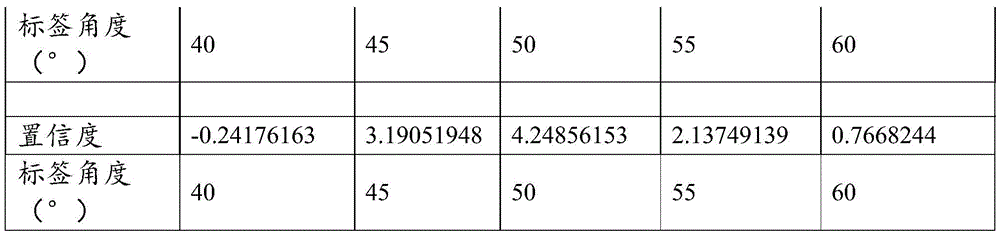
TABLE 1 confidence and tag Angle correspondence
As shown in table 1, the label angles corresponding to the classifiers are: [40 45 50 55 60]; therefore, the classification result is: [40 50 ] \ 8230; ].
Referring to fig. 9, a schematic structural diagram of a BLE positioning device according to an embodiment of the present invention is provided. As shown in fig. 9, the positioning device includes a CPU processing unit, the CPU processing unit includes two cores, wherein one core CPU1 is used for running main application software, and the other core CPU2 is used for executing low power consumption bluetooth and radio frequency real-time processing tasks; the radio frequency system is connected with the array antenna; the CPU1 and the CPU2 are respectively communicated with the memory through a shared bus matrix, and the CPU2 can also be communicated with a radio frequency system through a radio frequency bus matrix. Wherein the memory has stored therein a computer program that, when executed, causes the BLE positioning device to perform a BLE positioning method.
Referring to fig. 10, a flowchart of a BLE positioning method according to an embodiment of the present invention is provided. As shown in fig. 10, the method is applied to a CPU processing unit of a BLE positioning device, in particular to a CPU2, and includes:
301, determining the transmission channel information, the initial angle of arrival and the antenna pair phase difference according to the positioning signal of the BLE tag.
Specifically, the BLE positioning equipment receives a BLE data packet which is sent by a tag to be positioned and carries the CTE through an antenna array. The BLE positioning equipment analyzes the BLE data packet received by the antenna array to obtain an I/Q component, RSSI and a BLE channel index value of the BLE data packet. Then, the antenna pair phase difference and the initial arrival angle are calculated according to the I/Q components and/or the RSSI.
Illustratively, when the antenna array of the BLE positioning device is a half-circular array board as shown in fig. 2, the antenna pair phase difference calculated by the CPU2 includes: the phase difference of the antenna pairs between the No. 1-4 antennas in the first semicircular array and the phase difference of the antenna pairs between the No. 0 and the No. 5-7 antennas in the second semicircular array. And the CPU2 calculates and obtains an initial arrival angle according to the antenna pair phase difference between every two antennas of No. 1-4 antennas in the first semicircular array and the antenna pair phase difference between every two antennas of No. 0 and No. 5-7 antennas in the second semicircular array.
Illustratively, when the antenna array of the BLE positioning device is the antenna array structure shown in fig. 3A or fig. 3B, the antenna pair phase difference calculated by the CPU2 includes: the antenna pair phase difference of the first antenna group and the antenna pair phase difference of the second antenna group. Then, the CPU2 calculates an initial arrival angle based on the antenna pair phase difference of the first antenna group and the antenna pair phase difference of the second antenna group.
302, inputting the transmission channel information, the initial arrival angle and the antenna pair phase difference into a random forest model, and outputting a first arrival angle by the random forest model.
303, inputting the transmission channel information, the initial angle of arrival and the antenna pair phase difference into an SVM model, and outputting a second angle of arrival by the SVM model.
And 304, inputting the first arrival angle and the second arrival angle into a voting model, and outputting a corrected arrival angle by the voting model.
In the embodiment of the invention, the BLE positioning equipment is integrated with the AOA calculation model. The structure of the AOA calculation model is shown in fig. 4, and includes a random forest model, an SVM model, and a voting model. The method comprises the steps of establishing a BLE channel index value, an initial arrival angle, an antenna pair phase difference and a calculation rule among first arrival angles by using a random forest model. And after a BLE channel index value, an initial arrival angle and an antenna pair phase difference are input into the random forest model, the random forest model outputs a first arrival angle. Similarly, the SVM model may calculate a confidence value between the input initial arrival angle and the corresponding angle tag according to the input BLE channel index value, the initial arrival angle, and the antenna pair phase difference, and may output a second arrival angle according to the confidence value SVM model. The voting model in the AOA calculation model can output a final arrival angle by voting on the first arrival angle and the second arrival angle, so that AOA correction is realized.
Further, the specific calculation processes of the random forest model and the SVM model in the embodiment of the present invention may refer to the descriptions of the embodiments related to fig. 6 to fig. 8, and are not described herein again.
In specific implementation, the present application further provides a computer storage medium, where the computer storage medium may store a program, and the program may include some or all of the steps in the embodiments provided in the present application when executed. The storage medium may be a magnetic disk, an optical disk, a read-only memory (ROM), a Random Access Memory (RAM), or the like.
In a specific implementation, an embodiment of the present application further provides a computer program product, where the computer program product includes executable instructions, and when the executable instructions are executed on a computer, the computer is caused to execute some or all of the steps in the foregoing method embodiment.
In the embodiments of the present application, "at least one" means one or more, "a plurality" means two or more. "and/or" describes the association relationship of the associated objects, and means that there may be three relationships, for example, a and/or B, and may mean that a exists alone, a and B exist simultaneously, and B exists alone. Wherein A and B can be singular or plural. The character "/" generally indicates that the former and latter associated objects are in an "or" relationship. "at least one of the following" and similar expressions refer to any combination of these items, including any combination of singular or plural items. For example, at least one of a, b, and c may represent: a, b, c, a-b, a-c, b-c, or a-b-c, wherein a, b, c may be single or multiple.
Those of ordinary skill in the art will appreciate that the various elements and algorithm steps described in connection with the embodiments disclosed herein can be implemented as electronic hardware, computer software, or combinations of electronic hardware. Whether such functionality is implemented as hardware or software depends upon the particular application and design constraints imposed on the implementation. Skilled artisans may implement the described functionality in varying ways for each particular application, but such implementation decisions should not be interpreted as causing a departure from the scope of the present application.
It can be clearly understood by those skilled in the art that, for convenience and simplicity of description, the specific working processes of the above-described systems, apparatuses and units may refer to the corresponding processes in the foregoing method embodiments, and are not described herein again.
The above description is only for the specific embodiments of the present application, and any person skilled in the art can easily conceive of the changes or substitutions within the technical scope of the present disclosure, and all the changes or substitutions should be covered by the protection scope of the present application. The protection scope of the present application shall be subject to the protection scope of the claims.
Claims (15)
1. A position location and direction finding system, comprising:
the tag to be positioned is used for transmitting a positioning signal;
the receiving equipment is used for determining positioning parameters according to the received positioning signals;
the positioning processing equipment is used for determining the transmitting channel information, the initial arrival angle and the antenna pair phase difference of the positioning signal received by the receiving equipment according to the positioning parameters; calculating an arrival angle according to the transmitting channel information, the initial arrival angle and the antenna pair phase difference, and correcting the arrival angle;
wherein the transmission channel information comprises a transmission channel index value;
wherein, calculating the arrival angle according to the transmission channel information, the initial arrival angle and the antenna pair phase difference, and correcting the arrival angle, comprises:
inputting the transmission channel information, the initial arrival angle and the antenna pair phase difference into a random forest model, and outputting a first arrival angle by the random forest model;
inputting the transmitting channel information, the initial arrival angle and the antenna pair phase difference into a Support Vector Machine (SVM) model, and outputting a second arrival angle by the SVM model;
inputting the first arrival angle and the second arrival angle into a voting model, and outputting a corrected arrival angle by the voting model.
2. The system of claim 1, wherein the receiving device comprises a half-circular array plate, the half-circular array plate comprising: a first array of semi-circles and a second array of semi-circles;
the first semicircular array and the second semicircular array respectively comprise N and M antennas, 1 antenna in the N antennas is located at the circle center of the first semicircular array, N-1 antenna is located at the semicircular arc position of the first semicircular array, 1 antenna in the M antennas is located at the circle center of the second semicircular array, M-1 antenna is located at the semicircular arc position of the second semicircular array, N is more than or equal to 3, M is more than or equal to 3;
the first semicircular array and the second semicircular array are arranged in the same plane, and the diameters of the first semicircular array and the second semicircular array are parallel to each other;
the positioning processing equipment receives the antenna pair phase difference determined by the positioning signal according to the semicircular array plate and comprises the following steps: the first semicircular array comprises antenna pair phase differences between every two antennas and the second semicircular array comprises antenna pair phase differences between every two antennas.
3. The system according to claim 1, wherein the receiving device comprises a multi-antenna linear array board, N antennas are arranged on the multi-antenna linear array board, and N is more than or equal to 3; the N antennas comprise at least one reference antenna, and each reference antenna corresponds to two matched antenna groups;
the positioning processing equipment receives the positioning signals according to the multi-antenna linear array plate to determine the phase difference of the antenna pairs, and the phase difference comprises the following steps: and antenna pair phase differences respectively corresponding to the antenna groups.
4. A method for locating and direction finding, comprising:
determining the transmitting channel information, the initial arrival angle and the antenna pair phase difference of a positioning signal transmitted by a tag to be positioned;
inputting the transmitting channel information, the initial arrival angle and the antenna pair phase difference into a random forest model, and outputting a first arrival angle by the random forest model;
inputting the transmitting channel information, the initial arrival angle and the antenna pair phase difference into a Support Vector Machine (SVM) model, and outputting a second arrival angle by the SVM model;
inputting the first angle of arrival and the second angle of arrival into a voting model, the voting model outputting a corrected angle of arrival;
wherein the transmission channel information comprises a transmission channel index value.
5. The method of claim 4, wherein the random forest model comprises X decision trees and a first decision module, wherein:
each decision tree is used for outputting an arrival angle to be decided according to input transmitting channel information, an antenna pair phase difference and an initial arrival angle;
the first decision module is used for determining voting probabilities of arrival angles to be decided output by the X decision trees and outputting the first arrival angle according to the voting probabilities of the arrival angles to be decided.
6. The method of claim 5, wherein the X decision trees are obtained by training X sample sets, each sample set containing a plurality of sample data, the sample data being transmission channel information labeled with arrival angle, antenna pair phase difference, and initial arrival angle; wherein,
and each decision tree establishes a decision rule between input transmission channel information, antenna pair phase difference and initial arrival angle and output arrival angle to be decided through training of a corresponding sample set.
7. The method of claim 6, further comprising:
in the training process, the random forest model comprises the number x of decision trees i Randomly determining;
when the number of the decision trees is x i The accuracy of the first arrival angle output by the random forest model is z i Z is said i Determining according to the arrival angle labeled by the sample data;
according to different values of x i Corresponding z i And determining the number of decision trees of the random forest model as X.
8. The method of claim 4, wherein the SVM model comprises Y classifiers and a second decision module;
the Y classifiers correspond to Y angle tags, and each two classifier is used for calculating a confidence value of the input initial arrival angle and the corresponding angle tag according to the input transmission channel information, the antenna pair phase difference and the initial arrival angle;
the second decision module is used for determining a target second classifier from the Y second classifiers according to the Y confidence values, and determining an angle label of the target second classifier as the second arrival angle.
9. The method of claim 8, wherein each of the two classifiers corresponds to a positive quantity sample set, each positive quantity sample set comprising a plurality of sample data, the sample data being transmission channel information labeled with angle of arrival, antenna pair phase difference, and initial angle of arrival;
each two classifiers establishes input transmission channel information, antenna pair phase difference and initial arrival angle through training of Y positive quantity sample sets, and establishes interval calculation rules with own angle labels, and interval values calculated according to the interval calculation rules are used for determining confidence values;
in the training process, when the data input into the two classifiers belong to the corresponding positive sample set, the output confidence value is a positive value; when the data input into the two classifiers belong to other Y-1 positive sample sets, the output confidence value is a negative value.
10. The method of claim 4, wherein the antenna pair phase difference comprises: a plurality of antennas of half-circle array plate are to the phase difference, wherein, half-circle array plate includes: a first array of semi-circles and a second array of semi-circles;
the first semicircular array and the second semicircular array respectively comprise N antennas and M antennas, 1 antenna in the N antennas is located at the circle center position of the first semicircular array, N-1 antennas are located at the semicircular arc position of the first semicircular array, 1 antenna in the M antennas is located at the circle center position of the second semicircular array, M-1 antennas are located at the semicircular arc position of the second semicircular array, N is more than or equal to 3, and M is more than or equal to 3;
the first semicircular array and the second semicircular array are arranged in the same plane, and the diameters of the first semicircular array and the second semicircular array are parallel to each other;
a plurality of antennas of semicircle array plate are to the phase difference, include: each antenna pair phase difference included in the first semicircular array and each antenna pair phase difference included in the second semicircular array;
outputting, by the random forest model, the first arrival angle according to the transmission channel information, the initial arrival angle of the semicircular array plate, the antenna pair phase difference between every two antennas included in the first semicircular array, and the antenna pair phase difference between every two antennas included in the second semicircular array;
and the SVM model outputs the second arrival angle according to the transmission channel information, the initial arrival angle of the semicircular array plate, the antenna pair phase difference between every two antennas included in the first semicircular array and the antenna pair phase difference between every two antennas included in the second semicircular array.
11. The method of claim 4, wherein the antenna pair phase difference comprises: phase differences of a plurality of antenna pairs of the multi-antenna linear array plate are achieved, wherein N antennas are arranged on the multi-antenna linear array plate, and N is larger than or equal to 3; the N antennas comprise at least one reference antenna, and each reference antenna corresponds to the two matched antenna groups;
a plurality of antenna pair phase differences of many antennas linear array board include: antenna pair phase differences respectively corresponding to each antenna group;
the random forest model outputs the first arrival angle according to the transmitting channel information, the initial arrival angle of the multi-antenna linear array board and the antenna pair phase difference corresponding to each antenna group;
and the SVM model outputs the second arrival angle according to the transmitting channel information, the initial arrival angle of the multi-antenna linear array board and the antenna pair phase difference corresponding to each antenna group.
12. A BLE positioning method, comprising:
determining transmitting channel information, an initial arrival angle and an antenna pair phase difference according to a positioning signal of a BLE tag;
calculating an arrival angle according to the transmitting channel information, the initial arrival angle and the antenna pair phase difference, and correcting the arrival angle;
wherein the transmission channel information comprises a transmission channel index value;
wherein, calculating an arrival angle according to the transmission channel information, the initial arrival angle and the antenna pair phase difference, and correcting the arrival angle, comprises:
inputting the transmitting channel information, the initial arrival angle and the antenna pair phase difference into a random forest model, and outputting a first arrival angle by the random forest model;
inputting the transmitting channel information, the initial arrival angle and the antenna pair phase difference into a Support Vector Machine (SVM) model, and outputting a second arrival angle by the SVM model;
inputting the first arrival angle and the second arrival angle into a voting model, and outputting a corrected arrival angle by the voting model.
13. A method as claimed in claim 12, wherein the random forest model comprises X decision trees and a first decision module, wherein:
each decision tree is used for outputting an arrival angle to be decided according to input transmitting channel information, an antenna pair phase difference and an initial arrival angle;
the first decision module is used for determining voting probabilities of arrival angles to be decided output by the X decision trees and outputting the first arrival angle according to the voting probabilities of the arrival angles to be decided.
14. The method of claim 12, wherein the SVM model comprises Y classifiers and a second decision module;
the Y classifiers correspond to Y angle tags, and each two classifier is used for calculating a confidence value of the input initial arrival angle and the corresponding angle tag according to the input transmission channel information, the antenna pair phase difference and the initial arrival angle;
the second decision module is used for determining a target second classifier from the Y second classifiers according to the Y confidence values, and determining an angle label of the target second classifier as the second arrival angle.
15. A BLE positioning device, comprising:
a processor;
a memory;
and one or more computer programs, wherein the one or more computer programs are stored in the memory, the one or more computer programs comprising instructions that, when executed, cause the BLE positioning device to perform the method of any of claims 12-14.
Priority Applications (1)
| Application Number | Priority Date | Filing Date | Title |
|---|---|---|---|
| CN202111210902.4A CN113945887B (en) | 2021-10-18 | 2021-10-18 | Positioning and direction finding system and method and BLE positioning device |
Applications Claiming Priority (1)
| Application Number | Priority Date | Filing Date | Title |
|---|---|---|---|
| CN202111210902.4A CN113945887B (en) | 2021-10-18 | 2021-10-18 | Positioning and direction finding system and method and BLE positioning device |
Publications (2)
| Publication Number | Publication Date |
|---|---|
| CN113945887A CN113945887A (en) | 2022-01-18 |
| CN113945887B true CN113945887B (en) | 2022-11-22 |
Family
ID=79331225
Family Applications (1)
| Application Number | Title | Priority Date | Filing Date |
|---|---|---|---|
| CN202111210902.4A Active CN113945887B (en) | 2021-10-18 | 2021-10-18 | Positioning and direction finding system and method and BLE positioning device |
Country Status (1)
| Country | Link |
|---|---|
| CN (1) | CN113945887B (en) |
Families Citing this family (1)
| Publication number | Priority date | Publication date | Assignee | Title |
|---|---|---|---|---|
| CN115278522B (en) * | 2022-07-13 | 2025-02-11 | 隔空(上海)智能科技有限公司 | UWB signal incident angle processing and positioning method, system, electronic device, and medium |
Citations (7)
| Publication number | Priority date | Publication date | Assignee | Title |
|---|---|---|---|---|
| CN108288991A (en) * | 2017-01-09 | 2018-07-17 | 中兴通讯股份有限公司 | Feedback method and device for beam information and configuration information |
| CN109874134A (en) * | 2019-02-01 | 2019-06-11 | 重庆谷庚科技有限责任公司 | RF label indoor locating system and method based on OFDM |
| CN110891308A (en) * | 2018-09-07 | 2020-03-17 | 财团法人工业技术研究院 | Wireless positioning calibration system and method |
| CN112040394A (en) * | 2020-08-05 | 2020-12-04 | 深圳市微能信息科技有限公司 | Bluetooth positioning method and system based on AI deep learning algorithm |
| CN112929817A (en) * | 2021-02-04 | 2021-06-08 | 珠海极海半导体有限公司 | Terminal positioning method, device, terminal, storage medium and program product |
| CN113115224A (en) * | 2021-04-06 | 2021-07-13 | 中移(上海)信息通信科技有限公司 | Indoor positioning method and indoor positioning device |
| CN214101799U (en) * | 2020-11-17 | 2021-08-31 | 浙江王力安防产品有限公司 | Indoor positioner based on bluetooth AOA location technology |
Family Cites Families (7)
| Publication number | Priority date | Publication date | Assignee | Title |
|---|---|---|---|---|
| US10091616B2 (en) * | 2005-12-15 | 2018-10-02 | Polte Corporation | Angle of arrival (AOA) positioning method and system for positional finding and tracking objects using reduced attenuation RF technology |
| US10440512B2 (en) * | 2012-08-03 | 2019-10-08 | Polte Corporation | Angle of arrival (AOA) positioning method and system for positional finding and tracking objects using reduced attenuation RF technology |
| US10627473B2 (en) * | 2013-10-01 | 2020-04-21 | Phasorlab, Inc. | Angle of arrival measurements using RF carrier synchronization and phase alignment methods |
| US11269043B2 (en) * | 2018-06-20 | 2022-03-08 | Denso International America, Inc. | Circular polarized quadrifilar helix antennas |
| US11415657B2 (en) * | 2019-09-30 | 2022-08-16 | Silicon Laboratories Inc. | Angle of arrival using machine learning |
| US20210124006A1 (en) * | 2019-10-29 | 2021-04-29 | Hon Lin Technology Co., Ltd. | Method and apparatus for estimating angle of arrival of signals in wireless communication system |
| CN111352083B (en) * | 2020-01-17 | 2022-04-01 | 武汉大学 | Automatic calibration method and device for gain of multiple receiving channels of high-frequency ground wave radar |
-
2021
- 2021-10-18 CN CN202111210902.4A patent/CN113945887B/en active Active
Patent Citations (7)
| Publication number | Priority date | Publication date | Assignee | Title |
|---|---|---|---|---|
| CN108288991A (en) * | 2017-01-09 | 2018-07-17 | 中兴通讯股份有限公司 | Feedback method and device for beam information and configuration information |
| CN110891308A (en) * | 2018-09-07 | 2020-03-17 | 财团法人工业技术研究院 | Wireless positioning calibration system and method |
| CN109874134A (en) * | 2019-02-01 | 2019-06-11 | 重庆谷庚科技有限责任公司 | RF label indoor locating system and method based on OFDM |
| CN112040394A (en) * | 2020-08-05 | 2020-12-04 | 深圳市微能信息科技有限公司 | Bluetooth positioning method and system based on AI deep learning algorithm |
| CN214101799U (en) * | 2020-11-17 | 2021-08-31 | 浙江王力安防产品有限公司 | Indoor positioner based on bluetooth AOA location technology |
| CN112929817A (en) * | 2021-02-04 | 2021-06-08 | 珠海极海半导体有限公司 | Terminal positioning method, device, terminal, storage medium and program product |
| CN113115224A (en) * | 2021-04-06 | 2021-07-13 | 中移(上海)信息通信科技有限公司 | Indoor positioning method and indoor positioning device |
Non-Patent Citations (6)
| Title |
|---|
| "AoA-Aware Probabilistic Indoor Location Fingerprinting Using Channel State Information";Luan Chen等;《IEEE Internet of Things Journal》;20201231;第7卷(第11期);10868-10883 * |
| "DOA estimation with channel gain-phase uncertainties via Schur-product and RARE algorithm";Hu, Weiwei;《IET Radar, Sonar & Navigation》;20191231;第13卷(第8期);1306-1312 * |
| "基于L型延迟阵列调制宽带转换器的信号载频和二维到达角联合估计";姜思仪,等;《物理学报》;20210507;第70卷(第8期);280-288 * |
| "基于子空间匹配追踪的LFM信号的DOA估计";刘璐,等;《电子科技》;20141231;第27卷(第7期);43-46 * |
| "干涉仪测向的校准技术研究";冯啸羽;《中国优秀硕士学位论文全文数据库 信息科技辑》;20130315(第3期);I136-1123 * |
| "模拟电荷法在UHVDC输电线路中的优化及应用";王珍雪,等;《高压电器》;20160116;第52卷(第1期);15-20+26 * |
Also Published As
| Publication number | Publication date |
|---|---|
| CN113945887A (en) | 2022-01-18 |
Similar Documents
| Publication | Publication Date | Title |
|---|---|---|
| Zhang et al. | TIPS: Transformer based indoor positioning system using both CSI and DoA of WiFi signal | |
| CN107741580B (en) | Bluetooth positioning method | |
| Yang et al. | Decimeter level indoor localization using WiFi channel state information | |
| US10613211B2 (en) | Virtual angle-of-arrival/angle-of-departure tracking | |
| Paulino et al. | Self-localization via circular Bluetooth 5.1 antenna array receiver | |
| Zou et al. | A mutual information based online access point selection strategy for WiFi indoor localization | |
| CN108646213B (en) | Direct wave AOA (automatic optical inspection) judgment method in indoor multipath environment | |
| Fang et al. | A novel fused positioning feature for handling heterogeneous hardware problem | |
| US20210399587A1 (en) | Polarization adaptive wireless power transmission system | |
| CN112929817B (en) | Terminal positioning method, device, terminal and storage medium | |
| Zhou et al. | MobiFi: Fast deep-learning based localization using mobile WiFi | |
| CN111856402A (en) | Signal processing method and device, storage medium, and electronic device | |
| CN113945887B (en) | Positioning and direction finding system and method and BLE positioning device | |
| Lin et al. | A self-learning mean optimization filter to improve bluetooth 5.1 AoA indoor positioning accuracy for ship environments | |
| CN109327249A (en) | Angle-of- arrival estimation method in mimo system | |
| US20230214620A1 (en) | Method and device for positioning, and storage medium | |
| CN113993068B (en) | Positioning and direction-finding system, method and BLE positioning device | |
| CN114696882B (en) | Beamforming method, device, system and base station | |
| CN114143705B (en) | Direction finding method, device, system and storage medium | |
| Sun et al. | Antenna selection and placement analysis of MIMO radar networks for target localization | |
| Troccoli et al. | Implementation of embedded multiple signal classification algorithm for mesh IoT networks | |
| US20240094380A1 (en) | Method for performing positioning operation and electronic device for supporting same | |
| CN114759962B (en) | Beamforming method, device, system and base station | |
| WO2024140796A1 (en) | Transmission processing method and apparatus, and terminal and network-side device | |
| CN110049551A (en) | Signal tracing method based on commercial wireless WiFi equipment |
Legal Events
| Date | Code | Title | Description |
|---|---|---|---|
| PB01 | Publication | ||
| PB01 | Publication | ||
| SE01 | Entry into force of request for substantive examination | ||
| SE01 | Entry into force of request for substantive examination | ||
| GR01 | Patent grant | ||
| GR01 | Patent grant |