CN113896873A - A kind of branched polyester ionomer auxiliary agent based on ionic bond construction and its preparation method and application - Google Patents
A kind of branched polyester ionomer auxiliary agent based on ionic bond construction and its preparation method and application Download PDFInfo
- Publication number
- CN113896873A CN113896873A CN202111328655.8A CN202111328655A CN113896873A CN 113896873 A CN113896873 A CN 113896873A CN 202111328655 A CN202111328655 A CN 202111328655A CN 113896873 A CN113896873 A CN 113896873A
- Authority
- CN
- China
- Prior art keywords
- auxiliary agent
- hydroxyethyl
- branched polyester
- ionomer
- polyester ionomer
- Prior art date
- Legal status (The legal status is an assumption and is not a legal conclusion. Google has not performed a legal analysis and makes no representation as to the accuracy of the status listed.)
- Granted
Links
- 229920000554 ionomer Polymers 0.000 title claims abstract description 234
- 239000012752 auxiliary agent Substances 0.000 title claims abstract description 166
- 229920000728 polyester Polymers 0.000 title claims abstract description 142
- 238000002360 preparation method Methods 0.000 title claims abstract description 38
- 238000010276 construction Methods 0.000 title claims 7
- 230000000844 anti-bacterial effect Effects 0.000 claims abstract description 155
- 239000004626 polylactic acid Substances 0.000 claims abstract description 80
- 229920000747 poly(lactic acid) Polymers 0.000 claims abstract description 76
- 239000000654 additive Substances 0.000 claims abstract description 41
- -1 halogen ion Chemical group 0.000 claims description 203
- VXUYXOFXAQZZMF-UHFFFAOYSA-N titanium(IV) isopropoxide Chemical compound CC(C)O[Ti](OC(C)C)(OC(C)C)OC(C)C VXUYXOFXAQZZMF-UHFFFAOYSA-N 0.000 claims description 104
- 238000006243 chemical reaction Methods 0.000 claims description 103
- 150000003839 salts Chemical class 0.000 claims description 93
- RTZKZFJDLAIYFH-UHFFFAOYSA-N Diethyl ether Chemical compound CCOCC RTZKZFJDLAIYFH-UHFFFAOYSA-N 0.000 claims description 79
- 238000006068 polycondensation reaction Methods 0.000 claims description 67
- 238000003756 stirring Methods 0.000 claims description 60
- 230000015572 biosynthetic process Effects 0.000 claims description 55
- 239000003054 catalyst Substances 0.000 claims description 55
- 238000003786 synthesis reaction Methods 0.000 claims description 55
- SQGYOTSLMSWVJD-UHFFFAOYSA-N silver(1+) nitrate Chemical compound [Ag+].[O-]N(=O)=O SQGYOTSLMSWVJD-UHFFFAOYSA-N 0.000 claims description 52
- HEDRZPFGACZZDS-UHFFFAOYSA-N Chloroform Chemical compound ClC(Cl)Cl HEDRZPFGACZZDS-UHFFFAOYSA-N 0.000 claims description 50
- 238000000605 extraction Methods 0.000 claims description 50
- 238000005886 esterification reaction Methods 0.000 claims description 48
- 125000002887 hydroxy group Chemical group [H]O* 0.000 claims description 39
- IJGRMHOSHXDMSA-UHFFFAOYSA-N Atomic nitrogen Chemical compound N#N IJGRMHOSHXDMSA-UHFFFAOYSA-N 0.000 claims description 38
- 238000002156 mixing Methods 0.000 claims description 34
- 239000000243 solution Substances 0.000 claims description 27
- 229910052757 nitrogen Inorganic materials 0.000 claims description 26
- 239000012299 nitrogen atmosphere Substances 0.000 claims description 26
- 229910001961 silver nitrate Inorganic materials 0.000 claims description 26
- 150000002148 esters Chemical class 0.000 claims description 25
- 239000007864 aqueous solution Substances 0.000 claims description 24
- 239000011261 inert gas Substances 0.000 claims description 24
- DWPYQDGDWBKJQL-UHFFFAOYSA-N 2-pyridin-4-ylethanol Chemical compound OCCC1=CC=NC=C1 DWPYQDGDWBKJQL-UHFFFAOYSA-N 0.000 claims description 21
- 238000000034 method Methods 0.000 claims description 21
- AMSDWLOANMAILF-UHFFFAOYSA-N 2-imidazol-1-ylethanol Chemical compound OCCN1C=CN=C1 AMSDWLOANMAILF-UHFFFAOYSA-N 0.000 claims description 20
- 230000032050 esterification Effects 0.000 claims description 20
- LYCAIKOWRPUZTN-UHFFFAOYSA-N Ethylene glycol Chemical compound OCCO LYCAIKOWRPUZTN-UHFFFAOYSA-N 0.000 claims description 19
- 229920000642 polymer Polymers 0.000 claims description 17
- 125000005442 diisocyanate group Chemical group 0.000 claims description 16
- 238000004090 dissolution Methods 0.000 claims description 16
- 239000002253 acid Substances 0.000 claims description 15
- RAXXELZNTBOGNW-UHFFFAOYSA-N imidazole Natural products C1=CNC=N1 RAXXELZNTBOGNW-UHFFFAOYSA-N 0.000 claims description 15
- YMWUJEATGCHHMB-UHFFFAOYSA-N Dichloromethane Chemical group ClCCl YMWUJEATGCHHMB-UHFFFAOYSA-N 0.000 claims description 14
- 229940008841 1,6-hexamethylene diisocyanate Drugs 0.000 claims description 12
- RRAMGCGOFNQTLD-UHFFFAOYSA-N hexamethylene diisocyanate Chemical group O=C=NCCCCCCN=C=O RRAMGCGOFNQTLD-UHFFFAOYSA-N 0.000 claims description 12
- LFQSCWFLJHTTHZ-UHFFFAOYSA-N Ethanol Chemical compound CCO LFQSCWFLJHTTHZ-UHFFFAOYSA-N 0.000 claims description 11
- XEKOWRVHYACXOJ-UHFFFAOYSA-N Ethyl acetate Chemical group CCOC(C)=O XEKOWRVHYACXOJ-UHFFFAOYSA-N 0.000 claims description 9
- 239000000155 melt Substances 0.000 claims description 9
- 150000001335 aliphatic alkanes Chemical class 0.000 claims description 8
- 239000012044 organic layer Substances 0.000 claims description 8
- 230000035484 reaction time Effects 0.000 claims description 8
- 125000003178 carboxy group Chemical group [H]OC(*)=O 0.000 claims description 5
- 229910052736 halogen Inorganic materials 0.000 claims description 5
- 125000001183 hydrocarbyl group Chemical group 0.000 claims description 5
- UPMLOUAZCHDJJD-UHFFFAOYSA-N 4,4'-Diphenylmethane Diisocyanate Chemical compound C1=CC(N=C=O)=CC=C1CC1=CC=C(N=C=O)C=C1 UPMLOUAZCHDJJD-UHFFFAOYSA-N 0.000 claims description 4
- KXBFLNPZHXDQLV-UHFFFAOYSA-N [cyclohexyl(diisocyanato)methyl]cyclohexane Chemical compound C1CCCCC1C(N=C=O)(N=C=O)C1CCCCC1 KXBFLNPZHXDQLV-UHFFFAOYSA-N 0.000 claims description 4
- 239000003607 modifier Substances 0.000 claims description 4
- 239000003960 organic solvent Substances 0.000 claims description 4
- 239000000126 substance Substances 0.000 claims description 4
- 230000009471 action Effects 0.000 claims description 3
- 239000003208 petroleum Substances 0.000 claims description 3
- 230000001376 precipitating effect Effects 0.000 claims description 3
- JUJWROOIHBZHMG-UHFFFAOYSA-N pyridine Substances C1=CC=NC=C1 JUJWROOIHBZHMG-UHFFFAOYSA-N 0.000 claims description 3
- 238000005809 transesterification reaction Methods 0.000 claims description 3
- XLYOFNOQVPJJNP-UHFFFAOYSA-N water Substances O XLYOFNOQVPJJNP-UHFFFAOYSA-N 0.000 claims description 3
- 239000007795 chemical reaction product Substances 0.000 claims description 2
- 150000002009 diols Chemical class 0.000 claims description 2
- 150000002500 ions Chemical class 0.000 claims description 2
- UMJSCPRVCHMLSP-UHFFFAOYSA-N pyridine Natural products COC1=CC=CN=C1 UMJSCPRVCHMLSP-UHFFFAOYSA-N 0.000 claims description 2
- 238000006467 substitution reaction Methods 0.000 claims description 2
- 150000004820 halides Chemical class 0.000 claims 3
- 238000001556 precipitation Methods 0.000 claims 3
- WGCNASOHLSPBMP-UHFFFAOYSA-N hydroxyacetaldehyde Natural products OCC=O WGCNASOHLSPBMP-UHFFFAOYSA-N 0.000 claims 2
- 239000003795 chemical substances by application Substances 0.000 claims 1
- 239000000203 mixture Substances 0.000 claims 1
- 239000013589 supplement Substances 0.000 claims 1
- 230000000996 additive effect Effects 0.000 abstract description 30
- 230000004048 modification Effects 0.000 abstract description 25
- 238000012986 modification Methods 0.000 abstract description 25
- 239000000463 material Substances 0.000 abstract description 18
- 238000011160 research Methods 0.000 abstract description 10
- 230000009286 beneficial effect Effects 0.000 abstract description 2
- 239000002994 raw material Substances 0.000 abstract 1
- WNLRTRBMVRJNCN-UHFFFAOYSA-N adipic acid Chemical compound OC(=O)CCCCC(O)=O WNLRTRBMVRJNCN-UHFFFAOYSA-N 0.000 description 80
- 239000012074 organic phase Substances 0.000 description 45
- 238000001035 drying Methods 0.000 description 44
- 239000001361 adipic acid Substances 0.000 description 40
- 235000011037 adipic acid Nutrition 0.000 description 40
- CDQSJQSWAWPGKG-UHFFFAOYSA-N butane-1,1-diol Chemical compound CCCC(O)O CDQSJQSWAWPGKG-UHFFFAOYSA-N 0.000 description 40
- 239000000047 product Substances 0.000 description 36
- 239000002244 precipitate Substances 0.000 description 25
- 238000002390 rotary evaporation Methods 0.000 description 22
- 238000000967 suction filtration Methods 0.000 description 20
- HNTGIJLWHDPAFN-UHFFFAOYSA-N 1-bromohexadecane Chemical compound CCCCCCCCCCCCCCCCBr HNTGIJLWHDPAFN-UHFFFAOYSA-N 0.000 description 18
- 238000010438 heat treatment Methods 0.000 description 16
- 238000002844 melting Methods 0.000 description 15
- 230000008018 melting Effects 0.000 description 15
- CXMXRPHRNRROMY-UHFFFAOYSA-N sebacic acid Chemical compound OC(=O)CCCCCCCCC(O)=O CXMXRPHRNRROMY-UHFFFAOYSA-N 0.000 description 12
- OFOBLEOULBTSOW-UHFFFAOYSA-N Malonic acid Chemical compound OC(=O)CC(O)=O OFOBLEOULBTSOW-UHFFFAOYSA-N 0.000 description 10
- 230000000694 effects Effects 0.000 description 10
- 230000006872 improvement Effects 0.000 description 7
- 230000008569 process Effects 0.000 description 7
- 125000000954 2-hydroxyethyl group Chemical group [H]C([*])([H])C([H])([H])O[H] 0.000 description 6
- QTBSBXVTEAMEQO-UHFFFAOYSA-N Acetic acid Chemical compound CC(O)=O QTBSBXVTEAMEQO-UHFFFAOYSA-N 0.000 description 6
- OKKJLVBELUTLKV-UHFFFAOYSA-N Methanol Chemical compound OC OKKJLVBELUTLKV-UHFFFAOYSA-N 0.000 description 6
- 238000002474 experimental method Methods 0.000 description 6
- 125000003010 ionic group Chemical group 0.000 description 6
- 239000000178 monomer Substances 0.000 description 6
- 239000000758 substrate Substances 0.000 description 6
- 241000191967 Staphylococcus aureus Species 0.000 description 5
- 125000002091 cationic group Chemical group 0.000 description 5
- 230000000052 comparative effect Effects 0.000 description 5
- 239000002904 solvent Substances 0.000 description 5
- 241000588724 Escherichia coli Species 0.000 description 4
- INSRQEMEVAMETL-UHFFFAOYSA-N decane-1,1-diol Chemical compound CCCCCCCCCC(O)O INSRQEMEVAMETL-UHFFFAOYSA-N 0.000 description 4
- 238000007731 hot pressing Methods 0.000 description 4
- 229920000831 ionic polymer Polymers 0.000 description 4
- 238000009864 tensile test Methods 0.000 description 4
- RNFJDJUURJAICM-UHFFFAOYSA-N 2,2,4,4,6,6-hexaphenoxy-1,3,5-triaza-2$l^{5},4$l^{5},6$l^{5}-triphosphacyclohexa-1,3,5-triene Chemical compound N=1P(OC=2C=CC=CC=2)(OC=2C=CC=CC=2)=NP(OC=2C=CC=CC=2)(OC=2C=CC=CC=2)=NP=1(OC=1C=CC=CC=1)OC1=CC=CC=C1 RNFJDJUURJAICM-UHFFFAOYSA-N 0.000 description 3
- JWYLVAHJOPSMIF-UHFFFAOYSA-N 2-(4-methylimidazol-1-yl)ethanol Chemical compound CC1=CN(CCO)C=N1 JWYLVAHJOPSMIF-UHFFFAOYSA-N 0.000 description 3
- 229920001817 Agar Polymers 0.000 description 3
- 241000894006 Bacteria Species 0.000 description 3
- 239000008272 agar Substances 0.000 description 3
- 230000001580 bacterial effect Effects 0.000 description 3
- 238000005266 casting Methods 0.000 description 3
- 238000011161 development Methods 0.000 description 3
- 239000003063 flame retardant Substances 0.000 description 3
- 230000006870 function Effects 0.000 description 3
- 239000007788 liquid Substances 0.000 description 3
- 238000004806 packaging method and process Methods 0.000 description 3
- 238000012545 processing Methods 0.000 description 3
- 238000010345 tape casting Methods 0.000 description 3
- 238000012360 testing method Methods 0.000 description 3
- PBLNBZIONSLZBU-UHFFFAOYSA-N 1-bromododecane Chemical compound CCCCCCCCCCCCBr PBLNBZIONSLZBU-UHFFFAOYSA-N 0.000 description 2
- HSBMPUYCFQSKRP-UHFFFAOYSA-N 1-bromoimidazole Chemical compound BrN1C=CN=C1 HSBMPUYCFQSKRP-UHFFFAOYSA-N 0.000 description 2
- FAPWRFPIFSIZLT-UHFFFAOYSA-M Sodium chloride Chemical compound [Na+].[Cl-] FAPWRFPIFSIZLT-UHFFFAOYSA-M 0.000 description 2
- OKJPEAGHQZHRQV-UHFFFAOYSA-N Triiodomethane Natural products IC(I)I OKJPEAGHQZHRQV-UHFFFAOYSA-N 0.000 description 2
- XLOMVQKBTHCTTD-UHFFFAOYSA-N Zinc monoxide Chemical compound [Zn]=O XLOMVQKBTHCTTD-UHFFFAOYSA-N 0.000 description 2
- 238000010521 absorption reaction Methods 0.000 description 2
- 239000002671 adjuvant Substances 0.000 description 2
- 239000003242 anti bacterial agent Substances 0.000 description 2
- 230000003115 biocidal effect Effects 0.000 description 2
- 150000001768 cations Chemical class 0.000 description 2
- 238000009833 condensation Methods 0.000 description 2
- 230000005494 condensation Effects 0.000 description 2
- 230000007547 defect Effects 0.000 description 2
- 238000010494 dissociation reaction Methods 0.000 description 2
- 230000005593 dissociations Effects 0.000 description 2
- 125000001495 ethyl group Chemical group [H]C([H])([H])C([H])([H])* 0.000 description 2
- 238000007306 functionalization reaction Methods 0.000 description 2
- 150000002460 imidazoles Chemical class 0.000 description 2
- 238000009776 industrial production Methods 0.000 description 2
- INQOMBQAUSQDDS-UHFFFAOYSA-N iodomethane Chemical compound IC INQOMBQAUSQDDS-UHFFFAOYSA-N 0.000 description 2
- 230000005012 migration Effects 0.000 description 2
- 238000013508 migration Methods 0.000 description 2
- 229920003023 plastic Polymers 0.000 description 2
- 239000004033 plastic Substances 0.000 description 2
- 229920006381 polylactic acid film Polymers 0.000 description 2
- 239000002861 polymer material Substances 0.000 description 2
- BBFCIBZLAVOLCF-UHFFFAOYSA-N pyridin-1-ium;bromide Chemical compound Br.C1=CC=NC=C1 BBFCIBZLAVOLCF-UHFFFAOYSA-N 0.000 description 2
- JUJWROOIHBZHMG-UHFFFAOYSA-O pyridinium Chemical compound C1=CC=[NH+]C=C1 JUJWROOIHBZHMG-UHFFFAOYSA-O 0.000 description 2
- 239000000376 reactant Substances 0.000 description 2
- 238000012827 research and development Methods 0.000 description 2
- 230000002441 reversible effect Effects 0.000 description 2
- 238000010998 test method Methods 0.000 description 2
- OKTJSMMVPCPJKN-UHFFFAOYSA-N Carbon Chemical compound [C] OKTJSMMVPCPJKN-UHFFFAOYSA-N 0.000 description 1
- 206010059866 Drug resistance Diseases 0.000 description 1
- 239000006057 Non-nutritive feed additive Substances 0.000 description 1
- 229920000305 Nylon 6,10 Polymers 0.000 description 1
- DWAQJAXMDSEUJJ-UHFFFAOYSA-M Sodium bisulfite Chemical compound [Na+].OS([O-])=O DWAQJAXMDSEUJJ-UHFFFAOYSA-M 0.000 description 1
- 241000700605 Viruses Species 0.000 description 1
- 150000007513 acids Chemical class 0.000 description 1
- 125000001931 aliphatic group Chemical group 0.000 description 1
- 229920003232 aliphatic polyester Polymers 0.000 description 1
- 230000000845 anti-microbial effect Effects 0.000 description 1
- 230000008901 benefit Effects 0.000 description 1
- 229940077388 benzenesulfonate Drugs 0.000 description 1
- SRSXLGNVWSONIS-UHFFFAOYSA-N benzenesulfonic acid Chemical class OS(=O)(=O)C1=CC=CC=C1 SRSXLGNVWSONIS-UHFFFAOYSA-N 0.000 description 1
- 230000001588 bifunctional effect Effects 0.000 description 1
- 229920002988 biodegradable polymer Polymers 0.000 description 1
- 239000004621 biodegradable polymer Substances 0.000 description 1
- 239000002981 blocking agent Substances 0.000 description 1
- 238000009395 breeding Methods 0.000 description 1
- 230000001488 breeding effect Effects 0.000 description 1
- 229910052799 carbon Inorganic materials 0.000 description 1
- 230000015556 catabolic process Effects 0.000 description 1
- 239000003153 chemical reaction reagent Substances 0.000 description 1
- 238000004891 communication Methods 0.000 description 1
- 230000001276 controlling effect Effects 0.000 description 1
- ZDOYGJNADZJRFB-PVMVIUQGSA-L copper (17S,18S)-18-(2-carboxyethyl)-20-(carboxymethyl)-12-ethenyl-7-ethyl-3,8,13,17-tetramethyl-17,18-dihydroporphyrin-21,23-diide-2-carboxylic acid Chemical compound [Cu++].CCc1c(C)c2cc3[n-]c(cc4nc([C@@H](CCC(O)=O)[C@@H]4C)c(CC(O)=O)c4[n-]c(cc1n2)c(C)c4C(O)=O)c(C)c3C=C ZDOYGJNADZJRFB-PVMVIUQGSA-L 0.000 description 1
- 239000002537 cosmetic Substances 0.000 description 1
- 238000004132 cross linking Methods 0.000 description 1
- 238000002425 crystallisation Methods 0.000 description 1
- 230000008025 crystallization Effects 0.000 description 1
- 238000000354 decomposition reaction Methods 0.000 description 1
- 238000006731 degradation reaction Methods 0.000 description 1
- 238000013461 design Methods 0.000 description 1
- 230000009977 dual effect Effects 0.000 description 1
- 230000009881 electrostatic interaction Effects 0.000 description 1
- 238000003912 environmental pollution Methods 0.000 description 1
- 238000001914 filtration Methods 0.000 description 1
- 125000000524 functional group Chemical group 0.000 description 1
- 150000002334 glycols Chemical class 0.000 description 1
- 150000002367 halogens Chemical class 0.000 description 1
- 150000004693 imidazolium salts Chemical class 0.000 description 1
- 238000011534 incubation Methods 0.000 description 1
- 239000012948 isocyanate Substances 0.000 description 1
- 150000002513 isocyanates Chemical class 0.000 description 1
- 238000004519 manufacturing process Methods 0.000 description 1
- 238000002715 modification method Methods 0.000 description 1
- 229910000402 monopotassium phosphate Inorganic materials 0.000 description 1
- 235000019796 monopotassium phosphate Nutrition 0.000 description 1
- 238000006386 neutralization reaction Methods 0.000 description 1
- 230000006911 nucleation Effects 0.000 description 1
- 238000010899 nucleation Methods 0.000 description 1
- 230000010355 oscillation Effects 0.000 description 1
- 239000005022 packaging material Substances 0.000 description 1
- QQVIHTHCMHWDBS-UHFFFAOYSA-N perisophthalic acid Natural products OC(=O)C1=CC=CC(C(O)=O)=C1 QQVIHTHCMHWDBS-UHFFFAOYSA-N 0.000 description 1
- 239000012071 phase Substances 0.000 description 1
- 238000005191 phase separation Methods 0.000 description 1
- PJNZPQUBCPKICU-UHFFFAOYSA-N phosphoric acid;potassium Chemical compound [K].OP(O)(O)=O PJNZPQUBCPKICU-UHFFFAOYSA-N 0.000 description 1
- 239000004014 plasticizer Substances 0.000 description 1
- 239000012716 precipitator Substances 0.000 description 1
- 230000009257 reactivity Effects 0.000 description 1
- 230000001105 regulatory effect Effects 0.000 description 1
- 235000010267 sodium hydrogen sulphite Nutrition 0.000 description 1
- 230000007480 spreading Effects 0.000 description 1
- 238000003892 spreading Methods 0.000 description 1
- 238000010025 steaming Methods 0.000 description 1
- 239000000725 suspension Substances 0.000 description 1
- 230000002194 synthesizing effect Effects 0.000 description 1
- 239000012085 test solution Substances 0.000 description 1
- 238000005979 thermal decomposition reaction Methods 0.000 description 1
- 239000011787 zinc oxide Substances 0.000 description 1
Classifications
-
- C—CHEMISTRY; METALLURGY
- C08—ORGANIC MACROMOLECULAR COMPOUNDS; THEIR PREPARATION OR CHEMICAL WORKING-UP; COMPOSITIONS BASED THEREON
- C08G—MACROMOLECULAR COMPOUNDS OBTAINED OTHERWISE THAN BY REACTIONS ONLY INVOLVING UNSATURATED CARBON-TO-CARBON BONDS
- C08G63/00—Macromolecular compounds obtained by reactions forming a carboxylic ester link in the main chain of the macromolecule
- C08G63/68—Polyesters containing atoms other than carbon, hydrogen and oxygen
- C08G63/685—Polyesters containing atoms other than carbon, hydrogen and oxygen containing nitrogen
-
- C—CHEMISTRY; METALLURGY
- C08—ORGANIC MACROMOLECULAR COMPOUNDS; THEIR PREPARATION OR CHEMICAL WORKING-UP; COMPOSITIONS BASED THEREON
- C08J—WORKING-UP; GENERAL PROCESSES OF COMPOUNDING; AFTER-TREATMENT NOT COVERED BY SUBCLASSES C08B, C08C, C08F, C08G or C08H
- C08J5/00—Manufacture of articles or shaped materials containing macromolecular substances
- C08J5/18—Manufacture of films or sheets
-
- C—CHEMISTRY; METALLURGY
- C08—ORGANIC MACROMOLECULAR COMPOUNDS; THEIR PREPARATION OR CHEMICAL WORKING-UP; COMPOSITIONS BASED THEREON
- C08L—COMPOSITIONS OF MACROMOLECULAR COMPOUNDS
- C08L67/00—Compositions of polyesters obtained by reactions forming a carboxylic ester link in the main chain; Compositions of derivatives of such polymers
- C08L67/04—Polyesters derived from hydroxycarboxylic acids, e.g. lactones
-
- C—CHEMISTRY; METALLURGY
- C08—ORGANIC MACROMOLECULAR COMPOUNDS; THEIR PREPARATION OR CHEMICAL WORKING-UP; COMPOSITIONS BASED THEREON
- C08J—WORKING-UP; GENERAL PROCESSES OF COMPOUNDING; AFTER-TREATMENT NOT COVERED BY SUBCLASSES C08B, C08C, C08F, C08G or C08H
- C08J2367/00—Characterised by the use of polyesters obtained by reactions forming a carboxylic ester link in the main chain; Derivatives of such polymers
- C08J2367/04—Polyesters derived from hydroxy carboxylic acids, e.g. lactones
-
- C—CHEMISTRY; METALLURGY
- C08—ORGANIC MACROMOLECULAR COMPOUNDS; THEIR PREPARATION OR CHEMICAL WORKING-UP; COMPOSITIONS BASED THEREON
- C08J—WORKING-UP; GENERAL PROCESSES OF COMPOUNDING; AFTER-TREATMENT NOT COVERED BY SUBCLASSES C08B, C08C, C08F, C08G or C08H
- C08J2467/00—Characterised by the use of polyesters obtained by reactions forming a carboxylic ester link in the main chain; Derivatives of such polymers
-
- C—CHEMISTRY; METALLURGY
- C08—ORGANIC MACROMOLECULAR COMPOUNDS; THEIR PREPARATION OR CHEMICAL WORKING-UP; COMPOSITIONS BASED THEREON
- C08L—COMPOSITIONS OF MACROMOLECULAR COMPOUNDS
- C08L2201/00—Properties
- C08L2201/02—Flame or fire retardant/resistant
Landscapes
- Chemical & Material Sciences (AREA)
- Health & Medical Sciences (AREA)
- Chemical Kinetics & Catalysis (AREA)
- Medicinal Chemistry (AREA)
- Polymers & Plastics (AREA)
- Organic Chemistry (AREA)
- Engineering & Computer Science (AREA)
- Manufacturing & Machinery (AREA)
- Materials Engineering (AREA)
- Polyesters Or Polycarbonates (AREA)
Abstract
The invention relates to the field of branched polyester ionomers, and discloses a branched polyester ionomer auxiliary agent constructed based on ionic bonds, and a preparation method and application thereof. The end capping group of the ionomer additive in the technical scheme can bring various special properties, and is beneficial to modification research of other materials. When the ionomer additive is applied to modification of polylactic acid, the toughness and antibacterial property of the polylactic acid can be improved, and the antibacterial toughening difunctional ionomer additive with different use requirements can be obtained by adjusting the preparation process and the raw material ratio of the ionomer additive, so that modified polylactic acid products with different use requirements can be obtained.
Description
Technical Field
The invention relates to the field of branched polyester ionomers, in particular to a branched polyester ionomer auxiliary agent constructed based on ionic bonds, and a preparation method and application thereof.
Background
An ionic polymer is defined as a polymer containing a small number of ionic groups in the main or side chain, which is composed mainly of a non-ionic main chain and ionizable or ionic comonomers. Due to the existence of positive and negative ion pairs and the polarity difference between the main chain and the ionic groups of the ionomer, the main chain and the ionic groups of the ionomer molecule are subjected to micro-phase separation to form a nano-scale ionic aggregate, thereby playing a role in physical crosslinking. The ionic aggregates impart some unusual characteristics to the ionomer as compared to other polymers, such as significantly improved thermal stability and mechanical properties, increased melt viscosity, increased characteristic relaxation time, increased modulus, etc., as compared to the ionomer and its parent polymer. Therefore, the ionomer synthesized by introducing the ionic group into the molecular chain segment of the aliphatic polymer has certain improvement effect on the inherent defects of the aliphatic polyester, such as low melt strength, slow crystallization speed and the like. PBS ionomers having 0.3 and 1.2 mol% ionic groups were prepared by esterification polycondensation method using dimethyl fumarate sodium bisulfite (SDMF) as the third monomer, such as Ishida et al (Macromolecular Chemistry & Physics,2005, 206(10), 1028-1034), and the physical crosslinks were generated by electrostatic interactions between the ionic groups, resulting in PBS ionomers having higher complex viscosities and nucleation efficiencies than PBS.
Currently, the methods for preparing polyester ionomers mainly include two methods: (1) preparation of ionomers by esterification polycondensation of dibasic acids, glycols and ionic salts (such as Macromolecular Rapid Communications,2004, 25(25), 753-; (2) hydroxyl-terminated prepolymers are obtained by esterification and polycondensation of dibasic acid and dihydric alcohol, and the prepolymers and ionic salts are subjected to chain extension to prepare ionomers (such as Acs Macro Letters,2012, 1(8),965-968 and J.appl.Polym.Sci.2017,134, 45545-45556). All of these methods yield linear ionomers. With the development of the times, in order to meet various requirements in practical applications, the modification of polymer materials has received more and more attention. Compared with linear polymers, branched polymers have the characteristics of low density, high toughness, fast degradation and the like, and if the branched polymers are used as a processing aid for regulating and controlling the mechanical properties, rheological properties and the like of materials, the branched polymers have incomparable value compared with linear polymer aids. However, at the present stage, no report is found about the synthesis and application of the ionomer auxiliary agent of branched polyester constructed by ionic bonds; and the ionic bond is a reversible dynamic bond, and under the conditions of high temperature and dissolution, a dynamic process of dissociation and assembly exists, so that compared with the branched polymer synthesized through chemical bonds reported earlier, the ionic bond has special research value of functionalization.
Polylactic acid (poly (lactic acid) PLA) is a biodegradable polymer material. Due to the implementation of the relevant requirements of plastic limit order, carbon neutralization and the like, modification research aiming at PLA has been the focus of various research and development units and enterprises. Meanwhile, with the rapid development of the express industry and the catering industry, the rapid development of the plastic packaging industry is further driven, and the research and development of environment-friendly biodegradable high polymer materials are of great significance in order to build the ecological environment of green water mountains. On the other hand, express packaging is complicated by staff and route regions, and good innate conditions are provided for breeding and spreading of bacteria and viruses. PLA as a packaging material has the advantages of degradability and high mechanical strength, but the defects of brittleness, no antibacterial property and the like also greatly hinder the further popularization of the PLA, and particularly greatly limit the application of the PLA in the fields with clear antibacterial requirements such as food, medical treatment, cosmetics and the like. At present, a plurality of research methods respectively aiming at the antibacterial property and toughening modification of polylactic acid exist, but reports aiming at the simultaneous modification of the two properties are few, the FANWEIHUA (Chinese patent: CN105001605A) and the like add a plurality of additives such as nano zinc oxide, chlorophyllin copper acid and the like into the polylactic acid, and although the high-efficiency antibacterial property of the polylactic acid is realized, the elongation at break of the material is 62.2% under the best addition proportion, the toughening effect is not ideal, and the mechanical properties of the material are seriously influenced by the plurality of additives, so that the production cost is also increased. In order to solve the problems of the existing related reports, the related research that only one macromolecular additive is added to solve the problems of the polylactic acid such as antibiosis and toughening modification is not reported. Most of the additives are antibacterial agents, toughening additives or plasticizers and the like, and are added into polylactic acid for antibacterial and toughening modification, the modification of the additives has the problem of interface phase tolerance between the additives and poor compatibility between the additives and a polylactic acid substrate, the problem can lead to the effect of 1+1<2, in order to achieve the effective antibacterial and toughening effect, the content of the additives needs to be increased, and the damage to some performances of the substrate can be further caused; secondly, most of the conventional auxiliary agents are micromolecular auxiliary agents which can migrate in the use process of the base material, and the micromolecular auxiliary agents can migrate to the surrounding environment along with the increase of the use time of the base material, so that potential safety hazards are caused, and the application of the base material in the packaging field of food medical treatment and the like is further limited. Therefore, in order to solve the problems, if a high-efficiency macromolecular additive is invented, modification of the two functions can be realized simultaneously by only the additive, so that not only can the industrial production cost be reduced, but also the problems of interface incompatibility among various additives and migration of the micromolecular additive can be solved, and the damage to the mechanical property of a base material is reduced.
Disclosure of Invention
The invention aims to provide a branched polyester ionomer auxiliary agent constructed based on ionic bonds as well as a preparation method and application thereof, and aims to solve the technical blank of synthesis and application of the branched polyester ionomer auxiliary agent constructed based on ionic bonds in the prior art and the problem that the antibacterial and toughening effects of polylactic acid are difficult to realize and the antibacterial and toughening effects are simultaneously and effectively improved by only adding one auxiliary agent.
In order to achieve the purpose, the invention adopts the following technical scheme: a branched polyester ionomer auxiliary agent constructed based on ionic bonds has a structural general formula shown as a formula (I) or a formula (II):

wherein x and y are integers greater than or equal to 1, z is an integer greater than 4, j is an integer from 2 to 10, k is an integer from 1 to 8, and n is an integer from 0 to 15;
the structural formula of R-is a formula (III), a formula (IV) or a formula (V):

wherein k is an integer of 1 to 8, M represents COOH or H, A represents a hydrocarbyl moiety of a diisocyanate;
the structural formula of B-is formula (VI), formula (VII) or formula (VIII):

wherein t is an integer of 0 to 9, i is an integer of 0 to 15, and X is a halogen ion.
The technical scheme also provides a preparation method of the branched polyester ionomer auxiliary agent constructed based on the ionic bond, which comprises the following steps:
s1, synthesis of trifunctional antibacterial ionic salt: the synthesis is carried out in two steps,
(1) respectively reacting halogenated alkane with 1- (2-hydroxyethyl) imidazole and 4- (2-hydroxyethyl) pyridine under the protection of inert gas, then precipitating a reaction product under the action of a precipitator, filtering, and drying to respectively obtain 1- (2-hydroxyethyl) -4-alkyl imidazole halide salt and 1-alkyl-4- (2-hydroxyethyl) pyridine halide salt;
(2) respectively dissolving the 1- (2-hydroxyethyl) -4-alkyl imidazole halide salt and the 1-alkyl-4- (2-hydroxyethyl) pyridine halide salt obtained in the step (1) into an organic solvent, respectively adding the completely dissolved salts into an aqueous solution containing sodium methyl isophthalate benzene sulfonate for extraction reaction, collecting an organic layer after the extraction reaction, adding a drop of silver nitrate into a small amount of the organic layer, and observing whether a precipitate exists or not; if the precipitate exists, continuously adding the reconfigured sodium methyl isophthalate benzenesulfonate with the same concentration into the organic layer for dissolving to perform extraction reaction until a little of the organic layer is added with a drop of silver nitrate and no precipitate is generated; collecting an organic phase, and performing rotary steaming and drying to respectively obtain 1- (2-hydroxyethyl) -4-alkyl imidazole isophthalic acid methyl ester benzene sulfonate and 1-alkyl-4- (2-hydroxyethyl) pyridine isophthalic acid methyl ester benzene sulfonate;
s2, synthesis of an ionomer auxiliary agent: mixing the trifunctional antibacterial ionic salt obtained in the step S1 with dihydric alcohol and a catalyst, and performing ester exchange reaction in a nitrogen atmosphere; then adding dibasic acid to continue esterification reaction; finally, a catalyst is supplemented for polycondensation reaction to obtain the branched polyester ionomer auxiliary agent constructed by the polyhydroxy-terminated ionic bonds, and then the chain extension reaction is carried out on the branched polyester ionomer auxiliary agent constructed by the polyhydroxy-terminated ionic bonds.
In the technical scheme, in order to solve the problems of multiple auxiliaries and small-molecular auxiliaries in the prior art in the modification of polylactic acid, the problem of a single macromolecular auxiliary is researched, and the aim of endowing the macromolecular auxiliary with antibacterial and toughening modification effects is achieved. In order to synthesize the macromolecular auxiliary agent with antibacterial toughening functional modification, the inventor firstly considers the introduction of an antibacterial component monomer and a toughening component monomer. At present, cationic quaternary ammonium salts, imidazolium salts and pyridinium salts are reported to be a very effective antibacterial agent and do not cause drug resistance of bacteria, but because the decomposition temperature is too low, the processing temperature is low, the salts cannot be directly polymerized into polymers through esterification condensation, and otherwise the stability is affected. Secondly, in the related research of polylactic acid toughening, the antibacterial toughening modification is found by directly adding antibacterial ionic salt or cationic type polyionic liquid formed by the antibacterial ionic salt into polylactic acid, because the antibacterial ionic salt has large polarity difference and poor compatibility with the polylactic acid, the mechanical property of the material can be seriously influenced when the antibacterial ionic salt is added into the polylactic acid, and the branched structure has an outstanding effect on the toughening of the polylactic acid. According to the scheme, when the prepolymer is prepared, a branched structure is introduced into a design of a cationic antibacterial component monomer, and the branched polyester ionomer auxiliary agent constructed by ionic bonds can be formed by utilizing esterification and polycondensation of the branched polyester ionomer auxiliary agent, so that the complex synthetic route for synthesizing the branched polymer by other documents is avoided, the antibacterial component is introduced, the formed ionomer auxiliary agent has high molecular weight, and the possibility of environmental pollution caused by migration of the ionomer auxiliary agent is avoided.
Preferably, as an improvement, in step S1, the molar ratio of the halogenated alkane to the 1- (2-hydroxyethyl) imidazole and the 4- (2-hydroxyethyl) pyridine respectively in the substitution reaction is 1:1, the reaction temperature is 60-90 ℃, the reaction time is 12-24h, and the precipitant is one of ethyl acetate, diethyl ether and petroleum ether.
In the technical scheme, the reaction conditions are in a better condition range verified by experiments, and the precipitant can be ethyl acetate, diethyl ether or petroleum ether, so that the aim of effectively precipitating the reactant can be fulfilled.
Preferably, as a modification, in step S1, the organic solvent is dichloromethane or chloroform, and the molar ratio of the 1- (2-hydroxyethyl) -4-alkyl imidazole halide salt and the 1-alkyl-4- (2-hydroxyethyl) pyridine halide salt in the reaction with the sodium methyl benzene sulfonate isophthalate is 1: 1.02-1.1.
In the technical scheme, the imidazole salt and the pyridinium can be fully reacted by the components in the proportion, and if the imidazole salt and the pyridinium are not fully reacted and remain, the reaction fails due to the existence of halogen in the subsequent esterification polycondensation.
Preferably, as an improvement, in step S2, the branched polyester ionomer aid constructed by the polyhydroxy-terminated ionic bond is added with a monoacid or a diacid to perform high-temperature polycondensation, so as to obtain an alkyl-terminated branched polyester ionomer aid or a polycarboxyl-terminated branched polyester ionomer aid, respectively; heating the branched polyester ionomer auxiliary agent constructed by polyhydroxy-terminated ionic bonds, melting and stirring uniformly, repeatedly vacuumizing, introducing nitrogen, adding diisocyanate with 1 time of hydroxyl, and adding alkane-terminated substances to obtain the alkane-terminated branched polyester ionomer auxiliary agent; heating, melting and stirring uniformly a branched polyester ionomer auxiliary agent constructed by polyhydroxy-terminated ionic bonds, repeatedly vacuumizing and introducing nitrogen, adding diisocyanate with the hydroxyl number being 1 time, and adding 1- (2-hydroxyethyl) imidazole or 1- (2-hydroxyethyl) -4-alkyl imidazole halide salt to obtain an imidazole-terminated branched polyester ionomer auxiliary agent or an alkyl imidazole halide salt-terminated branched polyester ionomer auxiliary agent respectively; heating, melting and stirring uniformly a branched polyester ionomer auxiliary agent constructed by polyhydroxy-terminated ionic bonds, repeatedly vacuumizing and introducing nitrogen, adding diisocyanate with the hydroxyl number being 1 time, and then adding 4- (2-hydroxyethyl) pyridine or 1-alkyl-4- (2-hydroxyethyl) pyridine halide salt to obtain the pyridine-terminated branched polyester ionomer auxiliary agent or the alkyl pyridine halide salt-terminated branched polyester ionomer auxiliary agent respectively.
In the technical scheme, after the branched polyester ionomer auxiliary agent (prepolymer) constructed by polyhydroxy-terminated ionic bonds is prepared, different terminated ionomer auxiliary agents can be generated by further chain extension reaction of the branched polyester ionomer auxiliary agent (prepolymer), so that different properties of the ionomer auxiliary agent are endowed, and the modification of polylactic acid can be realized according to different requirements. In the research process of the technical scheme, the antibacterial salt or the cationic polyion liquid formed by the antibacterial salt is directly added into the polylactic acid for antibacterial toughening modification, and the mechanical property of the material can be seriously influenced when the antibacterial salt or the cationic polyion liquid is added into the polylactic acid due to large polarity difference and poor compatibility with the polylactic acid. And the increase of molecular weight can be realized by combining chain extension with a branched structure, so that the mechanical property of the material cannot be influenced by adding excessive antibacterial ionic salt while high antibacterial activity is ensured.
Preferably, as an improvement, in step S2, the molar ratio of the trifunctional antibacterial ionic salt obtained by the high-temperature esterification polycondensation reaction to the dihydric alcohol and the dibasic acid is 0.3-1:2.5-3:1.7-1, and the mole number of the dihydric alcohol is 1.25-1.5 times of the total mole number of the antibacterial ionic salt and the dibasic acid; the esterification reaction temperature is 160-180 ℃, the catalyst of tetraisopropyl titanate is used, the ester exchange reaction time of the dihydric alcohol and the antibacterial ion salt is 15-60min, and then the dibasic acid is added for esterification reaction for 2-4 h; the polycondensation reaction temperature is 200 ℃ and 220 ℃, the catalyst is tetraisopropyl titanate, and the polycondensation reaction time is 2-6 h.
In the technical scheme, the molar ratio of the dihydric alcohol to the antibacterial ionic salt to the dibasic acid needs to be adjusted in order to obtain the hydroxyl end capping, and the dihydric alcohol is lost in the intermediate reaction, so that the excessive dihydric alcohol in the early stage needs to be ensured. In order to achieve the purpose that the ionomer auxiliary is used for modifying polylactic acid and endows the polylactic acid with excellent antibacterial performance, enough molar ratio of antibacterial ion salt needs to be introduced, but the high content of the antibacterial ion salt causes too great difficulty in condensation into a polymer and incomplete reaction is easy to occur; this is mainly due to the large molecular weight and steric hindrance of the antibacterial ionic salt. According to the technical scheme, the addition amount of the reaction components and the traditional esterification polycondensation are carried out step by step, so that the complete esterification polycondensation of the antibacterial components can be ensured, and the reaction difficulty is reduced.
Preferably, as an improvement, in step S2, the molar ratio of the polyhydroxy terminated branched polyester ionomer to the monohydric alcohol, 1- (2-hydroxyethyl) imidazole, 1- (2-hydroxyethyl) -4-alkanyl imidazole halide salt, 4- (2-hydroxyethyl) pyridine, 1-alkanyl-4- (2-hydroxyethyl) pyridine halide salt is 1: 1; the dosage of the diisocyanate accounts for 1 time of the total mole number of the hydroxyl of the polyhydroxy terminated branched polyester ionomer, the chain extension reaction temperature is 80-130 ℃, and the reaction time is 20-60 min.
In the technical scheme, experiments prove that the ratio of 1:1 can ensure complete reaction, otherwise the chain extension reaction is influenced or the product is polluted by excessive residual reactants. In addition, the reaction temperature also has an important influence on the chain extension reaction, and the reactivity is influenced by over-high or under-low temperature.
Preferably, as a refinement, in step S2, the branched polyester ionomer aid constructed from polyhydroxy-terminated ionic bonds has the structural formula (IX) or (X):


wherein x and y are integers greater than or equal to 1, z is an integer greater than 4, j is an integer from 2 to 10, k is an integer from 1 to 8, and n is an integer from 0 to 15;
in the step S2, monoacid is added for high-temperature polycondensation to obtain branched polyester ionomer auxiliary agent constructed by alkane-based end-capped ionic bonds, or diacid is added for high-temperature polycondensation to obtain polycarboxyl end-capped branched polyester ionomer auxiliary agent, and the structural formula of the branched polyester ionomer auxiliary agent is shown as a formula (XI) or (XII):

wherein x and y are integers more than or equal to 1, z is an integer more than 4, j is an integer from 2 to 10, k is an integer from 1 to 8, n is an integer from 0 to 15, and M represents COOH or H;
the alkane terminated branched polyester ionomer aid obtained by chain extension in step S2 has the structural formula (XIII) or (XIV):


wherein x and y are integers greater than or equal to 1, z is an integer greater than 4, j is an integer from 2 to 10, k is an integer from 1 to 8, n is an integer from 0 to 15, and A represents a hydrocarbyl moiety of a diisocyanate;
the structural formula of B-is formula (XV), formula (XVI) or formula (XVII):

wherein t is an integer of 0 to 9, i is an integer of 0 to 15, and X is a halogen ion;
in step S2, the diisocyanate is 1, 6-hexamethylene diisocyanate, dicyclohexylmethane diisocyanate, or diphenylmethane diisocyanate.
Preferably, as an improvement, the branched polyester ionomer auxiliary constructed based on ionic bonds is used as a polylactic acid modifier.
In the technical scheme, the branched polyester ionomer auxiliary agent constructed based on ionic bonds can be used as a polylactic acid modifier, when polylactic acid is modified by the auxiliary agent, the toughness and the antibacterial performance of the film can be improved, tests prove that the fracture growth rate of the modified polylactic acid film is between 115 and 217 percent, the tensile strength is more than 30MPa, and the antibacterial rate of the modified polylactic acid film to escherichia coli and staphylococcus aureus is more than 90 percent in the antibacterial test result.
Preferably, as an improvement, when the polylactic acid is modified, a melt blending or solution blending method is adopted, and the addition mass ratio of the ionomer auxiliary agent to the polylactic acid is 0.1-0.5: 1.
In the technical scheme, when polylactic acid is modified, experiments prove that the mechanical property of the polylactic acid is reduced due to excessive addition of the ionomer, the antibacterial property is affected due to too little addition of the ionomer, and the addition proportion can ensure the high mechanical property of the polylactic acid and has a good antibacterial effect.
In conclusion, the technical scheme has the following beneficial effects:
1. the technical scheme solves the technical blank of synthesis and application of the branched polyester ionomer auxiliary agent constructed by ionic bonds in the prior art.
2. In the technical scheme, the ionic bond is a reversible dynamic bond, and under the conditions of high temperature and dissolution, a dynamic process of dissociation and assembly exists, so that compared with a branched polymer synthesized through a chemical bond reported in the early stage, the ionic bond inevitably has a special functionalized research value.
3. The technical scheme can realize the two functional modifications of antibiosis and toughening of the base material only by adding the ionomer auxiliary agent. Not only can reduce the industrial production cost, but also can solve the problem of interface incompatibility among various additives and reduce the damage to the mechanical property of the base material.
4. According to the technical scheme, the ionomer auxiliary agent modifies the polylactic acid, so that the flame retardance and the antibacterial property of the polylactic acid are improved, toughened and antibacterial modified polylactic acid products with different use requirements can be obtained by adjusting the structure and the component proportion of the ionomer, and the application space of the polylactic acid product is further expanded.
5. The technical scheme has low investment on equipment, is simple to operate, belongs to an environment-friendly type and has great market potential.
Detailed Description
The following is further detailed by way of specific embodiments:
example 1
An ionomer auxiliary agent of branched polyester constructed by ionic bonds has a structural general formula of formula (I) or formula (II):

wherein x and y are integers which are more than 1 or equal to each other, z is an integer which is more than 4, j is an integer of 2 to 10, k is an integer of 1 to 8, and n is an integer of 0 to 15;
the structural formula of R-is a formula (III), a formula (IV) or a formula (V):

wherein k is an integer of 1 to 8, M represents COOH or H, A represents a hydrocarbyl moiety of a diisocyanate;
the structural formula of B-is formula (VI), formula (VII) or formula (VIII):

wherein t is an integer of 0 to 9, i is an integer of 0 to 15, and X is a halogen ion.
A preparation method of a branched polyester ionomer auxiliary agent constructed by ionic bonds comprises the following steps:
s1, synthesis of trifunctional antibacterial ionic salt: the iodomethane and 1- (2-hydroxyethyl) imidazole are fed according to the molar ratio of 1:1, and react under the protection of inert gas, after the reaction is carried out for 12h at 60 ℃, the product is poured into a beaker filled with ether, stirred for at least 1h, filtered and dried, and the corresponding 1- (2-hydroxyethyl) -4-methylimidazole iodized salt is obtained.
S2, synthesis of an ionomer auxiliary agent: dissolving the obtained 1- (2-hydroxyethyl) -4-methylimidazole iodic salt into dichloromethane, respectively adding the dichloromethane into an aqueous solution containing methyl isophthalate sodium benzenesulfonate after complete dissolution to perform extraction reaction, wherein the molar ratio of the methyl isophthalate sodium benzenesulfonate to the 1- (2-hydroxyethyl) -4-methylimidazole iodic salt is 1.02:1, and repeating the whole extraction process until a drop of silver nitrate is added into the organic phase and no precipitate is generated. And collecting an organic phase, and performing rotary evaporation and drying to obtain the 1- (2-hydroxyethyl) -4-methylimidazole isophthalic acid methyl ester benzene sulfonate. And (3) uniformly stirring the obtained trifunctional antibacterial ionic salt and ethylene glycol at 160 ℃ under nitrogen atmosphere, adding 0.05 wt% of tetraisopropyl titanate catalyst to perform ester exchange reaction (the tetraisopropyl titanate accounts for 0.05 wt% of the total mass of methyl isophthalate benzene sulfonate methyl triphenyl phosphine salt, the ethylene glycol and the malonic acid), reacting for 60min, and then adding the malonic acid to continue the esterification reaction for 3 hours. Then 0.05 wt% of tetraisopropyl titanate catalyst is supplemented for polycondensation reaction at the reaction temperature of 200 ℃ for 2-6 hours to obtain the branched polyester ionomer auxiliary agent constructed by polyhydroxy-terminated ionic bonds. The antibacterial ionic salt, the ethylene glycol and the malonic acid are fed according to the molar ratio of 0.3:2.5: 1.7.
Example 2
The preparation method of the branched polyester ionomer auxiliary agent constructed by ionic bonds in the embodiment comprises the following steps:
s1, synthesis of trifunctional antibacterial ionic salt: feeding bromododecane and 1- (2-hydroxyethyl) imidazole according to a molar ratio of 1:1, reacting under the protection of inert gas, reacting at 75 ℃ for 24 hours, pouring the product into a beaker filled with diethyl ether, stirring for at least 1 hour, and performing suction filtration and drying to obtain the corresponding 1- (2-hydroxyethyl) -4-dodecyl imidazole bromine salt.
S2, synthesis of an ionomer auxiliary agent: dissolving the obtained 1- (2-hydroxyethyl) -4-dodecyl imidazole bromide salt into chloroform, respectively adding the solution into an aqueous solution containing methyl isophthalate sodium benzenesulfonate after complete dissolution to perform extraction reaction, wherein the molar ratio of the methyl isophthalate sodium benzenesulfonate to the 1- (2-hydroxyethyl) -4-hexadecyl imidazole bromide salt is 1.1:1, and repeating the whole extraction process until a drop of silver nitrate is added into the organic phase and no precipitate is generated. And collecting an organic phase, and performing rotary evaporation and drying to obtain the 1- (2-hydroxyethyl) -4-dodecyl imidazole isophthalic acid methyl ester benzene sulfonate. Uniformly stirring the obtained trifunctional antibacterial ionic salt and decanediol at 180 ℃ under nitrogen atmosphere, adding 0.05 wt% of tetraisopropyl titanate catalyst for transesterification reaction for 15min, and then adding sebacic acid for continuous esterification reaction for 2 hours. Then 0.05 wt% of tetraisopropyl titanate catalyst is supplemented for polycondensation reaction at the reaction temperature of 220 ℃ for 6 hours to obtain the branched polyester ionomer auxiliary agent constructed by polyhydroxy-terminated ionic bonds. The antibacterial ionic salt, the decanediol and the sebacic acid are fed according to the molar ratio of 1:3: 1.
Example 3
The preparation method of the branched polyester ionomer auxiliary agent constructed by ionic bonds in the embodiment comprises the following steps:
s1, synthesis of trifunctional antibacterial ionic salt: feeding bromohexadecane and 1- (2-hydroxyethyl) imidazole according to a molar ratio of 1:1, reacting under the protection of inert gas, reacting at 90 ℃ for 24 hours, pouring the product into a beaker filled with diethyl ether, stirring for at least 1 hour, and performing suction filtration and drying to obtain the corresponding 1- (2-hydroxyethyl) -4-hexadecylimidazole bromine salt.
S2, synthesis of an ionomer auxiliary agent: dissolving the obtained 1- (2-hydroxyethyl) -4-hexadecyl imidazole bromide salt into chloroform, respectively adding the dissolved 1- (2-hydroxyethyl) -4-hexadecyl imidazole bromide salt into an aqueous solution containing methyl isophthalate sodium benzenesulfonate to carry out extraction reaction, wherein the molar ratio of the methyl isophthalate sodium benzenesulfonate to the 1- (2-hydroxyethyl) -4-hexadecyl imidazole bromide salt is 1.1:1, and repeating the whole extraction process until a drop of silver nitrate is added into an organic phase and no precipitate is generated. Then collecting an organic phase, and carrying out rotary evaporation and drying to obtain the 1- (2-hydroxyethyl) -4-hexadecyl imidazole isophthalic acid methyl ester benzene sulfonate. Uniformly stirring the obtained trifunctional antibacterial ionic salt and butanediol at 170 ℃ under nitrogen atmosphere, adding 0.05 wt% of tetraisopropyl titanate catalyst for ester exchange reaction for 45min, and then adding adipic acid for continuous esterification reaction for 4 hours. Then 0.05 wt% of tetraisopropyl titanate catalyst is supplemented for polycondensation reaction, the reaction temperature is 210 ℃, and the polycondensation reaction is carried out for 4 hours, so as to obtain the branched polyester ionomer auxiliary agent constructed by polyhydroxy-terminated ionic bonds. The antibacterial ionic salt, butanediol and adipic acid are fed according to the molar ratio of 1:3: 1.
Example 4
The preparation method of the branched polyester ionomer auxiliary agent constructed by ionic bonds in the embodiment comprises the following steps:
s1, synthesis of trifunctional antibacterial ionic salt: feeding bromohexadecane and 1- (2-hydroxyethyl) imidazole according to a molar ratio of 1:1, reacting under the protection of inert gas, reacting at 90 ℃ for 24 hours, pouring the product into a beaker filled with diethyl ether, stirring for at least 1 hour, and performing suction filtration and drying to obtain the corresponding 1- (2-hydroxyethyl) -4-hexadecylimidazole bromine salt.
S2, synthesis of an ionomer auxiliary agent: dissolving the obtained 1- (2-hydroxyethyl) -4-hexadecyl imidazole bromide salt into chloroform, respectively adding the dissolved 1- (2-hydroxyethyl) -4-hexadecyl imidazole bromide salt into an aqueous solution containing methyl isophthalate sodium benzenesulfonate to carry out extraction reaction, wherein the molar ratio of the methyl isophthalate sodium benzenesulfonate to the 1- (2-hydroxyethyl) -4-hexadecyl imidazole bromide salt is 1.1:1, and repeating the whole extraction process until a drop of silver nitrate is added into an organic phase and no precipitate is generated. Then collecting an organic phase, and carrying out rotary evaporation and drying to obtain the 1- (2-hydroxyethyl) -4-hexadecyl imidazole isophthalic acid methyl ester benzene sulfonate. Uniformly stirring the obtained trifunctional antibacterial ionic salt and butanediol at 170 ℃ under nitrogen atmosphere, adding 0.05 wt% of tetraisopropyl titanate catalyst for ester exchange reaction for 45min, and then adding adipic acid for continuous esterification reaction for 4 hours. Then 0.05 wt% of tetraisopropyl titanate catalyst is supplemented for polycondensation reaction at the reaction temperature of 220 ℃ for 4 hours to obtain the branched polyester ionomer auxiliary agent constructed by polyhydroxy-terminated ionic bonds. The antibacterial ionic salt, butanediol and adipic acid are fed according to the molar ratio of 1:3: 1. Then adding sebacic acid with the same molar ratio of hydroxyl, and carrying out esterification and polycondensation reaction for 1h at 220 ℃ to obtain the branched polyester ionomer auxiliary agent constructed by the carboxyl-terminated ionic bond.
Example 5
The preparation method of the branched polyester ionomer auxiliary agent constructed by ionic bonds in the embodiment comprises the following steps:
s1, synthesis of trifunctional antibacterial ionic salt: feeding bromohexadecane and 1- (2-hydroxyethyl) imidazole according to a molar ratio of 1:1, reacting under the protection of inert gas, reacting at 90 ℃ for 24 hours, pouring the product into a beaker filled with diethyl ether, stirring for at least 1 hour, and performing suction filtration and drying to obtain the corresponding 1- (2-hydroxyethyl) -4-hexadecylimidazole bromine salt.
S2, synthesis of an ionomer auxiliary agent: dissolving the obtained 1- (2-hydroxyethyl) -4-hexadecyl imidazole bromide salt into chloroform, respectively adding the dissolved 1- (2-hydroxyethyl) -4-hexadecyl imidazole bromide salt into an aqueous solution containing methyl isophthalate sodium benzenesulfonate to carry out extraction reaction, wherein the molar ratio of the methyl isophthalate sodium benzenesulfonate to the 1- (2-hydroxyethyl) -4-hexadecyl imidazole bromide salt is 1.1:1, and repeating the whole extraction process until a drop of silver nitrate is added into an organic phase and no precipitate is generated. Then collecting an organic phase, and carrying out rotary evaporation and drying to obtain the 1- (2-hydroxyethyl) -4-hexadecyl imidazole isophthalic acid methyl ester benzene sulfonate. Uniformly stirring the obtained trifunctional antibacterial ionic salt and butanediol at 170 ℃ under nitrogen atmosphere, adding 0.05 wt% of tetraisopropyl titanate catalyst for ester exchange reaction for 45min, and then adding adipic acid for continuous esterification reaction for 4 hours. Then 0.05 wt% of tetraisopropyl titanate catalyst is supplemented for polycondensation reaction at the reaction temperature of 220 ℃ for 4 hours to obtain the branched polyester ionomer auxiliary agent constructed by polyhydroxy-terminated ionic bonds. The antibacterial ionic salt, butanediol and adipic acid are fed according to the molar ratio of 1:3: 1. Then adding acetic acid with the same molar ratio of hydroxyl, and carrying out esterification and polycondensation reaction for 1h at 220 ℃ to obtain the branched polyester ionomer auxiliary agent constructed by the ionic bond of the ethyl end capping.
Example 6
The preparation method of the branched polyester ionomer auxiliary agent constructed by ionic bonds in the embodiment comprises the following steps:
s1, synthesis of trifunctional antibacterial ionic salt: feeding bromohexadecane and 1- (2-hydroxyethyl) imidazole according to a molar ratio of 1:1, reacting under the protection of inert gas, reacting at 90 ℃ for 24 hours, pouring the product into a beaker filled with diethyl ether, stirring for at least 1 hour, and performing suction filtration and drying to obtain the corresponding 1- (2-hydroxyethyl) -4-hexadecylimidazole bromine salt.
S2, synthesis of an ionomer auxiliary agent: dissolving the obtained 1- (2-hydroxyethyl) -4-hexadecyl imidazole bromide salt into chloroform, respectively adding the dissolved 1- (2-hydroxyethyl) -4-hexadecyl imidazole bromide salt into an aqueous solution containing methyl isophthalate sodium benzenesulfonate to carry out extraction reaction, wherein the molar ratio of the methyl isophthalate sodium benzenesulfonate to the 1- (2-hydroxyethyl) -4-hexadecyl imidazole bromide salt is 1.1:1, and repeating the whole extraction process until a drop of silver nitrate is added into an organic phase and no precipitate is generated. Then collecting an organic phase, and carrying out rotary evaporation and drying to obtain the 1- (2-hydroxyethyl) -4-hexadecyl imidazole isophthalic acid methyl ester benzene sulfonate. Uniformly stirring the obtained trifunctional antibacterial ionic salt and butanediol at 170 ℃ under nitrogen atmosphere, adding 0.05 wt% of tetraisopropyl titanate catalyst for ester exchange reaction for 45min, and then adding adipic acid for continuous esterification reaction for 4 hours. Then 0.05 wt% of tetraisopropyl titanate catalyst is supplemented for polycondensation reaction, the reaction temperature is 210 ℃, and the polycondensation reaction is carried out for 4 hours, so as to obtain the branched polyester ionomer auxiliary agent constructed by polyhydroxy-terminated ionic bonds. The antibacterial ionic salt, butanediol and adipic acid are fed according to the molar ratio of 1:3: 1. Heating the obtained branched polyester ionomer auxiliary agent constructed by polyhydroxy-terminated ionic bonds to 80 ℃, melting and stirring uniformly, repeatedly vacuumizing and introducing nitrogen, adding dicyclohexylmethane diisocyanate with the hydroxyl number being 1 time, adding methanol with the hydroxyl number being 1 time, and reacting for 20min to obtain the branched polyester ionomer auxiliary agent constructed by the methyl-terminated ionic bonds.
Example 7
The preparation method of the branched polyester ionomer auxiliary agent constructed by ionic bonds in the embodiment comprises the following steps:
s1, synthesis of trifunctional antibacterial ionic salt: feeding bromohexadecane and 1- (2-hydroxyethyl) imidazole according to a molar ratio of 1:1, reacting under the protection of inert gas, reacting at 90 ℃ for 24 hours, pouring the product into a beaker filled with diethyl ether, stirring for at least 1 hour, and performing suction filtration and drying to obtain the corresponding 1- (2-hydroxyethyl) -4-hexadecylimidazole bromine salt.
S2, synthesis of an ionomer auxiliary agent: dissolving the obtained 1- (2-hydroxyethyl) -4-hexadecyl imidazole bromide salt into chloroform, respectively adding the dissolved 1- (2-hydroxyethyl) -4-hexadecyl imidazole bromide salt into an aqueous solution containing methyl isophthalate sodium benzenesulfonate to carry out extraction reaction, wherein the molar ratio of the methyl isophthalate sodium benzenesulfonate to the 1- (2-hydroxyethyl) -4-hexadecyl imidazole bromide salt is 1.1:1, and repeating the whole extraction process until a drop of silver nitrate is added into an organic phase and no precipitate is generated. Then collecting an organic phase, and carrying out rotary evaporation and drying to obtain the 1- (2-hydroxyethyl) -4-hexadecyl imidazole isophthalic acid methyl ester benzene sulfonate. Uniformly stirring the obtained trifunctional antibacterial ionic salt and butanediol at 170 ℃ under nitrogen atmosphere, adding 0.05 wt% of tetraisopropyl titanate catalyst for ester exchange reaction for 45min, and then adding adipic acid for continuous esterification reaction for 4 hours. Then 0.05 wt% of tetraisopropyl titanate catalyst is supplemented for polycondensation reaction, the reaction temperature is 210 ℃, and the polycondensation reaction is carried out for 4 hours, so as to obtain the branched polyester ionomer auxiliary agent constructed by polyhydroxy-terminated ionic bonds. The antibacterial ionic salt, butanediol and adipic acid are fed according to the molar ratio of 1:3: 1. Heating the obtained branched polyester ionomer auxiliary agent constructed by the polyhydroxy-terminated ionic bond to 130 ℃, melting and stirring uniformly, repeatedly vacuumizing and introducing nitrogen, adding 1 time of diphenylmethane diisocyanate and 1 time of hydroxyl, and reacting for 40min to obtain the branched polyester ionomer auxiliary agent constructed by the decyl-terminated ionic bond.
Example 8
The preparation method of the branched polyester ionomer auxiliary agent constructed by ionic bonds in the embodiment comprises the following steps:
s1, synthesis of trifunctional antibacterial ionic salt: feeding bromohexadecane and 1- (2-hydroxyethyl) imidazole according to a molar ratio of 1:1, reacting under the protection of inert gas, reacting at 90 ℃ for 24 hours, pouring the product into a beaker filled with diethyl ether, stirring for at least 1 hour, and performing suction filtration and drying to obtain the corresponding 1- (2-hydroxyethyl) -4-hexadecylimidazole bromine salt.
S2, synthesis of an ionomer auxiliary agent: dissolving the obtained 1- (2-hydroxyethyl) -4-hexadecyl imidazole bromide salt into chloroform, respectively adding the dissolved 1- (2-hydroxyethyl) -4-hexadecyl imidazole bromide salt into an aqueous solution containing methyl isophthalate sodium benzenesulfonate to carry out extraction reaction, wherein the molar ratio of the methyl isophthalate sodium benzenesulfonate to the 1- (2-hydroxyethyl) -4-hexadecyl imidazole bromide salt is 1.1:1, and repeating the whole extraction process until a drop of silver nitrate is added into an organic phase and no precipitate is generated. Then collecting an organic phase, and carrying out rotary evaporation and drying to obtain the 1- (2-hydroxyethyl) -4-hexadecyl imidazole isophthalic acid methyl ester benzene sulfonate. Uniformly stirring the obtained trifunctional antibacterial ionic salt and butanediol at 170 ℃ under nitrogen atmosphere, adding 0.05 wt% of tetraisopropyl titanate catalyst for ester exchange reaction for 45min, and then adding adipic acid for continuous esterification reaction for 4 hours. Then 0.05 wt% of tetraisopropyl titanate catalyst is supplemented for polycondensation reaction, the reaction temperature is 210 ℃, and the polycondensation reaction is carried out for 4 hours, so as to obtain the branched polyester ionomer auxiliary agent constructed by polyhydroxy-terminated ionic bonds. The antibacterial ionic salt, butanediol and adipic acid are fed according to the molar ratio of 1:3: 1. Heating the obtained branched polyester ionomer auxiliary agent constructed by the polyhydroxy-terminated ionic bond to 80 ℃, melting and stirring uniformly, repeatedly vacuumizing and introducing nitrogen, adding 1, 6-hexamethylene diisocyanate with 1 time of hydroxyl, adding 1- (2-hydroxyethyl) imidazole with 1 time of hydroxyl, and reacting for 60min to obtain the branched polyester ionomer auxiliary agent constructed by the imidazole-terminated ionic bond.
Example 9
The preparation method of the branched polyester ionomer auxiliary agent constructed by ionic bonds in the embodiment comprises the following steps:
s1, synthesis of trifunctional antibacterial ionic salt: feeding bromohexadecane and 1- (2-hydroxyethyl) imidazole according to a molar ratio of 1:1, reacting under the protection of inert gas, reacting at 90 ℃ for 24 hours, pouring the product into a beaker filled with diethyl ether, stirring for at least 1 hour, and performing suction filtration and drying to obtain the corresponding 1- (2-hydroxyethyl) -4-hexadecylimidazole bromine salt.
S2, synthesis of an ionomer auxiliary agent: dissolving the obtained 1- (2-hydroxyethyl) -4-hexadecyl imidazole bromide salt into chloroform, respectively adding the dissolved 1- (2-hydroxyethyl) -4-hexadecyl imidazole bromide salt into an aqueous solution containing methyl isophthalate sodium benzenesulfonate to carry out extraction reaction, wherein the molar ratio of the methyl isophthalate sodium benzenesulfonate to the 1- (2-hydroxyethyl) -4-hexadecyl imidazole bromide salt is 1.1:1, and repeating the whole extraction process until a drop of silver nitrate is added into an organic phase and no precipitate is generated. Then collecting an organic phase, and carrying out rotary evaporation and drying to obtain the 1- (2-hydroxyethyl) -4-hexadecyl imidazole isophthalic acid methyl ester benzene sulfonate. Uniformly stirring the obtained trifunctional antibacterial ionic salt and butanediol at 170 ℃ under nitrogen atmosphere, adding 0.05 wt% of tetraisopropyl titanate catalyst for ester exchange reaction for 45min, and then adding adipic acid for continuous esterification reaction for 4 hours. Then 0.05 wt% of tetraisopropyl titanate catalyst is supplemented for polycondensation reaction, the reaction temperature is 210 ℃, and the polycondensation reaction is carried out for 4 hours, so as to obtain the branched polyester ionomer auxiliary agent constructed by polyhydroxy-terminated ionic bonds. The antibacterial ionic salt, butanediol and adipic acid are fed according to the molar ratio of 1:3: 1. Heating the obtained branched polyester ionomer auxiliary agent constructed by the polyhydroxy-terminated ionic bond to 80 ℃, melting and stirring uniformly, repeatedly vacuumizing and introducing nitrogen, adding 1, 6-hexamethylene diisocyanate with 1 time of hydroxyl, adding 1- (2-hydroxyethyl) -4-hexadecyl imidazole bromide with 1 time of hydroxyl, and reacting for 60min to obtain the branched polyester ionomer auxiliary agent constructed by the ionic bond terminated by the imidazole bromide.
Example 10
The preparation method of the branched polyester ionomer auxiliary agent constructed by ionic bonds in the embodiment comprises the following steps:
s1, synthesis of trifunctional antibacterial ionic salt: feeding bromohexadecane and 1- (2-hydroxyethyl) imidazole according to a molar ratio of 1:1, reacting under the protection of inert gas, reacting at 90 ℃ for 24 hours, pouring the product into a beaker filled with diethyl ether, stirring for at least 1 hour, and performing suction filtration and drying to obtain the corresponding 1- (2-hydroxyethyl) -4-hexadecylimidazole bromine salt.
S2, synthesis of an ionomer auxiliary agent: dissolving the obtained 1- (2-hydroxyethyl) -4-hexadecyl imidazole bromide salt into chloroform, respectively adding the dissolved 1- (2-hydroxyethyl) -4-hexadecyl imidazole bromide salt into an aqueous solution containing methyl isophthalate sodium benzenesulfonate to carry out extraction reaction, wherein the molar ratio of the methyl isophthalate sodium benzenesulfonate to the 1- (2-hydroxyethyl) -4-hexadecyl imidazole bromide salt is 1.1:1, and repeating the whole extraction process until a drop of silver nitrate is added into an organic phase and no precipitate is generated. Then collecting an organic phase, and carrying out rotary evaporation and drying to obtain the 1- (2-hydroxyethyl) -4-hexadecyl imidazole isophthalic acid methyl ester benzene sulfonate. Uniformly stirring the obtained trifunctional antibacterial ionic salt and butanediol at 170 ℃ under nitrogen atmosphere, adding 0.05 wt% of tetraisopropyl titanate catalyst for ester exchange reaction for 45min, and then adding adipic acid for continuous esterification reaction for 4 hours. Then 0.05 wt% of tetraisopropyl titanate catalyst is supplemented for polycondensation reaction, the reaction temperature is 210 ℃, and the polycondensation reaction is carried out for 4 hours, so as to obtain the branched polyester ionomer auxiliary agent constructed by polyhydroxy-terminated ionic bonds. The antibacterial ionic salt, butanediol and adipic acid are fed according to the molar ratio of 1:3: 1. Heating the obtained branched polyester ionomer auxiliary agent constructed by the polyhydroxy-terminated ionic bond to 80 ℃, melting and stirring uniformly, repeatedly vacuumizing and introducing nitrogen, adding 1, 6-hexamethylene diisocyanate with 1 time of hydroxyl, adding 4- (2-hydroxyethyl) pyridine with 1 time of hydroxyl, and reacting for 60min to obtain the branched polyester ionomer auxiliary agent constructed by the pyridine-terminated ionic bond.
Example 11
The preparation method of the branched polyester ionomer auxiliary agent constructed by ionic bonds in the embodiment comprises the following steps:
s1, synthesis of trifunctional antibacterial ionic salt: feeding bromohexadecane and 1- (2-hydroxyethyl) imidazole according to a molar ratio of 1:1, reacting under the protection of inert gas, reacting at 90 ℃ for 24 hours, pouring the product into a beaker filled with diethyl ether, stirring for at least 1 hour, and performing suction filtration and drying to obtain the corresponding 1- (2-hydroxyethyl) -4-hexadecylimidazole bromine salt.
S2, synthesis of an ionomer auxiliary agent: dissolving the obtained 1- (2-hydroxyethyl) -4-hexadecyl imidazole bromide salt into chloroform, respectively adding the dissolved 1- (2-hydroxyethyl) -4-hexadecyl imidazole bromide salt into an aqueous solution containing methyl isophthalate sodium benzenesulfonate to carry out extraction reaction, wherein the molar ratio of the methyl isophthalate sodium benzenesulfonate to the 1- (2-hydroxyethyl) -4-hexadecyl imidazole bromide salt is 1.1:1, and repeating the whole extraction process until a drop of silver nitrate is added into an organic phase and no precipitate is generated. Then collecting an organic phase, and carrying out rotary evaporation and drying to obtain the 1- (2-hydroxyethyl) -4-hexadecyl imidazole isophthalic acid methyl ester benzene sulfonate. Uniformly stirring the obtained trifunctional antibacterial ionic salt and butanediol at 170 ℃ under nitrogen atmosphere, adding 0.05 wt% of tetraisopropyl titanate catalyst for ester exchange reaction for 45min, and then adding adipic acid for continuous esterification reaction for 4 hours. Then 0.05 wt% of tetraisopropyl titanate catalyst is supplemented for polycondensation reaction, the reaction temperature is 210 ℃, and the polycondensation reaction is carried out for 4 hours, so as to obtain the branched polyester ionomer auxiliary agent constructed by polyhydroxy-terminated ionic bonds. The antibacterial ionic salt, butanediol and adipic acid are fed according to the molar ratio of 1:3: 1. Heating the obtained branched polyester ionomer auxiliary agent constructed by the polyhydroxy-terminated ionic bond to 80 ℃, melting and stirring uniformly, repeatedly vacuumizing and introducing nitrogen, adding 1, 6-hexamethylene diisocyanate with 1 time of hydroxyl, adding 1-hexadecyl-4- (2-hydroxyethyl) pyridine bromide with 1 time of hydroxyl, and reacting for 60min to obtain the branched polyester ionomer auxiliary agent constructed by the ionic bond terminated by the pyridine bromide.
Example 12
The preparation method of the branched polyester ionomer auxiliary agent constructed by ionic bonds in the embodiment comprises the following steps:
s1, synthesis of trifunctional antibacterial ionic salt: the iodomethane and 4- (2-hydroxyethyl) pyridine are fed according to the molar ratio of 1:1, and react under the protection of inert gas, after the reaction is carried out for 12h at 60 ℃, the product is poured into a beaker filled with ether, stirred for at least 1h, filtered and dried, and the corresponding 1-methyl-4- (2-hydroxyethyl) pyridine iodized salt is obtained.
S2, synthesis of an ionomer auxiliary agent: dissolving the obtained 1-methyl-4- (2-hydroxyethyl) pyridine iodide salt into dichloromethane, respectively adding the obtained solution into an aqueous solution containing methyl isophthalate sodium benzenesulfonate for extraction reaction after complete dissolution, wherein the molar ratio of the methyl isophthalate sodium benzenesulfonate to the 1-methyl-4- (2-hydroxyethyl) pyridine iodide salt is 1.02:1, and repeating the whole extraction process until a drop of silver nitrate is added into the organic phase and no precipitate is generated. And collecting an organic phase, and performing rotary evaporation and drying to obtain the 1-methyl-4- (2-hydroxyethyl) pyridine isophthalic acid methyl ester benzene sulfonate. Uniformly stirring the obtained trifunctional antibacterial ionic salt and ethylene glycol at 170 ℃ under nitrogen atmosphere, adding 0.05 wt% of tetraisopropyl titanate catalyst for ester exchange reaction for 30min, and then adding malonic acid for continuous esterification reaction for 4 hours. Then 0.05 wt% of tetraisopropyl titanate catalyst is supplemented for polycondensation reaction, the reaction temperature is 210 ℃, and the polycondensation reaction is carried out for 4 hours, so as to obtain the branched polyester ionomer auxiliary agent constructed by polyhydroxy-terminated ionic bonds. The antibacterial ionic salt, the ethylene glycol and the malonic acid are fed according to the molar ratio of 0.3:2.5: 1.7.
Example 13
The preparation method of the branched polyester ionomer auxiliary agent constructed by ionic bonds in the embodiment comprises the following steps:
s1, synthesis of trifunctional antibacterial ionic salt: feeding bromododecane and 4- (2-hydroxyethyl) pyridine according to a molar ratio of 1:1, reacting under the protection of inert gas, reacting at 75 ℃ for 24 hours, pouring the product into a beaker filled with diethyl ether, stirring for at least 1 hour, and performing suction filtration and drying to obtain the corresponding 1-dodecyl-4- (2-hydroxyethyl) pyridine bromide salt.
S2, synthesis of an ionomer auxiliary agent: dissolving the obtained 1-dodecyl-4- (2-hydroxyethyl) pyridine bromide in chloroform, respectively adding the solution into an aqueous solution containing sodium methyl benzene sulfonate isophthalate after complete dissolution to perform extraction reaction, wherein the molar ratio of the sodium methyl benzene sulfonate isophthalate to the 1-dodecyl-4- (2-hydroxyethyl) pyridine bromide is 1.1:1, and repeating the whole extraction process until a drop of silver nitrate is added into the organic phase and no precipitate is generated. And collecting an organic phase, and performing rotary evaporation and drying to obtain 1-dodecyl-4- (2-hydroxyethyl) pyridine isophthalic acid methyl ester benzene sulfonate. Uniformly stirring the obtained trifunctional antibacterial ionic salt and decanediol at 170 ℃ under nitrogen atmosphere, adding 0.05 wt% of tetraisopropyl titanate catalyst for ester exchange reaction for 30min, and then adding decanedioic acid for continuous esterification for 4 hours. Then 0.05 wt% of tetraisopropyl titanate catalyst is supplemented for polycondensation reaction, the reaction temperature is 210 ℃, and the polycondensation reaction is carried out for 4 hours, so as to obtain the branched polyester ionomer auxiliary agent constructed by polyhydroxy-terminated ionic bonds. The antibacterial ionic salt, the decanediol and the sebacic acid are fed according to the molar ratio of 1:3: 1.
Example 14
The preparation method of the branched polyester ionomer auxiliary agent constructed by ionic bonds in the embodiment comprises the following steps:
s1, synthesis of trifunctional antibacterial ionic salt: feeding bromohexadecane and 4- (2-hydroxyethyl) pyridine according to a molar ratio of 1:1, reacting under the protection of inert gas, reacting at 90 ℃ for 24 hours, pouring the product into a beaker filled with diethyl ether, stirring for at least 1 hour, and performing suction filtration and drying to obtain the corresponding 1-hexadecyl-4- (2-hydroxyethyl) pyridine bromide salt.
S2, synthesis of an ionomer auxiliary agent: dissolving the obtained 1-hexadecyl-4- (2-hydroxyethyl) pyridine bromide into chloroform, respectively adding the solution into an aqueous solution containing methyl isophthalate sodium benzenesulfonate after complete dissolution to perform extraction reaction, wherein the molar ratio of the methyl isophthalate sodium benzenesulfonate to the 1-hexadecyl-4- (2-hydroxyethyl) pyridine bromide is 1.1:1, and repeating the whole extraction process until a drop of silver nitrate is added into the organic phase and no precipitate is generated. Then collecting an organic phase, and carrying out rotary evaporation and drying to obtain the 1-hexadecyl-4- (2-hydroxyethyl) pyridine isophthalic acid methyl ester benzene sulfonate. Uniformly stirring the obtained trifunctional antibacterial ionic salt and butanediol at 170 ℃ under nitrogen atmosphere, adding 0.05 wt% of tetraisopropyl titanate catalyst for ester exchange reaction for 45min, and then adding adipic acid for continuous esterification reaction for 4 hours. Then 0.05 wt% of tetraisopropyl titanate catalyst is supplemented for polycondensation reaction, the reaction temperature is 210 ℃, and the polycondensation reaction is carried out for 4 hours, so as to obtain the branched polyester ionomer auxiliary agent constructed by polyhydroxy-terminated ionic bonds. The antibacterial ionic salt, butanediol and adipic acid are fed according to the molar ratio of 1:3: 1.
Example 15
The preparation method of the branched polyester ionomer auxiliary agent constructed by ionic bonds in the embodiment comprises the following steps:
s1, synthesis of trifunctional antibacterial ionic salt: feeding bromohexadecane and 4- (2-hydroxyethyl) pyridine according to a molar ratio of 1:1, reacting under the protection of inert gas, reacting at 90 ℃ for 24 hours, pouring the product into a beaker filled with diethyl ether, stirring for at least 1 hour, and performing suction filtration and drying to obtain the corresponding 1-hexadecyl-4- (2-hydroxyethyl) pyridine bromide salt.
S2, synthesis of an ionomer auxiliary agent: dissolving the obtained 1-hexadecyl-4- (2-hydroxyethyl) pyridine bromide into chloroform, respectively adding the solution into an aqueous solution containing methyl isophthalate sodium benzenesulfonate after complete dissolution to perform extraction reaction, wherein the molar ratio of the methyl isophthalate sodium benzenesulfonate to the 1-hexadecyl-4- (2-hydroxyethyl) pyridine bromide is 1.1:1, and repeating the whole extraction process until a drop of silver nitrate is added into the organic phase and no precipitate is generated. Then collecting an organic phase, and carrying out rotary evaporation and drying to obtain the 1-hexadecyl-4- (2-hydroxyethyl) pyridine isophthalic acid methyl ester benzene sulfonate. Uniformly stirring the obtained trifunctional antibacterial ionic salt and butanediol at 170 ℃ under nitrogen atmosphere, adding 0.05 wt% of tetraisopropyl titanate catalyst for ester exchange reaction for 45min, and then adding adipic acid for continuous esterification reaction for 4 hours. Then 0.05 wt% of tetraisopropyl titanate catalyst is supplemented for polycondensation reaction at the reaction temperature of 220 ℃ for 4 hours to obtain the branched polyester ionomer auxiliary agent constructed by polyhydroxy-terminated ionic bonds. The antibacterial ionic salt, butanediol and adipic acid are fed according to the molar ratio of 1:3: 1. Then adding sebacic acid with the same molar ratio of hydroxyl, and carrying out esterification and polycondensation reaction for 1h at 220 ℃ to obtain the branched polyester ionomer auxiliary agent constructed by the carboxyl-terminated ionic bond.
Example 16
The preparation method of the branched polyester ionomer auxiliary agent constructed by ionic bonds in the embodiment comprises the following steps:
s1, synthesis of trifunctional antibacterial ionic salt: feeding bromohexadecane and 4- (2-hydroxyethyl) pyridine according to a molar ratio of 1:1, reacting under the protection of inert gas, reacting at 90 ℃ for 24 hours, pouring the product into a beaker filled with diethyl ether, stirring for at least 1 hour, and performing suction filtration and drying to obtain the corresponding 1-hexadecyl-4- (2-hydroxyethyl) pyridine bromide salt.
S2, synthesis of an ionomer auxiliary agent: dissolving the obtained 1-hexadecyl-4- (2-hydroxyethyl) pyridine bromide into chloroform, respectively adding the solution into an aqueous solution containing methyl isophthalate sodium benzenesulfonate after complete dissolution to perform extraction reaction, wherein the molar ratio of the methyl isophthalate sodium benzenesulfonate to the 1-hexadecyl-4- (2-hydroxyethyl) pyridine bromide is 1.1:1, and repeating the whole extraction process until a drop of silver nitrate is added into the organic phase and no precipitate is generated. Then collecting an organic phase, and carrying out rotary evaporation and drying to obtain the 1-hexadecyl-4- (2-hydroxyethyl) pyridine isophthalic acid methyl ester benzene sulfonate. Uniformly stirring the obtained trifunctional antibacterial ionic salt and butanediol at 170 ℃ under nitrogen atmosphere, adding 0.05 wt% of tetraisopropyl titanate catalyst for ester exchange reaction for 45min, and then adding adipic acid for continuous esterification reaction for 4 hours. Then 0.05 wt% of tetraisopropyl titanate catalyst is supplemented for polycondensation reaction at the reaction temperature of 220 ℃ for 4 hours to obtain the branched polyester ionomer auxiliary agent constructed by polyhydroxy-terminated ionic bonds. The antibacterial ionic salt, butanediol and adipic acid are fed according to the molar ratio of 1:3: 1. Then adding acetic acid with the same molar ratio of hydroxyl, and carrying out esterification and polycondensation reaction for 1h at 220 ℃ to obtain the branched polyester ionomer auxiliary agent constructed by the ionic bond of the ethyl end capping.
Example 17
The preparation method of the branched polyester ionomer auxiliary agent constructed by ionic bonds in the embodiment comprises the following steps:
s1, synthesis of trifunctional antibacterial ionic salt: feeding bromohexadecane and 4- (2-hydroxyethyl) pyridine according to a molar ratio of 1:1, reacting under the protection of inert gas, reacting at 90 ℃ for 24 hours, pouring the product into a beaker filled with diethyl ether, stirring for at least 1 hour, and performing suction filtration and drying to obtain the corresponding 1-hexadecyl-4- (2-hydroxyethyl) pyridine bromide salt.
S2, synthesis of an ionomer auxiliary agent: dissolving the obtained 1-hexadecyl-4- (2-hydroxyethyl) pyridine bromide into chloroform, respectively adding the solution into an aqueous solution containing methyl isophthalate sodium benzenesulfonate after complete dissolution to perform extraction reaction, wherein the molar ratio of the methyl isophthalate sodium benzenesulfonate to the 1-hexadecyl-4- (2-hydroxyethyl) pyridine bromide is 1.1:1, and repeating the whole extraction process until a drop of silver nitrate is added into the organic phase and no precipitate is generated. Then collecting an organic phase, and carrying out rotary evaporation and drying to obtain the 1-hexadecyl-4- (2-hydroxyethyl) pyridine isophthalic acid methyl ester benzene sulfonate. Uniformly stirring the obtained trifunctional antibacterial ionic salt and butanediol at 170 ℃ under nitrogen atmosphere, adding 0.05 wt% of tetraisopropyl titanate catalyst for ester exchange reaction for 45min, and then adding adipic acid for continuous esterification reaction for 4 hours. Then 0.05 wt% of tetraisopropyl titanate catalyst is supplemented for polycondensation reaction at the reaction temperature of 220 ℃ for 4 hours to obtain the branched polyester ionomer auxiliary agent constructed by polyhydroxy-terminated ionic bonds. The antibacterial ionic salt, butanediol and adipic acid are fed according to the molar ratio of 1:3: 1. Heating the obtained branched polyester ionomer auxiliary agent constructed by polyhydroxy-terminated ionic bonds to 80 ℃, melting and stirring uniformly, repeatedly vacuumizing and introducing nitrogen, adding dicyclohexylmethane diisocyanate with the hydroxyl number being 1 time, adding methanol with the hydroxyl number being 1 time, and reacting for 20min to obtain the branched polyester ionomer auxiliary agent constructed by the methyl-terminated ionic bonds.
Example 18
The preparation method of the branched polyester ionomer auxiliary agent constructed by ionic bonds in the embodiment comprises the following steps:
s1, synthesis of trifunctional antibacterial ionic salt: feeding bromohexadecane and 4- (2-hydroxyethyl) pyridine according to a molar ratio of 1:1, reacting under the protection of inert gas, reacting at 90 ℃ for 24 hours, pouring the product into a beaker filled with diethyl ether, stirring for at least 1 hour, and performing suction filtration and drying to obtain the corresponding 1-hexadecyl-4- (2-hydroxyethyl) pyridine bromide salt.
S2, synthesis of an ionomer auxiliary agent: dissolving the obtained 1-hexadecyl-4- (2-hydroxyethyl) pyridine bromide into chloroform, respectively adding the solution into an aqueous solution containing methyl isophthalate sodium benzenesulfonate after complete dissolution to perform extraction reaction, wherein the molar ratio of the methyl isophthalate sodium benzenesulfonate to the 1-hexadecyl-4- (2-hydroxyethyl) pyridine bromide is 1.1:1, and repeating the whole extraction process until a drop of silver nitrate is added into the organic phase and no precipitate is generated. Then collecting an organic phase, and carrying out rotary evaporation and drying to obtain the 1-hexadecyl-4- (2-hydroxyethyl) pyridine isophthalic acid methyl ester benzene sulfonate. Uniformly stirring the obtained trifunctional antibacterial ionic salt and butanediol at 170 ℃ under nitrogen atmosphere, adding 0.05 wt% of tetraisopropyl titanate catalyst for ester exchange reaction for 45min, and then adding adipic acid for continuous esterification reaction for 4 hours. Then 0.05 wt% of tetraisopropyl titanate catalyst is supplemented for polycondensation reaction at the reaction temperature of 220 ℃ for 4 hours to obtain the branched polyester ionomer auxiliary agent constructed by polyhydroxy-terminated ionic bonds. The antibacterial ionic salt, butanediol and adipic acid are fed according to the molar ratio of 1:3: 1. Heating the obtained branched polyester ionomer auxiliary agent constructed by the polyhydroxy-terminated ionic bond to 130 ℃, melting and stirring uniformly, repeatedly vacuumizing and introducing nitrogen, adding 1 time of diphenylmethane diisocyanate and 1 time of hydroxyl, and reacting for 40min to obtain the branched polyester ionomer auxiliary agent constructed by the decyl-terminated ionic bond.
Example 19
The preparation method of the branched polyester ionomer auxiliary agent constructed by ionic bonds in the embodiment comprises the following steps:
s1, synthesis of trifunctional antibacterial ionic salt: feeding bromohexadecane and 4- (2-hydroxyethyl) pyridine according to a molar ratio of 1:1, reacting under the protection of inert gas, reacting at 90 ℃ for 24 hours, pouring the product into a beaker filled with diethyl ether, stirring for at least 1 hour, and performing suction filtration and drying to obtain the corresponding 1-hexadecyl-4- (2-hydroxyethyl) pyridine bromide salt.
S2, synthesis of an ionomer auxiliary agent: dissolving the obtained 1-hexadecyl-4- (2-hydroxyethyl) pyridine bromide into chloroform, respectively adding the solution into an aqueous solution containing methyl isophthalate sodium benzenesulfonate after complete dissolution to perform extraction reaction, wherein the molar ratio of the methyl isophthalate sodium benzenesulfonate to the 1-hexadecyl-4- (2-hydroxyethyl) pyridine bromide is 1.1:1, and repeating the whole extraction process until a drop of silver nitrate is added into the organic phase and no precipitate is generated. Then collecting an organic phase, and carrying out rotary evaporation and drying to obtain the 1-hexadecyl-4- (2-hydroxyethyl) pyridine isophthalic acid methyl ester benzene sulfonate. Uniformly stirring the obtained trifunctional antibacterial ionic salt and butanediol at 170 ℃ under nitrogen atmosphere, adding 0.05 wt% of tetraisopropyl titanate catalyst for ester exchange reaction for 45min, and then adding adipic acid for continuous esterification reaction for 4 hours. Then 0.05 wt% of tetraisopropyl titanate catalyst is supplemented for polycondensation reaction at the reaction temperature of 220 ℃ for 4 hours to obtain the branched polyester ionomer auxiliary agent constructed by polyhydroxy-terminated ionic bonds. The antibacterial ionic salt, butanediol and adipic acid are fed according to the molar ratio of 1:3: 1. Heating the obtained branched polyester ionomer auxiliary agent constructed by the polyhydroxy-terminated ionic bond to 80 ℃, melting and stirring uniformly, repeatedly vacuumizing and introducing nitrogen, adding 1, 6-hexamethylene diisocyanate with 1 time of hydroxyl, adding 1- (2-hydroxyethyl) imidazole with 1 time of hydroxyl, and reacting for 60min to obtain the branched polyester ionomer auxiliary agent constructed by the imidazole-terminated ionic bond.
Example 20
The preparation method of the branched polyester ionomer auxiliary agent constructed by ionic bonds in the embodiment comprises the following steps:
s1, synthesis of trifunctional antibacterial ionic salt: feeding bromohexadecane and 4- (2-hydroxyethyl) pyridine according to a molar ratio of 1:1, reacting under the protection of inert gas, reacting at 90 ℃ for 24 hours, pouring the product into a beaker filled with diethyl ether, stirring for at least 1 hour, and performing suction filtration and drying to obtain the corresponding 1-hexadecyl-4- (2-hydroxyethyl) pyridine bromide salt.
S2, synthesis of an ionomer auxiliary agent: dissolving the obtained 1-hexadecyl-4- (2-hydroxyethyl) pyridine bromide into chloroform, respectively adding the solution into an aqueous solution containing methyl isophthalate sodium benzenesulfonate after complete dissolution to perform extraction reaction, wherein the molar ratio of the methyl isophthalate sodium benzenesulfonate to the 1-hexadecyl-4- (2-hydroxyethyl) pyridine bromide is 1.1:1, and repeating the whole extraction process until a drop of silver nitrate is added into the organic phase and no precipitate is generated. Then collecting an organic phase, and carrying out rotary evaporation and drying to obtain the 1-hexadecyl-4- (2-hydroxyethyl) pyridine isophthalic acid methyl ester benzene sulfonate. Uniformly stirring the obtained trifunctional antibacterial ionic salt and butanediol at 170 ℃ under nitrogen atmosphere, adding 0.05 wt% of tetraisopropyl titanate catalyst for ester exchange reaction for 45min, and then adding adipic acid for continuous esterification reaction for 4 hours. Then 0.05 wt% of tetraisopropyl titanate catalyst is supplemented for polycondensation reaction at the reaction temperature of 220 ℃ for 4 hours to obtain the branched polyester ionomer auxiliary agent constructed by polyhydroxy-terminated ionic bonds. The antibacterial ionic salt, butanediol and adipic acid are fed according to the molar ratio of 1:3: 1. Heating the obtained branched polyester ionomer auxiliary agent constructed by the polyhydroxy-terminated ionic bond to 80 ℃, melting and stirring uniformly, repeatedly vacuumizing and introducing nitrogen, adding 1, 6-hexamethylene diisocyanate with 1 time of hydroxyl, adding 1- (2-hydroxyethyl) -4-hexadecyl imidazole bromide with 1 time of hydroxyl, and reacting for 60min to obtain the branched polyester ionomer auxiliary agent constructed by the ionic bond terminated by the imidazole bromide.
Example 21
The preparation method of the branched polyester ionomer auxiliary agent constructed by ionic bonds in the embodiment comprises the following steps:
s1, synthesis of trifunctional antibacterial ionic salt: feeding bromohexadecane and 4- (2-hydroxyethyl) pyridine according to a molar ratio of 1:1, reacting under the protection of inert gas, reacting at 90 ℃ for 24 hours, pouring the product into a beaker filled with diethyl ether, stirring for at least 1 hour, and performing suction filtration and drying to obtain the corresponding 1-hexadecyl-4- (2-hydroxyethyl) pyridine bromide salt.
S2, synthesis of an ionomer auxiliary agent: dissolving the obtained 1-hexadecyl-4- (2-hydroxyethyl) pyridine bromide into chloroform, respectively adding the solution into an aqueous solution containing methyl isophthalate sodium benzenesulfonate after complete dissolution to perform extraction reaction, wherein the molar ratio of the methyl isophthalate sodium benzenesulfonate to the 1-hexadecyl-4- (2-hydroxyethyl) pyridine bromide is 1.1:1, and repeating the whole extraction process until a drop of silver nitrate is added into the organic phase and no precipitate is generated. Then collecting an organic phase, and carrying out rotary evaporation and drying to obtain the 1-hexadecyl-4- (2-hydroxyethyl) pyridine isophthalic acid methyl ester benzene sulfonate. Uniformly stirring the obtained trifunctional antibacterial ionic salt and butanediol at 170 ℃ under nitrogen atmosphere, adding 0.05 wt% of tetraisopropyl titanate catalyst for ester exchange reaction for 45min, and then adding adipic acid for continuous esterification reaction for 4 hours. Then 0.05 wt% of tetraisopropyl titanate catalyst is supplemented for polycondensation reaction at the reaction temperature of 220 ℃ for 4 hours to obtain the branched polyester ionomer auxiliary agent constructed by polyhydroxy-terminated ionic bonds. The antibacterial ionic salt, butanediol and adipic acid are fed according to the molar ratio of 1:3: 1. Heating the obtained branched polyester ionomer auxiliary agent constructed by the polyhydroxy-terminated ionic bond to 80 ℃, melting and stirring uniformly, repeatedly vacuumizing and introducing nitrogen, adding 1, 6-hexamethylene diisocyanate with 1 time of hydroxyl, adding 4- (2-hydroxyethyl) pyridine with 1 time of hydroxyl, and reacting for 60min to obtain the branched polyester ionomer auxiliary agent constructed by the pyridine-terminated ionic bond.
Example 22
The preparation method of the branched polyester ionomer auxiliary agent constructed by ionic bonds in the embodiment comprises the following steps:
s1, synthesis of trifunctional antibacterial ionic salt: feeding bromohexadecane and 4- (2-hydroxyethyl) pyridine according to a molar ratio of 1:1, reacting under the protection of inert gas, reacting at 90 ℃ for 24 hours, pouring the product into a beaker filled with diethyl ether, stirring for at least 1 hour, and performing suction filtration and drying to obtain the corresponding 1-hexadecyl-4- (2-hydroxyethyl) pyridine bromide salt.
S2, synthesis of an ionomer auxiliary agent: dissolving the obtained 1-hexadecyl-4- (2-hydroxyethyl) pyridine bromide into chloroform, respectively adding the solution into an aqueous solution containing methyl isophthalate sodium benzenesulfonate after complete dissolution to perform extraction reaction, wherein the molar ratio of the methyl isophthalate sodium benzenesulfonate to the 1-hexadecyl-4- (2-hydroxyethyl) pyridine bromide is 1.1:1, and repeating the whole extraction process until a drop of silver nitrate is added into the organic phase and no precipitate is generated. Then collecting an organic phase, and carrying out rotary evaporation and drying to obtain the 1-hexadecyl-4- (2-hydroxyethyl) pyridine isophthalic acid methyl ester benzene sulfonate. Uniformly stirring the obtained trifunctional antibacterial ionic salt and butanediol at 170 ℃ under nitrogen atmosphere, adding 0.05 wt% of tetraisopropyl titanate catalyst for ester exchange reaction for 45min, and then adding adipic acid for continuous esterification reaction for 4 hours. Then 0.05 wt% of tetraisopropyl titanate catalyst is supplemented for polycondensation reaction at the reaction temperature of 220 ℃ for 4 hours to obtain the branched polyester ionomer auxiliary agent constructed by polyhydroxy-terminated ionic bonds. The antibacterial ionic salt, butanediol and adipic acid are fed according to the molar ratio of 1:3: 1. Heating the obtained branched polyester ionomer auxiliary agent constructed by the polyhydroxy-terminated ionic bond to 80 ℃, melting and stirring uniformly, repeatedly vacuumizing and introducing nitrogen, adding 1, 6-hexamethylene diisocyanate with 1 time of hydroxyl, adding 1-hexadecyl-4- (2-hydroxyethyl) pyridine bromide with 1 time of hydroxyl, and reacting for 60min to obtain the branched polyester ionomer auxiliary agent constructed by the ionic bond terminated by the pyridine bromide.
To facilitate a quick understanding of the examples, the reagent choices for the trifunctional antimicrobial salts, diols, diacids, diisocyanates, and blocking agents of examples 1-22 are summarized in Table 1.
TABLE 1

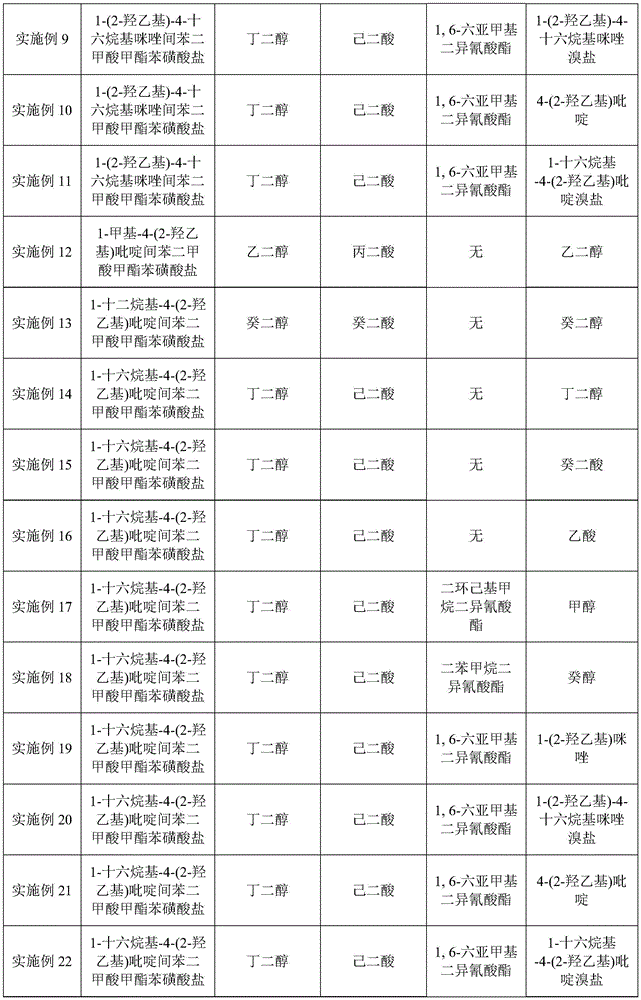
Application example 1: the ionomer additive prepared in example 1 is applied to polylactic acid modification, and the specific method comprises the following steps: melt blending or solvent blending the ionomer aid prepared in example 1 with polylactic acid (PLA), wherein melt blending is selected in this example; the addition amount of the ionomer additive may be 0.1 to 0.5 times of the mass of the polylactic acid, and in this embodiment, specifically, the amount of the ionomer additive is 50g per 100g of pla, the melt blending temperature is 180 ℃, and the melt blending time is 5 min. And extruding and granulating the product after melt blending. Then, after the granular product was melted, it was hot-pressed on a press vulcanizer to form a film having a thickness of 0.5 mm.
Application example 2: the ionomer additive prepared in example 1 is applied to polylactic acid modification, and the specific method comprises the following steps: the ionomer additive prepared in example 1 and polylactic acid (PLA) are subjected to solution blending, specifically, the ionomer additive is added in every 100g of PLA, the solution blending temperature is 35 ℃, the solution blending time is 24 hours, chloroform is used as a solvent, and a product obtained by solution blending is subjected to tape casting to form a film. And (3) hot-pressing the product subjected to the film casting to form a film with the thickness of 0.5mm by using a flat vulcanizing machine.
Application example 3: the optimum addition mass ratio of the ionomer additive to the polylactic acid is 0.1-0.5:1, and in order to highlight the influence of the addition amount of the ionomer additive, the ionomer additive prepared in example 1 is applied to the modification of the polylactic acid, and the specific method comprises the following steps: the ionomer additive prepared in example 1 and polylactic acid (PLA) are subjected to solution blending, specifically, the ionomer additive is added in every 100g of PLA, the solution blending temperature is 35 ℃, the solution blending time is 24 hours, chloroform is used as a solvent, and a product obtained by solution blending is subjected to tape casting to form a film. And (3) hot-pressing the product subjected to the film casting to form a film with the thickness of 0.5mm by using a flat vulcanizing machine.
Application example 4: the optimum addition mass ratio of the ionomer additive to the polylactic acid is 0.1-0.5:1, and in order to highlight the influence of the addition amount of the ionomer additive, the ionomer additive prepared in example 1 is applied to the modification of the polylactic acid, and the specific method comprises the following steps: the ionomer additive prepared in example 1 and polylactic acid (PLA) are subjected to solution blending, specifically, the ionomer additive is added in every 100g of PLA, the solution blending temperature is 35 ℃, the solution blending time is 24 hours, chloroform is used as a solvent, and a product obtained by solution blending is subjected to tape casting to form a film. And (3) hot-pressing the product subjected to the film casting to form a film with the thickness of 0.5mm by using a flat vulcanizing machine.
Application examples 5 to 26 are obtained by applying the ionomer aids prepared in examples 2 to 22 to polylactic acid modification, respectively, and are different from application example 1 in that: the ionomer additive, the addition amount of the ionomer additive in every 100g of PLA, the blending mode, the blending temperature, the blending time and the type of solvent, wherein the ionomer additive: example 1 shows the ionomer aid was prepared by the process of example 1; specifically, as shown in table 2.
TABLE 2

The films prepared in the above application examples were tested for toughness and antibacterial property, wherein the toughness of the films was mainly measured for tensile strength and elongation at break.
The test method comprises the following steps: each sample strip is dumbbell-shaped, 4mm wide, 0.5mm thick, and original gauge length is 25mm, and under the condition that the stretching rule is normal, each sample strip is tested for 5 times. The tensile strength and the elongation at break are obtained by testing and calculating through a tensile testing machine, and the model of the tensile testing machine is a CMT4104 tensile testing machine of Shenzhen New Miss company; the antibacterial property is mainly detected by the antibacterial rate, and the antibacterial activity of the antibacterial rate on gram-positive bacteria staphylococcus aureus (ATCC6538) and gram-negative bacteria escherichia coli (ATCC25922) is detected by a suspension oscillation method. The typical procedure is as follows: the sample was cut into pieces of about 0.5X 0.5cm, and the pieces were immersed in a medium containing 100mL of 0.5mM PBS (potassium dihydrogen phosphate) at a cell concentration of 1.0 to 1.5X 10⁴mL) in a flask. Then shaken on a rotary shaker at 37 ℃ for 12 hours at 200 revolutions. Before and after shaking, 20uL of test solution was extracted, diluted and plated on agar plates. After incubation at 37 ℃ for 24h, the number of colonies formed on the agar plates was counted. The antibacterial effect was determined from the results of repeated experiments. The antibacterial rate of bacteria was calculated as follows:

where R is the bacterial antibacterial rate and B, A is the number of viable bacterial cells on the agar plate before and after shaking. Three replicates of each set of experiments were performed and the results are expressed as an average and the results for each set are shown in table 3.
TABLE 3


Coli and staphylococcus aureus in this example were from:

when the addition mass ratio of the ionomer auxiliary agent to the polylactic acid is 0.1-0.5:1, the modified polylactic acid is subjected to a film tensile test, the breaking growth rate is 115-217%, and the tensile strength is more than 30 MPa. The antibacterial rate of Escherichia coli is more than 92%, the antibacterial rate of staphylococcus aureus is more than 92%, and most of the antibacterial rates are 99%. The ionomer additive disclosed by the invention can be used for efficiently toughening PLA (polylactic acid) and achieving good antibacterial property. In the performance research of the ionomer additive prepared in each example, the research shows that the antibacterial rate of the ionomer additive in each example is more than 99%. Namely, the invention realizes the double-functionalization effect of the auxiliary agent, thereby enabling the application range of the polylactic acid to be wider and having great market potential.
Comparative example 1
10g of 1- (2-hydroxyethyl) -4-hexadecylimidazolium bromide prepared according to the step S1 in this example 3 and 40g of polybutylene adipate ionomer as the ionomer aid prepared in the previous patent (application No. 202010896361, a flame retardant and toughening dual-functional ionomer aid, a preparation method and an application thereof) in example 4 were taken. The two materials are melt blended with 100g of polylactic acid (PLA), the melt blending temperature is 190 ℃, and the melt blending time is 5 min. After the melt blending is finished, the molecular weight of the polylactic acid base material is found to be seriously reduced, and the polylactic acid base material can not be extruded and pelletized and can not be formed in the subsequent hot pressing. The phenomenon was analyzed because the thermal stability of polylactic acid was seriously deteriorated by 1- (2-hydroxyethyl) -4-hexadecylimidazolium bromide. The salts prepared in step S1 mentioned in other examples of the invention thermally decompose at the appropriate processing temperature of PLA, and after being compounded with the bifunctional ionomer adjuvant of the prior patent (application No. 202010896361), the thermal decomposition is more obvious, so that the molecular weight of the PLA substrate is rapidly reduced and the PLA substrate cannot be processed and molded. The experimental result shows that the antibacterial ionic salt is directly blended with the PLA base material and the ionomer auxiliary agent without the antibacterial group, so that the antibacterial performance of the PLA cannot be increased, the mechanical property of the PLA is poor, and subsequent processing and forming cannot be performed. Thus, simple blending methods cannot impart the superior properties of the antibacterial ionic salt to the ionomer adjuvant or PLA substrate, and must be modified to achieve this.
Comparative example 2
Since the object of increasing the antibacterial property of PLA cannot be achieved by simple blending, the inventors have further explored a modification method of PLA. The flame retardant and toughening dual function ionomer aid synthesis process of the prior patent (application No. 202010896361) allows the introduction of the antibacterial cation salt as a monomer component into the ionomer, which helps to improve the compatibility of the antibacterial cation salt with the substrate. The inventors have conducted experiments on the above assumptions, and introduced the antibacterial cations of dihydroxy groups into the ionomer aid of the prior patent, taking N, N-hydroxyethyl hydroxydodecyl imidazole bromide as an example, the specific process is as follows:
placing about 2000g/mol of terminal hydroxyl poly butylene adipate and N, N-hydroxyethyl hydroxy dodecyl imidazole bromide in a reaction device according to the mass ratio of 7:3, stirring and heating under the protection of nitrogen until the terminal hydroxyl poly butylene adipate and the N, N-hydroxyethyl hydroxy dodecyl imidazole bromide are completely molten, then adding 1, 6-hexamethylene diisocyanate, wherein the addition amount of the 1, 6-hexamethylene diisocyanate is 1 time of the total hydroxyl molar ratio of the terminal hydroxyl poly butylene adipate and the N, N-hydroxyethyl hydroxy dodecyl imidazole bromide, and reacting for 1 hour at 80 ℃ to obtain a chain extension product. When the chain extension reaction is carried out, the reaction is found to be unstable and is often crosslinked, which is probably caused by the serious moisture absorption of the N, N-hydroxyethyl-hydroxydodecyl-imidazole bromide salt, the mass of the N, N-hydroxyethyl-hydroxydodecyl-imidazole bromide salt cannot be accurately weighed after the N, N-hydroxyethyl-hydroxydodecyl-imidazole bromide salt absorbs moisture, and the isocyanate is also easily crosslinked in the presence of water vapor. Therefore, when the antibacterial cation salt is introduced into the hard segment of the ionomer in a chain extension mode, the chain extension reaction is very unstable due to the moisture absorption, high viscosity and the like of the antibacterial cation, and the ionomer is particularly easy to crosslink and fail. Other cationic antibacterial salts containing a dihydroxy group also have the same problem, so that the synthesis cannot proceed normally due to instability of the reaction.
Comparative example 3
The introduction of the antibacterial cation salt into the flame-retardant and toughening dual-function ionomer auxiliary agent is used for subsequent antibacterial modification of polylactic acid, and in order to achieve the purpose, a high molar ratio is needed, but the esterification and polycondensation are more difficult due to the high content of the antibacterial cation salt monomer, and a large amount of unreacted antibacterial cation salt can remain in a polycondensate, which is mainly caused by the complex molecular structure, large molecular weight and large steric hindrance of the general antibacterial cation salt. All designed antibacterial cation salts referred to in this patent have this problem. The reaction of reaction example 3 was carried out according to the conventional esterification polycondensation step using 1- (2-hydroxyethyl) -4-hexadecylimidazole isophthalic acid methyl ester benzenesulfonate as an example, and the specific operation was as follows: the feeding molar ratio of the 1- (2-hydroxyethyl) -4-hexadecyl imidazole isophthalic acid methyl ester benzene sulfonate to butanediol and adipic acid is 1:3: 1. Firstly, 1- (2-hydroxyethyl) -4-hexadecyl imidazole isophthalic acid methyl ester benzene sulfonate, butanediol and adipic acid are stirred uniformly at 170 ℃ under nitrogen atmosphere and then subjected to esterification reaction for 3 hours. Then 1 wt% of tetraisopropyl titanate catalyst is added for polycondensation reaction, the reaction temperature is 220 ℃, and the polycondensation reaction is carried out for 2 hours, so as to obtain polyhydroxy-terminated prepolymer. In contrast, in comparative document 5, the amount of the benzene sulfonate salt of methyl 1- (2-hydroxyethyl) -4-hexadecylimidazole isophthalate polymerized into the prepolymer was only 20% of the amount theoretically allowed into the prepolymer. Therefore, even though the heat stability of the antibacterial cation salt is solved by the present patent and the antibacterial cation salt can be reacted at the conventional esterification polycondensation temperature, the antibacterial cation salt designed by the present patent has a large molecular weight and a large steric hindrance, and when the required molar ratio in the prepolymer is high, complete polycondensation cannot be achieved at all according to the conventional esterification polycondensation step. Therefore, we searched for the redesign of the esterification polycondensation step (step-by-step) to synthesize prepolymers with high antibacterial cation salt content.
Comparative example 4
Before the branching structure is carried out, a straight-chain antibacterial toughening polymer is designed. Take 1-methyl-4-hexadecyl imidazole isophthalic acid methyl ester benzene sulfonate as an example. The specific operation is as follows: the feeding molar ratio of the 1-methyl-4-hexadecyl imidazole isophthalic acid methyl ester benzene sulfonate to butanediol and adipic acid is 1:3: 1. Firstly, uniformly stirring the obtained antibacterial ionic salt and butanediol at 170 ℃ under nitrogen atmosphere, adding 0.05 wt% of tetraisopropyl titanate catalyst for ester exchange reaction for 45min, and then adding adipic acid for continuous esterification reaction for 4 hours. Then 0.05 wt% of tetraisopropyl titanate catalyst is supplemented for polycondensation reaction, the reaction temperature is 210 ℃, and the polycondensation reaction is carried out for 4 hours, so as to obtain the dihydroxy terminated polyester ionomer auxiliary agent. For comparison with application example 6, the amount of ionomer aid added per 100g of PLA was 10g, the melt blending temperature was 190 ℃ and the melt blending time was 5 min. And extruding and granulating the product after melt blending. Then, after the granular product was melted, it was hot-pressed on a press vulcanizer to form a film having a thickness of 0.5 mm. Under the same test procedure, the elongation at break is 200% and the tensile strength is 41MPa, but the antibacterial rate of Escherichia coli is 80% and the antibacterial rate of staphylococcus aureus is 86%. The difference of mechanical properties is not great, but the antibacterial rate is obviously reduced, mainly because the action capacity of short branched chains on the bacterial wall is weakened and the antibacterial effect is weakened without long branched chain structure. Meanwhile, the function of the branched chain structure is not limited to the structure, and the branched chain structure also plays a role in subsequently grafting more functional groups, and is a basis for various applications.
The foregoing is merely an example of the present invention and common general knowledge in the art of designing and/or characterizing particular aspects and/or features is not described in any greater detail herein. It should be noted that, for those skilled in the art, without departing from the technical solution of the present invention, several variations and modifications can be made, which should also be regarded as the protection scope of the present invention, and these will not affect the effect of the implementation of the present invention and the practicability of the patent. The scope of the claims of the present application shall be determined by the contents of the claims, and the description of the embodiments and the like in the specification shall be used to explain the contents of the claims.
Claims (10)


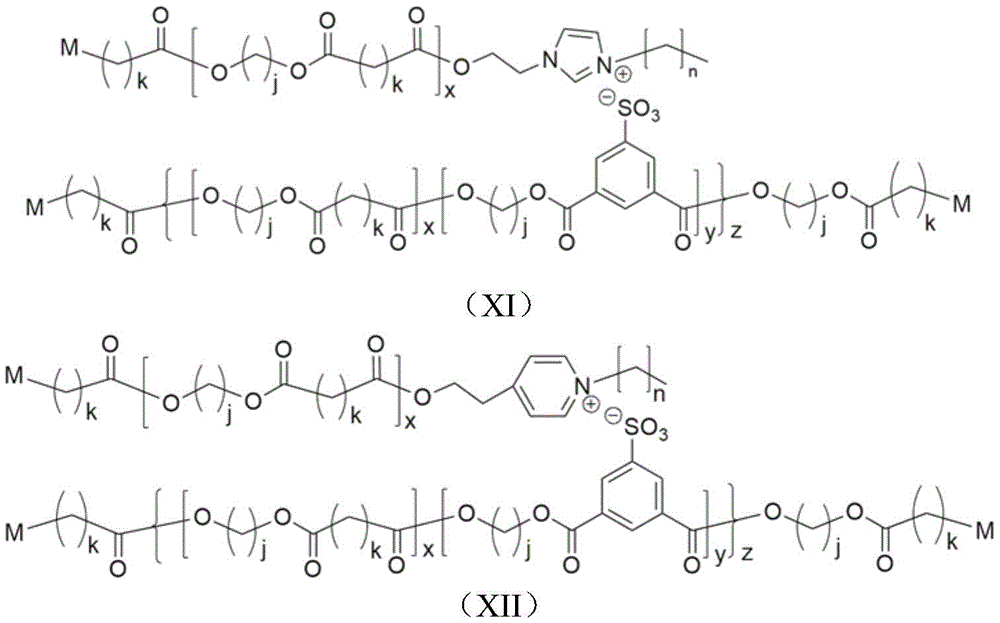


Priority Applications (1)
| Application Number | Priority Date | Filing Date | Title |
|---|---|---|---|
| CN202111328655.8A CN113896873B (en) | 2021-11-10 | 2021-11-10 | A branched polyester ionomer additive based on ionic bond construction and its preparation method and application |
Applications Claiming Priority (1)
| Application Number | Priority Date | Filing Date | Title |
|---|---|---|---|
| CN202111328655.8A CN113896873B (en) | 2021-11-10 | 2021-11-10 | A branched polyester ionomer additive based on ionic bond construction and its preparation method and application |
Publications (2)
| Publication Number | Publication Date |
|---|---|
| CN113896873A true CN113896873A (en) | 2022-01-07 |
| CN113896873B CN113896873B (en) | 2023-01-10 |
Family
ID=79193863
Family Applications (1)
| Application Number | Title | Priority Date | Filing Date |
|---|---|---|---|
| CN202111328655.8A Active CN113896873B (en) | 2021-11-10 | 2021-11-10 | A branched polyester ionomer additive based on ionic bond construction and its preparation method and application |
Country Status (1)
| Country | Link |
|---|---|
| CN (1) | CN113896873B (en) |
Citations (5)
| Publication number | Priority date | Publication date | Assignee | Title |
|---|---|---|---|---|
| US4217440A (en) * | 1979-08-20 | 1980-08-12 | Eastman Kodak Company | Method for making branched polyesters reproducibly |
| CN110066389A (en) * | 2019-03-15 | 2019-07-30 | 四川大学 | The ion monomer of the sulfonate structures containing benzheterocycle, ionomer and their preparation method and application with its flame-retardant and anti-dripping |
| CN111748182A (en) * | 2019-08-19 | 2020-10-09 | 天津大学 | High-transparency and toughness polylactic acid-based material and preparation method thereof |
| CN111961188A (en) * | 2020-08-31 | 2020-11-20 | 重庆文理学院 | A kind of flame retardant and toughening bifunctional ionomer auxiliary agent and its preparation method and application |
| CN112126047A (en) * | 2020-10-08 | 2020-12-25 | 天津大学 | Degradable biopolymer capable of being derived from biomass and preparation method thereof |
-
2021
- 2021-11-10 CN CN202111328655.8A patent/CN113896873B/en active Active
Patent Citations (5)
| Publication number | Priority date | Publication date | Assignee | Title |
|---|---|---|---|---|
| US4217440A (en) * | 1979-08-20 | 1980-08-12 | Eastman Kodak Company | Method for making branched polyesters reproducibly |
| CN110066389A (en) * | 2019-03-15 | 2019-07-30 | 四川大学 | The ion monomer of the sulfonate structures containing benzheterocycle, ionomer and their preparation method and application with its flame-retardant and anti-dripping |
| CN111748182A (en) * | 2019-08-19 | 2020-10-09 | 天津大学 | High-transparency and toughness polylactic acid-based material and preparation method thereof |
| CN111961188A (en) * | 2020-08-31 | 2020-11-20 | 重庆文理学院 | A kind of flame retardant and toughening bifunctional ionomer auxiliary agent and its preparation method and application |
| CN112126047A (en) * | 2020-10-08 | 2020-12-25 | 天津大学 | Degradable biopolymer capable of being derived from biomass and preparation method thereof |
Also Published As
| Publication number | Publication date |
|---|---|
| CN113896873B (en) | 2023-01-10 |
Similar Documents
| Publication | Publication Date | Title |
|---|---|---|
| JP2008075068A (en) | Resin composition | |
| CN111186112B (en) | Preparation method of novel thermotropic liquid crystal high-performance polyarylate film | |
| CN113249101A (en) | Preparation method of water-soluble composite temporary plugging agent for diversion fracturing | |
| CN113736073B (en) | Degradable polyester and preparation methods and products thereof | |
| CN101921387B (en) | Lignin modified PET (Polyethylene Terephthalate) composite material and preparation method thereof | |
| CN110423443A (en) | A kind of biomass-based tough flame-proof sheet material of height | |
| CN118047953A (en) | A comb-shaped graft copolymer and its preparation and application | |
| CN113896873A (en) | A kind of branched polyester ionomer auxiliary agent based on ionic bond construction and its preparation method and application | |
| JP2003138109A (en) | Inherently electrostatic dissipating block copolymer composition | |
| CN112745471B (en) | Room-temperature intrinsic self-repairing glassy polymer material and preparation method thereof | |
| CN110591065A (en) | Permanent antistatic five-membered ring-cyclohexanediol adipate copolyester and preparation method thereof | |
| CN113278137A (en) | Biodegradable PBST polymer, preparation method and application thereof, agricultural mulching film and preparation method | |
| CN113980258B (en) | A kind of antibacterial flame retardant toughening multifunctional ionomer auxiliary agent and its preparation method and application | |
| CN116813897A (en) | PET nucleating agent and preparation method and application thereof | |
| CN115260542B (en) | Preparation method of degradable polymer/starch master batch | |
| CN116515094A (en) | Preparation method of flame-retardant degradable polyester and degradable copolymerized flame retardant | |
| CN106866516B (en) | A kind of end group is the organic nitrogen-containing carboxylate and preparation method thereof of carboxylic acid group | |
| CN113817299B (en) | PLA-based blended composite material with ion and chemical double-crosslinking structure and preparation method thereof | |
| KR20170015878A (en) | Terminally modified polyethylene terephthalate resin, method for producing same and molded article | |
| CN108586717A (en) | A kind of biology base electrostatic dissipation polyester and preparation method thereof | |
| CN106831552B (en) | A kind of organic nitrogen-containing thioester compound whose end group is a mercapto group and its preparation method | |
| CN120757903B (en) | Antistatic plastic packaging film and preparation process thereof | |
| CN115626977B (en) | Synthesis method of biodegradable polyester | |
| CN119490644B (en) | Simultaneous multi-stimulus responsive liquid crystal-polyethylene glycol block copolymer, its preparation method and application | |
| CN119859394B (en) | A biodegradable PLA composite material and its preparation method |
Legal Events
| Date | Code | Title | Description |
|---|---|---|---|
| PB01 | Publication | ||
| PB01 | Publication | ||
| SE01 | Entry into force of request for substantive examination | ||
| SE01 | Entry into force of request for substantive examination | ||
| GR01 | Patent grant | ||
| GR01 | Patent grant |