CN113878571B - Configuration optimization comprehensive method for seven-degree-of-freedom cooperative robot - Google Patents
Configuration optimization comprehensive method for seven-degree-of-freedom cooperative robot Download PDFInfo
- Publication number
- CN113878571B CN113878571B CN202010632490.2A CN202010632490A CN113878571B CN 113878571 B CN113878571 B CN 113878571B CN 202010632490 A CN202010632490 A CN 202010632490A CN 113878571 B CN113878571 B CN 113878571B
- Authority
- CN
- China
- Prior art keywords
- robot
- configuration
- degree
- freedom
- optimal
- Prior art date
- Legal status (The legal status is an assumption and is not a legal conclusion. Google has not performed a legal analysis and makes no representation as to the accuracy of the status listed.)
- Active
Links
- 238000005457 optimization Methods 0.000 title claims abstract description 54
- 238000000034 method Methods 0.000 title claims abstract description 24
- 210000000707 wrist Anatomy 0.000 claims abstract description 43
- 238000013461 design Methods 0.000 claims abstract description 26
- 230000015572 biosynthetic process Effects 0.000 claims abstract description 24
- 238000003786 synthesis reaction Methods 0.000 claims abstract description 24
- 238000011156 evaluation Methods 0.000 claims abstract description 8
- 230000008569 process Effects 0.000 claims abstract description 8
- 239000011159 matrix material Substances 0.000 claims description 28
- 238000001308 synthesis method Methods 0.000 claims description 9
- 230000009466 transformation Effects 0.000 claims description 9
- 238000004364 calculation method Methods 0.000 claims description 6
- 238000011438 discrete method Methods 0.000 claims description 3
- 238000013507 mapping Methods 0.000 claims description 3
- 210000001503 joint Anatomy 0.000 description 6
- 238000011160 research Methods 0.000 description 4
- 241000282412 Homo Species 0.000 description 3
- 238000000926 separation method Methods 0.000 description 3
- 230000008859 change Effects 0.000 description 2
- 238000010586 diagram Methods 0.000 description 2
- 230000007246 mechanism Effects 0.000 description 2
- 241001442234 Cosa Species 0.000 description 1
- 238000000342 Monte Carlo simulation Methods 0.000 description 1
- 230000008901 benefit Effects 0.000 description 1
- 230000008094 contradictory effect Effects 0.000 description 1
- 230000000694 effects Effects 0.000 description 1
- 238000005516 engineering process Methods 0.000 description 1
- 230000002068 genetic effect Effects 0.000 description 1
- 230000003993 interaction Effects 0.000 description 1
- 230000008092 positive effect Effects 0.000 description 1
- 238000012216 screening Methods 0.000 description 1
- 238000007789 sealing Methods 0.000 description 1
- 230000009897 systematic effect Effects 0.000 description 1
- 230000001131 transforming effect Effects 0.000 description 1
- 210000003857 wrist joint Anatomy 0.000 description 1
Images


Classifications
-
- B—PERFORMING OPERATIONS; TRANSPORTING
- B25—HAND TOOLS; PORTABLE POWER-DRIVEN TOOLS; MANIPULATORS
- B25J—MANIPULATORS; CHAMBERS PROVIDED WITH MANIPULATION DEVICES
- B25J9/00—Programme-controlled manipulators
- B25J9/16—Programme controls
- B25J9/1628—Programme controls characterised by the control loop
- B25J9/163—Programme controls characterised by the control loop learning, adaptive, model based, rule based expert control
-
- B—PERFORMING OPERATIONS; TRANSPORTING
- B25—HAND TOOLS; PORTABLE POWER-DRIVEN TOOLS; MANIPULATORS
- B25J—MANIPULATORS; CHAMBERS PROVIDED WITH MANIPULATION DEVICES
- B25J9/00—Programme-controlled manipulators
- B25J9/16—Programme controls
- B25J9/1602—Programme controls characterised by the control system, structure, architecture
- B25J9/1607—Calculation of inertia, jacobian matrixes and inverses
Landscapes
- Engineering & Computer Science (AREA)
- Robotics (AREA)
- Mechanical Engineering (AREA)
- Physics & Mathematics (AREA)
- Mathematical Physics (AREA)
- Automation & Control Theory (AREA)
- Manipulator (AREA)
- Numerical Control (AREA)
Abstract
本发明涉及协作机器人领域,具体地说是一种七自由度协作机器人构型优化综合方法,包括以下步骤,步骤一:建立七自由度机器人运动学模型及运动学性能评价指标;步骤二:对七自由度机器人进行构型综合,将七自由度机器人拆分为“肩肘”和“腕”两部分,并利用步骤一中的运动学性能评价指标分别对“肩肘”部和“腕”部进行构型综合,获得最优的“肩肘”部构型和“腕”部构型,并通过构型优化综合,将最优的“肩肘”部构型和“腕”部构型分别组合,并对组合后的七自由度机器人构型进行评估,获得最优的七自由度构型;步骤三:对步骤二中获得的最优七自由度构型进行尺寸优化。本发明简化了构型综合过程,可用于指导七自由度协作机器人的设计。
The present invention relates to the field of collaborative robots, in particular to a comprehensive method for configuration optimization of a seven-degree-of-freedom collaborative robot, comprising the following steps: step 1: establishing a kinematics model of a seven-degree-of-freedom robot and an evaluation index for kinematic performance; The seven-degree-of-freedom robot performs configuration synthesis, splits the seven-degree-of-freedom robot into two parts, the "shoulder-elbow" and "wrist", and uses the kinematic performance evaluation indicators in step 1 to perform the "shoulder-elbow" and "wrist" parts respectively. Configuration synthesis to obtain the optimal "shoulder-elbow" configuration and "wrist" configuration, and through configuration optimization synthesis, the optimal "shoulder-elbow" configuration and "wrist" configuration are combined separately, and Evaluate the combined seven-degree-of-freedom robot configuration to obtain the optimal seven-degree-of-freedom configuration; step three: perform size optimization on the optimal seven-degree-of-freedom configuration obtained in step two. The invention simplifies the configuration synthesis process and can be used to guide the design of the seven-degree-of-freedom collaborative robot.
Description
技术领域technical field
本发明涉及协作机器人领域,具体地说是一种七自由度协作机器人构型优化综合方法。The invention relates to the field of collaborative robots, in particular to a configuration optimization synthesis method for a seven-degree-of-freedom collaborative robot.
背景技术Background technique
协作机器人能够将自身的高精度、高忍耐性与人类的灵活适应能力相结合,以提高中小企业的自动化水平,并使工业机器人的应用领域扩展到3C、医疗、服务等行业。Collaborative robots can combine their own high precision, high tolerance and human flexible adaptability to improve the automation level of small and medium-sized enterprises, and expand the application of industrial robots to 3C, medical, service and other industries.
与传统工业机器人不同,工作于非结构环境下的协作机器人需要具有较高的灵巧性和避障能力,而机器人的构型和尺度参数决定着机器人的运动性能和避障能力。因此,不同于采用非冗余自由度构型的传统工业机器人,协作机器人的构型及尺度参数发生了新的变化,新一代协作机器人大都采用了七自由度单臂或双臂构型,机器人的尺度参数与人类手相似。Different from traditional industrial robots, collaborative robots working in unstructured environments need to have high dexterity and obstacle avoidance ability, and the robot's configuration and scale parameters determine the robot's motion performance and obstacle avoidance ability. Therefore, unlike traditional industrial robots that adopt a non-redundant degree of freedom configuration, new changes have taken place in the configuration and scale parameters of collaborative robots. Most of the new generation of collaborative robots adopt a seven-degree-of-freedom single-arm or dual-arm configuration. The scale parameter of is similar to the human hand.
相比于六自由度构型,七自由度构型的机器人灵巧性能和避障能力得到了大幅提升,机器人可以利用冗余自由度来回避奇异点和躲避障碍物,便于机器人末端位姿的调节,使得机器人在灵巧性和避障能力上有了质的飞跃,但其缺点是运动学逆解较为复杂,构型对于七自由度机器人逆解的特性影响巨大,其决定了冗余自由度机器人的逆解是否具有解析性、解耦性,能否进行工作空间分解以简化逆解的计算。Compared with the six-degree-of-freedom configuration, the dexterity performance and obstacle avoidance ability of the robot with the seven-degree-of-freedom configuration have been greatly improved. The robot can use redundant degrees of freedom to avoid singularities and obstacles, which is convenient for the adjustment of the robot's end pose. , which makes the robot have a qualitative leap in dexterity and obstacle avoidance ability, but its disadvantage is that the kinematics inverse solution is more complicated, and the configuration has a great influence on the characteristics of the seven-degree-of-freedom robot inverse solution, which determines the redundant degree-of-freedom robot Whether the inverse solution is analytical and decoupled, and whether the workspace can be decomposed to simplify the calculation of the inverse solution.
目前,冗余自由度机器人构型的研究主要侧重于消除内部奇异点或产生灵活工作空间等构型设计,以及对影响冗余自由度特性的杆参数进行优化设计等。最初,串联机器人构型综合主要凭借经验和直觉,直至拓扑图论等方法的引入才为机器人构型综合提供了数学理论基础,同时关节、连杆等组件的符号化为机器人拓扑构型的研究提供了重要依据。目前,针对六自由度机器人构型的研究较为成熟,而七自由度机器人构型综合研究较少,理论的不完善造成了七自由度机器人构型的多样化与差异化。At present, the research on the configuration of redundant degree-of-freedom robots mainly focuses on configuration design such as eliminating internal singularities or generating flexible workspaces, and optimizing the design of rod parameters that affect the characteristics of redundant degrees of freedom. Initially, the configuration synthesis of series robots mainly relied on experience and intuition. It was not until the introduction of methods such as topology graph theory that a mathematical theoretical basis was provided for robot configuration synthesis. important evidence is provided. At present, the research on the configuration of six-degree-of-freedom robots is more mature, while the comprehensive research on the configuration of seven-degree-of-freedom robots is less.
现有的冗余自由度构型综合方法主要包括图谱、结构拓扑以及人机工程学等方法,其中图谱和结构拓扑方法是从串联机器人的拓扑结构切入,通过分析任务目标的特点得到一系列的约束条件,列举出所有满足约束条件的可选构型,然后逐一分析可选构型的机构特性,按照一定的选型原则优选出最佳构型。而机器人要与人类肩并肩的完成协作任务,就必须按照人类的工作特点进行设计,目前协作机器人在构型和尺度设计的过程中大多采用人机工程学设计,采用拟人构型和人类手臂尺度相似的设计,即拟人机械臂,在灵活性、负载等方面与人手臂相比拟,依据人体手臂运动性能将串联七自由度机器人划分为肩部、肘部以及腕部,即拟人构型,这一理论也是目前研究冗余仿人臂自由度分布所普遍采用的理论。目前七自由度构型的获取主要是在最优六自由度构型的基础上添加一个转动关节形成,此种构型均具有和人类手臂相似的结构,能产生自运动而不改变末端位姿,从而完全消除肩部和腕部出现的奇异情况,而且也有利于避开障碍物。Existing redundant degree-of-freedom configuration synthesis methods mainly include atlas, structural topology, and ergonomics methods. Among them, the atlas and structural topology methods start from the topological structure of serial robots, and obtain a series of Constraint conditions, list all optional configurations that meet the constraint conditions, and then analyze the mechanism characteristics of the optional configurations one by one, and optimize the best configuration according to certain selection principles. In order for robots to complete collaborative tasks side by side with humans, they must be designed according to the working characteristics of humans. At present, most collaborative robots adopt ergonomic design in the process of configuration and scale design, using anthropomorphic configuration and human arm scale. The similar design, that is, the anthropomorphic robotic arm, is comparable to the human arm in terms of flexibility and load. According to the motion performance of the human arm, the serial seven-degree-of-freedom robot is divided into shoulders, elbows, and wrists, that is, the anthropomorphic configuration. The first theory is also commonly used in the study of the distribution of degrees of freedom of redundant humanoid arms. At present, the acquisition of the seven-degree-of-freedom configuration is mainly formed by adding a rotating joint on the basis of the optimal six-degree-of-freedom configuration. This configuration has a structure similar to that of the human arm, and can generate self-motion without changing the end pose. , thereby completely eliminating shoulder and wrist oddities, and also facilitates obstacle avoidance.
冗余自由度机器人运动性能不仅受机器人构型的影响,也受尺度参数的影响,某些连杆参数之间的相对变化可能会导致机器人工作空间拓扑结构特性的改变,从而影响机器人的运动特性。串联或并联机器人的尺度优化主要是以机器人的运动性能、工作空间、刚度性能甚至是动态性能为优化目标,以机器人尺寸参数或者结构参数为设计参数或约束进行优化设计,获得合理的机器人尺度参数。The kinematic performance of a redundant degree of freedom robot is not only affected by the configuration of the robot, but also by the scale parameters. The relative changes between some link parameters may lead to changes in the topological characteristics of the robot's workspace, thereby affecting the kinematic characteristics of the robot. . The scale optimization of series or parallel robots is mainly based on the robot’s motion performance, work space, stiffness performance and even dynamic performance as the optimization goal, and the robot’s size parameters or structural parameters are used as design parameters or constraints to optimize the design to obtain reasonable robot scale parameters. .
但目前构型优化综合存在的缺点在于:第一,对于机器人末端运动特性和约束特征的数学描述还缺乏系统的研究,对于机器人构型如何满足“任务空间”的作业要求还缺乏简单有效的理论指导;第二,用于评价机器人性能的各种指标仅能反映其某一方面的特性,而不同性能指标对参数的要求有可能是矛盾的,因此机器人参数优化问题还不能完全解决;第三,串联机器人可选的构型极其繁多,逐一筛选十分困难,缺乏有效的定量的构型筛选方法。However, the shortcomings of the current configuration optimization synthesis are as follows: First, there is still a lack of systematic research on the mathematical description of the robot's terminal motion characteristics and constraint characteristics, and there is still a lack of simple and effective theory on how the robot configuration can meet the operating requirements of the "task space" Second, the various indicators used to evaluate robot performance can only reflect its characteristics in a certain aspect, and the requirements of different performance indicators for parameters may be contradictory, so the problem of robot parameter optimization cannot be completely solved; third , there are so many optional configurations for tandem robots, it is very difficult to screen them one by one, and there is a lack of effective quantitative configuration screening methods.
发明内容Contents of the invention
本发明的目的在于提供一种七自由度协作机器人构型优化综合方法,基于“肩肘-腕”分离对七自由度机器人进行构型综合并获得最优的七自由度构型,简化了构型综合过程,可用于指导七自由度协作机器人的设计。The purpose of the present invention is to provide a configuration optimization and synthesis method for a seven-degree-of-freedom collaborative robot. Based on the "shoulder-elbow-wrist" separation, the seven-degree-of-freedom robot is configured and synthesized to obtain the optimal seven-degree-of-freedom configuration, which simplifies the configuration. A comprehensive process that can be used to guide the design of a seven-degree-of-freedom collaborative robot.
本发明的目的是通过以下技术方案来实现的:The purpose of the present invention is achieved through the following technical solutions:
一种七自由度协作机器人构型优化综合方法,包括以下步骤:A comprehensive method for configuration optimization of a seven-degree-of-freedom collaborative robot, comprising the following steps:
步骤一:建立七自由度机器人运动学模型及运动学性能评价指标;Step 1: Establish a seven-degree-of-freedom robot kinematics model and kinematics performance evaluation index;
步骤二:对七自由度机器人进行构型综合,将七自由度机器人拆分为“肩肘”和“腕”两部分,并利用步骤一中的运动学性能评价指标分别对“肩肘”部和“腕”部进行构型综合,获得最优的“肩肘”部构型和最优的“腕”部构型,并通过构型优化综合,将最优的“肩肘”部构型和最优的“腕”部构型分别组合,并对组合后的各种七自由度机器人构型进行评估,获得最优的七自由度构型;Step 2: Synthesize the configuration of the seven-degree-of-freedom robot, split the seven-degree-of-freedom robot into two parts: "shoulder-elbow" and "wrist", and use the kinematic performance evaluation indicators in
步骤三:对步骤二中获得的最优七自由度构型进行尺寸优化,获得七自由度机器人最优构型参数。Step 3: Perform size optimization on the optimal seven-degree-of-freedom configuration obtained in step two, and obtain the optimal configuration parameters of the seven-degree-of-freedom robot.
步骤一中,首先通过修改的Denavit Hartenberg(DHm)参数化建模方法建立机械臂的运动学模型,然后通过所述运动学模型及雅克比矩阵,求解结构长度指标和全局性能指标。In
步骤一中,建立机械臂的运动学模型过程如下:In
七自由度冗余机器人看成由八个连杆和七个关节组成,DHm参数化建模方法通过连杆转角ai-1,连杆长度ai-1,连杆偏距di,关节角θi四个参数描述连杆的运动特性,其中,ai-1、ai-1描述连杆i-1本身的运动特性,di、θi描述连杆i-1和连杆i之间的联接关系;The seven-degree-of-freedom redundant robot is regarded as composed of eight links and seven joints. The DHm parametric modeling method uses link angle a i-1 , link length a i-1 , link offset distance d i , and joint The four parameters of the angle θ i describe the kinematic characteristics of the connecting rod, where a i-1 and a i-1 describe the kinematic characteristics of the connecting rod i-1 itself, and d i and θ i describe the kinematic characteristics of the connecting rod i-1 and the connecting rod i connection between
坐标系Oi-xiyizi相对于坐标系Oi-1-xi-1yi-1zi-1的连杆变换通式为:The general formula of the link transformation of the coordinate system O i -x i y i z i relative to the coordinate system O i-1 -x i-1 y i-1 z i-1 is:
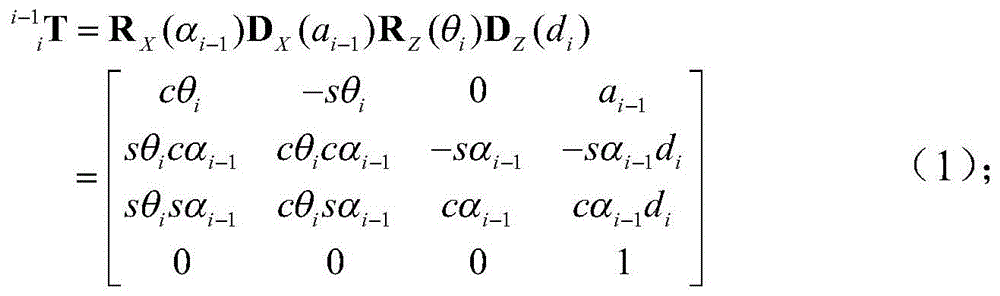
上式(1)中cθi=cosθi,sθi=sinθi,cai-1=cosai-1,sai-1=sinαi-1。In the above formula (1), cθ i = cosθ i , sθ i = sinθ i , ca i-1 = cosa i-1 , sa i-1 = sinα i-1 .
七自由度机器人末端的位姿可以通过连杆的齐次变换矩阵连乘获得:The pose at the end of the seven-degree-of-freedom robot can be obtained by multiplying the homogeneous transformation matrix of the connecting rod:

上式(2)中,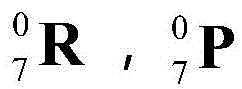
上述齐次变换矩阵可表示为广义矢量形式:The above homogeneous transformation matrix can be expressed in generalized vector form:

上式(3)中,t是6×1矢量,表示机器人末端在笛卡尔坐标系下的位姿信息,矢量p=(px,py,pz)T和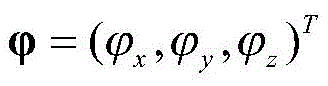
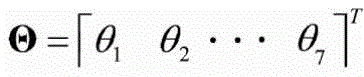
机器人关节空间速度到机器人笛卡尔空间速度的映射可以通过机器人雅克比矩阵表示The mapping from the robot joint space velocity to the robot Cartesian space velocity can be expressed by the robot Jacobian matrix
t=JΘ (4);t = JΘ (4);
其中J表示机器人的雅克比矩阵,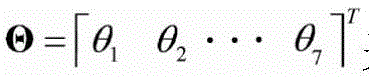
步骤一中,结构长度指标QL计算如下:In


上式(5)和(6)中,QL为结构长度指标,V表示机器人的可达空间体积,L为机器人连杆的总长度。In the above formulas (5) and (6), Q L is the structural length index, V is the reachable space volume of the robot, and L is the total length of the connecting rod of the robot.
步骤一中,全局性能指标η计算如下:In
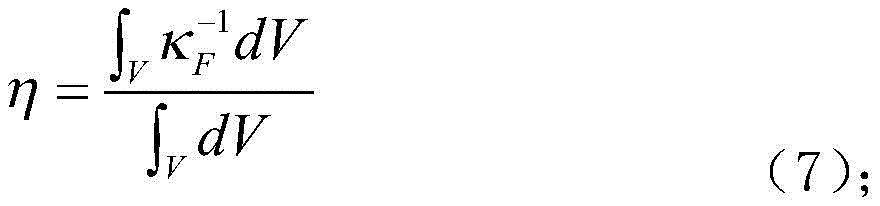

实际计算时,全局性能指标通过离散方法获得,具体为:In actual calculation, the global performance index is obtained through a discrete method, specifically:
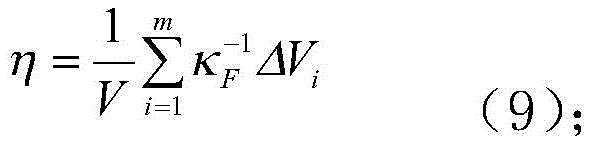
上式(9)中,m为离散点的数值。In the above formula (9), m is the numerical value of the discrete point.
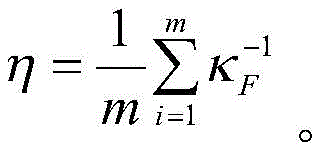
当DVi≡ΔV时,上式变成:When D V i≡ΔV, the above formula becomes:
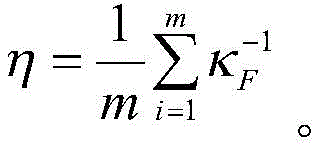
步骤二中,采用结构长度指标和全局性能指标对机器人“肩肘”部进行构型综合,获得3种最优“肩肘”部构型,采用结构长度指标和全局性能指标分别对机器人“腕”部进行构型综合,获得5种最优“腕”部构型,通过构型优化综合,将3种最优“肩肘”部构型和5种最优“腕”部构型组合,获得19种七自由度机器人构型,对19种构型进行运动可控性和设计简易性评估,获得最优七自由度构型。In
步骤三中,对于所述最优七自由度构型,仅需要对连杆偏距d3和d5进行尺度优化,优化目标为结构长度指标和全局性能指标,通过优化连杆偏距d3和d5使结构长度指标最小化,全局性能指标最大化。In
本发明的优点与积极效果为:Advantage of the present invention and positive effect are:
1、本发明基于“肩肘-腕”分离对七自由度机器人进行构型综合并获得最优的七自由度构型,解决了现有技术中七自由度机器人构型优化综合存在的问题,简化了构型综合过程。1. The present invention synthesizes the configuration of the seven-degree-of-freedom robot based on the "shoulder-elbow-wrist" separation and obtains the optimal seven-degree-of-freedom configuration, which solves the problems existing in the optimization and synthesis of the configuration of the seven-degree-of-freedom robot in the prior art, and simplifies configuration synthesis process.
2、本发明对获得的最优七自由度SRS构型进行多目标尺度优化综合,并获得七自由度机器人最优构型参数,此机器人的最优构型参数可用于指导协作机器人机构和结构设计。2. The present invention performs multi-objective scale optimization and synthesis on the obtained optimal seven-degree-of-freedom SRS configuration, and obtains the optimal configuration parameters of the seven-degree-of-freedom robot. The optimal configuration parameters of this robot can be used to guide the mechanism and structure of the collaborative robot design.
附图说明Description of drawings
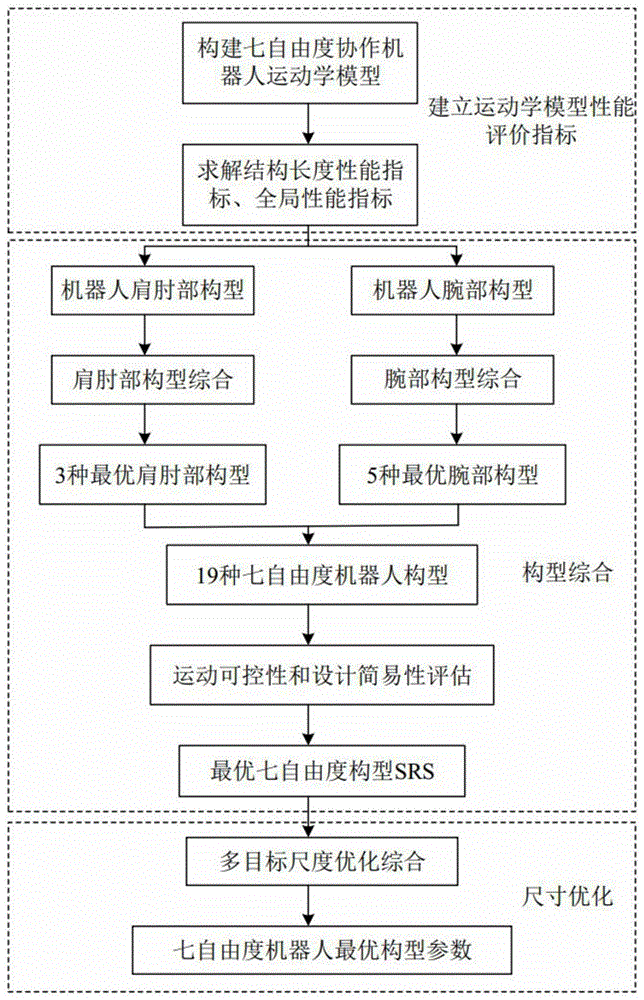
图1为本发明的方法流程图;Fig. 1 is method flowchart of the present invention;
图2为一种七自由度机器人的DHm参数表;Fig. 2 is a DHm parameter table of a seven-degree-of-freedom robot;
图3为一种七自由度机器人运动学模型示意图;Fig. 3 is a schematic diagram of a seven-degree-of-freedom robot kinematics model;
图4为图3中机器人运动学模型的局部放大图;Fig. 4 is the partial enlarged view of robot kinematics model in Fig. 3;
图5为肩肘部构型综合优化目标f1(x)的等高线图;Fig. 5 is the contour map of the comprehensive optimization target f 1 (x) of the shoulder and elbow configuration;
图6为最优肩肘部和腕部构型;Figure 6 is the optimal shoulder, elbow and wrist configuration;
图7为腕部构型综合优化目标f2(x)的等高线图;Fig. 7 is a contour map of the comprehensive optimization target f 2 (x) of the wrist configuration;
图8为七自由度冗余机器人构型图谱;Figure 8 is a configuration diagram of a seven-degree-of-freedom redundant robot;
图9为七自由度机器人SRS构型连杆坐标系布局;Fig. 9 is the layout of the connecting rod coordinate system of the seven-degree-of-freedom robot SRS configuration;
图10为七自由度机器人SRS构型DHm参数;Fig. 10 is the SRS configuration DHm parameter of the seven-degree-of-freedom robot;
图11为七自由度机器人SRS构型尺度优化优化结果和收敛情况。Figure 11 shows the optimization results and convergence of the SRS configuration scale optimization of the seven-degree-of-freedom robot.
具体实施方式Detailed ways
下面结合附图对本发明作进一步详述。The present invention will be described in further detail below in conjunction with the accompanying drawings.
如图1~11所示,本发明包括如下步骤:As shown in Figures 1-11, the present invention comprises the following steps:
步骤一:建立七自由度机器人运动学模型及运动学性能评价指标,具体给过程如下:Step 1: Establish a seven-degree-of-freedom robot kinematic model and kinematic performance evaluation indicators. The specific process is as follows:
(1.1)通过修改的Denavit Hartenberg(DHm)参数化建模方法建立机械臂的运动学模型。(1.1) The kinematics model of the manipulator is established by the modified Denavit Hartenberg (DHm) parametric modeling method.
如图2所示,七自由度冗余机器人可以看成由八个连杆和七个关节组成,DHm参数化建模方法能够通过连杆转角αi-1,连杆长度ai-1,连杆偏距di,关节角θi四个参数来描述连杆的运动特性,其中,αi-1、ai-1描述连杆i-1本身的运动特性,di、θi描述连杆i-1和连杆i之间的联接关系。As shown in Figure 2, the seven-DOF redundant robot can be regarded as composed of eight connecting rods and seven joints. The DHm parametric modeling method can pass the connecting rod rotation angle α i-1 , the connecting rod length a i-1 , The four parameters of connecting rod offset distance d i and joint angle θ i describe the kinematic characteristics of the connecting rod, among which, α i-1 and a i-1 describe the kinematic characteristics of the connecting rod i-1 itself, and d i and θ i describe The connection relationship between link i-1 and link i.
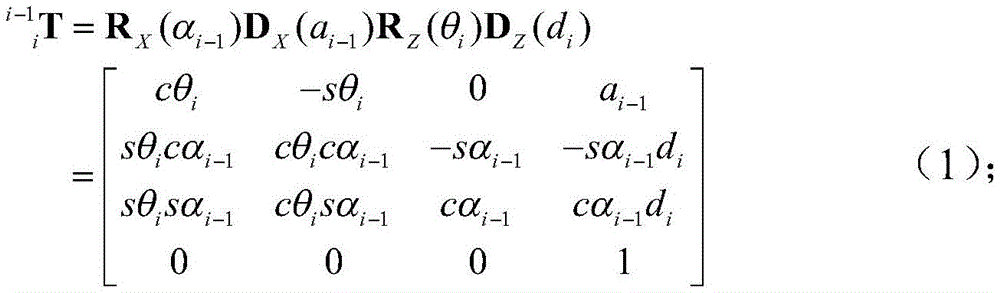
坐标系Oi-xiyizi相对于坐标系Oi-1-xi-1yi-1zi-1的连杆变换通式为:The general formula of the link transformation of the coordinate system O i -x i y i z i relative to the coordinate system O i-1 -x i-1 y i-1 z i-1 is:

上式(1)中cθi=cosθi,sθi=sinθi,cαi-1=cosαi-1,sαi-1=sinαi-1。In the above formula (1), cθ i =cosθ i , sθ i =sinθ i , cα i-1 =cosα i-1 , sα i-1 =sinα i-1 .
每两个相邻的连杆可用上述改进的DH参数描述(即式(1)),七自由度机器人的DHm参数及连杆坐标系布局分别如图3~4所示,则机器人末端的位姿可以通过连杆的齐次变换矩阵连乘获得,可推导七自由度机器人运动学方程为:Every two adjacent connecting rods can be described by the improved DH parameters mentioned above (that is, formula (1)). The DHm parameters of the seven-DOF robot and the layout of the connecting rod coordinate system are shown in Figures 3 and 4, respectively. The posture can be obtained by multiplying the homogeneous transformation matrix of the connecting rod, and the kinematic equation of the seven-degree-of-freedom robot can be derived as:

上式(2)中,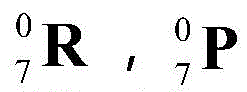
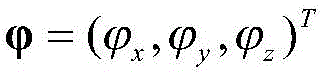
上述齐次变换矩阵可表示为广义矢量形式:The above homogeneous transformation matrix can be expressed in generalized vector form:

上式(3)中,t是6×1矢量,表示机器人末端在笛卡尔坐标系下的位姿信息。矢量p=(px,py,pz)T和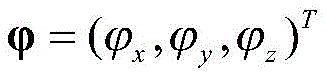
机器人关节空间速度到机器人笛卡尔空间速度的映射可以通过机器人雅克比矩阵表示The mapping from the robot joint space velocity to the robot Cartesian space velocity can be expressed by the robot Jacobian matrix
t=JΘ (4);t = JΘ (4);
其中J表示机器人的雅克比矩阵,
(1.2)通过步骤(1.1)中获得的机器人的运动学模型及雅克比矩阵,求解结构长度、全局性能等运动学性能评价指标:(1.2) Through the kinematic model and Jacobian matrix of the robot obtained in step (1.1), solve the kinematic performance evaluation indicators such as structural length and global performance:
结构长度指标、条件数、可操作度、工作空间体积等性能指标能够用于评价和优化机器人运动学性能,可采用上述指标进行单目标或多目标构型优化综合。Performance indicators such as structural length index, condition number, operability, and workspace volume can be used to evaluate and optimize robot kinematics performance, and the above indexes can be used for single-objective or multi-objective configuration optimization synthesis.
(1.2.1)结构长度指标(SLI)。(1.2.1) Structural Length Index (SLI).
结构长度指标是机器人连杆长度和与机器人可达空间的立方根比值,反映了在机器人连杆总长度一定的情况下,该机器人所能达到的工作空间体积的大小。结构长度指标越小表示机器人的设计越合理,定义为:The structural length index is the ratio of the length of the connecting rod of the robot to the cube root of the reachable space of the robot, reflecting the size of the working space that the robot can reach when the total length of the connecting rod of the robot is constant. The smaller the structural length index is, the more reasonable the design of the robot is, defined as:
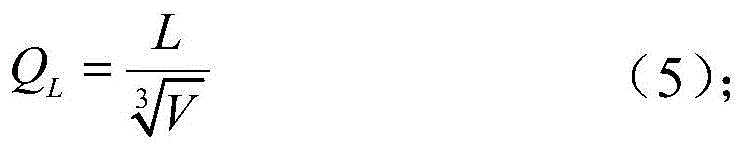

上式(5)和(6)中,QL为结构长度指标,V表示机器人的可达空间体积,可以通过蒙特卡洛方法求解,所述蒙特卡洛方法为本领域公知技术,L为机器人连杆的总长度。In the above formulas (5) and (6), Q L is the structural length index, and V represents the reachable space volume of the robot, which can be solved by the Monte Carlo method, which is a well-known technology in the art, and L is the robot The total length of the connecting rod.
(1.2.2)全局性能指标(GCI)。(1.2.2) Global Performance Index (GCI).
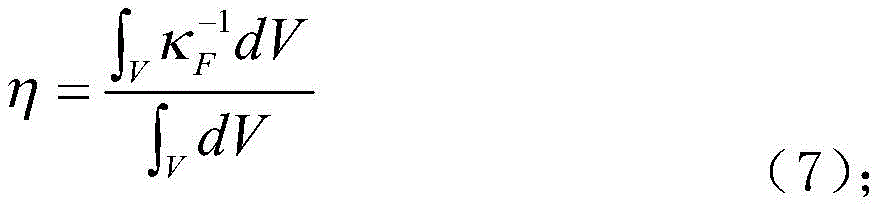
全局性能指标η是雅克比矩阵条件数的倒数在可达工作空间上的平均值,能够衡量机器人在整个工作空间的整体运动性能,反映了机器人在整个工作空间中向各个方向的运动和力的转化能力。The global performance index η is the average value of the reciprocal of the condition number of the Jacobian matrix in the accessible workspace, which can measure the overall motion performance of the robot in the entire workspace, reflecting the movement and force of the robot in all directions in the entire workspace. transforming ability.
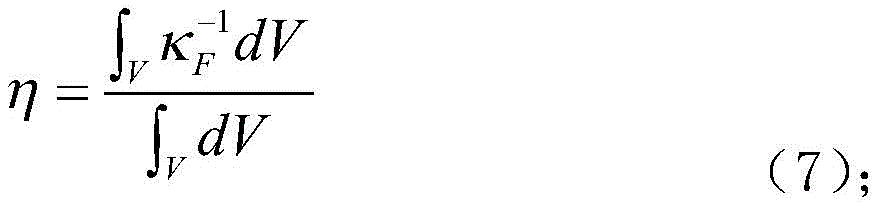

上式(7)和(8)中,kF表示基于Frobenius(罗贝尼乌斯)范数的雅克比矩阵的条件数,tr(g)表示矩阵的迹,n为雅克比矩阵的维数。In the above formulas (7) and (8), k F represents the condition number of the Jacobian matrix based on the Frobenius (Robenius) norm, tr(g) represents the trace of the matrix, and n is the dimension of the Jacobian matrix .
当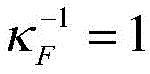


上式(9)中,m为离散点的数值。In the above formula (9), m is the numerical value of the discrete point.
当DVi≡DV时,上式可以变成:When DV i ≡DV, the above formula can become:
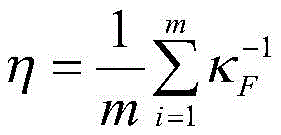
通过离散的方式求解机器人全局性能指标,离散点越多,机器人性能指标求解精度越高,但计算量越大,当离散点超过一百万点时,误差在0.1%以内。The global performance index of the robot is solved in a discrete way. The more discrete points, the higher the accuracy of the robot performance index solution, but the greater the amount of calculation. When the discrete points exceed one million points, the error is within 0.1%.
步骤二:对七自由度机器人进行构型综合,具体过程如下:Step 2: Synthesize the configuration of the seven-degree-of-freedom robot. The specific process is as follows:
(2.1)依据人机工程学,将七自由度机器人拆分为“肩肘”和“腕”两部分:(2.1) According to ergonomics, the seven-degree-of-freedom robot is divided into two parts: "shoulder and elbow" and "wrist":
由于协作机器人要与人类肩并肩工作于非结构环境下,所以协作机器人要具有拟人性、类人体积等特性。依据人机工程学理论,将七自由度机器人划分为肩部、肘部以及腕部,如图3所示。其中肩部具有三个自由度、肘部具有一个自由度、腕部具有三个自由度。在进行构型优化时,将肩部和肘部看作一个整体,腕部看作一个整体进行构型综合,即“肩肘-腕”分离原则。Since collaborative robots have to work side by side with humans in an unstructured environment, collaborative robots must have characteristics such as anthropomorphism and human-like volume. According to the theory of ergonomics, the seven-degree-of-freedom robot is divided into shoulders, elbows and wrists, as shown in Figure 3. The shoulder has three degrees of freedom, the elbow has one degree of freedom, and the wrist has three degrees of freedom. When performing configuration optimization, consider the shoulder and elbow as a whole, and the wrist as a whole for configuration synthesis, that is, the separation principle of "shoulder-elbow-wrist".
(2.2)采用步骤一中获得的结构长度指标和全局性能指标对机器人“肩肘”部进行构型综合,获得3种最优“肩肘”部构型:(2.2) Use the structural length index and global performance index obtained in
“肩肘”部可以当作是四自由度串联结构,决定机器人末端的位置,同时由于该部分含有一个冗余自由度,所以在优化时要考虑其灵巧性。本发明选取结构长度指标QL和全局性能指标η作为优化目标,通过优化连杆转角αi-1使结构长度指标最小化,全局性能指标最大化。因此,“肩肘”部构型综合可以转换为下述优化问题。求设计变量矢量x=[α1,α2,α3]T,使The "shoulder and elbow" part can be regarded as a four-degree-of-freedom series structure, which determines the position of the end of the robot. At the same time, since this part contains a redundant degree of freedom, its dexterity should be considered during optimization. The present invention selects the structural length index Q L and the global performance index η as optimization targets, and optimizes the connecting rod rotation angle α i-1 to minimize the structural length index and maximize the global performance index. Therefore, the configuration synthesis of "shoulder and elbow" can be transformed into the following optimization problem. Calculate the design variable vector x=[α 1 ,α 2 ,α 3 ] T , so that
max
s.t.-180°≤α1≤180°st-180°≤α 1 ≤180°
-180°≤α2≤180°-180°≤α 2 ≤180°
-180°≤α3≤180°-180°≤α 3 ≤180°
以各连杆转角作为优化参数,为保证优化的合理性,降低连杆长度和偏距对优化结果的影响,设置机器人DHm参数中的连杆长度和偏距相等,即ai-1=di=1(i=2,3,4),将连杆转角α1的变化区间等分为8个子区间,在每个离散点α1=0°,±45°,±90°,±135°,±180°绘制连杆转角α2和α3关于目标函数的等高线图,如图5所示。Taking the rotation angle of each connecting rod as the optimization parameter, in order to ensure the rationality of the optimization and reduce the influence of the connecting rod length and offset on the optimization result, set the connecting rod length and offset in the robot DHm parameters to be equal, that is, a i-1 = d i = 1 (i = 2, 3, 4), divide the change interval of the connecting rod rotation angle α 1 into 8 sub-intervals, and at each discrete point α 1 = 0°, ±45°, ±90°, ±135 °, ±180° draw the contour map of the connecting rod rotation angle α 2 and α 3 with respect to the objective function, as shown in Figure 5.
图5中A区域为能够使“肩肘”部运动性能较优的连杆转角范围,其中最优构型的连杆转角为α2=α3=±90°,即关节轴线相互垂直,连杆转角α1的变动对于优化目标的影响较小,在考虑机器人的结构设计、运动学和动力学可控性等设计准则,选取α1=±90°,α2=±90°,α3=±90°,即机器人各关节轴线相互垂直,根据各连杆转角的数值,可以获得三种最优“肩肘”部构型,如图6中(a)图所示。Area A in Figure 5 is the range of connecting rod rotation angles that can make the movement performance of the "shoulder and elbow" better, and the optimal configuration of the connecting rod rotation angle is α 2 =α 3 =±90°, that is, the joint axes are perpendicular to each other, and the connecting rods The change of rotation angle α 1 has little influence on the optimization objective. Considering the design criteria of robot structure design, kinematics and dynamic controllability, select α 1 =±90°, α 2 =±90°, α 3 = ±90°, that is, the axes of the joints of the robot are perpendicular to each other. According to the value of the rotation angle of each connecting rod, three optimal "shoulder and elbow" configurations can be obtained, as shown in (a) of Figure 6.
(2.3)采用结构长度指标和全局性能指标分别对机器人“腕”部进行构型综合,获得5种最优“腕”部构型:(2.3) The structure length index and global performance index are used to synthesize the configuration of the "wrist" part of the robot, and five optimal "wrist" part configurations are obtained:
“腕”部可以视为三自由度串联结构,决定机器人末端的姿态。本文选取全局性能指标η作为优化目标评价“腕”部的灵巧性,通过优化连杆转角αi-1使全局性能指标最大化。因此,“腕”部构型综合可以转换为下述优化问题。求设计变量矢量x=[a5,a6]T,使The "wrist" part can be regarded as a three-degree-of-freedom series structure, which determines the posture of the end of the robot. In this paper, the global performance index η is selected as the optimization target to evaluate the dexterity of the "wrist", and the global performance index is maximized by optimizing the connecting rod rotation angle α i-1 . Therefore, the configuration synthesis of the "wrist" can be transformed into the following optimization problem. Calculate the design variable vector x=[a 5 ,a 6 ] T , so that
maxf2(x)=η(x)maxf 2 (x)=η(x)
s.t.-180°≤α5≤180°st-180°≤α 5 ≤180°
-180°≤α6≤180°-180°≤α 6 ≤180°
以连杆转角作为优化参数,由于连杆偏置和长度对腕关节姿态灵巧性无影响,所以不需要考虑连杆偏置和长度。绘制连杆转角α5和α6关于目标函数的等高线图,如图7所示。图7中B区域为能够使“腕”部运动性能较优的连杆转角范围,其中最优构型的连杆转角为α5=α6=±90°,即关节轴线相互垂直。考虑机器人的结构设计、运动学和动力学可控性等设计准则,选取α5=±90°,α6=±90°。根据各连杆转角的数值,可以获得三种最优“腕”部构型,如图6中(b)所示。Taking the connecting rod angle as the optimization parameter, since the connecting rod offset and length have no effect on the dexterity of the wrist joint posture, it is not necessary to consider the connecting rod offset and length. Draw the contour plots of connecting rod rotation angles α 5 and α 6 with respect to the objective function, as shown in Figure 7. Area B in Fig. 7 is the range of connecting rod rotation angle that can make the "wrist" part move better, and the optimal configuration of connecting rod rotation angle is α 5 =α 6 =±90°, that is, the joint axes are perpendicular to each other. Considering design criteria such as robot structure design, kinematics and dynamic controllability, select α 5 =±90°, α 6 =±90°. According to the value of the rotation angle of each connecting rod, three optimal "wrist" configurations can be obtained, as shown in Fig. 6(b).
(2.4)通过构型优化综合,将3种最优“肩肘”部构型和5种最优“腕”部构型组合,获得19种七自由度机器人构型。(2.4) Through configuration optimization and synthesis, 3 optimal "shoulder and elbow" configurations and 5 optimal "wrist" configurations are combined to obtain 19 robot configurations with seven degrees of freedom.
将3种最优“肩肘”部构型和5种最优“腕”部构型组合,获得19种七自由度机器人构型,如图8所示,这些构型能够实现较优的工作空间和灵巧性能,但在机器人构型选择时还需要考虑运动学控制简易性、设计简易性等因素。Combining 3 optimal "shoulder-elbow" configurations and 5 optimal "wrist" configurations, 19 robot configurations with seven degrees of freedom are obtained, as shown in Figure 8. These configurations can achieve a better working space And dexterous performance, but the kinematics control simplicity, design simplicity and other factors need to be considered when choosing the robot configuration.
运动控制简易性是指所选构型是否有利于机器人运动学甚至是动力学控制,是否存在运动学逆解。一般而言,非球手腕构型能够模仿人的手腕,其工作空间大,但是运动学和动力学复杂,而球手腕密封性好、运动学和动力学较简单。The simplicity of motion control refers to whether the selected configuration is conducive to robot kinematics or even dynamics control, and whether there is a kinematics inverse solution. Generally speaking, the non-ball wrist configuration can imitate the human wrist, and its working space is large, but its kinematics and dynamics are complex, while the ball wrist has good sealing performance and relatively simple kinematics and dynamics.
设计简易性是指所选构型是否有利于机械结构、驱动、电气等设计,是否容易出现夹点影响人机交互的安全性。Design simplicity refers to whether the selected configuration is conducive to the design of mechanical structure, drive, electrical, etc., and whether it is prone to pinch points that affect the safety of human-computer interaction.
(2.5)对上述19种构型进行运动可控性和设计简易性评估,获得最优七自由度构型SRS:(2.5) Evaluate the motion controllability and design simplicity of the above 19 configurations, and obtain the optimal seven-degree-of-freedom configuration SRS:
如图8所示,其中构型C1在运动可控性和设计简易性方面最为优越,该机器人构型具有和人的手臂相似的结构,前三个关节可以看作三自由度球副的肩部,后三个关节看作三自由度球副的腕部,中间的关节看成肘部,称之为SRS构型。这一构型可以绕连接肩腕两球副之间的直线做自运动,利用这种构型可以很方便的避开一些障碍物,而且可以完全消除手腕和肩部的奇异。As shown in Figure 8, the configuration C1 is the most superior in terms of motion controllability and design simplicity. This robot configuration has a structure similar to that of a human arm. The first three joints can be regarded as the shoulder The last three joints are regarded as the wrist of the three-degree-of-freedom spherical pair, and the middle joint is regarded as the elbow, which is called the SRS configuration. This configuration can do self-motion around the straight line connecting the two ball pairs connecting the shoulder and wrist. Using this configuration can easily avoid some obstacles, and can completely eliminate the singularity of the wrist and shoulder.
步骤三:对七自由度机器人进行尺寸优化,具体为:对SRS构型进行多目标尺度优化综合,获得七自由度机器人最优构型参数:Step 3: Carry out size optimization on the seven-degree-of-freedom robot, specifically: carry out multi-objective scale optimization and synthesis on the SRS configuration, and obtain the optimal configuration parameters of the seven-degree-of-freedom robot:
冗余自由度机器人的奇异与灵活工作空间特性不仅受关节形式或配置的影响,也受杆尺度参数的影响,某些连杆参数之间的相对变化可能导致机器人工作空间拓扑结构特性的改变,从而影响机器人的运动特性。综合考虑机器人结构简洁性、拟人性、运动学和动力学可控性,本发明选择SRS构型作为尺度优化的构型,如图9所示,该构型的连杆DHm参数如图10所示,仅需要对连杆偏距d3和d5进行尺度优化,优化目标为结构长度指标QL和全局性能指标η,通过优化连杆偏距di使结构长度指标最小化,全局性能指标最大化。因此,SRS构型尺度优化可以转换为下述优化问题。求设计变量矢量x=[d3,d5]T,使:The singular and flexible workspace characteristics of redundant DOF robots are not only affected by the joint form or configuration, but also by the rod scale parameters. The relative changes between some link parameters may lead to changes in the topological characteristics of the robot workspace, Thus affecting the motion characteristics of the robot. Considering the simplicity of the robot structure, anthropomorphism, kinematics and dynamic controllability, the present invention selects the SRS configuration as the scale-optimized configuration, as shown in Figure 9, and the connecting rod DHm parameters of this configuration are shown in Figure 10 shows that only the connecting rod offset distance d 3 and d 5 need to be scaled optimized, the optimization target is the structural length index Q L and the global performance index η, the structural length index is minimized by optimizing the connecting rod offset distance d i , and the global performance index maximize. Therefore, the SRS configuration scaling optimization can be transformed into the following optimization problem. Find the design variable vector x=[d 3 ,d 5 ] T , so that:
minf1(x)=QL(x)+η(x)-1 minf 1 (x)=Q L (x)+η(x) -1
s.t.0.3≤d3≤0.5 st0.3≤d3≤0.5
0.3≤d5≤0.5 0.3≤d5≤0.5
d3+d5=0.9d 3 +d 5 =0.9
采用遗传算法对协作机器人进行尺寸优化,优化结果和收敛情况见图11,优化结果为d3=0.46m和d5=0.44m。为便于协作机器人模块化设计,本发明选取d3=d5=0.45m。The genetic algorithm is used to optimize the size of the collaborative robot. The optimization results and convergence conditions are shown in Figure 11. The optimization results are d 3 =0.46m and d 5 =0.44m. In order to facilitate the modular design of the collaborative robot, the present invention selects d 3 =d 5 =0.45m.
本实施例中,各步骤的计算和等高图的绘制均可采用Matlab等商业软件实现。In this embodiment, the calculation of each step and the drawing of the contour map can be realized by commercial software such as Matlab.
Claims (7)







Priority Applications (1)
| Application Number | Priority Date | Filing Date | Title |
|---|---|---|---|
| CN202010632490.2A CN113878571B (en) | 2020-07-02 | 2020-07-02 | Configuration optimization comprehensive method for seven-degree-of-freedom cooperative robot |
Applications Claiming Priority (1)
| Application Number | Priority Date | Filing Date | Title |
|---|---|---|---|
| CN202010632490.2A CN113878571B (en) | 2020-07-02 | 2020-07-02 | Configuration optimization comprehensive method for seven-degree-of-freedom cooperative robot |
Publications (2)
| Publication Number | Publication Date |
|---|---|
| CN113878571A CN113878571A (en) | 2022-01-04 |
| CN113878571B true CN113878571B (en) | 2022-11-29 |
Family
ID=79012540
Family Applications (1)
| Application Number | Title | Priority Date | Filing Date |
|---|---|---|---|
| CN202010632490.2A Active CN113878571B (en) | 2020-07-02 | 2020-07-02 | Configuration optimization comprehensive method for seven-degree-of-freedom cooperative robot |
Country Status (1)
| Country | Link |
|---|---|
| CN (1) | CN113878571B (en) |
Families Citing this family (3)
| Publication number | Priority date | Publication date | Assignee | Title |
|---|---|---|---|---|
| CN115462909B (en) * | 2022-09-16 | 2023-05-16 | 哈尔滨工业大学 | Main manipulator performance optimization method for minimally invasive surgery robot |
| CN115462908B (en) * | 2022-09-16 | 2023-06-27 | 哈尔滨工业大学 | Main manipulator structure of minimally invasive surgery robot |
| CN118061204B (en) * | 2024-04-24 | 2024-09-10 | 成都飞机工业(集团)有限责任公司 | Motion optimal target attitude solving method of redundant degree-of-freedom robot |
Citations (4)
| Publication number | Priority date | Publication date | Assignee | Title |
|---|---|---|---|---|
| US5430643A (en) * | 1992-03-11 | 1995-07-04 | The United States Of America As Represented By The Administrator Of The National Aeronautics And Space Administration | Configuration control of seven degree of freedom arms |
| CN105956297A (en) * | 2016-05-09 | 2016-09-21 | 金陵科技学院 | Movement flexibility comprehensive evaluation and optimization method of redundant robot |
| CN109291046A (en) * | 2017-07-25 | 2019-02-01 | 中国科学院沈阳自动化研究所 | An inverse kinematics planning method for a seven-degree-of-freedom anthropomorphic robotic arm |
| CN110666840A (en) * | 2019-10-16 | 2020-01-10 | 金陵科技学院 | Industrial robot comprehensive performance index design and evaluation method |
-
2020
- 2020-07-02 CN CN202010632490.2A patent/CN113878571B/en active Active
Patent Citations (4)
| Publication number | Priority date | Publication date | Assignee | Title |
|---|---|---|---|---|
| US5430643A (en) * | 1992-03-11 | 1995-07-04 | The United States Of America As Represented By The Administrator Of The National Aeronautics And Space Administration | Configuration control of seven degree of freedom arms |
| CN105956297A (en) * | 2016-05-09 | 2016-09-21 | 金陵科技学院 | Movement flexibility comprehensive evaluation and optimization method of redundant robot |
| CN109291046A (en) * | 2017-07-25 | 2019-02-01 | 中国科学院沈阳自动化研究所 | An inverse kinematics planning method for a seven-degree-of-freedom anthropomorphic robotic arm |
| CN110666840A (en) * | 2019-10-16 | 2020-01-10 | 金陵科技学院 | Industrial robot comprehensive performance index design and evaluation method |
Non-Patent Citations (1)
| Title |
|---|
| 协作机器人的构型分析研究;王洪光等;《智能系统学报》;20190305;第14卷(第02期);全文 * |
Also Published As
| Publication number | Publication date |
|---|---|
| CN113878571A (en) | 2022-01-04 |
Similar Documents
| Publication | Publication Date | Title |
|---|---|---|
| CN109895101B (en) | A method for obtaining unique numerical solution of inverse kinematics of articulated manipulator | |
| CN109397271B (en) | 7-degree-of-freedom anthropomorphic mechanical arm and control method and system thereof | |
| WO2021184655A1 (en) | Method for planning motion along trajectory of end of hyper-redundant mechanical arm | |
| CN113878571B (en) | Configuration optimization comprehensive method for seven-degree-of-freedom cooperative robot | |
| CN109093600B (en) | Scale synthesis method of five-degree-of-freedom hybrid robot for round steel end face labeling | |
| CN105807712B (en) | A kind of method that the dual quaterion of six-degree-of-freedom parallel robot direct kinematics solves | |
| CN106844951B (en) | A method and system for solving the inverse kinematics of a hyper-redundant robot based on piecewise geometry | |
| Wild et al. | Efficient and scalable inverse kinematics for continuum robots | |
| Mu et al. | Simultaneous planning method considering both overall configuration and end pose for hyper-redundant manipulators | |
| Clark et al. | Design and workspace characterisation of malleable robots | |
| CN111300408A (en) | Humanoid double-arm robot motion planning control method combining shape similarity and expression similarity | |
| Lin et al. | The piecewise constant curvature model for the forward and inverse kinematics of continuum robot based on lie theory | |
| Li et al. | A real-time explicit mapping and teleoperation control method for humanoid robots with posture constraints | |
| CN108638057B (en) | Double-arm motion planning method for humanoid robot | |
| Quan et al. | Obstacle avoidance method for fixed trajectory of a seven-degree-of-freedom manipulator | |
| Gan et al. | Human-like manipulation planning for articulated manipulator | |
| Abbasnejad et al. | Architecture optimization of 4PUS+ 1PS parallel manipulator | |
| Su et al. | A heterogeneous master-slave teleoperation method for 7-DOF manipulator | |
| Zhao et al. | Human-robot kinematics mapping method based on dynamic equivalent points | |
| Cao et al. | Humanoid robot torso motion planning based on manipulator pose dexterity index | |
| Qian et al. | Path planning approach for redundant manipulator based on Jacobian pseudoinverse-RRT algorithm | |
| Sun et al. | Workspace optimization of a humanoid robotic arm based on the multi-parameter plane model | |
| CN117656044A (en) | Mechanical arm inverse kinematics calculation method for autonomous planning of redundant parameters | |
| Fang et al. | RRT-based motion planning with sampling in redundancy space for robots with anthropomorphic arms | |
| Bing et al. | System design and experiment of bionics robotic arm with humanoid characteristics |
Legal Events
| Date | Code | Title | Description |
|---|---|---|---|
| PB01 | Publication | ||
| PB01 | Publication | ||
| SE01 | Entry into force of request for substantive examination | ||
| SE01 | Entry into force of request for substantive examination | ||
| GR01 | Patent grant | ||
| GR01 | Patent grant |