CN113853638B - Method for determining boarding location of vehicle dispatch service and device for determining boarding location of vehicle dispatch service - Google Patents
Method for determining boarding location of vehicle dispatch service and device for determining boarding location of vehicle dispatch service Download PDFInfo
- Publication number
- CN113853638B CN113853638B CN201980095024.0A CN201980095024A CN113853638B CN 113853638 B CN113853638 B CN 113853638B CN 201980095024 A CN201980095024 A CN 201980095024A CN 113853638 B CN113853638 B CN 113853638B
- Authority
- CN
- China
- Prior art keywords
- vehicle
- boarding
- location
- boarding location
- candidate
- Prior art date
- Legal status (The legal status is an assumption and is not a legal conclusion. Google has not performed a legal analysis and makes no representation as to the accuracy of the status listed.)
- Active
Links
Images


Classifications
-
- G—PHYSICS
- G08—SIGNALLING
- G08G—TRAFFIC CONTROL SYSTEMS
- G08G1/00—Traffic control systems for road vehicles
- G08G1/123—Traffic control systems for road vehicles indicating the position of vehicles, e.g. scheduled vehicles; Managing passenger vehicles circulating according to a fixed timetable, e.g. buses, trains, trams
- G08G1/127—Traffic control systems for road vehicles indicating the position of vehicles, e.g. scheduled vehicles; Managing passenger vehicles circulating according to a fixed timetable, e.g. buses, trains, trams to a central station ; Indicators in a central station
- G08G1/13—Traffic control systems for road vehicles indicating the position of vehicles, e.g. scheduled vehicles; Managing passenger vehicles circulating according to a fixed timetable, e.g. buses, trains, trams to a central station ; Indicators in a central station the indicator being in the form of a map
-
- G—PHYSICS
- G06—COMPUTING OR CALCULATING; COUNTING
- G06Q—INFORMATION AND COMMUNICATION TECHNOLOGY [ICT] SPECIALLY ADAPTED FOR ADMINISTRATIVE, COMMERCIAL, FINANCIAL, MANAGERIAL OR SUPERVISORY PURPOSES; SYSTEMS OR METHODS SPECIALLY ADAPTED FOR ADMINISTRATIVE, COMMERCIAL, FINANCIAL, MANAGERIAL OR SUPERVISORY PURPOSES, NOT OTHERWISE PROVIDED FOR
- G06Q10/00—Administration; Management
- G06Q10/06—Resources, workflows, human or project management; Enterprise or organisation planning; Enterprise or organisation modelling
- G06Q10/063—Operations research, analysis or management
- G06Q10/0631—Resource planning, allocation, distributing or scheduling for enterprises or organisations
- G06Q10/06311—Scheduling, planning or task assignment for a person or group
-
- G—PHYSICS
- G08—SIGNALLING
- G08G—TRAFFIC CONTROL SYSTEMS
- G08G1/00—Traffic control systems for road vehicles
- G08G1/123—Traffic control systems for road vehicles indicating the position of vehicles, e.g. scheduled vehicles; Managing passenger vehicles circulating according to a fixed timetable, e.g. buses, trains, trams
- G08G1/133—Traffic control systems for road vehicles indicating the position of vehicles, e.g. scheduled vehicles; Managing passenger vehicles circulating according to a fixed timetable, e.g. buses, trains, trams within the vehicle ; Indicators inside the vehicles or at stops
- G08G1/137—Traffic control systems for road vehicles indicating the position of vehicles, e.g. scheduled vehicles; Managing passenger vehicles circulating according to a fixed timetable, e.g. buses, trains, trams within the vehicle ; Indicators inside the vehicles or at stops the indicator being in the form of a map
-
- G—PHYSICS
- G08—SIGNALLING
- G08G—TRAFFIC CONTROL SYSTEMS
- G08G1/00—Traffic control systems for road vehicles
- G08G1/20—Monitoring the location of vehicles belonging to a group, e.g. fleet of vehicles, countable or determined number of vehicles
- G08G1/202—Dispatching vehicles on the basis of a location, e.g. taxi dispatching
-
- G—PHYSICS
- G01—MEASURING; TESTING
- G01C—MEASURING DISTANCES, LEVELS OR BEARINGS; SURVEYING; NAVIGATION; GYROSCOPIC INSTRUMENTS; PHOTOGRAMMETRY OR VIDEOGRAMMETRY
- G01C21/00—Navigation; Navigational instruments not provided for in groups G01C1/00 - G01C19/00
- G01C21/26—Navigation; Navigational instruments not provided for in groups G01C1/00 - G01C19/00 specially adapted for navigation in a road network
- G01C21/34—Route searching; Route guidance
- G01C21/3407—Route searching; Route guidance specially adapted for specific applications
- G01C21/3438—Rendezvous; Ride sharing
-
- G—PHYSICS
- G06—COMPUTING OR CALCULATING; COUNTING
- G06Q—INFORMATION AND COMMUNICATION TECHNOLOGY [ICT] SPECIALLY ADAPTED FOR ADMINISTRATIVE, COMMERCIAL, FINANCIAL, MANAGERIAL OR SUPERVISORY PURPOSES; SYSTEMS OR METHODS SPECIALLY ADAPTED FOR ADMINISTRATIVE, COMMERCIAL, FINANCIAL, MANAGERIAL OR SUPERVISORY PURPOSES, NOT OTHERWISE PROVIDED FOR
- G06Q10/00—Administration; Management
- G06Q10/02—Reservations, e.g. for tickets, services or events
Landscapes
- Engineering & Computer Science (AREA)
- Business, Economics & Management (AREA)
- Physics & Mathematics (AREA)
- General Physics & Mathematics (AREA)
- Human Resources & Organizations (AREA)
- Remote Sensing (AREA)
- Radar, Positioning & Navigation (AREA)
- Economics (AREA)
- Entrepreneurship & Innovation (AREA)
- Strategic Management (AREA)
- Educational Administration (AREA)
- Quality & Reliability (AREA)
- Tourism & Hospitality (AREA)
- Operations Research (AREA)
- General Business, Economics & Management (AREA)
- Marketing (AREA)
- Theoretical Computer Science (AREA)
- Game Theory and Decision Science (AREA)
- Development Economics (AREA)
- Automation & Control Theory (AREA)
- Traffic Control Systems (AREA)
- Navigation (AREA)
- Management, Administration, Business Operations System, And Electronic Commerce (AREA)
Abstract
本发明提供一种车辆调度服务上车地点决定方法以及车辆调度服务上车地点决定系统,在具有来自用户的车辆调度请求时,从候选上车地点之中决定用户可准确到达上车地点的合适的上车地点。该车辆调度服务上车地点决定方法具有:通过无线通信进行信息交换的车辆调度信息数据服务器(1)、车载单元(2)、以及移动终端器(3),决定进行了车辆调度请求的用户搭乘调度车辆(4)的上车地点,流程如下。在具有来自用户的车辆调度请求时,获取车辆调度请求地点的位置信息。基于车辆调度请求地点与地图信息,算出在车辆调度请求地点的周边存在的候选上车地点。算出用户将候选上车地点识别为上车地点的难易度即上车地点识别难易度(R)。将候选上车地点之中上车地点识别难易度(R)较低的候选上车地点决定为用户搭乘调度车辆(4)的上车地点。
The present invention provides a method for determining a boarding location for a vehicle dispatching service and a system for determining a boarding location for a vehicle dispatching service. When there is a vehicle dispatching request from a user, it is determined from among candidate boarding locations that the user can accurately arrive at the boarding location. pick-up location. The vehicle scheduling service boarding location determination method includes: a vehicle scheduling information data server (1), an on-board unit (2), and a mobile terminal (3) that exchange information through wireless communication, and determines the boarding location of the user who has made a vehicle scheduling request. The boarding location of the scheduling vehicle (4) is as follows. When there is a vehicle dispatch request from the user, the location information of the vehicle dispatch request location is acquired. Based on the vehicle dispatch request location and the map information, candidate boarding locations existing around the vehicle dispatch request location are calculated. The degree of difficulty for the user to recognize the boarding location candidate as the boarding location, that is, the boarding location identification difficulty (R), is calculated. Among the candidate boarding locations, the candidate boarding location with a lower boarding location recognition difficulty (R) is determined as the boarding location where the user boards the dispatching vehicle (4).
Description
技术领域technical field
本公开涉及根据来自用户的车辆调度请求对车辆进行调度的车辆调度服务上车地点决定方法以及车辆调度服务上车地点决定装置。The present disclosure relates to a vehicle dispatching service boarding location determination method and a vehicle dispatching service boarding location determination device for dispatching vehicles according to a vehicle dispatching request from a user.
背景技术Background technique
以往,以用户从发出车辆调度请求的地点的通行难易度为基准,从预先决定的可上下车的地点,将一处或多处推荐上下车地点向用户提示。而且,已知一种车辆调度服务上车地点决定系统,其向用户选择的上下车地点调度车辆(例如参照专利文献1)。In the past, one or more recommended pick-up and drop-off spots were presented to the user from the predetermined pick-up and drop-off spots based on the traffic difficulty of the spot where the user issued the vehicle dispatch request. Furthermore, there is known a vehicle dispatch service boarding location determination system that dispatches a vehicle to a boarding/alighting location selected by a user (for example, refer to Patent Document 1).
现有技术文献prior art literature
专利文献patent documents
专利文献1:美国专利申请公开2016/0370194号公报Patent Document 1: US Patent Application Publication No. 2016/0370194
发明内容Contents of the invention
发明所要解决的技术问题The technical problem to be solved by the invention
在专利文献1所公开的系统中,利用用户的通行难易度与自动驾驶车辆的通行难易度,选定推荐上下车地点。但是,在可随地上下车的无站点的车辆调度服务的情况下,因为上车地点没有物理地标,所以,存在诸如用户不能确切地识别上车地点这样的问题。In the system disclosed in
本公开是鉴于上述问题而提出的,目的在于,在具有来自用户的车辆调度请求时,从候选上车地点之中决定用户可准确到达上车地点的确切的上车地点。The present disclosure was made in view of the above problems, and an object of the present disclosure is to determine an exact boarding location where the user can accurately arrive at the boarding location from candidate boarding locations when there is a vehicle dispatch request from the user.
用于解决技术问题的技术方案Technical solutions for technical problems
为了实现上述目的,本公开为一种车辆调度服务上车地点决定方法,具有车辆调度信息数据服务器与终端,基于来自终端的车辆调度请求,决定搭乘调度车辆的上车地点,流程如下。In order to achieve the above purpose, the present disclosure is a method for determining a boarding location for a vehicle dispatching service, which has a vehicle dispatching information data server and a terminal, and determines the boarding location of a dispatching vehicle based on a vehicle dispatching request from the terminal. The process is as follows.
当获取车辆调度请求时,获取请求了车辆调度的地点的位置信息。When a vehicle dispatch request is acquired, positional information of a place where vehicle dispatch is requested is acquired.
基于位置信息与地图信息,算出在位置信息的周边存在的候选上车地点。Based on the positional information and map information, candidate boarding spots existing around the positional information are calculated.
基于将可看到的目标物体作为地图上的地点而登记的地图数据库,提取在候选上车地点的周边存在的周边目标物体的信息。Based on a map database in which visible target objects are registered as points on a map, information on surrounding target objects existing around candidate boarding locations is extracted.
基于候选上车地点与周边目标物体的位置关系,算出表示将候选上车地点识别为上车地点的容易程度的指标即上车地点识别难易度。Based on the positional relationship between the candidate boarding point and the surrounding target objects, the boarding point recognition difficulty level, which is an index indicating how easy it is to recognize the candidate boarding point as the boarding point, is calculated.
将候选上车地点之中上车地点识别难易度较低的候选上车地点决定为上车地点。Among the candidate boarding locations, a candidate boarding location with a low degree of difficulty in identifying the boarding location is determined as the boarding location.
发明的效果The effect of the invention
因此,当具有来自用户的车辆调度请求时,能够从候选上车地点之中决定用户可准确到达上车地点的确切的上车地点。Therefore, when there is a vehicle dispatch request from the user, it is possible to determine an exact boarding location at which the user can accurately arrive at the boarding location from among candidate boarding locations.
附图说明Description of drawings
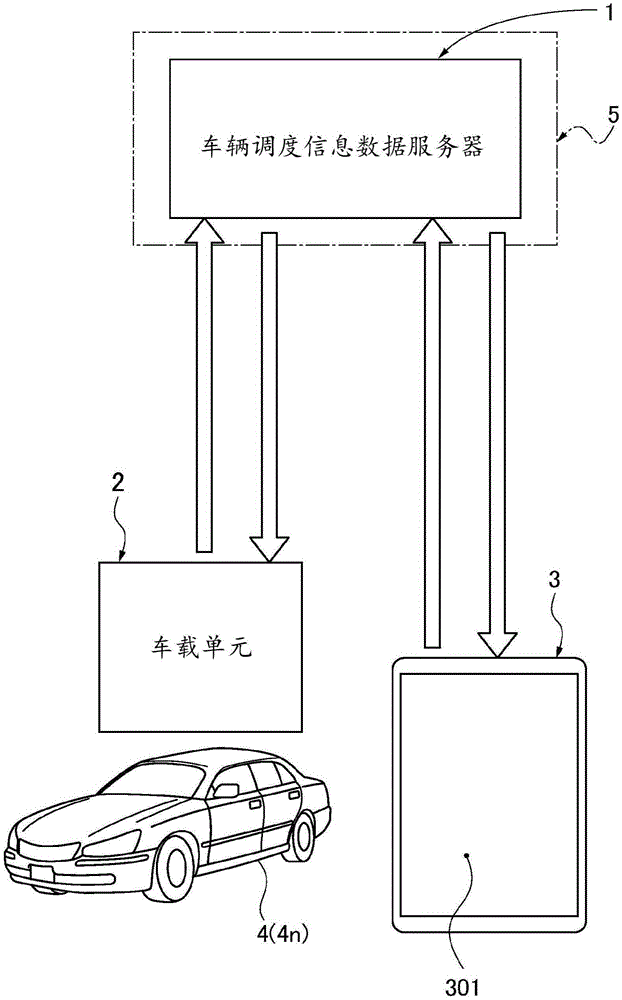
图1是表示应用第一实施例的车辆调度服务上车地点决定方法以及车辆调度服务上车地点决定系统的车辆调度服务网络的整体结构的网络结构图。FIG. 1 is a network configuration diagram showing the overall structure of a vehicle dispatching service network to which the vehicle dispatching service boarding location determination method and the vehicle dispatching service boarding location determination system of the first embodiment are applied.
图2是表示车辆调度服务网络中具有的车辆调度信息数据服务器/车载单元/移动终端器的详细结构的块图。2 is a block diagram showing a detailed configuration of a vehicle dispatch information data server/vehicle unit/mobile terminal included in the vehicle dispatch service network.
图3是表示背景技术下的车辆调度服务上车地点决定作用的概念的上车地点决定作用说明图。FIG. 3 is an explanatory diagram of a boarding location determination function showing the concept of a boarding location determination function of a vehicle dispatching service in the background technology.
图4是表示第一实施例下的车辆调度服务上车地点决定作用的概念的上车地点决定作用说明图。Fig. 4 is an explanatory diagram of boarding location determination function showing the concept of the boarding location determination function of the vehicle dispatching service in the first embodiment.
图5是表示在车辆调度信息数据服务器执行的车辆调度服务上车地点决定控制处理的流程的流程图。5 is a flowchart showing the flow of a vehicle dispatch service boarding location determination control process executed by the vehicle dispatch information data server.
具体实施方式Detailed ways
下面,基于附图所示的第一实施例,说明用于实施本公开的车辆调度服务上车地点决定方法以及车辆调度服务上车地点决定系统的方式。Hereinafter, based on the first embodiment shown in the accompanying drawings, methods for implementing the method for determining a boarding location for a vehicle dispatching service and the system for determining a boarding location for a vehicle dispatching service of the present disclosure will be described.
第一实施例first embodiment
第一实施例的车辆调度服务上车地点决定方法以及车辆调度服务上车地点决定系统应用在根据来自用户的车辆调度请求对车辆进行调度的按需式车辆调度服务网络中。下面,将第一实施例的结构分为“整体系统结构”、“车辆调度信息数据服务器/车载单元/移动终端器的详细结构”进行说明。The vehicle dispatching service boarding location determination method and the vehicle dispatching service boarding location determination system of the first embodiment are applied in an on-demand vehicle dispatching service network that dispatches vehicles according to vehicle dispatching requests from users. In the following, the structure of the first embodiment will be divided into "overall system structure" and "detailed structure of vehicle scheduling information data server/vehicle unit/mobile terminal" for description.
[整体系统结构][Overall system structure]
图1表示第一实施例的车辆调度服务上车地点决定方法以及车辆调度服务上车地点决定系统所应用的车辆调度服务网络的整体结构。下面,基于图1,说明车辆调度服务网络的整体系统结构。FIG. 1 shows the overall structure of the vehicle dispatching service network applied to the vehicle dispatching service boarding location determination method and the vehicle dispatching service boarding location determination system of the first embodiment. Next, based on FIG. 1 , the overall system structure of the vehicle dispatching service network will be described.
如图1所示,车辆调度服务网络具有:车辆调度信息数据服务器1、车载单元2(车载终端)、以及移动终端器3(客户端)。上述信息设备通过无线通信的接收与发送进行信息交换。在此,“车辆调度服务”是指例如将属于出租车服务、租车服务及汽车共享服务等的车辆视为调度车辆4,根据来自用户的车辆调度请求调度车辆的服务。As shown in FIG. 1 , the vehicle dispatching service network has: a vehicle dispatching
众所周知,车辆调度信息数据服务器由一台或多台计算机构成,是在接受来自外部的信号输入后进行各种处理的程序服务,例如设置在车辆调度服务管理中心5。第一实施例的车辆调度信息数据服务器1作为兼顾多台调度车辆4n的车辆管理功能、以及管理持有移动终端器3的大量用户的用户管理功能的服务器而进行说明。As we all know, the vehicle dispatching information data server is composed of one or more computers, and is a program service for performing various processes after receiving external signal input, for example, it is installed in the vehicle dispatching
在车辆调度信息数据服务器1中,当从用户接收到车辆调度请求时,从多台调度车辆4n之中选定调度车辆4,决定发送车辆调度请求的用户的上车地点/下车地点,计算调度车辆4的自当前地点的行驶路线。而且,从车辆调度信息数据服务器1向已选定的调度车辆4的车载单元2发送依照行驶路线与用户上下车的停车位置而移动的指示。此外,从车辆调度信息数据服务器1向已选定的调度车辆4的车载单元2以及发送了车辆调度请求信息的移动终端器3发送在道路地图上增加了上车地点及下车地点等的车辆调度服务信息的显示指示。In the vehicle dispatching
车载单元2在规定的车辆调度服务区域内搭载在一台调度车辆4或存在多台的调度车辆4n上。在此,调度车辆4是根据用户的请求提供移动服务的的服务车辆,可以是通过加油补充汽油的汽油车,也可以是通过充电补充电力的电动汽车。另外,可以是驾驶员驾驶的车辆,也可以是在驾驶员搭乘后通过自动驾驶来行驶的自动驾驶车辆,也可以是无驾驶员搭乘的无人驾驶车辆。需要说明的是,在本实施例中,之后,假定是在驾驶员搭乘后通过自动驾驶来行驶的自动驾驶车辆来进行说明。The on-
当一台调度车辆4或多台调度车辆4n的车载单元2算出车辆位置时,将包含车辆位置的车辆信息从车载单元2向车辆调度信息数据服务器1发送。而且,当已选定的调度车辆4的车载单元2从车辆调度信息数据服务器1接收到移动指示时,依照行驶路线/上车地点/下车地点,进行使调度车辆4行驶/停止的自动驾驶控制。另外,当已选定的调度车辆4的车载单元2从车辆调度信息数据服务器1接收到显示指示时,对在道路地图上增加了上车地点及下车地点等的车辆调度服务信息进行提示。When the on-
移动终端器3是通过安装车辆调度服务的应用软件、作为接受车辆调度服务的用户而在车辆调度服务网络中加入的智能手机等便携信息终端。需要说明的是,移动终端器3是用户持有的客户端的一个例子。The mobile terminal 3 is a portable information terminal such as a smart phone that is added to the vehicle dispatch service network as a user receiving the vehicle dispatch service by installing the application software of the vehicle dispatch service. It should be noted that the mobile terminal 3 is an example of a client held by a user.
在用户利用通过调度车辆4行驶至目的地的车辆调度服务时,通过移动终端器3选择车辆调度服务应用,在显示界面401显示请求输入界面。当用户通过对请求输入界面的操作而输入车辆调度请求时,将车辆调度请求信息向车辆调度信息数据服务器1发送。在接收到该车辆调度请求信息的车辆调度信息数据服务器1侧,执行适合车辆调度请求条件的调度车辆4的选择、行驶路线的计算、上车地点/下车地点的决定等处理,并将处理结果向移动终端器3发送。而且,从车辆调度信息数据服务器1接收到处理结果的移动终端器3在显示界面401显示在道路地图上增加了上车地点及下车地点等的车辆调度服务信息。When the user utilizes the vehicle dispatching service that travels to the destination through the
[车辆调度信息数据服务器/车载单元/移动终端器的详细结构][Detailed structure of vehicle dispatch information data server/vehicle unit/mobile terminal]
图2表示车辆调度服务网络中具有的车辆调度信息数据服务器1/车载单元2/移动终端器3的详细结构。下面,基于图2,说明车辆调度信息数据服务器1/车载单元2/移动终端器3的各详细结构。FIG. 2 shows a detailed configuration of the vehicle dispatch
(车辆调度信息数据服务器的详细结构)(Detailed structure of vehicle dispatch information data server)
如图2所示,车辆调度信息数据服务器1具有:车辆信息数据库101、地图数据库102、用户信息数据库103、车辆调度请求信息获取部104、候选上车地点算出部105、以及路线计算部106。此外,具有:调度车辆选定部107、上车地点识别难易度算出部108、上车地点决定部109、移动指示部110、车辆调度计划数据库111、用户通行难易度算出部112、以及用户调整部113。As shown in FIG. 2 , the vehicle scheduling
车辆信息数据库101是保持从车载单元2的车辆信息发送部202送出的车辆信息的数据库。在作为调度车辆4而存在多台调度车辆4n的情况下,在此存储有来自在规定的服务区域内存在的所有调度车辆4n的车辆信息。The
在此,“车辆信息”中至少包括调度车辆4的位置信息,但除此以外,还包括车辆方向、车速、车门锁止及车门的开闭状态、安全带传感器值、是否处于自动驾驶中等各种车辆状态。另外,诸如是否可接受车辆调度请求、是否正处于接送中、有无乘客及人数、上下车状态、是否已到达移动指示的目的地等之类的与车辆调度相关的信息也与相同的车辆ID关联而被保持。Here, the "vehicle information" includes at least the location information of the
地图数据库102除了至少包括车辆可行驶的道路连接信息的、例如诸如公开街道地图(=Open Street Map)之类的导航地图以外,还包括用户可上车的区域或位置的信息。除此以外,也可以包括下车地点的信息、车辆的等候位置信息、以及用于计算用户步行的路线的步行者道路连接信息。The
地图数据库102也可以将用户可看到的目标物体保持为地图上的地点。下面,将用户可看到的目标物体称为“POI(目标点,point of Interest的缩写”。作为POI,除了导航地图中包括的设施及商铺信息以外,也可以包括用户可看到的任何目标物体。例如包括广告牌、公交站、消防栓等。此外,也可以包括具有特征的地形及道路形状,例如可以为斜坡上、十字路口、道路路口等用户可识别位置的地形及道路形状。The
需要说明的是,在地图数据库102不包括POI的情况下,只要预先将用户可识别的位置作为候选上车地点登记在地图数据库102中即可。由此,必须选定上车地点识别难易度较低的上车地点。It should be noted that, in the case where the
用户信息数据库103从移动终端器3接收用户的车辆调度请求,并保持接收到的车辆调度请求信息。另外,从车辆调度计划数据库111接收并存储用户的车辆调度计划信息。The
车辆调度请求信息获取部104获取在用户信息数据库103中存储的各用户的车辆调度请求信息,向候选上车地点算出部105送出。从用户信息数据库103获取车辆调度请求信息的时刻可以是接收新用户的车辆调度请求之时,也可以是定期确认在系统上存在的现有用户来实施。The vehicle dispatch request
候选上车地点算出部105基于在车辆调度请求信息获取部104获取到的车辆调度请求中包含的用户出发地点的位置信息、以及在地图数据库102中包含的可上车的位置信息,算出候选上车地点,向调度车辆选定部107送出。The candidate boarding
对候选上车地点的具体算出方法进行说明。可以在地图数据库102中预先登记多个可上车的候选地点,将用户的出发地点周围一定范围内的上车地点作为候选上车地点。在此,一定范围例如可以为半径为500m的圆,也可以为利用在地图数据库102中包含的步行路径信息、在一定时间内例如5分钟以内可到达的上车地点。另外,在一定范围内候选上车地点较少的情况下也可以扩大范围,反之在过多的情况下也可以缩小范围。The specific calculation method of the candidate boarding place will be described. A plurality of boarding candidate locations may be pre-registered in the
路线计算部106从调度车辆选定部107中调用,提供如下的功能,即,利用在地图数据库102中包含的道路信息,进行调度车辆4的当前位置至上车地点的路线计算,并算出移动所需要的时间。The
在此,在地图数据库102中包含步行路径的情况下,此外,也可以进行用户出发地点至上车地点之间的步行者路线计算,进而算出用户通行时间。或者,由路线计算部106进行的路线计算例如可以利用路线搜索应用即OSRM(Open Source Routing Machine的缩写)”等通常应用的方法。Here, if the
调度车辆选定部107基于从候选上车地点算出部送出的候选上车地点信息、以及在车辆信息数据库101中存储的多台调度车辆4n的位置信息,利用路线计算部106的路线计算功能选定最佳的调度车辆4,向上车地点识别难易度算出部108送出。The dispatching
在此,调度车辆4的选定方法可以单纯选择与在车辆调度请求信息中包含的用户的出发地点最近的车辆。另外,也可以针对每个候选上车地点,利用路线计算部106,选择可最早到达的车辆。Here, the method of selecting the
上车地点识别难易度算出部108基于从调度车辆选定部107送出的候选上车地点、以及在地图数据库102中包含的POI信息,首先提取在候选上车地点周边存在的周边POI。之后,算出各候选上车地点的上车地点识别难易度R,向上车地点决定部109送出。The boarding point recognition
在此,周边POI的提取可以选择在上车地点的一定范围(例如半径为100m)内存在的所有POI,也可以选择最靠近的POI,或依照接近的顺序提取多个POI。接着,对上车地点识别难易度R的算出方法进行说明。Here, the extraction of surrounding POIs may select all POIs within a certain range (for example, a radius of 100m) of the boarding location, or select the closest POI, or extract multiple POIs in order of proximity. Next, a calculation method of the boarding point recognition difficulty level R will be described.
单纯地说,假设以0或1判定上车地点识别难易度R,判定上车地点的一定距离(例如10m)以内是否存在POI,并在存在的情况下判定R=0,在不存在的情况下判定R=1。To put it simply, assuming that the recognition difficulty R of the boarding location is determined as 0 or 1, it is determined whether there is a POI within a certain distance (for example, 10m) from the boarding location, and if there is a POI, it is judged that R=0, and if there is no POI In this case, it is judged that R=1.
上车地点识别难易度R也可以基于上车地点与周边POI的位置关系来算出。例如,假设至最靠近POI的距离为X(m),使识别难易度最大的距离为C(m),则上车地点识别难易度R可以算出为R=X/C(X<C)、R=1(X≥C)等。具体而言,假设C=100m,当至最靠近的POI为10m时R=0.1,当为90m时R=0.9,设定为距离越近,上车地点识别难易度R越小。需要说明的是,上述算出式是一个例子,只要基于与周边POI的位置关系算出上车地点识别难易度R,可以通过任意的方法算出。The boarding location identification difficulty R may also be calculated based on the positional relationship between the boarding location and surrounding POIs. For example, assuming that the distance to the closest POI is X (m), and the distance that maximizes the recognition difficulty is C (m), then the recognition difficulty R of the boarding location can be calculated as R=X/C (X<C ), R=1 (X≥C) and so on. Specifically, assuming C=100m, R=0.1 when the closest POI is 10m, and R=0.9 when it is 90m, and it is set such that the closer the distance is, the smaller the boarding point recognition difficulty R is. It should be noted that the above calculation formula is an example, and it may be calculated by any method as long as the boarding point recognition difficulty R is calculated based on the positional relationship with surrounding POIs.
上车地点识别难易度R也可以基于周边POI自身的识别难易度Rp来算出。POI自身的识别难易度Rp例如可以根据识别难易度Rp,将0~1的数值与预先在地图数据库102中登记的POI关联而登记。识别难易度Rp的算出可以通过主观评估来进行,也可以基于POI的大小及高度,通过计算来算出。另外,识别难易度R可以单纯为R=Rp,也可以考虑周边POI与上车地点间的距离进行校正。The boarding location recognition difficulty R may be calculated based on the recognition difficulty Rp of the surrounding POI itself. The recognition difficulty Rp of the POI itself can be registered by associating a numerical value of 0 to 1 with POIs previously registered in the
上车地点识别难易度R也可以基于周边POI的确定性S来算出。POI的确定性S是用户能够以何种程度精度良好地确定该位置的指标。例如,在POI为“东京站”的情况下,POI表示的范围扩大为半径200m左右,确定性S较低。另一方面,在POI为“东京站A1出口”的情况下,POI表示的范围降低至半径5m左右,确定性S较高。在此,确定性S例如可以根据确定程度,将0~1的数值与预先在地图数据库102中登记的POI关联而登记。确定性S的算出可以通过主观评估来进行,也可以基于POI表示的范围,通过计算来算出,使POI范围越小,确定性S越高。另外,上车地点识别难易度R可以单纯为R=1-S,也可以考虑周边POI与上车地点间的距离进行校正。The boarding location identification difficulty R may also be calculated based on the certainty S of the surrounding POIs. The certainty S of the POI is an index of how accurately the user can specify the position. For example, when the POI is "Tokyo Station", the range indicated by the POI is expanded to a radius of about 200 m, and the certainty S is low. On the other hand, when the POI is "Tokyo Station A1 Exit", the range indicated by the POI is reduced to a radius of about 5 m, and the certainty S is high. Here, the certainty S may be registered by associating a numerical value of 0 to 1 with a POI previously registered in the
上车地点决定部109基于从上车地点识别难易度算出部108送出的候选上车地点、以及各候选上车地点的上车地点识别难易度R,决定最终的上车地点,并向移动指示部110及车辆调度计划数据库111送出上车地点及调度车辆4的信息。在此,上车地点可以从候选上车地点之中选择上车地点识别难易度较低的候选上车地点(=上车地点识别难易度R的值为最小的候选上车地点)。The boarding
上车地点决定部109此外具有用户通行难易度算出部112,上车地点也可以基于用户通行难易度D与上车地点识别难易度R,决定最终的上车地点。具体而言,可以在各自以0~1算出用户通行难易度D及上车地点识别难易度R后,选择两个难易度的总和(D+R)为最小的上车地点。也可以利用加权总和而非单纯的总和,由此来强调任一指标。The boarding
上车地点决定部109此外具有用户调整部113,也可以在将上车地点识别难易度较低的多个候选上车地点向用户调整部113送出后,从用户调整部113接收用户的选择结果,将用户选择的上车地点选择为最终的上车地点。The boarding
移动指示部110利用从上车地点决定部109送出的上下车地点及调度车辆信息、以及在车辆信息数据库101中包含的车辆信息,利用路线计算部106的路线计算功能,算出至下一目的地的路线。而且,将使调度车辆4移动的移动指示向车载单元2的移动指示接收部203发送。The
车辆调度计划数据库111接收从上车地点决定部109送出的上车地点及调度车辆信息,收纳为车辆调度计划。此外,将每位用户的车辆调度计划信息向用户信息数据库103送出,并将车辆调度计划信息向用户持有的移动终端器3发送。The vehicle dispatch plan database 111 receives boarding locations and dispatched vehicle information sent from the boarding
用户通行难易度算出部112利用在车辆调度请求信息中包含的用户的出发地点与各候选上车地点的信息,算出出发地点与候选上车地点之间的用户通行难易度D。用户通行难易度例如可以将距离、到达时间、有无阶梯、上下车地点的舒适性等评估项目各自在0~1之间进行量化,通过对各项目的得分进行加权平均来算出。评估项目为一个例子,也可以包括其它的项目。The user traffic
用户调整部113将从上车地点决定部109送出的多个候选上车地点向移动终端器3发送。此时,除了与各候选上车地点关联的周边POI的名称及位置以外,也可以结合候选上车地点与周边POI的相对位置关系等附加信息来发送。从移动终端器3接收用户选择的上车地点的信息,并向上车地点决定部109送出。The
(车载单元的详细结构)(Detailed structure of on-board unit)
如图2所示,车载单元2具有:车辆位置算出部201、车辆信息发送部202、移动指示接收部203、信息提示装置204、以及自动驾驶ECU205。需要说明的是,虽然形成为信息提示装置204及自动驾驶ECU205共同存在的结构,但也可以为包括任意一方的结构。As shown in FIG. 2 , the vehicle-mounted
车辆位置算出部201算出调度车辆4的位置,并向车辆信息发送部202送出。车辆位置算出部201例如是与GPS/INS传感器连接的ECU,可以将从GPS/INS传感器输出的经纬度的位置信息每隔一定时间(例如100msec)送出。作为位置信息的算出方法,例如也可以利用基于地图的地图匹配等可确定位置以外的方法。The vehicle
车辆信息发送部202例如是具有4G/LTE移动通信功能的车载装置,通过CAN或LAN等与车辆位置算出部201连接。而且,每隔一定时间(例如100msec)将从车辆位置算出部201送出的车辆位置向车辆调度信息数据服务器1的车辆信息数据库101发送。The vehicle
需要说明的是,虽然在图1中未记载,但车辆信息发送部202也可以与车辆CAN及其它的传感器连接,在获取了车辆方向、车速、车门锁止及车门的开闭状态、安全带传感器值、是否处于自动驾驶中等各种车辆状态后,作为车辆信息而发送。It should be noted that, although not described in FIG. 1 , the vehicle
移动指示接收部203例如是具有4G/LTE移动通信功能的车载装置,将从车辆调度信息数据服务器1的移动指示部110发送的路线信息向通过CAN或LAN等连接的信息提示装置204及自动驾驶ECU205送出。需要说明的是,移动指示接收部203也可以与同样具有与车辆调度信息数据服务器1的通信功能的车辆信息发送部202进行功能整合。The movement
信息提示装置204例如是在从车厢内的驾驶员及乘员角度可观察的位置设置的显示装置,由作为应用程序而安装的软件显示从移动指示接收部203接收到的路线信息。具体而言,例如在界面显示地图后,通过在路线信息中包含的目的地的位置标注星号等标识来显示目的地,另外通过用线连接路线(纬度/纬度的点组)进行绘制来进行路线显示等处理。另外,也可以在接收到新的路线时鸣音引起注意等根据需要利用音频进行信息提示。The
自动驾驶ECU205基于从移动指示接收部203送出的路线信息,通过自动驾驶行驶至目的地。自动驾驶的实现方法通过众所周知的驱动/制动/操舵控制车辆运行,以沿着计算出的路线移动。The
需要说明的是,虽然在图1中未记载,但自动驾驶ECU205也可以对路线接收完毕、正在移动、到达目的地等车辆调度移动状态进行管理,并向车辆信息发送部202送出状态。It should be noted that, although not shown in FIG. 1 , the
(移动终端器3的详细结构)(Detailed structure of mobile terminal 3)
如图2所示,移动终端器3具有:显示界面301、安装有车辆调度服务应用软件的用户应用部302、以及进行与车辆调度信息数据服务器1的接收与发送的通信部303。As shown in FIG. 2 , the mobile terminal 3 has: a
用户应用部302基于来自用户的输入,将如下说明的车辆调度请求信息向车辆调度信息数据服务器1的用户信息数据库103发送。The
车辆调度请求信息至少包括用户的出发地点的位置信息。用户的出发地点的位置信息可以为从GPS获取的当前地点信息,也可以作为确定的上车地点而通过来自用户的输入来获取。作为车辆调度请求信息,除此以外还可以包括下车地点、绕行地点的确定、上车人数、行李信息、请求时间、希望上车时间、可否拼车等附加信息。需要说明的是,在本实施例中,假设车辆调度请求信息包括上述所有的信息来进行说明。The vehicle dispatch request information includes at least location information of the user's departure location. The location information of the user's departure location may be current location information acquired from GPS, or may be acquired as a confirmed boarding location through input from the user. As the vehicle dispatch request information, it may also include additional information such as alighting location, detour location determination, boarding number, luggage information, request time, desired boarding time, carpooling availability, and the like. It should be noted that, in this embodiment, it is assumed that the vehicle dispatch request information includes all the above information for description.
用户应用部302从车辆调度信息数据服务器1的车辆调度计划数据库110接收如下说明的车辆调度计划信息,由显示界面301向用户提示。The
车辆调度计划信息至少包括分配给用户的车辆与上车地点的信息。作为车辆调度计划信息,除此以外也可以包括车辆的行驶路线等附加信息。The vehicle dispatch plan information includes at least the information about the vehicles allocated to the user and the boarding locations. Additional information such as the travel route of the vehicle may be included as the vehicle dispatch plan information.
用户应用部302此外也可以将从用户调整部113接收到的多个候选上车地点由显示界面301向用户提示,在用户选择一个地点后,将选择结果向用户调整部113发送。In addition, the
用户应用部302也可以在由显示界面301将多个候选上车地点向用户提示时,将从用户调整部113获取到的每个候选上车地点的周边POI信息向用户提示。作为周边POI信息的提示方法,可以由字符表示POI的名称,也可以在地图上表示POI的位置。The
移动终端器3也可以在将多个候选上车地点由显示界面301向用户提示时,将与从用户调整部113获取到的每个候选上车地点的周边POI的相对位置信息向用户提示。与周边POI的相对位置信息例如可以表示为最近的POI至上车地点的方位与距离,也可以表示为与周边存在的多个POI的距离。具体而言,例如在作为周边POI而存在便利商店(下面简称为“便利店”)和邮局的情况下,只要用户可以理解诸如“自便利店向东100m”、“便利店与邮局之间”、“朝向邮局的道路”等与POI的相对位置关系,可以使用任意的表达方法。The mobile terminal 3 may also present the relative position information of each candidate boarding location to the user obtained from the
接着,对“背景技术与问题的解决方案”进行说明。而且,对第一实施例下的“车辆调度服务中的上车地点决定作用”进行说明。Next, "Background Art and Solution to Problem" will be described. Furthermore, the "action of boarding location determination in the vehicle dispatch service" under the first embodiment will be described.
[背景技术与问题的解决方案][Background Art and Solution to Problem]
当将专利文献1所公开的系统作为背景技术时,在背景技术中,利用用户的通行难易度与自动驾驶车辆的通行难易度,选定推荐上下车地点。即,背景技术的推荐上下车地点基于“用户的通行容易程度”、以及“调度车辆的停车容易程度”来决定,未考虑“用户的识别容易程度”。When the system disclosed in
这样,在背景技术中,通过基于“用户的通行容易程度”以及“调度车辆的停车容易程度”决定推荐上下车地点,对于用户,只作为地图上的点而引导推荐上车地点。因此,至少用户持有的便携终端可能发生GPS精度相应的位置偏移,在高楼林立的城区,便携终端的GPS精度可能会显著恶化。在背景技术中,例如,如图3所示,在高楼林立的城区的十字路口附近发出了车辆调度请求的用户依赖便携终端的GPS与地图,以上车地点X为目标。在该情况下,由于电波在高楼等的反射而产生的多径的影响,便携终端的GPS精度降低至数10m数量级。因此,假设用户准确到达便携终端所显示的上车地点Y,则用户到达的位置是与上车地点X偏移便携终端的GPS精度相应的位置。因此,在调度车辆Z到达停车位置(虚线位置)后,用户要匆忙移动上车地点X与上车地点Y的因GPS精度而产生的相应的误差距离。In this way, in the background technology, the recommended boarding and alighting locations are determined based on "ease of passage for the user" and "easiness of parking the dispatched vehicle", and the recommended aboarding locations are guided to the user only as points on the map. Therefore, at least the position of the portable terminal held by the user may be shifted corresponding to the GPS accuracy, and the GPS accuracy of the portable terminal may be significantly deteriorated in an urban area full of tall buildings. In the background art, for example, as shown in FIG. 3 , a user who sends a vehicle dispatch request near an intersection in a city full of tall buildings relies on the GPS and map of the portable terminal to target the pick-up point X. In this case, the GPS accuracy of the mobile terminal is reduced to the order of several tens of meters due to the influence of multipath caused by the reflection of radio waves on tall buildings and the like. Therefore, assuming that the user accurately arrives at the boarding location Y displayed on the portable terminal, the user arrives at a location corresponding to the GPS accuracy of the boarding location X offset by the portable terminal. Therefore, after the dispatched vehicle Z arrives at the parking position (the dotted line position), the user has to move the corresponding error distance between the boarding location X and the boarding location Y due to GPS accuracy.
由此,在利用调度车辆的通行难易度与用户的通行难易度决定上车地点的背景技术下,用户难以准确到达调度车辆停车的上车地点。特别是在随处可上下车的无站点的车辆调度服务的情况下,因为在上车地点没有物理地标,所以存在用户不能确切识别上车地点这样的问题。Therefore, under the background technology that the boarding location is determined by the traffic difficulty of the dispatching vehicle and the traffic difficulty of the user, it is difficult for the user to accurately arrive at the boarding location where the dispatching vehicle parks. In particular, in the case of a non-stop vehicle dispatching service in which passengers can get on and off at any place, there is a problem that the user cannot accurately identify the boarding location because there is no physical landmark at the boarding location.
对于上述问题,本公开着眼于“用户的识别容易程度”比“用户的通行容易程度”及“调度车辆的停车容易程度”更重要这一点,决定发出车辆调度请求的用户搭乘调度车辆的上车地点。问题解决方案为具有通过无线通信进行信息交换的车辆调度信息数据服务器1、车载单元2、以及移动终端器3,并决定发出了车辆调度请求的用户搭乘调度车辆4的上车地点的车辆调度服务上车地点决定方法,流程如下。当具有来自用户的车辆调度请求时,获取车辆调度请求地点的位置信息。基于车辆调度请求地点与地图信息,算出在车辆调度请求地点的周边存在的候选上车地点。算出用户将候选上车地点识别为上车地点的难易度即上车地点识别难易度R。将候选上车地点之中上车地点识别难易度R较低的候选上车地点决定为用户搭乘调度车辆4的上车地点。Regarding the above problems, this disclosure focuses on the fact that "easiness of user identification" is more important than "ease of passage of users" and "easiness of parking of dispatched vehicles", and decides that the user who issued the vehicle dispatch request boards the dispatched vehicle. Place. The solution to the problem is a vehicle dispatching service that has a vehicle dispatching
即,算出用户将候选上车地点识别为上车地点的难易度即上车地点识别难易度R,将候选上车地点之中上车地点识别难易度R较低、且用户容易识别的候选上车地点决定为搭乘调度车辆4的用户的上车地点。That is, calculate the difficulty level for the user to recognize the candidate boarding location as the boarding location, that is, the boarding location recognition difficulty R. Candidate boarding locations determined to be the boarding locations of users who take the
因此,当具有来自用户的车辆调度请求时,能够从候选上车地点之中决定用户可准确到达上车地点的确切的上车地点。例如,在图4所示的场景下,考虑用户的通行难易度与调度车辆的通行难易度,决定候选上下车地点A为上下车地点。与此相对,在问题解决方案中,将上车地点识别难易度R较低的候选上车地点B决定为上下车地点。由此,在用户从出发地点向候选上车地点B移动时,因为存在便利店这样的、用户可看到的目标物体POI,所以,能够容易地步行到达候选上车地点B。Therefore, when there is a vehicle dispatch request from the user, it is possible to determine an exact boarding location at which the user can accurately arrive at the boarding location from among candidate boarding locations. For example, in the scenario shown in FIG. 4 , considering the traffic difficulty of the user and the dispatch vehicle, the candidate pick-up and drop-off location A is determined as the drop-off and drop-off location. On the other hand, in the solution to the problem, the boarding point candidate B whose boarding point recognition difficulty level R is low is determined as the boarding point. Thus, when the user moves from the departure point to the candidate boarding point B, since there is an object POI visible to the user such as a convenience store, the user can easily reach the candidate boarding point B on foot.
[车辆调度服务中的上车地点决定作用][Determinant role of pick-up location in vehicle dispatching service]
图5表示在车辆调度信息数据服务器1中执行的车辆调度服务上车地点决定控制处理的流程。下面,基于图5,对车辆调度服务中的上车地点决定作用进行说明。FIG. 5 shows the flow of the vehicle dispatch service boarding location determination control process executed in the vehicle dispatch
在Step101中,在从移动终端器3接收到车辆调度请求,并存储在用户信息数据库103后,进入Step102。In Step101, after receiving the vehicle dispatch request from the mobile terminal 3 and storing it in the
在Step102中,在车辆调度请求信息获取部104获取了在用户信息数据库103中存储的用户的车辆调度请求信息后,候选上车地点算出部105算出候选上车地点,进入Step103。In
在Step103中,针对候选上车地点算出部105算出的候选上车地点,调度车辆选定部107决定调度车辆,进入Step104。In
在Step104中,基于候选上车地点的位置信息以及在地图数据库102中包含的POI信息,上车地点识别难易度算出部108算出各候选上车地点的上车地点识别难易度R,进入Step105。In
在Step105中,上车地点决定部109基于上车地点识别难易度R,将多个、例如两个候选上下车地点由用户调整部113及移动终端器3向用户进行提示,进入Step106。In
在Step106中,移动终端器3通过用户输入接收上车地点选择结果,向用户调整部113送出,进入Step107。In Step106, the mobile terminal 3 receives the selection result of the boarding location through user input, sends it to the
在Step107中,基于从用户调整部113送出的用户输入结果,上车地点决定部109决定最终的上车地点,进入Step108。In
在Step108中,基于上车地点决定部109决定的上车地点信息,移动指示部110向调度车辆4发出调度指示,结束处理。In
这样,在车辆调度服务上车地点决定控制处理中,当从移动终端器3接收到车辆调度请求时,在车辆调度信息数据服务器1中选择调度车辆4,并且基于上车地点识别难易度R算出多个候选上下车地点。然后,当通过向移动终端器3发送将算出的多个候选上下车地点向用户提示时,通过用户输入选择上车地点。然后,当车辆调度信息数据服务器1接收到来自移动终端器3的选择结果时,在车辆调度信息数据服务器1的上车地点决定部109中决定上车地点,从移动指示部110向调度车辆4发送调度指示。In this way, in the vehicle dispatching service boarding location determination control process, when a vehicle dispatching request is received from the mobile terminal 3, the dispatching
上述处理流程原则上只是一个例子,也可以采用其它的处理流程。例如,在Step105中,可以替代用户调整部113将多个上车地点向用户提示,而是上车地点决定部109发送唯一决定的上车地点,在Step106中,用户可以替代选择上车地点而是实施接受或取消的输入。The above processing flow is in principle only an example, and other processing flows may also be adopted. For example, in Step105, instead of the
如上所述,在第一实施例的车辆调度服务上车地点决定方法以及车辆调度服务上车地点决定系统中,具有如下列举的效果。As mentioned above, in the vehicle dispatching service boarding location determination method and the vehicle dispatching service boarding location determination system of the first embodiment, there are the following effects.
(1)为一种车辆调度服务上车地点决定方法,具有通过无线通信进行信息交换的车辆调度信息数据服务器1、车载单元2(车载终端)、以及移动终端器3(客户端),决定发出了车辆调度请求的用户搭乘调度车辆4的上车地点,(1) It is a method for determining the boarding location of a vehicle dispatching service, which has a vehicle dispatching
当具有来自用户的车辆调度请求时,获取车辆调度请求地点的位置信息,When there is a vehicle dispatch request from the user, the location information of the vehicle dispatch request location is obtained,
基于车辆调度请求地点与地图信息,算出在车辆调度请求地点的周边存在的候选上车地点,Based on the vehicle dispatch request location and map information, calculate the candidate boarding locations that exist around the vehicle dispatch request location,
对于候选上车地点,算出用户用于识别为上车地点的难易度即上车地点识别难易度R,For the candidate boarding location, calculate the difficulty level for the user to identify as the boarding location, that is, the difficulty of identifying the boarding location R,
将候选上车地点之中上车地点识别难易度R较低的候选上车地点决定为用户搭乘调度车辆4的上车地点(图4)。Among the candidate boarding locations, the candidate boarding location with a lower identification difficulty R is determined as the boarding location where the user boards the dispatching vehicle 4 ( FIG. 4 ).
由此,在算出用户用于识别上车地点的难易度即上车地点识别难易度R后,考虑上车地点识别难易度R来决定上车地点。因此,能够提出一种车辆调度服务上车地点决定方法,当具有来自用户的车辆调度请求时,从候选上车地点之中决定用户可准确到达上车地点的确切的上车地点。Thus, after calculating the boarding location recognition difficulty R which is the difficulty level for the user to recognize the boarding location, the boarding location is determined in consideration of the boarding location recognition difficulty R. Therefore, it is possible to propose a method for determining a boarding location for a vehicle dispatching service. When there is a vehicle dispatching request from a user, an exact boarding location where the user can accurately arrive at the boarding location is determined from candidate boarding locations.
(2)基于将用户可看到的目标物体(POI)作为地图上的地点而登记的地图数据库102,提取在候选上车地点的周边存在的周边目标物体信息(周边POI信息),(2) Based on the
基于周边目标物体信息(周边POI信息)算出对于候选上车地点的上车地点识别难易度R(图2)。Based on the peripheral target object information (peripheral POI information), the boarding location recognition difficulty R ( FIG. 2 ) for the candidate boarding location is calculated.
由此,利用将用户可看到的目标物体(POI)作为地图上的地点而登记的地图数据库102,基于上车地点周边的周边目标物体信息(周边POI信息),算出上车地点识别难易度R。也就是说,选择出与用户可看到的目标物体(POI)关联的上车地点。因此,用户通过以用户可看到的目标物体(POI)为目标进行移动,能够准确地到达上车地点。Thus, using the
(3)基于候选上车地点与周边目标物体(周边POI)的位置关系,算出对于候选上车地点的上车地点识别难易度R(图2)。(3) Based on the positional relationship between the candidate boarding location and surrounding target objects (peripheral POIs), calculate the boarding location recognition difficulty R for the candidate boarding location ( FIG. 2 ).
由此,上车地点识别难易度R基于候选上车地点与周边目标物体(周边POI)的位置关系而算出。因此,用户能够优先选择与作为地标的目标物体(POI)接近的上车地点。Accordingly, the boarding point recognition difficulty R is calculated based on the positional relationship between the boarding point candidate and surrounding target objects (peripheral POIs). Therefore, the user can preferentially select a boarding location that is close to a target object (POI) as a landmark.
(4)算出在地图数据库102中存储的、用户可看到的目标物体(POI)的识别难易度Rp,(4) Calculate the recognition difficulty Rp of the target object (POI) visible to the user stored in the
基于周边目标物体(周边POI)自身的识别难易度Rp,算出对于候选上车地点的上车地点识别难易度R(图2)。Based on the recognition difficulty Rp of the peripheral target object (peripheral POI) itself, the boarding location recognition difficulty R for the candidate boarding location is calculated ( FIG. 2 ).
由此,基于周边目标物体(周边POI)自身的识别难易度Rp,算出对于候选上车地点的上车地点识别难易度R。因此,用户可以优先选择与作为地标而更易于明了的目标物体(POI)关联的上车地点。Accordingly, based on the recognition difficulty Rp of the peripheral target object (peripheral POI) itself, the boarding point recognition difficulty R for the candidate boarding point is calculated. Therefore, the user can preferentially select a boarding location associated with an object of interest (POI) that is easier to understand as a landmark.
(5)将在地图数据库102中存储的、用户可看到的目标物体(POI)所表示的范围的宽窄作为指标,算出确定性S,(5) Calculate the certainty S by using the range indicated by the target object (POI) visible to the user stored in the
基于周边目标物体(周边POI)的确定性S,算出对于候选上车地点的上车地点识别难易度R(图2)。Based on the certainty S of surrounding target objects (peripheral POIs), the boarding location recognition difficulty R ( FIG. 2 ) for candidate boarding locations is calculated.
由此,算出将目标物体(POI)表示的范围的宽窄作为指标的确定性S,基于候选上车地点的周边目标物体(周边POI)的确定性S,算出上车地点识别难易度R。因此,用户可以优先选择与容易确定位置的目标物体(POI)关联的上车地点。Accordingly, the certainty S using the width of the range indicated by the target object (POI) as an index is calculated, and the boarding point recognition difficulty R is calculated based on the certainty S of surrounding objects (peripheral POIs) of the candidate boarding point. Accordingly, the user can preferentially select a pick-up location associated with an easily located object of interest (POI).
在此,利用具体例说明周边目标物体(周边POI)的确定性S。当提及“东京站”,则确定性S较低,不清楚要去哪里,但当提及“东京站A1出口”时,则确定性S增高。也就是说,目标物体(POI)表示的地图上的区域的范围越窄,则确定性S越高。Here, the certainty S of surrounding target objects (peripheral POIs) will be described using a specific example. When "Tokyo Station" is mentioned, the certainty S is low, and it is not clear where to go, but when "Tokyo Station Exit A1" is mentioned, the certainty S increases. That is, the narrower the area on the map indicated by the target object (POI), the higher the certainty S.
(6)算出用户请求地点与候选上车地点之间的用户通行难易度D,(6) Calculate the user's traffic difficulty D between the user's request location and the candidate boarding location,
在从候选上车地点之中决定上车地点的情况下,除了上车地点识别难易度R以外,还考虑用户通行难易度D来决定(图2)。When the boarding location is determined from among the boarding location candidates, it is determined in consideration of the user's traffic difficulty D in addition to the boarding location recognition difficulty R ( FIG. 2 ).
由此,考虑用户请求地点与候选上车地点之间的用户通行难易度D、以及上车地点识别难易度R双方来决定上下车地点。因此,用户可以选择平衡了上车地点的识别容易程度与通行的容易程度两个指标后的上车地点。Thus, the boarding point is determined by considering both the user's traffic difficulty D between the user's requested point and the candidate boarding point, and the boarding point identification difficulty R. Therefore, the user can select a boarding location that balances the two indicators of the ease of identification and the ease of passage of the boarding location.
(7)在地图数据库102中存储的目标物体(POI)除了用户可识别的目标物体(POI)以外,还包括具有特征的地形及道路形状(图2)。(7) The target objects (POIs) stored in the
由此,作为目标物体(POI),除了设施及商铺等物体以外,还包括十字路口及斜坡上等并非存在的物体、却是用户可识别或确定的位置。因此,可以选择用户可识别的位置或用户可确定的位置的周边作为上车地点。Therefore, as the target object (POI), in addition to objects such as facilities and shops, there are also non-existent objects such as intersections and slopes, but positions that can be recognized or identified by the user. Therefore, a location recognizable by the user or the periphery of a location that the user can determine can be selected as the boarding location.
(8)在从多个候选上车地点之中决定上车地点的情况下,向用户通知多个候选上车地点,将用户选择的候选上车地点决定为最终的上车地点(图2)。(8) When a boarding location is determined from a plurality of candidate boarding locations, the user is notified of the plurality of candidate boarding locations, and the candidate boarding location selected by the user is determined as the final boarding location (Fig. 2) .
由此,在系统提出候选上车地点后,将最终的上车地点的决定权委托给用户。因此,可以精细地反映系统无法掌握的用户需求,来决定上车地点。In this way, after the system proposes candidate boarding locations, the right to determine the final boarding location is entrusted to the user. Therefore, it is possible to finely reflect user needs that cannot be grasped by the system to determine the boarding location.
(9)在向用户通知多个候选上车地点时,对每个候选上车地点的周边目标物体信息(周边POI信息)进行提示(图2)。(9) When notifying the user of multiple candidate boarding locations, the surrounding target object information (surrounding POI information) of each candidate boarding location is prompted ( FIG. 2 ).
由此,在向用户通知候选上车地点时,会对每个候选上车地点的周边目标物体信息(周边POI信息)进行提示。因此,用户在确认是否为自身可识别的目标物体(POI)后,选定最终的上车地点,并且在用户前往上车地点时,以目标物体(POI)为目标进行移动,由此能够准确地步行到达上车地点。Thus, when the candidate boarding locations are notified to the user, surrounding target object information (surrounding POI information) of each candidate boarding location is presented. Therefore, after the user confirms whether it is a target object (POI) that can be recognized by the user, selects the final boarding location, and when the user goes to the boarding location, moves with the target object (POI) as the target, thereby being able to accurately Arrive at the pick-up location on foot.
(10)在向用户通知多个候选上车地点时,对与每个候选上车地点的周边目标物体(周边POI)的相对位置信息进行提示(图2)。(10) When notifying the user of multiple candidate boarding locations, the relative position information of surrounding target objects (peripheral POIs) to each candidate boarding location is presented ( FIG. 2 ).
由此,在向用户通知候选上车地点时,会对每个候选上车地点与周边目标物体(周边POI)的相对位置进行提示。因此,用户在也包括与目标物体(POI)的相对位置来判断上车地点的容易明了程度后,可以选定最终的上车地点。Thus, when the candidate boarding locations are notified to the user, the relative positions of each candidate boarding location and surrounding target objects (peripheral POIs) are presented. Therefore, the user can select the final boarding location after judging the easiness of the boarding location including the relative position to the target object (POI).
在此,与周边目标物体(周边POI)的相对位置例如为“便利店之前”、“自公交站向东100m”等。Here, the relative positions to the surrounding target objects (peripheral POIs) are, for example, "in front of the convenience store", "100 m east from the bus stop", and the like.
(11)调度车辆4具有根据来自用户的车辆调度请求,通过自动驾驶向上车地点及下车地点行驶的自动驾驶功能(图1)。(11) Scheduling The
由此,因为调度车辆4通过自动驾驶行驶,所以,不依赖于驾驶员对上车地点的识别难易度,能够精确地到达确定的上车地点。因此,只要用户准确地步行到达上车地点,就可以顺利地搭乘调度车辆4。As a result, since the
(12)车辆调度信息数据服务器1进行如下的处理:(12) The vehicle scheduling
在从移动终端器3(客户端)接收到车辆调度请求时,获取用户发出车辆调度请求的车辆调度请求地点的信息,When receiving the vehicle dispatching request from the mobile terminal 3 (client), obtain the information of the vehicle dispatching request place where the user sends out the vehicle dispatching request,
基于车辆调度请求地点与地图信息,算出在车辆调度请求地点的周边存在的候选上车地点,Based on the vehicle dispatch request location and map information, calculate the candidate boarding locations that exist around the vehicle dispatch request location,
算出用户将候选上车地点识别为上车地点的难易度即上车地点识别难易度R,Calculate the difficulty for the user to identify the candidate boarding location as the boarding location, that is, the difficulty of identifying the boarding location R,
将候选上车地点之中上车地点识别难易度R较低的候选上车地点决定为用户搭乘调度车辆4的上车地点,Among the candidate boarding locations, the candidate boarding locations with a lower boarding location identification difficulty R are determined as the boarding locations where the user boards the dispatching
当决定上车地点,则对于在调度车辆4搭载的车载单元2(车载终端),发送从当前地点向已决定的上车地点移动的移动指示(图5)。When the boarding place is decided, then to the vehicle-mounted unit 2 (vehicle terminal) mounted on the dispatching
因此,通过在从移动终端器3(客户端)接收车辆调度请求的车辆调度信息数据服务器1中分担所有的处理功能,能够由车辆调度信息数据服务器1整合管理车辆调度服务。此外,能够减轻调度车辆4的车载单元2(车载终端)中的处理负载。Therefore, by allocating all processing functions to the vehicle dispatch
(13)移动终端器3(客户端)进行如下的处理:(13) The mobile terminal 3 (client) carries out the following processing:
向车辆调度信息数据服务器1发送车辆调度请求,Send vehicle scheduling request to vehicle scheduling
当发送车辆调度请求时,接收基于在车辆调度信息数据服务器1中的处理而发送的上车地点的信息,When sending a vehicle scheduling request, receiving the information of the boarding place sent based on the processing in the vehicle scheduling
当接收到上车地点的信息时,在显示界面301显示地图和上车地点的位置(图1)。When the information of the boarding place is received, a map and the location of the boarding place are displayed on the display interface 301 ( FIG. 1 ).
由此,只通过向车辆调度信息数据服务器1发送车辆调度请求,就可以接收到用户可准确到达的上车地点的信息,并显示在显示界面301。因此,能够减轻利用车辆调度服务的用户的操作负担。Thus, only by sending a vehicle dispatch request to the vehicle dispatch
(14)为一种车辆调度服务上车地点决定系统,具有通过无线通信进行信息交换的车辆调度信息数据服务器1、车载单元2(车载终端)、以及移动终端器3(客户端),决定发出了车辆调度请求的用户搭乘调度车辆4的上车地点,(14) It is a vehicle scheduling service boarding location determination system, which has a vehicle scheduling
车辆调度信息数据服务器1具有:Vehicle scheduling
车辆调度请求信息获取部104,其在具有来自用户的车辆调度请求时,获取车辆调度请求地点的位置信息;A vehicle dispatch request
候选上车地点算出部105,其基于车辆调度请求地点与地图数据库102,算出在车辆调度请求地点的周边存在的候选上车地点;Candidate boarding
上车地点识别难易度算出部108,其算出用户将候选上车地点识别为上车地点的难易度即上车地点识别难易度R;The boarding location recognition
上车地点决定部109,其将候选上车地点之中上车地点识别难易度R较低的候选上车地点决定为用户搭乘调度车辆4的上车地点(图2)。The boarding
因此,可以提出一种车辆调度服务上车地点决定系统,在具有来自用户的车辆调度请求时,从候选上车地点之中决定用户可准确到达上车地点的确切的上车地点。Therefore, a system for determining a boarding location for a vehicle dispatching service can be proposed, which determines the exact boarding location where the user can accurately arrive at the boarding location from candidate boarding locations when there is a vehicle scheduling request from the user.
上面,基于第一实施例说明了本公开的车辆调度服务上车地点决定方法以及车辆调度服务上车地点决定系统。但是,针对具体结构,不限于该第一实施例,在不脱离权利要求范围的各权利要求的发明主旨的范围内,容许进行设计的变更及添加等。Above, based on the first embodiment, the method for determining the boarding location of the vehicle dispatching service and the system for determining the boarding location of the vehicle dispatching service of the present disclosure have been described. However, the specific structure is not limited to this first embodiment, and design changes, additions, and the like are allowed within the scope of the gist of the invention in each claim without departing from the scope of the claims.
在第一实施例中,作为车辆调度信息数据服务器1,表示了兼顾多台调度车辆4n的车辆管理功能、以及管理持有移动终端器3的大量用户的用户管理功能的例子。但是,作为车辆调度信息数据服务器,也可以为如下的例子,即,将具有多台调度车辆的车辆管理功能的车辆管理服务器、以及具有管理持有客户端的大量用户的用户管理功能的用户管理服务器分开而设置在不同的设施,在两个服务器之间通过无线通信进行信息交换。In the first embodiment, as the vehicle dispatch
在第一实施例中,表示了由在车厢内设置的显示装置实现车载单元2的信息提示装置204的例子。但是,信息提示装置不一定限定于显示装置,例如可以由智能手机来实现,也可以由进行绘图运算的个人计算机与显示器的组合来实现。此外,也可以在服务器侧安装有面向网页浏览的应用程序后,由平板电脑等访问网页浏览器来实现。In the first embodiment, an example is shown in which the
在第一实施例中,作为客户端,表示了使用移动终端器3的例子。但是,作为客户端,例如也可以使用将车辆调度服务作为网络应用程序来安装、经由因特网进行请求的自家的个人计算机及笔记本电脑。In the first embodiment, an example of using the mobile terminal 3 as a client was shown. However, as a client, for example, a personal computer or a notebook computer at home that installs the vehicle dispatch service as a web application and makes a request via the Internet may also be used.
在第一实施例中,表示了在从移动终端器3(客户端)接收车辆调度请求的车辆调度信息数据服务器1中分担所有的处理功能的例子。但是,也可以为将在车辆调度信息数据服务器中执行的处理功能的一部分由调度车辆的车载终端及客户端分担的例子。In the first embodiment, an example is shown in which all processing functions are allocated to the vehicle dispatch
Claims (12)
Applications Claiming Priority (1)
| Application Number | Priority Date | Filing Date | Title |
|---|---|---|---|
| PCT/IB2019/000413 WO2020201802A1 (en) | 2019-04-03 | 2019-04-03 | Vehicle dispatching service boarding-location determination method, and vehicle dispatching service boarding-location determination system |
Publications (2)
| Publication Number | Publication Date |
|---|---|
| CN113853638A CN113853638A (en) | 2021-12-28 |
| CN113853638B true CN113853638B (en) | 2023-04-25 |
Family
ID=72666329
Family Applications (1)
| Application Number | Title | Priority Date | Filing Date |
|---|---|---|---|
| CN201980095024.0A Active CN113853638B (en) | 2019-04-03 | 2019-04-03 | Method for determining boarding location of vehicle dispatch service and device for determining boarding location of vehicle dispatch service |
Country Status (6)
| Country | Link |
|---|---|
| US (1) | US11928619B2 (en) |
| EP (1) | EP3951742A4 (en) |
| JP (1) | JP7020586B2 (en) |
| CN (1) | CN113853638B (en) |
| BR (1) | BR112021019695A2 (en) |
| WO (1) | WO2020201802A1 (en) |
Families Citing this family (13)
| Publication number | Priority date | Publication date | Assignee | Title |
|---|---|---|---|---|
| JP7468404B2 (en) * | 2021-02-25 | 2024-04-16 | トヨタ自動車株式会社 | Autonomous vehicles, autonomous vehicle dispatch systems and mobile terminals |
| JP7600843B2 (en) * | 2021-04-22 | 2024-12-17 | 日産自動車株式会社 | Boarding location setting method and boarding location setting device |
| JP7611776B2 (en) * | 2021-06-07 | 2025-01-10 | 日産自動車株式会社 | Ride assistance device, ride assistance method, program, and ride assistance system |
| CN113276888B (en) * | 2021-06-09 | 2022-10-21 | 北京百度网讯科技有限公司 | Riding method, device, equipment and storage medium based on automatic driving |
| JP7631116B2 (en) * | 2021-06-18 | 2025-02-18 | 日産自動車株式会社 | Information providing device and information providing method |
| JP7552631B2 (en) * | 2022-02-21 | 2024-09-18 | トヨタ自動車株式会社 | Information processing device, information processing method, and mobile object |
| JP7438497B2 (en) * | 2022-03-23 | 2024-02-27 | 本田技研工業株式会社 | Information processing system and information processing method |
| CN114579890B (en) * | 2022-04-26 | 2022-07-29 | 阿里巴巴(中国)有限公司 | Method, device and equipment for recommending getting-on point name and storage medium |
| CN115482823A (en) * | 2022-09-09 | 2022-12-16 | 阿波罗智行科技(广州)有限公司 | Audio processing method and device based on automatic speech recognition |
| CN115938143B (en) * | 2022-11-28 | 2024-09-24 | 重庆长安汽车股份有限公司 | Automatic connecting driving method and system |
| WO2025220153A1 (en) * | 2024-04-17 | 2025-10-23 | 日産自動車株式会社 | Information processing method and information processing device |
| CN118138633B (en) * | 2024-04-30 | 2024-07-05 | 成都湃尔智芯科技有限公司 | Network contract automobile management method and system applied to large public places |
| CN119180475A (en) * | 2024-11-25 | 2024-12-24 | 浙江小遛信息科技有限公司 | Scheduling method and server for shared vehicles |
Citations (10)
| Publication number | Priority date | Publication date | Assignee | Title |
|---|---|---|---|---|
| JP2000035341A (en) * | 1998-07-17 | 2000-02-02 | Matsushita Electric Ind Co Ltd | Destination guidance device |
| WO2006077638A1 (en) * | 2005-01-20 | 2006-07-27 | Hitachi, Ltd. | Vehicle sharing management server device, user terminal device, vehicle-mounted terminal device, and vehicle sharing management method |
| WO2008041283A1 (en) * | 2006-09-29 | 2008-04-10 | Pioneer Corporation | Route guidance device, information recording method, route guidance method, information recording program, route guidance program, and recording medium |
| JP2015204005A (en) * | 2014-04-15 | 2015-11-16 | Necエンジニアリング株式会社 | Vehicle dispatch management system, vehicle dispatch management device, vehicle dispatch management method, and vehicle dispatch management program |
| CN107063286A (en) * | 2016-01-26 | 2017-08-18 | 通用汽车环球科技运作有限责任公司 | Passenger loading and the arbitration got off and vehicle routing plan in the transportation system based on autonomous vehicle |
| CN107248273A (en) * | 2017-07-03 | 2017-10-13 | 鄂尔多斯市普渡科技有限公司 | A kind of countermeasure and the position selecting method that gets on and off for wheelchair passenger |
| CN107403560A (en) * | 2017-08-17 | 2017-11-28 | 北京经纬恒润科技有限公司 | A kind of method and device for recommending Entrucking Point |
| JP6415672B1 (en) * | 2017-11-20 | 2018-10-31 | ヤフー株式会社 | Information processing apparatus, information processing method, and information processing program |
| CN109115237A (en) * | 2018-08-27 | 2019-01-01 | 北京优酷科技有限公司 | A kind of position recommended method and server of riding |
| CN109558957A (en) * | 2017-09-26 | 2019-04-02 | 通用汽车环球科技运作有限责任公司 | Select vehicle boarding position |
Family Cites Families (11)
| Publication number | Priority date | Publication date | Assignee | Title |
|---|---|---|---|---|
| JPS58138870A (en) * | 1982-02-12 | 1983-08-17 | 株式会社大林組 | Construction of underground tank using underground continuous wall |
| US9733096B2 (en) | 2015-06-22 | 2017-08-15 | Waymo Llc | Determining pickup and destination locations for autonomous vehicles |
| CN109564723B (en) * | 2016-08-26 | 2022-11-08 | 索尼公司 | Mobile body control device, mobile body control method, and mobile body |
| US10495472B2 (en) * | 2017-05-10 | 2019-12-03 | Lyft, Inc. | Dynamic geolocation optimization of pickup locations using location scores |
| US10290074B2 (en) * | 2017-05-25 | 2019-05-14 | Uber Technologies, Inc. | Coordinating on-demand transportation with autonomous vehicles |
| JP2019016290A (en) * | 2017-07-10 | 2019-01-31 | 富士通株式会社 | Traveling management method, traveling management device and traveling management program |
| US11118930B2 (en) * | 2017-07-14 | 2021-09-14 | Lyft, Inc. | Providing information to users of a transportation system using augmented reality elements |
| US10401858B2 (en) * | 2017-08-29 | 2019-09-03 | Waymo Llc | Arranging passenger pickups for autonomous vehicles |
| JP6870548B2 (en) * | 2017-09-19 | 2021-05-12 | トヨタ自動車株式会社 | Driverless transportation system |
| KR101917316B1 (en) | 2017-09-28 | 2018-11-09 | 정연욱 | System for providing information of car stop using augmented reality |
| US10671862B2 (en) * | 2018-01-30 | 2020-06-02 | Wipro Limited | Method and system for detecting obstacles by autonomous vehicles in real-time |
-
2019
- 2019-04-03 BR BR112021019695A patent/BR112021019695A2/en not_active Application Discontinuation
- 2019-04-03 US US17/436,107 patent/US11928619B2/en active Active
- 2019-04-03 WO PCT/IB2019/000413 patent/WO2020201802A1/en not_active Ceased
- 2019-04-03 JP JP2021510563A patent/JP7020586B2/en active Active
- 2019-04-03 CN CN201980095024.0A patent/CN113853638B/en active Active
- 2019-04-03 EP EP19922229.0A patent/EP3951742A4/en not_active Ceased
Patent Citations (10)
| Publication number | Priority date | Publication date | Assignee | Title |
|---|---|---|---|---|
| JP2000035341A (en) * | 1998-07-17 | 2000-02-02 | Matsushita Electric Ind Co Ltd | Destination guidance device |
| WO2006077638A1 (en) * | 2005-01-20 | 2006-07-27 | Hitachi, Ltd. | Vehicle sharing management server device, user terminal device, vehicle-mounted terminal device, and vehicle sharing management method |
| WO2008041283A1 (en) * | 2006-09-29 | 2008-04-10 | Pioneer Corporation | Route guidance device, information recording method, route guidance method, information recording program, route guidance program, and recording medium |
| JP2015204005A (en) * | 2014-04-15 | 2015-11-16 | Necエンジニアリング株式会社 | Vehicle dispatch management system, vehicle dispatch management device, vehicle dispatch management method, and vehicle dispatch management program |
| CN107063286A (en) * | 2016-01-26 | 2017-08-18 | 通用汽车环球科技运作有限责任公司 | Passenger loading and the arbitration got off and vehicle routing plan in the transportation system based on autonomous vehicle |
| CN107248273A (en) * | 2017-07-03 | 2017-10-13 | 鄂尔多斯市普渡科技有限公司 | A kind of countermeasure and the position selecting method that gets on and off for wheelchair passenger |
| CN107403560A (en) * | 2017-08-17 | 2017-11-28 | 北京经纬恒润科技有限公司 | A kind of method and device for recommending Entrucking Point |
| CN109558957A (en) * | 2017-09-26 | 2019-04-02 | 通用汽车环球科技运作有限责任公司 | Select vehicle boarding position |
| JP6415672B1 (en) * | 2017-11-20 | 2018-10-31 | ヤフー株式会社 | Information processing apparatus, information processing method, and information processing program |
| CN109115237A (en) * | 2018-08-27 | 2019-01-01 | 北京优酷科技有限公司 | A kind of position recommended method and server of riding |
Also Published As
| Publication number | Publication date |
|---|---|
| US11928619B2 (en) | 2024-03-12 |
| WO2020201802A1 (en) | 2020-10-08 |
| EP3951742A1 (en) | 2022-02-09 |
| BR112021019695A2 (en) | 2021-12-07 |
| US20220164737A1 (en) | 2022-05-26 |
| JP7020586B2 (en) | 2022-02-18 |
| EP3951742A4 (en) | 2022-04-20 |
| JPWO2020201802A1 (en) | 2020-10-08 |
| CN113853638A (en) | 2021-12-28 |
Similar Documents
| Publication | Publication Date | Title |
|---|---|---|
| CN113853638B (en) | Method for determining boarding location of vehicle dispatch service and device for determining boarding location of vehicle dispatch service | |
| US11370455B2 (en) | Boarding-alighting position determination method, boarding-alighting position determination device, and boarding-alighting position determination system | |
| US9689698B2 (en) | System and method for associating devices moving along the same travel path | |
| US8335648B2 (en) | Route searching system, route searching server and route searching method | |
| CN100444209C (en) | System and device for road traffic congestion estimation | |
| CN118244754A (en) | Inconvenience of passengers getting on and off for automatically driving vehicle | |
| JP4568311B2 (en) | Information collection / distribution system, information collection / distribution server, user terminal device, and information collection / distribution method | |
| US20050080554A1 (en) | Area information provision system and method | |
| JP4568314B2 (en) | Information collection / distribution system, information collection / distribution server, user terminal device, and information collection / distribution method | |
| US20210027632A1 (en) | Vehicle dispatch apparatus, vehicle dispatch system and vehicle dispatch method | |
| JP2012160130A (en) | Taxi information provision system and taxi information provision method | |
| CN113283687A (en) | Server, vehicle operation system, vehicle operation method, and non-volatile computer-readable medium | |
| JP4028879B2 (en) | Navigation system, portable terminal device and departure / arrival discrimination method | |
| JP6682193B2 (en) | Notification system, server device, communication terminal device, program and notification method | |
| JP4163741B1 (en) | Navigation system, route search server, portable terminal device, and route search method | |
| JP2003016587A (en) | Operation information providing system | |
| KR100627755B1 (en) | Optimal transfer information provision system and method of public transportation | |
| WO2022200820A1 (en) | Boarding site setting device, vehicle allocation service system, boarding site setting method, and boarding site table | |
| JP6333433B1 (en) | Information processing apparatus, vehicle search method, and program | |
| JP6794001B2 (en) | Navigation devices and computer programs | |
| JP2020086947A (en) | Vehicle dispatch device | |
| US20220322038A1 (en) | Indoor and outdoor seamless positioning switching device including domains and actors | |
| CN114550481B (en) | Information processing device, information processing system, information processing method, and storage medium | |
| US20240300538A1 (en) | Vehicle control device, vehicle control method, and non-transitory storage medium | |
| WO2007007378A1 (en) | Entry information providing device and entry information utilizing terminal device |
Legal Events
| Date | Code | Title | Description |
|---|---|---|---|
| PB01 | Publication | ||
| PB01 | Publication | ||
| SE01 | Entry into force of request for substantive examination | ||
| SE01 | Entry into force of request for substantive examination | ||
| GR01 | Patent grant | ||
| GR01 | Patent grant |