CN113754804B - Catalyst system for olefin polymerization and application thereof - Google Patents
Catalyst system for olefin polymerization and application thereof Download PDFInfo
- Publication number
- CN113754804B CN113754804B CN202010507249.7A CN202010507249A CN113754804B CN 113754804 B CN113754804 B CN 113754804B CN 202010507249 A CN202010507249 A CN 202010507249A CN 113754804 B CN113754804 B CN 113754804B
- Authority
- CN
- China
- Prior art keywords
- compound
- och
- catalyst system
- formula
- electron donor
- Prior art date
- Legal status (The legal status is an assumption and is not a legal conclusion. Google has not performed a legal analysis and makes no representation as to the accuracy of the status listed.)
- Active
Links
- 238000006116 polymerization reaction Methods 0.000 title claims abstract description 86
- 239000003054 catalyst Substances 0.000 title claims abstract description 67
- 150000001336 alkenes Chemical class 0.000 title claims abstract description 25
- JRZJOMJEPLMPRA-UHFFFAOYSA-N olefin Natural products CCCCCCCC=C JRZJOMJEPLMPRA-UHFFFAOYSA-N 0.000 title claims description 14
- 150000001875 compounds Chemical class 0.000 claims abstract description 226
- 239000011949 solid catalyst Substances 0.000 claims abstract description 102
- RTAQQCXQSZGOHL-UHFFFAOYSA-N Titanium Chemical compound [Ti] RTAQQCXQSZGOHL-UHFFFAOYSA-N 0.000 claims abstract description 50
- 239000010936 titanium Substances 0.000 claims abstract description 47
- 229910052719 titanium Inorganic materials 0.000 claims abstract description 22
- 150000004945 aromatic hydrocarbons Chemical class 0.000 claims abstract description 20
- FYYHWMGAXLPEAU-UHFFFAOYSA-N Magnesium Chemical compound [Mg] FYYHWMGAXLPEAU-UHFFFAOYSA-N 0.000 claims abstract description 18
- 239000007795 chemical reaction product Substances 0.000 claims abstract description 3
- -1 hydroxy, amino Chemical group 0.000 claims description 93
- 125000001424 substituent group Chemical group 0.000 claims description 36
- 239000011777 magnesium Substances 0.000 claims description 31
- 229910052749 magnesium Inorganic materials 0.000 claims description 30
- RTZKZFJDLAIYFH-UHFFFAOYSA-N ether Substances CCOCC RTZKZFJDLAIYFH-UHFFFAOYSA-N 0.000 claims description 25
- 238000000034 method Methods 0.000 claims description 25
- 125000000217 alkyl group Chemical group 0.000 claims description 20
- 229910052739 hydrogen Inorganic materials 0.000 claims description 19
- 125000005843 halogen group Chemical group 0.000 claims description 17
- 239000001257 hydrogen Substances 0.000 claims description 17
- TWRXJAOTZQYOKJ-UHFFFAOYSA-L Magnesium chloride Chemical compound [Mg+2].[Cl-].[Cl-] TWRXJAOTZQYOKJ-UHFFFAOYSA-L 0.000 claims description 16
- 125000003545 alkoxy group Chemical group 0.000 claims description 16
- 125000002485 formyl group Chemical group [H]C(*)=O 0.000 claims description 13
- VGGSQFUCUMXWEO-UHFFFAOYSA-N Ethene Chemical compound C=C VGGSQFUCUMXWEO-UHFFFAOYSA-N 0.000 claims description 12
- 239000005977 Ethylene Substances 0.000 claims description 12
- 150000002430 hydrocarbons Chemical group 0.000 claims description 10
- 239000004215 Carbon black (E152) Substances 0.000 claims description 9
- 229930195733 hydrocarbon Natural products 0.000 claims description 9
- 229910052736 halogen Inorganic materials 0.000 claims description 8
- 235000011147 magnesium chloride Nutrition 0.000 claims description 8
- 125000004122 cyclic group Chemical group 0.000 claims description 7
- 150000002367 halogens Chemical class 0.000 claims description 7
- 150000003961 organosilicon compounds Chemical class 0.000 claims description 6
- 150000001491 aromatic compounds Chemical class 0.000 claims description 5
- 125000002496 methyl group Chemical group [H]C([H])([H])* 0.000 claims description 5
- XCHARIIIZLLEBL-UHFFFAOYSA-N Medicagenic acid 3-O-beta-D-glucoside Chemical compound C12CC(C)(C)CCC2(C(O)=O)CCC(C2(CCC3C4(C)C(O)=O)C)(C)C1=CCC2C3(C)CC(O)C4OC1OC(CO)C(O)C(O)C1O XCHARIIIZLLEBL-UHFFFAOYSA-N 0.000 claims description 4
- NSGDYZCDUPSTQT-UHFFFAOYSA-N N-[5-bromo-1-[(4-fluorophenyl)methyl]-4-methyl-2-oxopyridin-3-yl]cycloheptanecarboxamide Chemical compound Cc1c(Br)cn(Cc2ccc(F)cc2)c(=O)c1NC(=O)C1CCCCCC1 NSGDYZCDUPSTQT-UHFFFAOYSA-N 0.000 claims description 4
- 229910019142 PO4 Inorganic materials 0.000 claims description 4
- 229910052782 aluminium Inorganic materials 0.000 claims description 4
- 125000002029 aromatic hydrocarbon group Chemical group 0.000 claims description 4
- 125000003178 carboxy group Chemical group [H]OC(*)=O 0.000 claims description 4
- 125000001153 fluoro group Chemical group F* 0.000 claims description 4
- 125000001183 hydrocarbyl group Chemical group 0.000 claims description 4
- 239000010452 phosphate Substances 0.000 claims description 4
- 229920000642 polymer Polymers 0.000 claims description 4
- SFHYNDMGZXWXBU-LIMNOBDPSA-N 6-amino-2-[[(e)-(3-formylphenyl)methylideneamino]carbamoylamino]-1,3-dioxobenzo[de]isoquinoline-5,8-disulfonic acid Chemical compound O=C1C(C2=3)=CC(S(O)(=O)=O)=CC=3C(N)=C(S(O)(=O)=O)C=C2C(=O)N1NC(=O)N\N=C\C1=CC=CC(C=O)=C1 SFHYNDMGZXWXBU-LIMNOBDPSA-N 0.000 claims description 3
- XFZZDIHCNHYESF-UHFFFAOYSA-N 7-amino-1-bromo-4-phenyl-5,7,8,9-tetrahydrobenzo[7]annulen-6-one Chemical compound C=12CC(=O)C(N)CCC2=C(Br)C=CC=1C1=CC=CC=C1 XFZZDIHCNHYESF-UHFFFAOYSA-N 0.000 claims description 3
- UFHFLCQGNIYNRP-UHFFFAOYSA-N Hydrogen Chemical compound [H][H] UFHFLCQGNIYNRP-UHFFFAOYSA-N 0.000 claims description 3
- XAGFODPZIPBFFR-UHFFFAOYSA-N aluminium Chemical compound [Al] XAGFODPZIPBFFR-UHFFFAOYSA-N 0.000 claims description 3
- 125000001495 ethyl group Chemical group [H]C([H])([H])C([H])([H])* 0.000 claims description 3
- 125000002887 hydroxy group Chemical group [H]O* 0.000 claims description 3
- 125000000027 (C1-C10) alkoxy group Chemical group 0.000 claims description 2
- 125000006657 (C1-C10) hydrocarbyl group Chemical group 0.000 claims description 2
- OMONCKYJLBVWOQ-UHFFFAOYSA-N 1-ethoxy-2-methoxybenzene Chemical compound CCOC1=CC=CC=C1OC OMONCKYJLBVWOQ-UHFFFAOYSA-N 0.000 claims description 2
- 229910052799 carbon Inorganic materials 0.000 claims description 2
- 150000002170 ethers Chemical class 0.000 claims description 2
- OTCKOJUMXQWKQG-UHFFFAOYSA-L magnesium bromide Chemical compound [Mg+2].[Br-].[Br-] OTCKOJUMXQWKQG-UHFFFAOYSA-L 0.000 claims description 2
- BLQJIBCZHWBKSL-UHFFFAOYSA-L magnesium iodide Chemical compound [Mg+2].[I-].[I-] BLQJIBCZHWBKSL-UHFFFAOYSA-L 0.000 claims description 2
- 150000007524 organic acids Chemical class 0.000 claims description 2
- 230000000379 polymerizing effect Effects 0.000 claims description 2
- JUJWROOIHBZHMG-UHFFFAOYSA-N pyridine Substances C1=CC=NC=C1 JUJWROOIHBZHMG-UHFFFAOYSA-N 0.000 claims description 2
- UMJSCPRVCHMLSP-UHFFFAOYSA-N pyridine Natural products COC1=CC=CN=C1 UMJSCPRVCHMLSP-UHFFFAOYSA-N 0.000 claims description 2
- 150000002431 hydrogen Chemical class 0.000 claims 8
- 239000000047 product Substances 0.000 abstract description 9
- VLKZOEOYAKHREP-UHFFFAOYSA-N n-Hexane Chemical compound CCCCCC VLKZOEOYAKHREP-UHFFFAOYSA-N 0.000 description 59
- 239000000203 mixture Substances 0.000 description 47
- YXFVVABEGXRONW-UHFFFAOYSA-N Toluene Chemical compound CC1=CC=CC=C1 YXFVVABEGXRONW-UHFFFAOYSA-N 0.000 description 39
- XEKOWRVHYACXOJ-UHFFFAOYSA-N Ethyl acetate Chemical compound CCOC(C)=O XEKOWRVHYACXOJ-UHFFFAOYSA-N 0.000 description 30
- 238000002360 preparation method Methods 0.000 description 27
- IJGRMHOSHXDMSA-UHFFFAOYSA-N Atomic nitrogen Chemical compound N#N IJGRMHOSHXDMSA-UHFFFAOYSA-N 0.000 description 22
- 239000012442 inert solvent Substances 0.000 description 16
- 238000005406 washing Methods 0.000 description 16
- YMWUJEATGCHHMB-UHFFFAOYSA-N Dichloromethane Chemical compound ClCCl YMWUJEATGCHHMB-UHFFFAOYSA-N 0.000 description 15
- 238000006243 chemical reaction Methods 0.000 description 15
- 230000000052 comparative effect Effects 0.000 description 14
- 239000002244 precipitate Substances 0.000 description 14
- 238000003756 stirring Methods 0.000 description 13
- 229910052757 nitrogen Inorganic materials 0.000 description 12
- 239000000725 suspension Substances 0.000 description 12
- 150000003609 titanium compounds Chemical class 0.000 description 12
- HEDRZPFGACZZDS-UHFFFAOYSA-N Chloroform Chemical compound ClC(Cl)Cl HEDRZPFGACZZDS-UHFFFAOYSA-N 0.000 description 10
- MTZQAGJQAFMTAQ-UHFFFAOYSA-N ethyl benzoate Chemical compound CCOC(=O)C1=CC=CC=C1 MTZQAGJQAFMTAQ-UHFFFAOYSA-N 0.000 description 10
- 239000000463 material Substances 0.000 description 10
- BOTDANWDWHJENH-UHFFFAOYSA-N Tetraethyl orthosilicate Chemical compound CCO[Si](OCC)(OCC)OCC BOTDANWDWHJENH-UHFFFAOYSA-N 0.000 description 9
- 239000002904 solvent Substances 0.000 description 9
- JHIVVAPYMSGYDF-UHFFFAOYSA-N cyclohexanone Chemical compound O=C1CCCCC1 JHIVVAPYMSGYDF-UHFFFAOYSA-N 0.000 description 8
- 239000004699 Ultra-high molecular weight polyethylene Substances 0.000 description 7
- 239000002585 base Substances 0.000 description 7
- 125000004435 hydrogen atom Chemical class [H]* 0.000 description 7
- 125000000959 isobutyl group Chemical group [H]C([H])([H])C([H])(C([H])([H])[H])C([H])([H])* 0.000 description 7
- 239000000243 solution Substances 0.000 description 7
- 229920000785 ultra high molecular weight polyethylene Polymers 0.000 description 7
- LFQSCWFLJHTTHZ-UHFFFAOYSA-N Ethanol Chemical compound CCO LFQSCWFLJHTTHZ-UHFFFAOYSA-N 0.000 description 6
- 238000001035 drying Methods 0.000 description 6
- 239000012452 mother liquor Substances 0.000 description 6
- 229910001220 stainless steel Inorganic materials 0.000 description 6
- 239000010935 stainless steel Substances 0.000 description 6
- 239000006228 supernatant Substances 0.000 description 6
- XJDNKRIXUMDJCW-UHFFFAOYSA-J titanium tetrachloride Chemical compound Cl[Ti](Cl)(Cl)Cl XJDNKRIXUMDJCW-UHFFFAOYSA-J 0.000 description 6
- VOITXYVAKOUIBA-UHFFFAOYSA-N triethylaluminium Chemical compound CC[Al](CC)CC VOITXYVAKOUIBA-UHFFFAOYSA-N 0.000 description 6
- XLYOFNOQVPJJNP-UHFFFAOYSA-N water Substances O XLYOFNOQVPJJNP-UHFFFAOYSA-N 0.000 description 6
- CSCPPACGZOOCGX-UHFFFAOYSA-N Acetone Chemical compound CC(C)=O CSCPPACGZOOCGX-UHFFFAOYSA-N 0.000 description 5
- 229910021578 Iron(III) chloride Inorganic materials 0.000 description 5
- 229930040373 Paraformaldehyde Natural products 0.000 description 5
- PMZURENOXWZQFD-UHFFFAOYSA-L Sodium Sulfate Chemical compound [Na+].[Na+].[O-]S([O-])(=O)=O PMZURENOXWZQFD-UHFFFAOYSA-L 0.000 description 5
- 238000004458 analytical method Methods 0.000 description 5
- 239000008346 aqueous phase Substances 0.000 description 5
- 238000004440 column chromatography Methods 0.000 description 5
- RBTARNINKXHZNM-UHFFFAOYSA-K iron trichloride Chemical compound Cl[Fe](Cl)Cl RBTARNINKXHZNM-UHFFFAOYSA-K 0.000 description 5
- 239000012074 organic phase Substances 0.000 description 5
- 229920002866 paraformaldehyde Polymers 0.000 description 5
- 239000003208 petroleum Substances 0.000 description 5
- ZWEHNKRNPOVVGH-UHFFFAOYSA-N 2-Butanone Chemical compound CCC(C)=O ZWEHNKRNPOVVGH-UHFFFAOYSA-N 0.000 description 4
- ZIXLDMFVRPABBX-UHFFFAOYSA-N 2-methylcyclopentan-1-one Chemical compound CC1CCCC1=O ZIXLDMFVRPABBX-UHFFFAOYSA-N 0.000 description 4
- 239000004593 Epoxy Substances 0.000 description 4
- UUGLJVMIFJNVFH-UHFFFAOYSA-N Hexyl benzoate Chemical compound CCCCCCOC(=O)C1=CC=CC=C1 UUGLJVMIFJNVFH-UHFFFAOYSA-N 0.000 description 4
- WYURNTSHIVDZCO-UHFFFAOYSA-N Tetrahydrofuran Chemical compound C1CCOC1 WYURNTSHIVDZCO-UHFFFAOYSA-N 0.000 description 4
- XSIFPSYPOVKYCO-UHFFFAOYSA-N butyl benzoate Chemical compound CCCCOC(=O)C1=CC=CC=C1 XSIFPSYPOVKYCO-UHFFFAOYSA-N 0.000 description 4
- BGTOWKSIORTVQH-UHFFFAOYSA-N cyclopentanone Chemical compound O=C1CCCC1 BGTOWKSIORTVQH-UHFFFAOYSA-N 0.000 description 4
- 239000003701 inert diluent Substances 0.000 description 4
- 229910001629 magnesium chloride Inorganic materials 0.000 description 4
- YLYBTZIQSIBWLI-UHFFFAOYSA-N octyl acetate Chemical compound CCCCCCCCOC(C)=O YLYBTZIQSIBWLI-UHFFFAOYSA-N 0.000 description 4
- 239000003960 organic solvent Substances 0.000 description 4
- 150000002903 organophosphorus compounds Chemical class 0.000 description 4
- UHOVQNZJYSORNB-UHFFFAOYSA-N Benzene Chemical compound C1=CC=CC=C1 UHOVQNZJYSORNB-UHFFFAOYSA-N 0.000 description 3
- BRLQWZUYTZBJKN-UHFFFAOYSA-N Epichlorohydrin Chemical compound ClCC1CO1 BRLQWZUYTZBJKN-UHFFFAOYSA-N 0.000 description 3
- OKKJLVBELUTLKV-UHFFFAOYSA-N Methanol Chemical compound OC OKKJLVBELUTLKV-UHFFFAOYSA-N 0.000 description 3
- ZMANZCXQSJIPKH-UHFFFAOYSA-N Triethylamine Chemical compound CCN(CC)CC ZMANZCXQSJIPKH-UHFFFAOYSA-N 0.000 description 3
- 125000005842 heteroatom Chemical group 0.000 description 3
- 239000007791 liquid phase Substances 0.000 description 3
- 239000010413 mother solution Substances 0.000 description 3
- 238000005086 pumping Methods 0.000 description 3
- 229920006395 saturated elastomer Polymers 0.000 description 3
- STCOOQWBFONSKY-UHFFFAOYSA-N tributyl phosphate Chemical compound CCCCOP(=O)(OCCCC)OCCCC STCOOQWBFONSKY-UHFFFAOYSA-N 0.000 description 3
- ORYGRKHDLWYTKX-UHFFFAOYSA-N trihexylalumane Chemical compound CCCCCC[Al](CCCCCC)CCCCCC ORYGRKHDLWYTKX-UHFFFAOYSA-N 0.000 description 3
- WSSSPWUEQFSQQG-UHFFFAOYSA-N 4-methyl-1-pentene Chemical compound CC(C)CC=C WSSSPWUEQFSQQG-UHFFFAOYSA-N 0.000 description 2
- BWDBEAQIHAEVLV-UHFFFAOYSA-N 6-methylheptan-1-ol Chemical compound CC(C)CCCCCO BWDBEAQIHAEVLV-UHFFFAOYSA-N 0.000 description 2
- XDTMQSROBMDMFD-UHFFFAOYSA-N Cyclohexane Chemical compound C1CCCCC1 XDTMQSROBMDMFD-UHFFFAOYSA-N 0.000 description 2
- JIGUQPWFLRLWPJ-UHFFFAOYSA-N Ethyl acrylate Chemical compound CCOC(=O)C=C JIGUQPWFLRLWPJ-UHFFFAOYSA-N 0.000 description 2
- QIGBRXMKCJKVMJ-UHFFFAOYSA-N Hydroquinone Chemical compound OC1=CC=C(O)C=C1 QIGBRXMKCJKVMJ-UHFFFAOYSA-N 0.000 description 2
- KFZMGEQAYNKOFK-UHFFFAOYSA-N Isopropanol Chemical compound CC(C)O KFZMGEQAYNKOFK-UHFFFAOYSA-N 0.000 description 2
- BAPJBEWLBFYGME-UHFFFAOYSA-N Methyl acrylate Chemical compound COC(=O)C=C BAPJBEWLBFYGME-UHFFFAOYSA-N 0.000 description 2
- LRHPLDYGYMQRHN-UHFFFAOYSA-N N-Butanol Chemical compound CCCCO LRHPLDYGYMQRHN-UHFFFAOYSA-N 0.000 description 2
- IMNFDUFMRHMDMM-UHFFFAOYSA-N N-Heptane Chemical compound CCCCCCC IMNFDUFMRHMDMM-UHFFFAOYSA-N 0.000 description 2
- ISWSIDIOOBJBQZ-UHFFFAOYSA-N Phenol Chemical compound OC1=CC=CC=C1 ISWSIDIOOBJBQZ-UHFFFAOYSA-N 0.000 description 2
- 239000004698 Polyethylene Substances 0.000 description 2
- XBDQKXXYIPTUBI-UHFFFAOYSA-M Propionate Chemical compound CCC([O-])=O XBDQKXXYIPTUBI-UHFFFAOYSA-M 0.000 description 2
- VYPSYNLAJGMNEJ-UHFFFAOYSA-N Silicium dioxide Chemical compound O=[Si]=O VYPSYNLAJGMNEJ-UHFFFAOYSA-N 0.000 description 2
- KXKVLQRXCPHEJC-UHFFFAOYSA-N acetic acid trimethyl ester Natural products COC(C)=O KXKVLQRXCPHEJC-UHFFFAOYSA-N 0.000 description 2
- 125000003710 aryl alkyl group Chemical group 0.000 description 2
- 125000003118 aryl group Chemical group 0.000 description 2
- CQEYYJKEWSMYFG-UHFFFAOYSA-N butyl acrylate Chemical compound CCCCOC(=O)C=C CQEYYJKEWSMYFG-UHFFFAOYSA-N 0.000 description 2
- 238000007334 copolymerization reaction Methods 0.000 description 2
- 125000000753 cycloalkyl group Chemical group 0.000 description 2
- MEWFSXFFGFDHGV-UHFFFAOYSA-N cyclohexyl(trimethoxy)silane Chemical compound CO[Si](OC)(OC)C1CCCCC1 MEWFSXFFGFDHGV-UHFFFAOYSA-N 0.000 description 2
- DIOQZVSQGTUSAI-UHFFFAOYSA-N decane Chemical compound CCCCCCCCCC DIOQZVSQGTUSAI-UHFFFAOYSA-N 0.000 description 2
- AOGQPLXWSUTHQB-UHFFFAOYSA-N hexyl acetate Chemical compound CCCCCCOC(C)=O AOGQPLXWSUTHQB-UHFFFAOYSA-N 0.000 description 2
- NNPPMTNAJDCUHE-UHFFFAOYSA-N isobutane Chemical compound CC(C)C NNPPMTNAJDCUHE-UHFFFAOYSA-N 0.000 description 2
- QPJVMBTYPHYUOC-UHFFFAOYSA-N methyl benzoate Chemical compound COC(=O)C1=CC=CC=C1 QPJVMBTYPHYUOC-UHFFFAOYSA-N 0.000 description 2
- 238000002156 mixing Methods 0.000 description 2
- PNJWIWWMYCMZRO-UHFFFAOYSA-N pent‐4‐en‐2‐one Natural products CC(=O)CC=C PNJWIWWMYCMZRO-UHFFFAOYSA-N 0.000 description 2
- 229920000573 polyethylene Polymers 0.000 description 2
- 239000000843 powder Substances 0.000 description 2
- 239000000741 silica gel Substances 0.000 description 2
- 229910002027 silica gel Inorganic materials 0.000 description 2
- 150000003377 silicon compounds Chemical class 0.000 description 2
- 239000002002 slurry Substances 0.000 description 2
- 239000007921 spray Substances 0.000 description 2
- 239000000126 substance Substances 0.000 description 2
- YLQBMQCUIZJEEH-UHFFFAOYSA-N tetrahydrofuran Natural products C=1C=COC=1 YLQBMQCUIZJEEH-UHFFFAOYSA-N 0.000 description 2
- SXNLMXPRYYYOSO-UHFFFAOYSA-N (2,3-dimethylcyclopentyl)-trimethoxysilane Chemical compound CO[Si](OC)(OC)C1CCC(C)C1C SXNLMXPRYYYOSO-UHFFFAOYSA-N 0.000 description 1
- PXNCJMOUZFENEM-UHFFFAOYSA-N 1,3-diethoxy-2,2-dimethylpropane Chemical compound CCOCC(C)(C)COCC PXNCJMOUZFENEM-UHFFFAOYSA-N 0.000 description 1
- HXINKONAVYDDKZ-UHFFFAOYSA-N 1,4-di(propan-2-yloxy)benzene Chemical compound CC(C)OC1=CC=C(OC(C)C)C=C1 HXINKONAVYDDKZ-UHFFFAOYSA-N 0.000 description 1
- ZROGCHDPRZRKTI-UHFFFAOYSA-N 1,4-dibutoxybenzene Chemical compound CCCCOC1=CC=C(OCCCC)C=C1 ZROGCHDPRZRKTI-UHFFFAOYSA-N 0.000 description 1
- PASBRBFJGLGYIM-UHFFFAOYSA-N 1,4-dipropoxybenzene Chemical compound CCCOC1=CC=C(OCCC)C=C1 PASBRBFJGLGYIM-UHFFFAOYSA-N 0.000 description 1
- FNLXODLTOAZUTD-UHFFFAOYSA-N 1-(3-bromopropoxy)-4-methoxybenzene Chemical compound COC1=CC=C(OCCCBr)C=C1 FNLXODLTOAZUTD-UHFFFAOYSA-N 0.000 description 1
- VXNZUUAINFGPBY-UHFFFAOYSA-N 1-Butene Chemical compound CCC=C VXNZUUAINFGPBY-UHFFFAOYSA-N 0.000 description 1
- DURPTKYDGMDSBL-UHFFFAOYSA-N 1-butoxybutane Chemical compound CCCCOCCCC DURPTKYDGMDSBL-UHFFFAOYSA-N 0.000 description 1
- LIKMAJRDDDTEIG-UHFFFAOYSA-N 1-hexene Chemical compound CCCCC=C LIKMAJRDDDTEIG-UHFFFAOYSA-N 0.000 description 1
- RBRSROXEBKPPQB-UHFFFAOYSA-N 1-methoxy-4-propoxybenzene Chemical compound CCCOC1=CC=C(OC)C=C1 RBRSROXEBKPPQB-UHFFFAOYSA-N 0.000 description 1
- KWKAKUADMBZCLK-UHFFFAOYSA-N 1-octene Chemical compound CCCCCCC=C KWKAKUADMBZCLK-UHFFFAOYSA-N 0.000 description 1
- YQXKUILMUQPCPU-UHFFFAOYSA-N 2,2,2-tricyclopentylethoxysilane Chemical compound C1CCCC1C(C1CCCC1)(CO[SiH3])C1CCCC1 YQXKUILMUQPCPU-UHFFFAOYSA-N 0.000 description 1
- RQXTZKGDMNIWJF-UHFFFAOYSA-N 2-butan-2-ylcyclohexan-1-one Chemical compound CCC(C)C1CCCCC1=O RQXTZKGDMNIWJF-UHFFFAOYSA-N 0.000 description 1
- 125000003903 2-propenyl group Chemical group [H]C([*])([H])C([H])=C([H])[H] 0.000 description 1
- 125000001494 2-propynyl group Chemical group [H]C#CC([H])([H])* 0.000 description 1
- QKBARYIIIXIZGP-UHFFFAOYSA-N 3,3-dimethylcyclobutan-1-one Chemical compound CC1(C)CC(=O)C1 QKBARYIIIXIZGP-UHFFFAOYSA-N 0.000 description 1
- VXEGSRKPIUDPQT-UHFFFAOYSA-N 4-[4-(4-methoxyphenyl)piperazin-1-yl]aniline Chemical compound C1=CC(OC)=CC=C1N1CCN(C=2C=CC(N)=CC=2)CC1 VXEGSRKPIUDPQT-UHFFFAOYSA-N 0.000 description 1
- 125000004860 4-ethylphenyl group Chemical group [H]C1=C([H])C(=C([H])C([H])=C1*)C([H])([H])C([H])([H])[H] 0.000 description 1
- VGVHNLRUAMRIEW-UHFFFAOYSA-N 4-methylcyclohexan-1-one Chemical compound CC1CCC(=O)CC1 VGVHNLRUAMRIEW-UHFFFAOYSA-N 0.000 description 1
- 125000000590 4-methylphenyl group Chemical group [H]C1=C([H])C(=C([H])C([H])=C1*)C([H])([H])[H] 0.000 description 1
- JTHZUSWLNCPZLX-UHFFFAOYSA-N 6-fluoro-3-methyl-2h-indazole Chemical compound FC1=CC=C2C(C)=NNC2=C1 JTHZUSWLNCPZLX-UHFFFAOYSA-N 0.000 description 1
- DXPPIEDUBFUSEZ-UHFFFAOYSA-N 6-methylheptyl prop-2-enoate Chemical compound CC(C)CCCCCOC(=O)C=C DXPPIEDUBFUSEZ-UHFFFAOYSA-N 0.000 description 1
- DKPFZGUDAPQIHT-UHFFFAOYSA-N Butyl acetate Natural products CCCCOC(C)=O DKPFZGUDAPQIHT-UHFFFAOYSA-N 0.000 description 1
- WJCNUEIKJVJVKH-UHFFFAOYSA-N C(C(C)C)[Si](OC)(OC)OC.C(CCC)[Si](OCC)(OCC)OCC Chemical compound C(C(C)C)[Si](OC)(OC)OC.C(CCC)[Si](OCC)(OCC)OCC WJCNUEIKJVJVKH-UHFFFAOYSA-N 0.000 description 1
- 125000006374 C2-C10 alkenyl group Chemical group 0.000 description 1
- 125000005865 C2-C10alkynyl group Chemical group 0.000 description 1
- LCGLNKUTAGEVQW-UHFFFAOYSA-N Dimethyl ether Chemical compound COC LCGLNKUTAGEVQW-UHFFFAOYSA-N 0.000 description 1
- IAYPIBMASNFSPL-UHFFFAOYSA-N Ethylene oxide Chemical compound C1CO1 IAYPIBMASNFSPL-UHFFFAOYSA-N 0.000 description 1
- DICUPLXUNISGAQ-UHFFFAOYSA-N Isooctyl acetate Chemical compound CC(C)CCCCCOC(C)=O DICUPLXUNISGAQ-UHFFFAOYSA-N 0.000 description 1
- VVQNEPGJFQJSBK-UHFFFAOYSA-N Methyl methacrylate Chemical compound COC(=O)C(C)=C VVQNEPGJFQJSBK-UHFFFAOYSA-N 0.000 description 1
- CTQNGGLPUBDAKN-UHFFFAOYSA-N O-Xylene Chemical compound CC1=CC=CC=C1C CTQNGGLPUBDAKN-UHFFFAOYSA-N 0.000 description 1
- LGRFSURHDFAFJT-UHFFFAOYSA-N Phthalic anhydride Natural products C1=CC=C2C(=O)OC(=O)C2=C1 LGRFSURHDFAFJT-UHFFFAOYSA-N 0.000 description 1
- 229920003171 Poly (ethylene oxide) Polymers 0.000 description 1
- 239000004793 Polystyrene Substances 0.000 description 1
- GOOHAUXETOMSMM-UHFFFAOYSA-N Propylene oxide Chemical compound CC1CO1 GOOHAUXETOMSMM-UHFFFAOYSA-N 0.000 description 1
- 238000002441 X-ray diffraction Methods 0.000 description 1
- 239000011954 Ziegler–Natta catalyst Substances 0.000 description 1
- NOZAQBYNLKNDRT-UHFFFAOYSA-N [diacetyloxy(ethenyl)silyl] acetate Chemical compound CC(=O)O[Si](OC(C)=O)(OC(C)=O)C=C NOZAQBYNLKNDRT-UHFFFAOYSA-N 0.000 description 1
- 238000010521 absorption reaction Methods 0.000 description 1
- 239000012190 activator Substances 0.000 description 1
- 150000001298 alcohols Chemical class 0.000 description 1
- 150000001338 aliphatic hydrocarbons Chemical class 0.000 description 1
- 125000003342 alkenyl group Chemical group 0.000 description 1
- 125000005234 alkyl aluminium group Chemical group 0.000 description 1
- 125000000304 alkynyl group Chemical group 0.000 description 1
- HSFWRNGVRCDJHI-UHFFFAOYSA-N alpha-acetylene Natural products C#C HSFWRNGVRCDJHI-UHFFFAOYSA-N 0.000 description 1
- 125000003277 amino group Chemical group 0.000 description 1
- 125000004429 atom Chemical group 0.000 description 1
- 230000009286 beneficial effect Effects 0.000 description 1
- 125000001797 benzyl group Chemical group [H]C1=C([H])C([H])=C(C([H])=C1[H])C([H])([H])* 0.000 description 1
- IAQRGUVFOMOMEM-UHFFFAOYSA-N butene Natural products CC=CC IAQRGUVFOMOMEM-UHFFFAOYSA-N 0.000 description 1
- JHIWVOJDXOSYLW-UHFFFAOYSA-N butyl 2,2-difluorocyclopropane-1-carboxylate Chemical compound CCCCOC(=O)C1CC1(F)F JHIWVOJDXOSYLW-UHFFFAOYSA-N 0.000 description 1
- SXPLZNMUBFBFIA-UHFFFAOYSA-N butyl(trimethoxy)silane Chemical compound CCCC[Si](OC)(OC)OC SXPLZNMUBFBFIA-UHFFFAOYSA-N 0.000 description 1
- 125000004432 carbon atom Chemical group C* 0.000 description 1
- JEZFASCUIZYYEV-UHFFFAOYSA-N chloro(triethoxy)silane Chemical compound CCO[Si](Cl)(OCC)OCC JEZFASCUIZYYEV-UHFFFAOYSA-N 0.000 description 1
- CBVJWBYNOWIOFJ-UHFFFAOYSA-N chloro(trimethoxy)silane Chemical compound CO[Si](Cl)(OC)OC CBVJWBYNOWIOFJ-UHFFFAOYSA-N 0.000 description 1
- 238000004587 chromatography analysis Methods 0.000 description 1
- 238000007398 colorimetric assay Methods 0.000 description 1
- JNGZXGGOCLZBFB-IVCQMTBJSA-N compound E Chemical compound N([C@@H](C)C(=O)N[C@@H]1C(N(C)C2=CC=CC=C2C(C=2C=CC=CC=2)=N1)=O)C(=O)CC1=CC(F)=CC(F)=C1 JNGZXGGOCLZBFB-IVCQMTBJSA-N 0.000 description 1
- 230000007797 corrosion Effects 0.000 description 1
- 238000005260 corrosion Methods 0.000 description 1
- SHQSVMDWKBRBGB-UHFFFAOYSA-N cyclobutanone Chemical compound O=C1CCC1 SHQSVMDWKBRBGB-UHFFFAOYSA-N 0.000 description 1
- CQXPNMWPFCUNRG-UHFFFAOYSA-N cyclobutyl-methoxy-propan-2-yloxysilane Chemical compound CC(O[SiH](OC)C1CCC1)C CQXPNMWPFCUNRG-UHFFFAOYSA-N 0.000 description 1
- CGZZMOTZOONQIA-UHFFFAOYSA-N cycloheptanone Chemical compound O=C1CCCCCC1 CGZZMOTZOONQIA-UHFFFAOYSA-N 0.000 description 1
- 125000000113 cyclohexyl group Chemical group [H]C1([H])C([H])([H])C([H])([H])C([H])(*)C([H])([H])C1([H])[H] 0.000 description 1
- ATGKAFZFOALBOF-UHFFFAOYSA-N cyclohexyl(triethoxy)silane Chemical compound CCO[Si](OCC)(OCC)C1CCCCC1 ATGKAFZFOALBOF-UHFFFAOYSA-N 0.000 description 1
- IIRFCWANHMSDCG-UHFFFAOYSA-N cyclooctanone Chemical compound O=C1CCCCCCC1 IIRFCWANHMSDCG-UHFFFAOYSA-N 0.000 description 1
- 125000001511 cyclopentyl group Chemical group [H]C1([H])C([H])([H])C([H])([H])C([H])(*)C1([H])[H] 0.000 description 1
- MGGAITMRMJXXMT-UHFFFAOYSA-N cyclopentyl(triethoxy)silane Chemical compound CCO[Si](OCC)(OCC)C1CCCC1 MGGAITMRMJXXMT-UHFFFAOYSA-N 0.000 description 1
- YRMPTIHEUZLTDO-UHFFFAOYSA-N cyclopentyl(trimethoxy)silane Chemical compound CO[Si](OC)(OC)C1CCCC1 YRMPTIHEUZLTDO-UHFFFAOYSA-N 0.000 description 1
- RJAXOUUONIIIER-UHFFFAOYSA-N cyclopentyl-diethoxy-methylsilane Chemical compound CCO[Si](C)(OCC)C1CCCC1 RJAXOUUONIIIER-UHFFFAOYSA-N 0.000 description 1
- JXZQBPNJNQYXGF-UHFFFAOYSA-N cyclopentyl-dimethoxy-methylsilane Chemical compound CO[Si](C)(OC)C1CCCC1 JXZQBPNJNQYXGF-UHFFFAOYSA-N 0.000 description 1
- BVNCDRJKUJGGTL-UHFFFAOYSA-N cyclopentyl-methoxy-dimethylsilane Chemical compound CO[Si](C)(C)C1CCCC1 BVNCDRJKUJGGTL-UHFFFAOYSA-N 0.000 description 1
- 125000001559 cyclopropyl group Chemical group [H]C1([H])C([H])([H])C1([H])* 0.000 description 1
- CUSUFTNOPPMGBK-UHFFFAOYSA-N decyl benzoate Chemical compound CCCCCCCCCCOC(=O)C1=CC=CC=C1 CUSUFTNOPPMGBK-UHFFFAOYSA-N 0.000 description 1
- BAAAEEDPKUHLID-UHFFFAOYSA-N decyl(triethoxy)silane Chemical compound CCCCCCCCCC[Si](OCC)(OCC)OCC BAAAEEDPKUHLID-UHFFFAOYSA-N 0.000 description 1
- KQAHMVLQCSALSX-UHFFFAOYSA-N decyl(trimethoxy)silane Chemical compound CCCCCCCCCC[Si](OC)(OC)OC KQAHMVLQCSALSX-UHFFFAOYSA-N 0.000 description 1
- FVAXOELGJXMINU-UHFFFAOYSA-N dicyclopentyl(diethoxy)silane Chemical compound C1CCCC1[Si](OCC)(OCC)C1CCCC1 FVAXOELGJXMINU-UHFFFAOYSA-N 0.000 description 1
- JWCYDYZLEAQGJJ-UHFFFAOYSA-N dicyclopentyl(dimethoxy)silane Chemical compound C1CCCC1[Si](OC)(OC)C1CCCC1 JWCYDYZLEAQGJJ-UHFFFAOYSA-N 0.000 description 1
- VNXMGRKUIIJFOL-UHFFFAOYSA-N dicyclopentylmethoxysilane Chemical compound C1CCCC1C(O[SiH3])C1CCCC1 VNXMGRKUIIJFOL-UHFFFAOYSA-N 0.000 description 1
- ZZNQQQWFKKTOSD-UHFFFAOYSA-N diethoxy(diphenyl)silane Chemical compound C=1C=CC=CC=1[Si](OCC)(OCC)C1=CC=CC=C1 ZZNQQQWFKKTOSD-UHFFFAOYSA-N 0.000 description 1
- TUZXHLFJEVFZAF-UHFFFAOYSA-N diethoxy-bis(2-methylphenyl)silane Chemical compound C=1C=CC=C(C)C=1[Si](OCC)(OCC)C1=CC=CC=C1C TUZXHLFJEVFZAF-UHFFFAOYSA-N 0.000 description 1
- GBEUGTODHMIIMD-UHFFFAOYSA-N diethoxy-bis(3-methylphenyl)silane Chemical compound C=1C=CC(C)=CC=1[Si](OCC)(OCC)C1=CC=CC(C)=C1 GBEUGTODHMIIMD-UHFFFAOYSA-N 0.000 description 1
- WCJFZAFGBBIZAA-UHFFFAOYSA-N diethoxy-bis(4-methylphenyl)silane Chemical compound C=1C=C(C)C=CC=1[Si](OCC)(OCC)C1=CC=C(C)C=C1 WCJFZAFGBBIZAA-UHFFFAOYSA-N 0.000 description 1
- VVKJJEAEVBNODX-UHFFFAOYSA-N diethoxy-di(propan-2-yl)silane Chemical compound CCO[Si](C(C)C)(C(C)C)OCC VVKJJEAEVBNODX-UHFFFAOYSA-N 0.000 description 1
- OXSKWPFZITXGFK-UHFFFAOYSA-N diethoxy-methyl-(2-methylbutan-2-yl)silane Chemical compound CCO[Si](C)(OCC)C(C)(C)CC OXSKWPFZITXGFK-UHFFFAOYSA-N 0.000 description 1
- YNLAOSYQHBDIKW-UHFFFAOYSA-M diethylaluminium chloride Chemical compound CC[Al](Cl)CC YNLAOSYQHBDIKW-UHFFFAOYSA-M 0.000 description 1
- 238000010790 dilution Methods 0.000 description 1
- 239000012895 dilution Substances 0.000 description 1
- JJQZDUKDJDQPMQ-UHFFFAOYSA-N dimethoxy(dimethyl)silane Chemical compound CO[Si](C)(C)OC JJQZDUKDJDQPMQ-UHFFFAOYSA-N 0.000 description 1
- AHUXYBVKTIBBJW-UHFFFAOYSA-N dimethoxy(diphenyl)silane Chemical compound C=1C=CC=CC=1[Si](OC)(OC)C1=CC=CC=C1 AHUXYBVKTIBBJW-UHFFFAOYSA-N 0.000 description 1
- AAMBIAPMLISIDH-UHFFFAOYSA-N dimethoxy-bis(2-methylphenyl)silane Chemical compound C=1C=CC=C(C)C=1[Si](OC)(OC)C1=CC=CC=C1C AAMBIAPMLISIDH-UHFFFAOYSA-N 0.000 description 1
- IWEAAVHEPCUQHR-UHFFFAOYSA-N dimethoxy-bis(3-methylphenyl)silane Chemical compound C=1C=CC(C)=CC=1[Si](OC)(OC)C1=CC=CC(C)=C1 IWEAAVHEPCUQHR-UHFFFAOYSA-N 0.000 description 1
- SZIZIGBTHTUEBU-UHFFFAOYSA-N dimethoxy-bis(4-methylphenyl)silane Chemical compound C=1C=C(C)C=CC=1[Si](OC)(OC)C1=CC=C(C)C=C1 SZIZIGBTHTUEBU-UHFFFAOYSA-N 0.000 description 1
- VHPUZTHRFWIGAW-UHFFFAOYSA-N dimethoxy-di(propan-2-yl)silane Chemical compound CO[Si](OC)(C(C)C)C(C)C VHPUZTHRFWIGAW-UHFFFAOYSA-N 0.000 description 1
- CVQVSVBUMVSJES-UHFFFAOYSA-N dimethoxy-methyl-phenylsilane Chemical compound CO[Si](C)(OC)C1=CC=CC=C1 CVQVSVBUMVSJES-UHFFFAOYSA-N 0.000 description 1
- YYLGKUPAFFKGRQ-UHFFFAOYSA-N dimethyldiethoxysilane Chemical compound CCO[Si](C)(C)OCC YYLGKUPAFFKGRQ-UHFFFAOYSA-N 0.000 description 1
- 229920006351 engineering plastic Polymers 0.000 description 1
- FWDBOZPQNFPOLF-UHFFFAOYSA-N ethenyl(triethoxy)silane Chemical compound CCO[Si](OCC)(OCC)C=C FWDBOZPQNFPOLF-UHFFFAOYSA-N 0.000 description 1
- NKSJNEHGWDZZQF-UHFFFAOYSA-N ethenyl(trimethoxy)silane Chemical compound CO[Si](OC)(OC)C=C NKSJNEHGWDZZQF-UHFFFAOYSA-N 0.000 description 1
- RSIHJDGMBDPTIM-UHFFFAOYSA-N ethoxy(trimethyl)silane Chemical compound CCO[Si](C)(C)C RSIHJDGMBDPTIM-UHFFFAOYSA-N 0.000 description 1
- NWPWRAWAUYIELB-UHFFFAOYSA-N ethyl 4-methylbenzoate Chemical compound CCOC(=O)C1=CC=C(C)C=C1 NWPWRAWAUYIELB-UHFFFAOYSA-N 0.000 description 1
- HQKSINSCHCDMLS-UHFFFAOYSA-N ethyl naphthalene-2-carboxylate Chemical compound C1=CC=CC2=CC(C(=O)OCC)=CC=C21 HQKSINSCHCDMLS-UHFFFAOYSA-N 0.000 description 1
- SBRXLTRZCJVAPH-UHFFFAOYSA-N ethyl(trimethoxy)silane Chemical compound CC[Si](OC)(OC)OC SBRXLTRZCJVAPH-UHFFFAOYSA-N 0.000 description 1
- MYEJNNDSIXAGNK-UHFFFAOYSA-N ethyl-tri(propan-2-yloxy)silane Chemical compound CC(C)O[Si](CC)(OC(C)C)OC(C)C MYEJNNDSIXAGNK-UHFFFAOYSA-N 0.000 description 1
- 125000002534 ethynyl group Chemical group [H]C#C* 0.000 description 1
- 238000001914 filtration Methods 0.000 description 1
- 239000007789 gas Substances 0.000 description 1
- 238000012685 gas phase polymerization Methods 0.000 description 1
- 239000003502 gasoline Substances 0.000 description 1
- 238000010438 heat treatment Methods 0.000 description 1
- FUZZWVXGSFPDMH-UHFFFAOYSA-N hexanoic acid Chemical compound CCCCCC(O)=O FUZZWVXGSFPDMH-UHFFFAOYSA-N 0.000 description 1
- 239000001282 iso-butane Substances 0.000 description 1
- 125000001972 isopentyl group Chemical group [H]C([H])([H])C([H])(C([H])([H])[H])C([H])([H])C([H])([H])* 0.000 description 1
- 125000001449 isopropyl group Chemical group [H]C([H])([H])C([H])(*)C([H])([H])[H] 0.000 description 1
- 239000003350 kerosene Substances 0.000 description 1
- 238000005461 lubrication Methods 0.000 description 1
- 238000005259 measurement Methods 0.000 description 1
- POPACFLNWGUDSR-UHFFFAOYSA-N methoxy(trimethyl)silane Chemical compound CO[Si](C)(C)C POPACFLNWGUDSR-UHFFFAOYSA-N 0.000 description 1
- 229940095102 methyl benzoate Drugs 0.000 description 1
- HMRROBKAACRWBP-UHFFFAOYSA-N methyl naphthalene-1-carboxylate Chemical compound C1=CC=C2C(C(=O)OC)=CC=CC2=C1 HMRROBKAACRWBP-UHFFFAOYSA-N 0.000 description 1
- BFXIKLCIZHOAAZ-UHFFFAOYSA-N methyltrimethoxysilane Chemical compound CO[Si](C)(OC)OC BFXIKLCIZHOAAZ-UHFFFAOYSA-N 0.000 description 1
- 238000003801 milling Methods 0.000 description 1
- 238000012986 modification Methods 0.000 description 1
- 230000004048 modification Effects 0.000 description 1
- 125000002950 monocyclic group Chemical group 0.000 description 1
- YKYONYBAUNKHLG-UHFFFAOYSA-N n-Propyl acetate Natural products CCCOC(C)=O YKYONYBAUNKHLG-UHFFFAOYSA-N 0.000 description 1
- 125000004108 n-butyl group Chemical group [H]C([H])([H])C([H])([H])C([H])([H])C([H])([H])* 0.000 description 1
- 125000003136 n-heptyl group Chemical group [H]C([H])([H])C([H])([H])C([H])([H])C([H])([H])C([H])([H])C([H])([H])C([H])([H])* 0.000 description 1
- 125000001280 n-hexyl group Chemical group C(CCCCC)* 0.000 description 1
- 125000000740 n-pentyl group Chemical group [H]C([H])([H])C([H])([H])C([H])([H])C([H])([H])C([H])([H])* 0.000 description 1
- 125000004123 n-propyl group Chemical group [H]C([H])([H])C([H])([H])C([H])([H])* 0.000 description 1
- 125000001971 neopentyl group Chemical group [H]C([*])([H])C(C([H])([H])[H])(C([H])([H])[H])C([H])([H])[H] 0.000 description 1
- 231100000956 nontoxicity Toxicity 0.000 description 1
- IOQPZZOEVPZRBK-UHFFFAOYSA-N octan-1-amine Chemical compound CCCCCCCCN IOQPZZOEVPZRBK-UHFFFAOYSA-N 0.000 description 1
- VECVSKFWRQYTAL-UHFFFAOYSA-N octyl benzoate Chemical compound CCCCCCCCOC(=O)C1=CC=CC=C1 VECVSKFWRQYTAL-UHFFFAOYSA-N 0.000 description 1
- ANISOHQJBAQUQP-UHFFFAOYSA-N octyl prop-2-enoate Chemical compound CCCCCCCCOC(=O)C=C ANISOHQJBAQUQP-UHFFFAOYSA-N 0.000 description 1
- 239000003921 oil Substances 0.000 description 1
- 229910052760 oxygen Inorganic materials 0.000 description 1
- 239000002245 particle Substances 0.000 description 1
- XNLICIUVMPYHGG-UHFFFAOYSA-N pentan-2-one Chemical compound CCCC(C)=O XNLICIUVMPYHGG-UHFFFAOYSA-N 0.000 description 1
- YWAKXRMUMFPDSH-UHFFFAOYSA-N pentene Chemical compound CCCC=C YWAKXRMUMFPDSH-UHFFFAOYSA-N 0.000 description 1
- 239000012071 phase Substances 0.000 description 1
- 125000001997 phenyl group Chemical group [H]C1=C([H])C([H])=C(*)C([H])=C1[H] 0.000 description 1
- 125000000286 phenylethyl group Chemical group [H]C1=C([H])C([H])=C(C([H])=C1[H])C([H])([H])C([H])([H])* 0.000 description 1
- 229910052698 phosphorus Inorganic materials 0.000 description 1
- 229920003229 poly(methyl methacrylate) Polymers 0.000 description 1
- 125000003367 polycyclic group Chemical group 0.000 description 1
- 239000004926 polymethyl methacrylate Substances 0.000 description 1
- 229920000098 polyolefin Polymers 0.000 description 1
- 229920001451 polypropylene glycol Polymers 0.000 description 1
- 229920002223 polystyrene Polymers 0.000 description 1
- BDERNNFJNOPAEC-UHFFFAOYSA-N propan-1-ol Chemical compound CCCO BDERNNFJNOPAEC-UHFFFAOYSA-N 0.000 description 1
- 229940090181 propyl acetate Drugs 0.000 description 1
- LVTJOONKWUXEFR-FZRMHRINSA-N protoneodioscin Natural products O(C[C@@H](CC[C@]1(O)[C@H](C)[C@@H]2[C@]3(C)[C@H]([C@H]4[C@@H]([C@]5(C)C(=CC4)C[C@@H](O[C@@H]4[C@H](O[C@H]6[C@@H](O)[C@@H](O)[C@@H](O)[C@H](C)O6)[C@@H](O)[C@H](O[C@H]6[C@@H](O)[C@@H](O)[C@@H](O)[C@H](C)O6)[C@H](CO)O4)CC5)CC3)C[C@@H]2O1)C)[C@H]1[C@H](O)[C@H](O)[C@H](O)[C@@H](CO)O1 LVTJOONKWUXEFR-FZRMHRINSA-N 0.000 description 1
- 125000002914 sec-butyl group Chemical group [H]C([H])([H])C([H])([H])C([H])(*)C([H])([H])[H] 0.000 description 1
- AIFMYMZGQVTROK-UHFFFAOYSA-N silicon tetrabromide Chemical compound Br[Si](Br)(Br)Br AIFMYMZGQVTROK-UHFFFAOYSA-N 0.000 description 1
- 239000005049 silicon tetrachloride Substances 0.000 description 1
- 238000001228 spectrum Methods 0.000 description 1
- 238000001694 spray drying Methods 0.000 description 1
- 229910052717 sulfur Inorganic materials 0.000 description 1
- 125000000999 tert-butyl group Chemical group [H]C([H])([H])C(*)(C([H])([H])[H])C([H])([H])[H] 0.000 description 1
- ASEHKQZNVUOPRW-UHFFFAOYSA-N tert-butyl(triethoxy)silane Chemical compound CCO[Si](OCC)(OCC)C(C)(C)C ASEHKQZNVUOPRW-UHFFFAOYSA-N 0.000 description 1
- JHVNMGWNEQGGDU-UHFFFAOYSA-N tert-butyl-diethoxy-methylsilane Chemical compound CCO[Si](C)(C(C)(C)C)OCC JHVNMGWNEQGGDU-UHFFFAOYSA-N 0.000 description 1
- NETBVGNWMHLXRP-UHFFFAOYSA-N tert-butyl-dimethoxy-methylsilane Chemical compound CO[Si](C)(OC)C(C)(C)C NETBVGNWMHLXRP-UHFFFAOYSA-N 0.000 description 1
- 125000001973 tert-pentyl group Chemical group [H]C([H])([H])C([H])([H])C(*)(C([H])([H])[H])C([H])([H])[H] 0.000 description 1
- UQMOLLPKNHFRAC-UHFFFAOYSA-N tetrabutyl silicate Chemical compound CCCCO[Si](OCCCC)(OCCCC)OCCCC UQMOLLPKNHFRAC-UHFFFAOYSA-N 0.000 description 1
- MQHSFMJHURNQIE-UHFFFAOYSA-N tetrakis(2-ethylhexyl) silicate Chemical compound CCCCC(CC)CO[Si](OCC(CC)CCCC)(OCC(CC)CCCC)OCC(CC)CCCC MQHSFMJHURNQIE-UHFFFAOYSA-N 0.000 description 1
- LFQCEHFDDXELDD-UHFFFAOYSA-N tetramethyl orthosilicate Chemical compound CO[Si](OC)(OC)OC LFQCEHFDDXELDD-UHFFFAOYSA-N 0.000 description 1
- ZQZCOBSUOFHDEE-UHFFFAOYSA-N tetrapropyl silicate Chemical compound CCCO[Si](OCCC)(OCCC)OCCC ZQZCOBSUOFHDEE-UHFFFAOYSA-N 0.000 description 1
- SGCFZHOZKKQIBU-UHFFFAOYSA-N tributoxy(ethenyl)silane Chemical compound CCCCO[Si](OCCCC)(OCCCC)C=C SGCFZHOZKKQIBU-UHFFFAOYSA-N 0.000 description 1
- PTCWADDVLPYBBZ-UHFFFAOYSA-N tricyclopentylmethoxysilane Chemical compound C1CCCC1C(C1CCCC1)(O[SiH3])C1CCCC1 PTCWADDVLPYBBZ-UHFFFAOYSA-N 0.000 description 1
- ALVYUZIFSCKIFP-UHFFFAOYSA-N triethoxy(2-methylpropyl)silane Chemical compound CCO[Si](CC(C)C)(OCC)OCC ALVYUZIFSCKIFP-UHFFFAOYSA-N 0.000 description 1
- DENFJSAFJTVPJR-UHFFFAOYSA-N triethoxy(ethyl)silane Chemical compound CCO[Si](CC)(OCC)OCC DENFJSAFJTVPJR-UHFFFAOYSA-N 0.000 description 1
- CPUDPFPXCZDNGI-UHFFFAOYSA-N triethoxy(methyl)silane Chemical compound CCO[Si](C)(OCC)OCC CPUDPFPXCZDNGI-UHFFFAOYSA-N 0.000 description 1
- JCVQKRGIASEUKR-UHFFFAOYSA-N triethoxy(phenyl)silane Chemical compound CCO[Si](OCC)(OCC)C1=CC=CC=C1 JCVQKRGIASEUKR-UHFFFAOYSA-N 0.000 description 1
- NBXZNTLFQLUFES-UHFFFAOYSA-N triethoxy(propyl)silane Chemical compound CCC[Si](OCC)(OCC)OCC NBXZNTLFQLUFES-UHFFFAOYSA-N 0.000 description 1
- DQWPFSLDHJDLRL-UHFFFAOYSA-N triethyl phosphate Chemical compound CCOP(=O)(OCC)OCC DQWPFSLDHJDLRL-UHFFFAOYSA-N 0.000 description 1
- SFENPMLASUEABX-UHFFFAOYSA-N trihexyl phosphate Chemical compound CCCCCCOP(=O)(OCCCCCC)OCCCCCC SFENPMLASUEABX-UHFFFAOYSA-N 0.000 description 1
- HQYALQRYBUJWDH-UHFFFAOYSA-N trimethoxy(propyl)silane Chemical compound CCC[Si](OC)(OC)OC HQYALQRYBUJWDH-UHFFFAOYSA-N 0.000 description 1
- IOPAQHDEQBHWEB-UHFFFAOYSA-N trimethoxy-(2-methylcyclopentyl)silane Chemical compound CO[Si](OC)(OC)C1CCCC1C IOPAQHDEQBHWEB-UHFFFAOYSA-N 0.000 description 1
- WVLBCYQITXONBZ-UHFFFAOYSA-N trimethyl phosphate Chemical compound COP(=O)(OC)OC WVLBCYQITXONBZ-UHFFFAOYSA-N 0.000 description 1
- OJAJJFGMKAZGRZ-UHFFFAOYSA-N trimethyl(phenoxy)silane Chemical compound C[Si](C)(C)OC1=CC=CC=C1 OJAJJFGMKAZGRZ-UHFFFAOYSA-N 0.000 description 1
- GBXQPDCOMJJCMJ-UHFFFAOYSA-M trimethyl-[6-(trimethylazaniumyl)hexyl]azanium;bromide Chemical compound [Br-].C[N+](C)(C)CCCCCC[N+](C)(C)C GBXQPDCOMJJCMJ-UHFFFAOYSA-M 0.000 description 1
- XZZNDPSIHUTMOC-UHFFFAOYSA-N triphenyl phosphate Chemical compound C=1C=CC=CC=1OP(OC=1C=CC=CC=1)(=O)OC1=CC=CC=C1 XZZNDPSIHUTMOC-UHFFFAOYSA-N 0.000 description 1
- RXPQRKFMDQNODS-UHFFFAOYSA-N tripropyl phosphate Chemical compound CCCOP(=O)(OCCC)OCCC RXPQRKFMDQNODS-UHFFFAOYSA-N 0.000 description 1
- 238000000870 ultraviolet spectroscopy Methods 0.000 description 1
- NQPDZGIKBAWPEJ-UHFFFAOYSA-N valeric acid Chemical compound CCCCC(O)=O NQPDZGIKBAWPEJ-UHFFFAOYSA-N 0.000 description 1
- 125000000391 vinyl group Chemical group [H]C([*])=C([H])[H] 0.000 description 1
- 229920002554 vinyl polymer Polymers 0.000 description 1
- 239000008096 xylene Substances 0.000 description 1
Classifications
-
- C—CHEMISTRY; METALLURGY
- C08—ORGANIC MACROMOLECULAR COMPOUNDS; THEIR PREPARATION OR CHEMICAL WORKING-UP; COMPOSITIONS BASED THEREON
- C08F—MACROMOLECULAR COMPOUNDS OBTAINED BY REACTIONS ONLY INVOLVING CARBON-TO-CARBON UNSATURATED BONDS
- C08F10/00—Homopolymers and copolymers of unsaturated aliphatic hydrocarbons having only one carbon-to-carbon double bond
-
- C—CHEMISTRY; METALLURGY
- C08—ORGANIC MACROMOLECULAR COMPOUNDS; THEIR PREPARATION OR CHEMICAL WORKING-UP; COMPOSITIONS BASED THEREON
- C08F—MACROMOLECULAR COMPOUNDS OBTAINED BY REACTIONS ONLY INVOLVING CARBON-TO-CARBON UNSATURATED BONDS
- C08F110/00—Homopolymers of unsaturated aliphatic hydrocarbons having only one carbon-to-carbon double bond
- C08F110/02—Ethene
-
- Y—GENERAL TAGGING OF NEW TECHNOLOGICAL DEVELOPMENTS; GENERAL TAGGING OF CROSS-SECTIONAL TECHNOLOGIES SPANNING OVER SEVERAL SECTIONS OF THE IPC; TECHNICAL SUBJECTS COVERED BY FORMER USPC CROSS-REFERENCE ART COLLECTIONS [XRACs] AND DIGESTS
- Y02—TECHNOLOGIES OR APPLICATIONS FOR MITIGATION OR ADAPTATION AGAINST CLIMATE CHANGE
- Y02P—CLIMATE CHANGE MITIGATION TECHNOLOGIES IN THE PRODUCTION OR PROCESSING OF GOODS
- Y02P20/00—Technologies relating to chemical industry
- Y02P20/50—Improvements relating to the production of bulk chemicals
- Y02P20/52—Improvements relating to the production of bulk chemicals using catalysts, e.g. selective catalysts
Landscapes
- Chemical & Material Sciences (AREA)
- Health & Medical Sciences (AREA)
- Chemical Kinetics & Catalysis (AREA)
- Medicinal Chemistry (AREA)
- Polymers & Plastics (AREA)
- Organic Chemistry (AREA)
- Transition And Organic Metals Composition Catalysts For Addition Polymerization (AREA)
Abstract
The present invention provides a catalyst system for the polymerization of olefins comprising the following components or the reaction product of the following components: 1) A solid catalyst component comprising elemental magnesium, elemental titanium, and optionally an internal electron donor; 2) A cocatalyst component selected from organoaluminum compounds; 3) An external electron donor comprising a aromatic hydrocarbon compound selected from the group consisting of those represented by formula (I). The inventors of the present application have found in the study that the molecular weight of the polymeric product can be increased by introducing a pillar aromatic hydrocarbon and its derivatives as external electron donors into the Z-N catalyst.
Description
Technical Field
The invention relates to the field of olefin polymerization, in particular to a catalyst system for olefin polymerization and application thereof.
Background
Ultra-high molecular weight polyethylene (Ultra high molecular weight polyethylene, abbreviated as UHMWPE) is a special polyethylene variety with a molecular weight greater than 150 ten thousand. Most of the current commercial UHMWPE is prepared from Ziegler-Natta catalyst (Z-N catalyst for short), and has the comprehensive properties of wear resistance, impact resistance, self-lubrication, corrosion resistance, low temperature resistance, sanitation, no toxicity, difficult adhesion, difficult water absorption, low density and the like which are incomparable with common polyethylene and other engineering plastics.
One key index for UHMWPE products is the molecular weight, and UHMWPE products with higher molecular weight have better mechanical properties and higher added value. Thus, it is desirable to incorporate an electron donor into the Z-N catalyst component to increase the molecular weight of the UHMWPE product.
Disclosure of Invention
In view of the above problems of the prior art, it is an object of the present invention to provide a use of a column aromatic hydrocarbon and its derivatives as an external electron donor in a catalyst system for olefin polymerization. The inventors of the present application have found that the molecular weight of a polymerization product can be increased by introducing a column aromatic hydrocarbon and its derivative as an external electron donor into a Z-N catalyst.
It is a second object of the present invention to provide a catalyst system for olefin polymerization which employs a column aromatic hydrocarbon and its derivatives as external electron donors.
It is a further object of the present invention to provide the use of a catalyst system corresponding to the second object.
It is a fourth object of the present invention to provide a process for polymerizing olefins corresponding to the second and third objects.
In order to achieve one of the above purposes, the technical scheme adopted by the invention is as follows:
the use of a column aromatic compound of formula (I) as an electron donor, in particular an external electron donor, in a catalyst system for the polymerization of olefins,

In the formula (I), the middle bracket part represents a base unit, wherein M 1 、M 2 、M 3 、M 4 、R 1 And R is 2 Identical or different, each independently selected from hydrogen, hydroxy, amino, -CHO, -R 3 CHO、-C(O)OH、-R 3 C(O)OH、-C(O)OR 4 、-R 3 C(O)OR 4 、-OR 4 、-R 3 OR 4 C, with or without substituents, halogen atoms 1 -C 10 Alkyl and C with or without substituents 1 -C 10 Alkoxy, wherein R is 3 Is C with or without substituents 1 -C 6 Alkylene group, R 4 Is C with or without substituents 1 -C 6 Alkyl groups, said substituents being selected from the group consisting of hydroxy groups, amino groups, -CHO, -C (O) OH, halogen atoms,C 1 -C 6 Alkyl, C 1 -C 6 Alkoxy and heteroatom;
n represents the number of basic units and is an integer of 3-20;
when the adjacent groups in the base units OR between adjacent base units are-C (O) OR 4 、-R 3 C(O)OR 4 、-OR 4 、-R 3 OR 4 C with or without substituents 1 -C 10 Hydrocarbyl and C with or without substituents 1 -C 10 In hydrocarbyloxy, two adjacent groups are optionally linked to each other to form a cyclic structure.
The inventors of the present application have found that the molecular weight of a polymerization product can be increased by introducing a column aromatic hydrocarbon and its derivative as an external electron donor into a Z-N catalyst.
According to the invention M on different base units 1 、M 2 、M 3 、M 4 、R 1 And R is 2 May be the same or different.
According to the invention, the values of n can be cited as 4, 5, 6, 7, 8, 9, 10, 11, 12, 13, 14, 15, 16, 17, 18, 19 and 20, preferably 4, 5, 6, 7, 8.
In the context of the present specification, C 1 -C 10 The hydrocarbon group may be selected from C 1 -C 10 Alkyl, C 3 -C 10 Cycloalkyl, C 2 -C 10 Alkenyl, C 2 -C 10 Alkynyl, C 6 -C 10 Aryl and C 7 -C 10 Aralkyl groups.
C 1 -C 10 Alkyl means C 1 -C 10 Straight-chain alkyl or C 3 -C 10 Non-limiting examples of branched alkyl groups of (2) include: methyl, ethyl, n-propyl, isopropyl, n-butyl, sec-butyl, isobutyl, tert-butyl, n-pentyl, isopentyl, tert-pentyl, neopentyl, n-hexyl, n-heptyl, n-octyl and n-decyl.
C 3 -C 10 Examples of cycloalkyl groups may include, but are not limited to: cyclopropyl, cyclopentyl, cyclohexyl, 4-methylcyclohexyl, 4-ethylCyclohexyl, 4-n-propylcyclohexyl and 4-n-butylcyclohexyl.
C 6 -C 10 Examples of aryl groups may include, but are not limited to: phenyl, 4-methylphenyl and 4-ethylphenyl.
C 2 -C 10 Examples of alkenyl groups may include, but are not limited to: vinyl and allyl.
C 2 -C 10 Examples of alkynyl groups may include, but are not limited to: ethynyl and propargyl.
C 7 -C 10 Examples of aralkyl groups may include, but are not limited to: phenylmethyl, phenylethyl, phenyl-n-propyl, phenyl-n-butyl, phenyl-t-butyl and phenyl-isopropyl.
In the context of the present specification, the heteroatom refers to atoms commonly contained in the molecular structure of other column aromatics and derivatives thereof, such as O, N, S, P, si and B, among others, in addition to halogen atoms, carbon atoms and hydrogen atoms.
According to the present invention, the compound represented by formula (I) is selected from one or more of the following compounds:
compound A1: m is M 1 =M 2 =OCH 3 ,M 3 =M 4 =H,R 1 =R 2 =H,n=5;
Compound A2: m is M 1 =M 2 =OCH 3 ,M 3 =M 4 =H,R 1 =R 2 =H,n=6;
Compound A3: m is M 1 =M 2 =OCH 3 ,M 3 =M 4 =H,R 1 =R 2 =H,n=7;
Compound B1: m is M 1 =M 2 =OCH 2 CH 3 ,M 3 =M 4 =H,R 1 =R 2 =H,n=5;
Compound B2: m is M 1 =M 2 =OCH 2 CH 3 ,M 3 =M 4 =H,R 1 =R 2 =H,n=6;
Compound B3: m is M 1 =M 2 =OCH 2 CH 3 ,M 3 =M 4 =H,R 1 =R 2 =H,n=7;
Compound C1: m is M 1 =M 2 =OCH 2 CH 2 CH 3 ,M 3 =M 4 =H,R 1 =R 2 =H,n=5;
Compound C2: m is M 1 =M 2 =OCH 2 CH 2 CH 3 ,M 3 =M 4 =H,R 1 =R 2 =H,n=6;
Compound C3: m is M 1 =M 2 =OCH 2 CH 2 CH 3 ,M 3 =M 4 =H,R 1 =R 2 =H,n=7;
Compound D1: m is M 1 =M 2 =OCH(CH 3 ) 2 ,M 3 =M 4 =H,R 1 =R 2 =H,n=5;
Compound D2: m is M 1 =M 2 =OCH(CH 3 ) 2 ,M 3 =M 4 =H,R 1 =R 2 =H,n=6;
Compound D3: m is M 1 =M 2 =OCH(CH 3 ) 2 ,M 3 =M 4 =H,R 1 =R 2 =H,n=7;
Compound E1: m is M 1 =M 2 =OCH 2 CH 2 CH 2 CH 3 ,M 3 =M 4 =H,R 1 =R 2 =H,n=5;
Compound E2: m is M 1 =M 2 =OCH 2 CH 2 CH 2 CH 3 ,M 3 =M 4 =H,R 1 =R 2 =H,n=6;
Compound E3: m is M 1 =M 2 =OCH 2 CH 2 CH 2 CH 3 ,M 3 =M 4 =H,R 1 =R 2 =H,n=7;
Compound F1: m is M 1 =OCH 3 ;M 2 =OCH 2 CH 3 ,M 3 =M 4 =H,R 1 =R 2 =H,n=5;
Compound F2: m is M 1 =OCH 3 ;M 2 =OCH 2 CH 3 ,M 3 =M 4 =H,R 1 =R 2 =H,n=6;
Compound F3: m is M 1 =OCH 3 ;M 2 =OCH 2 CH 3 ,M 3 =M 4 =H,R 1 =R 2 =H,n=7;
Compound G1: m is M 1 =OCH 3 ;M 2 =OCH 2 CH 2 CH 3 ,M 3 =M 4 =H,R 1 =R 2 =H,n=5;
Compound G2: m is M 1 =OCH 3 ;M 2 =OCH 2 CH 2 CH 3 ,M 3 =M 4 =H,R 1 =R 2 =H,n=6;
Compound G3: m is M 1 =OCH 3 ;M 2 =OCH 2 CH 2 CH 3 ,M 3 =M 4 =H,R 1 =R 2 =H,n=7;
Compound H1: m is M 1 =OCH 3 ;M 2 =OCH 2 CH 2 CH 2 CH 3 ,M 3 =M 4 =H,R 1 =R 2 =H,n=5;
Compound H2: m is M 1 =OCH 3 ;M 2 =OCH 2 CH 2 CH 2 CH 3 ,M 3 =M 4 =H,R 1 =R 2 =H,n=6;
Compound H3: m is M 1 =OCH 3 ;M 2 =OCH 2 CH 2 CH 2 CH 3 ,M 3 =M 4 =H,R 1 =R 2 =H,n=7;
Compound I1: m is M 1 =M 2 =OH,M 3 =M 4 =H,R 1 =R 2 =H,n=5;
Compound I2: m is M 1 =M 2 =OH,M 3 =M 4 =H,R 1 =R 2 =H,n=6;
Compound I3: m is M 1 =M 2 =OH,M 3 =M 4 =H,R 1 =R 2 =H,n=7;
Compound J1: m is M 1 =OCH 3 ,M 2 =OH,M 3 =M 4 =H,R 1 =R 2 =H,n=5;
Compound J2: m is M 1 =OCH 3 ,M 2 =OH,M 3 =M 4 =H,R 1 =R 2 =H,n=6;
Compound J3: m is M 1 =OCH 3 ,M 2 =OH,M 3 =M 4 =H,R 1 =R 2 =H,n=7;
Compound K1: m is M 1 =M 2 =OCH 3 ,M 3 =M 4 =NH 2 ,R 1 =R 2 =H,n=5;
Compound K2: m is M 1 =M 2 =OCH 3 ,M 3 =M 4 =NH 2 ,R 1 =R 2 =H,n=6;
Compound K3: m is M 1 =M 2 =OCH 3 ,M 3 =M 4 =NH 2 ,R 1 =R 2 =H,n=7;
Compound L1: m is M 1 =M 2 =OCH 3 ,M 3 =M 4 =Cl,R 1 =R 2 =H,n=5;
Compound L2: m is M 1 =M 2 =OCH 3 ,M 3 =M 4 =Cl,R 1 =R 2 =H,n=6;
Compound L3: m is M 1 =M 2 =OCH 3 ,M 3 =M 4 =Cl,R 1 =R 2 =H,n=7;
Compound M1: m is M 1 =M 2 =OCH 3 ,M 3 =M 4 =Br,R 1 =R 2 =CH 3 ,n=5;
Compound M2: m is M 1 =M 2 =OCH 3 ,M 3 =M 4 =Br,R 1 =R 2 =CH 3 ,n=6;
Compound M3: m is M 1 =M 2 =OCH 3 ,M 3 =M 4 =Br,R 1 =R 2 =CH 3 ,n=7;
Compound N1: m is M 1 =M 2 =OCH 3 ,M 3 =M 4 =I,R 1 =R 2 =H,n=5;
Compound N2: m is M 1 =M 2 =OCH 3 ,M 3 =M 4 =I,R 1 =R 2 =H,n=6;
Compound N3: m is M 1 =M 2 =OCH 3 ,M 3 =M 4 =I,R 1 =R 2 =H,n=7;
Compound O1: m is M 1 =OCH 3 ,M 2 =CHO,M 3 =M 4 =H,R 1 =R 2 =H,n=5;
Compound O2: m is M 1 =OCH 3 ,M 2 =CHO,M 3 =M 4 =H,R 1 =R 2 =H,n=6;
Compound O3: m is M 1 =OCH 3 ,M 2 =CHO,M 3 =M 4 =H,R 1 =R 2 =H,n=7;
Compound P1: m is M 1 =OCH 3 ;M 2 =OCH 2 CH 2 CH 2 Br,M 3 =M 4 =H,R 1 =R 2 =H,n=5;
Compound P2: m is M 1 =OCH 3 ;M 2 =OCH 2 CH 2 CH 2 Br,M 3 =M 4 =H,R 1 =R 2 =H,n=6;
Compound P3: m is M 1 =OCH 3 ;M 2 =OCH 2 CH 2 CH 2 Br,M 3 =M 4 =H,R 1 =R 2 =H,n=7;
Compound Q1: m is M 1 =M 3 =OCH 3 ,M 2 =M 4 =OCH 3 ,R 1 =R 2 =H,n=5;
Compound Q2: m is M 1 =M 3 =OCH 3 ,M 2 =M 4 =OCH 3 ,R 1 =R 2 =H,n=6;
Compound Q3: m is M 1 =M 3 =OCH 3 ,M 2 =M 4 =OCH 3 ,R 1 =R 2 =H,n=7;
Compound R1: m is M 1 =OCH 2 CH 3 ;M 2 =OCH 2 CH 2 CH 3 ,M 3 =M 4 =H,R 1 =R 2 =OCH 3 ,n=5;
Compound R2: m is M 1 =OCH 2 CH 3 ;M 2 =OCH 2 CH 2 CH 3 ,M 3 =M 4 =H,R 1 =R 2 =OCH 3 ,n=6;
Compound R3: m is M 1 =OCH 2 CH 3 ;M 2 =OCH 2 CH 2 CH 3 ,M 3 =M 4 =H,R 1 =R 2 =OCH 3 ,n=7。
In order to achieve the second purpose, the technical scheme adopted by the invention is as follows:
a catalyst system for the polymerization of olefins comprising the following components or the reaction product of the following components:
1) A solid catalyst component comprising elemental magnesium, elemental titanium, a halogen, and optionally an internal electron donor;
2) A cocatalyst component selected from organoaluminum compounds;
3) An external electron donor comprising a compound selected from the group consisting of aromatic hydrocarbon compounds represented by formula (I),

in the formula (I), the middle bracket part represents a base unit, wherein M 1 、M 2 、M 3 、M 4 、R 1 And R is 2 Identical or different, each independently selected from hydrogen, hydroxy, amino, -CHO, -R 3 CHO、-C(O)OH、-R 3 C(O)OH、-C(O)OR 4 、-R 3 C(O)OR 4 、-OR 4 、-R 3 OR 4 C, with or without substituents, halogen atoms 1 -C 10 Alkyl and C with or without substituents 1 -C 10 Alkoxy, wherein R is 3 Is C with or without substituents 1 -C 6 Alkylene group, R 4 Is C with or without substituents 1 -C 6 Alkyl groups, said substituents being selected from the group consisting of hydroxy, amino, -CHO, -C (O) OH, halogen atoms, C 1 -C 6 Alkyl, C 1 -C 6 Alkoxy and heteroatom;
n represents the number of basic units and is an integer of 3-20;
when the adjacent groups in the base units OR between adjacent base units are-C (O) OR 4 、-R 3 C(O)OR 4 、-OR 4 、-R 3 OR 4 C with or without substituents 1 -C 10 Hydrocarbyl and C with or without substituents 1 -C 10 In hydrocarbyloxy, two adjacent groups are optionally linked to each other to form a cyclic structure.
In the present invention, the cyclic structure is selected from the group consisting of a saturated or unsaturated monocyclic ring, a saturated or unsaturated polycyclic ring, and combinations thereof.
In some preferred embodiments of the invention, in formula (I), M 1 、M 2 、M 3 And M 4 The same or different are each independently selected from hydrogen, hydroxy, amino, -CHO, fluoro, chloro, bromo, iodo, C 1 -C 10 C substituted by alkyl or halogen atoms 1 -C 10 Alkyl, C 1 -C 10 Alkoxy and halogen atom substituted C 1 -C 10 An alkoxy group; r is R 1 And R is 2 Identical or different, each independently selected from hydrogen, C with or without substituents 1 -C 10 Alkyl and C with or without substituents 1 -C 10 An alkoxy group; n is an integer of 4 to 10.
In some preferred embodiments of the invention, in formula (I), M 1 、M 2 、M 3 And M 4 The same or different are each independently selected from hydrogen, hydroxy, amino, -CHO, fluoro, chloro, bromo, iodo, C 1 -C 6 Alkoxy and halogen atom substituted C 1 -C 6 An alkoxy group; r is R 1 And R is 2 Identical or different, each independently selected from hydrogen, C with or without substituents 1 -C 6 Alkyl and C with or without substituents 1 -C 6 An alkoxy group; n is an integer of 4 to 7.
In some preferred embodiments of the invention, in formula (I), M 1 And M 2 Identical or different, each independently selected from C 1 -C 6 An alkoxy group.
In some preferred embodiments of the present invention, the aromatic hydrocarbon compound of formula (I) is selected from one or more of the following compounds:
compound A1: m is M 1 =M 2 =OCH 3 ,M 3 =M 4 =H,R 1 =R 2 =H,n=5;
Compound A2: m is M 1 =M 2 =OCH 3 ,M 3 =M 4 =H,R 1 =R 2 =H,n=6;
Compound A3: m is M 1 =M 2 =OCH 3 ,M 3 =M 4 =H,R 1 =R 2 =H,n=7;
Compound B1: m is M 1 =M 2 =OCH 2 CH 3 ,M 3 =M 4 =H,R 1 =R 2 =H,n=5;
Compound B2: m is M 1 =M 2 =OCH 2 CH 3 ,M 3 =M 4 =H,R 1 =R 2 =H,n=6;
Compound B3: m is M 1 =M 2 =OCH 2 CH 3 ,M 3 =M 4 =H,R 1 =R 2 =H,n=7;
Compound C1: m is M 1 =M 2 =OCH 2 CH 2 CH 3 ,M 3 =M 4 =H,R 1 =R 2 =H,n=5;
Compound C2: m is M 1 =M 2 =OCH 2 CH 2 CH 3 ,M 3 =M 4 =H,R 1 =R 2 =H,n=6;
Compound C3: m is M 1 =M 2 =OCH 2 CH 2 CH 3 ,M 3 =M 4 =H,R 1 =R 2 =H,n=7;
Compound D1: m is M 1 =M 2 =OCH(CH 3 ) 2 ,M 3 =M 4 =H,R 1 =R 2 =H,n=5;
Compound D2: m is M 1 =M 2 =OCH(CH 3 ) 2 ,M 3 =M 4 =H,R 1 =R 2 =H,n=6;
Compound D3: m is M 1 =M 2 =OCH(CH 3 ) 2 ,M 3 =M 4 =H,R 1 =R 2 =H,n=7;
Compound E1: m is M 1 =M 2 =OCH 2 CH 2 CH 2 CH 3 ,M 3 =M 4 =H,R 1 =R 2 =H,n=5;
Compound E2:M 1 =M 2 =OCH 2 CH 2 CH 2 CH 3 ,M 3 =M 4 =H,R 1 =R 2 =H,n=6;
compound E3: m is M 1 =M 2 =OCH 2 CH 2 CH 2 CH 3 ,M 3 =M 4 =H,R 1 =R 2 =H,n=7;
Compound F1: m is M 1 =OCH 3 ;M 2 =OCH 2 CH 3 ,M 3 =M 4 =H,R 1 =R 2 =H,n=5;
Compound F2: m is M 1 =OCH 3 ;M 2 =OCH 2 CH 3 ,M 3 =M 4 =H,R 1 =R 2 =H,n=6;
Compound F3: m is M 1 =OCH 3 ;M 2 =OCH 2 CH 3 ,M 3 =M 4 =H,R 1 =R 2 =H,n=7;
Compound G1: m is M 1 =OCH 3 ;M 2 =OCH 2 CH 2 CH 3 ,M 3 =M 4 =H,R 1 =R 2 =H,n=5;
Compound G2: m is M 1 =OCH 3 ;M 2 =OCH 2 CH 2 CH 3 ,M 3 =M 4 =H,R 1 =R 2 =H,n=6;
Compound G3: m is M 1 =OCH 3 ;M 2 =OCH 2 CH 2 CH 3 ,M 3 =M 4 =H,R 1 =R 2 =H,n=7;
Compound H1: m is M 1 =OCH 3 ;M 2 =OCH 2 CH 2 CH 2 CH 3 ,M 3 =M 4 =H,R 1 =R 2 =H,n=5;
Compound H2: m is M 1 =OCH 3 ;M 2 =OCH 2 CH 2 CH 2 CH 3 ,M 3 =M 4 =H,R 1 =R 2 =H,n=6;
Compound H3: m is M 1 =OCH 3 ;M 2 =OCH 2 CH 2 CH 2 CH 3 ,M 3 =M 4 =H,R 1 =R 2 =H,n=7;
Compound I1: m is M 1 =M 2 =OH,M 3 =M 4 =H,R 1 =R 2 =H,n=5;
Compound I2: m is M 1 =M 2 =OH,M 3 =M 4 =H,R 1 =R 2 =H,n=6;
Compound I3: m is M 1 =M 2 =OH,M 3 =M 4 =H,R 1 =R 2 =H,n=7;
Compound J1: m is M 1 =OCH 3 ,M 2 =OH,M 3 =M 4 =H,R 1 =R 2 =H,n=5;
Compound J2: m is M 1 =OCH 3 ,M 2 =OH,M 3 =M 4 =H,R 1 =R 2 =H,n=6;
Compound J3: m is M 1 =OCH 3 ,M 2 =OH,M 3 =M 4 =H,R 1 =R 2 =H,n=7;
Compound K1: m is M 1 =M 2 =OCH 3 ,M 3 =M 4 =NH 2 ,R 1 =R 2 =H,n=5;
Compound K2: m is M 1 =M 2 =OCH 3 ,M 3 =M 4 =NH 2 ,R 1 =R 2 =H,n=6;
Compound K3: m is M 1 =M 2 =OCH 3 ,M 3 =M 4 =NH 2 ,R 1 =R 2 =H,n=7;
Compound L1: m is M 1 =M 2 =OCH 3 ,M 3 =M 4 =Cl,R 1 =R 2 =H,n=5;
Compound L2: m is M 1 =M 2 =OCH 3 ,M 3 =M 4 =Cl,R 1 =R 2 =H,n=6;
Compound L3: m is M 1 =M 2 =OCH 3 ,M 3 =M 4 =Cl,R 1 =R 2 =H,n=7;
Compound M1: m is M 1 =M 2 =OCH 3 ,M 3 =M 4 =Br,R 1 =R 2 =CH 3 ,n=5;
Compound M2: m is M 1 =M 2 =OCH 3 ,M 3 =M 4 =Br,R 1 =R 2 =CH 3 ,n=6;
Compound M3: m is M 1 =M 2 =OCH 3 ,M 3 =M 4 =Br,R 1 =R 2 =CH 3 ,n=7;
Compound N1: m is M 1 =M 2 =OCH 3 ,M 3 =M 4 =I,R 1 =R 2 =H,n=5;
Compound N2: m is M 1 =M 2 =OCH 3 ,M 3 =M 4 =I,R 1 =R 2 =H,n=6;
Compound N3: m is M 1 =M 2 =OCH 3 ,M 3 =M 4 =I,R 1 =R 2 =H,n=7;
Compound O1: m is M 1 =OCH 3 ,M 2 =CHO,M 3 =M 4 =H,R 1 =R 2 =H,n=5;
Compound O2: m is M 1 =OCH 3 ,M 2 =CHO,M 3 =M 4 =H,R 1 =R 2 =H,n=6;
Compounds of formula (I)O3:M 1 =OCH 3 ,M 2 =CHO,M 3 =M 4 =H,R 1 =R 2 =H,n=7;
Compound P1: m is M 1 =OCH 3 ;M 2 =OCH 2 CH 2 CH 2 Br,M 3 =M 4 =H,R 1 =R 2 =H,n=5;
Compound P2: m is M 1 =OCH 3 ;M 2 =OCH 2 CH 2 CH 2 Br,M 3 =M 4 =H,R 1 =R 2 =H,n=6;
Compound P3: m is M 1 =OCH 3 ;M 2 =OCH 2 CH 2 CH 2 Br,M 3 =M 4 =H,R 1 =R 2 =H,n=7;
Compound Q1: m is M 1 =M 3 =OCH 3 ,M 2 =M 4 =OCH 3 ,R 1 =R 2 =H,n=5;
Compound Q2: m is M 1 =M 3 =OCH 3 ,M 2 =M 4 =OCH 3 ,R 1 =R 2 =H,n=6;
Compound Q3: m is M 1 =M 3 =OCH 3 ,M 2 =M 4 =OCH 3 ,R 1 =R 2 =H,n=7;
Compound R1: m is M 1 =OCH 2 CH 3 ;M 2 =OCH 2 CH 2 CH 3 ,M 3 =M 4 =H,R 1 =R 2 =OCH 3 ,n=5;
Compound R2: m is M 1 =OCH 2 CH 3 ;M 2 =OCH 2 CH 2 CH 3 ,M 3 =M 4 =H,R 1 =R 2 =OCH 3 ,n=6;
Compound R3: m is M 1 =OCH 2 CH 3 ;M 2 =OCH 2 CH 2 CH 3 ,M 3 =M 4 =H,R 1 =R 2 =OCH 3 ,n=7。
In some preferred embodiments of the present invention, the external electron donor further comprises other external electron donors, preferably, the other external electron donors are selected from one or more of organosilicon compounds, ester compounds, ether compounds and ketone compounds.
According to the invention, one or more other types of electron donor compounds are additionally added to serve as a compound external electron donor, so that the comprehensive performance of the catalyst system is further improved.
In some preferred embodiments of the present invention, the organosilicon compound has the general formula (II),
R 5x R 6y Si(OR 7 ) z the compound of formula (II),
in the formula (II), R 5 And R is 6 Each is selected from C 1 -C 10 Hydrocarbyl or halogen, R 7 Is C 1 -C 10 The alkyl, x, y and z are positive integers, and x is more than or equal to 0 and less than or equal to 2, y is more than or equal to 0 and less than or equal to 2, z is more than or equal to 0 and less than or equal to 4, and x+y+z=4.
In accordance with the present invention, the organosilicon compound may be selected from the group consisting of silicon tetrachloride, silicon tetrabromide, tetramethoxysilane, tetraethoxysilane, tetrapropoxysilane, tetrabutoxysilane, tetrakis (2-ethylhexyloxy) silane, ethyltrimethoxysilane, ethyltriethoxysilane, methyltrimethoxysilane, methyltriethoxysilane, n-propyltriethoxysilane, n-propyltrimethoxysilane, decyltrimethoxysilane, decyltriethoxysilane, cyclopentyltrimethoxysilane, cyclopentyltriethoxysilane, 2-methylcyclopentyltrimethoxysilane, 2, 3-dimethylcyclopentyltrimethoxysilane, cyclohexyltrimethoxysilane, cyclohexyltriethoxysilane, vinyltrimethoxysilane, vinyltriethoxysilane, t-butyltriethoxysilane, n-butyltrimethoxysilane, n-butyltriethoxysilane isobutyl trimethoxysilane, isobutyl triethoxysilane, cyclohexyl trimethoxysilane, phenyl triethoxysilane, monochlorotrimethoxysilane, monochlorotriethoxysilane, ethyl triisopropoxysilane, vinyl tributoxysilane, trimethylphenoxysilane, methyltriallyloxysilane, vinyl triacetoxysilane, dimethyldimethoxysilane, dimethyldiethoxysilane, diisopropyldimethoxysilane, diisopropyldiethoxysilane, tert-butylmethyldimethoxysilane, tert-butylmethyldiethoxysilane, tert-pentylmethyldiethoxysilane, dicyclopentyldimethoxysilane, dicyclopentyldiethoxysilane, methylcyclopentyldiethoxysilane, methylcyclopentyldimethoxysilane, dimethylcyclobutyldimethoxysilane, one or more of diphenyl dimethoxy silane, diphenyl diethoxy silane, methylphenyl dimethoxy silane, di-o-tolyldimethoxy silane, di-o-tolyldiethoxy silane, di-m-tolyldimethoxy silane, di-m-tolyldiethoxy silane, di-p-tolyldimethoxy silane, di-p-tolyldiethoxy silane, trimethylmethoxy silane, trimethylethoxy silane, tricyclopentylmethoxy silane, tricyclopentylethoxy silane, dicyclopentylmethoxy silane, and cyclopentyldimethylmethoxy silane.
In some preferred embodiments of the present invention, the ester compound has a general formula shown in formula (III),
R 8 COOR 9 formula (III),
in the formula (III), R 8 Is C 1 -C 10 Straight-chain hydrocarbon group, C 3 -C 10 Branched hydrocarbon radicals, C 3 -C 10 Cyclic hydrocarbon radicals or C 6 -C 10 Aromatic hydrocarbon group, R 9 Is C 1 -C 10 Straight-chain hydrocarbon radicals or C 3 -C 10 Branched hydrocarbon groups.
According to the present invention, the ester compound may be selected from methyl acetate, ethyl acetate, n-hexyl acetate, n-octyl acetate, isooctyl acetate, ethyl benzoate, n-butyl benzoate, n-hexyl benzoate, n-octyl benzoate, n-decyl benzoate, methyl acrylate, ethyl acrylate and butyl acrylate, n-octyl acrylate, isooctyl acrylate and stearyl acrylate, and the like.
In some preferred embodiments of the present invention, the ether compound is selected from the group consisting of 1, 3-diether compounds and 1, 2-diether compounds, wherein the structural formula of the 1, 3-diether compound is shown in formula (IV),

in the formula (IV), R a And R is b Identical or different, each independently selected from C 1 -C 6 Alkyl, preferably methyl or ethyl, R c And R is d Identical or different, each independently selected from H, C 1 -C 6 Alkyl, preferably H or methyl, and the 1, 2-diether compound is selected from one or more of phthalic ether, phthalic diethyl ether and 1-ethoxy-2-methoxybenzene.
In some preferred embodiments of the present invention, the ketone compound has the general formula (V),
R 10 COR 11 (V),
in the formula (V), R 10 Is C 1 -C 10 Straight-chain hydrocarbon group, C 3 -C 10 Branched hydrocarbon radicals, C 3 -C 10 Cyclic hydrocarbon radicals or C 6 -C 10 Aromatic hydrocarbon group, R 11 Is C 1 -C 10 Straight-chain hydrocarbon radicals or C 3 -C 10 Branched hydrocarbon group, and R 9 And R is 10 Optionally interconnected to form a cyclic structure.
In some preferred embodiments of the present invention, the ketone compound is selected from one or more of acetone, butanone, pentanone, cyclobutanone, dimethyl cyclobutanone, cyclopentanone, 2-methylcyclopentanone, cyclohexanone, methylcyclohexanone, 2-sec-butylcyclohexanone, cycloheptanone, and cyclooctanone.
In some preferred embodiments of the present invention, the molar ratio of the aromatic hydrocarbon compound represented by formula (I) to the other external electron donor is from 1:100 to 100:1, preferably from 1:50 to 50:1, more preferably from 1:20 to 20:1.
In some preferred embodiments of the present invention, the molar ratio of titanium element in the solid catalyst component to the external electron donor is (0.01-100): 1, preferably (0.05-50): 1, more preferably (0.05-10): 1.
In some preferred embodiments of the present invention, the internal electron donor is selected from one or more of the aromatic hydrocarbon compound, the organic alcohol compound, the organic acid ester compound, the organic acid halide compound, the organic acid anhydride compound, the ether compound, the ketone compound, the amine compound, the phosphate compound, the amide compound, the carbonate compound, the phenol compound, the pyridine compound, and the polymer compound having a polar group represented by the formula (I), preferably one or more of the aromatic hydrocarbon compound, the organic alcohol compound, and the phosphate compound represented by the formula (I), and more preferably, the internal electron donor is used in an amount of 0.001 to 5 mol, preferably 0.01 to 1 mol, per mol of magnesium element in the solid catalyst component.
According to the present invention, the internal electron donor may be selected from one or more of a column aromatic compound represented by formula (I), methyl acetate, ethyl acetate, propyl acetate, butyl acetate, n-octyl acetate, methyl benzoate, ethyl benzoate, butyl benzoate, hexyl benzoate, ethyl p-methylbenzoate, methyl naphthoate, ethyl naphthoate, methyl methacrylate, ethyl acrylate, butyl acrylate, diethyl ether, butyl ether, tetrahydrofuran, 2-dimethyl-1, 3-diethoxypropane, 2-dimethyl-1, 3-dimethoxypropane, o-xylyl ether, diethyl ether, methanol, ethanol, propanol, isopropanol, butanol, isooctanol, octylamine, triethylamine, acetone, butanone, cyclopentanone, 2-methylcyclopentanone, cyclohexanone, phenol, hydroquinone, ethylene oxide, propylene oxide, epichlorohydrin, trimethyl phosphate, triethyl phosphate, tripropyl phosphate, tributyl phosphate, triphenyl phosphate, trihexyl phosphate, polymethyl methacrylate, polystyrene, polypropylene oxide, and polyethylene oxide.
In some preferred embodiments of the present invention, the magnesium element in the solid catalyst component is derived from a magnesium-containing compound, preferably from magnesium halide, more preferably from one or more of magnesium dichloride, magnesium dibromide and magnesium diiodide, and even more preferably magnesium dichloride.
In some preferred embodiments of the present invention, the titanium element in the solid catalyst component is derived from TiCl 3 、TiCl 4 、TiBr 4 、TiI 4 、Ti(OC 2 H 5 )Cl 3 、Ti(OCH 3 )Cl 3 、Ti(OC 4 H 9 )Cl 3 、Ti(OC 2 H 5 )Br 3 、Ti(OC 2 H 5 ) 2 Cl 2 、Ti(OCH 3 ) 2 Cl 2 、Ti(OCH 3 ) 2 I 2 、Ti(OC 2 H 5 ) 3 Cl、Ti(OCH 3 ) 3 Cl、Ti(OC 2 H 5 ) 3 I、Ti(OC 2 H 5 ) 4 、Ti(OC 3 H 7 ) 4 And Ti (OC) 4 H 9 ) 4 One or more of them, more preferably TiCl 3 、TiCl 4 、TiBr 4 、Ti(OC 2 H 5 )Cl 3 、Ti(OC 2 H 5 ) 2 Cl 2 And Ti (OC) 2 H 5 ) 3 One or more of Cl, further preferably TiCl 4 And/or TiCl 3 。
According to the present invention, the solid catalyst component may be any solid catalyst component of the prior art comprising magnesium, titanium and optionally an internal electron donor compound.
According to the present invention, the solid catalyst component may be any solid catalyst component of the prior art comprising magnesium, titanium, halogen and optionally an internal electron donor compound.
According to the invention, the solid catalyst component comprises a titanium compound having at least one Ti-halogen bond supported on magnesium halide. Wherein the magnesium halide belongs to a known carrier of Ziegler-Natta type polyolefin catalyst, preferably magnesium chloride in an active state, and wide peaks without fine structures exist at 32 DEG and 50 DEG respectively in an X-ray diffraction (XRD) spectrum of the carrier.
In some preferred embodiments of the present invention, the molar ratio of magnesium element to titanium element in the solid catalyst component is (0.1-50): 1, preferably (1-25): 1.
In some preferred embodiments of the present invention, the organoaluminum compound has the formula AlR 1 d X 1 3-d Wherein R is 1 Is hydrogen or C l -C 20 Hydrocarbyl, X 1 Is halogen atom, d is more than 0 and less than or equal to 3; preferably, the organoaluminum compound is selected from Al (CH) 3 ) 3 、Al(CH 2 CH 3 ) 3 、Al(i-Bu) 3 、Al(n-C 6 H 13 ) 3 、AlH(CH 2 CH 3 ) 2 、AlCl(CH 2 CH 3 ) 2 、AlH(i-Bu) 2 、AlCl 1.5 (CH 2 CH 3 ) 1.5 、AlCl(CH 2 CH 3 ) 2 And AlCl 2 (CH 2 CH 3 ) One or more of these are more preferably Al (CH) 2 CH 3 ) 3 And/or Al (i-Bu) 3 More preferably, the molar ratio of the aluminum element in the organoaluminum compound to the titanium element in the solid catalyst component is (5-500): 1, preferably (20-200): 1.
According to the present invention, the solid catalyst component may be prepared according to any one of the methods in the prior art.
Specifically, the solid catalyst component may be prepared by the following method:
method 1
1) Milling a magnesium halide and optionally an internal electron donor compound in a mixture under conditions that activate the magnesium halide;
2) Treating the mixed and ground product one or more times with an excess of titanium compound;
3) The treated product is washed with a hydrocarbon solvent to obtain the solid catalyst component.
This method is described in particular in CN1726230a, the disclosure of which is incorporated herein by reference in its entirety.
Method 2
1) Reacting a magnesium halide with an alcohol compound and optionally an internal electron donor compound in the presence of an inert solvent;
2) Then adding an organic silicon compound to carry out contact reaction;
3) Carrying out contact reaction on the system in the step 2) and a titanium compound;
4) Removing unreacted materials and solvent, washing the precipitate to obtain the solid catalyst component.
Method 3
1) Dissolving and reacting magnesium halide, titanium halide and an optional internal electron donor compound to prepare mother liquor;
2) Blending the superfine carrier and the mother solution to prepare slurry;
3) And carrying out spray drying on the slurry to obtain the solid catalyst component.
Any of the organoaluminum compounds can be used as the activator component of the solid catalyst component, and the titanium atom in the solid catalyst component is reduced to a state that can effectively polymerize an olefin such as ethylene, to give a prereduced solid catalyst component.
Method 4
1) Reacting a magnesium halide with an organic epoxy compound, an organic phosphorus compound, an alcohol compound, and optionally an internal electron donor compound in the presence of an inert solvent;
2) The reaction solution obtained in the step 1) is contacted with a titanium compound and an organosilicon compound for reaction, and is treated at high temperature;
3) Removing unreacted materials and solvent, washing the precipitate to obtain the solid catalyst component.
The process may be carried out with particular reference to CN1958620a, which is incorporated herein by reference in its entirety.
Method 5
1) Reacting magnesium halide with an organic epoxy compound, an organic phosphorus compound and an organic alcohol in the presence of an inert solvent to obtain a solution;
2) The solution is contacted and reacted with titanium compound;
3) Optionally, adding an internal electron donor compound into the reaction system to perform a reaction;
4) Removing unreacted materials and solvent, washing the precipitate to obtain the solid catalyst component.
Method 6
1) Reacting magnesium halide with an organic epoxy compound and an organic phosphorus compound in the presence of an inert solvent, optionally adding an organic anhydride compound for continuous reaction to obtain a solution;
2) The solution is contacted and reacted with titanium compound;
3) Optionally, adding an internal electron donor compound into the reaction system to perform a reaction;
4) Removing unreacted materials and solvent, washing the precipitate to obtain the solid catalyst component.
Method 7
1) Dispersing magnesium halide alcohol compound in an inert solvent to obtain suspension;
2) Contacting the suspension with an organoaluminum compound and optionally an internal electron donor compound, then removing unreacted materials, and washing with an inert solvent;
3) Contacting the precipitate obtained in step 2) with the titanium compound in the presence of an inert solvent, removing unreacted materials and the solvent, and washing the precipitate to obtain the solid catalyst component.
In step 2), the organoaluminum compound may be specifically selected from Al (CH) 3 ) 3 、Al(CH 2 CH 3 ) 3 、Al(i-Bu) 3 、Al(n-C 6 H 13 ) 3 、AlH(CH 2 CH 3 ) 2 、AlH(i-Bu) 2 、AlCl(CH 2 CH 3 ) 2 、AlCl 1.5 (CH 2 CH 3 ) 1.5 、AlCl(CH 2 CH 3 ) 2 、AlCl 2 (CH 2 CH 3 ) And alkyl aluminum compounds. In addition, the organoaluminum compound is preferably Al (CH) 2 CH 3 ) 3 、Al(n-C 6 H 13 ) 3 And Al (i-Bu) 3 One or more of these are more preferably Al (CH) 2 CH 3 ) 3 。
The process may be carried out with particular reference to CN102807638A, which is incorporated herein by reference in its entirety.
Method 8
1) Dispersing magnesium halide alcohol compound in an inert solvent to obtain suspension;
2) The suspension is contacted with titanium compound at low temperature (below-5 ℃ for example), then treated at high temperature (above 50 ℃ for example), and unreacted substances are removed and washed by inert solvent;
3) Contacting the precipitate obtained in step 2) with a titanium compound and optionally an internal electron donor compound in the presence of an inert solvent, then removing unreacted materials and solvent, and washing the precipitate to obtain the solid catalyst component.
Method 9
1) Dispersing an alkyl magnesium/alkoxy magnesium halide compound in an inert solvent to obtain a suspension;
2) Contacting the suspension with a titanium compound and optionally an internal electron donor compound, then removing unreacted materials and washing with an inert solvent;
3) Contacting the precipitate obtained in step 2) with the titanium compound in the presence of an inert solvent, removing unreacted materials and the solvent, and washing the precipitate to obtain the solid catalyst component.
Method 10
1) Reacting an alkoxy magnesium compound with a titanium compound and an optional internal electron donor compound to form a transparent solution, and then adding an inert solvent for dilution;
2) And adding an organic aluminum compound into the diluted solution, removing unreacted substances and a solvent after the reaction, and washing the precipitate to obtain the solid catalyst component.
The compounds used in the above preparation methods are all selected conventionally in the art, for example, organic epoxy compounds, organic phosphorus compounds, alcohol compounds, organic silicon compounds, etc. can be selected with reference to the prior art, and are not particularly limited herein. The inert solvents selected for each process may be the same or different and may be selected with reference to the prior art, for example toluene and/or hexane.
In addition, the above preparation methods are described in more detail as examples of the solid catalyst component of the present invention, but the present invention is not limited to these preparation methods.
In order to achieve the third purpose, the technical scheme adopted by the invention is as follows:
the use of the above-described catalyst system in the field of olefin polymerization, in particular in the field of ethylene polymerization.
According to the present invention, the olefin polymerization reaction includes homo-polymerization and copolymerization of olefins.
According to the present invention, the above-mentioned ethylene polymerization includes homo-polymerization of ethylene and copolymerization of ethylene with butene, pentene, hexene, octene or 4-methyl-1-pentene.
In order to achieve the fourth purpose, the technical scheme adopted by the invention is as follows:
a process for the polymerization of olefins comprising: the olefin is polymerized in the presence of the catalyst system described above.
In some preferred embodiments of the invention, the polymerization conditions include: the temperature is 0 ℃ to 150 ℃, preferably 60 ℃ to 100 ℃; the pressure is 0.1MPa to 10MPa, preferably 0.1MPa to 5MPa.
According to the invention, the above-mentioned catalyst systems are suitable for polymerization under various conditions, for example, the olefin polymerization may be carried out in the liquid phase or in the gas phase, or else in combination with a liquid phase and a gas phase polymerization stage. The medium used for the liquid phase polymerization may be selected from inert solvents such as saturated aliphatic or aromatic hydrocarbons, e.g., isobutane, hexane, heptane, cyclohexane, naphtha, raffinate oil, hydrogenated gasoline, kerosene, benzene, toluene, xylene, etc., preferably toluene, n-hexane or cyclohexane.
In addition, in order to adjust the molecular weight of the final polymer, hydrogen may be used as a molecular weight regulator.
The catalyst system provided by the invention has the beneficial effect that the molecular weight of the prepared polymerization product can be obviously improved through the polymerization reaction participated in by the catalyst system.
Detailed Description
The present invention will be described in detail with reference to examples, but the scope of the present invention is not limited to the following description.
In the following examples and comparative examples:
polymer molecular weight test: the measurement was performed according to ASTM D4020-18.
Determination of titanium content: colorimetric assays were performed using an ultraviolet-visible spectrophotometer model 722.
In the following examples and comparative examples:
in the present invention, the compound represented by the formula (I) can be prepared by referring to the existing literature, for example, the compound J1 is prepared by referring to Org. Lett.2019,21, 3976-3980.
Preparation example 1
3mmol of 1, 4-di-n-propoxybenzene was added with anhydrous chloroform (50 mL), stirred well, 9mmol of paraformaldehyde, 0.45mmol of ferric chloride were added to the mixture, reacted at 30℃for 2 to 3 hours, washed with 50mL of water, the aqueous phase was extracted with methylene chloride, the organic phase was dried over anhydrous sodium sulfate, concentrated, and separated by column chromatography (petroleum ether/ethyl acetate=30:1) to give a mixture C containing compound C1, compound C2 and compound C3. From the nuclear magnetic analysis, c1:c2:c3 (molar ratio) =1 in mixture C: 0.75:0.05.
Preparation example 2
3mmol of 1-methoxy-4-bromopropoxybenzene was added with anhydrous chloroform (40 mL), stirred well, 9mmol of paraformaldehyde, 0.50mmol of ferric chloride were added to the mixture, reacted at 30℃for 2 to 3 hours, washed with 50mL of water, the aqueous phase was extracted with methylene chloride, the organic phase was dried over anhydrous sodium sulfate, concentrated, and separated by column chromatography (petroleum ether/ethyl acetate=20:1) to give a mixture P comprising compound P1, compound P2 and compound P3. From the nuclear magnetic analysis, it can be seen that p1:p2:p3 (molar ratio) =1 in the mixture P: 0.52:0.02.
preparation example 3
3mmol of 1, 4-diisopropyloxybenzene was added with anhydrous chloroform (50 mL), stirred well, 9mmol of paraformaldehyde and 0.45mmol of ferric chloride were added to the mixture, reacted at 30℃for 2 to 3 hours, washed with 50mL of water, the aqueous phase was extracted with methylene chloride, the organic phase was dried over anhydrous sodium sulfate, concentrated, and separated by column chromatography (petroleum ether/ethyl acetate=30:1) to give a mixture D containing the compound D1, the compound D2 and the compound D3. From the nuclear magnetic analysis, d1:d2:d3 (molar ratio) =1 in mixture D: 0.43:0.02.
preparation example 4
3mmol of 1, 4-di-n-butoxybenzene was added with anhydrous chloroform (50 mL), stirred well, 9mmol of paraformaldehyde, 0.45mmol of ferric chloride were added to the mixture, reacted at 30℃for 2 to 3 hours, washed with 50mL of water, the aqueous phase was extracted with methylene chloride, the organic phase was dried over anhydrous sodium sulfate, concentrated, and column chromatography (petroleum ether/ethyl acetate=30:1) was carried out to obtain a mixture E comprising the compound E1, the compound E2 and the compound E3. From the nuclear magnetic analysis, it can be seen that E1:e2:e3 (molar ratio) =1 in mixture E: 0.72:0.05.
Preparation example 5
3mmol of 1-methoxy-4-propoxybenzene was added with anhydrous chloroform (40 mL), stirred well, 9mmol of paraformaldehyde, 0.50mmol of ferric chloride were added to the mixture, reacted at 30℃for 2 to 3 hours, washed with 50mL of water, the aqueous phase was extracted with methylene chloride, the organic phase was dried over anhydrous sodium sulfate, concentrated, and separated by column chromatography (petroleum ether/ethyl acetate=20:1) to give a mixture G comprising compound G1, compound G2 and compound G3. From the nuclear magnetic analysis, it was found that in the mixture G, g1:g2:g3 (molar ratio) =1: 0.67:0.04.
example 1
(1) Preparation of solid catalyst component
4.0g of magnesium chloride, 50mL of toluene, 3.0mL of epichlorohydrin, 9mL of tri-n-butyl phosphate and 4.4mL of ethanol were added to the reaction vessel, and the mixture was reacted at a temperature of 70℃for 2 hours. The system was cooled to-10℃and 70mL of titanium tetrachloride was slowly added dropwise, followed by 5mL of tetraethoxysilane, gradually warmed to 85℃and kept at constant temperature for 1 hour. Stopping stirring, standing, quickly layering the suspension, pumping out supernatant, washing with inert diluent toluene and organic solvent hexane for multiple times, and drying to obtain the solid catalyst component a with good fluidity.
(2) Polymerization reaction
After the stainless steel reactor with the volume of 2L was fully replaced by high-purity nitrogen, 1L of hexane and 1.0ml of triethylaluminum with the concentration of 1M were added, and then the solid catalyst component a (containing 0.6 mg of titanium) and the mixture C prepared by the above method were added, the temperature was raised to 60℃and ethylene was introduced so that the total pressure in the reactor became 0.85MPa (gauge pressure), and polymerization was carried out at 70℃for 2 hours.
The molar ratio of the solid catalyst component (calculated as titanium element) to the external electron donor and the polymerization result are shown in Table 1.
Comparative example 1
(1) Preparation of solid catalyst component
As shown in example 1.
(2) Polymerization reaction
The polymerization results are shown in Table 1, as in example 1, but without any external electron donor.
Comparative example 2
(1) Preparation of solid catalyst component
As shown in example 1.
(2) Polymerization reaction
As in example 1, but ethyl acetate (EA for short) was added as an external electron donor instead of mixture C. The molar ratio of the solid catalyst component (calculated as titanium element) to the external electron donor and the polymerization result are shown in Table 1.
Example 2
(1) Preparation of solid catalyst component
4.8g of magnesium chloride, 30mL of decane and 20mL of isooctanol were added to the reaction vessel, and the mixture was reacted at a stirring rate of 300rpm and a temperature of 130℃for 3 hours. The system was cooled to 50 ℃, 3.5mL of tetraethoxysilane was added and stirring was continued for 2 hours. The system is cooled to room temperature, slowly dripped into 200mL of titanium tetrachloride which is cooled to 0 ℃, and the temperature is kept constant for 1h after the dripping is completed. The system was gradually warmed to 110℃and kept at constant temperature for 2 hours. Stopping stirring, standing, quickly layering the suspension, pumping out supernatant, washing with inert diluent toluene and organic solvent hexane for multiple times, and drying to obtain the solid catalyst component b with good fluidity.
(2) Homo-polymerization
After the stainless steel reactor with the volume of 2L was fully replaced by high-purity nitrogen, 1L of hexane and 1.0ml of triethylaluminum with the concentration of 1M were added, and then the solid catalyst component b (containing 0.6 mg of titanium), the mixture C and 2, 2-dimethyl-1, 3-diethoxy-propane (abbreviated as diether I) prepared by the above method were added, the temperature was raised to 60℃and ethylene was introduced so that the total pressure in the reactor became 0.85MPa (gauge pressure), and polymerization was carried out at 70℃for 2 hours.
The molar ratio of the solid catalyst component (calculated as titanium element) to the external electron donor and the polymerization result are shown in Table 1.
Comparative example 3
(1) Preparation of solid catalyst component
As shown in example 2.
(2) Polymerization reaction
As in example 2, but without adding mixture C as external electron donor. The molar ratio of the solid catalyst component (calculated as titanium element) to the external electron donor and the polymerization result are shown in Table 1.
Comparative example 4
(1) Preparation of solid catalyst component
As shown in example 2.
(2) Polymerization reaction
As in example 2, but instead of mixture C, 2-dimethyl-1, 3-dimethoxy-propane (abbreviated as diether ii) was used as external donor. The molar ratio of the solid catalyst component (calculated as titanium element) to the external electron donor and the polymerization result are shown in Table 1.
Example 3
(1) Preparation of solid catalyst component
4.0g of magnesium chloride, 90mL of toluene, 8.0mL of epichlorohydrin and 16.0mL of tri-n-butyl phosphate are added into a reaction kettle, and the mixture is reacted for 2 hours under the conditions of the stirring rotation speed of 450rpm and the temperature of 60 ℃, 3g of phthalic anhydride is added, the constant temperature is continued for 1 hour, the temperature is reduced to minus 40 ℃, 70mL of titanium tetrachloride is added dropwise, and the temperature is gradually increased to 95 ℃ and is kept constant for 1 hour. Filtering mother liquor, washing the mother liquor for multiple times by using toluene serving as an inert diluent and hexane serving as an organic solvent, and drying the mother liquor to obtain the solid catalyst component c with good fluidity.
(2) Polymerization reaction
After the stainless steel reactor with the volume of 2L is fully replaced by high-purity nitrogen, 1L of hexane and 1.0ml of triethylaluminum with the concentration of 1M are added, then the solid catalyst component c (containing 0.6 mg of titanium), the mixture E and ethyl benzoate (EB for short) prepared by the method are added, the temperature is raised to 75 ℃, ethylene is introduced to ensure that the total pressure in the reactor reaches 0.85MPa (gauge pressure), and polymerization is carried out for 2 hours at the temperature of 85 ℃.
The molar ratio of the solid catalyst component (calculated as titanium element) to the external electron donor and the polymerization result are shown in Table 1.
Comparative example 5
(1) Preparation of solid catalyst component
As shown in example 3.
(2) Polymerization reaction
As in example 3, but without adding mixture E as external electron donor. The molar ratio of the solid catalyst component (calculated as titanium element) to the external electron donor and the polymerization result are shown in Table 1.
Comparative example 6
(1) Preparation of solid catalyst component
As shown in example 3.
(2) Polymerization reaction
As in example 3, but instead of mixture E, 2-dimethyl-1, 3-dimethoxy-propane (abbreviated as diether ii) was used as external donor. The molar ratio of the solid catalyst component (calculated as titanium element) to the external electron donor and the polymerization result are shown in Table 1.
Example 4
(1) Preparation of solid catalyst component
To a 250mL three-necked flask purged with nitrogen, 1.5g TiCl was added sequentially 4 4.4g anhydrous MgCl 2 0.1g of compound C and 100mL of tetrahydrofuran are stirred and heated to 65 ℃, the mixture is reacted for 3 hours at constant temperature, and the temperature is reduced to 35 ℃ to obtain mother liquor.
6g of silica gel (Cabot Corporation TS-610 with the particle size of 0.02-0.1 μm) is added into a 250mL three-necked flask which is blown off by nitrogen, the cooled mother solution is added, the temperature is kept at 35 ℃, after stirring for 1h, the mother solution obtained by mixing the silica gel is spray-dried by a spray dryer, and the spray conditions are as follows: the inlet temperature was 180℃and the outlet temperature was 110℃to obtain a solid catalyst component d, the composition of which is shown in Table 1.
(2) Pre-reduction treatment
100mL of hexane, 5g of solid catalyst component and 4mL of tri-n-hexylaluminum (1M) are sequentially added into a 250mL three-necked flask blown off by nitrogen, the temperature is raised to 50 ℃ under stirring, the temperature is kept constant for 1h, 9mL of diethyl aluminum chloride (1M) is further added, the temperature is kept constant for 1h, mother liquor is filtered, and the pre-reduced solid catalyst component d with good fluidity is obtained after washing for many times by hexane and drying.
(3) Polymerization reaction
After the stainless steel reactor with the volume of 2L is fully replaced by high-purity nitrogen, 1L of hexane and 1.0ml of triethylaluminum with the concentration of 1M are added, then the solid catalyst component D (containing 0.6 mg of titanium), the mixture D and tetraethoxysilane (TEOS for short) prepared by the method are added, the temperature is raised to 75 ℃, ethylene is introduced to ensure that the total pressure in the reactor reaches 0.85MPa (gauge pressure), and polymerization is carried out for 2 hours at the temperature of 85 ℃.
The molar ratio of the solid catalyst component (calculated as titanium element) to the external electron donor and the polymerization result are shown in Table 1.
Comparative example 7
(1) Preparation of solid catalyst component and pre-reduction treatment
As shown in example 4.
(2) Polymerization reaction
As in example 4, but without adding mixture D as external electron donor. The molar ratio of the solid catalyst component (calculated as titanium element) to the external electron donor and the polymerization result are shown in Table 1.
Comparative example 8
(1) Preparation of solid catalyst component and pre-reduction treatment
As shown in example 4.
(2) Polymerization reaction
As in example 4, but instead of mixture D, o-phthal methyl ether (abbreviated as diether iii) was added as external donor. The molar ratio of the solid catalyst component (calculated as titanium element) to the external electron donor and the polymerization result are shown in Table 1.
Example 5
(1) Preparation of solid catalyst component
10g of Mg (OEt) 2 55mL of toluene was added to the reaction vessel and a suspension was formed with stirring at 300 rpm. The system is cooled to 0 ℃, 40mL of titanium tetrachloride is slowly added, the temperature is slowly increased to 90 ℃ after the dripping is completed, and the temperature is kept for 1 hour. The stirring was stopped, the suspension was allowed to stand, and the supernatant was removed by suction. 60mL of toluene, 30mL of titanium tetrachloride and 0.1g of Compound E were added, and the temperature was raised to 90℃and kept constant for 1 hour. Stopping stirring, standing, and removing supernatant. Washing with toluene serving as an inert diluent and hexane serving as an organic solvent for multiple times, and drying to obtain the solid catalyst component e with good fluidity.
(2) Polymerization reaction
After the stainless steel reactor with the volume of 2L is fully replaced by high-purity nitrogen, 1L of hexane and 1.0ml of triethylaluminum with the concentration of 1M are added, then the solid catalyst component e (containing 0.6 mg of titanium), the mixture C and tetraethoxysilane (TEOS for short) prepared by the method are added, the temperature is raised to 60 ℃, ethylene is introduced to ensure that the total pressure in the reactor reaches 0.85Mpa (gauge pressure), and polymerization is carried out for 2 hours at 70 ℃.
The molar ratio of the solid catalyst component (calculated as titanium element) to the external electron donor and the polymerization result are shown in Table 1.
Comparative example 9
(1) Preparation of solid catalyst component
As shown in example 5.
(2) Polymerization reaction
As in example 5, but without adding mixture C as external electron donor. The molar ratio of the solid catalyst component (calculated as titanium element) to the external electron donor and the polymerization result are shown in Table 1.
Comparative example 10
(1) Preparation of solid catalyst component
As shown in example 5.
(2) Polymerization reaction
As in example 5, but instead of mixture C, 2-dimethyl-1, 3-dimethoxy-propane (abbreviated as diether II) was added as external donor. The molar ratio of the solid catalyst component (calculated as titanium element) to the external electron donor and the polymerization result are shown in Table 1.
Example 6
(1) Preparation of solid catalyst component
6.0g of spherical carrier MgCl is added in sequence into a reactor fully replaced by high-purity nitrogen 2 ·2.6C 2 H 5 OH, 120mL of toluene, was cooled to-10℃with stirring, 45mL of tri-n-hexylaluminum in hexane (tri-n-hexylaluminum: 1.0M) was added dropwise, then heated to 60℃and the reaction was maintained for 3 hours. Stirring was stopped, the suspension was allowed to separate rapidly, the supernatant was removed, and the precipitate was washed several times with toluene and hexane. 120mL of hexane was added, the system was cooled to 0℃and 8mL of titanium tetrachloride was slowly added dropwise, followed by heating to 60℃and reacting for 2 hours. Stopping stirring, standing, quickly layering the suspension, pumping out supernatant, washing the precipitate twice with hexane, transferring the precipitate into a chromatography funnel through hexane, and drying with high-purity nitrogen to obtain the spherical solid catalyst component f with good fluidity.
(2) Polymerization reaction
After the stainless steel reactor with the volume of 2L is fully replaced by high-purity nitrogen, 1L of hexane and 1.0ml of triethylaluminum with the concentration of 1M are added, then the solid catalyst component f (containing 0.6 mg of titanium), the mixture G and ethyl acetate (EA for short) prepared by the method are added, the temperature is raised to 60 ℃, ethylene is introduced to ensure that the total pressure in the reactor reaches 0.85Mpa (gauge pressure), and polymerization is carried out for 2 hours at 70 ℃.
The molar ratio of the solid catalyst component (calculated as titanium element) to the external electron donor and the polymerization result are shown in Table 1.
Example 7
(1) Preparation of solid catalyst component
As shown in example 6.
(2) Polymerization reaction
The amount of mixture G was reduced as in example 6. The molar ratio of the solid catalyst component (calculated as titanium element) to the external electron donor and the polymerization result are shown in Table 1.
Comparative example 11
(1) Preparation of solid catalyst component
As shown in example 6.
(2) Polymerization reaction
As in example 6, but without adding mixture G as external donor. The molar ratio of the solid catalyst component (calculated as titanium element) to the external electron donor and the polymerization result are shown in Table 1.
Comparative example 12
(1) Preparation of solid catalyst component
As shown in example 6.
(2) Polymerization reaction
As in example 6, but with the addition of tetraethyl orthosilicate (TEOS for short) instead of mixture G as external electron donor. The molar ratio of the solid catalyst component (calculated as titanium element) to the external electron donor and the polymerization result are shown in Table 1.
Example 8
The difference from example 2 is only that compound J1 is used as external electron donor instead of mixture C.
The molar ratio of the solid catalyst component (calculated as titanium element) to the external electron donor and the polymerization result are shown in Table 1.
Example 9
The only difference from example 2 is that mixture K was used as external electron donor instead of mixture C.
The molar ratio of the solid catalyst component (calculated as titanium element) to the external electron donor and the polymerization result are shown in Table 1.
Example 10
The only difference from example 2 is that mixture L was used as external electron donor instead of mixture C.
The molar ratio of the solid catalyst component (calculated as titanium element) to the external electron donor and the polymerization result are shown in Table 1.
Example 11
The difference from example 2 is only that mixture P is used as external electron donor instead of mixture C.
The molar ratio of the solid catalyst component (calculated as titanium element) to the external electron donor and the polymerization result are shown in Table 1.
Example 12
The only difference from example 2 is that the molar ratio of the solid catalyst component (calculated as titanium element) to the mixture C is 1:11, and the polymerization results are shown in Table 1.
Example 13
As in example 3, but cyclohexanone (abbreviated as CH) was added as an external electron donor instead of ethyl benzoate. The molar ratio of the solid catalyst component (calculated as titanium element) to the external electron donor and the polymerization result are shown in Table 1.
TABLE 1

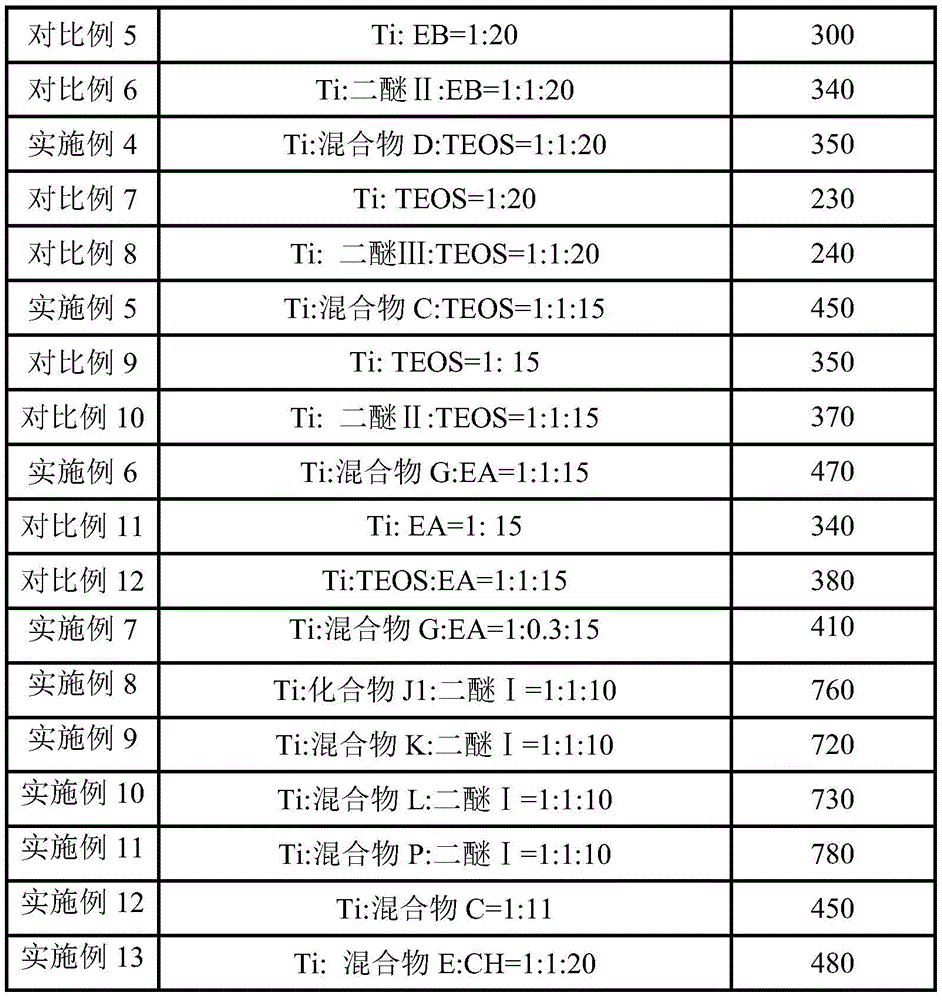
As can be seen from the data in table 1:
1. the catalyst system of the invention can increase the molecular weight of the polymerized powder in the polymerization reaction by adding the column arene and the derivative thereof as the external electron donor, compared with the catalyst system without adding the external electron donor;
2. column aromatics and their derivatives can be added to the catalyst system as built-up external electron donors with other compounds (the listed compounds serve only an exemplary purpose, such as ethyl acetate, ethyl benzoate, phthal-methyl ether, 2-dimethyl-1, 3-diethoxypropane, 2-dimethyl-1, 3-dimethoxypropane and cyclohexanone). Compared with external electron donors without using column arene and its derivatives, the compound external electron donor can obviously improve the molecular weight of the polymerized powder in polymerization reaction.
It should be noted that the above-described embodiments are only for explaining the present invention and do not constitute any limitation of the present invention. The invention has been described with reference to exemplary embodiments, but it is understood that the words which have been used are words of description and illustration, rather than words of limitation. Modifications may be made to the invention as defined in the appended claims, and the invention may be modified without departing from the scope and spirit of the invention. Although the invention is described herein with reference to particular means, materials and embodiments, the invention is not intended to be limited to the particulars disclosed herein, as the invention extends to all other means and applications which perform the same function.
Claims (40)
1. The use of a column aromatic compound of formula (I) as an electron donor in a catalyst system for the polymerization of olefins,

In the formula (I) of the present invention,
the middle bracket part represents the base unit, where M 1 、M 2 、M 3 、M 4 Identical or different, each independently selected from hydrogen, hydroxy, amino, -CHO, -R 3 CHO、-C(O)OH、- R 3 C(O)OH、-C(O)OR 4 、-R 3 C(O)OR 4 、-OR 4 、-R 3 OR 4 C, with or without substituents, halogen atoms 1 -C 10 Alkyl, wherein R is 3 Is C with or without substituents 1 -C 6 Alkylene group, R 4 Is C with or without substituents 1 -C 6 Alkyl groups, said substituents being selected from the group consisting of hydroxy, amino, -CHO, -C (O) OH, halogen atoms, C 1 -C 6 Alkyl, C 1 -C 6 An alkoxy group; r is R 1 And R is 2 Identical or different, each independently selected from hydrogen, hydroxy, halogen, C with or without substituents 1 -C 10 Alkyl and C with or without substituents 1 -C 10 An alkoxy group;
n represents the number of basic units and is an integer of 3-20;
when adjacent groups within a base unit or adjacent basesThe adjacent groups between the units being-C (O) OR 4 、-R 3 C(O)OR 4 、-OR 4 、-R 3 OR 4 C with or without substituents 1 -C 10 In the case of alkyl groups, two adjacent groups are optionally linked to each other to form a cyclic structure.
2. Use according to claim 1, characterized in that the aromatic hydrocarbon compound of formula (I) is used as external electron donor in a catalyst system for the polymerization of olefins.
3. A catalyst system for the polymerization of olefins comprising the following components or the reaction product of the following components:
1) A solid catalyst component comprising elemental magnesium, elemental titanium, a halogen, and optionally an internal electron donor;
2) A cocatalyst component selected from organoaluminum compounds;
3) An external electron donor comprising a compound selected from the group consisting of aromatic hydrocarbon compounds represented by formula (I),
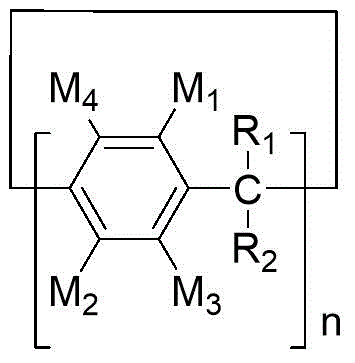
In the formula (I) of the present invention,
the middle bracket part represents the base unit, where M 1 、M 2 、M 3 、M 4 Identical or different, each independently selected from hydrogen, hydroxy, amino, -CHO, -R 3 CHO、-C(O)OH、- R 3 C(O)OH、-C(O)OR 4 、-R 3 C(O)OR 4 、-OR 4 、-R 3 OR 4 C, with or without substituents, halogen atoms 1 -C 10 Alkyl, wherein R is 3 Is C with or without substituents 1 -C 6 Alkylene group, R 4 Is C with or without substituents 1 -C 6 Alkyl groups, said substituents being selected from the group consisting of hydroxy, amino, -CHO, -C (O) OH, halogen atoms, C 1 -C 6 Alkyl, C 1 -C 6 An alkoxy group; r is R 1 And R is 2 The same or a different one of the above,each independently selected from hydrogen, hydroxy, halogen, C with or without substituents 1 -C 10 Alkyl and C with or without substituents 1 -C 10 An alkoxy group;
n represents the number of basic units and is an integer of 3-20;
when the adjacent groups in the base units OR between adjacent base units are-C (O) OR 4 、-R 3 C(O)OR 4 、-OR 4 、-R 3 OR 4 C with or without substituents 1 -C 10 In the case of alkyl groups, two adjacent groups are optionally linked to each other to form a cyclic structure.
4. A catalyst system according to claim 3, wherein in formula (I), M 1 、M 2 、M 3 And M 4 The same or different are each independently selected from hydrogen, hydroxy, amino, -CHO, fluoro, chloro, bromo, iodo, C 1 -C 10 C substituted by alkyl or halogen atoms 1 -C 10 Alkyl, C 1 -C 10 Alkoxy and halogen atom substituted C 1 -C 10 An alkoxy group; r is R 1 And R is 2 Identical or different, each independently selected from hydrogen, C with or without substituents 1 -C 10 Alkyl and C with or without substituents 1 -C 10 An alkoxy group; n is an integer of 4 to 10.
5. The catalyst system of claim 4, wherein in formula (I), M 1 、M 2 、M 3 And M 4 The same or different are each independently selected from hydrogen, hydroxy, amino, -CHO, fluoro, chloro, bromo, iodo, C 1 -C 6 Alkoxy and halogen atom substituted C 1 -C 6 An alkoxy group; r is R 1 And R is 2 Identical or different, each independently selected from hydrogen, C with or without substituents 1 -C 6 Alkyl and C with or without substituents 1 -C 6 An alkoxy group; n is an integer of 4 to 7.
6. The catalyst system of claim 5, wherein in formula (I), M 1 And M 2 Identical or different, each independently selected from C 1 -C 6 An alkoxy group.
7. The catalyst system of any one of claims 3-6, wherein the aromatic hydrocarbon compound of formula (I) is selected from one or more of the following compounds:
Compound A1: m is M 1 =M 2 =OCH 3 ,M 3 =M 4 =H,R 1 =R 2 =H,n=5;
Compound A2: m is M 1 =M 2 =OCH 3 ,M 3 =M 4 =H,R 1 =R 2 =H,n=6;
Compound A3: m is M 1 =M 2 =OCH 3 ,M 3 =M 4 =H,R 1 =R 2 =H,n=7;
Compound B1: m is M 1 =M 2 =OCH 2 CH 3 ,M 3 =M 4 =H,R 1 =R 2 =H,n=5;
Compound B2: m is M 1 =M 2 =OCH 2 CH 3 ,M 3 =M 4 =H,R 1 =R 2 =H,n=6;
Compound B3: m is M 1 =M 2 =OCH 2 CH 3 ,M 3 =M 4 =H,R 1 =R 2 =H,n=7;
Compound C1: m is M 1 =M 2 =OCH 2 CH 2 CH 3 ,M 3 =M 4 =H,R 1 =R 2 =H,n=5;
Compound C2: m is M 1 =M 2 =OCH 2 CH 2 CH 3 ,M 3 =M 4 =H,R 1 =R 2 =H,n=6;
Compound C3: m is M 1 =M 2 =OCH 2 CH 2 CH 3 ,M 3 =M 4 =H,R 1 =R 2 =H,n=7;
Compound D1: m is M 1 =M 2 =OCH(CH 3 ) 2 ,M 3 =M 4 =H,R 1 =R 2 =H,n=5;
Compound D2: m is M 1 =M 2 =OCH(CH 3 ) 2 ,M 3 =M 4 =H,R 1 =R 2 =H,n=6;
Compound D3: m is M 1 =M 2 =OCH(CH 3 ) 2 ,M 3 =M 4 =H,R 1 =R 2 =H,n=7;
Compound E1: m is M 1 =M 2 =OCH 2 CH 2 CH 2 CH 3 ,M 3 =M 4 =H,R 1 =R 2 =H,n=5;
Compound E2: m is M 1 =M 2 =OCH 2 CH 2 CH 2 CH 3 ,M 3 =M 4 =H,R 1 =R 2 =H,n=6;
Compound E3: m is M 1 =M 2 =OCH 2 CH 2 CH 2 CH 3 ,M 3 =M 4 =H,R 1 =R 2 =H,n=7;
Compound F1: m is M 1 =OCH 3 ;M 2 =OCH 2 CH 3 ,M 3 =M 4 =H,R 1 =R 2 =H,n=5;
Compound F2: m is M 1 =OCH 3 ;M 2 =OCH 2 CH 3 ,M 3 =M 4 =H,R 1 =R 2 =H,n=6;
Compound F3: m is M 1 =OCH 3 ;M 2 =OCH 2 CH 3 ,M 3 =M 4 =H,R 1 =R 2 =H,n=7;
Compound G1: m is M 1 =OCH 3 ;M 2 =OCH 2 CH 2 CH 3 ,M 3 =M 4 =H,R 1 =R 2 =H,n=5;
Compound G2: m is M 1 =OCH 3 ;M 2 =OCH 2 CH 2 CH 3 ,M 3 =M 4 =H,R 1 =R 2 =H,n=6;
Compound G3: m is M 1 =OCH 3 ;M 2 =OCH 2 CH 2 CH 3 ,M 3 =M 4 =H,R 1 =R 2 =H,n=7;
Compound H1: m is M 1 =OCH 3 ;M 2 =OCH 2 CH 2 CH 2 CH 3 ,M 3 =M 4 =H,R 1 =R 2 =H,n=5;
Compound H2: m is M 1 =OCH 3 ;M 2 =OCH 2 CH 2 CH 2 CH 3 ,M 3 =M 4 =H,R 1 =R 2 =H,n=6;
Compound H3: m is M 1 =OCH 3 ;M 2 =OCH 2 CH 2 CH 2 CH 3 ,M 3 =M 4 =H,R 1 =R 2 =H,n=7;
Compound I1: m is M 1 =M 2 =OH,M 3 =M 4 =H,R 1 =R 2 =H,n=5;
Compound I2: m is M 1 =M 2 =OH,M 3 =M 4 =H,R 1 =R 2 =H,n=6;
Compound I3: m is M 1 =M 2 =OH,M 3 =M 4 =H,R 1 =R 2 =H,n=7;
Compound J1: m is M 1 =OCH 3 ,M 2 =OH,M 3 =M 4 =H,R 1 =R 2 =H,n=5;
Compound J2: m is M 1 =OCH 3 ,M 2 =OH,M 3 =M 4 =H,R 1 =R 2 =H,n=6;
Compound J3: m is M 1 =OCH 3 ,M 2 =OH,M 3 =M 4 =H,R 1 =R 2 =H,n=7;
Compound K1: m is M 1 =M 2 =OCH 3 ,M 3 =M 4 =NH 2 ,R 1 =R 2 =H,n=5;
Compound K2: m is M 1 =M 2 =OCH 3 ,M 3 =M 4 =NH 2 ,R 1 =R 2 =H,n=6;
Compound K3: m is M 1 =M 2 =OCH 3 ,M 3 =M 4 =NH 2 ,R 1 =R 2 =H,n=7;
Compound L1: m is M 1 =M 2 =OCH 3 ,M 3 =M 4 =Cl,R 1 =R 2 =H,n=5;
Compound L2: m is M 1 =M 2 =OCH 3 ,M 3 =M 4 =Cl,R 1 =R 2 =H,n=6;
Compound L3: m is M 1 =M 2 =OCH 3 ,M 3 =M 4 =Cl,R 1 =R 2 =H,n=7;
Compound M1: m is M 1 =M 2 =OCH 3 ,M 3 =M 4 =Br,R 1 =R 2 =CH 3 ,n=5;
Compound M2: m is M 1 =M 2 =OCH 3 ,M 3 =M 4 =Br,R 1 =R 2 =CH 3 ,n=6;
Compound M3: m is M 1 =M 2 =OCH 3 ,M 3 =M 4 =Br,R 1 =R 2 =CH 3 ,n=7;
Compound N1: m is M 1 =M 2 =OCH 3 ,M 3 =M 4 =I,R 1 =R 2 =H,n=5;
Compound N2: m is M 1 =M 2 =OCH 3 ,M 3 =M 4 =I,R 1 =R 2 =H,n=6;
Compound N3: m is M 1 =M 2 =OCH 3 ,M 3 =M 4 =I,R 1 =R 2 =H,n=7;
Compound O1: m is M 1 =OCH 3 ,M 2 =CHO,M 3 =M 4 =H,R 1 =R 2 =H,n=5;
Compound O2: m is M 1 =OCH 3 ,M 2 =CHO,M 3 =M 4 =H,R 1 =R 2 =H,n=6;
Compound O3: m is M 1 =OCH 3 ,M 2 =CHO,M 3 =M 4 =H,R 1 =R 2 =H,n=7;
Compound P1: m is M 1 =OCH 3 ;M 2 =OCH 2 CH 2 CH 2 Br,M 3 =M 4 =H,R 1 =R 2 =H,n=5;
Compound P2: m is M 1 =OCH 3 ;M 2 =OCH 2 CH 2 CH 2 Br,M 3 =M 4 =H,R 1 =R 2 =H,n=6;
Compound P3: m is M 1 =OCH 3 ;M 2 =OCH 2 CH 2 CH 2 Br,M 3 =M 4 =H,R 1 =R 2 =H,n=7;
Compound Q1: m is M 1 =M 3 =OCH 3 ,M 2 =M 4 =OCH 3 ,R 1 =R 2 =H,n=5;
Compound Q2: m is M 1 =M 3 =OCH 3 ,M 2 =M 4 =OCH 3 ,R 1 =R 2 =H,n=6;
Compound Q3: m is M 1 =M 3 =OCH 3 ,M 2 =M 4 =OCH 3 ,R 1 =R 2 =H,n=7;
Compound R1: m is M 1 =OCH 2 CH 3 ;M 2 =OCH 2 CH 2 CH 3 ,M 3 =M 4 =H,R 1 =R 2 =OCH 3 ,n=5;
Compound R2: m is M 1 =OCH 2 CH 3 ;M 2 =OCH 2 CH 2 CH 3 ,M 3 =M 4 =H,R 1 =R 2 =OCH 3 ,n=6;
Compound R3: m is M 1 =OCH 2 CH 3 ;M 2 =OCH 2 CH 2 CH 3 ,M 3 =M 4 =H,R 1 =R 2 =OCH 3 ,n=7。
8. The catalyst system of any of claims 3-6, wherein the external electron donor further comprises an additional external electron donor.
9. The catalyst system of claim 8, wherein the other external electron donor is selected from one or more of organosilicon compounds, ester compounds, ether compounds, and ketone compounds.
10. The catalyst system of claim 9 wherein the organosilicon compound has the formula (II),
R 5x R 6y Si(OR 7 ) z the compound of formula (II),
in the formula (II), R 5 And R is 6 Each is selected from C 1 -C 10 Hydrocarbyl or halogen, R 7 Is C 1 -C 10 The alkyl, x, y and z are positive integers, and x is more than or equal to 0 and less than or equal to 2, y is more than or equal to 0 and less than or equal to 2, z is more than or equal to 0 and less than or equal to 4, and x+y+z=4.
11. The catalyst system of claim 9, wherein the ester compound has a general formula shown in formula (III),
R 8 COOR 9 formula (III),
in the formula (III), R 8 Is C 1 -C 10 Straight-chain hydrocarbon group, C 3 -C 10 Branched hydrocarbon radicals, C 3 -C 10 Cyclic hydrocarbon radicals, R 9 Is C 1 -C 10 Straight-chain hydrocarbon radicals or C 3 -C 10 Branched hydrocarbon groups.
12. The catalyst according to claim 11A catalyst system characterized in that in formula (III), C 3 -C 10 Cyclic hydrocarbon radicals selected from C 6 -C 10 Aromatic hydrocarbon groups.
13. The catalyst system of claim 9, wherein the ether compound is selected from the group consisting of 1, 3-diether compounds and 1, 2-diether compounds, wherein the 1, 3-diether compounds have a structural formula shown in formula (IV),
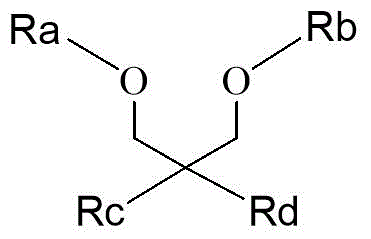
in the formula (IV), R a And R is b Identical or different, each independently selected from C 1 -C 6 Alkyl, R c And R is d Identical or different, each independently selected from H, C 1 -C 6 And the 1, 2-diether compound is selected from one or more of o-phthalether, o-phthalether and 1-ethoxy-2-methoxybenzene.
14. The catalyst system of claim 13, wherein in formula (IV), R a And R is b Identical or different, each independently selected from methyl or ethyl, R c And R is d The same or different are each independently selected from H or methyl.
15. The catalyst system of claim 9, wherein the ketone compound has a general formula shown in formula (V),
R 10 COR 11 (V),
in the formula (V), R 10 Is C 1 -C 10 Straight-chain hydrocarbon group, C 3 -C 10 Branched hydrocarbon radicals, C 3 -C 10 Cyclic hydrocarbon radicals, R 11 Is C 1 -C 10 Straight-chain hydrocarbon radicals or C 3 -C 10 Branched hydrocarbon group, and R 10 And R is 11 Optionally interconnected to form a cyclic structure.
16. The catalyst system of claim 15 wherein in formula (V), C 3 -C 10 Cyclic hydrocarbon radicals selected from C 6 -C 10 Aromatic hydrocarbon groups.
17. The catalyst system of claim 8, wherein the molar ratio of the aromatic hydrocarbon compound of formula (I) to the other external electron donor is from 1:100 to 100:1.
18. The catalyst system of claim 17, wherein the molar ratio of the aromatic hydrocarbon compound of formula (I) to the other external donor is from 1:50 to 50:1.
19. The catalyst system of claim 18, wherein the molar ratio of the aromatic hydrocarbon compound of formula (I) to the other external donor is from 1:20 to 20:1.
20. The catalyst system of any of claims 3-6, wherein the molar ratio of titanium element in the solid catalyst component to the external electron donor is (0.01-100): 1.
21. The catalyst system of claim 20, wherein the molar ratio of titanium element to the external electron donor in the solid catalyst component is (0.05-50): 1.
22. The catalyst system according to any one of claims 3 to 6, wherein the internal electron donor is selected from one or more of a column aromatic compound, an organic alcohol compound, an organic acid ester compound, an organic acid halide compound, an organic acid anhydride compound, an ether compound, a ketone compound, an amine compound, a phosphate compound, an amide compound, a carbonate compound, a phenol compound, a pyridine compound, and a polymer compound having a polar group, which are represented by the formula (I).
23. The catalyst system of claim 22, wherein the internal electron donor is one or more of a column aromatic compound, an organic alcohol compound, and a phosphate compound represented by the formula (I).
24. The catalyst system of any one of claims 3-6, wherein the internal electron donor is used in an amount of 0.001 to 5 moles per mole of magnesium element in the solid catalyst component.
25. The catalyst system of claim 24, wherein the internal electron donor is used in an amount of 0.01 to 1 mole per mole of magnesium element in the solid catalyst component.
26. The catalyst system of any one of claim 3 to 6,
in the solid catalyst component, the magnesium element is derived from a magnesium-containing compound; and/or
In the solid catalyst component, the titanium element is derived from TiCl 3 、TiCl 4 、TiBr 4 、TiI 4 、Ti(OC 2 H 5 )Cl 3 、Ti(OCH 3 )Cl 3 、Ti(OC 4 H 9 )Cl 3 、Ti(OC 2 H 5 )Br 3 、Ti(OC 2 H 5 ) 2 Cl 2 、Ti(OCH 3 ) 2 Cl 2 、Ti(OCH 3 ) 2 I 2 、Ti(OC 2 H 5 ) 3 Cl、Ti(OCH 3 ) 3 Cl、Ti(OC 2 H 5 ) 3 I、Ti(OC 2 H 5 ) 4 、Ti(OC 3 H 7 ) 4 And Ti (OC) 4 H 9 ) 4 One or more of the following.
27. The catalyst system of claim 26, wherein the catalyst system comprises,
in the solid catalyst component, the magnesium element is derived from magnesium halide; and/or
In the solid catalyst component, the titanium element is derived from TiCl 3 、TiCl 4 、TiBr 4 、Ti(OC 2 H 5 )Cl 3 、Ti(OC 2 H 5 ) 2 Cl 2 And Ti (OC) 2 H 5 ) 3 One or more of Cl.
28. The catalyst system of claim 27, wherein the catalyst system comprises,
the magnesium element in the solid catalyst component is derived from one or more of magnesium dichloride, magnesium dibromide and magnesium diiodide; and/or
In the solid catalyst component, the titanium element is derived from TiCl 4 And/or TiCl 3 。
29. The catalyst system of claim 28, wherein the catalyst system comprises,
in the solid catalyst component, the magnesium element is derived from magnesium dichloride.
30. The catalyst system of any one of claim 3 to 6,
the molar ratio of the magnesium element to the titanium element in the solid catalyst component is (0.1-50): 1.
31. The catalyst system of claim 30, wherein the catalyst system comprises,
the molar ratio of the magnesium element to the titanium element in the solid catalyst component is (1-25): 1.
32. The catalyst system of any one of claims 3-6, wherein the organoaluminum compound comprisesThe general formula of the compound is AlR 1 d X 1 3-d Wherein R is 1 Is hydrogen or C l -C 20 Hydrocarbyl, X 1 Is halogen atom, d is more than 0 and less than or equal to 3.
33. The catalyst system of claim 30, wherein the organoaluminum compound is selected from the group consisting of Al (CH 3 ) 3 、AlCl 1.5 (CH 2 CH 3 ) 1.5 One or two of them.
34. The catalyst system of any of claims 3-6, wherein the molar ratio of elemental aluminum in the organoaluminum compound to elemental titanium in the solid catalyst component is (5-500): 1.
35. The catalyst system of claim 34 wherein the molar ratio of elemental aluminum in the organoaluminum compound to elemental titanium in the solid catalyst component is from (20 to 200): 1.
36. Use of the catalyst system of any one of claims 3-35 in the field of olefin polymerization.
37. Use of the catalyst system of any one of claims 3-35 in the field of ethylene polymerization.
38. A process for the polymerization of olefins comprising: polymerizing olefins in the presence of the catalyst system of any of claims 3-35.
39. The olefin polymerization process of claim 38 wherein the polymerization conditions comprise: the temperature is 0-150 ℃; the pressure is 0.1MPa-10MPa.
40. The olefin polymerization process of claim 39 wherein said polymerization conditions comprise: the temperature is 60-100 ℃; the pressure is 0.1MPa-5MPa.
Priority Applications (1)
| Application Number | Priority Date | Filing Date | Title |
|---|---|---|---|
| CN202010507249.7A CN113754804B (en) | 2020-06-05 | 2020-06-05 | Catalyst system for olefin polymerization and application thereof |
Applications Claiming Priority (1)
| Application Number | Priority Date | Filing Date | Title |
|---|---|---|---|
| CN202010507249.7A CN113754804B (en) | 2020-06-05 | 2020-06-05 | Catalyst system for olefin polymerization and application thereof |
Publications (2)
| Publication Number | Publication Date |
|---|---|
| CN113754804A CN113754804A (en) | 2021-12-07 |
| CN113754804B true CN113754804B (en) | 2023-05-09 |
Family
ID=78785172
Family Applications (1)
| Application Number | Title | Priority Date | Filing Date |
|---|---|---|---|
| CN202010507249.7A Active CN113754804B (en) | 2020-06-05 | 2020-06-05 | Catalyst system for olefin polymerization and application thereof |
Country Status (1)
| Country | Link |
|---|---|
| CN (1) | CN113754804B (en) |
Family Cites Families (9)
| Publication number | Priority date | Publication date | Assignee | Title |
|---|---|---|---|---|
| FR2769310B1 (en) * | 1997-10-08 | 2000-02-18 | Rhodia Chimie Sa | PROCESS FOR AMIDOALKYLATION OF A PHENOLIC COMPOUND CARRYING AN ELECTRO-DONOR GROUP |
| BR112012033011B1 (en) * | 2010-06-24 | 2020-05-26 | Basell Poliolefine Italia S.R.L. | CATALYST SYSTEM AND PROCESS FOR POLYMERIZING OLEFINS USING SUCH SYSTEM |
| CN102453152B (en) * | 2010-10-25 | 2013-06-05 | 中国石油化工股份有限公司 | Olefin polymerization catalyst system and olefin polymerization method using same |
| CN104109212B (en) * | 2014-06-13 | 2017-11-07 | 北京利和知信科技有限公司 | Solid catalyst component for olefine polymerization and catalyst |
| CN107076739B (en) * | 2014-08-21 | 2018-12-25 | 伊卢米纳剑桥有限公司 | Reversible surface functionalization |
| JP6090804B2 (en) * | 2015-06-15 | 2017-03-08 | ダブリュー・アール・グレース・アンド・カンパニー−コーンW R Grace & Co−Conn | Internal donor for olefin polymerization catalysts |
| CN105622406B (en) * | 2016-02-04 | 2018-06-15 | 广西大学 | Functionalization column [5] aromatic hydrocarbons trimer preparation method and application |
| CN109111539B (en) * | 2017-06-23 | 2021-02-05 | 中国石油化工股份有限公司 | Catalyst component for olefin polymerization and catalyst thereof |
| CN109280101B (en) * | 2017-07-19 | 2021-02-05 | 中国石油化工股份有限公司 | Solid catalyst component and catalyst system for olefin polymerization and olefin polymerization process |
-
2020
- 2020-06-05 CN CN202010507249.7A patent/CN113754804B/en active Active
Also Published As
| Publication number | Publication date |
|---|---|
| CN113754804A (en) | 2021-12-07 |
Similar Documents
| Publication | Publication Date | Title |
|---|---|---|
| CN109280101B (en) | Solid catalyst component and catalyst system for olefin polymerization and olefin polymerization process | |
| CN110016093B (en) | Solid catalyst component and catalyst system for olefin polymerization and olefin polymerization process | |
| CN100513433C (en) | Catalyst components in use for polymerizing ethylene, and catalyst | |
| CN110016094B (en) | Solid catalyst component and catalyst system for olefin polymerization and olefin polymerization process | |
| CN109280110B (en) | Solid catalyst component for olefin polymerization, olefin polymerization catalyst, application thereof and ethylene copolymer | |
| CN113754799B (en) | Solid catalyst component and solid catalyst system comprising same | |
| CN109111539B (en) | Catalyst component for olefin polymerization and catalyst thereof | |
| CN101407561A (en) | Olefin polymerizing catalyst | |
| CN105384854B (en) | A kind of catalytic component for vinyl polymerization, catalyst and preparation method thereof | |
| CN109280104B (en) | Application of cyclotri-veratrum hydrocarbon and derivative thereof in olefin polymerization catalyst | |
| CN102993343B (en) | Catalyst component for ethylene polymerization, and catalyst thereof | |
| CN107344973B (en) | Catalyst component for olefin polymerization, catalyst system and application thereof | |
| CN102453152B (en) | Olefin polymerization catalyst system and olefin polymerization method using same | |
| CN102453133B (en) | Olefin polymeric catalyst system and olefin polymerization method by using catalyst system thereof | |
| CN113754804B (en) | Catalyst system for olefin polymerization and application thereof | |
| CN112661882B (en) | Application of cyclohexene-1,2-dicarboxylic acid ester compound | |
| CN109280106B (en) | Solid catalyst component and catalyst system for olefin polymerization and olefin polymerization process | |
| CN112661883B (en) | Solid catalyst component for preparing polyolefin, catalyst system and application thereof | |
| CN105199024A (en) | Catalyst component for vinyl polymerization, catalyst and preparation method thereof | |
| CN109280109B (en) | Catalyst system for olefin polymerization and application thereof | |
| CN109280111B (en) | Catalyst system for olefin polymerization and application thereof | |
| CN107344976B (en) | Catalyst component for olefin polymerization, catalyst system and application thereof | |
| CN113754801B (en) | Solid catalyst for preparing olefin polymer and solid catalyst system | |
| CN116693727B (en) | Catalyst for olefin polymerization and its application | |
| CN101456924A (en) | Catalyst component for olefin polymerization and catalyst thereof |
Legal Events
| Date | Code | Title | Description |
|---|---|---|---|
| PB01 | Publication | ||
| PB01 | Publication | ||
| SE01 | Entry into force of request for substantive examination | ||
| SE01 | Entry into force of request for substantive examination | ||
| GR01 | Patent grant | ||
| GR01 | Patent grant |