CN113706916B - A wisdom parking management system for parking area - Google Patents
A wisdom parking management system for parking area Download PDFInfo
- Publication number
- CN113706916B CN113706916B CN202011184935.1A CN202011184935A CN113706916B CN 113706916 B CN113706916 B CN 113706916B CN 202011184935 A CN202011184935 A CN 202011184935A CN 113706916 B CN113706916 B CN 113706916B
- Authority
- CN
- China
- Prior art keywords
- parking
- vehicle
- parking space
- parking lot
- entrance
- Prior art date
- Legal status (The legal status is an assumption and is not a legal conclusion. Google has not performed a legal analysis and makes no representation as to the accuracy of the status listed.)
- Active
Links
- 238000007726 management method Methods 0.000 claims abstract description 24
- 238000013461 design Methods 0.000 claims abstract description 8
- 230000009471 action Effects 0.000 claims description 14
- 230000003068 static effect Effects 0.000 claims description 14
- 238000000034 method Methods 0.000 claims description 8
- 238000013459 approach Methods 0.000 claims description 3
- 238000013473 artificial intelligence Methods 0.000 claims description 3
- 238000010801 machine learning Methods 0.000 claims description 3
- 239000011159 matrix material Substances 0.000 claims description 3
- 230000007246 mechanism Effects 0.000 claims description 3
- 230000005855 radiation Effects 0.000 claims description 3
- 230000008569 process Effects 0.000 claims description 2
- 230000006870 function Effects 0.000 description 8
- 238000004364 calculation method Methods 0.000 description 3
- JXASPPWQHFOWPL-UHFFFAOYSA-N Tamarixin Natural products C1=C(O)C(OC)=CC=C1C1=C(OC2C(C(O)C(O)C(CO)O2)O)C(=O)C2=C(O)C=C(O)C=C2O1 JXASPPWQHFOWPL-UHFFFAOYSA-N 0.000 description 2
- 238000009825 accumulation Methods 0.000 description 2
- 238000012937 correction Methods 0.000 description 2
- 230000003993 interaction Effects 0.000 description 2
- 238000012986 modification Methods 0.000 description 2
- 230000004048 modification Effects 0.000 description 2
- 238000012545 processing Methods 0.000 description 2
- 230000009286 beneficial effect Effects 0.000 description 1
- 238000013135 deep learning Methods 0.000 description 1
- 238000010586 diagram Methods 0.000 description 1
- 230000007717 exclusion Effects 0.000 description 1
- 230000002452 interceptive effect Effects 0.000 description 1
- 230000002787 reinforcement Effects 0.000 description 1
- 238000012827 research and development Methods 0.000 description 1
Images

Classifications
-
- G—PHYSICS
- G08—SIGNALLING
- G08G—TRAFFIC CONTROL SYSTEMS
- G08G1/00—Traffic control systems for road vehicles
- G08G1/14—Traffic control systems for road vehicles indicating individual free spaces in parking areas
- G08G1/145—Traffic control systems for road vehicles indicating individual free spaces in parking areas where the indication depends on the parking areas
- G08G1/148—Management of a network of parking areas
-
- G—PHYSICS
- G07—CHECKING-DEVICES
- G07B—TICKET-ISSUING APPARATUS; FARE-REGISTERING APPARATUS; FRANKING APPARATUS
- G07B15/00—Arrangements or apparatus for collecting fares, tolls or entrance fees at one or more control points
- G07B15/02—Arrangements or apparatus for collecting fares, tolls or entrance fees at one or more control points taking into account a variable factor such as distance or time, e.g. for passenger transport, parking systems or car rental systems
-
- G—PHYSICS
- G08—SIGNALLING
- G08G—TRAFFIC CONTROL SYSTEMS
- G08G1/00—Traffic control systems for road vehicles
- G08G1/01—Detecting movement of traffic to be counted or controlled
- G08G1/017—Detecting movement of traffic to be counted or controlled identifying vehicles
-
- G—PHYSICS
- G08—SIGNALLING
- G08G—TRAFFIC CONTROL SYSTEMS
- G08G1/00—Traffic control systems for road vehicles
- G08G1/14—Traffic control systems for road vehicles indicating individual free spaces in parking areas
- G08G1/141—Traffic control systems for road vehicles indicating individual free spaces in parking areas with means giving the indication of available parking spaces
- G08G1/142—Traffic control systems for road vehicles indicating individual free spaces in parking areas with means giving the indication of available parking spaces external to the vehicles
-
- G—PHYSICS
- G08—SIGNALLING
- G08G—TRAFFIC CONTROL SYSTEMS
- G08G1/00—Traffic control systems for road vehicles
- G08G1/14—Traffic control systems for road vehicles indicating individual free spaces in parking areas
- G08G1/149—Traffic control systems for road vehicles indicating individual free spaces in parking areas coupled to means for restricting the access to the parking space, e.g. authorization, access barriers, indicative lights
Landscapes
- Physics & Mathematics (AREA)
- General Physics & Mathematics (AREA)
- Business, Economics & Management (AREA)
- Finance (AREA)
- Engineering & Computer Science (AREA)
- Computer Security & Cryptography (AREA)
- Traffic Control Systems (AREA)
Abstract
The invention discloses an intelligent parking management system for a parking lot, which comprises: the parking space intelligent distribution and vehicle entrance path planning subsystem is used for distributing an appointed parking space for an entrance vehicle and pushing a path plan reaching the appointed parking space; the vehicle entrance guidance subsystem is dispersed at the intersection of the parking lot and used for guiding the traveling direction of a vehicle or a driver; and the parking space management subsystem and the vehicle departure path planning subsystem are used for limiting the path planning for allowing the assigned specified vehicle to stop in the parking space and pushing the specified exit according to the requirements of the driver and passengers. The system realizes one-to-one basic order of the vehicle through quick binding of the vehicle, thereby putting an end to civil dispute of robbing the vehicle, and in addition, the accuracy of the vehicle parking space pushing meeting the requirements of the vehicle owner can be improved through algorithm conditions or a small amount of customer self-selection conditions, so that the parking lot can be better served for the customer, and the design is particularly suitable for the market and scenic spot with a large amount of temporary parking.
Description
The technical field is as follows:
the invention belongs to the technical field of intelligent parking research and development, and particularly relates to an intelligent parking management system for a parking lot.
Background art:
the parking lot management system is a set of network system which is built by a computer, network equipment and lane management equipment and is used for managing vehicle access, traffic flow guidance and parking fee collection in a parking lot. Is a necessary tool for professional parking lot management companies. The system realizes the dynamic and static comprehensive management of vehicle access and vehicle in-and-out through acquiring and recording the vehicle access record and the position in the field. However, the existing parking system is only responsible for the entrance registration and the exit payment of vehicles, the management in the parking lot is almost rare, the news of the owner who sends out the parking lot for contending for the parking space is often seen, the reason is that no one manages in the parking lot, the parking is managed purely by the owner's consciousness, the applicant thinks that it is necessary to establish the order rule in the parking lot by using the technical means, and the applicant searches related documents to find that: the current parking lot management is still in simpler statistics such as vacant or parked cars or road guidance in places such as road signboards, and it is not difficult to understand that the original purpose of the design is to make better use of limited parking resources, but we can find easily by using practice: these designs do not function substantially to establish parking order.
The information disclosed in this background section is only for enhancement of understanding of the general background of the invention and should not be taken as an acknowledgement or any form of suggestion that this information forms the prior art already known to a person skilled in the art.
The invention content is as follows:
the invention aims to provide an intelligent parking management system capable of establishing parking order of a parking lot.
In order to achieve the above object, the present invention provides an intelligent parking management system for a parking lot, which mainly comprises: the parking space intelligent distribution and vehicle entrance path planning subsystem is used for distributing an appointed parking space for an entrance vehicle and pushing a path plan reaching the appointed parking space;
the vehicle entrance guidance subsystem is dispersed at the intersection of the parking lot and used for guiding the traveling direction of a vehicle or a driver;
and the parking space management subsystem and the vehicle departure path planning subsystem are used for limiting the path planning for allowing the assigned specified vehicle to stop in the parking space and pushing the specified exit according to the requirements of the driver and passengers.
The design mainly comprises the steps that an only parking space is pushed and temporarily bound for each entering vehicle, the parking space can be obtained through calculation according to preset rules, meanwhile, a pushing path can guide a driver to reach an appointed area due to the fact that the traffic environment of an indoor parking lot is very simple, and the driver can be guided to reach the appointed area only through a simple schematic diagram.
Preferably, in the above technical solution, the parking space intelligent allocation and vehicle entrance path planning subsystem includes a plurality of parking lot entrance electronic gate machines, a plurality of network devices and servers, a plurality of sensors, and a plurality of image recognition devices;
the parking lot entrance electronic gate machine is used for identifying the license plate number of an approaching vehicle and uploading an identification result and the gate machine number to the server through the network equipment;
the sensor and the image recognition device are used for recognizing the current state of the parking space and the vehicle departure information and uploading the information to the server through the network equipment;
and the server performs data calculation and processing according to the information and the building information of the parking lot, allocates an optimal parking space for each incoming vehicle and plans an optimal path for seeking.
And the plurality of sensors are used for detecting the traffic flow information of each road in the parking lot and the special information such as the vehicle height of the vehicles entering the parking lot and uploading the information to the server through network equipment.
Preferably, in the above technical solution, the solution of determining the specific parking space position by using an artificial intelligence scheme is as follows:
state is established with 6 dimensions The values are represented by sub-states in 6 dimensions, each sub-state being denoted b1 i ,b2 i ,b3 i ,b4 i ,b5 i ,b6 i I.e. by
 Meanwhile, each parking space has a unique number, one vehicle can only select one parking space, and events for selecting different parking spaces are independent of each other, so that the Action is set as an Action and is recorded as A j ,A j = number of each parking space, and then the number is given by setting a judging mechanism
 A below j Scoring, i.e. calculating a numerical value
 Then a Table Q-Table or matrix for State and Action can be obtained;
machine learning can be performed according to the following formula according to each Q-Table, namely, the Q-Table is updated:

wherein alpha is a learning rate gamma is an incentive decay coefficient, and the learning rate gamma is updated by adopting a time difference method;
finally, when Q k ≈Q k+1 Then, obtaining a convergence value of the Q-Table, namely obtaining a parking space matching algorithm of the parking lot;
when the vehicle enters the field, the current state can be found Lower correspondence score
 The highest one action A j (i.e., optimal parking space).
Preferably, in the above technical solution, for 6 dimensions b1 under the State i ,b2 i ,b3 i ,b4 i ,b5 i ,b6 i Respectively represent:
b1 i represents the current status of the parking space, i.e., "empty" or "parked", "empty" =1, "parked" =0;
namely, it is
b2 i The entrance position label of the vehicle owner entering the field is expressed, the approximate direction or preference of the vehicle owner after parking is obtained, and a parking space allocation principle with the entrance belonging to a function area priority is established;
namely that
b3 i Expressing the personalized condition of the vehicle, and establishing a distribution principle of special arrangement of the special vehicle;
namely, it is
Above, b1 i ,b2 i ,b3 i All are directly obtained by sensor feedback data;
b4 i the far and near degree of the parking space and the elevator opening is shown so as to reflect most car owners in actual lifeSelecting the preference of parking spaces and establishing the distribution principle of the nearby elevators, i.e.
b5 i A theoretical value representing the required distance or time from the entrance to the parking space;
b6 i indicating the current parking lot situation, i.e. level of busy level, i.e.
Preferably, in the above technical scheme, in order to obtain b4 i A sub-algorithm logic is given as follows: establishing a plane rectangular coordinate system xy based on a design drawing of a parking lot, and respectively setting the plane rectangular coordinate system xy as an x axis and a y axis according to the directions of two rectangular sides of the parking lot; the position of the elevator on each floor is fixed and unchangeable, so the condition of the Z-axis multi-floor parking lot only needs to be finely adjusted, only one floor of the parking lot is set, and the coordinates of each parking space and each elevator are uniquely determined and are marked as (x, y); the elevator radiates to the periphery in a circular shape, the radiation radius is set to be r, and the elevator must meet the equation:
(x-x 1 ) 2 +(y-y 1 ) 2 =r 2 ,
it is easy to know that the distance from each parking space to the elevator E1 is The distance between the parking space and the elevator entrance can be obtained by comparing the sizes of the s and the r.
Preferably, in the above technical solution, b5 i Nesting a sub-algorithm to judge whether at least one condition can be met, if so, calculating a specific value, and judging the conditions as follows:
congestion is avoided, and congestion conditions are uploaded by a sensor in real time;
the routes are not detoured, and considering the fact that most car owners cannot select the way of detouring to go to parking spots, the direction of the routes is relatively fixed and is reduced from 4 to 2,
namely, it is Or
Or
Preferably, in the above technical solution, for b5 i Nesting one sub-algorithm specifically comprises: dividing each intersection according to the terrain of each parking lot, marking the intersection as nodes, establishing an approaching relation among different nodes, correspondingly deleting node connection of a congested road section or giving a congestion parameter alpha to the congested road section according to the congestion condition fed back by a sensor when calculating a path, finally calculating whether at least one relatively smooth path which does not go around a far road can be used for a vehicle master-slave entrance to drive into a parking space, and if the path exists, calculating the driving cost of the path according to the length of the path, the driving time or other available conditions and outputting an optimal path for the parking space; if not, 0 is output or not.
Preferably, in the above technical solution, b6 i And representing the grade of the busy degree of the current parking lot, judging whether the current parking lot is in a busy state or not by nesting a sub-algorithm, and performing parameter correction for other data in an auxiliary manner. Preferably, in the above technical solution, the scoring mechanism is selected from the group consisting of In addition to the consideration of the completion degree of each dimension for score accumulation, the influence weight of the arranged parking space on the arrangement of the subsequent parking spaces is also considered, and b5 i The dimension includes the plan of the optimal path.
Preferably, in the above technical solution, for b6 i The sub-algorithm of (2) establishes sub-dimensions according to the total parking space size of the parking lot, the numerical ratio of parked vehicles, the hot time period, the vehicle approach frequency and the like, and is explained by adopting a parameter equation: b6 i The = af (x) + bg (x) + ch (x), f (x), g (x), h (x) respectively correspond to the total parking space size of the parking lot and the numerical ratio of the parked vehicles, the hot time period and the vehicle approach frequency, and abc represents the degree of influence;b6 i the specific significance of the algorithm is that if the busy mode is started, the algorithm gives priority to avoiding congestion; if the idle mode is enabled, the algorithm will prioritize the elevator proximity principle more.
Preferably, in the technical scheme, the vehicle entrance guidance subsystem comprises a plurality of off-site parking space guidance signs, a plurality of on-site parking space guidance signs, a plurality of intelligent small-sized printing devices, a plurality of large-sized LED display screens, a plurality of network devices and servers, and an App/applet client;
the off-site parking space guiding indication board is used for helping a vehicle to find a parking lot entrance corresponding to a building function area, and the form of the parking lot entrance guiding indication board can be divided into a static graphic representation or an LED screen; if the LED screen is adopted, the LED screen is also connected to a server through network equipment so as to display the information of the number of the remaining parking spaces in the functional area; the parking place guiding indication board in the parking lot is used for assisting in guiding an approaching vehicle to find a place, and the form can be divided into a static graphic representation or an LED screen, if the static graphic representation is adopted, the parking place guiding indication board only needs to mark, point and guide the positions of each parking area and each specific parking place in the parking lot in the graphic representation; if the LED screen is adopted, the LED screen is connected to a server through network equipment, and the road conditions of the area and the roads in the adjacent area are displayed; the large-scale LED display screen, the intelligent small-sized printing equipment or the App/small program client side are matched with each entrance electronic gate, and the parking space distribution and the path planning calculated by the server are transmitted to the vehicle owner in a large-screen display, printing paper slips or data pushing mode.
Preferably, among the above technical scheme, the parking space management subsystem includes: the system comprises a plurality of small LED display screens, a plurality of electronic ground locks, a plurality of network devices and a server;
each small LED display screen, each electronic ground lock, each sensor and the image recognition device are in a set corresponding to each parking space and are connected with the server through network equipment; the server is used for feeding back the parking space allocation data to the small LED display screen and the electronic ground lock of the parking space through the network equipment; each small LED display screen is used for displaying the current state of the parking space; each electronic ground lock is used for helping to realize the targeted parking of the vehicle, namely, the ground lock is opened when the license plate number and the parking space are successfully corresponding, and the ground lock is closed when the license plate number and the parking space are failed to correspond.
Compared with the prior art, the invention has the following beneficial effects: the optimal parking space is adapted to each vehicle according to rules, one-bit basic order of the vehicle is realized through quick binding of the parking spaces, civil dispute of robbing the parking spaces is avoided, accuracy of meeting requirements of vehicle owners in parking space pushing can be improved through algorithm conditions or a small number of customer self-selection conditions, so that the parking lot can be better served for customers, and the design is particularly suitable for shopping malls and scenic spots with a large number of temporary parking.
Description of the drawings:
fig. 1 is a schematic view of a garage.
The specific implementation mode is as follows:
the following detailed description of specific embodiments of the invention is provided, but it should be understood that the scope of the invention is not limited to the specific embodiments.
Throughout the specification and claims, unless explicitly stated otherwise, the word "comprise", or variations such as "comprises" or "comprising", will be understood to imply the inclusion of a stated element or component but not the exclusion of any other element or component.
An intelligent parking management system for a parking lot, comprising: the parking space intelligent distribution and vehicle entrance path planning subsystem, the vehicle entrance guiding subsystem, the parking space management subsystem and the vehicle exit path planning subsystem.
The parking space intelligent allocation and vehicle entrance path planning subsystem comprises: the system comprises a plurality of parking lot entrance electronic gate machines, a plurality of network devices, a server, a plurality of sensors and a plurality of in-stall image identification devices.
Each parking lot entrance electronic gate is used for identifying the license plate number of an approaching vehicle and uploading an identification result and a gate number (position) to a server through network equipment. The sensor and the image recognition device in each parking space are used for recognizing the current state of the parking space, namely 'vacant' or 'stopped', and the departure information, namely the departure time, and uploading the departure information to the server through the network equipment. A plurality of sensors (geomagnetic sensors, infrared sensors, ultrasonic sensors, image recognition and the like) are used for detecting special information such as traffic flow information of each road in a parking lot and vehicle height of vehicles entering the parking lot and uploading the special information to a server through network equipment. And the server performs data calculation and processing according to the information and the building information of the parking lot, allocates an optimal parking space for each approaching vehicle and plans an optimal path for locating.
The method is solved by adopting an artificial intelligence (machine deep learning) scheme for determining the specific parking space position, and specifically comprises the following steps:
a value-based algorithm, i.e., a Q-learning algorithm, in reinforcement learning (learning) is used. The algorithm can freely explore the problem space, try a large number of choices in the iteration process, and control the final convergence result through the rewarded function, and the result is an expected algorithm for solving the problem.
Q is an Action-utility function (Action-utility function) for evaluating whether an Action (Action, abbreviated as a) is taken in a specific State (State, abbreviated as S).
In this problem, we temporarily set up a State with 6 dimensions (which can be updated according to the user's needs, i.e. the dimension is expanded), which is a vector and is recorded as The values are represented by sub-states in 6 dimensions, each sub-state being denoted b1 i ,b2 i ,b3 i ,b4 i ,b5 i ,b6 i I.e. by
 Simultaneously, because every parking stall has the only serial number, and a car can only select a parking stall, selects the incident mutual independence of different parking stalls, consequentlyWe set this Action as Action, denoted A j ,A j Number of each space, e.g. A 18 And (= 18 th parking space). Then setting up a judging mechanism to
 A below j Scoring, i.e. calculating a numerical value
 Then a Table (or matrix) Q-Table about State and Action can be obtained, taking the Table form as an example, as follows:


machine learning can be performed according to the following formula according to each Q-Table, namely, the Q-Table is updated:

wherein alpha is learning rate gamma is reward decay coefficient, and is updated by adopting a time difference method.
Finally, when Q k ≈Q k+1 And then, obtaining a convergence value of the Q-Table, namely obtaining the parking space matching algorithm of the parking lot. When the vehicle enters the field, the current state can be found out Lower correspondence score
 The highest one action A j (i.e., optimal parking space).
For 6 dimensions b1 at State i ,b2 i ,b3 i ,b4 i ,b5 i ,b6 i Respectively represent:
b1 i represents the current status of the space, i.e. "empty" or "stopped", "empty" =1, "stopped" =0.
Namely, it is
b2 i And indicating the entrance position label of the vehicle owner entering the field, obtaining the approximate direction or preference of the vehicle owner after parking, and establishing a parking space allocation principle of 'entrance belonging to function area priority'.
Namely, it is
b3 i Representing the individuality of the vehicle, a "special vehicle-specific arrangement" assignment rule is established, for example: electric vehicles, shared vehicles, very large and ultra high-profile SUVs and the like.
Namely, it is
Above, b1 i ,b2 i ,b3 i Are all directly obtained from sensor feedback data.
b4 i The system shows the distance between the parking spaces and the elevator opening so as to reflect the preference of most car owners to select the parking spaces in real life and establish the distribution principle of 'elevator is near'.
To obtain b4 i A sub-algorithm is required to be nested, and a logic idea of the sub-algorithm is given:
a plane rectangular coordinate system xy is established based on a design drawing of a parking lot, and is set as an x axis and a y axis respectively according to the directions of two rectangular sides of the parking lot. Considering that the position of the elevator on each floor is fixed in real life, the situation of the z-axis (multi-floor parking lot) only needs to be finely adjusted, and for convenience of description, the parking lot is not provided with only one floor, as shown in figure 1,
the coordinates of each car slot and each elevator are uniquely determined, denoted as (x, y).
Taking elevator E1 as an example, the coordinates thereof are (x) 1 ,y 1 ). The elevator radiates to the periphery in a circular shape, the radiation radius is set to be r, and the elevator must meet the equation:
(x-x 1 ) 2 +(y-y 1 ) 2 =r 2 ;
it is easy to know that the distance from each parking space to the elevator E1 is The distance between the parking space and the elevator entrance can be obtained by comparing the sizes of the s and the r, for convenience of expression in the model, only two options of near or far are assumed, and the parking space can be expanded and subdivided into near, general, far and the like in actual life.
Namely, it is
b5 i The theoretical value of the required distance or time from the entrance to the parking space is represented, whether at least one condition meeting the following conditions exists or not is judged by nesting one sub-algorithm, and if the condition exists, a specific value is calculated. The judgment conditions are as follows:
1. avoiding congestion (congestion situation is uploaded by sensor in real time)
2. Not detour (considering the practical situation, most car owners can not select the way of detour to go to the parking spot, so the direction of the route is relatively fixed, 4 is reduced to 2)
Namely, it is Or
Or
b6 i Indicating the condition (busy degree grade) of the current parking lot, and judging whether the current parking lot is in a busy (peak) state or not by nesting a sub-algorithm, thereby judging whether the current parking lot is in the busy (peak) state or notHis data assists in making parameter corrections.
Namely, it is
For scoring mechanism In addition to the consideration of the completion degree of each dimension for score accumulation, the influence weight on the arrangement of the subsequent parking space after the parking space is arranged is also considered. For example, if congestion is subsequently caused, or the difficulty of matching subsequent parking spaces is increased, a lower score is given.
In b5 i The dimension includes the plan for the optimal path.
The vehicle entry guidance subsystem includes: the system comprises a plurality of off-site parking space guide signs (static graphics or LED screens), a plurality of on-site parking space guide signs (static graphics or LED screens), a plurality of intelligent small-sized printing devices, a plurality of large-sized LED display screens, a plurality of network devices and servers, and App/applet clients.
The off-site parking space guiding indication board is used for helping a vehicle to find a parking lot entrance corresponding to a building functional area, and can be divided into a static graphic representation or an LED screen, if the static graphic representation is adopted, the vehicle only needs to mark, point and guide the position of each entrance of the parking lot corresponding to the building functional area (such as a shopping mall, a hotel, an office building and the like); if the LED screen is adopted, the LED screen is connected to a server through network equipment so as to display the information of the number of the remaining parking spaces in the functional area. The parking place guiding indication board in the parking lot is used for assisting in guiding an approaching vehicle to find a place, and the form can be divided into a static graphic representation or an LED screen, if the static graphic representation is adopted, the parking place guiding indication board only needs to mark, point and guide the positions of each parking area and each specific parking place in the parking lot in the graphic representation; if the LED screen is adopted, the LED screen is connected to a server through network equipment, and the road conditions (congestion or smoothness) of the roads in the area and the adjacent area are displayed. The large-scale LED display screen, the intelligent small-sized printing equipment or the App/small program client side are matched with each entrance electronic gate, and the parking space distribution and the path planning calculated by the server are transmitted to the vehicle owner in a large-screen display, printing paper slips or data pushing mode.
The parking stall management subsystem includes: the system comprises a plurality of small LED display screens, a plurality of electronic ground locks, a plurality of network devices and a server.
Each small LED display screen, each electronic ground lock, each sensor and the image recognition device are in a set corresponding to each parking space and are connected with the server through network equipment. The server is used for feeding back the parking space allocation data to the small LED display screen and the electronic ground lock of the parking space through the network equipment. Each small LED display screen is used for displaying the current state of the parking space (no parking or the number plate of the parked/parked vehicle); each electronic ground lock is used for helping to realize the targeted parking of the vehicle, namely, the ground lock is opened when the license plate number and the parking space are successfully corresponding, and the ground lock is closed when the license plate number and the parking space are failed to correspond.
The vehicle departure and departure path planning subsystem comprises: the system comprises a plurality of outgoing interactive devices, a plurality of parking lot exit electronic gates, a plurality of network devices and a server.
The departure interaction equipment is connected with the server through network equipment and is used for paying, searching and planning a departure path when the vehicle owner leaves the vehicle, and the vehicle owner can manually select an exit with the intention. The server plans an optimal path for departure according to the vehicle owner selection and the current vehicle flow information, feeds the optimal path back to the departure interaction equipment, and transmits the optimal path to the vehicle owner in a printing paper slip or data pushing mode. The parking lot exit electronic gate is used for realizing the function of parking lot payment.
The foregoing description of specific exemplary embodiments of the invention has been presented for the purposes of illustration and description. It is not intended to limit the invention to the precise form disclosed, and obviously many modifications and variations are possible in light of the above teaching. The exemplary embodiments were chosen and described in order to explain certain principles of the invention and its practical application to enable one skilled in the art to make and use various exemplary embodiments of the invention and various alternatives and modifications as are suited to the particular use contemplated. It is intended that the scope of the invention be defined by the claims and their equivalents.
Claims (5)
1. The utility model provides an wisdom parking management system for parking area which characterized in that: the system consists of: the parking space intelligent distribution and vehicle entrance path planning subsystem is used for distributing an appointed parking space for an entrance vehicle and pushing a path plan reaching the appointed parking space;
the vehicle entrance guidance subsystem is dispersed at the intersection of the parking lot and used for guiding the traveling direction of a vehicle or a driver;
the parking space management subsystem and the vehicle departure path planning subsystem are used for limiting the path planning for allowing the assigned specified vehicle to stop in the parking space and pushing the specified exit according to the requirements of the driver and passengers;
adopt artificial intelligence scheme to confirm concrete parking stall position, specifically as follows:
state is established in 6 dimensions, noted Each is represented by a sub-state under 6 dimensions, and each sub-state is respectively marked as b1 i ,b2 i ,b3 i ,b4 i ,b5 i ,b6 i I.e. by
 Therein, with respect to 6 dimensions b1 at State i ,b2 i ,b3 i ,b4 i ,b5 i ,b6 i And represents:
b1 i represents the current status of the parking space, i.e., "empty" or "parked", "empty" =1, "parked" =0; namely that
b2 i Indicating the entry position mark of the vehicle owner entering the parking lot, obtaining the heading or preference of the vehicle owner after parking, and establishing a parking space allocation principle with priority of the functional area to which the entry belongs;
namely, it is
b3 i Expressing the personalized condition of the vehicle, and establishing a distribution principle of special arrangement of the special vehicle;
namely that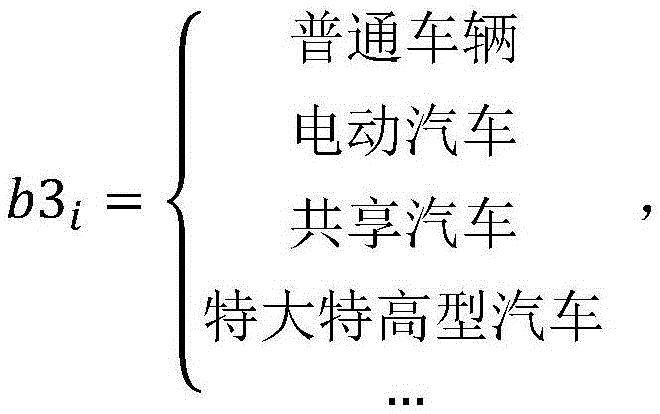
b1 i ,b2 i ,b3 i All are directly obtained by sensor feedback data;
b4 i the method comprises the steps of representing the distance between a parking place and an elevator port, reflecting the preference of most car owners for selecting the parking place in actual life, and establishing an elevator-near allocation principle, namely establishing a plane rectangular coordinate system xy based on a design drawing of a parking lot, and setting the directions of two rectangular sides of the parking lot as an x axis and a y axis respectively; when the parking lot has only one floor, the coordinate of the elevator E1 is recorded as (x) 1 ,y 1 ) The coordinates of the parking spaces are (x, y), the elevator radiates around in a circle, the radiation radius is set to be r, and the distance between each parking space and the elevator E1 is set to be The distance between the parking space and the elevator opening is obtained by comparing the s with the r;
b5 i the theoretical value of the required distance or time when the vehicle moves from the entrance to the parking space is represented, and the theoretical value comprises the planning of the optimal path; b6 i Representing the situation of the current parking lot, namely the busy degree grade, establishing sub-dimensions according to the total parking space size of the parking lot, the numerical ratio of parked vehicles, the hot time period and the vehicle entrance frequency, and calculating whether the current parking lot is in a busy state by adopting the following algorithm: b6 i = af (x) + bg (x) + ch (x), where f (x), g (x), h (x) respectively represent the total parking space size of the parking lot and the numerical ratio of the parked vehicles, the hot time period and the vehicle approach frequency, and a, b, c respectively represent the magnitude of the influence degree of f (x), g (x), h (x); when the busy mode is started, the algorithm gives priority to avoiding congestion, and when the idle mode is started, the algorithm gives priority to the elevator proximity principle;
because each parking space has a unique number, and one vehicle can only select one parking space and selectThe events of different parking spaces are independent of each other, so the Action is set as Action, and is marked as A j ,A j = number of each parking space, setting up judgment mechanism for each parking space A below j Scoring, i.e. calculating a numerical value
 Obtaining a Table Q-Table or matrix related to State and Action;
machine learning can be performed according to each Q-Table according to the following formula, namely updating the Q-Table:

wherein alpha is the learning rate, gamma is the rewarding decay coefficient, and the updating is carried out by adopting a time difference method;
when Q is k ≈Q k+1 Then, obtaining a convergence value of the Q-Table, namely obtaining a parking space matching algorithm of the parking lot;
when the vehicle enters the field, the current state can be found out Lower correspondence score
 The highest one action A j Namely the optimal parking space.
2. The intelligent parking management system for a parking lot according to claim 1, wherein: the parking space intelligent allocation and vehicle entrance path planning subsystem comprises a plurality of parking lot entrance electronic gates, a plurality of network devices, a server, a plurality of sensors and a plurality of image identification devices;
the parking lot entrance electronic gate is used for identifying the license plate number of an incoming vehicle and uploading an identification result and the gate number to a server through network equipment;
the sensors and the image recognition devices in the parking spaces are used for recognizing the current states of the parking spaces and the vehicle departure information and uploading the current states of the parking spaces and the vehicle departure information to the server through the network devices; the server calculates and processes data according to the information and the building information of the parking lot, allocates optimal parking spaces for each incoming vehicle respectively, and plans an optimal path for seeking the parking spaces;
the multiple sensors are used for detecting traffic flow information of each road in the parking lot and vehicle type and vehicle height information of vehicles entering the parking lot and uploading the information to the server through the network equipment.
3. The intelligent parking management system for a parking lot of claim 1, wherein: with respect to scoring mechanisms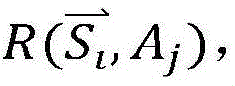 The method not only accumulates scores according to the completion degree of each dimension, but also gives consideration to the weight of the influence on subsequent parking space arrangement after the parking spaces are arranged.
4. The intelligent parking management system for a parking lot of claim 1, wherein: the vehicle entrance guiding subsystem comprises a plurality of off-site parking space guiding indication boards, a plurality of on-site parking space guiding indication boards, a plurality of intelligent small-sized printing devices, a plurality of large-sized LED display screens, a plurality of network devices, a server and an App/small program client;
the off-site parking space guiding sign is used for helping a vehicle to find a parking lot entrance corresponding to a building functional area, and can be divided into a static graphic representation or an LED screen, and when the static graphic representation is adopted, the position of each entrance of the parking lot corresponding to the building functional area is marked, pointed and guided in the graphic representation; when the LED screen is adopted, the LED screen is connected to the server through network equipment, and the information of the number of the remaining parking spaces in the functional area is displayed;
the parking place guiding indication board in the parking lot is used for assisting in guiding an approaching vehicle to find a place, and can be divided into a static graphic representation or an LED screen, and when the static graphic representation is adopted, the parking place guiding indication board marks, points and guides each parking area and the position of a specific parking place in the parking lot in the graphic representation; when the LED screen is adopted, the LED screen is connected to the server through network equipment, and the road conditions of the area and the roads in the adjacent area are displayed;
the large-scale LED display screen, the intelligent small-sized printing equipment or the App/small program client are matched with each entrance electronic gate, and the parking space allocation and the path planning calculated by the server are transmitted to the vehicle owner in a large-screen display, printing paper slips or data pushing mode.
5. The intelligent parking management system for a parking lot of claim 1, wherein: the parking space management subsystem comprises: the system comprises a plurality of small LED display screens, a plurality of electronic ground locks, a plurality of network devices and a server;
each small LED display screen, each electronic ground lock, each sensor and the image recognition device are in a set corresponding to each parking space and are connected with the server through network equipment, and the server feeds parking space distribution data back to the small LED display screens and the electronic ground locks of the parking spaces through the network equipment; each small LED display screen is used for displaying the current state of the parking space; each electronic ground lock is used for helping to achieve targeted parking of the vehicle, namely, the ground lock is opened when the license plate number and the parking space are successfully corresponding, and the ground lock is closed when the license plate number and the parking space are failed to correspond.
Priority Applications (1)
| Application Number | Priority Date | Filing Date | Title |
|---|---|---|---|
| CN202011184935.1A CN113706916B (en) | 2020-10-29 | 2020-10-29 | A wisdom parking management system for parking area |
Applications Claiming Priority (1)
| Application Number | Priority Date | Filing Date | Title |
|---|---|---|---|
| CN202011184935.1A CN113706916B (en) | 2020-10-29 | 2020-10-29 | A wisdom parking management system for parking area |
Publications (2)
| Publication Number | Publication Date |
|---|---|
| CN113706916A CN113706916A (en) | 2021-11-26 |
| CN113706916B true CN113706916B (en) | 2023-01-17 |
Family
ID=78646678
Family Applications (1)
| Application Number | Title | Priority Date | Filing Date |
|---|---|---|---|
| CN202011184935.1A Active CN113706916B (en) | 2020-10-29 | 2020-10-29 | A wisdom parking management system for parking area |
Country Status (1)
| Country | Link |
|---|---|
| CN (1) | CN113706916B (en) |
Families Citing this family (9)
| Publication number | Priority date | Publication date | Assignee | Title |
|---|---|---|---|---|
| CN114882732A (en) * | 2022-05-18 | 2022-08-09 | 合肥观佳智能科技有限公司 | Intelligent parking management system of smart city |
| CN115311888B (en) * | 2022-06-28 | 2023-11-28 | 厦门路桥信息股份有限公司 | Route guiding method, medium and system for avoiding congestion in parking lot |
| CN114922488B (en) * | 2022-07-04 | 2024-06-11 | 陕西迈克高新科技实业集团有限公司 | Automatic control method for intelligent parking garage |
| CN114913708B (en) * | 2022-07-18 | 2022-10-28 | 深圳市华睿智兴信息科技有限公司 | Parking path guiding system and method for intelligent parking lot |
| CN115830905A (en) * | 2022-11-29 | 2023-03-21 | 南通理工学院 | An intelligent parking space guidance system for an underground parking lot |
| CN116386375A (en) * | 2022-12-10 | 2023-07-04 | 深圳艾科智泊科技有限公司 | A method and system for automatic diversion control of super large parking lot |
| CN116434598A (en) * | 2023-03-27 | 2023-07-14 | 安徽多威尔智能科技股份有限公司 | Partition intelligent parking guiding system based on big data and improved ant colony |
| CN118378773B (en) * | 2024-06-21 | 2024-09-03 | 福建海峡区块链信息科技有限公司 | Intelligent building management method and device based on block chain |
| CN119091678A (en) * | 2024-09-12 | 2024-12-06 | 中国第一汽车股份有限公司 | A method, device, equipment, storage medium and product for guiding parking |
Citations (1)
| Publication number | Priority date | Publication date | Assignee | Title |
|---|---|---|---|---|
| CN111402616A (en) * | 2020-02-20 | 2020-07-10 | 西安电子科技大学 | Intelligent parking control method, system, storage medium, computer program and terminal |
Family Cites Families (11)
| Publication number | Priority date | Publication date | Assignee | Title |
|---|---|---|---|---|
| US7293004B1 (en) * | 2004-06-14 | 2007-11-06 | Sun Microsystems, Inc | Method for tuning state-based scheduling policies |
| CN102522002B (en) * | 2011-12-31 | 2013-11-06 | 南京九竹科技实业有限公司 | All-round intelligent guiding system and method for large parking lot |
| US9776512B2 (en) * | 2014-11-10 | 2017-10-03 | Streetsmart Ltd. | Methods, circuits, devices, systems and associated computer executable code for driver decision support |
| CN107967817A (en) * | 2017-11-17 | 2018-04-27 | 张慧 | Intelligent managing system for parking lot and method based on multi-path camera deep learning |
| CN108665728A (en) * | 2018-06-04 | 2018-10-16 | 厦门中卡科技股份有限公司 | Managing system of car parking and its parking space management system, Car license recognition toll collection system |
| CN109895764B (en) * | 2018-06-29 | 2023-06-27 | 华为技术有限公司 | Method and device for determining automatic parking strategy |
| US11938969B2 (en) * | 2018-11-23 | 2024-03-26 | International Business Machines Corporation | Intelligent dynamic parking for autonomous vehicles |
| US11816709B2 (en) * | 2018-12-28 | 2023-11-14 | Pied Parker, Inc. | Image-based parking recognition and navigation |
| CN109741626B (en) * | 2019-02-24 | 2023-09-29 | 苏州科技大学 | Parking situation prediction method, scheduling method and system for parking lot |
| US11301948B2 (en) * | 2019-04-01 | 2022-04-12 | International Business Machines Corporation | Parking continuity with unused duration between automated vehicles |
| CN111126598B (en) * | 2019-12-19 | 2023-08-01 | 深圳南方德尔汽车电子有限公司 | Automatic parking method, automatic parking device, computer equipment and storage medium |
-
2020
- 2020-10-29 CN CN202011184935.1A patent/CN113706916B/en active Active
Patent Citations (1)
| Publication number | Priority date | Publication date | Assignee | Title |
|---|---|---|---|---|
| CN111402616A (en) * | 2020-02-20 | 2020-07-10 | 西安电子科技大学 | Intelligent parking control method, system, storage medium, computer program and terminal |
Non-Patent Citations (1)
| Title |
|---|
| 一个基于机器学习的小区停车位智能共享解决方案;王语舟等;《中国信息化》;20200520(第05期);全文 * |
Also Published As
| Publication number | Publication date |
|---|---|
| CN113706916A (en) | 2021-11-26 |
Similar Documents
| Publication | Publication Date | Title |
|---|---|---|
| CN113706916B (en) | A wisdom parking management system for parking area | |
| CN105336210B (en) | A kind of parking stall bootstrap technique of multilayer large-scale intelligent vehicle reservoir region management system | |
| CN107346611B (en) | Obstacle avoidance method and obstacle avoidance system for autonomous driving vehicle | |
| CN102436757B (en) | Parking space guiding and reverse vehicle searching system and method | |
| CN107680403A (en) | Vehicle, which is led, stops method and system | |
| CN105047012B (en) | Intelligent garage guiding and pick-up navigation system and method based on RFID label tag | |
| CN102930740A (en) | Parking lot vacancy navigation device | |
| CN107301789A (en) | A kind of parking stall navigation system and parking stall air navigation aid | |
| Rye et al. | Parking management | |
| CN206021569U (en) | A kind of intelligent parking management system | |
| CN107331200A (en) | A kind of CBD underground garages intelligent parking guiding system, method and device | |
| CN105185149A (en) | Parking lot parking space reservation and navigation system | |
| CN101231763A (en) | A large comprehensive parking lot management system | |
| CN107730975A (en) | Supermarket's stopping guide reverse car seeking and the system and method for the guiding that appears on the scene | |
| TW201732751A (en) | Innovated smart parking assistance system and information system | |
| CN108711307A (en) | Large Underground reverse vehicle-searching system for parking lots | |
| CN111369692A (en) | Intelligent parking system | |
| TW200919228A (en) | Guiding system and method for searching car in parking lot | |
| CN112990759B (en) | Digital twin-based data processing system | |
| Barde et al. | A review of parking management system at SSCET campus | |
| CN106710289A (en) | Parking lot guiding system and parking lot guiding method | |
| CN109031262B (en) | Positioning vehicle searching system and method thereof | |
| CN107886756B (en) | Intelligent guiding method for parking path in yard | |
| CN114093194A (en) | Indoor induced parking method for tire positioning | |
| CN117012052A (en) | A method and device based on discrete sequential parking space allocation and vehicle guidance |
Legal Events
| Date | Code | Title | Description |
|---|---|---|---|
| PB01 | Publication | ||
| PB01 | Publication | ||
| SE01 | Entry into force of request for substantive examination | ||
| SE01 | Entry into force of request for substantive examination | ||
| GR01 | Patent grant | ||
| GR01 | Patent grant | ||
| TR01 | Transfer of patent right | ||
| TR01 | Transfer of patent right |
Effective date of registration: 20240603 Address after: 210000, Building 3, Xida Yingbi, Xuanwu District, Nanjing City, Jiangsu Province Patentee after: Dong Wenbing Country or region after: China Address before: 210000 room 404, building 1, Ruixin Lanting, No. 3, Babao East Street, Jiefang South Road, Qinhuai District, Nanjing, Jiangsu Province Patentee before: Dong Xiaotian Country or region before: China |