CN113671156B - Method for quantifying contribution rate of soil available nitrogen to crop nitrogen nutrition - Google Patents
Method for quantifying contribution rate of soil available nitrogen to crop nitrogen nutrition Download PDFInfo
- Publication number
- CN113671156B CN113671156B CN202110983392.8A CN202110983392A CN113671156B CN 113671156 B CN113671156 B CN 113671156B CN 202110983392 A CN202110983392 A CN 202110983392A CN 113671156 B CN113671156 B CN 113671156B
- Authority
- CN
- China
- Prior art keywords
- nitrogen
- soil
- crop
- crops
- marking
- Prior art date
- Legal status (The legal status is an assumption and is not a legal conclusion. Google has not performed a legal analysis and makes no representation as to the accuracy of the status listed.)
- Active
Links
- IJGRMHOSHXDMSA-UHFFFAOYSA-N Atomic nitrogen Chemical compound N#N IJGRMHOSHXDMSA-UHFFFAOYSA-N 0.000 title claims abstract description 432
- 229910052757 nitrogen Inorganic materials 0.000 title claims abstract description 216
- 239000002689 soil Substances 0.000 title claims abstract description 167
- 235000016709 nutrition Nutrition 0.000 title claims abstract description 35
- 230000035764 nutrition Effects 0.000 title claims abstract description 35
- 238000000034 method Methods 0.000 title claims abstract description 24
- 238000010521 absorption reaction Methods 0.000 claims abstract description 27
- 241000209140 Triticum Species 0.000 claims description 21
- 235000021307 Triticum Nutrition 0.000 claims description 21
- 240000008042 Zea mays Species 0.000 claims description 21
- 235000002017 Zea mays subsp mays Nutrition 0.000 claims description 21
- 235000005824 Zea mays ssp. parviglumis Nutrition 0.000 claims description 19
- 235000005822 corn Nutrition 0.000 claims description 19
- 235000015097 nutrients Nutrition 0.000 claims description 9
- 230000004720 fertilization Effects 0.000 claims description 3
- 229920000742 Cotton Polymers 0.000 claims description 2
- 244000068988 Glycine max Species 0.000 claims description 2
- 235000010469 Glycine max Nutrition 0.000 claims description 2
- 244000299507 Gossypium hirsutum Species 0.000 claims description 2
- 244000062793 Sorghum vulgare Species 0.000 claims description 2
- 235000019713 millet Nutrition 0.000 claims description 2
- 239000003337 fertilizer Substances 0.000 abstract description 6
- 230000008859 change Effects 0.000 abstract description 3
- 238000012272 crop production Methods 0.000 abstract description 3
- 238000011065 in-situ storage Methods 0.000 abstract description 2
- 238000009406 nutrient management Methods 0.000 abstract description 2
- 230000001276 controlling effect Effects 0.000 abstract 1
- 230000001105 regulatory effect Effects 0.000 abstract 1
- 239000000618 nitrogen fertilizer Substances 0.000 description 7
- 238000005553 drilling Methods 0.000 description 6
- QJGQUHMNIGDVPM-OUBTZVSYSA-N nitrogen-15 Chemical compound [15N] QJGQUHMNIGDVPM-OUBTZVSYSA-N 0.000 description 6
- 238000002347 injection Methods 0.000 description 5
- 239000007924 injection Substances 0.000 description 5
- 238000011160 research Methods 0.000 description 5
- 238000004364 calculation method Methods 0.000 description 4
- 238000010586 diagram Methods 0.000 description 3
- 238000003973 irrigation Methods 0.000 description 3
- 230000002262 irrigation Effects 0.000 description 3
- 235000016383 Zea mays subsp huehuetenangensis Nutrition 0.000 description 2
- MMDJDBSEMBIJBB-UHFFFAOYSA-N [O-][N+]([O-])=O.[O-][N+]([O-])=O.[O-][N+]([O-])=O.[NH6+3] Chemical compound [O-][N+]([O-])=O.[O-][N+]([O-])=O.[O-][N+]([O-])=O.[NH6+3] MMDJDBSEMBIJBB-UHFFFAOYSA-N 0.000 description 2
- XKMRRTOUMJRJIA-UHFFFAOYSA-N ammonia nh3 Chemical compound N.N XKMRRTOUMJRJIA-UHFFFAOYSA-N 0.000 description 2
- 238000003967 crop rotation Methods 0.000 description 2
- 238000011156 evaluation Methods 0.000 description 2
- 235000009973 maize Nutrition 0.000 description 2
- 238000005259 measurement Methods 0.000 description 2
- 238000000520 microinjection Methods 0.000 description 2
- 239000010902 straw Substances 0.000 description 2
- 238000012795 verification Methods 0.000 description 2
- 208000003643 Callosities Diseases 0.000 description 1
- 206010020649 Hyperkeratosis Diseases 0.000 description 1
- 235000013339 cereals Nutrition 0.000 description 1
- 230000007547 defect Effects 0.000 description 1
- 230000000694 effects Effects 0.000 description 1
- 238000005516 engineering process Methods 0.000 description 1
- 238000003912 environmental pollution Methods 0.000 description 1
- 238000012986 modification Methods 0.000 description 1
- 230000004048 modification Effects 0.000 description 1
- 238000011002 quantification Methods 0.000 description 1
- 230000009467 reduction Effects 0.000 description 1
- 239000013049 sediment Substances 0.000 description 1
- 239000000243 solution Substances 0.000 description 1
- 238000011410 subtraction method Methods 0.000 description 1
- 239000002699 waste material Substances 0.000 description 1
Images


Classifications
-
- G—PHYSICS
- G01—MEASURING; TESTING
- G01N—INVESTIGATING OR ANALYSING MATERIALS BY DETERMINING THEIR CHEMICAL OR PHYSICAL PROPERTIES
- G01N33/00—Investigating or analysing materials by specific methods not covered by groups G01N1/00 - G01N31/00
- G01N33/24—Earth materials
-
- G—PHYSICS
- G01—MEASURING; TESTING
- G01N—INVESTIGATING OR ANALYSING MATERIALS BY DETERMINING THEIR CHEMICAL OR PHYSICAL PROPERTIES
- G01N33/00—Investigating or analysing materials by specific methods not covered by groups G01N1/00 - G01N31/00
- G01N33/24—Earth materials
- G01N33/243—Earth materials for determining biological parameters concerning composting, biodegradability or bioavailability
-
- G—PHYSICS
- G01—MEASURING; TESTING
- G01N—INVESTIGATING OR ANALYSING MATERIALS BY DETERMINING THEIR CHEMICAL OR PHYSICAL PROPERTIES
- G01N33/00—Investigating or analysing materials by specific methods not covered by groups G01N1/00 - G01N31/00
- G01N33/24—Earth materials
- G01N33/245—Earth materials for agricultural purposes
-
- G—PHYSICS
- G01—MEASURING; TESTING
- G01N—INVESTIGATING OR ANALYSING MATERIALS BY DETERMINING THEIR CHEMICAL OR PHYSICAL PROPERTIES
- G01N33/00—Investigating or analysing materials by specific methods not covered by groups G01N1/00 - G01N31/00
- G01N33/24—Earth materials
- G01N33/248—Earth materials related to manure as a biological product
-
- Y—GENERAL TAGGING OF NEW TECHNOLOGICAL DEVELOPMENTS; GENERAL TAGGING OF CROSS-SECTIONAL TECHNOLOGIES SPANNING OVER SEVERAL SECTIONS OF THE IPC; TECHNICAL SUBJECTS COVERED BY FORMER USPC CROSS-REFERENCE ART COLLECTIONS [XRACs] AND DIGESTS
- Y02—TECHNOLOGIES OR APPLICATIONS FOR MITIGATION OR ADAPTATION AGAINST CLIMATE CHANGE
- Y02P—CLIMATE CHANGE MITIGATION TECHNOLOGIES IN THE PRODUCTION OR PROCESSING OF GOODS
- Y02P60/00—Technologies relating to agriculture, livestock or agroalimentary industries
- Y02P60/20—Reduction of greenhouse gas [GHG] emissions in agriculture, e.g. CO2
- Y02P60/21—Dinitrogen oxide [N2O], e.g. using aquaponics, hydroponics or efficiency measures
Landscapes
- Life Sciences & Earth Sciences (AREA)
- Health & Medical Sciences (AREA)
- Engineering & Computer Science (AREA)
- Chemical & Material Sciences (AREA)
- Food Science & Technology (AREA)
- Analytical Chemistry (AREA)
- Geology (AREA)
- General Life Sciences & Earth Sciences (AREA)
- Environmental & Geological Engineering (AREA)
- Medicinal Chemistry (AREA)
- Physics & Mathematics (AREA)
- Remote Sensing (AREA)
- Biochemistry (AREA)
- General Health & Medical Sciences (AREA)
- General Physics & Mathematics (AREA)
- Immunology (AREA)
- Pathology (AREA)
- Fertilizing (AREA)
Abstract
The invention relates to the technical field of crop production nutrient management, and particularly discloses a method for quantifying contribution rate of available soil nitrogen to crop nitrogen nutrition. The method for quantifying the contribution rate of effective nitrogen in soil to nitrogen nutrition of crops comprises the following steps: a. two kinds of soil with different effective nitrogen contents are created; b. determining the effective nitrogen content of the soil in the crop root areas in the non-nitrogen-applying area and the nitrogen-applying area; c. determining the position of a mark point; d. marking the effective nitrogen of soil at a marking point; e. the crops are planted in the marking unit to calculate the absorption amount of the effective nitrogen of the crops to the soil and the contribution rate of the crops to the nitrogen nutrition. The method for quantifying the contribution rate of the available nitrogen in the soil to the nitrogen nutrition of the crops does not change the initial content of the available nitrogen in the soil, realizes in-situ marking, covers the whole root system distribution area of the crops, can truly reflect the absorption of the root system to the available nitrogen in the soil, is simple and convenient to operate, and has important significance for accurately regulating and controlling the nitrogen nutrition of the crops so as to improve the utilization rate of the fertilizer.
Description
Technical Field
The invention relates to the technical field of crop production nutrient management, in particular to a method for quantifying contribution rate of available soil nitrogen to crop nitrogen nutrition.
Background
Nitrogen is the most nutrient element absorbed by crops as a vital element, and plays a crucial role in the yield and quality of crops. The nitrogen absorbed by crops mainly comes from the following sources: soil nitrogen, applied nitrogen fertilizers (inorganic fertilizers and organic fertilizers), nitrogen in the residues of the previous crops, nitrogen input by irrigation and atmospheric dry-wet settlement and the like. Among them, soil nitrogen and nitrogen fertilizers are the two most important nitrogen sources. Available nitrogen (mainly nitrate nitrogen and ammonium nitrogen) in soil nitrogen is the most main form of crop nitrogen absorption, so that the evaluation of crop absorption of the soil available nitrogen and nitrogen nutrition contribution thereof has very important significance on crop efficient nitrogen nutrition management and nitrogen fertilizer application reduction and synergism.
At present, the quantitative research on the absorption of effective nitrogen crops in soil generally adopts an external source 15 N micro injection technology, namely, a certain amount of the N micro injection 15 The method of directly injecting N-marked nitrate nitrogen or ammonium nitrogen into soil has a plurality of defects: 1. the nitrogen content of the injection soil layer is increased, and the original nitrogen distribution state is changed; 2. the injected nitrogen is distributed in only a few soils around the injection point, and the concentration of the nitrogen is obviously higher than other soils around the injection point, and the imbalance can change the absorption characteristics of crops to the nitrogen in the soil at this level; 3. only the uptake of soil nitrogen at the injection point (injection layer) can be studied, due to the marking 15 N nitrogen cannot cover the entire root zone of a crop, so the effectiveness of a crop on total soil available nitrogen in the root zone cannot be evaluated globally.
Disclosure of Invention
Aiming at the problems of the existing method for quantifying the contribution rate of the available nitrogen in the soil to the nitrogen nutrition of crops, the invention provides a method for quantifying the contribution rate of the available nitrogen in the soil to the nitrogen nutrition of crops.
In order to achieve the purpose of the invention, the embodiment of the invention adopts the following technical scheme:
a method for quantifying the contribution rate of available soil nitrogen to crop nitrogen nutrition, comprising the steps of:
a. dividing a land plot with uniform soil strength into a region, wherein nitrogen is not applied in the region, the rest part of the region is normally applied with nitrogen, and then carrying out crop planting for at least one season on the land plot to obtain a nitrogen-applying-free region and a nitrogen-applying region with obvious difference in effective nitrogen content of soil;
b. dividing the nitrogen-free area and the nitrogen-applying area into 5-10 layers according to the longitudinal depth, wherein the thickness of each layer of soil is L/(5-10), and L is the maximum depth of the root system of the crop; then determining the concentration of available nitrogen in each layer of soil in the nitrogen-non-application area and the nitrogen-application area;
c. dividing a circular marking unit in the nitrogen applying area, wherein 8 marking points are arranged in each marking unit, the 8 marking points are respectively distributed on the diameter which equally divides the marking unit into 8 parts, and the distances from the 8 marking points to the center of the marking unit are respectively r/8, r/4, 3r/8, r/2, 5r/8, 2r/3, 7r/8 and r; wherein r is the radius of the marking unit;
d. taking out the soil from the earth surface to the deepest part of the root system of the crop at the marking point by using a soil drill, discarding the soil, and leaving 8 drill pits in the marking unit; meanwhile, taking out soil from the earth surface to the deepest part of the root system of the crop in a layering way by using the earth drill in the nitrogen-free area, and adding the soil into the taken out soil 15 N-marked effective nitrogen to make the effective nitrogen content of each layer of soil taken out be identical to that of each layer of soil in the corresponding nitrogen application area, and then adding the effective nitrogen 15 Filling each layer of soil marked by N into the drilling pit of the marking unit from bottom to top according to the corresponding position, and completing effective nitrogen marking of the soil in the marking unit;
e. planting crops to be researched in the marking units for completing effective nitrogen marking of the soil, and measuring the dry matter weight, the total nitrogen content and the crop content of the crops in the marking units after the crops to be researched are mature 15 The N abundance; calculating the nitrogen nutrition contribution of the soil available nitrogen to the crops:
the nitrogen nutrition contribution rate of the soil available nitrogen to the crops = the soil available nitrogen crop absorption g/the total crop nitrogen absorption g × 100%;
wherein, the total nitrogen absorption of the crops = the weight of dry matter multiplied by the percentage content of the total nitrogen of the crops;
effective nitrogen uptake in soil = total nitrogen uptake in crop × [ (crop) 15 N abundance-crops 15 N background abundance)/exogenously added available nitrogen 15 N abundance]X (total available nitrogen of soil in one drilled pit/external source added in one drilled pit 15 N marks the total amount of effective nitrogen) × K, K being the ratio of the area of the marking unit to the sum of the cross-sectional areas of the 8 drilled pits.
Compared with the prior art, the method for quantifying the contribution rate of the effective nitrogen in the soil to the nitrogen nutrition of the crops does not change the initial content of the effective nitrogen in the soil, realizes in-situ marking, realizes all coverage and integral evaluation of the root distribution area of the crops, has strong representativeness and simple operation, can accurately adjust the fertilizing amount according to the crop absorption amount of the effective nitrogen in the soil and the nitrogen nutrition contribution rate of the effective nitrogen in the soil in the crop production, has accurate quantification result, avoids resource waste and environmental pollution caused by blind fertilization, and has important significance for improving the fertilizer utilization rate, the crop yield and the quality.
Preferably, in the step b, the nitrogen-non-applying region and the nitrogen-applying region are equally divided into 10 layers according to the longitudinal depth, and the thickness of each layer of soil is L/10.
Preferably, in step c, the radius of the marking unit is 20-40cm.
Preferably, in step c, 3 to 6 marking units can be provided.
Preferably, in step d, the inner diameter of the earth auger is 4-6cm.
Preferably, the distance between the marking unit and the nitrogen-free region is more than or equal to 200cm.
Preferably, in step e, the crops to be studied comprise winter wheat, summer corn, millet, cotton and soybean.
The invention also provides application of the method for quantifying contribution rate of effective nitrogen in soil to nitrogen nutrition of crops in accurate adjustment of soil fertilization amount.
Drawings
FIG. 1 is a schematic diagram showing the distribution positions of marking points in a marking unit in example 1 of the present invention;
FIG. 2 is a schematic diagram showing the distribution of soil layers in the drilled pits in the marking unit in example 1 of the present invention;
FIG. 3 is a schematic view of winter wheat planted in a marking unit in example 1 of the present invention;
fig. 4 is a schematic diagram of the distribution positions of the marking points in the marking unit and the planting of summer corn in example 2 of the present invention.
Detailed Description
In order to make the objects, technical solutions and advantages of the present invention more apparent, the present invention is further described in detail with reference to the following embodiments. It should be understood that the specific embodiments described herein are merely illustrative of the invention and are not intended to limit the invention.
Example 1
The method for quantifying the contribution rate of the available soil nitrogen to the nitrogen nutrition of the winter wheat comprises the following steps:
a. two kinds of soil with different effective nitrogen contents are created
Dividing a land plot with uniform land capacity into two areas, wherein nitrogen fertilizer is normally applied in the crop planting period of one area, and the annual nitrogen application amount is 400kg/hm 2 The region is denoted by N 400 (ii) a The other area is not applied with nitrogen fertilizer, and the area without nitrogen is recorded as N 0 . Performing crop rotation planting of winter wheat and summer corn in the two areas for one year, and obtaining a nitrogen-free area and a nitrogen-applying area with significant difference in effective nitrogen content after one year; the distance between the non-nitrogen-applying region and the nitrogen-applying region is 200cm;
b. determining the effective nitrogen content of the soil in the root zone of the crops in the non-nitrogen-applying zone and the nitrogen-applying zone
Dividing the nitrogen-free area and the nitrogen-applying area into 10 layers according to the longitudinal depth on average, wherein the thickness of each layer of soil is 20cm (the maximum depth L of the root system of winter wheat in the research area is 200 cm); then, the concentration (mg/kg) of available nitrogen in each layer of soil in the nitrogen-non-application region and the nitrogen-application region was measured and respectively designated as C N400-x 、C N0-x X is the number of soil layers, and the measurement results are shown in table 1;
c. determining mark point position
Dividing a circular marking unit (also called a winter wheat planting unit) with the radius (r) of 30cm in a nitrogen application area, dividing 3 marking units, wherein 8 marking points are arranged in each marking unit, the 8 marking points are respectively distributed on the diameter which equally divides the marking unit into 8 parts, and the distances from the 8 marking points to the center of the circle of the marking unit are respectively r/8, r/4, 3r/8, r/2, 5r/8, 2r/3, 7r/8, r (30/8, 30/4, 90/8, 30/2, 150/8, 60/3, 210/8 and 30) cm; wherein r is the radius of the marking unit; the distribution positions of the 8 marking points are shown in FIG. 1;
d. marking point soil effective nitrogen mark
Taking out the soil between the earth surface and the deepest part (200 cm) of the root system of the crop at the marking point by using a soil drill with the inner diameter of 4cm, discarding the soil, and leaving 8 drill pits in the marking unit; meanwhile, taking out the soil from the earth surface to the deepest part of the root system of the crop in a layering way by using a soil drill with the inner diameter of 4cm in a nitrogen-free area, and adding the soil into the taken-out soil 15 N-marked effective nitrogen to make the effective nitrogen content of each layer of soil taken out be identical to that of each layer of soil in the corresponding nitrogen application area, and then adding the effective nitrogen 15 Filling each layer of soil marked by N into the drilling pits of the marking unit from bottom to top according to the corresponding positions, and completing effective nitrogen marking of the soil in the marking unit; the distribution of the soil layers in the drilling pits corresponding to the 8 marking points is shown in figure 2;
m 15N =m soil for planting ×(C N -C 0 ),m Soil for soil Is the total mass of a layer of soil (in kg, calculated as drilling area x soil thickness x soil volume weight), C N ,C 0 Respectively the soil available nitrogen content of the soil layer, and the unit is mg/kg;
added by compensation in each soil layer 15 The amount of N-labeled available nitrogen is shown in table 1;
TABLE 1 effective nitrogen content and effective nitrogen amount for soil layers in nitrogen-applying area and non-nitrogen-applying area


e. Planting winter wheat in the marking unit to calculate the absorption amount of the winter wheat to the soil effective nitrogen and the nitrogen nutrition contribution rate of the soil effective nitrogen to the winter wheat
After the marking of the effective nitrogen in the soil is finished, uniformly broadcasting and planting the winter wheat in the marking unit (the planting density of the winter wheat is 400 grains/m) 2 ) As shown in fig. 3; after the winter wheat is mature, measuring the dry matter weight, the total nitrogen content and the winter wheat content of the winter wheat in the marking unit 15 N abundance, calculating the nitrogen nutrition contribution of the soil effective nitrogen to the crops, wherein the calculation method comprises the following steps:
the nitrogen nutrition contribution rate of the soil available nitrogen to the crops = the soil available nitrogen crop absorption g/the total crop nitrogen absorption g × 100%;
wherein, the total nitrogen absorption of the crops g = dry matter weight g × total nitrogen content of the crops;
effective nitrogen uptake in soil g = total nitrogen uptake in crops g x [ (crops) 15 N abundance-crops 15 N background abundance)/exogenously added available nitrogen 15 Abundance of N]X (total effective Nitrogen content of soil in one pit/external Source added in one pit) 15 N marks total effective nitrogen) × 28.125, 28.125 being the ratio of the area of the marking cell to the sum of the cross-sectional areas of the 8 drilled pits;
the calculation results are shown in table 2.
TABLE 2 absorption of soil available nitrogen by winter wheat and nitrogen nutrient contribution rate of soil to winter wheat
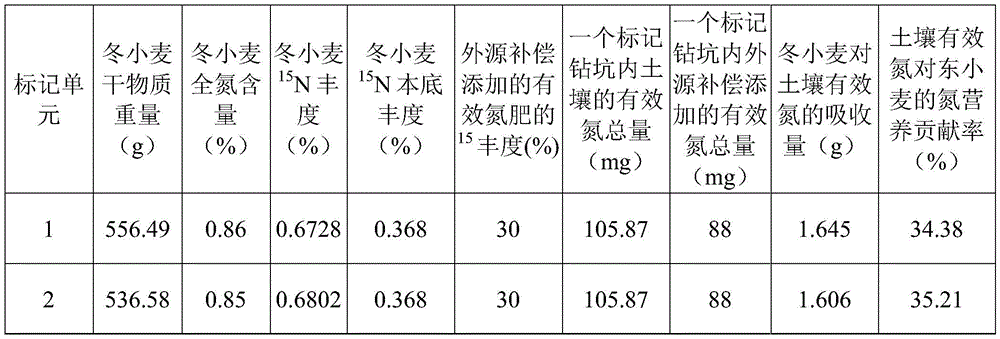

f. Verification of accuracy and reliability of quantitative data
In the research area of the embodiment, in the nitrogen nutrition source of the winter wheat, the nitrogen fertilizer accounts for 21.28-48.23% and the average is 34.56%; the organic mineralized nitrogen accounts for 19.34-29.79% in the growing season, and the average content is 24.78%; the nitrogen content of the preceding stubble returned straws is 7.26 percent on average; the proportion of other nitrogen sources such as input nitrogen for irrigation and settled nitrogen in the atmosphere is 3.22%, the effective nitrogen proportion of the soil is indirectly obtained by using a subtraction method (the proportion of the nitrogen sources is subtracted from 100%) and is 32.18%, the value is basically equivalent to the value of the nitrogen nutrition contribution of the effective nitrogen of the soil to winter wheat, which is 33.89%, and the accuracy of the method for calculating the nitrogen nutrition contribution rate of the effective nitrogen of the soil to winter wheat in the embodiment is further verified.
Example 2
The method for quantifying the contribution rate of the available nitrogen in the soil to the nitrogen nutrition of the summer corn comprises the following steps:
a. two kinds of soil with different effective nitrogen contents are created
Dividing a land plot with uniform land capacity into two areas, wherein nitrogen fertilizer is normally applied in the crop planting period of one area, and the annual nitrogen application amount is 400kg/hm 2 The region is denoted by N 400 (ii) a The other area is not applied with nitrogen fertilizer, and the area without nitrogen is recorded as N 0 . Performing crop rotation planting of winter wheat and summer corn in the two areas for one year, and obtaining a nitrogen-free area and a nitrogen-applying area with significant difference in effective nitrogen content after one year; the distance between the non-nitrogen-applying region and the nitrogen-applying region is 200cm;
b. determining the effective nitrogen content of the soil in the root zone of the crops in the non-nitrogen-applying zone and the nitrogen-applying zone
Dividing the nitrogen-free area and the nitrogen-applying area into 10 layers according to the longitudinal depth on average, wherein the thickness of each layer of soil is 12cm (the maximum depth L of the root system of summer corn in the research area is 120 cm); then, the concentration (mg/kg) of available nitrogen in each layer of soil in the nitrogen-non-application region and the nitrogen-application region was measured and recorded as C N400-x 、C N0-x X is the number of soil layers, and the measurement results are shown in table 3;
c. determining mark point locations
Dividing a circular marking unit (also called a summer corn planting unit) with the radius (r) of 20cm in a nitrogen application area, and dividing 3 marking units, wherein 8 marking points are arranged in each marking unit, the 8 marking points are respectively distributed on the diameter which equally divides the marking unit into 8 parts, and the distances from the 8 marking points to the circle center of the marking unit are respectively r/8, r/4, 3r/8, r/2, 5r/8, 2r/3, 7r/8, r (20/8, 20/4, 60/8, 20/2, 100/8, 40/3, 140/8 and 20) cm; wherein r is the radius of the marking unit; the distribution positions of the 8 marking points are shown in FIG. 4;
d. marking point soil effective nitrogen mark
Taking out the soil from the ground surface to the deepest part (120 cm) of the root system of the summer corn at the marking point by using a soil drill with the inner diameter of 4cm, discarding the soil, and leaving 8 drill pits in the marking unit; meanwhile, in the nitrogen-free area, soil between the ground surface and the depth of 120cm is taken out layer by using a soil drill with the inner diameter of 4cm, and the taken-out soil is added 15 N-marked effective nitrogen to make the effective nitrogen content of each layer of soil taken out be identical to that of each layer of soil in the corresponding nitrogen application area, and then adding the effective nitrogen 15 Filling each layer of soil marked by N into the drilling pit of the marking unit from bottom to top according to the corresponding position, and completing effective nitrogen marking of the soil in the marking unit;
m 15N =m soil for soil ×(C N -C 0 ),m Soil for soil The total mass of a layer of soil (unit is kg, calculated by drilling area, soil thickness and soil volume weight of the soil layer), C N ,C 0 Respectively the soil effective nitrogen content of the soil layer, and the unit is mg/kg;
added by compensation in each soil layer 15 The amount of N-labeled available nitrogen is shown in table 3;
TABLE 3 effective nitrogen content and effective nitrogen amount for soil layers of nitrogen-applying area and non-nitrogen-applying area


e. Planting summer corn in the marking unit to calculate the absorption amount of the summer corn to the soil available nitrogen and the nitrogen nutrition contribution rate of the soil available nitrogen to the summer corn
Soil is provided withPlanting summer corns at the circle center of the marking unit after the nitrogen effect marking is finished, as shown in fig. 4; after the summer corn is ripe, the dry matter weight, the total nitrogen content and the content of the summer corn in the marking unit are measured 15 N abundance, calculating the nitrogen nutrition contribution of the soil effective nitrogen to summer corn, wherein the calculation method comprises the following steps:
the nitrogen nutrition contribution rate of the soil available nitrogen to the crops = the soil available nitrogen crop absorption g/the total crop nitrogen absorption g × 100%;
wherein, the total nitrogen absorption of the crops g = dry matter weight g × total nitrogen content of the crops;
soil available nitrogen crop absorption g = crop total nitrogen absorption g x [ (crop) 15 N abundance-crops 15 N background abundance)/exogenously added available nitrogen 15 N abundance]X (total effective Nitrogen content of soil in one pit/external Source added in one pit) 15 N marks the total amount of effective nitrogen) × 12.5, 12.5 being the ratio of the area of the marking unit to the sum of the cross-sectional areas of the 8 drilled pits;
the calculation results are shown in table 4.
TABLE 4 absorption of available nitrogen from summer maize and nitrogen nutrient contribution rate of summer maize from soil


f. Verification of accuracy and reliability of quantitative data
In the research area of the embodiment, in the nitrogen nutrition source of summer corn, the average proportion of the nitrogen fertilizer is 32.25%; the average proportion of the organic mineralized nitrogen in the growing season is 31.42 percent; the nitrogen content of the preceding stubble returned straws is 3.19 percent on average; the proportion of other nitrogen sources such as irrigation input nitrogen, atmospheric sediment nitrogen and the like is 4.53%, the effective nitrogen proportion of the soil is indirectly obtained by the subtraction (the proportion of the nitrogen sources is subtracted from 100%) and is 28.61%, which is basically equivalent to the value of the nitrogen nutrition contribution of the effective nitrogen of the soil to the summer corn of 30.78%, and the accuracy of the method for calculating the nitrogen nutrition contribution rate of the effective nitrogen of the soil to the summer corn is further verified.
The above description is only for the purpose of illustrating the preferred embodiments of the present invention and is not to be construed as limiting the invention, and any modifications, equivalents or improvements made within the spirit and principle of the present invention should be included in the scope of the present invention.
Claims (7)
1. A method for quantifying contribution rate of available soil nitrogen to crop nitrogen nutrition is characterized by comprising the following steps: the method comprises the following steps:
a. dividing a land plot with uniform soil strength into an area, wherein nitrogen is not applied in the area, the rest part of the area is normally applied with nitrogen, and then planting crops for at least one season on the land plot to obtain a nitrogen-non-application area and a nitrogen-application area with significant difference in effective nitrogen content of soil;
b. dividing the nitrogen-free area and the nitrogen-applying area into 5-10 layers according to the longitudinal depth, wherein the thickness of each layer of soil is L/(5-10), and L is the maximum depth of the root system of the crop; then determining the concentration of available nitrogen in each layer of soil in the nitrogen-non-application area and the nitrogen-application area;
c. dividing a circular marking unit in the nitrogen applying region, wherein 8 marking points are arranged in each marking unit, the 8 marking points are respectively distributed on the diameter which equally divides the marking unit into 8 parts, and the distances from the 8 marking points to the circle center of the marking unit are respectively r/8, r/4, 3r/8, r/2, 5r/8, 2r/3, 7r/8 and r; wherein r is the radius of the marking unit, and the radius of the marking unit is 20-40cm;
d. taking out the soil from the earth surface to the deepest part of the root system of the crop at the marking point by using a soil drill, discarding the soil, and leaving 8 drill pits in the marking unit; simultaneously, taking out soil between the earth surface and the deepest part of a crop root system layer by layer in the nitrogen-free area by using the soil drill, adding 15N marked effective nitrogen into the taken-out soil to enable the effective nitrogen content of each layer of the taken-out soil to be the same as that of each layer of soil in the corresponding nitrogen-applying area, filling each layer of soil added with the 15N mark into the drill pit of the marking unit from bottom to top according to the corresponding position, and finishing soil effective nitrogen marking in the marking unit;
e. planting crops to be researched in the marking unit which finishes effective nitrogen marking of the soil, and measuring the dry matter weight, the total nitrogen content and the 15N abundance of the crops in the marking unit after the crops to be researched are mature; calculating the nitrogen nutrition contribution of the soil available nitrogen to the crops:
the nitrogen nutrition contribution rate of the soil available nitrogen to the crops = the soil available nitrogen crop absorption g/the total crop nitrogen absorption g × 100%;
wherein, the total nitrogen absorption of the crops = the weight of dry matter x the percentage content of the total nitrogen of the crops;
the effective nitrogen crop absorption = total crop nitrogen absorption x [ (crop 15N abundance-crop 15N background abundance)/exogenously added effective nitrogen 15N abundance ] × (total effective nitrogen of soil in one drilled pit/total effective nitrogen marked by exogenously added 15N in one drilled pit) × K, where K is the ratio of the area of the marking unit to the sum of the cross-sectional areas of the 8 drilled pits.
2. The method of quantifying soil available nitrogen nutrient contribution rate to crop nitrogen as claimed in claim 1, wherein: in the step b, the nitrogen-free area and the nitrogen-applying area are evenly divided into 10 layers according to the longitudinal depth, and the thickness of each layer of soil is L/10.
3. The method of quantifying soil available nitrogen nutrient contribution rate to crop nitrogen as claimed in claim 1, wherein: in step c, 3-6 marking units can be set.
4. The method of quantifying soil available nitrogen nutrient contribution rate to crop nitrogen as claimed in claim 1, wherein: in the step d, the inner diameter of the soil drill is 4-6cm.
5. The method of quantifying soil available nitrogen nutrient contribution rate to crop nitrogen as claimed in claim 1, wherein: the distance between the marking unit and the nitrogen-free region is more than or equal to 200cm.
6. The method of quantifying soil available nitrogen nutrient contribution rate to crop nitrogen as claimed in claim 1, wherein: in step e, the crops to be researched comprise winter wheat, summer corn, millet, cotton and soybean.
7. Use of the method of quantifying soil available nitrogen nutrient contribution rate to crop nitrogen as claimed in any of claims 1-6 for the accurate adjustment of the amount of soil fertilization.
Priority Applications (1)
| Application Number | Priority Date | Filing Date | Title |
|---|---|---|---|
| CN202110983392.8A CN113671156B (en) | 2021-08-25 | 2021-08-25 | Method for quantifying contribution rate of soil available nitrogen to crop nitrogen nutrition |
Applications Claiming Priority (1)
| Application Number | Priority Date | Filing Date | Title |
|---|---|---|---|
| CN202110983392.8A CN113671156B (en) | 2021-08-25 | 2021-08-25 | Method for quantifying contribution rate of soil available nitrogen to crop nitrogen nutrition |
Publications (2)
| Publication Number | Publication Date |
|---|---|
| CN113671156A CN113671156A (en) | 2021-11-19 |
| CN113671156B true CN113671156B (en) | 2023-02-03 |
Family
ID=78546288
Family Applications (1)
| Application Number | Title | Priority Date | Filing Date |
|---|---|---|---|
| CN202110983392.8A Active CN113671156B (en) | 2021-08-25 | 2021-08-25 | Method for quantifying contribution rate of soil available nitrogen to crop nitrogen nutrition |
Country Status (1)
| Country | Link |
|---|---|
| CN (1) | CN113671156B (en) |
Families Citing this family (2)
| Publication number | Priority date | Publication date | Assignee | Title |
|---|---|---|---|---|
| CN116087467A (en) * | 2022-12-01 | 2023-05-09 | 南宁师范大学 | Open-air normal position 15 N isotope pairing injection marking method |
| CN118883893A (en) * | 2024-07-11 | 2024-11-01 | 广东省农业科学院设施农业研究所 | A method for evaluating the contribution of plant cadmium absorption based on stable isotopes |
Citations (3)
| Publication number | Priority date | Publication date | Assignee | Title |
|---|---|---|---|---|
| CN104792967A (en) * | 2015-04-13 | 2015-07-22 | 中国水稻研究所 | Method for measuring contribution rate of soil adsorbed amino acid to plant nitrogen nutrition |
| EP2942621A1 (en) * | 2014-05-06 | 2015-11-11 | Polyor SARL | Diagnosis of the diazotrophic state of arable soil and recommendation for the addition of nitrogen fertiliser |
| CN110261532A (en) * | 2019-06-10 | 2019-09-20 | 中国科学院南京土壤研究所 | The method that field on-spot study crop aerial part absorbs volatile nitrogen after the top dressing of farmland |
Family Cites Families (1)
| Publication number | Priority date | Publication date | Assignee | Title |
|---|---|---|---|---|
| DE102011050877B4 (en) * | 2011-03-04 | 2014-05-22 | Technische Universität München | Method for determining the fertilizer requirement, in particular the nitrogen fertilizer requirement and apparatus for carrying out the method |
-
2021
- 2021-08-25 CN CN202110983392.8A patent/CN113671156B/en active Active
Patent Citations (3)
| Publication number | Priority date | Publication date | Assignee | Title |
|---|---|---|---|---|
| EP2942621A1 (en) * | 2014-05-06 | 2015-11-11 | Polyor SARL | Diagnosis of the diazotrophic state of arable soil and recommendation for the addition of nitrogen fertiliser |
| CN104792967A (en) * | 2015-04-13 | 2015-07-22 | 中国水稻研究所 | Method for measuring contribution rate of soil adsorbed amino acid to plant nitrogen nutrition |
| CN110261532A (en) * | 2019-06-10 | 2019-09-20 | 中国科学院南京土壤研究所 | The method that field on-spot study crop aerial part absorbs volatile nitrogen after the top dressing of farmland |
Non-Patent Citations (1)
| Title |
|---|
| 15N同位素在华北冬小麦夏玉米氮营养来源研究中的应用;张经廷等;《同位素》;20190831;第32卷(第4期);299-307 * |
Also Published As
| Publication number | Publication date |
|---|---|
| CN113671156A (en) | 2021-11-19 |
Similar Documents
| Publication | Publication Date | Title |
|---|---|---|
| Spargo et al. | Soil carbon sequestration with continuous no-till management of grain cropping systems in the Virginia coastal plain | |
| Wang | Water use efficiency and optimal supplemental irrigation in a high yield wheat field | |
| Feng et al. | Effects of subsoiling tillage on soil properties, maize root distribution, and grain yield on mollisols of Northeastern China | |
| Yadav | Factor productivity trends in a rice–wheat cropping system under long-term use of chemical fertilizers | |
| Bhattacharyya et al. | Sustainability under combined application of mineral and organic fertilizers in a rainfed soybean–wheat system of the Indian Himalayas | |
| Riley et al. | Nitrogen leaching and soil nitrate, nitrite, and ammonium levels under irrigated wheat in Northern Mexico | |
| Gong et al. | Long-term manuring and fertilization effects on soil organic carbon pools under a wheat–maize cropping system in North China Plain | |
| Röver et al. | Spatial heterogeneity within the plough layer: low and moderate variability of soil properties | |
| Sahin et al. | Water infiltration and soil water content in claypan soils influenced by agroforestry and grass buffers compared to row crop management | |
| Sun et al. | Identifying optimal water and nitrogen inputs for high efficiency and low environment impacts of a greenhouse summer cucumber with a model method | |
| CN113671156B (en) | Method for quantifying contribution rate of soil available nitrogen to crop nitrogen nutrition | |
| Li et al. | Differential fertilizer nitrogen fates in maize cropping system among three soil textures based on 15N | |
| Mai et al. | Simultaneously maximizing root/mycorrhizal growth and phosphorus uptake by cotton plants by optimizing water and phosphorus management | |
| Lyu et al. | No-tillage with total green manure mulching: A strategy to lower N2O emissions | |
| Riley | Residual value of inorganic fertilizer and farmyard manure for crop yields and soil fertility after long-term use on a loam soil in Norway | |
| Li et al. | Reducing N2O emissions while maintaining yield in a wheat–maize rotation system modelled by APSIM | |
| Li et al. | Spatial and temporal distributions of nitrogen and crop yield as affected by nonuniformity of sprinkler fertigation | |
| Farooque et al. | Forecasting potato tuber yield using a soil electromagnetic induction method | |
| Villar et al. | Soil nitrogen dynamics during an oilseed rape (Brassica napus L.) growing cycle in a humid Mediterranean climate | |
| Lombardi et al. | Greenhouse gas emissions from cattle dung depositions in two Urochloa forage fields with contrasting biological nitrification inhibition (BNI) capacity | |
| Ersahin et al. | Estimating potential nitrate leaching in nitrogen fertilized and irrigated tomato using the computer model NLEAP | |
| Qiu et al. | Simulation of the irrigation requirements for improving carbon sequestration in a rainfed cropping system under long-term fertilization on the Loess Plateau of China | |
| Hasanah et al. | Optimizing rice paddies’ lower greenhouse gas emissions and higher yield with SRI management under varying water table levels | |
| Phoeurn et al. | Assessing the feasibility of alternate wetting and drying (AWD) technique for improving water use efficiency in dry-season rice production | |
| Lekomtsev et al. | Maintaining soil fertility by optimizing the use of nitrogen fertilizers in precision farming system |
Legal Events
| Date | Code | Title | Description |
|---|---|---|---|
| PB01 | Publication | ||
| PB01 | Publication | ||
| SE01 | Entry into force of request for substantive examination | ||
| SE01 | Entry into force of request for substantive examination | ||
| GR01 | Patent grant | ||
| GR01 | Patent grant |