CN113596632A - Passive optical network slice dividing method, device and framework - Google Patents
Passive optical network slice dividing method, device and framework Download PDFInfo
- Publication number
- CN113596632A CN113596632A CN202110857020.0A CN202110857020A CN113596632A CN 113596632 A CN113596632 A CN 113596632A CN 202110857020 A CN202110857020 A CN 202110857020A CN 113596632 A CN113596632 A CN 113596632A
- Authority
- CN
- China
- Prior art keywords
- slice
- bandwidth
- ratio
- shared
- bandwidth ratio
- Prior art date
- Legal status (The legal status is an assumption and is not a legal conclusion. Google has not performed a legal analysis and makes no representation as to the accuracy of the status listed.)
- Granted
Links
- 230000003287 optical effect Effects 0.000 title claims abstract description 48
- 238000000034 method Methods 0.000 title claims abstract description 30
- 238000003062 neural network model Methods 0.000 claims abstract description 29
- 230000015654 memory Effects 0.000 claims abstract description 17
- 238000013468 resource allocation Methods 0.000 claims description 15
- 238000012549 training Methods 0.000 claims description 15
- 230000006870 function Effects 0.000 claims description 10
- 238000012360 testing method Methods 0.000 claims description 9
- 238000004364 calculation method Methods 0.000 claims description 8
- 238000012795 verification Methods 0.000 claims description 5
- 238000010606 normalization Methods 0.000 claims description 4
- ORILYTVJVMAKLC-UHFFFAOYSA-N Adamantane Natural products C1C(C2)CC3CC1CC2C3 ORILYTVJVMAKLC-UHFFFAOYSA-N 0.000 claims description 3
- 238000005457 optimization Methods 0.000 claims description 3
- 238000005070 sampling Methods 0.000 claims description 3
- 238000007781 pre-processing Methods 0.000 claims description 2
- 230000007547 defect Effects 0.000 abstract description 5
- 230000006403 short-term memory Effects 0.000 description 24
- 238000013528 artificial neural network Methods 0.000 description 14
- 238000010586 diagram Methods 0.000 description 7
- 238000012937 correction Methods 0.000 description 6
- 238000010200 validation analysis Methods 0.000 description 3
- 238000005516 engineering process Methods 0.000 description 2
- 239000000284 extract Substances 0.000 description 2
- 230000007787 long-term memory Effects 0.000 description 2
- 238000012544 monitoring process Methods 0.000 description 2
- 210000002569 neuron Anatomy 0.000 description 2
- 230000004913 activation Effects 0.000 description 1
- 230000000694 effects Effects 0.000 description 1
- 230000006872 improvement Effects 0.000 description 1
- 238000012423 maintenance Methods 0.000 description 1
- 238000007726 management method Methods 0.000 description 1
- 230000007246 mechanism Effects 0.000 description 1
- 238000005192 partition Methods 0.000 description 1
- 230000008569 process Effects 0.000 description 1
- 230000000750 progressive effect Effects 0.000 description 1
- 238000000638 solvent extraction Methods 0.000 description 1
- 230000003068 static effect Effects 0.000 description 1
Images


Classifications
-
- H—ELECTRICITY
- H04—ELECTRIC COMMUNICATION TECHNIQUE
- H04Q—SELECTING
- H04Q11/00—Selecting arrangements for multiplex systems
- H04Q11/0001—Selecting arrangements for multiplex systems using optical switching
- H04Q11/0062—Network aspects
- H04Q11/0067—Provisions for optical access or distribution networks, e.g. Gigabit Ethernet Passive Optical Network (GE-PON), ATM-based Passive Optical Network (A-PON), PON-Ring
-
- H—ELECTRICITY
- H04—ELECTRIC COMMUNICATION TECHNIQUE
- H04L—TRANSMISSION OF DIGITAL INFORMATION, e.g. TELEGRAPHIC COMMUNICATION
- H04L41/00—Arrangements for maintenance, administration or management of data switching networks, e.g. of packet switching networks
- H04L41/08—Configuration management of networks or network elements
- H04L41/0893—Assignment of logical groups to network elements
-
- H—ELECTRICITY
- H04—ELECTRIC COMMUNICATION TECHNIQUE
- H04L—TRANSMISSION OF DIGITAL INFORMATION, e.g. TELEGRAPHIC COMMUNICATION
- H04L41/00—Arrangements for maintenance, administration or management of data switching networks, e.g. of packet switching networks
- H04L41/08—Configuration management of networks or network elements
- H04L41/0896—Bandwidth or capacity management, i.e. automatically increasing or decreasing capacities
Landscapes
- Engineering & Computer Science (AREA)
- Computer Networks & Wireless Communication (AREA)
- Signal Processing (AREA)
- Data Exchanges In Wide-Area Networks (AREA)
Abstract
Description
技术领域technical field
本发明涉及无源光网络切片划分领域,特别是涉及一种无源光网络切片划分方法、装置及框架。The present invention relates to the field of passive optical network slice division, in particular to a passive optical network slice division method, device and framework.
背景技术Background technique
近年来,新颖的网络业务和不断多样化的网络应用场景正以惊人的速度出现,现有的网络架构不断受到挑战。不同应用带有多元化的服务质量需求,因此,无源光网络(PON)朝着多切片网络的场景发展。在光接入网中,切片技术可以将一台物理光线路终端(OLT)设备虚拟化为多个切片OLT,从而实现差异化服务和独立运维,可以有效减少网络重复投资。然而现有的资源按需分配的切片划分方式,虽然可以有效的避免切片间的抢占,但是仍然存在不同切片对共享宽带资源的公平分配及因无法获得足够的宽带造成延迟或丢包的技术缺陷,无法满足多种业务的服务质量(QoS)需求。In recent years, novel network services and increasingly diverse network application scenarios are emerging at an alarming rate, and the existing network architecture is constantly being challenged. Different applications have diversified service quality requirements. Therefore, passive optical networks (PONs) are developing towards a multi-slice network scenario. In the optical access network, the slicing technology can virtualize a physical optical line terminal (OLT) device into multiple slicing OLTs, so as to realize differentiated services and independent operation and maintenance, which can effectively reduce the repeated investment in the network. However, although the existing slice division method of on-demand resource allocation can effectively avoid preemption among slices, there are still technical defects such as fair allocation of shared broadband resources between different slices and delay or packet loss due to insufficient bandwidth. , unable to meet the quality of service (QoS) requirements of various services.
因此,如何实现网络切片公平地分配共享带宽资源,并避免一些切片因无法获得足够的宽带造成延迟或丢包的技术缺陷,满足多种业务的QoS需求,成为一个亟待解决的技术问题。Therefore, how to achieve a fair allocation of shared bandwidth resources for network slices, avoid the technical defects of delay or packet loss caused by insufficient bandwidth for some slices, and meet the QoS requirements of various services has become an urgent technical problem to be solved.
发明内容SUMMARY OF THE INVENTION
本发明的目的是提供一种无源光网络切片划分方法、装置及框架,以实现网络切片公平地分配共享带宽资源,并避免一些切片因无法获得足够的宽带造成延迟或丢包的技术缺陷,满足多种业务的QoS需求。The purpose of the present invention is to provide a passive optical network slice division method, device and framework, so as to realize the fair distribution of shared bandwidth resources in network slices, and to avoid the technical defects of delay or packet loss caused by insufficient bandwidth for some slices, Meet the QoS requirements of various services.
为实现上述目的,本发明提供了如下方案:For achieving the above object, the present invention provides the following scheme:
一种无源光网络切片划分方法,包括:A method for dividing a passive optical network slice, comprising:
基于每个切片的历史流量数据,采用长短期记忆神经网络模型,预测每个切片在下一个切片带宽分配周期的流量,得到每个切片的流量预测值;Based on the historical traffic data of each slice, the long-short-term memory neural network model is used to predict the traffic of each slice in the next slice bandwidth allocation cycle, and obtain the traffic forecast value of each slice;
根据每个切片的流量预测值,采用基于带宽请求的比例分配带宽策略,获得每个切片的共享带宽比;According to the traffic forecast value of each slice, the bandwidth allocation strategy based on the bandwidth request ratio is adopted to obtain the shared bandwidth ratio of each slice;
将每个切片的共享带宽比分别与每个切片的分配比上限值比较,并将共享带宽比大于分配比上限值的切片的共享带宽比修正为所述切片的分配上限值;Comparing the shared bandwidth ratio of each slice with the allocation ratio upper limit value of each slice respectively, and revising the shared bandwidth ratio of the slice whose shared bandwidth ratio is greater than the allocation ratio upper limit value to the allocation upper limit value of the slice;
分别根据每个切片的共享带宽比和预设的最小保证带宽比进行每个切片的带宽资源分配。Bandwidth resource allocation for each slice is performed according to the shared bandwidth ratio of each slice and the preset minimum guaranteed bandwidth ratio.
可选的,所述根据每个切片的流量预测值,采用基于带宽请求的比例分配带宽策略,获得每个切片的共享带宽比,具体包括:Optionally, according to the traffic forecast value of each slice, adopt a bandwidth request-based proportional bandwidth allocation strategy to obtain the shared bandwidth ratio of each slice, specifically including:
根据每个切片的流量预测值,利用公式rm(t)=τj*pm(t),计算每个切片的基于优先级加权的带宽请求;According to the traffic forecast value of each slice, using the formula rm ( t )=τ j * pm (t), calculate the bandwidth request based on the priority weighting of each slice;
其中,rm(t)表示切片m的基于优先级加权的带宽请求,pm(t)为切片的流量预测值,τj为优先级权重;Among them, rm (t) represents the priority-weighted bandwidth request of slice m , pm (t) is the traffic prediction value of the slice, and τ j is the priority weight;
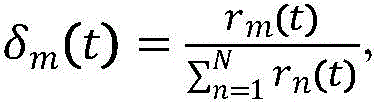
根据每个切片的基于优先级加权的带宽请求,利用公式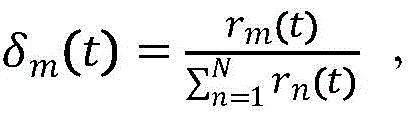
其中,δm(t)表示切片m的共享带宽比,rn(t)表示切片n的基于优先级加权的带宽请求,N表示切片的数量。Among them, δ m (t) represents the shared bandwidth ratio of slice m, rn (t) represents the priority-weighted bandwidth request of slice n , and N represents the number of slices.
可选的,所述将每个切片的共享带宽比分别与每个切片的分配比上限值比较,并将共享带宽比大于分配比上限值的切片的共享带宽比修正为所述切片的分配上限值,具体包括:Optionally, the shared bandwidth ratio of each slice is compared with the upper limit value of the allocation ratio of each slice respectively, and the shared bandwidth ratio of the slice whose shared bandwidth ratio is greater than the upper limit value of the allocation ratio is corrected to the value of the slice. Allocate caps, including:
对于切片m,判断公式
若所述判断结果表示否,则将δm(t)的数值修正为
其中,δm(t)表示切片m的共享带宽比,
可选的,分别根据每个切片的共享带宽比和预设的最小保证带宽比进行每个切片的带宽资源分配,具体包括:Optionally, perform bandwidth resource allocation for each slice according to the shared bandwidth ratio of each slice and the preset minimum guaranteed bandwidth ratio, specifically including:
分别根据每个切片的共享带宽比,利用公式

其中,

可选的,所述基于每个切片的历史流量数据,采用长短期记忆神经网络模型,预测每个切片在下一个切片带宽分配周期的流量,得到每个切片的流量预测值,之前还包括:Optionally, based on the historical traffic data of each slice, a long short-term memory neural network model is used to predict the traffic of each slice in the next slice bandwidth allocation period, and the traffic forecast value of each slice is obtained, which also includes:
根据每个切片的租户所缴纳费用和优先级,预设每个切片的最小保证带宽比。The minimum guaranteed bandwidth ratio of each slice is preset according to the fees and priorities paid by the tenants of each slice.
可选的,所述基于每个切片的历史流量数据,采用长短期记忆神经网络模型,预测每个切片在下一个切片带宽分配周期的流量,得到每个切片的流量预测值,之前还包括:Optionally, based on the historical traffic data of each slice, a long short-term memory neural network model is used to predict the traffic of each slice in the next slice bandwidth allocation period, and the traffic forecast value of each slice is obtained, which also includes:
以切片带宽分配周期为采样周期,分别对每个切片的流量数据进行采集,获得流量样本数据集;Taking the slice bandwidth allocation period as the sampling period, collect the traffic data of each slice respectively to obtain the traffic sample data set;
将所述流量样本数据集划分为训练集、验证集和测试集;dividing the traffic sample data set into a training set, a verification set and a test set;
采用归一化、差分和滑窗的方式对所述训练集、所述验证集和所述测试集进行预处理;The training set, the verification set and the test set are preprocessed by means of normalization, difference and sliding window;
基于预处理后的训练集,以均方误差作为损失函数,以Adam作为优化算法,对所述长短期记忆神经网络模型进行训练,获得训练后的长短期记忆神经网络模型;Based on the preprocessed training set, the mean square error is used as the loss function, and Adam is used as the optimization algorithm to train the long-short-term memory neural network model, and the trained long-short-term memory neural network model is obtained;
基于预处理后的验证集和测试集,以平均绝对百分比误差作为指标,对训练后的长短期记忆神经网络模型进行验证和测试。Based on the preprocessed validation set and test set, the trained long short-term memory neural network model is validated and tested with the mean absolute percentage error as an indicator.
一种无源光网络切片划分装置,包括:A passive optical network slice dividing device, comprising:
流量预测模块,用于基于每个切片的历史流量数据,采用长短期记忆神经网络模型,预测每个切片在下一个切片带宽分配周期的流量,得到每个切片的流量预测值;The traffic prediction module is used to predict the traffic of each slice in the next slice bandwidth allocation cycle based on the historical traffic data of each slice, using the long-short-term memory neural network model, and obtain the traffic forecast value of each slice;
共享带宽比计算模块,用于根据每个切片的流量预测值,采用基于带宽请求的比例分配带宽策略,获得每个切片的共享带宽比;The shared bandwidth ratio calculation module is used to obtain the shared bandwidth ratio of each slice by adopting the proportional bandwidth allocation strategy based on the bandwidth request according to the traffic forecast value of each slice;
共享带宽比修正模块,用于将每个切片的共享带宽比分别与每个切片的分配比上限值比较,并将共享带宽比大于分配比上限值的切片的共享带宽比修正为所述切片的分配上限值;The shared bandwidth ratio correction module is used to compare the shared bandwidth ratio of each slice with the upper limit value of the allocation ratio of each slice, and correct the shared bandwidth ratio of the slice whose shared bandwidth ratio is greater than the upper limit value of the allocation ratio as the The allocation upper limit value of the slice;
带宽资源分配模块,用于分别根据每个切片的共享带宽比和预设的最小保证带宽比进行每个切片的带宽资源分配。A bandwidth resource allocation module, configured to allocate bandwidth resources to each slice according to the shared bandwidth ratio of each slice and the preset minimum guaranteed bandwidth ratio.
可选的,所述共享带宽比计算模块,具体包括:Optionally, the shared bandwidth ratio calculation module specifically includes:
带宽请求计算子模块,用于根据每个切片的流量预测值,利用公式rm(t)=τj*pm(t),计算每个切片的基于优先级加权的带宽请求;The bandwidth request calculation submodule is used to calculate the priority-weighted bandwidth request of each slice by using the formula r m (t)=τ j *p m (t) according to the traffic forecast value of each slice;
其中,rm(t)表示切片m的基于优先级加权的带宽请求,pm(t)为切片的流量预测值,τj为优先级权重;Among them, rm (t) represents the priority-weighted bandwidth request of slice m , pm (t) is the traffic prediction value of the slice, and τ j is the priority weight;
共享带宽比计算子模块,用于根据每个切片的基于优先级加权的带宽请求,利用公式
其中,δm(t)表示切片m的共享带宽比,rn(t)表示切片n的基于优先级加权的带宽请求,N表示切片的数量。Among them, δ m (t) represents the shared bandwidth ratio of slice m, rn (t) represents the priority-weighted bandwidth request of slice n , and N represents the number of slices.
可选的,所述共享带宽比修正模块,具体包括:Optionally, the shared bandwidth ratio correction module specifically includes:
判断子模块,用于对于切片m,判断公式
共享带宽比修正子模块,用于若所述判断结果表示否,则将δm(t)的数值修正为
其中,δm(t)表示切片m的共享带宽比,
本发明还提供一种无源光网络切片的架构,所述架构包括数据平面和控制平面;The present invention also provides an architecture for passive optical network slicing, the architecture includes a data plane and a control plane;
所述数据平面包括多个切片;the data plane includes a plurality of slices;
所述控制平面包括一级SDN控制器、多个二级SDN控制器和多个预测模块;The control plane includes a first-level SDN controller, multiple second-level SDN controllers and multiple prediction modules;
每个所述切片分别与每个所述二级SDN控制器连接,每个所述二级SDN控制器分别通过所述预测模块与所述一级SDN控制器连接;所述一级SDN控制器分别与每个所述切片连接;Each of the slices is respectively connected with each of the second-level SDN controllers, and each of the second-level SDN controllers is respectively connected with the first-level SDN controller through the prediction module; the first-level SDN controller be connected to each of the slices, respectively;
所述二级SDN控制器用于获取切片的历史流量数据,并将所述历史流量数据发送给所述预测模块;The secondary SDN controller is used to obtain sliced historical traffic data, and send the historical traffic data to the prediction module;
所述预测模块用于基于长短期记忆神经网络模型,预测所述切片在下一个切片带宽分配周期的流量,得到所述切片的流量预测值,并将所述切片的流量预测值发送给所述一级SDN控制器;The prediction module is used to predict the traffic of the slice in the next slice bandwidth allocation cycle based on the long short-term memory neural network model, obtain the traffic prediction value of the slice, and send the traffic prediction value of the slice to the one. level SDN controller;
所述一级SDN控制器用于根据每个切片的流量预测值,采用基于带宽请求的比例分配带宽策略和分配比上限值限制策略,获得每个切片的共享带宽比;将每个切片的共享带宽比分别与每个切片的分配比上限值比较,并将共享带宽比大于分配比上限值的切片的共享带宽比修正为所述切片的分配上限值;分别根据每个切片的共享带宽比和预设的最小保证带宽比进行每个切片的带宽资源分配,并将每个切片的宽带资源分配结果发送给每个所述切片。The first-level SDN controller is used to obtain the shared bandwidth ratio of each slice by adopting the bandwidth request-based proportional allocation bandwidth strategy and the allocation ratio upper limit limit strategy according to the traffic forecast value of each slice; The bandwidth ratio is respectively compared with the upper limit value of the allocation ratio of each slice, and the shared bandwidth ratio of the slice whose shared bandwidth ratio is greater than the upper limit value of the allocation ratio is corrected to the upper limit value of the allocation ratio of the slice; Perform bandwidth resource allocation for each slice based on the bandwidth ratio and the preset minimum guaranteed bandwidth ratio, and send the broadband resource allocation result for each slice to each of the slices.
根据本发明提供的具体实施例,本发明公开了以下技术效果:According to the specific embodiments provided by the present invention, the present invention discloses the following technical effects:
本发明所提供的一种无源光网络切片划分方法,包括:基于每个切片的历史流量数据,采用长短期记忆神经网络模型,预测每个切片在下一个切片带宽分配周期的流量,得到每个切片的流量预测值;根据每个切片的流量预测值,采用基于带宽请求的比例分配带宽策略,获得每个切片的共享带宽比;将每个切片的共享带宽比分别与每个切片的分配比上限值比较,并将共享带宽比大于分配比上限值的切片的共享带宽比修正为所述切片的分配上限值,分别根据每个切片的共享带宽比和预设的最小保证带宽比进行每个切片的带宽资源分配。本发明基于长短期记忆神经网络模型进行流量预测,并基于流量预测值采用带宽请求的比例分配带宽策略,获得切片的共享带宽比,实现网络切片公平地分配共享带宽资源,并设置了分配上限值,避免一些切片因无法获得足够的宽带造成延迟或丢包的技术缺陷,能够极大地提高资源利用率,降低网络时延,保证各个网络的QoS需求。The method for dividing a passive optical network slice provided by the present invention includes: based on the historical flow data of each slice, using a long short-term memory neural network model, predicting the flow of each slice in the next slice bandwidth allocation period, and obtaining each slice The traffic prediction value of the slice; according to the traffic prediction value of each slice, the bandwidth allocation strategy based on the bandwidth request is adopted to obtain the shared bandwidth ratio of each slice; the shared bandwidth ratio of each slice is divided with the allocation ratio of each slice The upper limit value is compared, and the shared bandwidth ratio of the slice whose shared bandwidth ratio is greater than the upper limit value of the allocation ratio is corrected to the allocation upper limit value of the slice, according to the shared bandwidth ratio of each slice and the preset minimum guaranteed bandwidth ratio. Perform bandwidth resource allocation for each slice. The present invention performs traffic prediction based on the long-term and short-term memory neural network model, and adopts the proportional bandwidth allocation strategy of bandwidth requests based on the traffic prediction value to obtain the shared bandwidth ratio of slices, realizes the fair distribution of shared bandwidth resources in network slices, and sets an allocation upper limit. This can greatly improve resource utilization, reduce network delay, and ensure the QoS requirements of each network.
附图说明Description of drawings
为了更清楚地说明本发明实施例或现有技术中的技术方案,下面将对实施例中所需要使用的附图作简单地介绍,显而易见地,下面描述中的附图仅仅是本发明的一些实施例,对于本领域普通技术人员来讲,在不付出创造性劳动性的前提下,还可以根据这些附图获得其他的附图。In order to more clearly illustrate the embodiments of the present invention or the technical solutions in the prior art, the accompanying drawings required in the embodiments will be briefly introduced below. Obviously, the drawings in the following description are only some of the present invention. In the embodiments, for those of ordinary skill in the art, other drawings can also be obtained according to these drawings without creative labor.
图1为本发明提供的一种无源光网络切片的架构的结构图;1 is a structural diagram of an architecture of a passive optical network slice provided by the present invention;
图2为本发明提供的一种无源光网络切片划分方法的流程示意图;2 is a schematic flowchart of a method for dividing a passive optical network slice provided by the present invention;
图3为本发明提供的一种无源光网络切片划分方法的原理图;3 is a schematic diagram of a method for dividing a passive optical network slice provided by the present invention;
图4为本发明提供的长短期记忆神经网络训练流程示意图;4 is a schematic diagram of a training process flow of a long short-term memory neural network provided by the present invention;
图5为本发明提供的不同类型的切片的神经网络模型示意图;图5a为MFH网络流量模型的示意图,图5b为IIoT网络流量模型的示意图;5 is a schematic diagram of a neural network model of different types of slices provided by the present invention; FIG. 5 a is a schematic diagram of an MFH network traffic model, and FIG. 5 b is a schematic diagram of an IIoT network traffic model;
图6为本发明提供的一种无源光网络切片划分装置的结构示意图。FIG. 6 is a schematic structural diagram of an apparatus for dividing a passive optical network slice provided by the present invention.
具体实施方式Detailed ways
下面将结合本发明实施例中的附图,对本发明实施例中的技术方案进行清楚、完整地描述,显然,所描述的实施例仅仅是本发明一部分实施例,而不是全部的实施例。基于本发明中的实施例,本领域普通技术人员在没有做出创造性劳动前提下所获得的所有其他实施例,都属于本发明保护的范围。The technical solutions in the embodiments of the present invention will be clearly and completely described below with reference to the accompanying drawings in the embodiments of the present invention. Obviously, the described embodiments are only a part of the embodiments of the present invention, but not all of the embodiments. Based on the embodiments of the present invention, all other embodiments obtained by those of ordinary skill in the art without creative efforts shall fall within the protection scope of the present invention.
本发明的目的是提供一种无源光网络切片划分方法、装置及框架,以实现网络切片公平地分配共享带宽资源,并避免一些切片因无法获得足够的宽带造成延迟或丢包的技术缺陷,满足多种业务的QoS需求。The purpose of the present invention is to provide a passive optical network slice division method, device and framework, so as to realize the fair distribution of shared bandwidth resources in network slices, and to avoid the technical defects of delay or packet loss caused by insufficient bandwidth for some slices, Meet the QoS requirements of various services.
为使本发明的上述目的、特征和优点能够更加明显易懂,下面结合附图和具体实施方式对本发明作进一步详细的说明。In order to make the above objects, features and advantages of the present invention more clearly understood, the present invention will be described in further detail below with reference to the accompanying drawings and specific embodiments.
分配带宽的调度方案包括:切片间分配(Inter-slice Allocation,IRA)和切片内分配(Intra-slice Allocation,IAA)。IAA本质上是一个动态网络切片划分周期,在此期间二级SDN控制器接收ONU请求消息和队列状态。在IRA周期内,一级SDN控制器接收到网络切片的统计信息,根据网络切片划分算法计算每个切片分配的带宽。换句话说,由虚拟光线路终端连接的二级SDN控制器只负责DBA期间的时隙分配,而一级SDN控制器拥有网络的全局视野,并分配和调度切片资源。Scheduling schemes for allocating bandwidth include: Inter-slice Allocation (IRA) and Intra-slice Allocation (IAA). IAA is essentially a dynamic network slice partition cycle during which the secondary SDN controller receives ONU request messages and queue status. During the IRA cycle, the first-level SDN controller receives the statistical information of network slices, and calculates the bandwidth allocated to each slice according to the network slice partitioning algorithm. In other words, the second-level SDN controller connected by the virtual optical line terminal is only responsible for time slot allocation during DBA, while the first-level SDN controller has a global view of the network and allocates and schedules slice resources.
为了避免频繁的IRA调度和不必要的开销,所述切片间分配的周期比所述切片内分配的周期长。In order to avoid frequent IRA scheduling and unnecessary overhead, the period of the inter-slice allocation is longer than the period of the intra-slice allocation.
我们提出了一种基于流量预测的动态带宽分配机制,通过引入网络切片流量预测模块实现网络流量预测功能。与传统方法相比,主要的改进在于考虑了网络切片负载的实时性,在保证切片服务的优先级的前提下,即可以满足预先设定的不同优先级的最低资源比例,同时还能将剩余资源按需分配。We propose a dynamic bandwidth allocation mechanism based on traffic prediction, and realize the network traffic prediction function by introducing the network slice traffic prediction module. Compared with the traditional method, the main improvement is that the real-time nature of the network slice load is considered. On the premise of ensuring the priority of the slice service, the preset minimum resource ratio of different priorities can be met, and the remaining Resources are allocated on demand.
首先本发明提出一种时分复用无源光网络(TDM-PON)切片架构,该架构是用来完成动态调度方案的基础。在对接入网资源和功能进行抽象的基础上,将单个OLT在逻辑上划分为两个独立的虚拟OLT(虚拟光线路终端1和2),该切片可以满足特定数量的ONU和特定数量的用户设备的相应需求,网络切片可以在逻辑上彼此隔离。TDM-PON网络切片结构如图1所示,一级SDN控制器能够为网络切片提供管理和编排。这些切片由它们自己的二级软件定义网络控制器,即二级SDN控制器管理。此外,本发明为每个网络切片设置了不同的带宽保证率。为此,本发明考虑每个切片的QoS阈值,以满足其特定的QoS要求。从预测的角度来看,二级SDN控制器负责实时监控网络状态和带宽资源的使用情况,并收集的可靠的历史流量数据。预测模块对接收数据进行归一化处理,通过长短期记忆网络(LSTM)提取数据特征,可以有效拟合切片流量数据。经过训练的LSTM神经网络模型可以实现切片流量数据的预测。First of all, the present invention proposes a time division multiplexing passive optical network (TDM-PON) slice architecture, which is the basis for completing the dynamic scheduling scheme. On the basis of abstracting access network resources and functions, a single OLT is logically divided into two independent virtual OLTs (virtual optical line terminals 1 and 2), which can satisfy a specific number of ONUs and a specific number of According to the corresponding needs of user equipment, network slices can be logically isolated from each other. The structure of TDM-PON network slicing is shown in Figure 1. The first-level SDN controller can provide management and orchestration for network slicing. These slices are managed by their own secondary software-defined network controller, the secondary SDN controller. In addition, the present invention sets different bandwidth guarantee rates for each network slice. To this end, the present invention considers the QoS threshold of each slice to meet its specific QoS requirements. From a forecasting perspective, the secondary SDN controller is responsible for monitoring network status and bandwidth resource usage in real time, and collecting reliable historical traffic data. The prediction module normalizes the received data, and extracts data features through a long short-term memory network (LSTM), which can effectively fit the slice traffic data. The trained LSTM neural network model can realize the prediction of slice traffic data.
如图1所示,本发明的网络切片分为两个平面:数据平面和控制平面层。控制平面用来下发资源和数据转发的策略,数据平面只负责执行控制平面的策略,这样就实现了控制和转发功能解耦。As shown in FIG. 1, the network slicing of the present invention is divided into two planes: a data plane and a control plane layer. The control plane is used to issue policies for resource and data forwarding, and the data plane is only responsible for executing the policies of the control plane, thus realizing the decoupling of control and forwarding functions.
数据平面:Data plane:
切片功能划分方式为:无源光网络的结构由光线路终端(OLT)、光分配网(ODN)和光网络单元(ONU)组成。若将PON切片,需要用网络功能虚拟化技术(NFV)将OLT设备功能进行抽象,虚拟化成多个虚拟的OLT(虚拟光线路终端),所谓切片,是指将虚拟光线路终端和相应的ODN和ONU组合,把原来单一的网络结构切分成多个子网络。各个网络相互隔离,因此可以运行不同的服务,满足不同的指标。本发明将PON划分为两个网络切片,一个运行移动前传业务,一个运行工业物联网业务。The slicing function is divided as follows: the structure of the passive optical network is composed of an optical line terminal (OLT), an optical distribution network (ODN) and an optical network unit (ONU). If the PON is sliced, it is necessary to use the network function virtualization technology (NFV) to abstract the function of the OLT equipment and virtualize it into multiple virtual OLTs (virtual optical line terminals). The so-called slicing refers to the virtual optical line terminal and the corresponding ODN. Combined with ONU, the original single network structure is divided into multiple sub-networks. Each network is isolated from each other, so it is possible to run different services and meet different metrics. The invention divides the PON into two network slices, one runs the mobile fronthaul service and the other runs the industrial Internet of Things service.
其中各切片内部连接关系为:在移动前传(MFH)切片中,中心单元连接虚拟光线路终端1,再通过光分路器连接分布单元。在工业物联网(IIoT)切片中,网络服务器连接虚拟光线路终端2,再通过光分路器和光网络单元连接工业物联网设备。The internal connection relationship of each slice is as follows: in a mobile fronthaul (MFH) slice, the central unit is connected to the virtual optical line terminal 1, and then connected to the distribution unit through an optical splitter. In the Industrial Internet of Things (IIoT) slice, the network server connects the virtual optical line terminal 2, and then connects the IIoT devices through the optical splitter and the optical network unit.
控制层:control layer:
控制平面用于控制切片的划分:主要采用的工具是软件定义网络控制器,即SDN控制器,具体分为一级SDN控制器(一级软件定义网络控制器)和二级SDN控制器(二级软件定义网络控制器),一级SDN控制器连接OLT,具有全局视野,可以控制切片的资源划分,执行分配策略。二级SDN控制器是一级SDN控制器下属的控制器,具有控制各自切片的能力,负责实时监控切片的网络状态和带宽资源的使用情况。The control plane is used to control the division of slices: the main tool used is the software-defined network controller, that is, the SDN controller, which is divided into a first-level SDN controller (first-level software-defined network controller) and a second-level SDN controller (two The first-level software-defined network controller), the first-level SDN controller is connected to the OLT, has a global view, can control the resource division of slices, and implement the allocation strategy. The second-level SDN controller is a subordinate controller of the first-level SDN controller, which has the ability to control the respective slices, and is responsible for monitoring the network status of the slices and the usage of bandwidth resources in real time.
本发明设置了预测模块,预测模块主要由两个LSTM神经网络模型组成,长短期记忆神经网络模型可以通过给它提供一定数量的历史流量数据来预测下一切片带宽分配周期的流量。所述预测模块设置在一级SDN控制器和二级SDN控制器之间。The present invention sets a prediction module, which is mainly composed of two LSTM neural network models, and the long short-term memory neural network model can predict the traffic of the next slice bandwidth allocation period by providing it with a certain amount of historical traffic data. The prediction module is arranged between the primary SDN controller and the secondary SDN controller.
基于上述框架和原理,本发明提供了一种无源光网络切片划分方法,本发明的切片划分方法,即带宽分配方法可以实时计算加权带宽需求,实现动态带宽分配。该算法混合了固定带宽分配和动态带宽分配,通过集中控制,可以在静态分配带宽的基础上根据预测的切片需求分配额外的带宽。具体而言,二级SDN控制器收集切片历史流量数据,通过长短时记忆(LSTM)神经网络预测下一切片周期的流量,预测结果作为切片带宽请求上传至一级SDN控制器。一级SDN控制器对不同优先级切片的带宽请求配置相应的优先级权重,然后按照比例分配算法为每个切片分配带宽。该算法能够极大地提高资源利用率,降低网络时延,保证各个网络的QoS需求。Based on the above framework and principles, the present invention provides a passive optical network slice division method. The slice division method of the present invention, that is, the bandwidth allocation method, can calculate the weighted bandwidth requirement in real time and realize dynamic bandwidth allocation. The algorithm mixes fixed and dynamic bandwidth allocation, and through centralized control, additional bandwidth can be allocated based on predicted slice demand on top of statically allocated bandwidth. Specifically, the second-level SDN controller collects slice historical traffic data, predicts the traffic of the next slice cycle through a long short-term memory (LSTM) neural network, and uploads the prediction result to the first-level SDN controller as a slice bandwidth request. The first-level SDN controller configures corresponding priority weights for bandwidth requests of different priority slices, and then allocates bandwidth to each slice according to the proportional allocation algorithm. The algorithm can greatly improve resource utilization, reduce network delay, and ensure the QoS requirements of each network.
图2和3所示,本发明提供一种无源光网络切片划分方法,包括:As shown in Figures 2 and 3, the present invention provides a method for dividing a passive optical network slice, including:
步骤201,基于每个切片的历史流量数据,采用长短期记忆神经网络模型,预测每个切片在下一个切片带宽分配周期的流量,得到每个切片的流量预测值。Step 201: Based on the historical traffic data of each slice, a long short-term memory neural network model is used to predict the traffic of each slice in the next slice bandwidth allocation period, and a traffic prediction value of each slice is obtained.
在步骤201之前,本发明利用每个切片相应的历史流量数据训练长短期记忆神经网络,确定每个切片对应的训练后的长短期记忆神经网络。长短期记忆神经网络训练方法如图4所示,首先设计MFH切片和IIoT切片流量模型,用来生成所需流量数据,并将收集到的流量数据采用归一化、滑窗等手段进行预处理,然后通过长短期记忆网络提取数据特征。训练后的长短期记忆神经网络对未来时刻的切片流量数据进行预测。Before
具体的,如图4所示,步骤101所述基于每个切片的历史流量数据,采用长短期记忆神经网络模型,预测每个切片在下一个切片带宽分配周期的流量,得到每个切片的流量预测值,之前还包括:Specifically, as shown in FIG. 4 , in step 101, based on the historical traffic data of each slice, a long short-term memory neural network model is used to predict the traffic of each slice in the next slice bandwidth allocation period, and the traffic forecast of each slice is obtained. value, before also including:
以切片带宽分配周期为采样周期,分别对每个切片的流量数据进行采集,获得流量样本数据集;收集每个切片对应的历史流量数据每一个切片划分周期统计一次各切片流量,共收集10000个数据。长短期记忆神经网络学习各自切片上历史流量数据特征,预测切片在下一周期任务负载。历史流量数据来自于上述的TDM-PON切片,对于切片DBA周期产生的数据每一个切片划分周期统计一次,得到训练数据集。数据集按照8:1:1被分为训练集、验证集和测试集。Taking the slice bandwidth allocation period as the sampling period, collect the traffic data of each slice separately to obtain the traffic sample data set; collect the historical traffic data corresponding to each slice and count the traffic of each slice once in each slice division period, and collect a total of 10,000 data sets. data. The long short-term memory neural network learns the characteristics of historical traffic data on each slice, and predicts the task load of the slice in the next cycle. The historical traffic data comes from the above-mentioned TDM-PON slice, and the data generated by the slice DBA period is counted once for each slice division period to obtain a training data set. The dataset is divided into training set, validation set and test set according to 8:1:1.
基于所述流量样本数据集,对长短期记忆神经网络模型进行训练;所述长短期记忆神经网络模型包括MFH网络预测模块和IIoT网络预测模块。Based on the traffic sample data set, a long-short-term memory neural network model is trained; the long-short-term memory neural network model includes an MFH network prediction module and an IIoT network prediction module.
流量样本数据集按照8:1:1被分为训练集、验证集和测试集,并采用归一化、差分和滑窗等方式进行数据预处理。The traffic sample data set is divided into training set, validation set and test set according to 8:1:1, and data preprocessing is carried out by means of normalization, difference and sliding window.
训练长短期记忆神经网络。将经过预处理的历史流量数据作为输入,传入到长短期记忆神经网络中进行训练。具体而言,MFH切片的长短期记忆神经网络需要前50个流量数据预测下一时刻流量,而IIoT切片的长短期记忆神经网络需要前35个历史数据预测下一时刻流量。Training long short-term memory neural networks. The preprocessed historical traffic data is used as input and passed into the long short-term memory neural network for training. Specifically, the long-short-term memory neural network of MFH slice needs the first 50 traffic data to predict the next moment of traffic, while the long-short-term memory neural network of IIoT slice needs the first 35 historical data to predict the next moment of traffic.
训练长短期记忆神经网络的参数:批量大小为200,学习率为0.01。如图5所示,对于不同类型的网络切片,LSTM模型的输入层和隐藏层有所区别:MFH网络预测模块根据前50个历史数据进行预测,有两个隐藏层,每层神经元个数为[160,160];而IIoT网络预测模块根据前35个历史数据预测,有一个隐藏层,神经元个数为95。除此之外,预测模块以下参数是相同的:采用均方误差作为损耗函数,采用Adam作为优化算法,采用tanh作为激活函数。Parameters for training long short-term memory neural network: batch size is 200, learning rate is 0.01. As shown in Figure 5, for different types of network slices, the input layer and hidden layer of the LSTM model are different: the MFH network prediction module makes predictions based on the first 50 historical data, there are two hidden layers, and the number of neurons in each layer is is [160, 160]; while the IIoT network prediction module predicts based on the first 35 historical data, there is a hidden layer and the number of neurons is 95. In addition, the following parameters of the prediction module are the same: the mean square error is used as the loss function, Adam is used as the optimization algorithm, and tanh is used as the activation function.
验证神经网络预测能力:用平均绝对百分比误差(Mean Absolute PercentageError,MAPE)作为指标来评估模型的有效性(该公式是已有公式)。MAPE可以表示为:Validate the predictive ability of neural network: Use Mean Absolute PercentageError (MAPE) as an indicator to evaluate the effectiveness of the model (this formula is an existing formula). MAPE can be expressed as:

为了保证网络切片的基本性能,一级SDN控制器为每个切片设置一个最小的保证资源比率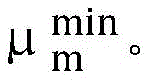
步骤202,根据每个切片的流量预测值,采用基于带宽请求的比例分配带宽策略,获得每个切片的共享带宽比。Step 202: According to the traffic prediction value of each slice, a bandwidth allocation policy based on the bandwidth request ratio is adopted to obtain the shared bandwidth ratio of each slice.
本发明将TDM-PON切片的优先级划分为三个级别j(j=1,2,3),并将优先级对应的权值设置为τj,则基于优先级加权的带宽请求rm(t)可以表示为相应的优先级权值与网络切片预测值的乘积。其表达式如下:The present invention divides the priority of the TDM-PON slice into three levels j ( j =1, 2, 3), and sets the weight corresponding to the priority as τ j , then the bandwidth request rm ( t) can be expressed as the product of the corresponding priority weight and the predicted value of the network slice. Its expression is as follows:
rm(t)=τj*pm(t)r m (t)=τ j *p m (t)
根据每个切片的基于优先级加权的带宽请求,利用公式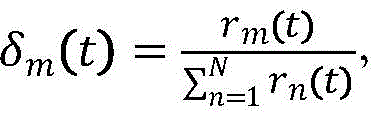
步骤203,将每个切片的共享带宽比分别与每个切片的分配比上限值比较,并将共享带宽比大于分配比上限值的切片的共享带宽比修正为所述切片的分配上限值;Step 203: Compare the shared bandwidth ratio of each slice with the upper limit of the allocation ratio of each slice respectively, and correct the shared bandwidth ratio of the slice whose shared bandwidth ratio is greater than the upper limit of the allocation ratio to the upper limit of allocation of the slice. value;
分配给切片m的带宽比率可以表示为切片m的带宽请求rm(t)占总带宽请求的比例。特别的,在某些极端的情况下,不同切片的带宽请求会具有很大的差别。在这种情况下,如果我们仍然采用前面的根据请求的比例分配带宽的策略,一些切片将无法获得足够的带宽,从而增加了延迟和丢包。因此,有必要对共享资源池中提供的资源的比例添加分配上限


具体的,对于切片m,判断公式
若所述判断结果表示否,则将δm(t)的数值修正为
其中,δm(t)表示切片m的共享带宽比,
步骤204,分别根据每个切片的共享带宽比和预设的最小保证带宽比进行每个切片的带宽资源分配。Step 204: Perform bandwidth resource allocation for each slice according to the shared bandwidth ratio of each slice and the preset minimum guaranteed bandwidth ratio.
分配给切片m的带宽资源
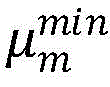
步骤204分别根据每个切片的共享带宽比和预设的最小保证带宽比进行每个切片的带宽资源分配,具体包括:分别根据每个切片的共享带宽比,利用公式


分配共享带宽Bremain为剩余带宽,本发明将它抽象成共享资源池,根据切片优先级和带宽请求按需分配切片带宽。The allocated shared bandwidth B remains is the remaining bandwidth, which is abstracted into a shared resource pool in the present invention, and the slice bandwidth is allocated on demand according to slice priority and bandwidth request.
本发明采用静态和动态相结合的网络切片划分方法,根据对网络切片流量的预测来分配带宽。其中,为了训练长短期记忆神经网络,二级SDN控制器将采集到的历史流量数据上传到预测模块。此外,一级SDN控制器为每个切片的带宽请求配置相应的优先级权值,然后根据比例分配算法为每个切片分配带宽。总带宽资源在分配保证带宽之后组成一个共享资源池,在共享资源池中可以为网络切片公平地分配共享资源,同时满足不同切片的QoS需求。The present invention adopts a network slice division method combining static and dynamic, and allocates bandwidth according to the prediction of network slice traffic. Among them, in order to train the long short-term memory neural network, the secondary SDN controller uploads the collected historical traffic data to the prediction module. In addition, the first-level SDN controller configures the corresponding priority weight for the bandwidth request of each slice, and then allocates the bandwidth to each slice according to the proportional allocation algorithm. After allocating guaranteed bandwidth, the total bandwidth resources form a shared resource pool. In the shared resource pool, shared resources can be allocated to network slices fairly, and the QoS requirements of different slices can be met at the same time.
图6为本发明所提供的一种无源光网络切片划分装置,包括:FIG. 6 is a passive optical network slice dividing device provided by the present invention, including:
流量预测模块601,用于基于每个切片的历史流量数据,采用长短期记忆神经网络模型,预测每个切片在下一个切片带宽分配周期的流量,得到每个切片的流量预测值;The
共享带宽比计算模块602,用于根据每个切片的流量预测值,采用基于带宽请求的比例分配带宽策略,获得每个切片的共享带宽比。The shared bandwidth
所述共享带宽比计算模块602,具体包括:带宽请求计算子模块,用于根据每个切片的流量预测值,利用公式rm(t)=τj*pm(t),计算每个切片的基于优先级加权的带宽请求;其中,rm(t)表示切片m的基于优先级加权的带宽请求,pm(t)为切片的流量预测值,τj为优先级权重;共享带宽比计算子模块,用于根据每个切片的基于优先级加权的带宽请求,利用公式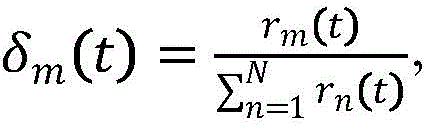
共享带宽比修正模块603,用于将每个切片的共享带宽比分别与每个切片的分配比上限值比较,并将共享带宽比大于分配比上限值的切片的共享带宽比修正为所述切片的分配上限值。The shared bandwidth
所述共享带宽比修正模块603,具体包括:判断子模块,用于对于切片m,判断公式


带宽资源分配模块604,用于分别根据每个切片的共享带宽比和预设的最小保证带宽比进行每个切片的带宽资源分配。The bandwidth
本说明书中各个实施例采用递进的方式描述,每个实施例重点说明的都是与其他实施例的不同之处,各个实施例之间相同相似部分互相参见即可。对于实施例公开的装置而言,由于其与实施例公开的方法相对应,所以描述的比较简单,相关之处参见方法部分说明即可。The various embodiments in this specification are described in a progressive manner, and each embodiment focuses on the differences from other embodiments, and the same and similar parts between the various embodiments can be referred to each other. As for the device disclosed in the embodiment, since it corresponds to the method disclosed in the embodiment, the description is relatively simple, and the relevant part can be referred to the description of the method.
本文中应用了具体个例对本发明的原理及实施方式进行了阐述,以上实施例的说明只是用于帮助理解本发明的方法及其核心思想;同时,对于本领域的一般技术人员,依据本发明的思想,在具体实施方式及应用范围上均会有改变之处。综上所述,本说明书内容不应理解为对本发明的限制。In this paper, specific examples are used to illustrate the principles and implementations of the present invention. The descriptions of the above embodiments are only used to help understand the methods and core ideas of the present invention; meanwhile, for those skilled in the art, according to the present invention There will be changes in the specific implementation and application scope. In conclusion, the contents of this specification should not be construed as limiting the present invention.
Claims (8)







Priority Applications (1)
| Application Number | Priority Date | Filing Date | Title |
|---|---|---|---|
| CN202110857020.0A CN113596632B (en) | 2021-07-28 | 2021-07-28 | Passive optical network slice dividing method, device and system |
Applications Claiming Priority (1)
| Application Number | Priority Date | Filing Date | Title |
|---|---|---|---|
| CN202110857020.0A CN113596632B (en) | 2021-07-28 | 2021-07-28 | Passive optical network slice dividing method, device and system |
Publications (2)
| Publication Number | Publication Date |
|---|---|
| CN113596632A true CN113596632A (en) | 2021-11-02 |
| CN113596632B CN113596632B (en) | 2022-05-24 |
Family
ID=78251014
Family Applications (1)
| Application Number | Title | Priority Date | Filing Date |
|---|---|---|---|
| CN202110857020.0A Active CN113596632B (en) | 2021-07-28 | 2021-07-28 | Passive optical network slice dividing method, device and system |
Country Status (1)
| Country | Link |
|---|---|
| CN (1) | CN113596632B (en) |
Cited By (5)
| Publication number | Priority date | Publication date | Assignee | Title |
|---|---|---|---|---|
| CN114423047A (en) * | 2022-02-14 | 2022-04-29 | 国网电力科学研究院有限公司 | Network bandwidth allocation optimization method, system, storage medium and computing device |
| CN114448770A (en) * | 2022-01-24 | 2022-05-06 | 北京电信规划设计院有限公司 | Methods for customizing broadband network slices |
| CN115884228A (en) * | 2022-12-07 | 2023-03-31 | 中国联合网络通信集团有限公司 | Mobile network processing method and device based on flow data and server |
| CN115941487A (en) * | 2022-12-02 | 2023-04-07 | 中国联合网络通信集团有限公司 | Flow distribution method, device, equipment and medium |
| CN120074722A (en) * | 2025-04-27 | 2025-05-30 | 深圳市遨游通讯设备有限公司 | Heterogeneous network intelligent slice resource scheduling method and device, electronic equipment and medium |
Citations (10)
| Publication number | Priority date | Publication date | Assignee | Title |
|---|---|---|---|---|
| US20070212071A1 (en) * | 2006-03-08 | 2007-09-13 | Huawei Tecnologies Co., Ltd. | System and Method for Allocating Bandwidth in Remote Equipment on a Passive Optical Network |
| CN102045605A (en) * | 2010-12-09 | 2011-05-04 | 北京邮电大学 | Periodical polling dynamic bandwidth distribution algorithm based on QoS (Quality of Service) in OFDM-PON (Orthogonal Frequency Division Multiplexing-Passive Optical Network) |
| CN108881967A (en) * | 2018-08-01 | 2018-11-23 | 广发证券股份有限公司 | A kind of video method for uploading, device and equipment based on machine learning |
| CN109743215A (en) * | 2019-03-05 | 2019-05-10 | 重庆邮电大学 | An Ant Colony Optimization Virtual Network Mapping Method Based on Disaster Prediction under Multi-area Faults |
| CN110234041A (en) * | 2019-02-13 | 2019-09-13 | 孙武 | A kind of optical network unit bandwidth demand accurately reports mechanism |
| CN111586502A (en) * | 2020-03-26 | 2020-08-25 | 北京邮电大学 | Resource allocation method and system in elastic optical network |
| CN111741450A (en) * | 2020-06-18 | 2020-10-02 | 中国电子科技集团公司第三十六研究所 | Network traffic prediction method, device and electronic device |
| CN112970228A (en) * | 2018-11-09 | 2021-06-15 | 华为技术有限公司 | Method and system for performance assurance with conflict management when providing network slicing service |
| CN113038302A (en) * | 2019-12-25 | 2021-06-25 | 中国电信股份有限公司 | Flow prediction method and device and computer storage medium |
| CN113115139A (en) * | 2021-04-23 | 2021-07-13 | 北京智芯微电子科技有限公司 | Optical network virtualization system based on network container and service mapping method |
-
2021
- 2021-07-28 CN CN202110857020.0A patent/CN113596632B/en active Active
Patent Citations (10)
| Publication number | Priority date | Publication date | Assignee | Title |
|---|---|---|---|---|
| US20070212071A1 (en) * | 2006-03-08 | 2007-09-13 | Huawei Tecnologies Co., Ltd. | System and Method for Allocating Bandwidth in Remote Equipment on a Passive Optical Network |
| CN102045605A (en) * | 2010-12-09 | 2011-05-04 | 北京邮电大学 | Periodical polling dynamic bandwidth distribution algorithm based on QoS (Quality of Service) in OFDM-PON (Orthogonal Frequency Division Multiplexing-Passive Optical Network) |
| CN108881967A (en) * | 2018-08-01 | 2018-11-23 | 广发证券股份有限公司 | A kind of video method for uploading, device and equipment based on machine learning |
| CN112970228A (en) * | 2018-11-09 | 2021-06-15 | 华为技术有限公司 | Method and system for performance assurance with conflict management when providing network slicing service |
| CN110234041A (en) * | 2019-02-13 | 2019-09-13 | 孙武 | A kind of optical network unit bandwidth demand accurately reports mechanism |
| CN109743215A (en) * | 2019-03-05 | 2019-05-10 | 重庆邮电大学 | An Ant Colony Optimization Virtual Network Mapping Method Based on Disaster Prediction under Multi-area Faults |
| CN113038302A (en) * | 2019-12-25 | 2021-06-25 | 中国电信股份有限公司 | Flow prediction method and device and computer storage medium |
| CN111586502A (en) * | 2020-03-26 | 2020-08-25 | 北京邮电大学 | Resource allocation method and system in elastic optical network |
| CN111741450A (en) * | 2020-06-18 | 2020-10-02 | 中国电子科技集团公司第三十六研究所 | Network traffic prediction method, device and electronic device |
| CN113115139A (en) * | 2021-04-23 | 2021-07-13 | 北京智芯微电子科技有限公司 | Optical network virtualization system based on network container and service mapping method |
Non-Patent Citations (3)
| Title |
|---|
| FU WANG;QINGHUA TIAN;QI ZHANG;FENG TIAN;HUAN CHANG;XIN XIANGJUN: "A Dynamic Bandwidth Allocation Scheme for Internet of Thing in Network-Slicing Passive Optical Networks", 《2020 IEEE COMPUTING, COMMUNICATIONS AND IOT APPLICATIONS (COMCOMAP)》 * |
| 刘明月,涂崎,汪洋,孟萨出拉,赵雄文: "智能电网中网络切片的资源分配算法研究", 《电力信息与通信技术》 * |
| 李志沛,王曦朔,刘博,张琦,忻向军: "一种适用于概率成形光传输系统的调制格式识别方法", 《北京邮电大学学报》 * |
Cited By (8)
| Publication number | Priority date | Publication date | Assignee | Title |
|---|---|---|---|---|
| CN114448770A (en) * | 2022-01-24 | 2022-05-06 | 北京电信规划设计院有限公司 | Methods for customizing broadband network slices |
| CN114448770B (en) * | 2022-01-24 | 2024-02-23 | 北京电信规划设计院有限公司 | Method for customizing broadband network slices |
| CN114423047A (en) * | 2022-02-14 | 2022-04-29 | 国网电力科学研究院有限公司 | Network bandwidth allocation optimization method, system, storage medium and computing device |
| CN115941487A (en) * | 2022-12-02 | 2023-04-07 | 中国联合网络通信集团有限公司 | Flow distribution method, device, equipment and medium |
| CN115884228A (en) * | 2022-12-07 | 2023-03-31 | 中国联合网络通信集团有限公司 | Mobile network processing method and device based on flow data and server |
| CN115884228B (en) * | 2022-12-07 | 2025-12-05 | 中国联合网络通信集团有限公司 | Mobile network processing method, apparatus, and server based on traffic data |
| CN120074722A (en) * | 2025-04-27 | 2025-05-30 | 深圳市遨游通讯设备有限公司 | Heterogeneous network intelligent slice resource scheduling method and device, electronic equipment and medium |
| CN120074722B (en) * | 2025-04-27 | 2025-08-08 | 深圳市遨游通讯设备有限公司 | Heterogeneous network intelligent slice resource scheduling method and device, electronic equipment and medium |
Also Published As
| Publication number | Publication date |
|---|---|
| CN113596632B (en) | 2022-05-24 |
Similar Documents
| Publication | Publication Date | Title |
|---|---|---|
| CN113596632B (en) | Passive optical network slice dividing method, device and system | |
| CN102724103B (en) | Proxy server, hierarchical network system and distributed workload management method | |
| CN105721577B (en) | Software defined network-oriented server load balancing method | |
| CN106533806B (en) | A method for providing cross-layer QoS based on application awareness in multi-tenant SDN network | |
| CN106817499A (en) | A kind of resources for traffic dispatching method and forecast dispatching device | |
| CN109639498A (en) | A kind of resource flexibility configuration method of the service-oriented quality based on SDN and NFV | |
| CN112015549B (en) | A method and system for selecting and preempting scheduling nodes based on server clusters | |
| CN120017608B (en) | Disaster recovery data recovery method and system for disaster recovery system | |
| CN105141446A (en) | Network equipment health degree assessment method determined based on objective weight | |
| Beshley et al. | Traffic engineering and QoS/QoE supporting techniques for emerging service-oriented software-defined network | |
| CN118921334A (en) | Two-layer wide area network flow management system | |
| CN117082008B (en) | Virtual elastic network data transmission scheduling method, computer device and storage medium | |
| CN116939158B (en) | Monitoring management system and method based on cloud computing | |
| CN120264358B (en) | Network flow regulation and control system, method and storage medium | |
| Panayiotou et al. | Fair resource allocation in optical networks under tidal traffic | |
| CN119887454A (en) | Hotel unmanned check-in system and method based on face recognition | |
| CN119521420A (en) | Network resource allocation method, device, equipment and medium based on load balancing | |
| CN119052085A (en) | A multi-network parallel acceleration system | |
| Yu et al. | Quantitative quality estimation of cloud-based streaming services | |
| CN116614734A (en) | A passive optical network dynamic slicing method, device and storage medium based on traffic prediction and ONU migration | |
| RU2742038C1 (en) | Method for dynamic quasioptimal performance distribution when processing real-time fractal traffic in systems with failures | |
| Varga et al. | Service quality-based network slicing optimization | |
| CN108011838B (en) | Response time-based load balancing method for SDN multi-controller | |
| CN120602398B (en) | Communication unit data transmission optimization method and system for large-scale electric energy data | |
| CN118740658B (en) | Cloud computing-based power grid business hall terminal data management method and system |
Legal Events
| Date | Code | Title | Description |
|---|---|---|---|
| PB01 | Publication | ||
| PB01 | Publication | ||
| SE01 | Entry into force of request for substantive examination | ||
| SE01 | Entry into force of request for substantive examination | ||
| GR01 | Patent grant | ||
| GR01 | Patent grant |