CN113541834B - Abnormal signal semi-supervised classification method and system and data processing terminal - Google Patents
Abnormal signal semi-supervised classification method and system and data processing terminal Download PDFInfo
- Publication number
- CN113541834B CN113541834B CN202110708117.5A CN202110708117A CN113541834B CN 113541834 B CN113541834 B CN 113541834B CN 202110708117 A CN202110708117 A CN 202110708117A CN 113541834 B CN113541834 B CN 113541834B
- Authority
- CN
- China
- Prior art keywords
- cnn
- clustering
- data
- abnormal signal
- input
- Prior art date
- Legal status (The legal status is an assumption and is not a legal conclusion. Google has not performed a legal analysis and makes no representation as to the accuracy of the status listed.)
- Active
Links
Images


Classifications
-
- H—ELECTRICITY
- H04—ELECTRIC COMMUNICATION TECHNIQUE
- H04B—TRANSMISSION
- H04B17/00—Monitoring; Testing
- H04B17/30—Monitoring; Testing of propagation channels
- H04B17/382—Monitoring; Testing of propagation channels for resource allocation, admission control or handover
-
- G—PHYSICS
- G06—COMPUTING OR CALCULATING; COUNTING
- G06F—ELECTRIC DIGITAL DATA PROCESSING
- G06F18/00—Pattern recognition
- G06F18/20—Analysing
- G06F18/23—Clustering techniques
- G06F18/232—Non-hierarchical techniques
- G06F18/2321—Non-hierarchical techniques using statistics or function optimisation, e.g. modelling of probability density functions
- G06F18/23213—Non-hierarchical techniques using statistics or function optimisation, e.g. modelling of probability density functions with fixed number of clusters, e.g. K-means clustering
-
- G—PHYSICS
- G06—COMPUTING OR CALCULATING; COUNTING
- G06N—COMPUTING ARRANGEMENTS BASED ON SPECIFIC COMPUTATIONAL MODELS
- G06N3/00—Computing arrangements based on biological models
- G06N3/02—Neural networks
- G06N3/04—Architecture, e.g. interconnection topology
- G06N3/045—Combinations of networks
-
- G—PHYSICS
- G06—COMPUTING OR CALCULATING; COUNTING
- G06N—COMPUTING ARRANGEMENTS BASED ON SPECIFIC COMPUTATIONAL MODELS
- G06N3/00—Computing arrangements based on biological models
- G06N3/02—Neural networks
- G06N3/08—Learning methods
- G06N3/088—Non-supervised learning, e.g. competitive learning
-
- H—ELECTRICITY
- H04—ELECTRIC COMMUNICATION TECHNIQUE
- H04W—WIRELESS COMMUNICATION NETWORKS
- H04W24/00—Supervisory, monitoring or testing arrangements
- H04W24/08—Testing, supervising or monitoring using real traffic
-
- G—PHYSICS
- G06—COMPUTING OR CALCULATING; COUNTING
- G06F—ELECTRIC DIGITAL DATA PROCESSING
- G06F2218/00—Aspects of pattern recognition specially adapted for signal processing
- G06F2218/12—Classification; Matching
Landscapes
- Engineering & Computer Science (AREA)
- Physics & Mathematics (AREA)
- Theoretical Computer Science (AREA)
- Data Mining & Analysis (AREA)
- Evolutionary Computation (AREA)
- Life Sciences & Earth Sciences (AREA)
- Artificial Intelligence (AREA)
- General Physics & Mathematics (AREA)
- General Engineering & Computer Science (AREA)
- Computing Systems (AREA)
- Computer Networks & Wireless Communication (AREA)
- Molecular Biology (AREA)
- Computational Linguistics (AREA)
- Biophysics (AREA)
- Biomedical Technology (AREA)
- Mathematical Physics (AREA)
- Software Systems (AREA)
- Health & Medical Sciences (AREA)
- General Health & Medical Sciences (AREA)
- Signal Processing (AREA)
- Probability & Statistics with Applications (AREA)
- Computer Vision & Pattern Recognition (AREA)
- Evolutionary Biology (AREA)
- Electromagnetism (AREA)
- Bioinformatics & Computational Biology (AREA)
- Bioinformatics & Cheminformatics (AREA)
- Information Retrieval, Db Structures And Fs Structures Therefor (AREA)
Abstract
Description
技术领域technical field
本发明涉及深度学习和无线通信频谱信号技术领域,尤其涉及一种异常信号半监督分类方法、系统、数据处理终端。The invention relates to the technical field of deep learning and wireless communication spectrum signals, in particular to a semi-supervised classification method, system and data processing terminal for abnormal signals.
背景技术Background technique
无线电频谱是我们最宝贵和最广泛使用的自然资源之一。随着无线通信技术的发展,无线通信网络包含多种类型的通信系统,用于多样化的用户通信服务,同时频谱使用变得非常复杂,这导致电波拥塞和其他干扰等问题。无线网络结构复杂多样,其中无线频谱信号中的异常的种类更是繁多,为了方便无线网络结构的频谱管理,研究人员通常希望在检测出异常信号后,还能知道该异常的类别,以及哪种异常出现的次数多等等。如果能将不同频带上存在的相似异常进行分组,这样不仅可以使用户交互最小,还有利于频谱管理,这对促进新一代无线系统的发展变得至关重要。然而,实际的无线频带使用不同的参数,如信号带宽、调制类型和时间占用,因此无线频谱异常信号分类问题,仍然是一个昂贵的过程。所以无线通信网络需要一个高效、可靠的解决方案来分类出各种无线频谱异常信号。The radio spectrum is one of our most precious and widely used natural resources. With the development of wireless communication technology, wireless communication networks include various types of communication systems for diverse user communication services, while the use of spectrum becomes very complicated, which leads to problems such as radio wave congestion and other interference. The wireless network structure is complex and diverse, and there are many types of anomalies in the wireless spectrum signal. In order to facilitate the spectrum management of the wireless network structure, researchers usually hope to know the type of the anomaly and what kind of abnormal signal it is after detecting the abnormal signal. The number of abnormal occurrences is high and so on. If similar anomalies existing on different frequency bands can be grouped, it can not only minimize user interaction, but also facilitate spectrum management, which becomes crucial to facilitate the development of next-generation wireless systems. However, actual wireless frequency bands use different parameters, such as signal bandwidth, modulation type, and time occupancy, so the wireless spectrum anomaly signal classification problem remains an expensive process. Therefore, the wireless communication network needs an efficient and reliable solution to classify various wireless spectrum abnormal signals.
目前,业内常用的现有技术是这样的:最近,基于深度学习的方法在诸如图像分类、对象检测和跟踪以及检索等各个领域取得了一系列突破。它们采用的结构大都基于卷积神经网络(CNNs)。而关于聚类的研究工作都是基于特征编码的,如哈希,这可以大大降低图像特征的维数,从而使大规模聚类成为可能。然而,降低特征的维数相当于降低表征能力,导致聚类性能不理想。Currently, the existing techniques commonly used in the industry are as follows: Recently, deep learning-based methods have achieved a series of breakthroughs in various fields such as image classification, object detection and tracking, and retrieval. The structures they adopt are mostly based on convolutional neural networks (CNNs). The research work on clustering is based on feature encoding, such as hashing, which can greatly reduce the dimensionality of image features, thus making large-scale clustering possible. However, reducing the dimensionality of features is equivalent to reducing the representational power, resulting in unsatisfactory clustering performance.
综上所述,现有技术存在的问题是:In summary, the problems in the prior art are:
(1)给异常的无线频谱异常信号打上标签类别需要耗费大量的人力,财力,实现起来十分困难,因此之前研究人员所提出的有监督学习的分类方法,不适用于无线频谱异常信号。(1) It takes a lot of manpower and financial resources to label the abnormal wireless spectrum abnormal signals, and it is very difficult to implement. Therefore, the supervised learning classification method proposed by previous researchers is not suitable for wireless spectrum abnormal signals.
(2)由于真实世界里,无线网络环境十分复杂,无线频谱异常信号的种类繁多,单纯地使用无监督学习的算法对多种异常信号进行聚类也很难达到我们想要的结果。(2) Since the wireless network environment is very complex in the real world, and there are many kinds of wireless spectrum abnormal signals, it is difficult to achieve the desired results simply by using unsupervised learning algorithms to cluster various abnormal signals.
解决以上问题及缺陷的难度为:既要完全利用好真实无线网络环境中有用信息,也要保证无线频谱异常信号的分类准确度。本发明结合了记忆增强频谱异常检测编码器MemSAD、卷积神经网络CNN以及无监督学习聚类算法K-means,提出了一种基于深度学习的半监督的异常信号分类方法来解决上述问题。The difficulty of solving the above problems and defects is: not only to fully utilize the useful information in the real wireless network environment, but also to ensure the classification accuracy of wireless spectrum abnormal signals. The present invention combines a memory-enhanced spectrum anomaly detection encoder MemSAD, a convolutional neural network CNN and an unsupervised learning clustering algorithm K-means, and proposes a semi-supervised abnormal signal classification method based on deep learning to solve the above problems.
解决以上问题及缺陷的意义为:可以使频谱管理人员可以在用户交互较小的情况下,从复杂的无限网络环境中对异常信号进行分类,且分类准确度可接受。The significance of solving the above problems and defects is that it can enable spectrum managers to classify abnormal signals from complex wireless network environments with acceptable classification accuracy with little user interaction.
发明内容Contents of the invention
针对现有技术存在的问题,本发明提供了一种异常信号半监督分类方法、系统、数据处理终端。Aiming at the problems existing in the prior art, the present invention provides a semi-supervised classification method, system and data processing terminal for abnormal signals.
本发明是这样实现的,一种异常信号半监督分类方法,所述方法包括以下步骤:The present invention is realized like this, a kind of abnormal signal semi-supervised classification method, described method comprises the following steps:
步骤一:构建一个深度学习聚类模型,利用少量有标签的异常信号数据预训练一个CNN分类模型;Step 1: Build a deep learning clustering model and pre-train a CNN classification model with a small amount of labeled abnormal signal data;
步骤二:将异常信号数据作为步骤一中训练好的CNN模型的输入,通过CNN中间层的映射函数提取输入数据的压缩特征;Step 2: Use the abnormal signal data as the input of the trained CNN model in step 1, and extract the compressed features of the input data through the mapping function of the CNN intermediate layer;
步骤三:将CNN提取的小部分少量有标签的每个类别的压缩特征的均值作为初始聚类质心;Step 3: Use the mean value of the compressed features of each category with a small number of labels extracted by CNN as the initial cluster centroid;
步骤四:将CNN中间层提取的全部压缩特征作为K-means聚类算法的输入用于聚类,从而得到新的聚类质心;Step 4: Use all the compressed features extracted by the CNN intermediate layer as the input of the K-means clustering algorithm for clustering, so as to obtain a new cluster centroid;
步骤五:将CNN中间层提取的全部少量有标签的每个类别的压缩特征的均值放入Memory中;Step 5: Put the mean value of all the compressed features of each category with a small number of labels extracted by the middle layer of CNN into Memory;
步骤六:计算K-means得到的新的聚类质心与存放在Memory中的均值的欧式距离,若K-means中某个类的质心离Memory中的某个均值最近,则为该类中的所有无标签的数据打上Memory中的类别标签;Step 6: Calculate the Euclidean distance between the new cluster centroid obtained by K-means and the mean value stored in Memory. If the centroid of a certain class in K-means is closest to a certain mean value in Memory, it is the All unlabeled data are marked with category labels in Memory;
步骤七:此时,K-means的聚类结果中所有的数据都有了相应了标签,利用交叉熵函数损失去更新CNN网络的参数;Step 7: At this point, all the data in the K-means clustering results have corresponding labels, and use the cross-entropy function loss to update the parameters of the CNN network;
步骤八:重复上述步骤四至步骤七,直到迭代过程收敛,以达到用聚类结果来辅助训练分类器的目的。Step 8: Repeat the above steps 4 to 7 until the iterative process converges, so as to achieve the purpose of using the clustering results to assist the training of the classifier.
进一步,所述深度学习聚类模型包括一个记忆增强频谱异常检测编码器MemSAD、一个经典的卷积神经网络CNN和一个无监督聚类算法K-means;Further, the deep learning clustering model includes a memory-enhanced spectral anomaly detection encoder MemSAD, a classic convolutional neural network CNN and an unsupervised clustering algorithm K-means;
所述深度学习聚类模型采用了一个合成异常信号数据集,所述合成异常信号数据集中包含少量有标签的数据


其中,xi为原始异常信号数据,
进一步,所述预训练一个CNN分类模型包括利用合成异常信号数据集中全部的少量有标签数据
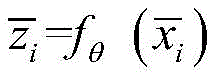
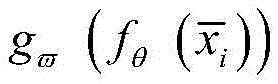
采用预先训练好的CNN网络来提取数据特征,将全部异常数据

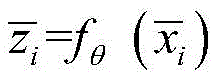
其中,fθ(·)为卷积层、池化层等中间层的映射函数,
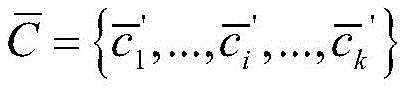
进一步,所述K-means算法预先设置所需参数,所述参数包括异常信号聚类的类别数k和初始聚类质心。通过CNN网络的中间层映射函数fθ(·)提取的有标签数据
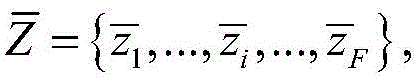
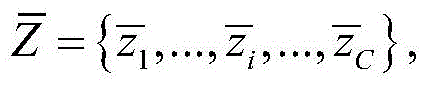
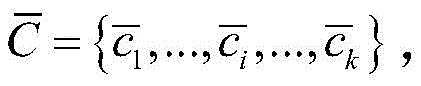
所述K-means算法将CNN网络所提取的全部数据的压缩特征
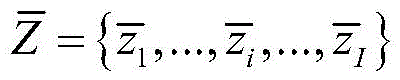


进一步,所述CNN网络将所提取的全部有标签的数据的压缩特征来计算其

通过计算K-means得到的新的聚类质心


将K-means第一次聚类的结果ri和通过CNN网络中间层的输出结果

其中,ri为K-means的聚类输出结果,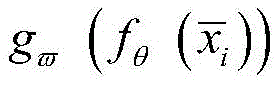
进一步,将压缩后的异常信号序列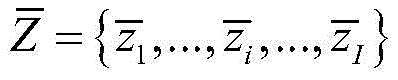

其中,C为质心矩阵,每个输入样本
所述K-means算法采用调整兰德指数ARI评价指标来判断本次聚类结果和上次聚类结果的相似度,从而判断K-means何时收敛,ARI定义如下:The K-means algorithm adjusts the Rand index ARI evaluation index to judge the similarity between the clustering result of this time and the previous clustering result, so as to judge when the K-means converges. ARI is defined as follows:
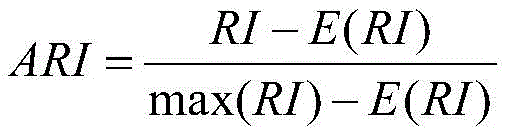
其中,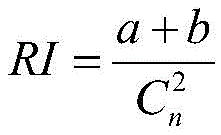
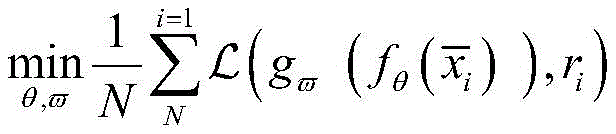
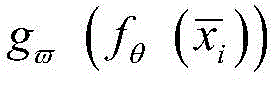
进一步,所述异常信号半监督分类方法采用CNN网络和K-means算法交替进行异常信号分类,通过计算K-means聚类输出和卷积神经网络CNN的输出之间的损失来联合更新卷积神经网络CNN分类器的参数

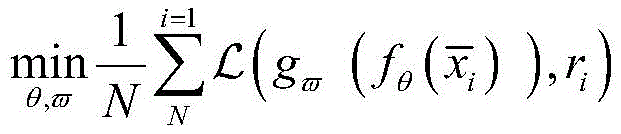
其中,

本发明的另一目的在于提供一种异常信号半监督分类系统,所述半监督的异常信号分类系统包括:Another object of the present invention is to provide a semi-supervised classification system for abnormal signals. The semi-supervised classification system for abnormal signals includes:
模型构建模块,用于构建一个深度学习聚类模型;A model building block for building a deep learning clustering model;
模型预训练模块,用于利用少量有标签的异常信号数据预训练一个CNN分类模型;The model pre-training module is used to pre-train a CNN classification model using a small amount of labeled abnormal signal data;
压缩特征提取模块,用于将异常信号数据作为训练好的CNN模型的输入,通过CNN中间层的映射函数提取输入数据的压缩特征;Compression feature extraction module, used to use the abnormal signal data as the input of the trained CNN model, and extract the compression feature of the input data through the mapping function of the CNN intermediate layer;
参数设置模块,用于对K-means聚类算法的所需参数进行预先设置;A parameter setting module is used to pre-set the required parameters of the K-means clustering algorithm;
聚类质心获取模块,用于对初始聚类质心和新的聚类质心进行计算;The cluster centroid acquisition module is used to calculate the initial cluster centroid and new cluster centroid;
距离计算模块,用于计算K-means得到的新的聚类质心与存放在Memory中的均值的欧式距离;The distance calculation module is used to calculate the Euclidean distance between the new cluster centroid obtained by K-means and the mean value stored in Memory;
参数更新模块,用于利用交叉熵函数损失去更新CNN网络的参数。The parameter update module is used to update the parameters of the CNN network by using the cross-entropy function loss.
结合上述的所有技术方案,本发明所具备的优点及积极效果为:In combination with all the above-mentioned technical solutions, the advantages and positive effects of the present invention are:
本发明克服已有技术的不足之处,提出了一种基于深度学习的半监督异常信号分类方法,可以对大量无标签、少量有标签的信号数据进行半监督分类,解决了大多数聚类算法在无标签条件下聚类效果不佳的问题。具体优点及积极效果如下:The present invention overcomes the deficiencies of the prior art, and proposes a semi-supervised abnormal signal classification method based on deep learning, which can perform semi-supervised classification on a large number of unlabeled and a small number of labeled signal data, and solves most clustering algorithms The problem of clustering poorly in the unlabeled condition. The specific advantages and positive effects are as follows:
(1)本发明针对信号种类繁多,区分不明显的问题,采用了MemSAD的重构损失作为输入,增大了异常样本的差异性,从而提高了深度学习半监督分类模型识别的准确率。(1) Aiming at the problem that there are many types of signals and the distinction is not obvious, the present invention adopts the reconstruction loss of MemSAD as input, which increases the difference of abnormal samples, thereby improving the recognition accuracy of the deep learning semi-supervised classification model.
(2)本发明针对目前分类模型并未对异常信号建模的问题,通过结合卷积神经网络CNN和无监督聚类算法K-means,构建了一种基于深度学习的半监督异常信号分类模型,该模型无需获取大量具有标签的数据即可对数据进行分类处理,并且聚类效果比单纯使用无监督聚类算法K-means效果更佳。(2) The present invention aims at the problem that the current classification model does not model abnormal signals, and constructs a semi-supervised abnormal signal classification model based on deep learning by combining convolutional neural network CNN and unsupervised clustering algorithm K-means , the model can classify data without obtaining a large amount of labeled data, and the clustering effect is better than that of simply using the unsupervised clustering algorithm K-means.
附图说明Description of drawings
图1是本发明实施例提供的异常信号半监督分类方法的流程图。Fig. 1 is a flowchart of a semi-supervised classification method for abnormal signals provided by an embodiment of the present invention.
图2是本发明实施例提供的基于深度学习的半监督的异常信号分类方法的模型结构图。FIG. 2 is a model structure diagram of a semi-supervised abnormal signal classification method based on deep learning provided by an embodiment of the present invention.
图3是本发明实施例提供的微调后的AlexNet网络的参数。Fig. 3 is the parameters of the fine-tuned AlexNet network provided by the embodiment of the present invention.
图4是本发明实施例提供的合成异常信号数据集,里面包含12类异常。Fig. 4 is a synthetic abnormal signal data set provided by an embodiment of the present invention, which contains 12 types of abnormalities.
图5是本发明实施例提供的K-means聚类评价指标ARI在不同迭代次数下的值。Fig. 5 is the value of the K-means clustering evaluation index ARI provided by the embodiment of the present invention under different iteration times.
图6是本发明实施例提供的基于深度学习的半监督的异常信号分类方法的聚类结果图。Fig. 6 is a clustering result diagram of the deep learning-based semi-supervised abnormal signal classification method provided by the embodiment of the present invention.
具体实施方式Detailed ways
为了使本发明的目的、技术方案及优点更加清楚明白,以下结合实施例,对本发明进行进一步详细说明。应当理解,此处所描述的具体实施例仅仅用以解释本发明,并不用于限定本发明。In order to make the object, technical solution and advantages of the present invention more clear, the present invention will be further described in detail below in conjunction with the examples. It should be understood that the specific embodiments described here are only used to explain the present invention, not to limit the present invention.
本实施实例提供了一种异常信号半监督分类方法、系统、数据处理终端,下面结合附图对本发明作详细的描述。This implementation example provides a semi-supervised classification method, system, and data processing terminal for abnormal signals. The invention will be described in detail below in conjunction with the accompanying drawings.
如图1所示,本发明实施例提供的异常信号半监督分类方法包括以下步骤:As shown in Figure 1, the abnormal signal semi-supervised classification method provided by the embodiment of the present invention includes the following steps:
S101:构建一个深度学习聚类模型,利用少量有标签的异常信号数据预训练一个CNN分类模型;S101: Construct a deep learning clustering model, and use a small amount of labeled abnormal signal data to pre-train a CNN classification model;
S102:将全部异常信号数据作为步骤S101中训练好的CNN模型的输入,通过CNN中间层的映射函数提取输入数据的压缩特征;S102: Using all the abnormal signal data as the input of the trained CNN model in step S101, extracting the compressed features of the input data through the mapping function of the CNN intermediate layer;
S103:将CNN提取的小部分少量有标签的每个类别的压缩特征的均值作为初始聚类质心;S103: Use the mean value of the compressed features of each category with a small number of labels extracted by the CNN as the initial cluster centroid;
S104:将CNN中间层提取的全部压缩特征作为K-means聚类算法的输入用于聚类,从而得到新的聚类质心;S104: use all the compressed features extracted by the CNN intermediate layer as the input of the K-means clustering algorithm for clustering, so as to obtain a new cluster centroid;
S105:将CNN中间层提取的全部少量有标签的每个类别的压缩特征的均值放入Memory中;S105: Put the mean value of all the compressed features of each category with a small number of labels extracted by the CNN intermediate layer into Memory;
S106:计算K-means得到的新的聚类质心与存放在Memory中的均值的欧式距离,若K-means中某个类的质心离Memory中的某个均值最近,则为该类中的所有无标签的数据打上Memory中的类别标签;S106: Calculate the Euclidean distance between the new cluster centroid obtained by K-means and the mean value stored in Memory, if the centroid of a certain class in K-means is closest to a certain mean value in Memory, then all The unlabeled data is marked with the category label in Memory;
S107:此时,K-means的聚类结果中所有的数据都有了相应了标签,利用交叉熵函数损失去更新CNN网络的参数;S107: At this time, all the data in the K-means clustering result have corresponding labels, and use the cross-entropy function loss to update the parameters of the CNN network;
S108:重复上述步骤S104至步骤S107,直到迭代过程收敛,以达到用聚类结果来辅助训练分类器的目的。S108: Repeat the above step S104 to step S107 until the iterative process converges, so as to achieve the purpose of using the clustering results to assist in training the classifier.
下面结合具体实施例对本发明进一步进行描述。The present invention will be further described below in conjunction with specific embodiments.
本发明是这样实现的,一种异常信号半监督分类方法包括以下步骤:The present invention is achieved in that a kind of abnormal signal semi-supervised classification method comprises the following steps:
步骤S1:构建一个深度学习聚类模型,所述深度学习聚类模型包括一个记忆增强频谱异常检测编码器MemSAD(Memory-augmented Unsupervised Spectrum AnomalyDetection)、一个经典的卷积神经网络CNN(Convolutional Neural Networks)和一个无监督聚类算法K-means。首先利用30%有标签的异常信号数据预训练一个CNN分类模型;Step S1: Construct a deep learning clustering model, the deep learning clustering model includes a memory-enhanced spectrum anomaly detection coder MemSAD (Memory-augmented Unsupervised Spectrum AnomalyDetection), a classic convolutional neural network CNN (Convolutional Neural Networks) and an unsupervised clustering algorithm K-means. First, pre-train a CNN classification model with 30% labeled abnormal signal data;
步骤S2:将异常信号数据(30%有标签数据和70%无标签数据)作为步骤S1中训练好的CNN模型的输入,通过CNN中间层的映射函数提取输入数据的压缩特征;Step S2: using abnormal signal data (30% labeled data and 70% unlabeled data) as the input of the trained CNN model in step S1, and extracting the compressed features of the input data through the mapping function of the CNN intermediate layer;
步骤S3:将CNN提取的前5%的有标签数据的每个类别的压缩特征的均值作为初始聚类质心;Step S3: use the mean value of the compressed features of each category of the first 5% of the labeled data extracted by CNN as the initial cluster centroid;
步骤S4:将CNN中间层提取的全部数据压缩特征作为K-means聚类算法的输入用于聚类,从而得到新的聚类质心;Step S4: use all the data compression features extracted by the CNN intermediate layer as the input of the K-means clustering algorithm for clustering, so as to obtain a new cluster centroid;
步骤S5:将CNN中间层提取的30%有标签数据的每个类别的压缩特征的均值放入Memory中;Step S5: Put the mean value of the compressed features of each category of the 30% labeled data extracted by the middle layer of CNN into Memory;
步骤S6:计算K-means得到的新的聚类质心与存放在Memory中的均值的欧式距离,若K-means中某个类的质心离Memory中的某个均值最近,则为该类中的所有无标签的数据打上Memory中的类别标签;Step S6: Calculate the Euclidean distance between the new cluster centroid obtained by K-means and the mean value stored in Memory. If the centroid of a certain class in K-means is closest to a certain mean value in Memory, it is the All unlabeled data are marked with category labels in Memory;
步骤S7:此时,K-means的聚类结果中所有的数据都有了相应了标签,利用交叉熵函数损失去更新CNN网络的参数;Step S7: At this point, all the data in the K-means clustering results have corresponding labels, and use the cross-entropy function loss to update the parameters of the CNN network;
步骤S8:重复上述步骤S4、S5、S6、S7,直到迭代过程收敛,以达到用聚类结果来辅助训练分类器的目的。Step S8: Repeat the above steps S4, S5, S6, and S7 until the iterative process converges, so as to achieve the purpose of using the clustering results to assist in training the classifier.
步骤S1中,具体地,如图2所示,本发明所构建的深度学习聚类模型由以下几个部分组成:一个记忆增强无监督频谱异常检测编码器MemSAD(Memory-augmentedUnsupervised Spectrum Anomaly Detection)、一个经典的卷积神经网络CNN(Convolutional Neural Networks)和K-means聚类算法。In step S1, specifically, as shown in Figure 2, the deep learning clustering model constructed by the present invention consists of the following parts: a memory-enhanced unsupervised spectrum anomaly detection encoder MemSAD (Memory-augmentedUnsupervised Spectrum Anomaly Detection), A classic convolutional neural network CNN (Convolutional Neural Networks) and K-means clustering algorithm.
(1)MemSAD:可检测由故障和误用导致的频谱使用异常,其内存模块记录了正常数据的原型模式,并且允许在训练和测试阶段同时进行更新,从而提高记忆项以及从正常数据学习压缩特征的能力。(1) MemSAD: It can detect abnormal spectrum usage caused by failure and misuse. Its memory module records the prototype mode of normal data and allows simultaneous updates during training and testing phases, thereby improving memory items and learning compression from normal data. characteristic capabilities.
(2)CNN:用于提取异常数据的压缩特征以及对异常数据进行分类,本发明所采用的CNN网络是一个微调后的AlexNet网络。AlexNet是一个由5个卷积层和3个全连接层组成的,本发明对该网络的参数进行了微调,具体参数见图3。(2) CNN: used to extract the compressed features of the abnormal data and classify the abnormal data. The CNN network adopted in the present invention is a fine-tuned AlexNet network. AlexNet is composed of 5 convolutional layers and 3 fully connected layers. The present invention fine-tunes the parameters of the network, and the specific parameters are shown in Figure 3.
(3)K-means聚类算法:用于对CNN网络压缩后的特征进行聚类。(3) K-means clustering algorithm: used to cluster the compressed features of the CNN network.
进一步,步骤S1中所述的深度学习聚类模型将原始异常信号X={x1,...,xi,...,xN}通过MemSAD编码器网络进行重构,得到重构后的异常信号


其中,xi为原始异常信号数据,
进一步,步骤S1中所述的深度学习聚类模型将30%有标签的异常信号数据
步骤S2中,具体地,该合成异常信号数据集含36000个异常数据,信号异常类别数为12,如图4所示。其中10800个有标签数据(占比30%),25200个无标签数据(占比70%)作为步骤S1中训练好的CNN模型的输入。In step S2, specifically, the synthetic abnormal signal data set contains 36,000 abnormal data, and the number of signal abnormal categories is 12, as shown in FIG. 4 . Among them, 10800 labeled data (accounting for 30%) and 25200 unlabeled data (accounting for 70%) are used as the input of the trained CNN model in step S1.
进一步,将异常数据


步骤S3中,具体地,K-means算法需要预先设置所需参数,所述参数包括异常信号聚类的类别数和初始聚类质心。首先确定一个k值,即我们希望将数据集经过聚类得到12个类别,因此令k=12。从步骤S2中CNN网络的中间层映射函数fθ(·)提取的10800个有标签数据的压缩特征中选取前540个数据的压缩特征(占比5%)来计算其每一个类别的均值
步骤S4中,具体地,将步骤S2中所提取的36000个数据的压缩特征作为K-means的输入,对压缩特征序列中每一个数据点,计算其与步骤S3中所得到的每一个初始质心

步骤S5中,具体地,利用步骤S2中所提取的10800个有标签数据的压缩特征来计算其每一个类别的均值
步骤S6中,具体地,计算K-means得到的新的聚类质心



步骤S7中,具体地,此时,所有的数据都有了相应了标签,将K-means第一次聚类的结果ri和通过CNN网络中间层的输出结果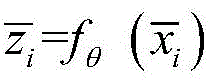

其中,ri为K-means的聚类输出结果,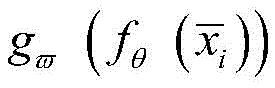
进一步,通过误差反向传播算法以及交叉熵损失函数来更新CNN的参数,并得到新的中间层映射函数。输入数据通过新的映射函数进行压缩特征的提取,并将提取的特征输入到K-means算法中,此时K-means沿用上一次保存的初始质心进行聚类。Further, the parameters of the CNN are updated through the error backpropagation algorithm and the cross-entropy loss function, and a new intermediate layer mapping function is obtained. The input data is extracted through the new mapping function, and the extracted features are input into the K-means algorithm. At this time, K-means uses the last saved initial centroid for clustering.
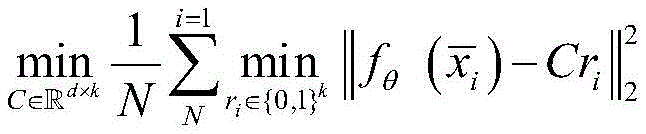
步骤S8中,具体地,重复上述步骤S4、S5、S6、S7,直到迭代过程收敛,以达到用聚类结果来辅助训练分类器的目的。K-means算法的具体的训练目标表示如下:In step S8, specifically, the above steps S4, S5, S6, and S7 are repeated until the iterative process converges, so as to achieve the purpose of using the clustering results to assist in training the classifier. The specific training objectives of the K-means algorithm are expressed as follows:

其中,C为质心矩阵,每个输入样本
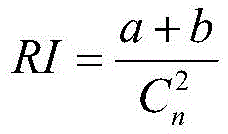
进一步,本发明采用调整兰德指数ARI评价指标来判断本次聚类结果和上次聚类结果的相似度,从而判断K-means何时收敛,ARI定义如下:Further, the present invention adjusts the Rand index ARI evaluation index to judge the similarity between the clustering result of this time and the previous clustering result, thereby judging when K-means converges. ARI is defined as follows:

其中,
进一步,K-means聚类评价指标ARI在不同迭代次数下的值如图5所示。Further, the values of the K-means clustering evaluation index ARI at different iterations are shown in Figure 5.
进一步,利用K-means的聚类结果辅助CNN进行参数更新,直到找到一个最佳的参数

其中,

进一步,当CNN的分类器训练完成后,输入无标签的测试数据,得到K-means的最终聚类结果图,如图6所示。Further, after the training of the CNN classifier is completed, the unlabeled test data is input to obtain the final clustering result map of K-means, as shown in Figure 6.
应当注意,本发明的实施方式可以通过硬件、软件或者软件和硬件的结合来实现。硬件部分可以利用专用逻辑来实现;软件部分可以存储在存储器中,由适当的指令执行系统,例如微处理器或者专用设计硬件来执行。本领域的普通技术人员可以理解上述的设备和方法可以使用计算机可执行指令和/或包含在处理器控制代码中来实现,例如在诸如磁盘、CD或DVD-ROM的载体介质、诸如只读存储器(固件)的可编程的存储器或者诸如光学或电子信号载体的数据载体上提供了这样的代码。本发明的设备及其模块可以由诸如超大规模集成电路或门阵列、诸如逻辑芯片、晶体管等的半导体、或者诸如现场可编程门阵列、可编程逻辑设备等的可编程硬件设备的硬件电路实现,也可以用由各种类型的处理器执行的软件实现,也可以由上述硬件电路和软件的结合例如固件来实现。It should be noted that the embodiments of the present invention can be realized by hardware, software, or a combination of software and hardware. The hardware part can be implemented using dedicated logic; the software part can be stored in memory and executed by a suitable instruction execution system such as a microprocessor or specially designed hardware. Those of ordinary skill in the art will understand that the above-described devices and methods can be implemented using computer-executable instructions and/or contained in processor control code, for example, on a carrier medium such as a magnetic disk, CD or DVD-ROM, such as a read-only memory Such code is provided on a programmable memory (firmware) or on a data carrier such as an optical or electronic signal carrier. The device and its modules of the present invention may be implemented by hardware circuits such as VLSI or gate arrays, semiconductors such as logic chips, transistors, etc., or programmable hardware devices such as field programmable gate arrays, programmable logic devices, etc., It can also be realized by software executed by various types of processors, or by a combination of the above-mentioned hardware circuits and software such as firmware.
以上所述仅为本发明的较佳实施例而已,并不用以限制本发明,凡在本发明的精神和原则之内所作的任何修改、等同替换和改进等,均应包含在本发明的保护范围之内。The above descriptions are only preferred embodiments of the present invention, and are not intended to limit the present invention. Any modifications, equivalent replacements and improvements made within the spirit and principles of the present invention should be included in the protection of the present invention. within range.
Claims (7)
























Priority Applications (1)
| Application Number | Priority Date | Filing Date | Title |
|---|---|---|---|
| CN202110708117.5A CN113541834B (en) | 2021-06-24 | 2021-06-24 | Abnormal signal semi-supervised classification method and system and data processing terminal |
Applications Claiming Priority (1)
| Application Number | Priority Date | Filing Date | Title |
|---|---|---|---|
| CN202110708117.5A CN113541834B (en) | 2021-06-24 | 2021-06-24 | Abnormal signal semi-supervised classification method and system and data processing terminal |
Publications (2)
| Publication Number | Publication Date |
|---|---|
| CN113541834A CN113541834A (en) | 2021-10-22 |
| CN113541834B true CN113541834B (en) | 2023-03-03 |
Family
ID=78125840
Family Applications (1)
| Application Number | Title | Priority Date | Filing Date |
|---|---|---|---|
| CN202110708117.5A Active CN113541834B (en) | 2021-06-24 | 2021-06-24 | Abnormal signal semi-supervised classification method and system and data processing terminal |
Country Status (1)
| Country | Link |
|---|---|
| CN (1) | CN113541834B (en) |
Families Citing this family (10)
| Publication number | Priority date | Publication date | Assignee | Title |
|---|---|---|---|---|
| CN114205821B (en) * | 2021-11-30 | 2023-08-08 | 广州万城万充新能源科技有限公司 | Wireless radio frequency anomaly detection method based on depth prediction coding neural network |
| CN114254702A (en) * | 2021-12-16 | 2022-03-29 | 南方电网数字电网研究院有限公司 | Method, device, equipment, medium and product for identifying abnormal data of bus load |
| CN114547102B (en) * | 2022-01-14 | 2025-04-04 | 北京理工大学 | Model Stealing Attack Method Based on Gradient Driven Data Generation |
| CN115391027B (en) * | 2022-07-12 | 2025-09-30 | Oppo广东移动通信有限公司 | Data processing method, device, electronic device and storage medium |
| CN115511118A (en) * | 2022-09-19 | 2022-12-23 | 常州英集动力科技有限公司 | A method and system for auxiliary decision-making of heating system faults based on artificial intelligence |
| CN116166953A (en) * | 2023-03-02 | 2023-05-26 | 四川航天烽火伺服控制技术有限公司 | Data feature extraction method, device, equipment and storage medium |
| CN116383737B (en) * | 2023-06-05 | 2023-08-11 | 四川大学 | Rotary machine fault diagnosis method and system based on cluster comparison learning |
| CN118645248B (en) * | 2024-08-15 | 2024-12-24 | 山东建筑大学 | Dual semi-supervised integrated abnormal psychological sand table detection method and system |
| CN119782907A (en) * | 2024-12-26 | 2025-04-08 | 中国科学院自动化研究所 | Domain Adaptation Method during Test Based on Memory Replay and Weighted Entropy Minimization |
| CN120071408B (en) * | 2024-12-30 | 2025-09-09 | 哈尔滨工业大学(威海) | Automatic segmentation method of intravascular lipid plaque based on deep learning |
Citations (2)
| Publication number | Priority date | Publication date | Assignee | Title |
|---|---|---|---|---|
| CN110942091A (en) * | 2019-11-15 | 2020-03-31 | 武汉理工大学 | A Semi-Supervised Few-Shot Image Classification Method for Finding Reliable Outlier Data Centers |
| CN112288034A (en) * | 2020-11-19 | 2021-01-29 | 江南大学 | Semi-supervised online anomaly detection method for wireless sensor network |
Family Cites Families (6)
| Publication number | Priority date | Publication date | Assignee | Title |
|---|---|---|---|---|
| US9336302B1 (en) * | 2012-07-20 | 2016-05-10 | Zuci Realty Llc | Insight and algorithmic clustering for automated synthesis |
| CN107846326B (en) * | 2017-11-10 | 2020-11-10 | 北京邮电大学 | An adaptive semi-supervised network traffic classification method, system and device |
| US10789703B2 (en) * | 2018-03-19 | 2020-09-29 | Kla-Tencor Corporation | Semi-supervised anomaly detection in scanning electron microscope images |
| CN108764281A (en) * | 2018-04-18 | 2018-11-06 | 华南理工大学 | A kind of image classification method learning across task depth network based on semi-supervised step certainly |
| CN109034205B (en) * | 2018-06-29 | 2021-02-02 | 西安交通大学 | Image classification method based on transductive semi-supervised deep learning |
| CN110414587A (en) * | 2019-07-23 | 2019-11-05 | 南京邮电大学 | Deep Convolutional Neural Network Training Method and System Based on Progressive Learning |
-
2021
- 2021-06-24 CN CN202110708117.5A patent/CN113541834B/en active Active
Patent Citations (2)
| Publication number | Priority date | Publication date | Assignee | Title |
|---|---|---|---|---|
| CN110942091A (en) * | 2019-11-15 | 2020-03-31 | 武汉理工大学 | A Semi-Supervised Few-Shot Image Classification Method for Finding Reliable Outlier Data Centers |
| CN112288034A (en) * | 2020-11-19 | 2021-01-29 | 江南大学 | Semi-supervised online anomaly detection method for wireless sensor network |
Non-Patent Citations (2)
| Title |
|---|
| Method of modulation recognition based on combination algorithm of K-means clustering and grading training SVM;Faquan Yang等;《China Communications》;20181228;第55-63页 * |
| 基于半监督学习和信息增益率的入侵检测方案;许勐璠等;《计算机研究与发展》;20171015;第2255-2267页 * |
Also Published As
| Publication number | Publication date |
|---|---|
| CN113541834A (en) | 2021-10-22 |
Similar Documents
| Publication | Publication Date | Title |
|---|---|---|
| CN113541834B (en) | Abnormal signal semi-supervised classification method and system and data processing terminal | |
| US12131258B2 (en) | Joint pruning and quantization scheme for deep neural networks | |
| Zhou et al. | Graph convolutional network hashing | |
| CN110460605B (en) | Abnormal network flow detection method based on automatic coding | |
| US11908457B2 (en) | Orthogonally constrained multi-head attention for speech tasks | |
| CN110134803B (en) | A fast retrieval method for image data based on hash learning | |
| KR20220058897A (en) | Perform XNOR equivalent operations by adjusting column thresholds of a compute-in-memory array | |
| US20220101133A1 (en) | Dynamic quantization for energy efficient deep learning | |
| CN115037805B (en) | A method, system, device and storage medium for identifying unknown network protocols based on deep clustering | |
| CN114358216B (en) | Quantum clustering method based on machine learning framework and related device | |
| CN101324926B (en) | Method for selecting characteristic facing to complicated mode classification | |
| CN116756663B (en) | A multi-classification method and device based on variational quantum computing | |
| CN118395363A (en) | Active power distribution network abnormal state sensing method and system based on data enhancement | |
| US20250315665A1 (en) | Sparsity-based neural network mapping to computing units in a system-on-chip | |
| CN116400168A (en) | A power grid fault diagnosis method and system based on deep feature clustering | |
| Rui et al. | Smart network maintenance in an edge cloud computing environment: An adaptive model compression algorithm based on model pruning and model clustering | |
| CN115392357A (en) | Classification model training and labeled data sample spot inspection method, medium and electronic equipment | |
| CN114332491A (en) | Saliency target detection algorithm based on feature reconstruction | |
| CN110287985B (en) | Depth neural network image identification method based on variable topology structure with variation particle swarm optimization | |
| Perenda et al. | Evolutionary optimization of residual neural network architectures for modulation classification | |
| CN112866156B (en) | A radio signal clustering method and system based on deep learning | |
| CN114168822A (en) | Method for establishing time series data clustering model and time series data clustering | |
| CN114328942A (en) | Relationship extraction method, apparatus, device, storage medium and computer program product | |
| CN114124437A (en) | Encrypted Traffic Identification Method Based on Prototype Convolutional Network | |
| CN115883301B (en) | Signal modulation classification model and learning method based on sample recall incremental learning |
Legal Events
| Date | Code | Title | Description |
|---|---|---|---|
| PB01 | Publication | ||
| PB01 | Publication | ||
| SE01 | Entry into force of request for substantive examination | ||
| SE01 | Entry into force of request for substantive examination | ||
| GR01 | Patent grant | ||
| GR01 | Patent grant |