CN113506640B - Cerebral perfusion state classification device, method, device and model training device - Google Patents
Cerebral perfusion state classification device, method, device and model training device Download PDFInfo
- Publication number
- CN113506640B CN113506640B CN202110943428.XA CN202110943428A CN113506640B CN 113506640 B CN113506640 B CN 113506640B CN 202110943428 A CN202110943428 A CN 202110943428A CN 113506640 B CN113506640 B CN 113506640B
- Authority
- CN
- China
- Prior art keywords
- data
- physiological
- blood flow
- random forest
- forest model
- Prior art date
- Legal status (The legal status is an assumption and is not a legal conclusion. Google has not performed a legal analysis and makes no representation as to the accuracy of the status listed.)
- Active
Links
Images


Classifications
-
- G—PHYSICS
- G16—INFORMATION AND COMMUNICATION TECHNOLOGY [ICT] SPECIALLY ADAPTED FOR SPECIFIC APPLICATION FIELDS
- G16H—HEALTHCARE INFORMATICS, i.e. INFORMATION AND COMMUNICATION TECHNOLOGY [ICT] SPECIALLY ADAPTED FOR THE HANDLING OR PROCESSING OF MEDICAL OR HEALTHCARE DATA
- G16H50/00—ICT specially adapted for medical diagnosis, medical simulation or medical data mining; ICT specially adapted for detecting, monitoring or modelling epidemics or pandemics
- G16H50/70—ICT specially adapted for medical diagnosis, medical simulation or medical data mining; ICT specially adapted for detecting, monitoring or modelling epidemics or pandemics for mining of medical data, e.g. analysing previous cases of other patients
-
- A—HUMAN NECESSITIES
- A61—MEDICAL OR VETERINARY SCIENCE; HYGIENE
- A61B—DIAGNOSIS; SURGERY; IDENTIFICATION
- A61B5/00—Measuring for diagnostic purposes; Identification of persons
- A61B5/0033—Features or image-related aspects of imaging apparatus, e.g. for MRI, optical tomography or impedance tomography apparatus; Arrangements of imaging apparatus in a room
- A61B5/004—Features or image-related aspects of imaging apparatus, e.g. for MRI, optical tomography or impedance tomography apparatus; Arrangements of imaging apparatus in a room adapted for image acquisition of a particular organ or body part
- A61B5/0042—Features or image-related aspects of imaging apparatus, e.g. for MRI, optical tomography or impedance tomography apparatus; Arrangements of imaging apparatus in a room adapted for image acquisition of a particular organ or body part for the brain
-
- A—HUMAN NECESSITIES
- A61—MEDICAL OR VETERINARY SCIENCE; HYGIENE
- A61B—DIAGNOSIS; SURGERY; IDENTIFICATION
- A61B5/00—Measuring for diagnostic purposes; Identification of persons
- A61B5/02—Detecting, measuring or recording for evaluating the cardiovascular system, e.g. pulse, heart rate, blood pressure or blood flow
- A61B5/0205—Simultaneously evaluating both cardiovascular conditions and different types of body conditions, e.g. heart and respiratory condition
- A61B5/02055—Simultaneously evaluating both cardiovascular condition and temperature
-
- A—HUMAN NECESSITIES
- A61—MEDICAL OR VETERINARY SCIENCE; HYGIENE
- A61B—DIAGNOSIS; SURGERY; IDENTIFICATION
- A61B5/00—Measuring for diagnostic purposes; Identification of persons
- A61B5/02—Detecting, measuring or recording for evaluating the cardiovascular system, e.g. pulse, heart rate, blood pressure or blood flow
- A61B5/026—Measuring blood flow
-
- A—HUMAN NECESSITIES
- A61—MEDICAL OR VETERINARY SCIENCE; HYGIENE
- A61B—DIAGNOSIS; SURGERY; IDENTIFICATION
- A61B5/00—Measuring for diagnostic purposes; Identification of persons
- A61B5/05—Detecting, measuring or recording for diagnosis by means of electric currents or magnetic fields; Measuring using microwaves or radio waves
- A61B5/055—Detecting, measuring or recording for diagnosis by means of electric currents or magnetic fields; Measuring using microwaves or radio waves involving electronic [EMR] or nuclear [NMR] magnetic resonance, e.g. magnetic resonance imaging
-
- A—HUMAN NECESSITIES
- A61—MEDICAL OR VETERINARY SCIENCE; HYGIENE
- A61B—DIAGNOSIS; SURGERY; IDENTIFICATION
- A61B5/00—Measuring for diagnostic purposes; Identification of persons
- A61B5/145—Measuring characteristics of blood in vivo, e.g. gas concentration or pH-value ; Measuring characteristics of body fluids or tissues, e.g. interstitial fluid or cerebral tissue
- A61B5/14542—Measuring characteristics of blood in vivo, e.g. gas concentration or pH-value ; Measuring characteristics of body fluids or tissues, e.g. interstitial fluid or cerebral tissue for measuring blood gases
-
- A—HUMAN NECESSITIES
- A61—MEDICAL OR VETERINARY SCIENCE; HYGIENE
- A61B—DIAGNOSIS; SURGERY; IDENTIFICATION
- A61B5/00—Measuring for diagnostic purposes; Identification of persons
- A61B5/40—Detecting, measuring or recording for evaluating the nervous system
- A61B5/4058—Detecting, measuring or recording for evaluating the nervous system for evaluating the central nervous system
-
- A—HUMAN NECESSITIES
- A61—MEDICAL OR VETERINARY SCIENCE; HYGIENE
- A61B—DIAGNOSIS; SURGERY; IDENTIFICATION
- A61B5/00—Measuring for diagnostic purposes; Identification of persons
- A61B5/72—Signal processing specially adapted for physiological signals or for diagnostic purposes
- A61B5/7235—Details of waveform analysis
- A61B5/7264—Classification of physiological signals or data, e.g. using neural networks, statistical classifiers, expert systems or fuzzy systems
- A61B5/7267—Classification of physiological signals or data, e.g. using neural networks, statistical classifiers, expert systems or fuzzy systems involving training the classification device
-
- G—PHYSICS
- G06—COMPUTING OR CALCULATING; COUNTING
- G06N—COMPUTING ARRANGEMENTS BASED ON SPECIFIC COMPUTATIONAL MODELS
- G06N20/00—Machine learning
- G06N20/20—Ensemble learning
-
- G—PHYSICS
- G06—COMPUTING OR CALCULATING; COUNTING
- G06N—COMPUTING ARRANGEMENTS BASED ON SPECIFIC COMPUTATIONAL MODELS
- G06N3/00—Computing arrangements based on biological models
- G06N3/004—Artificial life, i.e. computing arrangements simulating life
- G06N3/006—Artificial life, i.e. computing arrangements simulating life based on simulated virtual individual or collective life forms, e.g. social simulations or particle swarm optimisation [PSO]
-
- G—PHYSICS
- G06—COMPUTING OR CALCULATING; COUNTING
- G06N—COMPUTING ARRANGEMENTS BASED ON SPECIFIC COMPUTATIONAL MODELS
- G06N5/00—Computing arrangements using knowledge-based models
- G06N5/01—Dynamic search techniques; Heuristics; Dynamic trees; Branch-and-bound
-
- G—PHYSICS
- G16—INFORMATION AND COMMUNICATION TECHNOLOGY [ICT] SPECIALLY ADAPTED FOR SPECIFIC APPLICATION FIELDS
- G16H—HEALTHCARE INFORMATICS, i.e. INFORMATION AND COMMUNICATION TECHNOLOGY [ICT] SPECIALLY ADAPTED FOR THE HANDLING OR PROCESSING OF MEDICAL OR HEALTHCARE DATA
- G16H50/00—ICT specially adapted for medical diagnosis, medical simulation or medical data mining; ICT specially adapted for detecting, monitoring or modelling epidemics or pandemics
- G16H50/20—ICT specially adapted for medical diagnosis, medical simulation or medical data mining; ICT specially adapted for detecting, monitoring or modelling epidemics or pandemics for computer-aided diagnosis, e.g. based on medical expert systems
-
- A—HUMAN NECESSITIES
- A61—MEDICAL OR VETERINARY SCIENCE; HYGIENE
- A61B—DIAGNOSIS; SURGERY; IDENTIFICATION
- A61B5/00—Measuring for diagnostic purposes; Identification of persons
- A61B5/02—Detecting, measuring or recording for evaluating the cardiovascular system, e.g. pulse, heart rate, blood pressure or blood flow
- A61B5/021—Measuring pressure in heart or blood vessels
-
- A—HUMAN NECESSITIES
- A61—MEDICAL OR VETERINARY SCIENCE; HYGIENE
- A61B—DIAGNOSIS; SURGERY; IDENTIFICATION
- A61B5/00—Measuring for diagnostic purposes; Identification of persons
- A61B5/02—Detecting, measuring or recording for evaluating the cardiovascular system, e.g. pulse, heart rate, blood pressure or blood flow
- A61B5/024—Measuring pulse rate or heart rate
-
- G—PHYSICS
- G16—INFORMATION AND COMMUNICATION TECHNOLOGY [ICT] SPECIALLY ADAPTED FOR SPECIFIC APPLICATION FIELDS
- G16H—HEALTHCARE INFORMATICS, i.e. INFORMATION AND COMMUNICATION TECHNOLOGY [ICT] SPECIALLY ADAPTED FOR THE HANDLING OR PROCESSING OF MEDICAL OR HEALTHCARE DATA
- G16H30/00—ICT specially adapted for the handling or processing of medical images
- G16H30/20—ICT specially adapted for the handling or processing of medical images for handling medical images, e.g. DICOM, HL7 or PACS
-
- G—PHYSICS
- G16—INFORMATION AND COMMUNICATION TECHNOLOGY [ICT] SPECIALLY ADAPTED FOR SPECIFIC APPLICATION FIELDS
- G16H—HEALTHCARE INFORMATICS, i.e. INFORMATION AND COMMUNICATION TECHNOLOGY [ICT] SPECIALLY ADAPTED FOR THE HANDLING OR PROCESSING OF MEDICAL OR HEALTHCARE DATA
- G16H30/00—ICT specially adapted for the handling or processing of medical images
- G16H30/40—ICT specially adapted for the handling or processing of medical images for processing medical images, e.g. editing
-
- G—PHYSICS
- G16—INFORMATION AND COMMUNICATION TECHNOLOGY [ICT] SPECIALLY ADAPTED FOR SPECIFIC APPLICATION FIELDS
- G16H—HEALTHCARE INFORMATICS, i.e. INFORMATION AND COMMUNICATION TECHNOLOGY [ICT] SPECIALLY ADAPTED FOR THE HANDLING OR PROCESSING OF MEDICAL OR HEALTHCARE DATA
- G16H40/00—ICT specially adapted for the management or administration of healthcare resources or facilities; ICT specially adapted for the management or operation of medical equipment or devices
- G16H40/60—ICT specially adapted for the management or administration of healthcare resources or facilities; ICT specially adapted for the management or operation of medical equipment or devices for the operation of medical equipment or devices
- G16H40/63—ICT specially adapted for the management or administration of healthcare resources or facilities; ICT specially adapted for the management or operation of medical equipment or devices for the operation of medical equipment or devices for local operation
Landscapes
- Health & Medical Sciences (AREA)
- Engineering & Computer Science (AREA)
- Life Sciences & Earth Sciences (AREA)
- Medical Informatics (AREA)
- Public Health (AREA)
- Biomedical Technology (AREA)
- Physics & Mathematics (AREA)
- General Health & Medical Sciences (AREA)
- Pathology (AREA)
- Data Mining & Analysis (AREA)
- Theoretical Computer Science (AREA)
- Biophysics (AREA)
- Molecular Biology (AREA)
- Artificial Intelligence (AREA)
- Surgery (AREA)
- Heart & Thoracic Surgery (AREA)
- Animal Behavior & Ethology (AREA)
- Veterinary Medicine (AREA)
- Software Systems (AREA)
- Databases & Information Systems (AREA)
- Evolutionary Computation (AREA)
- Primary Health Care (AREA)
- Epidemiology (AREA)
- Mathematical Physics (AREA)
- Physiology (AREA)
- General Physics & Mathematics (AREA)
- General Engineering & Computer Science (AREA)
- Computing Systems (AREA)
- Nuclear Medicine, Radiotherapy & Molecular Imaging (AREA)
- Cardiology (AREA)
- Computer Vision & Pattern Recognition (AREA)
- Neurology (AREA)
- Radiology & Medical Imaging (AREA)
- Computational Linguistics (AREA)
- Neurosurgery (AREA)
- Hematology (AREA)
- Optics & Photonics (AREA)
- Pulmonology (AREA)
- Fuzzy Systems (AREA)
- Psychiatry (AREA)
Abstract
本申请公开了脑灌注状态分类装置、方法、设备及模型训练装置。该装置中,收发模块,用于接收来自不同数据采集设备的生理特征数据;处理器,用于提取生理特征数据中的生理特征;将生理特征输入随机森林模型中,以使随机森林模型中的多个决策树预测出生理特征对应的脑灌注状态类型;基于生理特征对应的脑灌注状态类型对脑灌注状态进行分类。通过该装置,不仅无需使用大型检查设备即可对脑灌注状态进行分类,大大降低脑灌注状态分类的实现难度,拓展脑灌注状态分类的应用场景;并通过随机森林模型还可融合更多生理特征,以更加准确地区分各种脑灌注状态,提高脑血流及脑功能评估结果的准确性,辅助医生完成脑部检查。
The present application discloses a cerebral perfusion state classification device, method, equipment and model training device. In the device, a transceiver module is used for receiving physiological characteristic data from different data acquisition devices; a processor is used for extracting physiological characteristics in the physiological characteristic data; and the physiological characteristics are input into the random forest model, so that the Multiple decision trees predict the cerebral perfusion state type corresponding to the physiological feature; the cerebral perfusion state is classified based on the cerebral perfusion state type corresponding to the physiological feature. Through this device, the cerebral perfusion state can be classified without using large-scale inspection equipment, greatly reducing the difficulty of implementing cerebral perfusion state classification, and expanding the application scenarios of cerebral perfusion state classification; more physiological features can also be integrated through the random forest model , to more accurately distinguish various cerebral perfusion states, improve the accuracy of cerebral blood flow and cerebral function assessment results, and assist doctors in completing brain examinations.
Description
技术领域technical field
本申请属于计算机技术领域,尤其涉及脑灌注状态分类装置、方法、设备及模型训练装置。The present application belongs to the field of computer technology, and in particular relates to a cerebral perfusion state classification device, method, device and model training device.
背景技术Background technique
脑灌注成像技术主要用于反映脑组织的血流灌注状态。相关技术中,多采用电子计算机断层扫描(Computed Tomography,CT)、核磁共振成像(Magnetic ResonanceImaging,MRI)等大型设备进行检查,然后根据检查结果进行脑血流及脑功能状态的评估。Cerebral perfusion imaging technology is mainly used to reflect the blood perfusion state of brain tissue. In the related art, large-scale equipment such as Computed Tomography (CT) and Magnetic Resonance Imaging (MRI) are mostly used for examination, and then cerebral blood flow and cerebral functional state are evaluated according to the examination results.
但是,相关技术中检查设备的操作复杂,而且往往体积较大,难以适应一些特殊场景,例如航天场景、户外急救场景等。因此,有待提出一种新的解决方案。However, the inspection equipment in the related art is complicated to operate, and is often bulky, which makes it difficult to adapt to some special scenarios, such as aerospace scenarios, outdoor emergency scenarios, and the like. Therefore, a new solution needs to be proposed.
发明内容SUMMARY OF THE INVENTION
有鉴于此,本申请提供一种解决或部分解决上述技术问题的脑灌注状态分类装置、方法、设备及模型训练装置。In view of this, the present application provides a cerebral perfusion state classification device, method, device and model training device that solve or partially solve the above technical problems.
第一方面,本申请实施例提供一种脑灌注状态分类装置,该装置包括:In a first aspect, an embodiment of the present application provides a cerebral perfusion state classification device, the device comprising:
收发模块,用于接收来自不同数据采集设备的生理特征数据,其中,生理特征数据包括生理指标数据、颈部血流数据、脑部血流数据中的至少一种;a transceiver module for receiving physiological feature data from different data collection devices, wherein the physiological feature data includes at least one of physiological index data, neck blood flow data, and cerebral blood flow data;
处理器,用于提取生理特征数据中的生理特征;将生理特征输入随机森林模型中,以使随机森林模型中的多个决策树预测出生理特征对应的脑灌注状态类型;基于生理特征对应的脑灌注状态类型对脑灌注状态进行分类。The processor is used to extract the physiological features in the physiological feature data; input the physiological features into the random forest model, so that the multiple decision trees in the random forest model predict the cerebral perfusion state type corresponding to the physiological features; The cerebral perfusion state type classifies the cerebral perfusion state.
第二方面,本申请实施例提供一种脑灌注状态分类方法,方法包括:In a second aspect, an embodiment of the present application provides a method for classifying a cerebral perfusion state, the method comprising:
接收来自不同数据采集设备的生理特征数据,其中,生理特征数据包括生理指标数据、颈部血流数据、脑部血流数据中的至少一种;Receive physiological feature data from different data collection devices, wherein the physiological feature data includes at least one of physiological index data, neck blood flow data, and cerebral blood flow data;
提取生理特征数据中的生理特征;Extracting physiological features from physiological feature data;
将生理特征输入随机森林模型中,以使随机森林模型中的多个决策树预测出生理特征对应的脑灌注状态类型;The physiological features are input into the random forest model, so that the multiple decision trees in the random forest model can predict the cerebral perfusion state type corresponding to the physiological features;
基于生理特征对应的脑灌注状态类型对脑灌注状态进行分类。The cerebral perfusion state is classified based on the type of cerebral perfusion state corresponding to the physiological characteristics.
第三方面,本申请实施例提供一种脑灌注状态分类模型的训练装置,包括:In a third aspect, an embodiment of the present application provides a training device for a cerebral perfusion state classification model, including:
收发模块,用于接收来自不同数据采集设备的生理特征数据样本,其中,生理特征数据样本包括生理指标数据样本、颈部血流数据样本、脑部血流数据样本中的至少一种;a transceiver module for receiving physiological feature data samples from different data collection devices, wherein the physiological feature data samples include at least one of physiological index data samples, neck blood flow data samples, and cerebral blood flow data samples;
处理器,用于提取生理特征数据样本中的生理特征样本;将生理特征样本输入到随机森林模型中,以使随机森林模型中的多个决策树预测出生理特征样本对应的脑灌注状态类型;a processor for extracting physiological feature samples in the physiological feature data samples; inputting the physiological feature samples into the random forest model, so that multiple decision trees in the random forest model predict the cerebral perfusion state type corresponding to the physiological feature samples;
处理器,还用于基于随机森林模型预测出的脑灌注状态类型、以及预先标注的生理特征数据样本与脑灌注状态类型样本的映射关系,调整随机森林模型,以使调整后的随机森林模型输出的脑灌注状态类型与脑灌注状态类型样本一致。The processor is further configured to adjust the random forest model based on the cerebral perfusion state type predicted by the random forest model and the mapping relationship between the pre-marked physiological characteristic data samples and the cerebral perfusion state type samples, so that the adjusted random forest model outputs The type of cerebral perfusion state is consistent with the type of cerebral perfusion state in the sample.
第四方面,本申请实施例提供一种脑灌注状态分类模型的训练方法,包括:In a fourth aspect, an embodiment of the present application provides a training method for a cerebral perfusion state classification model, including:
接收来自不同数据采集设备的生理特征数据样本,其中,生理特征数据样本包括生理指标数据样本、颈部血流数据样本、脑部血流数据样本中的至少一种;Receive physiological feature data samples from different data collection devices, wherein the physiological feature data samples include at least one of physiological index data samples, neck blood flow data samples, and cerebral blood flow data samples;
提取生理特征数据样本中的生理特征样本;extracting physiological feature samples from the physiological feature data samples;
将生理特征样本输入到随机森林模型中,以使随机森林模型中的多个决策树预测出生理特征样本对应的脑灌注状态类型;Input the physiological feature samples into the random forest model, so that the multiple decision trees in the random forest model predict the cerebral perfusion state type corresponding to the physiological feature samples;
基于预测出的脑灌注状态类型、以及预先标注的生理特征数据样本与脑灌注状态类型样本的映射关系,调整随机森林模型,以使调整后的随机森林模型输出的脑灌注状态类型与脑灌注状态类型样本一致。Based on the predicted cerebral perfusion state type and the mapping relationship between the pre-labeled physiological characteristic data samples and the cerebral perfusion state type samples, the random forest model is adjusted so that the cerebral perfusion state type output by the adjusted random forest model is consistent with the cerebral perfusion state type. Type samples are consistent.
第五方面,本申请实施例提供一种电子设备,包括:存储器及处理器;其中,In a fifth aspect, an embodiment of the present application provides an electronic device, including: a memory and a processor; wherein,
存储器,用于存储程序;memory for storing programs;
处理器,与存储器耦合,用于执行存储器中存储的程序,以用于:a processor, coupled to the memory, for executing a program stored in the memory for:
接收来自不同数据采集设备的生理特征数据,其中,生理特征数据包括生理指标数据、颈部血流数据、脑部血流数据中的至少一种;Receive physiological feature data from different data collection devices, wherein the physiological feature data includes at least one of physiological index data, neck blood flow data, and cerebral blood flow data;
提取生理特征数据中的生理特征;Extracting physiological features from physiological feature data;
将生理特征输入随机森林模型中,以使随机森林模型中的多个决策树预测出生理特征对应的脑灌注状态类型;The physiological features are input into the random forest model, so that the multiple decision trees in the random forest model can predict the cerebral perfusion state type corresponding to the physiological features;
基于生理特征对应的脑灌注状态类型对脑灌注状态进行分类。The cerebral perfusion state is classified based on the type of cerebral perfusion state corresponding to the physiological characteristics.
第六方面,本申请实施例提供一种计算机存储介质,用于储存计算机程序,计算机程序使计算机执行时实现如下方法:In a sixth aspect, an embodiment of the present application provides a computer storage medium for storing a computer program, and the computer program enables the computer to implement the following method when executed:
接收来自不同数据采集设备的生理特征数据,其中,生理特征数据包括生理指标数据、颈部血流数据、脑部血流数据中的至少一种;Receive physiological feature data from different data collection devices, wherein the physiological feature data includes at least one of physiological index data, neck blood flow data, and cerebral blood flow data;
提取生理特征数据中的生理特征;Extracting physiological features from physiological feature data;
将生理特征输入随机森林模型中,以使随机森林模型中的多个决策树预测出生理特征对应的脑灌注状态类型;The physiological features are input into the random forest model, so that the multiple decision trees in the random forest model can predict the cerebral perfusion state type corresponding to the physiological features;
基于生理特征对应的脑灌注状态类型对脑灌注状态进行分类。The cerebral perfusion state is classified based on the type of cerebral perfusion state corresponding to the physiological characteristics.
本申请实施例提供的方案通过收发模块,接收来自不同数据采集设备的生理特征数据,例如生理指标数据、颈部血流数据、脑部血流数据。进而,通过处理器,提取生理特征数据中的生理特征;将提取出的生理特征输入随机森林模型中,以使该随机森林模型中的多个决策树预测出生理特征对应的脑灌注状态类型;基于生理特征对应的脑灌注状态类型对脑灌注状态进行分类。The solutions provided by the embodiments of the present application receive physiological feature data from different data collection devices, such as physiological index data, neck blood flow data, and cerebral blood flow data, through a transceiver module. Further, extracting the physiological features in the physiological feature data through the processor; inputting the extracted physiological features into the random forest model, so that a plurality of decision trees in the random forest model predict the cerebral perfusion state type corresponding to the physiological features; The cerebral perfusion state is classified based on the type of cerebral perfusion state corresponding to the physiological characteristics.
本申请技术方案中,通过将多种生理特征输入到随机森林(Random Forest,RF)模型,使该随机森林模型中的多个决策树预测出多种生理特征对应的脑灌注状态类型,实现对脑灌注状态的分类,从而,无需使用大型检查设备即可对脑灌注状态进行分类,大大降低脑灌注状态分类的实现难度,拓展脑灌注状态分类的应用场景(例如航天场景、户外急救场景等)。并且,通过随机森林模型还可融合更多生理特征,以更加准确地区分各种脑灌注状态,提高脑血流及脑功能评估结果的准确性,辅助医生完成脑部检查。In the technical solution of the present application, by inputting a variety of physiological features into a random forest (Random Forest, RF) model, multiple decision trees in the random forest model can predict the cerebral perfusion state types corresponding to the multiple physiological features, thereby realizing Classification of cerebral perfusion status, so that the cerebral perfusion status can be classified without the use of large-scale inspection equipment, which greatly reduces the difficulty of implementing cerebral perfusion status classification, and expands the application scenarios of cerebral perfusion status classification (such as aerospace scenes, outdoor emergency scenes, etc.) . In addition, the random forest model can also integrate more physiological features to more accurately distinguish various cerebral perfusion states, improve the accuracy of cerebral blood flow and brain function assessment results, and assist doctors in completing brain examinations.
附图说明Description of drawings
为了更清楚地说明本申请实施例或现有技术中的技术方案,下面将对实施例或现有技术描述中所需要使用的附图作一简单地介绍,显而易见地,下面描述中的附图是本申请的一些实施例,对于本领域普通技术人员来讲,在不付出创造性劳动的前提下,还可以根据这些附图获得其他的附图。在附图中:In order to more clearly illustrate the embodiments of the present application or the technical solutions in the prior art, the following will briefly introduce the accompanying drawings used in the description of the embodiments or the prior art. Obviously, the accompanying drawings in the following description These are some embodiments of the present application. For those of ordinary skill in the art, other drawings can also be obtained based on these drawings without any creative effort. In the attached image:
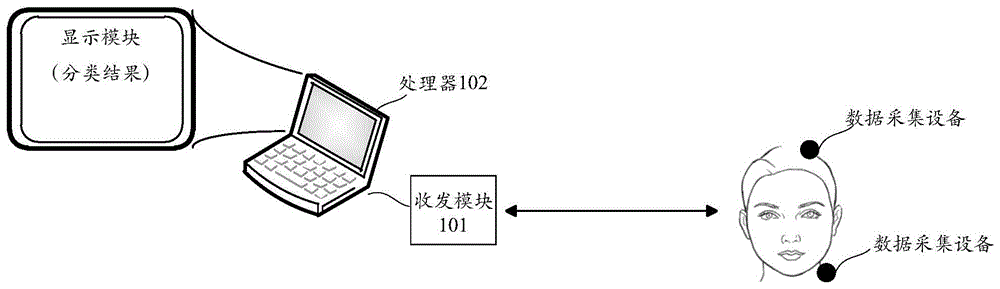
图1为本申请实施例提供的一种脑灌注状态分类装置的结构示意图;1 is a schematic structural diagram of a cerebral perfusion state classification device according to an embodiment of the present application;
图2为本申请实施例提供的一种脑灌注状态分类方法的流程示意图;2 is a schematic flowchart of a method for classifying cerebral perfusion states according to an embodiment of the present application;
图3为本申请实施例提供的一种脑灌注状态分类模型训练装置的结构示意图;3 is a schematic structural diagram of a training device for a cerebral perfusion state classification model provided by an embodiment of the present application;
图4为本申请实施例提供的一种脑灌注状态分类模型训练方法的流程示意图;4 is a schematic flowchart of a training method for a cerebral perfusion state classification model provided by an embodiment of the present application;
图5为本申请实施例提供的电子设备的结构示意图。FIG. 5 is a schematic structural diagram of an electronic device provided by an embodiment of the present application.
具体实施方式Detailed ways
在介绍本申请各实施例提供的技术方案之前,先对本文中涉及到专有名词进行简单的介绍。Before introducing the technical solutions provided by the embodiments of the present application, a brief introduction to the proper nouns involved in this document is given.
为使本申请实施例的目的、技术方案和优点更加清楚,下面将结合本申请实施例中的附图,对本申请实施例中的技术方案进行清楚、完整地描述,显然,所描述的实施例是本申请一部分实施例,而不是全部的实施例。基于本申请中的实施例,本领域普通技术人员在没有做出创造性劳动前提下所获得的所有其他实施例,都属于本申请保护的范围。In order to make the purposes, technical solutions and advantages of the embodiments of the present application clearer, the technical solutions in the embodiments of the present application will be described clearly and completely below with reference to the drawings in the embodiments of the present application. Obviously, the described embodiments It is a part of the embodiments of the present application, but not all of the embodiments. Based on the embodiments in the present application, all other embodiments obtained by those of ordinary skill in the art without creative efforts shall fall within the protection scope of the present application.
在本申请实施例中使用的术语是仅仅出于描述特定实施例的目的,而非旨在限制本申请。在本申请实施例和所附权利要求书中所使用的单数形式的“一种”、“所述”和“该”也旨在包括多数形式,除非上下文清楚地表示其他含义,“多种”一般包含至少两种,但是不排除包含至少一种的情况。The terms used in the embodiments of the present application are only for the purpose of describing specific embodiments, and are not intended to limit the present application. As used in the examples of this application and the appended claims, the singular forms "a," "the," and "the" are intended to include the plural forms as well, unless the context clearly dictates otherwise, "a plurality" Generally, at least two kinds are included, but the case of including at least one kind is not excluded.
应当理解,本文中使用的术语“和/或”仅仅是一种描述关联对象的关联关系,表示可以存在三种关系,例如,A和/或B,可以表示:单独存在A,同时存在A和B,单独存在B这三种情况。另外,本文中字符“/”,一般表示前后关联对象是一种“或”的关系。It should be understood that the term "and/or" used in this document is only an association relationship to describe the associated objects, indicating that there may be three kinds of relationships, for example, A and/or B, which may indicate that A exists alone, and A and B exist at the same time. B, there are three cases of B alone. In addition, the character "/" in this document generally indicates that the related objects are an "or" relationship.
还需要说明的是,术语“包括”、“包含”或者其任何其他变体意在涵盖非排他性的包含,从而使得包括一系列要素的商品或者系统不仅包括那些要素,而且还包括没有明确列出的其他要素,或者是还包括为这种商品或者系统所固有的要素。在没有更多限制的情况下,由语句“包括一个……”限定的要素,并不排除在包括所述要素的商品或者系统中还存在另外的相同要素。It should also be noted that the terms "comprising", "comprising" or any other variation thereof are intended to encompass a non-exclusive inclusion such that a commodity or system comprising a list of elements includes not only those elements, but also those not explicitly listed. other elements that are inherent in the commodity or system. Without further limitation, an element defined by the phrase "comprising a..." does not preclude the presence of additional identical elements in the article or system that includes the element.
首先,需要说明的是,介绍本申请的实施背景。目前,脑灌注成像技术主要用于反映脑组织的血流灌注状态。通过脑灌注成像技术,能够尽可能还原脑血管的实际情况,辅助评估脑血流及脑功能状态。First, it should be noted that the implementation background of the present application is introduced. At present, cerebral perfusion imaging technology is mainly used to reflect the blood perfusion state of cerebral tissue. Through cerebral perfusion imaging technology, the actual situation of cerebral blood vessels can be restored as much as possible, and the cerebral blood flow and cerebral functional status can be assessed.
相关技术中,多采用电子计算机断层扫描(CT)、核磁共振成像(MRI)等大型设备进行检查,然后根据检查结果进行脑血流及脑功能状态的评估。In the related art, large-scale equipment such as computed tomography (CT) and magnetic resonance imaging (MRI) are mostly used for examination, and then cerebral blood flow and cerebral functional state are evaluated according to the examination results.
但是,相关技术中检查设备的操作复杂,需要由专门的技术人员来控制,而且往往体积较大,通常安装在医院等固定场所中,因此,脑灌注成像技术难以适应于一些特殊场景。例如,在航天场景中,由于太空环境中重力发生改变(如超重、失重),且太空舱内空间有限,因此无法通过相关技术中的大型检查设备对宇航员的脑灌注状态进行检查,导致无法评估宇航员在太空环境中的脑血流以及脑部功能。再例如,在户外急救场景中,事故地点通常交通不便(地处偏远或附近拥堵),伤者往往难以及时运送到具有检查设备的医院,因而,急救人员往往无法及时获知伤者的脑灌注状态,影响伤者的救治。However, the inspection equipment in the related art is complicated to operate, needs to be controlled by specialized technicians, and is often bulky, and is usually installed in fixed places such as hospitals. Therefore, cerebral perfusion imaging technology is difficult to adapt to some special scenarios. For example, in the aerospace scene, due to the change of gravity in the space environment (such as overweight and weightlessness) and the limited space in the space capsule, it is impossible to check the astronaut's cerebral perfusion state through the large-scale inspection equipment in related technologies, resulting in the inability to Assess cerebral blood flow and brain function in astronauts in the space environment. For another example, in an outdoor emergency scene, the accident site is usually inconvenient (located in a remote area or with congestion nearby), and it is often difficult for the injured to be transported to a hospital with inspection equipment in time. Therefore, the emergency personnel often cannot know the cerebral perfusion state of the injured person in time. , affecting the treatment of the injured.
因此,有待提出一种能够解决上述至少一个问题的技术方案。Therefore, there is a need to propose a technical solution that can solve at least one of the above problems.
本申请实施例提供的技术方案的执行主体可以是一个装置也可以是多个装置。所述装置可以包括但不限于:集成在智能手机、平板电脑、PDA(Personal DigitalAssistant,个人数字助理)、智能电视、膝上型便携计算机、台式计算机、智能穿戴设备、医疗设备等任意终端设备上的装置。所述装置包括用于接收生理特征数据(如下文介绍的生理指标数据、颈部血流数据、脑部血流数据)的收发模块、以及用于处理上述生理特征数据的处理器。所述装置的处理器可以搭载在上述终端设备中。所述装置的处理器可以与传感器集成在同一设备中,也可以分别集成在不同设备中,本申请实施例并不限定。可选地,所述装置还包括显示模块,用于展示所述装置的处理结果,例如终端设备中的屏幕。The executive body of the technical solutions provided in the embodiments of the present application may be one device or multiple devices. The device may include, but is not limited to, be integrated on any terminal device such as a smart phone, a tablet computer, a PDA (Personal Digital Assistant), a smart TV, a laptop computer, a desktop computer, a smart wearable device, and a medical device. installation. The device includes a transceiver module for receiving physiological characteristic data (such as physiological index data, cervical blood flow data, and cerebral blood flow data described below), and a processor for processing the above physiological characteristic data. The processor of the apparatus may be mounted in the above-mentioned terminal device. The processor of the apparatus may be integrated with the sensor in the same device, or may be integrated in different devices respectively, which is not limited in the embodiment of the present application. Optionally, the apparatus further includes a display module configured to display a processing result of the apparatus, such as a screen in a terminal device.
实际应用中,所述装置的收发模块可以与不同数据采集设备通信,从而通过通信连接接收这些数据采集设备各自获取到的生理特征数据。其中,不同数据采集设备中集成有不同功能的传感器。In practical applications, the transceiver module of the apparatus can communicate with different data collection devices, so as to receive the physiological characteristic data obtained by these data collection devices through the communication connection. Among them, sensors with different functions are integrated in different data acquisition devices.
例如,集成在超声数据检测设备中的超声传感器,该超声数据检测设备设置于目标评估对象侧。该超声数据检测设备例如实现为集成有超声传感器的颈部检查装置,该颈部检查装置与集成收发模块的装置相连。当然,为适应多种应用场景,该颈部检查装置与集成处理器的装置的连接方式可以是有线连接,也可以是无线连接,例如WiFi、5G、4G、蓝牙等。For example, an ultrasonic sensor integrated in an ultrasonic data detection device provided on the side of the target evaluation object. The ultrasonic data detection device is implemented, for example, as a neck inspection device integrated with an ultrasonic sensor, the neck inspection device being connected to a device integrating a transceiver module. Of course, in order to adapt to various application scenarios, the connection between the neck examination device and the device with integrated processor may be wired connection or wireless connection, such as WiFi, 5G, 4G, Bluetooth, and so on.
除此之外,收发模块还可与磁共振数据采集设备通信。例如,超导型磁共振扫描仪Besides, the transceiver module can also communicate with the magnetic resonance data acquisition device. For example, superconducting magnetic resonance scanners
另一实施例中,收发模块、处理器、以及数据采集设备可以集成在同一系统中,例如收发模块、处理器、以及数据采集设备可以集成在针对某一航天场景的脑灌注状态监测系统中。进而,在脑灌注状态监测系统中直接展示处理结果,例如发出用于表示脑灌注状态分类结果的语音信息、或者显示脑灌注状态分类结果。或者,由该脑灌注状态监测系统将处理结果发送至终端设备,并由终端设备对处理结果进行展示。In another embodiment, the transceiver module, the processor, and the data acquisition device may be integrated into the same system, for example, the transceiver module, the processor, and the data acquisition device may be integrated into a cerebral perfusion state monitoring system for a spaceflight scene. Furthermore, the processing result is directly displayed in the cerebral perfusion state monitoring system, for example, voice information for expressing the cerebral perfusion state classification result is issued, or the cerebral perfusion state classification result is displayed. Alternatively, the cerebral perfusion state monitoring system sends the processing result to the terminal device, and the terminal device displays the processing result.
实际上,所述装置的硬件结构可以根据具体应用场景进行设置,本申请实施例中仅为示例,具体设置并不限定。In fact, the hardware structure of the apparatus may be set according to specific application scenarios, the embodiments of the present application are only examples, and the specific settings are not limited.
应当注意的是,无论执行主体实现为哪一种硬件结构,执行主体的核心意图都是:It should be noted that no matter which hardware structure the execution body is implemented as, the core intent of the execution body is:
从生理特征数据中提取多种生理特征,从而通过随机森林模型中的多个决策树预测出这些生理特征对应的脑灌注状态类型,实现对脑灌注状态的分类。这样,无需使用大型检查设备即可对脑灌注状态进行分类,大大降低脑灌注状态分类的实现难度,拓展脑灌注状态分类的应用场景(例如航天场景、户外急救场景等)。并且,通过随机森林模型还可融合更多生理特征,以更加准确地区分各种脑灌注状态,提高脑血流及脑功能评估结果的准确性,辅助医生完成脑部检查。A variety of physiological features are extracted from the physiological feature data, and the cerebral perfusion state types corresponding to these physiological features are predicted through multiple decision trees in the random forest model, so as to realize the classification of the cerebral perfusion state. In this way, the cerebral perfusion state can be classified without the use of large-scale inspection equipment, which greatly reduces the difficulty of implementing cerebral perfusion state classification, and expands the application scenarios of cerebral perfusion state classification (such as aerospace scenarios, outdoor emergency scenarios, etc.). In addition, the random forest model can also integrate more physiological features to more accurately distinguish various cerebral perfusion states, improve the accuracy of cerebral blood flow and brain function assessment results, and assist doctors in completing brain examinations.
下面结合具体实施例介绍技术方案的具体实施方式。Specific implementations of the technical solutions are described below with reference to specific embodiments.
如图1为本申请实施例提供的一种脑灌注状态分类装置的结构示意图。FIG. 1 is a schematic structural diagram of a cerebral perfusion state classification device according to an embodiment of the present application.
从图1中可以看到,所述装置包括如下模块:As can be seen from Figure 1, the device includes the following modules:
收发模块101,用于接收来自不同数据采集设备的生理特征数据。The
处理器102,用于提取生理特征数据中的生理特征;将生理特征输入随机森林模型中,以使随机森林模型中的多个决策树预测出生理特征对应的脑灌注状态类型;基于生理特征对应的脑灌注状态类型对脑灌注状态进行分类。The processor 102 is configured to extract the physiological features in the physiological feature data; input the physiological features into the random forest model, so that a plurality of decision trees in the random forest model predict the cerebral perfusion state type corresponding to the physiological features; The type of cerebral perfusion state classifies the cerebral perfusion state.
进一步的,该装置还可能包括显示模块,用于输出处理器102的处理结果,如敏感脑区、敏感脑区的脑部磁共振数据以及脑灌注状态分类。Further, the apparatus may further include a display module for outputting the processing results of the processor 102, such as sensitive brain regions, brain magnetic resonance data of the sensitive brain regions, and classification of cerebral perfusion states.
可以理解的是,收发模块101与处理器102可以位于同一台设备上,也可以是收发模块101位于本地,而处理器102位于远程服务器。当然,此处描述的两种结构仅为示例,实际应用中可以根据具体应用场景选择用于集成收发模块101与处理器102的硬件结构。It can be understood that the
首先,收发模块101用于接收来自不同数据采集设备的生理特征数据。在一可选实施例中,收发模块101与数据采集设备通信,从而,通过与数据采集设备的通信连接,接收来自数据采集设备的生理特征数据。First, the
可选地,生理特征数据包括但不限于生理指标数据、颈部血流数据、脑部血流数据中的至少一种。Optionally, the physiological characteristic data includes, but is not limited to, at least one of physiological index data, neck blood flow data, and cerebral blood flow data.
本申请实施例中,生理指标数据主要用于反映评估目标的生理指标,比如生理指标数据包括但不限于:评估目标的年龄、性别、心率、体温、血压、血氧饱和度。可选地,这些生理指标数据可以来自于历史评估数据,例如预先录入的年龄、性别,也可以实时检测得到的,例如对评估目标进行检测,以采集心率、体温、血压、血氧饱和度。比如,采用血压计测量血压,采用智能移动设备采集心率、体温、血氧饱和度。当然,另一示例中,上述生理指标数据也可采用同一生理指标数据监测系统获取,该监测系统例如搭载在救护车或者航天载具上。In the embodiment of the present application, the physiological index data is mainly used to reflect the physiological index of the evaluation target. For example, the physiological index data includes but is not limited to: the age, gender, heart rate, body temperature, blood pressure, and blood oxygen saturation of the evaluation target. Optionally, these physiological index data can come from historical evaluation data, such as pre-entered age and gender, or can be obtained by real-time detection, such as detecting the evaluation target to collect heart rate, body temperature, blood pressure, and blood oxygen saturation. For example, use a sphygmomanometer to measure blood pressure, and use smart mobile devices to collect heart rate, body temperature, and blood oxygen saturation. Of course, in another example, the above-mentioned physiological index data can also be acquired by using the same physiological index data monitoring system, and the monitoring system is mounted on, for example, an ambulance or a space vehicle.
本申请实施例中,颈部血流数据由超声数据采集设备获取。由于流经脑部的血液都要通过颈部输送,因此,颈部血流数据能够在一定程度上反映出脑部血流情况,为脑灌注状态的预测提供基础。In the embodiment of the present application, the cervical blood flow data is acquired by an ultrasonic data acquisition device. Since the blood flowing through the brain must be transported through the neck, the neck blood flow data can reflect the cerebral blood flow to a certain extent, and provide a basis for the prediction of the cerebral perfusion state.
实际应用中,颈部血流数据包括但不限于以下任意一种数据或组合:颈部血管血流数据、血管管腔形态变化数据、血管功能数据。可选地,颈部血流数据为连续周期性数据,例如超声传感器基于预设周期采集的多个颈部血流数据。例如,超声传感器依据预设周期连续采集多组颈部血流数据。其中,每一组颈部血流数据中包括多个颈部血流信号,从而由这些信号构成对应的颈部血流序列。In practical applications, the neck blood flow data includes but is not limited to any one of the following data or a combination: neck blood vessel blood flow data, blood vessel lumen shape change data, and blood vessel function data. Optionally, the cervical blood flow data is continuous periodic data, for example, a plurality of cervical blood flow data collected by an ultrasonic sensor based on a preset period. For example, the ultrasonic sensor continuously collects multiple sets of neck blood flow data according to a preset period. Wherein, each set of neck blood flow data includes a plurality of neck blood flow signals, so that these signals constitute a corresponding neck blood flow sequence.
实际应用中,收发模块101与集成有超声探头的数据采集设备连接。例如,数据采集设备中集成有基于血管内超声(intravenous ultrasound,IVUS)技术实现的超声传感器。或者,也可以集成有多普勒超声探头。In practical applications, the
本申请实施例中,脑部血流数据包括但不限于脑部磁共振数据。其中,脑部磁共振数据包括但不限于:动脉自旋标记示踪(Arterial Spin Labeling,ASL)数据、定量磁敏感成像(Quantitative Susceptibility Imaging,QSM)数据、定量血氧依赖水平(quantitative Blood Oxygen Level Dependent,qBOLD)数据。In this embodiment of the present application, the cerebral blood flow data includes but is not limited to cerebral magnetic resonance data. The brain magnetic resonance data includes but is not limited to: Arterial Spin Labeling (ASL) data, Quantitative Susceptibility Imaging (QSM) data, quantitative Blood Oxygen Level (quantitative Blood Oxygen Level) data Dependent, qBOLD) data.
其中,ASL数据是利用ASL技术获得的,主要用于反映(被测对象的)脑血流量。如ASL序列。其中,ASL是无需使用造影剂而获得脑灌注成像的方法,可以从不同角度反映脑组织的血流灌注信息。在ASL技术中,会采用饱和脉冲或反转序列在兴趣区的上游对血液中内源性质子进行标记,然后在兴趣区(比如重点观察的脑部区域)采集信号。从而,实现对脑血流动力学的无创研究。Among them, the ASL data is obtained by using the ASL technology, and is mainly used to reflect the cerebral blood flow (of the measured object). such as ASL sequences. Among them, ASL is a method for obtaining cerebral perfusion imaging without using a contrast agent, which can reflect the blood perfusion information of brain tissue from different angles. In the ASL technique, a saturation pulse or inversion sequence is used to label endogenous protons in the blood upstream of the region of interest, and then the signal is collected in the region of interest (such as the brain region of interest). Thus, a non-invasive study of cerebral hemodynamics is achieved.
由于ASL具有天然的可重复性,在较短时间内重复观察血流灌注变化,因此,可选地,采用ASL技术获取多组ASL序列作为脑部核共振样本,用于下文随机森林模型的训练。例如,ASL平均时间序列样本。Since ASL has natural repeatability, the changes in blood perfusion can be observed repeatedly in a relatively short period of time. Therefore, optionally, ASL technology is used to obtain multiple sets of ASL sequences as brain nuclear resonance samples, which are used for the training of the random forest model below. . For example, ASL averages time series samples.
其中,QSM数据主要用于评估脑氧代谢参数,如氧摄取分数(OEF)。QSM数据是基于梯度回波的一种新型磁共振成像技术,可量化生物组织内磁化率空间分布而成为能定量活体组织铁含量的重要方法。Among them, QSM data are mainly used to evaluate cerebral oxygen metabolism parameters, such as oxygen uptake fraction (OEF). QSM data is a new type of magnetic resonance imaging technology based on gradient echo, which can quantify the spatial distribution of magnetic susceptibility in biological tissue and become an important method to quantify iron content in living tissue.
其中,qBOLD数据主要用于反映(被测对象的)脑部血氧水平。具体地,qBOLD技术通过测量血流量和血氧合水平的变化,能够有效地反映被测对象在各种状态(如静息状态、负荷状态)下脑部血流和代谢活动等功能性变化,是研究大脑功能连接异常的有效手段。Among them, the qBOLD data is mainly used to reflect the brain blood oxygen level (of the subject). Specifically, qBOLD technology can effectively reflect the functional changes such as cerebral blood flow and metabolic activity of the measured object under various states (such as resting state and load state) by measuring changes in blood flow and blood oxygenation level. It is an effective means to study abnormal brain functional connections.
具体地,可以将BOLD信号与静脉血氧合(Yv)和缺氧血容量(DBV)分离,从而得到qBOLD磁共振图像。实际应用中,qBOLD磁共振图像,可以提供局部和绝对的体内血氧饱和度测量值,从而根据局部信号的变化,能够反映出各脑区神经细胞的活动程度,达到无创研究大脑活动的目的,为下文脑灌注状态分类提供基础。Specifically, the BOLD signal can be separated from venous oxygenation (Yv) and deoxygenated blood volume (DBV) to obtain qBOLD magnetic resonance images. In practical applications, qBOLD magnetic resonance images can provide local and absolute blood oxygen saturation measurements in vivo, so that according to changes in local signals, it can reflect the activity of nerve cells in various brain regions, and achieve the purpose of non-invasive research on brain activity. Provide a basis for the classification of cerebral perfusion status below.
值得说明的是,上述介绍的各种生理特征数据均可用于作为下文训练随机森林模型的样本数据。样本数据的采集过程参见相关技术中的具体实施方式,此处暂不展开。It is worth noting that the various physiological characteristic data introduced above can be used as sample data for training the random forest model below. For the collection process of sample data, refer to the specific implementation manner in the related art, which will not be expanded here for the time being.
本申请实施例中的处理器102,是用于对采集到多种生理特征数据进行分析、处理的设备。该处理器102可以为本地处理器102,也可以为远程服务器或服务器集群,还可以是云端服务器中的虚拟处理器102。The processor 102 in this embodiment of the present application is a device used for analyzing and processing various collected physiological characteristic data. The processor 102 may be a local processor 102, a remote server or server cluster, or a virtual processor 102 in a cloud server.
在通过收发模块101接收到生理特征数据的基础上,处理器102需要利用生理特征数据对脑灌注状态类型进行预测。On the basis of receiving the physiological characteristic data through the
实际上,脑灌注状态是指脑部血流灌注状态。基于不同应用需求,脑灌注状态可分为多种类型。例如,脑灌注状态按照血流灌注情况分为脑血流量正常、脑血流量轻度偏高、脑血流量中高、脑血流量高、脑血流量轻度偏低、脑血流量中低、脑血流量低。再例如,脑灌注状态可以按照年龄段分为儿童脑灌注状态正常/异常、青年脑灌注状态正常/异常、老年脑灌注状态正常/异常。当然,还可根据性别、身体情况(如是否患有基础病等)等单一评价维度或多个评价维度细分为更多类型。In fact, the cerebral perfusion state refers to the state of cerebral blood flow perfusion. Based on different application requirements, cerebral perfusion states can be divided into various types. For example, cerebral perfusion status is divided into normal cerebral blood flow, mildly high cerebral blood flow, moderately high cerebral blood flow, high cerebral blood flow, mildly low cerebral blood flow, moderately low cerebral blood flow, and cerebral blood flow Low blood flow. For another example, the cerebral perfusion status can be divided into normal/abnormal cerebral perfusion status in children, normal/abnormal cerebral perfusion status in young people, and normal/abnormal cerebral perfusion status in the elderly. Of course, it can also be subdivided into more types according to a single evaluation dimension or multiple evaluation dimensions such as gender and physical condition (such as whether you have underlying diseases, etc.).
在一可选实施例中,处理器102提取生理特征数据中的生理特征时,具体用于:In an optional embodiment, when the processor 102 extracts the physiological features in the physiological feature data, it is specifically used for:
基于生理指标数据提取对应的年龄、性别、血压、心率、体温、血氧饱和度;基于颈部血流数据提取对应的收缩峰值血流速度、舒张末期血流速度、平均血流速度、阻力指数、搏动指数、收缩/舒张比值;基于ASL数据以及QSM数据提取对应的脑部血流动力学参数;以生理指标数据、颈部血流数据、ASL数据以及QSM数据中提取出的多种生理特征,作为随机森林模型的输入特征。Extract corresponding age, gender, blood pressure, heart rate, body temperature, blood oxygen saturation based on physiological index data; extract corresponding peak systolic blood flow velocity, end-diastolic blood flow velocity, average blood flow velocity, resistance index based on neck blood flow data , pulsatility index, systolic/diastolic ratio; extract corresponding cerebral hemodynamic parameters based on ASL data and QSM data; multiple physiological features extracted from physiological index data, cervical blood flow data, ASL data and QSM data , as the input features of the random forest model.
通过上述步骤提取出的生理特征,用于作为预测脑灌注状态的随机森林模型的输入特征。随机森林模型的具体说明参见下文,此处暂不展开。The physiological features extracted through the above steps are used as input features of the random forest model for predicting the state of cerebral perfusion. The specific description of the random forest model is as follows, which will not be expanded here for the time being.
具体而言,对于任一评估目标,从生理指标数据中提取该评估目标的年龄、性别、血压、心率、体温、血氧饱和度。Specifically, for any evaluation target, the age, gender, blood pressure, heart rate, body temperature, and blood oxygen saturation of the evaluation target are extracted from the physiological index data.
对于任一评估目标,基于颈部血流数据计算出该评估目标对应的收缩峰值血流速度、舒张末期血流速度、平均血流速度、阻力指数、搏动指数、收缩/舒张比值。实际应用中,上述评估参数可采用超声频谱图计算得到,具体计算方式可参考临床常用的计算方式。例如,阻力指数RI可以采用如下公式计算,即:RI=(PSV-EDV)/PSV,其中PSV为收缩期峰值颈部血流速度,EDV即舒张末期颈部血流速度。For any assessment target, the peak systolic blood flow velocity, end-diastolic blood flow velocity, average blood flow velocity, resistance index, pulsatility index, and systolic/diastolic ratio corresponding to the assessment target are calculated based on the cervical blood flow data. In practical applications, the above evaluation parameters can be calculated by using the ultrasonic spectrogram, and the specific calculation method can refer to the calculation method commonly used in clinical practice. For example, the resistance index RI can be calculated by the following formula: RI=(PSV-EDV)/PSV, where PSV is the peak systolic cervical blood flow velocity, and EDV is the end-diastolic cervical blood flow velocity.
对于任一评估目标,基于ASL数据、QSM数据、qBOLD数据计算出该评估目标对应的脑部血流动力学参数。其中,脑部血流动力学参数包括但不限于:脑血流量(CBF)、脑氧代谢参数。例如,利用ASL数据计算出脑血流量(CBF)。例如,采用QSM数据和qBOLD数据可以计算出脑氧代谢参数,例如氧摄取分数(OEF)。For any assessment target, the cerebral hemodynamic parameters corresponding to the assessment target were calculated based on ASL data, QSM data, and qBOLD data. The cerebral hemodynamic parameters include but are not limited to: cerebral blood flow (CBF) and cerebral oxygen metabolism parameters. For example, cerebral blood flow (CBF) is calculated using ASL data. For example, cerebral oxygen metabolism parameters such as oxygen uptake fraction (OEF) can be calculated using QSM data and qBOLD data.
进而,在提取出的上述生理特征之后,可选地,处理器102以生理指标数据、颈部血流数据、ASL数据以及QSM数据中提取出的多种生理特征,作为随机森林模型的输入特征集。Further, after the above-mentioned physiological features are extracted, optionally, the processor 102 uses a variety of physiological features extracted from the physiological index data, neck blood flow data, ASL data and QSM data as the input features of the random forest model set.
进而,基于提取出的生理特征,在一可选实施例中,处理器102将生理特征输入随机森林模型中,以使随机森林模型中的多个决策树预测出生理特征对应的脑灌注状态类型时,具体用于:Further, based on the extracted physiological features, in an optional embodiment, the processor 102 inputs the physiological features into the random forest model, so that the multiple decision trees in the random forest model predict the cerebral perfusion state type corresponding to the physiological features , specifically for:
将生理特征输入随机森林模型中;对生理特征进行特征筛选,以得到随机森林模型的特征子集;通过多个决策树基于特征子集分别得到多个待选脑灌注状态类型;通过多个决策树基于多个待选脑灌注状态类型进行投票决策,得到多个投票结果;以多个投票结果中票数最多的待选脑灌注状态类型作为随机森林模型最终输出的预测结果。Input the physiological features into the random forest model; perform feature screening on the physiological features to obtain feature subsets of the random forest model; obtain multiple candidate cerebral perfusion state types based on the feature subsets through multiple decision trees; The tree performs voting decisions based on multiple candidate cerebral perfusion state types, and obtains multiple voting results; the candidate cerebral perfusion state type with the most votes among the multiple voting results is used as the final output prediction result of the random forest model.
其中,随机森林模型是基于决策树所构成的袋装(Bagging)集成算法,在决策树的训练过程中引入随机特征选择的算法模型。随机森林模型中集成有多种弱分类器,从而形成新的分类器模型,使得随机森林模型无需进行特征选择能够得到较高正确率。Among them, the random forest model is based on the bagging (Bagging) ensemble algorithm composed of decision trees, and the algorithm model of random feature selection is introduced in the training process of decision trees. A variety of weak classifiers are integrated in the random forest model to form a new classifier model, so that the random forest model can obtain a higher accuracy rate without feature selection.
基于上文中介绍的输入特征集,上述步骤中,首先处理器102将包含多种生理特征的输入特征集输入到随机森林模型中。可选地,输入特征集中包括从生理特征数据中提取到的全部生理特征。Based on the input feature set introduced above, in the above steps, first, the processor 102 inputs the input feature set including various physiological features into the random forest model. Optionally, the input feature set includes all physiological features extracted from the physiological feature data.
接着,处理器102将生理特征输入到随机森林模型之后,也可通过如下步骤实现在随机森林模型中实现特征选择,以进一步提高随机森林模型的预测准确性。其中,处理器102对生理特征进行特征筛选,以得到随机森林模型的特征子集时,具体用于:Next, after the processor 102 inputs the physiological features into the random forest model, the following steps can also be used to implement feature selection in the random forest model, so as to further improve the prediction accuracy of the random forest model. Wherein, when the processor 102 performs feature screening on the physiological features to obtain the feature subset of the random forest model, it is specifically used for:
获取在预设脑灌注状态类型下多种生理特征对随机森林模型的特征重要性;基于特征重要性对多种生理特征与预设脑灌注状态类型的相关性进行排序;根据排序结果筛选出与预设脑灌注状态类型最相关的生理特征作为随机森林模型的特征子集。Obtain the feature importance of various physiological features to the random forest model under the preset cerebral perfusion state type; rank the correlations between various physiological features and preset cerebral perfusion state types based on the feature importance; The most relevant physiological features of cerebral perfusion state types are preset as feature subsets of the random forest model.
其中,多种生理特征,包括但不限于:年龄、性别、血压、心率、体温、血氧饱和度、收缩峰值血流速度、舒张末期血流速度、平均血流速度、阻力指数、搏动指数、收缩/舒张比值、脑血流量、脑氧代谢参数中的一种或组合。Among them, a variety of physiological characteristics, including but not limited to: age, gender, blood pressure, heart rate, body temperature, oxygen saturation, peak systolic blood flow velocity, end-diastolic blood flow velocity, average blood flow velocity, resistance index, pulsatility index, One or a combination of systolic/diastolic ratio, cerebral blood flow, and cerebral oxygen metabolism parameters.
可选地,为便于进行模型训练,通常会进行数据标注。在一可选实施例中,假设生理特征数据包括在不同类型脑灌注状态下采集到的生理特征数据样本,此情况下,处理器102还用于:标注各个生理特征数据样本对应的脑灌注状态类型。此处标注参考的依据是采集生理特征数据时所检测到的脑灌注状态类型,例如脑灌注状态正常、脑灌注状态偏高、脑灌注状态偏低。Optionally, to facilitate model training, data labeling is usually performed. In an optional embodiment, it is assumed that the physiological characteristic data includes physiological characteristic data samples collected under different types of cerebral perfusion states. In this case, the processor 102 is further configured to: mark the cerebral perfusion state corresponding to each physiological characteristic data sample. type. The reference here is based on the type of cerebral perfusion state detected when the physiological characteristic data is collected, such as normal cerebral perfusion state, high cerebral perfusion state, and low cerebral perfusion state.
本申请实施例中,特征重要性是用于衡量每一输入特征对模型预测结果贡献的指标参数。通过特征重要性度量能提升随机森林模型的预测准确性,可选地,通过随机森林模型中各个输入特征的重要性排序进行特征选择,以得到更为高效可靠的特征子集。In the embodiment of the present application, the feature importance is an index parameter used to measure the contribution of each input feature to the model prediction result. The prediction accuracy of the random forest model can be improved by the feature importance measurement. Optionally, feature selection is performed by the importance order of each input feature in the random forest model to obtain a more efficient and reliable feature subset.
具体地,通过计算每个输入特征在随机森林中每一决策树上的贡献度,进而,对于每一输入特征,以在多个决策树上贡献度的平均值来表示该输入特征的特征重要性。实际应用中,可采用频数统计、基尼指数(Gini)法、平均精度下降法来计算输入特征的特征重要性。Specifically, by calculating the contribution of each input feature on each decision tree in the random forest, and further, for each input feature, the average value of the contribution on multiple decision trees is used to represent the feature importance of the input feature. sex. In practical applications, frequency statistics, Gini index (Gini) method, and average precision drop method can be used to calculate the feature importance of input features.
值得说明的是,由于基尼指数无需进行对数运算,计算相对其他方法更快,因此,本申请中进一步可选地,采用基尼指数法计算输入特征的特征重要性。具体而言,通过计算任一脑灌注状态样本下输入特征样本的基尼指数,可以衡量出特征样本的特征重要性,从而,从多种生理特征中筛选出与预设脑灌注状态类型最相关的生理特征,作为随机森林模型的特征子集。It is worth noting that since the Gini index does not need to perform logarithmic operation, the calculation is faster than other methods. Therefore, in this application, the Gini index method is further optionally used to calculate the feature importance of the input features. Specifically, by calculating the Gini index of the input feature sample under any cerebral perfusion state sample, the feature importance of the feature sample can be measured, so that the most relevant type of the preset cerebral perfusion state can be selected from a variety of physiological features. Physiological features, as a subset of features for random forest models.
在一可选实施例中,处理器102获取在预设脑灌注状态类型下多种生理特征对随机森林模型的特征重要性时,具体用于:In an optional embodiment, when the processor 102 acquires the feature importance of various physiological features to the random forest model under the preset cerebral perfusion state type, it is specifically used for:
对于预设类型脑灌注状态下采集到的每一生理特征数据样本,计算每一生理特征数据样本中的生理特征对随机森林模型中每一决策树的基尼指数,以得到每一生理特征对随机森林模型中各个决策树的基尼指数。For each physiological feature data sample collected under a preset type of cerebral perfusion, calculate the Gini index of the physiological feature in each physiological feature data sample to each decision tree in the random forest model, so as to obtain each physiological feature pair random Gini index of individual decision trees in the forest model.
具体来说,本实施例中,将生理特征的重要性评分记为VIM,基尼指数值记为GI。假设m个生理特征X=X1,X2,...Xn,每个生理特征Xi的基尼指数对应的评分为VIMi,即第i个特征在随机森林模型的所有决策树中节点分裂不纯度的平均改变量。根据基尼指数计算公式可得,在第i棵决策树中,节点k的基尼指数为:
其中,k代表特征节点i处有k个类别,pmk表示节点m中类别k所占的比例。生理特征Xi在节点m的重要性,即节点m分支前后的基尼指数变化量为:
其中,GIl和GIr分别表示分支后两个新节点的基尼指数。如果生理特征Xi在决策树j中出现的节点处于集合M中,那么Xi在第j棵树中的特征重要性评分为:
进一步假设随机森林模型共有n棵树,那么:Further assume that there are n trees in the random forest model, then:
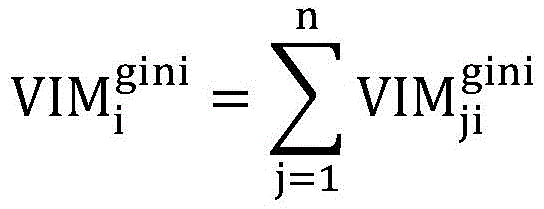
进而,将生理特征的重要性评分进行归一化处理,得到生理特征最终的重要性评分: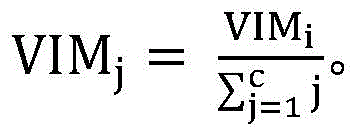
最终,将多种生理特征按照重要性评分进行降序排序,删除重要性评分较低(即相关性较低)的生理特征,得到随机森林模型的特征子集。Finally, a variety of physiological features are sorted in descending order according to their importance scores, and physiological features with lower importance scores (ie, lower correlations) are deleted to obtain a feature subset of the random forest model.
通过上述步骤可以对多种生理特征进行特征选择,进而,得到更高效可靠的特征子集。并且,针对不同脑灌注状态下采集到的生理特征进行特征选择,可以进一步融合更多不同类型的生理特征,以进一步提高各种脑灌注状态的预测准确性,提高脑血流及脑功能评估结果的准确性,辅助医生完成脑部检查。Through the above steps, feature selection can be performed on a variety of physiological features, and further, a more efficient and reliable feature subset can be obtained. In addition, feature selection for physiological features collected under different cerebral perfusion states can further integrate more different types of physiological features to further improve the prediction accuracy of various cerebral perfusion states, and improve the evaluation results of cerebral blood flow and brain function. Accurate, assisting doctors to complete brain examinations.
值得说明的是,实际应用中,采集其他评估方式进行特征选择的原理类似,此处不再展开介绍。It is worth noting that in practical applications, the principle of collecting other evaluation methods for feature selection is similar, and will not be introduced here.
进而,基于上述筛选出的特征子集,处理器102通过多个决策树基于特征子集分别得到多个待选脑灌注状态类型;通过多个决策树基于多个待选脑灌注状态类型进行投票决策,得到多个投票结果;以多个投票结果中票数最多的待选脑灌注状态类型作为随机森林模型最终输出的预测结果。Further, based on the above-selected feature subsets, the processor 102 obtains a plurality of cerebral perfusion state types to be selected based on the feature subsets through a plurality of decision trees; and votes based on the plurality of cerebral perfusion state types to be selected through a plurality of decision trees Decision-making to obtain multiple voting results; the type of cerebral perfusion state to be selected with the largest number of votes among the multiple voting results is used as the prediction result of the final output of the random forest model.
具体地,每一决策树进行投票决策,将票数最高的状态作为最终的脑部状态。随机森林模型最终预测结果H(x)的计算方式为:Specifically, each decision tree performs voting decisions, and the state with the highest number of votes is used as the final brain state. The calculation method of the final prediction result H(x) of the random forest model is:
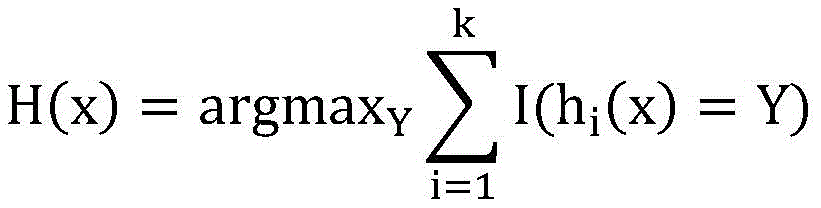
其中,hi(x)表示单一决策树模型的分类预测结果,I()为表示性函数,Y是目标变量。Among them, h i (x) represents the classification prediction result of a single decision tree model, I() is the representation function, and Y is the target variable.
实际应用中,假设提取出的生理特征包括:血压、心率、血氧饱和度、收缩峰值血流速度、舒张末期血流速度、平均血流速度、阻力指数、搏动指数、收缩/舒张比值、脑血流量、脑氧代谢参数。In practical applications, it is assumed that the extracted physiological features include: blood pressure, heart rate, blood oxygen saturation, peak systolic blood flow velocity, end-diastolic blood flow velocity, average blood flow velocity, resistance index, pulsatility index, systolic/diastolic ratio, brain Blood flow, cerebral oxygen metabolism parameters.
基于此,先筛选出随机森林模型的特征子集,从而通过多个决策树基于上述特征子集分别输出每一决策树判断的待选脑灌注状态类型。Based on this, feature subsets of the random forest model are firstly screened, so as to output the type of cerebral perfusion state to be judged by each decision tree based on the aforementioned feature subsets through multiple decision trees.
进一步假设多个决策树包括5个决策树,假设这5个决策树中3个投票决策出脑灌注状态类型为待选脑灌注状态类型a,另外2个投票决策出脑灌注状态类型为待选脑灌注状态类型b,基于此,以待选脑灌注状态类型a(即5个投票结果中票数最多的待选脑灌注状态类型)作为该随机森林模型最终输出的预测结果。It is further assumed that the multiple decision trees include 5 decision trees, and it is assumed that 3 of the 5 decision trees voted to decide that the cerebral perfusion state type was the candidate cerebral perfusion state type a, and the other 2 voted to decide that the cerebral perfusion state type was the candidate to be selected. The cerebral perfusion state type b, based on this, the candidate cerebral perfusion state type a (that is, the candidate cerebral perfusion state type with the most votes among the five voting results) is used as the prediction result of the final output of the random forest model.
通过上述步骤,在实际应用中,针对训练后的随机森林模型,基于输入的多种生理特征,即可预测出这些生理特征对应的脑灌注状态类型,实现对脑灌注状态的分类。Through the above steps, in practical applications, for the trained random forest model, based on various input physiological features, the cerebral perfusion state types corresponding to these physiological features can be predicted, and the classification of cerebral perfusion states can be realized.
进一步地,还可根据对脑灌注状态分类结果展示预警信息,以提示向使用者提示当前脑灌注状态。Further, early warning information can also be displayed according to the classification result of the cerebral perfusion state, so as to prompt the user to prompt the current cerebral perfusion state.
实际应用中,例如,假设脑灌注状态类型为一类表示脑血流量正常,假设脑灌注状态类型为二类表示脑血流量偏高,假设脑灌注状态类型为三类表示脑血流量偏低。基于上述假设,若判定脑灌注状态类型属于一类,则显示“当前脑灌注状态为脑血流量正常”;若判定脑灌注状态类型属于二类,则显示“当前脑灌注状态为脑血流量偏高”,从而通过显示内容可以辅助医师完成脑部检查评估。In practical applications, for example, assuming that the cerebral perfusion state type is Type 1, it means that the cerebral blood flow is normal, assuming that the cerebral perfusion state type is Type 2, it means that the cerebral blood flow is high, and assuming that the cerebral perfusion state type is Type 3, it means that the cerebral blood flow is low. Based on the above assumptions, if it is determined that the cerebral perfusion state type belongs to the first category, it will display “the current cerebral perfusion state is normal cerebral blood flow”; if it is determined that the cerebral perfusion state type belongs to the second category, it will display “the current cerebral perfusion state is cerebral blood flow deviation High”, so that the displayed content can assist the physician in completing the brain examination and evaluation.
当然,除了一类、二类、三类外,还可将各个脑部区域的脑灌注状态类别设置为三类或以上类别。例如,脑血流量正常、脑血流量轻度偏高、脑血流量中高、脑血流量高、脑血流量轻度偏低、脑血流量中低、脑血流量低。此处描述的高低程度,实际是根据脑血流量的阈值范围确定的。Of course, in addition to the first, second, and third categories, the cerebral perfusion state category of each brain region can also be set to three or more categories. For example, normal cerebral blood flow, mildly high cerebral blood flow, moderately high cerebral blood flow, high cerebral blood flow, mildly low cerebral blood flow, moderately low cerebral blood flow, and low cerebral blood flow. The level described here is actually determined according to the threshold range of cerebral blood flow.
介绍完本申请可能使用到的网络模型及其用法后,下面介绍用于训练上述模型的训练数据的获取方式。例如,After introducing the network models that may be used in this application and their usage, the following describes how to obtain the training data for training the above models. E.g,
首先,可以通过超声传感器采集目标检查对象的颈部血流数据。与上文介绍类似,将颈部血流数据转换为颈部血流特征序列,序列元素的个数根据颈部血流数据的采集数量决定。First, the neck blood flow data of the target examination object can be collected through the ultrasonic sensor. Similar to the above description, the neck blood flow data is converted into a neck blood flow feature sequence, and the number of sequence elements is determined according to the number of collected neck blood flow data.
其次,介绍脑部磁共振样本。脑部磁共振样本主要包括qBOLD样本、ASL样本、QSM样本。Next, brain MRI samples are introduced. Brain magnetic resonance samples mainly include qBOLD samples, ASL samples, and QSM samples.
例如,采用功能性磁共振成像(functional magnetic resonance imaging,fMRI)获取脑部磁共振图像作为脑部磁共振样本。可选地,对脑部磁共振图像进行时间片校正、头动校正、结构图像与功能图像配准、全局归一化、空间平衡、空间标准化等预处理操作得到大脑灰质图像,以该大脑灰质图像作为脑部磁共振样本。值得说明的是,fMRI是一种神经影像学方式,其原理是利用磁振造影来测量神经元活动所引发之血液动力的改变。For example, using functional magnetic resonance imaging (fMRI) to obtain a brain magnetic resonance image as a brain magnetic resonance sample. Optionally, preprocessing operations such as time slice correction, head movement correction, structural image and functional image registration, global normalization, spatial balance, and spatial normalization are performed on the brain magnetic resonance image to obtain a brain gray matter image, and the gray matter image is obtained from the brain gray matter image. Images served as brain magnetic resonance samples. It is worth noting that fMRI is a neuroimaging modality that uses magnetic resonance imaging to measure hemodynamic changes caused by neuronal activity.
进而,从脑部磁共振样本中提取出qBOLD样本、ASL样本、QSM样本。Furthermore, qBOLD samples, ASL samples, and QSM samples are extracted from the brain magnetic resonance samples.
本申请中,qBOLD样本是通过qBOLD技术采集的连续周期数据。简单来说,就是在测量周期内可以采集预设数量的多个qBOLD数据样本。例如,在测量周期内采集200个qBOLD数据样本。因此,qBOLD数据能够反映出连续时间段内脑部血流和代谢活动等功能性变化,为敏感脑区的筛选提供依据。另外两种样本数据的采集方式类似,此处不再展开介绍,具体采集方式可参见相关技术。In this application, qBOLD samples are continuous periodic data collected by qBOLD technology. Simply put, a preset number of multiple qBOLD data samples can be collected during a measurement period. For example, take 200 samples of qBOLD data during a measurement period. Therefore, qBOLD data can reflect functional changes such as cerebral blood flow and metabolic activity in continuous time periods, and provide a basis for the screening of sensitive brain regions. The other two sample data collection methods are similar, and will not be introduced here. For specific collection methods, please refer to related technologies.
可选地,还可为脑部磁共振样本标注相应分类标签,以便将携带有分类标签的脑部磁共振样本用于对下文介绍的脑灌注状态分类模型的训练过程。Optionally, corresponding classification labels can also be marked for the brain magnetic resonance samples, so that the brain magnetic resonance samples carrying the classification labels are used in the training process of the cerebral perfusion state classification model described below.
实际应用中,分类标签可参考血流灌注特征阈值设置,具体地,血流灌注特征阈值设置为一个或多个数值范围。数值范围中包括高灌注阈值。简单来说,就是各个脑灌注状态类别具有对应的血流灌注特征阈值范围,该范围的端点例如为高灌注阈值。若某一评估目标的血流灌注特征值高于某一类别的高灌注阈值,则该评估目标的脑灌注状态不属于该类别。In practical applications, the classification label may refer to the setting of the blood perfusion characteristic threshold, specifically, the blood perfusion characteristic threshold is set to one or more numerical ranges. The high perfusion threshold is included in the numerical range. To put it simply, each cerebral perfusion state category has a corresponding blood perfusion characteristic threshold range, and the end point of the range is, for example, a high perfusion threshold. If the blood perfusion characteristic value of a certain assessment target is higher than the high perfusion threshold of a certain category, the cerebral perfusion state of the assessment target does not belong to this category.
举例来说,血流灌注特征例如为脑血流量,基于此,血流灌注特征阈值为脑血流量阈值。For example, the blood perfusion characteristic is, for example, cerebral blood flow, and based on this, the blood perfusion characteristic threshold is the cerebral blood flow threshold.
在本实施例中,通过将多种生理特征输入到随机森林模型,使该随机森林模型中的多个决策树预测出多种生理特征对应的脑灌注状态类型,实现对脑灌注状态的分类。不仅,无需使用大型检查设备即可对脑灌注状态进行分类,大大降低脑灌注状态分类的实现难度,拓展脑灌注状态分类的应用场景(例如航天场景、户外急救场景等)。而且,通过随机森林模型还可融合更多生理特征,以更加准确地区分各种脑灌注状态,提高脑血流及脑功能评估结果的准确性,辅助医生完成脑部检查。In this embodiment, by inputting multiple physiological features into the random forest model, multiple decision trees in the random forest model predict the cerebral perfusion state types corresponding to the multiple physiological features, thereby realizing the classification of the cerebral perfusion state. Not only that, the cerebral perfusion state can be classified without the use of large-scale inspection equipment, which greatly reduces the difficulty of implementing cerebral perfusion state classification, and expands the application scenarios of cerebral perfusion state classification (such as aerospace scenarios, outdoor emergency scenarios, etc.). Moreover, the random forest model can also integrate more physiological features to more accurately distinguish various cerebral perfusion states, improve the accuracy of cerebral blood flow and brain function assessment results, and assist doctors in completing brain examinations.
如图2为本申请实施例提供的一种脑灌注状态分类方法的流程示意图。具体包括如下步骤:FIG. 2 is a schematic flowchart of a method for classifying a cerebral perfusion state according to an embodiment of the present application. Specifically include the following steps:
201、接收来自不同数据采集设备的生理特征数据;201. Receive physiological characteristic data from different data collection devices;
202、提取生理特征数据中的生理特征;202. Extract physiological features from the physiological feature data;
203、将生理特征输入随机森林模型中,以使随机森林模型中的多个决策树预测出生理特征对应的脑灌注状态类型;203. Inputting the physiological features into the random forest model, so that a plurality of decision trees in the random forest model predict the cerebral perfusion state type corresponding to the physiological features;
204、基于生理特征对应的脑灌注状态类型对脑灌注状态进行分类。204. Classify the cerebral perfusion state based on the cerebral perfusion state type corresponding to the physiological feature.
可选地,脑部血流数据包括脑部磁共振数据,脑部磁共振数据包括动脉自旋标记示踪ASL数据以及定量磁敏感成像QSM数据。Optionally, the cerebral blood flow data includes brain magnetic resonance data, and the brain magnetic resonance data includes arterial spin labeling ASL data and quantitative susceptibility imaging QSM data.
其中,生理特征数据包括生理指标数据、颈部血流数据、脑部血流数据中的至少一种。The physiological characteristic data includes at least one of physiological index data, neck blood flow data, and cerebral blood flow data.
其中,提取生理特征数据中的生理特征,包括:Among them, the physiological features in the physiological feature data are extracted, including:
基于生理指标数据提取对应的年龄、性别、血压、心率、体温、血氧饱和度;基于颈部血流数据提取对应的收缩峰值血流速度、舒张末期血流速度、平均血流速度、阻力指数、搏动指数、收缩/舒张比值;基于ASL数据以及QSM数据提取对应的脑部血流动力学参数,其中脑部血流动力学参数包括脑血流量CBF和脑氧代谢参数;以生理指标数据、颈部血流数据、ASL数据以及QSM数据中提取出的多种生理特征,作为随机森林模型的输入特征。Extract corresponding age, gender, blood pressure, heart rate, body temperature, blood oxygen saturation based on physiological index data; extract corresponding peak systolic blood flow velocity, end-diastolic blood flow velocity, average blood flow velocity, resistance index based on neck blood flow data , pulsatility index, systolic/diastolic ratio; corresponding cerebral hemodynamic parameters are extracted based on ASL data and QSM data, wherein cerebral hemodynamic parameters include cerebral blood flow CBF and cerebral oxygen metabolism parameters; Various physiological features extracted from neck blood flow data, ASL data and QSM data are used as the input features of the random forest model.
可选地,将生理特征输入随机森林模型中,以使随机森林模型中的多个决策树预测出生理特征对应的脑灌注状态类型,包括:Optionally, the physiological features are input into the random forest model, so that multiple decision trees in the random forest model predict the cerebral perfusion state type corresponding to the physiological features, including:
将生理特征输入随机森林模型中;对生理特征进行特征筛选,以得到随机森林模型的特征子集;通过多个决策树基于特征子集分别得到多个待选脑灌注状态类型;通过多个决策树基于多个待选脑灌注状态类型进行投票决策,得到多个投票结果;以多个投票结果中票数最多的待选脑灌注状态类型作为随机森林模型最终输出的预测结果。Input physiological features into random forest model; perform feature screening on physiological features to obtain feature subsets of random forest model; obtain multiple candidate cerebral perfusion state types based on feature subsets through multiple decision trees; The tree performs voting decisions based on multiple candidate cerebral perfusion state types, and obtains multiple voting results; the candidate cerebral perfusion state type with the most votes among the multiple voting results is used as the final output prediction result of the random forest model.
其中,可选地,对生理特征进行特征筛选,以得到随机森林模型的特征子集,包括:Wherein, optionally, feature screening is performed on physiological features to obtain feature subsets of the random forest model, including:
获取在预设脑灌注状态类型下多种生理特征对随机森林模型的特征重要性;基于特征重要性对多种生理特征与预设脑灌注状态类型的相关性进行排序;根据排序结果筛选出与预设脑灌注状态类型最相关的生理特征作为随机森林模型的特征子集。Obtain the feature importance of various physiological features to the random forest model under the preset cerebral perfusion state type; rank the correlations between various physiological features and preset cerebral perfusion state types based on the feature importance; The most relevant physiological features of cerebral perfusion state types are preset as feature subsets of the random forest model.
其中,可选地,生理特征数据包括在不同类型脑灌注状态下采集到的生理特征数据样本。Wherein, optionally, the physiological characteristic data includes physiological characteristic data samples collected under different types of cerebral perfusion states.
方法还包括:标注各个生理特征数据样本对应的脑灌注状态类型。The method further includes: marking the cerebral perfusion state type corresponding to each physiological characteristic data sample.
其中,可选地,获取特征重要性的方法,包括:基尼指数法、频数统计法、平均精度下降法中的至少一种。Wherein, optionally, the method for obtaining the feature importance includes: at least one of the Gini index method, the frequency statistics method, and the average precision drop method.
其中,可选地,获取在预设脑灌注状态类型下多种生理特征对随机森林模型的特征重要性,包括:Wherein, optionally, the feature importance of various physiological features to the random forest model under the preset cerebral perfusion state type is obtained, including:
对于预设类型脑灌注状态下采集到的每一生理特征数据样本,计算每一生理特征数据样本中的生理特征对随机森林模型中每一决策树的基尼指数,以得到每一生理特征对随机森林模型中各个决策树的基尼指数。For each physiological feature data sample collected under a preset type of cerebral perfusion, calculate the Gini index of the physiological feature in each physiological feature data sample to each decision tree in the random forest model, so as to obtain each physiological feature pair random Gini index of individual decision trees in the forest model.
值得说明的是,脑灌注状态分类方法与图1提供的脑灌注状态分类装置的实施方式类似,相似之处参见上文,此处不展开。It is worth noting that the cerebral perfusion state classification method is similar to the implementation of the cerebral perfusion state classification device provided in FIG. 1 , and the similarities are referred to above, and will not be expanded here.
图3为本申请实施例提供的一种脑灌注状态分类模型训练装置的结构示意图。如图3所示,装置包括:收发模块31以及处理器32;其中,FIG. 3 is a schematic structural diagram of an apparatus for training a cerebral perfusion state classification model according to an embodiment of the present application. As shown in FIG. 3, the device includes: a
收发模块31,用于接收来自不同数据采集设备的生理特征数据样本,其中,生理特征数据样本包括生理指标数据样本、颈部血流数据样本、脑部血流数据样本中的至少一种;The
处理器32,用于提取生理特征数据样本中的生理特征样本;将生理特征样本输入到随机森林模型中,以使随机森林模型中的多个决策树预测出生理特征样本对应的脑灌注状态类型;The
处理器32,还用于基于随机森林模型预测出的脑灌注状态类型、以及预先标注的生理特征数据样本与脑灌注状态类型样本的映射关系,调整随机森林模型,以使调整后的随机森林模型输出的脑灌注状态类型与脑灌注状态类型样本一致。The
值得说明的是,上述装置训练得到的脑灌注状态模型的实现原理,与图1提供的脑灌注状态分类装置的实现原理类似,相似之处参见上文,此处不展开。It is worth noting that the implementation principle of the cerebral perfusion state model trained by the above device is similar to the implementation principle of the cerebral perfusion state classification device provided in FIG.
图4为本申请实施例提供的一种脑灌注状态分类模型训练方法的流程示意图。如图4所示,方法包括:FIG. 4 is a schematic flowchart of a training method for a cerebral perfusion state classification model provided by an embodiment of the present application. As shown in Figure 4, the method includes:
401、接收来自不同数据采集设备的生理特征数据样本,其中,生理特征数据样本包括生理指标数据样本、颈部血流数据样本、脑部血流数据样本中的至少一种;401. Receive physiological feature data samples from different data collection devices, wherein the physiological feature data samples include at least one of physiological index data samples, neck blood flow data samples, and cerebral blood flow data samples;
402、提取生理特征数据样本中的生理特征样本;402. Extract a physiological feature sample in the physiological feature data sample;
403、将生理特征样本输入到随机森林模型中,以使随机森林模型中的多个决策树预测出生理特征样本对应的脑灌注状态类型;403. Input the physiological feature samples into the random forest model, so that multiple decision trees in the random forest model predict the cerebral perfusion state type corresponding to the physiological feature samples;
404、基于预测出的脑灌注状态类型、以及预先标注的生理特征数据样本与脑灌注状态类型样本的映射关系,调整随机森林模型,以使调整后的随机森林模型输出的脑灌注状态类型与脑灌注状态类型样本一致。404. Based on the predicted cerebral perfusion state type and the mapping relationship between the pre-marked physiological characteristic data samples and the cerebral perfusion state type samples, adjust the random forest model, so that the cerebral perfusion state type output by the adjusted random forest model is consistent with the brain perfusion state type. Perfusion state type samples are consistent.
值得说明的是,上述方法训练得到的脑灌注状态模型的实现原理,与图1提供的脑灌注状态分类装置的实现原理类似,相似之处参见上文,此处不展开。It is worth noting that the implementation principle of the cerebral perfusion state model trained by the above method is similar to the implementation principle of the cerebral perfusion state classification device provided in FIG.
图5为本申请实施例提供的电子设备的结构示意图。如图5所示,电子设备包括:存储器51以及处理器52;其中,FIG. 5 is a schematic structural diagram of an electronic device provided by an embodiment of the present application. As shown in FIG. 5, the electronic device includes: a
存储器51,用于存储程序;a
处理器52,与存储器耦合,用于执行存储器中存储的程序,以用于:A
接收来自不同数据采集设备的生理特征数据,其中,生理特征数据包括生理指标数据、颈部血流数据、脑部血流数据中的至少一种;Receive physiological feature data from different data collection devices, wherein the physiological feature data includes at least one of physiological index data, neck blood flow data, and cerebral blood flow data;
提取生理特征数据中的生理特征;Extracting physiological features from physiological feature data;
将生理特征输入随机森林模型中,以使随机森林模型中的多个决策树预测出生理特征对应的脑灌注状态类型;The physiological features are input into the random forest model, so that the multiple decision trees in the random forest model can predict the cerebral perfusion state type corresponding to the physiological features;
基于生理特征对应的脑灌注状态类型对脑灌注状态进行分类。The cerebral perfusion state is classified based on the type of cerebral perfusion state corresponding to the physiological characteristics.
上述存储器51可被配置为存储其它各种数据以支持在计算设备上的操作。这些数据的示例包括用于在计算设备上操作的任何应用程序或方法的指令。存储器51可以由任何类型的易失性或非易失性存储设备或者它们的组合实现,如静态随机存取存储器(SRAM),电可擦除可编程只读存储器(EEPROM),可擦除可编程只读存储器(EPROM),可编程只读存储器(PROM),只读存储器(ROM),磁存储器,快闪存储器,磁盘或光盘。The
上述处理器52在执行存储器51中的程序时,除了上面的功能之外,还可实现其它功能,具体可参见前面各实施例的描述。When the above-mentioned
进一步,如图5所示,电子设备还包括:显示器53、电源组件54、通讯组件55等其它组件。图5中仅示意性给出部分组件,并不意味着该电子设备只包括图5所示组件。Further, as shown in FIG. 5 , the electronic device further includes: a
相应的,本申请实施例还提供一种存储有计算机程序的可读存储介质,所述计算机程序被计算机执行时能够实现上述各实施例提供的脑灌注状态分类方法的步骤或功能。Correspondingly, the embodiments of the present application further provide a readable storage medium storing a computer program, and when the computer program is executed by a computer, the steps or functions of the cerebral perfusion state classification methods provided by the above-mentioned embodiments can be realized.
以上所描述的装置实施例仅仅是示意性的,其中所述作为分离部件说明的单元可以是或者也可以不是物理上分开的,作为单元显示的部件可以是或者也可以不是物理单元,即可以位于一个地方,或者也可以分布到多个网络单元上。可以根据实际的需要选择其中的部分或者全部模块来实现本实施例方案的目的。本领域普通技术人员在不付出创造性的劳动的情况下,即可以理解并实施。The device embodiments described above are only illustrative, wherein the units described as separate components may or may not be physically separated, and the components displayed as units may or may not be physical units, that is, they may be located in One place, or it can be distributed over multiple network elements. Some or all of the modules may be selected according to actual needs to achieve the purpose of the solution in this embodiment. Those of ordinary skill in the art can understand and implement it without creative effort.
通过以上的实施方式的描述,本领域的技术人员可以清楚地了解到各实施方式可借助软件加必需的通用硬件平台的方式来实现,当然也可以通过硬件。基于这样的理解,上述技术方案本质上或者说对现有技术做出贡献的部分可以以软件产品的形式体现出来,该计算机软件产品可以存储在计算机可读存储介质中,如ROM/RAM、磁碟、光盘等,包括若干指令用以使得一台计算机设备(可以是个人计算机,服务器,或者网络设备等)执行各个实施例或者实施例的某些部分所述的方法。From the description of the above embodiments, those skilled in the art can clearly understand that each embodiment can be implemented by means of software plus a necessary general hardware platform, and certainly can also be implemented by hardware. Based on this understanding, the above-mentioned technical solutions can be embodied in the form of software products in essence or the parts that make contributions to the prior art, and the computer software products can be stored in computer-readable storage media, such as ROM/RAM, magnetic A disc, an optical disc, etc., including several instructions for causing a computer device (which may be a personal computer, a server, or a network device, etc.) to perform the methods described in various embodiments or some parts of the embodiments.
最后应说明的是:以上实施例仅用以说明本申请的技术方案,而非对其限制;尽管参照前述实施例对本申请进行了详细的说明,本领域的普通技术人员应当理解:其依然可以对前述各实施例所记载的技术方案进行修改,或者对其中部分技术特征进行等同替换;而这些修改或者替换,并不使相应技术方案的本质脱离本申请各实施例技术方案的精神和范围。Finally, it should be noted that the above embodiments are only used to illustrate the technical solutions of the present application, but not to limit them; although the present application has been described in detail with reference to the foregoing embodiments, those of ordinary skill in the art should understand that: it can still be The technical solutions described in the foregoing embodiments are modified, or some technical features thereof are equivalently replaced; and these modifications or replacements do not make the essence of the corresponding technical solutions deviate from the spirit and scope of the technical solutions of the embodiments of the present application.
Claims (9)
Priority Applications (3)
| Application Number | Priority Date | Filing Date | Title |
|---|---|---|---|
| CN202110943428.XA CN113506640B (en) | 2021-08-17 | 2021-08-17 | Cerebral perfusion state classification device, method, device and model training device |
| US17/750,248 US11621079B2 (en) | 2021-08-17 | 2022-05-20 | Cerebral perfusion state classification apparatus, method and device, and model training apparatus |
| CA3159991A CA3159991C (en) | 2021-08-17 | 2022-05-22 | Cerebral perfusion state classification apparatus, method and device, and model training apparatus |
Applications Claiming Priority (1)
| Application Number | Priority Date | Filing Date | Title |
|---|---|---|---|
| CN202110943428.XA CN113506640B (en) | 2021-08-17 | 2021-08-17 | Cerebral perfusion state classification device, method, device and model training device |
Publications (2)
| Publication Number | Publication Date |
|---|---|
| CN113506640A CN113506640A (en) | 2021-10-15 |
| CN113506640B true CN113506640B (en) | 2022-05-31 |
Family
ID=78015982
Family Applications (1)
| Application Number | Title | Priority Date | Filing Date |
|---|---|---|---|
| CN202110943428.XA Active CN113506640B (en) | 2021-08-17 | 2021-08-17 | Cerebral perfusion state classification device, method, device and model training device |
Country Status (3)
| Country | Link |
|---|---|
| US (1) | US11621079B2 (en) |
| CN (1) | CN113506640B (en) |
| CA (1) | CA3159991C (en) |
Families Citing this family (6)
| Publication number | Priority date | Publication date | Assignee | Title |
|---|---|---|---|---|
| CN114533121B (en) * | 2022-02-18 | 2022-09-16 | 首都医科大学附属北京友谊医院 | Cerebral perfusion state prediction device, method, device and model training device |
| CN115040100B (en) * | 2022-06-14 | 2023-10-27 | 安影科技(北京)有限公司 | Rapid acquisition method for optic nerve blood flow perfusion numerical value |
| CN115937087B (en) * | 2022-10-11 | 2023-06-23 | 首都医科大学附属北京友谊医院 | Cerebral perfusion state classification method, device, equipment and storage medium |
| CN115701878B (en) * | 2022-10-14 | 2024-07-30 | 首都医科大学附属北京友谊医院 | Eye perfusion state prediction method, device and electronic equipment |
| CN118136247A (en) * | 2024-02-26 | 2024-06-04 | 中国人民解放军总医院第一医学中心 | A method and system for evaluating cognitive function in people with chronic hypoperfusion cerebrovascular disease |
| CN119993539A (en) * | 2025-01-27 | 2025-05-13 | 首都医科大学附属北京友谊医院 | Brain metabolic state classification device, method, storage medium and program product |
Citations (3)
| Publication number | Priority date | Publication date | Assignee | Title |
|---|---|---|---|---|
| CN106919956A (en) * | 2017-03-09 | 2017-07-04 | 温州大学 | Brain wave age forecasting system based on random forest |
| CN111524606A (en) * | 2020-04-24 | 2020-08-11 | 郑州大学第一附属医院 | Tumor data statistical method based on random forest algorithm |
| CN111814284A (en) * | 2020-06-30 | 2020-10-23 | 三峡大学 | Online Voltage Stability Evaluation Method Based on Correlation Detection and Improved Random Forest |
Family Cites Families (4)
| Publication number | Priority date | Publication date | Assignee | Title |
|---|---|---|---|---|
| US9386933B2 (en) * | 2014-08-29 | 2016-07-12 | Heartflow, Inc. | Systems and methods for determination of blood flow characteristics and pathologies through modeling of myocardial blood supply |
| US10373718B2 (en) * | 2014-12-01 | 2019-08-06 | Bijoy Menon Professional Corporation | Decision support tool for stroke patients |
| US10229500B2 (en) * | 2017-03-21 | 2019-03-12 | Novarad Corporation | Incorporation of statistical strength into voxels in an fMRI image |
| KR101754291B1 (en) * | 2017-04-04 | 2017-07-06 | 이현섭 | Medical image processing system and method for personalized brain disease diagnosis and status determination |
-
2021
- 2021-08-17 CN CN202110943428.XA patent/CN113506640B/en active Active
-
2022
- 2022-05-20 US US17/750,248 patent/US11621079B2/en active Active
- 2022-05-22 CA CA3159991A patent/CA3159991C/en active Active
Patent Citations (3)
| Publication number | Priority date | Publication date | Assignee | Title |
|---|---|---|---|---|
| CN106919956A (en) * | 2017-03-09 | 2017-07-04 | 温州大学 | Brain wave age forecasting system based on random forest |
| CN111524606A (en) * | 2020-04-24 | 2020-08-11 | 郑州大学第一附属医院 | Tumor data statistical method based on random forest algorithm |
| CN111814284A (en) * | 2020-06-30 | 2020-10-23 | 三峡大学 | Online Voltage Stability Evaluation Method Based on Correlation Detection and Improved Random Forest |
Also Published As
| Publication number | Publication date |
|---|---|
| US20230056555A1 (en) | 2023-02-23 |
| US11621079B2 (en) | 2023-04-04 |
| CA3159991C (en) | 2023-03-21 |
| CN113506640A (en) | 2021-10-15 |
| CA3159991A1 (en) | 2022-09-26 |
Similar Documents
| Publication | Publication Date | Title |
|---|---|---|
| CN113506640B (en) | Cerebral perfusion state classification device, method, device and model training device | |
| CN114533121B (en) | Cerebral perfusion state prediction device, method, device and model training device | |
| CN113569984B (en) | Brain perfusion state classification device, method, equipment and storage medium | |
| Akbulut et al. | Fetal health status prediction based on maternal clinical history using machine learning techniques | |
| CN108305246B (en) | Device and system for predicting blood flow characteristics based on medical images | |
| KR20210108980A (en) | body analysis | |
| CN107280762A (en) | Method and system for carrying out individualized blood flow modeling based on wearable sensors network | |
| CN117598666A (en) | Plaque vulnerability assessment in medical imaging | |
| CN110168658A (en) | Patient monitoring system and method | |
| CN106343976A (en) | Method and device for establishing blood pressure model as well as method and device for determining blood pressure | |
| CN104382570A (en) | Digitized full-automatic health condition detection device | |
| CN111508607B (en) | An obesity prediction system based on BP neural network | |
| Li et al. | Hybrid D1DCnet using forehead iPPG for continuous and noncontact blood pressure measurement | |
| CN115517681A (en) | Method and system for monitoring mood fluctuation and evaluating emotional disorder state of MD (MD) patient | |
| CN116779166A (en) | Data processing methods and devices, health assessment methods and devices, electronic equipment and readable storage media | |
| CN116705316A (en) | Method, medium and system for evaluating risk index of atherosclerosis | |
| CN110428893A (en) | A kind of tele-medicine vital sign data acquisition device | |
| CN113140315B (en) | Health self-testing system, server and health detection system | |
| Shafiq et al. | Dual smart sensor data-based deep learning network for premature infant hypoglycemia detection | |
| CN111603151B (en) | A non-invasive blood component detection method and system based on time-frequency joint analysis | |
| Satishkumar et al. | Predicting pregnancy complications through artificial intelligence and machine learning | |
| Majed et al. | Advancements in uroflowmetry: A comprehensive review of non-invasive urodynamic assessment and developmental prototypes for home monitoring | |
| CN115701878B (en) | Eye perfusion state prediction method, device and electronic equipment | |
| CN119993539A (en) | Brain metabolic state classification device, method, storage medium and program product | |
| CN120747102B (en) | Visual-text-based methods, devices, equipment, and media for screening mental disorders. |
Legal Events
| Date | Code | Title | Description |
|---|---|---|---|
| PB01 | Publication | ||
| PB01 | Publication | ||
| SE01 | Entry into force of request for substantive examination | ||
| SE01 | Entry into force of request for substantive examination | ||
| GR01 | Patent grant | ||
| GR01 | Patent grant |