CN113449749B - Goods space height determining method and system - Google Patents
Goods space height determining method and system Download PDFInfo
- Publication number
- CN113449749B CN113449749B CN202010218576.0A CN202010218576A CN113449749B CN 113449749 B CN113449749 B CN 113449749B CN 202010218576 A CN202010218576 A CN 202010218576A CN 113449749 B CN113449749 B CN 113449749B
- Authority
- CN
- China
- Prior art keywords
- height
- category
- skus
- cluster
- goods
- Prior art date
- Legal status (The legal status is an assumption and is not a legal conclusion. Google has not performed a legal analysis and makes no representation as to the accuracy of the status listed.)
- Active
Links
Images


Classifications
-
- G—PHYSICS
- G06—COMPUTING OR CALCULATING; COUNTING
- G06F—ELECTRIC DIGITAL DATA PROCESSING
- G06F18/00—Pattern recognition
- G06F18/20—Analysing
- G06F18/23—Clustering techniques
- G06F18/232—Non-hierarchical techniques
- G06F18/2321—Non-hierarchical techniques using statistics or function optimisation, e.g. modelling of probability density functions
- G06F18/23213—Non-hierarchical techniques using statistics or function optimisation, e.g. modelling of probability density functions with fixed number of clusters, e.g. K-means clustering
-
- G—PHYSICS
- G06—COMPUTING OR CALCULATING; COUNTING
- G06Q—INFORMATION AND COMMUNICATION TECHNOLOGY [ICT] SPECIALLY ADAPTED FOR ADMINISTRATIVE, COMMERCIAL, FINANCIAL, MANAGERIAL OR SUPERVISORY PURPOSES; SYSTEMS OR METHODS SPECIALLY ADAPTED FOR ADMINISTRATIVE, COMMERCIAL, FINANCIAL, MANAGERIAL OR SUPERVISORY PURPOSES, NOT OTHERWISE PROVIDED FOR
- G06Q10/00—Administration; Management
- G06Q10/08—Logistics, e.g. warehousing, loading or distribution; Inventory or stock management
- G06Q10/087—Inventory or stock management, e.g. order filling, procurement or balancing against orders
Landscapes
- Engineering & Computer Science (AREA)
- Business, Economics & Management (AREA)
- Physics & Mathematics (AREA)
- Data Mining & Analysis (AREA)
- Theoretical Computer Science (AREA)
- Economics (AREA)
- General Physics & Mathematics (AREA)
- Bioinformatics & Computational Biology (AREA)
- Probability & Statistics with Applications (AREA)
- Evolutionary Biology (AREA)
- Evolutionary Computation (AREA)
- General Engineering & Computer Science (AREA)
- Bioinformatics & Cheminformatics (AREA)
- Artificial Intelligence (AREA)
- Life Sciences & Earth Sciences (AREA)
- Accounting & Taxation (AREA)
- Finance (AREA)
- Development Economics (AREA)
- Computer Vision & Pattern Recognition (AREA)
- Entrepreneurship & Innovation (AREA)
- Human Resources & Organizations (AREA)
- Marketing (AREA)
- Operations Research (AREA)
- Quality & Reliability (AREA)
- Strategic Management (AREA)
- Tourism & Hospitality (AREA)
- General Business, Economics & Management (AREA)
- Warehouses Or Storage Devices (AREA)
Abstract
The invention discloses a method and a system for determining the height of a cargo space, which are characterized in that Stock Keeping Units (SKUs) are obtained, all the obtained SKUs are divided into a plurality of categories, and each category comprises at least one SKU; performing clustering analysis on the cargo heights corresponding to all different SKUs in each category to obtain a clustering result of each category; determining the cargo space height of each category according to the clustering result of each category; thereby design out the goods position of reasonable height, effectively improve space utilization, play obvious improvement effect to the utilization ratio in whole warehouse, also can conveniently carry out the customization management to the goods moreover, improve the security of goods, reduce the goods maintenance cost, improve user satisfaction.
Description
Technical Field
The invention belongs to the technical field of storage of goods in a warehouse space, and particularly relates to a method and a system for determining the height of a goods space.
Background
With the accelerated development of the urbanization in China, the continuous upgrading of the consumption level of people and the deep penetration of the e-commerce to the life bring huge development opportunities and huge challenges to the warehouse logistics industry.
At the present time when land resources are scarce, the low utilization rate makes the rent pressure of the warehouse more prominent. At present, the goods shelves in the warehouse are usually in the same specification, and a plurality of products in different specifications are stored on the goods shelves in the same specification, so that the space waste is inevitably caused.
Disclosure of Invention
The invention provides a goods space height determining method, which improves the space utilization rate.
In order to solve the technical problems, the invention adopts the following technical scheme:
a cargo space height determination method, comprising:
acquiring SKUs in inventory and dividing all the acquired SKUs into a plurality of categories, wherein each category comprises at least one SKU;
performing clustering analysis on the cargo heights corresponding to all SKUs in each category to obtain a clustering result of each category;
and determining the cargo space height of each category according to the clustering result of each category.
Further, in the process of performing cluster analysis on the heights of the cargos corresponding to all SKUs in each category to obtain a clustering result of each category, the method specifically comprises the following steps:
(1) Acquiring the cargo height corresponding to each different SKU in the category;
(2) Determining the clustering number m of the category;
(3) Randomly distributing all different SKUs in the category into m clusters, and calculating the cluster center of each cluster;
(4) Calculating the sum of the distances between the heights of the cargos corresponding to all the different SKUs in the category and the respective clustering centers;
(5) Each SKU in the category is redistributed to the nearest cluster center, and the SKUs distributed to the same cluster center are used as the same category and are redistributed into m clusters;
(6) Recalculating the cluster center of each cluster; recalculating the sum of the distances between the heights of the cargos corresponding to all the SKUs and the respective clustering centers;
(7) Judging whether the difference between the distance sum calculated in the step (6) and the distance sum calculated in the previous time is within a set difference range or not;
if not, returning to the step (5);
and if so, taking the clustering center as the clustering result of the category.
Still further, in the process of determining the number m of clusters of the category, the following steps are included:
the sum of the squares of the distances S is calculated according to the following formula 2 :
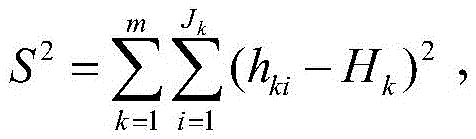

wherein,
J k representing the number of SKUs in the k-th cluster, k =1,2,3, … …, m;
H k represents the average cargo height of the kth cluster, k =1,2,3, … …, m;
h ki indicating the cargo height of the ith SKU in the kth cluster;
if sum of squared distances S 2 Determining the number of clusters at the moment in a set value range;
if sum of squared distances S 2 If the distance is not in the set value range, the cluster number is reselected, and the distance square sum S is recalculated 2 Up to the sum of squares of the distances S 2 At the set point of takingWithin a range of values.
Further, in the sum of squared distances S 2 Within the convergence interval, the set value range is determined.
Still further, when the sum of squared distances S is satisfied 2 And on the premise of a set value range, when the cluster number is selected in multiple ways, selecting the minimum value of the cluster number.
Still further, the process of determining the cargo space height of each category according to the clustering result of each category includes: and for each category, correcting all height values of the clustering result according to a preset correction principle, so that all the corrected height values are integral multiples of the corrected minimum height value, and taking all the corrected height values as the cargo space height of the category.
Further, the process of determining the cargo space height of each category according to the clustering result of each category specifically includes: for each category, correcting all height values of the clustering result according to a preset correction principle to enable all corrected height values to be integral multiples of the corrected minimum height value, and determining the maximum height of the cargo space of the category according to the corrected maximum height value; dividing the goods space into a plurality of height gears along the height direction of the goods space, and determining the height step length of the gears according to the corrected minimum height value; the adjustment of gear is realized through the horizontal baffle of dismantling the connection with goods shelves.
Still further, the preset correction principle is as follows: converting all height value units of the clustering result into millimeters, and rounding up to hundreds of bits; and then increasing the minimum amplitude of the rounded height values, so that all the corrected height values are integral multiples of the rounded minimum height value.
Further, the number of the SKUs is multiple, and all the obtained SKUs are divided into multiple categories according to sales volume or inventory.
A cargo space height determination system comprising:
an acquisition module for acquiring stock SKUs;
the classification module is used for classifying all the obtained SKUs into a plurality of classifications, and each classification comprises at least one SKU;
the cluster analysis module is used for carrying out cluster analysis on the cargo heights corresponding to all SKUs in each category to obtain a cluster result of each category;
and the cargo space height determining module is used for determining the cargo space height of each category according to the clustering result of each category.
Further, the cluster analysis module is specifically configured to:
acquiring the cargo height corresponding to each different SKU in the category;
determining the clustering number m of the category;
randomly distributing all different SKUs in the category into m clusters, and calculating the cluster center of each cluster;
calculating the sum of the distances between the heights of the cargos corresponding to all the different SKUs in the category and the respective clustering centers;
each SKU in the category is redistributed to the nearest cluster center, and the SKUs distributed to the same cluster center are used as the same category and are redistributed into m clusters;
recalculating the cluster center of each cluster; recalculating the sum of the distances between the heights of the cargos corresponding to all the SKUs and the respective clustering centers;
judging whether the difference between the distance sum calculated this time and the distance sum calculated last time is within a set difference range;
if not, each SKU in the category is redistributed to the nearest cluster center, and the SKUs distributed to the same cluster center are taken as the same category and are redistributed into m clusters; recalculating the cluster center of each cluster; recalculating the sum of the distances between the heights of the cargos corresponding to all the SKUs and the respective clustering centers;
and if so, taking the clustering center as the clustering result of the category.
Still further, the cargo space height determining module is specifically configured to: and for each category, correcting all height values of the clustering result according to a preset correction principle, so that all the corrected height values are integral multiples of the corrected minimum height value, and taking all the corrected height values as the cargo space height of the category.
Further, the cargo space height determining module is specifically configured to: for each category, correcting all height values of the clustering result according to a preset correction principle to enable all corrected height values to be integral multiples of the corrected minimum height value, and determining the maximum height of the cargo space of the category according to the corrected maximum height value; dividing the goods space into a plurality of height gears along the height direction of the goods space, and determining the height step length of the gears according to the corrected minimum height value; the adjustment of gear is realized through the horizontal baffle of can dismantling the connection with goods shelves.
Compared with the prior art, the invention has the advantages and positive effects that: according to the method and the system for determining the height of the cargo space, the stock keeping SKUs are obtained, all the obtained SKUs are divided into a plurality of categories, and each category comprises at least one SKU; performing cluster analysis on the heights of the cargos corresponding to all different SKUs in each category to obtain a cluster result of each category; determining the cargo space height of each category according to the clustering result of each category; thereby design out the goods position of reasonable height, effectively improve space utilization, play obvious improvement effect to the utilization ratio in whole warehouse, also can conveniently carry out the customization management to the goods moreover, improve the security of goods, reduce the goods maintenance cost, improve user satisfaction.
Other features and advantages of the present invention will become more apparent from the following detailed description of the invention when taken in conjunction with the accompanying drawings.
Drawings
FIG. 1 is a flow chart of one embodiment of a cargo space height determination method of the present invention;
FIG. 2 is a flow chart of the cluster analysis of FIG. 1;
FIG. 3 is a graph of sum of squared distances versus number of clusters;
fig. 4 is a block diagram of the structure of an embodiment of the cargo space height determining system according to the present invention.
Detailed Description
In order to make the objects, technical solutions and advantages of the present invention more apparent, the present invention will be described in further detail with reference to the accompanying drawings and examples.
The method for determining the height of the cargo space mainly comprises the following steps, which are shown in fig. 1.
Step S1: stock keeping SKUs are obtained, and all the obtained SKUs are divided into a plurality of categories, wherein each category comprises at least one SKU.
SKU (Stock keeping Unit) refers to an inventory holding Unit, which is a unique identifier for each product and service. For the same product and service, its corresponding SKU is the same.
The number of the plurality may be one or more. When the number of the SKUs is one, dividing all the SKUs into a large category; when the number of the SKUs is multiple, all the SKUs are divided into multiple categories.
There may be situations where some goods occupy more resources (capital, manpower, material resources, etc.) in inventory, and the loss of such goods in the event of a shortage is enormous. Therefore, the important attention is paid to the part of the goods, and certain measures are taken, such as storing the goods on a shelf close to the warehouse-out opening, observing the stock quantity, replenishing the goods in time, and the like. Therefore, the goods need to be classified.
In this embodiment, for convenience of warehouse management, all the acquired different SKUs may be divided into a plurality of categories, such as category a goods, category B goods, category C goods, and the like, according to sales volumes or stock quantities.
For example, all different SKUs in the warehouse are acquired, the sales volume (or average daily average warehouse-out volume) of the goods corresponding to the SKU in a quarter is counted for each SKU, and the sales volumes are sorted in a descending order. Typically, the top 100 SKUs are listed and the 100 SKUs are focused on as Category A goods. The remaining goods that are not in the top 100 of the sales volume are considered as category B goods. To maintain an efficient, dynamic warehouse operating environment, inventory is taken, warehouse exports are counted for each quarter, SKUs 100 before sales for that quarter are screened, and data is updated.
A plurality of goods positions are arranged on each goods shelf in the vertical direction, and the height of the goods positions on each goods shelf is equal or unequal and is determined according to the position of the partition board. When the height of the goods position is larger than that of the goods, the goods can be placed in the goods position, and the placing quantity is calculated by the length and the width of the container and the length and the width of the goods.
Step S2: and carrying out clustering analysis on the cargo heights corresponding to all the different SKUs in each category to obtain a clustering result of each category.
In this embodiment, it is preferable to perform cluster analysis by using a K-means cluster analysis algorithm.
Specifically, the following steps may be performed for each category (e.g., category a, category B, and category C), respectively, as shown in fig. 2:
s21: the height of the item corresponding to each different SKU in the category is obtained.
S22: the number of clusters m for that category is determined.
The cluster number refers to the number of classes that classify all SKUs for that class. The number of clusters m is 3 indicating that SKUs are divided into 3 clusters according to cargo height. For example, category a goods includes 30 SKUs, and the 30 SKUs are classified into 3 categories, i.e., m =3.
Assuming that the category (e.g., category a) has a total of n SKUs, the n SKUs are divided into m clusters, each cluster including at least one SKU.
Assume that the number of different SKUs contained in the m clusters is: j. the design is a square 1 、J 2 、J 3 、……、J m . By J k Representing the number of SKUs in the k-th cluster, k =1,2,3, … …, m.
Assume that the average cargo heights of the m clusters are: h 1 、H 2 、……、H m . By H k Represents the average cargo height of the kth cluster, k =1,2,3, … …, m.
h ki Indicating the cargo height of the ith SKU in the kth cluster.
The sum of the squares of the distances S is calculated according to the following formula 2 :


it is clear that the larger the number m of clusters, the sum of squared distances S 2 The smaller the size, but the more the cluster number m increases, the more difficult the hardware design, so the cluster number m and the sum of squared distances S are 2 A balance point is found between.
In this embodiment, the sum of squared distances S may be referred to 2 Presetting a reasonable value range if the sum of squares of distances S 2 And determining the number of clusters at the moment in a set value range. If sum of squared distances S 2 If the distance is not in the set value range, the cluster number is reselected, and the distance square sum S is recalculated 2 Up to the sum of squares of the distances S 2 Within a set value range. The method determines the proper clustering number, so that the difficulty in designing the shelf due to the difficulty in implementing the subsequent height design of the goods space caused by the overlarge value of the clustering number is avoided, the problem that the height types of the goods space are too few caused by the overlarge value of the clustering number is also avoided, and the space utilization rate cannot be effectively improved. Therefore, the clustering number determined by the method is convenient for designing the height of the goods space subsequently, and the problem of low space utilization rate can be effectively solved.
At the sum of squared distances S 2 Within the convergence interval, the set value range is determined. The value range determined by the method is reasonable in value, and a reasonable range is defined for determining the number of clusters. Referring to fig. 3, when the number of clusters reaches 3, the sum of squared distances S 2 Tends to converge, S 2 In a set value range [0.2 x 10^8,0.4 x 10^8]And so the cluster number can be determined to be 3. Of course, when the number of clusters is 4, 5, 6, the sum of squared distances S 2 Also within the set value range, the cluster number can be determined to be 4, 5, 6. However, the larger the number of clusters, the more resources need to be consumed at subsequent design cargo space heights. Therefore, the sum of squared distances S is satisfied 2 Under the premise of a set value rangeWhen there are a plurality of choices for the number of clusters, it is preferable to select the minimum value of the number of clusters.
S23: all the different SKUs in that category are randomly assigned to m clusters and the cluster center for each cluster is calculated.
The cluster center for each type refers to the average cargo height of each type of SKU.
Assuming that the A category has 30 SKUs, the clustering number is m =3, the 30 SKUs are randomly divided into 3 categories, and the average cargo height of each SKU category is calculated to obtain 3 clustering centers.
S24: and calculating the distance sum S between the heights of the cargos corresponding to all the different SKUs in the category and the respective cluster centers.
Firstly, the distance between the cargo height corresponding to each SKU and the clustering center of each SKU is calculated respectively, and then the calculated distances are added to obtain the distance sum S. The distance between the cargo height corresponding to the SKU and the cluster center is the difference between the cargo height corresponding to the SKU and the cluster center.
Suppose that:
the sum of the distances between the heights of the cargos corresponding to all SKUs in the cluster 1 and the cluster center of the cluster is S1;
the sum of the distances between the heights of the cargos corresponding to all SKUs in the cluster 2 and the cluster center of the cluster is S2;
……
the sum of the distances between the heights of the cargos corresponding to all SKUs in the mth cluster and the cluster center of the cluster is Sm;
then, the sum of the distances from the cargo heights corresponding to all SKUs in the category a to the respective cluster centers S = S1+ S2+ … … + Sm.
S25: each SKU in the category is reassigned to the nearest cluster center, and the SKUs assigned to the same cluster center are reclassified into m clusters as the same category.
S26: recalculating the cluster center of each cluster; and recalculating the distance sum of the heights of the cargos corresponding to all the SKUs and the respective cluster centers.
S27: it is determined whether the difference between the sum of distances calculated in step S26 and the sum of distances calculated in the previous time is within the set difference range. In the present embodiment, the difference range is preferably set to [ -0.02,0.02].
If not, the difference between the two distance sums is larger, and the two distance sums do not meet the requirement, the step S25 is returned to.
If yes, it means that the sum of the two distances is not much different, step S28 is executed.
S28: and taking the clustering center as the clustering result of the category.
The clustering center at this time is the clustering result of the category, that is, the clustering result of the category is the current m clustering centers, that is, m height values. For example, for a category a good, the number of clusters is 3, and the clustering result is: 414mm,878mm,1815mm.
Through the steps S21-S28, the clustering result of each category is obtained, so that the method is simple and convenient to implement, and the accurate clustering result can be clustered, thereby being beneficial to the accurate design of the subsequent cargo space height.
And step S3: and determining the cargo space height of each category according to the clustering result of each category.
As an optimal design scheme of this embodiment, determining the cargo space height of each category according to the clustering result of each category specifically includes: and for each category, correcting all height values of the clustering result according to a preset correction principle, so that all the corrected height values are integral multiples of the corrected minimum height value, and taking all the corrected height values as the cargo space height of the category. The height of the goods position determined by the method is convenient for the production design of the goods position of the goods shelf and improves the space safety of goods.
The preset correction principle is as follows: converting all height value units of the clustering result into millimeters, and rounding up to hundreds of bits; and then increasing the minimum amplitude of the rounded plurality of height values, so that all the corrected height values are integral multiples of the rounded minimum height value. Special cases are as follows: the corrected minimum height value is 1 times of itself. The height of each goods shelf is a whole hundred millimeters and is an integral multiple of the minimum height value by correcting according to the principle, so that the production of the goods shelves is facilitated, and the warehouse management is facilitated.
For example, for a category a goods, the number of clusters is 3, and the clustering result is three height values: 414mm,878mm,1815mm. In consideration of space safety, the three height values are rounded up to hundreds of positions to obtain 500mm,900mm and 1900mm, then 900mm is increased to 1000mm, 1900mm is increased to 2000mm, and finally, the corrected height values are 500mm,1000mm and 2000mm as the cargo space height of the cargo in the A category. Three types of goods spaces are designed according to the three height values, and are respectively used for storing the goods in the category A in the height range.
The height and the quantity of the goods space are designed according to the current goods condition, but the types and the quantity of the goods can be changed at any time, namely, the space utilization rate can be reduced after the goods condition is changed. If the goods position quantity of every kind of height is fixed, when the goods kind changes, some goods positions can't deposit the higher product of height, again can cause the space waste. For example, a 500mm high cargo space may not be able to store products of greater height, whereas a 2000mm high cargo space would be wasteful of space if used to store products of lesser height.
In order to solve this problem, the present embodiment proposes another preferred design: for each category, correcting all height values of the clustering result according to a preset correction principle to enable all corrected height values to be integral multiples of the corrected minimum height value, and determining the maximum height of the cargo space of the category according to the corrected maximum height value; then dividing the goods space into a plurality of height gears along the height direction of the goods space, and determining the height step length of the gears according to the corrected minimum height value; the gear adjustment is realized through a horizontal clapboard detachably connected with the goods shelf; the gear is adjusted through the horizontal partition plate, so that the SKUs with different heights can be placed in the goods space, the space utilization is more flexible, and the utilization rate of the warehouse is improved. The number of gear positions is the ratio of the corrected maximum height value to the corrected minimum height value. The maximum height of the goods space of the category is determined along the height direction of the goods shelf, then the height gears are divided, the height step length of the gears is determined, and the gears are adjusted through the horizontal partition plates.
For example, for a category a goods, the number of clusters is 3, and the clustering result is three height values: 414mm,878mm,1815mm, and taking up these three height values to hundreds in view of space safety, 500mm,900mm,1900mm were obtained. Then, the height of 900mm was increased to 1000mm, and the height of 1900mm was increased to 2000mm, to obtain a corrected height value of 500mm,1000mm, and 2000mm. With the maximum height value 2000mm as the maximum height of the goods position of A classification goods, the height step length of gear is determined to be 500mm according to the minimum 500mm after the correction, from this can be along the direction of height of goods position from bottom to top divide into 4 height gears, do respectively: 500mm,1000mm,1500mm and 2000mm, and according to the height of the goods, a horizontal partition plate is placed at a proper gear, so that the storage requirement of the goods can be met. The goods shelf can be well adapted to the future development change of the warehouse, so that the space utilization of the warehouse is more flexible, and the utilization rate of the warehouse is improved.
By way of example:
if the height of the goods corresponding to the SKU is 450mm, the horizontal partition plate is placed at a first gear, and the height of the gear is 500mm;
if the height of the goods corresponding to the SKU is 800mm, the horizontal partition plate is placed at a second gear, and the height of the gear is 1000mm;
if the height of the goods corresponding to the SKU is 1200mm, the horizontal partition plate is placed at a third gear, and the height of the gear is 1500mm;
and if the cargo height corresponding to the SKU is 1900mm, the horizontal partition plate is placed at the fourth gear, and the gear height is 2000mm.
The user can be according to the position of the nimble horizontal baffle of adjustment of the change of not co-altitude goods quantity to satisfy the demand of depositing of all goods.
The method for determining the height of the cargo space comprises the steps of obtaining stock SKUs, and dividing all the obtained SKUs into a plurality of categories, wherein each category comprises at least one SKU; performing clustering analysis on the cargo heights corresponding to all different SKUs in each category to obtain a clustering result of each category; determining the cargo space height of each category according to the clustering result of each category; thereby design out the goods position of reasonable height, effectively improve space utilization, play obvious improvement effect to the utilization ratio in whole warehouse, also can conveniently carry out the customization management to the goods moreover, improve the security of goods, reduce the goods maintenance cost, improve user satisfaction.
Based on the cargo space height determining method, the embodiment further provides a cargo space height determining system, which mainly comprises an obtaining module, a category dividing module, a cluster analysis module, a cargo space height determining module and the like, and is shown in fig. 4.
An acquisition module to acquire SKUs in inventory. For example, the acquisition module may select a code scanning gun that scans a nameplate on the cargo and may acquire various information for the cargo, including a corresponding SKU. And scanning various goods in the stock by using a code scanning gun to obtain the stock SKU.
And the classification module is used for classifying all the acquired SKUs into a plurality of classifications, and each classification comprises at least one SKU.
And the cluster analysis module is used for carrying out cluster analysis on the cargo heights corresponding to all the SKUs in each category to obtain a cluster result of each category.
And the cargo space height determining module is used for determining the cargo space height of each category according to the clustering result of each category.
In this embodiment, the cluster analysis module is specifically configured to:
acquiring the cargo height corresponding to each different SKU in the category;
determining the clustering number m of the category;
randomly distributing all different SKUs in the category into m clusters, and calculating the cluster center of each cluster;
calculating the sum of the distances between the heights of the cargos corresponding to all the different SKUs in the category and the respective clustering centers;
each SKU in the category is redistributed to the nearest cluster center, and the SKUs distributed to the same cluster center are used as the same category and are redistributed into m clusters;
recalculating the cluster center of each cluster; recalculating the sum of the distances between the heights of the cargos corresponding to all the SKUs and the respective clustering centers;
judging whether the difference between the distance sum calculated this time and the distance sum calculated last time is within a set difference range;
if not, each SKU in the category is redistributed to the nearest cluster center, and the SKUs distributed to the same cluster center are taken as the same category and are redistributed into m clusters; recalculating the cluster center of each cluster; recalculating the sum of the distances between the heights of the cargos corresponding to all the SKUs and the respective clustering centers;
and if so, taking the clustering center as the clustering result of the category.
In this embodiment, the cargo space height determining module is specifically configured to: and for each category, correcting all height values of the clustering result according to a preset correction principle, so that all the corrected height values are integral multiples of the corrected minimum height value, and taking all the corrected height values as the cargo space height of the category.
As another preferred design of this embodiment, the cargo space height determining module is specifically configured to: for each category, correcting all height values of the clustering result according to a preset correction principle to enable all corrected height values to be integral multiples of the corrected minimum height value, and determining the maximum height of the cargo space of the category according to the corrected maximum height value; dividing the goods space into a plurality of height gears along the height direction of the goods space, and determining the height step length of the gears according to the corrected minimum height value; the adjustment of gear is realized through the horizontal baffle of can dismantling the connection with goods shelves.
The operation process of the cargo space height determining system has been described in detail in the cargo space height determining method, and is not described herein again.
The cargo space height determining system of the embodiment is characterized in that stock SKUs are obtained, and all the obtained SKUs are divided into a plurality of categories, wherein each category comprises at least one SKU; performing clustering analysis on the cargo heights corresponding to all different SKUs in each category to obtain a clustering result of each category; determining the cargo space height of each category according to the clustering result of each category; thereby design out the goods position of reasonable height, effectively improve space utilization, play obvious improvement effect to the utilization ratio in whole warehouse, also can conveniently carry out the customization management to the goods moreover, improve the security of goods, reduce the goods maintenance cost, improve user satisfaction.
The above examples are only intended to illustrate the technical solution of the present invention, but not to limit it; although the present invention has been described in detail with reference to the foregoing embodiments, it will be apparent to those skilled in the art that various changes may be made and equivalents may be substituted for elements thereof; and such modifications or substitutions do not depart from the spirit and scope of the corresponding technical solutions.
Claims (8)
1. A cargo space height determination method, comprising:
acquiring SKUs in inventory and dividing all the acquired SKUs into a plurality of categories, wherein each category comprises at least one SKU;
performing clustering analysis on the cargo heights corresponding to all SKUs in each category to obtain a clustering result of each category;
determining the cargo space height of each category according to the clustering result of each category; the method specifically comprises the following steps:
for each category, correcting all height values of the clustering result according to a preset correction principle, so that all corrected height values are integral multiples of the corrected minimum height value, and all corrected height values are used as the cargo space height of the category;
or,
for each category, correcting all height values of the clustering result according to a preset correction principle to enable all corrected height values to be integral multiples of the corrected minimum height value, and determining the maximum height of the cargo space of the category according to the corrected maximum height value; dividing the goods space into a plurality of height gears along the height direction of the goods space, and determining the height step length of the gears according to the corrected minimum height value; the adjustment of gear is realized through the horizontal baffle of can dismantling the connection with goods shelves.
2. The method of claim 1, wherein the step of performing cluster analysis on the cargo heights corresponding to all SKUs in each category to obtain a clustering result of each category comprises the following steps:
(1) Acquiring the cargo height corresponding to each different SKU in the category;
(2) Determining the clustering number m of the category;
(3) Randomly distributing all different SKUs in the category into m clusters, and calculating the cluster center of each cluster;
(4) Calculating the sum of the distances between the heights of the cargos corresponding to all the different SKUs in the category and the respective clustering centers;
(5) Each SKU in the category is redistributed to the nearest cluster center, and the SKUs distributed to the same cluster center are taken as the same category and are redistributed into m clusters;
(6) Recalculating the cluster center of each cluster; recalculating the sum of the distances between the heights of the cargos corresponding to all the SKUs and the respective clustering centers;
(7) Judging whether the difference between the distance sum calculated in the step (6) and the distance sum calculated in the previous time is within a set difference range or not;
if not, returning to the step (5);
and if so, taking the clustering center as the clustering result of the category.
3. The method according to claim 2, wherein in the determining the number m of clusters of the category, the method comprises:
the sum of squared distances S is calculated according to the following formula 2 :


wherein,
J k representing the number of SKUs in the k-th cluster, k =1,2,3, … …, m;
H k represents the average cargo height of the kth cluster, k =1,2,3, … …, m;
h ki indicating the cargo height of the ith SKU in the kth cluster;
if sum of squared distances S 2 Determining the number of clusters at the moment in a set value range;
if sum of squared distances S 2 If the distance is not in the set value range, the cluster number is reselected, and the distance square sum S is recalculated 2 Up to the sum of squares of the distances S 2 Within a set value range.
4. Method according to claim 3, characterized in that the sum of the squares of the distances S 2 Within the convergence interval, the set value range is determined.
5. The method of claim 3, wherein the sum of squared distances S is satisfied 2 And on the premise of a set value range, selecting the minimum value of the cluster number when the cluster number has a plurality of selections.
6. The method according to claim 1, wherein the preset correction rule is: converting all height value units of the clustering result into millimeters, and rounding up to hundreds of bits; and then increasing the minimum amplitude of the rounded height values, so that all the corrected height values are integral multiples of the rounded minimum height value.
7. The method of claim 1, wherein said plurality is a plurality, and all SKUs acquired are classified into a plurality of categories according to sales or inventory.
8. A cargo space height determination system, comprising:
an acquisition module for acquiring stock SKUs;
the classification module is used for classifying all the acquired SKUs into a plurality of classifications, and each classification comprises at least one SKU;
the cluster analysis module is used for carrying out cluster analysis on the cargo heights corresponding to all SKUs in each category to obtain a cluster result of each category;
the goods space height determining module is used for determining the goods space height of each category according to the clustering result of each category; the method specifically comprises the following steps:
for each category, correcting all height values of the clustering result according to a preset correction principle, so that all corrected height values are integral multiples of the corrected minimum height value, and taking all corrected height values as the cargo space height of the category;
or,
for each category, correcting all height values of the clustering result according to a preset correction principle so that all corrected height values are integral multiples of the corrected minimum height value, and determining the maximum height of the goods space of the category according to the corrected maximum height value; dividing the goods space into a plurality of height gears along the height direction of the goods space, and determining the height step length of the gears according to the corrected minimum height value; the adjustment of gear is realized through the horizontal baffle of can dismantling the connection with goods shelves.
Priority Applications (1)
| Application Number | Priority Date | Filing Date | Title |
|---|---|---|---|
| CN202010218576.0A CN113449749B (en) | 2020-03-25 | 2020-03-25 | Goods space height determining method and system |
Applications Claiming Priority (1)
| Application Number | Priority Date | Filing Date | Title |
|---|---|---|---|
| CN202010218576.0A CN113449749B (en) | 2020-03-25 | 2020-03-25 | Goods space height determining method and system |
Publications (2)
| Publication Number | Publication Date |
|---|---|
| CN113449749A CN113449749A (en) | 2021-09-28 |
| CN113449749B true CN113449749B (en) | 2023-02-17 |
Family
ID=77806737
Family Applications (1)
| Application Number | Title | Priority Date | Filing Date |
|---|---|---|---|
| CN202010218576.0A Active CN113449749B (en) | 2020-03-25 | 2020-03-25 | Goods space height determining method and system |
Country Status (1)
| Country | Link |
|---|---|
| CN (1) | CN113449749B (en) |
Citations (12)
| Publication number | Priority date | Publication date | Assignee | Title |
|---|---|---|---|---|
| CN101923692A (en) * | 2009-06-12 | 2010-12-22 | 埃森哲环球服务有限公司 | Be used to use the system and method for the top-down performance optimization of elasticity modeling |
| CN106066163A (en) * | 2016-07-21 | 2016-11-02 | 国网河北省电力公司电力科学研究院 | A kind of piler and the on-line monitoring method of stereo storage rack perpendicularity |
| CN106709692A (en) * | 2017-02-24 | 2017-05-24 | 北京远大宏略科技股份有限公司 | Logistics center storage position allocation method |
| CN106774203A (en) * | 2016-12-16 | 2017-05-31 | 无锡天捷自动化物流设备有限公司 | Automated warehousing management method and device |
| CN107067206A (en) * | 2011-09-09 | 2017-08-18 | 西姆伯蒂克有限责任公司 | Store and fetch the detection of system box unit |
| CN108292381A (en) * | 2015-09-29 | 2018-07-17 | 利尼芝物流有限责任公司 | warehouse shelf space optimization |
| CN109001748A (en) * | 2018-07-16 | 2018-12-14 | 北京旷视科技有限公司 | The correlating method of target object and article, apparatus and system |
| CN109117861A (en) * | 2018-06-29 | 2019-01-01 | 浙江大学宁波理工学院 | A kind of multi-level cluster analysis method of point set for taking spatial position into account |
| CN109121408A (en) * | 2014-12-12 | 2019-01-01 | 西姆伯蒂克有限责任公司 | storage and retrieval system |
| CN109564651A (en) * | 2016-05-19 | 2019-04-02 | 思比机器人公司 | Method for automatically generating the planogram for the shelf structure being assigned to product in shop |
| CN110020823A (en) * | 2019-04-09 | 2019-07-16 | 心怡科技股份有限公司 | A kind of storehouse assignment algorithm based on K-Means |
| CN110069980A (en) * | 2019-03-05 | 2019-07-30 | 北京三快在线科技有限公司 | Product polymerization and device, electronic equipment based on image |
-
2020
- 2020-03-25 CN CN202010218576.0A patent/CN113449749B/en active Active
Patent Citations (12)
| Publication number | Priority date | Publication date | Assignee | Title |
|---|---|---|---|---|
| CN101923692A (en) * | 2009-06-12 | 2010-12-22 | 埃森哲环球服务有限公司 | Be used to use the system and method for the top-down performance optimization of elasticity modeling |
| CN107067206A (en) * | 2011-09-09 | 2017-08-18 | 西姆伯蒂克有限责任公司 | Store and fetch the detection of system box unit |
| CN109121408A (en) * | 2014-12-12 | 2019-01-01 | 西姆伯蒂克有限责任公司 | storage and retrieval system |
| CN108292381A (en) * | 2015-09-29 | 2018-07-17 | 利尼芝物流有限责任公司 | warehouse shelf space optimization |
| CN109564651A (en) * | 2016-05-19 | 2019-04-02 | 思比机器人公司 | Method for automatically generating the planogram for the shelf structure being assigned to product in shop |
| CN106066163A (en) * | 2016-07-21 | 2016-11-02 | 国网河北省电力公司电力科学研究院 | A kind of piler and the on-line monitoring method of stereo storage rack perpendicularity |
| CN106774203A (en) * | 2016-12-16 | 2017-05-31 | 无锡天捷自动化物流设备有限公司 | Automated warehousing management method and device |
| CN106709692A (en) * | 2017-02-24 | 2017-05-24 | 北京远大宏略科技股份有限公司 | Logistics center storage position allocation method |
| CN109117861A (en) * | 2018-06-29 | 2019-01-01 | 浙江大学宁波理工学院 | A kind of multi-level cluster analysis method of point set for taking spatial position into account |
| CN109001748A (en) * | 2018-07-16 | 2018-12-14 | 北京旷视科技有限公司 | The correlating method of target object and article, apparatus and system |
| CN110069980A (en) * | 2019-03-05 | 2019-07-30 | 北京三快在线科技有限公司 | Product polymerization and device, electronic equipment based on image |
| CN110020823A (en) * | 2019-04-09 | 2019-07-16 | 心怡科技股份有限公司 | A kind of storehouse assignment algorithm based on K-Means |
Non-Patent Citations (1)
| Title |
|---|
| 面向汽车零部件自动化立体仓库的货位优化研究;林红;《中国优秀硕士学位论文全文数据库信息科技辑》;20121015;第1-68页 * |
Also Published As
| Publication number | Publication date |
|---|---|
| CN113449749A (en) | 2021-09-28 |
Similar Documents
| Publication | Publication Date | Title |
|---|---|---|
| CN111815233B (en) | Goods position optimization method based on total logistics amount and energy consumption | |
| CN109615137A (en) | Location optimization method for cloud distribution in cloud logistics environment | |
| CN113762563A (en) | Method and system for optimal layout of warehouse storage space based on grey relational analysis of orders | |
| CN117408608A (en) | Digital warehouse management system and method thereof | |
| CN112633793A (en) | Method for optimizing warehouse entry allocation of goods space in automatic three-dimensional warehouse through big data analysis | |
| CN113449749B (en) | Goods space height determining method and system | |
| CN110599087A (en) | Intelligent management system for logistics storage | |
| CN110826958A (en) | Intelligent goods dispatching method and device for e-commerce platform | |
| CN117993568A (en) | Rural market logistics optimization method and system based on clustering algorithm analysis | |
| CN114022044A (en) | Method and system for realizing supply and demand model of automobile supply chain | |
| CN120235552A (en) | A material management intelligent warehouse location dynamic management method and system | |
| CN109359905B (en) | Automatic unmanned warehouse goods space allocation method and device and storage medium | |
| CN112007865A (en) | Inbound sorting method, inbound sorting device, electronic equipment and storage medium | |
| CN112862136B (en) | Sorting method, sorting device, sorting system, server and storage medium | |
| CN110020823A (en) | A kind of storehouse assignment algorithm based on K-Means | |
| CN109658007A (en) | Methods of picking fresh goods | |
| CN115423404B (en) | Automatic partitioning method and system for sorting area of e-commerce warehouse | |
| CN110533279A (en) | For dispatching the method, system and storage medium of cloud logistics platform transport power | |
| CN112085444B (en) | Automatic raw material bin material receiving method and system for plate-type furniture | |
| CN109887545A (en) | A kind of gene data service system and method based on cloud framework | |
| CN116976769A (en) | Dual-core transportation scheme optimization method and system | |
| CN110543963B (en) | XGboost model-based client order weight forecasting method and system | |
| CN113283756A (en) | Shop employee distribution method and distribution device | |
| CN114996630B (en) | A dynamic opening method for a multi-compartment storage device | |
| CN115713290A (en) | Intelligent replenishment system for warehouse management |
Legal Events
| Date | Code | Title | Description |
|---|---|---|---|
| PB01 | Publication | ||
| PB01 | Publication | ||
| SE01 | Entry into force of request for substantive examination | ||
| SE01 | Entry into force of request for substantive examination | ||
| GR01 | Patent grant | ||
| GR01 | Patent grant |