CN1134418C - Substituted pyrazolyl benzenesulfonamides for treating inflammation - Google Patents
Substituted pyrazolyl benzenesulfonamides for treating inflammation Download PDFInfo
- Publication number
- CN1134418C CN1134418C CNB99126472XA CN99126472A CN1134418C CN 1134418 C CN1134418 C CN 1134418C CN B99126472X A CNB99126472X A CN B99126472XA CN 99126472 A CN99126472 A CN 99126472A CN 1134418 C CN1134418 C CN 1134418C
- Authority
- CN
- China
- Prior art keywords
- pyrazol
- benzenesulfonamide
- phenyl
- trifluoromethyl
- pyrazole
- Prior art date
- Legal status (The legal status is an assumption and is not a legal conclusion. Google has not performed a legal analysis and makes no representation as to the accuracy of the status listed.)
- Expired - Lifetime
Links
Classifications
-
- A—HUMAN NECESSITIES
- A61—MEDICAL OR VETERINARY SCIENCE; HYGIENE
- A61P—SPECIFIC THERAPEUTIC ACTIVITY OF CHEMICAL COMPOUNDS OR MEDICINAL PREPARATIONS
- A61P1/00—Drugs for disorders of the alimentary tract or the digestive system
- A61P1/04—Drugs for disorders of the alimentary tract or the digestive system for ulcers, gastritis or reflux esophagitis, e.g. antacids, inhibitors of acid secretion, mucosal protectants
-
- A—HUMAN NECESSITIES
- A61—MEDICAL OR VETERINARY SCIENCE; HYGIENE
- A61P—SPECIFIC THERAPEUTIC ACTIVITY OF CHEMICAL COMPOUNDS OR MEDICINAL PREPARATIONS
- A61P19/00—Drugs for skeletal disorders
- A61P19/02—Drugs for skeletal disorders for joint disorders, e.g. arthritis, arthrosis
-
- A—HUMAN NECESSITIES
- A61—MEDICAL OR VETERINARY SCIENCE; HYGIENE
- A61P—SPECIFIC THERAPEUTIC ACTIVITY OF CHEMICAL COMPOUNDS OR MEDICINAL PREPARATIONS
- A61P25/00—Drugs for disorders of the nervous system
- A61P25/04—Centrally acting analgesics, e.g. opioids
-
- A—HUMAN NECESSITIES
- A61—MEDICAL OR VETERINARY SCIENCE; HYGIENE
- A61P—SPECIFIC THERAPEUTIC ACTIVITY OF CHEMICAL COMPOUNDS OR MEDICINAL PREPARATIONS
- A61P25/00—Drugs for disorders of the nervous system
- A61P25/06—Antimigraine agents
-
- A—HUMAN NECESSITIES
- A61—MEDICAL OR VETERINARY SCIENCE; HYGIENE
- A61P—SPECIFIC THERAPEUTIC ACTIVITY OF CHEMICAL COMPOUNDS OR MEDICINAL PREPARATIONS
- A61P29/00—Non-central analgesic, antipyretic or antiinflammatory agents, e.g. antirheumatic agents; Non-steroidal antiinflammatory drugs [NSAID]
-
- A—HUMAN NECESSITIES
- A61—MEDICAL OR VETERINARY SCIENCE; HYGIENE
- A61P—SPECIFIC THERAPEUTIC ACTIVITY OF CHEMICAL COMPOUNDS OR MEDICINAL PREPARATIONS
- A61P31/00—Antiinfectives, i.e. antibiotics, antiseptics, chemotherapeutics
-
- A—HUMAN NECESSITIES
- A61—MEDICAL OR VETERINARY SCIENCE; HYGIENE
- A61P—SPECIFIC THERAPEUTIC ACTIVITY OF CHEMICAL COMPOUNDS OR MEDICINAL PREPARATIONS
- A61P35/00—Antineoplastic agents
-
- A—HUMAN NECESSITIES
- A61—MEDICAL OR VETERINARY SCIENCE; HYGIENE
- A61P—SPECIFIC THERAPEUTIC ACTIVITY OF CHEMICAL COMPOUNDS OR MEDICINAL PREPARATIONS
- A61P5/00—Drugs for disorders of the endocrine system
- A61P5/14—Drugs for disorders of the endocrine system of the thyroid hormones, e.g. T3, T4
-
- A—HUMAN NECESSITIES
- A61—MEDICAL OR VETERINARY SCIENCE; HYGIENE
- A61P—SPECIFIC THERAPEUTIC ACTIVITY OF CHEMICAL COMPOUNDS OR MEDICINAL PREPARATIONS
- A61P9/00—Drugs for disorders of the cardiovascular system
-
- C—CHEMISTRY; METALLURGY
- C07—ORGANIC CHEMISTRY
- C07D—HETEROCYCLIC COMPOUNDS
- C07D231/00—Heterocyclic compounds containing 1,2-diazole or hydrogenated 1,2-diazole rings
- C07D231/02—Heterocyclic compounds containing 1,2-diazole or hydrogenated 1,2-diazole rings not condensed with other rings
- C07D231/10—Heterocyclic compounds containing 1,2-diazole or hydrogenated 1,2-diazole rings not condensed with other rings having two or three double bonds between ring members or between ring members and non-ring members
- C07D231/12—Heterocyclic compounds containing 1,2-diazole or hydrogenated 1,2-diazole rings not condensed with other rings having two or three double bonds between ring members or between ring members and non-ring members with only hydrogen atoms, hydrocarbon or substituted hydrocarbon radicals, directly attached to ring carbon atoms
-
- C—CHEMISTRY; METALLURGY
- C07—ORGANIC CHEMISTRY
- C07D—HETEROCYCLIC COMPOUNDS
- C07D231/00—Heterocyclic compounds containing 1,2-diazole or hydrogenated 1,2-diazole rings
- C07D231/02—Heterocyclic compounds containing 1,2-diazole or hydrogenated 1,2-diazole rings not condensed with other rings
- C07D231/10—Heterocyclic compounds containing 1,2-diazole or hydrogenated 1,2-diazole rings not condensed with other rings having two or three double bonds between ring members or between ring members and non-ring members
- C07D231/14—Heterocyclic compounds containing 1,2-diazole or hydrogenated 1,2-diazole rings not condensed with other rings having two or three double bonds between ring members or between ring members and non-ring members with hetero atoms or with carbon atoms having three bonds to hetero atoms with at the most one bond to halogen, e.g. ester or nitrile radicals, directly attached to ring carbon atoms
-
- C—CHEMISTRY; METALLURGY
- C07—ORGANIC CHEMISTRY
- C07D—HETEROCYCLIC COMPOUNDS
- C07D231/00—Heterocyclic compounds containing 1,2-diazole or hydrogenated 1,2-diazole rings
- C07D231/02—Heterocyclic compounds containing 1,2-diazole or hydrogenated 1,2-diazole rings not condensed with other rings
- C07D231/10—Heterocyclic compounds containing 1,2-diazole or hydrogenated 1,2-diazole rings not condensed with other rings having two or three double bonds between ring members or between ring members and non-ring members
- C07D231/14—Heterocyclic compounds containing 1,2-diazole or hydrogenated 1,2-diazole rings not condensed with other rings having two or three double bonds between ring members or between ring members and non-ring members with hetero atoms or with carbon atoms having three bonds to hetero atoms with at the most one bond to halogen, e.g. ester or nitrile radicals, directly attached to ring carbon atoms
- C07D231/16—Halogen atoms or nitro radicals
-
- C—CHEMISTRY; METALLURGY
- C07—ORGANIC CHEMISTRY
- C07D—HETEROCYCLIC COMPOUNDS
- C07D231/00—Heterocyclic compounds containing 1,2-diazole or hydrogenated 1,2-diazole rings
- C07D231/54—Heterocyclic compounds containing 1,2-diazole or hydrogenated 1,2-diazole rings condensed with carbocyclic rings or ring systems
-
- C—CHEMISTRY; METALLURGY
- C07—ORGANIC CHEMISTRY
- C07D—HETEROCYCLIC COMPOUNDS
- C07D401/00—Heterocyclic compounds containing two or more hetero rings, having nitrogen atoms as the only ring hetero atoms, at least one ring being a six-membered ring with only one nitrogen atom
- C07D401/02—Heterocyclic compounds containing two or more hetero rings, having nitrogen atoms as the only ring hetero atoms, at least one ring being a six-membered ring with only one nitrogen atom containing two hetero rings
- C07D401/04—Heterocyclic compounds containing two or more hetero rings, having nitrogen atoms as the only ring hetero atoms, at least one ring being a six-membered ring with only one nitrogen atom containing two hetero rings directly linked by a ring-member-to-ring-member bond
-
- C—CHEMISTRY; METALLURGY
- C07—ORGANIC CHEMISTRY
- C07D—HETEROCYCLIC COMPOUNDS
- C07D403/00—Heterocyclic compounds containing two or more hetero rings, having nitrogen atoms as the only ring hetero atoms, not provided for by group C07D401/00
- C07D403/02—Heterocyclic compounds containing two or more hetero rings, having nitrogen atoms as the only ring hetero atoms, not provided for by group C07D401/00 containing two hetero rings
- C07D403/04—Heterocyclic compounds containing two or more hetero rings, having nitrogen atoms as the only ring hetero atoms, not provided for by group C07D401/00 containing two hetero rings directly linked by a ring-member-to-ring-member bond
-
- C—CHEMISTRY; METALLURGY
- C07—ORGANIC CHEMISTRY
- C07D—HETEROCYCLIC COMPOUNDS
- C07D405/00—Heterocyclic compounds containing both one or more hetero rings having oxygen atoms as the only ring hetero atoms, and one or more rings having nitrogen as the only ring hetero atom
- C07D405/02—Heterocyclic compounds containing both one or more hetero rings having oxygen atoms as the only ring hetero atoms, and one or more rings having nitrogen as the only ring hetero atom containing two hetero rings
- C07D405/04—Heterocyclic compounds containing both one or more hetero rings having oxygen atoms as the only ring hetero atoms, and one or more rings having nitrogen as the only ring hetero atom containing two hetero rings directly linked by a ring-member-to-ring-member bond
-
- C—CHEMISTRY; METALLURGY
- C07—ORGANIC CHEMISTRY
- C07D—HETEROCYCLIC COMPOUNDS
- C07D409/00—Heterocyclic compounds containing two or more hetero rings, at least one ring having sulfur atoms as the only ring hetero atoms
- C07D409/02—Heterocyclic compounds containing two or more hetero rings, at least one ring having sulfur atoms as the only ring hetero atoms containing two hetero rings
- C07D409/04—Heterocyclic compounds containing two or more hetero rings, at least one ring having sulfur atoms as the only ring hetero atoms containing two hetero rings directly linked by a ring-member-to-ring-member bond
-
- C—CHEMISTRY; METALLURGY
- C07—ORGANIC CHEMISTRY
- C07D—HETEROCYCLIC COMPOUNDS
- C07D495/00—Heterocyclic compounds containing in the condensed system at least one hetero ring having sulfur atoms as the only ring hetero atoms
- C07D495/02—Heterocyclic compounds containing in the condensed system at least one hetero ring having sulfur atoms as the only ring hetero atoms in which the condensed system contains two hetero rings
- C07D495/04—Ortho-condensed systems
Landscapes
- Chemical & Material Sciences (AREA)
- Organic Chemistry (AREA)
- Health & Medical Sciences (AREA)
- Veterinary Medicine (AREA)
- Public Health (AREA)
- Chemical Kinetics & Catalysis (AREA)
- General Chemical & Material Sciences (AREA)
- Medicinal Chemistry (AREA)
- Nuclear Medicine, Radiotherapy & Molecular Imaging (AREA)
- Pharmacology & Pharmacy (AREA)
- Life Sciences & Earth Sciences (AREA)
- Animal Behavior & Ethology (AREA)
- General Health & Medical Sciences (AREA)
- Engineering & Computer Science (AREA)
- Bioinformatics & Cheminformatics (AREA)
- Pain & Pain Management (AREA)
- Rheumatology (AREA)
- Neurosurgery (AREA)
- Neurology (AREA)
- Biomedical Technology (AREA)
- Communicable Diseases (AREA)
- Orthopedic Medicine & Surgery (AREA)
- Cardiology (AREA)
- Endocrinology (AREA)
- Diabetes (AREA)
- Oncology (AREA)
- Immunology (AREA)
- Heart & Thoracic Surgery (AREA)
- Physical Education & Sports Medicine (AREA)
- Pharmaceuticals Containing Other Organic And Inorganic Compounds (AREA)
- Plural Heterocyclic Compounds (AREA)
- Heterocyclic Carbon Compounds Containing A Hetero Ring Having Oxygen Or Sulfur (AREA)
- Nitrogen Condensed Heterocyclic Rings (AREA)
- Nitrogen And Oxygen Or Sulfur-Condensed Heterocyclic Ring Systems (AREA)
Abstract
Description
本发明属于抗炎药物领域,更具体地讲,本发明涉及用于治疗炎症和与炎症有关的疾病例如关节炎的化合物、组合物以及治疗方法。The present invention belongs to the field of anti-inflammatory drugs, and more particularly, the present invention relates to compounds, compositions and methods for treating inflammation and inflammation-related diseases such as arthritis.
本发明背景Background of the invention
在炎症发展过程中,前列腺素起着重要作用并且抑制前列腺素的产生,特别是PGG2、PGH2和PGE2的产生,已经成为寻找抗炎药物的普遍指标。但是,通常具有可减缓因前列腺素所引起的疼痛以及与炎症有关的肿胀的非甾类抗炎药(NSAID)也会对与炎症无关的其它由前列腺素调节的生理过程产生影响。这样,施用大剂量的常用的非甾类抗炎药可产生严重的副反应,包括有生命危险的溃疡,从而限制了它们的治疗效力。当不选择非甾类抗炎药时,可使用皮质类固醇,但特别是在长期治疗过程中,会出现更为强烈的副反应。Prostaglandins play an important role in the development of inflammation and inhibition of prostaglandin production, especially PGG 2 , PGH 2 and PGE 2 , has become a common indicator in the search for anti-inflammatory drugs. However, non-steroidal anti-inflammatory drugs (NSAIDs), which generally relieve pain and swelling associated with inflammation due to prostaglandins, also affect other prostaglandin-mediated physiological processes unrelated to inflammation. Thus, administration of high doses of commonly used NSAIDs can produce severe side effects, including life-threatening ulcers, limiting their therapeutic efficacy. Corticosteroids can be used when NSAIDs are not an option, but more severe side effects occur, especially during long-term treatment.
现已发现,先有的非甾类抗炎药通过抑制人花生四烯酸/前列腺素途径中的酶包括环氧合酶(COX)可以阻止前列腺素的生成。最近发现一种与炎症有关的诱导酶(即“环氧合酶II(COX II)”或“前列腺素G/H合成酶II”)提供了一种可行的抑制目标,其更有效地减缓炎症并且产生较弱或较小副作用。It has now been found that prior NSAIDs prevent prostaglandin production by inhibiting enzymes in the human arachidonic acid/prostaglandin pathway, including cyclooxygenase (COX). The recent discovery of an inducible enzyme associated with inflammation (i.e. "cyclooxygenase II (COX II)" or "prostaglandin G/H synthase II") provides a viable target for inhibition that more effectively slows down inflammation And produce weak or minor side effects.
吡唑类化合物可用于治疗炎症早已有公开。Matsuo等人在美国专利5,134,142中公开了具有抗炎活性的1,5-二芳基吡唑类化合物,特别是1-(4-氟苯基)-5-[4-(甲基磺酰基)苯基]-3-三氟甲基吡唑。It has long been disclosed that pyrazole compounds can be used to treat inflammation. Matsuo et al. in U.S. Patent 5,134,142 disclose 1,5-diarylpyrazoles with anti-inflammatory activity, especially 1-(4-fluorophenyl)-5-[4-(methylsulfonyl) Phenyl]-3-trifluoromethylpyrazole.
R.Hamilton在美国专利3,940,418中公开了作为抗炎药的三环4,5-二氢苯并[g]吲唑类化合物。另外,R.Hamilton[J.Heterocycclic Chem.,13,545(1976)]还公开了作为抗炎药的三环4,5-二氢苯并[g]吲唑类化合物。美国专利5,134,155公开了作为HMG-CoA还原酶抑制剂的具有与饱和环桥连的吡唑和苯基的稠合三环吡唑类化合物。欧洲专利公开EP 477,049(公开日为1992年3月25日)公开了具有抑制精神活性的[4,5-二氢-1-苯基-1H-苯并[g]吲唑-3-基]酰胺类化合物。欧洲专利公开EP 347,773(公开日为1989年12月27日)公开了作为免疫刺激剂的[4,5-二氢-1-苯基-1H-苯并[g]吲唑-3-基]丙酰胺类化合物。M.Hashem等人[J.Med.Chem.,19,229(1976)]公开了作为抗菌剂的具有饱和环桥连的吡唑和苯基的稠合三环吡唑类化合物。R. Hamilton in US Patent 3,940,418 discloses tricyclic 4,5-dihydrobenzo[g]indazoles as anti-inflammatory agents. In addition, R. Hamilton [J. Heterocyclic Chem., 13, 545 (1976)] also disclosed tricyclic 4,5-dihydrobenzo[g]indazole compounds as anti-inflammatory drugs. US Patent 5,134,155 discloses fused tricyclic pyrazoles having pyrazole and phenyl bridged to a saturated ring as HMG-CoA reductase inhibitors. European Patent Publication EP 477,049 (published on March 25, 1992) discloses [4,5-dihydro-1-phenyl-1H-benzo[g]indazol-3-yl] with antipsychotic activity Amide compounds. European Patent Publication EP 347,773 (published December 27, 1989) discloses [4,5-dihydro-1-phenyl-1H-benzo[g]indazol-3-yl] as an immunostimulant Propionamide compounds. M. Hashem et al. [J. Med. Chem., 19, 229 (1976)] disclosed fused tricyclic pyrazoles having saturated ring-bridged pyrazoles and phenyl groups as antibacterial agents.
某些被取代的吡唑基-苯磺酰胺类化合物作为合成中间体已经在文献中公开过。特别是,由吡唑啉化合物已经制得作为具有降血糖活性化合物中间体的4-[5-(4-氯苯基)-3-苯基-1H-吡唑-1-基]苯磺酰胺[R.Soliman等人,J.Pharm.Sci.,76,626(1987)]。由吡唑啉化合物已经制得4-[5-[2-(4-溴苯基)-2H-1,2,3-三唑-4-基]-3-甲基-1H-吡唑-1-基]苯磺酰胺并且公开了其有效的降血糖活性[H.Mokhtar,Pak.J.Sci.Ind.Res.,31,762(1988)]。同样也已经制得了4-[4-溴-5-[2-(4-氯苯基)-2H-1,2,3-三唑-4-基]-3-甲基-1H-吡唑-1-基]苯磺酰胺[H.Mokhtar等人,Pak.J.Sci.Ind.Res.,34,9(1991)]。Certain substituted pyrazolyl-benzenesulfonamides have been disclosed in the literature as synthetic intermediates. In particular, 4-[5-(4-chlorophenyl)-3-phenyl-1H-pyrazol-1-yl]benzenesulfonamide as an intermediate of compounds having hypoglycemic activity has been prepared from pyrazoline compounds [R. Soliman et al., J. Pharm. Sci., 76, 626 (1987)]. 4-[5-[2-(4-bromophenyl)-2H-1,2,3-triazol-4-yl]-3-methyl-1H-pyrazole- 1-yl]benzenesulfonamide and disclosed its potent hypoglycemic activity [H. Mokhtar, Pak. J. Sci. Ind. Res., 31, 762 (1988)]. 4-[4-bromo-5-[2-(4-chlorophenyl)-2H-1,2,3-triazol-4-yl]-3-methyl-1H-pyrazole has also been prepared -1-yl]benzenesulfonamide [H. Mokhtar et al., Pak. J. Sci. Ind. Res., 34, 9 (1991)].
吡唑衍生物,特别是1-[4-(氨基磺酰基)苯基]-5-苯基-1H-吡唑-3,4-二羧酸的植物毒性已经公开[M.Cocco等人,Il.Farmaco-Ed.Sci.,40,272(1985)]。The phytotoxicity of pyrazole derivatives, especially 1-[4-(aminosulfonyl)phenyl]-5-phenyl-1H-pyrazole-3,4-dicarboxylic acid has been published [M.Cocco et al., Il. Farmaco-Ed. Sci., 40, 272 (1985)].
苯乙烯基吡唑酯类化合物用作抗糖尿病药已经公开[H.Mokhtar等人,Pharmazie,33,649-651(1978)]。将苯乙烯基吡唑羧酸类化合物用作抗糖尿病药已有公开[R.Soliman等人,Pharmazie,33,184-5(1978)]。将4-[3,4,5-三取代的-吡唑-1-基]苯磺酰胺类化合物用作抗糖尿病药物磺酰脲的中间体也已有公开,特别是1-[4-(氨基磺酰基)苯基]-3-甲基-5-苯基-1H-吡唑-4-羧酸[R.Soliman等人,J.Pharm.Sci.,72,1004(1983)]。作为抗糖尿病药物中间体的一系列4-[3-取代的甲基-5-苯基-1H-吡唑-1-基]苯磺酰胺类化合物已经制得,特别是4-[3-甲基-5-苯基-1H-吡唑-1-基]苯磺酰胺[H.Feid-Allah,Pharmazie,36,754(1981)]。另外,由上述4-[3-甲基-5-苯基-1H-吡唑-1-基]苯磺酰胺化合物已经制得1-(4-[氨基磺酰基]苯基)-5-苯基吡唑-3-羧酸[R.Soliman等人,I.Pharm.Sci.,70,602(1981)]。The use of styrylpyrazole esters as antidiabetic agents has been disclosed [H. Mokhtar et al., Pharmazie, 33, 649-651 (1978)]. The use of styrylpyrazole carboxylic acids as antidiabetic agents has been disclosed [R. Soliman et al., Pharmazie, 33, 184-5 (1978)]. The use of 4-[3,4,5-trisubstituted-pyrazol-1-yl]benzenesulfonamides as intermediates for antidiabetic sulfonylureas has also been disclosed, especially 1-[4-( Aminosulfonyl)phenyl]-3-methyl-5-phenyl-1H-pyrazole-4-carboxylic acid [R. Soliman et al., J. Pharm. Sci., 72, 1004 (1983)]. A series of 4-[3-substituted methyl-5-phenyl-1H-pyrazol-1-yl]benzenesulfonamides as intermediates of antidiabetic drugs have been prepared, especially 4-[3-methyl yl-5-phenyl-1H-pyrazol-1-yl]benzenesulfonamide [H. Feid-Allah, Pharmazie, 36, 754 (1981)]. In addition, 1-(4-[aminosulfonyl]phenyl)-5-benzene Pyrazole-3-carboxylic acid [R. Soliman et al., I. Pharm. Sci., 70, 602 (1981)].
用于治疗与炎症有关的疾病的一类化合物为如下限定的式I化合物或其可药用的盐:
其中R1选自芳基和杂环基,其中R1在可被取代的位置上被一个或多个选自下列的取代基取代,所述取代基为氨磺酰基、卤素、烷基、烷氧基、羟基、卤代烷基和 Wherein R 1 is selected from aryl and heterocyclic groups, wherein R 1 is substituted by one or more substituents selected from the group consisting of sulfamoyl, halogen, alkyl, alkane Oxygen, Hydroxy, Haloalkyl and
其中R2选自氢(hydrido)、卤素、烷基、卤代烷基、氰基、硝基、甲酰基、羧基、烷氧基、氨基羰基、烷氧羰基、羧基烷基、烷氧羰基烷基、脒基、氰基脒基、氰基烷基、烷氧羰基氰基链烯基、氨基羰基烷基、N-烷氨基羰基、N-芳氨基羰基、N,N-二烷氨基羰基、N-烷基-N-芳基氨基羰基、环烷氨基羰基、杂环氨基羰基、羧基烷氨基羰基、芳烷氧基羰基烷氨基羰基、烷基羰基、烷基羰基烷基、羟基烷基、卤代芳烷基、羧基卤代烷基、烷氧羰基卤代烷基、氨基羰基卤代烷基、烷氨基羰基卤代烷基、N-烷氨基、N,N-二烷氨基、N-芳氨基、N-芳烷基氨基、N-烷基-N-芳烷基氨基、N-烷基-N-芳基氨基、氨基烷基、N-烷氨基烷基、N,N-二烷氨基烷基、N-芳氨基烷基、N-芳烷氨基烷基、N-烷基-N-芳烷基氨基烷基、N-烷基-N-芳基氨基烷基、芳氧基、芳烷氧基、芳硫基、芳烷硫基、烷硫基、烷基亚磺酰基、烷基磺酰基、N-烷氨基磺酰基、N-芳氨基磺酰基、芳基磺酰基、N,N-二烷氨基磺酰基、N-烷基-N-芳基氨基磺酰基、杂环,

其中R3选自氢、烷基、卤素、卤代烷基、氰基、硝基、甲酰基、羧基、烷氧羰基、羧基烷基、烷氧羰基烷基、脒基、氰基脒基、氨基羰基、烷氧基、N-烷氨基、N,N-二烷氨基、氨基羰基烷基、N-烷氨基羰基、N-芳氨基羰基、N,N-二烷氨基羰基、N-烷基-N-芳基氨基羰基、烷基羰基、烷基羰基烷基、羟基烷基、烷硫基、烷基亚磺酰基、烷基磺酰基、N-烷氨基磺酰基、N-芳氨基磺酰基、芳基磺酰基、N,N-二烷氨基磺酰基、N-烷基-N-芳基氨基磺酰基、环烷基、杂环、杂环烷基和芳烷基;Wherein R is selected from hydrogen, alkyl, halogen, haloalkyl, cyano, nitro, formyl, carboxyl, alkoxycarbonyl, carboxyalkyl, alkoxycarbonylalkyl, amidino, cyanoamidino, aminocarbonyl , Alkoxy, N-Alkylamino, N, N-Dialkylamino, Aminocarbonylalkyl, N-Alkylaminocarbonyl, N-arylaminocarbonyl, N, N-Dialkylaminocarbonyl, N-Alkyl-N -Arylaminocarbonyl, alkylcarbonyl, alkylcarbonylalkyl, hydroxyalkyl, alkylthio, alkylsulfinyl, alkylsulfonyl, N-alkylaminosulfonyl, N-arylaminosulfonyl, aryl Sulfonyl, N,N-dialkylaminosulfonyl, N-alkyl-N-arylaminosulfonyl, cycloalkyl, heterocycle, heterocycloalkyl and aralkyl;
其中R4选自芳基链烯基、芳基、环烷基、环烯基和杂环;其中R4在可被取代的位置可被一个或多个选自下列的取代基任意取代,所述取代基为卤素、烷硫基、烷基亚磺酰基、烷基、链烯基、烷基磺酰基、氰基、羧基、烷氧羰基、氨基羰基、N-烷氨基羰基、N-芳氨基羰基、N,N-二烷氨基羰基、N-烷基-N-芳基氨基羰基、卤代烷基、羟基、烷氧基、羟基烷基、卤代烷氧基、氨磺酰基、N-烷氨基磺酰基、氨基、N-烷氨基、N,N-二烷氨基、杂环、环烷基烷基、硝基、酰氨基、

或者R3和R4一起形成
其中m为1-3,包括1和3;Where m is 1-3, including 1 and 3;
其中A选自苯基和5或6元杂芳基;Wherein A is selected from phenyl and 5 or 6 membered heteroaryl;
其中R5为烷基;Wherein R 5 is an alkyl group;
其中R6为一个或多个选自下列的基团,所述基团为卤素、烷硫基、烷基亚磺酰基、烷基磺酰基、氰基、羧基、烷氧羰基、氨基羰基、N-烷氨基羰基、N-芳氨基羰基、烷基、链烯基、N,N-二烷氨基羰基、N-烷基-N-芳基氨基羰基、卤代烷基、氢、羟基、烷氧基、羟基烷基、卤代烷氧基、氨磺酰基、N-烷氨基磺酰基、氨基、N-烷氨基、N,N-二烷氨基、杂环、环烷基烷基、硝基和酰氨基;和Wherein R is one or more groups selected from the group consisting of halogen, alkylthio, alkylsulfinyl, alkylsulfonyl, cyano, carboxyl, alkoxycarbonyl, aminocarbonyl, N -Alkylaminocarbonyl, N-arylaminocarbonyl, Alkyl, Alkenyl, N,N-Dialkylaminocarbonyl, N-Alkyl-N-arylaminocarbonyl, Haloalkyl, Hydrogen, Hydroxy, Alkoxy, hydroxyalkyl, haloalkoxy, sulfamoyl, N-alkylaminosulfonyl, amino, N-alkylamino, N,N-dialkylamino, heterocycle, cycloalkylalkyl, nitro, and amido; and
其中R7选自氢、烷基、芳基和芳烷基;Wherein R is selected from hydrogen, alkyl, aryl and aralkyl;
条件是R2和R3不能是选自下列的相同的基团,所述基团为氢、羧基和乙氧羰基;进一步条件是当R3为氢时以及当R4为苯基时,R2不是羧基或甲基;进一步条件是当R2为甲基时,R4不是三唑基;进一步条件是当R2为羧基、氨基羰基或乙氧羰基时,R4不是芳基链烯基;进一步条件是当R2为甲基和R3为羧基时,R4不是苯基;进一步条件是当R2为三氟甲基时,R4不是未被取代的噻吩基;并且进一步条件是当R1为未被氨磺酰基取代的苯基时,R4为被氨磺酰基取代的芳基或者R6为氨磺酰基。with the proviso that R2 and R3 cannot be the same group selected from the group consisting of hydrogen, carboxyl and ethoxycarbonyl; with the further proviso that when R3 is hydrogen and when R4 is phenyl, R 2 is not carboxyl or methyl; the further condition is that when R is methyl, R is not triazolyl; the further condition is that when R is carboxyl, aminocarbonyl or ethoxycarbonyl, R is not arylalkenyl ; the further condition is that when R 2 is methyl and R 3 is carboxyl, R 4 is not phenyl; the further condition is that when R 2 is trifluoromethyl, R 4 is not unsubstituted thienyl; and the further condition is When R 1 is phenyl not substituted by sulfamoyl, R 4 is aryl substituted by sulfamoyl or R 6 is sulfamoyl.
上文中所用术语“进一步条件是”意指所述条件不应认为与其他任一条件相关联。The term "a further condition is" used above means that said condition should not be considered in conjunction with any other condition.
式I化合物可用于,但不仅限于,治疗患者炎症以及治疗其他与炎症有关的疾病,例如用作治疗疼痛和头痛的止痛药,或者用作治疗发烧的退热药。例如,式I化合物可用于治疗关节炎,包括但不仅限于类风湿性关节炎、脊椎关节病、痛风性关节炎、骨关节炎、全身性红斑狼疮和青少年关节炎。此类式I化合物可用于治疗哮喘、支气管炎、月经痛性痉挛、腱炎、粘液囊炎和有关的皮肤病,例如牛皮癣、湿疹、烧伤和皮炎。式I化合物还可用于治疗胃肠疾病例如肠炎、节段性回肠炎、胃炎、肠激惹综合征和溃疡性结肠炎,并且可用于预防结肠直肠癌。式I化合物可用于治疗如脉管疾病、偏头痛、结节性动脉外膜炎、甲状腺炎、再生障碍性贫学、霍奇森病、硬皮病、风湿热、I型糖尿病、重症肌无力、肉样瘤病、肾病综合征、贝切特综合征、多肌炎、龈炎、超敏反应、结膜炎、受伤后出现的肿胀、心肌缺血等疾病。所述化合物可用作抗炎药物例如治疗关节炎,而具有毒副作用明显较低的优点。The compound of formula I can be used, but not limited to, to treat inflammation in patients and to treat other inflammation-related diseases, for example, as an analgesic for pain and headache, or as an antipyretic for fever. For example, compounds of Formula I are useful in the treatment of arthritis, including but not limited to rheumatoid arthritis, spondyloarthropathy, gouty arthritis, osteoarthritis, systemic lupus erythematosus, and juvenile arthritis. Such compounds of formula I are useful in the treatment of asthma, bronchitis, menstrual cramps, tendonitis, bursitis and related skin diseases such as psoriasis, eczema, burns and dermatitis. Compounds of formula I are also useful in the treatment of gastrointestinal disorders such as enteritis, Crohn's disease, gastritis, irritable bowel syndrome and ulcerative colitis, and in the prevention of colorectal cancer. Compounds of formula I can be used for the treatment of vascular diseases, migraine, adventitia nodosa, thyroiditis, aplastic anemia, Hodgson's disease, scleroderma, rheumatic fever, type I diabetes, myasthenia gravis, muscle Nephrotic syndrome, Behcet syndrome, polymyositis, gingivitis, hypersensitivity, conjunctivitis, swelling after injury, myocardial ischemia, etc. Said compounds can be used as anti-inflammatory drugs, for example in the treatment of arthritis, with the advantage of significantly lower toxic side effects.
本发明化合物优选包括对环氧合酶II的选择性抑制作用强于环氧合酶I的化合物。优选的是,所述化合物的环氧合酶II IC50值低于约0.2μM并且对环氧合酶II的抑制作用与对环氧合酶I的抑制作用的选择性比至少为50,较优选是至少为100。更优选的是,所述化合物的环氧合酶I IC50值大于约1μM,并且较优选的是大于10μM。此优选的选择性可以说明降低出现常规非甾类抗炎药所引起的副作用的能力。The compounds of the present invention preferably include compounds which selectively inhibit cyclooxygenase II over cyclooxygenase I. Preferably, the compound has a cyclooxygenase II IC50 value of less than about 0.2 μM and a selectivity ratio for cyclooxygenase II inhibition over cyclooxygenase I inhibition of at least 50, compared to Preferably at least 100. More preferably, the compounds have a cyclooxygenase I IC50 value greater than about 1 [mu]M, and more preferably greater than 10 [mu]M. This preferred selectivity may account for the ability to reduce the occurrence of side effects caused by conventional NSAIDs.
优选的一类化合物为下列式I化合物或其可药用的盐,其中R1选自芳基,所述芳基选自苯基、萘基和联苯基,和5-或6-元杂芳基,其中R1在可被取代的位置上被一个或多个选自下列的取代基取代,所述取代基为氨磺酰基、卤素、低级烷基、低级烷氧基、羟基、低级卤代烷基和
其中R2选自氢、卤素、低级烷基、低级卤代烷基、氰基、硝基、甲酰基、羧基、低级烷氧羰基、低级羧基烷基、低级烷氧羰基烷基、脒基、氰基脒基、低级氰基烷基、低级烷氧羰基氰基链烯基、氨基羰基、低级烷氧基、低级芳氧基、低级芳烷氧基、低级氨基羰基烷基、低级N-烷氨基羰基、N-芳氨基羰基、低级N,N-二烷氨基羰基、低级N-烷基-N-芳基氨基羰基、低级环烷氨基羰基、低级杂环氨基羰基、低级羧基烷氨基羰基、低级芳烷氧基羰基烷氨基羰基、低级卤代芳烷基、低级羧基卤代烷基、低级烷氧羰基卤代烷基、低级氨基羰基卤代烷基、低级烷氨基羰基卤代烷基、低级烷基羰基、低级烷羰基烷基、低级烷氨基、低级N,N-二烷氨基、N-芳基氨基、低级N-芳烷基氨基、低级N-烷基-N-芳烷基氨基、低级N-烷基-N-芳基氨基、低级氨基烷基、低级N-烷氨基烷基、低级N,N-二烷氨基烷基、低级N-芳氨基烷基、低级N-芳烷氨基烷基、低级N-烷基-N-芳烷基氨基烷基、低级N-烷基-N-芳基氨基烷基、芳硫基、低级芳烷硫基、低级羟基烷基、低级烷硫基、低级烷基亚磺酰基、低级烷基磺酰基、低级N-烷氨基磺酰基、N-芳氨基磺酰基、芳基磺酰基、低级N,N-二烷氨基磺酰基、低级N-烷基-N-芳基氨基磺酰基、杂环、

其中R3选自氢、低级烷基、卤素、低级卤代烷基、氰基、硝基、甲酰基、羧基、低级烷氧羰基、低级羧基烷基、低级烷氧羰基烷基、脒基、氰基脒基、氨基羰基、低级烷氧基、低级N-烷氨基、低级N,N-二烷氨基、低级氨基羰基烷基、低级N-烷氨基羰基、低级N-芳氨基羰基、低级N,N-二烷氨基羰基、低级N-烷基-N-芳基氨基羰基、低级烷基羰基、低级烷基羰基烷基、低级羟基烷基、低级烷硫基、低级烷基亚磺酰基、低级烷基磺酰基、低级N-烷氨基磺酰基、N-芳氨基磺酰基、芳基磺酰基、低级N,N-二烷氨基磺酰基、低级N-烷基-N-芳基氨基磺酰基、低级环烷基、杂环、低级杂环烷基和低级芳烷基;Wherein R is selected from hydrogen, lower alkyl, halogen, lower haloalkyl, cyano, nitro, formyl, carboxyl, lower alkoxycarbonyl, lower carboxyalkyl, lower alkoxycarbonylalkyl, amidino, cyano Amino, aminocarbonyl, lower alkoxy, lower N-alkylamino, lower N,N-dialkylamino, lower aminocarbonylalkyl, lower N-alkylaminocarbonyl, lower N-arylaminocarbonyl, lower N,N -Dialkylaminocarbonyl, lower N-alkyl-N-arylaminocarbonyl, lower alkylcarbonyl, lower alkylcarbonylalkyl, lower hydroxyalkyl, lower alkylthio, lower alkylsulfinyl, lower alkyl Alkylsulfonyl, lower N-alkylaminosulfonyl, N-arylaminosulfonyl, arylsulfonyl, lower N, N-dialkylaminosulfonyl, lower N-alkyl-N-arylaminosulfonyl, lower Cycloalkyl, heterocycle, lower heterocycloalkyl and lower aralkyl;
其中R4选自低级芳基链烯基、芳基、低级环烷基、低级环烯基和5-10元杂环;其中R4在可被取代的位置可被一个或多个选自下列的取代基任意取代,所述取代基为卤素、低级烷硫基、低级烷基亚磺酰基、低级烷基、低级链烯基、低级烷基磺酰基、氰基、羧基、低级烷氧羰基、氨基羰基、低级N-烷氨基羰基、N-芳氨基羰基、低级N,N-二烷氨基羰基、低级N-烷基-N-芳基氨基羰基、低级卤代烷基、羟基、低级烷氧基、低级羟基烷基、低级卤代烷氧基、氨磺酰基、低级N-烷氨基磺酰基、氨基、低级N-烷氨基、低级N,N-二烷氨基、5-或6-元杂环、低级环烷基烷基、硝基、酰氨基、

或者其中R3和R4一起形成 or where R3 and R4 together form
其中m为1-3,包括1和3;Where m is 1-3, including 1 and 3;
其中A选自苯基和5或6元杂芳基;Wherein A is selected from phenyl and 5 or 6 membered heteroaryl;
其中R5为低级烷基;Wherein R 5 is lower alkyl;
其中R6为一个或多个选自下列的基团,所述基团为卤素、低级烷硫基、低级烷基亚磺酰基、低级烷基磺酰基、氰基、羧基、低级烷氧羰基、氨基羰基、低级N-烷氨基羰基、N-芳氨基羰基、低级烷基、低级链烯基、低级N,N-二烷氨基羰基、低级N-烷基-N-芳基氨基羰基、低级卤代烷基、氢、羟基、低级烷氧基、低级羟基烷基、低级卤代烷氧基、氨磺酰基、低级N-烷氨基磺酰基、氨基、低级N-烷氨基、低级N,N-二烷氨基、5-或6-元杂环、低级环烷基烷基、硝基和酰氨基;和Wherein R is one or more groups selected from the group consisting of halogen, lower alkylthio, lower alkylsulfinyl, lower alkylsulfonyl, cyano, carboxyl, lower alkoxycarbonyl, Aminocarbonyl, lower N-alkylaminocarbonyl, N-arylaminocarbonyl, lower alkyl, lower alkenyl, lower N,N-dialkylaminocarbonyl, lower N-alkyl-N-arylaminocarbonyl, lower haloalkane radical, hydrogen, hydroxyl, lower alkoxy, lower hydroxyalkyl, lower haloalkoxy, sulfamoyl, lower N-alkylaminosulfonyl, amino, lower N-alkylamino, lower N,N-dialkylamino, 5- or 6-membered heterocycle, lower cycloalkylalkyl, nitro and amido; and
其中R7选自氢、低级烷基、芳基和低级芳烷基。Wherein R is selected from hydrogen, lower alkyl, aryl and lower aralkyl.
更优选的一类化合物为下列式I化合物或其可药用的盐,其中R1为苯基,其中R1在可被取代的位置上被一个或多个选自下列的取代基取代,所述取代基为氨磺酰基、卤素、低级烷基、低级烷氧基、羟基、低级卤代烷基和
其中R2选自氢、低级烷基、低级卤代烷基、氰基、羧基、低级烷氧羰基、低级羧基烷基、低级氰基烷基、低级烷氧羰基氰基链烯基、低级卤代芳烷基、低级羧基卤代烷基、低级烷氧羰基卤代烷基、低级氨基羰基卤代烷基、低级烷氨基羰基卤代烷基、低级N-烷氨基、低级N,N-二烷氨基、N-芳基氨基、低级N-芳烷基氨基、低级N-烷基-N-芳烷基氨基、低级N-烷基-N-芳基氨基、低级氨基烷基、低级N-烷氨基烷基、低级N,N-二烷氨基烷基、低级N-芳氨基烷基、低级N-芳烷氨基烷基、低级N-烷基-N-芳烷基氨基烷基、低级N-烷基-N-芳基氨基烷基、芳氧基、低级芳烷氧基、低级烷氧基、低级烷硫基、芳硫基、低级芳烷硫基、氨基羰基、低级氨基羰基烷基、低级N-烷氨基羰基、N-芳氨基羰基、低级N,N-二烷氨基羰基、低级N-烷基-N-芳基氨基羰基、低级环烷氨基羰基、低级羧基烷氨基羰基、低级芳烷氧基羰基烷氨基羰基、低级羟基烷基、

其中R3选自氢、低级烷基、卤素、氰基、低级羟基烷基、低级烷硫基、低级烷基亚磺酰基、低级烷基磺酰基、低级烷氧基、低级N-烷氨基、低级N,N-二烷氨基、低级N-烷氨基磺酰基、N-芳氨基磺酰基、芳基磺酰基、低级N,N-二烷氨基磺酰基、低级N-烷基-N-芳基氨基磺酰基、低级环烷基;Wherein R is selected from hydrogen, lower alkyl, halogen, cyano, lower hydroxyalkyl, lower alkylthio, lower alkylsulfinyl, lower alkylsulfonyl, lower alkoxy, lower N-alkylamino, Lower N, N-dialkylamino, lower N-alkylaminosulfonyl, N-arylaminosulfonyl, arylsulfonyl, lower N, N-dialkylaminosulfonyl, lower N-alkyl-N-aryl Aminosulfonyl, lower cycloalkyl;
其中R4选自低级芳基链烯基、芳基、低级环烷基、低级环烯基和5-10元杂环;其中R4在可被取代的位置可被一个或多个选自下列的取代基任意取代,所述取代基为卤素、低级烷硫基、低级烷基亚磺酰基、低级烷基、低级链烯基、低级烷基磺酰基、氰基、羧基、低级烷氧羰基、氨基羰基、低级卤代烷基、羟基、低级烷氧基、低级羟基烷基、低级卤代烷氧基、氨磺酰基、低级烷氨基磺酰基、氨基、低级N-烷氨基、低级N,N-二烷氨基、5-或6-元杂环、低级环烷基烷基、硝基、和

或者其中R3和R4一起形成
其中m为2;where m is 2;
其中A选自苯基和5或6元杂芳基;Wherein A is selected from phenyl and 5 or 6 membered heteroaryl;
其中R5为低级烷基;Wherein R 5 is lower alkyl;
其中R6为一个或多个选自下列的基团,所述基团为卤素、低级烷硫基、低级烷基亚磺酰基、低级烷基、低级链烯基、低级烷基磺酰基、氰基、羧基、低级烷氧羰基、氨基羰基、低级卤代烷基、羟基、低级烷氧基、低级羟基烷基、低级卤代烷氧基、氨磺酰基、氨基、低级N-烷氨基、低级N,N-二烷氨基、低级环烷基烷基和硝基;和Wherein R is one or more groups selected from the group consisting of halogen, lower alkylthio, lower alkylsulfinyl, lower alkyl, lower alkenyl, lower alkylsulfonyl, cyano Carboxyl, lower alkoxycarbonyl, aminocarbonyl, lower haloalkyl, hydroxy, lower alkoxy, lower hydroxyalkyl, lower haloalkoxy, sulfamoyl, amino, lower N-alkylamino, lower N, N- Dialkylamino, lower cycloalkylalkyl and nitro; and
其中R7选自氢、低级烷基、芳基和低级芳烷基。Wherein R is selected from hydrogen, lower alkyl, aryl and lower aralkyl.
特别优选的一类化合物为下列式I化合物或其可药用的盐,其中R1为苯基,其中R1在可被取代的位置上被一个或多个选自下列的取代基取代,所述取代基为氨磺酰基、卤素、低级烷基、低级烷氧基和
其中R2选自氢、低级烷基、低级卤代烷基、氰基、羧基、低级烷氧羰基、低级羧基烷基、低级氰基烷基、低级烷氧羰基氰基链烯基、低级卤代芳烷基、低级羧基卤代烷基、低级烷氧羰基卤代烷基、低级氨基羰基卤代烷基、低级烷氨基羰基卤代烷基、低级N-烷氨基、低级N,N-二烷氨基、N-芳基氨基、低级N-芳烷基氨基、低级N-烷基-N-芳烷基氨基、低级N-烷基-N-芳基氨基、低级氨基烷基、低级N-烷氨基烷基、低级N,N-二烷氨基烷基、低级N-芳氨基烷基、低级N-芳烷氨基烷基、低级N-烷基-N-芳烷基氨基烷基、低级N-烷基-N-芳基氨基烷基、低级烷氧基、芳氧基、低级芳烷氧基、低级烷硫基、芳硫基、低级芳烷硫基、氨基羰基、低级氨基羰基烷基、低级N-烷氨基羰基、N-芳氨基羰基、低级N,N-二烷氨基羰基、低级N-烷基-N-芳基氨基羰基、低级环烷氨基羰基、低级羧基烷氨基羰基、低级杂环氨基羰基、低级芳烷氧基羰基烷氨基羰基、低级羟基烷基、 和

其中R3选自氢、低级烷基、卤素、氰基、低级羟基烷基、低级烷氧基、低级N-烷氨基、低级N,N-二烷氨基、低级烷硫基、低级烷基磺酰基和低级环烷基;Wherein R is selected from hydrogen, lower alkyl, halogen, cyano, lower hydroxyalkyl, lower alkoxy, lower N-alkylamino, lower N, N-dialkylamino, lower alkylthio, lower alkylsulfonyl Acyl and lower cycloalkyl;
其中R4选自低级芳基链烯基、芳基、低级环烷基、低级环烯基和5-10元杂环;其中R4在可被取代的位置可被一个或多个选自下列的取代基任意取代,所述取代基为卤素、低级烷硫基、低级烷基亚磺酰基、低级烷基、低级链烯基、低级烷基磺酰基、氰基、羧基、低级烷氧羰基、氨基羰基、低级卤代烷基、羟基、低级烷氧基、低级羟基烷基、低级卤代烷氧基、氨磺酰基、氨基、低级N-烷氨基、低级N,N-二烷氨基、5-或6-元杂环、低级环烷基烷基、硝基、和

或者其中R3和R4一起形成
其中m为2;where m is 2;
其中A选自苯基和5元杂芳基;Wherein A is selected from phenyl and 5-membered heteroaryl;
其中R5为低级烷基;Wherein R 5 is lower alkyl;
其中R6为一个或多个选自下列的基团,所述基团为卤素、低级烷基、低级烷基磺酰基、低级卤代烷基、低级烷氧基、氨磺酰基、氨基和硝基;和Wherein R is one or more groups selected from the group consisting of halogen, lower alkyl, lower alkylsulfonyl, lower haloalkyl, lower alkoxy, sulfamoyl, amino and nitro; and
其中R7选自氢、低级烷基、芳基和低级芳烷基。Wherein R is selected from hydrogen, lower alkyl, aryl and lower aralkyl.
在式I化合物中次一类的化合物为下列化合物或其可药用的盐,其中R1为在可被取代的位置上被一个或多个选自下列的取代基取代的苯基,所述取代基为卤素、低级烷基、氨磺酰基和 Among the compounds of formula I, the second class of compounds is the following compounds or pharmaceutically acceptable salts thereof, wherein R is phenyl substituted by one or more substituents selected from the following substituents at the positions that can be substituted, said The substituents are halogen, lower alkyl, sulfamoyl and
其中R2选自氢、低级烷基、低级卤代烷基、氰基、羧基、低级烷氧羰基、低级羧基烷基、低级氰基烷基、低级烷氧羰基氰基链烯基、低级卤代芳烷基、低级羧基卤代烷基、低级烷氧羰基卤代烷基、低级氨基羰基卤代烷基、低级烷氨基羰基卤代烷基、低级N-烷氨基、低级N,N-二烷氨基、N-芳基氨基、低级N-芳烷基氨基、低级N-烷基-N-芳烷基氨基、低级N-烷基-N-芳基氨基、低级氨基烷基、低级N-烷氨基烷基、低级N,N-二烷氨基烷基、低级N-芳氨基烷基、低级N-芳烷氨基烷基、低级N-烷基-N-芳烷基氨基烷基、低级N-烷基-N-芳基氨基烷基、低级烷氧基芳氧基、低级芳烷氧基、低级烷硫基、芳硫基、低级芳烷硫基、氨基羰基、低级氨基羰基烷基、低级N-烷氨基羰基、N-芳氨基羰基、低级N,N-二烷氨基羰基、低级N-烷基-N-芳基氨基羰基、低级环烷氨基羰基、低级羧基烷氨基羰基、低级芳烷氧基羰基烷氨基羰基、低级羟基烷基、
其中R3选自氢、低级烷基、卤素、氰基、低级羟基烷基、低级烷氧基、低级烷硫基、低级N-烷氨基、低级N,N-二烷氨基、低级烷基磺酰基和低级环烷基;Wherein R is selected from hydrogen, lower alkyl, halogen, cyano, lower hydroxyalkyl, lower alkoxy, lower alkylthio, lower N-alkylamino, lower N,N-dialkylamino, lower alkylsulfonyl Acyl and lower cycloalkyl;
其中R4选自低级芳基链烯基、芳基、低级环烷基、低级环烯基和5-10元杂环;其中R4在可被取代的位置可被一个或多个选自下列的取代基任意取代,所述取代基为卤素、低级烷硫基、低级烷基亚磺酰基、低级烷基、低级链烯基、低级烷基磺酰基、氰基、羧基、低级烷氧羰基、氨基羰基、低级卤代烷基、羟基、低级烷氧基、低级羟基烷基、低级卤代烷氧基、氨磺酰基、低级烷基氨基羰基、氨基、低级N-烷氨基、低级N,N-二烷氨基、5-或6-元杂环、低级环烷基烷基、硝基、和 Wherein R is selected from lower arylalkenyl, aryl, lower cycloalkyl, lower cycloalkenyl and 5-10 membered heterocycle; wherein R can be replaced by one or more of the following The substituents are optionally substituted, and the substituents are halogen, lower alkylthio, lower alkylsulfinyl, lower alkyl, lower alkenyl, lower alkylsulfonyl, cyano, carboxyl, lower alkoxycarbonyl, Aminocarbonyl, lower haloalkyl, hydroxy, lower alkoxy, lower hydroxyalkyl, lower haloalkoxy, sulfamoyl, lower alkylaminocarbonyl, amino, lower N-alkylamino, lower N,N-dialkylamino , 5- or 6-membered heterocycle, lower cycloalkylalkyl, nitro, and
其中R5为低级烷基;和wherein R is lower alkyl; and
其中R7选自氢、低级烷基、芳基和低级芳烷基。Wherein R is selected from hydrogen, lower alkyl, aryl and lower aralkyl.
特别令人感兴趣的一类化合物为下列式I化合物或其可药用的盐,其中R1为在可被取代的位置上被一个或多个选自下列的取代基取代的苯基,所述取代基为氟、氯、甲基、氨磺酰基和
其中R2选自氢、甲基、乙基、异丙基、叔丁基、异丁基、己基、氟甲基、二氟甲基、三氟甲基、氯甲基、二氯甲基、三氯甲基、五氟乙基、七氟丙基、二氟氯甲基、二氯氟甲基、二氟乙基、二氟丙基、二氯乙基、二氯丙基、氰基、羧基、甲氧羰基、乙氧羰基、异丙氧羰基、叔丁氧羰基、丙氧羰基、丁氧羰基、异丁氧羰基、戊氧羰基、乙酰基、丙酰基、丁酰基、异丁酰基、戊酰基、异戊酰基、新戊酰基、己酰基、三氟乙酰基、氰基甲基、乙氧羰基氰基乙烯基、1,1-二氟-1-苯基甲基、1,1-二氟-1-苯基乙基、二氟乙酰基、甲氧羰基二氟甲基、二氟乙酰胺基、N,N-二甲基二氟乙酰胺基、N-苯基二氟乙酰胺基、N-乙氨基、N-甲氨基、N,N-二甲氨基、N,N-二乙氨基、N-苯氨基、N-苄氨基、N-苯乙氨基、N-甲基-N-苄基氨基、N-乙基-N-苯基氨基、N-甲基-N-苯基氨基、氨甲基、N-甲氨基甲基、N,N-二甲氨基甲基、N-苯氨基甲基、N-苄氨基甲基、N-甲基-N-苄氨基甲基、N-甲基-N-苯基氨基甲基、甲氧基、乙氧基、苯氧基、苄氧基、甲硫基、苯硫基、苄硫基、N-甲基脲、N-甲基硫脲、N-甲基乙酰胺基、脲、脲甲基、硫脲、硫脲甲基、乙酰胺基(acetamidyl))、N-苯基硫脲甲基、N-苄基硫脲甲基、N-甲基硫脲甲基、N-苯基脲甲基、N-苄基脲甲基、N-甲基脲甲基、N-苯基乙酰胺基甲基、N-苄基乙酰胺基甲基、N-甲基乙酰胺基甲基、氨基羰基、氨基羰基甲基、N-甲基氨基羰基、N-乙基氨基羰基、N-异丙基氨基羰基、N-丙基氨基羰基、N-丁基氨基羰基、N-异丁基氨基羰基、N-叔丁基氨基羰基、N-戊基氨基羰基、N-苯基氨基羰基、N,N-二甲氨基羰基、N-甲基-N-乙基氨基羰基、N-(3-氟苯基)氨基羰基、N-(4-甲基苯基)氨基羰基、N-(3-氯苯基)氨基羰基、N-甲基-N-(3-氯苯基)氨基羰基、N-(4-甲氧基苯基)氨基羰基、N-甲基-N-苯基氨基羰基、环戊基氨基羰基、环己基氨基羰基、羧甲基氨基羰基、苄氧羰基甲基氨基羰基、羟丙基、羟甲基和羟丙基;Wherein R is selected from hydrogen, methyl, ethyl, isopropyl, tert-butyl, isobutyl, hexyl, fluoromethyl, difluoromethyl, trifluoromethyl, chloromethyl, dichloromethyl, Trichloromethyl, pentafluoroethyl, heptafluoropropyl, difluorochloromethyl, dichlorofluoromethyl, difluoroethyl, difluoropropyl, dichloroethyl, dichloropropyl, cyano, Carboxyl, methoxycarbonyl, ethoxycarbonyl, isopropoxycarbonyl, tert-butoxycarbonyl, propoxycarbonyl, butoxycarbonyl, isobutoxycarbonyl, pentyloxycarbonyl, acetyl, propionyl, butyryl, isobutyryl, Valeryl, isovaleryl, pivaloyl, hexanoyl, trifluoroacetyl, cyanomethyl, ethoxycarbonylcyanovinyl, 1,1-difluoro-1-phenylmethyl, 1,1- Difluoro-1-phenylethyl, difluoroacetyl, methoxycarbonyldifluoromethyl, difluoroacetamide, N,N-dimethyldifluoroacetamide, N-phenyldifluoroacetamide Base, N-ethylamino, N-methylamino, N,N-dimethylamino, N,N-diethylamino, N-phenylamino, N-benzylamino, N-phenylethylamino, N-methyl-N -Benzylamino, N-ethyl-N-phenylamino, N-methyl-N-phenylamino, aminomethyl, N-methylaminomethyl, N,N-dimethylaminomethyl, N- Anilinomethyl, N-benzylaminomethyl, N-methyl-N-benzylaminomethyl, N-methyl-N-phenylaminomethyl, methoxy, ethoxy, phenoxy, benzyl Oxygen, methylthio, phenylthio, benzylthio, N-methylurea, N-methylthiourea, N-methylacetamido, urea, ureamethyl, thiourea, thioureamethyl, Acetamido (acetamidyl)), N-phenylcarbidylcarbidyl, N-benzylthiocarbidylmethyl, N-methylthiocarbidylmethyl, N-phenylcarbidylcarbidol, N-benzylcarbidylcarbazine , N-methylureidomethyl, N-phenylacetamidomethyl, N-benzylacetamidomethyl, N-methylacetamidomethyl, aminocarbonyl, aminocarbonylmethyl, N-methyl Aminocarbonyl, N-ethylaminocarbonyl, N-isopropylaminocarbonyl, N-propylaminocarbonyl, N-butylaminocarbonyl, N-isobutylaminocarbonyl, N-tert-butylaminocarbonyl, N -Amylaminocarbonyl, N-phenylaminocarbonyl, N,N-dimethylaminocarbonyl, N-methyl-N-ethylaminocarbonyl, N-(3-fluorophenyl)aminocarbonyl, N-(4 -Methylphenyl)aminocarbonyl, N-(3-chlorophenyl)aminocarbonyl, N-methyl-N-(3-chlorophenyl)aminocarbonyl, N-(4-methoxyphenyl)amino Carbonyl, N-methyl-N-phenylaminocarbonyl, cyclopentylaminocarbonyl, cyclohexylaminocarbonyl, carboxymethylaminocarbonyl, benzyloxycarbonylmethylaminocarbonyl, hydroxypropyl, hydroxymethyl and hydroxypropyl ;
其中R3选自氢、甲基、乙基、异丙基、叔丁基、异丁基、己基、氟、氯、溴、氰基、甲氧基、甲硫基、甲基磺酰基、N-甲氨基、N-乙氨基、N,N-二甲氨基、N,N-二乙氨基、环丙基、环戊基、羟丙基、羟甲基和羟乙基;和Wherein R is selected from hydrogen, methyl, ethyl, isopropyl, tert-butyl, isobutyl, hexyl, fluorine, chlorine, bromine, cyano, methoxy, methylthio, methylsulfonyl, N - methylamino, N-ethylamino, N,N-dimethylamino, N,N-diethylamino, cyclopropyl, cyclopentyl, hydroxypropyl, hydroxymethyl and hydroxyethyl; and
其中R4选自苯乙烯基、苯基、萘基、联苯基、环己基、环戊基、环庚基、1-环己烯基、2-环己烯基、3-环己烯基、4-环己烯基、1-环戊烯基、4-环戊烯基、苯并呋喃基、2,3-二氢苯并呋喃基、1,2,3,4-四氢萘基、苯并噻吩基、茚基、2,3-二氢化茚基、吲哚基、二氢吲哚基、苯并二氢吡喃基、苯并吡喃、苯并二氢噻喃基、苯并噻喃基、苯并间二氧杂环戊烯基、苯并二氧杂环己烷基、吡啶基、噻吩基、噻唑基、噁唑基、呋喃基和吡嗪基;其中R4在可被取代的位置上可被一个或多个选自下列的取代基任意取代,所述取代基为氟、氯、溴、甲硫基、甲基亚磺酰基、甲基、乙基、丙基、异丙基、叔丁基、异丁基、己基、乙烯基、丙烯基、甲基磺酰基、氰基、羧基、甲氧羰基、乙氧羰基、异丙氧羰基、叔丁氧羰基、丙氧羰基、丁氧羰基、异丁氧羰基、戊氧羰基、氨基羰基、氟甲基、二氟甲基、三氟甲基、氯甲基、二氯甲基、三氯甲基、五氟甲基、七氟丙基、溴二氟甲基、二氟氯甲基、二氯氟甲基、二氟乙基、二氟丙基、二氯乙基、二氯丙基、羟基、甲氧基、亚甲二氧基、乙氧基、丙氧基、正丁氧基、氨磺酰基、甲氨基磺酰基、羟基丙基、羟基异丙基、羟甲基、羟乙基、三氟甲氧基、氨基、N-甲氨基、N-乙氨基、N-乙基-N-甲基氨基、N,N-二甲氨基、N,N-二乙氨基、甲酰氨基、甲基羰基氨基、三氟乙酰氨基、哌啶基、哌嗪基、吗啉代、环己基甲基、环丙基甲基、环戊基甲基、硝基、
其中R7选自氢、甲基、乙基、苯基和苄基。Wherein R is selected from hydrogen, methyl, ethyl, phenyl and benzyl.
式I化合物中,更令人感兴趣的一类化合物为下列化合物或其可药用的盐,其中R1为在可被取代的位置被氨磺酰基取代的苯基;其中R2选自低级卤代烷基、氰基、羧基、低级烷氧羰基、低级羧基烷基、氨基羰基、低级N-烷氨基羰基、N-芳氨基羰基、低级N,N-二烷氨基羰基、低级N-烷基-N-芳基氨基羰基、低级环烷氨基羰基和低级羟基烷基;其中R3和R4一起形成其中m为2;其中A选自苯基和5元杂芳基;和其中R6为一或多个选自下列的基团,所述基团包括卤素、低级烷基、低级烷基磺酰基、低级卤代烷基、低级烷氧基、氨基和硝基。Among the compounds of formula I, a more interesting class of compounds is the following compounds or pharmaceutically acceptable salts thereof, wherein R is phenyl substituted by sulfamoyl at the position that can be substituted; wherein R is selected from lower Haloalkyl, cyano, carboxyl, lower alkoxycarbonyl, lower carboxyalkyl, aminocarbonyl, lower N-alkylaminocarbonyl, N-arylaminocarbonyl, lower N,N-dialkylaminocarbonyl, lower N-alkyl- N-arylaminocarbonyl, lower cycloalkylaminocarbonyl and lower hydroxyalkyl; wherein R3 and R4 together form wherein m is 2; wherein A is selected from phenyl and 5-membered heteroaryl; and wherein R is one or more groups selected from the group consisting of halogen, lower alkyl, lower alkylsulfonyl , lower haloalkyl, lower alkoxy, amino and nitro.
特别令人感兴趣的一类化合物为下列式I化合物或其可药用的盐,其中R2选自氟甲基、二氟甲基、三氟甲基、氯甲基、二氯甲基、三氯甲基、五氟乙基、七氟丙基、二氟氯甲基、二氯氟甲基、二氟乙基、二氟丙基、二氯乙基、二氯丙基、氰基、羧基、甲氧羰基、乙氧羰基、异丙氧羰基、叔丁氧羰基、丙氧羰基、丁氧羰基。异丁氧羰基、戊氧羰基、乙酰基、丙酰基、丁酰基、异丁酰基、戊酰基、异戊酰基、新戊酰基、己酰基、三氟乙酰基、氨基羰基、N-甲氨基羰基、N-乙氨基羰基、N-异丙基氨基羰基、N-丙基氨基羰基、N-丁基氨基羰基、N-异丁基氨基羰基、N-叔丁基氨基羰基、N-戊基氨基羰基、N-苯基氨基羰基、N,N-二甲氨基羰基、N-甲基-N-乙基氨基羰基、N-(3-氟苯基)氨基羰基、N-(4-甲基苯基)氨基羰基、N-(3-氯苯基)氨基羰基、N-(4-甲氧基苯基)氨基羰基、N-甲基-N-苯基氨基羰基、环己基氨基羰基、羟丙基、羟甲基和羟乙基;其中A选自苯基、呋喃基和噻吩基;和其中R6为一个或多个选自下列的基团,所述基团为氟、氯、溴、甲基磺酰基、甲基、乙基、异丙基、叔丁基、异丁基、氟甲基、二氟甲基、三氟甲基、氯甲基、二氯甲基、三氯甲基、五氟乙基、七氟丙基、二氟氯甲基、二氯氟甲基、二氟乙基、二氟丙基、二氯乙基、二氯丙基、甲氧基、亚甲二氧基、乙氧基、丙氧基、正丁氧基、氨基和硝基。A class of compounds of particular interest are compounds of the following formula I, or pharmaceutically acceptable salts thereof, wherein R is selected from the group consisting of fluoromethyl, difluoromethyl, trifluoromethyl, chloromethyl, dichloromethyl, Trichloromethyl, pentafluoroethyl, heptafluoropropyl, difluorochloromethyl, dichlorofluoromethyl, difluoroethyl, difluoropropyl, dichloroethyl, dichloropropyl, cyano, Carboxyl, methoxycarbonyl, ethoxycarbonyl, isopropoxycarbonyl, tert-butoxycarbonyl, propoxycarbonyl, butoxycarbonyl. Isobutoxycarbonyl, pentyloxycarbonyl, acetyl, propionyl, butyryl, isobutyryl, valeryl, isovaleryl, pivaloyl, hexanoyl, trifluoroacetyl, aminocarbonyl, N-methylaminocarbonyl, N-ethylaminocarbonyl, N-isopropylaminocarbonyl, N-propylaminocarbonyl, N-butylaminocarbonyl, N-isobutylaminocarbonyl, N-tert-butylaminocarbonyl, N-pentylaminocarbonyl , N-phenylaminocarbonyl, N, N-dimethylaminocarbonyl, N-methyl-N-ethylaminocarbonyl, N-(3-fluorophenyl)aminocarbonyl, N-(4-methylphenyl )aminocarbonyl, N-(3-chlorophenyl)aminocarbonyl, N-(4-methoxyphenyl)aminocarbonyl, N-methyl-N-phenylaminocarbonyl, cyclohexylaminocarbonyl, hydroxypropyl , hydroxymethyl and hydroxyethyl; wherein A is selected from phenyl, furyl and thienyl; and wherein R is one or more groups selected from the group consisting of fluorine, chlorine, bromine, methyl Sulfonyl, methyl, ethyl, isopropyl, tert-butyl, isobutyl, fluoromethyl, difluoromethyl, trifluoromethyl, chloromethyl, dichloromethyl, trichloromethyl, Pentafluoroethyl, heptafluoropropyl, difluorochloromethyl, dichlorofluoromethyl, difluoroethyl, difluoropropyl, dichloroethyl, dichloropropyl, methoxy, methylenedioxy ethoxy, propoxy, n-butoxy, amino and nitro.
式I化合物中更令人感兴趣的一类化合物为下列化合物或其可药用的盐,其中R1选自苯基、萘基、联苯基和5-或6-元杂芳基,其中其中R1在可被取代的位置上被一个或多个选自下列的取代基取代,所述取代基为卤素、低级烷基、低级烷氧基、羟基和低级卤代烷基;其中R2选自低级卤代烷基;其中R3为氢;和其中R4为在可被取代的位置上被氨磺酰基取代的芳基。A more interesting class of compounds of formula I is the following compounds or pharmaceutically acceptable salts thereof, wherein R is selected from phenyl, naphthyl, biphenyl and 5- or 6-membered heteroaryl, wherein Wherein R 1 is substituted by one or more substituents selected from the group consisting of halogen, lower alkyl, lower alkoxy, hydroxyl and lower haloalkyl at the position that can be substituted; wherein R 2 is selected from Lower haloalkyl; wherein R 3 is hydrogen; and wherein R 4 is aryl substituted by sulfamoyl at the position that may be substituted.
特别令人感兴趣的一类化合物为下列式I化合物或其可药用的盐,其中R1选自苯基、萘基、苯并呋喃基、苯并噻吩基、吲哚基、苯并间二氧杂环戊烯基、苯并二氧杂环己烷基、吡啶基、噻吩基、噻唑基、噁唑基、呋喃基和吡嗪基;其中R1在可被取代的位置上被一个或多个选自下列的取代基取代,所述取代基为氟、氯、溴、氟甲基、二氟甲基、三氟甲基、氯甲基、二氯甲基、三氯甲基、五氟乙基、七氟丙基、二氟氯甲基、二氯丙基、二氯氟甲基、二氟乙基、二氟丙基、二氯乙基、甲基、乙基、丙基、羟基、甲氧基、乙氧基、丙氧基和正丁氧基;其中R2选自氟甲基、二氟甲基、三氟甲基、氯甲基、二氯甲基、三氯甲基、五氟乙基、七氟丙基、二氟氯甲基、二氟乙基、二氯氟甲基、二氟丙基、二氯乙基和二氯丙基;其中R3为氢;和其中R4为在可被取代的位置上被氨磺酰基取代的苯基。A class of compounds of particular interest are compounds of the following formula I, or pharmaceutically acceptable salts thereof, wherein R is selected from the group consisting of phenyl, naphthyl, benzofuryl, benzothienyl, indolyl, benzom- Dioxolyl, benzodioxanyl, pyridyl, thienyl, thiazolyl, oxazolyl, furyl and pyrazinyl; wherein R is replaced by a or a plurality of substituents selected from the group consisting of fluorine, chlorine, bromine, fluoromethyl, difluoromethyl, trifluoromethyl, chloromethyl, dichloromethyl, trichloromethyl, Pentafluoroethyl, heptafluoropropyl, difluorochloromethyl, dichloropropyl, dichlorofluoromethyl, difluoroethyl, difluoropropyl, dichloroethyl, methyl, ethyl, propyl , hydroxy, methoxy, ethoxy, propoxy and n-butoxy; wherein R is selected from fluoromethyl, difluoromethyl, trifluoromethyl, chloromethyl, dichloromethyl, trichloromethane Base, pentafluoroethyl, heptafluoropropyl, difluorochloromethyl, difluoroethyl, dichlorofluoromethyl, difluoropropyl, dichloroethyl and dichloropropyl; wherein R 3 is hydrogen; and wherein R4 is phenyl substituted by sulfamoyl at the position that can be substituted.
式I化合物中更令人感兴趣的一类化合物为下列式II所示的化合物或其可药用的盐:
其中R2选自氢、烷基、卤代烷基、烷氧羰基、氰基、氰基烷基、羧基、氨基羰基、烷氨基羰基、环烷氨基羰基、芳氨基羰基、羧基烷氨基羰基、羧基烷基、芳烷氧基羰基烷氨基羰基、氨基羰基烷基、烷氧羰基氰基链烯基和羟基烷基;wherein R is selected from hydrogen, alkyl, haloalkyl, alkoxycarbonyl, cyano, cyanoalkyl, carboxyl, aminocarbonyl, alkylaminocarbonyl, cycloalkylaminocarbonyl, arylaminocarbonyl, carboxyalkylaminocarbonyl, carboxyalkyl Aralkoxycarbonylalkylaminocarbonyl, aminocarbonylalkyl, alkoxycarbonylcyanoalkenyl and hydroxyalkyl;
其中R3选自氢、烷基、氰基、羟基烷基、环烷基、烷基磺酰基和卤素;和wherein R is selected from hydrogen, alkyl, cyano, hydroxyalkyl, cycloalkyl, alkylsulfonyl and halogen; and
其中R4选自芳基链烯基、芳基、环烷基、环烯基和杂环;其中R4在可被取代的位置上可被一个或多个选自下列的取代基任意取代,所述取代基为卤素、烷硫基、烷基磺酰基、氰基、硝基、卤代烷基、烷基、羟基、链烯基、羟基烷基、羧基、环烷基、烷氨基、二烷氨基、烷氧羰基、氨基羰基、烷氧基、卤代烷氧基、氨磺酰基、杂环和氨基;Wherein R is selected from arylalkenyl, aryl, cycloalkyl, cycloalkenyl and heterocycle; wherein R can be optionally substituted by one or more substituents selected from the following substituents , The substituents are halogen, alkylthio, alkylsulfonyl, cyano, nitro, haloalkyl, alkyl, hydroxyl, alkenyl, hydroxyalkyl, carboxyl, cycloalkyl, alkylamino, dialkylamino , alkoxycarbonyl, aminocarbonyl, alkoxy, haloalkoxy, sulfamoyl, heterocycle and amino;
条件是R2和R3不同时为氢;进一步条件是当R3为氢时以及当R4为苯基时,R2不是羧基或甲基;进一步条件是当R2为甲基时,R4不是三唑基;进一步条件是当R2为羧基、氨基羰基或乙氧羰基时,R4不是芳基链烯基;进一步条件是当R2为甲基和R3为羧基时,R4不是苯基;并且进一步条件是当R2为三氟甲基时,R4不是未被取代的噻吩基。The proviso is that R2 and R3 are not hydrogen at the same time; the further condition is that when R3 is hydrogen and when R4 is phenyl, R2 is not carboxyl or methyl; the further condition is that when R2 is methyl, R 4 is not triazolyl; the further condition is that when R 2 is carboxyl, aminocarbonyl or ethoxycarbonyl, R 4 is not arylalkenyl; the further condition is that when R 2 is methyl and R 3 is carboxyl, R 4 is not phenyl; and with the further proviso that when R2 is trifluoromethyl, R4 is not unsubstituted thienyl.
特别令人感兴趣的一类化合物为下列式II化合物或其可药用的盐,其中R2选自氢、低级烷基、低级卤代烷基、低级烷氧羰基、氰基、低级氰基烷基、羧基、氨基羰基、低级烷氨基羰基、低级环烷氨基羰基、芳氨基羰基、低级羧基烷氨基羰基、低级芳烷氧羰基烷氨基羰基、低级氨基羰基烷基、低级羧基烷基、低级烷氧羰基氰基链烯基和低级羟基烷基;A class of compounds of particular interest are compounds of the following formula II, or pharmaceutically acceptable salts thereof, wherein R is selected from the group consisting of hydrogen, lower alkyl, lower haloalkyl, lower alkoxycarbonyl, cyano, lower cyanoalkyl , carboxyl, aminocarbonyl, lower alkylaminocarbonyl, lower cycloalkylaminocarbonyl, arylaminocarbonyl, lower carboxyalkylaminocarbonyl, lower aralkoxycarbonylalkylaminocarbonyl, lower aminocarbonylalkyl, lower carboxyalkyl, lower alkoxy Carbonylcyanoalkenyl and lower hydroxyalkyl;
其中R3选自氢、低级烷基、氰基、低级羟基烷基、低级环烷基、低级烷基磺酰基和卤素;和wherein R is selected from hydrogen, lower alkyl, cyano, lower hydroxyalkyl, lower cycloalkyl, lower alkylsulfonyl and halogen; and
其中R4选自芳基链烯基、芳基、环烷基、环烯基和杂环;其中R4在可被取代的位置上可被一个或多个选自下列的取代基任意取代,所述取代基为卤代、低级烷硫基、低级烷基磺酰基、氰基、硝基、低级卤代烷基、低级烷基、羟基、低级链烯基、低级羟基烷基、羧基、低级环烷基、低级烷氨基、低级二烷氨基、低级烷氧羰基、氨基羰基、低级烷氧基、低级卤代烷氧基、氨磺酰基、5或6元杂环和氨基。Wherein R is selected from arylalkenyl, aryl, cycloalkyl, cycloalkenyl and heterocycle; wherein R can be optionally substituted by one or more substituents selected from the following substituents , The substituents are halogenated, lower alkylthio, lower alkylsulfonyl, cyano, nitro, lower haloalkyl, lower alkyl, hydroxyl, lower alkenyl, lower hydroxyalkyl, carboxyl, lower cycloalkane group, lower alkylamino group, lower dialkylamino group, lower alkoxycarbonyl group, aminocarbonyl group, lower alkoxy group, lower haloalkoxy group, sulfamoyl group, 5- or 6-membered heterocyclic ring and amino group.
式I化合物中特别令人感兴趣的一组具体化合物为下列化合物及其可药用的盐:4-[5-(4-(N-乙氨基)苯基)-3-(三氟甲基)-1H-吡唑-1-基]苯磺酰胺;4-[5-(4-(N-乙基-N-甲基氨基)苯基)-3-(三氟甲基)-1H-吡唑-1-基]苯磺酰胺;4-[5-(3-氟-4-(N-甲氨基)苯基)-3-(三氟甲基)-1H-吡唑-1-基]苯磺酰胺;4-[5-(3-氯-4-(N-甲氨基)苯基)-3-(三氟甲基)-1H-吡唑-1-基]苯磺酰胺;4-[5-(3-甲基-4-(N-甲氨基)苯基)-3-(三氟甲基)-1H-吡唑-1-基]苯磺酰胺;4-[5-(4-(N,N-二甲氨基)-3-氟苯基)-3-(三氟甲基)-1H-吡唑-1-基]苯磺酰胺;4-[5-(3-氯-4-(N,N-二甲氨基)苯基)-3-(三氟甲基)-1H-吡唑-1-基]苯磺酰胺;4-[5-(4-(N,N-二甲氨基)-3-甲基苯基)-3-(三氟甲基)-1H-吡唑-1-基]苯磺酰胺;4-[5-(4-(N-乙基-N-甲基氨基)-3-氟苯基)-3-(三氟甲基)-1H-吡唑-1-基]苯磺酰胺;4-[5-(3-氯-4-(N-乙基-N-甲基氨基)苯基)-3-(三氟甲基)-1H-吡唑-1-基]苯磺酰胺;4-[5-(4-(N-乙基-N-甲基氨基)-3-甲基苯基)-3-(三氟甲基)-1H-吡唑-1-基]苯磺酰胺;4-[5-(4-(N,N-二乙氨基)-3-氟苯基)-3-(三氟甲基)-1H-吡唑-1-基]苯磺酰胺;4-[5-(3-氯-4-(N,N-二乙氨基)苯基)-3-(三氟甲基)-1H-吡唑-1-基]苯磺酰胺;4-[5-(4-(N,N-二乙氨基)-3-甲基苯基)-3-(三氟甲基)-1H-吡唑-1-基]苯磺酰胺;N-[4-[1-[4-(氨基磺酰基)苯基]-3-(三氟甲基)-1H-吡唑-5-基]-3-氟苯基]-N-甲基乙酰胺;N-[4-[1-[4-(氨基磺酰基)苯基]-3-(三氟甲基)-1H-吡唑-5-基]-3-氯苯基]-N-甲基乙酰胺;N-[4-[1-[4-(氨基磺酰基)苯基]-3-(三氟甲基)-1H-吡唑-5-基]-3-甲基苯基]-N-甲基乙酰胺;N-[4-[1-[4-(氨基磺酰基)苯基]-3-(三氟甲基)-1H-吡唑-5-基]-3-氟苯基]-N-甲基脲;N-[4-[1-[4-(氨基磺酰基)苯基]-3-(三氟甲基)-1H-吡唑-5-基]-3-氯苯基]-N-甲基脲;N-[4-[1-[4-(氨基磺酰基)苯基]-3-(三氟甲基)-1H-吡唑-5-基]-3-甲基苯基]-N-甲基脲;N-[4-[1-[4-(氨基磺酰基)苯基]-3-(三氟甲基)-1H-吡唑-5-基]-3-氟苯基]-N-甲基硫脲;N-[4-[1-[4-(氨基磺酰基)苯基]-3-(三氟甲基)-1H-吡唑-5-基]-3-氯苯基]-N-甲基硫脲;N-[4-[1-[4-(氨基磺酰基)苯基]-3-(三氟甲基)-1H-吡唑-5-基]-3-甲基苯基]-N-甲基硫脲;4-[5-(3-(N,N-二甲氨基)苯基)-3-(三氟甲基)-1H-吡唑-1-基]苯磺酰胺;4-[5-(3-(N-乙基-N-甲基氨基)苯基)-3-(三氟甲基)-1H-吡唑-1-基]苯磺酰胺;4-[5-(4-氯-3-(N-甲氨基)苯基)-3-(三氟甲基)-1H-吡唑-1-基]苯磺酰胺;4-[5-(4-甲基-3-(N-甲氨基)苯基)-3-(三氟甲基)-1H-吡唑-1-基]苯磺酰胺;N-[3-[1-[4-(氨基磺酰基)苯基]-3-(三氟甲基)-1H-吡唑-5-基]苯基]-N-甲基乙酰胺;N-[3-[1-[4-(氨基磺酰基)苯基]-3-(三氟甲基)-1H-吡唑-5-基]-4-氟苯基]-N-甲基乙酰胺;N-[3-[1-[4-(氨基磺酰基)苯基]-3-(三氟甲基)-1H-吡唑-5-基]-4-甲基苯基]-N-甲基脲;N-[3-[1-[4-(氨基磺酰基)苯基]-3-(三氟甲基)-1H-吡唑-5-基]-4-氟苯基]-N-甲基硫脲;4-[5-(2-(N-乙基-N-甲基氨基)-4-甲基苯基)-3-(三氟甲基)-1H-吡唑-1-基]苯磺酰胺;N-[2-[1-[4-(氨基磺酰基)苯基]-3-(三氟甲基)-1H-吡唑-5-基]-4-甲基苯基]-N-甲基脲;N-[2-[1-[4-(氨基磺酰基)苯基]-3-(三氟甲基)-1H-吡唑-5-基]-4-氟苯基]-N-甲基硫脲;4-[5-(1H-吲哚-5-基)-3-(三氟甲基)-1H-吡唑-1-基]苯磺酰胺;4-[5-(7-氟-1H-吲哚-5-基)-3-(三氟甲基)-1H-吡唑-1-基]苯磺酰胺;4-[5-(1-乙基-1H-吲哚-5-基)-3-(三氟甲基)-1H-吡唑-1-基]苯磺酰胺;4-[5-(7-甲基-1H-吲哚-5-基)-3-(三氟甲基)-1H-吡唑-1-基]苯磺酰胺;4-[5-(7-氯-1H-吲哚-5-基)-3-(三氟甲基)-1H-吡唑-1-基]苯磺酰胺;4-[5-(2,3-二氢-1H-吲哚-5-基)-3-(三氟甲基)-1H-吡唑-1-基]苯磺酰胺;4-[5-(7-氟-1-甲基-2,3-二氢-1H-吲哚-5-基)-3-(三氟甲基)-1H-吡唑-1-基]苯磺酰胺;4-[3-氨基甲基-5-苯基-1H-吡唑-1-基]苯磺酰胺;4-[3-(N-甲氨基)甲基-5-苯基-1H-吡唑-1-基]苯磺酰胺;4-[3-(N,N-二甲氨基)甲基-5-苯基-1H-吡唑-1-基]苯磺酰胺;4-[5-苯基-3-(N-苯基氨基)甲基-1H-吡唑-1-基]苯磺酰胺;4-[3-(N-苄氨基)甲基-5-苯基-1H-吡唑-1-基]苯磺酰胺;4-[3-(N-苄基-N-甲基氨基)甲基-5-苯基-1H-吡唑-1-基]苯磺酰胺;4-[3-(N-甲基-N-苯基氨基)甲基-5-苯基-1H-吡唑-1-基]苯磺酰胺;N-[[1-[4-(氨基磺酰基)苯基]-5-苯基-1H-吡唑-3-基]甲基]乙酰胺;N-[[1-[4-(氨基磺酰基)苯基]-5-苯基-1H-吡唑-3-基]甲基]-N-甲基乙酰胺;N-[[1-[4-(氨基磺酰基)苯基]-5-苯基-1H-吡唑-3-基]甲基]-N-苯基乙酰胺;N-[[1-[4-(氨基磺酰基)苯基]-5-苯基-1H-吡唑-3-基]甲基]-N-苄基乙酰胺;N-[[1-[4-(氨基磺酰基)苯基]-5-苯基-1H-吡唑-3-基]甲基]脲;N-[[1-[4-(氨基磺酰基)苯基]-5-苯基-1H-吡唑-3-基]甲基]-N-甲基脲;N-[[1-[4-(氨基磺酰基)苯基]-5-苯基-1H-吡唑-3-基]甲基]-N-苯基脲;N-[[1-[4-(氨基磺酰基)苯基]-5-苯基-1H-吡唑-3-基]甲基]-N-苄基脲;N-[[1-[4-(氨基磺酰基)苯基]-5-苯基-1H-吡唑-3-基]甲基]硫脲;N-[[1-[4-(氨基磺酰基)苯基]-5-苯基-1H-吡唑-3-基]甲基]-N-甲基硫脲;N-[[1-[4-(氨基磺酰基)苯基]-5-苯基-1H-吡唑-3-基]甲基]-N-苯基硫脲;N-[[1-[4-(氨基磺酰基)苯基]-5-苯基-1H-吡唑-3-基]甲基]-N-苄基硫脲;4-[4-甲氧基-5-苯基-3-(三氟甲基)-1H-吡唑-1-基]苯磺酰胺;4-[4-甲硫基-5-苯基-3-(三氟甲基)-1H-吡唑-1-基]苯磺酰胺;4-[4-(N-甲氨基)-5-苯基-3-(三氟甲基)-1H-吡唑-1-基]苯磺酰胺;4-[4-(N,N-二甲氨基)-5-苯基-3-(三氟甲基)-1H-吡唑-1-基]苯磺酰胺;4-[3-甲氧基-5-苯基-1H-吡唑-1-基]苯磺酰胺;4-[3-乙氧基-5-苯基-1H-吡唑-1-基]苯磺酰胺;4-[3-苯氧基-5-苯基-1H-吡唑-1-基]苯磺酰胺;4-[3-苄氧基-5-苯基-1H-吡唑-1-基]苯磺酰胺;4-[3-甲硫基-5-苯基-1H-吡唑-1-基]苯磺酰胺;4-[3-苄硫基-5-苯基-1H-吡唑-1-基]苯磺酰胺;4-[3-(N-甲氨基)-5-苯基-1H-吡唑-1-基]苯磺酰胺;4-[3-(N,N-二甲氨基)-5-苯基-1H-吡唑-1-基]苯磺酰胺;4-[3-(N-苄基-N-甲基氨基)-5-苯基-1H-吡唑-1-基]苯磺酰胺;N-1-[4-(氨基磺酰基)苯基]-5-苯基-1H-吡唑-3-基]乙酰胺;N-1-[4-(氨基磺酰基)苯基]-5-苯基-1H-吡唑-3-基]-N-甲基乙酰胺;N-1-[4-(氨基磺酰基)苯基]-5-苯基-1H-吡唑-3-基]-N-苄基乙酰胺;N-1-[4-(氨基磺酰基)苯基]-5-苯基-1H-吡唑-3-基]脲;N-1-[4-(氨基磺酰基)苯基]-5-苯基-1H-吡唑-3-基]-N-甲基脲;N-1-[4-(氨基磺酰基)苯基]-5-苯基-1H-吡唑-3-基]-N-苄基脲;N-1-[4-(氨基磺酰基)苯基]-5-苯基-1H-吡唑-3-基]硫脲;N-1-[4-(氨基磺酰基)苯基]-5-苯基-1H-吡唑-3-基]-N-甲基硫脲;N-1-[4-(氨基磺酰基)苯基]-5-苯基-1H-吡唑-3-基]-N-苄基硫脲;4-[5-苯基-3-(1,1-二氟-1-苯基甲基)-1H-吡唑-1-基]苯磺酰胺;4-[5-苯基-3-(1,1-二氟-2-苯基乙基)-1H-吡唑-1-基]苯磺酰胺;1-[4-(氨基磺酰基)苯基]-5-苯基-1H-吡唑-3-二氟乙酸;1-[4-(氨基磺酰基)苯基]-5-苯基-1H-吡唑-3-二氟乙酸甲酯;1-[4-(氨基磺酰基)苯基]-5-苯基-1H-吡唑-3-二氟乙酰胺;N,N-二甲基-1-[4-(氨基磺酰基)苯基]-5-苯基-1H-吡唑-3-二氟乙酰胺;N-苯基-1-[4-(氨基磺酰基)苯基]-5-苯基-1H-吡唑-3-二氟乙酰胺;1-[4-(氨基磺酰基)苯基]-5-苯基-1H-吡唑-3-乙酸;1-[4-(氨基磺酰基)苯基]-4-氯-5-苯基-1H-吡唑-3-二氟乙酸;1-[4-(氨基磺酰基)苯基]-4-溴-5-苯基-1H-吡唑-3-二氟乙酸;1-[4-(氨基磺酰基)苯基]-4-氯-5-(4-氯苯基)-1H-吡唑-3-乙酸;1-[4-(氨基磺酰基)苯基]-4-溴-5-苯基-1H-吡唑-3-乙酸;(R)-2-[1-[4-(氨基磺酰基)苯基]-5-苯基-1H-吡唑-3-基]丙酸;(S)-2-[1-[4-(氨基磺酰基)苯基]-5-苯基-1H-吡唑-3-基]丙酸;(R)-2-[1-[4-(氨基磺酰基)苯基]-4-氯-5-苯基-1H-吡唑-3-基]丙酸;(S)-2-[1-[4-(氨基磺酰基)苯基]-4-氯-5-苯基-1H-吡唑-3-基]丙酸;(R)-2-[1-[4-(氨基磺酰基)苯基]-4-溴-5-苯基-1H-吡唑-3-基]丙酸;(S)-2-[1-[4-(氨基磺酰基)苯基]-4-溴-5-苯基-1H-吡唑-3-基]丙酸;2-[1-[4-(氨基磺酰基)苯基]-5-苯基-1H-吡唑-3-基]-2-甲基丙酸;2-[1-[4-(氨基磺酰基)苯基]-4-氯-5-苯基-1H-吡唑-3-基]-2-甲基丙酸;2-[1-[4-(氨基磺酰基)苯基]-4-溴-5-苯基-1H-吡唑-3-基]-2-甲基丙酸;2-氟-4-[5-苯基-3-(三氟甲基)-1H-吡唑-1-基]苯磺酰胺;3-氟-4-[5-苯基-3-(三氟甲基)-1H-吡唑-1-基]苯磺酰胺;2-甲基-4-[5-苯基-3-(三氟甲基)-1H-吡唑-1-基]苯磺酰胺;3-甲基-4-[5-苯基-3-(三氟甲基)-1H-吡唑-1-基]苯磺酰胺;1-[4-(氨基磺酰基)苯基-5-(4-氯苯基)-1H-吡唑-3-羧酸乙酯;1-[4-(氨基磺酰基)苯基-5-(4-甲基苯基)-1H-吡唑-3-羧酸乙酯;1-[4-(氨基磺酰基)苯基-5-(4-氯苯基)-1H-吡唑-3-羧酸异丙酯;1-[4-(氨基磺酰基)苯基-5-(4-氨基苯基)-1H-吡唑-3-羧酸甲酯;1-[4-(氨基磺酰基)苯基-5-(4-氯苯基)-1H-吡唑-3-羧酸;1-[4-(氨基磺酰基)苯基-5-(4-氯苯基)-1H-吡唑-3-羧酸叔丁酯;1-[4-(氨基磺酰基)苯基-5-(4-氯苯基)-1H-吡唑-3-羧酸丙酯;1-[4-(氨基磺酰基)苯基-5-(4-氯苯基)-1H-吡唑-3-羧酸丁酯;1-[4-(氨基磺酰基)苯基-5-(4-氯苯基)-1H-吡唑-3-羧酸异丁酯;1-[4-(氨基磺酰基)苯基-5-(4-氯苯基)-1H-吡唑-3-羧酸戊酯;1-[4-(氨基磺酰基)苯基-5-(4-氯苯基)-1H-吡唑-3-羧酸甲酯;1-[4-(氨基磺酰基)苯基-5-(4-甲基苯基)-1H-吡唑-3-羧酸甲酯;1-[4-(氨基磺酰基)苯基-5-(4-甲氧基苯基)-1H-吡唑-3-羧酸甲酯;1-[4-(氨基磺酰基)苯基-5-(4-溴苯基)-1H-吡唑-3-羧酸甲酯;1-[4-(氨基磺酰基)苯基-5-(4-硝基苯基)-1H-吡唑-3-羧酸甲酯;1-[4-(氨基磺酰基)苯基-5-(4-氟苯基)-1H-吡唑-3-羧酸甲酯;1-[4-(氨基磺酰基)苯基-5-(3,5-二氯-4-甲氧基苯基)-1H-吡唑-3-羧酸甲酯;1-[4-(氨基磺酰基)苯基-5-(3,5-二氟-4-甲氧基苯基)-1H-吡唑-3-羧酸甲酯;N-[4-甲基苯基]-1-[4-(氨基磺酰基)苯基]-5-(4-氟苯基)-1H-吡唑-3-甲酰胺;N-[3-氯苯基]-1-[4-(氨基磺酰基)苯基]-5-(4-氟苯基)-1H-吡唑-3-甲酰胺;N-[3-氟苯基]-1-[4-(氨基磺酰基)苯基]-5-(4-氟苯基)-1H-吡唑-3-甲酰胺;N-[3-氟苯基]-1-[4-(氨基磺酰基)苯基]-5-(4-氯苯基)-1H-吡唑-3-甲酰胺;N-[[1-[4-(氨基磺酰基)苯基]-5-(4-氯苯基)-1H-吡唑-3-基]羰基]甘氨酸苯甲酯;1-[4-(氨基磺酰基)苯基]-5-(4-溴苯基)-1H-吡唑-3-甲酰胺;1-[4-(氨基磺酰基)苯基]-5-(4-氯苯基)-1H-吡唑-3-甲酰胺;N-苯基-1-[4-(氨基磺酰基)苯基]-5-(4-氟苯基)-1H-吡唑-3-甲酰胺;N-(4-甲氧基苯基)-1-[4-(氨基磺酰基)苯基]-5-(4-氟苯基)-1H-吡唑-3-甲酰胺;N-(4-甲基苯基)-1-[4-(氨基磺酰基)苯基]-5-(4-氯苯基)-1H-吡唑-3-甲酰胺;N,N-二甲基-1-[4-(氨基磺酰基)苯基]-5-(4-氯苯基)-1H-吡唑-3-甲酰胺;N-甲基-1-[4-(氨基磺酰基)苯基]-5-(4-氯苯基)-1H-吡唑-3-甲酰胺;N-甲基-N-乙基-1-[4-(氨基磺酰基)苯基]-5-(4-氯苯基)-1H-吡唑-3-甲酰胺;N-苯基-1-[4-(氨基磺酰基)苯基]-5-(4-氯苯基)-1H-吡唑-3-甲酰胺;N-甲基-N-苯基-1-[4-(氨基磺酰基)苯基]-5-(4-氯苯基)-1H-吡唑-3-甲酰胺;N-乙基-1-[4-(氨基磺酰基)苯基]-5-(4-氯苯基)-1H-吡唑-3-甲酰胺;N-异丙基-1-[4-(氨基磺酰基)苯基]-5-(4-氯苯基)-1H-吡唑-3-甲酰胺;N-丙基-1-[4-(氨基磺酰基)苯基]-5-(4-氯苯基)-1H-吡唑-3-甲酰胺;N-丁基-1-[4-(氨基磺酰基)苯基]-5-(4-氯苯基)-1H-吡唑-3-甲酰胺;N-异丁基-1-[4-(氨基磺酰基)苯基]-5-(4-氯苯基)-1H-吡唑-3-甲酰胺;N-叔丁基-1-[4-(氨基磺酰基)苯基]-5-(4-氯苯基)-1H-吡唑-3-甲酰胺;N-戊基-1-[4-(氨基磺酰基)苯基]-5-(4-氯苯基)-1H-吡唑-3-甲酰胺;N-环己基-1-[4-(氨基磺酰基)苯基]-5-(4-氟苯基)-1H-吡唑-3-甲酰胺;N-环戊基-1-[4-(氨基磺酰基)苯基]-5-(4-氯苯基)-1H-吡唑-3-甲酰胺;4-[5-(4-氯苯基)-3-(吡咯烷子基(pyrrolidino)甲酰胺)-1H-吡唑-1-基]苯磺酰胺;4-[5-(4-氯苯基)-3-(哌啶子基(piperidino)甲酰胺)-1H-吡唑-1-基]苯磺酰胺;N-(3-氯苯基)-1-[4-(氨基磺酰基)苯基]-5-(4-氯苯基)-1H-吡唑-3-甲酰胺;N-(2-吡啶基)-1-[4-(氨基磺酰基)苯基]-5-(4-氯苯基)-1H-吡唑-3-甲酰胺;N-甲基-N-(3-氯苯基)-1-[4-(氨基磺酰基)苯基]-5-(4-氯苯基)-1H-吡唑-3-甲酰胺;1-[4-(氨基磺酰基)苯基]-5-(4-硝基苯基)-1H-吡唑-3-甲酰胺;1-[4-(氨基磺酰基)苯基]-5-(4-氟苯基)-1H-吡唑-3-甲酰胺;1-[4-(氨基磺酰基)苯基]-5-苯基-1H-吡唑-3-甲酰胺;1-[4-(氨基磺酰基)苯基]-5-(3-氯-4-甲氧基苯基)-1H-吡唑-3-甲酰胺;1-[4-(氨基磺酰基)苯基]-5-(4-甲硫基苯基)-1H-吡唑-3-甲酰胺;1-[4-(氨基磺酰基)苯基]-5-(4-甲氧基苯基)-1H-吡唑-3-甲酰胺;1-[4-(氨基磺酰基)苯基]-5-(4-甲基苯基)-1H-吡唑-3-甲酰胺;N-甲基1-[4-(氨基磺酰基)苯基]-5-(4-甲氧基苯基)-1H-吡唑-3-甲酰胺;N-[[1-[4-(氨基磺酰基)苯基]-5-(4-氯苯基)-1H-吡唑-3-基]羰基]甘氨酸;1-[4-(氨基磺酰基)苯基]-5-(3-溴-4-甲氧基苯基)-1H-吡唑-3-甲酰胺;1-[4-(氨基磺酰基)苯基]-5-(3,5-二氯-4-甲氧基苯基)-1H-吡唑-3-甲酰胺;4-[5-(4-溴苯基)-3-氰基-1H-吡唑-1-基]苯磺酰胺;4-[3-氰基-5-(4-氟苯基)-1H-吡唑-1-基]苯磺酰胺;4-[5-(4-氯苯基)-3-氰基-1H-吡唑-1-基]苯磺酰胺;4-[3-氰基-5-(4-甲氧基苯基)-1H-吡唑-1-基]苯磺酰胺;4-[3-氰基-5-(4-甲基苯基)-1H-吡唑-1-基]苯磺酰胺;4-[3-氰基-5-(4-甲硫基苯基)-1H-吡唑-1-基]苯磺酰胺;4-[5-(3-氯-4-甲氧基苯基)-3-氰基-1H-吡唑-1-基]苯磺酰胺;4-[5-(3,5-二氯-4-甲氧基苯基)-3-氰基-1H-吡唑-1-基]苯磺酰胺;4-[5-(3-溴-4-甲氧基苯基)-3-氰基-1H-吡唑-1-基]苯磺酰胺;4-[3-氰基-5-苯基-1H-吡唑-1-基]苯磺酰胺;4-[5-(4-硝基苯基)-3-(氰基)-1H-吡唑-1-基]苯磺酰胺;4-[4-氯-5-(4-氟苯基)-1H-吡唑-1-基]苯磺酰胺;4-[4-氯-5-(4-氯苯基)-1H-吡唑-1-基]苯磺酰胺;4-[4-溴-5-(4-氯苯基)-1H-吡唑-1-基]苯磺酰胺;4-[4-氯-5-苯基-1H-吡唑-1-基]苯磺酰胺;4-[4-氯-5-(3,5-二氯-4-甲氧基苯基)-1H-吡唑-1-基]苯磺酰胺;4-[4-溴-5-(4-甲基苯基)-1H-吡唑-1-基]苯磺酰胺;4-[4-氯-5-(4-甲基苯基)-1H-吡唑-1-基]苯磺酰胺;4-[4-氯-5-(3-氯-4-甲氧基苯基)-1H-吡唑-1-基]苯磺酰胺;4-[4-氯-5-(4-甲氧基苯基)-1H-吡唑-1-基]苯磺酰胺;4-[4-溴-5-(4-甲氧基苯基)-1H-吡唑-1-基]苯磺酰胺;4-[4-氰基-5-(4-甲氧基苯基)-1H-吡唑-1-基]苯磺酰胺;4-[4-氯-5-(3,5-二氯-4-甲氧基苯基)-1H-吡唑-1-基]苯磺酰胺;4-[4-甲基-5-苯基-1H-吡唑-1-基]苯磺酰胺;4-[4-氟-5-苯基-1H-吡唑-1-基]苯磺酰胺;4-[5-(4-氯苯基)-4-甲基磺酰基-1H-吡唑-1-基]苯磺酰胺;4-[4-氯-5-(4-氯苯基)-3-(三氟甲基)-1H-吡唑-1-基]苯磺酰胺;4-[4-乙基-5-苯基-3-(三氟甲基)-1H-吡唑-1-基]苯磺酰胺;4-[4-甲基-5-苯基-3-(三氟甲基)-1H-吡唑-1-基]苯磺酰胺;4-[5-(4-甲氧基苯基)-4-甲基-3-(三氟甲基)-1H-吡唑-1-基]苯磺酰胺;4-[5-(4-氯苯基)-4-甲基-3-(三氟甲基)-1H-吡唑-1-基]苯磺酰胺;4-[5-(4-氯苯基)-4-乙基-3-(三氟甲基)-1H-吡唑-1-基]苯磺酰胺;4-[4-乙基-5-(4-甲基苯基)-3-(三氟甲基)-1H-吡唑-1-基]苯磺酰胺;4-[4-乙基-5-(4-甲氧基-3-甲基苯基)-3-(三氟甲基)-1H-吡唑-1-基]苯磺酰胺;4-[4-乙基-5-(4-甲氧基苯基)-3-(三氟甲基)-1H-吡唑-1-基]苯磺酰胺;4-[4-环丙基-5-苯基-3-(三氟甲基)-1H-吡唑-1-基]苯磺酰胺;4-[4-乙基-5-(3-氟-4-氯苯基)-3-(三氟甲基)-1H-吡唑-1-基]苯磺酰胺;4-[4-羟甲基-5-苯基-3-(三氟甲基)-1H-吡唑-1-基]苯磺酰胺;4-[5-(4-氟苯基)-4-甲基-3-(三氟甲基)-1H-吡唑-1-基]苯磺酰胺;4-[4-甲基-5-(4-甲基苯基)-3-(三氟甲基)-1H-吡唑-1-基]苯磺酰胺;4-[4-氟-5-苯基-3-(三氟甲基)-1H-吡唑-1-基]苯磺酰胺;4-[4-溴-5-(4-氯苯基)-3-(二氟甲基)-1H-吡唑-1-基]苯磺酰胺;4-[4-氯-5-(3,5-二氯-4-甲氧基苯基)-3-(二氟甲基)-1H-吡唑-1-基]苯磺酰胺;4-[4-氯-3-(二氟甲基)-5-苯基-1H-吡唑-1-基]苯磺酰胺;4-[4-溴-3-(二氟甲基)-5-苯基-1H-吡唑-1-基]苯磺酰胺;4-[4-氯-3-(二氟甲基)-5-(4-甲氧基苯基)-1H-吡唑-1-基]苯磺酰胺;4-[4-氯-3-氰基-5-苯基-1H-吡唑-1-基]苯磺酰胺;4-[4-氯-5-(4-氯苯基)-3-氰基-1H-吡唑-1-基]苯磺酰胺;4-[4-氯-3-氰基-5-(4-氟苯基)-1H-吡唑-1-基]苯磺酰胺;4-[4-溴-3-氰基-5-(4-氟苯基)-1H-吡唑-1-基]苯磺酰胺;4-[4-溴-3-氰基-5-苯基-1H-吡唑-1-基]苯磺酰胺;[1-(4-氨基磺酰基苯基)-4-溴-5-(4-氯苯基)-1H-吡唑-3-基]羧酸乙酯;[1-(4-氨基磺酰基苯基)-4-氯-5-苯基-1H-吡唑-3-基]羧酸甲酯;[1-(4-氨基磺酰基苯基)-4-氯-5-(4-氯苯基)-1H-吡唑-3-基]羧酸甲酯;[1-(4-氨基磺酰基苯基)-4-氯-5-(4-氯苯基)-1H-吡唑-3-基]羧酸乙酯;[1-(4-氨基磺酰基苯基)-4-氯-5-(4-氟苯基)-1H-吡唑-3-基]羧酸甲酯;[1-(4-氨基磺酰基苯基)-4-溴-5-(4-氟苯基)-1H-吡唑-3-基]羧酸甲酯;[1-(4-氨基磺酰基苯基)-4-氯-5-(3-氯-4-甲氧基苯基)-1H-吡唑-3-基]羧酸甲酯;[1-(4-氨基磺酰基苯基)-4-氯-5-(3,5-二氯-4-甲氧基苯基)-1H-吡唑-3-基]羧酸甲酯;[1-(4-氨基磺酰基苯基)-5-(3-溴-4-甲氧基苯基)-4-氯-1H-吡唑-3-基]羧酸甲酯;[1-(4-氨基磺酰基苯基)-4-氯-5-苯基-1H-吡唑-3-基]甲酰胺;[1-(4-氨基磺酰基苯基)-4-氯-5-(4-氯苯基)-1H-吡唑-3-基]甲酰胺;[1-(4-氨基磺酰基苯基)-4-氯-5-(4-氟苯基)-1H-吡唑-3-基]甲酰胺;[1-(4-氨基磺酰基苯基)-4-溴-5-(4-氯苯基)-1H-吡唑-3-基]甲酰胺;[1-(4-氨基磺酰基苯基)-4-溴-5-苯基-1H-吡唑-3-基]甲酰胺;[1-(4-氨基磺酰基苯基)-4-氯-5-(4-氯苯基)-1H-吡唑-3-基]甲酸;[1-(4-氨基磺酰基苯基)-4-氯-5-苯基-1H-吡唑-3-基]甲酸;[1-(4-氨基磺酰基苯基)-4-氯-5-(3,5-二氯-4-甲氧基苯基)-1H-吡唑-3-基]甲酸;4-[4-氯-3-异丙基-5-苯基-1H-吡唑-1-基]苯磺酰胺;4-[4-氯-3-甲基-5-苯基-1H-吡唑-1-基]苯磺酰胺;4-[4-氯-3-羟甲基-5-苯基-1H-吡唑-1-基]苯磺酰胺;4-[4-氯-5-(4-氯苯基)-3-羟甲基-1H-吡唑-1-基]苯磺酰胺;[1-(4-氨基磺酰基苯基)-4-氯-5-(4-氯苯基)-1H-吡唑-3-基]丙酸;4-[5-(4-氯苯基)-3-(三氟甲基)-1H-吡唑-1-基]苯磺酰胺;4-[5-苯基-3-(三氟甲基)-1H-吡唑-1-基]苯磺酰胺;4-[5-(4-氟苯基)-3-(三氟甲基)-1H-吡唑-1-基]苯磺酰胺;4-[5-(4-氰基苯基)-3-(三氟甲基)-1H-吡唑-1-基]苯磺酰胺;4-[5-(2,4-二氟苯基)-3-(三氟甲基)-1H-吡唑-1-基]苯磺酰胺;4-[5-(2,6-二氟苯基)-3-(三氟甲基)-1H-吡唑-1-基]苯磺酰胺;4-[5-(4-甲氧基苯基)-3-(三氟甲基)-1H-吡唑-1-基]苯磺酰胺;4-[5-(3,4-二氯苯基)-3-(三氟甲基)-1H-吡唑-1-基]苯磺酰胺;4-[5-(4-溴苯基)-3-(三氟甲基)-1H-吡唑-1-基]苯磺酰胺;4-[5-(2,4-二氯苯基)-3-(三氟甲基)-1H-吡唑-1-基]苯磺酰胺;4-[5-(3-氯苯基)-3-(三氟甲基)-1H-吡唑-1-基]苯磺酰胺;4-[5-(4-甲基苯基)-3-(三氟甲基)-1H-吡唑-1-基]苯磺酰胺;4-[5-(4-三氟甲基苯基)-3-(三氟甲基)-1H-吡唑-1-基]苯磺酰胺;4-[5-(4-三氟甲氧基苯基)-3-(三氟甲基)-1H-吡唑-1-基]苯磺酰胺;4-[5-(4-硝基苯基)-3-(三氟甲基)-1H-吡唑-1-基]苯磺酰胺;4-[5-(2-氯苯基)-3-(三氟甲基)-1H-吡唑-1-基]苯磺酰胺;4-[5-(2-氟苯基)-3-(三氟甲基)-1H-吡唑-1-基]苯磺酰胺;4-[5-(4-氨基苯基)-3-(三氟甲基)-1H-吡唑-1-基]苯磺酰胺;4-[5-(2-甲基苯基)-3-(三氟甲基)-1H-吡唑-1-基]苯磺酰胺;4-[5-(4-氟-2-甲基苯基)-3-(三氟甲基)-1H-吡唑-1-基]苯磺酰胺;4-[5-(3-甲基苯基)-3-(三氟甲基)-1H-吡唑-1-基]苯磺酰胺;4-[5-(4-乙氧基苯基)-3-(三氟甲基)-1H-吡唑-1-基]苯磺酰胺;4-[5-(3,5-二甲基-4-甲氧基苯基)-3-(三氟甲基)-1H-吡唑-1-基]苯磺酰胺;4-[5-(3-氟苯基)-3-(三氟甲基)-1H-吡唑-1-基]苯磺酰胺;4-[5-(3-氟-4-甲氧基苯基)-3-(三氟甲基)-1H-吡唑-1-基]苯磺酰胺;4-[5-(4-甲硫基苯基)-3-(三氟甲基)-1H-吡唑-1-基]苯磺酰胺;4-[5-(4-氯-3-甲基苯基)-3-(三氟甲基)-1H-吡唑-1-基]苯磺酰胺;4-[5-(4-乙基苯基)-3-(三氟甲基)-1H-吡唑-1-基]苯磺酰胺;4-[5-(2,4-二甲基苯基)-3-(三氟甲基)-1H-吡唑-1-基]苯磺酰胺;4-[5-(2-甲氧基苯基)-3-(三氟甲基)-1H-吡唑-1-基]苯磺酰胺;4-[5-(4-甲氧基-3-甲基苯基)-3-(三氟甲基)-1H-吡唑-1-基]苯磺酰胺;4-[5-(3-溴-4-甲硫基苯基)-3-(三氟甲基)-1H-吡唑-1-基]苯磺酰胺;4-[5-(4-羟基-3-甲基苯基)-3-(三氟甲基)-1H-吡唑-1-基]苯磺酰胺;4-[5-(3-氯-4-甲基苯基)-3-(三氟甲基)-1H-吡唑-1-基]苯磺酰胺;4-[5-(3,4-二甲氧基苯基)-3-(三氟甲基)-1H-吡唑-1-基]苯磺酰胺;4-[5-(3-氯-4-甲氧基苯基)-3-(三氟甲基)-1H-吡唑-1-基]苯磺酰胺;4-[5-(3-氯-4-甲氧基-5-甲基苯基)-3-(三氟甲基)-1H-吡唑-1-基]苯磺酰胺;4-[5-(3-乙基-4-甲氧基苯基)-3-(三氟甲基)-1H-吡唑-1-基]苯磺酰胺;4-[5-(4-氟-2-甲氧基苯基)-3-(三氟甲基)-1H-吡唑-1-基]苯磺酰胺;4-[5-(4-羟甲基苯基)-3-(三氟甲基)-1H-吡唑-1-基]苯磺酰胺;4-[5-(4-甲氧基-3-(1-丙烯基)苯基)-3-(三氟甲基)-1H-吡唑-1-基]苯磺酰胺;4-[5-(3,5-二氯-4-甲氧基苯基)-3-(三氟甲基)-1H-吡唑-1-基]苯磺酰胺;4-[5-(2,4-二甲氧基苯基)-3-(三氟甲基)-1H-吡唑-1-基]苯磺酰胺;4-[5-(3-氯-4-氟苯基)-3-(三氟甲基)-1H-吡唑-1-基]苯磺酰胺;4-[5-(4-甲氧基-3-丙基苯基)-3-(三氟甲基)-1H-吡唑-1-基]苯磺酰胺;4-[5-(3,5-二氟-4-甲氧基苯基)-3-(三氟甲基)-1H-吡唑-1-基]苯磺酰胺;4-[5-(3-氟-4-甲硫基苯基)-3-(三氟甲基)-1H-吡唑-1-基]苯磺酰胺;4-[5-(3-环丙甲基-4-甲氧基苯基)-3-(三氟甲基)-1H-吡唑-1-基]苯磺酰胺;4-[1-[4-(氨基磺酰基)苯基]-3-(三氟甲基)-1H-吡唑-5-基]苯甲酸;4-[5-(3-甲基-4-甲硫基苯基)-3-(三氟甲基)-1H-吡唑-1-基]苯磺酰胺;4-[5-(3-氯-4-甲硫基苯基)-3-(三氟甲基)-1H-吡唑-1-基]苯磺酰胺;4-[5-(4-(N,N-二甲氨基)苯基)-3-(三氟甲基)-1H-吡唑-1-基]苯磺酰胺;4-[5-(4-甲基-3-硝基苯基)-3-(三氟甲基)-1H-吡唑-1-基]苯磺酰胺;4-[5-(4-(N-甲氨基)苯基)-3-(三氟甲基)-1H-吡唑-1-基]苯磺酰胺;4-[5-(3-氨基-4-甲基苯基)-3-(三氟甲基)-1H-吡唑-1-基]苯磺酰胺;4-[1-[4-(氨基磺酰基)苯基]-3-(三氟甲基)-1H-吡唑-5-基]苯甲酸甲酯;4-[1-[4-(氨基磺酰基)苯基]-3-(三氟甲基)-1H-吡唑-5-基]苯甲酰胺;4-[5-(3,5-二氟苯基)-3-(三氟甲基)-1H-吡唑-1-基]苯磺酰胺;4-[5-(2,4,6-三氟苯基)-3-(三氟甲基)-1H-吡唑-1-基]苯磺酰胺;4-[5-(2,6-二氯苯基)-3-(三氟甲基)-1H-吡唑-1-基]苯磺酰胺;4-[5-(2,4,6-三氯苯基)-3-(三氟甲基)-1H-吡唑-1-基]苯磺酰胺;4-[5-(3-甲氧基苯基)-3-(三氟甲基)-1H-吡唑-1-基]苯磺酰胺;4-[5-(3,4-二甲基苯基)-3-(三氟甲基)-1H-吡唑-1-基]苯磺酰胺;4-[5-(1,3-苯并间二氧杂环戊烯-5-基)-3-(三氟甲基)-1H-吡唑-1-基]苯磺酰胺;4-[5-(2-氟-4-甲氧基苯基)-3-(三氟甲基)-1H-吡唑-1-基]苯磺酰胺;4-[5-(2-氯-4-甲氧基苯基)-3-(三氟甲基)-1H-吡唑-1-基]苯磺酰胺;4-[5-(4-氯-2-甲氧基苯基)-3-(三氟甲基)-1H-吡唑-1-基]苯磺酰胺;4-[5-(2-甲硫基苯基)-3-(三氟甲基)-1H-吡唑-1-基]苯磺酰胺;4-[5-(3-甲硫基苯基)-3-(三氟甲基)-1H-吡唑-1-基]苯磺酰胺;4-[5-(2-甲基亚磺酰基苯基)-3-(三氟甲基)-1H-吡唑-1-基]苯磺酰胺;4-[5-(3-甲基亚磺酰基苯基)-3-(三氟甲基)-1H-吡唑-1-基]苯磺酰胺;4-[5-(4-甲基亚磺酰基苯基)-3-(三氟甲基)-1H-吡唑-1-基]苯磺酰胺;4-[5-(2-氟-4-甲基苯基)-3-(三氟甲基)-1H-吡唑-1-基]苯磺酰胺;4-[5-(4-氟-3-甲基苯基)-3-(三氟甲基)-1H-吡唑-1-基]苯磺酰胺;4-[5-(2-氯-4-甲基苯基)-3-(三氟甲基)-1H-吡唑-1-基]苯磺酰胺;4-[5-(4-氯-2-甲基苯基)-3-(三氟甲基)-1H-吡唑-1-基]苯磺酰胺;4-[5-(4-羟基苯基)-3-(三氟甲基)-1H-吡唑-1-基]苯磺酰胺;4-[5-(3,4-二羟基苯基)-3-(三氟甲基)-1H-吡唑-1-基]苯磺酰胺;4-[5-(4-异丙基苯基)-3-(三氟甲基)-1H-吡唑-1-基]苯磺酰胺;N-[4-[1-[4-(氨基磺酰基)苯基]-3-三氟甲基-1H-吡唑-5-基]苯基]乙酰胺;N-[4-[1-[4-(氨基磺酰基)苯基]-3-三氟甲基-1H-吡唑-5-基]苯基]甲酰胺;N-[4-[1-[4-(氨基磺酰基)苯基]-3-三氟甲基-1H-吡唑-5-基]苯基]三氟乙酰胺;4-[5-(4-[N-甲氨基磺酰基]苯基)-3-(三氟甲基)-1H-吡唑-1-基]苯磺酰胺;4-[5-(2,5-二氯苯基)-3-(三氟甲基)-1H-吡唑-1-基]苯磺酰胺;4-[5-(4-正丁氧基苯基)-3-(三氟甲基)-1H-吡唑-1-基]苯磺酰胺;4-[5-(4-[氨基磺酰基]苯基)-3-(三氟甲基)-1H-吡唑-1-基]苯磺酰胺;4-[5-(2,3-二氟苯基)-3-(三氟甲基)-1H-吡唑-1-基]苯磺酰胺;4-[5-(2,5-二氟苯基)-3-(三氟甲基)-1H-吡唑-1-基]苯磺酰胺;4-[5-(2,3,4-三氟苯基)-3-(三氟甲基)-1H-吡唑-1-基]苯磺酰胺;4-[5-(3,4,5-三氟苯基)-3-(三氟甲基)-1H-吡唑-1-基]苯磺酰胺;4-[5-(2,4,5-三氟苯基)-3-(三氟甲基)-1H-吡唑-1-基]苯磺酰胺;4-[5-(2,5,6-三氟苯基)-3-(三氟甲基)-1H-吡唑-1-基]苯磺酰胺;4-[5-(2,3,4,5-四氟苯基)-3-(三氟甲基)-1H-吡唑-1-基]苯磺酰胺;4-[5-(2,3,4,6-四氟苯基)-3-(三氟甲基)-1H-吡唑-1-基]苯磺酰胺;4-[5-(2,3,5,6-四氟苯基)-3-(三氟甲基)-1H-吡唑-1-基]苯磺酰胺;4-[5-(五氟苯基)-3-(三氟甲基)-1H-吡唑-1-基]苯磺酰胺;4-[5-(2,3,4-三氯苯基)-3-(三氟甲基)-1H-吡唑-1-基]苯磺酰胺;4-[5-(3,4,5-三氯苯基)-3-(三氟甲基)-1H-吡唑-1-基]苯磺酰胺;4-[5-(2,4,5-三氯苯基)-3-(三氟甲基)-1H-吡唑-1-基]苯磺酰胺;4-[5-(2,5,6-三氯苯基)-3-(三氟甲基)-1H-吡唑-1-基]苯磺酰胺;4-[5-(2,3,4,5-四氯苯基)-3-(三氟甲基)-1H-吡唑-1-基]苯磺酰胺;4-[5-(2,3,4,6-四氯苯基)-3-(三氟甲基)-1H-吡唑-1-基]苯磺酰胺;4-[5-(2,3,5,6-四氯苯基)-3-(三氟甲基)-1H-吡唑-1-基]苯磺酰胺;4-[5-(2,3,4,5,6-五氟苯基)-3-(三氟甲基)-1H-吡唑-1-基]苯磺酰胺;4-[5-(4-叔丁基苯基)-3-(三氟甲基)-1H-吡唑-1-基]苯磺酰胺;4-[5-(4-异丁基苯基)-3-(三氟甲基)-1H-吡唑-1-基]苯磺酰胺;4-[5-(4-氯苯基)-3-(二氟甲基)-1H-吡唑-1-基]苯磺酰胺;4-[5-(4-三氟甲基苯基)-3-(二氟甲基)-1H-吡唑-1-基]苯磺酰胺;4-[5-(4-甲硫基苯基)-3-(二氟甲基)-1H-吡唑-1-基]苯磺酰胺;4-[5-(4-(1-吗啉代)苯基)-3-(二氟甲基)-1H-吡唑-1-基]苯磺酰胺;4-[5-(4-甲基苯基)-3-(二氟甲基)-1H-吡唑-1-基]苯磺酰胺;4-[5-苯基-3-(二氟甲基)-1H-吡唑-1-基]苯磺酰胺;4-[5-(4-甲氧基苯基)-3-(二氟甲基)-1H-吡唑-1-基]苯磺酰胺;4-[5-(3,4-二甲基苯基)-3-(二氟甲基)-1H-吡唑-1-基]苯磺酰胺;4-[5-(3-氟-4-甲氧基苯基)-3-(二氟甲基)-1H-吡唑-1-基]苯磺酰胺;4-[1-[4-(氨基磺酰基)苯基]-3-(二氟甲基)-1H-吡唑-5-基]苯甲酸;4-[1-[4-(氨基磺酰基)苯基]-3-(二氟甲基)-1H-吡唑-5-基]苯甲酸甲酯;4-[1-(4-氨基磺酰基苯基)-3-(二氟甲基)-1H-吡唑-1-基]苯甲酰胺;4-[5-(2-氟-4-甲氧基苯基)-3-(二氟甲基)-1H-吡唑-1-基]苯磺酰胺;4-[5-(4-氰基苯基)-3-(二氟甲基)-1H-吡唑-1-基]苯磺酰胺;4-[5-(3-氯-4-甲基苯基)-3-(二氟甲基)-1H-吡唑-1-基]苯磺酰胺;4-[5-(3-氯-4-甲氧基苯基)-3-(二氟甲基)-1H-吡唑-1-基]苯磺酰胺;4-[5-(4-氯-3-甲基苯基)-3-(二氟甲基)-1H-吡唑-1-基]苯磺酰胺;4-[5-(3,4-二甲氧基苯基)-3-(二氟甲基)-1H-吡唑-1-基]苯磺酰胺;4-[5-(3,5-二氯-4-甲氧基苯基)-3-(二氟甲基)-1H-吡唑-1-基]苯磺酰胺;4-[5-(3,5-二氟-4-甲氧基苯基)-3-(二氟甲基)-1H-吡唑-1-基]苯磺酰胺;4-[5-(2-甲氧基苯基)-3-(二氟甲基)-1H-吡唑-1-基]苯磺酰胺;4-[5-(3-溴-4-甲氧基苯基)-3-(二氟甲基)-1H-吡唑-1-基]苯磺酰胺;4-[5-(4-甲基磺酰基苯基)-3-(二氟甲基)-1H-吡唑-1-基]苯磺酰胺;4-[5-(5-溴-2-噻吩基)-3-(二氟甲基)-1H-吡唑-1-基]苯磺酰胺;4-[5-(5-氯-2-噻吩基)-3-(二氟甲基)-1H-吡唑-1-基]苯磺酰胺;4-[5-(1-环己烯基)-3-(二氟甲基)-1H-吡唑-1-基]苯磺酰胺;4-[5-(环己基)-3-(二氟甲基)-1H-吡唑-1-基]苯磺酰胺;4-[5-(联苯基)-3-(二氟甲基)-1H-吡唑-1-基]苯磺酰胺;4-[5-(1,4-苯并二氧杂环己烷-6-基)-3-(二氟甲基)-1H-吡唑-1-基]苯磺酰胺;4-[3-(二氟甲基)-5-(4-甲基环己基)-1H-吡唑-1-基]苯磺酰胺;4-[5-(甲基-1-环己烯基)-3-(二氟甲基)-1H-吡唑-1-基]苯磺酰胺;4-[5-(2-甲基-1-环戊烯基)-3-(二氟甲基)-1H-吡唑-1-基]苯磺酰胺;4-[5-(苯并呋喃-2-基)-3-(二氟甲基)-1H-吡唑-1-基]苯磺酰胺;4-[5-(1,3-苯并间二氧杂环戊烯-5-基)-3-(二氟甲基)-1H-吡唑-1-基]苯磺酰胺;4-[5-(2-吡嗪基)-3-(二氟甲基)-1H-吡唑-1-基]苯磺酰胺;4-[5-(4-(吗啉代)苯基)-3-(二氟甲基)-1H-吡唑-1-基]苯磺酰胺;4-[5-(2,5-二甲基-3-呋喃基)-3-(二氟甲基)-1H-吡唑-1-基]苯磺酰胺;4-[5-(5-甲基-2-呋喃基)-3-(二氟甲基)-1H-吡唑-1-基]苯磺酰胺;4-[5-(1-氯-1-甲基-4-环己基)-3-(二氟甲基)-1H-吡唑-1-基]苯磺酰胺;4-[5-(3,4-二溴-4-甲基环己基)-3-(二氟甲基)-1H-吡唑-1-基]苯磺酰胺;4-[5-(2-甲氧基环己基)-3-(二氟甲基)-1H-吡唑-1-基]苯磺酰胺;4-[5-(2-噻吩基)-3-(二氟甲基)-1H-吡唑-1-基]苯磺酰胺;4-[5-(2,4-二甲基-3-噻吩基)-3-(二氟甲基)-1H-吡唑-1-基]苯磺酰胺;4-[5-(2,5-二氯-3-噻吩基)-3-(二氟甲基)-1H-吡唑-1-基]苯磺酰胺;4-[5-(苯并呋喃-5-基)-3-(三氟甲基)-1H-吡唑-1-基]苯磺酰胺;4-[5-(5-溴-2-噻吩基)-3-(三氟甲基)-1H-吡唑-1-基]苯磺酰胺;4-[5-(5-氯-2-噻吩基)-3-(三氟甲基)-1H-吡唑-1-基]苯磺酰胺;4-[5-(5-(2,3-二氢化茚基))-3-(三氟甲基)-1H-吡唑-1-基]苯磺酰胺;4-[5-(5-甲基-2-噻吩基)-3-(三氟甲基)-1H-吡唑-1-基]苯磺酰胺;4-[5-(2,3-二氢苯并呋喃-5-基)-3-(三氟甲基)-1H-吡唑-1-基]苯磺酰胺;4-[5-(1-环己烯基)-3-(三氟甲基)-1H-吡唑-1-基]苯磺酰胺;4-[5-(5-苯并噻吩基)-3-(三氟甲基)-1H-吡唑-1-基]苯磺酰胺;4-[5-(3,4-二氢-2H-1-苯并吡喃-6-基)-3-(三氟甲基)-1H-吡唑-1-基]苯磺酰胺;4-[5-(3,4-二氢-2H-1-苯并噻喃-6-基)-3-(三氟甲基)-1H-吡唑-1-基]苯磺酰胺;4-[5-(2-苯乙烯基)-3-(三氟甲基)-1H-吡唑-1-基]苯磺酰胺;4-[5-(4-甲基-1,3-苯并间二氧杂环戊烯-6-基)-3-(三氟甲基)-1H-吡唑-1-基]苯磺酰胺;4-[5-(4-甲基-1,3-苯并间二氧杂环戊烯-5-基)-3-(三氟甲基)-1H-吡唑-1-基]苯磺酰胺;4-[5-(2-吡嗪基)-3-(三氟甲基)-1H-吡唑-1-基]苯磺酰胺;4-[5-(联苯基)-3-(三氟甲基)-1H-吡唑-1-基]苯磺酰胺;4-[5-(1,2,3,4-四氢萘-6-基)-3-(三氟甲基)-1H-吡唑-1-基]苯磺酰胺;4-[5-(2-萘基)-3-(三氟甲基)-1H-吡唑-1-基]苯磺酰胺;4-[5-(2-噻唑基)-3-(三氟甲基)-1H-吡唑-1-基]苯磺酰胺;4-[5-(2-噁唑基)-3-(三氟甲基)-1H-吡唑-1-基]苯磺酰胺;4-[5-(环己基)-3-(三氟甲基)-1H-吡唑-1-基]苯磺酰胺;4-[5-(环戊基)-3-(三氟甲基)-1H-吡唑-1-基]苯磺酰胺;4-[5-(环庚基)-3-(三氟甲基)-1H-吡唑-1-基]苯磺酰胺;4-[5-(1-环戊烯基)-3-(三氟甲基)-1H-吡唑-1-基]苯磺酰胺;4-[5-(2-呋喃基)-3-(三氟甲基)-1H-吡唑-1-基]苯磺酰胺;4-[5-(2-吡啶基)-3-(三氟甲基)-1H-吡唑-1-基]苯磺酰胺;4-[5-(3-吡啶基)-3-(三氟甲基)-1H-吡唑-1-基]苯磺酰胺;4-[5-(6-甲基-3-吡啶基)-3-(三氟甲基)-1H-吡唑-1-基]苯磺酰胺;4-[5-(4-吡啶基)-3-(三氟甲基)-1H-吡唑-1-基]苯磺酰胺;4-[5-(3-环己烯基)-3-(三氟甲基)-1H-吡唑-1-基]苯磺酰胺;4-[5-(4-环己烯基)-3-(三氟甲基)-1H-吡唑-1-基]苯磺酰胺;4-[5-(4-甲基环己-4-烯-1-基)-3-(三氟甲基)-1H-吡唑-1-基]苯磺酰胺;4-[5-(5-氯-2-呋喃基)-3-(三氟甲基)-1H-吡唑-1-基]苯磺酰胺;4-[5-(5-溴-2-呋喃基)-3-(三氟甲基)-1H-吡唑-1-基]苯磺酰胺;4-[5-(6-甲氧基-2-萘基)-3-(三氟甲基)-1H-吡唑-1-基]苯磺酰胺;4-[5-(4-氯苯基)-3-(七氟丙基)-1H-吡唑-1-基]苯磺酰胺;4-[5-(4-氯苯基)-3-(氯二氟甲基)-1H-吡唑-1-基]苯磺酰胺;4-[5-(4-氯苯基)-3-(五氟乙基)-1H-吡唑-1-基]苯磺酰胺;4-[5-(3-氯-4-甲氧基苯基)-3-(氯甲基)-1H-吡唑-1-基]苯磺酰胺;4-[3-(氯二氟甲基)-5-(3-氟-4-甲氧基苯基)-1H-吡唑-1-基]苯磺酰胺;4-[5-(苯基)-3-(氟甲基)-1H-吡唑-1-基]苯磺酰胺;4-[3-(二氯甲基)-5-(3-氟-4-甲氧基苯基)-1H-吡唑-1-基]苯磺酰胺;4-[3-(溴二氟甲基)-5-(3-氟-4-甲氧基苯基)-1H-吡唑-1-基]苯磺酰胺;4-[5-(4-氯苯基)-3-(氟甲基)-1H-吡唑-1-基]苯磺酰胺;4-[5-(4-氯苯基)-3-(氯甲基)-1H-吡唑-1-基]苯磺酰胺;4-[5-(4-氯苯基)-3-(二氯甲基)-1H-吡唑-1-基]苯磺酰胺;4-[5-(4-氯苯基)-3-(二氯氟甲基)-1H-吡唑-1-基]苯磺酰胺;4-[5-(4-氟苯基)-3-(三氯甲基)-1H-吡唑-1-基]苯磺酰胺;4-[5-(4-氯苯基)-3-(1,1-二氟乙基)-1H-吡唑-1-基]苯磺酰胺;4-[5-(4-氯苯基)-3-(1,1-二氟丙基)-1H-吡唑-1-基]苯磺酰胺;4-[5-(4-氯苯基)-3-(1,1-二氯乙基)-1H-吡唑-1-基]苯磺酰胺;4-[5-(4-氯苯基)-3-(1,1-二氯丙基)-1H-吡唑-1-基]苯磺酰胺;4-[5-(4-氯苯基)-3-硝基-1H-吡唑-1-基]苯磺酰胺;4-[5-(4-氯苯基)-3-(脒基)-1H-吡唑-1-基]苯磺酰胺;4-[5-(4-氯苯基)-3-(甲基磺酰基)-1H-吡唑-1-基]苯磺酰胺;4-[5-(4-氯苯基)-3-(N-甲基-氨基磺酰基)-1H-吡唑-1-基]苯磺酰胺;4-[5-(4-氟苯基)-3-(咪唑基)-1H-吡唑-1-基]苯磺酰胺;4-[5-(4-氟苯基)-3-(2-吡啶基)-1H-吡唑-1-基]苯磺酰胺;4-[5-(4-氯苯基)-3-(N-氰基脒基)-1H-吡唑-1-基]苯磺酰胺;4-[5-(4-氯苯基)-3-(四唑基)-1H-吡唑-1-基]苯磺酰胺;4-[5-(4-氯苯基)-3-(苯基磺酰基)-1H-吡唑-1-基]苯磺酰胺;4-[5-(4-氯苯基)-3-(N-苯氨基磺酰基)-1H-吡唑-1-基]苯磺酰胺;4-[5-(4-氯苯基)-3-(N,N-二甲氨基磺酰基)-1H-吡唑-1-基]苯磺酰胺;4-[5-(4-氯苯基)-3-(N-甲基-N-苯基氨基磺酰基)-1H-吡唑-1-基]苯磺酰胺;4-[5-(4-氯苯基)-3-(N-乙氨基磺酰基)-1H-吡唑-1-基]苯磺酰胺;4-[5-(4-氯苯基)-3-(N-异丙基氨基磺酰基)-1H-吡唑-1-基]苯磺酰胺;4-[5-(4-氯苯基)-3-(N-甲基-N-乙基氨基磺酰基)-1H-吡唑-1-基]苯磺酰胺;4-[5-(4-氯苯基)-3-(N-甲基-N-(3-氯苯基)氨基磺酰基)-1H-吡唑-1-基]苯磺酰胺;4-[5-(4-氯苯基)-3-(N-甲基-N-(2-吡啶基)氨基磺酰基)-1H-吡唑-1-基]苯磺酰胺;4-[3-甲基-5-苯基-1H-吡唑-1-基]苯磺酰胺;4-[3-异丁基-5-苯基-1H-吡唑-1-基]苯磺酰胺;4-[3-(3-羟基丙基)-5-苯基-1H-吡唑-1-基]苯磺酰胺;4-[5-(4-氟苯基)-3-(3-羟基丙基)-1H-吡唑-1-基]苯磺酰胺;4-[5-(3,5-二氯-4-甲氧基)-3-(3-羟基丙基)-1H-吡唑-1-基]苯磺酰胺;4-[5-(4-甲基苯基)-3-(2-羟基异丙基)-1H-吡唑-1-基]苯磺酰胺;1-[4-(氨基磺酰基)苯基]-5-(4-氟苯基)-1H-吡唑-3-丙酸;1-[4-(氨基磺酰基)苯基]-5-(4-氯苯基)-1H-吡唑-3-丙酸;1-[4-(氨基磺酰基)苯基]-5-(4-氯苯基)-1H-吡唑-3-丙酰胺;1-[4-(氨基磺酰基)苯基]-5-(4-氟苯基)-1H-吡唑-3-丙酸甲酯;4-[3-(3-羟甲基)-5-苯基-1H-吡唑-1-基]苯磺酰胺;4-[5-(4-氯苯基)-3-(3-羟甲基)-1H-吡唑-1-基]苯磺酰胺;4-[3-(3-羟甲基)-5-(4-甲氧基苯基)-1H-吡唑-1-基]苯磺酰胺;4-[5-(3,5-二氯-4-甲氧基苯基)-3-(3-羟甲基)-1H-吡唑-1-基]苯磺酰胺;4-[5-(3-氯-4-甲氧基苯基)-3-(3-羟甲基)-1H-吡唑-1-基]苯磺酰胺;3-[1-(4-氨基磺酰基苯基)-5-(苯基)-1H-吡唑-3-基]-2-氰基-2-丙烯酸乙酯;4-[5-(4-氯苯基)-3-(氯)-1H-吡唑-1-基]苯磺酰胺;4-[5-(4-氯苯基)-3-(溴)-1H-吡唑-1-基]苯磺酰胺;4-[5-(4-氯苯基)-3-(氟)-1H-吡唑-1-基]苯磺酰胺;4-[3-(二氟甲基)-4,5-二氢-7-甲氧基-1H-苯并[g]吲唑-1-基]苯磺酰胺;4-[3-(二氟甲基)-4,5-二氢-7-甲基-1H-苯并[g]吲唑-1-基]苯磺酰胺;4-[4,5-二氢-7-甲氧基-3-(三氟甲基)-1H-苯并[g]吲唑-1-基]苯磺酰胺;4-[4,5-二氢-3-(三氟甲基)-1H-苯并[g]吲唑-1-基]苯磺酰胺;4-[4,5-二氢-7-甲基-3-(三氟甲基)-1H-苯并[g]吲唑-1-基]苯磺酰胺;4-[4,5-二氢-6,8-二甲基-3-(三氟甲基)-1H-苯并[g]吲唑-1-基]苯磺酰胺;4-[4,5-二氢-6,8-二甲氧基-3-(三氟甲基)-1H-苯并[g]吲唑-1-基]苯磺酰胺;[1-(4-氨基磺酰基苯基)-4,5-二氢-7-甲氧基-1H-苯并[g]吲唑-3-基]羧酸甲酯;4-[4,5-二氢-3-三氟甲基-1H-噻吩并[3,2,g]吲唑-1-基]苯磺酰胺;4-[1-苯基-3-(二氟甲基)-1H-吡唑-5-基]苯磺酰胺;4-[1-(4-氯苯基)-3-(二氟甲基)-1H-吡唑-5-基]苯磺酰胺;4-[1-(4-氟苯基)-3-(二氟甲基)-1H-吡唑-5-基]苯磺酰胺;4-[1-(4-甲氧基苯基)-3-(二氟甲基)-1H-吡唑-5-基]苯磺酰胺;4-[1-苯基-3-(三氟甲基)-1H-吡唑-5-基]苯磺酰胺;4-[1-(4-氯苯基)-3-(三氟甲基)-1H-吡唑-5-基]苯磺酰胺;4-[1-(4-氟苯基)-3-(三氟甲基)-1H-吡唑-5-基]苯磺酰胺;和4-[1-(4-甲氧基苯基)-3-(三氟甲基)-1H-吡唑-5-基]苯磺酰胺。A particularly interesting group of specific compounds among the compounds of formula I are the following compounds and pharmaceutically acceptable salts thereof: 4-[5-(4-(N-ethylamino)phenyl)-3-(trifluoromethyl )-1H-pyrazol-1-yl]benzenesulfonamide; 4-[5-(4-(N-ethyl-N-methylamino)phenyl)-3-(trifluoromethyl)-1H- Pyrazol-1-yl]benzenesulfonamide; 4-[5-(3-fluoro-4-(N-methylamino)phenyl)-3-(trifluoromethyl)-1H-pyrazol-1-yl ]benzenesulfonamide; 4-[5-(3-chloro-4-(N-methylamino)phenyl)-3-(trifluoromethyl)-1H-pyrazol-1-yl]benzenesulfonamide; 4 -[5-(3-methyl-4-(N-methylamino)phenyl)-3-(trifluoromethyl)-1H-pyrazol-1-yl]benzenesulfonamide; 4-[5-( 4-(N,N-Dimethylamino)-3-fluorophenyl)-3-(trifluoromethyl)-1H-pyrazol-1-yl]benzenesulfonamide; 4-[5-(3-chloro -4-(N,N-Dimethylamino)phenyl)-3-(trifluoromethyl)-1H-pyrazol-1-yl]benzenesulfonamide; 4-[5-(4-(N,N -Dimethylamino)-3-methylphenyl)-3-(trifluoromethyl)-1H-pyrazol-1-yl]benzenesulfonamide; 4-[5-(4-(N-ethyl- N-methylamino)-3-fluorophenyl)-3-(trifluoromethyl)-1H-pyrazol-1-yl]benzenesulfonamide; 4-[5-(3-chloro-4-(N -Ethyl-N-methylamino)phenyl)-3-(trifluoromethyl)-1H-pyrazol-1-yl]benzenesulfonamide; 4-[5-(4-(N-ethyl- N-methylamino)-3-methylphenyl)-3-(trifluoromethyl)-1H-pyrazol-1-yl]benzenesulfonamide; 4-[5-(4-(N,N- Diethylamino)-3-fluorophenyl)-3-(trifluoromethyl)-1H-pyrazol-1-yl]benzenesulfonamide; 4-[5-(3-chloro-4-(N,N -Diethylamino)phenyl)-3-(trifluoromethyl)-1H-pyrazol-1-yl]benzenesulfonamide; 4-[5-(4-(N,N-diethylamino)-3 -Methylphenyl)-3-(trifluoromethyl)-1H-pyrazol-1-yl]benzenesulfonamide; N-[4-[1-[4-(aminosulfonyl)phenyl]-3 -(Trifluoromethyl)-1H-pyrazol-5-yl]-3-fluorophenyl]-N-methylacetamide; N-[4-[1-[4-(aminosulfonyl)phenyl) ]-3-(trifluoromethyl)-1H-pyrazol-5-yl]-3-chlorophenyl]-N-methylacetamide; N-[4-[1-[4-(aminosulfonyl ) phenyl]-3-(trifluoromethyl)-1H-pyrazol-5-yl]-3-methylphenyl]-N-methylacetamide; N-[4-[1-[4- (Aminosulfonyl)phenyl]-3-(trifluoromethyl)-1H-pyrazol-5-yl]-3-fluorophenyl]-N-methylurea; N-[4-[1-[ 4-(aminosulfonyl)phenyl]-3-(trifluoromethyl)-1H-pyrazol-5-yl]-3-chlorophenyl]-N-methylurea; N-[4-[1 -[4-(aminosulfonyl)phenyl]-3-(trifluoromethyl)-1H-pyrazol-5-yl]-3-methylphenyl]-N-methylurea; N-[4 -[1-[4-(aminosulfonyl)phenyl]-3-(trifluoromethyl)-1H-pyrazol-5-yl]-3-fluorophenyl]-N-methylthiourea; N -[4-[1-[4-(aminosulfonyl)phenyl]-3-(trifluoromethyl)-1H-pyrazol-5-yl]-3-chlorophenyl]-N-methylsulfur Urea; N-[4-[1-[4-(aminosulfonyl)phenyl]-3-(trifluoromethyl)-1H-pyrazol-5-yl]-3-methylphenyl]-N -methylthiourea; 4-[5-(3-(N,N-dimethylamino)phenyl)-3-(trifluoromethyl)-1H-pyrazol-1-yl]benzenesulfonamide; 4 -[5-(3-(N-Ethyl-N-methylamino)phenyl)-3-(trifluoromethyl)-1H-pyrazol-1-yl]benzenesulfonamide; 4-[5- (4-chloro-3-(N-methylamino)phenyl)-3-(trifluoromethyl)-1H-pyrazol-1-yl]benzenesulfonamide; 4-[5-(4-methyl- 3-(N-methylamino)phenyl)-3-(trifluoromethyl)-1H-pyrazol-1-yl]benzenesulfonamide; N-[3-[1-[4-(aminosulfonyl) Phenyl]-3-(trifluoromethyl)-1H-pyrazol-5-yl]phenyl]-N-methylacetamide; N-[3-[1-[4-(aminosulfonyl)benzene Base] -3-(trifluoromethyl)-1H-pyrazol-5-yl]-4-fluorophenyl]-N-methylacetamide; N-[3-[1-[4-(aminosulfonyl Acyl)phenyl]-3-(trifluoromethyl)-1H-pyrazol-5-yl]-4-methylphenyl]-N-methylurea; N-[3-[1-[4- (Aminosulfonyl)phenyl]-3-(trifluoromethyl)-1H-pyrazol-5-yl]-4-fluorophenyl]-N-methylthiourea; 4-[5-(2- (N-Ethyl-N-methylamino)-4-methylphenyl)-3-(trifluoromethyl)-1H-pyrazol-1-yl]benzenesulfonamide; N-[2-[1 -[4-(aminosulfonyl)phenyl]-3-(trifluoromethyl)-1H-pyrazol-5-yl]-4-methylphenyl]-N-methylurea; N-[2 -[1-[4-(aminosulfonyl)phenyl]-3-(trifluoromethyl)-1H-pyrazol-5-yl]-4-fluorophenyl]-N-methylthiourea; 4 -[5-(1H-indol-5-yl)-3-(trifluoromethyl)-1H-pyrazol-1-yl]benzenesulfonamide; 4-[5-(7-fluoro-1H-indole Indol-5-yl)-3-(trifluoromethyl)-1H-pyrazol-1-yl]benzenesulfonamide; 4-[5-(1-ethyl-1H-indol-5-yl)- 3-(trifluoromethyl)-1H-pyrazol-1-yl]benzenesulfonamide; 4-[5-(7-methyl-1H-indol-5-yl)-3-(trifluoromethyl )-1H-pyrazol-1-yl]benzenesulfonamide; 4-[5-(7-chloro-1H-indol-5-yl)-3-(trifluoromethyl)-1H-pyrazole-1 -yl]benzenesulfonamide; 4-[5-(2,3-dihydro-1H-indol-5-yl)-3-(trifluoromethyl)-1H-pyrazol-1-yl]benzenesulfonate Amide; 4-[5-(7-fluoro-1-methyl-2,3-dihydro-1H-indol-5-yl)-3-(trifluoromethyl)-1H-pyrazole-1- Base] benzenesulfonamide; 4-[3-aminomethyl-5-phenyl-1H-pyrazol-1-yl]benzenesulfonamide; 4-[3-(N-methylamino)methyl-5-benzene Base-1H-pyrazol-1-yl]benzenesulfonamide; 4-[3-(N,N-dimethylamino)methyl-5-phenyl-1H-pyrazol-1-yl]benzenesulfonamide; 4-[5-Phenyl-3-(N-phenylamino)methyl-1H-pyrazol-1-yl]benzenesulfonamide; 4-[3-(N-Benzylamino)methyl-5-benzene Base-1H-pyrazol-1-yl]benzenesulfonamide; 4-[3-(N-benzyl-N-methylamino)methyl-5-phenyl-1H-pyrazol-1-yl]benzene Sulfonamide; 4-[3-(N-methyl-N-phenylamino)methyl-5-phenyl-1H-pyrazol-1-yl]benzenesulfonamide; N-[[1-[4- (Aminosulfonyl)phenyl]-5-phenyl-1H-pyrazol-3-yl]methyl]acetamide; N-[[1-[4-(aminosulfonyl)phenyl]-5-benzene Base-1H-pyrazol-3-yl]methyl]-N-methylacetamide; N-[[1-[4-(aminosulfonyl)phenyl]-5-phenyl-1H-pyrazole- 3-yl]methyl]-N-phenylacetamide; N-[[1-[4-(aminosulfonyl)phenyl]-5-phenyl-1H-pyrazol-3-yl]methyl] -N-benzylacetamide; N-[[1-[4-(aminosulfonyl)phenyl]-5-phenyl-1H-pyrazol-3-yl]methyl]urea; N-[[1 -[4-(aminosulfonyl)phenyl]-5-phenyl-1H-pyrazol-3-yl]methyl]-N-methylurea; N-[[1-[4-(aminosulfonyl )phenyl]-5-phenyl-1H-pyrazol-3-yl]methyl]-N-phenylurea; N-[[1-[4-(aminosulfonyl)phenyl]-5-benzene Base-1H-pyrazol-3-yl]methyl]-N-benzylurea; N-[[1-[4-(aminosulfonyl)phenyl]-5-phenyl-1H-pyrazole-3 -yl]methyl]thiourea; N-[[1-[4-(aminosulfonyl)phenyl]-5-phenyl-1H-pyrazol-3-yl]methyl]-N-methylthio Urea; N-[[1-[4-(aminosulfonyl)phenyl]-5-phenyl-1H-pyrazol-3-yl]methyl]-N-phenylthiourea; N-[[1 -[4-(aminosulfonyl)phenyl]-5-phenyl-1H-pyrazol-3-yl]methyl]-N-benzylthiourea; 4-[4-methoxy-5-benzene Base-3-(trifluoromethyl)-1H-pyrazol-1-yl]benzenesulfonamide; 4-[4-methylthio-5-phenyl-3-(trifluoromethyl)-1H-pyridine Azol-1-yl]benzenesulfonamide; 4-[4-(N-methylamino)-5-phenyl-3-(trifluoromethyl)-1H-pyrazol-1-yl]benzenesulfonamide; 4 -[4-(N,N-Dimethylamino)-5-phenyl-3-(trifluoromethyl)-1H-pyrazol-1-yl]benzenesulfonamide; 4-[3-methoxy- 5-phenyl-1H-pyrazol-1-yl]benzenesulfonamide; 4-[3-ethoxy-5-phenyl-1H-pyrazol-1-yl]benzenesulfonamide; 4-[3- Phenoxy-5-phenyl-1H-pyrazol-1-yl]benzenesulfonamide; 4-[3-Benzyloxy-5-phenyl-1H-pyrazol-1-yl]benzenesulfonamide; 4 -[3-Methylthio-5-phenyl-1H-pyrazol-1-yl]benzenesulfonamide; 4-[3-Benzylthio-5-phenyl-1H-pyrazol-1-yl]benzene Sulfonamide; 4-[3-(N-methylamino)-5-phenyl-1H-pyrazol-1-yl]benzenesulfonamide; 4-[3-(N,N-dimethylamino)-5- Phenyl-1H-pyrazol-1-yl]benzenesulfonamide; 4-[3-(N-Benzyl-N-methylamino)-5-phenyl-1H-pyrazol-1-yl]benzenesulfonamide Amide; N-1-[4-(aminosulfonyl)phenyl]-5-phenyl-1H-pyrazol-3-yl]acetamide; N-1-[4-(aminosulfonyl)phenyl] -5-phenyl-1H-pyrazol-3-yl]-N-methylacetamide; N-1-[4-(aminosulfonyl)phenyl]-5-phenyl-1H-pyrazole-3 -yl]-N-benzylacetamide; N-1-[4-(aminosulfonyl)phenyl]-5-phenyl-1H-pyrazol-3-yl]urea; N-1-[4- (Aminosulfonyl)phenyl]-5-phenyl-1H-pyrazol-3-yl]-N-methylurea; N-1-[4-(aminosulfonyl)phenyl]-5-phenyl -1H-pyrazol-3-yl]-N-benzylurea; N-1-[4-(aminosulfonyl)phenyl]-5-phenyl-1H-pyrazol-3-yl]thiourea; N-1-[4-(aminosulfonyl)phenyl]-5-phenyl-1H-pyrazol-3-yl]-N-methylthiourea; N-1-[4-(aminosulfonyl) Phenyl]-5-phenyl-1H-pyrazol-3-yl]-N-benzylthiourea; 4-[5-phenyl-3-(1,1-difluoro-1-phenylmethyl )-1H-pyrazol-1-yl]benzenesulfonamide; 4-[5-phenyl-3-(1,1-difluoro-2-phenylethyl)-1H-pyrazol-1-yl] Benzenesulfonamide; 1-[4-(aminosulfonyl)phenyl]-5-phenyl-1H-pyrazole-3-difluoroacetic acid; 1-[4-(aminosulfonyl)phenyl]-5- Methyl phenyl-1H-pyrazole-3-difluoroacetate; 1-[4-(aminosulfonyl)phenyl]-5-phenyl-1H-pyrazole-3-difluoroacetamide; N,N -Dimethyl-1-[4-(aminosulfonyl)phenyl]-5-phenyl-1H-pyrazole-3-difluoroacetamide; N-phenyl-1-[4-(aminosulfonyl ) phenyl]-5-phenyl-1H-pyrazole-3-difluoroacetamide; 1-[4-(aminosulfonyl)phenyl]-5-phenyl-1H-pyrazole-3-acetic acid; 1-[4-(aminosulfonyl)phenyl]-4-chloro-5-phenyl-1H-pyrazole-3-difluoroacetic acid; 1-[4-(aminosulfonyl)phenyl]-4- Bromo-5-phenyl-1H-pyrazole-3-difluoroacetic acid; 1-[4-(aminosulfonyl)phenyl]-4-chloro-5-(4-chlorophenyl)-1H-pyrazole -3-acetic acid; 1-[4-(aminosulfonyl)phenyl]-4-bromo-5-phenyl-1H-pyrazole-3-acetic acid; (R)-2-[1-[4-( Aminosulfonyl)phenyl]-5-phenyl-1H-pyrazol-3-yl]propanoic acid; (S)-2-[1-[4-(aminosulfonyl)phenyl]-5-phenyl -1H-pyrazol-3-yl]propionic acid; (R)-2-[1-[4-(aminosulfonyl)phenyl]-4-chloro-5-phenyl-1H-pyrazole-3- base]propionic acid; (S)-2-[1-[4-(aminosulfonyl)phenyl]-4-chloro-5-phenyl-1H-pyrazol-3-yl]propionic acid; (R) -2-[1-[4-(Aminosulfonyl)phenyl]-4-bromo-5-phenyl-1H-pyrazol-3-yl]propanoic acid; (S)-2-[1-[4 -(aminosulfonyl)phenyl]-4-bromo-5-phenyl-1H-pyrazol-3-yl]propanoic acid; 2-[1-[4-(aminosulfonyl)phenyl]-5- Phenyl-1H-pyrazol-3-yl]-2-methylpropionic acid; 2-[1-[4-(aminosulfonyl)phenyl]-4-chloro-5-phenyl-1H-pyrazole -3-yl]-2-methylpropionic acid; 2-[1-[4-(aminosulfonyl)phenyl]-4-bromo-5-phenyl-1H-pyrazol-3-yl]-2 -methylpropionic acid; 2-fluoro-4-[5-phenyl-3-(trifluoromethyl)-1H-pyrazol-1-yl]benzenesulfonamide; 3-fluoro-4-[5-benzene Base-3-(trifluoromethyl)-1H-pyrazol-1-yl]benzenesulfonamide; 2-methyl-4-[5-phenyl-3-(trifluoromethyl)-1H-pyrazole -1-yl]benzenesulfonamide; 3-methyl-4-[5-phenyl-3-(trifluoromethyl)-1H-pyrazol-1-yl]benzenesulfonamide; 1-[4-( Aminosulfonyl)phenyl-5-(4-chlorophenyl)-1H-pyrazole-3-carboxylic acid ethyl ester; 1-[4-(aminosulfonyl)phenyl-5-(4-methylbenzene Base)-1H-pyrazole-3-carboxylic acid ethyl ester; 1-[4-(aminosulfonyl)phenyl-5-(4-chlorophenyl)-1H-pyrazole-3-carboxylic acid isopropyl ester ; 1-[4-(aminosulfonyl)phenyl-5-(4-aminophenyl)-1H-pyrazole-3-carboxylic acid methyl ester; 1-[4-(aminosulfonyl)phenyl-5 -(4-chlorophenyl)-1H-pyrazole-3-carboxylic acid; 1-[4-(aminosulfonyl)phenyl-5-(4-chlorophenyl)-1H-pyrazole-3-carboxylic acid tert-butyl acid; 1-[4-(aminosulfonyl)phenyl-5-(4-chlorophenyl)-1H-pyrazole-3-carboxylic acid propyl ester; 1-[4-(aminosulfonyl) Phenyl-5-(4-chlorophenyl)-1H-pyrazole-3-butyl carboxylate; 1-[4-(aminosulfonyl)phenyl-5-(4-chlorophenyl)-1H- Isobutyl pyrazole-3-carboxylate; 1-[4-(aminosulfonyl)phenyl-5-(4-chlorophenyl)-1H-pentyl pyrazole-3-carboxylate; 1-[4 -(aminosulfonyl)phenyl-5-(4-chlorophenyl)-1H-pyrazole-3-carboxylic acid methyl ester; 1-[4-(aminosulfonyl)phenyl-5-(4-methyl phenyl)-1H-pyrazole-3-carboxylic acid methyl ester; 1-[4-(aminosulfonyl)phenyl-5-(4-methoxyphenyl)-1H-pyrazole-3-carboxylate Methyl 1-[4-(aminosulfonyl)phenyl-5-(4-bromophenyl)-1H-pyrazole-3-carboxylate; 1-[4-(aminosulfonyl)benzene Base-5-(4-nitrophenyl)-1H-pyrazole-3-carboxylic acid methyl ester; 1-[4-(aminosulfonyl)phenyl-5-(4-fluorophenyl)-1H- Pyrazole-3-carboxylic acid methyl ester; 1-[4-(aminosulfonyl)phenyl-5-(3,5-dichloro-4-methoxyphenyl)-1H-pyrazole-3-carboxylate Methyl 1-[4-(aminosulfonyl)phenyl-5-(3,5-difluoro-4-methoxyphenyl)-1H-pyrazole-3-carboxylic acid methyl ester; N- [4-Methylphenyl]-1-[4-(aminosulfonyl)phenyl]-5-(4-fluorophenyl)-1H-pyrazole-3-carboxamide; N-[3-chlorobenzene Base] -1-[4-(aminosulfonyl)phenyl]-5-(4-fluorophenyl)-1H-pyrazole-3-carboxamide; N-[3-fluorophenyl]-1-[ 4-(aminosulfonyl)phenyl]-5-(4-fluorophenyl)-1H-pyrazole-3-carboxamide; N-[3-fluorophenyl]-1-[4-(aminosulfonyl )phenyl]-5-(4-chlorophenyl)-1H-pyrazole-3-carboxamide; N-[[1-[4-(aminosulfonyl)phenyl]-5-(4-chlorobenzene Base)-1H-pyrazol-3-yl]carbonyl]glycine benzyl ester; 1-[4-(aminosulfonyl)phenyl]-5-(4-bromophenyl)-1H-pyrazole-3- Formamide; 1-[4-(aminosulfonyl)phenyl]-5-(4-chlorophenyl)-1H-pyrazole-3-carboxamide; N-phenyl-1-[4-(aminosulfonyl) Acyl)phenyl]-5-(4-fluorophenyl)-1H-pyrazole-3-carboxamide; N-(4-methoxyphenyl)-1-[4-(aminosulfonyl)phenyl ]-5-(4-fluorophenyl)-1H-pyrazole-3-carboxamide; N-(4-methylphenyl)-1-[4-(aminosulfonyl)phenyl]-5-( 4-Chlorophenyl)-1H-pyrazole-3-carboxamide; N,N-Dimethyl-1-[4-(aminosulfonyl)phenyl]-5-(4-chlorophenyl)-1H -pyrazole-3-carboxamide; N-methyl-1-[4-(aminosulfonyl)phenyl]-5-(4-chlorophenyl)-1H-pyrazole-3-carboxamide; N- Methyl-N-ethyl-1-[4-(aminosulfonyl)phenyl]-5-(4-chlorophenyl)-1H-pyrazole-3-carboxamide; N-phenyl-1-[ 4-(aminosulfonyl)phenyl]-5-(4-chlorophenyl)-1H-pyrazole-3-carboxamide; N-methyl-N-phenyl-1-[4-(aminosulfonyl ) phenyl]-5-(4-chlorophenyl)-1H-pyrazole-3-carboxamide; N-ethyl-1-[4-(aminosulfonyl)phenyl]-5-(4-chloro Phenyl)-1H-pyrazole-3-carboxamide; N-isopropyl-1-[4-(aminosulfonyl)phenyl]-5-(4-chlorophenyl)-1H-pyrazole-3 -formamide; N-propyl-1-[4-(aminosulfonyl)phenyl]-5-(4-chlorophenyl)-1H-pyrazole-3-carboxamide; N-butyl-1- [4-(aminosulfonyl)phenyl]-5-(4-chlorophenyl)-1H-pyrazole-3-carboxamide; N-isobutyl-1-[4-(aminosulfonyl)phenyl ]-5-(4-chlorophenyl)-1H-pyrazole-3-carboxamide; N-tert-butyl-1-[4-(aminosulfonyl)phenyl]-5-(4-chlorophenyl )-1H-pyrazole-3-carboxamide; N-pentyl-1-[4-(aminosulfonyl)phenyl]-5-(4-chlorophenyl)-1H-pyrazole-3-carboxamide ; N-cyclohexyl-1-[4-(aminosulfonyl)phenyl]-5-(4-fluorophenyl)-1H-pyrazole-3-carboxamide; N-cyclopentyl-1-[4 -(aminosulfonyl)phenyl]-5-(4-chlorophenyl)-1H-pyrazole-3-carboxamide; 4-[5-(4-chlorophenyl)-3-(pyrrolidino (pyrrolidino) formamide)-1H-pyrazol-1-yl]benzenesulfonamide; 4-[5-(4-chlorophenyl)-3-(piperidino (piperidino) formamide)-1H-pyridine Azol-1-yl]benzenesulfonamide; N-(3-chlorophenyl)-1-[4-(aminosulfonyl)phenyl]-5-(4-chlorophenyl)-1H-pyrazole-3 -formamide; N-(2-pyridyl)-1-[4-(aminosulfonyl)phenyl]-5-(4-chlorophenyl)-1H-pyrazole-3-carboxamide; N-form Base-N-(3-chlorophenyl)-1-[4-(aminosulfonyl)phenyl]-5-(4-chlorophenyl)-1H-pyrazole-3-carboxamide; 1-[4 -(aminosulfonyl)phenyl]-5-(4-nitrophenyl)-1H-pyrazole-3-carboxamide; 1-[4-(aminosulfonyl)phenyl]-5-(4- Fluorophenyl)-1H-pyrazole-3-carboxamide; 1-[4-(aminosulfonyl)phenyl]-5-phenyl-1H-pyrazole-3-carboxamide; 1-[4-( Aminosulfonyl)phenyl]-5-(3-chloro-4-methoxyphenyl)-1H-pyrazole-3-carboxamide; 1-[4-(aminosulfonyl)phenyl]-5- (4-methylthiophenyl)-1H-pyrazole-3-carboxamide; 1-[4-(aminosulfonyl)phenyl]-5-(4-methoxyphenyl)-1H-pyrazole -3-carboxamide; 1-[4-(aminosulfonyl)phenyl]-5-(4-methylphenyl)-1H-pyrazole-3-carboxamide; N-methyl 1-[4- (Aminosulfonyl)phenyl]-5-(4-methoxyphenyl)-1H-pyrazole-3-carboxamide; N-[[1-[4-(aminosulfonyl)phenyl]-5 -(4-Chlorophenyl)-1H-pyrazol-3-yl]carbonyl]glycine; 1-[4-(aminosulfonyl)phenyl]-5-(3-bromo-4-methoxyphenyl )-1H-pyrazole-3-carboxamide; 1-[4-(aminosulfonyl)phenyl]-5-(3,5-dichloro-4-methoxyphenyl)-1H-pyrazole- 3-formamide; 4-[5-(4-bromophenyl)-3-cyano-1H-pyrazol-1-yl]benzenesulfonamide; 4-[3-cyano-5-(4-fluoro Phenyl)-1H-pyrazol-1-yl]benzenesulfonamide; 4-[5-(4-chlorophenyl)-3-cyano-1H-pyrazol-1-yl]benzenesulfonamide; 4- [3-cyano-5-(4-methoxyphenyl)-1H-pyrazol-1-yl]benzenesulfonamide; 4-[3-cyano-5-(4-methylphenyl)- 1H-pyrazol-1-yl]benzenesulfonamide; 4-[3-cyano-5-(4-methylthiophenyl)-1H-pyrazol-1-yl]benzenesulfonamide; 4-[5 -(3-chloro-4-methoxyphenyl)-3-cyano-1H-pyrazol-1-yl]benzenesulfonamide; 4-[5-(3,5-dichloro-4-methoxy phenyl)-3-cyano-1H-pyrazol-1-yl]benzenesulfonamide; 4-[5-(3-bromo-4-methoxyphenyl)-3-cyano-1H-pyridine Azol-1-yl]benzenesulfonamide; 4-[3-cyano-5-phenyl-1H-pyrazol-1-yl]benzenesulfonamide; 4-[5-(4-nitrophenyl)- 3-(cyano)-1H-pyrazol-1-yl]benzenesulfonamide; 4-[4-chloro-5-(4-fluorophenyl)-1H-pyrazol-1-yl]benzenesulfonamide; 4-[4-chloro-5-(4-chlorophenyl)-1H-pyrazol-1-yl]benzenesulfonamide; 4-[4-bromo-5-(4-chlorophenyl)-1H-pyridine Azol-1-yl]benzenesulfonamide; 4-[4-chloro-5-phenyl-1H-pyrazol-1-yl]benzenesulfonamide; 4-[4-chloro-5-(3,5-di Chloro-4-methoxyphenyl)-1H-pyrazol-1-yl]benzenesulfonamide; 4-[4-bromo-5-(4-methylphenyl)-1H-pyrazol-1-yl ]benzenesulfonamide; 4-[4-chloro-5-(4-methylphenyl)-1H-pyrazol-1-yl]benzenesulfonamide; 4-[4-chloro-5-(3-chloro- 4-methoxyphenyl)-1H-pyrazol-1-yl]benzenesulfonamide; 4-[4-chloro-5-(4-methoxyphenyl)-1H-pyrazol-1-yl] Benzenesulfonamide; 4-[4-bromo-5-(4-methoxyphenyl)-1H-pyrazol-1-yl]benzenesulfonamide; 4-[4-cyano-5-(4-methyl Oxyphenyl)-1H-pyrazol-1-yl]benzenesulfonamide; 4-[4-chloro-5-(3,5-dichloro-4-methoxyphenyl)-1H-pyrazole- 1-yl]benzenesulfonamide; 4-[4-methyl-5-phenyl-1H-pyrazol-1-yl]benzenesulfonamide; 4-[4-fluoro-5-phenyl-1H-pyrazole -1-yl]benzenesulfonamide; 4-[5-(4-chlorophenyl)-4-methylsulfonyl-1H-pyrazol-1-yl]benzenesulfonamide; 4-[4-chloro-5 -(4-chlorophenyl)-3-(trifluoromethyl)-1H-pyrazol-1-yl]benzenesulfonamide; 4-[4-ethyl-5-phenyl-3-(trifluoromethyl Base)-1H-pyrazol-1-yl]benzenesulfonamide; 4-[4-methyl-5-phenyl-3-(trifluoromethyl)-1H-pyrazol-1-yl]benzenesulfonamide ; 4-[5-(4-methoxyphenyl)-4-methyl-3-(trifluoromethyl)-1H-pyrazol-1-yl]benzenesulfonamide; 4-[5-(4 -Chlorophenyl)-4-methyl-3-(trifluoromethyl)-1H-pyrazol-1-yl]benzenesulfonamide; 4-[5-(4-chlorophenyl)-4-ethyl -3-(trifluoromethyl)-1H-pyrazol-1-yl]benzenesulfonamide; 4-[4-ethyl-5-(4-methylphenyl)-3-(trifluoromethyl) -1H-pyrazol-1-yl]benzenesulfonamide; 4-[4-ethyl-5-(4-methoxy-3-methylphenyl)-3-(trifluoromethyl)-1H- Pyrazol-1-yl]benzenesulfonamide; 4-[4-Ethyl-5-(4-methoxyphenyl)-3-(trifluoromethyl)-1H-pyrazol-1-yl]benzene Sulfonamide; 4-[4-cyclopropyl-5-phenyl-3-(trifluoromethyl)-1H-pyrazol-1-yl]benzenesulfonamide; 4-[4-ethyl-5-( 3-fluoro-4-chlorophenyl)-3-(trifluoromethyl)-1H-pyrazol-1-yl]benzenesulfonamide; 4-[4-hydroxymethyl-5-phenyl-3-( Trifluoromethyl)-1H-pyrazol-1-yl]benzenesulfonamide; 4-[5-(4-fluorophenyl)-4-methyl-3-(trifluoromethyl)-1H-pyrazole -1-yl]benzenesulfonamide; 4-[4-methyl-5-(4-methylphenyl)-3-(trifluoromethyl)-1H-pyrazol-1-yl]benzenesulfonamide; 4-[4-fluoro-5-phenyl-3-(trifluoromethyl)-1H-pyrazol-1-yl]benzenesulfonamide; 4-[4-bromo-5-(4-chlorophenyl) -3-(Difluoromethyl)-1H-pyrazol-1-yl]benzenesulfonamide; 4-[4-chloro-5-(3,5-dichloro-4-methoxyphenyl)-3 -(Difluoromethyl)-1H-pyrazol-1-yl]benzenesulfonamide; 4-[4-chloro-3-(difluoromethyl)-5-phenyl-1H-pyrazol-1-yl ]benzenesulfonamide; 4-[4-bromo-3-(difluoromethyl)-5-phenyl-1H-pyrazol-1-yl]benzenesulfonamide; 4-[4-chloro-3-(two Fluoromethyl)-5-(4-methoxyphenyl)-1H-pyrazol-1-yl]benzenesulfonamide; 4-[4-chloro-3-cyano-5-phenyl-1H-pyridine Azol-1-yl]benzenesulfonamide; 4-[4-chloro-5-(4-chlorophenyl)-3-cyano-1H-pyrazol-1-yl]benzenesulfonamide; 4-[4- Chloro-3-cyano-5-(4-fluorophenyl)-1H-pyrazol-1-yl]benzenesulfonamide; 4-[4-bromo-3-cyano-5-(4-fluorophenyl )-1H-pyrazol-1-yl]benzenesulfonamide; 4-[4-bromo-3-cyano-5-phenyl-1H-pyrazol-1-yl]benzenesulfonamide; [1-(4 -aminosulfonylphenyl)-4-bromo-5-(4-chlorophenyl)-1H-pyrazol-3-yl]ethyl carboxylate; [1-(4-aminosulfonylphenyl)-4 -Chloro-5-phenyl-1H-pyrazol-3-yl]carboxylic acid methyl ester; [1-(4-aminosulfonylphenyl)-4-chloro-5-(4-chlorophenyl)-1H -pyrazol-3-yl]carboxylic acid methyl ester; [1-(4-aminosulfonylphenyl)-4-chloro-5-(4-chlorophenyl)-1H-pyrazol-3-yl]carboxylic acid Acetyl ethyl ester; [1-(4-aminosulfonylphenyl)-4-chloro-5-(4-fluorophenyl)-1H-pyrazol-3-yl]methyl carboxylate; [1-(4 -aminosulfonylphenyl)-4-bromo-5-(4-fluorophenyl)-1H-pyrazol-3-yl]methyl carboxylate; [1-(4-aminosulfonylphenyl)-4 -Chloro-5-(3-chloro-4-methoxyphenyl)-1H-pyrazol-3-yl]carboxylic acid methyl ester; [1-(4-aminosulfonylphenyl)-4-chloro- 5-(3,5-dichloro-4-methoxyphenyl)-1H-pyrazol-3-yl]carboxylic acid methyl ester; [1-(4-aminosulfonylphenyl)-5-(3 -Bromo-4-methoxyphenyl)-4-chloro-1H-pyrazol-3-yl]carboxylic acid methyl ester; [1-(4-aminosulfonylphenyl)-4-chloro-5-benzene Base-1H-pyrazol-3-yl]carboxamide; [1-(4-aminosulfonylphenyl)-4-chloro-5-(4-chlorophenyl)-1H-pyrazol-3-yl] Formamide; [1-(4-aminosulfonylphenyl)-4-chloro-5-(4-fluorophenyl)-1H-pyrazol-3-yl]formamide; [1-(4-aminosulfonyl Acylphenyl)-4-bromo-5-(4-chlorophenyl)-1H-pyrazol-3-yl]formamide; [1-(4-aminosulfonylphenyl)-4-bromo-5- Phenyl-1H-pyrazol-3-yl]carboxamide; [1-(4-aminosulfonylphenyl)-4-chloro-5-(4-chlorophenyl)-1H-pyrazol-3-yl ] formic acid; [1-(4-aminosulfonylphenyl)-4-chloro-5-phenyl-1H-pyrazol-3-yl]formic acid; [1-(4-aminosulfonylphenyl)-4 -Chloro-5-(3,5-dichloro-4-methoxyphenyl)-1H-pyrazol-3-yl]carboxylic acid; 4-[4-chloro-3-isopropyl-5-phenyl -1H-pyrazol-1-yl]benzenesulfonamide; 4-[4-chloro-3-methyl-5-phenyl-1H-pyrazol-1-yl]benzenesulfonamide; 4-[4-chloro -3-Hydroxymethyl-5-phenyl-1H-pyrazol-1-yl]benzenesulfonamide; 4-[4-chloro-5-(4-chlorophenyl)-3-hydroxymethyl-1H- Pyrazol-1-yl]benzenesulfonamide; [1-(4-aminosulfonylphenyl)-4-chloro-5-(4-chlorophenyl)-1H-pyrazol-3-yl]propionic acid; 4-[5-(4-Chlorophenyl)-3-(trifluoromethyl)-1H-pyrazol-1-yl]benzenesulfonamide; 4-[5-phenyl-3-(trifluoromethyl )-1H-pyrazol-1-yl]benzenesulfonamide; 4-[5-(4-fluorophenyl)-3-(trifluoromethyl)-1H-pyrazol-1-yl]benzenesulfonamide; 4-[5-(4-cyanophenyl)-3-(trifluoromethyl)-1H-pyrazol-1-yl]benzenesulfonamide; 4-[5-(2,4-difluorophenyl )-3-(trifluoromethyl)-1H-pyrazol-1-yl]benzenesulfonamide; 4-[5-(2,6-difluorophenyl)-3-(trifluoromethyl)-1H -pyrazol-1-yl]benzenesulfonamide; 4-[5-(4-methoxyphenyl)-3-(trifluoromethyl)-1H-pyrazol-1-yl]benzenesulfonamide; 4 -[5-(3,4-Dichlorophenyl)-3-(trifluoromethyl)-1H-pyrazol-1-yl]benzenesulfonamide; 4-[5-(4-bromophenyl)- 3-(trifluoromethyl)-1H-pyrazol-1-yl]benzenesulfonamide; 4-[5-(2,4-dichlorophenyl)-3-(trifluoromethyl)-1H-pyridine Azol-1-yl]benzenesulfonamide; 4-[5-(3-chlorophenyl)-3-(trifluoromethyl)-1H-pyrazol-1-yl]benzenesulfonamide; 4-[5- (4-methylphenyl)-3-(trifluoromethyl)-1H-pyrazol-1-yl]benzenesulfonamide; 4-[5-(4-trifluoromethylphenyl)-3-( Trifluoromethyl)-1H-pyrazol-1-yl]benzenesulfonamide; 4-[5-(4-trifluoromethoxyphenyl)-3-(trifluoromethyl)-1H-pyrazole- 1-yl]benzenesulfonamide; 4-[5-(4-nitrophenyl)-3-(trifluoromethyl)-1H-pyrazol-1-yl]benzenesulfonamide; 4-[5-( 2-Chlorophenyl)-3-(trifluoromethyl)-1H-pyrazol-1-yl]benzenesulfonamide; 4-[5-(2-fluorophenyl)-3-(trifluoromethyl) -1H-pyrazol-1-yl]benzenesulfonamide; 4-[5-(4-aminophenyl)-3-(trifluoromethyl)-1H-pyrazol-1-yl]benzenesulfonamide; 4 -[5-(2-Methylphenyl)-3-(trifluoromethyl)-1H-pyrazol-1-yl]benzenesulfonamide; 4-[5-(4-fluoro-2-methylbenzene Base)-3-(trifluoromethyl)-1H-pyrazol-1-yl]benzenesulfonamide; 4-[5-(3-methylphenyl)-3-(trifluoromethyl)-1H- Pyrazol-1-yl]benzenesulfonamide; 4-[5-(4-ethoxyphenyl)-3-(trifluoromethyl)-1H-pyrazol-1-yl]benzenesulfonamide; 4- [5-(3,5-Dimethyl-4-methoxyphenyl)-3-(trifluoromethyl)-1H-pyrazol-1-yl]benzenesulfonamide; 4-[5-(3 -Fluorophenyl)-3-(trifluoromethyl)-1H-pyrazol-1-yl]benzenesulfonamide; 4-[5-(3-fluoro-4-methoxyphenyl)-3-( Trifluoromethyl)-1H-pyrazol-1-yl]benzenesulfonamide; 4-[5-(4-Methylthiophenyl)-3-(trifluoromethyl)-1H-pyrazole-1- Base] benzenesulfonamide; 4-[5-(4-chloro-3-methylphenyl)-3-(trifluoromethyl)-1H-pyrazol-1-yl]benzenesulfonamide; 4-[5 -(4-Ethylphenyl)-3-(trifluoromethyl)-1H-pyrazol-1-yl]benzenesulfonamide; 4-[5-(2,4-Dimethylphenyl)-3 -(trifluoromethyl)-1H-pyrazol-1-yl]benzenesulfonamide; 4-[5-(2-methoxyphenyl)-3-(trifluoromethyl)-1H-pyrazole- 1-yl]benzenesulfonamide; 4-[5-(4-methoxy-3-methylphenyl)-3-(trifluoromethyl)-1H-pyrazol-1-yl]benzenesulfonamide; 4-[5-(3-Bromo-4-methylthiophenyl)-3-(trifluoromethyl)-1H-pyrazol-1-yl]benzenesulfonamide; 4-[5-(4-hydroxy -3-methylphenyl)-3-(trifluoromethyl)-1H-pyrazol-1-yl]benzenesulfonamide; 4-[5-(3-chloro-4-methylphenyl)-3 -(trifluoromethyl)-1H-pyrazol-1-yl]benzenesulfonamide; 4-[5-(3,4-dimethoxyphenyl)-3-(trifluoromethyl)-1H- Pyrazol-1-yl]benzenesulfonamide; 4-[5-(3-Chloro-4-methoxyphenyl)-3-(trifluoromethyl)-1H-pyrazol-1-yl]benzenesulfonamide Amide; 4-[5-(3-Chloro-4-methoxy-5-methylphenyl)-3-(trifluoromethyl)-1H-pyrazol-1-yl]benzenesulfonamide; 4- [5-(3-Ethyl-4-methoxyphenyl)-3-(trifluoromethyl)-1H-pyrazol-1-yl]benzenesulfonamide; 4-[5-(4-fluoro- 2-methoxyphenyl)-3-(trifluoromethyl)-1H-pyrazol-1-yl]benzenesulfonamide; 4-[5-(4-hydroxymethylphenyl)-3-(tri Fluoromethyl)-1H-pyrazol-1-yl]benzenesulfonamide; 4-[5-(4-methoxy-3-(1-propenyl)phenyl)-3-(trifluoromethyl) -1H-pyrazol-1-yl]benzenesulfonamide; 4-[5-(3,5-dichloro-4-methoxyphenyl)-3-(trifluoromethyl)-1H-pyrazole- 1-yl]benzenesulfonamide; 4-[5-(2,4-dimethoxyphenyl)-3-(trifluoromethyl)-1H-pyrazol-1-yl]benzenesulfonamide; 4- [5-(3-chloro-4-fluorophenyl)-3-(trifluoromethyl)-1H-pyrazol-1-yl]benzenesulfonamide; 4-[5-(4-methoxy-3 -Propylphenyl)-3-(trifluoromethyl)-1H-pyrazol-1-yl]benzenesulfonamide; 4-[5-(3,5-difluoro-4-methoxyphenyl) -3-(Trifluoromethyl)-1H-pyrazol-1-yl]benzenesulfonamide; 4-[5-(3-fluoro-4-methylthiophenyl)-3-(trifluoromethyl) -1H-pyrazol-1-yl]benzenesulfonamide; 4-[5-(3-cyclopropylmethyl-4-methoxyphenyl)-3-(trifluoromethyl)-1H-pyrazole- 1-yl]benzenesulfonamide; 4-[1-[4-(aminosulfonyl)phenyl]-3-(trifluoromethyl)-1H-pyrazol-5-yl]benzoic acid; 4-[5 -(3-methyl-4-methylthiophenyl)-3-(trifluoromethyl)-1H-pyrazol-1-yl]benzenesulfonamide; 4-[5-(3-chloro-4- Methylthiophenyl)-3-(trifluoromethyl)-1H-pyrazol-1-yl]benzenesulfonamide; 4-[5-(4-(N,N-dimethylamino)phenyl)- 3-(trifluoromethyl)-1H-pyrazol-1-yl]benzenesulfonamide; 4-[5-(4-methyl-3-nitrophenyl)-3-(trifluoromethyl)- 1H-pyrazol-1-yl]benzenesulfonamide; 4-[5-(4-(N-methylamino)phenyl)-3-(trifluoromethyl)-1H-pyrazol-1-yl]benzene Sulfonamide; 4-[5-(3-Amino-4-methylphenyl)-3-(trifluoromethyl)-1H-pyrazol-1-yl]benzenesulfonamide; 4-[1-[4 -(aminosulfonyl)phenyl]-3-(trifluoromethyl)-1H-pyrazol-5-yl]methyl benzoate; 4-[1-[4-(aminosulfonyl)phenyl]- 3-(trifluoromethyl)-1H-pyrazol-5-yl]benzamide; 4-[5-(3,5-difluorophenyl)-3-(trifluoromethyl)-1H-pyridine Azol-1-yl]benzenesulfonamide; 4-[5-(2,4,6-trifluorophenyl)-3-(trifluoromethyl)-1H-pyrazol-1-yl]benzenesulfonamide; 4-[5-(2,6-Dichlorophenyl)-3-(trifluoromethyl)-1H-pyrazol-1-yl]benzenesulfonamide; 4-[5-(2,4,6- Trichlorophenyl)-3-(trifluoromethyl)-1H-pyrazol-1-yl]benzenesulfonamide; 4-[5-(3-methoxyphenyl)-3-(trifluoromethyl )-1H-pyrazol-1-yl]benzenesulfonamide; 4-[5-(3,4-dimethylphenyl)-3-(trifluoromethyl)-1H-pyrazol-1-yl] Benzenesulfonamide; 4-[5-(1,3-benzodioxol-5-yl)-3-(trifluoromethyl)-1H-pyrazol-1-yl]benzenesulfonamide ; 4-[5-(2-fluoro-4-methoxyphenyl)-3-(trifluoromethyl)-1H-pyrazol-1-yl]benzenesulfonamide; 4-[5-(2- Chloro-4-methoxyphenyl)-3-(trifluoromethyl)-1H-pyrazol-1-yl]benzenesulfonamide; 4-[5-(4-chloro-2-methoxyphenyl )-3-(trifluoromethyl)-1H-pyrazol-1-yl]benzenesulfonamide; 4-[5-(2-methylthiophenyl)-3-(trifluoromethyl)-1H- Pyrazol-1-yl]benzenesulfonamide; 4-[5-(3-methylthiophenyl)-3-(trifluoromethyl)-1H-pyrazol-1-yl]benzenesulfonamide; 4- [5-(2-Methylsulfinylphenyl)-3-(trifluoromethyl)-1H-pyrazol-1-yl]benzenesulfonamide; 4-[5-(3-Methylsulfinyl) Phenyl)-3-(trifluoromethyl)-1H-pyrazol-1-yl]benzenesulfonamide; 4-[5-(4-methylsulfinylphenyl)-3-(trifluoromethyl )-1H-pyrazol-1-yl]benzenesulfonamide; 4-[5-(2-fluoro-4-methylphenyl)-3-(trifluoromethyl)-1H-pyrazol-1-yl ]benzenesulfonamide; 4-[5-(4-fluoro-3-methylphenyl)-3-(trifluoromethyl)-1H-pyrazol-1-yl]benzenesulfonamide; 4-[5- (2-chloro-4-methylphenyl)-3-(trifluoromethyl)-1H-pyrazol-1-yl]benzenesulfonamide; 4-[5-(4-chloro-2-methylbenzene Base)-3-(trifluoromethyl)-1H-pyrazol-1-yl]benzenesulfonamide; 4-[5-(4-hydroxyphenyl)-3-(trifluoromethyl)-1H-pyridine Azol-1-yl]benzenesulfonamide; 4-[5-(3,4-dihydroxyphenyl)-3-(trifluoromethyl)-1H-pyrazol-1-yl]benzenesulfonamide; 4- [5-(4-Isopropylphenyl)-3-(trifluoromethyl)-1H-pyrazol-1-yl]benzenesulfonamide; N-[4-[1-[4-(aminosulfonyl ) phenyl]-3-trifluoromethyl-1H-pyrazol-5-yl]phenyl]acetamide; N-[4-[1-[4-(aminosulfonyl)phenyl]-3-three Fluoromethyl-1H-pyrazol-5-yl]phenyl]formamide; N-[4-[1-[4-(aminosulfonyl)phenyl]-3-trifluoromethyl-1H-pyrazole -5-yl]phenyl]trifluoroacetamide; 4-[5-(4-[N-methylaminosulfonyl]phenyl)-3-(trifluoromethyl)-1H-pyrazol-1-yl ]benzenesulfonamide; 4-[5-(2,5-dichlorophenyl)-3-(trifluoromethyl)-1H-pyrazol-1-yl]benzenesulfonamide; 4-[5-(4 -n-butoxyphenyl)-3-(trifluoromethyl)-1H-pyrazol-1-yl]benzenesulfonamide; 4-[5-(4-[aminosulfonyl]phenyl)-3- (Trifluoromethyl)-1H-pyrazol-1-yl]benzenesulfonamide; 4-[5-(2,3-difluorophenyl)-3-(trifluoromethyl)-1H-pyrazole- 1-yl]benzenesulfonamide; 4-[5-(2,5-difluorophenyl)-3-(trifluoromethyl)-1H-pyrazol-1-yl]benzenesulfonamide; 4-[5 -(2,3,4-Trifluorophenyl)-3-(trifluoromethyl)-1H-pyrazol-1-yl]benzenesulfonamide; 4-[5-(3,4,5-trifluoro Phenyl)-3-(trifluoromethyl)-1H-pyrazol-1-yl]benzenesulfonamide; 4-[5-(2,4,5-trifluorophenyl)-3-(trifluoromethyl Base)-1H-pyrazol-1-yl]benzenesulfonamide; 4-[5-(2,5,6-trifluorophenyl)-3-(trifluoromethyl)-1H-pyrazole-1- Base] benzenesulfonamide; 4-[5-(2,3,4,5-tetrafluorophenyl)-3-(trifluoromethyl)-1H-pyrazol-1-yl]benzenesulfonamide; 4- [5-(2,3,4,6-tetrafluorophenyl)-3-(trifluoromethyl)-1H-pyrazol-1-yl]benzenesulfonamide; 4-[5-(2,3, 5,6-tetrafluorophenyl)-3-(trifluoromethyl)-1H-pyrazol-1-yl]benzenesulfonamide; 4-[5-(pentafluorophenyl)-3-(trifluoromethyl Base)-1H-pyrazol-1-yl]benzenesulfonamide; 4-[5-(2,3,4-trichlorophenyl)-3-(trifluoromethyl)-1H-pyrazole-1- Base] benzenesulfonamide; 4-[5-(3,4,5-trichlorophenyl)-3-(trifluoromethyl)-1H-pyrazol-1-yl]benzenesulfonamide; 4-[5 -(2,4,5-Trichlorophenyl)-3-(trifluoromethyl)-1H-pyrazol-1-yl]benzenesulfonamide; 4-[5-(2,5,6-trichloro Phenyl)-3-(trifluoromethyl)-1H-pyrazol-1-yl]benzenesulfonamide; 4-[5-(2,3,4,5-tetrachlorophenyl)-3-(tri Fluoromethyl)-1H-pyrazol-1-yl]benzenesulfonamide; 4-[5-(2,3,4,6-tetrachlorophenyl)-3-(trifluoromethyl)-1H-pyridine Azol-1-yl]benzenesulfonamide; 4-[5-(2,3,5,6-tetrachlorophenyl)-3-(trifluoromethyl)-1H-pyrazol-1-yl]benzenesulfonamide Amide; 4-[5-(2,3,4,5,6-pentafluorophenyl)-3-(trifluoromethyl)-1H-pyrazol-1-yl]benzenesulfonamide; 4-[5 -(4-tert-butylphenyl)-3-(trifluoromethyl)-1H-pyrazol-1-yl]benzenesulfonamide; 4-[5-(4-isobutylphenyl)-3- (Trifluoromethyl)-1H-pyrazol-1-yl]benzenesulfonamide; 4-[5-(4-chlorophenyl)-3-(difluoromethyl)-1H-pyrazol-1-yl ]benzenesulfonamide; 4-[5-(4-trifluoromethylphenyl)-3-(difluoromethyl)-1H-pyrazol-1-yl]benzenesulfonamide; 4-[5-(4 -Methylthiophenyl)-3-(difluoromethyl)-1H-pyrazol-1-yl]benzenesulfonamide; 4-[5-(4-(1-morpholino)phenyl)-3 -(Difluoromethyl)-1H-pyrazol-1-yl]benzenesulfonamide; 4-[5-(4-methylphenyl)-3-(difluoromethyl)-1H-pyrazole-1 -yl]benzenesulfonamide; 4-[5-phenyl-3-(difluoromethyl)-1H-pyrazol-1-yl]benzenesulfonamide; 4-[5-(4-methoxyphenyl )-3-(difluoromethyl)-1H-pyrazol-1-yl]benzenesulfonamide; 4-[5-(3,4-dimethylphenyl)-3-(difluoromethyl)- 1H-pyrazol-1-yl]benzenesulfonamide; 4-[5-(3-fluoro-4-methoxyphenyl)-3-(difluoromethyl)-1H-pyrazol-1-yl] Benzenesulfonamide; 4-[1-[4-(aminosulfonyl)phenyl]-3-(difluoromethyl)-1H-pyrazol-5-yl]benzoic acid; 4-[1-[4- (Aminosulfonyl)phenyl]-3-(difluoromethyl)-1H-pyrazol-5-yl]methyl benzoate; 4-[1-(4-aminosulfonylphenyl)-3-( Difluoromethyl)-1H-pyrazol-1-yl]benzamide; 4-[5-(2-fluoro-4-methoxyphenyl)-3-(difluoromethyl)-1H-pyridine Azol-1-yl]benzenesulfonamide; 4-[5-(4-cyanophenyl)-3-(difluoromethyl)-1H-pyrazol-1-yl]benzenesulfonamide; 4-[5 -(3-chloro-4-methylphenyl)-3-(difluoromethyl)-1H-pyrazol-1-yl]benzenesulfonamide; 4-[5-(3-chloro-4-methoxy phenyl)-3-(difluoromethyl)-1H-pyrazol-1-yl]benzenesulfonamide; 4-[5-(4-chloro-3-methylphenyl)-3-(difluoro Methyl)-1H-pyrazol-1-yl]benzenesulfonamide; 4-[5-(3,4-dimethoxyphenyl)-3-(difluoromethyl)-1H-pyrazole-1 -yl]benzenesulfonamide; 4-[5-(3,5-dichloro-4-methoxyphenyl)-3-(difluoromethyl)-1H-pyrazol-1-yl]benzenesulfonamide ; 4-[5-(3,5-difluoro-4-methoxyphenyl)-3-(difluoromethyl)-1H-pyrazol-1-yl]benzenesulfonamide; 4-[5- (2-methoxyphenyl)-3-(difluoromethyl)-1H-pyrazol-1-yl]benzenesulfonamide; 4-[5-(3-bromo-4-methoxyphenyl) -3-(Difluoromethyl)-1H-pyrazol-1-yl]benzenesulfonamide; 4-[5-(4-methylsulfonylphenyl)-3-(difluoromethyl)-1H- Pyrazol-1-yl]benzenesulfonamide; 4-[5-(5-bromo-2-thienyl)-3-(difluoromethyl)-1H-pyrazol-1-yl]benzenesulfonamide; 4 -[5-(5-Chloro-2-thienyl)-3-(difluoromethyl)-1H-pyrazol-1-yl]benzenesulfonamide; 4-[5-(1-cyclohexenyl) -3-(Difluoromethyl)-1H-pyrazol-1-yl]benzenesulfonamide; 4-[5-(cyclohexyl)-3-(difluoromethyl)-1H-pyrazol-1-yl ]benzenesulfonamide; 4-[5-(biphenyl)-3-(difluoromethyl)-1H-pyrazol-1-yl]benzenesulfonamide; 4-[5-(1,4-benzo Dioxan-6-yl)-3-(difluoromethyl)-1H-pyrazol-1-yl]benzenesulfonamide; 4-[3-(difluoromethyl)-5-(4 -Methylcyclohexyl)-1H-pyrazol-1-yl]benzenesulfonamide; 4-[5-(methyl-1-cyclohexenyl)-3-(difluoromethyl)-1H-pyrazole -1-yl]benzenesulfonamide; 4-[5-(2-methyl-1-cyclopentenyl)-3-(difluoromethyl)-1H-pyrazol-1-yl]benzenesulfonamide; 4-[5-(benzofuran-2-yl)-3-(difluoromethyl)-1H-pyrazol-1-yl]benzenesulfonamide; 4-[5-(1,3-benzo Dioxol-5-yl)-3-(difluoromethyl)-1H-pyrazol-1-yl]benzenesulfonamide; 4-[5-(2-pyrazinyl)-3-( Difluoromethyl)-1H-pyrazol-1-yl]benzenesulfonamide; 4-[5-(4-(morpholino)phenyl)-3-(difluoromethyl)-1H-pyrazole- 1-yl]benzenesulfonamide; 4-[5-(2,5-dimethyl-3-furyl)-3-(difluoromethyl)-1H-pyrazol-1-yl]benzenesulfonamide; 4-[5-(5-Methyl-2-furyl)-3-(difluoromethyl)-1H-pyrazol-1-yl]benzenesulfonamide; 4-[5-(1-chloro-1 -Methyl-4-cyclohexyl)-3-(difluoromethyl)-1H-pyrazol-1-yl]benzenesulfonamide; 4-[5-(3,4-dibromo-4-methylcyclo Hexyl)-3-(difluoromethyl)-1H-pyrazol-1-yl]benzenesulfonamide; 4-[5-(2-methoxycyclohexyl)-3-(difluoromethyl)-1H -pyrazol-1-yl]benzenesulfonamide; 4-[5-(2-thienyl)-3-(difluoromethyl)-1H-pyrazol-1-yl]benzenesulfonamide; 4-[5 -(2,4-Dimethyl-3-thienyl)-3-(difluoromethyl)-1H-pyrazol-1-yl]benzenesulfonamide; 4-[5-(2,5-dichloro -3-thienyl)-3-(difluoromethyl)-1H-pyrazol-1-yl]benzenesulfonamide; 4-[5-(benzofuran-5-yl)-3-(trifluoromethyl Base)-1H-pyrazol-1-yl]benzenesulfonamide; 4-[5-(5-bromo-2-thienyl)-3-(trifluoromethyl)-1H-pyrazol-1-yl] Benzenesulfonamide; 4-[5-(5-chloro-2-thienyl)-3-(trifluoromethyl)-1H-pyrazol-1-yl]benzenesulfonamide; 4-[5-(5- (2,3-indanyl))-3-(trifluoromethyl)-1H-pyrazol-1-yl]benzenesulfonamide; 4-[5-(5-methyl-2-thienyl) -3-(Trifluoromethyl)-1H-pyrazol-1-yl]benzenesulfonamide; 4-[5-(2,3-Dihydrobenzofuran-5-yl)-3-(trifluoromethyl Base)-1H-pyrazol-1-yl]benzenesulfonamide; 4-[5-(1-cyclohexenyl)-3-(trifluoromethyl)-1H-pyrazol-1-yl]benzenesulfonamide Amide; 4-[5-(5-benzothienyl)-3-(trifluoromethyl)-1H-pyrazol-1-yl]benzenesulfonamide; 4-[5-(3,4-dihydro -2H-1-benzopyran-6-yl)-3-(trifluoromethyl)-1H-pyrazol-1-yl]benzenesulfonamide; 4-[5-(3,4-dihydro- 2H-1-benzothiopyran-6-yl)-3-(trifluoromethyl)-1H-pyrazol-1-yl]benzenesulfonamide; 4-[5-(2-styryl)-3 -(trifluoromethyl)-1H-pyrazol-1-yl]benzenesulfonamide; 4-[5-(4-methyl-1,3-benzodioxol-6-yl) -3-(trifluoromethyl)-1H-pyrazol-1-yl]benzenesulfonamide; 4-[5-(4-methyl-1,3-benzodioxole-5- Base)-3-(trifluoromethyl)-1H-pyrazol-1-yl]benzenesulfonamide; 4-[5-(2-pyrazinyl)-3-(trifluoromethyl)-1H-pyridine Azol-1-yl]benzenesulfonamide; 4-[5-(biphenyl)-3-(trifluoromethyl)-1H-pyrazol-1-yl]benzenesulfonamide; 4-[5-(1 , 2,3,4-tetrahydronaphthalene-6-yl)-3-(trifluoromethyl)-1H-pyrazol-1-yl]benzenesulfonamide; 4-[5-(2-naphthyl)- 3-(trifluoromethyl)-1H-pyrazol-1-yl]benzenesulfonamide; 4-[5-(2-thiazolyl)-3-(trifluoromethyl)-1H-pyrazole-1- Base] benzenesulfonamide; 4-[5-(2-oxazolyl)-3-(trifluoromethyl)-1H-pyrazol-1-yl]benzenesulfonamide; 4-[5-(cyclohexyl) -3-(trifluoromethyl)-1H-pyrazol-1-yl]benzenesulfonamide; 4-[5-(cyclopentyl)-3-(trifluoromethyl)-1H-pyrazole-1- Base] benzenesulfonamide; 4-[5-(cycloheptyl)-3-(trifluoromethyl)-1H-pyrazol-1-yl]benzenesulfonamide; 4-[5-(1-cyclopentene Base)-3-(trifluoromethyl)-1H-pyrazol-1-yl]benzenesulfonamide; 4-[5-(2-furyl)-3-(trifluoromethyl)-1H-pyrazole -1-yl]benzenesulfonamide; 4-[5-(2-pyridyl)-3-(trifluoromethyl)-1H-pyrazol-1-yl]benzenesulfonamide; 4-[5-(3 -pyridyl)-3-(trifluoromethyl)-1H-pyrazol-1-yl]benzenesulfonamide; 4-[5-(6-methyl-3-pyridyl)-3-(trifluoromethyl Base)-1H-pyrazol-1-yl]benzenesulfonamide; 4-[5-(4-pyridyl)-3-(trifluoromethyl)-1H-pyrazol-1-yl]benzenesulfonamide; 4-[5-(3-cyclohexenyl)-3-(trifluoromethyl)-1H-pyrazol-1-yl]benzenesulfonamide; 4-[5-(4-cyclohexenyl)- 3-(trifluoromethyl)-1H-pyrazol-1-yl]benzenesulfonamide; 4-[5-(4-methylcyclohex-4-en-1-yl)-3-(trifluoromethyl Base)-1H-pyrazol-1-yl]benzenesulfonamide; 4-[5-(5-chloro-2-furyl)-3-(trifluoromethyl)-1H-pyrazol-1-yl] Benzenesulfonamide; 4-[5-(5-bromo-2-furyl)-3-(trifluoromethyl)-1H-pyrazol-1-yl]benzenesulfonamide; 4-[5-(6- Methoxy-2-naphthyl)-3-(trifluoromethyl)-1H-pyrazol-1-yl]benzenesulfonamide; 4-[5-(4-chlorophenyl)-3-(heptafluoro Propyl)-1H-pyrazol-1-yl]benzenesulfonamide; 4-[5-(4-chlorophenyl)-3-(chlorodifluoromethyl)-1H-pyrazol-1-yl]benzene Sulfonamide; 4-[5-(4-chlorophenyl)-3-(pentafluoroethyl)-1H-pyrazol-1-yl]benzenesulfonamide; 4-[5-(3-chloro-4- Methoxyphenyl)-3-(chloromethyl)-1H-pyrazol-1-yl]benzenesulfonamide; 4-[3-(chlorodifluoromethyl)-5-(3-fluoro-4- Methoxyphenyl)-1H-pyrazol-1-yl]benzenesulfonamide; 4-[5-(phenyl)-3-(fluoromethyl)-1H-pyrazol-1-yl]benzenesulfonamide ; 4-[3-(dichloromethyl)-5-(3-fluoro-4-methoxyphenyl)-1H-pyrazol-1-yl]benzenesulfonamide; 4-[3-(bromodi Fluoromethyl)-5-(3-fluoro-4-methoxyphenyl)-1H-pyrazol-1-yl]benzenesulfonamide; 4-[5-(4-chlorophenyl)-3-( Fluoromethyl)-1H-pyrazol-1-yl]benzenesulfonamide; 4-[5-(4-chlorophenyl)-3-(chloromethyl)-1H-pyrazol-1-yl]benzenesulfonamide Amide; 4-[5-(4-chlorophenyl)-3-(dichloromethyl)-1H-pyrazol-1-yl]benzenesulfonamide; 4-[5-(4-chlorophenyl)- 3-(Dichlorofluoromethyl)-1H-pyrazol-1-yl]benzenesulfonamide; 4-[5-(4-fluorophenyl)-3-(trichloromethyl)-1H-pyrazole- 1-yl]benzenesulfonamide; 4-[5-(4-chlorophenyl)-3-(1,1-difluoroethyl)-1H-pyrazol-1-yl]benzenesulfonamide; 4-[ 5-(4-chlorophenyl)-3-(1,1-difluoropropyl)-1H-pyrazol-1-yl]benzenesulfonamide; 4-[5-(4-chlorophenyl)-3 -(1,1-dichloroethyl)-1H-pyrazol-1-yl]benzenesulfonamide; 4-[5-(4-chlorophenyl)-3-(1,1-dichloropropyl) -1H-pyrazol-1-yl]benzenesulfonamide; 4-[5-(4-chlorophenyl)-3-nitro-1H-pyrazol-1-yl]benzenesulfonamide; 4-[5- (4-chlorophenyl)-3-(amidino)-1H-pyrazol-1-yl]benzenesulfonamide; 4-[5-(4-chlorophenyl)-3-(methylsulfonyl)- 1H-pyrazol-1-yl]benzenesulfonamide; 4-[5-(4-chlorophenyl)-3-(N-methyl-aminosulfonyl)-1H-pyrazol-1-yl]benzenesulfonamide Amide; 4-[5-(4-fluorophenyl)-3-(imidazolyl)-1H-pyrazol-1-yl]benzenesulfonamide; 4-[5-(4-fluorophenyl)-3- (2-pyridyl)-1H-pyrazol-1-yl]benzenesulfonamide; 4-[5-(4-chlorophenyl)-3-(N-cyanoamidino)-1H-pyrazole-1 -yl]benzenesulfonamide; 4-[5-(4-chlorophenyl)-3-(tetrazolyl)-1H-pyrazol-1-yl]benzenesulfonamide; 4-[5-(4-chloro Phenyl)-3-(phenylsulfonyl)-1H-pyrazol-1-yl]benzenesulfonamide; 4-[5-(4-chlorophenyl)-3-(N-phenylaminosulfonyl)- 1H-pyrazol-1-yl]benzenesulfonamide; 4-[5-(4-chlorophenyl)-3-(N,N-dimethylaminosulfonyl)-1H-pyrazol-1-yl]benzene Sulfonamide; 4-[5-(4-Chlorophenyl)-3-(N-methyl-N-phenylaminosulfonyl)-1H-pyrazol-1-yl]benzenesulfonamide; 4-[5 -(4-chlorophenyl)-3-(N-ethylaminosulfonyl)-1H-pyrazol-1-yl]benzenesulfonamide; 4-[5-(4-chlorophenyl)-3-(N -isopropylaminosulfonyl)-1H-pyrazol-1-yl]benzenesulfonamide; 4-[5-(4-chlorophenyl)-3-(N-methyl-N-ethylaminosulfonyl )-1H-pyrazol-1-yl]benzenesulfonamide; 4-[5-(4-chlorophenyl)-3-(N-methyl-N-(3-chlorophenyl)aminosulfonyl)- 1H-pyrazol-1-yl]benzenesulfonamide; 4-[5-(4-chlorophenyl)-3-(N-methyl-N-(2-pyridyl)aminosulfonyl)-1H-pyridine Azol-1-yl]benzenesulfonamide; 4-[3-methyl-5-phenyl-1H-pyrazol-1-yl]benzenesulfonamide; 4-[3-isobutyl-5-phenyl- 1H-pyrazol-1-yl]benzenesulfonamide; 4-[3-(3-hydroxypropyl)-5-phenyl-1H-pyrazol-1-yl]benzenesulfonamide; 4-[5-( 4-fluorophenyl)-3-(3-hydroxypropyl)-1H-pyrazol-1-yl]benzenesulfonamide; 4-[5-(3,5-dichloro-4-methoxy)- 3-(3-hydroxypropyl)-1H-pyrazol-1-yl]benzenesulfonamide; 4-[5-(4-methylphenyl)-3-(2-hydroxyisopropyl)-1H- Pyrazol-1-yl]benzenesulfonamide; 1-[4-(aminosulfonyl)phenyl]-5-(4-fluorophenyl)-1H-pyrazole-3-propionic acid; 1-[4- (Aminosulfonyl)phenyl]-5-(4-chlorophenyl)-1H-pyrazole-3-propionic acid; 1-[4-(aminosulfonyl)phenyl]-5-(4-chlorobenzene base)-1H-pyrazole-3-propionamide; 1-[4-(aminosulfonyl)phenyl]-5-(4-fluorophenyl)-1H-pyrazole-3-propionic acid methyl ester; 4 -[3-(3-Hydroxymethyl)-5-phenyl-1H-pyrazol-1-yl]benzenesulfonamide; 4-[5-(4-chlorophenyl)-3-(3-hydroxymethyl Base)-1H-pyrazol-1-yl]benzenesulfonamide; 4-[3-(3-hydroxymethyl)-5-(4-methoxyphenyl)-1H-pyrazol-1-yl] Benzenesulfonamide; 4-[5-(3,5-dichloro-4-methoxyphenyl)-3-(3-hydroxymethyl)-1H-pyrazol-1-yl]benzenesulfonamide; 4 -[5-(3-chloro-4-methoxyphenyl)-3-(3-hydroxymethyl)-1H-pyrazol-1-yl]benzenesulfonamide; 3-[1-(4-amino Sulfonylphenyl)-5-(phenyl)-1H-pyrazol-3-yl]-2-cyano-2-ethyl propenoate; 4-[5-(4-chlorophenyl)-3-( Chloro)-1H-pyrazol-1-yl]benzenesulfonamide; 4-[5-(4-chlorophenyl)-3-(bromo)-1H-pyrazol-1-yl]benzenesulfonamide; 4- [5-(4-Chlorophenyl)-3-(fluoro)-1H-pyrazol-1-yl]benzenesulfonamide; 4-[3-(difluoromethyl)-4,5-dihydro-7 -Methoxy-1H-benzo[g]indazol-1-yl]benzenesulfonamide; 4-[3-(difluoromethyl)-4,5-dihydro-7-methyl-1H-benzene And[g]indazol-1-yl]benzenesulfonamide; 4-[4,5-dihydro-7-methoxy-3-(trifluoromethyl)-1H-benzo[g]indazole- 1-yl]benzenesulfonamide; 4-[4,5-dihydro-3-(trifluoromethyl)-1H-benzo[g]indazol-1-yl]benzenesulfonamide; 4-[4, 5-Dihydro-7-methyl-3-(trifluoromethyl)-1H-benzo[g]indazol-1-yl]benzenesulfonamide; 4-[4,5-dihydro-6,8 -Dimethyl-3-(trifluoromethyl)-1H-benzo[g]indazol-1-yl]benzenesulfonamide; 4-[4,5-dihydro-6,8-dimethoxy -3-(Trifluoromethyl)-1H-benzo[g]indazol-1-yl]benzenesulfonamide; [1-(4-aminosulfonylphenyl)-4,5-dihydro-7- Methoxy-1H-benzo[g]indazol-3-yl]carboxylic acid methyl ester; 4-[4,5-dihydro-3-trifluoromethyl-1H-thieno[3,2,g ]indazol-1-yl]benzenesulfonamide; 4-[1-phenyl-3-(difluoromethyl)-1H-pyrazol-5-yl]benzenesulfonamide; 4-[1-(4- Chlorophenyl)-3-(difluoromethyl)-1H-pyrazol-5-yl]benzenesulfonamide; 4-[1-(4-fluorophenyl)-3-(difluoromethyl)-1H -pyrazol-5-yl]benzenesulfonamide; 4-[1-(4-methoxyphenyl)-3-(difluoromethyl)-1H-pyrazol-5-yl]benzenesulfonamide; 4 -[1-phenyl-3-(trifluoromethyl)-1H-pyrazol-5-yl]benzenesulfonamide; 4-[1-(4-chlorophenyl)-3-(trifluoromethyl) -1H-pyrazol-5-yl]benzenesulfonamide; 4-[1-(4-fluorophenyl)-3-(trifluoromethyl)-1H-pyrazol-5-yl]benzenesulfonamide; and 4-[1-(4-Methoxyphenyl)-3-(trifluoromethyl)-1H-pyrazol-5-yl]benzenesulfonamide.
式II化合物中,特别令人感兴趣的一组具体化合物为下列化合物及其可药用的盐:4-[5-(4-氯苯基)-3-(三氟甲基)-1H-吡唑-1-基]苯磺酰胺;4-[5-苯基-3-(三氟甲基)-1H-吡唑-1-基]苯磺酰胺;4-[5-(4-氟苯基)-3-(三氟甲基)-1H-吡唑-1-基]苯磺酰胺;4-[5-(4-甲氧基苯基)-3-(三氟甲基)-1H-吡唑-1-基]苯磺酰胺;4-[5-(4-氯苯基)-3-(二氟甲基)-1H-吡唑-1-基]苯磺酰胺;4-[5-(4-甲基苯基)-3-(三氟甲基)-1H-吡唑-1-基]苯磺酰胺;4-[4-氯-5-(4-氯苯基)-3-(三氟甲基)-1H-吡唑-1-基]苯磺酰胺;4-[3-(二氟甲基)-5-(4-甲基苯基)-1H-吡唑-1-基]苯磺酰胺;4-[3-(二氟甲基)-5-苯基-1H-吡唑-1-基]苯磺酰胺;4-[3-(二氟甲基)-5-(4-甲氧基苯基)-1H-吡唑-1-基]苯磺酰胺;4-[3-氰基-5-(4-氟苯基)-1H-吡唑-1-基]苯磺酰胺;4-[3-(二氟甲基)-5-(3-氟-4-甲氧基苯基)-1H-吡唑-1-基]苯磺酰胺;4-[5-(3-氟-4-甲氧基苯基)-3-(三氟甲基)-1H-吡唑-1-基]苯磺酰胺;4-[4-氯-5-苯基-1H-吡唑-1-基]苯磺酰胺;4-[5-(4-氯苯基)-3-(羟甲基)-1H-吡唑-1-基]苯磺酰胺;和4-[5-(4-(N,N-二甲氨基)苯基)-3-(三氟甲基)-1H-吡唑-1-基]苯磺酰胺。Among the compounds of formula II, a particularly interesting group of specific compounds are the following compounds and pharmaceutically acceptable salts thereof: 4-[5-(4-chlorophenyl)-3-(trifluoromethyl)-1H- Pyrazol-1-yl]benzenesulfonamide; 4-[5-phenyl-3-(trifluoromethyl)-1H-pyrazol-1-yl]benzenesulfonamide; 4-[5-(4-fluoro Phenyl)-3-(trifluoromethyl)-1H-pyrazol-1-yl]benzenesulfonamide; 4-[5-(4-methoxyphenyl)-3-(trifluoromethyl)- 1H-pyrazol-1-yl]benzenesulfonamide; 4-[5-(4-chlorophenyl)-3-(difluoromethyl)-1H-pyrazol-1-yl]benzenesulfonamide; 4- [5-(4-methylphenyl)-3-(trifluoromethyl)-1H-pyrazol-1-yl]benzenesulfonamide; 4-[4-chloro-5-(4-chlorophenyl) -3-(trifluoromethyl)-1H-pyrazol-1-yl]benzenesulfonamide; 4-[3-(difluoromethyl)-5-(4-methylphenyl)-1H-pyrazole -1-yl]benzenesulfonamide; 4-[3-(difluoromethyl)-5-phenyl-1H-pyrazol-1-yl]benzenesulfonamide; 4-[3-(difluoromethyl) -5-(4-methoxyphenyl)-1H-pyrazol-1-yl]benzenesulfonamide; 4-[3-cyano-5-(4-fluorophenyl)-1H-pyrazole-1 -yl]benzenesulfonamide; 4-[3-(difluoromethyl)-5-(3-fluoro-4-methoxyphenyl)-1H-pyrazol-1-yl]benzenesulfonamide; 4- [5-(3-fluoro-4-methoxyphenyl)-3-(trifluoromethyl)-1H-pyrazol-1-yl]benzenesulfonamide; 4-[4-chloro-5-phenyl -1H-pyrazol-1-yl]benzenesulfonamide; 4-[5-(4-chlorophenyl)-3-(hydroxymethyl)-1H-pyrazol-1-yl]benzenesulfonamide; and 4 -[5-(4-(N,N-Dimethylamino)phenyl)-3-(trifluoromethyl)-1H-pyrazol-1-yl]benzenesulfonamide.
术语“氢”表示-个单-的氢原子(H)。此氢基可以,例如,与氧原子连接形成羟基,或者两个氢基可以与碳原子连接形成亚甲基(-CH2-)。单独或者在其它术语例如“卤代烷基”和“烷基磺酰基”中使用的术语“烷基”包括具有1至约20个碳原子,优选1至约12个碳原子的直链或支链基团。更优选的烷基基团是具有1至约10个碳原子的“低级烷基”基团,最优选的是具有1至约6个碳原子的低级烷基基团。此基团的实例包括甲基、乙基、正丙基、异丙基、正丁基、异丁基、仲丁基、叔丁基、戊基、异戊基、己基等。术语“链烯基”包括至少含有-个碳-碳双键的具有2至约20个碳原子或者,优选具有2至约12个碳原子的直链或支链基团。更优选的烷基基团是具有2至约6个碳原子的“低级链烯基”。此基团的实例包括乙烯基、正-丙烯基、丁烯基等。术语“卤”意即卤素,例如氟、氯、溴或碘原子。术语“卤代烷基”包括其中任何一个或多个烷基碳原子被上述卤素取代的基团,具体地讲,包括一卤代烷基、二卤代烷基和多卤代烷基基团。比如,一卤代烷基可以在所述基团中含有碘、溴、氯或氟原子。二卤代和多卤代烷基基团可以是含有两个或多个相同卤原子或者不同卤原子组合的基团。“低级卤代烷基”包括含有1-6个碳原子的基团,卤代烷基的实例包括氟甲基、二氟甲基、三氟甲基、氯甲基、二氯甲基、三氯甲基、五氟乙基、七氟丙基、二氟氯甲基、二氯氟甲基、二氟乙基、二氟丙基、二氯乙基和二氯丙基。术语“羟基烷基”包括含有1至约10个碳原子的、其中任何一个碳原子可被一或多个羟基基团取代的直链或支链烷基基团。更优选的羟基烷基基团是具有1-6个碳原子并且含有一或多个羟基基团的“低级羟基烷基”。此基团的实例包括羟甲基、羟乙基、羟基丙基、羟基丁基和羟基己基。术语“烷氧基”和“烷氧基烷基”包括每个烷基部分具有1至约1 0个碳原子的直链或支链含氧基团,例如甲氧基。更优选的烷氧基基团是具有1-6个碳原子的“低级烷氧基”。此基团的实例包括甲氧基、乙氧基、丙氧基、丁氧基和叔丁氧基。术语“烷氧基烷基”包括含有连接到所述烷基基团上的两个或多个烷氧基基团的烷基基团,形成一烷氧基烷基和二烷氧基烷基基团。更优选的烷氧基烷基基团是含有1-6个碳原子和一或两个烷氧基基团的“低级烷氧基烷基”基团。此基团的实例包括甲氧基甲基、甲氧基乙基、乙氧基乙基、甲氧基丁基和甲氧基丙基。“烷氧基”或“烷氧基烷基”基团可进一步被一或多个卤原子例如氟、氯或溴取代,形成“卤代烷氧基”或“卤代烷氧基烷基”基团。此基团的实例包括氟甲氧基、氯甲氧基、三氟甲氧基、三氟乙氧基、氟乙氧基、和氟丙氧基。单独或结合使用的术语“芳基”表示含有一、二或三个环的芳族系碳环,其中所述的环可以悬挂式连接在一起或者稠合。术语“芳基”包括芳族基团例如苯基、萘基、四氢萘基、1,2-二氢化茚和联苯基。术语“杂环”包括饱和、部分饱和和不饱和的含杂原子的环状基团,其中所述杂原子可选自氮、硫和氧。饱和杂环基的实例包括饱和的含有1-4个氮原子的3-6-元杂单环基团[例如吡咯烷基、咪唑烷基、哌啶子基、哌嗪基等];饱和的含有1-2个氧原子和1-3个氮原子的3-6-元杂单环基团[例如吗啉基等];饱和的含有1-2个硫原子和1-3个氮原子的3-6-元杂单环[例如噻唑烷基等]。部分饱和的杂环基的实例包括二氢噻吩、二氢吡喃、二氢呋喃和二氢噻唑。术语“杂芳基”包括不饱和的杂环基。不饱和的杂环基,亦即术语“杂芳基”的实例包括不饱和的含有1-4个氮原子的5或6元杂单环,例如吡咯基、吡咯啉基、咪唑基、吡唑基、2-吡啶基、3-吡啶基、4-吡啶基、嘧啶基、吡嗪基、哒嗪基、三唑基[例如4H-1,2,4-三唑基、1H-1,2,3-三唑基、2H-1,2,3-三唑基等]、四唑基[例如1H-四唑基、2H-四唑基等]等等;不饱和的含有1-5个氮原子的稠合杂环基,例如吲哚基、异氮杂茚基、中氮茚基、苯并咪唑基、喹啉基、异喹啉基、吲唑基、苯并三唑基、四唑并哒嗪基[例如四唑并[1,5-b]哒嗪基等]等等;不饱和的含有氧原子的3-6-元杂单环基,例如吡喃基、2-呋喃基、3-呋喃基等;不饱和的含有硫原子的5-6-元杂单环基,例如2-噻吩基、3-噻吩基等;不饱和的含有1-2个氧原子和1-3个氮原子的5-6-元杂单环基,例如噁唑基、异噁唑基、噁二唑基[例如1,2,4-噁二唑基、1,3,4-噁二唑基、1,2,5-噁二唑基等]等等;不饱和的含有1-2个氧原子和1-3个氮原子的稠合杂环基[例如苯并噁唑基、苯并噁二唑基等];不饱和的含有1-2个硫原子和1-3个氮原子的5-6-元杂单环基,例如噻唑基、噻二唑基[例如1,2,4-噁二唑基、1,3,4-噁二唑基、1,2,5-噁二唑基等]等等;不饱和的含有1-2个硫原子和1-3个氮原子的稠合杂环基[例如苯并噻唑基、苯并噻二唑基等]等等。此术语还包括其中杂环基与芳基稠合的基团。此稠合的二环基团的实例包括苯并呋喃、苯并噻吩等。所述“杂环基”可以带有1-3个取代基,例如低级烷基、羟基、氧代、氨基和低级烷氨基。优选的杂环基包括5-10元稠合或不稠合的基团。更优选的杂芳基的实例包括苯并呋喃基、2,3-二氢苯并呋喃基、苯并噻吩基、吲哚基、二氢吲哚基、苯并二氢吡喃基、苯并吡喃、苯并二氢噻喃基、苯并噻喃基、苯并间二氧杂环戊烯基、苯并二氧杂环己烷基、吡啶基、噻吩基、噻唑基、噁唑基、呋喃基和吡嗪基。单独或者与其他术语例如烷基磺酰基连在一起使用的术语“磺酰基”分别表示二价基团-SO2-。“烷基磺酰基”包括与磺酰基相连的烷基基团,其中烷基如上定义。更优选的烷基磺酰基基团是具有1-6个碳原子的“低级烷基磺酰基”基团。此低级烷基磺酰基基团的实例包括甲基磺酰基、乙基磺酰基和丙基磺酰基。术语“芳基磺酰基”包括与磺酰基基团相连的如上定义的芳基。此基团的实例包括苯基磺酰基。单独使用或者与其他基团例如“N-烷氨基磺酰基”、“N-芳氨基磺酰基”、“N,N-二烷氨基磺酰基”和“N-烷基-N-芳基氨基磺酰基”一起使用的术语“氨磺酰基”和“氨基磺酰基”表示形成磺酰胺(-SO2NH2)的、被胺取代的磺酰基。术语“N-烷氨基磺酰胺”和“N,N-二烷氨基磺酰胺”表示分别被一个烷基或两个烷基取代的氨基磺酰基基团。更优选的烷氨基磺酰基基团是具有1-6个碳原子的“低级烷氨基磺酰基”基团。此低级烷氨基磺酰基基团的实例包括N-甲氨基磺酰基、N-乙氨基磺酰基和N-甲基-N-乙基氨基磺酰基。术语“N-芳氨基磺酰基”和“N-烷基-N-芳基氨基磺酰基”表示分别被一个芳基或者一个烷基和一个芳基取代的氨基磺酰基。更优选的N-烷基-N-芳基氨基磺酰基基团是带有1-6个碳原子的烷基的“低级N-烷基-N-芳基磺酰基”基团。此低级N-烷基-N-芳基氨基磺酰基的实例包括N-甲基-苯基氨基磺酰基和N-乙基-苯基氨基磺酰基。单独使用或者与其他术语例如“羧基烷基”一起使用的术语“羧基”表示-CO2H。术语“链烷酰基”或“羧基烷基”包括与烷基相连的含有如上定义的羧基的基团。链烷酰基基团可以被取代和未被取代,例如甲酰基、乙酰基、丙酰基、丁酰基、异丁酰基、戊酰基、异戊酰基、新戊酰基、己酰基等等。单独使用或者与其他术语例如“烷基羰基”一起使用的术语“羰基”表示-(C=O)-。术语“烷基羰基”包括带有被烷基取代的羰基基团的基团。更优选的烷基羰基基团是具有1-6个碳原子的“低级烷基羰基”基团。此基团的实例包括甲基羰基和乙基羰基。术语“烷基羰基烷基”表示被“烷基羰基”基团取代的烷基。术语“烷氧羰基”意指含有经氧原子与羰基相连的如上定义的烷氧基的基团。优选的是,“低级烷氧羰基”包括含有1-6个碳原子的烷氧基基团。此“低级烷氧羰基”酯的实例包括取代的或未被取代的甲氧羰基、乙氧羰基、丙氧羰基、丁氧羰基和己氧羰基。术语“烷氧羰基烷基”包括含有取代到烷基上的如上定义的“烷氧羰基”的基团。更优选的烷氧羰基烷基基团是含有与1-6个碳原子相连的如上定义的低级烷氧羰基基团的“低级烷氧羰基烷基”。此低级烷氧羰基烷基基团的实例包括甲氧羰基甲基、叔丁氧羰基乙基和甲氧羰基乙基。当以其本身使用或者与其他如下所述术语一起使用时,术语“氨基羰基”表示式-C(=O)NH2酰胺基团,所述术语例如“氨基羰基烷基”、“N-烷氨基羰基”、“N-芳氨基羰基”、“N,N-二烷氨基羰基”、“N-烷基-N-芳基氨基羰基”、“N-烷基-N-羟基氨基羰基”和“N-烷基-N-羟基氨基羰基烷基”。术语“N-烷氨基羰基”和“N,N-二烷氨基羰基”表示分别被一个烷基基团或者被两个烷基基团取代的氨基羰基基团。更优选的是含有与氨基羰基基团相连的如上定义的烷基基团的“低级烷氨基羰基”。术语“N-芳氨基羰基”和“N-烷基-N-芳基氨基羰基”表示分别被一个芳基或者被一个烷基和一个芳基取代的氨基羰基基团。术语“氨基羰基烷基”包括被氨基羰基基团取代的烷基基团。术语“N-环烷基氨基羰基”表示被至少一个环烷基基团取代的氨基羰基基团。更优选的是含有与氨基羰基基团相连的3-7个碳原子低级环烷基的“低级环烷基氨基羰基”。术语“氨基烷基”包括被氨基取代的烷基基团。术语“烷氨基烷基”包括含有被烷基基团取代的氮原子的氨基烷基基团。术语“脒基”表示-C(=NH)-NH2基团。术语“氰基脒基”表示-C(=N-CN)-NH2基团。术语“杂环烷基”包括杂环取代的烷基基团。更优选的是含有1-6个碳原子和杂环基的“低级杂环烷基”基团。此基团的实例包括吡咯烷基甲基、吡啶基甲基和噻吩基甲基。术语“芳烷基”包括芳基取代的烷基基团。优选的芳烷基基团是含有与1-6个碳原子的烷基相连的芳基基团的“低级芳烷基”。此基团的实例包括苄基、二苯甲基、三苯甲基、苯乙基和二苯乙基。所述芳烷基中的芳基可以另外被卤素、烷基、烷氧基、卤代烷基和卤代烷氧基取代。术语苯甲基和苄基可互相替换。术语“环烷基”包括含有3-10个碳原子的基团。更优选的环烷基基团是含有3-7个碳原子的“低级环烷基”基团。此基团的实例例如有环丙基、环丁基、环戊基、环己基和环庚基。术语“环烯基”包括含有3-10个碳原子的不饱和环基团,例如环丁烯基、环戊烯基、环己烯基和环庚烯基。术语“烷硫基”包括含有与二价硫原子相连的1-10个碳原子的直链或支链烷基的基团。烷硫基的一个实例是甲硫基,(CH3-S-)。术语“烷基亚磺酰基”包括含有与二价-S(=O)-原子相连的1-10个碳原子的直链或支链烷基的基团。术语“氨基烷基”包括被氨基取代的烷基基团。更优选的氨基烷基基团是含有1-6个碳原子的“低级氨基烷基”。实例包括氨甲基、氨乙基和氨基丁基。术语“烷氨基烷基”包括含有被至少一个烷基取代的氮原子的氨基烷基基团。更优选的烷氨基烷基基团是含有与如上所述低级氨基烷基相连的1-6个碳原子的“低级烷氨基烷基”。术语“N-烷氨基”和“N,N-二烷氨基”表示分别被一个烷基和被两个烷基取代的氨基基团。更优选的烷氨基基团是含有一或两个与氮原子相连的1-6个碳原子的烷基基团的“低级烷氨基”。适宜的“烷氨基”可以是一或二烷氨基,例如N-甲氨基、N-乙氨基、N,N-二甲氨基、N,N-二乙氨基等等。术语“芳氨基”表示被一个或两个芳基取代的氨基基团,例如N-苯氨基。在所述基团的芳环部分,“芳氨基”基团可以进一步被取代。术语“芳烷基氨基”表示被一个或两个芳烷基取代的氨基基团,例如N-苄基氨基。在所述基团的芳环部分,“芳烷基氨基”基团可以进一步被取代。术语“N-烷基-N-芳基氨基”和“N-芳烷基-N-烷基氨基”表示在氨基上分别被一个芳烷基和一个烷基,或者被一个芳基和一个烷基取代的氨基基团。术语“N-芳氨基烷基”和“N-芳烷氨基烷基”表示分别被一个芳基或者被一个芳烷基取代的并且含有与烷基基团相连的氨基的氨基基团。更优选的芳氨基烷基基团是含有与1-6个碳原子相连的芳氨基基团的“低级芳氨基烷基”。此基团的实例包括N-苯氨基甲基和N-苯基-N-甲基氨基甲基。术语“N-烷基-N-芳基氨基烷基”和“N-芳烷基-N-烷基氨基烷基”表示分别含有与烷基基团相连的氨基的N-烷基-N-芳基氨基和N-烷基-N-芳烷基氨基基团。单独使用或者在例如术语“酰氨基”中使用的术语“酰基”表示由有机酸除去羟基以后形成的基团。术语“酰氨基”包括被酰基取代的氨基基团。“酰氨基”基团的实例有乙酰基氨基或乙酰氨基(CH3C(=O)-NH-),其中胺可以进一步被烷基、芳基或芳烷基取代。术语“芳硫基”包括与二价硫原子相连的含有6-10个碳原子的芳基基团。“芳硫基”的一个实例是苯硫基。术语“芳烷硫基”包括与二价硫原子相连的如上所述的芳烷基基团。“芳烷硫基”的一个实例是苄硫基。术语“芳氧基”包括与氧原子相连的如上所述芳基基团。此基团的实例包括苯氧基。术语“芳烷氧基”包括通过氧原子与其他基团相连的含氧芳烷基基团。更优选的芳烷氧基基团是含有与如上所述低级烷氧基基团相连的苯基的“低级芳烷氧基”基团。术语“卤代芳烷基”包括与卤代烷基基团相连的如上所述芳基基团。术语“羧基卤代烷基”包括含有与烷基部分相连的卤素的如上所述羧基烷基。术语“烷氧羰基卤代烷基”包括取代在卤代烷基基团上的如上定义的烷氧羰基基团。术语“氨基羰基卤代烷基”包括取代在卤代烷基基团上的如上定义的氨基羰基基团。术语“烷氨基羰基卤代烷基”包括取代在卤代烷基上的如上定义的烷氨基羰基基团。术语“烷氧羰基氰基链烯基”包括在链烯基基团上同时取代有氰基的如上定义的烷氧羰基基团。术语“羧基烷氨基羰基”包括被羧基烷基基团取代的如上定义的氨基羰基基团。术语“芳烷氧基羰基烷氨基羰基”包括被芳基取代的烷氧羰基基团取代的如上定义的氨基羰基基团。术语“环烷基烷基”包括与烷基基团相连的如上定义的含有3-10个碳原子的环烷基基团。更优选的环烷基烷基基团是含有如上定义的与低级烷基相连的环烷基基团的“低级环烷基烷基”基团。此基团的实例例如有环丙基甲基、环丁基甲基和环己基乙基。术语“芳基链烯基”包括与2-10个碳原子的链烯基基团相连的芳基基团,例如苯基丁烯基和苯基乙烯基或苯乙烯基。The term "hydrogen" means a single hydrogen atom (H). This hydrogen group may, for example, be attached to an oxygen atom to form a hydroxyl group, or two hydrogen groups may be attached to a carbon atom to form a methylene group ( -CH2- ). The term "alkyl" used alone or in conjunction with other terms such as "haloalkyl" and "alkylsulfonyl" includes straight or branched chain radicals having 1 to about 20 carbon atoms, preferably 1 to about 12 carbon atoms group. More preferred alkyl groups are "lower alkyl" groups having 1 to about 10 carbon atoms, most preferred are lower alkyl groups having 1 to about 6 carbon atoms. Examples of such groups include methyl, ethyl, n-propyl, isopropyl, n-butyl, isobutyl, sec-butyl, tert-butyl, pentyl, isopentyl, hexyl, and the like. The term "alkenyl" includes straight or branched chain groups having 2 to about 20 carbon atoms or, preferably, 2 to about 12 carbon atoms, containing at least one carbon-carbon double bond. More preferred alkyl groups are "lower alkenyl" having 2 to about 6 carbon atoms. Examples of such groups include vinyl, n-propenyl, butenyl, and the like. The term "halo" means a halogen such as a fluorine, chlorine, bromine or iodine atom. The term "haloalkyl" includes groups in which any one or more alkyl carbon atoms are replaced by the above-mentioned halogens, specifically, including monohaloalkyl, dihaloalkyl and polyhaloalkyl groups. For example, a monohaloalkyl group may contain iodine, bromine, chlorine or fluorine atoms within the group. Dihalo and polyhaloalkyl groups may be groups containing two or more of the same halogen atoms or a combination of different halogen atoms. "Lower haloalkyl" includes groups containing 1-6 carbon atoms, and examples of haloalkyl include fluoromethyl, difluoromethyl, trifluoromethyl, chloromethyl, dichloromethyl, trichloromethyl, Pentafluoroethyl, heptafluoropropyl, difluorochloromethyl, dichlorofluoromethyl, difluoroethyl, difluoropropyl, dichloroethyl and dichloropropyl. The term "hydroxyalkyl" includes straight or branched chain alkyl groups containing from 1 to about 10 carbon atoms, any one of which may be replaced by one or more hydroxy groups. More preferred hydroxyalkyl groups are "lower hydroxyalkyl" having 1 to 6 carbon atoms and containing one or more hydroxy groups. Examples of such groups include hydroxymethyl, hydroxyethyl, hydroxypropyl, hydroxybutyl and hydroxyhexyl. The terms "alkoxy" and "alkoxyalkyl" include straight or branched chain oxygen-containing groups having 1 to about 10 carbon atoms per alkyl moiety, eg methoxy. More preferred alkoxy groups are "lower alkoxy" having 1 to 6 carbon atoms. Examples of such groups include methoxy, ethoxy, propoxy, butoxy and t-butoxy. The term "alkoxyalkyl" includes alkyl groups containing two or more alkoxy groups attached to said alkyl group, forming monoalkoxyalkyl and dialkoxyalkyl group. More preferred alkoxyalkyl groups are "lower alkoxyalkyl" groups containing 1 to 6 carbon atoms and one or two alkoxy groups. Examples of such groups include methoxymethyl, methoxyethyl, ethoxyethyl, methoxybutyl and methoxypropyl. An "alkoxy" or "alkoxyalkyl" group may be further substituted with one or more halogen atoms such as fluorine, chlorine or bromine to form a "haloalkoxy" or "haloalkoxyalkyl" group. Examples of such groups include fluoromethoxy, chloromethoxy, trifluoromethoxy, trifluoroethoxy, fluoroethoxy, and fluoropropoxy. The term "aryl" used alone or in combination denotes an aromatic carbocyclic ring containing one, two or three rings, wherein said rings may be linked together in a pendant manner or fused. The term "aryl" includes aromatic groups such as phenyl, naphthyl, tetrahydronaphthyl, indane and biphenyl. The term "heterocycle" includes saturated, partially saturated and unsaturated cyclic groups containing heteroatoms, wherein the heteroatoms may be selected from nitrogen, sulfur and oxygen. Examples of saturated heterocyclic groups include saturated 3-6-membered heteromonocyclic groups [such as pyrrolidinyl, imidazolidinyl, piperidino, piperazinyl, etc.] containing 1-4 nitrogen atoms; saturated 3-6-membered heteromonocyclic groups containing 1-2 oxygen atoms and 1-3 nitrogen atoms [such as morpholinyl, etc.]; saturated ones containing 1-2 sulfur atoms and 1-3 nitrogen atoms 3-6-membered heteromonocyclic ring [eg thiazolidinyl, etc.]. Examples of partially saturated heterocyclic groups include dihydrothiophene, dihydropyran, dihydrofuran and dihydrothiazole. The term "heteroaryl" includes unsaturated heterocyclic groups. Examples of unsaturated heterocyclic groups, i.e. the term "heteroaryl" include unsaturated 5- or 6-membered heteromonocyclic rings containing 1-4 nitrogen atoms, such as pyrrolyl, pyrrolinyl, imidazolyl, pyrazole Base, 2-pyridyl, 3-pyridyl, 4-pyridyl, pyrimidyl, pyrazinyl, pyridazinyl, triazolyl [such as 4H-1,2,4-triazolyl, 1H-1,2 , 3-triazolyl, 2H-1,2,3-triazolyl, etc.], tetrazolyl [such as 1H-tetrazolyl, 2H-tetrazolyl, etc.], etc.; unsaturated containing 1-5 A fused heterocyclic group of a nitrogen atom, such as indolyl, isozaindenyl, indolizyl, benzimidazolyl, quinolinyl, isoquinolyl, indazolyl, benzotriazolyl, tetrazolinyl, Azolopyridazinyl [such as tetrazolo[1,5-b]pyridazinyl, etc.] and the like; unsaturated 3-6-membered heteromonocyclic groups containing oxygen atoms, such as pyranyl, 2-furan base, 3-furyl, etc.; unsaturated 5-6-membered heteromonocyclic groups containing sulfur atoms, such as 2-thienyl, 3-thienyl, etc.; unsaturated containing 1-2 oxygen atoms and 1- 5-6-membered heteromonocyclic group with 3 nitrogen atoms, such as oxazolyl, isoxazolyl, oxadiazolyl [such as 1,2,4-oxadiazolyl, 1,3,4-oxadio Azolyl, 1,2,5-oxadiazolyl, etc.] etc.; unsaturated fused heterocyclic groups containing 1-2 oxygen atoms and 1-3 nitrogen atoms [such as benzoxazolyl, benzene oxadiazolyl, etc.]; unsaturated 5-6-membered heteromonocyclic groups containing 1-2 sulfur atoms and 1-3 nitrogen atoms, such as thiazolyl, thiadiazolyl [such as 1,2, 4-oxadiazolyl, 1,3,4-oxadiazolyl, 1,2,5-oxadiazolyl, etc.] etc.; unsaturated containing 1-2 sulfur atoms and 1-3 nitrogen atoms The fused heterocyclic group [such as benzothiazolyl, benzothiadiazolyl, etc.] and the like. The term also includes groups in which a heterocyclyl group is fused to an aryl group. Examples of such fused bicyclic groups include benzofuran, benzothiophene, and the like. The "heterocyclic group" may have 1 to 3 substituents such as lower alkyl, hydroxy, oxo, amino and lower alkylamino. Preferred heterocyclic groups include 5-10 membered fused or unfused groups. Examples of more preferred heteroaryl groups include benzofuryl, 2,3-dihydrobenzofuryl, benzothienyl, indolyl, indolinyl, chromanyl, benzo Pyran, chromanyl, benzothiopyryl, benzodioxolyl, benzodioxanyl, pyridyl, thienyl, thiazolyl, oxazolyl , furyl and pyrazinyl. The term "sulfonyl", used alone or in combination with other terms such as alkylsulfonyl, respectively, denotes the divalent group -SO2- . "Alkylsulfonyl" includes an alkyl group, wherein alkyl is as defined above, attached to a sulfonyl group. More preferred alkylsulfonyl groups are "lower alkylsulfonyl" groups having 1 to 6 carbon atoms. Examples of such lower alkylsulfonyl groups include methylsulfonyl, ethylsulfonyl and propylsulfonyl. The term "arylsulfonyl" includes an aryl group as defined above attached to a sulfonyl group. Examples of such groups include phenylsulfonyl. Used alone or with other groups such as "N-alkylaminosulfonyl", "N-arylaminosulfonyl", "N,N-dialkylaminosulfonyl" and "N-alkyl-N-arylaminosulfonyl" The terms "sulfamoyl" and "aminosulfonyl" used together with "acyl" denote a sulfonyl group substituted with an amine to form a sulfonamide ( -SO2NH2 ) . The terms "N-alkylaminosulfonamide" and "N,N-dialkylaminosulfonamide" denote an aminosulfonyl group substituted with one or two alkyl groups, respectively. More preferred alkylaminosulfonyl groups are "lower alkylaminosulfonyl" groups having 1 to 6 carbon atoms. Examples of such lower alkylaminosulfonyl groups include N-methylaminosulfonyl, N-ethylaminosulfonyl and N-methyl-N-ethylaminosulfonyl. The terms "N-arylaminosulfonyl" and "N-alkyl-N-arylaminosulfonyl" denote an aminosulfonyl group substituted with an aryl group or an alkyl group and an aryl group, respectively. More preferred N-alkyl-N-arylaminosulfonyl groups are "lower N-alkyl-N-arylsulfonyl" groups having an alkyl group of 1 to 6 carbon atoms. Examples of such lower N-alkyl-N-arylaminosulfonyl groups include N-methyl-phenylaminosulfonyl and N-ethyl-phenylaminosulfonyl. The term "carboxy" used alone or with other terms such as "carboxyalkyl" means -CO2H . The term "alkanoyl" or "carboxyalkyl" includes groups containing a carboxyl group as defined above attached to an alkyl group. The alkanoyl group can be substituted and unsubstituted, for example formyl, acetyl, propionyl, butyryl, isobutyryl, valeryl, isovaleryl, pivaloyl, hexanoyl, and the like. The term "carbonyl" used alone or with other terms such as "alkylcarbonyl" means -(C=O)-. The term "alkylcarbonyl" includes groups with carbonyl groups substituted with alkyl groups. More preferred alkylcarbonyl groups are "lower alkylcarbonyl" groups having 1 to 6 carbon atoms. Examples of such groups include methylcarbonyl and ethylcarbonyl. The term "alkylcarbonylalkyl" denotes an alkyl group substituted with an "alkylcarbonyl" group. The term "alkoxycarbonyl" means a group containing an alkoxy group as defined above attached via an oxygen atom to a carbonyl group. Preferably, "lower alkoxycarbonyl" includes alkoxy groups containing 1 to 6 carbon atoms. Examples of such "lower alkoxycarbonyl" esters include substituted or unsubstituted methoxycarbonyl, ethoxycarbonyl, propoxycarbonyl, butoxycarbonyl and hexyloxycarbonyl groups. The term "alkoxycarbonylalkyl" includes groups containing an "alkoxycarbonyl" as defined above substituted to an alkyl group. More preferred alkoxycarbonylalkyl groups are "lower alkoxycarbonylalkyl" containing a lower alkoxycarbonyl group as defined above attached to 1 to 6 carbon atoms. Examples of such lower alkoxycarbonylalkyl groups include methoxycarbonylmethyl, tert-butoxycarbonylethyl and methoxycarbonylethyl. The term "aminocarbonyl" means an amide group of the formula -C(=O) NH2 when used by itself or in combination with other terms such as "aminocarbonylalkyl", "N-alk Aminocarbonyl", "N-arylaminocarbonyl", "N,N-dialkylaminocarbonyl", "N-alkyl-N-arylaminocarbonyl", "N-alkyl-N-hydroxyaminocarbonyl", and "N-Alkyl-N-hydroxyaminocarbonylalkyl". The terms "N-alkylaminocarbonyl" and "N,N-dialkylaminocarbonyl" denote an aminocarbonyl group substituted with one alkyl group or with two alkyl groups, respectively. More preferred are "lower alkylaminocarbonyl" containing an alkyl group as defined above attached to an aminocarbonyl group. The terms "N-arylaminocarbonyl" and "N-alkyl-N-arylaminocarbonyl" denote an aminocarbonyl group substituted with one aryl or with one alkyl and one aryl, respectively. The term "aminocarbonylalkyl" includes alkyl groups substituted with aminocarbonyl groups. The term "N-cycloalkylaminocarbonyl" denotes an aminocarbonyl group substituted with at least one cycloalkyl group. More preferred are "lower cycloalkylaminocarbonyl" containing a lower cycloalkyl group of 3 to 7 carbon atoms bonded to an aminocarbonyl group. The term "aminoalkyl" includes alkyl groups substituted with amino groups. The term "alkaminoalkyl" includes aminoalkyl groups containing a nitrogen atom substituted with an alkyl group. The term "amidino" denotes a -C(=NH) -NH2 group. The term "cyanoamidino" denotes a -C(=N-CN) -NH2 group. The term "heterocycloalkyl" includes heterocyclic substituted alkyl groups. More preferred are "lower heterocycloalkyl" groups containing 1 to 6 carbon atoms and a heterocyclyl group. Examples of such groups include pyrrolidinylmethyl, pyridylmethyl and thienylmethyl. The term "aralkyl" includes aryl-substituted alkyl groups. Preferred aralkyl groups are "lower aralkyl" containing an aryl group attached to an alkyl group of 1 to 6 carbon atoms. Examples of such groups include benzyl, benzhydryl, trityl, phenethyl and benzhydryl. The aryl group in said aralkyl group may be additionally substituted by halogen, alkyl, alkoxy, haloalkyl and haloalkoxy. The terms benzyl and benzyl are interchangeable. The term "cycloalkyl" includes groups containing 3-10 carbon atoms. More preferred cycloalkyl groups are "lower cycloalkyl" groups containing 3 to 7 carbon atoms. Examples of such groups are eg cyclopropyl, cyclobutyl, cyclopentyl, cyclohexyl and cycloheptyl. The term "cycloalkenyl" includes unsaturated ring groups containing 3 to 10 carbon atoms, such as cyclobutenyl, cyclopentenyl, cyclohexenyl and cycloheptenyl. The term "alkylthio" includes groups containing straight or branched chain alkyl groups of 1 to 10 carbon atoms bonded to a divalent sulfur atom. An example of an alkylthio group is methylthio, ( CH3 -S-). The term "alkylsulfinyl" includes groups containing straight or branched chain alkyl groups of 1 to 10 carbon atoms attached to a divalent -S(=O)- atom. The term "aminoalkyl" includes alkyl groups substituted with amino groups. More preferred aminoalkyl groups are "lower aminoalkyl" containing 1 to 6 carbon atoms. Examples include aminomethyl, aminoethyl and aminobutyl. The term "alkaminoalkyl" includes aminoalkyl groups containing a nitrogen atom substituted with at least one alkyl group. More preferred alkylaminoalkyl groups are "lower alkylaminoalkyl" containing 1 to 6 carbon atoms attached to lower aminoalkyl as described above. The terms "N-alkylamino" and "N,N-dialkylamino" denote amino groups substituted with one alkyl group and with two alkyl groups, respectively. More preferred alkylamino groups are "lower alkylamino" groups containing one or two alkyl groups of 1 to 6 carbon atoms attached to a nitrogen atom. Suitable "alkylamino" may be mono- or dialkylamino, such as N-methylamino, N-ethylamino, N,N-dimethylamino, N,N-diethylamino and the like. The term "arylamino" denotes an amino group substituted by one or two aryl groups, eg N-phenylamino. An "arylamino" group may be further substituted in the aromatic ring portion of the group. The term "aralkylamino" denotes an amino group substituted with one or two aralkyl groups, eg N-benzylamino. The "aralkylamino" group may be further substituted in the aromatic ring portion of the group. The terms "N-alkyl-N-arylamino" and "N-aralkyl-N-alkylamino" mean that the amino group is replaced by an aralkyl group and an alkyl group, or an aryl group and an alkane group, respectively. substituted amino groups. The terms "N-arylaminoalkyl" and "N-aralkylaminoalkyl" denote an amino group substituted by an aryl group or by an aralkyl group, respectively, and containing an amino group attached to the alkyl group. More preferred arylaminoalkyl groups are "lower arylaminoalkyl" containing an arylamino group attached to 1 to 6 carbon atoms. Examples of such groups include N-anilinomethyl and N-phenyl-N-methylaminomethyl. The terms "N-alkyl-N-arylaminoalkyl" and "N-aralkyl-N-alkylaminoalkyl" mean N-alkyl-N- Arylamino and N-alkyl-N-aralkylamino groups. The term "acyl" used alone or in eg the term "acylamino" denotes a group formed from an organic acid after removal of a hydroxyl group. The term "acylamino" includes amino groups substituted with acyl groups. Examples of "acylamino" groups are acetylamino or acetamido ( CH3C (=O)-NH-), where the amine may be further substituted with alkyl, aryl or aralkyl groups. The term "arylthio" includes aryl groups containing 6-10 carbon atoms bonded to a divalent sulfur atom. An example of "arylthio" is phenylthio. The term "aralkylthio" includes aralkyl groups as described above attached to a divalent sulfur atom. An example of "aralkylthio" is benzylthio. The term "aryloxy" includes aryl groups as described above attached to an oxygen atom. Examples of such groups include phenoxy. The term "aralkoxy" includes oxygen-containing aralkyl groups attached to other groups through an oxygen atom. More preferred aralkoxy groups are "lower aralkoxy" groups which contain a phenyl group attached to a lower alkoxy group as described above. The term "haloaralkyl" includes aryl groups as described above attached to a haloalkyl group. The term "carboxyhaloalkyl" includes carboxyalkyl groups as described above containing a halogen attached to the alkyl moiety. The term "alkoxycarbonylhaloalkyl" includes an alkoxycarbonyl group as defined above substituted on a haloalkyl group. The term "aminocarbonylhaloalkyl" includes aminocarbonyl groups as defined above substituted on a haloalkyl group. The term "alkylaminocarbonylhaloalkyl" includes alkylaminocarbonyl groups as defined above substituted on a haloalkyl group. The term "alkoxycarbonylcyanoalkenyl" includes an alkoxycarbonyl group as defined above which is simultaneously substituted with a cyano group on the alkenyl group. The term "carboxyalkylaminocarbonyl" includes aminocarbonyl groups as defined above substituted with carboxyalkyl groups. The term "aralkoxycarbonylalkylaminocarbonyl" includes aminocarbonyl groups as defined above substituted with aryl-substituted alkoxycarbonyl groups. The term "cycloalkylalkyl" includes cycloalkyl groups as defined above containing 3 to 10 carbon atoms attached to an alkyl group. More preferred cycloalkylalkyl groups are "lower cycloalkylalkyl" groups containing a cycloalkyl group as defined above attached to a lower alkyl group. Examples of such groups are, for example, cyclopropylmethyl, cyclobutylmethyl and cyclohexylethyl. The term "arylalkenyl" includes an aryl group attached to an alkenyl group of 2 to 10 carbon atoms, such as phenylbutenyl and phenylvinyl or styryl.
本发明涉及一种治疗炎症和与炎症有关的疾病例如关节炎的药物组合物,所述药物组合物含有治疗有效量的式I化合物和至少一种可药用的载体、赋形剂或稀释剂。The present invention relates to a pharmaceutical composition for treating inflammation and diseases related to inflammation such as arthritis, said pharmaceutical composition contains a therapeutically effective amount of a compound of formula I and at least one pharmaceutically acceptable carrier, excipient or diluent .
本发明还涉及一种治疗患者炎症或与炎症有关的疾病的方法,所述方法包括给患有此炎症或疾病的患者使用治疗有效量的式I化合物。The present invention also relates to a method of treating inflammation or a disease associated with inflammation in a patient, said method comprising administering to the patient suffering from such inflammation or disease a therapeutically effective amount of a compound of formula I.
在本发明所述化合物还包括其可药用的盐。术语“可药用的盐”包括通常用以形成碱金属盐和游离酸或游离碱的加成盐的盐。对于盐的种类并没有限制,只要它是可药用的。适宜的式I化合物的可药用的酸加成盐可以用无机酸或有机酸制得。此无机酸的实例有盐酸、氢溴酸、氢碘酸、硝酸、碳酸、硫酸和磷酸。适宜的有机酸可选自脂族、环脂族、芳族、芳脂族、杂环、羧酸和磺酸类有机酸,此类酸的实例有甲酸、乙酸、丙酸、琥珀酸、乙醇酸、葡糖酸、乳酸、苹果酸、酒石酸、柠檬酸、山梨酸、葡糖醛酸、马来酸、富马酸、焦酒石酸、天冬氨酸、谷氨酸、苯甲酸、邻氨基苯甲酸、甲磺酸、水杨酸、水杨酸、4-羟基苯甲酸、苯乙酸、扁桃酸、双羟萘酸、甲磺酸、乙磺酸、苯磺酸、泛酸、2-羟基乙磺酸、甲苯磺酸、磺胺酸、环己氨基磺酸、硬脂酸、algenicacid、β-羟基丁酸、水杨酸、半乳糖二酸和半乳糖醛酸。适宜的式I化合物可药用的碱加成盐包括由铝、钙、锂、镁、钾、钠和锌制备的碱盐或者由N,N′-二苄基乙二胺、氯代普鲁卡因、胆碱、二乙醇胺、乙二胺、胆影葡胺(N-甲基葡糖胺)和普鲁卡因制备的有机盐。所有这些盐均可以通过例如将适宜的酸或碱与式I化合物反应经常规方法由相应的式I化合物制得。一般合成方法The compounds described in the present invention also include their pharmaceutically acceptable salts. The term "pharmaceutically acceptable salt" includes salts commonly used to form addition salts of alkali metal salts and free acids or free bases. There is no limitation on the kind of salt as long as it is medicinally acceptable. Suitable pharmaceutically acceptable acid addition salts of compounds of formula I may be prepared with inorganic or organic acids. Examples of such inorganic acids are hydrochloric acid, hydrobromic acid, hydroiodic acid, nitric acid, carbonic acid, sulfuric acid and phosphoric acid. Suitable organic acids may be selected from aliphatic, cycloaliphatic, aromatic, araliphatic, heterocyclic, carboxylic and sulfonic organic acids, examples of such acids are formic acid, acetic acid, propionic acid, succinic acid, ethanol Acid, gluconic acid, lactic acid, malic acid, tartaric acid, citric acid, sorbic acid, glucuronic acid, maleic acid, fumaric acid, pyrotartaric acid, aspartic acid, glutamic acid, benzoic acid, anthranilic acid Formic acid, methanesulfonic acid, salicylic acid, salicylic acid, 4-hydroxybenzoic acid, phenylacetic acid, mandelic acid, pamoic acid, methanesulfonic acid, ethanesulfonic acid, benzenesulfonic acid, pantothenic acid, 2-hydroxyethanesulfonic acid acid, toluenesulfonic acid, sulfanilic acid, cyclamate, stearic acid, algenicacid, beta-hydroxybutyric acid, salicylic acid, galactaric acid, and galacturonic acid. Suitable pharmaceutically acceptable base addition salts of compounds of formula I include base salts prepared from aluminum, calcium, lithium, magnesium, potassium, sodium and zinc or from N,N'-dibenzylethylenediamine, chloroprod Organic salts prepared from caine, choline, diethanolamine, ethylenediamine, bileshadow meglumine (N-methylglucamine) and procaine. All these salts may be prepared from the corresponding compounds of formula I by conventional methods, for example by reacting a suitable acid or base with a compound of formula I. General Synthesis Method
本发明化合物可以按照下列反应路线I-VIII中的方法合成,除了进一步说明的以外,其中R1-R7取代基如式I中定义。The compounds of the present invention can be synthesized according to the methods in the following schemes I-VIII, wherein R 1 -R 7 substituents are as defined in formula I unless otherwise specified.
反应路线I
合成路线I说明了由原料1制备四取代的吡唑类化合物的方法。在合成路线I步骤1中,所述苯基-甲基酮(1)与碱和烷基化试剂(R3X,其中X表示离去基团,如甲苯磺酰基)反应,得到所述取代的酮(2)。在步骤2中,按照Reid和Calvin,J.Amer.Chem.Soc.,72,2948-2952(1950)中所述相似的方法,将所述酮(2)用碱如甲醇钠和酰化剂如酯(R2CO2CH3)或者酯的等同物(R3CO-咪唑)处理,得到所述中间体二酮(3)。在步骤3中,将所述二酮(3)与被取代的肼在乙酸或醇溶剂中进行反应,得到吡唑类化合物(4)和(5)的混合物。用色谱法或重结晶法可以分离出所需的吡唑类化合物(4)。Scheme I illustrates the preparation of tetrasubstituted pyrazoles from starting material 1. In Step 1 of Synthetic Route I, the phenyl-methyl ketone (1) is reacted with a base and an alkylating agent (R 3 X, wherein X represents a leaving group such as tosyl) to obtain the substituted of ketones (2). In step 2, the ketone (2) is treated with a base such as sodium methoxide and an acylating agent in a manner similar to that described in Reid and Calvin, J.Amer.Chem.Soc., 72, 2948-2952 (1950). Treatment as an ester ( R2CO2CH3 ) or an ester equivalent ( R3CO -imidazole) affords the intermediate diketone (3). In step 3, the diketone (3) is reacted with substituted hydrazine in acetic acid or alcohol solvent to obtain a mixture of pyrazole compounds (4) and (5). The desired pyrazole compound (4) can be isolated by chromatography or recrystallization.
反应路线II Reaction Scheme II
合成路线II说明了包括其中R3为氢原子的式I化合物的制备方法。在步骤1中,将酮(1)用碱,优选NaOMe或NaH,和酯或者酯的等同物处理,形成所述二酮(6)中间体,无需进一步分离,直接使用。在步骤2中,于无水极性溶剂例如无水乙醇或乙酸中,将二酮(6)于回流状态下用被取代的肼的盐酸盐或游离碱处理10-24小时,得到吡唑类化合物(7)和(8)的混合物。于乙醚/己烷中重结晶或者经色谱法得到(7),通常为淡黄色或者褐色固体。Synthetic Scheme II illustrates the preparation of compounds of formula I involving wherein R3 is a hydrogen atom. In step 1, the ketone (1) is treated with a base, preferably NaOMe or NaH, and an ester or ester equivalent to form the diketone (6) intermediate which is used without further isolation. In step 2, diketone (6) is treated with substituted hydrazine hydrochloride or free base in an anhydrous polar solvent such as ethanol or acetic acid at reflux for 10-24 hours to give pyrazole A mixture of compounds (7) and (8). Recrystallization from ether/hexane or chromatography affords (7), usually as a light yellow or brown solid.
反应路线III
合成路线III说明了式I的4,5-二氢苯并[g]吲唑化合物的制备方法。在步骤1中,将三氟乙酸乙酯与碱,例如25%甲醇钠的极性溶剂如甲醇溶液,和1-四氢萘酮衍生物(9)反应,得到所述二酮(10)中间体。在步骤2中,于无水极性溶剂例如无水乙醇或乙酸中,将所述二酮(10)在回流状态下用被取代的肼的游离碱或盐酸盐处理24小时,得到吡唑化合物(11)和(12)的混合物。重结晶,得到4,5-二氢苯并[g]吲唑基-苯磺酰胺(11)。Scheme III illustrates the preparation of 4,5-dihydrobenzo[g]indazole compounds of formula I. In step 1, ethyl trifluoroacetate is reacted with a base, such as 25% sodium methoxide in a polar solvent such as methanol, and 1-tetralone derivative (9) to obtain the intermediate diketone (10) body. In step 2, the diketone (10) is treated with the free base or hydrochloride of substituted hydrazine in an anhydrous polar solvent such as absolute ethanol or acetic acid at reflux for 24 hours to give pyrazole A mixture of compounds (11) and (12). Recrystallization gave 4,5-dihydrobenzo[g]indazolyl-benzenesulfonamide (11).
反应路线IV Scheme IV
合成路线IV说明了由合适的其中R3为氢的吡唑化合物(7)制备其中R3为氯的吡唑化合物(13)的方法。氯化作用是通过于室温下将氯气流通过含有(7)的溶液实现的。
合成路线V说明了用于合成路线I中没有市售的被取代的酮18的制备方法。所述酮化合物可以通过用酰氯或酸酐15将被取代的苯化合物14原料进行常规的Friedel-Craft酰化制备。另外,所述的酮也可以通过常规有机金属法(其中M表示金属如锂、镁等)由苯甲腈类化合物16制得。另一种所述有机金属合成路线是由所述醛17(其中M表示金属如锂、镁等)开始的。用适宜的氧化剂如CrO3进行氧化,随后得到所述酮化合物。Scheme V illustrates the preparation of the substituted ketone 18 used in Scheme I which is not commercially available. The ketone compounds can be prepared by conventional Friedel-Craft acylation of substituted benzene compounds 14 starting materials with acid chlorides or anhydrides 15 . In addition, the ketones can also be prepared from benzonitrile compounds 16 by conventional organometallic methods (where M represents metals such as lithium, magnesium, etc.). Another such organometallic synthetic route starts from the aldehyde 17 (where M represents a metal such as lithium, magnesium, etc.). Oxidation with a suitable oxidizing agent such as CrO3 then affords the ketone compound.
反应路线VI Scheme VI
合成路线VI说明了另一种构建所述吡唑21化合物的区域选择性方法。可将市售的烯酮19进行环氧化,得到环氧酮20,将其用4-氨磺酰基苯肼盐酸盐处理,得到所述吡唑化合物21。Synthetic Scheme VI illustrates another regioselective approach to the construction of the pyrazole 21 compounds. Commercially available enone 19 can be epoxidized to afford epoxyketone 20, which can be treated with 4-sulfamoylphenylhydrazine hydrochloride to afford pyrazole compound 21 as described.
反应路线VII Reaction Scheme VII
合成路线VII说明了由原料22制备吡唑化合物23(其中R4为3-氨基-4-取代的苯基)的方法。在常规硝化条件下,可将适宜的5-(4-取代的芳基)吡唑化合物中所述R-基团的邻位进行硝化并优选用肼和Pd/C将所述硝基基团还原成氨基。通过将所述氨基进行烷基化,可以对所述氨基化合物做进一步处理。Scheme VII illustrates the preparation of pyrazole compounds 23 (wherein R4 is 3-amino-4-substituted phenyl) from starting materials 22. Under conventional nitration conditions, suitable 5-(4-substituted aryl)pyrazole compounds can be nitrated ortho to the R-group and the nitro group is preferably nitrated with hydrazine and Pd/C. reduced to amino. The amino compound can be further processed by alkylating the amino group.
反应路线VIII
合成路线VIII说明了由酯24制备吡唑化合物26的方法。优选用氢化锂铝(LAH)将所述酯24还原成所述醇,随后优选用MnO2进行氧化,得到所述醛25。将各种亲核试剂(例如异羟肟酸酯(hydroxamate)和1,3-二羰基化合物)与所述醛进行稠合,得到所需肟或链烯化合物26。Scheme VIII illustrates the preparation of pyrazole compounds 26 from esters 24. Reduction of the ester 24 to the alcohol, preferably with lithium aluminum hydride (LAH), followed by oxidation, preferably with MnO2 , affords the aldehyde 25. Fusion of various nucleophiles, such as hydroxamate and 1,3-dicarbonyl compounds, with the aldehyde affords the desired oxime or alkene compound 26.
下列实施例详细说明了式I-II化合物的制备方法。上述一般性合成方法构成了本发明的一部分,而下列详细说明的内容落在本发明范围内并只用以举例说明。所述详细说明的内容只用于说明目的,而对本发明的范围不起限定作用。除非另有说明,所有份数均指重量比,温度指摄氏温度。HRMS是高分辨率质谱的缩写。下列各表中,“ND”表示“未检测”。The following examples illustrate the preparation of compounds of formula I-II. The above general synthetic methods form part of the present invention, while the following detailed description falls within the scope of the invention and is given by way of illustration only. The content of the detailed description is for the purpose of illustration only, and does not limit the scope of the present invention. All parts are by weight and temperatures are in degrees Celsius unless otherwise indicated. HRMS is an acronym for High Resolution Mass Spectrometry. In the following tables, "ND" means "not detected".
实施例1
4-[5-(4-氯苯基)-3-(三氟甲基)-1H-吡唑-1-基]苯磺酰胺步骤1:4,4,4-三氟-1-[4-(氯)苯基]-丁烷-1,3-二酮的制备4-[5-(4-Chlorophenyl)-3-(trifluoromethyl)-1H-pyrazol-1-yl]benzenesulfonamide Step 1: 4,4,4-Trifluoro-1-[4 Preparation of -(chloro)phenyl]-butane-1,3-dione
将三氟乙酸乙酯(23.52g,166mmol)置于500ml三口圆底烧瓶中并溶于甲基叔丁基醚(75ml),于2分钟内,经加料漏斗向搅拌的溶液中加入25%甲醇钠(40ml,177mmol)。然后,将4′-氯苯乙酮(23.21g,150mmol)溶于甲基叔丁基醚(20ml)中,并于5分钟内滴加到所述反应中。搅拌过夜(15.75小时)后,加入3NHCl(70ml)。收集有机层,用盐水(75ml)洗涤,MgSO4干燥,过滤并真空浓缩,得到35.09g桔黄色固体。将所述固体于异辛烷中重结晶,得到31.96g(85%)所述二酮:mp 66-67℃。步骤2:4-[5-(4-氯苯基)-3-(三氟甲基)-1H-吡唑-1-基]苯磺酰胺的制备Ethyl trifluoroacetate (23.52g, 166mmol) was placed in a 500ml three-necked round-bottomed flask and dissolved in methyl tert-butyl ether (75ml), and within 2 minutes, 25% methanol was added to the stirred solution via an addition funnel Sodium (40ml, 177mmol). Then, 4'-chloroacetophenone (23.21 g, 150 mmol) was dissolved in methyl tert-butyl ether (20 ml) and added dropwise to the reaction over 5 minutes. After stirring overnight (15.75 hours), 3N HCl (70ml) was added. The organic layer was collected, washed with brine (75ml), dried over MgSO4 , filtered and concentrated in vacuo to give 35.09g of an orange solid. The solid was recrystallized from isooctane to give 31.96 g (85%) of the diketone: mp 66-67°C. Step 2: Preparation of 4-[5-(4-chlorophenyl)-3-(trifluoromethyl)-1H-pyrazol-1-yl]benzenesulfonamide
向搅拌下的步骤1所得4,4,4-三氟-1-[4-(氯)苯基]-丁烷-1,3-二酮(1.00g,4.0mmol)的乙醇(50ml)溶液中加入4-氨磺酰基苯肼盐酸盐(982mg,4.4mmol 1.1当量),将反应加热回流并搅拌20小时。(HPLC面积百分比表明,4-[5-(4-氯苯基)-3-(三氟甲基)-1H-吡唑-1-基]苯磺酰胺与其区域异构体4-[3-(4-氯苯基)-5-(三氟甲基)-1H-吡唑-1-基]苯磺酰胺的比为96∶3)。冷至室温后,将反应混合物真空浓缩,残余物溶于乙酸乙酯,用水和盐水洗涤,MgSO4干燥,过滤并真空浓缩,得到浅棕色固体,将其于乙酸乙酯和异辛烷中重结晶,得到所述吡唑(1.28g,80%,mp 143-145℃)。HPLC表明,经纯化的产物为4-[5-(4-氯苯基)-3-(三氟甲基)-1H-吡唑-1-基]苯磺酰胺与其区域异构体的99.5∶0.5的混合物。1H NMR(CDCl3/CD3OD 10/1) d 5.2(s,2H),6.8(s,1H),7.16(d,J=8.5Hz,2H),7.35(d,J=8.5Hz,2H),7.44(d,J=8.66,2H),7.91(d,J=8.66Hz,2H);13C NMR(CDCl3/CD3OD 10/1) d 106.42(d,J=0.03Hz),121.0(q,J=276Hz),125.5,126.9,127.3,129.2,130.1,135.7,141.5,143.0,143.9(q,J=37Hz),144.0;19F NMR(CDCl3/CD3OD 10/1) d-62.9。EI GC-MSM+=401。To a solution of 4,4,4-trifluoro-1-[4-(chloro)phenyl]-butane-1,3-dione (1.00 g, 4.0 mmol) obtained in step 1 under stirring in ethanol (50 ml) 4-Sulfamoylphenylhydrazine hydrochloride (982mg, 4.4mmol 1.1 equiv) was added and the reaction was heated to reflux and stirred for 20 hours. (HPLC area percentage shows that 4-[5-(4-chlorophenyl)-3-(trifluoromethyl)-1H-pyrazol-1-yl]benzenesulfonamide and its regioisomer 4-[3- (4-Chlorophenyl)-5-(trifluoromethyl)-1H-pyrazol-1-yl]benzenesulfonamide in a ratio of 96:3). After cooling to room temperature, the reaction mixture was concentrated in vacuo, the residue was dissolved in ethyl acetate, washed with water and brine, dried over MgSO , filtered and concentrated in vacuo to give a light brown solid which was redissolved in ethyl acetate and isooctane Crystallization afforded the pyrazole (1.28 g, 80%, mp 143-145°C). HPLC showed that the purified product was 99.5% of 4-[5-(4-chlorophenyl)-3-(trifluoromethyl)-1H-pyrazol-1-yl]benzenesulfonamide and its regioisomers: A mixture of 0.5. 1 H NMR (CDCl 3 /CD 3 OD 10/1) d 5.2(s, 2H), 6.8(s, 1H), 7.16(d, J=8.5Hz, 2H), 7.35(d, J=8.5Hz, 2H), 7.44 (d, J=8.66, 2H), 7.91 (d, J=8.66Hz, 2H); 13 C NMR (CDCl 3 /CD 3 OD 10/1) d 106.42 (d, J=0.03Hz) , 121.0 (q, J=276Hz), 125.5, 126.9, 127.3, 129.2, 130.1, 135.7, 141.5, 143.0, 143.9 (q, J=37Hz), 144.0; 19 F NMR (CDCl 3 /CD 3 OD 10/1 ) d-62.9. EI GC-MSM+=401.
实施例2
4-[5-(4-甲基苯基)-3-(三氟甲基)-1H-吡唑-1-基]苯磺酰胺步骤1:1-(4-甲基苯基)-4,4,4-三氟丁烷-1,3-二酮的制备4-[5-(4-Methylphenyl)-3-(trifluoromethyl)-1H-pyrazol-1-yl]benzenesulfonamide Step 1: 1-(4-Methylphenyl)-4 , Preparation of 4,4-trifluorobutane-1,3-dione
氩气氛下,将4′-甲基苯乙酮(5.26g,39.2mmol)溶于25ml甲醇中并加入12ml(52.5mmol)甲醇钠的甲醇(25%)溶液。将混合物搅拌5分钟,加入5.5ml(46.2mmol)三氟乙酸乙酯。回流24小时后,将混合物冷至室温并浓缩。加入100ml 10% HCl并将混合物用4×75ml乙酸乙酯萃取,萃取液用MgSO4干燥,过滤并浓缩,得到8.47g(94%)棕色油状物,无需进一步纯化。步骤2:4-[5-(4-甲基苯基)-3-(三氟甲基)-1H-吡唑-1-基]苯磺酰胺的制备Under argon atmosphere, 4'-methylacetophenone (5.26 g, 39.2 mmol) was dissolved in 25 ml of methanol and 12 ml (52.5 mmol) of sodium methoxide in methanol (25%) was added. The mixture was stirred for 5 minutes and 5.5 ml (46.2 mmol) of ethyl trifluoroacetate was added. After reflux for 24 hours, the mixture was cooled to room temperature and concentrated. 100ml 10% HCl was added and the mixture was extracted with 4 x 75ml ethyl acetate, the extract was dried over MgSO4 , filtered and concentrated to give 8.47g (94%) of a brown oil without further purification. Step 2: Preparation of 4-[5-(4-methylphenyl)-3-(trifluoromethyl)-1H-pyrazol-1-yl]benzenesulfonamide
向步骤1所得二酮(4.14g,18.0mmol)的75ml无水乙醇溶液中加入4.26(19.0mmol)4-氨磺酰基苯肼盐酸盐,反应于氩气氛下回流24小时。冷至室温并过滤后,将反应混合物浓缩,得到6.13g桔黄色固体。将所述固体于二氯甲烷/己烷中重结晶,得到3.11g(8.2mmol,46%)浅黄色固体状产物:mp 157-159℃;元素分析C17H14N3O2SF3,计算值:C,53.54;H,3.70;N,11.02。实测值:C,53.17;H,3.81;N,10.90。Add 4.26 g (19.0 mmol) of 4-sulfamoylphenylhydrazine hydrochloride to the diketone (4.14 g, 18.0 mmol) obtained in step 1 in 75 ml of absolute ethanol solution, and the reaction is refluxed under an argon atmosphere for 24 hours. After cooling to room temperature and filtering, the reaction mixture was concentrated to give 6.13 g of an orange solid. The solid was recrystallized in dichloromethane/hexane to obtain 3.11 g (8.2 mmol, 46%) of the product as a pale yellow solid: mp 157-159°C; elemental analysis C 17 H 14 N 3 O 2 SF 3 , Calculated: C, 53.54; H, 3.70; N, 11.02. Found: C, 53.17; H, 3.81; N, 10.90.
实施例3
4-[5-(3,5-二氯-4-甲氧基苯基)-3-(三氟甲基)-1H-吡唑-1-基]苯磺酰胺步骤1:3,5-二氯-4-甲氧基苯乙酮的制备4-[5-(3,5-Dichloro-4-methoxyphenyl)-3-(trifluoromethyl)-1H-pyrazol-1-yl]benzenesulfonamide Step 1: 3,5- Preparation of Dichloro-4-methoxyacetophenone
氩气氛下,向7.44g(55.8mmol)AlCl3的25ml CH2Cl2冷溶液(0℃)中滴加2.5ml乙酸酐。搅拌0.5小时后,滴加4.18g(23.6mmol)2,6-二氯代苯甲醚。将反应于0℃下搅拌1小时,温热至室温并搅拌12小时。将反应倾入6ml浓盐酸/80ml冰水中,水相用乙酸乙酯(3×75ml)萃取。将合并的有机相洗涤并用MgSO4干燥,过滤并汽提,得到黄色油状粗产物。NMR分析表明,仅在甲氧基的对位发生了酰化反应。所述粗油状物无需进一步纯化直接使用。步骤2和3:4-[5-(3,5-二氯-4-甲氧基苯基)-3-(三氟甲基)-1H-吡唑-1-基]苯磺酰胺的制备To a cold solution (0°C) of 7.44 g (55.8 mmol) of AlCl 3 in 25 ml of CH 2 Cl 2 was added dropwise 2.5 ml of acetic anhydride under argon atmosphere. After stirring for 0.5 hours, 4.18 g (23.6 mmol) of 2,6-dichloroanisole was added dropwise. The reaction was stirred at 0 °C for 1 hour, warmed to room temperature and stirred for 12 hours. The reaction was poured into 6ml concentrated hydrochloric acid/80ml ice water and the aqueous phase was extracted with ethyl acetate (3 x 75ml). The combined organic phases were washed and dried over MgSO4 , filtered and stripped to give the crude product as a yellow oil. NMR analysis indicated that acylation occurred only at the para position of the methoxy group. The crude oil was used without further purification. Steps 2 and 3: Preparation of 4-[5-(3,5-dichloro-4-methoxyphenyl)-3-(trifluoromethyl)-1H-pyrazol-1-yl]benzenesulfonamide
用实施例2步骤1和2相同的方法制得所述标题化合物并用制备板纯化,用10∶1己烷/乙酸乙酯展开,得一黄色固体:元素分析C17H12N3O3SF3Cl2·H2O,计算值:C,42.16;H,2.91;N,8.68。实测值:C,42.03;H,2.54;N,8.45。The title compound was prepared by the same method as in Steps 1 and 2 of Example 2 and purified with a preparative plate, developed with 10:1 hexane/ethyl acetate to give a yellow solid: elemental analysis C 17 H 12 N 3 O 3 SF 3Cl2 - H2O , calcd: C, 42.16; H , 2.91; N, 8.68. Found: C, 42.03; H, 2.54; N, 8.45.
实施例4 Example 4
4-[5-(3-乙基-4-甲氧基苯基)-3-(三氟甲基)-1H-吡唑-1-基]苯磺酰胺步骤1:3-乙基-4-甲氧基苯乙酮的制备4-[5-(3-Ethyl-4-methoxyphenyl)-3-(trifluoromethyl)-1H-pyrazol-1-yl]benzenesulfonamide Step 1: 3-Ethyl-4 - Preparation of methoxyacetophenone
将AlCl3(4.9g,36.8mmol)加到2-乙基苯甲醚(2.5g,18.4mmol)的二氯甲烷(50ml)溶液中。向所述反应混合物中滴加乙酰氯(1.3ml,18.4mmol),然后于回流状态下搅拌0.5小时。冷至室温后,将反应物倾入碎冰中并随后用二氯甲烷/水萃取。有机层用硫酸镁干燥,过滤并浓缩。粗产物于4000微米色谱板上进行色谱分离,用10%乙酸乙酯/90%己烷作展开剂,得到2.3g所需产物。步骤2和3:4-[5-(3-乙基-4-甲氧基苯基)-3-(三氟甲基)-1H-吡唑-1-基]苯磺酰胺的制备AlCl3 (4.9 g, 36.8 mmol) was added to a solution of 2-ethylanisole (2.5 g, 18.4 mmol) in dichloromethane (50 mL). Acetyl chloride (1.3ml, 18.4mmol) was added dropwise to the reaction mixture, followed by stirring under reflux for 0.5 hours. After cooling to room temperature, the reaction was poured into crushed ice and then extracted with dichloromethane/water. The organic layer was dried over magnesium sulfate, filtered and concentrated. The crude product was chromatographed on a 4000 micron chromatographic plate using 10% ethyl acetate/90% hexane as the developing solvent to obtain 2.3 g of the desired product. Steps 2 and 3: Preparation of 4-[5-(3-ethyl-4-methoxyphenyl)-3-(trifluoromethyl)-1H-pyrazol-1-yl]benzenesulfonamide
用实施例2步骤1和2中所述方法制得所述标题化合物:元素分析C19H18N3O3SF3,计算值:C,53.64;H,4.26;N,9.88。实测值:C,53.69;H,4.36;N,9.88。The title compound was prepared by the method described in Steps 1 and 2 of Example 2: Elemental analysis calculated for C19H18N3O3SF3 : C, 53.64 ; H, 4.26; N, 9.88 . Found: C, 53.69; H, 4.36; N, 9.88.
实施例5 Example 5
4-[5-(3-甲基-4-甲硫基苯基)-3-(三氟甲基)-1H-吡唑-1-基]苯磺酰胺步骤1:2-甲基苯甲硫醚的制备4-[5-(3-Methyl-4-methylthiophenyl)-3-(trifluoromethyl)-1H-pyrazol-1-yl]benzenesulfonamide Step 1: 2-Methylbenzene Preparation of thioether
将碘甲烷(0.5ml,8.1mmol)和碳酸钾(1.1g,8.1mmol)加入到邻甲苯硫酚(1.0g,8.1mmol)的10ml DMF溶液中。将反应于50℃下搅拌4小时并倾入己烷和水中。分出有机层,用硫酸镁干燥并浓缩,得到1.1g所需产物。步骤2、3和4:4-[5-(3-甲基-4-甲硫基苯基)-3-(三氟甲基)-1H-吡唑-1-基]苯磺酰胺的制备Iodomethane (0.5ml, 8.1mmol) and potassium carbonate (1.1g, 8.1mmol) were added to a solution of o-cresol (1.0g, 8.1mmol) in 10ml of DMF. The reaction was stirred at 50°C for 4 hours and poured into hexane and water. The organic layer was separated, dried over magnesium sulfate and concentrated to give 1.1 g of the desired product. Steps 2, 3 and 4: Preparation of 4-[5-(3-methyl-4-methylthiophenyl)-3-(trifluoromethyl)-1H-pyrazol-1-yl]benzenesulfonamide
用实施例4步骤1、2和3中所述方法制得所述标题化合物:元素分析C18H16N3O2S2F3,计算值:C,50.58;H,3.77;N,9.83。实测值:C,50.84;H,3.62;N,9.62。The title compound was prepared by the method described in Steps 1, 2 and 3 of Example 4: Elemental analysis for C 18 H 16 N 3 O 2 S 2 F 3 , calculated: C, 50.58; H, 3.77; N, 9.83 . Found: C, 50.84; H, 3.62; N, 9.62.
实施例6
4-[5-(3-(3-丙烯基)-4-甲氧基苯基)-3-(三氟甲基)-1H-吡唑-1-基]苯磺酰胺步骤1:3-烯丙基-4-甲氧基苯乙酮的制备4-[5-(3-(3-Pronyl)-4-methoxyphenyl)-3-(trifluoromethyl)-1H-pyrazol-1-yl]benzenesulfonamide Step 1: 3- Preparation of Allyl-4-Methoxyacetophenone
将氢氧化钾(3.2g,56.8mmol)加入到3-烯丙基-4-羟基苯乙酮(10g,56.8)的125ml THF溶液中。加入硫酸二甲酯(过量)并将反应于50℃下搅拌16小时。将反应冷却,浓缩并倾入EtOAc和水中。分出有机层并用稀氢氧化钠洗涤,除去未反应的原料。将乙酸乙酯层干燥并浓缩,得到9.2g 3-烯丙基-4-甲氧基苯乙酮。步骤2和3:4-[5-(3-(3-丙烯基)-4-甲氧基苯基)-3-(三氟甲基)-1H-吡唑-1-基]苯磺酰胺的制备Potassium hydroxide (3.2 g, 56.8 mmol) was added to a solution of 3-allyl-4-hydroxyacetophenone (10 g, 56.8 g) in 125 ml THF. Dimethyl sulfate (excess) was added and the reaction was stirred at 50°C for 16 hours. The reaction was cooled, concentrated and poured into EtOAc and water. The organic layer was separated and washed with dilute sodium hydroxide to remove unreacted starting material. The ethyl acetate layer was dried and concentrated to obtain 9.2 g of 3-allyl-4-methoxyacetophenone. Steps 2 and 3: 4-[5-(3-(3-Pronyl)-4-methoxyphenyl)-3-(trifluoromethyl)-1H-pyrazol-1-yl]benzenesulfonamide preparation of
用实施例2步骤1和2中所述方法制得所述标题化合物:元素分析C20H18N3F3O3S,计算值:C,54.92;H,4.15;N,9.61。实测值:C,54.70;H,4.12;N,9.43。The title compound was prepared by the method described in Steps 1 and 2 of Example 2: Elemental analysis, calculated for C20H18N3F3O3S : C, 54.92 ; H, 4.15; N, 9.61. Found: C, 54.70; H, 4.12; N, 9.43.
实施例7
4-[5-(3-丙基-4-甲氧基苯基)-3-(三氟甲基)-1H-吡唑-1-基]苯磺酰胺步骤1:3-正丙基-4-甲氧基苯乙酮的制备4-[5-(3-Propyl-4-methoxyphenyl)-3-(trifluoromethyl)-1H-pyrazol-1-yl]benzenesulfonamide Step 1: 3-n-Propyl- Preparation of 4-methoxyacetophenone
向实施例6步骤1中产物(3g,17.0mmol)的50ml乙醇溶液中加入催化量的4%Pd/C。于室温5psi氢气下,用Parr振动器将反应混合物搅拌0.5小时,将反应物过滤并浓缩,得到4g 3-丙基-4-甲氧基苯乙酮纯品。步骤2和3:4-[5-(3-正丙基-4-甲氧基苯基)-3-(三氟甲基)-1H-吡唑-1-基]苯磺酰胺的制备To a solution of the product (3 g, 17.0 mmol) in step 1 of Example 6 in 50 ml of ethanol was added a catalytic amount of 4% Pd/C. The reaction mixture was stirred with a Parr shaker at room temperature under 5 psi of hydrogen for 0.5 hour, the reactant was filtered and concentrated to obtain 4 g of pure 3-propyl-4-methoxyacetophenone. Steps 2 and 3: Preparation of 4-[5-(3-n-propyl-4-methoxyphenyl)-3-(trifluoromethyl)-1H-pyrazol-1-yl]benzenesulfonamide
用实施例2步骤1和2中所述方法制得所述标题化合物:元素分析C20H20N3F3O3S,计算值:C,54.66;H,4.59;N,9.56。实测值:C,54.84;H,4.65;N,9.52。The title compound was prepared as described in Example 2, steps 1 and 2 : Elemental analysis, calculated for C20H20N3F3O3S : C, 54.66 ; H, 4.59 ; N, 9.56. Found: C, 54.84; H, 4.65; N, 9.52.
实施例8
4-[5-(3-环丙基甲基-4-甲氧基苯基)-3-(三氟甲基)-1H-吡唑-1-基]苯磺酰胺步骤1:3-环丙基甲基-4-甲氧基苯乙酮的制备4-[5-(3-Cyclopropylmethyl-4-methoxyphenyl)-3-(trifluoromethyl)-1H-pyrazol-1-yl]benzenesulfonamide Step 1: 3-cyclo Preparation of Propylmethyl-4-Methoxyacetophenone
向实施例6步骤1中产物(3g,17.0mmol)和催化量的Pd(OAc)2的20ml Et2O溶液中加入重氮甲烷醚溶液,直至原料被消耗完全。将反应物过滤,浓缩,并于4000微米色谱板上进行色谱分离(用20% EA/80%己烷作展开剂),得到2.5g所需的酮。步骤2和3:4-[5-(3-环丙基甲基-4-甲氧基苯基)-3-(三氟甲基)-1H-吡唑-1-基]苯磺酰胺的制备To a solution of the product (3 g, 17.0 mmol) in Step 1 of Example 6 and a catalytic amount of Pd(OAc) 2 in 20 ml Et 2 O was added diazomethane ether solution until the starting material was completely consumed. The reaction was filtered, concentrated, and chromatographed on a 4000 micron plate in 20% EA/80% hexane to give 2.5 g of the desired ketone. Steps 2 and 3: 4-[5-(3-Cyclopropylmethyl-4-methoxyphenyl)-3-(trifluoromethyl)-1H-pyrazol-1-yl]benzenesulfonamide preparation
用实施例2步骤1和2中所述方法制得所述标题化合物:元素分析C21H20N3F3SO3,计算值:C,55.87;H,4.47;N,9.31。实测值:C,55.85;H,4.27;N,9.30。The title compound was prepared as described in Example 2, steps 1 and 2 : Elemental analysis, calculated for C21H20N3F3SO3 : C, 55.87 ; H, 4.47; N , 9.31. Found: C, 55.85; H, 4.27; N, 9.30.
实施例9
4-[4-甲基-3-硝基苯基)-3-(三氟甲基-1H-吡唑-1-基]苯磺酰胺4-[4-Methyl-3-nitrophenyl)-3-(trifluoromethyl-1H-pyrazol-1-yl]benzenesulfonamide
向实施例2产物(500mg,1.31mmol)的5ml硫酸溶液中加入硝酸(0.6ml,1.31mmol)并将反应于室温下搅拌0.5小时。将混合物倾入冰中,过滤固体沉淀并于4000微米色谱板上进行色谱分离(用20% EtOAc/80%己烷作展开剂),得到410mg所需产物:元素分析C17H13N4O4SF3,计算值:C,47.89;H,3.07;N,13.14。实测值:C,47.86;H,2.81;N,13.15。To a solution of the product from Example 2 (500 mg, 1.31 mmol) in 5 ml of sulfuric acid was added nitric acid (0.6 ml, 1.31 mmol) and the reaction was stirred at room temperature for 0.5 hours. The mixture was poured into ice, and the solid precipitate was filtered and chromatographed on a 4000 micron chromatographic plate (using 20% EtOAc/80% hexane as developing solvent) to obtain 410 mg of the desired product: elemental analysis C 17 H 13 N 4 O 4 SF3 , calcd: C, 47.89; H, 3.07; N, 13.14. Found: C, 47.86; H, 2.81; N, 13.15.
实施例10 Example 10
4-[5-(3-氨基-4-甲基苯基)-3-(三氟甲基)-1H-吡唑-1-基]苯磺酰胺4-[5-(3-Amino-4-methylphenyl)-3-(trifluoromethyl)-1H-pyrazol-1-yl]benzenesulfonamide
将催化量的10% Pd/C将加入到水合肼(0.022ml,0.7mmol)的10ml乙醇溶液中。在加入实施例9的化合物(100mg,0.23mmol)之前,将反应混合物回流15分钟,将所得反应混合物再回流2小时。将反应冷却,经硅藻土过滤并浓缩,得到100mg所述标题化合物:元素分析C17H15N4O2SF3·CO2,计算值:C,50.24;H,3.61;N,13.39。实测值:C,50.49;H,3.44;N,13.37。A catalytic amount of 10% Pd/C was added to a solution of hydrazine hydrate (0.022ml, 0.7mmol) in 10ml ethanol. The reaction mixture was refluxed for 15 minutes before the compound of Example 9 (100 mg, 0.23 mmol) was added, and the resulting reaction mixture was refluxed for an additional 2 hours. The reaction was cooled, filtered through celite and concentrated to afford 100 mg of the title compound: Elemental Anal . Calcd. for C17H15N4O2SF3 - CO2 : C, 50.24 ; H , 3.61; N, 13.39. Found: C, 50.49; H, 3.44; N, 13.37.
实施例11
4-[5-(4-羟甲基苯基)-3-(三氟甲基)-1H-吡唑-1-基]苯磺酰胺步骤1:4-[5-(4-溴甲基苯基)-3-(三氟甲基)-1H-吡唑-1-基]苯磺酰胺的制备4-[5-(4-Hydroxymethylphenyl)-3-(trifluoromethyl)-1H-pyrazol-1-yl]benzenesulfonamide Step 1: 4-[5-(4-Bromomethyl) Preparation of phenyl)-3-(trifluoromethyl)-1H-pyrazol-1-yl]benzenesulfonamide
将实施例2的产物(1.13g,3.0mmol)和N-溴代琥珀酰亚胺(NBS,0.64g,3.6mmol)溶于40ml苯中并用UV灯照射3小时。将反应冷至室温并倾入50ml H2O中。分出有机相,用盐水洗涤并用MgSO4干燥,得到琥珀油状所述吡唑粗产物。将所述油状物经谱带色谱法纯化,用30%乙酸乙酯/70%己烷展开,得到黄色油状所述4-溴甲基化合物,静置析晶。步骤2:4-[5-(4-羟甲基苯基)-3-(三氟甲基)-1H-吡唑-1-基]苯磺酰胺的制备The product of Example 2 (1.13 g, 3.0 mmol) and N-bromosuccinimide (NBS, 0.64 g, 3.6 mmol) were dissolved in 40 ml of benzene and irradiated with UV lamp for 3 hours. The reaction was cooled to room temperature and poured into 50ml H2O . The organic phase was separated, washed with brine and dried over MgSO4 to afford the crude pyrazole as an amber oil. The oil was purified by band chromatography and developed with 30% ethyl acetate/70% hexane to obtain the 4-bromomethyl compound in yellow oil, which was crystallized upon standing. Step 2: Preparation of 4-[5-(4-hydroxymethylphenyl)-3-(trifluoromethyl)-1H-pyrazol-1-yl]benzenesulfonamide
将步骤1中所得溴甲基化合物溶于30ml丙酮/4ml H2O并回流120小时。将反应浓缩,将残余物溶于50ml乙酸乙酯并用MgSO4干燥,得到琥珀油状粗产物。将所述油状物经谱带色谱法纯化,用30%乙酸乙酯/70%己烷展开,得到黄色固体状所述标题化合物:元素分析C17H14N3O3SF3,计算值:C,51.38;H,3.55;N,10.57。实测值:C,51.28;H,3.59;N,10.31。The bromomethyl compound obtained in step 1 was dissolved in 30ml acetone/4ml H 2 O and refluxed for 120 hours. The reaction was concentrated, the residue was dissolved in 50 ml ethyl acetate and dried over MgSO4 to give the crude product as an amber oil. The oil was purified by band chromatography developed with 30% ethyl acetate/70% hexane to give the title compound as a yellow solid: Elemental analysis for C 17 H 14 N 3 O 3 SF 3 calculated: C, 51.38; H, 3.55; N, 10.57. Found: C, 51.28; H, 3.59; N, 10.31.
实施例12
4-[1-(4-(氨基磺酰基)苯基)-3-(三氟甲基)-1H-吡唑-5-基]苯甲酸4-[1-(4-(Aminosulfonyl)phenyl)-3-(trifluoromethyl)-1H-pyrazol-5-yl]benzoic acid
向实施例11产物的2ml丙酮溶液中加入1.33M Jones试剂,直至呈桔黄色。将反应物倾入20ml乙酸乙酯和20ml H2O中,分出有机层,用饱和亚硫酸氢钠洗涤并用MgSO4干燥,粗产物经硅胶/硅藻土过滤,得到黄色固体状所述标题化合物:HRMS m/z 411.0507(C17H12N3O4SF3,计算值:411.0500)。Add 1.33M Jones reagent to the 2ml acetone solution of the product of Example 11 until it turns orange. The reaction was poured into 20ml ethyl acetate and 20ml H2O , the organic layer was separated, washed with saturated sodium bisulfite and dried over MgSO4 , the crude product was filtered through silica gel/celite to give the titled as yellow solid Compound : HRMS m / z 411.0507 ( calcd for C17H12N3O4SF3 : 411.0500 ).
用所述适宜的苯乙酮替代,按照实施例1-12中所述相似的方法制得下列表I中的化合物。Following a similar procedure as described in Examples 1-12, substituting the appropriate acetophenone as described, the compounds in Table I below were prepared.
表I实施例 A M.P.(℃) 元素分析13 4-Br 137-139 计算值:C,43.07;H,2.48;N,9.42;Br,17.91Table I Example A MP (°C) Elemental Analysis 13 4-Br 137-139 Calculated: C, 43.07; H, 2.48; N, 9.42; Br, 17.91
实测值:C,43.01;H,2.32;N,9.39;Br,17.6214 3-Cl 154-155 计算值:C,47.83;H,2.76;N,10.46;Cl,8.82Measured: C, 43.01; H, 2.32; N, 9.39; Br, 17.6214 3-Cl 6 2.154-155; Calculated: C, 47.83;
实测值:C,47.61;H,2.85;N,10.31;Cl,8.4315 2-Cl 159-160 计算值:C,47.83;H,2.76;N,10.46Measured value: C, 47.61; H, 2.85; N, 10.31; Cl, 8.4315 2-Cl 6 159-160 ;
实测值:C,47.47;H,2.65;N,10.3116 4-CF3 144-145 计算值:C,46.90;H,2.55;N,9.65Found: C, 47.47; H, 2.65; N, 10.3116 4-CF 3 144-145 Calculated: C, 46.90; H, 2.55; N, 9.65
实测值:C,46.98;H,2.57;N,9.6117 4-F 168-169 计算值:C,49.87;H,2.88;N,10.90 Measured Values: C, 46.98; H, 2.57;
实测值:C,49.83;H,2.89;N,10.86Measured values: C, 49.83; H, 2.89; N, 10.86
表I(续)
实测值:C,52.14;H,3.07;N,11.3419 4-OCH3 153-154 计算值:C,51.38;H,3.55;N,10.57Found: C, 52.14; H, 3.07; N, 11.3419 Calculated for 4 -OCH3 153-154: C, 51.38; H, 3.55; N, 10.57
实测值:C,51.00;H,3.48;N,10.2420 4-OCF3 101-103 计算值:C,45.24;H,2.46;N,9.31Found: C, 51.00; H, 3.48; N, 10.2420 4-OCF 3 101-103 Calculated: C, 45.24; H, 2.46; N, 9.31
实测值:C,45.22;H,2.37;N,9.2921 2-CH3 126-128 计算值:C,53.54;H,3.70;N,11.02Found: C, 45.22; H, 2.37; N, 9.2921 2- CH3 126-128 Calcd: C, 53.54; H, 3.70; N, 11.02
实测值:C,53.52;H,3.55;N,11.0622 2,4-二-F 127-130 M+H 40423 2,6-二-F 178-180 M+H 40424 4-CN 196-197.5Real measured values: C, 53.52; H, 3.55; N, 11.0622 2, 4-two -F 127-130 m+H 40423 2, 6-2 -F 178-180 m+H 40424 4-CN 196-197.5.5
表I(续)实施例 A M.P.(℃) 元素分析25 3,4-二-Cl 145-147 计算值:C,44.05;H,2.31;N,9.63;Cl,16.25Table I (continued) Example A MP (°C) Elemental Analysis 25 Calcd. 3,4-Di-Cl 145-147: C, 44.05; H, 2.31; N, 9.63; Cl, 16.25
实测值:C,44.00;H,2.20;N,9.63;Cl,16.4626 2,4-二-Cl 153-155 计算值:C,43.87;H,2.35;N,9.59Found: C, 44.00; H, 2.20; N, 9.63; Cl, 16.4626 2,4-di-Cl 153-155
实测值:C,43.78;H,2.13;N,9.5627 4-NO2 169-172(分解) 计算值:C,46.61;H,2.69;N,13.59;S,7.78Found: C, 43.78; H, 2.13; N, 9.5627 4-NO 2 169-172 (decomposition) Calculated: C, 46.61; H, 2.69; N, 13.59;
实测值:C,46.52;H,2.67;N,13.51;S,7.8428 2-F 165-166 计算值:C,49.87;H,2.88;N,10.90Measured value: C, 46.52; H, 2.67; N, 13.51; S, 7.8428 2-F 9 0. 165-166 Calculated value: C, 49.87;
实测值:C,49.49;H,2.62;N,10.7929 4-NH2 124-127(分解) HRMS:382.067130 4-F,2-CH3 170-171 计算值:C,51.13;H,3.28;N,10.52Found: C, 49.49; H, 2.62; N, 10.7929 4- NH2 124-127 (decomposition) HRMS: 382.067130 4-F, 2- CH3 170-171 Calculated: C, 51.13; H, 3.28; N , 10.52
实测值:C,50.83,H,2.98;N,10.55Measured values: C, 50.83, H, 2.98; N, 10.55
表I(续)实施例 A M.P.(℃) 元素分析31 3-CH3 135-137 计算值:C,53.54;H,3.70;N,11.02Table I (continued) Example A MP (°C) Elemental Analysis 31 3-CH 3 135-137 Calculated: C, 53.54; H, 3.70; N, 11.02
实测值:C,53.15;H,3.58;N,10.9632 4-OCH2CH3 141-142 计算值:C,51.43;H,4.08;N,9.99Found: C, 53.15; H, 3.58; N, 10.9632 Calcd for 4 - OCH2CH3 141-142: C, 51.43; H, 4.08; N, 9.99
实测值:C,51.49;H,3.80;N,10.0833 4-OCH3,3,5-二-CH3 143-144 计算值:C,53.64;H,4.26;N,9.87Found: C, 51.49; H, 3.80; N, 10.0833 4- OCH3,3,5 -di- CH3 143-144 Calcd: C, 53.64; H, 4.26; N, 9.87
实测值:C,53.49;H,4.39;N,9.6434 3-F 143-144 计算值:C,49.87;H,2.88;N,10.90 Measured Value: C, 53.49 ; H, 4.39 ;
实测值:C,49.80;H,2.80;N,10.8435 4-OCH3,3-F 155-156 计算值:C,49.16;H,3.15;N,10.11Found: C, 49.80; H, 2.80; N, 10.8435 4-OCH 3 , 3-F 155-156 Calculated: C, 49.16; H, 3.15; N, 10.11
实测值:C,48.77;H,2.93;N,9.9636 4-SCH3 165-166 计算值:C,49.39;H,3.41;N,10.16Found: C, 48.77; H, 2.93; N, 9.9636 Calculated for 4-SCH 3 165-166: C, 49.39; H, 3.41; N, 10.16
实测值:C,49.48;H,3.46;N,10.26Measured value: C, 49.48; H, 3.46; N, 10.26
表I(续)实施例 A M.P(℃) 元素分析37 4-Cl,3-CH3 ND 计算值:C,49.10;H,3.15;N,10.11Table I (continued) Example A MP (°C) Elemental Analysis 37 4-Cl, 3-CH 3 ND Calculated: C, 49.10; H, 3.15; N, 10.11
实测值:C,19.00;H,3.00;N,10.1038 4-CH2CH3 ND 计算值:C,54.63;H,4.08;N,10.63Found: C, 19.00; H, 3.00; N, 10.1038 Calcd for 4- CH2CH3ND : C , 54.63; H, 4.08; N, 10.63
实测值:C,54.54;H,3.73;N,10.6739 2,4-二-CH3 ND 计算值:C,54.68;H,4.08;N,10.63Found: C, 54.54; H, 3.73; N, 10.6739 2,4-Di- CH3ND Calcd: C, 54.68; H, 4.08; N, 10.63
实测值:C,54.31;H,4.32;N,10.3940 2-OCH3 167-168 计算值:C,51.38;H,3.55;N,10.57Found: C, 54.31; H, 4.32; N, 10.3940 2- OCH3 167-168 Calcd: C, 51.38; H, 3.55; N, 10.57
实测值:C,51.29;H,3.34;N,10.5241 4-OCH3,3-CH3 146-14742 4-SCH3,3-Br 141-144 HRMS:490.959543 4-CH3,3-Cl 186-190 计算值:C,49.10;H,3.15;N,10.11Found: C, 51.29; H, 3.34; N, 10.5241 4-OCH 3 , 3-CH 3 146-14742 4-SCH 3 , 3-Br 141-144 HRMS: 490.959543 4-CH 3 , 3-Cl 186- 190 Calculated: C, 49.10; H, 3.15; N, 10.11
实测值:C,49.21;H,3.17;N,10.10measured value: C, 49.21; H, 3.17; N, 10.10
表I(续)实施例 A M.P.(℃) 元素分析44 3,4-di-OCH3 192-193 计算值:C,50.58;H,3.77;N,9.83Table I (continued) Example A MP (°C) Elemental Analysis 44 3,4-di-OCH 3 192-193 Calculated: C, 50.58; H, 3.77; N, 9.83
实测值:C,50.58;H,3.83;N,9.7245 4-OCH3,3-Cl 166-168 计算值:C,47.29;H,3.03;N,9.73Found: C, 50.58; H, 3.83; N, 9.7245 Calcd for 4 -OCH3, 3-Cl 166-168: C, 47.29; H, 3.03; N, 9.73
实测值:C,47.21;H,2.91;N,9.5546 4-OCH3,3-C1,5-CH3 ND 计算值:C,48.49;H,3.39;N,9.42Found: C, 47.21; H, 2.91; N, 9.5546 Calcd for 4 -OCH3,3-C1,5- CH3ND : C, 48.49; H, 3.39; N, 9.42
实测值:C,48.27;H,3.42;N,9.2247 2-OCH3,4-F 163-164 计算值:C,49.16;H,3.15;N,10.12Found: C, 48.27; H, 3.42; N, 9.2247 2-OCH 3 , 4-F 163-164 Calcd: C, 49.16; H, 3.15; N, 10.12
实测值:C,49.32;H,3.27;N,10.1848 2,4-二-OCH3 ND 计算值:C,50.58;H,3.77;N,9.83Found: C, 49.32; H, 3.27; N, 10.1848 Calcd for 2,4-di- OCH3ND : C, 50.58; H, 3.77; N, 9.83
实测值:C,50.40;H,3.78;N,9.8349 4-F,3-Cl ND 计算值:C,45.78;H,2.40;N,10.01 Measured Values: C, 50.40; H, 3.78;
实测值:C,45.75;H,2.34;N,10.15Measured value: C, 45.75; H, 2.34; N, 10.15
表I(续)
实测值:C,46.72;H,2.75;N,9.5451 4-SCH3,3-F ND 计算值:C,47.33;H,3.04;N,9.74Found: C, 46.72; H, 2.75; N, 9.5451 Calcd for 4 -SCH3,3-F ND: C, 47.33; H, 3.04; N, 9.74
实测值:C,47.25;H,3.39;N,9.4552 4-SCH3,3-Cl ND 计算值:C,45.59;H,2.93;N,9.38Found: C, 47.25; H, 3.39; N, 9.4552 Calcd for 4- SCH3,3 -Cl ND: C, 45.59; H, 2.93; N, 9.38
实测值:C,45.56;H,2.76;N,9.5253 4-N(CH3)2 ND HRMS:410.101654 4-N(CH2CH3)2 ND HRMS:438.1353Found: C, 45.56; H, 2.76; N, 9.5253 4-N(CH 3 ) 2 ND HRMS: 410.101654 4-N(CH 2 CH 3 ) 2 ND HRMS: 438.1353
实施例55
4-[5-(4-羟基-3-甲基苯基)-3-(三氟甲基)-1H-吡唑-1-基]苯磺酰胺4-[5-(4-Hydroxy-3-methylphenyl)-3-(trifluoromethyl)-1H-pyrazol-1-yl]benzenesulfonamide
向实施例41产物(240mg,0.58mmol)的DMF(3ml)溶液中加入NaSMe(205mg,2.9mmol)并将混合物回流2小时。将混合物冷却,倾入0.1N HCl中并用EtOAc(3×)萃取。合并的萃取液用MgSO4干燥并浓缩,用1∶1己烷/乙酸乙酯进行闪式色谱分离,得到31mg所述标题化合物:元素分析C17H14N3O3SF3·0.25H2O,计算值:C,50.80;H,3.64;N,10.45。实测值:C,50.71;H,3.47;N,10.39。To a solution of the product of Example 41 (240 mg, 0.58 mmol) in DMF (3 ml) was added NaSMe (205 mg, 2.9 mmol) and the mixture was refluxed for 2 hours. The mixture was cooled, poured into 0.1N HCl and extracted with EtOAc (3x). The combined extracts were dried over MgSO4 , concentrated and flash chromatographed with 1:1 hexane/ethyl acetate to give 31 mg of the title compound : Elemental analysis C17H14N3O3SF3 · 0.25H2 O, calcd: C, 50.80; H, 3.64; N, 10.45. Found: C, 50.71; H, 3.47; N, 10.39.
实施例56
4-[5-(4-(N-甲氨基)苯基)-3-(三氟甲基)-1H-吡唑-1-基]苯磺酰胺4-[5-(4-(N-Methylamino)phenyl)-3-(trifluoromethyl)-1H-pyrazol-1-yl]benzenesulfonamide
向实施例53产物(431mg,1.0mmol)的10ml甲醇溶液中加入36mg(0.17mmol)氯化钌(III)水合物,随后于2小时内加入1.5ml 30%过氧化氢(14.7mmol)。反应用25ml 1M KOH甲醇溶液中止并浓缩,得到1.24g棕色固体。将所述固体经制备板纯化,用2/97/1甲醇/二氯甲烷/氯化铵展开,得到52mg(0.14mmol,12%)黄色固体状所述产物。To a solution of the product of Example 53 (431 mg, 1.0 mmol) in 10 ml of methanol was added 36 mg (0.17 mmol) of ruthenium(III) chloride hydrate, followed by 1.5 ml of 30% hydrogen peroxide (14.7 mmol) within 2 hours. The reaction was quenched with 25ml of 1M KOH in methanol and concentrated to give 1.24g of a brown solid. The solid was purified by preparative plates developed with 2/97/1 methanol/dichloromethane/ammonium chloride to afford 52 mg (0.14 mmol, 12%) of the product as a yellow solid.
实施例57
N-[4-[1-[4-(氨基磺酰基)苯基)-3-(三氟甲基)-1H-吡唑-5-基]苯基]-N-甲基乙酰胺N-[4-[1-[4-(aminosulfonyl)phenyl)-3-(trifluoromethyl)-1H-pyrazol-5-yl]phenyl]-N-methylacetamide
于室温下,将19mg(0.051mmol)实施例56的产物用0.03ml乙酸酐(0.32mmol)和0.03ml三乙胺(0.22mmol)的3ml二氯甲烷溶液处理12小时。将反应混合物浓缩并将残余物溶液溶于10ml乙酸乙酯。用盐水(2×10ml)洗涤后,溶液用MgSO4干燥,过滤并浓缩,得到黄色固体状所述标题化合物(18.4mg,74%):HRMS m/e438.0976(C19H17N4O3SF3,计算值:438.0974)。19 mg (0.051 mmol) of the product of Example 56 were treated with 0.03 ml of acetic anhydride (0.32 mmol) and 0.03 ml of triethylamine (0.22 mmol) in 3 ml of dichloromethane for 12 hours at room temperature. The reaction mixture was concentrated and the residue solution was dissolved in 10 ml of ethyl acetate. After washing with brine (2×10 ml), the solution was dried over MgSO 4 , filtered and concentrated to give the title compound (18.4 mg, 74%) as a yellow solid: HRMS m/e 438.0976 (C 19 H 17 N 4 O 3 SF 3 , calculated: 438.0974).
实施例58
4-[5-(4-氯苯基)-3-(二氟甲基)-1H-吡唑-1-基]苯磺酰胺步骤1:4,4-二氟-1-[4-(氯)苯基]-丁烷-1,3-二酮的制备4-[5-(4-Chlorophenyl)-3-(difluoromethyl)-1H-pyrazol-1-yl]benzenesulfonamide Step 1: 4,4-Difluoro-1-[4-( Preparation of chloro)phenyl]-butane-1,3-dione
将二氟乙酸乙酯(24.82g,200mmol)置于500ml三口圆底烧瓶中并溶于乙醚(200ml)中。于2分钟内,经加料漏斗向搅拌下的溶液中加入25%甲醇钠的甲醇(48ml,210mmol)溶液。然后,将4′-氯代苯乙酮(25.94g,200mmol)溶于乙醚(50ml)中,并于5分钟内滴加到所述反应中。搅拌过夜(18小时)后,加入1HHCl(250ml)和乙醚(250ml)。收集有机层,用盐水(250ml)洗涤,MgSO4干燥,过滤并真空浓缩,得到46.3g黄色固体。将所述固体于二氯甲烷和异辛烷中重结晶,得到31.96g(69%)所述二酮:mp 65-66.5℃。步骤2:4-[5-(4-氯苯基)-3-(二氟甲基)-1H-吡唑-1-基]苯磺酰胺的制备Ethyl difluoroacetate (24.82 g, 200 mmol) was placed in a 500 ml three-neck round bottom flask and dissolved in diethyl ether (200 ml). To the stirred solution was added 25% sodium methoxide in methanol (48 mL, 210 mmol) via the addition funnel over 2 minutes. Then, 4'-chloroacetophenone (25.94 g, 200 mmol) was dissolved in diethyl ether (50 ml) and added dropwise to the reaction over 5 minutes. After stirring overnight (18 hours), 1HHCl (250ml) and diethyl ether (250ml) were added. The organic layer was collected, washed with brine (250ml), dried over MgSO4 , filtered and concentrated in vacuo to give 46.3g of a yellow solid. The solid was recrystallized from dichloromethane and isooctane to give 31.96 g (69%) of the diketone: mp 65-66.5°C. Step 2: Preparation of 4-[5-(4-chlorophenyl)-3-(difluoromethyl)-1H-pyrazol-1-yl]benzenesulfonamide
将4-氨磺酰基苯肼盐酸盐(1.45g,6.5mmol,1.3当量)和步骤1中的4,4-二氟-1-[4-(氯)苯基]丁烷-1,3-二酮(1.16g,5mmol)溶于乙醇(10ml),将反应加热回流并搅拌20小时。冷至室温后,将反应混合物真空浓缩。残余物溶于乙酸乙酯(100ml),用水(100ml)和盐水(100ml)洗涤,MgSO4干燥,过滤并真空浓缩,得到1.97g浅棕色固体,将其于乙醇和水中重结晶,得到4-[5-(4-氯苯基)-3-(二氟甲基)-1H-吡唑-1-基]苯磺酰胺(1.6g,83%):mP 185-186℃。4-sulfamoylphenylhydrazine hydrochloride (1.45g, 6.5mmol, 1.3eq) and 4,4-difluoro-1-[4-(chloro)phenyl]butane-1,3 - Diketone (1.16g, 5mmol) was dissolved in ethanol (10ml) and the reaction was heated to reflux and stirred for 20 hours. After cooling to room temperature, the reaction mixture was concentrated in vacuo. The residue was dissolved in ethyl acetate (100ml), washed with water (100ml) and brine (100ml), dried over MgSO4 , filtered and concentrated in vacuo to give 1.97g of a light brown solid which was recrystallized in ethanol and water to give 4- [5-(4-Chlorophenyl)-3-(difluoromethyl)-1H-pyrazol-1-yl]benzenesulfonamide (1.6 g, 83%): mP 185-186°C.
实施例59
4-[5-(3-氟-4-甲氧基苯基)-3-(二氟甲基)-1H-吡唑-1-基]苯磺酰胺步骤1:3′-氟-4′-甲氧基苯乙酮的制备4-[5-(3-Fluoro-4-methoxyphenyl)-3-(difluoromethyl)-1H-pyrazol-1-yl]benzenesulfonamide Step 1: 3'-Fluoro-4' - Preparation of methoxyacetophenone
将氯化铝(80.0g,0.6mol)和氯仿(750ml)加入到2L装有机械搅拌器并用冰浴冷却的三口圆底烧瓶中,向搅拌下的溶液中滴加乙酰氯(51.0g,0.65mol),使温度保持在5-10℃。在于5-10℃滴加2-氟代苯甲醚(62.6g,0.5mol)之前,将混合物于5℃下搅拌10分钟。将混合物于0-10℃下搅拌1小时并倾入冰(1L)中。分层并将水层用二氯甲烷(2×250ml)萃取,将合并的有机层用水(2×250ml)洗涤,无水MgSO4干燥,过滤并真空浓缩至体积为300ml。加入己烷并有白色固体生成,将其过滤分离出并经空气干燥。此产物于二氯甲烷和己烷混合物中重结晶,得到在下步反应中适用的产物(77.2g,92%):mP 92-94℃;1H NMR(DMSO-d6)7.8(m,2H),7.3(t,1H),3.9(s,3H),2.5(s,3H)。步骤2:4,4-二氟-1-(3-氟-4-甲氧基苯基)-丁烷-1,3-二酮的制备Aluminum chloride (80.0g, 0.6mol) and chloroform (750ml) were added to a 2L three-necked round-bottomed flask equipped with a mechanical stirrer and cooled with an ice bath, and acetyl chloride (51.0g, 0.65ml) was added dropwise to the stirred solution. mol), keeping the temperature at 5-10°C. The mixture was stirred at 5°C for 10 minutes before 2-fluoroanisole (62.6 g, 0.5 mol) was added dropwise at 5-10°C. The mixture was stirred at 0-10°C for 1 hour and poured into ice (1 L). The layers were separated and the aqueous layer was extracted with dichloromethane (2 x 250ml), the combined organic layers were washed with water (2 x 250ml), dried over anhydrous MgSO4 , filtered and concentrated in vacuo to a volume of 300ml. Hexanes were added and a white solid formed which was isolated by filtration and air dried. This product was recrystallized from a mixture of dichloromethane and hexane to give the product (77.2 g, 92%) suitable for the next reaction: mP 92-94°C; 1 H NMR (DMSO-d 6 ) 7.8 (m, 2H) , 7.3(t, 1H), 3.9(s, 3H), 2.5(s, 3H). Step 2: Preparation of 4,4-difluoro-1-(3-fluoro-4-methoxyphenyl)-butane-1,3-dione
将二氟乙酸乙酯(4.06g,32.7mmol)置于250ml锥形烧瓶中并溶于甲基叔丁基醚(50ml)。向搅拌下的溶液中加入25%甲醇钠(7.07g,32.7mmol),随后加入步骤1所得3′-氟-4′-甲氧基苯乙酮(5.0g,29.7mmol)。搅拌16小时后,加入1NHCl(50ml)。收集有机层,用水(2×50ml)洗涤,无水MgSO4干燥,过滤并加入己烷,以沉淀出褐色固体(7.0g,96%):mp 70-72℃;1H NMR(DMSO-d6)8.0(m,3H),7.3(t,1H),6.9(s,1H),6.5(t,1H),3.9(s,3H)。步骤3:4-[5-(3-氟-4-甲氧基苯基)-3-(二氟甲基)-1H-吡唑-1-基]苯磺酰胺的制备Ethyl difluoroacetate (4.06 g, 32.7 mmol) was placed in a 250 ml Erlenmeyer flask and dissolved in methyl tert-butyl ether (50 ml). To the stirred solution was added 25% sodium methoxide (7.07 g, 32.7 mmol), followed by 3'-fluoro-4'-methoxyacetophenone from step 1 (5.0 g, 29.7 mmol). After stirring for 16 hours, 1N HCl (50ml) was added. The organic layer was collected, washed with water (2×50 ml), dried over anhydrous MgSO 4 , filtered and added hexane to precipitate a brown solid (7.0 g, 96%): mp 70-72°C; 1 H NMR (DMSO-d 6 ) 8.0 (m, 3H), 7.3 (t, 1H), 6.9 (s, 1H), 6.5 (t, 1H), 3.9 (s, 3H). Step 3: Preparation of 4-[5-(3-fluoro-4-methoxyphenyl)-3-(difluoromethyl)-1H-pyrazol-1-yl]benzenesulfonamide
将步骤2中所得4,4-二氟-1-(3-氟-4-甲氧基苯基)-丁烷-1,3-二酮(7.0g,28.4mmol)溶于乙醇(150ml),向搅拌下的混合物中加入4-氨磺酰基苯肼盐酸盐(7.4g,33mmol)并于回流下搅拌过夜(16小时)。将混合物冷却并加入水,直至慢慢地有结晶出现。过滤分离出产物并经空气干燥,得到浅褐色固体状所需产物(9.8g,87%):mp 159-161℃;1H NMR(DMSO-d6)7.85(d,2H),7.5(m,6H),7.3-6.9(m,5H),3.8(s,3H)。元素分析:C17H14N3SO3F3,计算值:C,51.38;H,3.55;N,10.57。实测值:C,51.46;H,3.52;N,10.63。Dissolve 4,4-difluoro-1-(3-fluoro-4-methoxyphenyl)-butane-1,3-dione (7.0 g, 28.4 mmol) obtained in step 2 in ethanol (150 ml) , to the stirred mixture was added 4-sulfamoylphenylhydrazine hydrochloride (7.4 g, 33 mmol) and stirred at reflux overnight (16 hours). The mixture was cooled and water was added until crystallization slowly occurred. The product was isolated by filtration and air dried to give the desired product (9.8 g, 87%) as a beige solid: mp 159-161 °C; 1 H NMR (DMSO-d 6 ) 7.85 (d, 2H), 7.5 (m , 6H), 7.3-6.9 (m, 5H), 3.8 (s, 3H). Elemental analysis: Calcd . for C17H14N3SO3F3 : C, 51.38; H , 3.55; N , 10.57. Found: C, 51.46; H, 3.52; N, 10.63.
实施例60 Example 60
4-[3-二氟甲基-5-(4-甲氧基苯基)-1-H-吡唑-1-基]苯磺酰胺步骤1:4,4,4-三氟甲基-1-(4-甲氧基苯基)丁烷-1,3-二酮的制备4-[3-Difluoromethyl-5-(4-methoxyphenyl)-1-H-pyrazol-1-yl]benzenesulfonamide Step 1: 4,4,4-Trifluoromethyl- Preparation of 1-(4-methoxyphenyl)butane-1,3-dione
于500ml圆底烧瓶中,向搅拌下的4-甲氧基苯乙酮(11.43g,76.11mmol)和二氟代乙酸乙酯(8.4ml,10.4g,83.72mmol)的乙醚(300ml)溶液中加入甲醇钠的甲醇溶液(18.2ml,25%溶液,79.91mmol),在30分钟内,溶液变为深紫色,然后在1.5小时内变为灰色悬浮液。将反应搅拌60小时,加入乙醚(300ml)并将混合物用1N HCl酸化(pH 2)。将混合物转移至分液漏斗中,混合并分离。乙醚相用水洗涤,硫酸镁干燥并过滤。加入己烷,产生5.25g桔黄色固体状4,4,4-三氟甲基-1-(4-甲氧基苯基)丁烷-1,3-二酮沉淀。另外,将己烷的浓缩母液重结晶,得到3.43g产物。1H NMR(CDCl3)400mHz 15.58(br s,1H),7.94(d,J=8.87Hz,2H),6.98(d,J=8,87Hz,2H),6.49(s,1H),6.00(t,J=54.55Hz,1H),3.89(s,3H)。步骤2:4-[5-(4-甲氧基苯基)-3-二氟甲基-1-H-吡唑-1-基]苯磺酰胺的制备In a 500ml round bottom flask, add 4-methoxyacetophenone (11.43g, 76.11mmol) and ethyl difluoroacetate (8.4ml, 10.4g, 83.72mmol) in ether (300ml) under stirring Sodium methoxide in methanol (18.2ml, 25% solution, 79.91mmol) was added and the solution turned dark purple within 30 minutes and then a gray suspension within 1.5 hours. The reaction was stirred for 60 hours, diethyl ether (300ml) was added and the mixture acidified (pH 2) with 1N HCl. Transfer the mixture to a separatory funnel, mix and separate. The ether phase was washed with water, dried over magnesium sulfate and filtered. Addition of hexane resulted in the precipitation of 5.25 g of 4,4,4-trifluoromethyl-1-(4-methoxyphenyl)butane-1,3-dione as an orange solid. Separately, the concentrated mother liquor in hexane was recrystallized to give 3.43 g of product. 1 H NMR (CDCl 3 ) 400mHz 15.58(br s, 1H), 7.94(d, J=8.87Hz, 2H), 6.98(d, J=8,87Hz, 2H), 6.49(s, 1H), 6.00( t, J = 54.55 Hz, 1H), 3.89 (s, 3H). Step 2: Preparation of 4-[5-(4-methoxyphenyl)-3-difluoromethyl-1-H-pyrazol-1-yl]benzenesulfonamide
将步骤1中所得4,4,4-三氟甲基-1-(4-甲氧基苯基)丁烷-1,3-二酮(2.006g,8.79mmol)和4-氨磺酰基苯肼盐酸盐(2.065g,9.23mmol)的混合物溶于乙醇(25ml),加热回流16小时。将反应冷至室温,浓缩并于甲醇中重结晶,得到4-[5-(4-甲氧基苯基)-3-二氟甲基-1-H-吡唑-1-基]苯磺酰胺的绒毛状褐色结晶(1.49g,45%):mp 133-135℃;1H NMR(CDCl3)300mHz 7.90(d,J=8.863Hz,2H),7.45(d,J=8.863Hz,2H),7.14(d,J=8.863Hz,2H),6.88(d,J=8.863Hz,2H),6.77(t,J=56.47Hz,1H),6.68(s,1H),4.96(brs,2H),3.83(s,3H);19NMR(CDCl3)300mHz-112.70(d,J=57.9Hz)。高分辨率质谱:C17H15F2N3O3S,计算值:379.0802,实测值:379.0839。元素分析:C17H15F2N3O3S,计算值:C,53.82;H,3.99;N,11.08。实测值:C,53.75;H,3.99;N,11.04。4,4,4-trifluoromethyl-1-(4-methoxyphenyl)butane-1,3-dione (2.006g, 8.79mmol) and 4-sulfamoylbenzene A mixture of hydrazine hydrochloride (2.065g, 9.23mmol) was dissolved in ethanol (25ml) and heated at reflux for 16 hours. The reaction was cooled to room temperature, concentrated and recrystallized from methanol to give 4-[5-(4-methoxyphenyl)-3-difluoromethyl-1-H-pyrazol-1-yl]benzenesulfonate Fluffy brown crystals of the amide (1.49 g, 45%): mp 133-135°C; 1 H NMR (CDCl 3 ) 300 mHz 7.90 (d, J=8.863 Hz, 2H), 7.45 (d, J=8.863 Hz, 2H ), 7.14(d, J=8.863Hz, 2H), 6.88(d, J=8.863Hz, 2H), 6.77(t, J=56.47Hz, 1H), 6.68(s, 1H), 4.96(brs, 2H ), 3.83 (s, 3H); 19 NMR (CDCl 3 ) 300 mHz-112.70 (d, J=57.9 Hz). High resolution mass spectrum: Calcd . for C17H15F2N3O3S : 379.0802 , found: 379.0839 . Elemental analysis : Calcd. for C17H15F2N3O3S : C , 53.82; H, 3.99; N , 11.08. Found: C, 53.75; H, 3.99; N, 11.04.
用所述适宜的苯乙酮替代,按照实施例58-60中所述相似的方法制得下列表II中化合物。Substituting the appropriate acetophenone as described, the compounds in Table II below were prepared in a similar manner as described in Examples 58-60.
表II
实测值:C,56.25;H,4.17;N,11.6165 3,4-二-CH3 168-171 计算值:C,57.28;H,4.54;N,11.13Found: C, 56.25; H, 4.17; N, 11.6165 3,4-Di- CH3 168-171 Calcd: C, 57.28; H, 4.54; N, 11.13
实测值:C,57.34;H,4.59;N,11.1666 4-CO2CH3 157-158 计算值:C,53.56;H,3.09;N,15.61Found: C, 57.34; H, 4.59; N, 11.1666 Calcd for 4 - CO2CH3 157-158: C, 53.56; H, 3.09; N, 15.61
实测值:C,53.45;H,3.11;N,15.6267 4-CONH2 235-236 HRMS:393.083368 4-CO2H 258-260(分解) HRMS:394.066269 2-F,4-OCH3 138-140 计算值:C,51.38;H,3.55;N,10.57Found: C, 53.45; H, 3.11; N, 15.6267 4-CONH 2 235-236 HRMS: 393.083368 4-CO 2 H 258-260 (decomposed) HRMS: 394.066269 2-F, 4-OCH 3 138-140 Calculated Values: C, 51.38; H, 3.55; N, 10.57
实测值:C,51.14;H,3.48;N,10.40Measured values: C, 51.14; H, 3.48; N, 10.40
表II(续)
实测值:C,54.58;H,3.21;N,15.0671 3-Cl,4-CH3 156-158 计算值:C,51.32;H,3.55;N,10.56Found: C, 54.58; H, 3.21; N, 15.0671 Calcd for 3-Cl, 4- CH3 156-158: C, 51.32; H, 3.55; N, 10.56
实测值:C,51.46;H,3.53;N,10.5372 3-Cl,4-OCH3 160 计算值:C,49.34;H,3.41;N,10.15;Cl,8.57;S,7.75Found: C, 51.46; H, 3.53; N, 10.5372 Calcd for 3-Cl, 4- OCH3 160: C, 49.34; H, 3.41; N, 10.15;
实测值:C,49.41;H,3.37;N,10.17;Cl,8.62;S,7.6773 4-Cl,3-CH3 163-165 计算值:C,51.32;H,3.55;N,10.56Found: C, 49.41; H, 3.37; N, 10.17; Cl, 8.62; S, 7.6773 Calcd: C, 51.32; H, 3.55;
实测值:C,51.42;H,3.57;N,10.5374 3,4-二-OCH3 181-185 计算值:C,52.81;H,4.19;N,10.26Found: C, 51.42; H, 3.57; N, 10.5374 3,4-Di- OCH3 181-185 Calcd: C, 52.81; H, 4.19; N, 10.26
实测值:C,52.86;H,4.19;N,10.2075 3,5-二-Cl,4-OCH3 170-173 计算值:C,45.55;H,2.92;N,9.37Found: C, 52.86; H, 4.19; N, 10.2075 3,5-Di-Cl,4-OCH3 170-173 Calcd: C, 45.55; H, 2.92; N, 9.37
实测值:C,45.83;H,3.05;N,9.31Measured value: C, 45.83; H, 3.05; N, 9.31
表II(续)
实测值:C,49.24;H,3.16;N,10.1377 2-OCH3 129-132 计算值:C,53.82;H,3.99;N,11.08Found: C, 49.24; H, 3.16; N, 10.1377 Calcd for 2 -OCH3 129-132: C, 53.82; H, 3.99; N, 11.08
实测值:C,53.82;H,3.97;N,11.1578 3-Br,4-OCH3 164 HRMS:456.988379 4-SO2CH3 209-21080 4-C6H5 167-170 M+42581 H 171-172 HRMS:349.0737Found: C, 53.82; H, 3.97; N, 11.1578 3-Br, 4-OCH 3 164 HRMS: 456.988379 4-SO 2 CH 3 209-21080 4-C 6 H 5 167-170 M + 42581 H 171- 172 HRMS: 349.0737
实施例82 Example 82
4-[5-(1,3-苯并间二氧杂环戊烯-5-基)-3-(二氟甲基)-1H-吡唑-1-基]苯磺酰胺步骤1:1-(1,3-苯并间二氧杂环戊烯-5-基)-4,4-二氟丁烷-1,3-二酮的制备4-[5-(1,3-Benzodioxol-5-yl)-3-(difluoromethyl)-1H-pyrazol-1-yl]benzenesulfonamide Step 1:1 Preparation of -(1,3-benzodioxol-5-yl)-4,4-difluorobutane-1,3-dione
将二氟代乙酸乙酯(1.72g,11mmol)溶于乙醚(25ml),向搅拌下的溶液中加入25%甲醇钠(2.38g,11mmol),随后加入3′,4′-(亚甲二氧基)苯乙酮(1.64g,10mmol)。16小时后,加入1N HCl(25ml)。收集有机层并用水(2×25ml)洗涤,硫酸镁干燥,过滤并浓缩。无需进一步纯化和定性,将所得二酮粗产物直接用于下一步骤。步骤2:5-(1,3-苯并间二氧杂环戊烯-5-基)-4-[3-(二氟甲基)-1H-吡唑-1-基]苯磺酰胺的制备Ethyl difluoroacetate (1.72g, 11mmol) was dissolved in ether (25ml), and 25% sodium methoxide (2.38g, 11mmol) was added to the stirred solution, followed by 3',4'-(methylene dimethoxide oxy)acetophenone (1.64 g, 10 mmol). After 16 hours, 1N HCl (25ml) was added. The organic layers were collected and washed with water (2 x 25ml), dried over magnesium sulfate, filtered and concentrated. The resulting crude diketone was used directly in the next step without further purification and characterization. Step 2: 5-(1,3-benzodioxol-5-yl)-4-[3-(difluoromethyl)-1H-pyrazol-1-yl]benzenesulfonamide preparation
将步骤1中所得1-(1,3-苯并间二氧杂环戊烯-5-基)-4,4-二氟丁烷-1,3-二酮(2.4g,10mmol)溶于乙醇(100ml),向搅拌下的混合物中加入4-氨磺酰基苯肼盐酸盐(2.46g,11mmol)并加热回流16小时。将混合物冷却并加入水,直至慢慢地有结晶出现。过滤,得到浅褐色固体(3.3g,84%):mp 214-218℃;1HNMR(d6-DMSO):7.86(d,J=8.7Hz,2H),7.51(d,J=8.7Hz,2H),7.49(brs,2H),7.3-6.7(m,5H),6.06(s,2H)。元素分析:C17H13N3SO4F2,计算值:C,51.91;H,3.33;N,10.68;实测值:C,51.90;H,3.25;N,10.65。1-(1,3-benzodioxol-5-yl)-4,4-difluorobutane-1,3-dione (2.4 g, 10 mmol) obtained in step 1 was dissolved in Ethanol (100ml), 4-sulfamoylphenylhydrazine hydrochloride (2.46g, 11mmol) was added to the stirred mixture and heated to reflux for 16 hours. The mixture was cooled and water was added until crystallization slowly occurred. Filtration gave light brown solid (3.3g, 84%): mp 214-218°C; 1 HNMR (d 6 -DMSO): 7.86 (d, J=8.7Hz, 2H), 7.51 (d, J=8.7Hz, 2H), 7.49 (brs, 2H), 7.3-6.7 (m, 5H), 6.06 (s, 2H). Elemental analysis: Calcd. for C17H13N3SO4F2 : C , 51.91; H, 3.33; N , 10.68; Found: C , 51.90; H, 3.25; N, 10.65.
实施例83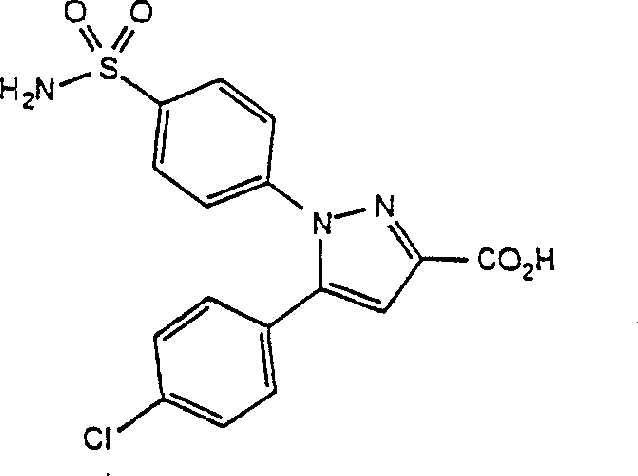
4-[4-(氨基磺酰基)苯基]-5-(4-氯苯基)-1H-吡唑-3-羧酸步骤1:4-[4-(氯)苯基]-2,4-二氧代丁酸甲酯的制备4-[4-(Aminosulfonyl)phenyl]-5-(4-chlorophenyl)-1H-pyrazole-3-carboxylic acid Step 1: 4-[4-(chloro)phenyl]-2, Preparation of methyl 4-dioxobutyrate
将草酸二甲酯(23.6g,200mmol)置于500ml三口圆底烧瓶中并溶于乙醚(200ml)。于2分钟内,经加料漏斗向搅拌下的溶液中加入25%甲醇钠的甲醇溶液(48ml,210mmol)。然后,将4′-氯代苯乙酮(25.94g,200mmol)溶于乙醚(50ml),并于3分钟内滴加到所述反应中。搅拌过夜(18小时)后,加入1N HCl(400ml)和乙酸乙酯(750ml)。收集有机层,用盐水(350ml)洗涤,MgSO4干燥,过滤并真空浓缩,得到45.7g黄色固体。将所述固体于乙酸乙酯和异辛烷中重结晶,得到23g(48%)所述二酮:mp 108.5-110.5℃。步骤2:4-[4-(氨基磺酰基)苯基]-5-(4-氯苯基)-1H-吡唑-3-羧酸的制备Dimethyl oxalate (23.6 g, 200 mmol) was placed in a 500 ml three-neck round bottom flask and dissolved in diethyl ether (200 ml). To the stirred solution was added 25% sodium methoxide in methanol (48 mL, 210 mmol) via the addition funnel over 2 minutes. Then, 4'-chloroacetophenone (25.94 g, 200 mmol) was dissolved in diethyl ether (50 ml) and added dropwise to the reaction over 3 minutes. After stirring overnight (18 hours), 1N HCl (400ml) and ethyl acetate (750ml) were added. The organic layer was collected, washed with brine (350ml), dried over MgSO4 , filtered and concentrated in vacuo to give 45.7g of a yellow solid. The solid was recrystallized from ethyl acetate and isooctane to afford 23 g (48%) of the diketone: mp 108.5-110.5°C. Step 2: Preparation of 4-[4-(aminosulfonyl)phenyl]-5-(4-chlorophenyl)-1H-pyrazole-3-carboxylic acid
将4-氨磺酰基苯肼盐酸盐(1.45g,6.5mmol,1.3当量)和4-[4-(氯)苯基]-2,4-二氧代丁酸甲酯(1.2g,5mmol)溶于乙醇(50ml),将反应加热回流并搅拌20小时。冷至室温后,将反应混合物真空浓缩,残余物溶于乙酸乙酯(200ml)并用水(100ml)和盐水(100ml)洗涤,MgSO4干燥,过滤并真空浓缩,得到1.7g浅棕色固体,将其于甲醇和水中重结晶,得到1.6g(85%)白色固体。将此产物溶于甲醇(150ml)和3N NaOH(75ml)中并于回流状态下搅拌3小时。真空除去甲醇,水溶液用浓HCl酸化。将所述产物萃取至乙酸乙酯(200ml)中,将其用盐水(100ml)洗涤,MgSO4干燥,过滤并浓缩,得到4-[4-(氨基磺酰基)苯基]-5-(4-氯苯基)-1H-吡唑-3-羧酸,1.4g(74%):mp 135℃(分解)。4-sulfamoylphenylhydrazine hydrochloride (1.45g, 6.5mmol, 1.3eq) and 4-[4-(chloro)phenyl]-2,4-dioxobutanoic acid methyl ester (1.2g, 5mmol ) was dissolved in ethanol (50ml) and the reaction was heated to reflux and stirred for 20 hours. After cooling to room temperature, the reaction mixture was concentrated in vacuo, the residue was dissolved in ethyl acetate (200ml) and washed with water (100ml) and brine (100ml), dried over MgSO , filtered and concentrated in vacuo to give 1.7g of a light brown solid, which was It was recrystallized from methanol and water to give 1.6 g (85%) of a white solid. This product was dissolved in methanol (150ml) and 3N NaOH (75ml) and stirred at reflux for 3 hours. Methanol was removed in vacuo and the aqueous solution was acidified with cone. HCl. The product was extracted into ethyl acetate (200ml), which was washed with brine (100ml), dried over MgSO4 , filtered and concentrated to give 4-[4-(aminosulfonyl)phenyl]-5-(4 -Chlorophenyl)-1H-pyrazole-3-carboxylic acid, 1.4 g (74%): mp 135° C. (dec.).
实施例84
1-(4-氨基磺酰基苯基)-5-(3,5-二氟-4-甲氧基苯基)-1H-吡唑-3-羧酸甲酯步骤1:3,5-二氟-4-甲氧基苯乙酮的制备1-(4-Aminosulfonylphenyl)-5-(3,5-difluoro-4-methoxyphenyl)-1H-pyrazole-3-carboxylic acid methyl ester Step 1: 3,5-di Preparation of Fluoro-4-methoxyacetophenone
于4℃(冰浴)氮气氛下,20分钟内向搅拌下的AlCl3(24.05g,180.40mmol)的氯仿(300ml,通过氧化铝干燥)悬浮液中加入乙酰氯(11.0ml,152.65mmol),于0℃下将所述冷悬浮液搅拌30分钟并于30分钟内滴加2,6-二氟苯甲醚。将所得悬浮液温热至室温并搅拌过夜,通过将其缓慢地倾入到快速搅拌下的冰/水混合物中使反应中止。水层用二氯甲烷(2×50ml)萃取,将有机相合并并真空浓缩,得到一澄清的流动性油。将上述澄清油状物、DMF(25ml)、K2CO3(15g)加入到50ml圆底烧瓶中,加入碘甲烷(6ml)并于45℃氮气氛下搅拌此悬浮液。加入水(1ml)并将混合物再加热14小时。将粗反应混合物冷至室温,用水(250ml)稀释并用乙醚(3×100ml)萃取。乙醚相用饱和碳酸氢钠溶液、硫酸氢钾(0.1N溶液)洗涤,MgSO4干燥,过滤并真空浓缩,得到一澄清的流动性液体。将此液体蒸馏(30℃,1mm),得到12.5g澄清液体,其为3,5-二氟-4-甲氧基苯乙酮和3,5-二氟-4-乙酰氧基苯乙酮的85∶15混合物。以此比例为基准,产率为41%。以这种形式使用此酮。步骤2:1-(4-氨基磺酰基苯基)-5-(3,5-二氟-4-甲氧基苯基)-1H-吡唑-3-羧酸甲酯的制备To a stirred suspension of AlCl3 (24.05 g, 180.40 mmol) in chloroform (300 ml, dried over alumina) was added acetyl chloride (11.0 ml, 152.65 mmol) over 20 minutes at 4°C (ice bath) under nitrogen, The cold suspension was stirred at 0° C. for 30 minutes and 2,6-difluoroanisole was added dropwise within 30 minutes. The resulting suspension was warmed to room temperature and stirred overnight, quenched by pouring it slowly into a rapidly stirring ice/water mixture. The aqueous layer was extracted with dichloromethane (2 x 50ml), the organic phases were combined and concentrated in vacuo to give a clear mobile oil. The above clear oil, DMF (25ml), K2CO3 (15g) were added to a 50ml round bottom flask, iodomethane (6ml) was added and the suspension was stirred at 45°C under nitrogen atmosphere. Water (1 ml) was added and the mixture was heated for a further 14 hours. The crude reaction mixture was cooled to room temperature, diluted with water (250ml) and extracted with diethyl ether (3 x 100ml). The ether phase was washed with saturated sodium bicarbonate solution, potassium bisulfate (0.1N solution), dried over MgSO4 , filtered and concentrated in vacuo to give a clear mobile liquid. This liquid was distilled (30 °C, 1 mm) to obtain 12.5 g of clear liquid which were 3,5-difluoro-4-methoxyacetophenone and 3,5-difluoro-4-acetoxyacetophenone 85:15 mixture. Based on this ratio, the yield was 41%. Use this ketone in this form. Step 2: Preparation of 1-(4-aminosulfonylphenyl)-5-(3,5-difluoro-4-methoxyphenyl)-1H-pyrazole-3-carboxylic acid methyl ester
向搅拌下的步骤1中所得3,5-二氟-4-甲氧基苯乙酮(6.46g,34.70mmol)和草酸二甲酯(6.15g,52.05mmol)的甲醇(80ml)溶液中一次加入甲醇钠溶液(13.4ml,25%溶液,58.99mmol)并将反应搅拌过夜。粗反应物用二氯甲烷稀释,用硫酸氢钾(0.1N溶液)、盐水洗涤,MgSO4干燥,过滤并真空浓缩,得到4-(3,5-二氟-4-甲氧基苯基)-2,4-二氧代-丁酸甲酯灰白色固体结晶,将其以这种形式使用。将4-(3,5-二氟-4-甲氧基苯基-2,4-二氧代-丁酸酯和4-氨磺酰基苯肼盐酸盐(7.76g,34.70mmol)的混合物溶于甲醇,加热回流9小时。令澄清的反应物冷至室温,通过真空抽滤收集形成的结晶沉淀,得到5.45g灰白色固体状1-(4-氨磺酰基苯基)-5-(3,5-二氟-4-甲氧基苯基)-1H-吡唑-3-羧酸甲酯(以3,5-二氟-4-甲氧基苯乙酮为基准,产率为37%):mp 185-190℃;1HNMR(CDCl3/300mHz)7.95(d,J=8.86,2H),7.49(d,J=8.86,2H),7.02(s,1H),6.77(m,2H),4.99(s,2H),4.04(s,3H),3.98(s,3H);19F NMR(CDCl3/300mHz)-126.66。元素分析:C17H13F2N3O3S,计算值:C,51.06;H,3.57;N,9.92。实测值:C,51.06;H,3.54,N.9.99。3,5-difluoro-4-methoxyacetophenone (6.46g, 34.70mmol) and dimethyl oxalate (6.15g, 52.05mmol) in methanol (80ml) solution obtained in step 1 under stirring Sodium methoxide solution (13.4ml, 25% solution, 58.99mmol) was added and the reaction was stirred overnight. The crude reaction was diluted with dichloromethane, washed with potassium bisulfate (0.1N solution), brine, dried over MgSO, filtered and concentrated in vacuo to give 4-(3,5 - difluoro-4-methoxyphenyl) - Methyl 2,4-dioxo-butyrate was used as a crystalline off-white solid. A mixture of 4-(3,5-difluoro-4-methoxyphenyl-2,4-dioxo-butyrate and 4-sulfamoylphenylhydrazine hydrochloride (7.76 g, 34.70 mmol) Dissolve in methanol and heat to reflux for 9 hours. Allow the clear reactant to cool to room temperature and collect the crystalline precipitate formed by vacuum filtration to obtain 5.45 g of off-white solid 1-(4-sulfamoylphenyl)-5-(3 , 5-difluoro-4-methoxyphenyl)-1H-pyrazole-3-carboxylic acid methyl ester (based on 3,5-difluoro-4-methoxyacetophenone, the yield was 37 %): mp 185-190°C; 1 HNMR (CDCl 3 /300mHz) 7.95 (d, J=8.86, 2H), 7.49 (d, J=8.86, 2H), 7.02 (s, 1H), 6.77 (m, 2H), 4.99(s, 2H), 4.04(s, 3H), 3.98(s, 3H); 19 F NMR (CDCl 3 /300mHz)-126.66. Elemental analysis: C 17 H 13 F 2 N 3 O 3 S , Calculated: C, 51.06; H, 3.57; N, 9.92. Found: C, 51.06; H, 3.54, N.9.99.
实施例85Example 85
[1-(4-氨基磺酰基苯基)-5-(4-氯苯基)-1H-吡唑-3-基]羧酸甲酯步骤1:4-[4-(氯)苯基]-2,4-二氧代丁酸甲酯的制备Methyl [1-(4-aminosulfonylphenyl)-5-(4-chlorophenyl)-1H-pyrazol-3-yl]carboxylate Step 1: 4-[4-(chloro)phenyl] - Preparation of 2,4-dioxobutyric acid methyl ester
将草酸二甲酯(15.27g,0.129mol)和4′-氯代苯乙酮(20.0g,0.129mol)加入到带有电磁搅拌器的500ml圆底烧瓶中并用甲醇(300ml)稀释。一次加入甲醇钠(25%甲醇溶液,70ml),将反应于室温下搅拌16小时,在此过程中,反应物变成不溶物。用机械方式将固体破碎,然后加入浓盐酸(70ml),于室温下将白色悬浮液剧烈搅拌60分钟。将悬浮液冷至0℃并保持30分钟。将固体过滤,滤饼用冷水(100ml)洗涤,干燥后,得到烯醇式4-[4-(氯)苯基]-2,4-二氧代丁酸甲酯(16.94g,54.4%):1H NMR(CDCl3/300MHz)7.94(d,J=8.66Hz,2H),7.48(d,J=8.66Hz,2H),7.04(s,1H),3.95(s,3H),3.48(s,1H)。步骤2:[1-(4-氨基磺酰基苯基)-5-(4-氯苯基)-1H-吡唑-3-基]羧酸甲酯的制备Dimethyl oxalate (15.27 g, 0.129 mol) and 4'-chloroacetophenone (20.0 g, 0.129 mol) were added to a 500 ml round bottom flask with a magnetic stirrer and diluted with methanol (300 ml). Sodium methoxide (25% in methanol, 70 mL) was added in one portion and the reaction was stirred at room temperature for 16 hours during which time the reaction became insoluble. The solid was broken up mechanically, then concentrated hydrochloric acid (70ml) was added and the white suspension was stirred vigorously at room temperature for 60 minutes. The suspension was cooled to 0°C for 30 minutes. The solid was filtered, the filter cake was washed with cold water (100ml), and after drying, the enol formula 4-[4-(chloro)phenyl]-2,4-dioxobutanoic acid methyl ester (16.94g, 54.4%) was obtained : 1 H NMR (CDCl 3 /300MHz) 7.94(d, J=8.66Hz, 2H), 7.48(d, J=8.66Hz, 2H), 7.04(s, 1H), 3.95(s, 3H), 3.48( s, 1H). Step 2: Preparation of methyl [1-(4-aminosulfonylphenyl)-5-(4-chlorophenyl)-1H-pyrazol-3-yl]carboxylate
向装有电磁搅拌器和氮气入口的100ml圆底烧瓶中加入步骤1中所得4-[4-(氯)苯基]-2,4-二氧代丁酸甲酯(5.0g,20.78mmol)、4-氨磺酰基苯肼盐酸盐(5.11g,22.86mmol)和甲醇(50ml),将反应容器加热回流并保持16小时,过夜有沉淀生成。将悬浮液冷却至0℃,保持0.5小时,过滤并用冷水洗涤,空气干燥后,得到7.91g(91%)粗产物。将3.50g产物于沸腾的乙醇中重结晶,得到3.14g(97%)纯[1-(4-氨基磺酰基苯基)-5-(4-氯苯基)-1H-吡唑-3-基]羧酸甲酯:mp 227℃;1H NMR(CDCl3/300MHz)7.91(d,J=8.86Hz,2H),7.44(d,J=8.86Hz,2H),7.33(d,J=8.66Hz,2H),7.14(d,J=8.66Hz,2H),7.03(s,1H),3.96(s,3H)。质谱,MH+=392。元素分析:C17H14N3O4ClS,计算值:C,52.11;H,3.60;N,10.72;Cl,9.05;S,8.18。实测值:C,52.07;H,3.57;N,10.76;Cl,9.11;S,8.27。Add the obtained 4-[4-(chloro)phenyl]-2,4-dioxobutanoic acid methyl ester (5.0g, 20.78mmol) in step 1 to the 100ml round bottom flask equipped with magnetic stirrer and nitrogen inlet , 4-sulfamoylphenylhydrazine hydrochloride (5.11g, 22.86mmol) and methanol (50ml), the reaction vessel was heated to reflux and maintained for 16 hours, and a precipitate formed overnight. The suspension was cooled to 0° C. for 0.5 h, filtered and washed with cold water to give 7.91 g (91%) of crude product after air drying. 3.50 g of the product were recrystallized in boiling ethanol to give 3.14 g (97%) of pure [1-(4-aminosulfonylphenyl)-5-(4-chlorophenyl)-1H-pyrazole-3- base] methyl carboxylate: mp 227°C; 1 H NMR (CDCl 3 /300MHz) 7.91 (d, J=8.86Hz, 2H), 7.44 (d, J=8.86Hz, 2H), 7.33 (d, J= 8.66Hz, 2H), 7.14(d, J=8.66Hz, 2H), 7.03(s, 1H), 3.96(s, 3H). Mass spectrum, MH+=392. Elemental analysis: Calcd . for C17H14N3O4ClS : C, 52.11 ; H, 3.60; N, 10.72; Cl, 9.05; S, 8.18. Found: C, 52.07; H, 3.57; N, 10.76; Cl, 9.11; S, 8.27.
实施例86
[1-(4-氨基磺酰基苯基)-5-(4-氯苯基)-1H-吡唑-3-基]羧酸乙酯Ethyl [1-(4-aminosulfonylphenyl)-5-(4-chlorophenyl)-1H-pyrazol-3-yl]carboxylate
将[1-(4-氨基磺酰基苯基)-5-(4-氯苯基)-1H-吡唑-3-基]羧酸甲酯(实施例85)(0.10g)溶于无水乙醇(10ml)并加入催化量的21% NaOEt/EtOH。无需控制温度,将反应搅拌72小时,然后,加入水(10ml)。结晶出产物,将悬浮液冷却至0℃并保持30分钟。将产物过滤,用水(5ml)洗涤并干燥,得到0.071g(70%)白色固体:质谱:MH+=406。元素分析:C18H16N3O4ClS,计算值:C,53.27;H,3.97;N,10.35;Cl,8.74;S,7.90。实测值:C,53.04;H,4.00;N,10.27;Cl,8.69;S,7.97。[1-(4-Aminosulfonylphenyl)-5-(4-chlorophenyl)-1H-pyrazol-3-yl]carboxylic acid methyl ester (Example 85) (0.10 g) was dissolved in anhydrous Ethanol (10ml) and a catalytic amount of 21% NaOEt/EtOH was added. The reaction was stirred without temperature control for 72 hours, then water (10ml) was added. The product crystallized out and the suspension was cooled to 0°C for 30 minutes. The product was filtered, washed with water (5ml) and dried to give 0.071g (70%) of a white solid: Mass spectrum: MH+=406. Elemental analysis: Calcd . for C18H16N3O4ClS : C, 53.27 ; H, 3.97; N , 10.35; Cl, 8.74; S, 7.90. Found: C, 53.04; H, 4.00; N, 10.27; Cl, 8.69; S, 7.97.
用所述适宜的试剂替代,按照实施例83-86中所述相似的方法制得下列化合物。Substituting the appropriate reagents as described, the following compounds were prepared following similar procedures as described in Examples 83-86.
表III实施例 A B M.P(℃) 元素分析87 4-NO2 -CH3 216-220 MH+=40388 4-F -CH3 ND 计算值:C,54.40;H,3.76;N,11.19;S,8.54Table III Example A B MP (°C) Elemental Analysis 87 4-NO 2 -CH 3 216-220 MH+=40388 4-F -CH 3 ND Calculated: C, 54.40; H, 3.76; N, 11.19; S, 8.54
实测值:C,54.49;H,3.70;N,11.25;S,8.5089 4-NH2 -CH3 267-269(dec) MH+=37390 4-Br -CH3 221-224 MH+=43891 4-OCH3 -CH3 169-171 HRMS:387.093092 4-CH3 -CH3 213-215 HRMS:371.096593 4-CH3 -CH2CH3 219-220 计算值:C,59.21;H,4.97;N,10.90Found: C, 54.49; H, 3.70 ; N, 11.25; S, 8.5089 4-NH 2 -CH 3 267-269 (dec) MH+ = 37390 4-Br -CH 3 221-224 -CH 3 169-171 HRMS: 387.093092 4-CH 3 -CH 3 213-215 HRMS: 371.096593 4-CH 3 -CH 2 CH 3 219-220 Calculated: C, 59.21; H, 4.97; N, 10.90
实测值:C,58.73;H,4.96;N,10.7894 4-Cl -CH2CH2CH3 ND 计算值:C,54.35;H,4.32;N,10.01;Found: C, 58.73; H, 4.96; N, 10.7894 Calcd for 4 - Cl-CH2CH2CH3ND: C, 54.35; H , 4.32; N, 10.01;
Cl,8.44;S,7.64Cl, 8.44; S, 7.64
实测值:C,54.11;H,4.28;N,10.14;Measured value: C, 54.11; H, 4.28; N, 10.14;
Cl,8.54;S,7.6495 3,5-二-Cl,4-OCH3 -CH3 225-229Cl, 8.54; S, 7.6495 3,5-di-Cl, 4-OCH 3 -CH 3 225-229
实施例96 Example 96
4-[4-(4-氨基磺酰基)苯基]-5-(4-氯苯基)-1H-吡唑-3-甲酰胺4-[4-(4-Aminosulfonyl)phenyl]-5-(4-chlorophenyl)-1H-pyrazole-3-carboxamide
将4-[4-(氨基磺酰基)苯基]-5-(4-氯苯基)-1H-吡唑-3-羧酸(实施例83)(1.08g,2.86mmol)、HOBt(0.66g,4.3mmol)和EDC(0.66g,3.4mmol)溶于二甲基甲酰胺(DMF)(20ml)并于室温下搅拌5分钟。向此溶液中加入NH4OH(30%,2.9ml)并将反应再搅拌18小时。然后,将此溶液倾入乙酸乙酯(200ml)和1N HCl(200ml)中,振摇并分离。有机层用饱和NaHCO3(150ml)和盐水(150ml)洗涤,MgSO4干燥,过滤并浓缩,得到0.9g白色固体。将其于乙酸乙酯和异辛烷中重结晶,得到4-[4-(4-氨基磺酰基)苯基]-5-(4-氯苯基)-1H-吡唑-3-甲酰胺(0.85g,79%):mp 108-110℃。4-[4-(aminosulfonyl)phenyl]-5-(4-chlorophenyl)-1H-pyrazole-3-carboxylic acid (Example 83) (1.08g, 2.86mmol), HOBt (0.66 g, 4.3mmol) and EDC (0.66g, 3.4mmol) were dissolved in dimethylformamide (DMF) (20ml) and stirred at room temperature for 5 minutes. To this solution was added NH4OH (30%, 2.9ml) and the reaction was stirred for a further 18 hours. Then, the solution was poured into ethyl acetate (200ml) and 1N HCl (200ml), shaken and separated. The organic layer was washed with saturated NaHCO3 (150ml) and brine (150ml), dried over MgSO4 , filtered and concentrated to give 0.9g of a white solid. It was recrystallized from ethyl acetate and isooctane to give 4-[4-(4-aminosulfonyl)phenyl]-5-(4-chlorophenyl)-1H-pyrazole-3-carboxamide (0.85g, 79%): mp 108-110°C.
实施例97
[1-(氨基磺酰基苯基)-5-(4-氟苯基-1H-吡唑-3-基]甲酰胺[1-(aminosulfonylphenyl)-5-(4-fluorophenyl-1H-pyrazol-3-yl]formamide
向装有温度计、喷气管、回流冷凝器和电磁搅拌器的250ml三口圆底烧瓶中加入[1-(4-氨基磺酰基苯基)-5-(4-氟苯基)-1H-吡唑-3-基]羧酸甲酯(实施例88)(3.0g,7.99mmol)、甲醇(100ml)和催化量的氰化钠,无需控制温度,向反应容器中喷入无水氨气16小时,在此过程中悬浮液变成深红色。于室温下向反应中喷入无水氮气20分钟,冷至0℃并保持30分钟。滤出固体并用冷水(50ml)洗涤,干燥后,得到1.87g(65%)白色固体状[1-(氨基磺酰基苯基)-5-(4-氟苯基-1H-吡唑-3-基]甲酰胺:mp 214-216℃;1H NMR(CDCl3/CD3OD/300MHz)7.64(d,J=8.66Hz,2H),7.14(d,J=8.66Hz,2H),6.95(m,2H),6.82-6.67(m,6H),6.39(s,1H);19F NMR(CDCl3/CD3OD/282.2MHz)-112.00(m)。质谱,MH+=361。元素分析:C16H13N4O3FS,计算值:C,53.33;H,3.64;N,15.55;S,8.90。实测值:C,53.41;H,3.69;N,15.52;S,8.96。Add [1-(4-aminosulfonylphenyl)-5-(4-fluorophenyl)-1H-pyrazole to a 250ml three-necked round-bottomed flask equipped with a thermometer, jet tube, reflux condenser and electromagnetic stirrer -3-yl] methyl carboxylate (Example 88) (3.0g, 7.99mmol), methanol (100ml) and catalytic amount of sodium cyanide, no need to control the temperature, spray anhydrous ammonia into the reaction vessel for 16 hours , during which the suspension turned dark red. The reaction was sparged with anhydrous nitrogen for 20 minutes at room temperature, cooled to 0°C and held for 30 minutes. The solid was filtered off and washed with cold water (50ml) to give, after drying, 1.87g (65%) of [1-(aminosulfonylphenyl)-5-(4-fluorophenyl-1H-pyrazole-3- base] formamide: mp 214-216°C; 1 H NMR (CDCl 3 /CD 3 OD/300MHz) 7.64 (d, J=8.66Hz, 2H), 7.14 (d, J=8.66Hz, 2H), 6.95 ( m, 2H), 6.82-6.67 (m, 6H), 6.39 (s, 1H); 19 F NMR (CDCl 3 /CD 3 OD/282.2MHz)-112.00 (m). Mass spectrum, MH+=361. Elemental analysis: Calcd for C16H13N4O3FS : C , 53.33; H, 3.64; N, 15.55; S, 8.90. Found: C, 53.41; H, 3.69;
实施例98
N-(3-氯苯基)-[1-(4-氨基磺酰基苯基)-5-(4-氟苯基)-1H-吡唑-3-基]甲酰胺步骤1:4-[4-氟苯基]-2,4-二氧代丁酸甲酯的制备N-(3-Chlorophenyl)-[1-(4-aminosulfonylphenyl)-5-(4-fluorophenyl)-1H-pyrazol-3-yl]carboxamide Step 1: 4-[ Preparation of methyl 4-fluorophenyl]-2,4-dioxobutanoate
将草酸二甲酯(18.80g,0.159mol)和4′-氟代苯乙酮(20.0g,0.145mol)加入到1000ml圆底烧瓶中并用甲醇(400ml)稀释。将反应瓶置于声波浴(Bransonic1200)中,于25分钟内加入甲醇钠(25%甲醇溶液,70ml)。将反应物于45℃声波震荡16小时,在此过程中,反应物变成不溶物。将所述固体用机械方式破碎,然后倾入盐酸溶液(1N,500ml)中。加入电磁搅拌棒,并将白色悬浮液于室温下剧烈搅拌60分钟,将悬浮液冷至0℃并保持30分钟。将固体过滤,滤饼用冷水(100ml)洗涤,干燥后,得到烯醇式4-[4-氟苯基]-2,4-二氧代丁酸甲酯(22.91g,70.6%):1H NMR(CDCl3/300MHz)8.03(ddd,J=8.86Hz,J=8.66Hz,J=5.03Hz,2H),7.19(dd,J=8.86Hz,J=8.66Hz,2H),7.04(s,1H),3.95(s,3H)。19F NMR(CDCl3/282.2MHz)-103.9(m)。步骤2:4-[1-(4-氨基磺酰基苯基)-5-(4-氟苯基)-1H-吡唑-3-基]羧酸甲酯的制备Dimethyl oxalate (18.80 g, 0.159 mol) and 4'-fluoroacetophenone (20.0 g, 0.145 mol) were added to a 1000 ml round bottom flask and diluted with methanol (400 ml). The reaction flask was placed in a sonic bath (Bransonic 1200), and sodium methoxide (25% in methanol, 70 ml) was added within 25 minutes. The reactants were sonicated at 45°C for 16 hours, during which time the reactants became insoluble. The solid was broken up mechanically and poured into a solution of hydrochloric acid (1N, 500ml). A magnetic stirring bar was added, and the white suspension was stirred vigorously at room temperature for 60 minutes, and the suspension was cooled to 0° C. for 30 minutes. The solid was filtered, the filter cake was washed with cold water (100ml), and after drying, the enol formula 4-[4-fluorophenyl]-2,4-dioxobutanoic acid methyl ester (22.91g, 70.6%) was obtained: 1 H NMR (CDCl 3 /300MHz) 8.03 (ddd, J=8.86Hz, J=8.66Hz, J=5.03Hz, 2H), 7.19 (dd, J=8.86Hz, J=8.66Hz, 2H), 7.04(s , 1H), 3.95(s, 3H). 19F NMR (CDCl 3 /282.2 MHz) - 103.9 (m). Step 2: Preparation of methyl 4-[1-(4-aminosulfonylphenyl)-5-(4-fluorophenyl)-1H-pyrazol-3-yl]carboxylate
向装有电磁搅拌器的500ml单口圆底烧瓶中加入步骤1中所得4-[4-氟苯基]-2,4-二氧代丁酸甲酯(1.00mg,44.61mmol)、4-氨磺酰基苯肼盐酸盐(10.98g,49.07mmol)和甲醇(200ml),将悬浮液加热并在回流状态下保持3小时,然后冷却至室温。将悬浮液冷至0℃,保持30分钟,过滤,用水(100ml)洗涤并干燥,得到14.4g(86%)白色固体状4-[1-(4-氨基磺酰基苯基)-5-(4-氟苯基)-1H-吡唑-3-基]羧酸甲酯:1H NMR(CDCl3/300MHz)7.85(d,J=8.66Hz,2H),7.36(d,J=8.66Hz,2H),7.18(ddd,J=8.66Hz,J=8.46Hz,J=4.85Hz,2H),7.00(dd,J=8.66Hz,J=8.46Hz,2H),6.28(s,1H),3.90(s,3H)。19F NMR(CDCl3/282.2MHz):-111.4(m)。质谱,MH+=376。元素分析C17H14N3O4FS:计算值:C,54.40;H,3.76;N,11.19;S,8.54。实测值:C,54.49;H,3.70;N,11.25;S,8.50。步骤3:[1-(4-氨基磺酰基苯基)-5-(4-氟苯基)-1H-吡唑-3-基]羧酸的制备Add 4-[4-fluorophenyl]-2,4-dioxobutanoic acid methyl ester (1.00 mg, 44.61 mmol) obtained in step 1 to a 500 ml single-necked round bottom flask equipped with an electromagnetic stirrer, 4-amino Sulfonylphenylhydrazine hydrochloride (10.98g, 49.07mmol) and methanol (200ml), the suspension was heated and kept at reflux for 3 hours, then cooled to room temperature. The suspension was cooled to 0°C for 30 minutes, filtered, washed with water (100 ml) and dried to give 14.4 g (86%) of 4-[1-(4-aminosulfonylphenyl)-5-( Methyl 4-fluorophenyl)-1H-pyrazol-3-yl]carboxylate: 1 H NMR (CDCl 3 /300MHz) 7.85(d, J=8.66Hz, 2H), 7.36(d, J=8.66Hz , 2H), 7.18(ddd, J=8.66Hz, J=8.46Hz, J=4.85Hz, 2H), 7.00(dd, J=8.66Hz, J=8.46Hz, 2H), 6.28(s, 1H), 3.90 (s, 3H). 19 F NMR (CDCl 3 /282.2 MHz): -111.4 (m). Mass spectrum, MH+=376. Elemental Analysis for C17H14N3O4FS : Calculated: C, 54.40; H, 3.76 ; N, 11.19 ; S, 8.54 . Found: C, 54.49; H, 3.70; N, 11.25; S, 8.50. Step 3: Preparation of [1-(4-aminosulfonylphenyl)-5-(4-fluorophenyl)-1H-pyrazol-3-yl]carboxylic acid
向装有电磁搅拌器的500ml单口圆底烧瓶中加入步骤2中所得4-[1-(4-氨基磺酰基苯基)-5-(4-氟苯基)-1H-吡唑-3-基]羧酸甲酯(10,0g,26.64mmol)和四氢呋喃(200ml),加入氢氧化钠水溶液(2.5N,27ml)和水(25ml),将悬浮液加热回流并保持16小时,在此过程中固体全部溶解。将反应冷至室温,加入盐酸溶液(1N,110ml)。将含水悬浮液用二氯甲烷(2×200ml)萃取,合并的有机溶液用无水硫酸镁干燥,过滤并真空浓缩,得一油状物。用300ml二氯甲烷研制,过滤并干燥后,得到9.0g(94%)白色固体状[1-(4-氨基磺酰基苯基)-5-(4-氟苯基)-1H-吡唑-3-基]羧酸:mp 138-142℃(分解);1H NMR(CD3OD/300MHz)7.93(d,J=8.66Hz,2H),7.51(d,J=8.66Hz,2H),7.31(ddd,J=8.86Hz,J=8.66Hz,J=4.83Hz,2H),7.11(dd,J=8.86Hz,J=8.66Hz,2H),7.06(s,1H)。19F NMR(CD3OD/282.2MHz):-114.01(m)。步骤4:N-(3-氯苯基)-[1-(4-氨基磺酰基苯基)-5-(4-氟苯基)-1H-吡唑-3-基]甲酰胺的制备Add the obtained 4-[1-(4-aminosulfonylphenyl)-5-(4-fluorophenyl)-1H-pyrazole-3- Base] carboxylate methyl ester (10,0g, 26.64mmol) and tetrahydrofuran (200ml), adding aqueous sodium hydroxide solution (2.5N, 27ml) and water (25ml), the suspension was heated to reflux and maintained for 16 hours, during which All solids were dissolved. The reaction was cooled to room temperature and hydrochloric acid solution (1N, 110ml) was added. The aqueous suspension was extracted with dichloromethane (2 x 200ml) and the combined organic solutions were dried over anhydrous magnesium sulfate, filtered and concentrated in vacuo to an oil. Trituration with 300 ml of dichloromethane, filtration and drying afforded 9.0 g (94%) of [1-(4-aminosulfonylphenyl)-5-(4-fluorophenyl)-1H-pyrazole- 3-yl]carboxylic acid: mp 138-142°C (decomposition); 1 H NMR (CD 3 OD/300MHz) 7.93 (d, J=8.66Hz, 2H), 7.51 (d, J=8.66Hz, 2H), 7.31 (ddd, J=8.86Hz, J=8.66Hz, J=4.83Hz, 2H), 7.11 (dd, J=8.86Hz, J=8.66Hz, 2H), 7.06(s, 1H). 19 F NMR (CD 3 OD/282.2 MHz): -114.01 (m). Step 4: Preparation of N-(3-chlorophenyl)-[1-(4-aminosulfonylphenyl)-5-(4-fluorophenyl)-1H-pyrazol-3-yl]formamide
向装有电磁搅拌器的100ml单口圆底烧瓶中加入步骤3中所得[1-(4-氨基磺酰基苯基)-5-(4-氟苯基)-1H-吡唑-3-基]羧酸(0.500g,1.38mmol)、1-羟基苯并三唑水合物(0.206g,1.522mmol)、1-(3-二甲氨基丙基)-3-乙基碳化二亚胺盐酸盐(0.318g,1.66mmol)和N,N-二甲基甲酰胺(30ml)。将溶液于室温下搅拌40分钟,然后,加入3-氯代苯胺(0.154ml,1.453mmol)。反应物于室温下静置16小时,然后倾入柠檬酸水溶液(5%,100ml)中。水溶液用乙酸乙酯(2×60ml)萃取,合并的有机溶液用柠檬酸水溶液(60ml)、饱和碳酸氢钠溶液(2×60ml)和50%饱和氯化钠溶液(2×60ml)洗涤,有机溶液用无水硫酸镁干燥,过滤并真空浓缩,得一油状物。用20ml二氯甲烷研制,过滤并干燥后,得到0.439g(67%)白色固体状N-(3-氯苯基)-[1-(4-氨基磺酰基苯基)-5-(4-氟苯基)-1H-吡唑-3-基]甲酰胺:mp 207-212℃;1H NMR(CDCl3/CD3OD/300MHz)8.90(s,1H),7.86(d,J=8.66Hz,2H),7.79(t,J=2.01Hz,1H),7.46(dd,J=7.05Hz,J=2.01Hz,1H),7.33(d,J=8.86Hz,2H),7.21-7.11(m,3H),7.02-6.94(m,4H)。19F NMR(CDCl3/CD3OD/282.2MHz):-111.38(m)。质谱,MH+=470。元素分析:C22H16N4O3ClFS,计算值:C,56.11;H,3.42;N,11.90;Cl,6.81;S,7.53。实测值:C,55.95;H,3.50;N,11.85;Cl,6.82;S,7.50。Add [1-(4-aminosulfonylphenyl)-5-(4-fluorophenyl)-1H-pyrazol-3-yl] obtained in step 3 to a 100ml single-necked round-bottomed flask equipped with an electromagnetic stirrer Carboxylic acid (0.500g, 1.38mmol), 1-hydroxybenzotriazole hydrate (0.206g, 1.522mmol), 1-(3-dimethylaminopropyl)-3-ethylcarbodiimide hydrochloride (0.318g, 1.66mmol) and N,N-dimethylformamide (30ml). The solution was stirred at room temperature for 40 minutes, then, 3-chloroaniline (0.154ml, 1.453mmol) was added. The reaction was allowed to stand at room temperature for 16 hours, then poured into aqueous citric acid (5%, 100ml). The aqueous solution was extracted with ethyl acetate (2×60ml), and the combined organic solution was washed with aqueous citric acid solution (60ml), saturated sodium bicarbonate solution (2×60ml) and 50% saturated sodium chloride solution (2×60ml), organic The solution was dried over anhydrous magnesium sulfate, filtered and concentrated in vacuo to an oil. Trituration with 20 ml of dichloromethane, filtration and drying gave 0.439 g (67%) of N-(3-chlorophenyl)-[1-(4-aminosulfonylphenyl)-5-(4- Fluorophenyl)-1H-pyrazol-3-yl]carboxamide: mp 207-212°C; 1 H NMR (CDCl 3 /CD 3 OD/300MHz) 8.90 (s, 1H), 7.86 (d, J=8.66 Hz, 2H), 7.79(t, J=2.01Hz, 1H), 7.46(dd, J=7.05Hz, J=2.01Hz, 1H), 7.33(d, J=8.86Hz, 2H), 7.21-7.11( m, 3H), 7.02-6.94 (m, 4H). 19 F NMR (CDCl 3 /CD 3 OD/282.2 MHz): -111.38 (m). Mass spectrum, MH+=470. Elemental analysis: Calcd . for C22H16N4O3ClFS : C, 56.11 ; H, 3.42; N, 11.90; Cl, 6.81; S, 7.53. Found: C, 55.95; H, 3.50; N, 11.85; Cl, 6.82; S, 7.50.
用适宜的原料替代,按照实施例96-98中所述相似的方法制得下列表IV中化合物。Substituting appropriate starting materials, the compounds in Table IV below were prepared in a similar manner as described in Examples 96-98.
表IV
℃99 4-Br H 143-145 MH+=421100 4-F 苯基- 233-236 MH+=436101 4-NO2 H 278-281 MH+=387102 4-F 4-CH3O-苯基- 209-211 MH+=466103 4-F 4-CH3-苯基- 222-225 MH+=451104 4-F 环己基- 224-227 MH+=442105 4-F 3-F-苯基- 227 MH+=454106 4-Cl 3-F-苯基- 174-176(分解) MH+=471107 H H ND MH+=343108 4-OCH3,3-Cl H ND MH+=408109 4-SCH3 H 115(分解) HRMS:389.0743℃99 4-Br H 143-145 MH+=421100 4-F phenyl-233-236 MH+=436101 4-NO 2 H 278-281 MH+=387102 4-F 4-CH 3 O-phenyl-209-211 MH+=466103 4-F 4-CH 3 -phenyl-222-225 MH+=451104 4-F cyclohexyl-224-227 MH+=442105 4-F 3-F-phenyl-227 MH+=454106 4-Cl 3 -F-phenyl- 174-176 (decomposition) MH+=471107 H H ND MH+=343108 4-OCH 3 , 3-Cl H ND MH+=408109 4-SCH 3 H 115 (decomposition) HRMS: 389.0743
表IV(续)实施例 A B M.P. 元素分析Table IV (continued) Example A B MP elemental analysis
℃110 4-OCH3 H 115-140 计算值:C,54.83;H,4.33;N,15.04Calcd. for °C 110 4-OCH 3 H 115-140: C, 54.83; H, 4.33; N, 15.04
实测值:C,54.76;H,4.34;N,14.98111 4-CH3 H 139-140 HRMS·H2O:356.0939112 4-OCH3 -CH3 209 MH+=387113 4-Cl 甘氨酸苄基酯 136 MH+=525114 4-Cl 甘氨酸 124-130 MH+=435115 4-OCH3,3-Br H ND M+Li=457/459116 4-OCH3,3,5-二-Cl H 185(分解) HRMS:440.0113Found: C, 54.76; H, 4.34; N, 14.98111 4-CH 3 H 139-140 HRMS H2O: 356.0939112 4-OCH 3 -CH 3 209 MH+ = 387113 4-Cl Glycine benzyl ester 136 MH+ = 525114 4 -Cl glycine 124-130 MH+=435115 4-OCH 3 , 3-Br H ND M+Li=457/459116 4-OCH 3 , 3,5-di-Cl H 185 (decomposition) HRMS: 440.0113
实施例117
4-[3-氰基-5-(4-氟苯基-1H-吡唑-1-基]苯磺酰胺4-[3-cyano-5-(4-fluorophenyl-1H-pyrazol-1-yl]benzenesulfonamide
向装备回流冷凝器、温度计、压力均衡加料漏斗和电磁搅拌器的100ml干燥的三口烧瓶中加入无水DMF(20ml)并冷却至0℃。于20秒中内加入草酰氯(0.530ml,6.105mmol),达到5℃放热。当反应冷至0℃时,所生成的白色沉淀溶解,将反应物于0℃下保持10分钟,然后,于约2分钟内向剧烈搅拌下的溶液中加入[1-(4-氨基磺酰基苯基)-5-(4-氟苯基)-1H-吡唑-3-基]甲酰胺(实施例97)的无水DMF溶液。15分钟后,加入吡啶(1.0ml,12.21mmol),使反应中止。将混合物倾入稀盐酸(1N,100ml)中并用乙酸乙酯(2×75ml)萃取。合并有机溶液用1NHCl(2×100ml)和50%饱和NaCl(3×100ml)洗涤,有机溶液用硫酸镁干燥,过滤并真空浓缩,得到一油状物粗品。将所述油状物加到硅胶柱中,用乙酸乙酯和己烷(40%乙酸乙酯)洗脱,将适宜的级份浓缩后,得到0.66g(69%)白色固体状4-[3-氰基-5-(4-氟苯基-1H-吡唑-1-基]苯磺酰胺:mp 184-185℃;1HNMR(CDCl3/300MHz)7.94(d,J=8.86Hz,2H),7.44(d,J=8.86Hz,2H),7.23-7.07(m,4H),6.87(s,1H),4.88(brs,2H);19F NMR(CDCl3/282.2MHz)-109.90(m)。质谱,MH+=343。元素分析:C16H11N4O2FS,计算值:C,56.14;H,3.24;N,16.37;S,9.36。实测值:C,56.19;H,3.16;N,16.39;S,9.41。Anhydrous DMF (20ml) was added to a 100ml dry three-neck flask equipped with a reflux condenser, thermometer, pressure equalization addition funnel and magnetic stirrer and cooled to 0°C. Oxalyl chloride (0.530ml, 6.105mmol) was added over 20 seconds, an exotherm reaching 5°C. When the reaction was cooled to 0°C, the resulting white precipitate dissolved, and the reactant was kept at 0°C for 10 minutes, then, within about 2 minutes, [1-(4-aminosulfonylbenzene) was added to the vigorously stirred solution. yl)-5-(4-fluorophenyl)-1H-pyrazol-3-yl]carboxamide (Example 97) in dry DMF. After 15 minutes, pyridine (1.0 mL, 12.21 mmol) was added to quench the reaction. The mixture was poured into dilute hydrochloric acid (1N, 100ml) and extracted with ethyl acetate (2 x 75ml). The combined organic solutions were washed with 1N HCl (2 x 100 mL) and 50% sat. NaCl (3 x 100 mL). The organic solution was dried over magnesium sulfate, filtered and concentrated in vacuo to give a crude oil. The oil was applied to a silica gel column eluting with ethyl acetate and hexanes (40% ethyl acetate) to give, after concentration of the appropriate fractions, 0.66 g (69%) of 4-[3- Cyano-5-(4-fluorophenyl-1H-pyrazol-1-yl]benzenesulfonamide: mp 184-185°C; 1 HNMR (CDCl 3 /300MHz) 7.94 (d, J=8.86Hz, 2H) , 7.44(d, J=8.86Hz, 2H), 7.23-7.07(m, 4H), 6.87(s, 1H), 4.88(brs, 2H); 19 F NMR(CDCl 3 /282.2MHz)-109.90(m ). Mass spectrum, MH+ = 343. Elemental analysis: C 16 H 11 N 4 O 2 FS, calculated: C, 56.14; H, 3.24; N, 16.37; S, 9.36. Found: C, 56.19; ; N, 16.39; S, 9.41.
用适宜的原料替代,按照实施例117中所述相似的方法制得下列表V中化合物。Following a procedure similar to that described in Example 117, substituting the appropriate starting material, the compounds in Table V below were prepared.
表V实施例 A M.P.(℃) 元素分析118 4-Br 156-157 HRMS:401.9833119 4-Cl 142-143120 4-OCH3 ND HRMS:354.0774121 4-CH3 90-95 HRMS:338.0849122 4-SCH3 192-193123 4-OCH3,3-Cl 179 MH+=389124 4-OCH3,3,5-二-Cl 121-125 HRMS:422.0051125 4-OCH3,3-Br 213 MH+=433126 4-NO2 230-232 MH+=370127 H ND MH+=325Table V Example A MP (°C) elemental analysis 118 4-Br 156-157 HRMS: 401.9833119 4-Cl 142-143120 4-OCH 3 ND HRMS: 354.0774121 4-CH 3 90-95 HRMS: 338.0849122 4-SCH 3 192-193123 4-OCH 3 , 3-Cl 179 MH+=389124 4-OCH 3 , 3,5-di-Cl 121-125 HRMS: 422.0051125 4-OCH 3 , 3-Br 213 MH+=433126 4-NO 2 230-232 MH+ =370127 H ND MH+=325
实施例128
4-[5-(4-氯苯基)-3-(七氟丙基)-1H-吡唑-1-基]苯磺酰胺步骤1:4,4,5,5,6,6,6-七氟-1-[4-(氯)苯基]己烷-1,3-二酮的制备4-[5-(4-Chlorophenyl)-3-(heptafluoropropyl)-1H-pyrazol-1-yl]benzenesulfonamide Step 1: 4, 4, 5, 5, 6, 6, 6 - Preparation of heptafluoro-1-[4-(chloro)phenyl]hexane-1,3-dione
将七氟丁酸乙酯(5.23g,21.6mmol)置于100ml圆底烧瓶中并溶于乙醚(20ml),向搅拌下的溶液中加入25%甲醇钠(4.85g,22.4mmol),随后加入4-氯代苯乙酮(3.04g,19.7mmol)。将反应于室温下搅拌过夜(15.9小时)并用3NHCl(17ml)处理。收集有机层,用盐水洗涤,MgSO4干燥,真空浓缩并于异辛烷中重结晶,得到白色固体状所述二酮(4.27g,62%):mp 27-30℃;1H NMR(CDCl3)300MHz 15.20(br s,1H),7.89(d,J=8.7Hz,2H),7.51(d,J=8.7Hz,2H),6.58(s,1H);19F NMR(CDCl3)300MHz:-80.94(t),-121.01(t),-127.17(s);M+H351。步骤2:4-[5-(4-氯苯基)-3-(七氟丙基)-1H-吡唑-1-基]苯磺酰胺的制备Ethyl heptafluorobutyrate (5.23g, 21.6mmol) was placed in a 100ml round bottom flask and dissolved in ether (20ml), and 25% sodium methoxide (4.85g, 22.4mmol) was added to the stirred solution, followed by 4-Chloroacetophenone (3.04 g, 19.7 mmol). The reaction was stirred overnight (15.9 hours) at room temperature and treated with 3N HCl (17ml). The organic layer was collected, washed with brine, dried over MgSO 4 , concentrated in vacuo and recrystallized from isooctane to give the diketone (4.27 g, 62%) as a white solid: mp 27-30°C; 1 H NMR (CDCl 3 ) 300MHz 15.20(br s, 1H), 7.89(d, J=8.7Hz, 2H), 7.51(d, J=8.7Hz, 2H), 6.58(s, 1H); 19 F NMR (CDCl 3 ) 300MHz : -80.94(t), -121.01(t), -127.17(s); M+H351. Step 2: Preparation of 4-[5-(4-chlorophenyl)-3-(heptafluoropropyl)-1H-pyrazol-1-yl]benzenesulfonamide
向搅拌下的步骤1中所得二酮(400mg,1.14mmol)的乙醇(5ml)溶液中加入4-氨磺酰基苯肼盐酸盐(290mg,1.30mmol),将反应加热回流并搅拌过夜(23.8小时)。真空下除去乙醇并将残余物溶于乙酸乙酯,用水和盐水洗涤,MgSO4干燥并真空浓缩,得到一白色固体。将其经过一硅胶柱,用乙酸乙酯/己烷(40%)洗脱并于乙酸乙酯/异辛烷中重结晶,得到白色固体状所述吡唑化合物(0.24g,42%):mp 168-71℃;1H NMR(CDCl3)300MHz 7.90(d,J=8.7Hz,2H),7.45(d,J=8.7Hz,2H),7.34(d,J=8.5Hz,2H),7.19(d,J=8.5Hz,2H),6.79(s,1H),5.20(br s,2H);19F NMR(CDCl3)300MHz:-80.48(t),-111.54(t),-127.07(s)。To a stirred solution of the diketone (400 mg, 1.14 mmol) obtained in Step 1 in ethanol (5 mL) was added 4-sulfamoylphenylhydrazine hydrochloride (290 mg, 1.30 mmol) and the reaction was heated to reflux and stirred overnight (23.8 Hour). Ethanol was removed in vacuo and the residue was dissolved in ethyl acetate, washed with water and brine, dried over MgSO4 and concentrated in vacuo to give a white solid. This was passed through a silica gel column eluting with ethyl acetate/hexane (40%) and recrystallized from ethyl acetate/iso-octane to afford the pyrazole compound (0.24 g, 42%) as a white solid: mp 168-71°C; 1 H NMR (CDCl 3 ) 300 MHz 7.90 (d, J=8.7Hz, 2H), 7.45 (d, J=8.7Hz, 2H), 7.34 (d, J=8.5Hz, 2H), 7.19(d, J=8.5Hz, 2H), 6.79(s, 1H), 5.20(br s, 2H); 19 F NMR(CDCl 3 ) 300MHz: -80.48(t), -111.54(t), -127.07 (s).
实施例129
4-[5-(4-氯苯基)-3-(氯-二氟甲基)-1H-吡唑-1-基]苯磺酰胺步骤1:4-氯-4,4-二氟-1-[4-(氯)苯基]-丁烷-1,3-二酮的制备4-[5-(4-Chlorophenyl)-3-(chloro-difluoromethyl)-1H-pyrazol-1-yl]benzenesulfonamide Step 1: 4-Chloro-4,4-difluoro- Preparation of 1-[4-(chloro)phenyl]-butane-1,3-dione
将2-氯-2,2-二氟乙酸甲酯(4.20g,29mmol)置于100ml圆底烧瓶中并溶于乙醚(10ml),向搅拌下的溶液中加入25%甲醇钠(6.37g,29mmol),随后加入4′-氯代苯乙酮(4.10g,26.5mmol)。将反应于室温下搅拌过夜(20.4小时)。然后倾入分液漏斗中并用3N HCl(15ml)、盐水(20ml)洗涤,MgSO4干燥,真空浓缩并于异辛烷中重结晶,得到黄色固体状所述二酮(3.78g,53%):mp 53-55℃;1HNMR(CDCl3)300MHz 14.80(br s,1H),7.87(d,J=8.7Hz,2H),7.50(d,J=8.7Hz,2H),6.49(S,1H);19F NMR(CDCl3)300MHz:-66.03(s);M+267。步骤2:4-[5-(4-氯苯基)-3-(氯-二氟甲基)-1H-吡唑-1-基]苯磺酰胺的制备Methyl 2-chloro-2,2-difluoroacetate (4.20 g, 29 mmol) was placed in a 100 ml round bottom flask and dissolved in ether (10 ml), and 25% sodium methoxide (6.37 g, 29 mmol), followed by the addition of 4'-chloroacetophenone (4.10 g, 26.5 mmol). The reaction was stirred overnight (20.4 hours) at room temperature. It was then poured into a separatory funnel and washed with 3N HCl (15ml), brine (20ml), dried over MgSO4 , concentrated in vacuo and recrystallized from isooctane to give the diketone (3.78g, 53%) as a yellow solid : mp 53-55°C; 1 HNMR (CDCl 3 ) 300MHz 14.80 (br s, 1H), 7.87 (d, J=8.7Hz, 2H), 7.50 (d, J=8.7Hz, 2H), 6.49 (S, 1H); 19F NMR (CDCl 3 ) 300 MHz: -66.03 (s); M+267. Step 2: Preparation of 4-[5-(4-chlorophenyl)-3-(chloro-difluoromethyl)-1H-pyrazol-1-yl]benzenesulfonamide
向搅拌下的步骤1中所得二酮(1.43g,5.7mmol)的乙醇(10ml)溶液中加入4-氨磺酰基苯肼盐酸盐(1.39g,6.2mmol),将反应加热回流并搅拌过夜(15.75小时)。真空下除去乙醇并将残余物溶于乙酸乙酯,用水和盐水洗涤,MgSO4干燥并真空浓缩,得到一白色固体。将其于乙酸乙酯/异辛烷中重结晶,得到白色固体状所述吡唑化合物(0.32g,41%):mp 130-33℃;1H NMR(CDCl3)300MHz7.90(d,J=8.9Hz,2H),7.47(d,J=8.7Hz,2H),7.35(d,J=8.5Hz,2H),7.19(d,J=8.7Hz,2H),6.76(s,1H),5.13(br s,2H);19F NMR(CDCl3)300MHz-48.44(s);M+417/419。To a stirred solution of the diketone obtained in Step 1 (1.43 g, 5.7 mmol) in ethanol (10 mL) was added 4-sulfamoylphenylhydrazine hydrochloride (1.39 g, 6.2 mmol) and the reaction was heated to reflux and stirred overnight (15.75 hours). Ethanol was removed in vacuo and the residue was dissolved in ethyl acetate, washed with water and brine, dried over MgSO4 and concentrated in vacuo to give a white solid. It was recrystallized from ethyl acetate/isooctane to obtain the pyrazole compound (0.32 g, 41%) as a white solid: mp 130-33°C; 1 H NMR (CDCl 3 ) 300 MHz 7.90 (d, J=8.9Hz, 2H), 7.47(d, J=8.7Hz, 2H), 7.35(d, J=8.5Hz, 2H), 7.19(d, J=8.7Hz, 2H), 6.76(s, 1H) , 5.13 (br s, 2H); 19 F NMR (CDCl 3 ) 300 MHz-48.44 (s); M+ 417/419.
实施例130
4-[3-(二氯甲基)-5-(3-氟-4-甲氧基苯基)-1H-吡唑-1-基]苯磺酰胺步骤1:3′-氟-4′-甲氧基苯乙酮的制备4-[3-(Dichloromethyl)-5-(3-fluoro-4-methoxyphenyl)-1H-pyrazol-1-yl]benzenesulfonamide Step 1: 3'-fluoro-4' - Preparation of methoxyacetophenone
将氯化铝(80.0g,0.6mol)和氯仿(750ml)加入到2L装有机械搅拌器并用冰浴冷却的三口圆底烧瓶中,向搅拌下的溶液中滴加乙酰氯(51.0g,0.65mol),使温度保持在5-10℃。在于5-10℃滴加2-氟代苯甲醚(63.06g,0.5mol)之前,将混合物于5℃下搅拌10分钟。将混合物于0-10℃下搅拌1小时并倾入冰(1L)中。分层并将水层用二氯甲烷(2×250ml)萃取,将合并的有机层用水(2×150ml)洗涤,硫酸镁干燥,并浓缩至体积为300ml。加入己烷并将混合物结晶得到一白色固体(77.2g,92%):mp 92-94℃;1H NMR(DMSO-d6)7.8(m,2H),7.3(t,J=8.7Hz,1H),3.9(s,3H),2.5(s,3H)。步骤2:4,4-二氯-1-(3-氟-4-甲氧基苯基)-丁烷-1,3-二酮的制备Aluminum chloride (80.0g, 0.6mol) and chloroform (750ml) were added to a 2L three-necked round-bottomed flask equipped with a mechanical stirrer and cooled with an ice bath, and acetyl chloride (51.0g, 0.65ml) was added dropwise to the stirred solution. mol), keeping the temperature at 5-10°C. The mixture was stirred at 5°C for 10 minutes before 2-fluoroanisole (63.06 g, 0.5 mol) was added dropwise at 5-10°C. The mixture was stirred at 0-10°C for 1 hour and poured into ice (1 L). The layers were separated and the aqueous layer was extracted with dichloromethane (2 x 250ml), the combined organic layers were washed with water (2 x 150ml), dried over magnesium sulfate and concentrated to a volume of 300ml. Hexane was added and the mixture crystallized to give a white solid (77.2 g, 92%): mp 92-94°C; 1 H NMR (DMSO-d 6 ) 7.8 (m, 2H), 7.3 (t, J = 8.7 Hz, 1H), 3.9(s, 3H), 2.5(s, 3H). Step 2: Preparation of 4,4-dichloro-1-(3-fluoro-4-methoxyphenyl)-butane-1,3-dione
将二氯乙酸甲酯(1.57g,11mmol)溶于乙醚(25ml),向搅拌下的溶液中加入25%甲醇钠(2.38g,11mmol),随后加入步骤1所得3′-氟-4′-甲氧基苯乙酮(1.68g,10mmol)。搅拌16小时后,加入1N HCl(25ml)。收集有机层,用水(2×25ml)洗涤,硫酸镁干燥,过滤并浓缩。将所得二酮粗产物直接用于下一步骤,而无需进一步纯化或定性。步骤3:4-[3-(二氯甲基)-5-(3-氟-4-甲氧基苯基)-1H-吡唑-1-基]苯磺酰胺的制备Methyl dichloroacetate (1.57g, 11mmol) was dissolved in ether (25ml), and 25% sodium methoxide (2.38g, 11mmol) was added to the stirred solution, followed by the addition of 3'-fluoro-4'- Methoxyacetophenone (1.68 g, 10 mmol). After stirring for 16 hours, 1N HCl (25ml) was added. The organic layers were collected, washed with water (2 x 25ml), dried over magnesium sulfate, filtered and concentrated. The resulting crude diketone was used directly in the next step without further purification or characterization. Step 3: Preparation of 4-[3-(dichloromethyl)-5-(3-fluoro-4-methoxyphenyl)-1H-pyrazol-1-yl]benzenesulfonamide
将步骤2中所得4,4-二氯-1-(3-氟-4-甲氧基苯基)-丁烷-1,3-二酮(2.8g,10mmol)溶于乙醇(100ml),向搅拌下的混合物中加入4-氨磺酰基苯肼盐酸盐(2.46g,11mmol)并加热回流16小时。将混合物冷却并加入水,直至慢慢地有结晶出现。过滤,得到一浅褐色固体(2.7g,63%):mp 190-193℃;1H NMR(DMSO-d6)7.84(d,J=8.4Hz,2H),7.53(s,1H),7.48(d,J=8.4Hz,2H),7.47(br s,2H),7.3-7.0(m,3H),6.95(s,1H),3.85(s,3H)。元素分析:C17H14N3SO3FCl2,计算值:C,47.45;H,3.28;N,9.76。实测值:C,47.68;H,3.42;N,10.04。4,4-dichloro-1-(3-fluoro-4-methoxyphenyl)-butane-1,3-dione (2.8 g, 10 mmol) obtained in step 2 was dissolved in ethanol (100 ml), To the stirred mixture was added 4-sulfamoylphenylhydrazine hydrochloride (2.46 g, 11 mmol) and heated to reflux for 16 hours. The mixture was cooled and water was added until crystallization slowly occurred. Filtration gave a light brown solid (2.7g, 63%): mp 190-193°C; 1 H NMR (DMSO-d 6 ) 7.84 (d, J=8.4Hz, 2H), 7.53 (s, 1H), 7.48 (d, J = 8.4 Hz, 2H), 7.47 (br s, 2H), 7.3-7.0 (m, 3H), 6.95 (s, 1H), 3.85 (s, 3H). Elemental analysis: Calcd . for C17H14N3SO3FCl2 : C, 47.45; H , 3.28 ; N, 9.76. Found: C, 47.68; H, 3.42; N, 10.04.
实施例131 Example 131
4-[3-氟甲基-5-苯基-1H-吡唑-1-基]苯磺酰胺步骤1:4-苯基-2,4-二氧代丁酸甲酯的制备4-[3-Fluoromethyl-5-phenyl-1H-pyrazol-1-yl]benzenesulfonamide Step 1: Preparation of methyl 4-phenyl-2,4-dioxobutanoate
向草酸二甲酯(11.81g,100mmol)的乙醚(200ml)溶液中加入24ml 25%甲醇钠的甲醇溶液,随后加入苯乙酮(12.02g,100mmol)的乙醚(20ml)溶液并将混合物于室温下搅拌过夜。将混合物于1N HCl和EtOAc之间配分,有机层用盐水洗涤,MgSO4干燥,并浓缩,得到18.4g丁酸酯粗产物。步骤2:1-[4-(氨基磺酰基)苯基]-5-苯基-1H-吡唑3-羧酸甲酯的制备To a solution of dimethyl oxalate (11.81 g, 100 mmol) in ether (200 ml) was added 24 ml of 25% sodium methoxide in methanol, followed by a solution of acetophenone (12.02 g, 100 mmol) in ether (20 ml) and the mixture was left at room temperature Stir overnight. The mixture was partitioned between 1N HCl and EtOAc, the organic layer was washed with brine, dried over MgSO4 , and concentrated to afford 18.4 g of crude butyrate. Step 2: Preparation of 1-[4-(aminosulfonyl)phenyl]-5-phenyl-1H-pyrazole 3-carboxylic acid methyl ester
用实施例2步骤2中所述方法,由步骤1中所得丁酸酯制得所述酯。步骤3:4-[3-羟基甲基-5-苯基-1H-吡唑-1-基]苯磺酰胺的制备The ester was prepared from the butyrate obtained in step 1 by the method described in step 2 of example 2. Step 3: Preparation of 4-[3-hydroxymethyl-5-phenyl-1H-pyrazol-1-yl]benzenesulfonamide
向步骤2中所得酯(4.0g,10.4mmol)的50ml THF溶液中一次加入LiAlH4(0.592g,15.6mmol)并将混合物回流过夜。将反应冷却,用1N NaHSO4使反应中止并用乙醚(3×)萃取。将合并的萃取液用MgSO4干燥并浓缩,得到3.5g醇粗产物。用1∶1己烷/EtOAc进行闪式色谱分离,得到所述标题化合物。步骤4:4-[3-氟甲基-5-苯基-1H-吡唑-1-基]苯磺酰胺的制备To a solution of the ester obtained in step 2 (4.0 g, 10.4 mmol) in 50 ml THF was added LiAlH4 (0.592 g, 15.6 mmol) in one portion and the mixture was refluxed overnight. The reaction was cooled, quenched with 1N NaHSO4 and extracted with ether (3x). The combined extracts were dried over MgSO4 and concentrated to give 3.5 g of crude alcohol. Flash chromatography with 1:1 hexanes/EtOAc afforded the title compound. Step 4: Preparation of 4-[3-fluoromethyl-5-phenyl-1H-pyrazol-1-yl]benzenesulfonamide
将步骤3中所得醇(212mg,0.64mmol)的二氯甲烷(4ml)混合物中加入二乙氨基三氟化硫(0.13ml,1.0mmol),将反应混合物于室温下搅拌3小时并于水和二氯甲烷之间配分。水溶液用二氯甲烷萃取,有机溶液用盐水洗涤并浓缩。将残余物于硅胶上进行色谱分离(1∶1己烷∶乙酸乙酯),得到所需产物(72mg,34%):mp162-163℃;元素分析:C16H14N3O2SF,计算值:C,58.00;H,4.26;N,12.68。实测值:C,57.95;H,4.03;N,12.58。Diethylaminosulfur trifluoride (0.13ml, 1.0mmol) was added to the dichloromethane (4ml) mixture of alcohol (212mg, 0.64mmol) obtained in step 3, and the reaction mixture was stirred at room temperature for 3 hours and dissolved in water and Partition between dichloromethane. The aqueous solution was extracted with dichloromethane, and the organic solution was washed with brine and concentrated. The residue was chromatographed on silica gel (1:1 hexane:ethyl acetate) to give the desired product (72 mg, 34%): mp 162-163°C; elemental analysis: C 16 H 14 N 3 O 2 SF, Calculated: C, 58.00; H, 4.26; N, 12.68. Found: C, 57.95; H, 4.03; N, 12.58.
用适宜取代的乙酰基和乙酸酯原料替代,按照实施例128-131中所述相似的方法制得下列表VI中的化合物。The compounds in Table VI below were prepared in a similar manner as described in Examples 128-131, substituting appropriately substituted acetyl and acetate starting materials.
表VI
实测值:C,50.34;H,3.43;N,10.96134 3-F,4-OCH3 -CF2Cl 120-124 计算值:C,47.29;H,3.04;N,9.74Found: C, 50.34; H, 3.43; N, 10.96134 3-F, 4-OCH3 - CF2Cl 120-124 Calcd: C, 47.29; H, 3.04; N, 9.74
实测值:C,47.28;H,3.37;N,9.88135 3-F,4-OCH3 -CBrF2 120-122 计算值:C,42.87;H,2.75;N,8.82Found: C, 47.28; H, 3.37; N, 9.88135 Calcd for 3-F, 4-OCH3- CBrF2 120-122: C, 42.87; H, 2.75 ; N, 8.82
实测值:C,42.99;H,3.81;N,9.92136 3-Cl,4-OCH3 -CH2Cl ND 计算值:C,49.53;H,2.84;N,8.66Found: C, 42.99; H, 3.81; N, 9.92136 Calcd for 3-Cl, 4- OCH3 - CH2Cl ND: C, 49.53; H, 2.84; N, 8.66
实测值:C,50.03;H,3.81;N,9.92Measured value: C, 50.03; H, 3.81; N, 9.92
实施例137 Example 137
4-[5-(2-吡嗪基)-3-(二氟甲基)-1H-吡唑-1-基]苯磺酰胺步骤1:4,4-二氟-1-(2-吡嗪基)-丁烷-1,3-二酮的制备4-[5-(2-Pyrazinyl)-3-(difluoromethyl)-1H-pyrazol-1-yl]benzenesulfonamide Step 1: 4,4-Difluoro-1-(2-pyridine Preparation of azinyl)-butane-1,3-dione
将二氟代乙酸乙酯(2.23g,18mmol)置于100ml圆底烧瓶并溶于乙醚(10ml),向搅拌下的溶液中加入甲醇钠(4.68g,22mmol),随后加入乙酰基吡嗪(2.00g,16mmol)。于室温下搅拌2小时后,形成沉淀,向反应物中加入THF(10ml)。将反应再搅拌25.9小时,然后用3N HCl(10ml)处理。收集有机层,用盐水(20ml)洗涤,MgSO4干燥,真空浓缩并于二氯甲烷/异辛烷中重结晶,得到褐色固体状所述二酮(2.23g,68%);mp 103-110℃;1H NMR(CDCl3)300MHz14.00(br s,1H),9.31(d,J=1.4Hz,1H),8.76(d,J=2.4Hz,1H),8.68(dd,J=1.4Hz2.4Hz,1H),7.20(s,1H),6.03(t,J=54.0Hz,1H);19F NMR(CDCl3)300MHz:-127.16(d);M+200。步骤2:4-[5-(2-吡嗪基)-3-(二氟甲基)-1H-吡唑-1-基]苯磺酰胺的制备Ethyl difluoroacetate (2.23g, 18mmol) was placed in a 100ml round bottom flask and dissolved in diethyl ether (10ml), and to the stirred solution was added sodium methoxide (4.68g, 22mmol), followed by acetylpyrazine ( 2.00 g, 16 mmol). After stirring at room temperature for 2 hours, a precipitate formed and THF (10 ml) was added to the reaction. The reaction was stirred for an additional 25.9 hours, then treated with 3N HCl (10 mL). The organic layer was collected, washed with brine (20ml), dried over MgSO4 , concentrated in vacuo and recrystallized from dichloromethane/isooctane to afford the diketone (2.23g, 68%) as a tan solid; mp 103-110 ℃; 1 H NMR (CDCl 3 ) 300 MHz 14.00 (br s, 1H), 9.31 (d, J=1.4Hz, 1H), 8.76 (d, J=2.4Hz, 1H), 8.68 (dd, J=1.4 Hz2.4Hz, 1H), 7.20(s, 1H), 6.03(t, J=54.0Hz, 1H); 19 F NMR (CDCl 3 ) 300MHz: -127.16(d); M+200. Step 2: Preparation of 4-[5-(2-pyrazinyl)-3-(difluoromethyl)-1H-pyrazol-1-yl]benzenesulfonamide
将4-氨磺酰基苯肼盐酸盐(0.37g,1.65mmol)加入到搅拌下的步骤1中所得二酮(0.30g,1.50mmol)的乙醇(10ml)悬浮液中,将反应加热回流并搅拌5.3小时。真空下除去乙醇,并将残余物溶于乙酸乙酯,用水(20ml)、盐水(20ml)洗涤,MgSO4干燥并真空浓缩,得到一棕色固体(0.36g)。将其于乙酸乙酯/乙醇/异辛烷中重结晶,得到棕色固体状所述吡唑化合物(0.20g,38%):mp 191-94℃;1HNMR(丙酮d6)300MHz 8.94(d,J=1.4Hz,1H),8.62(d,J=2.4Hz,1H),8.52(dd,J=1.4Hz 2.4Hz,1H),7.95(d,J=8.7Hz,2H),7.61(d,J=8.7Hz,2H),7.30(s,1H),7.02(t,J=54.6Hz,1H),6.73(br s,2H);19F NMR(丙酮d6)300MHz:-113.67(d);M+351。4-Sulfamoylphenylhydrazine hydrochloride (0.37g, 1.65mmol) was added to a stirred suspension of the diketone (0.30g, 1.50mmol) obtained in step 1 in ethanol (10ml) and the reaction was heated to reflux and Stir for 5.3 hours. Ethanol was removed in vacuo and the residue was dissolved in ethyl acetate, washed with water (20ml), brine (20ml), dried over MgSO4 and concentrated in vacuo to give a brown solid (0.36g). It was recrystallized from ethyl acetate/ethanol/isooctane to give the pyrazole compound (0.20 g, 38%) as a brown solid: mp 191-94°C; 1 HNMR (acetone d 6 ) 300 MHz 8.94 (d , J=1.4Hz, 1H), 8.62(d, J=2.4Hz, 1H), 8.52(dd, J=1.4Hz 2.4Hz, 1H), 7.95(d, J=8.7Hz, 2H), 7.61(d , J=8.7Hz, 2H), 7.30(s, 1H), 7.02(t, J=54.6Hz, 1H), 6.73(br s, 2H); 19 F NMR (acetone d 6 ) 300MHz: -113.67(d ); M+351.
实施例138
4-[5-(4-甲基-1,3-苯并间二氧杂环戊烯-5-基)-3-(三氟甲基)-1H-吡唑-1-基]苯磺酰胺步骤1:4-甲基-1,3-苯并间二氧杂环戊烯的制备4-[5-(4-Methyl-1,3-benzodioxol-5-yl)-3-(trifluoromethyl)-1H-pyrazol-1-yl]benzenesulfonate Amide Step 1: Preparation of 4-methyl-1,3-benzodioxole
于氩气氛下,将11.6g Adogen 464和7ml二溴甲烷于50ml H2O中回流0.5小时,于2小时内加入3-甲基邻苯二酚(8.89g,71.6mmol)并将混合物再回流1小时。由反应混合物中蒸馏出所述产物,得到黄色油状所述标题化合物:HRMSm/e 136.0524(元素分析C8H8O2,计算值:136.0524)。步骤2:5-乙酰基-4-甲基-1,3-苯并间二氧杂环戊烯(A)和6-乙酰基-4-甲基-1,3-苯并间二氧杂环戊烯(B)的制备Under an argon atmosphere, 11.6 g of Adogen 464 and 7 ml of dibromomethane were refluxed in 50 ml of H 2 O for 0.5 h, 3-methylcatechol (8.89 g, 71.6 mmol) was added within 2 h and the mixture was refluxed for 1 Hour. The product was distilled off from the reaction mixture to give the title compound as a yellow oil: HRMS m/e 136.0524 (Elemental analysis for C8H8O2 , calculated for: 136.0524). Step 2: 5-Acetyl-4-methyl-1,3-benzodioxole (A) and 6-acetyl-4-methyl-1,3-benzodioxole Preparation of cyclopentene (B)
在CaSO4干燥管干燥下,将13.8g多磷酸和5ml乙酸酐加热至45℃,直至呈液态,加入步骤1中所得产物并将反应于45℃下搅拌4.5小时。将反应冷却至室温并用150ml冰水使反应中止。水相用乙酸乙酯(4×50ml)萃取,合并的有机萃取液用MgSO4干燥并过滤,得到红色油状所述产物的粗产物。将所述油状物于硅胶上进行色谱分离,用10%乙酸乙酯/90%己烷洗脱,得到两种产物:A:元素分析:C10H10O3,计算值:C,67.07;H,5.66。实测值:C,67.41;H,5.75,和B:MS,M+178。步骤3和4:4-[5-(4-甲基-1,3-苯并间二氧杂环戊烯-5-基)-3-(三氟甲基)-1H-吡唑-1-基]苯磺酰胺Under drying in a CaSO4 drying tube, heat 13.8g polyphosphoric acid and 5ml acetic anhydride to 45°C until liquid, add the product obtained in step 1 and stir the reaction at 45°C for 4.5 hours. The reaction was cooled to room temperature and quenched with 150 ml of ice water. The aqueous phase was extracted with ethyl acetate (4 x 50ml) and the combined organic extracts were dried over MgSO4 and filtered to give the crude product as a red oil. The oil was chromatographed on silica gel, eluting with 10% ethyl acetate/90% hexane to obtain two products: A: elemental analysis: C 10 H 10 O 3 , calculated value: C, 67.07; H, 5.66. Found: C, 67.41; H, 5.75, and B: MS, M + 178. Steps 3 and 4: 4-[5-(4-Methyl-1,3-benzodioxol-5-yl)-3-(trifluoromethyl)-1H-pyrazole-1 -yl]benzenesulfonamide
用实施例2步骤1和2中所述方法,由产物A制得所述标题化合物:白色固体,元素分析:C18H14N3O4SF3,计算值:C,50.82;H,3.22;N,9.88。实测值:C,50.71;H,3.34;N,9.55。The title compound was obtained from product A by the method described in Steps 1 and 2 of Example 2: white solid, elemental analysis: C 18 H 14 N 3 O 4 SF 3 , calculated: C, 50.82; H, 3.22 ; N, 9.88. Found: C, 50.71; H, 3.34; N, 9.55.
用适宜的原料替代,按照实施例137-138中所述相似方法制得下列表VII中的化合物。The compounds in Table VII below were prepared in a similar manner as described in Examples 137-138, substituting the appropriate starting material.
表VII
实测值:C,52.40;H,3.98;N,9.96144 4-甲基环己-3-烯-1-基 CF2H 164-168 HRMS:367.1194145 2-甲基环戊烯-1-基 CF2H 165-166 HRMS:353.1033146 2,5-二甲基-3-噻吩基 CF2H 125-127 计算值:C,50.12;H,3.94;N,10.96Found: C, 52.40; H, 3.98; N, 9.96144 4-methylcyclohex-3-en-1-yl CF 2 H 164-168 HRMS: 367.1194145 2-methylcyclopenten-1-yl CF 2 H 165-166 HRMS: 353.1033146 Calcd for 2,5-dimethyl- 3 -thienyl CF2H 125-127: C, 50.12; H, 3.94; N, 10.96
实测值:C,50.21;H,3.92;N,11.00147 2,5-二甲基-3-呋喃基 CF2H 139-142 计算值:C,52.31;H,4.12;N,11.44Found: C, 50.21; H, 3.92; N, 11.00147 Calcd for 2,5-dimethyl-3-furyl CF2H 139-142: C, 52.31; H, 4.12; N , 11.44
实测值:C,52.07;H,4.16;N,11.37148 5-甲基-2-呋喃基 CF2H 177-179 计算值:C,50.99;H,3.71;N,11.89Found: C, 52.07; H, 4.16; N, 11.37148 Calcd for 5-methyl- 2- furyl CF2H 177-179: C, 50.99; H, 3.71; N, 11.89
实测值:C,51.08;H,3.68;N,11.95Measured value: C, 51.08; H, 3.68; N, 11.95
表VII(续)实施例 A B M.P.(℃) 元素分析149 4-溴-4-甲基环己-1-基 CF2H 175-178(分解) HRMS:448.0520150 4-甲基环己-1-基 CF2H 190-192 HRMS:369.1341151 4-氯-4-甲基环己-1-基 CF2H 197-199 HRMS:403.0958152 3,4-二溴-4-甲基环己-1-基 CF2H 172-173153 2-甲氧基环己-1-基 CF2H 177-179 HRMS:386.1357154 2-苯并呋喃基 CF2H 215-217 计算值:C,55.52;H,3.37;N,10.79Table VII (continued) Example A B MP (°C) Elemental Analysis 149 4-Bromo-4-methylcyclohex-1-yl CF 2 H 175-178 (decomposition) HRMS: 448.0520150 4-methylcyclohex-1-yl CF 2 H 190 -192 HRMS: 369.1341151 4-chloro-4-methylcyclohex-1-yl CF 2 H 197-199 HRMS: 403.0958152 3,4-dibromo-4-methylcyclohex-1-yl CF 2 H 172- 173153 2-Methoxycyclohex-1-yl CF2H 177-179 HRMS: 386.1357154 Calcd for 2- benzofuranyl CF2H 215-217: C, 55.52; H, 3.37; N, 10.79
实测值:C,55.52;H,3.32;N,10.85155 2,5-二氯-3-噻吩基 CF2H 154-156 计算值:C,39.63;H,2.14;N,9.90Found: C, 55.52; H, 3.32; N, 10.85155 Calcd for 2,5-dichloro- 3- thienyl CF2H 154-156: C, 39.63; H, 2.14; N, 9.90
实测值:C,39.63;H,2.13;N,9.89156 2-苯并呋喃基 CF3 227-228 计算值:C,53.07;H,2.97;N,10.31Found: C, 39.63; H, 2.13; N, 9.89156 Calcd for 2-benzofuranyl CF 3 227-228: C, 53.07; H, 2.97; N, 10.31
实测值:C,53.02;H,2.96;N,10.39157 5-氯-2-噻吩基 CF3 161-165 HRMS:406.9784Found: C, 53.02; H, 2.96; N, 10.39157 5-chloro-2-thienyl CF 3 161-165 HRMS: 406.9784
表VII(续)实施例 A B M.P.(℃) 元素分析158 5-溴-2-噻吩基 CF3 ND 计算值:C,37.18;H,2.01;N,9.29;Table VII (continued) Example A B MP (°C) Elemental analysis 158 5-bromo-2-thienyl CF 3 ND Calculated value: C, 37.18; H, 2.01; N, 9.29;
Br,17.67Br, 17.67
实测值:C,37.25;H,1.93;N,9.45;Measured value: C, 37.25; H, 1.93; N, 9.45;
Br,17.40159 5-(2,3-二氢化茚基) CF3 118-120 计算值:C,56.01;H,3.96;N,10.31Br, 17.40159 Calcd for 5-(2,3-indanyl) CF3 118-120: C, 56.01; H, 3.96; N, 10.31
实测值:C,56.02;H,4.06;N,10.22160 5-甲基噻吩-2-基 CF3 188-190 计算值:C,46.51;H,3.12;N,10.85Found: C, 56.02; H, 4.06; N, 10.22160 Calcd for 5-methylthiophen-2-yl CF 3 188-190: C, 46.51; H, 3.12; N, 10.85
实测值:C,46.17;H,3.10;N,10.75161 2,3-二氢苯并呋喃基 CF3 152-153 计算值:C,52.81;H,3.45;N,10.26Found: C, 46.17; H, 3.10; N, 10.75161 Calcd for 2,3-dihydrobenzofuranyl CF 3 152-153: C, 52.81; H, 3.45; N, 10.26
实测值:C,52.67;H,3.78;N,10.13162 1-环己烯基 CF3 135-138 HRMS:371.0918163 6-四氢萘基 CF3 143-145 计算值:C,57.00;H,4.31;N,9.97Found: C, 52.67; H, 3.78; N, 10.13162 1-Cyclohexenyl CF 3 135-138 HRMS: 371.0918163 6-Tetrahydronaphthyl CF 3 143-145 Calcd: C, 57.00; H, 4.31; N, 9.97
实测值:C,56.72;H,4.27;N,9.90Measured value: C, 56.72; H, 4.27; N, 9.90
表VII(续)实施例 A B M.P.(℃) 元素分析164 3-苯并噻吩基 CF3 164-165 计算值:C,51.06;H,2.86;N,9.92Table VII (continued) Example A B MP (°C) Elemental Analysis 164 3-Benzothienyl CF 3 164-165 Calculated: C, 51.06; H, 2.86; N, 9.92
实测值:C,50.96;H,2.73;N,9.78165 3,4-二氢苯并吡喃基 CF3 ND HRMS:423.0855166 苯乙烯基 CF3 166-167 计算值:C,54.96;H,3.59;N,10.68Found: C, 50.96; H, 2.73; N, 9.78165 3,4-Dihydrochromenyl CF 3 ND HRMS: 423.0855166 Styryl CF 3 166-167 Calcd: C, 54.96; H, 3.59; N, 10.68
实测值:C,54.77;H,3.59;N,10.47167 4-甲基-1,3-苯并间二氧杂环戊烯-6-基 CF3 ND 计算值:C,50.82;H,3.22;N,9.88Found: C, 54.77; H, 3.59; N, 10.47167 Calcd for 4-methyl-1,3-benzodioxol- 6- yl CF3ND: C, 50.82; H, 3.22; N, 9.88
实测值:C,50.64;H,3.35;N,9.72168 3-吡啶基 CF3 202-204 计算值:C,48.91;H,3.01;N,15.21Found: C, 50.64; H, 3.35; N, 9.72168 Calcd for 3-pyridyl CF 3 202-204: C, 48.91; H, 3.01; N, 15.21
实测值:C,48.97;H,3.16;N,14.96169 3,4-二氢苯并噻喃基 CF3 ND 计算值:C,51.95;H,3.67;N,9.56Found: C, 48.97; H, 3.16; N, 14.96169 Calcd for 3,4-dihydrochromanyl CF 3 ND: C, 51.95; H, 3.67; N, 9.56
实测值:C,51.98;H,3.78;N,9.48Measured value: C, 51.98; H, 3.78; N, 9.48
实施例170 Example 170
4-[5-(1-环己基)-3-(二氟甲基)-1H-吡唑-1-基]苯磺酰胺4-[5-(1-cyclohexyl)-3-(difluoromethyl)-1H-pyrazol-1-yl]benzenesulfonamide
将4-[5-(1-环己烯基)-3-(二氟甲基)-1H-吡唑-1-基]苯磺酰胺(实施例142)(0.31g,0.88mmol)溶于乙醇(15ml),加入10%钯/碳并将悬浮液于室温氢气氛(36psi)下搅拌18.25小时。反应经硅藻土过滤,并真空除去乙醇,得到一白色固体,将其于二氯甲烷/异辛烷中重结晶(0.31g,99%):mp 199-203℃;1HNMR(丙酮-d6)300MHz 8.05(d,J=8.7Hz,2H),7.60(d,J=8.5Hz,2H),6.69(t,J=55.0Hz,1H),6.47(s,1H),5.02(brs,2H),2.67(m,1H),1.71-1.88(m,5H),1.24-1.43(m,5H);19F NMR(丙酮-d6)300MHz:-112.86(d)。4-[5-(1-Cyclohexenyl)-3-(difluoromethyl)-1H-pyrazol-1-yl]benzenesulfonamide (Example 142) (0.31 g, 0.88 mmol) was dissolved in Ethanol (15ml), 10% palladium on carbon was added and the suspension was stirred at room temperature under a hydrogen atmosphere (36psi) for 18.25 hours. The reaction was filtered through celite and ethanol was removed in vacuo to give a white solid which was recrystallized from dichloromethane/isooctane (0.31 g, 99%): mp 199-203°C; 1 HNMR (acetone-d 6 ) 300MHz 8.05(d, J=8.7Hz, 2H), 7.60(d, J=8.5Hz, 2H), 6.69(t, J=55.0Hz, 1H), 6.47(s, 1H), 5.02(brs, 2H), 2.67 (m, 1H), 1.71-1.88 (m, 5H), 1.24-1.43 (m, 5H); 19 F NMR (acetone-d 6 ) 300 MHz: -112.86 (d).
实施例171 Example 171
4-[5-(4-氯苯基)-3-羟甲基-1H-吡唑-1-基]苯磺酰胺4-[5-(4-Chlorophenyl)-3-hydroxymethyl-1H-pyrazol-1-yl]benzenesulfonamide
将4-[4-(氨基磺酰基)苯基-5-(4-氯苯基)-1H-吡唑-3-羧酸(实施例83)(3.8g,10mmol)和四氢呋喃(100ml)于室温下进行搅拌,其间滴加1.0M甲硼烷-四氢呋喃复合物(30ml,30mmol),将混合物加热回流16小时。将溶液冷却并滴加甲醇,直至没有气体放出。加入乙酸乙酯(100ml)并将混合物用1N盐酸、盐水、饱和碳酸氢钠水溶液和水充分洗涤,硫酸镁干燥,过滤并浓缩。将所得产物于乙醇∶水中重结晶,得到2.6g(71%)白色固体:mp 192-194℃;1H NMR(d6-DMSO/300MHz)7.81(d,J=8.7Hz,2H),7.46(d,J=8.4Hz,2H),7.42(brs,2H),7.40(d,J=8.7Hz,2H),7.26(d,J=8.4Hz,2H),6.63(s,1H),5.35(t,J=8.0Hz,1H),4.50(d,J=8.0Hz,2H)。元素分析:C16H14N6SO2Cl,计算值:C,52.82;H,3.88;N,11.55。实测值:C,52.91;H,3.8;N,11.50。4-[4-(Aminosulfonyl)phenyl-5-(4-chlorophenyl)-1H-pyrazole-3-carboxylic acid (Example 83) (3.8g, 10mmol) and tetrahydrofuran (100ml) were dissolved in While stirring at room temperature, 1.0M borane-tetrahydrofuran complex (30ml, 30mmol) was added dropwise, and the mixture was heated to reflux for 16 hours. The solution was cooled and methanol was added dropwise until no gas evolved. Ethyl acetate (100ml) was added and the mixture was washed well with 1N hydrochloric acid, brine, saturated aqueous sodium bicarbonate and water, dried over magnesium sulfate, filtered and concentrated. The resulting product was recrystallized from ethanol:water to give 2.6 g (71%) of a white solid: mp 192-194 °C; 1 H NMR (d 6 -DMSO/300 MHz) 7.81 (d, J=8.7 Hz, 2H), 7.46 (d, J=8.4Hz, 2H), 7.42(brs, 2H), 7.40(d, J=8.7Hz, 2H), 7.26(d, J=8.4Hz, 2H), 6.63(s, 1H), 5.35 (t, J=8.0 Hz, 1H), 4.50 (d, J=8.0 Hz, 2H). Elemental analysis: Calcd . for C16H14N6SO2Cl : C, 52.82; H, 3.88 ; N, 11.55. Found: C, 52.91; H, 3.8; N, 11.50.
实施例172
4-[5-苯基-3-(3-羟基丙基)-1H-吡唑-1-基]苯磺酰胺4-[5-Phenyl-3-(3-hydroxypropyl)-1H-pyrazol-1-yl]benzenesulfonamide
于氮气流下,将60%氢化钠的矿物油分散液(4.0g,100mmol)用己烷(每次100ml)洗涤两次并干燥,加入乙醚(300ml),随后滴加乙醇(0.25ml)和γ-丁内酯(4.0ml,52mmol)。将混合物冷至10℃并于1小时内滴加苯乙酮(5.8ml,50mmol)的乙醚(40ml)溶液,将混合物温热至25℃并搅拌过夜。将混合物冷至0℃并用乙醇(5ml),随后用10%硫酸铵水溶液(100ml)使反应中止。分出有机溶液,用Na2SO4干燥并浓缩。残余物于硅胶上进行色谱分离,用1∶1己烷/乙酸乙酯洗脱,得到油状所述二酮(3.4g)。将吡啶(0.34ml,4.2mmol)和所述二酮(700mg,3.4mmol)的甲醇(3ml)溶液加入到4-氨磺酰基苯肼-HCl(750mg,3.4mmol)的甲醇(8ml)浆液中,将混合物于25℃下搅拌过夜并真空浓缩。将残余物溶于二氯甲烷并将溶液用1N HCl洗涤。分出有机溶液,干燥并浓缩。残余物于硅胶上进行色谱分离,用乙酸乙酯洗脱,得到固体状所需吡唑化合物(435mg):元素分析:C18H19N3O3S,计算值:C,60.49;H,5.36;N,11.75。实测值:C,60.22;H,5.63;N,11.54。Under nitrogen flow, 60% sodium hydride mineral oil dispersion (4.0g, 100mmol) was washed twice with hexane (100ml each time) and dried, ether (300ml) was added, followed by dropwise addition of ethanol (0.25ml) and γ - Butyrolactone (4.0ml, 52mmol). The mixture was cooled to 10°C and a solution of acetophenone (5.8ml, 50mmol) in ether (40ml) was added dropwise over 1 hour, the mixture was warmed to 25°C and stirred overnight. The mixture was cooled to 0°C and quenched with ethanol (5ml) followed by 10% aqueous ammonium sulfate (100ml). The organic solution was separated, dried over Na2SO4 and concentrated. The residue was chromatographed on silica gel eluting with 1:1 hexane/ethyl acetate to give the diketone as an oil (3.4g). A solution of pyridine (0.34ml, 4.2mmol) and the diketone (700mg, 3.4mmol) in methanol (3ml) was added to a slurry of 4-sulfamoylphenylhydrazine-HCl (750mg, 3.4mmol) in methanol (8ml) , the mixture was stirred overnight at 25 °C and concentrated in vacuo. The residue was dissolved in dichloromethane and the solution was washed with 1N HCl. The organic solution was separated, dried and concentrated. The residue was chromatographed on silica gel eluting with ethyl acetate to give the desired pyrazole compound (435 mg) as a solid: Elemental analysis: Calcd. for C18H19N3O3S : C, 60.49; H, 5.36; N, 11.75. Found: C, 60.22; H, 5.63; N, 11.54.
实施例173Example 173
4-[5-(4-氟苯基)-3-(3-羟基丙基)-1H-吡唑-1-基]苯磺酰胺4-[5-(4-fluorophenyl)-3-(3-hydroxypropyl)-1H-pyrazol-1-yl]benzenesulfonamide
用4-氟苯乙酮替代苯乙酮,按照实施例172的方法制得4-[5-(4-氟苯基)-3-(3-羟基丙基)-1H-吡唑-1-基]苯磺酰胺:元素分析:C18H18N3O3SF·0.25H2O,计算值:C,56.90;H,4.91;N,11.05。实测值:C,56.80;H,4.67;N,11.02。With 4-fluoroacetophenone instead of acetophenone, 4-[5-(4-fluorophenyl)-3-(3-hydroxypropyl)-1H-pyrazole-1- Base] benzenesulfonamide: elemental analysis: C 18 H 18 N 3 O 3 SF·0.25H 2 O, calculated: C, 56.90; H, 4.91; N, 11.05. Found: C, 56.80; H, 4.67; N, 11.02.
实施例174 Example 174
4-[4-(氨基磺酰基)苯基]-5-(4-氟苯基)-1H-吡唑]-3-丙酸4-[4-(Aminosulfonyl)phenyl]-5-(4-fluorophenyl)-1H-pyrazole]-3-propionic acid
将Jonse试剂(0.64ml 2.67M溶液)滴加到实施例173中所得4-[5-(4-氟苯基)-3-(3-羟基丙基)-1H-吡唑-1-基]苯磺酰胺(295mg,0.78mmol)的丙酮(8ml)溶液中,将混合物于25℃下搅拌2小时,将溶液过滤并将滤液真空浓缩。将残余物溶于乙酸乙酯并用水(3×)洗涤,有机溶液用MgSO4干燥并浓缩。将残余的油状物于乙醚/己烷中析晶,得到所需的酸(149mg):mp180-182℃;元素分析:C18H16N3O4SF,计算值:C,55.52;H,4.14;N,10.79。实测值:C,55.47;H,4.22;N,10.50。Jonse reagent (0.64ml 2.67M solution) was added dropwise to 4-[5-(4-fluorophenyl)-3-(3-hydroxypropyl)-1H-pyrazol-1-yl] obtained in Example 173 In a solution of benzenesulfonamide (295mg, 0.78mmol) in acetone (8ml), the mixture was stirred at 25°C for 2 hours, the solution was filtered and the filtrate was concentrated in vacuo. The residue was dissolved in ethyl acetate and washed with water (3x), the organic solution was dried over MgSO4 and concentrated. The residual oil was crystallized from ether/hexane to give the desired acid (149mg): mp 180-182°C; Elemental analysis: Calcd. for C 18 H 16 N 3 O 4 SF: C, 55.52; H, 4.14; N, 10.79. Found: C, 55.47; H, 4.22; N, 10.50.
实施例175
4-(3-异丁基-5-苯基-1H-吡唑-1-基)苯磺酰胺步骤1:2,3-环氧-5-甲基-1-苯基-3-己酮的制备4-(3-Isobutyl-5-phenyl-1H-pyrazol-1-yl)benzenesulfonamide Step 1: 2,3-Epoxy-5-methyl-1-phenyl-3-hexanone preparation of
向5-甲基-1-苯基-1-己烯-3-酮(2.0g,10.6mmol)的15ml EtOH和5ml丙酮溶液中滴加30%过氧化氢(2ml)和4N NaOH(1.5ml)的混合物并将混合物于25℃下搅拌1-3小时。加入水(50ml),将沉淀过滤并于40℃下真空干燥,得到1.9g白色固体状所述环氧化物:元素分析:C13H16O2·0.1H2O,计算值:C,75.77;H,7.92。实测值:C,75.47;H,7.56。步骤2:4-(3-异丙基-5-苯基-1H-吡唑-1-基)苯磺酰胺的制备30% hydrogen peroxide (2ml) and 4N NaOH (1.5ml ) and the mixture was stirred at 25°C for 1-3 hours. Water (50ml) was added, the precipitate was filtered and dried under vacuum at 40°C to give 1.9g of the epoxide as a white solid: Elemental analysis: C13H16O2 · 0.1H2O , calculated: C, 75.77 ; H, 7.92. Found: C, 75.47; H, 7.56. Step 2: Preparation of 4-(3-isopropyl-5-phenyl-1H-pyrazol-1-yl)benzenesulfonamide
于含有AcOH(0.5ml)的20ml EtOH中,将步骤1中所制备的环氧化物(1.26g,6.11mmol)和4-氨磺酰基苯肼盐酸盐(1.38g,6.17mmol)进行搅拌并将混合物回流3小时,冷却并用50ml H2O中止反应。水层用乙酸乙酯(3×50ml)萃取,合并的萃取液用MgSO4干燥并浓缩。用70∶30己烷/乙酸乙酯进行闪式色谱,得到白色固体状所述标题化合物(0.41g,19%):元素分析:C19H21N3O2S,计算值:C,64.20;H,5.96;N,11.82。实测值:C,64.31;H,6.29;N,11.73。The epoxide (1.26 g, 6.11 mmol) prepared in step 1 and 4-sulfamoylphenylhydrazine hydrochloride (1.38 g, 6.17 mmol) were stirred in 20 ml EtOH containing AcOH (0.5 ml) and The mixture was refluxed for 3 hours, cooled and quenched with 50ml H2O . The aqueous layer was extracted with ethyl acetate (3 x 50ml), the combined extracts were dried over MgSO4 and concentrated. Flash chromatography with 70:30 hexane/ethyl acetate afforded the title compound (0.41 g, 19%) as a white solid: Elemental analysis: Calcd . for C19H21N3O2S : C, 64.20 ; H, 5.96; N, 11.82. Found: C, 64.31; H, 6.29; N, 11.73.
实施例176 Example 176
3-[1-[4-(氨基磺酰基)苯基-5-苯基-1H-吡唑-3-基]-2-氰基-2-丙烯酸乙酯步骤1:4-[3-甲酰基-5-苯基-1H-吡唑-1-基]苯磺酰胺的制备3-[1-[4-(Aminosulfonyl)phenyl-5-phenyl-1H-pyrazol-3-yl]-2-cyano-2-propenoic acid ethyl ester Step 1: 4-[3-Methanol Preparation of acyl-5-phenyl-1H-pyrazol-1-yl]benzenesulfonamide
向实施例131步骤3中所制备的醇(1.1g,3.3mmol)的乙酸乙酯(20ml)溶液中加入MnO2(5g,60mmol)并将混合物于室温下搅拌过夜。混合物经硅藻土过滤并将溶液浓缩,得到所述醛的粗产物。步骤2:3-[1-[4-(氨基磺酰基)苯基-5-苯基-1H-吡唑-3-基]-2-氰基-2-丙烯酸乙酯的制备To a solution of the alcohol prepared in step 3 of Example 131 (1.1 g, 3.3 mmol) in ethyl acetate (20 ml) was added MnO2 (5 g, 60 mmol) and the mixture was stirred at room temperature overnight. The mixture was filtered through celite and the solution was concentrated to give the crude product of the aldehyde. Step 2: Preparation of 3-[1-[4-(aminosulfonyl)phenyl-5-phenyl-1H-pyrazol-3-yl]-2-cyano-2-propenoic acid ethyl ester
向步骤1中所得醛(1.2g,3.6mmol)的苯(18ml)溶液中加入氰基乙酸乙酯(0.38ml,3.6mmol)、乙酸铵(50mg,0.7mmol)和冰醋酸(0.17ml,2.8mmol),将溶液回流下加热18小时,冷却并于水和乙酸乙酯之间配分。有机溶液用饱和碳酸氢钠水溶液、水和盐水洗涤,将有机溶液干燥并浓缩。残余物于硅胶上进行色谱分离(40%己烷的乙酸乙酯溶液),得到所需产物(1.0g,66%):元素分析:C21H18N4O4S,计算值:C,59.82;H,4.30;N,13.22。实测值:C,59.70;H,4.29;N,13.26。Add ethyl cyanoacetate (0.38ml, 3.6mmol), ammonium acetate (50mg, 0.7mmol) and glacial acetic acid (0.17ml, 2.8mL) to the solution of aldehyde (1.2g, 3.6mmol) obtained in step 1 in benzene (18ml). mmol), the solution was heated at reflux for 18 hours, cooled and partitioned between water and ethyl acetate. The organic solution was washed with saturated aqueous sodium bicarbonate, water and brine, dried and concentrated. The residue was chromatographed on silica gel (40% hexane in ethyl acetate) to give the desired product ( 1.0 g, 66 % ) : Elemental analysis: C21H18N4O4S , calculated: C, 59.82; H, 4.30; N, 13.22. Found: C, 59.70; H, 4.29; N, 13.26.
实施例177
4-[5-(4-氯苯基)-3-[[(苯基甲氧基)亚氨基]甲基]-1H-吡唑-1-基]苯磺酰胺4-[5-(4-Chlorophenyl)-3-[[(phenylmethoxy)imino]methyl]-1H-pyrazol-1-yl]benzenesulfonamide
向220mg(0.58mmol)4-[5-(4-氯苯基)-3-甲酰基-1H-吡唑-1-基]苯磺酰胺(如实施例176步骤1中所述制备)的二氯甲烷(3ml)悬浮液中加入吡啶(0.12ml,1.3mmol)和O-苄基胲盐酸盐(110mg,0.68mmol)并将反应于室温下搅拌18小时。将混合物于pH 7缓冲液和二氯甲烷之间配分,有机层用水洗涤,干燥并浓缩。于硅胶上进行闪式色谱分离(2∶1己烷/EtOAc),得到所述标题化合物(151mg,56%):mp 158-159℃;元素分析:C23H19N4O3SCl·0.25H2O,计算值:C,58.59;H,4.17;N,11.88。实测值:C,58.43;H,4.03;N,11.85。To 220 mg (0.58 mmol) of 4-[5-(4-chlorophenyl)-3-formyl-1H-pyrazol-1-yl]benzenesulfonamide (prepared as described in step 1 of Example 176) To the suspension in methyl chloride (3ml) was added pyridine (0.12ml, 1.3mmol) and O-benzylridine hydrochloride (110mg, 0.68mmol) and the reaction was stirred at room temperature for 18 hours. The mixture was partitioned between pH 7 buffer and dichloromethane, the organic layer was washed with water, dried and concentrated. Flash chromatography on silica gel (2:1 hexanes/ EtOAc ) afforded the title compound (151 mg , 56%): mp 158-159 °C; elemental analysis: C23H19N4O3SCl ·0.25 Calcd for H2O : C, 58.59; H, 4.17; N, 11.88. Found: C, 58.43; H, 4.03; N, 11.85.
用适宜的原料替代,按照实施例171-177中所述相似方法制得下列表VIII中的化合物。Following similar procedures as described in Examples 171-177, substituting appropriate starting materials, the compounds in Table VIII below were prepared.
表VIII
实测值:C,56.92;H,4.76;N,11.64180 3,5-二-Cl,4-OCH3 -CH2OH 191-193 HRMS 427.0199181 3-Cl,4-OCH3 -CH2OH ND 计算值:C,51.84;H,4.09;N,10.67Found: C , 56.92; H, 4.76; N, 11.64180 3,5 - Di-Cl, 4- OCH3 - CH2OH 191-193 HRMS 427.0199181 3-Cl, 4-OCH3-CH2OH ND Calcd : C, 51.84; H, 4.09; N, 10.67
Cl,9.00;S,8.14Cl, 9.00; S, 8.14
实测值:C,51.77;H,4.02;N,10.73;Measured value: C, 51.77; H, 4.02; N, 10.73;
Cl,9.11;S,8.03182 4-CH3 -C(CH3)2OH 178-179183 4-Cl -(CH2)2CO2H 156-159184 4-Cl -CH2CONH2 198-200185 H -CH3 ND 计算值:C,60.46;H,5.07;N,13.21Cl, 9.11; S, 8.03182 4-CH 3 -C(CH 3 ) 2 OH 178-179183 4-Cl -(CH 2 ) 2 CO 2 H 156-159184 4-Cl -CH 2 CONH 2 198-200185 H - Calcd for CH3ND : C, 60.46; H, 5.07; N, 13.21
实测值:C,60.48;H,4.95;N,13.19186 4-Cl -CH2CN 212-214 计算值:C,54.77;H,3.51 N,15.03Found: C, 60.48; H, 4.95; N, 13.19186 Calcd for 4-Cl - CH2CN 212-214: C, 54.77; H, 3.51 N, 15.03
实测值:C,54.94;H,3.61;N,14.88Measured value: C, 54.94; H, 3.61; N, 14.88
实施例187
4-[4,5-二氢-3-(三氟甲基)-1H-苯并[g]吲唑-1-基]苯磺酰胺步骤1:2-三氟乙酰基-1-四氢萘酮的制备4-[4,5-Dihydro-3-(trifluoromethyl)-1H-benzo[g]indazol-1-yl]benzenesulfonamide Step 1: 2-Trifluoroacetyl-1-tetrahydro Preparation of naphthalene
向装有回流冷凝器、氮气入口和电磁搅拌器的250ml单口圆底烧瓶中加入三氟乙酸乙酯(28.4g,0.2mol)和75ml乙醚,向此溶液中加入48ml 25%甲醇钠的甲醇溶液(0.21mol)。于约5分钟内加入1-四氢萘酮(29.2g,0.2mol)的50ml乙醚溶液,反应混合物于室温下搅拌14小时并用100ml 3N HCl稀释。分相并将有机层用3N HCl和盐水洗涤,无水MgSO4干燥,过滤并真空浓缩。将残余物溶于70ml沸腾乙醇/水中并冷却至室温,此后有2-三氟乙酰基-1-四氢萘酮结晶生成。将其滤出并经空气干燥,得到纯化合物(32mg,81%):mp 48-49℃;1H NMR CDCl3δ2.8(m,2H),2.9(m,2H),7.2(d,J=3.0Hz,1H),7.36(m,1H),7.50(m,1H),7.98(m,1H);19F NMR CDCl3δ-72.0。EI GC-MS M+=242。步骤2:4-[4,5-二氢-3-(三氟甲基)-1H-苯并[g]吲唑-1-基]苯磺酰胺的制备Add ethyl trifluoroacetate (28.4 g, 0.2 mol) and 75 ml of ether to a 250 ml single-necked round bottom flask equipped with a reflux condenser, nitrogen inlet, and magnetic stirrer, and add 48 ml of 25% sodium methoxide in methanol to this solution (0.21 mol). A solution of 1-tetralone (29.2 g, 0.2 mol) in 50 mL of ether was added over about 5 minutes and the reaction mixture was stirred at room temperature for 14 hours and diluted with 100 mL of 3N HCl. The phases were separated and the organic layer was washed with 3N HCl and brine, dried over anhydrous MgSO4 , filtered and concentrated in vacuo. The residue was dissolved in 70 ml of boiling ethanol/water and cooled to room temperature, after which 2-trifluoroacetyl-1-tetralone crystallized. It was filtered off and air dried to give pure compound (32 mg, 81%): mp 48-49 °C; 1 H NMR CDCl 3 δ 2.8 (m, 2H), 2.9 (m, 2H), 7.2 (d, J = 3.0 Hz, 1H), 7.36 (m, 1H), 7.50 (m, 1H), 7.98 (m, 1H); 19 F NMR CDCl 3 δ-72.0. EI GC-MS M+=242. Step 2: Preparation of 4-[4,5-dihydro-3-(trifluoromethyl)-1H-benzo[g]indazol-1-yl]benzenesulfonamide
向装有回流冷凝器、氮气入口和电磁搅拌器的100ml单口圆底烧瓶中加入步骤1中所得2-三氟乙酰基-1-四氢萘酮(1.21g,5.0mmol)、4-氨磺酰基苯肼盐酸盐(1.12g,5.0mmol)和25ml无水乙醇,将溶液温热至回流保持15小时并真空浓缩。将残余物溶于乙酸乙酯,用水和盐水洗涤,无水MgSO4干燥,过滤并真空浓缩。残余物于乙酸乙酯和异辛烷的混合液中重结晶,得到1.40g,71%纯产物:mp257-258℃;1H NMR(CDCl3/CD3OD 4∶1)δ2.7(m,2H),2.9(m,2H),6.6(m,1H),6.9(m,1H),7.1(m,1H),7.16(m,1H),7.53(m,2H),7.92(m,2H);19F NMR(CDCl3)δ-62.5。FAB-MS M+H=394。Add 2-trifluoroacetyl-1-tetralone (1.21g, 5.0mmol) obtained in step 1 to a 100ml single-necked round-bottomed flask equipped with a reflux condenser, nitrogen inlet and magnetic stirrer, 4-sulfamosulfonic acid Acylphenylhydrazine hydrochloride (1.12 g, 5.0 mmol) and 25 mL of absolute ethanol, the solution was warmed to reflux for 15 hours and concentrated in vacuo. The residue was dissolved in ethyl acetate, washed with water and brine, dried over anhydrous MgSO 4 , filtered and concentrated in vacuo. The residue was recrystallized from a mixture of ethyl acetate and isooctane to obtain 1.40 g, 71% pure product: mp 257-258°C; 1 H NMR (CDCl 3 /CD 3 OD 4:1) δ 2.7 (m , 2H), 2.9(m, 2H), 6.6(m, 1H), 6.9(m, 1H), 7.1(m, 1H), 7.16(m, 1H), 7.53(m, 2H), 7.92(m, 2H); 19 F NMR (CDCl 3 ) δ-62.5. FAB-MS M+H=394.
实施例188 Example 188
4-[4,5-二氢-7-甲基-3-(三氟甲基)-1H-苯并[g]吲唑-1-基]苯磺酰胺步骤1:6-甲基-2-(三氟乙酰基)四氢萘酮的制备4-[4,5-Dihydro-7-methyl-3-(trifluoromethyl)-1H-benzo[g]indazol-1-yl]benzenesulfonamide Step 1: 6-Methyl-2 Preparation of -(trifluoroacetyl)tetralone
将三氟乙酸乙酯(5.33g,37.5mmol)溶于乙醚(50ml)并用甲醇钠溶液(25%甲醇溶液,9.92g,45.9mmol),随后用6-甲基四氢萘酮(5.94g,37.1mmol)处理。将反应于室温下搅拌6.1小时,然后用3N HCl(20ml)处理。收集有机层,用盐水洗涤,MgSO4干燥并真空浓缩,得到一褐色油状物(8.09g)。无需进一步纯化,将其用于下一步骤。步骤2:4-[4,5-二氢-7-甲基-3-(三氟甲基)-1H-苯并[g]吲唑-1-基]苯磺酰胺的制备Ethyl trifluoroacetate (5.33g, 37.5mmol) was dissolved in ether (50ml) and washed with sodium methoxide solution (25% in methanol, 9.92g, 45.9mmol) followed by 6-methyltetralone (5.94g, 37.1 mmol) treatment. The reaction was stirred at room temperature for 6.1 hours, then treated with 3N HCl (20ml). The organic layer was collected, washed with brine, dried over MgSO4 and concentrated in vacuo to give a brown oil (8.09g). It was used in the next step without further purification. Step 2: Preparation of 4-[4,5-dihydro-7-methyl-3-(trifluoromethyl)-1H-benzo[g]indazol-1-yl]benzenesulfonamide
将4-氨磺酰基苯肼盐酸盐(1.80g,8.0mmol)加入到搅拌下的步骤1中所得二酮(1.86g,7.3mmol)的乙醇(10ml)溶液中,将反应加热回流并搅拌14.8小时。将反应混合物冷却并过滤,将滤液真空浓缩,溶于乙酸乙酯,用水和盐水洗涤,MgSO4干燥并真空浓缩,得到褐色固体状所述吡唑化合物(1.90g,64%):mp 215-218℃。1H NMR(丙酮-d6)300MHz 8.10(d,2H),7.80(d,2H),7.24(s,1H),6.92(d,1H),6.79(brs,2H),6.88(d,1H),3.02(m,2H),2.85(m,2H),2.30(s,3H)。19F NMR(丙酮-d6)282MHz-62.46(s)。高分辨率质谱:C19H17F3N3O2S,计算值:408.0994。实测值:408.09 89。4-Sulfamoylphenylhydrazine hydrochloride (1.80 g, 8.0 mmol) was added to a stirred solution of the diketone (1.86 g, 7.3 mmol) obtained in step 1 in ethanol (10 ml) and the reaction was heated to reflux with stirring 14.8 hours. The reaction mixture was cooled and filtered, the filtrate was concentrated in vacuo, dissolved in ethyl acetate, washed with water and brine, dried over MgSO4 and concentrated in vacuo to afford the pyrazole compound (1.90 g, 64%) as a brown solid: mp 215- 218°C. 1 H NMR (acetone-d 6 ) 300MHz 8.10(d, 2H), 7.80(d, 2H), 7.24(s, 1H), 6.92(d, 1H), 6.79(brs, 2H), 6.88(d, 1H ), 3.02(m, 2H), 2.85(m, 2H), 2.30(s, 3H). 19 F NMR (acetone-d 6 ) 282 MHz-62.46 (s). High resolution mass spectrum: Calcd . for C19H17F3N3O2S : 408.0994 . Found value: 408.0989.
用适宜的酯替代,按照实施例187-188中所述相似方法制得下列表IX中的化合物。Following a similar procedure as described in Examples 187-188, substituting the appropriate ester, the compounds in Table IX below were prepared.
表IX
实施例196
4-[4,5-二氢-3-(三氟甲基)-1H噻吩并[3,2-g]吲唑-1-基]苯磺酰胺步骤1.4-氧代-4,5,6,7-四氢硫茚的制备4-[4,5-Dihydro-3-(trifluoromethyl)-1Hthieno[3,2-g]indazol-1-yl]benzenesulfonamide Step 1. 4-oxo-4,5,6 , the preparation of 7-tetrahydrothiane
将4-(2-噻吩基)丁酸(28.42g,167mmol)置于含有乙酸酐(30ml)和磷酸(0.6ml)的圆底烧瓶中,并加热回流3.2小时。将反应混合物倾入100ml水中,用乙酸乙酯萃取,盐水洗涤,MgSO4干燥并真空浓缩,得到一棕色油状物(22.60g),将其真空蒸馏(1mm Hg,107-115℃),得到一白色固体(13.08g,51%):mp 34-40℃;1H NMR(CDCl3)300MHz 7.29(d,J=5.2Hz,1H),6.99(d,J=5.2Hz,1H),2.95(t,J=6.0Hz,2H),2.47(m,2H),2.13(m,2H)。M+H=153。步骤2.4-氧代-4,5,6,7-四氢-5-(三氟乙酰基)硫茚的制备4-(2-Thienyl)butanoic acid (28.42g, 167mmol) was placed in a round bottom flask containing acetic anhydride (30ml) and phosphoric acid (0.6ml) and heated to reflux for 3.2 hours. The reaction mixture was poured into 100 ml of water, extracted with ethyl acetate, washed with brine, dried over MgSO4 and concentrated in vacuo to give a brown oil (22.60 g), which was vacuum distilled (1 mm Hg, 107-115 °C) to give a White solid (13.08 g, 51%): mp 34-40°C; 1 H NMR (CDCl 3 ) 300 MHz 7.29 (d, J = 5.2 Hz, 1 H), 6.99 (d, J = 5.2 Hz, 1 H), 2.95 ( t, J = 6.0 Hz, 2H), 2.47 (m, 2H), 2.13 (m, 2H). M+H=153. Step 2. Preparation of 4-oxo-4,5,6,7-tetrahydro-5-(trifluoroacetyl)thianaphne
将三氟乙酸乙酯(11.81g,83.1mmol)溶于乙醚(50ml)并用甲醇钠溶液(25%甲醇溶液,18.35g,84.9mmol)处理,随后用溶于乙醚(25ml)中的步骤1中所得4-氧代-4,5,6,7-四氢硫茚(12.57g,82.6mmol)处理。反应于室温下搅拌69.4小时,然后用3N HCl(40ml)处理。收集有机层,用盐水洗涤,MgSO4干燥并真空浓缩,得到一棕色固体。将其于乙醚/己烷中重结晶,得到棕色针状所述二酮(10.77g,52%);mp 54-64℃;1H NMR(CDCl3)300MHz 15.80(s,1H),7.41(d,J=5.2Hz,1H),7.17(d,J=5.2Hz,1H),3.04(m,2H),2.91(m,2H);19F NMR(CDCl3)282MHz-70.37(s)。M+H=249。步骤3.4-[4,5-二氢-3-(三氟甲基)-1H噻吩并[3,2-g]吲唑-1-基]苯磺酰胺的制备Ethyl trifluoroacetate (11.81g, 83.1mmol) was dissolved in ether (50ml) and treated with sodium methoxide solution (25% in methanol, 18.35g, 84.9mmol) followed by step 1 in ether (25ml) The resulting 4-oxo-4,5,6,7-thiadiene (12.57 g, 82.6 mmol) was treated. The reaction was stirred at room temperature for 69.4 hours, then treated with 3N HCl (40 mL). The organic layer was collected, washed with brine, dried over MgSO4 and concentrated in vacuo to give a brown solid. It was recrystallized in ether/hexane to give the diketone (10.77g, 52%) as brown needles; mp 54-64°C; 1 H NMR (CDCl 3 ) 300MHz 15.80(s, 1H), 7.41( d, J=5.2Hz, 1H), 7.17(d, J=5.2Hz, 1H), 3.04(m, 2H), 2.91(m, 2H); 19 F NMR (CDCl 3 ) 282MHz-70.37(s). M+H=249. Step 3. Preparation of 4-[4,5-dihydro-3-(trifluoromethyl)-1Hthieno[3,2-g]indazol-1-yl]benzenesulfonamide
将4-氨磺酰基苯肼盐酸盐(2.36g,10.6mmol)加入到搅拌下的步骤2所得二酮(2.24g,9.0mmol)的乙醇(20ml)溶液中,将反应加热回流并搅拌14.7小时。将反应混合物过滤,用乙醇和水洗涤,得到白色固体状所需吡唑化合物(2.69g,75%):mp 288-290℃;1H NMR(丙酮-d6)300MHz 8.12(d,J=8.7Hz,2H),7.83(d,J=8.7Hz,2H),7.27(d,J=5.2Hz,1H),6.81(brs,2H),6.59(s,J=5.4Hz,1H),3.18(m,2H),3.01(m,2H);19F NMR(丙酮-d6)282MHz-62.46(s)。高分辨率质谱:C16H12F3N3O2S2,计算值:399.0323。实测值:399.0280。4-sulfamoylphenylhydrazine hydrochloride (2.36g, 10.6mmol) was added to the ethanol (20ml) solution of diketone (2.24g, 9.0mmol) obtained in step 2 under stirring, and the reaction was heated to reflux and stirred for 14.7 Hour. The reaction mixture was filtered, washed with ethanol and water to give the desired pyrazole compound (2.69 g, 75%) as a white solid: mp 288-290 °C; 1 H NMR (acetone-d 6 ) 300 MHz 8.12 (d, J= 8.7Hz, 2H), 7.83(d, J=8.7Hz, 2H), 7.27(d, J=5.2Hz, 1H), 6.81(brs, 2H), 6.59(s, J=5.4Hz, 1H), 3.18 (m, 2H), 3.01 (m, 2H); 19 F NMR (acetone-d 6 ) 282 MHz-62.46 (s). High resolution mass spectrum : Calcd . for C16H12F3N3O2S2 : 399.0323. Found value: 399.0280.
实施例197
4-[5-(4-氯苯基)-4-氯-1H-吡唑-1-基]苯磺酰胺步骤1.3-[4-(氯)苯基]-丙烷-1,3-二酮的制备4-[5-(4-Chlorophenyl)-4-chloro-1H-pyrazol-1-yl]benzenesulfonamide Step 1. 3-[4-(Chloro)phenyl]-propane-1,3-dione preparation of
室温下将甲酸乙酯(8.15g,0.11mol)和4′-氯代苯乙酮(15.4g,0.1mmol)于乙醚(150ml)中进行搅拌,滴加甲醇钠(25%)(23.77g,0.11mol),将混合物于室温下搅拌16小时,然后用150ml 1N盐酸处理。分相,乙醚溶液用盐水洗涤,硫酸镁干燥,过滤并真空浓缩,得到18.3g黄色油状物。将所得混合物粗品直接用于下一步骤,而无需进一步纯化。步骤2.4-[5-(4-氯苯基)-1H-吡唑-1-基]苯磺酰胺的制备Ethyl formate (8.15g, 0.11mol) and 4'-chloroacetophenone (15.4g, 0.1mmol) were stirred in ether (150ml) at room temperature, and sodium methoxide (25%) (23.77g, 0.11mol), the mixture was stirred at room temperature for 16 hours, then treated with 150ml of 1N hydrochloric acid. The phases were separated and the ether solution was washed with brine, dried over magnesium sulfate, filtered and concentrated in vacuo to give 18.3 g of a yellow oil. The resulting crude mixture was used directly in the next step without further purification. Step 2. Preparation of 4-[5-(4-chlorophenyl)-1H-pyrazol-1-yl]benzenesulfonamide
将步骤1中所得3-[4-(氯)苯基]-丙烷-1,3-二酮(18.3g,0.1mol)和4-氨磺酰基苯肼盐酸盐(22.4g,0.1mol)溶于150ml无水乙醇中并加热回流16小时。将溶液冷却至室温,用100ml水稀释并静置,此后有吡唑结晶生成,将其过滤出,得到8.4g(25%)白色固体:mp 185-187℃;1H NMR(CDCl3/300MHz)7.89(d,J=8.7Hz,2H),7.76(d,J=1.8Hz,1H),7.43(d,J=8.7Hz,2H),7.34(d,J=8.7Hz,2H),7.17(d,J=8.7Hz,2H),6.53(d,J=1.8Hz,1H),4.93(brs,2H)。元素分析:C15H12N3SO2Cl,计算值:C,53.97;H,3.62;N,12.59。实测值:C,54.08;H,3.57;N,12.64。步骤3:4-[5-(4-氯苯基)-4-氯-1H-吡唑-1-基]苯磺酰胺的制备3-[4-(chloro)phenyl]-propane-1,3-dione (18.3g, 0.1mol) and 4-sulfamoylphenylhydrazine hydrochloride (22.4g, 0.1mol) obtained in step 1 Dissolve in 150ml of absolute ethanol and heat to reflux for 16 hours. The solution was cooled to room temperature, diluted with 100ml of water and allowed to stand, after which pyrazole crystals formed, which were filtered off to obtain 8.4g (25%) of a white solid: mp 185-187°C; 1 H NMR (CDCl 3 /300MHz ) 7.89 (d, J=8.7Hz, 2H), 7.76 (d, J=1.8Hz, 1H), 7.43 (d, J=8.7Hz, 2H), 7.34 (d, J=8.7Hz, 2H), 7.17 (d, J=8.7Hz, 2H), 6.53 (d, J=1.8Hz, 1H), 4.93 (brs, 2H). Elemental analysis: Calcd . for C15H12N3SO2Cl : C, 53.97; H , 3.62 ; N, 12.59. Found: C, 54.08; H, 3.57; N, 12.64. Step 3: Preparation of 4-[5-(4-chlorophenyl)-4-chloro-1H-pyrazol-1-yl]benzenesulfonamide
将步骤2中所得4-[5-(4-氯苯基)-1H-吡唑-1-基]苯磺酰胺(3.0g,9mmol)溶于50ml乙酸,并滴加9ml 1M氯的乙酸溶液。将混合物搅拌16小时,同时加入饱和碳酸氢钠水溶液,直至pH试纸显示混合物呈中性。混合物用乙酸乙酯(3×50ml)萃取,合并并用饱和碳酸氢钠水溶液和盐水洗涤,硫酸镁干燥,过滤并浓缩。所得产物于异丙醇中重结晶,得到2.6g(78%)白色固体:mp 168-171℃(分解);1H NMR(DMSO-D6/300MHz)8.08(s,1H),7.83(d,J=8.7Hz,2H),7.55(d,J=8.7Hz,2H),7.46(brs,2H),7.44(d,J=8.7Hz,2H),7.35(d,J=8.7Hz,2H)。元素分析:C15H11N3SO2Cl2,计算值:C,48.93;H,3.01;N,11.41。实测值:C,49.01;H,2.97;N,11.41。4-[5-(4-chlorophenyl)-1H-pyrazol-1-yl]benzenesulfonamide (3.0g, 9mmol) obtained in step 2 was dissolved in 50ml of acetic acid, and 9ml of 1M acetic acid solution of chlorine was added dropwise . The mixture was stirred for 16 hours with the addition of saturated aqueous sodium bicarbonate until pH paper indicated the mixture was neutral. The mixture was extracted with ethyl acetate (3 x 50ml), combined and washed with saturated aqueous sodium bicarbonate and brine, dried over magnesium sulfate, filtered and concentrated. The resulting product was recrystallized in isopropanol to give 2.6 g (78%) of a white solid: mp 168-171 °C (decomposition); 1 H NMR (DMSO-D 6 /300 MHz) 8.08 (s, 1H), 7.83 (d , J=8.7Hz, 2H), 7.55(d, J=8.7Hz, 2H), 7.46(brs, 2H), 7.44(d, J=8.7Hz, 2H), 7.35(d, J=8.7Hz, 2H ). Elemental analysis: Calcd . for C15H11N3SO2Cl2 : C , 48.93; H, 3.01 ; N, 11.41. Found: C, 49.01; H, 2.97; N, 11.41.
实施例198 Example 198
4-(4-氟-5-苯基-1H-吡唑-1-基)苯磺酰胺步骤1:2-氟苯乙酮的制备4-(4-Fluoro-5-phenyl-1H-pyrazol-1-yl)benzenesulfonamide Step 1: Preparation of 2-fluoroacetophenone
于-78℃下,向2-羟基苯乙酮(2.5g,18.4mmol)的100ml CH2Cl2溶液中加入三氟甲磺酸酐(10g,35.4mmol),随后加入2,6-二甲基吡啶(4.1ml,35.4mmol)并将混合物于-78℃下搅拌50分钟。将混合物倾入CH2Cl2和水中并分出CH2Cl2层,用盐水洗涤,Na2SO4干燥并浓缩,得到一桃色固体。向所述三氟甲磺酸盐粗品的100ml THF溶液中加入35ml 1N四丁基氯化铵的THF溶液,将混合物回流15分钟,冷却并倾入乙醚和水中。分出乙醚层,用盐水洗涤,Na2SO4干燥并浓缩。用20∶1己烷/EtOAc于硅胶上进行闪式色谱分离,得到所述α-氟代酮(0.852g,33.5%)。步骤2:4-(4-氟-5-苯基-1H-吡唑-1-基)苯磺酰胺的制备To a solution of 2-hydroxyacetophenone (2.5 g, 18.4 mmol) in 100 ml CH2Cl2 at -78 °C was added trifluoromethanesulfonic anhydride (10 g, 35.4 mmol) followed by 2,6 - dimethyl Pyridine (4.1ml, 35.4mmol) and the mixture was stirred at -78°C for 50 minutes. The mixture was poured into CH2Cl2 and water and the CH2Cl2 layer was separated, washed with brine, dried over Na2SO4 and concentrated to give a pink solid . To a solution of the crude triflate in 100 ml THF was added 35 ml 1N tetrabutylammonium chloride in THF, the mixture was refluxed for 15 minutes, cooled and poured into ether and water. The ether layer was separated, washed with brine, dried over Na2SO4 and concentrated. Flash chromatography on silica gel with 20:1 hexanes/EtOAc afforded the a-fluoroketone (0.852 g, 33.5%). Step 2: Preparation of 4-(4-fluoro-5-phenyl-1H-pyrazol-1-yl)benzenesulfonamide
将2-氟苯乙酮(200mg,145mmol)的2ml二甲基甲酰胺缩二甲醇溶液回流18小时,将混合物冷却并浓缩,得到烯氨基酮粗品。无需进-步纯化,将所述烯氨基酮于10ml EtOH中回流状态下用4-氨磺酰基苯肼盐酸盐(0.34g,1.52mmol)处理17小时,将混合物冷却,过滤并将滤液浓缩,得到一黄色胶状物。用5∶1-2∶1己烷/EtOAc梯度液进行闪式色谱分离,得到浅黄色固体状所述产物,mp 194-194.5℃;元素分析:C15H12N3O2SF·0.2H2O,计算值:C,56.14;H,3.89;N,13.09。实测值:C,55.99;H,3.65;N,12.92。A solution of 2-fluoroacetophenone (200mg, 145mmol) in 2ml of dimethylformamide dimethylacetal was refluxed for 18 hours, the mixture was cooled and concentrated to give crude enaminoketone. Without further purification, the enaminoketone was treated with 4-sulfamoylphenylhydrazine hydrochloride (0.34 g, 1.52 mmol) at reflux in 10 ml EtOH for 17 h, the mixture was cooled, filtered and the filtrate was concentrated , a yellow gum was obtained. Flash chromatography using a 5:1-2:1 hexane/EtOAc gradient gave the product as a pale yellow solid, mp 194-194.5°C; elemental analysis: C 15 H 12 N 3 O 2 SF·0.2H 2O , calcd: C, 56.14; H, 3.89; N, 13.09. Found: C, 55.99; H, 3.65; N, 12.92.
实施例199 Example 199
4-[5-(4-氯苯基)-3-(三氟甲基)-4-氯-1H-吡唑-1-基]苯磺酰胺4-[5-(4-Chlorophenyl)-3-(trifluoromethyl)-4-chloro-1H-pyrazol-1-yl]benzenesulfonamide
向装有回流冷凝器、气体分散管和电磁搅拌器的100ml三口圆底烧瓶中加入4-[5-(4-氯苯基)-3-三氟甲基-1H-吡唑-1-基]苯磺酰胺(实施例1)(500mg,1.2mmol)和50ml冰醋酸,将溶液于室温下搅拌并用氯气流处理15分钟。然后,溶液于室温下搅拌1.25小时并用100ml水稀释。溶液用乙醚萃取三次,合并的乙醚相用盐水洗涤,MgSO4干燥,过滤并真空浓缩,得到一白色固体。将其于乙醚/石油醚中重结晶,得到390mg(75%)4-[5-(4-氯苯基)-3-(三氟甲基)-4-氯-1H-吡唑-1-基]苯磺酰胺:mp 180-182℃;1H NMR(CDCl3/300MHz)7.97(d,J=6.6Hz,2H),7.49(d,J=6.3Hz,2H),7.45(d,J=6.3Hz,2H),7.25(d,J=6.6Hz,2H),5.78(brs,2H)。Add 4-[5-(4-chlorophenyl)-3-trifluoromethyl-1H-pyrazol-1-yl ] Benzenesulfonamide (Example 1) (500mg, 1.2mmol) and 50ml of glacial acetic acid, the solution was stirred at room temperature and treated with a stream of chlorine for 15 minutes. The solution was then stirred at room temperature for 1.25 hours and diluted with 100 ml of water. The solution was extracted three times with ether and the combined ether phases were washed with brine, dried over MgSO4 , filtered and concentrated in vacuo to give a white solid. It was recrystallized from ether/petroleum ether to give 390 mg (75%) 4-[5-(4-chlorophenyl)-3-(trifluoromethyl)-4-chloro-1H-pyrazole-1- Base] benzenesulfonamide: mp 180-182°C; 1 H NMR (CDCl 3 /300MHz) 7.97 (d, J=6.6Hz, 2H), 7.49 (d, J=6.3Hz, 2H), 7.45 (d, J =6.3Hz, 2H), 7.25(d, J=6.6Hz, 2H), 5.78(brs, 2H).
实施例200
4-[4-氟-5-苯基-3-(三氟甲基)-1H-吡唑-1-基]苯磺酰胺步骤1:4,4,4-三氟-1-苯基-丁烷-1,3-二酮的制备4-[4-Fluoro-5-phenyl-3-(trifluoromethyl)-1H-pyrazol-1-yl]benzenesulfonamide Step 1: 4,4,4-Trifluoro-1-phenyl- Preparation of butane-1,3-dione
于-78℃下,向实施例198步骤1中所得2-氟苯乙酮(0.48g,3.4mmol)的25mlTHF溶液中加入1N二(三甲基甲硅烷基)氨化锂(4ml)并将混合物于-78℃下搅拌45分钟。加入1-(三氟乙酰基)咪唑(0.65ml,5.7mmol),将混合物于-78℃下搅拌30分钟并于0℃下搅拌30分钟。混合物用0.5NHCl处理,倾入乙醚和水中,分出乙醚层,用盐水洗涤,MgSO4干燥并浓缩。于硅胶上进行闪式色谱分离,用10∶1-4∶1己烷/EtOAc梯度液洗脱,得到所述1,3-二酮(0.34g,43%)。步骤2:4-[4-氟-5-苯基-3-(三氟甲基)-1H-吡唑-1-基]苯磺酰胺的制备To a solution of 2-fluoroacetophenone (0.48 g, 3.4 mmol) obtained in step 1 of Example 198 in 25 ml of THF was added 1 N lithium bis(trimethylsilyl)amide (4 ml) at -78° C. and The mixture was stirred at -78°C for 45 minutes. 1-(Trifluoroacetyl)imidazole (0.65ml, 5.7mmol) was added, and the mixture was stirred at -78°C for 30 minutes and at 0°C for 30 minutes. The mixture was treated with 0.5N HCl, poured into ether and water, the ether layer was separated, washed with brine, dried over MgSO4 and concentrated. Flash chromatography on silica gel eluting with a gradient of 10:1 to 4:1 hexanes/EtOAc gave the 1,3-diketone (0.34 g, 43%). Step 2: Preparation of 4-[4-fluoro-5-phenyl-3-(trifluoromethyl)-1H-pyrazol-1-yl]benzenesulfonamide
于15ml EtOH中回流状态下,将步骤1中所得二酮(0.34g,1.45mmol)用4-氨磺酰基苯肼盐酸盐(0.35g,1.56mmol)处理15小时。将混合物冷却,过滤并将滤液浓缩,得到一黄色胶状物。用3∶1己烷/EtOAc进行闪式色谱分离,得到0.28g黄色固体。于CH2Cl2/己烷中重结晶,得到浅黄色固体状所述产物:元素分析:C16H11N3O2SF4,计算值:C,49.87;H,2.88;N,10.90。实测值:C,49.79;H,2.88;N,10.81。The diketone obtained in step 1 (0.34 g, 1.45 mmol) was treated with 4-sulfamoylphenylhydrazine hydrochloride (0.35 g, 1.56 mmol) under reflux in 15 ml of EtOH for 15 hours. The mixture was cooled, filtered and the filtrate was concentrated to give a yellow gum. Flash chromatography with 3:1 hexanes/EtOAc afforded 0.28 g of a yellow solid. Recrystallization from CH 2 Cl 2 /hexane gave the product as a pale yellow solid: Elemental analysis: Calcd. for C 16 H 11 N 3 O 2 SF 4 : C, 49.87; H, 2.88; N, 10.90. Found: C, 49.79; H, 2.88; N, 10.81.
实施例201 Example 201
4-[4-甲基-5-苯基-3-(三氟甲基)-1H-吡唑-1-基]苯磺酰胺步骤1:2-甲基-1-苯基-4,4,4-三氟丁烷-1,3-二酮的制备4-[4-Methyl-5-phenyl-3-(trifluoromethyl)-1H-pyrazol-1-yl]benzenesulfonamide Step 1: 2-Methyl-1-phenyl-4,4 , Preparation of 4-trifluorobutane-1,3-dione
于-78℃下,向苯基乙基酮(965mg,7.2mmol)的THF(20ml)溶液中加入二(三甲基甲硅烷基)氨化锂(7.9ml 1M THF溶液),将溶液于-78℃下保持0.5小时,然后于1小时内温热至-20℃。将溶液冷却至-78℃并经套管加入THF(4ml)中的1-(三氟乙酰基)咪唑(1.5g,9.1mmol),将溶液温热至室温并搅拌过夜。混合物于1N HCl和乙醚之间配分,将有机溶液干燥(Na2SO4)并浓缩,得到所述二酮粗品(1.9g)。步骤2:4-[4-甲基-5-苯基-3-(三氟甲基)-1H-吡唑-1-基]苯磺酰胺的制备At -78°C, add bis(trimethylsilyl)lithium amide (7.9ml 1M THF solution) to phenyl ethyl ketone (965mg, 7.2mmol) in THF (20ml), and dissolve the solution in - Hold at 78°C for 0.5 hours, then warm to -20°C over 1 hour. The solution was cooled to -78°C and 1-(trifluoroacetyl)imidazole (1.5 g, 9.1 mmol) in THF (4 ml) was added via cannula and the solution was allowed to warm to room temperature and stirred overnight. The mixture was partitioned between 1N HCl and ether, the organic solution was dried ( Na2SO4 ) and concentrated to give the crude diketone (1.9g). Step 2: Preparation of 4-[4-methyl-5-phenyl-3-(trifluoromethyl)-1H-pyrazol-1-yl]benzenesulfonamide
将步骤1中所得二酮溶于无水乙醇(25ml)中并加入4-氨磺酰基苯肼盐酸盐(2.0g,9.0mmol),将混合物于回流状态下加热19小时。真空除去挥发性物质并将残余物溶于乙酸乙酯,有机溶液用水和盐水洗涤,干燥并浓缩。残余物于硅胶上进行色谱分离(2∶1己烷/乙酸乙酯),得到所述吡唑标题化合物(1.52g,49%):mp 145-146℃;元素分析:C17H14N3O2SF3,计算值:C,53.54;H,3.70;N,11.01。实测值:C,53.41;H,3.66;N,10.92。The diketone obtained in Step 1 was dissolved in absolute ethanol (25ml) and 4-sulfamoylphenylhydrazine hydrochloride (2.0g, 9.0mmol) was added, and the mixture was heated under reflux for 19 hours. The volatiles were removed in vacuo and the residue was dissolved in ethyl acetate, the organic solution was washed with water and brine, dried and concentrated. The residue was chromatographed on silica gel (2:1 hexane/ethyl acetate) to give the pyrazole title compound (1.52 g, 49%): mp 145-146°C; elemental analysis: C 17 H 14 N 3 Calcd. for O2SF3 : C, 53.54; H, 3.70 ; N, 11.01. Found: C, 53.41; H, 3.66; N, 10.92.
实施例202
4-[4-乙基-5-(3-甲基-4-甲氧基苯基)-3-(三氟甲基)-1H-吡唑-1-基]苯磺酰胺步骤1:4-甲氧基-3-甲基苯基丙基酮的制备4-[4-Ethyl-5-(3-methyl-4-methoxyphenyl)-3-(trifluoromethyl)-1H-pyrazol-1-yl]benzenesulfonamide Step 1:4 -Preparation of methoxy-3-methyl phenyl propyl ketone
于0℃,向氯化铝(10.3g,77.2mmol)的二氯甲烷(40ml)悬浮液中滴加2-甲基苯甲醚(5.0ml,35.3mmol)和丁酸酐(5.8ml,35.3mmol)溶液,将反应溶液于0℃下保持2小时,然后温热至室温并搅拌过夜。将反应溶液倾入浓HCl(9ml)和冰水(80ml)中,反应物用二氯甲烷萃取,有机层用2N NaOH和盐水洗涤,干燥并浓缩。残余物于硅胶上进行色谱分离(9∶1己烷∶乙酸乙酯),得到所需产物(5.2g,77%)。步骤2和3:4-[4-乙基-5-(3-甲基-4-甲氧基苯基)-3-(三氟甲基)-1H-吡唑-1-基]苯磺酰胺的制备At 0°C, 2-methylanisole (5.0ml, 35.3mmol) and butyric anhydride (5.8ml, 35.3mmol) were added dropwise to a suspension of aluminum chloride (10.3g, 77.2mmol) in dichloromethane (40ml). ) solution, the reaction solution was kept at 0°C for 2 hours, then warmed to room temperature and stirred overnight. The reaction solution was poured into concentrated HCl (9ml) and ice water (80ml), the reactant was extracted with dichloromethane, the organic layer was washed with 2N NaOH and brine, dried and concentrated. The residue was chromatographed on silica gel (9:1 hexane:ethyl acetate) to give the desired product (5.2 g, 77%). Steps 2 and 3: 4-[4-Ethyl-5-(3-methyl-4-methoxyphenyl)-3-(trifluoromethyl)-1H-pyrazol-1-yl]benzenesulfonate Preparation of amides
用实施例201步骤1和2中所述方法,由步骤1中所得苯基丙基酮制得所述标题化合物:mp 135-136℃;元素分析:C20H20N3O3SF3,计算值:C,54.66;H,4.59;N,9.56。实测值:C,54.11;H,4.38;N,9.43。The title compound was prepared from the phenyl propyl ketone obtained in Step 1 by the method described in Steps 1 and 2 of Example 201: mp 135-136°C; elemental analysis: C 20 H 20 N 3 O 3 SF 3 , Calculated: C, 54.66; H, 4.59; N, 9.56. Found: C, 54.11; H, 4.38; N, 9.43.
实施例203
4-[4-环丙基-5-苯基-3-(三氟甲基)-1H-吡唑-1-基]苯磺酰胺步骤1:2-环丙基苯乙酮的制备4-[4-Cyclopropyl-5-phenyl-3-(trifluoromethyl)-1H-pyrazol-1-yl]benzenesulfonamide Step 1: Preparation of 2-cyclopropylacetophenone
于60℃下,向氰化钠(1.8g,37.0mmol)的二甲亚砜(20ml)悬浮液中滴加(溴甲基)环丙烷(5.0g,37.0mmol),以保持反应温度在60℃的速度加料。加料完成后,将反应混合物于80℃下加热15分钟。将混合物冷却并于乙醚和水之间配分。有机溶液用1N HCl和水洗涤,干燥并浓缩。将残余物溶于乙醚(5ml)并加入苯基溴化镁(25ml,3M乙醚溶液)的乙醚(20ml)和苯(25ml)溶液,将反应混合物于室温下搅拌20小时,然后倾入1N HCl溶液中并搅拌1.5小时。分出有机溶液,水溶液用二氯甲烷萃取。将有机溶液干燥并浓缩,残余物于硅胶上进行色谱分离(9∶1己烷∶乙酸乙酯),得到所需产物(2.0g,34%)。步骤2和3:4-[4-环丙基-5-苯基-3-(三氟甲基)-1H-吡唑-1-基]苯磺酰胺的制备At 60° C., (bromomethyl) cyclopropane (5.0 g, 37.0 mmol) was added dropwise to a suspension of sodium cyanide (1.8 g, 37.0 mmol) in dimethyl sulfoxide (20 ml) to keep the reaction temperature at 60 °C speed feed. After the addition was complete, the reaction mixture was heated at 80°C for 15 minutes. The mixture was cooled and partitioned between ether and water. The organic solution was washed with 1N HCl and water, dried and concentrated. The residue was dissolved in ether (5ml) and a solution of phenylmagnesium bromide (25ml, 3M in ether) in ether (20ml) and benzene (25ml) was added, the reaction mixture was stirred at room temperature for 20 hours, then poured into 1N HCl solution and stirred for 1.5 hours. The organic solution was separated, and the aqueous solution was extracted with dichloromethane. The organic solution was dried and concentrated and the residue was chromatographed on silica gel (9:1 hexane:ethyl acetate) to give the desired product (2.0 g, 34%). Steps 2 and 3: Preparation of 4-[4-cyclopropyl-5-phenyl-3-(trifluoromethyl)-1H-pyrazol-1-yl]benzenesulfonamide
用实施例201)步骤1和2中所述方法,由步骤1中所得苯乙酮制得所述标题化合物:mp 173-174℃;元素分析:C19H16N3O2SF3,计算值:C,56.01;H,3.96;N,10.31。实测值:C,55.85;H,3.78;N,10.19。Using the method described in Steps 1 and 2 of Example 201), the title compound was prepared from the acetophenone obtained in Step 1: mp 173-174°C; elemental analysis: C 19 H 16 N 3 O 2 SF 3 , calculated Values: C, 56.01; H, 3.96; N, 10.31. Found: C, 55.85; H, 3.78; N, 10.19.
实施例204
4-[4-羟甲基-5-苯基-3-(三氟甲基)-1H-吡唑-1-基]苯磺酰胺步骤1:4-[4-溴甲基-5-苯基-3-(三氟甲基)-1H-吡唑-1-基]苯磺酰胺的制备4-[4-Hydroxymethyl-5-phenyl-3-(trifluoromethyl)-1H-pyrazol-1-yl]benzenesulfonamide Step 1: 4-[4-Bromomethyl-5-benzene Preparation of 3-(trifluoromethyl)-1H-pyrazol-1-yl]benzenesulfonamide
向实施例201中所制得的4-[4-甲基-5-苯基-3-(三氟甲基)-1H-吡唑-1-基]苯磺酰胺(500mg,1.3mmol)的四氯化碳(9ml)和苯(4ml)溶液中加入N-溴代琥珀酰亚胺(285mg,1.6mmol),混合物用日光灯照射3.5小时。将反应混合物于二氯甲烷和水之间配分,将有机溶液干燥并浓缩,得到所需产物412mg(69%)。步骤2:4-[4-甲酰基-5-苯基-3-(三氟甲基)-1H-吡唑-1-基]苯磺酰胺的制备To 4-[4-methyl-5-phenyl-3-(trifluoromethyl)-1H-pyrazol-1-yl]benzenesulfonamide (500mg, 1.3mmol) prepared in Example 201 To a solution of carbon tetrachloride (9ml) and benzene (4ml) was added N-bromosuccinimide (285mg, 1.6mmol), and the mixture was irradiated with a fluorescent lamp for 3.5 hours. The reaction mixture was partitioned between dichloromethane and water, the organic solution was dried and concentrated to give 412 mg (69%) of the desired product. Step 2: Preparation of 4-[4-formyl-5-phenyl-3-(trifluoromethyl)-1H-pyrazol-1-yl]benzenesulfonamide
向步骤1中所制备的化合物(362mg,0.79mmol)的二甲亚砜(7ml)溶液中加入可力丁(0.14ml,1.0mmol),将溶液于120℃下加热3小时,然后于室温下保持过夜。反应溶液于乙酸乙酯和水之间配分,有机溶液用水洗涤,干燥并浓缩。将残余物进行色谱分离(1∶1己烷∶乙酸乙酯),得到所需产物(205mg,66%)。步骤3:4-[4-羟甲基-5-苯基-3-(三氟甲基)-1H-吡唑-1-基]苯磺酰胺的制备Add collidine (0.14ml, 1.0mmol) to the compound (362mg, 0.79mmol) prepared in step 1 in dimethyl sulfoxide (7ml) solution, the solution was heated at 120 ° C for 3 hours, then at room temperature Keep overnight. The reaction solution was partitioned between ethyl acetate and water, and the organic solution was washed with water, dried and concentrated. The residue was chromatographed (1:1 hexane:ethyl acetate) to give the desired product (205 mg, 66%). Step 3: Preparation of 4-[4-hydroxymethyl-5-phenyl-3-(trifluoromethyl)-1H-pyrazol-1-yl]benzenesulfonamide
于0℃下,向步骤2中所制备的醛(165mg,0.41mmol)的甲醇(3.5ml)溶液中加入硼氢化钠(16mg,0.41mmol),反应溶液于0℃下保持2.5小时。加入1M KHSO4水溶液(3ml)使反应中止,混合物用二氯甲烷萃取并将有机溶液干燥并浓缩。残余物于硅胶上进行色谱分离(1∶1己烷∶乙酸乙酯),得到所需产物(36mg,46%):m.p.179-180℃;1H NMR d 7.91(m,2H),7.53-7.40(m,5H),6.75(s,2H),4.53(d,2h,J=5.0Hz),4.30(t,1H,J=5.0Hz)。To the methanol (3.5ml) solution of the aldehyde (165mg, 0.41mmol) prepared in step 2 was added sodium borohydride (16mg, 0.41mmol) at 0°C, and the reaction solution was kept at 0°C for 2.5 hours. The reaction was quenched by the addition of 1M aqueous KHSO4 (3ml), the mixture was extracted with dichloromethane and the organic solution was dried and concentrated. The residue was chromatographed on silica gel (1:1 hexane:ethyl acetate) to give the desired product (36 mg, 46%): mp 179-180°C; 1 H NMR d 7.91 (m, 2H), 7.53-7.40 (m, 5H), 6.75 (s, 2H), 4.53 (d, 2h, J=5.0 Hz), 4.30 (t, 1H, J=5.0 Hz).
实施例205 Example 205
4-[4-氯-3-异丁基-5-苯基-1H-吡唑-1-基]苯磺酰胺4-[4-Chloro-3-isobutyl-5-phenyl-1H-pyrazol-1-yl]benzenesulfonamide
于室温下,向实施例175中所制备的吡唑(0.15g,0.42mmol)的CH2Cl2(10ml)溶液中缓慢地加入过量的硫酰氯,将混合物于室温下搅拌2小时,用水中止反应并将水层用二氯甲烷萃取三次。将合并的有机层用MgSO4干燥并浓缩,得到一油状物。将其于硅胶上进行闪式色谱纯化,用70∶30己烷/乙酸乙酯作洗脱剂,得到所需化合物:HRMS m/z 389.0970(C19H20ClN3SO2,计算值:389.0965)。To a solution of the pyrazole prepared in Example 175 (0.15 g, 0.42 mmol) in CH2Cl2 (10 ml) was slowly added excess sulfuryl chloride at room temperature and the mixture was stirred at room temperature for 2 hours and quenched with water It was reacted and the aqueous layer was extracted three times with dichloromethane. The combined organic layers were dried over MgSO4 and concentrated to give an oil. This was purified by flash chromatography on silica gel using 70:30 hexanes/ethyl acetate as eluent to give the desired compound: HRMS m/z 389.0970 (C 19 H 20 ClN 3 SO 2 , calcd: 389.0965 ).
用适宜的原料替代,按照实施例197-205中所述相似方法制得下列表X中的化合物。The compounds in Table X below were prepared in a similar manner as described in Examples 197-205, substituting the appropriate starting material.
表X
实测值:C,51.43;H,3.10;N,11.82207 Br H 4-Cl 209-210 计算值:C,43.66;H,2.69;N,10.18Real measured values: C, 51.43; H, 3.10; N, 11.82207 BR H 4-CL 209-210 Calculation Value: C, 43.66; H, 2.69; N, 10.18
实测值:C,43.74;H,2.70;N,10.23208 Cl H H 172-174 计算值:C,53.98;H,3.62;N,12.59Real measured values: C, 43.74; H, 2.70; N, 10.23208 CL H H 172-174 Calculation Value: C, 53.98; H, 3.62; N, 12.59
Cl,10.62;S,9.60Cl, 10.62; S, 9.60
实测值:C,54.17;H,3.64,N,12.45Measured value: C, 54.17; H, 3.64, N, 12.45
Cl,10.46;S,9.42209 Cl H 3,5-二-Cl,4-OCH3 211-212 计算值:C,44.41;H,2.80;N,9.71Cl, 10.46; S, 9.42209 Calcd for Cl H 3,5-di-Cl,4-OCH 3 211-212: C, 44.41; H, 2.80; N, 9.71
实测值:C,44.72;H,3.04,N,9.72210 Br 4-CH3 ND HRMS:391.0003Found: C, 44.72; H, 3.04, N, 9.72210 Br 4-CH 3 ND HRMS: 391.0003
表X(续)实施例 R3 R2 A MP(℃) 元素分析211 Cl H 4-CH3 160-163 计算值:C,55.25;H,4.06;N,12.08Table X (continued) Example R 3 R 2 A MP (°C) Elemental analysis Calcd. 211 Cl H 4-CH 3 160-163: C, 55.25; H, 4.06; N, 12.08
实测值:C,55.06;H,4.03,N,12.02212 Cl H 3-Cl,4-OCH3 ND 计算值:C,48.25;H,3.29;N,10.55Found: C, 55.06; H, 4.03, N, 12.02212 Calcd for Cl H 3-Cl, 4-OCH 3 ND: C, 48.25; H, 3.29; N, 10.55
Cl,17.80;S,8.05Cl, 17.80; S, 8.05
实测值:C,48.10;H,3.31,N,10.52Measured value: C, 48.10; H, 3.31, N, 10.52
Cl,17.70;S,7.98213 Cl H 4-OCH3 155-156 计算值:C,52.82;H,3.88;N,11.55Cl, 17.70; S, 7.98213 Calcd for ClH4- OCH3 155-156: C, 52.82; H, 3.88; N, 11.55
实测值:C,52.18;H,3.93,N,11.41214 Br H 4-OCH3 130-132215 CN H 4-OCH3 216-219 HRMS:355.0860Found: C, 52.18; H, 3.93, N, 11.41214 Br H 4-OCH 3 130-132215 CN H 4-OCH 3 216-219 HRMS: 355.0860
表X(续)
实测值:C,48.45;H,3.55,N,10.10217 SO2CH3 H C1 182-185 计算值:C,46.66;H,3.43;N,10.20Found: C, 48.45; H, 3.55, N, 10.10217 SO 2 CH 3 H C1 182-185 Calculated: C, 46.66; H, 3.43; N, 10.20
实测值:C,46.57;H,3.49,N,10.39218 C2H5 CF3 H 177-178 计算值:C,54.68;H,4.08;N,10.62Found: C, 46.57; H, 3.49, N, 10.39218 Calculated for C2H5CF3H 177-178 : C, 54.68; H, 4.08; N, 10.62
实测值:C,54.61;H,4.10;N,10.54219 CH3 CF3 4-OCH3 158-159 计算值:C,52.55;H,3.92;N,10.21Found: C, 54.61; H, 4.10; N, 10.54219 CH3CF34 - OCH3 158-159 Calcd: C, 52.55; H , 3.92; N, 10.21
实测值:C,52.27;H,4.00;N,10.16220 CH3 CF3 4-Cl 154-155 计算值:C,49.10;H,3.15;N,10.10Found: C, 52.27; H, 4.00; N, 10.16220 CH 3 CF 3 4-Cl 154-155 Calculated: C, 49.10; H, 3.15; N, 10.10
实测值:C,49.05;H,3.02;N,9.96221 CH3 CF3 4-F 103-104 计算值:C,51.13;H,3.28;N,10.52Found: C, 49.05; H, 3.02; N, 9.96221 CH 3 CF 3 4-F 103-104 Calculated: C, 51.13; H, 3.28; N, 10.52
实测值:C,51.09;H,3.26;N,10.34Measured value: C, 51.09; H, 3.26; N, 10.34
表X(续)实施例 R3 R2 A MP(℃) 元素分析222 C2H5 CF3 4-Cl ND 计算值:C,50.30;H,3.52;N,9.77Table X (continued) Example R 3 R 2 A MP (°C) Elemental analysis Calcd. 222 C 2 H 5 CF 3 4-Cl ND: C, 50.30; H, 3.52; N, 9.77
实测值:C,50.40;H,3.51;N,9.72223 CH3 CF3 4-CH3 144-145 计算值:C,54.68;H,4.08;N,10.62Found: C, 50.40; H, 3.51; N, 9.72223 CH 3 CF 3 4-CH 3 144-145 Calcd: C, 54.68; H, 4.08; N, 10.62
实测值:C,54.38;H,3.87;N,10.31224 C2H5 CF3 4-CH3 142-143 计算值:C,55.74;H,4.43;N,10.26Found: C, 54.38; H , 3.87 ; N, 10.31224 Calculated for C2H5CF34 - CH3142-143 : C, 55.74; H, 4.43; N, 10.26
实测值:C,55.60;H,4.37;N,10.17225 C2H5 CF3 4-OCH3 160-161 计算值:C,53.64;H,4.26;N,9.87Found: C, 55.60; H, 4.37; N, 10.17225 Calculated for C 2 H 5 CF 3 4-OCH 3 160-161: C, 53.64; H, 4.26; N, 9.87
实测值:C,53.55;H,4.23;N,9.65226 C2H5 CF3 3-F,4-OCH3 156-157 计算值:C,51.46;H,3.86;N,9.47Found: C, 53.55; H, 4.23; N, 9.65226 Calculated for C 2 H 5 CF 3 3-F, 4-OCH 3 156-157: C, 51.46; H, 3.86; N, 9.47
实测值:C,51.27;H,3.75;N,9.33227 Br CHF2 4-Cl 224-226 计算值:C,41.53;H,2.40;N,9.08Found: C, 51.27; H, 3.75; N, 9.33227 Calcd for Br CHF 2 4-Cl 224-226: C, 41.53; H, 2.40; N, 9.08
实测值:C,41.50;H,2.38;N,9.00Measured value: C, 41.50; H, 2.38; N, 9.00
表X(续)
实测值:C,42.50;H,2.67,N,8.56229 Cl CHF2 H 174-176 计算值:C,50.07;H,3.15;N,10.95Found: C, 42.50; H, 2.67, N, 8.56229 Calcd for Cl CHF2H 174-176: C, 50.07; H, 3.15; N, 10.95
实测值:C,50.07;H,3.18,N,10.98230 Br CHF2 H 184-186 计算值:C,44.87;H,2.82;N,9.81Found: C, 50.07; H, 3.18, N, 10.98230 Br CHF 2 H 184-186 Calculated: C, 44.87; H, 2.82; N, 9.81
实测值:C,44.98;H,2.81,N,9.64231 Cl CHF2 4-OCH3 171-172 HRMS:413.0351232 Cl CN H 174-177(sub) 计算值:C,53.56;H,3.09;N,15.61;Found: C, 44.98; H, 2.81, N, 9.64231 Cl CHF 2 4-OCH 3 171-172 HRMS: 413.0351232 Cl CN H 174-177 (sub) Calcd: C, 53.56; H, 3.09; N, 15.61 ;
Cl,9.98;S,8.94Cl, 9.98; S, 8.94
实测值:C,53.81;H,3.18;N,15.43;Measured value: C, 53.81; H, 3.18; N, 15.43;
Cl,9.78;S,8.91Cl, 9.78; S, 8.91
表X(续.)实施例 R3 R2 A MP(℃) 元素分析233 Cl CN 4-Cl ND 计算值:C,48.87;H,2.56;N,14.25;Table X (continued.) Example R 3 R 2 A MP (°C) Elemental Analysis Calculated 233 Cl CN 4-Cl ND: C, 48.87; H, 2.56; N, 14.25;
Cl,18.03;S,8.15Cl, 18.03; S, 8.15
实测值:C,48.99;H,2.55;N,14.30;Measured value: C, 48.99; H, 2.55; N, 14.30;
Cl,17.96;S,8.08234 Cl CN 4-F ND 计算值:C,51.00;H,2.68;N,14.87;Cl, 17.96; S, 8.08234 Cl CN 4-F ND Calculated: C, 51.00; H, 2.68; N, 14.87;
Cl,9.41;S,8.51Cl, 9.41; S, 8.51
实测值:C,51.19;H,2.73;N,14.98;Measured value: C, 51.19; H, 2.73; N, 14.98;
Cl,9.22;S,8.56235 Br CN 4-F ND 计算值:C,45.62;H,2.39;N,13.30;Cl, 9.22; S, 8.56235 Br CN 4-F ND Calculated: C, 45.62; H, 2.39; N, 13.30;
Br,18.97;S,7.61Br, 18.97; S, 7.61
实测值:C,45.51;H,2.36;N,13.21;Measured value: C, 45.51; H, 2.36; N, 13.21;
Br,19.09;S,7.51Br, 19.09; S, 7.51
表X(续)实施例 R3 R2 A MP(℃) 元素分析236 Br CN H ND 计算值:C,47.66;H,2.75;N,13.89;Table X (continued) Example R 3 R 2 A MP (°C) Elemental Analysis Calculated 236 Br CN H ND: C, 47.66; H, 2.75; N, 13.89;
Br,19.81;S,7.95Br, 19.81; S, 7.95
实测值:C,47.62;H,2.77;N,13.77;Measured value: C, 47.62; H, 2.77; N, 13.77;
Br,19.74;S,8.04237 Br CO2C2H5 4-Cl ND HRMS:482.9707238 Cl CO2CH3 H ND HRMS:342.0495239 Cl CO2CH3 4-Cl ND HRMS:426.0128240 Cl CO2C2H5 4-Cl ND HRMS:440.0207241 Cl CO2CH3 4-F ND HRMS:410.0391242 Br CO2CH3 4-F ND HRMS:453.9880Br, 19.74; S, 8.04237 Br CO 2 C 2 H 5 4-Cl ND HRMS: 482.9707238 Cl CO 2 CH 3 H ND HRMS: 342.0495239 Cl CO 2 CH 3 4-Cl ND HRMS: 426.0128240 Cl CO 2 C 2 H 5 4-Cl ND HRMS: 440.0207241 Cl CO 2 CH 3 4-F ND HRMS: 410.0391242 Br CO 2 CH 3 4-F ND HRMS: 453.9880
表X(续)实施例 R3 R2 A MP(℃) 元素分析243 Cl CO2CH3 4-OCH3,3-Cl ND 计算值:C,47.38;H,3.31;N,9.21;Table X (continued) Example R 3 R 2 A MP (°C) Elemental analysis 243 Cl CO 2 CH 3 4-OCH 3 , 3-Cl ND Calculated value: C, 47.38; H, 3.31; N, 9.21;
Cl,15.54;S,7.03Cl, 15.54; S, 7.03
实测值:C,47.10;H,3.26;N,9.01;Measured value: C, 47.10; H, 3.26; N, 9.01;
Cl,15.74;S,6.92244 Cl CO2CH3 4-OCH3,3,5-二-Cl 198-199 计算值:C,44.06;H,2.88;N,8.56.Cl, 15.74; S, 6.92244 Calcd for Cl CO 2 CH 3 4-OCH 3 , 3,5-di-Cl 198-199: C, 44.06; H, 2.88; N, 8.56.
实测值:C,43.59;H,2.77;N,8.44245 Cl CO2CH3 4-OCH3,3-Br ND 计算值:C,43.18,H,3.02;N,8.39;Found: C, 43.59; H, 2.77; N, 8.44245 Calcd for Cl CO 2 CH 3 4-OCH 3 , 3-Br ND: C, 43.18, H, 3.02; N, 8.39;
S,6.40S, 6.40
实测值:C,43.25;H,2.97;N,8.40;Measured value: C, 43.25; H, 2.97; N, 8.40;
S,6.59246 Cl CONH2 H ND HRMS:377.0539247 Cl CONH2 4-Cl ND HRMS:411.0115S, 6.59246 Cl CONH 2 H ND HRMS: 377.0539247 Cl CONH 2 4-Cl ND HRMS: 411.0115
表X(续.)
Br,18.19;S,7.30Br, 18.19; S, 7.30
实测值:C,43.65;H,2.78;N,12.66;Measured value: C, 43.65; H, 2.78; N, 12.66;
Br,18.13;S,7.21250 Br CONH2 H ND HRMS:419.9920251 Cl CO2H H ND HRMS 377.0249252 Cl CO2H 4-Cl ND 计算值:C,46.62,H,2.69;N,10.19;Br, 18.13; S, 7.21250 Br CONH 2 H ND HRMS: 419.9920251 Cl CO 2 H H ND HRMS 377.0249252 Cl CO 2 H 4-Cl ND Calcd: C, 46.62, H, 2.69; N, 10.19;
Cl,17.20;S,7.78Cl, 17.20; S, 7.78
实测值:C,46.59,H,2.68;N,10.21;Measured value: C, 46.59, H, 2.68; N, 10.21;
Cl,17.25;S,7.73Cl, 17.25; S, 7.73
表X(续)实施例 R3 R2 A MP(℃) 元素分析253 Cl CO2H 4-OCH3,3,5-二-Cl 220(分解) 计算值:C,42.83;H,2.54;N,8.81Table X (continued) Example R 3 R 2 A MP (°C) Elemental analysis 253 Cl CO 2 H 4-OCH 3 , 3,5-di-Cl 220 (decomposition) Calculated value: C, 42.83; H, 2.54; N, 8.81
实测值:C,43.65;H,2.52;N,8.78254 Cl CH3H H ND 计算值:C,55.25;H,4.06;N,12.08Found: C, 43.65; H, 2.52; N, 8.78254 Calcd for Cl CH3HH ND: C, 55.25; H, 4.06; N, 12.08
实测值:C,55.24;H,4.26;N,12.17255 Cl CH2OH H 195-197 HRMS:363.0431256 Cl CH2OH 4-Cl 203-204 计算值:C,48.25;H,3.29;N,10.55Found: C, 55.24; H, 4.26; N, 12.17255 Cl CH 2 OH H 195-197 HRMS: 363.0431256 Cl CH 2 OH 4-Cl 203-204 Calcd: C, 48.25; H, 3.29; N, 10.55
实测值:C,48.36;H,3.27;N,10.50257 Cl (CH2)2CO2H 4-Cl 212-214 计算值:C,49.10;H,3.43;N,9.54Found: C, 48.36; H, 3.27; N, 10.50257 Calcd for Cl( CH2 ) 2CO2H4 -Cl 212-214: C, 49.10; H, 3.43; N, 9.54
实测值:C,49.23;H,3.45;N,9.49258 OCH3 CF3 H 137-138 计算值:C,51.38;H,3.55;N,10.57Found: C, 49.23; H, 3.45; N, 9.49258 OCH3CF3H 137-138 Calcd: C, 51.38; H, 3.55; N, 10.57
实测值:C,51.40;H,3.47;N,10.47Measured value: C, 51.40; H, 3.47; N, 10.47
实施例259 Example 259
4-[4-氯-3-氰基-5-[4-(氟)苯基]-1H-吡唑-1-基]-N-[(二甲氨基)亚甲基]苯磺酰胺4-[4-Chloro-3-cyano-5-[4-(fluoro)phenyl]-1H-pyrazol-1-yl]-N-[(dimethylamino)methylene]benzenesulfonamide
将实施例234纯化过程中所用洗脱剂极性提高至60%乙酸乙酯,此后将适宜级份浓缩,得到4-[4-氯-3-氰基-5-[4-(氟)苯基]-1H-吡唑-1-基]-N-[(二甲氨基)亚甲基]苯磺酰胺(0.485g,15%):高分辨率质谱(MLi+):计算值:438.0779。实测值:438.0714。元素分析:C19H15N5O2FClS,计算值:C,52.84;H,3.50;N,16.22;Cl,8.21;S,7.42。实测值:C,52.76;H,3.52;N,16.12;Cl,8.11;S,7.35。The polarity of the eluent used in the purification of Example 234 was increased to 60% ethyl acetate, after which the appropriate fractions were concentrated to give 4-[4-chloro-3-cyano-5-[4-(fluoro)benzene yl]-1H-pyrazol-1-yl]-N-[(dimethylamino)methylene]benzenesulfonamide (0.485 g, 15%): High resolution mass spectrum (MLi+): Calculated: 438.0779. Found value: 438.0714. Elemental analysis: Calcd . for C19H15N5O2FClS : C , 52.84; H, 3.50; N, 16.22; Cl, 8.21; S , 7.42. Found: C, 52.76; H, 3.52; N, 16.12; Cl, 8.11; S, 7.35.
实施例260
4-[4-溴-3-氰基-5-苯基-1H-吡唑-1-基]-N-[(二甲氨基)亚甲基]苯磺酰胺4-[4-Bromo-3-cyano-5-phenyl-1H-pyrazol-1-yl]-N-[(dimethylamino)methylene]benzenesulfonamide
同样地,由实施例235纯化过程中分离得到4-[4-溴-3-氰基-5-苯基-1H-吡唑-1-基]-N-[(二甲氨基)亚甲基]苯磺酰胺(0.153g,28%):高分辨率质谱(M+):计算值:457.0208。实测值:457.0157。元素分析:C19H16N5O2BrS,计算值:C,49.79;H,3.52;N,15.28;Br,17.43;S,6.99。实测值:C,49.85;H,3.56;N,15.10;Br,17.52;S,6.87。Similarly, 4-[4-bromo-3-cyano-5-phenyl-1H-pyrazol-1-yl]-N-[(dimethylamino)methylene was isolated from the purification process of Example 235 ] Benzenesulfonamide (0.153 g, 28%): High resolution mass spectrum (M+): Calculated: 457.0208. Found value: 457.0157. Elemental Analysis: Calcd . for C19H16N5O2BrS : C , 49.79 ; H, 3.52; N, 15.28; Br, 17.43; S, 6.99. Found: C, 49.85; H, 3.56; N, 15.10; Br, 17.52; S, 6.87.
实施例261 Example 261
4-[1-(4-氟苯基)-3-(三氟甲基)-1H-吡唑-5-基]苯磺酰胺步骤1:N,N-二(4-甲氧基苄基)-4-(氨基磺酰基)苯乙酮的制备4-[1-(4-Fluorophenyl)-3-(trifluoromethyl)-1H-pyrazol-5-yl]benzenesulfonamide Step 1: N,N-Bis(4-methoxybenzyl )-4-(aminosulfonyl)acetophenone preparation
向4-(氨基磺酰基)苯乙酮(2.0g,9.0mmol)的二甲亚砜(25ml)溶液中加入氢化钠(450mg,19.0mmol),将反应混合物搅拌45分钟,然后经套管加入4-甲氧基苄基溴(3.5g,19.0mmol)的二甲亚砜(5ml)溶液。将混合物于室温下搅拌24小时并于乙酸乙酯和pH 7缓冲液之间配分,水溶液用乙酸乙酯萃取,将有机溶液干燥(MgSO4)并浓缩。残余物于硅胶上进行色谱分离(2∶1己烷/乙酸乙酯),得到所需产物(815mg,21%)。步骤2:N,N-二(4-甲氧基苄基)-4-[1-(4-氟苯基)-3-三氟甲基-1H-吡唑-5-基]苯磺酰胺的制备To a solution of 4-(aminosulfonyl)acetophenone (2.0 g, 9.0 mmol) in dimethyl sulfoxide (25 mL) was added sodium hydride (450 mg, 19.0 mmol), the reaction mixture was stirred for 45 minutes, then added via cannula 4-Methoxybenzyl bromide (3.5 g, 19.0 mmol) in dimethylsulfoxide (5 mL). The mixture was stirred at room temperature for 24 hours and partitioned between ethyl acetate and pH 7 buffer, the aqueous solution was extracted with ethyl acetate, the organic solution was dried ( MgSO4 ) and concentrated. The residue was chromatographed on silica gel (2:1 hexane/ethyl acetate) to give the desired product (815 mg, 21%). Step 2: N,N-Bis(4-methoxybenzyl)-4-[1-(4-fluorophenyl)-3-trifluoromethyl-1H-pyrazol-5-yl]benzenesulfonamide preparation of
向25%甲醇钠的甲醇(0.2ml)溶液中加入三氟乙酸乙酯(75mg,0.53mmol)和步骤1中所得被保护的苯乙酮(235mg,0.53mmol),加入THF(0.5ml)并将反应混合物于回流状态下加热2小时,然后于室温下搅拌过夜。混合物于乙醚和1N HCl溶液之间配分,将有机溶液干燥并浓缩,得到所述二酮粗品(279mg)。将其用无水乙醇(2.5ml)稀释,向此浆状物中加入吡啶(49mg,0.62mmol)和4-氟苯肼盐酸盐(80mg,0.50mmol),将混合物于室温下搅拌24小时并真空浓缩。将残余物溶于二氯甲烷并用1N HCl洗涤,将有机溶液干燥并浓缩。残余物于硅胶上进行色谱分离(3∶1己烷∶乙酸乙酯),得到被保护的吡唑化合物(159mg,51%)。步骤3:4-[1-(4-氟苯基)-3-(三氟甲基)-1H-吡唑-5-基]苯磺酰胺的制备To 25% sodium methoxide in methanol (0.2ml) was added ethyl trifluoroacetate (75mg, 0.53mmol) and the protected acetophenone (235mg, 0.53mmol) obtained in step 1, THF (0.5ml) was added and The reaction mixture was heated at reflux for 2 hours, then stirred at room temperature overnight. The mixture was partitioned between diethyl ether and 1N HCl solution, the organic solution was dried and concentrated to give the crude diketone (279mg). It was diluted with absolute ethanol (2.5ml), and pyridine (49mg, 0.62mmol) and 4-fluorophenylhydrazine hydrochloride (80mg, 0.50mmol) were added to the slurry, and the mixture was stirred at room temperature for 24 hours and concentrated in vacuo. The residue was dissolved in dichloromethane and washed with 1N HCl, the organic solution was dried and concentrated. The residue was chromatographed on silica gel (3:1 hexane:ethyl acetate) to afford the protected pyrazole compound (159 mg, 51%). Step 3: Preparation of 4-[1-(4-fluorophenyl)-3-(trifluoromethyl)-1H-pyrazol-5-yl]benzenesulfonamide
向被保护的吡唑(50mg,0.08mmol)的乙腈(1ml)和水(0.3ml)溶液中加入硝酸铵高铈(360mg,0.65mmol),反应溶液于室温下保持16小时。将溶液倾入水(15ml)中并用乙酸乙酯(2×25ml)萃取,将合并的萃取液干燥(MgSO4)并浓缩。残余物于硅胶上进行色谱分离(2∶1己烷∶乙酸乙酯),得到所需产物(13mg,42%):1HNMR(CD3OD)7.88(d,2H),7.46(d,2H),7.39(dd,2H),7.21(t,2H),7.06(s,1H)。To a solution of protected pyrazole (50mg, 0.08mmol) in acetonitrile (1ml) and water (0.3ml) was added ceric ammonium nitrate (360mg, 0.65mmol), and the reaction solution was kept at room temperature for 16 hours. The solution was poured into water (15ml) and extracted with ethyl acetate (2x25ml), the combined extracts were dried ( MgSO4 ) and concentrated. The residue was chromatographed on silica gel (2:1 hexane:ethyl acetate) to give the desired product (13 mg, 42%): 1 HNMR (CD 3 OD) 7.88 (d, 2H), 7.46 (d, 2H ), 7.39 (dd, 2H), 7.21 (t, 2H), 7.06 (s, 1H).
实施例262 Example 262
4-[1-(4-甲氧基苯基)-3-(三氟甲基)-1H-吡唑-5-基]苯磺酰胺4-[1-(4-Methoxyphenyl)-3-(trifluoromethyl)-1H-pyrazol-5-yl]benzenesulfonamide
用实施例261中所述方法制得所述标题化合物:HRMS m/z397.0702(C17H14N3O3SF3,计算值:397.0708)。 The title compound was prepared as described in Example 261: HRMS m/z 397.0702 (calcd for C17H14N3O3SF3 : 397.0708 ) .
生物学评价大鼠角叉菜胶足垫水肿试验Biological Evaluation Rat Carrageenan Footpad Edema Test
使用基本上如Winter等人所述的材料、试剂和方法进行角叉菜胶足水肿试验(Proc.Soc.Exp.Biol.Med.,111,544(1962))。挑选雄性Sprague-Dawley大鼠,使每组中大鼠的平均体重尽可能一样。试验前,将大鼠禁食多达16小时,可以饮水。给大鼠口服(1ml)悬浮于含有0.5%甲基纤维素和0.025%表面活性剂的赋形剂中的化合物,或者只口服赋形剂。1小时后,由足底下注射0.1ml 1%角叉菜胶/0.9%无菌生理盐水溶液并用与带有数字指示器的压力换能器相连的器官移位充满度测量器(displacement plethysmometer)测定注射了药物的脚的体积。注射角叉菜胶后3小时,再次测定脚的体积。将经药物处理的一组动物的脚肿胀平均值与安慰剂处理的一组动物进行比较并确定水肿抑制作用百分比(Otterness和Bliven,Laboratory Models for Testing NSAIDs,Non-steroidal Anti-Inflammatory Drugs,(J.Lombardino版,1985))。所述百分抑制作用说明了在此过程中测定的与对照脚体积相比的降低百分比,本发明所选化合物的试验数据汇总于表I中。由角叉菜胶诱导的大鼠痛觉缺失试验The carrageenan foot edema test was performed using materials, reagents and methods essentially as described by Winter et al. (Proc. Soc. Exp. Biol. Med., 111, 544 (1962)). Male Sprague-Dawley rats were selected so that the average body weight of the rats in each group was as uniform as possible. Before testing, rats were fasted for up to 16 hours with access to water. Rats were given orally (1 ml) the compound suspended in a vehicle containing 0.5% methylcellulose and 0.025% surfactant, or vehicle alone. After 1 hour, measured by subplantar injection of 0.1 ml of 1% carrageenan/0.9% sterile saline solution with a displacement plethysmometer connected to a pressure transducer with a digital indicator The volume of the foot where the drug was injected. Three hours after the carrageenan injection, the volume of the feet was measured again. The mean values of foot swelling in the drug-treated group of animals were compared to the placebo-treated group of animals and the percent inhibition of edema was determined (Otterness and Bliven, Laboratory Models for Testing NSAIDs, Non-steroidal Anti-Inflammatory Drugs, (J . Lombardino Edition, 1985)). The percent inhibition illustrates the percent reduction in paw volume measured during this process compared to the control. The data for selected compounds of the invention are summarized in Table I. Analgesia test induced by carrageenan in rats
用基本上如Hargreaves等人(Pain,32,77(1988))所述的材料、试剂和方法进行角叉菜胶诱导的大鼠痛觉缺失试验。如上述鼠角叉菜胶足垫水肿试验中所述处理雄性Sprague-Dawley大鼠。在注射角叉菜胶后3小时,将大鼠放于带有透明底板的有机玻璃容器中,在所述底板下面位置放有一高强度电灯作为辐射热源。在最初的20分钟内,热刺激开始作用于注射了药物的脚上,或者作用于对侧未注射药物的脚上。当光线被回缩的爪子打断时,关掉电灯和计时器电源,测定大鼠回缩其爪子的时间。以秒为单位确定对照组和药物治疗组的回缩潜伏期并确定对所述痛觉过敏的脚回缩的百分抑制作用。结果如表XI所示。Carrageenan-induced analgesia in rats was performed using materials, reagents and methods essentially as described by Hargreaves et al. (Pain, 32, 77 (1988)). Male Sprague-Dawley rats were treated as described above in the mouse carrageenan footpad edema test. Three hours after the carrageenan injection, the rats were placed in a plexiglass container with a transparent bottom plate under which a high-intensity electric lamp was placed as a radiant heat source. During the first 20 minutes, thermal stimulation was applied to either the drug-injected foot or the contralateral non-medicated foot. When the light is interrupted by the retracted paw, the light and timer power are turned off, and the time for the rat to withdraw its paw is measured. Withdrawal latencies were determined in seconds for the control and drug-treated groups and percent inhibition of withdrawal of the hyperalgesic foot was determined. The results are shown in Table XI.
表XITable XI
大鼠足水肿: 痛觉缺失Rat paw edema: Analgesia
百分抑制作用 百分抑制作用Percent Inhibition Percent Inhibition
@10mg/kg体重 @30mg/kg体重@10mg/kg body weight @30mg/kg body weight
实施例Example
1 44 941 44 94
2 35 382 35 38
58 36 6558 36 65
59 25 4159 25 41
60 49 3960 49 39
82 22* 82 22 *
86 42* 86 42 *
98 2* 98 2 *
117 32117 32
129 47* 129 47 *
170 18* 170 18 *
171 14 37171 14 37
188 32* 188 32 *
197 45* 27197 45 * 27
199 35199 35
*以30mg/kg体重进行试验对COX I和COX II的体外活性评估 * In vitro activity assessment of COX I and COX II tested at 30 mg/kg body weight
本发明化合物具有体外抑制COX II的活性。实施例中所述本发明化合物的COX II抑制活性可通过下述方法测定。The compound of the present invention has the activity of inhibiting COX II in vitro. The COX II inhibitory activity of the compounds of the present invention described in the Examples can be determined by the following method.
a.重组体COX杆状病毒的制备a. Preparation of recombinant COX baculovirus
按照D.R.O′Reilly等人(Baculovirus Expression Vectors:A LaboratoryManual(1992))所述相似方法,将2.0kb含有人或鼠COX-I或者人或鼠COX-II编码区的片断克隆到杆状病毒转移载体pVL1393(Invitrogen)的BamH1部位,以生成COX-I和COX-II杆状病毒转移载体。用磷酸钙法通过将4μg杆状病毒转移载体DNA与200ng线性杆状病毒质粒DNA一起转染到SF9昆虫细胞(2×10e8)中,分离出杆状病毒重组体。参见M.D.Summers和G.E.Smith,A Manual of Methods forBaculovirus Vectors and Insect Cell Culture Procedures,TexasAgric.Exp.Station Bull.1555(1987)。通过三周噬菌斑纯化,纯化重组体病毒并制得高效价(10E7-10E8 pfu/ml)病毒贮液。为了进行大规模的制备,将SF9昆虫细胞感染到含有所述重组体杆状病毒贮液的10升发酵罐(0.5×106ml)中,以使传染的多重性为0.1。72小时后,将所述细胞离心并将所述细胞沉淀物于含有1%3-[(3-胆酰氨基(cholamido)丙基)二甲铵基]-1-丙磺酸盐(CHAPS)的Tris/蔗糖(50mM:25%,pH 8.0)中进行匀浆。将所述匀浆液于10,000×G下离心30分钟并在进行COX活性试验之前,将所得上清液于-80℃下保存。A 2.0 kb fragment containing the human or murine COX-I or human or murine COX-II coding region was cloned into a baculovirus transfer vector following a method similar to that described by DRO'Reilly et al. (Baculovirus Expression Vectors: A Laboratory Manual (1992)) BamH1 site of pVL1393 (Invitrogen) to generate COX-I and COX-II baculovirus transfer vectors. Baculovirus recombinants were isolated by the calcium phosphate method by transfecting 4 μg of baculovirus transfer vector DNA together with 200 ng of linear bacmid DNA into SF9 insect cells (2×10e8). See MD Summers and GE Smith, A Manual of Methods for Baculovirus Vectors and Insect Cell Culture Procedures, Texas Agric. Exp. Station Bull. 1555 (1987). Recombinant virus was purified and high-titer (10E7-10E8 pfu/ml) virus stocks were prepared by three-week plaque purification. For large-scale production, SF9 insect cells were infected into a 10-liter fermenter (0.5 x 10⁶ ml) containing the recombinant baculovirus stock so that the multiplicity of infection was 0.1. After 72 hours, The cells were centrifuged and the cell pellet was dissolved in Tris/sucrose containing 1% 3-[(3-cholamidopropyl)dimethylammonio]-1-propanesulfonate (CHAPS). (50 mM: 25%, pH 8.0) for homogenization. The homogenate was centrifuged at 10,000 x G for 30 minutes and the resulting supernatant was stored at -80°C until assayed for COX activity.
b.COX I和COX II活性试验b. COX I and COX II activity test
用ELISA,以所形成的PGE2/μg蛋白质/时间来测试COX活性,检测所释放出的前列腺素。将含有适宜COX酶的CHAPS-加溶昆虫细胞膜于加有花生四烯酸(10μM)含肾上腺素、苯酚和血红素的磷酸钾缓冲液(50mM,pH 8.0)中进行孵育。在加入花生四烯酸之前,将化合物与所述酶预孵育10-20分钟。在37℃/室温下10分钟后,通过将40μl反应混合物转移到160μl ELISA缓冲液和25μM消炎痛中,使花生四烯酸与所述酶之间的任何反应全部停止。用常规ELISA法(CaymanChemical)测定所形成的PGE2。结果如表XII所示。Released prostaglandins were detected by ELISA, testing COX activity as PGE2 formed/μg protein/time. CHAPS-solubilized insect cell membranes containing the appropriate COX enzymes were incubated in potassium phosphate buffer (50 mM, pH 8.0) supplemented with arachidonic acid (10 μM) containing epinephrine, phenol and heme. Compounds were pre-incubated with the enzyme for 10-20 minutes prior to the addition of arachidonic acid. After 10 minutes at 37°C/room temperature, any reaction between arachidonic acid and the enzyme was completely stopped by transferring 40 μl of the reaction mixture to 160 μl ELISA buffer and 25 μM indomethacin. The PGE2 formed was measured by conventional ELISA method (Cayman Chemical). The results are shown in Table XII.
表:XII. Table: XII.
人COX II 人COX I实施例 IC50μM IC50μM1 <.1 182 <.1 15.03 <.1 >1004 .6 37.55 <.1 6.36 .2 78.77 14 >1008 37.7 >1009 .1 55.210 2.7 >10012 20 >10055 22 77.956 <.1 11.757 47.9 >10058 <.1 5.759 <.1 26.860 <.1 .882 <.1 1.184 <.1 65.585 73.6 >10086 .5 >10096 6.5 >10097 96 >10098 <.1 1.7117 .3 >100128 1.1 >100129 <.1 13.5130 3.6 12.5131 .2 >100138 .6 <.1170 .1 >100171 .8 >100172 4.2 >100Human COX II Human COX I Example IC 50 μM IC 50 μM1 <.1 182 <.1 15.03 <.1 >1004 .6 37.55 <.1 6.36 .2 78.77 14 >1008 37.7 >1009 .1 55.210 2.7 >20012 >10055 22 77.956 <.1 11.757 47.9 >10058 <.1 5.759 <.1 26.860 <.1 .882 <.1 1.184 <.1 65.585 73.6 >10086 .5 >10096 6.5 <1.5 >10097 7 96 3 >100128 1.1 >100129 <.1 13.5130 3.6 12.5131 .2 >100138 .6 <.1170 .1 >100171 .8 >100172 4.2 >100
表XII(续)Table XII (continued)
人COX II 人COX I实施例 IC50μM IC50μM173 4.7 >100174 3.5 100175 66.9 >100176 .3 >100187 1.1 13.6188 .2 19.8196 .6 4.1197 <.1 3.4198 4.2 56.5199 <.1 <.1200 <.1 .5201 <.1 2.2202 <.1 91203 27 >100204 6.7 >100205 <.1 2.1259 1.1 >100260 1.1 >100261 <.1 <.1262 <.1 <.1The COX II COX I Example IC 50 μm IC 50 μm173 4.7> 100174 3.5 100175 66.9 > 100176.3 > 100187 1.1 13.6188. 2 19.8196 .6 4.1197 <.1 3.4198 56.5199 <.1200 <.1 .1. 5201 <.1 2.2202 <.1 91203 27 >100204 6.7 >100205 <.1 2.1259 1.1 >100260 1.1 >100261 <.1 <.1262 <.1 <.1
本发明还包括一类药物组合物,所述药物组合物含有一种或多种式I化合物和一种或多种无毒、可药用的载体和/或稀释剂和/或赋形剂(在此统称为“载体”材料),如果需要,还含有其它活性成分。本发明化合物可以以任何适宜的途径给药,优选与此途径适宜的药物组合物形式,并以治疗有效量使用。所述化合物和组合物可以通过例如静脉内给药、腹膜内给药、皮下给药、肌内给药或局部给药。The present invention also includes a class of pharmaceutical compositions containing one or more compounds of formula I and one or more nontoxic, pharmaceutically acceptable carriers and/or diluents and/or excipients ( collectively referred to herein as "carrier" materials), and, if desired, other active ingredients. The compounds of the present invention can be administered by any suitable route, preferably in the form of a pharmaceutical composition suitable for this route, and used in a therapeutically effective amount. The compounds and compositions can be administered, for example, intravenously, intraperitoneally, subcutaneously, intramuscularly or topically.
当口服给药时,所述药物组合物可以是例如片剂、胶囊剂、悬浮液或液体的形式。所述药物组合物优选是制备成含有一定量活性成分的单元剂量形式。此单元剂量形式的实例有片剂或胶囊剂。所述活性成分也可以用例如生理盐水、葡萄糖或水作适宜的载体以组合物形式注射给药。When administered orally, the pharmaceutical composition may be in the form of, for example, tablets, capsules, suspensions or liquids. The pharmaceutical compositions are preferably prepared in unit dosage form containing a quantity of the active ingredient. Examples of such unit dosage forms are tablets or capsules. The active ingredient can also be injected in the form of a composition using, for example, physiological saline, glucose or water as a suitable carrier.
所给治疗活性化合物的量以及用所述化合物和/或组合物治疗疾病的剂量范围取决于各种因素,包括患者的年龄、体重、性别及病情,所患疾病的严重程度、用药方式和频率以及所用特定的化合物等等各种因素。所述药物组合物含有活性成分的范围约为0.1-2000mg,优选约为0.5-500mg并且最优选约为1-100mg。可选用的日剂量约为0.01-100mg/kg,优选约为0.1-50mg/kg并且最优选约为1-20mg/kg。所述日剂量可分每日1-4次使用。The amount of the therapeutically active compound to be given and the dosage range for treating the disease with said compound and/or composition depend on various factors, including the age, weight, sex and condition of the patient, the severity of the disease suffered, the mode and frequency of administration And various factors such as the specific compound used. The pharmaceutical composition contains the active ingredient in the range of about 0.1-2000 mg, preferably about 0.5-500 mg and most preferably about 1-100 mg. An optional daily dosage is about 0.01-100 mg/kg, preferably about 0.1-50 mg/kg and most preferably about 1-20 mg/kg. The daily dose can be divided into 1-4 times per day.
为了达到治疗目的,通常将所述本发明化合物和一种或多种与所述用药方式相适宜的赋形剂相组合。在口服给药时,可以将所述化合物与乳糖、蔗糖、淀粉纤维素链烷酸酯、纤维素烷基酯、滑石、硬脂酸、硬脂酸镁、氧化镁、磷酸和硫酸的钠盐和钙盐、明胶、阿拉伯胶、藻酸钠、聚乙烯吡咯烷酮和/或聚乙二醇混合,然后制成适于使用的片剂或胶囊剂。此胶囊剂和片剂可含有控释制剂,所述控释制剂可以是活性化合物悬浮于羟丙甲基纤维素中的分散体。适于非肠道给药的制剂可以是水性或非水等渗无菌注射液或悬浮液的形式。这些溶液和悬浮液可以由含有一种或多种上述口服给药制剂中所用载体或稀释剂的无菌粉末或颗粒制得。所述化合物可以溶于水、聚乙二醇、丙二醇、乙醇、玉米油、棉花籽油、花生油、芝麻油、苄醇、氯化钠和/或各种缓冲液中。其它赋形剂和用药方式均是药物领域公知的。For therapeutic purposes, the compound of the invention is usually combined with one or more excipients suitable for the mode of administration. For oral administration, the compound can be combined with lactose, sucrose, starch cellulose alkanoate, cellulose alkyl ester, talc, stearic acid, magnesium stearate, magnesium oxide, phosphoric acid and sodium salt of sulfuric acid Mix with calcium salt, gelatin, gum arabic, sodium alginate, polyvinylpyrrolidone and/or polyethylene glycol, and then make tablets or capsules suitable for use. Such capsules and tablets may contain a controlled release formulation which may be a dispersion of the active compound suspended in hydroxypropylmethylcellulose. Preparations suitable for parenteral administration may be in the form of aqueous or nonaqueous isotonic sterile injection solutions or suspensions. These solutions and suspensions may be prepared from sterile powders or granules which contain one or more of the carriers or diluents mentioned above for the preparations for oral administration. The compounds can be dissolved in water, polyethylene glycol, propylene glycol, ethanol, corn oil, cottonseed oil, peanut oil, sesame oil, benzyl alcohol, sodium chloride, and/or various buffers. Other excipients and modes of administration are well known in the pharmaceutical art.
尽管本发明描述了各种实施方案,但这些具体描述的实施方案对本发明不具有任何限定作用。While various embodiments have been described herein, these specific described embodiments are not intended to be limiting of the invention in any way.
Claims (2)
Applications Claiming Priority (4)
| Application Number | Priority Date | Filing Date | Title |
|---|---|---|---|
| US08/160594 | 1993-11-30 | ||
| US08/160,594 US5466823A (en) | 1993-11-30 | 1993-11-30 | Substituted pyrazolyl benzenesulfonamides |
| US08/223629 | 1994-04-06 | ||
| US08/223,629 US5521207A (en) | 1993-11-30 | 1994-04-06 | Substituted pyrazolyl benzenesulfonamide for the treatment of inflammation |
Related Parent Applications (1)
| Application Number | Title | Priority Date | Filing Date |
|---|---|---|---|
| CN94194833A Division CN1061036C (en) | 1993-11-30 | 1994-11-14 | Substituted pyrazolyl benzenesulfonamides for treating inflammation |
Related Child Applications (1)
| Application Number | Title | Priority Date | Filing Date |
|---|---|---|---|
| CNB2003101142478A Division CN1268614C (en) | 1993-11-30 | 1994-11-14 | Substituted pyrazolylbenzenesulfonamides for the treatment of inflammation |
Publications (2)
| Publication Number | Publication Date |
|---|---|
| CN1280126A CN1280126A (en) | 2001-01-17 |
| CN1134418C true CN1134418C (en) | 2004-01-14 |
Family
ID=26857022
Family Applications (4)
| Application Number | Title | Priority Date | Filing Date |
|---|---|---|---|
| CNB2003101142478A Expired - Lifetime CN1268614C (en) | 1993-11-30 | 1994-11-14 | Substituted pyrazolylbenzenesulfonamides for the treatment of inflammation |
| CN94194833A Expired - Lifetime CN1061036C (en) | 1993-11-30 | 1994-11-14 | Substituted pyrazolyl benzenesulfonamides for treating inflammation |
| CN99126471A Expired - Lifetime CN1127484C (en) | 1993-11-30 | 1999-12-15 | Substituted pyrazolyl benzene sulfone amides compounds for curing inflammation |
| CNB99126472XA Expired - Lifetime CN1134418C (en) | 1993-11-30 | 1999-12-15 | Substituted pyrazolyl benzenesulfonamides for treating inflammation |
Family Applications Before (3)
| Application Number | Title | Priority Date | Filing Date |
|---|---|---|---|
| CNB2003101142478A Expired - Lifetime CN1268614C (en) | 1993-11-30 | 1994-11-14 | Substituted pyrazolylbenzenesulfonamides for the treatment of inflammation |
| CN94194833A Expired - Lifetime CN1061036C (en) | 1993-11-30 | 1994-11-14 | Substituted pyrazolyl benzenesulfonamides for treating inflammation |
| CN99126471A Expired - Lifetime CN1127484C (en) | 1993-11-30 | 1999-12-15 | Substituted pyrazolyl benzene sulfone amides compounds for curing inflammation |
Country Status (25)
| Country | Link |
|---|---|
| US (2) | US5760068A (en) |
| EP (1) | EP0731795B1 (en) |
| JP (3) | JP3025017B2 (en) |
| KR (3) | KR100229343B1 (en) |
| CN (4) | CN1268614C (en) |
| AT (4) | ATE212985T1 (en) |
| CA (4) | CA2276946A1 (en) |
| CY (2) | CY2237B1 (en) |
| CZ (1) | CZ294630B6 (en) |
| DE (6) | DE69432193T2 (en) |
| DK (3) | DK0924201T3 (en) |
| ES (4) | ES2180233T3 (en) |
| FI (1) | FI115053B (en) |
| FR (1) | FR09C0007I2 (en) |
| GR (1) | GR3032696T3 (en) |
| HU (1) | HU223824B1 (en) |
| LU (2) | LU90698I2 (en) |
| NL (1) | NL300024I2 (en) |
| NO (1) | NO306460B1 (en) |
| NZ (3) | NZ276885A (en) |
| PL (1) | PL180717B1 (en) |
| PT (3) | PT923933E (en) |
| RO (1) | RO118291B1 (en) |
| RU (1) | RU2139281C1 (en) |
| WO (1) | WO1995015316A1 (en) |
Families Citing this family (258)
| Publication number | Priority date | Publication date | Assignee | Title |
|---|---|---|---|---|
| US5466823A (en) | 1993-11-30 | 1995-11-14 | G.D. Searle & Co. | Substituted pyrazolyl benzenesulfonamides |
| US6492411B1 (en) | 1993-11-30 | 2002-12-10 | G. D. Searle & Co. | Substituted pyrazolyl benzenesulfonamides for the treatment of inflammation |
| US6716991B1 (en) * | 1993-11-30 | 2004-04-06 | G. D. Searle & Co. | Process for preparing a substituted pyrazolyl benzenesulfonamide for the treatment of inflammation |
| WO1996014302A1 (en) * | 1994-11-08 | 1996-05-17 | Eisai Co., Ltd. | Pyrazole derivatives exhibiting anti-inflammatory and analgesic effects |
| US6429221B1 (en) * | 1994-12-30 | 2002-08-06 | Celgene Corporation | Substituted imides |
| CA2222138C (en) * | 1995-05-25 | 2008-10-14 | G.D. Searle & Co. | Method of preparing 3-haloalkyl-1h-pyrazoles |
| AU5886296A (en) | 1995-06-02 | 1996-12-18 | G.D. Searle & Co. | Heterocyclo substituted hydroxamic acid derivatives as cyclo oxygenase-2 and 5-lipoxygenase inhibitors |
| US5700816A (en) * | 1995-06-12 | 1997-12-23 | Isakson; Peter C. | Treatment of inflammation and inflammation-related disorders with a combination of a cyclooxygenase-2 inhibitor and a leukotriene A4 hydrolase inhibitor |
| AU6269496A (en) * | 1995-06-12 | 1997-01-09 | G.D. Searle & Co. | Combination of a cyclooxygenase-2 inhibitor and a leukotrien e b4 receptor antagonist for the treatment of infla mmations |
| DE69635048T2 (en) * | 1995-06-12 | 2006-02-16 | G.D. Searle & Co. | MEDIUM, CONTAINING A CYCLOOXYGENASE-2 INHIBITOR AND A 5-LIPOXYGENASE INHIBITOR |
| US6593361B2 (en) | 1995-07-19 | 2003-07-15 | Merck & Co Inc | Method of treating colonic adenomas |
| US5968974A (en) | 1995-07-19 | 1999-10-19 | Merck & Co., Inc. | Method of treating colonic adenomas |
| US5756529A (en) * | 1995-09-29 | 1998-05-26 | G.D. Searle & Co. | Substituted pyrazolyl benzenesulfonamides for use in veterinary therapies |
| GB9520584D0 (en) * | 1995-10-09 | 1995-12-13 | Fujisawa Pharmaceutical Co | Pyrazole derivatives,processes for preparation thereof and pharmaceutical composition comprising the same |
| EP0859642A2 (en) * | 1995-10-17 | 1998-08-26 | G.D. Searle & Co. | Method of detecting cyclooxygenase-2 |
| EP1640003A2 (en) | 1996-02-13 | 2006-03-29 | G.D. SEARLE & CO. | Compositions comprising a Cyclooxygenase-2 Inhibitor and a Leukotriene B4 receptor antagonist |
| ATE223732T1 (en) | 1996-02-13 | 2002-09-15 | Searle & Co | DRUG COMBINATIONS WITH IMMUNOSUPPRESSIVE EFFECTS WHICH CONTAIN CYCLOOXYGENASE-2 INHIBITORS AND LEUCOTRIEN LTA4 HYDRASE INHIBITORS |
| DE69709069T2 (en) | 1996-02-13 | 2002-07-04 | G.D. Searle & Co., Chicago | COMPOSITIONS WITH IMMUNOSUPPRESSIVE EFFECTS CONTAINING 5-LIPOXYGENASE INHIBITORS AND CYCLOOXYGENASE-2 INHIBITORS |
| US5908858A (en) * | 1996-04-05 | 1999-06-01 | Sankyo Company, Limited | 1,2-diphenylpyrrole derivatives, their preparation and their therapeutic uses |
| ATE233743T1 (en) | 1996-04-12 | 2003-03-15 | Searle & Co | N-((4-(5-METHYL-3-PHENYLISOXAZOLE-4- YL)PHENYL)SULPHONYLPROPYLAMIDE AND ITS SODIUM SALT AS PRO-PHARMACONE OF COX-2 INHIBITORS |
| US5677318A (en) * | 1996-07-11 | 1997-10-14 | Merck Frosst Canada, Inc. | Diphenyl-1,2-3-thiadiazoles as anti-inflammatory agents |
| EP1977749A1 (en) * | 1996-10-15 | 2008-10-08 | G.D. Searle LLC | Use of cyclooxygenase-2 inhibitors in the treatment and prevention of neoplasia |
| IT1287174B1 (en) * | 1996-11-15 | 1998-08-04 | Angelini Ricerche Spa | PHARMACOLOGICALLY ACTIVE DIARYL-CYCLOMETHYLENPYRAZOLES, PROCEDURE FOR PREPARING THEM AND PHARMACEUTICAL COMPOSITIONS THAT CONTAIN THEM |
| CN1247470A (en) * | 1996-11-19 | 2000-03-15 | G·D·瑟尔公司 | Methods of using cyclooxygenase-2 inhibitors as anti-angiogenic agents |
| ATE225660T1 (en) * | 1997-04-03 | 2002-10-15 | Searle & Co | METHOD OF USING CYCLOOXYGENASE-2 INHIBITORS TO TREAT AND PREVENT DEMENTIA |
| PL337098A1 (en) * | 1997-04-18 | 2000-07-31 | Searle & Co | Method of applying the cyclooxygenase-2 inhibitors in preventing cardiovascular disorders |
| US20040072889A1 (en) * | 1997-04-21 | 2004-04-15 | Pharmacia Corporation | Method of using a COX-2 inhibitor and an alkylating-type antineoplastic agent as a combination therapy in the treatment of neoplasia |
| AUPO941497A0 (en) * | 1997-09-24 | 1997-10-16 | Fujisawa Pharmaceutical Co., Ltd. | Novel compounds |
| AU750356B2 (en) * | 1997-09-24 | 2002-07-18 | Fujisawa Pharmaceutical Co., Ltd. | 1,5-diphenylpyrazole derivatives |
| FR2769311B1 (en) * | 1997-10-07 | 1999-12-24 | Union Pharma Scient Appl | NOVEL 3,4-DIARYLTHIAZOLIN-2-ONE OR -2-THIONE DERIVATIVES, PROCESSES FOR THEIR PREPARATION AND THERAPEUTIC USES |
| US5972986A (en) * | 1997-10-14 | 1999-10-26 | G.D. Searle & Co. | Method of using cyclooxygenase-2 inhibitors in the treatment and prevention of neoplasia |
| AUPP042397A0 (en) * | 1997-11-18 | 1997-12-11 | Fujisawa Pharmaceutical Co., Ltd. | 5-arylpyrazole compounds |
| US6025353A (en) * | 1997-11-19 | 2000-02-15 | G.D. Searle & Co. | Method of using cyclooxygenase-2 inhibitors as anti-angiogenic agents |
| US6887893B1 (en) | 1997-12-24 | 2005-05-03 | Sankyo Company, Limited | Methods and compositions for treatment and prevention of tumors, tumor-related disorders and cachexia |
| CA2327185A1 (en) * | 1998-04-08 | 1999-10-14 | Abbott Laboratories | Pyrazole inhibitors of cytokine production |
| US6294558B1 (en) | 1999-05-31 | 2001-09-25 | Pfizer Inc. | Sulfonylbenzene compounds as anti-inflammatory/analgesic agents |
| US6727238B2 (en) | 1998-06-11 | 2004-04-27 | Pfizer Inc. | Sulfonylbenzene compounds as anti-inflammatory/analgesic agents |
| USRE39708E1 (en) | 1998-08-07 | 2007-06-26 | Chiron Corporation | Estrogen receptor modulators |
| CA2348979A1 (en) * | 1998-11-02 | 2000-05-11 | Merck & Co., Inc. | Method of treating migraines and pharmaceutical compositions |
| SA99191255B1 (en) * | 1998-11-30 | 2006-11-25 | جي دي سيرل اند كو | celecoxib compounds |
| US6858598B1 (en) | 1998-12-23 | 2005-02-22 | G. D. Searle & Co. | Method of using a matrix metalloproteinase inhibitor and one or more antineoplastic agents as a combination therapy in the treatment of neoplasia |
| US20040122011A1 (en) * | 1998-12-23 | 2004-06-24 | Pharmacia Corporation | Method of using a COX-2 inhibitor and a TACE inhibitors as a combination therapy |
| US6649645B1 (en) | 1998-12-23 | 2003-11-18 | Pharmacia Corporation | Combination therapy of radiation and a COX-2 inhibitor for treatment of neoplasia |
| US6833373B1 (en) | 1998-12-23 | 2004-12-21 | G.D. Searle & Co. | Method of using an integrin antagonist and one or more antineoplastic agents as a combination therapy in the treatment of neoplasia |
| US20010024664A1 (en) * | 1999-03-19 | 2001-09-27 | Obukowicz Mark G. | Selective COX-2 inhibition from edible plant extracts |
| WO2000066562A1 (en) * | 1999-05-03 | 2000-11-09 | Dr. Reddy's Research Foundation | Pyrazoles having antiinflammatory activity |
| IL136025A0 (en) * | 1999-05-14 | 2001-05-20 | Pfizer Prod Inc | Combination therapy for the treatment of migraine |
| AU5140300A (en) * | 1999-05-17 | 2000-12-05 | Ilex Oncology, Inc. | Dfmo and celecoxib in combination for cancer chemoprevention and therapy |
| CO5190664A1 (en) | 1999-06-30 | 2002-08-29 | Pfizer Prod Inc | COMBINATION THERAPY FOR THE TREATMENT OF MIGRANA ADMINISTRATION OF A 5HT RECEPTOR, CAFFEINE AND A CYCLLOXYGENASA-2 INHIBITOR |
| ATE234299T1 (en) | 1999-12-03 | 2003-03-15 | Pfizer Prod Inc | SULFAMOYLHETEROARYLPYRAZOLE COMPOUNDS FOR USE AS ANALGESIC/ANTI-INFLAMMATORY AGENT |
| DK1104759T3 (en) | 1999-12-03 | 2004-01-26 | Pfizer Prod Inc | Heteroberlphenylpyrazole compounds as anti-inflammatory / analgesic agents |
| AP2002002532A0 (en) | 1999-12-03 | 2002-06-30 | Pfizer Prod Inc | Heterocyclo-alkylsulfonyl pyrazole derivatives as ant-inflammatory/analgesic agents. |
| EP1104758B1 (en) | 1999-12-03 | 2003-07-23 | Pfizer Products Inc. | Acetylene derivatives as anti-inflammatory/analgesic agents |
| ES2236011T3 (en) * | 1999-12-08 | 2005-07-16 | Pharmacia Corporation | CELECOXIB POLYMORPHIC CRYSTAL FORMS. |
| PT1175214E (en) * | 1999-12-08 | 2005-04-29 | Pharmacia Corp | COMPOSITIONS OF CYCLE-OXYGENASE-2 INHIBITOR WITH A QUICK START OF ITS THERAPEUTIC EFFECT |
| EA003612B1 (en) * | 1999-12-08 | 2003-06-26 | Фармация Корпорейшн | Solid-state form of celecoxib having enhanced bioavailability |
| UA74539C2 (en) * | 1999-12-08 | 2006-01-16 | Pharmacia Corp | Crystalline polymorphous forms of celecoxib (variants), a method for the preparation thereof (variants), a pharmaceutical composition (variants) |
| CA2393724A1 (en) | 1999-12-23 | 2001-06-28 | Nitromed, Inc. | Nitrosated and nitrosylated cyclooxygenase-2 inhibitors, compositions and methods of use |
| US20030158245A1 (en) * | 2000-03-31 | 2003-08-21 | Tsuneo Yasuma | Fused heterocyclic derivatives, their production and use |
| AU2001255600A1 (en) * | 2000-04-25 | 2001-11-07 | Pharmacia Corporation | Regioselective synthesis of 3,4-di(carbocyclyl or heterocyclyl)thiophenes |
| US6403629B2 (en) * | 2000-05-02 | 2002-06-11 | J.B. Chemical And Pharmaceuticals Limited | Heterocyclic compounds for therapeutic use |
| MY120279A (en) * | 2000-05-26 | 2005-09-30 | Pharmacia Corp | Use of a celecoxib composition for fast pain relief |
| EA011309B1 (en) * | 2000-06-13 | 2009-02-27 | Вайет | COMPOSITIONS FOR WEAKENING OF PAINS CONTAINING CELCOXIB |
| TR200001872A2 (en) | 2000-06-26 | 2002-01-21 | Fako �La�Lari A.� | The new crystal form "Form I" of 4- [5- (4-Methylphenyl-3- (trifluoromethyl) -1H-pyrazol-1-yl] benzenesulfonamide and the method for producing this product. |
| PE20020146A1 (en) * | 2000-07-13 | 2002-03-31 | Upjohn Co | OPHTHALMIC FORMULATION INCLUDING A CYCLOOXYGENASE-2 (COX-2) INHIBITOR |
| CA2414674A1 (en) * | 2000-07-13 | 2002-01-24 | Pharmacia Corporation | Use of cox-2 inhibitors in the treatment and prevention of ocular cox-2 mediated disorders |
| HUP0302068A3 (en) | 2000-07-20 | 2005-05-30 | Lauras As | Use of cox-2 inhibitors for treating or preventing immunodeficiency and pharmaceutical compositions containing them |
| US6716829B2 (en) | 2000-07-27 | 2004-04-06 | Pharmacia Corporation | Aldosterone antagonist and cyclooxygenase-2 inhibitor combination therapy to prevent or treat inflammation-related cardiovascular disorders |
| GB0021494D0 (en) * | 2000-09-01 | 2000-10-18 | Glaxo Group Ltd | Chemical comkpounds |
| US20030219461A1 (en) * | 2000-09-12 | 2003-11-27 | Britten Nancy J. | Parenteral combination therapy for infective conditions |
| AU2002229074A1 (en) * | 2000-12-15 | 2002-06-24 | Pharmacia Corporation | Selective cox-2 inhibition from plant extracts |
| AU2002229086A1 (en) * | 2000-12-15 | 2002-06-24 | Pharmacia Corporation | Selective cox-2 inhibition from non-edible plant extracts |
| US7115565B2 (en) * | 2001-01-18 | 2006-10-03 | Pharmacia & Upjohn Company | Chemotherapeutic microemulsion compositions of paclitaxel with improved oral bioavailability |
| US20030008870A1 (en) * | 2001-02-02 | 2003-01-09 | Joel Krasnow | Method of using a cyclooxygenase-2 inhibitor and sex steroids as a combination therapy for the treatment and prevention of dysmenorrhea |
| ITMI20010733A1 (en) | 2001-04-05 | 2002-10-05 | Recordati Chem Pharm | USE OF ISOENZIN COX-2 INHIBITORS FOR THE TREATMENT OF URINARY INCONTINENCE |
| ES2174757B1 (en) * | 2001-04-06 | 2003-11-01 | Esteve Labor Dr | EMPLOYMENT OF FIRAZOLIN DERIVATIVES IN THE PREPARATION OF A MEDICINAL PRODUCT FOR THE PREVENTION AND / OR TREATMENT OF CELLULAR PROLIFERATIVE DISEASES. |
| US20030105141A1 (en) * | 2001-04-17 | 2003-06-05 | Ping Gao | Finely self-emulsifiable pharmaceutical composition |
| US20030105144A1 (en) * | 2001-04-17 | 2003-06-05 | Ping Gao | Stabilized oral pharmaceutical composition |
| US6673818B2 (en) * | 2001-04-20 | 2004-01-06 | Pharmacia Corporation | Fluoro-substituted benzenesulfonyl compounds for the treatment of inflammation |
| GB0112802D0 (en) * | 2001-05-25 | 2001-07-18 | Glaxo Group Ltd | Pyrimidine derivatives |
| GB0112810D0 (en) * | 2001-05-25 | 2001-07-18 | Glaxo Group Ltd | Pyrimidine derivatives |
| DE10129320A1 (en) * | 2001-06-19 | 2003-04-10 | Norbert Mueller | Use of cyclooxygenase-2 inhibitor in the preparation of a medicament for treating psychiatric disorders e.g. schizophrenia |
| US20060167074A1 (en) * | 2001-06-19 | 2006-07-27 | Norbert Muller | Methods and compositions for the treatment of psychiatric disorders |
| ATE298749T1 (en) | 2001-07-05 | 2005-07-15 | Pfizer Prod Inc | HETEROCYCLO-ALKYLSULFONYL PYRAZOLES AS ANTI-INFLAMMATORY/ANALGESIC AGENTS |
| DE10135027A1 (en) * | 2001-07-18 | 2003-02-06 | Solvay Pharm Gmbh | Use of trifluoroacetylalkyl-substituted phenyl, phenol and benzoyl derivatives in the treatment and / or prophylaxis of Obestias and its concomitant and / or secondary diseases |
| UA80682C2 (en) * | 2001-08-06 | 2007-10-25 | Pharmacia Corp | Orally deliverable stabilized oral suspension formulation and process for the incresaing physical stability of thixotropic pharmaceutical composition |
| GB0119477D0 (en) * | 2001-08-09 | 2001-10-03 | Glaxo Group Ltd | Pyrimidine derivatives |
| US20040067992A1 (en) * | 2001-08-10 | 2004-04-08 | Pharmacia Corporation | Compositions of a cyclooxygenase-2 selective inhibitor and a carbonic anhydrase inhibitor for the treatment of neoplasia |
| BR0211836A (en) * | 2001-08-10 | 2004-12-14 | Pharmacia Corp | Carbonic anhydrase inhibitor |
| US20030100594A1 (en) * | 2001-08-10 | 2003-05-29 | Pharmacia Corporation | Carbonic anhydrase inhibitor |
| US20030220376A1 (en) * | 2001-08-10 | 2003-11-27 | Pharmacia Corporation | Methods for treating carbonic anhydrase mediated disorders |
| US20050101563A1 (en) * | 2001-08-14 | 2005-05-12 | Pharmacia Corporation | Method and compositions for the treatment and prevention of pain and inflammation |
| US20030114416A1 (en) * | 2001-08-14 | 2003-06-19 | Pharmacia Corporation | Method and compositions for the treatment and prevention of pain and inflammation with a cyclooxygenase-2 selective inhibitor and chondroitin sulfate |
| US20030114418A1 (en) * | 2001-08-14 | 2003-06-19 | Pharmacia Corporation | Method for the treatment and prevention of pain and inflammation with glucosamine and a cyclooxygenase-2 selective inhibitor and compositions therefor |
| AR038957A1 (en) | 2001-08-15 | 2005-02-02 | Pharmacia Corp | COMBINATION THERAPY FOR CANCER TREATMENT |
| US6956052B2 (en) | 2001-09-19 | 2005-10-18 | Pharmacia Corporation | Substituted pyrazolyl compounds for the treatment of inflammation |
| PE20030547A1 (en) * | 2001-09-24 | 2003-08-18 | Bayer Corp | IMIDAZOLE DERIVATIVES FOR THE TREATMENT OF OBESITY |
| GT200200183A (en) | 2001-09-28 | 2003-05-23 | PROCEDURE TO PREPARE DERIVATIVES OF HETEROCICLOALQUILSULFONIL PIRAZOL | |
| WO2003037336A1 (en) | 2001-11-02 | 2003-05-08 | Pfizer Products Inc. | 1-(5-sulfonyl-pyridin-2-yl)-5-(methylidene-cycloalkylmethoxy)-1h-pyrazole-4-carbonitrile derivatives and other compounds as cyclooxygenase inhibitors for the treatment of arthritis, neurodegeneration and colon cancer |
| DE10162121A1 (en) * | 2001-12-12 | 2003-06-18 | Berolina Drug Dev Ab Svedala | Deuterated substituted pyrazolyl-benzenesulfonamides and drugs containing these compounds |
| US20040062823A1 (en) * | 2001-12-13 | 2004-04-01 | Obukowicz Mark G. | Selective cox-2 inhibition from non-edible plant extracts |
| US20040126438A1 (en) * | 2001-12-13 | 2004-07-01 | Obukowicz Mark G. | Selective cox-2 inhibition from plant extracts |
| US20030212138A1 (en) * | 2002-01-14 | 2003-11-13 | Pharmacia Corporation | Combinations of peroxisome proliferator-activated receptor-alpha agonists and cyclooxygenase-2 selective inhibitors and therapeutic uses therefor |
| US20030220374A1 (en) * | 2002-01-14 | 2003-11-27 | Pharmacia Corporation | Compositions and methods of treatment involving peroxisome proliferator-activated receptor-gamma agonists and cyclooxygenase-2 selective inhibitors |
| US7927613B2 (en) * | 2002-02-15 | 2011-04-19 | University Of South Florida | Pharmaceutical co-crystal compositions |
| US20090088443A1 (en) * | 2002-02-15 | 2009-04-02 | Julius Remenar | Novel crystalline forms of conazoles and methods of making and using the same |
| US20100311701A1 (en) * | 2002-02-15 | 2010-12-09 | Transform Pharmaceuticals, Inc | Pharmaceutical Co-Crystal Compositions |
| US7790905B2 (en) * | 2002-02-15 | 2010-09-07 | Mcneil-Ppc, Inc. | Pharmaceutical propylene glycol solvate compositions |
| WO2004026235A2 (en) * | 2002-09-20 | 2004-04-01 | Transform Pharmaceuticals, Inc. | Pharmaceutical compositions with improved dissolution |
| EP1494998A2 (en) * | 2002-03-01 | 2005-01-12 | University Of South Florida | Multiple-component solid phases containing at least one active pharmaceutical ingredient |
| TW562937B (en) * | 2002-03-26 | 2003-11-21 | Nanya Technology Corp | Method for fast determining defect type of word line |
| WO2003086287A2 (en) * | 2002-04-08 | 2003-10-23 | The Ohio State University Research Foundation | Compounds and methods for inducing apoptosis in proliferating cells |
| MXPA04009352A (en) * | 2002-04-18 | 2005-01-25 | Pharmacia Corp | COMBINATION THERAPY FOR THE TREATMENT OF PARKINSONaCOES DISEASE WITH CYCLOOXYGENASE-2 (COX 2) INHIBITOR(S). |
| BR0309337A (en) * | 2002-04-18 | 2005-02-15 | Pharmacia Corp | Monotherapy for the treatment of parkinson's disease with cyclooxygenase-2 (cox2) inhibitors |
| EP1501805A1 (en) * | 2002-05-09 | 2005-02-02 | Pharmacia Corporation | Substituted pyrazolyl compounds for the treatment of inflammation |
| JP2005532333A (en) * | 2002-05-24 | 2005-10-27 | ファルマシア・コーポレーション | Synthesis of diarylpyrazole |
| JP2006500377A (en) * | 2002-06-21 | 2006-01-05 | トランスフォーム・ファーマシューティカルズ・インコーポレイテッド | Pharmaceutical composition having improved solubility |
| JP2006501179A (en) | 2002-06-27 | 2006-01-12 | ニトロメッド インコーポレーティッド | Cyclooxygenase-2 selective inhibitors, compositions and methods of use |
| WO2004002420A2 (en) * | 2002-06-28 | 2004-01-08 | Nitromed, Inc. | Oxime and/or hydrazone containing nitrosated and/or nitrosylated cyclooxigenase-2 selective inhibitors, compositions and methods of use |
| KR100467668B1 (en) * | 2002-08-07 | 2005-01-24 | 씨제이 주식회사 | 1,2,4-Triazole derivatives, processes for the preparation thereof, and pharmaceutical compositions containing the same |
| EP1546128B1 (en) * | 2002-08-19 | 2006-05-03 | Glaxo Group Limited | Pyrimidine derivatives as selective cox-2 inhibitors |
| GB0221443D0 (en) | 2002-09-16 | 2002-10-23 | Glaxo Group Ltd | Pyridine derivates |
| US20040087558A1 (en) * | 2002-10-24 | 2004-05-06 | Zeldis Jerome B. | Methods of using and compositions comprising selective cytokine inhibitory drugs for treatment, modification and management of pain |
| US20050203142A1 (en) * | 2002-10-24 | 2005-09-15 | Zeldis Jerome B. | Methods of using and compositions comprising immunomodulatory compounds for treatment, modification and management of pain |
| GB0227443D0 (en) * | 2002-11-25 | 2002-12-31 | Glaxo Group Ltd | Pyrimidine derivatives |
| WO2004047752A2 (en) * | 2002-11-26 | 2004-06-10 | Transform Pharmaceuticals, Inc. | Pharmaceutical formulations of celcoxib |
| EP1572173B1 (en) | 2002-12-13 | 2010-04-28 | Warner-Lambert Company LLC | Alpha-2-delta ligand to treat lower urinary tract symptoms |
| US20040235925A1 (en) * | 2002-12-17 | 2004-11-25 | Pharmacia Corporation | Method for the treatment, prevention, or inhibition of a CNS disorder and/or pain and inflammation using a combination of duloxetine, venlafaxine or atomoxetine and a cyclooxygenase-2 selective inhibitor and compositions thereof |
| US20040204411A1 (en) * | 2002-12-17 | 2004-10-14 | Pharmacia Corporation | Method for the treatment, prevention, or inhibition of a CNS disorder and/or pain and inflammation using a combination of reboxetine and a cyclooxygenase-2 selective inhibitor and compositions thereof |
| US20080153894A1 (en) * | 2002-12-19 | 2008-06-26 | Pharmacia Corporation | Cyclooxygenase-2 inhibitor and antibacterial agent combination for intramammary treatment of mastitis |
| ES2215474B1 (en) | 2002-12-24 | 2005-12-16 | J. URIACH & CIA S.A. | NEW DERIVATIVES OF PHOSPHORAMIDE. |
| US8183290B2 (en) * | 2002-12-30 | 2012-05-22 | Mcneil-Ppc, Inc. | Pharmaceutically acceptable propylene glycol solvate of naproxen |
| EP2339328A3 (en) | 2002-12-30 | 2011-07-13 | Transform Pharmaceuticals, Inc. | Pharmaceutical co-crystal compositions of celecoxib |
| US7772188B2 (en) | 2003-01-28 | 2010-08-10 | Ironwood Pharmaceuticals, Inc. | Methods and compositions for the treatment of gastrointestinal disorders |
| US20040220249A1 (en) * | 2003-01-29 | 2004-11-04 | Children's Medical Center Corporation | Prevention of surgical adhesions using selective COX-2 inhibitors |
| US20040220155A1 (en) * | 2003-03-28 | 2004-11-04 | Pharmacia Corporation | Method of providing a steroid-sparing benefit with a cyclooxygenase-2 inhibitor and compositions therewith |
| US20060142368A1 (en) * | 2003-04-08 | 2006-06-29 | Ching-Shih Chen | Compounds and methods for inducing apoptosis in proliferating cells |
| PL1534305T3 (en) * | 2003-05-07 | 2007-03-30 | Osteologix As | Treating cartilage / bone conditions with water-soluble strontium salts |
| US20060275503A1 (en) * | 2003-05-07 | 2006-12-07 | Nordic Bone A/S | Combination treatment with strontium for the prophylaxis and/or treatment of cartilage and/or bone conditions |
| CN1309717C (en) * | 2003-06-03 | 2007-04-11 | 李小虎 | 4-aryl group-5H-thoifuran-2-ketone derivative, producing method and use thereof |
| GB0319037D0 (en) * | 2003-08-13 | 2003-09-17 | Glaxo Group Ltd | 7-Azaindole Derivatives |
| US20050119262A1 (en) * | 2003-08-21 | 2005-06-02 | Pharmacia Corporation | Method for preventing or treating an optic neuropathy with a cox-2 inhibitor and an intraocular pressure reducing agent |
| US20050107350A1 (en) * | 2003-08-22 | 2005-05-19 | Pharmacia Corporation | Method for the treatment or prevention of bone disorders with a cyclooxygenase-2 inhibitor alone and in combination with a bone disorder treatment agent and compositions therewith |
| US20050131028A1 (en) * | 2003-09-11 | 2005-06-16 | Pharmacia Corporation | Methods and compositions for the extended duration treatment of pain, inflammation and inflammation-related disorders |
| US20060079566A1 (en) * | 2003-10-03 | 2006-04-13 | Ching-Shih Chen | PDK-1/Akt signaling inhibitors |
| EP1696907B1 (en) * | 2003-10-03 | 2013-04-17 | The Ohio State University Research Foundation | Pdk-1/akt signaling inhibitors |
| WO2005054204A2 (en) * | 2003-11-26 | 2005-06-16 | Synchrony Biosciences, Inc. | Pharmaceutical compounds that regenerate in vivo |
| WO2005054181A1 (en) * | 2003-12-01 | 2005-06-16 | Reverse Proteomics Research Institute Co., Ltd. | Novel target protein of anticancer agent and novel anticancer agent (spnal) corresponding thereto |
| US7067159B2 (en) | 2003-12-05 | 2006-06-27 | New Chapter, Inc. | Methods for treating prostate cancer with herbal compositions |
| US7070816B2 (en) | 2003-12-05 | 2006-07-04 | New Chapter, Inc. | Methods for treating prostatic intraepithelial neoplasia with herbal compositions |
| TW200526641A (en) * | 2003-12-26 | 2005-08-16 | Daiichi Seiyaku Co | Amidopyrazole derivatives |
| WO2005100987A1 (en) * | 2004-04-12 | 2005-10-27 | Takeda Pharmaceutical Company Limited | Novel ligand of g protein coupled receptor protein and use thereof |
| ITMI20041032A1 (en) * | 2004-05-24 | 2004-08-24 | Neuroscienze S C A R L | PHARMACEUTICAL COMPOSITES |
| WO2006041855A2 (en) | 2004-10-04 | 2006-04-20 | Nitromed, Inc. | Compositions and methods using apocynin compounds and nitric oxide donors |
| CA2585423A1 (en) * | 2004-10-28 | 2006-05-11 | Celgene Corporation | Methods and compositions using pde4 modulators for treatment and management of central nervous system injury |
| US20070298102A1 (en) | 2004-11-23 | 2007-12-27 | Aleksandra Dumicic | Extended Release Pharmaceutical Composition of Celecoxib |
| ES2552338T3 (en) | 2005-01-21 | 2015-11-27 | Astex Therapeutics Limited | Pharmaceutical compounds |
| US7521435B2 (en) | 2005-02-18 | 2009-04-21 | Pharma Diagnostics, N.V. | Silicon containing compounds having selective COX-2 inhibitory activity and methods of making and using the same |
| US7923465B2 (en) | 2005-06-02 | 2011-04-12 | Glenmark Pharmaceuticals S.A. | Cannabinoid receptor ligands, pharmaceutical compositions containing them, and process for their preparation |
| WO2006133926A1 (en) * | 2005-06-17 | 2006-12-21 | Carex Sa | Pyrazole derivates as cannabinoid receptor modulators |
| CA2613517A1 (en) * | 2005-06-27 | 2007-01-04 | Exelixis, Inc. | Pyrazole based lxr modulators |
| HUP0500730A2 (en) * | 2005-07-29 | 2007-02-28 | Richter Gedeon Vegyuszeti Gyar | 1,2-diaryl-heterocyclic compounds, their preparation, pharmaceutical compositions comprising thereof and their use |
| US20090018091A1 (en) | 2005-08-02 | 2009-01-15 | Nitromed, Inc. | Nitric Oxide Enhancing Antimicrobial Compounds, Compositions and Methods of Use |
| WO2007059311A2 (en) | 2005-11-16 | 2007-05-24 | Nitromed, Inc. | Furoxan compounds, compositions and methods of use |
| EP1965774A2 (en) * | 2005-12-30 | 2008-09-10 | Cogentus Pharmaceuticals, Inc. | Oral pharmaceutical formulations containing non-steroidal anti-inflammatory drugs and acid inhibitors |
| CA2647859C (en) | 2006-03-29 | 2016-01-05 | Nitromed, Inc. | Nitric oxide enhancing prostaglandin compounds, compositions and methods of use |
| US8128460B2 (en) * | 2006-09-14 | 2012-03-06 | The Material Works, Ltd. | Method of producing rust inhibitive sheet metal through scale removal with a slurry blasting descaling cell |
| EP2073803B1 (en) | 2006-10-12 | 2018-09-19 | Astex Therapeutics Limited | Pharmaceutical combinations |
| EP2073807A1 (en) | 2006-10-12 | 2009-07-01 | Astex Therapeutics Limited | Pharmaceutical combinations |
| EP2121621B1 (en) | 2006-12-08 | 2014-05-07 | Exelixis Patent Company LLC | Lxr and fxr modulators |
| CA2673545A1 (en) | 2006-12-22 | 2008-07-03 | Recordati Ireland Limited | Combination therapy of lower urinary tract disorders with .alpha.2.delta. ligands and nsaids |
| FR2911136B1 (en) * | 2007-01-05 | 2009-02-20 | Sanofi Aventis Sa | SUBSTITUTED N- (4-CYANO-1H-PYRAZOL-3-YL) METHYLAMINE DERIVATIVES AND THEIR PREPARATION AND THERAPEUTIC USE THEREOF |
| WO2008091530A2 (en) * | 2007-01-19 | 2008-07-31 | Mallinckrodt Inc. | Diagnostic and therapeutic cyclooxygenase-2 binding ligands |
| US8227500B2 (en) * | 2007-04-11 | 2012-07-24 | Kissei Pharmaceutical Co., Ltd. | 5-membered nitrogen containing heterocyclic derivatives and pharmaceutical compositions comprising the same |
| US8039502B2 (en) | 2007-07-24 | 2011-10-18 | The Ohio State University Research Foundation | Anti-infective agents against intracellular pathogens |
| US20090062364A1 (en) * | 2007-08-29 | 2009-03-05 | Protia, Llc | Deuterium-enriched celecoxib |
| EP2305645B1 (en) | 2008-06-20 | 2012-05-16 | NHWA Pharma.corporation | Aralkyl piperidine derivatives and their uses as antalgic or ataractic agent |
| RS53350B (en) | 2008-09-22 | 2014-10-31 | Array Biopharma, Inc. | SUBSTITUTED COMPOUNDS OF IMIDASO [1,2-B] PYRIDASINE AS INK KINASE INHIBITORS |
| EP2177215A1 (en) | 2008-10-17 | 2010-04-21 | Laboratorios Del. Dr. Esteve, S.A. | Co-crystals of tramadol and NSAIDs |
| PT2725028T (en) | 2008-10-22 | 2016-08-31 | Array Biopharma Inc | Substituted pyrazolo[1,5-]pyrimidine compounds as intermediates in the synthesis of trk kinase inhibitors |
| US8686017B2 (en) * | 2008-10-31 | 2014-04-01 | Loyola University Chicago | Methods of using proteinacious channels to identify pharmaceutical treatments and risks, and treatments resulting therefrom |
| US8785466B2 (en) * | 2008-10-31 | 2014-07-22 | Loyola University Chicago | Methods of using proteinacious channels to identify pharmaceutical treatments and risks, and treatments resulting therefrom |
| US20120108823A1 (en) | 2009-04-22 | 2012-05-03 | The Ohio State University Research Foundation | Anti-francisella agents |
| WO2010150144A2 (en) | 2009-06-25 | 2010-12-29 | Wockhardt Research Centre | Low dose pharmaceutical compositions of celecoxib |
| AR077468A1 (en) | 2009-07-09 | 2011-08-31 | Array Biopharma Inc | PIRAZOLO COMPOUNDS (1,5-A) PYRIMIDINE SUBSTITUTED AS TRK-QUINASA INHIBITORS |
| WO2011050944A1 (en) | 2009-10-28 | 2011-05-05 | Ratiopharm Gmbh | Formulations containing celecoxib |
| WO2011055233A2 (en) | 2009-11-03 | 2011-05-12 | Actavis Group Ptc Ehf | Improved process for preparing celecoxib polymorph |
| KR101955691B1 (en) | 2010-03-30 | 2019-03-07 | 베르선 코포레이션 | Multisubstituted aromatic compounds as inhibitors of thrombin |
| WO2011146336A1 (en) | 2010-05-20 | 2011-11-24 | Array Biopharma Inc. | Macrocyclic compounds as trk kinase inhibitors |
| US9079899B2 (en) | 2010-11-01 | 2015-07-14 | The Ohio State University | Anti-staphylococcal celecoxib derivatives |
| CN102746231A (en) * | 2011-04-20 | 2012-10-24 | 天津药物研究院 | Celecoxib preparation process |
| AR086745A1 (en) | 2011-06-27 | 2014-01-22 | Parion Sciences Inc | 3,5-DIAMINO-6-CHLORINE-N- (N- (4- (4- (2- (HEXIL (2,3,4,5,6-PENTAHYDROXIHEXIL)) AMINO) ETOXI) PHENYL) BUTIL) CARBAMIMIDOIL) PIRAZINA -2-CARBOXAMIDE |
| SI2861595T1 (en) | 2012-06-13 | 2017-04-26 | Incyte Holdings Corporation | Substituted tricyclic compounds as fgfr inhibitors |
| EP3406598B1 (en) * | 2012-06-14 | 2020-01-29 | Mayo Foundation for Medical Education and Research | Pyrazole derivatives as inhibitors of stat3 |
| CN102746232A (en) * | 2012-07-03 | 2012-10-24 | 石药集团中诺药业(石家庄)有限公司 | Preparation method of celecoxib impurity |
| WO2014012000A2 (en) | 2012-07-12 | 2014-01-16 | Euclises Pharmaceuticals, Inc. | No-releasing guanidine-coxib anti-cancer agents |
| WO2014012074A2 (en) * | 2012-07-12 | 2014-01-16 | Euclises Pharmaceuticals, Inc. | No-releasing nonoate (nitrogen-bound) sulfonamide-linked-coxib anti-cancer agents |
| WO2014018888A1 (en) | 2012-07-26 | 2014-01-30 | Confluence Life Sciences Inc. | 4-alkoxy/aralkoxy-5-substituted-pyrrolopyrimidine compounds as tak1 inhibitors in disease treatment |
| KR102148190B1 (en) | 2012-12-28 | 2020-08-26 | 다우 아그로사이언시즈 엘엘씨 | Synergistic fungicidal mixtures for fungal control in cereals |
| US9107947B2 (en) | 2013-01-31 | 2015-08-18 | The Penn State Research Foundation | Anti-cancer compositions and methods |
| WO2014138616A2 (en) * | 2013-03-08 | 2014-09-12 | Translational Drug Development, Llc | Pyrazole compounds and methods of use thereof |
| SG10201707486XA (en) * | 2013-03-15 | 2017-10-30 | Verseon Corp | Halogenopyrazoles as inhibitors of thrombin |
| CA2901637C (en) | 2013-03-15 | 2019-09-24 | Kevin Michael Short | Multisubstituted aromatic compounds as serine protease inhibitors |
| ES2657451T3 (en) | 2013-04-19 | 2018-03-05 | Incyte Holdings Corporation | Bicyclic heterocyclics as FGFR inhibitors |
| US9453002B2 (en) | 2013-08-16 | 2016-09-27 | Janssen Pharmaceutica Nv | Substituted imidazoles as N-type calcium channel blockers |
| CN104974091B (en) * | 2014-04-10 | 2018-01-02 | 沈阳药科大学 | Diaryl pyrazole azole compound of 3 methyl 1,5 and its production and use |
| MX2017003624A (en) | 2014-09-17 | 2017-07-13 | Verseon Corp | Pyrazolyl-substituted pyridone compounds as serine protease inhibitors. |
| ES2941630T3 (en) | 2014-11-16 | 2023-05-24 | Array Biopharma Inc | Hydrogen sulfate crystalline form of (S)-N-(5-((R)-2-(2,5-difluorophenyl)-pyrrolidin-1-yl)-pyrazolo[1,5-a]pyrimidin-3- yl)-3-hydroxypyrrolidine-1-carboxamide |
| CA2972408A1 (en) | 2014-12-30 | 2016-07-07 | Dow Agrosciences Llc | Use of picolinamide compounds with fungicidal activity |
| BR112017013105A2 (en) | 2014-12-30 | 2017-12-26 | Dow Agrosciences Llc | picolinamides with fungicidal activity |
| RU2708392C2 (en) | 2014-12-30 | 2019-12-06 | ДАУ АГРОСАЙЕНСИЗ ЭлЭлСи | Picolinamide compounds with fungicidal activity |
| BR112017013767A2 (en) | 2014-12-30 | 2018-03-13 | Dow Agrosciences Llc | use of picolinamides as fungicides |
| NZ732569A (en) | 2014-12-30 | 2019-01-25 | Dow Agrosciences Llc | Picolinamide compounds with fungicidal activity |
| AU2016209046A1 (en) | 2015-01-23 | 2017-07-20 | Aclaris Therapeutics, Inc. | Heterocyclic ITK inhibitors for treating inflammation and cancer |
| CA2976790C (en) | 2015-02-20 | 2024-02-27 | Incyte Corporation | Bicyclic heterocycles as fgfr inhibitors |
| MA41551A (en) | 2015-02-20 | 2017-12-26 | Incyte Corp | BICYCLIC HETEROCYCLES USED AS FGFR4 INHIBITORS |
| LT3261639T (en) | 2015-02-27 | 2022-11-25 | Verseon International Corporation | Substituted pyrazole compounds as serine protease inhibitors |
| EP3292213A1 (en) | 2015-05-04 | 2018-03-14 | Academisch Medisch Centrum | Biomarkers for the detection of aspirin insensitivity |
| CN117547528A (en) | 2015-05-28 | 2024-02-13 | 瑞迪博士实验室有限公司 | Celecoxib oral composition for the treatment of pain |
| CN104945388A (en) * | 2015-07-09 | 2015-09-30 | 南京大学 | Preparing method for 4-(3-(3-(4-clocoumarol)-acylhydrazone)-5-phenyl-pyrazol) benzene sulfonamide derivate and application to anti-cancer drugs |
| TN2019000271A1 (en) | 2015-10-26 | 2021-01-07 | Univ Colorado Regents | Point mutations in trk inhibitor-resistant cancer and methods relating to the same |
| AU2017218437A1 (en) | 2016-02-10 | 2018-08-23 | Cocoon Biotech Inc. | Compositions including benzenesulfonamide-containing non-steroidal anti-inflammatory drugs silk fibroin and a gelling agent and uses thereof |
| MX386416B (en) | 2016-04-04 | 2025-03-18 | Loxo Oncology Inc | Liquid formulations of (s)-n-(5-((r)-2-(2,5-difluorophenyl)-pyrrolidin-1-yl)-pyrazolo[1,5-a]pyrimidin-3-yl)-3-hydroxypyrrolidine-1-carboxamide |
| US10045991B2 (en) | 2016-04-04 | 2018-08-14 | Loxo Oncology, Inc. | Methods of treating pediatric cancers |
| PE20190437A1 (en) | 2016-05-18 | 2019-03-27 | Loxo Oncology Inc | PROCESSES FOR THE PREPARATION OF (S) -N- (5 - ((R) -2- (2,5-DIFLUOROPHENYL) PYRROLIDIN-1-IL) -PIRAZOLO [1,5-A] PYRIMIDIN-3-IL) - 3-HYDROXYPYRROLIDIN-1-CARBOXAMIDE AND SALTS THEREOF |
| CN114469858A (en) | 2016-05-27 | 2022-05-13 | 雷迪博士实验室有限公司 | Oral composition of celecoxib for treating pain |
| JP7471818B2 (en) | 2016-08-18 | 2024-04-22 | ヴィダック ファーマ リミテッド | Piperazine derivatives, pharmaceutical compositions, and methods of use thereof |
| JP7096598B2 (en) | 2016-09-07 | 2022-07-06 | トラスティーズ オブ タフツ カレッジ | Combination therapy with immuno-DASH inhibitors and PGE2 antagonists |
| JOP20190092A1 (en) | 2016-10-26 | 2019-04-25 | Array Biopharma Inc | PROCESS FOR THE PREPARATION OF PYRAZOLO[1,5-a]PYRIMIDINES AND SALTS THEREOF |
| JOP20190213A1 (en) | 2017-03-16 | 2019-09-16 | Array Biopharma Inc | Macrocyclic compounds as ros1 kinase inhibitors |
| TW201842851A (en) | 2017-05-02 | 2018-12-16 | 美商陶氏農業科學公司 | Synergistic mixture for fungal control in cereals |
| TWI774761B (en) | 2017-05-02 | 2022-08-21 | 美商科迪華農業科技有限責任公司 | Synergistic mixtures for fungal control in cereals |
| US20200085047A1 (en) | 2017-05-02 | 2020-03-19 | Dow Agrosciences Llc | Use of an Acyclic Picolinamide Compound as a Fungicide for Control of Phytopathogenic Fungi in Vegetables |
| AR111960A1 (en) | 2017-05-26 | 2019-09-04 | Incyte Corp | CRYSTALLINE FORMS OF A FGFR INHIBITOR AND PROCESSES FOR ITS PREPARATION |
| CN111566095B (en) | 2017-11-03 | 2024-09-27 | 阿克拉瑞斯治疗股份有限公司 | Substituted pyrrolopyridine JAK inhibitors and methods of making and using the same |
| BR102019004480B1 (en) | 2018-03-08 | 2023-03-28 | Dow Agrosciences Llc | PICOLINAMIDES AS FUNGICIDES |
| MX2020011639A (en) | 2018-05-04 | 2021-02-15 | Incyte Corp | Salts of an fgfr inhibitor. |
| KR20210018265A (en) | 2018-05-04 | 2021-02-17 | 인사이트 코포레이션 | Solid form of FGFR inhibitor and method for preparing same |
| CN112823005B (en) | 2018-08-10 | 2024-08-20 | 阿克拉瑞斯治疗股份有限公司 | Pyrrolopyrimidine ITK inhibitors |
| CN111039982A (en) * | 2018-10-12 | 2020-04-21 | 南京大学 | Design and synthesis of pyrazole sulfonamide derivatives containing novel phosphamidon skeleton |
| CA3115684A1 (en) | 2018-10-15 | 2020-04-23 | Dow Agrosciences Llc | Methods for sythesis of oxypicolinamides |
| US11739078B2 (en) | 2019-02-22 | 2023-08-29 | Insilico Medicine Ip Limited | Methods of inhibiting kinases |
| WO2020185532A1 (en) | 2019-03-08 | 2020-09-17 | Incyte Corporation | Methods of treating cancer with an fgfr inhibitor |
| WO2020223728A1 (en) | 2019-05-02 | 2020-11-05 | Aclaris Therapeutics, Inc. | Substituted pyrrolopyridines as jak inhibitors |
| US11591329B2 (en) | 2019-07-09 | 2023-02-28 | Incyte Corporation | Bicyclic heterocycles as FGFR inhibitors |
| WO2021067374A1 (en) | 2019-10-01 | 2021-04-08 | Incyte Corporation | Bicyclic heterocycles as fgfr inhibitors |
| JP7675711B2 (en) | 2019-10-14 | 2025-05-13 | インサイト・コーポレイション | Bicyclic heterocycles as FGFR inhibitors |
| WO2021076728A1 (en) | 2019-10-16 | 2021-04-22 | Incyte Corporation | Bicyclic heterocycles as fgfr inhibitors |
| CN114554848A (en) | 2019-10-18 | 2022-05-27 | 科迪华农业科技有限责任公司 | Process for the synthesis of picolinamides |
| WO2021113479A1 (en) | 2019-12-04 | 2021-06-10 | Incyte Corporation | Tricyclic heterocycles as fgfr inhibitors |
| CR20220285A (en) | 2019-12-04 | 2022-10-27 | Incyte Corp | DERIVATIVES OF AN FGFR INHIBITOR |
| WO2021146424A1 (en) | 2020-01-15 | 2021-07-22 | Incyte Corporation | Bicyclic heterocycles as fgfr inhibitors |
| CA3144079A1 (en) | 2020-12-28 | 2022-06-28 | Biodelivery Sciences International, Inc. | Methods of treating pain |
| WO2022149937A2 (en) | 2021-01-08 | 2022-07-14 | 서울대학교 산학협력단 | Dried-cell-secretome-based therapeutic agent for treating osteoarthritis |
| JP2024513575A (en) | 2021-04-12 | 2024-03-26 | インサイト・コーポレイション | Combination therapy including FGFR inhibitor and Nectin-4 targeting agent |
| EP4352060A1 (en) | 2021-06-09 | 2024-04-17 | Incyte Corporation | Tricyclic heterocycles as fgfr inhibitors |
| AR126102A1 (en) | 2021-06-09 | 2023-09-13 | Incyte Corp | TRICYCLIC HETEROCYCLES AS FGFR INHIBITORS |
| CN114292235B (en) * | 2021-12-29 | 2023-04-14 | 江苏天和制药有限公司 | A kind of preparation and purification method of deracoxib |
Family Cites Families (12)
| Publication number | Priority date | Publication date | Assignee | Title |
|---|---|---|---|---|
| US4146721A (en) * | 1969-09-12 | 1979-03-27 | Byk Gulden Lomberg Chemische Fabrik Gmbh | Pyrazol-4-acetic acid compounds |
| US3940418A (en) * | 1972-04-07 | 1976-02-24 | G. D. Searle & Co. | Esters and amides of 4,5-dihydrobenz[g]indazole-3-carboxylic acids and related compounds |
| DE2536003C2 (en) * | 1975-08-08 | 1985-11-14 | Schering AG, 1000 Berlin und 4709 Bergkamen | Pyrazole derivatives, their preparation and pharmaceutical derivatives containing them |
| US4826868A (en) * | 1986-05-29 | 1989-05-02 | Ortho Pharmaceutical Corporation | 1,5-Diaryl-3-substituted pyrazoles pharmaceutical compositions and use |
| GB8814587D0 (en) * | 1988-06-20 | 1988-07-27 | Erba Carlo Spa | Condensed pyrazole 3-oxo-propanenitrile derivatives & process for their preparation |
| PH27357A (en) * | 1989-09-22 | 1993-06-21 | Fujisawa Pharmaceutical Co | Pyrazole derivatives and pharmaceutical compositions comprising the same |
| FR2665898B1 (en) * | 1990-08-20 | 1994-03-11 | Sanofi | DERIVATIVES OF AMIDO-3 PYRAZOLE, PROCESS FOR THEIR PREPARATION AND PHARMACEUTICAL COMPOSITIONS CONTAINING THEM. |
| US5387693A (en) * | 1991-08-08 | 1995-02-07 | Ortho Pharmaceutical Corporation | Tetrahydroindazole, tetrahydrocyclopentapyrazole, and hexahydrocycloheptapyrazole intermediate compounds |
| US5134155A (en) * | 1991-08-08 | 1992-07-28 | Ortho Pharmaceutical Corporation | Tetrahydroindazole, tetrahydrocyclopentapyrazole, and hexahydrocycloheptapyrazole compounds and their use as HMG-coA reductase inhibitors |
| IL104311A (en) * | 1992-02-05 | 1997-07-13 | Fujisawa Pharmaceutical Co | Pyrazole derivatives, processes for the preparation thereof and pharmaceutical compositions containing the same |
| FI943948L (en) * | 1992-12-28 | 1994-08-26 | Eisai Co Ltd | Heterocyclic carboxylic acid derivatives |
| US5466823A (en) * | 1993-11-30 | 1995-11-14 | G.D. Searle & Co. | Substituted pyrazolyl benzenesulfonamides |
-
1994
- 1994-11-14 ES ES99101697T patent/ES2180233T3/en not_active Expired - Lifetime
- 1994-11-14 DK DK99101677T patent/DK0924201T3/en active
- 1994-11-14 CA CA002276946A patent/CA2276946A1/en not_active Abandoned
- 1994-11-14 CA CA002177576A patent/CA2177576C/en not_active Expired - Lifetime
- 1994-11-14 DE DE69432193T patent/DE69432193T2/en not_active Expired - Lifetime
- 1994-11-14 PL PL94314695A patent/PL180717B1/en unknown
- 1994-11-14 DE DE69429836T patent/DE69429836T2/en not_active Expired - Lifetime
- 1994-11-14 PT PT99101697T patent/PT923933E/en unknown
- 1994-11-14 JP JP7515611A patent/JP3025017B2/en not_active Expired - Lifetime
- 1994-11-14 RO RO96-01100A patent/RO118291B1/en unknown
- 1994-11-14 HU HU9601455A patent/HU223824B1/en active Protection Beyond IP Right Term
- 1994-11-14 EP EP95902444A patent/EP0731795B1/en not_active Expired - Lifetime
- 1994-11-14 DE DE69422306A patent/DE69422306D1/en not_active Expired - Lifetime
- 1994-11-14 NZ NZ276885A patent/NZ276885A/en not_active IP Right Cessation
- 1994-11-14 CA CA002277954A patent/CA2277954A1/en not_active Abandoned
- 1994-11-14 NZ NZ536355A patent/NZ536355A/en not_active IP Right Cessation
- 1994-11-14 PT PT95902444T patent/PT731795E/en unknown
- 1994-11-14 DK DK99101697T patent/DK0923933T3/en active
- 1994-11-14 PT PT99101677T patent/PT924201E/en unknown
- 1994-11-14 DE DE2000175033 patent/DE10075033I2/en active Active
- 1994-11-14 DE DE69430930T patent/DE69430930T2/en not_active Expired - Lifetime
- 1994-11-14 DE DE69422306T patent/DE69422306T4/en not_active Expired - Lifetime
- 1994-11-14 KR KR1019960702677A patent/KR100229343B1/en not_active Expired - Lifetime
- 1994-11-14 NZ NZ336428A patent/NZ336428A/en not_active IP Right Cessation
- 1994-11-14 CA CA002276945A patent/CA2276945C/en not_active Expired - Lifetime
- 1994-11-14 ES ES99101677T patent/ES2172959T3/en not_active Expired - Lifetime
- 1994-11-14 ES ES99101687T patent/ES2193609T3/en not_active Expired - Lifetime
- 1994-11-14 AT AT99101677T patent/ATE212985T1/en active
- 1994-11-14 AT AT95902444T patent/ATE187965T1/en active
- 1994-11-14 AT AT99101697T patent/ATE219937T1/en active
- 1994-11-14 RU RU96115039A patent/RU2139281C1/en active
- 1994-11-14 WO PCT/US1994/012720 patent/WO1995015316A1/en not_active Ceased
- 1994-11-14 AT AT99101687T patent/ATE233245T1/en active
- 1994-11-14 ES ES95902444T patent/ES2141916T3/en not_active Expired - Lifetime
- 1994-11-14 US US08/648,113 patent/US5760068A/en not_active Ceased
- 1994-11-14 CN CNB2003101142478A patent/CN1268614C/en not_active Expired - Lifetime
- 1994-11-14 KR KR1019997003745A patent/KR100263817B1/en not_active Expired - Lifetime
- 1994-11-14 CN CN94194833A patent/CN1061036C/en not_active Expired - Lifetime
- 1994-11-14 CZ CZ19961503A patent/CZ294630B6/en not_active IP Right Cessation
- 1994-11-14 DK DK95902444T patent/DK0731795T3/en active
-
1995
- 1995-09-27 US US08/534,757 patent/US5753688A/en not_active Expired - Lifetime
-
1996
- 1996-05-29 FI FI962249A patent/FI115053B/en not_active IP Right Cessation
- 1996-05-29 NO NO962184A patent/NO306460B1/en not_active IP Right Cessation
-
1999
- 1999-04-28 KR KR1019997003746A patent/KR100261669B1/en not_active Expired - Lifetime
- 1999-10-20 JP JP29887999A patent/JP3445762B2/en not_active Expired - Lifetime
- 1999-12-15 CN CN99126471A patent/CN1127484C/en not_active Expired - Lifetime
- 1999-12-15 CN CNB99126472XA patent/CN1134418C/en not_active Expired - Lifetime
-
2000
- 2000-02-18 GR GR20000400394T patent/GR3032696T3/en unknown
- 2000-11-03 NL NL300024C patent/NL300024I2/en unknown
- 2000-12-13 LU LU90698C patent/LU90698I2/en unknown
-
2001
- 2001-06-21 CY CY0100013A patent/CY2237B1/en unknown
-
2003
- 2003-01-06 JP JP2003032958A patent/JP3921451B2/en not_active Expired - Lifetime
-
2009
- 2009-03-03 FR FR09C0007C patent/FR09C0007I2/fr active Active
- 2009-03-06 LU LU91538C patent/LU91538I2/en unknown
- 2009-03-09 CY CY200900003C patent/CY2009003I1/en unknown
Also Published As
Similar Documents
| Publication | Publication Date | Title |
|---|---|---|
| CN1134418C (en) | Substituted pyrazolyl benzenesulfonamides for treating inflammation | |
| CN1699347A (en) | Substituted pyrazolyl benzenesulfonamides for the treatment of inflamation | |
| CN1202828A (en) | Substituted pyrazolylbenzenesulfonamides for use in veterinary therapy | |
| CN1137884C (en) | Indazole compounds and pharmaceutical compositions that inhibit protein kinases and methods of use thereof | |
| CN1798738A (en) | Biaryl substituted pyrazoles as sodium channel blockers | |
| HK1046136A1 (en) | Amide compounds and medicinal use thereof | |
| CN1784396A (en) | p38 inhibitors and methods of their use | |
| CN1930144A (en) | 3-'4-heterocyclyl -1,2,3,-triazol-1-yl!-n-aryl-benzamides as inhibitors of the cytokines production for the treatment of chronic inflammatory diseases | |
| US6492411B1 (en) | Substituted pyrazolyl benzenesulfonamides for the treatment of inflammation | |
| US6716991B1 (en) | Process for preparing a substituted pyrazolyl benzenesulfonamide for the treatment of inflammation | |
| CN1946707A (en) | Dibenzo chromene derivatives and their use as ERbeta selective ligands | |
| HK1048813B (en) | Indazole compounds and pharmaceutical compositions for inhibiting protein kinases, and methods for their use | |
| HK1013649B (en) | Substituted pyrazolyl benzenesulfonamides for the treatment of inflammation | |
| HK1021935B (en) | Substituted pyrazolyl benzenesulfonamides for use in the treatment of inflammation |
Legal Events
| Date | Code | Title | Description |
|---|---|---|---|
| C10 | Entry into substantive examination | ||
| SE01 | Entry into force of request for substantive examination | ||
| C06 | Publication | ||
| PB01 | Publication | ||
| C14 | Grant of patent or utility model | ||
| GR01 | Patent grant | ||
| C17 | Cessation of patent right | ||
| CX01 | Expiry of patent term |
Expiration termination date: 20141114 Granted publication date: 20040114 |