CN113394357A - Multi-component host material and organic electroluminescent device comprising same - Google Patents
Multi-component host material and organic electroluminescent device comprising same Download PDFInfo
- Publication number
- CN113394357A CN113394357A CN202110771216.8A CN202110771216A CN113394357A CN 113394357 A CN113394357 A CN 113394357A CN 202110771216 A CN202110771216 A CN 202110771216A CN 113394357 A CN113394357 A CN 113394357A
- Authority
- CN
- China
- Prior art keywords
- unsubstituted
- substituted
- deuterium
- aryl
- host
- Prior art date
- Legal status (The legal status is an assumption and is not a legal conclusion. Google has not performed a legal analysis and makes no representation as to the accuracy of the status listed.)
- Granted
Links
Classifications
-
- H—ELECTRICITY
- H10—SEMICONDUCTOR DEVICES; ELECTRIC SOLID-STATE DEVICES NOT OTHERWISE PROVIDED FOR
- H10K—ORGANIC ELECTRIC SOLID-STATE DEVICES
- H10K85/00—Organic materials used in the body or electrodes of devices covered by this subclass
- H10K85/60—Organic compounds having low molecular weight
- H10K85/649—Aromatic compounds comprising a hetero atom
- H10K85/657—Polycyclic condensed heteroaromatic hydrocarbons
- H10K85/6572—Polycyclic condensed heteroaromatic hydrocarbons comprising only nitrogen in the heteroaromatic polycondensed ring system, e.g. phenanthroline or carbazole
-
- H—ELECTRICITY
- H10—SEMICONDUCTOR DEVICES; ELECTRIC SOLID-STATE DEVICES NOT OTHERWISE PROVIDED FOR
- H10K—ORGANIC ELECTRIC SOLID-STATE DEVICES
- H10K85/00—Organic materials used in the body or electrodes of devices covered by this subclass
- H10K85/60—Organic compounds having low molecular weight
- H10K85/649—Aromatic compounds comprising a hetero atom
- H10K85/657—Polycyclic condensed heteroaromatic hydrocarbons
-
- C—CHEMISTRY; METALLURGY
- C07—ORGANIC CHEMISTRY
- C07D—HETEROCYCLIC COMPOUNDS
- C07D209/00—Heterocyclic compounds containing five-membered rings, condensed with other rings, with one nitrogen atom as the only ring hetero atom
- C07D209/56—Ring systems containing three or more rings
- C07D209/80—[b, c]- or [b, d]-condensed
- C07D209/82—Carbazoles; Hydrogenated carbazoles
-
- C—CHEMISTRY; METALLURGY
- C09—DYES; PAINTS; POLISHES; NATURAL RESINS; ADHESIVES; COMPOSITIONS NOT OTHERWISE PROVIDED FOR; APPLICATIONS OF MATERIALS NOT OTHERWISE PROVIDED FOR
- C09K—MATERIALS FOR MISCELLANEOUS APPLICATIONS, NOT PROVIDED FOR ELSEWHERE
- C09K11/00—Luminescent, e.g. electroluminescent, chemiluminescent materials
- C09K11/02—Use of particular materials as binders, particle coatings or suspension media therefor
- C09K11/025—Use of particular materials as binders, particle coatings or suspension media therefor non-luminescent particle coatings or suspension media
-
- C—CHEMISTRY; METALLURGY
- C09—DYES; PAINTS; POLISHES; NATURAL RESINS; ADHESIVES; COMPOSITIONS NOT OTHERWISE PROVIDED FOR; APPLICATIONS OF MATERIALS NOT OTHERWISE PROVIDED FOR
- C09K—MATERIALS FOR MISCELLANEOUS APPLICATIONS, NOT PROVIDED FOR ELSEWHERE
- C09K11/00—Luminescent, e.g. electroluminescent, chemiluminescent materials
- C09K11/06—Luminescent, e.g. electroluminescent, chemiluminescent materials containing organic luminescent materials
-
- H—ELECTRICITY
- H10—SEMICONDUCTOR DEVICES; ELECTRIC SOLID-STATE DEVICES NOT OTHERWISE PROVIDED FOR
- H10K—ORGANIC ELECTRIC SOLID-STATE DEVICES
- H10K50/00—Organic light-emitting devices
-
- H—ELECTRICITY
- H10—SEMICONDUCTOR DEVICES; ELECTRIC SOLID-STATE DEVICES NOT OTHERWISE PROVIDED FOR
- H10K—ORGANIC ELECTRIC SOLID-STATE DEVICES
- H10K85/00—Organic materials used in the body or electrodes of devices covered by this subclass
- H10K85/30—Coordination compounds
- H10K85/341—Transition metal complexes, e.g. Ru(II)polypyridine complexes
- H10K85/342—Transition metal complexes, e.g. Ru(II)polypyridine complexes comprising iridium
-
- H—ELECTRICITY
- H10—SEMICONDUCTOR DEVICES; ELECTRIC SOLID-STATE DEVICES NOT OTHERWISE PROVIDED FOR
- H10K—ORGANIC ELECTRIC SOLID-STATE DEVICES
- H10K85/00—Organic materials used in the body or electrodes of devices covered by this subclass
- H10K85/40—Organosilicon compounds, e.g. TIPS pentacene
-
- H—ELECTRICITY
- H10—SEMICONDUCTOR DEVICES; ELECTRIC SOLID-STATE DEVICES NOT OTHERWISE PROVIDED FOR
- H10K—ORGANIC ELECTRIC SOLID-STATE DEVICES
- H10K85/00—Organic materials used in the body or electrodes of devices covered by this subclass
- H10K85/60—Organic compounds having low molecular weight
- H10K85/615—Polycyclic condensed aromatic hydrocarbons, e.g. anthracene
-
- H—ELECTRICITY
- H10—SEMICONDUCTOR DEVICES; ELECTRIC SOLID-STATE DEVICES NOT OTHERWISE PROVIDED FOR
- H10K—ORGANIC ELECTRIC SOLID-STATE DEVICES
- H10K85/00—Organic materials used in the body or electrodes of devices covered by this subclass
- H10K85/60—Organic compounds having low molecular weight
- H10K85/615—Polycyclic condensed aromatic hydrocarbons, e.g. anthracene
- H10K85/626—Polycyclic condensed aromatic hydrocarbons, e.g. anthracene containing more than one polycyclic condensed aromatic rings, e.g. bis-anthracene
-
- H—ELECTRICITY
- H10—SEMICONDUCTOR DEVICES; ELECTRIC SOLID-STATE DEVICES NOT OTHERWISE PROVIDED FOR
- H10K—ORGANIC ELECTRIC SOLID-STATE DEVICES
- H10K85/00—Organic materials used in the body or electrodes of devices covered by this subclass
- H10K85/60—Organic compounds having low molecular weight
- H10K85/649—Aromatic compounds comprising a hetero atom
- H10K85/654—Aromatic compounds comprising a hetero atom comprising only nitrogen as heteroatom
-
- H—ELECTRICITY
- H10—SEMICONDUCTOR DEVICES; ELECTRIC SOLID-STATE DEVICES NOT OTHERWISE PROVIDED FOR
- H10K—ORGANIC ELECTRIC SOLID-STATE DEVICES
- H10K85/00—Organic materials used in the body or electrodes of devices covered by this subclass
- H10K85/60—Organic compounds having low molecular weight
- H10K85/649—Aromatic compounds comprising a hetero atom
- H10K85/657—Polycyclic condensed heteroaromatic hydrocarbons
- H10K85/6574—Polycyclic condensed heteroaromatic hydrocarbons comprising only oxygen in the heteroaromatic polycondensed ring system, e.g. cumarine dyes
-
- H—ELECTRICITY
- H10—SEMICONDUCTOR DEVICES; ELECTRIC SOLID-STATE DEVICES NOT OTHERWISE PROVIDED FOR
- H10K—ORGANIC ELECTRIC SOLID-STATE DEVICES
- H10K85/00—Organic materials used in the body or electrodes of devices covered by this subclass
- H10K85/60—Organic compounds having low molecular weight
- H10K85/649—Aromatic compounds comprising a hetero atom
- H10K85/657—Polycyclic condensed heteroaromatic hydrocarbons
- H10K85/6576—Polycyclic condensed heteroaromatic hydrocarbons comprising only sulfur in the heteroaromatic polycondensed ring system, e.g. benzothiophene
-
- C—CHEMISTRY; METALLURGY
- C09—DYES; PAINTS; POLISHES; NATURAL RESINS; ADHESIVES; COMPOSITIONS NOT OTHERWISE PROVIDED FOR; APPLICATIONS OF MATERIALS NOT OTHERWISE PROVIDED FOR
- C09K—MATERIALS FOR MISCELLANEOUS APPLICATIONS, NOT PROVIDED FOR ELSEWHERE
- C09K2211/00—Chemical nature of organic luminescent or tenebrescent compounds
- C09K2211/10—Non-macromolecular compounds
- C09K2211/1003—Carbocyclic compounds
- C09K2211/1007—Non-condensed systems
-
- C—CHEMISTRY; METALLURGY
- C09—DYES; PAINTS; POLISHES; NATURAL RESINS; ADHESIVES; COMPOSITIONS NOT OTHERWISE PROVIDED FOR; APPLICATIONS OF MATERIALS NOT OTHERWISE PROVIDED FOR
- C09K—MATERIALS FOR MISCELLANEOUS APPLICATIONS, NOT PROVIDED FOR ELSEWHERE
- C09K2211/00—Chemical nature of organic luminescent or tenebrescent compounds
- C09K2211/10—Non-macromolecular compounds
- C09K2211/1003—Carbocyclic compounds
- C09K2211/1011—Condensed systems
-
- C—CHEMISTRY; METALLURGY
- C09—DYES; PAINTS; POLISHES; NATURAL RESINS; ADHESIVES; COMPOSITIONS NOT OTHERWISE PROVIDED FOR; APPLICATIONS OF MATERIALS NOT OTHERWISE PROVIDED FOR
- C09K—MATERIALS FOR MISCELLANEOUS APPLICATIONS, NOT PROVIDED FOR ELSEWHERE
- C09K2211/00—Chemical nature of organic luminescent or tenebrescent compounds
- C09K2211/10—Non-macromolecular compounds
- C09K2211/1018—Heterocyclic compounds
- C09K2211/1025—Heterocyclic compounds characterised by ligands
- C09K2211/1029—Heterocyclic compounds characterised by ligands containing one nitrogen atom as the heteroatom
-
- C—CHEMISTRY; METALLURGY
- C09—DYES; PAINTS; POLISHES; NATURAL RESINS; ADHESIVES; COMPOSITIONS NOT OTHERWISE PROVIDED FOR; APPLICATIONS OF MATERIALS NOT OTHERWISE PROVIDED FOR
- C09K—MATERIALS FOR MISCELLANEOUS APPLICATIONS, NOT PROVIDED FOR ELSEWHERE
- C09K2211/00—Chemical nature of organic luminescent or tenebrescent compounds
- C09K2211/10—Non-macromolecular compounds
- C09K2211/1018—Heterocyclic compounds
- C09K2211/1025—Heterocyclic compounds characterised by ligands
- C09K2211/1029—Heterocyclic compounds characterised by ligands containing one nitrogen atom as the heteroatom
- C09K2211/1033—Heterocyclic compounds characterised by ligands containing one nitrogen atom as the heteroatom with oxygen
-
- C—CHEMISTRY; METALLURGY
- C09—DYES; PAINTS; POLISHES; NATURAL RESINS; ADHESIVES; COMPOSITIONS NOT OTHERWISE PROVIDED FOR; APPLICATIONS OF MATERIALS NOT OTHERWISE PROVIDED FOR
- C09K—MATERIALS FOR MISCELLANEOUS APPLICATIONS, NOT PROVIDED FOR ELSEWHERE
- C09K2211/00—Chemical nature of organic luminescent or tenebrescent compounds
- C09K2211/10—Non-macromolecular compounds
- C09K2211/1018—Heterocyclic compounds
- C09K2211/1025—Heterocyclic compounds characterised by ligands
- C09K2211/1029—Heterocyclic compounds characterised by ligands containing one nitrogen atom as the heteroatom
- C09K2211/1037—Heterocyclic compounds characterised by ligands containing one nitrogen atom as the heteroatom with sulfur
-
- C—CHEMISTRY; METALLURGY
- C09—DYES; PAINTS; POLISHES; NATURAL RESINS; ADHESIVES; COMPOSITIONS NOT OTHERWISE PROVIDED FOR; APPLICATIONS OF MATERIALS NOT OTHERWISE PROVIDED FOR
- C09K—MATERIALS FOR MISCELLANEOUS APPLICATIONS, NOT PROVIDED FOR ELSEWHERE
- C09K2211/00—Chemical nature of organic luminescent or tenebrescent compounds
- C09K2211/10—Non-macromolecular compounds
- C09K2211/1018—Heterocyclic compounds
- C09K2211/1025—Heterocyclic compounds characterised by ligands
- C09K2211/1044—Heterocyclic compounds characterised by ligands containing two nitrogen atoms as heteroatoms
-
- C—CHEMISTRY; METALLURGY
- C09—DYES; PAINTS; POLISHES; NATURAL RESINS; ADHESIVES; COMPOSITIONS NOT OTHERWISE PROVIDED FOR; APPLICATIONS OF MATERIALS NOT OTHERWISE PROVIDED FOR
- C09K—MATERIALS FOR MISCELLANEOUS APPLICATIONS, NOT PROVIDED FOR ELSEWHERE
- C09K2211/00—Chemical nature of organic luminescent or tenebrescent compounds
- C09K2211/10—Non-macromolecular compounds
- C09K2211/1018—Heterocyclic compounds
- C09K2211/1025—Heterocyclic compounds characterised by ligands
- C09K2211/1059—Heterocyclic compounds characterised by ligands containing three nitrogen atoms as heteroatoms
-
- C—CHEMISTRY; METALLURGY
- C09—DYES; PAINTS; POLISHES; NATURAL RESINS; ADHESIVES; COMPOSITIONS NOT OTHERWISE PROVIDED FOR; APPLICATIONS OF MATERIALS NOT OTHERWISE PROVIDED FOR
- C09K—MATERIALS FOR MISCELLANEOUS APPLICATIONS, NOT PROVIDED FOR ELSEWHERE
- C09K2211/00—Chemical nature of organic luminescent or tenebrescent compounds
- C09K2211/10—Non-macromolecular compounds
- C09K2211/1018—Heterocyclic compounds
- C09K2211/1025—Heterocyclic compounds characterised by ligands
- C09K2211/1088—Heterocyclic compounds characterised by ligands containing oxygen as the only heteroatom
-
- C—CHEMISTRY; METALLURGY
- C09—DYES; PAINTS; POLISHES; NATURAL RESINS; ADHESIVES; COMPOSITIONS NOT OTHERWISE PROVIDED FOR; APPLICATIONS OF MATERIALS NOT OTHERWISE PROVIDED FOR
- C09K—MATERIALS FOR MISCELLANEOUS APPLICATIONS, NOT PROVIDED FOR ELSEWHERE
- C09K2211/00—Chemical nature of organic luminescent or tenebrescent compounds
- C09K2211/10—Non-macromolecular compounds
- C09K2211/1018—Heterocyclic compounds
- C09K2211/1025—Heterocyclic compounds characterised by ligands
- C09K2211/1092—Heterocyclic compounds characterised by ligands containing sulfur as the only heteroatom
-
- C—CHEMISTRY; METALLURGY
- C09—DYES; PAINTS; POLISHES; NATURAL RESINS; ADHESIVES; COMPOSITIONS NOT OTHERWISE PROVIDED FOR; APPLICATIONS OF MATERIALS NOT OTHERWISE PROVIDED FOR
- C09K—MATERIALS FOR MISCELLANEOUS APPLICATIONS, NOT PROVIDED FOR ELSEWHERE
- C09K2211/00—Chemical nature of organic luminescent or tenebrescent compounds
- C09K2211/18—Metal complexes
- C09K2211/185—Metal complexes of the platinum group, i.e. Os, Ir, Pt, Ru, Rh or Pd
-
- H—ELECTRICITY
- H10—SEMICONDUCTOR DEVICES; ELECTRIC SOLID-STATE DEVICES NOT OTHERWISE PROVIDED FOR
- H10K—ORGANIC ELECTRIC SOLID-STATE DEVICES
- H10K2101/00—Properties of the organic materials covered by group H10K85/00
- H10K2101/10—Triplet emission
-
- H—ELECTRICITY
- H10—SEMICONDUCTOR DEVICES; ELECTRIC SOLID-STATE DEVICES NOT OTHERWISE PROVIDED FOR
- H10K—ORGANIC ELECTRIC SOLID-STATE DEVICES
- H10K2101/00—Properties of the organic materials covered by group H10K85/00
- H10K2101/90—Multiple hosts in the emissive layer
-
- H—ELECTRICITY
- H10—SEMICONDUCTOR DEVICES; ELECTRIC SOLID-STATE DEVICES NOT OTHERWISE PROVIDED FOR
- H10K—ORGANIC ELECTRIC SOLID-STATE DEVICES
- H10K50/00—Organic light-emitting devices
- H10K50/10—OLEDs or polymer light-emitting diodes [PLED]
- H10K50/11—OLEDs or polymer light-emitting diodes [PLED] characterised by the electroluminescent [EL] layers
Landscapes
- Chemical & Material Sciences (AREA)
- Engineering & Computer Science (AREA)
- Materials Engineering (AREA)
- Physics & Mathematics (AREA)
- Spectroscopy & Molecular Physics (AREA)
- Organic Chemistry (AREA)
- Inorganic Chemistry (AREA)
- Crystallography & Structural Chemistry (AREA)
- Optics & Photonics (AREA)
- Electroluminescent Light Sources (AREA)
- Plural Heterocyclic Compounds (AREA)
- Heterocyclic Carbon Compounds Containing A Hetero Ring Having Oxygen Or Sulfur (AREA)
- Indole Compounds (AREA)
- Nitrogen Condensed Heterocyclic Rings (AREA)
Abstract
The present invention relates to an organic electroluminescent device comprising at least one light-emitting layer between an anode and a cathode, wherein the light-emitting layer comprises a host and a phosphorescent dopant; the body is composed of a multi-component body compound; at least one first host compound of the multi-component host compounds is a specific aryl-containing dicarbazole derivative, and a second host compound is a specific carbazole derivative including a nitrogen heteroaryl-containing group. According to the present invention, the organic electroluminescent device using the multi-component host compound has high efficiency and long life compared to a conventional device using a single-component host compound.
Description
The patent application of the invention is a divisional application of the invention patent application with the international application number of PCT/KR2015/003485, the international application date of 2015, 4 months and 7 days, the application number of 201580017400.6 entering the Chinese national stage, and the name of the invention patent application is 'multi-component host material and organic electroluminescent device containing the same'.
Technical Field
The present invention relates to a multi-component host material and an organic electroluminescent device comprising the same.
Background
Electroluminescent (EL) devices are self-emissive devices that have the advantage of providing wider viewing angles, higher contrast ratios, and faster response times. Organic EL devices were originally developed by Eastman Kodak (Eastman Kodak) by using small aromatic diamine molecules and aluminum complexes as materials for forming a light emitting layer [ see "application physics article (appl. phys. lett.)51,913,1987 ].
An organic EL device converts electric energy into light by injecting charges into an organic light emitting material, and generally includes an anode, a cathode, and an organic layer formed between the two electrodes. The organic layer of the organic EL device may be composed of: a Hole Injection Layer (HIL), a Hole Transport Layer (HTL), an Electron Blocking Layer (EBL), an emission layer (EML) (containing a host and a dopant material), an electron buffer layer, a Hole Blocking Layer (HBL), an Electron Transport Layer (ETL), an Electron Injection Layer (EIL), and the like; the material for the organic layer may be classified into a hole injection material, a hole transport material, an electron blocking material, a light emitting material, an electron buffer material, a hole blocking material, an electron transport material, an electron injection material, and the like, depending on the function. In the organic EL device, holes from the anode and electrons from the cathode are injected into the light emitting layer by injecting charges, and excitons having high energy are generated by recombination of the holes and the electrons. The organic light emitting compound moves to an excited state using energy, and when the organic light emitting compound returns to a ground state from the excited state, light changed from the energy is emitted.
The most important factor determining the luminous efficiency in an organic EL device is a light emitting material. The luminescent material needs to have the following characteristics: high quantum efficiency, high mobility of electrons and holes, uniform layer formability, and stability. The light emitting material is classified into a blue light emitting material, a green light emitting material, and a red light emitting material according to a light emitting color, and further includes a yellow light emitting material or an orange light emitting material. In addition, the light emitting material is classified into a host material and a dopant material in terms of function. Recently, it is an urgent task to develop an organic EL device having high efficiency and long operation life. In particular, in view of EL characteristics required in medium-and large-sized OLED panels, development of a highly excellent light emitting material relative to conventional light emitting materials is urgent. For this reason, preferably, as a solvent in solid state and energy emitters, the host material should have high purity and suitable molecular weight for deposition under vacuum. In addition, the host material is required to have a high glass transition temperature and pyrolysis temperature to ensure thermal stability, high electrochemical stability to provide long lifetime, easy formability of the amorphous thin film, good adhesion to adjacent layers, and no movement between layers.
A mixed system of dopant/host materials can be used as a luminescent material to improve color purity, luminous efficiency, and stability. Generally, a device having the most excellent EL characteristics includes a light emitting layer in which a dopant is doped on a host. If a dopant/host material system is used, then the choice of host material is important because the host material greatly affects the efficiency and performance of the light emitting device.
WO 2013/168688 a1, japanese patent No. 3139321, korean patent No. 10-1170666, korean patent application publication No. 10-2012-0013173, and WO 2013/112557 a1 disclose organic EL devices comprising a dopant/host material system. The above documents use one host component having a carbazole-carbazole skeleton, or exclude a host having a carbazole skeleton from the second and third hosts.
The present inventors have found that an organic EL device using a multi-component host compound having a specific aryl-containing dicarbazole derivative and a specific carbazole derivative including a nitrogen heteroaryl-containing group has high efficiency and long life as compared with using a single-component host compound in a light-emitting layer.
Disclosure of Invention
Problems to be solved
An object of the present invention is to provide an organic EL device having high efficiency and long life.
Solution to the problem
The above object can be achieved by an organic electroluminescent device: the organic electroluminescent device includes at least one light emitting layer between an anode and a cathode, wherein the light emitting layer includes a host and a phosphorescent dopant; the body is composed of a multi-component body compound; at least one first host compound of the multi-component host compounds is represented by the following formula 1 as a specific aryl-containing dicarbazole derivative, and a second host compound is represented by the following formula 2 as a specific carbazole derivative including a nitrogen heteroaryl-containing group:

wherein
A1And A2Each independently represents a substituted or unsubstituted (C6-C30) aryl group;
X1to X16Each independently represents hydrogen, deuterium, halogen, cyano, substituted or unsubstituted (C1-C30) alkyl, substituted or unsubstituted (C2-C30) alkenyl, substituted or unsubstituted (C2-C30) alkynyl, substituted or unsubstituted (C3-C30) cycloalkyl, substituted or unsubstituted (C6-C60) aryl, substituted or unsubstituted 3-to 30-membered heteroaryl, substituted or unsubstituted tri (C1-C30) alkylsilyl, substituted or unsubstituted tri (C6-C30) arylsilyl, substituted or unsubstituted di (C1-C30) alkyl (C6-C30) arylsilyl, or substituted or unsubstituted mono or di (C6-C30) arylamino; or are linked between adjacent substituents to form a substituted or unsubstituted, mono-or polycyclic, (C3-C30) alicyclic or aromatic ring whose carbon atom may be replaced with at least one hetero atom selected from nitrogen, oxygen, and sulfur;
ma represents a substituted or unsubstituted nitrogen-containing 5-to 30-membered heteroaryl;
la represents a single bond or a substituted or unsubstituted (C6-C30) arylene;
xa to Xh each independently represent hydrogen, deuterium, halogen, cyano, substituted or unsubstituted (C1-C30) alkyl, substituted or unsubstituted (C2-C30) alkenyl, substituted or unsubstituted (C2-C30) alkynyl, substituted or unsubstituted (C3-C30) cycloalkyl, substituted or unsubstituted (C6-C60) aryl, substituted or unsubstituted 3-to 30-membered heteroaryl, substituted or unsubstituted tri (C1-C30) alkylsilyl, substituted or unsubstituted tri (C6-C30) arylsilyl, substituted or unsubstituted di (C1-C30) alkyl (C6-C30) arylsilyl, or substituted or unsubstituted mono or di (C6-C30) arylamino; or are linked between adjacent substituents to form a substituted or unsubstituted, mono-or polycyclic, (C3-C30) alicyclic or aromatic ring whose carbon atom ring may be replaced with at least one hetero atom selected from nitrogen, oxygen, and sulfur;
the fused aromatic or heteroaromatic ring is selected from the group consisting of: benzene, indole, indene, benzofuran and benzothiophene, which may be further substituted with (C1-C10) alkyl or (C6-C15) aryl; and is
The heteroaryl group contains at least one heteroatom selected from B, N, O, S, P (═ O), Si, and P.
Effects of the invention
According to the present invention, an organic EL device having high efficiency and long life is provided, and a display device or an illumination device using the organic EL device can be manufactured.
Detailed Description
Hereinafter, the present invention will be described in detail. However, the following description is intended to explain the invention and is not intended to limit the scope of the invention in any way.
The compound of formula 1 is represented by the following formula 3, 4,5 or 6:

wherein
A1、A2And X1To X16As defined in formula 1.
In formula 1, A1And A2Each independently represents a substituted or unsubstituted (C6-C30) aryl group; preferably, a substituted or unsubstituted (C6-C18) aryl group; more preferably, (C6-C18) aryl, unsubstituted or substituted with (C1-C6) alkyl, (C6-C12) aryl or tri (C6-C12) arylsilyl; and even more preferably phenyl, biphenyl, terphenyl, naphthyl, fluorenyl, phenanthryl, anthracyl, indenyl, terphenylene, pyrenylTetracenyl, perylenyl, chrysenyl, condensed tetraphenyl or fluoranthenyl.
In formula 1, X1To X16Each independently represents hydrogen, deuterium, halogen, cyano, substituted or unsubstituted (C1-C30) alkyl, substituted or unsubstituted (C2-C30) alkenyl, substituted or unsubstituted (C2-C30) alkynyl, substituted or unsubstituted (C3-C30) cycloalkyl, substituted or unsubstituted (C6-C60) aryl, substituted or unsubstituted 3-to 30-membered heteroaryl, substituted or unsubstituted tri (C1-C30) alkylsilyl, substituted or unsubstituted tri (C6-C30) arylsilyl, substituted or unsubstituted di (C1-C30) alkyl (C6-C30) arylsilyl, or substituted or unsubstituted mono or di (C6-C30) arylamino; or are linked between adjacent substituents to form a substituted or unsubstituted, mono-or polycyclic, (C3-C30) alicyclic or aromatic ring whose carbon atom ring may be replaced with at least one hetero atom selected from nitrogen, oxygen, and sulfur; preferably, hydrogen, substituted or unsubstituted (C6-C20) aryl, substituted or unsubstituted tri (C6-C12) arylsilyl, or substituted or unsubstituted 3-to 15-membered heteroaryl; and more preferably, hydrogen, a substituted or unsubstituted (C6-C18) aryl group, an unsubstituted triphenylsilyl group, a substituted or unsubstituted dibenzothienyl group, or a substituted or unsubstituted dibenzofuranyl group.
The compound of formula 2 is represented by the following formula 7, 8 or 9:

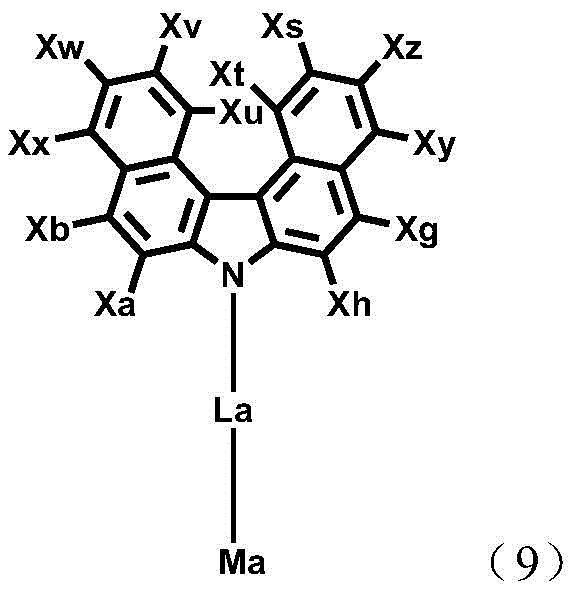
wherein
V and W each independently represent a single bond, NR15、CR16R17S or O, with the proviso that both V and W neither represent a single bond nor NR15;
A2Represents a warp fetchA substituted or unsubstituted (C6-C30) aryl group and may be bonded to Xn or Xo;
L3and L4Each independently represents a single bond or a substituted or unsubstituted (C6-C60) arylene;
xi represents hydrogen, deuterium, halogen, cyano, substituted or unsubstituted (C1-C30) alkyl, substituted or unsubstituted (C2-C30) alkenyl, substituted or unsubstituted (C2-C30) alkynyl, substituted or unsubstituted (C3-C30) cycloalkyl, substituted or unsubstituted (C6-C60) aryl, substituted or unsubstituted 3-to 30-membered heteroaryl, substituted or unsubstituted tri (C1-C30) alkylsilyl, substituted or unsubstituted tri (C6-C30) arylsilyl, substituted or unsubstituted di (C1-C30) alkyl (C6-C30) arylsilyl, or substituted or unsubstituted mono or di (C6-C30) arylamino; or are linked between adjacent substituents to form a substituted or unsubstituted, mono-or polycyclic, (C3-C30) alicyclic or aromatic ring whose carbon atom ring may be replaced with at least one hetero atom selected from nitrogen, oxygen, and sulfur;
xj to Xz each independently represent hydrogen, deuterium, halogen, cyano, carboxyl, nitro, hydroxyl, substituted or unsubstituted (C1-C30) alkyl, substituted or unsubstituted (C3-C30) cycloalkyl, substituted or unsubstituted (C3-C30) cycloalkenyl, substituted or unsubstituted 3-to 7-membered heterocycloalkyl, substituted or unsubstituted (C6-C60) aryl, substituted or unsubstituted 3-to 30-membered heteroaryl, -NR5R6or-SiR7R8R9(ii) a Or are linked between adjacent substituents to form a substituted or unsubstituted, mono-or polycyclic, (C3-C30) alicyclic or aromatic ring whose carbon atom ring may be replaced with at least one hetero atom selected from nitrogen, oxygen, and sulfur;
ma, La, Xa, Xb and Xe to Xh are as defined in formula 2;
R5to R9Each independently represents hydrogen, deuterium, halogen, cyano, carboxyl, nitro, hydroxyl, substituted or unsubstituted (C1-C30) alkyl, substituted or unsubstituted (C3-C30) cycloalkyl, substituted or unsubstituted (C3-C30) cycloalkenyl, substituted or unsubstitutedUnsubstituted 3-to 7-membered heterocycloalkyl, substituted or unsubstituted (C6-C60) aryl, or substituted or unsubstituted 3-to 30-membered heteroaryl; or are linked between adjacent substituents to form a substituted or unsubstituted, mono-or polycyclic, (C3-C30) alicyclic or aromatic ring whose carbon atom ring may be replaced with at least one hetero atom selected from nitrogen, oxygen, and sulfur; preferably, hydrogen, or a substituted or unsubstituted (C6-C25) aryl; more preferably, hydrogen or unsubstituted (C6-C18) aryl; and specifically hydrogen, unsubstituted phenyl, biphenyl or fluorenyl;
R16and R17Each independently represents hydrogen, deuterium, halogen, cyano, carboxyl, nitro, hydroxyl, substituted or unsubstituted (C1-C30) alkyl, substituted or unsubstituted (C3-C30) cycloalkyl, substituted or unsubstituted (C3-C30) cycloalkenyl, substituted or unsubstituted 3-to 7-membered heterocycloalkyl, substituted or unsubstituted (C6-C60) aryl, or substituted or unsubstituted 3-to 30-membered heteroaryl; and is
R15Represents hydrogen, deuterium, halogen, cyano, carboxyl, nitro, hydroxyl, substituted or unsubstituted (C1-C30) alkyl, substituted or unsubstituted (C3-C30) cycloalkyl, substituted or unsubstituted (C3-C30) cycloalkenyl, substituted or unsubstituted 3-to 7-membered heterocycloalkyl, substituted or unsubstituted (C6-C60) aryl, or substituted or unsubstituted 3-to 30-membered heteroaryl; preferably, a substituted or unsubstituted (C6-C30) aryl group; and more preferably, a substituted or unsubstituted phenyl group, an unsubstituted biphenyl group, an unsubstituted naphthyl group, or a substituted fluorenyl group.
In formula 2, La represents a single bond, or a substituted or unsubstituted (C6-C30) arylene group; preferably a single bond, or a substituted or unsubstituted (C6-C12) arylene; and more preferably a single bond, a (C6-C12) arylene group, which is unsubstituted or substituted with a tri (C6-C10) arylsilyl or (C6-C12) aryl group.
Further, La represents a single bond, or is represented by one selected from the following formulae 10 to 19:

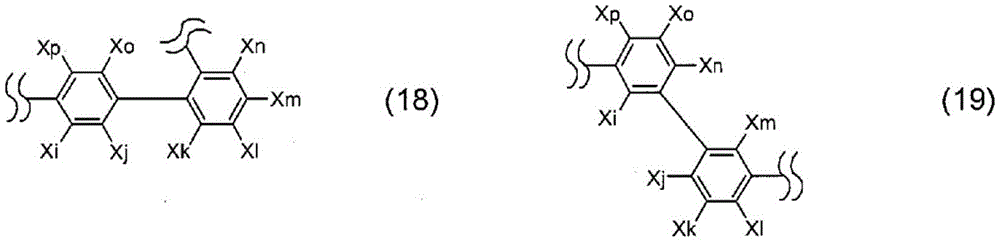
wherein
Xi to Xp each independently represent hydrogen, deuterium, halogen, cyano, substituted or unsubstituted (C1-C30) alkyl, substituted or unsubstituted (C2-C30) alkenyl, substituted or unsubstituted (C2-C30) alkynyl, substituted or unsubstituted (C3-C30) cycloalkyl, substituted or unsubstituted (C6-C60) aryl, substituted or unsubstituted 3-to 30-membered heteroaryl, substituted or unsubstituted tri (C1-C30) alkylsilyl, substituted or unsubstituted tri (C6-C30) arylsilyl, substituted or unsubstituted di (C1-C30) alkyl (C6-C30) arylsilyl, or substituted or unsubstituted mono or di (C6-C30) arylamino; or are linked between adjacent substituents to form a substituted or unsubstituted, mono-or polycyclic, (C3-C30) alicyclic or aromatic ring whose carbon atom ring may be replaced with at least one hetero atom selected from nitrogen, oxygen, and sulfur; preferably, hydrogen, cyano, substituted or unsubstituted (C6-C15) aryl, substituted or unsubstituted 10-to 20-membered heteroaryl, or substituted or unsubstituted tri (C6-C10) arylsilyl; more preferably, hydrogen, cyano, (C6-C15) aryl, which is unsubstituted or substituted with a tri (C6-C10) arylsilyl group, or 10-to 20-membered heteroaryl, which is unsubstituted or substituted with a (C6-C15) aryl group.
In formula 2, Ma represents a substituted or unsubstituted nitrogen-containing 5-to 11-membered heteroaryl group; preferably, a substituted or unsubstituted nitrogen-containing 6 to 10 membered heteroaryl; and more preferably, a nitrogen-containing 6-to 10-membered heteroaryl group, substituted with a substituent selected from the group consisting of: unsubstituted (C6-C18) aryl, cyano-substituted (C6-C12) aryl, (C6-C12) aryl substituted with (C1-C6) alkyl, (C6-C12) aryl substituted with tri (C6-C12) arylsilyl, and 6-to 15-membered heteroaryl.
Further, Ma represents a monocyclic-based heteroaryl group selected from the group consisting of: pyrrolyl, imidazolyl, pyrazolyl, triazinyl, tetrazinyl, triazolyl, tetrazolyl, pyridyl, pyrazinyl, pyrimidinyl, pyridazinyl, and the like, or a fused ring-based heteroaryl selected from the group consisting of: benzimidazolyl, isoindolyl, indolyl, indazolyl, benzothiadiazolyl, quinolyl, isoquinolyl, cinnolinyl, quinazolinyl, naphthyridinyl, quinoxalinyl, carbazolyl, phenanthridinyl and the like; preferably triazinyl, pyrimidinyl, pyridyl, quinolinyl, isoquinolinyl, quinazolinyl, naphthyridinyl or quinoxalinyl.
As used herein, "(C1-C30) (alkylene) means a straight or branched chain (alkylene) group having 1 to 30 carbon atoms, wherein the number of carbon atoms is preferably 1 to 20, more preferably 1 to 10, and includes methyl, ethyl, n-propyl, isopropyl, n-butyl, isobutyl, tert-butyl, and the like. "(C2-C30) alkenyl" means a straight or branched chain alkenyl group having 2 to 30 carbon atoms, wherein the number of carbon atoms is preferably 2 to 20, more preferably 2 to 10, and includes ethenyl, 1-propenyl, 2-propenyl, 1-butenyl, 2-butenyl, 3-butenyl, 2-methylbut-2-enyl and the like. "(C2-C30) alkynyl" is a straight or branched chain alkynyl group having 2 to 30 carbon atoms, wherein the number of carbon atoms is preferably 2 to 20, more preferably 2 to 10, and includes ethynyl, 1-propynyl, 2-propynyl, 1-butynyl, 2-butynyl, 3-butynyl, 1-methylpent-2-ynyl, and the like. "(C3-C30) cycloalkyl" is a monocyclic or polycyclic hydrocarbon having 3 to 30 carbon atoms, wherein the number of carbon atoms is preferably 3 to 20, more preferably 3 to 7, and includes cyclopropyl, cyclobutyl, cyclopentyl, cyclohexyl, and the like. "3-to 7-membered heterocycloalkyl" is a cycloalkyl group having at least one heteroatom selected from the group consisting of B, N, O, S, P (═ O), Si and P, preferably O, S and N, and 3 to 7, preferably 5 to 7 ring backbone atoms, and includes tetrahydrofuran, pyrrolidine, thiacyclopentane, tetrahydropyran, and the like. "(C6-C30) (arylene) group" is a monocyclic or fused ring derived from an aromatic hydrocarbon having 6 to 30 carbon atoms, wherein the number of carbon atoms is preferably 6 to 20, more preferably 6 to 15, and includes phenyl, biphenyl, terphenyl, naphthyl, fluorenyl, phenanthryl, anthryl, indenyl, terphenylene, pyrenyl, tetracenyl, perylenyl, chrysenyl, tetracenyl, fluoranthenyl, and the like. A "3-to 30-membered (arylene) heteroaryl" is an aryl having at least one, preferably 1 to 4 heteroatoms selected from the group consisting of B, N, O, S, P (═ O), Si, and P, and 3 to 30 ring backbone atoms; is a monocyclic ring or a fused ring fused to at least one benzene ring; having preferably 3 to 20, more preferably 3 to 15 ring backbone atoms; may be partially saturated; may be a group formed by bonding at least one heteroaryl or aryl group to a heteroaryl group via a single bond; and include monocyclic heteroaryl groups including furyl, thienyl, pyrrolyl, imidazolyl, pyrazolyl, thiazolyl, thiadiazolyl, isothiazolyl, isoxazolyl, oxazolyl, oxadiazolyl, triazinyl, tetrazinyl, triazolyl, tetrazolyl, furazanyl, pyridyl, pyrazinyl, pyrimidinyl, pyridazinyl and the like, and fused ring heteroaryl groups including benzofuryl, benzothienyl, isobenzofuryl, dibenzofuryl, dibenzothienyl, benzimidazolyl, benzothiazolyl, benzisothiazolyl, benzisoxazolyl, benzoxazolyl, isoindolyl, indolyl, indazolyl, benzothiadiazolyl, quinolyl, isoquinolyl, cinnolinyl, quinazolinyl, quinoxalinyl, carbazolyl, phenazinyl, phenanthridinyl, benzodioxolyl and the like. "nitrogen-containing 5-to 30-membered (arylene) heteroaryl" is an (arylene) group having at least one heteroatom N and 5 to 30 ring backbone atoms. 5 to 20 ring backbone atoms and 1 to 4 heteroatoms are preferred, and 5 to 15 ring backbone atoms are more preferred. Which is a monocyclic ring or a fused ring fused to at least one benzene ring; may be partially saturated; may be a group formed by bonding at least one heteroaryl or aryl group to a heteroaryl group via a single bond; and include monocyclic heteroaryl groups including pyrrolyl, imidazolyl, pyrazolyl, triazinyl, tetrazinyl, triazolyl, tetrazolyl, pyridyl, pyrazinyl, pyrimidinyl, pyridazinyl and the like, and fused cyclic heteroaryl groups including benzimidazolyl, isoindolyl, indolyl, indazolyl, benzothiadiazolyl, quinolyl, isoquinolyl, cinnolinyl, quinazolinyl, quinoxalinyl, carbazolyl, phenanthridinyl and the like. "halogen" includes F, Cl, Br and I.
Herein, "substituted" in the expression "substituted or unsubstituted" means that a hydrogen atom in a certain functional group is replaced by another atom or group, i.e., a substituent. Substituted alkyl (ene), substituted alkenyl, substituted alkynyl, substituted cycloalkyl, substituted aryl (ene), substituted heteroaryl (ene), substituted trialkylsilyl, substituted triarylsilyl, substituted dialkylarylsilyl, substituted mono-or diarylamino, or substituted mono-or polycyclic (C3-C30) alicyclic or aromatic ring substituents each independently being at least one selected from the group consisting of: deuterium; halogen; a cyano group; a carboxyl group; a nitro group; a hydroxyl group; (C1-C30) alkyl; halo (C1-C30) alkyl, (C2-C30) alkenyl; (C2-C30) alkynyl; (C1-C30) alkoxy; (C1-C30) alkylthio; (C3-C30) cycloalkyl; (C3-C30) cycloalkenyl; 3-to 7-membered heterocycloalkyl; (C6-C30) aryloxy; (C6-C30) arylthio; a 3-to 30-membered heteroaryl group, unsubstituted or substituted with a (C6-C30) aryl group; (C6-C30) aryl unsubstituted or substituted with cyano, 3-to 30-membered heteroaryl, or tri (C6-C30) arylsilyl; tri (C1-C30) alkylsilyl; a tri (C6-C30) arylsilyl group; di (C1-C30) alkyl (C6-C30) arylsilyl; (C1-C30) alkyldi (C6-C30) arylsilyl; an amino group; mono-or di (C1-C30) alkylamino; mono-or di (C6-C30) arylamino; (C1-C30) alkyl (C6-C30) arylamino; (C1-C30) alkylcarbonyl; (C1-C30) alkoxycarbonyl; (C6-C30) arylcarbonyl; a bis (C6-C30) arylboron group; a di (C1-C30) alkylboron group; (C1-C30) alkyl (C6-C30) arylboronyl; (C6-C30) aryl (C1-C30) alkyl; and (C1-C30) alkyl (C6-C30) aryl. Preferably, the substituents are each independently at least one selected from the group consisting of: (C1-C6) alkyl; 5-to 15-membered heteroaryl; (C6-C18) aryl unsubstituted or substituted with cyano or tri (C6-C12) arylsilyl; a tri (C6-C12) arylsilyl group; and (C1-C6) alkyl (C6-C12) aryl.
The compound of formula 1 as the first host compound may be selected from the group consisting of, but is not limited to:


the compound of formula 2 as the second host compound may be selected from the group consisting of, but not limited to:


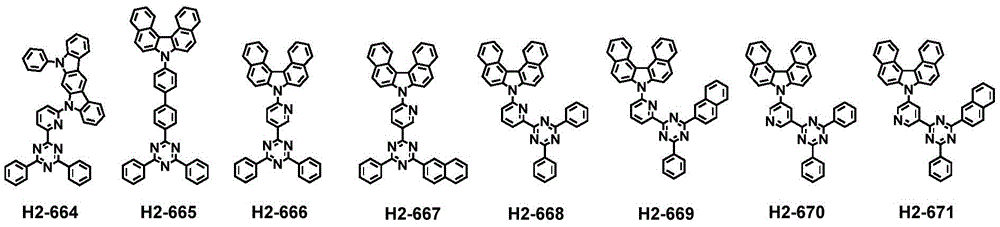
the organic EL device according to the present invention may include an anode, a cathode, and at least one organic layer between the two electrodes, wherein the organic layer includes a light emitting layer including a host and a phosphorescent dopant; the body is composed of a multi-component body compound; at least one first host compound of the multi-component host compounds is represented by formula 1 as a specific aryl-containing dicarbazole derivative, and a second host compound is represented by formula 2 as a specific carbazole derivative including a nitrogen heteroaryl-containing group.
The light emitting layer means a layer that emits light, and may be a single layer or a multilayer consisting of two or more layers. The concentration of the dopant compound doped into the host compound in the light-emitting layer is preferably less than 20% by weight.
The dopant included in the organic EL device of the present invention is preferably one or more phosphorescent dopants. The phosphorescent dopant material applied to the organic electroluminescent device of the present invention is not particularly limited, but may be preferably selected from complex compounds of iridium (Ir), osmium (Os), copper (Cu) and platinum (Pt), more preferably ortho-metalated complex compounds of iridium (Ir), osmium (Os), copper (Cu) and platinum (Pt), and even more preferably ortho-metalated iridium complex compounds.
The phosphorescent dopant may be selected from the group consisting of: compounds represented by the following formulae 101 to 103:

wherein
L is selected from the following structures:

R100represents hydrogen, or a substituted or unsubstituted (C1-C30) alkyl group; r101To R109And R111To R123Each independently represents hydrogen, deuterium, halogen; unsubstituted or halogen-substituted (C1-C30) alkyl; cyano, substituted or unsubstituted (C1-C30) alkoxy, substituted or unsubstituted (C6-C30) aryl, or substituted or unsubstituted (C3-C30) cycloalkyl; r120To R123Linked to an adjacent substituent(s) to form a substituted or unsubstituted, mono-or polycyclic (C3-C30) alicyclic or aromatic ring, such as quinoline; r124To R127Each independently represents hydrogen, deuterium, halogen, substituted or unsubstituted(C1-C30) alkyl, or substituted or unsubstituted (C6-C30) aryl; when R is124To R127When aryl, it is linked to an adjacent substituent(s) to form a substituted or unsubstituted mono-or polycyclic (C3-C30) alicyclic or aromatic ring, or heteroaromatic ring (e.g., fluorene, dibenzothiophene, or dibenzofuran); r201To R211Each independently represents hydrogen, deuterium, halogen, unsubstituted or halogen-substituted (C1-C30) alkyl, or substituted or unsubstituted (C6-C30) aryl; r208To R211May be linked to an adjacent substituent(s) to form a substituted or unsubstituted, mono-or polycyclic (C3-C30) alicyclic or aromatic ring, or heteroaromatic ring (e.g., fluorene, dibenzothiophene, or dibenzofuran); r and s each independently represent an integer of 1 to 3; when R or s is an integer of 2 or more, R100Each of which may be the same or different; and e represents an integer of 1 to 3.
Phosphorescent dopant materials include the following:


the organic EL device of the present invention may further include at least one compound selected from the group consisting of arylamine-based compounds and styrylarylamine-based compounds in the organic layer.
In the organic EL device of the present invention, the organic layer may further comprise at least one metal selected from the group consisting of: an organometallic of a group 1 metal, a group 2 metal, a transition metal of the 4 th period, a transition metal of the 5 th period, a lanthanoid, and a d-transition element of the periodic table, or at least one complex compound containing the metals.
Preferably, in the organic electroluminescent device of the present invention, at least one layer (hereinafter, referred to as "surface layer") selected from a chalcogenide layer, a metal halide layer, and a metal oxide layer may be disposed on the inner surface of one or both electrodes. Specifically, it is preferable that a chalcogenide (including oxide) layer having silicon or aluminum is disposed on the anode surface of the light emitting intermediate layer, and a metal halide layer or a metal oxide layer is disposed on the cathode surface of the electroluminescent intermediate layer. The surface layer provides operational stability of the organic electroluminescent device. Preferably, the chalcogenide compound comprises SiOX(1≤X≤2)、AlOX(X is more than or equal to 1 and less than or equal to 1.5), SiON, SiAlON and the like; the metal halide includes LiF, MgF2、CaF2Rare earth metal fluorides, etc.; and the metal oxide comprises Cs2O、Li2O, MgO, SrO, BaO, CaO, etc.
A hole injection layer, a hole transport layer, an electron blocking layer, or a combination thereof may be used between the anode and the light emitting layer. The hole injection layer may be a plurality of layers each using two compounds at the same time in order to lower a hole injection barrier (or hole injection voltage) from the anode to the hole transport layer or the electron blocking layer. The hole transport layer or the electron blocking layer may also be a multilayer.
An electron buffer layer, a hole blocking layer, an electron transport layer, an electron injection layer, or a combination thereof may be used between the light emitting layer and the cathode. The electron buffer layer may be a multi-layer, each of which uses two compounds at the same time, in order to control injection of electrons and improve interface characteristics between the light emitting layer and the electron injection layer. The hole blocking layer or the electron transport layer may also be a multilayer, each of which may use multiple components of the compound.
Preferably, in the organic electroluminescent device of the present invention, a mixed region of the electron transport compound and the reductive dopant or a mixed region of the hole transport compound and the oxidative dopant may be disposed on at least one surface of the pair of electrodes. In this case, the electron transport compound is reduced to an anion, and thus it becomes easier to inject and transport electrons from the mixed region to the light emitting medium. In addition, the hole transport compound is oxidized into cations, and thus it becomes easier to inject and transport holes from the mixed region to the light emitting medium. Preferably, the oxidizing dopant includes a plurality of Lewis acids (Lewis acids) and acceptor compounds; and the reducing dopant includes alkali metals, alkali metal compounds, alkaline earth metals, rare earth metals, and mixtures thereof. The reductive dopant layer may be used as a charge generation layer to prepare an organic electroluminescent device having two or more light emitting layers and emitting white light.
In order to form each layer constituting the organic electroluminescent device of the present invention, a dry film forming method such as vacuum deposition, sputtering, plasma, ion plating method, or the like, or a wet film forming method such as spin coating, dip coating, flow coating method, or the like may be used. When a layer is formed by using the first body and the second body according to the present invention, co-deposition or hybrid deposition may be used.
When a wet film formation method is used, a thin film is formed by dissolving or dispersing a material constituting each layer in a suitable solvent (e.g., ethanol, chloroform, tetrahydrofuran, dioxane, or the like). The solvent is not particularly limited as long as the material constituting each layer is soluble or dispersible in the solvent without causing any problem in forming the layer.
Further, a display device or a light device can be produced by using the organic EL device of the present invention.
Hereinafter, a method for manufacturing a device by using the host compound and the dopant compound of the present invention will be described in detail with reference to the following examples:
device examples 1-1: by co-depositing a first host compound and a second host compound according to the invention as
Host to manufacture OLED device
An OLED device comprising the organic electroluminescent compound of the present invention was manufactured as follows: making OLED devicesA transparent electrode Indium Tin Oxide (ITO) film (10 Ω/sq) on a glass substrate of Samsung Corning (Samsung Corning), Korea (Republic of Korea) was subjected to ultrasonic washing using trichloroethylene, acetone, ethanol, and distilled water in this order, and then stored in isopropyl alcohol. Then, the ITO substrate was mounted on a substrate holder of a vacuum vapor deposition apparatus. Will N4,N4' -Diphenyl-N4,N4'-bis (9-phenyl-9H-carbazol-3-yl) - [1,1' -biphenyl]-4,4' -diamine is introduced as HI-1 into a cell of a vacuum vapor deposition apparatus and then the pressure in the chamber of the apparatus is controlled to 10-6And (4) supporting. Subsequently, a current was applied to the cell to vaporize the introduced material, thereby forming a hole injection layer 1 having a thickness of 80nm on the ITO substrate. Next, 1,4,5,8,9, 12-hexaazatriphenylhexacyano-nitrile was introduced as HI-2 into another unit of the vacuum vapor deposition apparatus, and an electric current was applied to the unit to vaporize the introduced material, thereby forming a hole injection layer 2 having a thickness of 5nm on the hole injection layer 1. Mixing N- ([1,1' -biphenyl)]-4-yl) -9, 9-dimethyl-N- (4- (9-phenyl-9H-carbazol-3-yl) phenyl) -9H-fluoren-2-amine was introduced as HT-1 into one unit of a vacuum vapour deposition apparatus. Thereafter, a current was applied to the cell to vaporize the introduced material, thereby forming a hole transport layer 1 having a thickness of 10nm on the hole injection layer 2. Then, N-bis ([1,1' -biphenyl)]-4-yl) -4'- (9H-carbazol-9-yl) - [1,1' -biphenyl]-4-amine is introduced as HT-2 into another unit of the vacuum vapor deposition apparatus, and a current is applied to the unit to vaporize the introduced material, thereby forming a hole transport layer 2 having a thickness of 60nm on the hole transport layer 1. Thereafter, the compounds H1-1 and H2-2 were introduced as hosts into two cells of the vacuum vapor deposition apparatus, respectively, and the compound D-96 was introduced as a dopant into the other cell. The two host materials were vaporized at the same rate of 1:1, and the dopant was vaporized at different rates and deposited in a doping amount of 3 wt% based on the total weight of the host and the dopant to form a light emitting layer having a thickness of 40nm on the hole transport layer. Next, 2, 4-bis (9, 9-dimethyl-9H-fluoren-2-yl) -6- (naphthalen-2-yl) -1,3, 5-triazine as ET-1 and lithium quinolinate as EI-1 were added at the same rate of 1:1 over the other twoThe unit was vaporized to form an electron transport layer having a thickness of 30nm on the light emitting layer. After EI-1 quinolinithium as an electron injection layer was deposited on the electron transport layer to a thickness of 2nm, an Al cathode was then deposited on the electron injection layer by another vacuum vapor deposition apparatus to a thickness of 80 nm. Thus, an OLED device was manufactured.
The fabricated OLED devices exhibited a driving voltage at a luminance of 1,000 nit (nit), a luminous efficiency, CIE color coordinates, and a lifetime required for a constant current to decrease from 100% to 90% at a luminance of 5,000 nit, as provided in table 1 below.

Comparative examples 1 to 1: production of OLED devices by using only the second host compound according to the invention as host
Device for placing
An OLED device was fabricated in the same manner as device example 1-1, except that only the second host compound was used as a host in the light-emitting layer.
The light emission characteristics of the OLED devices manufactured in device examples 1-1 and comparative examples 1-1 are provided in table 1 below.
TABLE 1

Device examples 2-1 to 2-13: by co-reacting a first host compound according to the invention with a second host compound
Deposition as host to make OLED devices
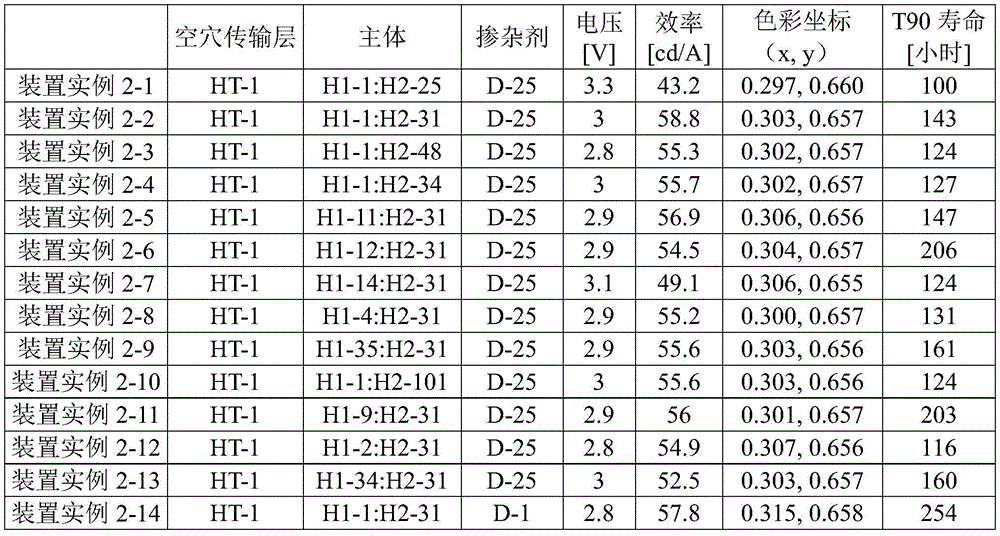
An OLED device was fabricated in the same manner as device example 1-1, except that the thickness of the hole injection layer 2 was 3nm, the thickness of the hole transport layer 1 was 40nm, the hole transport layer 2 was not present, D-25 was deposited as a dopant in a 15 wt% doping amount in the light emitting layer, the electron transport layer having a thickness of 35nm was deposited via an evaporation rate of 4:6, the combination of the first host compound and the second host compound used as hosts in the light emitting layer was based on device examples 2-1 to 2-13, as provided in table 2 below, and the lifetime required for the constant current to decrease from 100% to 90% at a luminance of 15,000 nits, as provided in table 2 below.
Device examples 2-14 to 2-18: by co-reacting a first host compound according to the invention with a second host compound
Deposition as host to make OLED devices
OLED devices were fabricated in the same manner as device examples 2-1 to 2-13, except that the thickness of the hole injection layer 2 was 3nm, the thickness of the hole transport layer 1 was 40nm, the hole transport layer 2 was not present, D-1 was used as a dopant for the light emitting layer, an electron transport layer having a thickness of 35nm was deposited via an evaporation rate of 4:6, the combination of the first host compound and the second host compound used as hosts in the light emitting layer was based on device examples 2-14 to 2-18, as provided in table 2 below, and the lifetime required for the constant current to decrease from 100% to 90% at a luminance of 15,000 nits, as provided in table 2 below.
Device examples 3-1 to 3-8: by co-precipitating a first host compound according to the invention and a second host compound
Volume-dominated fabrication of OLED devices
OLED devices were fabricated in the same manner as device examples 2-1 to 2-13, except that the thickness of the hole transport layer 1 was 10nm, the thickness of the hole transport layer 2 of HT-3 was 30nm, D-136 was used as a dopant for the light-emitting layer, and the combination of the first host compound and the second host compound used as a host in the light-emitting layer was based on device examples 3-1 to 3-8, as provided in table 2 below.
Examples of the apparatus 3 to 9: by co-depositing a first host compound and a second host compound according to the invention as
Host to manufacture OLED device
OLED devices were fabricated in the same manner as device examples 2-1 to 2-13, except that the thickness of the hole transport layer 1 was 10nm, the thickness of the hole transport layer 2 of HT-3 was 30nm, D-164 was used as a dopant for the light-emitting layer, and the combination of the first host compound and the second host compound used as a host in the light-emitting layer was based on device examples 3-9, as provided in table 2 below.
Device examples 3-10 to 3-12: by co-reacting a first host compound according to the invention with a second host compound
Deposition as host to make OLED devices
OLED devices were fabricated in the same manner as device examples 2-1 to 2-13, except that the thickness of the hole transport layer 1 was 10nm, the thickness of the hole transport layer 2 of HT-3 was 30nm, D-168 was used as a dopant for the light emitting layer, and the combination of the first host compound and the second host compound used as a host in the light emitting layer was based on device examples 3-10 to 3-12, as provided in table 2 below.
Device examples 3-13: by co-depositing a first host compound and a second host compound according to the invention as
Host to manufacture OLED device
OLED devices were fabricated in the same manner as device examples 2-1 to 2-13, except that the thickness of the hole transport layer 1 was 10nm, the thickness of the hole transport layer 2 of HT-3 was 30nm, D-180 was used as a dopant for the light-emitting layer, and the combination of the first host compound and the second host compound used as a host in the light-emitting layer was based on the device examples 3-13, as provided in table 2 below.
Comparative examples 2-1 to 2-3: manufactured by using only the first host compound according to the present invention as a host
OLED device
OLED devices were fabricated in the same manner as device examples 2-1 to 2-13, except that the first host compound used as a host in the light emitting layer was based on comparative examples 2-1 to 2-3, as provided in table 2 below.
Comparative examples 3-1 to 3-9: manufactured by using only the second host compound according to the present invention as a host
OLED device
OLED devices were fabricated in the same manner as device examples 2-1 to 2-13, except that the second host compound used as a host in the light emitting layer was based on comparative examples 3-1 to 3-9, as provided in table 2 below.
Comparative example 4-1: production of OLED devices by using only the second host compound according to the invention as host
Device for placing
OLED devices were fabricated in the same manner as device examples 3-1 to 3-8, except that the second host compound used as a host in the light-emitting layer was based on comparative example 4-1, as provided in table 2 below.
The light emission characteristics of the OLED devices manufactured in the above device examples and comparative examples are provided in table 2 below.
TABLE 2

Device examples 4-1 to 4-7: by co-precipitating a first host compound according to the invention and a second host compound
Volume-dominated fabrication of OLED devices
An OLED device was fabricated in the same manner as device example 1-1, except that HT-4 was used as the hole transport layer 2, the combination of the first host compound and the second host compound used as the host in the light emitting layer was based on device examples 4-1 to 4-7, as provided in table 3 below, and the lifetime required for the constant current to decrease from 100% to 95% at a luminance of 5,000 nits, as provided in table 3 below.

Comparative examples 5-1 and 5-2: manufactured by using only the second host compound according to the present invention as a host
OLED device
OLED devices were fabricated in the same manner as device examples 4-1 to 4-7, except that the second host compound used as a host in the light-emitting layer was based on comparative examples 5-1 and 5-2, as provided in table 3 below.
The light emission characteristics of the OLED devices fabricated in device examples 4-1 to 4-7 and comparative examples 5-1 and 5-2 are provided in table 3 below.
TABLE 3

Device examples 5-1 and 5-2: by co-precipitating a first host compound according to the invention and a second host compound
Volume-dominated fabrication of OLED devices
OLED devices were fabricated in the same manner as device examples 3-1 to 3-11, except that D-134 was used as a dopant in the light emitting layer, the combination of the first host compound and the second host compound used as a host in the light emitting layer was based on device examples 5-1 and 5-2, as provided in table 4 below, and the lifetime required for the constant current to decrease from 100% to 97% at a luminance of 15,000 nits, as provided in table 4 below.
Comparative examples 6-1 and 6-2: manufactured by using only the first host compound according to the present invention as a host
OLED device
OLED devices were fabricated in the same manner as device examples 5-1 and 5-2, except that the first host compound used as a host in the light-emitting layer was based on comparative examples 6-1 and 6-2, as provided in table 4 below.
Comparative example 7-1: production of OLED devices by using only the second host compound according to the invention as host
Device for placing
OLED devices were fabricated in the same manner as device examples 5-1 and 5-2, except that the second host compound used as a host in the light-emitting layer was based on comparative example 7-1, as provided in table 4 below.
The light emission characteristics of the OLED devices fabricated in device examples 5-1 and 5-2, comparative examples 6-1 and 6-2, and comparative example 7-1 are provided in table 4 below.
TABLE 4

The organic electroluminescent device of the present invention provides a longer lifetime compared to conventional devices by including a light emitting layer containing a host and a phosphorescent dopant, wherein the host is composed of a multi-component host compound of which at least one first host compound has a specific aryl-containing dicarbazole derivative and a second host compound has a specific carbazole derivative including a nitrogen-containing heteroaryl group.
Claims (8)


Applications Claiming Priority (8)
| Application Number | Priority Date | Filing Date | Title |
|---|---|---|---|
| KR10-2014-0041844 | 2014-04-08 | ||
| KR20140041844 | 2014-04-08 | ||
| KR20140086754 | 2014-07-10 | ||
| KR10-2014-0086754 | 2014-07-10 | ||
| KR1020150042704A KR101754715B1 (en) | 2014-04-08 | 2015-03-26 | Multi-component host material and organic electroluminescence device comprising the same |
| KR10-2015-0042704 | 2015-03-26 | ||
| CN201580017400.6A CN106133113A (en) | 2014-04-08 | 2015-04-07 | Multicomponent host material and organic electroluminescent device comprising same |
| PCT/KR2015/003485 WO2015156587A1 (en) | 2014-04-08 | 2015-04-07 | Multi-component host material and organic electroluminescent device comprising the same |
Related Parent Applications (1)
| Application Number | Title | Priority Date | Filing Date |
|---|---|---|---|
| CN201580017400.6A Division CN106133113A (en) | 2014-04-08 | 2015-04-07 | Multicomponent host material and organic electroluminescent device comprising same |
Publications (2)
| Publication Number | Publication Date |
|---|---|
| CN113394357A true CN113394357A (en) | 2021-09-14 |
| CN113394357B CN113394357B (en) | 2025-12-19 |
Family
ID=54365721
Family Applications (2)
| Application Number | Title | Priority Date | Filing Date |
|---|---|---|---|
| CN202110771216.8A Active CN113394357B (en) | 2014-04-08 | 2015-04-07 | Multicomponent host material and organic electroluminescent device comprising same |
| CN201580017400.6A Pending CN106133113A (en) | 2014-04-08 | 2015-04-07 | Multicomponent host material and organic electroluminescent device comprising same |
Family Applications After (1)
| Application Number | Title | Priority Date | Filing Date |
|---|---|---|---|
| CN201580017400.6A Pending CN106133113A (en) | 2014-04-08 | 2015-04-07 | Multicomponent host material and organic electroluminescent device comprising same |
Country Status (5)
| Country | Link |
|---|---|
| US (3) | US20170117488A1 (en) |
| EP (2) | EP3129446B1 (en) |
| JP (5) | JP6934299B2 (en) |
| KR (3) | KR101754715B1 (en) |
| CN (2) | CN113394357B (en) |
Cited By (1)
| Publication number | Priority date | Publication date | Assignee | Title |
|---|---|---|---|---|
| CN114907352A (en) * | 2022-05-05 | 2022-08-16 | 北京八亿时空液晶科技股份有限公司 | A kind of carbazole derivative and its application |
Families Citing this family (110)
| Publication number | Priority date | Publication date | Assignee | Title |
|---|---|---|---|---|
| KR101754715B1 (en) | 2014-04-08 | 2017-07-10 | 롬엔드하스전자재료코리아유한회사 | Multi-component host material and organic electroluminescence device comprising the same |
| KR20150141147A (en) * | 2014-06-09 | 2015-12-17 | 롬엔드하스전자재료코리아유한회사 | An organic electroluminescent compound and an organic electroluminescent device comprising the same |
| KR102502306B1 (en) * | 2014-07-22 | 2023-02-23 | 롬엔드하스전자재료코리아유한회사 | Organic Electroluminescence Device |
| WO2016129819A1 (en) | 2015-02-12 | 2016-08-18 | Rohm And Haas Electronic Materials Korea Ltd. | Organic electroluminescent compounds and organic electroluminescent device comprising the same |
| KR102606391B1 (en) * | 2015-02-12 | 2023-11-27 | 롬엔드하스전자재료코리아유한회사 | Organic Electroluminescent Compounds and Organic Electroluminescent Device Comprising the Same |
| KR102338908B1 (en) | 2015-03-03 | 2021-12-14 | 삼성디스플레이 주식회사 | An organic light emitting device |
| KR102613166B1 (en) * | 2015-03-13 | 2023-12-14 | 롬엔드하스전자재료코리아유한회사 | A plurality of host materials and organic electroluminescent device comprising the same |
| KR102388726B1 (en) * | 2015-04-29 | 2022-04-21 | 삼성디스플레이 주식회사 | Organic light emitting device |
| KR20160136211A (en) * | 2015-05-19 | 2016-11-29 | 롬엔드하스전자재료코리아유한회사 | Phosphorous Host Material and Organic Electroluminescent Device Comprising the Same |
| KR20170001552A (en) * | 2015-06-26 | 2017-01-04 | 롬엔드하스전자재료코리아유한회사 | Multi-component host material and organic electroluminescent device comprising the same |
| US10862037B2 (en) * | 2015-10-16 | 2020-12-08 | Lg Chem, Ltd. | Electroactive materials |
| KR102591635B1 (en) | 2015-10-27 | 2023-10-20 | 삼성디스플레이 주식회사 | An organic light emitting device |
| KR102399570B1 (en) | 2015-11-26 | 2022-05-19 | 삼성디스플레이 주식회사 | Organic light emitting device |
| KR20170068705A (en) * | 2015-12-09 | 2017-06-20 | 삼성디스플레이 주식회사 | Organic light-emitting device |
| US11910707B2 (en) | 2015-12-23 | 2024-02-20 | Samsung Display Co., Ltd. | Organic light-emitting device |
| KR102394374B1 (en) * | 2016-01-18 | 2022-05-04 | 에스에프씨 주식회사 | Organic light-emitting compounds and Organic light-emitting device comprising the same |
| TWI582081B (en) * | 2016-03-25 | 2017-05-11 | 昱鐳光電科技股份有限公司 | Compound for organic electroluminescent device and organic electroluminescent devices using the same |
| KR20170127101A (en) | 2016-05-10 | 2017-11-21 | 삼성디스플레이 주식회사 | Organic light emitting device |
| KR102054276B1 (en) | 2016-06-29 | 2019-12-10 | 삼성에스디아이 주식회사 | Compound for organic optoelectronic device, composition for organic optoelectronic device and organic optoelectronic device and display device |
| KR102027961B1 (en) | 2016-06-29 | 2019-10-02 | 삼성에스디아이 주식회사 | Compound for organic optoelectronic device, composition for organic optoelectronic device and organic optoelectronic device and display device |
| KR102050000B1 (en) | 2016-07-12 | 2019-11-28 | 삼성에스디아이 주식회사 | Compound for organic optoelectronic device, composition for organic optoelectronic device and organic optoelectronic device and display device |
| KR102032610B1 (en) | 2016-07-26 | 2019-10-15 | 주식회사 엘지화학 | Organic light emitting device |
| KR102054277B1 (en) | 2016-07-29 | 2019-12-10 | 삼성에스디아이 주식회사 | Composition for organic optoelectronic device and organic optoelectronic device and display device |
| KR102455656B1 (en) * | 2016-09-22 | 2022-10-19 | 롬엔드하스전자재료코리아유한회사 | Organic Electroluminescent Device Comprising an Electron Buffer Layer and an Electron Transport Layer |
| KR102122340B1 (en) * | 2016-12-02 | 2020-06-12 | 삼성에스디아이 주식회사 | Compound for organic optoelectronic device, composition for organic optoelectronic device and organic optoelectronic device and display device |
| CN110168048B (en) | 2017-01-05 | 2022-10-21 | 三星Sdi株式会社 | Organic photoelectric device, compound and composition used for same, and display device |
| TWI764984B (en) * | 2017-02-28 | 2022-05-21 | 南韓商羅門哈斯電子材料韓國公司 | Organic electroluminescent compound and organic electroluminescent device comprising the same |
| US20200006687A1 (en) * | 2017-03-21 | 2020-01-02 | Konica Minolta, Inc. | Organic electroluminescence element |
| CN106977514A (en) * | 2017-03-30 | 2017-07-25 | 上海道亦化工科技有限公司 | A kind of organic electroluminescent compounds and its luminescent device containing carbazole derivates |
| KR102084989B1 (en) * | 2017-04-17 | 2020-03-05 | 두산솔루스 주식회사 | Organic electroluminescent device using the same |
| KR102084990B1 (en) * | 2017-04-17 | 2020-03-05 | 두산솔루스 주식회사 | Organic electroluminescent device using the same |
| WO2018198844A1 (en) * | 2017-04-27 | 2018-11-01 | 新日鉄住金化学株式会社 | Organic electroluminescent element |
| KR20180137772A (en) | 2017-06-19 | 2018-12-28 | 삼성에스디아이 주식회사 | Organic optoelectric device and display device |
| KR101947747B1 (en) | 2018-05-04 | 2019-02-13 | 삼성에스디아이 주식회사 | Compound for organic optoelectronic device, composition for organic optoelectronic device and organic optoelectronic device and display device |
| KR102008897B1 (en) | 2017-06-22 | 2019-10-23 | 삼성에스디아이 주식회사 | Organic optoelectronic device and display device |
| US20190198772A1 (en) | 2017-06-22 | 2019-06-27 | Samsung Sdi Co., Ltd. | Compound for organic optoelectronic device, composition for organic optoelectronic device and organic optoelectronic device and display deivce |
| KR102064413B1 (en) * | 2017-06-29 | 2020-01-09 | 주식회사 엘지화학 | Novel hetero-cyclic compound and organic light emitting device comprising the same |
| KR102068415B1 (en) * | 2017-07-27 | 2020-01-20 | 주식회사 엘지화학 | Delayed fluorescence material and organic light emitting device comprising the same |
| KR102160270B1 (en) * | 2017-10-20 | 2020-09-25 | 삼성에스디아이 주식회사 | Composition for organic optoelectric device and organic optoelectric device and display device |
| KR20190055292A (en) * | 2017-11-13 | 2019-05-23 | 삼성디스플레이 주식회사 | Organic light-emitting device |
| CN111278819A (en) * | 2017-12-14 | 2020-06-12 | 广州华睿光电材料有限公司 | Bipolar compounds, polymers, mixtures, compositions, organic electronic devices and applications |
| JP2019108296A (en) * | 2017-12-19 | 2019-07-04 | 三星電子株式会社Samsung Electronics Co.,Ltd. | Organic electroluminescent element compound |
| US20190225635A1 (en) * | 2018-01-19 | 2019-07-25 | Chuanjun Xia | Metal complexes containing substituted pyridine ligands |
| KR102824606B1 (en) * | 2018-02-13 | 2025-06-25 | 삼성디스플레이 주식회사 | Organic light emitting device and display apparatus comprising the same |
| KR20190121418A (en) | 2018-04-17 | 2019-10-28 | 삼성디스플레이 주식회사 | Organic electroluminescence device and nitrogen-containing compound for organic electroluminescence device |
| CN110498790B (en) * | 2018-05-16 | 2022-03-01 | 江苏三月科技股份有限公司 | Organic light-emitting composite material and organic electroluminescent device containing same |
| EP3588599A1 (en) | 2018-06-26 | 2020-01-01 | Idemitsu Kosan Co., Ltd. | Composition, organic-electroluminescence-device material, composition film, organic electroluminescence device, and electronic device |
| WO2020022378A1 (en) | 2018-07-27 | 2020-01-30 | 出光興産株式会社 | Compound, material for organic electroluminescence element, organic electroluminescence element, and electronic device |
| KR102595751B1 (en) * | 2018-08-09 | 2023-10-30 | 덕산네오룩스 주식회사 | Organic electronic element comprising mixture mixed with different compounds as host material and an electronic device thereof |
| CN109053739A (en) * | 2018-09-19 | 2018-12-21 | 西安瑞联新材料股份有限公司 | A kind of pyrrolotriazine derivatives and its application in OLED device |
| KR102711310B1 (en) | 2018-10-02 | 2024-09-26 | 엘지디스플레이 주식회사 | Organic light emitting diode device |
| EP3643761A1 (en) | 2018-10-25 | 2020-04-29 | Idemitsu Kosan Co., Ltd. | Composition, organic electroluminescence device material, composition film, organic electroluminescence device, and electronic device |
| KR102331904B1 (en) | 2018-11-27 | 2021-11-26 | 주식회사 엘지화학 | Novel compound and organic light emitting device comprising the same |
| JP7172001B2 (en) | 2018-11-27 | 2022-11-16 | エルジー・ケム・リミテッド | Novel compound and organic light-emitting device containing the same |
| US11746117B2 (en) | 2018-11-27 | 2023-09-05 | Lg Chem, Ltd. | Heterocyclic compound and organic light emitting device comprising same |
| CN111269243A (en) * | 2018-12-05 | 2020-06-12 | 北京鼎材科技有限公司 | Organic electroluminescent compound and application thereof |
| EP3670517A1 (en) | 2018-12-21 | 2020-06-24 | Idemitsu Kosan Co., Ltd. | Polycyclic compound, composition and an organic electroluminescence device comprising the polycyclic compound or the composition |
| CN111354853B (en) * | 2018-12-24 | 2023-06-02 | 北京夏禾科技有限公司 | Organic electroluminescent device comprising dopant material and multiple host materials |
| KR102702683B1 (en) * | 2018-12-28 | 2024-09-03 | 엘지디스플레이 주식회사 | Organic light emitting diode and organic light emitting device including the same |
| US20220255017A1 (en) * | 2019-06-18 | 2022-08-11 | Rohm And Haas Electronic Materials Korea Ltd. | Organic electroluminescent compound and organic electroluminescent device comprising the same |
| KR102850886B1 (en) * | 2019-06-18 | 2025-08-28 | 듀폰스페셜티머터리얼스코리아 유한회사 | Organic electroluminescent compound and organic electroluminescent device comprising the same |
| KR20210008812A (en) * | 2019-07-15 | 2021-01-25 | 롬엔드하스전자재료코리아유한회사 | A plurality of host materials and organic electroluminescent device comprising the same |
| KR102801363B1 (en) | 2019-07-17 | 2025-05-07 | 삼성디스플레이 주식회사 | Organic electroluminescence device and polycyclic compound for organic electroluminescence device |
| KR102654051B1 (en) * | 2019-09-11 | 2024-04-03 | 주식회사 엘지화학 | Compound and organic light emitting device comprising the same |
| KR102516810B1 (en) | 2019-09-30 | 2023-03-30 | 삼성에스디아이 주식회사 | Compound for organic optoelectronic device, composition for organic optoelectronic device, organic optoelectronic device and display device |
| KR102782649B1 (en) * | 2019-10-02 | 2025-03-17 | 엘지디스플레이 주식회사 | Organic light emitting diode device |
| KR102869108B1 (en) | 2019-10-24 | 2025-10-14 | 듀폰스페셜티머터리얼스코리아 유한회사 | A plurality of host materials and organic electroluminescent device comprising the same |
| KR20210061734A (en) * | 2019-11-20 | 2021-05-28 | 삼성에스디아이 주식회사 | Organic optoelectronic device and display device |
| KR102489771B1 (en) * | 2019-12-11 | 2023-01-18 | 주식회사 엘지화학 | Organic light emitting device |
| KR20210076220A (en) * | 2019-12-12 | 2021-06-24 | 삼성디스플레이 주식회사 | Organic light emitting device and apparatus including the same |
| CN114206858B (en) * | 2019-12-20 | 2024-04-26 | 株式会社Lg化学 | New compound and organic light-emitting device containing the same |
| WO2021131755A1 (en) * | 2019-12-27 | 2021-07-01 | 日鉄ケミカル&マテリアル株式会社 | Organic electroluminescent element and method for manufacturing same |
| WO2021157635A1 (en) * | 2020-02-05 | 2021-08-12 | 出光興産株式会社 | Compound, material for organic electroluminescent elements, organic electroluminescent element, and electronic device |
| KR102806407B1 (en) * | 2020-02-14 | 2025-05-13 | 삼성디스플레이 주식회사 | Organic light emitting device and device with same |
| CN115244724A (en) * | 2020-03-06 | 2022-10-25 | 三星Sdi株式会社 | Composition for organic optoelectronic element, organic optoelectronic element and display device |
| KR102555495B1 (en) * | 2020-03-06 | 2023-07-12 | 삼성에스디아이 주식회사 | Composition for optoelectronic device and organic optoelectronic device and display device |
| KR102555494B1 (en) * | 2020-03-20 | 2023-07-12 | 삼성에스디아이 주식회사 | Composition for optoelectronic device and organic optoelectronic device and display device |
| KR102495278B1 (en) * | 2020-03-23 | 2023-02-01 | 삼성에스디아이 주식회사 | Composition for organic optoelectronic device, organic optoelectronic device and display device |
| US20230255106A1 (en) | 2020-05-29 | 2023-08-10 | Merck Patent Gmbh | Organic electroluminescent apparatus |
| CN113896734A (en) | 2020-07-06 | 2022-01-07 | 罗门哈斯电子材料韩国有限公司 | Organic electroluminescent compounds, various host materials and organic electroluminescent device comprising the same |
| KR20220005388A (en) | 2020-07-06 | 2022-01-13 | 롬엔드하스전자재료코리아유한회사 | Organic electroluminescent compound, a plurality of host materials and organic electroluminescent device comprising the same |
| CN113943571A (en) | 2020-07-17 | 2022-01-18 | 罗门哈斯电子材料韩国有限公司 | Organic electroluminescent compounds, various host materials and organic electroluminescent device comprising the same |
| KR20220010427A (en) | 2020-07-17 | 2022-01-25 | 롬엔드하스전자재료코리아유한회사 | Organic electroluminescent compound, a plurality of host materials and organic electroluminescent device comprising the same |
| KR20220010691A (en) | 2020-07-17 | 2022-01-26 | 삼성디스플레이 주식회사 | Light emitting device and electronic apparatus comprising the device |
| KR102283849B1 (en) * | 2020-08-21 | 2021-08-02 | 롬엔드하스전자재료코리아유한회사 | Organic electroluminescent compound, a plurality of host materials and organic electroluminescent device comprising the same |
| US20220109109A1 (en) * | 2020-08-21 | 2022-04-07 | Rohm And Haas Electronic Materials Korea Ltd. | Organic electroluminescent compound, a plurality of host materials and organic electroluminescent device comprising the same |
| KR102493132B1 (en) | 2020-09-11 | 2023-01-31 | 삼성디스플레이 주식회사 | Light-emitting device and electronic apparatus including the same |
| KR20220053059A (en) | 2020-10-20 | 2022-04-29 | 삼성디스플레이 주식회사 | Light emitting divice and amine compound for the same |
| KR102830321B1 (en) * | 2020-11-03 | 2025-07-03 | 삼성에스디아이 주식회사 | Compound for organic optoelectronic device, composition for organic optoelectronic device, organic optoelectronic device and display device |
| KR102860003B1 (en) * | 2020-11-06 | 2025-09-12 | 삼성에스디아이 주식회사 | Compound for organic optoelectronic device, composition for organic optoelectronic device, organic optoelectronic device and display device |
| KR102791287B1 (en) * | 2020-12-21 | 2025-04-08 | 엘티소재주식회사 | Heterocyclic compound, organic light emitting device comprising same, manufacturing method of same and composition for organic layer of organic light emitting device |
| KR20220095337A (en) | 2020-12-29 | 2022-07-07 | 엘지디스플레이 주식회사 | Organic light emitting diode and organic light emitting device including the same |
| KR20220152420A (en) * | 2021-05-06 | 2022-11-16 | 엘티소재주식회사 | Organic light emitting device, heterocyclic compound, and composition for organic material layer of organic light emitting device |
| US20240262846A1 (en) * | 2021-06-24 | 2024-08-08 | Lt Materials Co., Ltd. | Heterocyclic compound, organic light-emitting device, composition for organic material layer of organic light-emitting device |
| US20240389454A1 (en) * | 2021-07-06 | 2024-11-21 | Samsung Sdi Co., Ltd. | Compound for organic optoelectronic device, organic optoelectronic device, and display device |
| CN117222638A (en) * | 2021-07-06 | 2023-12-12 | 三星Sdi株式会社 | Compounds for organic optoelectronic devices, organic optoelectronic devices and display devices |
| KR20230014104A (en) * | 2021-07-19 | 2023-01-30 | 삼성디스플레이 주식회사 | Light emitting element |
| CN113563344B (en) * | 2021-07-27 | 2023-11-21 | 北京八亿时空液晶科技股份有限公司 | Carbazole derivatives, organic electroluminescent materials, light-emitting components and consumer products |
| KR20230038890A (en) | 2021-09-13 | 2023-03-21 | 롬엔드하스전자재료코리아유한회사 | Organic electroluminescent materials and organic electroluminescent device comprising the same |
| KR102804797B1 (en) * | 2021-09-30 | 2025-05-14 | 엘티소재주식회사 | Organic light emitting device, composition for organic layer of organic light emitting device and manufacturing method of organic light emitting device |
| CN114195700B (en) * | 2021-10-28 | 2022-09-13 | 北京莱特众成光电材料科技有限公司 | Organic compound, and organic electroluminescent device and electronic device comprising the same |
| KR20230064056A (en) * | 2021-11-02 | 2023-05-10 | 삼성디스플레이 주식회사 | Light emitting device and electronic apparatus comprising same |
| KR102859823B1 (en) * | 2022-03-26 | 2025-09-16 | 베이징 썸머 스프라우트 테크놀로지 컴퍼니 리미티드 | Organic electroluminescent device |
| KR102587497B1 (en) * | 2022-05-06 | 2023-10-11 | 솔루스첨단소재 주식회사 | Composition for organic electroluminescent device and organic electroluminescent device comprising the same |
| KR102643046B1 (en) * | 2022-05-27 | 2024-03-04 | 솔루스첨단소재 주식회사 | Composition for organic electroluminescent device and organic electroluminescent device comprising the same |
| KR102577795B1 (en) * | 2022-06-10 | 2023-09-12 | 솔루스첨단소재 주식회사 | Homogeneous organic complexs for organic electroluminescent device and organic electroluminescent device comprising the same |
| US20260013394A1 (en) * | 2022-08-03 | 2026-01-08 | Idemitsu Kosan Co.,Ltd. | Compound, material for organic electroluminescence device, organic electroluminescence device, and electronic apparatus |
| CN115521241B (en) * | 2022-09-29 | 2025-03-18 | 阜阳欣奕华新材料科技股份有限公司 | Composition of bicarbazole compounds containing para-biphenyl substituents and organic electroluminescent device containing the same |
| CN117126168A (en) * | 2023-08-28 | 2023-11-28 | 阜阳欣奕华材料科技有限公司 | A composition of a bicarbazole compound containing a para-biphenyl substituent and an organic electroluminescent device containing the same |
| CN119842390A (en) * | 2023-10-11 | 2025-04-18 | 阜阳欣奕华新材料科技股份有限公司 | Composition and organic electroluminescent device |
Citations (4)
| Publication number | Priority date | Publication date | Assignee | Title |
|---|---|---|---|---|
| US20130075716A1 (en) * | 2010-06-08 | 2013-03-28 | Idemitsu Losan Co Ltd | Organic electroluminescence element |
| WO2013058343A1 (en) * | 2011-10-21 | 2013-04-25 | 出光興産株式会社 | Organic electroluminescence element and material for organic electroluminescence element |
| US20130234119A1 (en) * | 2011-12-05 | 2013-09-12 | Idemitsu Kosan Co., Ltd. | Material for organic electroluminescence device and organic electroluminescence device |
| US20140084270A1 (en) * | 2012-08-17 | 2014-03-27 | Idemitsu Kosan Co., Ltd. | Organic electroluminescence device |
Family Cites Families (45)
| Publication number | Priority date | Publication date | Assignee | Title |
|---|---|---|---|---|
| JPH03139321A (en) | 1989-10-24 | 1991-06-13 | Taiyo Sanso Co Ltd | Dish-washing machine |
| JP3139321B2 (en) | 1994-03-31 | 2001-02-26 | 東レ株式会社 | Light emitting element |
| EP1489155A4 (en) * | 2002-03-22 | 2006-02-01 | Idemitsu Kosan Co | MATERIAL FOR ORGANIC ELECTROLUMINESCENT DEVICES AND ORGANIC ELECTROLUMINESCENT DEVICES PRODUCED WITH THIS MATERIAL |
| JP2008135498A (en) * | 2006-11-28 | 2008-06-12 | Toray Ind Inc | Light emitting element |
| JP3139321U (en) | 2007-09-14 | 2008-02-14 | 泰雅 弘中 | Movement direction conversion brush |
| KR101170666B1 (en) | 2009-03-03 | 2012-08-07 | 덕산하이메탈(주) | Bis-carbazole chemiclal and organic electroric element using the same, terminal thererof |
| KR101603070B1 (en) * | 2009-03-31 | 2016-03-14 | 롬엔드하스전자재료코리아유한회사 | Novel organic electroluminescent compounds and organic electroluminescent device using the same |
| DE102009023155A1 (en) * | 2009-05-29 | 2010-12-02 | Merck Patent Gmbh | Materials for organic electroluminescent devices |
| KR101506999B1 (en) | 2009-11-03 | 2015-03-31 | 제일모직 주식회사 | Compound for organic photoelectric device and organic photoelectric device including the same |
| KR20120057561A (en) * | 2010-04-20 | 2012-06-05 | 이데미쓰 고산 가부시키가이샤 | Biscarbazole derivative, material for organic electroluminescence device and organic electroluminescence device using the same |
| KR20110122051A (en) | 2010-05-03 | 2011-11-09 | 제일모직주식회사 | Compound for organic photoelectric device and organic photoelectric device comprising same |
| TW201300501A (en) | 2010-07-30 | 2013-01-01 | 羅門哈斯電子材料韓國公司 | Electroluminescent device using electroluminescent compound as luminescent material |
| KR101432599B1 (en) | 2010-08-04 | 2014-08-21 | 제일모직주식회사 | Compound for organic photoelectric device and organic photoelectric device including the same |
| WO2012077902A2 (en) | 2010-12-08 | 2012-06-14 | 제일모직 주식회사 | Compound for an organic optoelectronic device, organic light-emitting diode including the compound, and display device including the organic light-emitting diode |
| JP2012156499A (en) * | 2011-01-05 | 2012-08-16 | Idemitsu Kosan Co Ltd | Organic electroluminescent element |
| KR101720444B1 (en) * | 2011-02-07 | 2017-03-27 | 이데미쓰 고산 가부시키가이샤 | Biscarbazole derivative and organic electroluminescent element using same |
| US9601708B2 (en) | 2011-02-11 | 2017-03-21 | Universal Display Corporation | Organic light emitting device and materials for use in same |
| WO2012150826A1 (en) * | 2011-05-03 | 2012-11-08 | Rohm And Haas Electronic Materials Korea Ltd. | Novel organic electroluminescent compounds and an organic electroluminescent device using the same |
| CN103518271B (en) * | 2011-05-12 | 2016-06-29 | 东丽株式会社 | Light emitting element material and light-emitting component |
| KR101993015B1 (en) * | 2011-06-24 | 2019-06-25 | 이데미쓰 고산 가부시키가이샤 | Organic electroluminescent element |
| WO2013012298A1 (en) * | 2011-07-21 | 2013-01-24 | Rohm And Haas Electronic Materials Korea Ltd. | 9h-carbazole compounds and electroluminescent devices involving them |
| DE112012007348B3 (en) * | 2011-07-22 | 2021-04-01 | Semiconductor Energy Laboratory Co., Ltd. | Light-emitting element, light-emitting device, display device, lighting device, and electronic device |
| CA2849087A1 (en) | 2011-09-21 | 2013-03-28 | Merck Patent Gmbh | Carbazole derivatives for organic electroluminescent devices |
| WO2013062075A1 (en) * | 2011-10-26 | 2013-05-02 | 出光興産株式会社 | Organic electroluminescence element, and material for organic electroluminescence element |
| WO2013081881A1 (en) * | 2011-12-01 | 2013-06-06 | Dow Global Technologies Llc | Ape free cleaning composition with reduced voc |
| KR20130062583A (en) | 2011-12-05 | 2013-06-13 | 롬엔드하스전자재료코리아유한회사 | Novel organic electroluminescence compounds and organic electroluminescence device using the same |
| WO2013084885A1 (en) * | 2011-12-05 | 2013-06-13 | 出光興産株式会社 | Organic electroluminescent element |
| KR102054229B1 (en) * | 2012-01-13 | 2019-12-11 | 덕산네오룩스 주식회사 | Compound for organic electronic element, organic electronic element using the same, and a electronic device thereof |
| KR101498278B1 (en) * | 2012-01-18 | 2015-03-06 | 덕산네오룩스 주식회사 | Compound for organic electronic element, organic electronic element using the same, and an electronic device thereof |
| US9705099B2 (en) | 2012-01-26 | 2017-07-11 | Universal Display Corporation | Phosphorescent organic light emitting devices having a hole transporting cohost material in the emissive region |
| JP2015135836A (en) * | 2012-03-29 | 2015-07-27 | 出光興産株式会社 | Organic electroluminescent element and material for organic electroluminescent element |
| TWI585091B (en) | 2012-03-30 | 2017-06-01 | 新日鐵住金化學股份有限公司 | Organic electroluminescent elements |
| WO2013145923A1 (en) * | 2012-03-30 | 2013-10-03 | 出光興産株式会社 | Organic electroluminescent element |
| JPWO2013168688A1 (en) | 2012-05-10 | 2016-01-07 | コニカミノルタ株式会社 | Organic electroluminescence element, lighting device and display device |
| US9966541B2 (en) * | 2012-06-14 | 2018-05-08 | Idemitsu Kosan Co. Ltd. | Biscarbazole derivative host materials and green emitter for OLED emissive region |
| KR102204794B1 (en) * | 2012-08-10 | 2021-01-18 | 가부시키가이샤 한도오따이 에네루기 켄큐쇼 | Light-emitting element, light-emitting device, display device, electronic device, and lighting device |
| JP2014049539A (en) * | 2012-08-30 | 2014-03-17 | Idemitsu Kosan Co Ltd | Organic electroluminescent element |
| KR102176965B1 (en) * | 2012-09-07 | 2020-11-10 | 이데미쓰 고산 가부시키가이샤 | Novel aromatic heterocyclic derivative, organic electroluminescent element material, organic electroluminescent element material solution, and organic electroluminescent element |
| JP6133583B2 (en) | 2012-12-03 | 2017-05-24 | 出光興産株式会社 | Organic electroluminescence device |
| EP2935292B1 (en) * | 2012-12-21 | 2019-04-10 | Merck Patent GmbH | Metal complexes |
| KR101820865B1 (en) | 2013-01-17 | 2018-01-22 | 삼성전자주식회사 | MATERIAL FOR ORGANIC OPTOELECTRONIC DEVICE, ORGANIC LiGHT EMITTING DIODE INCLUDING THE SAME AND DISPLAY INCLUDING THE ORGANIC LiGHT EMITTING DIODE |
| EP2821459B1 (en) | 2013-07-01 | 2017-10-04 | Cheil Industries Inc. | Composition and organic optoelectric device and display device |
| CN103467450B (en) * | 2013-09-04 | 2015-10-28 | 吉林奥来德光电材料股份有限公司 | One class electroluminescent organic material and application in the devices thereof |
| KR101802861B1 (en) | 2014-02-14 | 2017-11-30 | 삼성디스플레이 주식회사 | Organic light-emitting devices |
| KR101754715B1 (en) * | 2014-04-08 | 2017-07-10 | 롬엔드하스전자재료코리아유한회사 | Multi-component host material and organic electroluminescence device comprising the same |
-
2015
- 2015-03-26 KR KR1020150042704A patent/KR101754715B1/en active Active
- 2015-04-07 CN CN202110771216.8A patent/CN113394357B/en active Active
- 2015-04-07 EP EP15777273.2A patent/EP3129446B1/en active Active
- 2015-04-07 US US15/301,978 patent/US20170117488A1/en not_active Abandoned
- 2015-04-07 EP EP24199330.2A patent/EP4450590A3/en active Pending
- 2015-04-07 CN CN201580017400.6A patent/CN106133113A/en active Pending
- 2015-04-07 JP JP2016559431A patent/JP6934299B2/en active Active
-
2016
- 2016-06-21 KR KR1020160077634A patent/KR101835750B1/en active Active
-
2018
- 2018-02-28 KR KR1020180024602A patent/KR102332629B1/en active Active
-
2020
- 2020-01-29 JP JP2020013053A patent/JP2020098917A/en not_active Withdrawn
-
2021
- 2021-06-22 JP JP2021103668A patent/JP2021168396A/en active Pending
- 2021-11-15 US US17/526,112 patent/US20220077405A1/en not_active Abandoned
-
2022
- 2022-06-15 JP JP2022096925A patent/JP7270099B2/en active Active
-
2023
- 2023-04-11 JP JP2023064045A patent/JP2023098984A/en active Pending
-
2024
- 2024-01-18 US US18/416,245 patent/US12402531B2/en active Active
Patent Citations (4)
| Publication number | Priority date | Publication date | Assignee | Title |
|---|---|---|---|---|
| US20130075716A1 (en) * | 2010-06-08 | 2013-03-28 | Idemitsu Losan Co Ltd | Organic electroluminescence element |
| WO2013058343A1 (en) * | 2011-10-21 | 2013-04-25 | 出光興産株式会社 | Organic electroluminescence element and material for organic electroluminescence element |
| US20130234119A1 (en) * | 2011-12-05 | 2013-09-12 | Idemitsu Kosan Co., Ltd. | Material for organic electroluminescence device and organic electroluminescence device |
| US20140084270A1 (en) * | 2012-08-17 | 2014-03-27 | Idemitsu Kosan Co., Ltd. | Organic electroluminescence device |
Cited By (1)
| Publication number | Priority date | Publication date | Assignee | Title |
|---|---|---|---|---|
| CN114907352A (en) * | 2022-05-05 | 2022-08-16 | 北京八亿时空液晶科技股份有限公司 | A kind of carbazole derivative and its application |
Also Published As
| Publication number | Publication date |
|---|---|
| KR20180027468A (en) | 2018-03-14 |
| JP2023098984A (en) | 2023-07-11 |
| JP6934299B2 (en) | 2021-09-15 |
| EP3129446A1 (en) | 2017-02-15 |
| CN113394357B (en) | 2025-12-19 |
| EP4450590A3 (en) | 2024-10-30 |
| US20240206333A1 (en) | 2024-06-20 |
| KR102332629B1 (en) | 2021-12-01 |
| US20220077405A1 (en) | 2022-03-10 |
| KR20160075485A (en) | 2016-06-29 |
| JP2021168396A (en) | 2021-10-21 |
| CN106133113A (en) | 2016-11-16 |
| KR101754715B1 (en) | 2017-07-10 |
| US12402531B2 (en) | 2025-08-26 |
| JP2022123051A (en) | 2022-08-23 |
| JP7270099B2 (en) | 2023-05-09 |
| KR20150116776A (en) | 2015-10-16 |
| KR101835750B1 (en) | 2018-03-07 |
| JP2020098917A (en) | 2020-06-25 |
| US20170117488A1 (en) | 2017-04-27 |
| EP3129446A4 (en) | 2017-11-29 |
| JP2017513220A (en) | 2017-05-25 |
| EP4450590A2 (en) | 2024-10-23 |
| EP3129446B1 (en) | 2025-01-22 |
Similar Documents
| Publication | Publication Date | Title |
|---|---|---|
| JP7270099B2 (en) | Multicomponent host material and organic electroluminescent device containing same | |
| KR102660550B1 (en) | A plurality of host materials and an organic electroluminescent device comprising the same | |
| CN107635964B (en) | Multiple host materials and organic electroluminescent device comprising the same | |
| CN106232772B (en) | Multi-component host material and organic electroluminescent device comprising same | |
| US20240090328A1 (en) | Multi-component host material and an organic electroluminescence device comprising the same | |
| JP6687613B2 (en) | Organic electroluminescent device | |
| CN106537634B (en) | Organic electroluminescent device | |
| JP6700196B2 (en) | Multi-component host material and organic electroluminescent device containing the same | |
| JP6688781B2 (en) | Organic electroluminescent device | |
| KR20240026971A (en) | Multi-Component Host Material and an Organic Electroluminescence Device Comprising the Same | |
| CN107771206B (en) | Multicomponent host material and organic electroluminescent device comprising the same | |
| CN106233489A (en) | Multicomponent material of main part and the Organnic electroluminescent device comprising it | |
| CN107075363A (en) | Various host materials and organic electroluminescent devices comprising same | |
| CN114497425A (en) | Multi-component host material and organic electroluminescent device comprising same | |
| CN106795166A (en) | Various host materials and the organic electroluminescence device comprising the host material | |
| CN107075361A (en) | Novel combination of host compound and dopant compound and organic electroluminescent device comprising same | |
| CN106459082A (en) | Novel organic electroluminescent compounds and organic electroluminescent device comprising the same | |
| KR20260015336A (en) | Multi-component host material and an organic electroluminescence device comprising the same |
Legal Events
| Date | Code | Title | Description |
|---|---|---|---|
| PB01 | Publication | ||
| PB01 | Publication | ||
| SE01 | Entry into force of request for substantive examination | ||
| SE01 | Entry into force of request for substantive examination | ||
| CB02 | Change of applicant information | ||
| CB02 | Change of applicant information |
Country or region after: Republic of Korea Address after: Chungcheongnam do, South Korea Applicant after: DuPont Special Materials Korea Co.,Ltd. Address before: Chungcheongnam do, South Korea Applicant before: ROHM AND HAAS ELECTRONIC MATERIALS KOREA Ltd. Country or region before: Republic of Korea |
|
| GR01 | Patent grant | ||
| GR01 | Patent grant |