CN113347944A - Bioabsorbable filamentary medical device - Google Patents
Bioabsorbable filamentary medical device Download PDFInfo
- Publication number
- CN113347944A CN113347944A CN202080009642.1A CN202080009642A CN113347944A CN 113347944 A CN113347944 A CN 113347944A CN 202080009642 A CN202080009642 A CN 202080009642A CN 113347944 A CN113347944 A CN 113347944A
- Authority
- CN
- China
- Prior art keywords
- filaments
- filament
- septum
- absorbable
- medical device
- Prior art date
- Legal status (The legal status is an assumption and is not a legal conclusion. Google has not performed a legal analysis and makes no representation as to the accuracy of the status listed.)
- Granted
Links
Images




Classifications
-
- A—HUMAN NECESSITIES
- A61—MEDICAL OR VETERINARY SCIENCE; HYGIENE
- A61F—FILTERS IMPLANTABLE INTO BLOOD VESSELS; PROSTHESES; DEVICES PROVIDING PATENCY TO, OR PREVENTING COLLAPSING OF, TUBULAR STRUCTURES OF THE BODY, e.g. STENTS; ORTHOPAEDIC, NURSING OR CONTRACEPTIVE DEVICES; FOMENTATION; TREATMENT OR PROTECTION OF EYES OR EARS; BANDAGES, DRESSINGS OR ABSORBENT PADS; FIRST-AID KITS
- A61F2/00—Filters implantable into blood vessels; Prostheses, i.e. artificial substitutes or replacements for parts of the body; Appliances for connecting them with the body; Devices providing patency to, or preventing collapsing of, tubular structures of the body, e.g. stents
- A61F2/02—Prostheses implantable into the body
- A61F2/04—Hollow or tubular parts of organs, e.g. bladders, tracheae, bronchi or bile ducts
- A61F2/06—Blood vessels
- A61F2/07—Stent-grafts
-
- A—HUMAN NECESSITIES
- A61—MEDICAL OR VETERINARY SCIENCE; HYGIENE
- A61F—FILTERS IMPLANTABLE INTO BLOOD VESSELS; PROSTHESES; DEVICES PROVIDING PATENCY TO, OR PREVENTING COLLAPSING OF, TUBULAR STRUCTURES OF THE BODY, e.g. STENTS; ORTHOPAEDIC, NURSING OR CONTRACEPTIVE DEVICES; FOMENTATION; TREATMENT OR PROTECTION OF EYES OR EARS; BANDAGES, DRESSINGS OR ABSORBENT PADS; FIRST-AID KITS
- A61F2/00—Filters implantable into blood vessels; Prostheses, i.e. artificial substitutes or replacements for parts of the body; Appliances for connecting them with the body; Devices providing patency to, or preventing collapsing of, tubular structures of the body, e.g. stents
- A61F2/82—Devices providing patency to, or preventing collapsing of, tubular structures of the body, e.g. stents
- A61F2/86—Stents in a form characterised by the wire-like elements; Stents in the form characterised by a net-like or mesh-like structure
- A61F2/90—Stents in a form characterised by the wire-like elements; Stents in the form characterised by a net-like or mesh-like structure characterised by a net-like or mesh-like structure
-
- A—HUMAN NECESSITIES
- A61—MEDICAL OR VETERINARY SCIENCE; HYGIENE
- A61F—FILTERS IMPLANTABLE INTO BLOOD VESSELS; PROSTHESES; DEVICES PROVIDING PATENCY TO, OR PREVENTING COLLAPSING OF, TUBULAR STRUCTURES OF THE BODY, e.g. STENTS; ORTHOPAEDIC, NURSING OR CONTRACEPTIVE DEVICES; FOMENTATION; TREATMENT OR PROTECTION OF EYES OR EARS; BANDAGES, DRESSINGS OR ABSORBENT PADS; FIRST-AID KITS
- A61F2/00—Filters implantable into blood vessels; Prostheses, i.e. artificial substitutes or replacements for parts of the body; Appliances for connecting them with the body; Devices providing patency to, or preventing collapsing of, tubular structures of the body, e.g. stents
- A61F2/0077—Special surfaces of prostheses, e.g. for improving ingrowth
- A61F2002/009—Special surfaces of prostheses, e.g. for improving ingrowth for hindering or preventing attachment of biological tissue
-
- A—HUMAN NECESSITIES
- A61—MEDICAL OR VETERINARY SCIENCE; HYGIENE
- A61F—FILTERS IMPLANTABLE INTO BLOOD VESSELS; PROSTHESES; DEVICES PROVIDING PATENCY TO, OR PREVENTING COLLAPSING OF, TUBULAR STRUCTURES OF THE BODY, e.g. STENTS; ORTHOPAEDIC, NURSING OR CONTRACEPTIVE DEVICES; FOMENTATION; TREATMENT OR PROTECTION OF EYES OR EARS; BANDAGES, DRESSINGS OR ABSORBENT PADS; FIRST-AID KITS
- A61F2210/00—Particular material properties of prostheses classified in groups A61F2/00 - A61F2/26 or A61F2/82 or A61F9/00 or A61F11/00 or subgroups thereof
- A61F2210/0004—Particular material properties of prostheses classified in groups A61F2/00 - A61F2/26 or A61F2/82 or A61F9/00 or A61F11/00 or subgroups thereof bioabsorbable
-
- A—HUMAN NECESSITIES
- A61—MEDICAL OR VETERINARY SCIENCE; HYGIENE
- A61F—FILTERS IMPLANTABLE INTO BLOOD VESSELS; PROSTHESES; DEVICES PROVIDING PATENCY TO, OR PREVENTING COLLAPSING OF, TUBULAR STRUCTURES OF THE BODY, e.g. STENTS; ORTHOPAEDIC, NURSING OR CONTRACEPTIVE DEVICES; FOMENTATION; TREATMENT OR PROTECTION OF EYES OR EARS; BANDAGES, DRESSINGS OR ABSORBENT PADS; FIRST-AID KITS
- A61F2210/00—Particular material properties of prostheses classified in groups A61F2/00 - A61F2/26 or A61F2/82 or A61F9/00 or A61F11/00 or subgroups thereof
- A61F2210/0076—Particular material properties of prostheses classified in groups A61F2/00 - A61F2/26 or A61F2/82 or A61F9/00 or A61F11/00 or subgroups thereof multilayered, e.g. laminated structures
-
- A—HUMAN NECESSITIES
- A61—MEDICAL OR VETERINARY SCIENCE; HYGIENE
- A61F—FILTERS IMPLANTABLE INTO BLOOD VESSELS; PROSTHESES; DEVICES PROVIDING PATENCY TO, OR PREVENTING COLLAPSING OF, TUBULAR STRUCTURES OF THE BODY, e.g. STENTS; ORTHOPAEDIC, NURSING OR CONTRACEPTIVE DEVICES; FOMENTATION; TREATMENT OR PROTECTION OF EYES OR EARS; BANDAGES, DRESSINGS OR ABSORBENT PADS; FIRST-AID KITS
- A61F2230/00—Geometry of prostheses classified in groups A61F2/00 - A61F2/26 or A61F2/82 or A61F9/00 or A61F11/00 or subgroups thereof
- A61F2230/0002—Two-dimensional shapes, e.g. cross-sections
- A61F2230/0017—Angular shapes
- A61F2230/0026—Angular shapes trapezoidal
-
- A—HUMAN NECESSITIES
- A61—MEDICAL OR VETERINARY SCIENCE; HYGIENE
- A61F—FILTERS IMPLANTABLE INTO BLOOD VESSELS; PROSTHESES; DEVICES PROVIDING PATENCY TO, OR PREVENTING COLLAPSING OF, TUBULAR STRUCTURES OF THE BODY, e.g. STENTS; ORTHOPAEDIC, NURSING OR CONTRACEPTIVE DEVICES; FOMENTATION; TREATMENT OR PROTECTION OF EYES OR EARS; BANDAGES, DRESSINGS OR ABSORBENT PADS; FIRST-AID KITS
- A61F2230/00—Geometry of prostheses classified in groups A61F2/00 - A61F2/26 or A61F2/82 or A61F9/00 or A61F11/00 or subgroups thereof
- A61F2230/0002—Two-dimensional shapes, e.g. cross-sections
- A61F2230/0028—Shapes in the form of latin or greek characters
- A61F2230/005—Rosette-shaped, e.g. star-shaped
-
- A—HUMAN NECESSITIES
- A61—MEDICAL OR VETERINARY SCIENCE; HYGIENE
- A61F—FILTERS IMPLANTABLE INTO BLOOD VESSELS; PROSTHESES; DEVICES PROVIDING PATENCY TO, OR PREVENTING COLLAPSING OF, TUBULAR STRUCTURES OF THE BODY, e.g. STENTS; ORTHOPAEDIC, NURSING OR CONTRACEPTIVE DEVICES; FOMENTATION; TREATMENT OR PROTECTION OF EYES OR EARS; BANDAGES, DRESSINGS OR ABSORBENT PADS; FIRST-AID KITS
- A61F2240/00—Manufacturing or designing of prostheses classified in groups A61F2/00 - A61F2/26 or A61F2/82 or A61F9/00 or A61F11/00 or subgroups thereof
-
- A—HUMAN NECESSITIES
- A61—MEDICAL OR VETERINARY SCIENCE; HYGIENE
- A61F—FILTERS IMPLANTABLE INTO BLOOD VESSELS; PROSTHESES; DEVICES PROVIDING PATENCY TO, OR PREVENTING COLLAPSING OF, TUBULAR STRUCTURES OF THE BODY, e.g. STENTS; ORTHOPAEDIC, NURSING OR CONTRACEPTIVE DEVICES; FOMENTATION; TREATMENT OR PROTECTION OF EYES OR EARS; BANDAGES, DRESSINGS OR ABSORBENT PADS; FIRST-AID KITS
- A61F2240/00—Manufacturing or designing of prostheses classified in groups A61F2/00 - A61F2/26 or A61F2/82 or A61F9/00 or A61F11/00 or subgroups thereof
- A61F2240/001—Designing or manufacturing processes
-
- A—HUMAN NECESSITIES
- A61—MEDICAL OR VETERINARY SCIENCE; HYGIENE
- A61F—FILTERS IMPLANTABLE INTO BLOOD VESSELS; PROSTHESES; DEVICES PROVIDING PATENCY TO, OR PREVENTING COLLAPSING OF, TUBULAR STRUCTURES OF THE BODY, e.g. STENTS; ORTHOPAEDIC, NURSING OR CONTRACEPTIVE DEVICES; FOMENTATION; TREATMENT OR PROTECTION OF EYES OR EARS; BANDAGES, DRESSINGS OR ABSORBENT PADS; FIRST-AID KITS
- A61F2250/00—Special features of prostheses classified in groups A61F2/00 - A61F2/26 or A61F2/82 or A61F9/00 or A61F11/00 or subgroups thereof
- A61F2250/0058—Additional features; Implant or prostheses properties not otherwise provided for
- A61F2250/0059—Additional features; Implant or prostheses properties not otherwise provided for temporary
-
- A—HUMAN NECESSITIES
- A61—MEDICAL OR VETERINARY SCIENCE; HYGIENE
- A61F—FILTERS IMPLANTABLE INTO BLOOD VESSELS; PROSTHESES; DEVICES PROVIDING PATENCY TO, OR PREVENTING COLLAPSING OF, TUBULAR STRUCTURES OF THE BODY, e.g. STENTS; ORTHOPAEDIC, NURSING OR CONTRACEPTIVE DEVICES; FOMENTATION; TREATMENT OR PROTECTION OF EYES OR EARS; BANDAGES, DRESSINGS OR ABSORBENT PADS; FIRST-AID KITS
- A61F2250/00—Special features of prostheses classified in groups A61F2/00 - A61F2/26 or A61F2/82 or A61F9/00 or A61F11/00 or subgroups thereof
- A61F2250/0058—Additional features; Implant or prostheses properties not otherwise provided for
- A61F2250/0067—Means for introducing or releasing pharmaceutical products into the body
-
- A—HUMAN NECESSITIES
- A61—MEDICAL OR VETERINARY SCIENCE; HYGIENE
- A61F—FILTERS IMPLANTABLE INTO BLOOD VESSELS; PROSTHESES; DEVICES PROVIDING PATENCY TO, OR PREVENTING COLLAPSING OF, TUBULAR STRUCTURES OF THE BODY, e.g. STENTS; ORTHOPAEDIC, NURSING OR CONTRACEPTIVE DEVICES; FOMENTATION; TREATMENT OR PROTECTION OF EYES OR EARS; BANDAGES, DRESSINGS OR ABSORBENT PADS; FIRST-AID KITS
- A61F2250/00—Special features of prostheses classified in groups A61F2/00 - A61F2/26 or A61F2/82 or A61F9/00 or A61F11/00 or subgroups thereof
- A61F2250/0058—Additional features; Implant or prostheses properties not otherwise provided for
- A61F2250/0096—Markers and sensors for detecting a position or changes of a position of an implant, e.g. RF sensors, ultrasound markers
- A61F2250/0098—Markers and sensors for detecting a position or changes of a position of an implant, e.g. RF sensors, ultrasound markers radio-opaque, e.g. radio-opaque markers
-
- A—HUMAN NECESSITIES
- A61—MEDICAL OR VETERINARY SCIENCE; HYGIENE
- A61F—FILTERS IMPLANTABLE INTO BLOOD VESSELS; PROSTHESES; DEVICES PROVIDING PATENCY TO, OR PREVENTING COLLAPSING OF, TUBULAR STRUCTURES OF THE BODY, e.g. STENTS; ORTHOPAEDIC, NURSING OR CONTRACEPTIVE DEVICES; FOMENTATION; TREATMENT OR PROTECTION OF EYES OR EARS; BANDAGES, DRESSINGS OR ABSORBENT PADS; FIRST-AID KITS
- A61F2310/00—Prostheses classified in A61F2/28 or A61F2/30 - A61F2/44 being constructed from or coated with a particular material
- A61F2310/00389—The prosthesis being coated or covered with a particular material
Landscapes
- Health & Medical Sciences (AREA)
- Engineering & Computer Science (AREA)
- Biomedical Technology (AREA)
- Heart & Thoracic Surgery (AREA)
- Public Health (AREA)
- Transplantation (AREA)
- Cardiology (AREA)
- Veterinary Medicine (AREA)
- Oral & Maxillofacial Surgery (AREA)
- Vascular Medicine (AREA)
- Life Sciences & Earth Sciences (AREA)
- Animal Behavior & Ethology (AREA)
- General Health & Medical Sciences (AREA)
- Gastroenterology & Hepatology (AREA)
- Pulmonology (AREA)
- Materials For Medical Uses (AREA)
- Prostheses (AREA)
- Media Introduction/Drainage Providing Device (AREA)
Abstract
Various aspects of the present disclosure relate to devices, systems, and methods that include a filament and a septum disposed about the filament. The membrane may be configured to retain debris of the filaments and maintain the structure of the membrane in response to breakage or degradation of the filaments.
Description
Cross Reference to Related Applications
This application claims the benefit of provisional patent application No. 62/794,387 filed on 2019, month 1, and day 18, which is incorporated herein by reference in its entirety for all purposes.
Technical Field
The present disclosure relates generally to implantable medical devices. More particularly, the present disclosure relates generally to implantable medical devices that include absorbable or biodegradable filaments.
Background
Medical stents are well known. One use of medical stents is to support a body lumen such as a blood vessel, which has contracted in diameter due to the effects of a lesion called atheroma, for example, or the development of a cancerous tumor. Atheroma refers to a lesion within an artery, including an accumulation of plaque that can impede blood flow through a blood vessel. Over time, plaque increases in size and thickness, and eventually leads to clinically significant arterial narrowing, or even total occlusion. When expanded against a body lumen that has contracted in diameter, the medical stent provides a tubular support structure within the body lumen. Sometimes, stents are lined or covered with a thin biocompatible material. These are known as stent grafts and can be used for endovascular repair of aneurysms. Stents are typically tubular and may expand from a relatively small diameter or self-expand to a larger diameter. Stents and stent grafts also find use in venous and arterial, as well as bronchial, tracheal, urinary and gastrointestinal applications. Stents may also be used to form closures for tissue openings such as Patent Foramen Ovale (PFO) or Atrial Septal Defect (ASD), vascular closure devices, or other similar devices.
Disclosure of Invention
According to an example ("example 1"), a medical device comprises: a filament; and a membrane disposed about the filament and configured to contain (retain) debris of the filament in response to the filament breaking or degrading and maintain a structure of the membrane.
According to yet another example ("example 2") further to the medical device of example 1, the filament is absorbable and is configured to degrade over time.
According to yet another example ("example 3") of the medical device of example 2, the septum is configured to contain (retain) debris of the filament during degradation.
According to yet another example ("example 4") of the medical device of any of examples 1-3, the septum is configured to promote tissue ingrowth, tissue attachment, or tissue encapsulation.
According to yet another example ("example 5") of the medical device of any of examples 1-3, the septum is configured to prevent tissue ingrowth.
According to yet another example ("example 6") of the medical device of any of examples 1-5, the septum is configured to increase a tensile strength of the filament.
According to yet another example ("example 7") of the medical device of any of examples 1-6, the device further includes an additional membrane layer disposed about the membrane, the additional membrane layer having a different material property than the membrane.
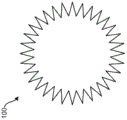
According to yet another example ("example 8") of the medical device of any of examples 1-7, the filament includes a cross-section that is at least one of irregular (non-uniform/non-flat), serrated, star-shaped, and polygonal.
According to an example ("example 9"), a stent comprises: a plurality of filaments configured to form a framework; and a plurality of membranes disposed about each of the plurality of filaments and configured to contain (retain) debris of the plurality of filaments in response to breakage or degradation of the filaments and maintain a structure of the framework.
According to yet another example ("example 10") of a stent relative to example 9, the plurality of filaments are braided to form a scaffold, and the plurality of filaments are absorbable and configured to degrade over time.
According to yet another example ("example 11") of a stent relative to example 10, the plurality of membranes are configured to reduce friction between the plurality of filaments.
According to yet another example ("example 12") with respect to the stent of example 10, at least a portion of the plurality of septums is radiopaque.
According to yet another example ("example 13") of a stent relative to example 10, at least a portion of the plurality of membranes comprises a drug-eluting layer.
According to yet another example ("example 14") with respect to the example stent, the framework includes non-absorbable filaments configured to remain in place after degradation of the plurality of filaments.
According to an example ("example 15"), an implantable medical device includes a structural element formed from one or more absorbable filaments configured to degrade over time into a plurality of debris after implantation, the debris including one or more debris of a first minimum size; and a sheath element at least partially covering the structural element, the sheath element including a membrane and configured to capture and retain one or more debris of a first minimum size during degradation of the one or more absorbable filaments.
According to an example ("example 16"), a method of manufacturing an implantable medical device includes: disposing a plurality of membranes around each of the plurality of absorbable filaments to form covered absorbable filaments, the plurality of membranes configured to contain (retain) debris of the plurality of absorbable filaments in response to breakage or degradation of the plurality of filaments; and disposing the covered absorbable filaments together to form a framework.
According to yet another example ("example 17") of a method further relative to example 16, disposing the covered absorbable filaments together comprises braiding the covered absorbable filaments to form a framework.
According to an example ("example 18"), a method of treating an opening in a patient to reduce the risk of release of particulate degradation products and/or reduce adverse events caused by embolisms in the vasculature due to the degradation products includes delivering a scaffold into the opening at a treatment site, wherein the scaffold includes a plurality of absorbable filaments and a plurality of membranes disposed around each of the plurality of filaments, and the plurality of membranes are configured to contain (retain) debris of the plurality of absorbable filaments within the plurality of membranes in response to breakage or degradation of the plurality of filaments.
According to an example ("example 19"), a method of stabilizing tissue includes: disposing a suture to span an opening in tissue, the suture comprising a filament and a membrane disposed about the filament and configured to contain (retain) debris of the filament in response to rupture or degradation of the filament and maintain a structure of the membrane; and structurally supporting the tissue to promote healing.
According to yet another example ("example 20") further to the method of example 19, the filament includes at least one of a textured, non-linear, patterned outer surface.
According to yet another example ("example 21") of a method further to example 19, the filament includes an eyelet disposed at one or both ends, and further comprising wrapping a suture around itself through the eyelet.
The foregoing examples are merely examples and are not to be construed as limiting or otherwise narrowing the scope of any inventive concept that is otherwise provided by the present disclosure. While multiple examples are disclosed, still other examples will become apparent to those skilled in the art from the following detailed description, which shows and describes illustrative examples of the invention. Accordingly, the drawings and detailed description are to be regarded as illustrative in nature and not as restrictive in nature.
Drawings
The accompanying drawings are included to provide a further understanding of the disclosure, are incorporated in and constitute a part of this specification, illustrate embodiments, and together with the description serve to explain the principles of the disclosure.
FIG. 1 is a diagram of an exemplary filament according to an embodiment; and
FIG. 2 is a diagram of another exemplary filament according to an embodiment;
FIG. 3 is an illustration of an exemplary implantable medical device according to an embodiment;
fig. 4 is an exemplary braid of an exemplary implantable medical device according to an embodiment;
5A-5C are illustrations of exemplary filament cross-sections according to an embodiment;
FIG. 6 is an exemplary filament and an exemplary septum according to an embodiment;
FIG. 7 is another exemplary filament and exemplary septum according to an embodiment;
FIG. 8 is an exemplary filament for use as a suture according to an embodiment;
9A-9C are illustrations of exemplary filaments according to an embodiment;
FIG. 10A is an exemplary filament for use as a suture in a first configuration according to an embodiment;
FIG. 10B is the filament shown in FIG. 10A in a second configuration according to an embodiment; and
FIG. 11 illustrates an exemplary stabilization of debris of an exemplary filament, according to an embodiment.
Detailed Description
Definitions and terms
Those skilled in the art will readily appreciate that aspects of the present invention may be implemented by any number of methods and apparatus configured to perform the intended functions. It should also be noted that the drawings referred to herein are not necessarily drawn to scale and may be exaggerated to illustrate various aspects of the disclosure, and in this regard, the drawings should not be construed as limiting.
This disclosure is not intended to be read in a limiting sense. For example, terms used in the present application should be read broadly in the context that those skilled in the art should ascribe the meaning of such terms.
With respect to imprecise terms, the terms "about" and "approximately (approximately)" may be used interchangeably to refer to a measurement that includes the measurement, and also includes any measurement that is reasonably close to the measurement. As understood and readily determined by one of ordinary skill in the relevant art, measurements that are reasonably close to the measurement deviate from the measurement by a relatively small amount. For example, such deviations may be due to measurement errors or fine adjustments made to optimize performance. The terms "about" and "approximately" can be understood as plus or minus 10% of the stated value if it is determined that one of ordinary skill in the relevant art would not readily determine a value for such a reasonably minor difference.
Description of various embodiments
Various aspects of the present disclosure relate to absorbable filaments (e.g., biodegradable or bioerodible) that include one or more membrane layers. The membrane may be left behind during and after degradation of the absorbable filament. During and after degradation, the septum may hold (contain) debris or chips (or particles) that may absorb the filaments. The septum may reduce the likelihood of emboli release.
Various aspects of the present disclosure relate to medical devices having one or more absorbable filaments configured to form a medical device. Absorbable filaments, which may be struts, fibers, braided fibers, woven fibers, conjugate fibers, or other structural elements, may degrade or dissolve by one or more chemical and/or biological based mechanisms that result in a tissue response suitable for the intended implant application. The membrane or sheath may be disposed with or attached to at least a portion of the one or more filaments. The septum may be configured to structurally reinforce and/or maintain the integrity of the absorbable filament during degradation or rupture. The membrane is designed to allow the degradation process, but not the degradation products to pass through until the degradation products degrade to a size that allows them to pass through the pores in the membrane. The medical device may comprise, for example, a stent or stent graft or other similar device. In some cases, the absorbable filament is configured to structurally reinforce or support a space (e.g., a blood vessel) in which the medical device is implanted.
In some cases, the absorbable filament degrades while the septum promotes healthy tissue ingrowth or regrowth. This tissue attachment ensures fixation within the anatomy, such that the structure provided by the absorbable filament may become unnecessary. In addition, the separator may be completely encapsulated and provide a porous jacket material (porous jacketed material) around the filament or filaments. The membrane surrounding the filaments may include tensile strength and toughness to provide sustained structural integrity while allowing degradation and exchange of fluid or moisture to the filaments through the open pores of the membrane.
Absorbable refers herein to materials that are capable of being absorbed by the body, whether directly by dissolution or indirectly by degrading the implant into smaller components that are then absorbed. The term "absorbable" as used herein also encompasses a variety of alternative terms that have historically been used interchangeably within and across surgical disciplines (but intermittently come out of differentiation). These terms include, for example, absorbable and derivatives thereof, degradable and derivatives thereof, biodegradable and derivatives thereof, resorbable and derivatives thereof, bioabsorbable and derivatives thereof, and bioerodible and derivatives thereof. As used herein, the term "absorbable" may include a variety of degradation mechanisms, including but not limited to corrosion and ester hydrolysis. Other terms relating to absorbency may be further referred to in appendix X4 of ASTM F2902-16.
Further, the filaments discussed herein may comprise monofilaments, which may also be described as individual fibers, strands, wires, rods, beads or other non-rigid, elongated, substantially cylindrical embodiments having a longitudinal dimension that exceeds more than 100 times its cross-section. The monofilaments optionally can be provided with one or more overlay coatings or other surface modifications to provide features not inherent in the underlying base structure.
Fig. 1 is an illustration of an exemplary filament 100 according to an embodiment. The filament 100 together with the septum 102 may form part of a medical device, as discussed in further detail below, or a medical device is used with the filament 100 and septum 102. In some cases, the septum 102 may be disposed about the filament and configured to initially contain (retain) debris (or particles) of the filament 100 and maintain the structure of the septum 102 in response to breakage or degradation of the filament 100. Septum 102 may be coupled or adhered to filament 100 using a medical adhesive.
In some cases, filament 100 is absorbable and is configured to degrade over time. The septum 102 is configured to contain (retain) debris (or particles) of the filament 100 during degradation and absorption into tissue. After filaments 100, which provide a stronger frame than septum 102 without filaments 100, have degraded, septum 102 may be left in place. For example, filament 100 may be a structural component that provides a temporary framework for tissue. The temporary framework provided by the filaments 100 prior to degradation may promote tissue strengthening, tissue regrowth, or growth of healthy tissue. The septum 102 remains in the patient and provides structure, unlike metal frame remnants that can occur with non-degradable implantable devices. In some cases, the filament 100 as a temporary frame structure is configured to provide sufficient outward force and/or pressure to allow the septum 102 to be supported against tissue to maintain contact during an initial period of time in the body (e.g., 30-60 days). This may allow tissue ingrowth, tissue attachment or tissue encapsulation (tissue encapsulation) to initiate and provide early critical anchoring of the filament 100 or a device formed from multiple filaments 100 within the tissue bed. The goal would be for tissue ingrowth, tissue attachment, or tissue encapsulation to completely encapsulate the septum 102 (or device) to maintain its intended shape and position while preventing any embolization of the device.
In some cases, the septum 102 is configured to promote tissue ingrowth, tissue attachment, or tissue encapsulation, while in other cases, the septum 102 is configured to prevent tissue ingrowth. Both of these conditions may be influenced by designing the membrane element to be porous and by controlling the pore size. The porosity of the membrane 102 may control the rate at which the filament 100 degrades. The filament 100 and the membrane 102 may be implanted in a patient to augment or repair unhealthy tissue. Tissue ingrowth into the septum 102 (or tissue attachment or tissue encapsulation) can promote the growth of healthy tissue and restoration of tissue structural integrity. In some cases, unlike metal or semi-metal filaments, degradable filaments 100 allow for initial strengthening of unhealthy tissue with the generally more biocompatible membrane 102 remaining in place. In some cases, there may be regions with different requirements within the same device, and thus a combination of the porosity of the septum 102 (within the same device) may be used to both promote and prevent tissue ingrowth.
In some cases, septum 102 may be configured to enhance the tensile strength of filament 100. In some cases, the tensile strength of the septum itself is stronger than the filaments to which the septum is applied. Such a thin, strong cover facilitates the manufacturing process. The filaments are now strong enough to be woven or braided. The septum 102 may be configured to contain (maintain) byproducts of the degradation process over a period of time. The septum 102 may contain (retain) fragments or debris of the degraded absorbable filament 102, which may reduce the likelihood of emboli release that may result from the release of the debris of the absorbable filament 102 into the bloodstream of the patient. The membrane 102 may contain (hold) or confine the products until their physical or chemical size is reduced to a size that allows them to pass through the pores and/or the resulting membrane/tissue composite. In some cases, the membrane 102 may be configured to maintain the debris from moving away from the treatment site before the debris is reduced to a size small enough to be benign enough to be absorbed by the patient.
In some cases, septum 102 may be absorbable or partially absorbable. If septum 102 is absorbable, the septum may have the same or shorter life as absorbable filament 100. The membrane 102 may enhance/strengthen the tissue coverage over the underlying (underlying) absorbable filament 100. The membrane 102 may be effective to limit or contain (retain) the migration of debris or particles that may emanate from the absorbable filament 100 during degradation or breakage of the absorbable filament 100. Similar to the non-absorbable membrane, the degradable membrane 102 may allow for tissue attachment and/or ingrowth that stabilizes overlying (overlying) tissue so that it may contain (maintain/control) or substantially inhibit migration of debris and particulate matter emitted by the degraded filaments. Preferred are porous absorbable membranes 102 that can maintain strength for longer periods of time than degraded filaments 100 and/or provide the ability to stabilize and strengthen the overlying tissue.
Fig. 2 is an illustration of another exemplary filament 100 according to an embodiment. Filament 100 may include a first septum 102 and a second septum 204. In some cases, septum 102 is disposed about the filament and is configured to contain (retain) debris of filament 100 and maintain the structure of septum 102 in response to breakage or degradation of filament 100.
In some cases, filament 100 is absorbable and is configured to degrade over time. The septum 102 is configured to retain debris of the filament 100 during degradation. The second diaphragm 204 is an additional diaphragm disposed around the (first) diaphragm 102, which has different material properties than the diaphragm.
One or both of the diaphragms 102, 204 may remain in place after the filaments 100, which provide a stronger framework than the diaphragms 102, 204 alone, have degraded. For example, filament 100 may be a structural component that provides a temporary framework for tissue. The temporary framework provided by the filaments 100 prior to degradation may promote tissue strengthening, tissue regrowth, or growth of healthy tissue. In some cases, one of the membranes 102, 204 may degrade as well as the filament 100. The membranes 102, 204 are capable of promoting degradation of the filament 100 at a different rate than only one of the membranes 102, 204. Further, one of the membranes 102, 204 may be a drug-eluting layer.
For example, filament 100 may be an absorbable metal (such as magnesium) and septum 102 may be a degradable polymer, including a degradable polymer containing a therapeutic agent. The membrane 204 may be a non-degradable polymer (e.g., ePTFE). The device may also provide radiopacity and initial strength due to the metal frame of the filament 100 if the filament 100 is formed of a metallic degradable material, or may include radiopacity if the septum 204 is imbibed with a radiopaque material. Both covers can delay the degradation of the metal by inhibiting the bioerosion process. The membrane 102 will begin to degrade and release the therapeutic agent. The membrane 204 will have an engineered porosity that controls therapeutic drug release, containing (retaining) degradation products until they degrade to a size that allows them to pass through the pores and allow tissue ingrowth, tissue attachment, or tissue encapsulation. In some cases, filament 100 may include a hydrophilically treated membrane for improved wetting and chemical diffusion during degradation.
Fig. 3 is an illustration of an exemplary implantable medical device 300 according to an embodiment. Implantable medical device 300 can include one or more absorbable filaments 100. Absorbable filament 100 may be bioerodible, biodegradable, or both (e.g., a combination thereof). Further, absorbable filament 100 may comprise a sheath element at least partially covering one or more absorbable filaments 100. One or more absorbable filaments 100 may form a structural element, and thus, the sheath element may at least partially cover the structural element, as shown in fig. 3. In some cases, the sheath element covers the entire structural element. The sheath element may include a septum 102.
In some cases and as shown in fig. 3, each of the one or more absorbable filaments 100 is individually covered by a septum 102. Further, absorbable filaments 100 may be configured to degrade into a plurality of debris over time after implantation. The plurality of debris may include one or more debris of a first minimum size. Septum 102 is configured to capture and retain one or more debris having a first minimum size during degradation of one or more absorbable filaments 100.
As described above, absorbable (e.g., biodegradable, bioerodible) filament 100 is configured to structurally reinforce or support a space (e.g., a blood vessel) in which medical device 300 is implanted. In some cases, absorbable filament 100 degrades, while septum 102 (e.g., a septum) promotes healthy tissue ingrowth or regrowth, tissue attachment, or tissue encapsulation, such that the structure provided by absorbable filament 100 may become unnecessary.
Further, the sheath element can include at least a portion of the septum 102 having a microstructure (e.g., ePTFE) that promotes tissue ingrowth, tissue attachment, or tissue encapsulation. In some cases, tissue ingrowth may occur in each of the membrane microstructure and macrostructure of absorbable filament 100. In some cases, the medical device 300 may be occluded without a covering (e.g., hydrophobic ePTFE).
As described above, each of the one or more absorbable filaments 100 may be individually covered by a membrane 102. Accordingly, the medical device 300 can include a plurality of septums disposed about each of the plurality of filaments 100 or about a portion of the plurality of filaments. The plurality of septums 102 may be configured to contain (retain) debris of the plurality of filaments 100 and maintain the structure of the medical device 300 in response to the breaking or degradation of the plurality of filaments 100.
In some cases, absorbable filament 100 may be formed into a braided medical device 300, as described in further detail with reference to fig. 4. Filaments (e.g., absorbable or non-absorbable) 100 may be braided to form a scaffold, and absorbable filaments 100 are configured to degrade over time. Further, the membranes 102, 204 may be configured to reduce friction between the plurality of filaments 100. The membrane 102 may be a material having a very low coefficient of friction (e.g., ePTFE). A septum 102 with a low coefficient of friction will allow absorbable filaments 100 of the braid to slide past each other. In some cases, absorbable filaments 100 and septum 102 having a low coefficient of friction (e.g., lower than uncovered) help create a compact and well-deployed device (and may include a smoother surface than uncovered filaments 100). As previously described, the septum 102 may increase the tensile strength and lubricity of the filaments, which aids in many manufacturing processes (e.g., braiding). In some cases, the weave provides a scaffold structure that is flexible and compliant in nature, allowing the device 300 to naturally conform to tissue and anatomical structures. The braided configuration is further balanced with an even number of helically wound and interwoven filaments 100 in multiple directions. The balancing of the braid may allow the device 300 to naturally expand to its intended shape by reducing internal binding twisting or bending forces.
In some cases and as shown, implantable medical device 300 may be a stent that is implanted within a patient's vasculature. In other instances, the filaments 100 may be woven into a closure or other implantable medical device 300 to be implanted within a tissue opening or defect of a patient. In either case, the implantable medical device 300 may form a framework for delivery within an opening at a treatment site. The scaffold includes a plurality of membranes 102 disposed about each of the plurality of absorbable filaments 100. The plurality of absorbable filaments 100 may be degraded by the plurality of membranes 102. During degradation and in response to breakage or degradation of the plurality of filaments 100, debris of the plurality of absorbable filaments 100 is contained (retained) within the plurality of membranes 102. After and during degradation of the plurality of filaments 100, the frame of the device 300 is formed from a plurality of membranes 102 that are left at the treatment site of the patient. Thus, the framework remains within the opening after degradation of the plurality of filaments 100.
The septum 102 promotes healthy tissue ingrowth or regrowth or tissue attachment or tissue encapsulation. Such tissue attachment with septum 102 ensures fixation within the anatomical structure such that the structure provided by absorbable filament 100 may become unnecessary. Septum 102 may have a surface structure that may stabilize absorbable filament 100 such that debris of absorbable filament 100 is restricted from moving from (away from) the treatment site.
In addition, the septum 102 may be completely encapsulated and provide a porous jacket material surrounding the one or more filaments. The membrane 102 surrounding the filaments 102 may include tensile strength and toughness to provide sustained structural integrity while allowing degradation and fluid or moisture exchange to occur through the open pores of the membrane 102 to the filaments 100 (allowing fluid or moisture exchange to the filaments 100 through the open pores of the membrane 102). In some cases, the filament 100, as a temporary scaffold, is configured to provide sufficient outward force and/or pressure to allow the septum 102 to be supported against tissue during an initial period of time in the body (e.g., 30-60 days) and to maintain the scaffold structure of the tissue after the filament 102 degrades.
Debris that holds (retains) and/or constrains the plurality of absorbable filaments 100 reduces the risk of releasing particulate degradation products as compared to an uncovered absorbable filament. In addition, debris that lodges (retains) and/or constrains the plurality of absorbable filaments 100 may reduce the likelihood of migration and potential adverse events caused by thrombosis or the creation of emboli in the vascular system.
In some cases, device 300 (and other devices discussed herein) may be formed from absorbable and non-absorbable filaments 100. In these cases, some of the scaffold of device 300 formed from non-absorbable filament 100 may be left in place. Where device 300 (and other devices discussed herein) include absorbable and non-absorbable filaments 100, the structural integrity of the tissue may be supported in addition to leaving septum 102 in the body by non-absorbable filaments 102 remaining in the body.
Fig. 4 is an exemplary braid of an exemplary implantable medical device 300 according to an embodiment. Medical device 300 may include a framework of absorbable filaments 100, each individually covered with a septum 102. The plurality of membranes 102 are disposed about each of the plurality of filaments and are configured to contain (retain) and/or confine debris of the plurality of filaments 102 in response to a fracture or degradation of the plurality of filaments 102 and maintain a structure of the framework.
In some cases, the filament 102 may be braided as shown in fig. 4. The braided medical device 300 may be self-expanding and/or plastically deformable such that the braid conforms to various shapes for various applications. Additionally, the septum 102 may be disposed about the filaments 102 to form covered absorbable filaments 102 prior to being disposed together. In some cases, covered absorbable filaments 102 may be braided, interwoven, interlocked, or otherwise disposed together to form medical device 300.
In some cases, septum 102 may be wrapped around absorbable filament 102 (wrapped around the absorbable filament). The wrap may act as a continuous strength member or member along the path of the braid or filament that allows the inner absorbable filament 100 to be intentionally weakened or broken to see the initial break point. Further, after or during braiding, the covered absorbable filament 102 may be shaped into the shape of the medical device 300. In some cases, septum(s) 102 may use a heat-setting process to provide reinforcement of filaments 100 and prevent drawn filaments 100 from shrinking and growing in cross-sectional area. This may allow for the use of higher heat-set and potentially improve the crystallization (strength) of the filament 100 while maintaining the smoothness and non-distortion of the braided construction. The setting process can also be carried out using solvents, and also by other means, such as polymer absorption (impregnation) by suitable fluid or thermal setting.
Fig. 5A-C are illustrations of cross-sections of an example filament 100, according to an embodiment. As shown and discussed in detail above, filament 100 may comprise a substantially circular cross-section. In other cases and as shown in fig. 5A-C, filament 100 can include a cross-section that is not substantially circular in cross-section.
For example, filament 100 can be formed or drawn to include a star-shaped cross-section. The star-shaped or polygonal cross-section of filament 100 as shown in fig. 5A-C may increase the surface area of filament 100 as compared to a filament 100 having a substantially circular cross-section. Accordingly, the degradation profile of the filament 100 may be customized based on the cross-section of the filament 100. For example, filament 100 may have a faster degradation curve or rate with a larger surface area. Although the filament 100 shown in fig. 5A-C includes a particular shape, the filament 100 discussed herein may include non-uniform (irregular/uneven/rugged), serrated, or patch sides, or include more or less sides (e.g., triangular, square, pentagonal, hexagonal) than shown in fig. 5A-C. In some cases, a filament 100 as discussed herein may be hollow (e.g., a micro-tube).
Fig. 6 is an exemplary filament 100 and an exemplary septum 102 according to an embodiment. The filament 100 together with the septum 102 may form part of a medical device, as discussed in further detail below, or a medical device is used with the filament 100 and septum 102. In some cases, septum 102 is disposed about filament 100 and is configured to initially contain (retain) debris of filament 100 and maintain the structure of septum 102 in response to breakage or degradation of filament 100. Septum 102 may be coupled or adhered to filament 100 using a medical adhesive. As discussed in detail above, septum 102 may be non-absorbable, and filament 100 may be absorbable.
In some cases, the diaphragm 102 may be compressed in one or more directions (e.g., the "x" direction). The compression of the septum 102 may introduce an out-of-plane (i.e., in the "z" direction) "bend (button) or structure. Such a method is generally disclosed in U.S. patent publication No. 2016/0167291 to zagg et al, in which a separator 102 is applied to a stretchable substrate in a stretched state such that the separator 102 reversibly adheres to the stretched stretchable substrate.
Fig. 7 is another exemplary filament 100 and an exemplary septum 102 according to an embodiment. The filament 100 together with the septum 102 may form part of a medical device, as discussed in further detail below, or a medical device is used with the filament 100 and septum 102. In some cases, septum 102 is disposed about filament 100 and is configured to initially retain debris of filament 100 and maintain the structure of septum 102 in response to a rupture or degradation of filament 100. Septum 102 may be coupled or adhered to filament 100 using a medical adhesive. As discussed in detail above, septum 102 may be non-absorbable, while filament 100 may be absorbable.
As shown, the septum 102 may be wrapped around (wrapped around) the filament 100. In some cases, septum 102 is helically wrapped around filament 100. In these cases, the diaphragm 102 may partially overlap adjacent windings. Separator 102 may be adhered to filament 100 and/or overlapping portions of adjacent windings of separator 102. Septum 102 may be adhered to filament 100 and/or to itself using an adhesive, such as Fluorinated Ethylene Propylene (FEP).
In some cases, filament 100 may be set to a desired shape. The shape set filaments 100 may be helically wound, woven together to form a pattern, or include additional shapes for desired applications (e.g., needleless sutures, staple replacements for soft tissue repair).
Fig. 8 is an exemplary filament 100 for use as a suture according to an embodiment. As shown in fig. 8, the filament 100 (wrapped/wound with the septum 102) may be used for tissue 820 repair. As shown, the filament 100 (wrapped/wrapped with the membrane 102) may be used as a suture to repair tissue 820. The filament 100 and the septum 102 may be disposed across an opening in the tissue 820. Prior to degradation, filament 100 may structurally support tissue 820 during healing. As tissue 850 heals, filament 100 degrades and becomes more compliant. Less structure is required as tissue 850 heals. Filaments 100 degraded in this manner may promote faster healing of tissue 820.
In some cases, filament 100 may be set to a desired shape. The shape set filaments 100 may be helically wound, woven together to form a pattern, or include additional shapes for desired applications (e.g., needleless sutures, staple replacements for soft tissue repair).
Fig. 9A-C are illustrations of an exemplary filament 100 according to an embodiment. As shown, the filament 100 may include a textured, non-linear (non-linear) or patterned outer surface. For example, as shown in fig. 9A, filament 100 includes a wave-like structure. In some cases and as shown in fig. 9B-C, filament 100 can include one or more protrusions 930. As shown, the protrusions 930 may be serrated (e.g., fig. 9B), semi-circular (fig. 9C), disposed on one circumferential side of the filament 100, or disposed on both circumferential sides of the filament 100. The protrusions 930 may facilitate knot formation and knot retention when using the filament 100, for example, as a suture or thread. Protrusions 930 may enhance the friction of filament 100 to facilitate tying of the knot. Further, the protrusions 930 may be formed in the filament 100 and/or a septum (not shown) disposed around the filament 100.
Fig. 10A-B illustrate an exemplary filament 100 used as a suture in a first configuration (where the filament 100 is not knotted) and in a second configuration (where the filament 100 is knotted) according to an embodiment. As shown in fig. 10A, filament 100 includes protrusions 930. Filament 100 may also include eyelet 1040 disposed at one or both ends of filament 100. As shown in fig. 10B, filament 100 may be wrapped around itself (wrapped around itself) through eyelet 1040. Protrusions 930 may frictionally engage or capture eyelet 1040 to facilitate knot formation in filament 100.
Fig. 11 illustrates an exemplary stabilization of debris for an exemplary filament 100, according to an embodiment. As shown in fig. 11, the septum 102 may be formed from truss-structured (e.g., woven, knitted, non-woven, absorbable, or non-absorbable) components 1122, 1124. As filament 100 degrades, members 1122, 1124 can house (retain) structural members and debris. In some cases, members 1122, 1124 may also include porosity to stabilize debris and/or particles that may be generated as a result of degradation of filament 100 and/or membrane 102. In some cases, for example, the underlying component (underlying component) 1122 may degrade, and the overlying component 1124 may stabilize the underlying component 1122. In this manner, the septum 102 may also degrade and promote stabilization, as described in detail above.
Upon degradation, the underlying component (underlying component) 1122 can stabilize the filament 100 and overlying (overlying) component 1124. The physical reduction of the overall structure may facilitate degradation of portions of filament 100 and septum 102 while integrating septum 102 into tissue. The overlying component (covering component) 1124 may degrade and the underlying component 1122 may be integrated into the tissue. A degraded overlying component (covering component) 1124 (or only the filament 100 degrades, while the membrane 102 is not overall degradable) may promote continued tissue coverage and maturation. Overlying component 1124 and underlying component 1122 may form a continuous diaphragm 102, or overlying component 1124 and underlying component 1122 may be separate structures. Where the overlying component 1124 and the underlying component 1122 are separate structures, the overlying component 1124 may be the diaphragm 1202 and the underlying component 1122 may be the resorbable layer.
Examples of absorbable filaments include, but are not limited to, absorbable metals such as magnesium and magnesium alloys, ferrous materials such as iron, aluminum, and aluminum alloys, and other similar materials.
Examples of absorbable polymers that may be used in the filament or membrane component include, but are not limited to, polymers, copolymers (including terpolymers), and blends that may include, in whole or in part, polyesteramides, Polyhydroxyalkanoates (PHAs), poly (3-hydroxyalkanoates), such as poly (3-hydroxypropionate), poly (3-hydroxybutyrate), poly (3-hydroxyvalerate), poly (3-hydroxyhexanoate), poly (3-hydroxyheptanoate), and poly (3-hydroxyoctanoate), poly (4-hydroxyalkanoates), such as poly (4-hydroxybutyrate), poly (4-hydroxyvalerate), poly (4-hydroxyhexanoate), poly (4-hydroxyheptanoate), poly (4-hydroxyoctanoate), poly (L-lactide-co-glycolide), and copolymer variants, Poly (D, L-lactide), poly (L-lactide), polyglycolide, poly (D, L-lactide-co-glycolide), poly (L-lactide-co-glycolide), polycaprolactone, poly (lactide-co-caprolactone), poly (glycolide-caprolactone), poly (dioxanone), poly (orthoester), poly (trimethylene carbonate), polyphosphazene, poly (anhydride), poly (tyrosine carbonate) and its derivatives, poly (tyrosine ester) and its derivatives, poly (iminocarbonate), poly (lactic acid-trimethylene carbonate), poly (glycolic acid-trimethylene carbonate), polyphosphate urethane, poly (amino acid), poly (ethylene glycol) (PEG), copoly (ether ester) (e.g., PEO/PLA), poly (ethylene glycol) (co- (trimethylene glycol-caprolactone), poly (trimethylene glycol) (poly (trimethylene glycol-co-caprolactone), poly (trimethylene glycol) (e.g., poly (ethylene glycol/PLA), poly (trimethylene glycol-caprolactone), poly (trimethylene glycol, poly (trimethylene glycol), poly (trimethylene glycol, or poly (trimethylene glycol), poly (trimethylene glycol, or poly (trimethylene glycol) or poly (trimethylene glycol, or poly (trimethylene glycol) or poly (trimethylene glycol, or poly (trimethylene glycol) or poly (trimethylene glycol, or poly (trimethylene glycol) or poly (trimethylene glycol, polyalkylene oxides such as poly (ethylene oxide), poly (propylene oxide), poly (ether esters), polyalkylene oxalates, poly (aspirin), biomolecules such as collagen, chitosan, alginates, fibrin, fibrinogen, cellulose, starch, collagen, dextran, dextrin, fragments and derivatives of hyaluronic acid, heparin, fragments and derivatives of heparin, glycosaminoglycans (GAG), GAG derivatives, polysaccharides, elastin, chitosan, alginate, or combinations thereof.
Examples of synthetic polymers suitable as separator materials (which may be used as separators) include, but are not limited to, nylons, polyacrylamides, polycarbonates, polyoxymethylenes, polymethylmethacrylate, polytetrafluoroethylene, polychlorotrifluoroethylene, polyvinyl chloride, polyurethane, elastomeric silicone polymers, polyethylene, polyurethane, polyglycolic acids, polyesters, polyamides, and mixtures, blends, and copolymers thereof. In one embodiment, the membrane is made of polyester(s), such as polyethylene terephthalate, including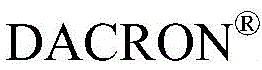 And
And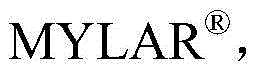 and polyaramides, such as
 And polyfluorocarbons such as hexafluoropropylene with and without copolymerization: (
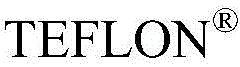 Or
Or ) Polytetrafluoroethylene (PTFE). At a certain pointIn some cases, the membrane comprises an expanded fluorocarbon polymer (particularly ePTFE) material. Included among such preferred fluoropolymers are Polytetrafluoroethylene (PTFE), Fluorinated Ethylene Propylene (FEP), copolymers of Tetrafluoroethylene (TFE) and perfluoro (propyl vinyl ether) (PFA), homopolymers of Polychlorotrifluoroethylene (PCTFE), and copolymers thereof with TFE, Ethylene Chlorotrifluoroethylene (ECTFE), copolymers of ethylene-tetrafluoroethylene (ETFE), polyvinylidene fluoride (PVDF), and polyvinyl fluoride (PVF). ePTFE is particularly preferred because of its wide use in vascular prostheses. In certain embodiments, the septum comprises a combination of the materials listed above. In some cases, the septum is substantially impermeable to bodily fluids. The substantially impermeable membrane may be made of a material that is substantially impermeable to bodily fluids, or may be constructed of a permeable material that is treated or manufactured (e.g., by laminating different types of materials described above or known in the art) to be substantially impermeable to bodily fluids.
Other examples of separator materials include, but are not limited to, vinylidene fluoride/Hexafluoropropylene (HFP), Tetrafluoroethylene (TFE), vinylidene fluoride, 1-hydropentafluoropropene, perfluoro (methyl vinyl ether), Chlorotrifluoroethylene (CTFE), pentafluoropropene, trifluoroethylene, hexafluoroacetone, hexafluoroisobutylene, fluorinated poly (ethylene-co-propylene) (FPEP), poly (hexafluoropropylene) (PHFP), poly (chlorotrifluoroethylene) (PCTFE), poly (vinylidene fluoride) (PVDF), poly (vinylidene fluoride-co-tetrafluoroethylene) (PVDF-TFE), poly (vinylidene fluoride-co-hexafluoropropylene) (PVDF-HFP), poly (tetrafluoroethylene-co-hexafluoropropylene) (PTFE-HFP), poly (tetrafluoroethylene-co-vinyl alcohol) (PTFE-VAL), Poly (tetrafluoroethylene-co-vinyl acetate) (PTFE-VAC), poly (tetrafluoroethylene-co-propylene) (PTFEP), poly (hexafluoropropylene-co-vinyl alcohol) (PHFP-VAL), poly (ethylene-co-tetrafluoroethylene) (PETFE), poly (ethylene-co-hexafluoropropylene) (PEHFP), poly (vinylidene fluoride-co-chlorotrifluoroethylene-ethylene) (PVDF-CTFE), and combinations thereof, as well as other polymers and copolymers described in U.S. publication 2004/0063805, the entire contents of which are incorporated herein by reference for all purposes. Other polyfluoropolymers include Tetrafluoroethylene (TFE)/perfluoroalkyl vinyl ether (PAVE). PAVE may be perfluoromethyl vinyl ether (PMVE), perfluoroethyl vinyl ether (PEVE) or perfluoropropyl vinyl ether (PPVE). Other polymers and copolymers include: polylactide, polycaprolactone-glycolide, polyorthoester, polyanhydride; a polyamino acid; a polysaccharide; polyphosphazene; poly (ether-ester) copolymers such as PEO-PLLA or blends thereof, polydimethylsiloxane; poly (ethylene-vinyl acetate); acrylate-based polymers or copolymers such as poly (hydroxyethyl methyl methacrylate), polyvinylpyrrolidone; fluorinated polymers such as polytetrafluoroethylene; cellulose esters and any polymers and copolymers.
The invention of the present application has been described above generally and with reference to specific embodiments. It will be apparent to those skilled in the art that various modifications and changes can be made to the embodiments without departing from the scope of the disclosure. Thus, it is intended that the embodiments cover the modifications and variations of this invention provided they come within the scope of the appended claims and their equivalents.
Claims (21)
Priority Applications (1)
| Application Number | Priority Date | Filing Date | Title |
|---|---|---|---|
| CN202510308311.2A CN120131255A (en) | 2019-01-18 | 2020-01-17 | Bioresorbable filament medical devices |
Applications Claiming Priority (3)
| Application Number | Priority Date | Filing Date | Title |
|---|---|---|---|
| US201962794387P | 2019-01-18 | 2019-01-18 | |
| US62/794,387 | 2019-01-18 | ||
| PCT/US2020/014002 WO2020150558A1 (en) | 2019-01-18 | 2020-01-17 | Bioabsorbable filament medical devices |
Related Child Applications (1)
| Application Number | Title | Priority Date | Filing Date |
|---|---|---|---|
| CN202510308311.2A Division CN120131255A (en) | 2019-01-18 | 2020-01-17 | Bioresorbable filament medical devices |
Publications (2)
| Publication Number | Publication Date |
|---|---|
| CN113347944A true CN113347944A (en) | 2021-09-03 |
| CN113347944B CN113347944B (en) | 2025-04-08 |
Family
ID=69593785
Family Applications (2)
| Application Number | Title | Priority Date | Filing Date |
|---|---|---|---|
| CN202510308311.2A Pending CN120131255A (en) | 2019-01-18 | 2020-01-17 | Bioresorbable filament medical devices |
| CN202080009642.1A Active CN113347944B (en) | 2019-01-18 | 2020-01-17 | Bioresorbable filament medical devices |
Family Applications Before (1)
| Application Number | Title | Priority Date | Filing Date |
|---|---|---|---|
| CN202510308311.2A Pending CN120131255A (en) | 2019-01-18 | 2020-01-17 | Bioresorbable filament medical devices |
Country Status (7)
| Country | Link |
|---|---|
| US (1) | US20200229953A1 (en) |
| EP (1) | EP3911271A1 (en) |
| JP (2) | JP7551625B2 (en) |
| CN (2) | CN120131255A (en) |
| AU (2) | AU2020209921B2 (en) |
| CA (2) | CA3249622A1 (en) |
| WO (1) | WO2020150558A1 (en) |
Families Citing this family (4)
| Publication number | Priority date | Publication date | Assignee | Title |
|---|---|---|---|---|
| CN120131255A (en) * | 2019-01-18 | 2025-06-13 | W.L.戈尔及同仁股份有限公司 | Bioresorbable filament medical devices |
| WO2020150557A1 (en) | 2019-01-18 | 2020-07-23 | W. L. Gore & Associates, Inc. | Bioabsorbable medical devices |
| US20220211984A1 (en) * | 2021-01-02 | 2022-07-07 | Bolanle Asiyanbola | Device to Reduce and Redirect Leaks |
| DE102022103887A1 (en) * | 2022-02-18 | 2023-08-24 | Stental Gmbh | Anchoring system for vascular implants |
Citations (16)
| Publication number | Priority date | Publication date | Assignee | Title |
|---|---|---|---|---|
| US20020165601A1 (en) * | 2001-05-04 | 2002-11-07 | Clerc Claude O. | Bioabsorbable stent-graft and covered stent |
| US20030018378A1 (en) * | 2001-07-19 | 2003-01-23 | The Cleveland Clinic Foundation | Endovascular prosthesis having a layer of biological tissue |
| US20050070930A1 (en) * | 2003-09-30 | 2005-03-31 | Gene W. Kammerer | Implantable surgical mesh |
| US20060193892A1 (en) * | 2001-10-26 | 2006-08-31 | Icon Medical Corp. | Polymer biodegradable medical device |
| US20080051866A1 (en) * | 2003-02-26 | 2008-02-28 | Chao Chin Chen | Drug delivery devices and methods |
| CN101257860A (en) * | 2005-04-05 | 2008-09-03 | 万能医药公司 | Degradable Implantable Medical Devices |
| CN101309653A (en) * | 2005-11-15 | 2008-11-19 | 奥巴斯尼茨医学公司 | Progenitor endothelial cell capturing drug eluting implantable medical device |
| CN102014978A (en) * | 2008-03-20 | 2011-04-13 | 麦德托尼克瓦斯科尔勒公司 | Controlled degradation of magnesium stents |
| US20120071962A1 (en) * | 2008-06-12 | 2012-03-22 | Elixir Medical Corporation | Intravascular stent |
| CN102858280A (en) * | 2010-04-23 | 2013-01-02 | 美敦力瓦斯科尔勒公司 | Biodegradable stent with non-biodegradable ends and mechanism for increased stent hoop strength |
| US20130184808A1 (en) * | 2012-01-16 | 2013-07-18 | Merit Medical Systems, Inc. | Rotational spun material covered medical appliances and methods of manufacture |
| US20130236498A1 (en) * | 2012-03-09 | 2013-09-12 | Eric K. Mangiardi | Biodegradable supporting device |
| CN103313681A (en) * | 2011-01-14 | 2013-09-18 | W.L.戈尔及同仁股份有限公司 | bracket |
| CN105188783A (en) * | 2013-03-14 | 2015-12-23 | 伊西康公司 | Randomly uniform three dimensional tissue scaffold of absorbable and non-absorbable materials |
| WO2017223526A1 (en) * | 2016-06-23 | 2017-12-28 | Poly-Med, Inc. | Medical implants having managed biodegradation |
| US20180125630A1 (en) * | 2016-11-09 | 2018-05-10 | Boston Scientific Scimed, Inc. | Stent including anti-migration capabilities |
Family Cites Families (5)
| Publication number | Priority date | Publication date | Assignee | Title |
|---|---|---|---|---|
| US20040063805A1 (en) | 2002-09-19 | 2004-04-01 | Pacetti Stephen D. | Coatings for implantable medical devices and methods for fabrication thereof |
| CA3010828A1 (en) * | 2008-01-17 | 2009-07-23 | Boston Scientific Scimed, Inc. | Stent with anti-migration feature |
| EP2839949B1 (en) | 2013-08-23 | 2016-10-12 | W.L. Gore & Associates GmbH | Process for the production of a structured film |
| CN105744912B (en) * | 2013-09-19 | 2019-01-01 | 巴塞尔大学医院 | artificial vascular graft |
| CN120131255A (en) * | 2019-01-18 | 2025-06-13 | W.L.戈尔及同仁股份有限公司 | Bioresorbable filament medical devices |
-
2020
- 2020-01-17 CN CN202510308311.2A patent/CN120131255A/en active Pending
- 2020-01-17 CA CA3249622A patent/CA3249622A1/en active Pending
- 2020-01-17 AU AU2020209921A patent/AU2020209921B2/en active Active
- 2020-01-17 EP EP20705845.4A patent/EP3911271A1/en active Pending
- 2020-01-17 CN CN202080009642.1A patent/CN113347944B/en active Active
- 2020-01-17 CA CA3125987A patent/CA3125987C/en active Active
- 2020-01-17 JP JP2021541473A patent/JP7551625B2/en active Active
- 2020-01-17 WO PCT/US2020/014002 patent/WO2020150558A1/en not_active Ceased
- 2020-01-17 US US16/745,834 patent/US20200229953A1/en active Pending
-
2023
- 2023-12-06 AU AU2023278054A patent/AU2023278054B2/en active Active
-
2024
- 2024-09-04 JP JP2024152062A patent/JP2024161205A/en active Pending
Patent Citations (16)
| Publication number | Priority date | Publication date | Assignee | Title |
|---|---|---|---|---|
| US20020165601A1 (en) * | 2001-05-04 | 2002-11-07 | Clerc Claude O. | Bioabsorbable stent-graft and covered stent |
| US20030018378A1 (en) * | 2001-07-19 | 2003-01-23 | The Cleveland Clinic Foundation | Endovascular prosthesis having a layer of biological tissue |
| US20060193892A1 (en) * | 2001-10-26 | 2006-08-31 | Icon Medical Corp. | Polymer biodegradable medical device |
| US20080051866A1 (en) * | 2003-02-26 | 2008-02-28 | Chao Chin Chen | Drug delivery devices and methods |
| US20050070930A1 (en) * | 2003-09-30 | 2005-03-31 | Gene W. Kammerer | Implantable surgical mesh |
| CN101257860A (en) * | 2005-04-05 | 2008-09-03 | 万能医药公司 | Degradable Implantable Medical Devices |
| CN101309653A (en) * | 2005-11-15 | 2008-11-19 | 奥巴斯尼茨医学公司 | Progenitor endothelial cell capturing drug eluting implantable medical device |
| CN102014978A (en) * | 2008-03-20 | 2011-04-13 | 麦德托尼克瓦斯科尔勒公司 | Controlled degradation of magnesium stents |
| US20120071962A1 (en) * | 2008-06-12 | 2012-03-22 | Elixir Medical Corporation | Intravascular stent |
| CN102858280A (en) * | 2010-04-23 | 2013-01-02 | 美敦力瓦斯科尔勒公司 | Biodegradable stent with non-biodegradable ends and mechanism for increased stent hoop strength |
| CN103313681A (en) * | 2011-01-14 | 2013-09-18 | W.L.戈尔及同仁股份有限公司 | bracket |
| US20130184808A1 (en) * | 2012-01-16 | 2013-07-18 | Merit Medical Systems, Inc. | Rotational spun material covered medical appliances and methods of manufacture |
| US20130236498A1 (en) * | 2012-03-09 | 2013-09-12 | Eric K. Mangiardi | Biodegradable supporting device |
| CN105188783A (en) * | 2013-03-14 | 2015-12-23 | 伊西康公司 | Randomly uniform three dimensional tissue scaffold of absorbable and non-absorbable materials |
| WO2017223526A1 (en) * | 2016-06-23 | 2017-12-28 | Poly-Med, Inc. | Medical implants having managed biodegradation |
| US20180125630A1 (en) * | 2016-11-09 | 2018-05-10 | Boston Scientific Scimed, Inc. | Stent including anti-migration capabilities |
Also Published As
| Publication number | Publication date |
|---|---|
| CA3125987A1 (en) | 2020-07-23 |
| CA3125987C (en) | 2025-07-08 |
| AU2020209921B2 (en) | 2023-09-07 |
| EP3911271A1 (en) | 2021-11-24 |
| AU2023278054B2 (en) | 2025-09-04 |
| WO2020150558A1 (en) | 2020-07-23 |
| US20200229953A1 (en) | 2020-07-23 |
| JP2022517421A (en) | 2022-03-08 |
| CN113347944B (en) | 2025-04-08 |
| AU2020209921A1 (en) | 2021-08-19 |
| CA3249622A1 (en) | 2025-06-17 |
| AU2023278054A1 (en) | 2024-01-04 |
| JP2024161205A (en) | 2024-11-15 |
| JP7551625B2 (en) | 2024-09-17 |
| CN120131255A (en) | 2025-06-13 |
Similar Documents
| Publication | Publication Date | Title |
|---|---|---|
| AU2023200662B2 (en) | Bioabsorbable medical devices | |
| AU2023278054B2 (en) | Bioabsorbable filament medical devices | |
| KR101903952B1 (en) | Absorbable vascular filter | |
| JP5693475B2 (en) | Stent modified with a material comprising amnion tissue and corresponding method | |
| EP3171786B1 (en) | Devices for treating heart failure | |
| US20130226222A1 (en) | Absorbable Vascular Filter | |
| CA3126019C (en) | Bioabsorbable medical devices |
Legal Events
| Date | Code | Title | Description |
|---|---|---|---|
| PB01 | Publication | ||
| PB01 | Publication | ||
| SE01 | Entry into force of request for substantive examination | ||
| SE01 | Entry into force of request for substantive examination | ||
| GR01 | Patent grant | ||
| GR01 | Patent grant |