CN113316635A - Engineered DNA polymerase variants - Google Patents
Engineered DNA polymerase variants Download PDFInfo
- Publication number
- CN113316635A CN113316635A CN201980087146.5A CN201980087146A CN113316635A CN 113316635 A CN113316635 A CN 113316635A CN 201980087146 A CN201980087146 A CN 201980087146A CN 113316635 A CN113316635 A CN 113316635A
- Authority
- CN
- China
- Prior art keywords
- dna polymerase
- amino acid
- substitution
- sequence
- engineered
- Prior art date
- Legal status (The legal status is an assumption and is not a legal conclusion. Google has not performed a legal analysis and makes no representation as to the accuracy of the status listed.)
- Pending
Links
Images


Classifications
-
- C—CHEMISTRY; METALLURGY
- C12—BIOCHEMISTRY; BEER; SPIRITS; WINE; VINEGAR; MICROBIOLOGY; ENZYMOLOGY; MUTATION OR GENETIC ENGINEERING
- C12N—MICROORGANISMS OR ENZYMES; COMPOSITIONS THEREOF; PROPAGATING, PRESERVING, OR MAINTAINING MICROORGANISMS; MUTATION OR GENETIC ENGINEERING; CULTURE MEDIA
- C12N9/00—Enzymes; Proenzymes; Compositions thereof; Processes for preparing, activating, inhibiting, separating or purifying enzymes
- C12N9/10—Transferases (2.)
- C12N9/12—Transferases (2.) transferring phosphorus containing groups, e.g. kinases (2.7)
- C12N9/1241—Nucleotidyltransferases (2.7.7)
- C12N9/1252—DNA-directed DNA polymerase (2.7.7.7), i.e. DNA replicase
-
- C—CHEMISTRY; METALLURGY
- C12—BIOCHEMISTRY; BEER; SPIRITS; WINE; VINEGAR; MICROBIOLOGY; ENZYMOLOGY; MUTATION OR GENETIC ENGINEERING
- C12N—MICROORGANISMS OR ENZYMES; COMPOSITIONS THEREOF; PROPAGATING, PRESERVING, OR MAINTAINING MICROORGANISMS; MUTATION OR GENETIC ENGINEERING; CULTURE MEDIA
- C12N15/00—Mutation or genetic engineering; DNA or RNA concerning genetic engineering, vectors, e.g. plasmids, or their isolation, preparation or purification; Use of hosts therefor
- C12N15/09—Recombinant DNA-technology
- C12N15/11—DNA or RNA fragments; Modified forms thereof; Non-coding nucleic acids having a biological activity
- C12N15/52—Genes encoding for enzymes or proenzymes
-
- C—CHEMISTRY; METALLURGY
- C12—BIOCHEMISTRY; BEER; SPIRITS; WINE; VINEGAR; MICROBIOLOGY; ENZYMOLOGY; MUTATION OR GENETIC ENGINEERING
- C12Q—MEASURING OR TESTING PROCESSES INVOLVING ENZYMES, NUCLEIC ACIDS OR MICROORGANISMS; COMPOSITIONS OR TEST PAPERS THEREFOR; PROCESSES OF PREPARING SUCH COMPOSITIONS; CONDITION-RESPONSIVE CONTROL IN MICROBIOLOGICAL OR ENZYMOLOGICAL PROCESSES
- C12Q1/00—Measuring or testing processes involving enzymes, nucleic acids or microorganisms; Compositions therefor; Processes of preparing such compositions
- C12Q1/48—Measuring or testing processes involving enzymes, nucleic acids or microorganisms; Compositions therefor; Processes of preparing such compositions involving transferase
-
- C—CHEMISTRY; METALLURGY
- C12—BIOCHEMISTRY; BEER; SPIRITS; WINE; VINEGAR; MICROBIOLOGY; ENZYMOLOGY; MUTATION OR GENETIC ENGINEERING
- C12Q—MEASURING OR TESTING PROCESSES INVOLVING ENZYMES, NUCLEIC ACIDS OR MICROORGANISMS; COMPOSITIONS OR TEST PAPERS THEREFOR; PROCESSES OF PREPARING SUCH COMPOSITIONS; CONDITION-RESPONSIVE CONTROL IN MICROBIOLOGICAL OR ENZYMOLOGICAL PROCESSES
- C12Q1/00—Measuring or testing processes involving enzymes, nucleic acids or microorganisms; Compositions therefor; Processes of preparing such compositions
- C12Q1/68—Measuring or testing processes involving enzymes, nucleic acids or microorganisms; Compositions therefor; Processes of preparing such compositions involving nucleic acids
- C12Q1/6897—Measuring or testing processes involving enzymes, nucleic acids or microorganisms; Compositions therefor; Processes of preparing such compositions involving nucleic acids involving reporter genes operably linked to promoters
-
- C—CHEMISTRY; METALLURGY
- C12—BIOCHEMISTRY; BEER; SPIRITS; WINE; VINEGAR; MICROBIOLOGY; ENZYMOLOGY; MUTATION OR GENETIC ENGINEERING
- C12Y—ENZYMES
- C12Y207/00—Transferases transferring phosphorus-containing groups (2.7)
- C12Y207/07—Nucleotidyltransferases (2.7.7)
- C12Y207/07007—DNA-directed DNA polymerase (2.7.7.7), i.e. DNA replicase
-
- C—CHEMISTRY; METALLURGY
- C12—BIOCHEMISTRY; BEER; SPIRITS; WINE; VINEGAR; MICROBIOLOGY; ENZYMOLOGY; MUTATION OR GENETIC ENGINEERING
- C12Q—MEASURING OR TESTING PROCESSES INVOLVING ENZYMES, NUCLEIC ACIDS OR MICROORGANISMS; COMPOSITIONS OR TEST PAPERS THEREFOR; PROCESSES OF PREPARING SUCH COMPOSITIONS; CONDITION-RESPONSIVE CONTROL IN MICROBIOLOGICAL OR ENZYMOLOGICAL PROCESSES
- C12Q2521/00—Reaction characterised by the enzymatic activity
- C12Q2521/10—Nucleotidyl transfering
- C12Q2521/101—DNA polymerase
-
- C—CHEMISTRY; METALLURGY
- C12—BIOCHEMISTRY; BEER; SPIRITS; WINE; VINEGAR; MICROBIOLOGY; ENZYMOLOGY; MUTATION OR GENETIC ENGINEERING
- C12Q—MEASURING OR TESTING PROCESSES INVOLVING ENZYMES, NUCLEIC ACIDS OR MICROORGANISMS; COMPOSITIONS OR TEST PAPERS THEREFOR; PROCESSES OF PREPARING SUCH COMPOSITIONS; CONDITION-RESPONSIVE CONTROL IN MICROBIOLOGICAL OR ENZYMOLOGICAL PROCESSES
- C12Q2531/00—Reactions of nucleic acids characterised by
- C12Q2531/10—Reactions of nucleic acids characterised by the purpose being amplify/increase the copy number of target nucleic acid
- C12Q2531/113—PCR
-
- C—CHEMISTRY; METALLURGY
- C12—BIOCHEMISTRY; BEER; SPIRITS; WINE; VINEGAR; MICROBIOLOGY; ENZYMOLOGY; MUTATION OR GENETIC ENGINEERING
- C12Q—MEASURING OR TESTING PROCESSES INVOLVING ENZYMES, NUCLEIC ACIDS OR MICROORGANISMS; COMPOSITIONS OR TEST PAPERS THEREFOR; PROCESSES OF PREPARING SUCH COMPOSITIONS; CONDITION-RESPONSIVE CONTROL IN MICROBIOLOGICAL OR ENZYMOLOGICAL PROCESSES
- C12Q2563/00—Nucleic acid detection characterized by the use of physical, structural and functional properties
- C12Q2563/107—Nucleic acid detection characterized by the use of physical, structural and functional properties fluorescence
-
- G—PHYSICS
- G01—MEASURING; TESTING
- G01N—INVESTIGATING OR ANALYSING MATERIALS BY DETERMINING THEIR CHEMICAL OR PHYSICAL PROPERTIES
- G01N2333/00—Assays involving biological materials from specific organisms or of a specific nature
- G01N2333/90—Enzymes; Proenzymes
- G01N2333/91—Transferases (2.)
- G01N2333/912—Transferases (2.) transferring phosphorus containing groups, e.g. kinases (2.7)
- G01N2333/91205—Phosphotransferases in general
- G01N2333/91245—Nucleotidyltransferases (2.7.7)
- G01N2333/9125—Nucleotidyltransferases (2.7.7) with a definite EC number (2.7.7.-)
- G01N2333/9126—DNA-directed DNA polymerase (2.7.7.7)
Landscapes
- Health & Medical Sciences (AREA)
- Life Sciences & Earth Sciences (AREA)
- Chemical & Material Sciences (AREA)
- Organic Chemistry (AREA)
- Genetics & Genomics (AREA)
- Engineering & Computer Science (AREA)
- Wood Science & Technology (AREA)
- Zoology (AREA)
- Molecular Biology (AREA)
- Bioinformatics & Cheminformatics (AREA)
- General Engineering & Computer Science (AREA)
- General Health & Medical Sciences (AREA)
- Biotechnology (AREA)
- Biochemistry (AREA)
- Biomedical Technology (AREA)
- Microbiology (AREA)
- Proteomics, Peptides & Aminoacids (AREA)
- Biophysics (AREA)
- Physics & Mathematics (AREA)
- Medicinal Chemistry (AREA)
- Analytical Chemistry (AREA)
- Immunology (AREA)
- Plant Pathology (AREA)
- Enzymes And Modification Thereof (AREA)
- Micro-Organisms Or Cultivation Processes Thereof (AREA)
- Measuring Or Testing Involving Enzymes Or Micro-Organisms (AREA)
Abstract
本发明提供了工程化DNA聚合酶多肽及其组合物、以及编码工程化DNA聚合酶多肽的多核苷酸。本发明还提供了使用包含工程化DNA聚合酶多肽的组合物用于诊断和其他目的的方法。

The present invention provides engineered DNA polymerase polypeptides and compositions thereof, and polynucleotides encoding the engineered DNA polymerase polypeptides. The present invention also provides methods of using compositions comprising engineered DNA polymerase polypeptides for diagnostic and other purposes.
Description
This application claims priority from U.S. provisional patent application serial No. 62/752,215, filed on 29/10/2018, which is incorporated by reference in its entirety for all purposes.
References to sequence lists, tables, or computer programs
The sequence listing concurrently filed under the file name CX9-181WO2_ st25.txt in Computer Readable Form (CRF) over the EFS-Web under 37c.f.r. § 1.821 is hereby incorporated by reference. An electronic copy of the sequence listing was created in 2019 on day 10 and 28 with a file size of 5,361 kilobytes.
Technical Field
The invention provides engineered DNA polymerase polypeptides, compositions thereof, and polynucleotides encoding the engineered DNA polymerase polypeptides. The invention also provides methods of using compositions comprising engineered DNA polymerase polypeptides for diagnostic and other purposes.
Background
A DNA polymerase is an enzyme that synthesizes DNA from deoxyribonucleotides. These enzymes are essential for DNA replication. DNA polymerases are of a wide variety of types and generally fall into 7 families, namely A, B, C, D, X, Y and RT. These families have different properties and are found in different types of organisms. For example, group a polymerases are replication and repair polymerases found in both eukaryotes and prokaryotes (examples include T7 DNA polymerase and e.coli (e.coli) polI). Group B polymerases are also replication and repair enzymes found in eukaryotes and prokaryotes (e.g., pol II, pol B, etc.). Group C and group D comprise the replicative polymerases found in prokaryotes and Euryarchaeota, respectively (group C polymerases include pol III, but group D polymerases are not well characterized). X, Y and group RT polymerases are replication and repair enzymes found in eukaryotes (group X), eukaryotes and prokaryotes (group Y), as well as viruses, retroviruses, and eukaryotes (group RT). Examples of group X polymerases include pol β, while group Y polymerases include pol IV and pol V, and group RT polymerases include polymerases from hepatitis B viruses. Some of these polymerases, particularly those obtained from thermophilic organisms, have found great utility in a variety of in vitro methods, including but not limited to Polymerase Chain Reaction (PCR). The availability of thermophilic polymerases enables the automation of PCR. Therefore, these are very important enzymes in applications where PCR can be used. Although many enzymes are commercially available (e.g., Taq and many others), there remains a need in the art for thermostable enzymes with high fidelity levels.
Summary of The Invention
The invention provides engineered DNA polymerase polypeptides, compositions thereof, and polynucleotides encoding the engineered DNA polymerase polypeptides. The invention also provides methods of using compositions comprising engineered DNA polymerase polypeptides for diagnostic and other purposes.
The invention provides an engineered DNA polymerase comprising a polypeptide sequence having at least 85%, 90%, 91%, 92%, 93%, 94%, 95%, 96%, 97%, 98%, 99% or more sequence identity to a reference sequence SEQ ID No. 2,6, 22, 24, 26, 28 and/or 824 or a functional fragment thereof, wherein the engineered DNA polymerase comprises at least one substitution or set of substitutions in its polypeptide sequence, and wherein the amino acid positions of the polypeptide sequence are numbered with reference to SEQ ID No. 2,6, 22, 24, 26, 28 and/or 824.
The invention also provides an engineered DNA polymerase comprising at least one substitution or set of substitutions at one or more positions selected from: 21. 21/66/247/282, 247/282/575, 282/575, 283/647/702/743, 339/647/661/664/668/702/712, 372/391/702, 391, 391/647/659/661/668/671/712/716, 391/647/659/661/668/671/716, 391/647/659/664/668/702/728/732, 391/647/659/664/671/702, 391/647/661/664/671/702/716, 391/647/671/728, 391/659/702/716/732/737, 391/661/664/668/671/716/737, 391/671, 391/702/712/716/732/743, 647/659/661/664/668/702, 647/659/664/668/702/712/737, 647/659/668/671/716/728, 647/668, 647/668/671/712, 659/702/743, 661/664/668/671/716, 668/702, 671/702, 671/702/716, 702, and 743, and/or any combination thereof, wherein the amino acid positions are numbered with reference to SEQ ID NO 6. In some embodiments, at least one substitution or set of substitutions is selected from the group consisting of 21E, 21E/66T/247G/282R, 247G/282K/575L, 283M/647H/702A/743A, 339L/647H/661T/664L/668E/702A/712V, 372S/391E/702A, 391E/647H/659E/661T/668E/671P/712V/716I, 391E/647H/659E/661T/668E/671P/716I, 391E/647H/659E/664L/668E/702A/728A/732E, 391E/647H/659E/664L/671P/702A, 391E/647H/661T/664L/671P/702A/716I, 391E/647H/671P/728A, 391E/659E/702A/716I/732E/737R, 391E/661T/664L/668E/671P/716I/737R, 391E/671P, 391E/702A/712V/716I/732E/743A, 391H/659E/661T/664L/668E/702A, 647H/659E/668L/702A/712V/737R, 647H/664E/668E/671P/716I/728A, 647H/668E, 671H/668E/712V, 647H/664E, 659E/702A/743A, 661T/664L/668E/671P/716I, 668E/702A, 671P/702A/716I, 702A and 743A, wherein the amino acid positions are numbered with reference to SEQ ID NO: 6.
The invention also provides an engineered DNA polymerase comprising at least one substitution or set of substitutions at one or more positions selected from: 18/387, 24/719, 43/528, 48/760, 101/646, 108/679, 223, 257, 282, 359, 360, 361, 362, 376/619, 390, 391, 394, 394/399, 420, 421, 478, 502, 506, 514, 515, 521, 528, 583/730, 603, 619, 631, 646, 655, 662, 666, 668, 685, 691, 702, 721, 738, 754, 760 and 761, and/or any combination thereof, wherein the amino acid positions are numbered with reference to SEQ ID NO: 6. In some embodiments, at least one substitution or set of substitutions is selected from 18H/387C, 24M/719A, 43L/528S, 48H/760H, 101S/646R, 108C/679S, 223N, 257R, 257W, 282R, 359C, 360R, 360T, 360V, 361G, 361M, 361W, 362R, 376V/619F, 390A, 390G, 390Q, 391A, 391G, 394M/399R, 394N, 394T, 420A, 420G, 420I, 420K, 420V, 421M, 421Q, 478L, 502A, 506R, 514R, 515F, 515G, 515R, 521P, 521T, 528A, 528S, 583N/730A, 619R, 619C, 646V, 662G, 668R, 655W, 668C, 666T, 668L, 685D, 685S, 691R, 691C, 721R, 721C, R, 619V, 721G, 721C, 512L, b, C, b, C, b, C, b, C, b, C, b, C, b, C, b, C, b, C, b, C, b, C, b, C, b, C, b, C, b, C, b, 760F, 760G, 761R, and 761W, and/or any combination thereof, wherein the amino acid position is numbered with reference to SEQ ID NO: 6. In some embodiments, the at least one substitution or substitution set is selected from the group consisting of Y18H/E387C, K24M/K719A, P43L/T528S, Y48H/E760H, P101S/K646R, R108C/Q67 679S, D223N, M257R, M257W, N282 39 282R, R359C, S360R, S360T, S360V, S361G, S361M, S361W, T362W, a 376W/T619W, Y390 36390, Y390W, K391W, L394W, L W/L W, L394, L W, R668K W, R420, R W, R391W, K391W, L391, L W, L3655K 3659, W, S3659, S W, S W, N3659, N W, N3659, N W, N3659, N W, N3659, N W, N3659, N W, N3659, N W, N3674, N W, N3674, N W.
The invention also provides an engineered DNA polymerase comprising at least one substitution or set of substitutions at one or more positions selected from: 174/361/394/666/668/721, 360/391, 361/391/659, 361/394/420/528/646/666/721/743, 361/394/420/528/666, 361/394/420/646/666/702/721/743, 361/528/646/666, 361/528/646/702/721, 361/528/666, 361/646, 394/420, 502/507/695, 528/646/659/668/743, 528/666, 528/668, 528/743, 619, 666, and 685/691/743 and/or any combination thereof, wherein the amino acid positions are referenced to SEQ ID NO:22 are numbered. In some embodiments, at least one substitution or substituent set is selected from the group consisting of 174V/361G/394T/666T/668L/721T, 360T/391G, 361G/394T/420A/528A/666T, 361G/394T/420A/528S/646R/666T/721T/743P, 361G/528A/646R/666T, 361G/528A/666T, 361G/528S/646R/702T/721T, 361G/646R, 361M/391A/659D, 361W/394T/420A/666T/702T/721T/743P, 394G/420K, 502I/507F/695A, 528S/646R/659D/668L/743P, 502I/507F/695A, 528S/646R/659D/668L/P, 528S/666T, 528S/668L, 528S/743P, 619C, 666T and 685D/691S/743P and/or any combination thereof, wherein the amino acid positions are numbered with reference to SEQ ID NO: 22. In some embodiments, the at least one substitution or set of substitutions is selected from A174/S361/L394/K666/R668/S721, S360/K391, S361/L394/R420/T528/K666, S361/L394/R420/T528/K646/K666/S721/A743, S361/T528/K646/K666, S361/T528/K646/A702/S721, S361/K646, S361/K391/E659, S361/L394/R420/K646/K666/A702/S721/A743, L394/R420, L502/Y507/S695, T528/K646/E659/R668/A619, T528/K666, T528/R668, T528/A743, T528, K666, and K685/G691/A743 and any combination thereof, wherein the amino acid positions are numbered with reference to SEQ ID NO: 22.
The invention also provides an engineered DNA polymerase comprising at least one substitution or set of substitutions at one or more positions selected from: 100. 277, 280, 281, 283, 339, 401, 468, 479, 480, 482, 489, 490, 491, 496, 497, and 498, and/or any combination thereof, wherein the amino acid positions are numbered with reference to SEQ ID No. 22. In some embodiments, the at least one substitution or set of substitutions is selected from 100Y, 277A, 280Y, 281C, 283V, 339M, 401S, 468N, 479P, 479Q, 480D, 480M, 482Q, 482V, 489V, 490L, 491L, 496A, 497D, and 498C, and/or any combination thereof, wherein the amino acid positions are numbered with reference to SEQ ID NO: 22. In some embodiments, the at least one substitution or set of substitutions is selected from H100Y, V277A, T280Y, I281C, L283V, F339M, G401S, G468N, K479P, K479Q, K480D, K480M, K482Q, K482V, E489V, K490L, K491L, R496A, Q497D, and R498C, and/or any combination thereof, wherein the amino acid positions are numbered with reference to SEQ ID No. 22.
The invention also provides an engineered DNA polymerase comprising at least one substitution or set of substitutions at one or more positions selected from: 15/134/482/490/497/671/685, 234/497/647, 257/390/420, 257/390/420/647, 257/401/420, 257/401/420/482/647/671/685, 257/482/497/647, 257/647, 257/671/685/702, 281, 281/391/478, 281/391/478/685, 281/391/488/492, 281/391/495/561/659/668, 281/391/659/668, 281/391/668, 281/478/659/685/702, 281/478/668, 281/488, 281/488/492/495/659/668, and, 281/488/492/668/702, 281/488/495, 281/488/495/668, 281/492/495/668, 281/492/495/668/702, 281/668, 390/401/716, 390/420, 390/491/671, 390/497, 390/671/685, 391, 391/478, 391/478/479/668, 391/478/492/668, 391/479/659/668, 391/488/492/659/685, 391/488/492/668, 391/488/495/668/685/702, 391/492/495, 391/492/495/659, 391/492/515/659/685, and, 391/495/659, 401, 401/482/659/671/702, 401/490, 401/490/659/671, 401/671, 420, 420/482/659/702, 420/490, 420/490/659/661/671, 420/659/702, 420/661/671, 420/685, 478, 478/479, 478/479/668, 478/479/702, 478/488/659, 478/488/668/685/702, 478/515, 479/492, 479/659/678, 482/497/647/716, 482/497/671/685, 482/671/702/716, 488, 488/492, 488/492/495, 420/482/659/702, 488/495, 488/495/685, 490/497/661/671/685/702/716, 492, 492/495/659/668, 492/659/685, 492/668/685/712, 492/668/712, 495, 495/659, 495/659/685, 497/647, 497/647/659/671, 497/659/691/716, 497/661, 497/661/671, 497/671/702, 497/671/716, 497/685, 497/702, 515, 659, 659/691 and 671 and/or any combination thereof, wherein the amino acid positions are numbered with reference to SEQ ID NO: 24. In some embodiments, at least one substitution or set of substitutions is selected from the group consisting of 15N/134N/482Q/490L/497D/671P/685K, 234V/497D/647H, 257W/390H/420Q, 257W/390Q/420Q/647H, 257W/401S/420Q/482Q/647H/671P/685K, 257W/482Q/497D/647H, 257W/671P/685K/702T, 281C/391E/478L/685K, 281C/391E/488R/492V, 281C/391G/478L, 281C/391G/495N/561A/659D/668E, 281C/391E/685K, 281C/391E/488E/R/492V, 281C/391G/478L, 281C/391G/495N/561A/659D/668E, 281C/391G/659D/668E, 281C/391G/668E, 281C/478L/659D/685K/702T, 281C/478L/668E, 281C/488R/492V/495N/659D/668E, 281C/488R/492V/668E/702T, 281C/488R/495N/668E, 281C/492V/495N/668E/702T, 281C/668E, 390Q/401S/716I, 390Q/420Q, 390Q/491D/671P, 390Q/497D, 390Q/671P/685K/702T, 281C/492K/668E, 390Q/401S/716I, 390Q/420Q, 390Q/491D/671P, 390Q/497D, and 390Q/671P, 391E, 391E/478L/479P/668E, 391E/488R/492V/659D/685K, 391E/488R/492V/668E, 391E/492V/495N/659D, 391G/478L/492V/668E, 391G/479P/659D/668E, 391G/488R/495N/668E/685K/702T, 391G/492V/495N, 391G/492V/515L/659D/685K, 391G/495N/659D, 401S/Q/482D/671P/702T, 401S/490L, 401S/659D/671P, 401S/671P/488R/492L/659D/685K, 420G, 420Q/482Q/659D/702T, 420Q/490L/659D/661T/671P, 420Q/659D/702T, 420Q/661T/671P, 420Q/685K, 478L/479P/668E, 478L/479P/702T, 478L/488R/659D, 478L/488R/668E/685K/702T, 478L/515L, 479P/492V, 479P/659D/678G, Q/497D/647H/716I, 482Q/497D/671P/685K, Q/671P/702T/716I, 492R/492R, 492V/488, 488R/495V/N/702, 488R/495N, 488R/495N/685K, 490L/497D/661T/671P/685K/702T/716I, 492V/495N/659D/668E, 492V/659D/685K, 492V/668E/685K/712V, 492V/668E/712V/495E/712V, 495N/659D/685K, 497D/647H/659D/671P, 497D/659D/691G/716I, 497D/661T/671P, 497D/671P/702T, 497D/671P/716I, 497D/685K, 497D/702T, 515L, 659D/691G/691K and any combination thereof, wherein the amino acid positions are numbered with reference to SEQ ID NO: 24. In some embodiments, at least one substitution or set of substitutions is selected from D15/D134/K482/K490/Q497/L671/D685, A234/Q497/D647, M257/Y390/R420/D647, M257/G401/R420/K482/D647/L671/D685, M257/K482/Q497/D647, M257/L671/D685/A702, I281/K391/K478/D685, I281/K391/I488/M492, I281/K391/K478, I281/K391/Y495/T561/E659/R668, I281/K668/E659/R668, I281/K391/R668, I281/K391/R391/K685, I281/K391/K478, I281/R478/K478/R478, I281/K478/R478, I281/R478, I478/R478, I281/R478, and R478/D478, I478/R478/D478, I257/D478, M257/D478, M257, M478/D685, M702, M257, M, I281C/I488R, I281C/I488R/M492V/Y495N/E659D/R668E, I281C/I488R/M492V/R668E/A702T, I281C/I488R/Y495N, I281C/I488R/Y495N/R668E, I281C/M492V/Y36495 495 72/R668V, I281V/M492/Y495V/R668V/A V, I488V/R668V, Y390V/G V/L36391V, Y671 36391/R420/V, Y390 36391K 36391/L V, Y36391K 36391/36391K 391/36391K 36391/V/36391K 685 3678/3678, Y36391K 685 36391K 36391/8/3678/V, Y36391K 3678/V, Y36391K 3678/V/3678/8/3678, Y3678/M492 3678/V, Y36668V/36668V, Y36668K 391V/36668/V/36668/8/V, Y36668K 391 36391/36391V/M V/36668/V, Y36668/M36668/36391 36668/V, Y36391V, Y36391V/K V, Y36391/K V/K36391/K V/V, Y36391V/K36391V/K36391V/36391/V/K V/K V/V, Y36391V/K36391V/K36391V/K V/V, Y36391/K V/36391V/K36391V/K V/36391V/36391V/36391/V/K V/36391/V, Y V/3678/V, Y V/K36391V/36391/K V/K36391V/V, Y V/36391V/36391V, K391/M492/Y495, K391/M492/K515/E659/D685, K391/Y495/E659, G401/K482/E659/L671/A702, G401/K490/E659/L671, G401/L671, R420/K482/E659/A702, R420/K490/E659/V661/L671, R420/E659/A702, R420/V661/L671, R420/D685, K478/K479/R668, K478/K479/A702, K488/I/E659, K482/I668/R668/D685/A702, K488/K515/M479/K678, K497/K9/K497/L478/K478/A702, K497/K478/L478/D685/D478/A702, K685/K18/K, K482/L671/A702/L716, I488/M492/Y495, I488/Y495/D685, K490/Q497/V661/L671/D685/A702/L716, M492/Y495/E659/R668, M492/E659/D685, M492/R668/D685/I712, M492/R668/I712, Y495/E659/D685, Q497/D647/E659/L671, Q497/E659/S691/L716, Q497/V661/L671, Q497/L671/A702, Q497/L716/L671/S691/L716, Q497/V661/L671, Q497/L671/L691/L659, and Q497/E6524 are numbered in reference positions of amino acids, wherein the amino acids are numbered SEQ ID NO: 24.
The invention also provides an engineered DNA polymerase comprising at least one substitution or set of substitutions at one or more positions selected from: 55/579, 108, 108/521, 156/451, 236/755, 240, 247, 248, 256, 298, 299, 299/319, 302, 309, 316, 319, 350, 356, 357, 358, 370, 384, 385, 386, 389, 406, 407, 411, 415, 440, 443, 447, 450, 451, 520, 536, 539, 540, 544, 550/575, 566, 568, 575, 579, 579/767, 600, 601, 601/638, 609/648, 624, 634, 648, 656, 672, 758, 765, 767, 772, 777, 778, 779, 780, 782, 784, and 785 and/or any combination thereof, wherein the amino acid positions are numbered with reference to SEQ ID NO: 24. In some embodiments, at least one substitution or substitution set is selected from 55E/579V, 55G/579A, 108C, 108F, 108G, 108S, 108V/521R, 108Y, 156L/451C, 236R/755T, 240A, 240Y, 247I, 247S, 248P, 256A, 298E, 299A/319G, 299E, 299Q, 299R, 302F, 309V, 316G, 319E, 319H, 319S, 350V, 356N, 356P, 356V, 357S, 358I, 370D, 370S, 370T, 384R, 385L, 386G, 386P, 386V, 389Q, 389R, 406V, 407A, 407L, 407R, 407S, 407Y, 411H, 415V, 440H, 443V, 447A, 450L, 450Y, G, 520C, 451N, 539G, 539V, 536L, 536V, 536A, 539G, 539V, 536L, 536V, 536A, 536V, 539Q, 539G, 539Q, 540G, 544G, 550S/575Q, 566G, 566Q, 568G, 568L, 575F, 575T, 579A, 579M, 579Q/767Q, 579R, 579S, 600A, 601I, 601L/638L, 601M, 601V, 609C/648Q, 624C, 624S, 634R, 648Q, 648R, 656A, 656Y, 672G, 758V, 765D, 767G, 767T, 772G, 777D, 778Q, 779D, 780A, 780W, 782S, 782V, 784-and 785G and/or any combination thereof, wherein the amino acid positions are numbered with reference to SEQ ID NO: 24. In some embodiments, at least one substitution or set of substitutions is selected from the group consisting of D55/N579, R108/K521, R108, F156/V451, K236/V755, R240, K247, E248, R256, K298, T299/K319, T299, K302, A309, E316, K319, I350, D356, V357, S358, L370, K384, P385, D386, E389, P406, E407, I415, E440, E443, I447, I450, V450, S520, E575, E520, E451, E579, E539, E648, E579, K520, E648, K520, K9, K520, K57536, E9, K769, K9, K520, K9, K520, K9, K520, K9, K520, K57544, K520, K57544, K9, K520, K9, K520, K9, K520, K9, K520, K57544, K9, K520, K9, K520, K9, K57544, K9, K520, K9, K520, K9, K520, K9, K520, K9, I758V, R765D, E767G, E767T, Q772G, T777D, G778Q, L779D, D780A, D780W, W782S, W782V, K784-and R785G and/or any combination thereof, wherein the amino acid positions are numbered with reference to SEQ ID NO: 24.
The invention also provides an engineered DNA polymerase comprising at least one substitution or set of substitutions at one or more positions selected from: 248. 281, 281/302, 281/492, 302/401, 339/491/492/579/712, 390/466/539/712, and 661, and/or any combination thereof, wherein the amino acid positions are numbered with reference to SEQ ID No. 26. In some embodiments, the at least one substitution or set of substitutions is selected from 248P, 281I/302F, 281I/492S, 302F/401S, 339A/491D/492V/579A/712V, 390Q/466A/539S/712V, and 661T, and/or any combination thereof, wherein the amino acid positions are numbered with reference to SEQ ID NO: 26. In some embodiments, the at least one substitution or set of substitutions is selected from E248P, C281I, C281I/K302F, C281I/M492S, K302F/G401S, F339A/K491D/M492V/N579A/I712V, Y390Q/I466A/I539S/I712V and V661T and/or any combination thereof, wherein the amino acid positions are numbered with reference to SEQ ID No. 26.
The invention also provides an engineered DNA polymerase comprising at least one substitution or set of substitutions at one or more positions selected from: 240/579, 240/579/702, 248/391/539/579/659/702, 248/391/659, 302/391/579, 339/390/420/425/466/490/491/515/702, 391, 391/482, 391/659, 420/515, 579, 579/659/702, 579/702, and 659/702 and/or any combination thereof, wherein the amino acid positions are numbered with reference to SEQ ID No. 28. In some embodiments, the at least one substitution or substitution set is selected from the group consisting of 240A/579A, 240A/579A/702A, 248P/391G/539S/579A/659D/702A, 248P/391G/659D, 302F/391G/579A, 339A/390Q/420G/425R/466A/490L/491P/515L/702A, 391G/482Q, 391G/659D, 420G/515F, 579A/659D/702A, 579A/702A, and 659D/702A, and/or any combination thereof, wherein the amino acid positions are numbered with reference to SEQ ID NO: 28. In some embodiments, the at least one substitution or substitution set is selected from the group consisting of R240A/N579A, R240A/N579A/T702A, E248P/K391G/I539S/N579A/E659D/T702A, E248P/K391G/E659D, K302F/K391G/N579A, F339A/Y390A/R420A/S425A/I36466/K490A/K491A/K515A/T702A, K391A/K482A, K391A/E659A, R420/K515A, N579/E6572/T A/T36702, N5772/T A/T36702, N5772/E6572/E659 and any combination thereof with an amino acid numbering of SEQ ID NO.
The invention also provides an engineered DNA polymerase comprising at least one substitution or set of substitutions at one or more positions selected from: 257. 420, 515, and 521, and/or any combination thereof, wherein the amino acid positions are numbered with reference to SEQ ID No. 6. In some embodiments, at least one substitution or set of substitutions is selected from 257W, 420Q, 515L, and 521S, and/or any combination thereof, wherein the amino acid positions are numbered with reference to SEQ ID No. 6. In some embodiments, the at least one substitution or substitution set is selected from M257W, R420Q, K515L, and K521S, and/or any combination thereof, wherein the amino acid positions are numbered with reference to SEQ ID No. 6.
The invention also provides an engineered DNA polymerase comprising at least one substitution or set of substitutions at one or more positions selected from: 71/361/702/721/738, 277, 281, 339, 391/491, 401, 479, 480, 482, 488, 490, 491, 492, 495, 497, 528/646/659/668/743, 702/743, and 743, and/or any combination thereof, wherein the amino acid positions are numbered with reference to SEQ ID NO: 22. In some embodiments, at least one substitution or set of substitutions is selected from 71D/361M/702T/721R/738V, 277A, 281C, 339M, 391N/491Q, 401S, 479P, 480M, 482Q, 482V, 488R, 490L, 490Y, 491D, 492V, 495N, 497D, 528S/646R/659D/668L/743P, 702T/743P, and/or any combination thereof, wherein the amino acid positions are numbered with reference to SEQ ID No. 22. In some embodiments, the at least one substitution or set of substitutions is selected from G71D/S361M/a702T/S721R/K738V, V277A, I281C, F339M, K391N/K491Q, G401Q, K479Q, K480Q, K482Q, I488Q, K490Q, K491Q, M492Q, Y495Q, Q497Q, T528Q/K646Q/E659Q/R668Q/a 743Q, a 702Q/a 743Q, and/or any combination thereof, wherein the amino acid positions are numbered with reference to SEQ ID NO: 22.
The invention also provides an engineered DNA polymerase comprising at least one substitution or set of substitutions at one or more positions selected from: 240. 370, 385, 539, 540, 550/575, 634, and 777, and/or any combination thereof, wherein the amino acid positions are numbered with reference to SEQ ID No. 24. In some embodiments, at least one substitution or substitution set is selected from 240A, 370T, 385L, 539V, 540G, 540Q, 550S/575Q, 634R, and 777D and 743P, and/or any combination thereof, wherein the amino acid positions are numbered with reference to SEQ ID NO: 24. In some embodiments, the at least one substitution or set of substitutions is selected from R240A, L370T, P385L, I539V, K540G, K540Q, V550S/R575Q, K634R, and T777D, and/or any combination thereof, wherein the amino acid positions are numbered with reference to SEQ ID No. 24.
The invention also provides an engineered DNA polymerase comprising at least one substitution or set of substitutions at one or more positions selected from: 390/391, 482, and 515, and/or any combination thereof, wherein the amino acid positions are numbered with reference to SEQ ID NO: 28. In some embodiments, at least one substitution or substitution set is selected from 390Q/391G, 482Q, 515F, and 515L, and/or any combination thereof, wherein the amino acid positions are numbered with reference to SEQ ID No. 28. In some embodiments, the at least one substitution or set of substitutions is selected from Y390Q/K391G, K482Q, K515F, and K515L and/or any combination thereof, wherein the amino acid positions are numbered with reference to SEQ ID No. 28.
The invention also provides an engineered DNA polymerase comprising at least one substitution or set of substitutions at one or more positions selected from: 281. 281/579 and/or any combination thereof, wherein the amino acid positions are numbered with reference to SEQ ID NO: 28. In some embodiments, the at least one substitution or substitution set is selected from 281I and 281I/579A and/or any combination thereof, wherein the amino acid positions are numbered with reference to SEQ ID NO 28. In some embodiments, the at least one substitution or set of substitutions is selected from C281I and C281I/N579A and/or any combination thereof, wherein the amino acid positions are numbered with reference to SEQ ID No. 28.
The invention also provides an engineered DNA polymerase comprising at least one substitution or set of substitutions at one or more positions selected from: 13. 15, 19, 26, 52, 55, 61, 80, 81, 82, 95, 111, 118, 141, 148, 152, 156, 162, 163, 179, 181, 187, 189, 191, 196, 208, 221, 229, 231, 242, 258, 274, 297, 313, 314, 317, 325, 326, 333, 349, 377, 387, 394, 395, 411, 447, 450, 451, 453, 469, 482, 496, 502, 520, 521, 537, 563, 564, 564/572, 567, 569, 575, 580, 601, 603, 619, 620, 648, 667, 673, 690, 705, 719, 731, 758, 761, 772, 774, 775, 778, 783, and 784, and/or any combination thereof, wherein the amino acid positions are numbered with reference to SEQ ID No. 824. In some embodiments, at least one substitution or set of substitutions is selected from 13T, 15G, 15W, 19S, 26S, 52M, 55K, 55P, 61A, 61R, 80G, 81T, 82Q, 95R, 111A, 111V, 118V, 141R, 141S, 148P, 152T, 156R, 162Q, 163A, 163G, 163K, 163P, 163Q, 163W, 179G, 181R, 187L, 189G, 191A, 191N, 196A, 196R, 208C, 221G, 229S, 231H, 242L, 258R, 258S, 274I, 274L, 274V, 274F, 313F, 314V, 317P, 317R, 317T, 325Q, 326K, 333R, 349I, 377W, 387A, 387S, 482G, 394R, 395H, 411T, 447V, 450V, 469V, 451H, 469L, 537, 453V, 521L, 521H, 521L, and the like, 564D/572G, 564Q, 567G, 569L, 569T, 575H, 575W, 580A, 580I, 601I, 603R, 619L, 619V, 620K, 648F, 667N, 667T, 673M, 690L, 705L, 719A, 731G, 758V, 761P, 772S, 774R, 775F, 775G, 778P, 778R, 783Q, 783R, and 784E, wherein the amino acid positions are numbered with reference to SEQ ID NO. 824. In some further embodiments, the at least one substitution or set of substitutions is selected from I13, D15, I19, I26, L52, D55, E61, V80, K81, V82, K95, I111, I118, E141, L148, D152, F156, E162, F163, a179, V181, I187, L189, Y191, S196, V208, N221, Y229, I231, V242, G258, F274, G297, E313, T314, S317, S325, M326, Y619, L333, L349, R377, E387, L394, L411, L394, R395, W447, I450, V719, S317, S325, M326, Y619, L349, R377, E387, L394, L411, L395, W450, I447, I575, Y4, Y102, K575, Y102, K3, K453, Y569, K3, K453, K779, K569, K3, K779, K3, K569, K779, K35, K569, K35, K3, K779, K35, K35, K3, K35, K3, K779, K35, K3, K569, K3, K569, K35, K779, K35, K569, K9, K569, K9, K9, K3, K9, K9, K9, K3, K779, K9, K9, K9, K3, K3, K9, K9, K9, K: 824.
The invention also provides an engineered DNA polymerase comprising at least one substitution or set of substitutions at one or more positions selected from: 15/447/569/775/783/784, 82/242/569, 82/450/567/569, 313, 314/447/569/783/784, 537/667, 567/569/667, and 569, and/or any combination thereof, wherein the amino acid positions are numbered with reference to SEQ ID No. 824. In some embodiments, the at least one substitution or set of substitutions is selected from the group consisting of 15W/447V/569T/775F/783Q/784E, 82Q/242L/569L, 82Q/450V/567G/569G, 313F, 314V/447V/569T/783Q/784E, 537K/667N, 567G/569G/667N, and 569T, wherein the amino acid position is numbered with reference to SEQ ID NO: 824. In some further embodiments, the at least one substitution or substitution set is selected from the group consisting of D15W/I447V/I569T/K775F/L783Q/K784E, V82Q/V242L/I569L, V82Q/I450V/P567G/I569G, E313F, T314V/I447V/I569T/L783/K784E, M537K/Y667N, P567G/I569G/Y667N, and I569T, wherein the amino acid positions are referenced to SEQ ID NO 824 numbering.
The invention also provides an engineered DNA polymerase, wherein the engineered DNA polymerase comprises a polypeptide sequence that is at least 85%, 90%, 91%, 92%, 93%, 94%, 95%, 96%, 97%, 98%, 99% or more identical to the sequence of at least one engineered DNA polymerase variant listed in table 3.1, table 3.2, table 3.3, table 3.4, table 3.6, table 3.7, table 3.8, table 3.9, table 4.1, table 4.2, table 4.3, table 4.4, table 4.5, table 6.2, and/or table 6.3. In some embodiments, the engineered DNA polymerase has DNA polymerase activity. In some embodiments, the engineered DNA polymerase has at least one improved property compared to a wild-type DNA polymerase. In some embodiments, the wild-type DNA polymerase is selected from Pfu DNA polymerase from Pyrococcus furiosus, group B DNA polymerase from a strain 2319x1 of the genus Pyrococcus (Thermococcus sp.) and Taq DNA polymerase from Thermus aquaticus. In some embodiments, the engineered DNA polymerase has at least one improved property compared to a wild-type DNA polymerase, wherein the improved property is selected from the group consisting of increased product production in a polymerase chain reaction, higher fidelity, and higher thermostability. In some embodiments, the engineered DNA polymerase produces higher product yields in a polymerase chain reaction than a wild-type DNA polymerase. In some embodiments, the wild-type DNA polymerase is selected from Pfu DNA polymerase from pyrococcus furiosus, group B DNA polymerase from the pyrococcus species strain 2319x1, and Taq DNA polymerase from thermus aquaticus. In some further embodiments, the engineered DNA polymerase exhibits higher fidelity than the wild-type DNA polymerase. In some embodiments, the wild-type DNA polymerase is selected from Pfu DNA polymerase from pyrococcus furiosus, group B DNA polymerase from the pyrococcus species strain 2319x1, and Taq DNA polymerase from thermus aquaticus. In still further embodiments, the engineered DNA polymerase exhibits greater thermostability than the wild-type DNA polymerase. In some further embodiments, the wild-type DNA polymerase is selected from Pfu DNA polymerase from pyrococcus furiosus, group B DNA polymerase from the pyrococcus species strain 2319x1, and Taq DNA polymerase from thermus aquaticus. In yet further embodiments, the engineered DNA polymerase is purified.
The invention also provides polynucleotide sequences encoding the engineered DNA polymerases provided herein. In some embodiments, the polynucleotide sequence encodes at least one of the engineered DNA polymerases provided herein. In some further embodiments, the polynucleotide sequence comprises at least 85%, 90%, 91%, 92%, 93%, 94%, 95%, 96%, 97%, 98%, 99% or more sequence identity to the reference sequence SEQ ID NO 1,5, 21, 23, 25, 27 and/or 823 and/or functional fragments thereof, wherein the engineered polypeptide comprises at least one substitution at one or more amino acid positions. In some further embodiments, the polynucleotide sequence encodes at least one engineered DNA polymerase comprising a sequence having at least 85%, 90%, 91%, 92%, 93%, 94%, 95%, 96%, 97%, 98%, 99% or more sequence identity to the reference sequence SEQ ID NOs 2,6, 22, 24, 26, 28, and/or 824. In some further embodiments, the polynucleotide sequence comprises SEQ ID NO 1,5, 21, 23, 25, 27, and/or 823. In some further embodiments, the polynucleotide sequence is operably linked to a control sequence. In yet further embodiments, the polynucleotide sequence is codon optimized.
The present invention also provides an expression vector comprising at least one polynucleotide sequence provided herein. The invention also provides a host cell transformed with at least one expression vector provided herein.
The invention also provides a method of producing an engineered DNA polymerase in a host cell, the method comprising culturing a host cell provided herein under suitable culture conditions, thereby producing at least one engineered DNA polymerase. In some embodiments, the method comprises recovering at least one engineered DNA polymerase from the culture and/or the host cell. In some further embodiments, the method further comprises the step of purifying the at least one engineered DNA polymerase. The invention also provides compositions comprising at least one engineered DNA polymerase provided herein.
The present invention also provides a high throughput assay system for determining the fidelity of a DNA polymerase. The invention also provides a method for high throughput determination of DNA polymerase fidelity, the method comprising: i) providing: at least one DNA polymerase; a reporter plasmid comprising genes encoding a first reporter protein and a second reporter protein and a selectable marker; an amplification system comprising a thermal cycler and reagents for performing a polymerase chain reaction; and a purification system; a transformation system comprising a competent host cell; and a flow cytometer; ii) exposing the DNA polymerase and the reporter plasmid to an amplification system under conditions such that the reporter construct is amplified by the DNA polymerase to produce a PCR product; iii) circularizing the PCR amplicon to provide a circularized PCR amplicon; vi) transforming the PCR amplicon using a transformation system to produce a transformed cell; and vii) analyzing the transformed cells using flow cytometry; and viii) determining the fidelity of the DNA polymerase. In some embodiments, the methods comprise at least one DNA polymerase provided herein (e.g., as provided in any of the examples and tables). In some embodiments, the method further comprises the step of inducing the transformed cell. In some further embodiments, the first reporter protein comprises green fluorescent protein. In still further embodiments, the second reporter protein comprises dsRed. In yet further embodiments, the selectable marker comprises chloramphenicol acetyltransferase. In some further embodiments, circularization of the PCR amplicon is performed using at least one ligase. In some embodiments, the PCR amplicon is purified. In some further embodiments, the method further comprises determining a fold improvement in polymerase fidelity compared to the reference DNA polymerase. In some embodiments, the reference DNA polymerase is a wild-type polymerase. In some further embodiments, the wild-type polymerase is selected from Pfu DNA polymerase from pyrococcus furiosus, group B DNA polymerase from the pyrococcus species strain 2319x1, and Taq DNA polymerase from thermus aquaticus. In some embodiments, the relative error rate for each variant is calculated by dividing the frequency of the first fluorescent protein (e.g., green only) of the variant by the frequency of the parental control. In some further embodiments, fold improvement in polymerase fidelity is reported and the relative error rate is determined.
Drawings
FIG. 1 provides a graph showing the relative error rates of polymerases tested as described in example 5.
Figure 2 provides a graph showing the coverage uniformity of microbial whole genome resequencing of organisms with low GC content (Staphylococcus epidermidis), 32% GC. Normalized coverage is plotted as a function of GC content for each genome. The theoretical ideal value of normalized coverage is plotted as a dashed line (1.0).
FIG. 3 provides a graph showing the coverage uniformity of microbial whole genome resequencing of organisms with high GC content (Rhodobacter sphaeroides, 69% GC). Normalized coverage is plotted as a function of GC content for each genome. The theoretical ideal value of normalized coverage is plotted as a dashed line (1.0).
Description of the invention
The invention provides engineered DNA polymerase polypeptides, compositions thereof, and polynucleotides encoding the engineered DNA polymerase polypeptides. The invention also provides methods of using compositions comprising engineered DNA polymerase polypeptides for diagnostic and other purposes. In some embodiments, the engineered DNA polymerase polypeptides are optimized to provide enhanced polymerization activity with high replication fidelity, particularly under conditions involving low concentration DNA input, high throughput analysis and/or sequencing reactions. In some embodiments, the invention provides methods and compositions comprising engineered DNA polymerases for diagnostic and research purposes. The invention also provides engineered DNA polymerase polypeptides, mutants, biologically active fragments and analogs thereof, and compositions comprising the same.
In some embodiments, the engineered DNA polymerases of the present invention are useful in diagnostic and research applications using small amounts of DNA from patient samples, including cell-free DNA, circulating tumor DNA, DNA isolated from circulating tumor cells, circulating fetal DNA, DNA isolated from virus-infected cells, fine needle aspirates, or single cells isolated by FACS (fluorescence activated cell sorting), laser capture microscopy, or microfluidic devices. However, it is not intended that the samples used in the present invention be limited to any particular sample type, as any suitable sample, including those with low DNA concentrations, may be used in the present invention.
In some embodiments, the engineered DNA polymerases of the present invention can be used to construct DNA sequencing libraries for moderate to high concentration DNA samples.
In some embodiments, the engineered DNA polymerases of the present invention are useful for molecular cloning applications, particularly those with low DNA concentrations compared to the Km of the naturally occurring enzyme. In some embodiments, this is applicable to high throughput cloning applications where the sample is prepared in a small volume, or any low concentration DNA sample, such as an environmental sample, a patient sample, or ancient DNA (acute DNA).
In some embodiments, the engineered DNA polymerases of the present invention can be used in simplified molecular biology work flows, including automated work flows, which eliminate cleanup steps between operations. Because the engineered DNA polymerase is active on low concentrations of substrate, a smaller volume (or dilution) of the substrate sample containing the inhibitor can be added to the ligation reaction. Relevant inhibitor-containing DNA samples may include DNA in PCR buffer, DNA in electrophoresis buffer, or DNA in crude extracts. The engineered DNA polymerases of the present invention are capable of efficiently ligating diluted samples, as compared to native DNA polymerases. Alternatively, in other embodiments, the engineered DNA polymerases of the present invention can be used for undiluted samples containing one or more inhibitors.
In some embodiments, the engineered DNA polymerases of the present invention can be used for single-pot multi-enzyme reactions (single-pot multi-enzyme reactions) performed in microfluidic droplets or well plates. The high specific activity of the DNA polymerase allows the choice of buffer formulations for the performance of other enzymes in the reaction, which achieves ligation performance without restriction for the entire workflow.
In some embodiments, the engineered DNA polymerases of the present invention can be used to construct DNA libraries. These libraries can be used for DNA sequencing, high throughput screening, genetic selection, phage display, yeast display, ribosome display, cell-based assays, biochemical assays, or imaging-based high-content screening. In some embodiments, the engineered DNA polymerases of the invention are particularly useful when library size, diversity, or fidelity is limited by the concentration of the ligation substrate when using wild-type DNA polymerases.
Abbreviations and definitions:
unless defined otherwise, all technical and scientific terms used herein have the same meaning as commonly understood by one of ordinary skill in the art to which this invention belongs. Generally, the nomenclature used herein and the laboratory procedures in cell culture, molecular genetics, microbiology, organic chemistry, analytical chemistry, and nucleic acid chemistry described below are those well known and commonly employed in the art. Such techniques are well known and described in numerous texts and reference works well known to those skilled in the art. For chemical synthesis and chemical analysis, standard techniques or modifications thereof are used.
All patents, patent applications, articles and publications mentioned herein (both supra and infra) are hereby expressly incorporated herein by reference.
Although any suitable methods and materials similar or equivalent to those described herein can be used in the practice of the present invention, some methods and materials are described herein. It is to be understood that this invention is not limited to the particular methodology, protocols, and reagents described, as these may vary according to the circumstances of use thereof by those skilled in the art. Accordingly, the terms defined immediately below are more fully described by reference to this application as a whole. All patents, patent applications, articles and publications mentioned herein (both supra and infra) are hereby expressly incorporated herein by reference.
As used herein, the singular forms "a", "an" and "the" include plural referents unless the context clearly dictates otherwise.
Numerical ranges include the numbers defining the range. Accordingly, each numerical range disclosed herein is intended to include every narrower numerical range that falls within such broader numerical range, as if such narrower numerical ranges were all expressly written herein. It is also intended that each maximum (or minimum) numerical limitation disclosed herein includes each lower (or higher) numerical limitation, as if such lower (or higher) numerical limitations were expressly written herein.
The term "about" means an acceptable error for a particular value. In some examples, "about" means within 0.05%, 0.5%, 1.0%, or 2.0% of a given range of values. In some examples, "about" means within 1,2, 3, or 4 standard deviations of a given value.
Furthermore, the headings provided herein are not limitations of the various aspects or embodiments of the invention which can be had by reference to the application as a whole. Accordingly, the terms defined immediately below are more fully defined by reference to this application as a whole. However, to facilitate an understanding of the present invention, a number of terms are defined below.
Unless otherwise indicated, nucleic acids are written from left to right in the 5 'to 3' direction, respectively; amino acid sequences are written from left to right in the amino to carboxy direction.
As used herein, the term "comprising" and its derivatives are intended to be inclusive (i.e., equivalent to the term "comprising" and its corresponding derivatives).
As used herein, an "EC" number refers to the enzyme Nomenclature of the International Union of Biochemistry and Molecular Biology Commission (Nomenclature Committee of the International Union of Biochemistry and Molecular Biology, NC-IUBMB). The IUBMB biochemical classification is a digital classification system of enzymes based on enzyme-catalyzed chemical reactions.
As used herein, "ATCC" refers to the American Type Culture Collection, the biological Collection of which includes genes and strains.
As used herein, "NCBI" refers to the National Center for Biological Information (National Center for Biological Information) and the sequence databases provided therein.
As used herein, the term "DNA" refers to deoxyribonucleic acid.
As used herein, the term "RNA" refers to ribonucleic acids.
As used herein, the terms "fusion protein" and "chimeric protein" and "chimera" refer to a hybrid protein produced by joining two or more genes that originally encode separate proteins. In some embodiments, the fusion protein is produced by recombinant techniques (e.g., molecular biology techniques known in the art).
As used herein, the term "polymerase" refers to a class of enzymes that polymerize nucleoside triphosphates. The polymerase uses the template nucleic acid strand to synthesize a complementary nucleic acid strand. The template strand and the synthetic nucleic acid strand may be independently DNA or RNA. Polymerases known in the art include, but are not limited to, DNA polymerases (e.g., escherichia coli DNA polI, thermus aquaticus (t.aquaticus) DNA polymerase [ Taq ], DNA-dependent RNA polymerases, and reverse transcriptases). As used herein, a polymerase is a polypeptide or protein that contains enough amino acids to perform the desired enzymatic function of the polymerase. In some embodiments, the polymerase does not contain all of the amino acids found in the native enzyme, but only contains enough amino acids to allow the polymerase to exert the desired catalytic activity, including but not limited to amino acids that exert 5 '-3' polymerization, 5 '-3' exonuclease, and 3 '-5' exonuclease activities.
As used herein, the terms "DNA polymerase activity," "synthetic activity," and "polymerase activity" are used interchangeably herein and refer to the ability of an enzyme to synthesize new DNA strands by incorporating deoxynucleoside triphosphates.
As used herein, the terms "duplex" and "ds" refer to a double-stranded nucleic acid (e.g., DNA) molecule consisting of two single-stranded polynucleotides whose sequences are complementary (a paired with T, C paired with G), arranged in an antiparallel, 5 'to 3' orientation, and held together by hydrogen bonding between nucleobases (i.e., adenine [ a ], guanine [ G ], cytosine [ C ], and thymine [ T ]).
As used herein, the term "blunt" refers to the end of a self-complementary DNA duplex or single-stranded ("ss") DNA that has no 5 'or 3' overhangs. Blunt ends may have 5' phosphates on one or both strands, which allows them to be ligated by a ligase such as T4DNA ligase.
As used herein, the term "end repair" refers to a method of repairing DNA (e.g., fragmented or damaged DNA, or DNA molecules that are incompatible with other DNA molecules). In some embodiments, the method includes two functions: 1) converting double-stranded DNA with an overhang to double-stranded DNA without an overhang by an enzyme such as T4DNA polymerase and/or Klenow fragment; and 2) addition of phosphate groups to the 5' end of DNA (single or double stranded) by enzymes such as polynucleotide kinases.
"protein," "polypeptide," and "peptide" are used interchangeably herein to refer to a polymer of at least two amino acids covalently linked by amide bonds, regardless of length or post-translational modification (e.g., glycosylation or phosphorylation).
"amino acids" are referred to herein by their commonly known three letter symbols or by the one letter symbols recommended by the IUPAC-IUB Biochemical nomenclature Commission. Likewise, nucleotides may be referred to by their commonly accepted single letter codes. The abbreviations used for the genetically encoded amino acids are conventional and are as follows: alanine (Ala or a), arginine (Arg or R), asparagine (Asn or N), aspartic acid (Asp or D), cysteine (Cys or C), glutamic acid (Glu or E), glutamine (Gln or Q), histidine (His or H), isoleucine (I1E or I), leucine ((Leu or L), lysine (Lys or K), methionine ((Met or M), phenylalanine (Phe or F), proline (Pro or P), serine (Ser or S), threonine (Thr or T), tryptophan (Trp or W), tyrosine (Tyr or Y), and valine (Val or V), when a three-letter abbreviation is used, an amino acid may be referred to for alpha-carbon (C or C) unless "L" or "D" is explicitly indicated above or clearly from the context in which the abbreviation is usedα) Is in the L-configuration or the D-configuration. For example, "Ala" represents alanine without specifying the configuration with respect to the alpha-carbon, and "D-A1 a" and "L-A1 a" represent D-alanine and L-alanine, respectively. When using the single letter abbreviations, the upper case letters indicate amino acids in the L-configuration with respect to the alpha-carbon, and the lower case letters indicate amino acids in the D-configuration with respect to the alpha-carbon. For example, "A" represents L-alanine and "a" represents D-alanine. When a polypeptide sequence is presented in a string of single-letter abbreviations or three-letter abbreviations (or mixtures thereof), the sequence is presented in the amino (N) to carboxy (C) direction according to conventional practice.
The abbreviations used to genetically encode the nucleosides are conventional and are as follows: adenosine (a); guanosine (G); cytidine (C); thymidine (T); and uridine (U). Unless specifically stated, the abbreviated nucleoside may be a ribonucleoside or a 2' -deoxyribonucleoside. Nucleosides can be designated as ribonucleosides or 2' -deoxyribonucleosides on an individual basis or on an aggregate basis. When nucleic acid sequences are presented in single-letter abbreviated strings, the sequences are presented in the 5 'to 3' direction according to conventional practice, and the phosphate is not shown.
The terms "engineered," "recombinant," "non-naturally occurring," and "variant" when used in reference to a cell, polynucleotide, or polypeptide refer to the following materials or materials corresponding to the natural or native form of the material: have been modified or the same in a manner not otherwise found in nature but produced or obtained from synthetic materials and/or by manipulation using recombinant techniques.
As used herein, "wild-type" and "naturally occurring" refer to the forms found in nature. For example, a wild-type polypeptide or polynucleotide sequence is a sequence present in an organism that can be isolated from a source in nature and not intentionally modified by human manipulation.
As used herein, "coding sequence" refers to that portion of a nucleic acid (e.g., a gene) that encodes the amino acid sequence of a protein.
As used herein, the term "percent (%) sequence identity" refers to a comparison between a polynucleotide and a polypeptide and is determined by comparing two optimally aligned sequences over a comparison window, wherein the portion of the polynucleotide or polypeptide sequence in the comparison window may comprise additions or deletions (i.e., gaps) as compared to the reference sequence for optimal alignment of the two sequences. The percentages can be calculated as follows: determining the number of positions at which identical nucleobases or amino acid residues occur in both sequences to yield the number of matched positions, dividing the number of matched positions by the total number of positions in the window of comparison, and multiplying the result by 100 to yield the percentage of sequence identity. Alternatively, the percentages may be calculated as follows: determining the number of positions in the two sequences at which identical nucleobases or amino acid residues occur or the number of positions at which the nucleobases or amino acid residues align with gaps to yield the number of matched positions, dividing the number of matched positions by the total number of positions in the window of comparison, and multiplying the result by 100 to yield the percentage of sequence identity. Those skilled in the art understand that there are many established algorithms that can be used to align two sequences. Optimal alignment of sequences for comparison can be performed, for example, by the local homology algorithm of Smith and Waterman (Smith and Waterman, adv.appl.Math.,2:482[1981]), by the homology alignment algorithm of Needleman and Wunsch (Needleman and Wunsch, J.Mol.biol.,48:443[1970]), by the similarity search method of Pearson and Lipman (Pearson and Lipman, Proc.Natl.Acad.Sci.USA 85:2444[1988]), by the computer of these algorithms (e.g., GAP, BESTFIT, FASTA and TFASTA in the GCG Wisconsin package), or by visual inspection, as is known in the art. Examples of algorithms suitable for determining percent sequence identity and sequence similarity include, but are not limited to, the BLAST and BLAST 2.0 algorithms (see, e.g., Altschul et al, J.mol.biol.,215: 403-. Software for performing BLAST analysis is publicly available through the national center for Biotechnology information website. The algorithm involves first identifying high scoring sequence pairs (HSPs) by identifying short words of length "W" in the query sequence that either match or satisfy some positive-valued threshold score "T" when aligned with a word of the same length in a database sequence. T is referred to as the neighborhood word score threshold (see Altschul et al, supra). These initial neighborhood word hits ((word hit) act as seeds for initiating searches to find longer HSPs containing them.then word hits extend in both directions along each sequence until the cumulative alignment score cannot be increased.for nucleotide sequences, the cumulative score is calculated using the parameters "M" (reward score for matching residue pairs; always >0) and "N" (penalty score for mismatching residues; always < 0). for amino acid sequences, a scoring matrix is used to calculate the cumulative score.in the case where the extension of a word hit in each direction ceases, the cumulative alignment score decreases by an amount "X" from its maximum reached value, the cumulative score reaches 0 or below 0 due to the cumulative one or more negatively scored residue alignments, or reaches the end of either sequence 10 expected value (E), M-5, N-4 and a comparison of the two chains. For amino acid sequences, the BLASTP program uses as defaults the following: word length of 3 (W), expectation value of 10 (E) and BLOSUM62 scoring matrix (see, e.g., Henikoff and Henikoff, Proc. Natl. Acad. Sci. USA89:10915[1989 ]). An exemplary determination of sequence alignment and% sequence identity may be made using the BESTFIT or GAP program in the GCG Wisconsin software package (Accelrys, Madison WI), using default parameters provided.
As used herein, "reference sequence" refers to a defined sequence that is used as a basis for sequence comparison. The reference sequence may be a subset of a larger sequence, e.g., a segment of a full-length gene or polypeptide sequence. Typically, the reference sequence is at least 20 nucleotides or amino acid residues in length, at least 25 residues in length, at least 50 residues in length, at least 100 residues in length, or the full length of the nucleic acid or polypeptide. Since two polynucleotides or polypeptides may each (1) comprise a sequence (i.e., a portion of the complete sequence) that is similar between the two sequences, and (2) may also comprise a sequence that is different between the two sequences, sequence comparisons between two (or more) polynucleotides or polypeptides are typically performed by comparing the sequences of the two polynucleotides or polypeptides over a "comparison window" to identify and compare local regions of sequence similarity. In some embodiments, a "reference sequence" may be based on a primary amino acid sequence, wherein the reference sequence is a sequence that may have one or more changes in the primary sequence. For example, the phrase "having a valine at the residue corresponding to X712 based on the reference sequence of SEQ ID NO: 6" (or "having a valine at the residue corresponding to position 712 based on the reference sequence of SEQ ID NO: 6") refers to a reference sequence in which the corresponding residue at position X172 in SEQ ID NO:6 (e.g., isoleucine) has been changed to a valine.
As used herein, a "comparison window" refers to a conceptual segment of at least about 20 contiguous nucleotide positions or amino acid residues, wherein a sequence may be compared to a reference sequence of at least 20 contiguous nucleotides or amino acids, and wherein the portion of the sequence in the comparison window may comprise 20% or fewer additions or deletions (i.e., gaps) as compared to the reference sequence (which does not comprise additions or deletions) for optimal alignment of the two sequences. The comparison window may be longer than 20 consecutive residues, and optionally includes a window of 30, 40, 50, 100, or longer.
As used herein, "corresponding to," "with reference to," and "with respect to," when used in the context of numbering a given amino acid or polynucleotide sequence, refers to the numbering of residues of a given reference sequence when the given amino acid or polynucleotide sequence is compared to the reference sequence. In other words, the number of residues or residue positions for a given polymer are specified with respect to a reference sequence, rather than by the actual numerical position of the residue within a given amino acid or polynucleotide sequence. For example, a given amino acid sequence, such as that of an engineered DNA polymerase, can be aligned to a reference sequence by introducing gaps to optimize residue matching between the two sequences. In these cases, residues in a given amino acid or polynucleotide sequence are numbered with respect to the reference sequence to which it is aligned, despite the gaps. In some embodiments, the sequence is tagged (e.g., with a histidine tag).
As used herein, "mutation" refers to a change in the sequence of a nucleic acid. In some embodiments, the mutation results in an alteration of the encoded polypeptide sequence (i.e., as compared to the original sequence without the mutation). In some embodiments, the mutation comprises a substitution, resulting in a different amino acid (e.g., substitution of tryptophan for aspartic acid). In some alternative embodiments, the mutation comprises an addition such that an amino acid is added to the original polypeptide sequence. In some further embodiments, the mutation comprises a deletion such that an amino acid is deleted from the original polypeptide sequence. Any number of mutations may be present in a given sequence.
As used herein, "amino acid difference" and "residue difference" refer to the difference of an amino acid residue at one position of a polypeptide sequence relative to the amino acid residue at the corresponding position in a reference sequence. The position of the amino acid difference is generally referred to herein as "Xn", where n refers to the corresponding position in the reference sequence on which the residue difference is based. For example, "a residue difference at position X15 as compared to SEQ ID NO: 824" (or "a residue difference at position 15 as compared to SEQ ID NO: 824") refers to a difference in the amino acid residue at a polypeptide position corresponding to position 15 of SEQ ID NO: 824. Thus, if the reference polypeptide SEQ ID NO:824 has an aspartic acid at position 15, the "residue difference at position X15 as compared to SEQ ID NO: 824" refers to an amino acid substitution of any residue other than aspartic acid at the position of the polypeptide corresponding to position 15 of SEQ ID NO: 824. In most cases herein, a particular amino acid residue difference at one position is indicated as "XnY", where "Xn" designates (as described above) the corresponding residue and position of the reference polypeptide, and "Y" is a single letter identifier of the amino acid found in the engineered polypeptide (i.e., a residue that is different from that in the reference polypeptide). In some cases (e.g., in tables in the examples), the disclosure also provides for specific amino acid differences represented by the conventional symbol "AnB," where a is a one-letter identifier of a residue in a reference sequence, "n" is the number of residue positions in the reference sequence, and B is a one-letter identifier of a residue substitution in the sequence of the engineered polypeptide. In some cases, a polypeptide of the disclosure can comprise one or more amino acid residue differences relative to a reference sequence, which are indicated by a list of designated positions at which the residue differences exist relative to the reference sequence. In some embodiments, where more than one amino acid can be used in a particular residue position of a polypeptide, the various amino acid residues that can be used are separated by a "/" (e.g., X775F/X775G, X775F/G, or K775F/G). The present disclosure includes engineered polypeptide sequences comprising one or more amino acid differences, including either/or both conservative and non-conservative amino acid substitutions, as well as insertions and deletions of an amino acid in the sequence (e.g., a deletion at position 784).
As used herein, the terms "amino acid substitution set" and "substitution set" refer to a set of amino acid substitutions in a polypeptide sequence. In some embodiments, a substitution set comprises 1,2, 3,4, 5,6, 7,8, 9, 10, 11, 12, 13, 14, 15, or more amino acid substitutions. In some embodiments, a substitution set refers to a set of amino acid substitutions present in any one of the variant DNA polymerase polypeptides listed in any one of the tables in the examples. In these substitution sets, individual substitutions are separated by a semicolon (";"; e.g., P567G; I569G; Y667N) or a slash ("/"; e.g., P567G/I569G/Y667N). In some embodiments, "substitution" includes deletion of an amino acid.
As used herein, "conservative amino acid substitutions" refer to the replacement of a residue with a different residue having a similar side chain, and thus generally include the replacement of an amino acid in a polypeptide with an amino acid in the same or similar defined class of amino acids. For example, but not limited to, an amino acid having an aliphatic side chain can be substituted with another aliphatic amino acid (e.g., alanine, valine, leucine, and isoleucine); an amino acid having a hydroxyl side chain is substituted with another amino acid having a hydroxyl side chain (e.g., serine and threonine); an amino acid having an aromatic side chain is substituted with another amino acid having an aromatic side chain (e.g., phenylalanine, tyrosine, tryptophan, and histidine); an amino acid having a basic side chain is substituted with another amino acid having a basic side chain (e.g., lysine and arginine); an amino acid having an acidic side chain is substituted with another amino acid having an acidic side chain (e.g., aspartic acid or glutamic acid); and a hydrophobic amino acid or a hydrophilic amino acid is substituted with another hydrophobic amino acid or a hydrophilic amino acid, respectively.
As used herein, "non-conservative substitution" refers to the substitution of an amino acid in a polypeptide with an amino acid having significantly different side chain properties. Non-conservative substitutions may use amino acids between, but not within, the defined groups and affect: (a) the structure of the peptide backbone in the substituted region (e.g., substitution of glycine with proline); (b) charge or hydrophobicity, and/or (c) side chain volume. For example, but not limited to, exemplary non-conservative substitutions include the substitution of an acidic amino acid with a basic amino acid or an aliphatic amino acid; substitution of small amino acids for aromatic amino acids; and replacing the hydrophilic amino acid with a hydrophobic amino acid.
As used herein, "deletion" refers to a modification of a polypeptide by the removal of one or more amino acids from a reference polypeptide. Deletions may include removal of 1 or more amino acids, 2 or more amino acids, 5 or more amino acids, 10 or more amino acids, 15 or more amino acids, or 20 or more amino acids, up to 10% of the total number of amino acids comprising the reference enzyme, or up to 20% of the total number of amino acids comprising the reference enzyme, while retaining enzymatic activity and/or retaining improved properties of the engineered polymerase. Deletions may involve internal and/or terminal portions of the polypeptide. In various embodiments, a deletion may comprise a continuous segment or may be discontinuous. Deletions are indicated by "-" and may be present in the substitution set.
As used herein, "insertion" refers to modification of a polypeptide by the addition of one or more amino acids to a reference polypeptide. Insertions may be in the internal part of the polypeptide or to the carboxyl or amino terminus. Insertions as used herein include fusion proteins known in the art. Insertions may be contiguous segments of amino acids or separated by one or more amino acids in a naturally occurring polypeptide.
As used herein, "functional fragment" and "biologically active fragment" are used interchangeably herein to refer to the following polypeptides: the polypeptides have one or more amino-terminal deletions and/or carboxy-terminal deletions and/or internal deletions, but wherein the remaining amino acid sequence is identical to the corresponding position in the sequence to which it is compared (e.g., the full-length engineered DNA polymerases of the invention), and retains substantially all of the activity of the full-length polypeptide.
As used herein, an "isolated polypeptide" refers to a polypeptide that is substantially separated from other contaminants (e.g., proteins, lipids, and polynucleotides) with which it is naturally associated. The term includes polypeptides that have been removed or purified from their naturally occurring environment or expression system (e.g., host cells or in vitro synthesis). The recombinant DNA polymerase polypeptide may be present intracellularly, in cell culture, or prepared in various forms, such as lysates or isolated preparations. Thus, in some embodiments, a recombinant DNA polymerase polypeptide provided herein is an isolated polypeptide.
As used herein, "substantially pure polypeptide" refers to a composition in which the polypeptide species is the predominant species present (i.e., the polypeptide species is more abundant on a molar or weight basis than any other individual macromolecular species in the composition), and is typically a substantially pure composition when the substance of interest constitutes at least about 50% by mole or% weight of the macromolecular species present. Typically, a substantially pure DNA polymerase composition constitutes about 60% or more, about 70% or more, about 80% or more, about 90% or more, about 95% or more and about 98% or more by molar or% weight of all macromolecular species present in the composition. In some embodiments, the target species is purified to substantial homogeneity (i.e., contaminant species cannot be detected in the composition by conventional detection methods), wherein the composition consists essentially of a single macromolecular species. Solvent species, small molecules (<500 daltons), and elemental ion species are not considered macromolecular species. In some embodiments, the isolated recombinant DNA polymerase polypeptide is a substantially pure polypeptide composition.
As used herein, "improved enzymatic properties" refers to an engineered DNA polymerase polypeptide that exhibits any improvement in enzymatic properties as compared to a reference DNA polymerase polypeptide, such as a wild-type DNA polymerase polypeptide (e.g., the wild-type DNA polymerase of SEQ ID NO: 2). Improved properties include, but are not limited to, properties such as: increased protein expression, increased thermal activity, increased thermostability, increased stability, increased enzyme activity, increased substrate specificity and/or affinity, increased specific activity, increased tolerance to substrate and/or end-product inhibition, increased chemical stability, improved chemoselectivity, improved solvent stability, increased tolerance to acidic pH, increased tolerance to proteolytic activity (i.e., reduced sensitivity to proteolysis), increased solubility, and an altered temperature profile.
As used herein, "increased enzymatic activity" and "enhanced catalytic activity" refer to improved properties of an engineered DNA polymerase polypeptide, which can be expressed as an increase in specific activity (e.g., product produced/time/weight protein) and/or an increase in percent conversion of substrate to product (e.g., percent conversion of an initial amount of substrate to product using a specified amount of DNA polymerase over a specified period of time) as compared to a reference DNA polymerase (e.g., wild-type DNA polymerase and/or another engineered DNA polymerase). Exemplary methods for determining enzyme activity are provided in the examples. Any property associated with enzyme activity may be affected, including classical enzyme property Km、VmaxOr kcatTheir alteration can result in increased enzymatic activity. The improvement in enzymatic activity can be from about 1.1 fold of the enzymatic activity of the corresponding wild-type enzyme to as much as 2 fold, 5 fold, 10 fold, 20 fold, 25 fold, 50 fold, 75 fold, 100 fold, 150 fold, 200 fold or more enzymatic activity compared to another engineered DNA polymerase from which the naturally occurring DNA polymerase or DNA polymerase polypeptide is derived.
The terms "proteolytic activity" and "proteolysis" are used interchangeably herein to refer to the breakdown of a protein into smaller polypeptides or amino acids. The breakdown of proteins is usually the result of the hydrolysis of peptide bonds by proteases (proteases). Proteases include, but are not limited to, pepsin, trypsin, chymotrypsin, elastase; carboxypeptidases a and B, and peptidases (e.g., aminopeptidases, dipeptidases and enteropeptidases).
The phrases "reducing susceptibility to proteolysis" and "reducing susceptibility to proteolysis" are used interchangeably herein to mean that an engineered DNA polymerase polypeptide according to the invention has higher enzymatic activity in a standard assay (e.g., as disclosed in the examples) compared to a reference DNA polymerase following treatment with one or more proteases.
As used herein, "conversion" refers to the enzymatic conversion (or bioconversion) of one or more substrates to one or more corresponding products. "percent conversion" refers to the percentage of substrate that is converted to product over a period of time under specified conditions. Thus, the "enzymatic activity" or "activity" of a DNA polymerase polypeptide can be expressed as the "percent conversion" of substrate to product over a specified period of time.
As used herein, "hybridization stringency" relates to hybridization conditions, such as washing conditions, in nucleic acid hybridization. Typically, hybridization reactions are performed under conditions of lower stringency, followed by different but higher stringency washes. The term "moderately stringent hybridization" refers to conditions that allow the target DNA to bind to the complementary nucleic acids: the complementary nucleic acid has about 60% identity, preferably about 75% identity, about 85% identity, with the target DNA, and greater than about 90% identity with the target polynucleotide. Exemplary moderately stringent conditions are those equivalent to hybridization in 50% formamide, 5 XDenhart solution, 5 XSSPE, 0.2% SDS at 42 ℃ followed by washing in 0.2 XSSPE, 0.2% SDS at 42 ℃. "high stringency hybridization" generally refers to a thermal melting temperature T determined under solution conditions with a defined polynucleotide sequencemThe difference is about 10 ℃ or less. In some embodiments, high stringency conditions refer to conditions that allow hybridization of only those nucleic acid sequences that form stable hybrids at 65 ℃ in 0.018M NaCl (i.e., if a hybrid is unstable at 65 ℃ in 0.018M NaCl, it is unstable under high stringency conditions as contemplated herein). For example, high stringency conditions can be provided by hybridization at conditions equivalent to 50% formamide, 5 XDenhart solution, 5 XSSPE, 0.2% SDS at 42 ℃ followed by washing in 0.1 XSSPE and 0.1% SDS at 65 ℃. Another high stringency condition comprises hybridization in 5 XSSC equivalent to 65 ℃ containing 0.1% (w: v) SDS andhybridization was performed under the condition of washing in 0.1 XSSC containing 0.1% SDS at 65 ℃. Other high stringency hybridization conditions, as well as moderately stringent conditions, are described in the references cited above.
As used herein, "codon-optimized" refers to the alteration of codons in a polynucleotide encoding a protein to those preferentially used in a particular organism such that the encoded protein is more efficiently expressed in that organism. Although the genetic code is degenerate, i.e. most amino acids are represented by several codons, which are called "synonymous" or "synonymous" codons, it is well known that the codon usage of a particular organism is non-random and biased for a particular codon triplet. This codon usage bias may be higher for a given gene, genes of common functional or ancestral origin, highly expressed proteins versus low copy number proteins, and aggregated protein coding regions of the genome of an organism. In some embodiments, the polynucleotide encoding the DNA polymerase is codon optimized for optimal production from the host organism selected for expression.
As used herein, "control sequences" are meant herein to include all components necessary or advantageous for expression of the polynucleotides and/or polypeptides of the present disclosure. Each control sequence may be native or foreign to the nucleic acid sequence encoding the polypeptide. Such control sequences include, but are not limited to, a leader sequence, a polyadenylation sequence, a propeptide sequence, a promoter sequence, a signal peptide sequence, an initiation sequence, and a transcription terminator. At a minimum, the control sequences include a promoter and transcriptional and translational stop signals. In some embodiments, the control sequence is provided with a linker for the purpose of introducing specific restriction sites facilitating ligation of the control sequence to the coding region of the nucleic acid sequence encoding the polypeptide.
"operably linked" is defined herein as a configuration in which control sequences are appropriately placed (i.e., in a functional relationship) at a position relative to a polynucleotide of interest such that the control sequences direct or modulate the expression of the polynucleotide encoding the polypeptide of interest.
As used herein, "promoter sequence" refers to a nucleic acid sequence that is recognized by a host cell for expression of a polynucleotide of interest, such as a coding sequence. The promoter sequence comprises transcriptional control sequences that mediate the expression of the polynucleotide of interest. The promoter may be any nucleic acid sequence which shows transcriptional activity in the host cell of choice including mutant, truncated, and hybrid promoters, and may be obtained from genes encoding extracellular or intracellular polypeptides either homologous or heterologous to the host cell.
As used herein, "suitable reaction conditions" refer to those conditions (e.g., ranges of enzyme loading, substrate loading, temperature, pH, buffer, co-solvent, etc.) in an enzymatic conversion reaction solution under which a DNA polymerase polypeptide of the present disclosure is capable of converting a substrate to a desired product compound. Exemplary "suitable reaction conditions" are provided herein (see examples).
As used herein, "loading," such as in "compound loading" or "enzyme loading," refers to the concentration or amount of a component in a reaction mixture at the start of a reaction. In the context of an enzymatic conversion reaction process, a "substrate" refers to a compound or molecule that is acted upon by a DNA polymerase polypeptide.
As used herein, in the context of an enzymatic conversion process, a "product" refers to a compound or molecule resulting from the action of a DNA polymerase polypeptide on a substrate.
As used herein, "culturing" refers to the growth of a microbial cell population under suitable conditions using any suitable medium (e.g., liquid, gel, or solid medium).
Recombinant polypeptides (e.g., DNA polymerase variants) can be produced using any suitable method known in the art. For example, there are many different mutagenesis techniques well known to those skilled in the art. In addition, mutagenesis kits are available from a number of commercial molecular biology suppliers. Methods are available that produce specific substitutions at defined amino acids (site-directed), specific or random mutations in localized regions of a gene (region-specific), or random mutagenesis within the entire gene (e.g., saturation mutagenesis). Many suitable methods are known to those skilled in the art for generating enzyme variants, including but not limited to site-directed mutagenesis of single-stranded or double-stranded DNA using PCR, cassette mutagenesis, gene synthesis, error-prone PCR, rearrangement, and chemical saturation mutagenesis, or any other suitable method known in the art. Non-limiting examples of methods for DNA and protein engineering are provided in the following patents: U.S. Pat. nos. 6,117,679; U.S. patent No. 6,420,175; U.S. patent No. 6,376,246; U.S. patent No. 6,586,182; U.S. patent No. 7,747,391; U.S. patent No. 7,747,393; U.S. patent No. 7,783,428; and U.S. patent No. 8,383,346. After the variants are produced, they may be screened for any desired property (e.g., high or increased activity, or low or decreased activity, increased thermal stability and/or acidic pH stability, etc.). In some embodiments, a "recombinant DNA polymerase polypeptide" (also referred to herein as an "engineered DNA polymerase polypeptide," "engineered DNA polymerase," "variant DNA polymerase," and "DNA polymerase variant") may be used.
As used herein, a "vector" is a DNA construct for introducing a DNA sequence into a cell. In some embodiments, the vector is an expression vector operably linked to suitable control sequences capable of effecting expression of the polypeptide encoded in the DNA sequence in a suitable host. In some embodiments, an "expression vector" has a promoter sequence operably linked to a DNA sequence (e.g., a transgene) to drive expression in a host cell, and in some embodiments, further comprises a transcription terminator sequence.
As used herein, the term "expression" includes any step involved in the production of a polypeptide, including, but not limited to, transcription, post-transcriptional modification, translation, and post-translational modification. In some embodiments, the term also encompasses secretion of the polypeptide from the cell.
As used herein, the term "production" refers to the production of proteins and/or other compounds from a cell. It is intended that the term encompass any step involved in the production of the polypeptide, including, but not limited to, transcription, post-transcriptional modification, translation, and post-translational modification. In some embodiments, the term also encompasses secretion of the polypeptide from the cell.
As used herein, an amino acid or nucleotide sequence (e.g., promoter sequence, signal peptide, terminator sequence, etc.) is "heterologous" if the two sequences are not associated in nature with another sequence to which it is operably linked.
As used herein, the terms "host cell" and "host strain" refer to a suitable host for an expression vector comprising a DNA (e.g., a polynucleotide sequence encoding at least one DNA polymerase variant) provided herein. In some embodiments, the host cell is a prokaryotic or eukaryotic cell that has been transformed or transfected with a vector constructed using recombinant DNA techniques as are known in the art.
As used herein, the term "analog" means a polypeptide having greater than 70% sequence identity but less than 100% sequence identity (e.g., greater than 75%, 78%, 80%, 83%, 85%, 88%, 90%, 91%, 92%, 93%, 94%, 95%, 96%, 97%, 98%, 99% sequence identity) to a reference polypeptide. In some embodiments, analogs comprise non-naturally occurring amino acid residues including, but not limited to, homoarginine, ornithine, and norvaline, as well as naturally occurring amino acids. In some embodiments, the analogs further comprise one or more D-amino acid residues and a non-peptide linkage between two or more amino acid residues.
As used herein, the term "effective amount" means an amount sufficient to produce the desired result. One of ordinary skill in the art can determine the effective amount by using routine experimentation.
The terms "isolated" and "purified" are used to refer to a molecule (e.g., an isolated nucleic acid, polypeptide, etc.) or other component that is removed from at least one other component with which it is naturally associated. The term "purified" does not require absolute purity, but is intended as a relative definition.
As used herein, "composition" and "formulation" encompass a product comprising at least one
As used herein, "cell-free DNA" refers to DNA that circulates freely in the bloodstream and is not contained by or associated with a cell. In some embodiments, the cell-free DNA comprises DNA that is initially derived and released from a normal somatic or germline cell, a cancer cell, a fetal cell, a microbial cell, or a virus.
As used herein, "amplification" refers to nucleic acid replication. In some embodiments, the term refers to the replication of a particular template nucleic acid.
As used herein, "polymerase chain reaction" and "PCR" refer to the methods described in U.S. patent nos. 4,683,195 and 4,6884,202, which are incorporated herein by reference. These methods can be used to increase the concentration of a segment of a target sequence or the entire target sequence in a mixture or purified DNA without the need for cloning or purification. A series of (a sequence of) denaturation, annealing and extension constitutes a "cycle". The steps of denaturation, primer annealing, and polymerase extension can be repeated many times (i.e., using multiple cycles) to obtain a high concentration of amplified DNA. This method is well known in the art and many variations have been developed over the years since the first time the method was described. By PCR, it is possible to amplify a single copy of a particular target sequence to a level that can be detected by several different methods, including but not limited to hybridization to a labeled probe, incorporation of a biotinylated primer, followed by avidin-enzyme conjugate detection, will32P-labeled deoxyribonucleotide triphosphates (e.g., dCTP or dATP) are incorporated into the amplified segment, and so on. In addition to genomic DNA, any oligonucleotide sequence suitable for amplification can be replicated using PCR with an appropriate primer set. The PCR product may also serve as a template for amplification.
As used herein, when used in relation to PCR, "target" refers to a region of nucleic acid that binds to a primer used in a PCR method. "targets" are selected from other nucleic acids present in the sample used in the PCR method. A "segment" is a region of nucleic acid in a target sequence.
As used herein, "sample template" refers to nucleic acids derived from a sample in which the presence of target nucleic acids is analyzed. In contrast, "background template" refers to nucleic acids other than sample template, which may or may not be present in the sample. The background template may be inadvertently contained in the sample, it may be caused by carryover (carryover), or it may be caused by the presence of nucleic acid contaminants from which the target nucleic acid is purified. For example, in some embodiments, nucleic acids from organisms other than the organism to be detected may be present in the test sample as background. However, it is not intended that the present invention be limited to any particular nucleic acid sample or template.
As used herein, "amplifiable nucleic acid" is used to refer to a nucleic acid that can be amplified by any amplification method, including, but not limited to, PCR. In most embodiments, the amplifiable nucleic acid comprises a sample template.
As used herein, "PCR product," "PCR fragment," and "amplification product" refer to the resulting compound obtained after two or more cycles of PCR amplification (or other amplification methods, as indicated above and below) that typically include denaturation, annealing, and extension steps. These terms include the situation where one or more segments of one or more target sequences have been amplified.
As used herein, "amplification reagents" and "PCR reagents" refer to those reagents required for amplification (e.g., deoxyribonucleoside triphosphates, buffers, etc.) other than primers, nucleic acid templates, and amplification enzymes. Typically, amplification reagents are placed and contained in a reaction vessel (e.g., test tube, microwell, etc.) along with other reaction components. The present invention is not intended to be limited to any particular amplification reagent, as any suitable reagent may be used in the present invention.
As used herein, "restriction endonuclease" and "restriction enzyme" refer to enzymes that cleave double-stranded nucleic acids at or near a particular nucleotide sequence (i.e., a "restriction site"). In some embodiments, the restriction enzyme is a bacterial enzyme, and in some further embodiments, the nucleic acid is DNA.
As used herein, "primer" refers to an oligonucleotide (i.e., a series of nucleotides), whether naturally occurring or synthetically produced, recombinantly produced, or produced by amplification, that is capable of acting as a point of initiation of nucleic acid synthesis when placed under conditions that induce synthesis of a primer extension product that is complementary to a nucleic acid strand (i.e., in the presence of nucleotides and an inducing agent, such as a DNA polymerase, and at a suitable temperature and pH). In most embodiments, the primers are single-stranded, but in some embodiments, they are double-stranded. In some embodiments, the primer is of sufficient length to prime the synthesis of extension products in the presence of a DNA polymerase. The exact primer length depends on many factors, as known to those skilled in the art.
As used herein, a "probe" refers to an oligonucleotide (i.e., a series of nucleotides), whether naturally occurring or synthetically produced, recombinantly produced, or produced by amplification, that is capable of hybridizing to another oligonucleotide of interest. Probes can be used to detect, identify and/or isolate specific gene sequences of interest. In some embodiments, the probes are labeled with a "reporter molecule" (also referred to as a "label") that facilitates detection of the probes in a suitable detection system (e.g., fluorescent, radioactive, luminescent, enzymatic, and other systems). It is not intended that the present invention be limited to any particular detection system or label. The primer, deoxyribonucleotide and deoxyribonucleoside may contain a label. In fact, it is not intended that the labeled compositions of the present invention be limited to any particular components. Illustrative indicia include, but are not limited to32P、35S and a fluorescent molecule (e.g., a fluorescent dye including, but not limited to, green fluorescent protein).
As used herein, "fidelity" when used in reference to a polymerase is intended to refer to the accuracy with which the template directs the incorporation of complementary bases in the synthesized DNA strand relative to the template strand. In general, fidelity is measured based on the frequency of incorporation of incorrect bases in a newly synthesized nucleic acid strand. Incorporation of incorrect bases may lead to point mutations, insertions or deletions. Fidelity can be calculated according to any method known in the art (see, e.g., Tindall and Kunkel, biochem.,27:6008-6013[1988 ]; and Barnes, Gene 112:29-35[1992 ]). The polymerase or polymerase variant may exhibit high fidelity or low fidelity. As used herein, "high fidelity" refers to a polymerase having an accurate base incorporation frequency that exceeds a predetermined value. As used herein, the term "low fidelity" refers to a polymerase having an exact base incorporation frequency below a predetermined value. In some embodiments, the predetermined value is the desired accurate base incorporation frequency or fidelity of a known polymerase (i.e., a reference polymerase).
As used herein, "altered fidelity" means that the fidelity of a polymerase variant is different from the fidelity of the parent polymerase from which the polymerase variant was derived. In some embodiments, the altered fidelity is higher than the fidelity of the parent polymerase, while in some other embodiments, the altered fidelity is lower than the fidelity of the parent polymerase. Altered fidelity can be determined by assaying the parent polymerase and the variant polymerase using any suitable assay known in the art and comparing their activities.
As used herein, the term "ligase" refers to a class of enzymes that are commonly used to join polynucleotides together or to join the ends of individual polynucleotides. The ligase comprises ATP dependent double-stranded polynucleotide ligase, NAD+Dependent double stranded DNA or RNA ligases and single stranded polynucleotide ligases. In some embodiments, the invention provides phage ligases (e.g., T3 DNA ligase, T4DNA ligase, and T7 DNA ligase) and variants thereof. In some further embodiments, the invention provides fusion or chimeric ligases. DNA ligases are commonly used to insert DNA fragments (e.g., genes) into plasmids along with restriction enzymes. For ligation of sticky end fragments, it is important to control the optimal temperature for efficient recombination. T4DNA ligase is most active at 37 ℃, but for optimal ligation efficiency of the sticky end fragments, the optimal temperature for the enzyme must be balanced with the melting temperature of the ligated ends; the shorter the overhang, the lower the melting temperature of the fragment. When the sticky end has beenUpon stabilization annealing, the ligation reaction tends to be most effective. For ligation of blunt-ended DNA fragments, the melting temperature is not a factor to be taken into account when the reaction takes place within the normal temperature range for ligation. In these reactions, the limiting factor is the amount of alignment between the ends of the DNA fragments that can occur, rather than the ligase activity. Thus, the most effective temperature for ligation of blunt-ended DNA fragments is the temperature at which the maximum amount of alignment can occur in the reaction.
As used herein, the term "adaptor" refers to a single-or double-stranded oligonucleotide having compatible DNA ends for ligation. The ends of the adapters may be single-stranded or double-stranded, and may contain overhangs that are compatible with complementary overhangs on the processed library insert DNA. The adapter may have both a single-stranded region and a double-stranded region. In some embodiments, the term "adaptor" is used to refer to full-length adaptors used in NGS (i.e., next generation sequencing) reactions that may include primer binding sites, barcodes, and other features, as well as to simplified model adaptors used in HTP screening and ligation assays that have the same ligation compatible ends as the full-length adaptors but lack these additional features. Designed to be used for The NGS adapters of the sequencing platform have a deoxythymidine 3 'overhang that is compatible with ligation of the deoxyadenosine 3' overhang present on the a tailed insert fragment. T-tailed adaptors cannot ligate to each other efficiently due to the selectivity of wild-type T4DNA ligase for non-complementary DNA ends. Adaptor dimerization can occur due to extreme ligation conditions including long incubation periods, high adaptor concentrations, or high concentrations of crowding agents (crowding agents). Importantly, nuclease contamination in the ligation reaction can remove overhangs on the adapter ends, creating blunt-ended substrates compatible with self-ligation.
As used herein, the term "compatible end" refers to the end of two DNA duplex fragments having a 5 'or 3' overhang that hybridize in a 5 'to 3' antiparallel orientation such that all bases on the overhang are complementary. In the case of ligation, at least one of the DNA fragments must have a 5 'phosphate on a nucleotide that is positioned adjacent to the 3' hydroxyl group of a nucleotide from another molecule when hybridized to a3 'or 5' overhang. The linkage results in covalent attachment of two substrate molecules at compatible ends. In some embodiments involving library preparation for DNA sequencing, two DNA molecules such as adaptors and insert fragments must have compatible ends, and the two strands of the adaptor/insert hybrid must be ligated to enable efficient library amplification by PCR or sequencing by polymerase extension of primers hybridized to the adaptors.
As used herein, the term "overhang" refers to a region of one or more unpaired polynucleotides present at the end of a double-stranded DNA fragment. The 5 'or 3' DNA ends may be present in unpaired regions. A double-stranded DNA fragment may be a duplex of two complementary single-stranded polynucleotides, or it may be a single polynucleotide having self-complementarity to a region forming a double-stranded DNA.
The term "subject" includes mammals, such as humans, non-human primates, livestock, companion animals, and laboratory animals (e.g., rodents and lagomorphs). The term is intended to include females as well as males.
As used herein, the term "patient" refers to any subject who is being evaluated for a disease, treated for a disease, or is experiencing a disease.
Engineered DNA polymerase polypeptides:
When a particular DNA polymerase variant (i.e., an engineered DNA polymerase polypeptide) is referred to by reference to a modification of a particular amino acid residue in the sequence of the wild-type DNA polymerase or a reference DNA polymerase, it is understood that variants of another DNA polymerase modified at one or more equivalent positions (as determined from optional amino acid sequence alignments between corresponding amino acid sequences) are included herein.
The engineered DNA polymerase polypeptide variants of the invention are subjected to polymerase reactions, including those useful in Polymerase Chain Reactions (PCR) and other reactions that utilize a polymerase to produce DNA.
The engineered DNA polymerase variants of the invention can be used to efficiently generate DNA libraries suitable for NGS and other diagnostic methods. These DNA polymerase variants can be used in solution as well as in immobilized embodiments.
In some further embodiments, the engineered DNA polymerase polypeptides of the invention comprise a polypeptide comprising at least 70%, at least 75%, at least 80%, at least 85%, at least 90%, at least 91%, at least 92%, at least 93%, at least 94%, at least 95%, at least 96%, at least 97%, at least 98%, or at least 99% sequence identity to SEQ ID NOs 2,6, 22, 24, 26, 28, and/or 824.
In some embodiments, the engineered DNA polymerase polypeptide is produced by culturing a microorganism comprising at least one polynucleotide sequence encoding at least one engineered DNA polymerase polypeptide under conditions conducive to production of the engineered DNA polymerase polypeptide. In some embodiments, the engineered DNA polymerase polypeptide is subsequently recovered from the resulting culture medium and/or cells.
The present invention provides exemplary engineered DNA polymerase polypeptides having DNA polymerase activity. The embodiments provide tables displaying sequence structure information that relates specific amino acid sequence characteristics to the functional activity of engineered DNA polymerase polypeptides. This structure-function related information is provided in the form of specific amino acid residue differences relative to the reference engineered polypeptides SEQ ID NOs 2,6, 22, 24, 26, 28 and/or 824 and experimentally determined related activity data for exemplary engineered DNA polymerase polypeptides.
In some embodiments, an engineered DNA polymerase polypeptide of the invention having DNA polymerase activity comprises an amino acid sequence having at least 85% sequence identity to a reference sequence of SEQ ID NOs 2,6, 22, 24, 26, 28, and/or 824, and exhibits at least one improved property compared to the reference sequence (e.g., wild-type DNA polymerase). In some embodiments, the improved property is increased product produced during PCR, while in some further embodiments, the improved property is increased fidelity, and in yet further embodiments, the improved property is increased thermostability.
In some embodiments, an engineered DNA polymerase exhibiting at least one improved property has at least 85%, at least 88%, at least 90%, at least 91%, at least 92%, at least 93%, at least 94%, at least 95%, at least 96%, at least 97%, at least 98%, at least 99% or more amino acid sequence identity to SEQ ID No. 2,6, 22, 24, 26, 28 and/or 824, and an amino acid residue difference at one or more amino acid positions (such as at 1,2, 3,4, 5,6, 7,8, 9, 10, 11, 12, 14, 15, 20 or more amino acid positions) as compared to SEQ ID No. 2,6, 22, 24, 26, 28 and/or 824. In some embodiments, the engineered DNA polymerase polypeptide is a polypeptide listed in a table provided in the examples (e.g., table 3.1, table 3.2, table 3.3, table 3.4, table 3.5, table 3.6, table 3.7, table 3.8, table 4.1, table 4.2, table 4.3, table 4.4, table 4.5, table 6.2, and/or table 6.3).
In some embodiments, the invention provides functional fragments of engineered DNA polymerase polypeptides. In some embodiments, a functional fragment comprises at least about 90%, at least about 95%, at least about 96%, at least about 97%, at least about 98%, or at least about 99% of the activity of the engineered DNA polymerase polypeptide from which it is derived (i.e., the parent engineered DNA polymerase). In some embodiments, a functional fragment comprises at least about 90%, at least about 91%, at least about 92%, at least about 93%, at least about 94%, at least about 95%, at least about 96%, at least about 97%, at least about 98%, or at least about 99% of the parent sequence of the engineered DNA polymerase. In some embodiments, a functional fragment is truncated by less than 5, less than 10, less than 15, less than 20, less than 25, less than 30, less than 35, less than 40, less than 45, and less than 50 amino acids.
In some embodiments, the invention provides functional fragments of engineered DNA polymerase polypeptides. In some embodiments, a functional fragment comprises at least about 95%, 96%, 97%, 98%, or 99% of the activity of the engineered DNA polymerase polypeptide from which it is derived (i.e., the parent engineered DNA polymerase). In some embodiments, the functional fragment comprises at least 90%, 91%, 92%, 93%, 94%, 95%, 96%, 97%, 98%, or 99% of the parent sequence of the engineered DNA polymerase. In some embodiments, a functional fragment is truncated by less than 5, less than 10, less than 15, less than 20, less than 25, less than 30, less than 35, less than 40, less than 45, less than 50, less than 55, less than 60, less than 65, or less than 70 amino acids.
In some embodiments, an engineered DNA polymerase exhibiting at least one improved property has at least 85%, at least 88%, at least 90%, at least 91%, at least 92%, at least 93%, at least 94%, at least 95%, at least 96%, at least 97%, at least 98%, at least 99% or more amino acid sequence identity to SEQ ID No. 2,6, 22, 24, 26, 28 and/or 824 and an amino acid residue difference at one or more amino acid positions (such as at 1,2, 3,4, 5,6, 7,8, 9, 10, 11, 12, 14, 15 or more amino acid positions) as compared to SEQ ID No. 2,6, 22, 24, 26, 28 and/or 824. In some embodiments, the engineered DNA polymerase comprises at least 90% sequence identity to SEQ ID NOs 2,6, 22, 24, 26, 28, and/or 824, and comprises at least 1,2, 3,4, 5,6, 7,8, 9, 10, or more amino acid positions different in amino acid. In some embodiments, the engineered DNA polymerase polypeptide consists of the sequence of SEQ ID NO 6,22, 24, 26, 28, and/or 824.
Polynucleotides encoding engineered polypeptides, expression vectors and host cells:
the present invention provides polynucleotides encoding the engineered DNA polymerase polypeptides described herein. In some embodiments, the polynucleotide is operably linked to one or more heterologous regulatory sequences that control gene expression to produce a recombinant polynucleotide capable of expressing the polypeptide. In some embodiments, an expression construct comprising at least one heterologous polynucleotide encoding one or more engineered DNA polymerase polypeptides is introduced into an appropriate host cell to express the corresponding one or more DNA polymerase polypeptides.
As will be apparent to the skilled artisan, the availability of protein sequences and knowledge of codons corresponding to various amino acids provides a description of all polynucleotides capable of encoding the subject polypeptides. The degeneracy of the genetic code, wherein identical amino acids are encoded by alternative or synonymous codons, allows the preparation of an extremely large number of nucleic acids, all of which encode engineered DNA polymerase polypeptides. Thus, the present invention provides methods and compositions for generating each and every possible variation of a DNA polymerase polynucleotide encoding a DNA polymerase polypeptide described herein, which variation can be made by selecting a combination based on possible codon usage, and for any of the polypeptides described herein, including amino acid sequences presented in the examples (e.g., in table 3.1, table 3.2, table 3.3, table 3.4, table 3.5, table 3.6, table 3.7, table 3.8, table 4.1, table 4.2, table 4.3, table 4.4, and/or table 4.5), all such variations are deemed specifically disclosed.
In some embodiments, preferably, the codons are optimized for use by the selected host cell for protein production. For example, preferred codons used in bacteria are typically used for expression in bacteria. Thus, a codon optimized polynucleotide encoding an engineered DNA polymerase polypeptide comprises preferred codons at about 40%, 50%, 60%, 70%, 80%, 90%, or greater than 90% of the codon positions in the full length coding region.
In some embodiments, the DNA polymerase polynucleotide encodes an engineered polypeptide having DNA polymerization activity and properties disclosed herein, wherein the polypeptide comprises an amino acid sequence having at least 80%, 85%, 86%, 87%, 88%, 89%, 90%, 91%, 92%, 93%, 94%, 95%, 96%, 97%, 98%, 99% or more identity to the amino acid sequence of a reference sequence selected from SEQ ID NOs 2,6, 22, 24, 26, 28, and/or 824 or any variant (e.g., those provided in the examples), and one or more residue differences (e.g., 1,2, 3,4, 5,6, 7,8, g., 1,2, 3,4, 5,6, 7,8, g., or all variants disclosed in the examples) as compared to the amino acid sequence of a reference polypeptide SEQ ID NOs 2,6, 22, 24, 26, 28, and/or 824 or any variant disclosed in the examples, 9, 10 or more amino acid residue positions). In some embodiments, the reference sequence is selected from SEQ ID NOs 2,6, 22, 24, 26, 28, and/or 824. In some embodiments, the engineered DNA polymerase variant comprises the polypeptide sequences set forth in SEQ ID NOs 6,22, 24, 26, 28, and/or 824. In some embodiments, the engineered DNA polymerase variants comprise one or more substitutions or one or more substitution sets of the variant DNA polymerases provided in the examples.
The present invention provides polynucleotides encoding the engineered DNA polymerase variants provided herein. In some embodiments, the polynucleotide comprises a nucleotide sequence that is at least 80%, 85%, 86%, 87%, 88%, 89%, 90%, 91%, 92%, 93%, 94%, 95%, 96%, 97%, 98%, 99% or more identical to the nucleic acid sequence of a reference sequence selected from SEQ ID NOs 1,5, 21, 23, 25, 27 and/or 823 or any variant (e.g., those provided in the examples), and one or more residue differences (e.g., 1,2, 3,4, 5,6, 7,8, 9, 10 or more positions) compared to the nucleic acid sequence of the reference polynucleotide SEQ ID NOs 1,5, 21, 23, 25, 27 and/or 823 or any variant disclosed in the examples.
In some embodiments, the reference sequence is selected from SEQ ID NO 1,5, 21, 23, 25, 27, and/or 823. In some embodiments, the polynucleotide is capable of hybridizing under highly stringent conditions to a reference polynucleotide sequence selected from SEQ ID NOs 1,5, 21, 23, 25, 27, and/or 823 or a complement thereof or a polynucleotide sequence encoding any of the variant DNA polymerase polypeptides provided herein.
In some embodiments, the polynucleotide capable of hybridizing under highly stringent conditions encodes a DNA polymerase polypeptide comprising an amino acid sequence that differs by one or more residues from SEQ ID NO 2, 22, 24, 26, 28, and/or 824. In some embodiments, the engineered DNA polymerase variant is encoded by the polynucleotide sequence set forth in SEQ ID NO 1,5, 21, 23, 25, 27, and/or 823.
In some embodiments, an isolated polynucleotide encoding any of the engineered DNA polymerase polypeptides herein is manipulated in various ways to facilitate expression of the DNA polymerase polypeptide. In some embodiments, the polynucleotide encoding the DNA polymerase polypeptide constitutes an expression vector in which one or more control sequences are present to regulate expression of the DNA polymerase polynucleotide and/or polypeptide. Manipulation of the isolated polynucleotide prior to its insertion into the vector may be desirable or necessary depending on the expression vector used. Techniques for modifying polynucleotides and nucleic acid sequences using recombinant DNA methods are well known in the art. In some embodiments, the control sequences include, among others, a promoter, a leader sequence, a polyadenylation sequence, a propeptide sequence, a signal peptide sequence, and a transcription terminator. In some embodiments, the selection of a suitable promoter is based on the selection of the host cell. For bacterial host cells, suitable promoters for directing transcription of the nucleic acid constructs of the present disclosure include, but are not limited to, promoters obtained from: coli lac operon, Streptomyces coelicolor agarase gene (dagA), Bacillus subtilis levansucrase gene (sacB), Bacillus licheniformis alpha-amylase gene (amyL), Bacillus stearothermophilus maltogenic amylase gene (amyM), Bacillus amyloliquefaciens alpha-amylase gene (amyQ), Bacillus penicillins penicillin (penP), Bacillus subtilis xylA and xylB genes, and prokaryotic beta-lactamase genes (see, e.g., Villa-Kamaroff et al, Proc. Natl. Acad. Sci. USA 75: 3727-) -3731[1978]), and tac promoter (see, e.g., Deer et al, Proc. Natl. Acad. Sci. USA 21.19825. USA 3. USA 21. 1983. USA 21. USA 3. 1983. USA 21. 19825. USA 3. A.) -3727-. Exemplary promoters for use in filamentous fungal host cells include, but are not limited to, promoters obtained from the following genes: aspergillus oryzae (Aspergillus oryzae) TAKA amylase, Rhizomucor miehei (Rhizomucor miehei) aspartic protease, Aspergillus niger (Aspergillus niger) neutral alpha-amylase, Aspergillus niger acid stable alpha-amylase, Aspergillus niger or Aspergillus awamori (Aspergillus awamori) glucoamylase (glaA), Rhizomucor miehei lipase, Aspergillus oryzae alkaline protease, Aspergillus oryzae triose phosphate isomerase, Aspergillus nidulans (Aspergillus nidulans) acetamidase, and Fusarium oxysporum (Fusarium oxysporum) trypsin-like protease (see, e.g., WO 96/00787), and NA2-tpi promoter (a hybrid of promoters from the Aspergillus niger neutral alpha-amylase gene and Aspergillus oryzae triose phosphate isomerase genes), and mutant, truncated, and hybrid promoters thereof. Exemplary yeast cell promoters may be from the following genes: saccharomyces cerevisiae enolase (ENO-1), Saccharomyces cerevisiae galactokinase (GAL1), Saccharomyces cerevisiae alcohol dehydrogenase/glyceraldehyde-3-phosphate dehydrogenase (ADH2/GAP), and Saccharomyces cerevisiae 3-phosphoglycerate kinase. Other useful promoters for Yeast host cells are known in the art (see, e.g., Romanos et al, Yeast 8:423-488[1992 ]).
In some embodiments, the control sequence is also a suitable transcription terminator sequence (i.e., a sequence recognized by a host cell to terminate transcription). In some embodiments, the terminator sequence is operably linked to the 3' terminus of the nucleic acid sequence encoding the DNA polymerase polypeptide. Any suitable terminator which is functional in the host cell of choice may be used in the present invention. Exemplary transcription terminators for filamentous fungal host cells may be obtained from the following genes: aspergillus oryzae TAKA amylase, Aspergillus niger glucoamylase, Aspergillus nidulans anthranilate synthase, Aspergillus niger alpha-glucosidase, and Fusarium oxysporum trypsin-like protease. Exemplary terminators for yeast host cells may be obtained from the following genes: saccharomyces cerevisiae enolase, Saccharomyces cerevisiae cytochrome C (CYC1), and Saccharomyces cerevisiae glyceraldehyde-3-phosphate dehydrogenase. Other useful terminators for yeast host cells are known in the art (see, e.g., Romanos et al, supra).
In some embodiments, the control sequence is also a suitable leader sequence (i.e., an untranslated region of an mRNA important for translation by the host cell). In some embodiments, the leader sequence is operably linked to the 5' terminus of the nucleic acid sequence encoding the DNA polymerase polypeptide. Any suitable leader sequence which is functional in the host cell of choice may be used in the present invention. Exemplary leader sequences for filamentous fungal host cells are obtained from the following genes: aspergillus oryzae TAKA amylase and Aspergillus nidulans triose phosphate isomerase. Suitable leader sequences for use in yeast host cells are obtained from the following genes: saccharomyces cerevisiae enolase (ENO-1), Saccharomyces cerevisiae 3-phosphoglycerate kinase, Saccharomyces cerevisiae alpha-factor, and Saccharomyces cerevisiae alcohol dehydrogenase/glyceraldehyde-3-phosphate dehydrogenase (ADH 2/GAP).
In some embodiments, the control sequence is also a polyadenylation sequence (i.e., a sequence operably linked to the 3' terminus of the nucleic acid sequence and which, when transcribed, is recognized by the host cell as a signal to add polyadenosine residues to transcribed mRNA). Any suitable polyadenylation sequence which is functional in the host cell of choice may be used in the present invention. Exemplary polyadenylation sequences for filamentous fungal host cells include, but are not limited to, those from the genes: aspergillus oryzae TAKA amylase, Aspergillus niger glucoamylase, Aspergillus nidulans anthranilate synthase, Fusarium oxysporum trypsin-like protease, and Aspergillus niger alpha-glucosidase. Useful polyadenylation sequences for yeast host cells are known (see, e.g., Guo and Sherman, mol. cell. biol.,15:5983-5990[1995 ]).
In some embodiments, the control sequence is also a signal peptide (i.e., a coding region that encodes an amino acid sequence linked to the amino terminus of a polypeptide and directs the encoded polypeptide into the secretory pathway of a cell). In some embodiments, the 5' end of the coding sequence of the nucleic acid sequence inherently contains a signal peptide coding region naturally linked in translation reading frame (in translation reading frame) with the segment of the coding region that encodes the secreted polypeptide. Alternatively, in some embodiments, the 5' end of the coding sequence comprises a signal peptide coding region that is foreign to the coding sequence. Any suitable signal peptide coding region that directs the expressed polypeptide into the secretory pathway of a host cell of choice may be used for expression of the one or more engineered polypeptides. Useful signal peptide coding regions for bacterial host cells are those signal peptide coding regions including, but not limited to, those obtained from the following genes: bacillus NClB 11837 maltogenic amylase, Bacillus stearothermophilus alpha-amylase, Bacillus licheniformis subtilisin, Bacillus licheniformis beta-lactamase, Bacillus stearothermophilus neutral proteases (nprT, nprS, nprM), and Bacillus subtilis prsA. Additional signal peptides are known in the art (see, e.g., Simonen and Palva, Microbiol. Rev.,57:109-137[1993 ]). In some embodiments, signal peptide coding regions effective for filamentous fungal host cells include, but are not limited to, signal peptide coding regions obtained from the following genes: aspergillus oryzae TAKA amylase, Aspergillus niger neutral amylase, Aspergillus niger glucoamylase, Rhizomucor miehei aspartic proteinase, Humicola insolens (Humicola insolens) cellulase, and Humicola lanuginosa lipase. Useful signal peptides for yeast host cells include, but are not limited to, those from the following genes: saccharomyces cerevisiae alpha factor and Saccharomyces cerevisiae invertase.
In some embodiments, the control sequence is also a propeptide coding region that codes for an amino acid sequence positioned at the amino terminus of a polypeptide. The resulting polypeptide is referred to as "proenzyme", "propolypeptide" or "zymogen". The propolypeptide can be converted to the mature active polypeptide by catalytic or autocatalytic cleavage of the propeptide from the propolypeptide. The propeptide coding region may be obtained from any suitable source including, but not limited to, the following genes: bacillus subtilis alkaline protease (aprE), Bacillus subtilis neutral protease (nprT), Saccharomyces cerevisiae alpha-factor, Rhizomucor miehei aspartic protease, and Myceliophthora thermophila lactase (see, e.g., WO 95/33836). Where both signal peptide and propeptide regions are present at the amino terminus of a polypeptide, the propeptide region is positioned next to the amino terminus of a polypeptide and the signal peptide region is positioned next to the amino terminus of the propeptide region.
In some embodiments, regulatory sequences are also utilized. These sequences facilitate the regulation of polypeptide expression relative to the growth of the host cell. Examples of regulatory systems are those that cause the expression of a gene to be turned on or off in response to a chemical or physical stimulus, including the presence of a regulatory compound. In prokaryotic host cells, suitable regulatory sequences include, but are not limited to, the lac, tac, and trp operator systems. In yeast host cells, suitable regulatory systems include, but are not limited to, the ADH2 system or GAL1 system. In filamentous fungi, suitable regulatory sequences include, but are not limited to, the TAKA alpha-amylase promoter, Aspergillus niger glucoamylase promoter, and Aspergillus oryzae glucoamylase promoter.
In another aspect, the present invention relates to recombinant expression vectors comprising a polynucleotide encoding an engineered DNA polymerase polypeptide and, depending on the type of host into which it is to be introduced, one or more expression control regions such as promoters and terminators, origins of replication, and the like. In some embodiments, the various nucleic acid and control sequences described herein are linked together to produce a recombinant expression vector that includes one or more convenient restriction sites to allow for insertion or substitution of a nucleic acid sequence encoding a DNA polymerase polypeptide at such sites. Alternatively, in some embodiments, the nucleic acid sequences of the invention are expressed by inserting the nucleic acid sequences or a nucleic acid construct comprising the sequences into a suitable vector for expression. In some embodiments involving the production of expression vectors, the coding sequence is located in the vector such that the coding sequence is operably linked with the appropriate control sequences for expression.
The recombinant expression vector may be any suitable vector (e.g., a plasmid or virus) which can be conveniently subjected to recombinant DNA procedures and can bring about the expression of the DNA polymerase polynucleotide sequence. The choice of the vector will generally depend on the compatibility of the vector with the host cell into which the vector is to be introduced. The vector may be a linear plasmid or a closed circular plasmid.
In some embodiments, the expression vector is an autonomously replicating vector (i.e., a vector that exists as an extrachromosomal entity, the replication of which is independent of chromosomal replication, such as a plasmid, an extrachromosomal element, a minichromosome, or an artificial chromosome). The vector may contain any means for ensuring self-replication (means). In some alternative embodiments, the vector is one in which, when introduced into a host cell, it is integrated into the genome and replicated together with the chromosome or chromosomes into which it is integrated. Furthermore, in some embodiments, a single vector or plasmid, or two or more vectors or plasmids that together comprise the total DNA to be introduced into the genome of the host cell, and/or a transposon is used.
In some embodiments, the expression vector comprises one or more selectable markers (selectable markers) that allow for easy selection of transformed cells. A "selection marker" is a gene whose product provides resistance to a biological agent or virus, resistance to heavy metals, prototrophy to auxotrophs (prototrophs), and the like. Examples of bacterial selectable markers include, but are not limited to, the dal genes from bacillus subtilis or bacillus licheniformis, or markers that confer antibiotic resistance such as ampicillin, kanamycin, chloramphenicol, or tetracycline resistance. Suitable markers for yeast host cells include, but are not limited to, ADE2, HIS3, LEU2, LYS2, MET3, TRP1, and URA 3. Selectable markers for use in a filamentous fungal host cell include, but are not limited to, amdS (acetamidase, e.g., from aspergillus nidulans (a. nidulans) or aspergillus oryzae (a. oryzae)), argB (ornithine carbamoyltransferase), bar (phosphinothricin acetyltransferase, e.g., from streptomyces hygroscopicus), hph (hygromycin phosphotransferase), niaD (nitrate reductase), pyrG (orotidine-5' -phosphate decarboxylase, e.g., from aspergillus nidulans or aspergillus oryzae), sC (sulfate adenyltransferase), and trpC (anthranilate synthase), as well as equivalents thereof. In another aspect, the invention provides a host cell comprising at least one polynucleotide encoding at least one engineered DNA polymerase polypeptide of the invention operably linked to one or more control sequences for expressing one or more engineered DNA polymerases in the host cell. Host cells suitable for use in expressing the polypeptides encoded by the expression vectors of the invention are well known in the art and include, but are not limited to, bacterial cells such as E.coli, Vibrio fluvialis, Streptomyces (Streptomyces) and Salmonella typhimurium (Salmonella typhimurium) cells; fungal cells, such as yeast cells (e.g., saccharomyces cerevisiae or Pichia pastoris (ATCC accession No. 201178)); insect cells such as Drosophila (Drosophila) S2 and Spodoptera (Spodoptera) Sf9 cells; animal cells such as CHO, COS, BHK, 293, and Bowes melanoma cells; and plant cells. Exemplary host cells also include various strains of E.coli (Escherichia coli) (e.g., W3110(Δ fhuA) and BL 21).
Thus, in another aspect, the invention provides a method of producing an engineered DNA polymerase polypeptide, wherein the method comprises culturing a host cell capable of expressing a polynucleotide encoding the engineered DNA polymerase polypeptide under conditions suitable for expression of the polypeptide. In some embodiments, the method further comprises the step of isolating and/or purifying a DNA polymerase polypeptide as described herein.
Suitable media and growth conditions for the host cell are well known in the art. It is contemplated that any suitable method for introducing a polynucleotide expressing a DNA polymerase polypeptide into a cell may be used in the present invention. Suitable techniques include, but are not limited to, electroporation, biolistic particle bombardment, liposome-mediated transfection, calcium chloride transfection, and protoplast fusion.
Engineered DNA polymerase polypeptides having the properties disclosed herein can be obtained by subjecting a polynucleotide encoding a naturally occurring or engineered DNA polymerase polypeptide to any suitable mutagenesis and/or directed evolution method known in the art and/or as described herein. Exemplary directed evolution techniques are mutagenesis and/or DNA shuffling (see, e.g., Stemmer, Proc. Natl. Acad. Sci. USA 91:10747-10751[1994 ]; WO 95/22625; WO 97/0078; WO 97/35966; WO 98/27230; WO 00/42651; WO 01/75767 and U.S. Pat. No. 6,537,746). Other directed evolution programs that can be used include, inter alia, staggered extension procedures (StEP), in vitro recombination (see, e.g., Zhao et al, nat. Biotechnol.,16: 258-.
Methods of mutagenesis and directed evolution can be readily applied to polynucleotides encoding DNA polymerases to generate libraries of variants that can be expressed, screened, and assayed. Any suitable mutagenesis and directed evolution methods can be used in the present invention and are well known in the art (see, e.g., U.S. Pat. nos. 5,605,793, 5,811,238, 5,830,721, 5,834,252, 5,837,458, 5,834,252, 6,117,679, 6,132,970, 6,165,793, 5,834,252, 36, 7,957,912, 7,981,614, 8,014,961, 8,029,988, 8,048,674, 8,058,001, 8,076,138, 8,108,150, 8,170,806, 8,224,580, 8,377,681, 8,383,346, 8,457,903, 8,504,498, 8,589,085, 8,762,066, 8,768,871, 9,593,326, 9,665,694, 9,684,771, and all related PCT and non-us corresponding applications; ling et al, anal. biochem.,254(2):157-78[1997 ]; dale et al, meth.mol.biol.,57:369-74[1996 ]; smith, Ann.Rev.Genet.19: 423-462[1985 ]; botstein et al, Science,229: 1193-; carter, biochem.J.,237:1-7[1986 ];
kramer et al, Cell,38:879-887[1984 ]; wells et al, Gene,34: 315-;
minshull et al, curr, Op, chem, biol.,3:284-290[1999 ]; christians et al, nat. Biotechnol.,17:259-264[1999 ]; crameri et al, Nature,391:288-291[1998 ];
crameri, et al, nat. Biotechnol.,15:436- > 438[1997 ]; zhang et al, Proc.Nat.Acad.Sci.U.S.A.,94: 4504-; crameri et al, nat. Biotechnol.,14: 315-; stemmer, Nature,370:389-391[1994 ]; stemmer, Proc. Nat. Acad. Sci. USA,91: 10747-; EP 3049973; WO 95/22625; WO 97/0078; WO 97/35966; WO 98/27230; WO 00/42651; WO 01/75767; WO 2009/152336; and WO 2015/048573, which is incorporated herein by reference in its entirety).
In some embodiments, the enzyme clones obtained after the mutagenesis treatment are screened by subjecting the enzyme preparation to a defined temperature (or other assay conditions) and measuring the amount of enzyme activity remaining after heat treatment or other suitable assay conditions. Clones comprising polynucleotides encoding DNA polymerase polypeptides are then isolated from the gene, sequenced to identify changes in nucleotide sequence (if any), and used to express the enzyme in a host cell. Measuring enzyme activity from the expression library can be performed using any suitable method known in the art (e.g., standard biochemical techniques, such as HPLC analysis).
For engineered polypeptides of known sequence, the enzyme-encoding polynucleotide can be prepared by standard solid phase methods according to known synthetic methods. In some embodiments, fragments of up to about 100 bases can be individually synthesized and then ligated (e.g., by enzymatic or chemical ligation methods or polymerase mediated methods) to form any desired contiguous sequence. For example, the polynucleotides and oligonucleotides disclosed herein can be prepared by chemical synthesis using classical phosphoramidite methods (see, e.g., Beaucage et al, Tet. Lett.,22:1859-69[1981 ]; and Matthes et al, EMBO J.,3:801-05[1984]), as commonly practiced in automated synthetic methods. According to the phosphoramidite method, oligonucleotides are synthesized (e.g., purified, annealed, ligated and cloned in an appropriate vector in an automated DNA synthesizer).
Thus, in some embodiments, a method for preparing an engineered DNA polymerase polypeptide may comprise: (a) synthesizing a polynucleotide encoding a polypeptide comprising an amino acid sequence selected from the amino acid sequences of any of the variants as described herein, and (b) expressing the DNA polymerase polypeptide encoded by the polynucleotide. In some embodiments of the methods, the amino acid sequence encoded by the polynucleotide may optionally have one or several (e.g., up to 3,4, 5, or up to 10) amino acid residue deletions, insertions, and/or substitutions. In some embodiments, the amino acid sequence optionally has 1-2, 1-3, 1-4, 1-5, 1-6, 1-7, 1-8, 1-9, 1-10, 1-15, 1-20, 1-21, 1-22, 1-23, 1-24, 1-25, 1-30, 1-35, 1-40, 1-45, or 1-50 amino acid residue deletions, insertions, and/or substitutions. In some embodiments, the amino acid sequence optionally has 1,2, 3,4, 5,6, 7,8, 9, 10, 11, 12, 13, 14, 15, 16, 17, 18, 19, 20, 21, 22, 23, 24, 25, 30, 35, 40, 45, or 50 amino acid residue deletions, insertions, and/or substitutions. In some embodiments, the amino acid sequence optionally has 1,2, 3,4, 5,6, 7,8, 9, 10, 11, 12, 13, 14, 15, 16, 18, 20, 21, 22, 23, 24, or 25 amino acid residue deletions, insertions, and/or substitutions. In some embodiments, the substitution is a conservative substitution or a non-conservative substitution.
Any desired improved property or combination of properties (e.g., activity, selectivity, fidelity, stability, thermostability, tolerance to various pH levels, protease sensitivity, etc.) of the expressed engineered DNA polymerase polypeptide can be evaluated using any suitable assay known in the art, including, but not limited to, the assays and conditions described herein.
In some embodiments, any of the engineered DNA polymerase polypeptides expressed in the host cell are recovered from the cell and/or culture medium using any one or more of the well-known techniques for protein purification including lysozyme treatment, sonication (sonification), filtration, salting out, ultracentrifugation, and chromatography, among others.
Chromatographic techniques for isolating DNA polymerase polypeptides include, among others, reverse phase chromatography, high performance liquid chromatography, ion exchange chromatography, hydrophobic interaction chromatography, size exclusion chromatography, gel electrophoresis, and affinity chromatography. The conditions used to purify a particular enzyme will depend in part on factors such as net charge, hydrophobicity, hydrophilicity, molecular weight, molecular shape, etc., and will be apparent to those skilled in the art. In some embodiments, affinity techniques can be used to isolate the improved DNA polymerase. For affinity chromatography purification, any antibody that specifically binds to the DNA polymerase polypeptide of interest can be used. To produce antibodies, various host animals, including but not limited to rabbits, mice, rats, etc., are immunized by injection with a DNA polymerase polypeptide or fragment thereof. In some embodiments, the DNA polymerase polypeptide or fragment is attached to a suitable carrier, such as BSA, by means of a side chain functional group or a linker attached to a side chain functional group.
In some embodiments, the engineered DNA polymerase polypeptide is produced in a host cell by a method comprising: a host cell (e.g., an escherichia coli strain) comprising a polynucleotide sequence encoding an engineered DNA polymerase polypeptide as described herein is cultured under conditions conducive for production of the engineered DNA polymerase polypeptide, and the engineered DNA polymerase polypeptide is recovered from the cell and/or the culture medium. In some embodiments, the host cell produces more than one engineered DNA polymerase polypeptide.
In some embodiments, the present invention provides methods of producing an engineered DNA polymerase polypeptide, comprising culturing a recombinant bacterial cell comprising a polynucleotide sequence encoding an engineered DNA polymerase polypeptide having at least 85%, 90%, 95%, 96%, 97%, 98%, or 99% sequence identity to a reference sequence SEQ ID No. 2,6, 22, 24, 26, 28, and/or 824 and having one or more amino acid residue differences, under suitable culture conditions that allow for production of the engineered DNA polymerase polypeptide, and optionally recovering the engineered DNA polymerase polypeptide from the culture and/or the cultured bacterial cell. In some embodiments, the host cell produces more than one engineered DNA polymerase polypeptide.
In some embodiments, after the engineered DNA polymerase polypeptides are recovered from the recombinant host cells and/or culture medium, they are further purified by any suitable method or methods known in the art. In some further embodiments, the purified engineered DNA polymerase polypeptides are combined with other components and compounds to provide compositions and formulations (e.g., diagnostic methods and compositions) comprising the engineered DNA polymerase polypeptides for different applications and uses as desired.
Experiment of
The following examples, including experiments and results obtained, are provided for illustrative purposes only and should not be construed as limiting the invention.
In the experimental disclosure below, the following abbreviations apply: ppm (parts per million); m (mole/liter); mM (millimole/liter); uM and μ M (micromole/liter); nM (nanomole/liter); mol (mole); gm and g (grams); mg (milligrams); ug and μ g (micrograms); l and 1 (liter); mL and mL (milliliters); cm (centimeters); mm (millimeters); um and μm (micrometers); sec (seconds); min(s) (min); h(s) and hr(s) (hours); Ω (ohm); μ f (microfarad); u (unit); MW (molecular weight); rpm (revolutions per minute); rcf (relative centrifugal force); PSI and PSI (pounds per square inch); deg.C (degrees Celsius); RT and RT (room temperature); NGS (next generation sequencing); ds (double stranded); ss (single strand); CDS (coding sequence); DNA (deoxyribonucleic acid); RNA (ribonucleic acid); escherichia Coli W3110 (a common laboratory strain of Escherichia Coli, available from Coli Genetic Stock Center [ CGSC ]]New Haven, CT); HTP (high flux); HPLC (high pressure liquid chromatography); mcyp (microcup); ddH2O(Double distilled water); PBS (phosphate buffered saline); BSA (bovine serum albumin); DTT (dithiothreitol); CAM (chloramphenicol); CAT (chloramphenicol acetyltransferase); IPTG (isopropyl. beta. -D-1-thiogalactoside); GFP (green fluorescent protein); eGFP (enhanced GFP); DsRed (red fluorescent protein isolated from Discosoma sp.); FIOPC (fold improvement over positive control); LB (Luria-Bertani); SPRI (solid phase reversible immobilization); Sigma-Aldrich (Sigma-Aldrich, st. louis, MO); perkin Elmer (Perkin Elmer, Inc, Waltham, MA); harvard Apparatus (Harvard Apparatus, Holliston, MA); millipore (Millipore, corp., Billerica MA); covaris (Covaris, inc., Woburn, MA); MagBio (MagBio Genomics, inc., Gaithersburg, MD); qiagen (Qiagen Inc., Germanown, MD); illumina (Illumina, inc., San Diego, CA); BD Biosciences (BD Biosciences, San Jose, Calif.); difco (Difco Laboratories, BD Diagnostic Systems, Detroit, MI); kuhner (Adolf Kuhner, AG, Basel, Switzerland); zymo (Zymo Research, Irvine, CA); agilent (Agilent Technologies, inc., Santa Clara, CA); thermo Scientific (part of Thermo Fisher Scientific, Waltham, MA); GE Healthcare (GE Healthcare Bio-Sciences, Piscataway, NJ); and Bio-Rad (Bio-Rad Laboratories, Hercules, Calif.).
Example 1
Obtaining of DNA polymerase Gene and construction of expression vector
Group B polymerase encoded by the genome of Thermococcus species strain 2319x1 (Unprot ID A0A0U3SCT 0; SEQ ID NOS: 1 and 2, respectively, are polynucleotide and polypeptide sequences) shares 73% protein sequence identity with Pyrococcus furiosus DNA polymerase (SEQ ID NO: 4). This polymerase (SEQ ID NO:2) is referred to herein as "Pol 3". It should be clear that this enzyme is distinct from the DNA polymerase III holoenzyme involved in prokaryotic DNA replication. A synthetic gene (SEQ ID NO:5) encoding the 6-histidine tagged form (SEQ ID NO:6) of Wild Type (WT) Pol3 polymerase was constructed and subcloned into the E.coli expression vector pCK100900i (see, e.g., U.S. Pat. No. 7,629,157 and U.S. patent application publication No. 2016/0244787, both of which are incorporated herein by reference). These plasmid constructs were transformed into E.coli strain derived from W3110. Libraries of gene variants are generated from these plasmids using directed evolution techniques generally known to those skilled in the art (see, e.g., U.S. patent No. 8,383,346 and WO 2010/144103, both of which are incorporated herein by reference). Substitutions in the enzyme variants described herein are indicated with reference to the 6-histidine tagged enzyme (i.e., SEQ ID NO:6) or variants thereof, as indicated.
Example 2
High Throughput (HTP) Pol3 DNA polymerase gene expression and lysate preparation
In this example, methods for HTP growth and lysate preparation of polymerase variants are described.
High throughput growth of Pol3 polymerases and variants
Transformed E.coli cells were selected by plating onto LB agar plates containing l% glucose and 30. mu.g/ml chloramphenicol. After overnight incubation at 37 ℃, colonies were placed in wells of 96-well shallow flat-bottom NUNCTM microplates (Thermo-Scientific) filled with 180 μ Ι/well of LB medium supplemented with l% glucose and 30 μ g/ml chloramphenicol. The culture was allowed to grow overnight for 18-20 hours in a shaker (200rpm,30 ℃, and 85% relative humidity; Kuhner). Overnight grown samples (20. mu.L) were transferred to Costar 96 well deep plates filled with 380. mu.L of excellent Broth (Terrific Broth) supplemented with 30. mu.g/ml chloramphenicol. The plates were incubated in a shaker (250rpm,30 ℃ C., and 85% relative humidity; Kuhner) for 120 minutes until OD600To between 0.4 and 0.8. The cells were then induced with 40. mu.L of 10mM IPTG in sterile water and incubated overnight for 18-20 hours in a shaker (250rpm,30 ℃, and 85% relative humidity; Kuhner). Cells were pelleted (4000rpm x 20min), supernatant was discarded, and cells were frozen at-80 ℃ prior to analysis.
Cracking of HTP precipitates
The cell pellet was thawed and resuspended by shaking in 300. mu.l/well lysis buffer (20mM NaCl,50mM Tris-HCl, pH 7.5) for 10 minutes at room temperature. Then, 150ul of the resuspended pellet was transferred to PCR plates (Bio-Rad). Cell lysis and heat treatment were performed for 60 minutes in a single thermocycler incubation step at 93 ℃. The cell debris and heat-insoluble material were pelleted (4000rpm x10 min) and the clear lysate supernatant was used for PCR assay as described in the examples below.
Example 3
PCR product yield assay
The selection of Pol3 variants was achieved by measuring the PCR product yield in an end-point PCR assay with a short extension time relative to the length of the template used. Each variant was screened in 30. mu.L of a reaction containing 80 pg/. mu.L of MCYP template DNA (SEQ ID NO:7), 0.2mM dNTPs, 400nM each of the MCYP forward primer (SEQ ID NO:10) and reverse primer (SEQ ID NO:11), 20mM Tris buffer, pH8.8, 10mM KCl, 2mM MgSO4、10mM(NH4)2SO40.1% v/v Triton x-100 and 0.1g/L BSA. Lysates were diluted in 20mM Tris, pH8.8, and 5ul of the diluted lysates were added to the PCR master mix to a final concentration of 0.12% -0.58% (v/v) lysate, as indicated by the conditions under each table in the examples below. The PCR cycle included an initial denaturation at 95 ℃ for 2min, followed by 25 cycles of: 95 ℃ for 25 seconds, annealing at 51 ℃ -53 ℃ for 30 seconds, and extension at 72 ℃ for 10 seconds to 2.25 min. Each table in the examples includes lysate concentration, annealing temperature and extension time. At the completion of the reactions, 70. mu.L of ddH was added to each reaction2And O. 3kb MCYP PCR product Quantification was performed on a GX capillary electrophoresis apparatus (Perkin-Elmer) using a DNA 5k assay. For Table 3.2, the product yields were qualitatively graded after electrophoresis on an E-gel 961% agarose gel (ThermoFisher).


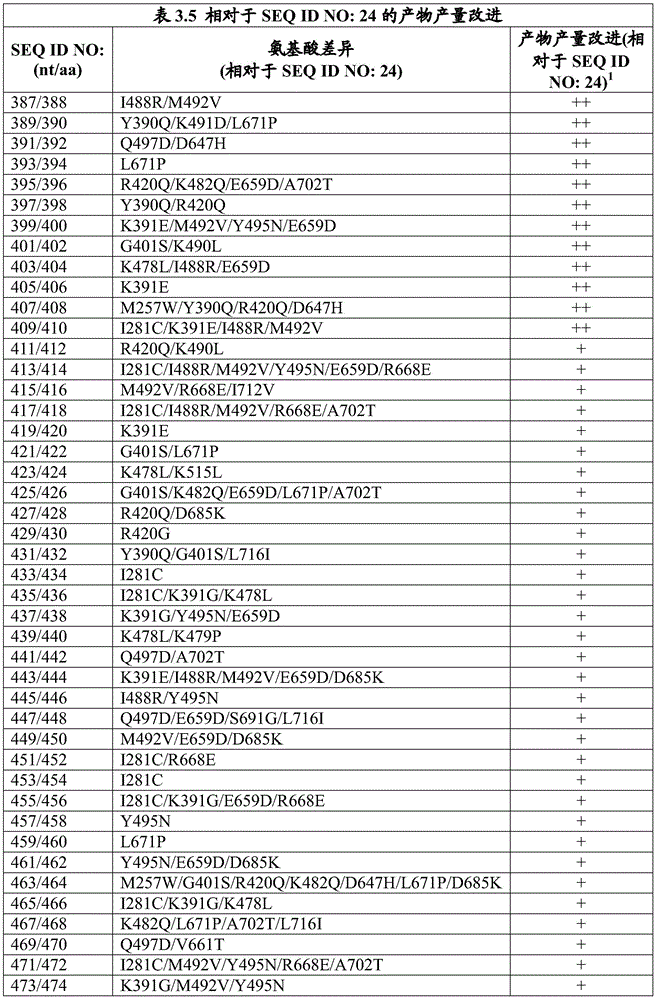


Example 4
High throughput polymerase fidelity test
Colony-based reporter assays are well established as a method of determining polymerase fidelity. In these assays, reporter genes such as lacZ are replicated (see, Barnes, Gene 112:29-35[ 1992)]) lacI (Jozwiakowksi and Connolly, Nucl. acids Res.,37: e102[2009 ]]) And rpsL (Kitabayashi et al, biosci. Biotechnol. biochem.,66:2194-2200[2002 ]]) The frequency of gene inactivating mutations observed in the clones is proportional to the error rate of the DNA polymerase used in reporter gene replication. Error rates were reported as the fraction of colonies with a blue or white phenotype on X-gal (5-bromo-4-chloro-3-indolyl B-D-galactopyranoside) plates for either lacI or lacZ, or the rate of colonies grown on selective ampicillin or streptomycin agar plates for rpsL. Because the error rate of proofreading DNA polymerase is very low (e.g., -3 x 10)-3) These techniques require the determination of a large number of colonies to reduce the effect of sampling errors on the observed error rate. These assays, while simple and burdensome, compare with direct Sanger sequencing of individual clonal ampliconsAnd, but with limited flux.
High throughput assays for the fidelity of the DNA polymerase used in the present invention were developed using cell-based flow cytometry assays. A reporter plasmid (SEQ ID NO:18) encoding the genes for the two fluorescent proteins eGFP (SEQ ID NO:14) and the wild type dsRed (SEQ ID NO:16) under the control of the inducible LacI promoter was constructed. The plasmid also encodes the gene for chloramphenicol acetyltransferase for selection. When the reporter plasmid was transformed into E.coli and induced with IPTG, both fluorescent proteins were expressed in most cells in the population. Coli populations expressing a single fluorescent protein (e.g., dsRed) exhibit a broad log-normal distribution of fluorescence intensity due to induction in gene expression and variation in noise. Thus, mutations that inactivate dsRed can be indistinguishable from noise in gene expression. Although there is extensive gene expression in the cells of the double-labeled (eGFP/dsRed) population, the expression of both proteins is co-variable. Thus, cells that strongly express eGFP without expressing dsRed are extremely rare, and cells expressing a reporter plasmid with inactivating mutations in dsRed (but retaining eGFP expression) are easily distinguished from background.
The PCR reaction was performed using a variant polymerase and an adjacent 5' -phosphorylated primer to replicate the entire sequence of the reporter plasmid. During PCR amplification, polymerase-induced errors are introduced into one or both of the fluorescent reporter proteins encoded by the reporter plasmids. The replications were circularized via ligation, transformed into E.coli, and the mixed population of wild type and error-containing transformants were induced to express the dual reporter. The induced cell population was then analyzed using flow cytometry to determine the fraction of cells that lost dsRed expression due to PCR error but still expressed GFP. Importantly, when isolated clones of the WT reporter plasmid were induced for 48-72 hours and analyzed by flow cytometry, the background of eGFP-expressing cells alone was very low.
The reporter construct was amplified using a 5' -phosphorylated forward primer (SEQ ID NO:19) and a reverse primer (SEQ ID NO:20) as described in example 2 for the PCR reaction. Typically, a final concentration of 0.25% v/v HTP lysate is used for each DNA polymerase. A50 ul reaction was assembled with a final concentration of 120pg/ul of the fidelity reporter construct (SEQ ID NO: 18). An extension time of 5 minutes was used during the cycle. To remove background DNA not amplified by the DNA polymerase variants by PCR, the remaining methylated full length reporter plasmid PCR template (SEQ ID NO:18) was fragmented by addition of DpnI restriction endonuclease followed by incubation at 37 ℃ for 15 min.
The linear ssDNA PCR amplicons were purified by column purification using a ZR-96DNA cleaner and concentrator (Zymo). Briefly, 200. mu.l of the supplied binding buffer was added to 50. mu.l of the PCR reaction and the samples were processed according to the manufacturer's protocol. The samples were eluted in 10-50. mu.l nuclease-free water.
The purified linear amplicons were then circularized at 20 ℃ for 1 hour in 200. mu.l ligation reaction with 66mM Tris-HCl, pH 8.0, 1mM ATP, 10mM MgCl21mM DTT, 50 ng/. mu.l DNA ligase (SEQ ID NO:38 of U.S. patent application sequence No. 15/972,919).
The circularized amplicons were then purified and concentrated using a ZR-96DNA cleaner and concentrator (Zymo). Briefly, 600. mu.l of the supplied binding buffer was added to 200. mu.l of the ligation reaction and the samples were processed using the manufacturer's protocol. The samples were eluted in 12. mu.l nuclease-free water.
Circularized amplicon use BTX A630/HT-10096 well electroporator (BTX, Harvard Apparatus) was transformed into E.coli. Electrocompetent W3110 E.coli cells (Agilent) were diluted with an equal volume of ice-cold sterile water. Then, 50ul of the diluted cell suspension was added to the well with 3ul of circularized amplicon eluate and mixed. The mixture was transferred to a 96-well disposable electroporation plate (BTX) with 2 mm-gap without coating. Plates were allowed to cool on ice and then E.coli transformation was pulsed (2500V, 200. omega., 25. mu.f) using standard settings. Cells were recovered from the wells and added to 500. mu.l of S.O.C. recovery medium (Invitrogen; see, Hanahan, J.mol.biol.,166:557-580[1983 ]]) In (1),this was followed by incubation at 37 ℃ for 1 hour with shaking to allow the cells to recover and express the antibiotic resistance marker (chloramphenicol acetyltransferase) present on the reporter plasmid. After 1 hour of incubation, 500 μ l of LB broth containing chloramphenicol (60 μ g/ml) was added to the wells to select for reporter plasmids during overnight growth at 30 ℃ or 37 ℃. Also at 1 hour, a portion of the growing cells were diluted 1:100 in LB and 5ul of the diluted culture was pipetted into LB+CAM+1% (v/v) glucose plates were spotted (spotted) to check the transformation efficiency. The spot (spot) having 5 or more colonies contains at least 105(ii) individual transformants; up to 10 were observed in some wells6And (4) a transformant. Blank control wells were inoculated with E.coli expressing the eGFP/dsRed reporter construct (SEQ ID NO:18) and positive controls expressed eGFP alone.
The following day, plates were subcultured by adding 20. mu.l of overnight culture to 380. mu.l of LB medium and grown at 30 ℃ with shaking. After 2 hours of incubation, IPTG was added to each plate to a final concentration of 1 mM. Plates were incubated at 30 ℃ for 40-72 hours with shaking to allow induction and complete maturation of wild-type dsRed protein. Induced cultures were pelleted by centrifugation, the supernatant decanted, and the cells resuspended in 400 μ l of 1 × PBS by vortexing. Cells were further diluted 100-fold in PBS for flow cytometry analysis.
Unless otherwise indicated in the tables below, the cells were used with ACCURI with autosamplerTMC6 flow cytometry (BD Biosciences) analysis. Both eGFP and dSerD were excited by 488nm laser, and fluorescence compensation was used to remove spectral overlap in the eGFP and dsRed emission channels. The corresponding control cultures on each plate were used to define gates for single eGFP-expressing (green only) and double eGFP/dsRed expressing cells. Typically, in control populations expressing eGFP/dsRed, the background frequency of green-only events was 1 × 10⁻⁵Whereas in the PCR-amplified population with high fidelity polymerase, only green events were observed at a frequency of 1x10⁻³To 3x10⁻³Therefore, no background subtraction needs to be applied. To minimize sampling error, a total of 500 green-only wells were analyzedEvent, or at most 106Total events/sample. At a flow rate of 14 ul/min, this takes between 15 and 4 minutes/sample depending on the fidelity of the polymerase. The green-only frequency for each variant was calculated by dividing the fraction of gated green-only events by the total number of gated fluorescent cell events. The relative error rate for each variant was calculated by dividing the green-only frequency of the variant by the frequency of the parental control. Finally, the fold improvement in polymerase fidelity reported in the table below is the inverse of the relative error rate.


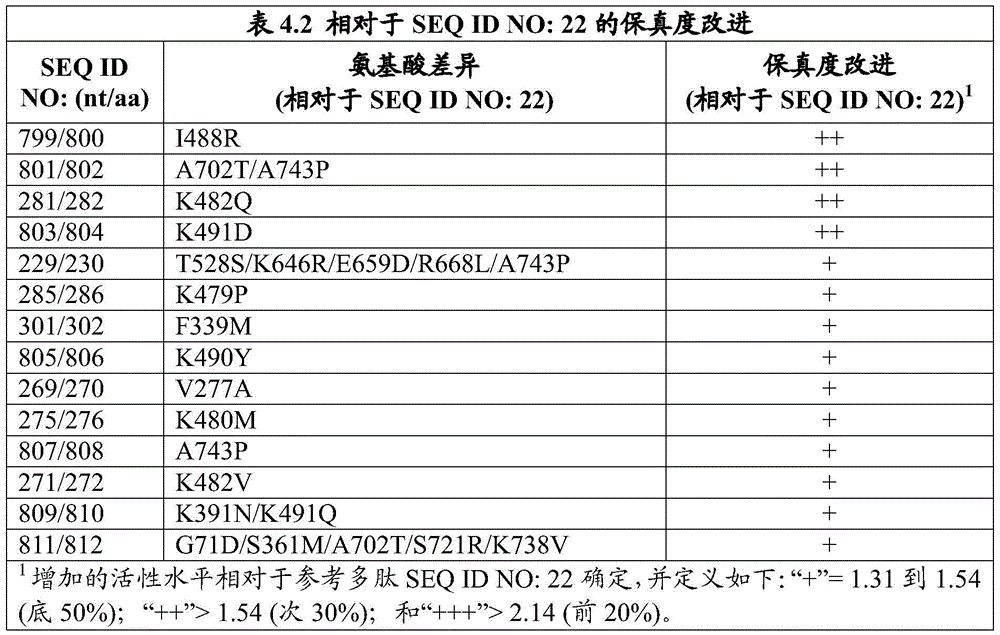


Example 5
Relative comparison of polymerase fidelity
Error rates of variant DNA polymerases determined using high throughput flow cytometryCompared to the error rate of commercially available DNA polymerase used for PCR. The variant polymerases from this study were used to amplify the fidelity reporter plasmid and were assayed as described in example 4. Commercially available polymerases were used to amplify the reporter construct using the buffer supplied with the polymerase (without the addition of magnesium) and thermal cycling times and temperatures were used according to the manufacturer's recommendations for a 4.5kb plasmid template. Table 5.1 lists the buffer, dNTP concentrations, annealing temperature and extension time used for each polymerase. Calculating the relative of each sample to the Platinum SUPERFITMThe error rate of the DNA polymerase, and then the relative error rate was calculated by comparing with Taq DNA polymerase in KCl buffer. FIG. 1 shows the relative error rates of these polymerases.
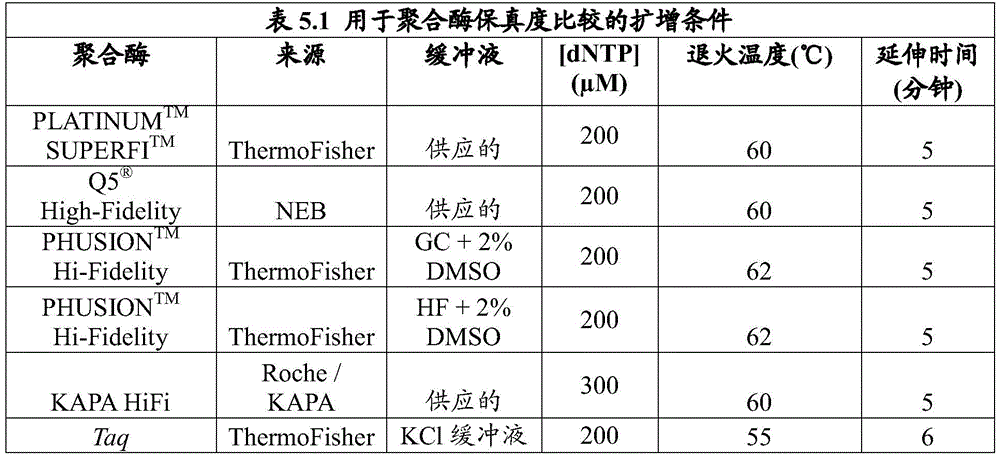

Example 6
Simultaneous screening for more than one polymerase trait
Polymerase performance that is robust across a range of applications was selected based on amplification of amplicons of different sizes and GC content from plasmid and genomic DNA templates. The subsequent round of screening was performed in buffer M6a, buffer M6 a: 30mM Tris pH8.8, 10mM (NH)4)2SO4、13.2mM KCl、0.4%(v/v)Triton x-100、0.5mg/ml BSA、1.5mM MgSO44.5% v/v DMSO. The PCR conditions for the challenge conditions (challenge conditions) are shown in Table 6.1. Product yields were determined by capillary electrophoresis as described in example 3 and fidelity was measured as described in example 4. In these performance challenge experiments, different templates were used. Table 6.1 provides the reaction conditions, primers and templates for each challenge. "ARX" refers to the human ARX gene; "MCYP" refers to microcyp; "KCL" refers to the challenge with additional KCL (4.5mM) using a microcup template; and areAnd "BRCA" refers to the human BRCA2 gene.


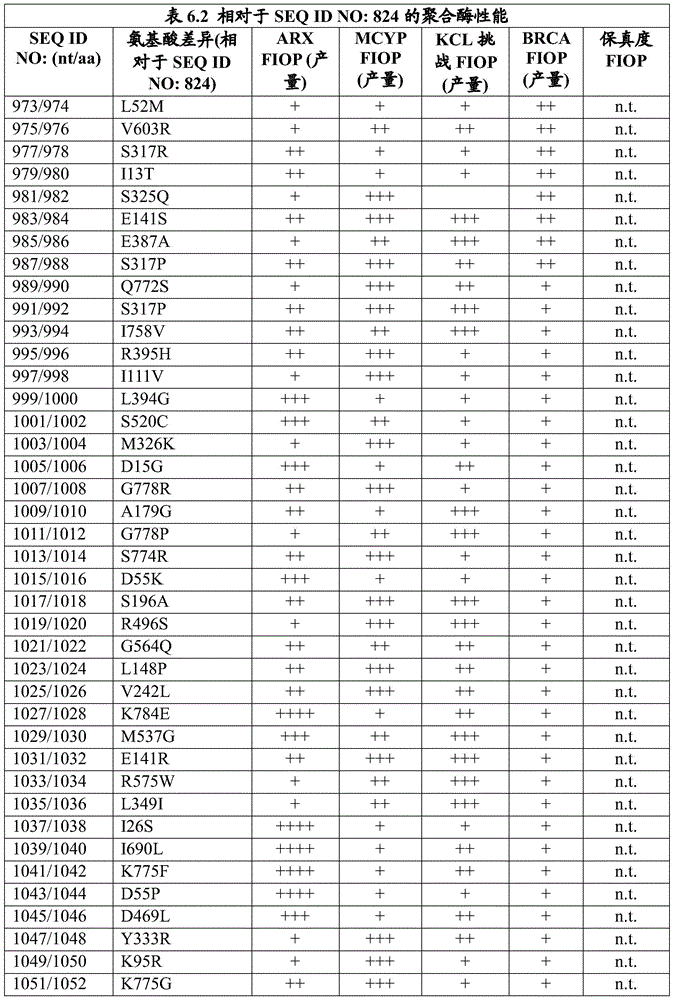


Example 7
Uniformity of coverage in next generation sequencing
Whole genome sequencing of microbial genomes is used to test the uniformity of coverage of amplified libraries in next generation sequencing applications. Genomic DNA from two bacteria, Staphylococcus epidermidis (ATCC 12228:2.5MB, 32.1% GC) and Rhodococcus sphaeroides (ATCC 17025:3.22MB, 68.5% GC), were used in these experiments. DNA from each organism was sheared using sonication (Covaris)To an average fragment length of 400 bp. Then, 100ng of genomic DNA was used as input to the KAPA Hyper library preparation workflow using KAPA plus double-indexed adapters (dual-indexed adapters) according to the manufacturer's instructions (Roche; product KR 0961). Using MagBio highPrepTMSPRI beads purified the ligated library fragments, and 10ng of input DNA was used as template for PCR amplification using the purified polymerase of SEQ ID NO: 1082. In M34b buffer (30mM Tris pH8.8, 7mM (NH)4)2SO4、17mM KCl、0.05%(v/v) Surfactant, 0.5mg/ml BSA, 2mM MgSO4、8%v/v DMSO、15μM ZnSO4) Eight PCR amplifications were performed. The amplified material was cleaned using HighPrep SPRI beads, normalized, and pooled for multiplex sequencing. The liberty pool was sequenced on a Miseq instrument (Illumina) using Miseq kit v2(2 × 250 bp). Reads were de-multiplexed, adapter sequences were trimmed, and then aligned to their respective genomes using CLC Genomics (Qiagen) software. CLC genomic read mapping QC metrics were used to determine the uniformity of coverage. Fig. 2 and 3 provide the results of these experiments.
While the invention has been described with reference to specific embodiments, various changes may be made and equivalents may be substituted for elements thereof, materials, compositions of matter, one or more process steps, to achieve the benefits of the invention, without departing from the scope of the claimed invention.
For all purposes in the united states, each and every publication and patent document cited in this disclosure is incorporated by reference herein, as if each such publication or document were specifically and individually indicated to be incorporated by reference. Citation of publications and patent documents is not intended as an indication that any such document is pertinent prior art, nor does it constitute an admission as to the contents or date thereof.
Claims (47)
1. An engineered DNA polymerase comprising a polypeptide sequence having at least 85%, 90%, 91%, 92%, 93%, 94%, 95%, 96%, 97%, 98%, 99% or more sequence identity to a reference sequence SEQ ID No. 2,6, 22, 24, 26, 28 and/or 824 or a functional fragment thereof, wherein said engineered DNA polymerase comprises at least one substitution in its polypeptide sequence, and wherein the amino acid position of said polypeptide sequence is numbered with reference to SEQ ID No. 2,6, 22, 24, 26, 28 and/or 824.
2. The engineered DNA polymerase of claim 1, wherein at least one substitution or set of substitutions is selected from 21, 21/66/247/282, 247/282/575, 282/575, 283/647/702/743, 339/647/661/664/668/702/712, 372/391/702, 391, 391/647/659/661/668/671/712/716, 391/647/659/661/668/671/716, 391/647/659/664/668/702/728/732, 391/647/659/664/671/702, 391/647/661/664/671/702/716, 391/647/671/728, a, 391/659/702/716/732/737, 391/661/664/668/671/716/737, 391/671, 391/702/712/716/732/743, 647/659/661/664/668/702, 647/659/664/668/702/712/737, 647/659/668/671/716/728, 647/668, 647/668/671/712, 659/702/743, 661/664/668/671/716, 668/702, 671/702, 671/702/716, 702, and 743, and/or any combination thereof, wherein the amino acid positions are numbered with reference to SEQ ID No. 6.
3. The engineered DNA polymerase of claim 1, wherein at least one substitution or set of substitutions comprises a substitution at an amino acid position selected from the group consisting of: 18/387, 24/719, 43/528, 48/760, 101/646, 108/679, 223, 257, 282, 359, 360, 361, 362, 376/619, 390, 391, 394, 394/399, 420, 421, 478, 502, 506, 514, 515, 521, 528, 583/730, 603, 619, 631, 646, 655, 662, 666, 668, 685, 691, 702, 721, 738, 754, 760 and 761, and/or any combination thereof, wherein the amino acid positions are numbered with reference to SEQ ID NO: 6.
4. The engineered DNA polymerase of claim 1, wherein at least one substitution or set of substitutions comprises a substitution at an amino acid position selected from the group consisting of: 174/361/394/666/668/721, 360/391, 361/391/659, 361/394/420/528/646/666/721/743, 361/394/420/528/666, 361/394/420/646/666/702/721/743, 361/528/646/666, 361/528/646/702/721, 361/528/666, 361/646, 394/420, 502/507/695, 528/646/659/668/743, 528/666, 528/668, 528/743, 619, 666, and 685/691/743 and/or any combination thereof, wherein the amino acid positions are referenced to SEQ ID NO:22 are numbered.
5. The engineered DNA polymerase of claim 1, wherein at least one substitution or set of substitutions comprises a substitution at an amino acid position selected from the group consisting of: 100. 277, 280, 281, 283, 339, 401, 468, 479, 480, 482, 489, 490, 491, 496, 497, and 498, and/or any combination thereof, wherein the amino acid positions are numbered with reference to SEQ ID No. 22.
6. The engineered DNA polymerase of claim 1, wherein at least one substitution or set of substitutions comprises a substitution at an amino acid position selected from the group consisting of: 15/134/482/490/497/671/685, 234/497/647, 257/390/420, 257/390/420/647, 257/401/420, 257/401/420/482/647/671/685, 257/482/497/647, 257/647, 257/671/685/702, 281, 281/391/478, 281/391/478/685, 281/391/488/492, 281/391/495/561/659/668, 281/391/659/668, 281/391/668, 281/478/659/685/702, 281/478/668, 281/488, 281/488/492/495/659/668, and, 281/488/492/668/702, 281/488/495, 281/488/495/668, 281/492/495/668, 281/492/495/668/702, 281/668, 390/401/716, 390/420, 390/491/671, 390/497, 390/671/685, 391, 391/478, 391/478/479/668, 391/478/492/668, 391/479/659/668, 391/488/492/659/685, 391/488/492/668, 391/488/495/668/685/702, 391/492/495, 391/492/495/659, 391/492/515/659/685, and, 391/495/659, 401, 401/482/659/671/702, 401/490, 401/490/659/671, 401/671, 420, 420/482/659/702, 420/490, 420/490/659/661/671, 420/659/702, 420/661/671, 420/685, 478, 478/479, 478/479/668, 478/479/702, 478/488/659, 478/488/668/685/702, 478/515, 479/492, 479/659/678, 482/497/647/716, 482/497/671/685, 482/671/702/716, 488, 488/492, 488/492/495, 420/482/659/702, 488/495, 488/495/685, 490/497/661/671/685/702/716, 492, 492/495/659/668, 492/659/685, 492/668/685/712, 492/668/712, 495, 495/659, 495/659/685, 497/647, 497/647/659/671, 497/659/691/716, 497/661, 497/661/671, 497/671/702, 497/671/716, 497/685, 497/702, 515, 659, 659/691 and 671 and/or any combination thereof, wherein the amino acid positions are numbered with reference to SEQ ID NO: 24.
7. The engineered DNA polymerase of claim 1, wherein at least one substitution or set of substitutions comprises a substitution at an amino acid position selected from the group consisting of: 55/579, 108, 108/521, 156/451, 236/755, 240, 247, 248, 256, 298, 299, 299/319, 302, 309, 316, 319, 350, 356, 357, 358, 370, 384, 385, 386, 389, 406, 407, 411, 415, 440, 443, 447, 450, 451, 520, 536, 539, 540, 544, 550/575, 566, 568, 575, 579, 579/767, 600, 601, 601/638, 609/648, 624, 634, 648, 656, 672, 758, 765, 767, 772, 777, 778, 779, 780, 782, 784, and 785 and/or any combination thereof, wherein the amino acid positions are numbered with reference to SEQ ID NO: 24.
8. The engineered DNA polymerase of claim 1, wherein at least one substitution or set of substitutions comprises a substitution at an amino acid position selected from the group consisting of: 248. 281, 281/302, 281/492, 302/401, 339/491/492/579/712, 390/466/539/712, and 661, and/or any combination thereof, wherein the amino acid positions are numbered with reference to SEQ ID No. 26.
9. The engineered DNA polymerase of claim 1, wherein at least one substitution or set of substitutions comprises a substitution at an amino acid position selected from the group consisting of: 240/579, 240/579/702, 248/391/539/579/659/702, 248/391/659, 302/391/579, 339/390/420/425/466/490/491/515/702, 391, 391/482, 391/659, 420/515, 579, 579/659/702, 579/702, and 659/702 and/or any combination thereof, wherein the amino acid positions are numbered with reference to SEQ ID No. 28.
10. The engineered DNA polymerase of claim 1, wherein at least one substitution or set of substitutions comprises a substitution at an amino acid position selected from the group consisting of: 257. 420, 515, and 521, and/or any combination thereof, wherein the amino acid positions are numbered with reference to SEQ ID No. 6.
11. The engineered DNA polymerase of claim 1, wherein at least one substitution or set of substitutions comprises a substitution at an amino acid position selected from the group consisting of: 71/361/702/721/738, 277, 281, 339, 391/491, 401, 479, 480, 482, 488, 490, 491, 492, 495, 497, 528/646/659/668/743, 702/743, and 743, and/or any combination thereof, wherein the amino acid positions are numbered with reference to SEQ ID NO: 22.
12. The engineered DNA polymerase of claim 1, wherein at least one substitution or set of substitutions comprises a substitution at an amino acid position selected from the group consisting of: 240. 370, 385, 539, 540, 550/575, 634, and 777, and/or any combination thereof, wherein the amino acid positions are numbered with reference to SEQ ID No. 24.
13. The engineered DNA polymerase of claim 1, wherein at least one substitution or set of substitutions comprises a substitution at an amino acid position selected from the group consisting of: 390/391, 482, and 515, and/or any combination thereof, wherein the amino acid positions are numbered with reference to SEQ ID NO: 28.
14. The engineered DNA polymerase of claim 1, wherein at least one substitution or set of substitutions comprises a substitution at an amino acid position selected from the group consisting of: 281. 281/579 and/or any combination thereof, wherein the amino acid positions are numbered with reference to SEQ ID NO: 28.
15. The engineered DNA polymerase of claim 1, wherein at least one substitution or set of substitutions comprises a substitution at an amino acid position selected from the group consisting of: 13. 15, 19, 26, 52, 55, 61, 80, 81, 82, 95, 111, 118, 141, 148, 152, 156, 162, 163, 179, 181, 187, 189, 191, 196, 208, 221, 229, 231, 242, 258, 274, 297, 313, 314, 317, 325, 326, 333, 349, 377, 387, 394, 395, 411, 447, 450, 451, 453, 469, 482, 496, 502, 520, 521, 537, 563, 564, 564/572, 567, 569, 575, 580, 601, 603, 619, 620, 648, 667, 673, 690, 705, 719, 731, 758, 761, 772, 774, 775, 778, 783, and 784, and/or any combination thereof, wherein the amino acid positions are numbered with reference to SEQ ID No. 824.
16. The engineered DNA polymerase of claim 1, wherein at least one substitution or set of substitutions comprises a substitution at an amino acid position selected from the group consisting of: 15/447/569/775/783/784, 82/242/569, 82/450/567/569, 313, 314/447/569/783/784, 537/667, 567/569/667, and 569, and/or any combination thereof, wherein the amino acid positions are numbered with reference to SEQ ID No. 824.
17. The engineered DNA polymerase of claim 1, wherein the engineered DNA polymerase comprises a polypeptide sequence at least 85%, 90%, 91%, 92%, 93%, 94%, 95%, 96%, 97%, 98%, 99% or more identical to the sequence of at least one engineered DNA polymerase variant listed in table 3.1, table 3.2, table 3.3, table 3.4, table 4.5, table 3.7, table 3.8, table 3.9, table 4.1, table 4.2, table 4.3, table 4.4, table 4.5, table 6.2, and/or table 6.3.
18. The engineered DNA polymerase of any one of claims 1-17, wherein the engineered DNA polymerase has DNA polymerase activity.
19. The engineered DNA polymerase of any one of claims 1-18 having at least one improved property compared to a wild-type DNA polymerase selected from Pfu DNA polymerase from Pyrococcus furiosus, group B DNA polymerase from Pyrococcus species (Thermococcus sp.) strain 2319x1, and Taq DNA polymerase from Thermus aquaticus (thermous aquaticus).
20. The engineered DNA polymerase of claim 19 having at least one improved property compared to a wild-type DNA polymerase, wherein the improved property is selected from the group consisting of production of increased products in a polymerase chain reaction, higher fidelity, and higher thermostability.
21. The engineered DNA polymerase of any one of claims 1-20, wherein the engineered DNA polymerase produces higher product yields in a polymerase chain reaction than a wild-type DNA polymerase, wherein the wild-type DNA polymerase is selected from Pfu DNA polymerase from pyrococcus furiosus, group B DNA polymerase from pyrococcus thermophilus strain 2319x1, and Taq DNA polymerase from thermus aquaticus.
22. The engineered DNA polymerase of any one of claims 1-21, wherein the engineered DNA polymerase exhibits higher fidelity than a wild-type DNA polymerase, wherein the wild-type DNA polymerase is selected from Pfu DNA polymerase from pyrococcus furiosus, group B DNA polymerase from pyrococcus thermophilus strain 2319x1, and Taq DNA polymerase from thermus aquaticus.
23. The engineered DNA polymerase of any one of claims 1-22, wherein the engineered DNA polymerase exhibits greater thermostability as compared to a wild-type DNA polymerase, wherein the wild-type DNA polymerase is selected from Pfu DNA polymerase from pyrococcus furiosus, group B DNA polymerase from pyrococcus species strain 2319x1, and Taq DNA polymerase from thermus aquaticus.
24. The engineered DNA polymerase of any one of claims 1-23, wherein the polymerase is purified.
25. A polynucleotide sequence encoding at least one engineered DNA polymerase of any one of claims 1-24.
26. A polynucleotide sequence comprising at least 85%, 90%, 91%, 92%, 93%, 94%, 95%, 96%, 97%, 98%, 99% or more sequence identity to a reference sequence SEQ ID No. 1,5, 21, 23, 25, 27, 823 and/or a functional fragment thereof, wherein the engineered polypeptide comprises at least one substitution at one or more amino acid positions.
27. The polynucleotide sequence of claim 25 and/or 26, wherein the polynucleotide sequence encodes at least one engineered DNA polymerase comprising a sequence having at least 85%, 90%, 91%, 92%, 93%, 94%, 95%, 96%, 97%, 98%, 99% or more sequence identity to the reference sequence SEQ ID No. 2,6, 22, 24, 26, 28 and/or 824.
28. The polynucleotide sequence of claim 27, wherein the sequence comprises SEQ ID NOs 1,5, 21, 23, 25, 27, and/or 823.
29. The polynucleotide sequence of any one of claims 25-28, wherein the polynucleotide sequence is operably linked to a control sequence.
30. The polynucleotide sequence of any one of claims 25-29, wherein the polynucleotide sequence is codon optimized.
31. An expression vector comprising at least one polynucleotide sequence of any one of claims 25-30.
32. A host cell transformed with at least one expression vector of claim 31.
33. A method of producing an engineered DNA polymerase in a host cell, the method comprising culturing the host cell of claim 32 under suitable culture conditions, thereby producing at least one engineered DNA polymerase.
34. The method of claim 33, further comprising recovering at least one engineered DNA polymerase from the culture and/or the host cell.
35. The method of claim 34, further comprising the step of purifying the at least one engineered DNA polymerase.
36. A composition comprising at least one engineered DNA polymerase of any one of claims 1-24.
37. A high throughput assay system for determining DNA polymerase fidelity.
38. A method for high throughput determination of DNA polymerase fidelity, the method comprising: i) providing: at least one DNA polymerase as set forth in any one of claims 1 to 24; a reporter plasmid comprising genes encoding a first reporter protein and a second reporter protein and a selectable marker; an amplification system comprising a thermal cycler and reagents for performing a polymerase chain reaction; and a purification system; a transformation system comprising a competent host cell; and a flow cytometer; ii) exposing the DNA polymerase and the reporter plasmid to the amplification system under conditions such that the reporter construct is amplified by the DNA polymerase to produce PCR products; iii) circularizing said PCR amplicon to provide a circularized PCR amplicon; vi) transforming the PCR amplicon using the transformation system to produce a transformed cell; and vii) analyzing the transformed cells using the flow cytometer; and viii) determining the fidelity of said DNA polymerase.
39. The method of claim 38, further comprising the step of inducing the transformed cell.
40. The method according to claim 38 and/or 39, wherein the first reporter protein comprises green fluorescent protein.
41. The method of any one of claims 38-40, wherein the second reporter protein comprises dsRed.
42. The method of any one of claims 38-41, wherein the selectable marker comprises a chloramphenicol acetyl transferase.
43. The method of any one of claims 38-42, wherein said circularizing of said PCR amplicon is performed using at least one ligase.
44. The method of any one of claims 38-43, wherein the PCR amplicon is purified.
45. The method of any one of claims 38-44, further comprising determining a fold improvement in polymerase fidelity compared to a reference DNA polymerase.
46. The method of claim 45, wherein the reference DNA polymerase is a wild-type polymerase.
47. The method of claim 46, wherein the wild-type polymerase is selected from Pfu DNA polymerase from Pyrococcus furiosus, group B DNA polymerase from Thermococcus species strain 2319x1, and Taq DNA polymerase from Thermus aquaticus.
Applications Claiming Priority (3)
| Application Number | Priority Date | Filing Date | Title |
|---|---|---|---|
| US201862752215P | 2018-10-29 | 2018-10-29 | |
| US62/752,215 | 2018-10-29 | ||
| PCT/US2019/058310 WO2020092216A1 (en) | 2018-10-29 | 2019-10-28 | Engineered dna polymerase variants |
Publications (1)
| Publication Number | Publication Date |
|---|---|
| CN113316635A true CN113316635A (en) | 2021-08-27 |
Family
ID=70328324
Family Applications (1)
| Application Number | Title | Priority Date | Filing Date |
|---|---|---|---|
| CN201980087146.5A Pending CN113316635A (en) | 2018-10-29 | 2019-10-28 | Engineered DNA polymerase variants |
Country Status (13)
| Country | Link |
|---|---|
| US (4) | US11060075B2 (en) |
| EP (1) | EP3874033A4 (en) |
| JP (2) | JP7780186B2 (en) |
| KR (1) | KR20210084590A (en) |
| CN (1) | CN113316635A (en) |
| AU (1) | AU2019373208A1 (en) |
| BR (1) | BR112021008186A2 (en) |
| CA (1) | CA3116590A1 (en) |
| IL (1) | IL282456B2 (en) |
| MX (1) | MX2021004925A (en) |
| SG (1) | SG11202103639SA (en) |
| WO (1) | WO2020092216A1 (en) |
| ZA (1) | ZA202102469B (en) |
Cited By (4)
| Publication number | Priority date | Publication date | Assignee | Title |
|---|---|---|---|---|
| CN115851661A (en) * | 2022-06-29 | 2023-03-28 | 武汉爱博泰克生物科技有限公司 | A kind of Taq DNA polymerase mutant and its application |
| WO2024138419A1 (en) * | 2022-12-28 | 2024-07-04 | 深圳华大生命科学研究院 | Polypeptide having dna polymerase activity and use thereof |
| CN118755689A (en) * | 2024-09-06 | 2024-10-11 | 长兴制药股份有限公司 | A mutant R-aminotransferase and a method for preparing an ubagepam intermediate thereof |
| WO2025137875A1 (en) * | 2023-12-26 | 2025-07-03 | 深圳华大生命科学研究院 | Isolated polypeptide, preparation method therefor, and use thereof |
Families Citing this family (5)
| Publication number | Priority date | Publication date | Assignee | Title |
|---|---|---|---|---|
| CN113316635A (en) | 2018-10-29 | 2021-08-27 | 科德克希思公司 | Engineered DNA polymerase variants |
| WO2024059581A2 (en) * | 2022-09-12 | 2024-03-21 | Codexis, Inc. | Engineered dna polymerase variants |
| CN120129744A (en) * | 2022-09-14 | 2025-06-10 | 科德克希思公司 | Engineered DNA polymerase variants |
| WO2024102861A2 (en) * | 2022-11-09 | 2024-05-16 | Codexis, Inc. | Dna polymerase variants |
| CN118879647B (en) * | 2024-07-31 | 2025-05-23 | 翌圣生物科技(上海)股份有限公司 | Mutant T4 DNA ligase and kit |
Citations (5)
| Publication number | Priority date | Publication date | Assignee | Title |
|---|---|---|---|---|
| CN1345937A (en) * | 2000-09-29 | 2002-04-24 | 上海博德基因开发有限公司 | Novel polypeptide-human RNA polymerase III subunit 12.76 and polynucleotide for encoding said polypeptide |
| CN101365807A (en) * | 2005-12-22 | 2009-02-11 | 加利福尼亚太平洋生物科学股份有限公司 | Polymerases for nucleotide analogue incorporation |
| CN105324483A (en) * | 2013-04-18 | 2016-02-10 | 科德克希思公司 | Engineered Phenylalanine Ammonia Lyase Peptides |
| CN105452451A (en) * | 2013-12-06 | 2016-03-30 | 生物辐射实验室股份有限公司 | Fusion polymerases |
| CN106701896A (en) * | 2015-08-28 | 2017-05-24 | 王金 | Method for detecting fidelity of DNA polymerase |
Family Cites Families (79)
| Publication number | Priority date | Publication date | Assignee | Title |
|---|---|---|---|---|
| US4683195A (en) | 1986-01-30 | 1987-07-28 | Cetus Corporation | Process for amplifying, detecting, and/or-cloning nucleic acid sequences |
| US5605793A (en) | 1994-02-17 | 1997-02-25 | Affymax Technologies N.V. | Methods for in vitro recombination |
| US6406855B1 (en) | 1994-02-17 | 2002-06-18 | Maxygen, Inc. | Methods and compositions for polypeptide engineering |
| US6309883B1 (en) | 1994-02-17 | 2001-10-30 | Maxygen, Inc. | Methods and compositions for cellular and metabolic engineering |
| US5834252A (en) | 1995-04-18 | 1998-11-10 | Glaxo Group Limited | End-complementary polymerase reaction |
| US6995017B1 (en) | 1994-02-17 | 2006-02-07 | Maxygen, Inc. | Methods for generating polynucleotides having desired characteristics by iterative selection and recombination |
| US20060257890A1 (en) | 1996-05-20 | 2006-11-16 | Maxygen, Inc. | Methods and compositions for cellular and metabolic engineering |
| US6395547B1 (en) | 1994-02-17 | 2002-05-28 | Maxygen, Inc. | Methods for generating polynucleotides having desired characteristics by iterative selection and recombination |
| US6335160B1 (en) | 1995-02-17 | 2002-01-01 | Maxygen, Inc. | Methods and compositions for polypeptide engineering |
| US5928905A (en) | 1995-04-18 | 1999-07-27 | Glaxo Group Limited | End-complementary polymerase reaction |
| US6165793A (en) | 1996-03-25 | 2000-12-26 | Maxygen, Inc. | Methods for generating polynucleotides having desired characteristics by iterative selection and recombination |
| US6117679A (en) | 1994-02-17 | 2000-09-12 | Maxygen, Inc. | Methods for generating polynucleotides having desired characteristics by iterative selection and recombination |
| US5837458A (en) | 1994-02-17 | 1998-11-17 | Maxygen, Inc. | Methods and compositions for cellular and metabolic engineering |
| DK0765394T3 (en) | 1994-06-03 | 2001-12-10 | Novozymes As | Purified Myceliopthora laccases and nucleic acids encoding them |
| DE69534185T2 (en) | 1994-06-30 | 2006-02-23 | Novozymes Biotech, Inc., Davis | NON-TOXIC, NON-TOXIGEN, NON-PATHOGENIC FUSARIUM EXPRESSION SYSTEM, AND PROMOTERS AND TERMINATORS TO BE USED IN IT |
| FI104465B (en) | 1995-06-14 | 2000-02-15 | Valio Oy | Protein hydrolyzates for the treatment and prevention of allergies and their preparation and use |
| US6096548A (en) | 1996-03-25 | 2000-08-01 | Maxygen, Inc. | Method for directing evolution of a virus |
| US6506602B1 (en) | 1996-03-25 | 2003-01-14 | Maxygen, Inc. | Methods for generating polynucleotides having desired characteristics by iterative selection and recombination |
| CZ293215B6 (en) | 1996-08-06 | 2004-03-17 | F. Hoffmann-La Roche Ag | Enzyme of thermally stable DNA polymerase, process of its preparation and a pharmaceutical composition and a kit containing thereof |
| US6326204B1 (en) | 1997-01-17 | 2001-12-04 | Maxygen, Inc. | Evolution of whole cells and organisms by recursive sequence recombination |
| EP2261373A3 (en) | 1997-01-17 | 2011-12-14 | Codexis Mayflower Holdings, LLC | Evolution of whole cells and organisms by recursive sequence recombination |
| US7148054B2 (en) | 1997-01-17 | 2006-12-12 | Maxygen, Inc. | Evolution of whole cells and organisms by recursive sequence recombination |
| US6265201B1 (en) | 1997-01-17 | 2001-07-24 | Regents Of The University Of Minnesota | DNA molecules and protein displaying improved triazine compound degrading ability |
| JP2001513983A (en) * | 1997-08-29 | 2001-09-11 | ライフ テクノロジーズ,インコーポレイテッド | High fidelity polymerase and its use |
| CA2313380C (en) | 1997-12-08 | 2008-12-30 | California Institute Of Technology | Method for creating polynucleotide and polypeptide sequences |
| EP1068351A2 (en) | 1998-04-02 | 2001-01-17 | Tellus Genetic Resources, Inc. | A method for obtaining a plant with a genetic lesion in a gene sequence |
| EP1073670A1 (en) | 1998-05-01 | 2001-02-07 | Maxygen, Inc. | Optimization of pest resistance genes using dna shuffling |
| CA2335269A1 (en) | 1998-06-17 | 1999-12-23 | Maxygen, Inc. | Method for producing polynucleotides with desired properties |
| US6365408B1 (en) | 1998-06-19 | 2002-04-02 | Maxygen, Inc. | Methods of evolving a polynucleotides by mutagenesis and recombination |
| EP1104459A1 (en) | 1998-08-12 | 2001-06-06 | Maxygen, Inc. | Dna shuffling of monooxygenase genes for production of industrial chemicals |
| US6500639B2 (en) | 1998-10-07 | 2002-12-31 | Maxygen, Inc. | DNA shuffling to produce nucleic acids for mycotoxin detoxification |
| EP1129184A1 (en) | 1998-11-10 | 2001-09-05 | Maxygen, Inc. | Modified adp-glucose pyrophosphorylase for improvement and optimation of plant phenotypes |
| JP4221100B2 (en) | 1999-01-13 | 2009-02-12 | エルピーダメモリ株式会社 | Semiconductor device |
| US6436675B1 (en) | 1999-09-28 | 2002-08-20 | Maxygen, Inc. | Use of codon-varied oligonucleotide synthesis for synthetic shuffling |
| US6917882B2 (en) | 1999-01-19 | 2005-07-12 | Maxygen, Inc. | Methods for making character strings, polynucleotides and polypeptides having desired characteristics |
| US6368861B1 (en) | 1999-01-19 | 2002-04-09 | Maxygen, Inc. | Oligonucleotide mediated nucleic acid recombination |
| US6376246B1 (en) | 1999-02-05 | 2002-04-23 | Maxygen, Inc. | Oligonucleotide mediated nucleic acid recombination |
| US7024312B1 (en) | 1999-01-19 | 2006-04-04 | Maxygen, Inc. | Methods for making character strings, polynucleotides and polypeptides having desired characteristics |
| US7873477B1 (en) | 2001-08-21 | 2011-01-18 | Codexis Mayflower Holdings, Llc | Method and system using systematically varied data libraries |
| WO2000042561A2 (en) | 1999-01-19 | 2000-07-20 | Maxygen, Inc. | Oligonucleotide mediated nucleic acid recombination |
| US7702464B1 (en) | 2001-08-21 | 2010-04-20 | Maxygen, Inc. | Method and apparatus for codon determining |
| US20070065838A1 (en) | 1999-01-19 | 2007-03-22 | Maxygen, Inc. | Oligonucleotide mediated nucleic acid recombination |
| US8457903B1 (en) | 1999-01-19 | 2013-06-04 | Codexis Mayflower Holdings, Llc | Method and/or apparatus for determining codons |
| US6961664B2 (en) | 1999-01-19 | 2005-11-01 | Maxygen | Methods of populating data structures for use in evolutionary simulations |
| IL144657A0 (en) | 1999-02-11 | 2002-06-30 | Maxygen Inc | High throughput mass spectrometry |
| AU3391900A (en) | 1999-03-05 | 2000-09-21 | Maxygen, Inc. | Encryption of traits using split gene sequences |
| US6531316B1 (en) * | 1999-03-05 | 2003-03-11 | Maxyag, Inc. | Encryption of traits using split gene sequences and engineered genetic elements |
| US6703240B1 (en) | 1999-04-13 | 2004-03-09 | Maxygar, Inc. | Modified starch metabolism enzymes and encoding genes for improvement and optimization of plant phenotypes |
| US7430477B2 (en) | 1999-10-12 | 2008-09-30 | Maxygen, Inc. | Methods of populating data structures for use in evolutionary simulations |
| US6519065B1 (en) | 1999-11-05 | 2003-02-11 | Jds Fitel Inc. | Chromatic dispersion compensation device |
| US6686515B1 (en) | 1999-11-23 | 2004-02-03 | Maxygen, Inc. | Homologous recombination in plants |
| EP1276900A2 (en) * | 2000-01-11 | 2003-01-22 | Maxygen, Inc. | Integrated systems and methods for diversity generation and screening |
| US6329178B1 (en) * | 2000-01-14 | 2001-12-11 | University Of Washington | DNA polymerase mutant having one or more mutations in the active site |
| JP2001269188A (en) * | 2000-03-11 | 2001-10-02 | Roche Diagnostics Gmbh | B-type DNA polymerase mutant with improved performance in PCR |
| EP1272967A2 (en) | 2000-03-30 | 2003-01-08 | Maxygen, Inc. | In silico cross-over site selection |
| US6902922B2 (en) | 2000-04-03 | 2005-06-07 | Novozymes A/S | Subtilisin variants |
| US7932070B2 (en) * | 2001-12-21 | 2011-04-26 | Agilent Technologies, Inc. | High fidelity DNA polymerase compositions and uses therefor |
| EP2315145B1 (en) | 2002-03-01 | 2015-11-25 | Codexis Mayflower Holdings, LLC | Methods, systems, and software for identifying functional biomolecules |
| US7747391B2 (en) | 2002-03-01 | 2010-06-29 | Maxygen, Inc. | Methods, systems, and software for identifying functional biomolecules |
| US20050084907A1 (en) | 2002-03-01 | 2005-04-21 | Maxygen, Inc. | Methods, systems, and software for identifying functional biomolecules |
| WO2003078583A2 (en) | 2002-03-09 | 2003-09-25 | Maxygen, Inc. | Optimization of crossover points for directed evolution |
| CA2533838A1 (en) | 2003-08-11 | 2005-02-24 | Codexis, Inc. | Improved ketoreductase polypeptides and related polynucleotides |
| WO2009102901A1 (en) | 2008-02-12 | 2009-08-20 | Codexis, Inc. | Method of generating an optimized, diverse population of variants |
| EP2250595B1 (en) | 2008-02-12 | 2017-06-14 | Codexis, Inc. | Method of selecting an optimized diverse population of variants |
| US8383346B2 (en) * | 2008-06-13 | 2013-02-26 | Codexis, Inc. | Combined automated parallel synthesis of polynucleotide variants |
| US20090312196A1 (en) | 2008-06-13 | 2009-12-17 | Codexis, Inc. | Method of synthesizing polynucleotide variants |
| CN102066561B (en) | 2008-06-13 | 2013-09-25 | 科德克希思公司 | Method of synthesizing polynucleotide variants |
| JP5258512B2 (en) * | 2008-10-30 | 2013-08-07 | 株式会社日立製作所 | DNA polymerase mutant with enhanced exonuclease activity |
| WO2010062777A2 (en) | 2008-11-03 | 2010-06-03 | Kapabiosystems | Modified type a dna polymerases |
| US20110082055A1 (en) | 2009-09-18 | 2011-04-07 | Codexis, Inc. | Reduced codon mutagenesis |
| WO2013003290A1 (en) | 2011-06-28 | 2013-01-03 | Codexis, Inc. | Protein variant generation by region shuffling |
| WO2013159055A1 (en) | 2012-04-20 | 2013-10-24 | Codexis, Inc. | Production of fatty alcohols from engineered microorganisms |
| RU2695146C2 (en) | 2013-01-31 | 2019-07-22 | Кодексис, Инк. | Methods, systems and software for identification of biomolecules with interacting components |
| AU2014324670B2 (en) | 2013-09-27 | 2019-11-21 | Codexis, Inc. | Structure based predictive modeling |
| WO2015048572A1 (en) | 2013-09-27 | 2015-04-02 | Codexis, Inc. | Automated screening of enzyme variants |
| CA2930595C (en) * | 2013-11-14 | 2023-09-19 | Integrated Dna Technologies, Inc. | Dna polymerase mutants having enhanced template discrimination activity |
| EP3192806A1 (en) | 2016-01-13 | 2017-07-19 | Affiris AG | Alpha chain of the high-affinity ige receptor (fceria) |
| WO2017121836A1 (en) | 2016-01-15 | 2017-07-20 | Thermo Fisher Scientific Baltics Uab | Thermophilic dna polymerase mutants |
| CN113316635A (en) | 2018-10-29 | 2021-08-27 | 科德克希思公司 | Engineered DNA polymerase variants |
-
2019
- 2019-10-28 CN CN201980087146.5A patent/CN113316635A/en active Pending
- 2019-10-28 MX MX2021004925A patent/MX2021004925A/en unknown
- 2019-10-28 SG SG11202103639SA patent/SG11202103639SA/en unknown
- 2019-10-28 WO PCT/US2019/058310 patent/WO2020092216A1/en not_active Ceased
- 2019-10-28 IL IL282456A patent/IL282456B2/en unknown
- 2019-10-28 AU AU2019373208A patent/AU2019373208A1/en active Pending
- 2019-10-28 BR BR112021008186-0A patent/BR112021008186A2/en unknown
- 2019-10-28 EP EP19878926.5A patent/EP3874033A4/en active Pending
- 2019-10-28 KR KR1020217016433A patent/KR20210084590A/en active Pending
- 2019-10-28 US US16/666,280 patent/US11060075B2/en active Active
- 2019-10-28 CA CA3116590A patent/CA3116590A1/en active Pending
- 2019-10-28 JP JP2021523258A patent/JP7780186B2/en active Active
-
2021
- 2021-04-14 ZA ZA2021/02469A patent/ZA202102469B/en unknown
- 2021-06-11 US US17/345,404 patent/US12018295B2/en active Active
-
2024
- 2024-02-22 JP JP2024025611A patent/JP2024057009A/en not_active Withdrawn
- 2024-04-05 US US18/628,461 patent/US20240263154A1/en not_active Abandoned
-
2025
- 2025-03-18 US US19/083,377 patent/US20250250552A1/en active Pending
Patent Citations (5)
| Publication number | Priority date | Publication date | Assignee | Title |
|---|---|---|---|---|
| CN1345937A (en) * | 2000-09-29 | 2002-04-24 | 上海博德基因开发有限公司 | Novel polypeptide-human RNA polymerase III subunit 12.76 and polynucleotide for encoding said polypeptide |
| CN101365807A (en) * | 2005-12-22 | 2009-02-11 | 加利福尼亚太平洋生物科学股份有限公司 | Polymerases for nucleotide analogue incorporation |
| CN105324483A (en) * | 2013-04-18 | 2016-02-10 | 科德克希思公司 | Engineered Phenylalanine Ammonia Lyase Peptides |
| CN105452451A (en) * | 2013-12-06 | 2016-03-30 | 生物辐射实验室股份有限公司 | Fusion polymerases |
| CN106701896A (en) * | 2015-08-28 | 2017-05-24 | 王金 | Method for detecting fidelity of DNA polymerase |
Non-Patent Citations (2)
| Title |
|---|
| 匿名: "accession no.E2D778", 《UNIPROT》, 30 November 2010 (2010-11-30), pages 1 * |
| 匿名: "Sequence:WP_058946753.1", 《NCBI》, 6 January 2016 (2016-01-06), pages 1 * |
Cited By (4)
| Publication number | Priority date | Publication date | Assignee | Title |
|---|---|---|---|---|
| CN115851661A (en) * | 2022-06-29 | 2023-03-28 | 武汉爱博泰克生物科技有限公司 | A kind of Taq DNA polymerase mutant and its application |
| WO2024138419A1 (en) * | 2022-12-28 | 2024-07-04 | 深圳华大生命科学研究院 | Polypeptide having dna polymerase activity and use thereof |
| WO2025137875A1 (en) * | 2023-12-26 | 2025-07-03 | 深圳华大生命科学研究院 | Isolated polypeptide, preparation method therefor, and use thereof |
| CN118755689A (en) * | 2024-09-06 | 2024-10-11 | 长兴制药股份有限公司 | A mutant R-aminotransferase and a method for preparing an ubagepam intermediate thereof |
Also Published As
| Publication number | Publication date |
|---|---|
| US20210309977A1 (en) | 2021-10-07 |
| JP7780186B2 (en) | 2025-12-04 |
| US20250250552A1 (en) | 2025-08-07 |
| JP2024057009A (en) | 2024-04-23 |
| CA3116590A1 (en) | 2020-05-07 |
| JP2022512847A (en) | 2022-02-07 |
| ZA202102469B (en) | 2025-09-25 |
| US12018295B2 (en) | 2024-06-25 |
| US20240263154A1 (en) | 2024-08-08 |
| US20200131485A1 (en) | 2020-04-30 |
| US11060075B2 (en) | 2021-07-13 |
| AU2019373208A1 (en) | 2021-05-13 |
| NZ774828A (en) | 2025-08-29 |
| EP3874033A4 (en) | 2022-08-03 |
| MX2021004925A (en) | 2021-06-15 |
| EP3874033A1 (en) | 2021-09-08 |
| BR112021008186A2 (en) | 2021-08-17 |
| KR20210084590A (en) | 2021-07-07 |
| WO2020092216A1 (en) | 2020-05-07 |
| IL282456B2 (en) | 2025-07-01 |
| SG11202103639SA (en) | 2021-05-28 |
| IL282456A (en) | 2021-06-30 |
| IL282456B1 (en) | 2025-03-01 |
Similar Documents
| Publication | Publication Date | Title |
|---|---|---|
| US12018295B2 (en) | Engineered DNA polymerase variants | |
| JP7401902B2 (en) | Genetically engineered ligase variants | |
| JP2020530266A (en) | T7 RNA polymerase variant | |
| CN115044569B (en) | Taq DNA polymerase mutant and application thereof | |
| CN120457200A (en) | DNA polymerase variants | |
| RU2820531C2 (en) | Engineered versions of dna polymerase | |
| US12129495B2 (en) | Engineered DNA polymerase variants | |
| WO2024059581A2 (en) | Engineered dna polymerase variants | |
| WO2023064935A1 (en) | Recombinant reverse transcriptase variants | |
| WO2024059547A2 (en) | Engineered dna polymerase variants | |
| EP4612163A2 (en) | Engineered vaccinia capping enzyme variants |
Legal Events
| Date | Code | Title | Description |
|---|---|---|---|
| PB01 | Publication | ||
| PB01 | Publication | ||
| SE01 | Entry into force of request for substantive examination | ||
| SE01 | Entry into force of request for substantive examination |