[go: up one dir, main page]

CN113258561A - Multi-attribute decision-based multi-distributed power supply micro-grid multi-objective optimization scheduling method - Google Patents

Multi-attribute decision-based multi-distributed power supply micro-grid multi-objective optimization scheduling method Download PDF

Info

Publication number
CN113258561A
CN113258561A CN202110419741.3A CN202110419741A CN113258561A CN 113258561 A CN113258561 A CN 113258561A CN 202110419741 A CN202110419741 A CN 202110419741A CN 113258561 A CN113258561 A CN 113258561A
Authority
CN
China
Prior art keywords
grid
objective
power
optimization
candidate
Prior art date
Legal status (The legal status is an assumption and is not a legal conclusion. Google has not performed a legal analysis and makes no representation as to the accuracy of the status listed.)
Pending
Application number
CN202110419741.3A
Other languages
Chinese (zh)
Inventor
李正明
陈剑月
王啸尘
张晨
Current Assignee (The listed assignees may be inaccurate. Google has not performed a legal analysis and makes no representation or warranty as to the accuracy of the list.)
Jiangsu University
Original Assignee
Jiangsu University
Priority date (The priority date is an assumption and is not a legal conclusion. Google has not performed a legal analysis and makes no representation as to the accuracy of the date listed.)
Filing date
Publication date
Application filed by Jiangsu University filed Critical Jiangsu University
Priority to CN202110419741.3A priority Critical patent/CN113258561A/en
Publication of CN113258561A publication Critical patent/CN113258561A/en
Pending legal-status Critical Current

Links

Images

Classifications

    • GPHYSICS
    • G06COMPUTING OR CALCULATING; COUNTING
    • G06FELECTRIC DIGITAL DATA PROCESSING
    • G06F30/00Computer-aided design [CAD]
    • G06F30/20Design optimisation, verification or simulation
    • G06F30/27Design optimisation, verification or simulation using machine learning, e.g. artificial intelligence, neural networks, support vector machines [SVM] or training a model
    • GPHYSICS
    • G06COMPUTING OR CALCULATING; COUNTING
    • G06NCOMPUTING ARRANGEMENTS BASED ON SPECIFIC COMPUTATIONAL MODELS
    • G06N3/00Computing arrangements based on biological models
    • G06N3/004Artificial life, i.e. computing arrangements simulating life
    • G06N3/006Artificial life, i.e. computing arrangements simulating life based on simulated virtual individual or collective life forms, e.g. social simulations or particle swarm optimisation [PSO]
    • HELECTRICITY
    • H02GENERATION; CONVERSION OR DISTRIBUTION OF ELECTRIC POWER
    • H02JCIRCUIT ARRANGEMENTS OR SYSTEMS FOR SUPPLYING OR DISTRIBUTING ELECTRIC POWER; SYSTEMS FOR STORING ELECTRIC ENERGY
    • H02J3/00Circuit arrangements for AC mains or AC distribution networks
    • HELECTRICITY
    • H02GENERATION; CONVERSION OR DISTRIBUTION OF ELECTRIC POWER
    • H02JCIRCUIT ARRANGEMENTS OR SYSTEMS FOR SUPPLYING OR DISTRIBUTING ELECTRIC POWER; SYSTEMS FOR STORING ELECTRIC ENERGY
    • H02J3/00Circuit arrangements for AC mains or AC distribution networks
    • H02J3/008Circuit arrangements for AC mains or AC distribution networks involving trading of energy or energy transmission rights
    • HELECTRICITY
    • H02GENERATION; CONVERSION OR DISTRIBUTION OF ELECTRIC POWER
    • H02JCIRCUIT ARRANGEMENTS OR SYSTEMS FOR SUPPLYING OR DISTRIBUTING ELECTRIC POWER; SYSTEMS FOR STORING ELECTRIC ENERGY
    • H02J3/00Circuit arrangements for AC mains or AC distribution networks
    • H02J3/38Arrangements for parallely feeding a single network by two or more generators, converters or transformers
    • H02J3/381Dispersed generators
    • HELECTRICITY
    • H02GENERATION; CONVERSION OR DISTRIBUTION OF ELECTRIC POWER
    • H02JCIRCUIT ARRANGEMENTS OR SYSTEMS FOR SUPPLYING OR DISTRIBUTING ELECTRIC POWER; SYSTEMS FOR STORING ELECTRIC ENERGY
    • H02J3/00Circuit arrangements for AC mains or AC distribution networks
    • H02J3/38Arrangements for parallely feeding a single network by two or more generators, converters or transformers
    • H02J3/46Controlling of the sharing of output between the generators, converters, or transformers
    • H02J3/466Scheduling the operation of the generators, e.g. connecting or disconnecting generators to meet a given demand
    • GPHYSICS
    • G06COMPUTING OR CALCULATING; COUNTING
    • G06FELECTRIC DIGITAL DATA PROCESSING
    • G06F2111/00Details relating to CAD techniques
    • G06F2111/06Multi-objective optimisation, e.g. Pareto optimisation using simulated annealing [SA], ant colony algorithms or genetic algorithms [GA]
    • GPHYSICS
    • G06COMPUTING OR CALCULATING; COUNTING
    • G06FELECTRIC DIGITAL DATA PROCESSING
    • G06F2113/00Details relating to the application field
    • G06F2113/04Power grid distribution networks
    • H02J2101/24
    • H02J2101/28
    • H02J2101/30
    • H02J2101/40
    • H02J2103/30
    • H02J2103/35
    • YGENERAL TAGGING OF NEW TECHNOLOGICAL DEVELOPMENTS; GENERAL TAGGING OF CROSS-SECTIONAL TECHNOLOGIES SPANNING OVER SEVERAL SECTIONS OF THE IPC; TECHNICAL SUBJECTS COVERED BY FORMER USPC CROSS-REFERENCE ART COLLECTIONS [XRACs] AND DIGESTS
    • Y02TECHNOLOGIES OR APPLICATIONS FOR MITIGATION OR ADAPTATION AGAINST CLIMATE CHANGE
    • Y02EREDUCTION OF GREENHOUSE GAS [GHG] EMISSIONS, RELATED TO ENERGY GENERATION, TRANSMISSION OR DISTRIBUTION
    • Y02E10/00Energy generation through renewable energy sources
    • Y02E10/50Photovoltaic [PV] energy
    • Y02E10/56Power conversion systems, e.g. maximum power point trackers

Landscapes

  • Engineering & Computer Science (AREA)
  • Power Engineering (AREA)
  • Physics & Mathematics (AREA)
  • Theoretical Computer Science (AREA)
  • Evolutionary Computation (AREA)
  • Software Systems (AREA)
  • Artificial Intelligence (AREA)
  • General Physics & Mathematics (AREA)
  • General Engineering & Computer Science (AREA)
  • Biomedical Technology (AREA)
  • Mathematical Physics (AREA)
  • General Health & Medical Sciences (AREA)
  • Molecular Biology (AREA)
  • Computing Systems (AREA)
  • Computational Linguistics (AREA)
  • Biophysics (AREA)
  • Data Mining & Analysis (AREA)
  • Life Sciences & Earth Sciences (AREA)
  • Health & Medical Sciences (AREA)
  • Computer Vision & Pattern Recognition (AREA)
  • Medical Informatics (AREA)
  • Computer Hardware Design (AREA)
  • Geometry (AREA)
  • Supply And Distribution Of Alternating Current (AREA)

Abstract

本发明是一种基于多属性决策的多种分布式电源的微电网多目标优化调度方法,针对包含多种分布式电源的微电网系统,建立了运行成本最低、污染排放最少、亏电率最低的多目标微电网优化调度模型,采用基于罚函数的粒子群算法以不同的目标进行分别寻优,多次优化后获取候选解集,采用多属性决策方法对候选解集进行综合评估分析,使用层次分析法分析各目标权重,对各目标函数在其对应的评价等级上进行置信度分析,使用证据融合和效用值分析获取效用值最大的方案即最优解,所得方案兼顾客观性和合理性,提高可再生能源的利用率降低系统运行成本。

Figure 202110419741

The invention is a multi-objective optimal scheduling method for a micro-grid with multiple distributed power sources based on multi-attribute decision-making. For the micro-grid system including multiple distributed power sources, the invention establishes the lowest operating cost, the least pollution emission and the lowest power loss rate. The multi-objective microgrid optimization scheduling model is based on the particle swarm algorithm based on the penalty function to optimize separately with different objectives, and the candidate solution set is obtained after multiple optimizations. Analytic Hierarchy Process analyzes the weight of each objective, conducts confidence analysis on each objective function on its corresponding evaluation level, and uses evidence fusion and utility value analysis to obtain the optimal solution with the largest utility value. , improve the utilization rate of renewable energy and reduce system operating costs.

Figure 202110419741

Description

Multi-attribute decision-based multi-distributed power supply micro-grid multi-objective optimization scheduling method
Technical Field
The invention belongs to the technical field of microgrid optimization, and particularly relates to a distributed multi-objective optimization scheduling control method for a microgrid.
Background
With the increasing environmental problems and energy crisis, there is an urgent need in the current society to change the energy structure and replace non-renewable energy with renewable clean energy. Microgrid technology arose from this background. The micro-grid technology can not only exert the advantages of clean power generation of new energy represented by wind and light, but also effectively reduce the adverse effects of the intermittency and volatility of the new energy on a large power grid. The reasonable scheduling is adopted, so that the utilization rate of the distributed power supply can be effectively improved, and the economic cost and the environmental cost of the operation of the micro-grid are reduced while the stability of the system is ensured. Due to the fact that the types of devices of the distributed power supply are various and the characteristics of the devices are different, the micro-grid optimization scheduling gradually changes from the former single target to the multi-target multi-constraint non-linear programming problem.
At present, multi-objective optimization scheduling for a microgrid is usually analyzed by an improved intelligent algorithm, however, sub-objectives of the microgrid scheduling are often mutually constrained, the improvement on the performance of one sub-objective possibly affects the performance of another sub-objective or even other sub-objectives, and finally, the multi-objective optimization scheduling for the microgrid can only select one scheme for decision making. In view of the above problems, the schemes obtained after the intelligent algorithm analysis are reasonably evaluated, and the selection of a unique and appropriate scheduling decision scheme from the candidate schemes becomes an important part of the scheduling method.
Disclosure of Invention
The invention mainly aims to solve the problems existing in the prior art background, and provides a multi-objective optimization scheduling method for a micro-grid based on multi-attribute decision.
Based on the purpose, the invention mainly adopts the following technical scheme: a multi-attribute decision-based micro-grid multi-objective optimization scheduling method mainly comprises the following steps:
step 1: carrying out optimization modeling on the microgrid according to the structure of the microgrid and the characteristics of all distributed power supplies, establishing each objective function with the lowest economic cost, the lowest emission of pollutant gas and the lowest loss rate of the microgrid, constructing constraint conditions of a system objective, and taking the microgrid as a research object in a grid-connected running state, wherein dynamic optimization is adopted and divided into 24 time periods, and each time period is 1 hour;
step 2: respectively optimizing the target function for multiple times by adopting a particle swarm algorithm based on a penalty function according to the instruction of a decision maker, taking the optimal solution of each optimization result as a candidate solution set, and obtaining a plurality of candidate schemes;
and step 3: and evaluating each objective function value in the obtained candidate objective schemes by adopting a multi-attribute decision theory, performing evidence fusion by adopting an evidence reasoning method, and selecting the candidate scheme with the maximum utility value as a final solution by adopting utility evaluation.
Further, the microgrid system in the step 1 mainly comprises a photovoltaic power generation system, a wind power generation system, a storage battery, a fuel cell and a control center, local daily typical photovoltaic output, wind power output and load data are obtained as system prediction data, and system operation parameters refer to local electricity price, pollution discharge treatment cost and system parameters of each distributed power supply;
the objective function of the system with the lowest economic cost of the microgrid is
mine1=F1+F2+F3
Consideration of F1Cost of purchasing electricity from the grid, F2Fuel cell fuel cost and F3The operating maintenance cost of the distributed power supply;
the objective function for minimum emission of pollutant gases is:
mine2=gFcWFC+gGWG
gFcand gGEmission coefficients of fuel cell FC and grid pollution gas, WFCAnd WGRespectively discharging the pollution gas of the fuel cell FC and the pollution gas of the power grid;
the objective function for which the deficit rate is lowest is:
Figure BDA0003027343380000021
the LPSP is the ratio of the electric energy shortage and the load demand when the micro-grid is powered by only an internal power supply, reflects the capability of guaranteeing the power supply when the micro-grid fails, and ELPSIs a shortage of electric energy, PLThe total required electric quantity of the load is;
the distributed power supply comprises photovoltaic arrays, wind driven generators, storage batteries, fuel cells and other devices. The system constraints include:
1) and power balance constraint:
Figure BDA0003027343380000022
2) tie line constraint:
Figure BDA0003027343380000023
3) and limiting the capacity of the generator set:
Figure BDA0003027343380000024
4) and (4) restraining the storage capacity of the energy storage unit: SOCmin≤SOC(t)≤SOCmax
5) Charging and discharging balance constraint: t isout=Tin≤Tmax
In the formula, N is the type of the generator set; pDG,iIs the output power of genset type i; pDNThe method is energy exchange with a power grid, and the specified electricity selling time is a negative value, and the electricity purchasing time is a positive value; pLIs the load demand; pGIs the output power of the tie line;
Figure BDA0003027343380000025
and
Figure BDA0003027343380000026
respectively, the minimum safe power output and the maximum safe power output of the tie line; pDG.iIs the output power of the generator set i;
Figure BDA0003027343380000027
and
Figure BDA0003027343380000028
respectively outputting the minimum safe power and the maximum safe power of the generator set i; t isoutIs the time of day that the energy storage device is discharged; t isinIs the time of day that the energy storage device is charging; t ismaxIs the maximum charge-discharge time of the energy storage device.
Further, the particle swarm optimization based on the penalty function is adopted in the step 2, optimization is carried out by using objective functions of economic cost, pollution emission and power shortage rate, and the optimal solution of the optimization result is selected as a candidate solution set after multiple times of optimization; setting a penalty function and control parameters of the particle swarm algorithm based on the penalty function, wherein the penalty function and the control parameters mainly comprise the particle number, the iteration number and the penalty function factors of the particle swarm algorithm; according to the optimization conditions of different objective functions, constraint conditions are combined to form a 'punishment' item, the 'punishment' item is loaded on the original objective function to force an iteration point to approach a feasible domain, and the optimization problem with constraint can be effectively processed; the penalty function is formulated as:
Figure BDA0003027343380000031
wherein F (x, M) is a penalty function; (x) is an objective function; m is a penalty factor; mp (x) is a penalty term; gi(x) Is a constraint condition;
the method comprises the steps of coding the output of a storage battery, a fuel cell and a power distribution network in a micro-grid optimization scheduling system to generate a random initial population, and optimizing and obtaining an individual and global optimal scheme meeting constraint conditions and penalty function conditions through a particle swarm optimization.
Further, in the step 3, a multi-attribute decision theory is adopted for a candidate scheme solution set obtained by the multi-objective optimization intelligent algorithm to perform quality ranking and utility value evaluation on each objective function value in the obtained candidate target scheme, and the most reasonable and effective scheme is selected; determining the evaluation index set as E ═ E1,e2,e3…,eL}, evaluation gradeSet is H ═ H1,H2,H3,…,HDThe solution set of candidate schemes is a ═ a1,a2,a3,…,aM}; l is an evaluation index set, D is the number of evaluation grades and the number of M candidate schemes;
and performing confidence evaluation on different objective functions in each candidate solution set on corresponding different evaluation levels to obtain a confidence expression as follows:
S(ei(aj))={(Hnn,i(aj)),n=1,2,…,N,i=1,2,…,M}
in the formula, ajIs the jth candidate solution set; beta is an,i(aj) Is ajConfidence on the ith evaluation index and the nth evaluation level;
confidence coefficient set of candidate schemes at each evaluation level can be finally obtained by adopting evidence fusion reasoning
S(aj)={(Hnn(aj)),(n=1,2,…,N)}
The evidence fusion reasoning result can only obtain the trust of each candidate scheme on each evaluation level, the quality of the candidate solution set cannot be judged visually, and then utility evaluation is applied to map the confidence coefficient distribution into utility values:
Figure BDA0003027343380000032
in the formula, u (a)j) Representation scheme ajA utility value of;
and selecting the scheme with the maximum utility value from all the schemes as the final scheme of the micro-grid multi-objective optimization scheduling, and using the scheme as a guiding decision for the micro-grid optimization scheduling operation in the next day.
The invention has the beneficial effects that: according to the method, a microgrid multi-target mathematical model is established by taking the minimum economic cost, the minimum emission of pollution gas and the minimum power loss rate of the operation of the microgrid as targets, a multi-attribute decision theory is combined with a penalty function particle swarm algorithm to solve the model to obtain a microgrid multi-target optimal scheduling optimal scheme, the problem that the system cannot achieve global optimization due to the fact that the performance of multiple targets changes caused by the change of one target is effectively solved, scientific decision theory basis and technical support are provided for the microgrid optimal scheduling of various distributed power supplies, and the method is beneficial to improving the renewable energy consumption capability of the microgrid and the economy of microgrid operation.
Drawings
FIG. 1 is a flow chart of the overall scheme of the present invention;
FIG. 2 is a flow chart of a penalty function particle swarm algorithm;
FIG. 3 is a schematic diagram of evidence fusion in accordance with the present invention.
Detailed Description
The invention adopts a multi-attribute decision method and a particle swarm algorithm of a penalty function to solve the model to obtain an optimal operation scheme, and mainly comprises the following steps: .
Step 1: establishing a micro-grid optimization scheduling objective function and constraint conditions of various distributed power supplies:
1. objective function
1) The objective function for minimizing the system operating cost is:
mine1=F1+F2+F3
Figure BDA0003027343380000041
Figure BDA0003027343380000042
Figure BDA0003027343380000043
in the formula F1Cost of purchasing electricity from the grid, F2Fuel consumption cost of fuel cell, F3The operating maintenance cost of the distributed power supply; pG(t) average power on the microgrid and the main grid connecting line in the tth scheduling period; the electricity purchasing time of the micro-grid to the main grid is a positive value, and the electricity selling time is a negative value; Δ t denotes schedulingA time period duration; gPr(t) showing the price of power purchased and sold on the power grid in the tth time period; cNGIs the gas price; qLHVIs natural gas with low heat value; pFC(t) is the average output power of the fuel cell FC during the tth period; etaFc(t) is the efficiency of the fuel cell FC during the tth period; is NDGIs the DG number in the microgrid; kOM,iOperating and maintaining a cost coefficient for the ith DG unit; pi(t) outputting power for the ith DG during the tth scheduling period;
2) the objective function of the system for minimizing pollutant emission is as follows:
mine2=gFcWFC+gGWG
Figure BDA0003027343380000051
Figure BDA0003027343380000052
in the formula e2The discharge amount of the pollution gas is reduced; gFcAnd gGThe emission coefficients of the fuel cell FC and the power grid pollution gas are respectively; wFCAnd WGRespectively discharging the pollution gas of the fuel cell FC and the pollution gas of the power grid; pFC(t) is the average output power of the fuel cell FC during the tth period; etaFc(t) is the efficiency of the fuel cell FC during the tth period; pGAnd (t) is the average power on the microgrid and the main network connecting line in the tth scheduling period.
3) The lowest objective function of the system power shortage rate is as follows:
Figure BDA0003027343380000053
in the formula, the power shortage rate of the LPSP adopted by the system can be used for representing the reliability of power supply of the microgrid system, and the smaller the LPSP is, the higher the reliability of power supply is; eLPSThe power is insufficient.
2. The constraint conditions include:
1) and power balance constraint:
Figure BDA0003027343380000054
2) tie line constraint:
Figure BDA0003027343380000055
3) and limiting the capacity of the generator set:
Figure BDA0003027343380000056
4) and (4) restraining the storage capacity of the energy storage unit: SOCmin≤SOC(t)≤SOCmax
5) Charging and discharging balance constraint: t isout=Tin≤Tmax
In the formula, N is the type of the generator set; pDG,iIs the output power of genset type i; pDNThe method is energy exchange with a power grid, and the specified electricity selling time is a negative value, and the electricity purchasing time is a positive value; pLIs the load demand; pGIs the output power of the tie line;
Figure BDA0003027343380000057
and
Figure BDA0003027343380000058
respectively, the minimum safe power output and the maximum safe power output of the tie line; pDG.iIs the output power of the generator set i;
Figure BDA0003027343380000059
and
Figure BDA00030273433800000510
respectively outputting the minimum safe power and the maximum safe power of the generator set i; t isoutIs the time of day that the energy storage device is discharged; t isinIs the time of day that the energy storage device is charging; t ismaxIs the maximum charge-discharge time of the energy storage device.
Step 2: performing simulation optimization on the micro-grid multi-objective optimization scheduling model by adopting a particle swarm algorithm based on a penalty function, performing multiple optimization simulation by mainly taking three different objectives, and selecting an optimal solution obtained by each optimization as a candidate scheme;
designing a penalty function particle swarm optimization algorithm, constructing a penalty function, combining constraint conditions of the constraint function into a penalty item according to a selected target function and the constraint conditions, loading the penalty item on the original target function to force an iteration point to approach a feasible domain, and effectively processing the optimization problem with constraint. The convergence precision and the convergence speed of the particle swarm algorithm can be effectively improved. The penalty function is formulated as:
Figure BDA0003027343380000061
wherein F (x, M) is a penalty function; (x) is an objective function; m is a penalty factor; mp (x) is a penalty term; gi(x) Are constraints.
An iterative formula of the particle swarm optimization algorithm is as follows:
vi(k+1)=ωνi(k)+C1r1(pik-xiD)+C2r2(pgk-xiD)
xi(k+1)=xi(k)+Vi(k)
in the formula, vi(k) Representing the current velocity of the particle; x is the number ofi(k) Representing the current position of the particle; p is a radical ofikRepresenting the extreme value of the particle individual; p is a radical ofgkRepresenting a particle global extremum; omega is the weight of the particle swarm velocity position updating formula; c1,C2Is a learning factor; k is the number of iterations, r1And r2The values of mutually independent random number sequences before each other are uniformly distributed between (0, 1).
FIG. 2 is a flow chart of a penalty function particle swarm algorithm, which comprises the following specific flows:
1. and setting population parameters which mainly comprise the number of particles, penalty function factors and iteration numbers. An initial objective function, constraints and penalty functions are additionally determined.
2. And obtaining an initial population position meeting the constraint condition, taking the individual as the initial position if the constraint condition is met, keeping the initial speed unchanged, and updating the speed position of the individual according to an iterative formula if the constraint condition is not met until the constraint condition is met.
3. And (4) the individuals meeting the constraint conditions update the speed position of each individual through population iteration, judge whether the new population position meets the penalty function constraint, and if not, continuously update the speed position of the individual according to an iteration formula until the penalty function constraint is met.
4. And judging the convergence condition, stopping iteration when the final optimal value is met or the maximum iteration number is reached, outputting an optimization result, and continuing iteration if the final optimal value is not met, and turning to the step 2.
After the step of repeated optimization is carried out on each objective function, a candidate solution set of the micro-grid multi-objective optimization scheduling can be obtained.
And step 3: and after the candidate solution sets are obtained, analyzing and evaluating each candidate solution set by using a multi-attribute decision.
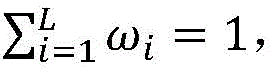
Firstly, analyzing each multi-attribute set { e ] according to an analytic hierarchy process and considering objective facts and willingness of a decision maker1,e2,e3…,eLCorresponding weight ω123…,ωLAnd are of
Figure BDA0003027343380000062
To indicate the relative importance between attributes. And then performing multi-attribute analysis on the candidate solution set to determine an evaluation index set, a candidate set and an evaluation grade. The evaluation index set is E ═ E1,e2,e3…,eLH, set of evaluation levels H ═ H1,H2,H3,…,HDThe solution set of candidate schemes is a ═ a1,a2,a3,…,aM}. L is an evaluation index set, D is the number of evaluation grades and the number of M candidate schemes. The evaluation index set refers to a multi-objective optimization function in the invention: economic operation cost, pollution gas emission and power shortage rate.
And performing confidence evaluation on different objective functions in each candidate solution set on corresponding different evaluation levels to obtain a confidence expression as follows:
S(ei(aj))={(Hnn,i(aj)),n=1,2,…,N,i=1,2,…,M}
in the formula, ajIs the jth candidate solution set; beta is an,i(aj) Is ajThe confidence level at the ith evaluation index and the nth evaluation level.
FIG. 3 is a schematic diagram of evidence fusion according to the present invention, which is a set of evaluation indexes { e } of the multi-objective functions of the micro-grid1,e2,e3…,eLThe importance of each index is represented by the corresponding weight { omega } which is placed at the bottom layer of the evidence fusion123…,ωL},{H1,H2,H3,…,HDThe decision maker evaluates the grade of each candidate scheme according to the objective function value of the candidate scheme by using a confidence evaluation method, and the confidence evaluation result (H)nn,i(aj) The decision maker has difficulty in directly judging the optimal solution from the evidence matrix, and needs to fuse the evidence, and the process is as follows:
calculating to obtain basic confidence m according to the confidencen,i=ωiβn,i(aj) Because a decider has uncertainty on the multi-objective optimization scheduling cognition of the microgrid, an uncertain basic credibility expression is as follows:
Figure BDA0003027343380000071
the first i attributes are fused on the evaluation level, and the total basic trust degree m can be obtainedn,i
Figure BDA0003027343380000072
{Hn}:mn,I(i+1)(aj)=KI(i+1)(aj)[mn,I(i)(aj)mn,i+1(aj)+mH,I(i)(aj)mn,i+1(aj)+mn,I(i)(aj)mH,i+1(aj)]
{H}:mH,I(i+1)(aj)=KI(i+1)(aj)[mH,I(i)(aj)mH,i+1(aj)]
In the formula KI(i+1)(aj) The scale factor is used for expressing the conflict degree among the evidences; m isn,I(i)Representing the total confidence coefficient obtained by fusing the confidence coefficients of the previous i evaluation indexes on the nth evaluation level; m isH,I(i)Indicating a basic confidence level that is not assigned to the first i evaluation indexes.
Integrated confidence of available candidate solutions on the evaluation level set:
Figure BDA0003027343380000073
in the formula, betan(aj) The confidence of the fused jth candidate scheme on the nth evaluation level; m isn,I(L)(aj) Representing the total confidence obtained by fusing the confidence of the L evaluation indexes on the nth evaluation level by the jth candidate scheme; m isH,I(L)(aj) Indicating that the jth candidate is not assigned to the basic confidence of the first L evaluation indexes.
Finally, the confidence coefficient set of the candidate schemes at each evaluation level is obtained
S(aj)={(Hnn(aj)),(n=1,2,…,N)}
The result of evidence fusion reasoning can only obtain the trust of each candidate scheme on each evaluation level, at the moment, the quality of the candidate solution set cannot be judged visually, and then utility evaluation is applied to map the confidence coefficient distribution into a utility value.
Figure BDA0003027343380000081
In the formula, u (a)j) Representation scheme ajThe utility value of (c).
And selecting the scheme with the maximum utility value from all the schemes as the final scheme of the micro-grid multi-objective optimization scheduling, and using the scheme as a guiding decision for the micro-grid optimization scheduling operation in the next day.
The scheme includes that a decision scheme of multi-objective optimization scheduling of a micro-grid of various distributed power supplies is obtained by a multi-attribute decision combined penalty function particle swarm optimization-based method, a limited number of candidate schemes are selected through multi-attribute decision, target weight is determined through an analytic hierarchy process, multi-evaluation-level confidence degree analysis is carried out on different targets, evidence fusion and utility evaluation are carried out, the problem of mutual influence performance of the targets in multi-objective optimization is effectively solved, and the system can stably run and achieve the optimal overall objective. The method can provide a scientific and effective method for selecting a future micro-grid multi-objective optimization scheduling scheme.
The above description is only of the preferred embodiments of the present invention, and it should be noted that: it will be apparent to those skilled in the art that various modifications and adaptations can be made without departing from the principles of the invention and these are intended to be within the scope of the invention.

Claims (5)

1. A multi-attribute decision-based micro-grid multi-objective optimization scheduling method is characterized by mainly comprising the following steps:
step 1: carrying out optimization modeling on the microgrid according to the structure of the microgrid and the characteristics of all distributed power supplies, establishing each objective function with the lowest economic cost, the lowest emission of pollutant gas and the lowest loss rate of the microgrid, constructing constraint conditions of a system objective, and taking the microgrid as a research object in a grid-connected running state, wherein dynamic optimization is adopted and divided into 24 time periods, and each time period is 1 hour;
step 2: respectively optimizing the target function for multiple times by adopting a particle swarm algorithm based on a penalty function according to the instruction of a decision maker, taking the optimal solution of each optimization result as a candidate solution set, and obtaining a plurality of candidate schemes;
and step 3: and evaluating each objective function value in the obtained candidate objective schemes by adopting a multi-attribute decision theory, performing evidence fusion by adopting an evidence reasoning method, and selecting the candidate scheme with the maximum utility value as a final solution by adopting utility evaluation.
2. The multi-objective optimization scheduling method for the micro-grid based on the multi-attribute decision as claimed in claim 1, wherein the micro-grid system in the step 1 mainly comprises a photovoltaic power generation system, a wind power generation system, a storage battery, a fuel cell and a control center, local daily typical photovoltaic output, wind power output and load data are obtained as system prediction data, and system operation parameters refer to local electricity prices, pollution discharge treatment costs and system parameters of each distributed power supply;
the objective function of the system with the lowest economic cost of the microgrid is
mine1=F1+F2+F3
Consideration of F1Cost of purchasing electricity from the grid, F2Fuel cell fuel cost and F3The operating maintenance cost of the distributed power supply;
the objective function for minimum emission of pollutant gases is:
mine2=gFcWFC+gGWG
gFcand gGEmission coefficients of fuel cell FC and grid pollution gas, WFCAnd WGRespectively discharging the pollution gas of the fuel cell FC and the pollution gas of the power grid;
the objective function for which the deficit rate is lowest is:
Figure FDA0003027343370000011
the LPSP reflects the ratio of the electric energy shortage and the load demand when the micro-grid is powered by only an internal power supplyEnsuring the power supply capability of the grid in the event of a grid fault, ELPSIs a shortage of electric energy, PLThe total required electric quantity of the load is;
the system constraint conditions comprise power balance constraint, tie line constraint, generator set capacity limit constraint, energy storage unit storage capacity constraint and charge-discharge balance constraint; distributed power sources include photovoltaic arrays, wind generators, batteries, fuel cells, gas turbines, and diesel generator devices.
3. The multi-objective optimization scheduling method for the micro-grid based on the multi-attribute decision as claimed in claim 1, wherein the constraint conditions of the system include:
1) and power balance constraint:
Figure FDA0003027343370000021
2) tie line constraint:
Figure FDA0003027343370000022
3) and limiting the capacity of the generator set:
Figure FDA0003027343370000023
4) and (4) restraining the storage capacity of the energy storage unit: SOCmin≤SOC(t)≤SOCmax
5) Charging and discharging balance constraint: t isout=Tin≤Tmax
In the formula, N is the type of the generator set; pDG,iIs the output power of genset type i; pDNThe method is energy exchange with a power grid, and the specified electricity selling time is a negative value, and the electricity purchasing time is a positive value; pLIs the load demand; pGIs the output power of the tie line;
Figure FDA0003027343370000024
and
Figure FDA0003027343370000025
respectively, the minimum safe power output and the maximum safe power output of the tie line; pDG.iIs the output power of the generator set i;
Figure FDA0003027343370000026
and
Figure FDA0003027343370000027
respectively outputting the minimum safe power and the maximum safe power of the generator set i; t isoutIs the time of day that the energy storage device is discharged; t isinIs the time of day that the energy storage device is charging; t ismaxIs the maximum charge-discharge time of the energy storage device.
4. The multi-objective optimization scheduling method for the micro-grid based on the multi-attribute decision as claimed in claim 1, wherein the particle swarm algorithm based on the penalty function is adopted in the step 2 to perform optimization respectively by objective functions of economic cost, pollution emission and power shortage rate, and an optimal solution of an optimization result is selected as a candidate solution set after multiple times of optimization; setting a penalty function and control parameters of the particle swarm algorithm based on the penalty function, wherein the penalty function and the control parameters mainly comprise the particle number, the iteration number and the penalty function factors of the particle swarm algorithm; according to the optimization conditions of different objective functions, constraint conditions are combined to form a 'punishment' item, the 'punishment' item is loaded on the original objective function to force an iteration point to approach a feasible domain, and the optimization problem with constraint can be effectively processed; the penalty function is formulated as:
Figure FDA0003027343370000028
wherein F (x, M) is a penalty function; (x) is an objective function; m is a penalty factor; mp (x) is a penalty term; gi(x) Is a constraint condition;
the method comprises the steps of coding the output of a storage battery, a fuel cell and a power distribution network in a micro-grid optimization scheduling system to generate a random initial population, and optimizing and obtaining an individual and global optimal scheme meeting constraint conditions and penalty function conditions through a particle swarm optimization.
5. The multi-attribute decision-based micro-grid multi-objective optimization scheduling method according to claim 1, wherein in the step 3, a multi-attribute decision theory is adopted for a candidate scheme solution set obtained by a multi-objective optimization intelligent algorithm to perform ranking of the advantages and disadvantages and evaluation of utility values on each objective function value in the obtained candidate target schemes, so as to select the most reasonable and effective scheme; determining the evaluation index set as E ═ E1,e2,e3…,eLH, set of evaluation levels H ═ H1,H2,H3,…,HDThe solution set of candidate schemes is a ═ a1,a2,a3,…,aM}; l is an evaluation index set, D is the number of evaluation grades and the number of M candidate schemes;
and performing confidence evaluation on different objective functions in each candidate solution set on corresponding different evaluation levels to obtain a confidence expression as follows:
S(ei(aj))={(Hnn,i(aj)),n=1,2,…,N,i=1,2,…,M}
in the formula, ajIs the jth candidate solution set; beta is an,i(aj) Is ajConfidence on the ith evaluation index and the nth evaluation level;
confidence coefficient set of candidate schemes at each evaluation level can be finally obtained by adopting evidence fusion reasoning
S(aj)={(Hnn(aj)),(n=1,2,…,N)}
βn(aj) Is ajConfidence at the nth rating level; the evidence fusion reasoning result can only obtain the trust of each candidate scheme on each evaluation level, the quality of the candidate solution set cannot be judged visually, and then utility evaluation is applied to map the confidence coefficient distribution into utility values:
Figure FDA0003027343370000031
in the formula, u (a)j) Representation scheme ajA utility value of; beta is anThe confidence level of the nth evaluation level;
and selecting the scheme with the maximum utility value from all the schemes as the final scheme of the micro-grid multi-objective optimization scheduling, and using the scheme as a guiding decision for the micro-grid optimization scheduling operation in the next day.
CN202110419741.3A 2021-04-19 2021-04-19 Multi-attribute decision-based multi-distributed power supply micro-grid multi-objective optimization scheduling method Pending CN113258561A (en)

Priority Applications (1)

Application Number Priority Date Filing Date Title
CN202110419741.3A CN113258561A (en) 2021-04-19 2021-04-19 Multi-attribute decision-based multi-distributed power supply micro-grid multi-objective optimization scheduling method

Applications Claiming Priority (1)

Application Number Priority Date Filing Date Title
CN202110419741.3A CN113258561A (en) 2021-04-19 2021-04-19 Multi-attribute decision-based multi-distributed power supply micro-grid multi-objective optimization scheduling method

Publications (1)

Publication Number Publication Date
CN113258561A true CN113258561A (en) 2021-08-13

Family

ID=77221123

Family Applications (1)

Application Number Title Priority Date Filing Date
CN202110419741.3A Pending CN113258561A (en) 2021-04-19 2021-04-19 Multi-attribute decision-based multi-distributed power supply micro-grid multi-objective optimization scheduling method

Country Status (1)

Country Link
CN (1) CN113258561A (en)

Cited By (6)

* Cited by examiner, † Cited by third party
Publication number Priority date Publication date Assignee Title
CN113890094A (en) * 2021-10-11 2022-01-04 燕山大学 Multi-target distributed power supply optimal configuration method considering power supply setting conditions
CN113988578A (en) * 2021-10-25 2022-01-28 国网山东省电力公司青岛供电公司 Microgrid group source network load storage cooperative optimization scheduling method and system considering reliability
CN116471624A (en) * 2023-04-27 2023-07-21 广东电网有限责任公司 IoT trust analysis method and related devices for photovoltaic power station group operation monitoring
CN117218424A (en) * 2023-09-12 2023-12-12 陕西丝路创城建设有限公司 A material management method and system in photovoltaic power station construction
CN117455033A (en) * 2023-09-21 2024-01-26 南京林业大学 Double-section type comprehensive energy system optimization method based on information fusion
CN120012944A (en) * 2025-04-15 2025-05-16 中国人民解放军国防科技大学 Trusted evidence reasoning method, device and equipment for multi-source data fusion

Non-Patent Citations (2)

* Cited by examiner, † Cited by third party
Title
仝年: ""微电网多目标优化调度研究"", 《中国优秀博硕士学位论文全文数据库(硕士)工程科技Ⅱ辑》 *
贾彦等: ""罚函数改进粒子群算法的风光储系统优化配置"", 《太阳能学报》 *

Cited By (10)

* Cited by examiner, † Cited by third party
Publication number Priority date Publication date Assignee Title
CN113890094A (en) * 2021-10-11 2022-01-04 燕山大学 Multi-target distributed power supply optimal configuration method considering power supply setting conditions
CN113890094B (en) * 2021-10-11 2022-06-03 燕山大学 Multi-target distributed power supply optimal configuration method considering power supply setting conditions
CN113988578A (en) * 2021-10-25 2022-01-28 国网山东省电力公司青岛供电公司 Microgrid group source network load storage cooperative optimization scheduling method and system considering reliability
CN113988578B (en) * 2021-10-25 2025-06-10 国网山东省电力公司青岛供电公司 Reliability-based micro-grid group source network load storage collaborative optimization scheduling method and system
CN116471624A (en) * 2023-04-27 2023-07-21 广东电网有限责任公司 IoT trust analysis method and related devices for photovoltaic power station group operation monitoring
CN116471624B (en) * 2023-04-27 2025-01-14 广东电网有限责任公司 Internet of Things trust analysis method and related device for photovoltaic power station group operation monitoring
CN117218424A (en) * 2023-09-12 2023-12-12 陕西丝路创城建设有限公司 A material management method and system in photovoltaic power station construction
CN117218424B (en) * 2023-09-12 2024-06-07 陕西丝路创城建设有限公司 Material management method and system in photovoltaic power station construction
CN117455033A (en) * 2023-09-21 2024-01-26 南京林业大学 Double-section type comprehensive energy system optimization method based on information fusion
CN120012944A (en) * 2025-04-15 2025-05-16 中国人民解放军国防科技大学 Trusted evidence reasoning method, device and equipment for multi-source data fusion

Similar Documents

Publication Publication Date Title
CN109462231B (en) Load optimization scheduling method, system and storage medium for residential micro-grid
CN113258561A (en) Multi-attribute decision-based multi-distributed power supply micro-grid multi-objective optimization scheduling method
Salkuti Day-ahead thermal and renewable power generation scheduling considering uncertainty
CN109325608B (en) Distributed power supply optimal configuration method considering energy storage and considering photovoltaic randomness
Niknam et al. Probabilistic energy and operation management of a microgrid containing wind/photovoltaic/fuel cell generation and energy storage devices based on point estimate method and self-adaptive gravitational search algorithm
CN103544655B (en) Layered optimization method of regional distribution network comprising micro-grid
CN107565607B (en) Micro-grid multi-time scale energy scheduling method based on real-time electricity price mechanism
CN108964050A (en) Micro-capacitance sensor dual-layer optimization dispatching method based on Demand Side Response
CN110119886A (en) A dynamic planning method for active distribution network
CN114723230B (en) Microgrid dual-layer dispatching method and system for renewable energy generation and energy storage
CN115526401A (en) A Novel Power System Optimal Planning Method Based on Digital Twin
Hou et al. Data-driven economic dispatch for islanded micro-grid considering uncertainty and demand response
CN110198042B (en) Dynamic optimization method for power grid energy storage and storage medium
Wu et al. Optimal allocation of microgrid considering economic dispatch based on hybrid weighted bilevel planning method and algorithm improvement
CN110518580A (en) Active power distribution network operation optimization method considering micro-grid active optimization
CN117543581A (en) Virtual power plant optimal scheduling method considering electric automobile demand response and application thereof
CN114301081B (en) A microgrid optimization method considering battery energy storage life loss and demand response
CN104794533A (en) Optimal capacity allocation method for user photovoltaic power station of power distribution network considering plug-in electric vehicles
CN118572705A (en) A method and system for assisting power grid peak regulation with flexible load participation
CN117391349A (en) Expressway micro-grid capacity configuration method and system considering charging pile planning
CN118195211A (en) Energy management method for industrial parks based on improved NSGA-II and GA-BP combined algorithm
CN112883630A (en) Day-ahead optimized economic dispatching method for multi-microgrid system for wind power consumption
CN119864855A (en) Micro-grid optimal scheduling method based on word order multi-target predictive control
Ul Hijaz Paul et al. Development of Short-Term Load Forecasting Model for DSM by Regulating Charging and Discharging of EVs and ESS with RES Based on the Prediction of this Model.
CN111967646A (en) Renewable energy source optimal configuration method for virtual power plant

Legal Events

Date Code Title Description
PB01 Publication
PB01 Publication
SE01 Entry into force of request for substantive examination
RJ01 Rejection of invention patent application after publication

Application publication date: 20210813

RJ01 Rejection of invention patent application after publication