CN113244458B - Composite material for repairing articular cartilage damage and preparation method thereof - Google Patents
Composite material for repairing articular cartilage damage and preparation method thereof Download PDFInfo
- Publication number
- CN113244458B CN113244458B CN202110500971.2A CN202110500971A CN113244458B CN 113244458 B CN113244458 B CN 113244458B CN 202110500971 A CN202110500971 A CN 202110500971A CN 113244458 B CN113244458 B CN 113244458B
- Authority
- CN
- China
- Prior art keywords
- collagen
- prp
- composite material
- articular cartilage
- calcium
- Prior art date
- Legal status (The legal status is an assumption and is not a legal conclusion. Google has not performed a legal analysis and makes no representation as to the accuracy of the status listed.)
- Active
Links
Images


Classifications
-
- A—HUMAN NECESSITIES
- A61—MEDICAL OR VETERINARY SCIENCE; HYGIENE
- A61L—METHODS OR APPARATUS FOR STERILISING MATERIALS OR OBJECTS IN GENERAL; DISINFECTION, STERILISATION OR DEODORISATION OF AIR; CHEMICAL ASPECTS OF BANDAGES, DRESSINGS, ABSORBENT PADS OR SURGICAL ARTICLES; MATERIALS FOR BANDAGES, DRESSINGS, ABSORBENT PADS OR SURGICAL ARTICLES
- A61L27/00—Materials for grafts or prostheses or for coating grafts or prostheses
- A61L27/40—Composite materials, i.e. containing one material dispersed in a matrix of the same or different material
- A61L27/44—Composite materials, i.e. containing one material dispersed in a matrix of the same or different material having a macromolecular matrix
-
- A—HUMAN NECESSITIES
- A61—MEDICAL OR VETERINARY SCIENCE; HYGIENE
- A61L—METHODS OR APPARATUS FOR STERILISING MATERIALS OR OBJECTS IN GENERAL; DISINFECTION, STERILISATION OR DEODORISATION OF AIR; CHEMICAL ASPECTS OF BANDAGES, DRESSINGS, ABSORBENT PADS OR SURGICAL ARTICLES; MATERIALS FOR BANDAGES, DRESSINGS, ABSORBENT PADS OR SURGICAL ARTICLES
- A61L27/00—Materials for grafts or prostheses or for coating grafts or prostheses
- A61L27/36—Materials for grafts or prostheses or for coating grafts or prostheses containing ingredients of undetermined constitution or reaction products thereof, e.g. transplant tissue, natural bone, extracellular matrix
- A61L27/3604—Materials for grafts or prostheses or for coating grafts or prostheses containing ingredients of undetermined constitution or reaction products thereof, e.g. transplant tissue, natural bone, extracellular matrix characterised by the human or animal origin of the biological material, e.g. hair, fascia, fish scales, silk, shellac, pericardium, pleura, renal tissue, amniotic membrane, parenchymal tissue, fetal tissue, muscle tissue, fat tissue, enamel
- A61L27/3616—Blood, e.g. platelet-rich plasma
-
- A—HUMAN NECESSITIES
- A61—MEDICAL OR VETERINARY SCIENCE; HYGIENE
- A61L—METHODS OR APPARATUS FOR STERILISING MATERIALS OR OBJECTS IN GENERAL; DISINFECTION, STERILISATION OR DEODORISATION OF AIR; CHEMICAL ASPECTS OF BANDAGES, DRESSINGS, ABSORBENT PADS OR SURGICAL ARTICLES; MATERIALS FOR BANDAGES, DRESSINGS, ABSORBENT PADS OR SURGICAL ARTICLES
- A61L27/00—Materials for grafts or prostheses or for coating grafts or prostheses
- A61L27/50—Materials characterised by their function or physical properties, e.g. injectable or lubricating compositions, shape-memory materials, surface modified materials
- A61L27/54—Biologically active materials, e.g. therapeutic substances
-
- C—CHEMISTRY; METALLURGY
- C07—ORGANIC CHEMISTRY
- C07K—PEPTIDES
- C07K14/00—Peptides having more than 20 amino acids; Gastrins; Somatostatins; Melanotropins; Derivatives thereof
- C07K14/435—Peptides having more than 20 amino acids; Gastrins; Somatostatins; Melanotropins; Derivatives thereof from animals; from humans
- C07K14/78—Connective tissue peptides, e.g. collagen, elastin, laminin, fibronectin, vitronectin or cold insoluble globulin [CIG]
-
- C—CHEMISTRY; METALLURGY
- C12—BIOCHEMISTRY; BEER; SPIRITS; WINE; VINEGAR; MICROBIOLOGY; ENZYMOLOGY; MUTATION OR GENETIC ENGINEERING
- C12N—MICROORGANISMS OR ENZYMES; COMPOSITIONS THEREOF; PROPAGATING, PRESERVING, OR MAINTAINING MICROORGANISMS; MUTATION OR GENETIC ENGINEERING; CULTURE MEDIA
- C12N5/00—Undifferentiated human, animal or plant cells, e.g. cell lines; Tissues; Cultivation or maintenance thereof; Culture media therefor
- C12N5/06—Animal cells or tissues; Human cells or tissues
- C12N5/0602—Vertebrate cells
- C12N5/0634—Cells from the blood or the immune system
- C12N5/0644—Platelets; Megakaryocytes
-
- C—CHEMISTRY; METALLURGY
- C12—BIOCHEMISTRY; BEER; SPIRITS; WINE; VINEGAR; MICROBIOLOGY; ENZYMOLOGY; MUTATION OR GENETIC ENGINEERING
- C12P—FERMENTATION OR ENZYME-USING PROCESSES TO SYNTHESISE A DESIRED CHEMICAL COMPOUND OR COMPOSITION OR TO SEPARATE OPTICAL ISOMERS FROM A RACEMIC MIXTURE
- C12P21/00—Preparation of peptides or proteins
- C12P21/06—Preparation of peptides or proteins produced by the hydrolysis of a peptide bond, e.g. hydrolysate products
-
- A—HUMAN NECESSITIES
- A61—MEDICAL OR VETERINARY SCIENCE; HYGIENE
- A61L—METHODS OR APPARATUS FOR STERILISING MATERIALS OR OBJECTS IN GENERAL; DISINFECTION, STERILISATION OR DEODORISATION OF AIR; CHEMICAL ASPECTS OF BANDAGES, DRESSINGS, ABSORBENT PADS OR SURGICAL ARTICLES; MATERIALS FOR BANDAGES, DRESSINGS, ABSORBENT PADS OR SURGICAL ARTICLES
- A61L2300/00—Biologically active materials used in bandages, wound dressings, absorbent pads or medical devices
- A61L2300/10—Biologically active materials used in bandages, wound dressings, absorbent pads or medical devices containing or releasing inorganic materials
- A61L2300/102—Metals or metal compounds, e.g. salts such as bicarbonates, carbonates, oxides, zeolites, silicates
-
- A—HUMAN NECESSITIES
- A61—MEDICAL OR VETERINARY SCIENCE; HYGIENE
- A61L—METHODS OR APPARATUS FOR STERILISING MATERIALS OR OBJECTS IN GENERAL; DISINFECTION, STERILISATION OR DEODORISATION OF AIR; CHEMICAL ASPECTS OF BANDAGES, DRESSINGS, ABSORBENT PADS OR SURGICAL ARTICLES; MATERIALS FOR BANDAGES, DRESSINGS, ABSORBENT PADS OR SURGICAL ARTICLES
- A61L2300/00—Biologically active materials used in bandages, wound dressings, absorbent pads or medical devices
- A61L2300/20—Biologically active materials used in bandages, wound dressings, absorbent pads or medical devices containing or releasing organic materials
- A61L2300/23—Carbohydrates
- A61L2300/232—Monosaccharides, disaccharides, polysaccharides, lipopolysaccharides
-
- A—HUMAN NECESSITIES
- A61—MEDICAL OR VETERINARY SCIENCE; HYGIENE
- A61L—METHODS OR APPARATUS FOR STERILISING MATERIALS OR OBJECTS IN GENERAL; DISINFECTION, STERILISATION OR DEODORISATION OF AIR; CHEMICAL ASPECTS OF BANDAGES, DRESSINGS, ABSORBENT PADS OR SURGICAL ARTICLES; MATERIALS FOR BANDAGES, DRESSINGS, ABSORBENT PADS OR SURGICAL ARTICLES
- A61L2300/00—Biologically active materials used in bandages, wound dressings, absorbent pads or medical devices
- A61L2300/20—Biologically active materials used in bandages, wound dressings, absorbent pads or medical devices containing or releasing organic materials
- A61L2300/30—Compounds of undetermined constitution extracted from natural sources, e.g. Aloe Vera
-
- A—HUMAN NECESSITIES
- A61—MEDICAL OR VETERINARY SCIENCE; HYGIENE
- A61L—METHODS OR APPARATUS FOR STERILISING MATERIALS OR OBJECTS IN GENERAL; DISINFECTION, STERILISATION OR DEODORISATION OF AIR; CHEMICAL ASPECTS OF BANDAGES, DRESSINGS, ABSORBENT PADS OR SURGICAL ARTICLES; MATERIALS FOR BANDAGES, DRESSINGS, ABSORBENT PADS OR SURGICAL ARTICLES
- A61L2430/00—Materials or treatment for tissue regeneration
- A61L2430/06—Materials or treatment for tissue regeneration for cartilage reconstruction, e.g. meniscus
-
- A—HUMAN NECESSITIES
- A61—MEDICAL OR VETERINARY SCIENCE; HYGIENE
- A61L—METHODS OR APPARATUS FOR STERILISING MATERIALS OR OBJECTS IN GENERAL; DISINFECTION, STERILISATION OR DEODORISATION OF AIR; CHEMICAL ASPECTS OF BANDAGES, DRESSINGS, ABSORBENT PADS OR SURGICAL ARTICLES; MATERIALS FOR BANDAGES, DRESSINGS, ABSORBENT PADS OR SURGICAL ARTICLES
- A61L2430/00—Materials or treatment for tissue regeneration
- A61L2430/24—Materials or treatment for tissue regeneration for joint reconstruction
-
- C—CHEMISTRY; METALLURGY
- C12—BIOCHEMISTRY; BEER; SPIRITS; WINE; VINEGAR; MICROBIOLOGY; ENZYMOLOGY; MUTATION OR GENETIC ENGINEERING
- C12N—MICROORGANISMS OR ENZYMES; COMPOSITIONS THEREOF; PROPAGATING, PRESERVING, OR MAINTAINING MICROORGANISMS; MUTATION OR GENETIC ENGINEERING; CULTURE MEDIA
- C12N2509/00—Methods for the dissociation of cells, e.g. specific use of enzymes
- C12N2509/10—Mechanical dissociation
Landscapes
- Health & Medical Sciences (AREA)
- Life Sciences & Earth Sciences (AREA)
- Chemical & Material Sciences (AREA)
- Engineering & Computer Science (AREA)
- Organic Chemistry (AREA)
- Zoology (AREA)
- Biomedical Technology (AREA)
- General Health & Medical Sciences (AREA)
- Medicinal Chemistry (AREA)
- Molecular Biology (AREA)
- Genetics & Genomics (AREA)
- Wood Science & Technology (AREA)
- Oral & Maxillofacial Surgery (AREA)
- Public Health (AREA)
- Biochemistry (AREA)
- Bioinformatics & Cheminformatics (AREA)
- Transplantation (AREA)
- Biotechnology (AREA)
- Veterinary Medicine (AREA)
- Hematology (AREA)
- Animal Behavior & Ethology (AREA)
- Epidemiology (AREA)
- Dermatology (AREA)
- Chemical Kinetics & Catalysis (AREA)
- General Engineering & Computer Science (AREA)
- Microbiology (AREA)
- Proteomics, Peptides & Aminoacids (AREA)
- Botany (AREA)
- Urology & Nephrology (AREA)
- Immunology (AREA)
- General Chemical & Material Sciences (AREA)
- Composite Materials (AREA)
- Materials Engineering (AREA)
- Toxicology (AREA)
- Gastroenterology & Hepatology (AREA)
- Biophysics (AREA)
- Cell Biology (AREA)
- Medicinal Preparation (AREA)
- Materials For Medical Uses (AREA)
Abstract
本发明涉及一种用于修复关节软骨损伤的复合材料,包括由动物皮肤组织制得的液态的胶原蛋白、自体血液制得的具有一定数量血小板数的PRP、质量百分比浓度为5%~10%的钙离子激活剂,胶原蛋白、PRP、钙离子激活剂以体积比为(10~15):(10~15):1的比例混合,且胶原蛋白和PRP的体积相同,同时公开了该复合材料的制备方法,即依次制得胶原蛋白、PRP并将它们混合,之后再混入钙离子激活剂。该发明制备方法简单易操作,不需要复杂的设备,原料来源广泛,选择动物皮肤组织和患者自体血液,能显著降低成本,不用添加外源性凝血酶,减少了不良反应发生的几率,也能减缓PRP中生长因子的释放。
The invention relates to a composite material for repairing articular cartilage damage, comprising liquid collagen prepared from animal skin tissue, PRP prepared from autologous blood with a certain number of platelets, and a mass percentage concentration of 5% to 10% The calcium activator, collagen, PRP, and calcium activator are mixed in a volume ratio of (10-15): (10-15): 1, and the volume of collagen and PRP is the same, and the compound is disclosed. The preparation method of the material is to sequentially prepare collagen and PRP and mix them, and then add calcium ion activator. The preparation method of the invention is simple and easy to operate, does not require complex equipment, has a wide range of raw material sources, selects animal skin tissue and patient autologous blood, can significantly reduce costs, does not need to add exogenous thrombin, reduces the probability of adverse reactions, and can also Slows the release of growth factors in PRP.
Description
技术领域technical field
本发明涉及医疗材料领域,尤其是一种用于修复关节软骨损伤的复合材料及其制备方法。The invention relates to the field of medical materials, in particular to a composite material for repairing articular cartilage damage and a preparation method thereof.
背景技术Background technique
关节软骨是由软骨细胞和软骨基质组成的一种乳白色、光滑的透明组织,覆盖于关节表面,可以保障机体关节正常运动。关节软骨损伤是较为常见的关节外科疾病,可由创伤、骨关节炎、类风湿性关节炎和剥脱性骨软骨炎等引起,未经有效治疗容易发展为膝骨性关节炎(KOA),后期会导致疼痛、关节畸形直至残疾,严重影响患者的运动功能与生活质量,同时加重患者心理压力或精神负担。Articular cartilage is a milky white, smooth and transparent tissue composed of chondrocytes and cartilage matrix. It covers the surface of the joint and can ensure the normal movement of the body's joints. Articular cartilage injury is a relatively common joint surgical disease, which can be caused by trauma, osteoarthritis, rheumatoid arthritis, and osteochondritis dissecans. Without effective treatment, it is easy to develop into knee osteoarthritis (KOA). It leads to pain, joint deformity and even disability, which seriously affects the patient's motor function and quality of life, and at the same time increases the patient's psychological pressure or mental burden.
随着再生医学与组织工程的不断发展,为软骨的修复与重建提供了新的方法及思路。软骨细胞工程就是通过利用支架材料、种子细胞以及生长因子三要素,综合形成具有良好生物学功能的替代组织,从而修复缺失或发生损伤的软骨组织。富血小板血浆(Platelet-rich Plasma,PRP)是全血经离心后得到的血小板浓缩物,含有大量生长因子及活性蛋白,如转化生长因子TGF-β,能有效促进细胞增殖、分化和细胞外基质的合成,可用于修复关节软骨损伤、加速骨愈合。With the continuous development of regenerative medicine and tissue engineering, new methods and ideas have been provided for the repair and reconstruction of cartilage. Chondrocyte engineering is to repair missing or damaged cartilage tissue by using the three elements of scaffold material, seed cells and growth factors to comprehensively form a substitute tissue with good biological functions. Platelet-rich Plasma (PRP) is a platelet concentrate obtained after centrifugation of whole blood. It contains a large number of growth factors and active proteins, such as transforming growth factor TGF-β, which can effectively promote cell proliferation, differentiation and extracellular matrix. It can be used to repair articular cartilage damage and accelerate bone healing.
随着PRP治疗KOA在临床的普及,仍然存在一些不足:首先,PRP网状结构的密度由其原料纤维蛋白原的数量决定,其类型取决于凝血酶总量与聚合速度。在传统PRP的制备过程中,未聚合的纤维蛋白原因溶解于PPP而直接被弃掉,因此加入凝血酶来促凝血时,纤维蛋白原含量已大大降低,使聚合后的纤维蛋白网状结构的密度远低于生理血凝块,由于外源性凝血酶的作用,高凝血酶浓度使得纤维蛋白原的聚合速度远高于生理反应,形成的纤维蛋白网由四分子纤维蛋白原聚合形成,僵硬而缺乏弹性,不利于网罗生长因子及促进细胞迁移。PRP由于外源性凝血酶的参与,瞬间激活了PRP中的血小板,并且激活后释放的生长因子亦有起加速血小板激活作用的生长因子,故其生长因子的释放集中在加入外源性凝血酶的时点附近以及使用后愈合期的早期阶段,而后期的释放较少,生长因子的释放并不均衡及持久。With the popularization of PRP treatment for KOA in clinical practice, there are still some deficiencies: First, the density of PRP network structure is determined by the amount of its raw material fibrinogen, and its type depends on the total amount of thrombin and the polymerization speed. In the preparation process of traditional PRP, the unpolymerized fibrin is directly discarded because it dissolves in the PPP. Therefore, when thrombin is added to promote coagulation, the fibrinogen content has been greatly reduced, which makes the polymerized fibrin network structure more stable. The density of blood clots is much lower than that of physiological blood clots. Due to the action of exogenous thrombin, the high thrombin concentration makes the polymerization rate of fibrinogen much higher than the physiological reaction. The formed fibrin network is formed by the polymerization of four molecules of fibrinogen, which is stiff The lack of elasticity is not conducive to trapping growth factors and promoting cell migration. Due to the participation of exogenous thrombin, PRP instantly activates platelets in PRP, and the growth factors released after activation also have growth factors that accelerate platelet activation, so the release of growth factors is concentrated in the addition of exogenous thrombin. Near the time point and in the early stage of the healing period after use, while the later release is less, the release of growth factors is not balanced and long-lasting.
发明内容SUMMARY OF THE INVENTION
针对现有的不足,本发明提供一种用于修复关节软骨损伤的复合材料及其制备方法。In view of the existing deficiencies, the present invention provides a composite material for repairing articular cartilage damage and a preparation method thereof.
本发明解决其技术问题所采用的技术方案是:一种用于修复关节软骨损伤的复合材料,包括由动物皮肤组织制得的液态的胶原蛋白、自体血液制得的血小板数为(350~1250)×103/μL的PRP、质量百分比浓度为5%~10%的钙离子激活剂,所述胶原蛋白、PRP、钙离子激活剂以体积比为(10~15):(10~15):1的比例混合,且胶原蛋白和PRP的体积相同,所述胶原蛋白中混合有长度小于500nm的由纤维素包覆的单壁碳纳米管,其在胶原蛋白中的浓度小于100μg/mL。The technical solution adopted by the present invention to solve the technical problem is: a composite material for repairing articular cartilage damage, comprising liquid collagen prepared from animal skin tissue, and platelets prepared from autologous blood (350-1250). )×10 3 /μL of PRP, calcium ion activator with a mass percentage concentration of 5% to 10%, and the volume ratio of collagen, PRP and calcium ion activator is (10 to 15):(10 to 15) : 1 ratio, and the volume of collagen and PRP are the same, and the collagen is mixed with cellulose-coated single-walled carbon nanotubes with a length of less than 500 nm, and the concentration of the collagen in the collagen is less than 100 μg/mL.
作为优选,所述胶原蛋白、PRP、钙离子激活剂的体积比是10:10:1。Preferably, the volume ratio of the collagen, PRP, and calcium activator is 10:10:1.
作为优选,所述钙离子激活剂是氯化钙、葡萄糖酸钙中的一种或两种,所述氯化钙的质量百分比浓度是10%或5%,所述葡萄糖酸钙的质量百分比浓度是10%。Preferably, the calcium ion activator is one or both of calcium chloride and calcium gluconate, the mass percentage concentration of the calcium chloride is 10% or 5%, and the mass percentage concentration of the calcium gluconate is is 10%.
一种用于修复关节软骨损伤的复合材料的制备方法,步骤如下:A preparation method of a composite material for repairing articular cartilage damage, the steps are as follows:
S1,胶原蛋白的制备,选择动物的皮肤组织将其制成胶原蛋白,所述胶原蛋白中混合有长度小于500nm的由纤维素包覆的单壁碳纳米管,其在胶原蛋白中的浓度小于100μg/mL;S1, preparation of collagen, select animal skin tissue to make collagen, the collagen is mixed with cellulose-coated single-walled carbon nanotubes with a length of less than 500 nm, and its concentration in collagen is less than 100μg/mL;
S2,PRP的制备,采集自体血液至预先装有枸橼酸钠或EDTA的血液采集容器中,离心去除血液中的红细胞制得血小板数为(350~1250)×103/μL的PRP;S2, preparation of PRP, collect autologous blood into a blood collection container pre-filled with sodium citrate or EDTA, and centrifuge to remove red blood cells in the blood to obtain PRP with a platelet count of (350-1250)×10 3 /μL;
S3,胶原蛋白和PRP的混合,将前述制备的胶原蛋白和PRP以体积比1:1的方式混合制成待注射溶液;S3, mixing of collagen and PRP, mixing the previously prepared collagen and PRP in a volume ratio of 1:1 to prepare a solution to be injected;
S4,待注射溶液和激活剂的混合,使用质量百分比浓度为5%~10%的钙离子激活剂与前述的待注射溶液混合,所述钙离子激活剂与待注射溶液的体积比为1:(20~30)。S4, the mixing of the solution to be injected and the activator, the calcium ion activator whose mass percentage concentration is 5% to 10% is mixed with the aforementioned solution to be injected, and the volume ratio of the calcium ion activator to the solution to be injected is 1: (20 to 30).
作为优选,所述钙离子激活剂是氯化钙、葡萄糖酸钙中的一种或两种,所述氯化钙的质量百分比浓度是10%或5%,所述葡萄糖酸钙的质量百分比浓度是10%。Preferably, the calcium ion activator is one or both of calcium chloride and calcium gluconate, the mass percentage concentration of the calcium chloride is 10% or 5%, and the mass percentage concentration of the calcium gluconate is is 10%.
作为优选,所述PRP是通过一次离心制得的,其离心速度为2200r/min,离心时间15min,离心结束后保留有PRP层下0.5~1mL的红细胞。Preferably, the PRP is prepared by one-time centrifugation with a centrifugation speed of 2200 r/min and a centrifugation time of 15 minutes. After the centrifugation, 0.5-1 mL of red blood cells are retained under the PRP layer.
作为优选,所述胶原蛋白的制备步骤如下:Preferably, the preparation steps of the collagen are as follows:
S1a,采样动物的皮肤组织;S1a, the skin tissue of the sampled animal;
S1b,前处理,对皮肤组织进行清洗和去脂处理;S1b, pretreatment, washing and degreasing the skin tissue;
S1c,去除杂蛋白,将前处理后的皮肤组织加入重量浓度为2%的氯化钠溶液中,浸提7~8小时;S1c, remove impurities, add the pretreated skin tissue to a sodium chloride solution with a weight concentration of 2%, and extract for 7-8 hours;
S1d,粉碎,将去除杂蛋白的组织放入组织捣碎机进行粉碎;S1d, pulverize, put the tissue from which impurities are removed into a tissue masher for pulverization;
S1e,提取,将粉碎后的组织加入蛋白酶中,在给定的pH值、提取温度、提取时间下进行提取;S1e, extraction, adding the crushed tissue to protease, and extracting at a given pH value, extraction temperature, and extraction time;
S1f,盐析,将提取液在7500~8000r/min的条件下离心,分离出上清液,调节pH值为7.0~7.5,加入(NH4)2SO4,缓慢搅拌后静置过夜;S1f, salting out, centrifuge the extract at 7500-8000 r/min, separate the supernatant, adjust the pH to 7.0-7.5, add (NH 4 ) 2 SO 4 , stir slowly and let stand overnight;
S1g,溶解与纯化,将盐析后的沉淀溶于pH为2的醋酸溶液,装入透析袋中透析纯化制得胶原蛋白。S1g, dissolve and purify, dissolve the precipitate after salting out in acetic acid solution with
作为优选,所述纤维素包覆的单壁碳纳米管制备方法如下,Preferably, the preparation method of the cellulose-coated single-walled carbon nanotubes is as follows,
P1,将单壁碳纳米管纯化并截短至长度小于500nm;P1, purifying and truncating single-walled carbon nanotubes to a length of less than 500 nm;
P2,将纯化并截短的单壁碳纳米管与纤维素的溴化1-丁基-3-甲基咪唑溶液在超声下反应,之后将反应液抽滤制得纤维素包覆的单壁碳纳米管。P2, the purified and truncated single-walled carbon nanotubes were reacted with a 1-butyl-3-methylimidazole bromide solution of cellulose under ultrasound, and then the reaction solution was suction filtered to obtain cellulose-coated single-walled carbon nanotubes. carbon nanotubes.
本发明的有益效果在于:该发明制备方法简单易操作,不需要复杂的设备,原料来源广泛,选择动物皮肤组织,来源广泛,能显著降低成本,胶原蛋白与PPR联合使用可以增加支架材料的网状结构密度,提高弹性,有利于网罗生长因子及促进细胞迁移,PRP利用患者自体血液,通过钙离子激活剂激活PRP中所含有的内源性凝血酶,不用添加外源性凝血酶,减少了不良反应发生的几率,也能减缓PRP中生长因子的释放,PRP中的血小板数量也就确保了通过钙离子能激活足够的生长因子,而激活剂浓度的限定就能最大化的激活生长因子,避免浓度过低起到稀释作用,导致生长因子的浓度降低,浓度过高起不到缓释的目的。The beneficial effects of the invention are as follows: the preparation method of the invention is simple and easy to operate, does not require complicated equipment, has a wide range of raw material sources, selects animal skin tissue, has a wide range of sources, and can significantly reduce costs, and the combined use of collagen and PPR can increase the network of scaffold materials. PRP uses the patient's own blood to activate the endogenous thrombin contained in PRP through calcium activator, without adding exogenous thrombin, reducing the The probability of adverse reactions can also slow down the release of growth factors in PRP. The number of platelets in PRP ensures that enough growth factors can be activated by calcium ions, and the limit of activator concentration can maximize the activation of growth factors. Avoid too low concentration to play a dilution effect, resulting in a decrease in the concentration of growth factors, and too high concentration can not achieve the purpose of slow release.
附图说明Description of drawings
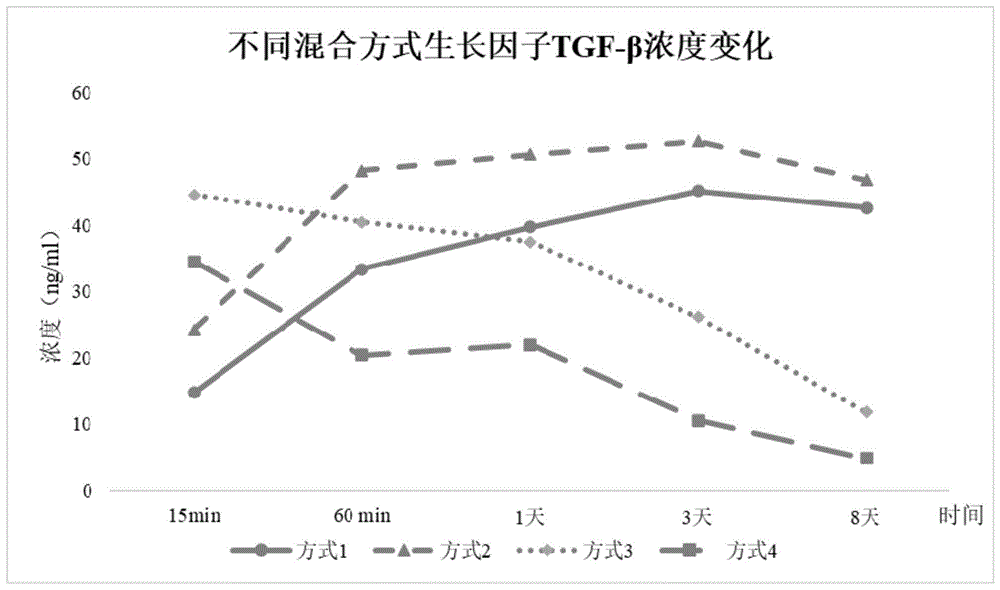
图1是本发明实施例中混合材料后生长因子浓度随时间变化的示意图;Fig. 1 is the schematic diagram of the change of growth factor concentration with time after mixing materials in the embodiment of the present invention;
图2是本发明实施例中混合材料后凝胶体积随时间的变化示意图;Fig. 2 is a schematic diagram of the change of gel volume with time after mixing materials in the embodiment of the present invention;
具体实施方式Detailed ways
为了更清楚地说明本发明实施例的目的、技术方案和优点,下面将结合附图及实施例对本发明作进一步说明,进行清楚、完整的描述,显然,所描述的实施例是本发明的部分实施例,而不是全部实施例。基于本发明的实施例,本领域普通技术人员在没有付出创造性劳动的前提下所获得的所有其他实施例,都属于本发明的保护范围。此外,本发明中所提到的方向用语,例如,“上”、“下”、“前”、“后”、“左”、“右”、“内”、“外”等,仅是参考附加图示的方向,使用的方向用语是为了更好、更清楚地说明及理解本发明,而不是指示或暗指本发明必须具有的方位,因此不能理解为对本发明的限制。In order to more clearly illustrate the purpose, technical solutions and advantages of the embodiments of the present invention, the present invention will be further described below with reference to the accompanying drawings and embodiments, and a clear and complete description will be given. Obviously, the described embodiments are part of the present invention examples, but not all examples. Based on the embodiments of the present invention, all other embodiments obtained by those of ordinary skill in the art without creative work fall within the protection scope of the present invention. In addition, the directional terms mentioned in the present invention, such as "up", "down", "front", "rear", "left", "right", "inside", "outside", etc., are only for reference In addition to the directions shown in the drawings, the directional terms used are for better and clearer description and understanding of the present invention, rather than indicating or implying the necessary orientation of the present invention, and therefore should not be construed as a limitation of the present invention.
本发明实施例,一种用于修复关节软骨损伤的复合材料及其制备方法,制备步骤如下:The embodiment of the present invention, a composite material for repairing articular cartilage damage and a preparation method thereof, the preparation steps are as follows:
S1,胶原蛋白的制备,选择动物的皮肤组织将其制成胶原蛋白,选择动物皮肤组织,如鱼、猪、牛、羊等的皮肤组织,来源广泛,成本低廉,能显著降低成本,胶原蛋白具有高生物相容性、低致敏性和可被生物降解的特性,且来源广泛、容易获取,是一种理想的生物支架材料,其制备过程则是:S1, preparation of collagen, select animal skin tissue to make collagen, select animal skin tissue, such as skin tissue of fish, pig, cow, sheep, etc., the source is wide, the cost is low, and the cost can be significantly reduced. Collagen It has the characteristics of high biocompatibility, hypoallergenicity and biodegradation, and is widely available and easy to obtain. It is an ideal bioscaffold material. The preparation process is as follows:
S1a,采样动物的皮肤组织,选定好动物,对其皮肤组织进行采样;S1a, sample the skin tissue of the animal, select the animal, and sample its skin tissue;
S1b,前处理,对皮肤组织进行清洗和去脂处理,首先刮去动物皮肤组织上的脂肪层,让后将其切成长和宽约5mm的小块状,加入5%脂肪酶、丙酮和1:1乙醚:石油醚浸泡并振荡处理30min~1h,结束后取出组织块并用清水冲洗至中性;S1b, pretreatment, cleaning and degreasing the skin tissue, first scraping the fat layer on the animal skin tissue, then cutting it into small pieces about 5mm long and wide, adding 5% lipase, acetone and 1 :1 Diethyl ether: petroleum ether soaked and shaken for 30min~1h, after the end, the tissue block was taken out and rinsed with water until neutral;
S1c,去除杂蛋白,将前处理后的皮肤组织加入重量浓度为2%的氯化钠溶液中,浸提7~8小时;S1c, remove impurities, add the pretreated skin tissue to a sodium chloride solution with a weight concentration of 2%, and extract for 7-8 hours;
S1d,粉碎,将去除杂蛋白的组织放入组织捣碎机进行粉碎;S1d, pulverize, put the tissue from which impurities are removed into a tissue masher for pulverization;
S1e,提取,将粉碎后的组织加入蛋白酶中,在给定的pH值、提取温度、提取时间下进行提取,此时pH值、提取温度、提取时间就依据所加入的不同蛋白酶来进行设定,在粉碎后的组织中加入木瓜蛋白酶,调节pH在5.0~7.0范围内,温度控制在25~35℃,提取时间20~24h;若使用胃蛋白酶,调节pH在1.5~2.5范围内,在10~20℃条件下提取5~12h;若使用中性蛋白酶,调节pH在7.0~8.0范围内,在30~35℃条件下提取5~8h;若使用菠萝蛋白酶,调节pH在2.5~3.5范围内,在40~50℃条件下提取5~8h;S1e, extraction, adding the crushed tissue to protease, and extracting at a given pH value, extraction temperature, and extraction time. At this time, the pH value, extraction temperature, and extraction time are set according to the different protease added. , add papain to the crushed tissue, adjust the pH in the range of 5.0-7.0, control the temperature at 25-35°C, and extract the time 20-24h; if pepsin is used, adjust the pH in the range of 1.5-2.5, within 10 Extraction at ~20℃ for 5-12h; if neutral protease is used, adjust pH in the range of 7.0-8.0, and extract at 30-35℃ for 5-8h; if bromelain is used, adjust pH in the range of 2.5-3.5 , extract at 40-50°C for 5-8h;
S1f,盐析,将提取液在7500~8000r/min的条件下离心,分离出上清液,调节pH值为7.0~7.5,加入(NH4)2SO4,缓慢搅拌后静置过夜;S1f, salting out, centrifuge the extract at 7500-8000 r/min, separate the supernatant, adjust the pH to 7.0-7.5, add (NH 4 ) 2 SO 4 , stir slowly and let stand overnight;
S1g,溶解与纯化,将盐析后的沉淀溶于pH为2的醋酸溶液,装入透析袋中透析纯化制得胶原蛋白;S1g, dissolve and purify, dissolve the precipitate after salting out in an acetic acid solution with
S2,PRP的制备,采集自体血液至预先装有枸橼酸钠或EDTA的血液采集容器中,离心去除血液中的红细胞制得血小板数为(350~1250)×103/μL的PRP,采集10mL自体血液至预先装有适量枸橼酸钠或EDTA的血液采集容器(离心管、注射器等)中,进行离心,采用一次离心的方式,离心速度设置为2200r/min,离心15min,离心后去除底部的红细胞,并保留白膜层(交界面)下少量的红细胞,即保留PRP层下0.5~1mL的红细胞,此时采集管内底部物质则为PRP,且PRP中血小板计数为(350~1250)×103/μL,约为全血血小板计数的3~6倍;S2, preparation of PRP, collect autologous blood into a blood collection container pre-filled with sodium citrate or EDTA, centrifuge to remove red blood cells in the blood to obtain PRP with a platelet count of (350-1250)×10 3 /μL, and collect 10mL of autologous blood was placed in a blood collection container (centrifuge tube, syringe, etc.) pre-filled with an appropriate amount of sodium citrate or EDTA, and centrifuged. The centrifugation speed was set to 2200r/min, centrifuged for 15min, and then removed after centrifugation. The red blood cells at the bottom, and a small amount of red blood cells under the buffy coat (interface) are retained, that is, 0.5-1 mL of red blood cells under the PRP layer are retained. At this time, the bottom material in the collection tube is PRP, and the platelet count in the PRP is (350-1250) ×10 3 /μL, about 3 to 6 times the whole blood platelet count;
S3,胶原蛋白和PRP的混合,将前述制备的胶原蛋白和PRP以体积比1:1的方式混合制成待注射溶液,PRP中血小板计数为662×103/μL,混合是可以采用缓慢搅拌下的混合或者利用两个注射器进行推注混合;胶原蛋白与PPR联合使用可以增加支架材料的网状结构密度,提高弹性,有利于网罗生长因子及促进细胞迁移;S3, the mixing of collagen and PRP, the collagen and PRP prepared above are mixed in a volume ratio of 1:1 to prepare a solution to be injected, the platelet count in PRP is 662×10 3 /μL, and the mixing can be done by slow stirring The combination of collagen and PPR can increase the density of the network structure of the scaffold material, improve the elasticity, and is conducive to trapping growth factors and promoting cell migration;
S4,待注射溶液和激活剂的混合,使用质量百分比浓度为5%~10%的钙离子激活剂与前述的带注射溶液混合,所述钙离子激活剂与待注射溶液的体积比为1:(20~30),PRP利用患者自体血液,通过钙离子激活剂激活PRP中所含有的内源性凝血酶,不用添加外源性凝血酶,外源性凝血酶的浓度可影响细胞的增殖、组织因子和炎症因子的释放,高浓度时具有神经毒性,采用自体血液中PRP避免了外源性凝血酶可能会产生的免疫排斥、凝血功能障碍等不良反应,也能减缓PRP中生长因子的释放,PRP中的血小板数量也就确保了通过钙离子能激活足够的生长因子,而激活剂浓度的限定就能最大化的激活生长因子,避免浓度过低起到稀释作用,导致生长因子的浓度降低,浓度过高起不到缓释的目的,抑制细胞增殖等问题,钙离子激活剂是氯化钙、葡萄糖酸钙中的一种或两种,所述氯化钙的质量百分比浓度是10%或5%,所述葡萄糖酸钙的质量百分比浓度是10%,葡萄糖酸钙是一种良好的螯合剂,可以有效地降低毛细血管通透性,增加致密度,起到止血效果,并有助于骨质形成,与CaCl2联合作为激活剂使用对细胞的促迁移作用明显。在实施例中选择选择10%CaCl2作为激活剂,与前述制成的待注射溶液的体积比为1:20进行混合,此时混合后形成的复合材料中胶原蛋白:PRP:CaCl2的体积比就为10:10:1。S4, the mixing of the solution to be injected and the activator, the calcium ion activator whose mass percentage concentration is 5% to 10% is mixed with the aforementioned injection solution, and the volume ratio of the calcium ion activator to the solution to be injected is 1: (20-30), PRP uses the patient's own blood to activate the endogenous thrombin contained in PRP through calcium activator, without adding exogenous thrombin, the concentration of exogenous thrombin can affect cell proliferation, The release of tissue factor and inflammatory factors is neurotoxic at high concentrations. The use of PRP in autologous blood avoids the possible adverse reactions such as immune rejection and coagulation dysfunction caused by exogenous thrombin, and can also slow down the release of growth factors in PRP. , the number of platelets in PRP also ensures that enough growth factors can be activated by calcium ions, and the limit of the activator concentration can maximize the activation of growth factors, avoiding the dilution effect of too low concentration, resulting in a decrease in the concentration of growth factors , the concentration is too high to achieve the purpose of sustained release, inhibit cell proliferation and other problems, calcium ion activator is one or both of calcium chloride, calcium gluconate, the mass percentage concentration of calcium chloride is 10% Or 5%, the mass percentage concentration of calcium gluconate is 10%, calcium gluconate is a good chelating agent, can effectively reduce capillary permeability, increase density, play a hemostatic effect, and help In bone formation, combined with CaCl 2 as an activator, it has a significant effect on promoting cell migration. In the embodiment, 10% CaCl 2 is selected as the activator, and the volume ratio of the solution to be injected is 1:20 for mixing. At this time, the volume of collagen:PRP:CaCl 2 in the composite material formed after mixing The ratio is 10:10:1.
在实施例中采用如下四种方式来混合形成该复合材料:In the embodiment, the following four ways are used to form the composite material:
(1)胶原蛋白+PRP+5%CaCl2:体积比为10:10:1;(1) Collagen+PRP+5% CaCl 2 : the volume ratio is 10:10:1;
(2)胶原蛋白+PRP+10%CaCl2:体积比为10:10:1;(2) Collagen+PRP+10% CaCl 2 : the volume ratio is 10:10:1;
(3)胶原蛋白+PRP+10%葡萄糖酸钙比为10:10:1;(3) The ratio of collagen+PRP+10% calcium gluconate is 10:10:1;
(4)胶原蛋白+PRP+10%CaCl2+10%葡萄糖酸钙:体积比为10:10:1:1混合后将复合材料放置于37℃恒温培养箱中,使其释放生长因子至培养基中,然后以复合材料中血小板和生长因子TGF-β的释放量,以及特定时间段内生长因子的释放情况(动力学检测)、凝胶的形成和回缩至体积最小的时间来作为评价手段,并以此证明该方法制备出的复合材料对促进软骨修复有积极作用,此时分别在第15分钟、60分钟、1天、3天和8天检测生长因子浓度,在每个时间节点,取少量样本,按照ELISA试剂盒说明测定TGF-β的浓度,检测结果如图1和图2中所示;(4) Collagen + PRP + 10% CaCl 2 + 10% calcium gluconate: the volume ratio is 10:10:1:1 and the composite material is placed in a constant temperature incubator at 37°C to release growth factors to the culture Then, the amount of platelets and growth factor TGF-β released in the composite material, as well as the release of growth factor in a specific time period (kinetic detection), the formation of gel and the time of shrinking to the minimum volume were used as evaluation. method, and proved that the composite material prepared by this method has a positive effect on promoting cartilage repair. At this time, the concentration of growth factors was detected at the 15th minute, 60 minutes, 1 day, 3 days and 8 days, respectively. At each time node , take a small amount of samples, and measure the concentration of TGF-β according to the instructions of the ELISA kit. The test results are shown in Figure 1 and Figure 2;
方式(1)混合后生长因子TGF-β在各个检测点(第15min、60min、1天、3天、8天)的释放量为14.8,33.4,39.7,45.2,42.6ng/mL;凝胶的形成时间和回缩至体积最小的时间分别为50~60min和1.5~2h,混合材料后凝胶体积大小在各个检测点(第15min、30min、1h、2h、6h)的结果分为2.1,2.6,3.4,3.0,2.9;Method (1) The release amount of growth factor TGF-β at each detection point (15min, 60min, 1 day, 3 days, 8 days) after mixing was 14.8, 33.4, 39.7, 45.2, 42.6 ng/mL; The formation time and the time of shrinking to the smallest volume were 50-60min and 1.5-2h, respectively. The results of the gel volume size at each detection point (15min, 30min, 1h, 2h, 6h) after mixing the materials were divided into 2.1, 2.6 , 3.4, 3.0, 2.9;
方式(2)混合后生长因子TGF-β在各个检测点(第15min、60min、1天、3天、8天)的释放量为24.3,48.2,50.6,52.6,46.8ng/mL;凝胶的形成时间和回缩至体积最小的时间分别为35~40min和1~1.5h,混合材料后凝胶体积大小在各个检测点(第15min、30min、1h、2h、6h)的结果分别为3.0,3.2,3.9,3.8,3.8mL;Method (2) The release amount of growth factor TGF-β at each detection point (15min, 60min, 1 day, 3 days, 8 days) after mixing was 24.3, 48.2, 50.6, 52.6, 46.8 ng/mL; The formation time and the time of shrinking to the smallest volume were 35-40min and 1-1.5h respectively. The results of the gel volume size at each detection point (15min, 30min, 1h, 2h, 6h) after mixing the materials were 3.0, respectively. 3.2, 3.9, 3.8, 3.8mL;
方式(3)混合后生长因子TGF-β在各个检测点(第15min、60min、1天、3天、8天)的释放量为44.6,40.5,37.5,26.2,11.8ng/mL;凝胶的形成时间和回缩至体积最小的时间分别为15~20min和约1h,混合材料后凝胶体积大小在各个检测点(第15min、30min、1h、2h、6h)的结果分为4.0,4.4,4.2,4.2,4.2mL;Mode (3) The release amount of growth factor TGF-β at each detection point (15min, 60min, 1 day, 3 days, 8 days) after mixing was 44.6, 40.5, 37.5, 26.2, 11.8 ng/mL; The formation time and the time of shrinking to the smallest volume were 15-20min and about 1h respectively. After mixing the materials, the gel volume size at each detection point (15min, 30min, 1h, 2h, 6h) was divided into 4.0, 4.4, 4.2 ,4.2,4.2mL;
方式(4)混合后生长因子TGF-β在各个检测点(第15min、60min、1天、3天、8天)的释放量为34.5,20.4,22.0,10.6,4.9ng/mL;凝胶的形成时间和回缩至体积最小的时间分别为约15min和约0.5h,混合材料后凝胶体积大小在各个检测点(第15min、30min、1h、2h、6h)的结果分为5.0,3.7,3.6,3.6,3.6mL。Mode (4) The release amount of growth factor TGF-β at each detection point (15min, 60min, 1 day, 3 days, 8 days) after mixing was 34.5, 20.4, 22.0, 10.6, 4.9 ng/mL; The formation time and the time of shrinking to the smallest volume were about 15min and about 0.5h, respectively. The gel volume size after mixing the materials was divided into 5.0, 3.7, 3.6 at each detection point (15min, 30min, 1h, 2h, 6h). , 3.6, 3.6mL.
选择方法(1)或方法(2)成软骨诱导因子TGF-β长时间内大量释放,凝胶的形成时间和降解时间较长,适于对受损软骨长期有效修复;Select method (1) or method (2) to release a large amount of chondrogenesis-inducing factor TGF-β for a long time, and the gel formation time and degradation time are long, which is suitable for long-term effective repair of damaged cartilage;
选择方法(3)或方法(4),成软骨诱导因子TGF-β短时间内快速释放,凝胶支架快速生成,适于对受损软骨短期快速修复:Select method (3) or method (4), the chondrogenesis-inducing factor TGF-β is rapidly released in a short time, and the gel scaffold is rapidly generated, which is suitable for short-term and rapid repair of damaged cartilage:
进一步的改进,所述胶原蛋白中混合有长度小于500nm的由纤维素包覆的单壁碳纳米管,其在胶原蛋白中的浓度小于100μg/mL,将纤维素包覆在单壁碳纳米管(SWCNTs)就获得了水分散性良好的纤维素/单壁碳纳米管复合物,也就显著提高了单壁碳纳米管的生物相容性,将它们和胶原蛋白共同作为生物支架,单壁碳纳米管的良好吸附性,吸附生长因子,加之它们的分散性和生物相容性,在这样的长度下,就能跨过细胞膜进入到细胞内部,这样的浓度也不会影响到细胞的生长,PRP分布分布更均匀,就能准确地将PRP分布到受损部位;其制备方法如下,A further improvement, the collagen is mixed with cellulose-coated single-walled carbon nanotubes with a length of less than 500 nm, and its concentration in the collagen is less than 100 μg/mL, and the cellulose is coated on the single-walled carbon nanotubes. (SWCNTs), cellulose/SWCNT composites with good water dispersibility were obtained, which significantly improved the biocompatibility of SWCNTs, and they were used together with collagen as biological scaffolds. The good adsorption of carbon nanotubes, the adsorption of growth factors, coupled with their dispersibility and biocompatibility, at such a length, they can cross the cell membrane and enter the interior of the cell, and this concentration will not affect the growth of cells. , the PRP distribution is more uniform, and the PRP can be accurately distributed to the damaged part; the preparation method is as follows,
P1,将单壁碳纳米管纯化并截短至长度小于500nm,实施例中将1.0g干燥的碳纳米管和200ml的硝酸水溶液(2.6mol/L)加入到500mL单颈圆底烧瓶中,超声30min后,在磁棒搅拌下继续回流24h,然后将反应液冷却至室温,用φ0.22μm混纤微孔滤膜抽滤,并用去离子水洗涤至中性,然后在50℃真空干燥24h后研磨待用,之后将纯化后的单壁碳纳米管分散于500mL 98%的H2SO4和65%HNO3混合酸中(3:1,V/V),0℃冰水浴下超声24h,然后用超纯水(18.2MΩ)洗涤至中性就得到截短的单壁碳纳米管;P1, purify and truncate the single-walled carbon nanotubes to a length of less than 500 nm. In the example, add 1.0 g of dried carbon nanotubes and 200 ml of nitric acid aqueous solution (2.6 mol/L) into a 500 mL single-neck round-bottomed flask, ultrasonically After 30min, refluxed for 24h under magnetic bar stirring, then the reaction solution was cooled to room temperature, filtered with φ0.22μm mixed fiber microporous membrane, washed with deionized water until neutral, and then vacuum-dried at 50°C for 24h. After grinding, the purified single-walled carbon nanotubes were dispersed in 500 mL of 98% H 2 SO 4 and 65% HNO 3 mixed acid (3:1, V/V), sonicated in an ice-water bath at 0°C for 24 h, Then washed with ultrapure water (18.2MΩ) until neutral to obtain truncated single-walled carbon nanotubes;
P2,将纯化并截短的单壁碳纳米管与纤维素的溴化1-丁基-3-甲基咪唑溶液在超声下反应,之后将反应液抽滤制得纤维素包覆的单壁碳纳米管,将3.5mg单壁碳纳米管和20g溴化1-丁基-3-甲基咪唑([BMIM]Br)加入到100mL单颈圆底烧瓶中,在80℃下超声20min,然后加入20g纤维素的溴化1-丁基-3-甲基咪唑溶液(5%w/w),继续超声10min后加入20mL去离子水,用φ0.22μm混纤微孔滤膜抽滤,将黑色产物重新分散到去离子水中后在抽滤,反复5次,最后将产物分散至5mL去离子水中待用。P2, the purified and truncated single-walled carbon nanotubes were reacted with a 1-butyl-3-methylimidazole bromide solution of cellulose under ultrasound, and then the reaction solution was suction filtered to obtain cellulose-coated single-walled carbon nanotubes. Carbon nanotubes, 3.5 mg of single-walled carbon nanotubes and 20 g of 1-butyl-3-methylimidazole bromide ([BMIM]Br) were added to a 100-mL single-neck round-bottom flask, sonicated at 80 °C for 20 min, and then Add 20 g of 1-butyl-3-methylimidazole bromide solution (5% w/w) of cellulose, continue to sonicate for 10 min, add 20 mL of deionized water, and filter with a φ0.22 μm mixed fiber microporous membrane. The black product was re-dispersed in deionized water and then filtered with suction for 5 times. Finally, the product was dispersed into 5 mL of deionized water for use.
应当理解的是,对本领域普通技术人员来说,可根据上述说明加以改进或变换,而所有这些改进和变换都应属于本发明所附权利要求的保护范围。It should be understood that, for those skilled in the art, improvements or changes can be made according to the above description, and all these improvements and changes should fall within the protection scope of the appended claims of the present invention.
Claims (8)
Priority Applications (1)
| Application Number | Priority Date | Filing Date | Title |
|---|---|---|---|
| CN202110500971.2A CN113244458B (en) | 2021-05-08 | 2021-05-08 | Composite material for repairing articular cartilage damage and preparation method thereof |
Applications Claiming Priority (1)
| Application Number | Priority Date | Filing Date | Title |
|---|---|---|---|
| CN202110500971.2A CN113244458B (en) | 2021-05-08 | 2021-05-08 | Composite material for repairing articular cartilage damage and preparation method thereof |
Publications (2)
| Publication Number | Publication Date |
|---|---|
| CN113244458A CN113244458A (en) | 2021-08-13 |
| CN113244458B true CN113244458B (en) | 2022-07-08 |
Family
ID=77222186
Family Applications (1)
| Application Number | Title | Priority Date | Filing Date |
|---|---|---|---|
| CN202110500971.2A Active CN113244458B (en) | 2021-05-08 | 2021-05-08 | Composite material for repairing articular cartilage damage and preparation method thereof |
Country Status (1)
| Country | Link |
|---|---|
| CN (1) | CN113244458B (en) |
Families Citing this family (3)
| Publication number | Priority date | Publication date | Assignee | Title |
|---|---|---|---|---|
| CN115120774B (en) * | 2022-06-28 | 2024-05-28 | 奥精医疗科技股份有限公司 | Carbon nano tube reinforced mineralized collagen material and preparation method and application thereof |
| CN115137751B (en) * | 2022-07-18 | 2024-05-28 | 东莞市妇幼保健院 | Treatment method of platelet-rich plasma and application of platelet-rich plasma in inhibiting striae gravidarum |
| CN115957368B (en) * | 2022-12-20 | 2024-04-12 | 重庆大学附属肿瘤医院 | Bacterial cellulose membrane for repairing skin wounds and preparation method and application thereof |
Citations (10)
| Publication number | Priority date | Publication date | Assignee | Title |
|---|---|---|---|---|
| US6322785B1 (en) * | 1999-03-02 | 2001-11-27 | Natrex Technologies | Methods and compositions for bone graft implants |
| CN1706887A (en) * | 2004-06-10 | 2005-12-14 | 中国医学科学院基础医学研究所 | A carbon nanotube-polymer composite material used in blood environment and its preparation method and application |
| GB0619287D0 (en) * | 2006-09-29 | 2006-11-08 | Secretary Trade Ind Brit | Method of separating carbon nanotubes |
| WO2007115388A1 (en) * | 2006-04-12 | 2007-10-18 | Universidade Federal De Minas Gerais | A composite comprising collagen and carbon nanotubes, process of produing same and uses thereof |
| CN101590294A (en) * | 2009-07-02 | 2009-12-02 | 上海交通大学 | Preparation method of polysaccharide-modified carbon nano-bionic nano-fiber structure bio-scaffold |
| CN102573943A (en) * | 2009-10-23 | 2012-07-11 | 世元世龙技术株式会社 | Composition for inducing tissue regeneration by activating platelet-rich plasma (PRP), and method for manufacturing same |
| CN103007357A (en) * | 2012-12-25 | 2013-04-03 | 福建省博特生物科技有限公司 | Application of carbon nano tube/collagen based composite material |
| CN105030826A (en) * | 2015-06-10 | 2015-11-11 | 中国人民解放军军事医学科学院附属医院 | Compound platelet gel and preparation method thereof |
| CN105263511A (en) * | 2013-03-21 | 2016-01-20 | 科尔普兰特有限公司 | Compositions comprising collagen and PRP for tissue regeneration |
| CN111135344A (en) * | 2020-02-27 | 2020-05-12 | 福州大学 | Scaffold for repairing carbon nano tube/collagen-based cartilage of composite albumin and preparation method thereof |
Family Cites Families (1)
| Publication number | Priority date | Publication date | Assignee | Title |
|---|---|---|---|---|
| CN105457032A (en) * | 2014-08-11 | 2016-04-06 | 中国人民解放军军事医学科学院毒物药物研究所 | Carbon nanotube-salinomycin drug delivery system targeting cancer stem cells, preparation method and use thereof |
-
2021
- 2021-05-08 CN CN202110500971.2A patent/CN113244458B/en active Active
Patent Citations (10)
| Publication number | Priority date | Publication date | Assignee | Title |
|---|---|---|---|---|
| US6322785B1 (en) * | 1999-03-02 | 2001-11-27 | Natrex Technologies | Methods and compositions for bone graft implants |
| CN1706887A (en) * | 2004-06-10 | 2005-12-14 | 中国医学科学院基础医学研究所 | A carbon nanotube-polymer composite material used in blood environment and its preparation method and application |
| WO2007115388A1 (en) * | 2006-04-12 | 2007-10-18 | Universidade Federal De Minas Gerais | A composite comprising collagen and carbon nanotubes, process of produing same and uses thereof |
| GB0619287D0 (en) * | 2006-09-29 | 2006-11-08 | Secretary Trade Ind Brit | Method of separating carbon nanotubes |
| CN101590294A (en) * | 2009-07-02 | 2009-12-02 | 上海交通大学 | Preparation method of polysaccharide-modified carbon nano-bionic nano-fiber structure bio-scaffold |
| CN102573943A (en) * | 2009-10-23 | 2012-07-11 | 世元世龙技术株式会社 | Composition for inducing tissue regeneration by activating platelet-rich plasma (PRP), and method for manufacturing same |
| CN103007357A (en) * | 2012-12-25 | 2013-04-03 | 福建省博特生物科技有限公司 | Application of carbon nano tube/collagen based composite material |
| CN105263511A (en) * | 2013-03-21 | 2016-01-20 | 科尔普兰特有限公司 | Compositions comprising collagen and PRP for tissue regeneration |
| CN105030826A (en) * | 2015-06-10 | 2015-11-11 | 中国人民解放军军事医学科学院附属医院 | Compound platelet gel and preparation method thereof |
| CN111135344A (en) * | 2020-02-27 | 2020-05-12 | 福州大学 | Scaffold for repairing carbon nano tube/collagen-based cartilage of composite albumin and preparation method thereof |
Non-Patent Citations (6)
| Title |
|---|
| Exploration of the single-walled carbon nanotubes’ influence for cartilage repair;Jianhua Wang et al;《Colloids and Surfaces A: Physicochemical and Engineering Aspects》;20200831;第606卷;全文 * |
| MSCs和PRP碳纳米管复合修复兔桡骨骨缺损的研究;孙兴磊等;《青岛大学医学院学报》;20140430;第50卷;第105-108页 * |
| 不同抗凝剂和激活剂联合应用对富血小板血浆凝胶释放生长因子;罗涛等;《中国组织工程研究》;20120415;第16卷;第2893-2897页 * |
| 大分子和纳米颗粒的跨膜吸收及细胞内转运;刘成杰等;《东南大学学报(医学版)》;20110228;第30卷;第114-127页 * |
| 富血小板血浆在肌肉骨骼疾病中的应用;梁大伟等;《中华关节外科杂志(电子版)》;20160401(第02期);全文 * |
| 血小板胶-胶原生物活性复合膜修复大鼠牙周骨组织缺损;张旭凤等;《中国组织工程研究》;20191231;第23卷;第2177-2182页 * |
Also Published As
| Publication number | Publication date |
|---|---|
| CN113244458A (en) | 2021-08-13 |
Similar Documents
| Publication | Publication Date | Title |
|---|---|---|
| CN113244458B (en) | Composite material for repairing articular cartilage damage and preparation method thereof | |
| CN102573943B (en) | Composition for inducing tissue regeneration by activating platelet-rich plasma (PRP) and preparation method thereof | |
| JP5614913B2 (en) | Composition of a cytocompatible, injectable and self-gelling chitosan solution for encapsulating and delivering live cells or biologically active factors | |
| CN109536440A (en) | The extracting method of excretion body | |
| CN102205147B (en) | Transplanting material of fat granule tissues compounded with SVFs (Stromal Vascular Fractions) and PRFs (Platelet-Rich Fibrins) as well as preparation method thereof | |
| CN108653327B (en) | Preparation method of secretory platelet-rich gel for treating chronic skin injury | |
| US20250276019A1 (en) | Methods for preparing platelet releasate | |
| JPWO2002040071A1 (en) | Composition for forming bone or periodontal tissue, and injection for forming bone or periodontal tissue | |
| CN111603610B (en) | A kind of preparation method of adipose tissue extracellular matrix | |
| CN103525890B (en) | A kind of preparation method of human placenta collagen | |
| CN110885786B (en) | Application of cytokines in promoting the secretion of exosomes by dental pulp stem cells | |
| CN103408787B (en) | Sponge material of collagen from freshwater fish and preparation method thereof | |
| CN102133432B (en) | Preparation method of silk fibroin micropore bracket | |
| CN109182249B (en) | Preparation method of scaffold material for cell transplantation for in vivo repair | |
| CN113831453B (en) | Temperature-responsive hyaluronic acid, hydrogel, and preparation method and application thereof | |
| CN110484498A (en) | A method of serum substitute is prepared using Cord blood | |
| WO2025161286A1 (en) | Platelet lysate, preparation method therefor, and use thereof | |
| CN115029312B (en) | A kind of extraction method of platelet exosome | |
| CN110237026A (en) | A kind of Sodium Hyaluronate compound fat stem cell conditioned medium lyophilized preparation | |
| CN111235091A (en) | Extraction reagent and extraction method for human autologous fat vascular stroma component SVF | |
| CN111172106B (en) | Method for extracting mesenchymal stem cells from human placenta or umbilical cord and extracting secretion of mesenchymal stem cells | |
| CN111744052A (en) | A kind of preparation method of spongy hemostatic material | |
| CN108478864A (en) | Composite fibrous scaffold | |
| CN113304322A (en) | Keratin material and cell compound for cartilage repair and preparation method thereof | |
| CN1247271C (en) | Device for producing blood products such as fibrin glue and its medical application |
Legal Events
| Date | Code | Title | Description |
|---|---|---|---|
| PB01 | Publication | ||
| PB01 | Publication | ||
| SE01 | Entry into force of request for substantive examination | ||
| SE01 | Entry into force of request for substantive examination | ||
| GR01 | Patent grant | ||
| GR01 | Patent grant | ||
| PP01 | Preservation of patent right | ||
| PP01 | Preservation of patent right |
Effective date of registration: 20250617 Granted publication date: 20220708 |