CN113242274B - Information grading return method for railway disaster prevention monitoring system - Google Patents
Information grading return method for railway disaster prevention monitoring system Download PDFInfo
- Publication number
- CN113242274B CN113242274B CN202110379328.9A CN202110379328A CN113242274B CN 113242274 B CN113242274 B CN 113242274B CN 202110379328 A CN202110379328 A CN 202110379328A CN 113242274 B CN113242274 B CN 113242274B
- Authority
- CN
- China
- Prior art keywords
- node
- data
- nodes
- monitoring
- transmission
- Prior art date
- Legal status (The legal status is an assumption and is not a legal conclusion. Google has not performed a legal analysis and makes no representation as to the accuracy of the status listed.)
- Active
Links
- 238000012544 monitoring process Methods 0.000 title claims abstract description 110
- 230000002265 prevention Effects 0.000 title claims abstract description 46
- 238000000034 method Methods 0.000 title claims abstract description 33
- 230000005540 biological transmission Effects 0.000 claims abstract description 103
- 230000002159 abnormal effect Effects 0.000 claims abstract description 32
- 230000000737 periodic effect Effects 0.000 claims abstract description 11
- 238000004891 communication Methods 0.000 claims abstract description 10
- 238000007781 pre-processing Methods 0.000 claims abstract description 6
- 238000002955 isolation Methods 0.000 claims description 36
- 238000005265 energy consumption Methods 0.000 claims description 32
- 238000005457 optimization Methods 0.000 claims description 22
- 238000005070 sampling Methods 0.000 claims description 18
- 238000012545 processing Methods 0.000 claims description 17
- 230000008569 process Effects 0.000 claims description 8
- 238000007405 data analysis Methods 0.000 claims description 3
- 238000000605 extraction Methods 0.000 claims description 3
- 238000010606 normalization Methods 0.000 claims description 3
- 238000002372 labelling Methods 0.000 claims 1
- 239000002699 waste material Substances 0.000 abstract description 4
- 238000013461 design Methods 0.000 description 3
- 238000005516 engineering process Methods 0.000 description 3
- 230000006870 function Effects 0.000 description 3
- 230000008447 perception Effects 0.000 description 3
- 238000012502 risk assessment Methods 0.000 description 3
- 235000008694 Humulus lupulus Nutrition 0.000 description 2
- 230000005856 abnormality Effects 0.000 description 2
- 230000009286 beneficial effect Effects 0.000 description 2
- 230000008859 change Effects 0.000 description 2
- 238000010276 construction Methods 0.000 description 2
- 238000011161 development Methods 0.000 description 2
- 238000010586 diagram Methods 0.000 description 2
- 230000000694 effects Effects 0.000 description 2
- 238000012986 modification Methods 0.000 description 2
- 230000004048 modification Effects 0.000 description 2
- 238000004458 analytical method Methods 0.000 description 1
- 238000004364 calculation method Methods 0.000 description 1
- 230000006872 improvement Effects 0.000 description 1
- 230000005577 local transmission Effects 0.000 description 1
- 239000011159 matrix material Substances 0.000 description 1
- 238000010295 mobile communication Methods 0.000 description 1
- 230000003287 optical effect Effects 0.000 description 1
Images


Classifications
-
- H—ELECTRICITY
- H04—ELECTRIC COMMUNICATION TECHNIQUE
- H04L—TRANSMISSION OF DIGITAL INFORMATION, e.g. TELEGRAPHIC COMMUNICATION
- H04L67/00—Network arrangements or protocols for supporting network services or applications
- H04L67/01—Protocols
- H04L67/10—Protocols in which an application is distributed across nodes in the network
-
- H—ELECTRICITY
- H04—ELECTRIC COMMUNICATION TECHNIQUE
- H04L—TRANSMISSION OF DIGITAL INFORMATION, e.g. TELEGRAPHIC COMMUNICATION
- H04L41/00—Arrangements for maintenance, administration or management of data switching networks, e.g. of packet switching networks
- H04L41/14—Network analysis or design
- H04L41/145—Network analysis or design involving simulating, designing, planning or modelling of a network
-
- H—ELECTRICITY
- H04—ELECTRIC COMMUNICATION TECHNIQUE
- H04L—TRANSMISSION OF DIGITAL INFORMATION, e.g. TELEGRAPHIC COMMUNICATION
- H04L47/00—Traffic control in data switching networks
- H04L47/10—Flow control; Congestion control
- H04L47/26—Flow control; Congestion control using explicit feedback to the source, e.g. choke packets
Landscapes
- Engineering & Computer Science (AREA)
- Computer Networks & Wireless Communication (AREA)
- Signal Processing (AREA)
- Alarm Systems (AREA)
- Mobile Radio Communication Systems (AREA)
Abstract
Description
技术领域technical field
本发明涉及铁路防灾监测无线通信技术领域,特别是涉及一种铁路防灾监测系统信息分级回传方法。The invention relates to the technical field of wireless communication for railway disaster prevention monitoring, in particular to a method for hierarchically returning information of a railway disaster prevention monitoring system.
背景技术Background technique
随着运行速度大幅提升和运营里程的快速增长,铁路已经成为我国旅客出行和快捷货运的主要方式之一,是我国国民经济和社会发展的重要支柱。然而,我国铁路线路覆盖范围广、运行环境复杂多变,这给铁路系统运行的安全性和可靠性带来很大挑战。致灾要素信息的实时获取、传输、计算等技术在铁路灾害防控中起到越来越重要的作用,为铁路运营系统的风险评估、预警和控制提供了丰富的大数据支撑和有效的技术支持。目前,铁路沿线的防灾监测系统多采用有线通信方式或者4G等移动通信方式对监测信息进行传输。然而,在地形环境复杂地区铁路沿线电力和网络资源部署难度大、成本高、移动网络信号质量差,难以保证防灾监测信息的有效传输。随着无线传输技术的发展,在地形环境复杂地区构建基于无线通信的局部传输系统将有效解决这一难题,在局部无线传输系统中对监测信息进行传输、汇集和转发,然后通过开阔区域的汇聚节点或者基站将信息发送到数据中心进行分析和处理。With the substantial increase in operating speed and the rapid growth of operating mileage, railways have become one of the main modes of travel for passengers and express freight in China, and an important pillar of my country's national economic and social development. However, my country's railway lines cover a wide range and the operating environment is complex and changeable, which brings great challenges to the safety and reliability of railway system operation. The technologies of real-time acquisition, transmission, and calculation of disaster-causing factor information play an increasingly important role in railway disaster prevention and control, providing rich big data support and effective technologies for risk assessment, early warning, and control of railway operation systems. support. At present, the disaster prevention monitoring systems along the railway line mostly use wired communication or mobile communication such as 4G to transmit monitoring information. However, in areas with complex terrain and environment, the deployment of power and network resources along the railway lines is difficult, the cost is high, and the quality of mobile network signals is poor, making it difficult to ensure the effective transmission of disaster prevention monitoring information. With the development of wireless transmission technology, the construction of a local transmission system based on wireless communication in areas with complex terrain and environment will effectively solve this problem. Nodes or base stations send information to the data center for analysis and processing.
目前,铁路沿线防灾监测数据大多采用固定的采样频率进行数据的感知和传输,这样可以最大程度的保持监测数据回传的完整性,然而该传输方式的采样频率对监测效果有决定性作用。一方面,大的采样频率会增加冗余数据的传输量及其相应的能量资源浪费;另一方面,小的采样频率会导致某些安全相关数据传输实时性降低,甚至发生漏传现象,引发安全隐患。At present, most of the disaster prevention monitoring data along the railway adopts a fixed sampling frequency for data perception and transmission, which can maintain the integrity of the monitoring data return to the greatest extent. However, the sampling frequency of this transmission method plays a decisive role in the monitoring effect. On the one hand, a large sampling frequency will increase the amount of redundant data transmission and the corresponding waste of energy resources; Security risks.
因此,需要本领域的技术人员解决的一个技术问题是:如何利用铁路防灾监测系统的边缘计算能力,对监测数据状态进行预处理和辨识,从而根据信息安全等级对数据进行分级回传。Therefore, a technical problem that needs to be solved by those skilled in the art is: how to use the edge computing capability of the railway disaster prevention monitoring system to preprocess and identify the monitoring data state, so as to return the data according to the level of information security.
发明内容SUMMARY OF THE INVENTION
针对上述技术问题,本发明提供一种铁路防灾监测系统信息分级回传方法,充分利用铁路防灾监测节点的边缘计算能力,对不同安全等级状态的数据采用分级回传方法,最大程度的保持安全相关信息回传的实时性,以及监测系统整体生命周期的最大化。In view of the above technical problems, the present invention provides a method for hierarchically transmitting information of a railway disaster prevention monitoring system, which makes full use of the edge computing capability of railway disaster prevention monitoring nodes, adopts a hierarchical return method for data of different security levels, and maintains the maximum extent possible. The real-time nature of the return of safety-related information, and the maximization of the overall life cycle of the monitoring system.
本发明是通过以下技术方案实现的:The present invention is achieved through the following technical solutions:
一种铁路防灾监测系统信息分级回传方法,所述方法具体包括如下步骤:A method for hierarchically returning information of a railway disaster prevention monitoring system, the method specifically comprises the following steps:
步骤S101:为铁路防灾监测系统中的每个监测节点分配相应的标号[1,2,3,…,N],并初始化各个节点的状态;第一轮所有节点的初始状态均为正常;从第二轮开始,根据节点状态和数据状态对节点进行分类并进行标注;Step S101: assign a corresponding label [1, 2, 3, ..., N] to each monitoring node in the railway disaster prevention monitoring system, and initialize the state of each node; the initial state of all nodes in the first round is normal; From the second round, the nodes are classified and labeled according to their state and data state;
步骤S102:利用铁路防灾监测系统各监测节点的感知能力,实时获取监测区域的致灾要素数据;其中,所述致灾要素包括风、雨、雪、地震和异物侵限;Step S102: Utilize the perception capability of each monitoring node of the railway disaster prevention monitoring system to obtain the disaster-causing element data of the monitoring area in real time; wherein, the disaster-causing elements include wind, rain, snow, earthquake and foreign body intrusion;
步骤S103:利用铁路防灾监测系统各监测节点的计算能力,对获取的所述致灾要素数据进行边缘端预处理,实现数据分析的特征提取;Step S103: Using the computing capability of each monitoring node of the railway disaster prevention monitoring system, perform edge-end preprocessing on the obtained disaster-causing element data to realize feature extraction for data analysis;
步骤S104:根据步骤S101节点状态标识结果,分别判断每个节点的状态是否正常;如果节点标识状态为正常,进入步骤S105;如果节点标识状态为异常,进入步骤S109;Step S104: according to the node status identification result in step S101, determine whether the status of each node is normal; if the node identification status is normal, go to step S105; if the node identification status is abnormal, go to step S109;
步骤S105:对于节点标识状态为正常的节点,根据步骤S103提取的数据特征,对照系统预设的致灾要素风险等级判断节点监测数据是否正常;如果监测数据正常,即监测数据风险等级为0,进入步骤S106;如果监测数据异常,即监测数据风险等级不为0,进入步骤S107;Step S105: For nodes whose node identification status is normal, according to the data features extracted in step S103, it is judged whether the monitoring data of the node is normal according to the risk level of the disaster-causing element preset by the system; if the monitoring data is normal, that is, the risk level of the monitoring data is 0, Go to step S106; if the monitoring data is abnormal, that is, the risk level of the monitoring data is not 0, go to step S107;
步骤S106:监测数据风险等级为0,相应节点进入预设的常规周期性传输模式,即按照系统预设的常规采样频率f进行数据回传;Step S106: the monitoring data risk level is 0, and the corresponding node enters the preset regular periodic transmission mode, that is, the data is returned according to the regular sampling frequency f preset by the system;
步骤S107:监测数据风险等级不为0,则将相应节点标记为隔离节点,并将隔离期设置为T=0;然后进入步骤S108;Step S107: if the monitoring data risk level is not 0, mark the corresponding node as an isolation node, and set the isolation period to T=0; then proceed to step S108;
步骤S108:对于监测数据风险等级不为0的隔离节点,采用预设的异常数据实时传输模式,即将监测的数据在能量和带宽资源允许的情况下,以时延最小的方式进行传输;Step S108: For the isolated nodes whose monitoring data risk level is not 0, a preset abnormal data real-time transmission mode is adopted, and the data to be monitored is transmitted in a manner with minimum delay when energy and bandwidth resources allow;
步骤S109:对于节点标识状态为异常的节点,根据步骤S103提取的数据特征,对照系统预设的致灾要素风险等级判断该节点监测数据是否正常;Step S109: For a node whose node identification status is abnormal, according to the data feature extracted in step S103, it is judged whether the monitoring data of the node is normal according to the risk level of the disaster-causing element preset by the system;
如果监测数据异常,即监测数据风险等级不为0,进入步骤S107、步骤S108进行数据传输;如果监测数据正常,即监测数据风险等级为0,进入步骤S110;If the monitoring data is abnormal, that is, the risk level of the monitoring data is not 0, go to step S107 and step S108 to perform data transmission; if the monitoring data is normal, that is, the risk level of the monitoring data is 0, go to step S110;
步骤S110:将隔离期变为T=T+1,然后进入步骤S111;Step S110: Change the isolation period to T=T+1, and then proceed to step S111;
步骤S111:判断隔离节点是否隔离期满,即T是否达到Tmax,其中隔离期最大值Tmax是系统预设的,为常数;如果没有达到隔离期,进入步骤S112,如果达到隔离期,进入步骤S113;Step S111: Determine whether the isolation period of the isolation node has expired, that is, whether T has reached Tmax, where the maximum value of the isolation period Tmax is preset by the system and is a constant; if the isolation period is not reached, go to step S112, if the isolation period is reached, go to step S113 ;
步骤S112:没有达到隔离期,即T<=Tmax,则相应节点进入隔离期传输模式,即节点以比预设的常规采样频率f更高的采样频率f/进行数据传输;Step S112: If the isolation period is not reached, that is, T<=Tmax, the corresponding node enters the isolation period transmission mode, that is, the node performs data transmission at a sampling frequency f / that is higher than the preset conventional sampling frequency f;
步骤S113:达到隔离期,即T>Tmax,则相应节点进入预设的常规周期性传输模式,即按照系统预设的常规采样频率f进行数据回传;Step S113: when the isolation period is reached, that is, T>Tmax, the corresponding node enters the preset regular periodic transmission mode, that is, data return is performed according to the regular sampling frequency f preset by the system;
步骤S114:当所有节点确定好传输模式后,系统根据各节点的传输模式和传输需求,建立多节点协同传输多目标优化模型,对各节点的传输路由进行优化;Step S114: after all nodes have determined the transmission mode, the system establishes a multi-node coordinated transmission multi-objective optimization model according to the transmission mode and transmission requirements of each node, and optimizes the transmission route of each node;
步骤S115:按照优化的通信协议将监测数据进行传输,传输结束后进入步骤S101。Step S115: The monitoring data is transmitted according to the optimized communication protocol, and after the transmission, the process goes to step S101.
进一步地,步骤S114中,所述建立多节点协同传输多目标优化模型,具体方法包括:Further, in step S114, the specific method for establishing a multi-node coordinated transmission multi-objective optimization model includes:
(1)建立节点时延最小化模型:(1) Establish a node delay minimization model:
F1(i)=minL(i),i=1,2,…,NF 1 (i)=minL(i), i=1,2,...,N
式中,F1(i)表示节点时延最小化优化目标函数;i表示第i个节点,N为铁路防灾监测系统中节点的总数;In the formula, F 1 (i) represents the node delay minimization optimization objective function; i represents the ith node, and N is the total number of nodes in the railway disaster prevention monitoring system;
(2)建立节点能耗最小化模型:(2) Establish a node energy minimization model:
F2(i)=minE(i),i=1,2,…,NF 2 (i)=minE(i), i=1,2,...,N
F2(i)表示节点能耗最小化优化目标函数;F 2 (i) represents the optimization objective function of node energy consumption minimization;
每个节点的能耗分为数据接收、数据处理和数据发送三个阶段,单节点总能耗E(i)定义为:The energy consumption of each node is divided into three stages: data reception, data processing and data transmission. The total energy consumption E(i) of a single node is defined as:
E(i)=Er(i)×fr(i)+Ed(i)×fd(i)+Et(i)×ft(i)E(i)=E r (i)×f r (i)+E d (i)×f d (i)+E t (i)×f t (i)
式中,fr(i)为节点i的数据接收频率;fd(i)为节点i的数据处理频率;ft(i)为节点i的数据发送频率;Er(i)表示节点i的单位数据接收能耗,Ed(i)表示节点i单位数据处理能耗、Et(i)表示节点i单位数据发送能耗;In the formula, f r (i) is the data receiving frequency of node i; f d (i) is the data processing frequency of node i; f t (i) is the data sending frequency of node i; E r (i) represents node i E d (i) represents the unit data processing energy consumption of node i, and E t (i) represents the unit data transmission energy consumption of node i;
(3)建立节点间能耗均衡化模型:(3) Establish a model of energy consumption balance between nodes:

F3(i)表示节点间能耗均衡化优化目标函数;
(4)建立多节点协同传输多目标优化模型:(4) Establish a multi-node cooperative transmission multi-objective optimization model:

其中,F1 *(i),F2 *(i),F3 *(i)分别为F1(i),F2(i),F3(i)归一化处理后的归一化形式;Among them, F 1 * (i), F 2 * (i), F 3 * (i) are the normalization of F 1 (i), F 2 (i), and F 3 (i) after normalization processing, respectively form;
λi,γi,ηi为0-1变量,用于不同类型节点选择;λ i , γ i , η i are 0-1 variables, used for different types of node selection;


进一步地,步骤S101中:Further, in step S101:
根据节点状态和数据状态对节点进行分类,分类后节点包括:The nodes are classified according to the node state and data state. The classified nodes include:
A类节点:节点正常、数据正常;Class A node: the node is normal and the data is normal;
B类节点:节点正常、数据异常;Class B node: the node is normal, the data is abnormal;
C类节点:节点异常、数据异常;Type C node: node exception, data exception;
D类节点:节点异常、数据正常、节点隔离期;D-type nodes: abnormal node, normal data, node isolation period;
E类节点:节点异常、数据正常、节点隔离期满;Class E node: node abnormality, normal data, node isolation period expires;
根据节点分类对节点的数据收发能力进行标记,标记种类包括:Mark the data sending and receiving capabilities of nodes according to the node classification. The marking types include:
对于A类节点的数据:低频收、发;For data of class A nodes: low frequency receiving and sending;
对于B类节点的数据:实时发送;For data of class B nodes: send in real time;
对于C类节点的数据:实时发送;For data of class C nodes: send in real time;
对于D类节点的数据:高频发送;For data of class D nodes: high frequency transmission;
对于E类节点的数据:低频收发。For data of class E nodes: low frequency transmission and reception.
本发明的有益技术效果:Beneficial technical effects of the present invention:
本发明提供的方法根据铁路防灾监测系统风险实时评估需求及线性无线传输系统能量和带宽资源受限特性,设计一种状态驱动和变周期相结合的信息分级回传方法。首先,充分利用防灾监测节点的计算能力对监测数据进行边缘侧预处理和特征分级,对安全相关的异常信息采用状态驱动的信息回传策略,保障了安全相关信息回传的实时性;其次,对处于正常状态的数据信息,根据防灾监测节点的状态,采用变周期信息回传策略,保证常规信息回传的周期性完整性。结合状态驱动和变周期两种信息回传策略的优势,在保障安全相关信息实时传输的前提下,有效降低了冗余信息回传造成的能量和带宽资源浪费,提升了监测系统的生命周期和服役能力。并且,对近期产生异常数据的节点,在一段时间内提升数据回传频率,用于致灾要素态势辨识、预测和防控;最后,对处于正常状态的节点,采用较低的数据回传频率,最大程度减少不必要的能量消耗,有效保障防灾状态监测的稳定性。The method provided by the invention designs an information grading return method combining state drive and variable period according to the real-time risk assessment requirements of the railway disaster prevention monitoring system and the limited energy and bandwidth resources of the linear wireless transmission system. First, make full use of the computing power of disaster prevention monitoring nodes to perform edge-side preprocessing and feature classification on monitoring data, and adopt a state-driven information return strategy for safety-related abnormal information, which ensures the real-time nature of safety-related information return; secondly , For the data information in the normal state, according to the state of the disaster prevention monitoring node, the variable period information return strategy is adopted to ensure the periodic integrity of the regular information return. Combining the advantages of state-driven and variable-period information return strategies, on the premise of ensuring real-time transmission of security-related information, it effectively reduces the waste of energy and bandwidth resources caused by redundant information return, and improves the life cycle of the monitoring system. service capacity. In addition, for nodes that have recently generated abnormal data, the frequency of data return is increased for a period of time, which is used for situation identification, prediction and prevention and control of disaster-causing factors; finally, for nodes that are in a normal state, a lower frequency of data return is used. , to minimize unnecessary energy consumption and effectively ensure the stability of disaster prevention status monitoring.
附图说明Description of drawings
图1是本发明实施实例所述的一种铁路防灾监测系统信息分级回传方法的流程图;Fig. 1 is a flow chart of a method for hierarchically returning information of a railway disaster prevention monitoring system according to an embodiment of the present invention;
图2是本发明实施实例所述的一种铁路防灾监测系统信息分级回传系统的总体结构图;Fig. 2 is the overall structure diagram of a railway disaster prevention monitoring system information classification back transmission system according to an embodiment of the present invention;
图3是本发明实施实例所述的一种铁路防灾监测系统信息分级回传方法的实现流程图。FIG. 3 is a flow chart of the realization of a method for hierarchically returning information of a railway disaster prevention monitoring system according to an embodiment of the present invention.
具体实施方式Detailed ways
为了使本发明的目的、技术方案及优点更加清楚明白,以下结合附图及实施例,对本发明进行进一步详细描述。应当理解,此处所描述的具体实施例仅仅用于解释本发明,并不用于限定本发明。In order to make the objectives, technical solutions and advantages of the present invention clearer, the present invention will be further described in detail below with reference to the accompanying drawings and embodiments. It should be understood that the specific embodiments described herein are only used to explain the present invention, but not to limit the present invention.
相反,本发明涵盖任何由权利要求定义的在本发明的精髓和范围上做的替代、修改、等效方法以及方案。进一步,为了使公众对本发明有更好的了解,在下文对本发明的细节描述中,详尽描述了一些特定的细节部分。对本领域技术人员来说没有这些细节部分的描述也可以完全理解本发明。On the contrary, the present invention covers any alternatives, modifications, equivalents and arrangements within the spirit and scope of the present invention as defined by the appended claims. Further, in order to give the public a better understanding of the present invention, some specific details are described in detail in the following detailed description of the present invention. The present invention can be fully understood by those skilled in the art without the description of these detailed parts.
参照图1,示出了一种铁路防灾监测系统信息分级回传方法的流程图,所述具体方法包括:Referring to FIG. 1 , a flowchart of a method for hierarchically returning information of a railway disaster prevention monitoring system is shown, and the specific method includes:
步骤S101:为铁路防灾监测系统中的每个监测节点分配相应的标号[1,2,3,…,N],并初始化各个节点的状态;第一轮初始状态均为正常;从第二轮开始,根据节点状态和数据状态对节点进行分类并进行标注;Step S101 : assign a corresponding label [1, 2, 3, ..., N] to each monitoring node in the railway disaster prevention monitoring system, and initialize the state of each node; the initial state of the first round is normal; At the beginning of the round, the nodes are classified and labeled according to the node state and data state;
步骤S102:利用铁路防灾监测系统各监测节点的感知能力,实时获取监测区域的致灾要素数据;Step S102: Using the perception capability of each monitoring node of the railway disaster prevention monitoring system to obtain the disaster-causing element data of the monitoring area in real time;
步骤S103:利用铁路防灾监测系统各监测节点的计算能力,对获取的所述致灾要素数据进行边缘端预处理,实现数据分析的特征提取;Step S103: Using the computing capability of each monitoring node of the railway disaster prevention monitoring system, perform edge-end preprocessing on the obtained disaster-causing element data to realize feature extraction for data analysis;
步骤S104:根据步骤S101节点状态标识结果,分别判断每个节点的状态是否正常;如果节点标识状态为正常,进入步骤S105;如果节点标识状态为异常,进入步骤S109;Step S104: according to the node status identification result in step S101, determine whether the status of each node is normal; if the node identification status is normal, go to step S105; if the node identification status is abnormal, go to step S109;
步骤S105:对于节点标识状态为正常的节点,根据步骤S103提取的数据特征,对照系统预设的致灾要素风险等级判断该节点监测数据是否正常;如果监测数据正常,即监测数据风险等级为0,进入步骤S106;如果监测数据异常,即监测数据风险等级不为0,进入步骤S107;Step S105: For a node whose node identification status is normal, according to the data characteristics extracted in step S103, it is judged whether the monitoring data of the node is normal according to the risk level of the disaster-causing element preset by the system; if the monitoring data is normal, that is, the risk level of the monitoring data is 0 , go to step S106; if the monitoring data is abnormal, that is, the risk level of the monitoring data is not 0, go to step S107;
步骤S106:监测数据风险等级为0,相应节点进入预设的常规周期性传输模式,即按照系统预设的常规采样频率f进行数据回传;Step S106: the monitoring data risk level is 0, and the corresponding node enters the preset regular periodic transmission mode, that is, the data is returned according to the regular sampling frequency f preset by the system;
步骤S107:监测数据风险等级不为0,则将相应节点标记为隔离节点,并将隔离期设置为T=0;然后进入步骤S108;Step S107: if the monitoring data risk level is not 0, mark the corresponding node as an isolation node, and set the isolation period to T=0; then proceed to step S108;
步骤S108:对于监测数据风险等级不为0的隔离节点,采用预设的异常数据实时传输模式,即将监测的数据在能量和带宽资源允许的情况下,以时延最小的方式进行传输;Step S108: For the isolated nodes whose monitoring data risk level is not 0, a preset abnormal data real-time transmission mode is adopted, and the data to be monitored is transmitted in a manner with minimum delay when energy and bandwidth resources allow;
步骤S109:对于节点标识状态为异常的节点,根据步骤S103提取的数据特征,对照系统预设的致灾要素风险等级判断该节点监测数据是否正常;Step S109: For a node whose node identification status is abnormal, according to the data feature extracted in step S103, it is judged whether the monitoring data of the node is normal according to the risk level of the disaster-causing element preset by the system;
如果监测数据异常,即监测数据风险等级不为0,进入步骤S107、步骤S108进行数据传输;如果监测数据正常,即监测数据风险等级为0,进入步骤S110;If the monitoring data is abnormal, that is, the risk level of the monitoring data is not 0, go to step S107 and step S108 to perform data transmission; if the monitoring data is normal, that is, the risk level of the monitoring data is 0, go to step S110;
步骤S110:将隔离期变为T=T+1,然后进入步骤S111;Step S110: Change the isolation period to T=T+1, and then proceed to step S111;
步骤S111:判断隔离节点是否隔离期满,即T是否达到Tmax,其中隔离期最大值Tmax是系统预设的,为常数;如果没有达到隔离期,进入步骤S112,如果达到隔离期,进入步骤S113;Step S111: Determine whether the isolation period of the isolation node has expired, that is, whether T has reached Tmax, where the maximum value of the isolation period Tmax is preset by the system and is a constant; if the isolation period is not reached, go to step S112, if the isolation period is reached, go to step S113 ;
步骤S112:没有达到隔离期,即T<=Tmax,则相应节点进入隔离期传输模式,即该节点以比预设的常规采样频率f更高的采样频率f/进行数据传输,以保障该节点在隔离期间数据传输的完整性,有利于该区域致灾要素状态的评估和预测;Step S112: If the isolation period is not reached, that is, T<=Tmax, the corresponding node enters the isolation period transmission mode, that is, the node performs data transmission at a sampling frequency f / that is higher than the preset conventional sampling frequency f to ensure that the node The integrity of data transmission during the isolation period is conducive to the assessment and prediction of the state of disaster-causing elements in the region;
步骤S113:达到隔离期,即T>Tmax,则相应节点进入预设的常规周期性传输模式,即按照系统预设的常规采样频率f进行数据回传;Step S113: when the isolation period is reached, that is, T>Tmax, the corresponding node enters the preset regular periodic transmission mode, that is, data return is performed according to the regular sampling frequency f preset by the system;
步骤S114:当所有节点确定好传输模式后,系统根据各节点的传输模式和传输需求,建立多节点协同传输多目标优化模型,对各节点的传输路由进行优化;Step S114: after all nodes have determined the transmission mode, the system establishes a multi-node coordinated transmission multi-objective optimization model according to the transmission mode and transmission requirements of each node, and optimizes the transmission route of each node;
具体地,对进入异常数据实时传输模式节点的数据进行优先级最高、时延最小的传输方式;对进入隔离期传输模式节点的数据采用高频传输方式,保证数据监测的完整性;对进入常规传输模式节点的数据采用低频传输方式,保证能量及带宽资源的高效利用。Specifically, the data entering the abnormal data real-time transmission mode node shall be transmitted in the mode with the highest priority and the smallest delay; the data entering the isolation period transmission mode node shall be transmitted in a high-frequency transmission mode to ensure the integrity of data monitoring; The data of the transmission mode node adopts the low frequency transmission mode to ensure the efficient use of energy and bandwidth resources.
步骤S115:按照优化的通信协议将监测数据进行传输,传输结束后进入步骤S101。Step S115: The monitoring data is transmitted according to the optimized communication protocol, and after the transmission, the process goes to step S101.
在本实施例,步骤S114中,所述建立多节点协同传输多目标优化模型,具体为:In this embodiment, in step S114, the establishment of a multi-node coordinated transmission multi-objective optimization model is specifically:
一般来说,铁路防灾监测系统无线传感器节点都是单天线的,即每个节点同一时间点只能处理单一信息的传输(收/发)。在线性传感网中,每个节点同时担任信息发送者、处理者和接收者3个角色,为了避免数据传输信道冲突,将信道划分为多个时隙slot,每个时隙负责不同类型的数据处理任务。数据在节点i处的传输时延定义为:Generally speaking, the wireless sensor nodes of the railway disaster prevention monitoring system are all single-antenna, that is, each node can only process the transmission (receive/transmit) of a single information at the same time point. In the linear sensor network, each node plays the roles of information sender, processor and receiver at the same time. In order to avoid data transmission channel conflict, the channel is divided into multiple time slots, each of which is responsible for different types of data processing tasks. The transmission delay of data at node i is defined as:
L(i)=Lr(i)+Lw(i)+Lt(i)L(i)=Lr(i)+Lw(i)+Lt(i)
其中,Lr(i)为数据的接收时延,Lw(i)为数据传输等待时延,由数据处理时间和传输优先级共同决定,Lt(i)为数据发送时间;Among them, Lr(i) is the data receiving delay, Lw(i) is the data transmission waiting delay, which is determined by the data processing time and transmission priority, and Lt(i) is the data sending time;
节点数据从源点到汇聚节点的传输时延定义为:The transmission delay of node data from source to sink is defined as:

其中H为总跳数;由于节点间数据发送和接收是连续的,因此相邻节点的收发时间可以合并;Among them, H is the total number of hops; since the data transmission and reception between nodes are continuous, the sending and receiving time of adjacent nodes can be combined;
每个节点的能耗分为数据接收、数据处理和数据发送三个阶段,单节点总能耗定义为:The energy consumption of each node is divided into three stages: data reception, data processing and data transmission. The total energy consumption of a single node is defined as:
E(i)=Er(i)×fr(i)+Ed(i)×fd(i)+Et(i)×ft(i)E(i)=E r (i)×f r (i)+E d (i)×f d (i)+E t (i)×f t (i)
其中fr(i)为节点i的数据接收频率,由与该节点有直接数据传输关系的前序节点决定;fd(i)为节点i的数据处理频率,由数据感知频率决定,感知到的数据都需要进行实时预处理;ft(i)为节点i的数据发送频率,由节点的数据发送模式决定。where f r (i) is the data receiving frequency of node i, which is determined by the pre-sequence nodes that have a direct data transmission relationship with the node; f d (i) is the data processing frequency of node i, which is determined by the data sensing frequency. All data needs to be preprocessed in real time; f t (i) is the data sending frequency of node i, which is determined by the data sending mode of the node.
首先,本专利建立3个单目标模型,分别为时延最小化模型,能耗最小化模型和能耗均衡化模型。其中,节点时延最小化模型为:First, this patent establishes three single-objective models, namely, a delay minimization model, an energy consumption minimization model and an energy consumption equalization model. Among them, the node delay minimization model is:
F1(i)=minL(i),i=1,2,…,NF 1 (i)=minL(i), i=1,2,...,N
能耗最小化模型为:The energy minimization model is:
F2(i)=minE(i),i=1,2,…,NF 2 (i)=minE(i), i=1,2,...,N
能耗均衡化模型为:The energy consumption equalization model is:

多节点协同传输多目标优化模型为:The multi-objective optimization model of multi-node cooperative transmission is:

其中,F1 *(i),F2 *(i),F3 *(i)分别为F1(i),F2(i),F3(i)的归一化形式,λi,γi,ηi为0-1变量,用于不同类型节点选择:Among them, F 1 * (i), F 2 * (i), F 3 * (i) are the normalized forms of F 1 (i), F 2 (i), F 3 (i), respectively, λ i , γ i , η i are 0-1 variables, used for different types of node selection:

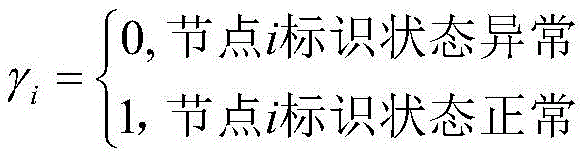

上述模型可以有效保障异常节点(节点标识状态和节点数据均为异常)传输时延最小化,保障信息传输实时性;隔离节点(节点标识状态异常,节点数据正常)传输时延和能耗同时最小化,保障传输实时性和监测连续性;正常节点(节点标识状态和节点数据均为正常)能耗均衡化,以提升系统生命周期。The above model can effectively ensure that the transmission delay of abnormal nodes (node identification status and node data are abnormal) is minimized, and the real-time information transmission is guaranteed; isolated nodes (node identification status is abnormal, node data is normal) transmission delay and energy consumption are minimized at the same time. The energy consumption of normal nodes (node identification status and node data are normal) is balanced to improve the system life cycle.
参照图2,示出了本发明的总体结构实体图,总体思路为:Referring to Fig. 2, the overall structure entity diagram of the present invention is shown, and the general idea is:
铁路防灾监测传感器主要由风速传感器、雨量传感器、雪量传感器、地震传感器和异物传感器5类型,每类传感器都由感知单元、计算单元、通信单元和能量单元4部分组成,各单元的能耗都由能量单元来供给。Railway disaster prevention monitoring sensors are mainly composed of 5 types of wind speed sensor, rain sensor, snow sensor, earthquake sensor and foreign object sensor. Each type of sensor is composed of four parts: sensing unit, computing unit, communication unit and energy unit. The energy consumption of each unit are supplied by the energy unit.
上述5类传感器在数据发送前,首先,对节点的标识状态进行判断,分别为正常状态和隔离状态;第二,对处于隔离状态节点的数据进行分析,判断是否有异常数据出现;第三,根据节点标识状态和数据状态进行传输模式选择,其中正常节点采用低采样频率的周期性传输模式,隔离节点正常数据的节点采用高采样频率的周期性传输模式,隔离节点异常数据的节点采用实时传输模式;第四,所有节点共同参与多节点协同传输多目标优化模型的构建与优化;第五,根据优化的结果设计通信协议,系统根据该通信协议进行数据传输。Before the above five types of sensors send data, firstly, judge the identification status of the node, which are the normal state and the isolated state; secondly, analyze the data of the node in the isolated state to determine whether there is abnormal data; thirdly, The transmission mode is selected according to the node identification status and data status. The normal node adopts the periodic transmission mode of low sampling frequency, the node that isolates the normal data of the node adopts the periodic transmission mode of high sampling frequency, and the node that isolates the abnormal data of the node adopts the real-time transmission mode. mode; fourth, all nodes jointly participate in the construction and optimization of the multi-node cooperative transmission multi-objective optimization model; fifth, the communication protocol is designed according to the optimization results, and the system performs data transmission according to the communication protocol.
参照图3,示出了本发明实例的方法实现流程图,具体步骤为:Referring to Fig. 3, the method realization flow chart of the example of the present invention is shown, and the concrete steps are:
步骤Step1、根据节点状态和数据状态对节点进行分类,分类后节点包括:Step 1. Classify the nodes according to the node state and data state. The classified nodes include:
A类节点:节点正常、数据正常;Class A node: the node is normal and the data is normal;
B类节点:节点正常、数据异常;Class B node: the node is normal, the data is abnormal;
C类节点:节点异常、数据异常;Type C node: node exception, data exception;
D类节点:节点异常、数据正常、节点隔离期;D-type nodes: abnormal node, normal data, node isolation period;
E类节点:节点异常、数据正常、节点隔离期满;Class E node: node abnormality, normal data, node isolation period expires;
步骤Step2、根据节点分类对节点的数据收发能力进行标记,标记种类包括:Step 2: Mark the data sending and receiving capabilities of the node according to the node classification, and the marking types include:
对于A类节点的数据:低频收、发;For data of class A nodes: low frequency receiving and sending;
对于B类节点的数据:实时发送;For data of class B nodes: send in real time;
对于C类节点的数据:实时发送;For data of class C nodes: send in real time;
对于D类节点的数据:高频发送;For data of class D nodes: high frequency transmission;
对于E类节点的数据:低频收发;For data of class E nodes: low frequency transmission and reception;
步骤Step3、根据节点的数据收发能力初始化节点间多跳链路矩阵,节点间传输链路用fi,j表示:Step 3: Initialize the multi-hop link matrix between nodes according to the data sending and receiving capabilities of the nodes, and the transmission links between nodes are represented by f i,j :

步骤Step4、建立节点时延最小化模型,Step 4: Establish a node delay minimization model,
F1(i)=minL(i),i=1,2,…,NF 1 (i)=minL(i), i=1,2,...,N
一般来说,铁路防灾监测系统无线传感器节点都是单天线的,即每个节点同一时间点只能处理单一信息的传输(收/发)。在线性传感网中,每个节点同时担任信息发送者、处理者和接收者3个角色,为了避免数据传输信道冲突,将信道划分为多个时隙slot,每个时隙负责不同类型的数据处理任务。数据在节点i处的传输时延定义为:Generally speaking, the wireless sensor nodes of the railway disaster prevention monitoring system are all single-antenna, that is, each node can only process the transmission (receive/transmit) of a single information at the same time point. In the linear sensor network, each node plays the roles of information sender, processor and receiver at the same time. In order to avoid data transmission channel conflict, the channel is divided into multiple time slots, each of which is responsible for different types of data processing tasks. The transmission delay of data at node i is defined as:
L(i)=Lr(i)+Lw(i)+Lt(i)L(i)=Lr(i)+Lw(i)+Lt(i)
其中,Lr(i)为数据的接收时延,Lw(i)为数据传输等待时延,由数据处理时间和传输优先级共同决定,Lt(i)为数据发送时间;Among them, Lr(i) is the data receiving delay, Lw(i) is the data transmission waiting delay, which is determined by the data processing time and transmission priority, and Lt(i) is the data sending time;
节点数据从源点到汇聚节点的传输时延定义为:The transmission delay of node data from source to sink is defined as:

其中H为总跳数;由于节点间数据发送和接收是连续的,因此相邻节点的收发时间可以合并;Among them, H is the total number of hops; since the data transmission and reception between nodes are continuous, the sending and receiving time of adjacent nodes can be combined;
步骤Step5、建立节点能耗最小化模型,Step 5: Establish a node energy minimization model,
F2(i)=minE(i),i=1,2,…,NF 2 (i)=minE(i), i=1,2,...,N
每个节点的能耗分为数据接收、数据处理和数据发送三个阶段,单节点总能耗定义为:The energy consumption of each node is divided into three stages: data reception, data processing and data transmission. The total energy consumption of a single node is defined as:
E(i)=Er(i)×fr(i)+Ed(i)×fd(i)+Et(i)×ft(i)E(i)=E r (i)×f r (i)+E d (i)×f d (i)+E t (i)×f t (i)
其中fr(i)为节点i的数据接收频率,由与该节点有直接数据传输关系的前序节点决定;fd(i)为节点i的数据处理频率,由数据感知频率决定,感知到的数据都需要进行实时预处理;ft(i)为节点i的数据发送频率,由节点的数据发送模式决定。where f r (i) is the data receiving frequency of node i, which is determined by the pre-sequence nodes that have a direct data transmission relationship with the node; f d (i) is the data processing frequency of node i, which is determined by the data sensing frequency. All data needs to be preprocessed in real time; f t (i) is the data sending frequency of node i, which is determined by the data sending mode of the node.
步骤Step6、建立节点间能耗均衡化模型,Step 6: Establish an energy consumption equalization model between nodes,

步骤Step7、建立多节点协同互操作关系模型,并确定不同类型数据的优化目标:Step 7: Establish a multi-node collaborative interoperability relationship model, and determine the optimization goals for different types of data:


不同类别节点的优化目标不同,分别为:A(能耗均衡化F3)、B(时延最小化F1)、C(时延最小化F1)、D(时延最小化F1、能耗最下化F2)、E(能耗均衡化F3);The optimization goals of different types of nodes are different, namely: A (energy consumption equalization F3), B (delay minimization F1), C (delay minimization F1), D (delay minimization F1, lowest energy consumption) F2), E (energy consumption equalization F3);
步骤Step8、建立多目标优化模型,Step 8: Establish a multi-objective optimization model,

其中,F1 *(i),F2 *(i),F3 *(i)分别为F1(i),F2(i),F3(i)的归一化形式,λi,γi,ηi为0-1变量,用于不同类型节点选择:Among them, F 1 * (i), F 2 * (i), F 3 * (i) are the normalized forms of F 1 (i), F 2 (i), F 3 (i), respectively, λ i , γ i , η i are 0-1 variables, used for different types of node selection:
步骤Step9、对多目标优化模型进行求解,得出铁路防灾监测系统各节点数据传输的最优多跳链路进行传输协议设计,系统根据该传输协议进行数据传输。Step 9: Solve the multi-objective optimization model, obtain the optimal multi-hop link for data transmission of each node of the railway disaster prevention monitoring system, and design the transmission protocol, and the system performs data transmission according to the transmission protocol.
本实施例设计了一种铁路防灾监测系统信息分级回传方法。该方法根据铁路防灾监测系统风险实时评估需求及线性无线传输系统能量和带宽资源受限特性,设计一种状态驱动和变周期相结合的信息分级回传方法。首先,充分利用防灾监测节点的计算能力对监测数据进行边缘侧预处理和特征分级,对安全相关的异常信息采用状态驱动的信息回传策略,保障了安全相关信息回传的实时性;其次,对处于正常状态的数据信息,根据防灾监测节点的状态,采用变周期信息回传策略,保证常规信息回传的周期性完整性。结合状态驱动和变周期两种信息回传策略的优势,在保障安全相关信息实时传输的前提下,有效降低了冗余信息回传造成的能量和带宽资源浪费,提升了监测系统的生命周期和服役能力。In this embodiment, a method for hierarchically returning information of a railway disaster prevention monitoring system is designed. According to the real-time risk assessment requirements of the railway disaster prevention monitoring system and the limited energy and bandwidth resources of the linear wireless transmission system, this method designs a state-driven and variable period information grading backhaul method. First, make full use of the computing power of disaster prevention monitoring nodes to perform edge-side preprocessing and feature classification on monitoring data, and adopt a state-driven information return strategy for safety-related abnormal information, which ensures the real-time nature of safety-related information return; secondly , For the data information in the normal state, according to the state of the disaster prevention monitoring node, the variable period information return strategy is adopted to ensure the periodic integrity of the regular information return. Combining the advantages of state-driven and variable-period information return strategies, on the premise of ensuring real-time transmission of security-related information, it effectively reduces the waste of energy and bandwidth resources caused by redundant information return, and improves the life cycle of the monitoring system. service capacity.
本领域普通技术人员可以理解,实现上述实施例的全部或者部分步骤/单元/模块可以通过程序指令相关的硬件来完成,前述程序可以存储于计算机可读取存储介质中,该程序在执行时,执行包括上述实施例各单元中对应的步骤;而前述的存储介质包括:ROM、RAM、磁碟或者光碟等各种可以存储程序代码的介质。Those of ordinary skill in the art can understand that all or part of the steps/units/modules of the above-mentioned embodiments can be implemented through program instructions related to hardware, and the aforementioned programs can be stored in a computer-readable storage medium, and when the program is executed, Execution includes the steps corresponding to the units in the foregoing embodiments; and the aforementioned storage medium includes: ROM, RAM, magnetic disk, or optical disk and other media that can store program codes.
以上所述的具体实施例,对本发明的目的、技术方案和有益效果进行了进一步详细说明,所应理解的是,以上所述仅为本发明的具体实施例而已,并不用于限制本发明,凡在本发明的精神和原则之内,所做的任何修改、等同替换、改进等,均应包含在本发明的保护范围之内。The specific embodiments described above further describe the purpose, technical solutions and beneficial effects of the present invention in further detail. It should be understood that the above descriptions are only specific embodiments of the present invention, and are not intended to limit the present invention. Any modification, equivalent replacement, improvement, etc. made within the spirit and principle of the present invention shall be included within the protection scope of the present invention.
Claims (3)


Priority Applications (1)
| Application Number | Priority Date | Filing Date | Title |
|---|---|---|---|
| CN202110379328.9A CN113242274B (en) | 2021-04-08 | 2021-04-08 | Information grading return method for railway disaster prevention monitoring system |
Applications Claiming Priority (1)
| Application Number | Priority Date | Filing Date | Title |
|---|---|---|---|
| CN202110379328.9A CN113242274B (en) | 2021-04-08 | 2021-04-08 | Information grading return method for railway disaster prevention monitoring system |
Publications (2)
| Publication Number | Publication Date |
|---|---|
| CN113242274A CN113242274A (en) | 2021-08-10 |
| CN113242274B true CN113242274B (en) | 2022-04-22 |
Family
ID=77131116
Family Applications (1)
| Application Number | Title | Priority Date | Filing Date |
|---|---|---|---|
| CN202110379328.9A Active CN113242274B (en) | 2021-04-08 | 2021-04-08 | Information grading return method for railway disaster prevention monitoring system |
Country Status (1)
| Country | Link |
|---|---|
| CN (1) | CN113242274B (en) |
Families Citing this family (2)
| Publication number | Priority date | Publication date | Assignee | Title |
|---|---|---|---|---|
| CN113727411B (en) * | 2021-09-10 | 2023-10-27 | 北京交通大学 | Adaptive optimization method for routing and data compression of railway disaster prevention monitoring wireless transmission system |
| CN114401325A (en) * | 2021-12-22 | 2022-04-26 | 上海应用技术大学 | An extra-domain data backhaul system based on multi-link fusion |
Family Cites Families (14)
| Publication number | Priority date | Publication date | Assignee | Title |
|---|---|---|---|---|
| WO2013121344A2 (en) * | 2012-02-17 | 2013-08-22 | Balaji Venkatraman | Real time railway disaster vulnerability assessment and rescue guidance system using multi-layered video computational analytics |
| CN103079220B (en) * | 2012-11-15 | 2015-05-13 | 中国科学院软件研究所 | Train-ground synergetic distributed network management system and method for high-speed rail wide-band communication system |
| US10097240B2 (en) * | 2013-02-19 | 2018-10-09 | Astrolink International, Llc | System and method for inferring schematic and topological properties of an electrical distribution grid |
| WO2017127806A1 (en) * | 2016-01-22 | 2017-07-27 | International Electronic Machines Corp. | Railway vehicle operations monitoring |
| CN108093443B (en) * | 2017-11-29 | 2020-05-22 | 北京交通大学 | Multi-service vehicle-ground communication bandwidth distribution system and method |
| CN108920995A (en) * | 2018-04-08 | 2018-11-30 | 华中科技大学 | Intelligent security guard video monitoring method and its system and monitor terminal |
| CN109239734B (en) * | 2018-08-24 | 2019-10-08 | 河南东网信息技术有限公司 | A kind of Along Railway environmental safety monitor and control early warning system |
| CN109246209B (en) * | 2018-08-30 | 2019-07-09 | 张家口市金诚科技有限责任公司 | Forestry Internet of Things secure communication management method |
| CN109862532B (en) * | 2019-02-28 | 2021-08-03 | 北京交通大学 | Layout optimization method and system of multi-sensor nodes for rail transit condition monitoring |
| CN110106800B (en) * | 2019-05-16 | 2023-09-19 | 北京鼎兴达信息科技股份有限公司 | High-speed railway sound barrier health index management evaluation system and monitoring device |
| CN110764493B (en) * | 2019-11-14 | 2021-08-24 | 中国国家铁路集团有限公司 | A PHM application system, method and storage medium suitable for high-speed railway |
| CN111238446B (en) * | 2020-01-15 | 2021-09-28 | 湖北民族大学 | Communication tower inclination monitoring system |
| CN112511586B (en) * | 2020-10-21 | 2024-07-16 | 中国铁道科学研究院集团有限公司通信信号研究所 | Cloud edge cooperation-based intelligent driving scheduling safety card control system for high-speed railway |
| CN112530132B (en) * | 2020-11-30 | 2023-05-02 | 深圳市联正通达科技有限公司 | Intelligent fire control management and control system based on cloud computing service |
-
2021
- 2021-04-08 CN CN202110379328.9A patent/CN113242274B/en active Active
Also Published As
| Publication number | Publication date |
|---|---|
| CN113242274A (en) | 2021-08-10 |
Similar Documents
| Publication | Publication Date | Title |
|---|---|---|
| Raja et al. | OCHSA: designing energy‐efficient lifetime‐aware leisure degree adaptive routing protocol with optimal cluster head selection for 5G communication network disaster management | |
| Yu | Construction of regional intelligent transportation system in smart city road network via 5G network | |
| CN113242274B (en) | Information grading return method for railway disaster prevention monitoring system | |
| Shyama et al. | Self-healing and optimal fault tolerant routing in wireless sensor networks using genetical swarm optimization | |
| CN106572513A (en) | Wireless sensor routing algorithm based on fuzzy multi-attribute decision | |
| CN107333294A (en) | A kind of combination AdaBoost and SVMs link quality prediction method | |
| Saffar et al. | Machine learning with partially labeled data for indoor outdoor detection | |
| CN118301626B (en) | Multi-objective optimized road side unit networking deployment method in intelligent traffic system | |
| Dixit et al. | BMUDF: Hybrid Bio-inspired Model for fault-aware UAV routing using Destination-aware Fan shaped clustering | |
| Ye et al. | Vehicle‐Mounted Self‐Organizing Network Routing Algorithm Based on Deep Reinforcement Learning | |
| CN105050095A (en) | Topology construction method for heterogeneous wireless sensor networks based on energy prediction | |
| Hu et al. | Graph neural network-based clustering enhancement in VANET for cooperative driving | |
| Tirumalasetti et al. | Automatic Dynamic User Allocation with opportunistic routing over vehicles network for Intelligent Transport System | |
| Su et al. | Transmission protocol of emergency messages in VANET based on the trust level of nodes | |
| Hilmani et al. | Hierarchical protocol based on recursive clusters for smart parking applications using Internet of things (IOT) | |
| CN113727411A (en) | Railway disaster prevention monitoring wireless transmission system routing and data compression self-adaptive optimization method | |
| Ranganathan et al. | Chaotic ant colony algorithm to control congestion and enhance opportunistic routing in multimedia network | |
| CN104853365A (en) | Wireless sensing networks topology construction method based on lossy link state prediction | |
| CN108900266B (en) | Cognitive Internet of vehicles spectrum sensing method based on cooperative node selection and FCM algorithm | |
| CN114268921B (en) | A method for transmitting burst data in a multi-mobile sink sensor network | |
| CN116471644A (en) | An Energy Equalizing Routing Algorithm Based on Transmission Cost | |
| Abderrahim et al. | Multihop transmission strategy using dijkstra algorithm to improve energy efficiency in WSNs | |
| CN110601758A (en) | Internet of vehicles multi-attribute switching method of visible light communication system | |
| Vankrinkelen et al. | Energy Efficient Technologies for 5G: Overview, Classification and Qualitative Comparison | |
| Li et al. | A trust evaluation method based on environmental assessment in the perception layer of Internet of Vehicles |
Legal Events
| Date | Code | Title | Description |
|---|---|---|---|
| PB01 | Publication | ||
| PB01 | Publication | ||
| SE01 | Entry into force of request for substantive examination | ||
| SE01 | Entry into force of request for substantive examination | ||
| GR01 | Patent grant | ||
| GR01 | Patent grant | ||
| EE01 | Entry into force of recordation of patent licensing contract | ||
| EE01 | Entry into force of recordation of patent licensing contract |
Application publication date: 20210810 Assignee: Puzheng Venture Capital Technology (Beijing) Co.,Ltd. Assignor: Beijing Jiaotong University Contract record no.: X2023990000693 Denomination of invention: A Method for Grading and Returning Information of Railway Disaster Prevention Monitoring System Granted publication date: 20220422 License type: Common License Record date: 20230710 |