CN113215223B - SNP typing detection method - Google Patents
SNP typing detection method Download PDFInfo
- Publication number
- CN113215223B CN113215223B CN202110594294.5A CN202110594294A CN113215223B CN 113215223 B CN113215223 B CN 113215223B CN 202110594294 A CN202110594294 A CN 202110594294A CN 113215223 B CN113215223 B CN 113215223B
- Authority
- CN
- China
- Prior art keywords
- base
- dna
- snp
- sequence
- chip
- Prior art date
- Legal status (The legal status is an assumption and is not a legal conclusion. Google has not performed a legal analysis and makes no representation as to the accuracy of the status listed.)
- Active
Links
- 238000001514 detection method Methods 0.000 title claims abstract description 26
- 239000000523 sample Substances 0.000 claims abstract description 79
- 108090000623 proteins and genes Proteins 0.000 claims abstract description 43
- 108020004414 DNA Proteins 0.000 claims abstract description 41
- 102000004190 Enzymes Human genes 0.000 claims abstract description 41
- 108090000790 Enzymes Proteins 0.000 claims abstract description 41
- 108010014303 DNA-directed DNA polymerase Proteins 0.000 claims abstract description 29
- 102000016928 DNA-directed DNA polymerase Human genes 0.000 claims abstract description 29
- 238000003776 cleavage reaction Methods 0.000 claims abstract description 27
- 230000007017 scission Effects 0.000 claims abstract description 25
- 108010061982 DNA Ligases Proteins 0.000 claims abstract description 21
- 102000012410 DNA Ligases Human genes 0.000 claims abstract description 21
- 239000000090 biomarker Substances 0.000 claims abstract description 17
- 230000000295 complement effect Effects 0.000 claims abstract description 16
- AHCYMLUZIRLXAA-SHYZEUOFSA-N Deoxyuridine 5'-triphosphate Chemical compound O1[C@H](COP(O)(=O)OP(O)(=O)OP(O)(O)=O)[C@@H](O)C[C@@H]1N1C(=O)NC(=O)C=C1 AHCYMLUZIRLXAA-SHYZEUOFSA-N 0.000 claims abstract description 14
- NHVNXKFIZYSCEB-XLPZGREQSA-N dTTP Chemical compound O=C1NC(=O)C(C)=CN1[C@@H]1O[C@H](COP(O)(=O)OP(O)(=O)OP(O)(O)=O)[C@@H](O)C1 NHVNXKFIZYSCEB-XLPZGREQSA-N 0.000 claims abstract description 13
- SUYVUBYJARFZHO-RRKCRQDMSA-N dATP Chemical compound C1=NC=2C(N)=NC=NC=2N1[C@H]1C[C@H](O)[C@@H](COP(O)(=O)OP(O)(=O)OP(O)(O)=O)O1 SUYVUBYJARFZHO-RRKCRQDMSA-N 0.000 claims abstract description 12
- HAAZLUGHYHWQIW-KVQBGUIXSA-N dGTP Chemical compound C1=NC=2C(=O)NC(N)=NC=2N1[C@H]1C[C@H](O)[C@@H](COP(O)(=O)OP(O)(=O)OP(O)(O)=O)O1 HAAZLUGHYHWQIW-KVQBGUIXSA-N 0.000 claims abstract description 12
- SUYVUBYJARFZHO-UHFFFAOYSA-N dATP Natural products C1=NC=2C(N)=NC=NC=2N1C1CC(O)C(COP(O)(=O)OP(O)(=O)OP(O)(O)=O)O1 SUYVUBYJARFZHO-UHFFFAOYSA-N 0.000 claims abstract description 11
- 239000002773 nucleotide Substances 0.000 claims abstract description 10
- 125000003729 nucleotide group Chemical group 0.000 claims abstract description 10
- 238000011144 upstream manufacturing Methods 0.000 claims abstract description 9
- RGWHQCVHVJXOKC-SHYZEUOFSA-J dCTP(4-) Chemical compound O=C1N=C(N)C=CN1[C@@H]1O[C@H](COP([O-])(=O)OP([O-])(=O)OP([O-])([O-])=O)[C@@H](O)C1 RGWHQCVHVJXOKC-SHYZEUOFSA-J 0.000 claims abstract 2
- 238000000034 method Methods 0.000 claims description 22
- 230000000694 effects Effects 0.000 claims description 9
- 102000004160 Phosphoric Monoester Hydrolases Human genes 0.000 claims description 6
- 108090000608 Phosphoric Monoester Hydrolases Proteins 0.000 claims description 6
- 238000005406 washing Methods 0.000 claims description 6
- 102000010719 DNA-(Apurinic or Apyrimidinic Site) Lyase Human genes 0.000 claims description 4
- 108010063362 DNA-(Apurinic or Apyrimidinic Site) Lyase Proteins 0.000 claims description 4
- 102000006943 Uracil-DNA Glycosidase Human genes 0.000 claims description 4
- 108010072685 Uracil-DNA Glycosidase Proteins 0.000 claims description 4
- 108010021757 Polynucleotide 5'-Hydroxyl-Kinase Proteins 0.000 claims description 3
- 102000008422 Polynucleotide 5'-hydroxyl-kinase Human genes 0.000 claims description 3
- 230000002194 synthesizing effect Effects 0.000 claims description 3
- 239000002585 base Substances 0.000 description 63
- 238000006243 chemical reaction Methods 0.000 description 20
- 239000000243 solution Substances 0.000 description 16
- 239000000203 mixture Substances 0.000 description 13
- 239000007788 liquid Substances 0.000 description 11
- 230000015572 biosynthetic process Effects 0.000 description 10
- RGWHQCVHVJXOKC-SHYZEUOFSA-N dCTP Chemical compound O=C1N=C(N)C=CN1[C@@H]1O[C@H](CO[P@](O)(=O)O[P@](O)(=O)OP(O)(O)=O)[C@@H](O)C1 RGWHQCVHVJXOKC-SHYZEUOFSA-N 0.000 description 10
- HEMHJVSKTPXQMS-UHFFFAOYSA-M Sodium hydroxide Chemical compound [OH-].[Na+] HEMHJVSKTPXQMS-UHFFFAOYSA-M 0.000 description 9
- 238000003786 synthesis reaction Methods 0.000 description 9
- 239000012295 chemical reaction liquid Substances 0.000 description 8
- 238000009396 hybridization Methods 0.000 description 8
- 101000650940 Autographa californica nuclear polyhedrosis virus RNA ligase Proteins 0.000 description 7
- 102100030953 Cleavage and polyadenylation specificity factor subunit 4 Human genes 0.000 description 7
- 101000727105 Homo sapiens Cleavage and polyadenylation specificity factor subunit 4 Proteins 0.000 description 7
- 241000588724 Escherichia coli Species 0.000 description 6
- 238000010586 diagram Methods 0.000 description 6
- 238000011065 in-situ storage Methods 0.000 description 6
- 229910019142 PO4 Inorganic materials 0.000 description 5
- 238000013461 design Methods 0.000 description 5
- 239000010452 phosphate Substances 0.000 description 5
- 241000282414 Homo sapiens Species 0.000 description 4
- ISAKRJDGNUQOIC-UHFFFAOYSA-N Uracil Chemical compound O=C1C=CNC(=O)N1 ISAKRJDGNUQOIC-UHFFFAOYSA-N 0.000 description 4
- 238000004458 analytical method Methods 0.000 description 4
- 239000003086 colorant Substances 0.000 description 4
- 239000012634 fragment Substances 0.000 description 4
- 230000004048 modification Effects 0.000 description 4
- 238000012986 modification Methods 0.000 description 4
- 102000003960 Ligases Human genes 0.000 description 3
- 108090000364 Ligases Proteins 0.000 description 3
- 229960002685 biotin Drugs 0.000 description 3
- 239000011616 biotin Substances 0.000 description 3
- 239000007850 fluorescent dye Substances 0.000 description 3
- 229910052739 hydrogen Inorganic materials 0.000 description 3
- 239000001257 hydrogen Substances 0.000 description 3
- 235000011178 triphosphate Nutrition 0.000 description 3
- 239000001226 triphosphate Substances 0.000 description 3
- YBJHBAHKTGYVGT-ZKWXMUAHSA-N (+)-Biotin Chemical compound N1C(=O)N[C@@H]2[C@H](CCCCC(=O)O)SC[C@@H]21 YBJHBAHKTGYVGT-ZKWXMUAHSA-N 0.000 description 2
- QCPFFGGFHNZBEP-UHFFFAOYSA-N 4,5,6,7-tetrachloro-3',6'-dihydroxyspiro[2-benzofuran-3,9'-xanthene]-1-one Chemical compound O1C(=O)C(C(=C(Cl)C(Cl)=C2Cl)Cl)=C2C21C1=CC=C(O)C=C1OC1=CC(O)=CC=C21 QCPFFGGFHNZBEP-UHFFFAOYSA-N 0.000 description 2
- 108010017826 DNA Polymerase I Proteins 0.000 description 2
- 102000004594 DNA Polymerase I Human genes 0.000 description 2
- SHIBSTMRCDJXLN-UHFFFAOYSA-N Digoxigenin Natural products C1CC(C2C(C3(C)CCC(O)CC3CC2)CC2O)(O)C2(C)C1C1=CC(=O)OC1 SHIBSTMRCDJXLN-UHFFFAOYSA-N 0.000 description 2
- 108010001336 Horseradish Peroxidase Proteins 0.000 description 2
- 108091028043 Nucleic acid sequence Proteins 0.000 description 2
- 108010006785 Taq Polymerase Proteins 0.000 description 2
- 230000003321 amplification Effects 0.000 description 2
- OPTASPLRGRRNAP-UHFFFAOYSA-N cytosine Chemical compound NC=1C=CNC(=O)N=1 OPTASPLRGRRNAP-UHFFFAOYSA-N 0.000 description 2
- QONQRTHLHBTMGP-UHFFFAOYSA-N digitoxigenin Natural products CC12CCC(C3(CCC(O)CC3CC3)C)C3C11OC1CC2C1=CC(=O)OC1 QONQRTHLHBTMGP-UHFFFAOYSA-N 0.000 description 2
- SHIBSTMRCDJXLN-KCZCNTNESA-N digoxigenin Chemical compound C1([C@@H]2[C@@]3([C@@](CC2)(O)[C@H]2[C@@H]([C@@]4(C)CC[C@H](O)C[C@H]4CC2)C[C@H]3O)C)=CC(=O)OC1 SHIBSTMRCDJXLN-KCZCNTNESA-N 0.000 description 2
- 239000000975 dye Substances 0.000 description 2
- 238000010828 elution Methods 0.000 description 2
- MHMNJMPURVTYEJ-UHFFFAOYSA-N fluorescein-5-isothiocyanate Chemical compound O1C(=O)C2=CC(N=C=S)=CC=C2C21C1=CC=C(O)C=C1OC1=CC(O)=CC=C21 MHMNJMPURVTYEJ-UHFFFAOYSA-N 0.000 description 2
- 230000006870 function Effects 0.000 description 2
- UYTPUPDQBNUYGX-UHFFFAOYSA-N guanine Chemical compound O=C1NC(N)=NC2=C1N=CN2 UYTPUPDQBNUYGX-UHFFFAOYSA-N 0.000 description 2
- 238000010438 heat treatment Methods 0.000 description 2
- 230000003100 immobilizing effect Effects 0.000 description 2
- 238000010348 incorporation Methods 0.000 description 2
- MOFVSTNWEDAEEK-UHFFFAOYSA-M indocyanine green Chemical compound [Na+].[O-]S(=O)(=O)CCCCN1C2=CC=C3C=CC=CC3=C2C(C)(C)C1=CC=CC=CC=CC1=[N+](CCCCS([O-])(=O)=O)C2=CC=C(C=CC=C3)C3=C2C1(C)C MOFVSTNWEDAEEK-UHFFFAOYSA-M 0.000 description 2
- 229960004657 indocyanine green Drugs 0.000 description 2
- 239000003550 marker Substances 0.000 description 2
- 238000003199 nucleic acid amplification method Methods 0.000 description 2
- NBIIXXVUZAFLBC-UHFFFAOYSA-K phosphate Chemical compound [O-]P([O-])([O-])=O NBIIXXVUZAFLBC-UHFFFAOYSA-K 0.000 description 2
- 125000002467 phosphate group Chemical group [H]OP(=O)(O[H])O[*] 0.000 description 2
- 230000026731 phosphorylation Effects 0.000 description 2
- 238000006366 phosphorylation reaction Methods 0.000 description 2
- PYWVYCXTNDRMGF-UHFFFAOYSA-N rhodamine B Chemical compound [Cl-].C=12C=CC(=[N+](CC)CC)C=C2OC2=CC(N(CC)CC)=CC=C2C=1C1=CC=CC=C1C(O)=O PYWVYCXTNDRMGF-UHFFFAOYSA-N 0.000 description 2
- 210000003296 saliva Anatomy 0.000 description 2
- 239000007787 solid Substances 0.000 description 2
- 239000000758 substrate Substances 0.000 description 2
- RWQNBRDOKXIBIV-UHFFFAOYSA-N thymine Chemical compound CC1=CNC(=O)NC1=O RWQNBRDOKXIBIV-UHFFFAOYSA-N 0.000 description 2
- 125000002264 triphosphate group Chemical class [H]OP(=O)(O[H])OP(=O)(O[H])OP(=O)(O[H])O* 0.000 description 2
- 229940035893 uracil Drugs 0.000 description 2
- XDQFBMPFEBUDIC-UHFFFAOYSA-N 1h-pyrimidine-2,4-dione Chemical compound O=C1C=CNC(=O)N1.O=C1C=CNC(=O)N1 XDQFBMPFEBUDIC-UHFFFAOYSA-N 0.000 description 1
- CZVCGJBESNRLEQ-UHFFFAOYSA-N 7h-purine;pyrimidine Chemical compound C1=CN=CN=C1.C1=NC=C2NC=NC2=N1 CZVCGJBESNRLEQ-UHFFFAOYSA-N 0.000 description 1
- 208000035657 Abasia Diseases 0.000 description 1
- 229930024421 Adenine Natural products 0.000 description 1
- GFFGJBXGBJISGV-UHFFFAOYSA-N Adenine Chemical compound NC1=NC=NC2=C1N=CN2 GFFGJBXGBJISGV-UHFFFAOYSA-N 0.000 description 1
- 102000004099 Deoxyribonuclease (Pyrimidine Dimer) Human genes 0.000 description 1
- 108010082610 Deoxyribonuclease (Pyrimidine Dimer) Proteins 0.000 description 1
- 102000007260 Deoxyribonuclease I Human genes 0.000 description 1
- 108010008532 Deoxyribonuclease I Proteins 0.000 description 1
- 102000004533 Endonucleases Human genes 0.000 description 1
- 108010042407 Endonucleases Proteins 0.000 description 1
- 206010064571 Gene mutation Diseases 0.000 description 1
- 108091034117 Oligonucleotide Proteins 0.000 description 1
- 108020005187 Oligonucleotide Probes Proteins 0.000 description 1
- 108010090804 Streptavidin Proteins 0.000 description 1
- 150000001251 acridines Chemical class 0.000 description 1
- 229960000643 adenine Drugs 0.000 description 1
- 239000003513 alkali Substances 0.000 description 1
- 239000012670 alkaline solution Substances 0.000 description 1
- 238000007844 allele-specific PCR Methods 0.000 description 1
- 230000009286 beneficial effect Effects 0.000 description 1
- ZYGHJZDHTFUPRJ-UHFFFAOYSA-N benzo-alpha-pyrone Natural products C1=CC=C2OC(=O)C=CC2=C1 ZYGHJZDHTFUPRJ-UHFFFAOYSA-N 0.000 description 1
- XJHABGPPCLHLLV-UHFFFAOYSA-N benzo[de]isoquinoline-1,3-dione Chemical class C1=CC(C(=O)NC2=O)=C3C2=CC=CC3=C1 XJHABGPPCLHLLV-UHFFFAOYSA-N 0.000 description 1
- 235000020958 biotin Nutrition 0.000 description 1
- 238000010504 bond cleavage reaction Methods 0.000 description 1
- 238000004140 cleaning Methods 0.000 description 1
- 230000019771 cognition Effects 0.000 description 1
- 230000008094 contradictory effect Effects 0.000 description 1
- 235000001671 coumarin Nutrition 0.000 description 1
- 150000004775 coumarins Chemical class 0.000 description 1
- 229940104302 cytosine Drugs 0.000 description 1
- 230000007547 defect Effects 0.000 description 1
- 238000004925 denaturation Methods 0.000 description 1
- 230000036425 denaturation Effects 0.000 description 1
- 238000003935 denaturing gradient gel electrophoresis Methods 0.000 description 1
- 239000005549 deoxyribonucleoside Substances 0.000 description 1
- 238000006209 dephosphorylation reaction Methods 0.000 description 1
- 238000011161 development Methods 0.000 description 1
- 238000003745 diagnosis Methods 0.000 description 1
- 230000029087 digestion Effects 0.000 description 1
- 238000004090 dissolution Methods 0.000 description 1
- 238000009509 drug development Methods 0.000 description 1
- 238000001035 drying Methods 0.000 description 1
- 238000001976 enzyme digestion Methods 0.000 description 1
- 238000000605 extraction Methods 0.000 description 1
- 238000011049 filling Methods 0.000 description 1
- GNBHRKFJIUUOQI-UHFFFAOYSA-N fluorescein Chemical compound O1C(=O)C2=CC=CC=C2C21C1=CC=C(O)C=C1OC1=CC(O)=CC=C21 GNBHRKFJIUUOQI-UHFFFAOYSA-N 0.000 description 1
- 238000001502 gel electrophoresis Methods 0.000 description 1
- 230000002068 genetic effect Effects 0.000 description 1
- 238000004128 high performance liquid chromatography Methods 0.000 description 1
- 230000003301 hydrolyzing effect Effects 0.000 description 1
- 238000001819 mass spectrum Methods 0.000 description 1
- 239000000463 material Substances 0.000 description 1
- 238000010369 molecular cloning Methods 0.000 description 1
- 239000002751 oligonucleotide probe Substances 0.000 description 1
- 108091033319 polynucleotide Proteins 0.000 description 1
- 239000002157 polynucleotide Substances 0.000 description 1
- 102000040430 polynucleotide Human genes 0.000 description 1
- 238000002360 preparation method Methods 0.000 description 1
- 238000012545 processing Methods 0.000 description 1
- 150000003220 pyrenes Chemical class 0.000 description 1
- 239000004065 semiconductor Substances 0.000 description 1
- 230000035945 sensitivity Effects 0.000 description 1
- 238000012163 sequencing technique Methods 0.000 description 1
- 238000010186 staining Methods 0.000 description 1
- 150000001629 stilbenes Chemical class 0.000 description 1
- 235000021286 stilbenes Nutrition 0.000 description 1
- 125000000446 sulfanediyl group Chemical group *S* 0.000 description 1
- 238000012360 testing method Methods 0.000 description 1
- JGVWCANSWKRBCS-UHFFFAOYSA-N tetramethylrhodamine thiocyanate Chemical compound [Cl-].C=12C=CC(N(C)C)=CC2=[O+]C2=CC(N(C)C)=CC=C2C=1C1=CC=C(SC#N)C=C1C(O)=O JGVWCANSWKRBCS-UHFFFAOYSA-N 0.000 description 1
- ANRHNWWPFJCPAZ-UHFFFAOYSA-M thionine Chemical compound [Cl-].C1=CC(N)=CC2=[S+]C3=CC(N)=CC=C3N=C21 ANRHNWWPFJCPAZ-UHFFFAOYSA-M 0.000 description 1
- 229940113082 thymine Drugs 0.000 description 1
- 238000011282 treatment Methods 0.000 description 1
- UNXRWKVEANCORM-UHFFFAOYSA-N triphosphoric acid Chemical compound OP(O)(=O)OP(O)(=O)OP(O)(O)=O UNXRWKVEANCORM-UHFFFAOYSA-N 0.000 description 1
Images




Classifications
-
- C—CHEMISTRY; METALLURGY
- C12—BIOCHEMISTRY; BEER; SPIRITS; WINE; VINEGAR; MICROBIOLOGY; ENZYMOLOGY; MUTATION OR GENETIC ENGINEERING
- C12Q—MEASURING OR TESTING PROCESSES INVOLVING ENZYMES, NUCLEIC ACIDS OR MICROORGANISMS; COMPOSITIONS OR TEST PAPERS THEREFOR; PROCESSES OF PREPARING SUCH COMPOSITIONS; CONDITION-RESPONSIVE CONTROL IN MICROBIOLOGICAL OR ENZYMOLOGICAL PROCESSES
- C12Q1/00—Measuring or testing processes involving enzymes, nucleic acids or microorganisms; Compositions therefor; Processes of preparing such compositions
- C12Q1/68—Measuring or testing processes involving enzymes, nucleic acids or microorganisms; Compositions therefor; Processes of preparing such compositions involving nucleic acids
- C12Q1/6813—Hybridisation assays
- C12Q1/6834—Enzymatic or biochemical coupling of nucleic acids to a solid phase
- C12Q1/6837—Enzymatic or biochemical coupling of nucleic acids to a solid phase using probe arrays or probe chips
-
- C—CHEMISTRY; METALLURGY
- C12—BIOCHEMISTRY; BEER; SPIRITS; WINE; VINEGAR; MICROBIOLOGY; ENZYMOLOGY; MUTATION OR GENETIC ENGINEERING
- C12Q—MEASURING OR TESTING PROCESSES INVOLVING ENZYMES, NUCLEIC ACIDS OR MICROORGANISMS; COMPOSITIONS OR TEST PAPERS THEREFOR; PROCESSES OF PREPARING SUCH COMPOSITIONS; CONDITION-RESPONSIVE CONTROL IN MICROBIOLOGICAL OR ENZYMOLOGICAL PROCESSES
- C12Q1/00—Measuring or testing processes involving enzymes, nucleic acids or microorganisms; Compositions therefor; Processes of preparing such compositions
- C12Q1/68—Measuring or testing processes involving enzymes, nucleic acids or microorganisms; Compositions therefor; Processes of preparing such compositions involving nucleic acids
- C12Q1/6844—Nucleic acid amplification reactions
- C12Q1/6858—Allele-specific amplification
Landscapes
- Chemical & Material Sciences (AREA)
- Life Sciences & Earth Sciences (AREA)
- Organic Chemistry (AREA)
- Engineering & Computer Science (AREA)
- Zoology (AREA)
- Wood Science & Technology (AREA)
- Proteomics, Peptides & Aminoacids (AREA)
- Health & Medical Sciences (AREA)
- Biophysics (AREA)
- General Engineering & Computer Science (AREA)
- Immunology (AREA)
- Microbiology (AREA)
- Molecular Biology (AREA)
- Analytical Chemistry (AREA)
- Physics & Mathematics (AREA)
- Genetics & Genomics (AREA)
- Biochemistry (AREA)
- Bioinformatics & Cheminformatics (AREA)
- Biotechnology (AREA)
- General Health & Medical Sciences (AREA)
- Chemical Kinetics & Catalysis (AREA)
- Measuring Or Testing Involving Enzymes Or Micro-Organisms (AREA)
Abstract
The present disclosure provides a SNP typing detection method comprising: (I) Hybridizing DNA to be detected with a gene chip, wherein a phosphorylated chip probe is fixed on the gene chip, the last base at the outward 5' end of the chip probe is a U base, a sequence in the chip probe, which is close to the downstream 3' direction of the U base, is reversely complementary with a sequence in the DNA to be detected, which is close to the upstream 5' direction of an SNP locus, and the SNP locus corresponds to the position of the U base; (II) adding a random primer or a specific primer, dNTP and DNA polymerase to synthesize a sequence which is reversely complementary with a sequence in the direction close to the downstream 3' direction of the SNP locus in the DNA to be detected; (III) adding an enzyme capable of catalyzing cleavage of the U base and an enzyme capable of catalyzing cleavage of the 3 'and 5' phosphodiester bond of the AP site, creating a nucleotide gap at the position of the U base; (IV) adding a DNA polymerase and a DNA ligase, and one or more of dATP, dTTP, dCTP, dGTP, dUTP with a biomarker; (V) detecting a gene chip aiming at the biomarkers to determine the genotype of the SNP locus.
Description
Technical Field
The present disclosure provides a SNP typing detection method.
Background
A Single Nucleotide Polymorphism (SNP) is a DNA sequence polymorphism caused by variation of a single nucleotide at the genome level, i.e., a difference of a single base in a DNA sequence. In nature, SNPs are widely existed, and have important significance in the aspects of drug development, clinical examination, gene mutation diagnosis and the like for the detection and analysis of the SNPs.
Current SNP detection methods can be broadly divided into two major categories: one category is the traditional classical SNP detection method based on gel electrophoresis, which is represented by single-strand conformation polymorphism, denaturing gradient gel electrophoresis, enzyme digestion amplification polymorphism sequence, allele-specific PCR and the like; the other large category is the SNP detection method with high throughput and high automation degree, which is represented by direct sequencing, gene chip, denaturation high performance liquid chromatography, mass spectrum detection technology, high resolution dissolution curve and the like.
The gene chip technology is the combination of micro processing technology and molecular biology in semiconductor industry technology, and integrates a large number of densely arranged gene probes on the surface of a substrate. The SNP detection method of the gene chip is utilized to design two or more probes according to the known SNP loci, the designed probes are fixed on a special carrier, and the typing detection of the SNP loci is realized based on different modes of hybridization, primer extension, connection and the like. The method realizes rapid, efficient and parallel polymorphic information analysis, and is a common high-throughput SNP analysis method.
Disclosure of Invention
The present disclosure may provide a SNP typing detection method, comprising the steps of:
(I) Hybridizing DNA to be detected with a gene chip, wherein a phosphorylated chip probe is fixed on the gene chip, the last base of the outward 5' end of the chip probe is a U base, a sequence in the chip probe, which is close to the downstream 3' direction of the U base, is reversely complementary with a sequence in the DNA to be detected, which is close to the upstream 5' direction of an SNP locus, and the SNP locus corresponds to the position of the U base;
(II) adding a random primer or a specific primer, dNTP and DNA polymerase to synthesize a sequence which is reversely complementary with a sequence which is close to the downstream 3' direction of the SNP locus in the DNA to be detected;
(III) adding an enzyme capable of catalyzing cleavage of a U base and an enzyme capable of catalyzing cleavage of the 3 'and 5' phosphodiester bond of an AP site, creating a nucleotide gap at the position of the U base;
(IV) adding a DNA polymerase and a DNA ligase, and one or more of dATP, dTTP, dCTP, dGTP, dUTP with a biomarker;
(V) detecting a gene chip aiming at the biomarkers to determine the genotype of the SNP locus.
The present disclosure may also provide a use of a gene chip comprising a chip probe in which the last base of the 5' end is a U base, for SNP typing detection, wherein a sequence in the chip probe immediately downstream of the U base in the 3' direction is reverse-complementary to a sequence in the DNA to be detected immediately upstream of the SNP site corresponding to the position of the U base in the 5' direction.
Drawings
Fig. 1 shows: in the prior art, the principle diagram of typing the SNP of A/C, A/G, T/C or T/G type by a classical connection method, wherein a chromogenic probe covers the SNP site, a capture probe does not cover the SNP site, and four chromogenic probes used are separately shown.
Fig. 2 shows: in the prior art, the principle diagram of typing the SNP of A/T or C/G type by a classical connection method is adopted, wherein a capture probe covers an SNP locus, and a color development probe does not cover the SNP locus.
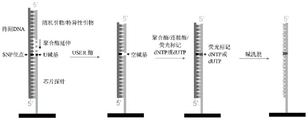
Fig. 3 shows: schematic diagram of SNP typing detection method according to the present disclosure.
Fig. 4 shows: in one embodiment of the present disclosure, the fluorescence scan of the gene chip results.
Fig. 5 shows: in another embodiment of the present disclosure, the fluorescence scan of the gene chip results.
Detailed Description
The in-situ synthesized gene chip is one kind of gene chip, has the advantages of high density, capacity of synthesizing oligonucleotide of any sequence, etc. and is especially suitable for SNP analysis, etc. On the in situ synthesis gene chip, the ligation method is a classical method for detecting SNP sites. The method realizes the detection of SNP loci through two probes, wherein the first probe is a capture probe fixed on a gene chip and is used for fixing a DNA fragment on the surface of the gene chip; the second probe is a color probe responsible for developing color on the gene chip.
For SNPs of A/C, A/G, T/C or T/G type, the chromogenic probes are divided into four groups, probes are designed for the SNP site A, C, G, T, respectively, the first base of the 3' end of which is specific, wherein A and T are labeled with one marker, and C and G are labeled with another marker showing a different color; the second base to the last base is degenerate. The capture probe is designed to go exactly one base next to the SNP site, but does not cover the SNP site. After the DNA to be detected is hybridized with the chip, a chromogenic probe is added, and the chromogenic probe which is complementarily matched with the SNP locus is connected to a capture probe by utilizing the high fidelity of ligase. After the ligation reaction is completed, the free chromogenic probe is removed, stained and scanned, and the genotype of the SNP site is determined based on the different colors of fluorescence. A schematic diagram of such SNP typing methods can be seen in FIG. 1.
For SNPs of type A/T or C/G, the capture probes are divided into two groups, which are designed to cover the SNP sites; the color probe does not cover the SNP site, only one type of the color probe is available, and the color of the color probe is one color. After the DNA to be detected is hybridized with the chip, if the capture probe is perfectly matched with the DNA to be detected, the chromogenic probe is added, and then the chromogenic probe is connected to the capture probe through a connection reaction; if the capture probe is not matched with the DNA to be detected at the SNP site, the chromogenic probe cannot be connected to the capture probe due to the high fidelity of the ligase after the chromogenic probe is added, so that the chromogenic probe can be washed away in the next elution process. Therefore, after staining and scanning, the genotype of the SNP site can be determined based on the presence or absence of fluorescence. A schematic diagram of such a SNP typing method can be seen in FIG. 2.
However, in this method, the in situ synthesis of gene chips has problems of poor quality of probes and non-synchronization of bases due to the problem of synthesis efficiency, i.e., as the number of bases increases in the process of synthesis from the 3' end to the 5' end, the closer to the 5' end, the smaller the number of effective probes. For the SNP of A/C, A/G, T/C or T/G type, the chromogenic link of the capture probe detection is realized by the connection of degenerate probes with specific bases, so that the problem of asynchronization of synthesis can cause that the probe with 5' end defect also participates in chromogenic reaction, thereby greatly increasing the detected background signal. Meanwhile, nonsynchronous bases in the middle of the capture probe can generate non-specific signals at a lower hybridization temperature. In addition, the design of the capture probes is complex and the cost of the chromogenic probes is high.
The inventors of the present invention creatively designed a novel SNP typing detection method, which comprises: hybridizing DNA to be detected with a gene chip, wherein a phosphorylated chip probe is fixed on the gene chip, the last base at the outward 5' end of the chip probe is a U base, a sequence in the chip probe, which is close to the downstream 3' direction of the U base, is reversely complementary with a sequence in the DNA to be detected, which is close to the upstream 5' direction of an SNP locus, and the SNP locus corresponds to the position of the U base; then, a random primer or a specific primer, dNTP and proper DNA polymerase are used for extension reaction, a sequence which is reversely complementary with a sequence in the 3' direction of the position which is close to the downstream of the SNP site in the DNA to be detected is synthesized, and the sequence extends to be close to the U base (without gaps) from the primer; then generating nucleotide gaps at the positions of the U bases by using an enzyme capable of catalyzing U base cleavage and an enzyme capable of catalyzing phosphodiester bond cleavage at the 3 'and 5' ends of the AP sites; then filling fluorescent labeled dNTP or dUTP by using high-fidelity polymerase; and finally, detecting the gene chip aiming at the biomarker to determine the genotype of the SNP locus. A schematic diagram of the SNP typing detection method according to the present disclosure described above can be seen in FIG. 3.
By this method, there is no need to design multiple capture probes and chromogenic probes, but a particularly beneficial technical effect is achieved: not only has high sensitivity, accuracy and high efficiency, but also has convenient operation, simplicity and rapidness and lower cost.
Unless defined otherwise herein, scientific and technical terms used herein have the same meaning as commonly understood by one of ordinary skill in the art.
As used herein, "DNA to be tested" refers to a DNA sample in which SNP sites are to be detected.
As used herein, the "gene chip" refers to a chip obtained by in situ synthesis of oligonucleotide probes on a solid support or by directly immobilizing a large number of probes prepared in advance on the surface of the support. The genetic information of the sample can be obtained by hybridizing the gene chip with the sample, then carrying out a series of treatments, and finally detecting and analyzing the signal by using a chip scanner and a computer.
As used herein, the term "chip probe" refers to a probe immobilized on a solid support, i.e., a gene chip, by in situ synthesis or by directly immobilizing a large number of probes prepared in advance.
As used herein, "U base" refers to a uracil (uracil) base.
As used herein, "reverse complementary" refers to purine pyrimidine bases on two oppositely oriented, parallel polynucleotide strands that are paired with each other by forming hydrogen bonds around the helical axis, according to the base complementary principle. That is, adenine A on one long chain forms a hydrogen bond with thymine T or uracil U on the other long chain; and guanine G forms hydrogen bonds with cytosine C.
As used herein, "specific primer" refers to a primer designed for a specific sequence that specifically binds to the specific sequence.
As used herein, "random primer" refers to a random sequence primer containing several bases, including but not limited to random hexamer primers, random nonamer primers, and the like. For example, a pd (N) 6 random hexamer primer is a random sequence of 6 bases: 5'-P-d (NNNNNN) -3', where N = G, A, T or C. In addition, modifications, such as thio modifications, can be made to the bases in the random primers to prevent digestion of the primers by the amplification enzyme.
As used herein, "DNA polymerase" is capable of catalyzing the addition of a single nucleotide to the 3' end of an existing DNA fragment to form a phosphodiester bond. The DNA polymerase useful in the present disclosure is any DNA polymerase known to those skilled in the art capable of performing the above-described functions, including but not limited to T4 DNA polymerase, taq DNA polymerase, klenow DNA polymerase, bst DNA polymerase, DNA polymerase I.
dATP, dTTP, dCTP, dGTP, dUTP can be used as substrates for DNA polymerase, where "dATP" refers to deoxyadenosine triphosphate, "dTTP" refers to deoxythymidine triphosphate, "dCTP" refers to deoxycytidine triphosphate, "dGTP" refers to deoxyguanosine triphosphate, and "dUTP" refers to deoxyuridine triphosphate. dATP, dTTP, dCTP, and dGTP are collectively referred to as dNTPs.
Biomarkers can be added to dNTPs, dUTP, so that the results of the reaction on the gene chip can be detected by the instrument. Biomarkers are well known to those skilled in the art and include, but are not limited to, cy3, cy5, cy7, biotin, DIG (digoxigenin), streptavidin, HRP (horseradish peroxidase), ICG (indocyanine green), TRITC (rhodamine), fluorescent dyes. Examples of fluorescent dyes include, but are not limited to: standard fluorescein and its derivatives such as FITC (fluorescein isothiocyanate), hydroxyfluorescein (FAM), tetrachlorofluorescein (TET), etc.; a rhodamine-based dye; a cyanine dye; other fluorescent dyes, such as stilbenes, naphthalimides, coumarins, acridines, pyrenes, and the like.
As used herein, "DNA ligase" is capable of catalyzing the formation of phosphodiester bonds between two DNA fragments, joining the two ends. DNA ligase useful in the present disclosure is any DNA ligase known to those skilled in the art capable of performing the ligation function described above, including but not limited to e.
As used herein, "enzyme capable of catalyzing cleavage of a U base" refers to any enzyme capable of catalyzing cleavage of a U base, forming an empty base or an Abasic (AP) site, examples of which include, but are not limited to, uracil DNA glycosylase and the like.
As used herein, "an enzyme capable of catalyzing cleavage of phosphodiester bonds at the 3 'and 5' ends of an AP site" refers to any enzyme capable of cleaving phosphodiester bonds at the 3 'and 5' ends of an AP site, releasing the sugar phosphate (sugar phosphate) portion of the AP site, thereby creating a nucleotide gap, such as an AP endonuclease (or AP endonuclease or AP lyase), including but not limited to endonuclease VIII (Endo VIII), and the like.
As used herein, "enzyme having 3 'phosphatase activity" refers to any enzyme capable of catalyzing the hydrolytic removal of a 3' terminal phosphate group, including, but not limited to, polynucleotide kinases (PNKs), and the like.
The present disclosure may provide a SNP typing detection method, comprising the steps of:
(I) Hybridizing DNA to be detected with a gene chip, wherein a phosphorylated chip probe is fixed on the gene chip, the last base of the outward 5' end of the chip probe is a U base, a sequence in the chip probe, which is close to the downstream 3' direction of the U base, is reversely complementary with a sequence in the DNA to be detected, which is close to the upstream 5' direction of an SNP locus, and the SNP locus corresponds to the position of the U base;
(II) adding a random primer or a specific primer, dNTP and DNA polymerase to synthesize a sequence which is reversely complementary with a sequence which is close to the downstream 3' direction of the SNP locus in the DNA to be detected;
(III) adding an enzyme capable of catalyzing cleavage of a U base and an enzyme capable of catalyzing cleavage of a phosphodiester bond at the 3 'and 5' ends of an AP site, creating a nucleotide gap at the position of the U base;
(IV) adding a DNA polymerase and a DNA ligase, and one or more of dATP, dTTP, dCTP, dGTP, dUTP with a biomarker;
(V) detecting a gene chip aiming at the biomarkers to determine the genotype of the SNP locus.
In some embodiments, in step (II), a DNA ligase is additionally added; and after step (III) and before step (IV), adding an enzyme having 3' phosphatase activity.
Accordingly, the present disclosure may provide a SNP typing detection method comprising the steps of:
(I ') hybridizing a DNA to be detected with a gene chip, wherein a phosphorylated chip probe is fixed on the gene chip, the last base of the outward 5' end of the chip probe is a U base, a sequence in the chip probe, which is close to the downstream 3 'direction of the U base, is reversely complementary with a sequence in the DNA to be detected, which is close to the upstream 5' direction of an SNP locus, and the SNP locus corresponds to the position of the U base;
(II ') adding a random primer or a specific primer, dNTP and DNA polymerase, synthesizing a sequence which is reversely complementary with a sequence in the direction close to the downstream 3' direction of the SNP locus in the DNA to be detected, and adding DNA ligase;
(III ' -1) adding an enzyme capable of catalyzing cleavage of a U base and an enzyme capable of catalyzing cleavage of 3' and 5' phosphate diester bonds of an AP site, creating a nucleotide gap at the position of the U base;
(III ' -2) adding an enzyme having 3' phosphatase activity to remove the 3' terminal phosphate group;
(IV') adding DNA polymerase and DNA ligase, and one or more of dATP, dTTP, dCTP, dGTP, dUTP with biomarkers;
(V') detecting a gene chip for the biomarker to determine the genotype of the SNP site.
In some embodiments, the gene chip can be an in situ synthesis gene chip.
In some embodiments, phosphorylated chip probes can be achieved by 5 'phosphorylation of chip probes with an enzyme having polynucleotide 5' hydroxykinase activity (such as, but not limited to, PNK).
In some embodiments, random primers may be added, as well as specific primers, as long as the primers enable synthesis of a sequence that is reverse complementary to a sequence immediately 3' to the downstream of the SNP site in the DNA to be tested.
In some embodiments, the DNA polymerase may be those conventionally used by those skilled in the art, including but not limited to T4 DNA polymerase, taq DNA polymerase, klenow DNA polymerase, bst DNA polymerase, DNA polymerase I. In some embodiments, the DNA polymerase may be a T4 DNA polymerase.
In some embodiments, the DNA ligase may be those conventionally used by those skilled in the art, including but not limited to e. In some embodiments, the DNA ligase may be e.
In some embodiments, an "enzyme capable of catalyzing U base cleavage" can be uracil DNA glycosylase.
In some embodiments, the "enzyme capable of catalyzing cleavage of the 3 'and 5' phosphodiester bond of an AP site" may be an endonuclease of an AP. In some embodiments, the "enzyme capable of catalyzing the cleavage of the phosphodiester bond at the 3 'and 5' ends of the AP site" may be Endo VIII.
In some embodiments, in step (III) or (III ' -1), "an enzyme capable of catalyzing U base cleavage" and "an enzyme capable of catalyzing cleavage of 3' and 5' terminal phosphodiester bond at AP site" may be added, respectively. In some embodiments, in step (III) or (III ' -1), "an enzyme capable of catalyzing U base cleavage" and "an enzyme capable of catalyzing cleavage of the 3' and 5' phosphate diester bond of the AP site" may be added in a mixture. The "enzyme capable of catalyzing cleavage of a U base" and "enzyme capable of catalyzing cleavage of the 3 'and 5' phosphate diester bond at the AP site" in the form of a mixture may be a commercial enzyme preparation, such as USER enzyme, uracil nickase, which is a mixture of uracil DNA glycosylase and Endo VIII.
In some embodiments, in step (III '-2), the enzyme having 3' phosphatase activity may be PNK, e.g. T4 PNK.
The type and amount of dUTP, dATP, dTTP, dCTP, dGTP and biomarkers added in step (IV) or (IV') depends on the degree of cognition and the expected outcome of the SNP to be tested.
In some embodiments, if it is desired to interpret whether a SNP site in the DNA to be tested is an A base, in step (IV) or (IV'), dUTP or dTTP with a biomarker can be added. In this case, if the final scanning result shows a signal, it indicates that the SNP site is an A base; if the final scan shows no signal, it indicates that the SNP site is not an A base. Therefore, if it is desired to determine whether the SNP site in the DNA to be detected is a specific base, the paired deoxynucleotide triphosphate can be added, and the determination can be made based on the final scanning result.
In some embodiments, if the SNP site to be detected is known to be a allelic polymorphism, such as A/C or A/T, then two paired deoxynucleoside triphosphates with fluorescent labels of different colors can be added, and the genotype of the SNP site can be determined according to the color in the final scanning result. Similarly, in some embodiments, if the SNP site to be detected is known to be a three-allelic polymorphism, three kinds of paired deoxyribonucleoside triphosphates with fluorescent labels of different colors can be added, and the genotype of the SNP site can be determined according to the color in the final scanning result. In some embodiments, if it is desired to determine which one or ones of the four bases A, T, C, G is the SNP site in the DNA to be tested, in step (IV) or (IV'), dNTPs fluorescently labeled with four colors can be added and the determination can be made based on the color in the final scan. In some embodiments, any one, two, three or more of dUTP, dATP, dTTP, dCTP, dGTP may be added in step (IV) or (IV'). In some embodiments, in step (IV) or (IV'), any one of dUTP, dATP, dTTP, dCTP, dGTP may be added. In some embodiments, in step (IV) or (IV'), dntps may be added.
After step (IV) or (IV ') and before step (V) or (V'), washing (elution) may be performed with an alkali solution. The alkaline solution may be those known to those skilled in the art, including but not limited to NaOH solution, KOH solution, and the like.
In the step (V) or (V'), the phrase "detecting a gene chip for the biomarker" means that a signal of the biomarker on the gene chip is read by an instrument, and the genotype of the SNP site is determined based on the presence or absence of the signal or the color of the signal.
The various embodiments and preferences described above for the various steps of the disclosed methods, as well as the various enzymes, primers, etc., used therein, can be combined with each other (so long as they are not inherently contradictory to each other), and the various embodiments formed thereby are considered part of the disclosure herein.
The present disclosure may also provide a use of a gene chip comprising a chip probe in which the last base of the 5' end is a U base, for SNP typing detection, wherein a sequence in the chip probe immediately downstream of the U base in the 3' direction is reverse-complementary to a sequence in the DNA to be detected immediately upstream of the SNP site corresponding to the position of the U base in the 5' direction.
The technical solutions of the present disclosure will be more clearly and clearly described below by way of illustration in conjunction with the accompanying drawings and examples. It should be understood that these examples are for illustrative purposes only and are not intended to limit the scope of the present disclosure in any way. The scope of the disclosure is limited only by the claims.
Examples
Experimental materials
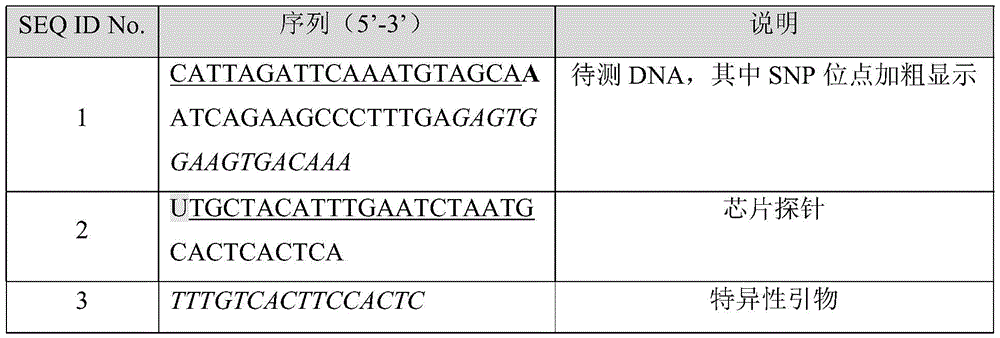
Unless otherwise stated, the gene chips used in the following examples were obtained from Shengjie technology (Hangzhou) Co., ltd and the primers were obtained from Shanghai Czeri bioengineering Co., ltd. The general procedures in molecular biology can be found, for example, in the molecular cloning guidelines. Sequence information of the probes, primers or test DNAs used in examples is shown in Table 1 below. The sequence information for the probes or DNA fragments shown in table 1 is merely to describe or demonstrate the design and concept of the present disclosure by way of example and is not intended to limit any particular sequence. After understanding the disclosure and the gist of the present invention, those skilled in the art can design corresponding chip probes for specific sequence information of different target sequences and achieve the technical effects of the present invention according to the concept of the present invention.
Table 1: related sequence information
Pretreatment: chip phosphorylation
The chip was added to 40. Mu.L of the reaction solution, reacted at 37 ℃ for 1 hour, and then reacted with ddH 2 And washing and drying. The reaction liquid was as follows:
| composition (A) | Source | Dosage (mu L) |
| 10× T4 ligase buffer | Takara | 4 |
| T4 PNK | Vazyme | 34 |
| ddH 2 O | Thermo Fish | 2 |
Example 1
1.1 hybridization reactions
The pretreated chip was added to 50. Mu.L of the hybridization solution, denatured by heating at 95 ℃ for 5min, then cooled to 50 ℃ for hybridization for 1 hour, then washed with 1ml of 4 XSSC for 5min, and the excess liquid was blotted with filter paper. The hybrid liquid lines were as follows:
| composition (I) | Source | Dosage (mu L) |
| 20×SSC | Thermo Fish | 10 |
| DNA to be detected | Human saliva extracted |
5 |
| ddH 2 O | Thermo Fish | 35 |
1.2 elongation reaction & ligation reaction
The chip obtained in 1.1 was added to 100. Mu.L of the reaction solution, reacted at 37 ℃ for 30min, followed by washing with 1ml of 4 XSSC for 5min, and excess liquid was blotted with filter paper. The reaction liquid is as follows:
| composition (A) | Source | Dosage (mu L) |
| 10×E.coli DNA ligase buffer | NEB | 10 |
| 0.1%BSA | NEB | 1 |
| 1mM dNTP | Worker of ordinary skill | 1 |
| T4 DNA Polymerase | Takara | 1 |
| E.coli DNA ligase | NEB | 1 |
| ddH 2 O | Thermo Fish | 86 |
1.3 cleavage reaction
The chip obtained in 1.2 was added to 40. Mu.L of the reaction solution, reacted at 37 ℃ for 30min, and then washed with 1ml of 4 XSSC for 5min, and excess liquid was blotted with filter paper. The reaction liquid is as follows:
| composition (A) | Source | Dosage (mu L) |
| 10×CutSmart buffer | NEB | 4 |
| USER Enzyme | NEB | 2 |
| ddH 2 O | Thermo Fish | 34 |
1.4 3' terminal dephosphorylation reaction
The chip obtained in 1.3 was added to 40. Mu.L of the reaction solution, reacted at 37 ℃ for 30min, and then washed with 1ml of 4 XSSC for 5min, and excess liquid was blotted with filter paper. The reaction liquid is as follows:
| composition (A) | Source | Dosage (mu L) |
| 10× T4 PNK buffer | Vazyme | 4 |
| T4 PNK | Vazyme | 34 |
| ddH 2 O | Thermo Fish | 2 |
1.5dUTP incorporation reactions
The chip obtained in 1.4 was added to 100. Mu.L of the reaction solution, reacted at 37 ℃ for 30min, and then heated at 75 ℃ for 20min. The reaction liquid is as follows:
| composition (I) | Source | Dosage (mu L) |
| 10×E.coli DNA ligase buffer | NEB | 10 |
| 0.1%BSA | NEB | 1 |
| 1mM dUTP-11-Biotin | Thermo Fish | 1 |
| T4 DNA Polymerase | Takara | 1 |
| E.coli DNA ligase | NEB | 1 |
| ddH 2 O | Thermo Fish | 86 |
1.6 alkaline washing
The chip obtained in 1.5 was washed with 0.2M NaOH for 2min, then with 1ml 4 XSSC for 5min, and excess liquid was blotted with filter paper.
1.7 Scan detection
The chip obtained in 1.6 was stained in 50. Mu.L of SAPE (streptavidin-phycoerythrin) solution for 30min in the absence of light. After rinsing once with 1mL of 4 XSSC, fluorescence intensity was measured using a SUMMIT chip scanner (available from Shengjie technology, hangzhou, ltd.).
The fluorescence scan results are shown in figure 4. The results show that: the background is clean, the fluorescence intensity is very high, and therefore the SNP site can be judged to be an A base.
Example 2
2.1 hybridization reactions
The pretreated chip was added to 50. Mu.L of the hybridization solution, denatured by heating at 95 ℃ for 5min, then cooled to 50 ℃ for hybridization for 1 hour, then washed with 1ml of 4 XSSC for 5min, and the excess liquid was blotted with filter paper. The hybrid liquid lines were as follows:
| composition (I) | Source | Dosage (mu L) |
| 20×SSC | Thermo Fish | 10 |
| DNA to be detected | Extraction of genome from |
5 |
| ddH 2 O | Thermo Fish | 35 |
2.2 extension reaction
The chip obtained in 2.1 was added to 100. Mu.L of the reaction solution, reacted at 37 ℃ for 30min, followed by washing with 1ml of 4 XSSC for 5min, and excess liquid was blotted with filter paper. The reaction liquid is as follows:
| composition (I) | Source | Dosage (mu L) |
| 0.1%BSA | NEB | 1 |
| 1mM dNTP | Worker of ordinary skill | 1 |
| T4 DNA Polymerase | Takara | 1 |
| 10×T4 DNA Polymerase buffer | Takara | 10 |
| ddH 2 O | Thermo Fish | 87 |
2.3 cleavage reaction
The chip obtained in 2.2 was added to 40. Mu.L of the reaction solution, reacted at 37 ℃ for 30min, and then washed with 1ml of 4 XSSC for 5min, and excess liquid was blotted with filter paper. The reaction liquid was as follows:
| composition (A) | Source | Dosage (mu L) |
| 10×CutSmart buffer | NEB | 4 |
| USER Enzyme | NEB | 2 |
| ddH 2 O | Thermo Fish | 34 |
2.4dUTP incorporation reactions
The chip obtained in 2.3 was added to 100. Mu.L of the reaction solution, reacted at 37 ℃ for 30min, and then heated at 75 ℃ for 20min. The reaction liquid is as follows:
| composition (I) | Source | Dosage (mu L) |
| 10×E.coli DNA ligase buffer | NEB | 10 |
| 0.1%BSA | NEB | 1 |
| 1mM dUTP-11-Biotin | Thermo Fish | 1 |
| T4 DNA Polymerase | Takara | 1 |
| E.coli DNA ligase | NEB | 1 |
| ddH 2 O | Thermo Fish | 86 |
2.5 alkaline cleaning
The chip obtained in 2.4 was washed with 0.2M NaOH for 2min, then with 1ml 4 XSSC for 5min, and excess liquid was blotted with filter paper.
2.6 Scan detection
The chip obtained in 2.5 was stained in 50. Mu.L of SAPE (streptavidin-phycoerythrin) solution for 30min in the absence of light. After rinsing once with 1mL of 4 XSSC, fluorescence intensity was measured using a SUMMIT chip scanner (available from Shengjie technology, hangzhou, ltd.).
The fluorescence scan results are shown in figure 5. The results show that: the background is clean, the fluorescence intensity is high, and therefore the SNP site can be judged to be an A base.
While particular embodiments of the present disclosure have been illustrated and described, it is not intended that these embodiments illustrate and describe all possible forms of the present disclosure. Rather, the words used in the specification are words of description rather than limitation. It will be apparent to those skilled in the art that various other changes and modifications can be made without departing from the general scope of the disclosure. It is therefore intended to cover in the appended claims all such changes and modifications that are within the scope of this disclosure.
Sequence listing
<110> Shengjie science and technology (Hangzhou) Co., ltd; shengjie science and technology (Jiaxing) Co., ltd
<120> SNP typing detection method
<130> D-CF210158
<160> 3
<170> SIPOSequenceListing 1.0
<210> 1
<211> 53
<212> DNA
<213> human (Homo sapiens)
<400> 1
cattagattc aaatgtagca aatcagaagc cctttgagag tggaagtgac aaa 53
<210> 2
<211> 31
<212> DNA
<213> Artificial Sequence (Artificial Sequence)
<400> 2
utgctacatt tgaatctaat gcactcactc a 31
<210> 3
<211> 16
<212> DNA
<213> Artificial Sequence (Artificial Sequence)
<400> 3
tttgtcactt ccactc 16
Claims (10)
1. A SNP typing detection method comprising the steps of:
(I) Hybridizing DNA to be detected with a gene chip, wherein a phosphorylated chip probe is fixed on the gene chip, the last base at the outward 5' end of the chip probe is a U base, a sequence in the chip probe, which is close to the downstream 3' direction of the U base, is reversely complementary with a sequence in the DNA to be detected, which is close to the upstream 5' direction of an SNP locus, and the SNP locus corresponds to the position of the U base;
(II) adding a random primer or a specific primer, dNTP and DNA polymerase, and synthesizing a sequence which is reversely complementary to a sequence in the direction close to the downstream 3' direction of the SNP locus in the DNA to be detected;
(III) adding an enzyme capable of catalyzing cleavage of a U base and an enzyme capable of catalyzing cleavage of the 3 'and 5' phosphodiester bond of an AP site, creating a nucleotide gap at the position of the U base;
(IV) adding a DNA polymerase and a DNA ligase, and one or more of dATP, dTTP, dCTP, dGTP, dUTP with a biomarker;
(V) detecting a gene chip aiming at the biomarkers to determine the genotype of the SNP locus.
2. The method of claim 1, wherein the enzyme capable of catalyzing U base cleavage in step (III) is uracil DNA glycosylase.
3. The method according to claim 1, wherein the enzyme capable of catalyzing the cleavage of the 3 'and 5' phosphodiester bond at the AP site in step (III) is an AP endonuclease.
4. The method according to any one of claims 1 to 3, wherein in step (II), a DNA ligase is additionally added; and after step (III) and before step (IV), adding an enzyme having 3' phosphatase activity.
5. The method of claim 4, wherein the enzyme having 3' phosphatase activity is a polynucleotide kinase.
6. The method of any one of claims 1-3, wherein the DNA polymerase in step (II) and step (IV) is T4 DNA polymerase.
7. The method of any one of claims 1-3, wherein the DNA ligase in step (IV) is E.
8. The method of claim 4, wherein the DNA ligase in step (II) is E.
9. The process of any one of claims 1-3, wherein after step (IV) and before step (V), washing is performed with a base solution.
10. Use of a gene chip comprising a chip probe in which the last base at the 5' end is a U base for SNP typing detection, wherein a sequence in the chip probe in the direction immediately downstream of the U base in the 3' direction is reverse complementary to a sequence in the DNA to be detected in the direction immediately upstream of the SNP site in the 5' direction, and the SNP site corresponds to the position of the U base.
Priority Applications (1)
| Application Number | Priority Date | Filing Date | Title |
|---|---|---|---|
| CN202110594294.5A CN113215223B (en) | 2021-05-28 | 2021-05-28 | SNP typing detection method |
Applications Claiming Priority (1)
| Application Number | Priority Date | Filing Date | Title |
|---|---|---|---|
| CN202110594294.5A CN113215223B (en) | 2021-05-28 | 2021-05-28 | SNP typing detection method |
Publications (2)
| Publication Number | Publication Date |
|---|---|
| CN113215223A CN113215223A (en) | 2021-08-06 |
| CN113215223B true CN113215223B (en) | 2022-10-18 |
Family
ID=77099256
Family Applications (1)
| Application Number | Title | Priority Date | Filing Date |
|---|---|---|---|
| CN202110594294.5A Active CN113215223B (en) | 2021-05-28 | 2021-05-28 | SNP typing detection method |
Country Status (1)
| Country | Link |
|---|---|
| CN (1) | CN113215223B (en) |
Families Citing this family (1)
| Publication number | Priority date | Publication date | Assignee | Title |
|---|---|---|---|---|
| CN116790724B (en) * | 2023-06-27 | 2024-04-12 | 北京百奥纳芯生物科技有限公司 | Method for detecting single base difference and gene chip |
Citations (6)
| Publication number | Priority date | Publication date | Assignee | Title |
|---|---|---|---|---|
| CN1824786A (en) * | 2005-12-23 | 2006-08-30 | 上海生物芯片有限公司 | Selective amplification process based on joining |
| CN101445834A (en) * | 2008-12-30 | 2009-06-03 | 东南大学 | Magnetic particle and single base extension based SNP automatic detection method |
| CN101586150A (en) * | 2008-05-23 | 2009-11-25 | 陕西北美基因股份有限公司 | Detecting probe, general oligonucleotide chip, nucleic acid detecting method and application thereof |
| CN102312004A (en) * | 2011-09-23 | 2012-01-11 | 张晓光 | Detection method and kit for gene mutations and HIV-1 drug resistance mutation sites |
| CN111793672A (en) * | 2020-07-23 | 2020-10-20 | 生捷科技(杭州)有限公司 | Method for forming cross-linked inverted probe on gene chip |
| CN111808928A (en) * | 2020-07-23 | 2020-10-23 | 生捷科技(杭州)有限公司 | SNP typing detection method |
Family Cites Families (2)
| Publication number | Priority date | Publication date | Assignee | Title |
|---|---|---|---|---|
| US9388459B2 (en) * | 2002-06-17 | 2016-07-12 | Affymetrix, Inc. | Methods for genotyping |
| US7189512B2 (en) * | 2003-02-20 | 2007-03-13 | Noga Porat | Methods for variation detection |
-
2021
- 2021-05-28 CN CN202110594294.5A patent/CN113215223B/en active Active
Patent Citations (6)
| Publication number | Priority date | Publication date | Assignee | Title |
|---|---|---|---|---|
| CN1824786A (en) * | 2005-12-23 | 2006-08-30 | 上海生物芯片有限公司 | Selective amplification process based on joining |
| CN101586150A (en) * | 2008-05-23 | 2009-11-25 | 陕西北美基因股份有限公司 | Detecting probe, general oligonucleotide chip, nucleic acid detecting method and application thereof |
| CN101445834A (en) * | 2008-12-30 | 2009-06-03 | 东南大学 | Magnetic particle and single base extension based SNP automatic detection method |
| CN102312004A (en) * | 2011-09-23 | 2012-01-11 | 张晓光 | Detection method and kit for gene mutations and HIV-1 drug resistance mutation sites |
| CN111793672A (en) * | 2020-07-23 | 2020-10-20 | 生捷科技(杭州)有限公司 | Method for forming cross-linked inverted probe on gene chip |
| CN111808928A (en) * | 2020-07-23 | 2020-10-23 | 生捷科技(杭州)有限公司 | SNP typing detection method |
Non-Patent Citations (6)
| Title |
|---|
| Single nucleotide polymorphism genotyping and point mutation detection by ligation on microarrays;Yanqiang Li 等;《J Nanosci Nanotechnol.》;20110228;第11卷(第2期);第994-1003页 * |
| 单核苷酸多态性电化学生物传感检测研究进展;封科军等;《分析测试学报》;20120325;第31卷(第3期);第359-364页 * |
| 基于DNA修复酶的电化学发光法检测脱碱基位点;王冬梅;《中国优秀博硕士学位论文全文数据库(硕士) 基础科学辑》;20210415(第2021/04期);第A006-66页 * |
| 基于DNA聚合酶Ⅰ的新型电化学传感器及其胰腺癌K-ras基因点突变检测;林丽清等;《电化学》;20150228;第21卷(第1期);第72-77页 * |
| 点突变的酶学检测技术;刘继业等;《核农学报》;20100420;第24卷(第2期);第307-313页 * |
| 用基因芯片检测单核苷酸多态性反应原理;张小燕等;《中国生物工程杂志》;20051125;第11卷;第57-61页 * |
Also Published As
| Publication number | Publication date |
|---|---|
| CN113215223A (en) | 2021-08-06 |
Similar Documents
| Publication | Publication Date | Title |
|---|---|---|
| US6280954B1 (en) | Arrayed primer extension technique for nucleic acid analysis | |
| CN1253582C (en) | Method for producing complex DNA methylation fingerprints | |
| JP2002539849A (en) | Universal array | |
| US8795971B2 (en) | Centroid markers for image analysis of high density clusters in complex polynucleotide sequencing | |
| US20070287151A1 (en) | Methods and Means for Nucleic Acid Sequencing | |
| JP4989493B2 (en) | Method for detecting nucleic acid sequence by intramolecular probe | |
| US20050250147A1 (en) | Digital profiling of polynucleotide populations | |
| US20050191636A1 (en) | Detection of STRP, such as fragile X syndrome | |
| WO2006039537A2 (en) | A system and method for inhibiting the decryption of a nucleic acid probe sequence used for the detection of a specific nucleic acid | |
| US20070020639A1 (en) | Isothermal locus specific amplification | |
| US20040126765A1 (en) | Method and compositions for sequencing nucleic acid molecules | |
| CN113215223B (en) | SNP typing detection method | |
| CN110914448A (en) | Array-based method for analyzing mixed samples using differentially labeled allele-specific probes | |
| CN113151405B (en) | SNP typing detection method | |
| US20110046009A1 (en) | Methods for detecting dna methylation using encoded particles | |
| US7629164B2 (en) | Methods for genotyping polymorphisms in humans | |
| EP1647602A1 (en) | Array-based comparative genome hybridization assays | |
| CN101548010A (en) | Methods for Determining Multi-allelic Haplotypes | |
| US11574705B2 (en) | High-throughput hybridization and reading method for biochips and system thereof | |
| CN100400673C (en) | Method for detecting Single Nucleotide Polymorphisms (SNPs) and point mutations | |
| WO2004001016A2 (en) | Methods for detection of genetic alterations associated with cancer | |
| WO2004050906A1 (en) | Methylation dna detecting method | |
| JP2010035451A (en) | Tag sequence, tag sequence-immobilized biochip and method for detecting selectively bondable substance by using this tag sequence | |
| US20100285970A1 (en) | Methods of sequencing nucleic acids | |
| Shammas et al. | ThalassoChip, an array mutation and single nucleotide polymorphism detection tool for the diagnosis of β-thalassaemia. |
Legal Events
| Date | Code | Title | Description |
|---|---|---|---|
| PB01 | Publication | ||
| PB01 | Publication | ||
| SE01 | Entry into force of request for substantive examination | ||
| SE01 | Entry into force of request for substantive examination | ||
| GR01 | Patent grant | ||
| GR01 | Patent grant |