CN113205631A - Community access control method and system based on face recognition - Google Patents
Community access control method and system based on face recognition Download PDFInfo
- Publication number
- CN113205631A CN113205631A CN202110298091.1A CN202110298091A CN113205631A CN 113205631 A CN113205631 A CN 113205631A CN 202110298091 A CN202110298091 A CN 202110298091A CN 113205631 A CN113205631 A CN 113205631A
- Authority
- CN
- China
- Prior art keywords
- queue
- face recognition
- community
- recognition device
- queuing
- Prior art date
- Legal status (The legal status is an assumption and is not a legal conclusion. Google has not performed a legal analysis and makes no representation as to the accuracy of the status listed.)
- Pending
Links
- 238000000034 method Methods 0.000 title claims abstract description 35
- 230000000694 effects Effects 0.000 claims abstract description 65
- 238000012706 support-vector machine Methods 0.000 claims abstract description 10
- 238000004364 calculation method Methods 0.000 claims description 6
- 238000010586 diagram Methods 0.000 description 6
- 230000006870 function Effects 0.000 description 5
- 238000005516 engineering process Methods 0.000 description 2
- 239000000463 material Substances 0.000 description 2
- 230000003287 optical effect Effects 0.000 description 2
- 230000008520 organization Effects 0.000 description 2
- 238000001514 detection method Methods 0.000 description 1
- 238000005265 energy consumption Methods 0.000 description 1
- 238000012423 maintenance Methods 0.000 description 1
- 238000004519 manufacturing process Methods 0.000 description 1
- 238000012544 monitoring process Methods 0.000 description 1
- 150000007523 nucleic acids Chemical class 0.000 description 1
- 102000039446 nucleic acids Human genes 0.000 description 1
- 108020004707 nucleic acids Proteins 0.000 description 1
- 239000013307 optical fiber Substances 0.000 description 1
- 238000006467 substitution reaction Methods 0.000 description 1
Images


Classifications
-
- G—PHYSICS
- G07—CHECKING-DEVICES
- G07C—TIME OR ATTENDANCE REGISTERS; REGISTERING OR INDICATING THE WORKING OF MACHINES; GENERATING RANDOM NUMBERS; VOTING OR LOTTERY APPARATUS; ARRANGEMENTS, SYSTEMS OR APPARATUS FOR CHECKING NOT PROVIDED FOR ELSEWHERE
- G07C9/00—Individual registration on entry or exit
- G07C9/30—Individual registration on entry or exit not involving the use of a pass
- G07C9/32—Individual registration on entry or exit not involving the use of a pass in combination with an identity check
- G07C9/37—Individual registration on entry or exit not involving the use of a pass in combination with an identity check using biometric data, e.g. fingerprints, iris scans or voice recognition
-
- G—PHYSICS
- G07—CHECKING-DEVICES
- G07C—TIME OR ATTENDANCE REGISTERS; REGISTERING OR INDICATING THE WORKING OF MACHINES; GENERATING RANDOM NUMBERS; VOTING OR LOTTERY APPARATUS; ARRANGEMENTS, SYSTEMS OR APPARATUS FOR CHECKING NOT PROVIDED FOR ELSEWHERE
- G07C11/00—Arrangements, systems or apparatus for checking, e.g. the occurrence of a condition, not provided for elsewhere
-
- G—PHYSICS
- G07—CHECKING-DEVICES
- G07C—TIME OR ATTENDANCE REGISTERS; REGISTERING OR INDICATING THE WORKING OF MACHINES; GENERATING RANDOM NUMBERS; VOTING OR LOTTERY APPARATUS; ARRANGEMENTS, SYSTEMS OR APPARATUS FOR CHECKING NOT PROVIDED FOR ELSEWHERE
- G07C9/00—Individual registration on entry or exit
- G07C9/30—Individual registration on entry or exit not involving the use of a pass
- G07C9/38—Individual registration on entry or exit not involving the use of a pass with central registration
-
- G—PHYSICS
- G07—CHECKING-DEVICES
- G07C—TIME OR ATTENDANCE REGISTERS; REGISTERING OR INDICATING THE WORKING OF MACHINES; GENERATING RANDOM NUMBERS; VOTING OR LOTTERY APPARATUS; ARRANGEMENTS, SYSTEMS OR APPARATUS FOR CHECKING NOT PROVIDED FOR ELSEWHERE
- G07C11/00—Arrangements, systems or apparatus for checking, e.g. the occurrence of a condition, not provided for elsewhere
- G07C2011/04—Arrangements, systems or apparatus for checking, e.g. the occurrence of a condition, not provided for elsewhere related to queuing systems
Landscapes
- Physics & Mathematics (AREA)
- General Physics & Mathematics (AREA)
- Engineering & Computer Science (AREA)
- Human Computer Interaction (AREA)
- Image Analysis (AREA)
Abstract
The embodiment of the application provides a community access control method and system based on face recognition. The method comprises the following steps: an entrance face recognition device is arranged at a community activity entrance; the control center calculates the number and the position of the flow control face recognition device needing to be started according to the flow of the personnel entering the community activity queuing queue at specified time intervals, and sends a starting instruction to the flow control face recognition device; after the entrance face recognition device recognizes the information of the personnel entering the community activity queuing queue, predicting the queue which should enter, sending out the guide of the entering queue, and opening a queuing channel; and in a set time interval, the flow control face recognition device predicts the adjustment scheme of the queue through a support vector machine by recognizing the personnel information in the specified queue, and sends an opening or closing instruction to the specified queue fence according to the adjustment scheme. According to the community access control method and device, the community access control efficiency is improved through the face recognition algorithm.
Description
Technical Field
The present application relates to the field of face recognition technology and community access control, and in particular, to a community access control method and system based on face recognition.
Background
When large-scale activities such as nucleic acid detection are carried out in communities, good order maintenance is needed, necessary access control is carried out on limited resources, large-scale gathering events can be caused if good community order is not maintained, and disputes among neighborhoods can also be caused. However, if the access control is performed by manpower such as community volunteers, the cost of labor is increased, and the side effect that the accuracy is not high and more people are gathered is easily caused.
Therefore, there is a need for an intelligent community access control method and system.
Disclosure of Invention
In view of this, the present application aims to provide a community access control method and system based on face recognition, which improve the automation level of community access control and solve the technical problems of low intelligence level, too strong dependence of manual participation, low accuracy and the like in the current community organization large-scale activity process.
Based on the above purpose, the present application provides a community access control method based on face recognition, which includes:
setting an inlet face recognition device at a community activity inlet, setting different queuing channels according to different community personnel types along the community activity queuing direction, and setting a flow control face recognition device according to different preset distances according to the different queuing channels; the inlet face recognition device and the flow control face recognition device are connected with a control center;
the control center calculates the number and the position of the flow control face recognition devices needing to be started according to the flow of the personnel entering the community activity queuing queue at specified time intervals, and sends starting instructions to the flow control face recognition devices;
after the entrance face recognition device recognizes the information of the personnel entering the community activity queuing queue, predicting the queue which should enter, sending out the guide of the entering queue, and opening the queuing channel;
in a set time interval, the flow control face recognition device predicts an adjustment scheme of a queue through a support vector machine by recognizing personnel information in a specified queue, and sends an opening or closing instruction to a specified queue fence according to the adjustment scheme;
and when the flow of the queue exceeds a specified flow limiting threshold value, sending a closing instruction to the inlet face recognition device.
In some embodiments, the method further comprises:
and the control center classifies the personnel information entering the community activity queuing queue according to the requirement of the community activity and sends the personnel information to the processing equipment corresponding to the community activity.
In some embodiments, different queuing channels are set according to different community personnel types along the community activity queuing direction, and the flow control face recognition device is set according to different preset distances according to different queuing channels, and the flow control face recognition device comprises:
for community personnel needing help, a green channel is established;
and according to the requirement of the community activities, carrying out priority division on the community personnel and corresponding to the corresponding queuing channel.
In some embodiments, calculating the number and the position of the flow control face recognition devices to be started according to the flow of people entering the community activity queuing queue, and sending a start instruction to the flow control face recognition devices, includes:
setting a user white list in the flow control face recognition device, and setting a corresponding white list channel; after the flow control face recognition device catches community people in the white list, the flow control face recognition device immediately guides the community people to a corresponding white list channel and opens the white list channel;
setting a user blacklist in the face recognition device; and when the face recognition device catches community people in the blacklist, prompting to refuse to enter and sending an alarm.
In some embodiments, after the entrance face recognition device recognizes information of people who enter a queue of a community activity, predicting the queue which should enter, sending a guide for entering the queue, and opening the queuing channel, the method includes:
the entrance face recognition device sends face information of a current person to be entered to the control center, and the control center retrieves the attribute of the current person according to the face information;
and the control center predicts the entering queues suitable for the current personnel through a queuing theory algorithm according to the people flow speed, the congestion condition and the attribute of the current personnel of each current queue.
In some embodiments, the flow control face recognition device predicts an adjustment scheme of a specified queue through a support vector machine by recognizing personnel information in the queue, and sends an opening or closing instruction to a specified queue fence according to the adjustment scheme, including:
under the condition that the congestion degree of the queue is predicted to exceed a specified threshold value, calculating the queue needing to be closed, and sending a closing instruction to the queue;
and under the condition that the congestion degree of the queue is predicted to be lower than a specified threshold value, calculating the queue needing to be closed, and sending a closing instruction to the queue.
In some embodiments, the crowdedness is calculated by the following formula:
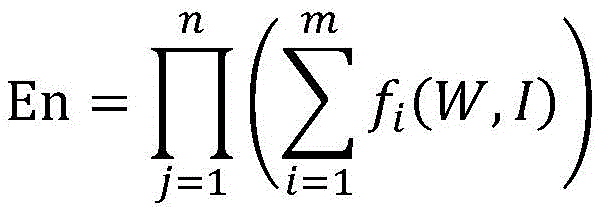
wherein j is the distance progression of community personnel, i is the queue speed progression, fi() The characteristic value of the congestion of the ith queue, W is the characteristic value of the personnel waiting to enter the queue, and I is the characteristic value of the queue state.
Based on the above purpose, the present application further provides a community access control system based on face recognition, including:
the system comprises a building module, a flow control module and a flow control module, wherein the building module is used for arranging an entrance face recognition device at a community activity entrance, setting different queuing channels according to different community personnel types along the community activity queuing direction, and arranging the flow control face recognition devices according to different preset distances according to different queuing channels; the inlet face recognition device and the flow control face recognition device are connected with a control center;
the computing module is used for the control center to compute the number and the position of the flow control face recognition devices needing to be started according to the flow of the personnel entering the community activity queuing queue at specified time intervals and send starting instructions to the flow control face recognition devices;
the prediction module is used for predicting a queue which should be entered after the entrance face recognition device recognizes the information of the personnel entering the community activity queuing queue, sending out an entry queue guide and opening the queuing channel;
the execution module is used for predicting an adjustment scheme of the queue through a support vector machine by identifying personnel information in a specified queue by the flow control face recognition device within a set time interval, and sending an opening or closing instruction to a specified queue fence according to the adjustment scheme;
and the closing module is used for sending a closing instruction to the entrance face recognition device when the flow of the queue exceeds a specified flow limiting threshold value.
In some embodiments, the system further comprises:
and the classification module is used for classifying the personnel information entering the community activity queuing queue by the control center according to the requirement of the community activity and sending the personnel information to the processing equipment corresponding to the community activity.
In some embodiments, the calculation module comprises:
a white list unit, configured to set a user white list in the flow control face recognition device, and set a corresponding white list channel; after the flow control face recognition device catches community people in the white list, the flow control face recognition device immediately guides the community people to a corresponding white list channel and opens the white list channel;
the blacklist unit is used for setting a user blacklist in the face recognition device; and when the face recognition device catches community people in the blacklist, prompting to refuse to enter and sending an alarm.
In general, the advantages of the present application and the experience brought to the user are: the advancing and crowding states of the queuing queue can be judged more accurately through the face recognition technology, so that manual intervention is avoided, and the healthy life experience of the community is improved; meanwhile, the number of queuing queues can be adjusted at the first time according to the type of community activities, and the intelligent management level of the community is increased.
Drawings
In the drawings, like reference numerals refer to the same or similar parts or elements throughout the several views unless otherwise specified. The figures are not necessarily to scale. It is appreciated that these drawings depict only some embodiments in accordance with the disclosure and are therefore not to be considered limiting of its scope.
Fig. 1 shows a flowchart of a community access control method based on face recognition according to an embodiment of the present invention.
FIG. 2 is a flowchart illustrating a community access control method based on face recognition according to an embodiment of the present invention.
Fig. 3 shows a constitutional diagram of a community access control system based on face recognition according to an embodiment of the present invention.
Fig. 4 shows a constitutional diagram of a community access control system based on face recognition according to an embodiment of the present invention.
Fig. 5 shows a configuration diagram of a calculation module according to an embodiment of the present invention.
Detailed Description
The present application will be described in further detail with reference to the following drawings and examples. It is to be understood that the specific embodiments described herein are merely illustrative of the relevant invention and not restrictive of the invention. It should be noted that, for convenience of description, only the portions related to the related invention are shown in the drawings.
It should be noted that the embodiments and features of the embodiments in the present application may be combined with each other without conflict. The present application will be described in detail below with reference to the embodiments with reference to the attached drawings.
Fig. 1 shows a flowchart of a community access control method based on face recognition according to an embodiment of the present invention. As shown in fig. 1, the community access control method based on face recognition includes:
step S11, an entrance face recognition device is arranged at a community activity entrance, different queuing channels are set according to different community personnel types along the community activity queuing direction, and a flow control face recognition device is arranged according to different preset distances according to the different queuing channels; the inlet face recognition device and the flow control face recognition device are connected with a control center.
Particularly, different people participating in large-scale community activities, people needing help, such as old, weak, sick and disabled people, organizations with activities, guests with invitations, and the like, different types of people entering the site of a large-scale activity should have different queue entries to ensure the orderly activity organization order.
According to the length of the queue, the face recognition devices are required to be arranged at different spacing distances, so that the properties of people entering the queue, the speed of the queue, the crowding degree and the like are accurately judged, and quantitative reference is provided for the control and management of the queue.
In one embodiment, set up different queuing passageways according to different community personnel types along the community activity direction of lining up to set up flow control face recognition device according to the preset distance of difference according to the passageway of lining up, include:
for community personnel needing help, a green channel is established;
and according to the requirement of the community activities, carrying out priority division on the community personnel and corresponding to the corresponding queuing channel.
And step S12, the control center calculates the number and the position of the flow control face recognition device needing to be started according to the flow of the personnel entering the community activity queuing queue at the specified time interval, and sends a starting instruction to the flow control face recognition device.
In particular, in order to save resources, both the number and the location of the face recognition devices need to be controlled. For example, when the queue is crowded with many people in the queue, the monitoring of the queue needs to be strengthened, and therefore, more face recognition devices need to be opened at more proper positions. On the contrary, under the condition that queue personnel are sparse, some face recognition devices can be closed, and energy consumption is saved.
In one embodiment, calculating the number and the position of flow control face recognition devices needing to be started according to the flow of people entering a community activity queuing queue, and sending a starting instruction to the flow control face recognition devices, the method comprises the following steps:
setting a user white list in the flow control face recognition device, and setting a corresponding white list channel; after the flow control face recognition device catches community people in the white list, the flow control face recognition device immediately guides the community people to a corresponding white list channel and opens the white list channel;
setting a user blacklist in the face recognition device; and when the face recognition device catches community people in the blacklist, prompting to refuse to enter and sending an alarm.
And step S13, after the entrance face recognition device recognizes the information of the people entering the community activity queuing queue, predicting the queue which should enter, sending out an entering queue guide, and opening the queuing channel.
In one embodiment, after the entrance face recognition device recognizes information of people entering a queue of a community activity, it predicts the queue that should enter, and sends out an entry queue guide to open the queuing channel, including:
the entrance face recognition device sends face information of a current person to be entered to the control center, and the control center retrieves the attribute of the current person according to the face information;
and the control center predicts the entering queues suitable for the current personnel through a queuing theory algorithm according to the people flow speed, the congestion condition and the attribute of the current personnel of each current queue.
And step S14, in a set time interval, the flow control face recognition device predicts an adjustment scheme of the queue through a support vector machine by recognizing personnel information in the specified queue, and sends an opening or closing instruction to the specified queue fence according to the adjustment scheme.
In one embodiment, the flow control face recognition device predicts an adjustment scheme of a specified queue through a support vector machine by recognizing personnel information in the queue in a set time interval, and sends an opening or closing instruction to a specified queue fence according to the adjustment scheme, and the flow control face recognition device includes:
under the condition that the congestion degree of the queue is predicted to exceed a specified threshold value, calculating the queue needing to be closed, and sending a closing instruction to the queue;
and under the condition that the congestion degree of the queue is predicted to be lower than a specified threshold value, calculating the queue needing to be closed, and sending a closing instruction to the queue.
In one embodiment, the crowdedness is calculated by the following formula:

wherein j is the distance progression of community personnel, i is the queue speed progression, fi() The characteristic value of the congestion of the ith queue, W is the characteristic value of the personnel waiting to enter the queue, and I is the characteristic value of the queue state.
Specifically, under the condition of crowded personnel, current limiting measures are needed, and the most effective way of the current limiting measures is to close a certain number of queuing queues, and the specified queuing queues are automatically closed by sending a closing instruction to a specified queue fence, so that current limiting is realized. Similarly, when traffic becomes less congested, the fence can be adaptively opened in order to improve the efficiency of the queuing queue.
And step S15, when the flow of the queue exceeds a specified flow limiting threshold value, sending a closing instruction to the entrance face recognition device.
FIG. 2 is a flowchart illustrating a community access control method based on face recognition according to an embodiment of the present invention. As shown in fig. 2, the community access control method based on face recognition further includes:
and step S16, the control center classifies the personnel information entering the community activity queuing queue according to the requirement of the community activity and sends the personnel information to the processing equipment corresponding to the community activity.
In particular, the present invention relates to a method for producing,
fig. 3 shows a constitutional diagram of a community access control system based on face recognition according to an embodiment of the present invention. As shown in fig. 3, the community access control system based on face recognition may be divided into:
the building module 31 is used for setting an entrance face recognition device at a community activity entrance, setting different queuing channels according to different community personnel types along the community activity queuing direction, and setting a flow control face recognition device according to different preset distances according to different queuing channels; the inlet face recognition device and the flow control face recognition device are connected with a control center;
the calculation module 32 is used for calculating the number and the position of the flow control face recognition device needing to be started according to the flow of the personnel entering the community activity queuing queue by the control center according to the designated time interval, and sending a starting instruction to the flow control face recognition device;
the prediction module 33 is used for predicting the queue which should be entered after the entrance face recognition device recognizes the information of the personnel entering the community activity queuing queue, sending out the guidance of entering the queue and opening the queuing channel;
the execution module 34 is configured to predict an adjustment scheme of the queue through a support vector machine by identifying the person information in the specified queuing queue by the flow control face recognition device within a set time interval, and send an opening or closing instruction to a specified queuing fence according to the adjustment scheme;
and the closing module 35 is configured to send a closing instruction to the entrance face recognition device when the flow rate of the queue exceeds a specified flow limit threshold.
Fig. 4 is a block diagram of a community access control system based on face recognition according to an embodiment of the present invention. As shown in fig. 4, the community access control system based on face recognition integrally further includes:
and the classification module 36 is used for classifying the personnel information entering the community activity queuing queue by the control center according to the requirement of the community activity, and sending the personnel information to the processing equipment corresponding to the community activity.
Fig. 5 shows a configuration diagram of a calculation module according to an embodiment of the present invention. As shown in fig. 5, the calculation module 32 includes:
a white list unit 321, configured to set a user white list in the flow control face recognition apparatus, and set a corresponding white list channel; after the flow control face recognition device catches community people in the white list, the flow control face recognition device immediately guides the community people to a corresponding white list channel and opens the white list channel;
a blacklist unit 322, configured to set a user blacklist in the face recognition apparatus; and when the face recognition device catches community people in the blacklist, prompting to refuse to enter and sending an alarm.
The functions of the modules in the systems in the embodiments of the present application may refer to the corresponding descriptions in the above methods, and are not described herein again.
In the description herein, references to the description of the term "one embodiment," "some embodiments," "an example," "a specific example," or "some examples," etc., mean that a particular feature, structure, material, or characteristic described in connection with the embodiment or example is included in at least one embodiment or example of the invention. Furthermore, the particular features, structures, materials, or characteristics described may be combined in any suitable manner in any one or more embodiments or examples. Furthermore, various embodiments or examples and features of different embodiments or examples described in this specification can be combined and combined by one skilled in the art without contradiction.
Any process or method descriptions in flow charts or otherwise described herein may be understood as representing modules, segments, or portions of code which include one or more executable instructions for implementing specific logical functions or steps of the process, and alternate implementations are included within the scope of the preferred embodiment of the present invention in which functions may be executed out of order from that shown or discussed, including substantially concurrently or in reverse order, depending on the functionality involved, as would be understood by those reasonably skilled in the art of the present invention.
The logic and/or steps represented in the flowcharts or otherwise described herein, e.g., an ordered listing of executable instructions that can be considered to implement logical functions, can be embodied in any computer-readable medium for use by or in connection with an instruction execution system, apparatus, or device, such as a computer-based system, processor-containing system, or other system that can fetch the instructions from the instruction execution system, apparatus, or device and execute the instructions. For the purposes of this description, a "computer-readable medium" can be any means that can contain, store, communicate, propagate, or transport the program for use by or in connection with the instruction execution system, apparatus, or device. More specific examples (a non-exhaustive list) of the computer-readable medium would include the following: an electrical connection (electronic device) having one or more wires, a portable computer diskette (magnetic device), a Random Access Memory (RAM), a read-only memory (ROM), an erasable programmable read-only memory (EPROM or flash memory), an optical fiber device, and a portable read-only memory (CDROM). Additionally, the computer-readable medium could even be paper or another suitable medium upon which the program is printed, as the program can be electronically captured, via for instance optical scanning of the paper or other medium, then compiled, interpreted or otherwise processed in a suitable manner if necessary, and then stored in a computer memory.
It should be understood that portions of the present invention may be implemented in hardware, software, firmware, or a combination thereof. In the above embodiments, the various steps or methods may be implemented in software or firmware stored in memory and executed by a suitable instruction execution system. For example, if implemented in hardware, as in another embodiment, any one or combination of the following techniques, which are known in the art, may be used: a discrete logic circuit having a logic gate circuit for implementing a logic function on a data signal, an application specific integrated circuit having an appropriate combinational logic gate circuit, a Programmable Gate Array (PGA), a Field Programmable Gate Array (FPGA), or the like.
It will be understood by those skilled in the art that all or part of the steps carried by the method for implementing the above embodiments may be implemented by hardware related to instructions of a program, which may be stored in a computer readable storage medium, and when the program is executed, the program includes one or a combination of the steps of the method embodiments.
In addition, functional units in the embodiments of the present invention may be integrated into one processing module, or each unit may exist alone physically, or two or more units are integrated into one module. The integrated module can be realized in a hardware mode, and can also be realized in a software functional module mode. The integrated module, if implemented in the form of a software functional module and sold or used as a separate product, may also be stored in a computer readable storage medium. The storage medium may be a read-only memory, a magnetic or optical disk, or the like.
The above description is only for the specific embodiment of the present invention, but the scope of the present invention is not limited thereto, and any person skilled in the art can easily conceive various changes or substitutions within the technical scope of the present invention, and these should be covered by the scope of the present invention. Therefore, the protection scope of the present invention shall be subject to the protection scope of the appended claims.
Claims (10)
1. A community access control method based on face recognition is characterized by comprising the following steps:
setting an inlet face recognition device at a community activity inlet, setting different queuing channels according to different community personnel types along the community activity queuing direction, and setting a flow control face recognition device according to different preset distances according to the different queuing channels; the inlet face recognition device and the flow control face recognition device are connected with a control center;
the control center calculates the number and the position of the flow control face recognition devices needing to be started according to the flow of the personnel entering the community activity queuing queue at specified time intervals, and sends starting instructions to the flow control face recognition devices;
after the entrance face recognition device recognizes the information of the personnel entering the community activity queuing queue, predicting the queue which should enter, sending out the guide of the entering queue, and opening the queuing channel;
in a set time interval, the flow control face recognition device predicts an adjustment scheme of a queue through a support vector machine by recognizing personnel information in a specified queue, and sends an opening or closing instruction to a specified queue fence according to the adjustment scheme;
and when the flow of the queue exceeds a specified flow limiting threshold value, sending a closing instruction to the inlet face recognition device.
2. The method of claim 1, further comprising:
and the control center classifies the personnel information entering the community activity queuing queue according to the requirement of the community activity and sends the personnel information to the processing equipment corresponding to the community activity.
3. The method as claimed in claim 1, wherein different queuing channels are set according to different community personnel types along the community activity queuing direction, and the flow control face recognition device is set according to different preset distances according to different queuing channels, comprising:
for community personnel needing help, a green channel is established;
and according to the requirement of the community activities, carrying out priority division on the community personnel and corresponding to the corresponding queuing channel.
4. The method of claim 1, wherein the steps of calculating the number and the positions of the flow control face recognition devices needing to be started according to the flow of the personnel entering the community activity queuing queue, and sending a starting instruction to the flow control face recognition devices comprise:
setting a user white list in the flow control face recognition device, and setting a corresponding white list channel; after the flow control face recognition device catches community people in the white list, the flow control face recognition device immediately guides the community people to a corresponding white list channel and opens the white list channel;
setting a user blacklist in the face recognition device; and when the face recognition device catches community people in the blacklist, prompting to refuse to enter and sending an alarm.
5. The method of claim 1, wherein after the entrance face recognition device recognizes the information of the person who enters the queue of the community activity, predicting the queue which should enter, sending out the guide of entering the queue, and opening the queuing channel, comprises:
the entrance face recognition device sends face information of a current person to be entered to the control center, and the control center retrieves the attribute of the current person according to the face information;
and the control center predicts the entering queues suitable for the current personnel through a queuing theory algorithm according to the people flow speed, the congestion condition and the attribute of the current personnel of each current queue.
6. The method of claim 1, wherein the flow control face recognition device predicts an adjustment scheme of a specified queue through a support vector machine by recognizing personnel information in the queue in the specified queue within a set time interval, and sends an opening or closing instruction to a specified queue fence according to the adjustment scheme, and the method comprises the following steps:
under the condition that the congestion degree of the queue is predicted to exceed a specified threshold value, calculating the queue needing to be closed, and sending a closing instruction to the queue;
and under the condition that the congestion degree of the queue is predicted to be lower than a specified threshold value, calculating the queue needing to be closed, and sending a closing instruction to the queue.
7. The method of claim 6, wherein the crowdedness is calculated by the following formula:

wherein j is the distance progression of community personnel, i is the queue speed progression, fi() The characteristic value of the congestion of the ith queue, W is the characteristic value of the personnel waiting to enter the queue, and I is the characteristic value of the queue state.
8. The utility model provides a community security protection equipment reports system of repairment based on edge calculation which characterized in that includes:
the system comprises a building module, a flow control module and a flow control module, wherein the building module is used for arranging an entrance face recognition device at a community activity entrance, setting different queuing channels according to different community personnel types along the community activity queuing direction, and arranging the flow control face recognition devices according to different preset distances according to different queuing channels; the inlet face recognition device and the flow control face recognition device are connected with a control center;
the computing module is used for the control center to compute the number and the position of the flow control face recognition devices needing to be started according to the flow of the personnel entering the community activity queuing queue at specified time intervals and send starting instructions to the flow control face recognition devices;
the prediction module is used for predicting a queue which should be entered after the entrance face recognition device recognizes the information of the personnel entering the community activity queuing queue, sending out an entry queue guide and opening the queuing channel;
the execution module is used for predicting an adjustment scheme of the queue through a support vector machine by identifying personnel information in a specified queue by the flow control face recognition device within a set time interval, and sending an opening or closing instruction to a specified queue fence according to the adjustment scheme;
and the closing module is used for sending a closing instruction to the entrance face recognition device when the flow of the queue exceeds a specified flow limiting threshold value.
9. The system of claim 8, further comprising:
and the classification module is used for classifying the personnel information entering the community activity queuing queue by the control center according to the requirement of the community activity and sending the personnel information to the processing equipment corresponding to the community activity.
10. The system of claim 8, wherein the computing module comprises:
a white list unit, configured to set a user white list in the flow control face recognition device, and set a corresponding white list channel; after the flow control face recognition device catches community people in the white list, the flow control face recognition device immediately guides the community people to a corresponding white list channel and opens the white list channel;
the blacklist unit is used for setting a user blacklist in the face recognition device; and when the face recognition device catches community people in the blacklist, prompting to refuse to enter and sending an alarm.
Priority Applications (1)
| Application Number | Priority Date | Filing Date | Title |
|---|---|---|---|
| CN202110298091.1A CN113205631A (en) | 2021-03-19 | 2021-03-19 | Community access control method and system based on face recognition |
Applications Claiming Priority (1)
| Application Number | Priority Date | Filing Date | Title |
|---|---|---|---|
| CN202110298091.1A CN113205631A (en) | 2021-03-19 | 2021-03-19 | Community access control method and system based on face recognition |
Publications (1)
| Publication Number | Publication Date |
|---|---|
| CN113205631A true CN113205631A (en) | 2021-08-03 |
Family
ID=77025501
Family Applications (1)
| Application Number | Title | Priority Date | Filing Date |
|---|---|---|---|
| CN202110298091.1A Pending CN113205631A (en) | 2021-03-19 | 2021-03-19 | Community access control method and system based on face recognition |
Country Status (1)
| Country | Link |
|---|---|
| CN (1) | CN113205631A (en) |
Cited By (5)
| Publication number | Priority date | Publication date | Assignee | Title |
|---|---|---|---|---|
| CN114021035A (en) * | 2021-11-02 | 2022-02-08 | 中国联合网络通信集团有限公司 | Sampling queue control method, regional server, system, device and medium |
| CN114897324A (en) * | 2022-04-25 | 2022-08-12 | 深圳创维-Rgb电子有限公司 | Personnel scheduling method, device and computer-readable storage medium to be tested |
| CN115865820A (en) * | 2022-11-23 | 2023-03-28 | 四川天邑康和通信股份有限公司 | Alarm clock reminding system and method based on optical modem flow monitoring |
| CN116050555A (en) * | 2021-10-28 | 2023-05-02 | 浙江宇视科技有限公司 | A nucleic acid detection deployment optimization method, device, storage medium and system |
| CN116797986A (en) * | 2022-12-14 | 2023-09-22 | 慧之安信息技术股份有限公司 | Nucleic acid detection point personnel distance maintenance system based on edge calculation |
Citations (9)
| Publication number | Priority date | Publication date | Assignee | Title |
|---|---|---|---|---|
| CN103745519A (en) * | 2014-01-03 | 2014-04-23 | 深圳市劲凯科技有限公司 | Intelligent self-service method of airport and system |
| CN106056303A (en) * | 2016-06-13 | 2016-10-26 | 宁波工程学院 | City subway station crowding degree automatic judgment method |
| CN106664391A (en) * | 2014-06-30 | 2017-05-10 | 日本电气株式会社 | Guidance processing device and guidance method |
| CN107215363A (en) * | 2017-06-12 | 2017-09-29 | 中国联合网络通信集团有限公司 | Passenger's queuing bootstrap technique and guiding system in a kind of subway station |
| CN107766982A (en) * | 2017-10-26 | 2018-03-06 | 深圳市坐标软件开发有限公司 | It is lined up querying method, apparatus and system |
| CN211015546U (en) * | 2019-12-31 | 2020-07-14 | 苏州研可智能科技有限公司 | A traffic monitoring system based on face recognition |
| CN111563989A (en) * | 2020-07-14 | 2020-08-21 | 深圳市全智芯科技有限公司 | Intelligent control method of gate, gate and computer readable storage medium |
| CN112133011A (en) * | 2020-09-25 | 2020-12-25 | 小爱智能科技(苏州)有限公司 | Public place face recognition access control system and access control method |
| CN112182267A (en) * | 2020-09-27 | 2021-01-05 | 中南大学 | Method and system for refined guidance of passengers in subway cars |
-
2021
- 2021-03-19 CN CN202110298091.1A patent/CN113205631A/en active Pending
Patent Citations (9)
| Publication number | Priority date | Publication date | Assignee | Title |
|---|---|---|---|---|
| CN103745519A (en) * | 2014-01-03 | 2014-04-23 | 深圳市劲凯科技有限公司 | Intelligent self-service method of airport and system |
| CN106664391A (en) * | 2014-06-30 | 2017-05-10 | 日本电气株式会社 | Guidance processing device and guidance method |
| CN106056303A (en) * | 2016-06-13 | 2016-10-26 | 宁波工程学院 | City subway station crowding degree automatic judgment method |
| CN107215363A (en) * | 2017-06-12 | 2017-09-29 | 中国联合网络通信集团有限公司 | Passenger's queuing bootstrap technique and guiding system in a kind of subway station |
| CN107766982A (en) * | 2017-10-26 | 2018-03-06 | 深圳市坐标软件开发有限公司 | It is lined up querying method, apparatus and system |
| CN211015546U (en) * | 2019-12-31 | 2020-07-14 | 苏州研可智能科技有限公司 | A traffic monitoring system based on face recognition |
| CN111563989A (en) * | 2020-07-14 | 2020-08-21 | 深圳市全智芯科技有限公司 | Intelligent control method of gate, gate and computer readable storage medium |
| CN112133011A (en) * | 2020-09-25 | 2020-12-25 | 小爱智能科技(苏州)有限公司 | Public place face recognition access control system and access control method |
| CN112182267A (en) * | 2020-09-27 | 2021-01-05 | 中南大学 | Method and system for refined guidance of passengers in subway cars |
Cited By (7)
| Publication number | Priority date | Publication date | Assignee | Title |
|---|---|---|---|---|
| CN116050555A (en) * | 2021-10-28 | 2023-05-02 | 浙江宇视科技有限公司 | A nucleic acid detection deployment optimization method, device, storage medium and system |
| CN114021035A (en) * | 2021-11-02 | 2022-02-08 | 中国联合网络通信集团有限公司 | Sampling queue control method, regional server, system, device and medium |
| CN114897324A (en) * | 2022-04-25 | 2022-08-12 | 深圳创维-Rgb电子有限公司 | Personnel scheduling method, device and computer-readable storage medium to be tested |
| CN115865820A (en) * | 2022-11-23 | 2023-03-28 | 四川天邑康和通信股份有限公司 | Alarm clock reminding system and method based on optical modem flow monitoring |
| CN115865820B (en) * | 2022-11-23 | 2024-05-28 | 四川天邑康和通信股份有限公司 | Alarm clock reminding system and method based on light cat flow monitoring |
| CN116797986A (en) * | 2022-12-14 | 2023-09-22 | 慧之安信息技术股份有限公司 | Nucleic acid detection point personnel distance maintenance system based on edge calculation |
| CN116797986B (en) * | 2022-12-14 | 2025-02-25 | 慧之安信息技术股份有限公司 | A personnel distance maintenance system for nucleic acid testing points based on edge computing |
Similar Documents
| Publication | Publication Date | Title |
|---|---|---|
| CN113205631A (en) | Community access control method and system based on face recognition | |
| US10395529B2 (en) | Traffic signal control using multiple Q-learning categories | |
| CN111179601B (en) | Tunnel traffic operation control method | |
| CN109816976A (en) | A kind of traffic management method and system | |
| CN113379099B (en) | Machine learning and copula model-based highway traffic flow self-adaptive prediction method | |
| Al-Khateeb et al. | Dynamic traffic light sequence algorithm using RFID | |
| CN107067763B (en) | Parking lot entrance and exit switching method and device | |
| CN114898889B (en) | A design method for cluster risk control model based on big data | |
| EP3425608A1 (en) | Traffic signal control using multiple q-learning categories | |
| CN109584579B (en) | Traffic signal lamp control method based on face recognition and computer equipment | |
| CN109685482A (en) | Intelligent building management method, system and the application that people, machine, object information merge | |
| CN115291555A (en) | Internet-based intelligent building digital information management system | |
| CN117765720A (en) | Park traffic intelligent adaptive guidance methods, systems, equipment and storage media | |
| CN106251011A (en) | For analyzing data processing method and the device that departure from port value machine passenger queues up | |
| CN118761513B (en) | Short-time prediction method for service area incoming passenger flow based on operator data | |
| CN115392557A (en) | Station passenger flow state monitoring method and system based on video and AFC data fusion | |
| CN120598330A (en) | A dynamic charging task allocation method for parking lots with multi-robot systems | |
| CN120564336A (en) | Smart city crowd management system, method and medium based on IoT large model | |
| CN119409033A (en) | Elevator control method, device and computer equipment based on multiple scenarios | |
| CN119207096A (en) | A smart traffic control system and method based on data analysis | |
| CN119429884A (en) | Elevator control method, elevator system and storage medium | |
| CN116432803B (en) | An intelligent early warning system and method for communication data based on the Internet of Things | |
| Bawaneh et al. | Machine Learning-Based Anomaly Detection in Smart City Traffic: Performance Comparison and Insights. | |
| CN119091518A (en) | A comprehensive management background operation and maintenance system | |
| CN118138999A (en) | A personnel safety management method and system based on 5G and RFID |
Legal Events
| Date | Code | Title | Description |
|---|---|---|---|
| PB01 | Publication | ||
| PB01 | Publication | ||
| SE01 | Entry into force of request for substantive examination | ||
| SE01 | Entry into force of request for substantive examination | ||
| RJ01 | Rejection of invention patent application after publication | ||
| RJ01 | Rejection of invention patent application after publication |
Application publication date: 20210803 |