CN113166183A - Process for the hydrogenation of oxime derivatives - Google Patents
Process for the hydrogenation of oxime derivatives Download PDFInfo
- Publication number
- CN113166183A CN113166183A CN201980079013.3A CN201980079013A CN113166183A CN 113166183 A CN113166183 A CN 113166183A CN 201980079013 A CN201980079013 A CN 201980079013A CN 113166183 A CN113166183 A CN 113166183A
- Authority
- CN
- China
- Prior art keywords
- alkyl
- alkoxy
- phenyl
- formula
- hydrogen
- Prior art date
- Legal status (The legal status is an assumption and is not a legal conclusion. Google has not performed a legal analysis and makes no representation as to the accuracy of the status listed.)
- Granted
Links
Classifications
-
- B—PERFORMING OPERATIONS; TRANSPORTING
- B01—PHYSICAL OR CHEMICAL PROCESSES OR APPARATUS IN GENERAL
- B01J—CHEMICAL OR PHYSICAL PROCESSES, e.g. CATALYSIS OR COLLOID CHEMISTRY; THEIR RELEVANT APPARATUS
- B01J31/00—Catalysts comprising hydrides, coordination complexes or organic compounds
- B01J31/16—Catalysts comprising hydrides, coordination complexes or organic compounds containing coordination complexes
- B01J31/22—Organic complexes
- B01J31/2282—Unsaturated compounds used as ligands
- B01J31/2295—Cyclic compounds, e.g. cyclopentadienyls
-
- C—CHEMISTRY; METALLURGY
- C07—ORGANIC CHEMISTRY
- C07C—ACYCLIC OR CARBOCYCLIC COMPOUNDS
- C07C231/00—Preparation of carboxylic acid amides
- C07C231/12—Preparation of carboxylic acid amides by reactions not involving the formation of carboxamide groups
-
- C—CHEMISTRY; METALLURGY
- C07—ORGANIC CHEMISTRY
- C07C—ACYCLIC OR CARBOCYCLIC COMPOUNDS
- C07C239/00—Compounds containing nitrogen-to-halogen bonds; Hydroxylamino compounds or ethers or esters thereof
- C07C239/08—Hydroxylamino compounds or their ethers or esters
- C07C239/10—Hydroxylamino compounds or their ethers or esters having nitrogen atoms of hydroxylamino groups further bound to carbon atoms of unsubstituted hydrocarbon radicals or of hydrocarbon radicals substituted by halogen atoms or by nitro or nitroso groups
-
- C—CHEMISTRY; METALLURGY
- C07—ORGANIC CHEMISTRY
- C07C—ACYCLIC OR CARBOCYCLIC COMPOUNDS
- C07C239/00—Compounds containing nitrogen-to-halogen bonds; Hydroxylamino compounds or ethers or esters thereof
- C07C239/08—Hydroxylamino compounds or their ethers or esters
- C07C239/12—Hydroxylamino compounds or their ethers or esters having nitrogen atoms of hydroxylamino groups further bound to carbon atoms of hydrocarbon radicals substituted by singly-bound oxygen atoms
-
- C—CHEMISTRY; METALLURGY
- C07—ORGANIC CHEMISTRY
- C07C—ACYCLIC OR CARBOCYCLIC COMPOUNDS
- C07C239/00—Compounds containing nitrogen-to-halogen bonds; Hydroxylamino compounds or ethers or esters thereof
- C07C239/08—Hydroxylamino compounds or their ethers or esters
- C07C239/20—Hydroxylamino compounds or their ethers or esters having oxygen atoms of hydroxylamino groups etherified
-
- C—CHEMISTRY; METALLURGY
- C07—ORGANIC CHEMISTRY
- C07D—HETEROCYCLIC COMPOUNDS
- C07D211/00—Heterocyclic compounds containing hydrogenated pyridine rings, not condensed with other rings
- C07D211/04—Heterocyclic compounds containing hydrogenated pyridine rings, not condensed with other rings with only hydrogen or carbon atoms directly attached to the ring nitrogen atom
- C07D211/06—Heterocyclic compounds containing hydrogenated pyridine rings, not condensed with other rings with only hydrogen or carbon atoms directly attached to the ring nitrogen atom having no double bonds between ring members or between ring members and non-ring members
- C07D211/08—Heterocyclic compounds containing hydrogenated pyridine rings, not condensed with other rings with only hydrogen or carbon atoms directly attached to the ring nitrogen atom having no double bonds between ring members or between ring members and non-ring members with hydrocarbon or substituted hydrocarbon radicals directly attached to ring carbon atoms
- C07D211/18—Heterocyclic compounds containing hydrogenated pyridine rings, not condensed with other rings with only hydrogen or carbon atoms directly attached to the ring nitrogen atom having no double bonds between ring members or between ring members and non-ring members with hydrocarbon or substituted hydrocarbon radicals directly attached to ring carbon atoms with substituted hydrocarbon radicals attached to ring carbon atoms
-
- C—CHEMISTRY; METALLURGY
- C07—ORGANIC CHEMISTRY
- C07D—HETEROCYCLIC COMPOUNDS
- C07D231/00—Heterocyclic compounds containing 1,2-diazole or hydrogenated 1,2-diazole rings
- C07D231/02—Heterocyclic compounds containing 1,2-diazole or hydrogenated 1,2-diazole rings not condensed with other rings
- C07D231/10—Heterocyclic compounds containing 1,2-diazole or hydrogenated 1,2-diazole rings not condensed with other rings having two or three double bonds between ring members or between ring members and non-ring members
- C07D231/14—Heterocyclic compounds containing 1,2-diazole or hydrogenated 1,2-diazole rings not condensed with other rings having two or three double bonds between ring members or between ring members and non-ring members with hetero atoms or with carbon atoms having three bonds to hetero atoms with at the most one bond to halogen, e.g. ester or nitrile radicals, directly attached to ring carbon atoms
-
- C—CHEMISTRY; METALLURGY
- C07—ORGANIC CHEMISTRY
- C07F—ACYCLIC, CARBOCYCLIC OR HETEROCYCLIC COMPOUNDS CONTAINING ELEMENTS OTHER THAN CARBON, HYDROGEN, HALOGEN, OXYGEN, NITROGEN, SULFUR, SELENIUM OR TELLURIUM
- C07F17/00—Metallocenes
-
- B—PERFORMING OPERATIONS; TRANSPORTING
- B01—PHYSICAL OR CHEMICAL PROCESSES OR APPARATUS IN GENERAL
- B01J—CHEMICAL OR PHYSICAL PROCESSES, e.g. CATALYSIS OR COLLOID CHEMISTRY; THEIR RELEVANT APPARATUS
- B01J2531/00—Additional information regarding catalytic systems classified in B01J31/00
- B01J2531/80—Complexes comprising metals of Group VIII as the central metal
- B01J2531/82—Metals of the platinum group
- B01J2531/827—Iridium
-
- B—PERFORMING OPERATIONS; TRANSPORTING
- B01—PHYSICAL OR CHEMICAL PROCESSES OR APPARATUS IN GENERAL
- B01J—CHEMICAL OR PHYSICAL PROCESSES, e.g. CATALYSIS OR COLLOID CHEMISTRY; THEIR RELEVANT APPARATUS
- B01J2540/00—Compositional aspects of coordination complexes or ligands in catalyst systems
- B01J2540/30—Non-coordinating groups comprising sulfur
- B01J2540/32—Sulfonic acid groups or their salts
-
- C—CHEMISTRY; METALLURGY
- C07—ORGANIC CHEMISTRY
- C07C—ACYCLIC OR CARBOCYCLIC COMPOUNDS
- C07C2601/00—Systems containing only non-condensed rings
- C07C2601/02—Systems containing only non-condensed rings with a three-membered ring
-
- C—CHEMISTRY; METALLURGY
- C07—ORGANIC CHEMISTRY
- C07C—ACYCLIC OR CARBOCYCLIC COMPOUNDS
- C07C2601/00—Systems containing only non-condensed rings
- C07C2601/04—Systems containing only non-condensed rings with a four-membered ring
Landscapes
- Chemical & Material Sciences (AREA)
- Organic Chemistry (AREA)
- Chemical Kinetics & Catalysis (AREA)
- Inorganic Chemistry (AREA)
- Engineering & Computer Science (AREA)
- Materials Engineering (AREA)
- Organic Low-Molecular-Weight Compounds And Preparation Thereof (AREA)
- Low-Molecular Organic Synthesis Reactions Using Catalysts (AREA)
Abstract
本发明涉及一种用于肟的铱催化氢化的新颖方法。本发明还涉及用于肟的铱催化氢化的新颖铱催化剂,和这些催化剂的制备方法。本发明进一步涉及这些新颖铱催化剂在其他不饱和底物的离子氢化中的用途。The present invention relates to a novel process for the iridium-catalyzed hydrogenation of oximes. The present invention also relates to novel iridium catalysts for the iridium-catalyzed hydrogenation of oximes, and methods of making these catalysts. The present invention further relates to the use of these novel iridium catalysts in the ionic hydrogenation of other unsaturated substrates.
Description
The present invention relates to a novel process for the iridium-catalysed hydrogenation of oximes. The invention also relates to novel iridium catalysts for the iridium-catalysed hydrogenation of oximes, and to a process for the preparation of these catalysts. The invention further relates to the use of these novel iridium catalysts in the ionic hydrogenation of other unsaturated substrates.
Reduction of oximes and oxime ethers to the corresponding hydroxylamine derivatives is a useful step in many organic syntheses;

the reduction of oximes and oxime ethers using sodium cyanoborohydride or borane complexes, such as trimethylamine borane complexes, is described in WO 13/127764. The main disadvantage of borane reduction processes is the high cost of the reducing agent, the low atom economy of the process leading to the formation of stoichiometric waste and toxicity of cyanoborohydride. Borane oxime reduction is in many cases over-reduced to the corresponding primary amine (edition I of seoul kunjiki of chem. soc. perkin trans. I), 1985, 2039).
WO 13/127764 discloses the heterogeneous hydrogenation of oximes and oxime ethers to hydroxylamines in the presence of a platinum-carbon catalyst and a strong acid such as sulfuric or hydrochloric acid. The main disadvantage of this process is the harsh reaction conditions and limited range, for example, other easily reducible functional groups on the substrate (such as nitro or alkenyl) are not tolerated. In some cases, heterogeneous oxime hydrogenation to hydroxylamine can suffer from over-reduction to the corresponding primary amine and catalyst poisoning.
There have been few reports of homogeneous hydrogenation of oximes and oxime ethers to hydroxylamines. Transition metal-catalyzed hydrogenation of oximes is often plagued by excessive reduction to the corresponding primary amines and low catalytic efficiency (cobalt catalyst-ball. chem. soc. jpn. [ japanese society for chemistry ]1963, 36, 763; ruthenium catalyzed-Tetrahedron: Asymmetry [ Tetrahedron: Asymmetry ]1992, 3, 1283; rhodium catalyzed-j.chem. soc. chem. commun. [ journal of chemical society chemical communication ]1995, 1767; org.lett. [ journal of organic chemistry ]2013, 15, 484; Tetrahedron: Asymmetry [ Tetrahedron: Asymmetry ]2016, 27, 268; iridium catalyzed-synth. commun. [ synthetic communication ]2001, 31, 2767).
EP1862446 discloses a homogeneous iridium-catalysed hydrogenation of ethyl 3-methoxyiminobutyrate derivatives using a combination of 60 bar hydrogen, bis (1, 5-cyclooctadiene) iridium (I) tetrafluoroborate and (R) -1- [ (S) -2-diphenylphosphinoferrocenyl ] ethyl-di-tert-butylphosphine. However, in practice the process is limited to the range of oximes of 3-ketoesters. This substrate tautomerizes to a2, 3-unsaturated ester, and thus the oxime hydrogenation reaction is in fact a carbon-carbon double bond reduction.
Angew.chem.int.ed. [ germany applied chemistry ]]2014, 53, 13278 and chem]2015, 21, 17583 discloses homogeneous hydrogenation of oxime derivatives using tris (pentafluorophenyl) borane catalysts, however, the process is limited to carrying bulky oxygen substituents (tert-butyl or Si [ (CH)3)2CH]3) And relatively severe reaction conditions (5% catalyst, 60-100 bar H)2)。
Chem [ organic and biomolecular chemistry ]2013, 11, 6934 and related patent applications WO 13/153407 and WO 13/153408 disclose certain cyclopentadienyl iridium catalysts for the reductive amination of ketones and aldehydes by corresponding imines. However, the disclosed catalysts have been found to be inefficient for the reduction of oximes.
We have now found that by using certain selected iridium catalysts, oximes can be reduced using hydrogen under relatively mild conditions.
According to the present invention, there is provided a process for hydrogenating an oxime of formula (I) to produce a hydroxylamine salt of formula (II) by reacting the oxime (I) with hydrogen in the presence of an iridium catalyst of formula (IIIa) or (IIIb) and an acid;


wherein R is1、R2And R3Each independently is hydrogen, C1-C8Alkyl radical, C1-C8Hydroxyalkyl radical, C1-C8Cyanoalkyl, C1-C6Alkoxy radical C1-C8Alkyl, di (C)1-C6Alkoxy) C1-C8Alkyl radical, C1-C8Haloalkyl, C2-C6Alkenyl radical, C3-C8Cycloalkyl, phenyl C1-C3Alkyl or heteroaryl, and wherein the cycloalkyl and phenyl moieties are each optionally substituted with 1 to 5 substituents selected from hydroxy, halogen, C1-C6Alkyl radical, C3-C8Cycloalkyl radical, C1-C6Haloalkyl, C1-C6Alkoxy, phenyl, heteroaryl, C1-C6Alkoxycarbonyl, acylamino, cyano, nitro and C2-C6Radical substitution of alkenyl; or
R1And R2Together with the carbon atom to which they are attached may form a 4 to 8 membered saturated cycloalkyl or heterocyclyl ring, wherein the heterocyclyl moiety is a non-aromatic monocyclic ring comprising 1,2 or 3 heteroatoms, wherein the heteroatoms are independently selected from N, O and S.
Preferably, R1、R2And R3Each independently is hydrogen, C1-C4Alkyl radical, C1-C4Hydroxyalkyl radical, C1-C4Cyanoalkyl, C1-C3Alkoxy radical C1-C4Alkyl, di (C)1-C3Alkoxy) C1-C4Alkyl radical, C1-C4Haloalkyl, C2-C3Alkenyl radical, C3-C6Cycloalkyl, phenyl C1-C2Alkyl or heteroaryl, and wherein the cycloalkyl and phenyl moieties are each optionally substituted by 1,2 or 3 substituents selected from hydroxy, halogen, C1-C3Alkyl radical, C3-C6Cycloalkyl radical, C1-C3Haloalkyl, C1-C3Alkoxy, phenyl, heteroaryl, C1-C3Alkoxycarbonyl, acylamino, cyano, nitro and C2-C3Radical substitution of alkenyl; or
R1And R2Together with the carbon atom to which they are attached may form a 4-to 6-membered saturated cycloalkyl or heterocyclyl ring, wherein the heterocyclyl moiety is a non-aromatic monocyclic ring comprising 1,2 or 3 heteroatoms, wherein the heteroatoms areIndependently selected from N, O and S.
More preferably, R1、R2And R3Each independently is hydrogen, C1-C4Alkyl radical, C1-C4Hydroxyalkyl radical, C1-C3Alkoxy radical C1-C4Alkyl, di (C)1-C3Alkoxy) C1-C4Alkyl radical, C1-C4Haloalkyl, C2-C3Alkenyl, phenyl and phenyl C1-C2Alkyl, and wherein the phenyl moiety may optionally be selected from halogen, C1-C3Alkyl radical, C1-C3Haloalkyl, C1-C3Alkoxy radical, C1-C3Alkoxycarbonyl, hydroxyl and nitro, preferably substituted by 1,2 or 3 radicals of chlorine, methyl, methoxy, methoxycarbonyl and nitro.
In one set of embodiments, R1Represents tert-butyl, methoxycarbonyl, 1-dimethoxymethyl, cyclopropyl, phenyl or benzyl wherein the aromatic ring of each phenyl or benzyl moiety is optionally substituted by 1,2 or 3 groups independently selected from chloro, methyl, methoxy, methoxycarbonyl and nitro;
R2represents hydrogen, methyl or ethyl; and is
R3Represents hydrogen, methyl, ethyl, isopropyl, tert-butyl, allyl or benzyl.
In another set of embodiments, R1Represents tert-butyl, methoxycarbonyl, 1-dimethoxymethyl, cyclopropyl, 2-methylphenyl, 2-chlorophenyl, 4-nitrophenyl, 4-methoxyphenyl, 2-bromobenzyl, 4-methoxybenzyl or 2,4, 6-trichlorobenzyl;
R2represents hydrogen, methyl or ethyl; and is
R3Represents hydrogen, methyl, ethyl, isopropyl, tert-butyl, allyl or benzyl.
In one set of embodiments, R1Represents phenyl or benzyl, wherein the aromatic ring of each phenyl or benzyl moiety is optionally independently selected from chloro, methyl, methoxy, methoxycarbonyl or1,2 or 3 substituents of nitro;
R2represents hydrogen or methyl; and is
R3Represents hydrogen, methyl, ethyl, isopropyl, tert-butyl, allyl or benzyl.
In a most preferred embodiment, the hydroxylamine of formula (II) is N-methoxy-1- (2,4, 6-trichlorophenyl) propan-2-amine (II-1).
R6、R7、R8、R9And R10Each independently is hydrogen or C1-C3An alkyl group. Preferably, R6、R7、R8、R9And R10Each independently is hydrogen or methyl, more preferably, R6、R7、R8、R9And R10Each represents a methyl group.

Preferred bidentate chelating C, N ligands are ligands having the structure (IV), (IVa) or (IVb):

wherein R is11A、R11B、R11C、R11D、R11E、R13A、R13B、R13CAnd R13DEach independently of the others is hydrogen, halogen, C1-C8Alkyl radical, C1-C8Alkoxy radical, C1-C8Haloalkyl, C1-C8Haloalkoxy, hydroxy C1-C8Alkoxy radical, C1-C8Alkoxy radical C1-C6Alkoxy radical, C1-C8Alkoxycarbonyl group, C1-C8Alkoxycarbonyl radical C1-C6Alkoxy radical, C1-C8Alkyl carbonyl radical C1-C6Alkoxy, phenoxy or nitro;
R12is hydrogen, C1-C8Alkyl or phenyl; and wherein each phenyl moiety is optionally substituted by 1 to 5 substituents selected from C1-C8Alkyl and C1-C8A radical substitution of alkoxy; or
Wherein the bidentate chelating ligand is (IVa) or (IVb), R11AAnd R13DTogether with the carbon atom to which they are attached may form a 5 or 6 membered unsaturated ring, preferably R11AAnd R13DTogether with the carbon atom to which they are attached may form a 6-membered unsaturated ring; or
R12And R13DTogether with the carbon atom to which they are attached may form a 5-to 8-membered partially saturated or unsaturated cycloalkyl or heterocyclyl ring, wherein the heterocyclyl moiety is a non-aromatic ring comprising 1 or 2 heteroatoms, and wherein the heteroatoms are independently selected from N, O and S. In one embodiment, R12And R13DTogether with the carbon atom to which they are attached may form a 6 to 8 membered partially saturated or unsaturated cycloalkyl or heterocyclyl ring, wherein the heterocyclyl moiety is a non-aromatic ring comprising 1 or 2 heteroatoms, wherein the heteroatoms are independently selected from N, O and S.
Preferably, R11A、R11B、R11C、R11D、R11E、R13A、R13B、R13CAnd R13DEach independently of the others is hydrogen, halogen, C1-C3Alkoxy, hydroxy C1-C3Alkoxy radical, C1-C3Alkoxy radical C1-C3Alkoxy radical, C1-C3Alkoxycarbonyl radical C1-C3Alkoxy radical, C1-C3Alkyl radical, C1-C3Alkoxy or nitro, and R12Is hydrogen, C1-C3Alkyl or phenyl; and wherein each phenyl moiety is optionally substituted with 1 to 3 substituents selected from C1-C3Alkyl and C1-C3A radical substitution of alkoxy; more preferably, R11A、R11B、R11C、R11D、R11E、R13A、R13B、R13CAnd R13DEach independently of the others is hydrogen, halogen, C1-C3Alkoxy, hydroxy C1-C3Alkoxy radical, C1-C3Alkoxy radical C1-C3Alkoxy or C1-C3Alkoxycarbonyl radical C1-C3Alkoxy, and R12Is hydrogen, C1-C3Alkyl or phenyl; and wherein each phenyl moiety is optionally substituted with 1 to 3 substituents selected from C1-C3Alkyl and C1-C3A radical substitution of alkoxy; or
Wherein the bidentate chelating ligand is (IVa) or (IVb), R11AAnd R13DTogether with the carbon atom to which they are attached may form a 5-or 6-membered unsaturated ring, preferably a 6-membered unsaturated ring; or
R12And R13DTogether with the carbon atom to which they are attached, may form a 5-to 7-membered, preferably 6-or 7-membered, partially saturated cycloalkyl or heterocyclyl ring, wherein the heterocyclyl moiety is a non-aromatic ring comprising one O atom. In one embodiment, R12And R13DTogether with the carbon atom to which they are attached, may form a 5 or 6 membered partially saturated cycloalkyl or heterocyclyl ring, wherein the heterocyclyl moiety is a non-aromatic ring comprising one O atom.
More preferably, R11A、R11B、R11C、R11D、R11E、R13A、R13B、R13CAnd R13DEach independently is hydrogen, methyl, methoxy, ethoxy, 2-hydroxyethoxy, 2-methoxyethoxy, methoxycarbonyl-methoxy, isopropoxycarbonyl-methoxy or nitro, and R12Is hydrogen, methyl or phenyl; and wherein each phenyl moiety isOptionally substituted with a single methoxy group; more preferably, R11A、R11B、R11C、R11D、R11E、R13A、R13B、R13CAnd R13DEach independently of the others is hydrogen, methyl, methoxy, ethoxy, 2-hydroxyethoxy, 2-methoxyethoxy, methoxycarbonyl-methoxy or isopropoxycarbonyl-methoxy, or
R12And R13DTogether with the carbon atom to which they are attached, may form a 6 or 7 membered partially saturated cycloalkyl or heterocyclyl ring, wherein the heterocyclyl moiety is a non-aromatic ring comprising one oxygen atom.
In one embodiment, R11A、R11B、R11C、R11D、R11E、R13A、R13B、R13CAnd R13DEach independently is hydrogen, C1-C8Alkyl radical, C1-C8Alkoxy or nitro.
Examples of bidentate chelating ligands are compounds having the formula (IV-1), (IV-2), (IV-3), (IV-5), (IV-6), (IV-7), (IV-8), (IV-9), (IV-10), (IV-11) or (IV-12), as shown below:

x represents an anionic group, i.e. a group with a net negative charge, and wherein X is not halogen. In complex (IIIa), where X is a halogen, we have found that the anionic group is too tightly bound to the metal and that such complexes do not yield sufficient quantities of catalytically active hydride intermediates under neutral or acidic hydrogenation conditions. Examples of suitable anionic groups X include those having the formula R14-SO2O-or R15Anionic ligands of-C (O) O-, wherein
R14Is halogen, hydroxy, C1-6Alkyl radical, C1-6Alkoxy radical, C1-6Haloalkyl or phenyl, wherein the phenyl moiety is optionally substituted with 1,2,3 or 4 substituents which may be the same or different selected from R16By substitution ofSubstituted by radicals;
R16is C1-4Alkyl radical, C1-4Haloalkyl, nitro or halogen, preferably methyl, ethyl, trifluoromethyl, nitro or halogen, more preferably methyl or halogen, even more preferably methyl, chloro or fluoro.
Preferably, R14Is hydroxy, methyl, trifluoromethyl, phenyl or tolyl.
R15Is C1-6Haloalkyl or phenyl, wherein the phenyl moiety is optionally substituted with 1,2,3 or 4 substituents which may be the same or different selected from R17Is substituted with the substituent(s).
R17Is C1-4Alkyl radical, C1-4Haloalkyl, nitro or halogen.
Preferably, R15Is trifluoromethyl.
In one embodiment, X represents a compound having the formula R14-SO2A group of O-. In one embodiment, X is methanesulfonate, toluenesulfonate, m-nitrobenzenesulfonate (nosylate), sulfate, bisulfate, trifluoromethanesulfonate or trifluoroacetate.
Y represents a neutral ligand, i.e. a ligand without a total charge. Examples of neutral ligands include, but are not limited to, H2O, alcohols, ethers, ketones, esters, amides, and nitriles. Preferably, Y is H2O, PhCN or MeCN, more preferably H2O or MeCN, and most preferably Y is H2O。
Z represents an anionic group, i.e. a group with a net negative charge, and wherein Z is not halogen. Examples of anionic groups include those having the formula R14-SO2O-Ligand of (2) (wherein R is14Are as described above), tetrafluoroborate, hexafluorophosphate, perchlorate, tetraphenylborate, tetrakis (3, 5-bis (trifluoromethyl) phenyl) borate, tetrakis (pentafluorophenyl) borate, fluorinated alkoxyaluminate, methanesulfonate, trifluoromethanesulfonate, toluenesulfonate, nitrate, hydrogensulfate or sulfate, and other weakly coordinating anionic groups. Preferably, Z has the formula R14-SO2O-(wherein R is14Is the above-mentioned) methanesulfonateSulfate, hydrogen sulfate, tetrafluoroborate, hexafluorophosphate, tetraphenylborate or tetrakis (3, 5-bis (trifluoromethyl) phenyl) borate, more preferably methanesulfonate or tetrafluoroborate.
Also provided is a process wherein N-methoxy-1- (2,4, 6-trichlorophenyl) propan-2-amine (II-1), as produced above, is further reacted with 3- (difluoromethyl) -1-methyl-pyrazole-4-carbonyl chloride (XII) to provide 3- (difluoromethyl) -N-methoxy-1-methyl-N- [ 1-methyl-2- (2,4, 6-trichlorophenyl) ethyl ] pyrazole-4-carboxamide (XIII):

in one embodiment of the invention, the iridium catalyst is a compound having formula (III-1), (III-11), (III-17), (III-18) or (III-19), preferably the iridium catalyst is a compound having formula (III-1), and compounds having formula (III-1), (III-11), (III-17), (III-18) or (III-19), preferably a compound having formula (III-1), are also provided:

in another embodiment of the present invention, there is provided a compound having formula (IIIc) or (IIId):

wherein R is6、R7、R8、R9And R10Each independently is hydrogen or C1-C3An alkyl group. Preferably, R6、R7、R8、R9And R10Each independently is hydrogen or methyl, more preferably R6、R7、R8、R9And R10Each represents a methyl group;
wherein R is11A、R11B、R11C、R11D、R11E、R13A、R13B、R13CAnd R13DEach independently of the others is hydrogen, halogen, C1-C8Alkyl radical, C1-C8Alkoxy radical, C1-C8Haloalkyl, C1-C8Haloalkoxy, hydroxy C1-C8Alkoxy radical, C1-C8Alkoxy radical C1-C6Alkoxy radical, C1-C8Alkoxycarbonyl group, C1-C8Alkoxycarbonyl radical C1-C6Alkoxy radical, C1-C8Alkyl carbonyl radical C1-C6Alkoxy, phenoxy or nitro;
R12is hydrogen, C1-C8Alkyl or phenyl; and wherein each phenyl moiety is optionally substituted by 1 to 5 substituents selected from C1-C8Alkyl and C1-C8A radical substitution of alkoxy; or
R12And R13DTogether with the carbon atom to which they are attached may form a 5 to 8 membered partially saturated or unsaturated cycloalkyl or heterocyclyl ring, wherein the heterocyclyl moiety is a non-aromatic ring comprising 1 or 2 heteroatoms, and wherein the heteroatoms are independently selected from N, O and S. In one embodiment, R12And R13DTogether with the carbon atom to which they are attached may form a 6 to 8 membered partially saturated or unsaturated cycloalkyl or heterocyclyl ring, wherein the heterocyclyl moiety is a non-aromatic ring comprising 1 or 2 heteroatoms, wherein the heteroatoms are independently selected from N, O and S;
x is methanesulfonate, toluenesulfonate, m-nitrobenzenesulfonate, sulfate, hydrogensulfate, trifluoromethanesulfonate or trifluoroacetate;
y is H2O, PhCN or MeCN; and is
Z is methanesulfonate, toluenesulfonate, m-nitrobenzenesulfonate, sulfate, hydrogensulfate, trifluoromethanesulfonate, tetrafluoroborate, hexafluorophosphate, tetraphenylborate or tetrakis (3, 5-bis (trifluoromethyl) phenyl) borate.
Preferably, R11A、R11B、R11C、R11D、R11E、R13A、R13B、R13CAnd R13DEach independently of the others is hydrogen, halogen, C1-C3Alkoxy, hydroxy C1-C3Alkoxy radical, C1-C3Alkoxy radical C1-C3Alkoxy radical, C1-C3Alkoxycarbonyl radical C1-C3Alkoxy radical, C1-C3Alkyl radical, C1-C3Alkoxy or nitro, and R12Is hydrogen, C1-C3Alkyl or phenyl; and wherein each phenyl moiety is optionally substituted with 1 to 3 substituents selected from C1-C3Alkyl and C1-C3A radical substitution of alkoxy; more preferably, R11A、R11B、R11C、R11D、R11E、R13A、R13B、R13CAnd R13DEach independently of the others is hydrogen, halogen, C1-C3Alkoxy, hydroxy C1-C3Alkoxy radical, C1-C3Alkoxy radical C1-C3Alkoxy or C1-C3Alkoxycarbonyl radical C1-C3Alkoxy, and R12Is hydrogen, C1-C3Alkyl or phenyl; and wherein each phenyl moiety is optionally substituted with 1 to 3 substituents selected from C1-C3Alkyl and C1-C3A radical substitution of alkoxy; or
R12And R13DTogether with the carbon atom to which they are attached, may form a 5-to 7-membered, preferably 6-or 7-membered partially saturated cycloalkyl or heterocyclyl ring, wherein the heterocyclyl moiety is a non-aromatic ring comprising one O atom. In one embodiment, R12And R13DTogether with the carbon atom to which they are attached, may form a 5 or 6 membered partially saturated cycloalkyl or heterocyclyl ring, wherein the heterocyclyl moiety is a non-aromatic ring comprising one O atom.
More preferably, R11A、R11B、R11C、R11D、R11E、R13A、R13B、R13CAnd R13DEach independently is hydrogen, methyl, methoxy, ethoxy, 2-hydroxyethoxy, 2-methoxyethoxy, methoxycarbonyl-methoxy, isopropoxycarbonyl-methoxy or nitro, and R12Is hydrogen, methyl or phenyl; and wherein each phenyl moiety is optionally substituted with a single methoxy group; more preferably, R11A、R11B、R11C、R11D、R11E、R13A、R13B、R13CAnd R13DEach independently is hydrogen, methyl, methoxy, ethoxy, 2-hydroxyethoxy, 2-methoxyethoxy, methoxycarbonyl-methoxy, or isopropoxycarbonyl-methoxy; or
R12And R13DTogether with the carbon atom to which they are attached, may form a 6-or 7-membered, preferably 6-membered partially saturated, cycloalkyl or heterocyclyl ring, wherein the heterocyclyl moiety is a non-aromatic ring comprising one O atom.
As used herein, the term "halogen" refers to fluorine (fluoro), chlorine (chloro), bromine (bromine) or iodine (iododine), preferably fluorine, chlorine or bromine. Most preferably, the halogen is chlorine.
As used herein, cyano means a-CN group.
As used herein, the term "hydroxyl" or "hydroxy" means an — OH group.
As used herein, amino means-NH2A group.
As used herein, amido means-NH (C ═ O) RaGroup, wherein RaIs C as generally defined below1-C4An alkyl group.
As used herein, amido means ═ O) NRaRaGroup, wherein RaIndependently is selected from hydrogen or C as generally defined below1-C4An alkyl group.
As used herein, nitro means-NO2A group.
As used herein, the term "C1-C8Alkyl "means onlyA linear or branched hydrocarbon chain group consisting of carbon atoms and hydrogen atoms, which is free of unsaturation, has from one to six carbon atoms, and which is attached to the rest of the molecule by a single bond. C1-C6Alkyl radical, C1-C4Alkyl radical, C1-C3Alkyl and C1-C2Alkyl groups should be construed accordingly. C1-8Examples of alkyl groups include, but are not limited to, methyl, ethyl, n-propyl, 1-methylethyl (isopropyl), n-butyl, and 1-dimethylethyl (tert-butyl). "C1-C2Alkylene "radical means C1-C2Alkyl is defined accordingly, except that such group is attached to the rest of the molecule by two single bonds. C1-C2An example of alkylene is-CH2-and-CH2CH2-。
As used herein, the term "C2-C6Alkenyl "refers to a straight or branched hydrocarbon chain radical consisting only of carbon and hydrogen atoms, containing at least one double bond which may have either the (E) -or (Z) -configuration, having from two to six carbon atoms, attached to the rest of the molecule by single bonds. C2-C6Examples of alkenyl groups include, but are not limited to, vinyl (ethenyl), prop-1-enyl, prop-2-enyl (allyl), and but-1-enyl.
As used herein, the term "C1-C8Alkoxy "means having the formula-ORaWherein R isaIs C as generally defined above1-8An alkyl group. Term C1-C6Alkoxy radical, C1-C4Alkoxy radical, C1-C3Alkoxy and C1-C2Alkoxy groups should be construed accordingly. C1-C6Examples of alkoxy groups include, but are not limited to, methoxy, ethoxy, propoxy, isopropoxy, and tert-butoxy.
As used herein, the term "C1-C8Haloalkyl "means C as generally defined above1-C8An alkyl group substituted with one or more halogen atoms which may be the same or different. C1-C8Examples of haloalkyl include, but are not limited to, fluoromethyl, fluoroethyl, difluoromethyl, trifluoromethyl, 2,2, 2-trifluoroethyl, and 3,3, 3-trifluoropropyl.
As used herein, the term "C1-C8Haloalkoxy "means C as generally defined above substituted with one or more of the same or different halogen atoms1-C8An alkoxy group.
As used herein, the term "hydroxy C1-C8Alkyl "refers to C as generally defined above1-C8An alkylene group (which is substituted with one or more hydroxyl groups as defined above).
As used herein, the term "hydroxy C1-C8Alkoxy "means C as generally defined above1-C8Alkoxy groups (which are substituted by one or more hydroxy groups as defined above).
As used herein, the term "cyano C1-C8Alkyl "refers to C as generally defined above1-C8An alkylene group (which is substituted with one or more cyano groups as defined above).
As used herein, the term "C1-C8Alkoxy radical C1-C6Alkoxy "means having the formula RbO-RaA group of O-wherein RbIs C as generally defined above1-C8An alkyl group, and RaIs C as generally defined above1-C6An alkylene group. C1-C8Alkoxy radical C1-C6Examples of alkoxy groups include, but are not limited to, methoxymethoxy, ethoxymethoxy, and methoxyethoxy.
As used herein, the term "C1-C8Alkoxycarbonyl "refers to a compound having the formula RaA group of OC (O) -, wherein RaIs C as generally defined above1-C8An alkyl group.
As used herein, the term "C1-C6Alkoxy radical C1-C8Alkyl "means having the formula RaORbA group of (a) wherein RaEach independently is C as generally defined above1-C6An alkyl group, and RbIs C as generally defined above1-C8An alkylene group.
As used herein, the term "di (C)1-C6Alkoxy) C1-C8Alkyl "means having the formula (R)aO)2RbA group of (a) wherein RaEach independently is C as generally defined above1-C6An alkyl group, and RbIs C as generally defined above1-C8An alkylene group.
As used herein, the term "C1-C8Alkoxycarbonyl radical C1-C6Alkoxy "means having the formula RaOC(O)RbA group of (a) wherein RaIs C as generally defined above1-C8An alkyl group, and RbIs C as generally defined above1-C6An alkyl group.
As used herein, the term "C1-C8Alkyl carbonyl radical C1-C6Alkoxy "means having the formula RaC(=O)ORbA group of O-wherein RaIs C as generally defined above1-C8An alkyl group, and RbIs C as generally defined above1-C6An alkyl group.
As used herein, the term "C3-C8Cycloalkyl "is a monocyclic group which is saturated or partially unsaturated and contains from 3 to 8 carbon atoms. C3-C6Cycloalkyl and C3-C5Cycloalkyl groups should be interpreted accordingly. C3-C8Examples of cycloalkyl groups include, but are not limited to, cyclopropyl, cyclobutyl, cyclopentyl, cyclopenten-1-yl, cyclopenten-3-yl and cyclohexen-3-yl.
As used herein, the term "phenyl C1-C3Alkyl "means through C as defined above1-C3The alkyl group is attached to the benzene ring of the remainder of the molecule. Phenyl radical C1-C3Examples of alkyl groups include, but are not limited to, benzyl.
As used herein, the term "heteroaryl" generally refers to a 5 or 6 membered monocyclic aromatic ring group containing 1 or 2 heteroatoms independently selected from nitrogen, oxygen, and sulfur. The heteroaryl group may be bonded to the rest of the molecule through a carbon atom or a heteroatom. Examples of heteroaryl groups include, but are not limited to, furyl, pyrrolyl, thienyl, pyrazolyl, imidazolyl, thiazolyl, oxazolyl, isoxazolyl, pyrazinyl, pyridazinyl, pyrimidinyl, and pyridyl.
As used herein, ═ O represents an oxo group, such as found in carbonyl (-C (═ O) -) groups.
As used herein, O-methanesulfonyl or methanesulfonate refers to a compound having the formula-OS (O)2CH3A group of (1).
As used herein, O-tosyl or tosylate refers to a compound having the formula-OS (O)2C6H4-to CH3A group of (1).
As used herein, O-m-nitrobenzenesulfonyl or m-nitrobenzenesulfonate refers to compounds having the formula-OS (O)2C6H4-p-NO2A group of (1).
As used herein, O-trifluoromethanesulfonyl or trifluoromethanesulfonate is intended to have the formula-OS (O)2CF3A group of (1).
As used herein, O-trifluoroacetyl or trifluoroacetate refers to compounds having the formula-OC (O) CF3A group of (1).
As used herein, tetrafluoroborate refers to a compound having the formula BF4 -A group of (1).
As used herein, tetraphenyl borate refers to compounds having the formula B (C)6H5)4 -A group of (1).
As used herein, tetrakis (3, 5-bis (trifluoromethyl) phenyl) boryl refers to a group having the formula B (3,5- (CF)3)2C6H3)4 -A group of (1).
Hexafluorophosphate, as used herein, refers to compounds having the formula PF6 -A group of (1).
Sulfate, as used herein, refers to compounds having the formula SO4 2-A group of (1).
As used herein, hydrogen sulfate refers to compounds having the formula HSO4 -A group of (1).
As described in WO 10/063700, some hydroxylamines and hydroxylamine salts of the general formula (II) are known as intermediates for pesticidally active compounds.
Suitable iridium catalysts (IIIa) can be prepared by halogen exchange through the known cyclometallated chloro complexes (VI) org.biomol.chem. [ organic and biomolecular chemistry ], 2013, 11, 6934; WO 2013/153407 uses suitable metal salts (X-M, wherein X is as defined in (IIIa) and M represents a metal), such as silver methanesulfonate, silver sulfate, silver p-toluenesulfonate. Alternatively, the iridium catalyst (IIIa) may be prepared by cyclometallation of an iridium complex (VII) (wherein X is as defined in (IIIa)) and a suitable C, N ligand (e.g. N, 1-bis (4-methoxyphenyl) ethylenimine). This reaction is preferably carried out in a non-coordinating or weakly coordinating solvent, such as dichloromethane, chloroform, 1, 2-dichloroethane or tetrahydrofuran.

If the catalyst synthesis is carried out in the presence of a coordinating solvent, such as nitrile or water, the complex of structure (IIIb) (Y and Z are as defined above) can be isolated.
According to the process of the present invention, the amount of iridium catalyst is generally between 0.001 mol% and 5 mol%, preferably between 0.01 mol% and 1 mol%, based on the number of moles of oxime substrate.
According to the process of the invention, the hydrogen pressure is typically between 1 and 100 bar, preferably between 5 and 80 bar, more preferably between 7 and 60 bar, and most preferably between 10 and 50 bar.
According to the process of the invention, the reaction temperature is generally between-20 ℃ and 120 ℃, preferably between 0 ℃ and 100 ℃, more preferably between 0 ℃ and 80 ℃ and even more preferably between 10 ℃ and 60 ℃.
The oxime hydrogenation is preferably carried out in the presence of at least a stoichiometric amount of an acid. Thus, the molar amount of acid should be equal to or higher than the amount of oxime substrate to be reduced, e.g. at least 1 to 3 molar equivalents, preferably 1 to 2 molar equivalents, and especially 1, 1.1 or 2 molar equivalents. The pKa of the acid must be such that it is capable of at least partially protonating the oxime substrate and hydroxylamine product. Thus, the pKa of the acid is preferably lower than the pKa of the product hydroxylamine salt (II). Suitable acids for most oxime substrates include, but are not limited to, methanesulfonic acid, p-toluenesulfonic acid, camphorsulfonic acid, sulfuric acid, trifluoroacetic acid, and trifluoromethanesulfonic acid, with methanesulfonic acid, p-toluenesulfonic acid, camphorsulfonic acid, sulfuric acid, and trifluoromethanesulfonic acid being preferred. More preferably, the acid is selected from the group consisting of methanesulfonic acid, camphorsulfonic acid and sulfuric acid.
Typically, the oxime hydrogenation reaction is carried out in the presence of a solvent, preferably an organic solvent such as an alcohol, ester, ether or hydrocarbon. Preferred solvents are alcohols such as methanol, ethanol, isopropanol, 2-methyl-2-butanol and 2-butanol, and ethers such as tetrahydrofuran, 1, 2-dimethoxyethane and methyltetrahydrofuran. Most preferred solvents are secondary alcohols such as isopropanol and 2-butanol, and ethers such as tetrahydrofuran and methyltetrahydrofuran. Preferably, the solvent is isopropanol.
The invention also relates to a process for the ionic hydrogenation of other unsaturated substrates, such as acylenamines, imines, enamines, heterocycles, aldehydes and ketones, with hydrogen in the presence of an iridium catalyst of formula (IIIa) or (IIIb) and optionally an acid.
Examples of the invention
The following examples serve to illustrate the invention.
The following abbreviations were used: s is singlet; bs as broad singlet; d is a doublet; br d is broad doublet; dd ═ doublet; dt is double triplet; t is triplet, tt is triplet, q is quartet, sept is heptatriplet; m is multiplet; RT ═ room temperature, RtRetention time, MH+Molecular weight of the molecular cation; DCM ═ dichloromethane.
Br equipped with BBFOplus probe at 400MHz/376.6MHz respectivelyRecording on a uker Avance III 400 spectrometer1H and19f NMR spectrum.
The following starting materials are commercially available:
chloro (pentamethylcyclopentadiene) [ (2-pyridyl-kN) phenyl-kC ] iridium (III) (CAS ═ 945491-51-0);
chloro (pentamethylcyclopentadiene) { 5-nitro-2- {1- [ (4-methoxyphenyl) imino-kN ] ethyl } phenyl-kC } iridium (III) (CAS ═ 1439402-25-1);
7- (2-methoxyethoxy) tetralin-1-one (CAS ═ 1697644-15-7);
methyl 2- (4-oxotetrahydronaphthalen-6-yl) oxyacetate (CAS ═ 1937197-95-9);
7- (2-hydroxyethoxy) tetralin-1-one (CAS ═ 1260011-13-9).
The following starting materials were prepared according to literature procedures:
iridium, chloro [5- (ethylmethylamine) -2- (2-pyridinyl- κ N) phenyl- κ C ] [ (1,2,3,4,5- η) -1,2,3,4, 5-pentamethyl-2, 4-cyclopentadien-1-yl ] (CAS ═ 1379114-67-6), according to chem.
Iridium, chloro [4, 5-dimethoxy-2- [1- [ (4-methoxyphenyl) imino- κ N ] ethyl ] phenyl- κ C ] [ (1,2,3,4,5- η) -1,2,3,4, 5-pentamethyl-2, 4-cyclopentadien-1-yl ] (CAS ═ 1507388-46-6), according to chem.
Iridium, chloro [ (1,2,3,4,5- η) -1,2,3,4, 5-pentamethyl-2, 4-cyclopentadien-1-yl ] [5,6,7, 8-tetrahydro-3-methoxy-8- [ (4-methoxyphenyl) imino- κ N ] -1-naphthyl- κ C ] (CAS ═ 1469468-10-7), according to synlet t synthesis letters 2014, 25, 81-84.
Iridium, chloro [ (1,2,3,4,5- η) -1,2,3,4, 5-pentamethyl-2, 4-cyclopentadien-1-yl ] [5,6,7, 8-tetrahydro-8- [ (4-methoxyphenyl) imino- κ N ] -1-naphthyl- κ C ] (CAS ═ 1469468-08-3), according to synlet t [ synthesis letters ]2014, 25, 81-84.
Iridium, chloro [4, 5-dimethoxy-2- [1- [ (4-methoxyphenyl) imino- κ N ] ethyl ] phenyl- κ C ] [ (1,2,3,4,5- η) -1,2,3,4, 5-pentamethyl-2, 4-cyclopentadien-1-yl ] (CAS ═ 1507388-46-6), according to chem.
Iridium (2+), trihydrate [ (1,2,3,4,5- η) -1,2,3,4, 5-pentamethyl-2, 4-cyclopentadien-1-yl ] -, sulfate (CAS ═ 254734-81-1), according to WO 2008/093668.
General procedure 1: synthesis of N-aryl ketimine ligands having formula (IV)
The corresponding ketone (1.0 eq), 4-methoxyaniline (1.1 eq) and triethylamine (6.0 eq) and DCM (0.4M) were charged to a dry reaction flask. A solution of titanium tetrachloride (0.6eq.) in DCM was added dropwise at-78 ℃ (making the reaction 0.2M total). The reaction mixture was stirred for 2-80 h. The reaction mixture was saturated with Na2CO3The solution was quenched and the mixture was filtered through a bed of celite. The aqueous layer was extracted with DCM and the organic layer was Na2SO4Dried, filtered and concentrated in vacuo to give the crude product. The crude product was passed through (a) with Et2O or cyclohexane crystallization, (b) column chromatography or (c) use as crude product for purification.
Table 1: ligand prepared according to general procedure 1:


general procedure 2: synthesis of an Iridium-chloro-Complex having the formula (VI)
Dichloro (pentamethylcyclopentadienyl) iridium (III) dimer (1.0 eq), sodium acetate (10.0 eq) and the corresponding ligand (2.2 eq) were charged to a dry reaction flask. DCM (40mL/mmol [ Ir ]]) Added under argon and the reaction mixture was stirred at room temperature. After the reaction is complete (by1H-NMR monitoring of the conversion) of the reaction mixture by The plug was filtered and washed with DCM. And concentrating the mother liquor to be dry to obtain the iridium-chlorine complex. For further purification procedures, see the detailed description below for each product.
Example 1:preparation of (N,1, 1-tris (4-methoxyphenyl) azomethine chloride complex (VI-1)

A single-neck round-bottom flask equipped with a magnetic stirrer and a condenser was charged with 4-methoxyaniline (0.598g), bis (4-methoxyphenyl) methanone (1.00g), molecular sieves, and toluene (8.0mL), and the reaction mixture was stirred at reflux for 24 h. The reaction mixture was cooled to RT and filtered through filter paper. The resulting filtrate was concentrated in vacuo to give N,1, 1-tris (4-methoxyphenyl) azomethine.
A single-neck round-bottom flask equipped with a magnetic stirrer was charged with N,1, 1-tris (4-methoxyphenyl) azomethine (324mg), DCM (4.3mL), dichloro (pentamethylcyclopentadienyl) -iridium (III) dimer (300mg), and sodium acetate (150.0mg), and the reaction mixture was stirred at reflux for 3 h. N,1, 1-tris (4-methoxyphenyl) azomethine (100mg) was added to the solution, and the mixture was stirred under reflux for another 30 minutes. The reaction mixture was then filtered through a pad of silica gel and the filtrate was reduced under vacuum. The resultant solid was dissolved in boiling dichloroethane (5mL) and MeOH (15mL) was added. The mixture was left overnight in a freezer (-22 ℃), and the resulting crystals were separated by decantation, washed with MeOH, and dried under vacuum to give 361mg of the title compound (VI-1) as red crystals.
1H NMR(CDCl3)δ=7.38(d,J=2.6Hz,1H),6.57-7.36(m,9H),6.49(dd,J=8.4Hz,J=2.6Hz,1H),3.90(s,3H),3.77(s,3H),3.75(s,3H),1.47(s,15H)ppm。
Table 2: an iridium-chloro-complex having formula (VI) prepared according to general procedure 2:


general procedure 3: synthesis of iridium-methanesulfonate complexes having the formula (III)
The reaction flask was charged with iridium-chloro complex (1.0 equivalent) and silver methanesulfonate (1.1 equivalent) under argon, and the reaction flask was covered with aluminum foil (silver methanesulfonate was photosensitive). Addition of CDCl3(2.5mL/mmol) and the reaction mixture was stirred under argon for 20 h. With CDCl3The reaction mixture was diluted and filtered through a syringe filter (0.22 μm). The filtrate was concentrated under reduced pressure to provide an iridium methanesulfonate complex. For further purification procedures, see the detailed description below for each product.
Example 2: (E) preparation of iridium (III-1) 4-methoxy-N- (1- (4-methoxyphenyl) ethylene) methanesulfonate complex

The reaction flask was charged with (E) -4-methoxy-N- (1- (4-methoxyphenyl) ethylene) phenylamine iridium chloride complex (400mg, CAS ═ 1258964-48-5) and silver methanesulfonate (136mg) under argon, and the reaction flask was covered with aluminum foil (silver methanesulfonate was photosensitive). Addition of CDCl3(2mL) and the reaction mixture was stirred under argon for 20 h. With another portion of CDCl3The reaction mixture was diluted (2mL) and filtered through a syringe filter (0.22 μm). The filtrate was concentrated under reduced pressure to give the title compound (III-1, 401mg) as a yellow solid.
1H NMR(CDCl3)δ7.70(bd,J=2.6Hz,1H),7.46(d,J=8.4Hz,1H),6.98(bs,4H),6.63(dd,J=8.4Hz,J=2.6Hz,1H),3.94(s,3H),3.86(s,3H),2.32(s,3H),1.78(s,3H),1.42(s,15H)ppm。
13C NMR(CDCl3) Delta 182.2,168.8,162.3,157.8,143.4,142.8,129.8,121.0,108.5,88.3,55.5,55.3,39.1,16.7,8.8 ppm. Due to signal broadening, no two carbon signals were observed.
Table 3: an iridium methanesulfonate complex having formula (III) prepared according to general procedure 3:


example 3: (E) preparation of iridium (III-14) sulfate (E) -4-methoxy-N- (1- (4-methoxyphenyl) ethylene) aniline complex

The reaction vial was charged with pentamethylcyclopentadienyl under argonIridium alkenylsulfate complex (143mg, CAS. RTM. [254734-81-1 ]]) (E) -N, 1-bis (4-methoxyphenyl) ethylenimine (76mg) and CD3OD (1.2 mL). The reaction vial was stirred overnight. Of reaction mixtures1H NMR analysis indicated the formation of cyclometallated iridium complex in 73% NMR yield.
1H NMR(CDCl3) δ 7.65(d, J ═ 8.4Hz,1H),7.57(d, J ═ 2.2Hz,1H),6.77(dd, J ═ 8.4Hz, J ═ 2.2Hz,1H),3.94(s,3H),3.87(s,3H),2.42(s,3H),1.42(s,15H) ppm. No four proton signals were observed due to signal broadening.
Example 4: (E) preparation of iridium (acetonitrile) tetrafluoroborate complex of (III-15) 4-methoxy-N- (1- (4-methoxyphenyl) ethylene) aniline

A reaction vial was charged with (E) -4-methoxy-N- (1- (4-methoxyphenyl) ethylene) phenylamine iridium chloride complex (250mg, CAS ═ 1258964-48-5), sodium tetrafluoroborate (89mg), and acetonitrile (1.6 mL). The reaction mixture was stirred at RT for 48h and filtered through a pad of celite (washing with DCM). The filtrate was concentrated in vacuo and the solid residue triturated with ether to give 246mg of the title compound as a yellow solid.
1H NMR(CDCl3)δ7.52(d,J=8.4Hz,1H),7.27(d,J=2.4Hz,1H),7.00-7.20(bs,4H),6.72(dd,J=8.4Hz,J=2.4Hz,1H),3.94(s,3H),3.88(s,3H),2.60(s,3H),2.42(s,3H),1.49(s,15H)ppm。
Example 5: (E) preparation of iridium (III-16) complex of (E) -4-methoxy-N- (1- (4-methoxyphenyl) ethylene) anilino trifluoroacetate

The reaction vial was charged with (E) -4-methoxy-N- (1- (4-methoxyphenyl) ethylene) phenylamine iridium chloride complex (250mg, CAS ═ 1258964-48-5), silver trifluoroacetate (107 mg)) And CDCl3(1.0 mL). The reaction mixture was stirred at RT for 20h and filtered through a pad of celite (washing with dichloromethane). The filtrate was concentrated and purified by column chromatography (silica, ethyl acetate-cyclohexane gradient). The separated solid was dissolved in a minimum amount of dichloromethane and diluted with n-pentane. The product was crystallized overnight in a freezer. The product was recovered by decantation, washed with n-pentane and dried under vacuum to give 129mg of the title compound as a yellow solid.
1H NMR(CDCl3) δ 7.66(d, J ═ 2.2Hz,1H),7.40(d, J ═ 8.4Hz,1H),6.09-7.10(bm,2H),6.55-6.65(m,1H),3.91(s,3H),3.87(s,3H),2.29(s,3H),1.43(s,15H) ppm. Due to signal broadening, no two proton signals were observed.
Example 6:synthesis of hydroxylamine (II-1) by Oxime hydrogenation

A 100mL Hastelloy (Hastelloy) reactor was charged with (E) -N-methoxy-1- (2,4, 6-trichlorophenyl) propane-2-imine (2.00g, 99:1 ═ E/Z, 95% NMR purity) and catalyst (III-1) as a solid (5.0mg), the reactor was closed and flushed with argon. iPrOH (10mL, anhydrous, degassed with argon) and methanesulfonic acid (0.72mL) were added to the reactor under argon, and the reactor was purged with hydrogen (3X5 bar) and pressurized to 50 bar H2And stirred at 23 ℃ overnight. Hydrogen was released and the reactor was again purged with argon. GC and NMR analysis of the crude reaction mixture indicated complete conversion. The reaction mixture was slowly added to saturated NaHCO3Solution (15mL) and water (10mL) and extracted with dichloromethane (2 × 15 mL). The combined organic layers were washed with Na2SO4Drying, filtration and evaporation gave 1.97g (97% NMR purity) of the desired product (II-1).
Example 7:synthesis of hydroxylamine (II-1) by hydrogenation of oximes under various conditions

Conditions are as follows: catalyst III-1, 1.5eq methanesulfonic acid, iPrOH solvent (200g substrate/1L solvent) unless otherwise indicated.
Table 4: reaction conditions and results according to example 7

In all reactions, high selectivity (> 95%) to the desired product was obtained.
Example 8:synthesis of hydroxylamine (II-1) by oxime hydrogenation using various catalysts

Conditions are as follows: unless otherwise indicated, 1.5eq methanesulfonic acid, iPrOH solvent (200g substrate/1L solvent), 0.1 mol% catalyst, 30 bar H2,RT,16h。
Table 5: reaction conditions and results according to example 8

In all reactions, high selectivity (> 95%) to the desired product was observed.
Example 9:synthesis of hydroxylamine (II) by hydrogenation of oximes, substrate Range

Conditions are as follows: 1.5eq methanesulfonic acid, iPrOH solvent, 1 mol% catalyst III-1, 50 bar H2,RT,16h
Table 6: hydroxylamine product (II) prepared according to example 9:


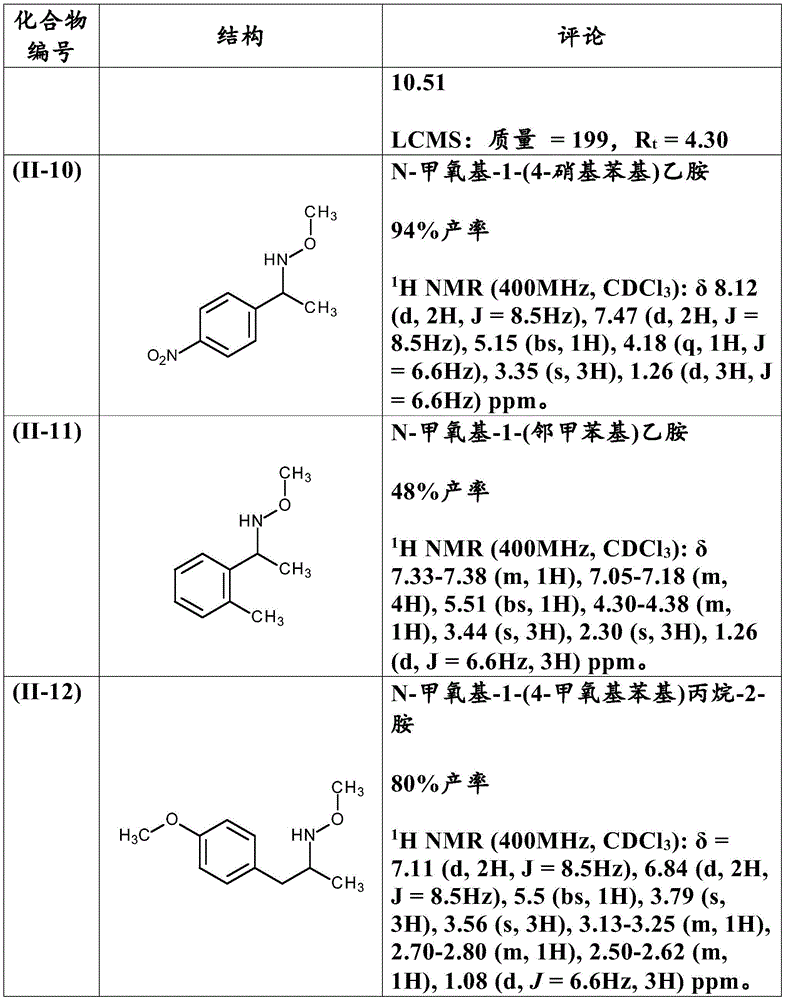


example 10:ionic hydrogenation of other substrates-Synthesis of cis-N- [2- (2, 4-dichlorophenyl) cyclobutyl by hydrogenation of acylenamines]Acetamide

A50 mL glass vial was charged with N- [2- (2, 4-dichlorophenyl) cyclobutenyl-1-yl]Acetamide (256mg), catalyst (III-1) (6.8mg), methanesulfonic acid (48mg), and isopropanol (4 mL). The glass vial was placed in a parallel autoclave purged with hydrogen (3 times) and hydrogenated at 50 bar of hydrogen and 23 ℃ for 16 h. Hydrogen was released and the reactor was purged with argon. GC and NMR analysis of the crude reaction mixture indicated complete conversion. The reaction mixture was slowly added to saturated NaHCO3Solution (15mL) and water (10mL) and extracted with DCM (2 × 15 mL). The combined organic layers were washed with Na2SO4Drying, filtering and evaporating to obtain 250mg of cis-N- [2- (2, 4-dichloro)Phenyl) cyclobutyl]An acetamide. The analytical data are consistent with the literature: WO 15/003951.
Example 11:ionic hydrogenation of other substrates-Synthesis of 2- (trifluoromethyl) piperidines by heterocyclic hydrogenation

A50 mL glass vial was charged with 2-trifluoromethylpyridine (144mg), catalyst (III-1) (6.8mg), methanesulfonic acid (144mg) and isopropanol (4 mL). The glass vial was placed in a parallel autoclave purged with hydrogen (3 times) and hydrogenated at 50 bar of hydrogen and 50 ℃ for 16 h. Hydrogen was released and the reactor was purged with argon. GC and NMR analysis of the crude reaction mixture indicated complete conversion. The reaction mixture was evaporated and analyzed by NMR. The starting material was found to be completely converted and 2- (trifluoromethyl) piperidine (CAS ═ 154630-93-0) was formed.
Comparative example 1:

in two solvents (THF/TFA and MeOH), at T ═ 60 ℃, pressure H296 diverse homogeneous catalyst-metal precursors (Rh, Ir, Pt, Ru, neutral/cationic)/ligand classes (monodentate/bidentate, phosphine, phosphite, etc.) were screened at 2% catalyst loading. The conversion to the desired Product (II-1, labeled "Product" in the following Table) was determined by GC and was based on area percentage.
Table 7:


these experiments demonstrate that the combination of the customary metal precursors and ligands does not allow homogeneous hydrogenation of oxime substrates such as (I-1), since the product (II-1) is formed in all cases in a content of < 1%.
Comparative example 2:

hydrogenation conditions: temperature 60 ℃ and pressure H260 bar and 20 h. The reaction conditions are as described in EP 1862446. The conversion to the desired Product ((II-1), labeled "Product" in the following table) was determined by GC and was based on area percentage.
Table 8:

SL-J002-1 ═ R) -1- [ (SP) -2- (diphenylphosphino) ferrocenyl ] ethyldi-tert-butylphosphine
In all cases, low selectivity, no or very low yield of the desired product (II-1 labeled "product" in the above table) was observed. These experiments demonstrate that the catalysts and conditions described in EP1862446A2 do not allow for efficient hydrogenation of oxime substrates such as (II-1).
Comparative example 3:

no formation of the desired product (II-1) was observed under the reaction conditions as described above, as described in org.biomol.chem. [ organic and biomolecular chemistry ], 2013, 11, 6934.
Comparative example 4:


under the reaction conditions according to the invention, no formation of the desired product (II-1) is observed, but use is made ofIridium-chlorine complex(VI) (e.g., in org. biomol. chem. [ organic and biomolecular chemistry ]]2013, 11, 6934; reported in WO 2013/153407). These experiments demonstrate that it is possible to determine,iridium halogen complexAre not effective as catalysts in current processes.
Comparative example 5:

when using the inventionAcid-freeUnder the reaction conditions of (1), formation of the desired product (II-1) was not observed. This experiment demonstrates that the stoichiometry of the appropriate acid is crucial in the process according to our invention.
Claims (13)


Applications Claiming Priority (3)
| Application Number | Priority Date | Filing Date | Title |
|---|---|---|---|
| GB1818113.1 | 2018-11-06 | ||
| GBGB1818113.1A GB201818113D0 (en) | 2018-11-06 | 2018-11-06 | Process |
| PCT/EP2019/079994 WO2020094527A1 (en) | 2018-11-06 | 2019-11-01 | Hydrogenation process of oxime derivatives |
Publications (2)
| Publication Number | Publication Date |
|---|---|
| CN113166183A true CN113166183A (en) | 2021-07-23 |
| CN113166183B CN113166183B (en) | 2025-04-22 |
Family
ID=64655468
Family Applications (1)
| Application Number | Title | Priority Date | Filing Date |
|---|---|---|---|
| CN201980079013.3A Active CN113166183B (en) | 2018-11-06 | 2019-11-01 | Method for hydrogenation of oxime derivatives |
Country Status (6)
| Country | Link |
|---|---|
| US (1) | US12491503B2 (en) |
| EP (1) | EP3877394B1 (en) |
| JP (1) | JP7466538B2 (en) |
| CN (1) | CN113166183B (en) |
| GB (1) | GB201818113D0 (en) |
| WO (1) | WO2020094527A1 (en) |
Cited By (1)
| Publication number | Priority date | Publication date | Assignee | Title |
|---|---|---|---|---|
| CN117185953A (en) * | 2022-05-31 | 2023-12-08 | 上海交通大学 | A method for preparing chiral hydroxylamine by asymmetric nickel-catalyzed hydrogenation of oxime |
Citations (3)
| Publication number | Priority date | Publication date | Assignee | Title |
|---|---|---|---|---|
| EP1862446A2 (en) * | 2006-06-02 | 2007-12-05 | Evonik Degussa GmbH | Method for manufacturing enantiomer-enriched hydroxylamine derivatives |
| CN104144914A (en) * | 2012-02-28 | 2014-11-12 | 先正达参股股份有限公司 | Process for the preparation of phenyl substituted 3 - difluoromethyl - 1 -methyl - 1h - pyrazole - 4 - carboxylic n-methoxy- [1 -methyl- 2 - phenylethyl] amides |
| CN106466641A (en) * | 2009-03-17 | 2017-03-01 | 约翰森·马瑟公开有限公司 | The method hydrogenating ketone in the presence of Ru (II) catalyst |
Family Cites Families (10)
| Publication number | Priority date | Publication date | Assignee | Title |
|---|---|---|---|---|
| DE102005057715A1 (en) * | 2005-12-02 | 2007-06-06 | Basf Ag | Process for preparing symmetrical and unsymmetrical N, N-dihydrocarbylhydroxylamines |
| JP5006059B2 (en) | 2007-01-29 | 2012-08-22 | エリック エム. カレイラ | Chiral iridium aqua complex and method for producing optically active hydroxy compound using the same |
| ME01518B (en) | 2008-12-05 | 2014-04-20 | Syngenta Participations Ag | Novel pyrazole-4-n-alkoxycarboxamides as microbiocides |
| GB201206573D0 (en) | 2012-04-13 | 2012-05-30 | Univ Liverpool | Catalyst compounds |
| GB201206572D0 (en) | 2012-04-13 | 2012-05-30 | Univ Liverpool | Catalyst compounds |
| PT3013801T (en) * | 2013-06-26 | 2018-11-16 | Syngenta Participations Ag | Process for the stereoselective preparation of a pyrazole-carboxamide |
| RS57025B1 (en) | 2013-07-08 | 2018-05-31 | Syngenta Participations Ag | 4-membered ring carboxamides used as nematicides |
| JP6254811B2 (en) * | 2013-10-09 | 2017-12-27 | 関東化學株式会社 | Organometallic compound having nitrogen-containing heterocyclic carbene ligand, catalyst containing the same, and method for producing amine compound |
| JP6654107B2 (en) * | 2015-06-26 | 2020-02-26 | 日本曹達株式会社 | Iridium complex |
| JP6873661B2 (en) * | 2016-11-25 | 2021-05-19 | 広栄化学株式会社 | New transition metal complex |
-
2018
- 2018-11-06 GB GBGB1818113.1A patent/GB201818113D0/en not_active Ceased
-
2019
- 2019-11-01 EP EP19798252.3A patent/EP3877394B1/en active Active
- 2019-11-01 JP JP2021524251A patent/JP7466538B2/en active Active
- 2019-11-01 US US17/291,122 patent/US12491503B2/en active Active
- 2019-11-01 WO PCT/EP2019/079994 patent/WO2020094527A1/en not_active Ceased
- 2019-11-01 CN CN201980079013.3A patent/CN113166183B/en active Active
Patent Citations (3)
| Publication number | Priority date | Publication date | Assignee | Title |
|---|---|---|---|---|
| EP1862446A2 (en) * | 2006-06-02 | 2007-12-05 | Evonik Degussa GmbH | Method for manufacturing enantiomer-enriched hydroxylamine derivatives |
| CN106466641A (en) * | 2009-03-17 | 2017-03-01 | 约翰森·马瑟公开有限公司 | The method hydrogenating ketone in the presence of Ru (II) catalyst |
| CN104144914A (en) * | 2012-02-28 | 2014-11-12 | 先正达参股股份有限公司 | Process for the preparation of phenyl substituted 3 - difluoromethyl - 1 -methyl - 1h - pyrazole - 4 - carboxylic n-methoxy- [1 -methyl- 2 - phenylethyl] amides |
Non-Patent Citations (2)
| Title |
|---|
| YOUCEF BOUTADLA等: "Alkyne insertion into cyclometallated pyrazole and imine complexes of iridium, rhodium and ruthenium; relevance to catalytic formation of carbo- and heterocycles", 《DALTON TRANS.》, vol. 39, 6 October 2010 (2010-10-06), pages 10447 - 10457, XP002797077, DOI: 10.1039/C0DT00280A * |
| YUN-FEI ZHANG等: "Ir-Catalyzed C-H Amidation of Aldehydes with Stoichiometric/ Catalytic Directing Group", 《CHEM. EUR. J. 》, vol. 22, 26 October 2016 (2016-10-26), pages 17808 - 17812, XP002797127, DOI: 10.1002/CHEM.201603805 * |
Cited By (1)
| Publication number | Priority date | Publication date | Assignee | Title |
|---|---|---|---|---|
| CN117185953A (en) * | 2022-05-31 | 2023-12-08 | 上海交通大学 | A method for preparing chiral hydroxylamine by asymmetric nickel-catalyzed hydrogenation of oxime |
Also Published As
| Publication number | Publication date |
|---|---|
| GB201818113D0 (en) | 2018-12-19 |
| WO2020094527A1 (en) | 2020-05-14 |
| EP3877394C0 (en) | 2024-06-26 |
| CN113166183B (en) | 2025-04-22 |
| US20210387173A1 (en) | 2021-12-16 |
| EP3877394A1 (en) | 2021-09-15 |
| EP3877394B1 (en) | 2024-06-26 |
| BR112021008776A2 (en) | 2021-08-03 |
| US12491503B2 (en) | 2025-12-09 |
| JP7466538B2 (en) | 2024-04-12 |
| JP2022513588A (en) | 2022-02-09 |
Similar Documents
| Publication | Publication Date | Title |
|---|---|---|
| US11053188B2 (en) | Process for the preparation of enantiomerically and diastereomerically enriched cyclobutane amines and amides | |
| JPH0262854A (en) | Production of substituted phenoxyethylamines | |
| HUE027438T2 (en) | Method for producing primary amines by means of homogeneously-catalysed alcohol amination | |
| JP7569314B2 (en) | Enantioselective Processes | |
| CN113166183B (en) | Method for hydrogenation of oxime derivatives | |
| Caplar et al. | Synthesis of the 2, 3-dihydro-6H-1, 4-oxazin-2-ones chiral at C (3) and asymmetric induction in hydrogenation of the azomethine bond | |
| EP0397042B1 (en) | Process for the preparation of isoquinoline derivatives | |
| WO2004000795A1 (en) | Process for production of vinyl perfluoroalkanesulfonate derivatives | |
| KR102590897B1 (en) | Method for producing chiral gamma-lactam compound and metal complex therefor | |
| BR112021008776B1 (en) | HYDROGENATION PROCESS OF OXIME DERIVATIVES AND RELATED COMPOUNDS | |
| JP3118061B2 (en) | Production method of optically active hydroxylamine | |
| JPH1017515A (en) | Binaphthyl compound and its production | |
| Menkudle et al. | CHEMISTRY & BIOLOGY INTERFACE | |
| CN109575073B (en) | 4-phosphonyl 1-naphthylamine compound and preparation method thereof | |
| Weber et al. | Push-Pull Triafulvenes from 1, 1′-Oxy-di [2, 3-bis (dimethylamino) cyclopropenylium] and 1-[Bis (dimethylamino) cyclopropenylio] pyridinium Salts | |
| JPH03176463A (en) | Pyrrolidinol derivative and its production | |
| KR100215549B1 (en) | Optically pure c2-symmetric tetrahydro 4,4'-bioxazolines and their preparation | |
| JPS6058231B2 (en) | Improved manufacturing method for encainide | |
| JPWO2003000645A1 (en) | Method for producing aminostilbene derivative | |
| JP2584959B2 (en) | Substituted phenoxyacetaldehyde oximes | |
| Menkudle et al. | Enantioselective Synthesis of β-Nitroethanols Catalyzed by Pyrrolidine Based Organocatalyst via Henry Reaction. | |
| JPH0813793B2 (en) | Tartaric acid amide derivative | |
| JPH02273630A (en) | Production of n-alkylbenzene | |
| JPS6038375A (en) | Preparation of ketone | |
| JPH10265410A (en) | Carbonylation and production of lactone |
Legal Events
| Date | Code | Title | Description |
|---|---|---|---|
| PB01 | Publication | ||
| PB01 | Publication | ||
| SE01 | Entry into force of request for substantive examination | ||
| SE01 | Entry into force of request for substantive examination | ||
| GR01 | Patent grant | ||
| GR01 | Patent grant |