Method for measuring hydrogen peroxide content by low-field nuclear magnetic resonance
Technical Field
The application relates to the field of hydrogen peroxide content analysis, in particular to an analysis method for measuring hydrogen peroxide content by using a low-field nuclear magnetic resonance technology.
Background
The measuring method of the hydrogen peroxide mainly comprises a titration method, a chemiluminescence method, a chromatography method, a spectrophotometry method, a test paper colorimetry, an amperometry and the like. Among the titration methods, there are mainly iodometry and potassium permanganate. At present, the accurate concentration of hydrogen peroxide solution is determined in a laboratory by using a potassium permanganate method, wherein dilute sulfuric acid is used as a medium at room temperature, manganese sulfate is used as a catalyst, and a potassium permanganate standard solution is used for directly titrating hydrogen peroxide. The titration time was determined by using potassium permanganate itself as an indicator to determine the endpoint of the titration. Although the potassium permanganate method has a simple measurement process and does not need to add an indicator, the accuracy is not high and the measurement error is large. The reason is that hydrogen peroxide is unstable and easy to decompose, and if other organic matters are added into a sample as a stabilizer or an additive, the organic matters react with potassium permanganate to consume a standard solution, so that measurement errors are caused.
Other titration methods such as sodium thiosulfate method have accuracy slightly higher than potassium permanganate method, but sodium thiosulfate standard solution is unstable and needs to be prepared in advance and calibrated in time, KI added is easily oxidized by oxygen in the air, and I generated in the reaction2Easy to volatilize, and starch is adsorbed on the part I when the starch is used as an indicator2. Therefore, the method has the disadvantages of long time consumption, incapability of timely titrating the content of hydrogen peroxide under the condition of dynamic change and at high temperature, large measurement error and low accuracy.
Other determination methods such as chromatography have the advantages of strong specificity, high accuracy, strong anti-interference capability and the like. CN103713061A discloses a method for measuring the content of hydrogen peroxide by combining biological enzyme with headspace gas chromatography, which has high accuracy and short measuring time. However, chromatography requires expensive chromatography and sample pretreatment is cumbersome. The chemiluminescence method has the advantages of high sensitivity, low detection limit, accurate measurement result and the like, but also has the defects of long measurement time, high cost and the like. The ultraviolet spectrophotometry has the advantages of reliable measuring result, high measuring speed and relatively simple and convenient operation. CN103712930A discloses a method for rapidly determining the content of hydrogen peroxide by spectrophotometry, which can achieve rapid determination without expensive instruments, but has the problems of toxic reaction reagents, easy environmental pollution and the like. The test paper colorimetric method has the advantages of simple and convenient operation, high determination speed and the like. CN103439323A discloses a method for rapidly determining residual hydrogen peroxide in a sample to be determined by using a test paper, which has the disadvantages of short determination time and high sensitivity, but also has the disadvantages of higher preparation cost of the test paper and poorer accuracy of the determination result.
Based on the reasons, the establishment of the method which is rapid, environment-friendly and capable of accurately measuring the hydrogen peroxide in the sample has very important significance. The applied technology of nuclear magnetic resonance is mainly based on the measurement of 6 important parameters, namely chemical shift, dipole indirect interaction, dipole direct interaction, longitudinal relaxation time, transverse relaxation time and diffusion coefficient. The first three mainly reflect the structural information of molecules, which is the main object of nuclear magnetic resonance spectrum technology research, and the higher the field intensity is, the better the parameter resolution is; the latter three mainly reflect the dynamic information of the molecule, and are the main research field of the low-field nuclear magnetic resonance analysis and test technology. The basic principle of the low-field nuclear magnetic technology is that on the premise of not damaging a sample, a radio frequency pulse is applied to the sample in a constant magnetic field, so that hydrogen protons of water molecules of the sample resonate, and transition from a low energy state to a high energy state is realized; after the radio frequency is terminated, the hydrogen protons return to a low energy state in a non-radiative manner, and the process is a relaxation process. Depending on the energy exchanging object, the relaxation process can be divided into transversal relaxation and longitudinal relaxation, the corresponding relaxation times being denoted T2 and T1, respectively. The length of the relaxation time is related to the existence state of hydrogen protons in the sample and the physical and chemical environment, and the intensity of the relaxation signal is related to the number of the hydrogen protons in the tested sample.
Based on the principle and the application, the concentration of the hydrogen peroxide sample is detected by using the low-field nuclear magnetic resonance analysis method, the detection speed is high, the sample does not need to be pretreated in the detection process, the solvent and the sample do not need to be consumed, the safety and the environmental protection are realized, and meanwhile, the risk of inaccurate hydrogen peroxide concentration result caused by the fact that potassium permanganate is consumed by other components in the sample is avoided.
Disclosure of Invention
The invention provides a method for measuring hydrogen peroxide content by low-field nuclear magnetic resonance, which can quickly measure the concentration of a hydrogen peroxide sample, has no solvent consumption and has high accuracy. The method comprises the following steps:
(1) measuring a plurality of standard hydrogen peroxide samples with different concentrations of Ci by using a low-field nuclear magnetic resonance analyzer, respectively obtaining signal values Si of the samples, and drawing a working curve of the standard hydrogen peroxide samples by taking Ci and Si as coordinate values;
(2) measuring a sample to be measured by using a low-field nuclear magnetic resonance analyzer to obtain a relaxation signal value S;
(3) and substituting the relaxation signal value S into the working curve of the standard hydrogen peroxide sample, and calculating to obtain the concentration C of the sample to be measured.
Preferably, step (1) comprises: and drawing a scatter diagram by taking Ci and Si as coordinate values, and fitting to obtain a unitary linear regression equation as a working curve of hydrogen peroxide.
Preferably, in the present invention, the plurality of standard hydrogen peroxide samples with different concentrations Ci includes at least 4 standard hydrogen peroxide samples with different concentrations Ci.
Preferably, in the invention, before the standard hydrogen peroxide sample or the sample to be measured is measured by using the low-field nuclear magnetic resonance analyzer, the sample is treated at a constant temperature of 32 ℃ for 10min by using a dry thermostat.
Preferably, in the present invention, when the signal value S of the sample to be measured is measured using the low-field nuclear magnetic resonance analyzer, the map of the relaxation time T2 is measured and acquired twice using the CPMG sequence, the average value of the relaxation time T2 of the sample to be measured is calculated from the map, and the reciprocal of the average value of T2 is taken as R2 as the relaxation signal value S.
Preferably, in the present invention, the low-field nuclear magnetic resonance analyzer is calibrated before the step (1).
Preferably, in the present invention, the step of calibrating the low-field nmr analyzer comprises measuring a signal value of the standard oil sample using the CPMG sequence, and calibrating the center frequency of the low-field nmr analyzer and the pulse width of the 90 ° pulse.
Preferably, in the present invention, the plurality of different concentrations Ci includes Ci being 0.
The technical scheme of the invention has the following advantages:
(1) according to the method, the interaction force of water molecules and hydrogen peroxide is effectively represented by the relaxation time T2 of the water molecules through a low-field nuclear magnetic technology, so that a working curve of hydrogen peroxide concentration and a signal value can be measured;
(2) the method is a physical detection method, other chemical reagents and complex pretreatment are not required to be added to a test sample, and the detected sample can be repeatedly detected to determine the repeatability and stability of an instrument;
(3) the detection period is short, and the decomposition degree of hydrogen peroxide in the same batch of samples can be monitored;
(4) the working curve of the standard hydrogen peroxide sample and the working curve equation thereof established in the invention have no universality.
(5) The hydrogen peroxide in the invention has different working curves in different formulas.
Drawings
In order to more clearly illustrate the embodiments of the present invention or the technical solutions in the prior art, the drawings used in the description of the embodiments or the prior art will be briefly described below. It should be apparent that the drawings described below are exemplary only and that other embodiments can be derived from the drawings provided by those of ordinary skill in the art without inventive faculty.
The structures, ratios, sizes and the like shown in the present specification are only used for matching with the contents disclosed in the specification, so that those skilled in the art can understand and read the present invention, and do not limit the conditions for implementing the present invention, so that the present invention has no technical essence, and any modifications of the structures, changes of the ratio relations or adjustments of the sizes, without affecting the functions and the achievable purposes of the present invention, should still fall within the range covered by the technical contents disclosed in the present invention.
Fig. 1 is a schematic diagram of the concentration and relaxation signal curves of a standard hydrogen peroxide sample in example 1 of the present invention.
Fig. 2 is a schematic diagram of the working curves of the concentration and the relaxation signal value of hydrogen peroxide in the formula 1 in example 2 of the present invention.
Fig. 3 is a schematic diagram of the working curves of the concentration and the relaxation signal value of hydrogen peroxide in the formula 2 according to example 3 of the present invention.
Fig. 4 is a schematic diagram of the working curves of the concentration and the relaxation signal value of hydrogen peroxide in the formula 3 according to example 4 of the present invention.
FIG. 5 is a graph showing the comparison of the results of the normalization of the potassium permanganate process and the low field nuclear magnetic process in comparative example 1 according to the present invention.
Detailed Description
The present invention is described in terms of specific embodiments, and other advantages and capabilities of the invention will become apparent to those skilled in the art from the disclosure herein.
Example 1:
firstly, correcting low-field nuclear magnetism by using a standard oil sample; then preparing standard hydrogen peroxide with different concentrations (0.10%, 0.50%, 1.00%, 1.99%, 3.00%, 3.99%), and recording signal values Si of various concentrations by using a low-field nuclear magnetic resonance analyzer; taking the prepared standard hydrogen peroxide concentration as an abscissa, converting the signal into an ordinate, and drawing a Si and Ci scatter diagram; and fitting by using a linear equation of one unit, calculating a regression equation, and calculating to obtain a working curve of the hydrogen peroxide.
The concentration of the standard hydrogen peroxide provided in example 1 of the present invention and the measured corresponding signal value are shown in table 1.
Example 2:
firstly, correcting low-field nuclear magnetism by using a standard oil sample; and then adding standard hydrogen peroxide into the formula 1, wherein the formula 1 is a neutral formula solution. Using a low-field nuclear magnetic resonance analyzer, firstly measuring a substrate signal S0 of a formula (C is 0) without adding hydrogen peroxide; then, a plurality of standard hydrogen peroxide samples with different concentrations (0.101%, 0.498%, 0.999%, 1.966%, 3.002%) are respectively measured, and the signal values are respectively marked as Si; drawing a Si and Ci scatter diagram by taking the concentration of the added standard hydrogen peroxide as an abscissa and the signal value as an ordinate; fitting by using a linear equation of one unit, calculating a regression equation, and calculating to obtain a working curve of the hydrogen peroxide; and taking a sample to be measured, measuring the relaxation signal value S of the sample, and calculating the corresponding hydrogen peroxide concentration according to the working curve.
The concentration of the standard hydrogen peroxide provided in example 2 of the present invention and the measured corresponding signal value are shown in table 2.
Example 3:
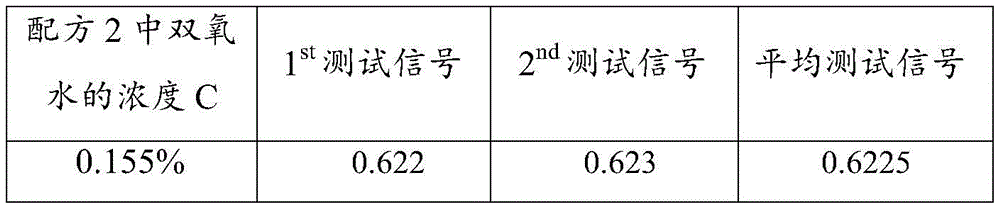
firstly, correcting low-field nuclear magnetism by using a standard oil sample; and adding standard hydrogen peroxide into a formula 2, wherein the formula 2 is an alkaline formula solution. Using a low-field nuclear magnetic resonance analyzer, firstly measuring a substrate signal S0 of a formula (C is 0) without adding hydrogen peroxide; then, a plurality of standard hydrogen peroxide samples with different concentrations (0.155%, 0.488%, 1.003% and 1.963%) are respectively measured, and the signal values of the samples are respectively marked as Si; drawing a Si and Ci scatter diagram by taking the concentration of the added standard hydrogen peroxide as an abscissa and the signal value as an ordinate; fitting by using a linear equation of one unit, calculating a regression equation, and calculating to obtain a working curve of the hydrogen peroxide; and taking a sample to be measured, measuring the relaxation signal value S of the sample, and calculating the corresponding hydrogen peroxide concentration according to the working curve.
The concentration of the standard hydrogen peroxide provided in example 3 of the present invention and the measured corresponding signal value are shown in table 3.
Example 4:
firstly, correcting low-field nuclear magnetism by using a standard oil sample; and adding standard hydrogen peroxide into a formula 3, wherein the formula 3 is an acidic formula solution. Using a low-field nuclear magnetic resonance analyzer, firstly measuring a substrate signal S0 of a formula (C is 0) without adding hydrogen peroxide; then, a plurality of standard hydrogen peroxide samples with different concentrations (0.098%, 0.404%, 0.987%, 1.967%) are respectively measured, and the signal values are respectively marked as Si; drawing a Si and Ci scatter diagram by taking the concentration of the added standard hydrogen peroxide as an abscissa and the signal value as an ordinate; fitting by using a linear equation of one unit, calculating a regression equation, and calculating to obtain a working curve of the hydrogen peroxide; and taking a sample to be measured, measuring the relaxation signal value S of the sample, and calculating the corresponding hydrogen peroxide concentration according to the working curve.
The concentration of the standard hydrogen peroxide provided in example 4 of the present invention and the measured corresponding signal value are shown in table 4.
Comparative example 1:
standard hydrogen peroxide samples with the concentration of 1% are added into the formula 1, the formula 2 and the formula 3 in the embodiment of the invention to obtain the sample 1, the sample 2 and the sample 3, the concentrations of hydrogen peroxide in the sample 1, the sample 2 and the sample 3 are respectively detected by using a low-field nuclear magnetism and potassium permanganate method, and the detection results are recorded in table 5.
TABLE 1 concentration of standard hydrogen peroxide and its signal value
TABLE 2 concentration of hydrogen peroxide and its signal value in formulation 1
TABLE 3 concentration of hydrogen peroxide and its signal value in formulation 2
Table 4 concentration of hydrogen peroxide and its signal value in formulation 3
TABLE 5 comparison of normalization test results of formula 1, formula 2, and formula 3 using potassium permanganate method and low field nuclear magnetic method
The purpose of example 1 is to study whether the low-field nuclear magnetic resonance technology can represent standard hydrogen peroxide, and whether the nuclear magnetic signal value and the concentration of the standard hydrogen peroxide present a linear relationship, fig. 1 is a schematic diagram of the concentration of the standard hydrogen peroxide sample and a working curve of a relaxation signal in example 1, and it is known through observation that the interaction between hydrogen peroxide and water can be studied through the low-field nuclear magnetic resonance technology, and the concentration of hydrogen peroxide and the relaxation signal of low-field nuclear magnetic resonance have good linear correlation.
The concentration of hydrogen peroxide in the formula is researched, a working curve of the hydrogen peroxide in the formula is firstly established, and then a hydrogen peroxide sample with unknown concentration is detected according to the working curve. According to the detection results of the embodiments 2, 3 and 4, the slope and intercept of the hydrogen peroxide working curve are different in different formula solutions, and the calculated working curves are different because the types and contents of the components are different in different formulas. Therefore, the invention aims to study the concentration change of hydrogen peroxide in the same formula and monitor the changes of other components and the contents thereof in the formula in real time by using a low-field nuclear magnetic technology, thereby controlling the quality of the formula.
As can be seen from the test results in table 5, formulations 1 and 3 contain interfering components that consume potassium permanganate, resulting in higher results as measured by the potassium permanganate method. The result of the low-field nuclear magnetic method is consistent with the standard addition concentration of the hydrogen peroxide, and the superiority of the hydrogen peroxide in the low-field nuclear magnetic method detection formula is shown.
The invention provides a method for measuring hydrogen peroxide content by low-field nuclear magnetic resonance. Firstly, the method proposes that the low-field nuclear magnetic technology is used for representing the concentration of hydrogen peroxide, and the result shows that the detected low-field nuclear magnetic signal and the concentration of hydrogen peroxide show a good linear relation, so that the low-field nuclear magnetic technology can be used for representing the concentration of hydrogen peroxide. On the basis, working curves of hydrogen peroxide in different formulas are researched by using low-field nuclear magnetism, and the result shows that the concentration of the hydrogen peroxide and nuclear magnetism signals in different formulas show good linear correlation, so that the concentration of the hydrogen peroxide in different formulas can be accurately and quickly measured. In addition, the results of comparative example 1 show that the low-field nuclear magnetic method can effectively avoid the adverse effect of interfering substances in the formula on the test results, compared with the test results of the potassium permanganate method. The measuring method disclosed by the invention is simple to operate, safe and effective, high in accuracy and good in repeatability and stability; meanwhile, the method is a physical detection method, other chemical reagents and complex pretreatment are not required to be added to a test sample, and the detected sample can be repeatedly detected to determine the repeatability and stability of the instrument and monitor the decomposition degree of hydrogen peroxide.
The embodiments of the present invention have been described in detail, but the embodiments are merely examples, and the present invention is not limited to the embodiments described above. Any equivalent modifications and substitutions to those skilled in the art are also within the scope of the present invention. Accordingly, equivalent changes and modifications made without departing from the spirit and scope of the present invention should be covered by the present invention.