Disclosure of Invention
The invention provides a modular omnidirectional unmanned ship capable of being spliced independently, and aims to solve the problems that functions, performance and usability of the unmanned ship are difficult to take into account, the unmanned ship is poor in universality, and the requirement of quick function adaptation of users under different use conditions is difficult to meet.
The invention is realized by the following technical scheme:
an autonomously spliceable modular unmanned omni-directional vessel, wherein the autonomously spliceable modular unmanned omni-directional vessel comprises:
the upper circumference of the side surface of the main floating body is provided with a plurality of extending floating blocks;
the cabin frame is fixedly arranged above the main floating body, a plurality of connecting fitting pieces are arranged on the outer side surface of the cabin frame in the circumferential direction and are used for connecting a plurality of same modular omnidirectional unmanned ships capable of being spliced independently;
the propellers are provided with a plurality of propellers, the propellers are arranged below the extending floating blocks in a one-to-one correspondence mode, and the propellers are used for driving the main floating bodies.
The unmanned ship of modularization qxcomm technology that can independently splice, wherein, the top of main body is provided with the control box, the control box gomphosis sets up the inside of main body, one side towards main body top on the control box is provided with waterproof apron, waterproof apron can dismantle the setting and be in on the control box.
Unmanned ship of modularization qxcomm technology that can independently splice, wherein, the inside of control box is provided with control module, control module includes:
a processor communication component in circuit connection with the propeller;
a power supply component in circuit connection with the processor communication component;
a sensor assembly in electrical connection with the processor communication assembly.
The modularized omnidirectional unmanned ship capable of being spliced independently is characterized in that the main floating body is in a spherical crown shape, one side of the main floating body, where a horizontal plane is located, is a bearing surface, and the cabin frame is arranged on the bearing surface.
The modular omnidirectional unmanned ship capable of being spliced autonomously is characterized in that a first fixing plate is arranged on the bearing surface, a second fixing plate is arranged on one side, opposite to the bearing surface, of the main floating body, the first fixing plate and the second fixing plate clamp and fix the main floating body and the plurality of extending floating blocks, the cabin frame is arranged on the first fixing plate, and the plurality of propellers are arranged on the second fixing plate.
The modular omnidirectional unmanned ship capable of being spliced independently is characterized in that the main floating body and the extension floating blocks are all members made of polystyrene foam.
The modular omnidirectional unmanned ship capable of being spliced autonomously is characterized in that the first fixing plate, the second fixing plate and the cabin frame are all members made of carbon fibers.
The modular omni-directional unmanned ship capable of being spliced autonomously comprises:
four extending floating blocks are arranged on the side edge of the main floating body in a centrosymmetric manner, and four propellers below the four extending floating blocks are fixedly arranged on the corresponding extending floating blocks at relative 90-degree included angles between every two propeller.
The modular omnidirectional unmanned ship capable of being spliced autonomously comprises a connecting fitting piece and a connecting fitting piece, wherein the connecting fitting piece comprises a first fitting piece and a second fitting piece which are arranged in pair, and the first fitting piece and the second fitting piece are arranged on the same horizontal plane at a preset distance.
The modular omnidirectional unmanned ship capable of being spliced independently is characterized in that the connecting ends of the first matching piece and the second matching piece are matched with each other, when two identical modular omnidirectional unmanned ships capable of being spliced independently are mutually butted,
the first mating member on the modular omnidirectional unmanned ship capable of being spliced autonomously is connected with the second mating member on the modular omnidirectional unmanned ship adjacent to the modular omnidirectional unmanned ship capable of being spliced autonomously in a matching manner;
the second matching piece on the modular omnidirectional unmanned ship capable of being spliced automatically is connected with the first matching piece on the modular omnidirectional unmanned ship adjacent to the modular omnidirectional unmanned ship capable of being spliced automatically in a matching mode.
The invention has the beneficial effects that: according to the invention, the cabin frame is arranged above the main floating body, the cabin frame is provided with the plurality of connecting matching pieces, and the plurality of unmanned ships can be combined with one another to form a large floating platform through the mutual connection of the connecting matching pieces, so that the carrying capacity of the unmanned ship is improved.
Detailed Description
In order to make the objects, technical solutions and effects of the present invention clearer and clearer, the present invention is further described in detail below with reference to the accompanying drawings and examples. It should be understood that the specific embodiments described herein are merely illustrative of the invention and are not intended to limit the invention.
It should be noted that, if directional indications (such as up, down, left, right, front, and back … …) are involved in the embodiment of the present invention, the directional indications are only used to explain the relative positional relationship between the components, the motion situation, and the like in a specific posture (as shown in the drawing), and if the specific posture is changed, the directional indications are changed accordingly.
In addition, if there is a description of "first", "second", etc. in an embodiment of the present invention, the description of "first", "second", etc. is for descriptive purposes only and is not to be construed as indicating or implying relative importance or implicitly indicating the number of technical features indicated. Thus, a feature defined as "first" or "second" may explicitly or implicitly include at least one of the feature. In addition, technical solutions between various embodiments may be combined with each other, but must be realized by a person skilled in the art, and when the technical solutions are contradictory or cannot be realized, such a combination should not be considered to exist, and is not within the protection scope of the present invention.
In the prior art, unmanned ships generally present design defects of both functions and performances and usability, for example, large unmanned ships with multiple functions and high cargo capacity have poor maneuverability correspondence, and unmanned ships with good maneuverability and portability have the problems of low cargo capacity and single function, so that unmanned ships in the prior art have poor universality and are difficult to meet the requirements of users for quick functional adaptation under different use conditions.
Based on the above problems in the prior art, the present invention provides an autonomous-splicing modular unmanned omni-directional vessel, as shown in fig. 1, including: the floating structure comprises a main floating body 100, wherein a plurality of extending floating blocks 110 are arranged on the side surface of the main floating body 100 in the circumferential direction; the cabin frame 200 is fixedly arranged above the main floating body 100, and a plurality of connecting fitting pieces are arranged on the outer side surface of the cabin frame 200 in the circumferential direction and are used for connecting a plurality of identical modularized omnidirectional unmanned ships which can be spliced independently; the propellers 120 are arranged, the propellers 120 are arranged below the extending floating blocks 110 in a one-to-one correspondence mode, and the propellers 120 are used for driving the main floating body 100.
According to the invention, the cabin frame 200 is provided with the connecting fitting pieces, and the connecting fitting pieces are connected with each other, so that a plurality of unmanned ships can be combined with each other to form a large floating platform, the carrying capacity of the unmanned ships is improved, and the propellers 120 arranged on the extending floating blocks 110 can ensure the maneuverability of the unmanned ships, thereby meeting the requirements of users on different functional quick adaptation of the unmanned ships under different use conditions.
In the above embodiment, as shown in fig. 1 and fig. 2, in the present invention, the main buoyancy member in the modular omni-directional unmanned ship capable of self-splicing is the main buoyancy body 100, and the main buoyancy body 100 is made of a material with a density less than that of water, and is used for providing buoyancy for the unmanned ship to float on the water surface, in an implementation manner of the present invention, the shape of the main buoyancy body 100 is set to be a spherical crown shape, and the spherical crown refers to a structure of a smaller volume part left after a sphere is cut by a plane, wherein a circular horizontal plane obtained when the sphere is cut by the plane is referred to as a bottom of the spherical crown, in this embodiment, one side of a horizontal circular surface on the spherical crown-shaped main buoyancy body 100 faces upward and is referred to as a bearing surface 101, one side of an arc surface of the main buoyancy body 100 (i.e. the reverse side of the bearing surface 101) is in contact with the water surface, and since one side of the arc surface of the main buoyancy body 100 is a part of the sphere, a smooth shape on the surface can satisfy that the main buoyancy body 100 reduces resistance with the water surface in each movement direction, therefore, the effect of reducing wave-making resistance in the operation process of the unmanned ship is achieved.
Further, in the above embodiment, in order to ensure that the main floating body 100 does not roll over during the floating process on the water surface, a plurality of extending floating blocks 110 are further arranged on the side surface of the main floating body 100, the plurality of extending floating blocks 110 are uniformly arranged on the side edge of the main floating body 100, so that the center of gravity of the whole unmanned ship is always in the center of the main floating body 100, the extending floating blocks 110 are also made of a material with density smaller than that of water, the extending floating blocks 110 improve the buoyancy of the unmanned ship, and simultaneously improve the contact area between the main floating body 100 and the water surface, thereby further improving the rollover prevention performance of the unmanned ship.
In the above embodiment, the main floating body 100 and the extended floating block 110 are both members made of polystyrene foam (eps foam), the polystyrene foam is heated and pre-foamed and then is heated and molded in a mold, and the structure of the polystyrene foam has the structural characteristics of micro closed pores, and the material characteristics of the polystyrene foam ensure that the main floating body 100 has the hydrophobic characteristic, so that the buoyancy performance cannot be lost even if the main floating body is soaked in water for a long time.
Specifically, in order to improve the stability of the interconnection between the main float 100 and the extended float block 110, as shown in fig. 4, a first fixing plate 131 is further disposed on one side of the bearing surface 101 of the main float 100, the shape of the first fixing plate 131 is adapted to the shape of the bearing surface 101 of the main float 100, and the first fixing plate 131 extends and covers in the direction in which the extended float block 110 is disposed, and the extended float block 110 and the main float block 100 can be fixed to the first fixing plate 131 together by using a detachable member such as a bolt during actual manufacturing, thereby preventing the main float block 100 and the extended float block 110 from being separated from each other during the process of the unmanned ship being attacked by wind and waves.
Further, a second fixed plate 132 is further disposed on the opposite side of the bearing surface 101 of the main floating body 100, as shown in fig. 3, the second fixed plate 132 is similar to the first fixed plate 131, and is also used for fixing the main floating body 100 and the extended floating block 110, and in actual installation, because the second fixed plate 132 is disposed on the side of the main floating body 100 where the spherical curved surface is located, the area of the second fixed plate 132 is adaptively reduced compared with the area of the first fixed plate 131, so as to achieve the effects of reducing weight and reducing water flow resistance.
In the above embodiment, the first fixing plate 131 and the second fixing plate 132 are made of carbon fiber, the carbon fiber is high-strength high-modulus fiber with carbon content of more than 90%, and has high temperature resistance, friction resistance, corrosion resistance and shock resistance, and the main floating body 100 and the extending floating block 110 after actual installation are clamped and fixed between the first fixing plate 131 and the second fixing plate 132, so that a stable connection whole body is formed between the main floating body 100 and the extending floating block 110, and thus, buoyancy with stable center of gravity and performance of resisting sea wave impact are provided for the unmanned ship.
In one embodiment of the present invention, as shown in fig. 1 and 3, a plurality of thrusters 120 are further disposed on the extending floating blocks 110, the thrusters 120 are used for providing power to propel the unmanned ship to travel on the water surface, the plurality of thrusters 120 are disposed below the plurality of extending floating blocks 110, and in actual use, the thrusters 120 are immersed below the water surface to provide thrust required by the sailing direction for the unmanned ship.
In an embodiment of the present invention, as shown in fig. 1 and 3, 4 extending floating blocks 110 are circumferentially disposed on the side of the main floating body 100, the 4 extending floating blocks 110 are disposed on the side of the main floating body 100 in a central symmetry manner, correspondingly, a propeller 120 is disposed on each extending floating block 110, the propeller 120 is fixedly disposed on the second fixed plate 132 and is opposite to the corresponding extending floating block 110, specifically, the extending floating blocks 110 and the propeller 120 as shown in fig. 3 specifically include:
the first extending floating block 111 and the first extending floating block 111 are provided with a first propeller 121;
the second extending floating block 112 and the second extending floating block 112 are provided with a second propeller 122;
the third extending floating block 113 and the third extending floating block 113 are provided with a third propeller 123;
the fourth extending floating block 114 and the fourth extending floating block 114 are provided with a fourth propeller 124;
when specifically setting up, first propeller 121, second propeller 122, third propeller 123 and fourth propeller 124 are two liang between relative 90 degrees contained angles fixed the setting on the floating block that extends that corresponds, and first propeller 121, second propeller 122, third propeller 123 and fourth propeller 124's propulsion direction all inequality, specific form refers to fig. 3, it arranges in proper order to be anticlockwise orientation between four propellers 120, when the in-service use, the resultant force that above-mentioned four propellers 120 produced promotes unmanned ship and surpasses single direction and go, its actual atress computational formula is as follows:
the thrust magnitude corresponding to the first propeller 121 is F1, the thrust magnitude corresponding to the second propeller 122 is F2, the thrust magnitude corresponding to the third propeller 123 is F3, and the thrust magnitude corresponding to the fourth propeller 124 is F4, so that the thrust F borne by the unmanned ship in a single direction can be obtained through the above calculation formula, and the driving of the unmanned ship is controlled through the four propellers 120.
In the above formula, the included angles α between the first propeller 121, the second propeller 122, the third propeller 123, and the fourth propeller 124 and the horizontal axis X are all 45 °, and the distance between adjacent propellers 120 is L, then the thrusts of the propellers 120 are superimposed to be the forces and moments of the unmanned ship in three planar directions X, y, and θ, that is, the component equation of F is:
the following is explained in a specific algebraic example:
assuming that the thrusters 120 of the unmanned ship are arranged such that the thrusters 120 are spaced apart by L ═ 0.5m, given a forward (x-positive) sailing command, the control system gives control commands to the four thrusters 120 such that the output thrusts are:
f1=20N,
f2=20N,
f3=-20N,
f4=-20N.
the thrust forces obtained in the directions of the three coordinate axes are respectively:
that is, at this time, the thrust F ═ fx ═ 56.5685N received by the unmanned ship achieves the thrust effect toward the front (x-direction) of the unmanned ship.
Based on the above embodiment, as shown in fig. 1 and fig. 2, a cabin frame 200 is further disposed on one side of the main floating body 100 where the bearing surface 101 is located, the cabin frame 200 is fixedly disposed above the main floating body 100, the cabin frame 200 and the bearing surface 101 of the main floating body 100 together form a cabin of an unmanned ship, which can be used for bearing goods and carrying load on carried equipment, and a plurality of connection fittings are disposed on the outer side surface of the cabin frame 200 around the circumference, and are used for splicing a plurality of identical modular omnidirectional unmanned ships that can be spliced independently, so as to achieve free combination and improve the effect of loading the unmanned ship.
In a specific embodiment, taking the above-mentioned embodiment with four extending floating blocks as an example, as shown in fig. 4, correspondingly, the cabin frame 200 is configured as a rectangle, and four sides of the cabin frame 200 are correspondingly configured with connection fittings, so as to facilitate the interconnection between a plurality of modular omni-directional unmanned ships that can be spliced independently.
Specifically, the connection fitting members include a first fitting member 210 and a second fitting member 220, which are arranged in pair, the first fitting member 210 and the second fitting member 220 are spaced apart from each other by a predetermined distance and are arranged on the same horizontal plane, in the above-described tank frame 200, which is arranged in a rectangular shape, the first fitting member 210 and the second fitting member 220 are arranged in 4 pairs, respectively arranged on four sides of the tank frame 200, and the order in which the first mating member 210 and the second mating member 220 are adjacently disposed is always consistent, for example, in fig. 4, in the upper side of the hold frame 200, the second fitting member 220 is disposed in the counterclockwise direction of the first fitting member 210, in the other side edges of the hold frame 200, the second fitting member 220 is also provided on the counterclockwise direction side of the first fitting member 210, therefore, when different modularized omnidirectional unmanned ships capable of being spliced independently are mutually butted, the first matching piece 210 and the second matching piece 220 of another unmanned ship can be always ensured to be mutually corresponding.
More specifically, the connecting ends of the first mating member 210 and the second mating member 220 are mutually mated, when two identical modular unmanned omni-directional vessels capable of being autonomously spliced are mutually butted, the first mating member 210 on the modular unmanned omni-directional vessel capable of being autonomously spliced is in mated connection with the second mating member 220 on the modular unmanned omni-directional vessel adjacent to the modular unmanned vessel capable of being autonomously spliced; and the second mating member 220 on the modular unmanned omni-directional vessel capable of being spliced independently is in mating connection with the first mating member 210 on the modular unmanned omni-directional vessel adjacent to the modular unmanned omni-directional vessel capable of being spliced independently.
The following explains the connection process of the above mentioned modular omnidirectional unmanned ship capable of autonomous splicing in detail by way of specific embodiments:
as shown in fig. 5, four modular omni-directional unmanned ships capable of autonomous splicing are connected to each other, and for convenience of explanation, the four modular omni-directional unmanned ships capable of autonomous splicing are named as a first unmanned ship W, a second unmanned ship X, a third unmanned ship Y and a fourth unmanned ship Z, wherein the sides of the first unmanned ship W, the second unmanned ship X, the third unmanned ship Y and the fourth unmanned ship Z are opposite to each other in pairs, so that the first unmanned ship W, the second unmanned ship X, the third unmanned ship Y and the fourth unmanned ship Z are connected to form a rectangular whole as shown in fig. 6, and in the actual connection process, adjacent unmanned ships are on the same horizontal plane, and the connection mating pieces correspond to each other.
Specifically, in the first embodiment of the present invention, as shown in fig. 8, the connection fitting member may be provided with a cone-rod type connection structure, that is, the first fitting member 210 is provided in the form of a hollow rod, a snap groove for snap-fixing with the second fitting member 220 is provided inside the hollow rod, and an opening portion of the first fitting member 210 is provided in the form of a bell mouth so as to form a butt joint with the first fitting member 210; correspondingly, the second fitting member 220 is set to be a tapered structure, a hidden and rotatable engaging portion is provided on the second fitting member 220, the engaging portion is adapted to the engaging groove of the first fitting member 210, the shape of the second fitting member 220 is adapted to the hollow interior of the first fitting member 210, when the fitting structure is actually installed, the second fitting member 220 is guided into the interior of the first fitting member 210 under the action of the bell mouth of the first fitting member 210, and is connected to the engaging groove of the first fitting member 210 by controlling the rotation of the engaging portion, so that the effect of engaging and fixing the first fitting member 210 and the second fitting member 220 is achieved.
In a second embodiment of the present invention, the first mating member 210 and the second mating member 220 may be connected by a magnetic attraction method, specifically, the first mating member 210 and the second mating member 220 are configured as permanent magnets or electromagnets with opposite magnetic poles, when adjacent unmanned ships approach each other, the first mating member 210 and the second mating member 220 in the adjacent unmanned ships are connected relatively under the action of an attraction force of the magnets, so as to realize the connection and fixation of the adjacent unmanned ships.
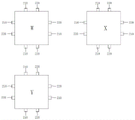
Specifically, when the four modular omni-directional unmanned ships capable of autonomous splicing are spliced, the schematic connection principle is shown in fig. 9, in the adjacent first sides of the first unmanned ship W and the second unmanned ship X, the first mating member 210 on the first unmanned ship W is located below the figure, the second mating member 220 is located above the figure, correspondingly, the first mating member 210 on the second unmanned ship X is located above the figure, and the second mating member 220 is located below the figure, that is, the first mating member 210 on the first unmanned ship W is correspondingly connected with the second mating member 220 on the second unmanned ship X, and the second mating member 220 on the first unmanned ship W is correspondingly connected with the first mating member 210 on the second unmanned ship X.
Meanwhile, the third unmanned ship Y corresponds to the first unmanned ship W, wherein the first mating member 210 on the first unmanned ship W is located on the left side of the figure, the second mating member 220 is located on the right side of the figure, and correspondingly, the first mating member 210 on the second unmanned ship X is located on the left side of the figure, and the second mating member 220 is located on the right side of the figure, so that when the first unmanned ship W is in butt joint with the third unmanned ship Y, the first mating member 210 on the first unmanned ship W is correspondingly connected with the second mating member 220 on the third unmanned ship Y, and the second mating member 220 on the first unmanned ship W is correspondingly connected with the first mating member 210 on the third unmanned ship Y.
According to the connection rule, the invention can realize the effect that a plurality of modularized omnidirectional unmanned ships which can be spliced independently are connected with each other to form a larger unmanned ship body, thereby forming a large-scale water mobile platform and improving the carrying capacity.
In another possible embodiment of the present invention, as shown in fig. 2, a control box 140 is further disposed above the main floating body 100, and the control box 140 is used for placing a control module, so as to realize remote control of the modular omnidirectional unmanned ship capable of being spliced autonomously.
Specifically, in the present embodiment, an installation position having the same shape as the control box 140 is preset on the main floating body 100, the control box 140 is disposed inside the main floating body 100 in a fitting manner, and correspondingly, a waterproof cover plate is further disposed on the control box 140 on a side facing the bearing surface 101 of the main floating body 100, and the waterproof cover plate is detachably disposed on the control box 140, so that a user can conveniently overhaul and replace the control module disposed inside the control box 140.
Further, the control module includes:
a processor communication component 141, wherein the processor communication component 141 is electrically connected with the propeller 120;
a power supply component 142, the power supply component 142 being in electrical connection with the processor communication component 141;
a sensor assembly 143, the sensor assembly 143 being in electrical communication with the processor communication assembly 141.
More specifically, as shown in fig. 10, fig. 10 is a schematic control connection diagram of a control module in the modular omnidirectional unmanned ship capable of autonomous splicing according to the present invention;
the processor communication component 141 includes a shipborne computer, a wireless communication module and a raspberry controller which are connected with each other through circuits;
the shipborne computer can record the navigation state and the navigation log of the modularized omnidirectional unmanned ship which can be spliced independently, and can control the controllable instrument on the unmanned ship.
The wireless communication module comprises various wireless connecting components, such as WiFi, a mobile data connector, a satellite signal connector and the like, and can realize the remote control of the unmanned ship and acquire or receive related data.
The raspberry group controller is a microcomputer, is small in size, is based on a Linux system, can realize quick data storage and basic operation by taking an SD expansion card as a hard disk, and accordingly reduces the overall cost of the unmanned ship while controlling sensor data.
The power supply assembly 142 may be a power supply in various forms, such as a battery, a solar cell, etc., but the present application is not limited thereto, and the battery assembly is used to supply power for the operation of the propeller 120, the processor communication assembly 141, and the sensor assembly 143.
The sensor assembly 143 includes: GPS, IMU, camera and lidar.
The GPS, namely the GPS signal receiving assembly can determine the position information of the unmanned ship through a global satellite positioning system, thereby effectively judging the driving path of the unmanned ship and providing guarantee for the safety of navigation information.
The IMU, inertia sensor promptly, can realize the detection to unmanned ship navigation speed and acceleration through inertia sensor to convert velocity signal into the signal of telecommunication, the navigating mate of being convenient for monitors and controls unmanned ship's navigation speed.
The camera, the camera is used for monitoring unmanned ship's navigation state to be convenient for operating personnel carries out more directly perceived accurate judgement to the navigation state of navigation ship, and on the other hand, the camera can realize taking notes to unmanned ship's navigation history, so that operating personnel is studied the result of use of unmanned ship.
Laser radar, laser radar are arranged in monitoring unmanned ship navigation path's barrier, simultaneously, still can realize the survey and drawing function to the object in the corresponding waters, and through laser radar, operating personnel can realize the effect of monitoring and drawing the waters state.
In the above embodiment, the processor communication component 141 is further interconnected with a motor driver, which is used for driving the propeller 120 to rotate, that is, the unmanned ship is controlled to sail, steer, change the moving state, etc. at a predetermined speed through the processor communication unit 141, in the above embodiment, four extended floating blocks 110 are provided, correspondingly, a first propeller 121, a second propeller 122, a third propeller 123 and a fourth propeller 124 are respectively arranged below the extension floating block 110, wherein the first propeller 121 is controlled to rotate by the electric driver 1, the second propeller 122 is controlled to rotate by the electric driver 2, the third propeller 123 is controlled to rotate by the electric driver 3, the fourth propeller 124 is controlled to rotate by the electric driver 4, and, in actual implementation, four motorized drives may be provided in the corresponding extended float blocks 110, thereby enabling a waterproof hidden arrangement of the device.
In summary, the present invention provides an autonomous-splicing modularized omnidirectional unmanned ship, which specifically includes: the upper circumference of the side surface of the main floating body is provided with a plurality of extending floating blocks; the cabin frame is fixedly arranged above the main floating body, a plurality of connection fitting pieces are arranged on the outer side surface of the cabin frame in the circumferential direction and are used for connecting a plurality of identical modularized omnidirectional unmanned ships capable of being spliced independently; the propeller is provided with a plurality of, and the propeller one-to-one sets up in the below that extends the floating block, and the propeller is used for driving main body. According to the invention, the cabin frame is provided with the connecting fitting pieces, and the connecting fitting pieces are mutually connected, so that a plurality of unmanned ships can be mutually combined to form a large floating platform, the carrying capacity of the unmanned ships is improved, and the propellers arranged on the extending floating blocks can ensure the maneuverability of the unmanned ships, thereby meeting the requirements of users on different functional quick adaptation of the unmanned ships under different use conditions.
It is to be understood that the invention is not limited to the examples described above, but that modifications and variations may be effected thereto by those of ordinary skill in the art in light of the foregoing description, and that all such modifications and variations are intended to be within the scope of the invention as defined by the appended claims.