CN113077017B - Synthetic Aperture Image Classification Method Based on Spiking Neural Network - Google Patents
Synthetic Aperture Image Classification Method Based on Spiking Neural Network Download PDFInfo
- Publication number
- CN113077017B CN113077017B CN202110566295.9A CN202110566295A CN113077017B CN 113077017 B CN113077017 B CN 113077017B CN 202110566295 A CN202110566295 A CN 202110566295A CN 113077017 B CN113077017 B CN 113077017B
- Authority
- CN
- China
- Prior art keywords
- layer
- neural network
- pulse
- synthetic aperture
- neuron
- Prior art date
- Legal status (The legal status is an assumption and is not a legal conclusion. Google has not performed a legal analysis and makes no representation as to the accuracy of the status listed.)
- Active
Links
Images


Classifications
-
- G—PHYSICS
- G06—COMPUTING OR CALCULATING; COUNTING
- G06F—ELECTRIC DIGITAL DATA PROCESSING
- G06F18/00—Pattern recognition
- G06F18/20—Analysing
- G06F18/24—Classification techniques
- G06F18/241—Classification techniques relating to the classification model, e.g. parametric or non-parametric approaches
-
- G—PHYSICS
- G06—COMPUTING OR CALCULATING; COUNTING
- G06F—ELECTRIC DIGITAL DATA PROCESSING
- G06F18/00—Pattern recognition
- G06F18/20—Analysing
- G06F18/21—Design or setup of recognition systems or techniques; Extraction of features in feature space; Blind source separation
- G06F18/214—Generating training patterns; Bootstrap methods, e.g. bagging or boosting
-
- G—PHYSICS
- G06—COMPUTING OR CALCULATING; COUNTING
- G06N—COMPUTING ARRANGEMENTS BASED ON SPECIFIC COMPUTATIONAL MODELS
- G06N3/00—Computing arrangements based on biological models
- G06N3/02—Neural networks
- G06N3/04—Architecture, e.g. interconnection topology
- G06N3/045—Combinations of networks
-
- G—PHYSICS
- G06—COMPUTING OR CALCULATING; COUNTING
- G06N—COMPUTING ARRANGEMENTS BASED ON SPECIFIC COMPUTATIONAL MODELS
- G06N3/00—Computing arrangements based on biological models
- G06N3/02—Neural networks
- G06N3/08—Learning methods
Landscapes
- Engineering & Computer Science (AREA)
- Theoretical Computer Science (AREA)
- Physics & Mathematics (AREA)
- Data Mining & Analysis (AREA)
- Evolutionary Computation (AREA)
- Life Sciences & Earth Sciences (AREA)
- Artificial Intelligence (AREA)
- General Physics & Mathematics (AREA)
- General Engineering & Computer Science (AREA)
- General Health & Medical Sciences (AREA)
- Software Systems (AREA)
- Molecular Biology (AREA)
- Computing Systems (AREA)
- Biophysics (AREA)
- Biomedical Technology (AREA)
- Mathematical Physics (AREA)
- Computational Linguistics (AREA)
- Health & Medical Sciences (AREA)
- Bioinformatics & Cheminformatics (AREA)
- Bioinformatics & Computational Biology (AREA)
- Computer Vision & Pattern Recognition (AREA)
- Evolutionary Biology (AREA)
- Image Analysis (AREA)
Abstract
Description
技术领域technical field
本发明涉及合成孔径图像技术领域,尤其涉及一种基于脉冲神经网络的合成孔径图像分类方法。The invention relates to the technical field of synthetic aperture images, in particular to a method for classifying synthetic aperture images based on a pulse neural network.
背景技术Background technique
合成孔径图像(Synthetic Aperture Image,SAI)是雷达或声呐利用与目标的相对运动,将尺寸较小的真实孔径用数据处理的方法合成较大的等效孔径,可对远距离观测目标产生高分辨率的特殊遥感图像。根据合成孔径成像的电磁波段、光学波段和声学波段,常见的载荷类型有合成孔径雷达(SyntheticAperture Radar,SAR)、合成孔径激光雷达(Synthetic Aperture Ladar,SAL)和合成孔径声呐(Synthetic Aperture Sonar,SAS)等成像设备。由于特殊的合成孔径成像机制,SAI具备穿透性、三维探测等能力,并具有相干斑噪声干扰等不同于常规图像的性质,这使其分析和处理产生了较大困难。Synthetic Aperture Image (Synthetic Aperture Image, SAI) is a radar or sonar that uses the relative motion of the target to synthesize a smaller real aperture into a larger equivalent aperture by data processing, which can produce high resolution for long-distance observation targets. special remote sensing images. According to the electromagnetic band, optical band and acoustic band of synthetic aperture imaging, the common load types are synthetic aperture radar (Synthetic Aperture Radar, SAR), synthetic aperture lidar (Synthetic Aperture Ladar, SAL) and synthetic aperture sonar (Synthetic Aperture Sonar, SAS). ) and other imaging equipment. Due to the special synthetic aperture imaging mechanism, SAI has the capabilities of penetrability and three-dimensional detection, and has properties different from conventional images such as coherent speckle noise interference, which makes its analysis and processing more difficult.
合成孔径声呐图像具有探测距离远、分辨率高的特点,可以用于水下搜救溺水者、沉船和飞机等应急任务。在长时间搜索的过程下,声呐操作员的人工操作可能会感到筋疲力尽,极可能错过潜在的探测目标。如何解决面向无人自主系统的合成孔径图像的目标分类,是目前亟需解决的一个问题。基于智能化的目标检测、目标分类和识别对于搜救工作的自动化具有很大的帮助。Synthetic aperture sonar images have the characteristics of long detection distance and high resolution, and can be used for emergency tasks such as underwater search and rescue of drowning people, shipwrecks and aircraft. In the process of searching for a long time, the manual operation of the sonar operator may feel exhausted, and it is very likely that the potential detection target will be missed. How to solve the target classification of synthetic aperture images for unmanned autonomous systems is a problem that needs to be solved urgently. Intelligence-based target detection, target classification and recognition are of great help to the automation of search and rescue work.
目前针对声呐图像的分类任务,一般采用深度卷积神经网络(DCNN)进行。相比合成孔径雷达图像而言,合成孔径声呐图像获取代价高昂,训练样本稀缺,而深度卷积神经网络的训练必须大量标注的数据集才能达到理想效果。此外,深度卷积神经网络需要很高的算力和大量的能源供给,非常不利于在移动环境下无人自主设备开展搜救任务,这造成了其难以发挥有效的应用。At present, the classification task of sonar images is generally carried out by deep convolutional neural network (DCNN). Compared with synthetic aperture radar images, synthetic aperture sonar images are expensive to acquire and training samples are scarce, while the training of deep convolutional neural networks requires a large number of labeled data sets to achieve the desired effect. In addition, deep convolutional neural networks require high computing power and a large amount of energy supply, which is very unfavorable for unmanned autonomous equipment to carry out search and rescue tasks in a mobile environment, which makes it difficult to exert effective applications.
发明内容Contents of the invention
针对现有基于深度卷积神经网络的合成孔径图像分类方法存在准确率低的或者不适用于移动环境下的无人自主设备的问题,本发明提供一种基于脉冲神经网络的合成孔径图像分类方法,可提高小样本的合成孔径声呐图像分类的准确率,解决现有合成孔径声呐图像获取困难、深度卷积神经网络对小样本图像分类准确率过低的问题,相关数据集实验表明,本发明方法具有高效性和低能耗的特点,可用于移动环境的无人自主设备的SAS图像分类任务。Aiming at the problem that the existing synthetic aperture image classification method based on deep convolutional neural network has low accuracy or is not suitable for unmanned autonomous equipment in a mobile environment, the present invention provides a synthetic aperture image classification method based on spiking neural network , can improve the classification accuracy of small-sample synthetic aperture sonar images, and solve the problems of difficulty in obtaining existing synthetic aperture sonar images and the low accuracy of deep convolutional neural networks for small-sample image classification. Experiments on related data sets show that the present invention The method has the characteristics of high efficiency and low energy consumption, and can be used for SAS image classification tasks of unmanned autonomous devices in mobile environments.
本发明提供的一种基于脉冲神经网络的合成孔径图像分类方法,包括:A kind of synthetic aperture image classification method based on the pulse neural network provided by the present invention comprises:
步骤1:使用深度卷积神经网络对合成孔径雷达图像进行预训练,保存训练好的权重参数;Step 1: Use the deep convolutional neural network to pre-train the synthetic aperture radar image, and save the trained weight parameters;
步骤2:对合成孔径声呐图像进行显著性计算,将显著性计算结果输入至脉冲编码器中进行脉冲编码;Step 2: Perform saliency calculation on the synthetic aperture sonar image, and input the saliency calculation result into the pulse encoder for pulse encoding;
步骤3:将预训练的深度卷积神经网络权重参数迁移到多层脉冲神经网络作为初始权重参数,使用集成学习的方法对多层脉冲神经网络进行训练;Step 3: Migrate the weight parameters of the pre-trained deep convolutional neural network to the multi-layer spiking neural network as the initial weight parameter, and use the method of integrated learning to train the multi-layer spiking neural network;
步骤4:将脉冲编码器的输出结果作为训练好的多层脉冲神经网络的输入,采用脉冲解码器对多层脉冲神经网络的输出结果进行解码以判别最终分类结果。Step 4: The output result of the pulse encoder is used as the input of the trained multi-layer spiking neural network, and the output result of the multi-layer spiking neural network is decoded by the pulse decoder to determine the final classification result.
进一步地,所述步骤1中的深度卷积神经网络具体为:包括深度卷积神经网络的输入层、卷积层、激活层、池化层、全连接层和输出层,神经元参数的偏置设置为0,激活函数设置为ReLU激活函数,池化层设置为平均池化层。Further, the deep convolutional neural network in
进一步地,所述步骤2中的显著性计算结果包括合成孔径图像的视觉显著图。Further, the saliency calculation result in
进一步地,所述步骤2中的脉冲编码具体为:将输入的图像数据编码为发放次数分布符合泊松过程的脉冲序列。Further, the pulse encoding in the
进一步地,所述步骤3中的多层脉冲神经网络由LIF神经元组成,所述多层脉冲神经网络包括输入层、卷积层、激活层、池化层和全连接层。Further, the multi-layer spiking neural network in step 3 is composed of LIF neurons, and the multi-layer spiking neural network includes an input layer, a convolution layer, an activation layer, a pooling layer and a fully connected layer.
进一步地,所述LIF神经元具有神经元膜电位的泄漏、积累以及阈值激发三个特征,所述LIF神经元泄漏、积累以及阈值激发过程具体为:Further, the LIF neuron has three characteristics of neuronal membrane potential leakage, accumulation and threshold excitation, and the process of leakage, accumulation and threshold excitation of the LIF neuron is specifically:

其中,Vmem为后神经元膜电位,τm为膜电位衰减的时间常数,Vrest为静息电位,Rm为细胞膜的阻抗,I(t)表示输入电流,为每个时间步的前神经元脉冲的加权总和。Among them, V mem is the membrane potential of the neuron, τ m is the time constant of membrane potential decay, V rest is the resting potential, R m is the impedance of the cell membrane, I(t) is the input current, and is the previous time of each time step Weighted sum of neuron spikes.
进一步地,所述卷积层在每个时间步中,每个LIF神经元对输入的脉冲与卷积核进行卷积操作以计算其输入电流,并将其整合到膜电位中,若膜电位超过卷积阈值,LIF神经元产生脉冲并复位膜电位,否则膜电位发生衰减。Further, in each time step of the convolutional layer, each LIF neuron performs a convolution operation on the input pulse and the convolution kernel to calculate its input current and integrate it into the membrane potential, if the membrane potential Beyond the convolution threshold, LIF neurons pulse and reset the membrane potential, which otherwise decays.
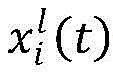
进一步地,所述卷积层采用下述公式计算其输入电流:Further, the convolutional layer uses the following formula to calculate its input current:

其中,

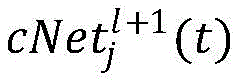
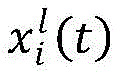
进一步地,所述池化层在每个时间步中,每个LIF神经元对输入的脉冲进行平均卷积操作以计算其输入电流,并将其整合到膜电位中,若膜电位超过卷积阈值,LIF神经元产生脉冲并复位膜电位。Further, in each time step of the pooling layer, each LIF neuron performs an average convolution operation on the input pulse to calculate its input current and integrate it into the membrane potential. If the membrane potential exceeds the convolution Threshold, LIF neurons pulse and reset membrane potential.
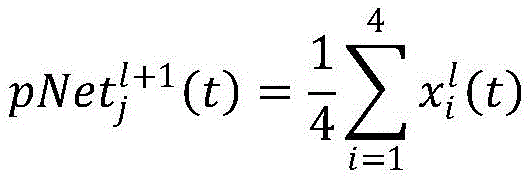
进一步地,所述池化层采用下述公式计算其输入电流:Further, the pooling layer uses the following formula to calculate its input current:

其中,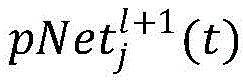

进一步地,所述步骤4中解码器的神经元数量与需要分类的类别数量相同;Further, the number of neurons of the decoder in the step 4 is the same as the number of categories to be classified;
步骤4具体包括:解码器将多层脉冲神经网络提取到的一维向量特征累加进行最终分类,所述累加是指每个时间步输出脉冲与对应输出层的权重相乘后的求和。Step 4 specifically includes: the decoder accumulates the one-dimensional vector features extracted by the multi-layer spiking neural network for final classification, and the accumulation refers to the sum of multiplying the output pulse of each time step by the weight of the corresponding output layer.
本发明的有益效果:Beneficial effects of the present invention:
在实际场景中应用时,普通卷积神经网络运行需要高性能计算设备以及大量能源供给,非常不适用海上移动计算场景;而脉冲神经网络可以映射到基于脉冲的超低功耗神经形态硬件并在其中实现时,具有高能效的特点,在无人自主设备上有较大的应用前景,基于此,本发明使用迁移学习技术,先基于深度卷积网络对合成孔径雷达图像进行训练,再将训练完成的卷积神经网络网络权重迁移到脉冲神经网络,并利用合成孔径声呐图像数据再进行训练,如此针对小样本合成孔径图像的识别问题,本发明可以在合成孔径声呐图像样本量稀少的情况下,提高合成孔径声呐图像分类的准确率,解决现有深度卷积神经网络在海底声呐图像分类问题上准确率较低,能耗过高的问题。本发明在移动端无人自助设备上可以得到很好的应用。When applied in actual scenarios, the operation of ordinary convolutional neural networks requires high-performance computing equipment and a large amount of energy supply, which is very unsuitable for maritime mobile computing scenarios; however, spiking neural networks can be mapped to pulse-based ultra-low-power neuromorphic hardware and run on When it is implemented, it has the characteristics of high energy efficiency and has a great application prospect in unmanned autonomous equipment. Based on this, the present invention uses transfer learning technology to first train synthetic aperture radar images based on deep convolutional networks, and then train The network weights of the completed convolutional neural network are transferred to the pulse neural network, and the synthetic aperture sonar image data is used for training again. In this way, for the recognition problem of the small-sample synthetic aperture image, the present invention can solve the problem when the sample size of the synthetic aperture sonar image is scarce. , improve the accuracy of synthetic aperture sonar image classification, and solve the problems of low accuracy and high energy consumption of the existing deep convolutional neural network in the classification of submarine sonar images. The present invention can be well applied to the unmanned self-service equipment at the mobile terminal.
附图说明Description of drawings
图1为本发明实施例提供的基于脉冲神经网络的合成孔径图像分类方法的流程示意图;FIG. 1 is a schematic flow diagram of a method for classifying synthetic aperture images based on a spiking neural network provided by an embodiment of the present invention;
图2为本发明实施例提供的脉冲神经网络的网络架构示意图;FIG. 2 is a schematic diagram of a network architecture of a spiking neural network provided by an embodiment of the present invention;
图3为本发明实施例提供的卷积层膜电位积累和脉冲激发过程的示意图;3 is a schematic diagram of the membrane potential accumulation and pulse excitation process of the convolutional layer provided by the embodiment of the present invention;
图4为本发明实施例提供的池化层膜电位积累和脉冲激发过程的示意图。Fig. 4 is a schematic diagram of the membrane potential accumulation and pulse excitation process of the pooling layer provided by the embodiment of the present invention.
具体实施方式detailed description
为使本发明的目的、技术方案和优点更加清楚,下面将结合本发明实施例中的附图,对本发明实施例中的技术方案进行清楚地描述,显然,所描述的实施例是本发明一部分实施例,而不是全部的实施例。基于本发明中的实施例,本领域普通技术人员在没有做出创造性劳动前提下所获得的所有其他实施例,都属于本发明保护的范围。In order to make the purpose, technical solutions and advantages of the present invention clearer, the technical solutions in the embodiments of the present invention will be clearly described below in conjunction with the accompanying drawings in the embodiments of the present invention. Obviously, the described embodiments are part of the present invention Examples, not all examples. Based on the embodiments of the present invention, all other embodiments obtained by persons of ordinary skill in the art without making creative efforts belong to the protection scope of the present invention.
实施例一Embodiment one
脉冲神经网络被称为第三代神经网络,有丰富的时空领域的神经动力学特性,采用脉冲神经网络实现合成孔径图像分类任务,具有高效性和低能耗的特点。本发明为解决合成孔径图像分类问题,如图1所示,本发明实施例提供一种基于脉冲神经网络的合成孔径图像分类方法,包括以下步骤:The spiking neural network is called the third-generation neural network, which has rich neurodynamic characteristics in the space-time field. Using the spiking neural network to realize the synthetic aperture image classification task has the characteristics of high efficiency and low energy consumption. The present invention solves the problem of synthetic aperture image classification. As shown in FIG. 1, an embodiment of the present invention provides a synthetic aperture image classification method based on a spiking neural network, including the following steps:
S101:使用深度卷积神经网络对合成孔径雷达图像进行预训练,保存训练好的权重参数;S101: Use a deep convolutional neural network to pre-train the synthetic aperture radar image, and save the trained weight parameters;
具体地,所述步骤S101中的深度卷积神经网络的网络架构具体为:包括深度卷积神经网络的输入层、卷积层、激活层、池化层、全连接层和输出层,神经元参数的偏置设置为0,激活函数设置为ReLU激活函数,池化层设置为平均池化层。Specifically, the network architecture of the deep convolutional neural network in step S101 is specifically: an input layer, a convolutional layer, an activation layer, a pooling layer, a fully connected layer and an output layer of the deep convolutional neural network, and neurons The bias of the parameters is set to 0, the activation function is set to the ReLU activation function, and the pooling layer is set to the average pooling layer.
S102:对合成孔径声呐图像进行显著性计算,将显著性计算结果输入至脉冲编码器中进行脉冲编码;S102: Perform saliency calculation on the synthetic aperture sonar image, and input the saliency calculation result into a pulse encoder for pulse encoding;
具体地,对合成孔径声呐图像进行显著性计算,显著性计算算法可采用基于图论的显著性计算(GBVS)、谱残差(SR)和Itti等方法实现。将显著性计算结果输入到编码器中,在脉冲编码器中对输入的合成孔径声呐图像数据编码,将输入的图像数据编码为发放次数分布符合泊松过程的脉冲序列。所述显著性计算结果包括合成孔径声呐图像的视觉显著图。Specifically, the saliency calculation is performed on the synthetic aperture sonar image, and the saliency calculation algorithm can be realized by using methods such as graph theory-based saliency calculation (GBVS), spectral residual (SR) and Itti. The saliency calculation result is input into the encoder, the input synthetic aperture sonar image data is encoded in the pulse encoder, and the input image data is encoded into a pulse sequence whose firing number distribution conforms to the Poisson process. The saliency calculation results include a visual saliency map of the synthetic aperture sonar image.
S103:将预训练的深度卷积神经网络权重参数迁移到多层脉冲神经网络作为初始权重参数,使用集成学习的方法对多层脉冲神经网络进行训练。S103: Migrate the weight parameters of the pre-trained deep convolutional neural network to the multi-layer spiking neural network as initial weight parameters, and use the integrated learning method to train the multi-layer spiking neural network.
具体地,作为一种可实施方式,如图2所示,多层脉冲神经网络的架构具体包括泄漏积分发放(Leaky Integrate and Fire,LIF)神经元,至少包括输入层、卷积层、激活层、池化层、全连接层。Specifically, as an implementable manner, as shown in FIG. 2, the architecture of a multi-layer spiking neural network specifically includes a leaky integral distribution (Leaky Integrate and Fire, LIF) neuron, including at least an input layer, a convolutional layer, and an activation layer. , pooling layer, fully connected layer.
为了避免过拟合,多层脉冲神经网络采用L2正则化的方法,并在每个卷积层添加Dropout层,丢弃率设置为0.25;多层脉冲神经网络中LIF神经元泄漏、积累以及阈值激发过程具体如下:In order to avoid over-fitting, the multi-layer spiking neural network adopts the L2 regularization method, and adds a Dropout layer to each convolutional layer, and the discarding rate is set to 0.25; in the multi-layer spiking neural network, LIF neuron leakage, accumulation and threshold excitation The process is as follows:

其中,Vmem为后神经元膜电位,τm为膜电位衰减的时间常数,Vrest为静息电位,Rm为细胞膜的阻抗,I(t)表示输入电流,为每个时间步的前神经元脉冲的加权总和。Among them, V mem is the membrane potential of the neuron, τ m is the time constant of membrane potential decay, V rest is the resting potential, R m is the impedance of the cell membrane, I(t) is the input current, and is the previous time of each time step Weighted sum of neuron spikes.
作为一种可实施方式,如图3所示,所述卷积层在每个时间步中,每个LIF神经元对输入的脉冲与卷积核进行卷积操作以计算其输入电流,并将其整合到膜电位中,如果膜电位超过卷积阈值,则LIF神经元产生脉冲并复位膜电位,否则膜电位发生衰减。其输入电流的计算公式可以表示为:As a possible implementation, as shown in Figure 3, in each time step of the convolutional layer, each LIF neuron performs a convolution operation on the input pulse and the convolution kernel to calculate its input current, and It is integrated into the membrane potential, and if the membrane potential exceeds the convolution threshold, the LIF neuron pulses and resets the membrane potential, otherwise the membrane potential decays. The calculation formula of its input current can be expressed as:

其中,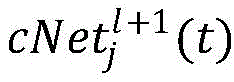


作为一种可实施方式,如图4所示,所述池化层在每个时间步中,每个神经元对输入的脉冲进行平均卷积操作以计算其输入电流,并将其整合到膜电位中,如果膜电位超过卷积阈值,则神经元产生脉冲并复位膜电位。其输入电流的计算公式可以表示为:As a possible implementation, as shown in Figure 4, in each time step of the pooling layer, each neuron performs an average convolution operation on the input pulse to calculate its input current, and integrate it into the membrane In potential, if the membrane potential exceeds the convolution threshold, the neuron pulses and resets the membrane potential. The calculation formula of its input current can be expressed as:
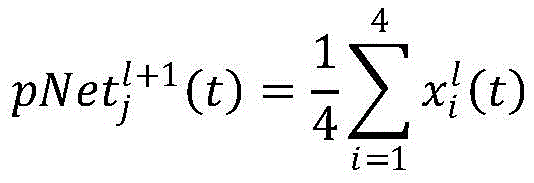
其中,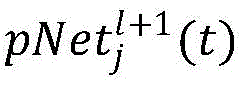

S104:将脉冲编码器的输出结果作为训练好的多层脉冲神经网络的输入,采用脉冲解码器对多层脉冲神经网络的输出结果进行解码以判别最终分类结果。S104: Using the output result of the pulse encoder as the input of the trained multi-layer spiking neural network, and using the pulse decoder to decode the output result of the multi-layer spiking neural network to determine the final classification result.
具体地,脉冲解码器中神经元数量和需要分类的类别数量相同;本步骤具体为:解码器将多层脉冲神经网络提取到的一维向量特征累加进行最终分类,所述累加是指每个时间步输出脉冲与对应输出层的权重相乘后的求和。Specifically, the number of neurons in the pulse decoder is the same as the number of categories to be classified; this step is specifically: the decoder accumulates the one-dimensional vector features extracted by the multi-layer pulse neural network for final classification, and the accumulation refers to each The sum of time step output spikes multiplied by the weights of the corresponding output layers.
实施例二Embodiment two
根据本发明的一种实施方式,在MNIST数据集上对脉冲神经网络在小样本图像分类任务的有效性进行验证,具体过程如下:According to an embodiment of the present invention, the validity of the spiking neural network in the small sample image classification task is verified on the MNIST data set, and the specific process is as follows:
S201:MNIST手写数字集共包含0-9十个数字类别,其中训练集包含60000张手写数字图像,测试集包含10000张手写数字图像。抽取MNIST手写数字集训练集的部分数据作为小样本图像分类任务的训练集,每类的抽取数量一致;使用MNIST手写数字集测试集的全部数据作为小样本图像分类任务的测试数据;使用深度卷积神经网络对MNIST数据集小样本图像数据进行预训练,保存训练好的权重参数;S201: The MNIST handwritten digit set contains ten digit categories from 0 to 9. The training set contains 60,000 handwritten digit images, and the test set contains 10,000 handwritten digit images. Extract part of the data from the MNIST handwritten digit set training set as the training set for the small-sample image classification task, and the number of extractions for each category is the same; use all the data of the MNIST handwritten digit set test set as the test data for the small-sample image classification task; use the depth volume The product neural network pre-trains the small sample image data of the MNIST dataset, and saves the trained weight parameters;
具体地,在实际应用中,可以先对MNIST数据集小样本图像数据进行预处理,将图像像素归一化为[0,1];深度卷积神经网络架构包括建立深度卷积神经网络的输入层、卷积层、激活层、池化层、全连接层和输出层,将深度卷积神经网络中神经元参数的偏置设置为0,将池化层设置为平均池化层。Specifically, in practical applications, the small sample image data of the MNIST dataset can be preprocessed first, and the image pixels are normalized to [0,1]; the deep convolutional neural network architecture includes the establishment of the input of the deep convolutional neural network layer, convolutional layer, activation layer, pooling layer, fully connected layer and output layer, set the bias of the neuron parameters in the deep convolutional neural network to 0, and set the pooling layer to the average pooling layer.
S202:在脉冲编码器中对MNIST数据集小样本图像数据编码,包括:脉冲编码器将输入的图像数据编码为发放次数分布符合泊松过程的脉冲序列。S202: Encoding the small-sample image data of the MNIST data set in the pulse coder, including: the pulse coder codes the input image data into a pulse sequence whose firing number distribution conforms to a Poisson process.
S203:将预训练的权重参数迁移到多层脉冲神经网络作为初始权重参数对多层脉冲神经网络进行训练;S203: Migrate the pre-trained weight parameters to the multi-layer spiking neural network as initial weight parameters to train the multi-layer spiking neural network;
如图2所示,多层脉冲神经网络架构具体包括泄漏积分发放(Leaky Integrateand Fire,LIF)神经元,多层脉冲神经网络至少包括输入层、卷积层、激活层、池化层、全连接层和输出层。As shown in Figure 2, the multi-layer spiking neural network architecture specifically includes Leaky Integrate and Fire (LIF) neurons, and the multi-layer spiking neural network includes at least an input layer, a convolutional layer, an activation layer, a pooling layer, and a fully connected layer and output layer.
具体地,为了避免过拟合,多层脉冲神经网络采用L2正则化的方法,并在每个卷积层添加Dropout层,丢弃率设置为0.1;多层脉冲神经网络中LIF神经元模型泄漏、积累以及阈值激发过程具体如下:Specifically, in order to avoid overfitting, the multi-layer spiking neural network adopts the L2 regularization method, and adds a Dropout layer to each convolutional layer, and the dropout rate is set to 0.1; in the multi-layer spiking neural network, the LIF neuron model leaks, The process of accumulation and threshold excitation is as follows:

其中,Vmem为后神经元膜电位,τm为膜电位衰减的时间常数,Vrest为静息电位,Rm为细胞膜的阻抗,I(t)表示输入电流,为每个时间步的前神经元脉冲的加权总和。Among them, V mem is the membrane potential of the neuron, τ m is the time constant of membrane potential decay, V rest is the resting potential, R m is the impedance of the cell membrane, I(t) is the input current, and is the previous time of each time step Weighted sum of neuron spikes.
如图3所示,所述卷积层在每个时间步中,每个神经元对输入的脉冲与卷积核进行卷积操作以计算其输入电流,并将其整合到膜电位中,如果膜电位超过卷积阈值,则神经元会产生脉冲并复位膜电位,否则膜电位会发生衰减。其输入电流的计算公式可以表示为:As shown in Figure 3, in each time step of the convolutional layer, each neuron performs a convolution operation on the input pulse and the convolution kernel to calculate its input current and integrate it into the membrane potential, if When the membrane potential exceeds the convolution threshold, the neuron pulses and resets the membrane potential, otherwise the membrane potential decays. The calculation formula of its input current can be expressed as:
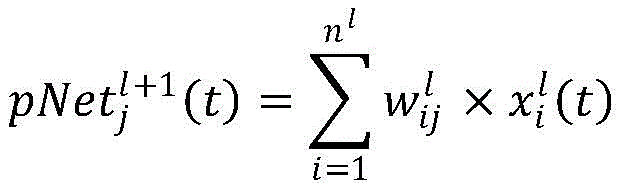
其中,


如图4所示,所述池化层在每个时间步中,每个神经元对输入的脉冲进行平均卷积操作以计算其输入电流,并将其整合到膜电位中,如果膜电位超过卷积阈值,则神经元会产生脉冲并复位膜电位。其输入电流的计算公式可以表示为:As shown in Figure 4, in each time step of the pooling layer, each neuron performs an average convolution operation on the input pulse to calculate its input current and integrate it into the membrane potential. If the membrane potential exceeds convolution threshold, the neuron fires a spike and resets the membrane potential. The calculation formula of its input current can be expressed as:
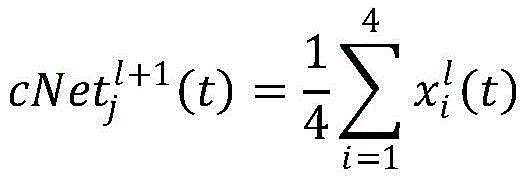
其中,

S204:将脉冲编码器的输出结果作为训练好的多层脉冲神经网络的输入,采用脉冲解码器对多层脉冲神经网络的输出结果进行解码以判别最终分类结果;S204: Using the output result of the pulse encoder as the input of the trained multi-layer spiking neural network, using the pulse decoder to decode the output result of the multi-layer spiking neural network to determine the final classification result;
脉冲解码器中神经元数量和需要分类的类别数量相同,解码器将多层脉冲神经网络提取到的一维向量特征累加进行最终分类,这个累加是每个时间步输出脉冲与对应输出层的权重相乘后的求和。The number of neurons in the pulse decoder is the same as the number of categories that need to be classified. The decoder accumulates the one-dimensional vector features extracted by the multi-layer pulse neural network for final classification. This accumulation is the weight of each time step output pulse and the corresponding output layer Sum after multiplication.
表1脉冲神经网络和卷积神经网络在MNIST数据集图像分类的准确率Table 1 Accuracy of spiking neural network and convolutional neural network in image classification of MNIST dataset
如表1所示,在每类图像数量较少的情况下,本发明的分类方法高于卷积神经网络的分类方法,本发明可以提高在MNIST数据集小样本图像分类的准确率,说明本发明分类方法在少量训练样本下可以取得较高的分类精度。As shown in Table 1, under the condition that the number of images of each type is small, the classification method of the present invention is higher than the classification method of convolutional neural network, and the present invention can improve the accuracy rate of small-sample image classification in MNIST data set, illustrates this The invented classification method can achieve higher classification accuracy with a small number of training samples.
本发明提高了合成孔径声呐图像分类的准确率,在实际场景中应用时,普通卷积神经网络运行需要高性能计算设备以及大量能源供给,非常不适用海上移动计算场景;而脉冲神经网络可以映射到基于脉冲的超低功耗神经形态硬件并在其中实现时,具有高能效的特点,在无人自主设备上有较大的应用前景。The present invention improves the accuracy of synthetic aperture sonar image classification. When applied in actual scenarios, the operation of ordinary convolutional neural networks requires high-performance computing equipment and a large amount of energy supply, which is very unsuitable for maritime mobile computing scenarios; while pulsed neural networks can map When implemented in pulse-based ultra-low-power neuromorphic hardware, it has the characteristics of high energy efficiency and has great application prospects in unmanned autonomous devices.
本发明采用上述技术方案,使用迁移学习技术,先基于深度卷积网络对合成孔径雷达图像进行训练,再将训练完成的卷积神经网络网络权重迁移到脉冲神经网络,并利用合成孔径声呐图像数据再进行训练。本发明可以在合成孔径声呐图像样本量稀少的情况下,提高合成孔径声呐图像分类的准确率,解决现有深度卷积神经网络在海底声呐图像分类问题上准确率较低,能耗过高的问题。本发明在移动端无人自助设备上可以得到很好的应用。The present invention adopts the above-mentioned technical scheme and uses transfer learning technology to first train the synthetic aperture radar image based on the deep convolutional network, then transfer the weights of the trained convolutional neural network to the pulse neural network, and use the synthetic aperture sonar image data Retrain. The present invention can improve the classification accuracy of synthetic aperture sonar images when the sample size of synthetic aperture sonar images is scarce, and solve the problem of low accuracy and high energy consumption of existing deep convolutional neural networks in the classification of submarine sonar images question. The present invention can be well applied to the unmanned self-service equipment at the mobile terminal.
最后应说明的是:以上实施例仅用以说明本发明的技术方案,而非对其限制;尽管参照前述实施例对本发明进行了详细的说明,本领域的普通技术人员应当理解:其依然可以对前述各实施例所记载的技术方案进行修改,或者对其中部分技术特征进行等同替换;而这些修改或者替换,并不使相应技术方案的本质脱离本发明各实施例技术方案的精神和范围。Finally, it should be noted that: the above embodiments are only used to illustrate the technical solutions of the present invention, rather than to limit them; although the present invention has been described in detail with reference to the foregoing embodiments, those of ordinary skill in the art should understand that: it can still be Modifications are made to the technical solutions described in the foregoing embodiments, or equivalent replacements are made to some of the technical features; and these modifications or replacements do not make the essence of the corresponding technical solutions deviate from the spirit and scope of the technical solutions of the various embodiments of the present invention.
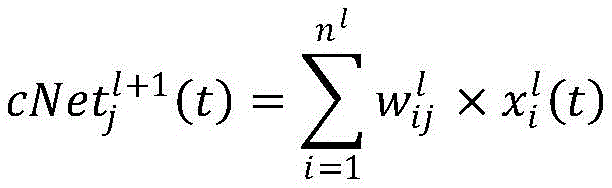
Claims (9)




Priority Applications (1)
| Application Number | Priority Date | Filing Date | Title |
|---|---|---|---|
| CN202110566295.9A CN113077017B (en) | 2021-05-24 | 2021-05-24 | Synthetic Aperture Image Classification Method Based on Spiking Neural Network |
Applications Claiming Priority (1)
| Application Number | Priority Date | Filing Date | Title |
|---|---|---|---|
| CN202110566295.9A CN113077017B (en) | 2021-05-24 | 2021-05-24 | Synthetic Aperture Image Classification Method Based on Spiking Neural Network |
Publications (2)
| Publication Number | Publication Date |
|---|---|
| CN113077017A CN113077017A (en) | 2021-07-06 |
| CN113077017B true CN113077017B (en) | 2022-12-13 |
Family
ID=76616813
Family Applications (1)
| Application Number | Title | Priority Date | Filing Date |
|---|---|---|---|
| CN202110566295.9A Active CN113077017B (en) | 2021-05-24 | 2021-05-24 | Synthetic Aperture Image Classification Method Based on Spiking Neural Network |
Country Status (1)
| Country | Link |
|---|---|
| CN (1) | CN113077017B (en) |
Families Citing this family (13)
| Publication number | Priority date | Publication date | Assignee | Title |
|---|---|---|---|---|
| CN114295967A (en) * | 2021-07-26 | 2022-04-08 | 桂林电子科技大学 | A fault diagnosis method for analog circuits based on transfer neural network |
| CN114092763B (en) * | 2021-11-22 | 2023-08-25 | 南京铁道职业技术学院 | Pulse neural network model construction method |
| CN114091659B (en) * | 2021-11-24 | 2025-08-05 | 西安电子科技大学 | Ultra-low-latency spiking neural network and learning method based on space-time information |
| CN114332545B (en) * | 2022-03-17 | 2022-08-05 | 之江实验室 | Image data classification method and device based on low-bit pulse neural network |
| CN114926737B (en) * | 2022-05-20 | 2025-04-18 | 大连大学 | A low-power target detection method based on convolutional spiking neural network |
| CN115270913B (en) * | 2022-06-10 | 2025-09-05 | 南京理工大学 | A radar signal classification method under low signal-to-noise ratio |
| CN115410079B (en) * | 2022-09-02 | 2026-01-02 | 河南大学 | Target Detection Method Based on Synthetic Aperture Sonar Images Using Spike Neural Networks |
| CN116310477B (en) * | 2022-11-23 | 2025-09-05 | 西安微电子技术研究所 | Image classification method based on S_ReLU spiking neural network |
| CN116740405B (en) * | 2023-03-28 | 2025-12-12 | 电子科技大学 | An image classification method, computer device, and storage medium |
| CN116403097B (en) * | 2023-04-04 | 2025-12-05 | 之江实验室 | A target detection method, apparatus, storage medium, and electronic device |
| CN119558360A (en) * | 2024-11-12 | 2025-03-04 | 南京大学 | A pulse neural network accelerator based on quaternary pulses and its calculation method |
| CN119395661B (en) * | 2025-01-02 | 2025-03-21 | 中国人民解放军火箭军工程大学 | A lightweight pulse neural network single photon radar back-end signal processing method |
| CN119943438B (en) * | 2025-01-20 | 2025-10-31 | 广东工业大学 | A method and system for predicting anticancer drug-drug interactions |
Citations (3)
| Publication number | Priority date | Publication date | Assignee | Title |
|---|---|---|---|---|
| CN110210563A (en) * | 2019-06-04 | 2019-09-06 | 北京大学 | The study of pattern pulse data space time information and recognition methods based on Spike cube SNN |
| WO2021012752A1 (en) * | 2019-07-23 | 2021-01-28 | 中建三局智能技术有限公司 | Spiking neural network-based short-range tracking method and system |
| CN112784976A (en) * | 2021-01-15 | 2021-05-11 | 中山大学 | Image recognition system and method based on impulse neural network |
Family Cites Families (7)
| Publication number | Priority date | Publication date | Assignee | Title |
|---|---|---|---|---|
| US12497055B2 (en) * | 2019-08-21 | 2025-12-16 | Micron Technology, Inc. | Monitoring controller area network bus for vehicle control |
| DE102019212907A1 (en) * | 2019-08-28 | 2021-03-04 | Robert Bosch Gmbh | Method, device and computer program for creating a pulsed neural network |
| CN111062450B (en) * | 2019-12-30 | 2023-03-24 | 西安电子科技大学 | Image classification device and method based on FPGA and SCNN architecture |
| CN111858989B (en) * | 2020-06-09 | 2023-11-10 | 西安工程大学 | An image classification method based on attention mechanism and spiking convolutional neural network |
| CN111753853B (en) * | 2020-07-08 | 2024-02-09 | 海南热带海洋学院 | An MPCNN-FAST sonar image feature point detection method |
| CN111860790B (en) * | 2020-08-04 | 2024-11-22 | 南京大学 | A method and system for improving the accuracy of deep residual spiking neural network to optimize image classification |
| CN112052817B (en) * | 2020-09-15 | 2023-09-05 | 中国人民解放军海军大连舰艇学院 | Improved YOLOv3 model side scan sonar sunken ship target automatic recognition method based on transfer learning |
-
2021
- 2021-05-24 CN CN202110566295.9A patent/CN113077017B/en active Active
Patent Citations (3)
| Publication number | Priority date | Publication date | Assignee | Title |
|---|---|---|---|---|
| CN110210563A (en) * | 2019-06-04 | 2019-09-06 | 北京大学 | The study of pattern pulse data space time information and recognition methods based on Spike cube SNN |
| WO2021012752A1 (en) * | 2019-07-23 | 2021-01-28 | 中建三局智能技术有限公司 | Spiking neural network-based short-range tracking method and system |
| CN112784976A (en) * | 2021-01-15 | 2021-05-11 | 中山大学 | Image recognition system and method based on impulse neural network |
Also Published As
| Publication number | Publication date |
|---|---|
| CN113077017A (en) | 2021-07-06 |
Similar Documents
| Publication | Publication Date | Title |
|---|---|---|
| CN113077017B (en) | Synthetic Aperture Image Classification Method Based on Spiking Neural Network | |
| CN113705769B (en) | A neural network training method and device | |
| Chen et al. | Research on recognition of fly species based on improved RetinaNet and CBAM | |
| CN110119785B (en) | An image classification method based on multi-layer spiking convolutional neural network | |
| CN111079739B (en) | Multi-scale attention feature detection method | |
| CN109102000A (en) | A kind of image-recognizing method extracted based on layered characteristic with multilayer impulsive neural networks | |
| Li et al. | L-DETR: a light-weight detector for end-to-end object detection with transformers | |
| Wu et al. | Remote sensing imagery scene classification based on spiking neural network | |
| CN115273814A (en) | Pseudo-voice detection method, device, computer equipment and storage medium | |
| CN111310816B (en) | Method for recognizing brain-like architecture image based on unsupervised matching tracking coding | |
| Ye et al. | Recognition algorithm of emitter signals based on PCA+ CNN | |
| CN117079095A (en) | High-altitude parabola detection methods, systems, media and equipment based on deep learning | |
| CN114154626A (en) | Deep neural network filter pruning method based on filter weight comprehensive evaluation | |
| Teow | A minimal convolutional neural network for handwritten digit recognition | |
| Zhao et al. | Iterative activation-based structured pruning | |
| CN116977840A (en) | Marine biological target detection methods, systems, storage media and equipment | |
| CN117765336A (en) | Small target detection method, system, equipment and medium based on local attention feature association mechanism | |
| CN115410079B (en) | Target Detection Method Based on Synthetic Aperture Sonar Images Using Spike Neural Networks | |
| CN114578307B (en) | A radar target fusion recognition method and system | |
| CN110796177A (en) | An effective method for reducing neural network overfitting in image classification tasks | |
| Liu et al. | Optimizing CNN using adaptive moment estimation for image recognition | |
| Zhao et al. | Adaptive fine-tuning and feature enhancement of SAM for remote sensing instance segmentation | |
| Daoudi et al. | Running convolutional neural network on tiny devices | |
| CN115880324A (en) | A Threshold Segmentation Method for Battlefield Target Image Based on Impulse Convolutional Neural Network | |
| Chen et al. | Conversion of artificial neural network to spiking neural network for hardware implementation |
Legal Events
| Date | Code | Title | Description |
|---|---|---|---|
| PB01 | Publication | ||
| PB01 | Publication | ||
| SE01 | Entry into force of request for substantive examination | ||
| SE01 | Entry into force of request for substantive examination | ||
| GR01 | Patent grant | ||
| GR01 | Patent grant |