CN113067651B - Inter-constellation interference detection method for low-orbit satellite system - Google Patents
Inter-constellation interference detection method for low-orbit satellite system Download PDFInfo
- Publication number
- CN113067651B CN113067651B CN202110296984.2A CN202110296984A CN113067651B CN 113067651 B CN113067651 B CN 113067651B CN 202110296984 A CN202110296984 A CN 202110296984A CN 113067651 B CN113067651 B CN 113067651B
- Authority
- CN
- China
- Prior art keywords
- interference
- ngso
- satellite
- carrier
- constellation
- Prior art date
- Legal status (The legal status is an assumption and is not a legal conclusion. Google has not performed a legal analysis and makes no representation as to the accuracy of the status listed.)
- Active
Links
Images


Classifications
-
- H—ELECTRICITY
- H04—ELECTRIC COMMUNICATION TECHNIQUE
- H04B—TRANSMISSION
- H04B17/00—Monitoring; Testing
- H04B17/30—Monitoring; Testing of propagation channels
- H04B17/309—Measuring or estimating channel quality parameters
- H04B17/345—Interference values
-
- H—ELECTRICITY
- H04—ELECTRIC COMMUNICATION TECHNIQUE
- H04B—TRANSMISSION
- H04B7/00—Radio transmission systems, i.e. using radiation field
- H04B7/14—Relay systems
- H04B7/15—Active relay systems
- H04B7/185—Space-based or airborne stations; Stations for satellite systems
- H04B7/1851—Systems using a satellite or space-based relay
- H04B7/18519—Operations control, administration or maintenance
-
- Y—GENERAL TAGGING OF NEW TECHNOLOGICAL DEVELOPMENTS; GENERAL TAGGING OF CROSS-SECTIONAL TECHNOLOGIES SPANNING OVER SEVERAL SECTIONS OF THE IPC; TECHNICAL SUBJECTS COVERED BY FORMER USPC CROSS-REFERENCE ART COLLECTIONS [XRACs] AND DIGESTS
- Y02—TECHNOLOGIES OR APPLICATIONS FOR MITIGATION OR ADAPTATION AGAINST CLIMATE CHANGE
- Y02D—CLIMATE CHANGE MITIGATION TECHNOLOGIES IN INFORMATION AND COMMUNICATION TECHNOLOGIES [ICT], I.E. INFORMATION AND COMMUNICATION TECHNOLOGIES AIMING AT THE REDUCTION OF THEIR OWN ENERGY USE
- Y02D30/00—Reducing energy consumption in communication networks
- Y02D30/70—Reducing energy consumption in communication networks in wireless communication networks
Landscapes
- Engineering & Computer Science (AREA)
- Physics & Mathematics (AREA)
- Computer Networks & Wireless Communication (AREA)
- Signal Processing (AREA)
- Quality & Reliability (AREA)
- Electromagnetism (AREA)
- Astronomy & Astrophysics (AREA)
- Aviation & Aerospace Engineering (AREA)
- General Physics & Mathematics (AREA)
- Radio Relay Systems (AREA)
Abstract
低轨卫星系统星座间干扰检测方法,涉及电子与通信技术领域。本发明对低轨卫星系统建模获取数据,通过对星座之间的干扰分析并结合卫星的发射接收参数等,然后利用信干噪比等的计算公式,最后将获得的系统余量与ITU的干扰判别门限比较,判断各个通信系统之间是否存在干扰,本发明的干扰检测准确,填补了现有技术中缺少星座之间的干扰分析的空白。

The invention discloses a low-orbit satellite system inter-constellation interference detection method, which relates to the technical field of electronics and communication. The present invention models the low-orbit satellite system to obtain data, analyzes the interference between the constellations and combines the satellite's transmitting and receiving parameters, etc., and then uses the calculation formula of the signal-to-interference-noise ratio, etc., and finally compares the obtained system margin with the ITU's Interference discrimination thresholds are compared to determine whether there is interference between various communication systems. The interference detection of the present invention is accurate, and fills the gap in the prior art that lacks interference analysis between constellations.
Description
技术领域technical field
本发明涉及电子与通信技术领域。The invention relates to the technical field of electronics and communication.
背景技术Background technique
卫星通信作为地面通信的补充,逐渐在整个通信系统中扮演者越来越重要的角色。物联网是目前的信息技术发展的重点方向和重要的组成部分,目前的地面物联网面临着各种各样的困难,其中包括天气、容量、网络资源等的影响。因此,人们开始将目前的地面物联网进行拓展,开辟其再空中的领域,其中最大的主战场就是空间信息网。空间信息网集合了地球同步轨道卫星、中轨道卫星、和低轨道卫星等来处理空间中的网络信息。Satellite communication, as a supplement to ground communication, is gradually playing an increasingly important role in the entire communication system. The Internet of Things is the key direction and an important part of the current development of information technology. The current terrestrial Internet of Things is facing various difficulties, including the impact of weather, capacity, and network resources. Therefore, people began to expand the current Internet of Things on the ground to open up its field in the air, and the biggest main battlefield is the space information network. The spatial information network integrates geosynchronous orbit satellites, medium orbit satellites, and low orbit satellites to process network information in space.
其中,低轨卫星通信系统时延小,信号的抗衰减能力强,而且可以通过提高系统的覆盖能力,达到卫星的全球无缝覆盖。低轨卫星的频率复用因子较大时,系统的频谱利用率较低,系统的频带容量相对较小,但是此种情况下一般同频波束之间的相距较大,因此此时同频干扰情况较少。Among them, the low-orbit satellite communication system has a small delay and strong anti-attenuation ability of the signal, and can achieve seamless global satellite coverage by improving the coverage of the system. When the frequency reuse factor of low-orbit satellites is large, the spectrum utilization rate of the system is low, and the frequency band capacity of the system is relatively small. However, in this case, the distance between the same-frequency beams is generally large, so the same-frequency interference The situation is less.
在对低轨卫星进行仿真获得其电磁数据挖掘电磁数据特征时,需要对低轨卫星系统进行建模,构建合适的低轨卫星网络,需要获取相应的包括卫星天线参数、卫星和地面站之间的相对角度和距离以及过顶时间等相关参数。When simulating low-orbit satellites to obtain their electromagnetic data mining electromagnetic data characteristics, it is necessary to model the low-orbit satellite system and build a suitable low-orbit satellite network. Relative angles and distances and overhead time and other related parameters.
目前主流的低轨卫星系统主要包括Starlink、OneWeb以及Telesat等的系统。但是目前的低轨卫星通信系统面临的问题主要是各个系统的使用频率范围较为集中,都基本集中在Ka/Ku频段,这就会带来同频干扰等的星间干扰问题。所以在NGSO的系统的星间,针对星间干扰并进行自适应功率控制等的方式调节系统十分重要。The current mainstream low-orbit satellite systems mainly include systems such as Starlink, OneWeb, and Telesat. However, the current low-orbit satellite communication system faces the main problem that the frequency ranges used by each system are relatively concentrated, and they are basically concentrated in the Ka/Ku frequency band, which will bring about inter-satellite interference problems such as co-frequency interference. Therefore, in the inter-satellite system of the NGSO system, it is very important to adjust the system in the manner of inter-satellite interference and adaptive power control.
但是现有的干扰分析都一般会集中在NGSO和GSO系统之间,往往对于NGSO星座之间的干扰意义不大,并且之前的分析一般都集中在单颗卫星之间的干扰分析,并没有针对两个星座之间的实时干扰分析。此外,一般的干扰分析都集中在卫星和地球站的下行链路中其他卫星对地球站的干扰,却忽略了在上行链路中可能存在的其他干扰卫星对主链路的卫星接收天线的干扰,会导致实际工作中的偏差。However, the existing interference analysis generally focuses on the NGSO and GSO systems, and often has little significance for the interference between NGSO constellations, and the previous analysis generally focuses on the interference analysis between single satellites, and does not address Real-time interference analysis between two constellations. In addition, the general interference analysis focuses on the interference of other satellites to the earth station in the downlink of the satellite and the earth station, but ignores the interference of other interfering satellites that may exist in the uplink to the satellite receiving antenna of the main link , will lead to deviations in actual work.
发明内容Contents of the invention
本发明是为了填补现有技术中缺少星座之间的干扰分析的问题,从而提供一种低轨卫星系统星座间干扰获取方法。The present invention aims to fill the problem of lack of interference analysis between constellations in the prior art, thereby providing a method for obtaining interference between constellations of a low-orbit satellite system.
低轨卫星系统星座间干扰检测方法,它包括以下步骤:A low-orbit satellite system inter-constellation interference detection method, which comprises the following steps:
步骤一、建立相应的NGSO卫星星座模型,并采集其中不同NGSO系统中每两个卫星之间以及所述NGSO卫星星座模型中每个卫星与地面站之间的实时距离和方向以及对应的时间和角度的数据文件;Step 1. Establish the corresponding NGSO satellite constellation model, and collect the real-time distance and direction between every two satellites in different NGSO systems and between each satellite in the NGSO satellite constellation model and the ground station, as well as the corresponding time and Angular data file;
步骤二、将步骤一获取的所有的时间段的数据文件构成一个时间连续的不同卫星之间相互对应的数据文件,在每两个两颗卫星或者卫星与地面站不相互通信的相应位置数值设置为数据集NaN;
通过设置NaN,在处理星间数据时可以将两颗卫星之间未发生通信交流时数据设置为空,可以更直观的获得星间干扰数据与时间之间的关系。By setting NaN, when processing inter-satellite data, the data can be set to null when there is no communication between two satellites, and the relationship between inter-satellite interference data and time can be obtained more intuitively.
步骤三、获取NGSO系统最佳的采样时间;Step 3. Obtain the best sampling time of the NGSO system;
步骤四、根据步骤三获取的NGSO系统的系统最佳采样时间对总的数据文件进行时间上的采样;Step 4, according to the optimal sampling time of the NGSO system obtained in step 3, the total data files are sampled in time;
步骤五、设定NGSO卫星系统中的各个参数,以及确定卫星发射天线和地面站接收天线的模型与参数;Step five, setting various parameters in the NGSO satellite system, and determining the models and parameters of the satellite transmitting antenna and the ground station receiving antenna;
步骤六、获取NGSO系统的载噪比门限;
步骤七、根据步骤五中设定的NGSO系统的参数,获取链路的载干比;Step seven, according to the parameters of the NGSO system set in step five, obtain the carrier-to-interference ratio of the link;
步骤八:获取NGSO系统的干扰余量M,并判断NGSO系统的干扰余量M是否大于步预设的ITU判别门限,如果判断结果为是,则低轨卫星系统星座间存在干扰,如果判断结果为否,则低轨卫星系统星座间不存在干扰,完成一次低轨卫星系统星座间干扰检测。Step 8: Obtain the interference margin M of the NGSO system, and judge whether the interference margin M of the NGSO system is greater than the preset ITU discrimination threshold. If the judgment result is yes, there is interference between the low-orbit satellite system constellations. If the judgment result is If no, there is no interference among the constellations of the low-orbit satellite system, and an interference detection among the constellations of the low-orbit satellite system is completed.
本发明取得的有益效果:本发明对低轨卫星系统建模获取数据,通过对星座之间的干扰分析并结合卫星的发射接收参数等,然后利用信干噪比等的计算公式,最后将获得的系统余量与ITU的干扰判别门限比较,判断各个通信系统之间是否存在干扰,本发明的干扰检测准确,填补了现有技术中缺少星座之间的干扰分析的空白。Beneficial effects obtained by the present invention: the present invention models the low-orbit satellite system to obtain data, analyzes the interference between the constellations and combines the satellite's transmitting and receiving parameters, etc., and then uses the calculation formula of the signal-to-interference-noise ratio, etc., and finally will obtain The system margin of the system is compared with the interference discrimination threshold of the ITU to judge whether there is interference between the various communication systems. The interference detection of the present invention is accurate, and fills the blank of lack of interference analysis between constellations in the prior art.
附图说明Description of drawings
图1是星座A星座图;Fig. 1 is a constellation diagram of constellation A;
图2是星座B星座图;Fig. 2 is constellation diagram of constellation B;
图3是星座A系统天线放大能力;Figure 3 shows the antenna amplification capability of the constellation A system;
图4是星座B系统天线放大能力;Figure 4 shows the antenna amplification capability of the constellation B system;
图5是下行链路中星座B对星座A系统的干扰余量图;FIG. 5 is a diagram showing the interference margin of the constellation B to the constellation A system in the downlink;
图6是上行链路中星座B对星座A系统的干扰余量图;FIG. 6 is an interference margin diagram of the constellation B to the constellation A system in the uplink;
图7是本发明的整体流程图。Fig. 7 is an overall flowchart of the present invention.
具体实施方式Detailed ways
具体实施方式一、NGSO系统的星间干扰检测方法,其主要在于构建可能存在干扰的场景,然后按照无线电规则计算。下面将结合本发明实施例中的附图,对本发明实施例中的技术方案进行清楚、完整地描述,显然,所描述的实施例仅仅是本发明一部分实施例,而不是全部的实施例,基于本发明中的实施例,本领域普通技术人员在没有做出创造性劳动的前提下所获得的所有其他实施例,都属于本发明保护的范围。Specific Embodiments 1. The inter-satellite interference detection method of the NGSO system mainly consists in constructing scenarios where interference may exist, and then calculating according to radio regulations. The technical solutions in the embodiments of the present invention will be clearly and completely described below in conjunction with the accompanying drawings in the embodiments of the present invention. Obviously, the described embodiments are only some of the embodiments of the present invention, not all of them. Based on The embodiments of the present invention, and all other embodiments obtained by persons of ordinary skill in the art without creative efforts, all belong to the protection scope of the present invention.
具体实施例:本具体实施例所述的讨论NGSO星座之间的干扰情况,包括不同系统的卫星与地面之间的干扰,以及不同系统的卫星与卫星之间的干扰;Specific embodiments: the discussion of interference between NGSO constellations described in this specific embodiment includes interference between satellites of different systems and the ground, and interference between satellites of different systems;
本实施例的发处理步骤包括:The processing steps of the present embodiment include:
步骤A1、选取星座A与星座B,建立相应的NGSO卫星星座模型,并获取所需要的星座间的相应数据。Step A1. Select constellation A and constellation B, establish a corresponding NGSO satellite constellation model, and obtain corresponding data between constellations required.
步骤A11、A星座的星座图,如图1所示。并获取其与所选择的地面站之间的距离数据。Step A11, the constellation diagram of constellation A, as shown in FIG. 1 . And get the distance data between it and the selected ground station.
步骤A12、B星座的星座图,如图2所示。并获取其与所选择的地面站之间的距离数据。Step A12, the constellation diagram of constellation B, as shown in FIG. 2 . And get the distance data between it and the selected ground station.
步骤A13、获得所选取的两个星座中的任意两个星之间的距离数据,并利用如下的余弦定理获取两个卫星与地面站之间的夹角θ1以及两个卫星之间的链路与其各自与地面站卫星链路之间的夹角θ2和θ3,公式中的a、b和c分别表示不同的两颗卫星与地球站之间的距离以及两颗卫星星座之间的距离。Step A13, obtain the distance data between any two stars in the selected two constellations, and use the following cosine theorem to obtain the angle θ1 between the two satellites and the ground station and the link between the two satellites The included angles θ 2 and θ 3 between them and the satellite link of the ground station, a, b and c in the formula respectively represent the distance between two different satellites and the earth station and the distance between the two satellite constellations .

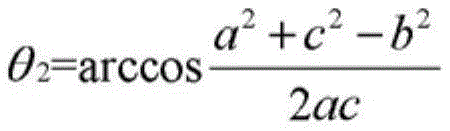

步骤A2、将所有的时间和角度与各自距离的数据整合为一个完整的数据文件,其时间按照先后顺序排列。由于各个卫星与地面站之间有可能会出现不互相连通的情况,所以获得的数据文件时间不是连续的,需要将数据文件时间变为连续,在不存在数据的时间将各个数据设置为NaN。Step A2, integrating all the time, angle and distance data into a complete data file, and the time is arranged in sequence. Since each satellite and the ground station may not be connected to each other, the obtained data file time is not continuous. It is necessary to change the data file time to continuous, and set each data to NaN when there is no data.
步骤A3、之后需要计算系统的最佳采样时间,这样可以在能够正确判断系统之间的干扰情况的前提下,尽可能减少所需要的数据计算量。计算最佳采样时间需要如下公式:In step A3, the optimal sampling time of the system needs to be calculated afterwards, so that the amount of data calculation required can be reduced as much as possible on the premise of correctly judging the interference between the systems. Calculating the optimal sampling time requires the following formula:

在计算中,需要获取所选取的星座轨道高度以及卫星运行角速度等的数据。In the calculation, it is necessary to obtain data such as the altitude of the selected constellation orbit and the angular velocity of the satellite.
在上式中,Δtstep-down表示系统的下行时间的步长,也就是系统最佳的采样时间间隔,Δtdown则为干扰NGSO卫星通过地球站的天线主瓣辐射范围所需的时间,这会受到系统的天线种类和放大能力,以及卫星轨道高度等的影响。Nstep-down表示受干扰系统地面站接收天线主瓣辐射面积的采样次数,其受主瓣宽度等的因素影响,是3dB宽度与是受干扰的NGSO系统地球站接收天线主瓣的离轴角采样间隔的比值。在实际工程中一般采用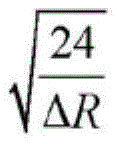
而Δtdown的值可以用卫星通过地球站接收天线主瓣辐射面积的角度与卫星在圆轨道上的角速度的比值确定。The value of Δt down can be determined by the ratio of the angle of the main lobe radiation area of the satellite receiving antenna through the earth station to the angular velocity of the satellite in the circular orbit.
在本例中最终根据上法确定时间步进为6秒。In this example, the time step is finally determined to be 6 seconds according to the above method.
步骤A4、根据获取的所需系统的系统最佳采样时间对总的数据文件进行时间上的采样,每隔6秒,获取所需数据,构成新的数据文件。Step A4. Sampling the total data files temporally according to the obtained optimal sampling time of the required system, obtaining the required data every 6 seconds to form a new data file.
步骤A5、需要确定本系统中的各个参数,包括A星座与B星座的发射功率、天线模型以及在系统中存在的主要损耗大小。Step A5. It is necessary to determine various parameters in the system, including the transmit power of constellation A and constellation B, the antenna model, and the main loss in the system.
对于所需要的天线模型与参数,根据ITU-R S.672-4的规定,NGSO系统的卫星天线的辐射模型可以按如下公式来表示:For the required antenna model and parameters, according to the provisions of ITU-R S.672-4, the radiation model of the satellite antenna of the NGSO system can be expressed by the following formula:

其中G(ψ)是方向角为ψ处的增益,Gm为主瓣的最大增益,ψ0为3dB波束宽度的半波束角,ψ1为第三个等式为0时的角度,Ls是相对于峰值增益内旁瓣的增益。一般来讲,按照经验Ls为-20,a为2.58,b为6.32。其A星座与B星座的卫星天线放大倍数如图3、图4所示:where G(ψ) is the gain at the direction angle ψ, G m is the maximum gain of the main lobe, ψ 0 is the half beam angle of the 3dB beamwidth, ψ 1 is the angle when the third equation is 0, L s is the gain of the sidelobe relative to the peak gain. Generally speaking, according to experience, L s is -20, a is 2.58, and b is 6.32. The satellite antenna magnifications of constellation A and constellation B are shown in Figure 3 and Figure 4:
另外ITU-R S.465-6则规定了NGSO系统中的地球站的天线放大能力。对于所研究的方向与主波束轴所成的角,应采用以下参考辐射图:In addition, ITU-R S.465-6 stipulates the antenna amplification capability of the earth station in the NGSO system. For the angle between the direction under study and the main beam axis, the following reference radiation pattern should be used:
对于

对于
G=-10dBiG=-10dBi
其中:in:
对于D/λ≥50,
对于D/λ<50,
G:天线的放大倍数G: The magnification of the antenna
D:天线直径D: Antenna diameter
λ:波长λ: wavelength

D/λ:归一化的反射器口面直径D/λ: Normalized reflector face diameter
步骤A6、计算邻星干扰信号对本星接收系统的等效噪声影响。Step A6, calculating the equivalent noise impact of the adjacent satellite interference signal on the local satellite receiving system.
步骤A61、一般按照国际电信联盟规定,只要邻星干扰信号对本星接收系统的等效噪声影响达到6%,一般就会认定邻星系统中存在干扰需要进行调整。所以也就是将6%视作判决门限。等效噪声温度相对增量可以表示为

也可以以分贝的形式表现为:It can also be expressed in decibels as:
I-N=-12.2dBI-N=-12.2dB
其中I表示干扰信号引起的系统相对噪声增量,而N表示链路自身存在的载噪比值。Among them, I represents the relative noise increase of the system caused by the interference signal, and N represents the carrier-to-noise ratio value of the link itself.
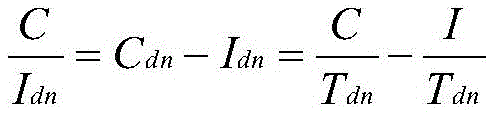
步骤A62、在考虑星间干扰时,选择采用功率来进行判断。在计算过程中,需要对载干比进行数据处理。所以最终传输的载干比与星间链路本身传输的载干比之间的关系为:Step A62, when considering inter-satellite interference, choose to use power for judgment. In the calculation process, it is necessary to perform data processing on the load-to-interference ratio. Therefore, the relationship between the carrier-to-interference ratio of the final transmission and the carrier-to-interference ratio transmitted by the inter-satellite link itself is:
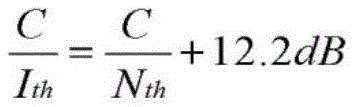
其中,

其中
步骤A7、根据不同的干扰情形,计算链路的载干比。Step A7. Calculate the carrier-to-interference ratio of the link according to different interference situations.
在考虑干扰情况时,主要分为两种的主要场景,主要分为在星座链路下行时其他星座对地球站接收天线之间的干扰以及在上行链路中其他星座对星座卫星接收天线造成的影响。在考虑第一种情况时,下行链路载干比就是:When considering the interference situation, it is mainly divided into two main scenarios, mainly divided into the interference between other constellations on the receiving antenna of the earth station during the downlink of the constellation link and the interference caused by other constellations on the receiving antenna of the constellation satellite in the uplink Influence. When considering the first case, the downlink carrier-to-interference ratio is:

当考虑以功率谱密度来对上述进行分析时,上式可以转变为:When considering the analysis of the above in terms of power spectral density, the above formula can be transformed into:

在计算下行链路载干比中,接收端的地球站的天线输出端的载波功率为In calculating the downlink carrier-to-interference ratio, the carrier power at the antenna output of the earth station at the receiving end is
Cdn=EIRPs-Ld+Ger C dn =EIRP s -L d +G er
其中EIRPs为载波卫星的EIRP值,Ld为下行链路的损耗值,Ger为地面站的接收增益。在考虑第二种情况时,主体方法相同,需要注意要带入的是卫星天线数据以及考虑其相应的信号干扰。整体过程如图5所示。Among them, EIRP s is the EIRP value of the carrier satellite, L d is the loss value of the downlink, and G er is the receiving gain of the ground station. When considering the second case, the main method is the same, and it is necessary to pay attention to the satellite antenna data and consider its corresponding signal interference. The overall process is shown in Figure 5.
步骤A8、根据无线电规则8,判断是否需要对系统进行调整,以减少星间干扰造成的影响。Step A8, according to the
在考虑系统的余量M时,可以根据之前计算的门限得到式:When considering the margin M of the system, the formula can be obtained according to the previously calculated threshold:

根据无线电规则可知,在判断是否存在干扰时,可以利用获得的系统余量,当系统余量M大于0时,系统的干扰情况不严重,不会对主链路的信道造成影响。而当M小于0时,干扰就会对主链路的通信造成影响,需要对系统进行例如自适应功率控制等操作,来改善信道环境。According to the radio regulations, when judging whether there is interference, the obtained system margin can be used. When the system margin M is greater than 0, the system interference is not serious and will not affect the channel of the main link. When M is less than 0, the interference will affect the communication of the main link, and operations such as adaptive power control need to be performed on the system to improve the channel environment.
这样,就可以根据卫星星座参数等,计算等效噪声温度相对增量,并根据无线电规则附录8来对其进行判断,两系统之间是否需要进行协调。In this way, the relative increment of equivalent noise temperature can be calculated according to the satellite constellation parameters, etc., and it can be judged according to
最终下行链路中的星间干扰余量情况如图5所示,可以看出在本例中,星座B对星座A系统的干扰情况不会对系统产生明显影响。Figure 5 shows the inter-satellite interference margin in the final downlink. It can be seen that in this example, the interference of constellation B to constellation A system will not have a significant impact on the system.
最终上行链路中的星间干扰余量情况如图6所示,可以看出在本例中,星座B对星座A系统的干扰情况可能会产生影响。Figure 6 shows the inter-satellite interference margin in the final uplink. It can be seen that in this example, constellation B may have an impact on the interference of constellation A system.
通过以上的判断方式,就可以得知在数据挖掘对数据进行分析的时候,针对任意的时间对应的角度,星间距离,频率以及降雨量等,判断该情形下是否存在干扰。Through the above judgment methods, it can be known that when data mining is analyzing the data, it can be judged whether there is interference in this situation for the angle corresponding to any time, the distance between the stars, the frequency and the rainfall, etc.
对干扰与时间和频率的多维度分析可知,在频率从900KHz到25GHz的范围内,随着频率增加,由于自由空间损耗等的增加,最终系统的SINR也会降低,受到干扰的可能增大,而对于干扰与时间的关系来讲,跟随着时间变化,星间的角度和距离也会变化,最终干扰判决会如之前的图像所示,这就是星间数据的干扰特征。The multi-dimensional analysis of interference, time and frequency shows that within the frequency range from 900KHz to 25GHz, as the frequency increases, due to the increase in free space loss, the SINR of the final system will also decrease, and the possibility of interference will increase. As for the relationship between interference and time, as time changes, the angle and distance between the stars will also change, and the final interference judgment will be as shown in the previous image, which is the interference feature of the inter-satellite data.
虽然在本文中参照了特定的实施方式来描述本发明,但是应该理解的是,这些实施例仅仅是本发明的原理和应用的示例,因此应该理解的是,可以对示例性的实例进行许多修改,并且可以设计出其他的布置,只要不偏离所附权利要求所限定的本发明的精神和范围,应该理解的是,可以通过不同于原始权利要求所描述的方式来结合不同的从属权利要求和本文中所述的特征,还可以理解的是,结合单独实施例所描述的特征可以使用在其它实施例中。While the invention is described herein with reference to specific embodiments, it is to be understood that these embodiments are merely illustrative of the principles and applications of the invention, and it is therefore understood that many modifications are possible in illustrative examples , and other arrangements may be devised without departing from the spirit and scope of the invention as defined in the appended claims, it being understood that different dependent claims and Features described herein, it will also be understood that features described in connection with individual embodiments can be used in other embodiments.
Claims (4)




Priority Applications (1)
| Application Number | Priority Date | Filing Date | Title |
|---|---|---|---|
| CN202110296984.2A CN113067651B (en) | 2021-03-19 | 2021-03-19 | Inter-constellation interference detection method for low-orbit satellite system |
Applications Claiming Priority (1)
| Application Number | Priority Date | Filing Date | Title |
|---|---|---|---|
| CN202110296984.2A CN113067651B (en) | 2021-03-19 | 2021-03-19 | Inter-constellation interference detection method for low-orbit satellite system |
Publications (2)
| Publication Number | Publication Date |
|---|---|
| CN113067651A CN113067651A (en) | 2021-07-02 |
| CN113067651B true CN113067651B (en) | 2023-01-31 |
Family
ID=76562608
Family Applications (1)
| Application Number | Title | Priority Date | Filing Date |
|---|---|---|---|
| CN202110296984.2A Active CN113067651B (en) | 2021-03-19 | 2021-03-19 | Inter-constellation interference detection method for low-orbit satellite system |
Country Status (1)
| Country | Link |
|---|---|
| CN (1) | CN113067651B (en) |
Families Citing this family (6)
| Publication number | Priority date | Publication date | Assignee | Title |
|---|---|---|---|---|
| CN114844552B (en) * | 2022-02-14 | 2024-11-08 | 国家国防科技工业局重大专项工程中心(国家航天局对地观测与数据中心) | A method and system for determining interference protection standards for remote sensing satellite data transmission links |
| CN114900223B (en) * | 2022-04-11 | 2023-12-22 | 中国科学院国家空间科学中心 | Inter-satellite communication link interference avoidance method based on interfered link included angle |
| CN115276771B (en) * | 2022-07-28 | 2024-01-16 | 银河航天(北京)网络技术有限公司 | Non-stationary orbit satellite gateway station service range simulation method and device |
| CN115549826B (en) * | 2022-09-13 | 2025-03-04 | 中国空间技术研究院 | A method for determining the co-frequency interference of satellite constellations to geostationary satellites |
| CN116483826A (en) * | 2022-10-31 | 2023-07-25 | 中国卫通集团股份有限公司 | Satellite link margin calculation method and device |
| CN117200868B (en) * | 2023-09-27 | 2024-05-14 | 中国空间技术研究院 | A method for evaluating and verifying inter-constellation interference and avoidance measures |
Citations (8)
| Publication number | Priority date | Publication date | Assignee | Title |
|---|---|---|---|---|
| WO2015034912A1 (en) * | 2013-09-06 | 2015-03-12 | Qualcomm Incorporated | Method for communication in a non-geostationary satellite network with a relay node located in the beams of two satellites and relaying data from the first to the second satellite according to the availability of an internet point ofpresence (ipp) |
| CN110224739A (en) * | 2019-06-04 | 2019-09-10 | 航天科工空间工程发展有限公司 | A kind of LEO Satellite communication link frequency interferences judgment method |
| CN110572192A (en) * | 2019-09-04 | 2019-12-13 | 航天科工空间工程发展有限公司 | Frequency avoidance method and device for low-earth-orbit satellite |
| CN110601777A (en) * | 2019-08-29 | 2019-12-20 | 浙江大学 | Method for estimating satellite-ground downlink co-channel interference under low-orbit mobile satellite constellation |
| CN110958047A (en) * | 2019-10-12 | 2020-04-03 | 中国空间技术研究院 | A low-orbit constellation GEO frequency interference avoidance method based on multiple coverage |
| CN111934739A (en) * | 2020-07-02 | 2020-11-13 | 航天科工空间工程发展有限公司 | Interference avoidance method for reducing pitching angle of NGSO satellite |
| CN112311439A (en) * | 2019-07-31 | 2021-02-02 | 台利斯公司 | Method for determining constraints for non-geostationary systems |
| CN112383344A (en) * | 2020-11-13 | 2021-02-19 | 航天科工空间工程发展有限公司 | Method and system for sharing frequency spectrum of NGSO satellite constellation system and ground system |
Family Cites Families (5)
| Publication number | Priority date | Publication date | Assignee | Title |
|---|---|---|---|---|
| US20030073435A1 (en) * | 2001-10-11 | 2003-04-17 | Steven Thompson | System and method for controlling interference affecting satellite terminals in a satellite communications network by establishing and using virtual cells which are independent of the cells formed by the spot beams generated by the satellite |
| US8116253B2 (en) * | 2002-10-08 | 2012-02-14 | Qualcomm Incorporated | Controlling forward and reverse link traffic channel power |
| CN102520461B (en) * | 2011-12-08 | 2014-07-02 | 中国空间技术研究院 | Method for determining interference from NGSO satellite earth detection system to deep space detection system |
| US9730227B2 (en) * | 2015-03-20 | 2017-08-08 | Qualcomm Incorporated | Dynamic frequency allocation of satellite beams |
| US10149200B2 (en) * | 2016-06-07 | 2018-12-04 | Iridium Satellite Llc | Interference mitigation for a satellite network |
-
2021
- 2021-03-19 CN CN202110296984.2A patent/CN113067651B/en active Active
Patent Citations (8)
| Publication number | Priority date | Publication date | Assignee | Title |
|---|---|---|---|---|
| WO2015034912A1 (en) * | 2013-09-06 | 2015-03-12 | Qualcomm Incorporated | Method for communication in a non-geostationary satellite network with a relay node located in the beams of two satellites and relaying data from the first to the second satellite according to the availability of an internet point ofpresence (ipp) |
| CN110224739A (en) * | 2019-06-04 | 2019-09-10 | 航天科工空间工程发展有限公司 | A kind of LEO Satellite communication link frequency interferences judgment method |
| CN112311439A (en) * | 2019-07-31 | 2021-02-02 | 台利斯公司 | Method for determining constraints for non-geostationary systems |
| CN110601777A (en) * | 2019-08-29 | 2019-12-20 | 浙江大学 | Method for estimating satellite-ground downlink co-channel interference under low-orbit mobile satellite constellation |
| CN110572192A (en) * | 2019-09-04 | 2019-12-13 | 航天科工空间工程发展有限公司 | Frequency avoidance method and device for low-earth-orbit satellite |
| CN110958047A (en) * | 2019-10-12 | 2020-04-03 | 中国空间技术研究院 | A low-orbit constellation GEO frequency interference avoidance method based on multiple coverage |
| CN111934739A (en) * | 2020-07-02 | 2020-11-13 | 航天科工空间工程发展有限公司 | Interference avoidance method for reducing pitching angle of NGSO satellite |
| CN112383344A (en) * | 2020-11-13 | 2021-02-19 | 航天科工空间工程发展有限公司 | Method and system for sharing frequency spectrum of NGSO satellite constellation system and ground system |
Non-Patent Citations (3)
| Title |
|---|
| Intelligent Resource Management for Satellite and Terrestrial Spectrum Shared Networking toward B5G;Min Jia;《IEEE Wireless Communications》;20200304;全文 * |
| 低轨卫星系统频谱干扰及其规避仿真与分析;代建中;《信息技术》;20210225;全文 * |
| 基于LTE的GEO卫星系统的一种窄带上行传输方案;江丽琼;《第十二届卫星通信学术年会论文集》;20160303;全文 * |
Also Published As
| Publication number | Publication date |
|---|---|
| CN113067651A (en) | 2021-07-02 |
Similar Documents
| Publication | Publication Date | Title |
|---|---|---|
| CN113067651B (en) | Inter-constellation interference detection method for low-orbit satellite system | |
| CN113131989B (en) | A Design Method of Spectrum Sharing Simulation Time Parameters for NGSO Constellation System | |
| CN114513248B (en) | Self-adaptive transmission method based on low-earth-orbit satellite communication system | |
| US6567645B1 (en) | Multiple satellite repeater management system using frame error rate for diversity selection | |
| CN112399429B (en) | Communication scene modeling method and system for satellite communication system | |
| CN115118363B (en) | A method for obtaining interference and channel capacity of NGSO satellite system based on spatial position probability | |
| US6321065B1 (en) | Performance enhancement of open-loop power control for satellite communication systems | |
| CN113315565B (en) | Multi-beam high-flux satellite forward link power band balancing system | |
| CN114845404A (en) | Uplink power control method for narrow-band GEO satellite communication asymmetric channel user | |
| CN114785381A (en) | Interference elimination method based on forward link model of multi-beam satellite system | |
| CN106850036B (en) | A priority-based scheduling method for movable spot beams in medium-orbit satellite systems | |
| CN115549826A (en) | A Judgment Method for Co-frequency Interference Between Satellite Constellation and Geostationary Orbit Satellite | |
| CN107395299B (en) | Interference analysis method for 450MHz frequency band satellite meteorological service and railway train dispatching system | |
| CN117200868A (en) | A method for inter-constellation interference assessment and avoidance measures verification | |
| CN116781143A (en) | Satellite-ground laser microwave cooperative transmission method under complex weather condition | |
| Nguyen-Kha et al. | Seamless 5g automotive connectivity with integrated satellite terrestrial networks in c-band | |
| CN119582932B (en) | Calculation method of the probability of uplink interference of low-orbit satellites by ground stations | |
| CN113890593A (en) | Satellite link power control method based on self-adaption | |
| CN110224739A (en) | A kind of LEO Satellite communication link frequency interferences judgment method | |
| CN114301510A (en) | 6G low-earth-orbit satellite network satellite deployment method based on inter-satellite distance constraint | |
| CN116321465B (en) | Satellite frequency spectrum sensing method and system based on phased array antenna | |
| Cheng et al. | Latency analysis of leo satellite relay communication: An application of conditional contact angle distribution | |
| Zhang et al. | Evaluating the Influence of Satellite Systems on Terrestrial Networks: Analyzing S-Band Interference | |
| Cheng et al. | Low delay LEO satellite relay communication with best relay selection | |
| Vatalaro et al. | Statistical channel modelling and performance evaluation in satellite personal communications |
Legal Events
| Date | Code | Title | Description |
|---|---|---|---|
| PB01 | Publication | ||
| PB01 | Publication | ||
| SE01 | Entry into force of request for substantive examination | ||
| SE01 | Entry into force of request for substantive examination | ||
| GR01 | Patent grant | ||
| GR01 | Patent grant |