CN113047827A - Horizontal well yield prediction method and device - Google Patents
Horizontal well yield prediction method and device Download PDFInfo
- Publication number
- CN113047827A CN113047827A CN201911378624.6A CN201911378624A CN113047827A CN 113047827 A CN113047827 A CN 113047827A CN 201911378624 A CN201911378624 A CN 201911378624A CN 113047827 A CN113047827 A CN 113047827A
- Authority
- CN
- China
- Prior art keywords
- well
- vertical
- horizontal well
- yield
- potential
- Prior art date
- Legal status (The legal status is an assumption and is not a legal conclusion. Google has not performed a legal analysis and makes no representation as to the accuracy of the status listed.)
- Pending
Links
Images


Classifications
-
- E—FIXED CONSTRUCTIONS
- E21—EARTH OR ROCK DRILLING; MINING
- E21B—EARTH OR ROCK DRILLING; OBTAINING OIL, GAS, WATER, SOLUBLE OR MELTABLE MATERIALS OR A SLURRY OF MINERALS FROM WELLS
- E21B49/00—Testing the nature of borehole walls; Formation testing; Methods or apparatus for obtaining samples of soil or well fluids, specially adapted to earth drilling or wells
Landscapes
- Life Sciences & Earth Sciences (AREA)
- Engineering & Computer Science (AREA)
- Geology (AREA)
- Mining & Mineral Resources (AREA)
- Physics & Mathematics (AREA)
- Environmental & Geological Engineering (AREA)
- Fluid Mechanics (AREA)
- General Life Sciences & Earth Sciences (AREA)
- Geochemistry & Mineralogy (AREA)
- Management, Administration, Business Operations System, And Electronic Commerce (AREA)
Abstract
The invention relates to a horizontal well yield prediction method and device, and belongs to the technical field of oil and gas field development. The method comprises the following steps: the horizontal well yield is equivalent to the superposition of the yields of a plurality of vertical wells; obtaining the boundary potential of the pressure relief range of the horizontal well and the bottom potential of each vertical well according to the potential superposition principle; obtaining the relation between the output of each vertical well and the number of the vertical wells according to the relation between potential and pressure, the boundary potential and the bottom potential of each vertical well; further obtaining the relation between the yield of the horizontal well and the number of the vertical wells; obtaining the change rate of the horizontal well yield along with the number of the vertical wells according to the relation between the horizontal well yield and the number of the vertical wells; taking the number of the vertical wells with the change rate smaller than a set threshold value as the equivalent number of the vertical wells; and further obtaining the predicted yield of the horizontal well. The horizontal well is equivalent to a plurality of vertical wells, so that corresponding parameters can be adopted for different reservoir physical properties in the horizontal section drilling, the yield of the horizontal well can be simply and accurately predicted, and the accuracy and the applicability of yield prediction are improved.
Description
Technical Field
The invention relates to a horizontal well yield prediction method and device, and belongs to the technical field of oil and gas field development.
Background
Compared with a vertical well, the horizontal well has the advantages of small production pressure difference and large controlled air leakage area, so that the horizontal well is widely applied. For a high-sulfur-content gas reservoir, the horizontal well can increase the oil-gas circulation capacity, can slow down the pressure drop and reduce the time of elemental sulfur precipitation under the condition of ensuring the yield, and improves the recovery ratio of no sulfur precipitation. Therefore, the horizontal well has been widely regarded as an important development technical means for the development of the sulfur-containing gas reservoir, but the yield prediction method of the horizontal well has yet to be deeply researched, and particularly, the yield calculation of the horizontal well under the condition of considering the special seepage rule and the phase state change of the sulfur-containing gas reservoir needs to be deeply discussed.
The existing method for calculating the yield of the horizontal well has two problems:
firstly, the calculation process is complicated and the accuracy is poor.
Secondly, the common characteristic of the existing horizontal well productivity calculation formula is that the physical parameters used in the formula are as follows: the permeability K, the effective formation thickness h, the viscosity μ, etc. are typically a single set of values. Therefore, the existing method is more practical for blocky, stable and continuous sedimentary reservoirs with stable reservoir development and small difference of physical property parameters, but is not suitable for sedimentary reservoirs with fast sedimentary microfacies, such as continental plaid rivers or delta diversion rivers and the like, with fast lithological change and fast physical property change of strata encountered by a horizontal section.
Disclosure of Invention
The application aims to provide a horizontal well yield prediction method and device, which are used for solving the problem of complex calculation in the prior art and further solving the problem of poor applicability in the prior art.
In order to achieve the purpose, the invention provides a horizontal well yield prediction method, which comprises the following steps:
the horizontal well yield is equivalent to the superposition of the yields of a plurality of vertical wells;
obtaining the boundary potential of the pressure relief range of the horizontal well and the bottom potential of each vertical well according to the potential superposition principle;
obtaining the relation between the yield of each straight well and the number of the straight wells according to the relation between the potential and the pressure, the boundary potential and the bottom potential of each straight well; further obtaining the relation between the yield of the horizontal well and the number of the vertical wells;
obtaining the change rate of the horizontal well yield along with the number of the vertical wells according to the relation between the horizontal well yield and the number of the vertical wells;
taking the number of the vertical wells when the change rate is smaller than a set threshold value as the equivalent number of the vertical wells; and obtaining the predicted horizontal well yield according to the equivalent number of the vertical wells and the relation between the horizontal well yield and the number of the vertical wells.
In addition, the invention also provides a horizontal well yield prediction device which comprises a memory and a processor, wherein the processor is used for executing instructions stored in the memory to realize the horizontal well yield prediction method.
The beneficial effects are that: the horizontal well is equivalent to a plurality of vertical wells, so that the yield of the horizontal well can be more accurately predicted by adopting corresponding parameters aiming at the physical properties of reservoirs with different drilling conditions in the horizontal section, the overall calculation process is simple, and the accuracy of yield prediction is improved. The method is also suitable for sedimentary reservoirs with fast lithological change and fast physical property change, improves the applicability of yield prediction, provides a new solution for calculating the yield of the horizontal well with fast reservoir change, and has good popularization and application values in oil field horizontal well development and gas field horizontal well development.
Further, in the method and the device for predicting the yield of the horizontal well, in order to obtain the boundary potential of the pressure relief range of the horizontal well and the bottom potential of each vertical well, the calculation modes of the boundary potential of the pressure relief range of the horizontal well and the bottom potential of each vertical well are as follows:


wherein phieThe boundary potential of the pressure relief range of the horizontal well; phiwThe bottom hole potential of the ith straight well; q is the unit formation thickness production; reTo convert the pressure relief radius; n is the number of vertical wells; riThe total equivalent distance of the N vertical wells relative to the ith vertical well; c is a constant term and is the sum of constant terms of each vertical well.
Further, in the horizontal well production prediction method and apparatus, in order to obtain the relationship between the production of each vertical well and the number of vertical wells, the boundary potential and the constant term of the bottom potential of each vertical well are eliminated, the relationship between the production of each vertical well and the number of vertical wells is obtained by using the relationship between the potential and the pressure, and the relationship between the production of the ith vertical well and the number of vertical wells is:

wherein Q isiThe yield of the ith vertical well; n is the number of vertical wells; kiThe permeability of the ith straight well is shown; h isiThe effective thickness of the stratum of the ith vertical well; mu is viscosity; peThe formation pressure at the boundary of the ith vertical well is taken as the formation pressure; pwThe bottom hole flowing pressure of the ith straight well.
Furthermore, in the horizontal well yield prediction method and device, for the sake of simple calculation, the horizontal well yield is equivalent to the superposition of the yields of a plurality of vertical wells which are arranged at equal intervals on the horizontal section of the horizontal well.
Further, in the horizontal well yield prediction method and device, in order to obtain the reduced pressure release radius, the calculation method of the reduced pressure release radius is as follows:

wherein a is the major axis of the elliptical pressure relief range of the horizontal well; and b is a short axis of the elliptical pressure relief range of the horizontal well.
Further, in the horizontal well yield prediction method and apparatus, in order to obtain the total equivalent distance between the N vertical wells and the ith vertical well, the calculation method of the total equivalent distance between the N vertical wells and the ith vertical well is as follows:
Ri=rw*(d+rw)*(2d+rw)*...*[(i-1)d+rw]*(d+rw)*(2d+rw)*...* [(N-i)*d+rw];
wherein r iswIs the wellbore radius of the vertical well, and d is the spacing between the vertical wells.
Furthermore, in the horizontal well yield prediction method and device, for simple calculation, the corresponding horizontal well yields under different vertical well quantities are calculated on the basis of the relationship between the horizontal well yields and the vertical well quantities, so that the relationship between the change rates of the horizontal well yields relative to the change rates of the vertical well quantities is fitted, and the vertical well quantities when the change rates are smaller than the set threshold value are solved.
Further, in the horizontal well yield prediction method and device, in order to ensure the accuracy of the number of vertical wells, the set threshold value is 0.001.
Further, in the horizontal well yield prediction method and device, the relationship between potential and pressure is as follows:

wherein Φ is potential; p is pressure; k is the permeability; μ is viscosity.
Drawings
FIG. 1 is a schematic diagram of the potential of a multiple vertical well of the present invention at any point in the formation;
FIG. 2 is a schematic diagram of the elliptical pressure relief range of a horizontal well of the present invention;
FIG. 3 is a schematic view of a horizontal well of the present invention equivalent to 11 vertical wells;
FIG. 4 is a curve fit plot of the present invention for determining the number of equivalent vertical wells.
Detailed Description
The first embodiment of the horizontal well yield prediction method comprises the following steps:
the main idea of the invention is to equate the production of a horizontal well to the sum of the production of N vertical wells arranged on the horizontal section of the horizontal well, so that the production of each vertical well and the number N of vertical wells need to be determined. The determination process of the yield of each vertical well comprises the following steps: determining the boundary potential of the pressure relief range of the horizontal well and the bottom potential of each vertical well according to the potential superposition principle; and obtaining the corresponding relation between the number N of the vertical wells and the yield of each vertical well according to the boundary potential, the bottom potential of each well and the relation between the potential and the pressure. The determination process of the number N of the vertical wells comprises the following steps: and obtaining the yield of the horizontal well according to the yield of each well, and determining the number of the vertical wells according to the change rate of the yield of the horizontal well along with the number of the vertical wells. And (4) obtaining the yield of the horizontal well after the yield of each vertical well and the number N of the vertical wells are determined.
When several wells are present in the formation at the same time, the potential of any point in the formation can be determined according to the principle of superposition of potentials based on differential thought and seepage mechanics. The principle of potential superposition is as follows: when seepage obeys the linear law, and a plurality of source sinks simultaneously exist in an infinite plane stratum, the potential of the synthetic flow is equal to the algebraic sum of potentials caused by the independent existence of each source sink, and the problem of simultaneous operation of a plurality of wells can be solved according to the potential superposition principle.
As shown in FIG. 1, assuming n vertical wells in an infinite stratum to produce simultaneously, the potential phi at M at any point in the stratum is determinedM. Each vertical well is numbered 1,2, 3, the.

Wherein phiiPotential caused to point M for the ith vertical well (i.e., producing well); r isiThe unit is M, and the linear distance is the linear distance from the ith vertical well to the point M; q. q.siThe unit stratum thickness production of the ith vertical well; ciIs a constant term.
According to the principle of potential superposition, when all vertical wells work simultaneously, the potential phi of M pointMComprises the following steps:


C=C1+C2+…+Ci+…+Cn;
wherein phiMThe superposition value of the potential is caused to M points by n straight wells.
The horizontal well yield prediction method provided by the embodiment comprises the following steps:
1) the horizontal well yield is equivalent to the superposition of the yields of a plurality of vertical wells; setting the number of equivalent vertical wells of the horizontal well as N, arranging the equivalent vertical wells at equal intervals on the horizontal section of the horizontal well, and obtaining the boundary potential of the pressure relief range of the horizontal well and the bottom potential of each vertical well by utilizing the potential superposition principle according to the number of the vertical wells.
As shown in fig. 2, the horizontal segment length of the horizontal well is L, and the unit is m; the major axis, the minor axis and the focal length of the oval pressure relief range of the horizontal well are respectively a, b and c, and the unit is m. Assuming a unit formation thickness production q per vertical welli(generally, the parameters of each well are the same and are q, because the unit thickness yield of each vertical well gradually converges with the increase of the number N of equivalent vertical wells, and finally reaches the precision required by a certain project), neglecting the friction resistance of a well casing, ensuring that the pressure at each position of the horizontal well section is equal without breakingLayer effects, ignoring gravity and capillary forces. Each vertical well is numbered 1,2, 3, 1, i, N.
Boundary potential phi at boundary of pressure relief range of horizontal welleComprises the following steps:

wherein R iseAnd converting the pressure relief radius.
Bottom hole potential phi of ith straight wellwN vertical wells are distributed on the horizontal section at equal intervals, the interval between the vertical wells is d,

wherein r iswIs the wellbore radius of a vertical well; riIs the product of the bottom hole distances of the N vertical wells relative to the ith vertical well (namely the total equivalent distance of the N vertical wells relative to the ith vertical well) and has the unit of mN。
2) And obtaining the corresponding relation between the number N of the vertical wells and the yield of each vertical well according to the boundary potential, the bottom potential of each well and the relation between the potential and the pressure.
Eliminating constant terms in the boundary potential and the bottom hole potential of each well, and obtaining the difference between the boundary potential and the bottom hole potential of each well
The relationship of potential Φ to pressure P is: where K is permeability and μ is viscosity (generally constant, same for each vertical well).
To obtain the ith vertical well To obtain
Wherein, PeThe formation pressure at the boundary of the ith vertical well is taken as the formation pressure; pwThe bottom hole flowing pressure of the ith straight well; kiThe permeability of the ith straight well is shown.
Further obtain
It is deduced that,
production Q of ith vertical welli(unit is m)3The/d) is:

wherein h isiThe effective thickness of the stratum of the ith vertical well.
3) The yield Q of the horizontal well is the sum of the yields of the N vertical wells, and the yield Q is obtained by:

4) and determining the number N of the vertical wells.
And calculating corresponding horizontal well yield under different vertical well numbers on the basis of the relation between the horizontal well yield and the vertical well number, thereby fitting the relation of the change rate of the horizontal well yield relative to the change of the vertical well number.
Rate of change f (N) ═ Δ Q/Δ N ═ ANBWherein A, B is a fitting parameter, fitting a trend of f (N) along with the number N of vertical wells, and when f (N) is less than a set threshold (in this embodiment, the set threshold is 0.001), satisfying the mine field requirement, and determining the number of vertical wells at that time as the final equivalent number of vertical wells。
5) And (5) substituting the final equivalent number of the vertical wells into a formula of the yield Q of the horizontal well to obtain the yield of the horizontal well.
The method solves the problem that the prior art cannot consider the difference of physical properties of the actual drilled reservoir in the horizontal section, and on the basis, when the physical property parameters of the horizontal well penetrating through each part of the stratum are known, the method can substitute the corresponding parameters such as the permeability K, the viscosity mu, the stratum thickness h and the like, so that the obtained horizontal well productivity can reflect the actual situation of the stratum better.
The second horizontal well yield prediction method comprises the following steps:
the main idea of the horizontal well yield prediction method provided in this embodiment is to solve the problem of complicated calculation in the prior art, and therefore the assumption of this embodiment is that the yield per unit formation thickness q of each vertical well isi(generally, the parameter of each well is the same and is q), the stratum is horizontally uniform and uniform in thickness, the single-phase homogeneous fluid ignores the friction resistance of the shaft, the pressure of each part of the horizontal well section is equal, the fault influence is avoided, the gravity and the pipe force are ignored, and the permeability K of each vertical well is also the sameiK, the effective stratum thickness h of each vertical welliThe same is h, so the yield Q of the ith vertical welli(unit is m)3The/d) is:

the explanation of the characters in the formula and other implementation processes are already described in the first embodiment, and are not described herein.
The prediction method of the present embodiment is verified by a specific example.
The embodiment of the horizontal well yield calculation method comprises the following steps: compared with the calculation result of a classic horizontal well productivity formula, the method has the following parameters:
ΔP=Pe-Pw=1MPa;μ=1mpa·s;K=1mD;h=5m;a=3000m;
L=1000m;rw=0.1m;
from the above-mentioned parameters, it is possible to, reduced pressure relief radius of

The above parameters are substituted into the traditional classical capacity formula:

the yield of the horizontal well is obtained as Q-12.626 multiplied by 10-6m3And/s, the interpretation of the characters in the formula is the same as that in the formula of the invention, and the description is not repeated here.
The above parameters are substituted into the formula of the present invention, and the operation process is described by taking the equivalent vertical well number N as 11,21,41,101 as an example, and includes the following steps:
the trial calculation of N is 11, 11 vertical wells divide the horizontal well section into 10 sections, as shown in figure 3, the yield Q of the ith vertical well is obtained according to the yield formula of the inventioni:

Calculating R of each equivalent vertical welli:
Ri=rw*(d)*(2d)*...*[(i-1)d]*(d)*(2d)*...*[(N-i)*d]
And has the following components: r1=R11;R2=R10;R3=R9;R4=R8;R5=R7;R6=R6。
The yield of each of the 11 vertical wells and the yield of the horizontal well are calculated, and the obtained results are shown in the table I:
when the table is N is 11, the yield of each equivalent vertical well and the yield of the horizontal well are calculated

Similarly, the trial calculation of N being 21,41,101 is completed, and the total calculation result is shown in table two:
horizontal well productivity calculations when table two N is 11,21,41,101
| |
11 | 21 | 41 | 101 |
| Q | 10.64183 | 11.46532 | 11.88481 | 12.10738 |
Determining the final equivalent vertical well number N and the horizontal well yield, and making the change rate delta Q/delta N of the horizontal well yield along with the equivalent vertical well number, as shown in figure 4, along with the increase of the equivalent vertical well number, the increment of the horizontal well yield approaches to zero, and the formula is determined by decreasing:
ΔQ/ΔN=26.46N-2.08< 0.001, i.e. a ═ 26.46, B ═ 2.08.
When N is more than or equal to 134, the change rate delta Q/delta N is less than 0.001, which meets the requirement of actual mine production precision; determining N to 134 as the final equivalent vertical well number, substituting into a formula to calculate the corresponding final horizontal well yield to be 12.456 multiplied by 10-6m3/s。
Evaluation of the calculation accuracy to obtain a final yield of 12.456X 10⁻⁶m3Results of the/s and classical yield equation 12.626 × 10⁻⁶m3Absolute error of 0.17X 10/s-6m3And/s, the relative error is 1.3 percent, further indicating that the calculation method provided by the invention achieves better calculation accuracy. The productivity obtained by equivalently using the horizontal well as a plurality of vertical wells and then overlapping and solving the horizontal well is reliable.
Third embodiment of horizontal well yield prediction method:
the method for predicting the yield of the horizontal well, which is provided by the embodiment one, is different from the embodiment one in that the arrangement mode of the vertical wells on the horizontal section of the horizontal well is equidistant, the embodiment is that the vertical wells are arranged on the horizontal section of the horizontal well at unequal intervals, the distances d in the unequal interval arrangement mode can be randomly arranged or arranged according to a certain rule, and the calculation mode of obtaining the total equivalent distance of the N vertical wells relative to the ith vertical well is as follows:
Ri=rw*(d1+rw)*(d2+rw)*...*(di-1+rw)*(di+1+rw)*(di+2+rw)*...* (dN-i+rw);
wherein r iswRadius of the well bore of the vertical well, d1、d2、di-1、di+1、di+2、dN-iThe distance between the 1 st, 2 nd, … … nd, i-1 st, i +2 nd, … … th and the N-i th vertical wells and the i th vertical well. And then, the yield of the horizontal well is calculated, but the calculation mode of the mode is too complex, and other implementation processes for calculating the yield of the horizontal well are introduced in the first embodiment of the horizontal well yield prediction method and are not described in detail herein.
The fourth horizontal well yield prediction method comprises the following steps:
the difference between the horizontal well yield prediction method provided in this embodiment and the first embodiment is that the set threshold in the first embodiment is 0.001, and this parameter is set as needed, and may be increased or decreased.
Fifth example of the horizontal well production prediction method:
the method for predicting the horizontal well yield provided by the embodiment is different from the first embodiment in that the number of N is solved in the first embodiment by a fitting manner, however, as can be seen from steps 1), 2) and 3) in the first embodiment, the yield Q of the horizontal well is a function of the number of the vertical wells N, and then the derivation on the number of the vertical wells is performed, so that the variation f (N) of the yield of the horizontal well along with the number of the vertical wells is obtained, that is, Δ Q/Δ N, therefore, in the present embodiment, the number of N when f (N) < 0.001 is obtained by calculation through direct derivation, but the calculation manner in this manner is too complex, and other implementation processes for calculating the yield of the horizontal well are already introduced in the first embodiment of the method for predicting the horizontal well yield, and are not described herein too much.
The embodiment of the horizontal well yield prediction device is as follows:
the horizontal well production prediction device provided by the embodiment comprises a memory and a processor, wherein the processor is used for executing instructions stored in the memory to realize the horizontal well production prediction method.
The specific implementation process of the horizontal well yield prediction method is already described in the first embodiment of the horizontal well yield prediction method, and will not be described in detail herein.
The second horizontal well yield prediction device embodiment:
the horizontal well production prediction device provided by the embodiment comprises a memory and a processor, wherein the processor is used for executing instructions stored in the memory to realize the horizontal well production prediction method.
The specific implementation process of the horizontal well yield prediction method is already described in the second embodiment of the horizontal well yield prediction method, and redundant description is not repeated here.
Third embodiment of the horizontal well yield prediction device:
the horizontal well production prediction device provided by the embodiment comprises a memory and a processor, wherein the processor is used for executing instructions stored in the memory to realize the horizontal well production prediction method.
The specific implementation process of the horizontal well yield prediction method is already described in the third embodiment of the horizontal well yield prediction method, and redundant description is not repeated here.
The fourth embodiment of the horizontal well yield prediction device:
the horizontal well production prediction device provided by the embodiment comprises a memory and a processor, wherein the processor is used for executing instructions stored in the memory to realize the horizontal well production prediction method.
The specific implementation process of the horizontal well yield prediction method is described in the fourth embodiment of the horizontal well yield prediction method, and will not be described in detail herein.
Fifth embodiment of the horizontal well yield prediction apparatus:
the horizontal well production prediction device provided by the embodiment comprises a memory and a processor, wherein the processor is used for executing instructions stored in the memory to realize the horizontal well production prediction method.
The specific implementation process of the horizontal well yield prediction method is already described in the fifth horizontal well yield prediction method embodiment, and redundant description is not repeated here.
Claims (10)
1. The horizontal well yield prediction method is characterized by comprising the following steps:
the horizontal well yield is equivalent to the superposition of the yields of a plurality of vertical wells;
obtaining the boundary potential of the pressure relief range of the horizontal well and the bottom potential of each vertical well according to the potential superposition principle;
obtaining the relation between the output of each vertical well and the number of the vertical wells according to the relation between the potential and the pressure, the boundary potential and the bottom potential of each vertical well; further obtaining the relation between the yield of the horizontal well and the number of the vertical wells;
obtaining the change rate of the horizontal well yield along with the number of the vertical wells according to the relation between the horizontal well yield and the number of the vertical wells;
taking the number of the vertical wells when the change rate is smaller than a set threshold value as the equivalent number of the vertical wells; and obtaining the predicted horizontal well yield according to the equivalent number of the vertical wells and the relation between the horizontal well yield and the number of the vertical wells.
2. The horizontal well yield prediction method according to claim 1, wherein the boundary potential of the pressure relief range of the horizontal well and the bottom potential of each vertical well are calculated in the following manner:

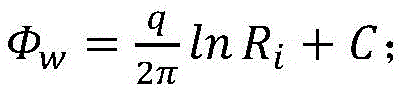
wherein phieThe boundary potential of the pressure relief range of the horizontal well; phiwThe bottom hole potential of the ith straight well; q is the unit formation thickness production; reTo convert the pressure relief radius; n is the number of vertical wells; riThe total equivalent distance of the N vertical wells relative to the ith vertical well; c is a constant term and is the sum of constant terms of each vertical well.
3. The horizontal well production prediction method according to claim 2, characterized in that the boundary potential and the constant term of the bottom potential of each vertical well are eliminated, the relation between the production of each vertical well and the number of vertical wells is obtained by utilizing the relation between potential and pressure, and the relation between the production of the ith vertical well and the number of vertical wells is as follows:

wherein Q isiThe yield of the ith vertical well; n is the number of vertical wells; kiThe permeability of the ith straight well is shown; h isiThe effective thickness of the stratum of the ith vertical well; mu.sIs viscosity; peThe formation pressure at the boundary of the ith vertical well is taken as the formation pressure; pwThe bottom hole flowing pressure of the ith straight well.
4. The horizontal well production prediction method according to claim 2, characterized by equating the horizontal well production to the superposition of several vertical well productions arranged at equal intervals in the horizontal section of the horizontal well.
5. The horizontal well yield prediction method according to claim 2 or 4, characterized in that the calculation mode of the reduced pressure release radius is as follows:

wherein a is the major axis of the elliptical pressure relief range of the horizontal well; and b is a short axis of the elliptical pressure relief range of the horizontal well.
6. The horizontal well yield prediction method according to claim 4, wherein the total equivalent distance of the N vertical wells relative to the ith vertical well is calculated by the following method:
Ri=rw*(d+rw)*(2d+rw)*.*[(i-1)d+rw]*(d+rw)*(2d+rw)*.*[(N-i)*d+rw];
wherein r iswIs the wellbore radius of the vertical well, and d is the spacing between the vertical wells.
7. The horizontal well yield prediction method according to claim 1, characterized by calculating corresponding horizontal well yields at different vertical well numbers based on the relationship between the horizontal well yields and the vertical well numbers, so as to fit the relationship between the change rates of the horizontal well yields relative to the change rates of the vertical well numbers, and further solve the vertical well numbers when the change rates are smaller than a set threshold value.
8. The horizontal well production prediction method according to claim 1, wherein the set threshold is 0.001.
9. The horizontal well production prediction method of claim 1 wherein the relationship of potential to pressure is:

wherein Φ is potential; p is pressure; k is the permeability; μ is viscosity.
10. Horizontal well production prediction apparatus comprising a memory and a processor for executing instructions stored in the memory to implement a horizontal well production prediction method according to any of claims 1 to 9.
Priority Applications (1)
| Application Number | Priority Date | Filing Date | Title |
|---|---|---|---|
| CN201911378624.6A CN113047827A (en) | 2019-12-27 | 2019-12-27 | Horizontal well yield prediction method and device |
Applications Claiming Priority (1)
| Application Number | Priority Date | Filing Date | Title |
|---|---|---|---|
| CN201911378624.6A CN113047827A (en) | 2019-12-27 | 2019-12-27 | Horizontal well yield prediction method and device |
Publications (1)
| Publication Number | Publication Date |
|---|---|
| CN113047827A true CN113047827A (en) | 2021-06-29 |
Family
ID=76506681
Family Applications (1)
| Application Number | Title | Priority Date | Filing Date |
|---|---|---|---|
| CN201911378624.6A Pending CN113047827A (en) | 2019-12-27 | 2019-12-27 | Horizontal well yield prediction method and device |
Country Status (1)
| Country | Link |
|---|---|
| CN (1) | CN113047827A (en) |
Citations (3)
| Publication number | Priority date | Publication date | Assignee | Title |
|---|---|---|---|---|
| CN103266881A (en) * | 2013-05-22 | 2013-08-28 | 中国石化集团华北石油局 | Method for predicting yield of compact hypotonic gas field multistage fracturing horizontal well |
| CN106869914A (en) * | 2017-03-09 | 2017-06-20 | 长江大学 | The PRODUCTION FORECASTING METHODS that seepage flow is coupled with flowing in pit shaft in a kind of oil reservoir |
| CN107301306A (en) * | 2017-08-04 | 2017-10-27 | 中国石油化工股份有限公司华北油气分公司 | Dynamic open-flow capacity Forecasting Methodology for DAMAGE OF TIGHT SAND GAS RESERVOIRS pressure break horizontal well |
-
2019
- 2019-12-27 CN CN201911378624.6A patent/CN113047827A/en active Pending
Patent Citations (3)
| Publication number | Priority date | Publication date | Assignee | Title |
|---|---|---|---|---|
| CN103266881A (en) * | 2013-05-22 | 2013-08-28 | 中国石化集团华北石油局 | Method for predicting yield of compact hypotonic gas field multistage fracturing horizontal well |
| CN106869914A (en) * | 2017-03-09 | 2017-06-20 | 长江大学 | The PRODUCTION FORECASTING METHODS that seepage flow is coupled with flowing in pit shaft in a kind of oil reservoir |
| CN107301306A (en) * | 2017-08-04 | 2017-10-27 | 中国石油化工股份有限公司华北油气分公司 | Dynamic open-flow capacity Forecasting Methodology for DAMAGE OF TIGHT SAND GAS RESERVOIRS pressure break horizontal well |
Non-Patent Citations (1)
| Title |
|---|
| 孙华超等: "用点汇法求取水平井产能分析与计算", 石油地质与工程, vol. 27, no. 06, pages 85 - 86 * |
Similar Documents
| Publication | Publication Date | Title |
|---|---|---|
| CN104213906B (en) | A kind of bored shaft pressure correction method | |
| CN111709847B (en) | Method for predicting recoverable reserves of top gas side water reservoir and evaluating development effect | |
| CN104481400B (en) | A kind of three-dimensional horizontal well track control method | |
| CN111428425B (en) | A productivity calculation method for staged fracturing horizontal wells with variable fracture permeability in shale reservoirs | |
| CN103939066B (en) | An a kind of note adopts the method that well group determines water injection rate determination oilwell produced fluid amount more | |
| CN104989341B (en) | A Method for Determining Effective Displacement Injection-production Well Spacing in Low Permeability Reservoir | |
| CN105840187A (en) | Method for calculating staged fracturing productivity of compact reservoir horizontal well | |
| CN106126899B (en) | Method for determining well positions of infilled wells of water-drive reservoir | |
| CN109858177B (en) | Bottom water reservoir horizontal well water drive numerical simulation method based on pseudo-streamline method | |
| CN109522579B (en) | Method for predicting fracture pressure of horizontal well fracturing construction | |
| CN109915018B (en) | Method for determining tool face angle in three-dimensional borehole trajectory control | |
| CN109492290B (en) | Integrated oil reservoir numerical simulation method | |
| CN108561115A (en) | A kind of irregular flood pattern unit design method of heterogeneous reservoir | |
| CN107503739B (en) | A pressure monitoring method for judging the direction of water flow in horizontal wells | |
| CN103122756A (en) | Method for confirming deepwater water separating pipe gas lift drilling well gas injection volume | |
| CN110991084A (en) | A Reservoir Permeability Calculation Method Based on Streamline Numerical Well Testing | |
| CN109403957A (en) | A kind of high pressure formation pressure acquisition methods | |
| CN111119992B (en) | Method for determining drilling parameters of drainage water of coal seam roof | |
| CN117592250A (en) | A method for calculating water injection volume in sub-injection well sections | |
| CN109918769A (en) | A Method of Calculating Unsteady Water Influx in Fracture-cavity Reservoirs Using Instantaneous Equation | |
| CN106484930A (en) | For determining the method and system of heterogeneous reservoir labyrinth well production | |
| CN105840160B (en) | Method and device for determining liquid outlet rule of commingled production well | |
| CN109815511B (en) | Drilling fluid density determination method for meeting requirement of cleaning of special-shaped well hole | |
| CN109812236B (en) | Method for determining well cleaning effect in special-shaped well | |
| CN113047827A (en) | Horizontal well yield prediction method and device |
Legal Events
| Date | Code | Title | Description |
|---|---|---|---|
| PB01 | Publication | ||
| PB01 | Publication | ||
| SE01 | Entry into force of request for substantive examination | ||
| SE01 | Entry into force of request for substantive examination | ||
| WD01 | Invention patent application deemed withdrawn after publication | ||
| WD01 | Invention patent application deemed withdrawn after publication |
Application publication date: 20210629 |