CN113045657B - A humanized anti-human BCMA monoclonal antibody and its CAR-T cells - Google Patents
A humanized anti-human BCMA monoclonal antibody and its CAR-T cells Download PDFInfo
- Publication number
- CN113045657B CN113045657B CN202010785169.8A CN202010785169A CN113045657B CN 113045657 B CN113045657 B CN 113045657B CN 202010785169 A CN202010785169 A CN 202010785169A CN 113045657 B CN113045657 B CN 113045657B
- Authority
- CN
- China
- Prior art keywords
- cells
- car
- bcma
- scfv
- humanized
- Prior art date
- Legal status (The legal status is an assumption and is not a legal conclusion. Google has not performed a legal analysis and makes no representation as to the accuracy of the status listed.)
- Active
Links
Images


Classifications
-
- C—CHEMISTRY; METALLURGY
- C07—ORGANIC CHEMISTRY
- C07K—PEPTIDES
- C07K16/00—Immunoglobulins [IGs], e.g. monoclonal or polyclonal antibodies
- C07K16/18—Immunoglobulins [IGs], e.g. monoclonal or polyclonal antibodies against material from animals or humans
- C07K16/28—Immunoglobulins [IGs], e.g. monoclonal or polyclonal antibodies against material from animals or humans against receptors, cell surface antigens or cell surface determinants
- C07K16/2878—Immunoglobulins [IGs], e.g. monoclonal or polyclonal antibodies against material from animals or humans against receptors, cell surface antigens or cell surface determinants against the NGF-receptor/TNF-receptor superfamily, e.g. CD27, CD30, CD40, CD95
-
- A—HUMAN NECESSITIES
- A61—MEDICAL OR VETERINARY SCIENCE; HYGIENE
- A61P—SPECIFIC THERAPEUTIC ACTIVITY OF CHEMICAL COMPOUNDS OR MEDICINAL PREPARATIONS
- A61P35/00—Antineoplastic agents
-
- A—HUMAN NECESSITIES
- A61—MEDICAL OR VETERINARY SCIENCE; HYGIENE
- A61K—PREPARATIONS FOR MEDICAL, DENTAL OR TOILETRY PURPOSES
- A61K35/00—Medicinal preparations containing materials or reaction products thereof with undetermined constitution
-
- A—HUMAN NECESSITIES
- A61—MEDICAL OR VETERINARY SCIENCE; HYGIENE
- A61K—PREPARATIONS FOR MEDICAL, DENTAL OR TOILETRY PURPOSES
- A61K40/00—Cellular immunotherapy
- A61K40/10—Cellular immunotherapy characterised by the cell type used
- A61K40/11—T-cells, e.g. tumour infiltrating lymphocytes [TIL] or regulatory T [Treg] cells; Lymphokine-activated killer [LAK] cells
-
- A—HUMAN NECESSITIES
- A61—MEDICAL OR VETERINARY SCIENCE; HYGIENE
- A61K—PREPARATIONS FOR MEDICAL, DENTAL OR TOILETRY PURPOSES
- A61K40/00—Cellular immunotherapy
- A61K40/30—Cellular immunotherapy characterised by the recombinant expression of specific molecules in the cells of the immune system
- A61K40/31—Chimeric antigen receptors [CAR]
-
- A—HUMAN NECESSITIES
- A61—MEDICAL OR VETERINARY SCIENCE; HYGIENE
- A61K—PREPARATIONS FOR MEDICAL, DENTAL OR TOILETRY PURPOSES
- A61K40/00—Cellular immunotherapy
- A61K40/40—Cellular immunotherapy characterised by antigens that are targeted or presented by cells of the immune system
- A61K40/41—Vertebrate antigens
- A61K40/42—Cancer antigens
- A61K40/4202—Receptors, cell surface antigens or cell surface determinants
- A61K40/4214—Receptors for cytokines
- A61K40/4215—Receptors for tumor necrosis factors [TNF], e.g. lymphotoxin receptor [LTR], CD30
-
- C—CHEMISTRY; METALLURGY
- C07—ORGANIC CHEMISTRY
- C07K—PEPTIDES
- C07K14/00—Peptides having more than 20 amino acids; Gastrins; Somatostatins; Melanotropins; Derivatives thereof
- C07K14/435—Peptides having more than 20 amino acids; Gastrins; Somatostatins; Melanotropins; Derivatives thereof from animals; from humans
- C07K14/705—Receptors; Cell surface antigens; Cell surface determinants
- C07K14/70503—Immunoglobulin superfamily
- C07K14/7051—T-cell receptor (TcR)-CD3 complex
-
- C—CHEMISTRY; METALLURGY
- C07—ORGANIC CHEMISTRY
- C07K—PEPTIDES
- C07K14/00—Peptides having more than 20 amino acids; Gastrins; Somatostatins; Melanotropins; Derivatives thereof
- C07K14/435—Peptides having more than 20 amino acids; Gastrins; Somatostatins; Melanotropins; Derivatives thereof from animals; from humans
- C07K14/705—Receptors; Cell surface antigens; Cell surface determinants
- C07K14/70578—NGF-receptor/TNF-receptor superfamily, e.g. CD27, CD30, CD40, CD95
-
- C—CHEMISTRY; METALLURGY
- C12—BIOCHEMISTRY; BEER; SPIRITS; WINE; VINEGAR; MICROBIOLOGY; ENZYMOLOGY; MUTATION OR GENETIC ENGINEERING
- C12N—MICROORGANISMS OR ENZYMES; COMPOSITIONS THEREOF; PROPAGATING, PRESERVING, OR MAINTAINING MICROORGANISMS; MUTATION OR GENETIC ENGINEERING; CULTURE MEDIA
- C12N5/00—Undifferentiated human, animal or plant cells, e.g. cell lines; Tissues; Cultivation or maintenance thereof; Culture media therefor
- C12N5/06—Animal cells or tissues; Human cells or tissues
- C12N5/0602—Vertebrate cells
- C12N5/0634—Cells from the blood or the immune system
- C12N5/0636—T lymphocytes
-
- C—CHEMISTRY; METALLURGY
- C12—BIOCHEMISTRY; BEER; SPIRITS; WINE; VINEGAR; MICROBIOLOGY; ENZYMOLOGY; MUTATION OR GENETIC ENGINEERING
- C12N—MICROORGANISMS OR ENZYMES; COMPOSITIONS THEREOF; PROPAGATING, PRESERVING, OR MAINTAINING MICROORGANISMS; MUTATION OR GENETIC ENGINEERING; CULTURE MEDIA
- C12N5/00—Undifferentiated human, animal or plant cells, e.g. cell lines; Tissues; Cultivation or maintenance thereof; Culture media therefor
- C12N5/06—Animal cells or tissues; Human cells or tissues
- C12N5/0602—Vertebrate cells
- C12N5/0634—Cells from the blood or the immune system
- C12N5/0646—Natural killers cells [NK], NKT cells
-
- A—HUMAN NECESSITIES
- A61—MEDICAL OR VETERINARY SCIENCE; HYGIENE
- A61K—PREPARATIONS FOR MEDICAL, DENTAL OR TOILETRY PURPOSES
- A61K39/00—Medicinal preparations containing antigens or antibodies
- A61K2039/505—Medicinal preparations containing antigens or antibodies comprising antibodies
-
- A—HUMAN NECESSITIES
- A61—MEDICAL OR VETERINARY SCIENCE; HYGIENE
- A61K—PREPARATIONS FOR MEDICAL, DENTAL OR TOILETRY PURPOSES
- A61K39/00—Medicinal preparations containing antigens or antibodies
- A61K2039/80—Vaccine for a specifically defined cancer
-
- A—HUMAN NECESSITIES
- A61—MEDICAL OR VETERINARY SCIENCE; HYGIENE
- A61K—PREPARATIONS FOR MEDICAL, DENTAL OR TOILETRY PURPOSES
- A61K2239/00—Indexing codes associated with cellular immunotherapy of group A61K40/00
- A61K2239/31—Indexing codes associated with cellular immunotherapy of group A61K40/00 characterized by the route of administration
-
- A—HUMAN NECESSITIES
- A61—MEDICAL OR VETERINARY SCIENCE; HYGIENE
- A61K—PREPARATIONS FOR MEDICAL, DENTAL OR TOILETRY PURPOSES
- A61K2239/00—Indexing codes associated with cellular immunotherapy of group A61K40/00
- A61K2239/38—Indexing codes associated with cellular immunotherapy of group A61K40/00 characterised by the dose, timing or administration schedule
-
- A—HUMAN NECESSITIES
- A61—MEDICAL OR VETERINARY SCIENCE; HYGIENE
- A61K—PREPARATIONS FOR MEDICAL, DENTAL OR TOILETRY PURPOSES
- A61K2239/00—Indexing codes associated with cellular immunotherapy of group A61K40/00
- A61K2239/46—Indexing codes associated with cellular immunotherapy of group A61K40/00 characterised by the cancer treated
-
- C—CHEMISTRY; METALLURGY
- C07—ORGANIC CHEMISTRY
- C07K—PEPTIDES
- C07K2317/00—Immunoglobulins specific features
- C07K2317/20—Immunoglobulins specific features characterized by taxonomic origin
- C07K2317/24—Immunoglobulins specific features characterized by taxonomic origin containing regions, domains or residues from different species, e.g. chimeric, humanized or veneered
-
- C—CHEMISTRY; METALLURGY
- C07—ORGANIC CHEMISTRY
- C07K—PEPTIDES
- C07K2317/00—Immunoglobulins specific features
- C07K2317/50—Immunoglobulins specific features characterized by immunoglobulin fragments
- C07K2317/56—Immunoglobulins specific features characterized by immunoglobulin fragments variable (Fv) region, i.e. VH and/or VL
-
- C—CHEMISTRY; METALLURGY
- C07—ORGANIC CHEMISTRY
- C07K—PEPTIDES
- C07K2317/00—Immunoglobulins specific features
- C07K2317/60—Immunoglobulins specific features characterized by non-natural combinations of immunoglobulin fragments
- C07K2317/62—Immunoglobulins specific features characterized by non-natural combinations of immunoglobulin fragments comprising only variable region components
- C07K2317/622—Single chain antibody (scFv)
-
- C—CHEMISTRY; METALLURGY
- C07—ORGANIC CHEMISTRY
- C07K—PEPTIDES
- C07K2319/00—Fusion polypeptide
- C07K2319/01—Fusion polypeptide containing a localisation/targetting motif
- C07K2319/03—Fusion polypeptide containing a localisation/targetting motif containing a transmembrane segment
-
- C—CHEMISTRY; METALLURGY
- C07—ORGANIC CHEMISTRY
- C07K—PEPTIDES
- C07K2319/00—Fusion polypeptide
- C07K2319/33—Fusion polypeptide fusions for targeting to specific cell types, e.g. tissue specific targeting, targeting of a bacterial subspecies
-
- C—CHEMISTRY; METALLURGY
- C12—BIOCHEMISTRY; BEER; SPIRITS; WINE; VINEGAR; MICROBIOLOGY; ENZYMOLOGY; MUTATION OR GENETIC ENGINEERING
- C12N—MICROORGANISMS OR ENZYMES; COMPOSITIONS THEREOF; PROPAGATING, PRESERVING, OR MAINTAINING MICROORGANISMS; MUTATION OR GENETIC ENGINEERING; CULTURE MEDIA
- C12N2510/00—Genetically modified cells
Landscapes
- Health & Medical Sciences (AREA)
- Life Sciences & Earth Sciences (AREA)
- Chemical & Material Sciences (AREA)
- Organic Chemistry (AREA)
- Immunology (AREA)
- General Health & Medical Sciences (AREA)
- Engineering & Computer Science (AREA)
- Genetics & Genomics (AREA)
- Biomedical Technology (AREA)
- Zoology (AREA)
- Biochemistry (AREA)
- Biotechnology (AREA)
- Bioinformatics & Cheminformatics (AREA)
- Wood Science & Technology (AREA)
- Public Health (AREA)
- Veterinary Medicine (AREA)
- Animal Behavior & Ethology (AREA)
- Cell Biology (AREA)
- Medicinal Chemistry (AREA)
- Epidemiology (AREA)
- Biophysics (AREA)
- Proteomics, Peptides & Aminoacids (AREA)
- Molecular Biology (AREA)
- Hematology (AREA)
- General Engineering & Computer Science (AREA)
- Microbiology (AREA)
- Toxicology (AREA)
- Gastroenterology & Hepatology (AREA)
- Pharmacology & Pharmacy (AREA)
- Chemical Kinetics & Catalysis (AREA)
- General Chemical & Material Sciences (AREA)
- Nuclear Medicine, Radiotherapy & Molecular Imaging (AREA)
- Peptides Or Proteins (AREA)
- Micro-Organisms Or Cultivation Processes Thereof (AREA)
Abstract
Description
技术领域technical field
本发明涉及一种能特异性抑制人多发性骨髓瘤及其他BCMA阳性肿瘤细胞生长的新型人源化抗B细胞成熟抗原(BCMA)的单克隆抗体(PMC308),以及表达含有该单克隆抗体序列的嵌合抗原受体的T免疫细胞(CAR-T细胞),它们在肿瘤过继免疫治疗中起作用。The present invention relates to a novel humanized anti-B cell maturation antigen (BCMA) monoclonal antibody (PMC308) that can specifically inhibit the growth of human multiple myeloma and other BCMA positive tumor cells, and an expression containing the monoclonal antibody sequence chimeric antigen receptor T immune cells (CAR-T cells), which play a role in adoptive immunotherapy of tumors.
背景技术Background technique
细胞与免疫疗法正在成为治疗癌症的一种具有广阔发展前景的方法。T细胞或T淋巴细胞是我们人体免疫系统细胞免疫的重要组成部分,它通过不断寻找和识别外来、异己抗原,从体细胞中区分正常细胞与异常细胞(癌细胞或受病毒感染细胞)杀灭与清除异常细胞。采用表达嵌合抗原受体(Chimeric Antigen Receptor)构建体对T细胞进行基因修饰是设计肿瘤特异性T细胞的最常见方法。将靶向肿瘤相关抗原(TAA)的CAR-T细胞注入患者体内(称为过继细胞转移或ACT)是一种有效的免疫治疗方式[1,2]。与化疗或抗体疗法相比,CAR-T技术的优势在于重新编程的工程T细胞可以在患者体内增殖、持续存活并杀伤靶细胞(“活体药物”)[1,3,4]。Cell and immunotherapy are emerging as a promising approach to treating cancer. T cells or T lymphocytes are an important part of the cellular immunity of our human immune system. It distinguishes normal cells from abnormal cells (cancer cells or virus-infected cells) from somatic cells by constantly searching for and recognizing foreign and foreign antigens. with the removal of abnormal cells. Genetic modification of T cells using constructs expressing a chimeric antigen receptor (Chimeric Antigen Receptor) is the most common method for designing tumor-specific T cells. The infusion of CAR-T cells targeting tumor-associated antigens (TAAs) into patients (called adoptive cell transfer or ACT) is an effective modality of immunotherapy [1, 2]. Compared with chemotherapy or antibody therapy, the advantage of CAR-T technology is that the reprogrammed engineered T cells can proliferate, persist and kill target cells in the patient (“living drug”) [1,3,4] .
CAR通常由源于单克隆抗体N端的单链可变片段(scFv)、铰链区、跨膜区和许多细胞内共刺激结构域如(i)CD28,(ii)CD137(4-1BB)、CD27或其他共刺激结构域,以及与其串联的CD3zeta活化结构域组成(图1)[1,2]。在图1中,左图为第一代的CAR结构(无共刺激结构域);中图为第二代的CAR结构(一个共刺激结构域,CD28或4-BB);并且右图为第三代的CAR结构(两个或多个共刺激结构域)。该图来自Golubovskaya,Wu,Cancers,2016[6]。CAR经历了从第一代(无共刺激结构域)到第二代(有一个共刺激结构域),再到第三代(有多个共刺激结构域)的发展历程。携带有两个共刺激结构域(即第三代CAR)及其转染表达的CAR-T细胞的应用使CAR-T的肿瘤杀伤活性增强,CAR-T细胞在体内的持久性延长,并且抗肿瘤疗效提高。CAR is usually composed of single-chain variable fragment (scFv), hinge region, transmembrane region and many intracellular costimulatory domains derived from the N-terminus of monoclonal antibody such as (i) CD28, (ii) CD137 (4-1BB), CD27 Or other costimulatory domains, and the CD3zeta activation domain in tandem with it (Figure 1) [1, 2]. In Figure 1, the left picture is the first generation CAR structure (no costimulatory domain); the middle picture is the second generation CAR structure (one costimulatory domain, CD28 or 4-BB); and the right picture is the first generation CAR structure (one costimulatory domain, CD28 or 4-BB); Three generations of CAR structures (two or more costimulatory domains). The figure is from Golubovskaya, Wu, Cancers, 2016 [6] . CARs have evolved from the first generation (without costimulatory domains) to the second generation (with one costimulatory domain) to the third generation (with multiple costimulatory domains). The application of CAR-T cells carrying two co-stimulatory domains (ie, third-generation CAR) and their transfection expression enhanced the tumor-killing activity of CAR-T, prolonged the persistence of CAR-T cells in vivo, and enhanced the anti-tumor effect of CAR-T cells. Improved tumor efficacy.
BCMABCMA
B细胞成熟抗原(B cell maturation antigen;BCMA)是一种细胞表面受体,也称为CD269和肿瘤坏死因子受体超家族成员17(TNFRSF17),它由TNFRSF17基因编码。该受体主要在成熟的B淋巴细胞中表达,在大多数情况下在多发性骨髓瘤(MM)中过表达[3]。当前针对MM中BCMA的疗法包括单克隆抗体、双特异性抗体和T细胞免疫疗法,CAR-T疗法等[3,4]。B cell maturation antigen (BCMA) is a cell surface receptor, also known as CD269 and tumor necrosis factor receptor superfamily member 17 (TNFRSF17), which is encoded by the TNFRSF17 gene. This receptor is mainly expressed in mature B lymphocytes and in most cases is overexpressed in multiple myeloma (MM) [3] . Current therapies for BCMA in MM include monoclonal antibodies, bispecific antibodies and T-cell immunotherapy, CAR-T therapy, etc. [3,4] .
BCMA结构和信号通路BCMA structure and signaling pathway
人BCMA蛋白由184个氨基酸组成:第1-54位氨基酸为胞外结构域;第55-77位为跨膜结构域;第78-184位为胞质结构域。BCMA的氨基酸序列如图2所示,其中带下划线的是细胞外结构域。BCMA与BAFF受体、跨膜激活剂、亲环素配体相互作用剂和钙调节剂(TACI)等其他受体类似,缺乏信号肽[4]。这些受体在B细胞成熟和分化为浆细胞中起主要作用。它们的配体包括BAFF和APRIL,两者均在MM患者中表达增加[4]。单克隆抗体是通过阻断受体-配体相互作用清除MM细胞,而CAR-T细胞疗法则是通过结合BCMA进而杀死MM细胞。BCMA还能与TRAF1,2,3,5和6相互作用。本发明是基于靶向MM细胞表面BCMA的人源化BCMA-CAR-T细胞。人源化BCMA-CAR-T细胞在scFV中具有人源化抗BCMA scFv序列,使它比小鼠ScFv对人的免疫原性低,更有应用优势。Human BCMA protein consists of 184 amino acids: amino acids 1-54 are extracellular domains; amino acids 55-77 are transmembrane domains; and amino acids 78-184 are cytoplasmic domains. The amino acid sequence of BCMA is shown in Figure 2, where the extracellular domain is underlined. BCMA is similar to other receptors such as BAFF receptors, transmembrane activators, cyclophilin ligand interactors, and calcium modulators (TACIs) and lacks a signal peptide [4] . These receptors play a major role in B cell maturation and differentiation into plasma cells. Their ligands include BAFF and APRIL, both of which are increased in MM patients [4] . Monoclonal antibodies clear MM cells by blocking receptor-ligand interactions, while CAR-T cell therapy kills MM cells by binding to BCMA. BCMA also interacts with TRAF1, 2, 3, 5 and 6. The present invention is based on humanized BCMA-CAR-T cells targeting BCMA on the surface of MM cells. Humanized BCMA-CAR-T cells have a humanized anti-BCMA scFv sequence in scFv, making it less immunogenic to humans than mouse ScFv and having more application advantages.
附图说明Description of drawings
图1.CAR的结构Figure 1. Structure of CAR
图2.BCMA蛋白的氨基酸序列。Figure 2. Amino acid sequence of BCMA protein.
图3.人源化BCMA CAR构建体的结构。Figure 3. Structure of humanized BCMA CAR constructs.
图4.用荧光标记的重组BCMA蛋白通过FACS分析检测人源化的BCMA-CAR构建体。Figure 4. Detection of humanized BCMA-CAR constructs by FACS analysis with fluorescently labeled recombinant BCMA protein.
图5.人源化的BCMA-CAR-T细胞杀死CHO-BCMA细胞但不杀死CHO细胞。Figure 5. Humanized BCMA-CAR-T cells kill CHO-BCMA cells but not CHO cells.
图6.人源化的BCMA-CAR-T细胞经CHO-BCMA阳性细胞刺激后特异性分泌高水平的IFN-γ。Figure 6. Humanized BCMA-CAR-T cells specifically secreted high levels of IFN-γ upon stimulation by CHO-BCMA-positive cells.
图7.人源化的BCMA-CAR-T细胞经多发性骨髓瘤细胞刺激后特异性分泌高水平的IFN-γ,而经BCMA阴性的K562对照细胞刺激前后无显著差异;人源化的BCMA-CAR-T细胞在多发性骨髓瘤细胞系中检测到BCMA,但在白血病或其他癌细胞系中未检测到。Figure 7. Humanized BCMA-CAR-T cells specifically secreted high levels of IFN-γ after stimulation with multiple myeloma cells, while there was no significant difference before and after stimulation with BCMA-negative K562 control cells; humanized BCMA -CAR-T cells detected BCMA in multiple myeloma cell lines, but not in leukemia or other cancer cell lines.
图8A.人源化的BCMA-CAR-T细胞显著抑制RPMI8226异种移植肿瘤的生长;图8B.人源化的BCMA-CAR-T细胞没有降低小鼠体重。Figure 8A. Humanized BCMA-CAR-T cells significantly inhibited RPMI8226 xenograft tumor growth; Figure 8B. Humanized BCMA-CAR-T cells did not reduce mouse body weight.
具体实施方式Detailed ways
定义definition
如本文所用,“嵌合抗原受体(CAR)”是指融合蛋白,其由能与抗原结合的胞外结构域、源于多肽的跨膜结构域(该多肽不同于衍生胞外结构域多肽)、以及至少一个细胞内的结构域组成。“嵌合抗原受体(CAR)”有时被称为“嵌合受体”、“T体”或“嵌合免疫受体(CIR)”,“能够与抗原结合的胞外结构域”是指能与某一抗原结合的任何寡肽或多肽。“细胞内结构域”是指已知功能为传递信号以引起细胞内生物过程的激活或抑制的任何寡肽或多肽。As used herein, a "chimeric antigen receptor (CAR)" refers to a fusion protein consisting of an extracellular domain capable of binding an antigen, a transmembrane domain derived from a polypeptide (different from the derived ectodomain polypeptide) ), and at least one intracellular domain composition. "Chimeric antigen receptor (CAR)" is sometimes referred to as "chimeric receptor", "T body" or "chimeric immune receptor (CIR)", and "extracellular domain capable of binding an antigen" refers to Any oligopeptide or polypeptide capable of binding to an antigen. "Intracellular domain" refers to any oligopeptide or polypeptide known to function to transmit a signal to cause activation or inhibition of a biological process within a cell.
如本文所用,“人源化抗体”是来自非人物种的抗体,其蛋白质序列已被修饰以增加其与人天然产生的抗体变体的相似性。As used herein, a "humanized antibody" is an antibody from a non-human species whose protein sequence has been modified to increase its similarity to naturally occurring antibody variants in humans.
如本文所用,“结构域”是指多肽中独立于其他区域折叠成特定结构的一个区域。As used herein, a "domain" refers to a region of a polypeptide that folds into a particular structure independently of other regions.
如本文所用,“单链可变片段(scFv)”是指由保留结合抗原能力的抗体衍生的单链多肽。scFv的示例包括通过重组DNA技术形成的抗体多肽,其中免疫球蛋白重链(H链)和轻链(L链)片段的Fv区通过间隔序列连接。用于工程化scFv的各种方法是本领域技术人员已知的。As used herein, "single-chain variable fragment (scFv)" refers to a single-chain polypeptide derived from an antibody that retains the ability to bind antigen. Examples of scFvs include antibody polypeptides formed by recombinant DNA techniques in which the Fv regions of immunoglobulin heavy chain (H chain) and light chain (L chain) fragments are linked by a spacer sequence. Various methods for engineering scFvs are known to those skilled in the art.
如本文所用,“肿瘤抗原”是指具有抗原性的生物分子,其表达引起癌症。As used herein, "tumor antigen" refers to an antigenic biomolecule whose expression causes cancer.
发明人已经基于特异性靶向BCMA的新型人源化BCMA单克隆抗体scFv序列构建了CAR-T细胞。发明人构建了人源化的BCMA-CAR-T细胞,以靶向过度表达BCMA肿瘤抗原的癌细胞。本发明的人源化的BCMA-CAR-T细胞可特异性高水平分泌针对多发性骨髓瘤癌细胞的细胞因子,并杀死CHO-BCMA阳性的靶细胞,但对BCMA阴性的CHO细胞无作用。The inventors have constructed CAR-T cells based on a novel humanized BCMA monoclonal antibody scFv sequence that specifically targets BCMA. The inventors constructed humanized BCMA-CAR-T cells to target cancer cells that overexpress BCMA tumor antigens. The humanized BCMA-CAR-T cells of the present invention can specifically secrete cytokines against multiple myeloma cancer cells at a high level, and kill CHO-BCMA-positive target cells, but have no effect on BCMA-negative CHO cells .
本发明涉及分泌人源化抗人BCMA单克隆抗体的杂交细胞克隆及其分泌产生的单克隆抗体(4C8A4或4C8A10),其分别包含具有SEQ ID NO:5的氨基酸序列的人源化VH序列和具有SEQ ID NO:6的氨基酸序列的人源化VL序列。在一个实施方式中,人源化抗人BCMA抗体是单链可变片段(scFv)。ScFv可以是VH-接头-VL或VL-接头-VH。The present invention relates to a hybrid cell clone secreting a humanized anti-human BCMA monoclonal antibody and the secreted monoclonal antibody (4C8A4 or 4C8A10), which respectively comprise a humanized VH sequence having the amino acid sequence of SEQ ID NO: 5 and a humanized VL sequence having the amino acid sequence of SEQ ID NO:6. In one embodiment, the humanized anti-human BCMA antibody is a single chain variable fragment (scFv). The ScFv can be VH -linker- VL or VL -linker- VH .
本发明还涉及嵌合抗原受体的融合蛋白,该融合蛋白从N末端到C末端包含以下部分:(i)靶向BCMA的单链可变片段(scFv)(本发明);(ii)跨膜结构域;(iii)至少一个共刺激结构域和(iv)激活结构域。The present invention also relates to fusion proteins of chimeric antigen receptors comprising, from N-terminus to C-terminus, the following moieties: (i) a single-chain variable fragment (scFv) targeting BCMA (the present invention); (ii) spanning a membrane domain; (iii) at least one costimulatory domain and (iv) an activation domain.
在一个具体实施方式中,CAR的共刺激结构域选自由CD28、4-1BB、GITR、ICOS-1、CD27、OX-40和DAP10组成的组。优选的共刺激结构域为CD28。In a specific embodiment, the costimulatory domain of the CAR is selected from the group consisting of CD28, 4-1BB, GITR, ICOS-1, CD27, OX-40 and DAP10. A preferred costimulatory domain is CD28.
优选的激活结构域为CD3zeta(CD3Z或CD3ζ)。A preferred activation domain is CD3zeta (CD3Z or CD3ζ).
跨膜结构域可以来源于天然多肽,或可以是人工设计的。来源于天然多肽的跨膜结构域可以获自任何膜结合或跨膜蛋白。例如,可以使用T细胞受体α或β链、CD3zeta链、CD28、CD3ε.、CD45、CD4、CD5、CD8、CD9、CD16、CD22、CD33、CD37、CD64、CD80、CD134、CD137、ICOS、CD154或GITR的跨膜结构域。人工设计的跨膜结构域为主要包含如亮氨酸和缬氨酸的疏水残基的多肽。优选在合成跨膜结构域的每个末端发现苯丙氨酸色氨酸和缬氨酸的三联体。任选地,短寡肽接头和多肽接头,例如具有2至10个氨基酸长度的接头可以设置在跨膜结构域和细胞内结构域之间。在一个实施方式中,可以使用具有甘氨酸-丝氨酸连续序列的接头序列。Transmembrane domains can be derived from natural polypeptides, or can be artificially designed. Transmembrane domains derived from native polypeptides can be obtained from any membrane-bound or transmembrane protein. For example, T cell receptor alpha or beta chain, CD3zeta chain, CD28, CD3ε., CD45, CD4, CD5, CD8, CD9, CD16, CD22, CD33, CD37, CD64, CD80, CD134, CD137, ICOS, CD154 can be used or the transmembrane domain of GITR. Artificially designed transmembrane domains are polypeptides comprising predominantly hydrophobic residues such as leucine and valine. A triplet of phenylalanine tryptophan and valine is preferably found at each end of the synthetic transmembrane domain. Optionally, short oligopeptide linkers and polypeptide linkers, eg, linkers having a length of 2 to 10 amino acids, can be provided between the transmembrane domain and the intracellular domain. In one embodiment, a linker sequence with a glycine-serine contiguous sequence can be used.
本发明提供了编码BCMA-CAR的核酸。编码CAR的核酸可以通过传统方法由特定CAR的氨基酸序列制备。编码氨基酸序列的碱基序列可以从前述的NCBI RefSeq IDs或GenBank关于各结构域的氨基酸序列的登录号获得,并且本发明的核酸序列可以使用标准的分子生物学和/或化学程序制备。例如,基于碱基序列,可以合成核酸,并且本发明的核酸可以通过使用聚合酶链反应(PCR)将从cDNA库获得的DNA片段结合来制备。The present invention provides nucleic acids encoding BCMA-CARs. Nucleic acids encoding CARs can be prepared from the amino acid sequence of a specific CAR by conventional methods. The base sequences encoding the amino acid sequences can be obtained from the aforementioned NCBI RefSeq IDs or GenBank accession numbers for the amino acid sequences of the respective domains, and the nucleic acid sequences of the present invention can be prepared using standard molecular biology and/or chemical procedures. For example, based on the base sequence, nucleic acid can be synthesized, and the nucleic acid of the present invention can be prepared by combining DNA fragments obtained from a cDNA library using polymerase chain reaction (PCR).
编码本发明的CAR的核酸可以插入载体中,并且该载体可以引入细胞中。例如,可以使用病毒载体,如逆转录病毒载体(包括核病毒载体、慢病毒载体、假型载体)、腺病毒载体、腺相关病毒(AAV)载体、猿猴病毒载体、牛痘病毒载体、仙台病毒载体、Epstein-Barr病毒(EBV)载体和HSV载体。优选使用缺乏复制能力的病毒载体,以便在感染细胞中不进行自我复制。Nucleic acids encoding the CARs of the present invention can be inserted into a vector, and the vector can be introduced into a cell. For example, viral vectors such as retroviral vectors (including riboviral, lentiviral, pseudotyped), adenoviral, adeno-associated virus (AAV), simian, vaccinia, Sendai virus vectors can be used , Epstein-Barr virus (EBV) vector and HSV vector. It is preferred to use viral vectors that lack replication capacity so as not to self-replicate in infected cells.
例如,当使用逆转录病毒载体时,可以基于载体所具有的LTR序列和包装信号序列选择合适的包装细胞,以使用该包装细胞制备逆转录病毒颗粒。包装细胞的示例包括PG13(ATCC CRL-10686)、PA317(ATCC CRL-9078)、GP+E-86和GP+envAm-12和Psi-Crip。还可以使用具有高转染效率的293细胞核293T细胞制备逆转录病毒颗粒。基于逆转录病毒生产的许多种类的逆转录病毒载体和可以用于包装逆转录病毒载体的包装细胞广泛地市售于许多公司。For example, when a retroviral vector is used, a suitable packaging cell can be selected based on the LTR sequence and packaging signal sequence possessed by the vector, and the packaging cell can be used to prepare retroviral particles. Examples of packaging cells include PG13 (ATCC CRL-10686), PA317 (ATCC CRL-9078), GP+E-86 and GP+envAm-12 and Psi-Crip. Retroviral particles can also be prepared using 293 nuclei 293T cells with high transfection efficiency. Many types of retroviral vectors based on retroviral production and packaging cells that can be used to package retroviral vectors are widely commercially available from many companies.
CAR-T细胞经由CAR结合特定的抗原,从而使信号转移到细胞中,并因此激活细胞。表达CAR的细胞的激活取决于宿主细胞的种类和CAR的细胞内结构域而改变,并且可以基于例如细胞因子的释放、细胞增殖速度的改善或细胞表面分子的变化等作为指标来确认。例如,来自的激活细胞的细胞毒素细胞因子(肿瘤坏死因子、淋巴毒素等)的释放导致表达抗原的靶细胞的破坏。此外,细胞因子的释放或细胞表面分子的变化刺激其他免疫细胞,例如,B细胞、树突细胞、NK细胞和巨噬细胞。CAR-T cells bind to specific antigens via CAR, thereby transferring signals into cells and thereby activating cells. Activation of CAR-expressing cells varies depending on the kind of host cell and the intracellular domain of the CAR, and can be confirmed based on, for example, release of cytokines, improvement in cell proliferation rate, or changes in cell surface molecules, etc. as indicators. For example, the release of cytotoxic cytokines (tumor necrosis factor, lymphotoxin, etc.) from activated cells results in the destruction of antigen-expressing target cells. In addition, the release of cytokines or changes in cell surface molecules stimulate other immune cells such as B cells, dendritic cells, NK cells and macrophages.
表达CAR的细胞可以用作用于癌症的治疗剂。该治疗剂包含表达CAR的细胞作为活性成分,并且其还可以包含合适的赋形剂。CAR-expressing cells can be used as therapeutics for cancer. The therapeutic agent contains CAR-expressing cells as an active ingredient, and it may also contain suitable excipients.
本发明人已经构建了针对多发性骨髓瘤细胞(MM)的人源化的BCMA-ScFv-CD28-CD3-CAR-T(BCMA-CAR-T)细胞。BCMA-CAR-T细胞分泌高水平的细胞因子,通过LDH细胞毒性实验测定以及CHO-BCMA细胞毒性实验测定呈阳性,但是对BCMA阴性CHO细胞毒性实验测定没有显著性,这表明CAR-T细胞具有针对靶向癌细胞的特异性杀伤活性,并以该杀伤活性清除肿瘤或病毒抗原。The inventors have constructed humanized BCMA-ScFv-CD28-CD3-CAR-T (BCMA-CAR-T) cells against multiple myeloma cells (MM). BCMA-CAR-T cells secrete high levels of cytokines, which were positive as determined by the LDH cytotoxicity assay and the CHO-BCMA cytotoxicity assay, but were not significant for the BCMA-negative CHO cytotoxicity assay, indicating that CAR-T cells have The specific killing activity for targeting cancer cells, and the killing activity to remove tumor or viral antigens.
本发明的人源化BCMA-scFv的优点包括:由于人源化BCMA scFv而对人的免疫原性较低。因此,本发明的BCMA抗体在许多临床应用中作为治疗剂是高度有效和有利的。Advantages of the humanized BCMA-scFv of the present invention include lower immunogenicity in humans due to the humanized BCMA scFv. Therefore, the BCMA antibodies of the present invention are highly effective and advantageous as therapeutic agents in many clinical applications.
本发明的人源化BCMA scFv可应用于多种免疫治疗:包括偶联有毒素/药物的抗体,单克隆治疗性抗体,BCMA抗体人源化和CAR-T细胞免疫治疗。The humanized BCMA scFv of the present invention can be applied to various immunotherapy: including toxin/drug conjugated antibody, monoclonal therapeutic antibody, BCMA antibody humanization and CAR-T cell immunotherapy.
使用本发明中人源化BCMA scFv的人源化BCMA-CAR-T细胞可以有效地用于靶向BCMA阳性癌细胞系中的BCMA抗原。Humanized BCMA-CAR-T cells using the humanized BCMA scFv of the present invention can be effectively used to target BCMA antigens in BCMA-positive cancer cell lines.
该人源化BCMA-CAR-T细胞可与不同的化学疗法联合使用:检查点抑制剂、靶向疗法、小分子抑制剂、抗体等。The humanized BCMA-CAR-T cells can be used in combination with different chemotherapies: checkpoint inhibitors, targeted therapies, small molecule inhibitors, antibodies, etc.
该人源化的BCMA-CAR-T细胞在临床上可用于治疗由BCMA阳性癌细胞导致的肿瘤。The humanized BCMA-CAR-T cells can be used clinically to treat tumors caused by BCMA-positive cancer cells.
对共刺激结构域如CD28、4-1BB及其他等的修饰可用于提高其功效。Tag-标记偶联的人源化BCMA scFv可用于CAR的制备。Modifications to costimulatory domains such as CD28, 4-1BB and others can be used to increase their efficacy. Tag-labeled conjugated humanized BCMA scFv can be used for CAR preparation.
该人源化BCMA-CAR-T细胞可与不同的安全开关结合应用:如t-EGFR,RQR(利妥昔单抗-CD34-利妥昔单抗)等。The humanized BCMA-CAR-T cells can be combined with different safety switches: such as t-EGFR, RQR (rituximab-CD34-rituximab), etc.
第三代CAR-T或其他共激活信号结构域可同时用于CAR结构内的同一个人源化BCMA-scFv。Third-generation CAR-T or other co-activating signaling domains can be used simultaneously within the same humanized BCMA-scFv within the CAR structure.
该人源化BCMA CAR可以与靶向其他不同肿瘤抗原或肿瘤微环境,例如VEGFR-1-3、PDL-1的CAR联合使用,也可与具有BCMA和CD3的双特异性抗体或其他抗原等联合用于疾病治疗。The humanized BCMA CAR can be used in combination with CARs targeting other different tumor antigens or tumor microenvironments, such as VEGFR-1-3, PDL-1, or with bispecific antibodies with BCMA and CD3 or other antigens, etc. Combination for disease treatment.
该人源化BCMA-CAR-T细胞可用于针对对化疗最具耐药性的肿瘤干细胞,以及由其形成的侵袭性肿瘤。The humanized BCMA-CAR-T cells can be used to target cancer stem cells that are most resistant to chemotherapy, as well as aggressive tumors formed from them.
下列实施例为对本发明的进一步说明。这些实施例仅旨在说明本发明,而不应理解为是限制性的。The following examples are further illustrations of the present invention. These examples are only intended to illustrate the invention and should not be construed as limiting.
实施例Example
本发明人在慢病毒载体内,经克隆至慢病毒载体的Xba I和Eco R I限制性酶切位点,构建了人源化的BCMA-ScFv-CAR结构体。在pCD510-FMC63-28z慢病毒CAR构建体中,包含人源化BCMA ScFv-CD28-CD3zeta片段——其插入位点在Xba I和Eco RI克隆位点之间。The inventors constructed a humanized BCMA-ScFv-CAR structure in a lentiviral vector by cloning into the Xba I and Eco R I restriction sites of the lentiviral vector. In the pCD510-FMC63-28z lentiviral CAR construct, a humanized BCMA ScFv-CD28-CD3zeta fragment was included - its insertion site was between the Xba I and Eco RI cloning sites.
慢病毒载体是通过在293T细胞中扩增生产,并通过RT-PCR方法确定其效价。然后使用等剂量的慢病毒进行T细胞的转导。Lentiviral vectors were produced by amplification in 293T cells, and their titers were determined by RT-PCR. T cells were then transduced with an equal dose of lentivirus.
实施例1、人源化的抗BCMA抗体重链可变区VH和轻链可变区VL以及单链可变片段scFv序列Example 1. Humanized anti-BCMA antibody heavy chain variable region VH and light chain variable region VL and single chain variable fragment scFv sequences
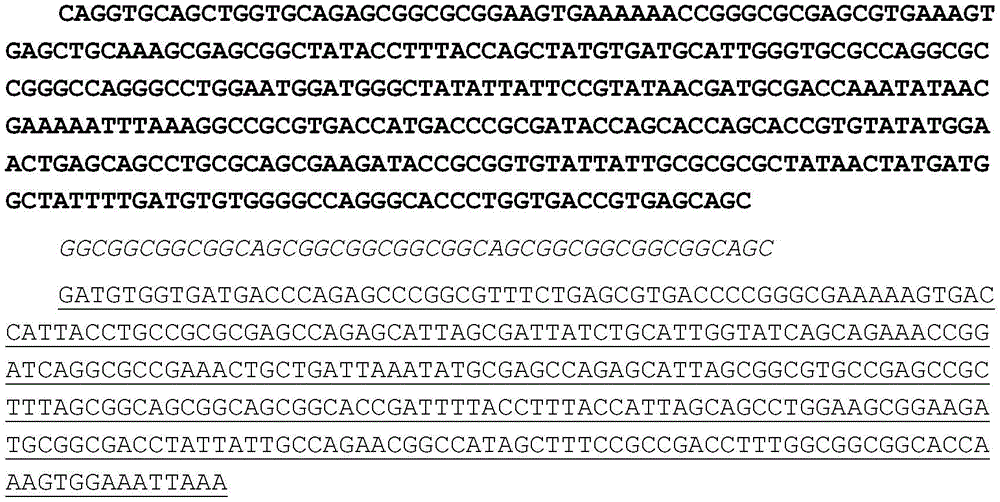
通过对BCMA阳性的杂交瘤克隆株4C8A4和4C8A10进行测序,获得BCMA scFv基因序列。人源化BCMA(PMC308)scFv的结构为:VH-接头-VL。接头为G4Sx3。The BCMA scFv gene sequences were obtained by sequencing the BCMA-positive hybridoma clones 4C8A4 and 4C8A10. The structure of the humanized BCMA (PMC308) scFv is: VH-linker-VL. The connector is G4Sx3.
人源化的BCMA VH和VL以及scFv序列如下所示。Humanized BCMA VH and VL and scFv sequences are shown below.
序列中粗体字突出显示了人源化的BCMA PMC308scFv克隆的核苷酸序列:VH(SEQID NO:1);下划线突出显示VL的核苷酸序列(SEQ ID NO:2);中间(斜体)是编码3xG4S接头3x(GGGGS)的核苷酸序列(SEQ ID NO:3)。The nucleotide sequence of the humanized BCMA PMC308 scFv clone is highlighted in bold in the sequence: VH (SEQ ID NO: 1); the nucleotide sequence of VL (SEQ ID NO: 2) is highlighted by underline; middle ( Italic) is the nucleotide sequence (SEQ ID NO: 3) encoding the 3xG4S linker 3x(GGGGS).
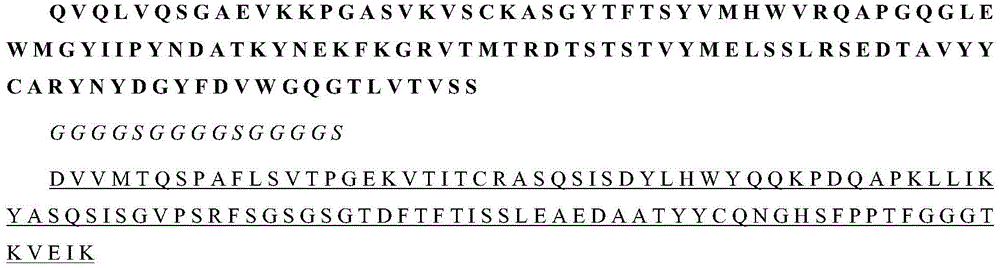
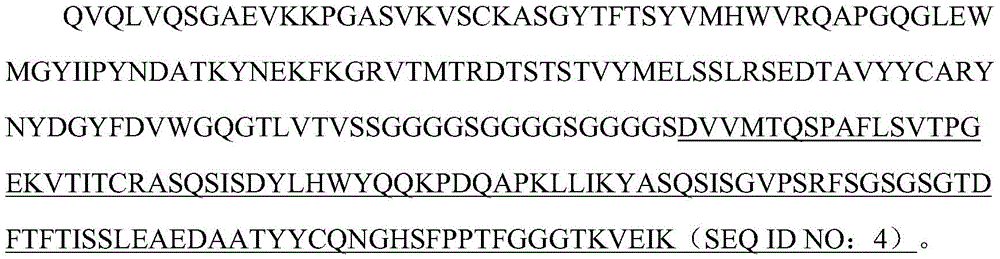
人源化BCMA(PMC308)scFv蛋白序列:(SEQ ID NO:4)Humanized BCMA (PMC308) scFv protein sequence: (SEQ ID NO: 4)
在蛋白序列中,粗体突出显示了VH的氨基酸序列(SEQ ID NO:5);下划线突出显示了VL的氨基酸序列(SEQ ID NO:6);中间(斜体)是3xG4S接头序列的氨基酸序列(SEQ IDNO:7)。In the protein sequence, the amino acid sequence of VH (SEQ ID NO: 5) is highlighted in bold; the amino acid sequence of VL (SEQ ID NO: 6) is highlighted in underline; in the middle (italics) are the amino acids of the 3xG4S linker sequence sequence (SEQ ID NO: 7).
实施例2.人源化的BCMA-CAR序列Example 2. Humanized BCMA-CAR sequences
人源化(PMC308)BCMA-CAR构建方案如图3所示,其中使用第二代BCMA-CAR(PMC308)。在整个申请中,我们将其称为人源化BCMA。带有EF1a启动子的慢病毒载体被用于克隆人源化scFv CAR序列。以下核苷酸序列显示了本发明人源化BCMA CAR序列,包括CD8-人源化BCMA ScFv-CD8-TM28-CD28-CD3ζ的核苷酸序列。该CAR结构包括人CD8信号肽,人源化BCMA scFv(VH-接头3x(G4S)-VL),CD8铰链结构域,CD28跨膜结构域、和CD3zeta激活结构域(图3)。The humanized (PMC308) BCMA-CAR construction scheme is shown in Figure 3, in which the second generation BCMA-CAR (PMC308) was used. Throughout the application, we refer to it as humanized BCMA. A lentiviral vector with the EF1a promoter was used to clone the humanized scFv CAR sequence. The following nucleotide sequences show the humanized BCMA CAR sequences of the present invention, including the nucleotide sequence of CD8-humanized BCMA ScFv-CD8-TM28-CD28-CD3ζ. The CAR structure includes human CD8 signal peptide, humanized BCMA scFv ( VH -linker 3x(G4S)-VL), CD8 hinge domain, CD28 transmembrane domain, and CD3zeta activation domain (Figure 3).
CD8前导序列--BCMA scFv(VH-接头-VL)-CD8铰链结构域-CD28TM-CD28-CD3-zeta:CD8 leader sequence--BCMA scFv(VH-linker-VL)-CD8 hinge domain-CD28TM-CD28-CD3-zeta:
<CD8前导序列><CD8 leader sequence>
ATGGCCTTACCAGTGACCGCCTTGCTCCTGCCGCTGGCCTTGCTGCTCCACGCCGCCAGGCCGgctagcATGGCCTTACCAGTGACCGCCTTGCTCCTGCCGCTGGCCTTGCTGCTCCACGCCGCCAGGCCGgctagc
<人源化BCMA,4C8A4/4C8A10scFv克隆><Humanized BCMA, 4C8A4/4C8A10scFv clone>
CAGGTGCAGCTGGTGCAGAGCGGCGCGGAAGTGAAAAAACCGGGCGCGAGCGTGAAAGTGAGCTGCAAAGCGAGCGGCTATACCTTTACCAGCTATGTGATGCATTGGGTGCGCCAGGCGCCGGGCCAGGGCCTGGAATGGATGGGCTATATTATTCCGTATAACGATGCGACCAAATATAACGAAAAATTTAAAGGCCGCGTGACCATGACCCGCGATACCAGCACCAGCACCGTGTATATGGAACTGAGCAGCCTGCGCAGCGAAGATACCGCGGTGTATTATTGCGCGCGCTATAACTATGATGGCTATTTTGATGTGTGGGGCCAGGGCACCCTGGTGACCGTGAGCAGCGGCGGCGGCGGCAGCGGCGGCGGCGGCAGCGGCGGCGGCGGCAGCGATGTGGTGATGACCCAGAGCCCGGCGTTTCTGAGCGTGACCCCGGGCGAAAAAGTGACCATTACCTGCCGCGCGAGCCAGAGCATTAGCGATTATCTGCATTGGTATCAGCAGAAACCGGATCAGGCGCCGAAACTGCTGATTAAATATGCGAGCCAGAGCATTAGCGGCGTGCCGAGCCGCTTTAGCGGCAGCGGCAGCGGCACCGATTTTACCTTTACCATTAGCAGCCTGGAAGCGGAAGATGCGGCGACCTATTATTGCCAGAACGGCCATAGCTTTCCGCCGACCTTTGGCGGCGGCACCAAAGTGGAAATTAAACAGGTGCAGCTGGTGCAGAGCGGCGCGGAAGTGAAAAAACCGGGCGCGAGCGTGAAAGTGAGCTGCAAAGCGAGCGGCTATACCTTTACCAGCTATGTGATGCATTGGGTGCGCCAGGCGCCGGGCCAGGGCCTGGAATGGATGGGCTATATTATTCCGTATAACGATGCGACCAAATATAACGAAAAATTTAAAGGCCGCGTGACCATGACCCGCGATACCAGCACCAGCACCGTGTATATGGAACTGAGCAGCCTGCGCAGCGAAGATACCGCGGTGTATTATTGCGCGCGCTATAACTATGATGGCTATTTTGATGTGTGGGGCCAGGGCACCCTGGTGACCGTGAGCAGCGGCGGCGGCGGCAGCGGCGGCGGCGGCAGCGGCGGCGGCGGCAGCGATGTGGTGATGACCCAGAGCCCGGCGTTTCTGAGCGTGACCCCGGGCGAAAAAGTGACCATTACCTGCCGCGCGAGCCAGAGCATTAGCGATTATCTGCATTGGTATCAGCAGAAACCGGATCAGGCGCCGAAACTGCTGATTAAATATGCGAGCCAGAGCATTAGCGGCGTGCCGAGCCGCTTTAGCGGCAGCGGCAGCGGCACCGATTTTACCTTTACCATTAGCAGCCTGGAAGCGGAAGATGCGGCGACCTATTATTGCCAGAACGGCCATAGCTTTCCGCCGACCTTTGGCGGCGGCACCAAAGTGGAAATTAAA
<XhoI限制位点><XhoI restriction site>
CTCGAGCTCGAG
<CD8铰链><CD8 hinge>
AAGCCCACCACGACGCCAGCGCCGCGACCACCAACACCGGCGCCCACCATCGCGTCGCAGCCCCTGTCCCTGCGCCCAGAGGCGAGCCGGCCAGCGGCGGGGGGCGCAGTGCACACGAGGGGGCTGGACTTCGCCAGTGATaagcccAAGCCCACCACGACGCCAGCGCCGCGACCACCAACACCGGCGCCCACCATCGCGTCGCAGCCCCTGTCCCTGCGCCCAGAGGCGAGCCGGCCAGCGGCGGGGGGCAGTGCACACGAGGGGGCTGGACTTCGCCAGTGATaagccc
<CD28TM/激活域><CD28TM/activation domain>
TTTTGGGTGCTGGTGGTGGTTGGTGGAGTCCTGGCTTGCTATAGCTTGCTAGTAACAGTGGCCTTTATTATTTTCTGGGTGAGGAGTAAGAGGAGCAGGCTCCTGCACAGTGACTACATGAACATGACTCCCCGCCGCCCCGGGCCCACCCGCAAGCATTACCAGCCCTATGCCCCACCACGCGACTTCGCAGCCTATCGCTCCTTTTGGGTGCTGGTGGTGGTTGGTGGAGTCCTGGCTTGCTATAGCTTGCTAGTAACAGTGGCCTTTATTATTTTCTGGGTGAGGAGTAAGAGGAGCAGGCTCCTGCACAGTGACTACATGAACATGACTCCCCGCCGCCCCGGGCCCACCCGCAAGCATTACCAGCCCTATGCCCCACCACGCGACTTCGCAGCCTATCGCTCC
<CD3zeta><CD3zeta>
AGAGTGAAGTTCAGCAGGAGCGCAGACGCCCCCGCGTACCAGCAGGGCCAGAACCAGCTCTATAACGAGCTCAATCTAGGACGAAGAGAGGAGTACGATGTTTTGGACAAGAGACGTGGCCGGGACCCTGAGATGGGGGGAAAGCCGCAGAGAAGGAAGAACCCTCAGGAAGGCCTGTACAATGAACTGCAGAAAGATAAGATGGCGGAGGCCTACAGTGAGATTGGGATGAAAGGCGAGCGCCGGAGGGGCAAGGGGCACGATGGCCTTTACCAGGGTCTCAGTACAGCCACCAAGGACACCTACGACGCCCTTCACATGCAGGCCCTGCCCCCTCGCTAAtagAGAGTGAAGTTCAGCAGGAGCGCAGACGCCCCCGCGTACCAGCAGGGCCAGAACCAGCTCTATAACGAGCTCAATCTAGGACGAAGAGAGGAGTACGATGTTTTGGACAAGAGACGTGGCCGGGACCCTGAGATGGGGGGAAAGCCGCAGAGAAGGAAGAACCCTCAGGAAGGCCTGTACAATGAACTGCAGAAAGATAAGATGGCGGAGGCCTACAGTGAGATTGGGATGAAAGGCGAGCGCCGGAGGGGCAAGGGGCACGATGGCCTTTACCAGGGTCTCAGTACAGCCACCAAGGACACCTACGACGCCCTTCACATGCAGGCCCTGCCCCCTCGCTAAtag
<EcoRI限制位点><EcoRI restriction site>
gaattcgaattc
人源化BCMA-CAR蛋白的氨基酸序列(构建体结构见图3)Amino acid sequence of humanized BCMA-CAR protein (see Figure 3 for the structure of the construct)
(SEQ ID NO:14)(SEQ ID NO: 14)
QVQLVQSGAEVKKPGASVKVSCKASGYTFTSYVMHWVRQAPGQGLEWMGYIIPYNDATKYNEKFKGRVTMTRDTSTSTVYMELSSLRSEDTAVYYCARYNYDGYFDVWGQGTLVTVSSGGGGSGGGGSGGGGSDVVMTQSPAFLSVTPGEKVTITCRASQSISDYLHWYQQKPDQAPKLLIKYASQSISGVPSRFSGSGSGTDFTFTISSLEAEDAATYYCQNGHSFPPTFGGGTKVEIKLEKPTTTPAPRPPTPAPTIASQPLSLRPEASRPAAGGAVHTRGLDFASDKPFWVLVVVGGVLACYSLLVTVAFIIFWVRSKRSRLLHSDYMNMTPRRPGPTRKHYQPYAPPRDFAAYRSRVKFSRSADAPAYQQGQNQLYNELNLGRREEYDVLDKRRGRDPEMGGKPQRRKNPQEGLYNELQKDKMAEAYSEIGMKGERRRGKGHDGLYQGLSTATKDTYDALHMQALPPRQVQLVQSGAEVKKPGASVKVSCKASGYTFTSYVMHWVRQAPGQGLEWMGYIIPYNDATKYNEKFKGRVTMTRDTSTSTVYMELSSLRSEDTAVYYCARYNYDGYFDVWGQGTLVTVSSGGGGSGGGGSGGGGSDVVMTQSPAFLSVTPGEKVTITCRASQSISDYLHWYQQKPDQAPKLLIKYASQSISGVPSRFSGSGSGTDFTFTISSLEAEDAATYYCQNGHSFPPTFGGGTKVEIKLEKPTTTPAPRPPTPAPTIASQPLSLRPEASRPAAGGAVHTRGLDFASDKPFWVLVVVGGVLACYSLLVTVAFIIFWVRSKRSRLLHSDYMNMTPRRPGPTRKHYQPYAPPRDFAAYRSRVKFSRSADAPAYQQGQNQLYNELNLGRREEYDVLDKRRGRDPEMGGKPQRRKNPQEGLYNELQKDKMAEAYSEIGMKGERRRGKGHDGLYQGLSTATKDTYDALHMQALPPR
实施例3.人源化的BCMA-CAR-T细胞能大量杀死骨髓瘤细胞并针对BCMA阳性癌细胞特异性分泌高水平的IFN-γ。Example 3. Humanized BCMA-CAR-T cells can kill myeloma cells in large numbers and secrete high levels of IFN-γ specifically against BCMA-positive cancer cells.
如图3所示,本发明以人源化BCMA-CAR构建并生成人源化BCMA-CAR-T细胞。同时以与BCMA scFv无关的scFv构建并生成模拟的CAR-T细胞(Mock CAR-T细胞)作为阴性对照。通过FACS检测发现,人源化BCMA-CAR-T细胞表达BCMA scFv(图4),其中将慢病毒人源化BCMACAR导入T细胞后,检测到人源化BCMA-CAR阳性细胞。As shown in Figure 3, the present invention constructs and generates humanized BCMA-CAR-T cells with humanized BCMA-CAR. At the same time, scFv unrelated to BCMA scFv was used to construct and generate mock CAR-T cells (Mock CAR-T cells) as a negative control. It was found by FACS that the humanized BCMA-CAR-T cells expressed BCMA scFv (Figure 4). After the lentiviral humanized BCMACAR was introduced into the T cells, the humanized BCMA-CAR-positive cells were detected.
实施例4.人源化的BCMA-CAR-T细胞杀死了CHO-BCMA细胞,但没有影响CHO细胞Example 4. Humanized BCMA-CAR-T cells killed CHO-BCMA cells but did not affect CHO cells
我们将人源化BCMA-CAR-T细胞与表达BCMA抗原的CHO-BCMA靶细胞以及CHO(BCMA阴性)对照细胞一起孵育。人源化的BCMA-CAR-T细胞特异性杀死CHO-BCMA细胞(图5,上图),而对CHO细胞无杀伤作用(图5,下图)。这证明了人源化的BCMA-CAR-T细胞对靶向BCMA抗原和杀死BCMA阳性细胞具有高度特异性。We incubated humanized BCMA-CAR-T cells with BCMA antigen-expressing CHO-BCMA target cells as well as CHO (BCMA-negative) control cells. Humanized BCMA-CAR-T cells specifically killed CHO-BCMA cells (Fig. 5, upper panel), but not CHO cells (Fig. 5, lower panel). This demonstrates that humanized BCMA-CAR-T cells are highly specific for targeting BCMA antigens and killing BCMA-positive cells.
在图5中,以XCelligence细胞毒性实时试验检测人源化BCMA-CAR-T细胞的细胞毒性。归一化的细胞指数显示在Y轴上,时间显示在X轴上。上图:CHO-BCMA靶细胞。上图右侧从上到下:模拟对照CAR-T细胞、空白对照细胞(不含CAR)和效应细胞之人源化CAR-T细胞。下图为CHO靶细胞。下图右侧从上到下分别为:模拟CAR-T细胞,人源化BCMA CAR-T细胞,和空白细胞。In Figure 5, the cytotoxicity of humanized BCMA-CAR-T cells was detected by the XCelligence cytotoxicity real-time assay. Normalized cell index is shown on the Y-axis and time is shown on the X-axis. Top panel: CHO-BCMA target cells. From top to bottom on the right side of the figure above: mock control CAR-T cells, blank control cells (without CAR), and humanized CAR-T cells of effector cells. The figure below shows the CHO target cells. From top to bottom on the right side of the figure below are: mock CAR-T cells, humanized BCMA CAR-T cells, and blank cells.
实施例5.人源化的CAR-T细胞能显著分泌针对靶标CHO-BCMA细胞的IFN-γExample 5. Humanized CAR-T cells can significantly secrete IFN-γ against target CHO-BCMA cells
将人源化BCMA-CAR-T细胞和靶标CHO-BCMA细胞共同孵育后,我们收集了上清液,并进行了IFN-γ分析。BCMA-CAR-T细胞与CHO-BCMA细胞共孵育后分泌高水平的IFN-γ(图6),其中与T细胞和模拟CAR-T对照细胞相比,CHO-BCMA细胞中的IFN-γ表达显著上调(p<0.05)。对照CHO细胞没有显示出IFN-γ高水平分泌(数据未显示)。这证实了人源化的BCMA-CAR-T细胞的特异性和细胞杀伤毒性。After co-incubating humanized BCMA-CAR-T cells with target CHO-BCMA cells, we collected the supernatant and performed IFN-γ analysis. BCMA-CAR-T cells secreted high levels of IFN-γ after co-incubation with CHO-BCMA cells (Fig. 6), where IFN-γ expression in CHO-BCMA cells compared with T cells and mock CAR-T control cells Significantly up-regulated (p<0.05). Control CHO cells did not show high levels of IFN-γ secretion (data not shown). This confirmed the specificity and cytotoxicity of humanized BCMA-CAR-T cells.
实施例6.人源化的CAR-T细胞针对BCMA阳性RPMI8226多发性骨髓瘤细胞分泌高水平的IFN-γ,而针对BCMA阴性白血病K562细胞很少分泌IFN-γExample 6. Humanized CAR-T cells secrete high levels of IFN-γ against BCMA-positive RPMI8226 multiple myeloma cells, but very little against BCMA-negative leukemia K562 cells
我们将BCMA-CAR-T细胞与多发性骨髓瘤细胞(RPMI8226细胞)和K562细胞分别进行孵育,并使用Fisher的试剂盒根据试验方法进行ELISA检测。人源化BCMA-CAR-T细胞针对BCMA阳性多发性骨髓瘤癌细胞分泌的IFN-γ较K562细胞显著升高(图7)。在图7中,人源化的CAR-T细胞针对BCMA阳性RPMI8226多发性骨髓瘤细胞分泌高水平的IFN-γ,而针对BCMA阴性白血病K562细胞分泌较少IFN-γ。与T细胞和模拟-CAR-T细胞组,以及与K562细胞组中分泌的IFN-γ相比,人源化的CAR-T细胞与多发性骨髓瘤细胞共孵育后IFN-γ的表达显著升高,p<0.05。IFN-γ的杀伤和分泌水平明显高于对照组T细胞和模拟的CAR-T细胞。这证实了人源化BCMA-CAR-T细胞对血液学BCMA阳性细胞具有特异性。我们还将人源化BCMA与小鼠BCMA-CAR细胞以及其他来源的人源化BCMA-CAR-T细胞(用于临床试验)进行了比较,发现我们的人源化BCMA-CAR-T细胞与阳性对照CAR-T(小鼠和其他人源化BCMA-CAR-T细胞)的IFN-γ分泌相似或相当,甚至更高(数据未显示)。这支持了人源化BCMA-CAR-T细胞在未来临床应用中的高潜力。We incubated BCMA-CAR-T cells with multiple myeloma cells (RPMI8226 cells) and K562 cells, respectively, and performed ELISA detection using Fisher's kit according to the experimental method. Humanized BCMA-CAR-T cells secreted significantly higher IFN-γ against BCMA-positive multiple myeloma cancer cells than K562 cells (Figure 7). In Figure 7, humanized CAR-T cells secreted high levels of IFN-γ against BCMA-positive RPMI8226 multiple myeloma cells and less IFN-γ against BCMA-negative leukemia K562 cells. Compared with the T cell and mock-CAR-T cell groups, and with the secreted IFN-γ in the K562 cell group, the expression of humanized CAR-T cells was significantly increased after co-incubation with multiple myeloma cells. High, p<0.05. The killing and secretion levels of IFN-γ were significantly higher than those of control T cells and mock CAR-T cells. This confirmed that the humanized BCMA-CAR-T cells were specific for hematological BCMA-positive cells. We also compared humanized BCMA with mouse BCMA-CAR cells as well as humanized BCMA-CAR-T cells from other sources (used in clinical trials) and found that our humanized BCMA-CAR-T cells were comparable to The IFN-γ secretion of the positive control CAR-T (mouse and other humanized BCMA-CAR-T cells) was similar or comparable, or even higher (data not shown). This supports the high potential of humanized BCMA-CAR-T cells for future clinical applications.
实施例7.人源化的BCMA-CAR-T细胞在体内小鼠模型中显著降低了RPMI8226异种移植肿瘤的生长Example 7. Humanized BCMA-CAR-T cells significantly reduce RPMI8226 xenograft tumor growth in an in vivo mouse model
将多发性骨髓瘤RPMI8226细胞皮下注射到NSG小鼠中(1×10^7个细胞/小鼠),然后通过静脉输注两次人源化的BCMA-CAR-T细胞(1×10^7个CAR-T细胞/小鼠)。人源化的BCMA-CAR-T细胞显著降低了小鼠中RPMI8226肿瘤生长(图8A)。用人源化BCMA-CAR-T细胞处理的小鼠并未引起小鼠体重降低,这表明CAR-T细胞对小鼠无毒(图8B)。此外,在研究过程中未观察到行为或视觉变化。同时通过FACS检测到小鼠血液中针对BCMA重组蛋白的人源化BCMA-CAR-T的含量(数据未显示)。Multiple myeloma RPMI8226 cells were subcutaneously injected into NSG mice (1×10^7 cells/mouse), followed by two intravenous infusions of humanized BCMA-CAR-T cells (1×10^7 cells/mouse) CAR-T cells/mouse). Humanized BCMA-CAR-T cells significantly reduced RPMI8226 tumor growth in mice (Figure 8A). Mice treated with humanized BCMA-CAR-T cells did not cause weight loss in mice, indicating that CAR-T cells were not toxic to mice (Fig. 8B). Additionally, no behavioral or visual changes were observed during the study. At the same time, the content of humanized BCMA-CAR-T against BCMA recombinant protein in the blood of mice was detected by FACS (data not shown).
在图8中,人源化的BCMA-CAR-T细胞显著降低了RPMI8226异种移植肿瘤的生长。图8A.人源化BCMA-CAR-T细胞显著降低RPMI8226肿瘤体积。在第7天和第20天,以1×10^7个细胞/小鼠的剂量分别注射CAR-T细胞。条形图显示肿瘤平均体积+/-标准误差。*p<0.05,BCMA与模拟对照相比。图8B.人源化BCMA-CAR-T细胞并未降低小鼠体重,条形图显示小鼠平均体重+/-标准偏差。In Figure 8, humanized BCMA-CAR-T cells significantly reduced the growth of RPMI8226 xenograft tumors. Figure 8A. Humanized BCMA-CAR-T cells significantly reduced RPMI8226 tumor volume. On
参考文献references
1.Maus,M.V.,Haas,A.R.,Beatty,G.L.,Albelda,S.M.,Levine,B.L.,Liu,X.,Zhao,Y.,Kalos,M.,和June,C.H.(2013).T cells expressing chimeric antigenreceptors can cause anaphylaxis in humans.Cancer Immunol Res 1,26-31.1. Maus, M.V., Haas, A.R., Beatty, G.L., Albelda, S.M., Levine, B.L., Liu, X., Zhao, Y., Kalos, M., and June, C.H. (2013). T cells expressing chimeric antigenreceptors can cause anaphylaxis in humans. Cancer Immunol Res 1, 26-31.
2.Maus,M.V.,Grupp,S.A.,Porter,D.L.,和June,C.H.(2014).Antibody-modified T cells:CARs take the front seat for hematologic malignancies.Blood123,2625-2635.2. Maus, M.V., Grupp, S.A., Porter, D.L., and June, C.H. (2014). Antibody-modified T cells: CARs take the front seat for hematologic malignancies. Blood123, 2625-2635.
3.Ali,S.A.,Shi,V.,Maric,I.,Wang,M.,Stroncek,D.F.,Rose,J.J.,Brudno,J.N.,Stetler-Stevenson,M.,Feldman,S.A.,Hansen,B.G.,等人(2016).T cellsexpressing an anti-B-cell maturation antigen chimeric antigen receptor causeremissions of multiple myeloma.Blood 128,1688-1700.3. Ali, S.A., Shi, V., Maric, I., Wang, M., Stroncek, D.F., Rose, J.J., Brudno, J.N., Stetler-Stevenson, M., Feldman, S.A., Hansen, B.G., et al. (2016). T cells expressing an anti-B-cell maturation antigen chimeric antigen receptor causeremissions of multiple myeloma. Blood 128, 1688-1700.
4.Tai,Y.T.,和Anderson,K.C.(2015).Targeting B-cell maturation antigenin multiple myeloma.Immunotherapy.4. Tai, Y.T., and Anderson, K.C. (2015). Targeting B-cell maturation antigen in multiple myeloma. Immunotherapy.
5.Boeye,A.(1986).Clonal isolation of hybridomas by manual single-cellisolation.Methods Enzymol 121,332-340.5. Boeye, A. (1986). Clonal isolation of hybridomas by manual single-cellisolation. Methods Enzymol 121, 332-340.
6.Golubovskaya,V.,Wu,L(2016)Cancers,Mar 15;8(3).6. Golubovskaya, V., Wu, L (2016) Cancers,
Claims (12)






Applications Claiming Priority (2)
| Application Number | Priority Date | Filing Date | Title |
|---|---|---|---|
| US201962953808P | 2019-12-26 | 2019-12-26 | |
| US62/953,808 | 2019-12-26 |
Publications (2)
| Publication Number | Publication Date |
|---|---|
| CN113045657A CN113045657A (en) | 2021-06-29 |
| CN113045657B true CN113045657B (en) | 2022-06-07 |
Family
ID=76507642
Family Applications (1)
| Application Number | Title | Priority Date | Filing Date |
|---|---|---|---|
| CN202010785169.8A Active CN113045657B (en) | 2019-12-26 | 2020-08-06 | A humanized anti-human BCMA monoclonal antibody and its CAR-T cells |
Country Status (3)
| Country | Link |
|---|---|
| US (1) | US20220356262A1 (en) |
| CN (1) | CN113045657B (en) |
| WO (1) | WO2021133712A1 (en) |
Families Citing this family (4)
| Publication number | Priority date | Publication date | Assignee | Title |
|---|---|---|---|---|
| WO2023109257A1 (en) * | 2021-12-16 | 2023-06-22 | 浙江瑞加美生物科技有限公司 | Humanized bcma antibody and bcma-car-t/bcma-car-dnt cell |
| CN116082507B (en) * | 2022-05-31 | 2023-10-03 | 山东恺悌生物制品有限公司 | Humanized BCMA antibodies and BCMA-CAR-T cells |
| CN116535521B (en) * | 2023-03-08 | 2024-12-24 | 深圳细胞谷生物医药有限公司 | BCMA-targeted chimeric antigen receptor and its application |
| CN116333172B (en) * | 2023-05-04 | 2024-02-09 | 广州百暨基因科技有限公司 | Fusion proteins and uses thereof |
Family Cites Families (8)
| Publication number | Priority date | Publication date | Assignee | Title |
|---|---|---|---|---|
| WO2014181229A2 (en) * | 2013-05-07 | 2014-11-13 | Rinat Neuroscience Corp. | Anti-glucagon receptor antibodies and methods of use thereof |
| JP6698546B2 (en) * | 2014-04-14 | 2020-05-27 | セレクティスCellectis | BCMA (CD269)-specific chimeric antigen receptor for cancer immunotherapy |
| TWI761831B (en) * | 2016-04-01 | 2022-04-21 | 美商凱特製藥公司 | Chimeric antigen receptor(car) and t cell receptor (tcr) and uses thereof |
| CN105777911B (en) * | 2016-04-12 | 2019-07-02 | 上海优卡迪生物医药科技有限公司 | Anti- BCMA Chimeric antigen receptor, encoding gene, recombinant expression carrier and its construction method and application |
| MX374810B (en) * | 2017-01-06 | 2025-03-06 | Eutilex Co Ltd | 4-1BB ANTI-HUMAN ANTIBODIES AND THEIR USES |
| CN108395478A (en) * | 2017-02-04 | 2018-08-14 | 上海恒润达生生物科技有限公司 | Target the Chimeric antigen receptor of BCMA and the method and application thereof to its dual modification |
| CN112074278B (en) * | 2018-04-03 | 2023-04-25 | 湖南远泰生物技术有限公司 | BCMA-CAR-T cells |
| CN108441504A (en) * | 2018-05-07 | 2018-08-24 | 武汉波睿达生物科技有限公司 | A kind of mosaic type antigen receptor of anti-BCMA and preparation method thereof |
-
2020
- 2020-08-06 CN CN202010785169.8A patent/CN113045657B/en active Active
- 2020-12-21 WO PCT/US2020/066332 patent/WO2021133712A1/en not_active Ceased
-
2022
- 2022-06-24 US US17/849,399 patent/US20220356262A1/en active Pending
Also Published As
| Publication number | Publication date |
|---|---|
| WO2021133712A1 (en) | 2021-07-01 |
| CN113045657A (en) | 2021-06-29 |
| US20220356262A1 (en) | 2022-11-10 |
Similar Documents
| Publication | Publication Date | Title |
|---|---|---|
| JP7492561B2 (en) | Humanized BCMA antibodies and BCMA-CAR-T cells | |
| CN113045657B (en) | A humanized anti-human BCMA monoclonal antibody and its CAR-T cells | |
| CN112074278A (en) | BCMA-CAR-T cells | |
| CN113710705B (en) | CAR-T cells with humanized CD19 SCFV | |
| CN113271965B (en) | CD37 antibodies and CD37-CAR-T cells | |
| CN114075287B (en) | Humanized BCMA antibody and BCMA-CAR-T cells | |
| CN114286691B (en) | CS1-antibodies and anti-CS1-CAR-T cells | |
| CN116082507B (en) | Humanized BCMA antibodies and BCMA-CAR-T cells | |
| RU2795443C2 (en) | Humanized antibody to bcma and bcma-car-nk-cells | |
| HK40032892A (en) | Humanized bcma antibody and bcma-car-t cells | |
| HK40032892B (en) | Humanized bcma antibody and bcma-car-t cells |
Legal Events
| Date | Code | Title | Description |
|---|---|---|---|
| PB01 | Publication | ||
| PB01 | Publication | ||
| SE01 | Entry into force of request for substantive examination | ||
| SE01 | Entry into force of request for substantive examination | ||
| CB02 | Change of applicant information |
Address after: Room 1-715, Heda Medicine Valley Center, 291 Fucheng Road, Xiasha street, Qiantang New District, Hangzhou City, Zhejiang Province, 310018 Applicant after: Hangzhou Jiyuan Gene Technology Co.,Ltd. Address before: Room 1-715, Heda Medicine Valley Center, 291 Fucheng Road, Xiasha street, Qiantang New District, Hangzhou City, Zhejiang Province, 310018 Applicant before: Hangzhou Zhongbai Jiyuan Gene Technology Co.,Ltd. |
|
| CB02 | Change of applicant information | ||
| GR01 | Patent grant | ||
| GR01 | Patent grant |