CN113033646A - Automatic identification method and system for battery protocol - Google Patents
Automatic identification method and system for battery protocol Download PDFInfo
- Publication number
- CN113033646A CN113033646A CN202110290820.9A CN202110290820A CN113033646A CN 113033646 A CN113033646 A CN 113033646A CN 202110290820 A CN202110290820 A CN 202110290820A CN 113033646 A CN113033646 A CN 113033646A
- Authority
- CN
- China
- Prior art keywords
- battery
- protocol
- decision tree
- data
- automatic identification
- Prior art date
- Legal status (The legal status is an assumption and is not a legal conclusion. Google has not performed a legal analysis and makes no representation as to the accuracy of the status listed.)
- Granted
Links
Images


Classifications
-
- G—PHYSICS
- G06—COMPUTING OR CALCULATING; COUNTING
- G06F—ELECTRIC DIGITAL DATA PROCESSING
- G06F18/00—Pattern recognition
- G06F18/20—Analysing
- G06F18/24—Classification techniques
- G06F18/243—Classification techniques relating to the number of classes
- G06F18/24323—Tree-organised classifiers
-
- G—PHYSICS
- G06—COMPUTING OR CALCULATING; COUNTING
- G06F—ELECTRIC DIGITAL DATA PROCESSING
- G06F18/00—Pattern recognition
- G06F18/20—Analysing
- G06F18/21—Design or setup of recognition systems or techniques; Extraction of features in feature space; Blind source separation
- G06F18/214—Generating training patterns; Bootstrap methods, e.g. bagging or boosting
-
- G—PHYSICS
- G06—COMPUTING OR CALCULATING; COUNTING
- G06V—IMAGE OR VIDEO RECOGNITION OR UNDERSTANDING
- G06V10/00—Arrangements for image or video recognition or understanding
- G06V10/94—Hardware or software architectures specially adapted for image or video understanding
- G06V10/95—Hardware or software architectures specially adapted for image or video understanding structured as a network, e.g. client-server architectures
-
- Y—GENERAL TAGGING OF NEW TECHNOLOGICAL DEVELOPMENTS; GENERAL TAGGING OF CROSS-SECTIONAL TECHNOLOGIES SPANNING OVER SEVERAL SECTIONS OF THE IPC; TECHNICAL SUBJECTS COVERED BY FORMER USPC CROSS-REFERENCE ART COLLECTIONS [XRACs] AND DIGESTS
- Y02—TECHNOLOGIES OR APPLICATIONS FOR MITIGATION OR ADAPTATION AGAINST CLIMATE CHANGE
- Y02E—REDUCTION OF GREENHOUSE GAS [GHG] EMISSIONS, RELATED TO ENERGY GENERATION, TRANSMISSION OR DISTRIBUTION
- Y02E60/00—Enabling technologies; Technologies with a potential or indirect contribution to GHG emissions mitigation
- Y02E60/10—Energy storage using batteries
Landscapes
- Engineering & Computer Science (AREA)
- Theoretical Computer Science (AREA)
- Data Mining & Analysis (AREA)
- Physics & Mathematics (AREA)
- General Physics & Mathematics (AREA)
- Bioinformatics & Cheminformatics (AREA)
- Computer Vision & Pattern Recognition (AREA)
- Evolutionary Biology (AREA)
- Evolutionary Computation (AREA)
- Bioinformatics & Computational Biology (AREA)
- General Engineering & Computer Science (AREA)
- Artificial Intelligence (AREA)
- Life Sciences & Earth Sciences (AREA)
- Software Systems (AREA)
- Multimedia (AREA)
- Communication Control (AREA)
- Charge And Discharge Circuits For Batteries Or The Like (AREA)
Abstract
The invention provides a method and a system for automatically identifying a battery protocol, and belongs to the technical field of battery replacement. The automatic identification method of the battery protocol comprises the following steps: s1: identifying a start; s2: judging whether an analysis sequence is set or not, and if so, analyzing the battery protocol according to the set analysis sequence; s3: judging whether the analysis is successful, if so, executing step S5, otherwise, executing step S4; s4: judging the type of a battery protocol based on the acquired battery data according to the learned decision tree rule, and identifying the battery protocol; s5: the battery protocol identification is complete. The invention has the beneficial effects that: on the premise that resources of a storage module and a memory are extremely limited, rapid identification of the protocol can still be achieved.
Description
Technical Field
The invention relates to a battery swapping technology, in particular to an automatic identification method for a battery protocol.
Background
In the battery replacement process of the electric bicycle, because the battery does not specify a communication protocol, the battery replacement cabinet can automatically identify the batteries and communicate with the batteries by using the protocol of the corresponding battery.
In the whole battery replacement system, the bin control is in charge of communication with the battery, the bin control is an embedded device formed by a single chip microcomputer, the memory and the Flash are limited, and the general Flash can not influence the whole battery replacement process because the corresponding battery needs to be quickly identified in the battery replacement process.
However, when the CPU, the memory, and the Flash are all single-chip microcomputers with extremely limited resources for communication, the recognition speed is relatively slow, and the user experience is affected.
Disclosure of Invention
In order to solve the problems in the prior art, the invention provides an automatic identification method of a battery protocol, which can still finish identification within 3s when the resource of a single chip microcomputer is limited.
The automatic identification method of the battery protocol comprises the following steps:
s1: identifying a start;
s2: judging whether an analysis sequence is set or not, and if so, analyzing the battery protocol according to the set analysis sequence;
s3: judging whether the analysis is successful, if so, executing step S5, otherwise, executing step S4;
s4: judging the type of a battery protocol based on the acquired battery data according to the learned decision tree rule, and identifying the battery protocol;
s5: the battery protocol identification is complete.
The invention is further improved, in step S4, the method for generating the decision tree rule includes:
s41: according to different types of battery protocols and different states of the battery, battery state data of the battery in the charging, discharging and standing states are respectively taken and are converged into corresponding battery data to form a corresponding learning data set D;
s42: classifying a learning data set D by taking the register address as one attribute, wherein the learning data set D is divided into M data samples, and M is a positive integer;
s43: each data sample is respectively calculated as a sub-tree, Gini gains under all attributes of the current sub-tree are calculated, the minimum attribute i is selected, if the current sub-trees are all in the same category, the calculation is stopped, otherwise, a sub-tree T is formed1Pushing into the stack, if there are multiple identical Gini gains, the corresponding sub-tree TlPressing into a stack to be calculated;
s44: judging whether the stack to be calculated is empty, if not, returning to the step S42 to continue calculation, otherwise, executing the step S45;
s45: screening a decision tree rule according to a set standard;
s46: the decision tree rule that is last used is determined.
The invention is further improved, in step S45, the criteria of the screening decision tree rule are:
(1) according to the Okam razor principle, the lower the height of the tree the better;
(2) in the subtree rules of two trees, it is preferable to use one attribute value for constructing the number of subtrees as small as possible.
The invention further improves, in step S5, the method for automatically identifying a battery includes:
s51: sorting according to the number of the battery communication protocols counted in a classified manner, and judging the protocol type;
s52: selecting a communication protocol;
s53: judging the battery protocol type according to the learned decision tree rule;
s54: judging whether a battery protocol is matched, if not, the battery protocol cannot be identified, and if so, executing the next step;
s55: identifying a battery protocol and beginning to communicate with the battery;
s56: and the automatic identification of the battery protocol is completed.
The invention is further improved, and the analysis sequence is as follows:
defaulting to use the communication protocol of the last battery, and if the analysis is successful, exiting; if the resolution is not successful, resolving the protocol according to the priority order in the resolution priority queue.
The invention is further improved, and the method also comprises the step S6: judging whether the identified battery protocol is in the warehouse-controlled memory, if so, analyzing the battery data by using the battery protocol, and if not, executing the step S7:
s7: sending a request for a synchronization identified battery protocol to a master control;
s8: after receiving the confirmation information sent by the master control, starting to receive the battery protocol data;
s9: the battery data is parsed using a battery protocol.
The invention also provides a system for realizing the automatic identification method of the battery protocol, which comprises the following steps:
a first judgment module for judging whether a parsing order is set;
an analysis module: the battery protocol is analyzed according to a set analysis sequence;
a second judging module: judging whether the analysis is successful;
a decision tree rule generation module: the system is used for utilizing the decision tree and CART algorithm to learn the rules and generating the decision tree rules;
a battery protocol identification module: and the battery protocol type judgment module is used for judging the battery protocol type based on the acquired battery data according to the learned decision tree rule and identifying the battery protocol.
Compared with the prior art, the invention has the beneficial effects that: the bin single-chip microcomputer is a low-frequency CPU, and can still realize the rapid identification of the protocol and correctly communicate with the battery on the premise that resources of a storage module and a memory are extremely limited; the problem of the space restriction that storage space is limited and all protocol libraries can not be stored is solved.
Drawings
FIG. 1 is a flow chart of a method for automatically identifying a battery protocol according to the present invention;
FIG. 2 is a schematic diagram of a decision tree structure;
FIG. 3 is a flow chart of a rule learning and automatic identification method;
FIG. 4 is a flowchart of a method according to another embodiment of the present invention.
Detailed Description
The present invention will be described in further detail with reference to the accompanying drawings and examples.
As shown in fig. 1, the battery protocol automatic identification method of the present invention includes the following steps:
1. battery identification is started;
2. judging whether a battery protocol number successfully analyzed last time exists, if so, analyzing the protocol according to the last protocol number, if not, judging whether an analysis priority is set, and if so, analyzing the battery protocol according to the set priority sequence;
the bottom layer communication protocol of the battery comprises: RS485, CAN, UART, etc. Classifying and counting according to the adapted battery communication protocol to obtain the number of each class, and forming a test sequence of the corresponding communication protocol, for example, the sequence for testing the bottom layer protocol is as follows: CAN, RS485 and UART. This sequence will automatically change as the battery protocol expands.
3. And judging whether the analysis is successful, if so, finishing the battery identification, and if not, starting to automatically identify the battery protocol.
The process of automatic identification can actually be converted into an automatic classification problem, but due to the particularity of a battery protocol, the logistic regression, SVM and deep learning algorithm used in machine learning originally cannot be effectively used on a low-frequency single chip microcomputer. The example adopts a special decision tree scheme for identification.
The node types designed by the decision tree of this example include a rule node and a battery protocol node, where the rule node is set to have a corresponding value of 0, and the battery protocol node is set to have a corresponding value of 1.
Specifically, for the definition of rule nodes, since some values other than 0 and non-0 are in different ranges in the protocol, the rule is defined as:
| rule sequence number | register | comparison operator | comparison value | when node type | node sequence number | is true and node type | node sequence number | when false |
Definition of battery protocol node: since the battery protocol node is the corresponding battery protocol type and is directly expressed by numerical values, the definition of the battery protocol node is as follows: i Battery protocol number
Therefore, the data structure of the decision tree in this example includes a battery protocol data structure, a battery protocol serial number, and a battery protocol, and the following describes the data structure of the entire node of the decision tree in this example with reference to a specific embodiment.
The decision tree shown in fig. 2, this example is represented by the decision tree data structure of table 2:

the node type of true/false is the corresponding node type, when the node type is 0, the node serial number is the rule node, and when the node type is 1, the node serial number is the battery protocol serial number.
As shown in fig. 3, the learning process of the decision tree in this example is:
(1) according to different types of battery protocols and different states of the batteries, battery state data of the batteries in charging, discharging and standing states are respectively taken and collected into a corresponding battery data set D, and as continuous values such as voltage, current and the like exist in the battery protocols, the CART algorithm of the decision tree is more suitable for training and learning of the data.
This example uses the concept of Gini's purity for a better partitioning of continuous variables. In order to measure the uncertainty of a feature set, the definition of the Gini index (D) is provided, and the calculation method of the Gini index (D) comprises the following steps:
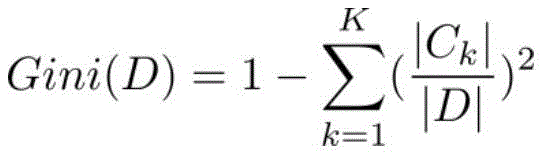
gini (D) represents the probability of two samples being randomly drawn from the data set D, with the classes being inconsistent, gini (D) ═ 0 when all samples belong to the same class, and gini (D) < maximized when the probabilities of all classes are equal. CkOne of the categories, K is the total number of categories in the category, and K is the serial number of one of the categories.
For discrete attributes, data can be divided according to certain attributes, and meanwhile, the decision tree is a binary tree, so that a battery data set D is divided into D under the condition of the characteristics A1And D2The kini index of the battery data set D represents the uncertainty of the divided battery data set D, and is defined as follows:

in this embodiment, attribute recursion is used to find the optimal partition, and the processing procedure is as follows:
if all samples of the current node belong to different classes or only one sample is left, the node is a non-leaf node, so that each attribute of the sample and a split point corresponding to each attribute are tried, and a partition with the highest Gini impurity degree is tried to be found, so that a sub-tree of the partition with the attribute is an optimal branch.
For the attribute value being continuous, the discrete calculation method can be used for reference, and the continuous value is discretized, and for the attribute having m continuous values, the m attribute values can be represented in positive order by the following example: [ a ] A1,a2,a3...am-1,am]Wherein the array has m-1 point of dissection:
from the m-1 cut points, the set can be divided into D1And D2Then, calculating the kini indexes of the cut points, and selecting one cut with the minimum kini index as the optimal cut.
For example: in the set of this example, there are three values, which are [1,3,100], and 2 cut points [2,51.5] are calculated, and the kini indexes of Gini (D,2) and Gini (D,51.5) are calculated, where the smallest value is an optimal cut, and the corresponding attribute value is the cut point.
Specifically for the battery protocol of this example, registers are used as an attribute, and a communication is collected to obtain the value x of each registeriAnd the battery protocol corresponding to the collected data of each register is CkA training data sample is composed: { (x)1,x2,...xi,...xn),CkAnd f, the battery protocol has n attributes, and the collected data is sorted to have s sample data. Because of the uncertainty of the protocol, all attributes are treated as continuations, and the computation process is more complex, but the training learning time is acceptable due to off-line computation.
The example is based on the above calculation formula, and the specific calculation process of the decision tree rule is as follows:
(1) initializing a stack of a subtree to be calculated;
(2) each data sample is respectively calculated as a subtree, Gini gains under all attributes of the current subtree are calculated, if the subtree with a register as an attribute is currently used, the Gini gains under all attributes of the current subtree are calculated, wherein all attributes are other attribute sets except register attributes which are already used in a subtree rule. Selecting attribute i with minimum Gini gain, if the current subtrees are all in the same category, determining a category according to the attribute judgment of the attribute i, stopping calculation, otherwise forming subtree T1Push into stack, if there are moreThe same Gini gain, and the corresponding sub-tree TlPressing the data into a stack to be calculated, wherein the classification or branch attribute cannot be determined, and calculation is required to be continued;
(3) judging whether the stack to be calculated is empty, if not, returning to the step (2) to continue calculation, otherwise, executing the step (4);
(4) the decision tree rule is screened according to the set criteria, and the screening criteria in this example are:
a. according to the Okam razor principle, the lower the height of the tree the better;
b. in the subtree rules of two trees, it is better to use one attribute value preferentially for constructing the subtrees as the attribute values used many times deviate in the fault-tolerant capability of new samples.
(5) The decision tree rule that is last used is determined.
And automatically identifying the battery protocol by using the learned decision tree rule. And according to the learning result of the decision tree, persisting the learned decision tree into the program. According to the corresponding rules, after the battery data is acquired, calculation and classification are performed according to the rules, so that the corresponding battery protocol can be identified.
As shown in fig. 4, as a preferred embodiment of the present invention, after identifying the battery protocol, this example uses a method of dynamically loading the battery protocol library for processing.
Due to the fact that the storage space of the single chip microcomputer is limited, all supported battery protocols of the battery replacing cabinet cannot be accommodated. The upper control device of the warehouse control is a main control, the main control of the embodiment is a CPU, the memory 7 and the storage are enough, and the complete protocol warehouse can be put into the main control. If the main control of the embodiment has no enough memory, the main control can also communicate with the upper computer to acquire all the protocols in the complete protocol library.
The protocol library of the embodiment is stored in the main control, and the processing method for dynamically loading the protocol library comprises the following steps:
1. the warehouse control starts to automatically identify a battery protocol;
2. identifying a battery protocol N;
3. is the battery protocol in the storage of the bin control? If yes, analyzing the battery data by using a protocol N, and if not, sending a request for requesting a synchronous battery protocol N to the master control;
4. after receiving the confirmation sent by the master control, starting to receive the data of the battery protocol N;
5. if the data of the battery protocol N cannot be normally received or the integrity verification fails, returning to execute the step 2;
6. the battery data is parsed using battery protocol N.
Compared with the prior art, the invention can still realize the rapid identification of the protocol on the premise that the bin single chip microcomputer is a low-frequency CPU and resources of a storage module and a memory are extremely limited, the identification speed is controlled within 3 seconds, and the communication with the battery is correct; the technical scheme for loading the dynamic protocol library well solves the problem of space limitation that the storage space is limited and all protocol libraries cannot be stored.
The above-described embodiments are intended to be illustrative, and not restrictive, of the invention, and all changes that come within the meaning and range of equivalency of the claims are therefore intended to be embraced therein.
Claims (7)
1. A battery protocol automatic identification method is characterized by comprising the following steps:
s1: identifying a start;
s2: judging whether an analysis sequence is set or not, and if so, analyzing the battery protocol according to the set analysis sequence;
s3: judging whether the analysis is successful, if so, executing step S5, otherwise, executing step S4;
s4: judging the type of a battery protocol based on the acquired battery data according to the learned decision tree rule, and identifying the battery protocol;
s5: the battery protocol identification is complete.
2. The battery protocol automatic identification method according to claim 1, characterized in that: in step S4, the method for generating the decision tree rule includes:
s41: according to different types of battery protocols and different states of the battery, battery state data of the battery in the charging, discharging and standing states are respectively taken and are converged into corresponding battery data to form a corresponding learning data set D;
s42: classifying a learning data set D by taking the register address as one attribute, wherein the learning data set D is divided into M data samples, and M is a positive integer;
s43: each data sample is respectively calculated as a sub-tree, Gini gains under all attributes of the current sub-tree are calculated, the minimum attribute i is selected, if the current sub-trees are all in the same category, the calculation is stopped, otherwise, a sub-tree T is formed1Pushing into the stack, if there are multiple identical Gini gains, the corresponding sub-tree TlPressing into a stack to be calculated;
s44: judging whether the stack to be calculated is empty, if not, returning to the step S42 to continue calculation, otherwise, executing the step S45;
s45: screening a decision tree rule according to a set standard;
s46: the decision tree rule that is last used is determined.
3. The battery protocol automatic identification method according to claim 2, characterized in that: in step S45, the criteria for screening the decision tree rule are:
(1) according to the Okam razor principle, the lower the height of the tree the better;
(2) in the subtree rules of two trees, it is preferable to use one attribute value for constructing the number of subtrees as small as possible.
4. The battery protocol automatic identification method according to claim 1, characterized in that: in step S5, the battery automatic identification method includes:
s51: sorting according to the number of the battery communication protocols counted in a classified manner, and judging the protocol type;
s52: selecting a communication protocol;
s53: judging the battery protocol type according to the learned decision tree rule;
s54: judging whether a battery protocol is matched, if not, the battery protocol cannot be identified, and if so, executing the next step;
s55: identifying a battery protocol and beginning to communicate with the battery;
s56: and the automatic identification of the battery protocol is completed.
5. The battery protocol automatic identification method according to claim 1, characterized in that: the analysis sequence is as follows:
defaulting to use the communication protocol of the last battery, and if the analysis is successful, exiting; if the resolution is not successful, resolving the protocol according to the priority order in the resolution priority queue.
6. The battery protocol automatic identification method according to any one of claims 1 to 5, characterized in that: further comprising step S6: judging whether the identified battery protocol is in the warehouse-controlled memory, if so, analyzing the battery data by using the battery protocol, and if not, executing the step S7:
s7: sending a request for a synchronization identified battery protocol to a master control;
s8: after receiving the confirmation information sent by the master control, starting to receive the battery protocol data;
s9: the battery data is parsed using a battery protocol.
7. A system for implementing the battery protocol automatic identification method of any one of claims 1 to 6, comprising:
a first judgment module for judging whether a parsing order is set;
an analysis module: the battery protocol is analyzed according to a set analysis sequence;
a second judging module: judging whether the analysis is successful;
a decision tree rule generation module: the system is used for utilizing the decision tree and CART algorithm to learn the rules and generating the decision tree rules;
a battery protocol identification module: and the battery protocol type judgment module is used for judging the battery protocol type based on the acquired battery data according to the learned decision tree rule and identifying the battery protocol.
Priority Applications (1)
| Application Number | Priority Date | Filing Date | Title |
|---|---|---|---|
| CN202110290820.9A CN113033646B (en) | 2021-03-18 | 2021-03-18 | Automatic battery protocol identification method and system |
Applications Claiming Priority (1)
| Application Number | Priority Date | Filing Date | Title |
|---|---|---|---|
| CN202110290820.9A CN113033646B (en) | 2021-03-18 | 2021-03-18 | Automatic battery protocol identification method and system |
Publications (2)
| Publication Number | Publication Date |
|---|---|
| CN113033646A true CN113033646A (en) | 2021-06-25 |
| CN113033646B CN113033646B (en) | 2024-06-28 |
Family
ID=76471472
Family Applications (1)
| Application Number | Title | Priority Date | Filing Date |
|---|---|---|---|
| CN202110290820.9A Active CN113033646B (en) | 2021-03-18 | 2021-03-18 | Automatic battery protocol identification method and system |
Country Status (1)
| Country | Link |
|---|---|
| CN (1) | CN113033646B (en) |
Cited By (1)
| Publication number | Priority date | Publication date | Assignee | Title |
|---|---|---|---|---|
| CN114500688A (en) * | 2022-01-28 | 2022-05-13 | 厦门科灿信息技术有限公司 | Method, device, terminal and storage medium for identifying device protocol |
Citations (9)
| Publication number | Priority date | Publication date | Assignee | Title |
|---|---|---|---|---|
| US6211644B1 (en) * | 1999-01-27 | 2001-04-03 | Telefonaktiebolaget Lm Ericsson | Method and apparatus for identifying a battery |
| US20070123316A1 (en) * | 2005-10-14 | 2007-05-31 | Herbert Little | Battery pack authentication for a mobile device |
| US20070123304A1 (en) * | 2005-10-14 | 2007-05-31 | Christopher Pattenden | Interface and communication protocol for a mobile device with a smart battery |
| US20120038473A1 (en) * | 2010-08-10 | 2012-02-16 | General Motors Llc | Wireless monitoring of battery for lifecycle management |
| US20130069661A1 (en) * | 2011-09-16 | 2013-03-21 | Research In Motion Limited | Diagnostic use of a plurality of electrical battery parameters |
| KR20160001375A (en) * | 2014-06-27 | 2016-01-06 | 부산대학교 산학협력단 | Apparatus and method for learning and classification of decision tree |
| WO2018104965A1 (en) * | 2016-12-07 | 2018-06-14 | Kumar Maini Chetan | Battery swapping systems and methods |
| CN111510133A (en) * | 2020-04-09 | 2020-08-07 | 上海艾为电子技术股份有限公司 | Clock phase control circuit, clock phase control method, power amplification device and audio equipment |
| CN112383882A (en) * | 2020-11-13 | 2021-02-19 | 深圳市比特安科技有限公司 | Data transmission method in Bluetooth battery replacement and battery replacement system |
-
2021
- 2021-03-18 CN CN202110290820.9A patent/CN113033646B/en active Active
Patent Citations (9)
| Publication number | Priority date | Publication date | Assignee | Title |
|---|---|---|---|---|
| US6211644B1 (en) * | 1999-01-27 | 2001-04-03 | Telefonaktiebolaget Lm Ericsson | Method and apparatus for identifying a battery |
| US20070123316A1 (en) * | 2005-10-14 | 2007-05-31 | Herbert Little | Battery pack authentication for a mobile device |
| US20070123304A1 (en) * | 2005-10-14 | 2007-05-31 | Christopher Pattenden | Interface and communication protocol for a mobile device with a smart battery |
| US20120038473A1 (en) * | 2010-08-10 | 2012-02-16 | General Motors Llc | Wireless monitoring of battery for lifecycle management |
| US20130069661A1 (en) * | 2011-09-16 | 2013-03-21 | Research In Motion Limited | Diagnostic use of a plurality of electrical battery parameters |
| KR20160001375A (en) * | 2014-06-27 | 2016-01-06 | 부산대학교 산학협력단 | Apparatus and method for learning and classification of decision tree |
| WO2018104965A1 (en) * | 2016-12-07 | 2018-06-14 | Kumar Maini Chetan | Battery swapping systems and methods |
| CN111510133A (en) * | 2020-04-09 | 2020-08-07 | 上海艾为电子技术股份有限公司 | Clock phase control circuit, clock phase control method, power amplification device and audio equipment |
| CN112383882A (en) * | 2020-11-13 | 2021-02-19 | 深圳市比特安科技有限公司 | Data transmission method in Bluetooth battery replacement and battery replacement system |
Non-Patent Citations (3)
| Title |
|---|
| FRANCISCO-JAVIER FERRÁNDEZ-PASTOR 等: "Intelligent Power Management System Using Hybrid Renewable Energy Resources and Decision Tree Approach", 《PROCEEDINGS》, 19 October 2018 (2018-10-19), pages 1 - 10 * |
| 刘武 等: "基于LabVIEW的电池管理系统与充电机通信协议测试", 《现代电子技术》, vol. 36, no. 17, 1 September 2013 (2013-09-01), pages 114 - 117 * |
| 蒋玮 等: "电动汽车电池组智能管理及其无线传感器网络路由协议", 《电力系统自动化》, vol. 39, no. 18, 25 September 2015 (2015-09-25), pages 62 - 68 * |
Cited By (2)
| Publication number | Priority date | Publication date | Assignee | Title |
|---|---|---|---|---|
| CN114500688A (en) * | 2022-01-28 | 2022-05-13 | 厦门科灿信息技术有限公司 | Method, device, terminal and storage medium for identifying device protocol |
| CN114500688B (en) * | 2022-01-28 | 2023-12-05 | 厦门科灿信息技术有限公司 | Method, device, terminal and storage medium for identifying equipment protocol |
Also Published As
| Publication number | Publication date |
|---|---|
| CN113033646B (en) | 2024-06-28 |
Similar Documents
| Publication | Publication Date | Title |
|---|---|---|
| US5014327A (en) | Parallel associative memory having improved selection and decision mechanisms for recognizing and sorting relevant patterns | |
| US6871201B2 (en) | Method for building space-splitting decision tree | |
| CN113918753A (en) | Image retrieval method based on artificial intelligence and related equipment | |
| US8352483B1 (en) | Scalable tree-based search of content descriptors | |
| CN114020916B (en) | Text classification method, device, storage medium and electronic device | |
| Ahmed et al. | DGStream: High quality and efficiency stream clustering algorithm | |
| CN112511547A (en) | Spark and clustering-based network abnormal traffic analysis method and system | |
| CN117608630A (en) | Code quality detection method, device, equipment and storage medium | |
| CN113033646B (en) | Automatic battery protocol identification method and system | |
| Valero-Mas et al. | On the suitability of Prototype Selection methods for kNN classification with distributed data | |
| CN117093884A (en) | Multimodal comparative learning sample construction method and system based on hierarchical clustering | |
| CN119987757B (en) | Code generation method and system based on low-code platform | |
| CN117973522B (en) | Application model construction method and system based on knowledge data training technology | |
| CN113076089B (en) | An API completion method based on object type | |
| CN108830302A (en) | A kind of image classification method, training method, classification prediction technique and relevant apparatus | |
| WO2022156086A1 (en) | Human computer interaction method, apparatus and device, and storage medium | |
| CN113031835A (en) | Menu data processing method and device | |
| CN111177388A (en) | Processing method and computer equipment | |
| CN117349151A (en) | A clustering-based test case prioritization method, device and storage medium | |
| Benkert et al. | Outlier detection in performance data of parallel applications | |
| WO2024049486A1 (en) | Zero-shot learning using decision tree | |
| CN114461878A (en) | Component classification and identification method and electronic equipment | |
| CN113850497A (en) | A power energy scheduling method, device, storage medium and platform | |
| Ma et al. | Exploring Beyond Logits: Hierarchical Dynamic Labeling Based on Embeddings for Semi-Supervised Classification | |
| CN120892945B (en) | Methods and Systems for Heterogeneous Resource Virtualization Labeling and Knowledge Base Creation |
Legal Events
| Date | Code | Title | Description |
|---|---|---|---|
| PB01 | Publication | ||
| PB01 | Publication | ||
| SE01 | Entry into force of request for substantive examination | ||
| SE01 | Entry into force of request for substantive examination | ||
| GR01 | Patent grant | ||
| GR01 | Patent grant |