CN112947049A - Thermal power generating unit control method, system and medium for hysteresis characteristic object - Google Patents
Thermal power generating unit control method, system and medium for hysteresis characteristic object Download PDFInfo
- Publication number
- CN112947049A CN112947049A CN202110120967.3A CN202110120967A CN112947049A CN 112947049 A CN112947049 A CN 112947049A CN 202110120967 A CN202110120967 A CN 202110120967A CN 112947049 A CN112947049 A CN 112947049A
- Authority
- CN
- China
- Prior art keywords
- deviation
- vector
- thermal power
- generating unit
- power generating
- Prior art date
- Legal status (The legal status is an assumption and is not a legal conclusion. Google has not performed a legal analysis and makes no representation as to the accuracy of the status listed.)
- Granted
Links
Images


Classifications
-
- G—PHYSICS
- G05—CONTROLLING; REGULATING
- G05B—CONTROL OR REGULATING SYSTEMS IN GENERAL; FUNCTIONAL ELEMENTS OF SUCH SYSTEMS; MONITORING OR TESTING ARRANGEMENTS FOR SUCH SYSTEMS OR ELEMENTS
- G05B11/00—Automatic controllers
- G05B11/01—Automatic controllers electric
- G05B11/36—Automatic controllers electric with provision for obtaining particular characteristics, e.g. proportional, integral, differential
- G05B11/42—Automatic controllers electric with provision for obtaining particular characteristics, e.g. proportional, integral, differential for obtaining a characteristic which is both proportional and time-dependent, e.g. P. I., P. I. D.
Landscapes
- Physics & Mathematics (AREA)
- General Physics & Mathematics (AREA)
- Engineering & Computer Science (AREA)
- Automation & Control Theory (AREA)
- Feedback Control In General (AREA)
Abstract
The invention discloses a thermal power generating unit control method, a thermal power generating unit control system and a thermal power generating unit control medium for a hysteresis characteristic object, wherein the thermal power generating unit control method comprises the steps of obtaining a measured value of a controlled object; calculating the deviation e of the measured value of the controlled object and the set value thereof and the first derivative of the deviation e to time; constructing a feedback vector taking the deviation e and a first derivative of the deviation e to time as elements; performing dot product calculation on the transpose of the response instruction vector with the same feedback vector dimension as the action instruction of the corresponding actuator; and dynamically adjusting the values of each element of the response instruction vector according to a preset self-learning rule of the response instruction vector. The response instruction obtained by the invention has a self-learning function, can be dynamically adjusted according to the feedback state of the controlled parameter, so that the control system has better response speed and response precision, and is suitable for a single variable control system with a hysteresis characteristic object and a multi-variable coupling control system with the hysteresis characteristic object.
Description
Technical Field
The invention relates to an automatic control technology of an industrial process, in particular to a thermal power generating unit control method, a thermal power generating unit control system and a thermal power generating unit control medium aiming at a hysteresis characteristic object.
Background
The control science and technology begin with a flying ball speed regulator of a watt steam engine, and the development stages of classical control represented by a Nyquist stability criterion and an Evans root trajectory method and modern control represented by a state space method, optimal control and optimal filtering are carried out, so that the control science and technology is in the development stage of intelligent control at present. As to intelligent control, there is no accepted, uniform definition to date. Generally, the methods of fuzzy control, neural network control, expert control, hierarchical control, learning control, humanoid intelligent control, etc. are all calculated as the category of intelligent control.
In the field of thermal power generation control, in order to reduce power generation cost, pursue higher economic benefits and meet increasingly strict emission standards, thermal power generating units are gradually developed towards the direction of high capacity and high parameters. The ultra (supercritical) power generating unit occupies most of the thermal power generating unit. The coordination control system of the supercritical parameter unit has the characteristics of multivariable input and output, nonlinearity and strong coupling. Due to the platform limit effect of a control system, the traditional control era algorithm is still adopted in the current thermal power control, most of related closed-loop control problems still depend on a PID (proportion integration differentiation) controller, and the ideal effect is difficult to achieve through coordination control. Along with the increase of the operation age of the thermal power generating unit, after the main and auxiliary equipment is overhauled in size, the linear regulation characteristic is lowered year by year, and the regulation quality of the automatic control system is further lowered. Many power plants, especially old units, are still manual operation units, and the automation level is low.
In recent years, researchers and engineering technicians develop researches from different aspects, try to improve the automation and intelligence levels of thermal power generating units, and continuously introduce different intelligent control algorithms into the field of thermal power generation control. However, the following problems still exist in engineering application of various intelligent control technologies: firstly, when a multivariable, strong-coupling and nonlinear time-varying object model is established by adopting a neural network, the accuracy, effectiveness and universality of sample data are crucial to the establishment and training of the model, a more advanced algorithm needs to be researched, and the problem of limited sample quantity is solved; secondly, the intelligent optimization algorithm has large calculation amount and relatively low searching speed, is difficult to ensure that a global optimal solution is found in limited time, and has adverse effect on the real-time performance of control; thirdly, the intelligent optimization algorithm is often used independently, is not organically integrated with the traditional PID control, and needs to be improved in the aspect of accurate response characteristic; fourth, the modeling and optimizing processes of the neural network and the intelligent optimization algorithm need to be calculated in a complex way, are difficult to complete by using the existing configuration tool of the DCS, and need to develop an independent system, so that the popularization and the application of the technology are limited. At present, no related intelligent algorithm is widely applied to thermal power generating unit control, and especially, an effective intelligent control means is lacked for controlling the content of nitrogen oxides in flue gas with cross coupling influence and hysteresis characteristics of main steam pressure, main steam temperature and the like and controlling the content of nitrogen oxides in flue gas with pure hysteresis characteristics. The reasons for this are mainly that the controlled object is complex, the nonlinearity and the hysteresis characteristics are obvious, the working conditions are different, the control parameters and the control loop lack the self-learning function, the dynamic adjustment cannot be realized, and the wide adaptation to all the working conditions is difficult. Therefore, it is necessary to study the control system and the self-learning function of the control parameters based on the characteristics of the controlled object, and to make the control more intelligent.
Disclosure of Invention
The technical problems to be solved by the invention are as follows: the response command obtained by the invention has a self-learning function, can be dynamically adjusted according to the feedback state of the controlled parameter, enables the control system to have better response speed and response precision, and is suitable for a single variable control system aiming at the hysteresis characteristic object and a multivariable coupling control system containing the hysteresis characteristic object.
In order to solve the technical problems, the invention adopts the technical scheme that:
a thermal power generating unit control method for a hysteresis characteristic object comprises the following steps:
1) acquiring a measured value of a controlled object with a hysteresis characteristic;
2) calculating the deviation e of the measured value of the controlled object and the set value thereof and the first derivative of the deviation e to time;
3) constructing a feedback vector taking the deviation e and a first derivative of the deviation e to time as elements;
4) firstly, performing dot product calculation on the feedback vector and the transpose of the response instruction vector with the same dimension of the feedback vector, and taking the dot product calculation result as an action instruction of a corresponding actuator; and then, dynamically adjusting the values of each element of the response instruction vector according to a preset self-learning rule of the response instruction vector.
Optionally, the controlled object is a single independent controlled object, and the feedback vector constructed in step 3) is Wherein e is the deviation of the measured value of the controlled object and the set value thereof,
 the first derivative of the deviation e with respect to time.
Optionally, the response instruction vector of the same dimension as the feedback vector in step 3) is in the form of [ w1,w2]Wherein w is1,w2Are respectively elements in the vector of response instructions, and element w1,w2The initial value of (a) satisfies: using e.w1,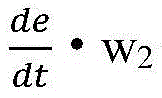 When the corresponding actuator is driven as an action command, the deviation e is caused to act towards 0, wherein e is the deviation between the measured value of the controlled object and the set value thereof,
 the first derivative of the deviation e with respect to time.
Optionally, the functional expression of the dot product calculation result in step 4) is: wherein e is the deviation of the measured value of the controlled object and the set value thereof,
 is the first derivative of the deviation e with respect to time, w1,w2Respectively, elements in the response instruction vector.
Optionally, the controlled object is one of n controlled objects with cross-coupling influence, and the feedback vector constructed in step 3) is Wherein e1~enThe measured values of the 1 st to n th controlled objects and the deviation of the set value thereof,
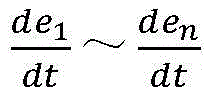 deviation e of measured value and set value of the 1 st to n th controlled objects1~enFirst derivative with respect to time.
Optionally, when performing the dot product calculation in step 4), the response instruction vector of any ith controlled object having the same dimension as the feedback vector is [ wi1,wi2,……,wi2n]Wherein w isi1,wi2,……,wi2nN response instructions in the response instruction vector of the ith controlled object respectively, and n response instructions wi1,wi2,……,wi2nThe initial value of (a) satisfies: with the use of e1·wi1, When the i-th actuator is driven as an operation command, the deviation e is causediMoving in a direction approaching 0.
Optionally, when performing the dot product calculation in step 4), the functional expression of the dot product calculation result of any ith controlled object is: wherein e1~enRespectively the deviation of the measured value of the controlled object and the set value thereof,
 are respectively a deviation e1~enFirst derivative with respect to time, wi1,wi2,……,wi2nRespectively n response instructions in the response instruction vector of the ith controlled object.
Optionally, when the values of the elements of the response instruction vector are dynamically adjusted in step 4), any ith element w of the response instruction vector is pointed toiThe processing steps of (1) include: judgment element wiWhether the preset adjusting condition is met or not, if not, keeping the element wiThe value of (d) is unchanged; otherwise according to wi+1=wi+ Δ w update element wiAnd updating the new value wi+1And carrying out amplitude limiting processing, wherein the delta w is a preset adjustment step length of the element.
In addition, the invention also provides a thermal power generating unit control system aiming at the hysteresis characteristic object, which comprises a microprocessor and a memory which are connected with each other, wherein the microprocessor is programmed or configured to execute the steps of the thermal power generating unit control method aiming at the hysteresis characteristic object.
Furthermore, the invention also provides a computer readable storage medium, wherein a computer program is stored in the computer readable storage medium and is programmed or configured to execute the thermal power generating unit control method aiming at the hysteresis characteristic object.
Compared with the prior art, the invention has the following advantages:
1. the invention takes the deviation of the set value and the measured value of the controlled variable and the first derivative of the deviation to time as the feedback vector, and can simultaneously monitor the absolute value and the variation trend of the control deviation, so that the controller adjusting instruction based on the feedback vector has a prediction function, can quickly eliminate the control deviation, and effectively avoids overshoot or undershoot phenomena which are easy to occur to the control of a hysteresis characteristic object.
2. The response instruction has a self-learning function, can be dynamically adjusted according to the control deviation and the variation trend of the controlled variable, and the adjustment instruction of the actuator is designed to be the product of a corresponding instruction vector and a feedback vector, so that the adjustment instruction of the actuator essentially responds to the track of a quadratic nonlinear curve, and compared with general linear adjustment, the response speed and the control precision are obviously improved. When the deviation between the set value and the measured value of the controlled object is large and has an expansion trend, the controller greatly outputs a command for making the controlled object move towards the direction of reducing the deviation, and the control method has rapidity; when the deviation between the set value and the measured value of the controlled object is reduced, the controller outputs an over-regulation preventing command in advance, and the two characteristics are very suitable for the nonlinear controlled object with a hysteresis characteristic and have predictability.
3. According to the invention, the self-learning rule responding to the instruction vector is designed with a protective measure, so that the dynamic adjustment is ensured to always act in the direction of reducing the controlled quantity control deviation, the divergence of the control system is effectively prevented, and the control system has good robustness and reliability.
4. According to the invention, an independent adjusting step length and an adjusting condition are designed for each element in the response instruction vector, so that the pertinence is stronger, the adjustment is more accurate, the self-learning capability is better, the control method can adapt to various working conditions which change rapidly in the operation process, and the problems that the existing control method is poor in adaptability and needs a large number of training samples are solved.
5. The learning rule and the control algorithm designed by the invention can be realized on any current control platform, can also be realized based on an independent platform, have good practicability, are easy to implement and popularize in engineering, and solve the problems that the current part of intelligent control technology is complex and is difficult to implement in a highly-modularized control system.
Drawings
FIG. 1 is a basic flow diagram of a method according to an embodiment of the present invention.
Fig. 2 is a schematic diagram of a basic principle of a first embodiment of the present invention.
Fig. 3 is a schematic diagram of a basic principle of a second embodiment of the present invention.
Detailed Description
The thermal power generating unit control method aiming at the hysteresis characteristic object is suitable for a single variable control system with hysteresis characteristics and a multivariable coupling control system with the hysteresis characteristic object, and is further specifically described below by combining the accompanying drawings and the specific implementation mode respectively. It should be noted that the thermal power generating unit control method of the present invention for the hysteresis characteristic object may also be applied to other single hysteresis characteristic objects than the two embodiments described below, or to two or more mutually coupled hysteresis characteristic objects.
The first embodiment is as follows:
the embodiment is a thermal power generating unit control method of a single controlled object.
As shown in fig. 1, the thermal power generating unit control method for the hysteresis characteristic object of the present embodiment includes:
1) acquiring a measured value of a controlled object with a hysteresis characteristic;
2) calculating the deviation e of the measured value of the controlled object and the set value thereof and the first derivative of the deviation e to time;
3) constructing a feedback vector taking the deviation e and a first derivative of the deviation e to time as elements;
4) firstly, performing dot product calculation on the feedback vector and the transpose of the response instruction vector with the same dimension of the feedback vector, and taking the dot product calculation result as an action instruction of a corresponding actuator; and then, dynamically adjusting the values of each element of the response instruction vector according to a preset self-learning rule of the response instruction vector.
In this embodiment, the controlled object is a single independent control object. As an alternative implementation, as shown in fig. 2, in this embodiment, the single independent controlled object refers to the content of nitrogen oxides in the flue gas of the thermal power generating unit.
In this embodiment, the feedback vector constructed in step 3) is Wherein e is the deviation of the measured value of the controlled object and the set value thereof,
 the first derivative of the deviation e with respect to time.
In this embodiment, the response instruction vector having the same dimension as the feedback vector in step 3) has the form of [ w1,w2]Wherein w is1,w2Are respectively elements in the vector of response instructions, and element w1,w2The initial value of (a) satisfies: using e.w1, When the corresponding actuator is driven as the action command, the actuator is operated in a direction that the deviation e is close to 0, wherein e is the deviation of the measured value of the controlled object and the set value thereof,
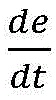 the first derivative of the deviation e with respect to time. In this embodiment, the deviation e is measured as the nox content — set value, and the controller output command (i.e., the actuator driving command) should be decreased when the deviation e is operated in a direction approaching 0, that is, when the set value of the nox content is greater than the measured value; when the set point for the nox content is less than the measured value, the controller output command should be increased (i.e., the actuator drive command).
As shown in fig. 2, the functional expression of the dot product calculation result in step 4) of this embodiment is: wherein e is the deviation of the measured value of the controlled object and the set value thereof,
 is the first derivative of the deviation e with respect to time, w1,w2Respectively, elements in the response instruction vector. Transposing the response instruction vector obtained in step 4) to perform dot product calculation and settle accountsThe result as the action command of the corresponding actuator specifically means: will be provided with
 The value of (c) is used as an action command of the actuator.
The initial steps of the self-learning rule in response to the instruction vector include: 1) designing an adjustment step size and an adjustment condition for each element in the response instruction vector; 2) when one element in the response instruction vector meets the adjustment condition, the element changes the corresponding adjustment step value on the original basis to obtain a new response instruction vector; 3) and designing amplitude limitation aiming at each element in the response instruction vector, and preventing the action of the actuator from moving towards the direction of enlarging the set value of the controlled variable and measuring the deviation in the self-learning process. In this embodiment, when the values of the elements of the response instruction vector are dynamically adjusted in step 4), the ith element w of the response instruction vector is pointed atiThe processing steps of (1) include: judgment element wiWhether the preset adjusting condition is met or not, if not, keeping the element wiThe value of (d) is unchanged; otherwise according to wi+1=wi+ Δ w update element wiAnd updating the new value wi+1And carrying out amplitude limiting processing, wherein the delta w is a preset adjustment step length of the element. Specifically, in the present embodiment, the first element w in the response instruction vector1Is set to be 0.02 under the condition that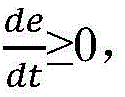 In response to w of the second element in the instruction vector2The adjustment step size of (2) is set to 0.01, and the adjustment condition is
 When in use
 w1(i+1)=w1i+△w1Wherein Δ w1Equal to 0.02; when in use
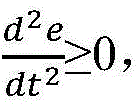 w2(i+1)=w2i+. Δ w, wherein Δ w2Equal to 0.01. The adjustment process is as follows: in the ith operation, when
 w1(i+1)=w1i+0.02, otherwise w1(i+1)=w1iWhen is coming into contact with
 w2(i+1)=w2i+0.01, otherwise w2(i+1)=w2i。
In summary, the response command obtained by the thermal power generating unit control for the hysteresis characteristic object in the embodiment has a self-learning function, and can be dynamically adjusted according to the feedback state of the controlled parameter, so that the control system has better response speed and response accuracy, and is suitable for both a single variable control system for the hysteresis characteristic object and a multi-variable coupling control system for the hysteresis characteristic object.
In addition, the present embodiment also provides a thermal power generating unit control system for a hysteresis characteristic object, which includes a microprocessor and a memory connected with each other, wherein the microprocessor is programmed or configured to execute the steps of the thermal power generating unit control method for the hysteresis characteristic object.
Furthermore, the present embodiment also provides a computer-readable storage medium having stored therein a computer program programmed or configured to execute the aforementioned thermal power unit control method for a hysteresis characteristic object.
Example two:
the present embodiment is substantially the same as the method of the embodiment, and the main differences include:
firstly, a controlled object is one of n controlled objects with cross coupling influence;
as an optional implementation manner, as shown in fig. 3, in this embodiment, the n controlled objects with the cross-coupling influence specifically refer to the main steam pressure and the main steam temperature of the thermal power generating unit.
Secondly, the feedback vector constructed in step 3) of this embodiment is Wherein e1~enThe measured values of the 1 st to n th controlled objects and the deviation of the set value thereof,
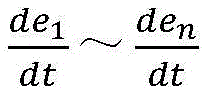 deviation e of measured value and set value of the 1 st to n th controlled objects1~enFirst derivative with respect to time.
Third, when performing the dot product calculation in step 4) of this embodiment, the response instruction vector of any ith controlled object having the same dimension as the feedback vector is [ wi1,wi2,……,wi2n]Wherein w isi1,wi2,……,wi2nN response instructions in the response instruction vector of the ith controlled object respectively, and n response instructions wi1,wi2,……,wi2nThe initial value of (a) satisfies: with the use of e1·wi1, When the i-th actuator is driven as an operation command, the deviation e is causediMoving in a direction approaching 0. Namely: response instruction vector [ w ] corresponding to 1 st controlled variable11,w12,……,w12n]Is such that e1·w11,
 All driving the 1 st actuator toward a deviation e of the 1 st controlled variable set point from the measurement1The direction approaching 0, the response instruction vector [ w ] corresponding to the 2 nd controlled variable21,w22,……,w22n]Is such that e1·w21,
 Drives the 2 nd actuator towards a deviation e of the 2 nd controlled variable set point from the measurement2The direction approaching 0, the response instruction vector [ w ] corresponding to the nth controlled variablen1,wn2,……,wn2n]Is such that e1·wn1,
 Drives the nth actuator towards a deviation e of the nth controlled variable set point from the measurementnApproaching the direction of 0. Deviation e of the ith controlled variable set value from the measurementnThe direction approaching 0 specifically means: when the main steam pressure set value is larger than the measured value, the corresponding response command vector [ w11,w12,……,w12n]The value of (a) should increase the output value of the main steam pressure controller, and when the set value of the main steam pressure is smaller than the measured value, the corresponding response instruction vector [ w [ w ] ])11,w12,……,w12n]The value of (a) should be such that the output value of the main steam pressure controller is reduced; when the set value of the main steam temperature is larger than the measured value, the corresponding response instruction vector [ w21,w22,……,w22n]The value of (a) should reduce the output value of the main steam temperature controller, and when the set value of the main steam temperature is smaller than the measured value, the corresponding response instruction vector [ w [ w ] ])21,w22,……,w22n]The value of (a) should be increased to the output value of the main steam temperature controller. Performing dot product calculation by using the transpose of the response instruction vector obtained in the step 4), wherein the specific way that the settlement result is used as the action instruction of the corresponding actuator is as follows: will be provided with
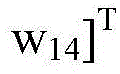 As the action command of the 1 st actuator, i.e. the output of the main steam pressure controller, will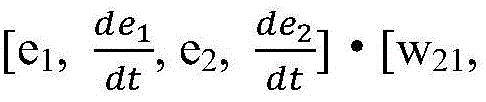
 As the action command of the 2 nd actuatorI.e. the output of the main steam temperature controller.
Fourth, when performing the dot product calculation in step 4) of this embodiment, the functional expression of the dot product calculation result of any ith controlled object is: wherein e1~enRespectively the deviation of the measured value of the controlled object and the set value thereof,
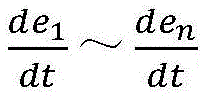 are respectively a deviation e1~enFirst derivative with respect to time, wi1,wi2,……,wi2nRespectively n response instructions in the response instruction vector of the ith controlled object. Namely: when the controlled variables are multivariable, the controlled variables will be
 As the action command of the 1 st actuator, will
 As the action command of the 2 nd actuator, will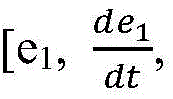
 The value of (d) is used as an action command of the nth actuator.
Fifthly, when the values of the elements of the response instruction vector are dynamically adjusted in step 4) of the embodiment, aiming at the ith element w of the response instruction vectoriThe processing steps of (1) include: judgment element wiWhether the preset adjusting condition is met or not, if not, keeping the element wiThe value of (d) is unchanged; otherwise according to wi+1=wi+ Δ w update element wiAnd updating the new value wi+1And carrying out amplitude limiting processing, wherein the delta w is a preset adjustment step length of the element. Specifically, in this embodiment, the 1 st controlled variable responds to the first element w in the instruction vector11Is set to 0.01 when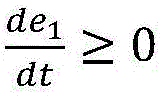 When w11(i+1)=w11i+0.01, second element w12Is set to 0.005 when
 w12(i+1)=w12i+0.005, third and fourth element w13,w14The value of (a) is kept unchanged; the second controlled variable is responsive to the first element w in the instruction vector21Is set to 0.03 when
 When w21(i+1)=w21i+0.03, second element w22Is set to 0.015 when
 w22(i+1)=w22i+0.015, third and fourth elements w23,w24The value of (a) remains unchanged. In the ith operation during adjustment, when
 When w11(i+1)=w11i+0.01, otherwise w11(i+1)=w11iWhen is coming into contact with
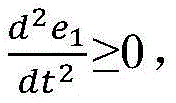 w12(i+1)=w12i+0.005, otherwise w12(i+1)=w12iThird and fourth elements w13,w14The value of (A) is always kept unchanged; when in use
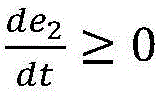 When w21(i+1)=w21i+0.03, otherwise w21(i+1)=w21iWhen is coming into contact with
 w22(i+1)=w22i+0.015, otherwise, w22(i+1)=w22iThird and fourth elements w23,w24The value of (a) is always kept constant.
In summary, the present embodiment has a self-learning function for the response command obtained by the thermal power generating unit control with the hysteresis characteristic object, and can dynamically adjust according to the feedback state of the controlled parameter, so that the control system has better response speed and response accuracy, and is suitable for both the univariate control system with the hysteresis characteristic and the multivariable coupling control system with the hysteresis characteristic object.
In addition, the present embodiment also provides a thermal power generating unit control system for a hysteresis characteristic object, which includes a microprocessor and a memory connected with each other, wherein the microprocessor is programmed or configured to execute the steps of the thermal power generating unit control method for the hysteresis characteristic object.
Furthermore, the present embodiment also provides a computer-readable storage medium having stored therein a computer program programmed or configured to execute the aforementioned thermal power unit control method for a hysteresis characteristic object.
As will be appreciated by one skilled in the art, embodiments of the present application may be provided as a method, system, or computer program product. Accordingly, the present application may take the form of an entirely hardware embodiment, an entirely software embodiment or an embodiment combining software and hardware aspects. Furthermore, the present application may take the form of a computer program product embodied on one or more computer-readable storage media (including, but not limited to, disk storage, CD-ROM, optical storage, and the like) having computer-usable program code embodied therein. The present application is directed to methods, apparatus (systems), and computer program products according to embodiments of the application, wherein the instructions that execute via the flowcharts and/or processor of the computer program product create means for implementing the functions specified in the flowchart flow or flows and/or block diagram block or blocks. These computer program instructions may also be stored in a computer-readable memory that can direct a computer or other programmable data processing apparatus to function in a particular manner, such that the instructions stored in the computer-readable memory produce an article of manufacture including instruction means which implement the function specified in the flowchart flow or flows and/or block diagram block or blocks. These computer program instructions may also be loaded onto a computer or other programmable data processing apparatus to cause a series of operational steps to be performed on the computer or other programmable apparatus to produce a computer implemented process such that the instructions which execute on the computer or other programmable apparatus provide steps for implementing the functions specified in the flowchart flow or flows and/or block diagram block or blocks.
The above description is only a preferred embodiment of the present invention, and the protection scope of the present invention is not limited to the above embodiments, and all technical solutions belonging to the idea of the present invention belong to the protection scope of the present invention. It should be noted that modifications and embellishments within the scope of the invention may occur to those skilled in the art without departing from the principle of the invention, and are considered to be within the scope of the invention.
Claims (10)
1. A thermal power generating unit control method for a hysteresis characteristic object is characterized by comprising the following steps:
1) acquiring a measured value of a controlled object with a hysteresis characteristic;
2) calculating the deviation e of the measured value of the controlled object and the set value thereof and the first derivative of the deviation e to time;
3) constructing a feedback vector taking the deviation e and a first derivative of the deviation e to time as elements;
4) firstly, performing dot product calculation on the feedback vector and the transpose of the response instruction vector with the same dimension of the feedback vector, and taking the dot product calculation result as an action instruction of a corresponding actuator; and then, dynamically adjusting the values of each element of the response instruction vector according to a preset self-learning rule of the response instruction vector.
2. The thermal power generating unit control method aiming at the hysteresis characteristic object as claimed in claim 1, wherein the controlled object is a single independent controlled object, and the feedback vector constructed in the step 3) is Wherein e is the deviation of the measured value of the controlled object and the set value thereof,
 the first derivative of the deviation e with respect to time.
3. The thermal power generating unit control method for the hysteresis characteristic object according to claim 2, wherein the response command vector having the same dimension as the feedback vector in step 3) is in the form of [ w [ w ] ]1,w2]Wherein w is1,w2Are respectively elements in the vector of response instructions, and element w1,w2The initial value of (a) satisfies the condition of adopting e.w1, When the corresponding actuator is driven as an action command, the deviation e is caused to act towards 0, wherein e is the deviation between the measured value of the controlled object and the set value thereof,
 the first derivative of the deviation e with respect to time.
4. The thermal power generating unit control method for the hysteresis characteristic object according to claim 3, wherein the functional expression of the dot product calculation result in the step 4) is: wherein e is the measured value of the controlled objectAnd the deviation of the set value thereof,
 is the first derivative of the deviation e with respect to time, w1,w2Respectively, elements in the response instruction vector.
5. The thermal power generating unit control method for the hysteresis characteristic object according to claim 1, wherein the controlled object is one of n controlled objects with cross-coupling influence; the feedback vector constructed in step 3) is
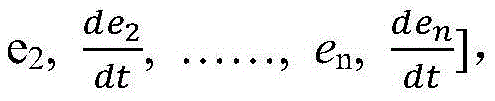 Wherein e1~enThe measured values of the 1 st to n th controlled objects and the deviation of the set value thereof,
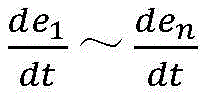 deviation e of measured value and set value of the 1 st to n th controlled objects1~enFirst derivative with respect to time.
6. The thermal power generating unit control method for the hysteresis characteristic object according to claim 5, wherein when the dot product calculation is performed in step 4), the response command vector of any ith controlled object having the same dimension as the feedback vector is [ wi1,wi2,……,wi2n]Wherein w isi1,wi2,……,wi2nN response instruction elements in the response instruction vector of the ith controlled object respectively, and n response instructions wi1,wi2,……,wi2nThe initial value of (a) satisfies: by using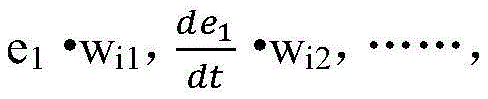
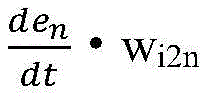 When the i-th actuator is driven as an operation command, the i-th actuator is operated so that the deviation e is generatediMoving in a direction approaching 0.
7. The thermal power generating unit control method for the hysteresis characteristic object according to claim 6, wherein when the dot product calculation is performed in step 4), a functional expression of a result of the dot product calculation for an arbitrary i-th controlled object is: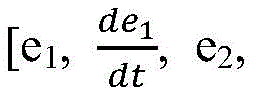
 wherein e1~enRespectively the deviation of the measured value of the controlled object and the set value thereof,
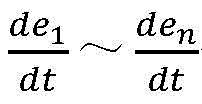 are respectively a deviation e1~enFirst derivative with respect to time, wi1,wi2,……,wi2nN response instruction elements in the response instruction vector of the ith controlled object respectively.
8. The thermal power generating unit control method for the hysteresis characteristic object according to claim 1, wherein when the values of the elements of the response command vector are dynamically adjusted in step 4), an ith element w of the response command vector is selectediThe processing steps of (1) include: judgment element wiWhether the preset adjusting condition is met or not, if not, keeping the element wiThe value of (d) is unchanged; otherwise according to wi+1=wi+ Δ w update element wiAnd updating the new value wi+1And carrying out amplitude limiting processing, wherein the delta w is a preset adjustment step length of the element.
9. A thermal power generating unit control system for a hysteresis characteristic object, comprising a microprocessor and a memory which are connected with each other, characterized in that the microprocessor is programmed or configured to execute the steps of the thermal power generating unit control method for the hysteresis characteristic object according to any one of claims 1 to 8.
10. A computer-readable storage medium, characterized in that a computer program is stored in the computer-readable storage medium, which is programmed or configured to execute the thermal power generating unit control method for a hysteresis characteristic object according to any one of claims 1 to 8.
Priority Applications (1)
| Application Number | Priority Date | Filing Date | Title |
|---|---|---|---|
| CN202110120967.3A CN112947049B (en) | 2021-01-28 | 2021-01-28 | A thermal power unit control method, system and medium for hysteresis characteristics objects |
Applications Claiming Priority (1)
| Application Number | Priority Date | Filing Date | Title |
|---|---|---|---|
| CN202110120967.3A CN112947049B (en) | 2021-01-28 | 2021-01-28 | A thermal power unit control method, system and medium for hysteresis characteristics objects |
Publications (2)
| Publication Number | Publication Date |
|---|---|
| CN112947049A true CN112947049A (en) | 2021-06-11 |
| CN112947049B CN112947049B (en) | 2023-10-27 |
Family
ID=76238955
Family Applications (1)
| Application Number | Title | Priority Date | Filing Date |
|---|---|---|---|
| CN202110120967.3A Active CN112947049B (en) | 2021-01-28 | 2021-01-28 | A thermal power unit control method, system and medium for hysteresis characteristics objects |
Country Status (1)
| Country | Link |
|---|---|
| CN (1) | CN112947049B (en) |
Citations (11)
| Publication number | Priority date | Publication date | Assignee | Title |
|---|---|---|---|---|
| CN101131571A (en) * | 2007-08-15 | 2008-02-27 | 华北电力大学 | PID Parameters Tuning Method for Coordinated Control System of Unit System Generating Sets |
| CN102607053A (en) * | 2012-02-29 | 2012-07-25 | 东南大学 | Intermittent control method for eliminating static deviation of main steam pressure of fossil fuel fired power unit |
| US20160209031A1 (en) * | 2015-01-20 | 2016-07-21 | Alstom Technology Ltd | Model-based controls for a furnace and method for controlling the furnace |
| CN105867125A (en) * | 2016-04-07 | 2016-08-17 | 中国中化股份有限公司 | Optimization control method and apparatus of refining apparatus coupling unit |
| CN105962408A (en) * | 2016-07-01 | 2016-09-28 | 云南烟叶复烤有限责任公司 | Multi-strategy composite control method for moisture of tobacco at outlet of tobacco redryer |
| CN107769210A (en) * | 2017-09-22 | 2018-03-06 | 华锐风电科技(集团)股份有限公司 | A kind of double-fed unit frequency modulation control method and system based on CS algorithms |
| CN109212970A (en) * | 2018-09-18 | 2019-01-15 | 西北工业大学 | A kind of neural network dynamic face control method of drive lacking rope system complex system |
| JP2019074375A (en) * | 2017-10-13 | 2019-05-16 | 株式会社リコー | Distance measuring device, moving body, distance measuring method, and program |
| CN110750047A (en) * | 2019-11-24 | 2020-02-04 | 曾喆昭 | Novel self-adaptive mutual coupling PID cooperative control theory method |
| CN110838725A (en) * | 2019-09-19 | 2020-02-25 | 国电新能源技术研究院有限公司 | Parameter setting method and device for wind power plant closed-loop PI controller |
| CN111255530A (en) * | 2020-03-19 | 2020-06-09 | 西安热工研究院有限公司 | Thermal power generating unit load adjusting system and method assisted by butterfly valve with low-pressure cylinder |
-
2021
- 2021-01-28 CN CN202110120967.3A patent/CN112947049B/en active Active
Patent Citations (11)
| Publication number | Priority date | Publication date | Assignee | Title |
|---|---|---|---|---|
| CN101131571A (en) * | 2007-08-15 | 2008-02-27 | 华北电力大学 | PID Parameters Tuning Method for Coordinated Control System of Unit System Generating Sets |
| CN102607053A (en) * | 2012-02-29 | 2012-07-25 | 东南大学 | Intermittent control method for eliminating static deviation of main steam pressure of fossil fuel fired power unit |
| US20160209031A1 (en) * | 2015-01-20 | 2016-07-21 | Alstom Technology Ltd | Model-based controls for a furnace and method for controlling the furnace |
| CN105867125A (en) * | 2016-04-07 | 2016-08-17 | 中国中化股份有限公司 | Optimization control method and apparatus of refining apparatus coupling unit |
| CN105962408A (en) * | 2016-07-01 | 2016-09-28 | 云南烟叶复烤有限责任公司 | Multi-strategy composite control method for moisture of tobacco at outlet of tobacco redryer |
| CN107769210A (en) * | 2017-09-22 | 2018-03-06 | 华锐风电科技(集团)股份有限公司 | A kind of double-fed unit frequency modulation control method and system based on CS algorithms |
| JP2019074375A (en) * | 2017-10-13 | 2019-05-16 | 株式会社リコー | Distance measuring device, moving body, distance measuring method, and program |
| CN109212970A (en) * | 2018-09-18 | 2019-01-15 | 西北工业大学 | A kind of neural network dynamic face control method of drive lacking rope system complex system |
| CN110838725A (en) * | 2019-09-19 | 2020-02-25 | 国电新能源技术研究院有限公司 | Parameter setting method and device for wind power plant closed-loop PI controller |
| CN110750047A (en) * | 2019-11-24 | 2020-02-04 | 曾喆昭 | Novel self-adaptive mutual coupling PID cooperative control theory method |
| CN111255530A (en) * | 2020-03-19 | 2020-06-09 | 西安热工研究院有限公司 | Thermal power generating unit load adjusting system and method assisted by butterfly valve with low-pressure cylinder |
Non-Patent Citations (2)
| Title |
|---|
| 王爱军;张磊洋;邢宝钦;李娜;: "单元机组协调控制系统模糊自适应控制研究", 汽轮机技术, no. 01 * |
| 程辉;苗国耀;: "基于大滞后控制技术的1000MW超超临界机组过热及再热汽温优化控制", 自动化技术与应用, no. 07 * |
Also Published As
| Publication number | Publication date |
|---|---|
| CN112947049B (en) | 2023-10-27 |
Similar Documents
| Publication | Publication Date | Title |
|---|---|---|
| CN101523308B (en) | Use of dynamic variance correction in optimization | |
| US7653445B2 (en) | Apparatus and method for model-based control | |
| JP5005695B2 (en) | Adaptive multi-variable MPC controller | |
| CN100562823C (en) | A Contour Control Method for Complicated Trajectories | |
| CN102841539B (en) | Based on the subcritical control method for coordinating of multi-model PREDICTIVE CONTROL | |
| Dey et al. | A simple nonlinear PD controller for integrating processes | |
| CN109407512B (en) | Time-lag-dependent intermittent process 2D input-output constraint control method | |
| JP2013069094A (en) | Control method and controller | |
| CN105334751B (en) | A kind of stability controller design method of batch injection moulding process | |
| US20120310375A1 (en) | A nonlinear intelligent pulse-controller | |
| CN113885326A (en) | A Closed-loop System Identification Method Based on Efficient Excitation of Setpoints Considering Feedforward | |
| CN112947049B (en) | A thermal power unit control method, system and medium for hysteresis characteristics objects | |
| Isa et al. | Comparative study of PID controlled modes on automatic water level measurement system | |
| Chew et al. | Optimized computational analysis of feedforward and feedback control scheme using genetic algorithm techniques | |
| CN108107713B (en) | Design method of proportional-differential advanced intelligent model set PID controller | |
| CN107870567B (en) | Design method of PID controller of PID (proportion-differentiation) advanced generalized intelligent internal model set | |
| CN111538305B (en) | Intelligent optimization method, system and medium for water supply and fuel control of thermal power unit based on demand diagnosis | |
| Wardi et al. | Fractional PID controller design for nonlinear systems based on singular perturbation technique | |
| Huang et al. | Identification and internal model control of an ideal heat integrated distillation column (HIDiC) | |
| CN113848839A (en) | Double-layer structure economic performance improving strategy based on iterative learning control | |
| CN106610588B (en) | Cascade prediction control system and method | |
| Govindarajan et al. | Cascaded process model based control: Packed absorption column application | |
| Diwakar et al. | IMC based design of pi controller for real time pressure process | |
| CN119536426B (en) | Coupling regulation and control method and system for branch temperature and flow of thermal hydraulic experiment system | |
| Icev et al. | Supervisory-plus-regulatory control design for efficient operation of industrial furnaces |
Legal Events
| Date | Code | Title | Description |
|---|---|---|---|
| PB01 | Publication | ||
| PB01 | Publication | ||
| SE01 | Entry into force of request for substantive examination | ||
| SE01 | Entry into force of request for substantive examination | ||
| GR01 | Patent grant | ||
| GR01 | Patent grant |