CN112941208B - A rapid on-site detection method for Salmonella in food - Google Patents
A rapid on-site detection method for Salmonella in food Download PDFInfo
- Publication number
- CN112941208B CN112941208B CN202110120893.3A CN202110120893A CN112941208B CN 112941208 B CN112941208 B CN 112941208B CN 202110120893 A CN202110120893 A CN 202110120893A CN 112941208 B CN112941208 B CN 112941208B
- Authority
- CN
- China
- Prior art keywords
- salmonella
- food
- amplification
- genomic dna
- minutes
- Prior art date
- Legal status (The legal status is an assumption and is not a legal conclusion. Google has not performed a legal analysis and makes no representation as to the accuracy of the status listed.)
- Active
Links
- 241000607142 Salmonella Species 0.000 title claims abstract description 61
- 235000013305 food Nutrition 0.000 title claims abstract description 34
- 238000001514 detection method Methods 0.000 title claims abstract description 29
- 238000000034 method Methods 0.000 claims abstract description 45
- 230000003321 amplification Effects 0.000 claims abstract description 39
- 238000003199 nucleic acid amplification method Methods 0.000 claims abstract description 39
- 108020004707 nucleic acids Proteins 0.000 claims abstract description 22
- 102000039446 nucleic acids Human genes 0.000 claims abstract description 22
- 150000007523 nucleic acids Chemical class 0.000 claims abstract description 16
- 108010091086 Recombinases Proteins 0.000 claims abstract description 9
- 102000018120 Recombinases Human genes 0.000 claims abstract description 9
- 239000003153 chemical reaction reagent Substances 0.000 claims abstract description 9
- 238000004451 qualitative analysis Methods 0.000 claims abstract description 9
- 239000001963 growth medium Substances 0.000 claims abstract description 5
- 229910021642 ultra pure water Inorganic materials 0.000 claims description 14
- 239000012498 ultrapure water Substances 0.000 claims description 14
- 230000001580 bacterial effect Effects 0.000 claims description 13
- 238000002835 absorbance Methods 0.000 claims description 12
- 238000011022 operating instruction Methods 0.000 claims description 10
- 238000007400 DNA extraction Methods 0.000 claims description 9
- 238000012360 testing method Methods 0.000 claims description 9
- 239000000980 acid dye Substances 0.000 claims description 7
- 239000000284 extract Substances 0.000 claims description 7
- -1 SYBR Green I nucleic acid Chemical class 0.000 claims description 6
- 239000000047 product Substances 0.000 claims description 6
- 238000012546 transfer Methods 0.000 claims description 6
- TWRXJAOTZQYOKJ-UHFFFAOYSA-L Magnesium chloride Chemical compound [Mg+2].[Cl-].[Cl-] TWRXJAOTZQYOKJ-UHFFFAOYSA-L 0.000 claims description 4
- 238000005119 centrifugation Methods 0.000 claims description 4
- 239000006228 supernatant Substances 0.000 claims description 4
- 238000000605 extraction Methods 0.000 claims description 3
- 239000002609 medium Substances 0.000 claims description 3
- UAIUNKRWKOVEES-UHFFFAOYSA-N 3,3',5,5'-tetramethylbenzidine Chemical compound CC1=C(N)C(C)=CC(C=2C=C(C)C(N)=C(C)C=2)=C1 UAIUNKRWKOVEES-UHFFFAOYSA-N 0.000 claims description 2
- 238000012197 amplification kit Methods 0.000 claims description 2
- 229910001629 magnesium chloride Inorganic materials 0.000 claims description 2
- 239000001509 sodium citrate Substances 0.000 claims description 2
- NLJMYIDDQXHKNR-UHFFFAOYSA-K sodium citrate Chemical compound O.O.[Na+].[Na+].[Na+].[O-]C(=O)CC(O)(CC([O-])=O)C([O-])=O NLJMYIDDQXHKNR-UHFFFAOYSA-K 0.000 claims description 2
- 238000011161 development Methods 0.000 abstract description 14
- 230000035945 sensitivity Effects 0.000 abstract description 6
- 238000012544 monitoring process Methods 0.000 abstract description 2
- 239000007788 liquid Substances 0.000 abstract 2
- 108020004414 DNA Proteins 0.000 description 15
- 230000000052 comparative effect Effects 0.000 description 10
- 239000008267 milk Substances 0.000 description 8
- 210000004080 milk Anatomy 0.000 description 8
- 235000013336 milk Nutrition 0.000 description 8
- CGNLCCVKSWNSDG-UHFFFAOYSA-N SYBR Green I Chemical compound CN(C)CCCN(CCC)C1=CC(C=C2N(C3=CC=CC=C3S2)C)=C2C=CC=CC2=[N+]1C1=CC=CC=C1 CGNLCCVKSWNSDG-UHFFFAOYSA-N 0.000 description 2
- 206010039438 Salmonella Infections Diseases 0.000 description 2
- 241000293869 Salmonella enterica subsp. enterica serovar Typhimurium Species 0.000 description 2
- 238000004458 analytical method Methods 0.000 description 2
- 230000034994 death Effects 0.000 description 2
- 231100000517 death Toxicity 0.000 description 2
- 239000000203 mixture Substances 0.000 description 2
- 230000002265 prevention Effects 0.000 description 2
- 108090000623 proteins and genes Proteins 0.000 description 2
- 206010039447 salmonellosis Diseases 0.000 description 2
- 108091093088 Amplicon Proteins 0.000 description 1
- 241000894006 Bacteria Species 0.000 description 1
- 108700031821 Bacteria invA Proteins 0.000 description 1
- 230000004544 DNA amplification Effects 0.000 description 1
- 206010012735 Diarrhoea Diseases 0.000 description 1
- MKYBYDHXWVHEJW-UHFFFAOYSA-N N-[1-oxo-1-(2,4,6,7-tetrahydrotriazolo[4,5-c]pyridin-5-yl)propan-2-yl]-2-[[3-(trifluoromethoxy)phenyl]methylamino]pyrimidine-5-carboxamide Chemical compound O=C(C(C)NC(=O)C=1C=NC(=NC=1)NCC1=CC(=CC=C1)OC(F)(F)F)N1CC2=C(CC1)NN=N2 MKYBYDHXWVHEJW-UHFFFAOYSA-N 0.000 description 1
- 206010034972 Photosensitivity reaction Diseases 0.000 description 1
- 206010047700 Vomiting Diseases 0.000 description 1
- 238000006243 chemical reaction Methods 0.000 description 1
- 108091036078 conserved sequence Proteins 0.000 description 1
- 238000011109 contamination Methods 0.000 description 1
- 230000007812 deficiency Effects 0.000 description 1
- 238000010586 diagram Methods 0.000 description 1
- 208000002173 dizziness Diseases 0.000 description 1
- 244000078673 foodborn pathogen Species 0.000 description 1
- 101150114988 invA gene Proteins 0.000 description 1
- 238000011901 isothermal amplification Methods 0.000 description 1
- 239000000463 material Substances 0.000 description 1
- 238000003752 polymerase chain reaction Methods 0.000 description 1
- 230000008092 positive effect Effects 0.000 description 1
- 238000004445 quantitative analysis Methods 0.000 description 1
- 238000009877 rendering Methods 0.000 description 1
- 238000011160 research Methods 0.000 description 1
- 101150021607 rppH gene Proteins 0.000 description 1
- 101150082821 sacA gene Proteins 0.000 description 1
- 238000011895 specific detection Methods 0.000 description 1
- 238000010561 standard procedure Methods 0.000 description 1
- 208000024891 symptom Diseases 0.000 description 1
- 230000008673 vomiting Effects 0.000 description 1
- 101150070603 yadA gene Proteins 0.000 description 1
Images


Classifications
-
- C—CHEMISTRY; METALLURGY
- C12—BIOCHEMISTRY; BEER; SPIRITS; WINE; VINEGAR; MICROBIOLOGY; ENZYMOLOGY; MUTATION OR GENETIC ENGINEERING
- C12Q—MEASURING OR TESTING PROCESSES INVOLVING ENZYMES, NUCLEIC ACIDS OR MICROORGANISMS; COMPOSITIONS OR TEST PAPERS THEREFOR; PROCESSES OF PREPARING SUCH COMPOSITIONS; CONDITION-RESPONSIVE CONTROL IN MICROBIOLOGICAL OR ENZYMOLOGICAL PROCESSES
- C12Q1/00—Measuring or testing processes involving enzymes, nucleic acids or microorganisms; Compositions therefor; Processes of preparing such compositions
- C12Q1/68—Measuring or testing processes involving enzymes, nucleic acids or microorganisms; Compositions therefor; Processes of preparing such compositions involving nucleic acids
- C12Q1/6876—Nucleic acid products used in the analysis of nucleic acids, e.g. primers or probes
- C12Q1/6888—Nucleic acid products used in the analysis of nucleic acids, e.g. primers or probes for detection or identification of organisms
- C12Q1/689—Nucleic acid products used in the analysis of nucleic acids, e.g. primers or probes for detection or identification of organisms for bacteria
-
- C—CHEMISTRY; METALLURGY
- C12—BIOCHEMISTRY; BEER; SPIRITS; WINE; VINEGAR; MICROBIOLOGY; ENZYMOLOGY; MUTATION OR GENETIC ENGINEERING
- C12Q—MEASURING OR TESTING PROCESSES INVOLVING ENZYMES, NUCLEIC ACIDS OR MICROORGANISMS; COMPOSITIONS OR TEST PAPERS THEREFOR; PROCESSES OF PREPARING SUCH COMPOSITIONS; CONDITION-RESPONSIVE CONTROL IN MICROBIOLOGICAL OR ENZYMOLOGICAL PROCESSES
- C12Q1/00—Measuring or testing processes involving enzymes, nucleic acids or microorganisms; Compositions therefor; Processes of preparing such compositions
- C12Q1/68—Measuring or testing processes involving enzymes, nucleic acids or microorganisms; Compositions therefor; Processes of preparing such compositions involving nucleic acids
- C12Q1/6844—Nucleic acid amplification reactions
-
- Y—GENERAL TAGGING OF NEW TECHNOLOGICAL DEVELOPMENTS; GENERAL TAGGING OF CROSS-SECTIONAL TECHNOLOGIES SPANNING OVER SEVERAL SECTIONS OF THE IPC; TECHNICAL SUBJECTS COVERED BY FORMER USPC CROSS-REFERENCE ART COLLECTIONS [XRACs] AND DIGESTS
- Y02—TECHNOLOGIES OR APPLICATIONS FOR MITIGATION OR ADAPTATION AGAINST CLIMATE CHANGE
- Y02A—TECHNOLOGIES FOR ADAPTATION TO CLIMATE CHANGE
- Y02A50/00—TECHNOLOGIES FOR ADAPTATION TO CLIMATE CHANGE in human health protection, e.g. against extreme weather
- Y02A50/30—Against vector-borne diseases, e.g. mosquito-borne, fly-borne, tick-borne or waterborne diseases whose impact is exacerbated by climate change
Landscapes
- Chemical & Material Sciences (AREA)
- Life Sciences & Earth Sciences (AREA)
- Organic Chemistry (AREA)
- Proteomics, Peptides & Aminoacids (AREA)
- Analytical Chemistry (AREA)
- Zoology (AREA)
- Wood Science & Technology (AREA)
- Health & Medical Sciences (AREA)
- Engineering & Computer Science (AREA)
- Microbiology (AREA)
- Immunology (AREA)
- Molecular Biology (AREA)
- Biotechnology (AREA)
- Biophysics (AREA)
- Physics & Mathematics (AREA)
- Biochemistry (AREA)
- Bioinformatics & Cheminformatics (AREA)
- General Engineering & Computer Science (AREA)
- General Health & Medical Sciences (AREA)
- Genetics & Genomics (AREA)
- Chemical Kinetics & Catalysis (AREA)
- Measuring Or Testing Involving Enzymes Or Micro-Organisms (AREA)
Abstract
Description
技术领域technical field
本发明属于食品细菌检测分析技术领域,具体涉及一种用于食品中沙门氏菌的现场快速检测方法。The invention belongs to the technical field of food bacteria detection and analysis, and in particular relates to an on-site rapid detection method for Salmonella in food.
背景技术Background technique
沙门氏菌是一种以食品为主要媒介的食源性致病菌,感染者常常伴随呕吐、头晕、腹泻等症状,严重的感染者,甚至可能引发死亡。在高度全球化的今天,各国之间食品贸易频繁,让沙门氏菌的防治工作异常困难。据最新的研究统计报告,仅在2017年,全球的沙门氏菌爆发案例就达到了9510万,直接引发的死亡人数也高达50771人(LancetInfect.Dis.2019,19,1312-1324)。由此可见,沙门氏菌对大众的健康造成严重损害,同时也给各个国家带来了财力和物力损失。Salmonella is a food-borne pathogen with food as the main medium. Infected people are often accompanied by symptoms such as vomiting, dizziness, and diarrhea. In severe cases, it may even cause death. In today's highly globalized world, frequent food trade among countries makes the prevention and control of Salmonella extremely difficult. According to the latest research statistics, in 2017 alone, the number of Salmonella outbreaks worldwide reached 95.1 million, and the number of deaths directly caused was as high as 50,771 (Lancet Infect. Dis. 2019, 19, 1312-1324). It can be seen that Salmonella has caused serious damage to the health of the public, and it has also brought financial and material losses to various countries.
对食品中的沙门氏菌进行准确可靠的检测,是防治沙门氏菌工作中必不可少的环节。目前,国际上检测食品中沙门氏菌的标准方法仍然是基于细菌培养的ISO 6579-1(https://www.iso.org/standard/56712.html)。该方法可实现食品中沙门氏菌的准确鉴定和分型,但其需要特定检测场所和较长检测时间(4-7天),通常适用于在基础条件较好的地区开展,并且以保存时间较长的食品为主要检测对象。然而,沙门氏菌污染严重的贫困地区却因缺乏相关基础设施和技术人员而无法实施相关检测,进而导致沙门氏菌感染事件频发。此外,细菌培养检测的方式不适用于保质期较短的生鲜食品,因此导致大量生鲜食品漏检,这也是沙门氏菌感染事件发生的主要原因之一。Accurate and reliable detection of Salmonella in food is an essential link in the prevention and control of Salmonella. Currently, the international standard method for the detection of Salmonella in food is still ISO 6579-1 (https://www.iso.org/standard/56712.html) based on bacterial culture. This method can realize the accurate identification and typing of Salmonella in food, but it requires a specific detection site and a long detection time (4-7 days), and is usually suitable for carrying out in areas with good basic conditions, and with a long storage time The food is the main detection object. However, poverty-stricken areas with serious Salmonella contamination are unable to carry out relevant testing due to the lack of relevant infrastructure and technical personnel, which leads to frequent Salmonella infection incidents. In addition, the method of bacterial culture detection is not suitable for fresh food with a short shelf life, thus resulting in a large number of missed detection of fresh food, which is also one of the main reasons for the occurrence of Salmonella infection incidents.
近年来,以聚合酶链式反应为代表的分子生物学方法因具备较高的灵敏度、较快的检测速度而备受关注,但目前其仍然严重依赖精密仪器(特别是信号读出的荧光设备),致使其受检测场所限制,无法满足对资源贫乏地区或者生鲜食品的检测需求。因此,如何利用分子生物学技术高灵敏度、高特异性的优点,并结合便携、快速的信号转换和读出技术,以降低分子生物学技术对仪器的依赖性,进而实现食品中沙门氏菌的现场快速、准确检测,这将是促进贫困地区加快食品检测、避免生鲜食品漏检需要追求的理想解决方案。In recent years, molecular biology methods represented by polymerase chain reaction have attracted much attention due to their high sensitivity and fast detection speed, but they still rely heavily on precision instruments (especially fluorescent equipment for signal readout). ), which makes it limited by the testing site and cannot meet the testing needs of resource-poor areas or fresh food. Therefore, how to use the advantages of high sensitivity and high specificity of molecular biology technology, combined with portable and fast signal conversion and readout technology, to reduce the dependence of molecular biology technology on instruments, and then realize the on-site rapid detection of Salmonella in food , Accurate detection, which will be an ideal solution to promote food detection in poverty-stricken areas and avoid missed detection of fresh food.
发明内容Contents of the invention
本发明目的是针对现有技术存在的不足,提供一种用于食品中沙门氏菌的现场快速检测方法。The purpose of the present invention is to provide an on-site rapid detection method for Salmonella in food in view of the deficiencies in the prior art.
本发明提供一种用于食品中沙门氏菌的现场快速检测方法,该方法的工艺步骤和条件如下:The invention provides a method for on-site rapid detection of salmonella in food, the process steps and conditions of the method are as follows:
(1)取2mL或2g待测食品样品,按照细菌基因组DNA提取试剂盒的操作说明,提取沙门氏菌基因组DNA,用超纯水溶解后4℃保存备用,或者(1) Take 2mL or 2g of the food sample to be tested, and extract the genomic DNA of Salmonella according to the operating instructions of the bacterial genomic DNA extraction kit, dissolve it in ultrapure water and store it at 4°C for later use, or
将待测食品样品与培养基混合后,在37℃进行增菌培养,随后取2mL培养液通过离心的方式去掉上清液,并按照细菌基因组DNA提取试剂盒的操作说明,提取沙门氏菌基因组DNA,用超纯水溶解后4℃保存备用;After mixing the food sample to be tested with the medium, carry out enrichment culture at 37°C, then take 2mL of the culture solution and remove the supernatant by centrifugation, and extract the Salmonella genomic DNA according to the operating instructions of the bacterial genomic DNA extraction kit. Dissolve in ultrapure water and store at 4°C for later use;
(2)按重组酶聚合酶扩增试剂盒的操作说明,预先将重组酶聚合酶扩增的试剂和100–800nM的核酸引物加入到扩增试管中,再向扩增管中加入1-20μL的提取沙门氏菌基因组DNA,并用超纯水扩增总体积至10-50μL,混匀后,25-42℃恒温扩增4分钟,再次混匀后,25-42℃恒温扩增6-16分钟;(2) According to the operating instructions of the recombinase polymerase amplification kit, add the reagent for recombinase polymerase amplification and 100–800nM nucleic acid primers into the amplification test tube in advance, and then add 1-20 μL to the amplification tube Extract the genomic DNA of Salmonella, and use ultrapure water to amplify the total volume to 10-50 μL. After mixing, amplify at a constant temperature of 25-42°C for 4 minutes. After mixing again, amplify at a constant temperature of 25-42°C for 6-16 minutes;
(3)将全部扩增产物转移至2mL的光敏显色液中,用LED灯光照1-5分钟,使无色光敏显色液显色,随后通过分光光度计测定652nm处吸光度,并进行定性分析。(3) Transfer all the amplified products to 2mL of photosensitive chromogenic solution, illuminate with LED light for 1-5 minutes to make the colorless photosensitive chromogenic solution develop color, then measure the absorbance at 652nm by spectrophotometer, and perform qualitative analysis analyze.
以上方法中所述的待测食品样品与培养基的体积或质量比为1:9,增菌培养时间为6-12小时,优选为6-8小时。The volume or mass ratio of the food sample to be tested and the culture medium described in the above method is 1:9, and the enrichment culture time is 6-12 hours, preferably 6-8 hours.
以上方法中所述的核酸引物中正向引物序列为:TGAAGCAAAACGTAGCGCCGCCAAACCTAAAA;反向引物序列为:ACCACTCGCATCAAATCAAAATAGACCGTAAA。通过该核酸引物扩增的基因为沙门氏菌高度保守基因(invA),扩增子长度为344bp。Among the nucleic acid primers described in the above method, the sequence of the forward primer is: TGAAGCAAAACGTAGCGCCGCCAAACCTAAAA; the sequence of the reverse primer is: ACCACTCGCATCAAATCAAAAATAGACCGTAAA. The gene amplified by the nucleic acid primer is highly conserved gene (invA) of Salmonella, and the length of the amplicon is 344bp.
以上方法中所述的提取沙门氏菌基因组DNA的提取液体积优选5-15μL。The volume of the extraction solution for extracting Salmonella genomic DNA described in the above method is preferably 5-15 μL.
以上方法中所述的核酸引物的浓度优选为120-480nM。The concentration of the nucleic acid primers described in the above method is preferably 120-480 nM.
以上方法中所述的RPA扩增体积优选为30-50μL。The volume of RPA amplification described in the above method is preferably 30-50 μL.
以上方法中所述的RPA扩增温度优选为32-42℃。The RPA amplification temperature described in the above method is preferably 32-42°C.
以上方法中所述的RPA扩增总时间优选为16-20分钟。The total time of RPA amplification described in the above method is preferably 16-20 minutes.
以上方法中所述的光敏显色液是由50mM柠檬酸钠、50mM氯化镁、0.2mg/mL的3,3',5,5'-四甲基联苯胺(TMB)和0.25-4X SYBR Green I(SG)核酸染料组成,且光敏显色液的pH为3.5-5.5,优选4.5。The photosensitive chromogenic solution described in the above method is composed of 50mM sodium citrate, 50mM magnesium chloride, 0.2mg/
以上方法所述的LED光源为涵盖450-520nm波长的可见光光源,优选为450-495nm。The LED light source described in the above method is a visible light source covering a wavelength of 450-520nm, preferably 450-495nm.
以上方法中所述的LED灯光照时间优选为2-3分钟。The LED lighting time described in the above method is preferably 2-3 minutes.
本发明与现有技术相比,具有以下积极效果:Compared with the prior art, the present invention has the following positive effects:
1.由于本发明方法中提供的扩增核酸引物,对沙门氏菌invA基因扩增具有较高的特异性和灵敏度,再结合光敏显色技术,不仅可检测低至5000CFU/mL的沙门氏菌样品,且通过设定的预增菌过程,还能够检测低至3CFU/mL的沙门氏菌样品,因而检测灵敏度高,能够满足绝大多数样品的检测需求。1. Because the amplified nucleic acid primer provided in the method of the present invention has higher specificity and sensitivity to the amplification of Salmonella invA gene, combined with light-sensitive color development technology, not only can detect the Salmonella sample as low as 5000CFU/mL, and pass The set pre-enrichment process can also detect Salmonella samples as low as 3CFU/mL, so the detection sensitivity is high and can meet the detection needs of most samples.
2.由于本发明提供的方法是利用RPA和光敏显色技术对沙门氏菌进行检测分析,因而既继承了分子生物学技术高灵敏度的优点,同时降低了对仪器设备依赖,适用于在绝大多数情况下的沙门氏菌现场的快速检测。2. Since the method provided by the present invention utilizes RPA and photosensitive chromogenic technology to detect and analyze Salmonella, it not only inherits the advantages of high sensitivity of molecular biology technology, but also reduces the dependence on instruments and equipment, and is suitable for most cases rapid detection of Salmonella in the field.
3.由于本发明提供的方法所使用的试剂,包括与基因组DNA提取、基因组DNA扩增和光敏显色的相关试剂,均易于保存和运输,因而可广泛适用于资源缺乏地区食品中的沙门氏菌监测。3. Because the reagents used in the method provided by the invention, including related reagents related to genomic DNA extraction, genomic DNA amplification and photosensitive color development, are easy to store and transport, they can be widely used in the monitoring of Salmonella in food in resource-poor areas .
附图说明Description of drawings
图1为本发明方法用不同浓度的核酸引物分析样品组和控制组的光敏显色结果。Fig. 1 is the photosensitive chromogenic result of analyzing the sample group and the control group with different concentrations of nucleic acid primers by the method of the present invention.
图2为本发明方法用不同体积的基因组DNA提取液(其中基因量相同)分析样品组和控制组的光敏显色结果。Fig. 2 is the photosensitized color development results of the sample group and the control group analyzed by the method of the present invention with different volumes of genomic DNA extracts (wherein the gene amount is the same).
图3为本发明方法用不同RPA扩增体积分析样品组和控制组的光敏显色结果。Fig. 3 is the photosensitive color development results of the sample group and the control group analyzed with different RPA amplification volumes by the method of the present invention.
图4为本发明方法用不同恒温扩增温度分析样品组和控制组的光敏显色结果。Fig. 4 is the photosensitive color development results of the sample group and the control group analyzed with different isothermal amplification temperatures by the method of the present invention.
图5为本发明方法用不同恒温扩增总时间分析样品组和控制组的光敏显色结果。Fig. 5 is the photosensitive color development results of the sample group and the control group analyzed with different total constant temperature amplification times by the method of the present invention.
图6为本发明方法用不同增菌培养时间分析样品组和控制组(30CFU/mL)的光敏显色结果。Fig. 6 is the photosensitive color development result of the sample group and the control group (30CFU/mL) analyzed with different enrichment culture time by the method of the present invention.
图7为本发明方法用不同SYBR Green I核酸染料分析样品组和控制组的光敏显色结果。Fig. 7 is the photosensitive chromogenic result of analyzing sample group and control group with different SYBR Green I nucleic acid dyes according to the method of the present invention.
图8为本发明方法用不同波长LED灯分析样品组和控制组的光敏显色结果。Fig. 8 shows the photosensitive color rendering results of the sample group and the control group analyzed by LED lamps with different wavelengths according to the method of the present invention.
图9为本发明方法用LED灯光照不同时间分析样品组和控制组的光敏显色结果。Fig. 9 shows the photosensitive color development results of the sample group and the control group analyzed by the method of the present invention using LED lights for different times.
图10为本发明方法用不同pH的光敏显色液分析样品组和控制组的光敏显色结果。Fig. 10 shows the photosensitive color development results of the sample group and the control group analyzed by the method of the present invention with different pH photosensitive chromogenic solutions.
图11为本发明检测沙门氏菌样品的检测流程示意图。Fig. 11 is a schematic diagram of the detection process for detecting Salmonella samples according to the present invention.
具体实施方式Detailed ways
下面通过实施例对本发明作进一步说明。值得指出的是,给出的实施例不能理解为对本发明保护范围的限制,该领域的技术人员根据本发明的内容对本发明作出的一些非本质的改进和调整仍应属于本发明保护范围。Below by embodiment the present invention will be further described. It is worth noting that the given embodiments cannot be construed as limiting the protection scope of the present invention, and some non-essential improvements and adjustments made by those skilled in the art according to the content of the present invention should still belong to the protection scope of the present invention.
值得说明的是,1)以下实施例中,沙门氏菌菌落总数的定量方法均为平板计数法,参考标准为GB 4789.2-2016。2)对比例仅作为相同分析条件下,实施例定性分析时的阴性或阳性判定的标准。3)在沙门氏菌实施例的定性分析时,是以实施例样品的吸光度和对比例样品的吸光度的比值作为判定标准,当比值小于1.2时,实施例样品被判定为沙门氏菌阴性,当比值大于或等于1.2时,实施例样品被判定为沙门氏菌阳性。It is worth noting that, 1) in the following examples, the quantitative methods of the total number of Salmonella colonies are the plate counting method, and the reference standard is GB 4789.2-2016. 2) the comparative example is only used as the negative of the qualitative analysis of the examples under the same analysis conditions or positive criteria. 3) During the qualitative analysis of the Salmonella embodiment, the ratio of the absorbance of the embodiment sample and the absorbance of the comparative example sample is used as a criterion, and when the ratio is less than 1.2, the embodiment sample is judged as Salmonella negative, when the ratio is greater than or equal to 1.2, the embodiment sample was judged to be Salmonella positive.
实施例1-4Example 1-4
(1)先各取2mL不同浓度的沙门氏菌模拟牛奶样品,所取浓度具体见表1,然后按照细菌基因组DNA提取试剂盒的操作说明,提取细菌基因组DNA,用25μL超纯水溶解后4℃保存备用;(1) Take 2 mL of Salmonella simulated milk samples with different concentrations, see Table 1 for the concentration, and then follow the operating instructions of the bacterial genomic DNA extraction kit to extract bacterial genomic DNA, dissolve it in 25 μL of ultrapure water, and store at 4 °C spare;
(2)按RPA试剂盒的操作说明,预先将重组酶聚合酶扩增的试剂和240nM的核酸引物加入到扩增试管中,再向扩增管中加入20μL的提取沙门氏菌基因组DNA,并用超纯水扩增体积至50μL,混匀后,37℃恒温扩增4分钟,再次混匀后,37℃恒温扩增16分钟;(2) According to the operation instructions of the RPA kit, add the reagent for amplification of recombinase polymerase and 240nM nucleic acid primer into the amplification test tube in advance, then add 20 μL of the extracted Salmonella genomic DNA to the amplification tube, and use ultrapure Water amplification volume to 50 μL, after mixing, 37 ℃ constant temperature amplification for 4 minutes, after mixing again, 37 ℃ constant temperature amplification for 16 minutes;
(3)将全部扩增产物转移至2mL的光敏显色液中,用495nm的LED灯进行2分钟光照,使无色光敏显色液(其中SYBR Green I核酸染料的浓度为2X)显色,随后通过分光光度计测定652nm处的吸光度,并进行定性分析,结果见表1。(3) Transfer all the amplified products to 2mL of photosensitive chromogenic solution, and use a 495nm LED lamp to illuminate for 2 minutes to make the colorless photosensitive chromogenic solution (wherein the concentration of SYBR Green I nucleic acid dye is 2X) develop color, Subsequently, the absorbance at 652nm was measured by a spectrophotometer, and a qualitative analysis was performed. The results are shown in Table 1.
对比例1Comparative example 1
本对比例采用的方法步骤和条件同实施例1-4,只是在其中未添加沙门氏菌模拟牛奶样品,其在652nm处的吸光度见表1。The method steps and conditions adopted in this comparative example are the same as those in Examples 1-4, except that the simulated milk sample of Salmonella was not added therein, and its absorbance at 652 nm is shown in Table 1.
表1Table 1
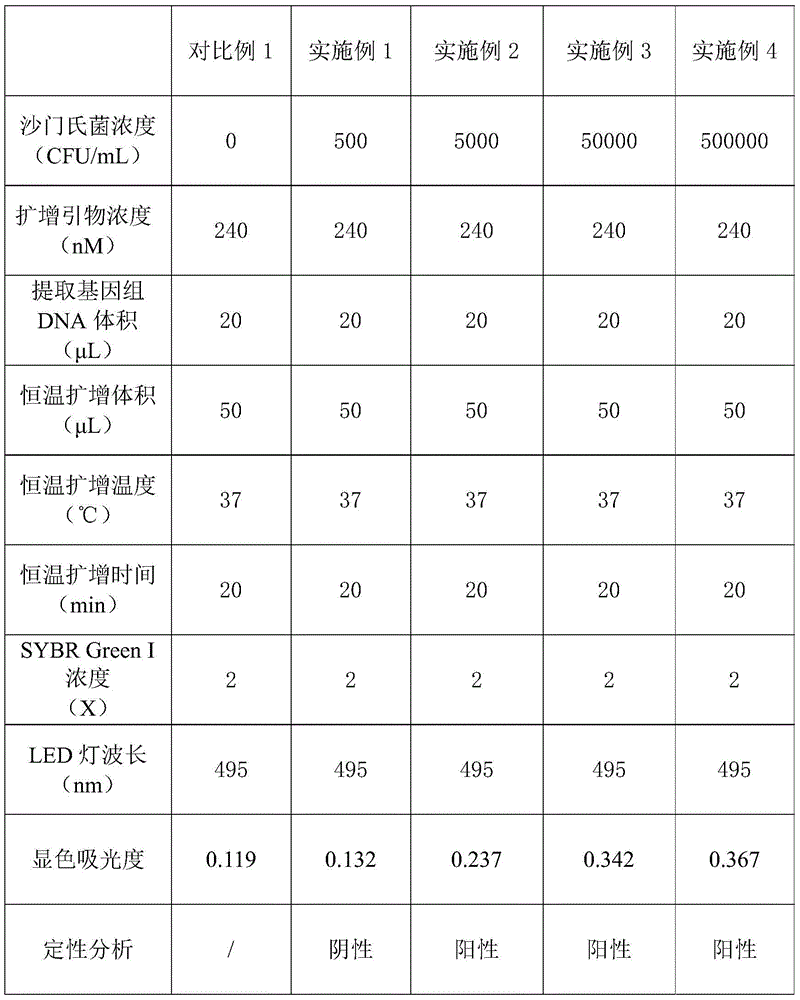
实施例5-8Example 5-8
(1)先各取2mL不同浓度的沙门氏菌模拟牛奶样品与培养基按1:9的比例混合后,所取浓度具体见表2,在37℃进行增菌6小时培养,随后取2mL培养液通过离心的方式去掉上清液,并按照细菌基因组DNA提取试剂盒的操作说明,提取沙门氏菌基因组DNA,用25μL超纯水溶解后4℃保存备用;(1) Take 2mL of Salmonella simulated milk samples of different concentrations and mix them with the culture medium at a ratio of 1:9. See Table 2 for details of the concentrations obtained. Carry out enrichment at 37°C for 6 hours, and then take 2mL of the culture solution to pass through Remove the supernatant by centrifugation, and extract the genomic DNA of Salmonella according to the operating instructions of the bacterial genomic DNA extraction kit, dissolve it in 25 μL of ultrapure water, and store it at 4°C for later use;
(2)按RPA试剂盒的操作说明,预先将重组酶聚合酶扩增的试剂和240nM的核酸引物加入到扩增试管中,再向扩增管中加入20μL的提取沙门氏菌基因组DNA,并用超纯水扩增体积至50μL,混匀后,37℃恒温扩增4分钟,再次混匀后,37℃恒温扩增16分钟;(2) According to the operation instructions of the RPA kit, add the reagent for amplification of recombinase polymerase and 240nM nucleic acid primer into the amplification test tube in advance, then add 20 μL of the extracted Salmonella genomic DNA to the amplification tube, and use ultrapure Water amplification volume to 50 μL, after mixing, 37 ℃ constant temperature amplification for 4 minutes, after mixing again, 37 ℃ constant temperature amplification for 16 minutes;
(3)将全部扩增产物转移至2mL的光敏显色液(其中SYBR Green I核酸染料的浓度为2X)中,用495nm的LED灯光照2分钟,使无色光敏显色液显色,随后通过分光光度计测定652nm处吸光度,并进行定性分析,结果见表2。(3) Transfer all the amplified products to 2 mL of photosensitive chromogenic solution (wherein the concentration of SYBR Green I nucleic acid dye is 2X), illuminate with 495nm LED light for 2 minutes to make the colorless photosensitive chromogenic solution develop color, and then The absorbance at 652nm was measured by a spectrophotometer, and a qualitative analysis was performed. The results are shown in Table 2.
对比例2Comparative example 2
本对比例采用的方法步骤和条件同实施例5-8,只是在其中未添加沙门氏菌模拟牛奶样品,其在652nm处的吸光度见表2。The method steps and conditions adopted in this comparative example are the same as those in Examples 5-8, except that the simulated milk sample of Salmonella was not added therein, and its absorbance at 652 nm is shown in Table 2.
表2Table 2


实施例9-12Examples 9-12
(1)先各取2mL不同浓度的沙门氏菌模拟牛奶样品,所取浓度具体见表3,然后按照细菌基因组DNA提取试剂盒的操作说明,提取细菌基因组DNA,用25μL超纯水溶解后4℃保存备用;(1) Take 2 mL of Salmonella simulated milk samples with different concentrations, see Table 3 for the specific concentrations, and then follow the operating instructions of the bacterial genomic DNA extraction kit to extract bacterial genomic DNA, dissolve them in 25 μL of ultrapure water, and store at 4 °C spare;
(2)按RPA试剂盒的操作说明,预先将重组酶聚合酶扩增的试剂和100-800nM的核酸引物加入到扩增试管中,再向扩增管中加入10-20μL的提取沙门氏菌基因组DNA,并用超纯水调整RPA扩增体积至10-50μL,混匀后,25-42℃恒温扩增4分钟,再次混匀后,25-42℃恒温扩增6-16分钟;(2) According to the operation instructions of the RPA kit, add the reagent for amplification of recombinase polymerase and 100-800nM nucleic acid primer into the amplification test tube in advance, and then add 10-20 μL of the extracted Salmonella genomic DNA to the amplification tube , and use ultrapure water to adjust the RPA amplification volume to 10-50 μL. After mixing, amplify at a constant temperature of 25-42°C for 4 minutes. After mixing again, amplify at a constant temperature of 25-42°C for 6-16 minutes;
(3)将全部扩增产物转移至2mL的光敏显色液(其中SYBR Green I核酸染料的浓度见表3)中,用450-520nm的LED灯进行2分钟光照,使无色光敏显色液显色,随后通过分光光度计测定652nm处吸光度,并进行定性分析,其结果见表3。(3) Transfer all the amplified products to 2mL of photosensitive chromogenic solution (the concentration of SYBR Green I nucleic acid dye is shown in Table 3), and light it with 450-520nm LED lamp for 2 minutes to make the colorless photosensitive chromogenic solution After color development, the absorbance at 652nm was measured by a spectrophotometer, and qualitative analysis was performed. The results are shown in Table 3.
对比例3-6Comparative example 3-6
本组对比例采用的方法步骤和条件分别对应不同的实施例9-12,只是在其中未添加沙门氏菌模拟牛奶样品,其在652nm处的吸光度见表3。The method steps and conditions used in this group of comparative examples correspond to different examples 9-12, except that the simulated milk sample of Salmonella was not added therein, and its absorbance at 652nm is shown in Table 3.
表3table 3


实施例13-16Examples 13-16
(1)实施例5-8先各取2mL不同浓度的沙门氏菌模拟牛奶样品与培养基按1:9的比例混合后,所取浓度具体见表4,在37℃进行增菌培养预定时间,随后取2mL培养液通过离心的方式去掉上清液,并按照细菌基因组DNA提取试剂盒的操作说明,提取沙门氏菌基因组DNA用25μL超纯水溶解后4℃保存备用;(1) In Examples 5-8, 2 mL of Salmonella simulated milk samples of different concentrations were mixed with the culture medium at a ratio of 1:9. Take 2 mL of the culture solution and remove the supernatant by centrifugation, and follow the operating instructions of the bacterial genomic DNA extraction kit to extract the genomic DNA of Salmonella, dissolve it in 25 μL of ultrapure water, and store it at 4 °C for later use;
(2)按RPA试剂盒的操作说明,预先将重组酶聚合酶扩增的试剂和100-800nM的核酸引物加入到扩增试管中,再向扩增管中加入10-20μL的提取沙门氏菌基因组DNA,并用超纯水调整RPA扩增体积至10-50μL,混匀后,25-42℃恒温扩增4分钟,再次混匀后,25-42℃恒温扩增6-16分钟;(2) According to the operation instructions of the RPA kit, add the reagent for amplification of recombinase polymerase and 100-800nM nucleic acid primer into the amplification test tube in advance, and then add 10-20 μL of the extracted Salmonella genomic DNA to the amplification tube , and use ultrapure water to adjust the RPA amplification volume to 10-50 μL. After mixing, amplify at a constant temperature of 25-42°C for 4 minutes. After mixing again, amplify at a constant temperature of 25-42°C for 6-16 minutes;
(3)将全部扩增产物转移至2mL的光敏显色液(其中SYBR Green I核酸染料的浓度见表4)中,用450-520nm的LED灯进行2分钟光照,使无色光敏显色液显色,随后通过分光光度计测定652nm处吸光度,并进行定性分析,结果见表4。(3) Transfer all the amplified products to 2mL of photosensitive chromogenic solution (the concentration of SYBR Green I nucleic acid dye is shown in Table 4), and irradiate with 450-520nm LED lamp for 2 minutes to make the colorless photosensitive chromogenic solution After color development, the absorbance at 652nm was measured by a spectrophotometer, and qualitative analysis was performed. The results are shown in Table 4.
对比例7-10Comparative example 7-10
本组对比例采用的方法步骤和条件分别对应不同的实施例13-16,只是在其中未添加沙门氏菌模拟牛奶样品,其在652nm处的吸光度见表4。The method steps and conditions used in this group of comparative examples correspond to different examples 13-16, except that no Salmonella simulated milk sample was added, and its absorbance at 652nm is shown in Table 4.
表4Table 4

SEQUENCE LISTINGSEQUENCE LISTING
<110> 四川大学<110> Sichuan University
<120> 一种用于食品中沙门氏菌的现场快速检测方法<120> A rapid on-site detection method for Salmonella in food
<130>四川大学<130>Sichuan University
<160> 2<160> 2
<170> PatentIn version 3.3<170> PatentIn version 3.3
<210> 1<210> 1
<211> 32<211> 32
<212> DNA<212>DNA
<213> Salmonella typhimurium<213> Salmonella typhimurium
<400> 1<400> 1
tgaagcaaaa cgtagcgccg ccaaacctaa aa 32tgaagcaaaa cgtagcgccg ccaaacctaa aa 32
<210> 2<210> 2
<211> 32<211> 32
<212> DNA<212>DNA
<213> Salmonella typhimurium<213> Salmonella typhimurium
<400> 2<400> 2
accactcgca tcaaatcaaa atagaccgta aa 32accactcgca tcaaatcaaa atagaccgta aa 32
Claims (5)
Priority Applications (1)
| Application Number | Priority Date | Filing Date | Title |
|---|---|---|---|
| CN202110120893.3A CN112941208B (en) | 2021-01-28 | 2021-01-28 | A rapid on-site detection method for Salmonella in food |
Applications Claiming Priority (1)
| Application Number | Priority Date | Filing Date | Title |
|---|---|---|---|
| CN202110120893.3A CN112941208B (en) | 2021-01-28 | 2021-01-28 | A rapid on-site detection method for Salmonella in food |
Publications (2)
| Publication Number | Publication Date |
|---|---|
| CN112941208A CN112941208A (en) | 2021-06-11 |
| CN112941208B true CN112941208B (en) | 2023-07-14 |
Family
ID=76238997
Family Applications (1)
| Application Number | Title | Priority Date | Filing Date |
|---|---|---|---|
| CN202110120893.3A Active CN112941208B (en) | 2021-01-28 | 2021-01-28 | A rapid on-site detection method for Salmonella in food |
Country Status (1)
| Country | Link |
|---|---|
| CN (1) | CN112941208B (en) |
Families Citing this family (5)
| Publication number | Priority date | Publication date | Assignee | Title |
|---|---|---|---|---|
| CN113528613A (en) * | 2021-07-16 | 2021-10-22 | 安徽农业大学 | An experimental method for detecting bacterial genes based on multi-enzyme constant temperature nucleic acid rapid amplification technology |
| CN113621718A (en) * | 2021-08-09 | 2021-11-09 | 浙江舟鲜生食品科技有限公司 | Method for rapidly detecting salmonella in food |
| CN114196518B (en) * | 2021-11-16 | 2025-10-31 | 四川大学 | Portable array nucleic acid amplicon signal detection device |
| CN114774587A (en) * | 2022-04-28 | 2022-07-22 | 常州市食品药品纤维质量监督检验中心 | Primer probe for detecting pathogenic microorganisms in instant fruits and vegetables and preparation method thereof |
| CN119464523A (en) * | 2024-11-05 | 2025-02-18 | 四川大学 | Photonic crystal fluorescence sensor based on recombinase polymerase amplification and CRISPR/Cas12a system |
Citations (6)
| Publication number | Priority date | Publication date | Assignee | Title |
|---|---|---|---|---|
| CN1541267A (en) * | 2001-06-12 | 2004-10-27 | �����﹤����ʽ���� | Method for stabilizing and storing reagents for nucleic acid amplification or detection |
| WO2012115885A1 (en) * | 2011-02-22 | 2012-08-30 | Caris Life Sciences Luxembourg Holdings, S.A.R.L. | Circulating biomarkers |
| CN105296664A (en) * | 2015-12-02 | 2016-02-03 | 上海市计量测试技术研究院 | Polynucleotide, method and kit for detecting salmonella bacteria |
| CN106868152A (en) * | 2017-03-14 | 2017-06-20 | 宁波海洋研究院 | A kind of detection method of food-borne pathogens salmonella |
| CN110205394A (en) * | 2019-05-10 | 2019-09-06 | 中国农业大学 | Biosensor and method for detecting salmonella |
| CN110283919A (en) * | 2019-05-10 | 2019-09-27 | 中国农业大学 | Biosensor and method for quantitative detection of salmonella |
-
2021
- 2021-01-28 CN CN202110120893.3A patent/CN112941208B/en active Active
Patent Citations (6)
| Publication number | Priority date | Publication date | Assignee | Title |
|---|---|---|---|---|
| CN1541267A (en) * | 2001-06-12 | 2004-10-27 | �����﹤����ʽ���� | Method for stabilizing and storing reagents for nucleic acid amplification or detection |
| WO2012115885A1 (en) * | 2011-02-22 | 2012-08-30 | Caris Life Sciences Luxembourg Holdings, S.A.R.L. | Circulating biomarkers |
| CN105296664A (en) * | 2015-12-02 | 2016-02-03 | 上海市计量测试技术研究院 | Polynucleotide, method and kit for detecting salmonella bacteria |
| CN106868152A (en) * | 2017-03-14 | 2017-06-20 | 宁波海洋研究院 | A kind of detection method of food-borne pathogens salmonella |
| CN110205394A (en) * | 2019-05-10 | 2019-09-06 | 中国农业大学 | Biosensor and method for detecting salmonella |
| CN110283919A (en) * | 2019-05-10 | 2019-09-27 | 中国农业大学 | Biosensor and method for quantitative detection of salmonella |
Non-Patent Citations (4)
| Title |
|---|
| dsDNA-SYBR Green I复合物光催化可视化检测;黄承鹏;《万方中国学位论文全文数据库》;20181228;摘要,第2.2.2、2.2.3、2.3.2、2.3.3.2节 * |
| Recombinase Polymerase Amplification Coupled with a Photosensitization Colorimetric Assay for Fast Salmonella spp. Testing;Xianming Li等;《Anal. Chem》;20210414;第93卷;第6559-6566页 * |
| 沙门氏菌重组酶聚合酶检测方法的建立及应用;刘立兵等;《食品科学》;20190125;第40卷(第2期);摘要,第1.2节 * |
| 纳米光学传感器用于检测汞离子;沈洋等;《化学进展》;20190424(第04期);536-549 * |
Also Published As
| Publication number | Publication date |
|---|---|
| CN112941208A (en) | 2021-06-11 |
Similar Documents
| Publication | Publication Date | Title |
|---|---|---|
| CN112941208B (en) | A rapid on-site detection method for Salmonella in food | |
| CN110453011B (en) | A method and application for rapid and accurate detection of African swine fever virus based on CRISPR/Cas12a | |
| CN106191298A (en) | A kind of method detecting vibrio parahaemolyticus Vibrio parahaemolyticus | |
| CN113322338B (en) | A CDA primer set, kit and application for detecting Shigella | |
| CN116837125A (en) | Kit and method for rapid detection of Vibrio parahaemolyticus based on LAMP-CRISPR/Cas12b integrated system | |
| CN107338291A (en) | Method based on nucleic acid chromatography biosensor technique detection Escherichia coli O 157 | |
| CN104726594B (en) | The heavy fluorescence PCR detection reagent kit of food-borne pathogens five | |
| CN101565753B (en) | Rapid diagnostic kit for staphylococcus aureus gene based on loop-mediated isothermal amplification technology and detecting method thereof | |
| CN106381340B (en) | Detection primers, detection kits and application of tomato cinerea LAMP | |
| CN111676302A (en) | Establishment and application of a rapid detection method of Vibrio vulnificus RPA-LFS | |
| CN116949197A (en) | Establishment of detection methods for four common Cryptosporidium RAA | |
| CN103409499A (en) | LAMP (Loop-Mediated Isothermal Amplification) detection method for calcein fluorescence visualization salmonella | |
| CN103571943A (en) | Nucleic acid detection method for salmonella typhimurium | |
| CN106434862A (en) | LAMP kit for real-time detection of foodborne Salmonella | |
| Feng et al. | An esterase activity-based biosensor for rapid and sensitive detection of viable Escherichia coli O157: H7 in milk | |
| CN101126717A (en) | An anti-interference rapid detection method and reagent for the total number of food bacteria | |
| CN116773442A (en) | Rapid photochromic multi-signal detection kit and method for food-borne pathogenic bacteria | |
| Fan et al. | Rapid detection of Listeria monocytogenes in ready-to-eat foods using a one-tube recombinase polymerase amplification and photosensitization colorimetric assay | |
| CN110387429B (en) | Reagent and kit for detecting pathogenic bacteria of Escherichia coli O157H 7 serotype and application | |
| CN102605069B (en) | Enterohemorrhagic Escherichia coli O104: H4 detection kit and use method thereof | |
| CN103740839B (en) | The botulinal universal test kit of fluorescence quantitative PCR detection and nondiagnostic detection method | |
| CN102747162A (en) | PCR (polymerase chain reaction) detection primers for three bacteria and application thereof | |
| CN106755411A (en) | The real-time fluorescence quantitative PCR quick detection primer and its kit of marine product vibrio parahemolyticus toxR genes | |
| CN114214445A (en) | Rapid quantitative detection method for living pathogenic bacteria in ship ballast water | |
| CN118834977B (en) | A method for detecting foodborne pathogenic bacteria |
Legal Events
| Date | Code | Title | Description |
|---|---|---|---|
| PB01 | Publication | ||
| PB01 | Publication | ||
| SE01 | Entry into force of request for substantive examination | ||
| SE01 | Entry into force of request for substantive examination | ||
| GR01 | Patent grant | ||
| GR01 | Patent grant |