CN112912396B - anti-CLDN 18.2 antibodies and uses thereof - Google Patents
anti-CLDN 18.2 antibodies and uses thereof Download PDFInfo
- Publication number
- CN112912396B CN112912396B CN201880098896.8A CN201880098896A CN112912396B CN 112912396 B CN112912396 B CN 112912396B CN 201880098896 A CN201880098896 A CN 201880098896A CN 112912396 B CN112912396 B CN 112912396B
- Authority
- CN
- China
- Prior art keywords
- antibody
- antigen
- binding fragment
- seq
- cancer
- Prior art date
- Legal status (The legal status is an assumption and is not a legal conclusion. Google has not performed a legal analysis and makes no representation as to the accuracy of the status listed.)
- Active
Links
Images


Classifications
-
- C—CHEMISTRY; METALLURGY
- C07—ORGANIC CHEMISTRY
- C07K—PEPTIDES
- C07K14/00—Peptides having more than 20 amino acids; Gastrins; Somatostatins; Melanotropins; Derivatives thereof
- C07K14/435—Peptides having more than 20 amino acids; Gastrins; Somatostatins; Melanotropins; Derivatives thereof from animals; from humans
- C07K14/705—Receptors; Cell surface antigens; Cell surface determinants
- C07K14/70503—Immunoglobulin superfamily
- C07K14/7051—T-cell receptor (TcR)-CD3 complex
-
- C—CHEMISTRY; METALLURGY
- C07—ORGANIC CHEMISTRY
- C07K—PEPTIDES
- C07K16/00—Immunoglobulins [IGs], e.g. monoclonal or polyclonal antibodies
- C07K16/18—Immunoglobulins [IGs], e.g. monoclonal or polyclonal antibodies against material from animals or humans
- C07K16/28—Immunoglobulins [IGs], e.g. monoclonal or polyclonal antibodies against material from animals or humans against receptors, cell surface antigens or cell surface determinants
-
- A—HUMAN NECESSITIES
- A61—MEDICAL OR VETERINARY SCIENCE; HYGIENE
- A61K—PREPARATIONS FOR MEDICAL, DENTAL OR TOILETRY PURPOSES
- A61K39/00—Medicinal preparations containing antigens or antibodies
- A61K39/395—Antibodies; Immunoglobulins; Immune serum, e.g. antilymphocytic serum
- A61K39/39533—Antibodies; Immunoglobulins; Immune serum, e.g. antilymphocytic serum against materials from animals
- A61K39/3955—Antibodies; Immunoglobulins; Immune serum, e.g. antilymphocytic serum against materials from animals against proteinaceous materials, e.g. enzymes, hormones, lymphokines
-
- A—HUMAN NECESSITIES
- A61—MEDICAL OR VETERINARY SCIENCE; HYGIENE
- A61K—PREPARATIONS FOR MEDICAL, DENTAL OR TOILETRY PURPOSES
- A61K40/00—Cellular immunotherapy
- A61K40/10—Cellular immunotherapy characterised by the cell type used
-
- A—HUMAN NECESSITIES
- A61—MEDICAL OR VETERINARY SCIENCE; HYGIENE
- A61K—PREPARATIONS FOR MEDICAL, DENTAL OR TOILETRY PURPOSES
- A61K40/00—Cellular immunotherapy
- A61K40/10—Cellular immunotherapy characterised by the cell type used
- A61K40/11—T-cells, e.g. tumour infiltrating lymphocytes [TIL] or regulatory T [Treg] cells; Lymphokine-activated killer [LAK] cells
-
- A—HUMAN NECESSITIES
- A61—MEDICAL OR VETERINARY SCIENCE; HYGIENE
- A61K—PREPARATIONS FOR MEDICAL, DENTAL OR TOILETRY PURPOSES
- A61K40/00—Cellular immunotherapy
- A61K40/30—Cellular immunotherapy characterised by the recombinant expression of specific molecules in the cells of the immune system
- A61K40/31—Chimeric antigen receptors [CAR]
-
- A—HUMAN NECESSITIES
- A61—MEDICAL OR VETERINARY SCIENCE; HYGIENE
- A61K—PREPARATIONS FOR MEDICAL, DENTAL OR TOILETRY PURPOSES
- A61K40/00—Cellular immunotherapy
- A61K40/40—Cellular immunotherapy characterised by antigens that are targeted or presented by cells of the immune system
- A61K40/41—Vertebrate antigens
- A61K40/42—Cancer antigens
- A61K40/4202—Receptors, cell surface antigens or cell surface determinants
-
- A—HUMAN NECESSITIES
- A61—MEDICAL OR VETERINARY SCIENCE; HYGIENE
- A61K—PREPARATIONS FOR MEDICAL, DENTAL OR TOILETRY PURPOSES
- A61K45/00—Medicinal preparations containing active ingredients not provided for in groups A61K31/00 - A61K41/00
- A61K45/06—Mixtures of active ingredients without chemical characterisation, e.g. antiphlogistics and cardiaca
-
- A—HUMAN NECESSITIES
- A61—MEDICAL OR VETERINARY SCIENCE; HYGIENE
- A61K—PREPARATIONS FOR MEDICAL, DENTAL OR TOILETRY PURPOSES
- A61K47/00—Medicinal preparations characterised by the non-active ingredients used, e.g. carriers or inert additives; Targeting or modifying agents chemically bound to the active ingredient
- A61K47/50—Medicinal preparations characterised by the non-active ingredients used, e.g. carriers or inert additives; Targeting or modifying agents chemically bound to the active ingredient the non-active ingredient being chemically bound to the active ingredient, e.g. polymer-drug conjugates
- A61K47/51—Medicinal preparations characterised by the non-active ingredients used, e.g. carriers or inert additives; Targeting or modifying agents chemically bound to the active ingredient the non-active ingredient being chemically bound to the active ingredient, e.g. polymer-drug conjugates the non-active ingredient being a modifying agent
- A61K47/68—Medicinal preparations characterised by the non-active ingredients used, e.g. carriers or inert additives; Targeting or modifying agents chemically bound to the active ingredient the non-active ingredient being chemically bound to the active ingredient, e.g. polymer-drug conjugates the non-active ingredient being a modifying agent the modifying agent being an antibody, an immunoglobulin or a fragment thereof, e.g. an Fc-fragment
- A61K47/6835—Medicinal preparations characterised by the non-active ingredients used, e.g. carriers or inert additives; Targeting or modifying agents chemically bound to the active ingredient the non-active ingredient being chemically bound to the active ingredient, e.g. polymer-drug conjugates the non-active ingredient being a modifying agent the modifying agent being an antibody, an immunoglobulin or a fragment thereof, e.g. an Fc-fragment the modifying agent being an antibody or an immunoglobulin bearing at least one antigen-binding site
- A61K47/6849—Medicinal preparations characterised by the non-active ingredients used, e.g. carriers or inert additives; Targeting or modifying agents chemically bound to the active ingredient the non-active ingredient being chemically bound to the active ingredient, e.g. polymer-drug conjugates the non-active ingredient being a modifying agent the modifying agent being an antibody, an immunoglobulin or a fragment thereof, e.g. an Fc-fragment the modifying agent being an antibody or an immunoglobulin bearing at least one antigen-binding site the antibody targeting a receptor, a cell surface antigen or a cell surface determinant
-
- A—HUMAN NECESSITIES
- A61—MEDICAL OR VETERINARY SCIENCE; HYGIENE
- A61P—SPECIFIC THERAPEUTIC ACTIVITY OF CHEMICAL COMPOUNDS OR MEDICINAL PREPARATIONS
- A61P35/00—Antineoplastic agents
-
- A—HUMAN NECESSITIES
- A61—MEDICAL OR VETERINARY SCIENCE; HYGIENE
- A61K—PREPARATIONS FOR MEDICAL, DENTAL OR TOILETRY PURPOSES
- A61K39/00—Medicinal preparations containing antigens or antibodies
- A61K2039/505—Medicinal preparations containing antigens or antibodies comprising antibodies
-
- C—CHEMISTRY; METALLURGY
- C07—ORGANIC CHEMISTRY
- C07K—PEPTIDES
- C07K2317/00—Immunoglobulins specific features
- C07K2317/20—Immunoglobulins specific features characterized by taxonomic origin
- C07K2317/24—Immunoglobulins specific features characterized by taxonomic origin containing regions, domains or residues from different species, e.g. chimeric, humanized or veneered
-
- C—CHEMISTRY; METALLURGY
- C07—ORGANIC CHEMISTRY
- C07K—PEPTIDES
- C07K2317/00—Immunoglobulins specific features
- C07K2317/30—Immunoglobulins specific features characterized by aspects of specificity or valency
- C07K2317/31—Immunoglobulins specific features characterized by aspects of specificity or valency multispecific
-
- C—CHEMISTRY; METALLURGY
- C07—ORGANIC CHEMISTRY
- C07K—PEPTIDES
- C07K2317/00—Immunoglobulins specific features
- C07K2317/50—Immunoglobulins specific features characterized by immunoglobulin fragments
- C07K2317/56—Immunoglobulins specific features characterized by immunoglobulin fragments variable (Fv) region, i.e. VH and/or VL
- C07K2317/565—Complementarity determining region [CDR]
-
- C—CHEMISTRY; METALLURGY
- C07—ORGANIC CHEMISTRY
- C07K—PEPTIDES
- C07K2317/00—Immunoglobulins specific features
- C07K2317/60—Immunoglobulins specific features characterized by non-natural combinations of immunoglobulin fragments
- C07K2317/62—Immunoglobulins specific features characterized by non-natural combinations of immunoglobulin fragments comprising only variable region components
- C07K2317/622—Single chain antibody (scFv)
-
- C—CHEMISTRY; METALLURGY
- C07—ORGANIC CHEMISTRY
- C07K—PEPTIDES
- C07K2317/00—Immunoglobulins specific features
- C07K2317/70—Immunoglobulins specific features characterized by effect upon binding to a cell or to an antigen
- C07K2317/73—Inducing cell death, e.g. apoptosis, necrosis or inhibition of cell proliferation
- C07K2317/732—Antibody-dependent cellular cytotoxicity [ADCC]
-
- C—CHEMISTRY; METALLURGY
- C07—ORGANIC CHEMISTRY
- C07K—PEPTIDES
- C07K2317/00—Immunoglobulins specific features
- C07K2317/70—Immunoglobulins specific features characterized by effect upon binding to a cell or to an antigen
- C07K2317/73—Inducing cell death, e.g. apoptosis, necrosis or inhibition of cell proliferation
- C07K2317/734—Complement-dependent cytotoxicity [CDC]
-
- C—CHEMISTRY; METALLURGY
- C07—ORGANIC CHEMISTRY
- C07K—PEPTIDES
- C07K2317/00—Immunoglobulins specific features
- C07K2317/70—Immunoglobulins specific features characterized by effect upon binding to a cell or to an antigen
- C07K2317/77—Internalization into the cell
-
- C—CHEMISTRY; METALLURGY
- C07—ORGANIC CHEMISTRY
- C07K—PEPTIDES
- C07K2317/00—Immunoglobulins specific features
- C07K2317/90—Immunoglobulins specific features characterized by (pharmaco)kinetic aspects or by stability of the immunoglobulin
- C07K2317/92—Affinity (KD), association rate (Ka), dissociation rate (Kd) or EC50 value
-
- C—CHEMISTRY; METALLURGY
- C07—ORGANIC CHEMISTRY
- C07K—PEPTIDES
- C07K2319/00—Fusion polypeptide
- C07K2319/01—Fusion polypeptide containing a localisation/targetting motif
- C07K2319/03—Fusion polypeptide containing a localisation/targetting motif containing a transmembrane segment
Landscapes
- Health & Medical Sciences (AREA)
- Life Sciences & Earth Sciences (AREA)
- General Health & Medical Sciences (AREA)
- Chemical & Material Sciences (AREA)
- Animal Behavior & Ethology (AREA)
- Public Health (AREA)
- Veterinary Medicine (AREA)
- Epidemiology (AREA)
- Medicinal Chemistry (AREA)
- Organic Chemistry (AREA)
- Immunology (AREA)
- Pharmacology & Pharmacy (AREA)
- Proteomics, Peptides & Aminoacids (AREA)
- Biochemistry (AREA)
- Molecular Biology (AREA)
- Genetics & Genomics (AREA)
- Biophysics (AREA)
- Nuclear Medicine, Radiotherapy & Molecular Imaging (AREA)
- General Chemical & Material Sciences (AREA)
- Chemical Kinetics & Catalysis (AREA)
- Bioinformatics & Cheminformatics (AREA)
- Engineering & Computer Science (AREA)
- Cell Biology (AREA)
- Mycology (AREA)
- Microbiology (AREA)
- Endocrinology (AREA)
- Toxicology (AREA)
- Zoology (AREA)
- Gastroenterology & Hepatology (AREA)
- Peptides Or Proteins (AREA)
- Medicines Containing Antibodies Or Antigens For Use As Internal Diagnostic Agents (AREA)
- Micro-Organisms Or Cultivation Processes Thereof (AREA)
- Medicinal Preparation (AREA)
- Medicines That Contain Protein Lipid Enzymes And Other Medicines (AREA)
Abstract
提供一种抗CLDN18.2的抗体或其抗原结合片段,编码其的核酸分子,包含其的免疫缀合物、双特异性分子、嵌合抗原受体及药物组合物,所述抗体或抗原结合片段用于预防和/或治疗肿瘤。
An anti-CLDN18.2 antibody or an antigen-binding fragment thereof, a nucleic acid molecule encoding the same, an immunoconjugate comprising the same, a bispecific molecule, a chimeric antigen receptor, and a pharmaceutical composition are provided, the antibody or antigen-binding Fragments are useful for preventing and/or treating tumors.
Description
技术领域technical field
本发明涉及疾病治疗及免疫学领域,具体而言,本发明涉及抗CLDN18.2的抗体或其抗原结合片段,编码其的核酸分子,包含其的免疫缀合物、双特异性分子、嵌合抗原受体及药物组合物,以及它们用于预防和/或治疗肿瘤的用途。The present invention relates to the field of disease treatment and immunology, specifically, the present invention relates to an anti-CLDN18.2 antibody or an antigen-binding fragment thereof, a nucleic acid molecule encoding it, an immunoconjugate, a bispecific molecule, a chimeric molecule comprising the same Antigen receptors and pharmaceutical compositions, and their use for preventing and/or treating tumors.
背景技术Background technique
胃癌是全球范围内最常见的恶性肿瘤之一,其5年生存率低,绝大多数国家都在20%-40%的水平,每年约有70万人死于该疾病。在中国胃癌的生存率为35.9%,据统计2015年中国胃癌的新发例数达679.1/10万,死亡例数高达498.0/10万,成为仅次于肺癌的高发病率及高死亡率的第二大肿瘤。胃癌的恶性程度较高,且由于胃癌筛查没有广泛开展,通常患者到晚期才得到诊断,错失手术根治的机会,仅能以化疗为主进行治疗。Gastric cancer is one of the most common malignant tumors in the world. Its 5-year survival rate is low, ranging from 20% to 40% in most countries. About 700,000 people die from this disease every year. The survival rate of gastric cancer in China is 35.9%. According to statistics, in 2015, the number of new cases of gastric cancer in China reached 679.1/100,000, and the number of deaths was as high as 498.0/100,000. Second largest tumor. Gastric cancer has a high degree of malignancy, and because gastric cancer screening is not widely carried out, patients are usually diagnosed at an advanced stage, missing the opportunity for radical surgery, and can only be treated with chemotherapy.
随着肿瘤分子生物学的发展,靶向药物和免疫治疗在血液瘤、乳腺癌、结直肠癌中的疗效得以证实,但在胃癌治疗中的应用相对缓慢。目前国际上已获批胃癌靶向治疗的靶点包括人类表皮生长因子受体2(HER2)和血管内皮生长因子(VEGF),获批的胃癌免疫治疗靶点为程序致死蛋白1(PD-1)。2017年9月,基于大型的三期临床试验ATTRACTION-2,日本厚生劳动省批准了PD-1抗体Opdivo用于治疗化疗耐药的晚期胃癌患者:跟安慰剂相比,Opdivo可以降低37%的死亡率,有效率11.2%。基于二期临床试验Keynote 059,美国FDA加速批准了PD-1抗体Keytruda用于治疗化疗耐药的PD-L1阳性的晚期胃癌患者:有效率15.5%。而在靶向治疗方面,血管内皮生长因子(VEGF)不仅促进肿瘤血管生成,并且可以与肿瘤细胞表面的受体结合激活下游信号通路,直接参与肿瘤干细胞的形成、发生与迁移等进程。VEGFR2抑制剂阿帕替尼和雷莫芦单抗都已在临床证明VEFR靶向治疗在晚期胃癌二线及二线以上安全有效。胃癌每年的新发病例中约有6%-35%出现HER2基因扩增或蛋白过表达的现象,因此HER2是抗癌治疗中重要的靶点之一。TOGA III期临床试验首次证实了曲妥珠单抗在HER2(+)晚期胃癌一线治疗治疗中的优势,曲妥珠单抗联合化疗组的OS较单纯化疗组明显延长(13.8个月vs.11个月),次要终点包括PFS、ORR(客观缓解率)、TTP(疾病进展时间)等也都有明显改善。然而我国患者HER2阳性的比例仅为10%左右,因此探索新的胃癌治疗靶点势在必行。With the development of tumor molecular biology, the efficacy of targeted drugs and immunotherapy in hematological tumors, breast cancer, and colorectal cancer has been confirmed, but their application in the treatment of gastric cancer is relatively slow. Currently, targets for targeted therapy for gastric cancer that have been approved internationally include human epidermal growth factor receptor 2 (HER2) and vascular endothelial growth factor (VEGF), and the approved target for immunotherapy for gastric cancer is programmed lethal protein 1 (PD-1). ). In September 2017, based on the large-scale phase III clinical trial ATTRACTION-2, the Ministry of Health, Labor and Welfare of Japan approved the PD-1 antibody Opdivo for the treatment of chemotherapy-resistant advanced gastric cancer patients: Compared with placebo, Opdivo can reduce the risk of cancer by 37%. The mortality rate is 11.2%. Based on the phase II clinical trial Keynote 059, the US FDA accelerated the approval of the PD-1 antibody Keytruda for the treatment of chemotherapy-resistant PD-L1-positive advanced gastric cancer patients: the effective rate was 15.5%. In terms of targeted therapy, vascular endothelial growth factor (VEGF) not only promotes tumor angiogenesis, but also binds to receptors on the surface of tumor cells to activate downstream signaling pathways, directly participating in the formation, occurrence, and migration of tumor stem cells. Both the VEGFR2 inhibitors apatinib and ramucirumab have been clinically proven to be safe and effective in the second-line and above-line treatment of advanced gastric cancer. About 6%-35% of new cases of gastric cancer each year have HER2 gene amplification or protein overexpression, so HER2 is one of the important targets in anticancer therapy. The TOGA phase III clinical trial first confirmed the advantages of trastuzumab in the first-line treatment of HER2 (+) advanced gastric cancer. The OS of the trastuzumab combined with chemotherapy group was significantly longer than that of the chemotherapy alone group (13.8 months vs. 11 months). months), secondary endpoints including PFS, ORR (objective response rate), and TTP (time to disease progression) were also significantly improved. However, the proportion of HER2-positive patients in my country is only about 10%, so it is imperative to explore new therapeutic targets for gastric cancer.
密蛋白(Claudin)是上皮与内皮的紧密连接内的跨膜蛋白复合体,位于相邻细胞间隙顶侧,其分布具有组织器官特异性,功能主要为细胞间黏附、维持细胞极性、调节细胞旁通透性及参与细胞增殖、分化的调节。密蛋白18(Claudin18)分子是四次跨膜蛋白,具有四个跨膜疏水区和两个胞外环,以两种不同剪接变体CLDN18.1和CLDN18.2存在。CLDN18.1和CLDN18.2在细胞内氮端和细胞外第一个胞外环存在序列上的差异,而其他部分的蛋白质一级序列相同。对CLDN18的组织分布显示,CLDN18.1仅在肺细胞中选择性表达,而CLDN18.2仅在胃细胞上表达,并且CLDN18.2在正常胃中的表达局限于已分化的短期存在的胃上皮细胞中。CLDN18.2在胃细胞恶性转化过程中经常性的被保留了,因而频繁地在人胃癌细胞表面上被展示,60-80%的胃肠道腺瘤显示CLDN18.2阳性(Clinical Cancer Research 2008,14(23):7624–34)。此外,CLDN18.2在胰管癌和转移的胰腺癌上高表达,阳性率高达60-70%,可作为胰管/胰腺癌诊断标记和治疗靶点(Journal of Clinical Pathology 2012,65:431-436;World Journal of Gastroenterology 2014,20(31):10813-10824;International Journal of Cancer 2014,134:731–739)。CLDN18.2在其他肿瘤上的异位激活尚无较为系统的研究,目前可查到的文献显示除上述的胰腺癌异位激活这一蛋白在食管癌、支气管癌、非小细胞肺癌(NSCLC)、乳腺癌、ENT肿瘤、卵巢癌、结肠癌、肝癌及其转移癌,特别是胃癌转移例如Krukenberg肿瘤、腹膜转移和淋巴结转移中均有发现表达(Clinical Cancer Research 2008,14(23):7624–34;International Journal of Cancer2014,134:731–739;Cancer Letters 2017,403:66-73;International Journal ofCancer 2014,135(9):2206-2214)。CLDN18.2是具有预防和治疗价值的肿瘤靶标,其在癌细胞和正常细胞之间的差异表达、其膜定位、其在大多数毒性相关正常组织中不存在、其在胃中的表达局限在可通过胃的靶阴性干细胞(或位置性不可及干细胞)来补充的已分化的胃细胞,使得CLDN18.2成为癌症免疫治疗的有吸引力的靶点。因此,发展具有更高的特异性、更低的毒副作用、更优的临床药效的抗CLDN18.2抗体是迫切而必要的,这将给癌症患者提供更多的用药选择。Claudin is a transmembrane protein complex in the tight junction between the epithelium and the endothelium. It is located on the top side of the adjacent intercellular space. Its distribution is specific to tissues and organs. Permeability and participation in the regulation of cell proliferation and differentiation. The claudin 18 (Claudin18) molecule is a tetraspanin with four transmembrane hydrophobic regions and two extracellular loops, and exists in two different splicing variants, CLDN18.1 and CLDN18.2. There are sequence differences between CLDN18.1 and CLDN18.2 at the nitrogen end of the cell and the first extracellular loop outside the cell, while the primary sequence of the other parts of the protein is the same. Tissue distribution of CLDN18 revealed that CLDN18.1 is selectively expressed only in lung cells, whereas CLDN18.2 is only expressed on gastric cells, and that CLDN18.2 expression in the normal stomach is restricted to the differentiated short-lived gastric epithelium in cells. CLDN18.2 is frequently retained during malignant transformation of gastric cells, and thus frequently displayed on the surface of human gastric cancer cells, 60-80% of gastrointestinal adenomas were positive for CLDN18.2 (Clinical Cancer Research 2008, 14(23):7624–34). In addition, CLDN18.2 is highly expressed in pancreatic ductal carcinoma and metastatic pancreatic cancer, with a positive rate as high as 60-70%, and can be used as a diagnostic marker and therapeutic target for pancreatic ductal/pancreatic cancer (Journal of Clinical Pathology 2012,65:431- 436; World Journal of Gastroenterology 2014, 20(31):10813-10824; International Journal of Cancer 2014, 134:731–739). The ectopic activation of CLDN18.2 in other tumors has not yet been systematically studied. Currently available literature shows that in addition to the above-mentioned ectopic activation of pancreatic cancer, this protein is also activated in esophageal cancer, bronchial cancer, and non-small cell lung cancer (NSCLC). , breast cancer, ENT tumor, ovarian cancer, colon cancer, liver cancer and its metastases, especially in gastric cancer metastases such as Krukenberg tumors, peritoneal metastases and lymph node metastases (Clinical Cancer Research 2008,14(23):7624– 34; International Journal of Cancer 2014, 134:731–739; Cancer Letters 2017, 403:66-73; International Journal of Cancer 2014, 135(9):2206-2214). CLDN18.2 is a tumor target with prophylactic and therapeutic value, its differential expression between cancer cells and normal cells, its membrane localization, its absence in most toxicity-related normal tissues, its expression restricted in stomach Differentiated gastric cells that can be recruited by target-negative stem cells (or positionally inaccessible stem cells) of the stomach make CLDN18.2 an attractive target for cancer immunotherapy. Therefore, it is urgent and necessary to develop anti-CLDN18.2 antibodies with higher specificity, lower toxicity and side effects, and better clinical efficacy, which will provide cancer patients with more drug options.
发明内容Contents of the invention
本发明的抗体能够特异性识别/结合人CLDN18.2,并且能够通过ADCC和/或CDC来诱导杀伤表达CLDN18.2的细胞(例如,肿瘤细胞),且与已知的抗CLDN18.2抗体相比具有更优的功能特性。因此,本发明的抗体具有用于预防和/或治疗肿瘤的潜力,具有重大的临床价值。The antibody of the present invention can specifically recognize/bind to human CLDN18.2, and can induce and kill cells expressing CLDN18.2 (for example, tumor cells) through ADCC and/or CDC, and is comparable to known anti-CLDN18.2 antibodies than has better functional properties. Therefore, the antibody of the present invention has the potential to be used for the prevention and/or treatment of tumors, and has great clinical value.
本发明的抗体Antibodies of the invention
因此,在一个方面,本发明提供了能够特异性结合CLDN18.2的抗体或其抗原结合片段,所述抗体或其抗原结合片段包含:Therefore, in one aspect, the present invention provides an antibody or antigen-binding fragment thereof capable of specifically binding CLDN18.2, said antibody or antigen-binding fragment thereof comprising:
(a)包含下述3个互补决定区(CDR)的重链可变区(VH):(a) A heavy chain variable region (VH) comprising the following three complementarity determining regions (CDRs):
(i)VH CDR1,其由下述序列组成:SEQ ID NO:75,或与SEQ ID NO:75相比具有一个或几个氨基酸的置换、缺失或添加(例如1个,2个或3个氨基酸的置换、缺失或添加)的序列,(i) VH CDR1, which consists of the following sequence: SEQ ID NO: 75, or has one or several amino acid substitutions, deletions or additions compared to SEQ ID NO: 75 (
(ii)VH CDR2,其由下述序列组成:SEQ ID NO:76,或与SEQ ID NO:76相比具有一个或几个氨基酸的置换、缺失或添加(例如1个,2个或3个氨基酸的置换、缺失或添加)的序列,和(ii) VH CDR2, which consists of the following sequence: SEQ ID NO: 76, or has one or several amino acid substitutions, deletions or additions compared to SEQ ID NO: 76 (
(iii)VH CDR3,其由下述序列组成:SEQ ID NO:77,或与SEQ ID NO:77相比具有一个或几个氨基酸的置换、缺失或添加(例如1个,2个或3个氨基酸的置换、缺失或添加)的序列;(iii) VH CDR3, which consists of the following sequence: SEQ ID NO: 77, or has one or several amino acid substitutions, deletions or additions compared to SEQ ID NO: 77 (for example, 1, 2 or 3 amino acid substitutions, deletions or additions);
和/或and / or
(b)包含下述3个互补决定区(CDR)的轻链可变区(VL):(b) A light chain variable region (VL) comprising the following three complementarity determining regions (CDRs):
(iv)VLCDR1,其由下述序列组成:SEQ ID NO:78,或与SEQ ID NO:78相比具有一个或几个氨基酸的置换、缺失或添加(例如1个,2个或3个氨基酸的置换、缺失或添加)的序列,(iv) VLCDR1, which consists of the following sequence: SEQ ID NO: 78, or has one or several amino acid substitutions, deletions or additions compared to SEQ ID NO: 78 (
(v)VLCDR2,其由下述序列组成:SEQ ID NO:79,或与SEQ ID NO:79相比具有一个或几个氨基酸的置换、缺失或添加(例如1个,2个或3个氨基酸的置换、缺失或添加)的序列,和(v) VLCDR2, which consists of the following sequence: SEQ ID NO: 79, or has one or several amino acid substitutions, deletions or additions compared to SEQ ID NO: 79 (
(vi)VLCDR3,其由下述序列组成:SEQ ID NO:80,或与SEQ ID NO:80相比具有一个或几个氨基酸的置换、缺失或添加(例如1个,2个或3个氨基酸的置换、缺失或添加)的序列。(vi) VLCDR3, which consists of the following sequence: SEQ ID NO: 80, or has one or several amino acid substitutions, deletions or additions compared to SEQ ID NO: 80 (
在某些优选的实施方案中,(i)-(vi)任一项中所述的置换为保守置换;In some preferred embodiments, the substitutions described in any one of (i)-(vi) are conservative substitutions;
在某些优选的实施方案中,所述抗体或其抗原结合片段的VH包含:如SEQ ID NO:75所示的VH CDR1、如SEQ ID NO:76所示的VH CDR2、如SEQ ID NO:77所示的VH CDR3;并且,所述抗体或其抗原结合片段的VL包含:如SEQ ID NO:78或96所示的VL CDR1、如SEQ ID NO:79所示的VL CDR2、如SEQ ID NO:80所示的VL CDR3。In certain preferred embodiments, the VH of the antibody or antigen-binding fragment thereof comprises: VH CDR1 as shown in SEQ ID NO:75, VH CDR2 as shown in SEQ ID NO:76, VH CDR2 as shown in SEQ ID NO: VH CDR3 shown in 77; and, the VL of the antibody or its antigen-binding fragment comprises: VL CDR1 shown in SEQ ID NO: 78 or 96, VL CDR2 shown in SEQ ID NO: 79, and VL CDR2 shown in SEQ ID NO: 79; NO: VL CDR3 shown in 80.
本发明还提供了一种能够特异性结合CLDN18.2的抗体或其抗原结合片段,所述抗体或其抗原结合片段包含重链可变区和轻链可变区,其中,The present invention also provides an antibody or an antigen-binding fragment thereof capable of specifically binding to CLDN18.2, the antibody or an antigen-binding fragment thereof comprising a heavy chain variable region and a light chain variable region, wherein,
(a)所述重链可变区包含SEQ ID NO:73所示的重链可变区中含有的3个CDR;并且,所述轻链可变区包含SEQ ID NO:74所示的轻链可变区中含有的3个CDR;或(a) the heavy chain variable region comprises 3 CDRs contained in the heavy chain variable region shown in SEQ ID NO:73; and, the light chain variable region comprises the light chain variable region shown in SEQ ID NO:74 3 CDRs contained in the chain variable region; or
(b)所述重链可变区包含SEQ ID NO:91所示的重链可变区中含有的3个CDR;并且,所述轻链可变区包含SEQ ID NO:92所示的轻链可变区中含有的3个CDR。(b) the heavy chain variable region comprises 3 CDRs contained in the heavy chain variable region shown in SEQ ID NO:91; and, the light chain variable region comprises the light chain variable region shown in SEQ ID NO:92 The 3 CDRs contained in the chain variable region.
在某些优选的实施方案中,所述重链可变区中含有的3个CDR,和/或所述轻链可变区中含有的3个CDR,由Kabat、Chothia或IMGT编号系统定义。In certain preferred embodiments, the 3 CDRs contained in the heavy chain variable region, and/or the 3 CDRs contained in the light chain variable region are defined by the Kabat, Chothia or IMGT numbering system.
在某些优选的实施方案中,所述抗体或其抗原结合片段是44F7或其抗原结合片段、其嵌合抗体、或其人源化抗体,或它们的变体,所述变体基本保留了其所源自的抗体或其抗原结合片段的生物学功能。In certain preferred embodiments, the antibody or antigen-binding fragment thereof is 44F7 or an antigen-binding fragment thereof, a chimeric antibody thereof, or a humanized antibody thereof, or a variant thereof that substantially retains The biological function of the antibody or antigen-binding fragment thereof from which it is derived.
在某些优选的实施方案中,所述抗体或其抗原结合片段具备以下生物学功能中的一项或多项:In some preferred embodiments, the antibody or antigen-binding fragment thereof has one or more of the following biological functions:
(a)以0.1μg/ml或更小(例如0.05μg/ml或更小)的EC50结合人CLDN18.2;(a) binds human CLDN18.2 with an EC50 of 0.1 μg/ml or less (eg, 0.05 μg/ml or less);
(b)以0.1μg/ml或更小的EC50结合小鼠CLDN18.2;(b) binds mouse CLDN18.2 with an EC50 of 0.1 μg/ml or less;
(c)不结合人CLDN18.1;(c) does not bind to human CLDN18.1;
(d)通过抗体依赖性细胞介导的细胞毒性(ADCC)来诱导杀伤表达人CLDN18.2的细胞(例如肿瘤细胞,如表达CLDN18.2的肿瘤细胞);(d) inducing killing of cells expressing human CLDN18.2 (such as tumor cells, such as tumor cells expressing CLDN18.2) by antibody-dependent cell-mediated cytotoxicity (ADCC);
(e)通过补体依赖的细胞毒性(CDC)来诱导杀伤表达人CLDN18.2的细胞(例如肿瘤细胞,如表达CLDN18.2的肿瘤细胞);(e) inducing and killing cells expressing human CLDN18.2 (such as tumor cells, such as tumor cells expressing CLDN18.2) by complement-dependent cytotoxicity (CDC);
(f)在受试者中预防和/治疗肿瘤(例如,表达CLDN18.2的肿瘤)。(f) preventing and/treating a tumor (eg, a CLDN18.2 expressing tumor) in a subject.
在某些优选的实施方案中,所述抗体或其抗原结合片段包含:In certain preferred embodiments, the antibody or antigen-binding fragment thereof comprises:
(1)如SEQ ID NO:75所示的VH CDR1、如SEQ ID NO:76所示的VH CDR2、如SEQ IDNO:77所示的VH CDR3;如SEQ ID NO:78或96所示的VL CDR1、如SEQ ID NO:79所示的VLCDR2、如SEQ ID NO:80所示的VL CDR3;或(1) VH CDR1 as shown in SEQ ID NO:75, VH CDR2 as shown in SEQ ID NO:76, VH CDR3 as shown in SEQ ID NO:77; VL as shown in SEQ ID NO:78 or 96 CDR1, VLCDR2 as set forth in SEQ ID NO:79, VL CDR3 as set forth in SEQ ID NO:80; or
(2)(a)SEQ ID NO:73所示的重链可变区中含有的3个CDR;以及,SEQ ID NO:74所示的轻链可变区中含有的3个CDR;或(b)SEQ ID NO:91所示的重链可变区中含有的3个CDR;以及,SEQ ID NO:92所示的轻链可变区中含有的3个CDR。(2) (a) 3 CDRs contained in the heavy chain variable region shown in SEQ ID NO: 73; and, 3 CDRs contained in the light chain variable region shown in SEQ ID NO: 74; or ( b) 3 CDRs contained in the heavy chain variable region represented by SEQ ID NO:91; and, 3 CDRs contained in the light chain variable region represented by SEQ ID NO:92.
在一个示例性实施方案中,所述抗体或其抗原结合片段包含:In an exemplary embodiment, the antibody or antigen-binding fragment thereof comprises:
(a)重链可变区(VH),其包含选自下列的氨基酸序列:(a) a heavy chain variable region (VH) comprising an amino acid sequence selected from the group consisting of:
(i)SEQ ID NO:73所示的序列;(i) the sequence shown in SEQ ID NO:73;
(ii)与SEQ ID NO:73所示的序列相比具有一个或几个氨基酸的置换、缺失或添加(例如1个,2个,3个,4个或5个氨基酸的置换、缺失或添加)的序列;或(ii) Compared with the sequence shown in SEQ ID NO: 73, there is one or several amino acid substitutions, deletions or additions (for example, 1, 2, 3, 4 or 5 amino acid substitutions, deletions or additions ) sequence; or
(iii)与SEQ ID NO:73所示的序列具有至少80%、至少85%、至少90%、至少91%、至少92%、至少93%、至少94%、至少95%、至少96%、至少97%、至少98%、至少99%、或100%的序列同一性的序列;(iii) at least 80%, at least 85%, at least 90%, at least 91%, at least 92%, at least 93%, at least 94%, at least 95%, at least 96%, Sequences with at least 97%, at least 98%, at least 99%, or 100% sequence identity;
和/或,and / or,
(b)轻链可变区(VL),其包含选自下列的氨基酸序列:(b) a light chain variable region (VL) comprising an amino acid sequence selected from the group consisting of:
(iv)SEQ ID NO:74所示的序列;(iv) the sequence shown in SEQ ID NO:74;
(v)与SEQ ID NO:74所示的序列相比具有一个或几个氨基酸的置换、缺失或添加(例如1个,2个,3个,4个或5个氨基酸的置换、缺失或添加)的序列;或(v) Compared with the sequence shown in SEQ ID NO: 74, there is one or several amino acid substitutions, deletions or additions (for example, 1, 2, 3, 4 or 5 amino acid substitutions, deletions or additions ) sequence; or
(vi)与SEQ ID NO:74所示的序列具有至少80%、至少85%、至少90%、至少91%、至少92%、至少93%、至少94%、至少95%、至少96%、至少97%、至少98%、至少99%、或100%的序列同一性的序列。(vi) at least 80%, at least 85%, at least 90%, at least 91%, at least 92%, at least 93%, at least 94%, at least 95%, at least 96%, Sequences having at least 97%, at least 98%, at least 99%, or 100% sequence identity.
在某些优选的实施方案中,(ii)或(v)中所述的置换是保守置换。In certain preferred embodiments, the substitutions described in (ii) or (v) are conservative substitutions.
在某些优选的实施方案中,所述抗体或其抗原结合片段包含:具有如SEQ ID NO:73所示的序列的VH和具有如SEQ ID NO:74所示的序列的VL。In certain preferred embodiments, the antibody or antigen-binding fragment thereof comprises: VH having the sequence shown in SEQ ID NO:73 and VL having the sequence shown in SEQ ID NO:74.
在某些优选的实施方案中,所述抗体或其抗原结合片段是人源化的。In certain preferred embodiments, the antibodies or antigen-binding fragments thereof are humanized.
在某些优选的实施方案中,所述抗体或其抗原结合片段的VH包含来源于人免疫球蛋白的重链可变区(VH)构架区(FR),和/或所述抗体或其抗原结合片段的VL包含来源于人免疫球蛋白的轻链可变区(VL)构架区(FR)。在此类实施方案中,所述抗体或其抗原结合片段的重链可变区FR和/或轻链可变区FR可以包含一个或多个非人源(例如,鼠源)氨基酸残基,例如所述重链构架区FR和/或轻链构架区FR可以包含一或多个氨基酸回复突变,在这些回复突变中有相应的鼠源氨基酸残基。In certain preferred embodiments, the VH of the antibody or antigen-binding fragment thereof comprises a heavy chain variable region (VH) framework region (FR) derived from human immunoglobulin, and/or the antibody or antigen thereof The VL of the binding fragment comprises light chain variable region (VL) framework regions (FR) derived from human immunoglobulins. In such embodiments, the heavy chain variable region FR and/or the light chain variable region FR of the antibody or antigen-binding fragment thereof may comprise one or more non-human (e.g., murine) amino acid residues, For example, the heavy chain framework region FR and/or the light chain framework region FR may comprise one or more amino acid backmutations in which there are corresponding murine amino acid residues.
在某些优选的实施方案中,所述抗体或其抗原结合片段包含:In certain preferred embodiments, the antibody or antigen-binding fragment thereof comprises:
(a)人免疫球蛋白的重链构架区或其变体,所述变体与其所源自的序列相比具有至多20个氨基酸的保守置换(例如至多15个、至多10个、或至多5个氨基酸的保守置换;例如1个,2个,3个,4个或5个氨基酸的保守置换);和/或(a) a heavy chain framework region of a human immunoglobulin, or a variant thereof, which has at most 20 amino acid conservative substitutions (e.g., at most 15, at most 10, or at most 5 amino acids) compared to the sequence from which it is derived A conservative substitution of amino acids; for example, a conservative substitution of 1, 2, 3, 4 or 5 amino acids); and/or
(b)人免疫球蛋白的轻链构架区或其变体,所述变体与其所源自的序列相比具有至多20个氨基酸的保守置换(例如至多15个、至多10个、或至多5个氨基酸的保守置换;例如1个,2个,3个,4个或5个氨基酸的保守置换)。(b) a light chain framework region of a human immunoglobulin, or a variant thereof, which has at most 20 amino acid conservative substitutions (e.g., at most 15, at most 10, or at most 5 amino acids) compared to the sequence from which it is derived A conservative substitution of amino acids; for example, a conservative substitution of 1, 2, 3, 4 or 5 amino acids).
在某些优选的实施方案中,所述抗体或其抗原结合片段包含人免疫球蛋白的构架区,例如人胚系抗体基因所编码的氨基酸序列中所包含的构架区。在某些优选的实施方案中,所述抗体或其抗原结合片段包含:人重链胚系基因所编码的氨基酸序列中所包含的重链构架区,和/或人轻链胚系基因所编码的氨基酸序列中所包含的轻链构架区。In certain preferred embodiments, the antibody or antigen-binding fragment thereof comprises the framework regions of a human immunoglobulin, eg, the framework regions contained in the amino acid sequences encoded by human germline antibody genes. In some preferred embodiments, the antibody or antigen-binding fragment thereof comprises: the heavy chain framework region contained in the amino acid sequence encoded by the human heavy chain germline gene, and/or the human light chain germline gene encoded The light chain framework region contained in the amino acid sequence.
在此类实施方案中,所述抗体或其抗原结合片段的构架区(重链构架区和/或轻链构架区)可以包含一个或多个非人源(例如,鼠源)氨基酸残基。在某些优选的实施方案中,所述构架区(重链构架区和/或轻链构架区)包含一或多个氨基酸残基,其被回复突变至相应的鼠源残基或相应鼠源残基的保守氨基酸置换(此类突变称为回复突变(backmutation))。In such embodiments, the framework regions (heavy chain framework regions and/or light chain framework regions) of the antibody or antigen-binding fragment thereof may comprise one or more non-human (eg, murine) amino acid residues. In certain preferred embodiments, the framework regions (heavy chain framework region and/or light chain framework region) comprise one or more amino acid residues which are backmutated to the corresponding murine residue or to the corresponding murine Conservative amino acid substitutions of residues (such mutations are called backmutations).
因此,在某些优选的实施方案中,所述抗体或其抗原结合片段包含人免疫球蛋白的构架区(例如,人胚系抗体基因所编码的氨基酸序列中所包含的构架区),所述构架区任选地包含一个或多个从人源残基至鼠源残基的回复突变。Accordingly, in certain preferred embodiments, the antibody or antigen-binding fragment thereof comprises a framework region of a human immunoglobulin (e.g., a framework region comprised in the amino acid sequence encoded by a human germline antibody gene), the The framework regions optionally comprise one or more backmutations from human to murine residues.
在一个示例性实施方案中,所述抗体或其抗原结合片段包含:In an exemplary embodiment, the antibody or antigen-binding fragment thereof comprises:
(a)重链可变区(VH),其包含选自下列的氨基酸序列:(a) a heavy chain variable region (VH) comprising an amino acid sequence selected from the group consisting of:
(i)SEQ ID NO:91所示的序列;(i) the sequence shown in SEQ ID NO:91;
(ii)与SEQ ID NO:91所示的序列相比具有一个或几个氨基酸的置换、缺失或添加(例如1个,2个,3个,4个或5个氨基酸的置换、缺失或添加)的序列;或(ii) Compared with the sequence shown in SEQ ID NO: 91, there is one or several amino acid substitutions, deletions or additions (for example, 1, 2, 3, 4 or 5 amino acid substitutions, deletions or additions ) sequence; or
(iii)与SEQ ID NO:91所示的序列具有至少80%、至少85%、至少90%、至少91%、至少92%、至少93%、至少94%、至少95%、至少96%、至少97%、至少98%、至少99%、或100%的序列同一性的序列;(iii) at least 80%, at least 85%, at least 90%, at least 91%, at least 92%, at least 93%, at least 94%, at least 95%, at least 96%, Sequences with at least 97%, at least 98%, at least 99%, or 100% sequence identity;
和/或,and / or,
(b)轻链可变区(VL),其包含选自下列的氨基酸序列:(b) a light chain variable region (VL) comprising an amino acid sequence selected from the group consisting of:
(iv)SEQ ID NO:92所示的序列;(iv) the sequence shown in SEQ ID NO:92;
(v)与SEQ ID NO:92所示的序列相比具有一个或几个氨基酸的置换、缺失或添加(例如1个,2个,3个,4个或5个氨基酸的置换、缺失或添加)的序列;或(v) Compared with the sequence shown in SEQ ID NO:92, there is one or several amino acid substitutions, deletions or additions (for example, 1, 2, 3, 4 or 5 amino acid substitutions, deletions or additions ) sequence; or
(vi)与SEQ ID NO:92所示的序列具有至少80%、至少85%、至少90%、至少91%、至少92%、至少93%、至少94%、至少95%、至少96%、至少97%、至少98%、至少99%、或100%的序列同一性的序列。(vi) at least 80%, at least 85%, at least 90%, at least 91%, at least 92%, at least 93%, at least 94%, at least 95%, at least 96%, Sequences having at least 97%, at least 98%, at least 99%, or 100% sequence identity.
在某些优选的实施方案中,(ii)或(v)中所述的置换是保守置换。In certain preferred embodiments, the substitutions described in (ii) or (v) are conservative substitutions.
在某些优选的实施方案中,所述抗体或其抗原结合片段包含:具有如SEQ ID NO:91所示的序列的VH和具有如SEQ ID NO:92所示的序列的VL。In some preferred embodiments, the antibody or antigen-binding fragment thereof comprises: VH having the sequence shown in SEQ ID NO:91 and VL having the sequence shown in SEQ ID NO:92.
在一个示例性实施方案中,所述抗体或其抗原结合片段包含:In an exemplary embodiment, the antibody or antigen-binding fragment thereof comprises:
(a)重链可变区(VH),其包含选自下列的氨基酸序列:(a) a heavy chain variable region (VH) comprising an amino acid sequence selected from the group consisting of:
(i)SEQ ID NO:99所示的序列;(i) the sequence shown in SEQ ID NO:99;
(ii)与SEQ ID NO:99所示的序列相比具有一个或几个氨基酸的置换、缺失或添加(例如1个,2个,3个,4个或5个氨基酸的置换、缺失或添加)的序列;或(ii) Compared with the sequence shown in SEQ ID NO:99, there is one or several amino acid substitutions, deletions or additions (for example, 1, 2, 3, 4 or 5 amino acid substitutions, deletions or additions ) sequence; or
(iii)与SEQ ID NO:99所示的序列具有至少80%、至少85%、至少90%、至少91%、至少92%、至少93%、至少94%、至少95%、至少96%、至少97%、至少98%、至少99%、或100%的序列同一性的序列;(iii) at least 80%, at least 85%, at least 90%, at least 91%, at least 92%, at least 93%, at least 94%, at least 95%, at least 96%, Sequences with at least 97%, at least 98%, at least 99%, or 100% sequence identity;
和/或,and / or,
(b)轻链可变区(VL),其包含选自下列的氨基酸序列:(b) a light chain variable region (VL) comprising an amino acid sequence selected from the group consisting of:
(iv)SEQ ID NO:100所示的序列;(iv) the sequence shown in SEQ ID NO: 100;
(v)与SEQ ID NO:100所示的序列相比具有一个或几个氨基酸的置换、缺失或添加(例如1个,2个,3个,4个或5个氨基酸的置换、缺失或添加)的序列;或(v) Compared with the sequence shown in SEQ ID NO: 100, there is one or several amino acid substitutions, deletions or additions (for example, 1, 2, 3, 4 or 5 amino acid substitutions, deletions or additions ) sequence; or
(vi)与SEQ ID NO:100所示的序列具有至少80%、至少85%、至少90%、至少91%、至少92%、至少93%、至少94%、至少95%、至少96%、至少97%、至少98%、至少99%、或100%的序列同一性的序列。(vi) at least 80%, at least 85%, at least 90%, at least 91%, at least 92%, at least 93%, at least 94%, at least 95%, at least 96%, Sequences having at least 97%, at least 98%, at least 99%, or 100% sequence identity.
在某些优选的实施方案中,(ii)或(v)中所述的置换是保守置换。In certain preferred embodiments, the substitutions described in (ii) or (v) are conservative substitutions.
在某些优选的实施方案中,所述抗体或其抗原结合片段包含:具有如SEQ ID NO:99所示的序列的VH和具有如SEQ ID NO:100所示的序列的VL。In certain preferred embodiments, the antibody or antigen-binding fragment thereof comprises: VH having the sequence shown in SEQ ID NO:99 and VL having the sequence shown in SEQ ID NO:100.
在一个示例性实施方案中,所述抗体或其抗原结合片段包含:In an exemplary embodiment, the antibody or antigen-binding fragment thereof comprises:
(a)重链可变区(VH),其包含选自下列的氨基酸序列:(a) a heavy chain variable region (VH) comprising an amino acid sequence selected from the group consisting of:
(i)SEQ ID NO:101所示的序列;(i) the sequence shown in SEQ ID NO: 101;
(ii)与SEQ ID NO:101所示的序列相比具有一个或几个氨基酸的置换、缺失或添加(例如1个,2个,3个,4个或5个氨基酸的置换、缺失或添加)的序列;或(ii) have one or several amino acid substitutions, deletions or additions compared to the sequence shown in SEQ ID NO: 101 (such as 1, 2, 3, 4 or 5 amino acid substitutions, deletions or additions ) sequence; or
(iii)与SEQ ID NO:101所示的序列具有至少80%、至少85%、至少90%、至少91%、至少92%、至少93%、至少94%、至少95%、至少96%、至少97%、至少98%、至少99%、或100%的序列同一性的序列;(iii) at least 80%, at least 85%, at least 90%, at least 91%, at least 92%, at least 93%, at least 94%, at least 95%, at least 96%, Sequences with at least 97%, at least 98%, at least 99%, or 100% sequence identity;
和/或,and / or,
(b)轻链可变区(VL),其包含选自下列的氨基酸序列:(b) a light chain variable region (VL) comprising an amino acid sequence selected from the group consisting of:
(iv)SEQ ID NO:102所示的序列;(iv) the sequence shown in SEQ ID NO: 102;
(v)与SEQ ID NO:102所示的序列相比具有一个或几个氨基酸的置换、缺失或添加(例如1个,2个,3个,4个或5个氨基酸的置换、缺失或添加)的序列;或(v) Compared with the sequence shown in SEQ ID NO: 102, there is one or several amino acid substitutions, deletions or additions (for example, 1, 2, 3, 4 or 5 amino acid substitutions, deletions or additions ) sequence; or
(vi)与SEQ ID NO:102所示的序列具有至少80%、至少85%、至少90%、至少91%、至少92%、至少93%、至少94%、至少95%、至少96%、至少97%、至少98%、至少99%、或100%的序列同一性的序列。(vi) at least 80%, at least 85%, at least 90%, at least 91%, at least 92%, at least 93%, at least 94%, at least 95%, at least 96%, Sequences having at least 97%, at least 98%, at least 99%, or 100% sequence identity.
在某些优选的实施方案中,(ii)或(v)中所述的置换是保守置换。In certain preferred embodiments, the substitutions described in (ii) or (v) are conservative substitutions.
在某些优选的实施方案中,所述抗体或其抗原结合片段包含:具有如SEQ ID NO:101所示的序列的VH和具有如SEQ ID NO:102所示的序列的VL。In certain preferred embodiments, the antibody or antigen-binding fragment thereof comprises: VH having the sequence shown in SEQ ID NO:101 and VL having the sequence shown in SEQ ID NO:102.
在另一个方面,本发明提供了能够特异性结合CLDN18.2的抗体或其抗原结合片段,所述抗体或其抗原结合片段包含:In another aspect, the present invention provides an antibody or antigen-binding fragment thereof capable of specifically binding CLDN18.2, said antibody or antigen-binding fragment thereof comprising:
(a)包含下述3个互补决定区(CDR)的重链可变区(VH):(a) A heavy chain variable region (VH) comprising the following three complementarity determining regions (CDRs):
(i)VH CDR1,其由下述序列组成:SEQ ID NO:3,或与其相比具有一个或几个氨基酸的置换、缺失或添加(例如1个,2个或3个氨基酸的置换、缺失或添加)的序列,(i) VH CDR1, which consists of the following sequence: SEQ ID NO: 3, or has one or several amino acid substitutions, deletions or additions thereto (for example, 1, 2 or 3 amino acid substitutions, deletions or add a sequence of ),
(ii)VH CDR2,其由下述序列组成:SEQ ID NO:4,或与其相比具有一个或几个氨基酸的置换、缺失或添加(例如1个,2个或3个氨基酸的置换、缺失或添加)的序列,和(ii) VH CDR2, which consists of the following sequence: SEQ ID NO: 4, or has one or several amino acid substitutions, deletions or additions thereto (for example, 1, 2 or 3 amino acid substitutions, deletions or add), and
(iii)VH CDR3,其由下述序列组成:SEQ ID NO:5,或与其相比具有一个或几个氨基酸的置换、缺失或添加(例如1个,2个或3个氨基酸的置换、缺失或添加)的序列;(iii) VH CDR3, which consists of the following sequence: SEQ ID NO: 5, or has one or several amino acid substitutions, deletions or additions thereto (for example, 1, 2 or 3 amino acid substitutions, deletions or add) sequence;
和/或and / or
(b)包含下述3个互补决定区(CDR)的轻链可变区(VL):(b) A light chain variable region (VL) comprising the following three complementarity determining regions (CDRs):
(iv)VL CDR1,其由下述序列组成:SEQ ID NO:6,或与其相比具有一个或几个氨基酸的置换、缺失或添加(例如1个,2个或3个氨基酸的置换、缺失或添加)的序列,(iv) VL CDR1, which consists of the following sequence: SEQ ID NO: 6, or has one or several amino acid substitutions, deletions or additions thereto (for example, 1, 2 or 3 amino acid substitutions, deletions or add a sequence of ),
(v)VL CDR2,其由下述序列组成:SEQ ID NO:7,或与其相比具有一个或几个氨基酸的置换、缺失或添加(例如1个,2个或3个氨基酸的置换、缺失或添加)的序列,和(v) VL CDR2, which consists of the following sequence: SEQ ID NO: 7, or has one or several amino acid substitutions, deletions or additions thereto (e.g. 1, 2 or 3 amino acid substitutions, deletions or add), and
(vi)VL CDR3,其由下述序列组成:SEQ ID NO:8,或与其相比具有一个或几个氨基酸的置换、缺失或添加(例如1个,2个或3个氨基酸的置换、缺失或添加)的序列。(vi) VL CDR3, which consists of the following sequence: SEQ ID NO: 8, or has one or several amino acid substitutions, deletions or additions thereto (for example, 1, 2 or 3 amino acid substitutions, deletions or add) sequence.
在某些优选的实施方案中,(i)-(vi)任一项中所述的置换为保守置换。In certain preferred embodiments, the substitutions described in any one of (i)-(vi) are conservative substitutions.
在某些优选的实施方案中,所述抗体或其抗原结合片段的VH包含:如SEQ ID NO:3所示的VH CDR1、如SEQ ID NO:4所示的VH CDR2、如SEQ ID NO:5所示的VH CDR3;并且,所述抗体或其抗原结合片段的VL包含:如SEQ ID NO:6所示的VL CDR1、如SEQ ID NO:7所示的VLCDR2、如SEQ ID NO:8所示的VL CDR3。In certain preferred embodiments, the VH of the antibody or antigen-binding fragment thereof comprises: VH CDR1 as shown in SEQ ID NO:3, VH CDR2 as shown in SEQ ID NO:4, VH CDR2 as shown in SEQ ID NO: VH CDR3 shown in 5; and, the VL of the antibody or its antigen-binding fragment comprises: VL CDR1 shown in SEQ ID NO: 6, VLCDR2 shown in SEQ ID NO: 7, VLCDR2 shown in SEQ ID NO: 8 VL CDR3 shown.
本发明还提供了一种能够特异性结合CLDN18.2的抗体或其抗原结合片段,所述抗体或其抗原结合片段包含重链可变区和轻链可变区,其中,所述重链可变区包含SEQ IDNO:1所示的重链可变区中含有的3个CDR;并且,所述轻链可变区包含SEQ ID NO:2所示的轻链可变区中含有的3个CDR。The present invention also provides an antibody or an antigen-binding fragment thereof capable of specifically binding to CLDN18.2, the antibody or an antigen-binding fragment thereof comprising a heavy chain variable region and a light chain variable region, wherein the heavy chain can be The variable region comprises the 3 CDRs contained in the heavy chain variable region shown in SEQ ID NO:1; and, the light chain variable region comprises the 3 CDRs contained in the light chain variable region shown in SEQ ID NO:2 CDR.
在某些优选的实施方案中,所述重链可变区中含有的3个CDR,和/或所述轻链可变区中含有的3个CDR,由Kabat、Chothia或IMGT编号系统定义。In certain preferred embodiments, the 3 CDRs contained in the heavy chain variable region, and/or the 3 CDRs contained in the light chain variable region are defined by the Kabat, Chothia or IMGT numbering system.
在某些优选的实施方案中,所述抗体或其抗原结合片段是1D10或其抗原结合片段、其嵌合抗体、或其人源化抗体,或它们的变体,所述变体基本保留了其所源自的抗体或其抗原结合片段的生物学功能。In certain preferred embodiments, the antibody or antigen-binding fragment thereof is 1D10 or an antigen-binding fragment thereof, a chimeric antibody thereof, or a humanized antibody thereof, or a variant thereof that substantially retains The biological function of the antibody or antigen-binding fragment thereof from which it is derived.
在某些优选的实施方案中,所述抗体或其抗原结合片段具备以下生物学功能中的一项或多项:In some preferred embodiments, the antibody or antigen-binding fragment thereof has one or more of the following biological functions:
(a)以0.1μg/ml或更小(例如,0.05μg/ml、0.02μg/ml或更小)的EC50结合人CLDN18.2;(a) binds human CLDN18.2 with an EC50 of 0.1 μg/ml or less (eg, 0.05 μg/ml, 0.02 μg/ml or less);
(b)以1μg/ml或更小的EC50结合小鼠CLDN18.2;(b) binds mouse CLDN18.2 with an EC50 of 1 μg/ml or less;
(c)通过抗体依赖性细胞介导的细胞毒性(ADCC)来诱导杀伤表达人CLDN18.2的细胞(例如肿瘤细胞,如表达CLDN18.2的肿瘤细胞);(c) inducing killing of cells expressing human CLDN18.2 (such as tumor cells, such as tumor cells expressing CLDN18.2) by antibody-dependent cell-mediated cytotoxicity (ADCC);
(d)通过补体依赖的细胞毒性(CDC)来诱导杀伤表达人CLDN18.2的细胞(例如肿瘤细胞,如表达CLDN18.2的肿瘤细胞);(d) inducing and killing cells expressing human CLDN18.2 (such as tumor cells, such as tumor cells expressing CLDN18.2) by complement-dependent cytotoxicity (CDC);
(e)介导CLDN18.2内化至细胞(例如,肿瘤细胞)中,例如以如通过FACS或流式细胞术所测量的至少10%(例如至少15%,至少20%或更多)的内化水平;所述细胞在其表面表达CLDN18.2;(e) mediate the internalization of CLDN18.2 into cells (e.g., tumor cells), e.g., at least 10% (e.g., at least 15%, at least 20% or more) as measured by FACS or flow cytometry the level of internalization; the cells express CLDN18.2 on their surface;
(f)在受试者中预防和/治疗肿瘤(例如,表达CLDN18.2的肿瘤)。(f) preventing and/treating a tumor (eg, a CLDN18.2 expressing tumor) in a subject.
在某些优选的实施方案中,所述抗体或其抗原结合片段包含:In certain preferred embodiments, the antibody or antigen-binding fragment thereof comprises:
(1)如SEQ ID NO:3所示的VH CDR1、如SEQ ID NO:4所示的VH CDR2、如SEQ ID NO:5所示的VH CDR3;如SEQ ID NO:6所示的VL CDR1、如SEQ ID NO:7所示的VL CDR2、如SEQ IDNO:8所示的VL CDR3;或(1) VH CDR1 as shown in SEQ ID NO:3, VH CDR2 as shown in SEQ ID NO:4, VH CDR3 as shown in SEQ ID NO:5; VL CDR1 as shown in SEQ ID NO:6 , VL CDR2 as shown in SEQ ID NO:7, VL CDR3 as shown in SEQ ID NO:8; or
(2)SEQ ID NO:1所示的重链可变区中含有的3个CDR;以及,SEQ ID NO:2所示的轻链可变区中含有的3个CDR。(2) 3 CDRs contained in the heavy chain variable region represented by SEQ ID NO:1; and, 3 CDRs contained in the light chain variable region represented by SEQ ID NO:2.
在一个示例性实施方案中,所述抗体或其抗原结合片段包含:In an exemplary embodiment, the antibody or antigen-binding fragment thereof comprises:
(a)重链可变区(VH),其包含选自下列的氨基酸序列:(a) a heavy chain variable region (VH) comprising an amino acid sequence selected from the group consisting of:
(i)SEQ ID NO:1所示的序列;(i) the sequence shown in SEQ ID NO:1;
(ii)与SEQ ID NO:1所示的序列相比具有一个或几个氨基酸的置换、缺失或添加(例如1个,2个,3个,4个或5个氨基酸的置换、缺失或添加)的序列;或(ii) have one or several amino acid substitutions, deletions or additions compared to the sequence shown in SEQ ID NO: 1 (such as 1, 2, 3, 4 or 5 amino acid substitutions, deletions or additions ) sequence; or
(iii)与SEQ ID NO:1所示的序列具有至少80%、至少85%、至少90%、至少91%、至少92%、至少93%、至少94%、至少95%、至少96%、至少97%、至少98%、至少99%、或100%的序列同一性的序列;(iii) at least 80%, at least 85%, at least 90%, at least 91%, at least 92%, at least 93%, at least 94%, at least 95%, at least 96%, Sequences with at least 97%, at least 98%, at least 99%, or 100% sequence identity;
和/或,and / or,
(b)轻链可变区(VL),其包含选自下列的氨基酸序列:(b) a light chain variable region (VL) comprising an amino acid sequence selected from the group consisting of:
(iv)SEQ ID NO:2所示的序列;(iv) the sequence shown in SEQ ID NO:2;
(v)与SEQ ID NO:2所示的序列相比具有一个或几个氨基酸的置换、缺失或添加(例如1个,2个,3个,4个或5个氨基酸的置换、缺失或添加)的序列;或(v) Compared with the sequence shown in SEQ ID NO: 2, there is one or several amino acid substitutions, deletions or additions (for example, 1, 2, 3, 4 or 5 amino acid substitutions, deletions or additions ) sequence; or
(vi)与SEQ ID NO:2所示的序列具有至少80%、至少85%、至少90%、至少91%、至少92%、至少93%、至少94%、至少95%、至少96%、至少97%、至少98%、至少99%、或100%的序列同一性的序列。(vi) at least 80%, at least 85%, at least 90%, at least 91%, at least 92%, at least 93%, at least 94%, at least 95%, at least 96%, Sequences having at least 97%, at least 98%, at least 99%, or 100% sequence identity.
在某些优选的实施方案中,(ii)或(v)中所述的置换是保守置换。In certain preferred embodiments, the substitutions described in (ii) or (v) are conservative substitutions.
在某些优选的实施方案中,所述抗体或其抗原结合片段包含:具有如SEQ ID NO:1所示的序列的VH和具有如SEQ ID NO:2所示的序列的VL。In certain preferred embodiments, the antibody or antigen-binding fragment thereof comprises: VH having the sequence shown in SEQ ID NO:1 and VL having the sequence shown in SEQ ID NO:2.
在某些优选的实施方案中,所述抗体或其抗原结合片段是人源化的。In certain preferred embodiments, the antibodies or antigen-binding fragments thereof are humanized.
在某些优选的实施方案中,所述抗体或其抗原结合片段的VH包含来源于人免疫球蛋白的重链可变区(VH)构架区(FR),和/或所述抗体或其抗原结合片段的VL包含来源于人免疫球蛋白的轻链可变区(VL)构架区(FR)。在此类实施方案中,所述抗体或其抗原结合片段的重链可变区FR和/或轻链可变区FR可以包含一个或多个非人源(例如,鼠源)氨基酸残基,例如所述重链构架区FR和/或轻链构架区FR可以包含一或多个氨基酸回复突变,在这些回复突变中有相应的鼠源氨基酸残基。In certain preferred embodiments, the VH of the antibody or antigen-binding fragment thereof comprises a heavy chain variable region (VH) framework region (FR) derived from human immunoglobulin, and/or the antibody or antigen thereof The VL of the binding fragment comprises light chain variable region (VL) framework regions (FR) derived from human immunoglobulins. In such embodiments, the heavy chain variable region FR and/or the light chain variable region FR of the antibody or antigen-binding fragment thereof may comprise one or more non-human (e.g., murine) amino acid residues, For example, the heavy chain framework region FR and/or the light chain framework region FR may comprise one or more amino acid backmutations in which there are corresponding murine amino acid residues.
在另一个方面,本发明提供了能够特异性结合CLDN18.2的抗体或其抗原结合片段,所述抗体或其抗原结合片段包含:In another aspect, the present invention provides an antibody or antigen-binding fragment thereof capable of specifically binding CLDN18.2, said antibody or antigen-binding fragment thereof comprising:
(a)包含下述3个互补决定区(CDR)的重链可变区(VH):(a) A heavy chain variable region (VH) comprising the following three complementarity determining regions (CDRs):
(i)VH CDR1,其由下述序列组成:SEQ ID NO:11,或与其相比具有一个或几个氨基酸的置换、缺失或添加(例如1个,2个或3个氨基酸的置换、缺失或添加)的序列,(i) VH CDR1, which consists of the following sequence: SEQ ID NO: 11, or has one or several amino acid substitutions, deletions or additions thereto (for example, 1, 2 or 3 amino acid substitutions, deletions or add a sequence of ),
(ii)VH CDR2,其由下述序列组成:SEQ ID NO:12,或与其相比具有一个或几个氨基酸的置换、缺失或添加(例如1个,2个或3个氨基酸的置换、缺失或添加)的序列,和(ii) VH CDR2, which consists of the following sequence: SEQ ID NO: 12, or has one or several amino acid substitutions, deletions or additions thereto (for example, 1, 2 or 3 amino acid substitutions, deletions or add), and
(iii)VH CDR3,其由下述序列组成:SEQ ID NO:13,或与其相比具有一个或几个氨基酸的置换、缺失或添加(例如1个,2个或3个氨基酸的置换、缺失或添加)的序列;(iii) VH CDR3, which consists of the following sequence: SEQ ID NO: 13, or has one or several amino acid substitutions, deletions or additions thereto (for example, 1, 2 or 3 amino acid substitutions, deletions or add) sequence;
和/或and / or
(b)包含下述3个互补决定区(CDR)的轻链可变区(VL):(b) A light chain variable region (VL) comprising the following three complementarity determining regions (CDRs):
(iv)VL CDR1,其由下述序列组成:SEQ ID NO:14,或与其相比具有一个或几个氨基酸的置换、缺失或添加(例如1个,2个或3个氨基酸的置换、缺失或添加)的序列,(iv) VL CDR1, which consists of the following sequence: SEQ ID NO: 14, or has one or several amino acid substitutions, deletions or additions thereto (e.g. 1, 2 or 3 amino acid substitutions, deletions or add a sequence of ),
(v)VL CDR2,其由下述序列组成:SEQ ID NO:15,或与其相比具有一个或几个氨基酸的置换、缺失或添加(例如1个,2个或3个氨基酸的置换、缺失或添加)的序列,和(v) VL CDR2, which consists of the following sequence: SEQ ID NO: 15, or has one or several amino acid substitutions, deletions or additions thereto (e.g. 1, 2 or 3 amino acid substitutions, deletions or add), and
(vi)VL CDR3,其由下述序列组成:SEQ ID NO:16,或与其相比具有一个或几个氨基酸的置换、缺失或添加(例如1个,2个或3个氨基酸的置换、缺失或添加)的序列。(vi) VL CDR3, which consists of the following sequence: SEQ ID NO: 16, or has one or several amino acid substitutions, deletions or additions thereto (e.g. 1, 2 or 3 amino acid substitutions, deletions or add) sequence.
在某些优选的实施方案中,(i)-(vi)任一项中所述的置换为保守置换。In certain preferred embodiments, the substitutions described in any one of (i)-(vi) are conservative substitutions.
在某些优选的实施方案中,所述抗体或其抗原结合片段的VH包含:如SEQ ID NO:11所示的VH CDR1、如SEQ ID NO:12所示的VH CDR2、如SEQ ID NO:13所示的VH CDR3;并且,所述抗体或其抗原结合片段的VL包含:如SEQ ID NO:14所示的VL CDR1、如SEQ ID NO:15所示的VL CDR2、如SEQ ID NO:16所示的VL CDR3;。In certain preferred embodiments, the VH of the antibody or antigen-binding fragment thereof comprises: VH CDR1 as shown in SEQ ID NO: 11, VH CDR2 as shown in SEQ ID NO: 12, VH CDR2 as shown in SEQ ID NO: VH CDR3 shown in 13; and, the VL of the antibody or its antigen-binding fragment comprises: VL CDR1 shown in SEQ ID NO: 14, VL CDR2 shown in SEQ ID NO: 15, VL CDR2 shown in SEQ ID NO: VL CDR3 shown in 16;.
本发明还提供了一种能够特异性结合CLDN18.2的抗体或其抗原结合片段,所述抗体或其抗原结合片段包含重链可变区和轻链可变区,其中,所述重链可变区包含SEQ IDNO:9所示的重链可变区中含有的3个CDR;并且,所述轻链可变区包含SEQ ID NO:10所示的轻链可变区中含有的3个CDR。The present invention also provides an antibody or an antigen-binding fragment thereof capable of specifically binding to CLDN18.2, the antibody or an antigen-binding fragment thereof comprising a heavy chain variable region and a light chain variable region, wherein the heavy chain can be The variable region comprises the 3 CDRs contained in the heavy chain variable region set forth in SEQ ID NO:9; and, the light chain variable region comprises the 3 CDRs contained in the light chain variable region set forth in SEQ ID NO:10 CDR.
在某些优选的实施方案中,所述重链可变区中含有的3个CDR,和/或所述轻链可变区中含有的3个CDR,由Kabat、Chothia或IMGT编号系统定义。In certain preferred embodiments, the 3 CDRs contained in the heavy chain variable region, and/or the 3 CDRs contained in the light chain variable region are defined by the Kabat, Chothia or IMGT numbering system.
在某些优选的实施方案中,所述抗体或其抗原结合片段是2F12或其抗原结合片段、其嵌合抗体、或其人源化抗体,或它们的变体,所述变体基本保留了其所源自的抗体或其抗原结合片段的生物学功能。In certain preferred embodiments, the antibody or antigen-binding fragment thereof is 2F12 or an antigen-binding fragment thereof, a chimeric antibody thereof, or a humanized antibody thereof, or a variant thereof that substantially retains The biological function of the antibody or antigen-binding fragment thereof from which it is derived.
在某些优选的实施方案中,所述抗体或其抗原结合片段具备以下生物学功能中的一项或多项:In some preferred embodiments, the antibody or antigen-binding fragment thereof has one or more of the following biological functions:
(a)以0.1μg/ml或更小(例如,0.05μg/ml或更小)的EC50结合人CLDN18.2;(a) binds human CLDN18.2 with an EC50 of 0.1 μg/ml or less (eg, 0.05 μg/ml or less);
(b)以0.1μg/ml或更小的EC50结合小鼠CLDN18.2;(b) binds mouse CLDN18.2 with an EC50 of 0.1 μg/ml or less;
(c)不结合人CLDN18.1;(c) does not bind to human CLDN18.1;
(d)通过抗体依赖性细胞介导的细胞毒性(ADCC)来诱导杀伤表达人CLDN18.2的细胞(例如肿瘤细胞,如表达CLDN18.2的肿瘤细胞);(d) inducing killing of cells expressing human CLDN18.2 (such as tumor cells, such as tumor cells expressing CLDN18.2) by antibody-dependent cell-mediated cytotoxicity (ADCC);
(e)通过补体依赖的细胞毒性(CDC)来诱导杀伤表达人CLDN18.2的细胞(例如肿瘤细胞,如表达CLDN18.2的肿瘤细胞);(e) inducing and killing cells expressing human CLDN18.2 (such as tumor cells, such as tumor cells expressing CLDN18.2) by complement-dependent cytotoxicity (CDC);
(f)在受试者中预防和/治疗肿瘤(例如,表达CLDN18.2的肿瘤)。(f) preventing and/treating a tumor (eg, a CLDN18.2 expressing tumor) in a subject.
在某些优选的实施方案中,所述抗体或其抗原结合片段包含:In certain preferred embodiments, the antibody or antigen-binding fragment thereof comprises:
(1)如SEQ ID NO:11所示的VH CDR1、如SEQ ID NO:12所示的VH CDR2、如SEQ IDNO:13所示的VH CDR3;如SEQ ID NO:14所示的VL CDR1、如SEQ ID NO:15所示的VL CDR2、如SEQ ID NO:16所示的VL CDR3;或(1) VH CDR1 as shown in SEQ ID NO:11, VH CDR2 as shown in SEQ ID NO:12, VH CDR3 as shown in SEQ ID NO:13; VL CDR1 as shown in SEQ ID NO:14, VL CDR2 as set forth in SEQ ID NO: 15, VL CDR3 as set forth in SEQ ID NO: 16; or
(2)SEQ ID NO:9所示的重链可变区中含有的3个CDR;以及,SEQ ID NO:10所示的轻链可变区中含有的3个CDR。(2) 3 CDRs contained in the heavy chain variable region represented by SEQ ID NO:9; and, 3 CDRs contained in the light chain variable region represented by SEQ ID NO:10.
在一个示例性实施方案中,所述抗体或其抗原结合片段包含:In an exemplary embodiment, the antibody or antigen-binding fragment thereof comprises:
(a)重链可变区(VH),其包含选自下列的氨基酸序列:(a) a heavy chain variable region (VH) comprising an amino acid sequence selected from the group consisting of:
(i)SEQ ID NO:9所示的序列;(i) the sequence shown in SEQ ID NO:9;
(ii)与SEQ ID NO:9所示的序列相比具有一个或几个氨基酸的置换、缺失或添加(例如1个,2个,3个,4个或5个氨基酸的置换、缺失或添加)的序列;或(ii) have one or several amino acid substitutions, deletions or additions compared to the sequence shown in SEQ ID NO: 9 (such as 1, 2, 3, 4 or 5 amino acid substitutions, deletions or additions ) sequence; or
(iii)与SEQ ID NO:9所示的序列具有至少80%、至少85%、至少90%、至少91%、至少92%、至少93%、至少94%、至少95%、至少96%、至少97%、至少98%、至少99%、或100%的序列同一性的序列;(iii) at least 80%, at least 85%, at least 90%, at least 91%, at least 92%, at least 93%, at least 94%, at least 95%, at least 96%, Sequences with at least 97%, at least 98%, at least 99%, or 100% sequence identity;
和/或,and / or,
(b)轻链可变区(VL),其包含选自下列的氨基酸序列:(b) a light chain variable region (VL) comprising an amino acid sequence selected from the group consisting of:
(iv)SEQ ID NO:10所示的序列;(iv) the sequence shown in SEQ ID NO: 10;
(v)与SEQ ID NO:10所示的序列相比具有一个或几个氨基酸的置换、缺失或添加(例如1个,2个,3个,4个或5个氨基酸的置换、缺失或添加)的序列;或(v) Compared with the sequence shown in SEQ ID NO: 10, there is one or several amino acid substitutions, deletions or additions (for example, 1, 2, 3, 4 or 5 amino acid substitutions, deletions or additions ) sequence; or
(vi)与SEQ ID NO:10所示的序列具有至少80%、至少85%、至少90%、至少91%、至少92%、至少93%、至少94%、至少95%、至少96%、至少97%、至少98%、至少99%、或100%的序列同一性的序列。(vi) at least 80%, at least 85%, at least 90%, at least 91%, at least 92%, at least 93%, at least 94%, at least 95%, at least 96%, Sequences having at least 97%, at least 98%, at least 99%, or 100% sequence identity.
在某些优选的实施方案中,(ii)或(v)中所述的置换是保守置换。In certain preferred embodiments, the substitutions described in (ii) or (v) are conservative substitutions.
在某些优选的实施方案中,所述抗体或其抗原结合片段包含:具有如SEQ ID NO:9所示的序列的VH和具有如SEQ ID NO:10所示的序列的VL。In certain preferred embodiments, the antibody or antigen-binding fragment thereof comprises: VH having the sequence shown in SEQ ID NO:9 and VL having the sequence shown in SEQ ID NO:10.
在某些优选的实施方案中,所述抗体或其抗原结合片段是人源化的。In certain preferred embodiments, the antibodies or antigen-binding fragments thereof are humanized.
在某些优选的实施方案中,所述抗体或其抗原结合片段的VH包含来源于人免疫球蛋白的重链可变区(VH)构架区(FR),和/或所述抗体或其抗原结合片段的VL包含来源于人免疫球蛋白的轻链可变区(VL)构架区(FR)。在此类实施方案中,所述抗体或其抗原结合片段的重链可变区FR和/或轻链可变区FR可以包含一个或多个非人源(例如,鼠源)氨基酸残基,例如所述重链构架区FR和/或轻链构架区FR可以包含一或多个氨基酸回复突变,在这些回复突变中有相应的鼠源氨基酸残基。In certain preferred embodiments, the VH of the antibody or antigen-binding fragment thereof comprises a heavy chain variable region (VH) framework region (FR) derived from human immunoglobulin, and/or the antibody or antigen thereof The VL of the binding fragment comprises light chain variable region (VL) framework regions (FR) derived from human immunoglobulins. In such embodiments, the heavy chain variable region FR and/or the light chain variable region FR of the antibody or antigen-binding fragment thereof may comprise one or more non-human (e.g., murine) amino acid residues, For example, the heavy chain framework region FR and/or the light chain framework region FR may comprise one or more amino acid backmutations in which there are corresponding murine amino acid residues.
在另一个方面,本发明提供了能够特异性结合CLDN18.2的抗体或其抗原结合片段,所述抗体或其抗原结合片段包含:In another aspect, the present invention provides an antibody or antigen-binding fragment thereof capable of specifically binding CLDN18.2, said antibody or antigen-binding fragment thereof comprising:
(a)包含下述3个互补决定区(CDR)的重链可变区(VH):(a) A heavy chain variable region (VH) comprising the following three complementarity determining regions (CDRs):
(i)VH CDR1,其由下述序列组成:SEQ ID NO:19,或与其相比具有一个或几个氨基酸的置换、缺失或添加(例如1个,2个或3个氨基酸的置换、缺失或添加)的序列,(i) VH CDR1, which consists of the following sequence: SEQ ID NO: 19, or has one or several amino acid substitutions, deletions or additions thereto (for example, 1, 2 or 3 amino acid substitutions, deletions or add a sequence of ),
(ii)VH CDR2,其由下述序列组成:SEQ ID NO:20,或与其相比具有一个或几个氨基酸的置换、缺失或添加(例如1个,2个或3个氨基酸的置换、缺失或添加)的序列,和(ii) VH CDR2, which consists of the following sequence: SEQ ID NO: 20, or has one or several amino acid substitutions, deletions or additions thereto (for example, 1, 2 or 3 amino acid substitutions, deletions or add), and
(iii)VH CDR3,其由下述序列组成:SEQ ID NO:21,或与其相比具有一个或几个氨基酸的置换、缺失或添加(例如1个,2个或3个氨基酸的置换、缺失或添加)的序列;(iii) VH CDR3, which consists of the following sequence: SEQ ID NO: 21, or has one or several amino acid substitutions, deletions or additions thereto (for example, 1, 2 or 3 amino acid substitutions, deletions) or add) sequence;
和/或and / or
(b)包含下述3个互补决定区(CDR)的轻链可变区(VL):(b) A light chain variable region (VL) comprising the following three complementarity determining regions (CDRs):
(iv)VL CDR1,其由下述序列组成:SEQ ID NO:22,或与其相比具有一个或几个氨基酸的置换、缺失或添加(例如1个,2个或3个氨基酸的置换、缺失或添加)的序列,(iv) VL CDR1, which consists of the following sequence: SEQ ID NO: 22, or has one or several amino acid substitutions, deletions or additions thereto (for example, 1, 2 or 3 amino acid substitutions, deletions or add a sequence of ),
(v)VL CDR2,其由下述序列组成:SEQ ID NO:23,或与其相比具有一个或几个氨基酸的置换、缺失或添加(例如1个,2个或3个氨基酸的置换、缺失或添加)的序列,和(v) VL CDR2, which consists of the following sequence: SEQ ID NO: 23, or has one or several amino acid substitutions, deletions or additions thereto (e.g. 1, 2 or 3 amino acid substitutions, deletions or add), and
(vi)VL CDR3,其由下述序列组成:SEQ ID NO:24,或与其相比具有一个或几个氨基酸的置换、缺失或添加(例如1个,2个或3个氨基酸的置换、缺失或添加)的序列。(vi) VL CDR3, which consists of the following sequence: SEQ ID NO: 24, or has one or several amino acid substitutions, deletions or additions thereto (e.g. 1, 2 or 3 amino acid substitutions, deletions or add) sequence.
在某些优选的实施方案中,(i)-(vi)任一项中所述的置换为保守置换。In certain preferred embodiments, the substitutions described in any one of (i)-(vi) are conservative substitutions.
在某些优选的实施方案中,所述抗体或其抗原结合片段的VH包含:如SEQ ID NO:19所示的VH CDR1、如SEQ ID NO:20所示的VH CDR2、如SEQ ID NO:21所示的VH CDR3;并且,所述抗体或其抗原结合片段的VL包含:如SEQ ID NO:22所示的VL CDR1、如SEQ ID NO:23所示的VL CDR2、如SEQ ID NO:24所示的VL CDR3。In certain preferred embodiments, the VH of the antibody or antigen-binding fragment thereof comprises: VH CDR1 as shown in SEQ ID NO: 19, VH CDR2 as shown in SEQ ID NO: 20, VH CDR2 as shown in SEQ ID NO: VH CDR3 shown in 21; and, the VL of the antibody or its antigen-binding fragment comprises: VL CDR1 shown in SEQ ID NO: 22, VL CDR2 shown in SEQ ID NO: 23, VL CDR2 shown in SEQ ID NO: VL CDR3 shown in 24.
本发明还提供了一种能够特异性结合CLDN18.2的抗体或其抗原结合片段,所述抗体或其抗原结合片段包含重链可变区和轻链可变区,其中,所述重链可变区包含SEQ IDNO:17所示的重链可变区中含有的3个CDR;并且,所述轻链可变区包含SEQ ID NO:18所示的轻链可变区中含有的3个CDR。The present invention also provides an antibody or an antigen-binding fragment thereof capable of specifically binding to CLDN18.2, the antibody or an antigen-binding fragment thereof comprising a heavy chain variable region and a light chain variable region, wherein the heavy chain can be The variable region comprises the 3 CDRs contained in the heavy chain variable region set forth in SEQ ID NO: 17; and, the light chain variable region comprises the 3 CDRs contained in the light chain variable region set forth in SEQ ID NO: 18 CDR.
在某些优选的实施方案中,所述重链可变区中含有的3个CDR,和/或所述轻链可变区中含有的3个CDR,由Kabat、Chothia或IMGT编号系统定义。In certain preferred embodiments, the 3 CDRs contained in the heavy chain variable region, and/or the 3 CDRs contained in the light chain variable region are defined by the Kabat, Chothia or IMGT numbering system.
在某些优选的实施方案中,所述抗体或其抗原结合片段是3F2或其抗原结合片段、其嵌合抗体、或其人源化抗体,或它们的变体,所述变体基本保留了其所源自的抗体或其抗原结合片段的生物学功能。In certain preferred embodiments, the antibody or antigen-binding fragment thereof is 3F2 or an antigen-binding fragment thereof, a chimeric antibody thereof, or a humanized antibody thereof, or a variant thereof which substantially retains The biological function of the antibody or antigen-binding fragment thereof from which it is derived.
在某些优选的实施方案中,所述抗体或其抗原结合片段具备以下生物学功能中的一项或多项:In some preferred embodiments, the antibody or antigen-binding fragment thereof has one or more of the following biological functions:
(a)以0.1μg/ml或更小(例如,0.05μg/ml或更小)的EC50结合人CLDN18.2;(a) binds human CLDN18.2 with an EC50 of 0.1 μg/ml or less (eg, 0.05 μg/ml or less);
(b)以0.1μg/ml或更小的EC50结合小鼠CLDN18.2;(b) binds mouse CLDN18.2 with an EC50 of 0.1 μg/ml or less;
(c)不结合人CLDN18.1;(c) does not bind to human CLDN18.1;
(d)通过抗体依赖性细胞介导的细胞毒性(ADCC)来诱导杀伤表达人CLDN18.2的细胞(例如肿瘤细胞,如表达CLDN18.2的肿瘤细胞);(d) inducing killing of cells expressing human CLDN18.2 (such as tumor cells, such as tumor cells expressing CLDN18.2) by antibody-dependent cell-mediated cytotoxicity (ADCC);
(e)通过补体依赖的细胞毒性(CDC)来诱导杀伤表达人CLDN18.2的细胞(例如肿瘤细胞,如表达CLDN18.2的肿瘤细胞);(e) inducing and killing cells expressing human CLDN18.2 (such as tumor cells, such as tumor cells expressing CLDN18.2) by complement-dependent cytotoxicity (CDC);
(f)在受试者中预防和/治疗肿瘤(例如,表达CLDN18.2的肿瘤)。(f) preventing and/treating a tumor (eg, a CLDN18.2 expressing tumor) in a subject.
在某些优选的实施方案中,所述抗体或其抗原结合片段包含:In certain preferred embodiments, the antibody or antigen-binding fragment thereof comprises:
(1)如SEQ ID NO:19所示的VH CDR1、如SEQ ID NO:20所示的VH CDR2、如SEQ IDNO:21所示的VH CDR3;如SEQ ID NO:22所示的VL CDR1、如SEQ ID NO:23所示的VL CDR2、如SEQ ID NO:24所示的VL CDR3;或(1) VH CDR1 as shown in SEQ ID NO:19, VH CDR2 as shown in SEQ ID NO:20, VH CDR3 as shown in SEQ ID NO:21; VL CDR1 as shown in SEQ ID NO:22, VL CDR2 as set forth in SEQ ID NO:23, VL CDR3 as set forth in SEQ ID NO:24; or
(2)SEQ ID NO:17所示的重链可变区中含有的3个CDR;以及,SEQ ID NO:18所示的轻链可变区中含有的3个CDR。(2) 3 CDRs contained in the heavy chain variable region represented by SEQ ID NO:17; and, 3 CDRs contained in the light chain variable region represented by SEQ ID NO:18.
在一个示例性实施方案中,所述抗体或其抗原结合片段包含:In an exemplary embodiment, the antibody or antigen-binding fragment thereof comprises:
(a)重链可变区(VH),其包含选自下列的氨基酸序列:(a) a heavy chain variable region (VH) comprising an amino acid sequence selected from the group consisting of:
(i)SEQ ID NO:17所示的序列;(i) the sequence shown in SEQ ID NO: 17;
(ii)与SEQ ID NO:17所示的序列相比具有一个或几个氨基酸的置换、缺失或添加(例如1个,2个,3个,4个或5个氨基酸的置换、缺失或添加)的序列;或(ii) have one or several amino acid substitutions, deletions or additions compared to the sequence shown in SEQ ID NO: 17 (such as 1, 2, 3, 4 or 5 amino acid substitutions, deletions or additions ) sequence; or
(iii)与SEQ ID NO:17所示的序列具有至少80%、至少85%、至少90%、至少91%、至少92%、至少93%、至少94%、至少95%、至少96%、至少97%、至少98%、至少99%、或100%的序列同一性的序列;(iii) at least 80%, at least 85%, at least 90%, at least 91%, at least 92%, at least 93%, at least 94%, at least 95%, at least 96%, Sequences with at least 97%, at least 98%, at least 99%, or 100% sequence identity;
和/或,and / or,
(b)轻链可变区(VL),其包含选自下列的氨基酸序列:(b) a light chain variable region (VL) comprising an amino acid sequence selected from the group consisting of:
(iv)SEQ ID NO:18所示的序列;(iv) the sequence shown in SEQ ID NO: 18;
(v)与SEQ ID NO:18所示的序列相比具有一个或几个氨基酸的置换、缺失或添加(例如1个,2个,3个,4个或5个氨基酸的置换、缺失或添加)的序列;或(v) Compared with the sequence shown in SEQ ID NO: 18, there is one or several amino acid substitutions, deletions or additions (for example, 1, 2, 3, 4 or 5 amino acid substitutions, deletions or additions ) sequence; or
(vi)与SEQ ID NO:18所示的序列具有至少80%、至少85%、至少90%、至少91%、至少92%、至少93%、至少94%、至少95%、至少96%、至少97%、至少98%、至少99%、或100%的序列同一性的序列。(vi) at least 80%, at least 85%, at least 90%, at least 91%, at least 92%, at least 93%, at least 94%, at least 95%, at least 96%, Sequences having at least 97%, at least 98%, at least 99%, or 100% sequence identity.
在某些优选的实施方案中,(ii)或(v)中所述的置换是保守置换。In certain preferred embodiments, the substitutions described in (ii) or (v) are conservative substitutions.
在某些优选的实施方案中,所述抗体或其抗原结合片段包含:具有如SEQ ID NO:17所示的序列的VH和具有如SEQ ID NO:18所示的序列的VL。In some preferred embodiments, the antibody or antigen-binding fragment thereof comprises: VH having the sequence shown in SEQ ID NO:17 and VL having the sequence shown in SEQ ID NO:18.
在某些优选的实施方案中,所述抗体或其抗原结合片段是人源化的。In certain preferred embodiments, the antibodies or antigen-binding fragments thereof are humanized.
在某些优选的实施方案中,所述抗体或其抗原结合片段的VH包含来源于人免疫球蛋白的重链可变区(VH)构架区(FR),和/或所述抗体或其抗原结合片段的VL包含来源于人免疫球蛋白的轻链可变区(VL)构架区(FR)。在此类实施方案中,所述抗体或其抗原结合片段的重链可变区FR和/或轻链可变区FR可以包含一个或多个非人源(例如,鼠源)氨基酸残基,例如所述重链构架区FR和/或轻链构架区FR可以包含一或多个氨基酸回复突变,在这些回复突变中有相应的鼠源氨基酸残基。In certain preferred embodiments, the VH of the antibody or antigen-binding fragment thereof comprises a heavy chain variable region (VH) framework region (FR) derived from human immunoglobulin, and/or the antibody or antigen thereof The VL of the binding fragment comprises light chain variable region (VL) framework regions (FR) derived from human immunoglobulins. In such embodiments, the heavy chain variable region FR and/or the light chain variable region FR of the antibody or antigen-binding fragment thereof may comprise one or more non-human (e.g., murine) amino acid residues, For example, the heavy chain framework region FR and/or the light chain framework region FR may comprise one or more amino acid backmutations in which there are corresponding murine amino acid residues.
在另一个方面,本发明提供了能够特异性结合CLDN18.2的抗体或其抗原结合片段,所述抗体或其抗原结合片段包含:In another aspect, the present invention provides an antibody or antigen-binding fragment thereof capable of specifically binding CLDN18.2, said antibody or antigen-binding fragment thereof comprising:
(a)包含下述3个互补决定区(CDR)的重链可变区(VH):(a) A heavy chain variable region (VH) comprising the following three complementarity determining regions (CDRs):
(i)VH CDR1,其由下述序列组成:SEQ ID NO:27,或与其相比具有一个或几个氨基酸的置换、缺失或添加(例如1个,2个或3个氨基酸的置换、缺失或添加)的序列,(i) VH CDR1, which consists of the following sequence: SEQ ID NO: 27, or has one or several amino acid substitutions, deletions or additions thereto (for example, 1, 2 or 3 amino acid substitutions, deletions or add a sequence of ),
(ii)VH CDR2,其由下述序列组成:SEQ ID NO:28,或与其相比具有一个或几个氨基酸的置换、缺失或添加(例如1个,2个或3个氨基酸的置换、缺失或添加)的序列,和(ii) VH CDR2, which consists of the following sequence: SEQ ID NO: 28, or has one or several amino acid substitutions, deletions or additions thereto (for example, 1, 2 or 3 amino acid substitutions, deletions or add), and
(iii)VH CDR3,其由下述序列组成:SEQ ID NO:29,或与其相比具有一个或几个氨基酸的置换、缺失或添加(例如1个,2个或3个氨基酸的置换、缺失或添加)的序列;(iii) VH CDR3, which consists of the following sequence: SEQ ID NO: 29, or has one or several amino acid substitutions, deletions or additions thereto (for example, 1, 2 or 3 amino acid substitutions, deletions or add) sequence;
和/或and / or
(b)包含下述3个互补决定区(CDR)的轻链可变区(VL):(b) A light chain variable region (VL) comprising the following three complementarity determining regions (CDRs):
(iv)VL CDR1,其由下述序列组成:SEQ ID NO:30,或与其相比具有一个或几个氨基酸的置换、缺失或添加(例如1个,2个或3个氨基酸的置换、缺失或添加)的序列,(iv) VL CDR1, which consists of the following sequence: SEQ ID NO: 30, or has one or several amino acid substitutions, deletions or additions thereto (for example, 1, 2 or 3 amino acid substitutions, deletions or add a sequence of ),
(v)VL CDR2,其由下述序列组成:SEQ ID NO:31,或与其相比具有一个或几个氨基酸的置换、缺失或添加(例如1个,2个或3个氨基酸的置换、缺失或添加)的序列,和(v) VL CDR2, which consists of the following sequence: SEQ ID NO: 31, or has one or several amino acid substitutions, deletions or additions thereto (e.g. 1, 2 or 3 amino acid substitutions, deletions or add), and
(vi)VL CDR3,其由下述序列组成:SEQ ID NO:32,或与其相比具有一个或几个氨基酸的置换、缺失或添加(例如1个,2个或3个氨基酸的置换、缺失或添加)的序列。(vi) VL CDR3, which consists of the following sequence: SEQ ID NO: 32, or has one or several amino acid substitutions, deletions or additions thereto (e.g. 1, 2 or 3 amino acid substitutions, deletions or add) sequence.
在某些优选的实施方案中,(i)-(vi)任一项中所述的置换为保守置换。In certain preferred embodiments, the substitutions described in any one of (i)-(vi) are conservative substitutions.
在某些优选的实施方案中,所述抗体或其抗原结合片段的VH包含:如SEQ ID NO:27所示的VH CDR1、如SEQ ID NO:28所示的VH CDR2、如SEQ ID NO:29所示的VH CDR3;并且,所述抗体或其抗原结合片段的VL包含:如SEQ ID NO:30所示的VL CDR1、如SEQ ID NO:31所示的VL CDR2、如SEQ ID NO:32所示的VL CDR3。In some preferred embodiments, the VH of the antibody or antigen-binding fragment thereof comprises: VH CDR1 as shown in SEQ ID NO:27, VH CDR2 as shown in SEQ ID NO:28, VH CDR2 as shown in SEQ ID NO: VH CDR3 shown in 29; and, the VL of the antibody or its antigen-binding fragment comprises: VL CDR1 shown in SEQ ID NO: 30, VL CDR2 shown in SEQ ID NO: 31, VL CDR2 shown in SEQ ID NO: VL CDR3 shown in 32.
本发明还提供了一种能够特异性结合CLDN18.2的抗体或其抗原结合片段,所述抗体或其抗原结合片段包含重链可变区和轻链可变区,其中,所述重链可变区包含SEQ IDNO:25所示的重链可变区中含有的3个CDR;并且,所述轻链可变区包含SEQ ID NO:26所示的轻链可变区中含有的3个CDR。The present invention also provides an antibody or an antigen-binding fragment thereof capable of specifically binding to CLDN18.2, the antibody or an antigen-binding fragment thereof comprising a heavy chain variable region and a light chain variable region, wherein the heavy chain can be The variable region comprises the 3 CDRs contained in the heavy chain variable region set forth in SEQ ID NO:25; and, the light chain variable region comprises the 3 CDRs contained in the light chain variable region set forth in SEQ ID NO:26 CDR.
在某些优选的实施方案中,所述重链可变区中含有的3个CDR,和/或所述轻链可变区中含有的3个CDR,由Kabat、Chothia或IMGT编号系统定义。In certain preferred embodiments, the 3 CDRs contained in the heavy chain variable region, and/or the 3 CDRs contained in the light chain variable region are defined by the Kabat, Chothia or IMGT numbering system.
在某些优选的实施方案中,所述抗体或其抗原结合片段是5F9或其抗原结合片段、其嵌合抗体、或其人源化抗体,或它们的变体,所述变体基本保留了其所源自的抗体或其抗原结合片段的生物学功能。In certain preferred embodiments, the antibody or antigen-binding fragment thereof is 5F9 or an antigen-binding fragment thereof, a chimeric antibody thereof, or a humanized antibody thereof, or a variant thereof which substantially retains The biological function of the antibody or antigen-binding fragment thereof from which it is derived.
在某些优选的实施方案中,所述抗体或其抗原结合片段具备以下生物学功能中的一项或多项:In some preferred embodiments, the antibody or antigen-binding fragment thereof has one or more of the following biological functions:
(a)以0.5μg/ml或更小的EC50结合人CLDN18.2;(a) binds to human CLDN18.2 with an EC50 of 0.5 μg/ml or less;
(b)以0.2μg/ml或更小的EC50结合小鼠CLDN18.2;(b) binds mouse CLDN18.2 with an EC50 of 0.2 μg/ml or less;
(c)通过抗体依赖性细胞介导的细胞毒性(ADCC)来诱导杀伤表达人CLDN18.2的细胞(例如肿瘤细胞,如表达CLDN18.2的肿瘤细胞);(c) inducing killing of cells expressing human CLDN18.2 (such as tumor cells, such as tumor cells expressing CLDN18.2) by antibody-dependent cell-mediated cytotoxicity (ADCC);
(d)通过补体依赖的细胞毒性(CDC)来诱导杀伤表达人CLDN18.2的细胞(例如肿瘤细胞,如表达CLDN18.2的肿瘤细胞);(d) inducing and killing cells expressing human CLDN18.2 (such as tumor cells, such as tumor cells expressing CLDN18.2) by complement-dependent cytotoxicity (CDC);
(e)介导CLDN18.2内化至细胞(例如,肿瘤细胞)中,例如以如通过FACS或流式细胞术所测量的至少10%(例如至少15%,至少20%或更多)的内化水平;所述细胞在其表面表达CLDN18.2;(e) mediate the internalization of CLDN18.2 into cells (e.g., tumor cells), e.g., at least 10% (e.g., at least 15%, at least 20% or more) as measured by FACS or flow cytometry the level of internalization; the cells express CLDN18.2 on their surface;
(f)在受试者中预防和/治疗肿瘤(例如,表达CLDN18.2的肿瘤)。(f) preventing and/treating a tumor (eg, a CLDN18.2 expressing tumor) in a subject.
在某些优选的实施方案中,所述抗体或其抗原结合片段包含:In certain preferred embodiments, the antibody or antigen-binding fragment thereof comprises:
(1)如SEQ ID NO:27所示的VH CDR1、如SEQ ID NO:28所示的VH CDR2、如SEQ IDNO:29所示的VH CDR3;如SEQ ID NO:30所示的VL CDR1、如SEQ ID NO:31所示的VL CDR2、如SEQ ID NO:32所示的VL CDR3;或(1) VH CDR1 as shown in SEQ ID NO:27, VH CDR2 as shown in SEQ ID NO:28, VH CDR3 as shown in SEQ ID NO:29; VL CDR1 as shown in SEQ ID NO:30, VL CDR2 as shown in SEQ ID NO:31, VL CDR3 as shown in SEQ ID NO:32; or
(2)SEQ ID NO:25所示的重链可变区中含有的3个CDR;以及,SEQ ID NO:26所示的轻链可变区中含有的3个CDR。(2) 3 CDRs contained in the heavy chain variable region represented by SEQ ID NO:25; and, 3 CDRs contained in the light chain variable region represented by SEQ ID NO:26.
在一个示例性实施方案中,所述抗体或其抗原结合片段包含:In an exemplary embodiment, the antibody or antigen-binding fragment thereof comprises:
(a)重链可变区(VH),其包含选自下列的氨基酸序列:(a) a heavy chain variable region (VH) comprising an amino acid sequence selected from the group consisting of:
(i)SEQ ID NO:25所示的序列;(i) the sequence shown in SEQ ID NO: 25;
(ii)与SEQ ID NO:25所示的序列相比具有一个或几个氨基酸的置换、缺失或添加(例如1个,2个,3个,4个或5个氨基酸的置换、缺失或添加)的序列;或(ii) Compared with the sequence shown in SEQ ID NO: 25, there is one or several amino acid substitutions, deletions or additions (for example, 1, 2, 3, 4 or 5 amino acid substitutions, deletions or additions ) sequence; or
(iii)与SEQ ID NO:25所示的序列具有至少80%、至少85%、至少90%、至少91%、至少92%、至少93%、至少94%、至少95%、至少96%、至少97%、至少98%、至少99%、或100%的序列同一性的序列;(iii) have at least 80%, at least 85%, at least 90%, at least 91%, at least 92%, at least 93%, at least 94%, at least 95%, at least 96%, Sequences with at least 97%, at least 98%, at least 99%, or 100% sequence identity;
和/或,and / or,
(b)轻链可变区(VL),其包含选自下列的氨基酸序列:(b) a light chain variable region (VL) comprising an amino acid sequence selected from the group consisting of:
(iv)SEQ ID NO:26所示的序列;(iv) the sequence shown in SEQ ID NO: 26;
(v)与SEQ ID NO:26所示的序列相比具有一个或几个氨基酸的置换、缺失或添加(例如1个,2个,3个,4个或5个氨基酸的置换、缺失或添加)的序列;或(v) Compared with the sequence shown in SEQ ID NO: 26, there is one or several amino acid substitutions, deletions or additions (for example, 1, 2, 3, 4 or 5 amino acid substitutions, deletions or additions ) sequence; or
(vi)与SEQ ID NO:26所示的序列具有至少80%、至少85%、至少90%、至少91%、至少92%、至少93%、至少94%、至少95%、至少96%、至少97%、至少98%、至少99%、或100%的序列同一性的序列。(vi) at least 80%, at least 85%, at least 90%, at least 91%, at least 92%, at least 93%, at least 94%, at least 95%, at least 96%, Sequences having at least 97%, at least 98%, at least 99%, or 100% sequence identity.
在某些优选的实施方案中,(ii)或(v)中所述的置换是保守置换。In certain preferred embodiments, the substitutions described in (ii) or (v) are conservative substitutions.
在某些优选的实施方案中,所述抗体或其抗原结合片段包含:具有如SEQ ID NO:25所示的序列的VH和具有如SEQ ID NO:26所示的序列的VL。In certain preferred embodiments, the antibody or antigen-binding fragment thereof comprises: VH having the sequence shown in SEQ ID NO:25 and VL having the sequence shown in SEQ ID NO:26.
在某些优选的实施方案中,所述抗体或其抗原结合片段是人源化的。In certain preferred embodiments, the antibodies or antigen-binding fragments thereof are humanized.
在某些优选的实施方案中,所述抗体或其抗原结合片段的VH包含来源于人免疫球蛋白的重链可变区(VH)构架区(FR),和/或所述抗体或其抗原结合片段的VL包含来源于人免疫球蛋白的轻链可变区(VL)构架区(FR)。在此类实施方案中,所述抗体或其抗原结合片段的重链可变区FR和/或轻链可变区FR可以包含一个或多个非人源(例如,鼠源)氨基酸残基,例如所述重链构架区FR和/或轻链构架区FR可以包含一或多个氨基酸回复突变,在这些回复突变中有相应的鼠源氨基酸残基。In certain preferred embodiments, the VH of the antibody or antigen-binding fragment thereof comprises a heavy chain variable region (VH) framework region (FR) derived from human immunoglobulin, and/or the antibody or antigen thereof The VL of the binding fragment comprises light chain variable region (VL) framework regions (FR) derived from human immunoglobulins. In such embodiments, the heavy chain variable region FR and/or the light chain variable region FR of the antibody or antigen-binding fragment thereof may comprise one or more non-human (e.g., murine) amino acid residues, For example, the heavy chain framework region FR and/or the light chain framework region FR may comprise one or more amino acid backmutations in which there are corresponding murine amino acid residues.
在另一个方面,本发明提供了能够特异性结合CLDN18.2的抗体或其抗原结合片段,所述抗体或其抗原结合片段包含:In another aspect, the present invention provides an antibody or antigen-binding fragment thereof capable of specifically binding CLDN18.2, said antibody or antigen-binding fragment thereof comprising:
(a)包含下述3个互补决定区(CDR)的重链可变区(VH):(a) A heavy chain variable region (VH) comprising the following three complementarity determining regions (CDRs):
(i)VH CDR1,其由下述序列组成:SEQ ID NO:35,或与其相比具有一个或几个氨基酸的置换、缺失或添加(例如1个,2个或3个氨基酸的置换、缺失或添加)的序列,(i) VH CDR1, which consists of the following sequence: SEQ ID NO: 35, or has one or several amino acid substitutions, deletions or additions thereto (for example, 1, 2 or 3 amino acid substitutions, deletions or add a sequence of ),
(ii)VH CDR2,其由下述序列组成:SEQ ID NO:36,或与其相比具有一个或几个氨基酸的置换、缺失或添加(例如1个,2个或3个氨基酸的置换、缺失或添加)的序列,和(ii) VH CDR2, which consists of the following sequence: SEQ ID NO: 36, or has one or several amino acid substitutions, deletions or additions thereto (for example, 1, 2 or 3 amino acid substitutions, deletions or add), and
(iii)VH CDR3,其由下述序列组成:SEQ ID NO:37,或与其相比具有一个或几个氨基酸的置换、缺失或添加(例如1个,2个或3个氨基酸的置换、缺失或添加)的序列;(iii) VH CDR3, which consists of the following sequence: SEQ ID NO: 37, or has one or several amino acid substitutions, deletions or additions thereto (for example, 1, 2 or 3 amino acid substitutions, deletions or add) sequence;
和/或and / or
(b)包含下述3个互补决定区(CDR)的轻链可变区(VL):(b) A light chain variable region (VL) comprising the following three complementarity determining regions (CDRs):
(iv)VL CDR1,其由下述序列组成:SEQ ID NO:38,或与其相比具有一个或几个氨基酸的置换、缺失或添加(例如1个,2个或3个氨基酸的置换、缺失或添加)的序列,(iv) VL CDR1, which consists of the following sequence: SEQ ID NO: 38, or has one or several amino acid substitutions, deletions or additions thereto (for example, 1, 2 or 3 amino acid substitutions, deletions or add a sequence of ),
(v)VL CDR2,其由下述序列组成:SEQ ID NO:39,或与其相比具有一个或几个氨基酸的置换、缺失或添加(例如1个,2个或3个氨基酸的置换、缺失或添加)的序列,和(v) VL CDR2, which consists of the following sequence: SEQ ID NO: 39, or has one or several amino acid substitutions, deletions or additions thereto (e.g. 1, 2 or 3 amino acid substitutions, deletions or add), and
(vi)VL CDR3,其由下述序列组成:SEQ ID NO:40,或与其相比具有一个或几个氨基酸的置换、缺失或添加(例如1个,2个或3个氨基酸的置换、缺失或添加)的序列。(vi) VL CDR3, which consists of the following sequence: SEQ ID NO: 40, or has one or several amino acid substitutions, deletions or additions thereto (for example, 1, 2 or 3 amino acid substitutions, deletions or add) sequence.
在某些优选的实施方案中,(i)-(vi)任一项中所述的置换为保守置换。In certain preferred embodiments, the substitutions described in any one of (i)-(vi) are conservative substitutions.
在某些优选的实施方案中,所述抗体或其抗原结合片段的VH包含:如SEQ ID NO:35所示的VH CDR1、如SEQ ID NO:36所示的VH CDR2、如SEQ ID NO:37所示的VH CDR3;并且,所述抗体或其抗原结合片段的VL包含:如SEQ ID NO:38所示的VL CDR1、如SEQ ID NO:39所示的VL CDR2、如SEQ ID NO:40所示的VL CDR3。In certain preferred embodiments, the VH of the antibody or antigen-binding fragment thereof comprises: VH CDR1 as shown in SEQ ID NO:35, VH CDR2 as shown in SEQ ID NO:36, VH CDR2 as shown in SEQ ID NO: VH CDR3 shown in 37; and, the VL of the antibody or its antigen-binding fragment comprises: VL CDR1 shown in SEQ ID NO: 38, VL CDR2 shown in SEQ ID NO: 39, VL CDR2 shown in SEQ ID NO: VL CDR3 shown in 40.
本发明还提供了一种能够特异性结合CLDN18.2的抗体或其抗原结合片段,所述抗体或其抗原结合片段包含重链可变区和轻链可变区,其中,所述重链可变区包含SEQ IDNO:33所示的重链可变区中含有的3个CDR;并且,所述轻链可变区包含SEQ ID NO:34所示的轻链可变区中含有的3个CDR。The present invention also provides an antibody or an antigen-binding fragment thereof capable of specifically binding to CLDN18.2, the antibody or an antigen-binding fragment thereof comprising a heavy chain variable region and a light chain variable region, wherein the heavy chain can be The variable region comprises the 3 CDRs contained in the heavy chain variable region set forth in SEQ ID NO:33; and, the light chain variable region comprises the 3 CDRs contained in the light chain variable region set forth in SEQ ID NO:34 CDR.
在某些优选的实施方案中,所述重链可变区中含有的3个CDR,和/或所述轻链可变区中含有的3个CDR,由Kabat、Chothia或IMGT编号系统定义。In certain preferred embodiments, the 3 CDRs contained in the heavy chain variable region, and/or the 3 CDRs contained in the light chain variable region are defined by the Kabat, Chothia or IMGT numbering system.
在某些优选的实施方案中,所述抗体或其抗原结合片段是9F3或其抗原结合片段、其嵌合抗体、或其人源化抗体,或它们的变体,所述变体基本保留了其所源自的抗体或其抗原结合片段的生物学功能。In certain preferred embodiments, the antibody or antigen-binding fragment thereof is 9F3 or an antigen-binding fragment thereof, a chimeric antibody thereof, or a humanized antibody thereof, or a variant thereof which substantially retains The biological function of the antibody or antigen-binding fragment thereof from which it is derived.
在某些优选的实施方案中,所述抗体或其抗原结合片段具备以下生物学功能中的一项或多项:In some preferred embodiments, the antibody or antigen-binding fragment thereof has one or more of the following biological functions:
(a)以0.2μg/ml或更小的EC50结合人CLDN18.2;(a) binds to human CLDN18.2 with an EC50 of 0.2 μg/ml or less;
(b)以0.1μg/ml或更小的EC50结合小鼠CLDN18.2;(b) binds mouse CLDN18.2 with an EC50 of 0.1 μg/ml or less;
(c)不结合人CLDN18.1;(c) does not bind to human CLDN18.1;
(d)通过抗体依赖性细胞介导的细胞毒性(ADCC)来诱导杀伤表达人CLDN18.2的细胞(例如肿瘤细胞,如表达CLDN18.2的肿瘤细胞);(d) inducing killing of cells expressing human CLDN18.2 (such as tumor cells, such as tumor cells expressing CLDN18.2) by antibody-dependent cell-mediated cytotoxicity (ADCC);
(e)通过补体依赖的细胞毒性(CDC)来诱导杀伤表达人CLDN18.2的细胞(例如肿瘤细胞,如表达CLDN18.2的肿瘤细胞);(e) inducing and killing cells expressing human CLDN18.2 (such as tumor cells, such as tumor cells expressing CLDN18.2) by complement-dependent cytotoxicity (CDC);
(f)在受试者中预防和/治疗肿瘤(例如,表达CLDN18.2的肿瘤)。(f) preventing and/treating a tumor (eg, a CLDN18.2 expressing tumor) in a subject.
在某些优选的实施方案中,所述抗体或其抗原结合片段包含:In certain preferred embodiments, the antibody or antigen-binding fragment thereof comprises:
(1)如SEQ ID NO:35所示的VH CDR1、如SEQ ID NO:36所示的VH CDR2、如SEQ IDNO:37所示的VH CDR3;如SEQ ID NO:38所示的VL CDR1、如SEQ ID NO:39所示的VL CDR2、如SEQ ID NO:40所示的VL CDR3;或(1) VH CDR1 as shown in SEQ ID NO:35, VH CDR2 as shown in SEQ ID NO:36, VH CDR3 as shown in SEQ ID NO:37; VL CDR1 as shown in SEQ ID NO:38, VL CDR2 as set forth in SEQ ID NO:39, VL CDR3 as set forth in SEQ ID NO:40; or
(2)SEQ ID NO:33所示的重链可变区中含有的3个CDR;以及,SEQ ID NO:34所示的轻链可变区中含有的3个CDR。(2) 3 CDRs contained in the heavy chain variable region represented by SEQ ID NO:33; and, 3 CDRs contained in the light chain variable region represented by SEQ ID NO:34.
在一个示例性实施方案中,所述抗体或其抗原结合片段包含:In an exemplary embodiment, the antibody or antigen-binding fragment thereof comprises:
(a)重链可变区(VH),其包含选自下列的氨基酸序列:(a) a heavy chain variable region (VH) comprising an amino acid sequence selected from the group consisting of:
(i)SEQ ID NO:33所示的序列;(i) the sequence shown in SEQ ID NO:33;
(ii)与SEQ ID NO:33所示的序列相比具有一个或几个氨基酸的置换、缺失或添加(例如1个,2个,3个,4个或5个氨基酸的置换、缺失或添加)的序列;或(ii) Compared with the sequence shown in SEQ ID NO: 33, there is one or several amino acid substitutions, deletions or additions (for example, 1, 2, 3, 4 or 5 amino acid substitutions, deletions or additions ) sequence; or
(iii)与SEQ ID NO:33所示的序列具有至少80%、至少85%、至少90%、至少91%、至少92%、至少93%、至少94%、至少95%、至少96%、至少97%、至少98%、至少99%、或100%的序列同一性的序列;(iii) at least 80%, at least 85%, at least 90%, at least 91%, at least 92%, at least 93%, at least 94%, at least 95%, at least 96%, Sequences with at least 97%, at least 98%, at least 99%, or 100% sequence identity;
和/或,and / or,
(b)轻链可变区(VL),其包含选自下列的氨基酸序列:(b) a light chain variable region (VL) comprising an amino acid sequence selected from the group consisting of:
(iv)SEQ ID NO:34所示的序列;(iv) the sequence shown in SEQ ID NO: 34;
(v)与SEQ ID NO:34所示的序列相比具有一个或几个氨基酸的置换、缺失或添加(例如1个,2个,3个,4个或5个氨基酸的置换、缺失或添加)的序列;或(v) Compared with the sequence shown in SEQ ID NO: 34, there is one or several amino acid substitutions, deletions or additions (for example, 1, 2, 3, 4 or 5 amino acid substitutions, deletions or additions ) sequence; or
(vi)与SEQ ID NO:34所示的序列具有至少80%、至少85%、至少90%、至少91%、至少92%、至少93%、至少94%、至少95%、至少96%、至少97%、至少98%、至少99%、或100%的序列同一性的序列。(vi) at least 80%, at least 85%, at least 90%, at least 91%, at least 92%, at least 93%, at least 94%, at least 95%, at least 96%, Sequences having at least 97%, at least 98%, at least 99%, or 100% sequence identity.
在某些优选的实施方案中,(ii)或(v)中所述的置换是保守置换。In certain preferred embodiments, the substitutions described in (ii) or (v) are conservative substitutions.
在某些优选的实施方案中,所述抗体或其抗原结合片段包含:具有如SEQ ID NO:33所示的序列的VH和具有如SEQ ID NO:34所示的序列的VL。In certain preferred embodiments, the antibody or antigen-binding fragment thereof comprises: VH having the sequence shown in SEQ ID NO:33 and VL having the sequence shown in SEQ ID NO:34.
在某些优选的实施方案中,所述抗体或其抗原结合片段是人源化的。In certain preferred embodiments, the antibodies or antigen-binding fragments thereof are humanized.
在某些优选的实施方案中,所述抗体或其抗原结合片段的VH包含来源于人免疫球蛋白的重链可变区(VH)构架区(FR),和/或所述抗体或其抗原结合片段的VL包含来源于人免疫球蛋白的轻链可变区(VL)构架区(FR)。在此类实施方案中,所述抗体或其抗原结合片段的重链可变区FR和/或轻链可变区FR可以包含一个或多个非人源(例如,鼠源)氨基酸残基,例如所述重链构架区FR和/或轻链构架区FR可以包含一或多个氨基酸回复突变,在这些回复突变中有相应的鼠源氨基酸残基。In certain preferred embodiments, the VH of the antibody or antigen-binding fragment thereof comprises a heavy chain variable region (VH) framework region (FR) derived from human immunoglobulin, and/or the antibody or antigen thereof The VL of the binding fragment comprises light chain variable region (VL) framework regions (FR) derived from human immunoglobulins. In such embodiments, the heavy chain variable region FR and/or the light chain variable region FR of the antibody or antigen-binding fragment thereof may comprise one or more non-human (e.g., murine) amino acid residues, For example, the heavy chain framework region FR and/or the light chain framework region FR may comprise one or more amino acid backmutations in which there are corresponding murine amino acid residues.
在另一个方面,本发明提供了能够特异性结合CLDN18.2的抗体或其抗原结合片段,所述抗体或其抗原结合片段包含:In another aspect, the present invention provides an antibody or antigen-binding fragment thereof capable of specifically binding CLDN18.2, said antibody or antigen-binding fragment thereof comprising:
(a)包含下述3个互补决定区(CDR)的重链可变区(VH):(a) A heavy chain variable region (VH) comprising the following three complementarity determining regions (CDRs):
(i)VH CDR1,其由下述序列组成:SEQ ID NO:43,或与其相比具有一个或几个氨基酸的置换、缺失或添加(例如1个,2个或3个氨基酸的置换、缺失或添加)的序列,(i) VH CDR1, which consists of the following sequence: SEQ ID NO: 43, or has one or several amino acid substitutions, deletions or additions compared thereto (for example, 1, 2 or 3 amino acid substitutions, deletions or add a sequence of ),
(ii)VH CDR2,其由下述序列组成:SEQ ID NO:44,或与其相比具有一个或几个氨基酸的置换、缺失或添加(例如1个,2个或3个氨基酸的置换、缺失或添加)的序列,和(ii) VH CDR2, which consists of the following sequence: SEQ ID NO: 44, or has one or several amino acid substitutions, deletions or additions thereto (for example, 1, 2 or 3 amino acid substitutions, deletions or add), and
(iii)VH CDR3,其由下述序列组成:SEQ ID NO:45,或与其相比具有一个或几个氨基酸的置换、缺失或添加(例如1个,2个或3个氨基酸的置换、缺失或添加)的序列;(iii) VH CDR3, which consists of the following sequence: SEQ ID NO: 45, or has one or several amino acid substitutions, deletions or additions compared thereto (for example, 1, 2 or 3 amino acid substitutions, deletions or add) sequence;
和/或and / or
(b)包含下述3个互补决定区(CDR)的轻链可变区(VL):(b) A light chain variable region (VL) comprising the following three complementarity determining regions (CDRs):
(iv)VL CDR1,其由下述序列组成:SEQ ID NO:46,或与其相比具有一个或几个氨基酸的置换、缺失或添加(例如1个,2个或3个氨基酸的置换、缺失或添加)的序列,(iv) VL CDR1, which consists of the following sequence: SEQ ID NO: 46, or has one or several amino acid substitutions, deletions or additions thereto (for example, 1, 2 or 3 amino acid substitutions, deletions or add a sequence of ),
(v)VL CDR2,其由下述序列组成:SEQ ID NO:47,或与其相比具有一个或几个氨基酸的置换、缺失或添加(例如1个,2个或3个氨基酸的置换、缺失或添加)的序列,和(v) VL CDR2, which consists of the following sequence: SEQ ID NO: 47, or has one or several amino acid substitutions, deletions or additions thereto (e.g. 1, 2 or 3 amino acid substitutions, deletions or add), and
(vi)VL CDR3,其由下述序列组成:SEQ ID NO:48,或与其相比具有一个或几个氨基酸的置换、缺失或添加(例如1个,2个或3个氨基酸的置换、缺失或添加)的序列。(vi) VL CDR3, which consists of the following sequence: SEQ ID NO: 48, or has one or several amino acid substitutions, deletions or additions thereto (e.g. 1, 2 or 3 amino acid substitutions, deletions or add) sequence.
在某些优选的实施方案中,(i)-(vi)任一项中所述的置换为保守置换。In certain preferred embodiments, the substitutions described in any one of (i)-(vi) are conservative substitutions.
在某些优选的实施方案中,所述抗体或其抗原结合片段的VH包含:如SEQ ID NO:43所示的VH CDR1、如SEQ ID NO:44所示的VH CDR2、如SEQ ID NO:45所示的VH CDR3;并且,所述抗体或其抗原结合片段的VL包含:如SEQ ID NO:46所示的VL CDR1、如SEQ ID NO:47所示的VL CDR2、如SEQ ID NO:48所示的VL CDR3。In certain preferred embodiments, the VH of the antibody or antigen-binding fragment thereof comprises: VH CDR1 as shown in SEQ ID NO:43, VH CDR2 as shown in SEQ ID NO:44, VH CDR2 as shown in SEQ ID NO: VH CDR3 shown in 45; and, the VL of the antibody or antigen-binding fragment thereof comprises: VL CDR1 shown in SEQ ID NO:46, VL CDR2 shown in SEQ ID NO:47, VL CDR2 shown in SEQ ID NO: VL CDR3 shown in 48.
本发明还提供了一种能够特异性结合CLDN18.2的抗体或其抗原结合片段,所述抗体或其抗原结合片段包含重链可变区和轻链可变区,其中,所述重链可变区包含SEQ IDNO:41所示的重链可变区中含有的3个CDR;并且,所述轻链可变区包含SEQ ID NO:42所示的轻链可变区中含有的3个CDR。The present invention also provides an antibody or an antigen-binding fragment thereof capable of specifically binding to CLDN18.2, the antibody or an antigen-binding fragment thereof comprising a heavy chain variable region and a light chain variable region, wherein the heavy chain can be The variable region comprises the 3 CDRs contained in the heavy chain variable region set forth in SEQ ID NO:41; and, the light chain variable region comprises the 3 CDRs contained in the light chain variable region set forth in SEQ ID NO:42 CDR.
在某些优选的实施方案中,所述重链可变区中含有的3个CDR,和/或所述轻链可变区中含有的3个CDR,由Kabat、Chothia或IMGT编号系统定义。In certain preferred embodiments, the 3 CDRs contained in the heavy chain variable region, and/or the 3 CDRs contained in the light chain variable region are defined by the Kabat, Chothia or IMGT numbering system.
在某些优选的实施方案中,所述抗体或其抗原结合片段是10B11或其抗原结合片段、其嵌合抗体、或其人源化抗体,或它们的变体,所述变体基本保留了其所源自的抗体或其抗原结合片段的生物学功能。In certain preferred embodiments, the antibody or antigen-binding fragment thereof is 10B11 or an antigen-binding fragment thereof, a chimeric antibody thereof, or a humanized antibody thereof, or a variant thereof which substantially retains The biological function of the antibody or antigen-binding fragment thereof from which it is derived.
在某些优选的实施方案中,所述抗体或其抗原结合片段具备以下生物学功能中的一项或多项:In some preferred embodiments, the antibody or antigen-binding fragment thereof has one or more of the following biological functions:
(a)以0.1μg/ml或更小(例如0.05μg/ml或更小)的EC50结合人CLDN18.2;(a) binds human CLDN18.2 with an EC50 of 0.1 μg/ml or less (eg, 0.05 μg/ml or less);
(b)以0.1μg/ml或更小的EC50结合小鼠CLDN18.2;(b) binds mouse CLDN18.2 with an EC50 of 0.1 μg/ml or less;
(c)不结合人CLDN18.1;(c) does not bind to human CLDN18.1;
(d)通过抗体依赖性细胞介导的细胞毒性(ADCC)来诱导杀伤表达人CLDN18.2的细胞(例如肿瘤细胞,如表达CLDN18.2的肿瘤细胞);(d) inducing killing of cells expressing human CLDN18.2 (such as tumor cells, such as tumor cells expressing CLDN18.2) by antibody-dependent cell-mediated cytotoxicity (ADCC);
(e)通过补体依赖的细胞毒性(CDC)来诱导杀伤表达人CLDN18.2的细胞(例如肿瘤细胞,如表达CLDN18.2的肿瘤细胞);(e) inducing and killing cells expressing human CLDN18.2 (such as tumor cells, such as tumor cells expressing CLDN18.2) by complement-dependent cytotoxicity (CDC);
(f)在受试者中预防和/治疗肿瘤(例如,表达CLDN18.2的肿瘤)。(f) preventing and/treating a tumor (eg, a CLDN18.2 expressing tumor) in a subject.
在某些优选的实施方案中,所述抗体或其抗原结合片段包含:In certain preferred embodiments, the antibody or antigen-binding fragment thereof comprises:
(1)如SEQ ID NO:43所示的VH CDR1、如SEQ ID NO:44所示的VH CDR2、如SEQ IDNO:45所示的VH CDR3;如SEQ ID NO:46所示的VL CDR1、如SEQ ID NO:47所示的VL CDR2、如SEQ ID NO:48所示的VL CDR3;或(1) VH CDR1 as shown in SEQ ID NO:43, VH CDR2 as shown in SEQ ID NO:44, VH CDR3 as shown in SEQ ID NO:45; VL CDR1 as shown in SEQ ID NO:46, VL CDR2 as set forth in SEQ ID NO:47, VL CDR3 as set forth in SEQ ID NO:48; or
(2)SEQ ID NO:41所示的重链可变区中含有的3个CDR;以及,SEQ ID NO:42所示的轻链可变区中含有的3个CDR。(2) 3 CDRs contained in the heavy chain variable region represented by SEQ ID NO:41; and, 3 CDRs contained in the light chain variable region represented by SEQ ID NO:42.
在一个示例性实施方案中,所述抗体或其抗原结合片段包含:In an exemplary embodiment, the antibody or antigen-binding fragment thereof comprises:
(a)重链可变区(VH),其包含选自下列的氨基酸序列:(a) a heavy chain variable region (VH) comprising an amino acid sequence selected from the group consisting of:
(i)SEQ ID NO:41所示的序列;(i) the sequence shown in SEQ ID NO: 41;
(ii)与SEQ ID NO:41所示的序列相比具有一个或几个氨基酸的置换、缺失或添加(例如1个,2个,3个,4个或5个氨基酸的置换、缺失或添加)的序列;或(ii) have one or several amino acid substitutions, deletions or additions compared to the sequence shown in SEQ ID NO: 41 (for example, 1, 2, 3, 4 or 5 amino acid substitutions, deletions or additions ) sequence; or
(iii)与SEQ ID NO:41所示的序列具有至少80%、至少85%、至少90%、至少91%、至少92%、至少93%、至少94%、至少95%、至少96%、至少97%、至少98%、至少99%、或100%的序列同一性的序列;(iii) at least 80%, at least 85%, at least 90%, at least 91%, at least 92%, at least 93%, at least 94%, at least 95%, at least 96%, Sequences with at least 97%, at least 98%, at least 99%, or 100% sequence identity;
和/或,and / or,
(b)轻链可变区(VL),其包含选自下列的氨基酸序列:(b) a light chain variable region (VL) comprising an amino acid sequence selected from the group consisting of:
(iv)SEQ ID NO:42所示的序列;(iv) the sequence shown in SEQ ID NO: 42;
(v)与SEQ ID NO:42所示的序列相比具有一个或几个氨基酸的置换、缺失或添加(例如1个,2个,3个,4个或5个氨基酸的置换、缺失或添加)的序列;或(v) Compared with the sequence shown in SEQ ID NO: 42, there is one or several amino acid substitutions, deletions or additions (for example, 1, 2, 3, 4 or 5 amino acid substitutions, deletions or additions ) sequence; or
(vi)与SEQ ID NO:42所示的序列具有至少80%、至少85%、至少90%、至少91%、至少92%、至少93%、至少94%、至少95%、至少96%、至少97%、至少98%、至少99%、或100%的序列同一性的序列。(vi) at least 80%, at least 85%, at least 90%, at least 91%, at least 92%, at least 93%, at least 94%, at least 95%, at least 96%, Sequences having at least 97%, at least 98%, at least 99%, or 100% sequence identity.
在某些优选的实施方案中,(ii)或(v)中所述的置换是保守置换。In certain preferred embodiments, the substitutions described in (ii) or (v) are conservative substitutions.
在某些优选的实施方案中,所述抗体或其抗原结合片段包含:具有如SEQ ID NO:41所示的序列的VH和具有如SEQ ID NO:42所示的序列的VL。In certain preferred embodiments, the antibody or antigen-binding fragment thereof comprises: VH having the sequence shown in SEQ ID NO:41 and VL having the sequence shown in SEQ ID NO:42.
在某些优选的实施方案中,所述抗体或其抗原结合片段是人源化的。In certain preferred embodiments, the antibodies or antigen-binding fragments thereof are humanized.
在某些优选的实施方案中,所述抗体或其抗原结合片段的VH包含来源于人免疫球蛋白的重链可变区(VH)构架区(FR),和/或所述抗体或其抗原结合片段的VL包含来源于人免疫球蛋白的轻链可变区(VL)构架区(FR)。在此类实施方案中,所述抗体或其抗原结合片段的重链可变区FR和/或轻链可变区FR可以包含一个或多个非人源(例如,鼠源)氨基酸残基,例如所述重链构架区FR和/或轻链构架区FR可以包含一或多个氨基酸回复突变,在这些回复突变中有相应的鼠源氨基酸残基。In certain preferred embodiments, the VH of the antibody or antigen-binding fragment thereof comprises a heavy chain variable region (VH) framework region (FR) derived from human immunoglobulin, and/or the antibody or antigen thereof The VL of the binding fragment comprises light chain variable region (VL) framework regions (FR) derived from human immunoglobulins. In such embodiments, the heavy chain variable region FR and/or the light chain variable region FR of the antibody or antigen-binding fragment thereof may comprise one or more non-human (e.g., murine) amino acid residues, For example, the heavy chain framework region FR and/or the light chain framework region FR may comprise one or more amino acid backmutations in which there are corresponding murine amino acid residues.
在另一个方面,本发明提供了能够特异性结合CLDN18.2的抗体或其抗原结合片段,所述抗体或其抗原结合片段包含:In another aspect, the present invention provides an antibody or antigen-binding fragment thereof capable of specifically binding CLDN18.2, said antibody or antigen-binding fragment thereof comprising:
(a)包含下述3个互补决定区(CDR)的重链可变区(VH):(a) A heavy chain variable region (VH) comprising the following three complementarity determining regions (CDRs):
(i)VH CDR1,其由下述序列组成:SEQ ID NO:51,或与其相比具有一个或几个氨基酸的置换、缺失或添加(例如1个,2个或3个氨基酸的置换、缺失或添加)的序列,(i) VH CDR1, which consists of the following sequence: SEQ ID NO: 51, or has one or several amino acid substitutions, deletions or additions compared thereto (for example, 1, 2 or 3 amino acid substitutions, deletions or add a sequence of ),
(ii)VH CDR2,其由下述序列组成:SEQ ID NO:52,或与其相比具有一个或几个氨基酸的置换、缺失或添加(例如1个,2个或3个氨基酸的置换、缺失或添加)的序列,和(ii) VH CDR2, which consists of the following sequence: SEQ ID NO: 52, or has one or several amino acid substitutions, deletions or additions thereto (for example, 1, 2 or 3 amino acid substitutions, deletions or add), and
(iii)VH CDR3,其由下述序列组成:SEQ ID NO:53,或与其相比具有一个或几个氨基酸的置换、缺失或添加(例如1个,2个或3个氨基酸的置换、缺失或添加)的序列;(iii) VH CDR3, which consists of the following sequence: SEQ ID NO: 53, or has one or several amino acid substitutions, deletions or additions thereto (for example, 1, 2 or 3 amino acid substitutions, deletions or add) sequence;
和/或and / or
(b)包含下述3个互补决定区(CDR)的轻链可变区(VL):(b) A light chain variable region (VL) comprising the following three complementarity determining regions (CDRs):
(iv)VL CDR1,其由下述序列组成:SEQ ID NO:54,或与其相比具有一个或几个氨基酸的置换、缺失或添加(例如1个,2个或3个氨基酸的置换、缺失或添加)的序列,(iv) VL CDR1, which consists of the following sequence: SEQ ID NO: 54, or has one or several amino acid substitutions, deletions or additions thereto (e.g. 1, 2 or 3 amino acid substitutions, deletions or add a sequence of ),
(v)VL CDR2,其由下述序列组成:SEQ ID NO:55,或与其相比具有一个或几个氨基酸的置换、缺失或添加(例如1个,2个或3个氨基酸的置换、缺失或添加)的序列,和(v) VL CDR2, which consists of the following sequence: SEQ ID NO: 55, or has one or several amino acid substitutions, deletions or additions thereto (e.g. 1, 2 or 3 amino acid substitutions, deletions or add), and
(vi)VL CDR3,其由下述序列组成:SEQ ID NO:56,或与其相比具有一个或几个氨基酸的置换、缺失或添加(例如1个,2个或3个氨基酸的置换、缺失或添加)的序列。(vi) VL CDR3, which consists of the following sequence: SEQ ID NO: 56, or has one or several amino acid substitutions, deletions or additions thereto (e.g. 1, 2 or 3 amino acid substitutions, deletions or add) sequence.
在某些优选的实施方案中,(i)-(vi)任一项中所述的置换为保守置换。In certain preferred embodiments, the substitutions described in any one of (i)-(vi) are conservative substitutions.
在某些优选的实施方案中,所述抗体或其抗原结合片段的VH包含:如SEQ ID NO:51所示的VH CDR1、如SEQ ID NO:52所示的VH CDR2、如SEQ ID NO:53所示的VH CDR3;并且,所述抗体或其抗原结合片段的VL包含:如SEQ ID NO:54所示的VL CDR1、如SEQ ID NO:55所示的VL CDR2、如SEQ ID NO:56所示的VL CDR3。In certain preferred embodiments, the VH of the antibody or antigen-binding fragment thereof comprises: VH CDR1 as shown in SEQ ID NO:51, VH CDR2 as shown in SEQ ID NO:52, VH CDR2 as shown in SEQ ID NO: VH CDR3 shown in 53; and, the VL of the antibody or its antigen-binding fragment comprises: VL CDR1 shown in SEQ ID NO:54, VL CDR2 shown in SEQ ID NO:55, VL CDR2 shown in SEQ ID NO: VL CDR3 shown in 56.
本发明还提供了一种能够特异性结合CLDN18.2的抗体或其抗原结合片段,所述抗体或其抗原结合片段包含重链可变区和轻链可变区,其中,所述重链可变区包含SEQ IDNO:49所示的重链可变区中含有的3个CDR;并且,所述轻链可变区包含SEQ ID NO:50所示的轻链可变区中含有的3个CDR。The present invention also provides an antibody or an antigen-binding fragment thereof capable of specifically binding to CLDN18.2, the antibody or an antigen-binding fragment thereof comprising a heavy chain variable region and a light chain variable region, wherein the heavy chain can be The variable region comprises the 3 CDRs contained in the heavy chain variable region set forth in SEQ ID NO:49; and, the light chain variable region comprises the 3 CDRs contained in the light chain variable region set forth in SEQ ID NO:50 CDR.
在某些优选的实施方案中,所述重链可变区中含有的3个CDR,和/或所述轻链可变区中含有的3个CDR,由Kabat、Chothia或IMGT编号系统定义。In certain preferred embodiments, the 3 CDRs contained in the heavy chain variable region, and/or the 3 CDRs contained in the light chain variable region are defined by the Kabat, Chothia or IMGT numbering system.
在某些优选的实施方案中,所述抗体或其抗原结合片段是27B5或其抗原结合片段、其嵌合抗体、或其人源化抗体,或它们的变体,所述变体基本保留了其所源自的抗体或其抗原结合片段的生物学功能。In certain preferred embodiments, the antibody or antigen-binding fragment thereof is 27B5 or an antigen-binding fragment thereof, a chimeric antibody thereof, or a humanized antibody thereof, or a variant thereof that substantially retains The biological function of the antibody or antigen-binding fragment thereof from which it is derived.
在某些优选的实施方案中,所述抗体或其抗原结合片段具备以下生物学功能中的一项或多项:In some preferred embodiments, the antibody or antigen-binding fragment thereof has one or more of the following biological functions:
(a)以0.2μg/ml或更小的EC50结合人CLDN18.2;(a) binds to human CLDN18.2 with an EC50 of 0.2 μg/ml or less;
(b)以0.1μg/ml或更小的EC50结合小鼠CLDN18.2;(b) binds mouse CLDN18.2 with an EC50 of 0.1 μg/ml or less;
(c)不结合人CLDN18.1;(c) does not bind to human CLDN18.1;
(d)通过抗体依赖性细胞介导的细胞毒性(ADCC)来诱导杀伤表达人CLDN18.2的细胞(例如肿瘤细胞,如表达CLDN18.2的肿瘤细胞);(d) inducing killing of cells expressing human CLDN18.2 (such as tumor cells, such as tumor cells expressing CLDN18.2) by antibody-dependent cell-mediated cytotoxicity (ADCC);
(e)通过补体依赖的细胞毒性(CDC)来诱导杀伤表达人CLDN18.2的细胞(例如肿瘤细胞,如表达CLDN18.2的肿瘤细胞);(e) inducing and killing cells expressing human CLDN18.2 (such as tumor cells, such as tumor cells expressing CLDN18.2) by complement-dependent cytotoxicity (CDC);
(f)在受试者中预防和/治疗肿瘤(例如,表达CLDN18.2的肿瘤)。(f) preventing and/treating a tumor (eg, a CLDN18.2 expressing tumor) in a subject.
在某些优选的实施方案中,所述抗体或其抗原结合片段包含:In certain preferred embodiments, the antibody or antigen-binding fragment thereof comprises:
(1)如SEQ ID NO:51所示的VH CDR1、如SEQ ID NO:52所示的VH CDR2、如SEQ IDNO:53所示的VH CDR3;如SEQ ID NO:54所示的VL CDR1、如SEQ ID NO:55所示的VL CDR2、如SEQ ID NO:56所示的VL CDR3;或(1) VH CDR1 as shown in SEQ ID NO:51, VH CDR2 as shown in SEQ ID NO:52, VH CDR3 as shown in SEQ ID NO:53; VL CDR1 as shown in SEQ ID NO:54, VL CDR2 as set forth in SEQ ID NO:55, VL CDR3 as set forth in SEQ ID NO:56; or
(2)SEQ ID NO:49所示的重链可变区中含有的3个CDR;以及,SEQ ID NO:50所示的轻链可变区中含有的3个CDR。(2) 3 CDRs contained in the heavy chain variable region represented by SEQ ID NO:49; and, 3 CDRs contained in the light chain variable region represented by SEQ ID NO:50.
在一个示例性实施方案中,所述抗体或其抗原结合片段包含:In an exemplary embodiment, the antibody or antigen-binding fragment thereof comprises:
(a)重链可变区(VH),其包含选自下列的氨基酸序列:(a) a heavy chain variable region (VH) comprising an amino acid sequence selected from the group consisting of:
(i)SEQ ID NO:49所示的序列;(i) the sequence shown in SEQ ID NO: 49;
(ii)与SEQ ID NO:49所示的序列相比具有一个或几个氨基酸的置换、缺失或添加(例如1个,2个,3个,4个或5个氨基酸的置换、缺失或添加)的序列;或(ii) Compared with the sequence shown in SEQ ID NO: 49, there is one or several amino acid substitutions, deletions or additions (for example, 1, 2, 3, 4 or 5 amino acid substitutions, deletions or additions ) sequence; or
(iii)与SEQ ID NO:49所示的序列具有至少80%、至少85%、至少90%、至少91%、至少92%、至少93%、至少94%、至少95%、至少96%、至少97%、至少98%、至少99%、或100%的序列同一性的序列;(iii) at least 80%, at least 85%, at least 90%, at least 91%, at least 92%, at least 93%, at least 94%, at least 95%, at least 96%, Sequences with at least 97%, at least 98%, at least 99%, or 100% sequence identity;
和/或,and / or,
(b)轻链可变区(VL),其包含选自下列的氨基酸序列:(b) a light chain variable region (VL) comprising an amino acid sequence selected from the group consisting of:
(iv)SEQ ID NO:50所示的序列;(iv) the sequence shown in SEQ ID NO:50;
(v)与SEQ ID NO:50所示的序列相比具有一个或几个氨基酸的置换、缺失或添加(例如1个,2个,3个,4个或5个氨基酸的置换、缺失或添加)的序列;或(v) Compared with the sequence shown in SEQ ID NO:50, there is one or several amino acid substitutions, deletions or additions (for example, 1, 2, 3, 4 or 5 amino acid substitutions, deletions or additions ) sequence; or
(vi)与SEQ ID NO:50所示的序列具有至少80%、至少85%、至少90%、至少91%、至少92%、至少93%、至少94%、至少95%、至少96%、至少97%、至少98%、至少99%、或100%的序列同一性的序列。(vi) at least 80%, at least 85%, at least 90%, at least 91%, at least 92%, at least 93%, at least 94%, at least 95%, at least 96%, Sequences having at least 97%, at least 98%, at least 99%, or 100% sequence identity.
在某些优选的实施方案中,(ii)或(v)中所述的置换是保守置换。In certain preferred embodiments, the substitutions described in (ii) or (v) are conservative substitutions.
在某些优选的实施方案中,所述抗体或其抗原结合片段包含:具有如SEQ ID NO:49所示的序列的VH和具有如SEQ ID NO:50所示的序列的VL。In some preferred embodiments, the antibody or antigen-binding fragment thereof comprises: VH having the sequence shown in SEQ ID NO:49 and VL having the sequence shown in SEQ ID NO:50.
在某些优选的实施方案中,所述抗体或其抗原结合片段是人源化的。In certain preferred embodiments, the antibodies or antigen-binding fragments thereof are humanized.
在某些优选的实施方案中,所述抗体或其抗原结合片段的VH包含来源于人免疫球蛋白的重链可变区(VH)构架区(FR),和/或所述抗体或其抗原结合片段的VL包含来源于人免疫球蛋白的轻链可变区(VL)构架区(FR)。在此类实施方案中,所述抗体或其抗原结合片段的重链可变区FR和/或轻链可变区FR可以包含一个或多个非人源(例如,鼠源)氨基酸残基,例如所述重链构架区FR和/或轻链构架区FR可以包含一或多个氨基酸回复突变,在这些回复突变中有相应的鼠源氨基酸残基。In certain preferred embodiments, the VH of the antibody or antigen-binding fragment thereof comprises a heavy chain variable region (VH) framework region (FR) derived from human immunoglobulin, and/or the antibody or antigen thereof The VL of the binding fragment comprises light chain variable region (VL) framework regions (FR) derived from human immunoglobulins. In such embodiments, the heavy chain variable region FR and/or the light chain variable region FR of the antibody or antigen-binding fragment thereof may comprise one or more non-human (e.g., murine) amino acid residues, For example, the heavy chain framework region FR and/or the light chain framework region FR may comprise one or more amino acid backmutations in which there are corresponding murine amino acid residues.
在另一个方面,本发明提供了能够特异性结合CLDN18.2的抗体或其抗原结合片段,所述抗体或其抗原结合片段包含:In another aspect, the present invention provides an antibody or antigen-binding fragment thereof capable of specifically binding CLDN18.2, said antibody or antigen-binding fragment thereof comprising:
(a)包含下述3个互补决定区(CDR)的重链可变区(VH):(a) A heavy chain variable region (VH) comprising the following three complementarity determining regions (CDRs):
(i)VH CDR1,其由下述序列组成:SEQ ID NO:59,或与其相比具有一个或几个氨基酸的置换、缺失或添加(例如1个,2个或3个氨基酸的置换、缺失或添加)的序列,(i) VH CDR1, which consists of the following sequence: SEQ ID NO: 59, or has one or several amino acid substitutions, deletions or additions thereto (for example, 1, 2 or 3 amino acid substitutions, deletions or add a sequence of ),
(ii)VH CDR2,其由下述序列组成:SEQ ID NO:60,或与其相比具有一个或几个氨基酸的置换、缺失或添加(例如1个,2个或3个氨基酸的置换、缺失或添加)的序列,和(ii) VH CDR2, which consists of the following sequence: SEQ ID NO: 60, or has one or several amino acid substitutions, deletions or additions thereto (for example, 1, 2 or 3 amino acid substitutions, deletions or add), and
(iii)VH CDR3,其由下述序列组成:SEQ ID NO:61,或与其相比具有一个或几个氨基酸的置换、缺失或添加(例如1个,2个或3个氨基酸的置换、缺失或添加)的序列;(iii) VH CDR3, which consists of the following sequence: SEQ ID NO: 61, or has one or several amino acid substitutions, deletions or additions thereto (for example, 1, 2 or 3 amino acid substitutions, deletions) or add) sequence;
和/或and / or
(b)包含下述3个互补决定区(CDR)的轻链可变区(VL):(b) A light chain variable region (VL) comprising the following three complementarity determining regions (CDRs):
(iv)VL CDR1,其由下述序列组成:SEQ ID NO:62,或与其相比具有一个或几个氨基酸的置换、缺失或添加(例如1个,2个或3个氨基酸的置换、缺失或添加)的序列,(iv) VL CDR1, which consists of the following sequence: SEQ ID NO: 62, or has one or several amino acid substitutions, deletions or additions thereto (for example, 1, 2 or 3 amino acid substitutions, deletions or add a sequence of ),
(v)VL CDR2,其由下述序列组成:SEQ ID NO:63,或与其相比具有一个或几个氨基酸的置换、缺失或添加(例如1个,2个或3个氨基酸的置换、缺失或添加)的序列,和(v) VL CDR2, which consists of the following sequence: SEQ ID NO: 63, or has one or several amino acid substitutions, deletions or additions thereto (e.g. 1, 2 or 3 amino acid substitutions, deletions or add), and
(vi)VL CDR3,其由下述序列组成:SEQ ID NO:64,或与其相比具有一个或几个氨基酸的置换、缺失或添加(例如1个,2个或3个氨基酸的置换、缺失或添加)的序列。(vi) VL CDR3, which consists of the following sequence: SEQ ID NO: 64, or has one or several amino acid substitutions, deletions or additions thereto (e.g. 1, 2 or 3 amino acid substitutions, deletions or add) sequence.
在某些优选的实施方案中,(i)-(vi)任一项中所述的置换为保守置换。In certain preferred embodiments, the substitutions described in any one of (i)-(vi) are conservative substitutions.
在某些优选的实施方案中,所述抗体或其抗原结合片段的VH包含:如SEQ ID NO:59所示的VH CDR1、如SEQ ID NO:60所示的VH CDR2、如SEQ ID NO:61所示的VH CDR3;并且,所述抗体或其抗原结合片段的VL包含:如SEQ ID NO:62所示的VL CDR1、如SEQ ID NO:63所示的VL CDR2、如SEQ ID NO:64所示的VL CDR3。In certain preferred embodiments, the VH of the antibody or antigen-binding fragment thereof comprises: VH CDR1 as shown in SEQ ID NO:59, VH CDR2 as shown in SEQ ID NO:60, VH CDR2 as shown in SEQ ID NO: VH CDR3 shown in 61; and, the VL of the antibody or its antigen-binding fragment comprises: VL CDR1 shown in SEQ ID NO:62, VL CDR2 shown in SEQ ID NO:63, VL CDR2 shown in SEQ ID NO: VL CDR3 shown in 64.
本发明还提供了一种能够特异性结合CLDN18.2的抗体或其抗原结合片段,所述抗体或其抗原结合片段包含重链可变区和轻链可变区,其中,所述重链可变区包含SEQ IDNO:57所示的重链可变区中含有的3个CDR;并且,所述轻链可变区包含SEQ ID NO:58所示的轻链可变区中含有的3个CDR。The present invention also provides an antibody or an antigen-binding fragment thereof capable of specifically binding to CLDN18.2, the antibody or an antigen-binding fragment thereof comprising a heavy chain variable region and a light chain variable region, wherein the heavy chain can be The variable region comprises the 3 CDRs contained in the heavy chain variable region set forth in SEQ ID NO:57; and, the light chain variable region comprises the 3 CDRs contained in the light chain variable region set forth in SEQ ID NO:58 CDR.
在某些优选的实施方案中,所述重链可变区中含有的3个CDR,和/或所述轻链可变区中含有的3个CDR,由Kabat、Chothia或IMGT编号系统定义。In certain preferred embodiments, the 3 CDRs contained in the heavy chain variable region, and/or the 3 CDRs contained in the light chain variable region are defined by the Kabat, Chothia or IMGT numbering system.
在某些优选的实施方案中,所述抗体或其抗原结合片段是37B1或其抗原结合片段、其嵌合抗体、或其人源化抗体,或它们的变体,所述变体基本保留了其所源自的抗体或其抗原结合片段的生物学功能。In certain preferred embodiments, the antibody or antigen-binding fragment thereof is 37B1 or an antigen-binding fragment thereof, a chimeric antibody thereof, or a humanized antibody thereof, or a variant thereof which substantially retains The biological function of the antibody or antigen-binding fragment thereof from which it is derived.
在某些优选的实施方案中,所述抗体或其抗原结合片段具备以下生物学功能中的一项或多项:In some preferred embodiments, the antibody or antigen-binding fragment thereof has one or more of the following biological functions:
(a)以0.1μg/ml或更小(例如0.05μg/ml或更小)的EC50结合人CLDN18.2;(a) binds human CLDN18.2 with an EC50 of 0.1 μg/ml or less (eg, 0.05 μg/ml or less);
(b)以0.1μg/ml或更小的EC50结合小鼠CLDN18.2;(b) binds mouse CLDN18.2 with an EC50 of 0.1 μg/ml or less;
(c)不结合人CLDN18.1;(c) does not bind to human CLDN18.1;
(d)通过抗体依赖性细胞介导的细胞毒性(ADCC)来诱导杀伤表达人CLDN18.2的细胞(例如肿瘤细胞,如表达CLDN18.2的肿瘤细胞);(d) inducing killing of cells expressing human CLDN18.2 (such as tumor cells, such as tumor cells expressing CLDN18.2) by antibody-dependent cell-mediated cytotoxicity (ADCC);
(e)通过补体依赖的细胞毒性(CDC)来诱导杀伤表达人CLDN18.2的细胞(例如肿瘤细胞,如表达CLDN18.2的肿瘤细胞);(e) inducing and killing cells expressing human CLDN18.2 (such as tumor cells, such as tumor cells expressing CLDN18.2) by complement-dependent cytotoxicity (CDC);
(f)在受试者中预防和/治疗肿瘤(例如,表达CLDN18.2的肿瘤)。(f) preventing and/treating a tumor (eg, a CLDN18.2 expressing tumor) in a subject.
在某些优选的实施方案中,所述抗体或其抗原结合片段包含:In certain preferred embodiments, the antibody or antigen-binding fragment thereof comprises:
(1)如SEQ ID NO:59所示的VH CDR1、如SEQ ID NO:60所示的VH CDR2、如SEQ IDNO:61所示的VH CDR3;如SEQ ID NO:62所示的VL CDR1、如SEQ ID NO:63所示的VL CDR2、如SEQ ID NO:64所示的VL CDR3;或(1) VH CDR1 as shown in SEQ ID NO:59, VH CDR2 as shown in SEQ ID NO:60, VH CDR3 as shown in SEQ ID NO:61; VL CDR1 as shown in SEQ ID NO:62, VL CDR2 as set forth in SEQ ID NO:63, VL CDR3 as set forth in SEQ ID NO:64; or
(2)SEQ ID NO:57所示的重链可变区中含有的3个CDR;以及,SEQ ID NO:58所示的轻链可变区中含有的3个CDR。(2) 3 CDRs contained in the heavy chain variable region represented by SEQ ID NO:57; and, 3 CDRs contained in the light chain variable region represented by SEQ ID NO:58.
在一个示例性实施方案中,所述抗体或其抗原结合片段包含:In an exemplary embodiment, the antibody or antigen-binding fragment thereof comprises:
(a)重链可变区(VH),其包含选自下列的氨基酸序列:(a) a heavy chain variable region (VH) comprising an amino acid sequence selected from the group consisting of:
(i)SEQ ID NO:57所示的序列;(i) the sequence shown in SEQ ID NO:57;
(ii)与SEQ ID NO:57所示的序列相比具有一个或几个氨基酸的置换、缺失或添加(例如1个,2个,3个,4个或5个氨基酸的置换、缺失或添加)的序列;或(ii) Compared with the sequence shown in SEQ ID NO: 57, there is one or several amino acid substitutions, deletions or additions (for example, 1, 2, 3, 4 or 5 amino acid substitutions, deletions or additions ) sequence; or
(iii)与SEQ ID NO:57所示的序列具有至少80%、至少85%、至少90%、至少91%、至少92%、至少93%、至少94%、至少95%、至少96%、至少97%、至少98%、至少99%、或100%的序列同一性的序列;(iii) at least 80%, at least 85%, at least 90%, at least 91%, at least 92%, at least 93%, at least 94%, at least 95%, at least 96%, Sequences with at least 97%, at least 98%, at least 99%, or 100% sequence identity;
和/或,and / or,
(b)轻链可变区(VL),其包含选自下列的氨基酸序列:(b) a light chain variable region (VL) comprising an amino acid sequence selected from the group consisting of:
(iv)SEQ ID NO:58所示的序列;(iv) the sequence shown in SEQ ID NO:58;
(v)与SEQ ID NO:58所示的序列相比具有一个或几个氨基酸的置换、缺失或添加(例如1个,2个,3个,4个或5个氨基酸的置换、缺失或添加)的序列;或(v) Compared with the sequence shown in SEQ ID NO:58, there is one or several amino acid substitutions, deletions or additions (for example, 1, 2, 3, 4 or 5 amino acid substitutions, deletions or additions ) sequence; or
(vi)与SEQ ID NO:58所示的序列具有至少80%、至少85%、至少90%、至少91%、至少92%、至少93%、至少94%、至少95%、至少96%、至少97%、至少98%、至少99%、或100%的序列同一性的序列。(vi) at least 80%, at least 85%, at least 90%, at least 91%, at least 92%, at least 93%, at least 94%, at least 95%, at least 96%, Sequences having at least 97%, at least 98%, at least 99%, or 100% sequence identity.
在某些优选的实施方案中,(ii)或(v)中所述的置换是保守置换。In certain preferred embodiments, the substitutions described in (ii) or (v) are conservative substitutions.
在某些优选的实施方案中,所述抗体或其抗原结合片段包含:具有如SEQ ID NO:57所示的序列的VH和具有如SEQ ID NO:58所示的序列的VL。In certain preferred embodiments, the antibody or antigen-binding fragment thereof comprises: VH having the sequence shown in SEQ ID NO:57 and VL having the sequence shown in SEQ ID NO:58.
在某些优选的实施方案中,所述抗体或其抗原结合片段是人源化的。In certain preferred embodiments, the antibodies or antigen-binding fragments thereof are humanized.
在某些优选的实施方案中,所述抗体或其抗原结合片段的VH包含来源于人免疫球蛋白的重链可变区(VH)构架区(FR),和/或所述抗体或其抗原结合片段的VL包含来源于人免疫球蛋白的轻链可变区(VL)构架区(FR)。在此类实施方案中,所述抗体或其抗原结合片段的重链可变区FR和/或轻链可变区FR可以包含一个或多个非人源(例如,鼠源)氨基酸残基,例如所述重链构架区FR和/或轻链构架区FR可以包含一或多个氨基酸回复突变,在这些回复突变中有相应的鼠源氨基酸残基。In certain preferred embodiments, the VH of the antibody or antigen-binding fragment thereof comprises a heavy chain variable region (VH) framework region (FR) derived from human immunoglobulin, and/or the antibody or antigen thereof The VL of the binding fragment comprises light chain variable region (VL) framework regions (FR) derived from human immunoglobulins. In such embodiments, the heavy chain variable region FR and/or the light chain variable region FR of the antibody or antigen-binding fragment thereof may comprise one or more non-human (e.g., murine) amino acid residues, For example, the heavy chain framework region FR and/or the light chain framework region FR may comprise one or more amino acid backmutations in which there are corresponding murine amino acid residues.
在另一个方面,本发明提供了能够特异性结合CLDN18.2的抗体或其抗原结合片段,所述抗体或其抗原结合片段包含:In another aspect, the present invention provides an antibody or antigen-binding fragment thereof capable of specifically binding CLDN18.2, said antibody or antigen-binding fragment thereof comprising:
(a)包含下述3个互补决定区(CDR)的重链可变区(VH):(a) A heavy chain variable region (VH) comprising the following three complementarity determining regions (CDRs):
(i)VH CDR1,其由下述序列组成:SEQ ID NO:67,或与其相比具有一个或几个氨基酸的置换、缺失或添加(例如1个,2个或3个氨基酸的置换、缺失或添加)的序列,(i) VH CDR1, which consists of the following sequence: SEQ ID NO: 67, or has one or several amino acid substitutions, deletions or additions thereto (for example, 1, 2 or 3 amino acid substitutions, deletions or add a sequence of ),
(ii)VH CDR2,其由下述序列组成:SEQ ID NO:68,或与其相比具有一个或几个氨基酸的置换、缺失或添加(例如1个,2个或3个氨基酸的置换、缺失或添加)的序列,和(ii) VH CDR2, which consists of the following sequence: SEQ ID NO: 68, or has one or several amino acid substitutions, deletions or additions thereto (for example, 1, 2 or 3 amino acid substitutions, deletions or add), and
(iii)VH CDR3,其由下述序列组成:SEQ ID NO:69,或与其相比具有一个或几个氨基酸的置换、缺失或添加(例如1个,2个或3个氨基酸的置换、缺失或添加)的序列;(iii) VH CDR3, which consists of the following sequence: SEQ ID NO: 69, or has one or several amino acid substitutions, deletions or additions thereto (for example, 1, 2 or 3 amino acid substitutions, deletions or add) sequence;
和/或and / or
(b)包含下述3个互补决定区(CDR)的轻链可变区(VL):(b) A light chain variable region (VL) comprising the following three complementarity determining regions (CDRs):
(iv)VL CDR1,其由下述序列组成:SEQ ID NO:70,或与其相比具有一个或几个氨基酸的置换、缺失或添加(例如1个,2个或3个氨基酸的置换、缺失或添加)的序列,(iv) VL CDR1, which consists of the following sequence: SEQ ID NO: 70, or has one or several amino acid substitutions, deletions or additions thereto (e.g. 1, 2 or 3 amino acid substitutions, deletions or add a sequence of ),
(v)VL CDR2,其由下述序列组成:SEQ ID NO:71,或与其相比具有一个或几个氨基酸的置换、缺失或添加(例如1个,2个或3个氨基酸的置换、缺失或添加)的序列,和(v) VL CDR2, which consists of the following sequence: SEQ ID NO: 71, or has one or several amino acid substitutions, deletions or additions thereto (e.g. 1, 2 or 3 amino acid substitutions, deletions or add), and
(vi)VL CDR3,其由下述序列组成:SEQ ID NO:72,或与其相比具有一个或几个氨基酸的置换、缺失或添加(例如1个,2个或3个氨基酸的置换、缺失或添加)的序列。(vi) VL CDR3, which consists of the following sequence: SEQ ID NO: 72, or has one or several amino acid substitutions, deletions or additions thereto (e.g. 1, 2 or 3 amino acid substitutions, deletions or add) sequence.
在某些优选的实施方案中,(i)-(vi)任一项中所述的置换为保守置换。In certain preferred embodiments, the substitutions described in any one of (i)-(vi) are conservative substitutions.
在某些优选的实施方案中,所述抗体或其抗原结合片段的VH包含:如SEQ ID NO:67所示的VH CDR1、如SEQ ID NO:68所示的VH CDR2、如SEQ ID NO:69所示的VH CDR3;并且,所述抗体或其抗原结合片段的VL包含:如SEQ ID NO:70所示的VL CDR1、如SEQ ID NO:71所示的VL CDR2、如SEQ ID NO:72所示的VL CDR3。In some preferred embodiments, the VH of the antibody or antigen-binding fragment thereof comprises: VH CDR1 as shown in SEQ ID NO:67, VH CDR2 as shown in SEQ ID NO:68, VH CDR2 as shown in SEQ ID NO: VH CDR3 shown in 69; and, the VL of the antibody or its antigen-binding fragment comprises: VL CDR1 shown in SEQ ID NO:70, VL CDR2 shown in SEQ ID NO:71, VL CDR2 shown in SEQ ID NO: VL CDR3 shown in 72.
本发明还提供了一种能够特异性结合CLDN18.2的抗体或其抗原结合片段,所述抗体或其抗原结合片段包含重链可变区和轻链可变区,其中,所述重链可变区包含SEQ IDNO:65所示的重链可变区中含有的3个CDR;并且,所述轻链可变区包含SEQ ID NO:66所示的轻链可变区中含有的3个CDR。The present invention also provides an antibody or an antigen-binding fragment thereof capable of specifically binding to CLDN18.2, the antibody or an antigen-binding fragment thereof comprising a heavy chain variable region and a light chain variable region, wherein the heavy chain can be The variable region comprises the 3 CDRs contained in the heavy chain variable region set forth in SEQ ID NO:65; and, the light chain variable region comprises the 3 CDRs contained in the light chain variable region set forth in SEQ ID NO:66 CDR.
在某些优选的实施方案中,所述重链可变区中含有的3个CDR,和/或所述轻链可变区中含有的3个CDR,由Kabat、Chothia或IMGT编号系统定义。In certain preferred embodiments, the 3 CDRs contained in the heavy chain variable region, and/or the 3 CDRs contained in the light chain variable region are defined by the Kabat, Chothia or IMGT numbering system.
在某些优选的实施方案中,所述抗体或其抗原结合片段是44A8或其抗原结合片段、其嵌合抗体、或其人源化抗体,或它们的变体,所述变体基本保留了其所源自的抗体或其抗原结合片段的生物学功能。In certain preferred embodiments, the antibody or antigen-binding fragment thereof is 44A8 or an antigen-binding fragment thereof, a chimeric antibody thereof, or a humanized antibody thereof, or a variant thereof that substantially retains The biological function of the antibody or antigen-binding fragment thereof from which it is derived.
在某些优选的实施方案中,所述抗体或其抗原结合片段具备以下生物学功能中的一项或多项:In some preferred embodiments, the antibody or antigen-binding fragment thereof has one or more of the following biological functions:
(a)以0.1μg/ml或更小的EC50结合人CLDN18.2;(a) binds to human CLDN18.2 with an EC50 of 0.1 μg/ml or less;
(b)以0.1μg/ml或更小的EC50结合小鼠CLDN18.2;(b) binds mouse CLDN18.2 with an EC50 of 0.1 μg/ml or less;
(c)不结合人CLDN18.1;(c) does not bind to human CLDN18.1;
(d)通过抗体依赖性细胞介导的细胞毒性(ADCC)来诱导杀伤表达人CLDN18.2的细胞(例如肿瘤细胞,如表达CLDN18.2的肿瘤细胞);(d) inducing killing of cells expressing human CLDN18.2 (such as tumor cells, such as tumor cells expressing CLDN18.2) by antibody-dependent cell-mediated cytotoxicity (ADCC);
(e)通过补体依赖的细胞毒性(CDC)来诱导杀伤表达人CLDN18.2的细胞(例如肿瘤细胞,如表达CLDN18.2的肿瘤细胞);(e) inducing and killing cells expressing human CLDN18.2 (such as tumor cells, such as tumor cells expressing CLDN18.2) by complement-dependent cytotoxicity (CDC);
(f)介导CLDN18.2内化至细胞(例如,肿瘤细胞)中,例如以如通过FACS或流式细胞术所测量的至少10%(例如至少15%,至少20%或更多)的内化水平;所述细胞在其表面表达CLDN18.2;(f) mediate the internalization of CLDN18.2 into cells (e.g., tumor cells), e.g., at least 10% (e.g., at least 15%, at least 20% or more) as measured by FACS or flow cytometry the level of internalization; the cells express CLDN18.2 on their surface;
(g)在受试者中预防和/治疗肿瘤(例如,表达CLDN18.2的肿瘤)。(g) preventing and/treating a tumor (eg, a CLDN18.2 expressing tumor) in a subject.
在某些优选的实施方案中,所述抗体或其抗原结合片段包含:In certain preferred embodiments, the antibody or antigen-binding fragment thereof comprises:
(1)如SEQ ID NO:67所示的VH CDR1、如SEQ ID NO:68所示的VH CDR2、如SEQ IDNO:69所示的VH CDR3;如SEQ ID NO:70所示的VL CDR1、如SEQ ID NO:71所示的VL CDR2、如SEQ ID NO:72所示的VL CDR3;或(1) VH CDR1 as shown in SEQ ID NO:67, VH CDR2 as shown in SEQ ID NO:68, VH CDR3 as shown in SEQ ID NO:69; VL CDR1 as shown in SEQ ID NO:70, VL CDR2 as shown in SEQ ID NO:71, VL CDR3 as shown in SEQ ID NO:72; or
(2)SEQ ID NO:65所示的重链可变区中含有的3个CDR;以及,SEQ ID NO:66所示的轻链可变区中含有的3个CDR。(2) 3 CDRs contained in the heavy chain variable region represented by SEQ ID NO:65; and, 3 CDRs contained in the light chain variable region represented by SEQ ID NO:66.
在一个示例性实施方案中,所述抗体或其抗原结合片段包含:In an exemplary embodiment, the antibody or antigen-binding fragment thereof comprises:
(a)重链可变区(VH),其包含选自下列的氨基酸序列:(a) a heavy chain variable region (VH) comprising an amino acid sequence selected from the group consisting of:
(i)SEQ ID NO:65所示的序列;(i) the sequence shown in SEQ ID NO:65;
(ii)与SEQ ID NO:65所示的序列相比具有一个或几个氨基酸的置换、缺失或添加(例如1个,2个,3个,4个或5个氨基酸的置换、缺失或添加)的序列;或(ii) Compared with the sequence shown in SEQ ID NO: 65, there is one or several amino acid substitutions, deletions or additions (such as 1, 2, 3, 4 or 5 amino acid substitutions, deletions or additions ) sequence; or
(iii)与SEQ ID NO:65所示的序列具有至少80%、至少85%、至少90%、至少91%、至少92%、至少93%、至少94%、至少95%、至少96%、至少97%、至少98%、至少99%、或100%的序列同一性的序列;(iii) at least 80%, at least 85%, at least 90%, at least 91%, at least 92%, at least 93%, at least 94%, at least 95%, at least 96%, Sequences with at least 97%, at least 98%, at least 99%, or 100% sequence identity;
和/或,and / or,
(b)轻链可变区(VL),其包含选自下列的氨基酸序列:(b) a light chain variable region (VL) comprising an amino acid sequence selected from the group consisting of:
(iv)SEQ ID NO:66所示的序列;(iv) the sequence shown in SEQ ID NO:66;
(v)与SEQ ID NO:66所示的序列相比具有一个或几个氨基酸的置换、缺失或添加(例如1个,2个,3个,4个或5个氨基酸的置换、缺失或添加)的序列;或(v) Compared with the sequence shown in SEQ ID NO:66, there is a substitution, deletion or addition of one or several amino acids (such as 1, 2, 3, 4 or 5 amino acid substitutions, deletions or additions ) sequence; or
(vi)与SEQ ID NO:66所示的序列具有至少80%、至少85%、至少90%、至少91%、至少92%、至少93%、至少94%、至少95%、至少96%、至少97%、至少98%、至少99%、或100%的序列同一性的序列。(vi) at least 80%, at least 85%, at least 90%, at least 91%, at least 92%, at least 93%, at least 94%, at least 95%, at least 96%, Sequences having at least 97%, at least 98%, at least 99%, or 100% sequence identity.
在某些优选的实施方案中,(ii)或(v)中所述的置换是保守置换。In certain preferred embodiments, the substitutions described in (ii) or (v) are conservative substitutions.
在某些优选的实施方案中,所述抗体或其抗原结合片段包含:具有如SEQ ID NO:65所示的序列的VH和具有如SEQ ID NO:66所示的序列的VL。In certain preferred embodiments, the antibody or antigen-binding fragment thereof comprises: VH having the sequence shown in SEQ ID NO:65 and VL having the sequence shown in SEQ ID NO:66.
在某些优选的实施方案中,所述抗体或其抗原结合片段是人源化的。In certain preferred embodiments, the antibodies or antigen-binding fragments thereof are humanized.
在某些优选的实施方案中,所述抗体或其抗原结合片段的VH包含来源于人免疫球蛋白的重链可变区(VH)构架区(FR),和/或所述抗体或其抗原结合片段的VL包含来源于人免疫球蛋白的轻链可变区(VL)构架区(FR)。在此类实施方案中,所述抗体或其抗原结合片段的重链可变区FR和/或轻链可变区FR可以包含一个或多个非人源(例如,鼠源)氨基酸残基,例如所述重链构架区FR和/或轻链构架区FR可以包含一或多个氨基酸回复突变,在这些回复突变中有相应的鼠源氨基酸残基。In certain preferred embodiments, the VH of the antibody or antigen-binding fragment thereof comprises a heavy chain variable region (VH) framework region (FR) derived from human immunoglobulin, and/or the antibody or antigen thereof The VL of the binding fragment comprises light chain variable region (VL) framework regions (FR) derived from human immunoglobulins. In such embodiments, the heavy chain variable region FR and/or the light chain variable region FR of the antibody or antigen-binding fragment thereof may comprise one or more non-human (e.g., murine) amino acid residues, For example, the heavy chain framework region FR and/or the light chain framework region FR may comprise one or more amino acid backmutations in which there are corresponding murine amino acid residues.
在某些优选的实施方案中,本发明的抗体或其抗原结合片段可以进一步包含来源于哺乳动物(例如,鼠或人)免疫球蛋白的恒定区序列或其变体,所述变体与其所源自的序列相比具有一个或多个氨基酸的置换、缺失或添加。在某些优选的实施方案中,所述变体与其所源自的序列相比具有一个或多个氨基酸的保守置换。In certain preferred embodiments, the antibodies or antigen-binding fragments thereof of the present invention may further comprise constant region sequences derived from mammalian (e.g., murine or human) immunoglobulins or variants thereof that are identical to their The derived sequence has one or more amino acid substitutions, deletions or additions compared to the derived sequence. In certain preferred embodiments, the variant has a conservative substitution of one or more amino acids compared to the sequence from which it is derived.
在某些优选的实施方案中,本发明的抗体或其抗原结合片段的重链包含人免疫球蛋白的重链恒定区(CH)或其变体,所述变体与其所源自的序列相比具有一个或多个氨基酸的置换、缺失或添加(例如,至多20个、至多15个、至多10个、或至多5个氨基酸的置换、缺失或添加;例如1个,2个,3个,4个或5个氨基酸的置换、缺失或添加);和/或,In certain preferred embodiments, the heavy chain of an antibody or antigen-binding fragment thereof of the invention comprises a heavy chain constant region (CH) of a human immunoglobulin or a variant thereof that is similar to the sequence from which it was derived. than having one or more amino acid substitutions, deletions, or additions (e.g., up to 20, up to 15, up to 10, or up to 5 amino acid substitutions, deletions, or additions; e.g., 1, 2, 3, 4 or 5 amino acid substitutions, deletions or additions); and/or,
本发明的抗体或其抗原结合片段的轻链包含人免疫球蛋白的轻链恒定区(CL)或其变体,所述变体与其所源自的序列相比具有至多20个氨基酸的保守置换(例如至多15个、至多10个、或至多5个氨基酸的保守置换;例如1个,2个,3个,4个或5个氨基酸的保守置换)。The light chain of an antibody or antigen-binding fragment thereof of the invention comprises a light chain constant region (CL) of a human immunoglobulin or a variant thereof having conservative substitutions of up to 20 amino acids compared to the sequence from which it is derived (eg conservative substitutions of up to 15, up to 10, or up to 5 amino acids; eg conservative substitutions of 1, 2, 3, 4 or 5 amino acids).
在某些优选的实施方案中,所述重链恒定区是IgG重链恒定区,例如IgG1、IgG2、IgG3或IgG4重链恒定区。在某些优选的实施方案中,所述重链恒定区是鼠IgG1、IgG2、IgG3或IgG4重链恒定区。在某些优选的实施方案中,所述重链恒定区是人IgG1、IgG2、IgG3或IgG4重链恒定区。在某些实施方案中,优选地所述重链恒定区是人IgG1或IgG4重链恒定区。In certain preferred embodiments, the heavy chain constant region is an IgG heavy chain constant region, such as an IgGl, IgG2, IgG3 or IgG4 heavy chain constant region. In certain preferred embodiments, the heavy chain constant region is a murine IgGl, IgG2, IgG3 or IgG4 heavy chain constant region. In certain preferred embodiments, the heavy chain constant region is a human IgGl, IgG2, IgG3 or IgG4 heavy chain constant region. In certain embodiments, preferably the heavy chain constant region is a human IgGl or IgG4 heavy chain constant region.
在某些优选的实施方案中,所述轻链恒定区是κ轻链恒定区。在某些优选的实施方案中,所述轻链恒定区是鼠κ轻链恒定区。在某些优选的实施方案中,所述轻链恒定区是人κ轻链恒定区。In certain preferred embodiments, the light chain constant region is a kappa light chain constant region. In certain preferred embodiments, the light chain constant region is a murine kappa light chain constant region. In certain preferred embodiments, the light chain constant region is a human kappa light chain constant region.
在某些示例性实施方案中,本发明的抗体或其抗原结合片段包含SEQ ID NO:81所示的重链恒定区(CH);和/或,SEQ ID NO:82所示的轻链恒定区(CL)。In certain exemplary embodiments, an antibody of the invention or an antigen-binding fragment thereof comprises a heavy chain constant region (CH) shown in SEQ ID NO:81; and/or, a light chain constant region shown in SEQ ID NO:82 area (CL).
在某些优选的实施方案中,本发明的抗体是鼠源抗体、嵌合抗体、人源化抗体、双特异性抗体或多特异性抗体。在某些优选的实施方案中,本发明的抗原结合片段选自Fab、Fab’、(Fab’)2、Fv、二硫键连接的Fv、scFv、双抗体(diabody)和单域抗体(sdAb)。In certain preferred embodiments, the antibodies of the invention are murine antibodies, chimeric antibodies, humanized antibodies, bispecific antibodies or multispecific antibodies. In certain preferred embodiments, the antigen-binding fragment of the invention is selected from the group consisting of Fab, Fab', (Fab') 2 , Fv, disulfide-linked Fv, scFv, diabody and single domain antibody (sdAb ).
在本发明中,本发明的抗体或其抗原结合片段可以包括这样的变体,所述变体与其所源自的抗体或其抗原结合片段相比差异仅在于一个或多个(例如,至多20个、至多15个、至多10个、或至多5个氨基酸的保守置换)氨基酸残基的保守置换,或者与其所源自的抗体或其抗原结合片段具有至少85%、至少90%、至少95%、至少96%、至少97%、至少98%、至少99%、或100%的序列同一性,且基本保留了其所源自的抗体或其抗原结合片段的上述生物学功能。In the present invention, an antibody or antigen-binding fragment thereof of the invention may include variants that differ from the antibody or antigen-binding fragment thereof from which it is derived by only one or more (eg, up to 20 conservative substitutions of at most 15, at most 10, or at most 5 amino acids) amino acid residues, or at least 85%, at least 90%, at least 95% of the antibody or antigen-binding fragment thereof from which it is derived , at least 96%, at least 97%, at least 98%, at least 99%, or 100% sequence identity, and substantially retain the above-mentioned biological functions of the antibody or antigen-binding fragment thereof from which it is derived.
抗体的制备Antibody preparation
本发明的抗体可以本领域已知的各种方法来制备,例如通过基因工程重组技术来获得。例如,通过化学合成或PCR扩增获得编码本发明抗体的重链和轻链基因的DNA分子。将所得DNA分子插入表达载体内,然后转染宿主细胞。然后,在特定条件下培养转染后的宿主细胞,并表达本发明的抗体。The antibodies of the present invention can be prepared by various methods known in the art, for example, by genetic engineering and recombination techniques. For example, DNA molecules encoding the heavy and light chain genes of the antibodies of the present invention are obtained by chemical synthesis or PCR amplification. The resulting DNA molecule is inserted into an expression vector and then transfected into a host cell. Then, the transfected host cells are cultured under specific conditions, and express the antibody of the present invention.
本发明的抗原结合片段可以通过水解完整的抗体分子获得(参见Morimoto etal.,J.Biochem.Biophys.Methods 24:107-117(1992)and Brennan et al.,Science 229:81(1985))。另外,这些抗原结合片段也可以直接由重组宿主细胞产生(reviewed inHudson,Curr.Opin.Immunol.11:548-557(1999);Little et al.,Immunol.Today,21:364-370(2000))。比如,Fab’片段可以直接从宿主细胞中获得;可以将Fab’片段化学偶联形成F(ab’)2片段(Carter et al.,Bio/Technology,10:163-167(1992))。另外,Fv、Fab或F(ab’)2片段也可以直接从重组宿主细胞培养液中直接分离得到。本领域的普通技术人员完全知晓制备这些抗原结合片段的其它技术。Antigen-binding fragments of the present invention can be obtained by hydrolyzing intact antibody molecules (see Morimoto et al., J. Biochem. Biophys. Methods 24:107-117 (1992) and Brennan et al., Science 229:81 (1985)). In addition, these antigen-binding fragments can also be directly produced by recombinant host cells (reviewed in Hudson, Curr. Opin. Immunol. 11:548-557 (1999); Little et al., Immunol. Today, 21:364-370 (2000) ). For example, Fab' fragments can be obtained directly from host cells; Fab' fragments can be chemically coupled to form F(ab') 2 fragments (Carter et al., Bio/Technology, 10:163-167 (1992)). In addition, Fv, Fab or F(ab') 2 fragments can also be directly isolated from the culture medium of recombinant host cells. Other techniques for preparing these antigen-binding fragments are well known to those of ordinary skill in the art.
因此,在另一个方面,本发明提供了一种分离的核酸分子,其包含编码本发明的抗体或其抗原结合片段,或其重链可变区和/或轻链可变区的核苷酸序列。在某些优选的实施方案中,所述分离的核酸分子编码本发明的抗体或其抗原结合片段,或其重链可变区和/或轻链可变区。Accordingly, in another aspect, the invention provides an isolated nucleic acid molecule comprising nucleotides encoding an antibody of the invention or an antigen-binding fragment thereof, or a heavy chain variable region and/or a light chain variable region thereof sequence. In certain preferred embodiments, the isolated nucleic acid molecule encodes an antibody or antigen-binding fragment thereof of the invention, or a heavy chain variable region and/or a light chain variable region thereof.
在另一个方面,本发明提供了一种载体(例如克隆载体或表达载体),其包含本发明的分离的核酸分子。在某些优选的实施方案中,本发明的载体是例如质粒,粘粒,噬菌体等。在某些优选的实施方案中,所述载体能够在受试者(例如哺乳动物,例如人)体内表达本发明的抗体或其抗原结合片段。In another aspect, the invention provides a vector (eg, a cloning vector or an expression vector) comprising an isolated nucleic acid molecule of the invention. In certain preferred embodiments, vectors of the invention are, for example, plasmids, cosmids, phage, and the like. In certain preferred embodiments, the vector is capable of expressing an antibody or antigen-binding fragment thereof of the invention in a subject (eg, a mammal, eg, a human).
在另一个方面,本发明提供了一种宿主细胞,其包含本发明的分离的核酸分子或本发明的载体。此类宿主细胞包括但不限于,原核细胞例如大肠杆菌细胞,以及真核细胞例如酵母细胞,昆虫细胞,植物细胞和动物细胞(如哺乳动物细胞,例如小鼠细胞、人细胞等)。在某些优选的实施方案中,本发明的宿主细胞是哺乳动物细胞,例如CHO(例如CHO-K1、CHO-S、CHO DG44)。In another aspect, the invention provides a host cell comprising an isolated nucleic acid molecule of the invention or a vector of the invention. Such host cells include, but are not limited to, prokaryotic cells such as E. coli cells, and eukaryotic cells such as yeast cells, insect cells, plant cells, and animal cells (such as mammalian cells, such as mouse cells, human cells, etc.). In certain preferred embodiments, the host cell of the invention is a mammalian cell, such as a CHO (eg, CHO-K1, CHO-S, CHO DG44).
在另一个方面,提供了制备本发明的抗体或其抗原结合片段的方法,其包括,在允许所述抗体或其抗原结合片段表达的条件下,培养本发明的宿主细胞,和从培养的宿主细胞培养物中回收所述抗体或其抗原结合片段。In another aspect, there is provided a method for producing an antibody or antigen-binding fragment thereof of the present invention, which comprises culturing the host cell of the present invention under conditions that allow expression of the antibody or antigen-binding fragment thereof, and obtaining from the cultured host The antibody or antigen-binding fragment thereof is recovered in cell culture.
衍生的抗体Derivatized Antibody
本发明的抗体或其抗原结合片段可进行衍生化,例如被连接至另一个分子(例如另一个多肽或蛋白)。通常,抗体或其抗原结合片段的衍生化(例如,标记)不会不利影响其对CLDN18.2(特别是人CLDN18.2)的结合。因此,本发明的抗体或其抗原结合片段还意欲包括此类衍生化的形式。例如,可以将本发明的抗体或其抗原结合片段功能性连接(通过化学偶合、基因融合、非共价连接或其它方式)于一个或多个其它分子基团,例如另一个抗体(例如,形成双特异性抗体),检测试剂,药用试剂,和/或能够介导抗体或抗原结合片段与另一个分子结合的蛋白或多肽(例如,抗生物素蛋白或多组氨酸标签)。此外,本发明的抗体或其抗原结合片段还可以用化学基团进行衍生,例如聚乙二醇(PEG),甲基或乙基,或者糖基。这些基团可用于改善抗体的生物学特性,例如增加血清半衰期。An antibody or antigen-binding fragment thereof of the invention can be derivatized, eg, linked to another molecule (eg, another polypeptide or protein). Typically, derivatization (eg, labeling) of an antibody or antigen-binding fragment thereof will not adversely affect its binding to CLDN18.2, particularly human CLDN18.2. Accordingly, the antibodies or antigen-binding fragments thereof of the invention are also intended to include such derivatized forms. For example, an antibody of the invention or an antigen-binding fragment thereof can be functionally linked (by chemical coupling, gene fusion, non-covalent linkage, or otherwise) to one or more other molecular moieties, such as another antibody (e.g., forming bispecific antibodies), detection reagents, pharmaceutical reagents, and/or proteins or polypeptides capable of mediating the binding of an antibody or antigen-binding fragment to another molecule (eg, an avidin or polyhistidine tag). In addition, the antibodies or antigen-binding fragments thereof of the invention may also be derivatized with chemical groups, such as polyethylene glycol (PEG), methyl or ethyl groups, or sugar groups. These groups can be used to improve the biological properties of antibodies, such as increasing serum half-life.
因此,在某些优选的实施方案中,本发明的抗体或其抗原结合片段带有标记。在某些优选的实施方案中,本发明的抗体或其抗原结合片段带有可检测的标记,例如酶、放射性核素、荧光染料、发光物质(如化学发光物质)或生物素。本发明所述的可检测的标记可以是可通过荧光、光谱、光化学、生物化学、免疫学、电学、光学或化学手段检测的任何物质。这类标记是本领域熟知的,其实例包括但不限于,酶(例如,辣根过氧化物酶、碱性磷酸酶、β-半乳糖苷酶、脲酶、葡萄糖氧化酶,等)、放射性核素(例如,3H、125I、35S、14C或32P)、荧光染料(例如,异硫氰酸荧光素(FITC)、荧光素、异硫氰酸四甲基罗丹明(TRITC)、藻红蛋白(PE)、德克萨斯红、罗丹明、量子点或花菁染料衍生物(例如Cy7、Alexa 750))、发光物质(例如化学发光物质,如吖啶酯类化合物)、磁珠(例如,
双特异性或多特异性分子bispecific or multispecific molecules
本发明的抗体或其抗原结合片段可用于形成双特异性或多特异性分子。本发明的抗体或其抗原结合片段可以是双特异性或多特异性分子的一部分,所述双特异性或多特异性分子包含具有不同于本发明的抗体或其抗原结合片段的结合特异性的第二功能模块(例如第二抗体),从而能够结合至少两个不同的结合位点和/或靶分子。例如,本发明的抗体或其抗原结合片段可连接至能够特异性结合可用作联合治疗的潜在靶标的任何蛋白质的第二抗体或其抗原结合片段。为产生所述双特异性或多特异性分子,可以将本发明的抗体或其抗原结合片段连接(例如通过化学偶联、基因融合、非共价缔合或其他方式)至一个或多个其他结合分子(例如另外的抗体、抗体片段、肽或结合模拟物)。Antibodies or antigen-binding fragments thereof of the invention can be used to form bispecific or multispecific molecules. An antibody or antigen-binding fragment thereof of the invention may be part of a bispecific or multispecific molecule comprising a protein having a different binding specificity than an antibody or antigen-binding fragment thereof of the invention. A second functional module (eg a second antibody), thereby being able to bind at least two different binding sites and/or target molecules. For example, an antibody or antigen-binding fragment thereof of the invention may be linked to a second antibody or antigen-binding fragment thereof capable of specifically binding any protein that may be used as a potential target for combination therapy. To generate such bispecific or multispecific molecules, an antibody of the invention, or antigen-binding fragment thereof, may be linked (e.g., by chemical conjugation, gene fusion, non-covalent association, or otherwise) to one or more other Binding molecules (eg, additional antibodies, antibody fragments, peptides or binding mimetics).
因此,在另一个方面,本发明提供了一种双特异性或多特异性分子,其包含本发明的抗体或其抗原结合片段。Thus, in another aspect, the invention provides a bispecific or multispecific molecule comprising an antibody of the invention or an antigen-binding fragment thereof.
在某些优选的实施方案中,所述双特异性或多特异性分子特异性结合CLDN18.2,并且额外地特异性结合一个或多个其他靶标。In certain preferred embodiments, the bispecific or multispecific molecule specifically binds CLDN18.2 and additionally specifically binds one or more other targets.
在某些优选的实施方案中,所述双特异性或多特异性分子还包含至少一种具有针对第二靶标的第二结合特异性的分子(例如第二抗体)。In certain preferred embodiments, the bispecific or multispecific molecule further comprises at least one molecule having a second binding specificity for a second target (eg, a second antibody).
免疫缀合物Immunoconjugate
本发明的抗体或其抗原结合片段可以与治疗剂连接以形成免疫缀合物。由于免疫缀合物具有选择性递送一种或多种治疗剂至靶组织(例如与肿瘤相关的抗原,如表达CLDN18.2的肿瘤)的能力,因此,免疫缀合物可以提高本发明的抗体或其抗原结合片段在治疗疾病(例如癌症)中的治疗效力。Antibodies or antigen-binding fragments thereof of the invention can be linked to therapeutic agents to form immunoconjugates. Due to the ability of immunoconjugates to selectively deliver one or more therapeutic agents to target tissues (e.g., tumor-associated antigens, such as tumors expressing CLDN18.2), immunoconjugates can enhance the ability of the antibodies of the invention Therapeutic efficacy of an antigen-binding fragment thereof in the treatment of a disease (eg, cancer).
因此,在另一个方面,本发明提供了免疫缀合物,其包含本发明的抗体或其抗原结合片段以及连接于所述抗体或其抗原结合片段的治疗剂。Accordingly, in another aspect, the invention provides an immunoconjugate comprising an antibody or antigen-binding fragment thereof of the invention and a therapeutic agent linked to said antibody or antigen-binding fragment thereof.
在某些优选的实施方案中,所述免疫缀合物是抗体-药物偶联物(ADC)。In certain preferred embodiments, the immunoconjugate is an antibody-drug conjugate (ADC).
在某些优选的实施方案中,所述治疗剂是细胞毒剂。在本发明中,所述细胞毒剂包括对细胞有害(例如杀伤细胞)的任何试剂。In certain preferred embodiments, the therapeutic agent is a cytotoxic agent. In the present invention, the cytotoxic agent includes any agent that is harmful to cells (eg, kills cells).
在某些优选的实施方案中,所述治疗剂选自烷化剂、有丝分裂抑制剂、抗肿瘤抗生素、抗代谢物、拓扑异构酶抑制剂、酪氨酸激酶抑制剂、放射性核素剂,及其任意组合。In certain preferred embodiments, the therapeutic agent is selected from the group consisting of alkylating agents, mitotic inhibitors, antitumor antibiotics, antimetabolites, topoisomerase inhibitors, tyrosine kinase inhibitors, radionuclide agents, and any combination thereof.
可用于本发明的免疫缀合物的烷化剂的实例包括但不限于氮芥类(如双氯乙基甲胺、苯丁酸氮芥、美法仑、环磷酰胺等)、乙烯亚胺类(如塞替哌等)、硫酸酯及多元醇类(如白消安、二溴甘露醇)、亚硝基脲类(如卡莫司汀、洛莫司汀等)、铂类抗肿瘤剂(如顺铂、奥沙利铂、卡铂等)等。Examples of alkylating agents that can be used in the immunoconjugates of the invention include, but are not limited to, nitrogen mustards (e.g., chlorambucil, chlorambucil, melphalan, cyclophosphamide, etc.), ethyleneimine (such as thiotepa, etc.), sulfate esters and polyols (such as busulfan, dibromomannitol), nitrosoureas (such as carmustine, lomustine, etc.), platinum antitumor Agents (such as cisplatin, oxaliplatin, carboplatin, etc.) and so on.
可用于本发明的免疫缀合物的有丝分裂抑制剂的实例包括但不限于美登素类(例如美登素、美登醇、美登醇的C-3酯等)、紫杉烷类(例如多西他赛、紫杉醇或纳米颗粒紫杉醇等)、长春花生物碱类(例如硫酸长春地辛、长春新碱、长春花碱或长春瑞滨等)Examples of mitotic inhibitors useful in the immunoconjugates of the invention include, but are not limited to, maytansinoids (e.g., maytansinoids, maytansinol, C-3 esters of maytansinol, etc.), taxanes (e.g., Docetaxel, paclitaxel or nanoparticle paclitaxel, etc.), vinca alkaloids (such as vindesine sulfate, vincristine, vinblastine or vinorelbine, etc.)
可用于本发明的免疫缀合物的抗肿瘤抗生素的实例包括但不限于放线菌素、蒽环类抗生素(例如柔红霉素、阿霉素、表柔比星、伊达比星等)、卡利奇霉素、倍癌霉素等。Examples of antitumor antibiotics that can be used in the immunoconjugates of the present invention include, but are not limited to, actinomycins, anthracyclines (such as daunorubicin, doxorubicin, epirubicin, idarubicin, etc.) , calicheamicin, double carcinomacin and so on.
可用于本发明的免疫缀合物的抗代谢物的实例包括但不限于叶酸拮抗剂(例如甲氨蝶呤等)、嘧啶拮抗剂(例如5-氟尿嘧啶、氟尿苷、阿糖胞苷、卡培他滨、吉西他滨等)、嘌呤拮抗剂(例如6-巯基嘌呤、6-硫鸟嘌呤等)、腺苷脱氨酶抑制剂(例如克拉屈滨、氟达拉滨、奈拉滨、喷司他丁等)。Examples of antimetabolites that can be used in the immunoconjugates of the invention include, but are not limited to, folic acid antagonists (such as methotrexate, etc.), pyrimidine antagonists (such as 5-fluorouracil, floxuridine, cytarabine, Betabine, gemcitabine, etc.), purine antagonists (such as 6-mercaptopurine, 6-thioguanine, etc.), adenosine deaminase inhibitors (such as cladribine, fludarabine, nelarabine, pensi statin, etc.).
可用于本发明的免疫缀合物的拓扑异构酶抑制剂的实例包括但不限于(喜树碱类及其衍生物(例如伊立替康、托泊替康等)、安吖啶、道诺霉素、阿霉素、表鬼臼毒素类、玫瑰树碱类、表柔比星、依托泊苷、丙亚胺、替尼泊苷等。Examples of topoisomerase inhibitors that can be used in the immunoconjugates of the present invention include, but are not limited to (camptothecins and their derivatives (e.g., irinotecan, topotecan, etc.), amsacrine, dawnos Mycin, Adriamycin, Epipodophyllotoxins, Ellipticines, Epirubicin, Etoposide, Propionimine, Teniposide, etc.
可用于本发明的免疫缀合物的酪氨酸激酶抑制剂的实例包括但不限于阿西替尼、博舒替尼、西地尼布、达沙替尼、厄洛替尼、吉非替尼、伊马替尼、拉帕替尼、来妥替尼、尼洛替尼、司马沙尼、舒尼替尼、凡德他尼等。Examples of tyrosine kinase inhibitors useful in the immunoconjugates of the invention include, but are not limited to, axitinib, bosutinib, cediranib, dasatinib, erlotinib, gefitinib Ni, Imatinib, Lapatinib, Letotinib, Nilotinib, Simazani, Sunitinib, Vandetanib, etc.
可用于本发明的免疫缀合物的放射性核素剂的实例包括但不限于于I131、In111、Y90、Lu177等。Examples of radionuclide agents that can be used in the immunoconjugates of the present invention include, but are not limited to, I 131 , In 111 , Y 90 , Lu 177 and the like.
在某些实例性实施方案中,所述治疗剂选自铂类抗肿瘤剂、蒽环类抗生素、紫杉烷类化合物、核苷类似物、喜树碱类化合物,及其类似物或同系物,及其任意组合。In certain exemplary embodiments, the therapeutic agent is selected from platinum antineoplastic agents, anthracycline antibiotics, taxane compounds, nucleoside analogs, camptothecin compounds, and analogs or homologues thereof , and any combination thereof.
在某些优选的实施方案中,本发明的抗体或其抗原结合片段任选地通过接头与所述治疗剂缀合。In certain preferred embodiments, an antibody or antigen-binding fragment thereof of the invention is conjugated to the therapeutic agent, optionally via a linker.
在本发明中,使用本领域现有的接头技术可以将细胞毒剂偶联至本发明的抗体或其抗原结合片段。已经用于将细胞毒剂偶联至抗体的接头类型的实例包括但不限于腙、硫醚、酯、二硫化物和含肽的接头。可以选择例如易于在溶酶体隔室内被低pH切割或易于被蛋白酶(例如优先在肿瘤组织中表达的蛋白酶,如组织蛋白酶,诸如组织蛋白酶B、C、D)切割的接头。In the present invention, the cytotoxic agent can be coupled to the antibody or antigen-binding fragment thereof of the present invention using linker techniques existing in the art. Examples of linker types that have been used to conjugate cytotoxic agents to antibodies include, but are not limited to, hydrazone, thioether, ester, disulfide, and peptide-containing linkers. A linker may be selected, for example, to be easily cleaved by low pH within the lysosomal compartment or by proteases (eg proteases preferentially expressed in tumor tissue, such as cathepsins, such as cathepsins B, C, D).
关于细胞毒剂的类型、接头及将治疗剂偶联至抗体的方法的进一步讨论还可参见Saito,G.等人(2003)Adv.Drug Deliv.Rev.55:199-215;Trail,P.A.等人(2003)CancerImmunol.Immunother.52:328-337;Payne,G.(2003)Can cer Cell 3:207-212;Allen,T.M.(2002)Nat.Rev.Cancer 2:750-763;Pasta n,I.and Kreitman,R.J.(2002)Curr.Opin.Investig.Drugs 3:1089-1091;Se nter,P.D.and Springer,C.J.(2001)Adv.Drug Deliv.Rev.53:247-264。Further discussion of types of cytotoxic agents, linkers, and methods of conjugating therapeutic agents to antibodies can also be found in Saito, G. et al. (2003) Adv. Drug Deliv. Rev. 55:199-215; Trail, P.A. et al. (2003) Cancer Immunol. Immunother.52: 328-337; Payne, G. (2003) Cancer Cell 3: 207-212; Allen, T.M. (2002) Nat. Rev. Cancer 2: 750-763; Pasta n, I and Kreitman, R.J. (2002) Curr. Opin. Investig. Drugs 3:1089-1091; Senter, P.D. and Springer, C.J. (2001) Adv.Drug Deliv.Rev.53:247-264.
嵌合抗原受体chimeric antigen receptor
本发明的抗体或其抗原结合片段可用于构建嵌合抗原受体(CAR),所述CAR包含特异性结合CLDN18.2的、与跨膜结构域连接的、与一个或多个细胞内T细胞信号结构域连接的细胞外抗原结合结构域(例如,scFv)。所述细胞内T细胞信号结构域可包括,例如T细胞受体信号结构域、T细胞共刺激信号结构域或其组合。T细胞受体信号结构域是指CAR中包含T细胞受体的细胞内结构域(例如CD3ζ蛋白的细胞内部分)的部分。共刺激信号结构域是指CAR中包含共刺激分子的细胞内结构域的部分,所述共刺激分子是除了淋巴细胞对抗原的高效应答所需的抗原受体或其配体以外的细胞表面分子。The antibody or antigen-binding fragment thereof of the present invention can be used to construct a chimeric antigen receptor (CAR), which comprises a specific binding to CLDN18.2, linked to a transmembrane domain, and one or more intracellular T cells Signaling domain-linked extracellular antigen binding domain (eg, scFv). The intracellular T cell signaling domain can include, for example, a T cell receptor signaling domain, a T cell co-stimulatory signaling domain, or a combination thereof. The T cell receptor signaling domain refers to the portion of the CAR that includes the intracellular domain of the T cell receptor (eg, the intracellular portion of the CD3ζ protein). The co-stimulatory signaling domain refers to the part of the CAR that contains the intracellular domain of co-stimulatory molecules, which are cell surface molecules other than antigen receptors or their ligands required for efficient lymphocyte response to antigens .
本发明的CAR的特征包括其以非MHC限制的方式将T-细胞特异性和反应性指向表达CLDN18.2的细胞(例如肿瘤细胞)的能力。非MHC限制的CLDN18.2识别能力赋予表达本发明的CAR的T细胞独立于抗原加工而识别抗原的能力。Features of the CARs of the invention include their ability to direct T-cell specificity and reactivity toward CLDN18.2-expressing cells (eg, tumor cells) in a non-MHC-restricted manner. The non-MHC-restricted CLDN18.2 recognition ability endows T cells expressing the CAR of the present invention with the ability to recognize antigens independently of antigen processing.
因此,在另一个方面,本发明提供了一种嵌合抗原受体(CAR),其包含本发明的抗体或其抗原结合片段的抗原结合结构域。Accordingly, in another aspect, the invention provides a chimeric antigen receptor (CAR) comprising the antigen binding domain of an antibody of the invention or an antigen-binding fragment thereof.
在某些优选的实施方案中,所述抗原结合结构域包含本发明的抗体或其抗原结合片段的重链可变区和轻链可变区。In certain preferred embodiments, the antigen binding domain comprises a heavy chain variable region and a light chain variable region of an antibody or antigen-binding fragment thereof of the invention.
在某些优选的实施方案中,所述抗原结合结构域是scFv。In certain preferred embodiments, the antigen binding domain is a scFv.
在某些优选的实施方案中,所述嵌合抗原受体包含本发明抗体的抗原结合片段(例如scFv)。In certain preferred embodiments, the chimeric antigen receptor comprises an antigen-binding fragment (eg, scFv) of an antibody of the invention.
在某些优选的实施方案中,所述嵌合抗原受体由免疫效应细胞(例如T细胞)所表达。In certain preferred embodiments, the chimeric antigen receptor is expressed by immune effector cells (eg, T cells).
在某些优选的实施方案中,在所述CAR的抗原结合结构域与跨膜结构域之间,可存在包含多肽序列的间隔结构域。所述间隔结构域可包含多达300个氨基酸,优选10至100个氨基酸,并且最优选25至50个氨基酸。在一些实施方案中,所述间隔结构域可包含免疫球蛋白结构域,例如人免疫球蛋白序列。在某些示例性实施方案中,所述免疫球蛋白结构域包含免疫球蛋白CH2和CH3结构域序列。在此类实施方案中,不受特定理论的约束,认为CH2和CH3结构域使所述CAR的抗原结合结构域从表达CAR的细胞的膜延伸出去,并且可更精确地模拟天然TCR的大小和结构域结构。In certain preferred embodiments, a spacer domain comprising a polypeptide sequence may exist between the antigen-binding domain and the transmembrane domain of the CAR. The spacer domain may comprise up to 300 amino acids, preferably 10 to 100 amino acids, and most preferably 25 to 50 amino acids. In some embodiments, the spacer domain may comprise an immunoglobulin domain, eg, a human immunoglobulin sequence. In certain exemplary embodiments, the immunoglobulin domain comprises immunoglobulin CH2 and CH3 domain sequences. In such embodiments, without being bound by a particular theory, it is believed that the CH2 and CH3 domains extend the antigen-binding domain of the CAR from the membrane of the CAR-expressing cell and more accurately mimic the size and function of a native TCR. domain structure.
在某些优选的实施方案中,所述跨膜结构域可衍生自天然来源或合成来源。在此类实施方案中,所述结构域可衍生自任何膜结合的或跨膜的蛋白质。可用于本发明的CAR中的示例性跨膜结构域可包含至少T细胞受体的α、β或ζ链的跨膜区,所述T细胞受体可以选自CD28、CD3ε、CD45、CD4、CD5、CDS、CD9、CD16、CD22、CD33、CD37、CD64、CD80、CD86、CD134、CD137、CD154。或者,所述跨膜结构域可为合成的,在这种情况下,其将主要包含疏水残基例如亮氨酸和缬氨酸。In certain preferred embodiments, the transmembrane domains may be derived from natural or synthetic sources. In such embodiments, the domains may be derived from any membrane-bound or transmembrane protein. Exemplary transmembrane domains useful in CARs of the invention may comprise at least the transmembrane region of the alpha, beta or zeta chain of a T cell receptor which may be selected from the group consisting of CD28, CD3ε, CD45, CD4, CD5, CDS, CD9, CD16, CD22, CD33, CD37, CD64, CD80, CD86, CD134, CD137, CD154. Alternatively, the transmembrane domain may be synthetic, in which case it will primarily comprise hydrophobic residues such as leucine and valine.
在某些示例性实施方案中,所述跨膜结构域包含T细胞受体的跨膜结构域,例如CD8跨膜结构域。In certain exemplary embodiments, the transmembrane domain comprises a transmembrane domain of a T cell receptor, eg, a CD8 transmembrane domain.
在某些示例性实施方案中,所述跨膜结构域包含T细胞共刺激分子(例如CD137或CD28)的跨膜结构域。In certain exemplary embodiments, the transmembrane domain comprises a transmembrane domain of a T cell co-stimulatory molecule (eg, CD137 or CD28).
在某些优选的实施方案中,可用于在所述CAR中使用的细胞内T细胞结构域的实例包括T细胞受体(TCR)的胞质序列和共刺激分子,所述T细胞受体(TCR)的胞质序列和共刺激分子在抗原受体接合后协力启动信号转导,以及这些序列和任何具有相同功能性能力的合成序列的任何衍生物或变体。In certain preferred embodiments, examples of intracellular T cell domains useful for use in the CAR include the cytoplasmic sequence and co-stimulatory molecules of the T cell receptor (TCR), the T cell receptor ( TCR) cytoplasmic sequences and co-stimulatory molecules cooperate to initiate signal transduction following antigen receptor engagement, and any derivatives or variants of these sequences and any synthetic sequences having the same functional capabilities.
在某些优选的实施方案中,所述CAR的细胞内区可包含以刺激的方式起作用的初级胞质信号序列,其可包含被称为基于免疫受体酪氨酸的活化基序或ITAM的信号基序。可包含于所述CAR中的包含初级胞质信号序列的ITAM的实例包括来自CD3ζ、FcRγ、FcRβ、CD3γ、CD3δ、CD3ε、CDS、CD22、CD79a、CD79b、和CD66d蛋白的那些。In certain preferred embodiments, the intracellular region of the CAR may comprise a primary cytoplasmic signal sequence acting in a stimulatory manner, which may comprise what is known as an immunoreceptor tyrosine-based activation motif or ITAM signal motif. Examples of ITAMs comprising a primary cytoplasmic signal sequence that can be included in the CAR include those from the CD3ζ, FcRγ, FcRβ, CD3γ, CD3δ, CD3ε, CDS, CD22, CD79a, CD79b, and CD66d proteins.
在某些优选的实施方案中,所述CAR的细胞内区可包含含有初级胞质信号结构域(例如CD3ζ)本身或与可用于CAR的环境中的任何其他期望的胞质结构域组合的ITAM。例如,所述CAR的胞质结构域包含CD3ζ链部分和细胞内共刺激信号结构域。所述共刺激信号结构域是指所述CAR的包含共刺激分子的细胞内结构域的部分。共刺激分子是除了淋巴细胞对抗原的高效应答所需的抗原受体或其配体以外的细胞表面分子。这样的分子的实例包括CD27、CD28、4-1BB(CD137)、OX40(CD134)、CD30、CD40、PD-1、ICOS、淋巴细胞功能相关抗原1(LFA-1)、CD2、CD7、LIGHT、NKG2C和B7-H3。In certain preferred embodiments, the intracellular region of the CAR may comprise an ITAM comprising a primary cytoplasmic signaling domain (e.g., CD3ζ) by itself or in combination with any other desired cytoplasmic domain that can be used in the context of the CAR . For example, the cytoplasmic domain of the CAR comprises a CD3ζ chain portion and an intracellular co-stimulatory signaling domain. The co-stimulatory signaling domain refers to the portion of the CAR comprising the intracellular domain of a co-stimulatory molecule. Costimulatory molecules are cell surface molecules other than antigen receptors or their ligands that are required for efficient lymphocyte responses to antigens. Examples of such molecules include CD27, CD28, 4-1BB (CD137), OX40 (CD134), CD30, CD40, PD-1, ICOS, Lymphocyte function-associated antigen 1 (LFA-1), CD2, CD7, LIGHT, NKG2C and B7-H3.
在某些优选的实施方案中,所述CAR可包含CD3ζ信号结构域、CD8信号结构域、CD28信号结构域、CD137信号结构域或其任意组合。所述一个或多个T细胞信号结构域在CAR上的顺序可由本领域技术人员根据需要而改变。In certain preferred embodiments, the CAR may comprise a CD3ζ signaling domain, a CD8 signaling domain, a CD28 signaling domain, a CD137 signaling domain, or any combination thereof. The order of the one or more T cell signaling domains on the CAR can be changed by those skilled in the art as needed.
生成嵌合抗原受体、包含这样的受体的T细胞的方法以及它们的用途(例如,用于治疗癌症)是本领域已知的,其详细描述可参见,例如,Brentjens等人,2010,MolecularTherapy,18:4,666-668;Morgan等人,2010,Molecular Therapy,published onlineFebruary 23,2010,第1-9页;Till等人,2008,Blood,112:2261-2271;Park等人,TrendsBiotechnol.,29:550-557,2011;Grupp等人,NEnglJMed.,368:1509-1518,2013;Han等人,J.Hematol Oncol.,6:47,2013;PCT专利公开文本WO2012/079000、WO2013/126726;和U.S.专利公开文本2012/0213783,其全部通过引用整体并入本文)。例如,可将编码本发明的嵌合抗原结合受体的核酸分子包含于用于在宿主细胞例如T细胞中表达的表达载体(例如,慢病毒载体)中,以制造所述CAR。在某些实例性实施方案中,使用所述嵌合抗原受体的方法包括从受试者分离T细胞,采用编码嵌合抗原受体的表达载体(例如慢病毒载体)转化T细胞,以及将表达所述嵌合抗原受体的工程化的T细胞施用至所述受试者以进行治疗,例如用于治疗所述受试者中的肿瘤。Methods of generating chimeric antigen receptors, T cells comprising such receptors, and their use (e.g., for the treatment of cancer) are known in the art and are described in detail, e.g., in Brentjens et al., 2010, Molecular Therapy, 18:4, 666-668; Morgan et al., 2010, Molecular Therapy, published online February 23, 2010, pp. 1-9; Till et al., 2008, Blood, 112:2261-2271; Park et al., Trends Biotechnol., 29:550-557, 2011; Grupp et al., NEnglJMed., 368:1509-1518, 2013; Han et al., J. Hematol Oncol., 6:47, 2013; PCT Patent Publications WO2012/079000, WO2013/126726 and U.S. Patent Publication 2012/0213783, which is hereby incorporated by reference in its entirety). For example, a nucleic acid molecule encoding a chimeric antigen-binding receptor of the present invention can be included in an expression vector (eg, a lentiviral vector) for expression in a host cell such as a T cell to produce the CAR. In certain exemplary embodiments, the method of using the chimeric antigen receptor comprises isolating T cells from a subject, transforming the T cells with an expression vector (e.g., a lentiviral vector) encoding the chimeric antigen receptor, and converting The engineered T cells expressing the chimeric antigen receptor are administered to the subject for therapy, eg, for treating a tumor in the subject.
因此,在另一个方面,本发明提供了一种分离的核酸分子,其包含编码本发明的嵌合抗原受体的核苷酸序列。在某些优选的实施方案中,所述分离的核酸分子编码本发明的嵌合抗原受体。Accordingly, in another aspect, the invention provides an isolated nucleic acid molecule comprising a nucleotide sequence encoding a chimeric antigen receptor of the invention. In certain preferred embodiments, the isolated nucleic acid molecule encodes a chimeric antigen receptor of the invention.
在另一个方面,本发明提供了一种载体(例如克隆载体或表达载体),其包含如上所述的分离的核酸分子。在某些优选的实施方案中,本发明的载体例如是质粒。In another aspect, the invention provides a vector (eg, a cloning vector or an expression vector) comprising an isolated nucleic acid molecule as described above. In certain preferred embodiments, vectors of the invention are, for example, plasmids.
在另一个方面,本发明提供了一种宿主细胞,其包含如上所述的分离的核酸分子或载体。在某些优选的实施方案中,所述宿主细胞是T细胞。在某些优选的实施方案中,所述宿主细胞是嵌合抗原受体T细胞(CAR-T)。In another aspect, the invention provides a host cell comprising the isolated nucleic acid molecule or vector as described above. In certain preferred embodiments, the host cells are T cells. In certain preferred embodiments, the host cell is a chimeric antigen receptor T cell (CAR-T).
治疗方法和药物组合物Methods of treatment and pharmaceutical compositions
本发明的抗体或其抗原结合片段可通过结合CLDN18.2诱导ADCC和/或CDC从而杀伤细胞,从而能够用于预防和/或治疗肿瘤。The antibody or antigen-binding fragment thereof of the present invention can induce ADCC and/or CDC by binding to CLDN18.2 to kill cells, and thus can be used to prevent and/or treat tumors.
因此,在另一个方面,本发明提供了一种药物组合物,其含有本发明的抗体或其抗原结合片段、双特异性或多特异性分子、或免疫缀合物,以及药学上可接受的载体和/或赋形剂。Therefore, in another aspect, the present invention provides a pharmaceutical composition comprising an antibody or antigen-binding fragment thereof, a bispecific or multispecific molecule, or an immunoconjugate of the present invention, and a pharmaceutically acceptable Carriers and/or Excipients.
在某些优选的实施方案中,所述药物组合物还可以包含另外的药学活性剂。In certain preferred embodiments, the pharmaceutical composition may further comprise additional pharmaceutically active agents.
在某些优选的实施方案中,所述另外的药学活性剂是具有抗肿瘤活性的药物,例如烷化剂、有丝分裂抑制剂、抗肿瘤抗生素、抗代谢物、拓扑异构酶抑制剂、酪氨酸激酶抑制剂、放射性核素剂、放射增敏剂(例如吉西他滨、5-氟尿嘧啶、紫杉烷、顺铂等)、抗血管生成剂、细胞因子(例如GM-CSF、IL-7、IL-12、IL-15、IL-18、IL-21等)、分子靶向药物(例如,CD20抗体如利妥昔单抗、Her2抗体如曲妥珠单抗、VEGF抗体如贝伐珠单抗、EGFR抗体如西妥昔单抗等)、免疫检查点抑制剂(例如,PD-1抗体、PD-L1抗体、CTLA-4抗体、LAG-3抗体等)、溶瘤病毒等。In certain preferred embodiments, the additional pharmaceutically active agent is a drug having antineoplastic activity, such as alkylating agents, mitotic inhibitors, antineoplastic antibiotics, antimetabolites, topoisomerase inhibitors, tyrosine Acid kinase inhibitors, radionuclide agents, radiosensitizers (such as gemcitabine, 5-fluorouracil, taxanes, cisplatin, etc.), anti-angiogenic agents, cytokines (such as GM-CSF, IL-7, IL- 12. IL-15, IL-18, IL-21, etc.), molecular targeted drugs (for example, CD20 antibodies such as rituximab, Her2 antibodies such as trastuzumab, VEGF antibodies such as bevacizumab, EGFR antibodies (such as cetuximab, etc.), immune checkpoint inhibitors (for example, PD-1 antibodies, PD-L1 antibodies, CTLA-4 antibodies, LAG-3 antibodies, etc.), oncolytic viruses, etc.
在某些优选的实施方案中,在所述药物组合物中,本发明的抗体或其抗原结合片段、双特异性或多特异性分子、或免疫缀合物与所述另外的药学活性剂作为分离的组分或作为同一组合物的组分提供。因此,本发明的抗体或其抗原结合片段、双特异性或多特异性分子、或免疫缀合物与所述另外的药学活性剂可以同时、分开或相继施用。In certain preferred embodiments, in said pharmaceutical composition, an antibody or antigen-binding fragment thereof, bispecific or multispecific molecule, or immunoconjugate of the invention is combined with said additional pharmaceutically active agent as Separate components or provided as components of the same composition. Accordingly, the antibody or antigen-binding fragment thereof, bispecific or multispecific molecule, or immunoconjugate of the invention and the additional pharmaceutically active agent may be administered simultaneously, separately or sequentially.
在某些示例性实施方案中,所述药物组合物包含无菌可注射液体(如水性或非水性悬浮液或溶液)。在某些示例性实施方案中,此类无菌可注射液体选自注射用水(WFI)、抑菌性注射用水(BWFI)、氯化钠溶液(例如0.9%(w/v)NaCl)、葡萄糖溶液(例如5%葡萄糖)、含有表面活性剂的溶液(例如0.01%聚山梨醇20)、pH缓冲溶液(例如磷酸盐缓冲溶液)、Ringer氏溶液及其任意组合。In certain exemplary embodiments, the pharmaceutical compositions comprise sterile injectable liquids (eg, aqueous or non-aqueous suspensions or solutions). In certain exemplary embodiments, such sterile injectable liquids are selected from the group consisting of water for injection (WFI), bacteriostatic water for injection (BWFI), sodium chloride solution (eg 0.9% (w/v) NaCl), dextrose solutions (eg, 5% dextrose), solutions containing surfactants (eg, 0.01% polysorbate 20), pH buffered solutions (eg, phosphate buffered saline), Ringer's solutions, and any combination thereof.
在另一个方面,本发明提供了一种降低CLDN18.2在细胞表面的表达水平的方法,其包括将所述细胞与本发明的抗体或其抗原结合片段、双特异性或多特异性分子、免疫缀合物、或药物组合物接触,使得CLDN18.2在所述细胞表面的表达水平降低;其中,所述细胞在其表面表达CLDN18.2。In another aspect, the present invention provides a method of reducing the expression level of CLDN18.2 on the surface of a cell, which comprises combining said cell with an antibody or antigen-binding fragment thereof, bispecific or multispecific molecule of the present invention, The immunoconjugate or the pharmaceutical composition is contacted so that the expression level of CLDN18.2 on the cell surface is reduced; wherein the cell expresses CLDN18.2 on its surface.
在某些优选的实施方案中,所述细胞是表达CLDN18.2的肿瘤细胞。In certain preferred embodiments, the cell is a tumor cell expressing CLDN18.2.
在某些优选的实施方案中,所述方法用于在体外降低CLDN18.2在细胞表面的表达水平用于非诊断目的。In certain preferred embodiments, the method is used to reduce the expression level of CLDN18.2 on the cell surface in vitro for non-diagnostic purposes.
在另一个方面,提供了本发明的抗体或其抗原结合片段、双特异性或多特异性分子、免疫缀合物、或药物组合物在制备药物中的用途,所述药物用于降低CLDN18.2在细胞表面的表达水平。In another aspect, use of the antibody or antigen-binding fragment thereof, bispecific or multispecific molecule, immunoconjugate, or pharmaceutical composition of the present invention in the preparation of a medicament for reducing CLDN18. 2 Expression levels on the cell surface.
在另一个方面,提供了本发明的抗体或其抗原结合片段、双特异性或多特异性分子、免疫缀合物、或药物组合物,其用于降低CLDN18.2在细胞表面的表达水平。In another aspect, there is provided an antibody or antigen-binding fragment thereof, bispecific or multispecific molecule, immunoconjugate, or pharmaceutical composition of the invention for reducing the expression level of CLDN18.2 on the cell surface.
在另一个方面,本发明提供了一种抑制表达CLDN18.2的肿瘤细胞生长和/或杀伤所述肿瘤细胞的方法,其包括将所述肿瘤细胞与有效量的本发明的抗体或其抗原结合片段、双特异性或多特异性分子、免疫缀合物、药物组合物、嵌合抗原受体或表达所述嵌合抗原受体的宿主细胞(例如嵌合抗原受体T细胞(CAR-T))接触。In another aspect, the present invention provides a method for inhibiting the growth of tumor cells expressing CLDN18.2 and/or killing the tumor cells, which comprises combining the tumor cells with an effective amount of the antibody of the present invention or its antigen Fragments, bispecific or multispecific molecules, immunoconjugates, pharmaceutical compositions, chimeric antigen receptors or host cells expressing said chimeric antigen receptors (e.g. chimeric antigen receptor T cells (CAR-T ))touch.
所述方法可以用于治疗目的,或者非治疗目的。在某些优选的实施方案中,所述方法可以用于非治疗目的,所述方法用于在体外抑制表达CLDN18.2的肿瘤细胞生长和/或杀伤所述肿瘤细胞。The methods can be used for therapeutic purposes, or for non-therapeutic purposes. In some preferred embodiments, the method can be used for non-therapeutic purposes, the method is used to inhibit the growth of tumor cells expressing CLDN18.2 and/or kill the tumor cells in vitro.
在另一个方面,提供了本发明的抗体或其抗原结合片段、双特异性或多特异性分子、免疫缀合物、药物组合物、嵌合抗原受体或表达所述嵌合抗原受体的宿主细胞(例如嵌合抗原受体T细胞(CAR-T))在制备药物中的用途,所述药物用于抑制表达CLDN18.2的肿瘤细胞生长和/或杀伤所述肿瘤细胞。In another aspect, there is provided an antibody or antigen-binding fragment thereof, a bispecific or multispecific molecule, an immunoconjugate, a pharmaceutical composition, a chimeric antigen receptor or a protein expressing said chimeric antigen receptor of the invention. Use of host cells (such as chimeric antigen receptor T cells (CAR-T)) in the preparation of medicines for inhibiting the growth of tumor cells expressing CLDN18.2 and/or killing the tumor cells.
在另一个方面,提供了本发明的抗体或其抗原结合片段、双特异性或多特异性分子、免疫缀合物、药物组合物、嵌合抗原受体或表达所述嵌合抗原受体的宿主细胞(例如嵌合抗原受体T细胞(CAR-T)),其用于抑制表达CLDN18.2的肿瘤细胞生长和/或杀伤所述肿瘤细胞。In another aspect, there is provided an antibody or antigen-binding fragment thereof, a bispecific or multispecific molecule, an immunoconjugate, a pharmaceutical composition, a chimeric antigen receptor or a protein expressing said chimeric antigen receptor of the invention. Host cells (such as chimeric antigen receptor T cells (CAR-T)), which are used to inhibit the growth of tumor cells expressing CLDN18.2 and/or kill the tumor cells.
在另一个方面,本发明提供了一种用于在受试者(例如人)中预防和/或治疗肿瘤的方法,所述方法包括向有此需要的受试者施用有效量的本发明的抗体或其抗原结合片段、双特异性或多特异性分子、免疫缀合物、药物组合物、嵌合抗原受体或表达所述嵌合抗原受体的宿主细胞(例如嵌合抗原受体T细胞(CAR-T))。In another aspect, the present invention provides a method for preventing and/or treating tumors in a subject (such as a human), the method comprising administering an effective amount of the present invention to a subject in need thereof. Antibodies or antigen-binding fragments thereof, bispecific or multispecific molecules, immunoconjugates, pharmaceutical compositions, chimeric antigen receptors, or host cells expressing said chimeric antigen receptors (e.g. chimeric antigen receptor T cells (CAR-T)).
在某些优选的实施方案中,所述肿瘤涉及表达CLDN18.2的肿瘤细胞。在某些优选的实施方案中,所述CLDN18.2在所述肿瘤细胞表面上表达。In certain preferred embodiments, the tumor involves tumor cells expressing CLDN18.2. In certain preferred embodiments, said CLDN18.2 is expressed on the surface of said tumor cells.
在某些优选的实施方案中,所述肿瘤表达CLDN18.2。In certain preferred embodiments, the tumor expresses CLDN18.2.
在某些优选的实施方案中,所述肿瘤选自胃癌、食管癌、胰腺癌、支气管癌、非小细胞肺癌、乳腺癌、耳鼻喉(ENT)癌、卵巢癌、结肠癌、肝癌、头颈癌、胆囊癌及其转移癌(例如,胃癌转移,如Krukenberg瘤、腹膜转移或淋巴结转移)。In certain preferred embodiments, the tumor is selected from gastric cancer, esophageal cancer, pancreatic cancer, bronchial cancer, non-small cell lung cancer, breast cancer, ear nose throat (ENT) cancer, ovarian cancer, colon cancer, liver cancer, head and neck cancer , gallbladder cancer and its metastases (for example, gastric cancer metastases such as Krukenberg tumor, peritoneal metastases or lymph node metastases).
在某些优选的实施方案中,将本发明的抗体或其抗原结合片段、双特异性或多特异性分子、免疫缀合物、药物组合物、嵌合抗原受体或表达所述嵌合抗原受体的宿主细胞(例如嵌合抗原受体T细胞(CAR-T))与另外的具有抗肿瘤活性的药物联合使用。这种另外的具有抗肿瘤活性的药物可以在施用所述抗体或其抗原结合片段、双特异性或多特异性分子、免疫缀合物、药物组合物、嵌合抗原受体或表达所述嵌合抗原受体的宿主细胞(例如CAR-T)之前、同时或之后施用。In certain preferred embodiments, an antibody or antigen-binding fragment thereof, bispecific or multispecific molecule, immunoconjugate, pharmaceutical composition, chimeric antigen receptor or expression of said chimeric antigen The recipient's host cells (such as chimeric antigen receptor T cells (CAR-T)) are used in combination with additional drugs with anti-tumor activity. This additional drug with anti-tumor activity may be administered upon administration of the antibody or antigen-binding fragment thereof, bispecific or multispecific molecule, immunoconjugate, pharmaceutical composition, chimeric antigen receptor, or expression of the chimeric antigen receptor. Administration before, at the same time or after the host cell (such as CAR-T) that engages the antigen receptor.
在某些优选的实施方案中,将本发明的抗体或其抗原结合片段、双特异性或多特异性分子、免疫缀合物、药物组合物、嵌合抗原受体或表达所述嵌合抗原受体的宿主细胞(例如CAR-T)与额外的疗法组合施用。这种额外的疗法可以是已知用于肿瘤的任何疗法,例如手术、化学治疗、放射治疗、靶向治疗、免疫治疗、激素治疗、基因治疗或姑息治疗。这种额外的疗法可以在施用本发明的抗体或其抗原结合片段、双特异性或多特异性分子、免疫缀合物、药物组合物、嵌合抗原受体或表达所述嵌合抗原受体的宿主细胞(例如CAR-T)之前、同时或之后施用。In certain preferred embodiments, an antibody or antigen-binding fragment thereof, bispecific or multispecific molecule, immunoconjugate, pharmaceutical composition, chimeric antigen receptor or expression of said chimeric antigen The recipient's host cells (eg, CAR-T) are administered in combination with additional therapies. This additional therapy can be any therapy known to be used on tumors, such as surgery, chemotherapy, radiation therapy, targeted therapy, immunotherapy, hormone therapy, gene therapy or palliative care. Such additional therapy may be administered upon administration of an antibody or antigen-binding fragment thereof, bispecific or multispecific molecule, immunoconjugate, pharmaceutical composition, chimeric antigen receptor, or expression of said chimeric antigen receptor of the invention. Administration of host cells (such as CAR-T) before, at the same time or after.
本发明的抗体或其抗原结合片段、双特异性或多特异性分子、免疫缀合物、药物组合物、嵌合抗原受体或表达所述嵌合抗原受体的宿主细胞(例如T细胞)可以配制成医学领域已知的任何剂型,例如,片剂、丸剂、混悬剂、乳剂、溶液、凝胶剂、胶囊剂、粉剂、颗粒剂、酏剂、锭剂、栓剂、注射剂(包括注射液、注射用无菌粉末与注射用浓溶液)、吸入剂、喷雾剂等。优选剂型取决于预期的给药方式和治疗用途。本发明的药物组合物应当是无菌的并在生产和储存条件下稳定。一种优选的剂型是注射剂。此类注射剂可以是无菌注射溶液。例如,可通过下述方法来制备无菌注射溶液:在适当的溶剂中掺入必需剂量的本发明的抗体,以及任选地,同时掺入其他期望的成分(包括但不限于,pH调节剂,表面活性剂,佐剂,离子强度增强剂,等渗剂、防腐剂、稀释剂,或其任何组合),随后过滤除菌。此外,可以将无菌注射溶液制备为无菌冻干粉剂(例如,通过真空干燥或冷冻干燥)以便于储存和使用。此类无菌冻干粉剂可在使用前分散于合适的载体中,例如注射用水(WFI)、抑菌性注射用水(BWFI)、氯化钠溶液(例如0.9%(w/v)NaCl)、葡萄糖溶液(例如5%葡萄糖)、含有表面活性剂的溶液(例如0.01%聚山梨醇20)、pH缓冲溶液(例如磷酸盐缓冲溶液)、Ringer氏溶液及其任意组合。Antibodies or antigen-binding fragments thereof, bispecific or multispecific molecules, immunoconjugates, pharmaceutical compositions, chimeric antigen receptors, or host cells (e.g., T cells) expressing said chimeric antigen receptors of the invention Can be formulated into any dosage form known in the medical field, for example, tablets, pills, suspensions, emulsions, solutions, gels, capsules, powders, granules, elixirs, lozenges, suppositories, injections (including liquid, sterile powder for injection and concentrated solution for injection), inhalation, spray, etc. The preferred dosage form depends on the intended mode of administration and therapeutic use. Pharmaceutical compositions of the invention should be sterile and stable under the conditions of manufacture and storage. A preferred dosage form is injection. Such injections can be sterile injectable solutions. For example, sterile injectable solutions can be prepared by incorporating the necessary doses of the antibodies of the present invention in an appropriate solvent, and optionally, simultaneously incorporating other desired ingredients including, but not limited to, pH adjusting agents. , surfactant, adjuvant, ionic strength enhancer, isotonic agent, preservative, diluent, or any combination thereof), followed by filter sterilization. In addition, sterile injectable solutions can be prepared as sterile lyophilized powder (eg, by vacuum drying or freeze-drying) for ease of storage and use. Such sterile lyophilized powders can be dispersed in suitable carriers before use, such as water for injection (WFI), bacteriostatic water for injection (BWFI), sodium chloride solution (such as 0.9% (w/v) NaCl), Dextrose solution (eg 5% glucose), surfactant containing solution (eg 0.01% polysorbate 20), pH buffered solution (eg phosphate buffered saline), Ringer's solution and any combination thereof.
此外,本发明的抗体或其抗原结合片段、双特异性或多特异性分子、免疫缀合物、药物组合物、嵌合抗原受体或表达所述嵌合抗原受体的宿主细胞(例如T细胞)可以以单位剂量形式存在于药物组合物中,以便于施用。In addition, antibodies or antigen-binding fragments thereof, bispecific or multispecific molecules, immunoconjugates, pharmaceutical compositions, chimeric antigen receptors or host cells expressing said chimeric antigen receptors (such as T cells) may be presented in the pharmaceutical composition in unit dosage form for ease of administration.
本发明的抗体或其抗原结合片段、双特异性或多特异性分子、免疫缀合物、药物组合物、嵌合抗原受体或表达所述嵌合抗原受体的宿主细胞(例如T细胞)可以通过本领域已知的任何合适的方法来施用,包括但不限于,口服、口腔、舌下、眼球、局部、肠胃外、直肠、叶鞘内、内胞浆网槽内、腹股沟、膀胱内、局部(如,粉剂、药膏或滴剂),或鼻腔途径。但是,对于许多治疗用途而言,优选的给药途径/方式是胃肠外给药(例如静脉注射或推注,皮下注射,腹膜内注射,肌内注射)。技术人员应理解,给药途径和/或方式将根据预期目的而发生变化。在一个优选的实施方案中,本发明的抗体或其抗原结合片段、双特异性或多特异性分子、免疫缀合物、药物组合物、嵌合抗原受体或表达所述嵌合抗原受体的宿主细胞(例如T细胞)通过静脉注射或推注给予。Antibodies or antigen-binding fragments thereof, bispecific or multispecific molecules, immunoconjugates, pharmaceutical compositions, chimeric antigen receptors, or host cells (e.g., T cells) expressing said chimeric antigen receptors of the invention Administration may be by any suitable method known in the art, including, but not limited to, oral, buccal, sublingual, ocular, topical, parenteral, rectal, intrathecal, intracytoplasmic reticulum, inguinal, intravesical, Topical (eg, powder, ointment, or drops), or nasal route. However, for many therapeutic uses, the preferred route/mode of administration is parenteral (eg, intravenous or bolus injection, subcutaneous injection, intraperitoneal injection, intramuscular injection). The skilled artisan will understand that the route and/or manner of administration will vary depending on the intended purpose. In a preferred embodiment, the antibody or antigen-binding fragment thereof, bispecific or multispecific molecule, immunoconjugate, pharmaceutical composition, chimeric antigen receptor or expression of said chimeric antigen receptor of the present invention The host cells (eg, T cells) are given by intravenous injection or bolus injection.
本发明的药物组合物可以包括“治疗有效量”或“预防有效量”的本发明的抗体或其抗原结合片段、双特异性或多特异性分子、免疫缀合物、药物组合物、嵌合抗原受体或表达所述嵌合抗原受体的宿主细胞(例如T细胞)。“预防有效量”是指,足以预防,阻止,或延迟疾病的发生的量。“治疗有效量”是指,足以治愈或至少部分阻止已患有疾病的患者的疾病和其并发症的量。本发明的抗体或其抗原结合片段的治疗有效量可根据如下因素发生变化:待治疗的疾病的严重度、患者自己的免疫系统的总体状态、患者的一般情况例如年龄,体重和性别,药物的施用方式,以及同时施用的其他治疗等等。The pharmaceutical composition of the present invention may comprise a "therapeutically effective amount" or "prophylactically effective amount" of the antibody or antigen-binding fragment thereof, bispecific or multispecific molecule, immunoconjugate, pharmaceutical composition, chimeric Antigen receptors or host cells (eg T cells) expressing said chimeric antigen receptors. "Prophylactically effective amount" refers to an amount sufficient to prevent, arrest, or delay the onset of a disease. By "therapeutically effective amount" is meant an amount sufficient to cure or at least partially prevent the disease and its complications in a patient already suffering from the disease. The therapeutically effective amount of an antibody of the invention or an antigen-binding fragment thereof may vary depending on the severity of the disease to be treated, the general state of the patient's own immune system, general conditions of the patient such as age, weight and sex, drug Mode of administration, and other treatments administered at the same time, etc.
在本发明中,可调整给药方案以获得最佳目的反应(例如治疗或预防反应)。例如,可以单次给药,可以在一段时间内多次给药,或者可以随治疗情况的紧急程度按比例减少或增加剂量。In the present invention, dosing regimens can be adjusted to achieve the optimum desired response (eg, a therapeutic or prophylactic response). For example, a single dose can be administered, multiple doses can be administered over time or the dose can be proportionally reduced or increased as indicated by the exigencies of the therapeutic situation.
在本发明中,所述受试者可以为哺乳动物,例如人。In the present invention, the subject may be a mammal, such as a human.
检测方法和试剂盒Detection methods and kits
本发明的抗体或其抗原结合片段能够特异性结合CLDN18.2,从而可用于检测CLDN18.2在样品中的存在或其水平。The antibody or antigen-binding fragment thereof of the present invention can specifically bind to CLDN18.2, and thus can be used to detect the presence or level of CLDN18.2 in a sample.
因此,在另一个方面,本发明提供了一种试剂盒,其包括本发明的抗体或其抗原结合片段。在某些优选的实施方案中,本发明的抗体或其抗原结合片段带有可检测的标记。在一个优选的实施方案中,所述试剂盒还包括第二抗体,其特异性识别本发明的抗体或其抗原结合片段。优选地,所述第二抗体还包括可检测的标记。Accordingly, in another aspect, the invention provides a kit comprising an antibody or antigen-binding fragment thereof of the invention. In certain preferred embodiments, the antibodies or antigen-binding fragments thereof of the invention are detectably labeled. In a preferred embodiment, the kit further includes a second antibody that specifically recognizes the antibody of the present invention or an antigen-binding fragment thereof. Preferably, said second antibody further comprises a detectable label.
在本发明中,所述可检测的标记可以是可通过荧光、光谱、光化学、生物化学、免疫学、电学、光学或化学手段检测的任何物质。特别优选的是,此类标记能够适用于免疫学检测(例如,酶联免疫测定法、放射免疫测定法、荧光免疫测定法、化学发光免疫测定法等)。这类标记是本领域熟知的,包括但不限于,酶(例如,辣根过氧化物酶、碱性磷酸酶、β-半乳糖苷酶、脲酶、葡萄糖氧化酶,等)、放射性核素(例如,3H、125I、35S、14C或32P)、荧光染料(例如,异硫氰酸荧光素(FITC)、荧光素、异硫氰酸四甲基罗丹明(TRITC)、藻红蛋白(PE)、德克萨斯红、罗丹明、量子点或花菁染料衍生物(例如Cy7、Alexa 750))、发光物质(例如化学发光物质,如吖啶酯类化合物)、磁珠(例如,
在另一个方面,本发明提供了检测CLDN18.2在样品中的存在或其量的方法,其包括以下步骤:In another aspect, the present invention provides a method for detecting the presence or amount of CLDN18.2 in a sample, comprising the steps of:
(1)将所述样品与本发明的抗体或其抗原结合片段接触;(1) contacting the sample with an antibody of the invention or an antigen-binding fragment thereof;
(2)检测所述抗体或其抗原结合片段与CLDN18.2之间复合物的形成或检测所述复合物的量。(2) Detecting the formation of a complex between the antibody or its antigen-binding fragment and CLDN18.2 or detecting the amount of the complex.
所述复合物的形成表明存在CLDN18.2或表达CLDN18.2的细胞。Formation of the complex indicates the presence of CLDN18.2 or cells expressing CLDN18.2.
在某些优选的实施方案中,所述样品是细胞样品,即包含细胞(例如肿瘤细胞)的样品。在此类实施方案中,优选地,所述复合物是由所述抗体、抗原结合片段或缀合物与所述样品中的细胞所表达的CLDN18.2之间形成的。In certain preferred embodiments, the sample is a cellular sample, ie a sample comprising cells (eg tumor cells). In such embodiments, preferably, said complex is formed between said antibody, antigen-binding fragment or conjugate and CLDN18.2 expressed by cells in said sample.
在一个优选的实施方案中,本发明的抗体或其抗原结合片段还带有可检测的标记。在另一个优选的实施方案中,在步骤(2)中,使用带有可检测的标记的试剂来检测本发明的抗体或其抗原结合片段。In a preferred embodiment, the antibody or antigen-binding fragment thereof of the invention is further detectably labeled. In another preferred embodiment, in step (2), the antibody or antigen-binding fragment thereof of the present invention is detected using a detectably labeled reagent.
所述方法可以用于诊断目的,或者非诊断目的(例如,所述样品是细胞样品,而非来自患者的样品)。在某些优选的实施方案中,所述CLDN18.2是人CLDN18.2。The methods can be used for diagnostic purposes, or non-diagnostic purposes (eg, the sample is a sample of cells rather than a sample from a patient). In certain preferred embodiments, the CLDN18.2 is human CLDN18.2.
在另一个方面,提供了本发明的抗体或其抗原结合片段在制备试剂盒中的用途,所述试剂盒用于检测CLDN18.2在样品中的存在或其量。在某些优选的实施方案中,所述CLDN18.2是人CLDN18.2。In another aspect, use of the antibody or antigen-binding fragment thereof of the present invention in the preparation of a kit for detecting the presence or amount of CLDN18.2 in a sample is provided. In certain preferred embodiments, the CLDN18.2 is human CLDN18.2.
在另一个方面,本发明提供了一种用于检测肿瘤是否能够通过靶向CLDN18.2的抗肿瘤疗法来治疗的方法,其包括以下步骤:In another aspect, the present invention provides a method for detecting whether a tumor can be treated by an anti-tumor therapy targeting CLDN18.2, comprising the following steps:
(1)将含有所述肿瘤细胞的样品与本发明的抗体或其抗原结合片段接触;(1) contacting a sample containing the tumor cells with the antibody of the present invention or an antigen-binding fragment thereof;
(2)检测所述抗体或其抗原结合片段与CLDN18.2之间复合物的形成。(2) detecting the complex formation between the antibody or its antigen-binding fragment and CLDN18.2.
在某些优选的实施方案中,所述复合物是所述抗体或其抗原结合片段与所述样品中的肿瘤细胞所表达的CLDN18.2之间形成的。In certain preferred embodiments, said complex is formed between said antibody or antigen-binding fragment thereof and CLDN18.2 expressed by tumor cells in said sample.
在某些优选的实施方案中,所述样品来自受试者,所述受试者患有肿瘤、怀疑患有肿瘤或具有患有肿瘤风险。在某些优选的实施方案中,所述样品来自在组织或器官未患癌症时其中的细胞基本不表达CLDN18.2的组织或器官。在某些优选的实施方案中,所述组织选自胃组织、肺组织、食管组织、胰腺组织或乳腺组织,并且所述组织任选地已被诊断为被癌症影响,例如通过对所述组织或器官的细胞进行目视检查或培养测试被诊断。在某些优选的实施方案中,,所述组织是除胃组织以外的组织。在某些优选的实施方案中,,所述组织是肺组织、食管组织、胰腺组织或乳腺组织。在此类实施方案中,当存在CLDN18.2或表达CLDN18.2的细胞,和/或与参照水平相比(例如与无肿瘤疾病的患者相比),CLDN18.2或表达CLDN18.2的细胞的量增加时,表明所述受试者适于靶向CLDN18.2的抗肿瘤疗法。In certain preferred embodiments, the sample is from a subject who has, is suspected of having, or is at risk of having a tumor. In certain preferred embodiments, the sample is from a tissue or organ in which cells do not substantially express CLDN18.2 when the tissue or organ is not cancerous. In certain preferred embodiments, the tissue is selected from gastric tissue, lung tissue, esophageal tissue, pancreatic tissue or breast tissue, and the tissue has optionally been diagnosed as being affected by cancer, e.g. or organ cells are diagnosed by visual inspection or culture testing. In certain preferred embodiments, the tissue is tissue other than gastric tissue. In certain preferred embodiments, the tissue is lung tissue, esophageal tissue, pancreatic tissue or breast tissue. In such embodiments, when CLDN18.2 or CLDN18.2-expressing cells are present, and/or compared to a reference level (eg, compared to a patient without a neoplastic disease), CLDN18.2 or CLDN18.2-expressing cells When the amount of increases, it indicates that the subject is suitable for anti-tumor therapy targeting CLDN18.2.
在一个优选的实施方案中,本发明的抗体或其抗原结合片段还带有可检测的标记。在另一个优选的实施方案中,在步骤(2)中,使用带有可检测的标记的试剂来检测本发明的抗体或其抗原结合片段。In a preferred embodiment, the antibody or antigen-binding fragment thereof of the invention is further detectably labeled. In another preferred embodiment, in step (2), the antibody or antigen-binding fragment thereof of the present invention is detected using a detectably labeled reagent.
在某些优选的实施方案中,所述CLDN18.2是人CLDN18.2。In certain preferred embodiments, the CLDN18.2 is human CLDN18.2.
在某些优选的实施方案中,所述肿瘤选自胃癌、食管癌、胰腺癌、支气管癌、非小细胞肺癌、乳腺癌、耳鼻喉(ENT)癌、卵巢癌、结肠癌、肝癌、头颈癌、胆囊癌及其转移癌(例如,胃癌转移,如Krukenberg瘤、腹膜转移或淋巴结转移)。In certain preferred embodiments, the tumor is selected from gastric cancer, esophageal cancer, pancreatic cancer, bronchial cancer, non-small cell lung cancer, breast cancer, ear nose throat (ENT) cancer, ovarian cancer, colon cancer, liver cancer, head and neck cancer , gallbladder cancer and its metastases (for example, gastric cancer metastases such as Krukenberg tumor, peritoneal metastases or lymph node metastases).
在某些优选的实施方案中,所述肿瘤选自食管癌、胰腺癌、支气管癌、非小细胞肺癌、乳腺癌、耳鼻喉(ENT)癌、卵巢癌、结肠癌、肝癌、头颈癌、胆囊癌及其转移癌(例如,胃癌转移,如Krukenberg瘤、腹膜转移或淋巴结转移。In certain preferred embodiments, the tumor is selected from esophageal cancer, pancreatic cancer, bronchial cancer, non-small cell lung cancer, breast cancer, ear nose throat (ENT) cancer, ovarian cancer, colon cancer, liver cancer, head and neck cancer, gallbladder cancer Cancer and its metastases (for example, gastric cancer metastases such as Krukenberg tumor, peritoneal metastases, or lymph node metastases.
在另一个方面,提供了本发明的抗体或其抗原结合片段在制备试剂盒中的用途,所述试剂盒用于检测肿瘤是否能够通过靶向CLDN18.2的抗肿瘤疗法来治疗。In another aspect, the use of the antibody or antigen-binding fragment thereof of the present invention in the preparation of a kit for detecting whether a tumor can be treated by an anti-tumor therapy targeting CLDN18.2 is provided.
在某些优选的实施方案中,所述抗体或其抗原结合片段带有可检测的标记。In certain preferred embodiments, the antibody or antigen-binding fragment thereof is detectably labeled.
在某些优选的实施方案中,所述CLDN18.2是人CLDN18.2。In certain preferred embodiments, the CLDN18.2 is human CLDN18.2.
在某些优选的实施方案中,所述肿瘤选自胃癌、食管癌、胰腺癌、支气管癌、非小细胞肺癌、乳腺癌、耳鼻喉(ENT)癌、卵巢癌、结肠癌、肝癌、头颈癌、胆囊癌及其转移癌(例如,胃癌转移,如Krukenberg瘤、腹膜转移或淋巴结转移)。In certain preferred embodiments, the tumor is selected from gastric cancer, esophageal cancer, pancreatic cancer, bronchial cancer, non-small cell lung cancer, breast cancer, ear nose throat (ENT) cancer, ovarian cancer, colon cancer, liver cancer, head and neck cancer , gallbladder cancer and its metastases (for example, gastric cancer metastases such as Krukenberg tumor, peritoneal metastases or lymph node metastases).
在某些优选的实施方案中,所述肿瘤选自食管癌、胰腺癌、支气管癌、非小细胞肺癌、乳腺癌、耳鼻喉(ENT)癌、卵巢癌、结肠癌、肝癌、头颈癌、胆囊癌及其转移癌(例如,胃癌转移,如Krukenberg瘤、腹膜转移或淋巴结转移。In certain preferred embodiments, the tumor is selected from esophageal cancer, pancreatic cancer, bronchial cancer, non-small cell lung cancer, breast cancer, ear nose throat (ENT) cancer, ovarian cancer, colon cancer, liver cancer, head and neck cancer, gallbladder cancer Cancer and its metastases (for example, gastric cancer metastases such as Krukenberg tumor, peritoneal metastases, or lymph node metastases.
术语定义Definition of Terms
在本发明中,除非另有说明,否则本文中使用的科学和技术名词具有本领域技术人员所通常理解的含义。并且,本文中所用的细胞培养、生物化学、核酸化学、免疫学实验室等操作步骤均为相应领域内广泛使用的常规步骤。同时,为了更好地理解本发明,下面提供相关术语的定义和解释。In the present invention, unless otherwise specified, the scientific and technical terms used herein have the meanings commonly understood by those skilled in the art. In addition, the operation steps in cell culture, biochemistry, nucleic acid chemistry, and immunology laboratories used in this paper are all routine steps widely used in the corresponding fields. Meanwhile, in order to better understand the present invention, definitions and explanations of relevant terms are provided below.
如本文中所使用的,术语“CLDN18(Claudin 18,密蛋白18)”具有本领域技术人员通常理解的含义,其属于密蛋白(Claudin)家族,是上皮与内皮的紧密连接内的跨膜蛋白,并且以两种剪接变体CLDN18.1和CLDN18.2的形式存在。CLDN18.1及CLDN18.2的序列均是本领域公知的,可分别参见NCBI数据库登录号NP_057453.1和NP_001002026.1。As used herein, the term "CLDN18 (Claudin 18, claudin 18)" has the meaning generally understood by those skilled in the art, which belongs to the claudin (Claudin) family and is a transmembrane protein in the tight junction of epithelium and endothelium , and exists as two splice variants, CLDN18.1 and CLDN18.2. The sequences of CLDN18.1 and CLDN18.2 are well known in the art, and can be found in NCBI database accession numbers NP_057453.1 and NP_001002026.1, respectively.
如本文中所使用的,术语“抗体”是指,通常由两对多肽链(每对具有一条轻链(LC)和一条重链(HC))组成的免疫球蛋白分子。抗体轻链可分类为κ(kappa)和λ(lambda)轻链。重链可分类为μ、δ、γ、α或ε,并且分别将抗体的同种型定义为IgM、IgD、IgG、IgA和IgE。在轻链和重链内,可变区和恒定区通过大约12或更多个氨基酸的“J”区连接,重链还包含大约3个或更多个氨基酸的“D”区。各重链由重链可变区(VH)和重链恒定区(CH)组成。重链恒定区由3个结构域(CH1、CH2和CH3)组成。各轻链由轻链可变区(VL)和轻链恒定区(CL)组成。轻链恒定区由一个结构域CL组成。恒定结构域不直接参与抗体与抗原的结合,但展现出多种效应子功能,如可介导免疫球蛋白与宿主组织或因子,包括免疫系统的各种细胞(例如,效应细胞)和经典补体系统的第一组分(C1q)的结合。VH和VL区还可被细分为具有高变性的区域(称为互补决定区(CDR)),其间散布有较保守的称为构架区(FR)的区域。各VH和VL由按下列顺序:FR1、CDR1、FR2、CDR2、FR3、CDR3、FR4从氨基末端至羧基末端排列的3个CDR和4个FR组成。各重链/轻链对的可变区(VH和VL)分别形成抗原结合部位。氨基酸在各区域或结构域的分配可遵循Kabat,Sequences of Proteins of Immunological Interest(NationalInstitutes of Health,Bethesda,Md.(1987and 1991)),或Chothia&Lesk(1987)J.Mol.Biol.196:901-917;Chothia等人(1989)Nature 342:878-883的定义。As used herein, the term "antibody" refers to an immunoglobulin molecule, usually composed of two pairs of polypeptide chains, each pair having one light chain (LC) and one heavy chain (HC). Antibody light chains can be classified as kappa (kappa) and lambda (lambda) light chains. Heavy chains can be classified as mu, delta, gamma, alpha, or epsilon, and define the antibody's isotype as IgM, IgD, IgG, IgA, and IgE, respectively. Within the light and heavy chains, the variable and constant regions are joined by a "J" region of about 12 or more amino acids, with the heavy chain also comprising a "D" region of about 3 or more amino acids. Each heavy chain is composed of a heavy chain variable region (VH) and a heavy chain constant region (CH). The heavy chain constant region consists of 3 domains (CH1, CH2 and CH3). Each light chain is composed of a light chain variable region (VL) and a light chain constant region (CL). The light chain constant region consists of one domain, CL. The constant domains are not directly involved in antibody-antigen binding, but exhibit a variety of effector functions, such as mediating immunoglobulin interactions with host tissues or factors, including various cells of the immune system (e.g., effector cells) and classical complement Binding of the first component (C1q) of the system. The VH and VL regions can also be subdivided into regions of high variability called complementarity determining regions (CDRs) interspersed with more conserved regions called framework regions (FRs). Each VH and VL consists of 3 CDRs and 4 FRs arranged in the following order: FR1, CDR1, FR2, CDR2, FR3, CDR3, FR4, from amino-terminus to carboxy-terminus. The variable regions (VH and VL) of each heavy chain/light chain pair form the antigen binding site, respectively. The allocation of amino acids in each region or domain can follow Kabat, Sequences of Proteins of Immunological Interest (National Institutes of Health, Bethesda, Md. (1987and 1991)), or Chothia & Lesk (1987) J.Mol.Biol.196:901-917 ; Definition by Chothia et al. (1989) Nature 342:878-883.
如本文中所使用的,术语“互补决定区”或“CDR”是指抗体可变区中负责抗原结合的氨基酸残基。在重链和轻链的可变区中各含有三个CDR,命名为CDR1、CDR2和CDR3。这些CDR的精确边界可根据本领域已知的各种编号系统进行定义,例如可按照Kabat编号系统(Kabat et al.,Sequences of Proteins of Immunological Interest,5th Ed.PublicHealth Service,National Institutes of Health,Bethesda,Md.,1991)、Chothia编号系统(Chothia&Lesk(1987)J.Mol.Biol.196:901-917;Chothia等人(1989)Nature 342:878-883)或IMGT编号系统(Lefranc et al.,Dev.Comparat.Immunol.27:55-77,2003)中的定义。对于给定的抗体,本领域技术人员将容易地鉴别各编号系统所定义的CDR。并且,不同编号系统之间的对应关系是本领域技术人员熟知的(例如,可参见Lefranc et al.,Dev.Comparat.Immunol.27:55-77,2003)。As used herein, the term "complementarity determining region" or "CDR" refers to the amino acid residues in the variable region of an antibody that are responsible for antigen binding. The variable regions of the heavy and light chains each contain three CDRs, designated CDR1, CDR2 and CDR3. The precise boundaries of these CDRs can be defined according to various numbering systems known in the art, for example, according to the Kabat numbering system (Kabat et al., Sequences of Proteins of Immunological Interest, 5th Ed. PublicHealth Service, National Institutes of Health, Bethesda , Md., 1991), the Chothia numbering system (Chothia & Lesk (1987) J.Mol.Biol.196:901-917; Chothia et al. (1989) Nature 342:878-883) or the IMGT numbering system (Lefranc et al., Dev. Comparat. Immunol. 27:55-77, 2003). For a given antibody, those skilled in the art will readily identify the CDRs defined by each numbering system. Also, the correspondence between different numbering systems is well known to those skilled in the art (for example, see Lefranc et al., Dev. Comparat. Immunol. 27:55-77, 2003).
在本发明中,本发明的抗体或其抗原结合片段含有的CDR可根据本领域已知的各种编号系统确定。在某些实施方案中,本发明的抗体或其抗原结合片段含有的CDR优选地通过Kabat、Chothia或IMGT编号系统确定。在某些实施方案中,本发明的抗体或其抗原结合片段含有的CDR优选地通过Kabat编号系统确定。In the present invention, the CDRs contained in the antibody of the present invention or an antigen-binding fragment thereof can be determined according to various numbering systems known in the art. In certain embodiments, antibodies of the invention or antigen-binding fragments thereof contain CDRs preferably identified by the Kabat, Chothia or IMGT numbering system. In certain embodiments, antibodies of the invention or antigen-binding fragments thereof contain CDRs preferably identified by the Kabat numbering system.
如本文中所使用的,术语“构架区(framework region)”或“FR”残基是指,抗体可变区中除了如上定义的CDR残基以外的那些氨基酸残基。As used herein, the term "framework region" or "FR" residues refers to those amino acid residues in an antibody variable region other than the CDR residues as defined above.
术语“抗体”不受任何特定的产生抗体的方法限制。例如,其包括,重组抗体、单克隆抗体和多克隆抗体。抗体可以是不同同种型的抗体,例如,IgG(例如,IgG1,IgG2,IgG3或IgG4亚型),IgA1,IgA2,IgD,IgE或IgM抗体。The term "antibody" is not limited to any particular method of producing antibodies. For example, it includes recombinant antibodies, monoclonal antibodies and polyclonal antibodies. Antibodies can be of different isotypes, eg, IgG (eg, IgGl, IgG2, IgG3, or IgG4 subtype), IgAl, IgA2, IgD, IgE, or IgM antibodies.
如本文中所使用的,术语抗体的“抗原结合片段”是指包含全长抗体的片段的多肽,其保持特异性结合全长抗体所结合的相同抗原的能力,和/或与全长抗体竞争对抗原的特异性结合,其也被称为“抗原结合部分”。通常参见,Fundamental Immunology,Ch.7(Paul,W.,ed.,第2版,Raven Press,N.Y.(1989),其以其全文通过引用合并入本文,用于所有目的。可通过重组DNA技术或通过完整抗体的酶促或化学断裂产生抗体的抗原结合片段。抗原结合片段的非限制性实例包括Fab、Fab’、F(ab’)2、Fd、Fv、互补决定区(CDR)片段、scFv、双抗体(diabody)、单域抗体(single domain antibody)、嵌合抗体、线性抗体(linear antibody)、纳米抗体(技术来自Domantis)、、probody和这样的多肽,其包含足以赋予多肽特异性抗原结合能力的抗体的至少一部分。工程改造的抗体变体综述于Holliger等,2005;Nat Biotechnol,23:1126-1136中。As used herein, the term "antigen-binding fragment" of an antibody refers to a polypeptide comprising a fragment of a full-length antibody that retains the ability to specifically bind to the same antigen to which the full-length antibody binds, and/or competes with the full-length antibody for Specific binding to an antigen, which is also referred to as an "antigen-binding moiety". See generally, Fundamental Immunology, Ch. 7 (Paul, W., ed., 2nd ed., Raven Press, NY (1989), which is incorporated herein by reference in its entirety for all purposes. or by enzymatic or chemical cleavage of intact antibodies to generate antigen-binding fragments of antibodies. Non-limiting examples of antigen-binding fragments include Fab, Fab', F(ab') 2 , Fd, Fv, complementarity determining region (CDR) fragments, scFv, diabody, single domain antibody, chimeric antibody, linear antibody, nanobody (technology from Domantis), probody, and polypeptides comprising sufficient At least a portion of an antibody of antigen binding capacity.Engineered antibody variants are reviewed in Holliger et al., 2005; Nat Biotechnol, 23:1126-1136.
如本文中所使用的,术语“全长抗体”意指,由两条“全长重链”和两条“全长轻链”组成的抗体。其中,“全长重链”是指这样的多肽链,其在N端到C端的方向上由重链可变区(VH)、重链恒定区CH1结构域、铰链区(HR)、重链恒定区CH2结构域、重链恒定区CH3结构域组成;并且,当所述全长抗体为IgE同种型时,任选地还包括重链恒定区CH4结构域。优选地,“全长重链”是在N端到C端方向上由VH、CH1、HR、CH2和CH3组成的多肽链。“全长轻链”是在N端到C端方向上由轻链可变区(VL)和轻链恒定区(CL)组成的多肽链。两对全长抗体链通过在CL和CH1之间的二硫键和两条全长重链的HR之间的二硫键连接在一起。本发明的全长抗体可以来自单一物种,例如人;也可以是嵌合抗体或人源化抗体。本发明的全长抗体包含分别由VH和VL对形成的两个抗原结合部位,这两个抗原结合部位特异性识别/结合相同的抗原。As used herein, the term "full-length antibody" means an antibody consisting of two "full-length heavy chains" and two "full-length light chains". Wherein, "full-length heavy chain" refers to such a polypeptide chain, which consists of a heavy chain variable region (VH), a heavy chain constant region CH1 domain, a hinge region (HR), a heavy chain The CH2 domain of the constant region and the CH3 domain of the constant region of the heavy chain; and, when the full-length antibody is of the IgE isotype, optionally further includes the CH4 domain of the constant region of the heavy chain. Preferably, a "full-length heavy chain" is a polypeptide chain consisting of VH, CH1, HR, CH2 and CH3 in the N-terminal to C-terminal direction. A "full-length light chain" is a polypeptide chain consisting, in the N-terminal to C-terminal direction, of a light chain variable region (VL) and a light chain constant region (CL). The two pairs of full-length antibody chains are linked together by a disulfide bond between CL and CH1 and between the HRs of the two full-length heavy chains. The full-length antibody of the present invention can be from a single species, such as human; it can also be a chimeric antibody or a humanized antibody. The full-length antibody of the present invention comprises two antigen-binding sites respectively formed by VH and VL pairs, and these two antigen-binding sites specifically recognize/bind to the same antigen.
如本文中所使用的,术语“Fd”意指由VH和CH1结构域组成的抗体片段;术语“dAb片段”意指由VH结构域组成的抗体片段(Ward等人,Nature 341:544 546(1989));术语“Fab片段”意指由VL、VH、CL和CH1结构域组成的抗体片段;术语“F(ab’)2片段”意指包含通过铰链区上的二硫桥连接的两个Fab片段的抗体片段;术语“Fab’片段”意指还原连接F(ab’)2片段中两个重链片段的二硫键后所获片段,由一条完整的轻链和重链的Fd片段(由VH和CH1结构域组成)组成。As used herein, the term "Fd" means an antibody fragment consisting of VH and CH1 domains; the term "dAb fragment" means an antibody fragment consisting of a VH domain (Ward et al., Nature 341:544 546( 1989)); the term "Fab fragment" means an antibody fragment consisting of VL, VH, CL and CH1 domains; the term "F(ab') 2 fragment" means a fragment comprising two An antibody fragment of a Fab fragment; the term "Fab'fragment" means the fragment obtained after reduction of the disulfide bond linking the two heavy chain fragments in the F(ab') 2 fragment, consisting of an intact light chain and the Fd of the heavy chain Fragment (consisting of VH and CH1 domains).
如本文中所使用的,术语“Fv”意指由抗体的单臂的VL和VH结构域组成的抗体片段。Fv片段通常被认为是,能形成完整的抗原结合位点的最小抗体片段。一般认为,六个CDR赋予抗体的抗原结合特异性。然而,即便是一个可变区(例如Fd片段,其仅仅含有三个对抗原特异的CDR)也能够识别并结合抗原,尽管其亲和力可能低于完整的结合位点。As used herein, the term "Fv" means an antibody fragment consisting of the VL and VH domains of a single arm of an antibody. The Fv fragment is generally considered to be the smallest antibody fragment capable of forming a complete antigen-binding site. It is generally believed that the six CDRs confer antigen-binding specificity to an antibody. However, even a variable region (such as the Fd fragment, which contains only three CDRs specific for an antigen) is able to recognize and bind antigen, although perhaps with a lower affinity than the full binding site.
如本文中所使用的,术语“Fc”意指,由抗体的第一重链的第二、第三恒定区与第二重链的第二、第三恒定区经二硫键结合而形成的抗体片段。抗体的Fc片段具有多种不同的功能,但不参与抗原的结合。As used herein, the term "Fc" means that the second and third constant regions of the first heavy chain of an antibody are combined with the second and third constant regions of the second heavy chain via disulfide bonds. Antibody fragments. The Fc fragment of an antibody has a variety of different functions, but is not involved in antigen binding.
如本文中所使用的,术语“scFv”是指,包含VL和VH结构域的单个多肽链,其中所述VL和VH通过接头(linker)相连(参见,例如,Bird等人,Science 242:423-426(1988);Huston等人,Proc.Natl.Acad.Sci.USA 85:5879-5883(1988);和Pluckthun,ThePharmacology of Monoclonal Antibodies,第113卷,Roseburg和Moore编,Springer-Verlag,纽约,第269-315页(1994))。此类scFv分子可具有一般结构:NH2-VL-接头-VH-COOH或NH2-VH-接头-VL-COOH。合适的现有技术接头由重复的GGGGS氨基酸序列或其变体组成。例如,可使用具有氨基酸序列(GGGGS)4的接头,但也可使用其变体(Holliger等人(1993),Proc.Natl.Acad.Sci.USA 90:6444-6448)。可用于本发明的其他接头由Alfthan等人(1995),Protein Eng.8:725-731,Choi等人(2001),Eur.J.Immunol.31:94-106,Hu等人(1996),Cancer Res.56:3055-3061,Kipriyanov等人(1999),J.Mol.Biol.293:41-56和Roovers等人(2001),Cancer Immunol.描述。在一些情况下,scFv的VH与VL之间还可以存在二硫键。As used herein, the term "scFv" refers to a single polypeptide chain comprising VL and VH domains, wherein the VL and VH are linked by a linker (see, e.g., Bird et al., Science 242:423 -426 (1988); Huston et al, Proc. , pp. 269-315 (1994)). Such scFv molecules may have the general structure: NH2 -VL-linker-VH-COOH or NH2 -VH-linker-VL-COOH. Suitable prior art linkers consist of the repeated GGGGS amino acid sequence or variants thereof. For example, a linker having the amino acid sequence (GGGGS) 4 can be used, but variants thereof can also be used (Holliger et al. (1993), Proc. Natl. Acad. Sci. USA 90:6444-6448). Other linkers useful in the present invention are described by Alfthan et al. (1995), Protein Eng. 8:725-731, Choi et al. (2001), Eur.J. Immunol.31:94-106, Hu et al. (1996), Cancer Res. 56:3055-3061, described by Kipriyanov et al. (1999), J. Mol. Biol. 293:41-56 and Roovers et al. (2001) Cancer Immunol. In some cases, there may also be a disulfide bond between the VH and VL of the scFv.
如本文中所使用的,术语“双抗体”意指,其VH和VL结构域在单个多肽链上表达,但使用太短的连接体以致不允许在相同链的两个结构域之间配对,从而迫使结构域与另一条链的互补结构域配对并且产生两个抗原结合部位(参见,例如,Holliger P.等人,Proc.Natl.Acad.Sci.USA90:6444-6448(1993),和Poljak R.J.等人,Structure 2:1121-1123(1994))。As used herein, the term "diabody" means that its VH and VL domains are expressed on a single polypeptide chain, but using a linker that is too short to allow pairing between the two domains of the same chain, This forces the domain to pair with the complementary domain of another chain and creates two antigen-binding sites (see, e.g., Holliger P. et al., Proc. Natl. Acad. Sci. USA 90:6444-6448 (1993), and Poljak R.J. et al., Structure 2:1121-1123 (1994)).
如本文中所使用的,术语“单域抗体(single-domain antibody,sdAb)”具有本领域技术人员通常理解的含义,其是指由单个单体可变抗体结构域(例如单个重链可变区)所组成的抗体片段,其保持特异性结合全长抗体所结合的相同抗原的能力。单域抗体也称为纳米抗体(nanobody)。As used herein, the term "single-domain antibody (sdAb)" has the meaning commonly understood by those skilled in the art, which refers to a single monomeric variable antibody domain (such as a single heavy chain variable antibody domain) region) that retains the ability to specifically bind the same antigen to which the full-length antibody binds. Single domain antibodies are also called nanobodies.
如本文中所使用的,术语“probody”具有本领域技术人员通常理解的含义,其是指一种经掩蔽的抗体,其在健康组织中保持惰性,但在疾病环境中特异性活化(例如,经由疾病环境中富集或特有的蛋白酶的蛋白酶裂解)。其详细教导可参见,例如Desnoyers等人,Sci.Transl.Med.,5:207ra144,2013。可对本文所描述的任何抗体或其抗原结合部分使用类似掩蔽技术。As used herein, the term "probody" has the meaning commonly understood by those skilled in the art, which refers to a masked antibody that remains inert in healthy tissue but is specifically activated in a disease setting (e.g., Proteolytic cleavage by proteases enriched or unique to disease environments). Its detailed teaching can be found in, for example, Desnoyers et al., Sci. Transl. Med., 5:207ra144, 2013. Similar masking techniques can be used with any of the antibodies, or antigen-binding portions thereof, described herein.
上述各个抗体片段均保持了特异性结合全长抗体所结合的相同抗原的能力,和/或与全长抗体竞争对抗原的特异性结合。Each of the above antibody fragments maintains the ability to specifically bind to the same antigen to which the full-length antibody binds, and/or competes with the full-length antibody for specific binding to the antigen.
可使用本领域技术人员已知的常规技术(例如,重组DNA技术或酶促或化学断裂法)从给定的抗体(例如本发明提供的抗体)获得抗体的抗原结合片段(例如,上述抗体片段),并且以与用于完整抗体的方式相同的方式就特异性筛选抗体的抗原结合片段。Antigen-binding fragments of antibodies (e.g., the antibody fragments described above) can be obtained from a given antibody (e.g., an antibody provided herein) using conventional techniques known to those skilled in the art (e.g., recombinant DNA techniques or enzymatic or chemical cleavage methods) ), and antigen-binding fragments of antibodies are screened for specificity in the same manner as for whole antibodies.
在本文中,除非上下文明确指出,否则当提及术语“抗体”时,其不仅包括完整抗体,而且包括抗体的抗原结合片段。Herein, unless the context clearly dictates otherwise, when the term "antibody" is referred to, it includes not only whole antibodies but also antigen-binding fragments of antibodies.
如本文中所使用的,术语“单克隆抗体”、“单抗”、“mAb”具有相同的含义且可互换使用可互换,其是指,来自一群高度同源的抗体分子中的一个抗体或抗体的一个片段,也即,除可能自发出现的自然突变外,一群完全相同的抗体分子。单抗对抗原上的单一表位具有高特异性。多克隆抗体是相对于单克隆抗体而言的,其通常包含至少2种或更多种的不同抗体,这些不同的抗体通常识别抗原上的不同表位。此外,修饰语“单克隆”仅表明该抗体的特征为从高度同源的抗体群中获得,不能理解为需要通过任何特定方法来制备所述抗体。As used herein, the terms "monoclonal antibody", "mAb", and "mAb" have the same meaning and are used interchangeably, which refers to one antibody molecule from a group of highly homogeneous antibody molecules. Antibody or a fragment of an antibody, that is, a population of antibody molecules that are identical except for natural mutations that may arise spontaneously. mAbs are highly specific for a single epitope on an antigen. Compared with monoclonal antibodies, polyclonal antibodies usually contain at least two or more different antibodies, and these different antibodies usually recognize different epitopes on antigens. In addition, the modifier "monoclonal" only indicates that the antibody is characterized as being obtained from a highly homogeneous antibody population, and cannot be interpreted as requiring any specific method to prepare the antibody.
本发明的单克隆抗体可以通过多种技术进行制备,例如杂交瘤技术(参见,例如Kohler等人.Nature,256:495,1975),重组DNA技术(参见,例如美国专利申请4,816,567),或噬菌体抗体库技术(参见,例如Clackson等.Nature352:624-628,1991,或Marks等.J.Mol.Biol.222:581-597,1991)。The monoclonal antibodies of the present invention can be prepared by various techniques, such as hybridoma technology (see, for example, Kohler et al. Nature, 256:495, 1975), recombinant DNA technology (see, for example, U.S. Patent Application No. 4,816,567), or bacteriophage Antibody library technology (see, eg, Clackson et al. Nature 352:624-628, 1991, or Marks et al. J. Mol. Biol. 222:581-597, 1991).
抗体可通过公知的技术,例如使用蛋白A或蛋白G的亲和层析进行纯化。随后或作为替代,可将特异性抗原(该抗体识别的靶分子)或其抗原表位固定在柱上,并通过免疫亲合层析法来纯化免疫特异性抗体。免疫球蛋白的纯化可参考例如D.Wilkinson(TheScientist,published by The Scientist,Inc.,Philadelphia Pa.,Vol.14,No.8(Apr.17,2000),pp.25-28)。Antibodies can be purified by known techniques such as affinity chromatography using protein A or protein G. Subsequently or alternatively, the specific antigen (the target molecule recognized by the antibody) or an epitope thereof can be immobilized on a column and the immunospecific antibody purified by immunoaffinity chromatography. The purification of immunoglobulin can refer to, for example, D. Wilkinson (The Scientist, published by The Scientist, Inc., Philadelphia Pa., Vol.14, No.8 (Apr.17, 2000), pp.25-28).
如本文中所使用的,术语“嵌合抗体(Chimeric antibody)”是指,这样的抗体,其轻链或/和重链的一部分源自一个抗体(其可以源自某一特定物种或属于某一特定抗体类或亚类),且轻链或/和重链的另一部分源自另一个抗体(其可以源自相同或不同的物种或属于相同或不同的抗体类或亚类),但无论如何,其仍保留对目标抗原的结合活性(U.S.P4,816,567to Cabilly et al.;Morrison et al.,Proc.Natl.Acad.Sci.USA,81:6851 6855(1984))。例如,术语“嵌合抗体”可包括这样的抗体(例如人鼠嵌合抗体),其中抗体的重链和轻链可变区来自第一抗体(例如鼠源抗体),而抗体的重链和轻链可变区来自第二抗体(例如人抗体)。As used herein, the term "Chimeric antibody" refers to an antibody whose light chain and/or heavy chain are partly derived from an antibody (which may be derived from a specific species or belong to a certain a specific antibody class or subclass), and the other part of the light chain or/and heavy chain is derived from another antibody (which may be derived from the same or different species or belong to the same or different antibody class or subclass), but regardless However, it still retains the binding activity to the target antigen (U.S.P. 4,816,567 to Cabilly et al.; Morrison et al., Proc. Natl. Acad. Sci. USA, 81:6851 6855 (1984)). For example, the term "chimeric antibody" may include antibodies (e.g., human-mouse chimeric antibodies) in which the antibody's heavy and light chain variable regions are derived from a primary antibody (e.g., a murine antibody), and the antibody's heavy and light chains are The light chain variable region is from a second antibody (eg, a human antibody).
如本文中所使用的,术语“人源化抗体”是指,经基因工程改造的非人源抗体,其氨基酸序列经修饰以提高与人源抗体的序列的同源性。通常而言,人源化抗体的全部或部分CDR区来自于非人源抗体(供体抗体),全部或部分的非CDR区(例如,可变区FR和/或恒定区)来自于人源免疫球蛋白(受体抗体)。人源化抗体通常保留了供体抗体的预期性质,包括但不限于,抗原特异性、亲和性、反应性等。供体抗体可以是有预期性质(例如,抗原特异性、亲和性、反应性等)的小鼠、大鼠、兔或非人灵长类动物(例如,食蟹猴)抗体。As used herein, the term "humanized antibody" refers to a genetically engineered non-human antibody whose amino acid sequence has been modified to increase sequence homology with a human antibody. Generally speaking, all or part of the CDR region of a humanized antibody is derived from a non-human antibody (donor antibody), and all or part of the non-CDR region (for example, variable region FR and/or constant region) is derived from a human Immunoglobulin (receptor antibody). Humanized antibodies generally retain the desired properties of the donor antibody, including, but not limited to, antigen specificity, affinity, reactivity, and the like. The donor antibody can be a mouse, rat, rabbit or non-human primate (eg, cynomolgus monkey) antibody having the desired properties (eg, antigen specificity, affinity, reactivity, etc.).
在本申请中,本发明抗体的预期性质包括:(1)特异性识别/结合CLDN18.2(特别是人CLDN18.2);(2)介导CLDN18.2内化;(3)通过抗体依赖性细胞介导的细胞毒性(ADCC)来诱导杀伤表达人CLDN18.2的细胞;(4)通过补体依赖的细胞毒性(CDC)来诱导杀伤表达人CLDN18.2的细胞;(5)预防和/治疗肿瘤的能力。本发明的抗体具有上述预期性质中的一项或多项。In this application, the expected properties of the antibodies of the present invention include: (1) specific recognition/binding to CLDN18.2 (especially human CLDN18.2); (2) mediating CLDN18.2 internalization; (3) through antibody-dependent (4) induce killing of cells expressing human CLDN18.2 through complement-dependent cytotoxicity (CDC); (5) prevent and/or ability to treat tumors. Antibodies of the invention have one or more of the desired properties described above.
本发明的嵌合抗体或人源化抗体可以根据上述制备的鼠单克隆抗体的序列进行制备。编码重链和轻链的DNA可以从目标鼠杂交瘤中获得,并且使用标准分子生物学技术进行工程改造以包含非鼠(例如人)免疫球蛋白序列。The chimeric antibody or humanized antibody of the present invention can be prepared according to the sequence of the mouse monoclonal antibody prepared above. DNA encoding the heavy and light chains can be obtained from the murine hybridoma of interest and engineered to contain non-murine (eg, human) immunoglobulin sequences using standard molecular biology techniques.
为制备嵌合抗体,可使用本领域已知的方法将鼠免疫球蛋白可变区连接至人免疫球蛋白恒定区(参见例如Cabilly等人的美国专利No.4,816,567)。例如,将编码VH的DNA可操作的连接至编码重链恒定区的另一DNA分子以获得全长重链基因。人重链恒定区基因的序列是本领域已知的(参见例如Kabat,E.A.等人(1991)Sequences of Proteins ofImmunological Interest,Fifth Edition,U.S.Department of Health and HumanServices,NIH Publication No.91-3242),包含这些区的DNA片段可以通过标准PCR扩增获得。重链恒定区可以是IgG1、IgG2、IgG3、IgG4、IgA、IgE、IgM或IgD恒定区,但是通常优选为IgG1或IgG4恒定区。例如,将编码VL的DNA可操作的连接至编码轻链恒定区CL的另一DNA分子以获得全长轻链基因(以及Fab轻链基因)。人轻链恒定区基因的序列是本领域已知的(参见例如Kabat,E.A.等人(1991)Sequences of Proteins of Immunological Interest,Fifth Edition,U.S.Department of Health and Human Services,NIH PublicationNo.91-3242),包含这些区的DNA片段可以通过标准PCR扩增获得。轻链恒定区可以是κ或λ恒定区,但通常优选为κ恒定区。To make chimeric antibodies, the murine immunoglobulin variable regions can be linked to human immunoglobulin constant regions using methods known in the art (see, eg, US Patent No. 4,816,567 to Cabilly et al.). For example, a VH-encoding DNA is operably linked to another DNA molecule encoding a heavy chain constant region to obtain a full-length heavy chain gene. The sequence of the human heavy chain constant region gene is known in the art (see for example Kabat, E.A. et al. (1991) Sequences of Proteins of Immunological Interest, Fifth Edition, U.S. Department of Health and Human Services, NIH Publication No. 91-3242), DNA fragments containing these regions can be amplified by standard PCR. The heavy chain constant region may be an IgGl, IgG2, IgG3, IgG4, IgA, IgE, IgM or IgD constant region, but is generally preferred to be an IgGl or IgG4 constant region. For example, a VL-encoding DNA is operably linked to another DNA molecule encoding the light chain constant region CL to obtain a full-length light chain gene (as well as a Fab light chain gene). The sequence of the human light chain constant region gene is known in the art (see for example Kabat, E.A. et al. (1991) Sequences of Proteins of Immunological Interest, Fifth Edition, U.S. Department of Health and Human Services, NIH Publication No. 91-3242) , DNA fragments containing these regions can be amplified by standard PCR. The light chain constant region can be a kappa or lambda constant region, but is generally preferred to be a kappa constant region.
为制备人源化抗体,可以使用本领域已知的方法将鼠CDR区插入人源框架序列(参见Winter的美国专利No.5,225,539;Queen等人的美国专利Nos.5,530,101;5,585,089;5,693,762和6,180,370;以及Lo,Benny,K.C.,editor,in Antibody Engineering:Methodsand Protocols,volume 248,Humana Press,New Jersey,2004)。或者,还可以利用转基因动物,其能够在免疫后不产生内源性免疫球蛋白、并且能够产生完整人抗体库。例如,已有报道在嵌合和种系突变小鼠中抗体重链连接区(JH)基因的纯合缺失可以完全抑制了内源性抗体产生,然后将人种系免疫球蛋白基因阵列转移到所述种系突变小鼠中将导致该小鼠在遇到抗原刺激时产生人抗体(参见例如,Jakobovits等,1993,Proc.Natl.Acad.Sci.USA90:2551;Jakobovits等,1993,Nature362:255-258;Bruggermann等,1993,Year inImmunology 7:33;和Duchosal等,1992,Nature355:258)。上述转基因动物的非限制性实例包括,HuMAb小鼠(Medarex,Inc.),其含有编码未重排的人重链(μ和γ)和κ轻链免疫球蛋白序列的人免疫球蛋白基因微型基因座(miniloci),加之使内源μ和κ链基因座失活的靶向突变(参见例如Lonberg等人(1994)Nature368(6474):856-859);或携带人重链转基因和人轻链转染色体的“KM小鼠TM”(参见专利申请WO02/43478)。其他抗体人源化改造的方法还包括噬菌体展示技术(Hoogenboom等,1991,J.Mol.Biol.227:381;Marks等,J.Mol.Biol.1991,222:581-597;Vaughan等,1996,Nature Biotech 14:309)。To prepare humanized antibodies, the murine CDR regions can be inserted into human framework sequences using methods known in the art (see U.S. Patent No. 5,225,539 to Winter; U.S. Patent Nos. 5,530,101 to Queen et al.; 5,585,089; 5,693,762 and 6,180,370; and Lo, Benny, KC, editor, in Antibody Engineering: Methods and Protocols, volume 248, Humana Press, New Jersey, 2004). Alternatively, transgenic animals capable of producing no endogenous immunoglobulins following immunization and capable of producing a fully human antibody repertoire can also be used. For example, it has been reported that homozygous deletion of the antibody heavy-chain joining region (JH) gene in chimeric and germline mutant mice completely suppressed endogenous antibody production, followed by transfer of human germline immunoglobulin gene arrays into Such germline mutations in mice will cause the mice to produce human antibodies when challenged with an antigen (see, e.g., Jakobovits et al., 1993, Proc. Natl. Acad. Sci. USA90:2551; Jakobovits et al., 1993, Nature 362: 255-258; Bruggermann et al., 1993, Year in Immunology 7:33; and Duchosal et al., 1992, Nature 355:258). Non-limiting examples of such transgenic animals include, HuMAb mice (Medarex, Inc.), which contain human immunoglobulin gene miniatures encoding unrearranged human heavy (μ and γ) and kappa light chain immunoglobulin sequences. loci (miniloci), plus targeted mutations that inactivate the endogenous μ and κ chain loci (see e.g. Lonberg et al. (1994) Nature 368(6474):856-859); or carry human heavy chain transgenes and human light Chain transchromosomal "KM mouse ™ " (see patent application WO02/43478). Other methods for antibody humanization include phage display technology (Hoogenboom et al., 1991, J.Mol.Biol.227:381; Marks et al., J.Mol.Biol.1991, 222:581-597; Vaughan et al., 1996 , Nature Biotech 14:309).
如本文中所使用的,术语“胚系抗体基因(germline antibody gene)”或“胚系抗体基因片段(germline antibody gene segment)”是指,存在于生物体的基因组中的编码免疫球蛋白的序列,其没有经历过能够导致表达特异性免疫球蛋白的遗传学重排及突变的成熟过程。在本发明中,表述“重链胚系基因”是指,编码免疫球蛋白重链的胚系抗体基因或基因片段,其包括V基因(variable)、D基因(diversity)、J基因(joining)和C基因(constant);类似地,表述“轻链胚系基因”是指,编码免疫球蛋白轻链的胚系抗体基因或基因片段,其包括V基因(variable)、J基因(joining)和C基因(constant)。在本发明中,由所述胚系抗体基因或胚系抗体基因片段所编码的氨基酸序列也称为“胚系序列(germlinesequence)”。胚系抗体基因或胚系抗体基因片段及其相应的胚系序列是本领域技术人员熟知的,并且可从专业数据库(例如,IMGT、UNSWIg、NCBI或VBASE2)获得或查询。As used herein, the term "germline antibody gene" or "germline antibody gene segment" refers to a sequence encoding an immunoglobulin present in the genome of an organism , which have not undergone the maturation process of genetic rearrangements and mutations leading to the expression of specific immunoglobulins. In the present invention, the expression "heavy chain germline gene" refers to the germline antibody gene or gene fragment encoding the heavy chain of immunoglobulin, which includes V gene (variable), D gene (diversity), J gene (joining) and C gene (constant); similarly, the expression "light chain germline gene" refers to a germline antibody gene or gene fragment encoding an immunoglobulin light chain, which includes V gene (variable), J gene (joining) and C gene (constant). In the present invention, the amino acid sequence encoded by the germline antibody gene or germline antibody gene fragment is also referred to as "germline sequence". Germline antibody genes or germline antibody gene fragments and their corresponding germline sequences are well known to those skilled in the art, and can be obtained or queried from professional databases (eg, IMGT, UNSWIg, NCBI or VBASE2).
如本文中所使用的,术语“特异性结合”是指,两分子间的非随机的结合反应,如抗体和其所针对的抗原之间的反应。特异性结合相互作用的强度或亲和力可以该相互作用的平衡解离常数(KD)表示。在本发明中,术语“KD”是指特定抗体-抗原相互作用的解离平衡常数,其用于描述抗体与抗原之间的结合亲和力。平衡解离常数越小,抗体-抗原结合越紧密,抗体与抗原之间的亲和力越高。在某些实施方式中,特异性结合某抗原的抗体(或对某抗原具有特异性的抗体)是指,抗体以小于约10-9M,例如小于约10-9M、10-10M、10-11M或10-12M或更小的亲和力(KD)结合该抗原。两分子间的特异性结合性质可使用本领域公知的方法进行测定,例如使用表面等离子体共振术(SPR)在BIACORE仪中测定。As used herein, the term "specific binding" refers to a non-random binding reaction between two molecules, such as the reaction between an antibody and its antigen. The strength or affinity of a specific binding interaction can be expressed in terms of the equilibrium dissociation constant ( KD ) for that interaction. In the present invention, the term " KD " refers to the dissociation equilibrium constant of a specific antibody-antigen interaction, which is used to describe the binding affinity between an antibody and an antigen. The smaller the equilibrium dissociation constant, the tighter the antibody-antigen binding, and the higher the affinity between the antibody and the antigen. In certain embodiments, an antibody that specifically binds to an antigen (or an antibody specific to an antigen) refers to an antibody that is less than about 10 -9 M, such as less than about 10 -9 M, 10 -10 M, Bind the antigen with an affinity (K D ) of 10 −11 M or 10 −12 M or less. The specific binding properties between two molecules can be determined using methods well known in the art, for example using surface plasmon resonance (SPR) in a BIACORE instrument.
如本文中所使用的,术语“细胞毒剂”包括对细胞有害(例如杀死细胞)的任何试剂,例如化疗药物、细菌毒素、植物毒素或放射性同位素等。As used herein, the term "cytotoxic agent" includes any agent that is detrimental to (eg, kills) cells, such as chemotherapeutic drugs, bacterial toxins, plant toxins, or radioactive isotopes, among others.
如本文中所使用的,术语“载体(vector)”是指,可将多聚核苷酸插入其中的一种核酸运载工具。当载体能使插入的多核苷酸编码的蛋白获得表达时,载体称为表达载体。载体可以通过转化,转导或者转染导入宿主细胞,使其携带的遗传物质元件在宿主细胞中获得表达。载体是本领域技术人员公知的,包括但不限于:质粒;噬菌粒;柯斯质粒;人工染色体,例如酵母人工染色体(YAC)、细菌人工染色体(BAC)或P1来源的人工染色体(PAC);噬菌体如λ噬菌体或M13噬菌体及动物病毒等。可用作载体的动物病毒包括但不限于,逆转录酶病毒(包括慢病毒)、腺病毒、腺相关病毒、疱疹病毒(如单纯疱疹病毒)、痘病毒、杆状病毒、乳头瘤病毒、乳头多瘤空泡病毒(如SV40)。一种载体可以含有多种控制表达的元件,包括但不限于,启动子序列、转录起始序列、增强子序列、选择元件及报告基因。另外,载体还可含有复制起始位点。As used herein, the term "vector" refers to a nucleic acid delivery vehicle into which a polynucleotide can be inserted. When the vector is capable of achieving expression of the protein encoded by the inserted polynucleotide, the vector is called an expression vector. A vector can be introduced into a host cell by transformation, transduction or transfection, so that the genetic material elements it carries can be expressed in the host cell. Vectors are well known to those skilled in the art, including but not limited to: plasmids; phagemids; cosmids; artificial chromosomes, such as yeast artificial chromosomes (YAC), bacterial artificial chromosomes (BAC) or P1-derived artificial chromosomes (PAC) ; Phage such as lambda phage or M13 phage and animal viruses. Animal viruses that can be used as vectors include, but are not limited to, retroviruses (including lentiviruses), adenoviruses, adeno-associated viruses, herpesviruses (such as herpes simplex virus), poxviruses, baculoviruses, papillomaviruses, papillomaviruses, papillomaviruses, Polyoma vacuolar virus (eg SV40). A vector can contain a variety of elements that control expression, including but not limited to, promoter sequences, transcription initiation sequences, enhancer sequences, selection elements, and reporter genes. In addition, the vector may also contain an origin of replication.
如本文中所使用的,术语“宿主细胞”是指,可用于导入载体的细胞,其包括但不限于,如大肠杆菌或枯草菌等的原核细胞,如酵母细胞或曲霉菌等的真菌细胞,如S2果蝇细胞或Sf9等的昆虫细胞,或者如纤维原细胞,CHO细胞,COS细胞,NSO细胞,HeLa细胞,BHK细胞,HEK 293细胞或人细胞等的动物细胞。As used herein, the term "host cell" refers to cells that can be used to introduce vectors, including, but not limited to, prokaryotic cells such as Escherichia coli or Bacillus subtilis, fungal cells such as yeast cells or Aspergillus, Insect cells such as S2 Drosophila cells or Sf9, or animal cells such as fibroblasts, CHO cells, COS cells, NSO cells, HeLa cells, BHK cells, HEK 293 cells or human cells.
如本文中所使用的,术语“同一性”用于指两个多肽之间或两个核酸之间序列的匹配情况。当两个进行比较的序列中的某个位置都被相同的碱基或氨基酸单体亚单元占据时(例如,两个DNA分子的每一个中的某个位置都被腺嘌呤占据,或两个多肽的每一个中的某个位置都被赖氨酸占据),那么各分子在该位置上是同一的。两个序列之间的“百分数同一性”是由这两个序列共有的匹配位置数目除以进行比较的位置数目×100的函数。例如,如果两个序列的10个位置中有6个匹配,那么这两个序列具有60%的同一性。例如,DNA序列CTGACT和CAGGTT共有50%的同一性(总共6个位置中有3个位置匹配)。通常,在将两个序列比对以产生最大同一性时进行比较。这样的比对可通过使用,例如,可通过计算机程序例如Align程序(DNAstar,Inc.)方便地进行的Needleman等人(1970)J.Mol.Biol.48:443-453的方法来实现。还可使用已整合入ALIGN程序(版本2.0)的E.Meyers和W.Miller(Comput.ApplBiosci.,4:11-17(1988))的算法,使用PAM120权重残基表(weight residue table)、12的缺口长度罚分和4的缺口罚分来测定两个氨基酸序列之间的百分数同一性。此外,可使用已整合入GCG软件包(可在www.gcg.com上获得)的GAP程序中的Needleman和Wunsch(J MoIBiol.48:444-453(1970))算法,使用Blossum 62矩阵或PAM250矩阵以及16、14、12、10、8、6或4的缺口权重(gap weight)和1、2、3、4、5或6的长度权重来测定两个氨基酸序列之间的百分数同一性。As used herein, the term "identity" is used to refer to the match of sequences between two polypeptides or between two nucleic acids. When a position in both sequences being compared is occupied by the same base or amino acid monomer subunit (for example, a position in each of the two DNA molecules is occupied by an adenine, or both a position in each of the polypeptides is occupied by lysine), then the molecules are identical at that position. "Percent identity" between two sequences is a function of the number of matching positions shared by the two sequences divided by the number of positions being compared x 100. For example, two sequences are 60% identical if 6 out of 10 positions match. For example, the DNA sequences CTGACT and CAGGTT share 50% identity (3 out of a total of 6 positions match). Typically, comparisons are made when two sequences are aligned for maximum identity. Such alignments can be achieved using, for example, the method of Needleman et al. (1970) J. Mol. Biol. 48:443-453 which can be conveniently performed by computer programs such as the Align program (DNAstar, Inc.). The algorithm of E. Meyers and W. Miller (Comput. Appl Biosci., 4: 11-17 (1988)), which has been incorporated into the ALIGN program (version 2.0), can also be used, using the PAM120 weight residue table, A gap length penalty of 12 and a gap penalty of 4 were used to determine the percent identity between two amino acid sequences. In addition, the Needleman and Wunsch (J MoI Biol. 48:444-453 (1970)) algorithm can be used in the GAP program that has been integrated into the GCG software package (available at www.gcg.com), using the Blossum 62 matrix or the PAM250 matrix with a gap weight of 16, 14, 12, 10, 8, 6, or 4 and a length weight of 1, 2, 3, 4, 5, or 6 to determine the percent identity between two amino acid sequences.
如本文中所使用的,术语“保守置换”意指不会不利地影响或改变包含氨基酸序列的蛋白/多肽的预期性质的氨基酸置换。例如,可通过本领域内已知的标准技术例如定点诱变和PCR介导的诱变引入保守置换。保守氨基酸置换包括用具有相似侧链的氨基酸残基替代氨基酸残基的置换,例如用在物理学上或功能上与相应的氨基酸残基相似(例如具有相似大小、形状、电荷、化学性质,包括形成共价键或氢键的能力等)的残基进行的置换。已在本领域内定义了具有相似侧链的氨基酸残基的家族。这些家族包括具有碱性侧链(例如,赖氨酸、精氨酸和组氨酸)、酸性侧链(例如天冬氨酸、谷氨酸)、不带电荷的极性侧链(例如甘氨酸、天冬酰胺、谷氨酰胺、丝氨酸、苏氨酸、酪氨酸、半胱氨酸、色氨酸)、非极性侧链(例如丙氨酸、缬氨酸、亮氨酸、异亮氨酸、脯氨酸、苯丙氨酸、甲硫氨酸)、β分支侧链(例如,苏氨酸、缬氨酸、异亮氨酸)和芳香族侧链(例如,酪氨酸、苯丙氨酸、色氨酸、组氨酸)的氨基酸。因此,优选用来自相同侧链家族的另一个氨基酸残基替代相应的氨基酸残基。鉴定氨基酸保守置换的方法在本领域内是熟知的(参见,例如,Brummell等人,Biochem.32:1180-1187(1993);Kobayashi等人Protein Eng.12(10):879-884(1999);和Burks等人Proc.NatlAcad.Set USA 94:412-417(1997),其通过引用并入本文)。As used herein, the term "conservative substitution" means an amino acid substitution that does not adversely affect or alter the expected properties of the protein/polypeptide comprising the amino acid sequence. For example, conservative substitutions can be introduced by standard techniques known in the art, such as site-directed mutagenesis and PCR-mediated mutagenesis. Conservative amino acid substitutions include substitutions for amino acid residues with amino acid residues that have similar side chains, e.g., are physically or functionally similar (e.g., have similar size, shape, charge, chemical properties, including Substitution of residues with the ability to form covalent or hydrogen bonds, etc.). Families of amino acid residues having similar side chains have been defined in the art. These families include those with basic side chains (e.g., lysine, arginine, and histidine), acidic side chains (e.g., aspartic acid, glutamic acid), uncharged polar side chains (e.g., glycine) , asparagine, glutamine, serine, threonine, tyrosine, cysteine, tryptophan), non-polar side chains (such as alanine, valine, leucine, isoleucine amino acid, proline, phenylalanine, methionine), beta branched side chains (e.g. threonine, valine, isoleucine) and aromatic side chains (e.g. tyrosine, phenylalanine, tryptophan, histidine) amino acids. Therefore, it is preferred to replace the corresponding amino acid residue with another amino acid residue from the same side chain family. Methods for identifying amino acid conservative substitutions are well known in the art (see, e.g., Brummell et al., Biochem. 32:1180-1187 (1993); Kobayashi et al. Protein Eng. 12(10):879-884 (1999) and Burks et al. Proc. Natl Acad. Set USA 94:412-417 (1997), which is incorporated herein by reference).
本文涉及的二十个常规氨基酸的编写遵循常规用法。参见例如,Immunology-ASynthesis(2nd Edition,E.S.Golub and D.R.Gren,Eds.,Sinauer Associates,Sunderland,Mass.(1991)),其以引用的方式并入本文中。在本发明中,术语“多肽”和“蛋白质”具有相同的含义且可互换使用。并且在本发明中,氨基酸通常用本领域公知的单字母和三字母缩写来表示。例如,丙氨酸可用A或Ala表示。The writing of the twenty conventional amino acids referred to herein follows conventional usage. See, eg, Immunology-ASynthesis (2nd Edition, E.S. Golub and D.R. Gren, Eds., Sinauer Associates, Sunderland, Mass. (1991 )), which is incorporated herein by reference. In the present invention, the terms "polypeptide" and "protein" have the same meaning and are used interchangeably. And in the present invention, amino acids are generally represented by single-letter and three-letter abbreviations known in the art. For example, alanine can be represented by A or Ala.
如本文中所使用的,术语“嵌合抗原受体(CAR)”是指,具有与T细胞受体的一个或多个细胞内信号结构域接合的细胞外抗体衍生的靶向结构域(例如scFv)的工程化的T细胞受体。在本发明中,术语“嵌合抗原受体T细胞”是表达CAR并且具有由该CAR的靶向结构域决定的抗原特异性的T细胞。制造CAR(例如,用于癌症治疗)的方法是本领域已知的,可参见例如,Park等人,TrendsBiotechnol.,29:550-557,2011;Grupp等人,NEnglJMed.,368:1509-1518,2013;Han等人,J.HematolOncol.,6:47,2013;PCT专利公开文本WO2012/079000、WO2013/059593;和美国专利公开文本2012/0213783,其全部通过引用整体并入本文。As used herein, the term "chimeric antigen receptor (CAR)" refers to a targeting domain (e.g., scFv) engineered T cell receptors. In the present invention, the term "chimeric antigen receptor T cell" is a T cell expressing a CAR and having antigen specificity determined by the targeting domain of the CAR. Methods for making CARs (e.g., for cancer therapy) are known in the art, see, e.g., Park et al., Trends Biotechnol., 29:550-557, 2011; Grupp et al., NEnglJMed., 368:1509-1518 , 2013; Han et al., J. Hematol Oncol., 6:47, 2013; PCT Patent Publications WO2012/079000, WO2013/059593; and US Patent Publication 2012/0213783, all of which are incorporated herein by reference in their entirety.
如本文中所使用的,术语“药学上可接受的载体和/或赋形剂”是指在药理学和/或生理学上与受试者和活性成分相容的载体和/或赋形剂,其是本领域公知的(参见例如Remington's Pharmaceutical Sciences.Edited by Gennaro AR,19thed.Pennsylvania:Mack Publishing Company,1995),并且包括但不限于:pH调节剂,表面活性剂,佐剂,离子强度增强剂,稀释剂,维持渗透压的试剂,延迟吸收的试剂,防腐剂。例如,pH调节剂包括但不限于磷酸盐缓冲液。表面活性剂包括但不限于阳离子,阴离子或者非离子型表面活性剂,例如Tween-80。离子强度增强剂包括但不限于氯化钠。防腐剂包括但不限于各种抗细菌试剂和抗真菌试剂,例如对羟苯甲酸酯,三氯叔丁醇,苯酚,山梨酸等。维持渗透压的试剂包括但不限于糖、NaCl及其类似物。延迟吸收的试剂包括但不限于单硬脂酸盐和明胶。稀释剂包括但不限于水,水性缓冲液(如缓冲盐水),醇和多元醇(如甘油)等。防腐剂包括但不限于各种抗细菌试剂和抗真菌试剂,例如硫柳汞,2-苯氧乙醇,对羟苯甲酸酯,三氯叔丁醇,苯酚,山梨酸等。稳定剂具有本领域技术人员通常理解的含义,其能够稳定药物中的活性成分的期望活性,包括但不限于谷氨酸钠,明胶,SPGA,糖类(如山梨醇,甘露醇,淀粉,蔗糖,乳糖,葡聚糖,或葡萄糖),氨基酸(如谷氨酸,甘氨酸),蛋白质(如干燥乳清,白蛋白或酪蛋白)或其降解产物(如乳白蛋白水解物)等。在某些示例性实施方案中,所述药学上可接受的载体或赋形剂包括无菌可注射液体(如水性或非水性悬浮液或溶液)。在某些示例性实施方案中,此类无菌可注射液体选自注射用水(WFI)、抑菌性注射用水(BWFI)、氯化钠溶液(例如0.9%(w/v)NaCl)、葡萄糖溶液(例如5%葡萄糖)、含有表面活性剂的溶液(例如0.01%聚山梨醇20)、pH缓冲溶液(例如磷酸盐缓冲溶液)、Ringer氏溶液及其任意组合。As used herein, the term "pharmaceutically acceptable carrier and/or excipient" refers to a carrier and/or excipient compatible with the subject and the active ingredient pharmacologically and/or physiologically, These are well known in the art (see e.g. Remington's Pharmaceutical Sciences. Edited by Gennaro AR, 19thed. Pennsylvania: Mack Publishing Company, 1995), and include, but are not limited to: pH adjusters, surfactants, adjuvants, ionic strength enhancers , diluents, agents for maintaining osmotic pressure, agents for delaying absorption, preservatives. For example, pH adjusting agents include, but are not limited to, phosphate buffers. Surfactants include but are not limited to cationic, anionic or nonionic surfactants such as Tween-80. Ionic strength enhancers include, but are not limited to, sodium chloride. Preservatives include, but are not limited to, various antibacterial and antifungal agents, such as parabens, chlorobutanol, phenol, sorbic acid, and the like. Agents to maintain osmotic pressure include, but are not limited to, sugars, NaCl, and the like. Agents that delay absorption include, but are not limited to, monostearates and gelatin. Diluents include, but are not limited to, water, aqueous buffers (eg, buffered saline), alcohols and polyols (eg, glycerol), and the like. Preservatives include, but are not limited to, various antibacterial and antifungal agents, such as thimerosal, 2-phenoxyethanol, parabens, chlorobutanol, phenol, sorbic acid, and the like. Stabilizer has the meaning generally understood by those skilled in the art, and it can stabilize the desired activity of the active ingredient in the medicine, including but not limited to sodium glutamate, gelatin, SPGA, sugars (such as sorbitol, mannitol, starch, sucrose , lactose, dextran, or glucose), amino acids (such as glutamic acid, glycine), proteins (such as dry whey, albumin or casein) or their degradation products (such as lactalbumin hydrolyzate), etc. In certain exemplary embodiments, the pharmaceutically acceptable carrier or excipient comprises a sterile injectable liquid (eg, aqueous or non-aqueous suspension or solution). In certain exemplary embodiments, such sterile injectable liquids are selected from the group consisting of water for injection (WFI), bacteriostatic water for injection (BWFI), sodium chloride solution (eg 0.9% (w/v) NaCl), dextrose solutions (eg, 5% dextrose), solutions containing surfactants (eg, 0.01% polysorbate 20), pH buffered solutions (eg, phosphate buffered saline), Ringer's solutions, and any combination thereof.
如本文中所使用的,术语“预防”是指,为了阻止或延迟疾病或病症或症状(例如,肿瘤)在受试者体内的发生而实施的方法。如本文中所使用的,术语“治疗”是指,为了获得有益或所需临床结果而实施的方法。为了本发明的目的,有益或所需的临床结果包括但不限于,减轻症状、缩小疾病的范围、稳定(即,不再恶化)疾病的状态,延迟或减缓疾病的发展、改善或减轻疾病的状态、和缓解症状(无论部分或全部),无论是可检测或是不可检测的。此外,“治疗”还可以指,与期望的存活期相比(如果未接受治疗),延长存活期。As used herein, the term "prevention" refers to methods performed to prevent or delay the occurrence of a disease or disorder or symptom (eg, a tumor) in a subject. As used herein, the term "treatment" refers to a method performed to obtain a beneficial or desired clinical result. For the purposes of this invention, beneficial or desired clinical outcomes include, but are not limited to, relief of symptoms, reduction in extent of disease, stabilization (i.e., no longer worsening) of disease state, delay or slowing of disease progression, amelioration or palliation of disease status, and relief of symptoms (whether partial or total), whether detectable or not. In addition, "treating" can also refer to prolonging survival as compared to expected survival if not receiving treatment.
如本文中使用的,术语“受试者”是指哺乳动物,例如灵长类哺乳动物,例如人。在某些实施方式中,所述受试者(例如人)患有肿瘤(例如表达CLDN18.2的肿瘤),或者,具有患有上述疾病的风险。As used herein, the term "subject" refers to a mammal, such as a primate mammal, such as a human. In certain embodiments, the subject (eg, a human) has a tumor (eg, a tumor expressing CLDN18.2), or is at risk of having a disease as described above.
如本文中所使用的,术语“有效量”是指足以获得或至少部分获得期望的效果的量。例如,预防疾病(例如,肿瘤)有效量是指,足以预防,阻止,或延迟疾病(例如,肿瘤)的发生的量;治疗疾病有效量是指,足以治愈或至少部分阻止已患有疾病的患者的疾病和其并发症的量。测定这样的有效量完全在本领域技术人员的能力范围之内。例如,对于治疗用途有效的量将取决于待治疗的疾病的严重度、患者自己的免疫系统的总体状态、患者的一般情况例如年龄,体重和性别,药物的施用方式,以及同时施用的其他治疗等等。As used herein, the term "effective amount" refers to an amount sufficient to achieve, or at least partially achieve, the desired effect. For example, an effective amount for preventing a disease (for example, a tumor) refers to an amount sufficient to prevent, arrest, or delay the occurrence of a disease (for example, a tumor); an effective amount for treating a disease refers to an amount sufficient to cure or at least partially prevent an existing disease The patient's disease and the amount of its complications. Determining such an effective amount is well within the capability of those skilled in the art. For example, amounts effective for therapeutic use will depend on the severity of the disease to be treated, the general state of the patient's own immune system, the general condition of the patient such as age, weight and sex, the mode of administration of the drug, and other treatments administered concomitantly etc.
如本文中所使用的,术语“免疫效应细胞”包括具有造血的起源并在免疫应答中起作用的细胞,例如淋巴细胞,例如B细胞和T细胞;天然杀伤细胞;髓样细胞,例如单核细胞、巨噬细胞、嗜曙红细胞、肥大细胞、嗜碱细胞和粒细胞。在某些优选的实施方案中,所述免疫效应细胞是T细胞。As used herein, the term "immune effector cells" includes cells of hematopoietic origin and function in an immune response, such as lymphocytes, such as B cells and T cells; natural killer cells; myeloid cells, such as monocytes cells, macrophages, eosinophils, mast cells, basophils, and granulocytes. In certain preferred embodiments, the immune effector cells are T cells.
如本文中所使用的,术语“转移”是指,指癌细胞从其原始部位扩散到身体的其他部位。转移的形成是非常复杂的过程,并依赖于恶性细胞从原发肿瘤中脱离、侵袭胞外基质、透过内皮基底膜以进入体腔和血管以及其后由血液转运后浸润靶器官。最后,新肿瘤(即继发性肿瘤或转移性肿瘤)在靶部位的生长依赖于血管发生。肿瘤转移经常甚至在切除原发肿瘤后发生,因为肿瘤细胞或组分可能残留并发展出转移潜力。在一个实施方案中,根据本发明的术语“转移”涉及“远端转移”,这涉及远离原发肿瘤和局部淋巴结系统的转移。继发性或转移性肿瘤的细胞与原始肿瘤中的细胞类似。这意味着例如如果卵巢癌转移至肝,则所述继发性肿瘤由异常的卵巢细胞(而不是异常的肝细胞)构成。则肝中的肿瘤被称为转移性卵巢癌(而不是肝癌)。As used herein, the term "metastasis" refers to the spread of cancer cells from their original site to other parts of the body. The formation of metastases is a very complex process and depends on the detachment of malignant cells from the primary tumor, invasion of the extracellular matrix, penetration of the endothelial basement membrane to enter body cavities and blood vessels, and subsequent infiltration of target organs after transport by the blood. Finally, the growth of new tumors (ie, secondary tumors or metastatic tumors) at target sites is dependent on angiogenesis. Tumor metastasis often occurs even after resection of the primary tumor, as tumor cells or components may remain and develop metastatic potential. In one embodiment, the term "metastasis" according to the invention relates to "distant metastasis", which relates to metastasis away from the primary tumor and the local lymph node system. The cells of a secondary or metastatic tumor resemble those in the original tumor. This means that for example if ovarian cancer metastasizes to the liver, the secondary tumor consists of abnormal ovarian cells (rather than abnormal liver cells). A tumor in the liver is then called metastatic ovarian cancer (not liver cancer).
发明的有益效果Beneficial Effects of the Invention
与现有技术相比,本发明的技术方案具有以下有益效果:Compared with the prior art, the technical solution of the present invention has the following beneficial effects:
本发明的抗体能够特异性识别/结合CLDN18.2,并且能够通过ADCC和/或CDC来诱导杀伤表达CLDN18.2的细胞(例如,肿瘤细胞)。因此,本发明的抗体具有用于预防和/或治疗肿瘤(特别是表达CLDN18.2的肿瘤)的潜力。本发明的人源化抗体不仅保留了亲本抗体的功能和性质,而且具有较高的人源化程度,从而可安全地施用给人受试者,而不引发免疫原性反应。尤其令人意外的是,本发明的抗体相比于已知抗CLDN18.2抗体具有明显提高的亲和活性及肿瘤杀伤活性。因此,本发明的抗体(特别是人源化抗体)具有重大的临床价值。The antibody of the present invention can specifically recognize/bind to CLDN18.2, and can induce killing of cells expressing CLDN18.2 (for example, tumor cells) through ADCC and/or CDC. Therefore, the antibody of the present invention has potential for preventing and/or treating tumors (especially tumors expressing CLDN18.2). The humanized antibody of the present invention not only retains the functions and properties of the parent antibody, but also has a high degree of humanization, so that it can be safely administered to human subjects without causing immunogenic reactions. It is particularly surprising that the antibody of the present invention has significantly improved affinity activity and tumor killing activity compared with known anti-CLDN18.2 antibodies. Therefore, the antibodies (especially humanized antibodies) of the present invention have great clinical value.
下面将结合附图和实施例对本发明的实施方案进行详细描述,但是本领域技术人员将理解,下列附图和实施例仅用于说明本发明,而不是对本发明的范围的限定。根据附图和优选实施方案的下列详细描述,本发明的各种目的和有利方面对于本领域技术人员来说将变得可实施。Embodiments of the present invention will be described in detail below with reference to the drawings and examples, but those skilled in the art will understand that the following drawings and examples are only for illustrating the present invention, rather than limiting the scope of the present invention. Various objects and advantages of this invention will become apparent to those skilled in the art from the accompanying drawings and the following detailed description of preferred embodiments.
附图说明Description of drawings
图1A-1D分别显示了抗CLDN18.2鼠源抗体与不同细胞表面CLDN18.2或CLDN18.1的结合活性测定结果。图1A:HEK293T-hCLDN18.2;图1B:HEK293T-mCLDN18.2;图1C:HEK293T-hCLDN18.1;图1D:HEK293T。Figures 1A-1D show the results of assays of the binding activities of anti-CLDN18.2 murine antibodies to CLDN18.2 or CLDN18.1 on the surface of different cells, respectively. Figure 1A: HEK293T-hCLDN18.2; Figure 1B: HEK293T-mCLDN18.2; Figure 1C: HEK293T-hCLDN18.1; Figure 1D: HEK293T.
图2显示了抗CLDN18.2嵌合抗体与细胞表面CLDN18.2的结合活性测定结果。Figure 2 shows the results of assaying the binding activity of the anti-CLDN18.2 chimeric antibody to CLDN18.2 on the cell surface.
图3A-3C分别显示了抗CLDN18.2嵌合抗体对HEK293T-hCLDN18.2、KATO-III和NUGC4的ADCC活性的测定结果。图3A:HEK293T-hCLDN18.2;图3B:KATO-III;图3C:NUGC4。Figures 3A-3C show the results of the determination of the ADCC activity of the anti-CLDN18.2 chimeric antibody against HEK293T-hCLDN18.2, KATO-III and NUGC4, respectively. Figure 3A: HEK293T-hCLDN18.2; Figure 3B: KATO-III; Figure 3C: NUGC4.
图4A-4B分别显示了抗CLDN18.2嵌合抗体对HEK293T-hCLDN18.2和KATO-III的CDC活性的测定结果。图4A:HEK293T-hCLDN18.2;图4B:KATO-III。Figures 4A-4B show the results of measuring the CDC activity of the anti-CLDN18.2 chimeric antibody on HEK293T-hCLDN18.2 and KATO-III, respectively. Figure 4A: HEK293T-hCLDN18.2; Figure 4B: KATO-III.
图5显示了抗CLDN18.2人源化抗体与细胞表面CLDN18.2的结合活性测定结果。Figure 5 shows the results of assaying the binding activity of the anti-CLDN18.2 humanized antibody to CLDN18.2 on the cell surface.
图6显示了抗CLDN18.2人源化抗体对KATO-III的ADCC活性的测定结果。Fig. 6 shows the results of measuring the ADCC activity of the anti-CLDN18.2 humanized antibody against KATO-III.
图7显示了抗CLDN18.2人源化抗体对KATO-III的CDC活性的测定结果。Figure 7 shows the results of measuring the CDC activity of the anti-CLDN18.2 humanized antibody against KATO-III.
图8A-8B分别显示了抗CLDN18.2抗体在小鼠肿瘤模型中对肿瘤体积(A)以及生存期(B)的影响。8A-8B show the effects of anti-CLDN18.2 antibodies on tumor volume (A) and survival time (B) in a mouse tumor model, respectively.
序列信息sequence information
本发明涉及的部分序列的信息提供于下面的表1中。Information on the partial sequences involved in the present invention is provided in Table 1 below.
表1:序列的描述Table 1: Description of the sequences


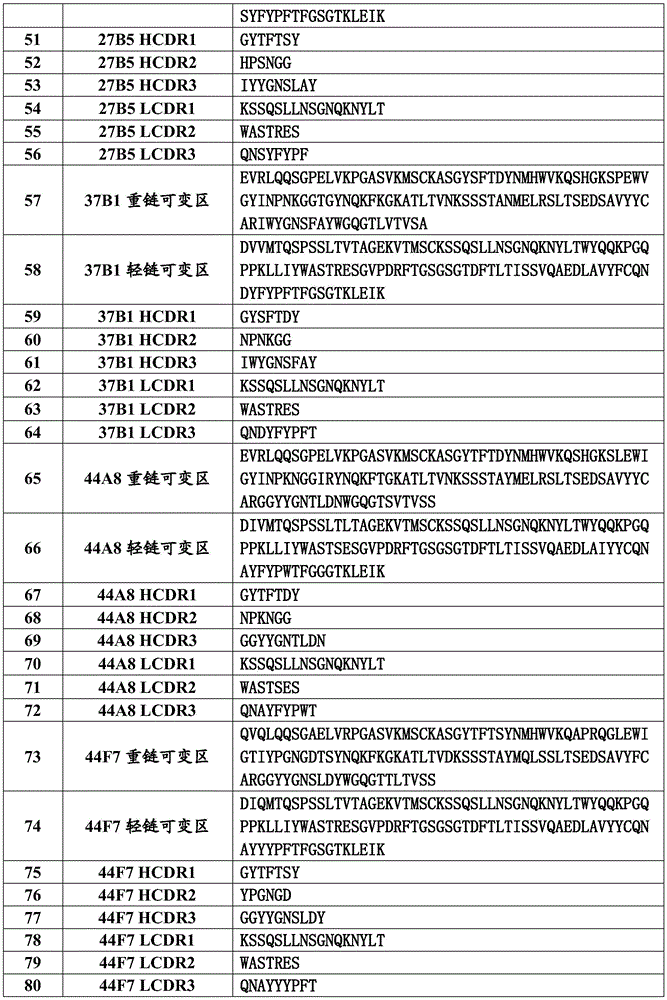


具体实施方式Detailed ways
现参照下列意在举例说明本发明(而非限定本发明)的实施例来描述本发明。The invention will now be described with reference to the following examples, which are intended to illustrate the invention, but not to limit it.
除非特别指明,本发明中所使用的分子生物学实验方法和免疫检测法,基本上参照J.Sambrook等人,分子克隆:实验室手册,第2版,冷泉港实验室出版社,1989,以及F.M.Ausubel等人,精编分子生物学实验指南,第3版,John Wiley&Sons,Inc.,1995中所述的方法进行;限制性内切酶的使用依照产品制造商推荐的条件。本领域技术人员知晓,实施例以举例方式描述本发明,且不意欲限制本发明所要求保护的范围。Unless otherwise specified, the molecular biology experiment methods and immunoassay methods used in the present invention are basically with reference to J.Sambrook et al., Molecular Cloning: A Laboratory Manual, 2nd Edition, Cold Spring Harbor Laboratory Press, 1989, and F.M.Ausubel et al., Molecular Biology Experimental Guide, 3rd Edition, John Wiley & Sons, Inc., 1995. The method described in; restriction endonucleases were used in accordance with the conditions recommended by the product manufacturer. Those skilled in the art understand that the examples describe the present invention by way of example and are not intended to limit the scope of the claimed invention.
实施例1:抗CLDN18.2鼠源抗体的产生Example 1: Production of anti-CLDN18.2 murine antibody
为了获得抗人CLDN18.2抗体,使用不同的免疫策略(表2)对小鼠(北京维通利华实验动物技术有限公司,品系代码216)进行接种,以引发鼠源单抗的产生。其中,抗原包括:表达人CLDN18.2胞外1区编码核酸序列的表达质粒(CLDN18.2-ECL1 DNA;SEQ ID NO:83,载体为pcDNA3.1)、表达人CLDN18.2胞外1区-补体C3-编码核酸序列的表达质粒(CLDN18.2-ECL1-C3d DNA;SEQ ID NO:84,载体为pcDNA3.1)、表达人CLDN18.2全长编码核酸序列的表达质粒(hCLDN18.2 DNA;SEQ ID NO:85,载体为pcDNA3.1)、经转染表达人源CLDN18.2的中国仓鼠卵巢细胞(CHO-hCLDN18.2)、经转染表达人源CLDN18.2高表达肾胚细胞(HEK293-hCLDN18.2)。佐剂包括:In vivo-jetPEI(Polyplus Transfection公司,货号201-50G)、ODN1826VacciGrade(InvivoGen公司,货号vac-1826-1)、完全弗氏佐剂CFA(InvivoGen公司,货号vac-cfa-60)。施用途径包括:肌肉(im)、腹膜内(ip)及皮下(sc)。在加强免疫3天后将免疫小鼠的脾细胞与小鼠骨髓瘤细胞SP2/0使用聚乙二醇法进行融合,得到既能表达抗体又能在体外无限增殖的B细胞融合,并且在HAT选择培养基中培养。将融合后的杂交瘤细胞铺在96孔细胞培养板中,并且通过初级筛选挑选出阳性克隆进行2-3轮亚克隆。In order to obtain anti-human CLDN18.2 antibodies, different immunization strategies (Table 2) were used to inoculate mice (Beijing Weitong Lihua Experimental Animal Technology Co., Ltd., strain code 216) to trigger the production of murine monoclonal antibodies. Among them, the antigens include: an expression plasmid expressing the nucleic acid sequence encoding human CLDN18.2 extracellular region 1 (CLDN18.2-ECL1 DNA; SEQ ID NO: 83, the vector is pcDNA3.1), expressing human CLDN18.2 extracellular region 1 -Expression plasmid of complement C3-encoding nucleic acid sequence (CLDN18.2-ECL1-C3d DNA; SEQ ID NO:84, carrier is pcDNA3.1), expression plasmid (hCLDN18.2 DNA; SEQ ID NO:85, the carrier is pcDNA3.1), Chinese hamster ovary cells (CHO-hCLDN18.2) transfected to express human CLDN18.2, kidney embryos with high expression of human CLDN18.2 after transfection cells (HEK293-hCLDN18.2). Adjuvants include: In vivo-jetPEI (Polyplus Transfection Company, product number 201-50G), ODN1826VacciGrade (InvivoGen Company, product number vac-1826-1), complete Freund's adjuvant CFA (InvivoGen Company, product number vac-cfa-60). Routes of administration include: intramuscular (im), intraperitoneal (ip) and subcutaneous (sc). Three days after the booster immunization, the splenocytes of the immunized mice were fused with mouse myeloma cells SP2/0 using the polyethylene glycol method to obtain B cell fusions that could express antibodies and proliferate indefinitely in vitro, and were selected in HAT cultured in culture medium. The fused hybridoma cells were plated in a 96-well cell culture plate, and positive clones were selected through primary screening for 2-3 rounds of subcloning.
表2:用于产生单克隆抗体的免疫方案Table 2: Immunization protocol used to generate monoclonal antibodies

初级筛选:在初级筛选中通过使用表达人源CLDN18.2的细胞测试生长克隆的上清液对细胞表面CLDN18.2结合能力。通过用DyLight488山羊抗鼠IgG(Abcam目录编号ab97015)第二抗体揭示出在上清液中的反应抗体的存在,在全视野细胞扫描分析仪上进行结合能力的评估(参见实施例3)。Primary Screen: Supernatants of grown clones were tested for cell surface CLDN18.2 binding in the primary screen by using cells expressing human CLDN18.2. Binding capacity was assessed on a full-field cytometer by revealing the presence of reactive antibodies in the supernatant with a DyLight 488 goat anti-mouse IgG (Abeam Cat# ab97015) secondary antibody (see Example 3).
次级筛选:对上述结合人源CLDN18.2的融合克隆上清液,使用人源CLDN18.表达的细胞测试上清液对细胞表面CLDN18.1结合能力。通过用DyLight488山羊抗鼠IgG(Abcam目录编号ab97015)第二抗体揭示出在上清液中的反应抗体的存在,在全视野细胞扫描分析仪上进行结合能力的评估(详细实验步骤可参见实施例3)。最终获得10株阳性杂交瘤单克隆细胞株,然后从其培养上清中分离纯化得到以下抗体:1D10、2F12、3F2、5F9、9F3、10B11、27B5、37B1、44A8、44F7。Secondary screening: For the supernatant of the above-mentioned fusion clone that binds to human CLDN18.2, use cells expressing human CLDN18. to test the ability of the supernatant to bind to cell surface CLDN18.1. The binding capacity was assessed on a full-field cytometer by using the DyLight488 goat anti-mouse IgG (Abcam catalog number ab97015) secondary antibody to reveal the presence of reactive antibodies in the supernatant (see Examples for detailed experimental procedures) 3). Finally, 10 positive hybridoma monoclonal cell lines were obtained, and then the following antibodies were isolated and purified from their culture supernatant: 1D10, 2F12, 3F2, 5F9, 9F3, 10B11, 27B5, 37B1, 44A8, 44F7.
实施例2:抗CLDN18.2鼠源抗体的抗原结合活性评价Example 2: Antigen-binding activity evaluation of anti-CLDN18.2 murine antibody
2.1表达CLDN18.2的细胞系的构建2.1 Construction of cell lines expressing CLDN18.2
通过慢病毒感染和抗性筛选的方法(MOI=3-10,5μg/ml polybrene)在HEK293T细胞(ATCC)、CHOS细胞(Invitrogen)、OCUM-1胃癌肿瘤细胞(南京科佰生物科技有限公司)上分别过表达人源CLDN18.2(SEQ ID NO:86)或CLDN18.1(SEQ ID NO:88),或小鼠CLDN18.2(SEQ ID NO:87)。慢病毒由上海吉凯基因化学技术有限公司提供,细胞感染72小时后加相应抗性继续培养2-4周,扩增并冻存,以用于后续实验。Through the method of lentivirus infection and resistance screening (MOI=3-10, 5μg/ml polybrene) in HEK293T cells (ATCC), CHOS cells (Invitrogen), OCUM-1 gastric cancer tumor cells (Nanjing Kebai Biotechnology Co., Ltd.) overexpress human CLDN18.2 (SEQ ID NO:86) or CLDN18.1 (SEQ ID NO:88), or mouse CLDN18.2 (SEQ ID NO:87) respectively. The lentivirus was provided by Shanghai Jikai Gene Chemical Technology Co., Ltd. 72 hours after the cells were infected, the corresponding resistance was added and continued to be cultured for 2-4 weeks, amplified and frozen for subsequent experiments.
2.2通过细胞扫描分析仪检测鼠源抗体与细胞表面CLDN18.2与CLDN18.1的结合情况2.2 Detection of binding of mouse antibody to cell surface CLDN18.2 and CLDN18.1 by cell scanning analyzer
使用重组表达人源CLDN18.2(hCLDN18.2)的HEK293T-hCLDN18.2和OCUM-1-hCLDN18.2,或表达小鼠CLDN18.2(mCLDN18.2)的HEK293T-mCLDN18.2,以及相应的阴性对照细胞系HEK293T;或者使用重组表达人源CLDN18.1(hCLDN18.1)的HEK293T-hCLDN18.1、CHOS-hCLDN18.1,使用DyLight488山羊抗鼠IgG(Abcam目录编号ab97015)或是DyLight488山羊抗人IgG(Abcam目录编号ab97003)作为第二抗体,使用以下方法产生滴定结合曲线。Use HEK293T-hCLDN18.2 and OCUM-1-hCLDN18.2 recombinantly expressing human CLDN18.2 (hCLDN18.2), or HEK293T-mCLDN18.2 expressing mouse CLDN18.2 (mCLDN18.2), and the corresponding Negative control cell line HEK293T; or use HEK293T-hCLDN18.1, CHOS-hCLDN18.1 recombinantly expressing human CLDN18.1 (hCLDN18.1), use DyLight488 goat anti-mouse IgG (Abcam catalog number ab97015) or DyLight488 goat anti- Human IgG (Abcam catalog number ab97003) was used as the secondary antibody and titration binding curves were generated using the following method.
将10000个细胞平铺于100μL DMEM+10%FBS/孔中,使用平底96孔板,过夜使细胞贴壁或沉于孔底,第二天去掉上清。通过将1/3体积(100μL)稀释于200μL DMEM中来实施3倍梯度稀释。细胞板的每一孔中加入100μL经稀释的抗体(筛选时使用融合克隆上清或亚克隆上清),相应阴性对照孔加入100μL DMEM,室温孵育1小时。去掉上清后,每孔加入100μL第二抗体(5μg/mL,稀释于DMEM中),室温孵育0.5小时。染色完成后去掉上清,用PBS清洗一次后每孔加入100μL PBS,然后上机器进行读数。Plate 10,000 cells in 100 μL DMEM+10% FBS/well, use a flat-bottom 96-well plate, let the cells adhere to the wall or sink to the bottom of the well overnight, and remove the supernatant the next day. A 3-fold serial dilution was performed by diluting 1/3 volume (100 μL) in 200 μL DMEM. Add 100 μL of diluted antibody to each well of the cell plate (use the fusion clone supernatant or subclone supernatant for screening), add 100 μL DMEM to the corresponding negative control well, and incubate at room temperature for 1 hour. After the supernatant was removed, 100 μL of secondary antibody (5 μg/mL, diluted in DMEM) was added to each well, and incubated at room temperature for 0.5 hours. After staining, remove the supernatant, wash once with PBS, add 100 μL of PBS to each well, and then read on the machine.
使用全视野细胞扫描分析仪(Nexcelom公司,型号
抗CLDN18.2抗体与表达人CLDN18.2的HEK293T、表达鼠CLDN18.2的HEK293T、表达人CLDN18.1的HEK293T和对照HEK293T的结合活性测定结果分别如图1A-1D所示,横坐标使用抗体浓度的对数,纵坐标使用和CLDN18.2抗体有结合显示绿色荧光的细胞占贴壁细胞总数的百分比。进一步根据曲线拟合出抗CLDN18.2抗体结合抗原活性的EC50,其结果如表3所示。其中,参比抗体为175D10(Ganymed Pharmaceuticals AG),公开于例如CN101312989B,CN103509114B。The binding activity assay results of anti-CLDN18.2 antibody to HEK293T expressing human CLDN18.2, HEK293T expressing mouse CLDN18.2, HEK293T expressing human CLDN18.1 and control HEK293T are shown in Figure 1A-1D respectively, and the abscissa uses antibodies The logarithm of the concentration, the ordinate used and CLDN18.2 antibody combined with the percentage of cells showing green fluorescence to the total number of adherent cells. The EC50 of the antigen-binding activity of the anti-CLDN18.2 antibody was further calculated according to the curve, and the results are shown in Table 3. Wherein, the reference antibody is 175D10 (Ganymed Pharmaceuticals AG), which is disclosed in, for example, CN101312989B and CN103509114B.
表3:抗CLDN18.2抗体与CLDN18.2的结合活性测定结果Table 3: Assay results of binding activity of anti-CLDN18.2 antibodies to CLDN18.2
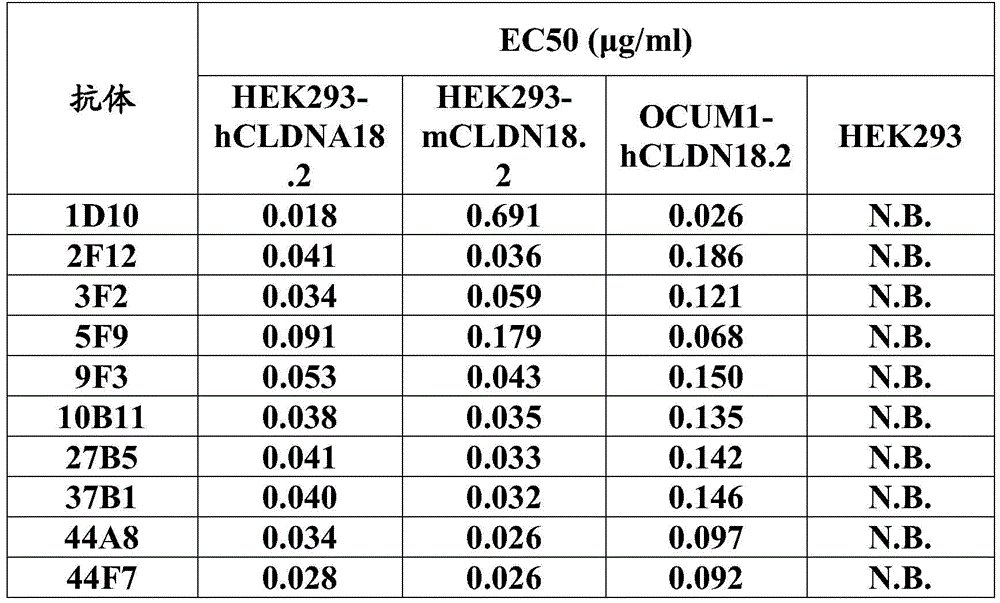

注:N.B.表示在测定浓度范围内没有结合。Note: N.B. indicates no binding within the concentration range of the assay.
上述结果显示,1D10、2F12、3F2、5F9、9F3、10B11、27B5、37B1、44A8、44F7均可结合表达人CLDN18.2的细胞,且显著优于参比抗体175D10,同时这些抗体不结合不表达CLDN18.2的阴性对照细胞(HEK293T)。The above results show that 1D10, 2F12, 3F2, 5F9, 9F3, 10B11, 27B5, 37B1, 44A8, and 44F7 can all bind to cells expressing human CLDN18.2, and are significantly better than the reference antibody 175D10, and these antibodies do not bind or express Negative control cells (HEK293T) for CLDN18.2.
抗CLDN18.2抗体与CLDN18.1的结合活性的EC50如表4所示。结果显示,2F12、3F2、9F3、10B11、27B5、37B1、44A8、44F7均不结合CLDN18.1,显示出针对CLDN18.2的良好的结合特异性。Table 4 shows the EC50 of the binding activity of anti-CLDN18.2 antibodies to CLDN18.1. The results showed that 2F12, 3F2, 9F3, 10B11, 27B5, 37B1, 44A8, and 44F7 did not bind to CLDN18.1, showing good binding specificity for CLDN18.2.
表4:抗CLDN18.2抗体与CLDN18.1的结合活性测定结果Table 4: Assay results of binding activity of anti-CLDN18.2 antibodies to CLDN18.1

注:N.B.表示在测定浓度范围内没有结合,空白表示该抗体未测量此项数据。Note: N.B. indicates that there is no binding within the concentration range of the assay, and blank indicates that the antibody has not measured this data.
实施例3:抗CLDN18.2鼠源抗体的序列测定及嵌合抗体的制备Example 3: Sequence determination of anti-CLDN18.2 murine antibody and preparation of chimeric antibody
3.1抗人CLDN18.2鼠源抗体可变区序列的测定3.1 Determination of the variable region sequence of the anti-human CLDN18.2 mouse antibody
离心收集杂交瘤细胞,每5-10×106个细胞加入1ml TRIzol和0.2ml氯仿,剧烈振荡15秒,室温放置3分钟,离心取水相加入0.5ml异丙醇,室温放置10分钟后收集沉淀,乙醇洗涤后干燥得到RNA。在冰浴离心管里面加入模板RNA和引物,使引物和模板正确配对后进行反转录,而后进行PCR扩增。扩增结束后,取4个微量离心管各加入dNTP/ddNTP混合物2.5μl,37℃温浴5min,备用。在一个空的微量离心管中加入1pmol的PCR扩增产物、10pmol测序引物、2μl 5×测序缓冲液,加双蒸水至总体积10μl,96℃加热8min,冰浴泠却1min,4℃10000g离心10s。加入2μl预冷的标记混合物(dCTP、dGTP、dTTP各0.75μmol/L)、α-32P-dATP 5μCi、1μl 0.1mol/L DDT、测序酶2U,加水至15μl,混匀后置冰上2min。3.5μl标记反应混合物加入到准备好的4个微量离心管中,37℃温浴5min。每管各加入4μl终止液。样品在80℃的水浴中热变性5min,每一泳道加2μl加到测序胶上,电泳分离这些片段,收集序列信息。Collect the hybridoma cells by centrifugation, add 1ml TRIzol and 0.2ml chloroform for every 5-10× 106 cells, shake vigorously for 15 seconds, leave at room temperature for 3 minutes, centrifuge to take the water phase, add 0.5ml isopropanol, and collect the precipitate after 10 minutes at room temperature , washed with ethanol and dried to obtain RNA. Add template RNA and primers into the ice-bath centrifuge tube, make the primers and templates paired correctly, perform reverse transcription, and then perform PCR amplification. After the amplification is completed, add 2.5 μl of dNTP/ddNTP mixture to each of the four microcentrifuge tubes, incubate at 37°C for 5 minutes, and set aside. Add 1pmol of PCR amplification product, 10pmol of sequencing primers, 2μl of 5×sequencing buffer to an empty microcentrifuge tube, add double distilled water to a total volume of 10μl, heat at 96°C for 8min, cool in an ice bath for 1min, 10000g at 4°C Centrifuge for 10s. Add 2 μl pre-cooled labeling mixture (dCTP, dGTP, dTTP each 0.75 μmol/L), α-32P-dATP 5 μCi, 1 μl 0.1mol/L DDT, sequence enzyme 2U, add water to 15 μl, mix well and place on ice for 2 minutes. Add 3.5 μl of the labeling reaction mixture into 4 prepared microcentrifuge tubes, and incubate at 37° C. for 5 minutes. Add 4 μl of stop solution to each tube. The samples were thermally denatured in a water bath at 80°C for 5 minutes, and 2 μl was added to the sequencing gel for each lane, and the fragments were separated by electrophoresis to collect sequence information.
10株鼠源抗体的VH和VL序列如下表5所示。进一步,还使用Kabat等人描述的方法(Kabat等,Sequences of Proteins of Immunological Interest,第五版,Public HealthService,美国国立卫生研究院,贝塞斯达、马里兰州(1991),第647-669页),确定了10株鼠源单抗的CDR序列(表6)。The VH and VL sequences of the 10 strains of murine antibodies are shown in Table 5 below. Further, the method described by Kabat et al. (Kabat et al., Sequences of Proteins of Immunological Interest, Fifth Edition, Public Health Service, National Institutes of Health, Bethesda, MD (1991), pp. 647-669 was also used ), the CDR sequences of 10 murine monoclonal antibodies were determined (Table 6).
表5:鼠源抗体轻重链可变区氨基酸序列Table 5: Amino acid sequences of the light and heavy chain variable regions of murine antibodies
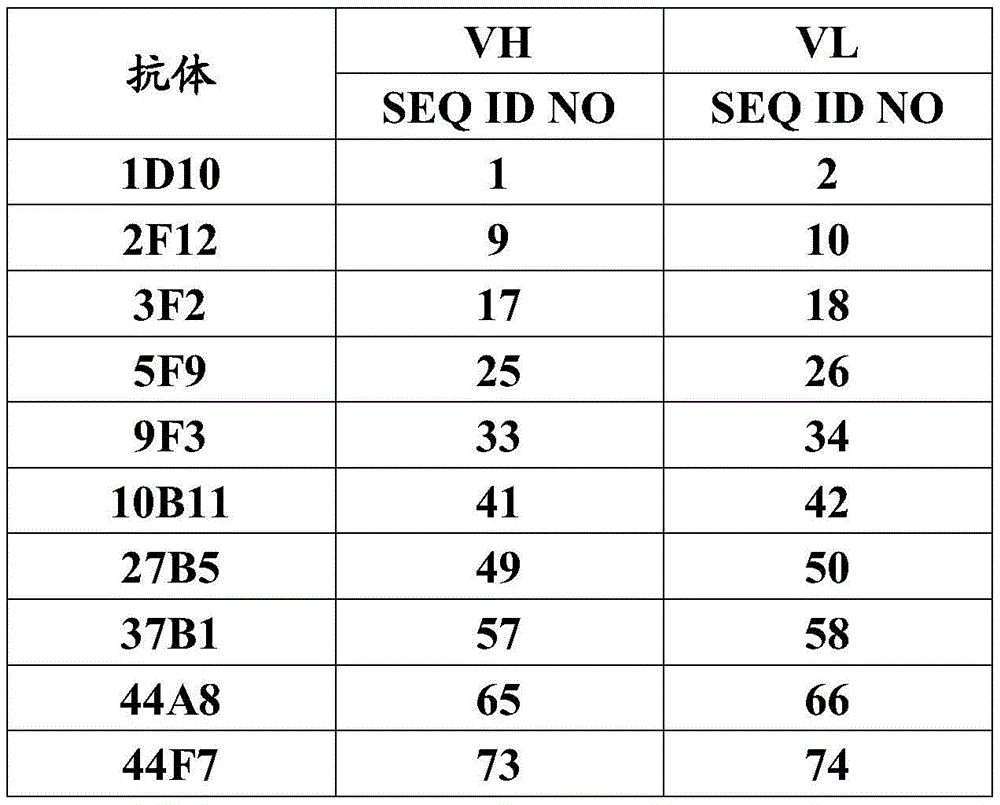
表6:鼠源抗体CDR的序列Table 6: Sequences of murine antibody CDRs


3.2人-鼠嵌合抗体的制备及抗原结合活性评价3.2 Preparation of human-mouse chimeric antibody and evaluation of antigen binding activity
将编码上述鼠源抗体的重链和轻链可变区的基因序列(参见SEQ ID N Os:103-122)分别与编码人抗体的重链恒定区(SEQ ID NO:81)和轻链恒定区(SEQ ID NO:82)的序列相连接,并在HEK293细胞(ATCC)中进行重组表达,从而获得相应的嵌合抗体1D10-chIgG1、2F12-chIgG1、3F2-chIgG1、5F9-chIgG1、9F3-chIgG1、10B11-chIgG1、27B5-chIgG1、37B1-c hIgG1、44A8-chIgG1、44F7-chIgG1。并通过实施例2中所描述的方法检测不同浓度的嵌合抗体与表达人源CLDN18.2的HEK293T细胞(HEK293T-h CLDN18.2)的结合活性。结果如图2所示,横坐标使用抗体浓度的对数,纵坐标使用和CLDN18.2抗体有结合显示绿色荧光的细胞占贴壁细胞总数的百分比(%荧光细胞)。进一步根据曲线拟合出嵌合抗体结合抗原活性的E C50如表7所示。结果显示,嵌合抗体3F2-chIgG1、5F9-chIgG1、9F3-chIg G1、10B11-chIgG1、27B5-chIgG1、37B1-chIgG1、44A8-chIgG1、44F7-chI gG1均能够识别/结合人CLDN18.2。The gene sequences (see SEQ ID NOs: 103-122) encoding the heavy chain and light chain variable regions of the above murine antibody were combined with the heavy chain constant region (SEQ ID NO: 81) and light chain constant region encoding the human antibody respectively. region (SEQ ID NO: 82) and were recombinantly expressed in HEK293 cells (ATCC) to obtain the corresponding chimeric antibodies 1D10-chIgG1, 2F12-chIgG1, 3F2-chIgG1, 5F9-chIgG1, 9F3- chIgG1, 10B11-chIgG1, 27B5-chIgG1, 37B1-c hIgG1, 44A8-chIgG1, 44F7-chIgG1. And the binding activity of different concentrations of chimeric antibodies to HEK293T cells expressing human CLDN18.2 (HEK293T-h CLDN18.2) was detected by the method described in Example 2. The results are shown in Figure 2, the abscissa uses the logarithm of the antibody concentration, and the ordinate uses the percentage of cells that show green fluorescence in combination with the CLDN18.2 antibody to the total number of adherent cells (% fluorescent cells). Further according to the curve fitting, the E C50 of the antigen-binding activity of the chimeric antibody is shown in Table 7. The results showed that chimeric antibodies 3F2-chIgG1, 5F9-chIgG1, 9F3-chIgG1, 10B11-chIgG1, 27B5-chIgG1, 37B1-chIgG1, 44A8-chIgG1, 44F7-chIgG1 could all recognize/bind to human CLDN18.2.
表7:嵌合抗体与CLDN18.2的结合活性测定结果Table 7: Results of determination of binding activity of chimeric antibody to CLDN18.2

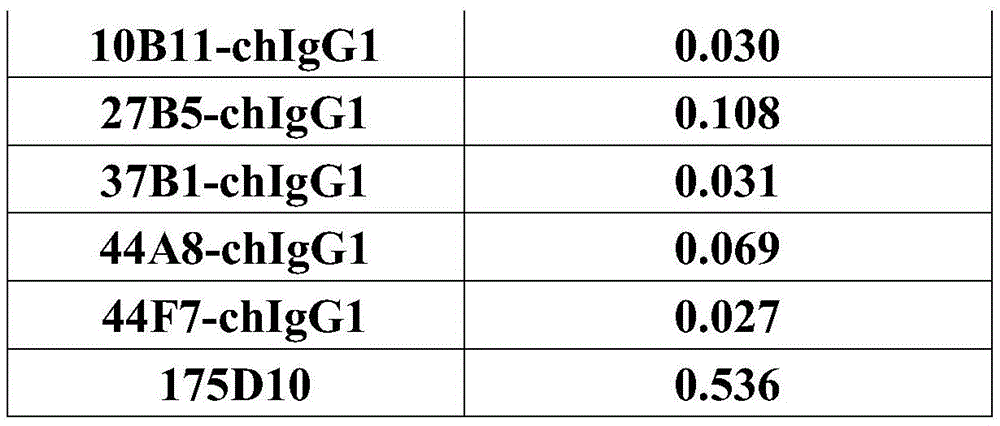
实施例4:抗CLDN18.2嵌合抗体诱导ADCC的活性评价Example 4: Evaluation of the activity of ADCC induced by anti-CLDN18.2 chimeric antibody
靶细胞使用HEK293T-hCLDN18.2或者天然表达hCLDN18.2的人胃癌肿瘤细胞系KATO-III和NUGC4,效应细胞使用通过Ficoll分离的人源外周血单核细胞(PBMC)。收获靶细胞,用PBS清洗2次,将活细胞染料Calcein AM(加入50μl DMSO溶解50μg Calcein AM干粉,Life Technologies,Cat#C3100MP)稀释到3μM,在5%CO2,37℃条件下进行靶细胞染色30分钟。染色完成,用PBS清洗2次,将5000个靶细胞平铺于100μL DMEM/孔中,使用平底96孔板。通过将1/3体积(100μL)稀释于200μL DMEM中来实施3倍梯度稀释。细胞板的相应孔中加入50μL经稀释的抗体(非特异性杀伤对照孔加入50μLDMEM培养基),在5%CO2,37℃与靶细胞一起孵育30分钟后,每孔加入50μL分离好的PBMC 50000个作为效应细胞。1000rpm离心3分钟,让细胞沉附于板底。在不同时间点0小时,2小时,3小时,4小时,6小时使用全视野细胞扫描分析仪(Nexcelom公司,型号
抗CLDN18.2抗体诱导ADCC活性的测定结果如图3A-3C所示,横坐标使用抗体浓度的对数,纵坐标使用校正过的特异性裂解百分比。进一步根据曲线拟合出抗CLDN18.2嵌合抗体诱导ADCC的EC50,其结果如表8所示。结果显示,所检测的抗体均可诱导PBMC对于表达人CLDN18.2的细胞的杀伤作用,且明显优于参比抗体175D10。The assay results of ADCC activity induced by anti-CLDN18.2 antibodies are shown in Figures 3A-3C, the abscissa uses the logarithm of the antibody concentration, and the ordinate uses the corrected percentage of specific lysis. The EC50 of ADCC induced by the anti-CLDN18.2 chimeric antibody was further calculated according to the curve, and the results are shown in Table 8. The results showed that all the tested antibodies could induce the killing effect of PBMC on cells expressing human CLDN18.2, which was significantly better than the reference antibody 175D10.
表8:嵌合抗体诱导ADCC活性的测定结果Table 8: Assay results of chimeric antibody-induced ADCC activity
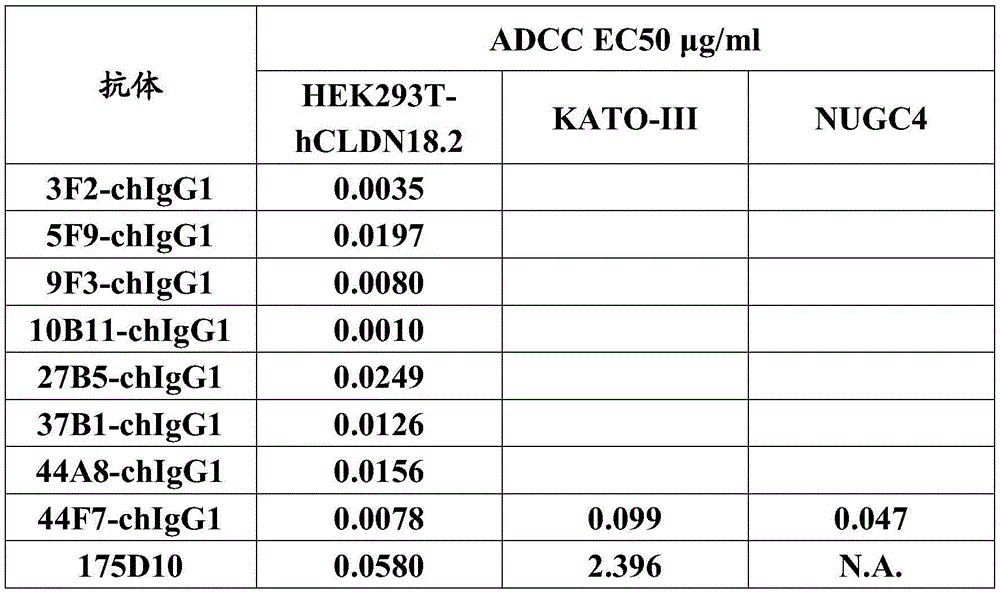
注:N.A.表示EC50大于测定测定浓度范围,空白表示该抗体未测量此项数据。Note: N.A. indicates that the EC50 is greater than the concentration range of the determination, and blank indicates that the antibody has not measured this data.
实施例5:抗CLDN18.2嵌合抗体诱导CDC的活性评价Example 5: Evaluation of CDC-induced activity of anti-CLDN18.2 chimeric antibody
靶细胞使用HEK293T-hCLDN18.2或者天然表达hCLDN18.2的人胃癌肿瘤细胞系KATO-III,效应细胞使用新鲜人血清。收获靶细胞,用PBS清洗2次,将活细胞染料CalceinAM(加入50μl DMSO溶解50μg Calcein AM干粉,Life Technologies,Cat#C3100MP)稀释到3μM,在5%CO2,37℃条件下进行靶细胞染色30分钟。染色完成,用PBS清洗2次,将8000个靶细胞平铺于25μL DMEM/孔中,使用平底96孔板。通过将1/3体积(100μL)稀释于200μL DMEM中来实施3倍梯度稀释。细胞板的每一孔中加入25μL经稀释的抗体(非特异性杀伤对照孔加入25μLDMEM培养基),在5%CO2,37℃与靶细胞一起孵育30分钟后,每孔加入50μL新鲜分离的20%人血清(用DMEM稀释)作为效应细胞。1000rpm离心3分钟,让细胞沉附于板底。在不同时间点0小时,1小时,2小时,3小时,4小时使用全视野细胞扫描分析仪(Nexcelom公司,型号
抗CLDN18.2抗体诱导CDC活性的测定结果如图4A-4B所示,横坐标使用抗体浓度的对数,纵坐标使用校正过的特异性细胞杀伤百分比。进一步根据曲线拟合出抗CLDN18.2抗体诱导CDC的EC50,其结果如表9所示。结果显示,所检测的抗体均可诱导人血清中补体对于表达人CLDN18.2的细胞的杀伤作用,且显著优于参比抗体175D10。The assay results of anti-CLDN18.2 antibody-induced CDC activity are shown in Figures 4A-4B, the abscissa uses the logarithm of the antibody concentration, and the ordinate uses the corrected percentage of specific cell killing. The EC50 of CDC induced by the anti-CLDN18.2 antibody was further calculated according to the curve, and the results are shown in Table 9. The results showed that all the tested antibodies could induce the killing effect of complement in human serum on cells expressing human CLDN18.2, and were significantly better than the reference antibody 175D10.
表9:嵌合抗体诱导CDC活性的测定结果Table 9: Assay results of chimeric antibody-induced CDC activity
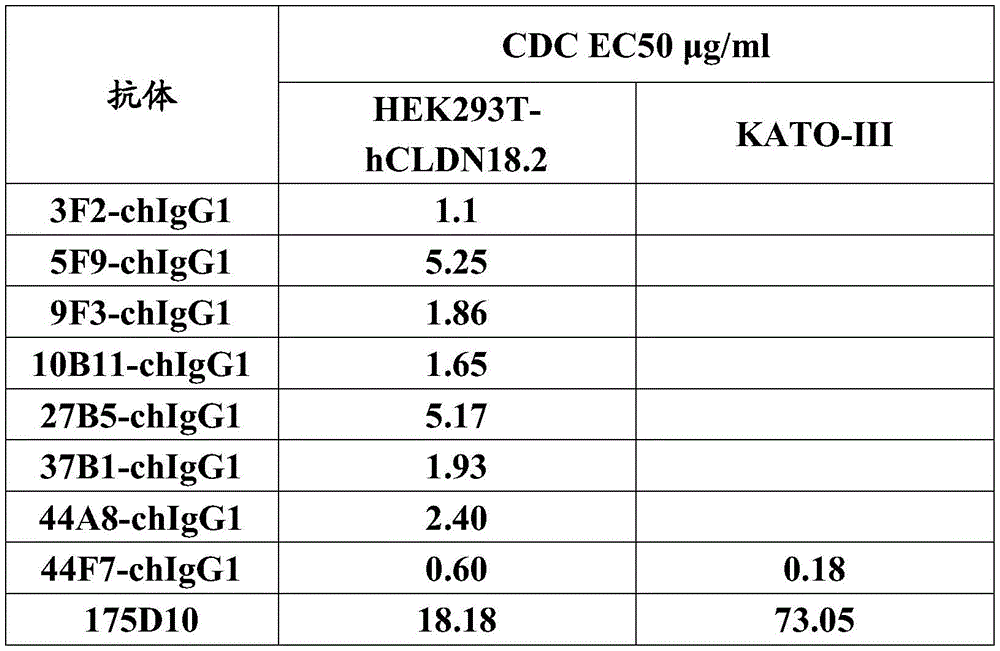
注:空白表示该抗体未测量此项数据。Note: Blank indicates that the antibody has not measured this data.
实施例6:抗CLDN18.2抗体诱导CLDN18.2内化的活性评价Example 6: Activity evaluation of anti-CLDN18.2 antibody-induced internalization of CLDN18.2
本实施例通过流式细胞术检测抗CLDN18.2抗体介导细胞(HEK293T-hCLDN18.2)表面的CLDN18.2内化的水平。在37℃下将两份细胞与10μg/mL嵌合抗体分别孵育1和4小时。用含2%FBS的PBS洗涤若干次后,加入10μg/mL第二抗体4℃下染色30分钟。然后通过流式细胞术分析细胞表面CLDN18.2的表达水平。In this example, the level of CLDN18.2 internalization on the surface of cells (HEK293T-hCLDN18.2) mediated by anti-CLDN18.2 antibody was detected by flow cytometry. Duplicate cells were incubated with 10 μg/mL chimeric antibody for 1 and 4 hours at 37°C, respectively. After washing several times with PBS containing 2% FBS, 10 μg/mL secondary antibody was added for staining at 4°C for 30 minutes. The expression level of cell surface CLDN18.2 was then analyzed by flow cytometry.
MFI4H为孵育4小时后的样品的MFI;MFI1H为孵育1小时后的样品的MFI,假设该条件下抗体完成结合,内吞尚未发生,MFI背景为仅有第二抗体的MFI,抗体介导的细胞表面CLDN18.2内吞百分百由以下公式计算:MFI 4H is the MFI of the sample after incubation for 4 hours; MFI 1H is the MFI of the sample after incubation for 1 hour, assuming that the antibody is bound under this condition, endocytosis has not yet occurred, the MFI background is the MFI of the second antibody only, and the antibody-mediated The percent endocytosis of cell surface CLDN18.2 was calculated by the following formula:
内化CLDN18.2的百分比%=100-100×(MFI4H-MFI1H)/(MFI1H-MFI背景)Percent % of internalized CLDN18.2 = 100-100 x (MFI 4H -MFI 1H )/(MFI 1H -MFI background )
结果如表10所示,这些抗体介导了不同程度的HEK293T-hCLDN18.2细胞表面上CLDN18.2的内吞。The results are shown in Table 10. These antibodies mediated different degrees of endocytosis of CLDN18.2 on the surface of HEK293T-hCLDN18.2 cells.
表10:嵌合抗体诱导CLDN18.2内化的测定结果Table 10: Assay results of chimeric antibody-induced internalization of CLDN18.2

实施例7:抗CLDN18.2抗体的人源化及活性评价Example 7: Humanization and activity evaluation of anti-CLDN18.2 antibody
为提高候选抗体与人源抗体的序列的同源性,减少抗体对人的免疫原性,可以对以上实施例提供的鼠源抗体进行人源化设计和制备,使用本领域已知的方法将鼠CDR区插入人源框架序列(参见Winter的美国专利No.5,225,539;Queen等人的美国专利Nos.5,530,101;5,585,089;5,693,762和6,180,370;以及Lo,Benny,K.C.,editor,in AntibodyEngineering:Methods and Protocols,volume 248,Humana Press,New Jersey,2004)。通常而言,人源化抗体的全部或部分CDR区来自于非人源抗体(供体抗体),全部或部分的非CDR区(例如,可变区FR和/或恒定区)来自于人源免疫球蛋白(受体抗体)。In order to increase the sequence homology between the candidate antibody and the human antibody and reduce the immunogenicity of the antibody to humans, the murine antibody provided in the above examples can be designed and prepared humanized, using methods known in the art to Mouse CDR regions inserted into human framework sequences (see Winter, U.S. Patent No. 5,225,539; Queen et al., U.S. Patent Nos. 5,530,101; 5,585,089; 5,693,762 and 6,180,370; and Lo, Benny, K.C., editor, in Antibody Engineering: Methods and Protocols, volume 248, Humana Press, New Jersey, 2004). Generally speaking, all or part of the CDR region of a humanized antibody is derived from a non-human antibody (donor antibody), and all or part of the non-CDR region (for example, variable region FR and/or constant region) is derived from a human Immunoglobulin (receptor antibody).
基于此,本发明人制备获得了3株鼠源抗体44F7的人源化抗体,分别命名为7004-09hu09、7004-09hu10、7004-09hu15,其氨基酸序列示于下表。Based on this, the present inventors prepared three humanized antibodies of the murine antibody 44F7, named 7004-09hu09, 7004-09hu10, and 7004-09hu15 respectively, and their amino acid sequences are shown in the table below.
表11:人源化抗体的轻重链可变区氨基酸序列Table 11: Amino acid sequences of light and heavy chain variable regions of humanized antibodies

将编码上述人源化抗体的重链和轻链可变区的基因序列(参见SEQ ID NOs:123-128)分别与编码人抗体的重链恒定区(SEQ ID NO:81)和轻链恒定区(SEQ ID NO:82)的序列相连接并进行重组表达。利用实施例2.2中所述方法通过细胞扫描分析仪检测人源化抗体与HEK293T-hCLDN18.2细胞表面CLDN18.2的结合情况。结果如图5所示,横坐标使用抗体浓度的对数,纵坐标使用和CLDN18.2抗体有结合显示绿色荧光的细胞占贴壁细胞总数的百分比(%荧光细胞)。进一步根据曲线拟合出抗CLDN18.2人源化抗体结合抗原的EC50,结果如表12所示。结果显示,所检测的人源化抗体均可结合hCLDN18.2表达的细胞,其亲和力和亲本嵌合抗体在同一个数量级。The gene sequences (see SEQ ID NOs: 123-128) encoding the heavy chain and light chain variable regions of the above-mentioned humanized antibody were combined with the heavy chain constant region (SEQ ID NO: 81) and light chain constant region encoding the human antibody, respectively. region (SEQ ID NO: 82) and then recombinantly expressed. Using the method described in Example 2.2, the binding of the humanized antibody to CLDN18.2 on the surface of HEK293T-hCLDN18.2 cells was detected by a cell scanning analyzer. The results are shown in Figure 5, the abscissa uses the logarithm of the antibody concentration, and the ordinate uses the percentage of cells that have combined with the CLDN18.2 antibody and displayed green fluorescence to the total number of adherent cells (% fluorescent cells). The EC50 of the anti-CLDN18.2 humanized antibody binding antigen was further calculated according to the curve, and the results are shown in Table 12. The results showed that all humanized antibodies tested could bind to cells expressing hCLDN18.2, and their affinity was at the same order of magnitude as that of the parental chimeric antibody.
表12:人源化抗体与CLDN18.2的结合活性测定结果Table 12: Assay results of binding activity of humanized antibodies to CLDN18.2
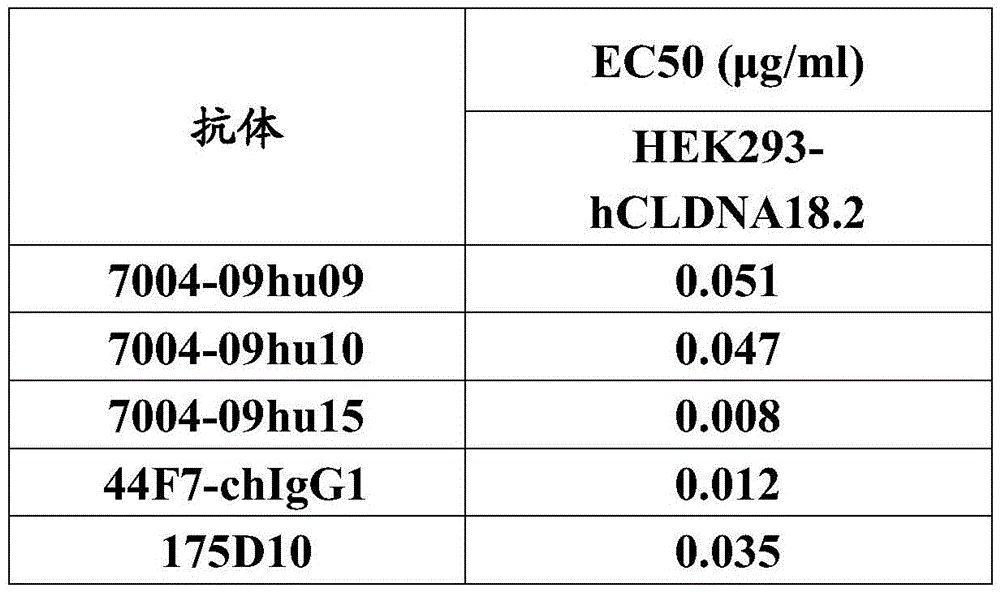
进一步,本发明人考察了人源化抗体诱导ADCC的能力,评价方法参见实施例4。靶细胞使用人胃癌肿瘤细胞KATO-III,效应细胞使用通过Ficoll分离的人源外周血单核细胞。测定结果如图6所示,横坐标使用抗体浓度的对数,纵坐标使用校正过的特异性细胞裂解百分比。进一步根据曲线拟合出抗CLDN18.2嵌合抗体诱导ADCC的EC50,其结果如表13所示。结果显示,所检测的抗体均可诱导PBMC对于表达人CLDN18.2的细胞的杀伤作用,其诱导ADCC的能力与亲本嵌合抗体在同一个数量级,且明显优于参比抗体175D10。Further, the present inventors investigated the ability of the humanized antibody to induce ADCC, and the evaluation method can be found in Example 4. Human gastric cancer tumor cells KATO-III were used as target cells, and human peripheral blood mononuclear cells separated by Ficoll were used as effector cells. The assay results are shown in Figure 6, the abscissa uses the logarithm of the antibody concentration, and the ordinate uses the corrected percentage of specific cell lysis. The EC50 of ADCC induced by the anti-CLDN18.2 chimeric antibody was further calculated according to the curve, and the results are shown in Table 13. The results showed that all the tested antibodies could induce the killing effect of PBMC on cells expressing human CLDN18.2, and their ability to induce ADCC was at the same order of magnitude as that of the parental chimeric antibody, and was significantly better than the reference antibody 175D10.
表13:人源化抗体诱导ADCC活性的测定结果Table 13: Determination results of ADCC activity induced by humanized antibodies

本发明人还考察了人源化抗体诱导CDC的能力,其评价方法参见实施例5。靶细胞使用人胃癌肿瘤细胞KATO-III,效应细胞使用新鲜人血清。测定结果如图7所示,横坐标使用抗体浓度的对数,纵坐标使用校正过的特异性细胞杀伤百分比。进一步根据曲线拟合出抗CLDN18.2嵌合抗体诱导CDC的EC50,其结果如表14所示。结果显示,所检测的抗体均可诱导人血清中补体对于表达人CLDN18.2的细胞的杀伤作用,其诱导CDC的能力与亲本嵌合抗体在同一个数量级,且明显优于参比抗体175D10。The present inventors also investigated the ability of the humanized antibody to induce CDC, and its evaluation method can be found in Example 5. Human gastric cancer tumor cell KATO-III was used as target cells, and fresh human serum was used as effector cells. The assay results are shown in Figure 7, the abscissa uses the logarithm of the antibody concentration, and the ordinate uses the corrected percentage of specific cell killing. The EC50 of CDC induced by the anti-CLDN18.2 chimeric antibody was further calculated according to the curve, and the results are shown in Table 14. The results showed that all the tested antibodies could induce the killing effect of complement in human serum on cells expressing human CLDN18.2, and their ability to induce CDC was at the same order of magnitude as that of the parental chimeric antibody, and was significantly better than the reference antibody 175D10.
表14:人源化抗体诱导CDC活性的测定结果Table 14: Assay results of CDC activity induced by humanized antibodies

以上结果表明,本发明的人源化抗体不仅具有较高的人源化程度,能够减少免疫排斥反应的可能性,而且展示出与亲本嵌合抗体相当且优于已知抗体的抗肿瘤活性。The above results show that the humanized antibody of the present invention not only has a high degree of humanization and can reduce the possibility of immune rejection, but also exhibits anti-tumor activity comparable to that of the parental chimeric antibody and better than that of known antibodies.
实施例8:抗CLDN18.2嵌合抗体的体内抗肿瘤活性评价Example 8: Evaluation of anti-tumor activity of anti-CLDN18.2 chimeric antibody in vivo
为了研究抗CLDN18.2抗体在动物体内的抗肿瘤作用,经皮下向裸鼠(SCID,北京维通利华实验动物技术有限公司)接种1×10⁷HEK293T-hCLDN18.2细胞,从接种当天开始进行静脉内和腹膜内交替给药,每周两次,每次10mg/kg,持续四周,停药后继续观察测量小鼠的肿瘤大小。图8A显示了经治疗后小鼠肿瘤体积的变化。结果显示,44F7-chIgG1抗体处理不仅显著抑制肿瘤的生长,而且完全消除了给药组小鼠的肿瘤,其抗肿瘤作用显著优于参比抗体175D10。此外,图8B显示44F7-chIgG1显著延长了荷瘤小鼠的总体生存期,展示了卓越的抗肿瘤活性。由此可见,相比参比抗体175D10,44F7-chIgG1在生存期的延长上也显示了明显优势。这样的技术效果是显著的和出人意料的。In order to study the anti-tumor effect of anti-CLDN18.2 antibody in animals, nude mice (SCID, Beijing Weitong Lihua Experimental Animal Technology Co., Ltd.) were subcutaneously inoculated with 1×10 7 HEK293T-hCLDN18.2 cells from the day of inoculation. Alternate intravenous and intraperitoneal administration, twice a week, 10 mg/kg each time, lasted for four weeks, continued to observe and measure the tumor size of the mice after drug withdrawal. Figure 8A shows the changes in tumor volume in mice after treatment. The results showed that the 44F7-chIgG1 antibody treatment not only significantly inhibited the growth of the tumor, but also completely eliminated the tumor in the mice in the administration group, and its anti-tumor effect was significantly better than that of the reference antibody 175D10. Furthermore, Figure 8B shows that 44F7-chIgG1 significantly prolongs the overall survival of tumor-bearing mice, demonstrating excellent antitumor activity. It can be seen that compared with the reference antibody 175D10, 44F7-chIgG1 also showed obvious advantages in prolonging the survival period. Such technical effects are significant and unexpected.
尽管本发明的具体实施方式已经得到详细的描述,但本领域技术人员将理解:根据已经公布的所有教导,可以对细节进行各种修改和变动,并且这些改变均在本发明的保护范围之内。本发明的全部分为由所附权利要求及其任何等同物给出。Although the specific implementation of the present invention has been described in detail, those skilled in the art will understand that: according to all the teachings that have been published, various modifications and changes can be made to the details, and these changes are all within the protection scope of the present invention . The full scope of the invention is given by the claims appended hereto and any equivalents thereof.

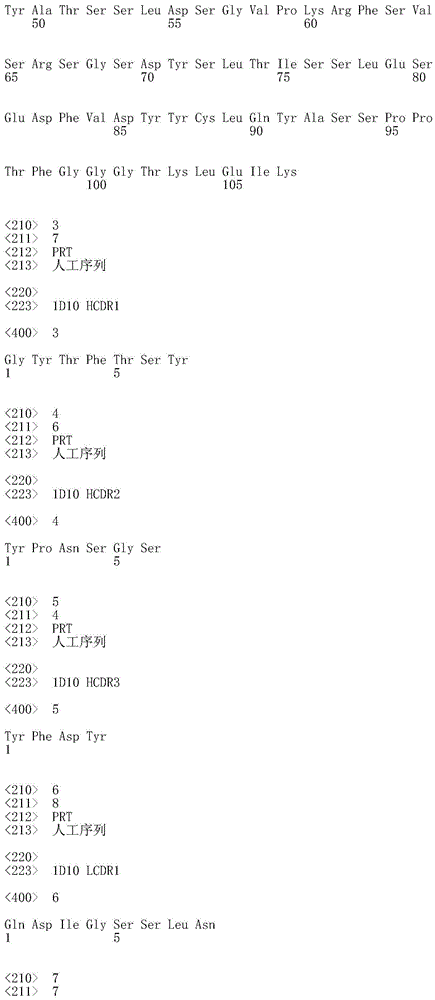
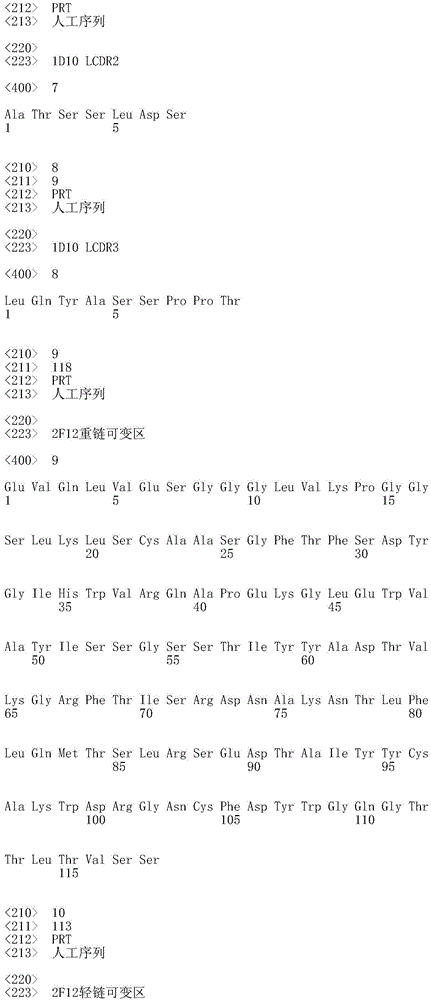


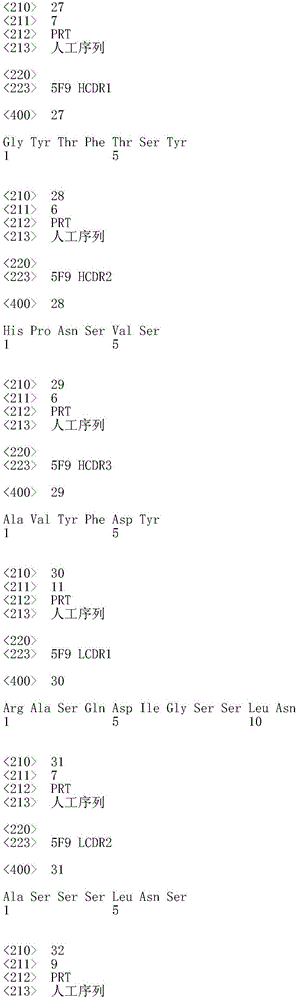


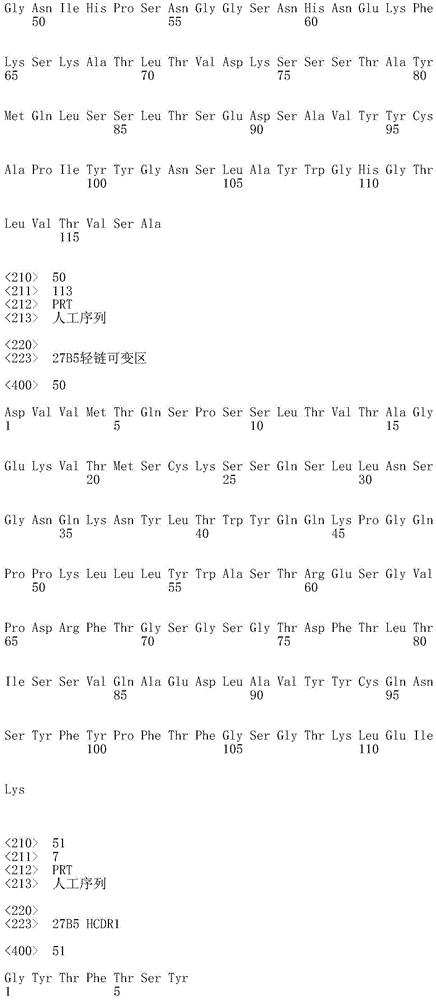
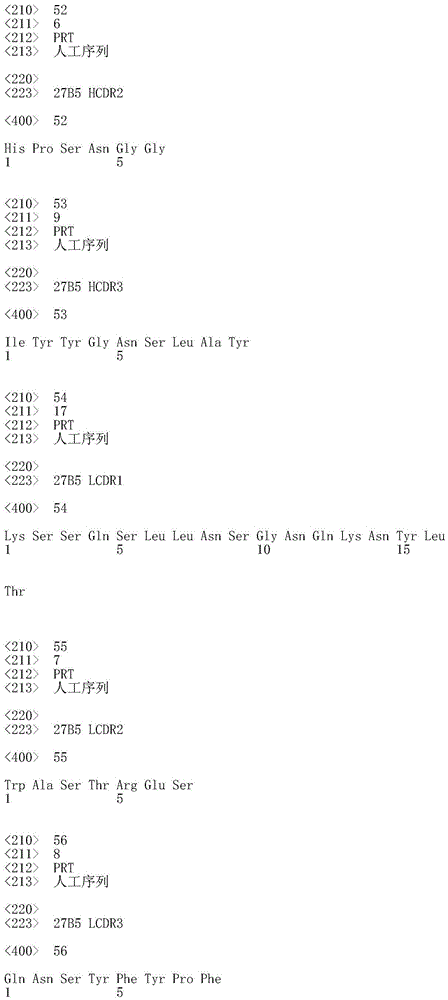


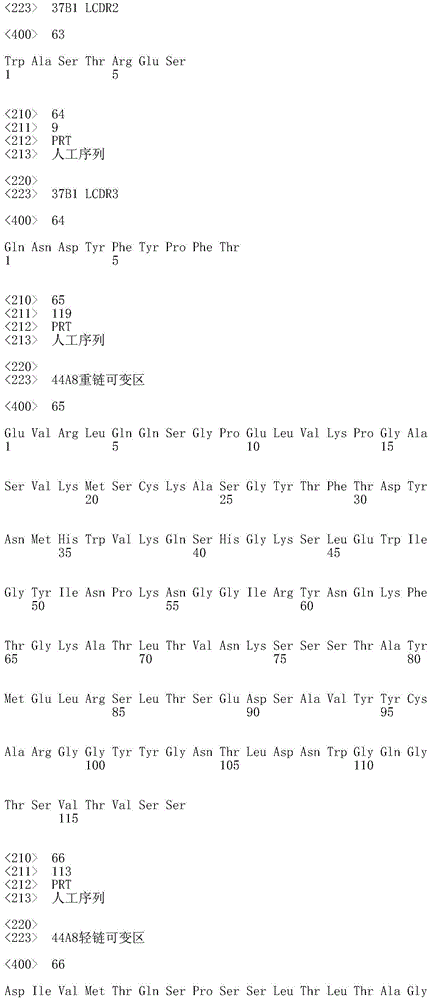
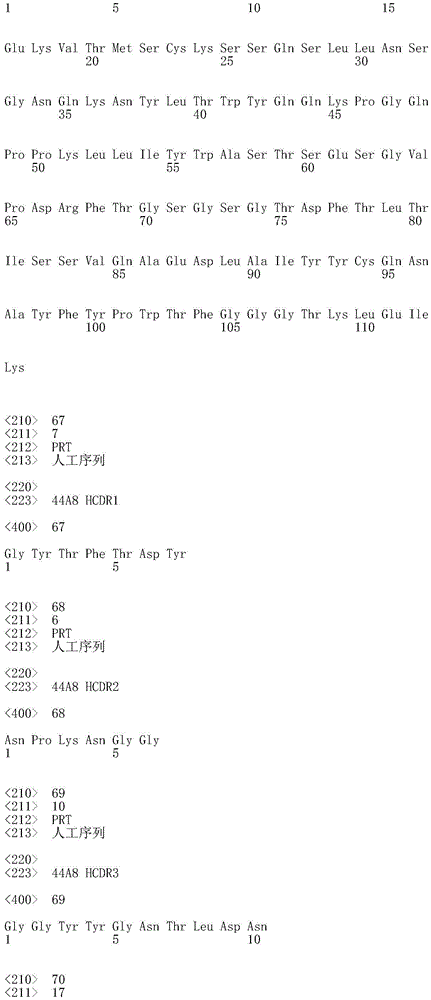


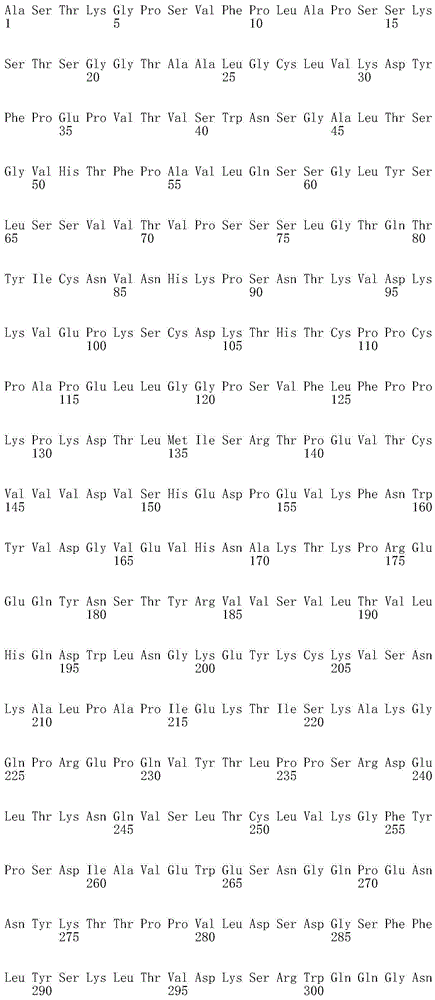

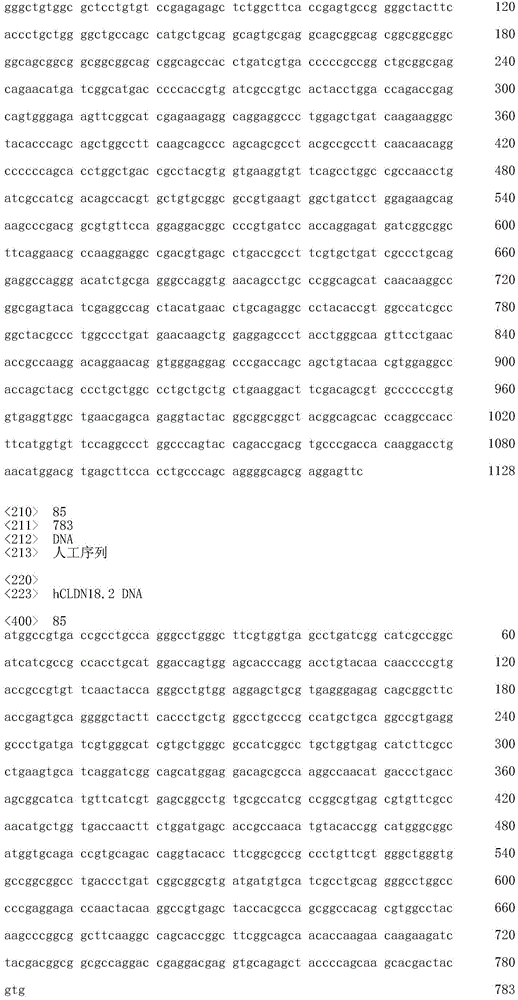

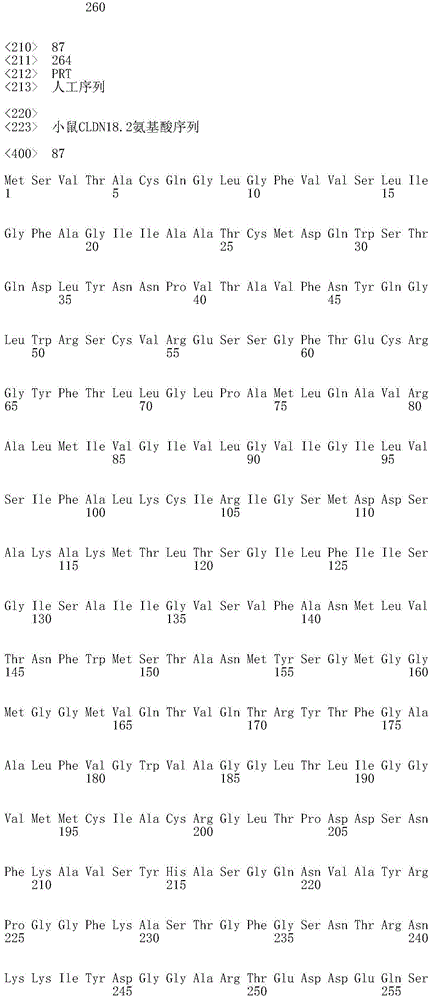

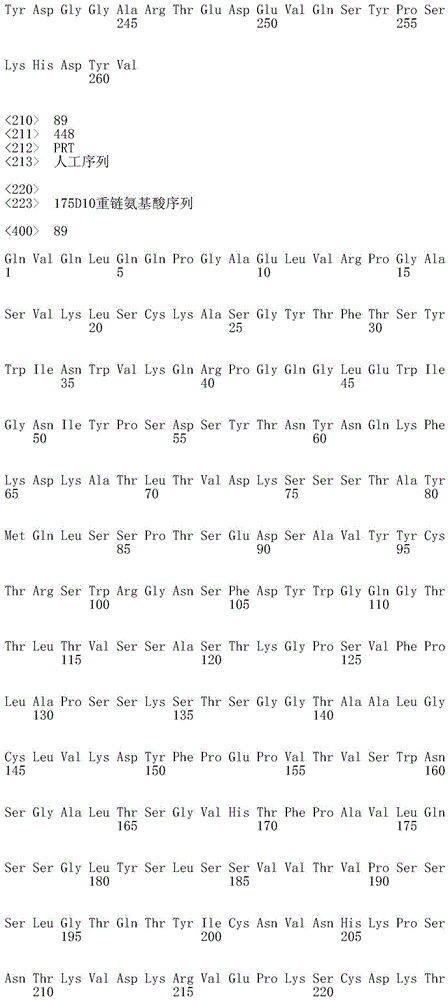
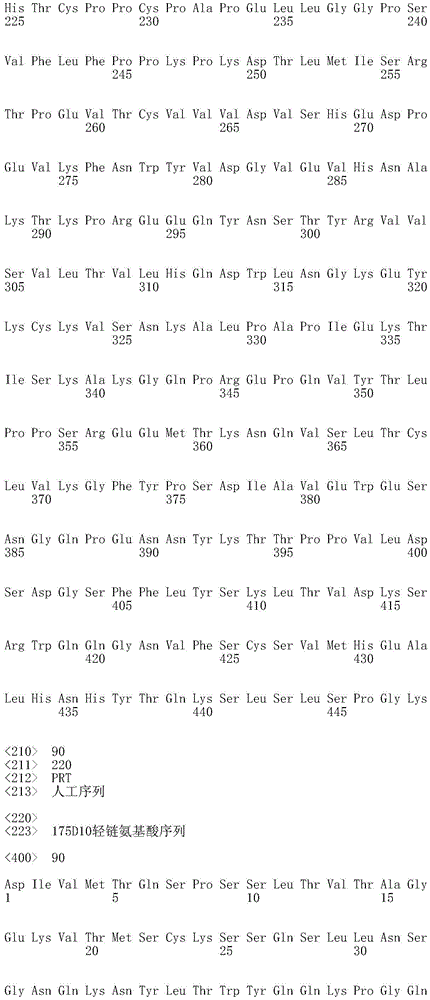

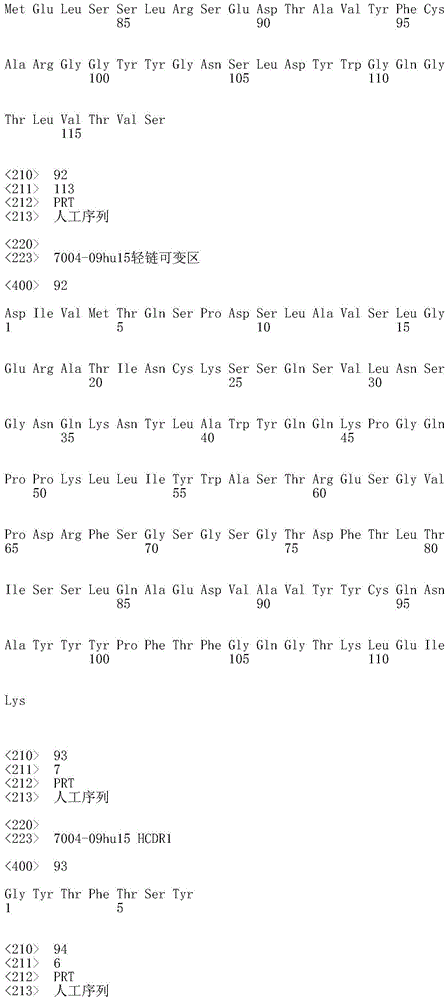


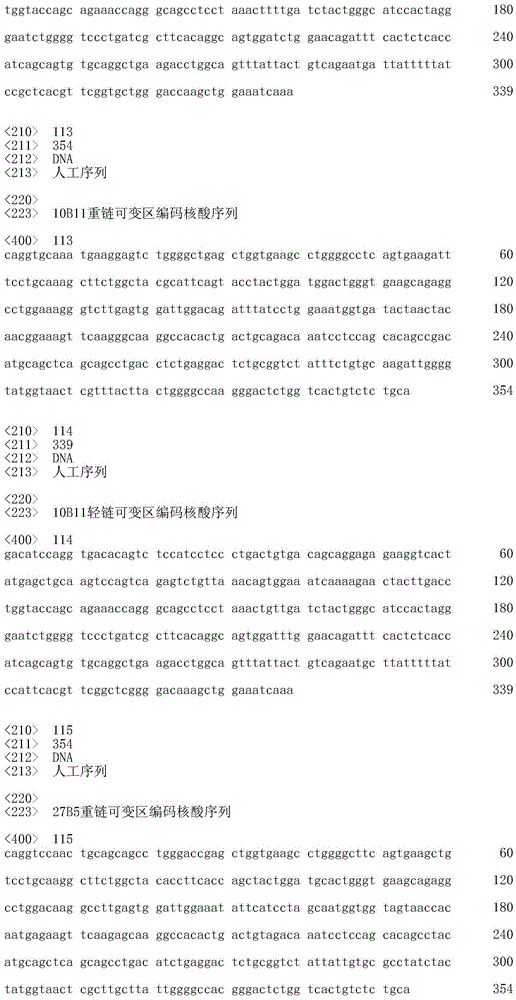


Claims (77)
Applications Claiming Priority (1)
| Application Number | Priority Date | Filing Date | Title |
|---|---|---|---|
| PCT/CN2018/111201 WO2020082209A1 (en) | 2018-10-22 | 2018-10-22 | Anti-cldn128.2 antibody and uses thereof |
Publications (2)
| Publication Number | Publication Date |
|---|---|
| CN112912396A CN112912396A (en) | 2021-06-04 |
| CN112912396B true CN112912396B (en) | 2023-03-14 |
Family
ID=70330841
Family Applications (1)
| Application Number | Title | Priority Date | Filing Date |
|---|---|---|---|
| CN201880098896.8A Active CN112912396B (en) | 2018-10-22 | 2018-10-22 | anti-CLDN 18.2 antibodies and uses thereof |
Country Status (11)
| Country | Link |
|---|---|
| US (1) | US20210403552A1 (en) |
| EP (1) | EP3872093A4 (en) |
| JP (1) | JP7401538B2 (en) |
| KR (1) | KR102775767B1 (en) |
| CN (1) | CN112912396B (en) |
| AU (1) | AU2018447127A1 (en) |
| BR (1) | BR112021007690A2 (en) |
| CA (1) | CA3117240A1 (en) |
| MX (1) | MX2021004588A (en) |
| WO (1) | WO2020082209A1 (en) |
| ZA (1) | ZA202103061B (en) |
Families Citing this family (19)
| Publication number | Priority date | Publication date | Assignee | Title |
|---|---|---|---|---|
| KR20210134321A (en) | 2019-02-01 | 2021-11-09 | 노바록 바이오테라퓨틱스 리미티드 | Anti-claudin 18 antibodies and methods of use thereof |
| KR102773187B1 (en) * | 2019-07-12 | 2025-02-27 | 퓨쳐진 바이오파머쓰티컬 (베이징) 코., 엘티디. | CLDN18.2 Antibody and Uses Thereof |
| MX2022014896A (en) * | 2020-05-25 | 2023-01-04 | Suzhou Transcenta Therapeutics Co Ltd | ANTI-CLDN18.2 ANTIBODIES AND USES FOR DIAGNOSIS THEREOF. |
| US20230365712A1 (en) * | 2020-10-16 | 2023-11-16 | The Children's Medical Center Corporation | Notch4 antibodies and uses thereof |
| CN114560941B (en) * | 2020-11-27 | 2024-01-16 | 广东东阳光药业股份有限公司 | Antibodies to CLDN18.2 and their applications |
| WO2022122709A1 (en) | 2020-12-07 | 2022-06-16 | Sotio Biotech A.S. | Antibody-drug conjugates based on humanized cldn18.2 antibodies |
| WO2022139114A1 (en) * | 2020-12-22 | 2022-06-30 | 주식회사 베르티스 | Method for determining subtype of pancreatic ductal adenocarcinoma, and subtype determination kit |
| AU2021405049A1 (en) | 2020-12-23 | 2023-06-22 | Sotio Biotech A.S. | Tumor-specific claudin 18.2 antibody-drug conjugates |
| EP4349371A4 (en) | 2021-06-02 | 2025-06-25 | Bio-Thera Solutions, Ltd. | DRUG CONJUGATE AND ASSOCIATED USE |
| KR20240046224A (en) * | 2021-08-18 | 2024-04-08 | 바이오세우스 인크. | Bispecific antibodies and their uses |
| WO2023045997A1 (en) * | 2021-09-24 | 2023-03-30 | 盛禾(中国)生物制药有限公司 | Anti-claudin18.2 antibody and use thereof |
| CN115991784A (en) * | 2021-10-19 | 2023-04-21 | 宝船生物医药科技(上海)有限公司 | anti-CD 47-CLDN18.2 bispecific antibody and uses thereof |
| KR20240099308A (en) * | 2021-10-19 | 2024-06-28 | 바이오션, 인코포레이티드 | Antibodies binding to CLDN18.2 and uses thereof |
| JP2025518100A (en) * | 2022-05-27 | 2025-06-12 | ▲蘇▼州易慕峰生物科技有限公司 | Chimeric antigen receptors containing CLDN18.2 single domain antibodies and their applications |
| CN117777288A (en) * | 2022-09-29 | 2024-03-29 | 南京博望医药科技有限公司 | Anti-claudin 18.2 antibody |
| CN116082523B (en) * | 2022-12-30 | 2023-10-13 | 邦恩泰(山东)生物医药科技集团股份有限公司 | A chimeric antigen receptor targeting Claudin18.2 and its application |
| KR20250129814A (en) | 2023-01-18 | 2025-08-29 | 타이리간드 바이오사이언스 (상하이) 리미티드 | Antibody-drug conjugates and uses thereof |
| CN118184782A (en) * | 2024-03-13 | 2024-06-14 | 河北森朗生物科技有限公司 | Anti-CLDN18.2 nanoantibodies, chimeric antigen receptors and their applications |
| CN120904331A (en) * | 2024-11-07 | 2025-11-07 | 北京荣瑷医学生物科技有限责任公司 | Nanometer antibody targeting claudin 18.2 and application thereof |
Citations (4)
| Publication number | Priority date | Publication date | Assignee | Title |
|---|---|---|---|---|
| CN102341412A (en) * | 2009-03-05 | 2012-02-01 | 梅达莱克斯公司 | Fully human antibody specific to CADM1 |
| CN107667118A (en) * | 2015-04-15 | 2018-02-06 | 加尼梅德药物有限公司 | Include the drug conjugate of the antibody for sealing protein 18 .2 |
| CN107960056A (en) * | 2015-05-11 | 2018-04-24 | 拜恩科技细胞&基因治疗有限公司 | Ocludin-18.2 specific immune receptor and T cell epitope |
| CN108472349A (en) * | 2016-06-23 | 2018-08-31 | 江苏恒瑞医药股份有限公司 | LAG-3 antibody, its antigen-binding fragment and its medical usage |
Family Cites Families (17)
| Publication number | Priority date | Publication date | Assignee | Title |
|---|---|---|---|---|
| NL154598B (en) | 1970-11-10 | 1977-09-15 | Organon Nv | PROCEDURE FOR DETERMINING AND DETERMINING LOW MOLECULAR COMPOUNDS AND PROTEINS THAT CAN SPECIFICALLY BIND THESE COMPOUNDS AND TEST PACKAGING. |
| US3817837A (en) | 1971-05-14 | 1974-06-18 | Syva Corp | Enzyme amplification assay |
| US3939350A (en) | 1974-04-29 | 1976-02-17 | Board Of Trustees Of The Leland Stanford Junior University | Fluorescent immunoassay employing total reflection for activation |
| US3996345A (en) | 1974-08-12 | 1976-12-07 | Syva Company | Fluorescence quenching with immunological pairs in immunoassays |
| US4275149A (en) | 1978-11-24 | 1981-06-23 | Syva Company | Macromolecular environment control in specific receptor assays |
| US4277437A (en) | 1978-04-05 | 1981-07-07 | Syva Company | Kit for carrying out chemically induced fluorescence immunoassay |
| US4366241A (en) | 1980-08-07 | 1982-12-28 | Syva Company | Concentrating zone method in heterogeneous immunoassays |
| US4816567A (en) | 1983-04-08 | 1989-03-28 | Genentech, Inc. | Recombinant immunoglobin preparations |
| US5225539A (en) | 1986-03-27 | 1993-07-06 | Medical Research Council | Recombinant altered antibodies and methods of making altered antibodies |
| US5530101A (en) | 1988-12-28 | 1996-06-25 | Protein Design Labs, Inc. | Humanized immunoglobulins |
| EP1916303B1 (en) | 2000-11-30 | 2013-02-27 | Medarex, Inc. | Nucleic acids encoding rearranged human immunoglobulin sequences from transgenic transchromosomal mice |
| EP1790664A1 (en) | 2005-11-24 | 2007-05-30 | Ganymed Pharmaceuticals AG | Monoclonal antibodies against claudin-18 for treatment of cancer |
| CA2776143A1 (en) | 2009-10-01 | 2011-04-07 | The United States Of America, As Represented By The Secretary, Departmen T Of Health And Human Services | Anti-vascular endothelial growth factor receptor-2 chimeric antigen receptors and use of same for the treatment of cancer |
| PH12013501201A1 (en) | 2010-12-09 | 2013-07-29 | Univ Pennsylvania | Use of chimeric antigen receptor-modified t cells to treat cancer |
| IN2014CN02906A (en) | 2011-10-20 | 2015-07-03 | Us Health | |
| WO2013126726A1 (en) | 2012-02-22 | 2013-08-29 | The Trustees Of The University Of Pennsylvania | Double transgenic t cells comprising a car and a tcr and their methods of use |
| WO2013167153A1 (en) * | 2012-05-09 | 2013-11-14 | Ganymed Pharmaceuticals Ag | Antibodies useful in cancer diagnosis |
-
2018
- 2018-10-22 CN CN201880098896.8A patent/CN112912396B/en active Active
- 2018-10-22 WO PCT/CN2018/111201 patent/WO2020082209A1/en not_active Ceased
- 2018-10-22 CA CA3117240A patent/CA3117240A1/en active Pending
- 2018-10-22 BR BR112021007690-5A patent/BR112021007690A2/en unknown
- 2018-10-22 US US17/287,946 patent/US20210403552A1/en active Pending
- 2018-10-22 KR KR1020217013745A patent/KR102775767B1/en active Active
- 2018-10-22 EP EP18937908.4A patent/EP3872093A4/en active Pending
- 2018-10-22 JP JP2021523245A patent/JP7401538B2/en active Active
- 2018-10-22 MX MX2021004588A patent/MX2021004588A/en unknown
- 2018-10-22 AU AU2018447127A patent/AU2018447127A1/en active Pending
-
2021
- 2021-05-06 ZA ZA2021/03061A patent/ZA202103061B/en unknown
Patent Citations (4)
| Publication number | Priority date | Publication date | Assignee | Title |
|---|---|---|---|---|
| CN102341412A (en) * | 2009-03-05 | 2012-02-01 | 梅达莱克斯公司 | Fully human antibody specific to CADM1 |
| CN107667118A (en) * | 2015-04-15 | 2018-02-06 | 加尼梅德药物有限公司 | Include the drug conjugate of the antibody for sealing protein 18 .2 |
| CN107960056A (en) * | 2015-05-11 | 2018-04-24 | 拜恩科技细胞&基因治疗有限公司 | Ocludin-18.2 specific immune receptor and T cell epitope |
| CN108472349A (en) * | 2016-06-23 | 2018-08-31 | 江苏恒瑞医药股份有限公司 | LAG-3 antibody, its antigen-binding fragment and its medical usage |
Also Published As
| Publication number | Publication date |
|---|---|
| EP3872093A4 (en) | 2022-10-19 |
| ZA202103061B (en) | 2022-10-26 |
| AU2018447127A1 (en) | 2021-05-27 |
| EP3872093A1 (en) | 2021-09-01 |
| JP7401538B2 (en) | 2023-12-19 |
| MX2021004588A (en) | 2022-01-18 |
| KR102775767B1 (en) | 2025-03-07 |
| BR112021007690A2 (en) | 2021-08-10 |
| CN112912396A (en) | 2021-06-04 |
| US20210403552A1 (en) | 2021-12-30 |
| KR20210093879A (en) | 2021-07-28 |
| WO2020082209A8 (en) | 2022-01-06 |
| WO2020082209A1 (en) | 2020-04-30 |
| JP2022516826A (en) | 2022-03-03 |
| CA3117240A1 (en) | 2020-04-30 |
Similar Documents
| Publication | Publication Date | Title |
|---|---|---|
| CN112912396B (en) | anti-CLDN 18.2 antibodies and uses thereof | |
| US20250340630A1 (en) | Antibody and use thereof | |
| JP7734753B2 (en) | Anti-CLDN6 antibodies and uses thereof | |
| US20230312739A1 (en) | Anti-cd73 antibody and use thereof | |
| EP4596582A1 (en) | B7-h3 binding protein and use thereof | |
| JP2022550243A (en) | Anti-PD-1 antibody and use thereof | |
| US20250230255A1 (en) | Anti-cd39 nanobody and uses thereof | |
| KR20250042908A (en) | Anti-mesothelin antibody and the use thereof | |
| KR20250028265A (en) | Antibodies and their uses | |
| RU2797709C2 (en) | Antibody to cldn18.2 and its use | |
| TW202140551A (en) | Anti-CLDN18.2 antibody and use thereof used in the field of disease treatment and immunology for prevention and/or treatment of tumors | |
| US20250092154A1 (en) | Anti-mesothelin antibodies and uses thereof | |
| HK40044791A (en) | Anti-cldn18.2 antibody and uses thereof | |
| HK40044791B (en) | Anti-cldn18.2 antibody and uses thereof | |
| KR20250126941A (en) | Humanized antibody against mesothelin and the use thereof | |
| HK40083261A (en) | Anti-cd73 antibody and use thereof | |
| HK40084729A (en) | Anti-flt3 antibodies and compositions |
Legal Events
| Date | Code | Title | Description |
|---|---|---|---|
| PB01 | Publication | ||
| PB01 | Publication | ||
| REG | Reference to a national code |
Ref country code: HK Ref legal event code: DE Ref document number: 40044791 Country of ref document: HK |
|
| SE01 | Entry into force of request for substantive examination | ||
| SE01 | Entry into force of request for substantive examination | ||
| GR01 | Patent grant | ||
| GR01 | Patent grant |