CN112877467B - Single nucleotide mutation site SNP, KASP markers significantly associated with soybean protein content and their applications - Google Patents
Single nucleotide mutation site SNP, KASP markers significantly associated with soybean protein content and their applications Download PDFInfo
- Publication number
- CN112877467B CN112877467B CN202110429090.6A CN202110429090A CN112877467B CN 112877467 B CN112877467 B CN 112877467B CN 202110429090 A CN202110429090 A CN 202110429090A CN 112877467 B CN112877467 B CN 112877467B
- Authority
- CN
- China
- Prior art keywords
- soybean
- kasp
- protein content
- snp
- soybean protein
- Prior art date
- Legal status (The legal status is an assumption and is not a legal conclusion. Google has not performed a legal analysis and makes no representation as to the accuracy of the status listed.)
- Active
Links
- 108010073771 Soybean Proteins Proteins 0.000 title claims abstract description 42
- 235000019710 soybean protein Nutrition 0.000 title claims abstract description 38
- 230000035772 mutation Effects 0.000 title claims abstract description 13
- 239000002773 nucleotide Substances 0.000 title claims abstract description 13
- 125000003729 nucleotide group Chemical group 0.000 title claims abstract description 13
- 244000068988 Glycine max Species 0.000 claims abstract description 48
- 235000010469 Glycine max Nutrition 0.000 claims abstract description 46
- 239000003147 molecular marker Substances 0.000 claims abstract description 21
- 238000009395 breeding Methods 0.000 claims abstract description 19
- 230000001488 breeding effect Effects 0.000 claims abstract description 19
- 210000000349 chromosome Anatomy 0.000 claims abstract description 8
- 241000196324 Embryophyta Species 0.000 claims abstract description 5
- 238000006467 substitution reaction Methods 0.000 claims abstract 2
- 238000006243 chemical reaction Methods 0.000 claims description 10
- 238000003753 real-time PCR Methods 0.000 claims description 10
- 238000011144 upstream manufacturing Methods 0.000 claims description 10
- 238000012408 PCR amplification Methods 0.000 claims description 6
- 239000007795 chemical reaction product Substances 0.000 claims description 4
- 229940001941 soy protein Drugs 0.000 claims description 4
- 238000001514 detection method Methods 0.000 claims description 2
- 238000000926 separation method Methods 0.000 claims description 2
- 229910021642 ultra pure water Inorganic materials 0.000 claims description 2
- 239000012498 ultrapure water Substances 0.000 claims description 2
- 238000000034 method Methods 0.000 abstract description 10
- 239000003550 marker Substances 0.000 abstract description 5
- 230000002068 genetic effect Effects 0.000 abstract description 3
- 230000002596 correlated effect Effects 0.000 abstract 1
- 108020004414 DNA Proteins 0.000 description 15
- 239000000463 material Substances 0.000 description 13
- 235000019624 protein content Nutrition 0.000 description 13
- 108700028369 Alleles Proteins 0.000 description 10
- 239000000523 sample Substances 0.000 description 7
- 230000003321 amplification Effects 0.000 description 5
- 238000012098 association analyses Methods 0.000 description 5
- 238000003199 nucleic acid amplification method Methods 0.000 description 5
- 108090000623 proteins and genes Proteins 0.000 description 5
- 238000000137 annealing Methods 0.000 description 4
- 238000004925 denaturation Methods 0.000 description 4
- 230000036425 denaturation Effects 0.000 description 4
- 238000003205 genotyping method Methods 0.000 description 4
- 238000005516 engineering process Methods 0.000 description 3
- 238000001506 fluorescence spectroscopy Methods 0.000 description 3
- IJGRMHOSHXDMSA-UHFFFAOYSA-N Atomic nitrogen Chemical compound N#N IJGRMHOSHXDMSA-UHFFFAOYSA-N 0.000 description 2
- 241000282414 Homo sapiens Species 0.000 description 2
- 238000007844 allele-specific PCR Methods 0.000 description 2
- 238000004458 analytical method Methods 0.000 description 2
- 230000008030 elimination Effects 0.000 description 2
- 238000003379 elimination reaction Methods 0.000 description 2
- 230000007613 environmental effect Effects 0.000 description 2
- 238000001914 filtration Methods 0.000 description 2
- 238000012257 pre-denaturation Methods 0.000 description 2
- 238000012216 screening Methods 0.000 description 2
- 241000894007 species Species 0.000 description 2
- XLYOFNOQVPJJNP-UHFFFAOYSA-N water Substances O XLYOFNOQVPJJNP-UHFFFAOYSA-N 0.000 description 2
- BZTDTCNHAFUJOG-UHFFFAOYSA-N 6-carboxyfluorescein Chemical compound C12=CC=C(O)C=C2OC2=CC(O)=CC=C2C11OC(=O)C2=CC=C(C(=O)O)C=C21 BZTDTCNHAFUJOG-UHFFFAOYSA-N 0.000 description 1
- LZZYPRNAOMGNLH-UHFFFAOYSA-M Cetrimonium bromide Chemical compound [Br-].CCCCCCCCCCCCCCCC[N+](C)(C)C LZZYPRNAOMGNLH-UHFFFAOYSA-M 0.000 description 1
- 238000007400 DNA extraction Methods 0.000 description 1
- 238000007696 Kjeldahl method Methods 0.000 description 1
- 108091028043 Nucleic acid sequence Proteins 0.000 description 1
- 108010064851 Plant Proteins Proteins 0.000 description 1
- 230000037429 base substitution Effects 0.000 description 1
- 230000009286 beneficial effect Effects 0.000 description 1
- 239000012472 biological sample Substances 0.000 description 1
- 238000004364 calculation method Methods 0.000 description 1
- 239000003153 chemical reaction reagent Substances 0.000 description 1
- 230000000052 comparative effect Effects 0.000 description 1
- 230000002860 competitive effect Effects 0.000 description 1
- 230000001276 controlling effect Effects 0.000 description 1
- 238000007796 conventional method Methods 0.000 description 1
- 239000005547 deoxyribonucleotide Substances 0.000 description 1
- 125000002637 deoxyribonucleotide group Chemical group 0.000 description 1
- 238000013461 design Methods 0.000 description 1
- 238000011161 development Methods 0.000 description 1
- 235000005911 diet Nutrition 0.000 description 1
- 230000000378 dietary effect Effects 0.000 description 1
- 230000029087 digestion Effects 0.000 description 1
- 230000000694 effects Effects 0.000 description 1
- 239000003797 essential amino acid Substances 0.000 description 1
- 235000020776 essential amino acid Nutrition 0.000 description 1
- 238000000605 extraction Methods 0.000 description 1
- 238000001917 fluorescence detection Methods 0.000 description 1
- 230000006870 function Effects 0.000 description 1
- 238000012214 genetic breeding Methods 0.000 description 1
- 238000012165 high-throughput sequencing Methods 0.000 description 1
- 238000004519 manufacturing process Methods 0.000 description 1
- 238000005065 mining Methods 0.000 description 1
- 229910052757 nitrogen Inorganic materials 0.000 description 1
- 235000016709 nutrition Nutrition 0.000 description 1
- 235000021118 plant-derived protein Nutrition 0.000 description 1
- 239000000047 product Substances 0.000 description 1
- 235000021075 protein intake Nutrition 0.000 description 1
- 235000018102 proteins Nutrition 0.000 description 1
- 102000004169 proteins and genes Human genes 0.000 description 1
- 230000001105 regulatory effect Effects 0.000 description 1
- 238000011160 research Methods 0.000 description 1
- 230000002194 synthesizing effect Effects 0.000 description 1
- 230000008685 targeting Effects 0.000 description 1
Images


Classifications
-
- C—CHEMISTRY; METALLURGY
- C12—BIOCHEMISTRY; BEER; SPIRITS; WINE; VINEGAR; MICROBIOLOGY; ENZYMOLOGY; MUTATION OR GENETIC ENGINEERING
- C12Q—MEASURING OR TESTING PROCESSES INVOLVING ENZYMES, NUCLEIC ACIDS OR MICROORGANISMS; COMPOSITIONS OR TEST PAPERS THEREFOR; PROCESSES OF PREPARING SUCH COMPOSITIONS; CONDITION-RESPONSIVE CONTROL IN MICROBIOLOGICAL OR ENZYMOLOGICAL PROCESSES
- C12Q1/00—Measuring or testing processes involving enzymes, nucleic acids or microorganisms; Compositions therefor; Processes of preparing such compositions
- C12Q1/68—Measuring or testing processes involving enzymes, nucleic acids or microorganisms; Compositions therefor; Processes of preparing such compositions involving nucleic acids
- C12Q1/6876—Nucleic acid products used in the analysis of nucleic acids, e.g. primers or probes
- C12Q1/6888—Nucleic acid products used in the analysis of nucleic acids, e.g. primers or probes for detection or identification of organisms
- C12Q1/6895—Nucleic acid products used in the analysis of nucleic acids, e.g. primers or probes for detection or identification of organisms for plants, fungi or algae
-
- A—HUMAN NECESSITIES
- A01—AGRICULTURE; FORESTRY; ANIMAL HUSBANDRY; HUNTING; TRAPPING; FISHING
- A01H—NEW PLANTS OR NON-TRANSGENIC PROCESSES FOR OBTAINING THEM; PLANT REPRODUCTION BY TISSUE CULTURE TECHNIQUES
- A01H1/00—Processes for modifying genotypes ; Plants characterised by associated natural traits
- A01H1/04—Processes of selection involving genotypic or phenotypic markers; Methods of using phenotypic markers for selection
-
- C—CHEMISTRY; METALLURGY
- C12—BIOCHEMISTRY; BEER; SPIRITS; WINE; VINEGAR; MICROBIOLOGY; ENZYMOLOGY; MUTATION OR GENETIC ENGINEERING
- C12Q—MEASURING OR TESTING PROCESSES INVOLVING ENZYMES, NUCLEIC ACIDS OR MICROORGANISMS; COMPOSITIONS OR TEST PAPERS THEREFOR; PROCESSES OF PREPARING SUCH COMPOSITIONS; CONDITION-RESPONSIVE CONTROL IN MICROBIOLOGICAL OR ENZYMOLOGICAL PROCESSES
- C12Q1/00—Measuring or testing processes involving enzymes, nucleic acids or microorganisms; Compositions therefor; Processes of preparing such compositions
- C12Q1/68—Measuring or testing processes involving enzymes, nucleic acids or microorganisms; Compositions therefor; Processes of preparing such compositions involving nucleic acids
- C12Q1/6844—Nucleic acid amplification reactions
- C12Q1/6858—Allele-specific amplification
-
- C—CHEMISTRY; METALLURGY
- C12—BIOCHEMISTRY; BEER; SPIRITS; WINE; VINEGAR; MICROBIOLOGY; ENZYMOLOGY; MUTATION OR GENETIC ENGINEERING
- C12Q—MEASURING OR TESTING PROCESSES INVOLVING ENZYMES, NUCLEIC ACIDS OR MICROORGANISMS; COMPOSITIONS OR TEST PAPERS THEREFOR; PROCESSES OF PREPARING SUCH COMPOSITIONS; CONDITION-RESPONSIVE CONTROL IN MICROBIOLOGICAL OR ENZYMOLOGICAL PROCESSES
- C12Q2600/00—Oligonucleotides characterized by their use
- C12Q2600/13—Plant traits
-
- C—CHEMISTRY; METALLURGY
- C12—BIOCHEMISTRY; BEER; SPIRITS; WINE; VINEGAR; MICROBIOLOGY; ENZYMOLOGY; MUTATION OR GENETIC ENGINEERING
- C12Q—MEASURING OR TESTING PROCESSES INVOLVING ENZYMES, NUCLEIC ACIDS OR MICROORGANISMS; COMPOSITIONS OR TEST PAPERS THEREFOR; PROCESSES OF PREPARING SUCH COMPOSITIONS; CONDITION-RESPONSIVE CONTROL IN MICROBIOLOGICAL OR ENZYMOLOGICAL PROCESSES
- C12Q2600/00—Oligonucleotides characterized by their use
- C12Q2600/156—Polymorphic or mutational markers
Landscapes
- Chemical & Material Sciences (AREA)
- Life Sciences & Earth Sciences (AREA)
- Organic Chemistry (AREA)
- Health & Medical Sciences (AREA)
- Proteomics, Peptides & Aminoacids (AREA)
- Engineering & Computer Science (AREA)
- Zoology (AREA)
- Wood Science & Technology (AREA)
- Genetics & Genomics (AREA)
- Analytical Chemistry (AREA)
- General Health & Medical Sciences (AREA)
- Biotechnology (AREA)
- Biophysics (AREA)
- Bioinformatics & Cheminformatics (AREA)
- Immunology (AREA)
- Botany (AREA)
- Physics & Mathematics (AREA)
- Molecular Biology (AREA)
- Microbiology (AREA)
- General Engineering & Computer Science (AREA)
- Biochemistry (AREA)
- Developmental Biology & Embryology (AREA)
- Environmental Sciences (AREA)
- Chemical Kinetics & Catalysis (AREA)
- Mycology (AREA)
- Measuring Or Testing Involving Enzymes Or Micro-Organisms (AREA)
Abstract
本发明提供了一种与大豆蛋白含量显著关联的单核苷酸突变位点SNP、KASP标记及其应用,属于植物分子育种领域。本发明与大豆蛋白含量显著关联的SNP S14_73926位于大豆基因组v2.0的14号染色体73,926bp位置,发生了碱基G至A的替换,表型变异解释率达到6.4%,并对该SNP位点开发了KASP标记,本发明提供的大豆蛋白含量显著关联的SNP及KASP标记可用于大豆蛋白性状的分子标记辅助选择育种,对于加快大豆高蛋白育种的遗传改良进程,提高育种选择效率具有重要的理论和实践指导意义。
The invention provides a single nucleotide mutation site SNP significantly associated with soybean protein content, KASP marker and application thereof, belonging to the field of plant molecular breeding. The SNP S14_73926 significantly associated with soybean protein content of the present invention is located at the 73,926bp position of chromosome 14 of the soybean genome v2.0, where a substitution of bases G to A occurred, and the interpretation rate of phenotypic variation reached 6.4%, and the SNP site The KASP markers have been developed, and the SNPs and KASP markers significantly correlated with soybean protein content provided by the present invention can be used for molecular marker-assisted selection breeding of soybean protein traits, and have an important theory for accelerating the genetic improvement process of soybean high-protein breeding and improving the efficiency of breeding selection and practical guidance.
Description
一、技术领域1. Technical Field
本发明属于分子遗传育种领域,提供了一种与大豆蛋白含量显著关联的核苷酸突变位点SNP、KASP标记及其应用,可用于大豆蛋白质含量性状的早期分子辅助选择,以提高育种效率。The invention belongs to the field of molecular genetic breeding, and provides a nucleotide mutation site SNP significantly associated with soybean protein content, a KASP marker and an application thereof, which can be used for early molecular assisted selection of soybean protein content traits to improve breeding efficiency.
二、背景技术2. Background Technology
大豆蛋白质含量40%左右,是人类植物蛋白质重要来源之一,所提供的蛋白质约占全世界蛋白质消费总量的68%,含有人体自身不能合成的八种必需氨基酸,因此具有很高的营养价值。随着人们膳食水平的提高,对大豆蛋白的消费需求持续增加,国内大豆供需矛盾更加凸出。因此,研究快速、有效的大豆蛋白性状分子育种技术,对于分子辅助大豆蛋白质性状的遗传改良具有十分重要的生产意义。Soybean protein content is about 40%, which is one of the important sources of plant protein for human beings. The protein it provides accounts for about 68% of the total protein consumption in the world. It contains eight essential amino acids that the human body cannot synthesize by itself, so it has high nutritional value. With the improvement of people's dietary level, the consumption demand for soy protein continues to increase, and the contradiction between domestic soybean supply and demand becomes more prominent. Therefore, the study of rapid and effective molecular breeding technology for soybean protein traits is of great production significance for the genetic improvement of molecular-assisted soybean protein traits.
传统高蛋白大豆育种是根据育种后代蛋白含量进行的单株选择,这种方式不仅费时耗力而且易受环境干扰准确性不高。利用目标基因存在的碱基差异,开发特异性分子标记进行辅助选择是提高高蛋白大豆选择效率的最佳方法。分子标记在作物育种中具有早期选择、不受环境影响以及准确、快速、高效的优势,已成为一种准确、高效的工具。虽然其中竞争性等位基因特异性PCR(Kompetitive Allele-Specific PCR,KASP)分子标记是建立在等位基因特异性扩增(Amplification Refractory Mutation System,ARMS)和高灵敏度的荧光检测基础之上的一种新型SNP分型方法。其原理是针对等位基因SNP位点设计两个正向引物和一个通用反向引物,每条正向引物都有特异性序列,可与不同荧光标记结合。带有与不同荧光结合序列的正向引物与通用反向引物PCR扩增样品的DNA,其等位变异就可以通过不同的荧光信号得以反映(He C L,etal.SNP genotyping:the KASPassay.MethodsMolBiol,2014,1145,75-86)。Traditional high-protein soybean breeding is based on the selection of individual plants according to the protein content of the breeding offspring. This method is not only time-consuming and labor-intensive, but also susceptible to environmental interference and has low accuracy. Using the base differences in the target gene to develop specific molecular markers for auxiliary selection is the best way to improve the efficiency of high-protein soybean selection. Molecular markers have the advantages of early selection, no environmental influence, and accuracy, rapidity, and efficiency in crop breeding, and have become an accurate and efficient tool. Although the competitive allele-specific PCR (Kompetitive Allele-Specific PCR, KASP) molecular marker is a new SNP typing method based on allele-specific amplification (Amplification Refractory Mutation System, ARMS) and highly sensitive fluorescence detection. Its principle is to design two forward primers and a universal reverse primer for the allele SNP site, each forward primer has a specific sequence that can be combined with different fluorescent markers. When the forward primers with different fluorescent binding sequences and the universal reverse primer are used to amplify the DNA of the sample by PCR, the allelic variation can be reflected by different fluorescent signals (He CL, et al. SNP genotyping: the KASPassay. Methods Mol Biol, 2014, 1145, 75-86).
研究表明大豆蛋白含量受多个基因调控并且容易受到环境的影响,为复杂的数量性状。目前,现有研究报道已经定位了多个控制大豆蛋白含量的QTL位点。单核苷酸多态性(SNP)主要是指在基因组水平上由单个核苷酸的变异所引起的DNA序列多态性。全基因组关联(GWAS)作为一种有效的基因定位工具,可以快速、准确地挖掘与大豆蛋白显著关联的SNP。因此,基于鉴定的与大豆蛋白显著关联的SNP,开发与大豆蛋白含量紧密连锁的KASP标记,用于育种早期(低世代)选择,对于减少育种工作量、加速育种进度具有显著的作用,同时经济效益明显。基于挖掘与大豆蛋白显著关联的SNP,开发出用于辅助育种的KASP分子标记,实现目标性状的早期分子辅助选择,以提高育种效率尤为重要。Studies have shown that soybean protein content is regulated by multiple genes and is easily affected by the environment, making it a complex quantitative trait. At present, existing research reports have located multiple QTL sites that control soybean protein content. Single nucleotide polymorphism (SNP) mainly refers to DNA sequence polymorphism caused by the variation of a single nucleotide at the genome level. As an effective gene positioning tool, genome-wide association study (GWAS) can quickly and accurately mine SNPs that are significantly associated with soybean protein. Therefore, based on the identified SNPs that are significantly associated with soybean protein, KASP markers that are closely linked to soybean protein content are developed for early (low-generation) selection in breeding, which has a significant effect on reducing breeding workload and accelerating breeding progress, and has obvious economic benefits. Based on mining SNPs that are significantly associated with soybean protein, it is particularly important to develop KASP molecular markers for assisted breeding to achieve early molecular assisted selection of target traits to improve breeding efficiency.
三、发明内容III. Summary of the invention
技术要求Technical requirements
本发明的目的是鉴定与大豆蛋白含量显著关联的单核苷酸突变位点(SNP),并基于该SNP位点信息开发KASP分子标记及其引物对,为实现该性状的早期鉴定和筛选提供分子辅助选择技术支持。The purpose of the present invention is to identify single nucleotide mutation sites (SNPs) significantly associated with soybean protein content, and develop KASP molecular markers and primer pairs based on the SNP site information to provide molecular assisted selection technology support for early identification and screening of this trait.
技术方案Technical Solution
本发明的目的可通过如下技术方案实现:The purpose of the present invention can be achieved through the following technical solutions:
一种与大豆蛋白含量显著关联的核苷酸突变位点SNP,其特征在于,与大豆蛋白含量显著相关联的SNP S14_73926位于大豆基因组v2.0的14号染色体73,926bp位置,发生了碱基G至A的替换,该SNP所处的核苷酸序列如Seq ID NO.1所述;A nucleotide mutation site SNP significantly associated with soybean protein content, characterized in that the SNP S14_73926 significantly associated with soybean protein content is located at the 73,926bp position of chromosome 14 of the soybean genome v2.0, and a base substitution from G to A occurs, and the nucleotide sequence of the SNP is as described in Seq ID NO.1;
本发明所述KASP标记含有三条引物,分别包含两条针对关键位点碱基差异设计的特异性引物,即上游引物F1(Seq ID NO.2)、上游引物F2(Seq ID NO.3),一条通用引物即下游引物R(Seq ID NO.4),两条特异性引物3’末端为等位变异碱基,5’端连接英国LGC(Laboratory ofthe Government Chemist)公司KASP反应试剂特定的FAM和HEX荧光接头序列。The KASP marker of the present invention contains three primers, which respectively include two specific primers designed for base differences at key sites, namely upstream primer F1 (Seq ID NO.2) and upstream primer F2 (Seq ID NO.3), and a universal primer, namely downstream primer R (Seq ID NO.4). The 3' ends of the two specific primers are allelic variant bases, and the 5' ends are connected to the FAM and HEX fluorescent linker sequences specific to the KASP reaction reagent of the British LGC (Laboratory of the Government Chemist) company.
KASP标记上游引物F1序列为5’-gaaggtgaccaagttcatgctgttgaagtgagatatggtggacg-3’;The sequence of the KASP tag upstream primer F1 was 5′- gaaggtgaccaagttcatgct gttgaagtgagatatggtggacg-3′;
KASP标记上游引物F2序列为5’-gaaggtcggagtcaacggattgttgaagtgagatatggtggaca-3’;The sequence of the KASP tag upstream primer F2 was 5′- gaaggtcggagtcaacggatt gttgaagtgagatatggtggaca-3′;
KASP标记下游引物R 5’-ttccacctcgccattcatcc-3’。KASP tag downstream primer R 5’-ttccacctcgccattcatcc-3’.
在合成所述的KASP分子标记引物时,所述正向引物F1的5’端加上羧基荧光素FAM的荧光信号标签(引物下划线部分);正向引物F2的5’端加上六氯荧光素氨基磷酸酯HEX的荧光信号标签(引物下划线部分)。When synthesizing the KASP molecular marker primers, a fluorescent signal label of carboxyfluorescein FAM is added to the 5' end of the forward primer F1 (the underlined portion of the primer); a fluorescent signal label of hexachlorofluorescein phosphoamidate HEX is added to the 5' end of the forward primer F2 (the underlined portion of the primer).
针对与大豆蛋白含量显著关联的核苷酸突变位点SNP的KASP分子标记应用于鉴定或辅助筛选方法是检测大豆14号染色体73,926bp位置的脱氧核糖核苷酸的基因型是AA还是GG,用于选择AA基因型大豆低世代育种材料,分子标记辅助大豆蛋白性状的遗传改良。The KASP molecular marker targeting the nucleotide mutation site SNP significantly associated with soybean protein content is used for identification or auxiliary screening methods to detect whether the genotype of the deoxyribonucleotide at the 73,926bp position on soybean chromosome 14 is AA or GG, which is used to select low-generation breeding materials of AA genotype soybeans. Molecular markers assist in the genetic improvement of soybean protein traits.
上述方法中,所述KASP引物组由上游引物F1、上游引物F2及下游引物R组成。PCR扩增是在ABI7500实时荧光定量PCR仪中进行,PCR结束后该仪器根据荧光信号可进行基因分型。反应完成后,ABI7500实时荧光定量PCR仪会直接对PCR反应产物进行荧光数据读取,荧光扫描的结果会自动转化成图形;若分型不充分,则继续扩增,每3个循环查看分型情况,直至分型全。In the above method, the KASP primer set consists of upstream primer F1 , upstream primer F2 and downstream primer R. PCR amplification is performed in an ABI7500 real-time fluorescence quantitative PCR instrument, and the instrument can perform genotyping based on the fluorescence signal after the PCR is completed. After the reaction is completed, the ABI7500 real-time fluorescence quantitative PCR instrument will directly read the fluorescence data of the PCR reaction product, and the results of the fluorescence scan will be automatically converted into a graph; if the typing is not sufficient, continue amplification, and check the typing every 3 cycles until the typing is complete.
具体操作步骤如下:The specific steps are as follows:
(1)大豆植株基因组DNA的提取;(1) Extraction of genomic DNA from soybean plants;
(2)采用所述的PCR特异性扩增引物对生物样本的基因组DNA进行PCR扩增并检测所述的SNP基因型:(2) Using the PCR specific amplification primers to perform PCR amplification on the genomic DNA of the biological sample and detect the SNP genotype:
将所述的分子标记引物加入同一PCR反应体系,并设置2个以超纯水代替样品模版DNA的空白对照,在荧光定量PCR仪上对大豆种质资源的DNA进行扩增;The molecular marker primers are added into the same PCR reaction system, and two blank controls are set up in which ultrapure water is used instead of sample template DNA, and the DNA of soybean germplasm resources is amplified on a fluorescent quantitative PCR instrument;
10μl反应体系:大豆样品DNA模板,25ng/μl,2μl;2×KASP Master mix 5μl;KASPAssay Mix,F1:F2:R=2:2:5,0.14μl;水2.9μl。反应条件包括94℃预变性15min;94℃变性20sec,61~55℃退火60sec,每一个循环降低0.6℃,10个循环;94℃变性20sec,55℃退火60sec,26个循环。10μl reaction system: soybean sample DNA template, 25ng/μl, 2μl; 2×KASP Master mix 5μl; KASPAssay Mix, F1:F2:R=2:2:5, 0.14μl; water 2.9μl. Reaction conditions include 94℃ pre-denaturation for 15min; 94℃ denaturation for 20sec, 61~55℃ annealing for 60sec, 0.6℃ lowering for each cycle, 10 cycles; 94℃ denaturation for 20sec, 55℃ annealing for 60sec, 26 cycles.
反应完成后,ABI7500实时荧光定量PCR仪会直接对PCR反应产物进行荧光数据读取,荧光扫描的结果会自动转化成图形,该分子标记引物可以清楚的将两种基因型分开,其中靠近Y轴的圆点为携带A等位变异位点,基因型为AA;靠近X轴的圆点为携带G等位变异位点,基因型为GG。After the reaction is completed, the ABI7500 real-time fluorescence quantitative PCR instrument will directly read the fluorescence data of the PCR reaction product. The results of the fluorescence scan will be automatically converted into a graph. The molecular marker primer can clearly separate the two genotypes. The dots close to the Y-axis are the A allele variant sites, and the genotype is AA; the dots close to the X-axis are the G allele variant sites, and the genotype is GG.
(3)根据基因型在不同分离世代选择得到高大豆蛋白含量单株或株系。(3) Select individual plants or strains with high soybean protein content in different separation generations based on their genotypes.
有益效果Beneficial Effects
(1)本发明大豆蛋白显著关联的SNP,S14_73926是从1084份大豆种质资源中选出具有代表性的264份(表1),包含52份地方种和212份栽培种,组成了微核心种质资源,进行10×重测序,经过剔除过滤后获得覆盖全基因组的高密度的SNP分子标记图谱,再利用凯氏定氮法检测两个环境下(2018和2019年)大豆种子的蛋白含量,对大豆蛋白表型数据进行全基因组关联分析得到的,在2个环境中均能检测到与大豆蛋白显著关联的SNP位点S14_73926,表型变异解释率达到6.4%,位于大豆基因组v2.0的14号染色体73,926bp位置。选择AA基因型大豆低世代育种材料,为大豆蛋白质含量性状的分子标记辅助育种提供技术支持。(1) The SNP significantly associated with soybean protein in the present invention, S14_73926, was selected from 264 representative soybean germplasm resources (Table 1), including 52 local species and 212 cultivars, to form a micro-core germplasm resource, and 10× resequencing was performed. After elimination and filtering, a high-density SNP molecular marker map covering the whole genome was obtained, and then the protein content of soybean seeds in two environments (2018 and 2019) was detected by Kjeldahl nitrogen determination. The soybean protein phenotypic data was subjected to genome-wide association analysis. The SNP site S14_73926 significantly associated with soybean protein was detected in both environments, and the phenotypic variation explanation rate reached 6.4%, which was located at the 73,926bp position of chromosome 14 of the soybean genome v2.0. The AA genotype soybean low-generation breeding material was selected to provide technical support for molecular marker-assisted breeding of soybean protein content traits.
(2)本发明鉴定了一个位于大豆14号染色体上控制大豆蛋白含量的SNP位点,开发的KASP分子标记能直接对SNP突变位点的G或A碱基进行特异的区分和检测,该KASP分子标记具有良好的应用价值,可实现对大豆蛋白质含量性状的预先选择和分子辅助育种。(2) The present invention identifies a SNP site on soybean chromosome 14 that controls soybean protein content. The developed KASP molecular marker can directly distinguish and detect the G or A base at the SNP mutation site. The KASP molecular marker has good application value and can realize the pre-selection of soybean protein content traits and molecular-assisted breeding.
(3)利用KASP分子标记引物在实时荧光定量PCR仪上对36份大豆材料进行扩增并进行基因分型,结果表明:该分子标记引物可以清楚的将两种基因型分开,其中靠近Y轴的圆点为携带A等位变异位点,基因型为AA,有8份,其平均蛋白含量分别为43.29%(2018年)和45.98%(2019年);靠近X轴的圆点为携带G等位变异位点,基因型为GG,有28份,其平均蛋白含量分别为38.64%(2018年)和41.48%(2019年);靠近XY轴原点的点为空白对照(图2)。另外发现,在包含264份大豆材料的关联分析群体中(有4份材料在SNP S14_73926基因型为缺失),基因型是AA型的21份大豆材料的平均蛋白含量分别为41.85%(2018年)和44.18%(2019年);基因型是GG型的239份大豆材料的平均蛋白含量分别为39.56%(2018年)和42.26%(2019年)。(3) KASP molecular marker primers were used to amplify and genotype 36 soybean materials on a real-time fluorescence quantitative PCR instrument. The results showed that the molecular marker primers can clearly separate the two genotypes. The dots close to the Y-axis are the A allele variant sites, with 8 samples of AA genotype, and their average protein contents were 43.29% (2018) and 45.98% (2019), respectively; the dots close to the X-axis are the G allele variant sites, with 28 samples of GG genotype, and their average protein contents were 38.64% (2018) and 41.48% (2019), respectively; the dots close to the origin of the XY axis are blank controls (Figure 2). It was also found that in the association analysis population containing 264 soybean materials (4 materials were missing in the SNP S14_73926 genotype), the average protein content of 21 soybean materials with AA genotype was 41.85% (2018) and 44.18% (2019), respectively; the average protein content of 239 soybean materials with GG genotype was 39.56% (2018) and 42.26% (2019), respectively.
四、附图说明IV. Description of the drawings
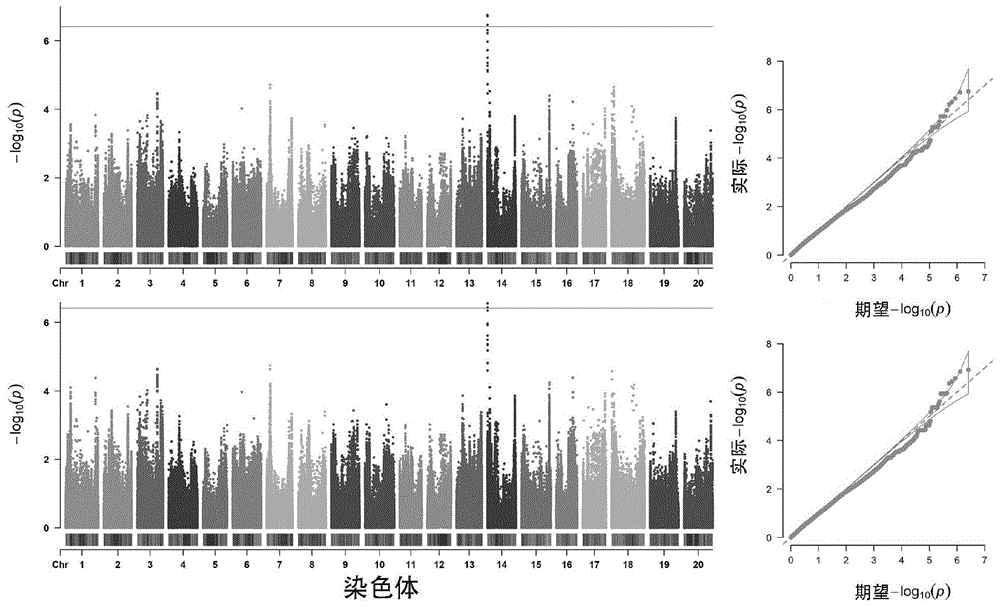
图1.大豆蛋白GWAS结果的曼哈顿及QQ-plot图。A和B分别代表2018和2019年的大豆蛋白GWAS结果的曼哈顿及QQ-plot图,图中红色实线代表显著阈值,-log(p-value)≥6.4。Figure 1. Manhattan and QQ-plot of soy protein GWAS results. A and B represent the Manhattan and QQ-plot of the soy protein GWAS results in 2018 and 2019, respectively. The red solid line in the figure represents the significant threshold, -log(p-value) ≥ 6.4.
图2.KASP标记对不同大豆品种基因分型。Figure 2. KASP markers for genotyping of different soybean varieties.
(靠近原点的黑色圆点代表无模板DNA的空白对照;靠近Y轴的绿色圆点和靠近X轴的蓝色圆点分别代表携带A等位变异位点的大豆品种和携有G等位变异位点的大豆品种)(The black dots near the origin represent the blank control without template DNA; the green dots near the Y-axis and the blue dots near the X-axis represent soybean varieties carrying the A allele mutation site and the G allele mutation site, respectively)
五、具体实施方式V. Specific implementation methods
下面结合附图及实施例对本发明做进一步说明,所用方法如无特别说明,均为常规方法。The present invention is further described below in conjunction with the accompanying drawings and embodiments. The methods used are conventional methods unless otherwise specified.
本发明中大豆蛋白显著关联的SNP,S14_73926是通过下列步骤获得的:The SNP significantly associated with soybean protein in the present invention, S14_73926, was obtained by the following steps:
(1)从1084份大豆种质资源中选出具有代表性的264份(表1),包含52份地方种和212份栽培种,组成了微核心种质资源,进行10×重测序,经过剔除过滤后获得覆盖全基因组的高密度的SNP分子标记图谱。(1) 264 representative soybean germplasm accessions (Table 1), including 52 local species and 212 cultivars, were selected from 1084 soybean germplasm resources to form a mini-core germplasm resource. The mini-core germplasm resource was subjected to 10× resequencing, and a high-density SNP molecular marker map covering the entire genome was obtained after elimination and filtering.
(2)利用凯氏定氮法检测两个环境下(2018和2019年)大豆种子的蛋白含量,利用R语言软件中的GAPIT算法包中的混合线性模型(MLM)对大豆蛋白表型数据进行全基因组关联分析,在2个环境中均能检测到与大豆蛋白显著关联的SNP位点S14_73926,表型变异解释率达到6.4%,位于大豆基因组v2.0的14号染色体73,926bp位置。(2) The protein content of soybean seeds in two environments (2018 and 2019) was detected by Kjeldahl method, and the soybean protein phenotypic data were subjected to genome-wide association analysis using the mixed linear model (MLM) in the GAPIT algorithm package in R language software. The SNP site S14_73926 significantly associated with soybean protein was detected in both environments, with an explanation rate of 6.4% of the phenotypic variation. It was located at the 73,926bp position on chromosome 14 of the soybean genome v2.0.
实施例1:大豆蛋白含量显著关联的核苷酸突变位点(SNP)获得Example 1: Obtaining nucleotide mutation sites (SNPs) significantly associated with soybean protein content
(1)蛋白含量的测定:取烘干的实验室大豆样品充分混匀后,粉碎,籽粒全部通过0.25mm孔径筛,装入样品瓶备用。称取试样0.2g,精确至0.0001g,置于300mL消煮管中。然后依据国标GB 5009.5-2016的方法进行蛋白的测定。(1) Determination of protein content: Take a dried laboratory soybean sample, mix it thoroughly, crush it, and let all the seeds pass through a 0.25 mm sieve. Put it into a sample bottle for later use. Weigh 0.2 g of the sample to an accuracy of 0.0001 g and place it in a 300 mL digestion tube. Then determine the protein content according to the method of national standard GB 5009.5-2016.
(2)DNA提取及高通量测序:采用CTAB法提取264份大豆幼嫩叶片的基因组DNA,进行全基因组重测序。(2) DNA extraction and high-throughput sequencing: The CTAB method was used to extract genomic DNA from 264 young soybean leaves and perform whole-genome resequencing.
(3)全基因组关联分析(GWAS):利用R语言软件中的GAPIT算法包,计算模型为混合线性模型(MLM),GWAS分析检测到与大豆蛋白含量显著关联的SNP位点24个,且均位于14号染色体上(图1),其中与大豆蛋白显著关联的SNP位点S14_73926,表型变异解释率达到6.4%。(3) Genome-wide association study (GWAS): Using the GAPIT algorithm package in the R language software and the mixed linear model (MLM) as the calculation model, GWAS analysis detected 24 SNP sites that were significantly associated with soybean protein content, all of which were located on chromosome 14 (Figure 1). Among them, the SNP site S14_73926 that was significantly associated with soybean protein explained 6.4% of the phenotypic variation.
实施例2:KASP标记特异引物的开发Example 2: Development of KASP marker-specific primers
利用NCBI(https://www.ncbi.nlm.nih.gov/)的Primer-BLAST功能,依据Seq IDNO.1序列设计三个引物,上游引物F1(Seq ID NO.2)、上游引物F2(Seq ID NO.3)和下游引物R(Seq ID NO.4),其中F1和F2分别包含FAM和HEX荧光接头序列(下划线),序列如下:Using the Primer-BLAST function of NCBI (https://www.ncbi.nlm.nih.gov/), three primers were designed based on the Seq ID NO.1 sequence, upstream primer F1 (Seq ID NO.2), upstream primer F2 (Seq ID NO.3) and downstream primer R (Seq ID NO.4), where F1 and F2 contain FAM and HEX fluorescent linker sequences (underlined), respectively, and the sequences are as follows:
F1序列:5’-gaaggtgaccaagttcatgctgttgaagtgagatatggtggacg-3’F1 sequence: 5'- gaaggtgaccaagttcatgct gttgaagtgagatatggtggacg-3'
F2序列:5’-gaaggtcggagtcaacggattgttgaagtgagatatggtggaca-3’F2 sequence: 5'- gaaggtcggagtcaacggatt gttgaagtgagatatggtggaca-3'
R序列:5’-ttccacctcgccattcatcc-3’R sequence: 5’-ttccacctcgccattcatcc-3’
实施例3:检测不同品种大豆SNP位点的基因型及其应用Example 3: Detection of genotypes of SNP sites of different soybean varieties and their applications
分别提取大豆样品的基因组DNA,以基因组DNA为模板,采用KASP标记专用引物在进行PCR扩增,得到PCR扩增产物。PCR扩增是在ABI7500实时荧光定量PCR仪中进行,PCR结束后该仪器根据荧光信号可进行基因分型。所述的扩增体系均为10μl反应体系:大豆样品DNA模板,25ng/μl,2μl;2×KASP Master mix 5μl;KASPAssay Mix,F1:F2:R=2:2:5,0.14μl;水2.9μl。反应条件包括94℃预变性15min;94℃变性20sec,61~55℃退火60sec,每一个循环降低0.6℃,10个循环;94℃变性20sec,55℃退火60sec,26个循环。The genomic DNA of soybean samples was extracted respectively, and PCR amplification was performed using the genomic DNA as a template and KASP-labeled special primers to obtain PCR amplification products. PCR amplification was performed in an ABI7500 real-time fluorescence quantitative PCR instrument. After the PCR was completed, the instrument could perform genotyping according to the fluorescence signal. The amplification system was a 10μl reaction system: soybean sample DNA template, 25ng/μl, 2μl; 2×KASP Master mix 5μl; KASPAssay Mix, F1:F2:R=2:2:5, 0.14μl; water 2.9μl. The reaction conditions included 94℃ pre-denaturation for 15min; 94℃ denaturation for 20sec, 61-55℃ annealing for 60sec, 0.6℃ lowered for each cycle, 10 cycles; 94℃ denaturation for 20sec, 55℃ annealing for 60sec, 26 cycles.
反应完成后,ABI7500实时荧光定量PCR仪直接对PCR反应产物进行荧光数据读取,结果如图2。利用KASP分子标记引物在实时荧光定量PCR仪上对36份大豆材料进行扩增并进行基因分型,结果表明:该分子标记引物可以清楚的将两种基因型分开,其中靠近Y轴的圆点为携带A等位变异位点,基因型为AA,有8份,其平均蛋白含量分别为43.29%(2018年)和45.98%(2019年);靠近X轴的圆点为携带G等位变异位点,基因型为GG,有28份,其平均蛋白含量分别为38.64%(2018年)和41.48%(2019年);靠近XY轴原点的点为空白对照(图2)。另外发现,在包含264份大豆材料的关联分析群体中(有4份材料在SNP S14_73926基因型为缺失),基因型是AA型的21份大豆材料的平均蛋白含量分别为41.85%(2018年)和44.18%(2019年);基因型是GG型的239份大豆材料的平均蛋白含量分别为39.56%(2018年)和42.26%(2019年)。After the reaction is completed, the ABI7500 real-time fluorescence quantitative PCR instrument directly reads the fluorescence data of the PCR reaction product, and the results are shown in Figure 2. The KASP molecular marker primers were used to amplify and genotype 36 soybean materials on the real-time fluorescence quantitative PCR instrument. The results showed that the molecular marker primers can clearly separate the two genotypes. The dots close to the Y axis are the A allele variant sites, the genotype is AA, there are 8 copies, and their average protein contents are 43.29% (2018) and 45.98% (2019), respectively; the dots close to the X axis are the G allele variant sites, the genotype is GG, there are 28 copies, and their average protein contents are 38.64% (2018) and 41.48% (2019), respectively; the points close to the origin of the XY axis are blank controls (Figure 2). It was also found that in the association analysis population containing 264 soybean materials (4 materials were missing in the SNP S14_73926 genotype), the average protein content of 21 soybean materials with AA genotype was 41.85% (2018) and 44.18% (2019), respectively; the average protein content of 239 soybean materials with GG genotype was 39.56% (2018) and 42.26% (2019), respectively.
表1.用于重测序及全基因组关联分析的大豆自然群体名称及编号Table 1. Names and numbers of soybean natural populations used for resequencing and genome-wide association analysis


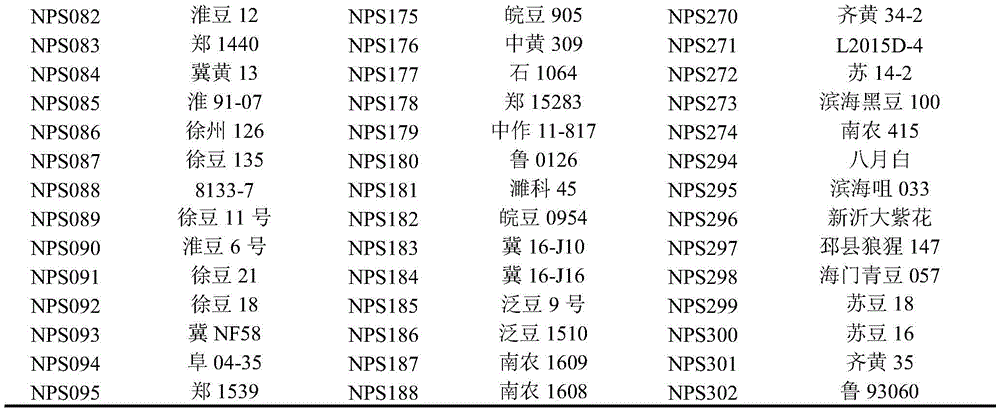
注:以上264份大豆材料以表1中对应的编号形式均出现在公开发表的文献中(Zhang,W.,Xu,W.,Zhang,H.et al.Comparative selective signature analysisandhigh-resolution GWAS reveal a new candidate gene controlling seedweight insoybean.TheorAppl Genet(2021).https://doi.org/10.1007/s00122-021-03774-6)。Note: The above 264 soybean materials appear in publicly published literature in the corresponding numbering format in Table 1 (Zhang, W., Xu, W., Zhang, H. et al. Comparative selective signature analysis and high-resolution GWAS reveal a new candidate gene controlling seed weight in soybean. Theor Appl Genet (2021). https://doi.org/10.1007/s00122-021-03774-6).
序列表Sequence Listing
<110> 江苏省农业科学院<110> Jiangsu Academy of Agricultural Sciences
<120> 与大豆蛋白含量显著关联的单核苷酸突变位点SNP、KASP标记及其应用<120> Single nucleotide mutation site SNP and KASP marker significantly associated with soybean protein content and their application
<141> 2021-04-20<141> 2021-04-20
<160> 4<160> 4
<170> SIPOSequenceListing 1.0<170> SIPOSequenceListing 1.0
<210> 1<210> 1
<211> 179<211> 179
<212> DNA<212> DNA
<213> 大豆(Glycine max)<213> Soybean (Glycine max)
<400> 1<400> 1
gttgaagtga gatatggtgg acgatttggc gaggtggtgg tagggaagac gggttgagga 60gttgaagtga gatatggtgg acgatttggc gaggtggtgg tagggaagac gggttgagga 60
agatagcgtc atatttggta agtaggtgtt ggatttctgg gatggggtgt ggtgttttag 120agatagcgtc atatttggta agtaggtgtt ggatttctgg gatggggtgt ggtgttttag 120
gggtaagggt gaaggaagaa atgggatgaa tggcgaggtg gaacaaggac gacgtggat 179gggtaagggt gaaggaagaa atgggatgaa tggcgaggtg gaacaaggac gacgtggat 179
<210> 2<210> 2
<211> 44<211> 44
<212> DNA<212> DNA
<213> 大豆(Glycine max)<213> Soybean (Glycine max)
<400> 2<400> 2
gaaggtgacc aagttcatgc tgttgaagtg agatatggtg gacg 44gaaggtgacc aagttcatgc tgttgaagtg agatatggtg gacg 44
<210> 3<210> 3
<211> 44<211> 44
<212> DNA<212> DNA
<213> 大豆(Glycine max)<213> Soybean (Glycine max)
<400> 3<400> 3
gaaggtcgga gtcaacggat tgttgaagtg agatatggtg gaca 44gaaggtcgga gtcaacggat tgttgaagtg agatatggtg gaca 44
<210> 4<210> 4
<211> 20<211> 20
<212> DNA<212> DNA
<213> 大豆(Glycine max)<213> Soybean (Glycine max)
<400> 4<400> 4
ttccacctcg ccattcatcc 20
Claims (2)
Priority Applications (1)
| Application Number | Priority Date | Filing Date | Title |
|---|---|---|---|
| CN202110429090.6A CN112877467B (en) | 2021-04-21 | 2021-04-21 | Single nucleotide mutation site SNP, KASP markers significantly associated with soybean protein content and their applications |
Applications Claiming Priority (1)
| Application Number | Priority Date | Filing Date | Title |
|---|---|---|---|
| CN202110429090.6A CN112877467B (en) | 2021-04-21 | 2021-04-21 | Single nucleotide mutation site SNP, KASP markers significantly associated with soybean protein content and their applications |
Publications (2)
| Publication Number | Publication Date |
|---|---|
| CN112877467A CN112877467A (en) | 2021-06-01 |
| CN112877467B true CN112877467B (en) | 2023-06-06 |
Family
ID=76040599
Family Applications (1)
| Application Number | Title | Priority Date | Filing Date |
|---|---|---|---|
| CN202110429090.6A Active CN112877467B (en) | 2021-04-21 | 2021-04-21 | Single nucleotide mutation site SNP, KASP markers significantly associated with soybean protein content and their applications |
Country Status (1)
| Country | Link |
|---|---|
| CN (1) | CN112877467B (en) |
Families Citing this family (14)
| Publication number | Priority date | Publication date | Assignee | Title |
|---|---|---|---|---|
| CN113801953A (en) * | 2021-09-02 | 2021-12-17 | 浙江省农业科学院 | An Indel/SNP Molecular Marker Related to Fragrance Traits of Fresh Soybean and Its Application |
| CN114317798B (en) * | 2021-12-21 | 2023-03-14 | 河北省农林科学院粮油作物研究所 | Molecular marker related to soybean protein content and application thereof |
| EP4456710A1 (en) * | 2021-12-29 | 2024-11-06 | Benson Hill, Inc. | Compositions and methods for producing high-protein soybean plants |
| CN115927653B (en) * | 2022-08-19 | 2025-10-24 | 广西壮族自治区水产科学研究院 | A SNP molecular marker, primer and application for identifying carp body color traits |
| CN115927720B (en) | 2022-09-16 | 2023-10-13 | 江苏省农业科学院 | Soy saponin related KASP (KASP) mark and application thereof |
| CN118256641A (en) * | 2022-09-16 | 2024-06-28 | 江苏省农业科学院 | Soybean oligosaccharide related KASP (KASP) mark and application thereof |
| WO2024168650A1 (en) * | 2023-02-16 | 2024-08-22 | 中国农业科学院作物科学研究所 | Molecular marker combination for soybean genotyping and use thereof |
| CN116751882B (en) * | 2023-06-01 | 2023-12-22 | 江苏省农业科学院 | KASP (KASP sequence identity) marker closely linked with drought tolerance of soybean in germination period and application thereof |
| CN116622888B (en) * | 2023-06-02 | 2024-02-20 | 江苏省农业科学院 | KASP (KASP-related protein) mark related to soybean glutamic acid and application thereof |
| CN116837128A (en) * | 2023-06-09 | 2023-10-03 | 南京农业大学 | SNP molecular marker extremely remarkably related to sucrose content of vegetable soybean seeds and application thereof |
| CN117987592B (en) * | 2024-03-21 | 2024-08-06 | 江苏省农业科学院 | A KASP molecular marker related to soybean main stem node number and its application |
| CN120060539B (en) * | 2025-03-05 | 2025-12-16 | 之江实验室 | Single nucleotide mutation sites (SNPs) and KASP markers significantly associated with soybean 100-seed weight and their applications |
| CN119876474B (en) * | 2025-03-05 | 2026-01-06 | 之江实验室 | Single nucleotide mutation sites (SNPs) and KASP markers significantly associated with soybean plant height and their applications |
| CN120555639B (en) * | 2025-05-28 | 2026-01-06 | 河北省农林科学院粮油作物研究所 | A KASP molecular marker for identifying soybean protein content and its application |
Citations (1)
| Publication number | Priority date | Publication date | Assignee | Title |
|---|---|---|---|---|
| CN108060260A (en) * | 2018-01-29 | 2018-05-22 | 吉林省农业科学院 | SNP marker relevant with soya seeds methionine content, section, primer and application |
Family Cites Families (4)
| Publication number | Priority date | Publication date | Assignee | Title |
|---|---|---|---|---|
| WO2010150901A1 (en) * | 2009-06-22 | 2010-12-29 | 国立大学法人佐賀大学 | Mutant for increasing oleic acid content of soybean oil and fat, and responsible gene therefor |
| AR080376A1 (en) * | 2010-03-03 | 2012-04-04 | Schillinger Genetics Inc | SOY WITH ULTRA LOW TRIPSINE INHIBITOR |
| CN106480089A (en) * | 2016-12-30 | 2017-03-08 | 上海交通大学 | A kind of method improving Semen sojae atricolor sulfur amino acid content and reducing allergen protein |
| CN107988424B (en) * | 2018-01-29 | 2021-03-09 | 吉林省农业科学院 | Molecular markers, intervals, primers and applications related to soybean seed methionine content |
-
2021
- 2021-04-21 CN CN202110429090.6A patent/CN112877467B/en active Active
Patent Citations (1)
| Publication number | Priority date | Publication date | Assignee | Title |
|---|---|---|---|---|
| CN108060260A (en) * | 2018-01-29 | 2018-05-22 | 吉林省农业科学院 | SNP marker relevant with soya seeds methionine content, section, primer and application |
Also Published As
| Publication number | Publication date |
|---|---|
| CN112877467A (en) | 2021-06-01 |
Similar Documents
| Publication | Publication Date | Title |
|---|---|---|
| CN112877467B (en) | Single nucleotide mutation site SNP, KASP markers significantly associated with soybean protein content and their applications | |
| CN113584216B (en) | Development and application of KASP marker of wheat grain weight gene TaCYP78A16 | |
| CN109628627B (en) | Development and application of SNP (single nucleotide polymorphism) marker of broad-spectrum rice blast resistance gene Pigm of rice | |
| CN106967803B (en) | High-throughput molecular marker for detecting fertility restorer gene of radish Ogura-CMS (fertility restorer gene) and application of high-throughput molecular marker | |
| WO2023236840A1 (en) | Snp site closely associated with anthocyanin content in vigna unguiculata, kasp molecular marker primer, and use thereof | |
| CN110541041B (en) | SNP marker related to Chinese domestic horse dwarf trait and application thereof | |
| CN115094156A (en) | Development and application of KASP marker for high temperature tolerance gene TT1 in rice | |
| CN115505648A (en) | Development and application of KASP molecular marker of drought-resistant gene of corn | |
| CN109628628B (en) | Development and application of SNP (single nucleotide polymorphism) marker of rice blast resistance gene Pi2 | |
| CN117646083A (en) | Identification primer and identification method for interspecific hybridization filial generation of dustpan willow and three-core willow | |
| KR102121570B1 (en) | KASP primer set based on SNP for discriminating or classifying Panax ginseng cultivar or resource and uses thereof | |
| CN111424109A (en) | A SNP molecular marker for identifying powdery mildew resistance of melon and its application | |
| CN113584215B (en) | Development and application of KASP marker of wheat powdery mildew resistance gene pmCH7015 | |
| CN114606334A (en) | Development and Application of SNP Molecular Markers for Maize Flowering Stage Gene | |
| CN117286287B (en) | KASP marker of soybean shade tolerance gene GmYUC2 and its application | |
| CN112695114A (en) | SNP molecular marker for detecting rice blast resistance Pik gene and application thereof | |
| CN109022432B (en) | Method for identifying tiller angle traits in wheat and its special primer set | |
| CN116179744B (en) | KASP (KASP-labeled primer combination for detecting orange/yellow flesh color traits of watermelons and application of KASP-labeled primer combination | |
| CN118109634A (en) | A method for identifying mitochondrial DNA fingerprints of melon varieties and purity of hybrids and primer combinations thereof | |
| CN117757973A (en) | A molecular marker related to tomato drought resistance and its application | |
| CN104946748B (en) | General SNP typing probes in a kind of grass | |
| CN117721240B (en) | A molecular marker related to soybean flowering time, KASP primer combination and its application | |
| CN116219060A (en) | Molecular markers related to the length of setae in millet and related biomaterials and applications | |
| CN116590453A (en) | A SNP molecular marker related to the dwarfing traits of lotus plants and its application | |
| CN119876474B (en) | Single nucleotide mutation sites (SNPs) and KASP markers significantly associated with soybean plant height and their applications |
Legal Events
| Date | Code | Title | Description |
|---|---|---|---|
| PB01 | Publication | ||
| PB01 | Publication | ||
| SE01 | Entry into force of request for substantive examination | ||
| SE01 | Entry into force of request for substantive examination | ||
| GR01 | Patent grant | ||
| GR01 | Patent grant |